

FEDERAL COURT OF AUSTRALIA
Oates v Matrix Group Ltd (in liquidation) (Trustee) [2017] FCA 809
ORDERS
DATE OF ORDER: |
THE COURT ORDERS THAT:
1. The amended application for an extension of time and leave to appeal filed on 20 March 2017 is dismissed.
2. The applicant pay the first and second respondents’ costs as agreed or taxed.
Note: Entry of orders is dealt with in Rule 39.32 of the Federal Court Rules 2011.
MARKOVIC J:
1 Tom Michael Oates is a creditor of Matrix Group Limited (in liquidation) as trustee for the Matrix Finance Group Unit Trust (Matrix). Mr Oates seeks an extension of time and leave to appeal from a judgment given on 13 December 2016 pursuant to which the primary judge made orders including, relevantly, Order 2, which dismissed paragraph 1 of his further amended cross-claim: Matrix Group Ltd (in liq) (Trustee) v Oates, in the matter of Matrix Group Ltd (in liq) (Trustee) [2016] FCA 1487 (Matrix v Oates). Mr Oates also seeks an order vindicating his contention that Order 2 made by the primary judge was not interlocutory so that leave to appeal is not required.
2 The respondents to Mr Oates’ application are Matrix as first respondent, Scott Darren Pascoe in his capacity as liquidator of Matrix (Liquidator) as second respondent and the partners of Kemp Strang, the former solicitors for the Liquidator, as third respondent. The partners of Kemp Strang have not taken an active role in this application.
3 Because Matrix is in liquidation Mr Oates requires leave to proceed against it pursuant to s 471B of the Corporations Act 2001 (Cth) (Corporations Act). By the filing of an interlocutory application on 12 April 2017 he has sought that leave. Matrix and the Liquidator have approached this application on the basis that the question of leave to proceed pursuant to s 471B of the Corporations Act would only become relevant in the event that the Court either: made an order granting Mr Oates an extension of time and leave to appeal from the decision in Matrix Group v Oates; or was of the opinion that leave to appeal was not required because Order 2 made by the primary judge was not interlocutory. I too will proceed on that basis.
Background
4 The relevant facts and procedural history are set out at [1] to [15] and [38] to [98] of the primary judge’s decision and have been conveniently summarised by Matrix and the Liquidator in their submissions.
5 Matrix has no assets other than causes of action against former officers and related entities. In summary, they are causes of action to recover more than $17 million in misappropriated assets (Claims).
6 In or about September 2011 Mr Oates and the Liquidator entered into a funding agreement (Oates Funding Agreement) for the purpose of funding the Liquidator to conduct public examinations under ss 596A and 596B of the Corporations Act. The Oates Funding Agreement was approved under s 477(2B) by this Court: Pascoe; in the matter of Matrix Group Ltd (in liq) [2011] FCA 1117.
7 From on or about 10 December 2012 a dispute arose between the Liquidator and Mr Oates in relation to their respective obligations under the Oates Funding Agreement. The Liquidator purported to terminate the Oates Funding Agreement prior to public examinations being conducted and thereafter conducted examinations of six examinees over one week in May 2013 at his own expense. Mr Oates asserts that the Liquidator’s termination of the Oates Funding Agreement was invalid and ineffectual.
8 On 9 July 2015 the Liquidator signed and exchanged a “Letter of Intent – Subject to Contract” dated 3 July 2015 with Harbour Fund III, LP (Harbour). The terms of that letter of intent were adopted for seven separate and additional periods of time by way of seven further letters, the last of which was dated 5 April 2016 (Letters of Intent).
9 In August 2016, after receiving creditor approval to do so, the Liquidator entered into an agreement with Harbour to fund proceedings to pursue the Claims (Harbour Agreement). Mr Oates was one of the creditors who gave approval for entry into the Harbour Agreement.
10 The Harbour Agreement relevantly included a condition precedent at cl 2 which was in the following terms:
2 Conditions Precedent
2.1 This Agreement has no force or effect (other than clauses 2, 7 and 18-28) prior to the following conditions precedent being satisfied or in the case of the condition precedent in clauses 2.1(b), waived by HF3:
…
(d) The Claimant and the Liquidator have either:
(i) obtained an acknowledgment by Oates that satisfies each of the parties that no claim will be made by Oates in respect of any of the parties conducting themselves in accordance with this Agreement, including but not limited to the making and/or receipt of payments in accordance with clause 8; or
(ii) obtained a direction or order from the Court that satisfies each of the parties that no successful claim can be made by Oates in respect of any of the parties conducting themselves in accordance with this Agreement, including but not limited to the making and/or receipt of payments in accordance with clause 8.
2.2 If the conditions precedent in clause 2.1 have not been satisfied or waived by HF3 prior to the Automatic Termination Date, the Agreement automatically terminates.
11 The “Automatic Termination Date” referred to in cl 2.2 was 31 December 2016.
12 In order to satisfy the condition precedent Matrix and the Liquidator commenced a proceeding seeking declarations and directions.
the proceeding before the primary judge
13 The relief sought by Matrix and the Liquidator in their proceeding is set out at [9] of the primary judge’s decision as follows:
By further amended originating process dated 10 November 2016, the liquidator seeks directions under s 479(3) of the Act to the following effect:
(1) that, if and to the extent that the plaintiffs have any remaining obligations under the Oates funding agreement, the liquidator would be justified in treating any payments to Harbour under the Harbour funding agreement as “disbursements in the winding up of the Company, properly and reasonably incurred to date” within the meaning of cl 6.1(a) of the Oates funding agreement;
(2) that, regardless of whether the Oates funding agreement has been validly and effectively terminated by the plaintiffs, the liquidator is justified in proceeding on the basis that:
(a) no term of the Harbour funding agreement is inconsistent with any entitlements of Oates under cl 6.1 of the Oates funding agreement; and
(b) by entering into the Harbour funding agreement, the plaintiffs have not breached cl 7.3 or cl 7.5 of the Oates funding agreement; and
(c) Mr Oates has not made any offer that the plaintiffs were required to accept (subject to the approvals referred to in cl 7.3(c)) under cl 7.3 of the Oates funding agreement;
(3) that the liquidator is justified in entering into the Harbour funding agreement.
14 The orders sought by Matrix and the Liquidator were framed so as to avoid any determination of the question of whether the Oates Funding Agreement had been validly terminated.
15 Mr Oates filed a cross-claim in the proceeding seeking relief against Matrix, the Liquidator and the partners of Kemp Strang. On 13 October 2016 he was granted leave to proceed with the application for relief sought in paragraph 1 of the cross-claim pursuant to s 471B of the Corporations Act. As set out at [11] of Matrix v Oates, Mr Oates sought the following relief in an amended paragraph 1 of his cross-claim, contained in a document titled “Notice of further amended order 1 of cross-claim” (further amended cross-claim):
1A. A declaration that no payment to the [liquidator] “for his fees and disbursements in the winding up of the Company, properly and reasonably incurred to date” under clause 6.1(a) of the Oates Funding Agreement should include (or be made in respect of) any payment to Harbour (or payment obligation to Harbour) under the Harbour Funding Agreement [Issue 1a].
1B. A declaration that the Harbour Funding Agreement is inconsistent with the rights and entitlements of [Mr Oates] under clause 6 of the Oates Funding Agreement [Issue 1b].
1C. A declaration that by entering into the Harbour Funding Agreement and/or the “Letter of Intent” agreements [Matrix, the liquidator and the partners of Kemp Strang] have breached clause 7 of the Oates Funding Agreement [Issue 1c].
1D. A declaration that [Mr Oates] has made an offer that [Matrix and the liquidator] were required to accept under clause 7.3(c) of the Oates Funding Agreement [Issue 1d].
1E. Rectification of the following errors or mistakes on the face of the Oates Funding Agreement as follows:
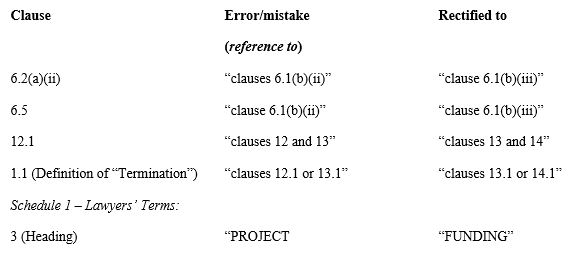
16 The form of the declarations sought by Mr Oates in paragraph 1 of his further amended cross-claim required the Court to determine whether the Oates Funding Agreement had been terminated.
17 By orders made on 13 October 2016 and varied on 24 October 2016 and 10 November 2016 the primary judge ordered pursuant to r 30.01 of the Federal Court Rules 2011 (Rules) that various questions be determined separately and before the other issues in the proceeding. Those questions are set out at [14] of the primary judge’s decision as follows:
1. On the assumption that the Oates funding agreement has not been terminated:
a. whether any payments to Harbour under the Harbour funding agreement would be “disbursements in the winding up of the Company, properly and reasonably incurred to date” within the meaning of clause 6.1(a) of the Oates funding agreement?
b. whether any term of the Harbour funding agreement is inconsistent with any entitlements of Oates under clause 6.1 of the Oates funding agreement?
c. whether, by entering into the Harbour funding agreement or the agreement referred to as the “Letters of Intent”, the plaintiffs have breached clause 7 of the Oates funding agreement?
d. Whether Mr Oates has made any offer that the plaintiffs were required to accept (subject to the approvals referred to in clause 7.3(c)), under clause 7.3 of the Oates funding agreement?
2. Whether the relief sought in the further amended originating process should be granted.
18 The primary judge determined the separate questions and made consequential orders on 13 December 2016. Her Honour answered the separate questions as follows, adopting their numbering:
(a) no;
(b) yes, cl 8.1 of the Harbour Agreement is inconsistent with cl 6.1 of the Oates Funding Agreement;
(c) yes, the plaintiffs have breached cl 7.5 of the Oates Funding Agreement;
(d) no.
19 The orders made by the primary judge included that the further amended originating process filed by Matrix and the Liquidator be dismissed and, as noted at [1] above, that paragraph 1 of Mr Oates’ further amended cross-claim be dismissed. The primary judge refused to make the declarations in the form sought by Mr Oates because “they pre-suppose the continuing operation of the Oates funding agreement, which is disputed”: see Matrix v Oates at [149].
is leave to appeal required?
20 In his amended application for extension of time and leave to appeal Mr Oates seeks leave to appeal from:
The order/decision of the Duty Registrar on or about 29 December 2016 (“Registrar Decision”), rejecting my appeal of the Judgment on the basis that it was interlocutory.
21 Mr Oates refers to paragraph 1A of his draft amended notice of appeal, which he says raises matters that “give rise to sufficient doubt to warrant the Registrar’s Decision be reconsidered by the Full Court”. The effect of paragraph 1A of the draft amended notice of appeal is an allegation by Mr Oates that Order 2 made by the primary judge on 13 December 2016 is final and binding. He asserts that the duty registrar should have accepted his appeal on the basis that it related to “the dismissal of the Appellant’s 1st paragraph of his cross-claim seeking declarations under section 21 of the Federal Court of Australia Act 1976” where, among other things, “the declarations sought by the Appellant and the Respondents … were to be final and binding”.
22 Mr Oates submitted that the matters that were determined on 10 November 2016, the date on which the separate questions were heard, were final and binding. Mr Oates relies on:
(1) an exchange between the primary judge and him on the one hand and counsel appearing for Matrix and the Liquidator on the other on 13 October 2016 as follows:
MR OATES: Could I make a request, then, that their originating process is limited to just directions, not a declaration, because if it's just directions they need in carrying out their duties as a liquidator, that's quite different to a declaration under section 21, I think, of the Federal Court, which is final and binding. I submit that those declarations – and if I need to make an oral or interlocutory application to strike that out, perhaps I will do that, but I submit that that should only be determined when all the other claims are determined in this matter.
HER HONOUR: Why should that be delayed?
MR OATES: I submit that if the court is going to determine things like is the funding agreement on foot, has it been breached, did I have rights to match the offer, were those rights exercised, all of those issues, I submit, should be determined in one go. If it's really just to expedite matters to give the liquidator a direction so he can move forward, then that's a different matter.
HER HONOUR: I think the question of the precise relief that they would be entitled to would have to be something that would be determined at the hearing, but at the moment, it's not clear to me why the precise form of the relief that's sought can't be dealt with separately from the claims that you're describing. Let me just get the application again. So they're seeking a declaration, in the alternative, that they would be justified in treating payments in a particular manner. Mr Scruby, am I correctly summarising the form of the declaration?
MR SCRUBY: That's so. And to avoid any doubt, yes, we want orders that would bind Mr Oates.
HER HONOUR: Yes.
MR SCRUBY: That's why he has been joined.
HER HONOUR: Yes. They do want orders that bind you, but the orders that they're seeking are predicated on an assumption that the funding agreement has not been terminated. I'm sorry, aren't I, Mr Scruby?
MR SCRUBY: That's correct.
HER HONOUR: So they're not seeking a determination that the funding agreement has been terminated. They're seeking limited directions that are for the purpose of enabling them to satisfy the condition precedent in the Harbour funding agreement.
(2) exchanges between the primary judge and him on the one hand and counsel appearing for Matrix and the Liquidator on the other on 24 October 2016 as follows:
MR SCRUBY: We became concerned after considering the matter further that some of the issues that arise on our interlocutory – on our originating process also arise or may arise on some of the claims for relief in Mr Oates' cross-claim. So what we have attempted to do is carve out separate questions and they are simply the questions that arise on our interlocutory process. That's order – that's order 1 or question 1. And then paragraph 2 is, really, just a further question of whether the relief that we seek should be made.
HER HONOUR: So at one point you were wanting to limit it to paragraph 5, but now you've gone back to all of the relief in the originating application?
MR SCRUBY: Yes, yes, yes. So we think it's just a matter of form over substance, but the purpose of it is to ensure that the form of the order that is made for the separate hearing doesn't give rise at some later stage to an assertion that these matters can be relitigated. That's the purpose of it. Now, I'm taking it from Mr Oates' proposed short minutes that he opposes this order 2.
And:
HER HONOUR: … Mr Scruby was saying earlier that one of the things that he wanted to clarify was that these issues would be resolved once and for all, and that would certainly be the only basis on which I would resolve the issues, because it would be a waste of the court's time to resolve them twice.
MR OATES: Yes.
HER HONOUR: And also it would involve the prospect of conflicting judgments. So what are your concerns about these reformulated issues?
MR OATES: Well, your Honour, it's not clear to me, but it seemed to me that the subsequently sent through amended originating process deals with all those issues. And so my understanding was there's no need to revoke the previous orders; that they've tidied up, or they've sought to achieve what they want to, in the amended originating process.
HER HONOUR: I think you're right that the question 2 really duplicates what's in the amended originating process. But what I understand Mr Scruby is trying to achieve by paragraph 1 is to make it clear to you, and to the court, that his client wants a resolution of each of those issues described in paragraph 1, which - - -
…
MR OATES: Okay. I’m sorry. Well, your Honour, on the basis that I can amend just order 1 of the cross-claim to seek equivalent and opposite orders, and have the rectification of those couple of cross-referencing errors, yes, I don’t have an issue, your Honour.
(3) exchanges between the primary judge and him on the one hand and counsel appearing for Matrix and the Liquidator on the other at the hearing of the separate questions on 10 November 2016 as follows:
MR SCRUBY: And we would say, in our case, the issues are primarily – they're matters of construction of two agreements but, in any event, the factual issues have been fully addressed and I won't go to them all but what his Honour did on various issues was make mostly directions and declarations but on some occasions directions only. … Your Honour has separate questions and the answers to those questions are going to determine, one way or the other, issues between the parties.
…
MR SCRUBY: … Now I was going to say something quickly about Mr Oates' proposed – or, rather, the amendments in his cross-claim. I'm content to do that in reply. I was simply going to make this point, your Honour, that the paragraphs in his cross-claim are not premised on the basis that – I withdraw that. They don't allow for the possibility that the Oates' agreement might have been terminated, as we say it has been. For, for example, if your Honour has Mr Oates' amended document l(c) seeks a declaration that by entering into the Harbour funding agreement the cross respondents have breached clause 7.3 and/or 7.5.
HER HONOUR: Yes.
MR SCRUBY: We would submit that order can't be made and, indeed, none of them can because they're – in terms because they appear to be premised on the assumption that the Oates' agreement's on foot. So it's easily cured by adding the same words of qualification that we've got but I simply wanted to make the point that if your Honour is against us then, for example, 1(c) would not follow because your Honour hasn't determined the question of whether the Oates agreement is on foot.
And:
MR OATES: Okay. The next item – your Honour, it was also raised that given that these – the first hearing of these proceedings are on the basis or on the assumption that the Oates' funding agreement is on foot, it hasn't been terminated - - -
HER HONOUR: Yes.
MR OATES: - - - then I accept that it may – if it comes to that, it may be necessary to amend the notice of cross-claim to add those qualifying words that then I accept that it may – if it comes to that, it may be necessary to amend the notice of crossclaim to add those qualifying words that – something along the lines of on the assumption that the Oates' funding agreement has not been terminated.
And can I just make the comment, your Honour, as to the plaintiff’s application under section 4793 (sic) that they should be directed – or the court should direct that they are justified in entering into that agreement. Your Honour, I still do have a difficulty with the hypothetical nature of such an order being based on the Oates’ agreement not having been terminated partly, your Honour, because the plaintiffs do still assert that the Oates’ funding agreement has been terminated and there’s no evidence that that assertion will not continue, your Honour, and to the contrary I think the plaintiffs need the Oates’ funding agreement to be terminated in order to give the reps and warranties under the Harbour funding agreement …
…
MR OATES: And could I just make one other – I perhaps should have mentioned before but I know we're assuming that the Oates funding agreement is on foot but I think tab 2 to the exhibit SPD2 had a whole lot of correspondence on the termination and there was – there's a lot of correspondence missing from that correspondence that I did initially put in an exhibit of my – annexed to my affidavit but, on the basis that the court wasn't addressing that issue, I haven't put that into evidence. So I just raise that – I submit that that's a one-sided presentation of the facts going to termination.
23 Mr Oates submitted that the transcript and the submissions of the Liquidator and Matrix made it clear that all of the issues that were raised and separately determined on 10 November 2016 would be final and binding, including the declarations sought by him in paragraph 1 of his further amended cross-claim. He submitted that the declarations were expressed to refer to each of those issues. Mr Oates referred to the judgment of the High Court in Hall v Busst (1960) 104 CLR 206 (Hall v Busst), submitting that the main issue to be determined by the primary judge was a contractual issue and that, where a question of construction is separated out at trial and findings made, those findings are final.
24 The starting point to consider this issue is s 24(1A) of the Federal Court of Australia Act 1976 (Cth) (Federal Court Act) which provides:
24 Appellate jurisdiction
(1A) An appeal shall not be brought from a judgment referred to in subsection (1) that is an interlocutory judgment unless the Court or a Judge gives leave to appeal.
25 The word “judgment” is defined in s 4 of the Federal Court Act to mean, relevantly, a “judgment, decree or order, whether final or interlocutory”.
26 An appeal is brought from a judgment as defined. The question for the Court is whether Order 2 made by the primary judge was interlocutory or final. That being the case, the Court is not concerned with the answers given by the primary judge to the separate questions. Those answers were, as Matrix and the Liquidator submitted, binding in the sense that the objective in answering them was to set up the parties’ rights in relation to the further litigation that it was anticipated would be conducted. That is reflected in the exchanges upon which Mr Oates relies that are set out above. Those exchanges do not establish, as Mr Oates contended, that Order 2 was final.
27 In N and E Bowder Pty Ltd v Australian Keg Company Pty Ltd (2014) 220 FCR 166 (Bowder) Rangiah J considered an application for leave to appeal against a judgment of a single judge of this Court. There the primary judge had made orders declaring that each of the applicants had infringed the respondent’s patent following a separate trial of the issue of infringement. Damages had not yet been determined. At [8] his Honour referred to the division of authority in this Court as to whether a declaration made in respect of a separate issue which does not dispose of the whole proceeding is interlocutory or final. His Honour noted that there was a long line of authority that held that such a judgment is interlocutory, referring to the judgments of Full Courts of this Court in Australian Builders’ Labourers’ Federated Union of Workers – Western Australian Branch v J-Corp Pty Limited (1993) 42 FCR 452 at 454; NZI Securities Australia Ltd v Poignand (1994) 51 FCR 584 (NZI Securities) at 593-594 and Fraser v NRMA Holdings Limited (1995) 55 FCR 452 (Fraser v NRMA) at 457, among others, which applied the reasoning of the High Court in Computer Edge Pty Ltd v Apple Computer Inc (1984) 54 ALR 767 (Computer Edge) at 767-768.
28 At [9] Rangiah J referred to the opposing view that a declaration made in respect of a separate issue which does not finally dispose of the case is a final judgment, so that leave to appeal is not required, noting that that view was strongly expressed by Finklestein J in Warramunda Village Inc v Pryde (2002) 116 FCR 58 at [65]-[70]. His Honour continued:
… In Ho v Grigor (2006) 151 FCR 236, the Full Court cited those passages from the judgment of Finkelstein J with approval. However, the Full Court was not directly deciding the question addressed by Finkelstein J and its apparent approval of those views appears to be obiter dicta. For present purposes, I consider that I am bound by the earlier Full Court decisions to conclude that the judgment was interlocutory and that leave to appeal is required.
(Emphasis added)
29 NZI Securities was an appeal by leave from part of a judgment in which the primary judge declared, in effect, that the appointment by the second appellant of the third appellant as the receiver of the assets of a company was, in the first instance, invalid. At 593 a Full Court of this Court (Beaumont, Gummow and Carr JJ) referred to the question of leave. Their Honours noted that they granted leave to appeal because the orders made by the primary judge were interlocutory. Their Honours said at 594:
In our opinion, in accordance with the reasoning of the High Court in Computer Edge Pty Ltd v Apple Computer Inc (1984) 54 ALR 767, the orders made at first instance were, for the purposes of s 24(1A) of the Federal Court of Australia Act 1976 (Cth), interlocutory. In a similar situation, in Caboche v Ramsay (1990) 119 ALR 215, Gummow J, with the agreement of Ryan and Lee JJ said (at 225-226):
It was pointed out in the course of argument that, given the terms of orders (2) and (3) set out above and consistently with the reasoning in Computer Edge Pty Ltd v Apple Computer Inc leave to appeal was necessary. None had been sought. Upon the issue thus being ventilated, counsel indicated that leave was not seriously opposed. The case raises some complex substantive issues. Accordingly, leave should be granted in each matter. I should add that the applicability in this court of Apple Computer has been affirmed by the Full Court on numerous occasions, most recently in Australian Builders' Labourers' Federated Union of Workers (WA) Branch v J-Corp Pty Ltd ... These decisions, of course, bind single judges of this Court; cf TAG Pacific Ltd v McSweeney (1992) 34 FCR 438.
We agree.
30 Fraser v NRMA concerned an application for leave to appeal from a declaration and orders made by the primary judge who had heard argument on separate issues raised on the pleadings. At 457 a Full Court of this Court (Black CJ, von Doussa and Cooper JJ) noted that leave was required “because the orders made do not dispose of the whole proceeding brought by the applicants; they are interlocutory in nature”.
31 Finally, Computer Edge, the decision of the High Court on which Bowder and the authorities cited therein were based, concerned an objection to the competency of the appeal. The Full Court of this Court from which the appeal was brought made orders granting permanent injunctive relief, an order that if the appellants wished to pursue claims for damages then they should file and serve notice to that effect on the respondents, whereupon the matter would be referred back to the primary judge, and an order requiring the appellants to bring in short minutes of order to give effect to the Court’s findings on particular issues. Gibbs CJ, with whom Murphy and Wilson JJ agreed, said at 767-768:
… What is plain is that the judgment of that court comprised two orders which, viewed by themselves and apart from the rest of the judgment, were final orders, and one order which was plainly interlocutory. The result of the judgment as a whole was that some of the questions in issue in the case were determined and others were not. The question then is whether a judgment of that kind is a final judgment within the meaning of s 33(4) of the Federal Court of Australia Act, and s 35(3) of the Judiciary Act as they stood at the material time.
The test for determining whether a judgment is final, which has been laid down in a number of cases …, is whether the judgment finally determines the rights of the parties, and the authorities have held that the court in applying the test must have regard to the legal rather than the practical effect of the judgment. So that the question in the present case is whether the whole judgment finally determined, in a legal sense, all the rights of the parties that were at issue in these proceedings. And the answer is, plainly, that it did not, because it left undetermined the question whether any, and what, damages were payable. …
32 Like Rangiah J, I too am bound by the decisions of the Full Court referred to in Bowder. Based on the reasoning in those decisions, the judgment of the primary judge could not be classified as final. Mr Oates sought particular declarations which the primary judge declined to make. That being so, the only order that her Honour could make, and did make, was an order dismissing the paragraph of the further amended cross-claim in which those declarations were sought. That was the only way to dispose of the matters raised by Mr Oates in that paragraph of the further amended cross-claim, her Honour having come to the view that the declarations should not be made. But that did not finally dispose of the matter.
33 As in Computer Edge and the decisions of Full Courts of this Court referred to above, Order 2 made by the primary judge did not finally determine, in a legal sense, all the rights of the parties at issue in the proceeding. It did not finally dispose of the proceeding. In particular, whether the Oates Funding Agreement was validly terminated or remains on foot remains as an issue to be determined between the parties. If the Court ultimately finds that it remains on foot then the answers to the separate questions as determined by the primary judge will follow. If, on the other hand, the Court ultimately finds that the Oates Funding Agreement was validly terminated then the answers to the separate questions as found by the primary judge will not follow. Whatever the outcome, once the issue is finally determined, leaving aside the question of leave to proceed against the company in liquidation pursuant to s 471B of the Corporations Act, the parties will have an appeal as of right on all issues.
34 Hall v Busst does not assist the determination of the question of whether Order 2 is interlocutory or final. There the parties had stated a case for the opinion of a single judge of the Supreme Court of Queensland. The primary judge answered the questions included in the stated case and made an order that the action proceed to trial on the issue of damages. The defendant then appealed to the Full Court of Queensland, which dismissed the appeal. The defendant appealed as of right to the High Court. At 218 Dixon CJ, after addressing the substantive issues in the appeal, noted that an objection was taken to the competency of the appeal on the ground that the order appealed from was interlocutory. His Honour was of the opinion that the order was intended as a judgment for the plaintiff for damages to be assessed and therefore that it was “final in the sense that word bears in s 35(1)(a)(2) of the Judiciary Act 1903-55 (Cth)”.
35 But that case was different to the present case. Dixon CJ was considering whether the appeal to the High Court was competent by reference to the Judiciary Act 1903-55 (Cth) in its then form which governed appeals to that Court. The governing legislation for appeals in this Court is the Federal Court Act and the applicable principles are as have been identified in the line of authority referred to above. That line of authority has expressly considered the provisions relating to appeals in this Court.
36 In my opinion Order 2 made by the primary judge is interlocutory. Mr Oates needs leave to appeal.
Extension of time
37 Mr Oates seeks an extension of time within which to file his application for leave to appeal. That is because, the orders of the primary judge being interlocutory, the application for leave to appeal should have been filed within 14 days after the date on which the judgment was pronounced or the order was made: r 35.13 of the Rules. The application for leave to appeal was not so filed. Matrix and the Liquidator do not oppose the grant of an extension of time to seek leave to appeal.
38 Mr Oates has filed an affidavit affirmed by him on 20 January 2017 in support of his application for an extension of time. In that affidavit Mr Oates deposes to the following matters by way of explanation for the late filing of his application for leave to appeal:
(1) he was not present in court when the primary judge gave judgment and made orders in Matrix v Oates;
(2) on 28 December 2016 Mr Oates filed a notice of appeal from the judgment and orders made in Matrix v Oates, but on 29 December 2016 that notice of appeal was rejected for filing by the Court. An email from eLodgement_admin@fedcourt.gov.au stated, among other things, that “[a]s per the Registrar’s instruction, the judgment delivered on 13 December was interlocutory. Leave to Appeal is required”;
(3) on 29 December 2016 Mr Oates sent an email to the Court querying whether the primary judge’s judgment was interlocutory. That email included the following:
The judgment is not expressed to be interlocutory and there were indications from her Honour and the parties during the trial that the orders were to be final and binding.
I was also excused from being in Court when her Honour’s judgment was handed down so if something was said then, I wasn’t present to hear it.
I was at no time made aware that the judgment was interlocutory and I have lodged my appeal on the basis that it wasn’t interlocutory in nature (ie that I had 21 days to appeal).
I’m going away to America for 2 weeks in the morning (till the 19th of January) and it is very difficult to now deal with this issue.
I have also just looked up the rules and normally one only has 14 days to seek leave to appeal an interlocutory decision.
Can you please reconsider the appeal I have lodged and not immediately reject it, in case there has been a mistake.
(4) later on 29 December 2016 Mr Oates sent a further email to the Court in which he referred to s 24(1E) of the Federal Court Act. He noted that “[o]n the basis that the registrar confirms that her Honour’s judgment dated 13 December 2016 was an interlocutory judgment, section 24(1E)(a) appears to provide that I can appeal from that interlocutory judgment when a final judgment is given in the proceeding” and that “[o]n that basis, I am content for my appeal to be rejected”. Mr Oates asked that if there was any uncertainty about the nature of the primary judge’s judgment then could any appeal “be held in the system pending resolution of this issue (ie until [he] return[ed] on the 19th of January)?”;
(5) on 30 December 2016 Ms Shehata, a senior coordinator from the Court’s registry services, sent an email to Mr Oates in which she said:
Thank you for your email. I forwarded both emails to the Duty Registrar and I will let you know once I hear back from him.
Also for your information, under the Federal Court Rules (Rule 1.61), when an Appeal/Leave to Appeal is being filed, the period between 24 December to 14 January is not counted. So, if a Notice of Appeal is to be re-filed (as it’s already been rejected under the Registrar’s instructions), your last date for filing it will be 25 January 2017. If Leave to Appeal is required, then your last day to file it will be 18 January 2017.
(6) later on 30 December 2016 Ms Shehata sent an email to Mr Oates on behalf of the duty registrar in which she said:
Because of the Court Vacation, the time for filing an application for leave to appeal an interlocutory judgment is automatically extended. In relation to the judgment given in NSD 1507/2016 on 13 December 2016, an application for leave to appeal must now be filed by 18 January 2017. After that date, a concurrent application for extension of time will need to be made.
The Registrar was of the view that the judgment was interlocutory having regard to Order 2 of 13 October 2016 … and paragraph 153 of [the primary judge’s] Reasons for Judgment given on 13 December 2016.
(7) Mr Oates was overseas from 30 December 2016 until 19 January 2017.
39 On an application for an extension of time the Court will consider whether the delay has been adequately explained and the likelihood of leave to appeal being granted. The latter question is, in this case, intimately connected to a determination of Mr Oates’ application for leave to appeal, such that the considerations are the same.
40 In my opinion, Mr Oates has adequately explained the delay in filing his application for leave to appeal. Mr Oates was of the view that he had an appeal as of right. Indeed, that has remained his view. Mr Oates was informed of the duty registrar’s opinion that Order 2 made by the primary judge was interlocutory prior to the expiration of the period within which an application for leave to appeal had to be filed, but he only received that opinion on the day he was leaving for a holiday overseas. Mr Oates returned to Australia on 19 January 2017 and filed his application for an extension of time and leave to appeal on 23 January 2017. In light of Mr Oates’ explanation and the fact that he is not legally represented I am satisfied with the explanation provided.
41 That then leaves the question of Mr Oates’ prospects on the application for leave to appeal. That issue is addressed below in connection with my consideration of whether leave to appeal should be allowed.
Should leave to appeal be allowed?
42 The principles to be applied in determining whether leave to appeal should be granted are settled. There are two requirements that need to be satisfied. First, the judgment the subject of the application must be attended with sufficient doubt to warrant it being reconsidered on an appeal. Secondly, the Court must be satisfied that substantial injustice would result if leave were refused, assuming the decision to be wrong: see Decor Corporation Pty Ltd v Dart Industries Inc (1991) 33 FCR 397 at 398-399.
43 Mr Oates has annexed a draft amended notice of appeal to his amended application for extension of time and leave to appeal. In his draft amended notice of appeal Mr Oates says that he appeals from Order 2 and from parts or the whole of 20 specified paragraphs of the primary judge’s reasons for judgment. The draft amended notice of appeal is lengthy and I do not propose to set it out in full in these reasons, but it is relevant to note that under the heading “Order 2 and/or Further or Other Orders” Mr Oates says that:
(1) the primary judge erred in making Order 2;
(2) the primary judge should have made the orders that he sought in all or some of paragraph 1 of his further amended notice of cross-claim:
(a) subject to qualification, namely, “on the assumption that the Oates Funding Agreement has not been terminated”, because that was the basis upon which the case was run; because that is consistent with Order 2 of the orders made by the primary judge; or because that was raised in the submissions and at the hearing on 10 November 2016;
(b) in a form that was consistent with the above, s 37M of the Federal Court Act or r 1.32 of the Rules; or
(c) in relation to cl 6 of the Oates Funding Agreement, on the basis that in accordance with cl 5.3 of the Oates Funding Agreement, the obligation to pay Oates from any Resolution Sum survives any alleged termination;
(3) alternatively, pursuant to order 1G of the further amended notice of cross-claim or otherwise, the primary judge should have made the “further or other order” that “[n]otwithstanding order 2, the Court makes the following declarations under section 21(1) of the Federal Court of Australia Act 1976 (Cth), on the assumption the Oates Funding Agreement has not been terminated. [declarations A-D]” (original emphasis); and
(4) alternatively, for the reasons set out above and consistent with her Honour’s reasons, pursuant to order 1G of the further amended notice of cross-claim or otherwise, the primary judge should have made “further or other orders” specified by Mr Oates in his draft amended notice of appeal “[o]n the assumption the Oates Funding Agreement has not been terminated”.
44 The balance of the draft amended notice of appeal addresses specific paragraphs of the primary judge’s reasons, setting out how it is that in relation to the findings made in those paragraphs the primary judge is alleged to have erred.
45 Mr Oates raised two issues in relation to the decision in Matrix v Oates. First, he submitted that the primary judge, having answered the separate questions largely in his favour, should have then made declarations in the form he sought in paragraph 1 of the further amended cross-claim. Secondly, he submitted that the primary judge is now bound by the findings that she made in her judgment and that, when her Honour then determines his application for leave to proceed pursuant to s 471B of the Corporations Act in relation to the further amended cross-claim, those findings will be relevant to that application and, as some of them are incorrect, Mr Oates will be prejudiced.
46 Mr Oates submitted that his appeal had merit. He contended that there were a number of errors in the primary judge’s decision. In oral submissions Mr Oates focused on an alleged error relating to a finding by the primary judge at [57] that the Letters of Intent ceased to have effect on 30 April 2016. He submitted that it was only the exclusivity period which ended on that date and that the balance of the obligations imposed on Matrix and the Liquidator continued for 90 days from 6 April 2016. Mr Oates submitted that this was important because in May 2016 Harbour made an offer to fund the proceedings, the Liquidator provided that offer to him and he made a counter offer. Mr Oates contended that “all of [the primary judge’s] findings” were based on her finding at [57] that, during that critical time in May, June and July 2016, the binding agreement in the Letters of Intent was not in effect when in fact it was.
47 When asked which particular findings relied on the finding at [57] Mr Oates referred to the finding at [15(d)] of her Honour’s decision. That paragraph records her Honour’s answer to question 1(d) of the separate questions. It was one of two questions which the primary judge did not answer in Mr Oates’ favour, the other being part of question 1(c), but only in relation to the agreement referred to as the “Letters of Intent”.
48 In relation to the Letters of Intent, in his written submissions Mr Oates takes issue with the primary judge’s finding at [143] that she did not accept “that the mere acceptance of the letters of intent involved any breach of cl 7”. Mr Oates submitted that her Honour should have found that the “proposal to offer litigation funding” set out in the Letters of Intent breached cll 7.4 and/or 7.5 of the Oates Funding Agreement, on the assumption that the Oates Funding Agreement was not validly terminated. Mr Oates also submitted that her Honour failed to give reasons for her finding in [143].
49 There is, as I have already observed, a live issue between Matrix and the Liquidator on the one hand and Mr Oates on the other as to whether the Oates Funding Agreement has been validly terminated. The separate questions which were determined by the primary judge proceeded on an assumption that the Oates Funding Agreement had not been terminated. Her Honour refused to make the declarations sought by Mr Oates in [1] of the further amended cross-claim because they presupposed the continuing operation of the Oates Funding Agreement, which is disputed: Matrix v Oates at [149]. That was the case and, in the circumstances, was a proper approach by the primary judge.
50 In his draft amended notice of appeal Mr Oates seeks to have declarations made “on the assumption that the Oates Funding Agreement has not been terminated”. That was not the form of declarations sought by Mr Oates in the further amended cross-claim that was before the primary judge.
51 At the hearing before the primary judge one of the issues was whether the Court had power to make the declarations sought by Matrix and the Liquidator. In their written submissions relied on before the primary judge Matrix and the Liquidator addressed the Court’s jurisdiction under s 479(3) of the Corporations Act and its jurisdiction to grant declaratory relief under s 21 of the Federal Court Act. In summary, they submitted that the declarations they sought were not hypothetical but dealt with past conduct and with the parties’ rights irrespective of the status of the Oates Funding Agreement. They submitted that the declarations determined an existing controversy between the parties.
52 In his written submissions relied on before the primary judge Mr Oates took issue with almost all of the submissions made by Matrix and the Liquidator. That included the submissions made that the Court had power to make the declarations sought by Matrix and the Liquidator. Mr Oates submitted that the declarations sought by Matrix and the Liquidator were hypothetical in that they “assume the Oates Agreement is on foot, while the Plaintiffs assert and will continue to assert that it has been terminated”.
53 At the hearing before the primary judge counsel for Matrix and the Liquidator on the one hand and Mr Oates on the other made the submissions set out at [22(3)] above concerning the form of any declarations. It is clear that Mr Oates maintained his position that the declarations sought by Matrix and the Liquidator were hypothetical because they were premised on the assumption that the Oates Funding Agreement had not been terminated. Mr Oates did not seek to amend the form of the declarations sought in paragraph 1 of his further amended cross-claim despite the submission he made at the hearing on 10 November 2016.
54 What Mr Oates now seeks to do is to argue on appeal that the primary judge made an error by not inserting the words “on the assumption that the Oates Funding Agreement has not been terminated” into the declarations sought by Mr Oates. The question that then arises is whether the primary judge should have taken the step of adding those words and making the declarations sought by Mr Oates. Her Honour did not do that, but it is difficult to see how, given the way the matter proceeded before her, there could be any error on the part of the primary judge in not taking that further step.
55 Turning then to consider the two questions that her Honour did not answer in favour of Mr Oates: part of question 1(c) and question 1(d). It is convenient to first consider question 1(d), which was whether Mr Oates made an offer which Matrix and the Liquidator were required to accept under cl 7.3 of the Oates Funding Agreement.
56 The primary judge considered this question at [144]-[148] of her decision. She noted that Mr Oates relied on an offer made on 24 May 2016, which he argued matched or bettered the substantive terms of an offer of funding that Matrix and the Liquidator wished to accept. The primary judge did not accept that Mr Oates’ 24 May 2016 offer was an offer that Matrix and the Liquidator were required to accept under cl 7.3 of the Oates Funding Agreement. Her Honour set out three reasons for that conclusion. One reason was that the circumstances in which cl 7.3 would operate had not arisen at the time of the 24 May 2016 offer because there had been no invitation to Mr Oates to submit an offer to fund the proposed proceedings in accordance with cl 7.2 and because there had been no offer of funding from Mr Oates of the kind contemplated by the introductory words of cl 7.3: Matrix v Oates at [146].
57 That conclusion was based on a finding made by her Honour at [61] of her decision, declining to draw the inference urged by Matrix and the Liquidator that an invitation had been made to Mr Oates to submit an offer to fund proceedings for the purposes of cl 7.2 of the Oates Funding Agreement. In order to understand the finding it is convenient to set out [60] to [61] of Matrix v Oates in full:
60 On 10 July 2015, Henry Davis York, lawyers (“HDY”), then acting for Mr Oates, wrote to Kemp Strang, lawyers, who were then acting for the liquidator, referring to the conversation between Mr Oates and Mr Livingstone. HDY requested information to permit HDY to advise Mr Oates “in relation to the proposed funding of the contemplated proceedings”. The letter indicated that Mr Oates sought an opportunity to “further contribute in this matter, including by way of matching any other offers of funding”. The letter concluded:
This request is made pursuant to the general rule that all significant creditors must be given an opportunity to join in funding recovery claims, the law relating to section 564 of the Corporations Act 2001 and the terms of the Funding Agreement between our respective clients dated 6 September 2011, in particular clauses 7, 9 and 11.2.
61 The liquidator submitted that the Court should infer (from the language of the letter) that, in the conversation which led to the 10 July 2015 letter, Mr Livingstone had made an invitation to Mr Oates to submit an offer to fund proceedings for the purposes of cl 7.2 of the Oates funding agreement. By this time, the liquidator had purported to terminate the Oates funding agreement. In the absence of any specific references to such an invitation in the 10 July 205 (sic) letter, or evidence from Mr Livingstone, I do not draw the inference sought by the liquidator.
58 In his draft amended notice of appeal Mr Oates does not take issue with the finding at [61]. Indeed, he seems to embrace that finding in his amended cross-claim, a copy of which was provided to me in the course of argument. At paragraphs 178 to 179 of his amended cross-claim Mr Oates alleges that in or about 2015 Matrix and/or the Liquidator decided to commence or take steps to commence proceedings against certain persons and that, in breach of cl 7.2 of the Oates Funding Agreement, Matrix and/or the Liquidator “failed to invite Mr Oates to submit an offer to fund those Proceedings”.
59 The primary judge addressed question 1(c) at [136] to [143] of her decision. She considered the Letters of Intent at [143], noting that Mr Oates did not make any specific submissions about them and finding that she did not accept that the mere acceptance of the Letters of Intent involved any breach of cl 7.
60 Clause 7.4 of the Oates Funding Agreement provides that Matrix and the Liquidator will ensure that “insofar as their dealings with any other potential funder are concerned there is no limitation or impediment to their complying with cl 7.3(a) above”. Clause 7.3(a) provides:
7.3 If, in addition to any offer of funding from Oates, the [Liquidator] or [Matrix] receives an offer of funding for the Proceedings from another party and the [Liquidator] or [Matrix] wishes to accept such offer in preference to Oates’ offer, then:
(a) the [Liquidator] and [Matrix] must first provide Oates with a summary of the terms of the other offer;
61 Mr Oates alleges in his amended cross-claim that the Letters of Intent entered into with Harbour breached the obligation in cl 7.4. At [58] the primary judge set out part of the Letters of Intent titled “Exclusivity” which it is alleged amounted to the breach. In particular, that part of the Letters of Intent included the following:
During the Exclusivity Period you will not enter into or continue any existing discussions or otherwise encourage anyone to consider or make an alternative proposal with respect to funding your claim.
62 At [59] to [74] the primary judge set out the dealings between the parties after entry into the Letters of Intent. Relevantly, her Honour noted that:
(1) a draft “Common Interest & Confidentiality Deed” between Mr Oates and the Liquidator was provided to Mr Oates’ solicitor;
(2) there was then further communication about a confidentiality regime and the basis upon which documents might be shared in relation to a possible new funding agreement involving, among others, Harbour;
(3) further correspondence was exchanged between Mr Oates’ solicitor and the Liquidator’s solicitor in relation to a number of issues including a stated desire by Mr Oates to put a “compromise … vis-à-vis the funding proposal / proposed funding agreement so as to address and resolve [Mr Oates’s] existing funding agreement”; a draft deed of settlement and release between Matrix, the Liquidator and Mr Oates proposed by the Liquidator; and the provision of a working draft of the funding agreement with Harbour by the Liquidator; and
(4) the Liquidator provided two alternative versions of draft funding agreements with Harbour together with two separate settlement proposals with Mr Oates.
63 It is clear from this chronology of events that, notwithstanding the exclusivity period contained in the Letters of Intent, there were continued dealings between the Liquidator and Mr Oates as contemplated by cl 7 of the Oates Funding Agreement. At [143] the primary judge simply found that the mere fact of signing the Letters of Intent did not amount to a breach of the Oates Funding Agreement. That is, whether there is a breach would depend on the subsequent conduct of the parties. In those circumstances there is no error in the primary judge’s approach.
64 Mr Oates also alleged that the primary judge misinterpreted the Letters of Intent and the date upon which they ceased to have effect. However, whether that was the case or not has no impact on the issue that was determined by the primary judge, namely, whether by entering into the Letters of Intent Matrix and the Liquidator breached cl 7 of the Oates Funding Agreement.
65 In my opinion, in light of the matters set out above, the primary judge’s decision is not attended with sufficient doubt to warrant it being reconsidered on an appeal.
66 That then leaves the question of whether substantial injustice would result if leave were refused, assuming the decision to be wrong. I would also answer that question in the negative. Mr Oates can pursue his claims for damages before the primary judge, subject to obtaining leave to proceed pursuant to s 471B of the Corporations Act. If he is successful in that claim then he will not need declarations of any kind. If he is not successful then he can appeal as of right against the orders finally made at the conclusion of the proceeding, again subject to a grant of leave to proceed against the company in liquidation and its liquidator.
67 Further, s 24(1E) of the Federal Court Act relevantly provides that the fact that there has been or can be no appeal from an interlocutory judgment of the Court in a proceeding does not prevent a party from founding an appeal from a final judgment in the proceeding on an interlocutory judgment. Thus, it will be open to Mr Oates to bring an appeal at the conclusion of the proceeding in relation to the orders made by the primary judge on 13 December 2016.
68 Finally, Matrix and the Liquidator submitted that Mr Oates’ claims depend on a trial judge ultimately accepting that the Oates Funding Agreement was not validly terminated by the Liquidator and that there is no utility in Mr Oates pursuing an appeal in advance of that issue being decided. They further submitted that, if the termination issue is determined adversely to Mr Oates, any orders made on an appeal at this point in the litigation would be made on a false basis. I accept those submissions.
Conclusion
69 It follows from the conclusions I have reached that it is not necessary for me to consider Mr Oates’ application for leave to proceed pursuant to s 471B of the Corporations Act. It also follows that orders should be made dismissing Mr Oates’ application for an extension of time and leave to appeal and that Mr Oates should be ordered to pay Matrix’s and the Liquidator’s costs. I will make orders accordingly.
I certify that the preceding sixty-nine (69) numbered paragraphs are a true copy of the Reasons for Judgment herein of the Honourable Justice Markovic. |


