

FEDERAL COURT OF AUSTRALIA
Anderson on behalf of the Wulli Wulli People v State of Queensland (No 4) [2017] FCA 800
ORDERS
DATE OF ORDER: |
BEING SATISFIED that an order in the terms set out below is within the power of the Court, and it appearing appropriate to the Court to do so, pursuant to s 87 of the Native Title Act 1993 (Cth)
THE COURT ORDERS BY CONSENT THAT:
1. There be a determination of native title in the terms set out below (the determination).
2. Each party to the proceedings is to bear its own costs.
THE COURT DETERMINES BY CONSENT THAT:
3. The Determination Area is the land and waters described in Schedule 1, and depicted in the map in Schedule 1. To the extent of any inconsistency between the written description and the map, the written description prevails.
4. Native title exists in relation to the Determination Area described in Parts 1 and 2 of Schedule 1.
5. The native title is held by the Wulli Wulli People described in Schedule 3 (the native title holders).
6. Subject to paragraphs 8, 9 and 10 below the nature and extent of the native title rights and interests in relation to the land and waters described in Part 1 of Schedule 1 are:
(a) other than in relation to Water, the right to possession, occupation, use and enjoyment of the area to the exclusion of all others; and
(b) in relation to Water, the non-exclusive rights to:
(i) hunt, fish and gather from the Water of the area;
(ii) take and use the Natural Resources of the Water in the area; and
(iii) take and use the Water of the area,
for personal, domestic and non-commercial communal purposes.
7. Subject to paragraphs 8, 9 and 10 below the nature and extent of the native title rights and interests in relation to the land and waters described in Part 2 of Schedule 1 are the non-exclusive rights to:
(a) access, be present on, move about on and travel over the area;
(b) camp, and live temporarily on the area as part of camping, and for that purpose build temporary shelters;
(c) hunt, fish and gather on the land and waters of the area for personal, domestic and non-commercial communal purposes;
(d) take, use, share and exchange Natural Resources from the land and waters of the area for personal, domestic and non-commercial communal purposes;
(e) take and use the Water of the area for personal, domestic and non-commercial communal purposes;
(f) conduct ceremonies on the area;
(g) be buried and bury native title holders within the area;
(h) maintain places of importance and areas of significance to the native title holders under their traditional laws and customs and protect those places and areas from physical harm;
(i) teach on the area the physical and spiritual attributes of the area;
(j) hold meetings on the area; and
(k) light fires on the area for domestic purposes including cooking, but not for the purpose of hunting or clearing vegetation.
8. The native title rights and interests are subject to and exercisable in accordance with:
(a) the Laws of the State and the Commonwealth; and
(b) the traditional laws acknowledged and traditional customs observed by the native title holders.
9. The native title rights and interests referred to in paragraphs 6(b) and 7 do not confer possession, occupation, use or enjoyment to the exclusion of all others.
10. There are no native title rights in or in relation to minerals as defined by the Mineral Resources Act 1989 (Qld) and petroleum as defined by the Petroleum Act 1923 (Qld) and the Petroleum and Gas (Production and Safety) Act 2004 (Qld).
11. The nature and extent of any other interests in relation to the Determination Area (or respective parts thereof) are set out in Schedule 4.
12. The relationship between the native title rights and interests described in paragraphs 6 and 7 and the other interests described in Schedule 4 (the “other interests”) is that:
(a) the other interests continue to have effect, and the rights conferred by or held under the other interests may be exercised notwithstanding the existence of the native title rights and interests;
(b) to the extent the other interests are inconsistent with the continued existence, enjoyment or exercise of the native title rights and interests in relation to the land and waters of the Determination Area, the native title continues to exist in its entirety but the native title rights and interests have no effect in relation to the other interests to the extent of the inconsistency for so long as the other interests exist; and
(c) the other interests and any activity that is required or permitted by or under, and done in accordance with, the other interests, or any activity that is associated with or incidental to such an activity, prevail over the native title rights and interests and any exercise of the native title rights and interests.
DEFINITIONS AND INTERPRETATION
13. In this determination, unless the contrary intention appears:
“land” and “waters”, respectively, have the same meanings as in the Native Title Act 1993 (Cth);
“Laws of the State and the Commonwealth” means the common law and the laws of the State of Queensland and the Commonwealth of Australia, and includes legislation, regulations, statutory instruments, local planning instruments and local laws;
“Local Government Act” has the meaning in the Local Government Act 2009 (Qld);
“Local Government Area” has the meaning in the Local Government Act 2009 (Qld);
“Natural Resources” means:
(a) any animal, plant, fish and bird life found on or in the lands and waters of the Determination Area; and
(b) any clays, soil, sand, gravel or rock found on or below the surface of the Determination Area,
that have traditionally been taken and used by the native title holders, but does not include:
(a) minerals as defined in the Mineral Resources Act 1989 (Qld) or petroleum as defined in the Petroleum Act 1923 (Qld) and the Petroleum and Gas (Production and Safety) Act 2004 (Qld);
“Reserve” means a reserve dedicated or taken to be a reserve under the Land Act 1994 (Qld);
“Water” means:
(a) water which flows, whether permanently or intermittently, within a river, creek or stream; and
(b) any natural collection of water, whether permanent or intermittent.
Other words and expressions used in this Determination have the same meanings as they have in Part 15 of the Native Title Act 1993 (Cth).
THE COURT DETERMINES THAT:
14. The native title is held in trust.
15. The Wulli Wulli Nation Aboriginal Corporation (ICN: 8263), incorporated under the Corporations (Aboriginal and Torres Strait Islander) Act 2006 (Cth), is to:
(a) be the prescribed body corporate for the purpose of ss 56(2)(b) and 56(3) of the Native Title Act 1993 (Cth); and
(b) perform the functions mentioned in s 57(1) of the Native Title Act 1993 (Cth) after becoming a registered native title body corporate.
LIST OF SCHEDULES
Schedule 1 – DETERMINATION AREA vii
Schedule 2 – AREAS NOT FORMING PART OF THE DETERMINATION AREA xii
Schedule 3 – NATIVE TITLE HOLDERS xiii
Schedule 4 – OTHER INTERESTS IN THE DETERMINATION AREA xiv
Schedule 1 – DETERMINATION AREA
A. Description of Determination Area
The Determination Area comprises all of the land and waters described in Parts 1 and 2 below, and depicted in the map, excluding the areas described in Schedule 2.
Part 1 - Exclusive Native Title Areas:
(a) All of the land and waters described in the following table and depicted in dark blue on the determination map:
Area Description (at date of determination) | Determination map reference |
Lot 32 on MPH22181* | Sheet 2 |
Lot 106 on MPH14020* | Sheet 2 |
Lot 211 on MPH14019* | Sheet 2 |
Lot 212 on MPH14019* | Sheet 2 |
Lot 224 on MPH14019* | Sheet 2 |
Lot 242 on MPH14019* | Sheet 2 |
Lot 49 on MPH14019* | Sheet 2 |
Lot 3 on DW542* | Sheet 2 |
Lot 4 on DW542* | Sheet 2 |
Lot 5 on DW542* | Sheet 2 |
Lot 6 on DW542* | Sheet 2 |
Lot 7 on DW542* | Sheet 2 |
Lot 158 on MPH14019* | Sheet 2 |
Lot 336 on MPH117* | Sheet 2 |
Lot 124 on MPH14020* | Sheet 2 |
Lot 43 on MPH22181* | Sheet 2 |
Lot 45 on MPH22181* | Sheet 2 |
Lot 46 on MPH22181* | Sheet 2 |
Lot 47 on MPH22181* | Sheet 2 |
Lot 326 on MPH115* | Sheet 2 |
Lot 38 on MPH14020* | Sheet 2 |
Lot 279 on SP104416* | Sheet 1 |
Lot 11 on USL36832* | Sheet 1 |
Lot 493 on DW218* | Sheet 1 |
Lot 497 on AP15544* | Sheet 1 |
Lot 542 on DW549* | Sheet 1 |
*denotes areas to which s 47B of the Native Title Act 1993 (Cth) applies
Part 2 - Non-Exclusive Native Title Areas:
(a) All of the land and waters described in the following table and depicted in light blue on the determination map:
Area Description (at date of determination) | Determination map reference |
Lot 1 on SP179686* | Sheet 1 |
*denotes an area to which s 47B of the Native Title Act 1993 (Cth) applies
B. Map of Determination Area
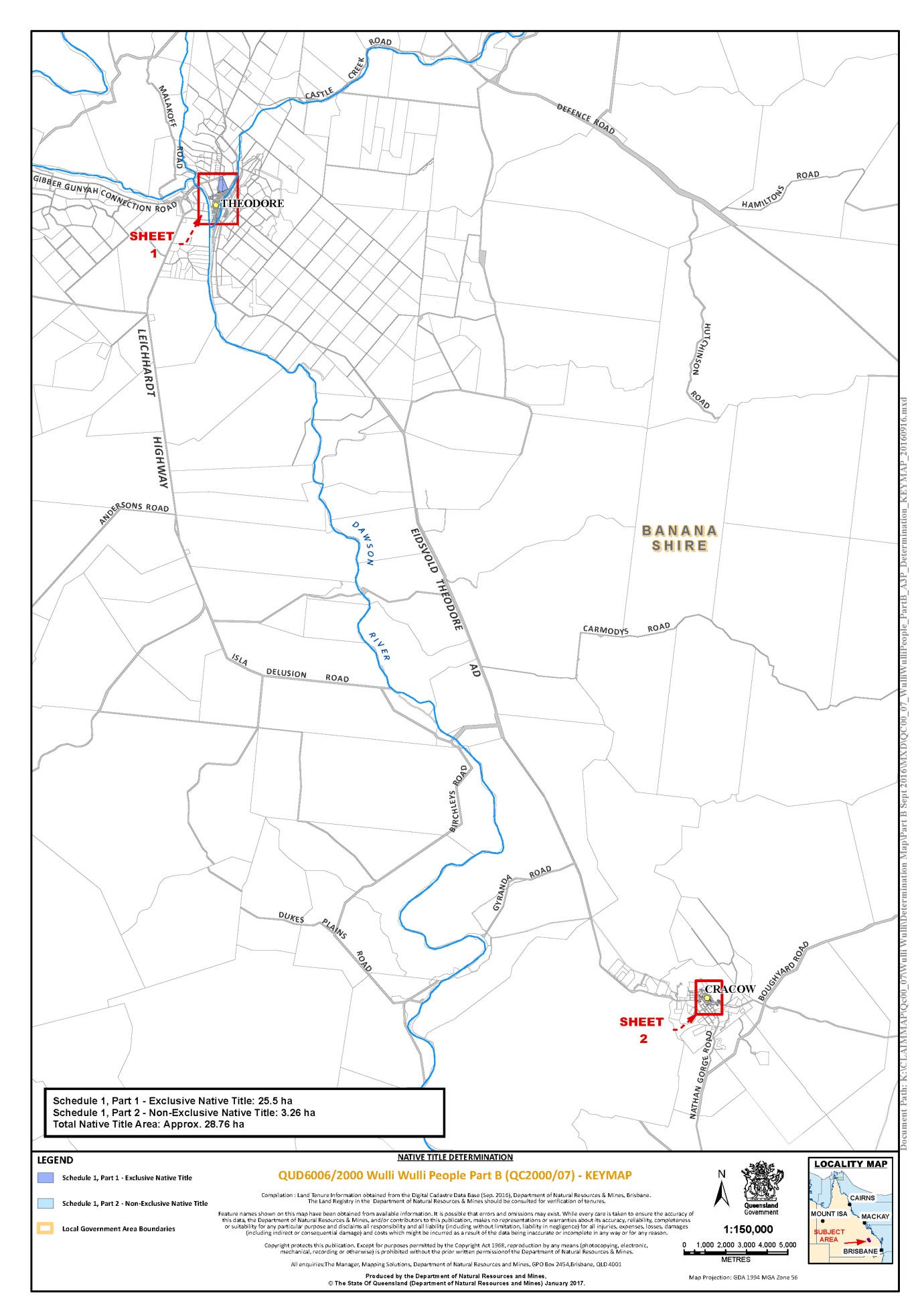
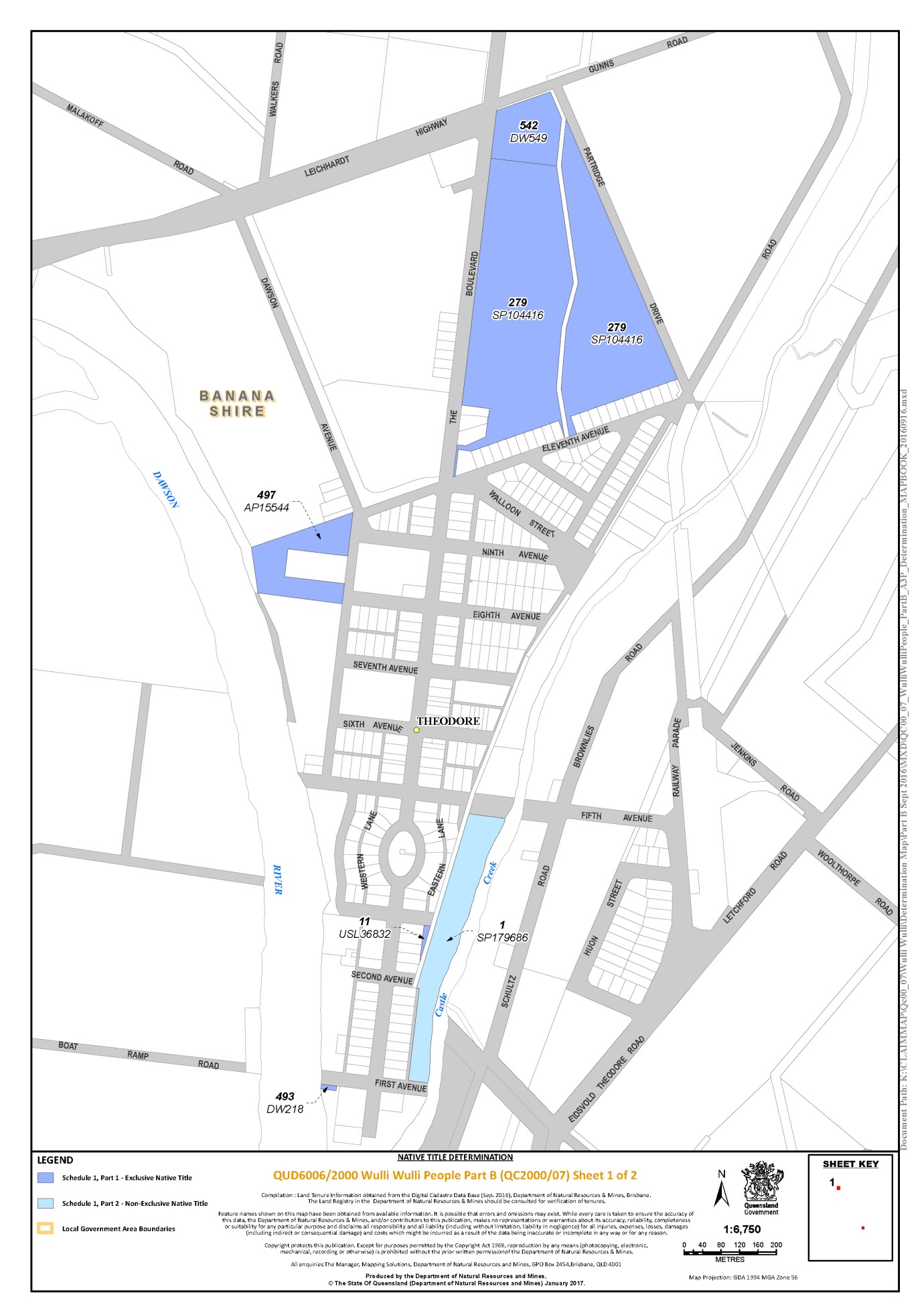
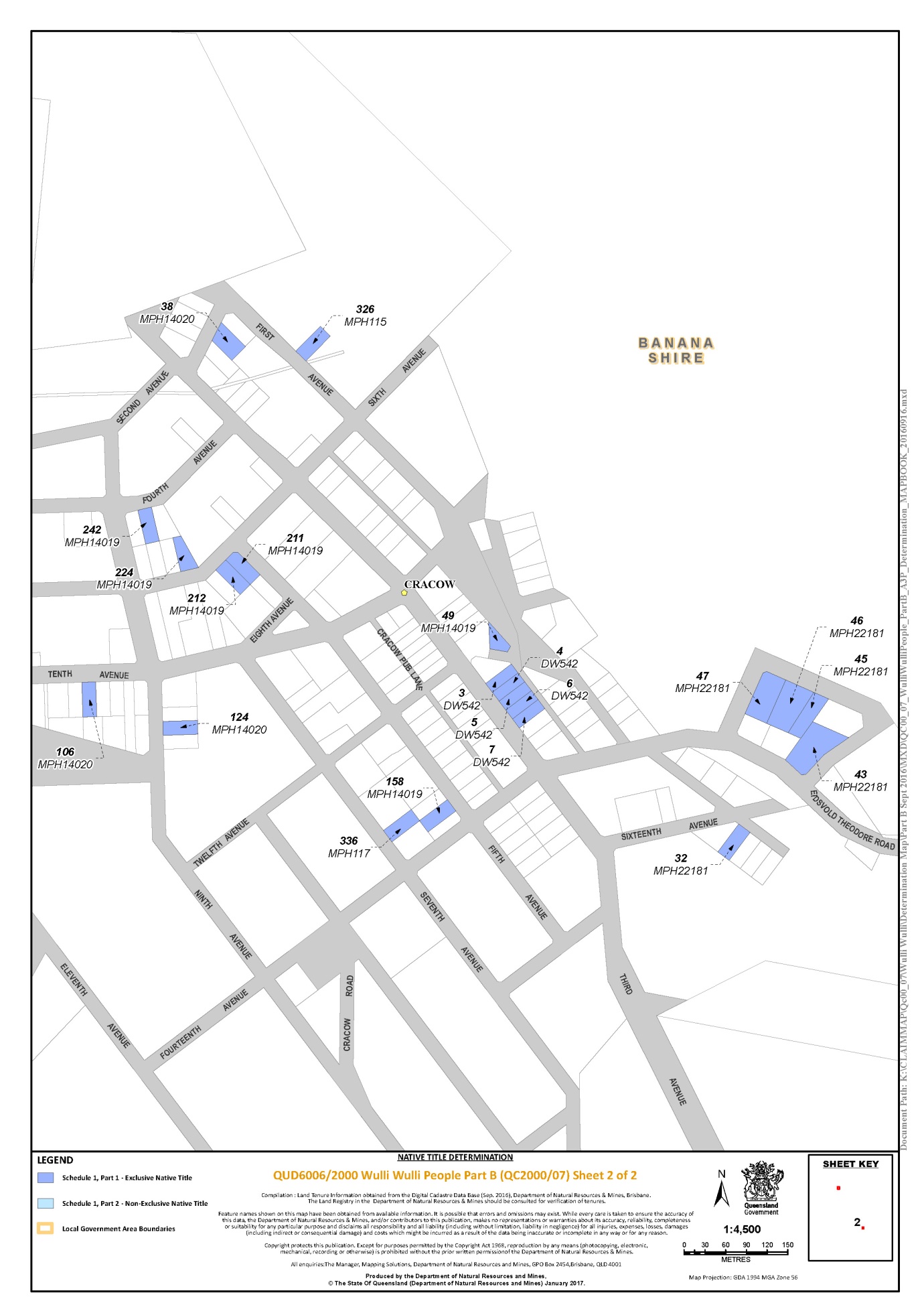
Schedule 2 – AREAS NOT FORMING PART OF THE DETERMINATION AREA
The following areas of land and waters are excluded from the Determination Area.
1. The land and waters on which any public work, as defined in s 253 of the Native Title Act 1993 (Cth), is or was constructed, established or situated, and to which ss 23B(7) and 23C(2) of the Native Title Act 1993 (Cth) and s 21 of the Native Title (Queensland) Act 1993 (Qld), applies, together with any adjacent land or waters in accordance with s 251D of the Native Title Act 1993 (Cth).
Schedule 3 – NATIVE TITLE HOLDERS
The native title holders are the Wulli Wulli People. The Wulli Wulli People are the biological descendants of one or more of the following people:
(a) Tommy (father of Wonga Pope);
(b) Jessie Fuller;
(c) Grace (mother of Fanny Joyce);
(d) Tilly (mother of Harry Blucher);
(e) Jack Hornet Senior (father of Jack Hornet);
(f) Jackanapes;
(g) Thomas Clancy;
(h) Maria (the mother of Isabella Hooper);
(i) The unnamed adoptive father of Maggie McLean;
(j) Mergwin Blay;
(k) Amy (wife of John Bond);
(l) Rosie (mother of John Barra);
(m) Billy and Selina (parents of Jacob);
(n) Jinnie (wife of George Logan); or
(o) Ginalene (mother of Ernest Pope).
Schedule 4 - OTHER INTERESTS IN THE DETERMINATION AREA
The nature and extent of the other interests in relation to the Determination Area are the following as they exist as at the date of the determination:
1. The rights and interests of the parties under the following agreements:
(a) the agreement between the Banana Shire Council and Desmond Dodd, Robert Bond, Robert Clancy, Drew Millar, Neil Saltner, Marjorie Reid, Elizabeth Law, Elizabeth Blucher, Annette Fuller, Celeste Williams, Ivan Saltner, Jeffrey Williams, Brian Clancy, Jill Wilson and Elliot Anderson on their own behalf and on behalf of the Wulli Wulli People QUD6006/00, registered on 29 January 2016; and
(b) the agreement between Ergon Energy Corporation Limited and Desmond Dodd, Robert Bond, Robert Clancy, Drew Millar, Neil Saltner, Marjorie Reid, Elizabeth Law, Elizabeth Blucher, Annette Fuller, Celeste Williams, Ivan Saltner, Jeffrey Williams, Brian Clancy, Jill Wilson and Elliot Anderson on their own behalf and on behalf of the Wulli Wulli People QUD6006/00, registered on 29 January 2016.
2. The rights and interests of Ergon Energy Corporation Limited ACN 087 646 062:
(a) as the owner and operator of any “Works” as that term is defined in the Electricity Act 1994 (Qld) within the Determination Area;
(b) as a distribution entity and the holder of a distribution authority under the Electricity Act 1994 (Qld); and
(c) created under the Electricity Act 1994 (Qld) and the Government Owned Corporations Act 1993 (Qld) including:
(i) rights in relation to any agreement relating to the Determination Area existing or entered into before the date on which these orders are made;
(ii) rights to enter the Determination Area by its employees, agents or contractors to exercise any of the rights and interests referred to in this paragraph; and
(iii) to inspect, maintain and manage any Works in the Determination Area.
3. The rights and interests of the Banana Shire Council as the local government for the Determination Area within its Local Government Area, including:
(a) its powers, functions, responsibilities and jurisdiction under a Local Government Act;
(b) its rights and interests under any interest in land or waters within the Determination Area including under any lease, license, access agreement, easement or reserve in the Determination Area;
(c) its rights to use, operate, maintain, replace, restore, remediate, repair and otherwise exercise all other rights as the owners and operators of infrastructure, structures, earthworks, access works, facilities and other improvements within the Determination Area;
(d) its rights under any agreements between the local governments and third parties which relate to land or water in the Determination Area; and
(e) the rights of its employees, agents and contractors to enter upon the Determination Area for the purpose of performing their powers and responsibilities under paragraphs (a) to (d).
4. The rights and interests of members of the public arising under the common law, including but not limited to any subsisting public right to fish.
5. So far as confirmed pursuant to s 212(2) of the Native Title Act 1993 (Cth) and s 18 of the Native Title Act (Queensland) Act 1993 (Qld) as at the date of this Determination, any existing public access to, and enjoyment of, the following places in the Determination Area:
(a) waterways;
(b) beds and banks or foreshores of waterways;
(c) stock routes; and
(d) areas that were public places at the end of 31 December 1993.
6. Any other rights and interests:
(a) held by the State of Queensland or Commonwealth of Australia; or
(b) existing by reason of the force and operation of the Laws of the State and the Commonwealth.
7. To avoid any doubt paragraphs 6(a) and 6(b) include the rights and interests of the State of Queensland in Reserves, the rights and interests of the trustees of those Reserves and of the persons entitled to access and use those Reserves for the respective purpose for which they are reserved.
Note: Entry of orders is dealt with in Rule 39.32 of the Federal Court Rules 2011.
COLLIER J:
1 In Anderson on behalf of the Wulli Wulli People v State of Queensland (No 3) [2015] FCA 821 I ordered by consent that native title existed in relation to 166 parcels of land within the original area claimed by the native title applicant under s 61 of the Native Title Act 1993 (Cth) (the Native Title Act). That consent determination was made in circumstances where the State of Queensland and the applicant (Elliot Anderson, Elizabeth Blucher, Robert Bond, Robert Clancy, Brian Clancy, Desmond Dodd, Elizabeth Law, Ivan Saltner, Neil Saltner and Jeffrey Williams) had not reached agreement in respect of an additional 27 parcels of land as originally claimed. These additional 27 parcels (the Balance Area) were vacant crown land either in or nearby the towns of Cracow and Theodore at the time the application was made.
2 Following judgment in Anderson (No 3) [2015] FCA 821, the parties to the native title application continued discussions in respect of the application of s 47B of the Native Title Act to the Balance Area. On 10 July 2017 the applicant filed an agreement with the Court executed by all parties pursuant to s 87 of the Native Title Act annexing a draft consent determination of title in relation to the Balance Area. The Balance Area is described in Schedule 1 to the draft consent determination.
Section 87 of the Native Title Act
3 Section 87 of the Native Title Act provides:
87 Power of Federal Court if parties reach agreement
Application
(1) This section applies if, at any stage of proceedings after the end of the period specified in the notice given under section 66:
(a) agreement is reached between the parties on the terms of an order of the Federal Court in relation to:
(i) the proceedings; or
(ii) a part of the proceedings; or
(iii) a matter arising out of the proceedings; and
(b) the terms of the agreement, in writing signed by or on behalf of the parties, are filed with the Court; and
(c) the Court is satisfied that an order in, or consistent with, those terms would be within the power of the Court.
Power of Court
(1A) The Court may, if it appears to the Court to be appropriate to do so, act in accordance with:
(a) whichever of subsection (2) or (3) is relevant in the particular case; and
(b) if subsection (5) applies in the particular case-that subsection.
Agreement as to order
(2) If the agreement is on the terms of an order of the Court in relation to the proceedings, the Court may make an order in, or consistent with, those terms without holding a hearing or, if a hearing has started, without completing the hearing.
Note: If the application involves making a determination of native title, the Court’s order would need to comply with section 94A (which deals with the requirements of native title determination orders).
Agreement as to part of proceedings
(3) If the agreement relates to a part of the proceedings or a matter arising out of the proceedings, the Court may in its order give effect to the terms of the agreement without, if it has not already done so, dealing at the hearing with the part of the proceedings or the matter arising out of the proceedings, as the case may be, to which the agreement relates.
Orders about matters other than native title
(4) Without limiting subsection (2) or (3), if the order under that subsection does not involve the Court making a determination of native title, the order may give effect to terms of the agreement that involve matters other than native title.
(5) Without limiting subsection (2) or (3), if the order under that subsection involves the Court making a determination of native title, the Court may also make an order under this subsection that gives effect to terms of the agreement that involve matters other than native title.
(6) The jurisdiction conferred on the Court by this Act extends to:
(a) making an order under subsection (2) or (3) that gives effect to terms of the agreement that involve matters other than native title; and
(b) making an order under subsection (5).
(7) The regulations may specify the kinds of matters other than native title that an order under subsection (2), (3) or (5) may give effect to.
Agreed statement of facts
(8) If some or all of the parties to the proceeding have reached agreement on a statement of facts, one of those parties may file a copy of the statement with the Court.
(9) Within 7 days after a statement of facts agreed to by some of the parties to the proceeding is filed, the Federal Court Chief Executive Officer must give notice to the other parties to the proceeding that the statement has been filed with the Court.
(10) In considering whether to make an order under subsection (2), (3) or (5), the Court may accept a statement of facts that has been agreed to by some or all of the parties to the proceedings but only if those parties include:
(a) the applicant; and
(b) the party that the Court considers was the principal government respondent in relation to the proceedings at the time the agreement was reached.
(11) In considering whether to accept under subsection (10) a statement of facts agreed to by some of the parties to the proceedings, the Court must take into account any objections that are made by the other parties to the proceedings within 21 days after the notice is given under subsection (9)
4 The applicant relies on the power of the Court to make orders without holding a hearing. The procedural criteria under s 87 of the Native Title Act which parties must meet to support such orders were explained by Reeves J in Nelson v Northern Territory (2010) 190 FCR 344 at [3]-[7], and reiterated by his Honour recently in Wikilyiri v Northern Territory of Australia [2017] FCA 446 at [10]-[19]. In summary, the applicant must establish:
(1) that the notice period under s 66 of the Native Title Act has ended: s 87(1);
(2) that the agreement that has been reached relates to the whole of the proceeding, or to a part of the proceeding, or to a matter arising out of the proceeding: s 87(1)(a);
(3) that the agreement reached has been reduced to writing, signed by, or on behalf of, the parties and filed with the Court: s 87(1)(b);
(4) circumstances such that the Court can be satisfied that an order in, or consistent with, the terms of the executed consent orders would be within the power of the Court: s 87(1)(c); and
(5) circumstances such that the Court can be satisfied that it would be appropriate to make a native title determination consistent with the terms of the parties’ agreement: s 87(1A).
5 In this case, the Wulli Wulli claim was filed with the Federal Court on 17 July 2000 and subsequently entered on the Register of Claims maintained by the Native Title Registrar on 6 April 2001. It is not disputed that notification was given in accordance with s 66 of the Native Title Act by the Native Title Registrar with a notification closing date of 24 October 2001. Section 87(1) in this respect is satisfied.
6 Second, the agreement filed by the parties on 10 July 2017 is in respect of the proceedings.
7 Third, s 87(1)(b) has clearly been satisfied by the filing of the agreement on 10 July 2017, signed by the applicant and the respondents.
8 The remaining fourth and fifth questions for consideration by the Court are whether the Court has power to make orders consistent with those sought by the applicant, and whether it is appropriate to do so.
Whether Court has power to make the orders sought by the parties
9 The applicant seeks a determination of native title under the Native Title Act. Section 223 of the Native Title Act states that the expression of “native title” or “native title rights and interests” means communal group or individual rights and interests of Aboriginal peoples or Torres Strait Islanders in relation to land or waters where:
(a) the rights and interests are possessed under the traditional laws acknowledged, and the traditional customs observed, by the Aboriginal peoples or Torres Strait Islanders; and
(b) the Aboriginal peoples or Torres Strait Islanders, by those laws and customs, have a connection with the land or waters; and
(c) the rights and interests are recognised by the common law of Australia
10 Section 94A of the Native Title Act provides that an order in which the Federal Court makes a determination of native title must set out details of the matters mentioned in s 225. Section 225 of the Native Title Act requires determination of the following matters:
(a) who the persons, or each group of persons, holding the common or group rights comprising the native title are; and
(b) the nature and extent of the native title rights and interests in relation to the determination area; and
(c) the nature and extent of any other interests in relation to the determination area; and
(d) the relationship between the rights and interests in paragraphs (b) and (c) (taking into account the effect of this Act); and
(e) to the extent that the land or waters in the determination area are not covered by a non-exclusive agricultural lease or a non-exclusive pastoral lease – whether the native title rights and interests confer possession, occupation, use and enjoyment of that land or waters on the native title holders to the exclusion of all others.
11 The evidence before me supports the following conclusions.
12 First, the native title claim group seeking the declaration of native title are descendants of identified apical ancestors, namely:
(1) Tommy, father of Wonga Pope;
(2) Jessie Fuller;
(3) Grace, mother of Fanny Joyce;
(4) Tilly, mother of Harry Blucher;
(5) Jack Hornet Senior, father of Jack Hornet;
(6) Jackanapes;
(7) Thomas Clancy;
(8) Maria, mother of Isabella Hooper;
(9) The unnamed adoptive father of Maggie McLean;
(10) Mergwin Blay;
(11) Amy, wife of John Bond;
(12) Rosie, mother of John Barra;
(13) Billy and Selina, parents of Jacob;
(14) Jinnie, wife of George Logan; and
(15) Ginalene, mother of Ernest Pope.
13 Second, as I found in Anderson (No 3) [2015] FCA 821, the Wulli Wulli People have continuity of connection with the determination area described in the native title claim. In so finding I relied on evidence of members of the native title claim group, as well as anthropological, linguistic, historical and archaeological evidence.
14 It is not disputed that the expert evidence to which I referred in Anderson (No 3) [2015] FCA 821 is equally applicable to the applicant’s claim in relation to the Balance Area. Further, I note evidence from Wulli Wulli People specifically demonstrating their connection to the Balance Area, namely:
(1) Affidavit of Kevin Leonard Clancy affirmed 11 April 2014;
(2) Affidavit of Kevin Leonard Clancy affirmed 16 July 2016;
(3) Affidavit of Lexie Stella Dodd affirmed 11 April 2014;
(4) Affidavit of Lexie Stella Dodd affirmed 5 August 2016;
(5) Affidavit of Brian Allen Clancy affirmed 12 November 2016;
(6) Affidavit of Neil Norton Saltner affirmed 12 November 2016;
(7) Affidavit of Elizabeth Kaye Blucher affirmed 12 November 2016; and
(8) Affidavit of Elliot Ashton Anderson affirmed 12 November 2016.
15 Mr Kevin Clancy provided affidavit evidence of the connection Wulli Wulli People share with the Balance Area, particularly that which encompasses Cracow. Mr Clancy explained how the land continues to provide natural resources for bush tucker, such as doon doon (witchedy grubs), and traditional medicine made from gumbi gumbi plants.
16 Ms Lexie Dodd deposed that she was born and raised in Theodore, that she continues to live there, and that her family lived in the area before Theodore became a town. She is a Wulli Wulli woman, descended from apical ancestors Ernest and Wonga Pope (parents of Ms Dodd’s grandmother, Queenie Dodd; and grandparents of Ms Dodd’s father, Raymond Dodd).
17 Ms Dodd travelled through and undertook traditional activities on the unallocated state land at the time the Wulli Wulli claim was filed. In her affidavit, Ms Dodd shared her understanding that Wulli Wulli People are “entitled to hunt, collect and use” natural resources “under traditional laws and customs” of their ancestors. She indicated that in accordance with these laws and customs, Wulli Wulli People inherit rights to access and use the country’s resources.
18 Mr Brian Clancy deposed that he learned from his parents that his country is his spiritual home and he is a custodian of his ancestors’ land. Speaking of the Wulli Wulli People, he described that they have “responsibilities … to look after [their] country, sites of significance and protect them from harm by other people.” To fulfil such duties, Mr Clancy explained that the Wulli Wulli People are responsible for controlling access to their land, which includes the Balance Area.
19 Mr Neil Saltner is a Wulli Wulli man by descent through his parents, Frederick John Saltner and Iris Fanny Saltner, grandmother, Fanny Joyce, and ancestors Wonga and Ernest Pope. In his affidavit material, Mr Saltner described with emphasis the importance of respecting the Wulli Wulli country by observing the traditional rights, responsibilities and rules bestowed upon its custodians. He deposed that:
… Those rights were handed down by our ancestors from each generation to the next. I was taught as a child that we can go to our ancestors’ country, live there like they did and take what we like as long as we don’t break any of our rules. At the same time, it was drummed into me that we have to protect the country, our sacred places and make sure harm isn’t caused to them by people who don’t belong to the land.
20 Mr Saltner gave evidence that he regularly visits Theodore and other parts of Wulli Wulli country to camp, fish, hunt and visit important places, and that when on country he controls the use and access of country by others.
21 Ms Elizabeth Blucher is a Wulli Wulli woman by descent from her parents, Harry Thomas Blucher and Pamela Judith Blucher. She was taught Wulli Wulli culture by her parents who had spent time on country to learn “traditional laws and customs” from their Elders. Ms Blucher recalled her experience of returning to country and being welcomed by her ancestors:
… when I was camping on country with my family, we were visited by an owl which is one of our totems. That was our ancestors welcoming us and making sure we were safe. I was taught to believe that the county and our ancestors know that we belong there, and they know when someone is a stranger to the land.
22 Mr Elliot Anderson, a Wulli Wulli man through his mother, Pamela May Anderson, and descendent of Wulli Wulli ancestors Billy, Selina, Wonga and Ernest Pope, affirmed detailed affidavit evidence of what it means to be Wulli Wulli. He learned the boundaries of the Wulli Wulli country from Elders including his Uncle Doug and Uncle Noel. They taught that Mr Anderson’s “traditional rights” to live off the land “also come with customary responsibilities” to look after the country and “protect it from harm caused by other people”.
23 I understand that connection material provided by the applicant, including evidence of members of the claim group, was assessed by the State in relation to the applicant’s claims concerning the Balance Area, and that the State was content to enter consent negotiations with the applicant in relation to those claims.
24 I am satisfied that the material currently before the Court and earlier before the Court in Anderson (No 3) [2015] FCA 821 substantiates the claim of the applicant to native title in the Balance Area.
25 Further, I have had regard to the affidavit of Ms Christine Anne Royan filed on 18 May 2017. Ms Royan deposes that she was engaged as a consultant to assist the Wulli Wulli People and has attended all authorisation meetings related to the proceedings. I am satisfied that:
the intention of the Wulli Wulli People to enter into the proposed consent determination and an Indigenous Land Use Agreement (ILUA) was notified under the Native Title Act;
an information meeting was held for the claim group on 5 May 2017 and an authorisation meeting on 6 May 2017 at Mundubbera; and
the Wulli Wulli People authorised the terms of the proposed consent determination at the authorisation meeting on 6 May 2017.
26 In conclusion, I am satisfied that the Court has power to make the orders sought by the applicant, which orders have been agreed by all parties.
Whether it is appropriate for the Court to make the orders sought by the parties
27 In Munn for and on behalf of the Gunggari People v State of Queensland [2001] FCA 1229 Emmett J identified a non-exhaustive list of factors to which the Court could properly have regard in determining whether an order pursuant to s 87 of the Native Title Act was appropriate. In particular, his Honour noted at [22] that a determination under the Native Title Act that native title exists generally operates against the entire world, and not only resolves an issue inter partes. His Honour continued:
28 As I have already said, the Court must act judicially. That is to say, it cannot simply act capriciously. The Court must have regard to the objects and purposes of the Act. One important object and purpose to be found in the Act is resolution of issues and disputes concerning native title by mediation and agreement, rather than by Court determination. Detailed procedures are set out in the Act to achieve those objects.
29 Next, the Court must have regard to the question of whether or not the parties to the proceeding, namely, those who are likely to be affected by an order, have had independent and competent legal representation. That concern would include a consideration of the extent to which the State is a party, on the basis that the State, or at least a Minister of the State, appears in the capacity of parens patriae to look after the interests of the community generally. The mere fact that the State was a party may not be sufficient. The Court may need to be satisfied that the State has in fact taken a real interest in the proceeding in the interests of the community generally. That may involve the Court being satisfied that the State has given appropriate consideration to the evidence that has been adduced, or intended to be adduced, in order to reach the compromise that is proposed. The Court, in my view, needs to be satisfied at least that the State, through competent legal representation, is satisfied as to the cogency of the evidence upon which the applicants rely.
30 However, that is not to say that the Court would itself want to predict the State’s assessment of that evidence or to make findings in relation to those matters. On the other hand, in an appropriate case, the Court may well ask to be shown the evidence upon which the parties have based their decision to reach a compromise. Either way, I would not contemplate that, where the Court is being asked to make an order under s 87, any findings would be made on those matters. The Court would look at the evidence only for the purpose of satisfying itself that those parties who have agreed to compromise the matter, particularly the State on behalf of the community generally, are acting in good faith and rationally.
31 Another matter that the Court would have to take into account would be whether the native title rights and interests that are to be declared in the determination are recognisable by the law of Australia or the State in which the land is situated. The Court may need to be satisfied whether native title had been extinguished and, if so, whether the extinguishment should be disregarded pursuant to provisions such as ss 47, 47A or 47B. Again, the Court may be prepared to accept that those matters have been considered by appropriate respondents, and the Court may be entitled to rely on appropriate assurances in relation to those matters, rather than to receive evidence of them.
32 The Court would also need to be satisfied that all of the requirements of the Act are complied with, such as s 55, if applicable, or ss 94A and 225. As with any order made by the Court, the Court would need to be satisfied that the proposed orders are unambiguous and certain as to the rights declared.
28 Having regard to the issues identified by his Honour in Munn [2001] FCA 1229, I am satisfied that:
The agreement reached by the parties is consistent with the objects and purposes of the Native Title Act, in particular the desirability of resolving issues and disputes concerning native title by mediation and agreement rather than by Court determination;
All the parties are legally represented. That a separate agreement between the parties in relation to the Balance Area was necessary following the earlier agreement concerning the 166 parcels of land in Wulli Wulli country indicates that the respondents, in particular the State, have given careful and thorough consideration to the evidence that has been adduced concerning the connection of the application to the Balance Area. I am satisfied the agreement of the parties in relation to the Balance Area, as recorded in the agreement filed on 10 July 2017, has been freely entered on an informed basis and with the benefit of appropriate legal and other expert advice (see Wonga on behalf of the Wanyurr Majay People v State of Queensland [2011] FCA 1055 at [4]);
The material on which the applicant relies supports the applicant’s claim of native title in the Balance Area; and
The requirements of ss 94A, 223 and 225 of the Native Title Act are satisfied.
29 I note further that in her affidavit filed on 18 May 2017, Ms Royan deposes that, at a meeting held at Mundubbera on 6 May 2017, the Wulli Wulli People resolved to appoint the Wulli Wulli National Aboriginal Corporation RNTBC (WWNAC) to hold their native title rights on trust. At the same meeting the Wulli Wulli People directed their solicitors to nominate WWNAC for the purposes of s 56 of the Native Title Act.
30 It is not in dispute that WWNAC was registered by the Office of the Registrar of Aboriginal Corporations on 24 July 2015 and is the registered native title body corporate as defined by s 253 Native Title Act for the area including the Balance Area.
31 I am satisfied that the requirements of s 56 Native Title Act have been satisfied, and that it is appropriate to make orders determining that native title in the Balance Area is to be held in trust by WWNAC.
32 Finally, I am satisfied that the proposed consent orders are unambiguous and certain as to the rights the parties seek the Court to declare.
33 In the circumstances I consider that it is appropriate to make the orders sought.
I certify that the preceding thirty-three (33) numbered paragraphs are a true copy of the Reasons for Judgment herein of the Honourable Justice Collier. |
Associate:


