

FEDERAL COURT OF AUSTRALIA
Pearce v Gulmohar Pty Ltd [2017] FCA 660
Table of Corrections | |
In the first sentence of paragraph 15, $832,031 has been replaced with $857,031. | |
6 July 2017 | In the second sentence of paragraph 497 the word “of” following the word “total” has been replaced with “claimed for”. |
TABLE OF CONTENTS
[6] | |
[15] | |
[24] | |
[94] | |
[117] | |
[131] | |
[144] | |
[144] | |
[158] | |
[165] | |
Analysis of contractual arrangements between GVF and Toxfree | [169] |
Contract for collection and removal of waste from GVF’s site | [169] |
[205] | |
[231] | |
[251] | |
[254] | |
[256] | |
[275] | |
[276] | |
[286] | |
[325] | |
[328] | |
[337] | |
[340] | |
[353] | |
[371] | |
[375] | |
[385] | |
[399] | |
[402] | |
[412] | |
[417] | |
[420] | |
[424] | |
[427] | |
[436] | |
[441] | |
[444] | |
[447] | |
The claim against Peter Heyn as trustee of the Heyn Family Trust | [453] |
[458] | |
[459] | |
[465] | |
The Palacimo payments, the Vaudell payments, the Superway Garden payment and the Heyn payments | [469] |
[475] | |
[483] | |
[487] | |
[490] |
ORDERS
DATE OF ORDER: |
THE COURT ORDERS THAT:
1. The matter is listed for hearing on 6 July 2017 at 9.30 am as to the form of orders and as to costs.
Note: Entry of orders is dealt with in Rule 39.32 of the Federal Court Rules 2011.
RANGIAH J:
1 Before going into liquidation, the first plaintiff, Grass Valley Formulators Pty Ltd (in liquidation) (GVF), engaged in a series of transactions with the first to fifth defendants. The plaintiffs allege that these transactions are “voidable transactions” within s 588FE of the Corporations Act 2001 (Cth). The plaintiffs also allege that the fifth and sixth defendants breached their duties as directors of GVF by causing the company to enter the transactions.
2 GVF’s problems began on 24 March 2009 when a fire broke out at its factory, resulting in chemical contamination of its site. GVF engaged Toxfree Solutions Ltd (Toxfree) to collect contaminated material from the site. Whether Toxfree was engaged to do any other work and its charges are matters in dispute. The maximum amount of GVF’s insurance cover was $1,549,000 after deduction of the excess. The insurer paid GVF that amount, but it was not enough to cover Toxfree’s invoices. GVF did not use the insurance proceeds to pay any part of Toxfree’s invoices, but instead made a series of payments to its undisputed creditors, including the first to fifth defendants.
3 Toxfree commenced proceedings against GVF in the Supreme Court of Western Australia. While those proceedings were pending, GVF made an application in the Supreme Court of Queensland for orders that it be wound up in insolvency. That application was granted on 17 November 2010.
4 The plaintiffs seek orders for the repayment of money paid by GVF to the first to fifth defendants. The plaintiffs’ case that the transactions are voidable transactions within s 588FE of the Corporations Act relies substantially on the allegation that GVF was insolvent when the transactions were entered.
5 I propose to describe the parties and the issues in the case before summarising the evidence. I will then address the question of GVF’s solvency. That depends principally upon the extent of the Toxfree debt, which was the area of greatest factual and legal debate in the case. I will then turn to the question of whether the transactions are voidable transactions and whether the fifth and sixth defendants breached their duties as directors.
6 The first plaintiff, Mark William Pearce, was appointed as liquidator of GVF under orders made by the Supreme Court of Queensland on 17 November 2010. Mr Pearce also gave expert accounting evidence at the trial.
7 The period of time relevant to the present proceedings is from March 2009 to November 2010. The positions of the defendants in that period were as follows.
8 The fifth defendant, Peter Karl Heyn, and the sixth defendant, Geoffrey Martin Vaughan, were directors of GVF. There also was a third director, Terrence Armstrong, who died in 2014. There was little evidence led about Mr Armstrong’s role in the management of the company.
9 Mr Heyn was the sole director and secretary of the first defendant, Gulmohar Pty Ltd (Gulmohar). Gulmohar provided stock to GVF on credit from time to time. GVF was indebted to Gulmohar throughout the relevant period.
10 Mr Heyn was also the director and secretary of, and a shareholder in, the second defendant, Palacimo Pty Ltd (Palacimo). Mr Heyn’s wife, Monique Heyn, was the other shareholder in Palacimo. Palacimo owned the shares in Gulmohar.
11 Mr Vaughan was a director and the secretary of the third defendant, Vaudell Pty Ltd (Vaudell).
12 Mr Vaughan was also a director and the secretary of the fourth defendant, Superway Garden AG & Pest Products Pty Ltd (Superway Garden).
13 The shares in GVF were owned by Palacimo, Vaudell and Mr Armstrong.
14 The defendants accept that each of them was a “related entity” of GVF within the meaning of that expression in s 9 of the Corporations Act.
15 In the period from 30 April 2009 to 17 November 2010, GVF paid the following amounts to the first to fifth defendants, totalling $857,031:
(a) $582,031 to Gulmohar (this was the net amount paid by GVF after deducting the value of stock supplied by Gulmohar);
(b) $100,000 to Palacimo;
(c) $90,000 to Vaudell;
(d) $42,500 to Superway Garden; and
(e) $42,500 to Mr Heyn as trustee of the Heyn Family Trust.
16 It is these payments, together with the granting to Gulmohar of a fixed and floating charge over GVF’s assets, which are said to be the voidable transactions. Those transactions also found the claim that Mr Heyn and Mr Vaughan breached their duties to GVF as its directors.
17 The plaintiffs allege that GVF was insolvent throughout the period from 30 April 2009 to 17 November 2010. The date 30 April 2009 seems to have been selected because the first payment among the impugned transactions was $50,000 to Gulmohar on 1 May 2009.
18 The allegation of insolvency requires consideration of three issues, namely:
(a) the extent of the debts due and payable by GVF in the period from 30 April 2009 to 17 November 2010;
(b) what funds GVF had available to pay such debts; and
(c) whether funding from related third parties was available to allow GVF to pay such debts.
19 The first issue, the extent of the debts due and payable, requires assessment of the debt owed by GVF to Toxfree. This requires examination of the terms of the contracts between GVF and Toxfree, the nature and extent of the work done by Toxfree and a determination as to what amounts were payable at what times.
20 The owner of the premises leased by GVF, Hamcor Pty Ltd (Hamcor), also claimed that it was owed a debt for unpaid rent. GVF disputed the debt and Hamcor was not paid. In the course of submissions the plaintiffs accepted that the Hamcor claim is not determinative of insolvency and can be left aside. I therefore do not propose to deal specifically with the Hamcor claim.
21 The second issue depends largely upon the evidence given by two expert accountants as to the funds GVF had available to it from its own assets and from an overdraft facility.
22 As to the third issue, Mr Heyn and Mr Vaughan gave evidence that they and companies they controlled were willing to provide financial support to GVF if required. Mrs Heyn also says she could have allowed her assets to be used to provide financial support. It is necessary to determine their capacity and willingness to provide such support as would allow GVF to pay its debts.
23 The remaining issues include whether the transactions are unfair preferences within s 588FA of the Corporations Act, uncommercial transactions within s 588FB, insolvent transactions within s 588FC, or unreasonable director-related transactions within s 588FDA, and whether the “good faith” defence in s 588FE is made out. It is also necessary to decide whether Mr Vaughan and Mr Heyn breached their fiduciary duties to GVF and their duties under ss 181, 182 and 183 of the Corporations Act.
EVIDENCE CONCERNING GVF’s ENGAGEMENT OF TOXFREE
24 GVF manufactured, or formulated, pesticides for sale to the agricultural industry. It operated from premises at Grass Valley, near Northam in Western Australia. The premises consisted of a factory and a separate administration building.
25 Karl Haslberger was GVF’s factory manager. At about 4 am (Western Australian time) on Tuesday, 24 March 2009, Mr Haslberger became aware that the factory was on fire. The fire brigade was called and the fire was extinguished.
26 The fire and the spraying of water by the fire brigade resulted in chemical contamination of the site. A pond on the site became filled with contaminated liquid. The soil at the site became contaminated. There was also contamination of containers and other equipment.
27 At about 7 or 8 am on the morning of the fire, Mr Haslberger was told by Ken Raine of the Western Australian Department of Environment and Conservation (DEC) that it would be a good idea to have someone on stand-by to carry out a clean up and removal of contaminated liquid. Mr Haslberger then telephoned Betty Carr, who was employed by Gulmohar as personal secretary to Mr Heyn, and gave her some names of companies that could assist to clean up the contaminated liquid, including Toxfree.
28 Toxfree provides waste management and industrial services, including providing emergency response services in relation to chemical spills. Toxfree is certified by the relevant government department in Western Australia as an emergency responder to dangerous goods incidents. Toxfree had previously been engaged by GVF to dispose of waste materials in 2007.
29 The witnesses have differing recollections of the precise sequence of relevant conversations and the content of those conversations. That is unsurprising, given the passage of time. Many of the differences are unimportant and need not be resolved. Other differences are more significant and I will deal specifically with these.
30 Errol Beere, a Business Development Manager employed by Toxfree, spoke to Mr Haslberger by telephone on the morning of 24 March 2009. Mr Haslberger said that storage tanks which contained chemicals were about to overflow and could spill into the Avon River. Mr Beere said that Toxfree could not commence providing its emergency response services until GVF raised a purchase order confirming that it accepted Toxfree’s terms. Mr Haslberger asked Mr Beere to liaise with Ms Carr to arrange a purchase order.
31 Mr Beere then spoke to Ms Carr by telephone. I accept Mr Beere’s version of the discussion. Mr Beere told Ms Carr that Toxfree would require a purchase order before it could start providing its emergency response services. Ms Carr asked Mr Beere for an estimate of costs. Mr Beere had already spoken to Mr Raine of the DEC, and had been told that approximately 500 tonnes of contaminated soil and approximately 300 kilolitres of liquid waste would need to be removed from the site. Mr Beere informed Ms Carr of the estimated quantities and said that it was extremely difficult to give an estimate of costs without seeing the site. Ms Carr informed Mr Beere that she required a figure solely for the purpose of preparing a purchase order. Mr Beere said that it would be not less than $160,000, exclusive of GST, for Toxfree’s emergency response services and he would provide her with a table of Toxfree’s rates along with his estimate.
32 Mr Beere told Ms Carr that he could not provide an estimate with respect to disposal costs until an analysis of the waste had been performed and the full extent of the chemicals involved was known. Ms Carr told Mr Beere that she understood that the estimate did not include Toxfree’s disposal rates and would confirm this on the purchase order.
33 Mr Beere then sent the following email to Ms Carr at 1.38 pm on 24 March 2009:
Hello Betty,
Please find attached our rates for Emergency Response callouts.
As discussed it is very difficult to pinpoint an estimated figure at this early stage. We will need to run sampling of both the contaminated water and contaminated soil before we can quote a rate for treatment and disposal.
The Department of Environment & Conservation representative onsite has said there could be up to 300 kilolitres of contaminated water and 500 tonnes of contaminated soil – he too has stressed that this is a rough estimation only.
Based on these figures though I can also give you a rough estimation of cost.
If we were to collect this amount of waste with the vehicles, equipment & personnel currently onsite then a rough estimation of this service/hire would be $160,000. Please note this does not include the treatment and disposal costs of the wastes mentioned.
As we progress on the job we will be able to provide a more accurate estimation of costs.
If you have any queries please either (sic) myself on 0419 870 077 or Toby Edmunds (Emergency Response Coordinator onsite) on 0428 927 827.
34 Mr Beere’s email attached a document addressed to Ms Carr with the heading “Emergency Response Rates – Grass Valley Formulators Fire”. The document said:
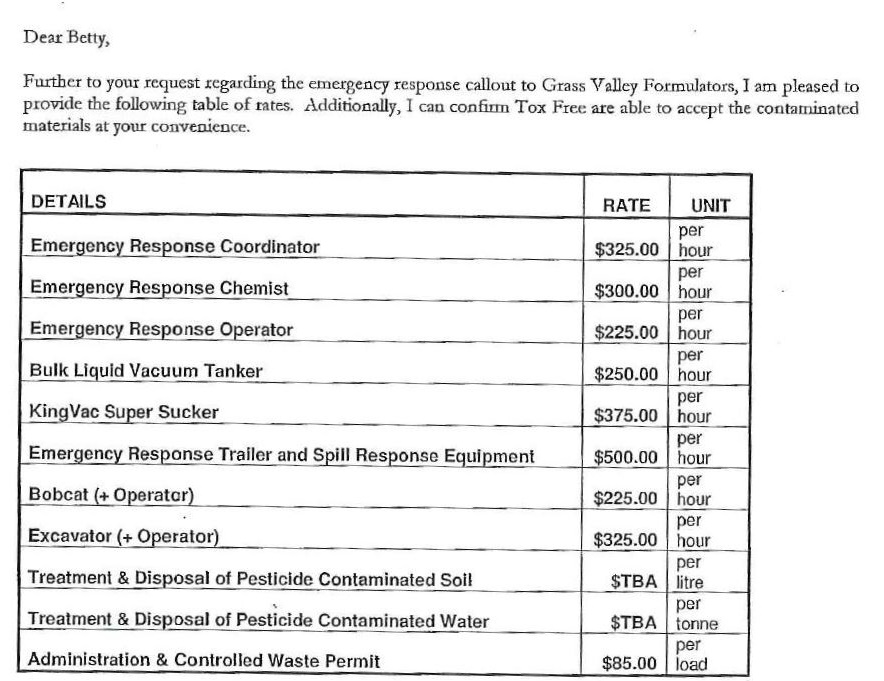
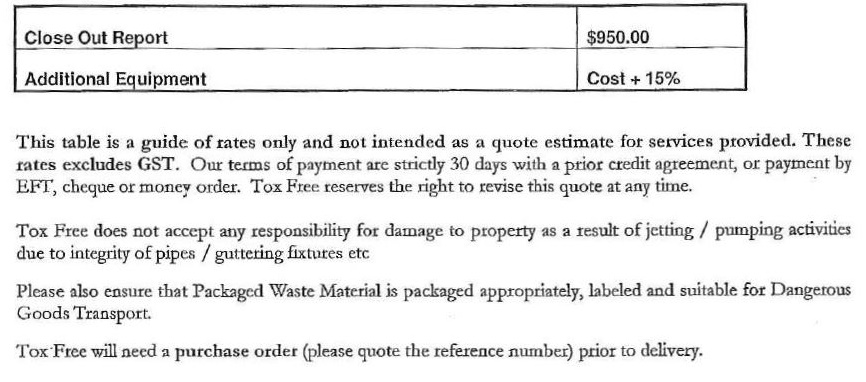
35 Ms Carr faxed a purchase order to Mr Beere. Ms Carr was in Victoria. The fax marking on the purchase order shows a time of “16:17”. I infer that the fax was sent at 4.17 pm Victorian time, or 2.17 pm Western Australian time. That timing seems to fit with Mr Beere’s earlier email which was sent to Ms Carr at 1.38 pm Western Australian time. The purchase order reads as follows:
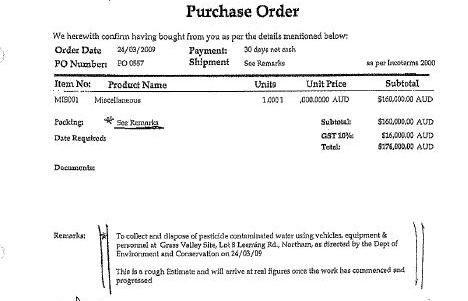
36 Ms Carr says that she received the information for her wording of the “Remarks” section from the Toxfree representative she spoke to (Mr Beere) and obtained approval for the wording from Mr Haslberger.
37 Mr Beere says that the purchase order did not accurately reflect the conversation he had with Ms Carr because his estimate of $160,000 was exclusive of treatment or disposal costs. Despite this, he did not then draw that matter to Ms Carr’s attention. It may also be noted that the purchase order referred only to the removal of contaminated water, and not to the removal of contaminated soil or equipment.
38 Gerrard Styles was employed by Toxfree as its General Manager, Operations. On 24 March 2009, Mr Styles sent an email to Ms Carr at 3.37 pm Western Australian time:
Hi Betty
Thanks for forwarding your PO for the work to Errol and myself. Lynda has forwarded the credit application forms, so we look forward to their return.
I would like to confirm a few details for clarity, to avoid any confusion following the clean up operation.
• Toxfree will only deal direct with Grass Valley Formulators and their nominated holding companies/subsidiaries. Toxfree will not deal direct with Grass Valley Formulators Insurance company with regard to the Northam Incident. The order number is a contract between Grass Valley Formulators and Toxfree Solutions.
• Toxfree will determine the method of disposal for all arisings it collects from the Northam incident, and disposes of the material as quickly as possible to avoid hold up on its current operation.
• Toxfree has issued a quotation for estimated rates on quotation 8307-09 KW, issued to yourself today 24/03/09.
If you have any questions, please do not hesitate to contact me on the numbers below.
39 Mr Styles appears to have assumed that the contract encompassed disposal of the waste.
40 Tobias Edmunds was employed as an Emergency Response Manager by Toxfree. Mr Edmunds had received a phone call from Mr Raine of the DEC suggesting that Toxfree deploy staff and emergency response equipment to GVF’s site as he was concerned that waste could leak into the Avon River. Mr Edmunds says he arrived at the site at about 10 am on 24 March 2009 and liaised with Mr Haslberger. Mr Edmunds says that the purpose of his discussion with Mr Haslberger was to explain the emergency response services that Toxfree would be providing and the schedule of rates. They did not discuss disposal of the waste. Mr Edmunds says that Toxfree began providing its emergency response services immediately after that discussion, which suggests that the work started not long after 10 am. However, Mr Edmunds also says that Toxfree deployed its emergency response unit to GVF’s site upon receipt of the purchase order. Mr Edmunds seems to be mistaken as to the time the work was commenced. It appears that Toxfree had deployed its staff and equipment to the site in anticipation of the purchase order being provided, but the purchase order was not provided until 2.17 pm. The work must have commenced sometime after that.
41 On the afternoon of 24 March, Mr Haslberger was handed documents headed “Environmental Field Notice” and “Pollution Response Unit Clean Up/Recovery Scope of Work” by Mr Raine of the DEC. Mr Edmunds was present when Mr Haslberger was given those documents. Earlier, Mr Raine had walked Mr Haslberger and Mr Edmunds through the site to point out what needed to be done in terms of the clean up and containment of waste. Mr Haslberger says that Toxfree “was left to continue with the clean up”, and “took over the clean up”, at about 4 pm. Mr Haslberger’s evidence suggests that the documents must have been handed to him shortly before that time.
42 The Environmental Field Notice stated:
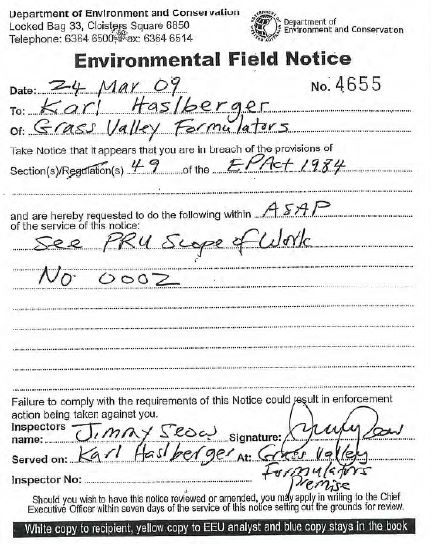
43 The “Pollution Response Unit Clean Up/Recovery Scope of Work” document stated:
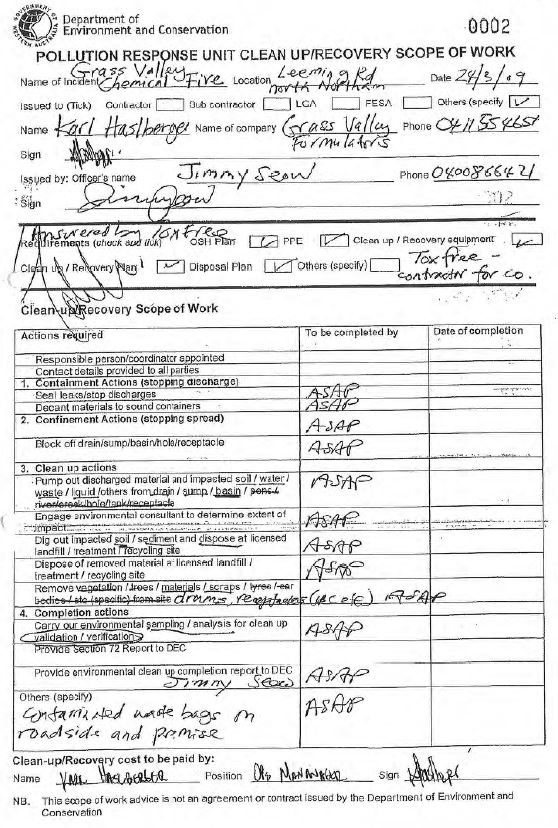
44 Mr Edmunds deposes that the job for GVF involved two defined stages: the emergency stage which commenced when the environmental field notice was issued and which finished once the site was cleared of all contaminated materials and the post-emergency stage, which covered the transport, storage and ultimate disposal of the contaminated material.
45 Mr Edmunds states that Toxfree’s emergency response services involved containing and collecting all of the contaminated material from the premises in accordance with the Environmental Field Notice from 24 March to 1 April 2009. It appears that the work on the first day consisted principally of securing leaking tanks and pumping the contaminated liquid from the pond into tanker trucks and transporting the liquid to Toxfree’s sites at Kwinana.
46 Mr Vaughan was in Queensland. He received a call on the morning of 24 March 2009 from Mr Haslberger telling him that GVF’s factory was on fire. Mr Vaughan arrived at the site that evening. He observed that by about 10.30 pm, about half the water had been removed from the pond and it appeared to him that there was no longer any risk of contaminated liquid flowing into the environment.
47 Mr Vaughan attended the GVF site each day until 31 March. He says that as a result of the fire there was no power to the site and no telephone or fax lines working. He says he had no access to any emails until he returned to Queensland on 1 April 2009.
48 Mr Styles says he telephoned Ms Carr on the day after the fire, Wednesday, 25 March 2009, to inform her that the value of the purchase order had almost been reached. He says he told Ms Carr that she should inform Mr Vaughan of this so that Mr Vaughan could advise Toxfree what he wanted Toxfree to do going forward. He says that Ms Carr responded with words to the effect that GVF would require Toxfree’s rates concerning the continuation of the services to determine the cost going forward. Mr Styles says Ms Carr also said that GVF would continue with the initial purchase order and she would consult Mr Vaughan. Mr Styles says that Ms Carr did not request that Toxfree cease providing the emergency response services.
49 Mr Styles states that Mr Vaughan had asked him if GVF could store the waste at Toxfree’s facility until GVF had determined if the liquid waste could be salvaged. He states that because of this request, he introduced a storage fee as Toxfree could not use its facilities for other clients while GVF’s wastes were stored. Mr Styles says that Toxfree stored the waste at its Kwinana and Port Headland facilities awaiting the results of analysis of the waste and further instructions from GVF. Mr Vaughan denies that he spoke to Mr Styles until 27 March 2009.
50 Mr Styles followed up his discussion with Ms Carr with an email to her, copied to Mr Vaughan, in the following terms:
Hi Betty
Further to our telephone conversation, I can confirm we are close to the original estimated PO of $ 160,000 + GST.
On your instruction we will continue to use the same PO (0557) and provide you with cost and operational updates.
We are currently freighting the liquid material to our Kwinana Operation, and will be charging storage at $0.0261 per litre, per day, until a decision is made of the fate of the material.
Additional charges to quote 8307-09KW will be made up as follows, please note this is purely an operational estimate at this stage.
• Additional PPE (Personal Protective Equipment) required for the ongoing operation EST only $ 300.00 per person (est. 8 personnel)per day
• Accomodation (sic), meals for all the team (est. 2 nights total) EST only $ 250 per person
• Lab analysis for disposal assessment – Est only $ 400.00
• Out of hours opening (including labour) for treatment plant opening, and transfer of existing products to make space. EST only $ 5480.00
• Decontamination of all plant and equipment post job, and disposal of all residues TBA
• Controlled Waste bulk liquid transfer of material transport (pocket road train configuration) to Kwinana ex. Northam EST $ 520.00 / hr
If you have any questions, please do not hesitate to contact myself on the numbers below. Please acknowledge your receipt of these charges.
51 GVF did not provide acknowledgement of the receipt of the new charges, despite the email seeking such acknowledgement.
52 It appears that Mr Styles had another conversation with Ms Carr later on 25 March 2009. He sent an email to various people within Toxfree referring to that conversation. That email reads:
Hi all
Just a brief update, spoke with Betty from Gulmohar (Grass Valley Formulators), they had received my email this morning detailing the extra charges for storage PPE etc. She had forwarded on to both directors and the Insurance Company. All parties want to proceed on the open PO (0557), and no comments have come back.
I will update you when more information becomes available.
53 Ms Carr disputes Mr Styles’ assertion that she said GVF would continue with the original purchase order. She says that Mr Styles said that Toxfree was close to the original estimate of $160,000 and would require a further purchase order for the additional work that was required. Ms Carr says she did not have the authority to authorise another purchase order, but said that Mr Styles should email her the details and she would forward the information to Mr Heyn and Mr Haslberger. She also denies that she agreed that the purchase order was to be an “open” purchase order. Ms Carr says that she understood the email to her of 25 March to mean that upon receiving GVF’s further instruction, Toxfree would use the same purchase order to provide any further work. She says her only role was to relay information between Toxfree and the directors of GVF. Mr Heyn was in Europe at that time, but she was in touch with him by email. Ms Carr forwarded Mr Styles’ email of 25 March to Mr Heyn shortly after she received it.
54 On 27 March 2009, Mr Styles and Mr Vaughan had a telephone conversation. Mr Styles says he told Mr Vaughan of the quantities of liquid and solid waste that had been removed from the site and the amounts that remained to be removed in the coming days. Mr Vaughan said that he would discuss this with Mr Heyn and they would review the figures. Mr Styles states that Mr Vaughan did not instruct him to not proceed with the work order or to cease doing work. He says that he explained to Mr Vaughan that the waste needed to go to Port Headland as this was where the liquid waste was to be disposed if it could not be salvaged. Toxfree’s Port Headland facility had the only industrial waste incinerator in Western Australia and was licensed for chemical incineration by the DEC. Mr Styles says Mr Vaughan told him that GVF would assess whether there were any other options available to it, but Mr Styles said there were no other options as there was no other licensed facility in Western Australia to store the waste.
55 Mr Styles sent Mr Vaughan a fax on 27 March. The fax states:
Further to our conversation today, I can confirm the following estimates of literage of pesticide contaminated material moved as of this evening;
• 250,000 litres (liquid, which will be transferred to Toxfree Solutions High Temperature facility in Port Hedland)
• Approx. 70 tonnes of pesticide contaminated soil which will be processed through TOxfree (sic) Solutions thermal desorption unit in Kwinana
After discussing with site there are an additional 60,000 litres to be transported from site tomorrow (liquid) and an additional 200 tonnes of contaminated soil.
Indications from site are that there is a certain amount of packaged waste in IBC’s to be pumped out and disposed of, and additional contaminated material for disposal.
As discussed, I will forward a copy of this email (faxed to Northam) to the DEC at your request.
After evaluation from both treatment plants, processing of the material will be at the following rates excluding GST and associated costs on the quote issued by Errol Beere
• Disposal only – Liquid (persicide(sic)/pesticide contaminated washwater (sic)- $ 3.14 per litre (Blending to Incineration specification and Incineration)
• Disposal only – pesticide contaminated soil - $ 1.62 per kg (thermal Desorption)
Work is being carried out against your original order (0557)
56 Mr Vaughan denies that Mr Styles had said during the conversation earlier that day that the waste would have to be disposed of by high temperature incineration or that the waste was being transported to Port Headland. Mr Vaughan says that Mr Styles said that the costs to date, including disposal, were in the vicinity of $1.6 million. Mr Vaughan says he requested an urgent meeting to discuss what Toxfree had done and how it had arrived at the figure. Mr Vaughan denies that he had agreed that Toxfree could carry out further work against GVF’s purchase order.
57 Mr Styles states that by 27 March 2009, the initial containment work had been completed in that Toxfree had averted the waste spilling in the Avon River and off-site, but there were still a number of issues listed in the DEC’s “Pollution Response Unit Clean Up/Recovery Scope of Work” document. He states that Toxfree had a skeleton staff on-site on 28 and 29 March 2009. Toxfree’s equipment was also on-site, and was charged to GVF.
58 Mr Edmunds recalls that on about 27 March 2009, Mr Vaughan asked him if Toxfree would store the following wastes at its storage facilities in Kwinana and Port Headland: 100,000 litres of liquids at Kwinana; 200,000 litres of liquids at Port Headland; and 200 tonnes of contaminated soil at Kwinana. Mr Edmunds understood that the split was based on Mr Styles’ fax of 27 March 2009. Mr Edmunds states that while he was on-site, Mr Vaughan instructed Toxfree to dispose of approximately 127 tonnes of contaminated soil removed from the GVF site. Mr Vaughan denies having such a discussion with Mr Edmunds. Mr Edmunds states that the solid waste that was held at Kwinana was disposed of within several months of Toxfree completing its services (ie by mid 2014).
59 On 30 March 2009, Mr Edmunds and Mr Styles met with Mr Vaughan and Mr Haslberger. Mr Styles said that the costs to date for the services were approximately $1.5 million for the emergency response services and the disposal costs. Mr Styles says that at the time of the meeting the most pressing issue still to be addressed was the disposal of the waste. He says that Mr Vaughan said he wanted Toxfree to provide him with the sequence of events for use by GVF’s insurer, QBE Insurance (Australia) Ltd (QBE). Mr Vaughan also said that Toxfree’s invoices would be covered by GVF’s insurance policy with QBE. Mr Vaughan discussed engaging an expert, Bruce Heath, and said that Mr Heath would analyse the waste to assess what options other than disposal of the waste might be available to GVF. Mr Styles said that was fine, but Toxfree was a waste disposal company and not a storage company and that storage rates would apply.
60 Mr Vaughan says that during that meeting Mr Styles said Toxfree would be issuing invoices which would detail how the costs were broken up. Mr Vaughan says he said he would not be able to receive the invoices because he had no email access. He said he could not understand how Toxfree could get to $1.6 million for the job. Mr Styles also said that now that the emergency was over, Toxfree would be going back to its regular rates.
61 On 31 March 2009, Mr Styles sent an email to Mr Vaughan, copied to Ms Carr, in the following terms:
Thanks for the courtesy extended to myself and Toby during our visit yesterday to discuss the progress with the clean up of the site following the fire last week. Please find a summary of the points raised, outcomes and actions going forward.
• The conditions of the Environmental Field Notice (EFN) issued by the Dept, of Environment and Conservation (DEC) will be completed by today (Tuesday) – conditions 2 & 3 are complete.
• The remainder of the contaminated soil will be removed by today to avoid any recontamination with rain filling up the containment dam. This will be verified by an Environmental Consultant (sampling today, results as soon as possible, by 3rd party laboratory), and further works (if any) will be identified.
• Copies of all non commercial documentation will be provided to DEC on Grass Valley Formulators request.
Insurances and financial liability
• Toxfree will provide a Sequence Of Events (SOE) to Grass Valley Formulators and DEC for Insurance and audit purposes
• Estimated total costs to date, attributable to Grass Valley Formulators are approximately $ 1,500,000 as of Monday 30th March. This includes labour, equipment and disposal costs.
• Samples of liquid will be made available to Grass Valley Formulators and their Insurance Company (QBE Insurance).
• The majority of the cost is the disposal of pesticide liquid residues currently approx. 100,000 L at Toxfree Solutions (Kwinana), the remainder approx. 200,000 L is at Toxfree Solutions Port Hedland Operation (OEC), where it was transferred due to capacity constraints at Toxfree (Kwinana). All liquid residues will be disposed of via High Temperature Incineration following blending.
• Contaminated Soil is currently stored at Toxfree (Kwinana) where it will be treated by thermal desorption.
• Total Invoice Value for the Emergency Response Component value for the work once complete will be in the region of $ 1,600,000
• Financial surety will be attained by submitting invoices as soon as possible, and detailing transport & labour components.
• Toxfree’s terms are standard 30 days
• In terms of cash flow, Toxfree will need prompt payment due to paying its labour up front for Emergency Response Work and disposal processing.
Other
• Toxfree to provide an up to date quote of all aspects top the cleanup aspect (non ER) of the operation
• All personnel included in the above email to be cc.d in all documentation
If you have any questions, please do not hesitate to contact myself or Toby
62 Mr Vaughan says that to the best of his recollection there was no discussion at the meeting on 30 March 2009 about transportation of waste to Port Hedland or Kwinana. He says he first became aware that waste had been transported to Port Hedland when he got email access on 2 April 2009. Ms Carr forwarded the email of 31 March 2009 to Mr Heyn.
63 On 31 March 2009, Toxfree provided invoice # 2318 to GVF. The invoice contained the heading “Description”. Under that heading, appeared the words:
Collection and disposal of pesticide contaminated water using Vehicles, equipment and Personnel at Grass Valley Site (Northam) as directed by the Department of Environment and Conservation on 24/03/09.
64 The invoice then set out a number of items of work for 24, 25, 26, 27, 28 and 29 March 2009. The invoice listed items of equipment or personnel, the number of hours charged for each item and the rate per hour. The rates were in accordance with Toxfree’s emergency response rates provided to Ms Carr on 24 March 2009. The invoice contained totals for each item for each day.
65 Although the invoice stated that it was for collection and disposal of pesticide contaminated water, this was wrong in two respects. Firstly, the invoice was in respect of the collection and removal of both solid waste and contaminated water. Second, the invoice was for collection and removal of waste, but not for its “disposal” (in the sense of its destruction).
66 The total amount of the invoice was $275,279.40 (incl GST). This exceeded the estimate of $160,000 (plus GST) by $99,279.40. Mr Beere states that the excess was accounted for by his underestimation of the time it would take for trucks to travel to and from Toxfree’s site at Kwinana. He says that additional time was required because GVF’s site only allowed one truck to enter or leave the site at a time, because a detour had to be taken to access a weighbridge which added an extra 30 minutes to each round trip and because it took longer to unload the waste at Toxfree’s Kwinana depot than it had estimated. There were also additional amounts for items which were first noted in Mr Styles’ email of 25 March 2009.
67 Toxfree sent a second invoice (# 2340) to GVF also dated 31 March 2009. Under the heading “Description”, the invoice referred to “Grass Valley Formulators Pesticide Spill. Disposal of”. The invoice included items for disposal of pesticide solutions and “wash waters” at $3.14 per litre, disposal of contaminated soil at $1,620 per tonne and transport costs from Kwinana to Port Headland by road train. The total of the invoice was $1,592,910.23.
68 Mr Edmunds states that by 1 April 2009, the emergency response services had been provided and emergency response rates no longer applied as the contaminated material had been removed and the premises no longer presented a pollution or combustion risk. He says that after 1 April 2009, Toxfree continued to provide services to GVF related to the DEC requirement that GVF provide a “section 72” closeout report. This was part of the work set out in the Pollution Response document. Preparation of that report required analysis of samples of liquid and soil removed from GVF’s site.
69 On 2 April 2009, Mr Edmunds provided a quotation for analysis of the material collected from the GVF site and a report. The amount quoted for analysis was $39,988 and the amount for the report was $950. Toxfree indicated that it would need a purchase order. On 9 April 2009, GVF provided a purchase order for these services.
70 On 2 April 2009, Mr Vaughan sent an email to Mr Edmunds stating:
Hi Toby, Sorry I have not been in touch since our meeting, I have had to return to Qld early yesterday to attend a family emergency. At this stage I will be remaining in Qld in the short term.
Thanks to both you and Ged on Monday for you (sic) time. As I mentioned to you both then, both Company Directors and our Insurers are seeking clarification on quite a number of issues. I am still awaiting your clarification of costs with our first and main issue being the vast difference between your original quote of $160,000 to remove the approx 300k Literage of contaminated water in question as well as 500 tonnes soil. The estimates of quantities to be removed that were given for you to quote on were surprisingly accurate (in particular the liquids) at the time. I do not believe the contaminated soil was anywhere near 500 tonnes, however we have not yet been advised final quantities. The second main issue as we discussed is the cost of disposal. I understand that you have been requested to supply a copy of analysis results by Bruce Heath of Chemical Consulting Services. I also understand to date he has not received analysis results. Can you please forward as soon as possible so that we can progress this matter forward.
71 In Mr Vaughan’s email, he disputed both invoices that Toxfree had sent. By then, GVF had retained Mr Heath of Chemical Consulting Services Pty Ltd to help and advise with regard to Toxfree’s fees and work.
72 On 4 April 2009, Mr Styles wrote to Mr Vaughan as follows:
Hi Geoff
Toby has forwarded me a copy of your request for clarification following our meeting last week, I hope your family emergency has been resolved.
Please find the following information for yourself and Insurance company;
• Costing, this has been provided out in the split quotes Toby has issued, as detailed as possible covering equipment, labour, tank rental and waste disposal.
• The PO issued (0557) on the 24th was a rough estimate (as detailed in the remarks section) primarily to cover Emergency Response, Equipment and labour, this PO was issued prior to determination of what disposal route the material had to be processed by.
• Liquid estimates are reasonably accurate (I think there is approx 350 k of washings/product etc.) and soils in the vicinity of 200 te(sic), final quantities will be advised.
• The majority of the bulk liquids are at our Port Hedland facility awaiting disposal via incineration. The contaminated soils and packaging remain at our Kwinana operation for thermal desorption.
• I have discussed with Bruce Heath of Chemical Consulting Services, and analysis is being provided as quickly as possible, I have advised Bruce verbally our storage tanks and transport are for waste products.
I hope this answers your queries to date, myself, Toby and Steve Gostlow (MD) are in Melbourne (Mt. Waverley) on Monday and Tuesday. If you require us to meet at your Ricketts Road office, we would be happy to do so.
Please do not hesitate to contact me if you have any questions
73 Mr Vaughan responded by email on 6 April 2009 saying:
In regards to disposal we have requested that liquid and solid waste be held for the time being until independent party (Chemical Consulting Services) can have a look at the analysis from which you determined your disposal costs. You have mentioned that you were arranging. I would have thought this was readily available as you have already determined what the disposal costs would be, based I assume upon this analysis.
74 On 7 April 2009, Mr Styles attended a meeting with Mr Heyn and Mr Vaughan to address GVF’s concerns with the invoices and explain how the costs in the invoices were calculated. Mr Heyn referred to the lower pricing for the job that Toxfree was involved in 2007. Mr Styles said that this was a different job with a different set of circumstances, that a price had been set and Toxfree was not going to move on the issue and that there would not be any further negotiation on the cost of disposal.
75 On 9 April, Mr Styles sent an email saying that GVF and Mr Heath would be provided with the basis for Toxfree’s costings for disposal and the chemical analysis, once received.
76 Mr Vaughan sent an email to Mr Styles on 15 April 2009. In that email Mr Vaughan said:
I have arranged to forward your invoices direct to our insurer, who will no doubt have numerous questions for you regarding your account. I am trying to organize a meeting possibly next week for both our assessor and ourselves to meet with you and work through some of these questions and discuss your accounts on a line by line basis. As soon as I hear back from our assessor, I will contact you to organize.
The matter regarding disposal costs has already been raised with you in a meeting with Peter Heyn last week. I note, we still have not seen any communication as to what basis you have arrived at your costing nor the analysis used to arrive at this figure. As we have indicated and have provided written evidence to you, there is a big difference in what we have paid you in the past (70c per Litre for incineration at Port Headland (your invoice 27956) and $3.14 per litre you now seek. The transport and disposal method is the same however the difference in the account would be in the vicinity of $886k approx. As you will appreciate, this huge difference is of extreme concern to GVF and its insurers.
In regard to your account for expenses (invoice 2318), again, there are a lot of questions being asked by GVF Directors and its insurers as to how the invoice amount has been arrived at. As we have mentioned before your estimate for removal was $160k (our purchase order based upon this) and yet we have an invoice tendered for $250k approx. How can this estimate be so far out?
77 Mr Vaughan’s email went on to question what he saw as excessive amounts in invoice # 2318, such as the cost of $27,250 plus GST for hire of a trailer and 4WD.
78 On 15 April 2009, Neil Armstrong of Toxfree responded by email, saying that Mr Styles was on annual leave, but that Mr Armstrong would look into Mr Vaughan’s queries and respond as soon as possible. Mr Armstrong also said that he would forward the analytical results once received. The results had in fact been received by Toxfree on 9 April 2009. The results were not provided to GVF until 24 April 2009.
79 There is in evidence an email sent by Mr Armstrong to Mr Styles and others within Toxfree on 23 April 2009 saying:
Please review attachment response to last weeks email and provide comment.
Note: I have not provided analysis results to the client as yet but shall send onwards tonight – results showed much lower contamination levels than expected.
Disposal rate suggested is based on revised contaminant levels and current incineration rates charged to Nufarm and others. Market rate unknown Geocyle tentative $1.80/1 and WRR? (No quote as yet)
Meeting scheduled 2pm tomorrow please confirm attendance.
80 The attachment provided a detailed response to Mr Vaughan’s email of 15 April. It is not entirely clear, but the attachment may have been sent to Mr Vaughan at some later stage.
81 On 24 April, Mr Vaughan attended a meeting with Mr Armstrong, Mr Edmunds, Mr Beere and Steve Gostlow of Toxfree. Mr Vaughan’s note of the meeting is as follows:

…
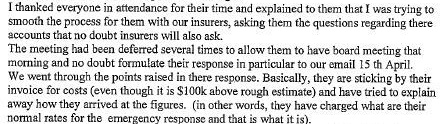
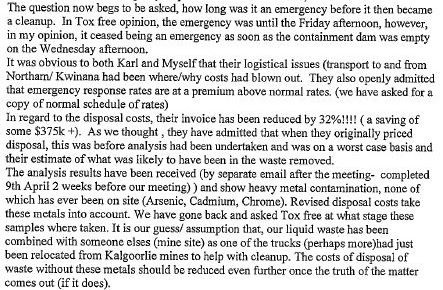
…
82 On 30 April 2009, Toxfree provided GVF with an invoice # 00002451 in the amount of $738,433.58 including GST. That consisted of $39,988 for the analysis of samples, $77,500 for the transport of waste to Port Headland, with almost all of the remainder consisting of storage costs for the solid and liquid waste material.
83 On 15 May, Mr Vaughan sent an email to Toxfree in the following terms:
I have just earlier this week received your invoice 2451 dated 30 April 2009 and must say GVF are very disappointed in the way Tox free is handling this storage/disposal of waste water. In particular we must question your invoice detailing $300k approx for storage of waste.
A point of contention from day one way has been getting an analysis of the waste water to determine what it consists of and sourcing the best/ cheapest method of disposal. Our reasoning, the less contaminated, the cheaper the disposal costs.
It was not until after our meeting.(sic) 24 April that we finally got a copy of the analysis report dated 9th April 2009 and that Toxfree kindly offered a reduction in the disposal costs by 32%. (Little did we realize at the time that the reduction in costs offered by Tox free had been quickly overtaken in storage costs).
84 On 22 May 2009, Toxfree issued an amended invoice # 2340A, which lowered the rate for disposal of liquid waste to $2.12 per litre, so that the total was $1,185,287.63.
85 On 28 May 2009, Toxfree issued invoice # 2495 to GVF for storage costs (described as “Tank and DG pad rental”) from 4 May 2009 to 1 June 2009 in an amount of $363,800.28 including GST.
86 In June 2009, Mr Vaughan set an email to Mr Armstrong of Toxfree saying:
As a result of the above, as soon as our insurer’s decision is known, Grass Valley management have some serious decisions which need to be taken, especially if there is a shortfall in what insurance are prepared to pay towards Toxfree claimed costs. Obviously, the ongoing viability of Grass Valley must also be taken into account if we are unable to replace equipment loss. We must also comply with current company law legislation.
87 On 11 June 2009, Mr Vaughan wrote to Mr Armstrong and Mr Styles saying:
Ged mentioned in an earlier meeting that storage costs had been applied in an effort to get us to decide on course of action a lot sooner. Whilst I can appreciate it is in everyone’s interest to get this matter finalized, you must understand that, from the very 1st days of cleanup, we have advised you that your costs will be a matter for our insurance company and our assessor could not enter into the discussions until fire investigation had been completed. I do not believe unrealistic invoicing (Storage in particular) is in anyones best interest in having this matter resolved quickly. The delay being encountered is outside GVF control whilst insurance claim progresses.
88 On 29 May 2009, GVF received a report from Bruce Heath. Mr Heath advised, inter alia, that the storage charges were unreasonable, that GVF had good cause to refuse to pay more than $0.70 per litre for disposal and that GVF should consider alternative methods of disposal.
89 On 15 July 2009, Toxfree issued a further invoice # PSHE00058 to GVF for storage of liquid waste in an amount of $352,064.79 for the period from 1 June 2009 to 30 June 2009.
90 On 15 January 2010, Toxfree commenced proceedings against GVF in the Supreme Court of Western Australia. The Statement of Claim alleged that GVF was indebted to Toxfree in the amount of $2,914,865.68. On 5 February 2010, GVF filed a Defence, Set-Off and Counterclaim. The counterclaim was based on the allegation that Toxfree had further contaminated the liquid waste with heavy metals, causing GVF unspecified loss and damage. It may be noted that in this proceeding, the plaintiffs do not dispute that the liquid waste was contaminated as a result of the presence of heavy metals in some of the tankers used by Toxfree. The tankers had not been cleaned before they were sent to the GVF job.
91 On 28 July 2010, Toxfree’s lawyers wrote to GVF’s lawyers, asking that GVF collect the waste stored at Toxfree’s facilities. It was not collected.
92 In the end, GVF provided no authorisation for Toxfree to proceed with the disposal of the liquid waste collected from the site and stored at Toxfree’s Port Headland facility. Neither did GVF provide any instructions for the return of the waste or its transfer elsewhere.
93 In late 2014, Toxfree transported the liquid waste from its Port Headland facility to Laverton in Victoria to allow it to make other use of its storage capacity. Approximately 363,000 litres of liquid was stored at Laverton. Between January and March 2015, the liquid waste was disposed of by high temperature incineration by Toxfree’s competitor, Geocycle. Mr Edmunds states that the costs incurred by Toxfree associated with the disposal of the liquid waste, not including any profit margin, were approximately $750,000. This consisted of $250,000 for transportation costs of the liquid waste from Port Headland to Laverton and $500,000 to incinerate the liquid waste.
EVIDENCE CONCERNING OTHER EVENTS
94 Mr Vaughan deposes that GVF was able to recommence trading within about a month after the fire occurred. It operated with one tank, whereas it would normally have six or seven tanks operating at the same time. GVF was able to progressively get other tanks operational over the following months, but its manufacturing capacity remained limited. There were delays in having the factory repaired because the owner of the property, Hamcor, delayed in paying its insurance excess. There were subsequent problems with defective work done by Hamcor’s builder. The factory was not fully reinstated until early 2010. Mr Heyn’s evidence is to similar effect.
95 GVF lost sales as a result of the fire because it was unable to meet orders. Mr Vaughan states that the company found itself with a huge inventory, but limited capacity to fill its orders. Mr Heyn also states that GVF had earlier stocked up in anticipation of a busy period, so the timing of the fire could not have been worse.
96 Mr Vaughan states that GVF paid all its debts, other than the disputed invoices from Toxfree and some of the rent claimed by Hamcor. He says that in order to ensure that it remained solvent, GVF scaled down its production levels and related expenses. Mr Heyn says that casual staff were laid off.
97 GVF received an initial payment of $199,000 from its insurer, QBE, on 27 July 2009. By that time QBE had accepted liability for the claim, but had not determined the quantum of the amount it was required to pay out. GVF received a second payment of $68,481.81 on 1 September 2009. On 27 November 2009, QBE and GVF signed a deed of release, settling the insurance claim. GVF received a final payment of $1,281,518.10 from the insurer on 2 December 2009. The amounts received from the insurer totalled approximately $1,549,000. These amounts were paid in respect of the Toxfree invoices and other costs resulting from the fire.
98 By July 2009, the invoices rendered by Toxfree had increased to approximately $2,900,000. Mr Vaughan says that GVF had delayed in posting those invoices into its MYOB accounting software because of the dispute and because it was hoped that the dispute could be settled. In July 2009, the full amount of Toxfree’s invoices was included in GVF’s accounts. This allowed GVF to claim a GST input credit based on the full amount. GVF received $264,988 for the GST input credit on 22 September 2009.
99 There were negotiations between GVF and the solicitors for Toxfree for settlement of the dispute. On 30 July 2009, GVF offered to settle by paying $850,000. Toxfree offered to settle for $1,600,000. GVF made a final offer on 25 August 2009 to pay $1,050,000 which was rejected. Mr Vaughan states that the offer was certainly not an admission that GVF owed Toxfree that amount of money. He says that the way Toxfree had conducted itself, including charging GVF about $300,000 per month for storage, was unconscionable. Mr Heyn states that he considered the Toxfree claim to be “unwinnable” (ie Toxfree could not win). Mr Heyn said the advice from GVF’s lawyers, Mason Siers Turnbull (MST Lawyers) was that GVF “had good prospects to defend the Tox Free Proceedings and also to pursue the counterclaim.”
100 Mr Vaughan says that in late 2009, following a discussion with Mr Heyn, he approached Graham Bendeich, whom he knew to be a insolvency practitioner, to obtain specialist advice. Mr Bendeich is a consultant to the firm Pearce & Heers. The first plaintiff, Mr Pearce, is a partner in that firm.
101 Mr Vaughan met with Mr Bendeich on 13 November 2009. They discussed a number of issues concerning Toxfree’s claims, GVF’s dispute with Hamcor and the proceeds of the insurance claim. Mr Vaughan asked whether the insurance proceeds had to be utilised for Toxfree’s claim, or whether the proceeds could be used to pay out GVF’s secured creditors and free up cash flow. He says that Mr Bendeich said that GVF could use the money for whatever business purposes were required and that payout of the loans would not be an issue. Mr Vaughan says that he asked about payment of Gulmohar’s loans or accounts. He says that Mr Bendeich told him that Gulmohar was entitled to be paid for its services or goods, being a major supplier to the company and a secured creditor, provided these had been supplied during the normal course of business.
102 Mr Bendeich gave evidence concerning his discussion with Mr Vaughan on 13 November 2009. He contemporaneously prepared a diary note of that discussion. Mr Vaughan vigorously contests a number of aspects of Mr Bendeich’s account of the discussion. Although there is inaccuracy in some aspects of Mr Bendeich’s diary note, where their recollections differ, I generally prefer the evidence of Mr Bendeich. That said, I do not think that there is any significant difference in their recollections of the important parts of the discussion.
103 I accept that Mr Vaughan told Mr Bendeich that GVF disputed Toxfree’s claim and that he considered the claims were excessive and unjustified. Mr Vaughan told Mr Bendeich he believed GVF was solvent and would be able to continue, but this was something that might change depending on how future matters panned out, including GVF’s dispute with Toxfree. Mr Vaughan requested advice from Mr Bendeich as to whether there were any difficulties or problems with paying the insurance proceeds to secured creditors. Mr Bendeich said that the directors of GVF had the ability to decide how to use the insurance proceeds, but if there was a liquidation further down the track, the payments were likely to come under the scrutiny of a liquidator if GVF was insolvent. Mr Bendeich also informed Mr Vaughan that in the event of an insolvency appointment, the charge in favour of Gulmohar was likely to be subject to scrutiny and might be vulnerable, given its recent creation.
104 GVF consulted MST Lawyers on 26 November 2009. In a file note, Mark Skermer of MST Lawyers, recorded that:
I met with Peter Heyn and Geoff Vaughan on Thursday 26 November and we proceeded to have a discussion with respect to the following matters:
1. QBE release;
2. Defending the Toxfree litigation; and
3. Corporate options and potential consequences.
I will address these in turn:
…
Corporate advice
I gave the client general corporate advice with respect to receiverships and liquidation without giving any advice as to whether they should engage either process at this point in time.
I advised the client that they needed to take extreme care in avoiding insolvent trading and preference payments. The client and I discussed this in detail and I supplied the client with an indepth knowledge of how the processes worked and what the client should do to avoid these sorts of claims.
I also advised the client that in the event that it wished to sell its plant and equipment, valuations should be obtained (minimum of 2 maximum of 3) before such items were sold and that a book valuation was not appropriate in this case.
I was instructed by the client to proceed and defend the Toxfree litigation.
…
105 Mr Vaughan states that he and Mr Heyn decided to clear GVF’s debts to its secured creditors and thereby free up the company’s cash flow. Their intention was to allow GVF to trade through the difficult period in anticipation of having a really good season in 2010. He says that GVF’s business was seasonal in nature and that the peak season was from March to July, August or September each year. After GVF received the insurance proceeds on 2 December 2010, it paid out its loan from Westpac Bank and an overdraft from ANZ and reduced some of its liability to Gulmohar. Mr Vaughan says that this improved GVF’s monthly cash flow by $15,155.
106 Mr Vaughan says he had seen a report in September 2009 which said that Australia’s wheat crop was expected to reach its highest levels in four years. It contributed to his belief that GVF would have a successful 2010 and to the decision to use the insurance proceeds to pay the secured creditors. However, a drought occurred in 2010, which affected GVF’s sales. The effects were felt from about February or March 2010. Orders slowed down and this had a detrimental impact on sales, which had become worse by the end of 2010, when the decision was made to liquidate the company. There is evidence supporting Mr Vaughan’s statement that the wheat-belt area of Western Australia was drought-affected in 2010.
107 On 15 January 2010, Mr Vaughan sent an email using his grassvalley.com.au email address, and describing himself as a director of GVF, to Darren Sommers of MST Lawyers. Mr Heyn was copied into the email. The email said:
At present time, GVF is trading minimally however with litigation that Mark is handling for us, in all probability the company will be liquidated as insurance settlement was insufficient to cover exorbitant and disputed clean up costs. As and when this happens is yet to be decided and open to advice.
GVF has been using the insurance funds received from QBE to replace damaged P & E destroyed in the fire as well as clearing majority of secured creditors/private loans.
With the company in its current form and unlikely to continue trading for the longer term, we have been having plant and equipment valued as well as the real estate which we currently rent.
…
Questions I have are as follows:
1. Directors Peter Heyn and myself are looking at buying (in some form of trading entity) P & E from GVF. The valuations are being done on market and forced (auction) value. With the transaction not being at arms’ length as such, can we purchase the P & E at auction value? The valuation advises that if goods are taken from site, the amount realised will be even further reduced. Concern is a challenge by liquidator, especially if we have Toxfree in the background getting most proceeds. My thought is that we are able to sell the assets, it is just the price paid which can be argued. Am I correct?
…
Intention was originally for Peter (secured creditor) to appoint a Receiver/Manager (all prior charges have been paid out) however if GVF can do the sale and renegotiate lease, we could probably just appoint administrator after the event to wind the company up and deal with the remaining creditor (Toxfree). Is this appropriate.
108 Mr Vaughan’s evidence is that he was not seeking advice on behalf of GVF, but was instead seeking advice for Mr Heyn and himself in their personal capacities.
109 On 26 July 2010, MST Lawyers provided a letter of advice in relation to GVF’s prospects of success in the proceeding in the Supreme Court of Western Australia. The letter of advice noted that Toxfree had claimed $2,914,865.68 for breach of contract plus interests and costs. MST Lawyers expressed the view that GVF was “in a strong position”. The letter said GVF’s argument that Toxfree was entitled to only $176,000 under the contract would probably fail, but that GVF was expected to have success “in reducing the quantum”, contingent upon obtaining experts’ reports. The letter said that one component of the counter-claim was based upon Toxfree depositing heavy metals on GVF’s property and advised that this aspect of the counter-claim was strong (although, it may be noted, such a case was never pleaded). The letter said that the second component of the counter-claim that Toxfree had made misleading representations concerning the cost and breadth of its services - would probably fail. MST Lawyers advised that GVF was expected to have “considerable success” in relation to reducing the quantum of Toxfree’s claim and that at least one component of the counter-claim was likely to have the effect of further reducing the amount payable to Toxfree. The letter also noted that the legal fees incurred by GVF to MST Lawyers to date were $65,427.68. MST Lawyers’ estimate of costs for the further conduct of the litigation, including a five to ten day trial, was in the order of $230,000.
110 Mr Heyn states that after receiving the advice from MST Lawyers, he and Mr Vaughan discussed the future of GVF. Mr Heyn states:
It was shortly after the time we received the MST Lawyer’s Advice that Geoff and me started to discuss whether we continue with the Tox Free Proceedings and with the Company. The MST Lawyer’s Advice pointed out the enormous cost of taking the Tox Free Proceedings all the way to a Court trial. Apart from the chances of winning or losing the shear (sic) amount of money involved in just getting the Company to a Court trial was more or less a main reason why the decision was made to liquidate the Company. The solvency of the Company didn’t even cross my mind because it continued to pay all its debts (excluding of course the disputed and unjustifiable Tox Free invoices), the decision to liquidate the Company was purely a commercial decision primarily based on the fact that the Company would have to raise the funds to litigate because it could not have raised sufficient funds just from its own trading.
111 Mr Vaughan and Mr Heyn say they made a decision to wind down the business, clear the debts (other than the disputed debts), pay all taxes that were due, pay all the staff entitlements, terminate the employment of its remaining staff and apply for an order to wind up the company.
112 On 27 October 2010, Mr Vaughan met with Mr Bendeich and Mr Pearce. Mr Vaughan told them that the directors had formed the view that it was no longer viable for GVF to continue and that they had decided to cease operating GVF’s business. They discussed the main issues involved in the likely liquidation of GVF. On 29 October 2010, Mr Vaughan sent an email to Mr Bendeich saying that he had spoken to his lawyers and that the directors had decided to make an application to wind up GVF.
113 On 15 November 2010, Gregg Lawyers, acting on behalf of GVF, filed an application seeking orders the company be wound up in insolvency. The application was accompanied by an affidavit of Mr Vaughan sworn on 15 November 2010 in which he deposed that GVF could not afford to continue with the litigation with Toxfree. He said that the directors had formed the view that it was not viable for the company to continue trading or to continue with the Toxfree litigation. He deposed that the company was “unable to meet its debts”.
114 Mr Vaughan’s affidavit of 15 November 2010 annexed a document in which he provided his assessment of the Toxfree debt:
My thoughts on whole matter and what Tox free are owed based on Tox free previous costing
Clean up cost (equipment) say $300k (this is without questioning account should be closed to $200k)
Liquid disposal $1.0 per liter) $375k. Nearly 50% than previously charged.
Solid disposal $1620 per tonne 319k without questioning cost.
Close to $1.0M or up. In my opinion this is more than generous.
We capped an offer to Tox at $1.050M in order to allow us to remedy the site allowing up to $200k to do so. With the $270k already paid by insurance this bought us to close to policy cap.
115 In this proceeding, Mr Vaughan deposes that the decision to liquidate GVF was not made on the basis that the company was insolvent. He says that GVF was “very solvent” in that it had paid all its debts except for the “unreasonable and unjustifiable claims” by Toxfree and, to a lesser extent, part of the rent claimed by Hamcor. Mr Vaughan says that he was concerned with how “we were going to continue the Company” and deal with the Toxfree proceedings. He understood MST Lawyers to have advised that GVF was going to be held liable for some amount, but it was a question of how much. He says he considered the Toxfree proceedings to be “vindictive” and he was concerned that the costs that would actually be incurred would be greater than the estimate. He says that if the drought were to persist through to 2011 and beyond, GVF was going to end up with bigger problems and most likely become insolvent. Mr Vaughan says that he and Mr Heyn had a discussion in early August 2010 with regard to how long GVF should continue to litigate with Toxfree and the utility of the company continuing to trade while the proceedings remain unresolved.
116 After GVF went into liquidation, Hamcor commenced proceedings against Mr Vaughan and Mr Heyn as guarantors of GVF’s lease. Those proceedings were settled out of court in 2011.
117 The plaintiffs called four current or former employees of Toxfree to give evidence. These were Mr Styles, Mr Beere, Mr Edmunds and Dr Morton. In assessing the reliability of those witnesses’ evidence, it is appropriate to consider them as a group. That is because all of them seemed anxious to justify Toxfree’s conduct and charges and, in addition, they were shown each other’s affidavits before they swore or affirmed their own affidavits. The fact that they were shown each other’s affidavits gives me cause for concern as to extent to which they were influenced by each other’s evidence.
118 Further, there is some evidence consistent with an overzealous desire amongst Toxfree’s employees to maximize its revenue from the GVF emergency. For example, Dr Morton sent an email to Mr Styles and Mr Edmunds on 26 March 2009 saying:
Men, I have just seen photos of the fire site from Rick…
Any chance we could make the argument to take the whole structure away?...burnt, pesticide affected steel…??????
119 In an email dated 24 March 2009 to Mr Beere and others, Mr Styles said:
Individual semi’s are fine, we’ll just charge more for transport, so good work, get all the gear out!
120 Further, despite Mr Beere saying that Toxfree could not provide a price for disposal of waste, until it had been analysed, Mr Styles proceeded to impose a price of $3.14 per litre for disposal of the liquid. At that stage, Toxfree provided no explanation to GVF as to how that rate was arrived at. Mr Armstrong of Toxfree prepared a document for internal use responding to questions raised by GVF, saying that the rate of $3.14 per litre “was to represent a worst case scenario in order to give GVF immediate estimates of disposal costs”. However, the rate of $3.14 per litre was never presented to GVF as an estimate or as a worst case scenario – it was the invoiced price. On 7 April 2009, Mr Styles said that Toxfree would not negotiate on the cost of disposal, but, on 24 April 2009, reduced the price to $2.12 per litre. In my view, GVF’s action in charging the “worst case” rate reflected an element of what Mr Vaughan described as “price gouging”. Toxfree’s inconsistent conduct contributed significantly to the ensuing dispute between the parties.
121 Having regard to these matters, I approach the evidence of the Toxfree witnesses with caution. That said, many aspects of their evidence were supported by emails or faxes sent shortly after relevant conversations.
122 It is understandable that Mr Vaughan and Mr Heyn were shocked by the invoices delivered on 31 March 2009, which totalled nearly $1,600,000. Their outrage and anger at Toxfree’s conduct is also understandable. That outrage and anger remained apparent when they were giving evidence. However, it is also clear that Toxfree was entitled to the payment of a substantial amount for work it did.
123 There are a number of aspects of the evidence of Mr Vaughan and Mr Heyn which I found to be inconsistent or implausible. I will give only a few examples for the moment.
124 In Mr Vaughan’s affidavit of 15 November 2010 in support of the application to wind up GVF, he swore that the company was “unable to meet its debts”. In contrast, in this proceeding, he swore that the decision to liquidate GVF was “not a decision, in my mind, that was made because the Company was insolvent” and that GVF was “very solvent”. Under cross-examination, Mr Vaughan initially appeared to blame the solicitor who prepared the affidavit filed in the Supreme Court of Queensland. He accepted that there was conflict between his affidavits. This conflict reflects what I consider was a tendency for Mr Vaughan to adapt his evidence to suit his present purpose.
125 Mr Vaughan and Mr Heyn defended proceedings brought against them by Hamcor in the District Court of Queensland for non-payment of rent on the basis that, following the fire, the premises “could not be occupied or used.” Mr Vaughan accepted the Hamcor defence was consistent with the instructions he had given. Inconsistently, he swore in this proceeding that within a month after the fire, GVF was able to produce pesticides, although in a limited capacity. It seemed to me that Mr Vaughan’s instructions in the Hamcor litigation were adapted to suit his extant purpose.
126 I thought that Mr Vaughan’s evidence in his affidavits and under cross-examination was evasive at times. For example, Mr Styles sent Mr Vaughan a fax on 27 March 2009 and, rather than acknowledging that it was received, Mr Vaughan merely deposed he had not seen it on that day. Under cross-examination, Mr Vaughan initially failed to accept that he had a Superway email account in 2009, before later acknowledging that he did. His answers under cross-examination were frequently unresponsive, leaving the impression that he was trying to avoid giving direct answers when confronted with difficult questions.
127 I also have substantial doubts about the reliability of Mr Heyn’s evidence. He was cross-examined about the defence in the Hamcor proceedings which alleged that GVF’s premises were unfit for occupation and use from the date of the fire until the termination of the lease on 17 November 2010. He said that the allegations in the defence were true and correct. In this proceeding, Mr Heyn’s evidence was that GVF was able to return to trading at full capacity at the start of 2010. Mr Heyn did not accept that there was an inconsistency, when there clearly was.
128 Mr Heyn was cross-examined about a consultation with Mr Skermer of MST Lawyers on 26 November 2009. Mr Heyn insisted that he could not recall discussing the issue of liquidation. He accepted the accuracy of Mr Skermer’s file note, but said that if receivership and liquidation was discussed “it must have been a sideline, otherwise I would recollect it”. He accepted that Mr Skermer would not have just volunteered advice. Mr Skermer’s file note shows that advice about receiverships and insolvency was not merely given as a “sideline”, but was a central part of the discussion. The file note shows that Mr Skermer gave advice with respect to receivership and liquidation, advised “in detail” that they needed to take care in avoiding insolvent trading and preference payments and gave advice as to the proposed sale of GVF’s plant and equipment in light of possible receivership and insolvency. It is implausible that Mr Heyn would have no recollection of discussing receivership and liquidation. Further, in this context, Mr Heyn’s statement in his affidavit of 23 October 2014 that the solvency of the company “didn’t even cross my mind” is implausible.
129 In his affidavit of 27 November 2015, Mr Heyn refers to his discussion with Mr Vaughan about getting advice from Mr Bendeich. He said that they wanted to ensure that they were acting appropriately as company directors and wanted to get advice from “someone who specialised in advising companies in difficult circumstances”. Under cross-examination, he denied that he was referring to companies experiencing financial difficulty. He said that he was instead referring to a company facing an exorbitant claim and being sued by Toxfree and difficulties with builders. But that is implausible since GVF was already receiving legal advice about the Toxfree debt and litigation, and Mr Bendeich is a liquidator. It is implausible that the “difficult circumstances” Mr Heyn was referring to were not financial difficulties.
130 My views as to the unreliability or implausibility of these aspects of Mr Vaughan’s and Mr Heyn’s evidence colour the approach I take to the remainder of their evidence.
131 Gulmohar supplied stock to GVF from time to time. Mr Heyn says he received advice from an accountant in 2008 to obtain a mortgage debenture to secure Gulmohar’s interest in the stock it was supplying, but which had not been paid for. Mr Heyn deposes that Mr Vaughan and Mr Armstrong agreed in 2008 that GVF would provide security by way of a mortgage debenture, but that it took some time for the documents to be prepared and signed.
132 On 4 May 2009, Mr Heyn wrote on behalf of Gulmohar to Mr Vaughan, in his capacity as a director of GVF, saying:
Please refer to the discussion we have had over the last week regarding the outstanding payments of Grass Valley to Gulmohar.
Gulmohar is owed approx. $800k by Grass Valley and for us to be able to provide ongoing support we require security towards the loans given to Grass Valley in the form of a mortgage debenture.
Could you please confirm this will be in order and I will arrange for necessary documentation to be forwarded.
133 The minutes of a meeting of Mr Vaughan and Mr Heyn, as GVF’s directors dated 22 May 2009 record the following:
Letter from Gulmohar Pty Ltd (“Gulmohar”) 4th May 2009 refers. Gulmohar has over the past few years provided financial support to the company in providing extended terms. They are owed in the vicinity of $800k and have requested that, for them to continue ongoing support in the same manner that we provide mortgage Debenture as security.
…
In order to secure Gulmohar’s ongoing support Directors have agreed to execute mortgage debenture documentation as requested by Gulmohar.
134 On 22 May 2009, GVF executed a Deed of Charge in favour of Gulmohar over GVF’s assets securing $800,000 plus interest plus any further advances.
135 Mr Vaughan says that GVF gave Gulmohar a mortgage debenture shortly after he and Mr Armstrong had agreed to it. He says that it was a mere coincidence that by the time the paperwork was in order, the fire had occurred in March 2009.
136 GVF’s financial statements and its MYOB accounting records record a number of debts owed to GVF’s related entities.
137 At the time of the fire on 24 March 2009, GVF owed Gulmohar $637,892.17 for the supply of stock on credit. After the fire, GVF’s accounts showed purchases from Gulmohar which totalled $957,546.39. GVF made payments to Gulmohar of $1,356,999.47. At the date of liquidation the amount owed to Gulmohar was $238,439.09. After the date of the fire the debt to Gulmohar was reduced by $399,453.08.
138 The payments made by GVF to Gulmohar were as follows:
Date | Amount |
1 May 2009 | $ 50,000.00 |
9 July 2009 | $ 100,000.00 |
16 July 2009 | $ 100,000.00 |
17 August 2009 | $ 30,000.00 |
14 October 2009 | $ 30,000.00 |
2 November 2009 | $ 30,000.00 |
12 November 2009 | $ 141,242.95 |
23 November 2009 | $ 21,000.00 |
8 December 2009 | $ 326,246.91 |
18 December 2009 | $ 14,240.66 |
20 January 2010 | $ 151,255.95 |
2 February 2010 | $ 53,000.00 |
9 April 2010 | $ 23,000.00 |
20 April 2010 | $ 10,000.00 |
11 May 2010 | $ 40,345.00 |
11 May 2010 | $ 141,488.00 |
7 July 2010 | $ 20,000.00 |
20 July 2010 | $ 10,000.00 |
13 September 2010 | $ 20,000.00 |
11 November 2010 | $ 45,000.00 |
139 At the date of the fire, GVF owed Superway Garden $42,500 under a loan agreement. The loan was not required to be repaid until 2016. GVF repaid Superway Garden $17,500 on 27 November 2009 and the remaining $25,000 on 9 December 2009.
140 At the date of the fire, GVF owed Mr Heyn, as trustee of the Heyn Family Trust, $42,500. GVF repaid $17,500 on 27 November 2009 and the remaining $25,000 on 16 December 2009.
141 Mr Vaughan states that he provided management services to GVF through Vaudell. GVF’s accounting records show that GVF had incurred a debt of $40,000 to Vaudell for management fees prior to the date of the fire. GVF paid $90,000 to Vaudell between May 2009 and February 2010 for management fees. The payments made to Vaudell were as follows:
Date | Amount |
28 May 2009 | $ 5,000 |
30 June 2009 | $ 2,500 |
30 June 2009 | $ 2,500 |
9 October 2009 | $ 10,000 |
9 October 2009 | $ 10,000 |
6 November 2009 | $ 10,000 |
18 November 2009 | $ 25,000 |
3 February 2010 | $ 12,500 |
3 February 2010 | $ 12,500 |
142 Mr Heyn deposes that he provided management services to GVF through Palacimo. According to Mr Pearce, Palacimo was owed $45,000 at the date of the fire. GVF paid $100,000 to Palacimo between May 2009 and February 2010. The payments made to Palacimo were:
Date | Amount |
28 May 2009 | $ 5,000 |
18 June 2009 | $ 5,000 |
9 October 2009 | $ 20,000 |
6 November 2009 | $ 15,000 |
10 December 2009 | $ 25,000 |
3 February 2010 | $ 25,000 |
4 February 2010 | $ 5,000 |
143 The only payments previously made to Vaudell and Palacimo were $10,000 each in December 2008.
Principles for assessment of solvency
144 Under s 95A(2) of the Corporations Act, a person who is not solvent is insolvent. Under s 95A(1), a person is solvent only if they are able to pay all their debts as and when they become due and payable.
145 The test for solvency requires application of a number of guiding principles recognised by the authorities. The principles include the following.
146 Insolvency is a question of fact to be ascertained from a consideration of the company’s financial position taken as a whole. The Court must have regard to the commercial realities. Commercial realities will be relevant in considering what resources are available to the company to meet its liabilities as they fall due, whether resources other than cash are realisable by sale or borrowing upon security and when such realisations are achievable: see Southern Cross Interiors Pty Ltd v Deputy Commissioner of Taxation (2001) 53 NSWLR 213 at [54]; Emanuel Management Pty Ltd (in liq) v Foster’s Brewing Group Ltd (2003) 178 FLR 1 at 26 [75] per Chesterman J; Hussain v CSR Building Products Limited, in the matter of FPJ Group Pty Ltd (in liq) (2016) 246 FCR 62 at [58].
147 The definition focuses on a “cash flow test” of insolvency, and not simply a “balance sheet test”: Hussain at [58]. That said, a company’s balance sheet remains relevant because the cash flow position must be assessed by reference to the company’s financial position as a whole: Hussain at [58]; Smith v Bone (2015) 104 ACSR 528 at [24].
148 Insolvency is an “endemic shortage of work capital”: Smith v Bone at [25]; Hymix Concrete Pty Ltd v Garritty (1977) 13 ALR 321 at 328. Such a position is to be distinguished from a temporary lack of liquidity: Sandell v Porter (1966) 115 CLR 666 at 670. Thus, a temporary lack of liquidity is not equivalent to insolvency and, conversely, neither is availability of surplus assets at a particular point in time conclusive of solvency: Expo International Pty Ltd (in liq) v Chant [1979] 2 NSWLR 820 at 837; Hussain at [58].
149 In assessing when debts are due and payable, the test is what debts are legally due, having regard to the agreement between the parties: Lee Kong v Pilkington (Australia) Ltd (1997) 25 ACSR 103 at 112, Hussain at [63]. This approach allows for situations where there is sufficient evidence of waiver of legal requirements, but reluctance by creditors to enforce legal rights is not sufficient. It does not matter that a creditor is unlikely to enforce its debt because the statutory test is whether the debt is due and payable at law: Hussain at [63].
150 On this test, it is immaterial that a company disputes a claimed debt. Such a dispute may require some form of determination, but does not alter whether the debt is legally due. The defendants have not contended to the contrary.
151 Where there are contract debts, it is for the party asserting that those debts are not payable at the times contractually stipulated to make good that assertion by satisfactory evidence: Southern Cross Interiors at [54].
152 The words “as and when they become due” are forward looking. That is, consideration is given to not only debts presently payable, but those that will become payable in the near future: Bank of Australasia v Hall (1907) 4 CLR 1514 at 1528; Expo International Pty Ltd (in liq) v Chant [1979] 2 NSWLR 820 at 838.
153 In assessing the assets available to pay the company's debts, the relevant question is as to what assets are capable of realisation within time to meet the company’s indebtedness: Bank of Australasia v Hall at 1543; Hall v Poolman (2007) 65 ACSR 123 at [187].
154 Where the company is trading with no intention of selling stock-in-trade or inventory outside the ordinary course of business, the value of that inventory ought be excluded from the solvency analysis: Rees v Bank of New South Wales (1964) 111 CLR 210 at 218-9; Ex parte Russell; Re Butterworth (1882) 19 Ch D 588 at 601-2; Re Damilock; Lewis v VI SA Australia Pty Ltd (2008) 252 ALR 533 at 550. Similarly, assets required to operate the business as a going concern (such as plant and equipment) are also excluded. In Re Timbatec Pty Ltd [1974] 1 NSWLR 613, Bowen CJ said that a debtor cannot rely on realising assets that would involve a cessation or breaking up of its business. If a company has to resort to selling assets that are essential to the continuation of its business, those assets are not to be included in a determination of solvency.
155 In proving insolvency, expert evidence from the liquidator may be relied upon: Sheahan v Hertz Australia Pty Ltd (1994) 14 ACSR 209 at 213; Pegulan Floor Coverings Pty Ltd v Carter (1997) 24 ACSR 651.
156 In ASIC v Plymin (No 1) (2003) 46 ACSR 126 at [386], the Court identified a number of common, albeit not essential, features in insolvency situations. That judgment has been referred to with approval in many subsequent decisions, including Bluestone Property Services Pty Ltd (in liq) v First Equilibrium Pty Ltd [2013] FCA 876 at [42]; Smith v Bone at [24] and McLellan v Carroll (2009) 76 ACSR 67 at [106]. The features are:
1. Continuing losses.
2. Liquidity ratios below 1.
3. Overdue Commonwealth and State taxes.
4. Poor relationship with present Bank, including inability to borrow further funds.
5. No access to alternative finance.
6. Inability to raise further equity capital.
7. Suppliers placing [company] on COD, or otherwise demanding special payments before resuming supply.
8. Creditors unpaid outside trading terms.
9. Issuing of post-dated cheques.
10. Dishonoured cheques.
11. Special arrangements with selected creditors.
12. Solicitors’ letters, summons[es], judgments or warrants issued against the company.
13. Payments to creditors of rounded sums which are not reconcilable to specific invoices.
14. Inability to produce timely and accurate financial information to display the company’s trading performance and financial position, and make reliable forecasts.
157 Importantly, this is a guide, not a checklist. It is merely a list of factors, the presence of one or more of which may indicate insolvency. Likewise, not all factors need be present. Further, certain factors present in a given case may carry different weight according to the circumstances of the particular case: Deputy Commissioner of Taxation v Barblance Pty Ltd (2010) 80 ATR 468 at [13].
158 A factor which may be relevant to the assessment of solvency is the likelihood that directors or associated companies will continue to support a company by lending it money or deferring debt: Re a Company [1986] BCLC 261 at 262; Lewis (as liquidator of Doran Constructions Pty Ltd (in liq)) v Doran (2005) 219 ALR 555 at [113]); Mulherin v Bank of Western Australia Ltd [2006] QCA 175 at [113]-[115]).
159 In Williams v Scholz [2008] QCA 94, the Queensland Court of Appeal observed that:
[109] It is well established that in considering a company's financial position as a whole, reference may be had, not merely to strict legal rights and obligations under agreements with creditors and debtors, but to “commercial realities”. …
[110] …There is some authority for the proposition that unsecured loans by directors cannot be taken into account. There should, however, be no objection in principle to regarding such financial support as relevant where the evidence establishes that the directors are likely to continue. Loans by related corporations have been regarded as relevant to the determination of solvency. And there is no reason in principle why a loan from directors should be treated any differently to loans from companies controlled by directors. The most important consideration is the degree of commitment to the continuation of financial support.
160 In International Cat Manufacturing Pty Ltd v Rodrick (2013) 97 ACSR 200 at [105], Morrison JA (Holmes and Gotterson JJA agreeing) confirmed that “regard can be had to such financial support where the evidence establishes that the directors are likely to continue it”.
161 In First Strategic Development Corporation Ltd (in liq) v Chan [2014] QSC 60, McMurdo J said:
[67] … [A] company's position must be considered by reference to not only its legal rights and obligations but also other circumstances such as the relative likelihood that it will have funds available to it from sources with which it has no formalised agreement or understanding. And there is no objection in principle to a consideration of the prospect of loans from related corporations or directors. …
[69] In Lewis v Doran, Giles JA (with whom Hodgson and McColl JJA agreed) emphasised that “the key concept is ability to pay the company‘s debts as and when they fall due”. That emphasis on “ability” is important here. The prospects of obtaining necessary funds from a party, which is not obliged to provide them, must be such as to give the company something more than a chance of paying its debts: the prospects must be sufficient to make the company able to do so. That does not mean that the provision of the funds must be free of any uncertainty or contingency. But there must be a sufficient likelihood for the company, and those directing it, to be able to rely upon the availability of those funds when incurring the relevant debts.
(Citations and emphasis omitted.)
His Honour concluded:
[81] …[S]tatements by the first defendant now as to his preparedness to fund the company's activity have to be assessed against what he did or did not do. As I have mentioned, he gave no credible explanation for not paying the debts which had been incurred to August 2010. And the ability or otherwise of the company to pay its debts must be assessed by looking at, from the company's perspective at the time it incurred a debt, the reliability of the first defendant as a source of funds, which is an assessment undertaken more accurately by reference to the surrounding facts and circumstances which I have discussed than by the first defendant's evidence of what was in his mind.
162 On appeal, in Chan v First Strategic Development Corp Ltd (in liq) [2015] QCA 28, Morrison JA (Gotterson JA and Boddice J agreeing) said, referring to McMurdo J’s analysis at [67]-[69]:
[43] I agree respectfully with those observations. They reflect the need, in cases where the financial support is from a source which cannot be compelled by legal arrangement, for there to be a degree of assuredness that the financial support will be forthcoming and at such a level that one could say the company was able to pay its debts as and when they fall due, rather than being possibly able to do so. Just as a conclusion that the relevant financial support does not have to be absolutely certain in order to be sufficient to meet the test in Lewis v Doran, Scholz and International Cat, equally the financial support does not have to be absolutely uncertain in order to be insufficient to qualify. Between the two extremes the factual circumstances of each case will provide a variety of points at which one might conclude that the financial support was of such a degree of commitment that it was likely to continue, and with the result that the company was able to pay its debts, and therefore that it has sufficient financial support to draw the conclusion of solvency.
[44] However, in my view there is no benefit in attempting to achieve some precise formula as to likelihood, by reference to which the financial support qualifies or does not. To say that the likelihood of it being provided is “probable” or “improbable” adds no more to what has been said in the authorities to which I have referred. Given that the resolution of this issue will almost always depend upon an assessment of facts, in my view it is better to proceed on the basis that, where the financial support is being provided by a director or related entity, and in circumstances where there is no formalised agreement or understanding, what is required is cogent evidence which enables the court to conclude that there is such a degree of commitment on the part of the provider of the financial support to continue it, such that it can be said that at any point of time it was likely to be continued, with the result that, at any of those times, the company was able to pay its debts as and when they fell due.
(Citations omitted.)
163 In ASIC v Edwards [2005] NSWSC 831 at [98], Barrett J said:
…[W]here retrospective insolvency is in issue, the Court can take into account that as at and after the alleged date of insolvency the company actually paid all its debts as they fell due because a third party made funds available to it without security. The Court can look at the arrangements which were actually made rather than artificially excluding them from consideration because the arrangements did not fall within the definition of payments from the debtor’s “own monies”. To look at what actually happened avoids the possibility that the Court is forced to conclude that, as a matter of law, a company could not pay all its relevant debts when, as a matter of fact, the company clearly did pay those debts.
(Emphasis omitted.)
His Honour continued at [99]:
…There is also the point (emphasised by the Court of Appeal in Expile Pty Ltd v Jabb’s Excavations Pty Ltd (2003) 45 ACSR 711) that the capacity to raise funds from external sources must be judged in a practical and businesslike way by reference to the commercial realities of the case, not by way of some theoretical textbook exercise. Possibilities are not enough. Genuine and realistic availability, as a matter of commercial reality, must be seen.
164 There must be cogent evidence of a degree of commitment and capacity on part of a financier if the Court is to conclude that financial support sufficient to avoid insolvency was likely to be offered or continued.
The parties’ submissions as to the Toxfree debt
165 The plaintiffs plead that as at 30 April 2009, GVF was indebted to Toxfree an amount of at least $1,100,000 (including GST) for work performed by Toxfree at GVF’s request, summarised as follows:
(a) $275,274.40 (including GST) for the emergency clean up work that was subject to the prescribed rates as indicated in Toxfree’s schedule of 24 March 2009.
(b) $0.0261 (plus GST) per litre per day for storage of liquid waste, or such other price per litre determined to be reasonable by the Court.
(c) $351,588.60 (including GST) for the disposal of contaminated soil.
(d) Not less than $1.80 per litre (plus GST) for the disposal of liquid waste plus costs for the transport of the liquid waste, or such other price determined to be reasonable by the Court.
(e) $45,031.80 (including GST) for the close-out report dated 7 April 2009.
166 The plaintiffs’ pleading proceeds on the basis that the Toxfree debt was at least $1,100,000 throughout the period from 30 April 2009 to the date of liquidation, 17 November 2010.
167 The defendants plead that:
(a) The only contract between GVF and Toxfree was for Toxfree to collect and remove contaminated liquid and soil from GVF’s premises for a price of approximately $160,000 (plus GST).
(b) Alternatively, Toxfree’s estimate of $160,000 (plus GST) amounted to a misleading or deceptive representation in contravention of s 52 of the Trade Practices Act 1974 (Cth).
(c) There was no contract for testing or disposal of the waste, the parties having agreed that Toxfree would provide a quotation to GVF for the testing and disposal once the quantities of the waste and the extent and nature of the contamination were determined, that quotation to be based on commercial rates that GVF was previously charged by Toxfree.
168 In the defendants’ closing oral submissions, their position was:
(a) There was a contract for the collection and removal of liquid waste (but not solid waste) from the site. The emergency rates notified by Toxfree were only to be charged for the emergency part of the work, which was completed on the first day.
(b) There was no contract for the disposal (in the sense of destruction) of the waste removed from the site, but Toxfree was entitled to payment for such disposal on a quantum meruit basis.
(c) There was no contract for storage of the waste, but Toxfree was entitled to payment for storage on a quantum meruit basis. Alternatively, there was a contract for storage at the rate of $0.0261 per litre per day for a reasonable length of time.
Analysis of contractual arrangements between GVF and Toxfree
Contract for collection and removal of waste from GVF’s site
169 The plaintiffs submit that there was a contract for Toxfree to carry out the work set out in the DEC’s Environmental Field Notice and Pollution Response document. In deciding whether such a contract was formed, the parties’ intentions must be objectively ascertained: Australian Broadcasting Corporation v XIVth Commonwealth Games Ltd (1988) 18 NSWLR 540 at 548-550; New South Wales Lotteries Corporation Pty Ltd v Kuzmanovski (2011) 195 FCR 234 at [55].
170 On 24 March 2009, Mr Beere of Toxfree told Mr Haslberger of GVF that Toxfree could not begin providing its emergency response services until GVF raised a purchase order confirming that it accepted Toxfree’s terms. Mr Beere provided Ms Carr with GVF’s emergency response rates for the collection of contaminated waste. He also provided a “rough estimate of cost” for that work. From their discussions with Mr Raine, Mr Beere and Mr Haslberger both understood that the DEC required the contaminated waste to be removed from the site. The contaminated waste was both solid and liquid waste. The solid waste consisted of contaminated soil and equipment.
171 Ms Carr, with Mr Haslberger’s authorisation, provided a purchase order to Toxfree which said, “We herewith confirm having bought from you as per the details mentioned below...” The price set out in the purchase order was $160,000 plus $16,000 GST, a total of $176,000. Under the heading “Product Name”, appeared the words “Miscellaneous” and “See Remarks”. The “Remarks” said:
To collect and dispose of pesticide contaminated water using vehicles, equipment & personnel at Grass Valley Site, Lot 8, Leeming Rd, Northam, as directed by the Dept of Environment and Conservation on 24/03/09
This is a rough Estimate and will arrive at real figures once the work has commenced and progressed
172 The purchase order did not accurately reflect the communications between Mr Beere and Ms Carr in two respects. Firstly, the estimate of $160,000 given by Mr Beere was only for collection of waste, and did not include disposal costs. Secondly, the purchase order referred only to the collection of liquid waste, and not to the collection of solid waste.
173 Both Toxfree and GVF failed to pick up the fact that the purchase order did not refer to solid waste. In fact, that was not an issue identified in the pleadings in the Western Australia Supreme Court, or in this proceeding. The issue was not raised until the closing submissions of counsel for the defendants.
174 Toxfree treated the purchase order as creating a contract for the disposal of waste, as well as its collection and removal. That led Toxfree to deliver an invoice for $1,592,910.23 for disposal of the waste on 31 March 2009. Toxfree apparently considered that it was entitled to unilaterally impose a rate for disposal. It imposed a rate of $3.14 per litre for liquid waste, despite Mr Beere saying that no rate could be determined until the waste had been analysed and no analysis having been done by the time the invoice was delivered. It imposed a rate of $1.62 per cubic litre for contaminated soil.
175 The purchase order must be read together with Toxfree’s email giving an estimate of $160,000 for the collection of “contaminated water and contaminated soil”. Toxfree proceeded to collect and remove both types of waste.
176 In my opinion, Mr Beere’s email to Ms Carr of 24 March 2009 attaching Toxfree’s emergency response rates and giving an estimate of costs, was an offer to contract with GVF to contract for the collection and removal of solid and liquid waste from the site at the quoted rates. By then, Toxfree had sent its emergency response crew to the site, but had said it could not begin providing its services until GVF raised a purchase order confirming that it accepted Toxfree’s terms. Toxfree was willing to carry out the work it had quoted for upon the purchase order being provided. GVF accepted Toxfree’s offer by providing the purchase order.
177 The purchase order referred only to the “collection” of waste, not its removal. The collection was to be done by using, inter alia, tankers. It was necessary to take the waste somewhere after it was collected so that it could be stored or disposed of. Therefore, the parties must have contemplated that the collection of waste also encompassed its removal from the site.
178 Although the purchase order referred only to collection of “pesticide contaminated water”, the estimate given by Toxfree, the discussions between the parties, their discussions with the DEC officers and their subsequent conduct, are consistent with an intention to contract for the collection and removal of solid waste, as well as liquid waste. GVF did not raise any dispute with Toxfree’s invoices on the basis that the contract was only for the collection and removal of liquid waste.
179 Upon the provision of the purchase order, GVF and Toxfree entered a contract. The terms required Toxfree to collect and remove contaminated solid and liquid waste from GVF’s site in accordance with directions to do so that had been given by the DEC to GVF. The work was to be carried out using Toxfree’s vehicles, equipment and personnel. Toxfree’s charges were to be at the emergency response rates that had been provided to GVF. Payment was to be made within 30 days of Toxfree delivering its invoice.
180 The plaintiffs argue that the contract required Toxfree to carry out all the work described in the DEC’s “Environmental Field Notice” and “Pollution Response” document. The plaintiffs rely, in particular, on the words “as directed by the Dept of Environment and Conservation on 24/04/09” in the purchase order. The purchase order was provided at 2.17 pm (Western Australian time), while the DEC’s documents were not served until about 4 pm. An email from Mr Styles at 3.37 pm acknowledged that there was a contract in place. The Pollution Response document, signed by Mr Haslberger, describes Toxfree as “contractor for co” also suggests that Toxfree had been engaged by the time the document was completed. I find that the DEC’s documents were given to GVF after the purchase order had been provided to Toxfree and the contract was formed. Therefore, the DEC’s documents are not contractual documents.
181 However, prior to the purchase order being provided, Mr Raine had made known the DEC’s concerns and requirements to both parties. Mr Raine talked separately to Mr Beere and Mr Haslberger and later walked around the site with Mr Edmunds and Mr Haslberger pointing out what needed to be done in terms of the clean up and containment of waste. Mr Raine told the parties that up to 300 kilolitres of liquid waste and 500 tonnes of contaminated spoil would have to be removed. They knew that the DEC’s concern was the risk that contaminated waste might spread into the environment, including the Avon River, presumably through overflowing, leaking or leaching. They knew that the DEC required that GVF eliminate that risk by having contaminated waste removed from the site. This was work that the parties understood, prior to the provision of the purchase order, which the DEC had or would direct to be done. This was what was meant when the purchase order said “as directed by the Department of Environment and Conservation”.
182 These were also the principal tasks later described in the “Pollution Response” document. Other tasks described in the “Pollution Response” document, such as environmental sampling and analysis, did not form part of the contract entered on 24 March 2009.
183 The defendants argue that under the contract, Toxfree was only entitled to charge its emergency response rates for the emergency part of the work. They argue that the emergency was over by the evening of 24 March 2009 when the pond had been substantially drained and there was no further risk of the pond overflowing into the Avon River. The plaintiffs submit that the contract entitled Toxfree to charge its emergency response rates for the whole of the task of collecting and removing the liquid and solid wastes, and that task was not complete until 31 March 2009.
184 There was a great deal of evidence about the subjective views of witnesses as to what constituted the emergency and when the emergency ended. However, the question as to what work Toxfree was entitled to charge emergency response rates for depends on the proper construction of the contract. This must be done on an objective basis.
185 As I have said, the contract was for Toxfree to collect and remove contaminated solid and liquid wastes from GVF’s site in accordance with the DEC’s directions. The DEC evidently regarded the whole of that task as urgent because there was a risk that the contaminated waste might escape into the environment, whether through the pond overflowing or through leaching or leaking of contaminated water. The DEC’s requirement that the collection and removal of the waste be done on an urgent basis was demonstrated by the fact that Mr Raine suggested that Toxfree urgently deploy a crew to the site and by the “Pollution Response” document later issued which required the work to be done as soon as possible. In my opinion, the contract was for Toxfree to perform the whole of the task of collection and removal of the waste at its emergency response rate. The contract was not for Toxfree to do some portion of the work contracted for at one rate and the remainder at a lower rate. The work was completed by 31 March, and was described in Toxfree’s invoice # 2318.
186 The defendants plead that the contract was to collect and remove contaminated soil and liquid waste for a charge of approximately $160,000 (plus GST). The defendants also plead that Toxfree engaged in misleading or deceptive conduct, in breach of s 52 of the Trade Practices Act, by providing an estimate of costs for collection and removal of wastes that was greatly understating the actual costs.
187 Mr Beere’s estimate was a representation as to a future matter. The question under s 51A of the Trade Practices Act is whether there were reasonable grounds for making the representation. Mr Beere made it clear in his discussion with Ms Carr and in his subsequent email that the figure of $160,000 was an estimate only and that it was very difficult to provide precise figures because, inter alia, he had not seen the site. The purchase order acknowledged that the figure was a “rough estimate” and “real figures” would be arrived at after the work had commenced and progressed. Mr Beere explains that the work proved to be more expensive because, amongst other things there were problems with more than one truck accessing the site at a time, increasing the time it took to do the work. There are reasonable grounds for the estimate, given the urgent circumstances. I find that the estimate was not misleading or deceptive.
188 Further, I find that the contract was not a contract for the work to be done at a fixed price.
189 The purchase order stated “We herewith confirm having bought from you as per the details mentioned below” and set out a total price of $160,000 plus $16,000 GST. The defendants submit that the contract was subject to a term that any work beyond the value of $160,000 plus GST required authorisation by GVF. I accept that submission. The defendants then argue that no authorisation of the further work was provided.
190 Mr Edmunds states that Mr Haslberger provided him with oral authority on site to continue to use the purchase order on about 25 March 2009. It is unclear what this means. Mr Edmunds states that Toxfree “may maintain file notes” of conversations with customers and that this procedure applied to Toxfree’s dealings with GVF. No file note of Mr Edmunds conversation with Mr Haslberger has been produced, and there is no other contemporary documentation consistent with the instruction being given. The first record of the conversation appears in Mr Edmunds affidavit, prepared some six years after the event. I have substantial doubts about Mr Edmunds’ recollection of this matter.
191 On 25 March, Mr Styles told Ms Carr by telephone that Toxfree was close to the value of the purchase order. I accept that Mr Styles asked for another purchase order for the additional work. Mr Styles requested that Ms Carr inform Mr Vaughan of this so he could advise Toxfree of what he wanted to do. Ms Carr said that GVF required Toxfree’s rates to determine the costs going forward. Mr Styles says that Ms Carr said GVF would continue with the original purchase order and she would consult Mr Vaughan. Mr Styles also sent an email to Ms Carr on the same day saying that Toxfree’s work was close to the $160,000 limit. The email continued “On your instruction we will continue to use the same PO (0557) and provide you with cost and operational updates”.
192 Ms Carr denies that she told Mr Styles that GVF would continue with the same purchase order. Ms Carr says that she understood the statement in the email to mean that upon receiving GVF’s further instruction, Toxfree would continue to use the same purchase order to provide any work. Ms Carr says, in effect, and I accept, that she was a mere conduit for communications between Toxfree and GVF. Ms Carr was acutely aware of the limits of her role, and I think it is unlikely that she gave any instruction to Toxfree to continue to do work after the $160,000 limit of the purchase order had been reached. Mr Styles appears to have mistakenly taken her as giving such an instruction. A tendency to enthusiastically proceed on a version of events favourable to Toxfree characterised several aspects of Mr Styles’ conduct. That misunderstanding is reflected in Mr Styles’ email to other Toxfree staff on the same date.
193 However, there is no reason to think that Ms Carr did not consult Mr Vaughan about her discussion with Mr Styles, as she said she would do. Mr Vaughan was available to Ms Carr by telephone. He was on site and knew that Toxfree was continuing to do the work. Further, Ms Carr forwarded Mr Styles email to Mr Heyn. No-one from GVF told Toxfree to stop working.
194 In Empirnall Holdings Pty Ltd v Machon Paull Partners Pty Ltd (1988) 14 NSWLR 523 at 535, McHugh JA (Samuels JA agreeing) held:
[W]here an offeree with a reasonable opportunity to reject the offer of goods or services takes the benefit of them under circumstances which indicate that they were to be paid for in accordance with the offer, it is open to the tribunal of fact to hold that the offer was accepted according to its terms…
The ultimate issue is whether a reasonable bystander would regard the conduct of the offeree, including his silence, as signalling to the offeror that his offer has been accepted.
See also Brambles Holdings Ltd v Bathurst City Council (2001) 53 NSWLR 153 at [82].
195 GVF gave no express instruction to Toxfree to continue its work of collection and removal of the waste after its costs reached $160,000. However, the whole of the circumstances must be considered. Toxfree had already done much of the work and had conveyed to GVF that it had nearly reached the $160,000 limit. The parties knew that the DEC required the whole of the contaminated waste to be collected and removed. GVF had the opportunity to instruct Toxfree not to continue with the work, but did not do so, and was content to take the benefit of the ongoing work. From the perspective of a reasonable bystander, GVF’s conduct, including its silence, provided tacit authorisation for Toxfree to continue to do the work once its charges had reached $160,000.
196 If this analysis is wrong, the question arises as to whether Toxfree is entitled to reasonable remuneration on a quantum meruit basis for its work after the $160,000 mark.
197 For the purposes of considering solvency, the word “debt” is not a word of “precise and inflexible denotation”: Hawkins v Bank of China (1992) 26 NSWLR 562 at 572. A debt can include a claim on a quantum meruit basis: see ASIC v Edwards (2009) 264 ALR 723. Such a debt can arise where services are provided at the request of a party, but where there was no fixed price agreed, or the work requested falls outside the scope of the original contract. In such a case, the law implies a term that a reasonable price shall be paid: Horton v Jones (No 2) (1939) 39 SR (NSW) 305 at 319-320; Brenner v First Artists’ Management Pty Ltd [1993] 2 VR 221 at 256; Benedetti v Sawiris [2014] AC 938 at 954. The starting point is the objective market value, or market price, of the services: Benedetti v Sawaris at 956. In Flett v Deniliquin Publishing Co Ltd [1964-5] NSWR 383, Herron CJ said at 386:
In seeking a measure of reasonable reward, the parties’ ineffective contract may be looked at for this purpose and in some cases the degree of benefit conferred on the defendant may be taken into account; Way v Latilla [1937] 3 All ER 759. But there must be some evidence of a market or prevailing price…put in another way, there was no external standard to which a trial judge could refer to define the quantum of the claim.
198 The Court may have regard to the terms of an ineffective contract in estimating the value of the services, although such terms are not necessarily determinative: Iezzi Constructions Pty Ltd v Watkins Pacific (Qld) Pty Ltd (1995) 2 Qd R 350 at 370.
199 The parties had agreed that Toxfree’s emergency response rates were to apply to work up to the value of $160,000. The remainder of the work involved in the collection and removal of the waste still had to be done as part of the work that the DEC required to be done on an urgent basis. I am satisfied that, in the circumstances, Toxfree’s emergency response rates were reasonable for the remainder of the work.
200 The defendants next argue that GVF only authorised the transportation of liquid waste to Toxfree’s plant at Kwinana, and not to Port Hedland. The defendants contend that Toxfree was not entitled to charge for transport to Port Hedland. Mr Vaughan’s evidence is that he was unaware that the liquid waste had been transported to Port Hedland until after it had been transported there.
201 Mr Edmunds’ evidence was that on 27 March 2009, Mr Vaughan asked if Toxfree could store the bulk of the liquid waste at Port Hedland. While I accept that Mr Vaughan asked Mr Edmunds if Toxfree could store the waste, I do not accept that Mr Vaughan asked if it could be stored at Port Hedland. There was no reason for Mr Vaughan to be so specific about where it was to be stored.
202 On 25 March 2009, Mr Styles sent an email to GVF saying that the liquid waste was being transported to Kwinana. Mr Vaughan claims not to have seen the email until 2 April. On 27 March, Mr Styles sent a fax to Mr Vaughan saying that 250,000 litres would be transferred to Toxfree’s Port Hedland facility. Mr Vaughan does not deny receiving the fax, but says only that he did not see it on the day it was sent. I also accept that before sending the fax, Mr Styles told Mr Vaughan by telephone that the liquid waste would be sent to Port Hedland. Mr Vaughan made no complaint about the waste being taken to Port Headland after he saw the fax, and that is consistent with Mr Styles having previously told him where it would be taken.
203 The terms of the contract formed on 24 March 2009 did not specify where the liquid waste was to be transported to. It must have been within the contemplation of the parties that the liquid waste would be transported to Port Hedland, since, as I will discuss later, GVF indicated in the purchase order that it wished to engage Toxfree to dispose of the waste and GVF knew from dealings in 2007, that Toxfree’s incineration facility was in Port Hedland. Toxfree was entitled to charge for the costs of such transportation.
204 The plaintiffs concede that Toxfree was not entitled to charge for a number of items, totalling $73,589.50, set out in Toxfree’s invoices # 2318 and # 2451 for work done between 24 March and 1 April 2009. The defendants’ submissions do not descend to the details of the invoices. Taking into account other items that may be disputed at the margins, the plaintiffs submit that the amount owed by GVF under invoice # 2318 since 30 April 2009 can be taken to be $200,000 (plus GST). I accept that submission.
Whether there was a contract for disposal of waste
205 The plaintiffs submit that under the contract formed on 24 March 2009, the parties agreed that Toxfree would not only collect the contaminated waste, but dispose of it at a price to be advised by Toxfree. The plaintiffs rely on the words “collect and dispose” in the purchase order (see para [35]). The plaintiffs argue that “dispose” refers to the decontamination of waste by treatment or incineration and dispersal of the material that remained. It is convenient to refer to disposal in this sense as “destruction” of the waste.
206 The defendants submit that, in the context, the word “dispose” refers only to the removal of the waste from the site. They also argue that the words “at Grass Valley Site” in the purchase order refers to work done at the site, indicating that the word “disposal” does not refer to off-site destruction of the waste, The defendants argue, alternatively, that there was no contract for disposal, in the sense of destruction, because there was no agreement as to Toxfree’s charges for disposal.
207 In 2007, Toxfree had disposed of waste for GVF by incinerating it. Mr Beere’s email of 24 March 2009 stated that there would have to be sampling of the contaminated soil and water before Toxfree could quote a rate for “treatment and disposal”. The email gave an estimate of costs to “collect” waste and said that the estimate did not include “treatment and disposal costs”. The schedule of emergency response rates attached to the email had a rate of “$TBA” for treatment and disposal of contaminated soil and water.
208 Ms Carr obtained approval of the wording of the purchase order from Mr Haslberger. Mr Haslberger must be taken to have used the word “dispose” to refer to something that Toxfree would do in association with treatment of the waste. The purchase order indicated that the work Toxfree was to do was to “collect and dispose of” pesticide contaminated water. Contrary to the defendants’ submissions, the word “dispose” in the purchase order did not refer to the mere removal of the waste from the site, but also referred to its destruction.
209 The defendants next submit that the purchase order was only for work done “at Grass Valley Site”, indicating that the agreement was not for the off-site disposal of waste. In my opinion, the words “at Grass Valley Site” refer to the location of the “pesticide contaminated water”, not the place where all the work was to be done. The purchase order required collection of contaminated waste from that site and transportation away from the site.
210 However, Toxfree’s charges to dispose of the waste were not agreed. Mr Beere had made it clear that Toxfree would be unable to provide an estimate for treatment and disposal until the waste was analysed. Toxfree’s “Emergency Response Rates” document email on 24 March 2009 said that the price for treatment and disposal of contaminated soil and water was “TBA”. The plaintiffs argue that it was a term of the contract formed on 24 March that the price for disposal was to be determined by Toxfree. The plaintiffs submit that it is settled law that parties may specify that further terms will become binding on them upon those terms being determined by one of the parties.
211 In Toyota Motor Corporation Australia Ltd v Ken Morgan Motors Pty Ltd [1994] 2 VR 106 at 130, Brooking JA noted that an agreement is not a binding contract unless the parties have agreed upon such terms as are in the circumstances legally necessary to constitute a contract. Otherwise, the supposed contract is bad for uncertainty. An aspect of uncertainty is incompleteness. A contract is incomplete if the parties have deliberately left some essential term to be settled by their future agreement: May and Butcher Ltd v the King [1934] 2 KB 17 at 20; Thorby v Goldberg (1964) 112 CLR 597 at 607; Australian and New Zealand Banking Group Ltd v Frost Holdings Pty Ltd [1989] VR 695 at 700. An incomplete contract may show that the parties did not intend that there should be a binding contract.
212 In this case, the purchase order demonstrates that GVF wished to engage Toxfree to dispose of the waste, but does not demonstrate that GVF intended to be bound in the absence of agreement as to the price. Toxfree had made it quite clear that it was unable to say what its price would be until the waste was analysed. There was no mechanism agreed for determination of the price. The purchase order cannot be understood as reflecting an agreement by GVF to be bound to pay whatever Toxfree decided to charge. In my opinion, the purchase order reflected no more than an intention by GVF to engage Toxfree to dispose of the waste at a price to be agreed.
213 Further, in circumstances where Toxfree specifically proposed a price and GVF rejected that price, there was no contract for disposal with an implied term that a reasonable price would be paid: c.f. Benedetti v Sawiris at 954. No binding contract for the disposal of waste was formed on 24 March 2009.
214 However, the parties subsequently entered a contract for the disposal of contaminated soil. Mr Edmunds states that while he was on-site (between 24 March and 1 April), Mr Vaughan instructed Toxfree to dispose of approximately 127 tonnes of contaminated soil that had been removed from the GVF site. Mr Vaughan disputes that he authorised the disposal of the soil. Despite the absence of any file note, I prefer Mr Edmunds’ account. Toxfree had retained both the solid and liquid waste pending instructions from GVF. Its action in destroying the contaminated soil is consistent with having received an instruction from GVF to do so. Further, Mr Vaughan took no issue with the cost of disposal of the soil. Mr Styles’ fax of 27 March 2009 had notified Mr Vaughan that the cost disposal of contaminated soil would be $1.62 per kg. Even in this proceeding, there is no contention that the price for the disposal of the solid waste was too high. That is consistent with Mr Vaughan having given an instruction for disposal of the soil. I find that a contract was formed for Toxfree to dispose of the contaminated soil at a price of $1.62 per kg.
215 Toxfree issued two invoices which included amounts for disposal of contaminated soil. Invoice # 2340 of 31 March 2009 included $206,776.80 (plus GST) for soil disposal; and invoice # 2451 of 30 April 2009 included $112,849.20 (plus GST) for soil disposal. The first amount was payable by 30 April 2009 and the second by 30 May 2009. GVF was indebted to Toxfree in those amounts from those dates.
216 GVF provided no instruction at all as to disposal of the liquid waste. It was stored at Toxfree’s Port Headland facility until late-2014, when it was transported to Laverton in Victoria. Approximately 363,000 litres of liquid was stored at Laverton. The liquid waste was incinerated between January and March 2015. The incineration was carried out by another disposal company, Geocycle, which charged Toxfree cost price. Mr Edmunds states that cost of incineration was approximately $500,000, but this is difficult to reconcile with Geocycle’s invoices exhibited to Dr Morton’s affidavit which total $255,000, and a letter from Geocycle which indicates that its charges were $267,000.
217 The defendants accept that Toxfree is entitled an amount for the reasonable value of disposal of the liquid waste on a quantum meruit basis. Toxfree’s entitlement to such an amount arose when GVF received the benefit that gave rise to its obligation to make restitution: see Coshott v Lenin [2007] NSWCA 153 at [17], Benedetti v Sawiris at 955-956. GVF’s obligation to pay a fee for storage of the liquid waste meant that it did not receive a benefit from the disposal until the disposal occurred. As the disposal did not occur until after the impugned transactions and after GVF went into liquidation, it is not strictly necessary for me to proceed to determine a reasonable price. However, I will consider that issue in case I am wrong.
218 The price that Toxfree initially sought to charge for the disposal of contaminated liquid was $3.14 per litre. Toxfree later reduced the price to $2.12 per litre. The plaintiffs argue that this was a reasonable price. The plaintiffs point to a price list for Geocycle from June 2010 showing a price of $2.35 per litre for disposal of non-chlorinated waste.
219 Dr Morton states that the price of $0.70 per litre charged that Toxfree charged GVF in 2007 is not comparable because Toxfree’s costs had significantly cost increased due to the mining boom. He also says that the waste disposed of in 2007 was not the same type of waste.
220 Toxfree’s initial price of $3.14 per litre, assessed despite Mr Edmunds saying that a price could not be given until the waste was analysed, was later implicitly accepted by Toxfree to be grossly excessive. That leaves me with little confidence that its price of $2.12 per litre after analysis can be relied upon as reasonable. A better indication of what is reasonable is found in an internal email written by Mr Armstrong on 23 April 2009, which says in relation to liquid waste:
Market rate unknown Geocycle tentative $1.80/L...
221 The email seems to indicate that Geocycle’s “tentative” price was $1.80 per litre for the disposal of liquid waste of the type collected from GVF’s site. That rate has the benefit of being independently assessed. It is broadly consistent with the rate of $1.06 per litre (which excluded any profit component) that Toxfree said was the cost of disposal in a letter it wrote to the DEC dated 28 January 2011. Subject to consideration of the defendants’ argument concerning “subjective devaluation”, I accept $1.80 per litre to be a reasonable price.
222 The defendants submit that what is a reasonable price is affected by the principle of subjective devaluation. Under that principle, it is permissible to reduce the objective market value of a service to reflect the subjective value of the service to the recipient of the service: Benedetti v Sawaris at 957. The defendants’ argument goes to the assessment of a reasonable price for disposal of the liquid waste and, possibly, storage of the waste.
223 The defendants’ subjective devaluation submission commences with propositions that Toxfree transported the liquid waste to Port Hedland without GVF’s authority and that Toxfree caused the waste to become contaminated with heavy metals. The defendants contend that these matters denied GVF the chance to treat the liquid waste itself (after obtaining a controlled waste licence and constructing an incinerator at its site). This is said to have limited the benefit that GVF derived from Toxfree’s services.
224 The defendants submit that Toxfree transported the liquid waste to Port Hedland without GVF’s permission. They submit that the prohibitive cost of transporting the waste back to its site from Port Hedland, instead of from Kwinana, contributed to the inability of GVF to process the waste at its own plant. However, I have already rejected the defendant’s argument that the waste was transported to Port Hedland without GVF’s permission.
225 Mr Heath of Chemical Consulting Services was initially engaged by GVF as a consultant to assist it in understanding and disputing the invoices raised by Toxfree. He was called as an expert witness at the trial. Mr Heath’s evidence is that GVF could have constructed a “small batch treatment plant” on its site at Grass Valley and treated the waste there at a much lower cost than the price proposed by Toxfree. He says that heavy metal contamination by Toxfree deprived GVF of the opportunity to do so.
226 I accept that Toxfree caused further contamination of the liquid waste with heavy metals by transporting the waste in dirty tankers. The evidence of Dr Morton, a technical manager employed by Toxfree, was that the additional contamination would not have increased the cost of disposal at Toxfree’s Port Hedland facility, which was the only licensed disposal facility in Western Australia. I accept that evidence.
227 Mr Heath’s suggestion of the construction of a treatment plant on GVF’s site to incinerate or mineralize the waste may not have arisen until his second report in these proceedings, in July 2015, six years after the fire. In a report dated 29 May 2009 he had suggested that the waste could be treated with a “waste water evaporator”, but it unclear whether that is the same thing as a small batch treatment plant.
228 In any event, GVF was legally obliged to comply with the “Environmental Field Notice” after it was issued by the DEC. The notice required GVF to remove the waste from the site and dispose of it at a licensed facility. GVF was not licensed to treat the waste at its factory site, or to take the waste back to its site. Mr Heath concedes that GVF’s dangerous goods licence was not the relevant licence. I accept that the relevant licence was a controlled waste licence. GVF never sought such a licence.
229 The only evidence as to the DEC’s requirements for a controlled waste licence is found in a document entitled, “A Guide to Licensing”, which contains only general guidelines. There is no evidence that if GVF had sought a licence, it is likely to have been granted one. There is no evidence as to how long it would have taken for a licence to be granted. That is relevant because the waste would have had to be stored in the meantime, and I accept that GVF would not have been permitted to store the waste at is premises without holding a controlled waste licence. Further, there is no evidence that the owner of GVF’s site, Hamcor, would have consented to a treatment plant being built on its land. In my opinion, the proposition that GVF could have built a treatment facility and incinerated the waste on its site is merely speculative. I do not accept Mr Heath’s opinion that the heavy metal contamination of the waste by Toxfree deprived GVF of the opportunity to treat the waste itself.
230 Even if Mr Heath’s opinion were accepted, he calculates the cost of constructing and operating a “small batch treatment plant” at $400,000. It is unclear whether this figure includes GST. It leaves out the costs of obtaining a controlled waste licence and approval for construction of treatment plant. At best for the defendants, the reasonable cost of disposal is $400,000 (incl GST).
231 Mr Edmunds states that Mr Vaughan requested that Toxfree store the waste so that it could consider its options. Mr Edmunds informed Mr Vaughan that Toxfree was licensed to store the liquid and solid waste. Mr Vaughan does not deny this in his affidavits, but deposes that he has no recollection of such a conversation. Under cross-examination, Mr Vaughan’s evidence was that he did have a discussion with Mr Edmunds about storing the waste “for a period of time, yes”. That conversation is likely to have occurred on 25 March 2009.
232 On the same day, Mr Styles sent an email to Ms Carr, copied to Mr Vaughan, saying:
We are currently freighting the liquid material to our Kwinana Operation, and will be charging storage at $0.0261 per litre per day, until a decision is made of the fate of the material.
…
Please acknowledge your receipt of these charges.
233 GVF did not acknowledge receipt. On 25 March 2009, Mr Styles sent an email to some of Toxfree’s staff saying that he had requested a purchase order for storage at $0.0261 per litre per day. No such purchase order was provided by GVF.
234 In an email to Mr Styles sent on 6 April 2009, Mr Vaughan said:
In regards to disposal we have requested that liquid and solid waste be held for the time being until independent party (Chemical Consulting Services) can have a look at the analysis from which you determined your disposal costs.
235 Mr Vaughan deposes that Toxfree agreed to store the waste until “agreement was made as to what to do with the material”. In its defence in the proceeding in the Supreme Court of Western Australia, GVF admitted that on about 30 March 2009 it requested Toxfree store the contaminated material until testing had been done and a disposal plan agreed. GVF also admitted in the defence that on 25 March 2009, Mr Styles had communicated that Toxfree would charge $0.0261 per litre per day for storage.
236 I accept that on 25 March 2009 Mr Vaughan asked Toxfree to store the solid and liquid waste. Toxfree quoted a price of $0.0261 per litre per day for storage of the liquid waste. That was an offer to store the waste at that rate. There was no express communication by GVF that the offer was accepted, but there was no complaint about the price. Mr Vaughan made a further request that Toxfree store the waste on about 30 March 2009 and his email of 6 April 2009 confirmed that GVF had requested that the waste be held for the time being. He again made no protest about the storage charge. A reasonable person would regard GVF’s conduct as signalling to Toxfree that its offer had been accepted: see Empirnall Holdings at 535. In my opinion, a contract was formed under which Toxfree agreed to store GVF’s liquid waste at $0.0261 per litre per day until the waste had been analysed and a disposal plan agreed
237 Mr Vaughan said in his oral evidence in relation to the volume of liquid waste:
Until such time as it actually arrived in an invoice, I don’t think my awareness was there to the same – to the extent it should have been.
It appears that Mr Vaughan simply failed to grasp that the total cost of storage of the liquid that had been removed at the quoted rate would be so high. However, that cannot affect the formation of the contract.
238 There was no price agreed for storage of solid waste. On or before 1 April 2009, GVF instructed Toxfree to dispose of the solid waste. The solid waste was stored by Toxfree until it was disposed of in mid-2009.
239 Toxfree issued invoice # 2451 on 30 April 2009 claiming $112,849.20 (plus GST) for storage costs for contaminated soil from 30 March to 3 May 2009. GVF instructed Toxfree to dispose of that waste within a few days of 24 March. For reasons that are unexplained, Toxfree did not carry out that work until mid-2009. Toxfree was entitled to storage costs for the contaminated soil for no more than a few days. In the absence of evidence as to the precise date when GVF gave the instruction, I do not propose to allow anything for storage of the contaminated soil.
240 Mr Vaughan started to complain about storage costs for the liquid waste in his email of 15 May 2009. Despite that, GVF provided no instructions to dispose of the liquid waste, or to transport it to another storage facility. Toxfree continued to store the liquid waste until March 2015.
241 Toxfree’s invoice # 2451 included an amount of $299,902.05 (plus GST) for storage of liquid waste at $0.0261 per litre per day. Toxfree was entitled to charge that amount and it was payable within 30 days, as was each of the other invoices for storage delivered by Toxfree.
242 Invoice # 2451 includes an amount for “DG Pad Rental”, which seems to be an additional charge for storage of liquid waste. That item also appears on several subsequent invoices. The contract was for storage costs at $0.0261 per litre per day. Toxfree was not entitled to impose any additional charge for “DG Pad Rental”, and I will not allow anything for this item.
243 On 28 May 2009, Toxfree issued invoice # 2495 which included an amount for storage costs for liquid waste from 4 May to 1 June 2009 in the amount of $265,627.53 (plus GST).
244 On 15 July 2009, Toxfree issued invoice # PSHE00058 for storage of liquid waste for the period from 1 June 2009 to 30 June 2009 in the amount of $257,058.90 (plus GST).
245 On 5 November 2009, Toxfree issued invoice # PSHE00593 for storage of liquid waste from 1 July to 31 July 2009 and 1 August to 31 August 2009 which include an amount of $265,627.53 (plus GST) for each month, a total of $531,255.06 (plus GST).
246 On 9 December 2009, Toxfree issued invoice # PSHE00753 for storage of liquid waste from 1 November to 30 November 2009 in the amount of $257,058.90 (plus GST).
247 On 4 January 2010, Toxfree issued invoice # PSHE00878 for storage of liquid waste from 1 December to 31 January 2009 in the amount of $265,627.53 (plus GST).
248 On 3 February 2010, Toxfree issued invoice # PSHE00992 for storage of liquid waste from 1 January to 31 January 2010 in the amount of $265,627.53 (plus GST).
249 GVF was indebted to Toxfree in these amounts from 30 days after the delivery of each invoice.
250 Although Toxfree did not issue any further invoices, the directors of GVF knew that storage costs for the liquid waste were accumulating at approximately $257,000 to $265,000 per month (plus GST) before GVF went into liquidation on 17 November 2010.
Contract for analysis of waste and report
251 On 2 April 2009, Toxfree provided Mr Vaughan with a written quotation for analysis of the waste in an amount of $39,980 (plus GST) and a report for the DEC in an amount of $950 (plus GST). The quotation stated that no documentation would be released until full payment of Toxfree’s emergency response invoice had been received. The offer required payment within 30 days.
252 GVF accepted the offer by providing Toxfree with a purchase order for an amount of $45,031.80 (including GST) dated 7 April 2009.
253 Toxfree engaged Engtech and obtained a report from Engtech on 29 May 2009. The amount invoiced to GVF for the Engtech report was $43,986.80 (including GST) and was included in Toxfree’s invoice # 2451 to GVF delivered on 30 April 2009. That amount was payable by GVF by 30 May 2009.
254 I have found that GVF and Toxfree entered the following contracts:
(a) 24 March 2009 – contract for Toxfree to collect and remove contaminated solid and liquid waste from GVF’s site, to be paid at Toxfree’s emergency response rates.
(b) 25 March 2009 – contract for Toxfree to store the liquid waste at $0.0261 per litre per day.
(c) Late March 2009 – contract for Toxfree to dispose of contaminated soil at $1.62 per kg.
(d) 7 April 2009 – contract for Toxfree to have the liquid waste analysed and to arrange the provision of a report for an amount not exceeding $45,031.80 (including GST).
255 The amounts owed by GVF to Toxfree at the relevant times (rounded down to the nearest thousand dollars) are summarised in the following table.
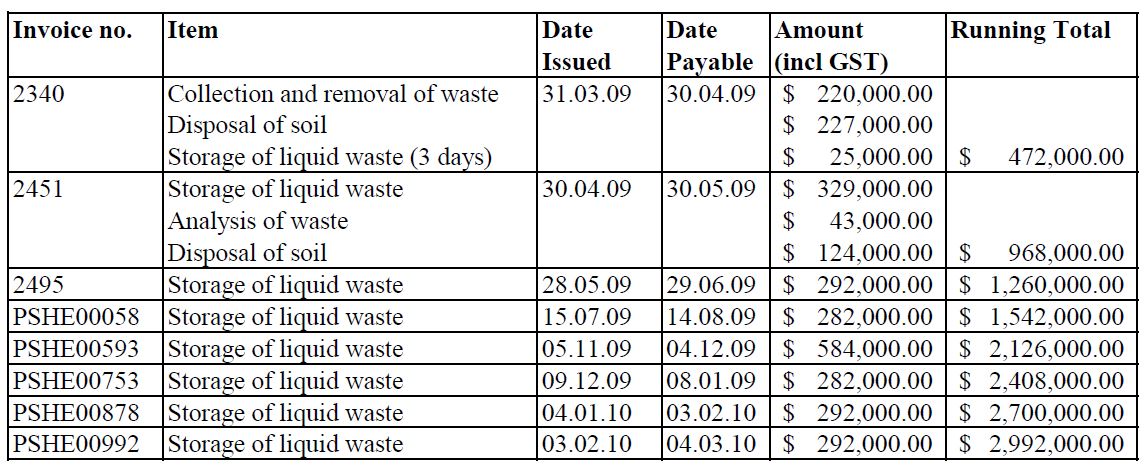
GVF’s other debts and the funds available to pay its debts
256 The first plaintiff, Mr Pearce, gave expert evidence concerning the solvency of GVF. The defendants called Anita Owens, a forensic accountant, to give expert evidence as to solvency. The experts produced a joint report and gave evidence concurrently.
257 The defendants did not object to the admission of Mr Pearce’s evidence, but they strongly criticise his evidence. They argue that Mr Pearce is not an independent witness as he has a substantial financial interest in the outcome of the litigation. Prior to the trial, Mr Pearce estimated his remuneration as liquidator of GVF to be about $335,000. Whether Mr Pearce receives all of that remuneration depends on the outcome of this proceeding.
258 I accept the defendants’ submission that Mr Pearce is not an independent witness. For that reason, I have approached Mr Pearce’s evidence with a strong inclination towards rejecting it where it conflicts with the evidence of Ms Owens. In the end, however, Mr Pearce’s lack of independence has proved to be unimportant in the resolution of conflicts between his evidence and the evidence of Ms Owens.
259 By the end of their concurrent evidence, Mr Pearce and Ms Owen were able to reach agreement as to the extent of GVF’s debts, apart from the Toxfree debt, due and payable in each month from April 2009 to October 2010.
260 Mr Pearce and Ms Owens were also able to reach a large measure of agreement as to GVF’s funds and sources of funds to meet its debts, but there remain three areas of difference. Firstly, Ms Owens considers that some allowance should be made for GVF’s ability to have raised funds by selling off part of its inventory. Secondly, in Ms Owens’ opinion, the proceeds of the insurance claim should be regarded as being available to pay GVF’s debts from the time it made the insurance claim. Thirdly, Ms Owens considers that the availability of external support from related entities and Mr and Mrs Heyn should be taken into account.
261 As to the first area of difference, Ms Owens said, “one would think that the company would have had the ability to liquidate some of that stock if it needed to, not convert it to the product that it actually made, but perhaps sold that to convert to cash surplus stock that it didn’t require to make those products”. Ms Owens’ opinion is that there was the potential for some unknown amount to be able to be raised to pay debts by the direct sale of inventory. She accepts that if there was to be a direct sale of the inventory, it would have to be sold at a discount. Mr Pearce’s opinion is that no allowance should be made for the mere possibility that GVF might have been able to sell some part of its inventory.
262 In April 2009, GVF’s inventory was valued at about $750,000. Gulmohar continued to supply stock on credit and GVF continued to formulate and sell pesticides. The value of the inventory generally trended downwards until the company went into liquidation. Before the fire, GVF’s sales of product were about $220,000 per month, but after the fire sales dropped to about $88,400 per month on average. Obviously, some portion of the inventory was being used to generate the ongoing sales. In October 2010, the value of the inventory was $391,581.
263 Precisely what the inventory consisted of is unclear. Ms Owens seems to infer that it consisted of materials used by GVF to make pesticides. That inference seems to be correct as Mr Vaughan states that the company found itself with a huge inventory, but limited capacity to fill its orders. Mr Heyn states that the company had to have a variety of chemicals in stock. The evidence suggests that the inventory mainly consisted of chemicals that were able to be combined together, or with other substances, to manufacture, or formulate, pesticides. In other words, the inventory consisted mainly of raw materials from which pesticides could be manufactured, not the finished product.
264 In Rees v Bank of New South Wales (1964) 111 CLR 210, Barwick CJ considered the extent to which trading stock could be taken into account for insolvency purposes. His Honour said at 218:
It is quite true that a trader, to remain solvent, does not need to have ready cash by him to cover his commitments as they fall for payment, and that in determining whether he can pay his debts as they become due regard must be had to his realizable assets. The extent to which their existence will prevent a conclusion of insolvency will depend on a number of surrounding circumstances, one of which must be the nature of the assets and in the case of a trader, the nature of his business. Here the company’s business was the sale of foodstuffs through a number of retail outlets. The asset whose value was said to negative a conclusion of insolvency, or at any rate to obviate the suspicion of it, was its trading stock of foodstuffs. In the ordinary course of the company’s business this asset was not available to be realized except by means of retail sales through its various shops. It is possible, of course, in a business such as that of the company for excess stocks to be realized otherwise than through the channels of the company’s retail business: but … no proposal to realize surplus stock by some bulk disposal for cash was in contemplation. The bank was not contemplating that the company intended to liquidate its business but to carry it on. …The stock in trade was clearly not an asset which was available to be realized to meet current debts except in the ordinary course of the company’s business…
265 Although GVF’s inventory consisted mainly of raw materials rather than trading stock, Barwick CJ’s approach is apposite. There is no evidence that GVF contemplated that it would or might dispose of part of its inventory other than by using it to manufacture pesticides in the ordinary course of its business. To the contrary, Mr Vaughan and Mr Heyn gave evidence that after the fire they intended to carry on business in the ordinary course. Further, Mr Heyn’s evidence was that it was necessary to keep chemicals on hand because orders came on an “urgent basis” and “we have not run a business that could plan”.
266 In addition, there is no evidence of any market in which the inventory could readily be sold. There is no evidence identifying the chemicals that comprised GVF’s inventory. There is no evidence of any buyer to whom that GVF could on-sell such chemicals. There is no evidence as to what portion of its inventory GVF could sell, or what price could be realised on such a sale, or how much time any such sale would take. Ms Owens’ proposition that some allowance should be made for the realisation of inventory is based upon a merely speculative possibility and must be rejected.
267 The second area of difference between Mr Pearce and Ms Owens is as to when the insurance proceeds should be taken to be available for GVF to pay its debts. Mr Pearce’s opinion is that the insurance proceeds should only be recognised as an asset of GVF from when QBE acknowledged that it would make payments and quantified the amounts. Mr Pearce and Ms Owens both accept that such treatment would accord with the relevant Australian accounting standards for a “contingent asset”, such as the proceeds of an insurance claim. However, Ms Owens contends that for the purposes of the solvency assessment, the Court should treat the insurance proceeds as an asset available to the company to pay its debts from the date the claim was made because, with the benefit of hindsight, it is known that the proceeds were eventually paid. She contends that it would be artificial to ignore the insurance claim and that the Toxfree debt should be taken to be offset by claim.
268 GVF made a claim upon its insurance policy with QBE on 25 March 2009. QBE engaged Freemans Claims and Insurance Services to assess the claim. There is evidence that QBE accepted that it was liable to pay some amount upon GVF’s claim by July 2009, but made no decision as to how much it was liable to pay at that stage. QBE paid GVF $199,000 on 27 July 2009, after Freeman’s recommended making a progress payment in a report dated 9 July 2009. QBE then paid $68,481.91 on 1 September 2009, following a recommendation by Freemans in its report dated 21 August 2009. QBE paid the final amount of $1,281,518.10 on 2 December 2009, after it entered a deed of release with GVF on 27 November 2009 to settle the claim for the total sum of $1,549,000. It is apparent that QBE must have decided to pay each amount only one to three weeks before making each payment.
269 In Bank of Australasia v Hall, Griffith CJ said at 1528:
The question is not whether the debtor would be able, if time were given to him, to pay his debts out of his assets, but whether he is presently able to do so with monies actually available.
270 There is no evidence that GVF could have compelled QBE to pay anything before the payments were in fact made, nor that QBE would have voluntarily made earlier payments if requested to do so by GVF. The Court must look to the funds the company has available, as a matter of commercial reality, to pay its due debts. As a matter of commercial reality, the insurance proceeds cannot be regarded as available to GVF until the payments were received (or, at best, one to three weeks before they were received). Therefore, Ms Owen’s opinion that the insurance proceeds were an asset available to GVF to pay its debts from the date of the insurance claim must be rejected.
271 I have rejected Ms Owen’s evidence that the funds available for GVF to pay its debts include amounts for the sale of part of GVF’s inventory. Leaving aside the question of related-party support for the moment, the funds available to GVF to pay its debts were principally from its sales and trade debtors, an overdraft with ANZ, the GST input credit payment and the proceeds of the insurance claim. In the course of their evidence, Mr Pearce and Ms Owens prepared a schedule (Exhibit 31) which depicts, amongst other things, the value of GVF’s current assets and current liabilities for each month from April 2009 to October 2010. Mr Pearce and Ms Owens agree as to the current assets. They also agree as to current liabilities, leaving aside the Toxfree debt. They agree as to the figures for current assets minus current liabilities, which they describe as “Available Funds”. They then exclude (by deducting) the debts owed to related entities on the basis that they are deferred debts. The resulting figures represent funds available to GVF to pay the Toxfree debt.
272 After that point, Mr Pearce and Ms Owens’ figures depart. Mr Pearce adds back in the payments made by GVF to related entities in each month, on the basis that those amounts were not in fact deferred. Ms Owens excludes those amounts, treating them as deferred debts on the basis of her instructions that the related entities would have been willing to defer those payments if necessary. That raises a factual issue which I will deal with later. For present purposes, I will adopt Mr Pearce’s methodology and figures.
273 The following table sets out:
(a) Mr Pearce’s figures as to the funds available to GVF to pay the Toxfree debt (rounded up to the nearest thousand dollars);
(b) the Toxfree debt I have assessed as due and payable in each month; and
(c) GVF’s shortfall of funds for each month.
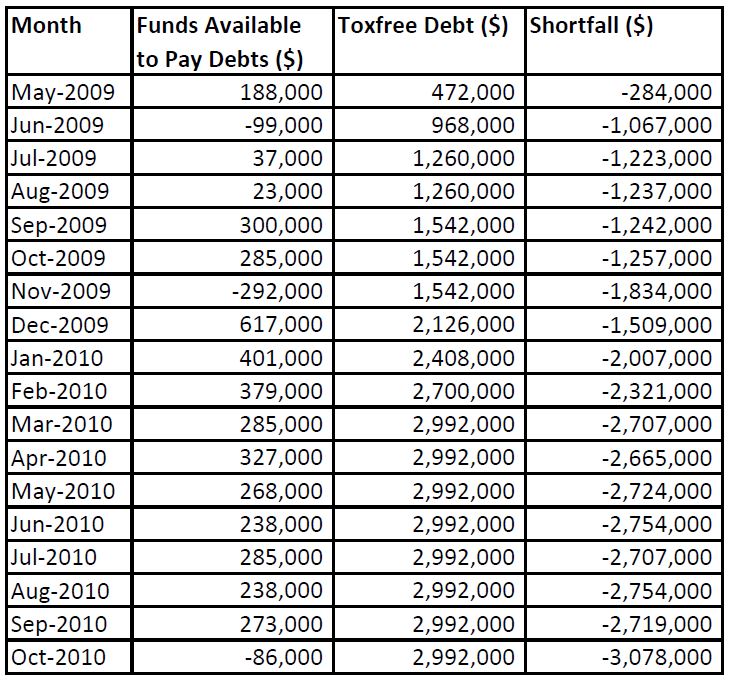
274 It may be seen that there was a shortfall in every month after April 2009. Unless it can be concluded that financial support from third parties sufficient to cover the shortfall was available, GVF was insolvent throughout the period.
275 The third area of disagreement between Mr Pearce and Ms Owens concerns the availability of financial support from related parties to enable GVF to pay its debts. There are two aspects of such support. First, Ms Owen treats the amounts paid by GVF to Gulmohar, Palacimo, Vaudell, Superway Garden and Mr Heyn after the fire as funds available to GVF on the basis that those entities would have deferred any requirement to pay those amounts to them. Second, Ms Owens proceeds on the basis that Mr and Mrs Heyn and Gulmohar would have directly provided funds to GVF to allow it to pay its due debts if funds were required.
276 Mr Vaughan deposes that he had access to funds of over $200,000 that he could have arranged to lend to GVF if the directors had chosen not to proceed with the liquidation. He states that, if necessary, he would have personally provided financial support to GVF, or caused Vaudell, Superway Garden and another company, Superway Termite Baiting Solutions Pty Ltd, to provide support. He says that, if necessary, he was also willing to cause Superway Garden to forgive GVF’s debts to that company.
277 Mr Vaughan did not provide Ms Owens with sufficient information to allow her to make an assessment of his assets and liabilities. Ms Owens considers that there is doubt as to whether Mr Vaughan and the entities associated with him had the capacity to provide funding to GVF. Accordingly, her opinion concerning the support available to GVF excludes any direct financial support from Mr Vaughan or those entities.
278 In light of Ms Owens’ view, I do not accept that Mr Vaughan, Vaudell, Superway Garden or Superway Termite Baiting Solutions Pty Ltd had the capacity to provide any funds to GVF.
279 Mr Heyn’s evidence was that if GVF required additional financial support, he was willing to cause Gulmohar to provide further support. He also deposed that if a decision had been made not to liquidate GVF in November 2010, he would have taken whatever reasonable steps were needed to enable GVF to continue trading. These steps would have included selling or borrowing against real estate owned by Mr Heyn and his wife, and drawing upon his superannuation entitlements.
280 Ms Owens considers that Mr Heyn, Mrs Heyn and Gulmohar did have the capacity to provide funds to GVF.
281 At the date of the fire on 24 March 2009, GVF owed Gulmohar $637,892.17 for the supply of stock. Gulmohar had historically deferred payment. GVF’s accounts record that after the fire, it purchased stock valued at $957,546.39. In the same period, GVF paid $1,356,999.47 to Gulmohar, resulting in a reduction of the debt by $399,453.08.
282 Ms Owens considers that Gulmohar was solvent between April 2009 and December 2010. Gulmohar had access to a facility with the Commonwealth Bank of Australia that allowed it to borrow up to $1,400,000. Ms Owens relied upon a spreadsheet provided by Mr Heyn showing the amounts available for Gulmohar from that facility from month to month. However, Ms Owens accepted in cross-examination that the spreadsheet does not include a trade loan from the Commonwealth Bank in the amount of $233,609 shown in GVF’s balance sheet. That casts substantial doubt upon the accuracy of Mr Heyn’s spreadsheet and extent of the funds available to Gulmohar. The spreadsheet shows that the loan funds available to Gulmohar ranged between $42,654 in April 2009 and $1,108,898 in December 2009. If the figures are reduced to take into account the further loan of $233,609, Gulmohar had between nothing and a maximum of $875,290 available to lend between April 2009 and November 2010.
283 Mr and Mrs Heyn jointly owned three real properties situated at Mt Waverley in Victoria. Ms Owens assesses that they had the ability to borrow approximately $316,000 secured against those properties.
284 Further, Ms Owens was instructed that Mr Heyn was able to access his superannuation benefits. As of 30 June 2009, Mr Heyn had accrued benefits of $501,058 available to him, and this amount had increased to $546,082 by 30 June 2010.
285 I accept that Mr and Mrs Heyn had the capacity to provide funds totalling approximately $817,000 to $877,000 to GVF.
Willingness to provide support
286 Mr Vaughan and Mr Heyn assert that if they had not decided to place GVF in liquidation, they would have, or would have caused the corporate defendants to, provide funds to the extent required to allow GVF to pay its debts. They also assert that they would have caused the other defendants to defer the debts owed to them in order to allow GVF to pay its debts. I will refer to the corporate defendants and the Heyn Family Trust as the “related parties”.
287 The issue is whether financial support sufficient to avoid insolvency was likely to be provided: Chan v First Strategic Development Corp at [44]. The reliability of the related parties as sources of funds must be assessed, not merely by what the Mr Vaughan and Mr Heyn assert, but also by reference to the surrounding facts and circumstances.
288 Mr Vaughan and Mr Heyn state that they would have been willing to provide or arrange financial support to GVF if they had not decided to place the company in liquidation. However, they did decide to place GVF in liquidation, so their statements describing what they would have done in an alternative reality are somewhat hollow. That matter, together with my views concerning the unreliability of their evidence, makes it important to consider what actually happened.
289 The willingness of Mr Vaughan and Mr Heyn to cause the related parties to defer their debts evaporated following the fire. Instead, those debts were paid out or paid down. It is true that Gulmohar continued to provide stock on credit to GVF, but the value of the stock it provided was significantly outweighed by payments it received from GVF. It is also true that Mr Vaughan and Mr Heyn continued to provide management services through Vaudell and Palacimo respectively, but they had no choice in the matter, as they continued to owe duties to GVF as its directors.
290 In the joint report prepared by Ms Owens and Mr Pearce, the following passage appears:
Owens is instructed that Gulmohar and other related entities were prepared to defer payment for amounts due to them until other undisputed creditors were paid and considers that the actions of those related entities supports those instructions.
291 The instruction that the related parties were prepared to defer payment “until other undisputed creditors were paid” indicates that they were not willing to defer payment to allow disputed creditors, including Toxfree, to be paid. That is consistent with what in fact happened.
292 Further, the related entities did not in fact provide direct financial support to GVF. To the contrary, Mr Heyn and Mr Vaughan caused GVF to pay substantial amounts to each of the related entities.
293 The joint report states that:
Owens was originally instructed that both Mr Heyn and Mr Vaughan and/or entities related to them were prepared to advance additional funds to GVF in the event that it was required to pay undisputed debts.
294 These instructions indicate a lack of willingness to advance funds to GVF to pay disputed debts and, again, this is consistent with what in fact happened.
295 In their instructions to Ms Owens, Mr Vaughan and Mr Heyn approached the issue of solvency as if GVF was not required to pay the debts it disputed. However, when assessing whether a debt is due and payable, the test is whether the debt is legally due having regard to the agreement between the parties: Lee Kong v Pilkington (Australia) Ltd at 112. The Toxfree debt was due and payable in the amounts and at the times I have assessed. It cannot be ignored for the purpose of assessing solvency.
296 In their evidence, Mr Heyn and Mr Vaughan strongly assert that the proceedings brought by Toxfree in the Supreme Court of Western Australia were baseless. They received legal advice in July 2010 that they were expected to have success in reducing the quantum of the claim, dependent upon obtaining supportive evidence from experts. However, they did not then instruct their solicitors to obtain experts’ reports. Mr Heyn and Mr Vaughan were unwilling to fund the litigation to the extent of the $230,000 or so that was required. Their unwillingness to fund GVF’s litigation tells strongly against any willingness to provide sufficient funds to GVF to allow it to pay its debts. Even if they believed that the true costs might be somewhat higher, their unwillingness to fund the litigation is quite inconsistent with the idea that they or the related parties would provide financial support to GVF to pay its debts.
297 I do not accept the assertions of Mr Vaughan and Mr Heyn that they were willing to provide, or cause the related parties to provide, financial support, whether by providing funds or deferring debts to allow GVF to pay its debts. Their evidence is inconsistent with what actually happened. That is enough to require a conclusion that financial support sufficient to avoid insolvency was not likely to be provided at any time between 30 April 2009 and the date of liquidation.
298 However, the evidence allows me to go further and positively draw an inference that Mr Vaughan and Mr Heyn were not willing to provide, or cause the related entities to provide, financial support. I conclude that on or very shortly after 26 November 2009, Mr Vaughan and Mr Heyn decided to adopt a scheme to use the insurance proceeds to pay out or pay down GVF’s undisputed debts and wind up the company in insolvency while leaving disputed creditors, including Toxfree, unpaid. I reach that conclusion for the following reasons.
299 GVF had not historically been a successful business. It made operating losses of $255,676 in the 2006/2007 financial year and $520,683 in the 2008/2009 year. It made a profit of $227,690 in the 2007/2008 year, but it made an overall loss of $548,669 for those years.
300 I accept that after the fire Mr Heyn and Mr Vaughan initially intended that GVF would continue to trade. It did in fact continue to trade, although its production and sales dropped dramatically. Its sales dropped from an average of $222,597 per month before the fire to $88,401 per month after the fire. It laid-off all but three production staff.
301 GVF’s MYOB accounting records show losses after the fire which totalled $2,210,293. If the Toxfree debt and the insurance proceeds are left out, the losses are $1,109,415. The MYOB records show that GVF made losses of: $36,231 in April 2009; $1,199 in May 2009, $226,124 in June 2009; $2,505,524 in July 2009 (when the Toxfree debt was included in the accounts); $37,029 in August 2009; $54,840 in September 2009; $67,045 in October 2009; and $59,441 in November 2009. GVF made a profit of $1,199,563 in December 2009 (when the final instalment of the insurance proceeds was received) and then made losses in every subsequent month until it went into liquidation. There is little doubt that by November 2009, GVF was a failing business.
302 By November 2009, Mr Heyn and Mr Vaughan understood or believed that GVF owed Toxfree a substantial amount of money. GVF offered to settle the claim on 30 July 2009 by paying Toxfree $850,000 and increased the offer to $950,000 on 11 August 2009 and then to $1,050,000 on 25 August 2009. While Mr Vaughan denies that the final offer reflected what he truly considered was the debt, I do not accept that evidence. A document annexed to Mr Vaughan’s affidavit of 15 November 2010 filed in the Supreme Court of Queensland sets out Mr Vaughan’s assessment of the debt and how the final offer was arrived at. Mr Vaughan’s assessment included amounts for collection and removal of the waste, and disposal of the solid and liquid waste, although nothing for storage costs and the cost of the analytical report. The document indicates that the offer was capped at $1,050,000 to allow GVF to use the difference between the offer and the limit of GVF’s insurance cover to “remedy the site”, presumably by replacing damaged plant and equipment. In my view, Mr Vaughan’s assessment is consistent with a belief or understanding that GVF owed Toxfree a debt in the order of $1 million or more. The offers were made with the knowledge and approval of Mr Heyn. I reject the evidence of Mr Vaughan and Mr Heyn that the final offer was merely a commercial offer to end the litigation, rather than reflecting what they understood or believed to be at least the amount of the Toxfree debt.
303 On 13 November 2009, Mr Vaughan received advice from Mr Bendeich from which he understood that GVF was not obliged to use the insurance proceeds to pay the Toxfree debt. Mr Vaughan and Mr Heyn understood that they were able use the proceeds to pay out other creditors.
304 It is apparent that Mr Heyn and Mr Vaughan were considering the liquidation of GVF by 26 November 2009. In his file note dated 26 November 2009, Mr Skermer of MST Lawyers recorded that he gave GVF advice “with respect to receiverships and liquidation”. Mr Skermer recorded that he also advised that GVF needed to take “extreme care” in avoiding insolvent trading and preference payments. Mr Skermer provided advice as to how GVF’s assets should be valued to enable them to be sold, in the context of a possible receivership or liquidation. Mr Heyn’s suggestion that Mr Skermer’s advice was merely a “sideline” is implausible. Mr Skermer gave detailed advice with respect to receivership and liquidation as a separate and distinct matter. I infer that Mr Heyn and Mr Vaughan consulted Mr Skermer in order to get advice about potential receivership or liquidation.
305 The events which followed the receipt of the advice from Mr Skermer on 26 November 2009 are consistent with Mr Vaughan and Mr Heyn deciding to embark on a scheme to pay out or pay down undisputed creditors, including the related entities, and have the company wound up in insolvency, while leaving the disputed creditors unpaid.
306 On 27 November 2009, a deed of release was executed between GVF and QBE. GVF received the final instalment of the insurance proceeds of $1,281,518 on 2 December 2009.
307 GVF then started increasing payments to the related entities. For example, it paid Gulmohar $326,247 on 8 December 2009, $14,240 on 18 December 2009, $151,256 on 20 January 2010 and $53,000 on 2 February 2010. GVF repaid a loan from Superway Garden , paying $17,500 on 27 November 2009 and $25,000 on 9 December 2009, despite repayment not being due until 2016. It paid the same amounts to Mr Heyn as trustee of the Heyn Family Trust on the same dates.
308 Mr Vaughan’s email of 15 January 2010 to Mr Somers of MST Lawyers is important. Mr Vaughan said that “in all probability the company will be liquidated as insurance settlement was insufficient to cover exorbitant and disputed clean up costs”. He said that “As and when this happens is yet to be decided and open to advice.” Mr Vaughan said that GVF was “unlikely to continue trading for the longer term”. In light of the foreshadowed liquidation, Mr Heyn and Mr Vaughan proposed to buy GVF’s plant and equipment, and were seeking advice as to a possible “challenge by liquidator, especially if we have Toxfree in the background getting most proceeds”. Mr Heyn was copied into the email and raised no objection to its contents.
309 The email provides evidence as to the state of mind of both Mr Vaughan and Mr Heyn at the time it was written. The email confirms that the reason for the proposed liquidation was that the insurance proceeds were insufficient to cover the Toxfree’s claimed debt. The reference to “Toxfree in the background”, indicates that the debt to Toxfree would not have been paid before GVF went into liquidation. The email is consistent with Mr Vaughan and Mr Heyn having decided that GVF could not, or would not, pay the Toxfree debt.
310 The email is also consistent with an intention having been formed to cease trading and place GVF in liquidation. The email indicates that liquidation was all but certain, saying “As and when is yet to be decided” rather than “If and when…”. Further, the fact that Mr Vaughan and Mr Heyn were seeking advice as to how they could acquire GVF’s plant and equipment is quite inconsistent with the proposition that GVF would continue to trade.
311 Mr Vaughan claims that he sought advice from MST Lawyers on his behalf and on Mr Heyn’s behalf in their personal capacities, rather than on behalf of GVF. That does not matter. What is important is that the email demonstrates the thinking of Mr Vaughan and Mr Heyn.
312 The evidence of Mr Heyn and Mr Vaughan is that, until the effects of the drought were felt in mid-2010, they intended that GVF would continue to trade. That is unlikely when considered in light of the substantial ongoing losses that GVF was making and the Toxfree claim looming over the company. The Toxfree claim for ongoing storage fees was increasing by about $257,000 or $265,000 (plus GST) per month, while GVF failed to provide any instructions for Toxfree to dispose of or otherwise deal with the liquid waste.
313 The email of 15 January 2010 to Mr Somers of MST Lawyers indicates that Mr Vaughan and Mr Heyn had decided that GVF would cease trading and go into liquidation. It was just a matter of when that would occur.
314 Between 27 November 2009 and the date of liquidation, GVF paid the following amounts to the related entities:
Recipient | Amount |
Gulmohar | $ 854,756 |
Palacimo | $ 55,000 |
Vaudell | $ 50,000 |
Superway Garden | $ 42,500 |
Mr Heyn | $ 42,500 |
315 Mr Heyn states that he and Mr Vaughan “took the steps of paying out long-term creditors such as Westpac, ANZ and Gulmohar to improve cash flow by more than $15,000 per month in interest”. Mr Vaughan’s evidence is to similar effect. There is no evidence that GVF was paying interest to Gulmohar and it is entirely unclear how paying down Gulmohar’s debt would improve GVF’s cashflow. Gulmohar already had the benefit of a fixed and floating charge over GVF’s assets and there is no evidence that Gulmohar was demanding immediate payment of the debt. It is true that paying out the loans from Westpac and ANZ would improve GVF’s cashflow, but that would also provide a significant benefit to Mr Vaughan and Mr Heyn once GVF went into liquidation, since they had personally guaranteed the loans.
316 GVF did not derive any particular benefit from paying out the debts to Vaudell, Palacimo, Superway Garden and Mr Heyn as trustee of the Heyn Family Trust. The defendants have not pointed to any evidence of demands for payment from those companies. The payments totalling $90,000 and $100,000 to Vaudell and Palacimo respectively after the fire was a departure from the previous situation where those companies had only previously been paid $10,000 in 2008. The amount paid to Superway Garden was not due until 2016, so there was no possible benefit to GVF in paying out that loan. On the other hand, those entities gained a significant benefit because they were paid out in full or in substantial part.
317 I have found that Mr Vaughan and Mr Heyn knew or believed that the debt to Toxfree was in the vicinity of $1 million or more by the end of August 2009. GVF offered to pay $1,050,000 to settle the claim. After Toxfree rejected the offer, the choices were to fight the Toxfree litigation and to try to trade out of trouble, or to take another course. The other course involved using the insurance proceeds to pay out or pay down GVF’s debts to the related entities and the undisputed creditors, leaving the disputed creditors unpaid and then having the company wound up in insolvency. That is the course that Mr Vaughan and Mr Heyn chose. I find they made that choice on or very shortly after 26 November 2009 when they consulted Mr Skermer. I am conscious of the gravity of these findings and, in making them, I have applied the standard of proof described in Briginshaw v Briginshaw (1938) 60 CLR 336 at 361-362 and s 140(2) of the Evidence Act 1995 (Cth).
318 The immediate relevance of these findings is to confirm that after 26 November 2009, Mr Vaughan and Mr Heyn were not willing to provide, or cause the related parties to provide, financial support to GVF which would allow it to pay its debts. These findings also have other consequences which I will discuss later in these reasons.
319 I also repeat that I do not accept the assertions of Mr Vaughan and Mr Heyn that they were willing to provide, or cause the related parties to provide, financial support sufficient to allow GVF to pay its debts at any time from 30 April 2009.
320 Mrs Heyn gave evidence as to her willingness to provide financial support to GVF. She deposed that she was fairly sure that GVF had been working quite successfully, so she probably would not have had any doubt that GVF would be able to pay the loan. She also said that if Mr Heyn was of the belief that financial support for GVF was needed, this would have been a factor in any decision she made.
321 The question of providing support to GVF was never raised with Mrs Heyn until 2015, when she was asked to provide an affidavit in this proceeding. Mrs Heyn’s evidence was premised on the belief that Gulmohar and GVF had been working successfully over the years. In fact, GVF had only made a profit in one year and was losing money in most months following the fire. Further, Mrs Heyn was unaware of the extent of the Toxfree debt.
322 Mrs Heyn said that she would have placed faith in her husband’s judgment, advice and decision-making. She also said that she would have exercised her own judgment.
323 As I have rejected Mr Heyn’s evidence that he was willing to provide funds to GVF, it follows that he would not have advised Mrs Heyn to do so. Even if Mrs Heyn independently exercised her judgment, it is very unlikely that she would have been prepared to place her own assets at risk once she learnt of the extent of the Toxfree debt, the extent of GVF’s losses in previous years and the extent of its losses following the fire. I find that if Mrs Heyn had been asked to provide funds to GVF following the fire, she would not have been willing to do so.
324 The defendants called Steven Arndell, the second director of Vaudell and Superway, to give evidence. Mr Arndell deposed that he would have been willing to allow Vaudell and Superway to lend funds to GVF. However, under cross-examination, he accepted that he had not been made aware of GVF’s financial situation and ultimately agreed that he would not have allowed Vaudell and Superway to lend any money to GVF.
325 As the table set out in para 271 indicates, the debts due and payable by GVF substantially exceeded the funds available to meet those debts in every month after April 2009. It was not a merely temporary state of illiquidity.
326 I have found that no financial support was available from Mr Vaughan, Mr Heyn, Mrs Heyn or the related entities that would allow GVF to pay its debts as they became due and payable.
327 I find that GVF was insolvent throughout the period from 30 April 2009 to 17 November 2010.
THE CLAIM FOR RELIEF UNDER s 588FF OF THE CORPORATIONS ACT
328 The plaintiffs seek orders under s 588FF of the Corporations Act. That section provides, relevantly:
(1) Where, on the application of a company’s liquidator, a court is satisfied that a transaction of the company is voidable because of section 588FE, the court may make one or more of the following orders:
(a) an order directing a person to pay to the company an amount equal to some or all of the money that the company has paid under the transaction;
…
(h) an order declaring an agreement constituting, forming part of, or relating to, the transaction, or specified provisions of such an agreement, to have been void at and after the time when the agreement was made, or at and after a specified later time;
…
(j) an order declaring such an agreement, or specified provisions of such an agreement, to be unenforceable.
329 Section 588FF(3) sets out a time limit for the making of an application, but the defendants do not contend that the application has not been brought within time.
330 The claim for relief under s 588FF depends upon the satisfaction of one or more subsections of s 588FE. There is some variance between the plaintiffs’ second amended statement of claim and their submissions as to which subsections they rely upon. However, I understand the plaintiffs to rely upon the following subsections of s 588FE:
…
(3) The transaction is voidable if:
(a) it is an insolvent transaction, and also an uncommercial transaction, of the company; and
(b) it was entered into, or an act was done for the purpose of giving effect to it, during the 2 years ending on the relation back day.
(4) The transaction is voidable if:
(a) it is an insolvent transaction of the company; and
(b) a related entity of the company is a party to it; and
(c) it was entered into, or an act was done for the purpose of giving effect to it, during the 4 years ending on the relation back day.
…
(6A) The transaction is voidable if:
(a) it is an unreasonable director-related transaction of the company; and
(b) it was entered into, or an act was done for the purposes of giving effect to it:
(i) during the 4 years ending on the relation back day; or
…
331 The parties agree that the relation-back date is 15 November 2010. The impugned transactions were entered into within the time periods described in s 588FE(3), (4) and (6A).
332 Subsections 588FE (3) and (4) require that the relevant transaction be an “insolvent transaction”. That expression is defined in s 588FC as follows:
A transaction of a company is an insolvent transaction of the company if, and only if, it is an unfair preference given by the company, or an uncommercial transaction of the company, and:
(a) any of the following happens at a time when the company is insolvent:
(i) the transaction is entered into; or
(ii) an act is done, or an omission is made, for the purpose of giving effect to the transaction; or
(b) the company becomes insolvent because of, or because of matters including:
(i) entering into the transaction; or
(ii) a person doing an act, or making an omission, for the purpose of giving effect to the transaction.
333 A transaction is an “unfair preference” in the circumstances set out in s 588FA. That section provides:
(1) A transaction is an unfair preference given by a company to a creditor of the company if, and only if:
(a) the company and the creditor are parties to the transaction (even if someone else is also a party); and
(b) the transaction results in the creditor receiving from the company, in respect of an unsecured debt that the company owes to the creditor, more than the creditor would receive from the company in respect of the debt if the transaction were set aside and the creditor were to prove for the debt in a winding up of the company;
even if the transaction is entered into, is given effect to, or is required to be given effect to, because of an order of an Australian court or a direction by an agency.
(2) For the purposes of subsection (1), a secured debt is taken to be unsecured to the extent of so much of it (if any) as is not reflected in the value of the security.
(3) Where:
(a) a transaction is, for commercial purposes, an integral part of a continuing business relationship (for example, a running account) between a company and a creditor of the company (including such a relationship to which other persons are parties); and
(b) in the course of the relationship, the level of the company’s net indebtedness to the creditor is increased and reduced from time to time as the result of a series of transactions forming part of the relationship;
then:
(c) subsection (1) applies in relation to all the transactions forming part of the relationship as if they together constituted a single transaction; and
(d) the transaction referred to in paragraph (a) may only be taken to be an unfair preference given by the company to the creditor if, because of subsection (1) as applying because of paragraph (c) of this subsection, the single transaction referred to in the last-mentioned paragraph is taken to be such an unfair preference.
334 The expression “uncommercial transaction” is defined in s 588FB as follows:
(1) A transaction of a company is an uncommercial transaction of the company if, and only if, it may be expected that a reasonable person in the company’s circumstances would not have entered into the transaction, having regard to:
(a) the benefits (if any) to the company of entering into the transaction; and
(b) the detriment to the company of entering into the transaction; and
(c) the respective benefits to other parties to the transaction of entering into it; and
(d) any other relevant matter.
(2) A transaction may be an uncommercial transaction of a company because of subsection (1):
(a) whether or not a creditor of the company is a party to the transaction; and
...
335 The expression “unreasonable director-related transaction” is defined in s 588FDA as follows:
(1) A transaction of a company is an unreasonable director-related transaction of the company if, and only if:
(a) the transaction is:
(i) a payment made by the company; or
(ii) a conveyance, transfer or other disposition by the company of property of the company; or
(iii) the issue of securities by the company; or
(iv) the incurring by the company of an obligation to make such a payment, disposition or issue; and
(b) the payment, disposition or issue is, or is to be, made to:
(i) a director of the company; or
(ii) a close associate of a director of the company; or
(iii) a person on behalf of, or for the benefit of, a person mentioned in subparagraph (i) or (ii); and
(c) it may be expected that a reasonable person in the company’s circumstances would not have entered into the transaction, having regard to:
(i) the benefits (if any) to the company of entering into the transaction; and
(ii) the detriment to the company of entering into the transaction; and
(iii) the respective benefits to other parties to the transaction of entering into it; and
(iv) any other relevant matter.
The obligation referred to in subparagraph (a)(iv) may be a contingent obligation.
…
(2) To avoid doubt, if:
(a) the transaction is a payment, disposition or issue; and
(b) the transaction is entered into for the purpose of meeting an obligation the company has incurred;
the test in paragraph (1)(c) applies to the transaction taking into account the circumstances as they exist at the time when the transaction is entered into (rather than as they existed at the time when the obligation was incurred).
…
336 The expression “transaction” is defined in s 9 of the Corporations Act to mean a transaction to which a company is a party, including security interests granted by the company and a payment made by the company.
337 The plaintiffs allege that two transactions between GVF and Gulmohar are unfair preferences within s 588FA, uncommercial transactions within s 588FB, insolvent transactions within s 588FC, and unreasonable director-related transactions within s 588FDA.
338 The first transaction is the series of payments made by GVF between 30 April 2009 and 17 November 2009 which operated to reduce its debt to Gulmohar by a total of $582,031.08 over that period (the Gulmohar payments). The second is the grant by GVF of a fixed and floating charge over its assets to Gulmohar on 22 May 2009 (the Gulmohar charge).
339 Gulmohar denies that the transactions are unfair preferences, relying upon the “running account” provision in s 588FA(3). Gulmohar denies that the transactions are uncommercial transactions or unreasonable director-related transactions, claiming that GVF benefitted by entering into the transactions. Gulmohar, also denies that the transactions are insolvent transactions on the basis that GVF was not insolvent at the relevant times. Further, Gulmohar relies upon the “good faith” defence under s 588FG(1) and (2).
340 The plaintiffs accept that there was a “running account” between GVF and Gulmohar which falls within s 588FA(3). Under s 588FA(3)(c), all the transactions forming part of the continuing business relationship are to be treated as if they together constituted a single transaction, and it is the single transaction which must, under s 588FA(1), be an unfair preference. In respect of the Gulmohar payments, the plaintiff’s case is put on the basis that the net reduction in the debt owed by GVF to Gulmohar in the period from 30 April 2009 to 17 November 2010 is an unfair preference.
341 The plaintiffs accept that the Gulmohar charge should also be treated as part of the same transaction. They refer to Richardson v Commercial Banking Co of Sydney Ltd (1952) 85 CLR 110, where Dixon, Williams and Fullagar JJ said at 132:
In considering whether the real effect of a payment was to work a preference its actual business character must be seen and when it forms part of an entire transaction which if carried out to its intended conclusion will leave the creditor without any preference priority or advantage over other creditors the payment cannot be isolated and construed as a preference.
342 The plaintiffs also refer on Cussen v Sultan [2009] NSWSC 1114, where Nicholas J said at [21]:
The court is obliged to look at the transactions between the parties in a manner which accords with commercial reality. It is not a matter of isolating particular individual steps in the course of a business relationship so as to give one element a different characteristic from that which the totality of that relationship would evidence, but of looking at the transaction as a whole. Thus, a transaction may include a payment by the company which has the effect of extinguishing the debt of another, or it may consist of a series of events occurring at different points of time which are sufficiently connected together.
(Citations omitted.)
343 The transactions comprising the Gulmohar payments and the Gulmohar charge are each alleged to give Gulmohar an unfair preference, although in different ways – the former involves direct preferential payments in advance of the winding up, while the latter gives Gulmohar an advantage during the winding up. Nevertheless, they each arise out of the same business relationship involving the supply of stock on credit. I accept that it is appropriate to consider the Gulmohar payments and the Gulmohar charge together as part of an entire transaction. At the same time, it is appropriate to start by considering their effects separately.
344 I will commence with the Gulmohar charge. Plainly, the requirement of s 588FA(1) that GVF and Gulmohar be parties to the transaction is satisfied. The issue is whether, under s 588FA(1)(b), the transaction results in Gulmohar receiving from GVF, in respect of an unsecured debt, more than Gulmohar would receive if the transaction is set aside and Gulmohar were to prove for the debt in the winding up.
345 For the purposes of s 588FA(1)(b), the Court must look to the best evidence available in the actual winding up, rather than a hypothetical winding up, albeit that the final outcome of the winding up may not be known: Walsh v Natra Pty Ltd (2000) 1 VR 523 at [31]-[33], [63].
346 The Gulmohar charge converted an unsecured debt into a secured debt. Its effect was to provide Gulmohar with a benefit over unsecured creditors in the winding up, namely, to receive a return in preference to unsecured creditors. The security given by Gulmohar charge over GVF’s assets would result in Gulmohar receiving more than if the charge were set aside and it were to prove for the unsecured debt in the winding up. The Gulmohar charge has the preferential effect required by s 588FA(1)(b) and is an unfair preference.
347 Having concluded that the Gulmohar charge is an unfair preference, I will approach the debt owed by GVF to Gulmohar as an unsecured debt. The Gulmohar payments had the effect of reducing the debt by $582,031, from $820,470 at 30 April 2009 to $238,439 at 17 November 2010. The reduction in debt represents a return to Gulmohar of about 71 cents in the dollar.
348 GVF was insolvent. On the assumption that Toxfree will be approved as a creditor for $1,000,000, Mr Pearce estimates there will be a return to creditors of about 5 cents in the dollar. The Toxfree debt is, in fact, higher and the return to creditors will be correspondingly lower. The Gulmohar payments have resulted in Gulmohar receiving substantially more than it would receive if it were to instead prove for the whole of its debt in the winding up.
349 Therefore, I am satisfied that the transaction consisting of the Gulmohar payments is an unfair preference.
350 I am also satisfied that the Gulmohar charge and the Gulmohar payments, considered as a single, entire transaction, is an unfair preference.
351 The Court will not avoid a transaction on a running account save to the extent that the ultimate effect is a reduction in the creditor’s indebtedness: Air Services Australia v Ferrier (1996) 185 CLR 483 at 502. Another way of expressing this is that the quantum of the preference is the amount by which the payments by the company exceed the value of the goods or services acquired: Air Services Australia v Ferrier at 502. In such a case, the quantum recoverable is normally the difference between the peak debt during the relation back period and the balance of the account at the conclusion of the relevant period: Mann v Sangria Pty Ltd (2001) 38 ACSR 307 at [36].
352 The plaintiffs claim against Gulmohar allows for the value of stock provided to GVF in the period from 30 April 2009 to 17 November 2010. The claim is confined to the reduction in GVF’s indebtedness from the beginning of the period to the end of the period. Gulmohar has not submitted that this approach is inappropriate. The amount of that reduction is $582,031.
353 The plaintiffs allege that the Gulmohar charge and the Gulmohar payments were “uncommercial transactions” within s 588FB. The plaintiffs must establish that it may be expected that a reasonable person in the company’s circumstances would not have entered the transactions, having regard to the benefits and detriments to the company of entering the transaction, the benefits to the other parties to the transaction of entering the transaction, and any other relevant matters.
354 The test is not that the transaction must be so unreasonable that no reasonable person would enter into it: Welcome Homes Real Estate Pty Ltd v Ziade Investment Pty Ltd (in liq) [2007] NSWCA 167 at [54].
355 The Court must look at the total business relationship between the parties, what the parties intended to do and how their intentions were affected by the transaction: Demondrille Nominees Pty Ltd v Shirlaw (1997) 15 ACLC 1716 at 1723.
356 The Court can look at several transactions as one overall transaction in appropriate circumstances. The Court looks at the balance of benefit and detriment to see whether the transaction can be explained by normal commercial practice: Demondrille Nominees Pty Ltd v Shirlaw at 1727. That is an appropriate approach to take to the transactions comprising the Gulmohar charge and the Gulmohar payments.
357 If the transaction involves related parties, the transaction is scrutinised much more closely: McDonald v Hanselmann (1998) 144 FLR 463 at 470; Welcome Homes Real Estate Pty Ltd v Ziade Investments Pty Ltd (in liq).
358 The state of knowledge of the company’s directors (ie. its directing minds) is relevant to the assessment of the company’s circumstances: Tosich Construction Pty Ltd (in liq) v Tosich (1997) 78 FCR 363 at 367; Capital Finance Australia Ltd v Tolcher (2007) 164 FCR 83 at [129].
359 In Re Solfire Pty Ltd (in liq) [1998] 2 Qd R at 92, the directors were aware of litigation against the company which would cost a large amount to defend. The directors arranged for a bill of sale to be granted by the company in respect of loans they had made to the company and had those loans paid out under the bill of sale. Ambrose J held that the intention of the directors was to pay themselves and other preferred creditors, but not pay the creditors who had sued (and subsequently obtained judgment). His Honour said at 165:
In my view the whole transaction…was one designed to defeat the rights of its judgment creditors. It was conceived by the respondents as a method by which the ordinary processes of the law – however expensive they may have been in the circumstances of this case – could be circumvented so that the company having used all its available resources to pay creditors (including the respondents) other than those judgment creditors the moneys that were owing to them, could go into liquidation leaving its judgment creditors with judgments and unsatisfied statutory demands which would be worthless. In my view the whole transaction may properly be characterized as “an uncommercial transaction” within s 588FB of the Corporations Law…
360 In Ashala Model Agency Pty Ltd (in liq) & Anor v Featherstone & Anor (2016) 309 FLR 321, Jackson J said at [162]:
I conclude that if the second plaintiff can show that the first defendant’s purpose, as director, in causing the payments to be made was that he would be paid as a creditor leaving the ATO or other creditors to remain unpaid in a contemplated winding down, the transaction was an uncommercial transaction. This is because it may be expected that a reasonable person in the company’s circumstances would not have entered into the transaction.
361 The defendants submit that the Gulmohar charge and the Gulmohar payments gave GVF a benefit, namely a continuing trading relationship where stock continued to be delivered on credit. They point out that Gulmohar was owed $238,439 when GVF was wound up, indicating that it had continued to support GVF’s trading. They also point out that the plaintiffs have not advanced a case that GVF might have been able to source materials on softer terms from anyone else. They argue that the charge was granted as part of a long-standing arrangement, pre-dating the fire.
362 The plaintiffs submit that there was no benefit to GVF from the transactions. They argue that GVF was making significant losses both before and after the fire and that the continuing supply of stock simply perpetuated the losses. The argument seems to amount to the proposition that that a reasonable person in the company’s circumstances would not have continued to trade following the fire.
363 The plaintiffs’ argument that there was no benefit to GVF operates with the benefit of hindsight. However, the issue must be considered by reference to the circumstances at the time of the transactions. I have found that following the fire, Mr Vaughan and Mr Heyn initially intended that GVF would continue to trade. That remained their intention at the time the Gulmohar charge was granted on 22 May 2009, two months after the fire. They were experienced businessmen who had invested much time, effort and money into establishing and running GVF’s business. They apparently believed at that stage that they might be able to negotiate a compromise of the disputed debts, obtain a payout from QBE sufficient to pay the Toxfree debt, restore the factory, return to full production and eventually turn a profit. A cautious approach must be taken to second-guessing commercial decisions made by directors with the benefit of hindsight. I am not prepared to find that a reasonable person in the company’s position would not have continued to trade by the time the charge was granted.
364 The plaintiffs also submit that the Gulmohar charge provided no benefit because GVF already had a great deal of inventory it could not sell. However, I accept Mr Heyn’s evidence to the effect that the nature of the business required GVF to have a large range of stock on hand to allow it formulate a range of pesticides at short notice. Further, GVF continued to trade and to use stock, although at a reduced level. I find that the Gulmohar charge did give a benefit to GVF.
365 The plaintiffs have not submitted that the Gulmohar charge caused any significant detriment to GVF at the time when it was granted. As I will explain later, Mr Vaughan and Mr Heyn had reasonable grounds to suspect that GVF was insolvent at the time of the transaction. However, they were optimistic that they would resolve their disputes and pay Toxfree from the insurance proceeds and trade their way out of difficulty. I accept that Mr Vaughan and Mr Armstrong had already agreed to the charge in 2008, and do not accept the plaintiffs’ submission that the charge was rushed through after the fire merely as a device to give Gulmohar an advantage in the event of an anticipated liquidation. Nor do I accept the plaintiffs’ submission that when the charge was granted on 22 May 2009, Mr Vaughan and Mr Heyn intended that a receiver would be appointed so that a sale of the company’s plant and equipment could be effected to themselves.
366 The plaintiffs have not established that a reasonable person in GVF’s circumstances would not have granted the Gulmohar charge and have not established that it was an uncommercial transaction.
367 I will next consider the Gulmohar payments. I have found that on or very shortly after 26 November 2009, Mr Vaughan and Mr Heyn developed a scheme to use the insurance proceeds to pay out or pay down GVF’s debts to the related entities and undisputed creditors, leaving the disputed creditors unpaid, and then place the insolvent company into liquidation (see [298]). The payments made to Gulmohar on and after 8 December 2009 were made pursuant to that scheme. By then, Mr Vaughan and Mr Heyn had decided that GVF would only continue to trade in the short term. It was trading at a loss so there was no benefit to GVF in continuing to receive stock on credit from Gulmohar. It may be said that GVF was complying with its legal obligation to pay its debts, although there is no evidence of any demand made by Gulmohar for payment. Further, GVF was selective in choosing to pay its debts to a related company, while paying nothing to Toxfree.
368 The circumstances are very much like those in Re Solfire Pty Ltd. I consider that a reasonable person in the company’s circumstances would not have made the payments to Gulmohar that were made from 8 December 2009 onwards. That series of payments was an uncommercial transaction.
369 The Gulmohar payments made before 26 November 2009 are in a different category. I cannot find, to the Briginshaw standard, that the scheme I have described was developed prior to that date. The earlier payments were made at a time when it appears that Mr Vaughan and Mr Heyn intended that GVF would continue to trade into the future. There was a benefit to GVF in making payments in order to maintain its relationship with Gulmohar. Gulmohar was continuing to supply stock on credit and was entitled to payment. I cannot conclude that a reasonable person in the company’s circumstances would not have made the payments to Gulmohar prior to 26 November 2009. That series of payments was not an uncommercial transaction.
370 While the Gulmohar payments would ordinarily be treated as an entire transaction, the fact that the payments made after 26 November 2009 were made pursuant to the scheme devised by Mr Vaughan and Mr Heyn makes it appropriate to treat those payments separately.
371 The next question is whether the Gulmohar charge and the Gulmohar payments were “insolvent transactions” within s 588FC.
372 Section 588FC requires that the transaction be either an unfair preference or an uncommercial transaction. I have found that the Gulmohar charge and the Gulmohar payments were unfair preferences, and that is enough to engage s 588FC.
373 I have found that GVF was insolvent at all times from 30 April 2009 to the date of insolvency. GVF was therefore insolvent when the transactions involving the Gulmohar charge and the Gulmohar payments were entered into.
374 Accordingly, I find that the Gulmohar charge and the Gulmohar payments were insolvent transactions within s 588FC. I also find that those transactions are voidable transactions within s 588FE(4).
Unreasonable director-related transactions
375 The plaintiffs allege that the Gulmohar and the Gulmohar payment were unreasonable director-related transactions within s 588FDA.
376 The Gulmohar charge and the Gulmohar payments are plainly transactions which fall within s 588FDA(1)(a).
377 There is an issue under s 588FDA(1)(b) as to whether the grant of the security and the payments were made “for the benefit of” a director of the company or a close associate of a director. The expression “close associate” is defined in s 9 to include a relative of a director. Accordingly, Mrs Heyn is a close associate of Mr Heyn.
378 The charge was granted to Gulmohar and the payments were made to Gulmohar. The shares in Gulmohar are wholly owned by Palacimo. Mr and Mrs Heyn own the shares in Palacimo. The question is whether the transactions were made for the benefit of Mr Heyn or Mrs Heyn.
379 Gulmohar submits that that a payment made to a company of which a director or a close associate of a director is a shareholder is not made “for the benefit of” the director or close associate. Gulmohar submits that a payment to a company which is owned by another company of which a director or a close associate is a shareholder, as in this case, is a step further removed. Gulmohar relies upon the judgments in Ziade Investments Pty Ltd v Welcome Homes Real Estate Pty Ltd at [89] and Great Wall Resources Pty Ltd [2013] NSWSC 354 at [44]-[46].
380 However, in Vasudevan v Becon Constructions (Australia) Pty Ltd (2014) 41 VR 445, Nettle JA rejected a submission that s 588FDA(1)(b) applies only to direct benefits, saying at [19]:
…[Section] 588FDA is self-evidently an anti-avoidance provision aimed at preventing errant directors from stripping benefits out of companies to their own advantage. It is to be presumed, therefore, that Parliament deployed the language of the section with the intention of achieving that objective. According to ordinary acceptation, “benefit” includes both direct and indirect benefits and, prima facie, that accords with the apparent objective of the section. If so, why should the notion of benefit be confined to direct benefit for the purposes of the section?
(See also Croew-Maxwell v Frost (2016) 91 NSWLR 414 at [72]).
381 Although Gulmohar submits this passage is obiter dicta and that I should not follow it, I think it is clearly right. It is true that finding that Mr and Mrs Heyn, as owners of the shares in Palacimo, which owned the shares in Gulmohar, received a benefit from the Gulmohar charge and the Gulmohar payments requires the corporate veil to be disregarded twice. Nevertheless, to find otherwise would be to ignore the reality of the situation. That Mr and Mrs Heyn received the benefit indirectly does not change the character of the transactions as being made for their benefit. Thus, s 588FDA (1)(b) is satisfied.
382 The next issue is whether the Gulmohar charge and the Gulmohar payments fall within s 588FDA(1)(c). In Smith (in his capacity as liquidator of Action Paintball Games Pty Ltd) (in liq) v Starke (No 2) (2015) 109 ACSR 145, Gleeson J at 162 distilled a number of principles from the authorities, including, relevantly, that: impropriety or breach of director’s duty is not necessary; the inquiry is concerned with the reasonableness of the company’s conduct, objectively assessed; the inquiry is conducted by reference to the company’s circumstances, encompassing all relevant matters; and that normal commercial practice is relevant but not determinative.
383 The words of s 588FDA(1)(c) are almost identical to those of s 588FB(1) and my reasoning as to whether the Gulmohar charge and the Gulmohar payments are uncommercial transactions applies equally here. I do not propose to repeat that analysis. I find that a reasonable person in the company’s circumstances would not have entered into the series of payments made after 26 November 2009. I reach the opposite conclusion in relation to the Gulmohar charge and the series of payments made to prior to 26 November 2009.
384 The Gulmohar charge was not an unreasonable director-related transaction. The transaction consisting of the series of payments made to Gulmohar prior to 26 November 2009 was not an unreasonable director-related transaction. However, the transaction consisting of the series of payments made to Gulmohar after 26 November 2009 was an unreasonable director-related transaction within s 588FDA and a voidable transaction within 588FE(6A).
385 Gulmohar relies upon the “good faith” defence under s 588FG(1) and (2). Section 588FG provides, relevantly:
(1) A court is not to make under section 588FF an order materially prejudicing a right or interest of a person other than a party to the transaction if it is proved that:
(a) the person received no benefit because of the transaction; or
(b) in relation to each benefit that the person received because of the transaction:
(i) the person received the benefit in good faith; and
(ii) at the time when the person received the benefit:
(A) the person had no reasonable grounds for suspecting that the company was insolvent at that time or would become insolvent as mentioned in paragraph 588FC(b); and
(B) a reasonable person in the person’s circumstances would have had no such grounds for so suspecting.
(2) A court is not to make under section 588FF an order materially prejudicing a right or interest of a person if the transaction is not an unfair loan to the company, or an unreasonable director-related transaction of the company, and it is proved that:
(a) the person became a party to the transaction in good faith; and
(b) at the time when the person became such a party:
(i) the person had no reasonable grounds for suspecting that the company was insolvent at that time or would become insolvent as mentioned in paragraph 588FC(b); and
(ii) a reasonable person in the person’s circumstances would have had no such grounds for so suspecting; and
(c) the person has provided valuable consideration under the transaction or has changed his, her or its position in reliance on the transaction.
…
386 Gulmohar does not submit that s 588FG(1)(a) applies. It plainly received a benefit from both the Gulmohar charge and the Gulmohar payments.
387 Section 588FG(1)(b) requires Gulmohar to prove that it received the benefit of the transaction “in good faith”. In Williams v Peters [2010] 1 Qd R 475, the Queensland Court of Appeal said at [57]:
The test is a demanding one, as the respondent is required to prove a negative. The matters to be established are to be determined by viewing the facts and circumstances as they unfolded at the time, without the benefit of hindsight in the commercial context of the transaction as a whole.
388 The requirement of good faith in s 588FG(1)(b)(i) is a purely subjective test, referable to the actual state of mind of the person who receives the benefit: Spedley Securities Ltd (in liq) v Western United Ltd (in liq) (1992) 10 ACLC 357 at 362; Smith v Deputy Federal Commissioner of Taxation (No 2) (1997) 15 ACLC 687 at 695.
389 In Re Macadam (1913) 13 SR(NSW) 206, Street J said at 207-208:
If a creditor honestly accepts payment of his debt, or honestly accepts as security for it, in circumstances which are not such as to call for an inquiry, he is protected even though in the result he may have gained a preference over other creditors; but if he accepts payment or takes security in such circumstances that he either knows or has good reason for suspecting that other creditors will be left unpaid while he is paid in full, I do not think that he can be said to be acting with that degree of good faith which is necessary to protect him.
390 In Spedley Securities Ltd v Western United Ltd, McLelland J said that a creditor acts in good faith:
… if at the time of payment…he neither believed nor suspected that the payment was such as to give him a preference over other creditors of an insolvent debtor.
391 Section 588FG(1)(b) requires that a defendant must prove that subjectively it had no reasonable grounds for suspecting that the company was insolvent and that, considered objectively, no reasonable person in the defendant’s position would have suspected insolvency: Williams v Peters at [55].
392 As to what is meant by “suspecting”, in Williams v Peters at [56], the Court cited the following passage from the judgment of Kitto J in Queensland Bacon Pty Ltd v Rees (1966) 115 CLR 266 at 303:
A suspicion that something exists is more than a mere idle wondering whether it exists or not; it is a positive feeling of actual apprehension or mistrust, amounting to a “slight opinion, but without sufficient evidence” [and]…the notion which “reason to suspect” expresses…is…of something which in all the circumstances would create in a mind of a reasonable person in the position of the payee an actual apprehension or fear that the situation of the payer is…a mistrust of the payer’s ability to pay his debts as they become due…
393 The Gulmohar charge and the Gulmohar payments should ordinarily be treated as a single transaction: see Olifent v Australian Wine Industries Pty Ltd (1996) 19 ACSR 285 at 293. Gulmohar is required to demonstrate the existence of the matters set out in s 588FG(1) and (2) over the whole period of the transaction: see Rothmans Exports Pty Ltd v Mistmorn Pty Ltd (in liq) (1994) 125 ALR 442 at 456-457, Panasonic Australia Pty Ltd v Wily (1997) 23 ACSR 266 at 269.
394 The Gulmohar charge was granted by GVF on 22 May 2009. I have found that GVF’S funds were insufficient to pay its debts over the whole period from 30 April 2009 to 17 November 2010. I have found that the related third parties were unable or unwilling (or both) to advance funds to GVF to allow it to pay its debts (see [296]). The defendants have admitted that Mr Vaughan and Mr Heyn, as directors of GVF, were fully aware of the company’s financial position. I have also found that shortly after 26 November 2009, Mr Vaughan and Mr Heyn decided to use the insurance proceeds to pay out or pay down GVF’s debts to the related entities and undisputed creditors, leaving the disputed creditors unpaid, and then place the company into liquidation (see [298]). They must certainly have known at that time that the company was insolvent.
395 When the Gulmohar charge was granted on 22 May 2009, the funds GVF had available to pay its debts were $188,000 (see [273]). I have found that the Toxfree debt at that stage was $472,000, consisting of $220,000 for the collection and removal of waste, $227,000 for the disposal of contaminated soil and $25,000 for the storage of liquid waste (all including GST) (see [255]). While there was a dispute about Toxfree’s invoices, Mr Vaughan and Mr Heyn must have known that there was a substantial chance that GVF would ultimately be found to owe Toxfree at least $176,000 (including GST) for collection and removal of waste, and the claimed amounts for disposal of contaminated soil and storage of liquid waste, a total of $428,000. After all, GVF had accepted the estimate of $176,000 (including GST) for collection and removal of waste, had requested that Toxfree dispose of the soil after Toxfree had provided its rate for such disposal and had asked Toxfree to store the liquid waste knowing Toxfree’s rate for storage (see [236]). If the figure of $428,000 is used for the Toxfree debt, GVF’s shortfall of funds to pay its debts was $240,000. It was not known at that stage whether QBE would accept liability and when any insurance proceeds might be paid.
396 The Gulmohar payments were made between 1 May 2009 and 11 November 2010. GVF had made an offer of $1,050,000 to settle the Toxfree claim in August 2010, which had been rejected. The Toxfree debt was rising at the rate of about $257,000 or $265,000 (plus GST) per month for storage charges in circumstances where GVF continued to provide no instruction as to what to do with the liquid waste. The difference between funds available to GVF and the Toxfree invoices was rising month by month. Further, on about 26 November 2009, Mr Vaughan and Mr Heyn had developed the scheme to pay out the related entities and ultimately have GVF wound up in insolvency.
397 In these circumstances, Gulmohar had reasonable grounds throughout the period from 30 April 2009 to 17 November 2010 for suspecting that GVF was insolvent. Further, a reasonable person in Gulmohar’s circumstances would have had reasonable grounds throughout that period for suspecting that GVF was insolvent. In addition, I do not accept that Mr Heyn, as the controlling mind of Gulmohar, neither believed nor suspected that the transactions were such as to give Gulmohar a preference over other creditors. Gulmohar has not made out the defence under s 588FG(1)(b).
398 Turning to s 588FG(2), I accept that Gulmohar provided valuable consideration for the Gulmohar charge and the Gulmohar payments and changed its position (by continuing to supply stock on credit) in reliance on the Gulmohar charge. However, s 588FG(2) has no application to unreasonable director-related transactions. Thus, it has no application to the series of payments after 26 November 2009. Further, for the reasons I have given above, Gulmohar has not proved that it became a party to the Gulmohar charge and the Gulmohar payments in good faith. Neither has it has proved that it had no reasonable grounds for suspecting that GVF was insolvent, or that a reasonable person in Gulmohar’s circumstances would have had no reasonable grounds for so suspecting. Therefore, the defence under s 588FG(2) must also fail.
399 GVF made a series of seven payments between 28 May 2009 and 4 February 2010 to Palacimo, totalling $100,000 (the Palacimo payments). Mr Pearce accepts that Palacimo was owed $45,000 at the date of the fire.
400 The plaintiffs allege that the Palacimo payments are uncommercial transactions within s 588FB, insolvent transactions within s 588FC and unreasonable director-related transactions within s 588FDA; and that they are voidable under s 588FE(3), (4) and (6A).
401 Palacimo denies that the transactions are uncommercial transactions. It submits that the payments were reasonable having regard to the benefit to GVF. Palacimo also denies that the transactions were insolvent transactions on the basis that GVF was not insolvent. It relies on the good faith defence under s 588FG(1)(b).
402 The plaintiffs must establish that a reasonable person in GVF’s circumstances would not have entered the transaction, having regard to the benefits and detriments to GVF, the benefits to Palacimo and any other relevant matters. The plaintiffs submit that there was no benefit to GVF from the payments to Palacimo.
403 Palacimo submits that there was a benefit to GVF from the payments. It submits that Mr Heyn provided his management services to GVF through Palacimo for a modest management fee. It submits that the management fees were invoiced, but payment was subject to the availability of cash, that Palacimo continued to provide the management services of Mr Heyn and ultimately GVF paid outstanding management fees when cash became available.
404 Palacimo delivered an invoice to GVF dated 25 June 2008 for management and consulting fees for 2007 to 2008 in an amount of $55,000 (incl GST). It delivered an invoice dated 1 October 2009 for $27,500 (incl GST) for management fees for 2008 to 2009. It also delivered invoices dated 2 February 2010 and 1 September 2010 each for $27,500 (incl GST), which contains no description of what the invoices were for.
405 It is appropriate to consider the Palacimo payments as an entire transaction. However, the payments made after 26 November 2009 can also be treated as a separate transaction because they were made pursuant to the scheme involving depleting GVF’s cash resources and paying out or paying down related-party creditors with the aim of having GVF wound up in insolvency.
406 Mr Heyn does not expressly explain why the $100,000 was paid to Palacimo after the fire, but does say:
I had provided my services to GVF through Palacimo Pty Ltd with the time actually spent in carrying out those services far exceeding the actual renumeration (sic) received; I was working an average of 25 hours per week for GVF but received an average of $25,000 per annum which equated to an hourly rate of renumeration (sic) of $19.50 being well below my actual earning capacity at the time of $124,919.00 per annum.
407 Mr Heyn can be taken to claim that the payments were for management services he had provided at a rate of $25,000 per annum. GVF’s records show that Palacimo received payment of only $10,000 between July 2007 and the date of the fire.
408 There was an existing relationship between Palacimo and GVF, under which Palacimo supplied Mr Heyn’s management services for a fee. It was not put to Mr Heyn that the arrangement was a sham, and in his evidence Mr Pearce accepts that GVF owed Palacimo $45,000 at the date of the fire.
409 There is no evidence, apart from the delivery of invoices, of any demand for payment by Palacimo, or any suggestion that Mr Heyn would withdraw his services if the payments were not made. In any event, he was obliged to carry out his obligations as a director of the company. Some of the payments seem to have been made for services that had provided by Mr Heyn before the payments were made. Other payments seem to have been made in respect of invoices dated 2 February 2010 and 1 September 2010 which do not indicate what the invoices were for. I am not willing to infer that those invoices were for management services. I do not accept that there was any benefit to GVF in making the Palacimo payments.
410 The Palacimo payments were made in circumstances where GVF’s financial situation was parlous, and the payments deprived GVF of valuable cash resources. Further, the payments made after 26 November 2009 were made pursuant to the scheme devised by Mr Vaughan and Mr Heyn. The payments made before that date were made in circumstances where Mr Vaughan and Mr Heyn at least had strong grounds to suspect, that GVF was insolvent.
411 A reasonable person in GVF’s circumstances would not have made the Palacimo payments. The Palacimo payments are an uncommercial transaction within s 588FB.
Unreasonable director-related transactions
412 Plainly, the Palacimo payments are transactions which fall within s 588FDA(1)(a).
413 I consider that Mr Heyn and Mrs Heyn, as shareholders of Palacimo, received a benefit from the Palacimo payments and that s 588FDA(1)(b) is satisfied.
414 The application of my reasoning as to why the Palacimo payments are an uncommercial transaction compels the conclusion that s 588FDA(1)(c) is satisfied.
415 I find that the Palacimo payments are an unreasonable director-related transaction.
416 It follows that s 588FE(6A) is satisfied.
417 I have found that the Palacimo payments are an uncommercial transaction and that GVF was insolvent when the payments were made.
418 Therefore, the Palacimo payments are an insolvent transaction.
419 The Palacimo payments are a voidable transaction within 588FE(3) and (4).
420 Palacimo relies on the good faith defence under s 588FG(1) and (2).
421 My reasoning as to the good faith defence in respect of Gulmohar applies equally to Palacimo.
422 Palacimo submits that an additional matter going to the question of good faith is that most or all of the Palacimo payments were made prior to Toxfree’s proceedings in the Supreme Court of Western Australia being served in early February 2010. The submission seems to be that there was no reason for Palacimo to suspect that GVF was insolvent before the proceedings were served. However, there was clearly a dispute between Toxfree and GVF before the proceedings were served and, in addition, I have found that Mr Vaughan and Mr Heyn devised the scheme involving paying out related-party creditors shortly after 26 November 2009. Therefore, there was a strong basis to believe that GVF was insolvent when the payments were made.
423 At the time of the Palacimo payments, Palacimo had reasonable grounds for suspecting that GVF was insolvent. Further, a reasonable person in Palacimo’s circumstances would have had reasonable grounds for suspecting that GVF was insolvent. In addition, I do not accept that Mr Heyn, as the controlling mind of Palacimo, neither believed nor suspected that the transactions were such as to give Palacimo a preference over other creditors. Palacimo has not established the defence under s 588FG(1) or (2).
424 GVF made a series of nine payments between 28 May 2009 and 3 February 2010 to Vaudell, totalling $90,000 (the Vaudell payments).
425 The plaintiffs allege that the Vaudell payments are uncommercial transactions within s 588FB, insolvent transactions within s 588FC and unreasonable director-related transactions within s 588FDA; and that they are voidable under s 588FE(3), (4) and (6A).
426 Vaudell denies that the transactions are uncommercial transactions. It submits that the payments were reasonable having regard to the benefit to GVF. Vaudell also denies that the insolvent transactions on the basis that GVF was not insolvent and relies on the good faith defence under s 588FG(1).
Uncommercial transaction
427 The parties’ submissions in respect of the Vaudell payments are very similar to their submissions in respect of the Palacimo payments.
428 The plaintiffs submit that there was no benefit to GVF from the payments to Vaudell. Vaudell submits that Mr Vaughan provided his management services to GVF through Vaudell, so that GVF received the benefit of those services in return for the Vaudell payments.
429 Vaudell delivered an invoice to GVF on 25 June 2008 claiming $50,000 for management fees for 2007 to 2008. The only payment made to Vaudell before the fire was $10,000. Vaudell delivered an invoice on 1 October 2009 for $25,000 for management fees for 2008 to 2009. It also delivered an invoice on 2 February 2010 for $12,500 which contained no description of what the invoice was for.
430 Mr Vaughan explains the Vaudell payments as follows:
Both Peter and I were spending probably the best part of every working week doing work for the Company. The management fees were simply to reimburse Peter and I through those said companies [Palacimo and Vaudell] for our time and out of pocket expenses in carrying out work for the Company.
431 The Vaudell payments were made in the context of an existing relationship with GVF under which Vaudell supplied Mr Vaughan’s management services for a fee. It was not suggested to Mr Vaughan in cross-examination that the arrangement was a sham .
432 As with Palacimo, it is appropriate to consider the Vaudell payments as an entire transaction, but the payments made after 26 November 2009 can also be treated as a separate transaction.
433 There is no evidence before the Court as to the precise terms of the agreement for GVF to pay for Mr Vaughan’s management services. There is no evidence of any demand for payment by Vaudell, or any suggestion that Mr Vaughan would withdraw his services if the payments were not made. The payments seem to have been made for services already provided by Mr Vaughan. The invoice dated 2 February contains no description of what the invoice was for. I am not willing to infer that the payment was made for Mr Vaughan’s management services.
434 Like the Palacimo payments, the Vaudell payments were made in circumstances where GVF’s financial situation was parlous and the payments deprived GVF of valuable cash resources without any corresponding benefit. Further, the payments made after 26 November 2009 were made pursuant to the scheme devised by Mr Vaughan and Mr Heyn. The payments made before that date were made in circumstances where Mr Vaughan and Mr Heyn had strong grounds to suspect, that GVF was insolvent.
435 A reasonable person in GVF’s circumstances would not have made the Vaudell payments. The Vaudell payments are an uncommercial transaction.
Unreasonable director-related transactions
436 The Vaudell payments are transactions which fall within s 588FDA(1)(a).
437 Mr Vaughan, as a shareholder, received a benefit from the Vaudell payments, so s 588FDA(1)(b) is satisfied.
438 The reasons I have given for my conclusion that the Vaudell payments are an uncommercial transaction apply equally to s 588FDA(1)(c). That provision is satisfied.
439 I find that the Vaudell payments are an unreasonable director-related transaction with s 588FDA(1).
440 It follows that the Vaudell payments are a voidable transaction under s 588FE(6A).
Insolvent transaction
441 I have found that the Vaudell payments were an uncommercial transaction and that GVF was insolvent when the payments were made.
442 Therefore, the Vaudell payments are an insolvent transaction within s 588FC.
443 The Vaudell payments are a voidable transaction under s 588FE(3) and (4).
Good faith
444 Vaudell relies on the good faith defence under s 588FG(1).
445 My reasoning as to the good faith defence in respect of Gulmohar and Palacimo applies equally to Vaudell.
446 At the time of the Vaudell payments, Vaudell had reasonable grounds for suspecting that GVF was insolvent. Further, a reasonable person in Vaudell’s circumstances would have had reasonable grounds for suspecting that GVF was insolvent. In addition, I do not accept that Mr Vaughan, as a director of Vaudell, neither believed nor suspected that the transactions were such as to give Vaudell a preference over other creditors. Vaudell has not established the defence under s 588FG(1).
The claim against Superway Garden
447 At the date of the fire, GVF owed Superway Garden $42,500 under a loan agreement. The loan was not required to be repaid until 2016, but GVF repaid $17,500 on 27 November 2009 and the remaining $25,000 on 9 December 2009 (the Superway Garden payments). The debt was not secured.
448 The plaintiffs allege that the Superway Garden payments was an unfair preference within s 588FA and an insolvent transaction within s 588FC and s 588FE(4).
449 Superway Garden does not rely on the good faith defence under s 588FG(1) or (2). It submits that the transactions were not an insolvent transaction because GVF was not insolvent when the payments were made. However, I have found that GVF was insolvent at all times between 30 April 2009 and 17 November 2010.
450 Superway Garden was paid in full, but would receive substantially less if it were to instead prove in the liquidation. The Superway Garden payments had the necessary preferential effect.
451 The Superway Garden payments are an unfair preference within s 588FA and an insolvent transaction within s 588FC.
452 The Superway Garden payments are a voidable transaction within 588FE(4).
The claim against Peter Heyn as trustee of the Heyn Family Trust
453 GVF owed Mr Heyn a debt of $42,500 since 30 June 2009, in his capacity as trustee of the Heyn Family Trust. The debt was paid in full by instalments of $17,500 on 27 November 2009 and $25,000 on 16 December 2009 (the Heyn payments).
454 There is little evidence as to how the debt arose or as to precisely why the Heyn payments were made. There is no suggestion that the debt was secured.
455 The plaintiffs allege that the Heyn payments was an unfair preference within s 588FA and an insolvent transaction within s 588FC and s 588FE(4).
456 The Heyn payments were made at times when GVF was insolvent. Mr Heyn has been paid in full when he would receive much less if he were to instead prove in the liquidation. The Heyn payments have the necessary preferential effect. They are an unfair preference within s 588FA, an insolvent transaction within s 588FC and a voidable transaction within s 588FE(4).
457 Mr Heyn relies on the good faith defence under s 588FG(1) and (2). However, as I have explained, at the time of the payments Mr Heyn had reasonable grounds to suspect that GVF was insolvent and a reasonable person in his position would have had reasonable grounds to suspect that GVF was insolvent (see [397]). Further, I do not accept that he became a party to the transactions in good faith. The good faith defence fails.
458 The plaintiffs allege that Mr Vaughan and Mr Heyn breached their statutory duties under ss 181(1), 182(2) and 183(1) of the Corporations Act and their fiduciary duties to GVF by causing GVF to engage in the impugned transactions. This is denied by Mr Vaughan and Mr Heyn.
Breach of s 181 of the Corporations Act
459 Section 181 of the Corporations Act provides, relevantly:
181 Good faith—civil obligations
Good faith—directors and other officers
(1) A director or other officer of a corporation must exercise their powers and discharge their duties:
(a) in good faith in the best interests of the corporation; and
(b) for a proper purpose.
460 In Bell Group Ltd (in liq) v Westpac Banking Corp (No 9) (2008) 39 WAR 1, Owen J reviewed the authorities and summarised the principles relating to s 181 in the following terms at [4619]:
…
1. The test whether directors acted bona fide in the interests of the company as a whole is largely (though by no means entirely) subjective. It is a factual question that focuses on the state of mind of the directors. The question is whether the directors (not the court) consider that the exercise of power is in the best interests of the company.
2. Similar principles apply in ascertaining the real purpose for which a power has been exercised.
3. It is the directors who make business decisions and courts have traditionally not pronounced on the commercial justification for those decisions. The courts do not substitute their own views about the commercial merits for the views of the directors on that subject.
4. Statements by the directors about their subjective intention or belief are relevant but not conclusive of the bona fides of the directors.
5. In ascertaining the state of mind of the directors the court is entitled to look at the surrounding circumstances and other materials that genuinely throw light upon the directors’ state of mind so as to show whether they were honestly acting in discharge of their powers in the interests of the company and the real purpose primarily motivating their actions.
6. The directors must give real and actual consideration to the interests of the company. The degree of consideration that must be given will depend on the individual circumstances. But the consideration must be more than a mere token: it must actually occur.
7. The court can look objectively at the surrounding circumstances and at the impugned transaction or exercise of power. But it does so not for the purpose of deciding whether or not the (sic) there was commercial justification for the decision. Rather, the objective inquiry is done to assist the court in deciding whether to accept or discount the assertions that the directors make about their subjective intentions and beliefs.
8. In that event a court may intervene if the decision is such that no reasonable board of directors could think the decision to be in the interests of the company
461 A director’s duty to the company does not normally include any duty to the company’s creditors: Spies v The Queen (2000) 201 CLR 603 at 635-636. However, in an insolvency context, the director’s duty to the company entails or includes an obligation to take into account the interests of creditors: Walker v Winborne (1976) 137 CLR 1 at 7, Bell Group Ltd (in liq) v Westpac Banking Corp (No 9) at [4418].
462 In Kalls Enterprises Pty Ltd (in liq) v Baloglow (2007) 63 ACSR 557, Giles JA said at [162]:
At least where the company is facing insolvency as well as considering the company’s interests the directors must consider the interests of its creditors. In Grove v Flavel the court said that the interests of creditors must be considered where to the knowledge of the directors there is a real and not remote risk of insolvency, and of course the risk includes the effect of the dealing in question… It is sufficient for present purposes that, in accord with the reason for regard to the interests of creditors, the company need not be insolvent at the time and the directors must consider their interests if there is a real and not remote risk that they will be prejudiced by the dealing in question.
[Citations omitted.]
463 In Bell Group, Owen J referred to this passage and concluded at [4445]:
In my view the statements all suggest that a financial state short of actual solvency could be sufficient to trigger the obligation to take into account the interests of creditors. Again, in my view, this approach accords with principle. The basic principle is that a decision that has adverse consequences for creditors might also be adverse to the interests of the company. Adversity might strike short of actual insolvency and might propel the company towards an insolvency administration. And that is where the interest of creditors come to the fore.
464 In summary, a director’s duty to the company require the director to take into account the interest of creditors where the company is insolvent, or where the circumstances indicate that there is a real and not remote risk that the interests of the creditor might be prejudiced by the dealing in question.
The Gulmohar charge and the Gulmohar payments
465 The plaintiffs submit that the grant of the Gulmohar charge was not an exercise of power made in good faith in the best interests of GVF. The plaintiffs’ submissions in this regard essentially mirror those made in support of their allegation that the Gulmohar charge was an uncommercial transaction. I have already considered those submissions and rejected them (see [366]). The reluctance of courts to substitute their own views about the commercial merits of a transaction for the views of the directors is of particular relevance. I do not accept the appellants’ submission that that Mr Vaughan and Mr Heyn contravened s 181(1) by causing GVF to grant the Gulmohar charge.
466 The plaintiffs’ submissions concerning the Gulmohar payments also mirror their submissions as to why those payments are uncommercial transactions. I have already dealt with those submissions (see [369]). I conclude that Mr Vaughan and Mr Heyn did not breach s 181(1) by causing GVF to make such of the payments as were made before 26 November 2009.
467 However, the Gulmohar payments made after 26 November 2009 were made pursuant to the scheme devised by Mr Vaughan and Mr Heyn (see [298]). At that point, they intended that the related parties would be paid from GVF’s funds, such that GVF would be wound up in insolvency. They preferred the interests of the related-party creditors to the interests of the disputed creditors and the interests of GVF. In my opinion the Gulmohar payments made after 26 November 2009 were not made in good faith in the best interests of the corporation and were not made for a proper purpose.
468 Mr Vaughan and Mr Heyn contravened s 181(1) by causing GVF to make the payments to Gulmohar that were made after 26 November 2009.
The Palacimo payments, the Vaudell payments, the Superway Garden payment and the Heyn payments
469 The plaintiffs submit that Mr Vaughan and Mr Heyn contravened s 181(1) by causing GVF to make the Palacimo payments, the Vaudell payments, the Superway Garden payments and the Heyn payments.
470 The plaintiffs submit at the time of the payments Mr Vaughan and Mr Heyn were aware or suspected that GVF was insolvent. They submit that the payments were made for the personal gain from Mr Vaughan and Mr Heyn and that the directors favoured their interests or the interests of persons other than the company. They point out that the transactions were with entities in which one or the other of the directors had an interest, directly or indirectly. The exception was the payments made to Mr Heyn directly. They submit that the interests of Toxfree, as a creditor, were wholly disregarded. Further, the loan from Superway Garden was not required to be repaid at the time that it was repaid.
471 I accept the plaintiffs’ submissions. The following findings may be added to those I have already made. When each of the Palacimo payments, the Vaudell payments, the Superway Garden payments and the Heyn payments were made, Mr Vaughan and Mr Heyn must have at least strongly suspected that GVF was insolvent. There was no legal or commercial reason for the payments to Superway Garden . Mr Vaughan and Mr Heyn caused the Vaudell payments and the Superway Garden payments to be made with the intention of benefiting those companies and Mr Vaughan, by reason of his interests in those companies. Similarly, Mr Vaughan and Mr Heyn caused the Palacimo payments to be made with the intention of benefitting Palacimo and Mr Heyn. The Heyn payments were intended to directly benefit Mr Heyn in his capacity as trustee of the Heyn Family Trust. When the payments were made, GVF was deprived of funds that would otherwise have been available to the company, as were the other creditors upon its winding up. Mr Vaughan and Mr Heyn failed to consider the interests of the creditors whose debts were who were being paid out or paid down.
472 The payments made after 26 November 2009 were made pursuant to the scheme devised by Mr Vaughan and Mr Heyn. Mr Vaughan and Mr Heyn deliberately acted to deplete GVF of funds and to deprive Toxfree of payment.
473 I find that in causing GVF to make the Palacimo payments, the Vaudell payments, the Superway Garden payments and the Heyn payments, Mr Vaughan and Mr Heyn were not honestly acting in discharge of their powers in the interests of the company. Rather, their real purpose was to benefit themselves and the related entities. They did not act in the best interests of GVF and its other creditors.
474 I find that Mr Vaughan and Mr Heyn contravened s 181(1) by causing GVF to make the Palacimo payments, the Vaudell payments, the Superway Garden payments and the Heyn payments.
Breach of s 182 of the Corporations Act
475 Section 182 provides:
182 Use of position—civil obligations
Use of position—directors, other officers and employees
(1) A director, secretary, other officer or employee of a corporation must not improperly use their position to:
(a) gain an advantage for themselves or someone else; or
(b) cause detriment to the corporation.
Note: This subsection is a civil penalty provision (see section 1317E).
(2) A person who is involved in a contravention of subsection (1) contravenes this subsection.
476 In Grove v Favel (1986) 43 SASR 410, Jacobs J said:
416 It seems to me, therefore, that what is “improper” for the purposes of s 124(2) cannot be determined by reference to some common, uniform, or inflexible standard which applies equally to every person who is an officer, but rather must be determined by reference to the particular duties and responsibilities of the particular officer whose conduct is impugned.
…
420 The word “improper” is not a term of art. It is to be understood in the commercial context to refer to conduct which is inconsistent with the “proper” of the duties, obligations and responsibilities of the officer concerned.
477 In Chew v The Queen (1992) 173 CLR 626 at 640, Dawson J said that “an objective standard must be applied in determining what amounts to impropriety”.
478 In R v Byrnes (1995) 183 CLR 501, the plurality said at 514-515:
Impropriety consists in a breach of the standards of conduct that would be expected of a person in the position of the alleged offender by reasonable persons with knowledge of the duties, powers and authority of the position and the circumstances of the case. When impropriety is said to consist in an abuse of power, the state of mind of the alleged offender is important: the alleged offender's knowledge or means of knowledge of the circumstances in which the power is exercised and his purpose or intention in exercising the power are important factors in determining the question whether the power has been abused. But impropriety is not restricted to abuse of power. It may consist in the doing of an act which a director or officer knows or ought to know that he has no authority to do.
479 The payment of a debt which is owing can be an “advantage” if the debt was not otherwise likely to be paid in the normal course: R v Donald [1993] 2 Qd R 680 at 685.
480 The plaintiffs rely upon their submissions concerning the contraventions of s 181(1) by Mr Vaughan and Mr Heyn.
481 I accept the plaintiffs’ submissions. In my opinion, the conduct of the directors in causing GVF to make the Gulmohar payments after 26 November 2009, the Palacimo payments, the Vaudell payments, the Superway Garden payments and the Heyn payments was improper use of their position to gain an advantage for themselves and their related entities. They also used their position to cause detriment to GVF in that it was deprived of funds that would otherwise have been available to the company, and to other creditors upon its winding up.
482 I find that Mr Vaughan and Mr Heyn each contravened s 182 by causing GVF to make the Gulmohar payments after 26 November 2009, the Palacimo payments, the Vaudell payments, the Superway Garden payments and the Heyn payments.
Breach of s 183 of the Corporations Act
483 Section 183 of the Corporations Act provides:
183 Use of information—civil obligations
Use of information—directors, other officers and employees
(1) A person who obtains information because they are, or have been, a director or other officer or employee of a corporation must not improperly use the information to:
(a) gain an advantage for themselves or someone else; or
(b) cause detriment to the corporation.
…
(2) A person who is involved in a contravention of subsection (1) contravenes this subsection.
…
484 The plaintiffs submit that Mr Vaughan and Mr Heyn contravened s 183(1) by improperly using information they gained as directors of GVF to gain an advantage for themselves or someone else. The relevant information is said to be the state of the company’s accounts and the company’s manufacturing and trading difficulties. The plaintiffs submit that it was knowledge of those matters which resulted in Mr Vaughan and Mr Heyn causing GVF to enter the impugned transactions.
485 I accept the plaintiffs’ submissions in relation to the Gulmohar payments after 26 November 2009, the Palacimo payments, the Vaudell payments, the Superway Garden payments and the Heyn payments. Mr Vaughan and Mr Heyn used their knowledge of GVF’s financial situation to cause those payments to be made to gain an advantage for the related entities to Mr Heyn and cause corresponding detriment to GVF.
486 I find that Mr Vaughan and Mr Heyn each contravened s 183(1) by causing GVF to make the Gulmohar payments after 26 November 2009, the Palacimo payments, the Vaudell payments, the Superway Garden payments and the Heyn payments.
487 The plaintiffs allege that Mr Heyn and Mr Vaughan owed the following fiduciary duties to GVF:
(a) to act bona fide in the interests of the company as a whole;
(b) to exercise their powers and discharge their duties only for the purpose for which they were conferred and not for any collateral or improper purpose;
(c) to not place themselves in a position of conflict, or potential conflict, between their personal interests and those of third parties and the interests of the company as a whole;
(d) where there existed a conflict or potential conflict between their own interests or those of others, and that of the company, to not exercise their powers as directors in their own interests or of others to the disadvantage of the company;
(e) to not use their position as a director for their own personal advantage or that of persons other than the company as a whole; and
(f) where the company was insolvent or nearing insolvency, to have regard to the interests of the company’s creditors generally.
488 Mr Heyn and Mr Vaughan admit that they owed GVF those duties, but deny that they were breached.
489 My reasoning in relation to the s 181 of the Corporations Act (see [468]) applies equally to the allegations and breach of fiduciary duty. I find that Mr Vaughan and Mr Heyn breached each of the fiduciary duties described above.
490 I have found that the Gulmohar charge is a voidable transaction within s 588FE(4) of the Corporations Act on the basis that it is an unfair preference and an insolvent transaction (see [350]). It is appropriate to make an order under s 588FF(1)(h) and (j) declaring the Gulmohar charge to be void and unenforceable.
491 I have found that the Gulmohar payments are voidable transactions within s 588FE(4) on the basis that Gulmohar payments are an unfair preference and an insolvent transaction (see [350]). An order should be made pursuant to s 588FF(1)(a) that Gulmohar pay GVF the amount of $582,031.
492 It seems unnecessary to make separate orders consequential upon my findings that the Gulmohar payments made after 26 November 2009 are uncommercial transactions and unreasonable director-related transactions.
493 I have found that the Palacimo payments are a voidable transaction within s 588FE(3) and (4) and unreasonable director-related transaction within s 588FE(6A) (see [416]). There should be an order pursuant to s 588FF(1)(a) that Palacimo pay GVF an amount of $100,000.
494 I have found that the Vaudell payments are a voidable transaction under s 588FE(3), (4) and (6A) (see [443]). An order should be made pursuant to s 588FF(1)(a) that Vaudell pay the sum of $90,000 to GVF.
495 I have found that the Superway Garden payments are a voidable transaction within s 588FE(4) (see [452]). Superway Garden should be ordered to pay GVF the sum of $42,500.
496 I have found that the Heyn payments are a voidable transaction within s 588FE(4) (see [456]). Mr Heyn should be ordered to pay GVF the sum of $42,500 in respect of that transaction.
497 I have found that Mr Vaughan and Mr Heyn each breached their duties under ss 181(1), 182(2) and 183(1) of the Corporations Act and breached their fiduciary duties by causing GVF to engage in the impugned transactions (see [474], [482], [486] and [489]). GVF’s loss from such breaches of duty is $832,031, being the total claimed for the Gulmohar payments, the Palacimo payments, the Vaudell payments, the Superway Garden payments and the Heyn payments. Mr Vaughan and Mr Heyn should be ordered to pay that amount to GVF.
498 There should also be orders for the payment of interest pursuant to s 51A of the Federal Court of Australia Act 1976 (Cth).
499 I will ask the parties to provide draft orders and will hear submissions as to costs.
I certify that the preceding four hundred and ninety-nine (499) numbered paragraphs are a true copy of the Reasons for Judgment herein of the Honourable Justice Rangiah. |
Associate:
QUD 749 of 2013 | |
SUPERWAY GARDEN AG & PEST PRODUCTS PTY LTD ACN 056 553 274 | |
Fifth Defendant: | PETER KARL HEYN |
Sixth Defendant: | GEOFFREY MARTIN VAUGHAN |


