

FEDERAL COURT OF AUSTRALIA
Booth on behalf of the Kungardutyi Punthamara People v State of Queensland [2017] FCA 638
ORDERS
DATE OF ORDER: | 9 June 2017 |
THE COURT ORDERS THAT:
1. Queensland South Native Title Services (QSNTS) and Clancy John McKellar, Iona Dawn Smith, Ernest (Hope) Ebsworth, Rosemary (Rose) Anne Wilson, Margaret Anne Collins, Sharlene Louise Knight, Archie Alfred Ebsworth, Donald James Dixon, Loretta McKellar, Norman John Hodge, and Jacqueline Elizabeth Hill on behalf of the Wongkumara People be joined as respondents to the proceeding, pursuant to s 84(5) of the Native Title Act 1993 (Cth) (the NTA).
2. The native title determination application be struck out pursuant to s 84C(1) of the NTA.
3. Alternatively, the native title determination application be summarily dismissed as an abuse of process.
4. Alternatively, the native title determination application be summarily dismissed as the applicants have no reasonable prospect of successfully prosecuting the proceeding within the meaning of s 31A(2) of the Federal Court of Australia Act 1976 (Cth).
5. The applicants file and serve any written submission and evidence in support as to why costs should not be ordered against them under s 85A of the NTA within 14 days.
6. The applicants in QUD 52 of 2008 (the Wongkumara proceeding) and QSNTS, being respondents to this proceeding, have 14 days thereafter in which to file and serve any written submission and evidence in reply in respect of costs.
Note: Entry of orders is dealt with in Rule 39.32 of the Federal Court Rules 2011.
JAGOT J:
1 These reasons for judgment explain why I have concluded that this proceeding should be struck out or summarily dismissed on the grounds that:
(1) The native title determination application does not comply with s 61 of the Native Title Act 1993 (Cth) (the NTA) in that the applicants have not been authorised by “all the persons (the native title claim group) who, according to their traditional laws and customs, hold the common or group rights and interests comprising the particular native title claimed” as required by s 61(1) and thus the proceeding is liable to be struck out under s 84C(1) of the NTA, and “after balancing the need for due prosecution of the application and the interests of justice” in accordance with s 84D of the NTA I consider that the defect in authorisation is such that the proceeding ought not to be permitted to continue.
(2) The bringing and maintenance of the proceeding, in all of the circumstances, constitutes an abuse of process which ought not to be permitted.
(3) By reason of the same circumstances, I am satisfied that the applicants have “no reasonable prospect of successfully prosecuting the proceeding” within the meaning of s 31A(2) of the Federal Court of Australia Act 1976 (Cth) (the Court Act).
The Kungardutyi Punthamara application
2 The native title determination application on behalf of the Kungardutyi Punthamara People was filed on 4 November 2016. The applicants are Mr Geoffrey Booth, Ms Coral King, Mr Stewart Williams, and Ms Veronica Booth. The native title claim group is described in the application in these terms:
The members of the Kungardutyi Punthamara People are descendants of:
• Toby and Jenny (the parents of Tonie Booth)
• Alex and Maggie (parents of Clara)
• Nancy (the mother of Rosie Williams)
• Davie and Betty (parents of Durham Bob)
3 The claim area is shown on the map which is annexed to these reasons for judgment in Schedule A.
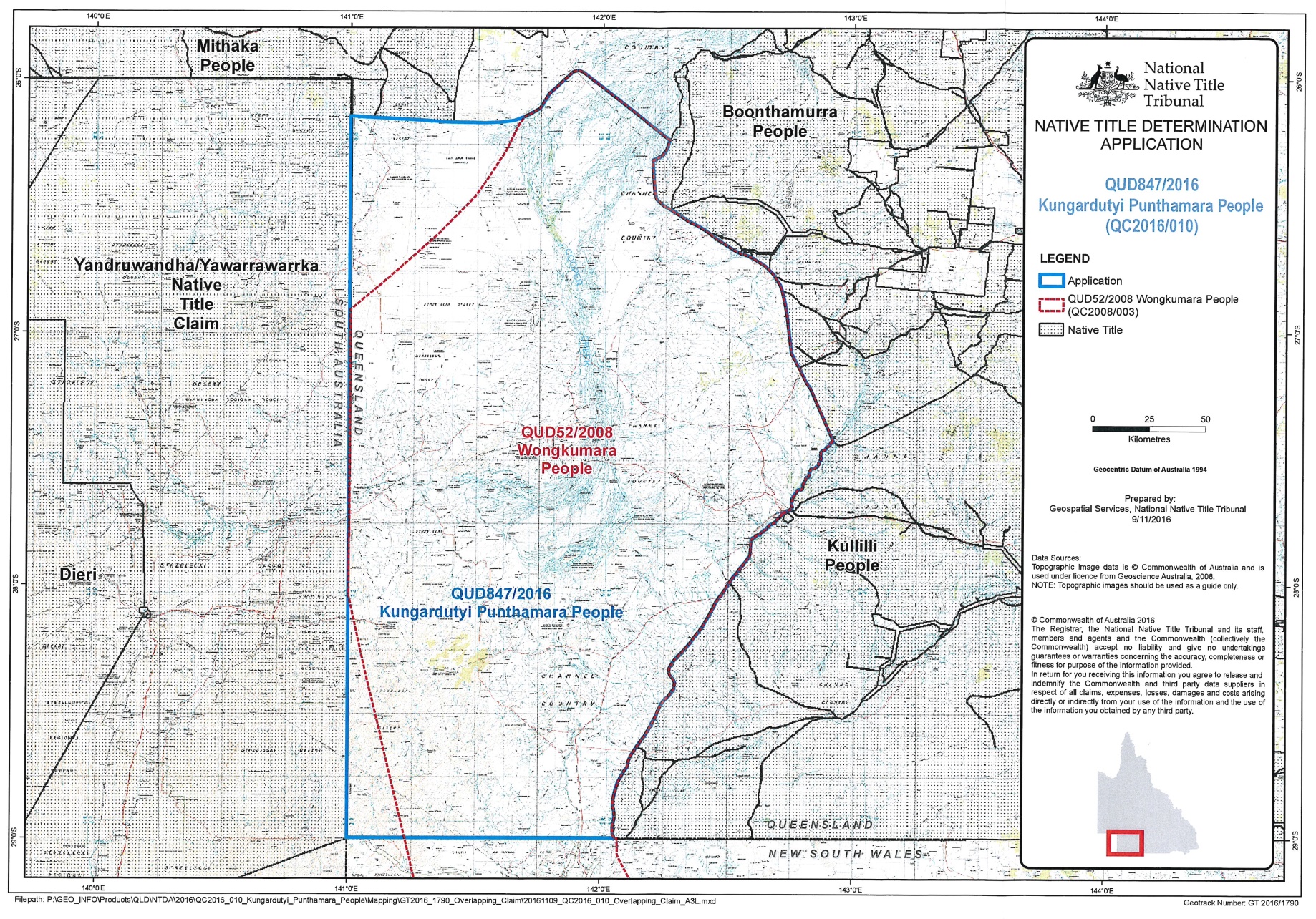
4 The Kungardutyi Punthamara claim area, as shown in the map which is annexed to these reasons for judgment in Schedule B, overlaps the entirety of an undetermined native title application filed on behalf of the Wongkumara People on 11 March 2008 (and subsequently amended). The Kungardutyi Punthamara claim area is also surrounded by other areas the subject of native title determinations including the determinations in favour of the Boonthamurra People made on 25 June 2015, the Kullilli People made on 2 July 2014, the Yandruwandha/Yawarrawarrka People made on 16 December 2015, and the Mithaka People made on 27 October 2015. The areas which are the subject of these determinations are each shown on the map in Schedule B.
5 The application is accompanied by a number of affidavits and an anthropological report of Dr Fiona Powell dated 16 August 2016.
The Wongkumara applicants’ and QSNTS’s strike out/summary dismissal applications
6 The applicants for the claim on behalf of the Wongkumara People (the Wongkumara applicants) and Queensland South Native Title Services (QSNTS) each filed an interlocutory application in the proceeding seeking orders that they be joined as parties in accordance with s 84(5) of the NTA and for the proceeding thereafter to be struck out or summarily dismissed on the grounds identified above.
7 Section 84(5) of the NTA provides that the “Federal Court may at any time join any person as a party to the proceedings, if the Court is satisfied that the person’s interests may be affected by a determination in the proceedings and it is in the interests of justice to do so”. The applications for joinder were not opposed. I am satisfied that the interests of the Wongkumara applicants and QSNTS may be affected by a determination in the proceeding and it is in the interests of justice that they each be joined as a party. The Wongkumara applicants represent the native title claim group in relation to an area of land which is overlapped by the claim made in the proceeding. QSNTS is a representative body recognised under Pt 11 of the NTA, the functions of which include those specified in s 203B of that Act. The claim in the Kungardutyi Punthamara proceeding (and thus also the claim of the Wongkumara applicants) is within the area for which QSNTS is the recognised representative body. By reason of these matters, it is apparent that both the Wongkumara applicants and QSNTS may be affected by a determination in the proceeding. It is in the interests of justice that they be joined as parties so that their contentions, that the claim has not been authorised as required, and that the proceeding involves an abuse of process and has no reasonable prospect of success, may be determined.
The authorisation issue
8 Section 61(1) of the NTA, relevantly, provides that a native title determination application may be made by:
A person or persons authorised by all the persons (the native title claim group) who, according to their traditional laws and customs, hold the common or group rights and interests comprising the particular native title claimed, provided the person or persons are also included in the native title claim group
9 By s 61(4) of the NTA:
A native title determination application, or a compensation application, that persons in a native title claim group or a compensation claim group authorise the applicant to make must:
(a) name the persons; or
(b) otherwise describe the persons sufficiently clearly so that it can be ascertained whether any particular person is one of those persons.
10 In s 253 of the NTA the native title claim group is defined to mean, relevantly, “the native title claim group mentioned in relation to the application in the table in subsection 61(1)”.
11 Section 251B of the NTA is in these terms:
For the purposes of this Act, all the persons in a native title claim group or compensation claim group authorise a person or persons to make a native title determination application or a compensation application, and to deal with matters arising in relation to it, if:
(a) where there is a process of decision-making that, under the traditional laws and customs of the persons in the native title claim group or compensation claim group, must be complied with in relation to authorising things of that kind - the persons in the native title claim group or compensation claim group authorise the person or persons to make the application and to deal with the matters in accordance with that process; or
(b) where there is no such process - the persons in the native title claim group or compensation claim group authorise the other person or persons to make the application and to deal with the matters in accordance with a process of decision-making agreed to and adopted, by the persons in the native title claim group or compensation claim group, in relation to authorising the making of the application and dealing with the matters, or in relation to doing things of that kind.
12 The Wongkumara applicants and QSNTS contend that the making of the Kungardutyi Punthamara application was not authorised by all the persons who according to their traditional laws and customs hold the common or group rights and interests comprising the particular native title claimed. They seek to strike out the Kungardutyi Punthamara application relying on s 84C(1) of the NTA which provides that:
If an application (the main application) does not comply with section 61 (which deals with the basic requirements for applications), 61A (which provides that certain applications must not be made) or 62 (which requires applications to be accompanied by affidavits and to contain certain details), a party to the proceedings may at any time apply to the Federal Court to strike out the application.
13 In Kite v State of South Australia [2007] FCA 1662 at [24] Finn J said this about s 84C(1) of the NTA:
…s 84C(1) provides that, if an application does not comply with s 61, s 61A or s 62, a party to the proceedings may at any time apply to this Court to strike it out. All I need observe here is that the court’s power should be exercised only where the claim as expressed is untenable upon the “version of the evidence” favourable to the respondent to the strike out: McKenzie [McKenzie v State of South Australia [2005] FCA 22; (2005) 214 ALR 214], at [26]; Bodney v Bropho (2004) 140 FCR 77.
14 In the present case, the issue may be considered in a number of ways. One, and perhaps the most straightforward way, involves comparing the identification of the native title claim group in the Kungardutyi Punthamara application with the identification of the native title claim group in the Wongkumara application.
15 The native title claim group in the Kungardutyi Punthamara application is set out above. The native title claim group in the Wongkumara application (initially filed in 2008) is identified in these terms:
The persons who may exercise the native title rights and interests, subject to and in accordance with the traditional laws acknowledged and traditional customs observed by them, are the Wongkumara People. The Wongkumara People are the descendants of one or more of the following people:
1) Charlotte (mother of Jack, Queenie and May Hines, Rosie Jones and Willy Dutton);
2) Siblings Polly (mother of Albert Ebsworth, Sam and Tommy Burgamar) and Charlie Nockatunga;
3) Maggie and Tommy (parents of Nellie Flash and Angelina);
4) Kutji (mother of George Dutton);
5) Tarella and her children Elizabeth and Harry (Fred) Hartnett;
6) Norman Harding;
7) Siblings Nellie (mother of Lucy Harding) and Judy (mother of Donald David Gillis);
8) Jenny (mother of Alf Barlow); and
9) Neddie and Nancy (grandparents of Jimmy Sedeek).
16 The report of Dr Powell which is an attachment to the Kungardutyi Punthamara application identifies that Clara, an apical ancestor in the Kungardutyi Punthamara application, was married to Sam Burgamar, who is an apical ancestor in the Wongkumara claim. The report also identifies that Clara and Sam had a daughter, Florrie (later Florrie Gray). It necessarily follows that the descendants of Florrie Gray are members of both the Kungardutyi Punthamara native title claim group and the Wongkumara native title claim group. Consistently with this, some of the affidavits from various members of the Kungardutyi Punthamara native title claim group which are annexed to the Kungardutyi Punthamara application identify Florrie Gray as their grandmother. While descendants of Florrie Gray would be within the description of the Kungardutyi Punthamara native title claim group (because she is a descendant of Alex and Maggie, parents of Clara) there is no reference in that description to Florrie Gray, daughter of Clara and Sam Burgamar to provide the reader with a clue that the claim group must include these descendants.
17 There are other examples which demonstrate that the Kungardutyi Punthamara native title claim group necessarily includes members of the Wongkumara native title claim group. May Hines is an apical ancestor of the Wongkumara native title claim group. Dr Powell’s report and the affidavits of Wilma Dalton and Coral King which form part of the Kungardutyi Punthamara application identify the daughter of May Hines with their father William Booth, Eva Flash (or Murray), as their older sister. The son of William Booth by May Hines was Bill Bowman. Consistently with this, in his affidavit forming part of the Kungardutyi Punthamara application Geoffrey Booth identifies both Eva Flash (or Murray) and Bill Bowman as his relatives. In other words, the descendants of Eva Flash (or Murray) and Bill Bowman necessarily are included in both the Kungardutyi Punthamara native title claim group and the Wongkumara native title claim group. However, there is no reference in the description of the Kungardutyi Punthamara native title claim group to the descendants of May Hines and William Booth (the parents of Eva Flash/Murray and Bill Bowman).
18 It is also apparent that the Kungardutyi Punthamara application, which includes the report of Dr Powell and various affidavits from members of the Kungardutyi Punthamara native title claim group, identifies a number of people who are members of the Wongkumara native title claim group including not only Florrie Gray and Eva Flash (or Murray), but also Florrie Gray’s daughter Marjorie Row Row, Lucy Harding (the daughter of Nellie, an apical ancestor in the Wongkumara application, who was married to Charlie Booth, the brother of Geoffrey Booth’s grandfather Frank Booth), and Norman Hodge (the son of Eva Flash/Murray, raised by Lucy Harding and Charlie Booth).
19 Another way of approaching the issue involves consideration of Dr Powell’s report forming part of the Kungardutyi Punthamara application. Dr Powell’s report identifies that the claim area is “within a region that is associated with a regional system of law and custom and that the lives of Aboriginal inhabitants of southwest Queensland were regulated by region-wide laws and customs..., which impacted on membership of local groups”. When dealing with a question which asked for an explanation as to why the claim group description should be regarded as encompassing all those persons entitled to exercise native title rights and interests in the claim group area “despite the fact that the claim group is limited to the persons so described”, Dr Powell said this:
96. My research found that according to the system of law and custom pertaining to this region, descent from an ancestor belonging to an area is the primary basis for the descendants’ assertions of native title rights and interests in the Application Area and that such descent underlies descendants’ socio-territorial identity. My research found that claimants identify the ancestors for this area on the basis of information transmitted orally about the connections of their forebears to the area and its ancestors, and that there are written records that support this oral testimony.
97. The apical ancestors identified in the claim group are recorded in the written records as having an association with the Application Area and are believed by their descendants to have originated from the Claim Area. They are also regarded by their descendants as persons who survived the appropriation of their lands by the first pastoralists and became members of station camps located on the principal stations in the Application Area, including Arrabury, Mount Howitt, Durham Down, Nockatunga, Nappa Merrie, Naryilco and other stations.
20 Dr Powell thus identifies descent as the criterion for group membership. But as is apparent from the discussion above, there are other descent lines which are not identified in the description of the Kungardutyi Punthamara native title claim group.
21 Consistently with this material, the submissions for the Kungardutyi Punthamara applicants state that the apical ancestors for the Kungardutyi Punthamara native title claim group were “part of the society of the original inhabitants of the claim area” (my emphasis).
22 The process which led to the authorisation of the Kungardutyi Punthamara applicants to make the claim also reflects this approach. Accordingly, the notice for the meeting seeking to authorise the making of the claim was in these terms:
KUNGARDUTYI PUNTHAMARA PEOPLE
NATIVE TITLE AUTHORISATION MEETING
SATURDAY 30 APRIL 2016, 10:00am
ROCKHAMPTON
23 A map showing the claim area then appeared followed by this:
The Kungardutyi Punthamara People native title claim group are descendants of the following ancestors:
• Toby and Jenny (the parents of Tonie Booth)
• Alex and Maggie (parents of Clara)
• Nancy (the mother of Rosie Williams)
• Davie and Betty (parents of Durham Bob)
Elders and members of the claim group are welcome and encouraged to attend for the purpose to authorise the Kungardutyi Punthamara People native title claim tha [sic’ includes parts of Cooper Creek and Wilson River country, Mount Howitt, Nockatunga and Arrabury in SW Queensland.
24 The affidavit evidence explaining how the authorisation meeting was organised includes Geoffrey Booth’s statement that it was agreed “by the representatives and senior Elders of all descent lines via phone calls to hold the Authorisation Meeting on 30 April 2016”. Geoffrey Booth also said that he “contacted the Kungardutyi Punthamara People members of my family, representatives and Elders of the other descent lines by phone and in person…They told me they would inform their family members. The Elders and representatives I consulted with by phone included Coral King, Dennis Fisher, Colin Booth, Norman Jasperson and Stewart Williams who are members of one or more of the four descent groups who comprise the Kungardutyi Punthamara People”.
25 Coral King gave this evidence in her affidavit:
8. Kungardutyi Punthamara people supplied me with their email addresses and mobile numbers and I used these to send out information about the proposed claim, the authorisation process and the date and place of the authorisation meeting. By 30 March 2016 I had confirmation from the Elders regarding agreement to the name, boundary map and ancestral descent lines which had been emailed to contact email addresses.
9. The proposed date of the 30 April 2016 was agreed by members of all descent lines as the most preferred date for the Authorisation meeting because many of the Elders from interstate would be in Rockhampton at that time on account of their attendance at a family funeral at Woorabinda on Thursday 28 April 2016. To save money from travel expenses and to allow attendance for my family members and other Kungardutyi Punthamara members who are suffering financial hardship it was agreed to by the representatives and senior Elders of all descent lines via phone calls to hold the Authorisation Meeting on 30 April 2016 in North Rockhampton with an opportunity for an informal pre-authorisation meeting for hand outs and discussion to be held the day before 29 April 2016.
10. I notified the Kungardutyi Punthamara People members of my family, representatives and Elders of other descent lines by email, in person and texts about the pre-authorisation on 29 April 2016 and authorisation meeting on 30 April 2016. The Elders told me they would inform their family members. The Elders and representatives I consulted with my phone included Geoffrey Booth, Coral Booth, Veronica Booth, Norman Jasperson, Stewart Williams and Alister Gibson who are members of one or more of the four descent groups who comprise the Kungartdutyi Punthamara People.
11. On 22 April 2016 I arranged for an email about the Kungardutyi Punthamara People Native Title Authorisation Meeting notice that described the claim group and the claim area boundary map to be emailed to claimant group members who had provided contact email addresses (Annexure CAK-AMN1).
12. A Kungardutyi Punthamara People Native Title Authorisation Meeting notice was on the Koori Mail website under What’s Hot continuously from 26 April 2016 through to 30 April 2016 to advertise the meeting. This notice was emailed to claimant group members who had provided an email address on 26 April 2016 (Annexure CAK-AMN2).
26 No email addresses are disclosed on Annexure CAK-AMN1 to Ms King’s affidavit.
27 In Daniel v Western Australia [2002] FCA 1147; (2002) 194 ALR 278, a case dealing with an application to replace applicants under s 66B of the NTA (which, in common with s 61(1), requires the replacement applicants to be authorised by the claim group to make the application and to deal with matters arising in relation to it) French J explained that:
[11] It is of central importance to the conduct of native title determination applications and the exercise of the rights that flow from their registration, that those who purport to bring such applications and to exercise such rights on behalf of a group of asserted native title holders have the authority of that group to do so…
[12] In Western Australia v Strickland (2000) 99 FCR 33 at 52 , the Full Court approved a passage from the judgment in Strickland v Native Title Registrar (1999) 168 ALR 242 at 259–60 , including the observation that:
The authorisation requirement acknowledges the communal character of traditional law and custom which grounds native title. It is not a condition to be met by formulaic statements in or in support of applications.
Wilcox J in Moran v Minister of Land and Water Conservation (NSW) [1999] FCA 1637 described the obtaining of proper authorisation of a claimant application as a “fundamental requirement of the Native Title Act”: at [48]. His Honour said:
It is important that those who come to the Court asserting a native title right, with all this involves in terms of effort and expense to other parties and the Court itself, should be properly authorised to make the claim. As I have explained, this does not necessarily mean the applicant must be individually authorised by each member of the claimant group. It will be enough that the applicant has been authorised to make the claim in accordance with a process of decision-making recognised under the traditional laws and customs of the claimant group. In meritorious cases, that is unlikely to be an onerous requirement. Traditional laws and customs are likely to exist in cases where the claimant group still maintains a vigorous communal life.
28 These statements of principle remain sound. In Burragubba on behalf of the Wangan and Jagalingou People v State of Queensland [2017] FCA 373 Reeves J said:
21 The proper authorisation of an applicant is of fundamental importance to the conduct of a native title determination application and the rights that flow from the valid registration of such an application under the NTA: Daniel v Western Australia (2002) 194 ALR 278; [2002] FCA 1147 (Daniel) at [11] per French J and Weribone on behalf of the Mandandanji People v State of Queensland [2013] FCA 255 (Weribone) at [36] per Rares J. Among other things, it establishes that the person or persons claiming before the Court to be the applicant has the authority of the native title claim group on whose behalf of the application is being brought to make the application and to deal with all matters arising in relation to it. Indeed, if the Court has any doubt about the applicant’s authority, it has, since the 2007 amendments to the NTA, had the power under s 84D(1)(a) to require a person to produce evidence that he or she is properly authorised as the applicant.
22 The process whereby a native title claim group authorises a person or persons to make an application on its behalf is set out in s 251B (see at [20] above). As has been observed on occasions in the past, the provisions of ss 251B(a) serve to recognise the communal character of the traditional laws and customs that underpin the concept of native title as defined in the NTA: see, for example, Bolton on behalf of the Southern Noongar Families v State of Western Australia [2004] FCA 760 (Bolton) at [43] per French J. I will return to the alternative procedure provided for in ss 251B(b) later in these reasons. However, whether the native title claim group proceeds under s 251B(a) or (b), the authorisation that ensues must be that of the whole of that claim group: see Daniel at [11]–[16] per French J; Landers v State of South Australia (2003) 128 FCR 495; [2003] FCA 264 at [35]–[38] per Mansfield J; Ward v Northern Territory [2002] FCA 171 at [24]–[25] per O’Loughlin J; Lawson on behalf of the ‘Pooncarie’ Barkandji (Paakantyi) People v Minister for Land and Water Conservation for the State of New South Wales [2002] FCA 1517 at [25] per Stone J; and Bolton at [45]–[46] per French J.
29 Reeves J continued, making the following observations in the context of s 66B of the NTA, which apply equally to the authorisation of initial, as opposed to replacement, applicants:
30 When such an authorisation meeting is convened, proper notice is essential to its validity. In this particular context, that means, among other things, that (Weribone at [40] and [41]):
… The notice must be sufficient to enable the persons to whom it is addressed, namely members or potential members of the native title claim group, to judge for themselves whether to attend the meeting and vote for or against a proposal or whether to leave the matter to be determined by the majority who do attend and vote at the meeting. …
… the proponent must give fair notice of the business to be dealt with at the meeting to all members of the claim group. The notice must be such as will fully inform the persons entitled to attend the meeting, so that they can make an informed decision whether or not to be present.
31 It is also important to note that, while the authorisation that ensues from an authorisation meeting conducted for the purposes of s 251B must be that of the whole of the claim group concerned (see the authorities cited at [22] above), it is not necessary that the notice of the meeting must result in all the members of the claim group attending the meeting. Rather, it is necessary that all the members be offered a reasonable opportunity to decide whether to attend: Frank on behalf of the Mayala People v State of Western Australia (No 3) [2016] FCA 1255 at [11] per Barker J; Butterworth on behalf of the Wiri Core Country Claim v State of Queensland (No 2) [2014] FCA 590 at [13] per Collier J; and Jurruru People v State of Western Australia [2012] FCA 2 at [30]–[31] per Barker J. The primary purpose of the notice of an authorisation meeting for the purposes of ss 251B and 66B of the NTA, therefore, is to result in a resolution concerning the authorisation of the applicant – whether that be the original authorisation prior to the filing of a native title determination application, or a subsequent replacement authorisation under s 66B – that is both fairly representative of the views of the whole of the native title claim group on that authorisation issue and that constitutes the informed consent, or vote, of those present at the meeting: TJ v Western Australia (2015) 242 FCR 283; [2015] FCA 818 at [107] and Weribone at [39].
32 Accordingly, the notice of an authorisation meeting must be expressed in a form, and promulgated in a manner, that is likely to result in all the members of the native title claim group being offered a reasonable opportunity to decide whether to attend the meeting and to participate in its deliberations. It must therefore alert those members to the fact the meeting has been called and to give them sufficient time to make arrangements to attend it, if they wish to. It must also give fair notice to the members of the native title claim group concerned of the business to be dealt with at the meeting so that they can make an informed decision whether, or not, to attend. …
30 The notice of the meeting for the Kungardutyi Punthamara does not satisfy the requirements identified in these decisions. It was incapable of resulting in an authorisation from all the persons who, according to their traditional laws and customs, hold the common or group rights and interests comprising the particular native title claimed. It was incapable of resulting in authorisation by a group that was likely to be fairly representative of the views of the whole of the native title claim or of being likely to provide all members of the native title claim group with a reasonable opportunity to decide whether to attend the meeting and to participate in its deliberations. These incapacities all result from the identification of the members of the group as the descendants of four confined lines of descent. The identification of these four lines of descent was incapable of satisfying the requirements for valid authorisation of the Kungardutyi Punthamara application. In particular, it cannot be assumed that any potential member of a native title claim group will be sufficiently aware (or aware at all) of their own ancestry to be able to identify their descent from any particular ancestor, particularly not back through multiples of generations. For this reason, it is necessary that a notice of a meeting for the purpose of authorising a native title claim must provide enough information to make potential members of the group aware of their potential membership. There may be many ways in which this object might be achieved. Relevant factors might include:
(1) the use of a group description or alternative group descriptions which, by evidence, are established to be likely to be known to those likely to be members of the claim group;
(2) reference to traditional names of the group which, by evidence, are established to be likely to be known to those likely to be members of the claim group;
(3) the identification of different levels of ancestors including the names of more recent ancestors which, by evidence, are established to be likely to be known to those likely to be members of the claim group; and
(4) the provision of a map which clearly identifies the claim area by reference to locations which, by evidence, are established to be likely to be known to those likely to be members of the claim group together with a claim group description which refers to people descended from people who have traditional connections with that area.
31 Whatever form the notice of meeting takes, considered as a whole, there must be sufficient visual and verbal indicators to make it likely that it will be effective to give likely members of the native title claim group a fair opportunity to decide whether or not to attend the meeting. The notice in the present case does not satisfy this requirement because it describes the members of the claim group as the descendants of four lines of descent when it is apparent from the material forming part of the Kungardutyi Punthamara application, particularly when compared with the Wongkumara application, that there are other lines of descent which include people who are likely to form part of the claim group, such as the descendants of May Hines (and her children, Eva Flash/ Murray and Bill Bowman).
32 The description of the claim group in the notice is exclusively by reference to descent from one or more of the four groups of apical ancestors. While the notice contains a map of the claim area it does not suggest that people with a traditional connection to that area may be members of the claim group because of the exclusive criterion of stated membership, being descent from one or more of the four groups of apical ancestors. Further, the reference to the locations of “parts of Cooper Creek and Wilson River country, Mount Howitt, Nockatunga and Arrabury in SW Queensland” in the notice is for the sole purpose of identifying the claim area and not for the purpose of identifying likely membership of the claim group. The invitation to attend the meeting, in terms, is to the descendants of the four groups of apical ancestors and no other people. Finally, the name of the claim group, the Kungardutyi Punthamara People, was unlikely to assist any likely member to identify themselves as a member. There is evidence that Punthamara is an alternative form of Boonthamurra. Yet there is an approved determination of native title for the Boonthamurra People in relation to land to the north-east of the Kungardutyi Punthamara claim area. There is also evidence that Punthamara, Kungardutyi and Wongkumara are all names for the same language and even the same society or, indeed, that Kungardutyi is a reference to the Wongkumara and Punthamara who form part of a regional society practising circumcision in order to distinguish them from other societies nearby who did not practice circumcision. Whatever the true position, the relevant point is that the name Kungardutyi Punthamara People was unlikely to disclose to all likely members of the claim group their membership.
33 The problems with the notice of the claim group meeting are compounded by the unsatisfactory evidence of how notice of the meeting was otherwise communicated to likely members of the claim group. It is apparent from the evidence that nothing more was done other than that certain people who currently identify as Kungardutyi Punthamara People (being descendants of one of the four lines of descent identified in the notice) contacted people who were known to them to currently identify as Kungardutyi Punthamara People (being descendants of one of the four lines of descent identified in the notice). There is no evidence of how many people were contacted. It is not possible to identify all of the people contacted. It also appears from the minutes of the meeting on 30 April 2016 and the record of attendance that 25 people attended the meeting, all identified as belonging to one of the four descent lines. Given the necessary overlap in membership between the Kungardutyi Punthamara application and the Wongkumara application, this supports the conclusion that the process of notification did not give a fair opportunity to all likely members of the claim group to decide whether or not to attend the meeting.
34 The reason for this is obvious and is apparent from the written submissions for the Kungardutyi Punthamara People. It is that the Kungardutyi Punthamara People are part only of a wider regional society which includes the descendants of a number of ancestors identified in the Wongkumara application. Prevailing orthodoxy is that a mere part or sub-set of the persons who, according to their traditional laws and customs, hold the common or group rights and interests comprising the particular native title claimed cannot authorise the making of a native title claim because they cannot, by definition, comprise all such persons (for example, Risk v National Native Title Tribunal [2000] FCA 1589 at [29]-[30] and [60] and at [15]-[22] and the cases cited in those paragraphs).
35 For the Kungardutyi Punthamara People it was put that a part of a society may authorise a claim, relying on the reasoning in Alyawarr, Kaytetye, Warumungu, Wakay Native Title Claim Group v Northern Territory of Australia (2004) 207 ALR 539; [2004] FCA 472, Aplin on behalf of the Waanyi Peoples v State of Queensland [2010] FCA 625, and Weribone on behalf of the Mandandanji People v State of Queensland [2013] FCA 255). These cases reflect the principle which Finn J identified in Kite at [22] in these terms:
However, where a sub-group of a community sharing traditional laws and customs alone possesses rights and interests in a particular area, that sub-group may itself constitute a native title claim group: see Hillig as Administrator of Worimi Local Aboriginal Land Council v Minister for Lands for the State of New South Wales (No 2) [2006] FCA 1115 at [60].
36 Accordingly, in Alyawarr there were different land holding groups which formed part of a single society (see at [111], [112], [131] and [132]). At [131] Mansfield J noted:
There are other illustrations of estate subgroups being found to constitute a broader composite community: Ward at first instance [Ward v Western Australia (1998) 159 ALR 483], Croker Island [Yarmirr v Northern Territory of Australia (1998) 156 ALR 370] and St Vigeon [The Wandarang, Alawa, Marra and Ngalakan Peoples v Northern Territory [2000] FCA 923; (2000) 104 FCR 380] (although the issue in that case was not contentious). In Ward at first instance, Lee J said at 525:
The mutual possession of a language connected with the land was an incident of identification of the community as was mutual recognition of membership of that community; mutual acknowledgment and observation of traditional law, customs and practices; and the recognition by others of the existence of the community.
His Honour at 541 said:
The territory of the Gajerrong community was adjacent to the Miriuwung and they shared economic and ceremonial links. Those links were reinforced when the extent of the depletion of Gajerrong people after European settlement saw Miriuwung and Gajerrong become regarded as a composite community with shared interests. The members of that community were still Miriuwung people and Gajerrong people but with a common outlook and beliefs, and common traditions and customs in respect of the land with which they were connected.
Those conclusions were upheld by Ward in the Full Court [State of Western Australia v Ward [2000] FCA 191; (2000) 99 FCR 316;]: see the judgment of Beaumont and von Doussa J at 372, [204] and 381, [239]. Their Honours said at [204] that the evidence showed a communal title shared by a composite community of the Miriuwung and Gajerrong estate groups under the traditionally based laws and customs as ‘currently acknowledged and observed by it’. The particular issue was not directly raised before the High Court in Ward, but the majority reasons indicate that the existence of the communal group holding native title must exist both at the time of sovereignty as well as at contemporary time, and during the continuum. That is not to require that there be a mirror reflection of all features of the traditional laws and customs, or the manner of their exercise, at the two temporal bookends for the reasons already given. But the communal rights and interests cannot be transferred from one communal group existing at sovereignty to a different communal group formed sometime thereafter, so that the new communal group may assert under the NT Act native title rights and interests which it holds and which are recognised by the common law under s 223(1)(c) of the NT Act.
37 In Aplin at [260]-[263] the point being made was that membership of that claim group, given the evidence, depended on acceptance by the group of the asserted identity. Given this, Dowsett J nevertheless made the following observation at [270]:
Although resolution of this matter is primarily for the claim group, any decision may not necessarily be beyond review, given its significance under the Native Title Act. There is, as far as I am aware, no precedent upon which to base a decision as to the availability of judicial relief in the event that persons who, according to traditional laws and customs, are entitled to Native Title rights and interests, are wrongfully excluded from membership of the claim group. Relief may be available, perhaps by analogy to that available for fraud on the power. See Ngurli Ltd v McCann (1953) 90 CLR 425 at 438; Cachia v Westpac Financial Services Ltd (2000) 170 ALR 65 at [74] and Gambotto v WCP Pty Ltd (1995) 182 CLR 432. In the latter case, McHugh J identified the fact that the doctrine had been used as the basis for granting relief against oppression of the minority of company shareholders. See also Alexander v Automatice Telephone Co [1900] 2 Ch 56 at 69 and Menier v Hooper’s Telegraph Work (1873-74) LR 9 Ch App 350 at 353–4. Statutory relief has long been available for oppression of minority shareholders, thus removing the need for further development of equitable doctrine in that area.
38 In Weribone, a case involving an application for replacement applicants, the issue was the sufficiency of the notice of the proposed authorisation meeting. Rares J at [40] said that:
The notice must be sufficient to enable the persons to whom it is addressed, namely members or potential members of the native title claim group, to judge for themselves whether to attend the meeting and vote for or against a proposal or whether to leave the matter to be determined by the majority who do attend and vote at the meeting.
39 These cases do not assist the position of the Kungardutyi Punthamara applicants. It may be accepted that a part or sub-set of a traditional society or community may be able to establish that the relevant part or sub-set itself has rights and interests possessed in relation to an area of land under the traditional laws acknowledged and the traditional customs observed by the larger society. However, there is no suggestion in the Kungardutyi Punthamara application that they are a part or a sub-set of a society which has traditional rights and interests in relation to the claim area, in contrast, for example, to other parts or sub-sets of the same society which have traditional rights and interests in relation to other land. Rather, the Kungardutyi Punthamara application is in relation to the same area of land as the Wongkumara application.
40 In an attempt to overcome the fundamental deficiencies in the identification of the claim group and the authorisation process, it was proposed on behalf of the Kungardutyi Punthamara applicants that they would be able to apply to amend the application to include under the identification of the four groups of apical ancestors the words “and who identify as and are accepted by the Kungardutyi Punthamara People”. This also does not assist.
41 First, self-identification and group acceptance cannot create a part or sub-set of a society which has rights and interests in relation to an area of land if, in fact, there are no such parts or sub-sets with rights in relation to land under the society’s traditional laws and customs.
42 Second, the proposed amendment would create a group different from that which was the subject of the notice and authorisation meeting. That group was not limited in the manner suggested and thus, as explained, necessarily includes members of the Wongkumara claim group. If membership of the group is confined in the manner now suggested, there will be no authorisation for the making of a native title claim on behalf of that new group. Accordingly, the proposed amendment cannot assist the Kungardutyi Punthamara applicants.
43 Section s 84D of the NTA must be considered. It is in these terms.
(3) Subsection (4) applies if:
(a) an application does not comply with section 61 (which deals with the basic requirements for applications) because it was made by a person or persons who were not authorised by the native title claim group to do so; or
(b) a person who is or was, or one of the persons who are or were, the applicant in relation to the application has dealt with, or deals with, a matter arising in relation to the application in circumstances where the person was not authorised to do so.
(4) The Federal Court may, after balancing the need for due prosecution of the application and the interests of justice:
(a) hear and determine the application, despite the defect in authorisation; or
(b) make such other orders as the court considers appropriate.
44 It is not in the interests of justice that the Kungardutyi Punthamara application be permitted to proceed. The defect in authorisation involves a matter of substance, not form. The confining of the Kungardutyi Punthamara native title claim group to four descent lines when comparison between that application and the Wongkumara application discloses other descent lines, members of which must also be members of the Kungardutyi Punthamara native title claim group, means that the Kungardutyi Punthamara application cannot have been properly authorised. It would be contrary to the interests of justice to permit the Kungardutyi Punthamara application to proceed in these circumstances. The conclusions I have reached below, that the Kungardutyi Punthamara application involves an abuse of process and has no reasonable prospects of success, each also provide additional independent grounds on which to reach this conclusion.
The abuse of process issue
45 The relevant facts are these.
46 Clancy Booth, the father of Geoffrey Booth, filed a native title determination application on behalf of the “Bunthamara” People on 14 April 1998 (QUD6187/1998). The application was discontinued on 14 December 1999.
47 Geoffrey Booth filed a native title determination application on behalf of the “Bunthamarra” People on 8 April 2002 (QUD6014/2002). This claim was dismissed under s 84C(1) of the NTA on 9 May 2003 (Booth v State of Queensland [2003] FCA 418).
48 In 2006 Mark Wallace and Barbara Olson, as applicants, filed a native title determination application on behalf of the Boonthamurra People. Geoffrey Booth and Dennis Fisher as representatives of the Booth/Fisher families were joined as a respondent to this proceeding. Separate questions were answered by Mansfield J in Wallace on behalf of Boonthamurra People v State of Queensland [2014] FCA 901; (2014) 313 ALR 138. The questions determined included these (at [6]):
(1) Were the deceased persons known as Clara and her son Frank Booth Boonthamurra persons?
(2) Did the geographical area with which Clara and her son Frank Booth were traditionally associated extend into the claim area of this claim, and if so to what extent?
(3) If so, is it reasonably arguable that Clara and her son Frank Booth acquired native title rights and interests in any part of the Boonthamurra claim area on the basis of that descent, other than as members of the claim group?
(4) Were the deceased persons known as Toby and/or Jenny, and their daughter, Toney:
(a) Boonthamurra persons; or
(b) Kungadutji persons?
(5) Did the geographical area with which Toby and/or Jenny, and their daughter Toney were traditionally associated extend into the claim area of this claim and if so to what extent?
(6) If so, is it reasonably arguable that persons who are descended from Toney acquired native title rights and interests in any part of the Boonthamurra claim area on the basis of that descent, other than as members of the claim group?
49 The “Clara” referred to in these questions is the “Clara” in the Kungardutyi Punthamara application (the daughter of Alex and Maggie). Mansfield J at [51] said:
Clara married Jim Booth, a white man. She is the mother of Frank Booth. Toney married Frank Booth. Frank Booth Jnr and Toney are in turn the parents of Dolly Fisher, Clancy Booth and Dempsey Booth. It is the next generation: Dennis Fisher (son of Dolly Fisher) and Geoffrey Booth (son of Clancy Booth) and others who have given evidence in this matter.
50 Members of the Kungardutyi Punthamara native title claim group, in their affidavits, identify their descent from Frank and Tonie Booth. The Geoffrey Booth who gave evidence before Mansfield J in Wallace is the Geoffrey Booth who is an applicant for the Kungardutyi Punthamara application.
51 Mansfield J noted the following in Wallace:
[45] As the issues have emerged, the claim is not simply about whether the Booth/Fisher families are properly Boonthamurra People by their apical ancestors but about the location of Boonthamurra country. When the order for the determination of particular questions was made, it was anticipated that if the deceased person, Clara and her son Frank Booth were found to be Boonthamurra People, or alternatively if Frank Booth’s wife Toney was Boonthamurra, that would be followed by an order that they should be added to the apical ancestors of the Boonthamurra People, and so the Booth/Fisher families would be recognised as members of the Boonthamurra People.
[46] In the course of submissions, the issue did not emerge in that way. Counsel for the Booth/Fisher families indicated that the Booth/Fisher families described themselves as part of the Wilson River group, involved largely through Clara in only the southern section of the Boonthamurra claim area, but they also claimed native title rights and interests over parts of the Wongkumara People claim area and the Kullilli People claim area. In addition, in respect of the alternative apical ancestor known as Tobey and/or Jenny, or her daughter Toney (but on the evidence more directly through Toney), the proposition was put in argument that the Kungadutji community had become synonymous with and part of the Boonthamurra People, but the two families’ particular interests through Toney were in the western section only of the Boonthamurra claim area towards Cooper Creek area, and probably west of the Cooke Range.
[47] In either event, it became apparent that the answer to the questions as expressed, if affirmative, would not routinely lead to the apical ancestors for the Boonthamurra People being changed in respect of this particular claim area. It might lead to a fresh claim made by the “Wilson River group “in respect of an area which overlaps each of the Boonthamurra, Kullilli and Wongkumara Peoples claim areas.
[48] In that regard, it is worth noting that, as I observed when that potential position emerged, the general south-west area of Queensland has been the subject of extensive claims made over a long period of time. All of those claims (other than the ones presently on foot) have either been dismissed or discontinued. If there is to be another claim, it should have been brought earlier and in a timely manner.
[49] However, it is not necessary to consider the consequences of such a potential claim, except to the extent that it affects the answers to the questions referred and consequently the status of the Booth/Fisher families as respondent parties to this application.
52 In a document filed in the Wallace proceedings on 21 October 2008 Geoffrey Booth and Dennis Fisher contended that the “Bunthamarra” and “Kungardutyi” Peoples “have different traditional country”. Subsequently, Geoffrey Booth gave evidence in an affidavit that Kungardutyi land was to the north-west of Boonthamurra land.
53 In [53] Mansfield J said:
What is important is whether Clara was a Boonthamurra woman or had an interest of a relevant kind in the present claim area, or (as the evidence has focused) in the southern part of the present claim area.
54 His Honour recorded Geoffrey Booth’s evidence in these terms at [65]:
As noted, Geoffrey Booth is Clancy Booth’s son. In Geoffrey Booth’s affidavit of 7 November 2008, he said he was told by his father that Grandpa Frank (Frank Booth) was from Noccundra and Nockatunga, and that around “that way” was Grandpa Frank’s country. He said Grandpa Frank was a Boonthamurra man. He also said Clancy Booth was from Nockatunga and that his tribe was the Boonthamurra/Wilson River tribe. In his affidavit of 12 November 2012, he said that Nockatunga was the main feature and central to his country. He said Clancy Booth’s mother, his grandmother, came from “around Eromanga and that this was her country and that she was a Kungadutji woman. At the hearing, Geoffrey Booth gave evidence of his understanding of law and custom, as taught to him by his father that the child’s mother chooses their tribe, and that his mother elected to choose Boonthamurra. He said Clara chose Boonthamurra for her son Frank and that Toney, Frank Booth’s wife, also chose Boonthamurra for Clancy Booth. Geoffrey Booth said his father identified as Boonthamurra and there was a conscious decision made not to identify as Kungadutji in order to keep the family together. He also said his father told him a lot about Kungadutji laws and customs.
55 It is apparent from Mansfield J’s reasons at [67] and [73] that Punthamara is the same as Boonthamurra.
56 His Honour’s conclusions about Clara included the following (my emphasis):
• [86] In my view, the evidence indicates that Clara was a Yandruwandha/Yawarrawarrka person. I prefer the views of Professor Trigger, Dr Sneddon and Mr Southon on that topic. I think that the critical step taken by Dr Powell referred to above is not warranted on the whole of the evidence, and that another step in her reasoning — namely that Kungadutji is a tribal ascription rather than a general description of status — is also not warranted on the evidence. The reasons for not accepting those steps in her reasoning are set out above.
• [87] Once those steps are not taken, there is only the anecdotal oral evidence which tends to identify Clara, or more directly Clancy Booth and Frank Booth through Clara, as Boonthamurra. I have discussed that evidence above. They are the particular reasons why, in this particular matter, that evidence is not persuasive.
• [98] Consequently, I find, on the balance of probabilities, that there is no sound basis that Clara had a Boonthamurra identity. It follows that Frank Booth and his lineal descendants including Clancy Booth and then the Booth/Fisher families are not Boonthamurra persons through Clara.
57 His Honour’s conclusions about Toney (or Tonie), who married Frank Booth, included these:
• [84] I think the strong preponderance of the evidence is that the Kungadutji People, as a language group holding interests in country, hold their interest quite remotely from the present claim area. Tindale’s journal records an interview with George Dutton describing the Kungadutji group as occupying the “upper Buloo River” area. Dr Breen’s interviews with George McDermott and King Miller in the 1960s record it as the area of Naryilco to Tibooburra. Dr Hercus and others in their study of Aboriginal Cultural Association with Mutawintji National Park entitled “Mutawintji”, prepared for the Registrar, Aboriginal Land Rights Act 1983 (NSW), say much the same thing. Their report at para 4.4 says:
All the evidence places Kungardutji in the area immediately east and north-east of Tibooburra and around the southern parts of the swampy areas around Lake Bulloo.
They refer to other earlier sources to support that. That area is, of course, in the north-western part of New South Wales.
• [100] Toney is the daughter of two Aboriginal persons, Toby and Jenny. Nothing is known of their tribal origins or affiliations. The evidence focused on the status of Toney. Toney married Frank Booth at Eromanga in 1916. The alternative basis of the Booth/Fisher families’ claim to be Boonthamurra is through Toney.
• [105] It is, on the evidence, clear Toney was identified as being of the Kungadutji tribe at the time of Tindale’s expedition. The issue is whether the Kungadutji area is part of the Boonthamurra country. Dr Powell agreed that her view was based on limited knowledge. She identified “various old records” which identified Kungadutji to be associated with areas that overlap with the western part of the Boonthamurra claim area. Her notion of Kungadutji being an identity label that was subsequently superseded by Boonthamurra and Wongkumara, largely relies on linguistic analysis.
• [106] In my view, on the evidence, the views of Professor Trigger, Dr Sneddon and Mr Southon, based partly on Dr Hercus’ analysis, that Kungadutji was more likely to be further south than the Boonthamurra claim area are more probably correct. I have discussed above the reason why I conclude that the Kungadutji People as a language group is an area well remote from the present claim area.
• [107] For those reasons, I do not think that the identification of Toney as Kungadutji by Tindale advances the claim of the Booth/Fisher families to be Boonthamurra. There is, in addition, no evidence to support the proposition that there is any acquisition of rights to country acquired by birth place irrespective of lineal acquisition of rights (either patrilineal or matrilineal), and there is no evidence which can support any finding that by her parentage Toney acquired rights in the Boonthamurra claim area.
58 Mansfield J answered the separate questions raised at [6] as follows at [110] and ordered that Geoffrey Booth and Dennis Fisher cease to be parties to the Boonthamurra application:
(1) No.
(2) On the basis that the expression “traditionally associated“ conveys that those persons held under the traditional laws and customs of a relevant native title claim group native title rights and interests in the claim area of this claim:
No.
(3) Not necessary to answer.
(4) (a) No.
(b) Not necessary to answer (see answer to question (5).
(5) On the basis that the expression “traditionally associated“ conveys that those persons held under the traditional laws and customs of a relevant native title claim group native title rights and interests in the claim area of this claim:
No.
(6) Not necessary to answer.
59 Subsequently, Mansfield J made orders by consent determining native title rights and interests in favour of the Boonthamurra People (Wallace on behalf of Boonthamurra People v Queensland [2015] FCA 600 or Wallace No 2). The native title claim group was described as the descendants of Kangaroo or Dick Ray.
60 Mansfield J also made orders by consent determining native title rights and interests in favour of the Yandruwandha and Yawarrawarrka People in Nicholls v State of South Australia [2015] FCA 1407. The native title claim group was described as including the descendants of “Clara Nirrpinni, mother of Frank Booth and Alice Miller (nee Booth)” which is the same Clara referred to in Wallace as an ancestor of the Booth family and as a Yandruwandha/Yawarrawarrka person and as an ancestor in the Kungardutyi Punthamara application.
61 Geoffrey Booth and Dennis Fisher had also each notified the Court in writing of their interest in the Wongkumara application and thus became parties to the Wongkumara application pursuant to s 84(3) of the NTA. On 3 February 2016 the Wongkumara applicants filed an interlocutory application seeking the removal of Geoffrey Booth and Dennis Fisher as parties to the Wongkumara application. Geoffrey Booth and Dennis Fisher discontinued their claims on 3 March 2016 in respect of the Wongkumara application immediately before the scheduled hearing date for the interlocutory application for them to be removed as parties.
62 As noted, the Kungardutyi Punthamara application, which overlaps the entirety of the claim area of the Wongkumara application, was filed on 4 November 2016, with Geoffrey Booth, Coral King, Stewart Williams and Veronica Booth as the applicants. Geoffrey Booth’s supporting affidavit claims descent from Clara and Tonie Booth, the subject of the separate questions in Wallace and the first of whom is an apical ancestor for the Yandruwandha and Yawarrawarrka native tile determination. Coral King claims descent from Tonie and Frank Booth, Frank being the son of Clara and husband of Tonie. Veronica Booth claims descent from Clara. Stewart Williams claims descent from Nancy (his grandmother) and Clancy Booth (his grandfather). Clancy Booth is the son of Tonie. Nancy is described as a relative of Frank Booth but by connections unknown. Otherwise all that is known is that she was the mother of Rosie Williams and associated with Nockatunga Station.
63 The principles relevant to a question of abuse of process were considered in Tyne (Trustee) v UBS AG (No 2) [2017] FCAFC 5; (2017) 341 ALR 415. They include that:
(1) Abuse of process is inherently broader and more flexible than estoppel. The doctrine may apply in any circumstances in which the use of a court’s procedures would be unjustifiably oppressive to a party or would bring the administration of justice into disrepute (Tomlinson v Ramsey Food Processing Pty Ltd [2015] HCA 28; (2015) 89 ALJR 750 at [25]).
(2) “…making a claim or raising an issue which was made or raised and determined in an earlier proceeding, or which ought reasonably to have been made or raised for determination in that earlier proceeding, can constitute an abuse of process even where the earlier proceeding might not have given rise to an estoppel” (Tomlinson at [26]).
(3) “…there are two aspects to abuse of process: first, the aspect of vexation, oppression and unfairness to the other party to the litigation and, secondly, the fact that the matter complained of will bring the administration of justice into disrepute” (O’Shane v Harbour Radio Pty Ltd [2013] NSWCA 315; (2013) 85 NSWLR 698 at [102] citing Rogers v R [1994] HCA 42; (1992) 181 CLR 251).
(4) Relevant factors for assessing the existence of an abuse of process include “the importance of the issue in and to the earlier proceedings; the terms and finality of the finding as to the issue sought to be relitigated; the identity between the relevant issues in the two proceedings; the extent of the oppression and unfairness to the other party if the issue is relitigated; the impact of the re-litigation upon the principle of finality and on the public confidence in the administration of justice; as well as the overall balance of justice between the parties” (O’Shane at [106] citing State Bank of New South Wales Ltd v Stenhouse Ltd (1997) Aust Torts Rep 81-423 (64,077)).
(5) “Earlier proceedings by one litigant could not make later proceedings by another an abuse of process unless there was a relevant connection between the litigants. Since the issue was abuse of process realities must be relevant. The ‘broad merits-based judgment’ excluded any narrow or artificial approach” (Champerslife Pty Ltd v Manojlovski [2010] NSWCA 33; (2010) 75 NSWLR 245 at [114]).
64 I do not accept that in Wallace Mansfield J did not determine the status of apical ancestors outside of the Boonthamurra claim area. To the contrary, in Wallace Geoffrey Booth contended that Clara was Boonthamurra, a claim which Mansfield J rejected because he found that Clara was a Yandruwandha/Yawarrawarrka person. This was an essential fact underpinning his Honour’s decision that Clara was not Boonthamurra and thus her descendants could not have traditional rights and interests in the Boonthamurra claim area. This is consistent, moreover, with the orders in Nicholls in which “Clara Nirrpinni, mother of Frank Booth and Alice Miller (nee Booth)” is an apical ancestor for the Yandruwandha/Yawarrawarrka People.
65 As QSNTS submitted the Kungardutyi Punthamara application seeks to re-litigate the issue whether Clara is a Boonthamurra person by re-branding the relevant society as Kungardutyi Punthamara. This constitutes an abuse of process. It is vexatious and oppressive to QSNTS (a party to Wallace) and to the Wongkumara applicants. It would bring the administration of justice into disrepute because the identity of Clara as a Yandruwandha/Yawarrawarrka person was essential to the orders in Wallace removing Geoffrey Booth as a party and to the native title determination in Nicholls.
66 Further, the Kungardutyi Punthamara application is inconsistent with the case which was put by Geoffrey Booth in Wallace in a number of respects. In Wallace, according to Geoffrey Booth’s initial evidence, the lands of the Kungardutyi were separate from those of the Boonthamurra. Kungardutyi land, it was said, was to the north-west of Boonthamurra land whereas Wongkumara land was to the south of Boonthamurra land. Geoffrey Booth ultimately contended that Tonie was Kungardutyi but on the basis that Kungardutyi was a part of the Boonthamurra and Wongkumara identity so as to found rights and interests, via Tonie, in the Boonthamurra claim area. As noted, Mansfield J rejected this contention on the basis that Tonie was Kungardutyi but Kungardutyi country was far to the south of Boonthamurra country in north-western New South Wales. This finding also underpinned his Honour’s conclusion that Geoffrey Booth was not a proper party to the Boonthamurra proceeding because descent from Tonie, a Kungardutyi person, could not found traditional rights and interests in the Boonthamurra claim area.
67 Accordingly, to remove Geoffrey Booth and Dennis Fisher as respondents to the Boonthamurra proceeding, Mansfield J had to be satisfied that neither descent from Clara nor Tonie gave Geoffrey Booth rights and interests in the Boonthamurra claim area. To reach the conclusion that Geoffrey Booth had no such rights and interests and thus was not a proper party to the Boonthamurra proceeding it was necessary for Mansfield J to find, as he did, that Clara was Yandruwandha/Yawarrawarrka whose country was to the west of Boonthamurra country and Tonie was Kungardutyi whose country was remote from Boonthamurra country, being in north-western New South Wales. But for these findings, including that the location of Yandruwandha/Yawarrawarrka and Kungardutyi country was nowhere near Boonthamurra country, there would have been no factual foundation for his Honour to have ordered removal of Geoffrey Booth and Dennis Fisher as parties from the Boonthamurra proceeding. These findings are inconsistent with Clara or Tonie being the source of any traditional rights and interests in the Wongkumara claim area to the immediate south of and abutting the Boonthamurra claim area.
68 Despite this, in the Kungardutyi Punthamara application there is a single claim area which is to the immediate south-west of Boonthamurra country, overlapping the Wongkumara claim area, with traditional rights and interests said to be sourced from descent from Clara and Tonie.
69 As QSNTS put it, Geoffrey Booth as a representative of the Booth family conducted the Wallace litigation on one basis and, having failed, now seeks to conduct litigation for the Kungardutyi Punthamara People on an inconsistent basis. The combining of the formerly separate alleged identities of Kungardutyi and Boonthamurra creates a new society, never identified in Wallace, said to have rights and interests in relation to a new area of land, the effect of which is to eradicate the land to the immediate south of the Boonthamurra land which was recognised by Geoffrey Booth as Wongkumara country. This too is an abuse of process as it is oppressive of QSNTS and the Wongkumara applicants. In Wallace at [48] Mansfield J said that:
…the general south-west area of Queensland has been the subject of extensive claims made over a long period of time. All of those claims (other than the ones presently on foot) have either been dismissed or discontinued. If there is to be another claim, it should have been brought earlier and in a timely manner.
70 Yet having failed in Wallace, Clara having been determined to be not Boonthamurra but Yandruwandha/Yawarrawarrka and an apical ancestor of the Yandruwandha/Yawarrawarrka native title claim group whose land is to the west, and Tonie having been determined not to be Boonthamurra but Kungardutyi whose land was to the south of and remote from the Boonthamurra land (that is, land in the north-western part of New South Wales), the Kungardutyi Punthamara applicants made a claim in November 2016 over the same claim area as the Wongkumara applicants (the Wongkumara applicants claim having been on foot since 2008), being land immediately to the south of the Boonthamurra land. This also involves both oppression to QSNTS and the Wongkumara applicants and, if permitted, would bring the administration of justice into disrepute.
71 Moreover, Geoffrey Booth was a party to the Wongkumara application and asserted interests in the Wongkumara claim area since 2008. When the Wongkumara applicants filed an interlocutory application in February 2016 seeking to challenge the existence of those interests in the Wongkumara claim area Geoffrey Booth withdrew as a party from the Wongkumara proceeding. Subsequently, the Kungardutyi Punthamara application was filed claiming rights and interests in the same area. As the Wongkumara applicants submitted, if it is the contention of the Booth family (and the Williams family) that apical ancestors have been omitted from the Wongkumara application then the proper way for that question to have been determined was as an issue in the Wongkumara proceeding. The making of an overlapping claim on behalf of a sub-set of a society, some eight years after the Wongkumara application was filed, is not a permissible way to resolve this issue. Geoffrey Booth had this opportunity to resolve his interests in the Wongkumara claim area in 2016 but declined to take that opportunity by withdrawing as a party from the Wongkumara proceeding before the Wongkumara applicants’ interlocutory application to determine this issue was heard. For Geoffrey Booth now to be an applicant in the Kungardutyi Punthamara application involves oppression of QSNTS and the Wongkumara applicants which also would bring the administration of justice into disrepute.
72 Some further observations should be made.
73 One observation is that this case does not raise for any consideration the concept that an Aboriginal person may identify, at different times, with more than one traditional society. Geoffrey Booth’s assertion of Boonthamurra identity was based on his descent from Clara and Tonie Booth. Mansfield J’s conclusion that neither gave Geoffrey Booth Boonthamurra identity was based on his finding that Clara was Yandruwandha/Yawarrawarrka and Tonie was Kungardutyi, with Kungardutyi country being remote from and to the south of Boonthamurra country. It was not suggested in Wallace, and is not suggested now, that Clara was Yandruwandha/Yawarrawarrka and also Kungardutyi Punthamara by reason of another source of such identification. It is also not suggested that Tonie’s descent and affiliations are different from those considered in Wallace.
74 Another observation is that exercising a broad merits-based judgment it is apparent that the actions taken by Geoffrey Booth in the past have been by him as a representative of the Booth family generally. Of the four descent lines comprising the Kungardutyi Punthamara native title claim group, two (Clara and Tonie Booth) are associated directly with the Booth family. The other two, Rosie Williams and Durham Bob, are separate. However, the Kungardutyi Punthamara native title claim group cannot itself be subdivided (yet further). If, as I am satisfied it is, it is an abuse of process for Geoffrey Booth (and thus the Booth family) to bring the Kungardutyi Punthamara application, then it necessarily follows that the application as a whole involves an abuse of process.
75 A further observation is that it is no answer to the abuse of process to note, as is the fact, that a person may lead different evidence in a subsequent proceeding from an earlier proceeding. The issue of abuse of process requires consideration of all of the circumstances to determine whether there is oppression and the bringing into disrepute of the administration of justice. This is not a case of mere different evidence. It is a case of a party, representing the interests of his family, having made a claim supported by evidence in a first proceeding (Wallace) and failing in that claim, having made another claim in a second proceeding (the Wongkumara proceeding) and withdrawing that claim before it could be determined, now making a claim in a third proceeding on the basis of contentions and evidence not only fundamentally inconsistent with the contentions and evidence relied upon in the first proceeding, but also as an illegitimate alternative to having the withdrawn claim in the second proceeding being determined in that proceeding. The extent of the oppression involved to QSNTS and the Wongkumara applicants is profound. The inconsistency of the conduct with the principle of the finality of judgments is also manifest.
76 The Kungardutyi Punthamara application should be summarily dismissed as an abuse of process for these reasons.
No reasonable prospects of success
77 The High Court considered the operation of s 31A(2) of the Court Act in Spencer v Commonwealth of Australia [2010] HCA 28; (2010) 241 CLR 118. It is apparent that:
(1) A proceeding need not be “hopeless” or “bound to fail” for it to have no reasonable prospect of success (at [17]).
(2) “The section authorises summary disposition of proceedings on a variety of bases under its general rubric. It will apply to the case in which the pleadings disclose no reasonable cause of action and their deficiency is incurable. It will include the case in which there is unanswerable or unanswered evidence of a fact fatal to the pleaded case and any case which might be propounded by permissible amendment. It will include the class of case in the longstanding category of cases which are ’frivolous or vexatious or an abuse of process’. The application of s 31A is not, in terms, limited to those categories” (at [22]).
(3) “The exercise of powers to summarily terminate proceedings must always be attended with caution” (at [24]).
(4) “Section 31A(2) requires a practical judgment by the Federal Court as to whether the applicant has more than a ‘fanciful’ prospect of success. That may be a judgment of law or of fact, or of mixed law and fact. Where there are factual issues capable of being disputed and in dispute, summary dismissal should not be awarded to the respondent simply because the court has formed the view that the applicant is unlikely to succeed on the factual issue. Where the success of a proceeding depends upon propositions of law apparently precluded by existing authority, that may not always be the end of the matter. Existing authority may be overruled, qualified or further explained. Summary processes must not be used to stultify the development of the law. But where the success of proceedings is critically dependent upon a proposition of law which would contradict a binding decision of this court, the court hearing the application under s 31A could justifiably conclude that the proceedings had no reasonable prospect of success” (at [25]).
(5) “The Federal Court may exercise power under s 31A if, and only if, satisfied that there is “no reasonable prospect” of success. Of course, it may readily be accepted that the power to dismiss an action summarily is not to be exercised lightly. But the elucidation of what amounts to ‘no reasonable prospect’ can best proceed in the same way as content has been given, through a succession of decided cases, to other generally expressed statutory phrases, such as the phrase ‘just and equitable’ when it is used to identify a ground for winding up a company. At this point in the development of the understanding of the expression and its application, it is sufficient, but important, to emphasise that the evident legislative purpose revealed by the text of the provision will be defeated if its application is read as confined to cases of a kind which fell within earlier, different, procedural regimes” (at [60]).
78 The Kungardutyi Punthamara application has no reasonable prospects of success because the application was not authorised as required and it is not in the interests of justice for the proceeding to be heard despite the lack of proper authorisation. The application also has no reasonable prospects of success because it involves an abuse of process which ought not to be permitted.
79 Apart from this, the factual circumstances which make the proceeding an abuse of process, independently from that doctrine, also mean that the proceeding has no reasonable prospects of success. It is not apparent how a sub-set of a regional society could give rights in relation to land when no source of such rights or interests in the traditional laws or customs of that regional society is apparent on any material. All of the available material indicates that the Kungardutyi Punthamara People are a sub-set of a broader regional society which did not vest in sub-groups any rights or interests in particular areas of land. It is also not apparent how descent from Clara or from Tonie could give traditional rights or interests in the Wongkumara claim area given the findings in Wallace, the determination in Nicholls, and the lack of any fresh evidence to support the Kungardutyi Punthamara application. As QSNTS submitted, the evidence in support of the Kungardutyi Punthamara application appears to be a mere selection of evidence from that relied upon by Geoffrey Booth in Wallace, with references to Boonthamurra re-branded to be references to “Punthamara Kungardutyi”.
80 Accordingly, apart from the lack of authorisation and the doctrine of abuse of process, the Kungardutyi Punthamara application should be summarily dismissed as a proceeding without reasonable prospects of success within the meaning of s 31A(2) of the Court Act.
Costs
81 The Wongkumara applicant and QSNTS seek an order for costs on the basis that, under s 85A(1) of the NTA, the Court should order otherwise than that each party bear his or her own costs because of the unreasonable conduct of the Kungardutyi Punthamara applicants within the meaning of s 85A(2).
82 The circumstances discussed above provide a prima facie basis of QSNTS and the Wongkumara applicants having been put to costs unnecessarily by reason of unreasonable conduct of the Kungardutyi Punthamara applicants. I will give the Kungardutyi Punthamara applicants 14 days in which to file and serve a submission and any evidence in answer to the costs orders sought and QSNTS and the Wongkumara applicants 14 days thereafter to file and serve any submission and evidence in reply.
I certify that the preceding 82 numbered paragraphs are a true copy of the Reasons for Judgment herein of the Honourable Justice Jagot. |
Schedule A 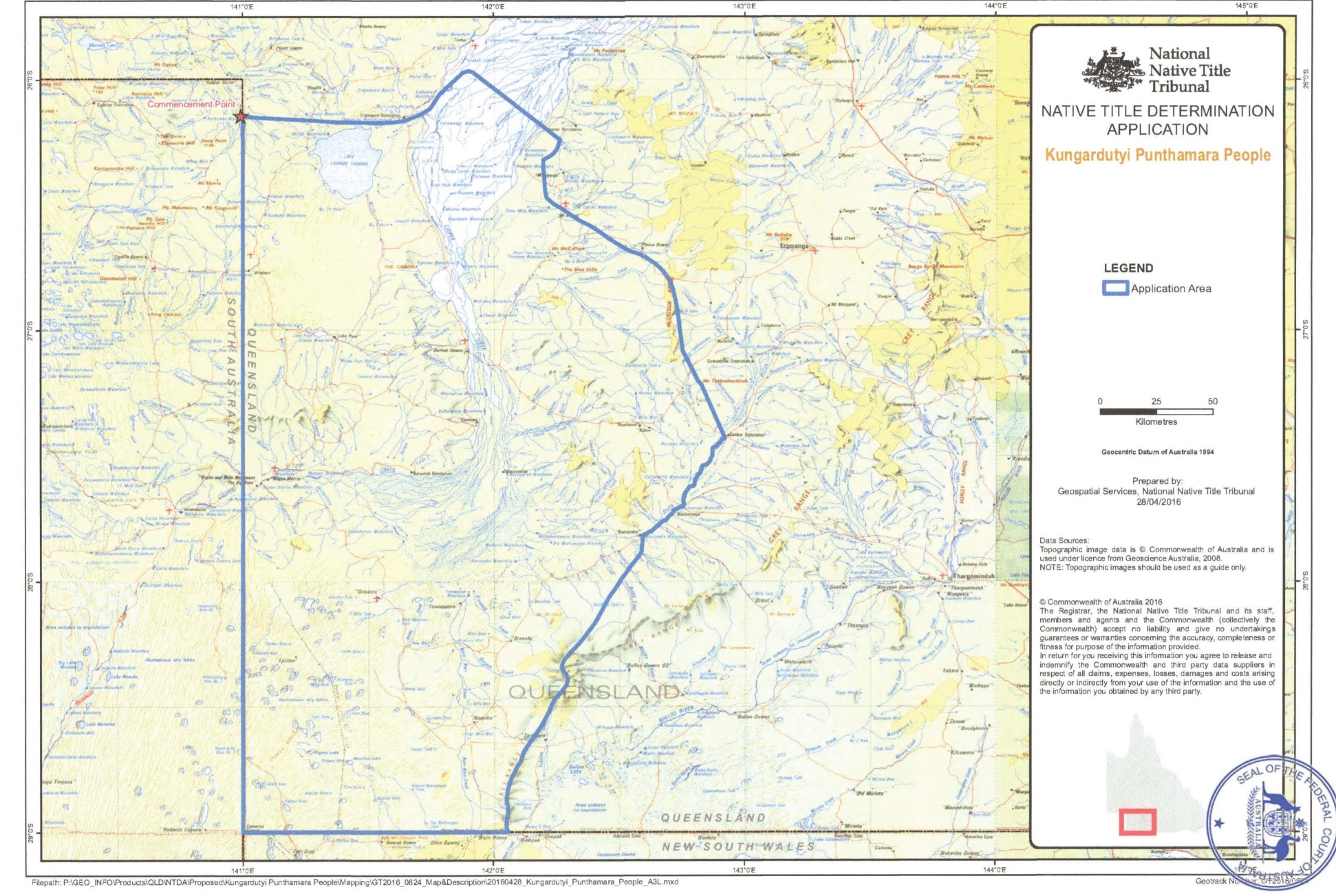
Schedule B
QUD 847 of 2016 | |
Coral King Stewart Williams Veronica Booth | |
Iona Dawn Smith Ernest (Hope) Ebsworth Rosemary (Rose) Anne Wilson Margaret Anne Collins Sharlene Lousie Knight Archie Alfred Ebsworth Donald James Dixon Loretta McKellar Norman John Hodge Jacqueline Elizabeth Hill | |


