

FEDERAL COURT OF AUSTRALIA
Afterpay Holdings Limited, in the matter of Afterpay Holdings Limited [2017] FCA 570
ORDERS
AFTERPAY HOLDINGS LIMITED ACN 606 589 520 Plaintiff | ||
DATE OF ORDER: | ||
THE COURT ORDERS THAT:
1. Pursuant to section 411(1) and section 1319 of the Corporations Act 2001 (Cth) (the Act):
(a) the plaintiff convene a meeting (Scheme Meeting) of the holders of ordinary shares in the plaintiff other than Touchcorp Limited (ARBN 603 731 184) and its subsidiaries (Scheme Shareholders), for the purpose of considering and if thought fit, agreeing (with or without modification) to the proposed scheme of arrangement (Scheme) between the plaintiff and the Scheme Shareholders, the terms of which scheme of arrangement are set out in Annexure C of the document which has been tendered and marked Exhibit 1 (Scheme Booklet);
(b) the Scheme Meeting be held on 19 June 2017 at the offices of Baker McKenzie, Level 19, CBW, 181 William Street, Melbourne in the State of Victoria commencing at 10:00 am;
(c) the chairperson of the Scheme Meeting be Anthony Eisen, or failing him, David Hancock;
(d) the chairperson appointed to the Scheme Meeting have the power to adjourn or postpone the Scheme Meeting in his absolute discretion for such time and to such date as he considers appropriate;
(e) at the Scheme Meeting, the resolution to approve the Scheme be decided by way of a poll;
(f) the explanatory statement substantially in the form of the Scheme Booklet be approved for distribution to Scheme Shareholders.
2. Pursuant to section 1319 of the Act, there be despatched to:
(a) each Scheme Shareholder who has nominated an electronic address for the purpose of receiving notices of meeting and proxy forms from Afterpay, at such address:
(i) an email substantially in the form of the document which is Annexure "PF-2" to the Finlay Affidavit including links to the Scheme Booklet and an online portal to lodge a proxy; and
(ii) if requested in writing by the Scheme Shareholder:
(A) by hand at, or by ordinary pre-paid post or courier to the address of that Scheme Shareholder set out in the register of members of Afterpay; or
(B) in the case of a Scheme Shareholder whose registered address is outside Australia, by airmail or facsimile to the address of that Scheme Shareholder as set out in the register of members of Afterpay,
a copy of the Scheme Booklet, a proxy form and a reply envelope addressed to Afterpay c/- Computershare Investor Services Pty Ltd, GPO Box 242, Melbourne, VIC, 3001, Australia; and
(b) each other Scheme Shareholder:
(i) by hand at, or by ordinary pre-paid post or courier to the address of that Scheme Shareholder set out in the register of members of Afterpay; or
(ii) in the case of a Scheme Shareholder whose registered address is outside Australia, by airmail or facsimile to the address of that Scheme Shareholder as set out in the register of members of Afterpay,
a copy of the Scheme Booklet, a proxy form and a reply envelope addressed to Afterpay c/- Computershare Investor Services Pty Ltd, GPO Box 242, Melbourne, VIC, 3001, Australia.
3. If an email notification of a failure to deliver an email to a Scheme Shareholder's nominated electronic address pursuant to Order 2(a) above of these orders is received, there be dispatched by hand at, or by ordinary pre-paid post or courier to, the address of each such Scheme Shareholder as set out in the register of members of Afterpay, a copy of the Scheme Booklet, a proxy form and a reply envelope addressed to Afterpay c/- Computershare Investor Services Pty Ltd, GPO Box 242, Melbourne, VIC, 3001, Australia.
4. Pursuant to rule 2.15 of the Federal Court (Corporations) Rules 2000 (Cth), with the exception of regulation 5.6.13 of the Corporation Regulations 2001 (Cth) (the Regulations), regulations 5.6.11 to 5.6.36A of the Regulations shall not apply to the Scheme Meeting.
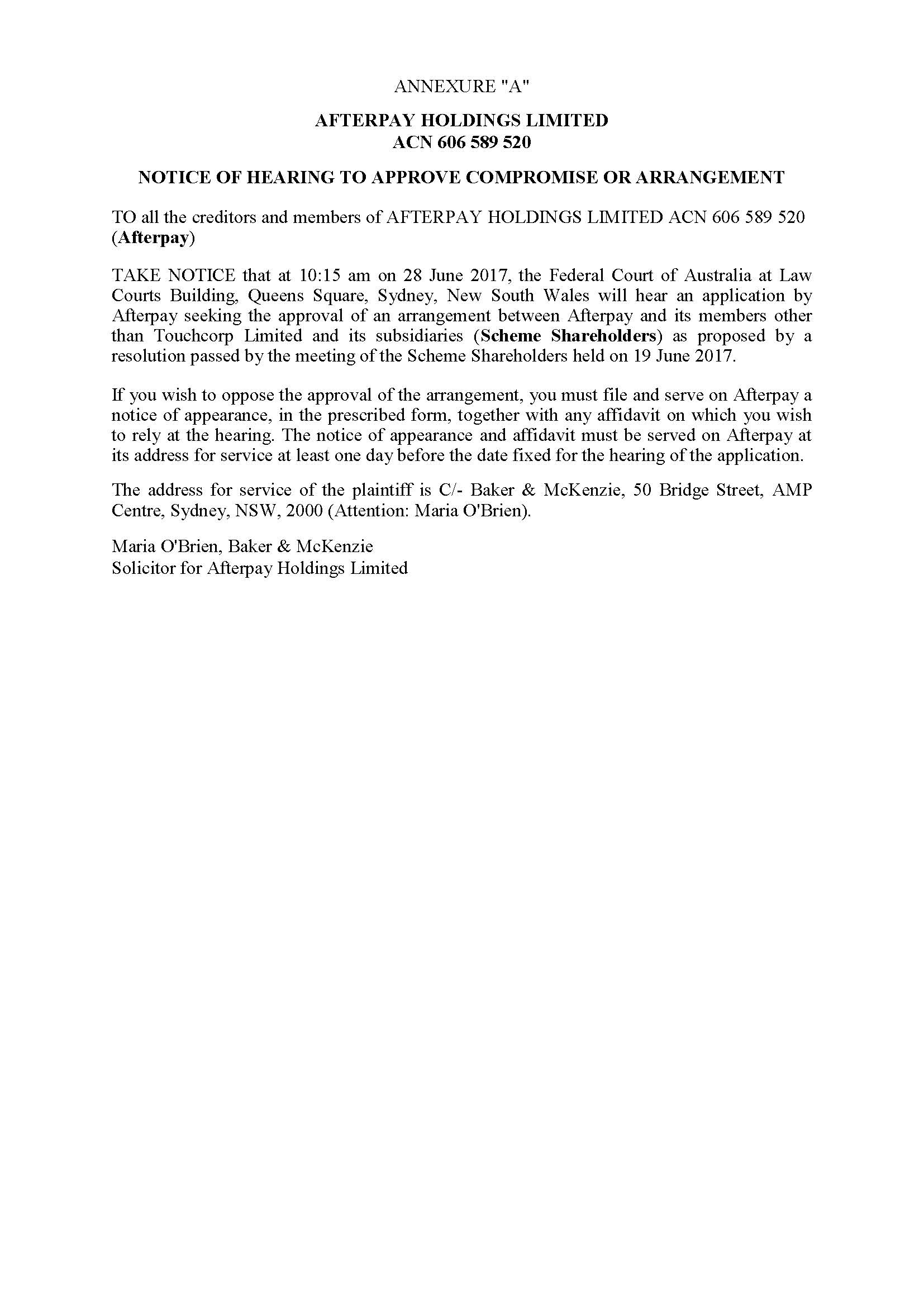
5. Notice of the hearing of the application for orders approving the proposed Scheme be published once in The Australian newspaper, by advertisement substantially in the form of Annexure "A" to these Orders, such advertisement to be published on or before 21 June 2017.
6. The proceeding be stood over to 28 June 2017 at 10:15am before Justice Yates for the hearing of any application to approve the Scheme.
7. There be liberty to apply.
8. These orders be entered forthwith.
Note: Entry of orders is dealt with in Rule 39.32 of the Federal Court Rules 2011.
YATES J:
Introduction
1 The plaintiff, Afterpay Holdings Limited (APH), seeks an order pursuant to s 411(1) of the Corporations Act 2001 (Cth) (the Act) that it convene a meeting of the holders of its ordinary shares (other than Touchcorp Limited (TC) and its subsidiaries) for the purpose of considering a scheme of arrangement between APH and its members (the APH scheme). The terms of the APH scheme are set out in Annexure C to a scheme booklet which has been tendered as Exhibit 1 (the scheme booklet). The scheme booklet stands as the explanatory statement required by s 412(1)(a) of the Act.
Background
2 APH is a public company registered under the Act. Its shares are listed on the Australian Securities Exchange (the ASX). As at 10 May 2017, APH had an issued capital comprising 180,337,038 fully paid ordinary shares, including 250,000 outstanding Loan Shares. Loan Shares have been issued to certain employees of TC who service APH. These shares are subject to vesting conditions and have been provided under a limited recourse loan. APH has also issued 155,000 Performance Rights and 16,065,000 Afterpay Options under certain plans adopted by APH to provide incentives for its employees (APH employee rights). The Performance Rights are rights to acquire shares in APH and Afterpay Options are options to acquire APH shares, subject to certain vesting conditions.
3 APH operates what it describes as “a technology driven payments business”. It provides a platform that allows retail merchants to offer their customers the ability to buy products on a “buy now, receive now, pay later” basis (both online and in store) without the customer having to apply for a traditional loan, pay any additional amount for the merchant’s products if instalment payments are made on time, or provide extensive personal information. The purchase value of the merchant’s products is paid by APH and then recouped by it from the customer, usually in four equal fortnightly instalments. APH receives its revenue primarily from transaction fees paid by its retail merchant clients. The remainder of its revenue is represented, primarily, by late fees charged to customers who do not make their agreed instalment payments on time.
4 TC is a company incorporated in Bermuda under the provisions of the Companies Act 1981 (Bermuda) (the Bermudan Companies Act). TC is registered as a foreign company in Australia under the Act. It is also listed on the ASX. TC built and continues to develop the technology that is used by APH. APH also outsources the processing of its transactions to TC in return for payment of an ongoing transaction fee. TC or its subsidiaries hold 50,000,000 (or approximately 27.7%) of APH’s issued shares.
5 Afterpay Touch Group Limited (ATG) was registered under the Act on 30 March 2017.
6 On 30 March 2017, APH, TC and ATG entered into a Merger Implementation Agreement (the MIA) to implement a merger of APH and TC. On implementation of the merger, ATG will become the parent company of APH and TC.
Aspects of the APH scheme and the merger
7 The main steps in implementing the merger will be:
ATG will acquire all of APH’s issued ordinary shares (other than those already owned by TC and its subsidiaries) by means of the APH scheme and APH will become a wholly-owned subsidiary of ATG;
ATG will acquire all of TC’s issued shares by means of a scheme of arrangement (the TC scheme) to be undertaken in Bermuda and TC will become a wholly-owned subsidiary of ATG;
ATG will apply to be listed on the ASX;
APH and TC will be de-listed from the ASX;
contemporaneously with the APH scheme, and conditional on that scheme becoming effective, APH and ATG will facilitate the exchange of Afterpay Options and Performance Rights for Options/Performance Rights (as applicable) in ATG.
8 As will be apparent, the APH scheme is a step towards implementing the merger, as is the TC scheme. The TC scheme will be proposed under the supervision of the Supreme Court of Bermuda and in accordance with the Bermudan Companies Act. The TC scheme will be dependent on the APH scheme being approved by this Court under s 411(4)(b) of the Act. Correspondingly, the APH scheme will be dependent on the TC scheme being sanctioned by the Supreme Court of Bermuda under the Bermudan Companies Act.
9 Under the APH scheme, Scheme Shareholders (as defined) will receive one share in ATG for every share held in APH (the scheme consideration). Under the TC scheme, the relevant shareholders will receive 0.64 shares in ATG for every share held in TC.
10 It is a condition of the MIA that, prior to any second court hearing in relation to the APH scheme, Exchange of Options/Rights Deeds will be executed by the holders of Afterpay Options and Performance Rights that were on issue as at the date of the MIA. In accordance with the terms of the Exchange of Options/Rights Deeds, ATG must grant or issue new rights under its own incentive plan (to be adopted on terms approved in writing by APH and TC) to the relevant holders of the Afterpay Options and Performance Rights, in amounts and on terms agreed by APH and TC for that purpose. The MIA contains similar provisions in relation to similar rights that have been granted by TC. If, in the case of APH, an Exchange of Options/Rights Deed cannot be entered into with a particular rights holder, APH’s directors will exercise their discretion to convert the relevant options or rights to shares, such that the holders of those shares will participate in the APH scheme as Scheme Shareholders. Relatedly, I also note that holders of Loan Shares will participate in the APH scheme as Scheme Shareholders.
11 ATG intends, following implementation of the merger, to grant senior executives up to a total of 12,000,000 Employee Rights in the form of limited recourse loan shares, with an issue price at a premium to the APH share price at the time of announcement of the merger. ATG also intends to grant Employee Rights to two directors of ATG in order to appropriately remunerate and incentivise them to remain with the merged group and align their interests with the long term interests of all ATG shareholders. However, as they will be directors of ATG, any such proposed rewards will be subject to shareholder approval to be sought at a separate general meeting of ATG after the implementation of the merger. These matters have been brought to the attention of APH’s shareholders in the scheme booklet.
12 APH’s directors have recommended unanimously that APH’s shareholders vote in favour of the APH scheme in the absence of a superior proposal. Each director who owns or controls shares in APH intends to vote in favour of the APH scheme in the absence of a superior proposal.
13 The directors of APH have engaged an independent expert, Lonergan Edwards & Associates Limited (Lonergan Edwards), to prepare an independent expert’s report stating whether, in the expert’s opinion, the scheme is fair and reasonable, and in the best interests of APH’s shareholders.
14 Lonergan Edwards has concluded that the merger will have a small positive impact on the value of APH’s shares, in the range of 3 to 6 cents per share. In coming to this view, Lonergan Edwards reasoned that the APH scheme should be valued as a merger rather than as a change of control transaction. Lonergan Edwards compared the value of APH’s shares before and after implementation of the merger on a portfolio (or listed market) basis, which it considered to be consistent with the Australian Securities & Investments Commission’s Regulatory Guide 111: Content of expert reports, 30 March 2011.
15 In its report, Lonergan Edwards has expressed the opinion that:
the merged entity is likely to be more attractive to potential investors as all intellectual property will be owned by the one company;
APH and TC are highly complementary businesses and the combination of both companies should benefit both groups of shareholders in the long term in that the merged entity is likely to be better placed to commercialise the business opportunities available to the group; and
the merged entity expects to be able to generate cost savings due to the merger.
16 Lonergan Edwards has also expressed the opinion that there are no material disadvantages for Scheme Shareholders arising from the merger. It did, however, note that Ineligible Foreign Shareholders (as defined in the APH scheme) will not receive shares in ATG but will receive, instead, a corresponding cash payment (see further below).
17 Overall, Lonergan Edwards concluded that the merger is fair and reasonable to APH’s shareholders. It also concluded that, as the advantages of the merger outweigh the disadvantages from the perspective of APH’s shareholders, it is also in the best interests of those shareholders.
18 The Lonergan Edwards report is included in the scheme booklet. Craig Lloyd Edwards, a director of Lonergan Edwards, is a co-author of the report. He shared the overall responsibility for its preparation. He has made an affidavit verifying the opinions expressed in the report.
19 I note that TC’s directors commissioned their own independent expert’s report for the benefit of TC’s shareholders in relation to the TC scheme. This report assesses the merger and the TC scheme on a different basis to that adopted by Lonergan Edwards. The scheme booklet summarises the differences between the two reports and refers APH’s shareholders to the ASX website which contains a full copy of the report obtained for TC’s shareholders.
20 The MIA has exclusivity provisions, including “no shop”, “no talk” and “no due diligence” restrictions, “notification of approaches” obligations and “right to match” provisions. The Exclusivity Period (defined in the MIA) is capable of precise ascertainment. The period commences on 30 March 2017 (the date of the MIA) and ends on the earliest of three identified events. The longest period is 6 months, which falls within the period of restriction that has generally been accepted by courts in this jurisdiction. The “no talk” and “no due diligence” restrictions, and the “notification of approaches” obligations, are subject to a fiduciary carve-out, such that APH’s directors are not prevented from taking or refusing to take any action with respect to a Competing Proposal (as defined in the MIA) provided, firstly, that the Competing Proposal is bona fide and made by or on behalf of a person whom APH’s directors consider to be of reputable commercial standing, and APH’s directors have determined in good faith (after taking certain steps) that failing to take the action or refusing to take the action would be likely to constitute a breach of their fiduciary or statutory obligations as directors.
21 The exclusivity provisions are clearly disclosed in the scheme booklet. The evidence before me is that they were negotiated on a commercial, arm’s-length basis, where the parties were separately advised and represented by external legal advisers and external financial advisers. The evidence establishes that APH and TC each required provisions of this nature and was satisfied that the final form of these provisions were acceptable.
22 The MIA also provides for the payment of a break fee by APH (and also TC) in certain circumstances. The amount of the break fee is $750,000, which is well within the guidance provided by Takeovers Panel, Guidance Note 7 – Lock-up devices. The MIA expresses the break fee payable by APH to be a genuine pre-estimate of the costs that TC would suffer if the APH scheme does not proceed. Once again, there is evidence before me that the break fee was negotiated in the same circumstances, and on the same basis, as the exclusivity provisions. If the break fee becomes payable by APH, it will be TC’s sole and exclusive remedy under the MIA. TC may not make any other claim for any loss that might arise under the MIA. Importantly, the break fee is not payable simply because the APH scheme is not approved at the scheme meeting. The existence of the break fee is clearly disclosed in the scheme booklet.
23 Ineligible Foreign Shareholders (as defined in the APH scheme) are not entitled to receive shares in ATG. On the Implementation Date (as defined in the APH scheme), the ATG shares to which Ineligible Foreign Shareholders would otherwise have been entitled will issue to a nominee for sale. The net proceeds of sale will be remitted to each Ineligible Foreign Shareholder, as provided in the APH scheme. The position of Ineligible Foreign Shareholders is clearly disclosed and explained in the scheme booklet.
24 Performance risk is managed under the APH scheme by requiring the scheme consideration to be provided prior to any transfer of the Scheme Shareholders’ shares to ATG. Further, ATG has executed a Deed Poll (dated 10 May 2017) in favour of each Scheme Shareholder under which it covenants to provide the scheme consideration in accordance with the APH scheme and to undertake all actions attributed to it under the APH scheme as if it were a party thereto. The Deed Poll is expressed to be governed by the laws of Victoria and ATG has irrevocably and unconditionally submitted to the non-exclusive jurisdiction of the courts of Victoria. A copy of the Deed Poll is included in the scheme booklet.
25 The APH scheme includes a deemed warranty by the Scheme Shareholders. If the APH scheme becomes effective, each Scheme Shareholder will be deemed to have warranted to APH (and will be deemed to have authorised APH to warrant to ATG) that the person’s Scheme Shares (including all rights and entitlements attaching to them) to be transferred to ATG will, on the date of transfer, be fully-paid and free from all mortgages, liens, encumbrances, pledges, security interests and other interests of third parties, and that the person has full power and capacity to sell and transfer the Scheme Shares (including all rights and entitlements attaching to them) to ATG. The terms of this warranty are brought to the attention of APH’s shareholders in the scheme booklet.
26 I note that subject to the requisite majorities being obtained at the scheme meeting, and subject to approval of the APH scheme by the Court at a second court hearing, APH and ATG will seek to rely on an exemption from the registration requirements of the Securities Act of 1933 (US): see s 3(a)(10) thereof.
27 The Australian Securities and Investments Commission (ASIC) did not attend the first court hearing. However, ASIC has provided a letter dated 11 May 2017 in which it acknowledges that the requirement of s 411(2)(a) of the Act (requiring ASIC to be given at least 14 days’ notice of the hearing of the application) has been satisfied. Further, for the purposes of s 411(2)(b) of the Act, ASIC has expressed the view that it has had a reasonable opportunity to examine the terms of the APH scheme and the draft explanatory statement, and to make submissions to the Court in relation thereto.
Conclusion and disposition
28 I am satisfied that APH is a Part 5.1 body and that the APH scheme is an “arrangement” for the purposes of s 411(1) of the Act. I am satisfied that the formal requirements that are preliminary to the Court convening a meeting under s 411(1) of the Act have been complied with. I am also satisfied that the proposed scheme is of such a nature and is cast in such terms that, if it receives the requisite statutory majorities, the Court would be likely to approve it on an unopposed application.
29 There is extensive evidence before the Court in relation to the verification of statements made in the scheme booklet, particularly in relation to information identified as “Afterpay Information”, “Touchcorp Information”, and “Afterpay Touch Group Information”. Subject to my consideration of any matter that might be raised at a second court hearing, I am satisfied that the scheme booklet sufficiently discloses the detail and effect of the APH scheme to enable shareholders to make an informed decision on how to vote.
30 I am satisfied that orders, substantially as sought, should be made.
I certify that the preceding thirty (30) numbered paragraphs are a true copy of the Reasons for Judgment herein of the Honourable Justice Yates. |


