

FEDERAL COURT OF AUSTRALIA
Australian Building and Construction Commissioner v Parker [2017] FCA 564
ORDERS
AUSTRALIAN BUILDING AND CONSTRUCTION COMMISSIONER Applicant | ||
AND: | First Respondent ROBERT KERA Second Respondent DANNY REEVES (and others named in the Schedule) Third Respondent | |
DATE OF ORDER: |
THE COURT ORDERS THAT:
1. The parties are to bring in Short Minutes of Orders to give effect to these reasons within fourteen days.
Note: Entry of orders is dealt with in Rule 39.32 of the Federal Court Rules 2011.
1 On 5 April 2016 the Australian Building and Construction Commissioner (the “Commissioner”) filed in this Court an Originating Application and a Statement of Claim. An Amended Originating Application was filed on 10 June 2016. Leave was granted to file a Further Amended Originating Application and an Amended Statement of Claim, which were filed on 14 July 2016. A Further Amended Statement of Claim followed on 8 September 2016.
2 The First Respondent to that proceeding was named as Mr Brian Parker, the State Secretary of the New South Wales Divisional Branch of the Eleventh Respondent, the Construction, Forestry, Mining & Energy Union (the “CFMEU”). The Second to Tenth Respondents are other persons associated with the CFMEU. The Twelfth Respondent is named as the Construction, Forestry, Mining & Energy Union, New South Wales Branch (the “CFMEU NSW”).
3 The facts giving rise to the proceeding involve conduct that took place principally on Thursday 24 July 2014 at a building site located at Hickson Road, Millers Point in Sydney (the “Site”). The Site was known as the Barangaroo South Redevelopment Project in Sydney (the “Project”). In about December 2009, Lend Lease Project Management and Construction (Australia) Pty Limited (“Lend Lease”) had been engaged by the Barangaroo Delivery Authority on behalf of the Government of New South Wales to develop the Site.
4 The events that took place on Thursday 24 July 2014 can truly be described as tumultuous. But, and in very summary form, the Commissioner seeks to segregate the events on that day into three separate stages, namely:
the “Blocking Action”, being conduct that commenced at about 5.45am and conduct which preceded a meeting of workers;
the “Stop Work Action”, namely the meeting of workers held between about 6.30am and 7.00am and the passing of a “Stop Work Resolution”; and
the “Enforcement Action”, namely that conduct which followed the “Stop Work Meeting”.
The Stop Work Resolution attracted some attention. The resolution which was proposed, and which was put, called upon the workers to cease work for 48 hours. But the resolution as passed was that the workers were to “reassess” their position on the following Monday – on one view of the facts a period in excess of 48 hours. At the end of the day on 24 July 2014, the Fair Work Commission made orders requiring the workers to return to work.
5 A further meeting was held on 25 July 2014. As the Commissioner would have it, this meeting was a continuation of the meeting held on the previous day and was a meeting which (inter alia) urged the workers to continue their strike action. As the Respondents would have it, the purpose of the meeting was to advise the workers of the orders made by the Commission and calling upon the workers to return to work.
6 The Commissioner alleges contraventions of the following provisions of the Fair Work Act 2009 (Cth) (the “Fair Work Act”):
s 50;
s 348;
s 355; and
s 417.
A pleading alleging accessorial liability was also made pursuant to ss 363 and 793 of the Fair Work Act. Each of the provisions alleged to have been contravened is a civil remedy provision. Declaratory relief is sought, together with orders for the imposition of penalties.
AN OVERVIEW OF THE proceEding
7 The resolution of the claims advanced by the Commissioner gave rise to a hearing which commenced on 12 July 2016 and continued thereafter on 13, 14 and 26 July, 5 August, 5 to 8 and 14 December 2016.
8 The hearing occupied some considerable time primarily by reason of the fact that there were ten individual Respondents whose own particular participation in the events on 24 and 25 July 2016 had to be individually examined.
9 Prior to the hearing, the circumstances surrounding one individual Respondent (Mr Luke Collier) attracted an application made on his behalf that the proceeding against him be stayed.
10 The progress of the hearing also occasioned a number of applications to further amend the pleadings. One such amendment occasioned no concern. On 1 December 2016 the Building & Construction Industry (Consequential and Transitional Provisions) Act 2016 (Cth) received Royal assent. One amendment effected by that Act was the substitution of the Commissioner for the Director of the Fair Work Building Industry Inspectorate as the Applicant in the proceeding. Other applications to amend made during the course of final submissions on the final day of the hearing met with opposition.
The Respondents – the forensic choices made & the positions held
11 As at the commencement of the hearing, the CFMEU and CFMEU NSW had each filed Defences.
12 The individual Respondents each filed a Defence which claimed a privilege against self-incrimination. All of the individual Respondents elected to await the close of the Commissioner’s case before a decision was made to either file amended Defences or to adduce their own evidence. The Respondents did in fact later elect to adduce evidence.
13 The positions held by each of the individual Respondents may be summarised as follows:
Respondent | Position held |
First Respondent Mr Brian Parker | 1. A member of the CFMEU and CFMEU NSW 2. State Secretary of the CFMEU NSW 3. NSW Divisional Branch Secretary and State Secretary of the CFMEU 4. Divisional Trustee and National Executive Committee member of the CFMEU |
Second Respondent Mr Robert Kera | 1. A member of the CFMEU and CFMEU NSW 2. State Joint Vice-President of the CFMEU NSW 3. NSW Divisional Branch Assistant Secretary of the Construction and General Division of the CFMEU NSW |
Third Respondent Mr Danny Reeves | 1. A member of the CFMEU and CFMEU NSW 2. A member of the Divisional Management Committee of the CFMEU and CFMEU NSW 3. An employee of Lend Lease Building 4. A delegate of the CFMEU and CFMEU NSW on the Project site |
Fourth Respondent Mr Peter Genovese | 1. A member of the CFMEU and CFMEU NSW 2. A member of the Divisional Management Committee of the CFMEU and CFMEU NSW 3. An employee of Lend Lease Building, suspended with pay from 26 March 2014 4. A delegate of the CFMEU and CFMEU NSW on the Project site |
Fifth Respondent Mr Michael Greenfield | 1. A member of the CFMEU and CFMEU NSW 2. Held appointment as and was employed as an Organiser by the CFMEU and CFMEU NSW |
Sixth Respondent Mr Luke Collier | 1. A member of the CFMEU and CFMEU NSW 2. Held appointment as and was employed as an Organiser by the CFMEU and CFMEU NSW |
Seventh Respondent Mr Darren Greenfield | 1. A member of the CFMEU and CFMEU NSW 2. Held appointment as and was employed as an Organiser by the CFMEU and CFMEU NSW |
Eighth Respondent Mr Tony Sloane | 1. A member of the CFMEU and CFMEU NSW 2. Held appointment as and was employed as an Organiser by the CFMEU and CFMEU NSW |
Ninth Respondent Mr Darren Taylor | 1. A member of the CFMEU and CFMEU NSW 2. Held appointment as and was employed as an Organiser by the CFMEU and CFMEU NSW |
Tenth Respondent Mr Richard Auimatagi | 1. A member of the CFMEU and CFMEU NSW 2. Held appointment as and was employed as an Organiser by the CFMEU and CFMEU NSW |
Some of the individual Respondents took a more active role in the events than others.
14 It is common ground that the CFMEU is an organisation of employees registered under the Fair Work (Registered Organisations) Act 2009 (Cth) and is an “industrial association” within the meaning of s 12 of the Fair Work Act. It is also common ground that the CFMEU NSW is not an organisation of employees covered by the enterprise agreements in force at the Site. But the Commissioner alleges that the CFMEU NSW is liable for the conduct of the individual Respondents, who are its officials, for the contraventions of ss 348, 355 and 417.
15 In the event that the conduct pleaded against the individual Respondents was established, neither the CFMEU nor the CFMEU NSW dispute liability.
A preliminary matter – a stay of the proceedings as against Collier
16 Prior to the hearing, in April 2016, Counsel on behalf of the Respondents sought a stay of the proceedings against Mr Collier, the Sixth Respondent.
17 Mr Collier had been charged with two criminal offences. One offence charged him with attempting to intimidate a Commonwealth public official (namely, Mr Jared O’Connor) contrary to ss 11.1(1) and 149.1(1) of the Criminal Code 1995 (Cth) (the “Criminal Code”); the second offence charged him with intimidating a Commonwealth public official (namely, Ms Veronica Tadros) contrary to s 149.1(1) of the Criminal Code. Both offences were said to have occurred between “about 23 July 2014 and 29 July 2014”.
18 Section 11.1 of the Criminal Code provides as follows:
11.1 Attempt
(1) A person who attempts to commit an offence commits the offence of attempting to commit that offence and is punishable as if the offence attempted had been committed.
Section 149.1 of the Criminal Code provides as follows:
149.1 Obstruction of Commonwealth public officials
(1) A person commits an offence if:
(a) the person knows that another person is a public official; and
(b) the first-mentioned person obstructs, hinders, intimidates or resists the official in the performance of the official’s functions; and
(c) the official is a Commonwealth public official; and
(d) the functions are functions as a Commonwealth public official.
Penalty: Imprisonment for 2 years.
19 In seeking a stay of the proceeding in this Court, reliance was placed upon s 553 of the Fair Work Act, which provides as follows:
Criminal proceedings during civil proceedings
(1) Proceedings for a pecuniary penalty order against a person for a contravention of a civil remedy provision are stayed if:
(a) criminal proceedings are commenced or have already commenced against the person for an offence; and
(b) the offence is constituted by conduct that is substantially the same as the conduct in relation to which the order would be made.
(2) The proceedings for the order may be resumed if the person is not convicted of the offence. Otherwise, the proceedings for the order are dismissed
A course not open to the Court, it was submitted, was to allow the proceeding against Mr Collier to continue but to not make any adverse findings against him. It was the “proceeding” in its entirety as against Mr Collier which was stayed if s 553(1) was enlivened.
20 The application for the stay was refused, although Counsel for the Respondents was then advised that the matter may need to be revisited. The stay was refused because it was concluded that the alleged contraventions in the present proceeding were not “substantially the same” as the elements of the criminal proceeding: General Manager of the Fair Work Commission v Thomson [2013] FCA 380, (2013) 241 FCR 439. Jessup J there observed, on the facts of that case (at 446):
[15] The circumstance that the allegations in this case which are based on conduct which is substantially the same as that which provides the foundation for the criminal charges will not, pending the completion of the criminal proceedings, be a part of the case made the task of the respondent in persuading the court to stay the proceeding as a whole a challenging one.
In that case, the proceeding seeking the recovery of penalties under the Fair Work (Registered Organisations) Act 2009 (Cth) was stayed.
21 The underlying facts of relevance to the present proceeding and to the criminal proceeding may well have a lot in common; but the elements of the contraventions and the criminal conduct, it was considered, were not “substantially the same”.
22 In Director of the Fair Work Building Industry Inspectorate v Construction, Forestry, Mining and Energy Union [2015] FCA 47, (2015) 323 ALR 294 at 301, Mortimer J expressed the difference in approaches between the parties as to the application of s 553 and the resolution of those differences as follows:
[35] Senior counsel for the respondents submitted it is the conduct described in the evidence which must be compared with the conduct relied upon by the applicant to allege a contravention of s 348. He submitted it would be incorrect to approach the comparison by comparing the elements in the offence of contempt and the elements of the civil penalty contravention. The elements of a criminal offence are unlikely, he submitted, ever to overlap entirely with the elements of a civil penalty provision.
[36] The applicant submitted the correct approach was to compare the elements of the criminal offence and the elements of the civil penalty contravention, which was the approach taken in Thomson. If a proceeding where a person is charged with contempt is correctly described as a “criminal proceeding for an offence” (recalling the applicant disputes this approach) then the core or key elements of the offence of contempt are the breach of a court order, and contumacy. Neither of those are elements of the civil penalty contravention and thus there is no substantial similarity for the purpose of s 553(1)(b).
[37] Senior counsel for the respondents invited the Court to take a broader approach than that taken by Jessup J in Thomson. I do not propose to take a broader approach. I consider the applicant’s submission is consistent with the decision of the High Court in Pearce v R (1998) 194 CLR 610; [1998] HCA 57, and the approach taken by Jessup J in Thomson.
23 No occasion has arisen to revisit the decision first made to refuse a stay of the proceeding as against Mr Collier.
24 The Court was later advised that Mr Collier was apparently convicted of an offence. But the fate of Mr Collier in respect to the criminal proceedings was otherwise left largely unaddressed. Other than the application made for a stay of the proceeding against Mr Collier, no further submission was advanced in final submissions that the outcome of the criminal proceedings against him attracted any further consideration.
A further preliminary matter – the pleading amendments
25 Two further amendments were sought on behalf of the Commissioner at the close of submissions, namely:
an application to amend paras [52], [60], [67A], [74A], [81], [87], [93], [99], [105] and [111] of the Further Amended Statement of Claim to delete the pleading that the conduct of the individual Respondents “constituted the organising of and taking action” and to substitute the phrase that the conduct “constituted the organising of or taking action”; and
an application to amend para [119] of the Further Amended Statement of Claim to delete the pleading that each of the First to Tenth Respondents (namely the individual Respondents) was “involved in the contraventions of sections 50 and 417 of the FW Act by the Stop Work Employees, within the meaning of section 550 of the FW Act” and to substitute the pleading that each of those Respondents was “involved in the contraventions of sections 50 and 417 of the FW Act by the Third Respondent, the Fourth Respondent, the Eleventh Respondent and the Site Employees, within the meaning of section 550 of the FW Act”. The Third and Fourth Respondents, Mr Reeves and Mr Genovese, were both employees of Lend Lease.
26 Counsel for the Respondents quite properly conceded that no “evidential prejudice” would be suffered should the amendments be granted. But he also quite properly submitted that there came a time when the pleadings should properly be beyond the reach of belated amendments. Such a time, it was submitted, had been reached when the applications to amend emerged during final submissions. Litigation, it is to be recalled, is “not a free for all” (cf. Construction, Forestry, Mining and Energy Union v BHP Coal Pty Ltd [2015] FCAFC 25 at [64], (2015) 230 FCR 298 at 311 per Logan, Bromberg and Katzmann JJ; Director, Fair Work Building Industry Inspectorate v ADCO Constructions Pty Ltd [2016] FCA 602 at [7] per Logan J) and both the Court and parties have imposed upon them the requirement to conduct proceedings “as quickly, inexpensively and efficiently as possible”: Federal Court of Australia Act 1976 (Cth) ss 37M and 37N.
27 Subject only to the ultimate fate to befall para [119], and notwithstanding the opposition of the Respondents, each of the applications to amend should be granted.
28 The first application followed more closely the wording of the contravention alleged, namely s 348 of the Fair Work Act. Both applications, it is also accepted, followed the manner in which the hearing had been conducted. But no like application was made to amend paras [56], [64], [70], [77], [85], [91], [97], [103], [109] and [115]. These were the allegations that the conduct of each of the individual Respondents “constituted organising industrial action by the Stop Work Employees in contravention of section 417 of the FW Act”. Section 417 is expressed in terms that a person “must not organise or engage in industrial action”. But there remained no pleading expressed in the alternative and no pleading that each of the individual Respondents “engage[d] in industrial action”. Had such an amendment been sought, it would have been granted. In the absence of any application to amend paras [56], [64], [70], [77], [85], [91], [97], [103], [109] and [115], the course which has been taken is to resolve the claim as pleaded.
29 The second application to amend, namely the application to amend the pleading as to accessorial liability, has proved more troublesome.
30 Counsel for the Respondents advanced two broad challenges to the pleading in paras [118] and [119], namely:
that there was an unacceptable degree of circularity in the pleadings such that the pleadings permitted a conclusion that a person was an accessory to his own primary contravention. If, for example, Mr Parker were to be found to have contravened the Fair Work Act by organising industrial action, the CFMEU could then be found to also have contravened the Act and Mr Parker could thereafter be found to be an accessory to the CFMEU contravention; and
the lack of precision in the manner in which one or other of the individual Respondents was said to be an accessory. This submission was grounded in considerations of fairness and the need for an individual to know the manner in which the case against him was sought to be advanced.
The former ground of challenge was the one initially advanced or, at least, primarily relied upon.
31 Paragraphs [118] to [120] are expressed as follows (without alteration):
Accessorial liability of the First to Tenth Respondents
118. Each of the First to Tenth Respondents was involved in the contraventions of sections 348, 355 and 417 of the FW Act by the other of the First to Tenth Respondents, within the meaning of section 550 of the FW Act, in that each of them:
a. aided, abetted, counselled or procured the contraventions; or
b. induced the contraventions, whether by threats or promises or otherwise; or
c. by act or omission, directly or indirectly, been knowingly concerned in or party to the contraventions; or
d. conspired with the other Respondents to effect the contraventions.
Particulars
Each of the First to Tenth Respondents:
i. had knowledge of the conduct of the other of the First to Tenth Respondents as pleaded in paragraph 52 to 116 above;
ii. attended the Stop Work Meeting;
iii. was aware of and supported the Stop Work Resolution and knew that its purpose was to cause the Site Employees to stop work during the term of the Lend Lease EBAs in order to place pressure on Lend Lease to reinstate Genovese as pleaded in paragraph 42 above; and
iv. each of the First to Tenth Respondents did not advise the other of the First to Tenth Respondents against taking the action they took nor did he dissociate himself from that action or its purpose but engaged in a common purpose with the other Respondents.
119. Each of the First to Tenth Respondents was involved in the contraventions of sections 50 and 417 of the FW Act by the Stop Work Employees, within the meaning of section 550 of the FW Act, in that each of them:
a. aided, abetted, counselled or procured the contraventions; or
b. induced the contraventions, whether by threats or promises or otherwise; or
c. by act or omission, directly or indirectly, been knowingly concerned in or party to the contraventions; or
d. conspired with the other Respondents to effect the contraventions.
Particulars
Each of the First to Tenth Respondents:
i. had knowledge of the conduct of the other of the First to Tenth Respondents as pleaded in paragraphs 52 to 116 above;
ii. attended the Stop Work Meeting;
iii. was aware of and supported the Stop Work Resolution and knew that its purpose was to cause the Site Employees to stop work during the term of the Lend Lease EBAs in order to place pressure on Lend Lease to reinstate Genovese as pleaded in paragraph 42 above; and
iv. each of the First to Tenth Respondents did not advise the other of the First to Tenth Respondents against taking the action they took nor did he dissociate himself from that action or its purpose but engaged in a common purpose with the other Respondents, and did not advise them or the CFMEU or the site employees to continue work and to engage the dispute resolution procedure under clause 19 of the JDA.
v. was aware of the matters concerning the suspension of Genovese referred to in paragraphs 35 and 36;
ivvi. was aware that the JDA required work to continue and disputes at the Site to be dealt with by participation of the CFMEU in a mandatory dispute resolution procedure;
120. By reason of the operation of section 550(1) of the FW Act each of the First to Tenth Respondents contravened sections 50, 348, 355 and 417 of the FW Act.
32 At the stage when the Respondents’ Interlocutory Application filed on 18 November 2016 was before the Court on 5 December 2016, this challenge to the pleadings was (regrettably) not given the attention by the Court in 2016 that it deserved. The Interlocutory Application, as correctly submitted in the Commissioner’s written Outline of Submissions, had been dismissed. But when that occurred, it was “without prejudice to the submissions which may be advanced as to what the pleading actually means”. Not deterred by the events on 5 December 2016, Counsel for the Respondents renewed his submissions that the paragraphs should be struck out. The fate of these three paragraphs was addressed in final submissions and is a question which should be revisited.
33 Paragraphs [118] and [119] should be struck out. As a result of that conclusion, para [120] should also be struck out.
34 There was much force in both of the grounds relied upon by Counsel for the Respondents. But the former ground was, with respect, not as persuasive as the latter. Albeit less than ideal and a manner of pleading which should be discouraged, any concern as to any potential “circularity” in the pleadings could adequately be addressed by submissions.
35 But it was the latter ground which has primarily prompted a reconsideration of the question as to whether paras [118] and [119] should be struck out.
36 As a starting point, the principle that a person against whom a “quasi-criminal” contravention is alleged “should know what case he or she has to meet” has long rested “upon a basic consideration of fairness”: cf. S v The Queen (1989) 168 CLR 266 at 285 per Gaudron and McHugh JJ. It is also to be accepted that a pleading that alleges that a person is an accessory to the contravention of a “civil penalty” provision by another person should separately allege:
knowledge on the part of the accessory of each and every element of the contravention; and
the identity of the other person who engaged in the contravening conduct.
Where the contravention is one involving an “intent” or “purpose”, it is also necessary to separately allege that the accessory:
had knowledge of that “intent” or “purpose”.
37 It was not understood that any of these requirements was put in issue by Senior Counsel for the Commissioner. It was his position that paras [118] and [119] met those requirements and did not need any further amendment to address the concerns of the Respondents.
38 Concurrence cannot be expressed with the Commissioner’s position. Left un-pleaded is any precise identification of:
which particular Respondent was said to be the person who engaged in the contravening conduct and, in respect to that conduct, which particular Respondent was said to be an accessory; and
the material facts founding a pleading that contends that the person who was said to be an accessory had “knowledge of the other of the First to Tenth Respondents”.
More specifically, with respect to those allegations that one or other of the Respondents engaged in conduct with an “intent to coerce”, there is no precise allegation identifying:
the factual basis for the allegation that that Respondent had knowledge of the “intent to coerce” or a factual allegation from which such knowledge could be inferred.
39 As a general proposition, it may be accepted that the Commissioner alleges that each of the individual Respondents was an accessory to any contravention of any of the remaining individual Respondents. And the Particulars provided in respect to para [118] seek to give colour to the more general allegation.
40 But, with respect, greater specificity than that is required.
41 With the benefit of hindsight, paras [118] and [119] should have been struck out earlier. But any earlier assessment of the merits of the Respondents’ strike out application should not prejudice its ultimate fate.
42 Even had a conclusion not been reached that these paragraphs should be belatedly struck out, it would nevertheless have been further concluded that the case of accessorial liability would not have prevailed. No sufficiently certain meaning could be given to the allegations as pleaded as against each of the individual Respondents. There was, for example, considerable uncertainty as to the factual basis upon which one particular Respondent was said to have knowledge of the “intent to coerce” being exercised by another Respondent. Separate from any question as to the form of the pleading, and separate from any question as to whether it would have been permissible to go beyond the pleadings as drafted in order to thereafter conduct a free-ranging search of the available evidence with a view to building a factual basis upon which findings of fact made against one Respondent in respect to (for example) that Respondent’s intent or knowledge could be attributed to another, the evidence of accessorial liability would not have satisfied the standard of proof required by Briginshaw v Briginshaw (1938) 60 CLR 336 (“Briginshaw”), or more accurately, the standard required by s 140 of the Evidence Act 1995 (Cth) (the “Evidence Act”).
LEND LEASE & THE SUBCONTRACTORS ON-SITE
43 As at July 2014 the Project comprised construction of:
three commercial office towers;
two residential towers; and
a commercial building.
44 As at July 2014 there were three entities within the Lend Lease group working on the Site, namely:
Lend Lease Building Pty Ltd (“Lend Lease Building”), formerly known as Lend Lease Project Management and Construction (Australia) Pty Ltd;
Lend Lease Structures Pty Ltd (“Lend Lease Structures”); and
Lend Lease Infrastructure Services Pty Ltd, now known as Lend Lease Services Pty Ltd.
The employees of Lend Lease Building were covered by an enterprise agreement called the Lend Lease Project Management & Construction/CFMEU Joint Development Agreement Mark 8 2012-2016 (the “Joint Development Agreement”, often referred to as “the JDA”). The employees of Lend Lease Structures were covered by an enterprise agreement called the Lend Lease Structures Pty Ltd/CFMEU Greenfields Collective Agreement 2012-2016. This Agreement was approved by Fair Work Australia on 7 November 2012 and has a nominal expiry date of 1 October 2016.
45 Clauses 19 and 20 of the Joint Development Agreement assume relevance to the Commissioner’s case in respect to breaches of that Agreement and the contraventions alleged in respect to ss 50 and 347. Those clauses provide as follows:
19. Conflict Resolution
19.1 The Parties recognise that one of the aims of the Agreement is to eliminate lost time in the event of a dispute and to achieve prompt resolution. The most effective procedure is for the responsibility for resolution to remain as close to the source of the dispute as possible. To this end, the following processes are agreed:
(a) Disputes Procedure
In the event of a dispute occurring, the following procedure will be adopted:
(i) Discussion between those directly affected;
(ii) Discussion on the project between the site management and the Employee affected or a representative nominated by the Employee (including Union delegate);
(iii) Discussion between senior Company management and the Employee affected, or if nominated by the Employee their Representative or appropriate Union official;
(iv) The relevant Union official commits to make him/herself available to be involved at any stage of the procedure as required, or in respect of any potential dispute. The Company agrees to facilitating access to the project for the relevant Union official to represent Employees under this procedure subject to the Union official complying with all site rules and reasonable requests and reasonable directions of site management.
A dispute will not be referred to the next level of the above procedure until a genuine attempt to resolve the matter has been made at the appropriate level.
(b) Reference to the relevant State Board or Panel.
If the dispute occurs in Victoria or Queensland, and still exists after the above disputes procedure either party may refer the dispute to a State Industry Dispute Panel or Board constituted under Australian Government or State law. This sub-clause does not prevent any of the parties to the dispute from referring the dispute to Fair Work Australia (FWA) either before or after any decision or recommendation of the State Board or Panel. If the matter has been referred to a State Industry Dispute Panel or Board constituted under Australian Government or State law, once a decision has been handed down the matter may be referred by either party to FWA within 14 days.
(c) Reference to Fair Work Australia
A dispute may be referred to FWA for conciliation and if required, arbitration, in either of the following circumstances:
(i) If the dispute still exists after the above disputes procedure has been carried out, the dispute may be referred by any of the parties to the dispute to FWA; or
(ii) If any party to the dispute refuses or fails to follow any step of the above disputes procedure the non breaching party will not be obligated to continue through the remaining steps and may immediately refer the matter to FWA.
(d) Notices of Disputes
Should a dispute arise and it does not appear to be one which can be settled immediately, the party raising the matter will notify the other party or parties by telephone within 48 hours of the dispute arising and confirm it in writing.
20. Work Continuity
Work shall continue without interruption or dislocation during discussion and resolution of disputes.
The subcontractors
46 In addition to the Lend Lease entities, there were also a number of subcontractors then engaged on the Project. The primary subcontractors (but by no means all of the subcontractors) were as follows:
Form workers |
Dalma Corp Pty Limited |
Cro Formwork (Aust) Pty Limited |
Steel fixers |
Courtley Reo Pty Limited |
Southside Reinforcing Pty Limited |
Concreters |
De Martin & Gasparini Pty Limited |
De Martin & Gasparini Pumping Pty Limited |
Plumbers |
Brown & Moodie Pty Limited |
Axis Plumbing Pty Ltd |
Electricians |
Stowe Australia Pty Limited |
FIP Electrical (NSW) Pty Limited |
Block layers |
DJD Brick and Blocklaying Pty Limited |
Scaffolders |
Erect Safe Scaffolding (Australia) Pty Limited |
Mechanical trades |
Freedom Air Pty Limited |
AG Coombes Pty Limited |
Melrose Cranes & Rigging Pty Limited was also engaged as a subcontractor on 23, 24 and 25 July 2014.
47 In all there were in excess of 1,100 workers on Site as at 23 July 2014.
48 The working hours on Site were from 7.00am to 7.00pm Monday to Friday and from 7.00am to 5.00pm on Saturdays. There was, however, usually a pre-start meeting commencing at about 6.30am or 7.00am between management of the Lend Lease entities and construction workers.
49 The Main Site Access had a covered walkway that leads to three turnstiles. It was the only entrance to the Site open at 7.00am. The other access points behind Towers 1, 2 and 3 only opened after 7.00am. They each had a turnstile but before 7.00am the turnstile was blocked by a gate closed with a padlock.
THE WITNESSES & MATTERS OF EVIDENCE
50 The evidence relied upon by both the Commissioner and the Respondents should be briefly identified at the outset.
51 There are also some preliminary matters going to the evidence which should be addressed.
52 There was in the present case, it should be noted at the outset, no Agreed Statement of Facts jointly prepared by the parties, as frequently occurs in cases where contraventions of the Fair Work Act are alleged. Nor has there been any admission by any of the individual Respondents in respect to any alleged contravention.
53 There was, accordingly, far more extensive evidence in the present case than frequently occurs in other like cases. The length of the hearing was also more protracted than is frequently the case. But such was the inevitable consequence of the individual Respondents invoking the privilege against self-incrimination – as was their right.
The Commissioner’s evidence
54 The Commissioner relied upon a number of affidavits and witness statements. Many witnesses had prepared witness statements and were only prepared to give evidence if required by a subpoena.
55 The evidence relied upon by the Commissioner was evidence from the following witnesses:
Lend Lease entities
Mr Nathan Smith, the Construction Manager of Lend Lease Building;
Mr Eric Hensley, the Manager, Indigenous Engagement for Lend Lease Building;
Mr Craig Scannell, a Senior Site Manager employed by Lend Lease Building at the Barangaroo South Development Project;
Mr Dane Morrison, a Construction Manager employed by Lend Lease Building;
Mr Jason Baker, a Services Foreman employed by Lend Lease Building;
Mr David Langford, a Construction Manager employed by Lend Lease Building;
Mr Patrick Cleary, a Services Foreman employed by Lend Lease Building;
Mr Greg Lin, a Senior Project Engineer employed by Lend Lease Building;
Mr Steven Polsen, a Site Manager employed by Lend Lease Building;
Mr Warren Henson, then employed by Lend Lease Building;
Mr Denis Fantov, a Site Manager employed by Lend Lease Building; and
Mr Thomas Waters, then employed by Lend Lease Building as Construction Manager for the T2 Tower.
Subcontractors
Mr Antonio Zoppellaro, the Construction Manager for Precision Air Pty Ltd, a mechanical subcontractor;
Mr Craig Schneidereit, a Leading Hand for DJD Brick & Blocklaying Pty Ltd;
Mr Fridae Tekaute, a Piling Supervisor for Advanced Foundation Solutions (Aust) Pty Ltd, which is now a division of Bashy Soletanche International;
Mr Paidre Vezza, a Project Manager for Boral Pty Ltd, a subcontractor of Lend Lease Building;
Mr Mick Melrose, a Senior Project Manager at Melrose Cranes & Rigging Pty Ltd, a subcontractor of Lend Lease; and
Mr Brian Finn, a Director of Courtly Reo Pty Limited, a subcontractor of Lend Lease Building.
Fair Work inspectors
Mr Matthew Barr, then employed as an inspector at the Fair Work Building Industry Inspectorate known as Fair Work Building and Construction. Mr Barr affirmed two affidavits;
Ms Veronica Tadros, then employed as an investigator with Fair Work Building and Construction;
Mr David Armstrong, an inspector employed by Fair Work Building and Construction;
Ms Giulietta Siciliano, a senior investigator employed by Fair Work Building and Construction; and
Mr Jared O’Connor, then employed as an inspector by Fair Work Building and Construction.
Police officers
Constable Chantelle Brealey, an officer of the New South Wales Police Force.
Most of the Commissioner’s witnesses were cross-examined, albeit briefly.
The Respondents’ evidence
56 The Respondents filed evidence from the following persons, namely:
Mr Brian Parker;
Mr Rob Kera;
Mr Danny Reeves;
Mr Pete Genovese;
Mr Michael Greenfield;
Mr Luke Collier;
Mr Darren Greenfield;
Mr Anthony Sloane;
Mr Darren Taylor; and
Mr Richard Auimatagi.
Preliminary matters of evidence
57 Four preliminary matters should be expressly addressed with respect to the evidence.
58 First, when making the findings of fact, due regard must be had to the gravity of the matters alleged: Evidence Act, s 140(2). Section 140 provides as follows:
Civil proceedings – standard of proof
(1) In a civil proceeding, the court must find the case of a party proved if it is satisfied that the case has been proved on the balance of probabilities.
(2) Without limiting the matters that the court may take into account in deciding whether it is so satisfied, it is to take into account:
(a) the nature of the cause of action or defence; and
(b) the nature of the subject-matter of the proceeding; and
(c) the gravity of the matters alleged.
The contraventions alleged by the Commissioner have to take into account the fact that they are contraventions of civil remedy provisions of the Fair Work Act. They are, accordingly, properly to be regarded as “quasi-criminal”: Australian Competition and Consumer Commission v Australian Safeway Stores Pty Ltd (No 3) [2002] FCA 1294 at [53], (2002) ATPR ¶41-901 at 45,414 per Goldberg J; BHP Coal Pty Ltd v Construction, Forestry, Mining and Energy Union [2013] FCA 1291 at [68] to [69], (2013) 239 IR 363 at 388 to 389 per Collier J. The standard of proof referred to in s 140(2) is a re-statement of the standard of proof referred to by Dixon J in Briginshaw v Briginshaw (1938) 60 CLR 336: Liquor Hospitality and Miscellaneous Union v Arnotts Biscuits Ltd [2010] FCA 770 at [15], (2010) 188 FCR 221 at 225 per Logan J. When commenting upon the evidence required in a petition for divorce on the ground of adultery under the Marriage Act 1928 (Vic), Dixon J in Briginshaw observed (at 362):
.… But reasonable satisfaction is not a state of mind that is attained or established independently of the nature and consequence of the fact or facts to be proved. The seriousness of an allegation made, the inherent unlikelihood of an occurrence of a given description, or the gravity of the consequences flowing from a particular finding are considerations which must affect the answer to the question whether the issue has been proved to the reasonable satisfaction of the tribunal. In such matters “reasonable satisfaction” should not be produced by inexact proofs, indefinite testimony, or indirect inferences.
See also: (1938) 60 CLR at 347 per Latham CJ. See also: Communications, Electrical, Electronic, Energy, Information, Postal, Plumbing and Allied Services Union of Australia v Australian Competition and Consumer Commission [2007] FCAFC 132 at [29] to [32], (2007) 162 FCR 466 at 479 to 480 per Weinberg, Bennett and Rares JJ; Darlaston v Parker [2010] FCA 771 at [17], (2010) 189 FCR 1 at 6 to 7 per Flick J.
59 All such findings of fact as have been made have been made against the standard imposed by s 140(2) of the Evidence Act. Findings as to a contravention of a civil remedy provision of the Fair Work Act are not findings lightly to be made.
60 Second, the factual account of what happened is inevitably the product of an assessment of the evidence as a whole. Some of the witnesses called on behalf of the Commissioner saw or heard part of what was happening; other witnesses gave a more or less complete account. To some extent, the account given by particular witnesses was different – for example, in respect to the number of workers estimated to have assembled at various times and there was some discrepancy as to the times at which events were taking place. To some extent, for example, in respect to the number of workers assembled, the differences may be attributable to an understandable difficulty in assessing the numbers of persons present in a large crowd; to some extent, the differences are not so readily explicable. The end result is that such findings as have been made are findings based upon an assessment of all of the evidence – even though some particular findings do not sit comfortably with the evidence of one witness as opposed to a different account given by another witness.
61 Third, a recurring theme in the cross-examination of many of the Commissioner’s witnesses focussed upon those witnesses identifying persons as CFMEU “officials, delegates and organisers” by reason of their wearing CFMEU branded clothing. The recurring theme was that the identification of those persons as CFMEU officials or delegates was founded upon an assumption that all persons who wore CFMEU branded clothing were necessarily CFMEU “officials, delegates and organisers” even though persons who were not such officials or delegates could wear that clothing. Notwithstanding that recurring theme, and subject to a specific reservation in respect to Mr Baker’s like evidence, it is concluded on the facts of the present case that:
a finding should be made that those persons who were not otherwise expressly identified by name but rather by reference to the apparel they were wearing were members of the CFMEU.
Such a finding, it is respectfully concluded, is not a finding based upon “inexact proofs” or “indirect inferences” (cf. Briginshaw) but a finding which takes into account those factors set forth in s 140(2) of the Evidence Act and:
the fact that those persons wearing such clothing were in a group of persons variously identified as including known CFMEU persons such as Messrs Parker and Kera;
the fact that on occasions one or other of the persons whose identity could not be established, but who were wearing such clothing, made statements giving voice to the concerns being expressed by known CFMEU persons; and
the fact that the meeting being held at about 6.30am on 24 July 2014 was (inter alia) expressed to give voice to the CFMEU’s support for Mr Genovese.
Moreover:
the fact that those persons were seen wearing the CFMEU badged clothing assumes some probative relevance to their status as being members of the CFMEU.
If it be correct to characterise the identification of those persons as an “assumption”, the “assumption” was one which was soundly based.
62 The specific reservation in respect to Mr Baker is that his cross-examination took an additional turn. In an earlier account of this incident, Mr Baker also described seeing members of the “Plumbers’ Union” also being present – but no reference was made to these persons in his affidavit relied upon in the present proceeding. The insignia on the clothing of those Union members was a skull and cross-bones. It was also put to him that the account in his evidence in the current proceeding was inconsistent with an earlier account he had given. The cross-examination was such that it is respectfully concluded that Mr Baker’s identification of the persons present being CFMEU “officials” should not be relied upon given the standard of proof required by Briginshaw and s 140 of the Evidence Act. Any finding that these persons were CFMEU persons, accordingly, is to be found elsewhere – if at all.
63 Fourth, a further recurring theme in the cross-examination of those witnesses who were inspectors employed by the Fair Working Building Industry Inspectorate was that the evidence of such witnesses was more directed to the Commissioner securing a result that the CFMEU had engaged in unlawful industrial activity on 24 and 25 July 2014 – as opposed to an impartial investigation of the facts with a view to later determining whether any breach of the Fair Work Act had occurred. Recourse was had by Counsel on behalf of the Respondents to the following observations of Griffith CJ in Melbourne Steamship Co Ltd v Moorehead (1912) 15 CLR 333 at 342:
I am sometimes inclined to think that in some parts—not all—of the Commonwealth, the old-fashioned traditional, and almost instinctive, standard of fair play to be observed by the Crown in dealing with subjects, which I learned a very long time ago to regard as elementary, is either not known or thought out of date. I should be glad to think that I am mistaken.
See also: Qantas Airways Ltd v Transport Workers’ Union of Australia [2011] FCA 470 at [192], (2011) 211 IR 1 at 47 per Moore J (“Qantas Airways”). The theme gained some traction during the cross-examination of Mr Armstrong when it emerged that he had not made reference in the evidence filed on behalf of the Commissioner to an earlier statement that had been provided to him by two workers on Site which was potentially “exculpatory” of the conduct of the CFMEU. Whether or not such statements should have been included in the evidence adduced on behalf of the Commissioner may presently be left to one side. The cross-examination, it may be accepted, raised questions as to why such evidence had not been adduced. Standing alone, it may well have been concluded that the evidence of Mr Armstrong would not have been sufficient to establish any contravention of the Fair Work Act. But such reservations ultimately assumed little relevance for either of at least two reasons, namely:
the facts sought to be established by the Commissioner by way of Mr Armstrong were facts established by other witnesses;
and, more importantly:
the evidence of the employees of the Fair Work Building Industry Inspectorate, it is considered, was otherwise a genuine attempt to impartially set forth such facts as were set forth in their affidavits and to answer such questions as were posed in cross-examination.
64 Subject to the reservations expressed, it should be observed that the evidence adduced by the Commissioner was otherwise considered to be reliable with each of the witnesses attempting to give their best recollection of what was said and whom they observed being present at the times they identified.
The cross-examination of the individual Respondents – “I don’t recall”
65 A familiar refrain from many of the individual Respondents when cross-examined was that they did not recall or remember what was said or did not hear what was said. The refrain was oft repeated and repeated in respect to many issues where the Respondents could well be expected to have heard what was said or to have recalled what was said.
66 A conclusion is open that there was – at the very least – a reluctance on the part of some of those Respondents to answer the questions being put. And such reluctance may be used when evaluating conflicting evidence.
67 Such a conclusion is a serious matter: Kuhl v Zurich Financial Services Australia Ltd [2011] HCA 11, (2011) 243 CLR 361 at 384. Heydon, Crennan and Bell JJ there observed:
[62] The significance of the trial judge’s finding. The conclusion of the trial judge that the plaintiff was “reluctant to say precisely what happened” is an important one. If that conclusion were soundly arrived at, it would be a significant factor against the plaintiff’s success. So, at least, the trial judge, the Court of Appeal majority and the first respondent thought. It would be significant because of the following considerations. Witnesses are supposed to answer questions put by counsel responsively: they are supposed to give a full answer, but no more. It is one thing to say that a witness was not asked the right questions. It is another thing to say that a witness did not answer the questions that were asked. And it is an even more serious thing to say that a witness was “reluctant” to answer. The duty of a witness is to tell the truth, the whole truth, and nothing but the truth so far as the questions asked seek it. The duty of a witness to answer questions responsively involves not only a negative duty (not to volunteer material for which the question does not call), but also a positive duty (to proffer all material within the witness’s knowledge for which the question does call). To conclude that a party-witness is reluctant to say what happened is to conclude that the party-witness is deliberately failing to comply with the duty to tell the whole truth. That is a serious conclusion to reach, for the following reasons.
Care should also be exercised when making use of evidence that is – or may be – subject to a query whether the evidence is the “complete truth” or a query whether a witness has suppressed aspects of his evidence which he may consider to be unfavourable. Heydon, Crennan and Bell JJ went on in Kuhl to make the following cautionary comments (at 386 to 389):
[67] It is not sound judicial technique to criticise a party-witness for deliberately withholding the truth in a fashion crucial to a dismissal of that party’s claim unless two conditions are satisfied. First, reasons must be given for concluding that the truth has been deliberately withheld. Secondly, the party-witness must have been given an opportunity to deal with the criticism.
…
[69] The lack of warning. The second condition is more controversial …
…
[74] The second condition was not satisfied. The plaintiff had no opportunity to deal with the criticism. Normally cross-examining counsel will prefigure and lay the ground work for any criticism a judge may feel minded to make of a witness’s evidence in chief. But here there was no cross-examination on the plaintiff’s evidence in chief about what happened in the moments before he sustained his injuries. This created a difficulty for the trial judge. The tactical decision of defence counsel not to cross-examine on that topic may well have been shrewd. When Wigmore enunciated his celebrated but controversial proposition to the effect that cross-examination was “beyond any doubt the greatest legal engine ever invented for the discovery of truth”, he immediately stated another much less controversial proposition by way of caveat: “A lawyer can do anything with a cross-examination – if he is skillful enough not to impale his own cause upon it.” The truth of the second proposition lies in the fact that when a cross-examiner seeks to extract from a witness testimony which is more favourable to the cross-examiner’s client than that which the witness gave in chief, the new testimony often turns out to be adverse to the client. If evidence in chief is thought to be too feeble to serve its purpose, cross-examiners often think it best to leave it alone, for to cross-examine will do no more than strengthen it: the repeated questions may cause the witness to think harder, may cause the witness to become more determined, may trigger better recollection and may result in the witness giving the more detailed evidence which was not given in chief. But decisions by cross-examiners of that kind are gambles, and the gambles can be lost …
[75] There was no point in the trial judge mentioning his conclusion that the plaintiff’s evidence was not frank and complete unless it played a role in his decision adverse to the plaintiff. In the absence of any challenge from the cross-examiner to the frankness and completeness of the plaintiff’s evidence, it was incumbent on the trial judge, if his conclusion that the plaintiff had not been frank and complete was to play a role in his decision adverse to the plaintiff, to make the challenge himself. Perhaps the criticism in the judgment did not occur to the trial judge until after the plaintiff had left the box, or until after the hearing had concluded and before the judge’s reserved judgment was given. It remained necessary either to recall the plaintiff or to have no regard to that aspect of the plaintiff’s evidence.
See also: Ashby v Slipper [2014] FCAFC 15 at [147], (2014) 219 FCR 322 at 368 per Mansfield and Gilmour JJ.
68 Such factual differences as inevitably emerged in the account given by one or other of the Commissioner’s witnesses as opposed to the evidence of one or other of the individual Respondents, in the circumstances of the present case, can largely be resolved by an assessment as to which evidence is to be preferred and which is more likely to reflect the facts as they unfolded. In those circumstances where an individual Respondent cannot recall speaking words overheard by one of the Commissioner’s witnesses, little difficulty has been experienced in accepting the evidence of the Commissioner’s witness. But in other circumstances, greater difficulty was experienced where an individual Respondent gave evidence that he could not recall what he said or what was said by others or did not hear what was said by others. Questions as to the weight to be given to such evidence, and indeed questions as to the credibility of the witness concerned, assumed more immediate importance.
69 In resolving such questions as to weight and credibility, regard has been had to the need to satisfy the “two conditions” and the cautionary remarks in Kuhl in making findings of fact as to whether the Commissioner has made out the allegations advanced in the Further Amended Statement of Claim.
70 Kuhl, of course, was not a case such as the present where the resolution of questions of liability have been separated from the process of assessing penalties (if any) to be imposed.
71 When assessing penalties, further consideration may have to be given to resolving the more difficult question of whether the evidence of one or other of the individual Respondents has properly discharged the oath or affirmation given to tell the “whole truth”.
72 As a general observation, and an observation divorced from the facts of the present case, there is (perhaps) little point in a witness waiving a privilege as to self-incrimination and thereafter proceeding to only give such evidence as may be considered to be to his immediate benefit and to fail to recall such evidence as may be contrary to self-interest. The privilege having been waived, the obligation thereafter is to tell the “whole truth”.
73 The purpose of presently making such a general observation is not to express any view at all as to further findings that may be open to be made on the facts of the present case. But where the “two conditions” specified in Kuhl have been satisfied, the reluctance of witnesses to answer questions has been relied upon for the purposes of determining liability. The purpose of presently making observations in respect to whether a witness has properly discharged the oath when giving evidence is to simply “flag” it as a matter which may attract submissions when assessing penalties (if any).
74 Given the gravity of a potential finding that a witness has not properly discharged the oath, the submissions of the parties to the present proceeding should accordingly address the appropriate future course to be pursued. Counsel for the Respondents suggested that the proper time to make such submissions may be on the hearing as to the penalties (if any) to be imposed on one or other of the Respondents. That is the course to be now taken.
THE FAIR WORK ACT
75 The case advanced on behalf of the Commissioner involved consideration of a number of the provisions of the Fair Work Act, which need separately to be addressed. These provisions are the following.
Section 19
76 Section 19 of the Fair Work Act provides as follows:
Meaning of industrial action
(1) Industrial action means action of any of the following kinds:
(a) the performance of work by an employee in a manner different from that in which it is customarily performed, or the adoption of a practice in relation to work by an employee, the result of which is a restriction or limitation on, or a delay in, the performance of the work;
(b) a ban, limitation or restriction on the performance of work by an employee or on the acceptance of or offering for work by an employee;
(c) a failure or refusal by employees to attend for work or a failure or refusal to perform any work at all by employees who attend for work;
(d) the lockout of employees from their employment by the employer of the employees.
(2) However, industrial action does not include the following:
(a) action by employees that is authorised or agreed to by the employer of the employees;
(b) action by an employer that is authorised or agreed to by, or on behalf of, employees of the employer;
(c) action by an employee if:
(i) the action was based on a reasonable concern of the employee about an imminent risk to his or her health or safety; and
(ii) the employee did not unreasonably fail to comply with a direction of his or her employer to perform other available work, whether at the same or another workplace, that was safe and appropriate for the employee to perform.
(3) An employer locks out employees from their employment if the employer prevents the employees from performing work under their contracts of employment without terminating those contracts.
77 Section 19(1)(a) to (c), it will be noted, by its terms confines attention to action “by an employee”. The origins of the expression “industrial action” may be traced back to ss 4(1) and 420(1) of the former Workplace Relations Act 1996 (Cth) (the “Workplace Relations Act”). And the confinement of s 19(1)(a) to (c) to the conduct of an “employee” was traced by the Full Court in Construction, Forestry, Mining and Energy Union v BHP Coal Pty Ltd [2015] FCAFC 25 at [134] to [138], (2015) 230 FCR 298 at 323 to 324. Given the terms of s 19(1)(a) to (c), Logan, Bromberg and Katzmann JJ there referred to the decision of Kenny J in Cahill v Construction, Forestry, Mining and Energy Union (No 2) [2008] FCA 1292, (2008) 170 FCR 357 and concluded:
[140] However, as Kenny J observed at [58], for the purposes of the WR Act (and now the FW Act), with the change made to the definition of “industrial action” by the Work Choices Act, “it became clear in terms that a relevant ‘ban, limitation or restriction on the performance of work’ must be imposed ‘by an employee’” (emphasis in original).
[141] In Ambulance Victoria v United Voice [2014] FCA 1119 at [22] Tracey J said that “the addition of the words ‘by an employee’ in the extant definition confirms that ‘industrial action’ as defined in s 19(1)(b) of the FW Act is ‘so confined’”. We respectfully agree. The words “by an employee” in s 19(1)(b) confine the action covered by that paragraph to a ban, limitation or restriction imposed by employees on the performance of their work or their acceptance of or offering for work. The conduct of persons other than the employees whose work is banned, limited or restricted is not capable of constituting “industrial action” within the meaning of s 19(1)(b). It follows that the CFMEU could not have engaged in or (as the primary judge apparently found) “taken” industrial action.
When employees refuse to attend work at the direction of their union, that conduct is “industrial action”: Skilled Engineering Ltd v Automotive, Food, Metals, Engineering, Printing and Kindred Industries Union [2001] FCA 1397 at [2], (2001) 108 IR 116 at 116 per Finkelstein J.
78 Notwithstanding an apparent simplicity of definition, the phrase “industrial action” still retains some subtlety. It is a phrase relevantly employed in ss 347(f) and 417(1). But one instance of where argument still surrounds the phrase was presented in Director of the Fair Work Building Industry Inspectorate v McCullough [2016] FCA 1291. It was there argued on behalf of the Respondents that the Director had failed to prove that each had engaged in “industrial action” because such action was confined to “disputation or bargaining between an employer and employees”. Barker J concluded that it was relevant to determine whether action took place outside the area of disputation and bargaining; but that was not determinative. After referring to the decision in Automotive, Food, Metals, Engineering, Printing and Kindred Industries Union v The Age Company Ltd [2004] AIRC 445, his Honour continued:
[128] As the Full Court emphasise at [118], the Full Bench in the Age case did not hold that action could never be industrial in character if it stood outside the area of disputation and bargaining. As the Full Court said, at [120], ultimately the question is whether action can be said to be “industrial” in character. If action takes place outside the area of disputation and bargaining, that is relevant in determining whether the action is “industrial”, but it is not determinative. In my view, that must be so.
[129] As the Full Court, and the Full Bench in the Age case, seem readily to have acknowledged, without any detailed analysis, a “political strike” – for example, when an employee attends a rally or some other form of demonstration or public meeting to express views about some issue not arising out of their immediate relationship with their employer – seems broadly to have been accepted as falling within the definition of “industrial action” (as defined by relevant legislation at material times).
[130] It might be observed that one reason why that might be the case, is that the industrial “muscle” of organised labour is intended to be used in such cases to add weight to the advancement of broader political issues. In such circumstances, it may well be open to conclude that an employee, by withdrawing his or her labour, or threatening to do so, in support of broad political objectives, engages in “industrial action” for the purposes of s 19. In that regard, what might be called the object of the industrial action is not relevant.
[131] In this case, the rally in question was not concerned with broader political issues, but was one organised by a union, the CFMEU, and was concerned with wages and conditions on work sites controlled by John Holland. The rally had clear and obvious industrial objectives. For an employee of an employer, other than John Holland, to not attend work because of the rally, in my view, would similarly be capable of being characterised as action that is industrial in character – whether or not the employee chose to attend the rally. That is because the employee’s labour is withdrawn, in this case, because of a rally with industrial objectives.
See also: Director of the Fair Work Building Industry Inspectorate v Adams [2015] FCA 828 at [32] to [33] per Barker J.
Section 50
79 Section 50 of the Fair Work Act provides as follows:
Contravening an enterprise agreement
A person must not contravene a term of an enterprise agreement.
Section 51 should also be noted. That section provides as follows:
The significance of an enterprise agreement applying to a person
(1) An enterprise agreement does not impose obligations on a person, and a person does not contravene a term of an enterprise agreement, unless the agreement applies to the person.
(2) An enterprise agreement does not give a person an entitlement unless the agreement applies to the person.
An “enterprise agreement” is defined in the Dictionary in s 12 of the Act as meaning:
(a) a single-enterprise agreement; or
(b) a multi-enterprise agreement.
A “single-enterprise agreement” is further defined as meaning an “enterprise agreement made as referred to in subsection 172(2)”; a “multi-enterprise agreement” is defined as meaning an “enterprise agreement made as referred to in subsection 172(3)”.
80 Section 2C(1) of the Acts Interpretation Act 1901 (Cth) provides as follows:
In any Act, expressions used to denote persons generally (such as “person”, “party”, “someone”, “anyone”, “no-one”, “one”, “another” and “whoever”), include a body politic or corporate as well as an individual.
81 Section 50, by its terms, does not require that a person who contravenes a term of an “enterprise agreement” has any knowledge of either the existence of the agreement or, more particularly, knowledge of the content of or even the existence of the term contravened.
82 So much, it is concluded, follows from the terms of s 50 itself.
83 Support for the same conclusion is sought on behalf of the Commissioner to be drawn from the following observations of Gleeson CJ, Gummow, Hayne, Callinan and Heydon JJ in Toll (FGCT) Pty Ltd v Alphapharm Pty Ltd [2004] HCA 52, (2004) 219 CLR 165 at 185:
[57] If there is a claim of misrepresentation, or non est factum, or if there is an issue as to whether a document was intended to affect legal relations or whether, on the other hand, it was tendered as a mere memorandum of a pre-existing contract, or a receipt, or if there is a claim for equitable or statutory relief, then even in the case of a signed document it may be material to know whether a person who has signed it was given sufficient notice of its contents. The general rule, which applies in the present case, is that where there is no suggested vitiating element, and no claim for equitable or statutory relief, a person who signs a document which is known by that person to contain contractual terms, and to affect legal relations, is bound by those terms, and it is immaterial that the person has not read the document. L'Estrange v Graucob ([1934] 2 KB 394 at 406 to 407) explicitly rejected an attempt to import the principles relating to ticket cases into the area of signed contracts. It was not argued, either in this Court or in the Court of Appeal, that L'Estrange v Graucob should not be followed.
Reliance upon contractual principles to resolve questions of statutory construction in industrial law, with respect, provides but limited support for the Commissioner’s contention.
Coercion to engage in industrial activity – s 348
84 Section 348 of the Fair Work Act (in summary form) prohibits a person from engaging in action “with intent to coerce” another person to “engage in industrial activity”.
85 Section 348 provides as follows:
Coercion
A person must not organise or take, or threaten to organise or take, any action against another person with intent to coerce the other person, or a third person, to engage in industrial activity.
Section 348 contains no counterpart provision to s 343(2), namely the qualification that s 343(1) “does not apply to protected industrial action”.
86 Section 347 defines the meaning to be given to “engages in industrial activity”. That section (in relevant part) provides as follows:
A person engages in industrial activity if the person:
...
(d) encourages, or participates in, an unlawful activity organised or promoted by an industrial association; or
(e) complies with an unlawful request made by, or requirement of, an industrial association; or
(f) takes part in industrial action; or ...
Coercion in respect to allocation of duties etc. – s 355
87 Section 355 provides as follows:
Coercion–allocation of duties etc. to particular person
A person must not organise or take, or threaten to organise or take, any action against another person with intent to coerce the other person, or a third person, to:
(a) employ, or not employ, a particular person; or
(b) engage, or not engage, a particular independent contractor; or
(c) allocate, or not allocate, particular duties or responsibilities to a particular employee or independent contractor; or
(d) designate a particular employee or independent contractor as having, or not having, particular duties or responsibilities.
Section 355 is one of three provisions in Pt 3-1 of the Fair Work Act directed at proscribing action against another person with the “intent to coerce”. The other sections are s 343(1) (which proscribes action taken with the “intent to coerce” a person to exercise or not to exercise a workplace right or to exercise a workplace right in a particular way) and s 348 (which proscribes organising or the taking of action with the “intent to coerce” another to engage in industrial activity). Section 343, it may be noted, provides as follows:
Coercion
(1) A person must not organise or take, or threaten to organise or take, any action against another person with intent to coerce the other person, or a third person, to:
(a) exercise or not exercise, or propose to exercise or not exercise, a workplace right; or
(b) exercise, or propose to exercise, a workplace right in a particular way.
(2) Subsection (1) does not apply to protected industrial action.
88 Section 355 makes a distinction between both:
organising and taking action; and
organising or taking action (on the one hand) and threatening to organise or take action (on the other).
See: Director, Fair Working Building Industry Inspectorate v Construction, Forestry, Mining and Energy Union [2015] FCA 1125 at [126] and [111], (2015) 254 IR 200 at 233 to 234 and 231 respectively.
89 Section 417 also employs the term “organise” – but in s 417 the statutory phrase is expressed in terms of a prohibition that a person must not “organise or engage in industrial action”.
Action against – ss 348 & 355
90 Common to both ss 348 and 355 are two phrases, namely:
the taking of action “against another person”; and
the taking of action “with intent to coerce”.
91 Section 348 requires that action be taken “against” another with an intention to coerce the person “to engage in industrial activity”; s 355 requires that action be taken “against” another person with an intention to coerce persons to (for example) employ a particular person or to engage a particular independent contractor.
92 Action is taken “against” another person if it is directed at or towards that person: Australian Building Construction Employees and Builders’ Labourers’ Federation v Employment Advocate [2001] FCA 1443, (2001) 114 FCR 22. When considering s 298S(2)(c) of the Workplace Relations Act, Lee, Finn and Merkel JJ referred to the “particular matters” relied upon in that appeal and continued (at 33):
[40] One is, in consequence, left to construe the bare words of s 298S(2)(c) – “threaten to take industrial action against an eligible person with intent to coerce the person ...” – unaided and unaffected by what might be suggested by other substantive provisions of Pt XA. Having regard in particular to the objects of Pt XA stated in s 298A, there is no reason for not giving the words of the subsection their ordinary and natural meaning which, in the present context, means industrial action directed at or towards an eligible person. So construed the subsection encompasses the industrial action found by the trial judge in this matter. Accordingly the appellants’ submissions must be rejected.
In that case, Leighton Contractors Pty Ltd was a contractor at a building site in Queensland. Statements had been made by officials of the CFMEU that if independent contractors did not join the CFMEU they would not be allowed to work on the site. In rejecting an argument that the threatened industrial action could only be taken as against Leighton Contractors as the employer of the labour on site, the Full Court concluded:
[36] The most significant question in this appeal is whether it can properly be said for s 298S(2)(c) purposes that the industrial action found by the trial judge to be threatened was to be taken “against” the three independent contractors. The appellants submit that as the threatened industrial action was a withdrawal of labour, it could only be taken against Leighton as the employers of that labour. They contend, in consequence, that the trial judge confused the target of the intention to coerce (ie the independent contractors) with the target of the industrial action (ie Leighton).
[37] It does no violence to ordinary usage to say that, insofar as the threat of industrial action (a) was caused by the failure of the three independent contractors to join the CFMEU; (b) was communicated directly to Poppi; (c) was aimed at securing their membership of the union; and (d) involved such action as was within the power of Hanna and could be used against the three to secure Hanna’s end, that industrial action was to be taken against the three.
[38] The workers’ employer as well had to endure the industrial action. Their employment relationship with Leighton provided the vehicle for the CFMEU being able to take action against the independent contractors. Leighton was, in consequence, necessarily implicated in the matter. In one sense the action was directed against Leighton in that it sought to coerce Leighton to take action against Hedley by threatening to dispense with its services, but that action against Leighton also provided the means of taking action against Poppi and the others in that it was designed to have them join the union if they wished to continue to work on the Leighton site instead of supplying services to Hedley at some other site.
[39] The sole question to be answered is whether the language of s 298S(2)(c) in its statutory setting precludes it being construed in accordance with its ordinary and natural meaning. The provisions of Pt XA clearly contemplate circumstances in which an industrial association, officer or member will be guilty of a contravention of the action by taking action (including industrial action) against B for the purpose or object of securing an effect upon, or consequence for, C. The following are directly illustrative of this (omitting references to threatened action): (a) “organise or take ... industrial action against an employer with the intent to coerce the employer [to take specified action against C]”: s 298P(3) and s 298P(4); “take ... action having the effect, directly or indirectly, of prejudicing a person in the person’s employment”: s 298Q; “advise [etc] a person (whether an employer or not) to take discriminatory action against [C]”: s 298S(2)(b). These types of provision acknowledge explicitly that, to secure a particular result, indirect rather than direct action against a person may be, or may be necessary to be, taken. But to the extent that they are premised upon a factual situation in which A takes action against B for the purpose of coercing – or inducing (s 298S(2)(a)) – B to take action against C (s 298P(3) and s 298P(4) and s 298S(20(b)), they do not assist in any way in the construction of s 298S(2)(c) as they are concerned with cumulative action involving distinct actors. For its part, s 298Q is likewise unhelpful as its concern (for present purposes) is with the effect of action and not with its having been taken “against” any particular person.
It was in this context that their Honours reached the conclusion expressed at [40]. See also: Helal v McConnell Dowell Constructors (Aust) Pty Ltd [2010] FCA 1462 at [27], (2010) 193 FCR 213 at 221 to 222 per Ryan J.
An intention to coerce
93 As to the phrase “with intent to coerce”, as employed in both ss 348 and 355, two elements must be established: first, it must be shown that the action was intended to exert pressure which, in a practical sense, negates choice; and, second, the pressure must involve conduct that is unlawful, illegitimate, or unconscionable: Seven Network (Operations) Ltd v Communications, Electrical, Electronic, Energy, Information, Postal, Plumbing and Allied Services Union of Australia [2001] FCA 456 at [41], (2001) 109 FCR 378 at 388 per Merkel J (“Seven Network”). That case concerned threats by the Union to take industrial action that would interfere with the televising of football matches and the Olympic Games in August and September 2000, in contravention of s 170NC(1) of the Workplace Relations Act. Section 170NC(1) provided as follows:
A person must not:
(a) take or threaten to take any industrial action or other action; or
(b) refrain or threaten to refrain from taking any action;
with intent to coerce another person to agree, nor not to agree, to:
(c) making, varying or terminating, or extending the nominal expiry date of, an agreement under Division 2 or 3; or
(d) approving any of the things mentioned in para (c).
Justice Merkel reviewed the authorities with respect to an intention to coerce and summarised the position as follows:
[41] The above cases establish that there must be two elements to prove “intent to coerce” under s 170NC(1). First, it needs to be shown that it was intended that pressure be exerted which, in a practical sense, will negate choice. Second, the exertion of the pressure must involve conduct that is unlawful, illegitimate or unconscionable. The requirement that the pressure exerted be unlawful, illegitimate or unconscionable must be considered in the context of the scheme of the Act and of the fact that, subject to the immunity in respect of protected industrial action under s 170MT of the Act, many forms of industrial action are unlawful: see Ansett Transport Industries (Operations) Pty Ltd v Australian Federation of Air Pilots [1991] 1 VR 637.
This passage was endorsed by Buchanan and Griffiths JJ in Victoria v Construction, Forestry, Mining and Energy Union [2013] FCAFC 160 at [70] to [72], (2013) 218 FCR 172 at 187. There under consideration was s 343 of the Fair Work Act. The presumption imposed by s 361 applied: [2013] FCAFC 160 at [54], (2013) 216 FCR at 185 per Buchanan and Griffiths JJ.
94 With respect to the second “element”, namely that the conduct be “unlawful, illegitimate or unconscionable”, Buchanan J in Fair Work Ombudsman v National Jet Systems Pty Ltd [2012] FCA 243 at [24], (2012) 218 IR 436 at 443 referred to the following observations of McHugh J in Crescendo Management Pty Ltd v Westpac Banking Corporation (1988) 19 NSWLR 40 at 46:
Pressure will be illegitimate if it consists of unlawful threats or amounts to unconscionable conduct. But the categories are not closed …
Justices Buchanan and Griffiths in Victoria v CFMEU also gave content to the term “illegitimate” when making the following observations:
[95] It is well accepted that even overwhelming economic pressure is not, without more, illegitimate. A party is not required to forego its advantages, or compromise its position, merely because it can negotiate from an unassailable position. It is also important, in our view, that for the purpose of the analysis of this issue it must be accepted that the conduct of the State was lawful, that the adoption and implementation of the Code and Guidelines was within power and that no breach of the FW Act was thereby involved …
See also: Director of the Fair Work Building Industry Inspectorate v Construction, Forestry, Mining and Energy Union [2015] FCA 353 at [52] per Tracey J.
95 The requirement imposed by s 355(1) that the action be taken “with intent to coerce” is to be construed in the same manner for ss 343, 348 and 355: cf. Fair Work Ombudsman v Maritime Union of Australia [2014] FCA 440 at [303] to [304], (2014) 243 IR 312 at 354 per Siopis J.
96 This meaning of the expression “intent to coerce” is well-settled: Director of the Fair Work Building Industry Inspectorate v Cartledge [2015] FCA 453 at [165], (2015) 239 FCR 405 at 433 per Mansfield J. The proof of an “intent to coerce” so as to negate choice requires a high degree of compulsion: National Tertiary Education Industry Union v Commonwealth of Australia [2002] FCA 441, (2002) 117 FCR 114. In the context of considering s 170NC of the Workplace Relations Act, Weinberg J there reviewed the authorities and concluded (at 143):
[103] The approach to the expression “intent to coerce” taken in each of the authorities set out above makes it clear that what is required is an intent to negate choice, and not merely an intent to influence or to persuade or induce. Coercion implies a high degree of compulsion, at least in a practical sense, and not some lesser form of pressure by which a person is left with a realistic choice as to whether or not to comply.
97 But it is not necessary to establish that a person intended to act unlawfully. The determination of whether the action engaged in was unlawful is to be determined objectively: Esso Australia Pty Ltd v The Australian Workers’ Union [2016] FCAFC 72. Buchanan J (with whom Siopis J agreed) observed:
[176] In my view, it should not be accepted that it is necessary to establish that a person intended to act unlawfully etc. Nor would it be a defence to show that a person believed their action would be, or was, lawful.
…
[194] … The requirement of intent applies to the purpose of negating choice. The additional element that the means employed be unlawful, etc. involves an objective test. That approach is consistent with the common law origins of the notion of coercion which can be traced back to the tort of economic duress, as explained in the cases to which I referred earlier. In that common law context, the notion of purpose, or intent, applies to the first element but not the second. There is no reason to think that the statutory adoption of the common law concept has altered its nature …
A little later, his Honour further observed:
[200] … an examination of intent is relevant to the first element of coercion, and an examination of objective circumstances is relevant to the second element.
98 Similarly, in Seven Network [2001] FCA 456, (2001) 109 FCR 378 at 387, Merkel J referred to Giorgianni v The Queen (1984) 156 CLR 473 at 504 to 507 and observed:
[35] Similarly, the intent required for the purposes of s 170NC relates to actual knowledge of the circumstances that made the conduct in question coercive conduct. For the reasons stated in Giorgianni, if the person in question had such knowledge, that person will not escape liability by establishing that he or she believed that the conduct was lawful …
99 A person engages in conduct intended to coerce another person even if the conduct has one of several other purposes or objectives: Hanley v Automotive, Food, Metals, Engineering, Printing and Kindred Industries Union [2000] FCA 1188 at [45], (2000) 100 FCR 530 at 541 per Ryan, Moore and Goldberg JJ. Section 360 only reinforces this conclusion.
Sections 360 & 361
100 Section 360 provides as follows:
Multiple reasons for action
For the purposes of this Part, a person takes action for a particular reason if the reasons for the action include that reason.
101 Section 361 provides as follows:
Reason for action to be presumed unless proved otherwise
(1) If:
(a) in an application in relation to a contravention of this Part, it is alleged that a person took, or is taking, action for a particular reason or with a particular intent; and
(b) taking that action for that reason or with that intent would constitute a contravention of this Part;
it is presumed that the action was, or is being, taken for that reason or with that intent, unless the person proves otherwise.
(2) Subsection (1) does not apply in relation to orders for an interim injunction.
102 Section 361 assumes relevance to both ss 348 and 355. The former section requires proof of:
an “intent to coerce the other person, or a third person, to engage in industrial activity”.
And the latter section requires proof of:
an “intent to coerce the other person, or a third person” to (relevantly) employ a particular person.
103 In order to invoke the reverse onus of proof, an applicant must establish that “the evidence is consistent with the hypothesis” that a respondent was actuated by a proscribed reason: General Motors-Holden’s Pty Ltd v Bowling (1976) 51 ALJR 235 at 241. When addressing a predecessor provision to s 361 (namely s 5(4) of the Conciliation and Arbitration Act 1904 (Cth)), Mason J there concluded:
Section 5(4) imposed the onus on the appellant of establishing affirmatively that it was not actuated by the reason alleged in the charge. The consequence was that the respondent, in order to succeed, was not bound to adduce evidence that the appellant was actuated by that reason, a matter peculiarly within the knowledge of the appellant. The respondent was entitled to succeed if the evidence was consistent with the hypothesis that the appellant was so actuated and that hypothesis was not displaced by the appellant. To hold that, despite the subsection, there is some requirement that the prosecutor brings evidence of this fact is to make an implication which, in my view, is unwarranted and which is at variance with the plain purpose of the provision in throwing on to the defendant the onus of proving that which lies peculiarly within his own knowledge.
See also: National Tertiary Education Union v Royal Melbourne Institute of Technology [2013] FCA 451 at [23], (2013) 234 IR 139 at 147 per Gray J; Construction, Forestry, Mining and Energy Union v Clermont Coal Pty Ltd [2015] FCA 1014 at [80] per Reeves J.
104 But where s 361 is triggered, it places on the person who is said to have had a particular intent the obligation of “establish[ing] affirmatively that it was not actuated by the reason alleged”: National Tertiary Education Union v Royal Melbourne Institute of Technology [2013] FCA 451 at [20] to [23], (2013) 234 IR 139 at 146 to 147 per Gray J. And it will generally be “extremely difficult to displace the statutory presumption in s 361 if no direct testimony is given by the decision-maker”: Board of Bendigo Regional Institute of Technical and Further Education v Barclay [2012] HCA 32 at [45], (2012) 248 CLR 500 at 517 per French CJ and Crennan J. But a reason alleged may be negated on the applicant’s own evidence: Construction, Forestry, Mining and Energy Union v BHP Coal Pty Ltd [2015] FCAFC 25, (2015) 230 FCR 298 at 334 to 335. Logan, Bromberg and Katzmann JJ there referred to the observations of Mason J in Bowling and continued:
[190] Section 5(4) was differently worded from the wording now found in s 361 of the FW Act. Nevertheless, the passage from the judgment of Mason J remains authoritative. In Barclay at [86] Gummow and Hayne JJ treated it as bearing upon the onus borne by a respondent under the FW Act. At [105] their Honours said that with respect to the onus of proof, the FW Act “adopts the same position as that under the 1904 Act”: see further Gummow and Hayne JJ at [104] and French CJ and Crennan J at [59].
[191] The first point made by Mason J in the quoted passage is that the onus is on a respondent to “establish affirmatively that it was not actuated by the reason alleged”. As Gray J said in National Tertiary Education Union v Royal Melbourne Institute of Technology (2013) 234 IR 139 at [20], to establish the fact that an alleged reason was not a reason actuating the conduct of the respondent requires the establishment of a negative proposition. In other words, the evidence must negate the alleged reason as a reason for the impugned conduct.
[192] It is possible that the alleged reason may be negated by a respondent on the applicant’s own evidence. Where the connection between the reason alleged and the impugned conduct is so remote as to be fanciful, the onus may well be discharged in the absence of any evidence from the decision-maker. But as French CJ and Crennan J observed at [45] of Barclay, “[g]enerally, it will be extremely difficult to displace the statutory presumption in s 361 if no direct testimony is given by the decision-maker”.
See also: Trevena v Thiess Pty Ltd [2016] FCA 468 at [77] per Tracey J. But “the presumption must not be treated as creating so heavy a burden that it is effectively impossible for the employer to discharge it”: Construction, Forestry, Mining and Energy Union v Port Kembla Coal Terminal Ltd (No 2) [2015] FCA 1088 at [413], (2015) 253 IR 391 at 469 to 470 per Murphy J.
105 Some attention has been given to the circumstances in which s 361 operates. According to its terms, s 361 applies where it is alleged that “a person took, or is taking, action for a particular reason or with a particular intent”. Some provisions of the Fair Work Act do not require proof of any particular reason or intent. Other provisions have an element of intent as but one of the elements which needs to be established in order to make out a contravention. Section 355 is an example. That section contains, as alternatives to the manner in which a contravention may occur, either a “threat to … take … action” or the taking of action “with intent” to coerce. In such circumstances, s 361 is confined in its operation to “reversing the onus of proof” to the element of taking action with intent and does not apply to a threat to take action. Such was the view of Jessup J in Director, Fair Work Building Industry Inspectorate v Construction, Forestry, Mining and Energy Union [2015] FCA 1125, (2015) 254 IR 200 at 231. His Honour there observed:
[111] In making findings as to Mr Edwards’ intent on 14 June 2013, I have placed no reliance on s 361 of the FW Act. In the submissions made on behalf of the applicant, it was treated as self-evident that s 361 applied to so much of s 355 as dealt with the matter of intent. Although counsel for the respondents said nothing on the subject, I regard the position as unclear at best. Section 355 makes a distinction between organising and taking action, on the one hand, and threatening to do so, on the other hand. Section 361 applies only to the mental element involved in taking action. In terms, it does not apply to a threat to take action. Historically, the prohibitions now to be found in s 355 were located in s 43 of the Building and Construction Industry Improvement Act 2005 (Cth) (“the BCII Act”). Their antecedents were not in Pt 16 of the Workplace Relations Act 1996 (Cth) (“the WR Act”), to which the reverse onus provision, then s 809, applied. No such provision applied to s 43 of the BCII Act. Section 361 now does apply to s 355, of course, but its extension beyond its actual terms, ie to threats, would be more than a mere continuation of a pre-existing legislative regime. It would be law reform of a kind which went unmentioned in the relevant Explanatory Memorandum. The result of applying s 361 as proposed by the applicant would, of course, be to expose a respondent to penal liability in a case in which the relevant applicant had not independently proved the facts relied on. Before taking such a step, and in the face of the plain language of s 361, I would require a more definite indication of legislative intention than the history of the legislation, and the parliamentary materials, disclose.
His Honour continued:
[114] … The question arises whether the reverse onus provisions of s 361 apply to conduct which amounts to organising someone else to take action but not to the taking of action as such. They do not do so in terms. What I have said about threats in para 111 above applies equally, mutatis mutandis, here. For reasons which I there expressed, I am not disposed to rely on s 361 …
106 This approach taken to the construction of s 361 in respect to s 355 is, with respect, correct. Section 355 by its terms is expressed to cover a broader range of conduct than is the area of operation of s 361. Section 361 should be confined to the circumstances which its terms expressly cover.
107 Further, section 361 does not apply to claims for accessorial liability under s 550 of the Fair Work Act: Port Kembla Coal Terminal Ltd v Construction, Forestry, Mining and Energy Union [2016] FCAFC 99 at [448] per Rangiah J. See also: Automotive, Food, Metals, Engineering, Printing and Kindred Industries Union v Visy Packaging Pty Ltd (No 3) [2013] FCA 525 at [241], (2013) 216 FCR 70 at 117 per Murphy J.
Organising or engaging in industrial action – s 417
108 Section 417 is directed to organising or engaging in “industrial action”. The expression “industrial action” is defined in s 19(1).
109 Section 417 provides in relevant part as follows:
Industrial action must not be organised or engaged in before nominal expiry date of enterprise agreement etc.
No industrial action
(1) A person referred to in subsection (2) must not organise or engage in industrial action from the day on which:
(a) an enterprise agreement is approved by the FWC until its nominal expiry date has passed; or
(b) a workplace determination comes into operation until its nominal expiry date has passed;
whether or not the industrial action relates to a matter dealt with in the agreement or determination.
(2) The persons are:
(a) an employer, employee, or employee organisation, who is covered by the agreement or determination; or
(b) an officer of an employee organisation that is covered by the agreement or determination, acting in that capacity.
…
The concern of s 417 is that industrial action does not occur during the period in which an enterprise agreement is in force and to ensure that that period is free of industrial action: Construction, Forestry, Mining and Energy Union v BHP Coal Pty Ltd [2015] FCAFC 25 at [146], (2015) 230 FCR 298 at 326 per Logan, Bromberg and Katzmann JJ.
110 At least three things need to be noted in respect to s 417. First, s 417 (unlike ss 348 and 355), employs the language of “organise or engage”. Obviously some different legislative intent is discernible – and presumably a wider area of operation is intended – than is sought to be conveyed by the statutory term “organise”. Second, neither the term “organise” nor the term “engage” is defined in the Fair Work Act. Third, the composite phrase “engages in industrial action” is defined in s 347. The width of the statutory definition of that phrase reinforces the greater width of meaning to be given to the expression “engages in industrial action”.
Organise, engage & take
111 Sections 348, 355 and 417 employ different language, including “organise”, “engage” and “take”. These differences (in very summary form) are as follows:
section 348: a person must not “organise or take … any action” against another person;
section 355: a person must not “organise or take … any action” against another person; and
section 417: a person must not “organise or engage in industrial action”.
To the extent that ss 348 and 355 extend beyond a prohibition upon “organising” action and seek to also embrace a prohibition upon the “taking” of any action, some difference in meaning is presumably intended to be conveyed by the Legislature. So, too, is the difference between “organising” and “engaging” for the purposes of s 417 – although to some extent the Legislative intent for the purposes of s 417 is conveyed by the definition in s 347 of the composite phrase “engages in industrial action”.
112 The difference in statutory language received but scant attention in either written or oral submissions. And this was so notwithstanding the manner in which paragraphs of the Further Amended Statement of Claim were drafted to mirror the difference between “organising” and “taking” action.
113 The word “organise” has in a different context been given a “large connotation”: Pirrie v McFarlane (1925) 36 CLR 170 at 203. Issacs J there said of that term in a very different context:
The word “organize” is in itself of large connotation. It certainly includes planning and creating the structure of the Air Force as an efficient working organism, arranging its order of ranks, appointing its members to their several posts and allotting their respective duties. Reference to the Oxford Dictionary will show the general significance of the word, and also that it was used with reference to the Duke of Wellington’s “organization” of military establishments.
Such judicial expressions as to the potential width of meaning to be given to the term “organise” is, however, of marginal assistance in the present proceeding. The meaning to be given to the term “organise” as it appears in s 417 of the Fair Work Act is (self-evidently) a meaning to be discerned by reference to the object and purpose of that section as used in that Act: Construction, Forestry, Mining and Energy Union v BHP Coal Pty Ltd [2015] FCAFC 25, (2015) 230 FCR 298 at 326. Logan, Bromberg and Katzmann JJ there concluded:
[144] The word “organised” as Isaac J said in Pirrie v McFarlane (1925) 36 CLR 170 at 203 “is in itself of large connotation”. However, it is not the type or extent of the conduct falling within the scope of the word that we need here to consider but rather the sense in which it has been employed in s 417(1) of the FW Act.
[145] The conduct prohibited by s 417(1) is the organisation or engagement in industrial action. But a contravention of s 417(1) only occurs if a person has organised industrial action by employees or employers or if employees or employers have engaged in such action. We do not consider that conduct which attempts, but fails, to organise the taking of industrial action is in contravention of s 417(1). There is a distinction to be drawn between organising industrial action and organising for industrial action. It is the organising of industrial action in which an employee or employer, as the case may be, has engaged, which s 417(1) prohibits. On BHP’s argument, an employer preparing for a lockout of its employees would contravene the section even if the preparations never came to fruition. So, too, an employer organisation would be in contravention of the FW Act where, despite a call upon its members to lock out employees, no lockout takes place. It is unlikely that Parliament intended that the section would have such a scope. There is no reason to conclude that a different approach was intended for employees and employee associations.
[146] The mischief with which s 417(1) is concerned is that industrial action not occur in the period from which an enterprise agreement (or workplace determination) is approved (or comes into operation), until the time that the nominal expiry date of the instrument has passed. The evident intent is to ensure that that period is free of industrial action. The intent is reflected in the heading to Div 3 of Pt 3–3, the only provision of which is s 417. The heading reads “No industrial action before nominal expiry date of enterprise agreement etc.”
[147] There can be no doubt that a contravention of s 417(1) by a person engaging in industrial action depends upon the industrial action occurring. In our view, that requirement applies consistently across each of the two means of contravention specified by s 417(1). Just as an attempt to engage in industrial action is not a contravention of s 417(1), an attempt to organise that action is also not within the scope of the provision.
[148] We can discern no basis for thinking that Parliament intended to distinguish between employees on the one hand and a union and its officials on the other, by penalising the latter but not the former for conduct which threatened but failed to achieve the period of industrial peace which s 417(1) requires. The FW Act provides a particular mechanism for addressing proposed industrial action. Injunctive relief is available against a person who proposes to contravene s 417(1), whether by organising or by engaging in industrial action (ss 417(3)(b) and 545(1)).
114 The word “organise” also received the attention of Charlesworth J in Director of the Fair Work Building Industry Inspectorate v Robinson [2016] FCA 525, (2016) 241 FCR 338 at 348, where her Honour observed:
[53] … I have given the word “organise” in s 417 of the FW Act a meaning that encompasses the concept of “marshalling” or “rallying”, which may inherently involve a number of discrete acts directed at achieving cohesiveness in a result (in this case, a single episode of industrial action) …
Action had there been taken against a construction company, Laing O’Rourke Construction Australia Pty Ltd. A “flyer” had been distributed inviting members to attend a meeting. Part of the factual matrix in question involved the attendance of two Union organisers at a meeting, Messrs Taylor and Haire. The factual conclusions reached by her Honour included in part the following:
[36] I find that Mr Taylor and Mr Haire jointly conducted the Airport meeting. Although Mr Taylor appears to have uttered more words than Mr Haire, Mr Haire did nothing to dissociate himself from Mr Taylor’s words. He attended the meeting knowing that the flyer had been distributed in advance of it. It is artificial to measure the relative culpability on these two respondents by reference to a word count of their respective statements. Mr Haire’s presence at the meeting in the capacity of an organiser, together with his statement that the employees’ refusal to board the buses would “send a message to JKC”, together with his failure to dissociate himself from Mr Taylor’s statements, support a finding that he intended the employees to appreciate that he adopted and endorsed the words used by Mr Taylor. He said fewer words than Mr Taylor because it was not necessary for him to repeat what Mr Taylor had already said. For these reasons, I find that Mr Haire’s contravening conduct is no less egregious than that of Mr Taylor.
[37] Each of Mr Taylor and Mr Haire attended the Airport meeting for the purpose of encouraging the members of their respective unions to stop work for the day. Their words had the intended effect. At the conclusion of the Airport meeting, O’Rourke employees returned to their cars and drove away. They did not attend work.
Her Honour continued:
[39] As a consequence of the conduct of Mr Robinson, Mr Taylor and Mr Haire, 66 O’Rourke employees were absent from work on that day. The concrete pour was cancelled. O’Rourke’s productivity on that day was limited. Although neither party adduced evidence quantifying any economic loss suffered by O’Rourke as a result of the disruption, the inference naturally arises that the consequences of the respondents’ conduct was precisely as they intended; sufficient disruption, inconvenience and expense to “send a message” to O’Rourke’s head contractor, JKC. The Court does not require evidence of economic loss in order to draw that inference.
The conduct of the Union organisers was there held to be a contravention of s 417. Her Honour’s observations as to the meaning to be given to the term “organise” has since been applied by Besanko J in Australian Building and Construction Commissioner v Construction, Forestry, Mining and Energy Union (No 3) [2017] FCA 10 at [33].
115 To similar effect is the conclusion of Moore J in Qantas Airways [2011] FCA 470 at [373], (2011) 211 IR at 83 that organising and conducting a meeting without ensuring a skeleton crew was in place while the meeting was taking place was a contravention of s 494(1) of the Workplace Relations Act, a provision in similar terms to the current s 417(1).
116 More than being a “passive observer” is required: cf. Qantas Airways [2011] FCA 470 at [370], (2011) 211 IR at 83. In the statutory context of considering whether there had been a contravention of s 494 of the former Workplace Relations Act, which provided that an employee “must not organise or engage in industrial action”, Moore J observed in respect to two of the employees there involved:
[370] Magree did nothing which, in my opinion, constituted contravention of s 494. Accompanying Loader and attending the Adelaide meeting as, in substance, a passive observer is a long way removed from the reach of s 494.
117 The use of the term “take” in juxtaposition to the term “organise” expresses, with respect, a relatively simple alternative. Action may be “taken” in furtherance of action which others may have “organised”. The term “take” is (relevantly) defined in the Shorter Oxford Dictionary (1993 ed) as including (perhaps unhelpfully):
The action or process, or an act, of taking…
The legislative intent, with respect, is clear enough. The object and purpose of ss 348 and 355 is to extend the prohibition beyond those who may “organise” action and to bring within the reach of those provisions persons who may not have “organised” action but nevertheless engage in conduct which is the “taking” of action with a specified intent to coerce.
118 As to the meaning of the term “engage”, it is apparent from the mere use of different terms – “organise or engage” – that the intended reach of the prohibition in s 417 was to go beyond a prohibition upon the organising of action and also to encompass a prohibition upon engaging in industrial action. Separate from the expanded definition given to the phrase “engages in industrial action” in s 347, the ordinary meaning of the word “engage” itself suggests a wider area of application than the term “organise”. The Shorter Oxford Dictionary (1993 ed) (relevantly) defines the term “organizer” as including:
A person who organizes or arranges something systematically; a person skilled in organization …
The same Dictionary (relevantly) defines the term “engage” as including:
enter into a contract or undertaking … Urge, persuade, induce …
119 After the expiry of the nominal term of an enterprise agreement, industrial action (whether or not protected industrial action) is not directly prohibited by the Fair Work Act: Australian Mines and Metals Association Inc v Maritime Union of Australia [2016] FCAFC 71 at [56]. As Buchanan J (Siopis J agreeing) there noted, however, industrial action (if not protected industrial action) may be prohibited by order of the Fair Work Commission. “Protected industrial action” is addressed in Div 2 of Pt 3-3 of the Act.
120 The term “engage” is not to be construed divorced from the composite phrase in which it appears, namely “engage in industrial action”. What the term and that phrase are, with respect, intended to convey is that a person may not be the person who “organises” action but may nevertheless be a person who “engages” in action. The concept of “engage” requires more than a mere presence at the time industrial action is taking place; it requires a statement by either words or conduct that a person is associating himself with the industrial action that is taking place and lending his aid (for example) to the action that others may have previously organised.
Involvement in contraventions – s 550
121 Section 550 provides as follows:
Involvement in contravention treated in same way as actual contravention
(1) A person who is involved in a contravention of a civil remedy provision is taken to have contravened that provision.
(2) A person is involved in a contravention of a civil remedy provision if, and only if, the person:
(a) has aided, abetted, counselled or procured the contravention; or
(b) has induced the contravention, whether by threats or promises or otherwise; or
(c) has been in any way, by act or omission, directly or indirectly, knowingly concerned in or party to the contravention; or
(d) has conspired with others to effect the contravention.
122 For a person to fall within the reach of s 550, that person must associate himself with the contravening conduct. When addressing the terms of s 550 of the Fair Work Act, North and Bromberg JJ in Fair Work Ombudsman v Quest South Perth Holdings Pty Ltd [2015] FCAFC 37, (2015) 228 FCR 346 at 404 (“Quest South Perth Holdings”) thus observed:
[253] The nature of the liability imposed by s 550(1) (in the context of the meaning of “involved in” set out in s 550(2)), was explained by Tamberlin, Gyles and Gilmour JJ in Construction, Forestry, Mining and Energy Union v Clarke (2007) 164 IR 299 at [26] as follows:
Regardless of the precise words of the accessorial provision, such liability depends upon the accessory associating himself or herself with the contravening conduct — the accessory should be linked in purpose with the perpetrators (per Gibbs CJ in Giorgianni v The Queen (1985) 156 CLR 473 at 479–480; see also Mason J at 493 and Wilson, Deane and Dawson JJ at 500). The words “party to, or concerned in” reflect that concept. The accessory must be implicated or involved in the contravention (Ashbury v Reid [1961] WAR 49 at 51; R v Tannous (1987) 10 NSWLR 303 per Lee J at 307E-308D (agreed with by Street CJ at 304 and Finlay J at 310)) or, as put by Kenny J in Emwest Products Pty Ltd v Automotive, Food, Metals, Engineering, Printing and Kindred Industries Union (2002) 117 FCR 588; 112 IR 388 at [34], must participate in, or assent to, the contravention.
[254] The requirements of what was then s 75B of the Trade Practices Act 1974 (Cth) were considered by the High Court in Yorke v Lucas (1985) 158 CLR 661. The terms of the former s 75B are the same as those found in s 550(2) of the FW Act. A wide range of elements are identified by the four sub-paragraphs of s 550(2). …
The person must have engaged in conduct which implicates or involves that person in the contravention such that there is a “practical connection” between that person and the contravention: Fair Work Ombudsman v Grouped Property Services Pty Ltd [2016] FCA 1034 at [950] per Katzmann J.
123 The phrase “aided, abetted, counselled or procured” is a phrase borrowed from the criminal law. In that context, the phrase requires that for a person to assume liability he must have “intentionally participated” in an act and to have “knowledge of the essential matters which go to make up the offence”: Yorke v Lucas (1985) 158 CLR 661 at 667. Mason ACJ, Wilson, Deane and Dawson JJ there observed in the context of the liability of individuals for a contravention by a corporation of the Trade Practices Act 1974 (Cth):
the words used, “aided, abetted, counselled or procured”, are taken from the criminal law where they are used to designate participation in a crime as a principal in the second degree or as an accessory before the fact. Both in the case of felonies where the principal offender and the secondary participant commit separate offences, and in the case of misdemeanours where no distinction is drawn between the two, a person will be guilty of the offences of aiding and abetting or counselling and procuring the commission of an offence only if he intentionally participates in it. To form the requisite intent he must have knowledge of the essential matters which go to make up the offence whether or not be knows that those matters amount to a crime.
Their Honours also later observed (at 670):
There can be no question that a person cannot be knowingly concerned in a contravention unless he has knowledge of the essential facts constituting the contravention.
124 In order for a person to have the requisite intention, the person must have knowledge of the “essential matters” which go to make up the events – but it is not necessary for the person to have knowledge that those matters constitute a contravention: Fair Work Ombudsman v Devine Marine Group Pty Ltd [2014] FCA 1365 at [176] per White J.
125 Where a contravention involves a “state of mind”, that “state of mind” is an element of the contravening conduct and a person can only be an accessory if he also has the required knowledge. In Quest South Perth Holdings [2015] FCAFC 37, (2015) 228 FCR at 406 to 407, North and Bromberg JJ went on further to observe:
[267] The need to establish an accessory’s knowledge of the primary contravener’s state of mind in an adverse action claim brought under s 340(1) of the FW Act, in which the contravener’s motive is an essential element of the contravention, was considered by Bromberg J in Construction, Forestry, Mining and Energy Union v McCorkell Constructions Pty Ltd (No 2) (2013) 232 IR 290 at [288]–[290], in a passage not dealt with subsequently in the reasons of the Full Court that considered that judgment. His Honour said:
[288] The CFMEU contended that whilst it is necessary to prove that the accessory knew what the principal contravener was doing, an accessory cannot know what the other person is feeling or thinking. It argued that whilst it was necessary for an accessory to have knowledge of the essential elements of a contravention, it was not necessary for an accessory to have knowledge of the principal contravener’s motive for the contravention.
[289] That submission must be wrong where a particular motive is a necessary element of the contravention. For instance, a person who assisted in the dismissal of an employee carried out by a contravener because of the employee’s race, could not be an accessory to the discriminatory conduct in the absence of having assisted knowing that the contravener’s conduct was motivated by race. Without that knowledge, it could not be said that the alleged accessory is “linked in purpose with the perpetrators”.
[290] An accessory will often know the principal perpetrator’s motive because the perpetrator will have revealed it. Alternatively, an accessory may know the perpetrator’s motive because their conduct is so intertwined, that the motive of one will be the obvious motive of the other.
See also: Construction, Forestry, Mining and Energy Union v Port Kembla Coal Terminal Ltd (No 2) [2015] FCA 1088 at [448], (2015) 253 IR 391 at 476 per Murphy J.
126 For a person to be “knowingly concerned in or a party to the contravention” for the purposes of s 550(2)(c), the person must have been an intentional participant with knowledge at the time of the contravention of the essential elements constituting the contravention: cf. Yorke v Lucas (1985) 158 CLR at 670. Actual knowledge is required – mere constructive or imputed knowledge is not sufficient. But actual knowledge may be inferred from “exposure to the obvious”: Giorgianni v The Queen (1985) 156 CLR 473 at 507 to 508.
127 Where the contravention in question is a contravention of a term of an enterprise agreement, there is some divergence in the authorities as to those matters of which an accessory must have knowledge. One line of authority tends to suggest that an accessory must have knowledge that the enterprise agreement applies: cf. Potter v Fair Work Ombudsman [2014] FCA 187 at [80] to [81] per Cowdroy J. Perhaps with an insistence upon a greater degree of knowledge, in Fair Work Ombudsman v Al Hilfi [2012] FCA 1166 at [44] Besanko J observed on the facts of that case that there was a good deal of force in the argument that it was necessary to establish that the accessory had knowledge that an award applied to particular employees, that the work being performed gave rise to those entitlements and that the employees were not paid those entitlements. The other line of authority tends to suggest that the approach in Potter sets the bar too high: Fair Work Ombudsman v Grouped Property Services Pty Ltd [2016] FCA 1034 at [1019]. Katzmann J there expressed an obiter view that where “the contravention is a failure to pay award rates, an accessory must know what rates are being paid but need not know that the rates which were paid were below the rates prescribed by the applicable award”.
128 Either approach, with respect, exposes a difficulty. Where the contravention in question is a contravention of s 50, that section does not require the person contravening a term of an enterprise agreement to have any knowledge of the existence of an enterprise agreement and does not require knowledge of the term being contravened or the fact that the act of contravention is in fact contravening conduct. If the “elements” of s 50 do not encompass those matters, it is – with respect – difficult to see why an accessory need have any greater knowledge. For a person to contravene s 50, it is sufficient to prove that conduct took place which was in fact a contravention of a term of an enterprise agreement. For the purposes of accessorial liability, all that need be proved is that the accessory had knowledge of the conduct.
Section 793
129 Section 793 of the Fair Work Act is contained within Pt 6-5 of the Act, a Part headed “Miscellaneous”.
130 The section provides as follows:
Liability of bodies corporate
Conduct of a body corporate
(1) Any conduct engaged in on behalf of a body corporate:
(a) by an officer, employee or agent (an official) of the body within the scope of his or her actual or apparent authority; or
(b) by any other person at the direction or with the consent or agreement (whether express or implied) of an official of the body, if the giving of the direction, consent or agreement is within the scope of the actual or apparent authority of the official;
is taken, for the purposes of this Act and the procedural rules, to have been engaged in also by the body.
State of mind of a body corporate
(2) If, for the purposes of this Act or the procedural rules, it is necessary to establish the state of mind of a body corporate in relation to particular conduct, it is enough to show:
(a) that the conduct was engaged in by a person referred to in paragraph (1)(a) or (b); and
(b) that the person had that state of mind.
Meaning of state of mind
(3) The state of mind of a person includes:
(a) the knowledge, intention, opinion, belief or purpose of the person; and
(b) the person’s reasons for the intention, opinion, belief or purpose.
Disapplication of Part 2.5 of the Criminal Code
(4) Part 2.5 of Chapter 2 of the Criminal Code does not apply to an offence against this Act.
(5) In this section, employee has its ordinary meaning.
131 The section is to be given a “broad operation”: Australian Workers’ Union v Leighton Contractors Pty Ltd [2013] FCAFC 4, (2013) 209 FCR 191 at 210 to 211. In emphasising the width of operation of s 793, Katzmann J (with whom Dowsett and McKerracher JJ relevantly agreed) observed:
[87] The starting point of construction must be the words of the section: K & S Lake City Freighters Pty Ltd v Gordon & Gotch Ltd (1985) 157 CLR 309 (“K & S”) at 321. The text of s 793 suggests a broad operation. So does its textual context. It appears in Pt 6-5 of the Act which is entitled “Miscellaneous”. Moreover, there is nothing in the legislative history to point to a narrow application. The predecessor of s 793 was s 826 of the WR Act (and s 349 before the Work Choices reforms). It was in substantially the same form, although the order of the subsections differed. The heading to s 826 (and s 349) was “Conduct by officers, directors, employees or agents”. There was no express reference to the liability of the body corporate and there were no subheadings. The legislative history does not suggest that the heading to s 793 was inserted with the intention of narrowing the scope of the section. In any event, in its ordinary meaning “liability for conduct” merely means the condition of being answerable for or bound by the conduct. Liability may be assumed or attributed. Indeed, that is what the law of agency is all about. Had Parliament intended to confine the operation of the section to cases involving contraventions of the FW Act, it could easily have said so.
THE COMMISSIONER’S EVIDENCE
132 The events as they unfolded on 24 July 2014 can properly be characterised as tumultuous. Many workers participated in those events. There were a number of officials from the CFMEU in attendance. Police were at one stage called and attended. At least one neighbour in the vicinity was disrupted by the noise created.
133 The events, as set forth in the Further Amended Statement of Claim, can conveniently be separated into the following three stages:
the “Blocking Action”, namely that conduct which commenced at about 5.45am;
the “Stop Work Action”, namely a meeting held between 6.30am and 7.00am during which a “Stop Work Resolution” was passed; and
the “Enforcement Action”, namely that conduct which followed the Stop Work Meeting.
Although the Further Amended Statement of Claim divides the events of 24 July 2014 into those three time periods, it should nevertheless be recognised that the evidence does not universally fall neatly into these periods. Inevitably the recollection of individual witnesses as to the time at which particular events occurred did not necessarily allocate the same event to the same time period. Indeed, questions may well be raised in any litigation if a number of diverse witnesses gave precisely the same evidence. The differences between the witnesses in the present case, it has been respectfully concluded, does not preclude findings being made which satisfy the demands of s 140(2) of the Evidence Act. The differences in the accounts provided, however, dictates the prudence of exposing those differences to scrutiny.
134 Each of the three phases of activity that took place on 24 July 2014, and the events that took place on 25 July 2014, needs to be explored in greater detail.
The precipitating event – the disciplinary action taken against Mr Genovese
135 Mr Peter Genovese was engaged on the Project from 2013 until 26 March 2014, when he was suspended. He returned to the Site briefly on 24 July 2014.
136 Prior to his suspension, Mr Genovese was employed by Lend Lease Building as a construction worker, level 5. At various times he was also the Chairman of the Site Work Health & Safety Committee. As at July 2014 he was also a delegate of the CFMEU and the CFMEU NSW.
137 On the account advanced by the Commissioner, Mr Genovese’s suspension on 26 March 2014 was preceded by ill-will between Mr Genovese and Mr Brad Geaney, who was the Site Manager for Tower 3 on the Project at the time. Mr Genovese was claiming that Mr Geaney had not made rectifications to identified safety issues regarding a walkway at Tower 3.
138 Allegations were made in February 2014 about a “physical altercation” in which Mr Genovese was said to have “thrown a punch at Mr Geaney” and that Mr Genovese “had to be physically restrained”.
139 Following an earlier meeting held on 19 February 2014, a further meeting was held on or around 11 March 2014. In addition to Mr Genovese, there were in attendance Messrs Hensley and Shepherd from Lend Lease Human Resources; Ms Charlton and Messrs Kera, and Reeves represented the interests of the CFMEU. Darren Greenfield also attended the 19 February meeting.
140 Mr Shepherd spoke to the group assembled on 11 March 2014 and said that the purpose of the meeting was to provide “an opportunity for Peter to respond to the allegations”. Mr Genovese said that all Mr Shepherd wanted was a “tit for tat session”. Towards the end of the meeting Mr Shepherd said that Lend Lease would “respond with its findings of the investigation”. Mr Kera stated, at least on the account proffered by Mr Shepherd, that he did not like the way the meeting was going and that he wanted “this all to cease. I’m telling Lend Lease to cease this investigation”.
141 A further meeting was held on or about 13 March 2014 which was attended by Messrs Hensley, Shepherd and Fadel from Lend Lease; Messrs Kera and Taylor and Ms Charlton from the CFMEU as well as Messrs Reeves and Genovese. Mr Hensley became aware of an earlier incident which had occurred in about December 2013 when Mr Genovese had said to Mr Geaney: “I will kill you”. Mr Shepherd told Mr Genovese that the incidents had been “verified by a number of witnesses” and told him that he would be issued with a warning.
142 Mr Shepherd asked him whether there was anything that he wanted to say. Mr Genovese responded by saying that his “stress levels have been high – so would yours – because of the bad managers I have to deal with”. Mr Shepherd handed Mr Genovese a letter confirming a warning that had been given. The letter, dated 13 March 2014, stated in part as follows:
Discussion
We now advise you that after careful consideration of all available information including Peter’s verbal response, it is clear that an altercation involving inappropriate behaviour did occur between Peter and Brad Geaney. It is our belief that Peter’s behaviour during this altercation constitutes a breach of Lend Lease Code of Conduct and the Lend Lease Employee Conduct Guide, namely section 3 part B – Harassment and Bullying.
Peter was advised that Lend Lease requires an undertaking that he will not repeat any of the actions/comments attributed to him in the workplace. Peter was advised that any further instances of this nature or other misconduct, will lead to disciplinary action taken against him.
The letter provided a space for both Mr Shepherd and Mr Genovese to sign – Mr Shepherd signed, but not Mr Genovese.
143 Again on the account advanced by the Commissioner, there was then a short break in the meeting and Mr Kera then re-entered the meeting room and said:
The Union don’t agree to any warning at all. We don’t accept it. Whatever Peter has done, it’s part of his job as a delegate. If it proceeds, we will dispute it.
Mr Shepherd said:
OK.
144 This account of these events has been taken from the affidavit of Mr Hensley. Whether this account should prevail has, obviously enough, to be assessed in combination with the evidence adduced by the Respondents and, in particular, the evidence of Messrs Kera, Reeves and Genovese.
145 A condition of Mr Genovese’s suspension, as set forth in a letter dated 26 March 2014, was as follows:
you must act in good faith and not take any steps that would, or would likely, disparage Lend Lease, discourage clients from dealing with Lend Lease or be contrary to Lend Lease’s interests.
146 There can be no questioning the fact that the CFMEU supported Mr Genovese. At another industrial site, namely the UTS FEIT Project located at Broadway in Sydney, a poster was found on 3 April 2014. The poster in part stated as follows:

The poster went on to state that “Peter has the 100% support of the CFMEU, its Committee of Management, Delegates and Members”. At the foot of the poster, the following words appeared:
Authorised by Brian Parker, State Secretary, CFMEU NSW 12 Railway Street, Lidcombe NSW 2141.
The relevance of this poster, and the support in fact given by the CFMEU to Mr Genovese is, again, a matter to be revisited in light of the evidence adduced by the Respondents.
The Blocking Action
147 These events preceded the meeting of workers which commenced at about 6.30am.
148 What is of central relevance is the need to determine who was in attendance; what was said and by whom; and what happened thereafter.
The Commissioner’s evidence
149 A number of witnesses gave evidence on behalf of the Commissioner as to the events preceding the 6.30am meeting on 24 July 2014.
150 Mr Lin thus stated that he arrived at work at about 5.45am and crossed towards the Main Site Access. He also stated that at about that time he heard Mr Parker say to workers as they approached the Main Site Access words to the effect:
Guys, there is going to be a meeting across the road so you can do what you have to do inside but make sure that you are there by 6.30am.
Mr Lin further stated that some of the other men standing with Mr Parker were heard to say words to much the same effect. At about 6.00am, Mr Lin saw in the vicinity of the Main Site Access about 7 or 8 men whom he identified to be Union officials from the CFMEU. Most of these officials, he maintained, were wearing CFMEU branded clothing. He identified Mr Parker as one of those men.
151 Mr Smith arrived for work at around 6.10am. At some time between 6.10am and 6.40am he walked towards the Site and observed between 500 and 600 workers milling outside the Main Site Access. He saw a number of “union officials”. The only person he recognised at the time was Mr Parker. But he also observed what he said were about four or five other CFMEU officials (or possibly more) wearing CFMEU branded clothing. By reason of the clothing, he assumed on the day that they were CFMEU persons. In his oral evidence he was, however, also able to recognise Messrs Kera, Collier, Reeves and Michael Greenfield. He nevertheless acknowledged that people could wear CFMEU badged clothing without being CFMEU officials. He heard a number of “union officials” say words to the effect:
There’s a union communication meeting over the road.
He recalled these words being said because they were said “multiple times to workers approaching the Main Site Access”. It was not suggested to Mr Smith that his estimate as to the number of workers in attendance was inaccurate.
152 Mr Morrison walked towards the Site at about 6.25am. He observed Mr Parker and six other individuals who were wearing black hoodies with “CFMEU” emblazoned on the back. When asked whether persons other than those from the CFMEU wore such clothing, he responded by saying that he was not aware whether anyone other than someone from the CFMEU could purchase such clothing. He did not recognise these persons as workers from the Site. Two of these officials had loudhailers and were directing workers not to enter the Site. He heard one of the CFMEU people say to the workers:
There’s a meeting across the road. You shouldn’t enter the site.
But Mr Morrison was not prevented from entering the Site. He observed there was no activity and the Site appeared to be empty. There were no construction workers.
153 Mr Henson received a phone call at about 6.00am saying that Union persons were standing outside the Site telling the workers that there was going to be a meeting. He got off the phone and walked to the Main Site Access. He saw Mr Sloane and another half dozen Union officials standing among what appeared to be “between 500 and 600 workers”. He also identified Messrs Taylor, Kera and Parker as being in attendance.
154 Mr Tekaute was at the Main Site Access at about 6.00am. He saw five or six CFMEU “officials, delegates and organisers” standing in front of the locked gate. He recognised them because they were wearing CFMEU branded clothing. He recognised in that group Messrs Parker and Kera. He also recognised Messrs Reeves and Genovese. He assumed all of these people were CFMEU officials “because they were all standing together”. As he approached the main gates, one of the CFMEU officials said words to the effect:
Sorry boys, site’s shut no work today. We will be holding a meeting over the road soon.
He felt that their presence was “intimidating” because they were standing in front of the locked gate with their arms crossed and because their “body language was suggesting that they would not let people through”. His observation was that he “would have needed to push past them to get through”. He observed two or three other workers approach the group and one of them said:
What’s happening?
One of the CFMEU officials said:
There’s a meeting across the road.
When Mr Tekaute was cross-examined as to his description of the CFMEU persons as “intimidating”, the following exchange occurred with his cross-examiner:
Now, I just want to get this clear. You’re talking about the people you thought who were CFMEU officials who were standing at the gate? –– Yes.
Is that correct? So let’s just go through it. Did you think that Peter Genovese was an intimidating presence? –– No.
Okay. Did you think that Mr Reeves was an intimidating presence? –– No.
Okay. So was your concern that they weren’t letting people through or that you thought that they might not let people through? –– That was my concern. Yes.
I see. But in fact, you just walked through anyway, didn’t you? –– Later on through the day – later on …
Yes? –– … in the morning.
Yes. And in fact, I think in your statement you say that you would have needed to push past them to get through. They were not standing together in a very tight bunch, were they? There were spaces between them, weren’t there? –– Yes. There was.
Okay. So you could have just walked through them? –– Yes.
Had you wanted to. Okay. All right. And, then, you – in fact, you weren’t concerned for yourself at all that they were intimidating presence, were you? –– No.
155 Mr Bryce arrived at the Site at about 6.15am. He observed a “lot of people gathered” outside the Main Site Access and estimated that “there would have been at least 200 people”. He recalled seeing Mr Darren Greenfield.
The findings made on the evidence thus far
156 Although much of this evidence was put in issue by the Respondents and has obviously to be assessed in the light of the evidence also adduced by the Respondents, it would seem relatively uncontroversial that prior to 6.30am on 24 July 2014:
there were some 500 to 600 workers gathered outside the Main Site Access;
Messrs Parker, Kera, Collier, Reeves, Taylor, Sloane, Genovese and Darren Greenfield assembled outside the Main Site Access;
these persons assembled together in the company of other persons wearing CFMEU branded clothing; and
workers attending for work were told that there was to be a meeting across the road.
What was more controversial, and were factual issues which needed to be resolved by reference to the entirety of the evidence, were such matters as:
whether words sought to be attributed to one or other of the individual Respondents were in fact said;
the proper character to be ascribed to the language used;
whether the manner in which the members of the CFMEU assembled could properly be described as intimidating and such that “they would not let people through” onto the Site; and
whether one of the CFMEU people, albeit a person who was not identified, also told workers words to the effect that there was going to be a meeting “across the road”, that they “shouldn’t enter the site” and that the “site’s shut no work today”.
The Stop Work Action & the Stop Work Resolution
157 These events focussed upon the meeting of workers that was scheduled to take place at about 6.30am on the morning of 24 July 2014.
158 The evidence as to who was present and what was said at this meeting was more extensive than that available in respect to the “Blocking Action”.
159 A number of accounts emerged from the evidence from different witnesses. But again there were some differences which should be exposed to scrutiny. To some extent, different witnesses observed and heard different things.
160 The number of workers who attended that meeting, as may otherwise have been anticipated, gradually grew as more and more workers arrived for work and were encouraged to attend the meeting prior to entering at the Main Site Access.
The evidence – the Lend Lease people
161 One of the most complete accounts of that meeting was given by Mr Lin. He gave evidence that at about 6.35am he saw a large group of construction workers gathering at the forecourt in front of The Bond. He observed a loudhailer being given to Mr Genovese who said words to the effect (without alteration):
I’ve been stood down now for 4 months with pay and I had poor treatment by Lend Lease and I haven’t had any resolution to my situation since I was stood down.
Lend lease management in Barangaroo have a poor attitude to safety at this site and it is the worse I have seen in the 30 years I have been with Lend Lease. The site managers had no interest in safety and that I am taking them on behalf of all of you! I have been unwell and I’ve been in hospital for some time but I am still unwell but I am willing to return to work.
Mr Lin also saw the loudhailer being passed to Mr Reeves who was heard to say:
Peter has been treated really badly by Lend Lease and he must be reinstated.
Mr Lin also heard Mr Parker say:
The current site allowance is $2 an hour but I pledge to you guys that I will fight to get it raised to $5 an hour by July 2015. Also, Peter Genovese must be reinstated and that it will take strike action for Lend Lease to reinstate him. I propose that this action will take more than 1 day and that none of you return to work until Monday.
He then heard Mr Parker say:
Boys we are going to take a vote on this now. Can I have a show of hands?
Those against?
Mr Lin did not observe any hands going up against the proposal. He then heard Mr Parker say:
Then it’s ruled unanimous.
162 Mr Polsen arrived on Site at about 7.00am. He maintained that he saw about 1,200 workers present at the meeting. He saw Mr Parker addressing the workers but did not hear what he said “because he was moving the loudhailer from side to side”. He did hear Mr Kera say words to the following effect:
I want to thank Danny Reeves for looking after the role of Safety Committee Chairperson while Peter has been away.
He then heard Mr Genovese say words to the effect:
Thanks guys for your support. Don’t worry about me. The union will take care of me.
He also observed Messrs Parker, Kera, Reeves and Genovese and heard one of them say words to the effect:
[we are] supporting Peter Genovese by not returning to work until next Monday.
He then heard either Mr Parker or Mr Kera call for a show of hands and saw a majority of hands rise in support of the motion to cease work until Monday 28 July 2014. The meeting finished, according to Mr Polsen, at about 7.20am.
163 After giving his account of the events that took place at about 6.30am, Mr Morrison went on to state that about 10 minutes later (at about 6.40am) he heard Mr Parker say words to the effect:
Peter has been treated poorly by Lend Lease. Peter has done nothing wrong. There was an incident a number of months ago and investigation had taken place and we’re aware of the findings. The findings were that Peter has done nothing wrong.
He also heard Mr Parker say:
Genovese has gone through hardship and has been treated poorly.
...
Enough is enough. We’re going to take on Lend Lease.
Mr Morrison then observed Mr Parker pass the loudhailer to another person who said words to the effect:
A worker died on the site in January 2014 and Lend Lease had pledged to match dollar for dollar to give to the family of the deceased worker. This has not happened and zero dollars have been provided. Peter G has suffered hardship and been poorly treated and we are going to fight for his reinstatement.
Mr Parker was then heard to say:
Lend Lease stood Peter down.
...
Peter needs to be reinstated as he was elected by the workers to represent them. He should be reinstated today or within a week.
Mr Genovese then addressed those assembled.
164 Mr Smith gave no more specific approximation as to when the meeting took place other than to say that it occurred “sometime between 6.10am and 6.40am”. But his recollection was that he heard Mr Parker address the workers and say words to the following effect (without alteration):
Lend Lease have safety breaches on a daily basis that are unreported. Serious injuries are regularly occurring on site. Safety incidents are occurring every 9 minutes on average. It is highly likely that if this continues, that a death is imminent. Peter Genovese is here today. He has been treated very poorly by Lend Lease. An investigation has taken place and Peter has been found to have done nothing wrong, and should therefore be reinstated immediately. Enough is enough and we need to take Lend Lease head on about this.
He then observed Mr Kera address the workers and say words to the effect:
This situation with Peter Genovese has got to stop. Safety on the site has been compromised in his absence. He must be reinstated immediately as safety committee chairman. The family of a worker that committed suicide earlier this year on the Barangaroo South site had not been paid a cent by Lend Lease, despite a union request to match any contribution to funds raised for his family dollar for dollar. Andrew Wilson’s commitment of providing $50,000 to the family of the worker is inadequate.
Mr Genovese was then seen to address the workers next and said words to the following effect:
I’ve been in hospital for part of the time since I’ve been stood down and my family and I have suffered greatly. There has been no resolution of the investigation into my conduct after 4 months. In the four months that I have been stood down, the safety record on the site has been appalling. Lend Lease site managers are incompetent, the worst I have seen in my 30 years of experience. The building on this site is only built up to Level 17. Back in my time, the building would already be complete, within a four day working week. The site managers have no regard for safety or worker welfare whatsoever, I must get back to work so I can hold Lend Lease accountable for their actions.
Mr Smith observed Mr Reeves address the workers but he was unable to recall what he said. Mr Parker was then observed to again speak to the workers and say words to the following effect (without alteration):
You guys all know of the proposed changes to the legislation going through parliament are designed to restrict union power. All union members need to stand up to these changes.
Mr Parker a little later then said words to the effect:
Who will walk out the gate until Peter G is reinstated? It will take more than just today to send that message to Lend Lease.
A number of workers walked up to the Main Site Access but none were observed to “enter the Site while the meeting was still taking place”.
165 Mr Henson also heard Mr Parker addressing the workers. He estimated the time to be about 6.40am. He specifically recalled Mr Parker telling the workers that “a construction worker is killed or injured every 9 minutes”. Mr Parker then introduced Mr Genovese who proceeded to criticise Lend Lease management and said:
I could run this job on my own and I could guarantee the safety of the workers a lot better than the current management could.
Mr Henson also specifically recalled that either Mr Kera or Mr Parker referred to “the fatality on Site”. Mr Kera was also heard to say that Lend Lease had not met a commitment to match dollar for dollar the amount being raised on Site for a deceased worker and an additional $50,000. He then heard Mr Parker calling for a show of hands and saying: “see you here on Monday”. He also observed Union officials questioning workers who approached the Main Site Access saying words to the effect: “What are you doing?” and “What do you want?” The workers responded by saying that they were going to get their tools or going to the toilet. Although Mr Henson maintained that no worker “returned to work”, he readily accepted that he did not go back on to the Site after the meeting.
166 Another employee of Lend Lease Building, Mr Cleary, arrived at the site at about 6.30am. He recognised Messrs Parker and Kera as being in attendance. He also saw three other persons whom he assumed were “CFMEU officials” because they were wearing black jackets with “CFMEU” written on them. Mr Cleary also heard Mr Parker say words to the effect:
I want Peter Genovese reinstated at Barangaroo on full duties by tomorrow or Monday at the latest.
He also heard Mr Kera address the workers, although he did not speak for very long. Mr Reeves also spoke. Mr Cleary heard Mr Genovese tell the workers words to the effect:
I was not given the right to any representation when I was initially called into the Lend Lease office four months ago. I have been off work for four months and I am still not 100% but I am ready to return to work. I have always had the best interest of the workers in mind and have always given 100% to the job.
Mr Genovese also said words to the effect:
Back in the day they would build 1 level per week and do it safely.
He later said:
The site managers for the Project are incompetent and I could run the job on my own. Barangaroo is the worst run project I have been involved in during my 30 years working for Lend Lease.
Mr Parker then said:
You are in danger of losing your RDOs, leave loading, 36 hour week and site allowance. We are pushing for a five dollar per hour site allowance by July 2015.
Mr Parker also said:
Do you want Peter back to work? If Peter is not reinstated by Monday, we will come back and reassess.
Mr Parker called for a “show of hands in favour of walking off the job until Monday morning unless Peter is reinstated”. Mr Cleary estimated that there were about 600 to 700 workers present at about 6.50am. It was about 7.12am when Mr Parker adjourned the meeting.
167 Mr Baker was also employed by Lend Lease Building as a Services Foreman. In giving his evidence, Mr Baker was assisted by both a statement that he had earlier provided to the Fair Work Commission, and a copy of notes he took on 24 July 2014 as to the events of that day. Assisted by these documents, Mr Baker said that at about 6.30am he walked towards the main entrance gates to the Site and observed a group of between 5 and 10 men wearing black hoodie jumpers with “CFMEU” printed on them. He recognised Messrs Parker and Kera. He heard one of the “CFMEU officials” say words to the effect:
There is going to be a meeting across the road.
Mr Baker was cross-examined on his identification of persons as CFMEU officials simply by reason of the fact that they were wearing CFMEU branded clothing. Reservation has been expressed in respect to Mr Baker’s evidence as to the identification of persons as CFMEU persons and his failure to also record in his affidavit filed in this Court the presence of persons from the Communication, Electrical and Plumbing Union (“CEPU”), who wore clothing with a skull and crossbones emblem. That reservation need not be repeated. But one instance of his cross-examination in this regard was the following exchange when Mr Baker was being pursued as to “inconsistencies” between the account given to this Court and that given to the Fair Work Commission:
I observed five large men wearing black hoodie jumpers. The jumpers had a skull and crossbones printed on them. I identified the skull and crossbones to mean the CFMEU.
That’s what you said at that stage, isn’t it? –– Yes. It is.
A little later the cross-examiner returned to this theme and the following exchange occurred:
Now, those two versions are inconsistent, aren’t they? –– Yes.
And the first version you gave you say today was truthful? –– That’s what I remember.
Yes. So sitting here today, as you remember, did they have skull and crossbones on their jumpers or did they have CFMEU branding on their jumpers? –– CFMEU.
Well that, then, means that your earlier statement cannot be true, doesn’t it? –– Yes.
Or is an alternate version that that statement was, in fact, true and that the evidence you’re giving you have reconstructed? –– No.
Well, let me put it to you, Mr Baker. You have reconstructed your evidence, haven’t you, so that you can identify these people as being CFMEU officials? –– No.
Because you knew that your earlier version did not come close to identifying them as CFMEU officials. That’s correct, isn’t it? –– No. It’s not.
And your version of events that this current affidavit is correct in relation to identifying these people is untrue, isn’t it? –– No. It’s not.
…
So you give evidence – or – sorry – you make a statement to the Fair Work Building Commission that these people wore skull-and-crossbones uniforms, knowing that that was the uniform of the Plumbers Union? –– The Plumbers Union were there as well.
Yes. But you knew, at the time you made that statement, that the skull and crossbones was the uniform of the Plumbers Union? –– Yes. I did.
So if you were going to define people by the uniform that they wore or the jumper that they wore, you should have said, shouldn’t you, that you knew these people to be members of the Plumbers Union? –– Yes.
And you haven’t, have you? –– No. I haven’t.
Although Mr Baker’s evidence in respect to the Union persons present is thus open to reservation, his further evidence in recognising Messrs Parker and Kera can reliably form part of the evidential matrix as to what was said at the meeting. His evidence in this regard was that at about 6.45am he heard a person he simply identified as a CFMEU “official” say words to the effect:
Come on guys, we got a meeting across the road here.
He estimated that there were approximately 300 to 400 workers present at the meeting. He saw Messrs Parker and Genovese address the meeting. He heard Mr Parker say words to the effect:
What motion are we going to put forward to get Peter Genovese back to work, has anyone got anything?
Mr Baker maintained that he heard Mr Parker say these words “a few times”. A little later he heard Mr Parker say:
I have just had a resolution from the floor, that we go out till Monday. Does anyone second that?
A motion was put and he estimated about 70% of the workforce raised their hands. The file note taken by Mr Baker on the day also notes (without alteration) that Mr Parker had previously introduced Mr Reeves, as “the man that has done an amazing job in the past 4 months in Peters absents”. The note goes on to state that Mr Reeves “spoke very softly but basically reiterated what Peter said and looks forward to having his mate back”.
168 Mr Waters arrived at the Site at about 7.00am and heard a number of cheers as he approached the Main Site Access. He identified persons in attendance as: Messrs Parker, Kera, Darren Greenfield and Taylor. He also saw Messrs Genovese and Reeves.
The evidence – the subcontractors
169 Mr Zoppellaro arrived at the Main Site Access at about 6.30am and saw eight to ten CFMEU officials standing in front of the Main Site Access. He believed they were “CFMEU officials, delegates and organisers” because “most of them were wearing black hoodies with the CFMEU insignia on it”. He did not know any of these people. One of those in attendance later identified himself when addressing the workers as “the State Secretary of the CFMEU”. At that time he also estimated the number of workers standing in the forecourt to be 300 to 400. At that time, he had the following conversation with a number of Lend Lease employees:
Zoppellaro: What’s happening? What’s going on?
Employee 1: Don’t know.
Employee 2: The gate is locked.
Employee 3: There’s going to be a meeting at 7 o’clock.
Mr Zoppellaro then stated that he crossed the road in front of the Main Site Access to the forecourt in order to listen to the meeting that was to take place. He arrived there at about 7.00am. By that time there were about 500 to 600 workers in the forecourt. He heard one person addressing those present as follows:
I’m the State Secretary of the CFMEU. They don’t want the workers represented on site. The CFMEU raised a lot of money for the young worker that fell to his death. Lend Lease said that they would match it, but we haven’t seen anything. The government is trying to remove site conditions.
Mr Genovese then addressed the workers and said words to the effect:
I’ve been stood down by Lend Lease on full pay. I want to regain my position as site delegate, but Lend Lease has locked us out. They won’t let us on the job.
Although it was put to Mr Zoppellaro in cross-examination that these words were not said, Mr Zoppellaro adhered to the account set forth in his affidavit. On Mr Zoppellaro’s account, another CFMEU person then addressed the workers and said:
Lend Lease don’t care about health and safety of workers on the site and don’t want workers represented by the union. What action is going to be taken? It has to come from the floor.
Someone spoke “from the crowd” and a CFMEU person then said:
We’ll go home and return on Monday 28 July to reconvene a meeting at 7.00 am. We’ll put it to a vote. All those in favour raise your hand [pause]. Those against [pause]. Righto let’s go home.
170 Mr Schneidereit arrived at the Main Site Access at about 6.30am. He saw about a dozen people gathered in front of the covered walkway at the Main Site Access whom he believed were from the CFMEU “because they were wearing clothing with the words ‘CFMEU’ on them”. He recognised Messrs Parker, Taylor and Kera. He had met them “many times before”. With respect to the other persons wearing CFMEU branded clothing, Mr Schneidereit accepted in cross-examination that “there are people who do wear that sort of clothing who are not CFMEU officials”. But he rejected the further proposition that his identification of those other persons as being from the CFMEU was founded upon an assumption. He also heard someone say:
Get everyone to come back out and see us for a communications meeting.
He could not recall who said those words. A “communications meeting”, he explained, was a means of communicating information to a lot of people. They “always” took place, he maintained, prior to 7.00am so that workers “can get to work on time”. But what his workers did prior to their normal start time of 7.00am was not, he explained, his concern. In cross-examination there was thus the following exchange:
As you understood it, in – well, say in relation to your company workers – they started at 7 o’clock? Is that correct? –– Yes. They’re expected to be at work at 7. Yes.
Okay. And as far as you were concerned, if they had a communications meeting that began prior to 7 o’clock and finished prior to 7 o’clock – that they were not undertaking industrial action against your company? –– Yes.
Okay? –– Well, it’s not my company; I am just one of the workers.
Certainly? –– But what people do outside their own time is not my business as part of my job.
Mr Schneidereit reached the Main Site Access “[s]hortly after 6.50am” and saw Mr Parker addressing the workers but did not hear what he was saying. Mr Schneidereit saw Mr Parker hand the loudhailer to Mr Genovese who said words to the effect:
I can run the Site better than everyone here.
At about 7.00am he then heard Mr Parker say:
We want [Genovese] back on Site because he’s the Site delegate and he is fit to return to his duties.
He also heard someone using the loudhailer and raising a motion that “we do not return to work”. A vote was taken and he saw no-one raise their hand in opposition. A person standing on the stairs, he observed, said words to the effect:
OK, we’re all out ‘til Peter [Genovese] gets his job back. Let’s all have Friday and the weekend off and reconvene on Monday.
Mr Schneidereit saw 14 workers from DJD Brick and Blocklaying standing “towards the back of the crowd” and after some inquiries made of him, he said to those workers:
Even if we wanted to work, we couldn’t due to all of the Lend Lease workers not working. There is no first aid, hoist drivers and crane crew. Hang on. Let me ring Dennis [Souveris, my direct manager] to see what’s going on.”
None of those workers did any work on Site that day. His Site Diary for the day reads: “Due to CFMEU issue. No work today”.
171 Mr Tekaute at about 6.40am observed approximately 200-300 workers gathered at the Main Site Access. He heard an announcement on a loudhailer that people were to “come over to the other side of the road for a meeting” and to “gather around”. He observed Messrs Parker, Kera and Reeves speaking on the loudhailer. At about 7.00am he heard Mr Parker on the loudhailer say words to the effect:
We are having a meeting in regards to Mr Genovese’s health. Lend Lease won’t let him go back to work. Mr Genovese is ready to go back to work.
He also observed Mr Genovese who said words to the effect:
Guys I was suspended from work by Lend Lease. I feel better, my health is better but they won’t let me go back to work and I should be allowed to.
He later observed Mr Parker take back the loudhailer and call for a “recommendation from the floor” and heard someone say words to the effect:
We stop work.
Mr Tekaute recalled that Mr Parker asked for a “vote from the floor in regards to not going to work”. He estimated about 50% of the workers raised their hands and Mr Parker then said words to the effect:
Work will be stopped until Monday. Go home.
He estimated that the meeting finished at about 7.30am.
172 Mr Vezza arrived at about 6.40am. At that time he observed “approximately one hundred or so” workers congregating outside the Main Site Access. As he approached the forecourt he recognised Mr Parker “standing with a few people who [he] assumed were CFMEU members”. He heard someone say on a loudhailer:
Lend Lease should return Genovese back to his job.
After the meeting, the workers dispersed, three or four De Martin & Gasparini (“DMG”) workers approached him and the following conversation occurred:
DMG worker: Where do we go, what do we do now?
Vezza: You put your hand up and voted to strike.
DMG worker: I didn’t put my hand up.
Vezza: As a group you nominated to not go back to work. Therefore DMG is not able to give you any other work. We can’t relocate you to another project because you are on strike.
Mr Vezza went on Site at about 10.30am and “there were no CFMEU people at the Main Site Access at that time”. None of the DMG employees performed any work on 24 July 2014.
The evidence – the inspectors
173 Mr O’Connor, an inspector at the time with Fair Work Building and Construction, was not in attendance at the site at 6.30am. He and Ms Siciliano arrived at the site at about 9.00am. The CFMEU people that he did recognise at that time were Messrs Parker, Collier, Auimatagi, Sloane, Darren Greenfield, Michael Greenfield, Taylor and Kera. He made a contemporaneous note of those in attendance which he annexed to his affidavit. Not only did his note support the evidence that he gave, Mr O’Connor also maintained when being cross-examined that he also had a distinct recollection of “most” of those persons being present. Mr O’Connor also watched a number of media files and recognised that those in attendance between 6.30am and 7.00am included Messrs Parker, Sloane and Michael Greenfield. Based upon watching one media file marked as “modified” at 6:37am, Mr O’Connor recognised Mr Parker saying words to the effect:
You have to start standing up. You have to start standing up for people like Peter.
The media file went on and at a time stamped 6.42am he heard Mr Parker say words to the effect:
All those in favour raise your hand.
The media file reveals most of the people raising their hand and Mr Parker was then heard to say:
All those against.
Mr Parker then said:
It’s unanimous. See you on Monday.
The findings made on the evidence thus far
174 It is self-evident from this limited account of the evidence given by the various witnesses relied upon by the Commissioner that there are discrepancies in those accounts, in particular in relation to:
the number of workers estimated to have been present;
the time at which events took place; and
the time at which the meeting was said to have finished.
But such discrepancies can presently be left to one side.
175 Notwithstanding such discrepancies, and although much of this evidence was again put in issue by the Respondents, it nevertheless emerged that the following findings of fact are relatively uncontroversial, namely:
there were a number of members of the CFMEU in attendance at the Site, including those who were in attendance prior to 6.30am;
the communication to the workers that there was to be a meeting “across the road” continued after 6.30am and continued until at least 6.45am;
the meeting commenced sometime before 7.00am, but not at 6.30am;
the workers who attended that meeting were addressed on matters including the desire for Mr Genovese to be reinstated; alleged safety breaches; the current rate of site allowance; and the alleged failure on the part of Lend Lease to contribute to the monies being raised in respect to a Site employee killed on Site;
a motion was put that the workers were to not return to the Site for a period of time; and
the meeting concluded after 7.00am, most probably after 7.15am.
What emerged as more controversial factual areas of dispute, and factual issues which needed to be resolved by reference to the entirety of the evidence and particularly that of the Respondents, focussed upon (inter alia):
whether the motion that was put for the workers to not return to work for a period of time was a motion to not return for 48 hours or until the following Monday;
the role played by Mr Parker in either himself “putting” the motion or whether he was merely repeating a motion proposed by one of the assembled workers;
whether the words attributed to Mr Parker (or words substantially to the same effect) by Messrs Lin, Morrison, Smith, Cleary, Baker, Schneidereit, Tekaute and O’Connor were in fact spoken by Mr Parker;
whether the words attributed to Mr Kera (or words substantially to the same effect) by Messrs Smith and Polsen were in fact spoken by Mr Kera;
whether the words attributed to Mr Genovese (or words substantially to the same effect) by Messrs Tekaute, Lin, Morrison, Smith, Henson, Cleary, Zoppellaro, Schneidereit, and Polsen were in fact spoken by Mr Genovese; and
whether the words attributed to Mr Reeves (or words substantially to the same effect) by Mr Lin were in fact spoken by Mr Reeves and that he “basically reiterated” what Mr Genovese had said, as recorded by Mr Baker in his file note.
The Enforcement Action & the events following the meeting
176 Evidence adduced by the Commissioner also addressed the events that followed the conclusion of the meeting on the morning of 24 July 2014. As is apparent, accounts varied as to when that meeting concluded – but it has been found that the meeting concluded sometime after the normal commencement hours of work at 7.00am and most probably after 7.15am.
177 The Further Amended Statement of Claim separately alleges (in very summary form) that:
after the Stop Work Meeting, Messrs Parker, Kera, Taylor, Darren Greenfield, Michael Greenfield, Sloane, Collier, Reeves, Genovese and Auimatagi resumed blocking the Site;
after the Stop Work Meeting, Messrs Parker and Collier, in the presence of Site employees, verbally and physically accosted certain officials at Site, being police in attendance and inspectors from the Fair Work Building Industry Inspectorate; and
many Site employees failed or refused to attend the Site for work.
The evidence relied upon by the Commissioner was in part as follows. Subject to reservations expressly made, this evidence is largely accepted as a factual account of the events as they unfolded.
The evidence – Lend Lease
178 Mr Polsen, having arrived at the site at about 7.00am, maintained that the meeting ended at about 7.20am. He maintained that “most” of the workers “headed away from the Site”. Mr Polsen heard the CFMEU organisers tell the workers words to the effect: “the site is closed”. He heard Mr Kera say to workers:
Where, you going fellas? You know that the site is closed from the vote.
One worker said:
I am going to collect my things in the shed and am then going home.
Mr Polsen had a conversation with Mr Kera and said words to the effect:
This is unprotected action. The site is open. You know it is illegal for us to close the Site.
Mr Kera did not reply. At about 8.15am Mr Polsen was approached by a subcontractor engaged at the Site who said words to the effect:
We’ve been told we have to get back to work. Steve we need your help. I don’t want to go back to work. I feel intimidated. I don’t want any confrontation. We feel intimidated as we are only a small team having to enter site with everyone looking at us.
179 Mr Lin did not observe any workers going back on Site. Mr Lin estimated that at the time there were about 1,200 workers who worked on Site. He estimated that about 800 attended the meeting. From his observations, around 80% of the workers did not even go into the Site but just went straight to the meeting.
180 Mr Langford maintained that he observed around 1,000 workers standing around in the forecourt. There were also persons whom he recognised as “CFMEU officials from previous occasions”. At around 8.00am Mr Langford observed that there were still about 50 Lend Lease Structures employees outside the Project. He observed Messrs Kera and Parker approach that group. Some of the Lend Lease Structures employees said words to the effect:
We want to work, [w]e want to get paid.
One or other of Messrs Kera or Parker then said:
You had a chance to vote.
About half the employees walked away. According to Mr Langford there were only three Lend Lease Structures employees who worked that day.
181 Mr Fantov arrived at the site between 7.30am and 8.00am. In his Outline of Evidence, Mr Fantov stated that he observed Messrs Parker, Kera, Sloane and Taylor. During his cross-examination, however, he accepted that he had no current recollection of Mr Taylor being present. There were also three other persons whom he could not identify but believed them to be CFMEU people as they had “CFMEU badging on their clothing”. Mr Fantov observed about 50 Lend Lease Structures workers outside the Project who appeared to be “confused and frustrated about the alleged vote that took place”. While Mr Langford was addressing these workers, Mr Fantov observed Messrs Parker, Kera and Sloane walk up to the workers and say words to the effect:
Gentlemen, there was a vote. You had the opportunity to raise your concerns then.
A number of the Lend Lease workers raised their concerns and disagreed with the action being taken. Mr Parker responded:
Sometimes you have to make sacrifices for the greater good.
The start time for work for these employees on 24 and 25 July 2014 was 7.00am.
182 Mr Scannell reviewed the computer records that record the number of workers engaged by subcontractors (excluding Lend Lease Structures) who entered the Main Site Access. From his review he estimated that approximately 770 such workers would be expected to enter the Site on 24 July 2014. The computer records revealed only 75 workers entered the Site at the Main Site Access by 7.30am.
183 After sending an email at about 7.35am, Mr Waters remained for about another 10 or 20 minutes at the Main Site Access. He observed a lot of workers “milling around talking” and observed “workers leaving as if they were going home”. He observed “CFMEU representatives standing … directly in front of the Main Site Access”.
The evidence – the subcontractors
184 Mr Zoppellaro after having set forth his recollection as to what was said at the meeting then set forth his recollection as to having observed 8 to 10 CFMEU “officials” standing in front of the Main Site Access who looked to him as though “they were standing there to form a barrier and prevent people from entering the Site”. But he did see some workers go up to the Main Site Access and they were allowed to go in. When asked in cross-examination whether the CFMEU “officials” stopped people going through, he replied: “Absolutely not”. The gates opened, according to Mr Zoppellaro, at about 7.30am to 8.00am. Approximately 14 Precision Air workers approached Mr Zoppellaro and a few asked him “[w]hat do you want me to do?” Mr Zoppellaro responded to the group and said:
I don’t believe we will have access to the job and I don’t have anywhere to transfer you to.
One of them then said:
See you Monday.
Mr Zoppellaro entered the Site at about 8.10am and “didn’t see anyone working”, although he “wasn’t looking very closely” and it was “difficult to see or hear whether work [was] going on” from where he was. None of the Precision Air workers went in that day.
185 Mr Finn arrived at the Site at about 6.45am. He observed most of the Courtly Reo workers standing on the side of the road opposite where the meeting was taking place, near the Main Site Access. He was advised by others that the Site was shut for the day. A number of his workers approached and said words to the effect:
Can we work? What’s going on?
Mr Finn replied:
The Site is closed for the day. I will try and find out what is going on and let you know.
Mr Finn agreed to their going home but said they would be required “to be at work tomorrow”.
186 According to Mr Tekaute, the meeting finished at about 7.30am. He then observed Messrs Genovese, Reeves and Kera and about three or four other men wearing CFMEU clothing “blocking access to the Site by standing in a group on the footpath in front of the covered walkway”. In respect to this account, there was the following exchange between Mr Tekaute and his cross-examiner:
Now, you talk, then, about the meeting finishing about 7.30 and you talk about a number of people standing at the – sorry, standing back at the gate in front of the main side access. And you say that:
They were blocking access to the Site by standing in a group on the footpath in front of the covered walkway.
But there were people going through to that site, weren’t there, through those gates? –– Yes.
Okay. So they weren’t blocking access to the Site, were they? –– No.
This cross-examination, it may be noted, mirrors much the same account given by Mr Tekaute as to CFMEU persons seen to be “not let[ting] people through” earlier in the morning. At about 7.45am Mr Tekaute observed Mr Wakeman walk towards the turnstile at the Main Site Access and one of the CFMEU officials started to “abuse” him, saying words to the effect:
You’re just a fucking dog.
Mr Wakeman replied:
Mate, I am part of management, you can’t stop me going to work.
The CFMEU official then called Mr Wakeman names such as “scum” and “dog”. The official then turned to Mr Tekaute and said words to the effect:
And where are you going?
Mr Tekaute replied with words to the effect:
I am going in there.
There was no response. Twelve of Mr Tekaute’s 16 scheduled Advanced Foundation Solutions workers attended work on the Project that day. All of those 12 workers agreed to attend again the following day.
187 Mr Schneidereit said that none of the DJD Brick & Blocklaying workers worked on Site that day.
188 Mr Bryce observed the meeting but has “bad hearing” and did not hear what was being said. More than one person spoke. He was told by one Erect Safe Scaffolding worker that there was to be another meeting on Monday. He gave his workers the option of going to another site or going home without pay. No worker worked on Site that day. At no stage did anyone on behalf of the CFMEU stop him from entering the Site.
The evidence — the inspectors
189 Ms Siciliano at about 9.00am saw approximately 20 to 30 construction workers “milling around the Site office and Main Site Access”, including men wearing items of clothing with the CFMEU logo. She walked up to two police officers who were in the open forecourt and asked them what was happening. Constable Brealey replied:
I’m not really sure. We’re here to keep the peace.
While she and Mr O’Connor were talking to Sergeant McAllister and Constable Brealey, Ms Siciliano heard a song with the lyrics “[w]ho let the dogs out”. She made inquiries of Messrs Hensley and Fadel as to what had happened that morning. Her assessment was that they were “guarded about information regarding the CFMEU delegate”.
The evidence – the police
190 Constable Brealey, an officer with the New South Wales Police Force, arrived at the Project Site at about 9.00am. She saw approximately 150 workers standing across the road from the Main Site Access. A person, whom she believed worked for Lend Lease, pointed to Mr Parker and said “[t]hat’s the male blocking the entry”. She introduced herself to the workers and yelled out:
If anyone wants to go into work, we will assist them to go in.
Her assessment was that “there were people who wanted to go back to work”. She heard a male yell out:
Excuse me, who do you think you are, you can’t do that.
She turned and saw Mr Parker coming towards her. He was “yelling in a loud voice” and the following exchange took place:
Parker: You can’t do that; you need to talk to me first.
Brealey: I do not know who you are.
Parker: Yes you do, they pointed me out to you. (Mr Parker pointed towards the reception office).
Brealey: They pointed you out as the person blocking the entry.
Parker: No they didn’t.
Constable Brealey described Mr Parker’s “body language” as “standing tall, he had broad shoulders, he was leaning down and toward me, his eyes were wide as if he was trying to stare me down”. When cross-examined as to her assessment of Mr Parker’s “body language”, the following exchange occurred between the Constable and her cross-examiner:
Was there anything else about his behaviour that you noticed? –– Just his body language.
Well, what does that mean, Ms Brealey? –– I have classified as intimidating the way he was standing towards me, leaning over the top of me, looking down at me. His chest was broad. He made sure that I was feeling either intimidated or scared.
Well, Ms Brealey, you don’t know what he was thinking, do you? –– I could only judge it on the – the actions that he was taking.
Well, you’re just guessing, aren’t you? –– It’s not guessing, because in my line of work we deal with people like him a lot.
I see. And who are people like him? –– When someone is trying to intimidate another person they do certain actions to intimidate a person.
Although it was suggested that her evidence was not “credible”, Constable Brealey rejected that suggestion. Her account of the exchange with Mr Parker thereafter continued as follows:
Brealey: You need to stop yelling at me and just talk to me.
Parker: I am from the union, and these people have gone on strike.
Brealey: We are here because someone called about being intimidated as there are people who want to go to work and you guys are standing here not letting them and we are here to avoid a breach of the peace.
Parker: There is no breach of the peace.
Mr Parker, she maintained, continued to talk over the top of her and tried “to intimidate me with body language”. Constable Brealey kept saying to Mr Parker “please listen to me” and the following exchange also occurred:
Brealey: Can you stop yelling.
Parker: This is how I talk to my workers.
Brealey: Well I am not your worker, so there is no need to yell at me.
Constable Brealey agreed that there was no intimidation of workers that she observed. Her assessment as to the conduct of Mr Parker being “intimidatory” was nevertheless accepted. That is how Mr Parker behaved and his intent to intimidate was manifest.
The findings made on the evidence thus far
191 Although much of this evidence relied upon by the Commissioner was again put in issue by the Respondents, it nevertheless emerged that the following findings of fact are relatively uncontroversial, namely:
by the time the meeting commenced, some 800 to 1,200 workers were in attendance – the precise number matters not. What is of importance is that a significant number of the entire workforce attended;
after the Stop Work Meeting concluded, members of the CFMEU congregated in the vicinity of the Main Site Access;
the workers who had attended the meeting (or, at the very least, the overwhelming number of workers) did not thereafter return to work; and
the police attended at the Site.
Again, what was more controversial, and were factual issues which needed to be resolved by reference to the entirety of the evidence, were such matters as:
the manner in which the CFMEU persons were assembled and whether (as suggested by the Commissioner) they congregated in a manner which was intimidatory and to give effect to the Stop Work Resolution and to prevent workers who may have wished to attend for work or (as suggested by the Respondents) whether they were simply talking to each other; and
the words which were said to workers and others, including the police.
Events after 9.00am on 24 July 2014
192 A number of events of potential relevance also took place after 9.00am on 24 July 2014.
193 First, there were a series of further exchanges between members of the CFMEU and others.
194 Thus, for example, at about 9.10am on that date, Mr O’Connor was in a reception room at the Site office. He saw Mr Collier come up to the window of the Site office and say words to the effect:
You’re a fucking grub
And:
Fucking dog
After leaving the Site office, and at about 9.18am, Mr Collier again approach Mr O’Connor and said words to the effect:
You’re a fucking grub, why are you here, go away. You’re lower than a paedophile you grub.
This account given by Mr O’Connor is accepted.
195 Ms Tadros, an inspector with the Fair Work Building Industry Inspectorate, observed that at about 9.50am there were about 20 people standing in small groups and individually on the footpath towards the Main Site Access. At about that time she saw Messrs Parker, Collier, Sloane, Auimatagi, Michael Greenfield and Kera. She took a photograph on her mobile phone and was able to recognise from that photograph Messrs Parker, Collier, Auimatagi, Kera and Michael Greenfield. Although cross-examined to suggest that one or other of the faces of those persons were either not visible or not clearly visible, there can be no doubting her identification of those persons. Not surprisingly, she maintained that at other times their faces were visible and she recognised some from their build. She had also seen Messrs Sloane and Auimatagi previously and later confirmed their identity by reference to photographs held on record. Her evidence as to identification is accepted.
196 Mr Armstrong, another inspector employed by the Fair Work Building Industry Inspectorate, was in his office on 24 July 2014 and had a brief discussion with Mr Barr who told him that “1,200 workers have walked off at Barangaroo”. He said that they would have to talk later to discuss whether there was a need to go to the Site the following day. At around mid-morning, Mr Armstrong located the following online news article on the CFMEU website:
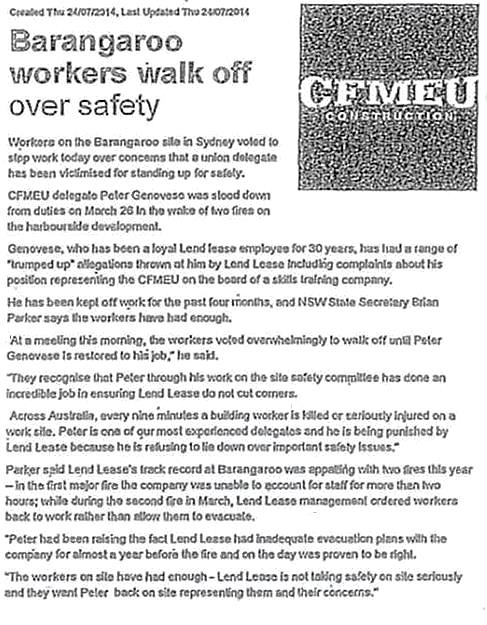
Later in the day Mr Barr told a meeting of Fair Work Building Industry inspectors that:
Lend Lease may be going to the Fair Work Commission to seek orders to stop the industrial action and require the CFMEU workers to return to work.
197 Mr Barr arrived on Site at about 9.45am. As he walked towards the Main Site Access he observed Mr O’Connor and Ms Siciliano speaking to two uniformed New South Wales Police officers. He recognised Messrs Michael Greenfield, Parker and Collier.
198 Later that day, a Senior Deputy President of the Fair Work Commission (the “FWC”) made an order under s 418 of the Fair Work Act. Section 418(1) provides as follows:
If it appears to the FWC that industrial action by one or more employees or employers that is not, or would not be, protected industrial action:
(a) is happening; or
(b) is threatened, impending or probable; or
(c) is being organised;
the FWC must make an order that the industrial action stop, not occur or not be organised (as the case may be) for a period (the stop period) specified in the order.
The order was expressed to come into effect immediately and to remain in force for a period of three months. One term of the order required the preparation of a written notice and for it to be signed by an authorised official of the relevant Unions, that notice being in the following form:
The Fair Work Commission has issued a section 418 order to stop or prevent industrial action.
This order is called Lend Lease Building Pty Limited Industrial Action Order July 2014.
The order requires that there be no unprotected industrial action at the Barangaroo South site in the State of New South Wales (Site) (including but not limited to bans, limitations and restrictions on the performance of work).
The order applies to:
• the following unions:
• Construction, Forestry, Mining and Energy Union;
• Communications, Electrical, Electronic, Energy, Information, Postal, Plumbing and Allied Services Union of Australia;
including each of their office-holders and those of the unions’ delegates who are Site Employees;
• Site Employees.
Accordingly, any direction, advice or authorisation by the Union to members of the Union employed by the Company to engage in industrial action at the Site which is not protected is withdrawn and such action must stop or not occur. Those members should return to work as normal and perform work in the manner in which it is usually performed, without any form of ban, limitation or restriction on the performance of work.
The morning of 25 July 2014
199 One of the amendments effected by the Amended Statement of Claim as filed on 14 July 2016, and one of the principal bases upon which leave to amend was opposed by Counsel for the Respondents, was that it expressly included an amendment directed to the events of 25 July 2014.
200 The opposition of the Respondents was rejected primarily on the basis that the events of 25 July 2014 had always been included in the statement of material facts that had been pleaded and that the amendments merely clarified that which previously may have been uncertain.
201 As amended, para [46A] of the Amended Statement of Claim alleges:
at about 6.30am a “number of CFMEU officials being Parker, Kera, Reeves, Collier, M Greenfield, D Greenfield, Sloane, Taylor and Auimatagi mustered outside the Site Access”;
“resumed blocking the Site Access”;
“called, organised and convened a further meeting of the Stop Work Employees for the purposes of communicating to them the making of section 418 orders by the Fair Work Commission”; and
continued their conduct from 24 July 2014.
This was one of the amendments referring to the events of 25 July 2014.
202 The evidence relied upon by the Commissioner included the following.
The evidence – Lend Lease entities
203 Mr Hensley arrived at work at about 5.30am on 25 July 2014. At about 6.30am Mr Hensley heard someone speaking through a loudhailer outside his office at the Site. In the forecourt area Mr Hensley observed a large number of workers from the Project and “various officials from the CFMEU”. He recognised Messrs Parker, Kera and Michael Greenfield. Mr Hensley also said that a cameraman had been engaged by Lend Lease as a contractor and was trying to take a video of the events. Mr Michael Greenfield stood in front of the camera blocking what could otherwise have been recorded. Mr Hensley had a conversation with Mr Michael Greenfield to the following effect:
M Greenfield: You know how to work that Eric?
Hensley: Have you got a copy of the order?
Mr Hensley was referring to the s 418 Fair Work Act order made by the Fair Work Commission:
M Greenfield: Yeah mate, I put it up on the wall at home mate.
Hensley: It’s all unnecessary.
M Greenfield: Sacking Peter Genovese for no reason after 30 years of service is unnecessary. Obviously the blokes on your site feel the same way if they’re willing to give up pay to walk out for the bloke. Inspirational if you ask me. Talking about bullying and harassing the workers, bringing the whole workforce down to intimidate the workers, that’s intimidation at its best.
Hensley: You don’t know the facts. It’s his doctor managing his return to work.
204 Mr Polsen walked to the Site at about 5.45am. He observed Mr Kera standing in front of the Main Site Access and handing out leaflets to the workers arriving. He also observed Mr Sloane. “Other CFMEU officials” were also handing out leaflets to workers. There was about 100 Lend Lease management staff also present at the Main Site Access. When the workers approached, Mr Polsen said:
The site’s open.
Several workers asked if the Site was open and Mr Polsen said words to the effect:
Yes, go through.
One of the CFMEU people said:
You are intimidating the workers.
At about 7.00am, Mr Polsen saw Mr Collier with a loudhailer. He chose to “tune out” what was being said “as it was offensive”. He observed some workers turning up for work at 7.00am but stated that “some workers tend to be late on any given day” and that it was not “unusual”.
205 Mr Baker at about 6.00am observed about 100 Lend Lease management staff from Foremen up to Senior Project Managers present at the Main Site Access. He also observed Messrs Parker and Kera and about 10 people wearing black hoodies branded “CFMEU”. The reservation previously expressed in respect to Mr Baker’s identification of these persons as CFMEU officials is again repeated. Mr Kera was wearing a blue hoodie jumper. He also observed a number of New South Wales Police officers present. At one point, he heard Mr Kera say to Mr Nathan Smith:
Where did you get your scar from?
Mr Smith has a scar on his face. He then observed Mr Kera “staring and scowling at Mr Smith”, who was then a Services Manager for Lend Lease and now a Construction Manager. He “felt Mr Kera was trying to intimidate Mr Smith”. Mr Baker adhered to his evidence in cross-examination that Mr Kera “scowled” at Mr Smith, saying “[t]his is my memory”. He also agreed that Mr Kera was “staring” at Mr Smith. Workers started arriving at about 6.15am and Mr Baker heard Lend Lease personnel say words to the effect: “welcome back” and “the site’s open”. He observed Mr Reeves approach the Lend Lease personnel and say words to the effect:
I hope you’re being paid well.
Mr Baker agreed in his cross-examination that these words were not said with a “threatening gesture”. He recorded these events by video on his phone.
206 Mr Smith on 25 July 2014 recalled Mr Parker saying words to the effect:
Lend Lease have obtained orders. Both individuals and the union could be fined if they are in breach of the orders. FWBC officials are present at this meeting. They are here to record and take pictures. They are dogs.
He adhered in his cross-examination to his account that Mr Parker said “[t]hey are dogs”.
207 Mr Cleary said that at about 5.45am on 25 July 2014 he saw Messrs Parker and Reeves standing outside the Main Site Access. He also saw one of the three other CFMEU officials he had observed the previous day. Mr Cleary maintained that one of the Union officials said to the Lend Lease employees who had gathered at the Main Site Access words to the effect:
Where were you cunts yesterday?
And:
Shouldn’t you soft cocks be in a coffee shop sipping lattes.
Mr Cleary said that at about 6.50am Mr Parker closed the meeting. He saw “lots of workers who were at the meeting return to work”. Approximately 50 to 100 workers stood around for a remaining 20 minutes after the meeting had ended. About 75% of the workforce was at work.
208 Mr Fantov arrived at work on 25 July 2014 at about 6.15am. At about 7.00am he observed Mr Langford advising the Lend Lease Structures employees that they were to return to work. Other than the Union delegate, Mr Preston, all other of these employees returned to work. He estimated that about 70 to 80 employees did not turn up for work on 25 July 2014. But he also characterised this estimate as a “gut feel”. Confined to this evidence, the estimate could be equated with “inexact proofs” (cf. Briginshaw) and would not satisfy the requisite standard prescribed by s 140 of the Evidence Act.
209 Mr Scannell also reviewed the computer records that record the number of workers engaged by subcontractors (excluding Lend Lease Structures) who entered the Main Site Access for the purposes of estimating the number of such workers who entered the Site on 25 July 2014. The estimated daily number of expected workers was again 770, it not being expected that there would be any great variation from day to day. The number of such workers who had entered the Site on 25 July 2014 using the Main Site Access by 7.30am was 75.
210 Mr Waters arrived at the Main Site Access at about 6.05am. He saw in attendance Messrs Parker, Kera, Darren Greenfield and Taylor. After 6.18am he heard Mr Kera say to the workers:
Boys, there’s a meeting on at 6.30am. Make sure you come across.
Between 6.33am and 6.37am he observed CFMEU representatives instructing the workers to go across the road to the forecourt so that a communication meeting could take place. At the time of the meeting he estimated that there were about 50 to 100 workers present. He observed Mr Parker addressing the workers with a loudhailer and describing the Fair Work Building and Construction people as “sorry excuses for human beings” and “dogs”. He also heard Mr Kera say:
These fucking dogs taking notes and recording and trying to intimidate us.
Mr Taylor then yelled out:
They are trying to intimidate the workers.
Mr Parker was then heard to say:
What do you want to do? Does anyone want to pass a motion to not return to work or to have another meeting?
Mr Gary Preston, a worker from Lend Lease Structures then said words to the effect:
There should be another meeting Monday morning in the same place.
Someone seconded the motion and Mr Parker then closed the meeting saying words to the effect:
Well it seems to me that everyone’s okay to return to work so everyone go back to work and we’ll meet again on Monday at 6.30.
211 Although this account of what was said by these witnesses has necessarily to be assessed (and re-assessed) in the context of such evidence as was adduced by the individual Respondents (and the cross-examination), it may presently be noted that this account is largely accepted.
The evidence – the subcontractors
212 Mr Schneidereit arrived at the Main Site Access at about 6.30am on 25 July 2014. He saw about 30 to 40 Lend Lease employees at the front Main Site Access. He also saw approximately six CFMEU officials standing in the forecourt. He recognised them “as CFMEU officials because some of them were wearing CFMEU branded clothing”. He heard one of them say:
It’s best if everyone goes back to work.
All of the DJD Brick & Blocklaying workers attended work on that day.
213 Mr Tekaute arrived at the Main Site Access at about 6.05am and observed about 30 or 40 workers wearing Lend Lease “hi-vis” vests standing outside. He waited for his FAS and Bauer workers to turn up and then sent them straight through onto the Site. By about 6.30am he observed “at least 200 workers gathered at The Forecourt”. He did not recall much of what was said but did recall Mr Parker saying over a loudhailer words to the effect:
There has been a court injunction and you guys are to go back to work.
He did not observe any CFMEU officials standing outside the gates.
214 Mr Zoppellaro held a short meeting with his own employees at a nearby café where the Managing Director of Precision Air, Mr Ohlback, had “strongly advised” them to go back to work. Mr Zoppellaro then arrived at the Site at about 7.00am. At that time he estimated there to be “about 500-600 people” in the forecourt. The meeting in the forecourt finished at about 7.30am and his own workers commenced work on that day at about 7.30am. They should have started at 7.00am.
215 Mr Vezza said that on 25 July 2014 approximately 23 De Martin & Gasparini workers attended work; there should have been 41 workers.
216 Mr Bryce observed some of the Erect Safe Scaffolding workers attend the Site on 25 July 2014 to collect their tool belts and equipment “but none of them performed any work on the Project on that day”.
217 Mr Finn said that all of the Courtly Reo workers that he had contacted the day before attended work on 25 July 2014.
The evidence – the inspectors
218 Mr Barr arrived on Site at about 6.00am. As he arrived he observed about 50 people standing in front of the Main Site Access. As he approached the Main Site Access at about 6.05am he recognised Messrs Michael Greenfield, Darren Greenfield, Collier and Parker. He observed Mr Parker look in his direction and say words to the effect:
For fuck’s sake.
He also heard Mr Parker say out loud words to the effect:
Across the road boys, 6.30am.
At about 6.35am he heard Mr Collier say words to the effect:
That grub Jared O’Connor is here, his phone number is [number omitted], why don’t you give him a call and let him know what you think.
At that point in time there were about 150 to 200 workers in the vicinity. Mr Barr then heard Mr Parker and others address the crowd and recalled the following being said:
Parker: We have FWBC here. If FWBC ask you to provide an interview, anything you say may be subpoenaed. You have to be very careful. If they ask you questions you don’t have to answer. Make sure you have legal representation, we can provide you with a lawyer. Make sure that FWBC give you questions in writing.
Collier (yelling): They are dogs, don’t talk to dogs!
Parker: Make sure they provide you questions in writing, like in an email.
By “they”, Mr Barr understood Mr Parker meant Fair Work Building and Construction. The address continued:
M Greenfield (yelling): Don’t be intimidated by Lend Lease!
Parker: Yesterday the Fair Work Commission issued orders. The fine is $11,000. You have been notified by your employers to come back to work. FWBC and employers are intimidating you. I can’t force you to go back to work. As you can see there is a tenth of what we had yesterday. I have had discussions with the Premier and Treasurer. The Treasurer is going to meet with the union to have a discussion. It is up to you what you do from here.
Mr Parker was speaking through a loudhailer. A little later Mr Barr also heard Mr Parker say words to the effect:
It’s up to you where you go from here. We need to be done here by 7.00am. When’s Peter coming back? We don’t know. Lend Lease have not sat down to resolve this.
Mr Barr also maintained that he heard Mr Kera point out Mr O’Connor and say words to the effect:
That’s FWBC. They are here to prosecute workers. We have the right to go to work and not to be prosecuted like dogs. This is Australia.
Mr Barr also observed Mr Sloane walk past both himself and Mr O’Connor and say to Mr O’Connor:
I hope you got your spelling right.
He understood that to be a reference to the notes Mr O’Connor was taking at the time.
219 Mr Barr then heard Mr Parker say through his loudhailer words to the effect:
If you do return to work …
He then observed Mr Parker stop and “a couple of seconds later” say words to the effect:
I have to be very careful as this is being recorded, its intimidation. I have to wrap up the meeting. I have no problem going to [gaol] for it. Any questions?
One worker said something and Mr Parker replied:
If you go back to work they can’t prosecute you. They can prosecute you if you don’t return to work.
A worker in the crowd was then heard to yell out:
Meeting on Monday.
Mr Parker, who Mr Barr considered appeared “non-committal”, then said words to the effect:
Okay we will have another meeting on Monday at 6.30am.
220 When cross-examined to seek to establish that Mr Parker was “recommending” that workers return to work by 7.00am, Mr Barr rejected such a characterisation as follows:
Yes. In fact, in relation to those issues he was really saying he was recommending people to go back to work, wasn’t he? –– I don’t believe so.
I see. Are you saying that he made some contrary position? –– No. He laid out the options, but didn’t appear to take one over the other, or push one over the other.
And – well, sorry. When you say “push one or the other” do you mean the options of going to work, or not going back to work? –– Yes.
But by indicating that people would be fined $11,000, wasn’t he doing exactly that? He was encouraging people to go back to work? –– I believe he was laying out their options so they could make a decision about what to do.
I see. So he was informing them? –– That’s how I took it, yes.
221 Mr Barr did not recall seeing any of the workers who attended the meeting enter the Site. At 7.02am Mr Barr observed Messrs Michael Greenfield, Collier and Kera standing within one metre of himself and Messrs Chris Blanchard and O’Connor. He thought they were standing so close so that they could listen to what he was discussing. He then recounted the following exchange between Mr Blanchard and Mr Michael Greenfield:
Michael Greenfield Are you the Lend Lease intimidation squad?
Blanchard: Yeah good one.
Mr Blanchard then received a telephone call and Mr Michael Greenfield then said:
That’s the premier coming for the pour.
222 At about 7.12am, Mr Barr heard Mr Collier speak over the loudhailer saying words to the effect:
We’re starting a dog wash over here.
He also heard the following exchange between Mr Darren Greenfield and Mr Michael Greenfield:
Darren Greenfield: Don’t stand too close Mick, they have fleas. They’re dogs.
He also heard Mr Michael Greenfield say:
I hope your kids work in the construction industry then they will come running to us.
He also heard Mr Michael Greenfield say to Mr O’Connor:
Wait till the ALP get in and you will be working at Maccas.
Mr Darren Greenfield was then observed to walk past Mr O’Connor and Mr Barr and say words to the effect:
I have a can of PAL in the boot of the car, they can eat it for breakfast.
Mr Collier then replied:
It can’t be that hard to get a job with FWBC, even if you were a transit officer.
Mr O’Connor’s previously worked as a transit officer.
223 Mr O’Connor arrived at the Site on 25 July 2014 at about 6.00am in the company of Mr Barr. Mr O’Connor observed the following people then in attendance:
Mr Parker, who was wearing a black CFMEU hoodie;
Mr Auimatagi, who was wearing a black hoodie with the words “Union for life” on the back;
Mr Collier, who was wearing a yellow CFMEU hoodie;
Mr Michael Greenfield, who was wearing a black CFMEU hoodie and a black beanie;
Mr Theo Samartzopoulos from the NSW Plumbers Union, who was wearing a black hoodie;
Mr Taylor, who was wearing a blue Union hoodie;
Mr Darren Greenfield, who was wearing a black Union hoodie;
Mr Mansour Razaghi from the CFMEU, who was wearing a black bomber jacket with CFMEU logos on it; and
Mr Kera, who was wearing a blue Union hoodie.
Again Mr O’Connor made a contemporaneous note recording the names of the CFMEU people present. At about 6.31am Mr O’Connor said that he saw Mr Collier holding a red loudhailer. Mr O’Connor also heard Mr Collier say words to the effect:
Righto boys, any construction workers, not including the FWBC dog in fluoro standing in the front, come over we are about to start.
Mr O’Connor was of the belief that that comment was directed to Mr Barr, who was standing next to him and wearing a high visibility jacket. Mr Collier was heard to continue on to say:
Boys if we can just gather around, bring it around the front.
Mr O’Connor then heard Mr Collier say:
And that grub is Jared O’Connor, and his phone number is … why don’t you give him a [call] and let him know what you think.
The phone number was deleted from the text of the affidavit. In cross-examination, Mr O’Connor accepted that he had previously handed out his phone number to “a couple of building industry participants”. Mr Parker then took over the loudhailer. At about 6.35am Mr O’Connor heard Mr Darren Greenfield yell out words to the effect:
They are nothing but dogs.
Mr Darren Greenfield at the time was pointing to Mr O’Connor and Mr Barr. Mr O’Connor also maintained that he heard Mr Michael Greenfield saying at the same time:
Don’t be intimidated by these Lend Lease guys, you are entitled to have a meeting.
He also observed Mr Parker pointing at either himself or Mr Barr and saying words to the effect:
The FWBC are taking down the names of all the workers to attempt to prosecute them.
The loudhailer passed hands a number of times. But Mr O’Connor heard Mr Taylor say:
Those are the dogs over there; they are from the FWBC, Fair Work Building Commission.
He assumed Mr Taylor meant Fair Work Building and Construction. Mr Sloane then walked past and said to Mr O’Connor:
Make sure you don’t make a spelling mistake.
At some time before 7.00am Mr O’Connor heard Mr Parker say on the loudhailer:
If you don’t go to work, they can prosecute you
Mr Parker then said:
So we will have a meeting at six thirty Monday.
Mr O’Connor accepted in cross-examination, perhaps unsurprisingly, that these words were being said by Mr Parker to the workers present. Mr O’Connor and Mr Barr returned to the Fair Work Building and Construction office at about 7.15am.
224 Ms Tadros at about 6.10am on 25 July 2014 saw approximately 15 people standing in front of and to the sides of the Main Site Access. At around 6.22am she observed Mr Michael Greenfield standing next to a camera on the side of the road opposite, next to a police car. He was wearing a black hooded jumper with the CFMEU logo on it. She also observed Messrs Parker, Collier and Razaghi. She was about to take a photo of Mr Parker who said words to the following effect:
You can take a photo of me? I’ll fucking take a photo of you.
Although cross-examined to suggest that the latter statement was not made, Ms Tadros adhered to the account she gave. Mr Kera moved in front of Ms Tadros and stood about five centimetres from her. She “felt intimidated by his physical presence”. She proceeded to take a photo of Messrs Collier and Razaghi. At about 6.31am Ms Tadros observed Mr Collier addressing the crowd and saying:
Guys before I hand it over, I just want you to know that we have some dogs in the crowd. Fair Work Building and Construction.
He then said:
If anyone has a problem with this, you can contact Jared O’Connor on [number not included]. Why don’t you give him a call and tell him what you think?
A little later, at about 6.41am she saw Mr Parker take the loudhailer from Mr Collier and say words to the effect:
We have the FWBC here taking photos of you and transcripts. You have rights as well so if they ask you to come along for an interview you know what to say. You don’t have to go. This is Australia!
She also heard Mr Parker say:
Slow down in your talking so the dogs can write it all down.
225 Mr Armstrong was a building inspector. He had previously interviewed two persons, Messrs Murdoch and Casey. The content of those interviews did not find its way into his affidavit. In cross-examination he accepted that the content of what Messrs Murdoch and Casey had told him could be regarded as “exculpatory” of the conduct of the CFMEU. These interviews, he explained, had been forwarded to the lead investigator (Mr Barr). He had no real explanation as to what had happened to this material thereafter as he was but “a small cog in a very large machine”. But such matters assume little present relevance. It is the evidence that he in fact gave that matters. Mr Armstrong attended the Site at about 6.00am. He recalled a meeting starting at 6.30am. One person said over a loudhailer:
Boys and any workers not including the FWBC dogs in fluro come around we’re about to start.
Mr Armstrong then observed the loudhailer being passed to Mr Parker who said words to the effect:
The Fair Work Commission has issued orders legally requiring union members to return to work. I can’t tell you to return to work or not, that’s up to each individual worker.
At the end of his address, Mr Parker said:
There are dogs over there. Don’t talk to the dogs.
Although it was put to him in cross-examination that Mr Parker had not used the term “dogs”, Mr Armstrong adhered to the account provided in his affidavit. He had a “clear recollection” of Mr Parker using that term. A third speaker, believed by Mr Armstrong to be Mr Reeves, also addressed the crowd and again referred to the FWBC inspectors as “dogs” throughout his address to the workers. The meeting ended, according to Mr Armstrong, a short time before 7.00am. He observed half the workers walk towards the Main Site Access. In his cross-examination, Mr Armstrong accepted that he did not see any person from the CFMEU threaten, intimidate or prevent any person from entering the Site. A number of workers lingered in the crowd. Mr Armstrong left the Site at around 7.50am.
226 And again it may presently be noted that although this account of what was said by these witnesses has necessarily to be assessed (and re-assessed) in the context of such evidence as was adduced by the individual Respondents (and the cross-examination), this account is largely accepted.
The findings made on the evidence thus far
227 Although much of this evidence was again put in issue by the Respondents and has obviously to be assessed in the light of the evidence also adduced by the Respondents, it would seem relatively uncontroversial that in relation to the events that occurred on 25 July 2014 that:
there was a meeting in the forecourt opposite the Main Site Access which commenced at about 6.30am and finished sometime after 7.00am;
there were fewer workers who attended this meeting than the meeting held on 24 July 2014 but the numbers in attendance were no less than about 100;
there were in attendance the following members of the CFMEU: Messrs Parker, Collier, Michael Greenfield, Darren Greenfield, Reeves, Kera, Taylor, Sloane, and Auimatagi;
Messrs Parker and Collier addressed the assembled workers; and
Mr Parker advised the workers of the order made by the Fair Work Commission on the afternoon of 24 July 2014 requiring the workers to return to work.
228 There is less controversy in respect to these events than those that occurred on the previous day. To some extent that may be attributable to the fact that there was a video recording of more of these events than was available in respect to the 24 July 2014 events.
229 What was more controversial, and which necessarily has to be assessed by reference to the entirety of the evidence and, in particular, the evidence of the Respondents themselves, are such facts as:
what was intended to be conveyed to the workers by Mr Parker when he addressed them (if anything) in addition to advising them of the orders made by the Commission;
what was said and done by other members of the CFMEU and what they intended to achieve by making comments to the Fair Work Building and Construction inspectors; and
what happened after the meeting concluded and how many workers attended for work and performed work on 25 July 2014.
the case for the respondents & THE FINDINGS MADE
230 Each of the Respondents, the Court was informed by their Counsel, waived their privilege against self-incrimination and elected to adduce evidence.
231 Each gave evidence.
232 The following sets forth their account of the events and the findings made based upon both their account and the evidence in its entirety.
Brian Parker
233 Mr Parker’s involvement in the events that unfolded on 24 and 25 July 2014 started with the suspension of Mr Peter Genovese. Messrs Parker and Kera were two of the principal persons in the events that culminated with the Stop Work Resolution on 24 July 2014.
234 Reservation is expressed as to the reliability of Mr Parker’s evidence. That reservation springs primarily from the fact that Mr Parker could not recall many of the statements sought to be attributed to either himself or others and, in particular, Mr Kera. Given the importance of the meetings held on 24 and 25 July 2014, and given the role that he played in those events, it is questionable whether his failure to recollect was to be attributed to a lack of memory of events occurring some time ago or to an unwillingness to be fully frank in the evidence that he was giving. The latter explanation, with respect, is considered to be the more likely explanation. Mr Parker’s evidence was also characterised more by his being anxious to provide an explanation for his conduct than by a desire to answer the question being put. Frequently, for example, he started answering questions before the question had been completed.
235 On Mr Parker’s account, he became aware of the allegations being made against Mr Genovese in about March 2014 but was not involved with the meetings held in either February or March 2014. He was, however, kept informed as to what was happening. Mr Parker, in consultation with Ms Rita Mallia and the “executive”, gave instructions for the sending of a letter dated 13 March 2014 from the CFMEU NSW. That letter stated (inter alia) that the Union considered the warning given to Mr Genovese to be “victimisation” and requested that the “warning issued … immediately be retracted”. Mr Parker also attended a Committee of Management meeting held on 28 March 2014 at which a resolution was passed supporting Mr Genovese.
236 One issue which was accepted by Mr Parker was that as at July 2014 he was aware that the Joint Development Agreement contained a dispute resolution procedure and that if the workers decided to go out on strike in a manner which was not protected their conduct would be unlawful industrial action and a contravention of the Joint Development Agreement.
237 Mr Parker, together with Mr Kera, organised the CFMEU persons to attend at the Barangaroo Site early on the morning of 24 July 2014. Prior to the meeting commencing sometime after 6.30am, Mr Parker and others assembled outside the Main Site Access and directed those workers attending for work that day to the meeting that was to be held across the road.
238 Once the meeting started, Mr Parker took a more prominent role – not unexpectedly given his position as State Secretary. When addressing the assembled workers, Messrs Lin, Polsen, Morrison, Smith, Cleary and Barr gave an account of what Mr Parker said, including statements that:
he was aware of the “findings” of the Lend Lease investigation and that he believed the findings were that “Peter has done nothing wrong”;
it would take strike action for Lend Lease to reinstate Mr Genovese;
Mr Genovese should be “reinstated immediately”;
“enough is enough. We’re going to take on Lend Lease”;
“who will walk out the gate until Pete G is reinstated? It will take more than just today to send that message to Lend Lease”;
“you have to start standing up for people like Peter”; and
“I have no problem going to [gaol] for it”.
239 Mr Parker in his affidavit either did not recall (or denied) saying words to the effect that you have to “start standing up for people like Peter”. Suffice to say, Mr Parker accepted some of the statements sought to be attributed to him but rejected others. He did accept, for example, that he said words to the effect that “enough is enough” and “we’re going to take on Lend Lease”.
240 The account of the words sought to be attributed to Mr Parker by Messrs Lin, Polsen, Morrison, Smith, Cleary and Barr is accepted.
241 In giving his response to the statements sought to be attributed to him, Mr Parker also displayed a willingness to misrepresent the facts as he presented them to the workers. One instance of this focussed on his statement to the workers that the “findings” made by Lend Lease in respect to Mr Genovese revealed that Mr Genovese had “done nothing wrong”. The fact was, as accepted by Mr Parker, there was a finding that Mr Genovese had engaged in “inappropriate” behaviour. But this finding did not stop Mr Parker telling the workers something to the contrary. His explanation for this was that the findings were the findings of a “kangaroo court”. There was thus the following exchange between him and his cross-examiner:
Now, what you said during the meeting was, “We’re having a meeting in regards to Mr Genovese’s health. Lendlease won’t let him go back to work. Mr Genovese is ready to go back to work.” Did you say words to that effect? — I’m pretty confident, I did, yes.
“Peter has been treated poorly by Lendlease. Peter has done nothing wrong. There was an incident a number of months ago and an investigation had taken place and we’re aware of the findings. The findings were that Peter has done nothing wrong.” You said that to the meeting? — Yes.
And that last bit, “The findings were that Peter has done nothing wrong” was not true, was it? — As far as I’m concerned, they were true.
But as a statement, it’s untrue, isn’t it, because you knew that there had been…? — As I say again, trumped-up charges against Peter.
Yes. Can I just finish the question, please, Mr Parker, so it gets on the transcript? — No problem.
You knew at the time of the meeting that Lendlease had made findings that Mr Genovese had acted inappropriately? — Kangaroo court, yes.
Well, you might have had your view about it, but as a matter of fact, they had made an adverse finding against Mr Genovese that the complaint had been substantiated, hadn’t they? — Correct, but every day, I see employers that kill people on building sites and get off with no recourse whatsoever, you know.
Right? — I see it – and I have seen it on this particular job, where there was 600 tonne of asbestos affecting workers on the job and the public and a pre-school straight across the road, and they want to tell lies and cover it up.
Well, Mr Parker, I don’t deny that you have genuine concerns about those sort of issues? — Every day of the week. You see it constantly in our industry.
But what you were doing here was misrepresenting the position to …? — Well, I wasn’t misrepresenting it, because very clearly, in my and my union’s terms of thinking, they were very much trumped-up charges against Peter. You know, I don’t know if you know what’s happened to the foreman that he had the incident with, but he’s no longer around; he hasn’t been around for a long period of time.
Whatever may have been the genuineness of the beliefs held by Mr Parker, the fact remained that his knowledge of the findings actually made did not prevent him from misrepresenting those findings to the assembled workers. In making the statement that “the findings were that Peter has done nothing wrong”, it is concluded that Mr Parker was making a statement either known by him to be untrue or a statement known by him to be a statement that was far from an accurate statement of fact.
242 One issue which should be separately addressed is the manner in which the resolution was passed.
243 On behalf of the Commissioner, Messrs Baker and Smith maintained that they heard Mr Parker say words to the effect:
“what motion are we going to put forward to get Peter Genovese back to work”;
“who will walk out the gate until Peter G is reinstated”; and
“it will take more than just today to send that message to Lend Lease”.
In his cross-examination, Mr Parker did not accept that he made these statements.
244 It is concluded that the words sought to be attributed to Mr Parker immediately prior to the resolution being passed were in fact said.
245 There was then the following exchange between Mr Parker and his cross-examiner as to the resolution proposed from the floor and the resolution as passed:
Now, someone shouted out from the floor, didn’t they, something about going out for 48; do remember that? — I’m pretty sure they did, yes.
And you said, “What was that again, mate? We’re going out for 48”? — I can’t recall all the conversation, but I don’t doubt that that was from the floor and I did repeat it.
And then you said, “Let’s do a show of hands in favour of walking off the job until Monday morning unless Peter is reinstated”? — I think – all I did was to echo exactly what was said from the floor.
But what you had actually done was put a different motion to the floor, wasn’t it, Mr Parker, because you were saying – you were asking for a show of hands on walking off the job until Monday? — No, I would have made a remark based on exactly what was said from the floor.
Because what was suggested from the floor was going out for 48 hours, which was the Thursday and the Friday? — Yes.
And the ultimate vote was on walking off the job until Monday? — Well, I’m not sure whether – sorry, no, it would have – it was 48 hours, but the vote was, yes, to come back on the Monday. That was the remarks to the person that formally put the motion.
There was then an exchange as to whether working overtime on Saturdays and Sundays was permitted by the employer where the worker had not worked on the preceding Friday. But what matters for present purposes is that there is a discrepancy between what was said to be the resolution proposed from one of the workers and the resolution as put to the workers by Mr Parker. And what matters is that in putting the resolution, Mr Parker well knew that any strike would constitute unlawful industrial action. His explanation for not telling the workers that any strike would be unlawful was that he just let the workers have their “own head”. This explanation is rejected. Mr Parker’s conduct in not advising workers of their action being unlawful forms but part of the factual matrix against which a finding as to his intent to coerce workers has been made.
246 Mr Parker also denied that the statements he made to the workers prior to the resolution being passed and in putting the resolution was to “stir up the workers” and to put pressure on Lend Lease. This denial should be expressly set forth. It was as follows:
And you knew at that point, when you were putting the resolution, that what was being proposed to the meeting was that the workers go off the site and cease work until Monday? — Yes.
And that that would constitute unlawful industrial action? — Yes.
And you didn’t stop to think that that would not be a very good thing for the workers to do? — No.
You didn’t advise them against it? — No.
Because, in your view, you would have achieved what you intended to achieve, and that is to put Lendlease in a position where it would be forced to do something about reinstating Mr Genovese; isn’t that right? — No, it’s not right. What it does help – the terms of what it was is that what was relayed to me was that workers were very upset with the union, and they felt that the issue about Peter Genovese, the union was not doing anything, and, unfortunately, you know, the workers took the path that they did, and I wasn’t going to hold them back.
In fact, you were going to encourage them? — No, I didn’t encourage them at all. That’s not true. You know it’s not true. But what I would do is let them have their own heads in the process of it. That meeting was originally called just to apply pressure with a return to work at 7 am. That’s what it would have been. So they had their pre-starts. That was the idea of the meeting. But when the workers – you could see the swell from the workers that weren’t happy, yes. You let them have their head.
But you spent most of the meeting stirring them up, didn’t you, in the hope that they would do something like that? — I could have said a worse. You know what I have said. It’s all there. You know exactly what I have said. The fact is I could have said a lot worse if I wanted to stir them up. I wasn’t stirring them up at all.
Well, you certainly were. You were inviting them to make some proposal from the floor? — Well, that’s your opinion. It’s certainly not mine.
Mr Parker’s denial of any attempt to encourage the workers to vote as they did is rejected; it is concluded that his intention was in fact to “stir up” the workers and to put pressure on Lend Lease.
247 After the meeting concluded on 24 July 2014, Mr Parker was one of the CFMEU persons who crossed the road and again assembled outside the Main Site Access. Mr Parker and some of the other members of the CFMEU remained there for the next 2½ to 3 hours. During that time, members of the CFMEU were heard to use expressions such as “you’re just a fucking dog”.
248 Another issue which should be separately addressed in respect to the events after the conclusion of the meeting on 24 July 2014 is the exchange which took place between Mr Parker and Constable Brealey. One of the exchanges the police officer attributed to Mr Parker were the words when he initially confronted her: “who do you think you are”. She told him to “calm down” and described him as “yelling in a loud voice” and described his conduct as trying “to intimidate me with body language”. Mr Parker maintained in his affidavit that he was surprised at her request to “calm down” and maintained that his voice was “not raised at the time”. Mr Parker denied in his cross-examination the account given by the police officer, as follows:
And you said:
A female police officer said to me words to the effect “Calm down”.
? — Yes.
And the reason she said that was because you had run or walked up to her in a fast manner and shouted out to her, “Who do you think you are? You can’t do that”? — That’s not correct at all.
Because she was standing over the road in the Bond forecourt, wasn’t she, talking to workers who were still there? — She was speaking to the FWBC inspectors. That’s who she was speaking to. She wasn’t speaking to any workers.
Well, I’m suggesting to you she was speaking to some workers in the Bond forecourt? — You suggest – but it’s not true. I’ve seen it from a distance. From what I seen anyway.
And you were concerned that she was saying might have been saying to the workers, “You can go onsite and work if you like.” You were concerned she might have been encouraging them to work? — No.
So you hopped over there, and you shouted at her, “Who the hell do you think you are? You can’t do that”? — No, I didn’t at all.
You said, “You have to speak to me first”? — Not true.
Do you agree she said something to you about the workers being intimidated? — I think she may have – she may have made those allegations, yes.
And that was – you understood that that was, in fact, what was happening, wasn’t it. That all of you standing around in a group, CMFEU [sic] organisers, were attempting to intimidate workers that might want to go onto the site? — No.
And you said to her, “This is how I speak to my workers.” Remember saying that? — Yes.
And that was because she told you to stop yelling at her? — No, that’s not correct.
And you were standing over her? — No, that’s not correct.
In a physical way? — No, that’s not correct.
And looking down at her? — No, that’s not correct.
She wasn’t very tall, was she. You were taller than her? — She wasn’t short either, but I was probably taller than her, yes.
And you were attempting to intimidate her, weren’t you? — No, I wasn’t.
You were trying to get her to back down from what she was doing? — No, I wasn’t.
And what you were trying to do was show that you, as the embodiment of the union, were defiant of the police or anyone who attempted to encourage the workers to go onsite and work? — No, that’s not true.
And you had a conversation with her in which you said, “We will continue the strike until he – Mr Genovese – gets his job back.” Do you remember saying that to her? — No, I didn’t use the word “strike”, no. That’s not true at all.
Well, did you say something like, “We will continue the work stoppage until he gets his job back”? — No, I don’t think I used those words either.
Well, what words did you use? — I can’t recall.
Do you think you said something like that to that effect? — I may have said something about what the decision that was made by the workers, but
That’s very similar to what you said to the Channel 7 reporter, isn’t it? — I don’t know. I can’t recall.
The workers are going out till Monday? — No.
Until Peter gets his job back? — Yes, I said that to Channel 7, yes, when I was interviewed, yes.
The account given by Constable Brealey is accepted and the rejection of that account by Mr Parker is itself rejected. Part of the reason for so concluding is the manner in which the police officer gave her evidence and the unreliability of much of the evidence of Mr Parker. Another part of the reason for so concluding is the fact that the police officer was someone totally independent of the events happening on site, with no self-interest in giving other than a factually accurate account of her recollection and is (accordingly) to be preferred as having a more impartial recollection of the exchange. This assessment of the police Constable’s evidence is accepted notwithstanding a challenge to the “credibility” of the Constable’s evidence. This challenge was launched (inter alia) from a premise that a police record, known as the “COPS entry”, did not disclose any account of the police officer having felt “intimidated”. There was thus, for example, the following exchange during the Constable’s cross-examination when she was taken to her exchange with Mr Parker:
So you don’t recall whether he pointed at you? — Not exactly if he pointed, but he was standing quite close to my face so I very much doubt he was pointing to me.
Okay. He was standing quite close to your face, and that’s what you saw as being intimidating, was it? — Yes, and his body language.
Could I just ask you a quick point. You, I assume, prepared a COPS entry in relation to these matters, did you? — I didn’t enter the COPS entry. My offsider did.
I see. And was your offsider there at the time? — Yes, he was.
A little later there was the following exchange:
And in fact, if you had thought that you were being intimidated by Mr Parker, you would have put that in the COPS entry, wouldn’t you? — I didn’t do the COPS entry, as I stated before.
Well, let me ask the question again. If you had thought that you had been intimidated, you would have put that in the COPS entry, wouldn’t you? — Doesn’t work like that.
Sorry, why doesn’t it work like that? — In a COPS entry, you don’t put in your feelings. You don’t enter into another officer’s COPS entry. It’s only the police officer who is putting the entry in can put what they had seen. There was no – I didn’t have any touch of the entry at all. It was done by Senior Constable Ross.
Nothing of substance, with respect, turned upon what was recorded in the “COPS entry”. It was the substance of the Constable’s evidence which assumed primary importance. The challenge to her evidence (perhaps surprisingly) was nevertheless repeated in the written submissions filed on behalf of the Respondents. The challenge to the “credibility” of Constable Brealey’s evidence is rejected.
249 However else the exchange between Mr Parker and the Constable may be characterised, it was a curious but revealing exchange. It is initially a curious exchange by reason of the question as to what was sought to be achieved in so confronting the police. But it is the answer to that question which is revealing. It is concluded that in engaging in the exchange, Mr Parker exposed his unwillingness to brook any opposition to the objectives he sought to pursue and, equally of importance, is that it exposes the objective of presenting to the workers in the vicinity that the Union would even take on the police to achieve those objectives. The Union was not going to be intimidated by the presence of the police; it was the Union, it is concluded, that was setting out to intimidate (inter alia) the workers. The exchange with the police Constable formed part of the background factual context in which it can readily be concluded that Mr Parker was deliberately setting out to create an atmosphere of defiance, even as against those charged with enforcing the law.
250 Mr Parker also took an active role in the events on 25 July 2014. This meeting, obviously enough, followed on from Mr Parker and others becoming aware of the orders made by the Fair Work Commission. A central factual issue dividing the parties was whether the meeting that took place on 25 July 2014 was for the purpose of informing the workers of the orders made or whether it was pursued for the purpose of encouraging the workers to continue their strike action. In his affidavit, Mr Parker maintained that in the absence of the orders being made “we would not have organised that meeting for Friday 25 July 2014”.
251 In resolving this divergence of approach, reference must be had to what was said during the course of that meeting and Mr Parker’s own account of his intention in calling the meeting.
252 A number of the Commissioner’s witnesses gave an account of what was said during the 25 July 2014 meeting.
253 Mr Parker was one of the members of the CFMEU again present on 25 July 2014 and one of the persons telling workers of the meeting to be held across the road as they arrived at the Site. One witness, Mr Barr, gave an account of Mr Parker telling the assembled workers of the orders made by the Fair Work Commission. Mr Barr also gave an account of Mr Parker thereafter making a number of statements, including words to the following effect:
“It’s up to you where you go from here. We need to be done by 7.00am. When’s Peter coming back? We don’t know. Lend Lease have not sat down to resolve this”; and
“if you do return to work …” (with Mr Parker thereafter pausing and continuing on to say) “I have to be very careful as this is being recorded, it’s intimidation. I have to wrap up the meeting. I have no problem going to [gaol] for it. Any questions?”
Mr Barr’s account also included observations as to the manner in which Mr Parker addressed the assembled workers, including his hesitation and expressed need to be “careful”. Another witness, Mr Lin, also gave an account of Mr Parker telling workers that the meeting had to be concluded by 7.00am. Mr Lin also gave an account of Mr Parker telling the workers that “Peter has been treated very poorly”; that he “must be reinstated to work” and that Lend Lease “have a poor attitude to safety”. According to Mr Lin, Mr Parker however also told the workers that “Lend Lease have obtained orders” and that they could “be fined if you don’t go back to work”. Mr Lin also recalled that Mr Parker “kept looking at his watch” and telling the workers that he had to “finish this meeting by 7.00am or I’ll be in breach of the Court’s orders”. This account given by Messrs Barr and Lin is accepted.
254 A concern on the part of Mr Parker to ensure that the meeting concluded by 7.00am, however, says little as to the message sought to be conveyed to the workers prior to that time. The line pursued in the cross-examination of Mr Parker was that in addition to informing the workers of the orders made by the Commission he was also urging them to continue their strike action. There were, for example, the following two exchanges:
But interlaced amongst all of that information, which you were obliged, as a matter of law, to tell the workers, you also made invitations to them, didn’t you, to consider continuing the strike? — No, that’s not correct. What I did say that could be extruded that way was to say that it’s up to yourselves whether you return to work or not. I can’t force you to return to work.
Now, why would you say that? — Very clearly because it’s not up to me. It’s up to the individual workers.
But you would be in their interests – it would be in their interests for you to be saying to them, given that a lot of them were your members, that it’s better for them to go back to work, to positively advise them to go back to work? — Yes, that’s right, yes.
So why was it at times during the meeting you were suggesting they might want to think about not going back to work? — I – I said to them, “I can’t force you to go back to work.” That was the words. Not I was implying that – anything to try and stop them from going back to work. I was very clear about it actually. It’s great to hear that people have got selective memories about this issue. What they write down in affidavits.
A little later the same theme was returned to with the following exchange:
And at the end of the meeting, you said, “I have to wrap up the meeting. I have no problem going to [gaol] for it.” Do you remember saying that? — Sorry. Go again.
You said, “I have to wrap up the meeting?” — Yes.
“I have no problem going to [gaol] for it? — I don’t know if I said about going to [gaol] for it. “I have to wrap up the meeting”, yes, because I was conscious of the fact that they needed to get back to work by a certain time.
And what was happening during that meeting on that morning, Mr Parker, was that, though you were complying in form with the 418 orders, you and Mr Reeves were making an invitation to the workers to continue the strike? — Absolutely not. Quite the contrary. I was, anyway. I can’t recall what Danny said, but I want to make it nice and clear that I was encouraging the workers to go back to work.
And your organisers created an atmosphere of defiance towards the FWBC inspectors? — I think one official did.
And your understanding of the purpose of that was that by doing that that would be part of encouraging the workers to seriously consider continuing the strike? — No, that’s not true.
255 It is accepted that Mr Parker was pursuing each of the following two objectives when addressing the workers: first, informing them of the orders made by the Commission and the need to finish the meeting by 7.00am; and second, urging them to continue their strike action. The denial by Mr Parker of pursuing the second of these two purposes is rejected; it is concluded that he was setting out to create “an atmosphere of defiance”, particularly “towards the FWBC inspectors”. Had Mr Parker genuinely only intended to convey to the workers the orders that had been made:
that message could have been put far more simply and directly than the words in fact employed by Mr Parker on that occasion; and
there would have been no need (for example) for Mr Parker to express any need for caution or for him to be “careful” in what he said. The need for care only arose, it is concluded, because Mr Parker was seeking to tread that fine line between informing the workers of the orders that had been made but also continuing to urge for further strike action.
256 It is thus concluded that the account given by the Commissioner’s witnesses, and in particular the evidence of Mr Barr, should be accepted. The words attributed to Mr Parker:
go well beyond any purpose of simply conveying to the assembled workers the message that the Fair Work Commission had made orders; and
are more characterised by an attempt to incite or encourage the workers to continue their existing strike action.
257 In reaching this conclusion, reliance has also been placed upon the context in which Mr Parker was addressing the assembled workers and what else was being said at the time, including Mr Reeves having previously told the workers that:
they should “think about how they voted yesterday”.
Mr Parker on 25 July 2014 was, it is concluded, seeking to tread a very fine line between being seen to be simply conveying the news that orders had been made by the Commission and not being seen to be endorsing the continuation of industrial action. Notwithstanding his accepted need to be “careful” in what he said, it is concluded that the message being conveyed to the workers was that he was encouraging continued industrial action – i.e., action that he was prepared to go to gaol for. Although it may be accepted that Mr Parker was quite conscious of the need to conclude the meeting before 7.00am, it is also to be accepted that he was encouraging the assembled workers to continue their industrial action.
258 Written submissions advanced by Counsel on behalf of Mr Parker placed emphasis upon words spoken by Mr Parker, including words in which it was submitted that Mr Parker had told the workers that:
“if I were one of you blokes, I’d probably go back to work”; and
“if you do not return to work they could possibl[y] implement those orders and those orders would be acted upon”.
Such submissions must necessarily be taken into account as part of the fact-finding exercise. But such words only form part of what was said and cannot be divorced from the context in which other things were also being said. Notwithstanding the making of these statements, when taken in the context of the balance of that which Mr Parker had told the workers and the manner in which the statements were made, it is concluded that the message being conveyed – and intended to be conveyed – by Mr Parker was that he was urging the employees to continue their industrial action.
259 Nor can Mr Parker’s involvement in the events as they unfolded on 24 and 25 July 2014 be divorced from the earlier commitment on the part of the CFMEU to having Mr Genovese reinstated, as evidenced by the fact that the CFMEU poster found at the UTS FEIT Project on 3 April 2014 was stated to have been “[a]uthorised by Brian Parker, State Secretary, CFMEU NSW, 12 Railway Street, Lidcombe NSW 2141”.
Mr Robert Kera
260 Mr Kera’s involvement with the events as they unfolded on 24 and 25 July 2014 may likewise be traced back to the allegations previously being made against Mr Genovese.
261 Mr Kera’s evidence was characterised by a failure to answer many of the questions which were put to him and more characterised by an attempt to convey the evidence that he wanted to give. Whether that was due to inadvertence or was deliberate may be left to one side. What does matter is that reservation is expressed as to accepting his evidence without caution.
262 Mr Kera became aware of the allegations made against Mr Genovese shortly after 12 March 2014.
263 At least two things should be noted in respect to his account of his knowledge of and involvement with these allegations.
264 First, Mr Kera held strong views in respect to the manner in which Mr Genovese had been treated. But the basis upon which he held those views was certainly not founded upon any clear understanding of the basis upon which Lend Lease had made its findings or the basis upon which it had issued Mr Genovese with a warning letter. Although Mr Kera had available to him a copy of the statements that had been made concerning the conduct of Mr Genovese, he did not seem to have any familiarity with the content of those statements and did not seem to have even bothered to read those statements. So much became apparent in the following exchange during his cross-examination when he was taken to the warning letter dated 13 March 2014:
It’s a letter of 13 March 2014. Do you recognise that that is the warning letter that was handed over? — I don’t think I ever saw a copy of it.
Right. So you don’t think you ever read it? — Well, I can’t recall ever seeing a copy of this. No.
But yet you said to Lendlease you didn’t accept it? — That’s correct.
Well, wasn’t that rather pre-judging the issue? — As I’ve said before, I believed Lendlease were victimising Peter of his role as safety down at Barangaroo.
And was that a belief just based on prejudice? — Sorry, can you repeat the question.
Was that just a prejudiced belief because they were Lendlease and Mr Genovese was CFMEU? — No, absolutely not. Peter was doing the outstanding job on site and I believe they were victimising him and it was unjustified what they were doing to him.
But you weren’t interested to know what they said in the warning letter? — Peter, I believe, at the time had a discussion with me and I believed him about a verbal altercation.
But before you made some judgment about what Lendlease were doing, don’t you think you should have fairly and reasonably informed yourself of what they actually had found? — I can’t recall ever seeing this document.
But it was handed over in the meeting that you were present at, wasn’t it, Mr Kera? — I can’t recall it being handed over to me.
But you interested to know what Lendlease had said in it? — It could have possibly have been forwarded to Leah Charleson who was there, but at the time I was a support person to Peter.
So you were prepared to take the view, quite strongly it appears, that Lendlease were victimising Peter Genovese without even taking an interest in what they said in writing about their investigation? — As I said, I can’t recall seeing this document.
265 Second, Mr Kera accepted that he attended two meetings concerning the investigations into the conduct of Mr Genovese. In his affidavit, Mr Kera accepted that at one of those meetings he said words to the effect: “I’m asking Lend Lease to cease this investigation”. He denied saying words to the effect: “I’m telling Lend Lease to cease this investigation”. This difference in the accounts given was pursued as follows in his cross-examination:
And do you remember in a meeting at the Barangaroo site office that you said to Mr Shepherd, “I’ve sat in two meetings now and I don’t like how it’s going. Peter was democratically elected as chair of the OH&S committee and also elected as the site delegate. I want this all to cease and I’m telling Lendlease to cease this investigation.” Do you remember that? — I recall having the discussion and asking Lendlease to cease the investigation. I remember that very clearly.
Right. And what you actually said was that you were telling Lendlease to cease the investigation; isn’t that right? — I know exactly what I said that day. I asked Lendlease to cease the investigation.
You were, in effect, ordering them to stop, weren’t you? — Absolutely not.
Were you angered by the fact that they were carrying out an investigation at all? — Yes.
And when they didn’t stop the investigation, what did you do about that? — Well, nothing.
Mr Reeves, it may be noted, accepted that Mr Kera said “something similar” to the words “I’m telling Lend Lease to cease this investigation”. But one thing is certain and that is that Mr Kera was “angry” that the inquiry was not shut down. He expressed his sentiment in this regard during the following exchange:
You just really didn’t want an investigation to happen at all, did you, Mr Kera? You wanted to shut it down? — I didn’t believe one was warranted.
And when it wasn’t shut down, you were quite angry about what had happened between Mr Genovese and Lendlease, weren’t you? — I wouldn’t say quite angry.
Angry? — Probably.
And as a senior official of the CFMEU, you decided to do all you could to have the union support Mr Genovese in this dispute, didn’t you? — Absolutely.
266 Mr Kera’s denial of having told Lend Lease to cease the investigation is not accepted. It is concluded that Mr Kera in fact told the meeting that the investigation into Mr Genovese had to cease as opposed to merely asking Lend Lease to cease the investigation. The evidence of Mr Shepherd as to what was said during the meeting on 11 March 2014 is accepted, including Mr Kera’s statement that the Union did not “agree to any warning at all” and that if “it proceeds, we will dispute it”. The statement made by Mr Kera that he was “telling” Lend Lease to cease the investigation is supported by both the evidence of Mr Shepherd and Mr Reeves. He did so because he was “angry” at the way in which he perceived Mr Genovese was being treated.
267 Mr Kera’s lack of knowledge as to the allegations made concerning Mr Genovese and his anger at how he was treated forms part of the factual matrix to be taken into account when making findings as to his “intent” when engaging in conduct.
268 With respect to knowledge of the Joint Development Agreement, Mr Kera’s knowledge, at least in general terms, was more immediate than that of Mr Parker. Mr Kera represented the CFMEU NSW in 2012 in the negotiations that led to that Agreement. He accepted in his affidavit that that Agreement “had a dispute resolution procedure” but that he did not know its precise content and had no knowledge of cl 20 of that Agreement.
269 With respect to the events on 24 and 25 July 2014, Mr Kera in his affidavit accepts that he “decided, along with Brian Parker that we needed to have a communications meeting with the workforce to let them know what was going on”. He goes on to state that he does not recall “the steps that I took to organise the communications meeting, but I did organise it”.
270 Prior to the meeting commencing on 24 July 2014, there is no question but that Mr Kera was one of a number of members of the CFMEU who were advising workers arriving on Site that there was to be a communications meeting across the road. On Mr Kera’s account, “the other union officials and I stood in the general area of the site access point” and were “not blocking anyone from getting in to the site”. There was “no formation or wall of union officials near the entrance”, according to Mr Kera. He was “not aware that anyone was prevented or blocked from gaining access to the site”. This account given by Mr Kera is accepted. But the manner in which the CFMEU persons were assembled says little as to their purpose in being present or the effect that their presence had on workers seeking to gain access to the Site.
271 Once the meeting started, Mr Kera stood in proximity to Mr Parker on the stairway leading to Sussex Street, being the vantage point from which he, together with Messrs Parker, Reeves and Genovese, addressed the assembled workers. Mr Kera could not recall what he said to the assembled workers, other than that “there has been an injustice committed down here at Barangaroo against Peter Genovese”. He also recalled saying something “about a worker who had passed away on the site earlier that year”. When cross-examined on this aspect of what he had told the assembled workers, the following exchange occurred:
You say you recall – in paragraph 24 you say you made the statement “There has been an injustice committed down here at Barangaroo against Peter Genovese”? — That’s correct.
You do recall that much? — Yes, I do.
And then didn’t you also refer to the worker who had committed suicide? — Yes, I did.
What did you say about that? — An Indigenous worker committed suicide earlier that year down at Barangaroo. It was left up to the union to pick up the pieces. Lendlease ..... to make a payment to the family of the deceased worker, and at that stage – what I believed at that stage – they hadn’t come good in relation to that, and I wanted [the] rest of the site to understand that, because ..... considerable discussion down on site about whether or not Lendlease had kept its part of the bargain in relation to looking after the family of the deceased worker.
And that had nothing to do with Mr Genovese’s situation, did it? — That’s correct.
So were you mentioning that because you wanted to stir the workers up against Lendlease? — I was mentioning that because that was the first opportunity I had to talk to the workers who were asking me questions in relation to what happened earlier on that year and whether or not Lendlease had come good on their payment.
So you remember saying all of that to the meeting? — I recall saying – talking in relation to the deceased Indigenous worker down at Barangaroo.
So if it had been reported that you had talked about the worker who had committed suicide on the site, that would be a correct report of what you said to the meeting? — If I spoke about the deceased Indigenous worker?
Yes? — Yes.
And you also said Peter Genovese must be re-instated immediately, didn’t you? — I can’t recall saying that.
And what I want to put to you, Mr Kera, is you did say that because you wanted the workers to take action against Lendlease in support of Mr Genovese? — No.
In addressing the assembled workers in this manner, it is concluded that Mr Kera was in fact trying to “stir up” the workers. Mr Kera’s rejection of having any such intent or motive is itself rejected.
272 One of the accounts given as to what Mr Kera told the workers at the 24 July 2014 meeting was given by Mr Smith. On Mr Smith’s account, Mr Kera had told the workers (inter alia) that the “situation with Peter Genovese has got to stop” and that he “must be reinstated immediately as safety committee chairman”. Mr Smith’s account of what was said is accepted.
273 After the meeting Mr Kera accepted that he crossed the road and assembled with the other CFMEU people in the vicinity of the Main Site Access. On the account given by Mr Polsen, Mr Kera queried workers as to where they were going and telling them that “the site is closed from the vote”. Mr Polsen also maintained that he informed Mr Kera that the action being taken was “unprotected action” and that it was “illegal for us to close the site”. But Mr Kera in his affidavit maintained that he “did not say to anyone” words to the effect that “the site is closed from the vote”; “where are you going fellas?”; or “[y]ou had a chance to vote”. He did recall a conversation with Mr Polsen but maintained that he did not recall Mr Polsen saying that “this is unprotected action, the site is open”. Mr Parker maintained that he did not hear Mr Kera say these words. The account given by Mr Polsen is accepted.
274 Mr Kera in his affidavit also accepted that he was present on site on 25 July 2014.
275 Mr Barr in his affidavit gave an account of having heard Mr Kera on 25 July 2014 tell the workers that the Fair Work Building and Construction inspectors were present and that the inspectors were there “to prosecute workers” and that the workers had “the right to go to work and not to be prosecuted like dogs”. Mr Kera in his affidavit accepted saying to the assembled workers on that day words to the following effect (without alteration):
Have a look to your right. There’s three individuals over there. That’s called the FWBC, the Fair Work Building and Construction Commission. They’re here today to monitor what’s going on so they can go around and fight and prosecute workers in Australia. This is fucking Australia in 2014! We’re doing work. We’re not fucking dogs! We’ve got the right to go to work, we’ve got the right to get paid and we don’t have the right to go in there and get prosecuted and put off by those individuals.
Mr Kera also accepted that at that point a woman from a neighbouring flat yelled out:
Shut the fuck up.
The account given by Mr Barr, which is substantially the same as that given by Mr Kera, is accepted. The account given by Mr Barr extended to a description of Messrs Kera, Michael Greenfield and Collier standing in close proximity when Mr Greenfield said (inter alia) to the inspectors “[a]re you the Lend Lease intimidation squad?”
276 A general observation should be made in respect to the evidence of Mr Kera. He was a witness who on many occasions failed to answer the question put to him. He was self-evidently a person with a keen understanding of his potential exposure to liability in the proceeding and, with respect, a person more concerned with confining the answers given in cross-examination to a question other than the one being asked. This general observation has formed a part of the reasoning as to why the evidence of other witnesses should be preferred to that given by Mr Kera.
Mr Danny Reeves
277 Mr Reeves occupies a unique position among the other individual Respondents (apart from Mr Genovese) by reason of his being an employee of Lend Lease Building.
278 He had an involvement in the consideration being given by Lend Lease to the allegations made against Mr Genovese. He also took an active part in the events as they unfolded on 24 and 25 July 2014.
279 Prior to the meeting commencing on 24 July 2014, Mr Reeves was one of a number of the CFMEU people who were informing the workers approaching the Main Site Access to attend work on that day that there was a meeting to be held across the road.
280 Mr Reeves’ involvement in the meeting once it started on 24 July 2014, however, took on a far more active and different complexion than simply being a communicator of a meeting to be held. Once the meeting started, he was positioned behind Mr Parker on the stairway from which Messrs Parker, Kera and Genovese addressed the assembled workers.
281 In his affidavit, Mr Reeves accepted that he told the assembled workers words to the following effect:
Lend Lease are incompetent and unwilling to address safety issues. Peter Genovese should be reinstated immediately. I’ve only been filling his role on the safety committee on a temporary basis. We should support Peter G…
He also recalled saying words to the effect:
Peter has been treated very badly by Lend Lease and he must be reinstated.
On the account given by Mr Smith, Mr Reeves addressed the meeting but he could not hear what he said. Mr Henson also maintained that Mr Reeves addressed the meeting. On Mr Lin’s account, Mr Lin “couldn’t hear very well what Mr Reeves was saying” but he could recall Mr Reeves saying words to the effect:
Peter has been treated really badly by Lend Lease and he must be reinstated.
Mr Reeves in his affidavit stated that he “did not speak in favour of a stop work action at the meeting”.
282 Mr Parker accepted that Mr Reeves possibly said words to the effect that “Peter has been treated badly” but accepted that Mr Reeves had said words to the effect that “Peter Genovese should be reinstated immediately” and that “we should support Peter G”.
283 These various accounts of what Mr Reeves told the assembled workers on 24 July 2014 have much in common with each other. It is accepted that Mr Reeves communicated to the workers the words he accepted as having said and the words attributed to him by others.
284 One particular aspect of the evidence of Mr Reeves should be specifically mentioned. In his affidavit he maintained that he “did not vote on the resolution, as there was no need for me to vote”. He went on to explain that the “numbers were very clear, it was close to unanimous that everyone wanted to go home to support Peter”. Nothing much may have turned upon whether he did or did not vote for the resolution but for the fact that the account in his affidavit stood in marked contrast to the evidence in the form of a photo taken at the time the resolution was being passed which shows his hand raised. On his account, his raised hand was not to be taken as voting in favour of the resolution, but simply as a gesture of pleasure that that was the decision taken; on the account advanced by the Commissioner, the photo evidences what it purports to be, namely Mr Reeves raising his hand in support of the resolution in common with the overwhelming number of assembled workers who also raised their hands in support of the resolution. The difference in these two accounts was pursued in cross-examination as follows when he was taken to the photograph:
And you will recognise that as a photograph of the meeting at the point in time when the vote was being made. Do you see that? — Is that exactly when the vote was being made?
You see all the workers – well, some of them or most of them putting their hands up? — Yes. I can see their hands are still up.
And you will see that Mr Parker is standing on the stairway with the megaphone? — Yes.
And he has got his hand up, hasn’t he? — Yes.
And you’re standing behind him and you’ve got your hand up? — Yes.
So does that remind you that you did vote for the resolution? — No. It was – reminds me that I didn’t vote for the meeting – for - vote for the resolution.
How is that not voting for the resolution? — When this photo was taken, the resolution had already been passed, and I was going, “Beauty”.
Well, that’s not correct, is it, Mr Reeves, because …? — It is actually, sir.
Well, can I just suggest to you that immediately after this photograph, Mr Parker said to the meeting, “Anyone against?” — Yes.
And at that point, the resolution hadn’t yet been finally passed, had it? — Yes, it had been.
And then after that, he said, “It’s unanimous. See yous Monday”? — Well, I – well, I knew – I knew before then, then. I knew before he said, “Unanimous. I’ll see you Monday”. I was cheering that it had been passed, but I didn’t – my intentions were not to vote on it because why would I vote, even though I’ve been seen here with my hand up, and I’m standing up there, different pose to everybody else, and there would be people watching me from Lend Lease management, when there was no need for me to vote with the numbers.
Well, there was – the vote was available to you because you were an employee of Lend Lease? — Yes. I wasn’t going to vote against it.
And what you were doing was voting for it, wasn’t it – weren’t you? — No.
And not only were you voting for it, but you were voting for it in a very public way to encourage other people to vote for it? — No.
This explanation provided by Mr Reeves is rejected. It is concluded that Mr Reeves by raising his hand was, like the others entitled to vote, voting in favour of the resolution and indicating thereby his solidarity with the position being propounded by Mr Parker and the workers. The rejection of his explanation provides further reason to question the reliability of Mr Reeves’ other evidence.
285 Mr Reeves arrived on site on 25 July 2014 at about 6.00 or 6.30am. Even on his account he took a more active role in this meeting than the one the previous day. According to Mr Cleary, just before 6.00am on 25 July 2014 he was standing just inside the Main Site Access. Mr Reeves approached and said words to the effect:
I hope you guys have had security training, because if you haven’t, you might get hurt today.
Mr Reeves does not deny saying these words, but he maintains that it was “said as banter”.
286 In respect to these statements, there was the following exchange between Mr Reeves and his cross-examiner:
Do you know Mr Cleary? — I do recall who he is, yes.
And you said to him and other Lendlease employees who were standing there:
I hope you guys have security training, because if you haven’t you might get hurt today.
Did you say that? — I don’t think I said – I said – could have said something similar. I wouldn’t have said that.
And was that intended to intimidate them? — No, not at all.
It wasn’t, wasn’t it, Mr Reeves? — I said “no”.
And did you say to them:
I hope you’re being paid well.
? — Yes.
Now, in your affidavit you say that that was all banter? — Yes.
But there’s nothing really funny about saying something to employees, “that you might get hurt today if you don’t have security training”, isn’t it? What’s funny about that? — Maybe I’ve got a bad sense of humour.
You accept, wouldn’t you, that that could have been interpreted as a threat? — I wouldn’t think so, no.
287 The account given by Mr Cleary, and not denied by Mr Reeves, is accepted. The explanation that the words were said as “banter” is rejected. It is concluded that the words were intended to convey their natural and ordinary meaning; the words were said with an intent to intimidate.
288 Mr Barr also gave an account of what Mr Reeves said to the assembled workers, including words to the effect:
Make a decision like yesterday. You need to stand up to them.
Mr Barr then recounts that the assembled workers clapped. On Mr Reeve’s account, although he could not recall all of what he said, he did recall saying words to the effect:
The decision you made yesterday and the decision you make today will follow you around for the rest of your life, make sure you make the right decision.
It is concluded that Mr Reeves did say these words.
Mr Peter Genovese
289 Mr Genovese also differs from the other individual Respondents (other than Mr Reeves) in being an employee of Lend Lease Building.
290 He was employed as a Construction Worker (CW5) and had worked for Lend Lease and its predecessors for more than 30 years.
291 Mr Genovese accepted in his cross-examination that as at 2014 he was aware that the enterprise bargaining agreement that applied to the Barangaroo site contained a conflict resolution clause and a work continuity clause. Indeed, he was part of the Lend Lease team that negotiated the Agreement.
292 In around the middle of February 2014, Mr Genovese heard rumours that an allegation of misconduct had been made against him. It was being alleged that on 14 February 2014 Mr Genovese had hit Mr Geaney. A meeting was held on that day. In attendance were Messrs Genovese, Shepherd, Hensley and Reeves. Mr Genovese denied the allegations. He did recall taking his shirt off and saying words to the effect:
My wife wants to know why I’ve got these bruises over my body. If I was doing the hitting, I don’t think I would have had any bruises.
On 10 March 2014 he received an email containing further allegations. A further meeting was held on 11 March 2014. In his affidavit, Mr Genovese denied the words attributed to him by Mr Hensley. He also denied in his cross-examination that he hit Mr Geaney.
293 A further meeting was held on 13 March 2014. Other than Mr Genovese, in attendance were Messrs Shepherd, Hensley and Fadel from Lend Lease; Messrs Kera and Taylor and Ms Charlson attended from the CFMEU. Mr Reeves was also in attendance. Mr Genovese was handed the letter of warning but refused to sign it. He recalled Mr Kera saying words to the effect:
[t]he Union’s not accepting that.
The CFMEU wrote a letter to Lend Lease asking that the warning be retracted immediately. Mr Genovese knew from that moment on that the Union was disputing the warning he had been given.
294 Mr Genovese in his affidavit also details a fire that occurred on Site on 12 March 2014 and the steps taken to get the Site back to work.
295 A couple of weeks later Mr Genovese became aware that Lend Lease was conducting a further investigation into his conduct. Mr Hensley telephoned him on 26 March 2014 and asked him to attend a meeting. In attendance were Messrs Hensley and Murray Coleman, the Managing Director of Lend Lease Building. After Mr Hensley left, Mr Coleman handed Mr Genovese a letter and began reading from the letter. This was a letter suspending his employment. Mr Genovese said words to the effect:
I should have some representation here.
But Mr Coleman, on Mr Genovese’s account, kept on reading from the letter. Mr Genovese returned to the work shed where a worker said to him:
What’s up Peter, why are you crying?
Mr Genovese replied:
I can’t talk to you, I have to go.
296 The letter handed to him on 26 March 2014 was signed by Mr Coleman and stated (inter alia) that Lend Lease had become aware of “additional issues” and directing him “not to attend your usual place of employment or any of the premises, including sites and projects, of Lend Lease or perform any further work unless specifically directed to do so by me”. The concluding part of the letter contained the following statement:
You are reminded of your obligations under your employment arrangements and your obligations as an employee under the common law. In particular:
(1) you must continue to comply with all of Lend Lease’s policies and procedures, including those relating to confidential information …
297 Mr Genovese became ill. He was (inter alia) admitted as an inpatient at St John of God hospital for a period of 21 days. That was in April/May 2014. He was certified as fit to return to work from 21 June 2014 for two days per week.
298 The Fair Work Commission made a decision on 22 January 2015 that he was to return to work. A Full Bench of the Commission refused an application by Lend Lease to appeal on 31 March 2015.
299 He was asked by someone from the Union to come to the Site because the workers had been asking after him. Mr Genovese agreed and attended on 24 July 2014. He rejected in his cross-examination that he had been “directed” to attend that meeting. That evidence of Mr Genovese is accepted.
300 His understanding, as set forth in his affidavit, was that the meeting was “to give the blokes an update on where I was up to”. No one discussed with him prior to the meeting that there was a potential for anyone to take industrial action. His intention, he maintained, in attending the meeting was to give the workers an update and to let the workers know he had a return to work certificate and was ready to come back to work. But these assertions were tested in cross-examination. During that cross-examination, Mr Genovese rejected the proposal that he was a “willing participant” in the meeting because it was “an important part of the union taking action against Lend Lease”. That exchange proceeded as follows:
The point is, Mr Genovese, you were a willing participant in this meeting because you knew … ? — I was willing …
Can I finish – can I finish my question, please … ? — Yes, you can.
… otherwise it won’t go on the record. You were a willing participant in this meeting because you knew that it was a meeting being arranged by the union in furtherance of the dispute about your suspension. Isn’t that right? — No.
And whether you were ill or unfit, you didn’t care because you wanted to be part of the action that was going to occur? — I don’t agree there I don’t care. I do care. I am a caring person, so …
Yes. Well, that’s not … ? — … I take offence to you saying that I don’t care. I do care.
Well, I’m not saying that generally you’re a non-caring person, Mr Genovese. I am saying … ? — All right. I do care.
… that in relation to this particular incident, you were prepared to put aside your unfitness or your illness or depression or whatever it was to participate in this meeting because you saw that it was an important part of the union taking action against Lendlease; isn’t that right? — No. No. That’s not correct.
You see … ? — That’s your assumption.
Well, it’s something I’m putting to you? — Well, I said no. I don’t agree with it.
All right. You see, if the union wanted to update all the workers at the Barangaroo site or at least the ones who are members of the union, all they had to do was get Mr Reeves to advise them about your situation; isn’t that right? — No, that’s not correct.
A little later there was the following exchange:
It wasn’t necessary for you to go all the way into a meeting at the site for the workers to be updated about your medical situation; isn’t that right? — For me it was necessary, yes. Maybe for you, it wasn’t. For me, it was. For my mental wellbeing, it was, because my job means everything to me – been doing it long enough, and to be dismissed and made out to be some type of animal, which I’m not, it’s very important for me to come back to the site to let my fellow colleagues know what they actually did to me.
Although considerable reservation is expressed, it is concluded that the Commissioner has not established that the purpose of Mr Genovese’s attendance at that meeting was for the purpose put to him in cross-examination.
301 On the account provided in his affidavit, Mr Genovese further states that he arrived on Site and from about 6.00 to 6.30am he stood on the footpath near the main entrance. He did not see anyone being prevented from entering the Site. A number of workers came up to him and shook his hand. He did not go out of his way to talk to anyone. He heard someone say words to the effect: “[t]here is a meeting across the road at 6.30”. In his cross-examination he adhered to his account that he had not heard people say words to the effect that the Site was shut for the day.
302 He recalled standing on the staircase and recalled:
Mr Parker saying something – but he could not recall what; and
Mr Kera speaking – but, again, could not recall what he said.
In his affidavit Mr Genovese states that he did not recall Mr Reeves speaking at the meeting. In his cross-examination this position perhaps shifted to an acceptance that he “vaguely” remembered Mr Reeves speaking.
303 But he did recall himself speaking and saying something about being in hospital and having depression. He thanked the workers for their support. He also recalled mentioning something about the safety record and probably said something about incompetence. He accepts in his affidavit that he said words to the effect:
The site managers for the project site are incompetent and I could run the job on my own. Barangaroo is the worst run project I have been involved in during my 30 years working for Lend Lease.
He also admits saying words to the effect:
I could run this job on my own and I could guarantee the safety of the workers a lot better than the current management could. The only thing I am guilty of is looking after the safety of the workers on site.
304 When asked about these statements in cross-examination, the following exchange occurred:
Now would you agree they are remarks that are disparaging of Lendlease? — No. Because they’re fact. I worked on the project, you didn’t. I experienced what I experienced on the project, so what I was saying there was the truth, nothing but the truth and statistics will prove what I’m saying is correct.
Didn’t you say to the meeting:
The site managers have no regard for safety or worker welfare whatsoever. I must get back to work so I can hold Lendlease accountable for their actions.
? — For their actions. For their unsafe actions. Yes.
And you knew, didn’t you, that it was a condition of your employment that you wouldn’t make derogatory remarks about Lendlease? — I never said any derogatory remarks at Lendlease. I told you that before.
But you were quite happy to make these remarks at the meeting because – can I just finish the question? Because you saw it as important to assist in the union having the workers take some action on your behalf? — No. The workers – the workers knew what was happening on that site. I didn’t have to tell them.
And you said to the meeting:
I’ve been stood down by Lendlease on full pay. I want to regain my position as site delegate but Lendlease have locked us out.
Remember that? — What paragraph’s that on?
Well, it’s not in your affidavit? — Well, I don’t remember saying that.
If that had been said it wouldn’t be true, would it, because Lendlease hadn’t locked anyone out? — Yes, they did. They locked me off the site. They took my keys off me. They – I had two – two electronic swipe cards that they – they took off me that didn’t work anymore. I was like – I was an outcast.
But that’s what happens when someone is suspended, isn’t it? — I don’t know what happens when someone’s suspended. That was the first time I’ve been suspended.
Well, you did know then? — In 30 years.
Of potential relevance is the fact that this exchange, and others, exposes an unwillingness on the part of Mr Genovese to acknowledge the true impact that his words may have had upon the assembled workers.
305 In his affidavit he also recalled the resolution being passed but maintained that he did not vote because he was not working at the time. His only recollection in cross-examination of what was said was “something about Monday”. He also stated in his affidavit that he “did not really want anyone to go out”. He thought that Lend Lease “would see the meeting going on and call us upstairs to discuss what was going on”. He denied that the purpose of the meeting, on his understanding, was to “stir the workers up to take action against Lendlease on [his] behalf”.
306 After the meeting he recalled Mr Parker coming up and saying “[w]e’re gonna talk to the media”. Mr Genovese gave an interview to Channel 7. As was put to him in his cross-examination, his willingness to participate in the interview did not sit comfortably with his evidence that he was “keeping to himself”. But that was what he maintained he was doing.
307 He did not hear anyone abusing workers at the Site or calling anyone “scum” or “dog”. He did not hear Mr Collier calling anyone a “grub”, a “fucking dog” or saying words to the effect “[y]ou’re a fucking grub, why are you here go away. You’re lower than a paedophile you grub”.
308 Mr Genovese took no part in the events on 25 July 2014.
309 Mr Genovese’s suspension was revoked on 31 July 2014 but he did not go back to work until the following year.
310 A general observation should be made in respect to the evidence of Mr Genovese. Mr Genovese was a person, with respect, more committed to advocating his cause than answering the questions put to him. Frequently his answers were simply not responsive and more an expression of the grievances he felt had been imposed upon him by Lend Lease. To some extent, his evidence has to be considered through the prism of a person who suffered as a result of his suspension – including a mental condition. Whatever the explanation, however, caution must be exercised in evaluating his evidence.
Mr Michael Greenfield
311 Mr Michael Greenfield was involved in the events of both 24 and 25 July 2014.
312 At the time of those events in July 2014 he was about 29 years of age and had been employed by the CFMEU for about six months. He was, to use his expression, “very green” and inexperienced. Indeed, the passing of the resolution on 24 July 2014 was the first industrial action he had experienced.
313 Mr Michael Greenfield could not recall whether it was Mr Parker or Mr Kera who instructed him to attend at the Site on 24 July 2014. He described the instruction given to him to be to go to the Site and inform workers that there was a communications meeting to be held across the road and that the purpose of that meeting was to give the workers an update on Mr Genovese. Indeed, as the following exchange with his cross-examiner exposes, Mr Michael Greenfield – being new to the CFMEU – was more focussed on learning “a whole lot of other things” rather than focussing on the purposes of the meeting held on 24 July 2014:
And did you - did you not have an interest in the reasons why Mr Genovese had been stood down? — Can you explain what you mean by that? An interest?
Well, you were aware that he had been stood down by Lend Lease? — Like I said, I wasn’t across the whole big issue. I wasn’t involved in it. All - all I had - I had heard it. I had heard people speaking about it. But for me at that time, only being six months into the union, I didn’t realise it was such a big deal and I wasn’t really interested in it, to be honest. I was still just trying to learn a whole lot of other things.
All right. You heard other people talking about it? — Briefly, not - not - not in depth. I just - I heard it mentioned, yes, that he had been stood down, but that’s about it.
And you didn’t ask - you didn’t have any interest in the issue? — To be honest, not really, because, like I said, at the time I didn’t realise that - and obviously now, I do ..... delegate, we - we support 100 per cent, but at the time for me, no.
So your - is it your evidence, Mr Greenfield, that at the time you turned up at the meeting on 24 July 2014 you really had no idea that the union had a view about Mr Genovese having been stood down? — I knew that the union had a view but there was a lot of concerned workers and that’s - we wanted to go down there to communicate to all them workers, but I’m sure that they were upset about it but I wasn’t involved in any conversations of - that went to that. I was not - I was - like I said, I was only pretty new, so …
Yes, but being new to a job doesn’t mean you are not interested in what’s going on around you, does it? — Well, there’s a lot of members and a lot of different job sites in Sydney and that wasn’t the only issue going on. I was - I was sent constantly to different places, so yes.
But someone - someone did tell you, did they, that the meeting was about communicating to the site workers about Peter Genovese? Someone told you that much, did they? — Apparently there was workers asking about Peter Genovese.
Who told you that? — I - like I said - like, it’s two years ago now, so to tell you …
You can’t remember? — I couldn’t tell you exactly who said it, but I knew - I knew that’s why.
All right. So you can’t recall who told you to go to the meeting? — It’s - it’s two years ago, and at the time - no. Yes. No, I can’t.
You can’t remember who told you the purpose of the meeting? — No.
And your evidence is you had - you didn’t know at the time you turned up on the 24th that the union wanted to have Mr Genovese reinstated to his job on the site? — No.
So what was your understanding about what you were expected to do when you turned up that day? — I was just directing workers and informing workers that there was a meeting across the road.
Mr Michael Greenfield, it may thus be accepted, knew little (if anything) about the facts surrounding Mr Genovese and did not know at that time that the CFMEU had lent “100%” support to having Mr Genovese reinstated.
314 On his account of the events on 24 July 2014, he did not hear anything of what was said by Messrs Parker, Kera, Genovese or Reeves when addressing the workers assembled. All that he recalled was the workers cheering when apparently a vote had been taken. The reason proffered by Mr Michael Greenfield as to why he did not hear what was being said was not that he was uninterested in what was taking place but rather because there was a constant “trickle” of workers turning up to the Site and he was fully engaged in informing them that there was a meeting across the road.
315 His involvement in the events on 25 July 2014 was more active. Without being exhaustive, on the account given by Mr Barr, Mr Michael Greenfield was heard to say to the Fair Work Building inspectors words to the effect that: “Are you the Lend Lease intimidation squad?” Mr Barr also heard Mr Michael Greenfield say words to the effect:
I hope your kids work in the construction industry then they will come running to us.
and
Wait till the ALP get in and you will be working at Maccas.
In Mr Michael Greenfield’s cross-examination, there was the following evidence in respect to these exchanges:
And you and Darren Greenfield, your father, went up to them, didn’t you, and you stood quite close to them and you said – so, I’m sorry, your father said:
They’re nothing but dogs. Don’t stand too close, Mick. They have fleas. They’re dogs.
Do you remember your father saying that to them? — No, I don’t.
And then you said to the inspectors:
I hope your kids don’t work in the construction industry. Then they are going to come running to us.
Do you remember saying that? — I’ve heard that in a statement and I totally reject that.
Yes? — That’s a lie.
Right. If that had been said, would you agree that that’s a very intimidating statement to make to someone? — That did not get said.
No. But do you agree if it was said it was a very intimidating statement to make to someone? — I’m not going to speculate on something that was not said.
…
And you also said:
Wait until the ALP get in and you will be working at Maccas.
Do you remember that? — At that time, I had just started with the union and I wouldn’t even know the Labor Party stood for ALP. So, no, I did not say that.
Are you seriously telling this court you didn’t know what ALP meant? — I did not say that.
No. My question was are you seriously telling the court that at the time on 25 July you didn’t know that the ALP stood for the Australian Labor Party? — I wasn’t much of a politician when I was playing rugby league. I didn’t have much interest in politics when I was playing rugby league.
Well, you would have to have been shut up in a room for the whole of your life if you didn’t know that, Mr Greenfield; isn’t that right? — If you say so.
316 Mr Greenfield in his affidavit stated that he did not recall saying words to the effect: “Don’t be intimidated by these Lend Lease guys, you are entitled to have a meeting”.
317 The account given by Mr Barr is accepted. His account is considered to be an objective account and was characterised by an attention to the precise time at which he heard things being said and the words being said. Mr Michael Greenfield’s evidence was, with respect, unreliable. It is extremely unlikely that he did not hear more of what was being said at the meeting on 24 July 2014. And the words attributed to him are borne out by a video of the events on 25 July 2014. Although Mr Michael Greenfield may have been “very green” in July 2014, it is concluded that he took a more active role than he was prepared to accept. He was far from a “passive observer”, at least in respect to the events on 25 July 2014.
Mr Luke Collier
318 Mr Collier was at the time an organiser of the CFMEU Construction and General New South Wales Divisional Branch and the Construction and General Division of the CFMEU NSW.
319 His knowledge of the background facts surrounding Mr Genovese was limited.
320 Nor did Mr Collier have any knowledge that enterprise bargaining agreements were required to include a dispute resolution clause, but it was his understanding that if workers went on strike without following procedures set forth in the Fair Work Act that the conduct of the workers was an “unlawful industrial action”.
321 Mr Collier’s role in the events as they unfolded on the morning of 24 July 2014 was more extensive than some of the other CFMEU people – but by no means as prominent as that of Messrs Parker or Kera. In his affidavit, he states that it was Mr Kera who asked him to attend at the Barangaroo Site on 24 July 2014. On his arrival, he recalls that he was standing around the area of the Site entrance but he does not remember with whom he was standing. But he was not, according to this affidavit, “standing in any strategic formation”. He did not recall anyone saying that the Site was shut or that workers should not enter the Site. But he did say that there was a meeting across the road.
322 The conclusion that Mr Collier was more extensively involved than some of the other CFMEU people springs from the fact that it was Mr Collier who brought the loudhailer or megaphone with him to the meeting and used that loudhailer to announce that there was to be a meeting. When cross-examined as to his involvement in the events leading up to the start of the meeting, there was thus the following exchange:
And during that period, you were one of the people intercepting workers and saying, “There’s a meeting across the road at 6.30” or words to that effect; is that right? — Yes.
And other people in the group were saying, “Don’t enter the site”? — No.
“Site shut today”? — No.
You were standing close enough to the other people in the group to hear what they were saying to workers, were you? — I wasn’t paying attention.
You weren’t paying attention? — No.
And you were the person who was tasked with announcing the commencement of the meeting, weren’t you? — I wasn’t tasked with it, but I did it.
You had a megaphone with you there on the day? — Yes.
Did you – and you brought that along with you on the morning? — Yes.
And you brought it along with you because you knew that one of the things you were going to do was announce the commencement of the meeting? — No, I just took some initiative.
Albeit perhaps not of great moment in itself, the exchange assumes importance because it exposes both the fact that:
Mr Collier’s inability to recall things which were being said around him and within his hearing is reason to express reservation as to the weight to be attributed to his evidence; and
the bringing of the loudhailer exposes a greater degree of planning and foresight which went into the preparation of the meeting and the manner in which messages were to be conveyed to the assembled workers than was otherwise acknowledged by Mr Collier.
Mr Collier’s explanation that he brought the loudhailer simply as a result of taking “some initiative” is rejected; the conclusion reached is that he brought the loudhailer so that he could take the more active role in the meeting that was to take place as the events later demonstrated.
323 His greater involvement than other CFMEU people was also demonstrated by the fact that he positioned himself close to Mr Parker when Mr Parker addressed the workers. Mr Collier’s lack of recollection of what was being said extended to his not being able to recall Mr Parker saying to the workers words to the effect that “enough is enough” and “we’re going to take on Lend Lease”. Nor, he maintained, did he recall much of what else Mr Parker was said to have told the workers. Nor could he be sure that Mr Kera addressed the workers. Mr Collier maintained that he did not recall Mr Genovese address the workers. Indeed, Mr Collier could recall very little, with his cross-examination at one point proceeding as follows:
So your evidence is that you sat or stood throughout the whole meeting through all the speeches given to the meeting and you didn’t – you don’t recall anything that was said and you don’t recall the vote at the end of the meeting. You don’t recall any of that. Is that your evidence? — I didn’t say I didn’t recall the vote.
Right. So you do recall the vote? — I did see a show of hands, yes.
You did see a show of hands. But you don’t recall anything else? — I was walking around conversing with other people in the crowd.
I see. Well, you don’t say that in your affidavit, do you? — Well, I wasn’t asked.
That exchange came shortly after the following exchange:
On 24 July, you were standing near Mr Parker and you were in a position to hear everything that the speaker said through the megaphone to the meeting, weren’t you? — I think I moved off after I handed Mr Parker the megaphone.
But you were still within the meeting, weren’t you? — Yes.
And you had no difficulty hearing what was being said through the megaphone, did you? — No.
And yet you can’t – you don’t seem to remember anything that was said? — No. I heard it, but I wasn’t listening.
What do you recall was said to the meeting? — I don’t recall.
You don’t recall anything? — No.
Mr Collier’s response in stating that he did not recall “anything” being said is rejected.
324 Mr Collier’s inability to recall even fundamental facts – including facts which were not put in issue by other witnesses (such as Mr Genovese addressing the workers) – casts a serious question over the balance of his evidence.
325 It also provides a basis upon which it may be queried whether Mr Collier was prepared to be fully frank in the evidence that he was giving. Some of Mr Collier’s evidence was not credible, as expressly put to him during the following exchange:
I think a moment ago, though, you said you understood that the meeting voted on a resolution to strike in support of Peter Genovese? — No, I didn’t. My evidence was …
Yes? — … that I understood the vote was to go out in support of Peter Genovese once the crowd had dispersed and not gone back to work.
Right. Okay. So your understanding about that, you say, occurred only after the vote? — Yes.
Well, that’s just not credible, is it, Mr Collier. You were standing there. You heard the resolution, didn’t you, and you knew exactly what it is? — No.
It was a resolution to go out until Monday in support of Mr Genovese and you knew that at the time it was put, didn’t you? — No.
And you also knew that in putting that resolution to the meeting Mr Parker was stirring up the workers to take action against Lendlease; isn’t that right? — No.
And the point of doing that was that you understood Mr Parker and the union to be wanting to put Lendlease in a position where it would be forced to reinstate Mr Genovese; isn’t that right? — No.
Contrary to this evidence of Mr Collier, it is concluded that he did in fact hear what was being said prior to the vote being taken and knew prior to the crowd dispersing the substance of the action being taken and voted upon and why that action was being taken.
326 After the meeting concluded, Mr Collier in his affidavit rejected having said words to the effect: “Where are you going? The site is shut because of the stop work resolution”. He also rejected having described some workers as “scum” or “dogs” and maintained that he did not play the song containing the lyrics “[w]ho let the dogs out”.
327 His explanation as to what he was doing after the meeting concluded is equally open to question. That explanation was as follows:
And what you were doing in standing in a group like that for a period of time after the meeting was lending your aid, weren’t you, Mr Collier, to the union intercepting workers who might want to enter the site to work and conveying to them that they had no choice to work because the resolution had been passed. That’s what you were doing, wasn’t it? — No.
Because there was no other reason, really, to stand around there for about two hours, was there? — I don’t know. I …
Were you just following orders? — It’s a public path.
Yes? — Yes.
But the meeting had finished and you didn’t have any other work to do, did you? — There’s always work to be done.
Well, there was no other work to do that morning on the site, was there? — We weren’t onsite, no.
So you had no reason to be there? — Again, it’s a public space.
Well, just because it’s a public space doesn’t mean you have to occupy it? — But I’m allowed to.
Certainly, but usually people have a reason and I’m suggesting to you that your reason was that you wanted to be part of this group to intercept workers who might want to work and convey to them they couldn’t do that because they had to comply with the resolution; isn’t that right? — Not at all, no.
The explanation provided by Mr Collier is rejected. It is concluded that Mr Collier’s presence after the meeting was for the purpose of conveying to the workers that they “had to comply with the resolution”.
328 Mr Collier’s greater involvement in the events that occurred on 24 July 2014 is also evidenced by the manner in which he spoke to the Fair Work Building and Construction inspectors who were present on that day. Although Mr Collier accepted that he referred to the inspectors as “dogs”, he denied as follows that it was his intention to intimidate them:
You’ve called them dogs? — Yes.
And that’s a fairly derogatory term that’s applied to it, isn’t it? — I would say yes.
And it’s intended to intimidate them when they’re on building sites, isn’t it? — I’ve never said it to intimidate, no.
And do you remember that the inspectors that you saw went into the site office? — Yes.
And you followed them up onto the veranda outside the site office, didn’t you? — I didn’t follow them directly, but I – I did walk onto the veranda, yes.
Yes. So you weren’t right behind them, but — Correct.
… after they had gone into the site office, you went up onto the veranda? —Yes.
And you were there with some other CFMEU officials? — I don’t recall.
And you looked in through the window at the inspectors, didn’t you? — I don’t recall.
And you looked at them, and you mouthed through the window of the site office, towards them the words, “You’re a fucking grub, fucking dog.” Remember that? — No.
You did that, didn’t you? — No.
You wanted to intimidate them? — No.
You didn’t like the fact that they had turned up on the site? — Correct.
And you didn’t like that, because you saw them as interfering in what the union had organised that day, which was the industrial action? — No.
Would you agree that if you had done that it would be intimidating conduct? — If I had done what?
Mouthed those words through the window at the inspectors? — No.
Would you agree that it’s inappropriate behaviour for a union official if it was done? — It may be inappropriate.
In what circumstances would it be appropriate? — I couldn’t think of any at the moment.
Well, it wouldn’t be, would it, ever; isn’t that right? — I guess so, yes.
Mr Collier’s rejection of the suggestion that he was attempting to intimidate the Fair Work Building and Construction inspectors is itself rejected. It is accepted that Mr Collier engaged in the conduct described in this exchange.
329 Mr Collier in his affidavit and in his cross-examination accepted that he was at the meeting on 25 July 2014 but could not recall who asked him to attend. He also accepted that from about 6.00am to 6.30am he was standing near the site entry but maintained that he “was not standing in any formation with any other union officials”. Mr Collier accepted that when addressing the workers who attended the meeting on 25 July 2014 he said words to the effect of “[t]here are dogs here today” and that he read out Mr O’Connor’s mobile phone number. He denied as follows that in doing so his intention was to intimidate Mr O’Connor:
Isn’t it fairly intimidating to call out someone’s mobile number generally and publicly and then invite people to phone them? — It’s a work phone. It’s a number that he gives out to multiple stakeholders and including employees.
But it wasn’t your business to call it out before the meeting, was it? — Probably not my business, no.
In your affidavit you say you intended to inform people at the meeting that they were entitled to telephone Mr O’Connor if they wanted to discuss why FWBC were at the meeting. Remember that? — Yes.
Saying that. That’s nonsense, isn’t it? — What, that they’re entitled to phone the FWBC if they have a concern?
No. No, your statement that that was your intention? — No.
I think you’re disagreeing with me? — It was my intention; what’s in my affidavit.
Yes. And it was – but it was your intention not to convey that message at all, but simply to intimidate Mr O’Connor.
And to indicate to the workers present that the union was being defiant towards the inspectors who were present? — I wouldn’t say the union was, no.
Again, Mr Collier’s rejection of the suggestion that he was attempting to intimidate Mr O’Connor is itself rejected. It is also concluded that Mr Collier’s motive or purpose in reading out Mr O’Connor’s mobile phone number was but a part of his overall intent to coerce the Site employees. Not only was that conduct part of a message of defiance directed to the Fair Work inspectors, it had a wider audience: it was conduct directed to the Site employees and to create an atmosphere that no defiance of the conduct voted upon was to be entertained. As with the other findings as to an intent to coerce, this conduct of Mr Collier was pursued with an intention that pressure be exerted upon the Site employees and was conduct that was “unlawful … or unconscionable”: cf. Seven Network [2001] FCA 456 at [41], (2001) 109 FCR at 388 per Merkel J.
330 Mr Collier also accepted that he said the words attributed to him by Ms Tadros but maintained that he did not say “[g]o back to work you grubs”. He also accepted, as recounted by Mr Barr, that he did say words to the effect: “[e]veryone, there is a meeting across the road, all construction workers, that doesn’t include the FWBC grub in the fluoro”. He did not deny saying, again as recounted by Mr Barr, “[i]t can’t be that hard to get a job with FWBC, even if you were a transit officer”.
Mr Darren Greenfield
331 Mr Darren Greenfield is the father of Mr Michael Greenfield.
332 As at July 2014 Mr Darren Greenfield was an organiser of the CFMEU Construction and General New South Wales Divisional Branch and General Division of the CFMEU NSW Branch. As at that date he was also generally aware that Lend Lease had an enterprise bargaining agreement with the CFMEU but was not specifically aware of the contents of it. He was also generally aware that such agreements contained dispute resolution clauses.
333 He was aware at some stage in 2014 of the allegations made against Mr Genovese but was unsure whether this culminated in a suspension or warning letter. He denied attending a meeting on 19 February 2014 at Barangaroo. In cross-examination, Mr Darren Greenfield accepted that “as a union and a member of ours, we would have been in support of him”.
334 On the morning of 24 July 2014 he recalled being told by Mr Kera that the Union was going to have a communications meeting at the Barangaroo Site and volunteered to help. He denied as follows in his cross-examination that his purpose in attending that meeting was to lend his assistance to putting pressure on Lend Lease to reinstate Mr Genovese:
So what I want to put to you, Mr Greenfield, is that in being there on 24 July you were lending your aid to what you understood was the union organising action by the workers to go out on strike in order to put Lendlease in a position where they were forced to reinstate Mr Genovese. That’s what you were doing that day, wasn’t it? — I say no to that.
…
Can you suggest any way in which a strike by the workers for a couple of days on that site would assist Mr Genovese? — I just think even a meeting of workers to show their concerns for Peter might at least get Lendlease to deal with the issue …
…
After the meeting at the time you say you became aware that there was a strike for a couple of days … ? — Yes.
… you decided that you would support the action taken by your conduct subsequently on that day to bring about Lendlease reinstating Mr Genovese? — I was there and they’re our members. I supported them and I support our members, but the intent wasn’t to go there for a strike.
335 On 24 July, Mr Darren Greenfield arrived on Site between 5.30am and 5.45am. Although he did not remember standing outside the main entrance he maintained in his affidavit that he was not “stood in any formation with any other organisers” and “did not block the entrance” or prevent any workers going on Site. He did tell workers arriving that “there’s a communications meeting across the road” and “there’s a meeting offsite before work”.
336 Mr Darren Greenfield maintained in his affidavit that he did not recall who spoke at the meeting and “could not hear the content of what was being said”. He saw the workers put their hands into the air but did not hear any resolution. His explanation in cross-examination as to the fact that he did not hear or recall what was being said at the meeting was that he “was making sure people didn’t get run over” as “people were going backward and forward across the road”. But the fact that he maintained that he could not hear what was being said and his explanation were challenged as follows in his cross-examination:
And do you agree that if you had looked up at the stairs, you would have seen people on the stairs – you would have had a clear view of the people on the stairs, as you see in this photograph? — Yes.
Yes? — Yes.
And there were times during the meeting, weren’t there, where you looked up at the speakers on the stairs? — No. I will be honest with you. I don’t recall taking any notice of what was going on across the road. I was dealing with all the workers coming from the site.
Well, Mr Greenfield, that’s just not correct, is it? You were standing on the other side of the road and you had been asked to come to the site that morning to help organise this meeting, and are you saying you had no interest in listening to what was going on? — I’m being serious when I was saying I was worried about people getting run over on Hickson Road. As I said, it’s a busy road and a lot of workers – and the majority of them are our members – were coming out still from that project and there was a lot of workers there on the road still. As I said, I’m not being smart about it. There was a lot of people there.
Yes, but … ? — And there was concern someone was going to be run over.
Well, Mr Greenfield, I suggest that you’re not being entirely frank with the court in giving that evidence and that there were times during the meeting when you were listening to the speakers and you were watching the meeting? — No, I deny that.
The same explanation was again tested a little later in his cross-examination as follows:
And by constantly saying in your evidence that all you were doing was attempting to save people being run over for the entire course of the meeting is just evading the question, isn’t it? — No, I deny that. It was a difficult site. And, as I repeat, a lot of workers come in and out of that project.
Well, I suggest to you that’s just untrue, Mr Greenfield, the position you put? — No, I deny that.
This denial on the part of Mr Greenfield as to the extent to which he was listening to what the speakers were saying and what he observed is rejected. It is concluded that Mr Greenfield did take a far greater interest in what was being said and what was taking place than he professed.
337 Mr Greenfield did accept as follows in his cross-examination that by walking off the Site the workers would be engaging in unlawful industrial action:
… You understood, didn’t you, that strikes that occurred in this fashion without protection having been obtained under the Act through proper procedures was unlawful? — I understand that is.
Yes? — I’m just saying I don’t know if I actually thought about it at that time.
Come on, Mr Greenfield. You knew, didn’t you, that what they were doing was striking and that it was unlawful industrial action? — It was striking and they were taking unlawful industrial action, yes.
So by the time the meeting had ended and you had been told that, you must have been aware that the workers were engaging in unlawful industrial action? — Strike action. Well, they were, yes.
338 After the meeting, he did hear some of the workers saying words to the effect: “[w]e’re walking out for a couple of days to support Peter”. He did not hear anyone being called “scum” or a “dog”. He observed Mr Parker talking to the police but did not hear any yelling. He did not see Mr Parker “using aggressive or intimidatory body language”. After the Stop Work Meeting, Mr Darren Greenfield formed part of the group of CFMEU persons outside the Main Site Access.
339 Mr Darren Greenfield also attended the Site on 25 July 2014. Again, he maintained that he did not stand “in any formation with any union officials blocking the main access gate, or see a group of union officials standing in a group blocking the gate”. He did not do anything to stop anyone entering the Site. He did, however, tell workers that “[t]here’s a meeting across the road before work”. Some of the workers said that they would “just drop my gear off and come back”.
340 He did not have a clear recollection of the meeting but did recall a woman “yelling from an apartment to the effect that the meeting should be quiet”. He also recalled Mr Collier yelling out Mr O’Connor’s mobile phone number but denied pointing at Mr O’Connor and denied saying or yelling the words: “[t]hey’re nothing but dogs”. These words, or words to similar effect, were the words attributed to Mr Darren Greenfield by Mr O’Connor. On Mr Darren Greenfield’s account, he saw his son and Mr Collier standing near the Fair Work Building and Construction inspectors and said: “[m]ove away from them boys, I’ve told you before”. On the account given by Mr Barr, at about 7.12am Mr Darren Greenfield said to his son:
Don’t stand too close Mick, they have fleas. They’re dogs.
341 In relation to this part of the meeting on 25 July 2014, a different account of the exchange was presented during his cross-examination as follows:
Now, Mr Greenfield, towards the end of the meeting, or just after the meeting on that day, do you remember this, that you and your son, Michael, approached the FWBC inspectors who were standing at the back of the meeting with clipboards, and you stood close to them while they were taking notes, and you said, “They’re nothing but dogs.” Remember that? — No, I don’t.
And you said to your son, “Don’t stand too close, Mick. They have fleas. They’re dogs.” Remember that? — No, I don’t.
If you had said those things to the inspectors in those circumstances, you would agree that that’s inappropriate behaviour for a CFMEU organiser, isn’t it? — Yes, I don’t normally speak to inspectors in that manner.
But you’re agreeing with me it would be inappropriate conduct? — Yes.
And do you remember your son then said to the inspectors, “I hope your kids don’t work in the construction industry. Then they’re going to come running to us”? — I don’t recall that. I didn’t walk over there with my son neither.
Well, you were standing in front of Mr O’Connor and Mr Barr, very close …? — Yes.
… when you said that last thing I said to you: “I hope your kids don’t work in the construction industry.” I’m sorry. I withdraw that. I will just have to ask you again, Mr Greenfield. It was my mistake. Your son said, “I hope your kids don’t work in the construction industry. Then they are going to come running to us”? — Yes. No, I didn’t hear him say that.
And then he said, “Wait until the ALP get in, and you will be working at Maccas”? — Yes, I didn’t hear him say that.
Because both of you engaged in that conduct, didn’t you, in order to intimidate the inspectors? — No, that’s not true.
And you wanted to assist in the creation of an environment of defiance and intimidation at the meeting? — No, that’s not true.
And the purpose of that was to encourage the workers to consider continuing the strike; isn’t … ? — No, that’s not true.
… that right? — Can I just say that I didn’t walk with my son to the inspectors. I saw my son and Luke Collier standing close to the inspectors …
Yes? — … and I walked over to them, and said, “Boys, move on.”
Notwithstanding the evidence of Mr Darren Greenfield, it is concluded that he did in fact say the words attributed to him by Messrs O’Connor and Barr and did refer to the inspectors as “dogs”.
342 Mr Darren Greenfield also recalled in his cross-examination Mr Reeves addressing the assembled workers as follows:
And Mr Reeves got on the megaphone and he said to the meeting, within your hearing, people should think about how they voted yesterday. I know how I voted yesterday. Remember that? — I remember Danny saying something to them words.
Right? — Yes.
And he also said, “You need to make a decision. Make a decision today like you did yesterday. It’s the start of something big? — Yes. But as I said to them to words that like. I’m not sure word for word exactly what he said, but to them …
Words to that that effect? — Yes.
This account given by Mr Darren Greenfield is to be accepted.
Mr Anthony Sloane
343 Mr Sloane is an organiser of the CFMEU Construction and General New South Wales Divisional Branch and the Construction and General Division of the CFMEU NSW. He had been employed as an organiser for “a couple of years before the events of July 2014”. Mr Sloane states in his affidavit that he was “generally aware that Lend Lease and the CFMEU had made Enterprise Bargaining Agreements in relation to the Barangaroo project, but … did not know what those agreements were called”. He was not aware that the Agreements “contained conflict resolution clauses, or work continuity clauses”. He maintained in cross-examination that he did not understand that such agreements contained clauses “by which the parties agreed to resolve disputes without taking industrial action”.
344 In his affidavit he also maintains that he was not aware of the investigations being made by Lend Lease into the conduct of Mr Genovese and was not aware of the meetings that took place, those being the meetings in January and February 2014. He maintained this position during his cross-examination.
345 When he arrived on Site on 24 July 2014 he saw that Messrs Parker and Kera were present. He did not recall much of what was said or who else was present. In cross-examination he accepted that Messrs Michael and Darren Greenfield were present but did not recall whether Mr Auimatagi was present. He did say however to approaching workers: “[t]here is a meeting across the road”. He did not recall anyone else saying anything. He observed the meeting taking place across the road but did not recall what was said. He also maintained his lack of recollection of what was said during the meeting when cross-examined. He was also reluctant to identify other persons from photographs shown to him during cross-examination.
346 After the meeting he did not recall anyone saying words to the effect: “[w]here are you going? The site is closed because of the stop work vote”. And he did not recall anyone using words such as “scum” or “dog”.
347 On the morning of 25 July 2014 Mr Sloane was also present at the Site. He accepts that he said to Mr O’Connor, but not to Mr Barr, words to the effect “I hope you got your spelling right”. Mr Sloane maintains that this statement was “intended as a joke”. But this statement attracted the particular attention of his cross-examiner. Initially there was the following exchange:
So you remember that happening, do you? — I remember Jared, yes. I think it was Jared who was writing.
And you said it in a nice way, a nice tone of voice? — Yes.
And you intended it as a joke? — Yes. I always treat people the way – with respect, because I always like to have respect back, yes.
Okay? — I like to act in a professional manner.
I see. And then in 34 of your affidavit you say you also said to – you also recognised Mr O’Connor, and you also said to him, “Make sure you don’t make a spelling mistake”? — Yes.
And that was – those little comments that you made to the inspectors, they were intended to disconcert them; isn’t that right? — Pardon?
You intended to disconcert Mr O’Connor by making those comments.
…
You intended to upset Mr O’Connor by making those comments to him? — No.
Because he was taking notes of the meeting and you didn’t like him doing that; isn’t that right? — No.
And you had heard Mr Collier calling out his mobile telephone number at the beginning of the meeting; do you remember that…? — No.
And calling the inspectors dogs; do you remember that? — No.
There was an atmosphere at the meeting created by the union officials, wasn’t there, of defiance towards the inspectors. Do you remember that? — No.
A short video was then shown which depicted the events on 25 July 2014, including Mr Sloane walking past the Fair Work Building and Construction inspectors and “tapping” Mr O’Connor on the shoulder as he walked past. The cross-examination continued:
No. I only tapped Jared.
So you tap Mr O’Connor? — Yes.
And is that when you said to him, “I hope you don’t make a spelling mistake”, or something like that? — Yes, in jest.
And what you were doing, I want to suggest to you, is that while they were being pointed out to the crowd as inspectors writing down notes about what was going on, you walked behind them and tapped them to indicate to everybody that they were the people being talked about; isn’t that right? — No.
You wanted to indicate to everyone that ? — How did I indicate that?
By walking around behind them and tapping them with your roll of paper? — Okay. That’s – no.
That’s what I’m suggesting you were doing? — No, that was not the intention.
Thank you. Because you knew – you knew that Mr Collier had shouted out abuse over the megaphone towards Mr O’Connor at the beginning of the meeting, didn’t you? — No, didn’t take any notice.
Mr Collier had said, “There’s dogs in the crowd that will be listening and taking photos, trying to get names and anything they can this morning.” Do you remember he shouted that out over the megaphone? — Can’t recollect.
“Jared O’Connor across the road would love nothing more than to see all you guys prosecuted.” Remember he said that? — Can’t remember that.
“His phone number is” – and then he read out his mobile phone number. “That’s Jared O’Connor.” Remember that? — No.
“If you’d like to let him know what you think of his bullshit ideas, just give him a phone call.” That’s what Mr Collier said through the megaphone. Do you remember that? — No.
He was inviting people in the crowd, wasn’t he, to call Mr O’Connor. And you knew at that point in the video that I was showing you that someone else in the crowd was also pointing out the FWBC inspectors standing there writing down things on their clipboards. You understood that was what was being shouted out at that time. And you wanted to make sure that the derision being directed towards the inspectors at the meeting was being directed at exactly the right people; isn’t that what you were doing? — No. That’s not my intention. I don’t operate like that.
So why was it that at that point in the meeting, you decided to walk out from the other part of the crowd, around behind the inspectors like that? — I can’t remember. I could have – could have been going to the toilet or could have been going into the Bond building.
348 Mr Sloane’s professed inability to recall much of what was happening on either 24 or 25 July 2014 occasions concern. Although a lack of recollection of events that took place over two years previously may readily be accepted, the extent of his inability to recall what was said – it is concluded – is more the product of an attempt to shield himself behind a professed inability to recall rather than a genuine attempt to answer the questions put to him.
349 It is concluded that his comment made to Mr O’Connor to “make sure you don’t make a spelling mistake” was not intended as a joke but rather as part of an “atmosphere … of defiance” being created by the CFMEU towards the inspectors present on that day.
350 The explanation provided by Mr Sloane as to his conduct of “tapping” Mr O’Connor on the shoulder is also rejected. His purpose or motive in “tapping” Mr O’Connor on the shoulder was – as suggested by his cross-examiner – to “make sure that the derision being directed towards the inspectors at the meeting was being directed at exactly the right people”.
Mr Darren Taylor
351 Mr Taylor is an organiser of the CFMEU Construction and General New South Wales Divisional Branch and the Construction and General Division of the CFMEU NSW.
352 He was aware as at July 2014 that Lend Lease and the CFMEU had entered into an enterprise bargaining agreement and was generally aware that such agreements often contained conflict resolution clauses. Indeed, Mr Taylor was one of the team of negotiators representing the CFMEU when the Joint Development Agreement was negotiated in 2012. He was also aware that that Agreement contained a dispute resolution clause. Although his knowledge as to whether the Fair Work Act required such a provision to be included in an enterprise bargaining agreement was open to question, he was aware that it would be unlawful industrial action if workers walked off the Site without having engaged in the “required procedure”.
353 He was also aware of a meeting held on or about 13 March 2014 at which a written warning was given to Mr Genovese and recalled someone from the CFMEU saying words to the effect: “[w]e don’t accept what’s being said in the claim and we advise Peter not to sign it”. During his cross-examination, Mr Taylor thought it was Ms Charlson who said those words but accepted that “it could have been Rob [Kera]”. He became aware that Mr Genovese was suspended “sometime after it happened”. He was also aware that it was the Union’s position that it wanted Mr Genovese reinstated and he agreed with that position.
354 On 24 July 2014, Mr Taylor arrived at the Site between 5.30am and 6.00am. On his account he was “chatting” with other members of the CFMEU before the meeting started. He recalled saying to workers words to the effect: “[h]ello, there’s a meeting across the road”. He did not recall hearing persons stating that the Site was shut or that workers should not enter the Site. He did not know that Mr Genovese was to attend that meeting. He did not hear anyone say to any of the workers “[d]on’t enter the site” or that “[t]he site is shut today”.
355 After getting a cup of coffee, he arrived at the meeting when Mr Parker was talking. He could not recall what Mr Parker was saying. On Mr Taylor’s account, it was not Mr Parker who put the resolution to the meeting; on his account Mr Parker was “repeating what was said”. He did not recall Mr Parker saying words to the effect that “[e]nough is enough. We’re going to take on Lend Lease”. He also recalled Messrs Genovese and Danny Reeves speaking to the assembled workers. But he did not recall Mr Reeves saying that Mr Genovese had been “treated really badly by Lendlease and he must be reinstated”. He was not aware what outcome was being sought from the meeting.
356 Mr Taylor’s professed inability to recall much of anything that was said by Messrs Parker, Kera, Reeves or Genovese stands in marked contrast to his insistence that it was not Mr Parker who put the resolution to the meeting. This topic was returned to in the cross-examination when the following exchanged occurred:
And as we’ve already discussed, at the end of the meeting Mr Parker put a resolution and called for a vote. Yes? — Say that again, sorry?
At the end of the meeting, Mr Parker put a resolution to the meeting and called for a vote on it, didn’t he? — Mr Parker repeated what was – what the resolution was that came off the floor.
Yes. You’re very keen to make sure that what’s understood is that he repeated something, aren’t you, Mr Taylor. Is that … ? — That’s how I remember it.
But it doesn’t really change the fact, does it, that Mr Parker put the motion to the meeting? —It does. It was a motion put off the floor.
Because you would have understood at the point where he put the resolution to the meeting that the workers strike for 48 hours – at that point, you would have understood, wouldn’t you, that what was being proposed was that there be unlawful industrial action taken? — Not by Brian Parker.
Well, I’m not asking you about Mr Parker. I’m asking you that you understood that that was what was being proposed. Regardless of who proposed it, that’s what was being proposed? — That – that’s what was being proposed, yes.
And you didn’t say to anyone, did you, “Hold on a minute. That’s – that would be unlawful industrial action. Tell Mr Parker to stop it now”? — No, I did not.
No. You didn’t seek to talk to any of the senior officials and warn them about what might happen to the workers, did you? — No.
Because you knew, didn’t you, that the workers could be potentially prosecuted for taking unlawful industrial action? — If they were to be, yes.
Yes. But you didn’t see any union official, did you, seek to intervene or step in and stop that resolution being voted on? — I can’t – I can’t talk for other officials. I know that I didn’t, but I can’t say for anyone else.
The professed inability of Mr Taylor to recall much of anything that was said during the meeting of workers on 24 July 2014 is open to serious question. As, too, is his failure to take any action to advise the workers that the resolution which was passed exposed them to prosecution for unlawful industrial action. But such reservations cannot be transformed into the making of any finding that he acted with an intent to coerce the Site employees.
357 Shortly after that he walked back across the road and talked to some Lend Lease Management personnel. He stood near the Main Site Access but maintained that he did not block anyone from entering the Site and did not hear anyone asking workers where they were going or that the Site was shut. During the following cross-examination, Mr Taylor also denied that he was “participating … [in] … a physical demonstration of strength”:
So what I want to suggest to you, Mr Taylor, is that you were participating on what you understood to be a physical demonstration of strength by the CFMEU outside the main site access after the meeting for the purposes of making sure that the workers complied with the stop-work resolution; isn’t that right? — No.
And the reason you were doing that was because you understood that the purpose of the strike, from the point of view of Mr Parker and yourself, was to put Lendlease in a position where it would be forced to do something about Mr Genovese’s suspension; isn’t that right? — That’s not correct, no.
Notwithstanding Mr Taylor’s denial, it is concluded that by attending on Site and standing in the vicinity of the other CFMEU persons then present Mr Taylor – and the others – were in fact presenting themselves in a “physical demonstration of strength by the CFMEU outside the main site access.”
358 Mr Taylor was also present at the Site on 25 July 2014. Mr Taylor’s recollection of what was said during the course of that meeting was also characterised by a professed inability to recall. He could not recall, for example, Mr Collier calling out on his loudhailer that there were “dogs in the crowd” and calling out Mr O’Connor’s mobile phone number. He could not recall what Mr Parker said but could recall a neighbouring woman shouting out “[s]hut the fuck up”.
359 Mr Waters in his evidence maintained that he heard Mr Taylor yell out words to the effect:
They are trying to intimidate the workers.
Mr O’Connor maintained that he heard Mr Taylor using a loudhailer and saying words to the effect:
Those are the dogs over there; they are from the FWBC, Fair Work Building Commission.
Mr O’Connor assumed Mr Taylor was referring to the Fair Work Building and Construction inspectors as “the dogs”. But Mr Taylor could not recall saying anything at that meeting and did not recall saying the words attributed to him by Mr O’Connor. Mr Taylor in his cross-examination could not recall shouting out during the meeting “[t]here’s dogs over there”.
360 The account given by Messrs Waters and O’Connor is accepted.
Mr Richard Auimatagi
361 Mr Auimatagi was employed at the relevant time as an organiser of the CFMEU and CFMEU NSW.
362 He was present on Site on both 24 and 25 July 2014.
363 On 24 July 2014 he arrived on Site at about 6.00am and on his account he was there with Messrs Parker, Kera, Collier and Michael Greenfield. Mr Daren Greenfield, on Mr Auimatagi’s account, turned up a little later. Mr Auimatagi had been asked by Mr Kera to turn up as a “last minute instruction” and did not ask why he was required to attend.
364 He stood around on the footpath opposite the Main Site Access telling workers arriving for work that there was to be a communications meeting. He had “no idea” why the meeting was to be held. He did not hear anyone tell the workers arriving on Site that the Site was shut for the day or that they were not to enter the Site.
365 Mr Auimatagi’s recollection of what was said at the meeting was imperfect. All that he could really recall was that a “common theme” running through Mr Parker’s statements to the assembled workers was the expressions “return back to work”, “mistreated” and “reinstatement”. He could not recall Mr Parker saying words to the effect “enough is enough” or that the Union was “going to take on Lend Lease”. He was more certain in his recollection that Mr Parker did not put any resolution to the meeting and that the “resolution came from the floor”. On his account, Mr Auimatagi was positioned on the staircase whilst Mr Parker and others were addressing the assembled workers. He maintained that words were not said to workers after the meeting to the effect “[w]here are you going”. He did not hear Mr Kera say words to the effect: “[w]here are you going, fellas? You know the site’s closed from the vote”. Nor did he hear words to the effect of “scum” or “dog”.
366 Mr Auimatagi was also present on Site on 25 July 2014 and arrived at about 6.30am. He maintained that he did not hear Mr Collier say words to the effect that “we have got a few dogs in the crowd” or call out Mr O’Connor’s mobile phone number. Mr Auimatagi also had no recollection of Mr Reeves saying words to the effect that the assembled workers “should think about how they voted yesterday” and that today was “the start of something very big”. He did not recall Mr Parker saying words to the effect that he had “no problem going to [gaol] for it”.
367 Mr Auimatagi, in his cross-examination, denied taking part in the events on 24 and/or 25 July 2014 with any intent to “coerce” any of the workers to take industrial action or to coerce Lend Lease into reinstating Mr Genovese. He denied such a purpose in being present as follows:
And you remember, don’t you, that the union organisers there on that day were at different times of the meeting abusing the Fair Work inspectors who were there and denigrating them. Do you remember that happened?— No. I never witnessed any of that.
Right. And you were there that day to lend your aid to the creation at the meeting of a general atmosphere of defiance against the FWBC? — No.
That’s why you were there, weren’t you? — No.
Standing around in the crowd, making sure that the FWBC were denigrated by the union organisers? — No.
And providing a physical presence for the union at the meeting? — Sorry, what was that question?
You were providing a physical presence with the others at the meeting for the union? — Sorry, I don’t understand the question.
Well, you were lending yourself to the union, having a physical presence at the meeting; that’s why you were there? — Sorry. Can you —
You don’t understand the question? — Sorry.
You were there – you were actually there to intimidate workers, weren’t you, Mr Auimatagi? — No.
Because you understood what was happening at the meeting was that Mr Parker and Mr Reeves were inviting the workers to continue the strike? — No.
Confined to a denial by Mr Auimatagi as to his purpose in being present, that denial is accepted.
368 But some reservation must nevertheless be expressed in respect to much of Mr Auimatagi’s evidence. It is considered highly unlikely that he did not hear what was being yelled out by Mr Collier given his presence among those assembled, his proximity to Mr Collier at the time and Mr Collier’s use of a loudhailer. Mr Auimatagi also maintained that he did not observe the inspectors from Fair Work Building and Construction in attendance and Mr O’Connor taking notes on a clipboard. A video of the events on 25 July 2014 positions those inspectors in such a manner that it would be difficult for Mr Auimatagi not to notice their presence. These reservations only serve to question the reliability of the balance of Mr Auimatagi’s evidence and his failure to recall the expression by Mr Kera of the words sought to be attributed to him.
369 Such reservations have, however, more immediate relevance to the findings made against Messrs Kera, Collier and Reeves. When making those findings, the evidence of Mr Auimatagi has been considered together with the balance of the evidence.
370 And, although it is found that Mr Auimatagi was aware that the enterprise agreement in force on the Site would have included a “conflict resolution clause”, he denied any knowledge that strike action of employees without compliance with such a clause would thereby constitute unlawful industrial action. But he was aware that such action on the part of employees would be a contravention of the enterprise agreement. There was thus the following exchange during the course of his cross-examination (without alteration):
So you would have understood well, wouldn’t you, that in the industrial relations system, if workers on a building site resolve to go on strike when an enterprise bargaining agreement was in force, and they hadn’t followed the proper procedure under the legislation to get protection for that strike, that they would be engaging in unlawful industrial action? — I’m not too sure. Illegal industrial action, that actual chart, but I’m well aware of the breach of the conflict resolution within EBAs. I’m aware of the extreme cases – what happens when that sort of breach.
The legislation? — Yes.
So would you understand this: that if the workers on a site agree to go out on strike and they went off the site, they didn’t work for a period of time, and they hadn’t engaged or attempted to engage the dispute resolution clause in the EBA, that they would be contravening the EBA? — Yes, yes, correct.
Indeed, when the question was returned to a little later in his cross-examination, Mr Auimatagi maintained that the workers could go on strike because it was their “right to choose” or because they had a “right to protest”. So much emerged from the following cross-examination:
But you also understood, didn’t you, that at that point of the meeting, that what was being proposed was that the workers would be taking unlawful industrial action? — No.
Well, how did you think that it was lawful for them to agree to go off the site for at least two days and refuse to work? — It’s the right to choose, right to choose to protest.
So do you think that if there’s a vote passed at a meeting like that to go on strike, that that makes it legitimate? — Can you repeat that question.
Well if a meeting is held like that and there’s a majority vote to strike or stop work, as you say, that that in itself means it’s a lawful thing to do? — I believe people have the right to protest.
Right. And that includes walking off the site and refusing to work? — Well, refusing to work – I mean, they hadn’t walked offsite because they hadn’t walked onsite.
That evidence of Mr Auimatagi is also accepted.
BREACHES & CONTRAVENTIONS
371 The Further Amended Statement of Claim alleges:
a series of breaches of the Joint Development Agreement; and
contraventions of ss 50, 348, 417 and 355 of the Fair Work Act.
In addition to specific contraventions against one or other of the individual Respondents, those Respondents are also alleged to assume “accessorial liability” by reason of s 550 of the Fair Work Act. The CFMEU and CFMEU NSW are alleged to have liability for the contraventions of the individual Respondents by reason of s 793 of the Fair Work Act.
372 The Commissioner in his Further Amended Statement of Claim alleges that those workers who did not attend for work, described as the “Stop Work Employees”, are said to have breached cls 19 and 20 of the Joint Development Agreement. The Further Amended Statement of Claim thereafter proceeds to set forth (inter alia) the contraventions alleged as against each of the individual Respondents. In large part, those allegations follow a common format. To some extent the allegations that follow such a standard format necessarily repeat an allegation as to the manner in which it is said the conduct falls within identified provisions of the Fair Work Act and why such conduct constitutes a contravention of the statutory provision relied upon.
373 It is nevertheless necessary to separately address each of the allegations made by the Commissioner against each of the Respondents.
Industrial action
374 Underlying the allegations advanced on behalf of the Commissioner are a number of recurring themes separately addressing each of the following:
the “Blocking Action”;
the “Stop Work Meeting”; and
the “Enforcement Action.”
The Commissioner alleges that such conduct constitutes “industrial action” as that phrase is defined in s 19(1)(b) and (c) of the Fair Work Act.
375 Although the participation of each of the individual Respondents must necessarily be separately considered, and subject to more specific conclusions expressed in respect to ss 348, 355 and 417, a number of general conclusions can be expressed.
The Blocking Action & the Stop Work Meeting
376 In respect to these events, it is concluded that:
the conduct of the employees that preceded the meeting at which the Stop Work Resolution was voted upon does not constitute “industrial action” within the meaning of and for the purposes of s 19(1)(b) and/or (c) of the Fair Work Act. That action, it is respectfully considered, was action pursued prior to any of the employees being required to have commenced work on either 24 or 25 July 2014 and cannot be properly characterised as “a ban, limitation or restriction on the performance of work by an employee” or “a failure or refusal by employees to attend for work or a failure or refusal to perform any work at all by employees”. Prior to 7.00am no employee was required to “perform” any work and attending a meeting at which no resolution had been voted upon cannot be regarded as a “failure or refusal … to attend for work”;
the passing of the resolution at the meeting held sometime after 6.30am on 24 July 2014 to stop work was “industrial action” within the meaning of s 19(1)(b), namely conduct which constituted “a ban, limitation or restriction on the performance of work”; and
the failure to attend work of those employees who did not attend work on 24 and/or 25 July 2014 was “industrial action” within the meaning of s 19(1)(c), namely “a failure or refusal by employees to attend for work or a failure or refusal to perform any work at all”.
377 A submission given some prominence by Counsel on behalf of the Respondents was that there was no “industrial action” prior to the passing of the Stop Work Resolution. The submission was that there was nothing unlawful in employees attending a meeting on their own time and prior to the commencement of work and that prior to the passing of the resolution, all that occurred was lawful. That submission – on the facts of the present case - is accepted.
378 If that submission, however, is intended to “draw a line in the sand” at the point of time when the resolution was passed and to characterise the events that immediately preceded the passing of that resolution as assuming no relevance in characterising the conduct that occurred thereafter, that further submission is rejected. It fails to address the role played by (inter alia) Messrs Parker, Kera and Genovese in the lead up to the passing of the resolution and seeks to impermissibly quarantine their earlier conduct from their later conduct. It also fails to place the events in the more general context of the CFMEU’s support for Mr Genovese which pre-dated the events on 24 and 25 July 2014.
The Enforcement Action
379 After the conclusion of the “Stop Work Meeting” on 24 July 2014 a number of the members of the CFMEU crossed the road and reassembled outside the Main Site Access or – at least – in the vicinity of the Main Site Access.
380 The Commissioner’s case, in very summary form, was that those members reassembled in that location for the purpose of giving effect to the resolution which had been passed. The passing of that resolution was known by some of them to be calling for the workers to engage in unlawful conduct. The manner in which this theme was advanced was expressed in cross-examination and in submissions in a variety of ways, including a “show of force” on behalf of the CFMEU. The reassembling of the members of the CFMEU was said to be for the purpose of blocking entry to the Site and “intimidating” the workers into not working.
381 The case for the CFMEU was that they reassembled over the road and stayed there for a period of some two to three hours simply to “have a chat”. That purpose, the CFMEU maintained, was consistent with the fact that the members were loosely assembled and did not (for example) form a “solid wall” to preclude workers entering the Site and the fact that some workers did enter the Site.
382 As a general conclusion, it may be presently noted that the case for the Commissioner is accepted. Findings of fact are to be made against a number of the individual Respondents and supportive of the contraventions alleged by the Commissioner.
383 Although it may readily be understandable that members of the CFMEU may reassemble across the road and “have a chat” for some limited period of time to perhaps discuss the passing of the resolution and issues arising, the true character of the assemblage of CFMEU members is exposed by the fact that:
the length of time the members stayed in the vicinity of the Main Site Access was not consistent with a brief and informal “chat” amongst themselves but was consistent with a sufficient period of time to ensure compliance with the Stop Work Resolution; and
some of the CFMEU members assembled told workers words to the effect that “Where are you going? The Site is closed”.
The fact that it was possible for those who wished to enter the site to pass through the assembled CFMEU persons does not detract from a conclusion that the presence of such persons in such numbers was intimidatory – and, indeed, intended to be intimidatory.
The Stop Work Employees
384 Paragraphs [50] and [51] of the Further Amended Statement of Claim allege that the “Stop Work Employees” engaged in “industrial action”.
385 The “Stop Work Employees” are those employees of Lend Lease and the subcontractors who attended the Stop Work Meeting and failed or refused to attend the Site for work or perform any work on the Project when they were expected to attend and perform work of 24 and 25 July 2014.
386 Those paragraphs provide as follows (without alteration):
Engaging in Industrial Action while Enterprise Agreements within nominal term
50. By reason of the matters pleaded in paragraph 47, the Stop Work Employees, including Reeves, engaged in industrial action, as defined by subparagraphs 19(1)(b) and (c) of the FW Act, by: and took part in industrial action within the meaning of section 347(f) of the FW Act, by:
a. failing or refusing to attend work by instead attending the Stop Work Meeting;
b. passing the Stop Work Resolution, which comprised a ban, limitation or restriction on the performance of work at the Site by Site Employees;
c. acting in accordance with the Stop Work Resolution by:
i. failing or refusing to attend work or perform any work following the Stop Work Meeting on 24 July 2014; and
ii failing or refusing at attend work or perform any work at the Stop Work Meeting on 25 July 2014.
(the Industrial Action)
51. The Stop Work Employees and Reeves engaged in the Industrial Action prior to the nominal expiry date of the Lend Lease EBAs and Subcontractor EBAs.
As para [50] of the Further Amended Statement of Claim makes clear, reliance is placed by the Commissioner upon s 19(1)(b) and (c) of the definition of the phrase “industrial action” set forth in s 19 of the Fair Work Act.
387 It is concluded that those employees who:
failed or refused to attend work on 24 and/or 25 July 2014;
voted in favour of the Stop Work Resolution; and
acted upon that resolution
did engage in “industrial action” within the meaning of and for the purposes of s 19(1)(b) and/or (c) of the Fair Work Act. Their conduct also fell within s 347(f) of the Fair Work Act. The refusal to attend work after the passing of the Stop Work Resolution constituted “industrial action”: cf. Skilled Engineering [2001] FCA 1397 at [2], (2001) 108 IR at 116; McCullough [2016] FCA 1291 at [131] per Barker J.
The individual Respondents – ss 348, 417 & 355
388 The Further Amended Statement of Claim thereafter proceeds to make a series of allegations against each of the individual Respondents as to contraventions of s 348, 417 and 355 of the Fair Work Act.
389 The allegations made against the First to Tenth Respondents follow a substantially similar format. The pleading against Mr Parker, by way of example, provides as follows (without alteration):
Parker
52. The conduct of Parker in respect of the Blocking Action, the Stop Work Action and the Enforcement Action as pleaded in paragraphs 39, 40, 41, 42, 44, 45, 46 and 46A constituted the organising of and taking action against the Site Employees, Lend Lease and the Police with intent to coerce the Site Employees to engage in:
(a) unprotected industrial action within the meaning of sub-ss. 19(1)(b) or (c), being industrial activity within the meaning of s. 347(f); and/or
(b) industrial action within the meaning of s. 417(1)(a), and to participate in a stoppage of work organised or promoted by the CFMEU and the CFMEU NSW, or comply with a stoppage of work required or requested by the CFMEU and CFMEU NSW, being unlawful activity within the meaning of s. 347(1)(d) and (e).
53. By reason of the conduct referred to in paragraph 52, Parker contravened section 348 of the FW Act.
54. The conduct of Parker in respect of the Blocking Action, the Stop Work Action and the Enforcement Action as pleaded in paragraphs 39, 40, 41, 42, 44, 45, 46 and 46A constituted organising or taking action against Lend Lease with intent to coerce it to allocate particular duties and responsibilities to Genovese or designate Genovese as having particular duties or responsibilities.
55. By reason of the conduct referred to in paragraph 54, Parker contravened section 355 of the FW Act.
56. The conduct of Parker as pleaded in paragraphs 39, 40, 41, 42, 44, 45, 46 and 46A constituted organising industrial action by the Stop Work Employees in contravention of section 417 of the FW Act.
57. In the alternative to paragraph 56, by reason of the conduct referred to in paragraph 56, Parker advised, encouraged or incited the Stop Work Employees to organise or engage in industrial action at the Site on 24 and 25 July 2014, and by reason of s. 362 of the FW Act, Parker is thereby taken to have contravened s. 355 of the FW Act.
…
59. By reason of the conduct pleaded in paragraph 56, Parker failed to initiate and engage in the dispute resolution procedure as required by clause 19 of the JDA and breached clause 20 of the JDA and Parker as an official of the CFMEU contravened s. 50 of the FW Act.
Although the format of these paragraphs is substantially repeated as against the remaining individual Respondents, there are some differences. One difference is that para [52] alleges that Mr Parker took action “against the Site Employees, Lend Lease and the Police”. The taking of action “against … the Police” is an allegation confined to Mr Parker’s involvement; it is not an allegation made against any of the remaining individual Respondents. Another difference is the reference in para [52] to para [46]. Paragraph [46] is a pleading in respect to the conduct of Messrs Parker and Collier alone. The comparable allegations to that made in para [52] in respect to the individual Respondents (other than Messrs Parker and Collier) do not include a reference to para [46]. A further difference is that which arises from the status of Messrs Reeves and Genovese as “employees” of Lend Lease. Paragraph [73] of the Further Amended Statement of Claim thus pleads (inter alia) a contravention of s 50 of the Fair Work Act by reason of a contravention of cls 19 and 20 of the Joint Development Agreement by Mr Reeves “in his capacity as an employee”.
390 Although it must constantly be borne in mind that the participation of each of the individual Respondents must necessarily be separately considered, a number of general conclusions can be expressed in respect to these pleadings. These generally expressed conclusions in respect to the events as they unfolded on 24 July 2014 are as follows:
those persons who informed workers attending at the Site prior to about 6.30am that there was to be a meeting “across the road” did not engage in “industrial action” within the meaning of and for the purposes of s 19(1)(b) or (c) of the Fair Work Act – at that point of time there was no “ban, limitation or restriction on the performance of work by an employee” and no “failure or refusal by employees to attend for work”;
those persons who informed workers attending at the Site prior to about 6.30am that there was to be a meeting “across the road” at least “encouraged” those workers to attend that meeting but did not thereby engage in “industrial activity” within the meaning of and for the purposes of s 347(d) of the Fair Work Act – it not being “unlawful” within the meaning of s 347(d) to encourage workers to attend a meeting prior to their scheduled commencement of work and to attend a meeting at a time at which there was no resolution or proposed course of action to be pursued by the workers;
those persons who addressed the assembled workers during the Stop Work Meeting did engage in “industrial action” within the meaning of and for the purposes of s 19(1)(b) – that “action” being the passing of the Stop Work Resolution being “a ban, limitation or restriction on the performance of work by an employee”;
those persons who so addressed the assembled workers either “encouraged” or “participated” in an “unlawful activity” within the meaning of and for the purposes of s 347(d) of the Fair Work Act; and
those persons who took part in the calling for and the vote on the Stop Work Resolution engaged in “industrial activity” within the meaning of s 347(f) – namely, taking part in “industrial action”.
Similarly, and in respect to the events the following day on 25 July 2014, like general conclusions can be expressed.
391 For the purposes of those allegations which seek to establish a contravention of s 355 of the Fair Work Act, and again in recognition of the necessity to consider the circumstances in respect to each individual Respondent, the following general conclusions can nevertheless also be expressed, namely:
nothing that was said by any member of the CFMEU, including the individual Respondents, at the point of time prior to the meeting being held and when workers were being informed that there was a meeting “across the road”, constitutes any action taken with “intent to coerce” within the meaning of and for the purposes of s 355 of the Fair Work Act;
but that:
the conduct of those members of the CFMEU, including the individual Respondents, who participated in the Stop Work Action and the Enforcement Action could potentially constitute action “with intent to coerce” within the meaning of and for the purposes of s 355 of the Fair Work Act.
In need of separate attention is the question whether what was said by (inter alia) Messrs Parker, Kera and Genovese prior to the Stop Work Resolution being passed could be characterised as:
action taken “with intent to coerce”.
392 For the purposes of those allegations which seek to establish a contravention of s 417 of the Fair Work Act, and again in recognition of the necessity to consider the circumstances in respect to each individual Respondent, the following general conclusions can also be expressed, namely:
the same conduct that constitutes “industrial activity” for the purposes of s 347 also constitutes “industrial action” for the purposes of s 417; and
the “enterprise agreement” relied upon by the Commissioner, namely the Joint Development Agreement, was approved on 13 September 2012 and has a nominal expiry date of 31 March 2016.
393 Although it may be accepted that the Stop Work Meeting was directed in part to the concerns of the CFMEU in respect to safety on Site and a desire to ensure compliance on the part of Lend Lease to contribute to a fund in support of the worker who had been killed on Site, it is also concluded that a very significant part of the reason for that meeting was to attempt to secure the return of Mr Genovese to his work and to secure that objective by strike action.
394 Section 360 of the Fair Work Act, it may presently be noted, provides that “a person takes action for a particular reason if the reasons for the action include that reason”. A “reason” for the Stop Work Meeting, indeed a very significant reason, was to secure the return of Mr Genovese to the workforce and to secure that result by strike action.
395 One further specific aspect embraced within these generally expressed conclusions should be further expanded upon.
396 Insofar as paras [52] to [53] of the Further Amended Statement of Claim seek to establish a contravention of s 348 of the Fair Work Act by reference to para [46], that allegation is rejected. Para [46] of the Further Amended Statement of Claim is an allegation that Messrs Parker and Collier, in the presence of Site employees, “verbally and physically accosted” officers of the New South Wales Police and inspectors from the Fair Work Building Industry Inspectorate. Section 348 is directed to prohibiting persons from organising or threatening to take “any action against another person with intent to coerce the other person, or a third person, to engage in industrial activity”. No contention could prevail that the action was taken to coerce either the police or the inspectors to engage in industrial activity. The only contention that had any potential substance was a contention that the conduct was taken against either the police or the inspectors with a view to coercing “a third person” – namely the workers on Site – to “engage in industrial activity”. But any contention that the action was itself taken with an intention to coerce the workers to engage in “industrial activity”, it is respectfully considered, is too remote and should not prevail. But the exchange with the police and the inspectors may nevertheless be relied upon in the context of other conduct engaged in as supporting a conclusion that Mr Parker had the requisite intent to establish a separate contravention of s 348.
397 Within this general framework of conclusions, the allegations pleaded as against each of the individual Respondents remain to be resolved.
Mr Brian Parker
398 As against Mr Parker, the Commissioner alleges in paras [52] to [59] of the Further Amended Statement of Claim that he contravened (in summary form) the following provisions of the Fair Work Act:
s 50;
s 347(f) and/or s 347(d) and (e);
s 348;
s 355; and
s 417.
399 With respect to para [52] of the Further Amended Statement of Claim, the allegation is that Mr Parker’s conduct was taken “with intent to coerce the Site Employees to engage in … unprotected industrial action within the meaning of sub-ss. 19(1)(b) or (c), being industrial activity within the meaning of s. 347(f); and/or … industrial action within the meaning of s. 417(1)(a)”.
400 It is concluded in respect to Mr Parker’s conduct on 24 July 2014 that:
his involvement in the Blocking Action, namely the conduct that preceded the meeting held on 24 July 2014 (para [39]), does not fall within ss 347 or 417.
It is further concluded, however, that his conduct in respect to the Stop Work Action and the Enforcement Action does constitute the organising of and taking of action against the Site employees, Lend Lease and the police with the intent to coerce the Site employees to engage in:
unprotected industrial action within the meaning of s 19(1)(b) and (c); and that
such action falls within s 347(f).
It is also concluded that such conduct on the part of Mr Parker was undertaken with the intent to coerce the Site employees to engage in:
industrial action within the meaning of s 417(1)(a);
and that:
such action falls within s 347(d).
In respect to Mr Parker’s conduct on 25 July 2014, namely the conduct pleaded at para [46A] of the Further Amended Statement of Claim, it is concluded that his conduct on that day likewise falls within s 347(f) and s 347(d).
401 Two particular factual features of Mr Parker’s conduct should nevertheless be expanded upon.
402 First, Mr Parker could not seek to insulate his conduct from liability at the meeting held on 24 July 2014 by seeking a motion “from the floor”. According to Mr Baker, for example, Mr Parker called “a few times” for a motion to be put forward “to get Peter Genovese back to work”. Mr O’Connor gave a similar account. No suggestion could prevail that it was someone other than Mr Parker who thereby proposed the taking of “industrial action”. In seeking to quarantine all conduct of Mr Parker prior to the passing of the resolution, the written submissions filed on behalf of Mr Parker contend as follows:
There is nothing said about industrial action until the moving of the motion from the floor. Arguably, by putting that motion to the meeting; Parker did organise industrial action. That, however, is the high point of the applicant’s evidence. There is no evidence that Parker, or anyone else, knew in advance of the terms of the motion.
Notwithstanding the qualified terms in which the admission is expressed, it is – with respect – unquestionably the case that by “putting that motion to the meeting” Mr Parker was “organis[ing] industrial action”. And, notwithstanding the terms in which the submission is advanced, it is erroneous to consider the conduct of putting the motion divorced from the factual context in which that occurred – including the number of workers in attendance and what the workers were being told by Messrs Parker, Kera and Reeves.
403 Second, Mr Parker’s “intent to coerce” the Site employees to engage in “industrial action” of the kind described in respect to the events on 24 July 2014 is an inference drawn from the conduct pursued by Mr Parker, including the following:
his statements made to the assembled workers, including a statement that was either known to be untrue or a statement that was far from an accurate statement of fact – namely, his statement that the findings following the investigation into Lend Lease were that “Peter has done nothing wrong”;
his conduct in seeking a motion “from the floor” to secure the return to work of Mr Genovese and the remarks subsequent to the resolution being passed that he would see the workers on Monday – a statement only consistent with workers abiding by the resolution passed;
his failure to advise the assembled workers that the taking of strike action without abiding by the terms of the Joint Development Agreement was not protected industrial action;
his conduct in being part of a group, the members of which were telling workers that “the site is closed from the vote” or describing persons entering the Site as “a fucking dog”. The language employed by a number of the CFMEU persons present was language which was not conducive to discussion but rather language which brooked no opposition;
his response to those Lend Lease workers who disagreed with the vote, as described by Mr Fantov, that “sometimes you have to make sacrifices for the greater good”; and
his conduct in being part of the group of CFMEU persons who later “blocked” the Main Site Access – conduct which has been found to be intimidatory, even though workers could pass through between the individual persons had they so wished.
In addressing the workers on the morning of 24 July 2014, it has been found that Mr Parker’s intention was to “stir up” the workers and thereby put pressure upon Lend Lease.
404 Separate from the above bases for the finding as to Mr Parker’s “intent to coerce” the workers, such an intention is also found in his conduct in subsequently:
engaging in the exchange with Constable Brealey – again conduct which has been found to be intimidatory. That exchange, it may be noted, occurred after the Constable had yelled out to the workers that the police would assist them “to go in” and Mr Parker’s response of “who do you think you are, you can’t do that”. The exchange between Mr Parker and Constable Brealey has been found to be substantially as that set forth by the Constable. It was conduct deliberately undertaken by Mr Parker and with full knowledge that in so confronting the police he was creating an atmosphere of defiance, even to those charged with enforcing the public peace. It provides a further basis upon which an “intent to coerce the Site Employees to engage” in that conduct set forth in para [52] of the Further Amended Statement of Claim can be found.
405 In respect to the events on 25 July 2014, the finding that Mr Parker had the same “intent to coerce” is an inference drawn from the following facts:
his conduct on the previous day; and
the manner in which he addressed the workers on 25 July 2014, it being found that on that second day he was in fact urging the workers to continue their strike action. Although the question as to Mr Parker’s intent on 24 and 25 July 2014 is evident from discrete events which occurred on each of those days, it is further concluded that his intent remained unchanged from 24 to 25 July 2014.
Having secured the vote of the workers to go out on strike, Mr Parker’s intent or objective on the following day – it is concluded – was to secure the continuation of the strike. Findings have been made that on 25 July 2014 Mr Parker was setting out to create “an atmosphere of defiance”, particularly towards the inspectors, and was attempting to incite or encourage the workers to continue their existing strike action.
406 From at least that point of time immediately preceding the passing of the resolution, Mr Parker’s conduct on 24 July 2014 was conduct bent on securing the passing of a resolution securing a stoppage of work on the Site and conduct bent on securing the effectiveness of that resolution. His conduct was bent on securing the effectiveness of that resolution in a manner which was to be seen by the workers as intimidatory and confrontational, even if that meant confronting a female police officer who was there simply to “keep the peace”.
407 So much, it is respectfully concluded, is the natural inference to be drawn from what was said and the action taken. The “intent to coerce” is an inference drawn from the evidence and the findings made; the denials on the part of Mr Parker as to his having any such intention is not sufficient to either rebut that presumption or provide any basis upon which any other inference or finding should be made.
408 Written submissions advanced on behalf of Mr Parker, and the other individual Respondents, contended that no finding of any intent to coerce the Site employees should be made. Emphasis was placed upon (inter alia) the necessity to prove an intent to negate choice rather than a mere intent to influence the Site employees: cf. National Tertiary Education Industry Union [2002] FCA 441 at [103], (2002) 117 FCR at 143 per Weinberg J. The written submission was that there was “little suggestion that the site employees were subject to the overbearing of their will”. That submission is rejected. The prospect that any employee who attended the meeting on 24 July 2014 – and who witnessed the conduct of the CFMEU officers before, during and after the passing of the Stop Work Resolution – thereafter would feel free to return to work is discounted. Although circumstances may readily be envisaged where workers freely vote upon a resolution to stop work and thereafter remain free to make a decision to either comply with or flout the resolution passed, such circumstances are far removed from the events as they unfolded on 24 July 2014. It is concluded that the events as they unfolded and culminated in the passing of the Stop Work Resolution, and the conduct subsequent to that resolution, denied the Site employees the opportunity to exercise a free choice as to whether they should return to work. No evidence from any particular Site employee of his having been deprived of such an opportunity or evidence that any freedom of choice on his part was negated is necessary; the fact of “coercion” is a fact – the same as any other fact – that may be inferred from the surrounding facts.
409 The “intent” was an intent to exert pressure and to negate choice by means which were “unlawful … or unconscionable”: cf. Seven Network [2001] FCA 456 at [41], (2001) 109 FCR at 388 per Merkel J.
410 Subject to:
the exclusion of conduct in respect to the Blocking Action;
the allegations advanced in para [52] of the Further Amended Statement of Claim are accepted. Subject to the reservation expressed, incorporated within that generally expressed finding are the findings that each of the allegations made in paras [39], [40], [41], [42], [44], [45], [46] and [46A] have been made out.
411 Mr Parker’s conduct in respect to the action taken against the Site employees and Lend Lease, it is concluded, was undertaken with the pleaded intent. The action was taken “against the Site Employees [and] Lend Lease” in that the action was directed at or towards those employees and Lend Lease: Australian Building Construction Employees and Builders’ Labourers’ Federation [2001] FCA 1443 at [40], (2001) 114 FCR at 33 per Lee, Fin and Merkel JJ.
412 For the purposes of para [53] of the Further Amended Statement of Claim, and subject again to the exclusion of Mr Parker’s conduct in respect to the Blocking Action, it is concluded that the remaining conduct as is referred to in para [52] constituted a contravention of s 348 of the Fair Work Act. Mr Parker’s conduct constituted a contravention of s 348, the elements of the contravention relevantly being:
organising or taking action;
that action being taken “against another person”;
with an “intent to coerce the other person”; and
to “engage in industrial activity”.
As set forth in para [52], the action taken was relevantly pleaded to have been organised or taken by Mr Parker and taken “against the Site Employees, Lend Lease ”.
413 The allegations made in para [54] of the Further Amended Statement of Claim are accepted.
414 The allegations in para [54] of the Further Amended Statement of Claim have been made out. Paragraph [54] of the Further Amended Statement of Claim pleads the more specific allegation that Mr Parker’s conduct “constituted organising or taking action against Lend Lease with intent to coerce it to allocate particular duties and responsibilities to Genovese or designate Genovese as having particular duties or responsibilities”. Again subject to the exclusion of Mr Parker’s conduct in respect to the Blocking Action, this allegation has also been made out.
415 Two features of this pleading nevertheless need to be separately addressed, namely:
the pleading that such action as was pursued was taken “against Lend Lease” and the requirement imposed by s 348 that action “be taken against another person”; and
the pleading as to the purpose (in summary form) being to achieve the reinstatement of Mr Genovese.
Each of these features is resolved in favour of the Commissioner.
416 At least one of the purposes sought to be achieved by Mr Parker when organising the events on 24 July 2014 was to bring attention to the plight of Mr Genovese and to secure his return to work. In pursuing the purpose of seeking the reinstatement of Mr Genovese, Mr Parker’s conduct was directed at or towards Lend Lease: Australian Building Construction Employees and Builders’ Labourers’ Federation [2001] FCA 1443 at [40], (2001) 114 FCA 22 at 33 per Lee, Fin and Merkel JJ.
417 It is concluded that Mr Parker did both “organise” and “take action” and that such action was “against Lend Lease”. It is also concluded that he acted with the “intent” alleged, namely an “intent to coerce Lend Lease to allocate particular duties and responsibilities to Genovese”. The “target” of the action being pursued, namely the reinstatement by Lend Lease of Mr Genovese, is made apparent from what was said to the workers and (in particular) the statement on 24 July 2014 as to “what motion are we going to put forward to get Peter Genovese back to work” and his statement on 25 July 2014 as to “[w]hen’s Peter coming back?” Again, the denials on the part of Mr Parker that he did not have any such intent does not provide any basis to reach a different conclusion and are not sufficient to rebut the presumption for the purposes of s 361 of the Fair Work Act.
418 The allegations made in para [54] of the Further Amended Statement of Claim have been made out.
419 Paragraph [55] of the Further Amended Statement of Claim pleads that Mr Parker contravened s 355 of the Fair Work Act by reason of his conduct as pleaded in para [54]. The allegation is that Mr Parker contravened s 355 by reason of his taking action against Lend Lease to secure the reinstatement of Mr Genovese.
420 So confined, it is concluded that the allegation in para [55] is to be accepted. One of the elements of s 355 is that it prohibits conduct taken “against another person with intent to coerce the other person” to do one or other of a number of things. This feature of s 355 is in common with the allegations already advanced on behalf of the Commissioner in paras [52] and [54] of the Further Amended Statement of Claim. Findings of fact have been made for the purposes of resolving those pleaded allegations. Obviously enough, like findings are made for the purposes of resolving para [55].
421 In making the findings as to coercion, attention has again been given to the necessity for the Commissioner to prove the “two elements”, namely:
an intention to exert pressure which, in a practical sense, negates choice; and
that the pressure must involve conduct that is unlawful, illegitimate or unconscionable.
See: Seven Network [2001] FCA 456 at [41], (2001) 109 FCR at 388. Attention has also been given to the “high degree of compulsion” which is necessary in order to prove an intention to negate choice: National Tertiary Education Industry Union [2002] FCA 441 at [103], (2002) 117 FCR at 43. This approach, it may presently be noted, to the finding as to an intention to coerce has been applied not only to Mr Parker but to each of the remaining individual Respondents.
422 For the purposes of resolving paras [54] and [55] of the Further Amended Statement of Claim, it is concluded that Mr Parker sought to exert pressure on Lend Lease to reinstate Mr Genovese such that Lend Lease had no option other than to reinstate Mr Genovese. Mr Parker held strong views as to the merits of Mr Genovese’s claim, believing that Mr Genovese had been “victimised” by Lend Lease and that the findings made against him by Lend Lease were the findings of a “kangaroo court”. He knew that the passing of the Stop Work Resolution and the strike action being taken by the employees was unlawful and that such action by the employees would result in work on the Site at Barangaroo being stopped for a period of at least two days. Such serious disruption to the work on a major construction site in Sydney cannot be construed as anything other than the exertion of pressure upon Lend Lease.
423 Paragraph [56] of the Further Amended Statement of Claim pleads that the conduct of Mr Parker previously pleaded constituted a contravention of s 417 of the Fair Work Act. The actions of the Site employees on 24 and 25 July 2014 falls within s 19(1)(b) and (c) of the Fair Work Act. And Mr Parker organised the events at which the Site employees took that action on 24 and 25 July 2014. The allegation in para [56] is thus accepted; Mr Parker’s conduct “constituted organising industrial action by the Stop Work Employees in contravention of section 417 of the FW Act”.
424 Paragraph [57] is drafted as an alternative to para [56]. Paragraph [57] pleads that Mr Parker “advised, encouraged or incited the Stop Work Employees to organise or engage in industrial action at the Site on 24 and 25 July 2014, and by reason of s. 362 of the FW Act, Mr Parker is thereby taken to have contravened s. 355 of the Fair Work Act”. Although para [57] is drafted in different terms to paras [52], [54] and [56] in that para [57] expressly refers to the “industrial action at the Site on … 25 July 2014”, that difference in drafting matters not. The events that took place on 25 July 2014 are incorporated in each of the preceding paragraphs by reason of the reference to para [46A], namely the paragraph that pleads the allegations in respect to 25 July 2014. Paragraph [57], it should also be noted, is not confined – as are paras [54] and [55] – to the purpose of seeking the reinstatement of Mr Genovese. More importantly, perhaps, para [57] seeks to invoke s 362 of the Fair Work Act.
425 Given the conclusion that the allegations in para [56] are to be accepted, it is unnecessary to resolve para [57]. It would otherwise have been concluded that the allegation in para [57] as to a contravention of s 355 would also have been made out.
426 Paragraph [58] has been abandoned.
427 Paragraph [59] of the Further Amended Statement of Claim pleads a contravention of s 50 of the Fair Work Act by reason of Mr Parker failing “to initiate and engage in the dispute resolution procedure as required by clause 19 of the JDA and breached clause 20 of the JDA”. Given this alleged failure, it is then pleaded that “Parker as an official of the CFMEU contravened s. 50 of the FW Act”. The allegation that Mr Parker breached cls 19 and 20 is rejected. There can be no “failure” on the part of Mr Parker to comply with any provision of any agreement to which he is not a party and not bound by. The only entity that was a party to the Joint Development Agreement and hence susceptible to an argument that it failed to comply with the terms of that Agreement was (relevantly) the CFMEU. The CFMEU NSW is also not a party. But any argument as to a contravention of s 50 on the part of the CFMEU is not the subject-matter of para [59], a paragraph which focusses upon an alleged breach by Mr Parker.
428 Paragraph [59] of the Further Amended Statement of Claim is thus rejected.
429 In making each of the above findings of fact as pleaded in the Further Amended Statement of Claim as against Mr Parker it should, perhaps, be expressly noted that such findings have been made by reference to the “quasi-criminal” nature of the proceeding and the standard of proof required by s 140(2) of the Evidence Act.
Mr Robert Kera
430 The allegations made against Mr Kera at paras [60] to [67] of the Further Amended Statement of Claim largely have their counterpart in the allegations made against Mr Parker at paras [52] to [59].
431 With respect to the allegations made against Mr Kera at para [60] and the allegations that he organised and took action against the Site employees and Lend Lease, those allegations again seek to focus attention upon Mr Kera’s conduct on:
24 July 2014 (at paras [39], [40], [41], [42], [44], and [45] – but not para [46]); and
25 July 2014 (at para [46A]).
There can be no doubt that Mr Kera was responsible, at least in part, for organising those events. He accepts in his affidavit that he organised those events, together with Mr Parker. Other witnesses, for example Mr Collier, maintain that it was Mr Kera who asked them to attend on 24 July 2014. There can also be no doubt that he took part in those events.
432 As with Mr Parker, it is not considered that Mr Kera’s conduct prior to the Stop Work Meeting held on 24 July 2014 falls within the reach of s 347(d) or (f).
433 But Mr Kera’s conduct on 24 July 2014 as it emerged during the course of the meeting on that day did fall within the reach of s 347(d) and (f). And such later conduct fell within the reach of s 348. His conduct during the course of that meeting was conduct which can accurately be described as “encouraging” or “participating” in an unlawful activity or as “taking part in industrial action”. And such conduct falls within s 348 as conduct which can accurately be described as “organising … action against another” and action “with intent to coerce” another to engage in industrial activity.
434 The account given by Mr Smith as to what Mr Kera told the assembled workers has been accepted. The account given by Mr Polsen as to Mr Kera’s conduct subsequent to the passing of the resolution has also been accepted. That conduct included Mr Kera telling the workers after the resolution had been passed that “the site is closed from the vote” and querying workers approaching the Main Site Access by asking “where are you going fellas?” or “where are you going mate?”.
435 As for the events on 25 July 2014, Mr Kera accepted in his affidavit that he was present on that day and accepted that he spoke to the workers. Mr Barr gave a fuller account of what Mr Kera said to the workers and a description of Mr Kera being in close proximity to Messrs Michael Greenfield and Collier when the inspectors were referred to as part of the Lend Lease “intimidation squad”. Messrs Michael and Darren Greenfield were also overheard by Mr Barr to refer to the inspectors as “dogs” and the words of caution given by Mr Michael Greenfield to his son not to stand too close to the inspectors as “they have fleas”. That account given by Mr Barr has been accepted.
436 The pleading advanced in para [61], being the contravention of s 348 of the Fair Work Act, has been made out. The intent to coerce the employees to engage in industrial action is made out by reference to both:
the role played by Mr Kera during the course of the meeting on 24 July 2014, including his demonstration of support for what was being urged upon the workers by Mr Parker; and
his statements made to the workers after Mr Parker had spoken, including his statement that the “situation with Peter Genovese has got to stop” and his statement that he “must be reinstated immediately to safety committee chairman”.
His urgings upon the workers to take industrial action and to “coerce” them into doing so was only given further support by:
his reference to the earlier suicide of a worker on Site – that fact having no ostensible relevance to Mr Genovese’s situation and potential return to work. The inference that is drawn is that that statement was not made simply for the purposes of informing the workers of that fact but as part of the pressure being exerted upon the workers to take action. His intent in making this statement, it has been concluded, was to “stir up” the assembled workers and thereby coerce them into taking action.
Mr Kera’s conduct on 24 July 2014 (in particular) cannot be divorced from:
his earlier participation in the meeting held in February 2014 when he told those attending that “Lend Lease [has] to cease this investigation” against Mr Genovese.
And the intent to coerce the employees carried over to 25 July 2014 as evidenced by:
the words he addressed to the workers and his association with the comments made by Messrs Michael Greenfield, Darren Greenfield and Collier. Mr Kera’s acceptance of having told the workers (inter alia) that “This is fucking Australia” and “We’re not fucking dogs” (and the balance of that exchange) strongly supports a finding that Mr Kera had an intention to coerce the employees.
437 The pleading as advanced in paras [62] and [63] of the Further Amended Statement of Claim has also been made out. There was no ambiguity in Mr Kera’s statement to the workers that the “situation with Peter Genovese has got to stop” and the statement that he “must be reinstated immediately”. Such statements were (inter alia) unequivocally the taking of action against Lend Lease. The making of these statements, moreover, cannot be divorced from Mr Kera’s earlier participation in the meeting held with Lend Lease in March 2014 when he told Lend Lease to cease the investigation into Mr Genovese and his statement that if the investigation proceeded “we will dispute it”. Mr Kera’s account that he merely asked Lend Lease to cease the investigation has been rejected.
438 Comparable to the allegations as made against Mr Parker, it is similarly concluded that (limited to the Stop Work Meeting and the Enforcement Action) the Commissioner has succeeding in making out the allegations made in paras [60] to [63] of the Further Amended Statement of Claim.
439 The pleading as advanced in para [64] of the Further Amended Statement of Claim, namely the contravention of s 417 of the Fair Work Act, is the counterpart allegation to that made against Mr Parker at para [56]. Just as the allegation against Mr Parker has proved unnecessary to resolve, so too has the counter-part allegation against Mr Kera not been resolved.
440 The pleading in para [65] as against Mr Kera, that allegation being the counterpart to the allegation made against Mr Parker at para [57], has also been made out.
441 Paragraph [67] of the Further Amended Statement of Claim is the counterpart allegation to that made against Mr Parker at para [59]. Paragraph [67] is rejected for the same reasons as para [59].
Mr Danny Reeves
442 The same allegations as are made against Mr Parker are largely also made as against Mr Reeves at paras [67A] to [74] of the Further Amended Statement of Claim.
443 Unlike Mr Parker, Mr Reeves was not only a delegate and representative of the CFMEU and the CFMEU NSW – he was also an employee of Lend Lease Building.
444 The comparable allegation made against Mr Parker at para [52] of the Further Amended Statement of Claim is made against Mr Reeves at para [67A] – other than the pleading at para [46] which is confined to the conduct of Messrs Parker and Collier.
445 The participation of Mr Reeves in the events on 24 and 25 July 2014 were more confined than that of Mr Parker or Mr Kera. But his involvement was greater than some of the remaining individual Respondents by reason of the fact that on 24 July 2014 he associated himself with Messrs Parker and Kera on the stairway when addressing the assembled workers and by reason of his having told those workers (inter alia) that Mr Genovese had “been treated very badly by Lend Lease and he must be reinstated”. Mr Reeves was also present on 25 July 2014 and was heard to tell the workers on that occasion (inter alia) that they should “make a decision like yesterday” and that “you need to stand up to them”.
446 For the purposes of resolving the allegations made against him in para [67A], it is concluded that:
even though the involvement of Mr Reeves was not as immediate as that (for example) of Mr Parker, he nevertheless participated in the “organising” of those events, in the sense that that term encompasses “the concept of ‘marshalling’ or ‘rallying’” (cf. Robinson [2016] FCA 525 at [53], (2016) 241 FCR at 348 per Charlesworth J);
and that his involvement was such that a finding is made that:
he took action against the Site employees and Lend Lease;
and further that he did so:
with an intent to coerce those employees. The intent to coerce the Site employees is most evident in his urgings upon those employees on 25 July 2014 to “make a decision like yesterday” and his urgings that they “need to stand up to them”, being Lend Lease. It is also evident from his statements made on 24 July 2014, including the making of such inflammatory statements as “Lend Lease are incompetent”.
Confined to Mr Reeves’ participation in the Stop Work Action and the Enforcement Action, but excluding his participation in the Blocking Action, those findings are such that Mr Reeves contravened s 348. The allegation advanced in para [67B] of the Further Amended Statement of Claim is thus accepted.
447 Paragraphs [68] and [69] of the Further Amended Statement of Claim set forth the allegations that Mr Reeves’s conduct constituted the taking of action against Lend Lease and the Site employees with intent to coerce Lend Lease to allocate particular duties and responsibilities to Mr Genovese. A contravention of s 355 is alleged. Paras [68] and [69] have also been made out. Such action as was engaged in by Mr Reeves on 24 and 25 July 2014 was action taken “against” Lend Lease (cf. Australian Building Construction Employees & Builders’ Labourers’ Federation v Employment Advocate [2001] FCA 1443 at [36] to [40], (2001) 114 FCA 22 at 32 to 33 per Lee, Fin and Merkel JJ) and was taken with an “intent to coerce” (Seven Network [2001] FCA 456 at [41], (2001) 109 FCR at 388 per Merkel J) Lend Lease into allocating particular duties and responsibilities to Mr Genovese.
448 Paragraph [70] alleges a contravention of s 417 of the Fair Work Act. Unlike ss 348 and 355, s 417 employs the language of “organise or engage in industrial action”. It is (perhaps) curious that the Further Amended Statement of Claim makes no allegation that Mr Reeves “engaged” in industrial action; the allegation is that the action on the part of Mr Reeves on both 24 and/or 25 July 2014 is that his conduct constituted the “organising” of the events on that day. His conduct has been found to constitute the “organising” of those events. And such events took place after the Joint Development Agreement had been approved and prior to its nominal expiry date. The allegation in para [70] has been made out.
449 Paragraph [71] of the Further Amended Statement of Claim, as with the counterpart allegation to that made against Mr Parker at para [57] and Mr Kera at para [65], is expressed in the alternative to para [70], alleges a contravention of s 355 and invokes s 362 of the Fair Work Act. Given the conclusion that the allegation in para [70] has been made out, it has proved unnecessary to resolve para [71].
450 Paragraph [72] has been abandoned.
451 Paragraph [73] is an allegation that seizes upon Mr Reeves’s status (inter alia) as an employee of Lend Lease Building. It is cross-referenced to that conduct pleaded at paras [50] and [51]. Paragraph [73] alleges a contravention of cls 19 and 20 of the Joint Development Agreement and a contravention of s 50 of the Fair Work Act. That allegation has been made out.
452 Paragraph [74] (as amended) alleges that by engaging in the conduct set forth in paras [50] and [51] Mr Reeves engaged in “industrial action in contravention of section 417 of the FW Act and a contravention of the terms of the JDA in contravention of section 50 of the FW Act”. Paragraphs [50] and [51] set forth the allegation as to the taking of “industrial action” by reason of (inter alia) “failing or refusing to attend work” and “passing the Stop Work Resolution”. Section 417 is directed to the taking of “industrial action”. Section 19 defines “industrial action” and confines its attention to the taking of action “by an employee”. The mere failure of an employee to attend work does not of itself constitute the taking of “industrial action”, the failure to attend not necessarily involving any “area of disputation and bargaining”: cf. Construction, Forestry, Mining and Energy Union v BHP Coal Pty Ltd [2015] FCAFC 25 at [113] to [120], (2015) 230 FCR at 320 to 321 per Logan, Bromberg and Katzmann JJ. But the failure to attend work and the involvement in the meeting when the Stop Work Resolution was passed is “industrial action”. It was action taken in furtherance of Union activity: McCullough [2016] FCA 1291 at [130] to [131] per Barker J. The action taken by Mr Reeves was taken both in his capacity as an employee and as an official of the CFMEU. Notwithstanding his dual capacity, Mr Reeve’s conduct remained that of an employee who failed to comply with the terms of cls 19 and 20 of the Joint Development Agreement. And the action taken by Mr Reeves is a contravention of “a term of an enterprise agreement” and hence a contravention of s 50.
453 The allegation in para [74] is thus made out.
Mr Peter Genovese
454 Much the same allegations as are made against Mr Parker are also substantially made as against Mr Genovese at paras [74A] to [80] of the Further Amended Statement of Claim.
455 But unlike Mr Parker and other individual Respondents, Mr Genovese took no part in the events that took place on 25 July 2014.
456 And, although Mr Genovese took a fairly prominent role in the events that took place on 24 July 2014, his involvement was very different in character to that of Messrs Parker and Kera.
457 In resolving the allegations advanced against Mr Genovese in paras [74A], [74B], [75] and [76], some reservation is expressed in accepting Mr Genovese’s presence on 24 July 2014 as attendance simply for the purpose of telling his fellow workers how his health was progressing. If that were the sole purpose sought to be achieved, a mass meeting of workers was far from necessary. But Mr Genovese presumably was not to know how the meeting on that day would turn out. Even so, a presence confined to such a purpose as that professed by Mr Genovese does not sit comfortably with his telling the assembled workers that he wanted to regain his position but that “Lend Lease have locked us out” and telling the workers that he was not given “the right to any representation when I was initially called into the Lend Lease office four months ago”. Some of his comments were unquestionably inflammatory, such as his description of Lend Lease as “incompetent” and that he had what he characterised as “poor treatment by Lend Lease”.
458 Notwithstanding such reservations, and notwithstanding the part played by Mr Genovese in addressing the assembled workers on 24 July 2014, it is concluded that neither his presence nor what he told the assembled workers on that day is sufficient to found a conclusion that he had any “intent to coerce” the Site employees for the purposes of ss 348 or 355 of the Fair Work Act. When his conduct is assessed by reference to s 140 of the Evidence Act as embracing Briginshaw, the evidence is not sufficient to reach any finding as to intent. No intent to coerce, it is respectfully concluded, can be inferred from such conduct or from his association with other members of the CFMEU outside (for example) the Main Site Access prior to the meeting commencing.
459 The allegations in paras [74A], [74B], [75] and [76] of the Further Amended Statement of Claim are thus rejected.
460 Paragraph [77] alleges that Mr Genovese’s conduct “constituted organising industrial action by the Stop Work Employees” and goes on to allege a contravention of s 417. Although no finding can be made that Mr Genovese “organised” the events on 24 July 2014, like Mr Reeves he “engaged” in those activities. But there is no allegation in para [77] that Mr Genovese “engaged” in “industrial action”. Unlike the conduct of Mr Reeves, and notwithstanding Mr Genovese’s involvement in addressing the assembled workers on 24 July 2014, it is concluded that his conduct fell short of “organising” industrial action, notwithstanding the fact that that term encompasses “marshalling” or “rallying” workers: cf. Robinson [2016] FCA 525 at [53], (2016) 241 FCR at 348 per Charlesworth J. The words he spoke to the assembled workers fell short of “rallying” the workers into action. Paragraph [77] is thus rejected.
461 Paragraph [78] alleges that Mr Genovese’s conduct is such that he “advised, encouraged or incited the Stop Work Employees to organise or engage in industrial action at the Site on 24 and 25 July 2014, and, by reason of s.362 of the FW Act, [he] is taken to have contravened s. 355 of the FW Act”. Although Mr Genovese may have “engaged” in the activities in addressing the assembled workers during the Stop Work Meeting, it cannot be found that he did so with any “intent to coerce” as required by s 355. And it matters not whether s 362 is properly invoked. Even if Mr Genovese were presumed to have had such an intent, his explanation as to why he attended the meeting is sufficient to rebut any presumption that may have arisen. Paragraph [78] is thus rejected.
462 Paragraph [79] has been abandoned.
463 Paragraph [80] alleges that, by reason of “the conduct pleaded in paragraph 77”, Mr Genovese “failed to initiate and engage in the dispute resolution procedure as required by clause 19 of the JDA and breached clause 20 of the JDA and Genovese as an official of the CFMEU contravened s. 50 of the FW Act”. The “conduct pleaded at paragraph 77” confined the present allegation against Mr Genovese to his having “organised” industrial action. But that allegation has been rejected. So, too, is the allegation made in para [80].
Mr Michael Greenfield
464 The same allegations made against Mr Parker are also substantially made against Mr Michael Greenfield at paras [81] to [86] of the Further Amended Statement of Claim.
465 The participation of Mr Michael Greenfield in the events on 24 and 25 July 2014 were, obviously enough, very different to those of Messrs Parker and Kera.
466 The liability of Mr Michael Greenfield is as with all other Respondents, to be assessed by reference to his own conduct and separately from the conduct of others including, in particular, those contraventions which allege a purpose or intent.
467 The comparable allegations made against Mr Michael Greenfield at para [81] of the Further Amended Statement of Claim are made against Mr Parker at para [52]. Confined to the events on 24 July 2014, it is concluded that:
no finding can be made that Mr Michael Greenfield “organised” the events on that day or “took action” against the Site employees and Lend Lease;
and that:
however his involvement on that day be best described, no finding can be made that he had any “intent to coerce” the Site employees.
His conduct was merely the conduit by which much of the conduct of Mr Parker took shape. Although Mr Michael Greenfield did take some part in the events of 24 July 2014 by informing the constant “trickle” of workers turning up to the Site that there was a meeting across the road, that involvement was different in character to that of (for example) Messrs Parker, Kera, Collier and Sloane. Mr Michael Greenfield’s involvement in the events of 24 July 2014 was, it is concluded, more properly characterised as that of person merely observing what was unfolding rather than taking part in it.
468 His conduct on 25 July 2014, however, takes on a different character. For whatever reason his conduct on the following day stands in contrast to that of 24 July 2014. His involvement on 25 July 2014 was more vocal and active, including his comments to the Fair Work Building and Construction inspectors that:
“I hope your kids work in the construction industry then they will come running to us”;
and his comment that:
“Wait till the ALP get in and you will be working at Maccas”.
Mr Barr’s account of these words having been said has been accepted, notwithstanding the denials expressed by Mr Michael Greenfield. There was also Mr Michael Greenfield’s involvement in the exchange with his father when the reference was made to the inspectors being “dogs” and having “fleas”.
469 But such conduct on 25 July 2014 does not expose action being taken “against the Site Employees and Lend Lease with intent to coerce the Site Employees”. Nor is Mr Michael Greenfield’s exchange with Mr Hensley on 25 July 2014 sufficient to make good the allegation that he took action “against … Lend Lease with intent to coerce the Site Employees”. In that exchange, Mr Michael Greenfield referred to (inter alia) Lend Lease “bringing the whole workforce down to intimidate the workers, that’s intimidation at its best”. Although it is accepted that that exchange took place substantially in accordance with the account given by Mr Hensley, and although that exchange was with an officer or employee of Lend Lease, it falls short of making good the allegation pleaded at para [81].
470 Paragraphs [81] and [82] of the Further Amended Statement of Claim are thus rejected.
471 Paragraphs [83] and [84] of the Further Amended Statement of Claim have also not been made out. No finding is made that Mr Michael Greenfield had any “intent to coerce Lend Lease to allocate particular duties and responsibilities to Genovese or designate Genovese as having particular duties or responsibilities”. Indeed, Mr Michael Greenfield knew very little of the facts surrounding Mr Genovese other than that the CFMEU had lent Mr Genovese its “100%” support.
472 Paragraph [85] of the Further Amended Statement of Claim however, attracts different considerations. Mr Michael Greenfield’s participation in the events of 24 July 2014 cannot be characterised as the “organising” of those events. His presence and participation in the events of that day, it is concluded, fall short of “marshalling” or “rallying” those present. But his involvement in the events of 25 July 2014 falls on the other side of the line. Mr Barr’s account of what was said by Mr Michael Greenfield on that day, it is considered, can properly be described as Mr Michael Greenfield’s association with the conduct being pursued by (inter alia) Messrs Parker and Kera and as the “marshalling” or “rallying” of the “Stop Work Employees”.
473 The alleged contravention of s 417 on the part of Mr Michael Greenfield on 25 July 2014 is thus made out.
474 Paragraph [86] of the Further Amended Statement of Claim is the counterpart allegation to that made against Mr Parker at para [59]. The reasons for rejecting para [59] apply equally to para [86]. The allegation in para [86] is thus rejected.
Mr Luke Collier
475 The allegations made against Mr Collier at paras [87] to [92] of the Further Amended Statement of Claim have their counterpart in the allegations made against Mr Parker at paras [52] to [59].
476 Again these allegations focus upon the events of both 24 and 25 July 2014.
477 Paragraphs [87] and [88] contain the counterpart allegation to that made against Mr Parker at paras [52] and [53], with the exception that there is no allegation that Mr Collier took action “against … the Police”. As with para [52], the allegation in para [87] is that Mr Collier organised and took action with an intent to coerce the Site employees to engage in unprotected industrial action within the meaning of s 347(f) and/or industrial action within the meaning of s 417(1)(a). The contravention alleged in para [88] is a contravention of s 348 of the Fair Work Act. Paragraph [87], as with para [52], is rejected to the extent that it alleges that the Blocking Action fell within ss 347 or 417 of the Fair Work Act. And notwithstanding the greater involvement of Mr Parker in the organising of the events on 24 July 2014 and the fact that it was Mr Parker who requested that Mr Collier attend at the Site on 24 July 2014, it is nevertheless concluded that Mr Collier’s involvement can accurately be described as “the organising of and taking action against the Site Employees, Lend Lease and the FW Inspectors”, as pleaded in para [87]. Section 348 provides (in part) that a person “must not organise or take” action against another. But it is concluded that the conduct of a person may accurately be described as the conduct of a person who “organise[s]” action even though others may take a more prominent role in the action organised. The term “organise”, it is accepted, “encompasses the concept of ‘marshalling’ or ‘rallying’, which may inherently involve a number of discrete acts directed at achieving cohesiveness in a result”: Robinson [2016] FCA 525 at [53], (2016) 241 FCR at 348 per Charlesworth J.
478 Mr Collier’s involvement in the events of 24 July 2014, which brings him within the reach of s 348 and the description of a person who “organises” action – or conduct that can accurately be described as the conduct of a person “who organises and takes action” – is his conduct in:
bringing a loudhailer to the meeting;
telling the workers approaching the Main Site Access that there was to be a meeting across the road;
announcing over the loudhailer that there was to be a meeting; and
during the course of the meeting, positioning himself in close proximity (in particular) to Mr Parker when Mr Parker was addressing the meeting and thereby associating himself with what was being said by Mr Parker.
Mr Collier also took an active part in the events on 25 July 2014 by reason of the fact that he:
introduced the meeting and said to the assembled workers “[g]uys before I hand it over, I just want you to know that we have some dogs in the crowd”.
479 Even though Mr Collier’s involvement in the Blocking Action does not of itself fall within the reach of s 348, such conduct can properly be taken into account when seeking to characterise his conduct which took place during the course of the Stop Work Meeting.
480 The conduct of Mr Collier in either “organising” or “taking” action on 24 and 25 July 2014 is also to be properly characterised as action taken with “intent to coerce the Site employees”. His conduct on 24 July 2014 is sufficient such that an inference of an intent may be drawn; Mr Collier has certainly done nothing to rebut that inference or presumption. That finding as to his intent is made in respect to his involvement on 24 July 2014. Although his conduct in proceeding onto the veranda and mouthing the words through the window of “[y]ou’re a fucking grub, fucking dog” was a less public expression of views and has been found to be an attempt to intimidate the Fair Work inspectors, it nevertheless remains conduct which forms part of the factual matrix from which a finding as to intent to coerce the Site employees may be founded. An intent to coerce is, with respect, even far more easily reached in respect to his conduct on 25 July 2014. No other inference, other than an intent to coerce, is open by reason of his repeatedly referring to the Fair Work inspectors as “dogs” and his reading out Mr O’Connor’s mobile phone number on that day. Although the statement was made in respect to Mr O’Connor’s phone number, it was a statement made to the entirety of the assembled workers and forms part of the factual matrix against which an intention to coerce the Site employees is founded.
481 The allegations made in paras [87] and [88] of the Further Amended Statement of Claim, other than in respect to the Blocking Action, thus prevail.
482 A contravention of s 348 has been made out.
483 Paragraphs [89] and [90] are the allegations as to a contravention on the part of Mr Collier of s 355 of the Fair Work Act. These allegations also prevail. Although Mr Collier professed to not knowing many things, including a lack of knowledge until after the workers had dispersed on 24 July 2014 that the vote which was passed was to support Mr Genovese’s return to work, that lack of knowledge on the part of Mr Collier has been rejected. Having stood in such close proximity to Mr Parker during the meeting, the lack of knowledge as to what the workers had been told by Mr Parker and Mr Genovese is unable to be accepted. It is concluded he knew what was being said and why the assembled workers had voted as they did.
484 The contravention of s 355 has been made out.
485 Paragraph [91] is the allegation that Mr Collier contravened s 417 of the Fair Work Act. This allegation is also accepted. Mr Colliers conduct “constituted organising industrial action by the Stop Work Employees in contravention of section 417 of the FW Act”.
486 Paragraph [92] of the Further Amended Statement of Claim is the counterpart allegation to that made against Mr Parker at para [59]. The reasons for rejecting para [59] apply equally to para [92]. The allegation in para [92] is thus rejected.
Mr Darren Greenfield
487 The allegations made against Mr Darren Greenfield at paras [93] to [98] have as their counterpart the allegations made against Mr Parker at paras [52] to [59] of the Further Amended Statement of Claim. .
488 Paragraphs [93] and [94] are the allegations that Mr Darren Greenfield contravened s 348 of the Fair Work Act.
489 Mr Darren Greenfield’s involvement in the events on 24 July 2014 were the result of him being told by Mr Kera that there was to be a communications meeting and Mr Darren Greenfield offering to help. No finding can be made against Mr Darren Greenfield that he :
acted with an intent to coerce the Site employees.
Mr Darren Greenfield’s denial of what was put to him with respect to the attention he paid to what was being said during the course of the Stop Work Meeting on 24 July 2014, and the extent of his observations as to what he saw on that day, has been rejected. But the rejection of Mr Darren Greenfield’s account of what he heard and observed on that day cannot be transposed into any finding that he was acting with any intent to coerce the Site employees.
490 Mr Darren Greenfield’s involvement in the events on 25 July 2014, being the allegation advanced in para [46A] of the Further Amended Statement of Claim, calls for separate attention. Although Mr Darren Greenfield denied the words attributed to him by Messrs O’Connor and Barr, it has been concluded that on 25 July 2014 he did refer to the Fair Work inspectors as “dogs” and told his son not to stand too close to them as “they have fleas”. Mr Barr also gave an account of Mr Darren Greenfield yelling out “[t]hey’re nothing but dogs”, which has also been accepted.
491 The sole Particular contained within para [46A], which is directed to the conduct of either Mr Michael Greenfield or Mr Darren Greenfield, is that set forth in para [46A(e)], namely the allegation that both of the Messrs Greenfield (together with Messrs Parker, Collier, Reeves, Kera and Taylor) “vilified and abused Fair Work Inspectors lawfully attending the site”. The comments made by Mr Darren Greenfield are accurately described, as in para [46A(e)], as conduct whereby he “vilified and abused Fair Work Building Inspectors lawfully attending the site”. But such vilification cannot be transposed and become action taken “against the Site Employees and Lend Lease” as alleged in para [93].
492 The allegations in paras [93] and [94] are thus rejected.
493 Paragraphs [95] and [96] are the allegations that Mr Darren Greenfield contravened s 355 of the Fair Work Act. These allegations are also rejected. No finding can be made that Mr Darren Greenfield acted with any intent to coerce Lend Lease to allocate particular duties to Mr Genovese.
494 Paragraph [97] alleges that Mr Darren Greenfield “organised” industrial action by the “Stop Work Employees” and contravened s 417 of the Fair Work Act. It is concluded that:
on 24 July 2014, Mr Darren Greenfield participated in the events on that day by being part of the assemblage of CFMEU persons assembling in the vicinity of the Main Site Access and did so for the purpose of presenting “a physical demonstration of strength by the CFMEU” and engaged in such conduct both before and after the Stop Work Resolution; and
on 25 July Mr Darren Greenfield yelled out the words attributed to him by Mr Barr, namely that “[t]hey’re nothing but dogs”.
Although it is respectfully considered that the term “organise” as employed in s 417 of the Fair Work Act requires more than mere presence, the requirement that a person “organise” an event is satisfied if a person associates himself with the conduct of others such that his action can be characterised as “marshalling” or “rallying” (cf. Robinson [2016] FCA 525 at [53], (2016) 241 FCR at 348 per Charlesworth J). Mr Darren Greenfield’s conduct on 24 and 25 July 2014, it is concluded, went beyond mere presence or association (cf. Qantas Airways [2011] FCA 470 at [373], (2011) 211 IR at 83 per Moore J; Robinson [2016] FCA 525 at [36] to [37], (2016) 241 FCR at 345 per Charlesworth J).
495 The allegation in para [97] is thus made out. The contravention by Mr Darren Greenfield of s 417 is established.
496 Paragraph [98] of the Further Amended Statement of Claim is the counterpart allegation to that made against Mr Parker at para [59]. The reasons for rejecting para [59] apply equally to para [98]. The allegation in para [98] is thus rejected.
Mr Anthony Sloane
497 The allegations made against Mr Sloane at paras [99] to [104] have as their counterpart the allegations made against Mr Parker at paras [52] to [59] of the Further Amended Statement of Claim.
498 The allegations made against Mr Sloane at para [99] of the Further Amended Statement of Claim, which are comparable to those made against Mr Parker at para [52], are rejected because no finding is made in respect to the events as they unfolded on 24 and/or 25 July 2014 that Mr Sloane:
acted with any “intent to coerce the Site Employees” to engaged in industrial action.
A finding could be made that Mr Sloane:
“took part” in the events on 25 July 2014 by reason of his saying to Mr O’Connor that he hoped he got his spelling right and “tapping” Mr O’Connor on the shoulder as he walked passed.
It has been accepted that this conduct was pursued by Mr Sloane for the very purpose of making “sure that the derision being directed to the inspectors at the meeting was being directed at exactly the right people”. But such a finding would lead nowhere – at least for the purposes of para [99] of the Further Amended Statement of Claim – in the absence of a finding that by so “taking part” Mr Sloane intended to coerce the Site employees. That finding is not made.
499 The contravention of s 348, pleaded at para [100], thus also fails.
500 Nor can any finding be made against Mr Sloane that his involvement “in respect of the Blocking Action, the Stop Work Action and the Enforcement Action”, as pleaded in para [101] was taken “with intent to coerce Lend Lease to allocate particular duties and responsibilities to Genovese or designate Genovese as having particular duties or responsibilities”.
501 The alleged conduct as pleaded in para [101] has thus not been made out and the contravention of s 355 as alleged in para [102] is rejected.
502 Paragraph [103] of the Further Amended Statement of Claim alleges the contravention of s 417 of the Fair Work Act. It is concluded that the involvement of Mr Sloane:
in respect to the events of 24 July 2014, namely by being part of the CFMEU persons congregating outside the Main Site Access on that day and attending the meeting; and
in respect to the events of 25 July 2014, including his conduct in “tapping” Mr O’Connor on the shoulder;
constitutes the “organising of industrial action by the Stop Work Employees” as alleged in para [103]. Mr Sloane’s contention that his comment to Mr O’Connor was intended as a “joke” has been rejected; and his conduct in “tapping” Mr O’Connor on the should has been characterised as “derision” directed at the inspectors in attendance on 25 July 2014.
503 The contravention of s 417 has been made out.
504 The contravention as pleaded in para [103], therefore, has been made out.
505 Paragraph [104] of the Further Amended Statement of Claim is the counterpart allegation as that made against Mr Parker at para [59]. The reasons for rejecting para [59] apply equally to para [104]. The allegation in para [104] is thus rejected.
Mr Darren Taylor
506 The same allegations as are made against Mr Parker are also substantially made as against Mr Darren Taylor at paras [105] to [110] of the Further Amended Statement of Claim.
507 The participation of Mr Taylor in the events on 24 and 25 July 2014 were, obviously enough, also very different to those of Messrs Parker and Kera.
508 The liability of Mr Taylor, as with each of the individual Respondents, is to be assessed by reference to his own conduct and separately from the conduct of others including, in particular, those contraventions which allege a purpose or intent.
509 The comparable allegations against Mr Parker at para [52] are made against Mr Taylor at para [105] of the Further Amended Statement of Claim. Those allegations are rejected because no finding is made in respect to the events as they unfolded on 24 July 2014 that Mr Taylor:
engaged in any action with an “intent to coerce the Site Employees” to engage in industrial action.
Nor can any such finding be made in respect to Mr Taylor’s conduct on 25 July 2014. The acceptance of the evidence of Mr Waters that Mr Taylor yelled out on 25 July 2014 that “they are trying to intimidate us”, takes the allegation in para [105] no further in the absence of any finding as to an “intent to coerce” on the part of Mr Taylor.
510 The alleged contravention of s 348, as made at para [106], thus also fails.
511 Nor can any finding be made against Mr Taylor that his involvement “in respect of the Blocking Action, the Stop Work Action and the Enforcement Action” on 24 July 2014, as pleaded at para [107], was taken “with intent to coerce Lend Lease to allocate particular duties and responsibilities to Genovese or designate Genovese as having particular duties or responsibilities”.
512 The alleged conduct as pleaded in para [107] has thus not been made out and the contravention of s 355 as alleged in para [108] is rejected.
513 Paragraph [109] of the Further Amended Statement of Claim alleges the contravention of s 417 of the Fair Work Act.
514 It has been concluded that:
on 24 July 2014 Mr Taylor participated in the events on that day by being part of the assemblage of CFMEU persons assembling in the vicinity of the Main Site Access and did so for the purpose of presenting “a physical demonstration of strength by the CFMEU” and engaged in such conduct both before and after the Stop Work Resolution; and
on 25 July 2014 Mr Taylor yelled out “[t]hey are trying to intimidate the workers” (as maintained by Mr Waters) and that there are “dogs over there” (as alleged by Mr O’Connor).
As with the conduct of Mr Darren Greenfield, it is likewise concluded that the term “organise” embraces the conduct of Mr Taylor on 24 and 25 July 2014. His conduct, even more so than that of Mr Darren Greenfield, can be characterised as “marshalling” or “rallying” (cf. Robinson [2016] FCA 525 at [53], (2016) 241 FCR at 348 per Charlesworth J). Mr Taylor’s conduct on 24 and 25 July 2014, it is concluded, went beyond mere presence or association (cf. Qantas Airways [2011] FCA 470 at [373], (2011) 211 IR at 83 per Moore J; Robinson [2016] FCA 525 at [36] to [37], (2016) 241 FCR at 345 per Charlesworth J).
515 The allegation in para [109] is thus made out. The contravention by Mr Taylor of s 417 is established.
516 It may be noted that the reference to “Sloane” in para [110] is assumed to be a typographical error and should be a reference to Mr Taylor. So understood, the allegation advanced in para [110] is nevertheless rejected. It is the counterpart allegation to that made against Mr Parker at para [59]. The reasons for rejecting para [59] apply equally to para [110].
517 Notwithstanding considerable reservation as to the reliability of Mr Taylor’s evidence, the Commissioner has not discharged the onus of proof in making out any of the contraventions alleged against Mr Taylor.
Mr Richard Auimatagi
518 The allegations made against Mr Auimatagi at paras [111] to [116] of the Further Amended Statement of Claim have as their counterpart the allegations made against Mr Parker at paras [52] to [59].
519 The comparable allegations made against Mr Parker at para [52] are made against Mr Auimatagi at para [111] of the Further Amended Statement of Claim. Those allegations are rejected because no finding is made in respect to the events as they unfolded on either 24 or 25 July 2014 that Mr Auimatagi’s involvement:
was pursued with any “intent to coerce the Site Employees” to engaged in industrial action.
520 Mr Auimatagi’s denial of any intent to coerce has been accepted.
521 The contravention of s 348, as made at para [112], thus fails.
522 Nor can any finding be made against Mr Auimatagi that his involvement “in respect of the Stop Work Action and the Enforcement Action”, as pleaded in para [113] was taken “with intent to coerce Lend Lease to allocate particular duties and responsibilities to Genovese or designate Genovese as having particular duties or responsibilities”. The contravention alleged in para [114] thus fails.
523 Paragraph [115] of the Further Amended Statement of Claim alleges the contravention of s 417 of the Fair Work Act. This allegation has been made out. Mr Auimatagi’s involvement in the events on 24 July 2014 went beyond a mere presence at the Site and constituted the “marshalling” or “rallying” of the Site employees by reason of:
his presence at the Main Site Access as from sometime after 6.00am in the company of (inter alia) Messrs Parker, Kera and Collier;
his advising employees attending for work that there was to be a meeting across the road; and
his attending the Stop Work Meeting and standing on the staircase from which Mr Parker and others addressed the assembled workers.
Although his involvement was nowhere near as extensive as that of Messrs Parker, Kera and Collier, his conduct in its entirety is sufficient to properly fall within the pleading at para [115] of “the organising of industrial action”. So, too, was his involvement in the events that took place on 25 July 2014. Whatever may have been the state of knowledge of Mr Auimatagi prior to his attendance on site on 24 July 2014, by the following day he was sufficiently across the background facts to tell workers attending for work on that day that “the site’s closed from the vote”.
524 Mr Auimatagi’s involvement in the events of 24 and 25 July 2014, being much the same conduct as was pursued by others in “marshalling” and “rallying” the “Stop Work Employees” does fall within the concept of “organising” as that term is used in s 417.
525 The contravention alleged in para [115] has thus been made out.
526 Paragraph [116] of the Further Amended Statement of Claim is the counterpart allegation to that made against Mr Parker at para [59]. The reasons for rejecting para [59] apply equally to para [116]. The allegation in para [116] is thus rejected.
The CFMEU & CFMEU NSW
527 The potential liability of the CFMEU and the CFMEU NSW was addressed in paras [121] to [151] of the Further Amended Statement of Claim.
528 As with the liability pleaded against the individual Respondents, the form of the pleading as to the liability of the CFMEU and the CFMEU NSW followed a similar format. Thus, for example, paras [121] to [123] focus on the potential liability of the CFMEU and the CFMEU NSW by reason of the conduct of Mr Parker. Those paras provided as follows:
121. The conduct of Parker as pleaded in paragraphs 39, 40, 41, 42, 44, 45, 46 and 46 and 46A was conduct engaged in by Parker as an official of the CFMEU and CFMEU NSW within the scope of his actual or apparent authority, and as an officer, member and agent of the CFMEU and CFMEU NSW acting in that capacity, and is taken to have been conduct engaged in by the CFMEU and CFMEU NSW.
122. By reason of the matters pleaded in paragraph 121, and the operation of section 793(1) and (2), section 363(1)(b) and (d), and section 361 of the FW Act, the CFMEU and CFMEU NSW contravened sections 348, 355 and 417 of the FW Act.
123. By reason of the matters pleaded in paragraphs 121 and 122, the CFMEU failed to initiate and engage in the dispute resolution procedure as required by clause 19 of the JDA, contravened clause 19 and 20 of the JDA and thereby contravened s. 50 of the FW Act.
The Eleventh and Twelfth Respondent’s Further Amended Defence pleads in response to these allegations as follows (without alteration):
121. Except as otherwise provided in this Defence, the eleventh respondent cannot plead the fact as to whether Parker engaged in particular conduct identified in paragraph 121 because it cannot interrogate Parker without requiring him to breach his privilege against penalty. The eleventh respondent has sought to interrogate Parker who has exercised his right to claim the privilege and not answer those questions. To the extent that Parker did engage in any such conduct, the eleventh respondent admits paragraph 12. In relation to conduct or actions of the first respondent admitted by the first respondent, the eleventh and twelfth respondents admit paragraph 121. The paragraph is otherwise denied.
122. The eleventh respondent repeats paragraph 121 and cannot otherwise plead to paragraph 122 because it cannot interrogate Parker without requiring him to breach his privilege against penalty. The eleventh respondent has sought to interrogate Parker who has exercised his right to claim privilege and not answer these questions. In relation to conduct or actions of the first respondent admitted by the first respondent, the the eleventh and twelfth respondents admit paragraph 122. The paragraph is otherwise denied, including that the conducts or actions of the first respondent so admitted contravened s.348 or s.355 of the FW Act.
123. The reasons of the matter pleaded in paragraphs 121 and 122, the eleventh respondent cannot plead to paragraph 123. The eleventh respondent contravened clause 20 of the JDA and thereby contravened s.50 of the FW Act. The eleventh and twelfth respondents otherwise deny paragraph 123, and note:
a. Clause 19 “Conflict resolution” of the JDA (the dispute settlement procedure) provided a process for the initiating and engagement in the dispute resolution procedure in the event of a dispute occurring within the jurisdiction of the Fair Work Act 2009.
b. the dispute settlement procedure was not invoked by either Lend Lease or any other person to which the JDA applied at in July 2014.
c. It is not mandatory to invoke the dispute settlement procedure in respect of every matter about which the dispute settlement procedure might be invoked.
d. The requirement in the Fair Work Act 2009 to include a dispute settlement procedure in an enterprise agreement approved under the Act, does not preclude matters that may be resolved under the procedure being resolved in another manner or not being resolved at all.
e. The eleventh respondent later invoked the dispute settlement procedure, and Lend Lease did not accept that there was any jurisdiction to invoke the procedure.
f. To the extent that the dispute settlement procedure ever applied, the eleventh respondent complied with its obligations under the procedure.
It should be noted at the outset that the form of the Defence as originally filed admitted the allegations as originally made. This position changed with the progress of the pleadings. The initial admission, it will be noted, was purportedly withdrawn and the allegations made were admitted in part and denied in part.
529 The form of these pleadings was repeated as against Mr Kera (at paras [124] to [126]); Mr Reeves (at paras [127] to [129]); Mr Genovese (at paras [130] to [132]); Mr Michael Greenfield (at paras [133] to [135]); Mr Collier (at paras [136] to [138]); Mr Darren Greenfield (at paras [139] to [141]); Mr Sloane (at paras [142] to [144]); Mr Taylor (at paras [145] to [147]); and Mr Auimatagi (at paras [148] to [150]).
The withdrawal of an admission
530 An initial submission advanced on behalf of the Commissioner was that the admission having first been made should not now be permitted to be withdrawn. That submission is rejected.
531 As a starting point, there is no general principle that an admission might or might not be withdrawn. In granting leave to withdraw an admission, the Court has a “broad discretion to weight up all matters with the overall question being to ensure that there [is] a fair trial”: Jeans v Commonwealth Bank of Australia Ltd [2003] FCAFC 309 at [18], (2003) 204 ALR 327 at 330 to 331 per Hill, Madgwick and Conti JJ. An admission, once made, may be withdrawn: Celestino v Celestino (Unreported, FCA, Spender, Miles and Von Doussa JJ, 16 August 1990). The touchstone is, with respect, whether it is in the interests of the proper administration of justice to allow an admission to be withdrawn: Centrestate Exports Pty Ltd v Amarantos Shipping Co Ltd [2005] SASC 158 at [32]. Debelle J there observed:
[4] The overriding consideration is the interests of justice. The Court will not lightly permit a party to withdraw an admission where the other party has acted to its detriment on the admission or is otherwise prejudiced by the withdrawal. It is plainly necessary to have regard to all relevant factors including the nature and importance of the admission, the circumstances in which the admission was made, whether the admission was made deliberately or inadvertently, the reason given for the application to withdraw, the detriment or prejudice which might be caused to the other party and the stage which the proceedings have reached, and whether the admission is contrary to the facts. The list of relevant factors affecting the Court’s decision will plainly vary from case to case.
See also: Novartis Pharmaceuticals Australia Pty Ltd v Bayer Australia Ltd (No 3) [2013] FCA 1323 at [12] per Robertson J.
532 In the circumstances of the present proceeding, to the extent that leave has not already been granted by reason of leave having been implicitly granted to file the Amended Defence, leave should be granted by reason of the fact that:
the withdrawal of the admission did not affect the conduct of the proceeding or the evidence as it was adduced either in chief or in cross-examination; and
the Commissioner suffers no prejudice in the granting of leave, other than the inevitable prejudice of a respondent changing its position.
The consequences flowing from the withdrawal of the admission is, accordingly, a matter of submission.
The CFMEU, the CFMEU NSW & the Joint Development Agreement
533 One further general conclusion may be expressed in respect to these pleadings. It is only the CFMEU that was a party to the Joint Development Agreement; the CFMEU NSW is not a party. To the extent that the Commissioner’s case depends upon a contravention of the Joint Development Agreement, or at least a failure to comply with the provisions of that Agreement, such a basis of liability must (accordingly) be confined to the CFMEU.
534 One series of allegations concerning this Agreement needs to be separately addressed. This series of allegations focussed upon the pleading that the CFMEU failed to initiate and engage in the dispute resolution procedure as required by cl 19 of the Joint Development Agreement and contravened cl 20 of that Agreement. By reason of this conduct, it is then alleged that the CFMEU contravened s 50 of the Fair Work Act.
535 Paragraphs [59], [67], [86], [92], [98], [104], [110] and [116] set forth the allegations that Messrs Parker, Kera, Michael Greenfield, Collier, Darren Greenfield, Sloane, Taylor and Auimatagi “failed to initiate and engage in the dispute resolution procedure as required by clause 19 of the JDA and breached clause 20 of the JDA and … as an official of the CFMEU contravened s. 50 of the FW Act”. Each of these allegations has been rejected upon the basis that none of these individuals were a party to the Joint Development Agreement and, accordingly, were not bound by the provisions of that Agreement. Messrs Reeves and Genovese attracted different consideration by reason of their additional status as employees of Lend Lease.
536 Left to one side when each of these allegations was rejected was the potential liability of the CFMEU and the CFMEU NSW.
537 Although it has been concluded that the series of allegations as against Messrs Parker, Kera, Michael Greenfield, Collier, Darren Greenfield, Sloane, Taylor and Auimatagi as to their having failed to initiate or engage in the dispute resolution clause as required by cl 19 of that Agreement and thereby breached cl 20 have each been rejected, it is nevertheless further concluded that:
in engaging in the conduct that they each pursued, each was acting in their capacity as an officer, employee or agent of the CFMEU;
the conduct thereby engaged in is to be taken for the purposes of the Fair Work Act to have been engaged in by the CFMEU; and
the CFMEU thereby failed to engage the dispute resolution provision and breached cl 20 of the Agreement.
538 To this extent, paras [59], [67], [86], [92], [98], [104], [110] and [116] of the Further Amended Statement of Claim are thus accepted.
The liability of the CFMEU & CFMEU NSW – the remaining contraventions
539 Not all contraventions pleaded against each of the individual Respondents have prevailed.
540 To the extent that the allegations against each of the individual Respondents has prevailed, it is concluded that:
in engaging in the conduct that they each pursued, each was acting in their capacity as an officer, employee or agent of both the CFMEU and the CFMEU NSW;
the conduct thereby engaged in is to be taken for the purposes of the Fair Work Act to have been engaged in by the CFMEU and the CFMEU NSW; and
the CFMEU and the CFMEU NSW thereby contravened those provisions of the Fair Work Act which have been contravened by the failure to engage in the dispute resolution provision and breached cl 20 of the Agreement.
Finding liability to have been made out as against both the CFMEU and the CFMEU NSW is not to preclude submissions later being entertained as to the form of any potential declaratory or other relief.
CONCLUSIONS
541 Many of the serious allegations made by the Commissioner have been made out.
542 Other allegations have failed.
543 The steps to be now taken include:
the making of orders to give effect to the findings made; and
setting the matter down for a hearing as to the relief to be granted.
These are steps which should be taken forthwith.
THE ORDER OF THE COURT IS:
The parties are to bring in Short Minutes of Orders to give effect to these reasons within fourteen days.
I certify that the preceding five hundred and forty-three (543) numbered paragraphs are a true copy of the Reasons for Judgment herein of the Honourable Justice Flick. |
Associate:
NSD 467 of 2016 | |
PETER GENEVESE | |
Fifth Respondent: | MICHAEL GREENFIELD |
Sixth Respondent: | LUKE COLLIER |
Seventh Respondent: | DARREN GREENFIELD |
Eighth Respondent: | TONY SLOANE |
Ninth Respondent: | DARREN TAYLOR |
Tenth Respondent: | RICHARD AUIMATAGI |
Eleventh Respondent: | CONSTRUCTION, FORESTRY, MINING & ENERGY UNION |
Twelfth Respondent: | CONSTRUCTION, FORESTRY, MINING & ENERGY UNION, NEW SOUTH WALES |


