FEDERAL COURT OF AUSTRALIA
Australian Securities and Investments Commission v Avestra Asset Management Limited (In Liquidation) [2017] FCA 497
ORDERS
DATE OF ORDER: |
THE COURT DECLARES THAT:
Declarations of contravention by Avestra
(a) Direct use of scheme property of the Advantage Fund to acquire shares in AG Financial
1. Between 20 and 21 March 2013, by making an off-market purchase of 230,000 shares in Excela Ltd (referred to in these declarations as “AG Financial”) on behalf of the Advantage Fund, Avestra Asset Management Limited (in liquidation) (Avestra), as the responsible entity of the Advantage Fund, gave a financial benefit out of the scheme property of the Advantage Fund to itself without obtaining approval of the members of the Advantage Fund in accordance with ss 217-227 of the Corporations Act 2001 (Cth) (the Act), and thereby contravened s 208(1) (as modified by s 601LC) of the Act.
(a) 4.2 million newly-issued shares in AG Financial on behalf of the Advantage Fund on or around 30 May 2013; and
(b) 16.7 million newly-issued shares in AG Financial on behalf of the Advantage Fund on or around 12 July 2013,
Avestra, as the responsible entity of the Advantage Fund, gave financial benefits out of the scheme property of the Advantage Fund to itself, and to AG Financial, being a related party of Avestra, without obtaining approval of the members of the Advantage Fund in accordance with ss 217-227 of the Act, and thereby contravened s 208(1) (as modified by s 601LC) of the Act on each occasion.
3. In making each of the purchases of shares in AG Financial on behalf of the Advantage Fund referred to in paragraphs 1 and 2, Avestra was in a position of conflict between:
(a) Avestra’s own interests in furthering its commercial objective of achieving a merger of the Avestra and AG Financial businesses; and
(b) the interests of the members of the Advantage Fund in the sound and professional selection of investments appropriate for the fund, made solely with a view to realising the investment objectives disclosed to members of the fund,
and failed to give priority to the members’ interests, and thereby contravened s 601FC(1)(c) of the Act between 20 March 2013 and 12 July 2013.
(b) Indirect use of scheme property of the Advantage Fund to acquire shares in AG Financial
4. Between 20 and 21 March 2013, by making an off-market purchase of 2.0 million shares in AG Financial on behalf of the Worberg Global Fund, at a time when the Advantage Fund held substantial unitholdings in the Worberg Global Fund, Avestra, as the responsible entity of the Advantage Fund, gave a financial benefit indirectly out of the scheme property of the Advantage Fund to itself without obtaining approval of the members of the Advantage Fund in accordance with ss 217-227 of the Act, and thereby contravened s 208(1) (as modified by s 601LC) of the Act.
(a) 8.5 million newly-issued shares in AG Financial on behalf of the Worberg Global Fund on or around 12 July 2013; and
(b) 9 million newly-issued shares in AG Financial on behalf of the Worberg Global Fund on or around 19 July 2013,
when the Advantage Fund held substantial unitholdings in the Worberg Global Fund, Avestra, as the responsible entity of the Advantage Fund, gave financial benefits indirectly out of the scheme property of the Advantage Fund to itself, and to AG Financial, being a related party of Avestra, without obtaining approval of the members of the Advantage Fund in accordance with ss 217-227 of the Act, and thereby contravened s 208(1) (as modified by s 601LC) of the Act on each occasion.
(c) Use of scheme and trust property of the Canton and Safecrest Funds to acquire shares in AG Financial
(a) 4.4 million shares in AG Financial between 20 and 21 March 2013;
(b) 17.76 million newly-issued shares in AG Financial on or around 12 July 2013; and
(c) 21 million newly-issued shares in AG Financial on or around 19 July 2013,
on behalf of the Canton Fund, when Avestra:
(d) was in a position of conflict between:
(i) Avestra’s own interests in furthering its commercial objective of achieving a merger of the Avestra and AG Financial businesses; and
(ii) the interests of the members of the Canton Fund in the sound and professional selection of investments appropriate for the fund, made solely with a view to realising the investment objectives disclosed to members of the fund; and
(e) failed to disclose that conflict of interest to, or obtain informed consent to that conflict of interest from, members of the Canton Fund,
and thereby failed to do all things necessary to ensure that it provided the financial services covered by its AFS licence efficiently, honestly and fairly, and thereby contravened s 912A(1)(a) of the Act on each occasion.
7. Avestra acquired:
(a) 500,000 shares in AG Financial on 3 July 2013;
(b) 500,000 shares in AG Financial on 4 July 2013;
(c) 7.5 million shares in AG Financial on or around 19 July 2013; and
(d) 500,000 shares in AG Financial on 1 August 2013,
on behalf of the Safecrest Fund, in furtherance of Avestra’s own commercial objective of achieving a merger of the Avestra and AG Financial businesses, and by doing so through the Safecrest Fund, concealed the use of scheme property of the Generator Fund to purchase shares in AG Financial from the books and records of the Generator Fund. Avestra thereby failed to do all things necessary to ensure that it provided the financial services covered by its AFS licence efficiently, honestly and fairly, and thereby contravened s 912A(1)(a) of the Act on each occasion.
(d) The Avestra loans
8. By advancing unsecured loans to itself from the Avestra Credit Fund:
(a) of $100,000 on 27 February 2014; and
(b) of $645,000 on 4 March 2014,
when scheme property of the Advantage, Emergent and Maximiser Funds was invested in the Avestra Credit Fund, Avestra, being the responsible entity of those funds, gave financial benefits indirectly out of the scheme property of those funds to itself, without obtaining approval of the members of those funds in accordance with ss 217-227 of the Act, and thereby contravened s 208(1) (as modified by s 601LC) of the Act on each occasion.
(e) The AG Financial loans
9. By advancing unsecured loans to AG Financial from the Avestra Credit Fund:
(a) of $250,000 between 20 and 25 February 2014;
(b) of $85,000 on 28 March 2014;
(c) of $90,000 on 24 April 2014;
when scheme property of the Advantage, Emergent and Maximiser Funds was invested in the Avestra Credit Fund, Avestra, being the responsible entity of those funds, gave financial benefits indirectly out of the scheme property of those funds to AG Financial, being a related party of Avestra, without obtaining approval of the members of those funds in accordance with ss 217-227 of the Act, and thereby contravened s 208(1) (as modified by s 601LC) of the Act on each occasion.
10. By advancing an unsecured loan of $100,000 to AG Financial from the Avestra Credit Fund on 26 June 2014, at a time when scheme property of the Advantage, Accelerator, Emergent and Maximiser Funds was invested in the Avestra Credit Fund, Avestra, being the responsible entity of those funds, gave a financial benefit indirectly out of the scheme property of those funds to AG Financial, being a related party of Avestra, without obtaining approval of the members of those funds in accordance with ss 217-227 of the Act, in contravention of s 208(1) (as modified by s 601LC) of the Act.
(f) Investments of scheme property of the Accelerator Fund into the Avestra Credit Fund
11. By making cash investments from the Accelerator Fund into the Avestra Credit Fund:
(a) of $801,000 on or around 2 June 2014; and
(b) of $240,000 on 1 July 2014,
Avestra, being the responsible entity of the Accelerator Fund, gave financial benefits out of the scheme property of the Accelerator Fund to itself, in its capacity as trustee of the Avestra Credit Fund, without obtaining approval of the members of the Accelerator Fund in accordance with ss 217-227 of the Act, and thereby contravened s 208(1) (as modified by s 601LC) of the Act on each occasion.
12. Between 2 June 2014 and 1 July 2014, by making the cash investments referred to in paragraph 11 from the Accelerator Fund into the Avestra Credit Fund, Avestra failed to act in the best interests of the members of the Accelerator Fund, and thereby contravened s 601FC(1)(c) of the Act.
(g) Failure to provide monthly reports for the AG Schemes
13. After becoming appointed as responsible entity of each of the Accelerator, Emergent, Generator and Maximiser Funds from 30 January 2014, Avestra failed to provide regular investment reports to members, as had been the practice prior to Bridge Global Securities’ appointment as fund manager of those schemes in April 2013, and thereby Avestra failed to do all things necessary to ensure that it provided financial services covered by its AFS licence efficiently, honestly and fairly, in contravention of s 912A(1)(a) of the Act.
(h) Non-disclosure, or inadequate disclosure, of change of investment mandate of the AG Schemes
14. Avestra failed to notify members of the Maximiser, Accelerator and Generator Funds of the material change to the investment risk, and to provide them with the information reasonably necessary to understand the nature and effect of that change in risk, as a consequence of those funds having become substantially exposed to Malaysian shares and equity derivatives, and thereby contravened s 1017B(1) of the Act on or around 7 February 2014 in respect of the Maximiser Fund, and from no later than 2 September 2014 in respect of each of the Accelerator and Generator Funds.
(i) Offshoring of the Canton Fund as the Bridge Global CMC Fund and cross-investments into the Canton Fund
15. Between 30 April and 1 June 2014, by transferring investments held by the Canton Fund directly to the Bridge Global CMC Fund, and redeeming units held by investors (including by Avestra on behalf of the Maximiser Fund) in the Canton Fund in exchange for units in the Bridge Global CMC Fund, Avestra, being the responsible entity of the Maximiser Fund, gave a financial benefit out of the scheme property of the Maximiser Fund, to Bridge Global SPC (as operator of the Bridge Global CMC Fund), being a related party of Avestra, without obtaining approval of the members of the Maximiser Fund in accordance with ss 217-227 of the Act in contravention of s 208(1) (as modified by s 601LC) of the Act.
16. By making investments into the Bridge Global CMC Fund:
(a) of US$745,879.50 on behalf of the Accelerator Fund on 2 June 2014;
(b) of US$207,527.59 on behalf of the Generator Fund on 2 June 2014;
(c) of US$227,816.66 on behalf of the Accelerator Fund on 1 July 2014;
(d) of US$73,477.99 on behalf of the Emergent Fund on 1 October 2014; and
(e) of US$317,529.89 on behalf of the Maximiser Fund on 1 October 2014,
Avestra, being the responsible entity of the Accelerator, Generator, Emergent and Maximiser Funds, gave financial benefits out of the scheme property of those funds to Bridge Global SPC (as operator of the Bridge Global CMC Fund), being a related party of Avestra, without obtaining approval of the members of those funds in accordance with ss 217-227 of the Act, and thereby contravened s 208(1) (as modified by s 601LC) of the Act on each occasion.
(j) In specie redemptions from the Worberg Global Fund and reinvestment of scheme property of the Emergent and Maximiser Funds into the Hanhong High-Yield Fund
17. Between 1 April 2014 and 1 February 2015, by making in specie redemptions of investments held by the Emergent and Maximiser Funds in the Worberg Global Fund, and substantially reinvesting the Malaysian shares and equity derivatives received by those redemptions into the Hanhong High-Yield Fund and then making in specie redemptions from the Hanhong High-Yield Fund to the Emergent and Maximiser Funds, with the result that the Emergent and Maximiser Funds were left holding extremely high weightings of shares and equity derivatives in a limited number of Malaysian-listed companies, Avestra failed to exercise the degree of care and diligence that a reasonable person would exercise if they were in Avestra’s position as responsible entity of those funds, in contravention of s 601FC(1)(b) of the Act.
(k) Management of conflicts of interest
18. At all times from 20 March 2013 until 1 February 2015, Avestra did not have in place adequate arrangements for the management of conflicts of interest arising wholly, or partially, in the provision of financial services by Avestra as part of its financial services business, in contravention of s 912A(1)(aa) of the Act.
Declarations of contravention by Rowles
(a) Direct use of scheme property of the Advantage Fund to acquire shares in AG Financial
19. Paul John Rowles (Rowles) authorised each of the acquisitions of shares referred to in paragraphs 1 and 2, was thereby involved in Avestra’s contraventions of s 208(1) (as modified by s 601LC) of the Act, and thereby contravened s 209(2) (as modified by s 601LA) of the Act on each occasion.
20. Rowles authorised the acquisitions of shares referred to in paragraph 3, and was thereby involved in Avestra’s contravention of s 601FC(1)(c) of the Act, in contravention of s 601FC(5) of the Act.
(b) Indirect use of scheme property of the Advantage Fund to acquire shares in AG Financial
21. Rowles authorised each of the acquisitions of shares referred to in paragraphs 4 and 5, was thereby involved in Avestra’s contraventions of s 208(1) (as modified by s 601LC) of the Act, and thereby contravened s 209(2) (as modified by s 601LA) of the Act on each occasion.
(c) Use of scheme and trust property of the Canton and Safecrest Funds to acquire shares in AG Financial
22. Rowles authorised each of the transactions on behalf of the Canton and Safecrest Funds referred to in paragraphs 6 and 7, and in so doing failed to exercise his powers and discharge his duties with the degree of care and diligence that a reasonable person would exercise if they were a director or officer of a corporation in Avestra’s circumstances and occupied the office held by Rowles, and had the same responsibilities within the corporation as Rowles, in contravention of s 180(1) of the Act.
(d) Investment of scheme property of the Emergent, Generator and Maximiser Funds into the Advantage, Canton, Worberg Global and Safecrest Funds
23. Rowles authorised Bridge Global Securities, as an agent of the responsible entity of the Emergent and Maximiser Funds, to give financial benefits, namely cash investments:
(a) of $600,000, out of the scheme property of the Emergent Fund into the Advantage Fund on 1 May 2013;
(b) of $1.6 million, out of the scheme property of the Maximiser Fund into the Advantage Fund on 1 May 2013; and
(c) of $400,000, out of the scheme property of the Maximiser Fund into the Advantage Fund between 1 and 2 July 2013,
to Avestra in its capacity as responsible entity of the Advantage Fund, a related party of Bridge Global Securities, without obtaining approval of the members of the Emergent and Maximiser Funds in accordance with ss 217-227 of the Act. Rowles was thereby involved in contraventions by Bridge Global Securities of s 208(1) (as modified by s 601LC) of the Act, and thereby contravened s 209(2) (as modified by s 601LA) of the Act on each occasion.
24. Rowles authorised Bridge Global Securities, as an agent of the responsible entity of the Maximiser Fund, to give a financial benefit, namely a cash investment of $380,000, out of the scheme property of the Maximiser Fund into the Canton Fund on 1 August 2013, to Avestra in its capacity as trustee of the Canton Fund, a related party of Bridge Global Securities, without obtaining approval of the members of the Maximiser Fund in accordance with ss 217-227 of the Act. Rowles was thereby involved in Bridge Global Securities’ contravention of s 208(1) (as modified by s 601LC) of the Act, and thereby contravened s 209(2) (as modified by s 601LA) of the Act.
25. Rowles authorised Bridge Global Securities, as an agent of the responsible entity of the Emergent and Maximiser Funds to give financial benefits, namely cash investments:
(a) of $616,560, out of the scheme property of the Emergent Fund into the Worberg Global Fund on 1 May 2013;
(b) of $1.64 million, out of the scheme property of the Maximiser Fund into the Worberg Global Fund on 1 May 2013; and
(c) of $383,520, out of the scheme property of the Maximiser Fund into the Worberg Global Fund between 1 and 2 July 2013,
to Avestra in its capacity as trustee of the Worberg Global Fund, a related party of Bridge Global Securities, without obtaining approval of the members of the Emergent and Maximiser Funds in accordance with ss 217-227 of the Act. Rowles was thereby involved in contraventions by Bridge Global Securities of s 208(1) (as modified by s 601LC) of the Act, and thereby contravened s 209(2) (as modified by s 601LA) of the Act on each occasion.
26. Rowles authorised Bridge Global Securities, as an agent of the responsible entity of the Generator Fund, to give financial benefits, namely cash investments:
(a) of $300,000, out of the scheme property of the Generator Fund into the Safecrest Fund between 1 and 2 July 2013; and
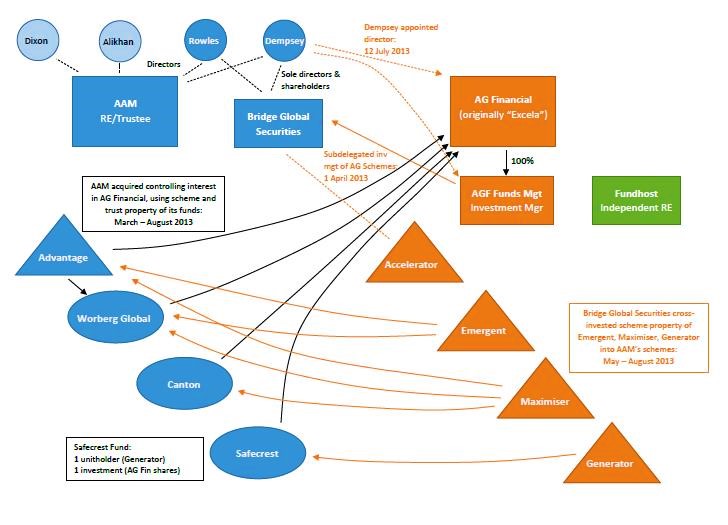
(b) of $125,000, out of the scheme property of the Generator Fund into the Safecrest Fund on 2 August 2013,
to Avestra in its capacity as trustee of the Safecrest Fund, a related party of Bridge Global Securities, without obtaining approval of the members of the Generator Fund in accordance with ss 217-227 of the Act. Rowles was thereby involved in contraventions by Bridge Global Securities of s 208(1) (as modified by s 601LC) of the Act, and thereby contravened s 209(2) (as modified by s 601LA) of the Act on each occasion.
(e) Substantial shareholder notice contraventions
27. Rowles made, or authorised the making of, statements contained in substantial shareholder notices that Avestra gave to the ASX Limited on 5 April 2013, that were to Rowles’s knowledge misleading in a material respect, in that the notices disclosed only the voting power obtained by the Canton Fund and the Worberg Global Fund in AG Financial, and omitted to disclose the voting power in AG Financial that Avestra had obtained through the share purchases it made on 20 and 21 March 2013, in contravention of s 1308(2) of the Act.
28. Rowles failed to take all steps that a reasonable person would take, if they were in Rowles’s position, to ensure that Avestra did not acquire relevant interests in AG Financial in contravention of s 606(1) of the Act:
(a) between 20 and 21 March 2013;
(b) on 30 May 2013; and
(c) between 24 June 2013 and 2 August 2013;
and Rowles thereby contravened s 601FD(1)(f)(i) of the Act on each occasion.
29. Rowles failed to take all steps that a reasonable person would take, if they were in Rowles’s position, to ensure that Avestra did not fail:
(a) to give the required information about a substantial holding in AG Financial between 26 March 2013 and 5 April 2013;
(b) to lodge a substantial shareholding notice in respect of AG Financial on or around 3 June 2013; and
(c) to give the required information about a substantial holding in AG Financial between 6 July 2013 and 6 August 2013,
in contravention of s 671B(1) of the Act, and Rowles thereby contravened s 601FD(1)(f)(i) of the Act on each occasion.
(f) The Avestra loans
30. Rowles authorised the advancement of each of the loans by Avestra from the Avestra Credit Fund to itself referred to in paragraph 8, was thereby involved in Avestra’s contraventions of s 208(1) (as modified by s 601LC) of the Act, and thereby contravened s 209(2) (as modified by s 601LA) of the Act on each occasion.
(g) The AG Financial loans
31. Rowles authorised the advancement of each of the loans by Avestra from the Avestra Credit Fund to AG Financial referred to in paragraphs 9 and 10, was thereby involved in Avestra’s contraventions of s 208(1) (as modified by s 601LC) of the Act, and thereby contravened s 209(2) (as modified by s 601LA) of the Act on each occasion.
(h) Investments of scheme property of the Accelerator Fund into the Avestra Credit Fund
32. Rowles authorised the making of each of the investments by Avestra from the Accelerator Fund to the Avestra Credit Fund referred to in paragraph 11, was thereby involved in Avestra’s contraventions of s 208(1) (as modified by s 601LC) of the Act, and thereby contravened s 209(2) (as modified by s 601LA) of the Act on each occasion.
33. Rowles authorised the cash investments from the Accelerator Fund into the Avestra Credit Fund referred to in paragraph 12, and was thereby involved in Avestra’s contravention of s 601FC(1)(c) of the Act, in contravention of s 601FC(5) of the Act.
(i) The Zenith loan agreement
34. Rowles authorised Avestra’s entry into a loan agreement with, and advancing US$6.0 million to, Zenith City Investments Ltd out of the Avestra Credit Fund on or around 6 May 2014, without having taken reasonable steps to ensure that Avestra had carried out adequate due diligence and obtained adequate security in respect of the loan, and in so doing failed to exercise his powers and discharge his duties with the degree of care and diligence that a reasonable person would exercise if they were a director or officer of a corporation in Avestra’s circumstances and occupied the office held by Rowles, and had the same responsibilities within the corporation as Rowles, in contravention of s 180(1) of the Act.
(j) Failure to provide monthly reports for the AG Schemes
35. Rowles failed to take all steps that a reasonable person would take, if they were in Rowles’s position, to ensure that Avestra complied with s 912A(1)(a) of the Act by providing regular investor reports to members of the Accelerator, Emergent, Generator and Maximiser Funds, and thereby contravened s 601FD(1)(f)(i) of the Act from 30 January 2014.
(k) Non-disclosure, or inadequate disclosure, of change of investment mandate of the AG Schemes
36. Rowles failed to take all steps that a reasonable person would take, if they were in Rowles’s position, to ensure that Avestra complied with s 1017B(1) of the Act with regard to the changed investment risk of the Maximiser, Accelerator and Generator Funds, and thereby contravened s 601FD(1)(f)(i) of the Act from 30 January 2014 in respect of the Maximiser Fund, and from no later than 2 September 2014 in respect of each of the Accelerator and Generator Funds.
(l) Offshoring of the Canton Fund as the Bridge Global CMC Fund and cross-investments into the Canton Fund
37. Rowles authorised the making of the transfers and redemptions referred to in paragraph 15, and was thereby involved in Avestra’s contravention of s 208(1) (as modified by s 601LC) of the Act, in contravention of s 209(2) (as modified by s 601LA) of the Act.
38. Rowles authorised the making of each of the investments referred to in paragraph 16, was thereby involved in Avestra’s contraventions of s 208(1) (as modified by s 601LC) of the Act, and thereby contravened s 209(2) (as modified by s 601LA) of the Act on each occasion.
(m) In specie redemptions from the Worberg Global Fund and reinvestment of scheme property of the Emergent and Maximiser Funds into the Hanhong High-Yield Fund
39. Rowles authorised the redemptions and investments referred to in paragraph 17, and was thereby involved in Avestra’s contravention of s 601FC(1)(b), in contravention of s 601FC(5) of the Act.
(n) Management of conflicts of interest
40. Rowles failed to take all steps that a reasonable person in Rowles’s position would have taken to ensure that Avestra did not contravene s 912A(1)(aa) of the Act, and thereby contravened s 601FD(1)(f)(i) of the Act between 20 March 2013 and 6 January 2015.
Declarations of contravention by Dempsey
(a) Direct use of scheme property of the Advantage Fund to acquire shares in AG Financial
41. Clayton Dempsey (Dempsey) was knowingly concerned in each of the acquisitions of shares referred to in paragraphs 1 and 2, and was thereby involved in Avestra’s contraventions of s 208(1) (as modified by s 601LC) of the Act, and thereby contravened s 209(2) (as modified by s 601LA) of the Act on each occasion.
42. Dempsey was knowingly concerned in the acquisitions of shares referred to in paragraph 3, and was thereby involved in Avestra’s contravention of s 601FC(1)(c) of the Act, in contravention of s 601FC(5) of the Act.
(b) Indirect use of scheme property of the Advantage Fund to acquire shares in AG Financial
43. Dempsey was knowingly concerned in each of the acquisitions of shares referred to in paragraphs 4 and 5, and was thereby involved in Avestra’s contraventions of s 208(1) (as modified by s 601LC) of the Act, and thereby contravened s 209(2) (as modified by s 601LA) of the Act on each occasion.
(c) Use of scheme and trust property of the Canton and Safecrest Funds to acquire shares in AG Financial
44. Dempsey was knowingly concerned in each of the transactions on behalf of the Canton and Safecrest Funds referred to in paragraphs 6 and 7, and in so doing failed to exercise his powers and discharge his duties with the degree of care and diligence that a reasonable person would exercise if they were a director or officer of a corporation in Avestra’s circumstances and occupied the office held by Dempsey, and had the same responsibilities within the corporation as Dempsey, in contravention of s 180(1) of the Act.
(d) Investment of scheme property of the Emergent, Generator and Maximiser Funds into the Advantage, Canton, Worberg Global and Safecrest Funds
45. Dempsey was knowingly concerned in Bridge Global Securities, as an agent of the responsible entity of the Emergent and Maximiser Funds, giving financial benefits, namely cash investments:
(a) of $600,000 cash, out of the scheme property of the Emergent Fund into the Advantage Fund on 1 May 2013;
(b) of $1.6 million, out of the scheme property of the Maximiser Fund into the Advantage Fund on 1 May 2013; and
(c) of $400,000, out of the scheme property of the Maximiser Fund into the Advantage Fund between 1 and 2 July 2013,
to Avestra in its capacity as responsible entity of the Advantage Fund, a related party of Bridge Global Securities, without obtaining approval of the members of the Emergent and Maximiser Funds in accordance with ss 217-227 of the Act. Dempsey was thereby involved in contraventions by Bridge Global Securities of s 208(1) (as modified by s 601LC) of the Act, and thereby contravened s 209(2) (as modified by s 601LA) of the Act on each occasion.
46. Dempsey was knowingly concerned in Bridge Global Securities, as an agent of the responsible entity of the Maximiser Fund, giving a financial benefit, namely a cash investment of $380,000, out of the scheme property of the Maximiser Fund into the Canton Fund on 1 August 2013, to Avestra, in its capacity as trustee of the Canton Fund, a related party of Bridge Global Securities, without obtaining approval of the members of the Maximiser Fund in accordance with ss 217-227 of the Act. Dempsey was thereby involved in Bridge Global Securities’ contravention of s 208(1) (as modified by s 601LC) of the Act, and thereby contravened s 209(2) (as modified by s 601LA) of the Act.
47. Dempsey was knowingly concerned in Bridge Global Securities, as an agent of the responsible entity of the Emergent and Maximiser Funds, giving financial benefits, namely cash investments:
(a) of $616,560, out of the scheme property of the Emergent Fund into the Worberg Global Fund on 1 May 2013;
(b) of $1.64 million, out of the scheme property of the Maximiser Fund into the Worberg Global Fund on 1 May 2013; and
(c) of $383,520, out of the scheme property of the Maximiser Fund into the Worberg Global Fund between 1 and 2 July 2013,
to Avestra, in its capacity as trustee of the Worberg Global Fund, a related party of Bridge Global Securities, without obtaining approval of the members of the Emergent and Maximiser Funds in accordance with ss 217-227 of the Act. Dempsey was thereby involved in contraventions by Bridge Global Securities of s 208(1) (as modified by s 601LC) of the Act, and thereby contravened s 209(2) (as modified by s 601LA) of the Act on each occasion.
48. Dempsey was knowingly concerned in Bridge Global Securities, as an agent of the responsible entity of the Generator Fund, giving financial benefits, namely cash investments:
(a) of $300,000, out of the scheme property of the Generator Fund into the Safecrest Fund between 1 and 2 July 2013; and
(b) of $125,000, out of the scheme property of the Generator Fund into the Safecrest Fund on 2 August 2013,
to Avestra, in its capacity as trustee of the Safecrest Fund, a related party of Bridge Global Securities, without obtaining approval of the members of the Generator Fund in accordance with ss 217-227 of the Act. Dempsey was thereby involved in contraventions by Bridge Global Securities of s 208(1) (as modified by s 601LC) of the Act, and thereby contravened s 209(2) (as modified by s 601LA) of the Act on each occasion.
(e) Substantial shareholder notice contraventions
49. Dempsey failed to take all steps that a reasonable person would take, if they were in Dempsey’s position, to ensure that Avestra did not acquire relevant interests in AG Financial in contravention of s 606(1) of the Act:
(a) between 20 and 21 March 2013;
(b) on 30 May 2013; and
(c) between 24 June 2013 and 2 August 2013,
and thereby contravened s 601FD(1)(f)(i) of the Act on each occasion.
50. Dempsey failed to take all steps that a reasonable person would take, if they were in Dempsey’s position, to ensure that Avestra did not fail:
(a) to give the required information about a substantial holding in AG Financial between 26 March 2013 and 5 April 2013;
(b) to lodge a substantial shareholding notice in respect of AG Financial on or around 3 June 2013; and
(c) to give the required information about a substantial holding in AG Financial between 6 July 2013 and 6 August 2013,
in contravention of s 671B(1) of the Act, and thereby contravened s 601FD(1)(f)(i) of the Act on each occasion.
(f) The Avestra loans
51. Dempsey authorised the advancement of each of the loans by Avestra from the Avestra Credit Fund to itself referred to in paragraph 8, was thereby involved in Avestra’s contraventions of s 208(1) (as modified by s 601LC) of the Act, and thereby contravened s 209(2) (as modified by s 601LA) of the Act on each occasion.
(g) The AG Financial loans
52. Dempsey authorised the advancement of each of the loans by Avestra from the Avestra Credit Fund to AG Financial referred to in paragraphs 9 and 10, was thereby involved in Avestra’s contraventions of s 208(1) (as modified by s 601LC) of the Act, and thereby contravened s 209(2) (as modified by s 601LA) of the Act on each occasion.
(h) Investments of scheme property of the Accelerator Fund into the Avestra Credit Fund
53. Dempsey authorised the making of each of the investments by Avestra from the Accelerator Fund to the Avestra Credit Fund referred to in paragraph 11, was thereby involved in Avestra’s contraventions of s 208(1) (as modified by s 601LC) of the Act, and thereby contravened s 209(2) (as modified by s 601LA) of the Act on each occasion.
54. Dempsey authorised the cash investments from the Accelerator Fund into the Avestra Credit Fund referred to in paragraph 12, and was thereby involved in Avestra’s contravention of s 601FC(1)(c) of the Act, in contravention of s 601FC(5) of the Act.
(i) The Zenith loan agreement
55. Dempsey authorised Avestra’s entry into a loan agreement with, and advancing US$6.0 million to, Zenith City Investments Ltd out of the Avestra Credit Fund on or around 6 May 2014, without having taken reasonable steps to ensure that Avestra had carried out adequate due diligence and obtained adequate security in respect of the loan, and in so doing failed to exercise his powers and discharge his duties with the degree of care and diligence that a reasonable person would exercise if they were a director or officer of a corporation in Avestra’s circumstances and occupied the office held by Dempsey, and had the same responsibilities within the corporation as Dempsey, in contravention of s 180(1) of the Act.
(j) Failure to provide monthly reports for the AG Schemes
56. Dempsey failed to take all steps that a reasonable person would take, if they were in Dempsey’s position, to ensure that Avestra complied with s 912A(1)(a) of the Act by providing regular investor reports to members of the Accelerator, Emergent, Generator and Maximiser Funds, and thereby contravened s 601FD(1)(f)(i) of the Act from 30 January 2014.
(k) Non-disclosure, or inadequate disclosure, of change of investment mandate of the AG Schemes
57. Dempsey failed to take all steps that a reasonable person would take, if they were in Dempsey’s position, to ensure that Avestra complied with s 1017B(1) of the Act with regard to the changed investment risk of the Maximiser, Accelerator and Generator Funds, and thereby contravened s 601FD(1)(f)(i) of the Act from 7 February 2014 in respect of the Maximiser Fund, and from no later than 2 September 2014 in respect of each of the Accelerator and Generator Funds.
(l) Offshoring of the Canton Fund as the Bridge Global CMC Fund and cross-investments into the Canton Fund
58. Dempsey authorised the making of the transfers and redemptions referred to in paragraph 15, and was thereby involved in Avestra’s contravention of s 208(1) (as modified by s 601LC) of the Act, in contravention of s 209(2) (as modified by s 601LA) of the Act.
59. Dempsey was knowingly concerned in the making of each of the investments referred to in paragraph 16, was thereby involved in Avestra’s contraventions of s 208(1) (as modified by s 601LC) of the Act, and thereby contravened s 209(2) (as modified by s 601LA) of the Act on each occasion.
(m) In specie redemptions from the Worberg Global Fund and reinvestment of scheme property of the Emergent and Maximiser Funds into the Hanhong High-Yield Fund
60. Dempsey authorised the redemptions and investments referred to in paragraph 17, and was thereby involved in Avestra’s contravention of s 601FC(1)(b), in contravention of s 601FC(5) of the Act.
(n) Management of conflicts of interest and Dempsey’s conduct as a member of the compliance committee
61. In his role as the sole executive member of Avestra’s compliance committee for the Advantage Fund and for the AG Schemes (from 30 January 2014), Dempsey failed to inform the compliance committee of numerous conflicts of interest and potential contraventions of the Act arising in connection with Avestra’s operation of the Advantage Fund and the AG Schemes, and thereby failed to exercise the degree of care and diligence that a reasonable person would exercise if they were in Dempsey’s position, in contravention of s 601JD(1)(b) of the Act between 20 March 2013 and 1 February 2015.
AND THE COURT ORDERS THAT:
62. Pursuant to s 1324(1) of the Act, Rowles be restrained, whether by himself, his servants, agents and employees or otherwise, from:
(a) carrying on a business related to, concerning or directed to financial products or financial services within the meaning of s 761A of the Act;
(b) providing financial product advice within the meaning of s 761A of the Act; or
(c) dealing in financial products within the meaning of s 761A of the Act,
for ten years from the date of this order.
63. Pursuant to ss 206C(1) and/or 206E(1) of the Act, Rowles be disqualified from managing corporations for ten years from the date of this order.
64. Pursuant to s 1324(1) of the Act, Dempsey be restrained, whether by himself, his servants, agents and employees or otherwise, from:
(a) carrying on a business related to, concerning or directed to financial products or financial services within the meaning of s 761A of the Act;
(b) providing financial product advice within the meaning of s 761A of the Act; or
(c) dealing in financial products within the meaning of s 761A of the Act,
for ten years from the date of this order.
65. Pursuant to ss 206C(1) and/or 206E(1) of the Act, Dempsey be disqualified from managing corporations for ten years from the date of this order.
66. There be no order for costs as between ASIC and Avestra and Rowles.
67. Dempsey pay ASIC’s costs of the proceeding fixed in the sum of $25,000.
Note: Entry of orders is dealt with in Rule 39.32 of the Federal Court Rules 2011.
BEACH J:
1 ASIC has brought the present proceedings against the corporate defendant and some of its former directors seeking declarations, injunctions and disqualification orders for, inter alia, contraventions of ss 180, 208(1) (modified by s 601LC), 209(2) (modified by s 601LA), 601FC, 601FD, 606, 671B, 912A, 1017B and 1308 of the Corporations Act 2001 (Cth) (the Act). Let me explain the context.
2 In March 2013, the first defendant, Avestra Asset Management Ltd (in liquidation) (Avestra) sought to obtain a majority interest in the shares of Excela Ltd, now known as Ennox Group Ltd, but between 29 November 2013 and 13 April 2016 known as AG Financial Ltd (AG Financial). AG Financial was an ASX-listed company whose subsidiaries were engaged in funds management and stockbroking. Avestra’s intention was to achieve a merger of the businesses of the Avestra group and the AG Financial group and in essence to achieve a back door listing for Avestra.
3 Avestra acquired an initial interest of 22% in AG Financial through off-market transactions with Peter Spann, the CEO of AG Financial. Several directors of Avestra, being the second defendant, Paul Rowles (Rowles), and the third defendant, Clayton Dempsey (Dempsey), also purchased smaller shareholdings in AG Financial for their respective superannuation funds, as did other entities associated with Avestra and its other directors.
4 In initiating and completing this strategy, Avestra did not use its own financial resources. Rather, it used funds that it held on trust as property of its sole registered managed investment scheme at the time and various unregistered wholesale managed investment schemes of which it was the responsible entity or trustee. Those transactions involved a conflict of interest between:
(a) Avestra’s own interest, being the pursuit of its objective of seeking to grow and benefit the business it conducted in its own right through acquiring and merging with AG Financial; and
(b) the interests of the members of its registered and wholesale schemes; their interests were to have scheme property invested in the best interests of scheme members, consistently with the investment objectives and risks that had been disclosed in relevant product disclosure statements and information memoranda.
5 Avestra purchased shares in AG Financial with such members’ funds in disregard of that conflict and without disclosing the proposed purchase to, or obtaining approval from, members of those schemes whose property Avestra had used to carry out its acquisition. Avestra also contravened the s 606 prohibition on acquiring more than 20% of voting shares in a listed company (s 606(1)(a)(i)) without making a takeover offer. That consequence was also facilitated by Avestra’s failure to disclose the extent of its own relevant interest(s) (as opposed to each scheme’s separate interests) in the voting shares of AG Financial.
6 And so began an extensive sequence of conflicts of interest and contraventions of the Act that followed throughout 2013 and 2014 by Avestra, Rowles and Dempsey.
7 Avestra’s conduct and that of Rowles and Dempsey throughout the relevant period demonstrated a systematic disregard of the conflicts of interest inherent in the transactions that Avestra carried out through its registered and wholesale investment schemes. In essence, Avestra repeatedly failed to:
(a) obtain member approval for related party transactions carried out directly or indirectly using scheme property;
(b) act in the best interests of members of the schemes and in particular to give priority to members’ interests in the event of a conflict with Avestra’s own interests; and
(c) ensure that Avestra did all things necessary to provide financial services efficiently, honestly and fairly.
8 A related failure of Avestra was that it failed to make appropriate or required disclosure to members of the schemes, particularly members of its registered managed investment scheme(s) pre and post its AG Financial acquisition strategy. In fact, Avestra took steps that had the effect of concealing matters from those investors. In particular:
(a) Avestra did not disclose or seek member approval of related party transactions; and
(b) Avestra carried out certain transactions in a manner that made the true use of scheme property invisible to any enquiring fund member.
9 Another feature of Avestra’s conduct was that the scheme property of a group of registered schemes known as the “AG Schemes” (I will elaborate on the detail of the AG Schemes later) became heavily invested in Malaysian shares and equity derivatives, including securities in a number of companies listed on the second-board “ACE market” of Bursa Malaysia. But except in the case of the Emergent Fund (one of the AG Schemes), the product disclosure statements for the AG Schemes had not disclosed that those funds would invest heavily in emerging-markets securities. Avestra did not give meaningful or adequate notification of the material changes in investment risk to members of those schemes. Moreover, after a sequence of in specie investments and redemptions between the AG Schemes and two Cayman Islands funds established in 2014 (the Bridge Global CMC Fund and the Hanhong High-Yield Fund), three of the four AG Schemes were left in early 2015 with very substantial and concentrated direct holdings of Malaysian shares and equity derivatives in a limited number of companies, including ACE market-listed companies.
10 Further, Avestra’s repeated engagement in undisclosed related party transactions, and its failure to act appropriately in the best interests of scheme members, resulted in the investment portfolios of the Accelerator and Maximiser Funds (two of the AG Schemes) becoming heavily exposed to high-risk investments that were at odds with the investment strategy and risks that had been presented to the retail investors in those schemes.
11 Generally, the conduct of Avestra was not in the best interests of scheme members, and appears to have been undertaken for the purpose of avoiding its statutory obligations and regulatory oversight. Regardless, objectively assessed, it was undertaken in contravention of the statutory protections for related party transactions and the behavioural standards of responsible entities.
12 A further dimension to Avestra’s conduct and the problems that occurred arose from its ability and predilection to invest the property from its registered scheme(s) in unregistered schemes. It is notable that prior to 2007 a registered managed investment scheme was prohibited from investing scheme property in any managed investment scheme that was not itself registered under s 601EB: former s 601FC(4). That prohibition was originally imposed to prevent a responsible entity from avoiding the scheme property protections that applied to registered schemes by investing the scheme property of a registered scheme into an unregistered managed investment scheme. For reasons that attracted itself to others, that prohibition was lifted in 2007 by the Corporations Legislation Amendment (Simpler Regulatory System) Act 2007 (Cth), Sch 1, cl 66 in the context of the following optimistic sentiment:
Increasingly registered managed investment schemes seek to diversify their investments among a range of foreign collective investment structures or focus on overseas investments. Generally such investment is not for the purpose of avoiding regulation and is directed to the best interests of members. (Explanatory memorandum to the Corporations Legislation Amendment (Simpler Regulatory System) Bill 2007 (Cth) at [1.38])
13 Further, as to the relevant individuals that ASIC has pursued, by reason of their involvement in Avestra’s conduct, both Rowles and Dempsey fell significantly short of the standards expected of directors of a responsible entity and of a financial services licensee.
the present proceedings
14 Before delving further into the detail of this matter, it is convenient to set out the background of the litigation.
(a) Provisional liquidation and liquidation of Avestra
15 On 9 September 2015, ASIC filed its originating process seeking orders that Avestra be wound up and that an official liquidator be appointed for the purposes of that winding up on the s 461(1)(k) ground of the Act that it was just and equitable to do so. The originating process also sought interim orders for the appointment of a provisional liquidator to Avestra pursuant to s 472(2).
16 ASIC alleged that Avestra was unfit to continue to act as a responsible entity or as a trustee of any managed investment schemes. ASIC sought a provisional liquidator to assume control over Avestra and its managed investment schemes, and to report to the Court and ASIC on matters including Avestra’s assets and liabilities, scheme assets controlled by it, and whether each of the schemes should be wound up or should continue to operate.
17 ASIC alleged that Avestra’s unfitness was demonstrated by the following matters:
(a) First, there had been persistent failures to recognise, and to appropriately resolve, conflicts between the interests of Avestra and its associates, and the interests of scheme members.
(b) Second, there were reasonable grounds to suspect that Avestra had committed multiple contraventions of the Act which related in essence to prohibitions on, and the obligation to manage or prevent conflicts of interests.
(c) Third, there had been repeated investments of scheme property of retail schemes into wholesale funds operated by Avestra or its associates, both in Australia and in the Cayman Islands.
(d) Fourth, one of the two central individuals responsible for Avestra’s conduct accepted that Avestra lacked expertise to operate the schemes.
(e) Fifth, there had been grossly inadequate supervision of key investment decisions.
(f) Sixth, there were considerably deficient conflict management procedures at Avestra and its related fund manager entities.
(g) Seventh, there had been a lack of disclosure to scheme members, both as to the conflicts of interest associated with the transactions involving Avestra and its schemes, and as to the composition of the schemes’ investment portfolios.
(h) Eighth, there had been multiple instances of failure to supply information formally requested by ASIC under various statutory notices.
18 On 27 October 2015, I made an order pursuant to s 472(2) of the Act appointing Simon Alexander Wallace-Smith of Deloitte Touche Tohmatsu and Richard Hughes of Deloitte Touche Tohmatsu as joint and several provisional liquidators of Avestra. My orders also directed the provisional liquidators to provide to the Court and to ASIC within 42 days of their appointment a report as to the provisional liquidation of Avestra. That report was to address matters including the assets and liabilities of Avestra and any suspected contraventions of the Act by Avestra or any of its current or former directors or any other person, whether in relation to any of Avestra’s schemes or otherwise. I adjourned the further hearing of ASIC’s originating process and its interlocutory application to 11 December 2015.
19 On 7 December 2015, the provisional liquidators issued their report on the provisional liquidation of Avestra. That report recommended, inter alia, the winding up of the Advantage Fund, the Accelerator Fund, the Emergent Fund, the Generator Fund and the Maximiser Fund. In light of that report, on 11 December 2015 ASIC filed an interlocutory application seeking an order pursuant to s 601ND(1)(a) of the Act that Avestra wind up each of the aforementioned registered schemes on the basis that it would be just and equitable to do so. On 11 December 2015, I made the order sought for the winding up of those registered schemes and also ordered under s 601NF(1) of the Act that the provisional liquidators be appointed to take responsibility for ensuring that each scheme be wound up in accordance with its constitution and for any orders that may be made under s 601NF(2). I adjourned the originating process to 19 February 2016.
20 On 17 February 2016, the provisional liquidators issued a further report which provided an update on the progress of the provisional liquidation of Avestra and the windings up of the Advantage Fund, the Accelerator Fund, the Emergent Fund, the Generator Fund and the Maximiser Fund. The provisional liquidators recommended that Avestra be placed into liquidation.
21 On 19 February 2016, I made orders for the winding up of Avestra on the basis that it was just and equitable to do so. The provisional liquidators were appointed as joint and several liquidators of Avestra. I also granted leave to ASIC to amend the originating process and to proceed against Avestra in liquidation.
(b) Enforcement proceedings against the parties
22 On 21 April 2016, ASIC filed an interlocutory application seeking orders to join Rowles and Dempsey as the second and third defendants respectively. ASIC’s application also sought, in essence, to amend the originating application to seek relief in the form of declarations of contraventions against Avestra, Rowles and Dempsey, and disqualification orders and injunctions against Rowles and Dempsey.
23 On 29 April 2016, I granted the orders sought by ASIC in its interlocutory application. ASIC subsequently filed an amended originating process together with a concise statement which set out the basis for the relief sought against the defendants. Subsequently, the matter then proceeded on pleadings.
24 On 25 November 2016, I set the matter down for trial on 24 April 2017 on an estimate of five days.
25 On or around 6 March 2017, ASIC and Rowles reached a settlement between them on the question of liability. On or around 20 April 2017, ASIC and Dempsey also reached a settlement on the question of liability. The parties agreed on proposed orders and declarations of contravention. Given that ASIC had resolved its claims on liability against Rowles and Dempsey, the trial date was vacated and the parties sought a hearing on the question of relief. That hearing was held on 26 April 2017.
26 Before me, a consolidated statement of agreed facts between ASIC, Rowles and Dempsey was tendered and relied upon pursuant to s 191 of the Evidence Act 1995 (Cth). Its content is too lengthy to reproduce in these reasons. I have summarised various aspects of the consolidated statement in the following sections of my reasons.
27 Before proceeding further, I should also note that I have had the benefit of detailed written submissions from Mr Jonathon Moore QC, with Mr Tom Clarke, counsel for ASIC. Their submissions display notable thoroughness and sophistication.
the relevant entities, individuals and schemes
(a) Avestra
28 Avestra was a licensed provider of financial services and the responsible entity and/or trustee of several investment funds.
29 During the period between 20 March 2013 and 1 February 2015, Avestra’s directors were Rowles who resigned on 6 January 2015, Dempsey, Rizwan Alikhan (Alikhan) and Jason Dixon (Dixon).
30 Under its Australian Financial Services Licence (AFSL), Avestra was licensed to provide general financial product advice for certain classes of financial products, deal in certain classes of financial products and operate specified registered managed investment schemes.
(b) Rowles and Dempsey
31 Avestra’s business and operations were primarily overseen by Rowles and Dempsey. Rowles was principally responsible for making investment decisions for Avestra’s various funds. Dempsey was principally responsible for compliance and administration matters.
32 The offices held by Rowles included director of Avestra at all relevant times until 6 January 2015, responsible manager under Avestra’s AFSL, director of Bridge Global Securities Pty Ltd (Bridge Global Securities) from 31 August 2011 to 9 July 2014 and then again from 20 August 2014 until 23 February 2015, director of Bridge Global Asset Management Ltd from 10 March 2014 and director of Bridge Global Absolute Return Fund SPC from 26 February 2014.
33 The offices held by Dempsey included director of Avestra, responsible manager under Avestra’s AFSL, member of Avestra’s compliance committee, director of Bridge Global Securities until 9 July 2014, director of AG Financial Ltd from 12 July 2013 until 24 September 2015 and director of AGF Funds Management Pty Ltd from 12 July 2013 until 28 September 2015.
(c) Avestra’s registered and wholesale funds
34 These proceedings concerns the following managed investment schemes of which Avestra was responsible entity or trustee:
Avestra-established registered scheme | Avestra’s wholesale schemes | The AG Schemes (Avestra took over as responsible entity of the AG Schemes on 30 January 2014) (registered schemes) |
Advantage Fund | Worberg Global Fund Canton Fund Safecrest Fund Avestra Credit Fund | Accelerator Fund Emergent Fund Generator Fund Maximiser Fund |
The Advantage Fund
35 The Avestra Advantage Fund (the Advantage Fund) was registered with ASIC on 16 April 2009. Avestra has been responsible entity of the Advantage Fund since its inception.
36 The replacement product disclosure statement (PDS) for the Advantage Fund, issued on 19 December 2012, indicated that the fund had a broad investment mandate:
The Fund will invest in listed Australian and international shares, Australian and International Exchange Traded Funds, hybrid securities, and option, Derivatives including Futures, CFDs and Margin Foreign Exchange including Exchange Traded and Over The Counter Products, either directly or by investing in other approved funds.
37 The Constitution of the Advantage Fund includes the following provisions, regarding the responsible entity’s ability to be interested in any transactions of or with the fund:
11.3 Investment powers
… [T]he Manager may in its capacity as trustee or responsible entity of the Trust invest in, dispose of or otherwise deal with property and rights in its absolute discretion. This includes the power to invest the whole or part of the Assets in related or like trusts or such other investments as the Manager determines.
16.3 Other capacities
Subject to the Corporations Act, if the Corporations Act applies, the Manager (or its associates) may:
(a) deal with itself (as trustee or responsible entity of the Trust or in another capacity), or with any of its associates or with any Member;
(b) be interested in any contract or transaction with itself (as trustee or responsible entity of the Trust or in another capacity) or with any Member or retain for its own benefit any profits or benefits derived from any such contract or transaction; or
(c) act in the same or a similar capacity in relation to any other managed investment scheme.
(footnotes omitted)
38 Apart from sizeable cross-investments from the Canton, Emergent and Maximiser Funds, the unitholders in the Advantage Fund were otherwise made up primarily of individuals and self-managed superannuation funds.
39 The Advantage Fund’s unit price decreased from $0.75 as at 31 October 2014 to $0.43 as at 30 June 2015.
The Canton Fund
40 The Canton Mackenzie Fund (the Canton Fund) was a wholesale scheme. It had previously been a registered scheme until December 2012. Avestra became the responsible entity and trustee of the Canton Fund in October 2012.
41 The PDS for the Canton Fund issued on 22 May 2013 stated that the Canton Fund would invest across a broad range of assets, including Malaysian, Australian and Hong Kong equities:
The Canton Mackenzie Fund invests across a range of assets including Malaysian IPO’s, Australian listed securities (including shares and Exchange Traded Funds), Hong Kong equities, fixed interest securities, managed investment schemes, hybrid securities, derivatives and cash. Derivatives will also be actively utilised in the risk management process and as an alternate to buying and selling a physical security.
42 The Canton Fund invested a substantial part of its net assets directly or indirectly in Malaysian shares and equity derivatives. As at 28 February 2014, approximately 32% of its net assets were invested directly in Malaysian shares, 44% were invested in the Worberg Global Fund and 20% were invested in the Advantage Fund (which was almost entirely invested in the Worberg Global Fund).
43 On around 1 May 2014, the Canton Fund was closed down, and unitholdings in, and the investments of, the Canton Fund, were transferred offshore to the Bridge Global CMC Fund.
The Worberg Global Fund
44 Avestra was the trustee of the Worberg Global Fund from at least March 2012. Bridge Global Securities was its fund manager.
45 In the information memorandum issued on 23 March 2012, the Worberg Global Fund was described as having a broad investment mandate:
The Fund may trade, variously, in listed Australian shares, Australian exchange traded funds, hybrid securities, fixed income securities, real property and derivatives products including, but not limited to, margin foreign exchange products, over the counter equity derivatives in global markets and exchange traded futures and options and/or managed investment schemes and unlisted companies.
46 At all relevant times, the unitholders in the Worberg Global Fund were wholly comprised of the Advantage and Canton Funds, the Emergent and Maximiser Schemes, Bridge Global Securities, AG Financial and the Bridge Global CMC Fund.
47 The Worberg Global Fund invested a substantial part of its net assets directly or indirectly in Malaysian shares and equity derivatives. As at 17 March 2014, approximately 75% of its net assets were invested directly in Malaysian shares and equity derivatives.
48 Between 1 April and 1 September 2014, the Worberg Global Fund was wound down by a sequence of in specie distributions to unitholders.
The Safecrest Fund
49 The Safecrest Capital Fund (the Safecrest Fund) was established as a trust by Avestra on or around 11 April 2013. On 2 July 2013, it received its first investment out of the scheme property of the Generator Fund.
50 At all times between July and December 2013, the Safecrest Fund had only one unitholder, namely the Generator Fund, and held only one investment, being shares in AG Financial.
51 The Safecrest Fund was terminated on around 30 June 2014.
The Avestra Credit Fund
52 The Avestra Credit Fund was established as a trust by Avestra on or around 31 January 2014.
53 Between February and July 2014:
(a) cash investments of approximately $6 million were made into the Avestra Credit Fund, primarily by the Worberg, Canton, Accelerator and Bridge Global CMC Funds; and
(b) Avestra granted loans out of the Avestra Credit Fund in the total sum of approximately $7.3 million, including unsecured loans to itself and to AG Financial.
54 From 1 July 2014, all of the units in the Avestra Credit Fund were held by the Bridge Global CMC Fund.
55 Bridge Global Securities is an Australian proprietary company, which successively had the following names:
15 September 2008 – 25 March 2013 | Avestra Funds Management Pty Ltd |
26 March 2013 – 8 July 2014 | AFM Global Pty Ltd |
9 July 2014 – | Bridge Global Securities Pty Ltd |
56 Between 1 October 2012 and 14 July 2014, Bridge Global Securities was owned, as to 50% each, by CCSM Holdings Pty Ltd and PRHL Capital Pty Ltd, being companies of which Dempsey’s and Rowles’s wives were, respectively, the sole shareholder and director.
57 During the relevant period, the directors of Bridge Global Securities were:
9 March 2012 – 12 August 2013 | Rowles, Dempsey |
13 August 2013 – 8 July 2014 | Rowles, Dempsey, Dixon |
58 Bridge Global Securities was appointed by Avestra as fund manager for the Advantage, Worberg Global and Avestra Credit Funds.
59 On 1 April 2013, shortly after Avestra’s initial purchases of shares in AG Financial, Bridge Global Securities was appointed as investment sub-manager of each of the AG Schemes.
60 In this proceeding, ASIC alleged that, in its capacity as investment sub-manager for the Emergent and Maximiser Funds, Bridge Global Securities committed a number of contraventions of s 208(1) in which Rowles and Dempsey were involved. The fact of Bridge Global Securities having committed those contraventions was also relevant in that ASIC sought disqualification orders against Rowles and Dempsey under s 206E(1)(a)(i), among other provisions. ASIC has not sought declarations of contravention against Bridge Global Securities in respect of those contraventions as it is not a party to the proceeding.
(e) AG Financial and its associated companies
61 AG Financial is an ASX-listed public company, which successively has had the following names:
12 January 2010 – 28 November 2013 | Excela Ltd |
29 November 2013 – 13 April 2016 | AG Financial Ltd |
14 April 2016 – | Ennox Group Ltd |
62 AG Financial’s business was in stockbroking and funds management.
63 Prior to 20 March 2013, AG Financial was controlled by Peter Spann, its chief executive officer. Spann sold his entire shareholding in AG Financial on around 20 March 2013, which was when Avestra first began purchasing shares in AG Financial through its registered and wholesale funds.
64 On 20 March 2013, the incumbent directors of AG Financial (including Spann) resigned, and were replaced as directors by Yosse Goldberg, Delan Pagliaccio, John Margerison and Craig Burbury.
65 On 12 July 2013, Dempsey was appointed as a director of AG Financial, in place of Burbury.
66 AGF Funds Management Pty Ltd (AGF Funds Management) was a wholly-owned subsidiary of AG Financial. It was formerly named Excela Funds Management Pty Ltd, until 24 February 2014. It operated the funds management business within the AG Financial group. Most significantly, it was the fund manager of each of the AG Schemes appointed by Fundhost (the responsible entity of the AG Schemes), but subdelegated that role to Bridge Global Securities from 1 April 2013.
67 Yosse Goldberg, Delan Pagliaccio, Craig Burbury and John Margerison were appointed directors of AGF Funds Management on 20 March 2013, on the same date as their appointment as directors of AG Financial. Dempsey was appointed as a director of AGF Funds Management (alongside Goldberg and Pagliaccio) on 12 July 2013, on the same date that he was appointed as a director of AG Financial.
68 As noted above, the AG Schemes were the Accelerator Fund, the Emergent Fund, the Generator Fund and the Maximiser Fund.
69 Each of the AG Schemes was originally registered by Fundhost Ltd, which was the independent responsible entity of those funds until it was replaced by Avestra on 30 January 2014.
70 AGF Funds Management was the investment manager for each of the AG Schemes, but sub-delegated that role to Bridge Global Securities on 1 April 2013.
71 The Constitution of each of the AG Schemes contains the following provisions regarding the responsible entity’s ability to be interested in any transactions of or with the fund:
8.1 The manager may invest in any asset it chooses, subject to what it tells investors from time to time (for example, in the trust’s product disclosure statement or telling investors of any material change in investment policy in accordance with the Corporations Act).
17.7 Subject to the Corporations Act, the manager may:
(a) deal with itself (as trustee of the trust or in any other capacity), or any associate or any investor
(b) be interested in any contract or transaction with itself (as trustee of the trust or in another capacity), any associate or investor and
(c) act in the same or a similar capacity in relation to any other trust or managed investment scheme,
and retain any benefit or benefits from doing so.
The Accelerator Fund
72 The PDS issued by Fundhost for the Accelerator Fund in June 2012 described the fund’s investment mandate as follows:
The Fund primarily invests in shares within the S&P/ASX Top 50, however the Fund may at times also hold S&P/ASX Top 200 shares (or an equivalent index tracking fund) on an index weighted basis.
73 The Accelerator Fund’s unit price declined from $0.33 on 31 October 2014 to $0.17 on 30 June 2015.
74 As at 31 October 2015, there were approximately 128 unitholders in the Accelerator Fund, overwhelmingly comprised of individuals and self-managed superannuation funds.
75 As noted below, by 31 January 2015, approximately 76% of the assets of the Accelerator Fund were invested in Malaysian equities, of which 72% was invested in the shares of a single company, Asia Biotech Bhd.
The Emergent Fund
76 Unlike the Accelerator, Generator and Maximiser Funds, the Emergent Fund was established and promoted as an emerging markets fund. The PDS issued by Fundhost for the Emergent Fund in June 2012 described the fund’s investment mandate as follows:
Emergent invests in a portfolio of managed funds, direct equities, cash, fixed interest securities and possibly derivatives in order to gain exposure to emerging markets which are expected to grow more quickly and produce higher returns than the Australian market over the medium to long term,
77 The PDS also included specific disclosures of the investment risks associated with that investment mandate, including emerging markets risk, sovereign risk and foreign exchange risk.
78 The Emergent Fund’s unit price declined from $1.17 as at 31 October 2014 to $0.81 as at 30 June 2015.
79 As at 31 October 2015, there were approximately 85 unitholders in the Emergent Fund, overwhelmingly comprised of individuals and self-managed superannuation funds.
The Generator Fund
80 The PDS issued by Fundhost for the Generator Fund in November 2008 described the fund’s investment mandate as follows:
GENERATORTM will invest in a combination of Managed Funds, Listed Investment Companies and cash or fixed interest in accordance with its Portfolio Construction Guidelines.
81 The Generator Fund’s unit price declined from $0.45 on 31 October 2014 to $0.23 on 30 June 2015.
82 As at 31 October 2015, there were approximately 61 unitholders in the Generator Fund, overwhelmingly comprised of individuals and self-managed superannuation funds.
The Maximiser Fund
83 The PDS issued by Fundhost for the Maximiser Fund in June 2012 described the fund’s investment mandate as follows:
Maximiser will invest in a portfolio of managed funds, direct equities, and cash or fixed interest securities that the Investment Manager believes will provide a high level of growth return over the medium to long term.
84 The Maximiser Fund’s unit price declined from $0.95 on 31 October 2014 to $0.60 on 30 June 2015.
85 As at 31 October 2015, there were 123 unitholders in the Maximiser Fund, overwhelmingly comprised of individuals and self-managed superannuation funds.
86 By 31 January 2015, approximately 83% of the assets of the Maximiser Fund were invested indirectly in Malaysian equities, of which 43% was invested in the shares of Asia Biotech Bhd.
(g) The Cayman funds: Bridge Global CMC Fund and the Hanhong High-Yield Fund
The Bridge Global CMC Fund
87 The Bridge Global Absolute Return Fund Segregated Portfolio (the Bridge Global CMC Fund) was one of a number of segregated portfolio investment funds operated in the Cayman Islands by Bridge Global Absolute Return Fund SPC (Bridge Global SPC), a Cayman Islands company. The Bridge Global CMC Fund was established in April 2014.
88 Bridge Global SPC was wholly owned by Bridge Global Asset Management Ltd (BGAM), a Cayman Islands company which, from 7 March 2014, was owned as to 40% by Avestra. Around the time that the Bridge Global CMC Fund was established, BGAM went through a succession of name changes:
Prior to 20 February 2014 | Bridge Partners Investment Management (Cayman) Ltd |
20 February – 3 March 2014 | Connect Capital Asset Management Ltd |
3 March – 1 June 2014 | Avestra Global Asset Management Ltd |
1 June – 11 August 2014 | AG Global Asset Management Ltd |
11 August 2014 – | Bridge Global Asset Management Ltd |
89 From 26 February 2014 and 10 March 2014 respectively, the directors of Bridge Global SPC and BGAM were Rowles and Sze-Wei Samuel Goh (Goh).
The Hanhong High-Yield Fund
90 The Hanhong High-Yield Fund Segregated Portfolio (the Hanhong High-Yield Fund) was one of a number of segregated portfolio investment funds operated in the Cayman Islands by Hanhong (Cayman) SPC Ltd (Hanhong SPC), a Cayman Islands company. The Hanhong High-Yield Fund was established in around August 2014.
91 On 28 July 2014, Jason Dixon, Nicholas McDonald and Neil Sheather were appointed directors of Hanhong SPC, in addition to two other incumbent directors. At the time, Dixon was also a director of Avestra, and each of Dixon, McDonald and Sheather were also directors of Bridge Global Securities.
factual background
(a) The AG Financial takeover and cross-investments from the AG Schemes
92 AG Financial operated a listed funds management business. AG Financial’s subsidiary, AGF Funds Management, was the investment manager of the AG Schemes. Until 30 January 2014, the AG Schemes had an independent responsible entity, Fundhost.
93 During the period from March to August 2013, there were two groups of transactions that ASIC now contends gave rise to contraventions by Avestra, namely:
(a) Avestra’s acquisition of a controlling interest in the shares of AG Financial, using scheme and trust property of its registered and wholesale funds; and
(b) cross-investments, by Bridge Global Securities, of the scheme property of the Emergent, Maximiser and Generator Funds into Avestra’s wholesale schemes.
94 Those two groups of transactions are illustrated in the following diagram:
Avestra’s acquisitions of shares in AG Financial
95 In around March 2013, Avestra and its associates, including Rowles and Dempsey, embarked on obtaining a controlling stake in AG Financial, in order to effect a merger or consolidation of the Avestra and Excela businesses, and to realise a “back-door listing” of Avestra.
96 In a succession of purchases between 20 March 2013 and 2 August 2013, Avestra used funds that it held on trust for unitholders in registered and wholesale managed investment schemes, rather than Avestra’s own funds, to acquire a controlling stake in AG Financial and to realise that commercial objective for the benefit of Avestra and its shareholders. The most significant purchases were:
Date | Type of purchase | Advantage Fund | Worberg Global Fund | Canton Fund | Safecrest Fund | Avestra’s % interest (aggregate) |
20-21 March 2013 | Off-market from Spann | 230,000 | 2,000,000 | 4,400,000 | 22.2% | |
30 May | Placement | 4,200,000 | 31.8% | |||
3 July | On market | 500,000 | 33.5% | |||
4 July | On market | 500,000 | 35.0% | |||
12 July | Rights issue | 16,700,000 | 8,500,000 | 17,760,000 | 46.3% | |
19 July | Shortfall allocation | 9,000,000 | 21,000,000 | 7,500,000 | 56.0% | |
1 August | Off market | 500,000 | 56.2% |
97 Rowles and Dempsey now accept the following:
(a) First, each of those purchases of shares in AG Financial by the Advantage Fund involved the giving of a financial benefit out of the scheme property of the Advantage Fund to Avestra and/or AG Financial, without having obtained the approval of members of the Advantage Fund, in contravention of s 208(1) (as modified by s 601LC). Further, in making those purchases, Avestra was in a position of conflict of interest and failed to give priority to the interests of the members of the Advantage Fund, in contravention of s 601FC(1)(c).
(b) Second, each of those purchases of shares in AG Financial by the Worberg Global Fund involved the giving of a financial benefit indirectly out of the scheme property of the Advantage Fund (scheme property of which was invested in the Worberg Global Fund) to Avestra and/or AG Financial, without having obtained the approval of members of the Advantage Fund, in contravention of s 208(1) (as modified by s 601LC).
(c) Third, they were each involved in the making of each of those purchases, and so they personally contravened s 209(2) (as modified by s 601LA) in relation to each purchase, and contravened s 601FC(5) in relation to the purchases by the Advantage Fund.
(d) Fourth, in making each of those purchases of shares in AG Financial by the Canton and Safecrest Funds, Avestra failed to provide financial services efficiently, fairly and honestly, in contravention of s 912A(1)(a).
(e) Fifth, they failed to take reasonable steps to prevent Avestra committing those contraventions of s 912A(1)(a), and so personally contravened s 601FD(1)(f)(i).
98 When making those acquisitions of shares in AG Financial through its registered and wholesale schemes, Avestra committed contraventions of the substantial shareholder notice obligation (s 671B) and takeover prohibition (s 606(1)). Avestra was convicted of those offences on 16 December 2014. Accordingly, no declarations of contravention were sought against Avestra for the contraventions of which it already had been convicted. Each of Rowles and Dempsey does not dispute having contravened s 1308(2) by filing substantial shareholder notices that did not reflect the extent of Avestra’s (as opposed to the schemes’) relevant interest in AG Financial, and thereby omitted information without which they knew the notices to be false or misleading. Further, Rowles and Dempsey do not dispute that they failed to take reasonable steps to prevent Avestra committing those contraventions, and so contravened s 601FD(1)(f)(i) on each occasion.
99 As a consequence of Avestra acquiring a controlling interest in AG Financial through its registered and wholesale funds, Dempsey was appointed as a director of AG Financial and AGF Funds Management on 12 July 2013, AG Financial moved its principal place of business to the same premises as Avestra’s principal place of business, and Excela Ltd was renamed AG Financial Ltd and adopted a logo closely resembling Avestra.
Cross-investments from the AG Schemes into Avestra’s registered and wholesale funds
100 On 1 April 2013, less than two weeks after Avestra made its first acquisition of 22% of the voting shares in AG Financial, AG Financial’s subsidiary, AGF Funds Management, sub-delegated investment management of the AG Schemes to Bridge Global Securities, a company of which both Rowles and Dempsey were then the sole directors.
101 Thereafter, Bridge Global Securities began to invest scheme property of the Emergent, Maximiser and Generator Funds into Avestra’s registered and wholesale funds and, in so doing, supplied additional capital for Avestra’s funds to make further purchases of shares in AG Financial, and thereby to increase the extent of Avestra’s control over AG Financial.
Date | From AG Scheme | To Avestra fund | Amount invested |
1 May 2013 | Emergent | Advantage | $600,000 |
Emergent | Worberg Global | $616,560 | |
Maximiser | Advantage | $1,600,000 | |
Maximiser | Worberg Global | $1,640,000 | |
1-2 July 2013 | Generator | Safecrest | $300,000 |
Maximiser | Advantage | $400,000 | |
Maximiser | Worberg Global | $383,520 | |
1 August 2013 | Maximiser | Canton | $380,000 |
2 August 2013 | Generator | Safecrest | $125,000 |
102 On 1 May 2013, when the first of those cross-investments were made, Fundhost, which was then the responsible entity of the AG Schemes, objected to the scheme property of the AG Schemes being invested into related party funds, without disclosure having been given to members of the AG Schemes. Avestra’s response was not merely to abruptly dismiss those concerns; but together with AG Stockbroking (another subsidiary of AG Financial), it set about removing Fundhost, and having itself appointed, as the responsible entity of the AG Schemes.
103 The Safecrest Fund was established as a wholesale fund in April 2013. Throughout the second half of 2013, the only investments into the Safecrest Fund were made out of the scheme property of the Generator Fund, and the only investment held by the Safecrest Fund was shares in AG Financial. In substance, the Safecrest Fund operated solely as a conduit for the undisclosed investment of scheme property of the Generator Fund in shares in AG Financial.
104 Another significant aspect of the cross-investments out of the Maximiser Fund was that, by its investments into the Worberg Global and Canton Funds, it became exposed to the substantial investments in Malaysian shares and equity derivatives held by those wholesale funds, which was not contemplated in the investment mandate described in the Maximiser Fund’s PDS.
105 Rowles and Dempsey do not dispute the following:
(a) First, each of those cross-investments out of the scheme property of the Emergent, Maximiser and Generator Funds involved Bridge Global Securities (as an agent of the responsible entity) giving a financial benefit to Avestra (a related party of Bridge Global Securities), in contravention of s 208(1) (as modified by s 601LC).
(b) Second, they were involved in the making of each of those cross-investments, and so they personally contravened s 209(2) (as modified by s 601LA) in relation to each cross-investment.
106 Following ASIC’s investigation into Avestra’s contraventions of the takeover provisions, between February and September 2014, Avestra divested the shareholdings in AG Financial that it held through the Advantage, Canton and Worberg Global Funds by off-market transfers to two offshore companies that had been substantial unitholders in the Canton Fund, and to Bridge Global SPC (in partial redemption of the Bridge Global CMC Fund’s unitholding in the Worberg Global Fund).
107 Avestra established the Avestra Credit Fund on or around 31 January 2014, by a deed poll executed by Rowles and Dempsey on behalf of Avestra. Avestra appointed itself as trustee of the Avestra Credit Fund. Avestra used the Avestra Credit Fund primarily as a vehicle to supply loan finance to itself, to AG Financial, and to Zenith City Investments Ltd (Zenith). Those loans were initially funded by cash invested from the Worberg Global and Canton Funds, and later (from 1 June 2014) also by the Accelerator and Bridge Global CMC Funds.
108 The investments into, and loans from, the Avestra Credit Fund up to 1 July 2014 are illustrated in the following diagram:
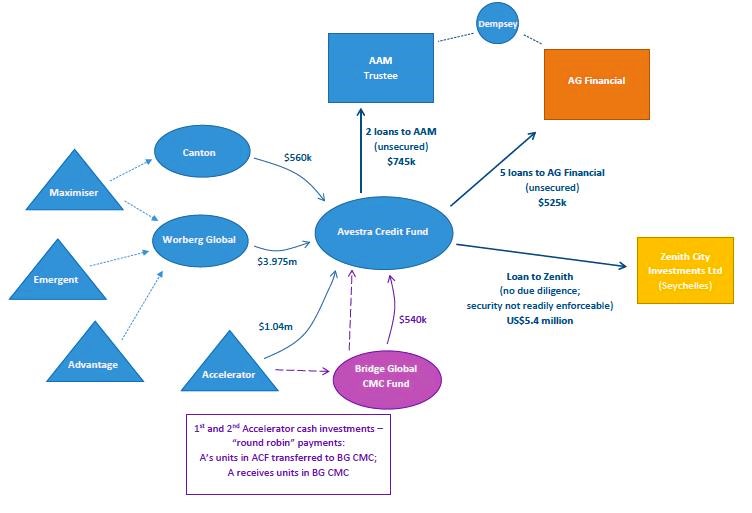
Loans to Avestra and AG Financial
109 Between February and June 2014, Avestra used the Avestra Credit Fund to provide unsecured loans to itself (in circumstances where Avestra was unable to obtain bank finance for the full amount of two property acquisitions) and to AG Financial, as follows:
Loan | Date advanced | Loan amount |
1st Avestra loan | 27 February 2014 | $100,000 |
2nd Avestra loan | 4 March 2014 | $645,000 |
1st AG Financial loan | 20-25 February 2014 | $250,000 |
2nd AG Financial loan | 28 March 2014 | $85,000 |
3rd AG Financial loan | 24 April 2014 | $90,000 |
4th AG Financial loan | 2 May 2014 | $20,000 |
5th AG Financial loan | 26 June 2014 | $100,000 |
110 When the Worberg Global, Canton and Bridge Global CMC Funds made investments into the Avestra Credit Fund, scheme property of the Advantage, Emergent and Maximiser Funds was invested in those funds, and so became indirectly invested in the Avestra Credit Fund.
111 Rowles and Dempsey do not dispute the following:
(a) First, each of the loans that Avestra made to itself out of the Avestra Credit Fund involved the giving of a financial benefit indirectly out of the scheme property of the Advantage, Emergent and Maximiser Funds to Avestra itself, without having obtained the approval of members of the Advantage, Emergent and Maximiser Funds, in contravention of s 208(1) (as modified by s 601LC).
(b) Second, each of the loans that Avestra made to AG Financial out of the Avestra Credit Fund involved the giving of a financial benefit indirectly out of the scheme property of the Advantage, Emergent and Maximiser Funds to AG Financial, a related party of Avestra, without having obtained the approval of members of the Advantage, Emergent and Maximiser Funds, in contravention of s 208(1) (as modified by s 601LC).
(c) Third, they were each involved in Avestra’s entry into each of the loans, and so they personally contravened s 209(2) (as modified by s 601LA) in relation to each loan.
Loan to Zenith City Investments Ltd
112 By far the largest loan that Avestra made out of the Avestra Credit Fund (comprising approximately 75% of all loans made) was to Zenith, a Seychelles-incorporated company controlled by an acquaintance of Rowles. Avestra carried out no due diligence regarding the investments that Zenith intended to make with the loan funds, and did not obtain readily realisable security in respect of the loans. Rowles and Dempsey do not dispute that in authorising the loan to Zenith, they did not act with reasonable care and diligence and thus they each contravened s 180(1).
Cash investments from the Accelerator Fund and “round robin” transfers
113 On 1 June 2014 and 1 July 2014, Avestra made two substantial cash investments into the Avestra Credit Fund from the scheme property of the Accelerator Fund, of $801,000 and $240,000, respectively. The cash invested from the Accelerator Fund was required primarily to fund the making of the Zenith loan. Those investments were disguised by immediate “round robin” transfers of the Accelerator Fund’s unitholdings to the Bridge Global CMC Fund, and were not recorded in the Accelerator Fund’s investment ledger.
114 Rowles and Dempsey do not dispute the following:
(a) First, each of the investments from the Accelerator Fund to the Avestra Credit Fund involved the giving of a financial benefit out of the scheme property of the Accelerator Fund to Avestra itself, without having obtained the approval of members of the Accelerator Fund, in contravention of s 208(1) (as modified by s 601LC).
(b) Second, further, in making those investments out of the Accelerator Fund, Avestra did not act in the best interests of members of the Accelerator Fund, in contravention of s 601FC(1).
(c) Third, they were each involved in Avestra’s making of those investments, and so they personally contravened s 209(2) (as modified by s 601LA) in respect of each investment, and contravened s 601FC(5).
Misleading response to ASIC
115 In November 2014, when ASIC required Avestra to provide information about each of its unregistered managed investment schemes, Dempsey provided a response to ASIC that omitted to mention the Avestra Credit Fund. In so doing, he omitted information without which he knew the response to be false or misleading, and thereby contravened s 1308(2).
(c) Offshoring of the Canton and Worberg Global Funds and transfers to and from the offshore funds
116 From 30 January 2014, Avestra took over as responsible entity of the AG Schemes.
Failure to provide regular investment reports
117 Fundhost queried AG Financial in September 2013 about its failure to provide monthly investment reports for the AG Schemes after Bridge Global Securities took over responsibility for investment management of those schemes. This had been the consistent practice prior to April 2013. Rowles received and responded to that enquiry from Fundhost. Nonetheless, after 30 January 2014, Avestra continued to fail to provide regularly monthly reports to members of the AG Schemes.
118 Rowles and Dempsey do not dispute that:
(a) in failing to provide regular investment reports to members, Avestra failed to provide financial services efficiently, honestly and fairly, and so contravened s 912A(1)(a); and
(b) they each failed to take reasonable steps to prevent Avestra from committing that contravention of s 912A(1)(a), and so they personally contravened s 601FD(1)(f)(i).
Failure to notify changed investment risk of the Accelerator, Generator and Maximiser Funds
119 On 7 February 2014, Avestra issued a letter to members of each of the AG Schemes, which advised that the investment mandate of each scheme had been updated, so that each scheme would invest in:
Global Equity Markets both Long and Short, Exchange Traded Funds, Fixed Interest Securities, Managed Investment Schemes, Derivatives and Cash. Derivatives will be actively utilised in the risk management process and as an alternate to buying and selling a physical security.
120 The letter did not otherwise disclose that there may be any change to the nature or extent of the investment risks to which the AG Schemes were subject.
121 Rowles and Dempsey do not dispute that by reason of the cross-investments:
(a) from the Maximiser Fund into the Worberg Global and Canton Funds, from 1 May 2013; and
(b) from the Maximiser, Accelerator and Generator Funds into the Bridge Global CMC and Hanhong High-Yield Funds, from 30 April 2014 (Maximiser) and 2 June 2014 (Accelerator and Generator),
the investment risk associated with investing in the Accelerator, Generator and Maximiser Funds materially changed, by reason of those funds acquiring substantial exposures to Malaysian shares and equity derivatives, including of a number of companies that were listed on the second-board ACE market of Bursa Malaysia.
122 As at 28 February 2014:
(a) the Accelerator and Generator Funds had no exposure to Malaysian shares or equity derivatives; and
(b) the Maximiser Fund, through its cross-investments into the Advantage, Worberg Global and Canton Funds, had acquired indirect holdings in Malaysian stocks and equity derivatives comprising approximately 61% of its total investment portfolio, as shown below:
Maximiser Fund: investments as at 28 February 2014
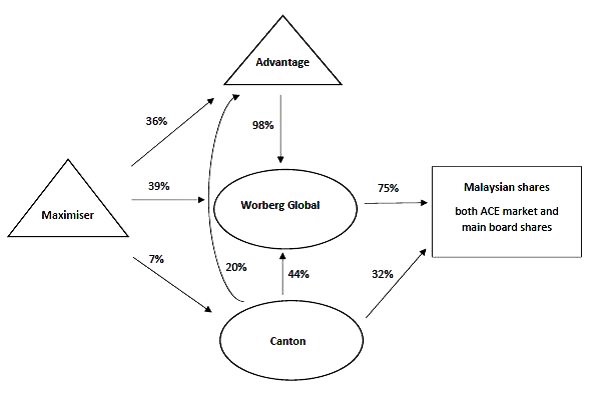
123 Following the AG Schemes’ investments into, and redemptions from, the Bridge Global CMC and Hanhong High-Yield Funds, as at 31 January 2015:
(a) 76% of the Accelerator Fund’s net asset value was invested directly in Malaysian equities, of which 72% was invested in the shares of a single ACE market-listed company, Asia Biotech Bhd; and
(b) 83% of the Maximiser Fund’s net asset value was invested directly in Malaysian equities, of which 43% was invested in the shares of Asia Biotech Bhd.
124 By way of illustration of the heightened investment risks to which those two funds had become subject, in February 2015, the share price of Asia Biotech Bhd fell by nearly 50%, from around MYR 0.238 (on 6 February 2015) to MYR 0.1213 (on 18 February 2015). As a result of the Maximiser Fund’s trading in shares of Asia Biotech Bhd during that month, the Maximiser Fund recorded realised investment losses of A$2.76 million in the month of February 2015.
125 The scheme property of the Generator Fund, which was smaller than the Accelerator and Maximiser Funds, became exposed indirectly to Malaysian shares through investments in the Bridge Global CMC and Hanhong High-Yield Funds between June and November 2014, but its redemptions from those funds in November 2014 were paid solely in cash.
126 In relation to each of the Accelerator, Generator and Maximiser Funds, Rowles and Dempsey do not dispute the following:
(a) First, the changed investment risk to which those funds had become subject in 2013, or to which they became subject during 2014, was a matter that Avestra was required, under s 1017B(1), to notify to holders of units in those schemes, with the information that was reasonably necessary for retail clients to understand the nature and effect of that change in investment risk.
(b) Second, Avestra did not provide such notification to members of the Accelerator, Generator and Maximiser Funds, by the 7 February 2014 letter or otherwise, in contravention of s 1017B(1).
(c) Third, they did not take all reasonable steps to prevent Avestra from committing those contraventions of s 1017B(1), and so they personally contravened s 601FD(1)(f)(i).
Establishment of, and cross-investments into, the offshore schemes
127 The second major stage of cross-investments from the AG Schemes occurred in 2014, after Avestra had taken over as responsible entity of the AG Schemes. During 2014, the cross-investments were not made into other Avestra-managed retail and wholesale schemes in Australia, but into new managed funds set up in the Cayman Islands, and operated by companies that were related to, and/or had common directors with, Avestra.
128 The cross-investments into, and redemptions from, the Bridge Global CMC and Hanhong High-Yield Funds are illustrated in the following diagrams:
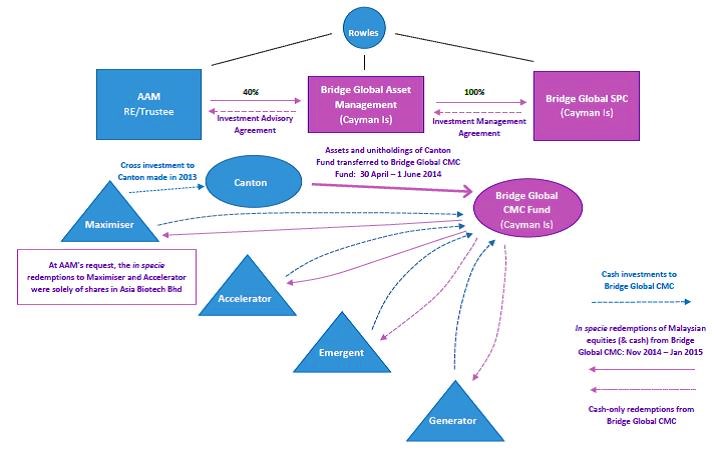
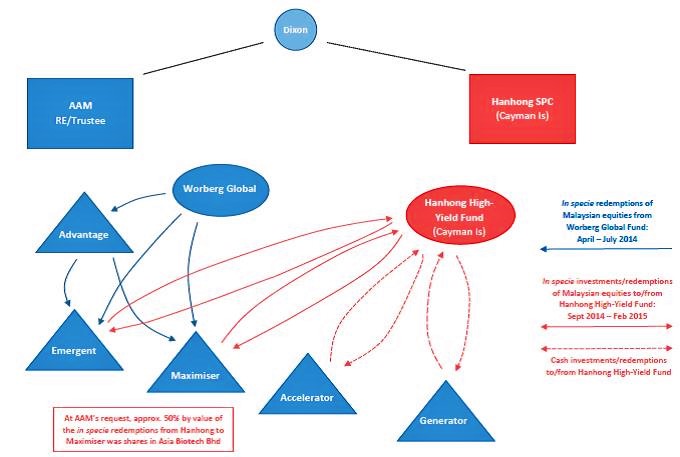
129 This second phase involved both the direct “offshoring” of the Canton Fund as the Bridge Global CMC Fund, and the transfer of Malaysian shares formerly held by the Worberg Global Fund to the newly-established Hanhong High-Yield Fund. The cross-investments made from the Maximiser and Emergent Funds into the Canton and Worberg Global Funds (originally made in 2013) were transferred over either directly or through staged in specie redemptions and reinvestments to the new offshore funds. Thereafter, Avestra made additional cross-investments from the AG Schemes, so that, by September 2014, each of the AG Schemes was cross-invested in both the Bridge Global CMC and Hanhong High-Yield Funds.
130 Eventually, between late October 2014 and early February 2015, Avestra unwound the AG Schemes’ cross-investments in the Bridge Global CMC and Hanhong High-Yield Funds. This involved substantial in specie distributions of Malaysian shares and equity derivatives being made to the Accelerator, Emergent and Maximiser Funds. Significantly, Avestra specifically identified the particular Malaysian securities that were to be distributed in specie to those funds from the offshore schemes.
131 The cross-investments into the offshore funds referred to above had the effect of exposing, or deepening the exposure of, the AG Schemes to Malaysian shares and equity derivatives. Following the unwinding of the cross-investments referred to above, each of the Accelerator, Emergent and Maximiser Funds held an investment portfolio that was very heavily weighted with a small number of Malaysian shares and equity derivatives:
(a) The resulting investments in Malaysian equities held by the Accelerator and Maximiser Funds are described above.
(b) As at 31 December 2014, following the in specie redemption of the Emergent Fund’s investment in the Hanhong High-Yield Fund, 41% of the Emergent Fund’s net asset value was invested directly in ACE market and main board-listed Malaysian shares, and a further 52% was invested in USD-denominated contracts for difference on two Malaysian stocks (of which 48% related to a single company, PNE PBC Bhd).
132 Rowles and Dempsey do not dispute the following:
(a) First, the initial transfer of investments from the Canton Fund to the Bridge Global CMC Fund between 30 April 2014 and 1 June 2014 involved the giving of a financial benefit indirectly out of the scheme property of the Maximiser Fund to Bridge Global SPC, a related party of Avestra, without having obtained the approval of members of the Maximiser Fund, in contravention of s 208(1) (as modified by s 601LC).
(b) Second, each of the subsequent cross-investments from the AG Schemes to the Bridge Global Fund involved the giving of a financial benefit out of the scheme property of the AG Schemes to Bridge Global SPC, a related party of Avestra, without having obtained the approval of members of the relevant AG Scheme, in contravention of s 208(1) (as modified by s 601LC).
(c) Third, they were each involved in the making of each of those investments into the Bridge Global CMC Fund, and so they personally contravened s 209(2) (as modified by s 601LA) in respect of each investment.
(d) Fourth, the making of in specie redemptions from the Worberg Global Fund to the Emergent and Maximiser Funds, the substantial reinvestments of those assets into the Hanhong High-Yield Fund, and the subsequent in specie redemptions from the Hanhong High-Yield Fund to the Emergent and Maximiser Funds, involved Avestra failing to exercise the degree of care and diligence that a reasonable responsible entity would exercise in Avestra’s position, in contravention of s 601FC(1)(b).
(e) Fifth, they each failed to take all reasonable steps to prevent Avestra committing that contravention of s 601FC(1)(b) and so they personally contravened s 601FD(1)(f)(i).
(d) Failure to manage conflicts of interest, and Dempsey’s conduct as a member of the compliance committee
Recording and management of conflicts of interest
133 Avestra maintained a conflicts of interest register, the purpose of which was to provide a vehicle for identifying actual or potential conflicts of interest that arose in the operation of its managed investment schemes and recording and tracking what steps Avestra had taken to address or resolve those conflicts. Dempsey was responsible for maintaining the conflicts of interest register.
134 During 2013, Dempsey made entries in the conflicts of interest register regarding:
(a) the cross-investments of the Emergent and Maximiser Funds into the Advantage and Worberg Global Funds while the Advantage and Worberg Global Funds held shares in AG Financial; and
(b) the cross-investment of the Generator Fund into the Safecrest Fund while the Safecrest Fund held shares in AG Financial.
135 In relation to each of those matters, Dempsey recorded that the managers were aware of the existence of a potential conflict, and would monitor it on an ongoing basis. Both conflicts were recorded as having been reviewed by Rowles and Dempsey. The status of both conflicts remained recorded as “ongoing”.
136 Avestra did not disclose any of those conflicts of interest to members of the affected schemes, nor did it take any other action to resolve those conflicts of interest beyond recording their existence in the conflicts of interest register.
137 In addition, the conduct outlined above gave rise to several other conflicts of interest that were never recorded in the conflicts of interest register, including:
(a) Avestra’s own acquisitions of shares in AG Financial through the Advantage, Canton, Worberg Global and Safecrest Funds;
(b) Avestra making unsecured loans to itself and to AG Financial from the Avestra Credit Fund; and
(c) Avestra transferring the unitholdings in, and investments of, the Canton Fund to the Bridge Global CMC Fund, the operator of which was 40% owned by Avestra and of which Rowles was also a director.
138 All other matters recorded in Avestra’s conflicts of interest register were uniformly and perfunctorily recorded as having been subject to “disclosure and monitoring” and recorded as remaining “ongoing”.
Avestra’s compliance committee
139 Dempsey was the sole executive member of Avestra’s compliance committee, along with two external members. Avestra’s compliance committee met quarterly, as it was required to do: s 601JH(1)(a).
140 At its meeting on 21 June 2013, the compliance committee noted that the investment of assets of Avestra’s registered managed investment schemes in Avestra’s unregistered scheme was a potential conflict of interest. But the committee deferred the matter for discussion at its next meeting on 25 September 2013, and again deferred the matter for discussion at the following meeting. The matter was never discussed at the following meeting on 12 December 2013 or thereafter.
141 As the sole executive member of the compliance committee, Dempsey did not draw to the compliance committee’s attention, and the committee never discussed, the other conflicts of interest referred to above.
142 In the circumstances, Rowles and Dempsey do not dispute that Avestra failed to have in place adequate arrangements for the management of conflicts of interest, in contravention of s 912A(1)(aa). Rowles does not dispute that he failed to take all reasonable steps to prevent Avestra from contravening s 912A(1)(aa) and so personally contravened s 601FD(1)(f)(i). Dempsey does not dispute that he failed to exercise the care and diligence that a reasonable person in his position as the sole executive member of Avestra’s compliance committee would have exercised and so contravened s 601JD(1)(b).
contraventions by Avestra and Bridge Global Securities
(a) Related party transactions using scheme property: s 208(1)
143 On the material before me, I accept that contraventions of s 208(1) (as modified by s 601LC) have occurred in relation to:
(a) Avestra’s acquisitions of shares in AG Financial out of scheme property of the Advantage Fund, between March and July 2013;
(b) Avestra’s acquisitions of shares in AG Financial out of trust property of the Worberg Global Fund, between March and July 2013;
(c) Bridge Global Securities cross-investing scheme property of the Emergent and Maximiser Funds into the Advantage, Canton and Worberg Global Funds, between May and August 2013;
(d) Bridge Global Securities cross-investing scheme property of the Generator Fund into the Safecrest Fund, in July and August 2013;
(e) Avestra giving unsecured loans to itself, and to AG Financial, out of the trust property of the Avestra Credit Fund, between February and July 2014;
(f) Avestra cross-investing scheme property of the Accelerator Fund into the Avestra Credit Fund, in June and July 2014;
(g) Avestra transferring the investments held by the Canton Fund to the Bridge Global CMC Fund between April and June 2014; and
(h) Avestra cross-investing scheme property of each of the AG Schemes into the Bridge Global CMC Fund between June and October 2014.
144 Section 208(1) applies (as modified by s 601LC) to the giving of financial benefits out of, or in a way that could endanger, the scheme property of a registered scheme. That section (as modified) provides:
If all the following conditions are satisfied in relation to a financial benefit:
(a) the benefit is given by:
(i) the responsible entity of a registered scheme; or
(ii) an entity that the responsible entity controls; or
(iii) an agent of, or person engaged by, the responsible entity
(b) the benefit either:
(i) is given out of scheme property; or
(ii) could endanger the scheme property
(c) the benefit is given to:
(i) the person or a related party; or
(ii) another person referred to in paragraph (a) or a related party of that person;
then, for the person referred to in paragraph (a) to give the benefit, either:
(d) the person referred to in paragraph (a) must:
(i) obtain the approval of the public company’s scheme’s members in the way set out in sections 217 to 227; and
(ii) give the benefit within 15 months after the approval; or
(e) the giving of the benefit must fall within an exception set out in sections 210 to 216.
145 Apparently, the purpose of the requirement to obtain member approval for such related party transactions is “to protect the interests of the scheme’s members as a whole” (s 207 (as modified by s 601LB)).
146 A “related party” is defined in s 228 and a “financial benefit” is defined in s 229. Both of those definitions are modified in their operation by s 601LA. A marked-up version of Chapter 2E, as modified by Part 5C.7, is set out in the annexure to my reasons.
147 Part 5C.7 had its genesis in the Australian Law Reform Commission’s report, Report No 65, Collective Investments: Other People’s Money (Vol 1) (1993) which recommended the following at [10.25]:
… the principles in the Corporations Law Pt 3.2A, adapted for collective investment schemes, should regulate transactions where a scheme operator, its associates or any other related party (‘interested parties’) could receive a financial benefit from dealings involving scheme assets. These transactions should include:
• scheme assets being invested in an interested party or in a scheme operated by an interested party
• an interested party selling or leasing its property to the scheme
• an interested party acquiring or leasing scheme assets
• scheme assets being lent to, or provided as security for, an interested party
• debts or other obligations owed to the scheme by an interested party being forgiven, released or waived in whole or in part, or its lending terms varied.
(footnotes omitted)
148 The protective purpose of s 208 is both confirmed and enhanced by the breadth of “financial benefit”. Section 229 (as modified by s 601LA) provides:
229 Giving a financial benefit
(1) In determining whether a financial benefit is given for the purposes of this Chapter:
(a) give a broad interpretation to financial benefits being given, even if criminal or civil penalties may be involved; and
(b) the economic and commercial substance of conduct is to prevail over its legal form; and
(c) disregard any consideration that is or may be given for the benefit, even if the consideration is adequate.
(2) Giving a financial benefit includes the following:
(a) giving a financial benefit indirectly, for example, through 1 or more interposed entities;
(b) giving a financial benefit by making an informal agreement, oral agreement or an agreement that has no binding force;
(c) giving a financial benefit that does not involve paying money (for example by conferring a financial advantage).
(3) The following are examples of a financial benefit being given to or received by a responsible entity or a related party:
(a) giving or providing finance or property to the responsible entity or related party;
(b) buying an asset from or selling an asset to the responsible entity or related party;
(c) leasing an asset from or to the responsible entity or related party;
(d) supplying services to or receiving services from the responsible entity or related party;
(e) issuing securities or granting an option to the responsible entity or related party;
(f) taking up or releasing an obligation of the responsible entity or related party.
149 The phrase “financial benefit” is to be given “the broadest of interpretation” as Santow J observed in Re HIH Insurance Ltd (in prov liq); Australian Securities and Investments Commission v Adler (2002) 41 ACSR 72; [2002] NSWSC 171 (ASIC v Adler) at [181]. The economic and commercial substance of the transaction or associated conduct trumps legal forms and other niceties. The consideration given or to be given for the benefit is irrelevant for definitional purposes.
150 There has been little useful consideration of s 208’s modified application in the registered scheme context. In the present context, ASIC has identified four questions that arise in relation to the application and operation of s 208(1) (as modified by s 601LC) that require some discussion. Questions (i) to (iii) go to the characterisation of the “financial benefit” given. Question (iv) raises an issue of construction, the answer to which requires some modest conceptual enhancement of the statutory language.
(i) Is the giving of money to be held on trust a “financial benefit”?
151 This issue has arisen in relation to the groups of contraventions of s 208(1) that involve cross-investments into funds of which Avestra or Bridge Global Securities was the responsible entity or trustee. Where an investment is made from one scheme into another, the responsible entity or trustee of the recipient scheme obtains only the legal title to the funds invested, and (assuming that the responsible entity or trustee itself holds no units in that scheme) does not receive any beneficial interest in an equitable sense. But the situation can involve the giving of a “financial benefit” to the responsible entity or trustee of the recipient scheme. Two ways in which the cross-investment of scheme property of a registered fund would confer a financial benefit on the recipient responsible entity or trustee are the following:
(a) First, by increasing the size of the funds under management by the recipient responsible entity, a matter which might be used by the responsible entity to promote itself.
(b) Second, by enabling the responsible entity to earn additional fees in respect of the invested funds (and thus potentially two sets of fees where the same entity was the responsible entity or trustee of both funds). Now before me ASIC has not directly put its case on the basis that the relevant financial benefit was conferred by Avestra and its related parties actually earning multiple fees as a result of cross-investments between schemes. But equally, the material before me does not foreclose the potential for Avestra to be financially benefitted in this way as a result of the cross-investments.
152 My conclusion is consistent with and fortified by Santow J’s observation in ASIC v Adler at [182] that the control over the use of funds conferred by holding money on trust may, as a matter of economic and commercial substance, fall within the broad meaning of “financial benefits”.
153 Accordingly, as a matter of economic and commercial substance, the recipient responsible entity or trustee’s receipt of bare legal title to the invested funds can be a “financial benefit”.
(ii) Is the acquisition of legal title to shares in a takeover target a “financial benefit”?
154 An analogous question arises in relation to Avestra’s acquisition of shares in AG Financial on behalf of the schemes of which Avestra was the responsible entity or trustee. It arises in relation to the secondary acquisitions of shares in AG Financial made by Avestra through the Advantage and Worberg Global Funds. The secondary acquisitions that are the subject of contraventions of s 208(1) are the initial purchases from Peter Spann made through the Advantage and Worberg Global Funds on 20 and 21 March 2013. Contrastingly, for each subscription for shares newly issued by AG Financial, the relevant “financial benefit” relied on by ASIC is the equity capital contributed to AG Financial, rather than a benefit obtained by Avestra through its legal ownership of those shares.
155 In circumstances where the benefit of any dividend stream and any entitlement to proceeds of a winding-up would accrue to the members of the scheme on whose behalf Avestra held the shares, did Avestra obtain any “financial benefit” from its acquisition of legal title to the shares?
156 There is no direct evidence of Avestra exercising its voting power in any general meeting of the shareholders of AG Financial. But in my view Avestra did acquire financial benefits, which it perceived to be commercially valuable, from merely holding legal title to those shares. For example, within two weeks of having initially acquired a 22% shareholding, Avestra’s related party, Bridge Global Securities, was appointed as investment sub-manager of the AG Schemes. Further, within a month, AG Financial entered into an agreement to acquire the entire shareholding in Avestra Capital Ltd, a related company to Avestra. Further, Dempsey was appointed as a director of AG Financial and its subsidiaries in July 2013. These financial benefits were both conferred and anticipated to be so conferred.
157 Moreover, by acquiring a greater than 20% interest in the voting shares of AG Financial through the funds, and by filing incomplete substantial shareholder notices, Avestra put itself in a position to realise those benefits, whilst evading the compulsory takeover trigger under s 606.
158 In my view, and from the perspective of economic and commercial substance, Avestra did obtain a financial benefit. It is no answer that Avestra’s initial purchases of shares in AG Financial did not involve the provision of a financial benefit to itself, merely because Avestra received only the bare legal title to the purchased shares, with the equitable title being vested in the schemes (or their members) themselves.
(iii) Is the investment of money from an unregistered scheme, in which scheme property of a registered scheme is invested, a financial benefit that is “given out of” the scheme property of the registered scheme?
159 In my opinion, where the scheme property of a registered scheme is invested in an unregistered managed investment scheme and trust property of the unregistered scheme is used to provide a financial benefit to the responsible entity of the registered scheme (or a related party of that responsible entity), a financial benefit is “given out of” the scheme property of the registered scheme within the meaning of s 208(1)(b)(i) (as modified). There is a possible alternative conclusion, namely that applying s 208(1)(b)(ii) (as modified), a financial benefit was given that “could endanger the scheme property” of the registered scheme, even though not “given out of” the scheme property, but such a theoretical possibility can be put to one side for present purposes.
160 In the present case, the relevant contraventions have been established on the basis that the relevant financial benefit(s) was given indirectly “out of” the scheme property of the registered fund(s). This indirect scenario arises in relation to the following contraventions:
(a) Avestra’s acquisitions of shares in AG Financial out of trust property of the Worberg Global Fund (in which scheme property of the Advantage Fund was invested).
(b) Avestra giving unsecured loans out of the Avestra Credit Fund to itself and to AG Financial. These Avestra Credit Fund transactions involved the indirect use of scheme property (of the Advantage, Emergent and Maximiser Funds) indirectly through two interposed funds: first, through the Canton and Worberg Global Funds (in which scheme property of the Advantage, Emergent and Maximiser Funds was invested); and second, through the Avestra Credit Fund (in which trust property of the Canton and Worberg Global Funds was invested).
161 In my view, the indirect scenario is addressed directly by s 229(2)(a), which confirms that “giving a financial benefit” includes “giving a financial benefit indirectly, for example, through 1 or more interposed entities”. If one reads s 229(2)(a) together with s 208(1)(b)(i) (as modified), the requirement for member approval is triggered where a financial benefit is given indirectly out of the scheme property of the registered scheme, through one or more interposed entities.
162 Indeed, when the forerunner to s 229(2) was first enacted (s 243G(1)(b), as inserted by the Corporate Law Reform Act 1992 (Cth)), the explanatory memorandum to the Corporate Law Reform Bill 1992 (Cth) stated at [263] to [264]:
Proposed section 243G - Giving a financial benefit
263. This provision is intended to ensure that the proposed Part 3.2A is not interpreted in a narrow or formalistic way.
264. In accordance with paragraph 243G(1)(b) a reference to giving a financial benefit will include the giving of a benefit indirectly, such as through one or more interposed entities (even if any of them is a principal), or by making or giving effect to a relevant agreement as defined in section 9. The use of ‘indirectly’ in this sense is to be contrasted with the narrower use discussed by Lockhart J. of the Federal Court of Australia in Trade Practices Commission v. Australian Iron & Steel Pty Ltd and others 22 FCR 305. It will include, for example, the case where a financial benefit is given by a public company to an entity that is not a related party of the public company, in the expectation that that entity will pass the financial benefit to a related party of the public company.
163 Apparently, there has been no direct consideration of s 229(2)(a) or its predecessor, s 243G(1)(b).
164 In my view, consistently with the broad and commercially substantive interpretation that is required to be applied to “giving a financial benefit”, it is within both the terms and purpose of s 229(2)(a) that the giving of a financial benefit from a registered scheme, via an unregistered scheme, should be caught by s 208. If otherwise, the requirement for member approval for the giving of a financial benefit out of scheme property could be easily circumvented by the device of routing the financial benefit through an interposed scheme. The statutory imperative in s 229(1)(a) to apply a broad interpretation focused upon matters of economic and commercial substance in identifying whether a financial benefit has been given, was stipulated to ensure that s 208 could not be so readily circumvented. The conclusion that s 208 applies to the provision of financial benefits through an interposed unregistered scheme is fortified by the fact that, in the present case when the relevant contraventions occurred, Avestra was both the responsible entity of the relevant registered fund and trustee of the relevant interposed unregistered scheme. Accordingly, when Avestra gave the financial benefits to itself or its related party through the interposed scheme(s), it knew that the benefit had been funded, in part, from the scheme property of the relevant registered schemes.
165 In summary, in my view the provision of financial benefits by Avestra from unregistered schemes, in which scheme property of one or more of its registered schemes was invested, amounted to the provision of a financial benefit “out of the scheme property” of the registered scheme(s), within the meaning of s 208(1)(b)(i). It is not necessary to dwell further in relation to other theoretical possibilities arising under s 208(1)(b)(ii).
(iv) Who are the related parties of a ss 208(1)(a)(ii) or 208(1)(a)(iii) giver of a financial benefit?
166 Section 208(1) (as modified) requires member approval to be obtained where a financial benefit is given out of scheme property of a registered scheme:
(i) the responsible entity of the scheme;
(ii) an entity that the responsible entity controls (see s 50AA on “control”); or
(iii) an agent of, or person engaged by, the responsible entity (s 601FB(3) deems certain persons to be an agent of a responsible entity);
(the “giver limb”)
(b) to any of:
(i) “the person”, being the giver of the financial benefit (that meaning of “the person” is supported by the grammar, the syntax and the words appearing above s 208(1)(d) (as modified), namely “then, for the person referred to in paragraph (a) to give the benefit” (my underlining)): s 208(1)(c)(i) (as modified);
(ii) a related party of the giver: s 208(1)(c)(i) (as modified);
(iii) another person referred to in s 208(1)(a): s 208(1)(c)(ii) (as modified); or
(iv) a related party of another person referred to in s 208(1)(a): s 208(1)(c)(ii) (as modified).
(the “recipient limb”)
167 Accordingly, the recipient limb encompasses benefits that are given to any of:
(a) a related party of the responsible entity;
(b) a related party of an entity that the responsible entity controls; or
(c) a related party of an agent of, or person engaged by, the responsible entity.
168 But an interesting definitional problem arises when one considers and applies the meaning of “related party” provided by s 228 (modified by s 601LA) to these recipient limb possibilities. Section 9 provides that “Unless the contrary intention appears … related party (when used in Chapter 2E) has the meaning given by section 228”. But because s 601LA(a) operates by merely replacing references to “public company” in the original text of s 228 with the expression “responsible entity”, the consequence is that, on its terms, s 228 (as modified) only specifies which persons are related parties of a responsible entity. In other words and in its terms, s 228 (as modified) does not specify who are related parties of either:
(a) an entity that the responsible entity controls; or
(b) an agent of, or person engaged by, a responsible entity.
169 In the present context, this definitional problem affects the contraventions of s 208(1) (as modified) that are said to have been committed by Bridge Global Securities in giving financial benefits out of the AG Schemes to Avestra. Rowles and Dempsey do not dispute that Avestra was a “related party” of Bridge Global Securities, which in turn was a deemed agent of Fundhost. But Avestra was not a related party of Fundhost, which was the responsible entity of the AG Schemes during 2013.
170 The definitional problem arises from the cross-referencing device employed by which Chapter 2E is modified for application to registered managed investment schemes. There are three realistic constructional choices open to me to solve the present problem:
(a) First, the principles stated in s 228 could be applied mutatis mutandis to ascertain a “related party” of either an entity that the responsible entity controls, or of an agent of or person engaged by a responsible entity.
(b) Second, the words “related party” could be construed in accordance with their ordinary meaning in order to ascertain who is a “related party” of either an entity that the responsible entity controls, or of an agent of or person engaged by a responsible entity.
(c) Third, it could be considered that in the case where a financial benefit is given out of scheme property by a person other than a responsible entity (ie one of the persons identified in ss 208(1)(a)(ii) or 208(1)(a)(iii)), the requirement for member approval is only enlivened where the benefit is provided to the responsible entity (or its related party) or another one of the persons identified in s 208(1)(a). In other words it could be said that in the absence of an applicable definition of “related party”, s 208(1) (as modified) does not apply where a ss 208(1)(a)(ii) or 208(1)(a)(iii) giver provides a financial benefit either to its related party or a related party of another person referred to in ss 208(1)(a)(ii) or 208(1)(a)(iii), where that recipient is not itself a related party of the responsible entity.
171 But I agree with ASIC that this third possibility must be rejected. To accept the third possibility would be to defeat the intention of the legislature through the literal application of definitions, a result that could only appeal to those afflicted with a sclerotic form of textualism.
172 If the third alternative were to be applied, the intended breadth of the class of recipients would be undermined by the drafter’s failure to properly modify s 228 so that it identifies who are the related parties of benefit-givers other than responsible entities. That result would negate both the policy and purpose of s 208 (as modified), which as the words of ss 208(1)(c)(i) and 208(1)(c)(ii) indicate, is not confined to the giving of financial benefits to persons who are related parties of the responsible entity itself.
173 Accordingly, in my view there is a need for an interpretation that defines who are the “related parties” of a ss 208(1)(a)(ii) or 208(1)(a)(iii) giver. Now the criterion of “related” is as a matter of ordinary meaning too elastic to provide clear parameters to determine with confidence who is, and who is not, a related party of a ss 208(1)(a)(ii) or 208(1)(a)(iii) giver. Accordingly, I do not propose to adopt the second constructional choice. Rather, I propose to adopt the first constructional choice.
174 The general proviso stated in the prefatory words of s 9 of the Act is “Unless the contrary intention appears”; see also s 6(1) which states, “The provisions of this Part have effect for the purposes of this Act, except so far as the contrary intention appears in this Act.”. Now a contrary intention may be discerned from the underlying statutory purpose. Moreover, the contrary intention need not be stated expressly. The derivation of a purposively-based contrary intention was endorsed by Mahoney JA in Deputy Commissioner of Taxation (NSW) v Mutton (1988) 12 NSWLR 104 at 108.
175 If the s 228 definition of “related party” was construed literally as operating only to determine who is a related party of a responsible entity, the ambit of s 208(1)(c) would be confined through drafting oversight to a narrower class of recipients than the class that the legislature expressly intended to cover. Accordingly, in my opinion a contrary intention is revealed by the very words of ss 208(1)(c)(i) and 208(1)(c)(ii) themselves. In order to give effect to the manifest legislative intent, the s 228 definition of “related party” should be applied by analogy in relation to ss 208(1)(a)(ii) or 208(1)(a)(iii) givers of financial benefits, mutatis mutandis, as it operates with respect to responsible entities.
176 Now as ASIC rightly submitted, a contrary argument might be mounted on the basis of the statutory purpose of Part 5C.7 stated in s 207 (as modified by s 601LB):
The rules in this Chapter, as they apply to a registered scheme, are designed to protect the interests of the scheme’s members as a whole, by requiring member approval for giving financial benefits to the responsible entity or its related parties that come out of scheme property or that could endanger those interests.
177 Now the reference in s 207 to requiring member approval for giving financial benefits to a responsible entity’s related parties, but not for the giving of benefits to related parties of ss 208(1)(a)(ii) or 208(1)(a)(iii) givers, might be said to support the third possible construction. But s 208(1)(c)(ii) makes it apparent that the purpose of Chapter 5C.7 is to capture a broader range of recipients than merely responsible entities and related parties of responsible entities. In that respect, s 207 understates the true breadth of the statutory purpose. Accordingly, this perceived contrary argument can be put to one side.
178 Perhaps another way to achieve the substance of the first constructional choice is to “read in” words omitted by drafting oversight. As recently stated in Taylor v The Owners - Strata Plan No 11564 (2014) 253 CLR 531, the reading in or omission of words is readily supported “in the case of simple, grammatical, drafting errors which if uncorrected would defeat the object of the provision” (at [38] per French CJ, Crennan and Bell JJ) and may be supported where more substantial errors are apparent. Addressing the three usually necessary criteria outlined by Lord Diplock in Wentworth Securities Ltd v Jones [1980] AC 74 at 105, and re-expressed by Lord Nicholls of Birkenhead in Inco Europe Ltd v First Choice Distribution [2000] 1 WLR 586 at 592, as justifying the reading in of additional words, but adopting the caveats expressed in Taylor at [39] and [40] including recognising that in some cases the satisfaction of such criteria may not be sufficient to justify the addition, the following can be stated:
(a) First, the precise purpose of s 208(1), and in particular ss 208(1)(c)(i) and 208(1)(c)(ii), is clear. The recipient class was intended to include a related party of an entity identified in ss 208(1)(a)(ii) or 208(1)(a)(iii).
(b) Second, I am satisfied that the failure of the modified version of s 228 to deal with identification of related parties of an entity identified in ss 208(1)(a)(ii) or 208(1)(a)(iii) occurred as a drafting oversight.
(c) Third, I am sure of the substance if not the precise words that the legislature would have enacted had it become aware of the omission. The appropriate response would have been an additional provision in Part 5C.7 to the effect that, in construing s 228, references to a “public company” were instead taken to be references to a “person referred to in s 208(1)(a) (as modified by s 601LC)”.
179 In summary, the first constructional choice is the correct one. And its effect can also be achieved by reading into s 228 the words that I have indicated.
180 Applying such a construction and accordingly, the giving of a financial benefit out of scheme property by an agent of a responsible entity (here, Bridge Global Securities, the deemed agent of Fundhost, in respect of the AG Schemes) could only have been made lawfully if approved by members of the registered scheme. By reason of AGF Funds Management, the investment manager of those funds, having sub-delegated its role to Bridge Global Securities, Bridge Global Securities was deemed to be an agent appointed by the responsible entity (Fundhost) by s 601FB(3). Avestra, the recipient, was a related party of Bridge Global Securities by reason of the fact that Rowles and Dempsey were the sole directors of Bridge Global Securities, and Bridge Global Securities was wholly owned by companies of which Rowles’ and Dempsey’s wives were the only directors and shareholders.
(b) In the event of conflict, members’ interests have priority: s 601FC(1)(c)
181 Contraventions of s 601FC(1)(c) by Avestra have not been disputed by Rowles and Dempsey in relation to:
(a) Avestra’s purchases of shares in AG Financial using scheme property of the Advantage Fund, between March and July 2013; and
(b) the two investments of scheme property of the Accelerator Fund into the Avestra Credit Fund, followed by “round robin” transfers of the Accelerator Fund’s unitholdings to the Bridge Global CMC Fund.
182 Section 601FC(1)(c) provides that, in exercising its powers and carrying out its duties, the responsible entity of a registered scheme must:
(a) act in the best interests of the members; and
(b) if there is a conflict between the members’ interests and the responsible entity’s own interests, give priority to the members’ interests.
183 In addition to s 601FC(2), s 601FC(1)(c) is of foundational importance to the fiduciary obligations that are imposed on responsible entities of registered schemes under the Chapter 5C framework.
184 The following propositions are not controversial:
(a) First, the test under the first limb is whether the responsible entity was acting with undivided loyalty in the best interests of the members.
(b) Second, the tests under the second limb are:
(i) Was there a conflict between the interests of the responsible entity and the interests of the members?
(ii) If so, did the responsible entity prefer the interests of the members to its own interests?
(c) Third, the expression “best interests of the members” relates to the members’ interests in the particular context in which the managed investment scheme operates, and by reference to the terms of the scheme’s constitution, the general law and statute. Section 601FC(1)(c) mirrors, without qualification, a trustee’s equitable obligation of undivided loyalty to its beneficiaries.
(d) Fourth, the enquiry whether the responsible entity has acted in the best interests of the members is an objective one. It is irrelevant whether the responsible entity acted honestly or subjectively believed that it was acting in the members’ best interests.
(e) Fifth, a responsible entity is not required to actually achieve the best outcome for members. It is not required to be prescient.
(c) Duty of reasonable care and diligence by a responsible entity: s 601FC(1)(b)
185 Rowles and Dempsey do not dispute that Avestra contravened s 601FC(1)(b) in connection with the in specie redemptions from the Worberg Global Fund to the Emergent and Maximiser Funds, and those funds’ subsequent in specie investments into, and redemptions from, the Hanhong High-Yield Fund.
186 Section 601FC(1)(b) requires that, in exercising its powers and carrying out its duties, a responsible entity must exercise the degree of care and diligence that a reasonable person would exercise if they were in the responsible entity’s position.
187 In Re Macquarie Investment Management (2016) 115 ACSR 368; [2016] NSWSC 1184, Barrett AJA accepted the following propositions which I also accept:
(a) The duty of a responsible entity under s 601FC(1)(b) is to exercise care and diligence in exercising its powers and duties and carrying out its duties as the responsible entity of the relevant scheme. Those powers and duties include the power to invest the scheme property and the responsibility to do so pursuant to the mandate of the scheme, subject to the Act.
(b) Section 601FC(1)(b) is cast in similar terms to the duty of care and diligence of a director of a corporation contained in s 180(1). Accordingly, authorities on s 180(1) may be relevant in terms of the standard of care and diligence required, although the position of a responsible entity is not identical to that of a company director.
(c) By requiring the responsible entity to exercise the degree of care and diligence that a reasonable person would exercise if they were in the responsible entity’s position, s 601FC(1)(b) sets out an objective test to measure the reasonableness of the actions taken by the responsible entity in exercising its powers and carrying out its duties (similarly to s 180(1)).
(d) In determining the scope of the duty of care and diligence, and whether there has been a breach of that duty, it is important to have regard to the circumstances of the responsible entity’s position and the scheme, including the type of scheme, the provisions of its constitution, the size and nature of its operations, the functions to be performed, the experience or skills of the responsible entity and the circumstances of the specific case.
(e) Similarly to the standard of care imposed by the law of negligence, it may be appropriate to refer to the principles developed under the law of professional negligence in determining the content of the duty.
(f) The scope and content of the duty are heavily influenced by the purpose of the particular power being exercised or duty being carried out, and the known reliance and vulnerability of those dependent on the carrying out of the duty. This is particularly relevant to the placing at risk of the scheme property of a registered scheme.
(g) As a general matter, and subject to the terms of the scheme, a responsible entity is expected to exercise a degree of restraint, as compared with the duty of a company director to display “entrepreneurial flair”. In exercising its power of investment, a responsible entity is subject to a “requirement of caution” (Australian Securities Commission v AS Nominees Ltd (1995) 62 FCR 504 at 516 to 518 per Finn J).
(h) Nonetheless, the exercise of prudence and caution must be considered through the prism of the particular registered scheme in question, having regard to its constitution and particular investment mandate, and the profile of the accepted risks and potential returns the subject of the investments that may be undertaken pursuant to the scheme. A responsible entity is not required to eschew a high-risk investment strategy where that is the nature of the scheme that has been marketed to investors. Rather, a responsible entity is required to implement the advertised strategy prudently.
(i) Whilst a responsible entity is entitled to place reliance on others, including advisers, there is a core and irreducible requirement of diligence.
(d) Provide financial services efficiently, fairly and honestly: s 912A(1)(a)
188 Rowles and Dempsey do not dispute that Avestra contravened s 912A(1)(a) with respect to:
(a) Avestra’s purchases of shares in AG Financial through two of its unregistered schemes, namely the Canton and Safecrest Funds. In particular:
(i) in making purchases of shares through the Canton Fund, a clear conflict of interest existed between Avestra’s own interests and the unitholders’ interests in the sound and professional investment of the fund’s assets, and Avestra neither disclosed the purchases to, nor sought approval from, the unitholders of the Canton Fund; and
(ii) in purchasing shares through the Safecrest Fund, Avestra operated that fund effectively as a conduit to apply scheme property of the Generator Fund to purchase shares in AG Financial, but in such a way that those purchases were not apparent in the financial records of the Generator Fund; and
(b) Avestra’s failure to provide regular investment updates to members of the AG Schemes after it took over as the responsible entity of those schemes from 30 January 2014.
189 Section 912A(1)(a) imposes a general obligation on a financial services licensee with regard to the provision of the financial services that are covered by its licence. It requires that the licensee must do all things necessary to ensure that those financial services are provided efficiently, honestly and fairly.
190 All of the activities of Avestra that are the subject of this proceeding involved the provision of financial services that are covered by its licence, with the sole exception that the making of loans by the Avestra Credit Fund was not a “financial service”, ultimately because a “credit facility” is not a “financial product”: s 765A(1)(h)(i); reg 7.1.06(1)(a) of the Corporations Regulations 2001 (Cth).
191 The “efficiently, honestly and fairly” standard is applied as a single, composite concept, rather than three discrete behavioural norms. The following principles are not in doubt (see Australian Securities and Investments Commission v Camelot Derivatives Pty Ltd (in liq) (2012) 88 ACSR 206; [2012] FCA 414 at [69] and [70] per Foster J). First, the words “efficiently, honestly and fairly” entail that a person must go about their duties efficiently having regard to the dictates of honesty and fairness, honestly having regard to the dictates of efficiency and fairness, and fairly having regard to the dictates of efficiency and honesty. Second, the phrase connotes a requirement of competency in providing advice and in complying with relevant statutory obligations. Third, the word “efficient” entails that the person is adequate in performance and is competent. Fourth, the concept of honesty is looked at through the lens of commercial morality rather than through the lens of the criminal law.
(e) Adequate arrangements for the management of conflicts of interest: s 912A(1)(aa)
192 Section 912A(1)(aa) was inserted in 2004 by the Corporate Law Economic Reform Program (Audit Reform and Corporate Disclosure) Act 2004 (Cth), s 3 and Schedule 10, in order to supplement the more general s 912A(1)(a) requirement to provide financial services efficiently, honestly and fairly. In this regard, the explanatory memorandum to the Corporate Law Economic Reform Program (Audit Reform and Corporate Disclosure) Bill 2003 (Cth) stated at [5.595] to [5.598]:
Under the current regulatory regime financial services licensees are required to ensure that financial services covered by their licence are provided ‘efficiently, honestly, and fairly’. While industry has widely accepted that this would include managing conflicts of interest, the duty was not express in its application to conflicts of interest.
It was considered that any new provision should not be limited in application to analysts, but should also provide for financial services licensees more generally, as the potential for conflicts of interest to arise are not limited in application.
Consequently, under proposed paragraph 912A(1)(aa), financial services licensees will be subject to an additional licensing obligation, which specifically requires them to have adequate arrangements for managing conflicts of interest. This will include ensuring that there is adequate disclosure of conflicts to investors, who can then consider their impact before making investment decisions. It will require internal policies and procedures for preventing and addressing potential conflicts of interest that are robust and effective. The obligation will apply to all conflicts of interest, other than those that occur wholly outside the financial services business of the licensee or its representative.
The additional licensing obligation will supplement the existing general duty in paragraph 912A(1)(a) to provide financial services ‘efficiently, honestly and fairly’…
193 In Australian Securities and Investments Commission v Citigroup Global Markets Australia Pty Ltd (No 4) (2007) 160 FCR 35, Jacobson J made the following observations (at [423]), albeit by way of obiter, which I accept. First, the effective management of conflicts of interest does not require that every possible conflict of interest must be eliminated, although that course is open to a financial services licensee. The reference to “management” of conflicts of interests assumes that some potential conflicts may be managed through implementing adequate arrangements that stop short of eliminating the conflict of interest (at [444] and [445]). And even in a fiduciary situation, adequate arrangements for the management of conflicts of interest does not always require the elimination of conflicts of interest for which the beneficiaries’ express consent has not been obtained (at [443]). Second, whether particular arrangements are adequate is to be determined as a question of fact in each case (at [446]). Third, adequate arrangements require more than a raft of written policies and procedures. They require a thorough understanding of the procedures by all employees and a willingness and ability to apply them to a host of possible conflicts (at [454]).
194 To this may be added the following observations:
(a) First, whether arrangements are adequate will depend upon the nature, scale and complexity of the licensee’s business. Moreover, although s 912A(1)(aa) does not import the full stringency of equitable constraints upon a fiduciary acting in a conflict of interest situation, the fact that a financial services licensee is in a fiduciary position (see also s 601FC(2)) will inform what arrangements are adequate.
(b) Second, the obligation to manage conflicts of interest is more than simply an obligation of disclosure to clients or beneficiaries.
(c) Third, the effective management of conflicts of interest will involve a combination of avoiding, controlling and disclosing conflicts of interest.
(d) Fourth, controlling a conflict of interest requires a licensee to first identify, assess and evaluate a conflict of interest and then to decide on and implement an appropriate response. Moreover, any arrangement in response must be regularly monitored to ensure that its implementation is effective.
(e) Fifth, in some cases, the potential impact on a licensee or third parties will be so serious that a conflict of interest cannot effectively be managed by disclosing it and imposing effective internal controls. In such cases, the only way to adequately manage such a conflict of interest may be to avoid it.
(f) Sixth, where disclosure is used as a means of managing a conflict of interest, the disclosure must be made to the affected persons in a timely, prominent, specific and meaningful way. The concept of “meaningful” connotes something comprehensible to the expected reasonable reader or audience. It also connotes something targeted in terms of its usefulness to the reasonable reader or audience. Further, its informational content ought cover the probability of the conflict occurring and the likely magnitude of its consequences if it does occur in terms of the potential advantages and disadvantages to those who generated the conflict or are participants or beneficiaries therein, or those to whom the disclosure is made. And for those to whom the disclosure is being made, reference should be made to any realistic steps that such a person can take (if any) to ameliorate the conflict’s effects.
(f) Notify material changes affecting financial products: s 1017B(1)
195 Section 1017B(1) requires that where a person (the holder) has acquired a financial product as a retail client, regardless of whether the holder acquired the financial product from the issuer, the issuer is required to notify the holder of certain changes and events, in accordance with ss 1017B(3) to 1017B(8). In this regard, the following may be noted. First, the issuer must notify holders of “any material change to a matter, or significant event that affects a matter, being a matter that would have been required to be specified in a Product Disclosure Statement for the financial product prepared on the day before the change or event occurs”: s 1017B(1A)(a). Second, the issuer must give the notice before the change or event occurs or as soon as practicable after, but not more than three months after, the change or event occurs: s 1017B(5). Third, the issuer must give the holder the information that is reasonably necessary for the holder to understand the nature and effect of the change or event: s 1017B(4).
196 Analysing the requirements of s 1017B(1) to the case before me, I would note the following:
(a) Units in each of the Accelerator, Generator and Maximiser Funds are “financial products”: s 764A(1)(b)(i).
(b) On and from 30 January 2014, Avestra was the “issuer” in respect of units in the Accelerator, Generator and Maximiser Funds, being the person responsible for the obligations owed, under the terms of the facility that is the units, to the holders of the units: s 761E(4).
(c) Avestra was therefore subject to the obligation to notify members of material changes, notwithstanding that members may have acquired their unitholdings by subscription from Fundhost, or by a secondary transfer. The obligation arose whether or not the holder acquired the financial product from the issuer: s 1017B(1).
(d) The units in the Accelerator, Generator and Maximiser Funds are presumed to have been provided to members of those funds as “retail clients” unless the contrary is established: s 761G(9).
197 The “matter[s] … that would have been required to be specified in a Product Disclosure Statement” for the Accelerator, Generator and Maximiser Funds included:
(a) in ss 1013D(1)(c) and (f):
… such of the following information as a person would reasonably require for the purpose of making a decision, as a retail client, whether to acquire the financial product: …
(c) information about any significant risks associated with holding the product; and
[…]
(f) information about any other significant characteristics or features of the product or of the rights, terms, conditions and obligations attaching to the product.
(b) in s 1013E:
… any other information that might reasonably be expected to have a material influence on the decision of a reasonable person, as a retail client, whether to acquire the product.
198 The concept of “significant risks” was addressed in Woodcroft-Brown v Timbercorp Securities Ltd (2013) 96 ACSR 307; [2013] VSCA 284 at [125] to [132], largely adopting the analysis of the trial judge, Judd J. Whether a particular circumstance is a “significant risk” is to be considered having regard, inter alia, to the probability of occurrence of the risk, the degree of impact upon investors, the nature of the particular product and the profile of the investors.
199 In considering whether it would be reasonable for a retail client considering whether to acquire units in the relevant Fund(s) to expect to find particular information in the relevant Product Disclosure Statement, the matters that may be taken into account include:
(a) the nature of the product (including its risk profile) (s 1013F(2)(a)); and
(b) the extent to which the product is well understood by the kinds of person who commonly acquire products of that kind as retail clients (s 1013F(2)(b)); and
(c) the kinds of things such persons may reasonably be expected to know (s 1013F(2)(c)).
200 I do not need to linger on the characteristics of “retail client” save to say that he or she is taken to be reasonably intelligent, to exercise common sense, to be reasonably diligent and reflective when deciding whether to make an investment, and to have a reasonable tolerance for risk.
201 The central matter that would have been required to be disclosed in any PDS for the Accelerator, Generator and Maximiser Funds was the nature and degree of investment risk associated with the purchase of units in those Funds. The financial risks associated with investments to be made out of the scheme property, in seeking to produce financial benefits for the members, is a matter that any retail client would reasonably expect to be addressed in the PDS when making his or her decision whether to invest. Rowles and Dempsey do not dispute the following:
(a) First, the changed investment risk to which the Accelerator, Generator and Maximiser Funds became subject as a consequence of becoming substantially exposed to Malaysian shares and equity derivatives was a material change that was required to be disclosed.
(b) Second, Avestra did not make such disclosure before, or as soon as practicable after, the funds became exposed to that material change in investment risk, and did not provide members with the information that was reasonably necessary for them to understand the nature and effect of the change.
(g) Takeover prohibition and substantial shareholder notices: ss 606(1), 671B(1)
202 Avestra was summarily convicted of three contraventions each of ss 606(1) and 671B(1) arising out of its acquisition of a majority interest in Avestra through the Advantage, Worberg Global and Canton Funds.
203 In part elaboration, Avestra’s contraventions of the obligation under s 671B(1) to file substantial shareholder notices that disclosed its aggregate interest in the voting shares of AG Financial obscured the conflict of interest between Avestra’s own commercial objective in achieving an effective takeover of AG Financial and the interests of members of the schemes in having the property of those schemes invested prudently and in accordance with the investment strategy disclosed in the relevant PDSs and information memorandums.
204 Although ASIC has not sought declarations of contravention of these provisions in this proceeding, in view of those contraventions having already been conclusively pronounced by the convictions entered against Avestra, Rowles and Dempsey do not oppose declarations that they each failed to take reasonable steps to prevent Avestra from contravening ss 606(1) and 671B(1), and thereby personally contravened s 601FD(1)(f)(i).
contraventions by Rowles and Dempsey
(a) Involvement in contraventions of ss 208(1) and 601FC(1)
205 Sections 209(2) and 601FC(5) make it a civil penalty contravention (see s 1317E(1)) for a person to be involved in another person’s contravention of s 208(1) and s 601FC(1), respectively. Section 79 expands upon what is meant by “involved in”.
206 Rowles and Dempsey do not contest that they authorised, or were knowingly concerned in, each of the transactions by which Avestra or Bridge Global Securities contravened s 208(1), and by which Avestra contravened s 601FC(1). Rowles and Dempsey are accordingly liable either as accessories to or for each of those contraventions of s 208(1) and s 601FC(1) by Avestra or Bridge Global Securities as contraventions of ss 209(2) and 601FC(5) respectively.
(b) Failure to take reasonable steps to prevent contraventions by a responsible entity: s 601FD(1)(f)(i)
207 Section 601FD(1)(f)(i) requires an officer of a responsible entity of a registered scheme to take all steps that a reasonable person would take, if they were in the officer’s position, to ensure that the responsible entity complies with the Act. I accept that the duty involves an objective test, being based on what a “reasonable person” would do to ensure compliance. This objective element is qualified, in that the reasonable person is taken to be in the particular officer’s position. And the relevant duty is not merely to take reasonable steps, but to take all steps that the hypothetical reasonable person would take.
208 Rowles and Dempsey do not contest that they contravened s 601FD(1)(f)(i) by failing to take all reasonable steps to prevent Avestra from contravening:
(a) sections 606(1) and 671B(1), in relation to Avestra’s acquisitions of a substantial interest in the voting shares of AG Financial;
(b) section 912A(1)(a), in relation to Avestra’s failure to provide regular investment reports to members of the AG Schemes;
(c) section 1017B(1), in relation to Avestra’s failure to notify members of the Accelerator, Generator and Maximiser Funds of a material change to the investment risk of those funds.
209 In addition, Rowles does not contest that he contravened s 601FD(1)(f)(i) by failing to take all reasonable steps to prevent Avestra from contravening s 912A(1)(aa), by failing to have in place adequate arrangements for the management of conflicts of interest.
(c) Reasonable care and diligence as director: s 180(1)
210 Rowles and Dempsey do not contest that they contravened s 180(1), by:
(a) failing to take reasonable steps to prevent Avestra from contravening s 912A(1)(a), by acquiring shares in AG Financial through the Canton and Safecrest Funds between March and August 2013; and
(b) authorising Avestra to advance the Zenith loan out of the Avestra Credit Fund.
211 In each respect, Avestra was not acting in its capacity as the responsible entity of a registered scheme, so that no directorial liability is capable of arising under s 601FD(1).
212 Two aspects of a director’s or officer’s obligations under s 180(1) are of particular significance.
213 First, in each instance, Avestra was acting in its capacity as trustee of an unregistered scheme. The standard of care that s 180(1) imposes on a director or officer of a company in a given case is shaped by, inter alia, the nature of the company’s business. Accordingly, where a company holds itself out as a professional trustee, it will ordinarily be held to a more exacting standard of prudence and diligence (Australian Securities Commission v AS Nominees Ltd at 517 to 518 per Finn J). Accordingly, the directors of a trustee company will also be held to a more exacting standard of care and diligence than would be required of directors of a trading company. The higher standard is imposed both because the trustee company is itself subject to fiduciary obligations to avoid a conflict between its own interests and those of the beneficiaries, and because the beneficiaries are vulnerable to the trustee preferring its own interests in the event that a conflict arises.
214 Second, the contraventions of s 180(1) in relation to the acquisitions of shares carried out through the Canton and Safecrest Funds are cast in terms of Rowles and Dempsey having failed to take reasonable steps to prevent Avestra from contravening s 912A(1)(a). Now s 180 does not provide a backdoor method for visiting directors with accessorial liability for every contravention of the Act committed by a corporation. It was said by me in Australian Securities and Investments Commission v Mariner Corporation Ltd (2015) 241 FCR 502 at [444] and [447] to [452] that:
The duty owed under s 180 does not impose a wide-ranging obligation on directors to ensure that the affairs of a company are conducted in accordance with law. It is not to be used as a back-door means for visiting accessorial liability on directors. Further, it is not to be used in a contrived way in an attempt to empower the Court to make a disqualification order under s 206C by the artificial invocation of s 180 (a civil penalty provision), when such a route is not otherwise available directly…
[…]
It is wrong to assert that if a director causes a company to contravene a provision of the Act, then necessarily the director has contravened s 180.
No contravention of s 180 would flow from such circumstances unless there was actual damage caused to the company by reason of that other contravention or it was reasonably foreseeable that the relevant conduct might harm the interests of the company, its shareholders and its creditors (if the company was in a precarious financial position): see Maxwell at [99]–[110] and Australian Securities and Investments Commission v Macdonald (No 11) (2009) 230 FLR 1; 256 ALR 199 at [236].
In order for an act or omission of the director to be capable of constituting a contravention of s 180 there must be reasonably foreseeable harm to the interests of the company caused thereby.
Further, relevant to the question of breach of duty is the balance between, on the one hand, the foreseeable risk of harm to the company flowing from the contravention and, on the other hand, the potential benefits that could reasonably be expected to have accrued to the company from that conduct.
Not only must the court consider the nature and magnitude of the foreseeable risk of harm and degree of probability of its occurrence, along with the expense, difficulty and inconvenience of taking alleviating action, but the court must balance the foreseeable risk of harm against the potential benefits that could reasonably be expected to accrue from the conduct in question.
After all, one expects management including the directors to take calculated risks. The very nature of commercial activity necessarily involves uncertainty and risk taking. The pursuit of an activity that might entail a foreseeable risk of harm does not of itself establish a contravention of s 180. Moreover, a failed activity pursued by the directors which causes loss to the company does not of itself establish a contravention of s 180.
215 But in Australian Securities and Investments Commission v Maxwell (2006) 59 ACSR 373; (2006) NSWSC 1052 Brereton J remarked at [104] that:
There are cases in which it will be a contravention of their duties, owed to the company, for directors to authorise or permit the company to commit contraventions of provisions of the Corporations Act. Relevant jeopardy to the interests of the company may be found in the actual or potential exposure of the company to civil penalties or other liability under the Act, and it may no doubt be a breach of a relevant duty for a director to embark on or authorise a course which attracts the risk of that exposure, at least if the risk is clear and the countervailing potential benefits insignificant. But it is a mistake to think that ss 180, 181 and 182 are concerned with any general obligation owed by directors at large to conduct the affairs of the company in accordance with law generally or the Corporations Act in particular; they are not. They are concerned with duties owed to the company…
216 Accordingly, the necessary requirement for liability in such a case is that the director failed to exercise reasonable care and diligence in circumstances that caused or failed to prevent the company from contravening the Act and where it was reasonably foreseeable that such contravention might harm the interests of the company (ASIC v Mariner Corporation Ltd at [448] to [452]).
217 I accept that this was the case here. Avestra’s contraventions of s 912A(1)(a) relating to the acquisitions of shares through the Canton and Safecrest Fund contributed materially to the conduct by reference to which ASIC sought and obtained orders for the appointment of provisional liquidators, and for the winding up of Avestra and the schemes of which it was responsible entity. Given the seriousness of Avestra’s misconduct in seeking to achieve a takeover of AG Financial using scheme property, it was at least reasonably foreseeable that Avestra’s failure to comply with its obligation to provide financial services efficiently, honestly and fairly might harm the company’s interests in that way.
218 As to the loan given by Avestra out of the Avestra Credit Fund to Zenith, a Seychelles-incorporated company, of which Rowles’s business acquaintance, Eddie Chai, was a director, ASIC does not allege that Avestra contravened the Act by making that loan. But in authorising that loan, Rowles and Dempsey did not act with reasonable care and diligence, and it was reasonably foreseeable that the making of the loan might cause harm to Avestra. Those circumstances include the fact that the loan accounted for approximately 75% of the investments made by the Avestra Credit Fund, and Avestra did not undertake due diligence regarding the intended use of the loan proceeds and did not obtain readily realisable security in respect of the loan. Moreover, the giving and circumstances of that loan was one of the matters relied on by ASIC in applying before me for the appointment of provisional liquidators and generally the winding up of Avestra.
(d) Reasonable care and diligence by a member of a responsible entity’s compliance committee: s 601JD(1)(b)
219 A responsible entity of a registered scheme must establish a compliance committee, if less than half of its directors are external directors: s 601JA(1). A compliance committee must be comprised of at least three members, of whom a majority must be external members: s 601JB(1). This requirement to have an external-majority compliance committee if the responsible entity does not itself have an external-majority board of directors gave effect, in modified form, to the ALRC’s recommendation that all responsible entities should have external-majority boards of directors, in order to bring a degree of detached supervision to the compliance risk of managed investment schemes (Australian Law Reform Commission’s report, Report No 65, Collective Investments: Other People’s Money (Vol 1) (1993) at [9.10]).
220 The functions of a compliance committee are, as specified in s 601JC(1):
(a) to monitor to what extent the responsible entity complies with the scheme’s compliance plan and to report on its findings to the responsible entity; and
(b) to report to the responsible entity:
(i) any breach of this Act involving the scheme; or
[…]
of which the committee becomes aware or that it suspects; and
(c) to report to ASIC if the committee is of the view that the responsible entity has not taken, or does not propose to take, appropriate action to deal with a matter reported under paragraph (b); and
(d) to assess at regular intervals whether the compliance plan is adequate, to report to the responsible entity on the assessment and to make recommendations to the responsible entity about any changes that it considers should be made to the plan.
221 The members of a responsible entity’s compliance committee are subject to director analogous duties. Under s 601JD(1), they are required to:
(a) act honestly; and
(b) exercise the degree of care and diligence that a reasonable person would exercise if they were in the member’s position; and
(c) not make use of information acquired through being a member of the committee in order to:
(i) gain an improper advantage for the member or another person; or
(ii) cause detriment to the members of the scheme; and
(d) not make improper use of their position as a member of the committee to gain, directly or indirectly, an advantage for themselves or for any person or to cause detriment to the members of the scheme.
222 Dempsey does not dispute that in his role as a member of Avestra’s compliance committee, Dempsey contravened the reasonable care and diligence obligation under s 601JD(1)(b) by failing to report material conflicts of interest and potential contraventions of the Act to the compliance committee.
(e) False or misleading statements to ASIC, or required by the Act: s 1308(2)
223 Rowles does not dispute that he contravened s 1308(2) by submitting substantial shareholder notices on 5 April 2013 which omitted to disclose Avestra’s aggregate interest (as opposed to the schemes’ respective interests) in the voting power of AG Financial, knowing that without that information, the notices were misleading in a material respect. In addition, Dempsey does not dispute that he contravened s 1308(2) by:
(a) submitting substantial shareholder notices on 6 August 2013 which omitted to disclose Avestra’s aggregate interest (as opposed to the schemes’ respective interests) in the voting power of AG Financial, knowing that without that information, the notices were misleading in a material respect; and
(b) sending a response to ASIC on 8 December 2014 that omitted to refer to the Avestra Credit Fund as one of the unregistered schemes of which Avestra was trustee, knowing that without that information, the response was misleading in a material respect.
224 Self-evidently, it is important to ensure that company directors do not knowingly make misleading public disclosures or misleading statement to the ASX or ASIC.
225 Moreover, although the primary purpose of the substantial shareholding notice regime is to facilitate the operation of an efficient and informed market, the omission to disclose Avestra’s aggregate interest in the voting shares of AG Financial also obscured the conflict of interest that was inherent in Avestra’s use of scheme and trust property to effect a takeover of AG Financial. Avestra’s misconduct prejudiced the interests of unitholders in those funds.
226 The consolidated agreed statement of facts is made only between ASIC, Rowles and Dempsey. It does not operate as between ASIC and Avestra. I have no difficulty in making the declarations sought as against Rowles and Dempsey, but let me say something further concerning the position of Avestra.
227 First, when ASIC made its application for disqualification and injunctive relief against Rowles and Dempsey in April 2016 and sought leave to proceed against Avestra, which I granted, I ordered ASIC to serve the amended originating process, the interlocutory process, the concise statement and the statement of claim on Avestra. In substance, I made orders for the proceeding to continue on the pleadings. Pursuant to r 16.31 of the Federal Court Rules 2011 (Cth), Division 16.3 of the Rules therefore applied. Avestra was accordingly required to file a defence within 28 days, under r 16.32. ASIC subsequently served the statement of claim (and in due course the amended and further amended statement of claim) on Avestra’s liquidators. But Avestra did not file a defence and nor had it sought to be heard at any stage. Moreover, the liquidators have indicated on a number of occasions that they were not taking an active role in the proceeding. Further, in the week prior to the final hearing before me, the liquidators enquired of ASIC what relief was to be sought against Avestra. After being informed that ASIC sought only declarations of contravention against Avestra, they made no appearance at that hearing. In the circumstances, I am able to make declarations of contravention against Avestra on the basis of its deemed admission of each of the allegations against it in the further amended statement of claim (see r 16.07(2)).
228 Second, the regulatory concerns that ASIC has pursued in this proceeding relate not only to seeking my denunciation of the contravening conduct of Rowles and Dempsey, but extends also to the denunciation of Avestra’s contraventions of the Act as a responsible entity and AFS licensee. Now although the financial services injunctions and disqualification orders proposed to be made against Rowles and Dempsey may be said to lessen the need for non-mandatory declarations of contravention (I will explain the mandatory / non-mandatory aspect in a moment) to be made, there remains a significant public interest in making declarations of contravention against Avestra in order to provide concrete examples to other responsible entities and AFS licensees of conduct that contravenes various significant provisions of the Act.
229 Third, s 1317E(1) requires the Court to make a declaration of contravention if it is satisfied that a contravention of a civil penalty provision has been committed. As regards Rowles and Dempsey, all but one of the contraventions pressed against them is a civil penalty contravention, for which a declaration of contravention is mandatory. But many of the contraventions pressed against Avestra are not civil penalty provisions; accordingly, the making of declarations in respect of those contraventions is a matter for my discretion. That discretion is informed by general and well-known considerations, which I have applied, concerning the utility of making declarations of contravention at the suit of a regulator.
230 But an important feature of the contraventions for which declarations have been sought against Avestra is that they also provide the basis for accessory or derivative contraventions by Rowles and Dempsey through:
(a) Rowles and Dempsey having been involved in Avestra’s contraventions, particularly ss 208(1) and 601FC(1); and
(b) Rowles and Dempsey having failed to take all reasonable steps to prevent Avestra from committing the relevant contraventions or engaging in the relevant conduct, thereby giving rise to personal contraventions of ss 601FD(1)(f)(i) and 180(1).
231 Now all of those accessory or derivative contraventions are civil penalty contraventions, for which a declaration of contravention is mandatory (s 1317E(1)). In those circumstances, the utility of first making the foundational declarations against Avestra is obvious.
232 Fourth, the making of declarations against Avestra also has other advantages. This proceeding has enabled a number of questions regarding the scope and operation of s 208 (as modified by s 601LC) to be clarified, such that the making of non-mandatory declarations of contravention of s 208 will assist in clarifying the law relating to s 208 as it applies to registered schemes. Further, ASIC has not previously obtained declarations of contravention of either ss 1017B(1) or 912A(1)(aa), such that the making of non-mandatory declarations of contravention of those provisions may have some prototype-like advantages. Further, as regards Avestra’s contraventions of s 912A(1)(a), the regulation of financial services providers may be assisted by making declarations that provide further concrete examples of conduct by an AFS licensee that has fallen well short of the “efficiently, honestly and fairly” standard.
233 In summary, I consider the declarations sought to be appropriate, albeit in more extensive terms than is usual, but reflecting the number and pattern of contraventions and their complexity. Finally on this aspect, in relation to the declarations sought against Rowles and Dempsey relating to the principal contraventions of Bridge Global Securities, it is no impediment that it is not a party to the proceedings; in any event ASIC put that entity on notice that declarations would be sought against Rowles and Dempsey based upon, inter alia, such a foundation.
(b) Financial services injunctions: s 1324(1)
234 Rowles and Dempsey do not dispute that I should impose orders restraining each of Rowles and Dempsey for ten years whether by themselves, their servants, agents and employees or otherwise from carrying on a business related to, concerning or directed to financial products or financial services, providing financial product advice and dealing in financial products.
235 Self-evidently, the Court’s power to grant injunctions under s 1324(1) is substantially protective in its purpose. In this case, the imposition of a general financial services injunction on each of Rowles and Dempsey is appropriate in view of their repeated failures to recognise and respond appropriately to obvious conflicts of interest between the interests of a responsible entity, trustee and AFSL licensee on the one hand, and the interests of scheme members, beneficiaries and retail clients on the other hand. The relevant conduct to be considered includes Rowles and Dempsey’s involvement in contraventions of s 208(1) that were committed by Bridge Global Securities, and not merely their involvement in contraventions by and other conduct of Avestra.
236 I will address the proposed duration of the injunctions in a moment by reference to the duration of the disqualification orders. They should be coterminous.
(c) Disqualification from managing corporations: ss 206C, 206E
237 Rowles and Dempsey do not oppose orders under s 206C(1)(a)(i) and/or s 206E(1)(a)(ii) that they be disqualified from managing corporations for ten years. Disqualification orders are made, inter alia, for the protection of the public and for the purposes of general and specific deterrence.
238 In determining the appropriate period of disqualification, it is appropriate to first consider a disqualification period for each individual contravention, or each course of conduct, and then take into account the totality principle, in order to arrive at a total period.
239 Given the large number of contraventions, it is appropriate to approach the assessment of duration on the basis that there were four broad courses of conduct in which Rowles and Dempsey were involved, concerning the following:
(a) First, Avestra’s takeover of AG Financial, and cross-investment from the AG Schemes into Avestra’s schemes between March and August 2013.
(b) Second, Avestra’s operation of the Avestra Credit Fund between February and July 2014.
(c) Third, Avestra’s conduct as responsible entity of the AG Schemes between January 2014 and February 2015, including the cross-investments from the AG Schemes into, and redemptions from, the Bridge Global CMC and Hanhong High-Yield Funds.
(d) Fourth, and overarching (a) to (c), Avestra’s failure to have appropriate measures in place for the management of conflicts of interests, and Dempsey’s conduct as a member of the compliance committee.
240 In relation to assessing the appropriate duration of disqualification by reference to course(s) of conduct, I repeat what I said in an analogous field in Australian Competition and Consumer Commission v Hillside (Australia New Media) Pty Ltd trading as Bet365 (No 2) [2016] FCA 698 at [21] to [25] concerning this conceptual tool and its utility. Further, in considering the appropriate duration of disqualification that would be justified by each course of conduct, considered alone, various principles were recently distilled by Gordon J in Registrar of Aboriginal and Torres Strait Island Corporations v Murray [2015] FCA 346 at [220]; see also Re HIH Insurance Ltd (in prov liq); Australian Securities and Investments Commission v Adler (2002) 42 ACSR 80; [2002] NSWSC 483 at [56]. I have applied those principles.
241 The conduct of Rowles and Dempsey in respect of each of the first three courses of conduct identified above involved significant and serial incompetence and irresponsibility. In each case this was highlighted by Avestra’s repeated disregard of conflicts between Avestra’s own interests (and those of its related parties, including AG Financial, Bridge Global Securities and Bridge Global SPC) and the interests of members in its registered and wholesale funds. Each course of conduct involved continued contraventions of the law and disregard for the legal obligations of a responsible entity and financial services licensee.
242 Now I accept that Rowles and Dempsey were not primarily motivated to enrich themselves, other than through the benefits and advantages that would otherwise accrue to the companies in which they themselves had direct or indirect shareholdings and/or that employed them. But in the financial services context of this case, the gravamen of their misconduct was the operation of managed investment schemes in a way that subordinated proper concern for the interests of scheme members and financial services clients to the interests of Avestra and its related corporate entities.
243 I also accept that by not contesting the contraventions and reaching agreement with ASIC as to relief, each of Rowles and Dempsey have acknowledged their responsibility for Avestra’s contraventions and misconduct.
244 Each of the first three courses of conduct may be seen to fall comfortably within the medium to high range of seriousness.
245 First, in carrying out the takeover of AG Financial and the initial cross-investments from the AG Schemes during 2013, both Rowles and Dempsey were involved in:
(a) Avestra’s use of scheme and trust property for its own purposes;
(b) the filing of misleading substantial shareholder notices that disguised Avestra’s takeover;
(c) the continued cross-investment of the AG Schemes into Avestra’s registered and wholesale schemes despite Fundhost having promptly voiced its objections to those cross-investments.
246 Further, Rowles was the protagonist behind the ouster of Fundhost as the responsible entity of the AG Schemes, to be succeeded by Avestra from 30 January 2014.
247 Second, in connection with the loans made by the Avestra Credit Fund, both Rowles and Dempsey were involved in:
(a) Avestra’s use of the Avestra Credit Fund to provide unsecured loans to Avestra and to AG Financial, which involved the indirect use of scheme property of the Emergent, Maximiser and Accelerator Funds; and
(b) the investments by the Accelerator Fund into the Avestra Credit Fund, which was subsequently disguised by the “round robin” transfers of the Accelerator Fund’s unitholding to the offshore Bridge Global CMC Fund.
248 After Rowles introduced Zenith to Avestra, both Rowles and Dempsey were involved in the giving of a large loan to Zenith without adequate due diligence, and without ensuring that effective security was obtained. Dempsey knowingly omitted to disclose the Avestra Credit Fund’s existence to ASIC when responding to ASIC’s enquiry regarding Avestra’s wholesale schemes in December 2014.
249 Third, in connection with the cross-investments from the AG Schemes during 2014 and the establishment of the offshore funds, both Rowles and Dempsey were involved in:
(a) the direct transfer of assets and unitholdings from the Canton Fund to the Bridge Global CMC Fund, operated by a related-party fund manager in the Cayman Islands; and
(b) the making of further cross-investments into the Canton Fund.
250 More broadly, both Rowles and Dempsey were involved in the sequence of cross-investments and redemptions that left three of the AG Schemes holding very high concentrations of Malaysian shares and equity derivatives, in circumstances where no meaningful disclosure of the material change in investment risks had been made to members of the Accelerator, Generator and Maximiser Funds.
251 Fourth, as to the overarching course of conduct that I have identified, being the inadequacy of Avestra’s conflict-management and compliance mechanisms, it would on its own rank at a lower order of seriousness. But if Avestra had observed effective compliance and conflict-management practices, it is likely that the episodes of misconduct described above would not have unfolded, or not to the same extent. Dempsey’s and Rowles’s omissions in that regard were not merely procedural or technical contraventions. They were shortcomings that created or reflected a significantly deficient corporate culture, which enabled Avestra to act with a systematic and serious disregard of its fiduciary and regulatory obligations.
252 In considering any question of parity between Rowles and Dempsey, Rowles appears to have been the primary protagonist of the trades and transactions in which Avestra engaged through its various registered and wholesale funds. But Rowles’ greater share of responsibility in that regard is balanced by Dempsey’s primary responsibility for compliance matters within Avestra. He bears a greater responsibility for Avestra’s overall compliance and conflict-management shortcomings which contributed to the overall course of Avestra’s misconduct. In the circumstances, it is appropriate that equal periods of financial services injunctions and disqualification should be imposed on Rowles and Dempsey.
253 Generally and applying the totality principle, I am satisfied that the proposed financial services injunctions and disqualifications for ten years against each of Rowles and Dempsey falls within the appropriate range reflecting the seriousness of the contraventions. As to the relevant range, I was not assisted by any review of the disqualification periods in other cases for the purposes of applying the so-called parity principle. In one sense it is conceptually incoherent to look at periods fixed in other cases to calibrate a figure in the present case when all that one has from the other cases are single point determinations produced by opaque intuitive synthesis (where there has been a contest) or single point determinations substantially influenced by the parties’ identification of and then consensus to the relevant period or range (see in an analogous context Singtel Optus Pty Ltd v Australian Competition and Consumer Commission (2012) 287 ALR 249; [2012] FCAFC 20 at [60] per Keane CJ, Finn and Gilmour JJ and Director of Consumer Affairs Victoria v Alpha Flight Services Pty Ltd [2015] FCAFC 118 at [76] per Barker, Katzmann and Beach JJ). Deconvolution analysis of the single point determinations in order to work out the causative contribution of any particular factor is unrealistic. But unless that can be done, comparisons outside the co-offender scenario have little value.
(d) Other matters
254 Finally, I should note that in considering the appropriateness of the injunctions and disqualification orders, I have taken into account that no pecuniary penalties have been imposed and no compensation orders have been sought. In other words, the exercise of the Court’s protective jurisdiction and the separate questions of general and specific deterrence have been adequately addressed by such injunctions and orders, coupled with the declarations.
CONCLUSION
255 For the foregoing reasons, I have made declarations and orders substantially to the effect of those sought by ASIC.
I certify that the preceding two hundred and fifty-five (255) numbered paragraphs are a true copy of the Reasons for Judgment herein of the Honourable Justice Beach. |
Associate:
Dated: 12 May 2017