FEDERAL COURT OF AUSTRALIA
K.J. Renfrey Nominees Pty Ltd (Trustee), in the matter of OneSteel Manufacturing Pty Ltd v OneSteel Manufacturing Pty Ltd [2017] FCA 325
File number: | VID 1477 of 2016 |
Judge: | DAVIES J |
Date of judgment: | |
Catchwords: | BANKRUPTCY AND INSOLVENCY – administration –application for an order pursuant to s 588FM of the Corporations Act 2001 (Cth) for an extension of time for registration for the purposes of s 588FL(2)(b)(iv) – whether s 588FL(4) engaged – whether vesting of PPSA security interest – whether it is just and equitable to make an order granting an extension of time for registration for the purposes of s 588FL(2)(b)(iv) |
Legislation: | Corporations Act 2001 (Cth) s, 444E(3)(c), 588FL, 588FM |
Cases cited: | In the matter of OneSteel Manufacturing Pty Ltd (administrators appointed) [2017] NSWSC 21 Re Appleyard Capital Pty Ltd [2014] NSWSC 782; (2014) 101 ACSR 629 Re Donnelly & Ors (in their capacities as joint and several administrators of Carpenter International Pty Ltd) (ACN 165 690 657) (administrators appointed) [2016] VSC 118; (2016) 111 ACSR 477 Re Mentha, in the matter of Arrium Limited (administrators appointed) [2016] FCA 972 Re Quality Blended Liquor Pty Ltd [2014] QSC 234; (2015) 2 Qd R 381 |
Date of last submissions: | 10 March 2017 |
Registry: | Victoria |
Division: | General Division |
National Practice Area: | Commercial and Corporations |
Sub-area: | Corporations and Corporate Insolvency |
Category: | Catchwords |
Number of paragraphs: | |
Solicitor for the Plaintiff: | Henry Davis York |
Counsel for the Defendant: | J Vaatstra of Arnold Bloch Leibler |
Solicitor for the Defendant: | Arnold Bloch Leibler |
ORDERS
DATE OF ORDER: |
THE COURT ORDERS THAT:
1. Pursuant to section 444E(3)(c) of the Corporations Act 2001 (Cth) (“the Corporations Act”), the Plaintiff be granted leave to bring and proceed nunc pro tunc with the Originating Process filed 13 December 2016 against the Defendant.
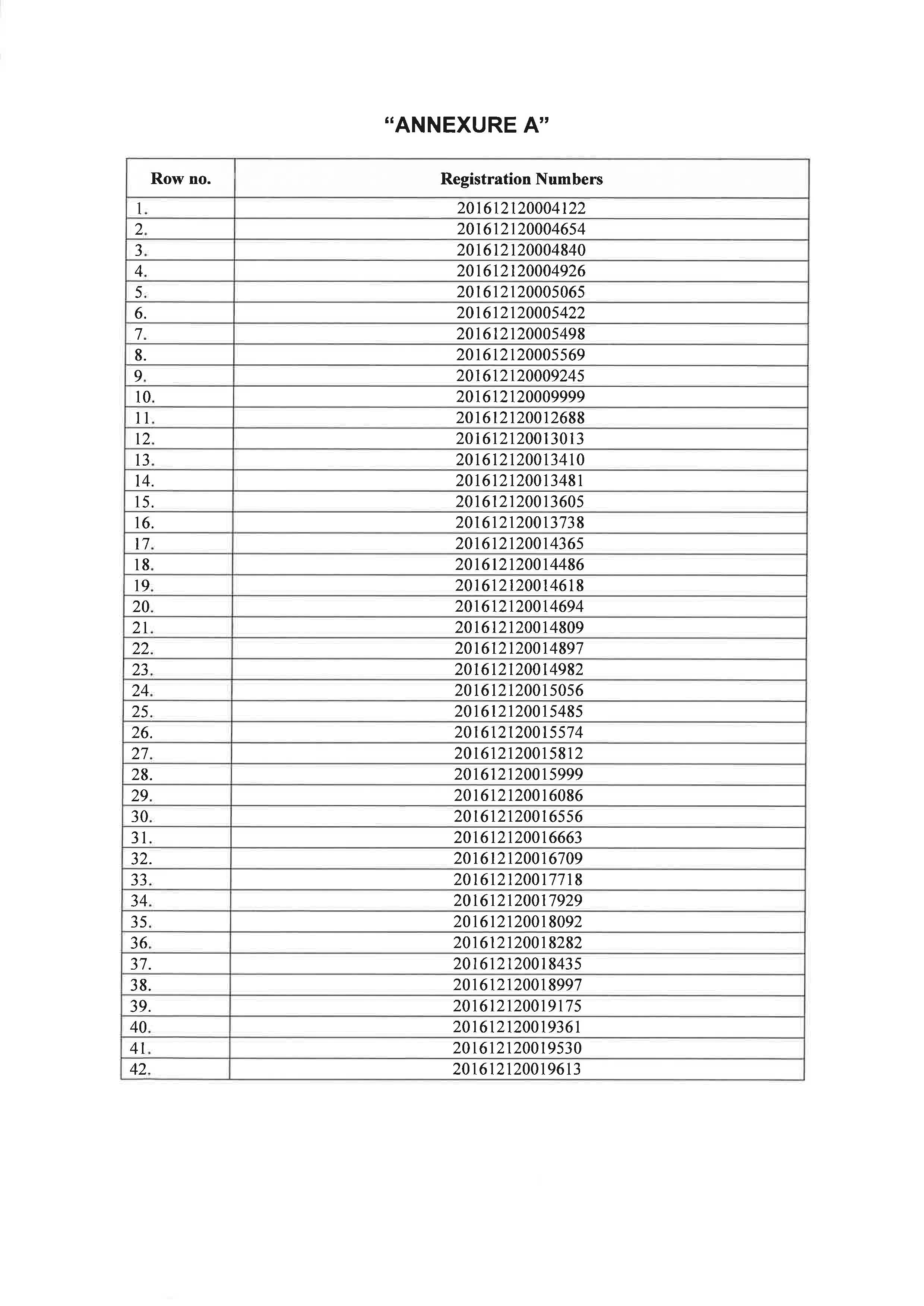
2. Pursuant to section 588FM of the Corporations Act, 12 December 2016 be fixed as the later time for the purposes of section 588FL(2)(b)(iv) in respect of any security interests granted by the Defendant in favour of the Plaintiff in connection with the Equipment Hire Services Agreement (effective date of 1 September 2016), such security interests corresponding to the registration numbers listed in “Annexure A” in the register established under the Personal Property Securities Act 2009 (Cth).
Note: Entry of orders is dealt with in Rule 39.32 of the Federal Court Rules 2011.
DAVIES J:
the application
1 The plaintiff (“Renfrey”) has applied for an order under s 588FM of the Corporations Act 2001 (Cth) (“the Corporations Act”) fixing 12 December 2016 as the later time for the purposes of s 588FL(2)(b)(iv) in respect of the registration of security interests granted by the defendant (“OneSteel” or “the company”) in connection with an Equipment Hire Services Agreement executed on 25 November 2016 (“the EHS agreement”). The order has been sought to preclude the possible effect of s 588FL(4) of the Corporations Act in relation to the vesting of the security interests in OneSteel, which would have the consequence, if the section applies, that Renfrey would lose the benefit of the security. The application is not opposed by OneSteel.
Factual background
2 OneSteel is a member of the Arrium Group of Companies. The company, along with other companies in the Arrium Group, went into administration on 7 April 2016 and subsequently entered into a deed of company arrangement on 4 November 2016 under which the administrators of the company were appointed as deed administrators.
3 At the time of the appointment of the administrators, various plant and equipment that OneSteel was using at its mining site in South Australia had been hired from Renfrey under an equipment hire services agreement entered into in July 2013. Renfrey had registered its security interest in the plant and equipment arising under this equipment hire services agreement shortly after the equipment hire services agreement had been entered into. After OneSteel was placed into administration, Renfrey became aware that its security interest had not been properly registered on the Personal Property Securities Register (“PPSR”) as the registration had identified Arrium Limited, OneSteel’s parent company, as the grantor, not OneSteel as it should have been. Renfrey fell into dispute with the administrators over whether the registration was effective under the Personal Property Securities Act 2009 (Cth) (“PPSA”) and whether the security interests had vested in OneSteel.
4 The dispute was resolved when it was agreed that the parties would enter into a new equipment hire agreement under which Renfrey would be granted new security interests in the relevant plant and equipment which could be registered under the PPSA. The EHS agreement was entered into in respect of the same plant and equipment on 25 November 2016 (with the effective date of 1 September 2016). Under clause 3.2(a), OneSteel agreed that it relinquished any interest it held in the plant and equipment immediately prior to the execution of the EHS agreement. By clause 3.2(b) OneSteel agreed that to the extent that the EHS agreement created a security interest for the purposes of the PPSA in favour of Renfrey that OneSteel and the deed administrators would do all things necessary for Renfrey to make a valid and effective PPSA registration.
5 On 12 December 2016, Renfrey’s security interest in the plant and equipment was registered under the PPSA. The registration was within 20 business days of the security interest arising.
legislation
6 Section 588FL of the Corporations Act relevantly provides as follows:
Vesting of PPSA security interests if collateral not registered within time
Scope
(1) This section applies if:
(a) any of the following events occurs:
(i) an order is made, or a resolution is passed, for the winding up of a company;
(ii) an administrator of a company is appointed under section 436A, 436B or 436C;
(iii) a company executes a deed of company arrangement under Part 5.3A; and
(b) a PPSA security interest granted by the company in collateral is covered by subsection (2).
Note: A security interest granted by a company in relation to which paragraph (a) applies that is unperfected at the critical time may vest in the company under section 267 or 267A of the Personal Property Securities Act 2009 .
(2) This subsection covers a PPSA security interest if:
(a) at the critical time, or, if the security interest arises after the critical time, when the security interest arises:
(i) the security interest is enforceable against third parties under the law of Australia; and
(ii) the security interest is perfected by registration, and by no other means; and
(b) the registration time for the collateral is after the latest of the following times:
(i) 6 months before the critical time;
(ii) the time that is the end of 20 business days after the security agreement that gave rise to the security interest came into force, or the time that is the critical time, whichever time is earlier;
(iii) if the security agreement giving rise to the security interest came into force under the law of a foreign jurisdiction, but the security interest first became enforceable against third parties under the law of Australia after the time that is 6 months before the critical time-the time that is the end of 56 days after the security interest became so enforceable, or the time that is the critical time, whichever time is earlier;
(iv) a later time ordered by the Court under section 588FM.
Note 1: For the meaning of critical time, see subsection (7).
Note 2: For when a security interest is enforceable against third parties under the law of Australia, see section 20 of the Personal Property Securities Act 2009 .
Note 3: A security interest may become perfected at a particular time by a registration that is made earlier than that time, if the security interest attaches to the collateral at the later time (after registration). See section 21 of the Personal Property Securities Act 2009 .
Note 4: The Personal Property Securities Act 2009 provides for perfection by registration, possession or control, or by force of that Act (see section 21 of that Act).
Vesting of security interest in company
(4) The PPSA security interest vests in the company at the following time, unless the security interest is unaffected by this section because of section 588FN:
(a) if the security interest first becomes enforceable against third parties at or before the critical time-immediately before the event mentioned in paragraph (1)(a);
(b) if the security interest first becomes enforceable against third parties after the critical time-at the time it first becomes so enforceable.
Note: For the meaning of critical time, see subsection (7).
Property acquired for new value without knowledge
…
(7) In this section:
“critical time”, in relation to a company, means:
(a) if the company is being wound up-when, on a day, the event occurs by virtue of which the winding up is taken to have begun or commenced on that day under section 513A or 513B; or
(b) in any other case-when, on a day, the event occurs by virtue of which the day is the section 513C day for the company.
7 Section 588FM provides as follows:
Extension of time for registration
(1) A company, or any person interested, may apply to the Court (within the meaning of section 58AA) for an order fixing a later time for the purposes of subparagraph 588FL(2)(b)(iv).
Note: If an insolvency-related event occurs in relation to a company, paragraph 588FL(2)(b) fixes a time by which a PPSA security interest granted by the company must be registered under the Personal Property Securities Act 2009, failing which the security interest may vest in the company.
(2) On an application under this section, the Court may make the order sought if it is satisfied that:
(a) the failure to register the collateral earlier:
(i) was accidental or due to inadvertence or some other sufficient cause; or
(ii) is not of such a nature as to prejudice the position of creditors or shareholders; or
(b) on other grounds, it is just and equitable to grant relief.
(3) The Court may make the order sought on any terms and conditions that seem just and expedient to the Court.
issues
8 In the present case, the “critical time”, as defined by s 588FL(7), is the date that the administration began, namely 7 April 2016: see s 513C of the Corporations Act. For the purposes of s 588FL(2)(b)(ii), the security interest came into force on 25 November 2016 and the time that was 20 business days after the security interest came into force was 23 December 2016. The security interest was registered within that time, namely on 12 December 2016. Whilst the security interest was registered within 20 business days of the security interest coming into force, it was, nonetheless, registered after the “critical time”, namely 7 April 2016, and the parties are concerned that on one possible construction of s 588FL(2)(b)(ii), the fact that the security interest was registered after the “critical time” means that, by reason of s 588FL(4), the security interest automatically vested in OneSteel when it became enforceable. Renfrey applied for an order under s 588FM extending the time for registration of its security interest to 12 December 2016 to avoid the potential operation of s 588FL(4). Renfrey relies on the just and equitable ground under s 588FM(2)(b) to extend the time for registration.
9 At the hearing, the parties did not seek to construe s 588FL(2)(b)(ii) beyond contending that the language of that provision leaves it unclear as to whether, absent an order under s 588FM, s 588FL(4) is engaged in this case because the relevant security interests were not perfected by registration until after the “critical date”. The parties adopted the approach taken in Re Mentha, in the matter of Arrium Limited (administrators appointed) [2016] FCA 972. In that case, the Court made an order under s 588FM on an urgent basis extending the registration time in respect of a security interest yet to be granted and registered, because of concern about the potential operation of s 588FL(4). The order was made “to put beyond doubt” that s 588FL would not, in that case, operate to vest the security interest automatically because the “critical time”, being the commencement of a voluntary administration, had already passed. The Court was not asked to, and did not, engage in a detailed consideration of s 588FL of the Corporations Act. Apart from the fact that the order in that case was sought before the security interest had arisen, so that there was no question raised in that case as to whether s 588FL(4) had been engaged when the s 588FM order was applied for, this case did not require an urgent decision and is an appropriate vehicle for grappling with the proper construction of s 588FL in relation to its application to a security interest granted and registered after the relevant event in s 588FL(1)(a) of the Corporations Act.
10 Shortly after the hearing of Renfrey’s application, the decision in In the matter of OneSteel Manufacturing Pty Ltd (administrators appointed) [2017] NSWSC 21 (“Re OneSteel Manufacturing”) was handed down. Briefly stated, the facts of that case were that the plaintiff (Alleasing) was in the business of asset financing and leasing. On 16 October 2014, Alleasing entered into a master lease agreement with OneSteel Manufacturing Pty Limited (administrators appointed) (the same entity as the defendant in this case), pursuant to which “rental schedules” could be entered into and particular goods leased to OneSteel. Pursuant to rental schedules, OneSteel rented a crusher and spare parts from Alleasing. The crusher lease and the parts lease were PPS leases within the meaning of the PPSA. The financing statement for the crusher lease was first registered on 17 October 2014. The financing statement for the parts lease was first registered on 7 July 2015. By an error, the registrations on the PPSR were lodged by reference to OneSteel’s ABN rather than its ACN. On 7 April 2016 administrators were appointed to OneSteel and on 10 June 2016 the administrators informed Alleasing that the registrations in respect of the crusher lease and parts lease were defective and their security interests were therefore unperfected. They advised that by reason of s 267 of the PPSA, Alleasing’s security interests vested in OneSteel. On 14 June 2016, Alleasing lodged new financing statements in respect of the crusher and the parts, using OneSteel’s ACN and, on 17 June 2016, amended the original registrations to include the ACN. Alleasing sought a declaration from the Court that its security interests were validly perfected and had not vested in OneSteel pursuant to s 267 of the PPSA, alternatively an order under s 588FM of the Corporations Act fixing as the registration time for its security interests, the date on which the second registrations were made. Brereton J held that the initial registrations were ineffective and therefore Alleasing’s security interests were unperfected at the time that an administrator was appointed to OneSteel and s 588FL did not apply to the security interest. His Honour stated at [69]‒[70]:
An order under s 588FM provides relief from the consequences of failure to register a security interest within time, with the consequences that a security interest is no longer in jeopardy of being vested in the grantor, in case of an insolvency event, on account of its belated registration. The effect of such relief is that should an insolvency event occur within six months of actual registration, although the security interest would otherwise vest in the grantor under s 588FL(4) because of its belated registration, it will not vest under that provision. However, an order under s 588FM fixes a later time only “for the purposes of subparagraph 588FL(2)(b)(iv)”. An order under s 588FM does not resurrect a security interest which has vested in the grantor for a reason other than late registration. In other words, it serves to immunise the relevant security interest only against the consequences of what would otherwise be late registration.
In this respect, it is notable that such relief is available only in respect of a security interest that has been perfected as at the “critical time”. Together, s 588FL(1) and (2) mean that s 588FL applies only to a security interest that “at the critical time” is enforceable against third parties and “is perfected by registration, and by no other means”. Alleasing’s submission that the phrase is perfected by registration means “is capable of being perfected” must be rejected. The opening words of s 588FL(2)(a) – “at the critical time, or, if the security interest arises after the critical time, when the security interest arises” – indicate that the security interest must have the status of being perfected at that time. Moreover, pursuant to CORPA s 588FK, the term “is perfected” has the same meaning in CORPA as in the PPSA, where s 21 uses the present tense in the same way:
…
Brereton J also held that the relief under s 588FM was not available since s 588FL(2)(a) was not satisfied and an order under s 588FM only immunised a perfected security interest from vesting under s 588FL(4). His Honour reasoned at [72]‒[74]:
That s 588FM is concerned only to provide relief from the consequences of belated registration of perfected interests, and is not concerned with unperfected interests, is reinforced by the note to s 588FL(1), which is to the effect that a security interest granted by a company which has an insolvency event, that is unperfected at the critical time, may vest in the company under PPSA s 267 or s 267A.
Section 588FM provides a means for obtaining relief from the consequences of belated registration of security interests granted by companies. Notably, it applies only to interests granted by companies. However, s 267, which vests unperfected security interests, applies to interests granted by individuals as well as those granted by companies. It would be discordant if a vesting under s 267 were amenable to cure by relief under s 588FM where the grantor was a company, but not otherwise.
Accordingly, an order under s 588FM does not immunise an unperfected security interest from vesting under s 267(2), but only a perfected security interest from vesting under s 588FL(4).
11 The parties were accordingly asked by the Court to provide further submissions:
(a) on whether s 588FL(4) applies in this case by reason of s 588FL(2)(b)(ii); and
(b) if so, on whether the Court has the power to make an order under s 588FM extending the time for registration of the security interest as it was registered after the critical date.
12 Both parties provided further written submissions. In summary, Renfrey put submissions distinguishing Re OneSteel Manufacturing as a case concerned with the interaction of s 267 of the PPSA and s 588FM of the Corporations Act and supporting the position that the Court has the power to make an order under s 588FM even if s 588FL(4) has been triggered. On the construction of s 588FL, Renfrey submitted that, adopting the approach of Brereton J, “it may be said that security interests arising after the ‘critical time’ are only caught by s 588FL(2)(a) if they are perfected by registration when the security interest arises”. It was submitted that such a construction would, however, have the “odd result that in respect of security interests arising after the ‘critical time’, only those security interests registered before they arise would be caught by s 588FL(2) (and, correspondingly, s 588FL(4))”. It was also argued that such a construction would greatly limit the application of s 588FL and arguably defeat the purpose of the section, which it was said, “is, expressed generally, to protect persons who are affected in their dealings with a company where others have dealt with the company as though it were unencumbered”. Renfrey maintained the position that the true construction and application of s 588FL(4) is unclear and in the circumstances, and to give certainty, it is reasonable for an extension to be granted under s 588FM of the Corporations Act. Renfrey also submitted that the Court should follow the decision in Re Quality Blended Liquor Pty Ltd [2014] QSC 234;] (2015) 2 Qd R 381 per Wilson J at [75]‒[83] and find that the making of an order under s 588FM is not contingent on s 588FL applying.
13 OneSteel submitted that the better view is that s 588FL does not apply although, it was said, the contrary view is arguable. It was argued that s 588FL(1)(a) refers to future events, whereas the use of the past tense in s 588FL(1)(b), “a PPSA security interest granted by the company in collateral is covered by subsection (2)”, connotes that the “granting” has already occurred at the time of the triggering event under subparagraph (a). Thus, it was argued, s 588FL requires, as a prerequisite to its operation, that the interest has already been granted when the relevant event in s 588FL(1)(a) occurs.
14 OneSteel also submitted that s 588FL(2)(a)(ii), construed according to its plain words, would independently preclude the application of s 588FL in this case by reason that, in order to satisfy the requirements in s 588FL(2)(a) for the section to apply, “when” the security interest arose, ie, on 25 November 2016, the two thresholds in s 588FL(2)(a) had to be met: viz: the security interest was enforceable against third parties under the law of Australia (s 588FL(2)(a)(i)); and the security interest was perfected by registration (s 588FL(2)(a)(ii)). It was accepted that the requirement under s 588FL(2)(a)(i) was met but not the requirement under s 588FL(2)(a)(ii) as registration did not happen until 12 December 2016.
consideration
15 Section 588FL must be read as a whole and, in my view, read as a whole, it seems clear, contrary to OneSteel’s submission, that the scope of s 588FL does cover PPSA security interests that are granted after a relevant s 588FL(1)(a) event.
16 In this case, a s 588FL(1)(a) event occurred in relation to OneSteel, being the appointment of an administrator to OneSteel. Whether s 588FL applies depends on whether the security interest granted by OneSteel “is covered” by s 588FL(2) of the Corporations Act.
17 A PPSA security interest “is covered” by s 588FL(2) if:
(a) “at the critical time, or, if the security interest arises after the critical time, when the security interest arises” it is enforceable against third parties in Australia and perfected by registration: s 588FL(2)(a); and
(b) the registration time for the collateral is after the latest of times prescribed in s 588FL(2)(b).
18 The words of s 588FL(2)(a) expressly and unambiguously extend the scope of that subsection to cover a PPSA security interest that “arises after the critical time”. The “critical time” for that purpose is defined in s 588FL(7), relevantly, by reference to the events prescribed in s 588FL(1)(a) in relation to the grantor company, namely:
(a) in respect of a grantor company that is being wound up, the day when the winding up is taken to have begun or commenced as prescribed by ss 513A and 513B (whichever is relevant);
(b) “in any other case”: ie if an administrator is appointed to the grantor company or the grantor company executes a deed of company arrangement, the s 513C day in relation to an administration.
19 If the grantor company is wound up, a security interest “arises after the critical time” if it arises after the day prescribed in s 513A or s 513B (whichever is relevant) as the day that the winding up is taken to have begun or commenced. Thus, for example, a security interest “arises after the critical time” if, in respect of a grantor company that is being wound up by court order, it arises after the day on which the order was made: s 513A(e) of the Corporations Act. If an administrator is appointed to the grantor company, a security interest “arises after the critical time” if it arises after the day prescribed in s 513C, namely the day on which the administration began: s 513C(b) of the Corporations Act.
20 The express provision in s 588FL(2) that the subsection covers a security interest “arising after the critical time”, being an expression defined by reference to the events prescribed in s 588FL(1)(a), is a powerful textual and contextual reason against OneSteel’s construction of s 588FL(1) that the “granting” of that interest must have already occurred at the time of the triggering event under subparagraph (a). A security interest that “arises after the critical time” is congruent to a security interest “granted” by the company after the relevant event prescribed in s 588FL(1)(a) that “is covered” by s 588FL(2). Read in that way, the different tenses in s 588FL(1)(a) and (b) do not connote that it is necessary that the security interest be “granted” by the company before the relevant event “occurs”, that is, as a requirement to be satisfied as a past event before the relevant s 588FL(1)(a) event occurs.
21 It was submitted for OneSteel that its construction, nonetheless, still gives meaning to s 588FL(2)(a) in that the “critical time” events do not overlap completely with the events described in s 588FL(1). It was said, for example, that a security interest could be granted after the appointment of administrators (that is “after the critical time”) but the “event” that triggers the operation of s 588FL(1) might be the “company executing a deed of company arrangement” or the time a winding up order is made. The difficulty with this argument is that it does not give primacy to the language used nor is the plain and grammatical meaning displaced by considerations of context. Section 588FL(4) is part of that context.
22 Pursuant to s 588FL(4), a PPSA security interest caught by s 588FL vests in the grantor company. The time at which it vests depends on the time at which the security interest first becomes enforceable. If it first became enforceable at or before the “critical time”, it vests immediately before the event mentioned in s 588FL(1)(a) (s 588FL(4)(a)). If it first became enforceable after the “critical time”, it vests immediately at the time it first becomes enforceable (s 588FL(4)(b)). OneSteel argued that whether a security interest becomes enforceable (pursuant to s 19 of the PPSA) is independent of whether it is “granted”. So much may be accepted in so far as “enforceability” is a particular statutory concept under the PPSA: see s 19 of the PPSA; Re Donnelly & Ors (in their capacities as joint and several administrators of Carpenter International Pty Ltd) (ACN 165 690 657) (administrators appointed) [2016] VSC 118; (2016) 111 ACSR 477 at [184]–[185]. Therefore, the argument went, s 588FL(4) “in no way indicates that s 588FL is intended to apply to security interests granted after the events specified in s 588FL(1)”. However, that proposition disregards s 588FL(2)(a)(i) under which it is a requirement for s 588FL to apply to a security interest that the security interest is enforceable against third parties under the law of Australia. The terms of s 588FL(4) operate consistently with the plain and grammatical meaning of the text in s 588FL(2)(a).
23 OneSteel also submitted that the explanatory memorandum to the legislation that inserted s 588FL into the Corporations Act is supportive of its construction in that each of the examples given as to scenarios in which s 588FL would apply are where the security interest was already granted by the company as at the date of the occurrence of one of the s 588FL(1)(a) events. The examples given are ones where the security interest was granted before a s 588FL(1)(a) event but nothing is said in the explanatory memorandum to indicate that Parliament did not intend s 588FL also to apply to security interests arising after a relevant event has occurred in relation to a grantor company.
24 I should at this point also deal with paragraph [70] of Re OneSteel Manufacturing where Brereton J stated that the opening words of s 588FL(2)(a) – “at the critical time, or, if the security interest arises after the critical time, when the security interest arises” – indicate that the security interest must have the status of being perfected “at that time”. Both parties argued that this passage supports the construction that both subparagraphs of s 588FL(2)(a) must be met at the time that the security interest arises. However, his Honour was there concerned with whether s 588FL applied to a security interest that had been defectively registered before the critical date. His Honour was not concerned with a security interest arising after the critical date. Contrary to the submissions of the parties, I do not think that the word “when” imports the requirement that a security interest must meet the requirements of both subparagraphs of s 588FL(2)(a) at the time that the security interest arises. The word “when” includes, in ordinary meaning, the meaning of “upon or after which; and then”: Macquarie Dictionary 7th edition. Read in that way, the word “when” does not convey a requirement that the security interest be enforceable and perfected at the time that it arises but, rather, upon or after arising, the two requirements of enforceability and registration be met. Such a construction gives effect to the ordinary meaning of the word and has a coherence with the section as a whole, avoiding the anomalous result pointed out by Renfrey that s 588FL would only apply to security interests arising after the critical time but registered before they arise (if that be possible) and not to security interests arising after the critical time but registered after they arise. The section plainly contemplates that security interests arising after the critical time, which are thereafter registered, are within its scope and no logical reason is apparent for construing the provision in a way that would exclude from the scope of the section, security interests that arise after the critical time but which are only registered after they arose.
25 The next issue is whether, in the present case, s 588FL has been engaged by s 588FL(2)(b). Pursuant to s 588FL(2)(b), s 588FL applies where registration has occurred but the registration time is after the latest of the following times:
six months before the commencement of the winding up or appointment of administrator (s 588FL(2)(b)(i));
more than 20 days after the security agreement became enforceable, “or the time that is the critical time, whichever is earlier” (s 588FL(2)(b)(ii));
if the security agreement giving rise to the security interest came into force under the law of a foreign jurisdiction, but the security interest first became enforceable against third parties under the law of Australia after the time that is six months before the critical time ‒ the time that is the end of 56 days after the security interest became so enforceable, or the time that is the critical time, whichever time is earlier (s 588FL(2)(b)(iii)); or
a later time fixed by the Court under s 588FM (s 588FL(2)(b)(iv)).
26 Subsections 588FL(2)(b)(i) and (iii) are not presently relevant. The provision in issue is s 588FL(2)(b)(ii). The language employed is that it is the earlier of the time frames of 20 business days after the security interest arises, or the critical time. The earlier of those time frames, in turn, is the latest of the times stipulated by s 588FL(2)(b). On this construction, where a security interest is registered after the commencement of the winding up or appointment of administrator (as the case may be), the security interest would vest in the grantor company on creation, even if registered within 20 business days after the security agreement came into force, unless an order was made under s 588FM extending the time for registration. The security interest granted by OneSteel to Renfrey is in this category as the registration was effected after the critical time, albeit within 20 business days of the security arising. I have therefore concluded that s 588FL(2) would cover the security interest granted by OneSteel to Renfrey, absent an order under s 588FM fixing a later registration time for the purposes of s 588FL(2)(b) and, thus, s 588FL(4) would be engaged, but for an order under s 588FM of the Corporations Act.
27 I turn now to s 588FM of the Corporations Act. I accept both parties’ submission that Re OneSteel Manufacturing is distinguishable as the point on which that case was decided does not arise in this case, namely whether s 588FM applied to a security interest that had already vested by operation of s 267 of the PPSA, where the finding was that s 588FL did not apply. In contrast to s 267 of the PPSA, the terms of s 588FL explicitly contemplate that an order may be made under s 588FM fixing a later time for registration to preclude the operation of s 588FL. Nothing in the terms of the section indicates that an order under s 588FM cannot be made after s 588FL(4) has been triggered.
28 To make an order under s 588FM(2)(b), the Court must be satisfied that it is just and equitable to grant relief. The circumstances that would justify an order extending the time for registration on the just and equitable ground to avoid the operation of s 588FL(4) will depend upon the circumstances of each particular case. Some general observations can be made though. As the purpose and effect of an order under s 588FM is to avoid the vesting of the security interest in the company and preserve the secured creditor’s security, it is relevant in determining whether it is just and equitable to fix a later time to consider the interests of the creditors: Re Appleyard Capital Pty Ltd [2014] NSWSC 782; (2014) 101 ACSR 629 at [29]-[30]. As Brereton J observed in Re Appleyard Capital Pty Ltd at [30] whilst “the presence or absence of prejudice to unsecured creditors is a relevant discretionary consideration, relevant prejudice is not necessarily established merely by showing that the dividend to unsecured creditors will be less if the security interest does not vest in the company; the unsecured creditors may well have been in no different a position if the security interest been timely registered”. His Honour stated that the type of prejudice that is of particular relevance is prejudice attributable to the failure to effect registration earlier where the delay in the registration of the security interest causes prejudice to creditors who have transacted with the company to their detriment, being unaware of the creation of a security interest. In the present case, there was no delay in registration.
29 I am satisfied that it is just and equitable to fix a later time for the purposes of s 588FL(2)(b)(iv) of the Corporations Act. The security interests were created as part of a commercial settlement of a dispute between the administrators and Renfrey relating to security interests arising under an earlier hire services agreement that OneSteel and Renfrey entered into in 2013 in respect of certain plant and equipment that OneSteel uses at its site at Ardrossan in South Australia. Since OneSteel went into administration it has continued to use that plant and equipment in OneSteel’s mining operations. It is the administrators’ view that the continued hire of the plant and equipment is necessary for the continued operation of OneSteel’s business and that the entry into the new agreement and OneSteel’s agreement to do all things necessary for Renfrey to make a valid and effective PPSA registration is in furtherance of the objects of Part 5.3A of the Corporations Act. In those circumstances, it seems to me that it is just and equitable to fix a later time for the registration of the security interest. As registration was made promptly after entry into the new equipment hire services agreement, the prejudice to unsecured creditors to which Brereton J referred in Re Appleyard Capital Pty Ltd does not arise in this case.
30 For the purposes of making this application, Renfrey has also sought the leave of the Court pursuant to s 444E(3)(c) of the Corporations Act to proceed against OneSteel. The administrators have consented to that order and it is appropriate that it be made.
I certify that the preceding thirty (30) numbered paragraphs are a true copy of the Reasons for Judgment herein of the Honourable Justice Davies. |
Associate: