FEDERAL COURT OF AUSTRALIA
Dincel Construction System Pty Limited v AFS Systems Pty Ltd [2017] FCA 262
ORDERS
DATE OF ORDER: |
THE COURT NOTES:
The undertaking to the Court given by the Applicant’s counsel to:
(a) submit to such order (if any) as the Court considers to be just for the payment of compensation, to be assessed by the Court or as it may direct, to any person, whether or not a party, adversely affected by the operation of these orders and undertakings or any continuation (with or without variation) thereof; and
(b) pay the compensation referred to in (a) to the person or persons there referred to.
THE COURT ORDERS THAT:
Until the determination of this proceeding or further order, the First Respondent, whether by itself, its servants or agents, or otherwise, be restrained from:
(a) manufacturing in Australia or importing into Australia the building element depicted in the photographs in Annexure WSH-6 to the affidavit of William Samuel Hunter sworn on 13 February 2017 (AFS Product);
(b) selling, supplying or otherwise disposing of the AFS Product in Australia;
(c) offering to manufacture, sell, supply or otherwise dispose of the AFS Product in Australia; or
(d) authorising, procuring, inducing or joining in a common design with any other person to engage in any of the acts referred to in sub-paragraphs (a) to (c) above.
Note: Entry of orders is dealt with in Rule 39.32 of the Federal Court Rules 2011.
NICHOLAS J:
Background
1 Before me is an application for an interlocutory injunction restraining the first respondent from (inter alia) selling or offering to sell a building element which is said to infringe various claims of Standard Patent No 2002328693 (“the Patent”).
2 The Patent relates to building elements used to form walls of a building. The applicant (“Dincel”) in the proceeding is the exclusive licensee. The second respondent- Mr Burak Dincel, the managing director of Dincel- is the patentee.
3 Since 2006 Dincel has made and sold permanent polymer formwork elements made out of PVC which are used to construct walls (“the Dincel element”). They are placed next to each other and “snapped” together. Concrete is then poured into the spaces inside the elements to make a solid wall.
4 There are other permanent polymer formwork elements on the market, including one that has been imported since 2011 by the first respondent (“AFS”) and sold under the trade name “Rediwall”. However, Dincel elements are the only elements of this kind that are currently on the market which can be “snapped” together. Mr Dincel says that this makes installation of the elements quicker, safer, and cheaper.
5 AFS is part of the CSR group. In around mid-December 2016, Mr Dincel became aware that AFS was testing new formwork products. In late January 2017, he became aware that AFS intended to launch a new formwork product (“the AFS element”) that would compete with Dincel’s element. The evidence indicates that the AFS element will not be launched before April of this year.
6 On 27 January 2017, Dincel’s solicitors sent a letter of demand to AFS. On 14 February 2017, following some correspondence between the solicitors for Dincel and AFS, Dincel commenced this proceeding.
7 At the hearing counsel for both parties focused much of their attention on the issue of patent construction arising out of the use of the term “ramp surfaces” in claim 1 of the Patent. In written submissions AFS also raised a fair basis issue.
The Evidence
8 Dincel relies on affidavit evidence of a mechanical engineer, Mr William Hunter, who has read the Patent and examined examples of the relevant AFS product. Mr Hunter is of the opinion that the AFS element incorporates each of the integers of claim 1 as well as dependent claims 1, 2-4, 7-9, 11, 14 and 25.
9 The evidence relied upon by Dincel also includes affidavits by Mr Dincel, Mr John Afaras, Dincel’s solicitor, and Mr Greg Turner, Dincel’s patent attorney. The evidence relied upon by AFS consists of affidavits by:
Mr Stephen Darwell, a director of AFS;
Mr Ben Boyd, a patent attorney at Griffith Hack;
Mr Timothy Phillips, an industrial designer engaged by AFS’ solicitors to act as an independent expert for AFS; and
Mr Derek Baigent, the solicitor for AFS.
10 There was no cross-examination.
11 The evidence of Mr Hunter and Mr Phillips was directed to the strength of the infringement case. The evidence of Mr Dincel and Mr Darwell was primarily directed to matters relevant to the balance of convenience. Mr Boyd produced an earlier version of the complete specification that Mr Flynn, counsel for AFS, submitted was relevant to the construction of the complete specification in its amended form.
12 The evidence also includes samples of two AFS elements which I have had the opportunity to inspect and “snap” together.
The Relevant Principles
13 There was no dispute as to the principles to be applied in determining whether to grant or withhold interlocutory injunctive relief. They were referred to by the Full Court in Warner-Lambert Co LLC v Apotex Pty Ltd (2014) 106 IPR 218 (Allsop CJ, Jagot and Nicholas JJ). The Full Court said at [69]-[70]:
[69] The principles to be applied in determining whether or not to grant interlocutory relief were considered by the High Court in Australian Broadcasting Corp v O’Neill (2006) 227 CLR 57; 229 ALR 457; [2006] HCA 46 (O’Neill), including by Gummow and Hayne JJ at [65]–[72]. Gleeson CJ and Crennan J agreed at [19] with the explanation of the relevant principles in those paragraphs. In O’Neill Gummow and Hayne JJ stated at [65]:
The relevant principles in Australia are those explained in Beecham Group Ltd v Bristol Laboratories Pty Ltd [(1968) 118 CLR 618; [1968] ALR 469]. This court (Kitto, Taylor, Menzies and Owen JJ) said that on such applications the court addresses itself to two main inquiries and continued [(1968) 118 CLR 618 at 622–623; [1968] ALR 469 at 470–1]:
“The first is whether the plaintiff has made out a prima facie case, in the sense that if the evidence remains as it is there is a probability that at the trial of the action the plaintiff will be held entitled to relief ... The second inquiry is ... whether the inconvenience or injury which the plaintiff would be likely to suffer if an injunction were refused outweighs or is outweighed by the injury which the defendant would suffer if an injunction were granted.”
By using the phrase “prima facie case”, their Honours did not mean that the plaintiff must show that it is more probable than not that at trial the plaintiff will succeed; it is sufficient that the plaintiff show a sufficient likelihood of success to justify in the circumstances the preservation of the status quo pending the trial. That this was the sense in which the court was referring to the notion of a prima facie case is apparent from an observation to that effect made by Kitto J in the course of argument [(1968) 118 CLR 618 at 620; [1968] ALR 469 at 468]. With reference to the first inquiry, the court continued, in a statement of central importance for this appeal [(1968) 118 CLR 618 at 622; [1968] ALR 469 at 470]:
“How strong the probability needs to be depends, no doubt, upon the nature of the rights [the plaintiff] asserts and the practical consequences likely to flow from the order he seeks.”
[70] Whether an applicant for an interlocutory injunction has made out a prima facie case and whether the balance of convenience favours the grant of such relief are related questions. It will often be necessary to give close attention to the strength of a party’s case when assessing the risk of doing an injustice to either party by the granting or withholding of interlocutory relief especially if the outcome of the interlocutory application is likely to have the practical effect of determining the substance of the matter in issue or if other remedies, including an award of damages, or an award of compensation pursuant to the usual undertaking, are likely to be inadequate.
14 The extent to which it is necessary or appropriate to evaluate the strength of the applicant’s claim for final relief when deciding whether to grant or withhold interlocutory relief will vary depending on the circumstances of the case. As Gummow and Hayne JJ explained in Australian Broadcasting Corp v O’Neill (2006) 227 CLR 57 at [71] “… the requisite strength of the probability of ultimate success depends upon the nature of the rights asserted and the practical consequences likely to flow from the interlocutory order sought.”
15 I was also referred to the decision in Samsung Electronics Company Ltd v Apple Inc (2011) 217 FCR 238 in which the Full Court (Dowsett, Foster and Yates JJ) said at [51]:
[51] It is true that an applicant for interlocutory relief need not necessarily show that its case is, on balance, likely to succeed. However the exercise described in O’Neill may lead to the conclusion that in order sufficiently to recognize the serious consequences for the respondent of the grant of interlocutory relief, the applicant should reasonably be expected to demonstrate such likelihood. Where the merits and the question of convenience are fairly evenly balanced, there will be no injustice in requiring that the party seeking relief demonstrate good prospects of success before imposing almost certain prejudice on the other side.
16 Mr Flynn placed considerable reliance upon this statement. However, what may be noted is that their Honours at [51] were addressing a situation in which both matters of legal merit and convenience were fairly evenly balanced. As I will explain, I do not think this is true of the present case.
17 On the question of patent construction, there was also no dispute as to the principles to be applied. These are summarised in many Full Court decisions including Jupiters Ltd v Neurizon Pty Ltd (2005) 65 IPR 86 (Hill, Finn and Gyles JJ) at [67]. The Patent is to be construed in accordance with these well settled principles. As to fair basis, the relevant principles are set out in the High Court’s judgment in Lockwood Security Products Pty Ltd v Doric Products Pty Ltd (2004) 217 CLR 274 (“Doric”) at [68]-[69], [91], [93] and [100]-[101].
The Patent
18 The Patent is entitled “Hollow interconnecting panels as lost formwork”. The specification describes an invention consisting of a hollow building element that acts as permanent formwork into which concrete may be poured to make a wall. The title refers to “lost” formwork because the elements are not re-useable.
19 The specification identifies two disadvantages in the prior art building elements which the invention is intended to overcome or ameliorate. First, the prior art elements are coupled together by a vertical sliding motion which hinders their assembly and are, due to their length, difficult to handle. Second, the prior art building elements have either male or female couplings, which means that both of the elements must be manufactured and stocked.
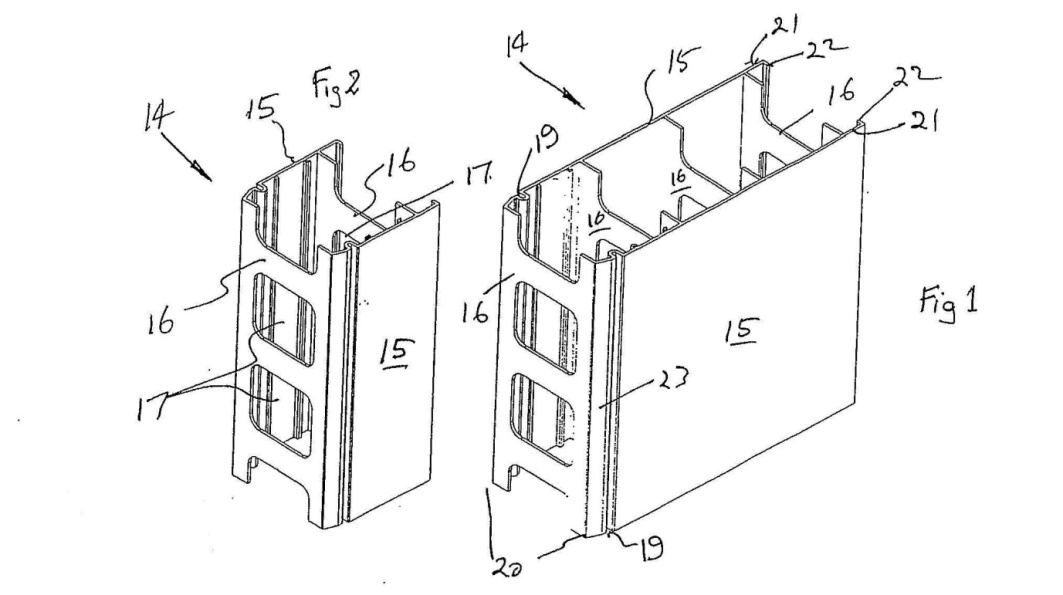
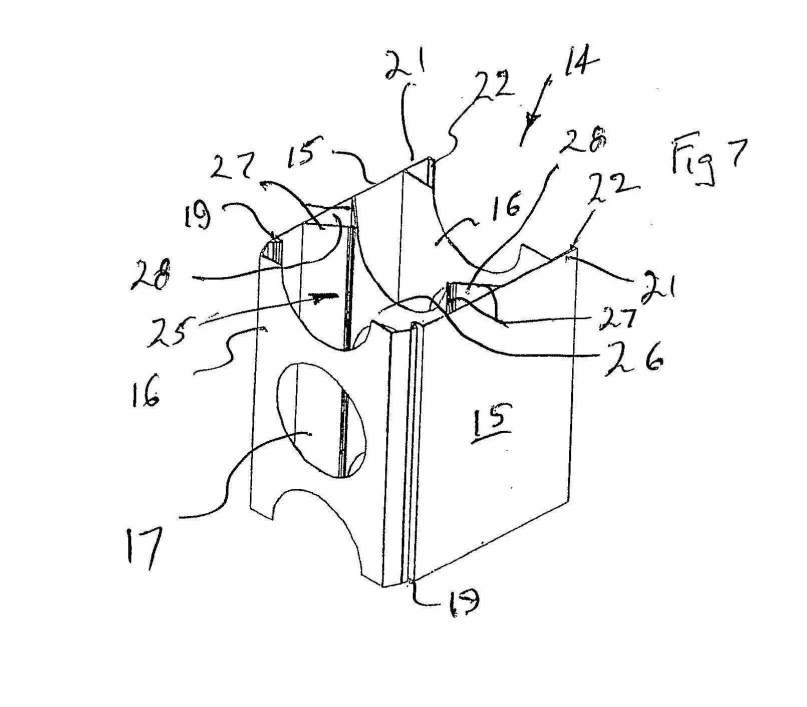
20 The specification includes a number of consistory statements (which mirror the claims) followed by a detailed description of various preferred embodiments with reference to eight drawings (Figures 1-8). These include Figs 1, 2 and 7 as follows:
21 The description of the preferred embodiments includes the following passage at page 6 lines 10 to 17:
Each of the side walls 15 is provided with a longitudinally extending groove 19 adjacent a longitudinal edge 20 of the respective side wall 15. Extending from each side wall 15 is a longitudinally extending flange 21, the flanges 21 being generally parallel and coextensive with respect to the grooves 19. Each flange 21 includes a longitudinally extending lip 22 which is received within the grooves 19 of the next adjacent element 14. Extending to each groove 19 is a ramp surface 23. The surfaces 23, as best seen in Figure 7, are located adjacent the end transverse web 16 and diverge from adjacent the end web 16 to the adjacent groove 19.
Figure 7 does not specifically identify the ramp surfaces (23) but their location is made clear in Fig 1.
22 Looking at Fig 1, one can see how the lip (22) of the flange (21) can be coupled to a like element by forcing the lip along the ramp surface (23) in a horizontal direction so that it transitions into the groove into which it then locks in what the specification refers to as the “snap engagement”.
23 For the purposes of the present hearing it is necessary to refer only to claim 1. Claim 1 of the Patent is for:
A hollow elongated integrally formed building element into which concrete is to be poured, said element including:
a pair of longitudinally extending spaced side walls which are generally parallel and coextensive;
transverse webs joining the side walls; wherein
each side wall has a longitudinally extending groove and a longitudinally extending flange extending from the side wall, with each flange and groove being positioned and configured to engage a respective groove or flange of a like element to secure adjacent elements together by snap engagement of the flange within its respective adjacent groove by movement of the groove and flange relative to each other and transverse of the element, with each groove being formed in a respective one of the side walls and each flange extending from a respective side wall so that the like element is locatable between the flanges to provide for engagement of the flanges and grooves, and wherein
the element further includes ramp surfaces that engage the flanges to move the flanges for said snap engagement of the flanges in the grooves.
(emphasis added)
24 I shall refer to the last of the integers of claim 1 (which I have emphasised) as the “ramp surface integer”. A ramp surface (23) in the preferred embodiment is shown in Fig 1 extending between a groove (19) and a longitudinal edge (20). The “said snap engagement of the flanges in the grooves” described in the ramp surface integer refers to the snap engagement of the flange into the adjacent groove previously described in the claim (which I have also emphasised) achieved by movement of the flange and groove relative to each other across the element.
Consideration
Prima face case
25 Neither party contended that “ramp surface” is a technical term. Nor is it a term defined in the specification. While a specific example of a ramp surface (23) is provided in the description of the preferred embodiment, it would be erroneous to interpret the term as used in claim 1 as being limited to a ramp surface that has that precise form. However, claim 1 includes other language which adds to the requirements of the claim by defining the function of the ramp surfaces relative to other integers. For an element to be within claim 1, it must include ramp surfaces that perform the function attributed to them by the other language of the claim.
26 Even though the term “ramp surface” might not have a technical meaning, this is not a case in which the correct meaning of that term can be ascertained merely by referring to dictionaries. The meaning to be given to it, which is ultimately a matter for the Court, will depend on the context in which it has been used in the claim and the specification as a whole as it would be interpreted by the notional skilled addressee.
27 Claim 1 requires that the element include ramp surfaces that engage the flanges in order to move them relative to their adjacent grooves to facilitate snap engagement of the flanges within the grooves. It is common ground that the claim requires that there be more than one ramp surface. In the preferred embodiment there are two ramp surfaces (23) each of which adjoins one of two grooves (19).
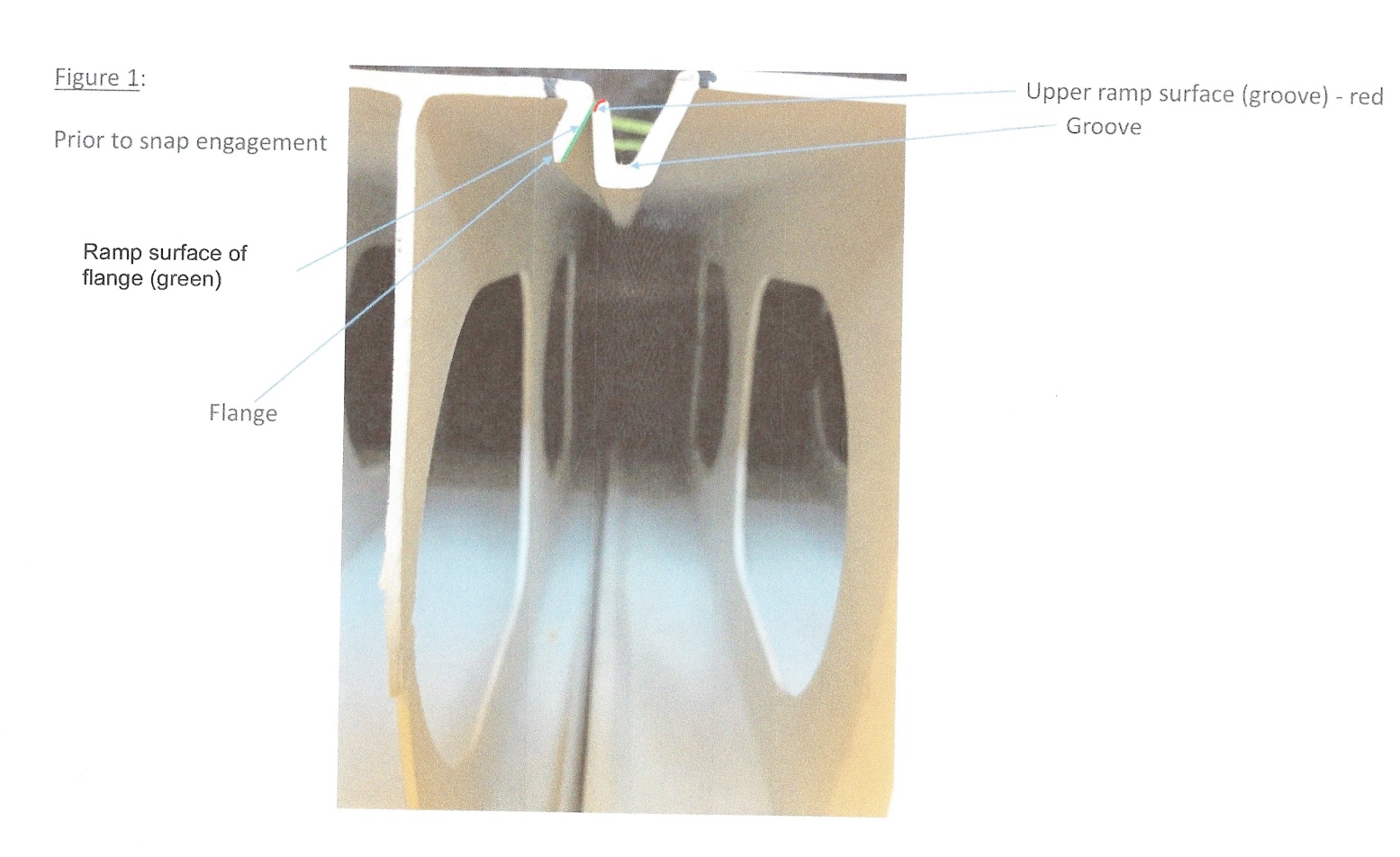
28 Mr Hunter says that the AFS element has all the features of claim 1. With regard to the ramp surface integer, he points to the outer surface of the groove, as depicted in Figure 1 of Annexure WSH-10, which is reproduced in Annexure A to these reasons. He says that the relevant ramp surface, or part of a ramp surface, appears at the upper end of the outer wall of the groove, where the outermost surface of the groove has a curved edge (highlighted in red in Annexure A). He says this is a ramp surface that engages the flange for snap engagement of the flange in the groove. He accepts that the outer wall of the flange (highlighted in green in Annexure A) also includes a ramp surface but says it is irrelevant to the requirements of claim 1. He says that the presence of this ramp surface on the outer wall of the flange does not mean that the curved edge at the top of the groove is not also acting as a ramp surface. He says the curved edge provides a ramp surface over which the flange moves before engaging the inside of the groove.
29 Mr Phillips says that Mr Hunter has interpreted the term “ramp surface” much too broadly. He says that a “ramp” in the ordinary sense of the word refers to something capable of functioning as a ramp which he defines (assisted by various dictionary definitions) as a slope or inclined plane for joining two different levels (Oxford) or a sloping surface connecting two different levels (Macquarie).
30 Mr Phillips also says that a ramp is an example of an “inclined plane” that permits an object to be moved at an angle from one height to another with less force than would otherwise be required if it were to be moved along a vertical plane. He says that a “ramp surface” within the meaning of claim 1 must be capable of moving the flange from one level to another, and that this movement must be sufficient to enable the flange to engage with the groove.
31 Mr Lang, who appeared with Ms St John for Dincel, submitted that his client’s infringement case is strong in the sense, as I understood his submission, that there is a strong probability that Dincel will obtain final relief. He submitted that Mr Phillips takes too narrow view of the term “ramp surface” and has focused unduly on the preferred embodiment and the configuration of the ramp surface depicted in Fig 1 of the Patent.
32 Mr Flynn submitted that Dincel’s infringement case is weak. He said that, properly construed, the ramp surface integer is referring to a ramp surface which consists of an inclined plane or slope functioning as a ramp along which the flange may transition (for example by sliding or rolling) so that it may “snap” into the groove.
33 In his written submission Mr Flynn also said that if, properly construed, claim 1 extends to an arrangement in which the snap engagement is achieved by what Mr Hunter describes, in Fig 1 of Annexure WSH-7, as a ramp surface consisting of the curved surface at the top of the outer wall of the groove, then the claim is not fairly based upon matter described in the specification. This submission was not developed in oral submissions.
34 The specification includes a consistory statement that mirrors claim 1. In the absence of any oral argument I do not propose to express a view on the fair basis point except to say that the sufficiency of the disclosure will need to be considered by the Court in light of the specification as a whole including the consistory statement. As the High Court noted in Doric at [99]:
… The inquiry is into what the body of the specification read as a whole discloses as the invention … An assertion by the inventor in a consistory clause of that of which the invention consists does not compel the conclusion by the court that the claims are fairly based nor is the assertion determinative of the identity of the invention. The consistory clause is to be considered by the court with the rest of the specification.
35 I do not accept either party’s characterisation of the strength of Dincel’s case. Dincel’s infringement case is certainly not strong, but nor would I describe it as weak. I am satisfied that the construction of claim 1 that it advances is a plausible one; whether it should be preferred to that propounded by AFS is a matter upon which I do not offer a view at this stage.
Balance of convenience
36 There was a considerable amount of evidence given by Mr Dincel and Mr Darwell relevant to the balance of convenience some of which was highly speculative and deserving little weight. My impression is that each witness may have engaged in some exaggeration when describing the consequences for his company’s business operations in the event that an interlocutory injunction is either granted or refused. I do not propose to refer to this evidence in any detail.
37 The key points in relation to the balance of convenience can be summarised quite briefly as follows:
Dincel has an established business based upon its commercial embodiment of the claimed invention. However, the Dincel element is Dincel’s only product (leaving aside some accessories) and the business is a “one trick pony”.
AFS has not yet launched its AFS element. The evidence as to when it will be launched was vague. Mr Darwell said only that AFS plans to launch the AFS element “no earlier than 3 April 2017”. AFS was first given notice that Dincel contended that the AFS element infringes the Patent in late January 2017.
It appears that AFS is planning to market its AFS element aggressively at prices below Dincel’s prices with fast and free product despatch and delivery. I accept that if AFS is permitted to sell its AFS element it could cause the Dincel business serious harm that would be difficult to quantify in the event that it were necessary to assess damages for patent infringement. Such harm may consist not only of lost revenue, but may also include more intangible components such as the loss of skilled employees who Mr Dincel says he may need to terminate.
AFS has an existing non-infringing product it supplies to its customers (the existing Rediwall product) that already competes with the Dincel element. In fact, Mr Darwell’s evidence was that customers perceive the existing Rediwall product and the Dincel element to be interchangeable. AFS can continue to promote and supply its existing non-infringing Rediwall product until the allegation of patent infringement raised in this proceeding is resolved.
I have already indicated to the parties that the Court can offer them an early final hearing. How soon that can occur may depend upon the scope of AFS’s challenge to the validity of the Patent. The particulars of invalidity that have been filed lack focus and will require considerable refinement.
38 Mr Flynn submitted that the evidence indicated that Dincel is not currently able to satisfy demand for the Dincel element. I do not accept that submission. All the evidence shows is that it takes Dincel longer to supply its product than it takes AFS to do so.
39 The usual undertaking as to damages is proffered by Dincel. AFS did not raise any issue as to the ability of Dincel to satisfy any award of compensation that may be made pursuant to the usual undertaking.
40 Mr Flynn submitted that it would be difficult for AFS to quantify its loss in the event that it is successful at trial. I accept that this may be so. However, it is important to note that an award of compensation pursuant to the usual undertaking as to damages is not withheld merely because the amount to be awarded cannot be calculated with mathematical precision or because there may be some uncertainty as to what would have occurred had the interlocutory injunction not been granted. In assessing compensation the Court does the best it can based upon the available evidence with proof to the civil standard.
DISPOSITION
41 In all the circumstances I am satisfied that Dincel has made out a prima facie case for the final injunctive relief it seeks and that the balance of convenience strongly favours the grant of an interlocutory injunction so as to maintain the status quo until the rights of the parties can be determined at a final hearing.
42 I will hear the parties on the question of costs.
I certify that the preceding forty-two (42) numbered paragraphs are a true copy of the Reasons for Judgment herein of the Honourable Justice Nicholas. |
Annexure A