FEDERAL COURT OF AUSTRALIA
Basetec Services Pty Ltd v Leighton Contractors Pty Ltd (No 8) [2017] FCA 258
ORDERS
DATE OF ORDER: |
THE COURT ORDERS THAT:
1. Subject to existing orders as to costs, Leighton pay 70% of Basetec’s costs of the proceeding (including the cross-claim) on a party and party basis from the commencement of the proceeding until 11 am on 26 March 2015.
2. Subject to existing orders as to costs, Basetec pay Leighton’s costs of the proceeding (including the cross-claim) on an indemnity basis from 11 am on 26 March 2015 to the date of final judgment.
3. The parties be heard as to the other orders to be made.
Note: Entry of orders is dealt with in Rule 39.32 of the Federal Court Rules 2011.
BESANKO J:
Introduction
1 These reasons deal with costs and other orders in a proceeding in the Court between Basetec Services Pty Ltd (“Basetec”) and Leighton Contractors Pty Ltd (“Leighton”). In the proceeding, Basetec claimed damages, compensation and other orders against Leighton on the basis of three causes of action, being a claim in contract, a claim for misleading or deceptive conduct pursuant to s 18 of the Australian Consumer Law, and a claim in tort for procuring or inducing a breach of contract by a third party. Leighton made a cross-claim alleging breaches of contract by Basetec and claiming a legal or equitable set-off in relation to the damages resulting from the breaches of contract.
2 Basetec succeeded on its claim in contract, but for an amount considerably less than it claimed and it failed with respect to the other two causes of action it alleged. Leighton succeeded in part on its cross-claim, but for an amount considerably less than it claimed.
3 I delivered my reasons on the substantive claims on 19 December 2016: Basetec Services Pty Ltd v Leighton Contractors Pty Ltd (No 6) [2016] FCA 1534. For convenience, I will use the same terms and abbreviations in these reasons as I used in those reasons. I will refer to those reasons as the substantive reasons. Other than costs and consequential orders, two issues remained outstanding after I had delivered the substantive reasons, being an issue as to the appropriate period for the calculation of interest and an issue as to whether Basetec was entitled under the Works Contract to an amount equivalent to GST. I made my decision with respect to those issues on 20 December 2016 and delivered reasons for my decision: Basetec Services Pty Ltd v Leighton Contractors Pty Ltd (No 7) [2016] FCA 1587. I will refer to these reasons as the additional reasons. The final orders that I made with respect to the substantive claims are as follows:
1. There be judgment in favour of the applicant against the respondent in the sum of $911,328.89.
2. There be judgment on the cross-claim in favour of the respondent against the applicant in the sum of $105,765.10.
3. The judgment in favour of the respondent against the applicant on the cross-claim be set off against the judgment on the claim.
4 Both parties have now made extensive submissions, both oral and written, on the issue of costs. Each relies on a number of affidavits which have formed the basis of some of the findings in these reasons. The submissions refer to many events from shortly prior to the commencement of this proceeding to the date of final judgment and it is convenient to begin with a summary of those events in chronological order.
5 The substantive reasons should be read with these reasons.
Chronology of Relevant Events
6 On 20 May 2013, Leighton terminated for convenience the Works Contract it had with Basetec.
7 On 3 June 2013, Leighton delivered a Payment Schedule to Basetec in the amount of $164,636.82 and, on 8 July 2013, Leighton paid this amount to Basetec.
8 On 12 December 2013, Basetec delivered a dispute notice pursuant to clause 46 of the Works Contract claiming an amount of $3,156,000 plus GST together with general damages.
9 On 12 March 2014, Leighton made a without prejudice offer to settle Basetec’s claim for $685,000 excluding GST by letter to Basetec. The offer was expressed to be open for a period of seven days. The offer did not contain a reservation to the effect that it was without prejudice “except as to costs”. The evidence establishes that at no time prior to this offer had Leighton given notice to Basetec of a cross-claim and the evidence suggests that as at 3 June 2013 at least, Leighton did not contemplate a cross-claim against Basetec. I will refer to Leighton’s offer as the without prejudice offer.
10 On 19 March 2014, Basetec rejected Leighton’s without prejudice offer and made a counter-offer of $2.4 million plus GST. This counter-offer was not accepted by Leighton.
11 On 14 April 2014, Basetec sent an offer in the form of an offer under r 25.01 of the Federal Court Rules 2011 (Cth) (“the Rules”), even though it had not issued proceedings at that point. The offer was to settle for the sum of $1.5 million inclusive of costs and plus GST. The offer was expressed to be open for a period of 14 days. This offer was not accepted.
12 On 28 April 2014, Basetec commenced this proceeding by filing an Originating Application and Statement of Claim. In its Statement of Claim, Basetec pleaded the three causes of action which I have previously identified and it claimed an amount of $3,156,000 plus GST for its contract claim, and general damages for its other two causes of action. It is also claimed that Leighton’s termination for convenience of the Works Contract was contrary to an implied term in the contract and was unconscionable.
13 On 17 June 2014, Leighton filed a Defence in which it denied Basetec’s claims.
14 On 15 July 2014, Basetec filed a Reply.
15 On 4 August 2014, Leighton filed a cross-claim in which it claimed damages for breach of contract in the amount of $1,241,425.71 and restitution in the amount of $250,000. It claimed a legal or equitable set-off with respect to these amounts. It also claimed that as a result of Basetec’s delays in delivering GRP piping and its demobilisation from the site, Basetec had repudiated the Works Contract.
16 On 20 August 2014, Basetec filed a Defence to the cross-claim.
17 On 9 September 2014, Leighton filed a Reply to Basetec’s Defence to the cross-claim.
18 On 25 September 2014, I made an order that Basetec provide security for costs in the amount of $300,000 (Basetec Services Pty Ltd v Leighton Contractors Pty Ltd [2014] FCA 991).
19 On 3 November 2014, Basetec sent an offer under r 25.01 of the Rules to Leighton. The offer was to accept the amount of $1,700,000 inclusive of costs and plus GST in settlement of the dispute between the parties to the Works Contract. The offer was expressed to be open for 14 days. This offer was not accepted.
20 On 15 December 2014, Basetec filed an Amended Statement of Claim. Basetec maintained its claim of $3,156,000 plus GST for its contract claim and provided particulars of the quantum of its claims in relation to the other two causes of action. It maintained its claim that Leighton’s purported termination of the Works Contract was a repudiation of the contract which it accepted.
21 On 9 February 2015, Leighton filed a Defence to Basetec’s Amended Statement of Claim.
22 On 23 March 2015, Basetec and Leighton entered into a mediation agreement. The agreement contained confidentiality provisions designed to ensure the confidentiality of disclosures made at the mediation. A mediation was held that day before the mediator who had been appointed, but the matter was not resolved. As I understand it, the mediation remained open in the sense that it was not terminated by the mediator pursuant to clause 13 of the mediation agreement.
23 On 24 March 2015, Leighton served an offer under r 25.01 of the Rules on Basetec. The offer was to settle the proceeding by a payment of $900,000 inclusive of GST and interest plus party and party costs. The offer was expressed to be open for a period of 28 days. The offer was not accepted by Basetec. I will refer to this offer as the Rules of Court offer.
24 On 22 April 2015, Mr Charles Figallo of Basetec sent a letter to the Chief Executive Officer of CIMIC asking for a meeting. CIMIC Group Limited is Leighton’s parent company.
25 On 22 May 2015, Mr Charles Figallo and Mr Paul Figallo met with Mr John Kirkwood of Leighton (Executive General Manager – Construction West) for the purpose of negotiations. The matter did not resolve.
26 On 19 June 2015, Leighton filed a Further Amended Defence to the Amended Statement of Claim and an Amended Statement of Cross-Claim. It is necessary to examine the amendments introduced by these documents. Basetec submits that the changes Leighton made to its defence and cross-claim after the Rules of Court offer and after the period for acceptance had expired are relevant to the issue of whether r 25.01 should operate according to its terms, or whether the presumption created by the rule should be taken to have been rebutted. Basetec submits that the changes to the defence and cross-claim are a significant reason why the presumption should be taken to have been rebutted.
27 As a general approach, it is possible to divide amendments to a pleading into four categories: the introduction of a new cause of action or causes of action; the introduction of new allegations in support of an existing cause of action or causes of actions; the introduction of new claims for relief or an increase in the amounts claimed; or the withdrawal of causes of action or allegations.
28 I start with the Further Amended Defence. Basetec alleges that this document alleged that Leighton was entitled to terminate the Works Contract for cause and it alleged that the payment of $164,636.82 to Basetec on 8 July 2013 represented the full entitlement of Basetec to payment on termination, and that any further claim was barred by operation of the Works Contract. Both those matters are correct (see substantive reasons at [163] and [173]). As far as I can see, neither of those matters were expressly alleged in the Defence to the Amended Statement of Claim filed on 9 January 2015. The allegation that Leighton had the right to terminate the Works Contract for breach did appear in Leighton’s Statement of Cross-Claim filed on 4 August 2014. The allegation by Leighton that any further claim was barred by the operation of the Works Contract failed at trial (see substantive reasons at [334]-[350]).
29 I turn now to the Amended Statement of Cross-Claim. I start with my own summary of the amendments.
30 In its pleading of the terms of the Works Contract, Leighton added a reference to clause 35.5 which deals with substantiation by Basetec of a progress claim, a reference to clauses 28.13 and 28.14 concerning substantial completion, a reference to clause 33.4(a) which deals with quotations with respect to proposed variations and clauses 33.5, 33.6 and 35.6 which deal with variations, and the deletion of a plea that it was an implied term that Basetec would do all things necessary to facilitate performance of the Works Contract.
31 Leighton withdrew a claim for an overpayment of $250,000 under or in respect of the Works Contract.
32 Leighton introduced a number of allegations to the effect that Basetec made the claim on Leighton described as V001, a refusal to supply GRP piping and the payment by Leighton to Basetec of $250,000 as a deposit “in anticipation of the performance by Basetec of the Work forming part of Variation V001 …”.
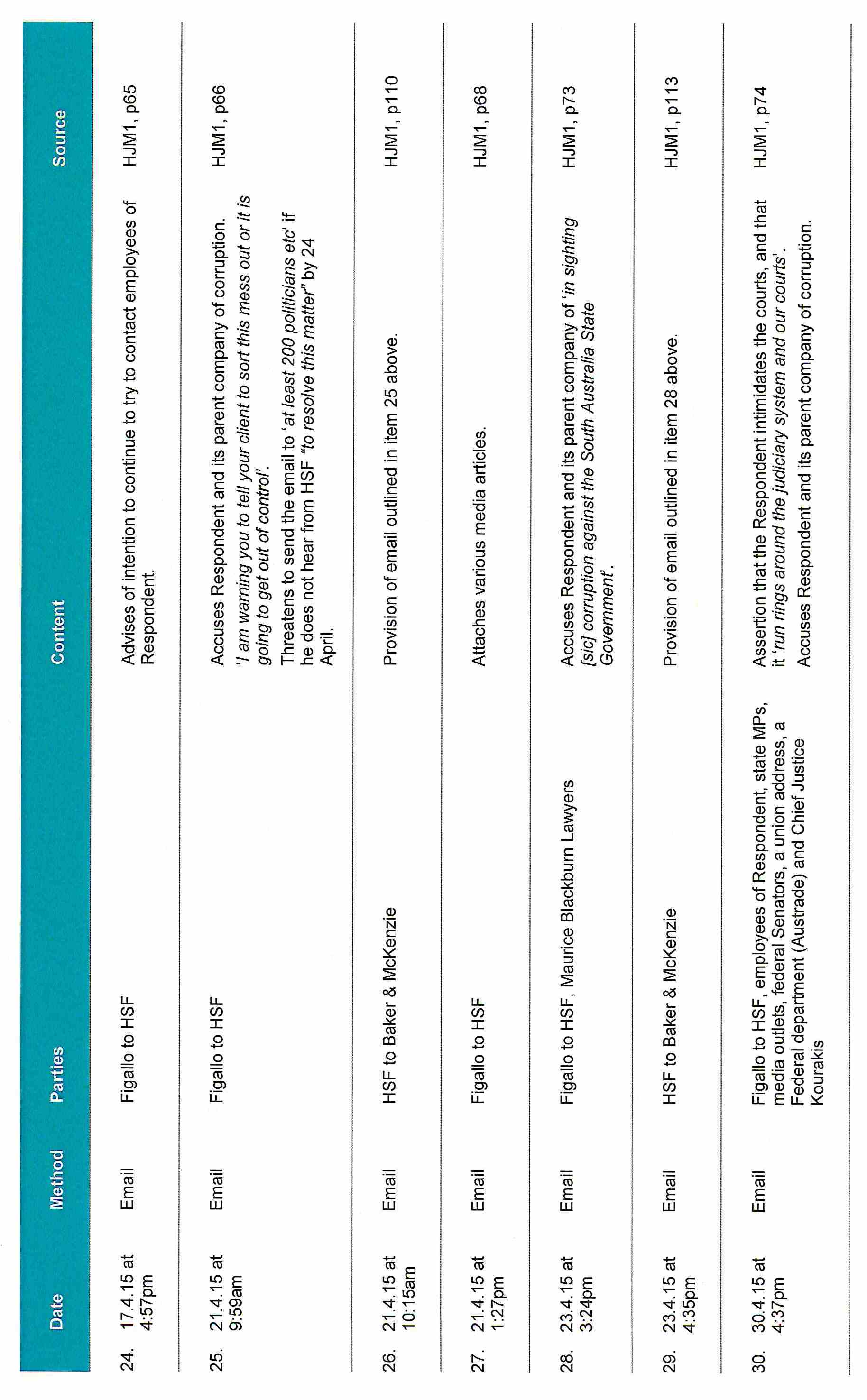
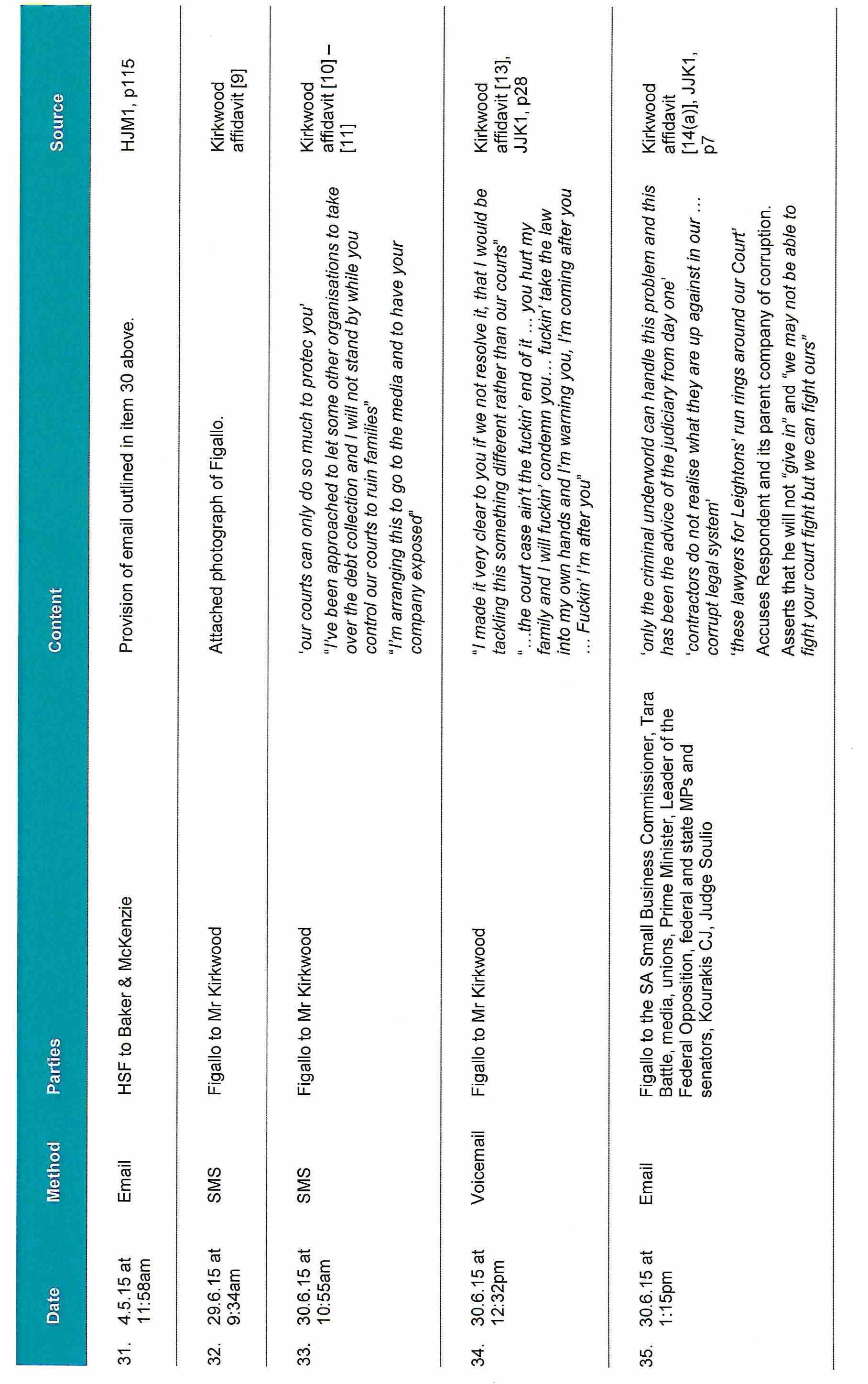
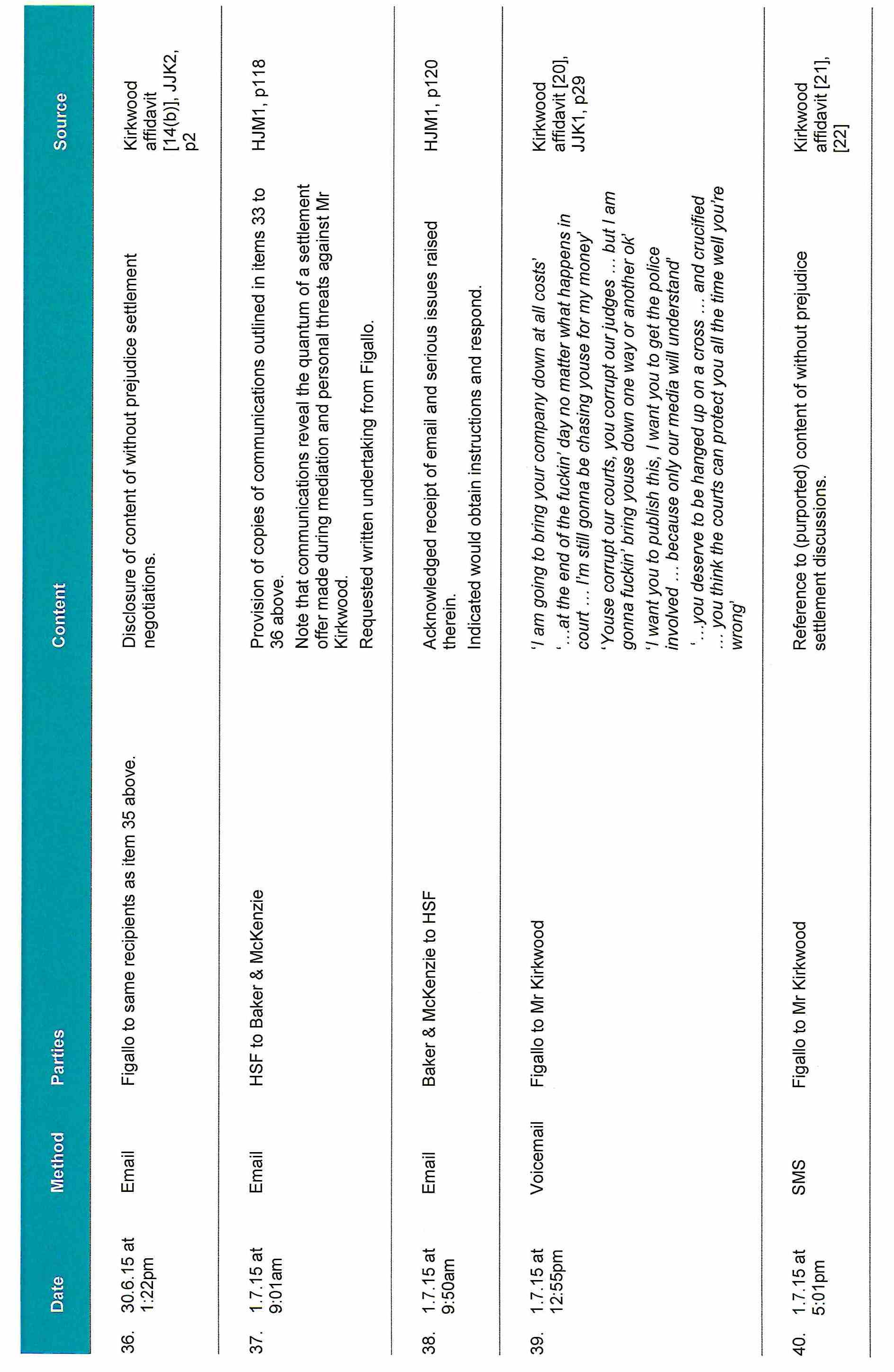
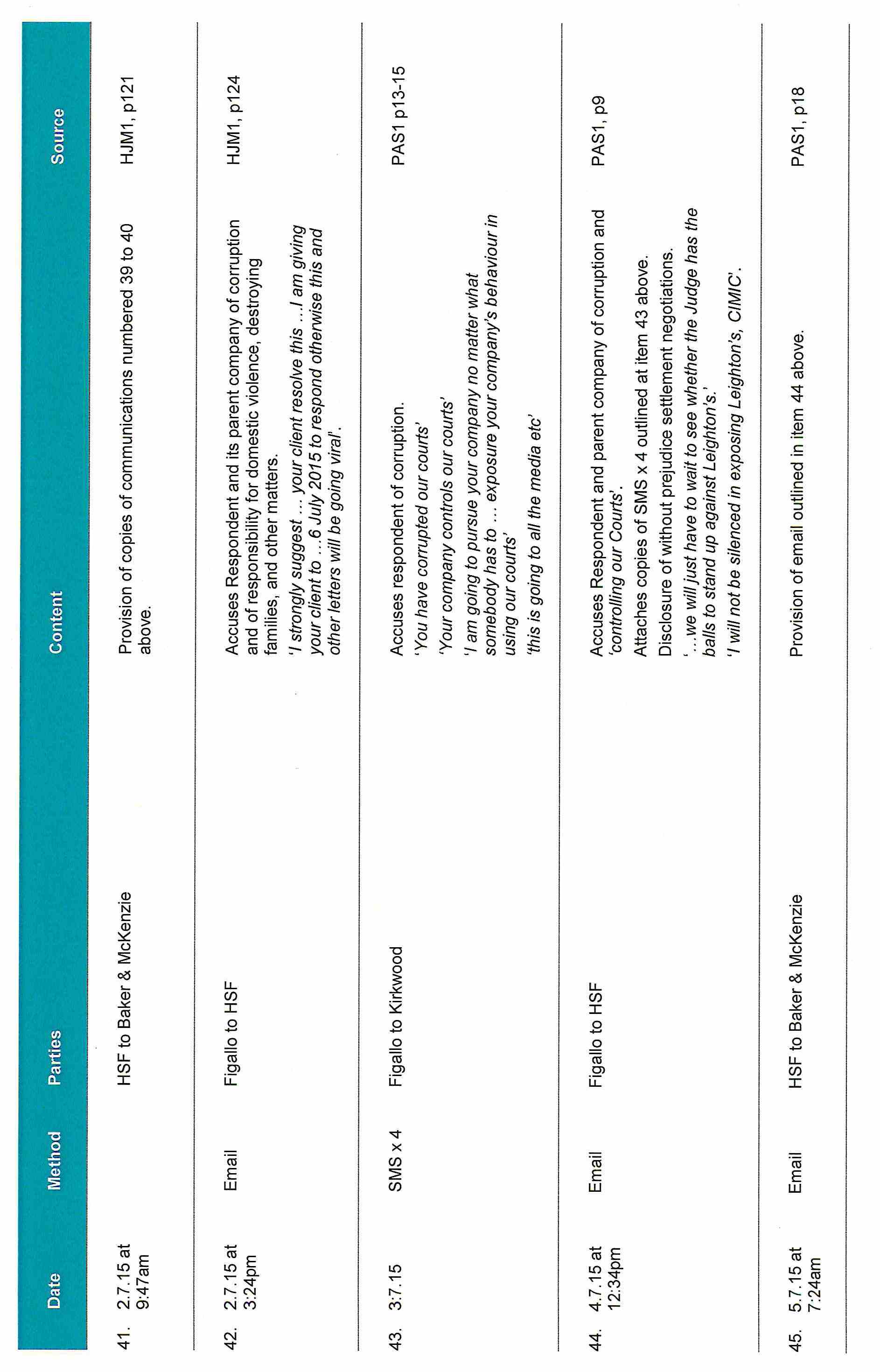
33 Leighton added further allegations surrounding Basetec’s demobilisation from the site.
34 Leighton expanded on its pleas that Basetec’s late delivery of GRP piping and its demobilisation and the alleged failure to remobilise to the site were breaches of the Works Contract. As I read what Leighton did, it was to add some allegations in support of its allegation that Basetec had repudiated the Works Contract. The allegations concern Basetec’s conduct and are set out in paragraphs 22-23E which relate to conduct in relation to V001, and paragraphs 29-34 which relate to conduct in relation to the demobilisation from the site and an alleged failure to remobilise to the site.
35 The claims are the same with the exception of the deletion of the claim in restitution for the amount of $250,000.
36 I turn to the matters which Basetec specifically identified in the Amended Statement of Cross-Claim. First, Basetec claims allegations that it caused delays to the works and failed to give notice of a variation to the works have been added in paragraphs 6.12-6.16. However, that is not what those paragraphs allege. They do allege that there were contractual obligations as to those matters. Secondly, Basetec claims that allegations that Basetec threatened to withhold supply of GRP piping have been added in paragraphs 22 to 23E. That is correct. Thirdly, Basetec claims that the allegations concerning negotiations about site jointing work have been added in paragraphs 30A to 30D. That is correct. Fourthly, Basetec claims that Leighton has alleged alternative grounds for termination of the Works Contract in paragraphs 37.1 to 37.3. That is correct. Fifthly, Basetec claims that Leighton has alleged that Basetec caused damage to its relationship with Leighton in paragraph 40. That is correct. Finally, Basetec claims that Leighton has alleged a set-off in paragraph 40. Whilst that is correct, I do not think that it is significant. The Statement of Cross-Claim filed on 4 August 2014 included a claim that Leighton was entitled to an equitable or legal set-off.
37 In terms of the broad characterisation referred to in paragraph 26 above, the amendments in the Amended Statement of Cross-Claim did not introduce any new cause of action or new claims for relief or involve an increase in the amounts claimed. Some allegations are deleted. The main changes effected by the amendments were the addition of some allegations in support of an existing allegation that Basetec evinced an intention not to be bound by the Works Contract and thereby repudiated the Works Contract. As will be clear from my substantive reasons, Basetec’s claim involved a detailed examination of events in the second half of 2012 and the first half of 2013, and the new allegations were intertwined with those events. Furthermore, as will be clear from the substantive reasons, Leighton failed at trial in its case that Basetec had committed breaches of the Works Contract which entitled it to terminate the contract (see substantive reasons at [627]-[647]).
38 On 30 June 2015, Basetec, through Mr Charles Figallo, sent an email to numerous media and news outlets and politicians publishing details of the mediation, including the details of a settlement offer made by Leighton at the mediation. The mediation was terminated on 10 July 2015.
39 In July 2015, Leighton issued an application seeking injunctions against Basetec and its officers and employees. As it happened, the evidence advanced supported orders only against Mr Charles Figallo.
40 Leighton sought an injunction restraining Mr Charles Figallo from communicating with it and CIMIC Group Limited as well as their respective officers, employees and agents about these proceedings or their subject matter, and an injunction restraining Mr Charles Figallo from publishing to non-parties statements about the conduct of it and of its legal representatives in the proceedings which are “calculated to intimidate, harass or otherwise bring improper pressure” on it in respect of the conduct of the proceedings or which is information communicated or provided in connection with attempts to mediate or negotiate a settlement of the proceeding.
41 This application was referred to another judge in this Registry (White J) because the evidence relating to it included evidence of some of the parties’ settlement negotiations and it was considered that I should not be informed of these matters. I did not read any of the evidence, or indeed White J’s reasons, until after I had made the final orders set out in paragraph 3 above.
42 The application came before White J on 17 July 2015 who made orders on that day (Basetec Services Pty Ltd v Leighton Contractors Pty Ltd (No 2) (2015) 236 FCR 432 (“White J’s reasons”)).
43 The orders which his Honour made were as follows (relevantly):
1. Pursuant to s 23 of the Federal Court of Australia Act 1976, that until further order Charles David Figallo be restrained from:
(a) communicating directly with the Respondent, its officers, employees or agents (including its legal representatives in these proceedings) about these proceedings or the subject matter of these proceedings in a manner which is calculated to intimidate, harass or otherwise bring improper pressure on the Respondent (including its officers, employees or agents) in respect of the conduct of these proceedings;
(b) communicating directly with the Respondent’s parent company, CIMIC Group Limited, its officers, employees or agents about these proceedings or the subject matter of these proceedings in a manner which is calculated to intimidate, harass or otherwise bring improper pressure on the Respondent (including its officers, employees or agents) in respect of the conduct of these proceedings;
(c) publishing or causing to be published to persons not party to these proceedings statements about:
(i) the Respondent’s conduct of these proceedings; or
(ii) the conduct of the Respondent’s legal representatives in these proceedings,
which is calculated to intimidate, harass or otherwise bring improper pressure on the Respondent (including its officers, employees or agents) in respect of the conduct of these proceedings;
(d) publishing to persons other than the parties to this litigation and their legal representatives information:
(i) communicated in the course of the mediation process engaged in by the parties in respect of these proceedings; or
(ii) expressly identified in writing or orally as being communicated on a without prejudice basis; or
(iii) otherwise communicated in connection with an attempt to negotiate a settlement of these proceedings; and
(iv) including, for the avoidance of doubt, details of any settlement offers made by the Respondent.
44 Justice White said that there were two aspects to the application. The first aspect was the injunction to restrain Mr Charles Figallo from disseminating information communicated in the course of the mediation or on a without prejudice basis or otherwise in connection with attempts to settle the proceeding. Mr Charles Figallo acknowledged that he should not be doing that and that matter was not in dispute.
45 The second aspect to the application was the injunction to restrain Mr Charles Figallo from placing improper pressure on it to settle the action, by communicating threats to publish material disparaging the conduct of Leighton and its officers, employees and agents in the proceedings, and by making personal threats to individuals employed by it. That matter was in dispute.
46 His Honour referred to the evidence before him. He did not set it all out in his reasons. For example, he did not set out Mr Charles Figallo’s disparagement of the courts and of members of the judiciary. His Honour said that such statements appeared to be contemptuous (at [47]).
47 Leighton’s case was that Mr Charles Figallo’s emails, text messages and voicemail messages constituted a contempt of Court or, in the alternative, were a basis upon which the Court may apprehend that Mr Charles Figallo may commit a contempt of Court. The evidence it presented showed a series of communications in October 2014, nothing then of substance until April 2015 when there was a resumption, and then a further resumption on 30 June 2015. His Honour summarised the evidence and I will not repeat what he said (at [18]-[30]). I will set out two of Mr Charles Figallo’s messages. The first is a voicemail message from Mr Charles Figallo to Mr Kirkwood on 30 June 2015 in which he said, among other things, the following (at [21]):
As you recall at our meeting, we tried to resolve our issues. I made it very clear to you if we do not resolve it, that I would be tackling this something different rather than our courts. I want you to know that has now started. I suggest you give me a phone call because all the media are on to me now and I intend to picket your place like mad and to expose the contracts that you keep winning as being such a labelled, corrupt company. John, I suggest you speak to me and resolve this [expletive] issue, OK because I tell you what John, whether I win or lose, as you quoted, your people quoted, “win or lose, you win”. Let me tell you, the court case ain’t the [expletive] end of it OK! Let me tell you that. The court case ain’t the [expletive] end. OK, so I’m serious now, you hurt my [expletive] family and I will [expletive] condemn you and I mean it OK you understand that? I’ve never had to do this in my life but I’m taking advice of the judiciary and that is to [expletive] take the law into my own hands and I’m warning you, I’m coming after you and I want you to use this as much as you can because the media want this as well. OK, I’m warning you John. [Expletive] I’m after you. OK.
The second is a voicemail message from Mr Charles Figallo to Mr Kirkwood on 1 July 2015 in which he said, among other things, the following (at [22]):
I just want you to know that when we had the last meeting at your office I told you the gloves were gonna be off. I meant what I said. I want you to understand that. OK. You can publish whatever you like. I’m happy to go to court but I’m going to bring your company down at all costs no matter what I do I’m going to expose it ... I gave you the opportunity of settling this several times. ... Let me tell you John at the end of the [expletive] day no matter what happens in court, I’m still gonna be chasing you for my money. OK. Understand that. You owe me money. ... OK, let’s get it clear. I’m going to expose you to the extent that I can bring them down. ... You understand, I want you to publish this, I want you to get the police involved. You understand because only our media will understand what’s going on and only the public and the taxpayers but when I read that story about that family that committed suicide in Western Australia because of you people, you deserve to be hanged up on a cross. And crucified, you understand that.
48 His Honour identified matters to be weighed in the balance against making the orders sought by Leighton and in that context he made the following observations about the lack of evidence of a connection between Mr Charles Figallo’s conduct and Leighton’s approach to settlement. He said (at [42] and [43]):
Next, I take into account that Leighton’s evidence does not really show that Mr Figallo’s conduct has, or is likely to, alter Leighton’s approach to settlement. Mr Kirkwood deposes only that, as a result of the communications from Mr Figallo, Leighton decided to request the mediator to terminate the mediation process.
That statement does not indicate the nature of the relationship between the conduct and the termination of the mediation. Nor does it indicate any change of attitude by Leighton to the question of settlement. Leighton may, for example, have already decided not to pursue settlement further or it may have decided that because of the nature of the communications, that it would prefer to take the matter to judgment and to obtain vindication. It is noteworthy that Mr Kirkwood does not make any statement to the effect that Leighton would like to achieve a settlement but feels inhibited from taking any step to that end by reason of Mr Figallo’s conduct.
49 Three matters proved decisive in his Honour’s decision to grant the orders. They were the following: Mr Charles Figallo’s disparagement of the courts and of members of the judiciary in his communications; Mr Charles Figallo had made it clear that he would, unless restrained, continue to make statements of the same kind; and that Mr Charles Figallo had not tempered his conduct despite the advice of Basetec’s own solicitors.
50 On or about 3 July 2015, Mr Charles Figallo sent a number of text messages to Mr Kirkwood which were in the following terms:
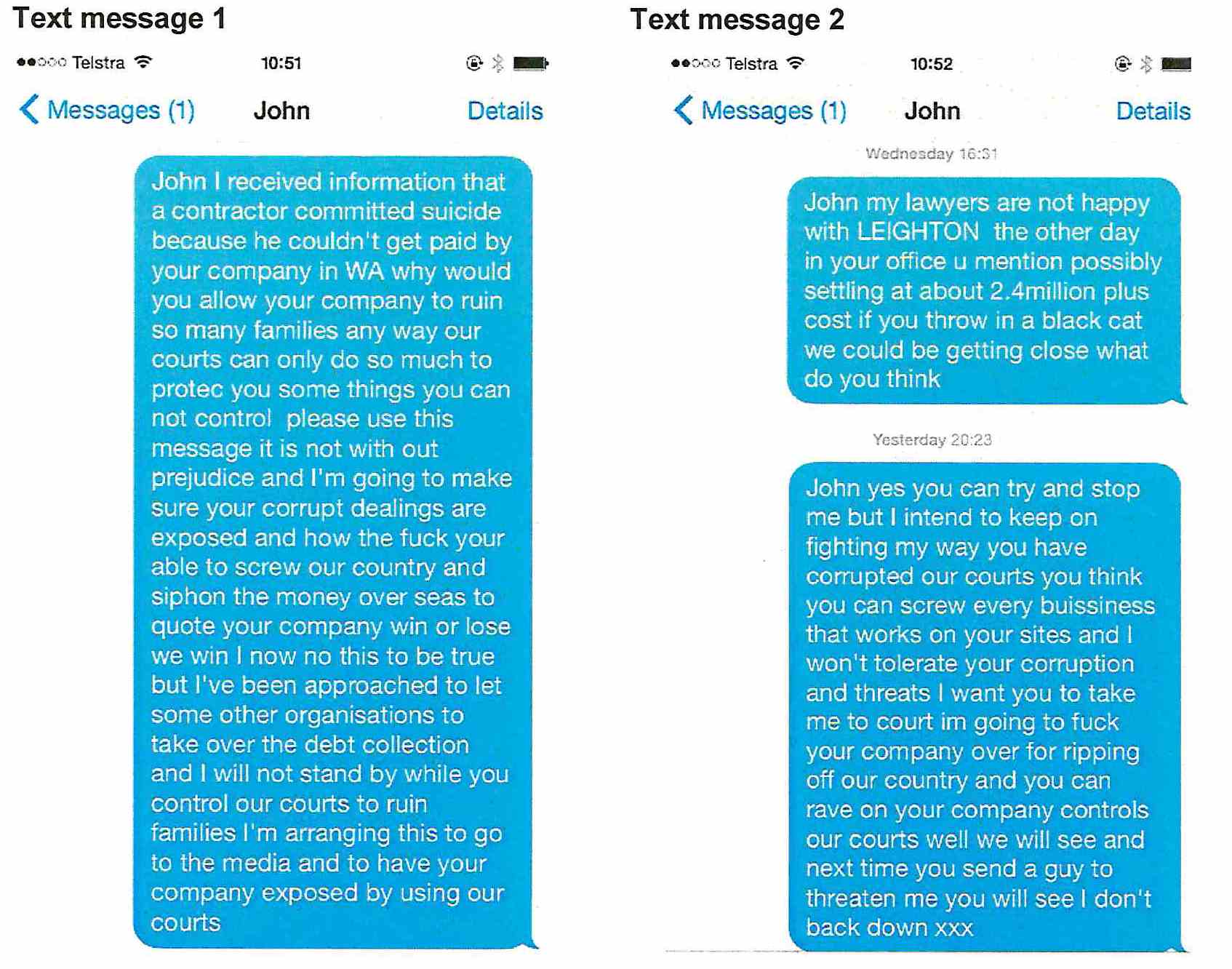
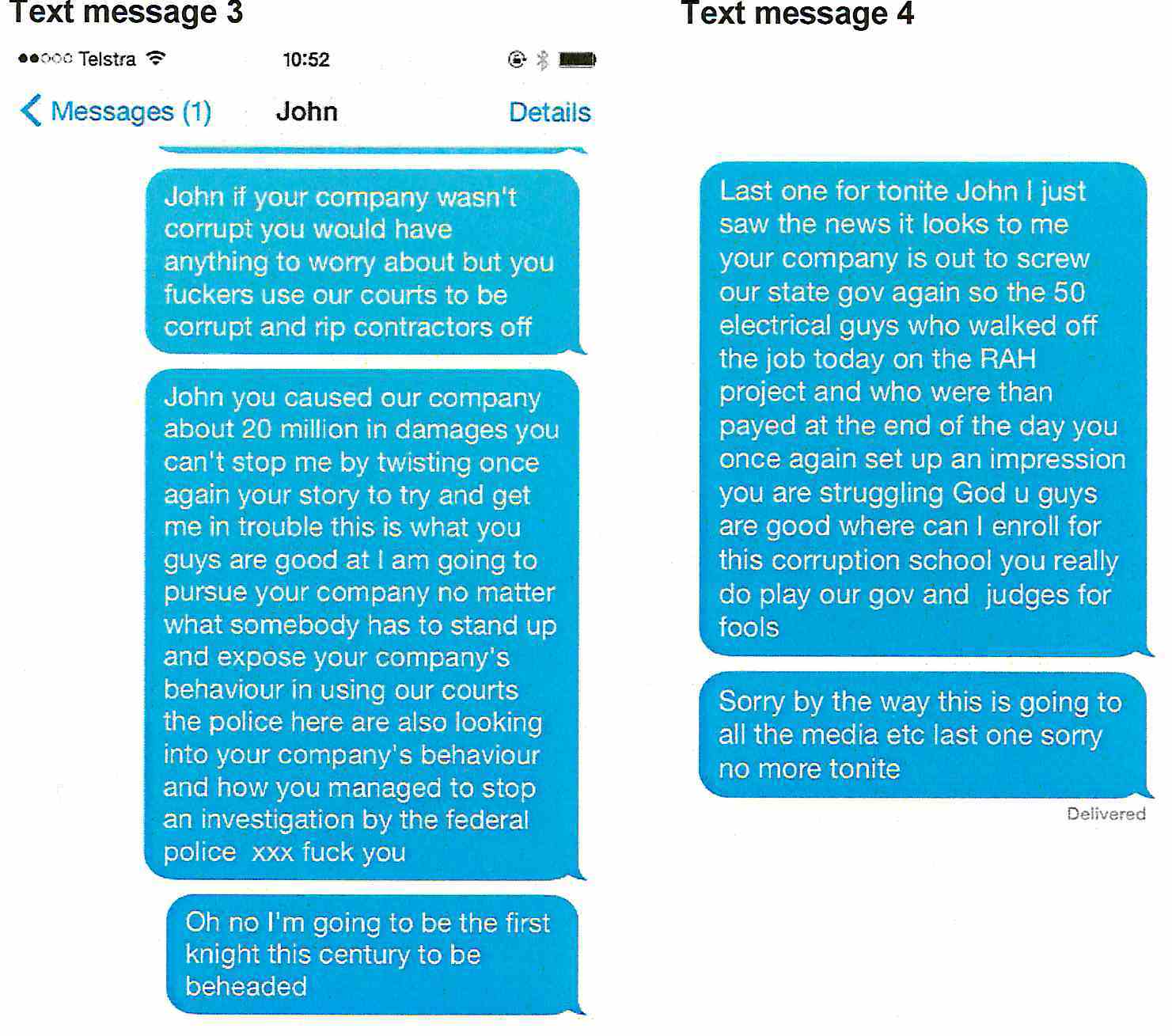
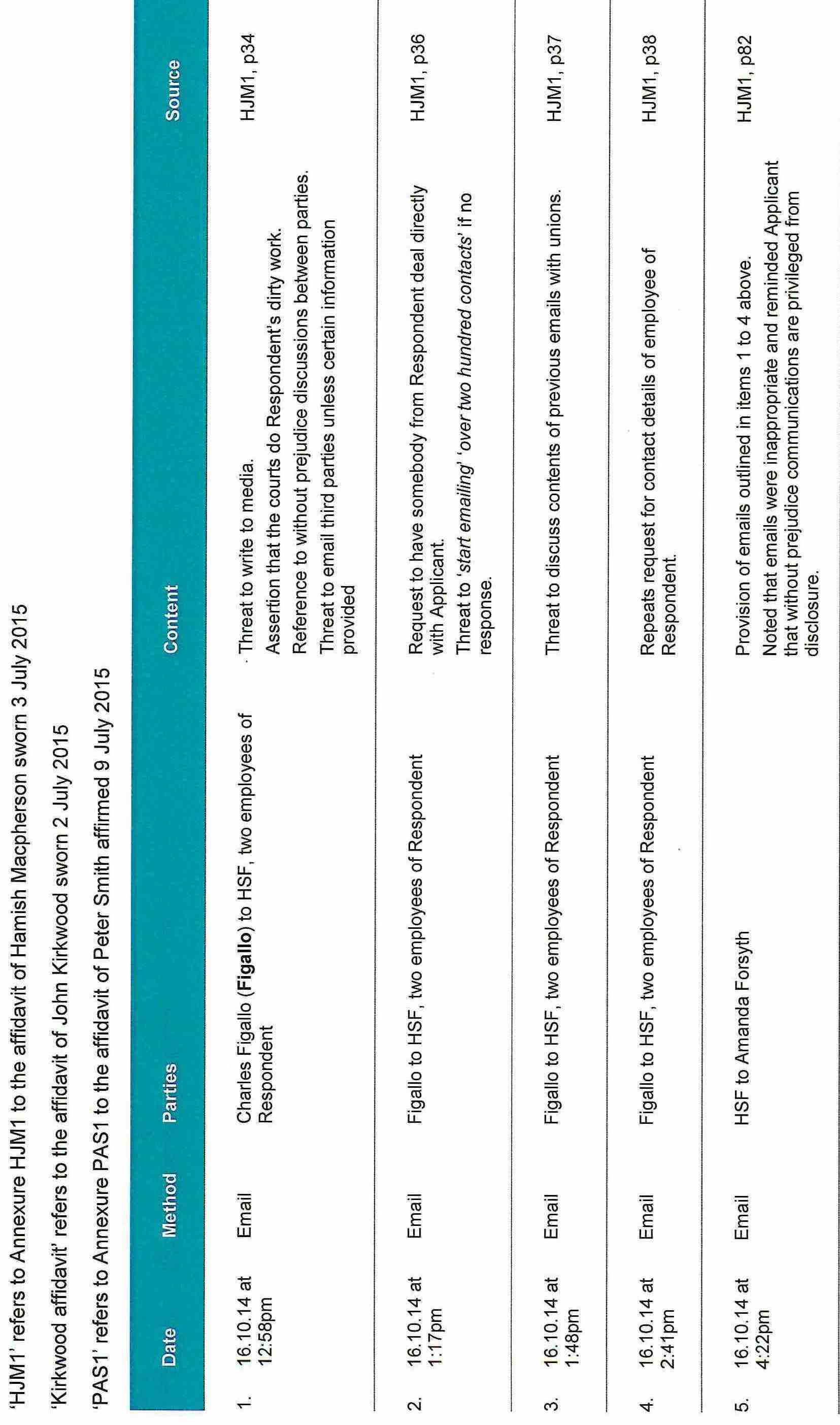
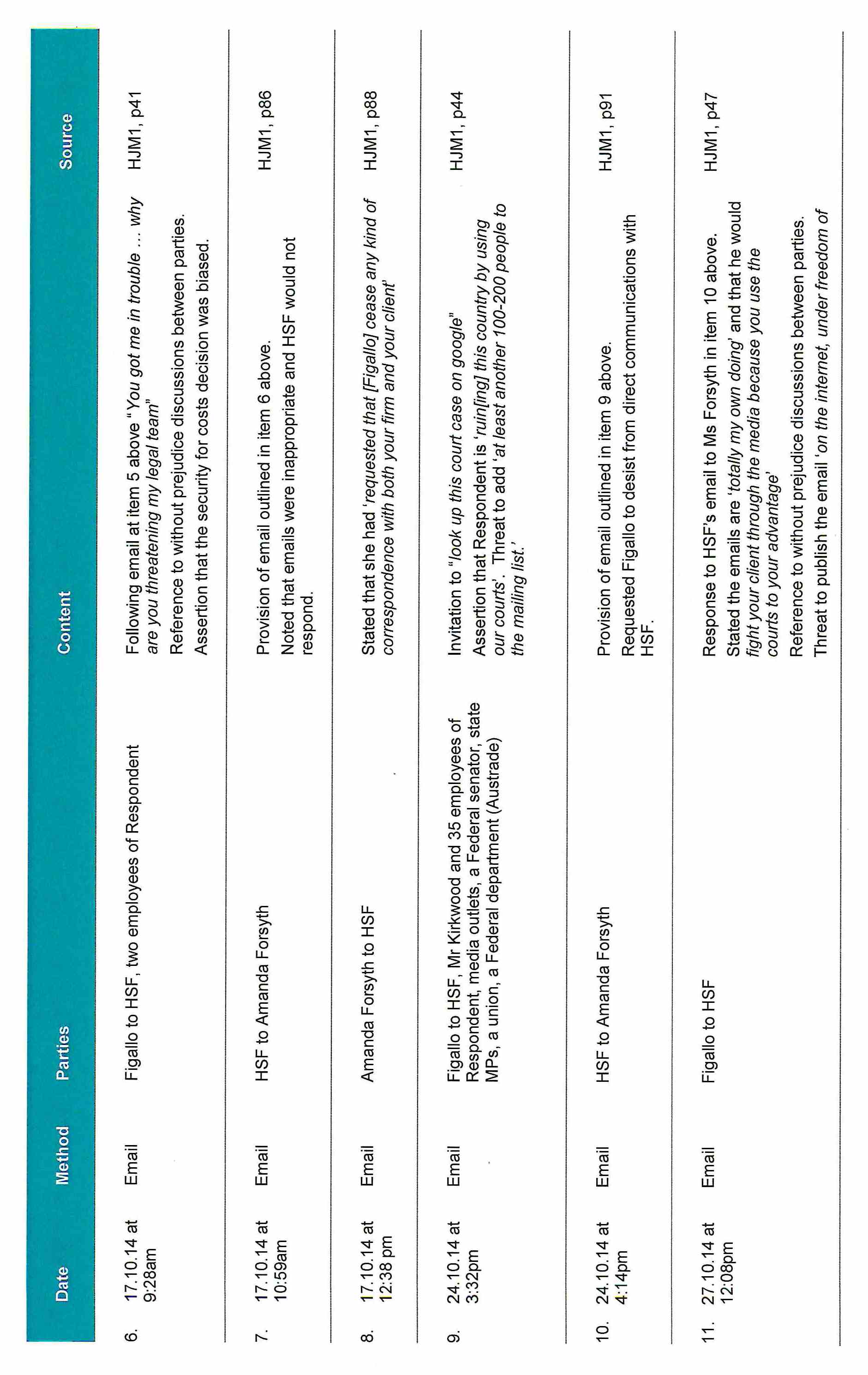
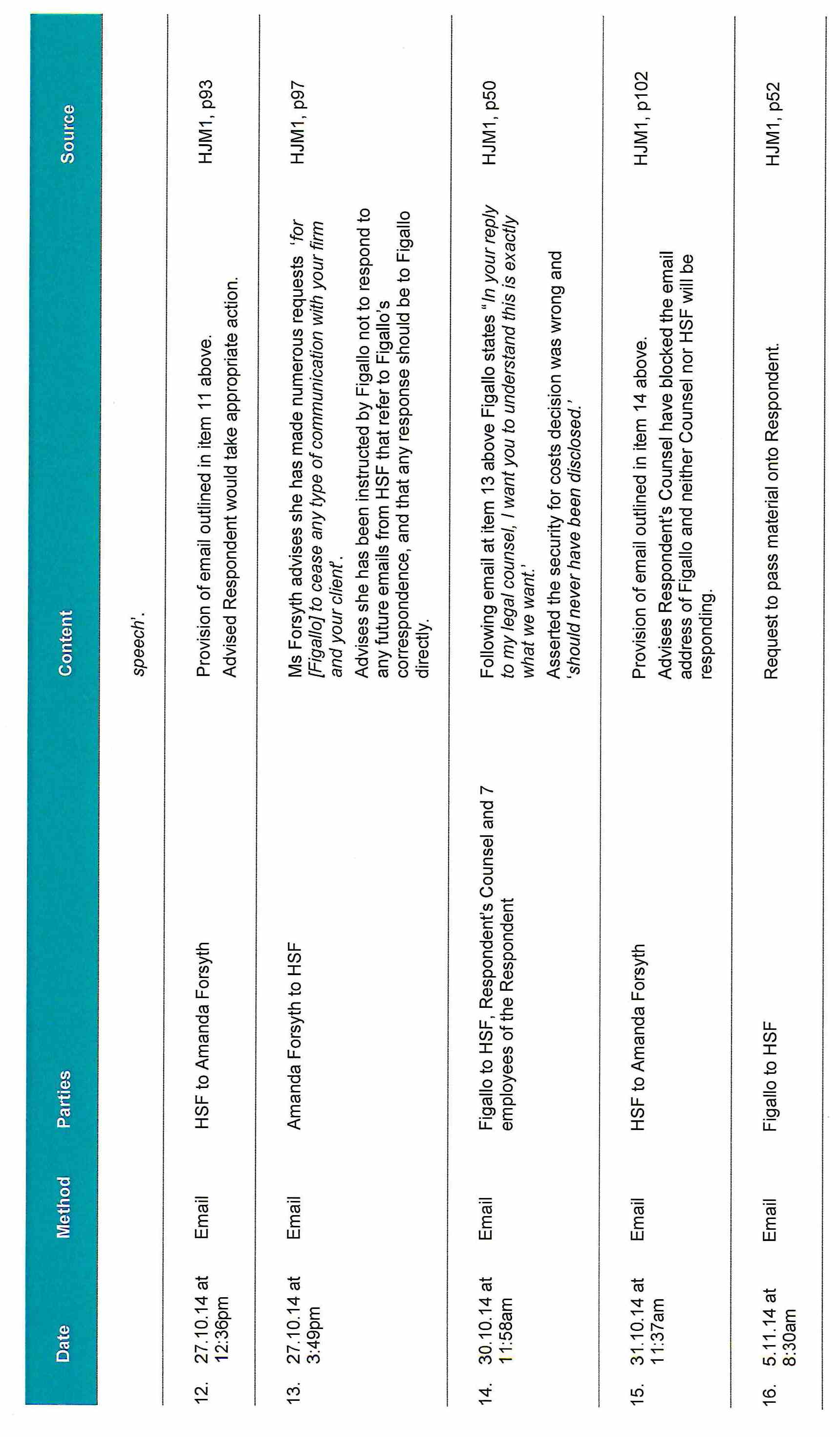
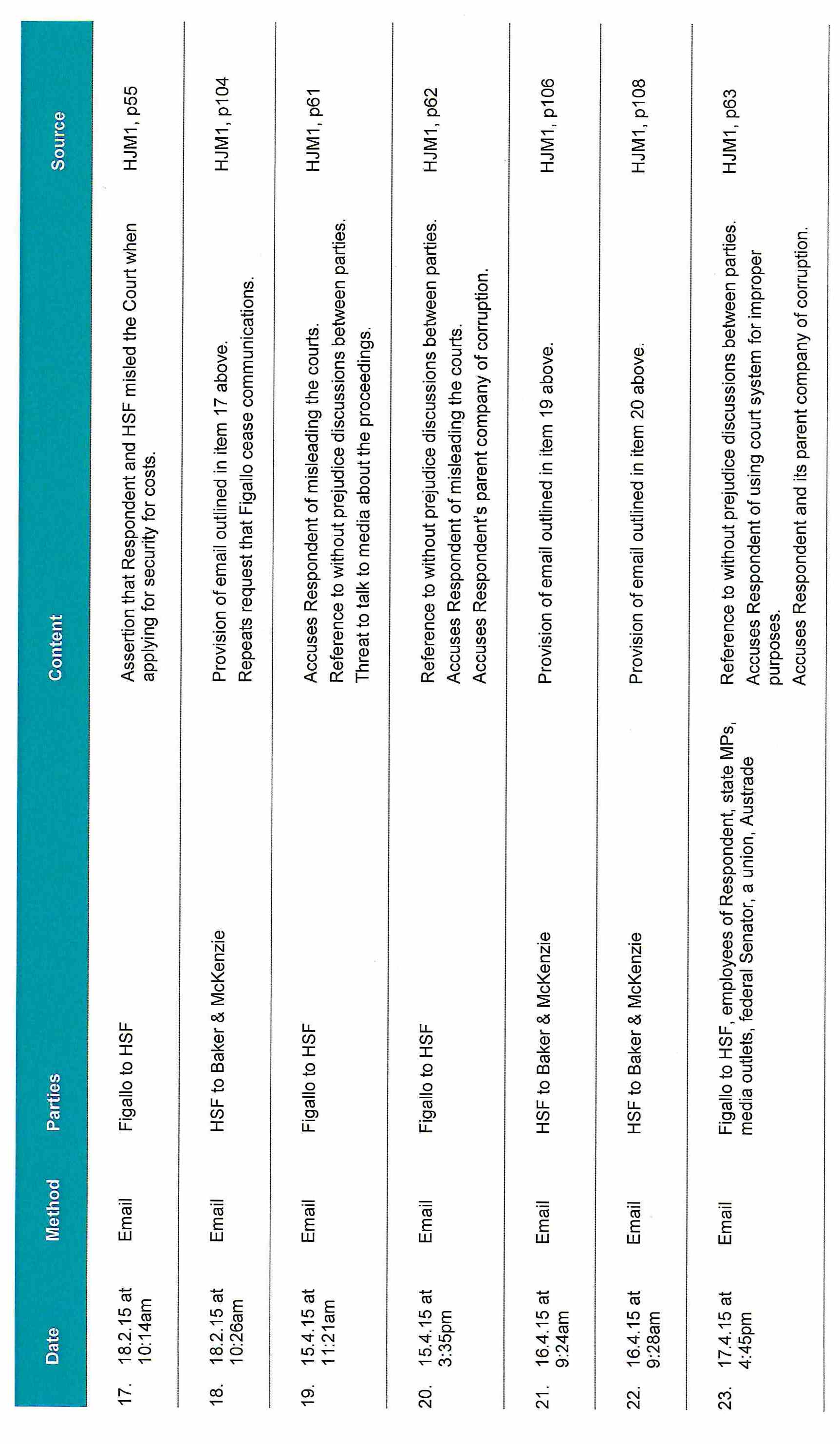
51 Leighton attached to its written submission, a summary of the communications involving Mr Charles Figallo which I reproduce in Annexure A to these reasons.
52 On 3 November 2015, Mr Paul Figallo sent an email to Leighton’s solicitor on behalf of Mr Charles Figallo. The email attached an email from Mr Charles Figallo to Mr Paul Figallo. However, the email was plainly directed to Leighton’s solicitor. In it, Mr Charles Figallo accuses Leighton of bullying behaviour and Leighton’s solicitor of deceitful and manipulative conduct.
53 On 20 July 2015, Basetec filed a Further Amended Defence to the Amended Cross-Claim.
54 On 9 December 2015, Basetec made an offer to Leighton to settle the proceeding on the following terms:
1. Payment by LCPL to Basetec of $3m plus GST and interest and costs; plus
2. Provision of a written apology from LCPL withdrawing the allegations made before White J in support of LCPL’s injunction application; plus
3. Basetec be retained by LCPL on a ‘medium sized contract’ in Adelaide, with details of the contract to be made public; plus
4. Hamish Macpherson is to buy a beer for Charles Figallo at a public bar in Adelaide.
55 Mr Rosser, a solicitor for Basetec, said that this offer was put in response to an approach from Leighton’s counsel and solicitor during the trial when they said words to the effect “we would recommend any half-way reasonable offer” and that before approaching Basetec, Leighton’s counsel clarified the statement by saying that the reference to “any half-way reasonable offer” was intended to mean an offer of payment by Basetec to Leighton.
56 I mentioned in my substantive reasons that Basetec was involved in proceedings in the Supreme Court of Queensland with Conveyor & General Engineering Pty Ltd (“Conveyor & General Engineering”). Those proceedings were instituted by Basetec.
57 I should also mention some matters about the presentation of Basetec’s claims. The substantive reasons indicate the following:
(1) The proof of Basetec’s claim in contract under clause 33.7 of the Works Contract depended in large measure on the evidence of Mr Paul Figallo and Basetec’s “business records” (Exhibit A17, see substantive reasons at paragraph 50 and Appendix A). This was information which at all material times was in the possession of Basetec.
(2) Basetec made a number of claims against Leighton which were reduced by Basetec by the time of trial, reduced again by Basetec by the end of the trial, and then reduced again by me in the substantive reasons (see substantive reasons at [59], [481]-[482], [487], [538], [549], [555]-[556], [561]-[566], [589]-[619]). By way of example, I refer in particular to the observations I made in [59] and [562] of the substantive reasons. Leighton pointed out that the amount recovered by Basetec excluding interest and GST was $587,882 (claim $676,211 minus cross-claim $88,329) which is less than 19% of the amount it claimed in its Statement of Claim (i.e., $3,156,000) with respect to its claim in contract.
(3) To say the very least, a number of Basetec’s claims were made without sufficient care. There are a number which should never have been made (see generally, the discussion in the substantive reasons beginning at [50]). In some cases, the fact that the claim was made reflects adversely on someone within Basetec (see substantive reasons at [67] and pre-trial, see [52]-[58] and [68]-[71]).
(4) Basetec’s case in relation to the claim for procuring or inducing a breach of contract changed significantly from the beginning of the trial to the end of the trial. In opening, the claim was reduced from the pleaded amount of $723,904.31 to $241,304.44 and the Court was told the claim would not figure prominently in the trial. At the conclusion of the trial, Basetec sought leave to amend to claim a very substantial amount in relation to this cause of action. I refused leave to amend (see substantive reasons Appendix A).
Analysis
58 In my opinion, different considerations apply for the period from the commencement of the proceeding on 28 April 2014 to 24 March 2015 when the Rules of Court offer was made from the considerations which are relevant in relation to the period thereafter. It is convenient to address the issue of costs by reference to those two periods.
The Period from 28 April 2014 to 11 am on 26 March 2015
59 Basetec submitted that it was successful in obtaining a substantial judgment in its favour and that the ordinary rule that costs follow the event should be applied (Ruddock v Vadarlis (No 2) (2001) 115 FCR 229 at [9]-[15]).
60 Leighton submitted that the discretion as to costs should be exercised to award no costs in relation to this period. It relied on the following matters in support of this submission:
(1) The without prejudice offer it made in March 2014. I should say that Leighton also alluded to the offer it made at the mediation, but did not develop an argument with respect to this offer;
(2) Basetec failed with respect to two of the three causes of action it alleged viz., misleading and deceptive conduct and the tort of procuring or inducing a breach of contract by a third party;
(3) Basetec recovered what Leighton alleged was only a small proportion of the amount Basetec claimed in contract;
(4) This proceeding was more suitably brought by Basetec in the District Court of Queensland or, if that is wrong, in the Supreme Court of Queensland. The costs in these jurisdictions are lower than in this Court and this Court has the power to reduce the costs and disbursements payable by a party by an amount to be specified by the Court where the proceeding could more suitably have been brought in another court or tribunal (r 40.08);
(5) Basetec, through Mr Charles Figallo, acted in breach of its duty under s 37N of the Federal Court of Australia Act 1976 (Cth) during this period.
1. The without prejudice offer
61 The without prejudice offer was made before the proceedings were commenced, but that does not mean that it cannot be taken into account. As I have said, the offer was not expressed to be without prejudice except as to costs. Nevertheless, I have the power to take it into account by reason of s 131(2)(h) of the Evidence Act 1995 (Cth) and I see no reason in this case not to take it into account.
62 It is not clear to me whether Leighton was contending that Basetec received a lesser amount at trial than the amount contained in the without prejudice offer, but I will proceed on the basis that it is so contending.
63 It is now clear that when comparing an offer made before trial with a judgment which includes interest, interest on the judgment is to be calculated to the date of the offer, not to the date of the judgment. That ensures a proper comparison is made between the offer and the judgment awarded (Westpac Banking Corporation v Wittenberg (2016) 242 FCR 505 at [319], [324]-[326]). Basetec argued to the contrary in relation to the Rules of Court offer in its written submissions, but abandoned that contention in its oral submissions.
64 The without prejudice offer was for $685,000 inclusive of interest, but excluding GST. I would interpret this as an offer which did not include GST or, more accurately, an amount equivalent to GST (see additional reasons) and that Leighton would not be paying GST. Basetec was awarded an amount equivalent to GST and it is not clear to me why Leighton’s calculations of the appropriate comparisons (and indeed those of Basetec) made the comparison with the judgment excluding GST and interest on GST or with the judgment excluding GST, but including interest on GST. Even on Leighton’s calculations, the judgment exceeded the offer.
65 Putting that matter to one side, the only way Leighton’s calculations bring the judgment below the without prejudice offer is if the amount it was awarded on its cross-claim is taken into account. I see no reason why the amount awarded on the cross-claim should be taken into account. A cross-claim by Leighton had not been foreshadowed at that point and Basetec had not been put on notice of a potential cross-claim or its amount. In those circumstances, I find that the judgment awarded to Basetec exceeded the without prejudice offer.
66 Notwithstanding that conclusion, the fact that Leighton made a substantial offer before the proceeding was commenced may be a matter to be taken into account as one of the relevant circumstances potentially relevant to the exercise of the discretion as to costs.
2. Basetec’s failure with respect to two causes of action
67 There is no doubt that the Court has the power to take into account the fact that a successful party has failed on certain issues in the case (Ruddock v Vadarlis supra). The Court will exercise caution before doing so. In Firebird Global Master Fund II Ltd v Republic of Nauru and Another (No 2) (2015) 90 ALJR 270 the High Court said at [6]):
In any event, the preferable approach in this case is the one usually taken, that costs should follow the outcome of the appeal. This is not a case where it may be said that the event of success is contestable, by reference to how separate issues have been determined. There are no special circumstances to warrant a departure from the general rule, and good reasons not to encourage applications regarding costs on an issue-by-issue basis, involving apportionments based on degrees of difficulty of issues, time taken to argue them and the like.
(Citation omitted.)
68 There are a number of cases in which the Court has considered whether to award costs on an issues basis, rather than simply by reference to the overall result. I refer, with respect, to the careful analysis by White J in Hockey v Fairfax Media Publications Pty Limited (No 2) (2015) 237 FCR 127 (see also Les Laboratoires Servier v Apotex Pty Ltd [2016] FCAFC 27; (2016) 117 IPR 415 at [292]-[331]).
69 The two causes of action upon which Basetec failed were quite separate from its claim in contract. They had different elements and different facts were relevant to them, albeit there was some overlap with the facts in the contract claim, and they involved different claims for relief. They did not substantially overlap with the claim in contract as might a cause of action in contract for a failure to exercise reasonable care and a claim in the tort of negligence based on the same facts. I think Basetec’s failure with respect to two of its three causes of action should be taken into account in the exercise of the discretion as to costs.
70 The next question is how Basetec’s failure in relation to the two causes of action is to be taken into account. There seem to me to be two alternatives and they are to award Leighton costs in relation to the two causes of action or to reduce Basetec’s costs by a percentage reflecting the lack of success. I think that the latter course is the appropriate one because the intense work directed to the particular causes of action was likely to have occurred after the period I am presently addressing. This is not to say that no separate work would have been done during the period under consideration, but the intense work which might have justified an order for costs in favour of Leighton is likely to have occurred after the period. I will address the extent of the appropriate reduction after considering the other matters Leighton asked me to take into account. I will also need to take into account Leighton’s success, albeit limited, on its cross-claim.
3. Basetec’s limited success with respect to its claim in contract
71 Leighton submitted that in exercising the discretion as to costs, the Court may take into account the fact that a party maintained an inflated or exaggerated claim and that, in this case, Basetec did that at different levels all the way through to judgment. Leighton’s submission is correct. It is correct to say that in exercising the discretion as to costs, a court may take into account the fact that an applicant “has made an exaggerated claim which has occupied a significant proportion of the proceedings and has succeeded only on a minor aspect of its original claim” or has conducted the trial in a manner which “unreasonably prolong[s] the proceeding” (Ruddock v Vadarlis supra at [15]). I think that Basetec’s inflated or exaggerated claim did unreasonably prolong the proceeding in this case. One only has to consider the concessions as to quantum made by Basetec after Mr Paul Figallo’s lengthy cross-examination to appreciate that point. This is a matter I will consider when addressing the costs for the period after the Rules of Court offer.
72 It is a different matter as to whether Basetec’s inflated or exaggerated claim led to Leighton incurring not insubstantial additional costs in the period now under consideration. I am not satisfied that it did.
73 There is another way in which Basetec’s inflated or exaggerated claim might have led to costs being incurred and that is that it might have meant that the proceeding could not have been resolved by a negotiated settlement. I will consider this matter in the context of the last of the five matters I have identified.
4. A more suitable court
74 Leighton submitted that Basetec should have commenced this proceeding in the Queensland District Court, or in the alternative, the Supreme Court of Queensland.
75 Rule 40.08 is in the following terms:
40.08 Reduction in costs otherwise payable
A party other than in a proceeding under the Admiralty Act 1988 may apply to the Court for an order that any costs and disbursements payable to another party in the proceeding be reduced by an amount to be specified by the Court if:
(a) the applicant has claimed a money sum or damages and has been awarded a sum of less than $100 000; or
(b) the proceeding (including a cross‑claim) could more suitably have been brought in another court or tribunal.
76 In support of this submission, Leighton relied on the following matters and submissions:
(1) Basetec commenced proceedings in the Supreme Court of Queensland in 2013 against Conveyor & General Engineering and in those proceedings it has described this proceeding as “related”.
(2) The costs comparison carried out by Leighton shows that there is a 15% difference between the costs in the Supreme Court of Queensland compared to the District Court of Queensland and a 68% difference between the costs in the Federal Court compared with the District Court of Queensland. I should make it clear that I received no submissions as to whether these costs comparison were correct. Basetec asked me to dismiss Leighton’s reliance on this matter on more general grounds.
(3) This was a building and construction dispute in which this Court has no particular expertise and the matter attracting federal jurisdiction (i.e., the misleading and deceptive conduct claim) could just have easily been dealt with in the State courts in Queensland.
(4) In the circumstances, any costs awarded to Basetec should be discounted by a further 60% by reason of the fact that the proceeding “could more suitably have been brought in the District Court of Queensland and that Court has a significantly lower cost scale”.
77 Justice Perram and I alluded to the purpose of the equivalent rule in the former Rules in Loyola v Cryeng Pty Ltd (No 2) [2012] FCAFC 98. We said (at [15]):
Plainly, the purpose of the two costs rules is to penalise parties who, through oversight or incompetence, bring and continue proceedings in an inappropriate Court in the judicial hierarchy.
78 Leighton pointed to various connecting factors between this dispute and the State of Queensland:
(1) The proper law of the Works Contract was the law of Queensland and the parties agreed to submit to the non-exclusive jurisdiction of the courts in Queensland and they agreed that all dispute resolution proceedings were to be conducted in Queensland.
(2) The work under the Works Contract was carried out in Queensland.
(3) A majority of the witnesses who gave evidence at the trial came from interstate.
79 There are two answers to Leighton’s submissions.
80 First, during the relevant period Leighton had made a cross-claim for approximately $1.5 million. Leighton told the Court that the monetary limit of the District Court of Queensland was $750,000 and that in determining whether a claim is within the limit, no account shall be taken of any amount awarded in the action by way of interest (District Court of Queensland Act 1967 (Qld), s 68(3)(c)). There is no evidence that Leighton would have reduced its cross-claim to keep the matter within the jurisdictional limit of the District Court of Queensland. At best for Leighton, the proceeding would have been a matter within the jurisdiction of the Supreme Court of Queensland.
81 Secondly, I am not prepared to conclude that Basetec should have commenced this proceeding in a court in Queensland rather than in South Australia or in State court rather than a Federal court. At no time did Leighton apply to have this proceeding transferred to a court in Queensland or cross-vested to a State court.
5. A breach of s 37N
82 Sections 37M and 37N of the Federal Court of Australia Act are in the following terms:
37M The overarching purpose of civil practice and procedure provisions
(1) The overarching purpose of the civil practice and procedure provisions is to facilitate the just resolution of disputes:
(a) according to law; and
(b) as quickly, inexpensively and efficiently as possible.
(2) Without limiting the generality of subsection (1), the overarching purpose includes the following objectives:
(a) the just determination of all proceedings before the Court;
(b) the efficient use of the judicial and administrative resources available for the purposes of the Court;
(c) the efficient disposal of the Court’s overall caseload;
(d) the disposal of all proceedings in a timely manner;
(e) the resolution of disputes at a cost that is proportionate to the importance and complexity of the matters in dispute.
(3) The civil practice and procedure provisions must be interpreted and applied, and any power conferred or duty imposed by them (including the power to make Rules of Court) must be exercised or carried out, in the way that best promotes the overarching purpose.
(4) The civil practice and procedure provisions are the following, so far as they apply in relation to civil proceedings:
(a) the Rules of Court made under this Act;
(b) any other provision made by or under this Act or any other Act with respect to the practice and procedure of the Court.
37N Parties to act consistently with the overarching purpose
(1) The parties to a civil proceeding before the Court must conduct the proceeding (including negotiations for settlement of the dispute to which the proceeding relates) in a way that is consistent with the overarching purpose.
(2) A party’s lawyer must, in the conduct of a civil proceeding before the Court (including negotiations for settlement) on the party’s behalf:
(a) take account of the duty imposed on the party by subsection (1); and
(b) assist the party to comply with the duty.
(3) The Court or a Judge may, for the purpose of enabling a party to comply with the duty imposed by subsection (1), require the party’s lawyer to give the party an estimate of:
(a) the likely duration of the proceeding or part of the proceeding; and
(b) the likely amount of costs that the party will have to pay in connection with the proceeding or part of the proceeding, including:
(i) the costs that the lawyer will charge to the party; and
(ii) any other costs that the party will have to pay in the event that the party is unsuccessful in the proceeding or part of the proceeding.
(4) In exercising the discretion to award costs in a civil proceeding, the Court or a Judge must take account of any failure to comply with the duty imposed by subsection (1) or (2).
(5) If the Court or a Judge orders a lawyer to bear costs personally because of a failure to comply with the duty imposed by subsection (2), the lawyer must not recover the costs from his or her client.
83 Section 37N(4) makes it clear that the Court must take into account a party’s failure to comply with its obligations in s 37N(1) in exercising the discretion as to costs. The Court has done that in an appropriate case as illustrated by Specsavers Pty Ltd v The Optical Superstore Pty Ltd (No 4) [2012] FCA 652 at [24]-[31] per Katzmann J (Appeal: Specsavers Pty Limited v The Optical Superstore Pty Ltd (2012) 208 FCR 78) and Avetmiss Easy Pty Ltd v Australian Skills Qualifications Authority (No 2) (2014) 315 ALR 131; [2014] FCA 444 at [8], [30], [36]-[40] per Mortimer J.
84 In Julstar Pty Ltd v Hart Trading Pty Ltd [2014] FCA 108, Greenwood J referred to the obligation in s 37N(1) in the context of offers to compromise a proceeding. His Honour said the following (at [94]):
Section 37N(1) casts an obligation on the parties to a civil proceeding to “conduct the proceeding (including negotiations for settlement of the dispute to which the proceeding relates) in a way that is consistent with the overarching purpose”. It follows that when the applicants, in their conduct of the proceeding, received the various offers of settlement whether under Pt 25 of the Federal Court Rules or derivative of the Calderbank v Calderbank jurisprudence, they were required, by s 37N(1), to engage with those offers, in their conduct of the proceeding, in a way directed to identifying whether each offer was conducive to the just resolution of the dispute as quickly, inexpensively and efficiently as possible. That obligation, and the notion of not unreasonably failing to accept an offer, required the applicants to carefully assess all the material, including the discovered material, to determine and confront the strengths and weaknesses in their case.
85 I will not list the matters which have been held to be relevant to s 37N(4). They are discussed in the cases to which I have referred. The matters cannot be exhaustively defined and each case will require a careful consideration of its own particular facts. I will examine the facts in this particular case.
86 As I read Leighton’s written submissions, it relies on four matters in support of its contention that Basetec breached its duty under s 37N(1) between the commencement of the proceeding, or shortly before, and the Rules of Court offer. They are as follows:
(1) Basetec refused the without prejudice offer which was an amount greater than the judgment amount;
(2) Basetec’s claim was inflated or exaggerated;
(3) Mr Paul Figallo swore and filed an affidavit in opposition to Leighton’s security for costs application which he was simply unable to reconcile with his oral evidence that he was not at all involved in the finances of Basetec; and
(4) Mr Charles Figallo’s emails, text messages and voicemail messages as referred to by White J in his reasons began in October 2014 (White J’s reasons at [17-[18]).
87 I should say that the bulk of the matters upon which Leighton relies in support of its submission that Basetec breached the duty it owed under s 37N(1) of the Federal Court of Australia Act occurred after the Rules of Court offer was served and I will consider those matters when I come to consider that period. Leighton did seem to rely on Basetec’s publication of the offer Leighton made at the mediation in relation to the first period even though the publication did not take place until 30 June 2015. It is not clear to me how that act bears upon the costs to be awarded in relation to the earlier period.
88 With respect to the first of the four matters identified above, I have already found that the without prejudice offer was not for an amount greater than the judgment sum.
89 With respect to the second matter, it is true that Basetec made an inflated or exaggerated claim, but that did not shut the door to mediation – a mediation ultimately took place – or Leighton making a further offer or the parties engaging in further settlement negotiations. Whilst the offers were in excess of the amount it recovered, Basetec indicated that it was prepared to compromise on its claim by its offer of $1,500,000 inclusive of costs plus GST on 14 April 2014 and its offer of $1,700,000 inclusive of costs plus GST on 3 November 2014.
90 With respect to the third matter, I dealt with this matter in the substantive reasons (at [79]). Whilst this matter did not reflect well on Mr Paul Figallo’s evidence, I do not see the matter as relevant or sufficiently relevant to weigh in the balance on the question of costs.
91 With respect to the fourth matter, Basetec’s conduct through Mr Charles Figallo in October 2014 was inappropriate and contrary to how litigation in this Court should be conducted, having regard to ss 37M and 37N. It is not to be condoned and may have been the subject of other forms of relief. At the same time, there must be a link between the behaviour and the incurring of costs. With some hesitation, I am not satisfied that there is such a link. The offers which Basetec made in 2014 were excessive in view of what it ultimately recovered, but not so excessive as to suggest settlement was not possible (at [11] and [19] above). More importantly, the parties did ultimately agree to mediation.
Conclusions with respect to the period from 28 April 2014 to 11 am on 26 March 2015
92 I think Basetec is entitled to an order for costs for this period for the proceeding (including the cross-claim) reduced to reflect its failure on two of its three causes of action and a small reduction to reflect Leighton’s limited success on its cross-claim. There is an element of impression in assessing the appropriate reduction, but I do not think that that can be avoided without a complex assessment of costs by the assessing officer and even that process is likely to involve broad judgments by the assessing officer.
93 I will order that Leighton pay 70% of Basetec’s costs of the proceeding (including the cross-claim) on a party and party basis for the period from 28 April 2014 to 11 am on 26 March 2015.
The Period from 11 am on 26 March 2015 to Final Judgment
The Rules of Court offer
94 The important consideration in relation to this period is the Rules of Court offer served on 24 March 2015.
95 Rule 25.14(1) of the Rules is in the following terms:
25.14 Costs where offer not accepted
(1) If an offer is made by a respondent and not accepted by an applicant, and the applicant obtains a judgment that is less favourable than the terms of the offer:
(a) the applicant is not entitled to any costs after 11.00 am on the second business day after the offer was served; and
(b) the respondent is entitled to an order that the applicant pay the respondent’s costs after that time on an indemnity basis.
96 In its oral submissions, Basetec accepted that the Rules of Court offer complied with the formal requirements of the Rules. There had been a suggestion in its written submissions that the offer did not separately specify the amount with respect to the claim and interest. That is true, but that circumstance does not affect the effectiveness of the offer. Rule 25.03(2) is optional or discretionary. Basetec also accepted Leighton’s comparisons between the Rules of Court offer and the judgment. Those comparisons show that excluding the cross-claim, the judgment was less favourable than the offer by an amount of $60,058.40, and including the cross-claim, the judgment was less favourable than the offer by an amount of $156,561.21. Either way the rule is engaged.
97 Leighton submitted that the Rules of Court offer included the cross-claim. In its oral submissions, Basetec did not seem to me to argue the point strongly one way or the other. In its written submissions, it suggested, as I understand it, that the cross-claim was not included in the offer because the offer stated that the amount of $900,000 was inclusive of GST and there was no GST payable with respect to the amount claimed in the cross-claim. I think the offer included the claim and cross-claim. Certainly, the context suggests that. The relevant form (i.e., Form 45) suggests that in that the compromise relates to all claims in the proceeding absent an indication to the contrary. Finally, and most significantly, the definition of proceeding in s 4 of the Federal Court of Australia Act includes a cross-claim. The definition is in the following terms:
proceeding means a proceeding in a court, whether between parties or not, and includes an incidental proceeding in the course of, or in connexion with, a proceeding, and also includes an appeal.
In this context, it is relevant to note that a cross-claim is started in a proceeding (r 15.01).
98 In view of this conclusion, I do not need to consider Leighton’s argument that the cross-claim should be taken into account in assessing the Rules of Court offer because the claim is an equitable set-off. The Rules of Court offer is properly construed as an offer to compromise the claim and the cross-claim.
99 Leighton points to the fact that at the time of the Rules of Court offer, the proceeding had been underway for some time, there had been a mediation, and Basetec was represented by a construction litigation partner of Baker McKenzie in Melbourne. I agree with Leighton’s submission that Basetec must have been aware of the weaknesses in their claim in terms of quantum.
100 Basetec did not accept the Rules of Court offer. It did write to Leighton on 4 May 2015 offering to resolve the dispute for $4.3 million.
101 The effect of an offer falling within s 25.14(1) is to give rise to a rebuttable presumption in favour of an order for indemnity costs. That follows from the fact that the Court’s power to make an order inconsistent with the Rules (r 1.35) is equivalent to the “otherwise orders” that appeared in O 23 r 11(6) of the former Rules (Kooee Communications Pty Ltd v Primus Telecommunications Pty Ltd (No 2) [2011] FCAFC 141). The party resisting the order for indemnity costs (in this case Basetec) bears the onus of showing that it should not be made (Futuretronics.com.au Pty Ltd v Graphix Labels Pty Ltd [2009] FCAFC 40 at [10]). (See generally, Specsavers Pty Limited v The Optical Superstore Pty Ltd (2012) 208 FCR 78 at [21].) Although a case dealing with the former Rules, I think the Full Court’s observation in Richardson v Oracle Corporation Australia Pty Ltd (No 2) [2014] FCAFC 139 at [11] applies to the current Rules, that is, that the presumption is not applied if proper reasons exist which, in general, only arise in an exceptional case.
102 Basetec sought to discharge the onus by reference to a number of matters.
103 First, Basetec submitted that the Rules of Court offer was made at a time when mediation and negotiations were ongoing between the parties. I do not have any precise evidence as to the understanding of the parties at the conclusion of the mediation on 23 March 2015, but I note that the mediation was left open and there were, in fact, further discussions. Even so, I do not see how this entitles Basetec to avoid the ordinary consequences of a Rules of Court offer, which is, of course, quite different from an oral offer put in the course of negotiations.
104 Secondly, Basetec contended that the presumption may be rebutted where the offeror makes changes to its case after the offer is made. Although Basetec referred to a number of changes to the respective cases of both parties, its focus was on the amendments in the Further Amended Defence to the Amended Statement of Claim and in the Amended Statement of Cross-Claim. Other amendments were mentioned, but I do not think that they are material. Certainly, I do not think Basetec is entitled to rely on amendments it made. I have summarised the amendments to the Further Amended Defence to the Amended Statement of Claim and Amended Statement of Cross-Claim earlier in these reasons.
105 The presumption operates on the basis that the offeree ought to have accepted the offer in light of the result at trial. That proposition only has validity where the offeree is informed as to the offeror’s case. At the risk of stating the obvious, it would be most unfair if an offeree gained less than the offer he or she rejected by reason of the introduction after the offer of a new claim. At the same time, the offeree cannot complain about developments which are part of the ordinary risks and vicissitudes of litigation (Shaw v Jarldorn (1999) 76 SASR 28 at [8] per Doyle CJ; at [38] per Perry J). In Fowdh v Fowdh [1993] NSWCA 100, Mahoney AP said:
It is one thing for a plaintiff to present her evidence, make an offer of compromise, and to succeed at the trial on that evidence. In such a case, indemnity costs may be warranted. It is another thing for the plaintiff to present a case and make an offer of settlement, and then to succeed at the trial upon a relevantly different case. A plaintiff who has done that may not readily receive indemnity costs. I do not mean by this that minor differences between the case at offer and the case at trial will be of significance or that, if the difference be significant, a discretionary judgment for indemnity costs may not be given. But where the difference between the position at offer and the position at trial be as the Master assessed it to be, a decision to refuse indemnity costs may readily be understood.
(See also Rolls Royce Industrial Power (Pacific) Ltd v James Hardie and Coy Pty Ltd (2001) 53 NSWLR 626 at [95]-[98] per Stein JA; Rakic v Johns Lyng Insurance Building Solutions (Victoria) Pty Ltd (Trustee) (No 2) [2016] FCA 783 at [37]-[42].)
106 The short answer to Basetec’s submission is that Leighton did not succeed (in the sense of obtain relief) with respect to any of the allegations introduced after the Rules of Court offer. It succeeded on allegations that had been made in the Statement of Cross-Claim. Even if there might be a case where an offeree could show that he or she might have taken a different approach to an offer had they been aware of allegations subsequently introduced, albeit unsuccessful at trial and that this rebutted the presumption (a matter about which I express no opinion), that is not this case. At the very least, the new allegations would have to be material and substantial and the question whether they answered that description would be judged, having regard to the particular circumstances of the case. This was a case where Basetec’s case, even at the time of the Rules of Court offer, raised a considerable number of factual matters. I do not assess Leighton’s post offer amendments to be material and substantial in the required sense.
107 Thirdly, Basetec submitted that Leighton’s failure on a significant part of its cross-claim is a reason the presumption is rebutted. That could not be sufficient by itself and I have rejected the other arguments. I have considered whether that part of Leighton’s cross-claim upon which it was unsuccessful should be excised from the order for indemnity costs and made the subject of a special order. I do not think that it should because had the Rules of Court offer been accepted, that would have been the end of the proceeding. The offer included the cross-claim and I cannot see that the situation is any different from an applicant who makes an offer under r 25.14(3) which it betters at trial, albeit that some of the applicant’s claims do not succeed. Unless there was some special circumstance, the applicant in such a case would be entitled to recover indemnity costs.
108 Fourthly, in oral submissions, Basetec pointed to the terms of the Rules of Court offer on the assumption (which I have found to be the case) that it included the cross-claim. The cross-claim formulated at the time of the Rules of Court offer was for an amount in the region of $1.5 million. Basetec submitted that it could be assumed that Leighton genuinely thought its claim was worth this amount and that it could be deduced from this that Leighton believed that Basetec’s claim was worth in the region of $2.4 million ($2.4 million - $1.5 million = $900,000). The submission was that if Leighton considered that Basetec’s claim was worth in the region of $2.4 million, then it was not unreasonable for Basetec to reject the Rules of Court offer. I reject this submission. Even if the premises of the submission are established (which they are not) I do not think Basetec can avoid the consequences of its decision on the basis of its perception of Leighton’s view of its claim. As I have said, the premises of the submission are not established as there is no evidence of Leighton’s process of reasoning in formulating its offer and it is trite to say that parties may formulate offers by reference to many and varied considerations and there is no evidence of how Basetec viewed the offer or its reasons for rejecting it.
109 None of the matters identified by Basetec rebut the presumption raised by the Rules of Court offer.
The other matters identified by Leighton
110 As I have said, the important consideration in relation to this period is the Rules of Court offer served on 24 March 2015. Leighton relied on a number of other acts and events in this period which it submitted were relevant to how the discretion as to costs should be exercised. A number of these matters are identified in the Chronology of Relevant Events. It seemed to rely on these matters in the following ways. First, it relied on them to negate any of the matters Basetec advanced in support of the submission that the presumption raised by the Rules of Court offer had been rebutted. I have decided that the matters raised by Basetec do not rebut the presumption and, in the circumstances, I do not need to consider the other matters for this purpose. Secondly, if I am wrong and the presumption has been rebutted, then I think the effect of Leighton’s submission is that the other matters nevertheless support an order for indemnity costs in its favour. It is far from obvious to me that this would be the result. Whilst the other matters, or at least some of them, are relevant to costs, they would each have to be examined and weighed to assess whether they should lead to a reduction in Basetec’s costs or an order for costs in favour of Leighton with respect to particular issues or periods, or no order as to costs for particular issues or periods. I do not propose to embark on that exercise which, in the circumstances, is hypothetical. Nevertheless, I will identify the other matters relied on by Leighton and make some observations about them.
111 First, the fact that Basetec failed with respect to two causes of action would be reflected in the order for costs in relation to the second period. I infer that as the trial approached, the costs incurred by Leighton would have increased with respect to these causes of action and that would be reflected in a greater reduction in Basetec’s costs than I have made for the first period, or possibly an order for costs in favour of Leighton with respect to those causes of action.
112 Secondly, the fact that Basetec advanced an inflated or exaggerated claim, and indeed, some aspects of its claim were fluctuating at trial, such as the claim for procuring or inducing a breach of contract by a third party, would be reflected in the order for costs. Those matters became more significant as the trial approached and at the trial. For example, part of the cross-examination of Mr Paul Figallo would have been unnecessary had Basetec taken a proper and realistic approach to its claims.
113 Thirdly, Mr Charles Figallo’s entirely inappropriate behaviour intensified after the Rules of Court offer. I refer to the summary in Annexure A to these reasons. I think that this behaviour is quite contrary to the duty imposed by s 37N(1). I take into account the comments made by White J which I have set out above (at [48]). However, I have further evidence before me by way of the following statement of Leighton’s solicitor:
When it became apparent to me that the Applicant had published details of the mediation offer, I relayed those details to my client and I was instructed to request termination of the mediation on the basis that the publication was a breach of the confidentiality requirements of the mediation agreement and my client no longer felt comfortable engaging in that process in circumstances where the things it said as part of that process ended up being sent to the media and the government.
I accept that evidence. In my opinion, Leighton’s response in terms of its involvement in mediation to Mr Charles Figallo’s conduct was perfectly understandable. There were two principal reasons this proceeding did not settle, or at least have a reasonable prospect of settling, and they were Basetec’s unreasonable and unrealistic view of its claim, and the tactics employed by Mr Charles Figallo in attempting to force Leighton to settle. Had I needed to consider the appropriate order for costs in relation to the second period absent the Rules of Court offer, these two matters would have been important.
114 Fourthly, as I have said, there seems to be a contention in Leighton’s written submissions that I should take into account the offer it made at the mediation. Leighton submitted that although it was improperly published by Mr Charles Figallo, the fact is that it had been published and, in the circumstances, I should take it into account. This submission was not developed in any way.
115 Finally, Leighton raised criticisms of Basetec’s late disclosure of invoices of Aperant Pty Ltd and Basetec’s expert witnesses. The failure to disclose the invoices would be a relevant matter in terms of the general orders made as to costs. As to the expert witnesses, I can say that had it been necessary to do so, I would have treated them as particular matters which might lead to special orders related to the particular matter.
Conclusion
116 For the reasons I have given, I will make the following orders:
(1) Subject to existing orders as to costs, Leighton pay 70% of Basetec’s costs of the proceeding (including the cross-claim) on a party and party basis from the commencement of the proceeding until 11 am on 26 March 2015.
(2) Subject to existing orders as to costs, Basetec pay Leighton’s costs of the proceeding (including the cross-claim) on an indemnity basis from 11 am on 26 March 2015 to the date of final judgment.
117 I will hear the parties as to whether any different order should be made with respect to the costs of the costs application.
118 Leighton also sought the following orders:
(1) execution of the orders made on 20 December 2016 be further stayed until the service of a certificate of taxation of the costs of the proceeding pursuant to Rule 40.32, unless otherwise ordered;
(2) subject to (4) below, the amount of $300,000 paid into Court by Basetec pursuant to the orders of 25 September 2014 remain in the Court’s interest bearing account until further order;
(3) Leighton has leave to set-off the amount in any certificate of taxation payable to it for costs against the judgment debt owing to Basetec;
(4) upon the issuing of a certificate of taxation in favour of Leighton, and after the set-off in (3) above, Leighton has leave to seek an order in chambers for payment to it of the amount referred to in (2) above.
119 These additional orders sought by Leighton seem to me to be appropriate even having regard to the fact that the orders as to costs which I will make do not reflect all of the orders sought by either party. However, having regard to that circumstance I will give the parties the opportunity to make any further submissions as to these orders should they wish to do so.
I certify that the preceding one hundred and nineteen (119) numbered paragraphs are a true copy of the Reasons for Judgment herein of the Honourable Justice Besanko. |
Associate:
Annexure A