

FEDERAL COURT OF AUSTRALIA
Comcare v Bromham [2017] FCA 174
ORDERS
Applicant | ||
AND: | Respondent | |
DATE OF ORDER: |
THE COURT ORDERS THAT:
1. Leave is granted to file the Supplementary Notice of Appeal dated 5 October 2016.
2. The appeal is allowed.
3. The matter is remitted to the Tribunal for reconsideration in accordance with law.
4. There is to be no order as to costs.
Note: Entry of orders is dealt with in Rule 39.32 of the Federal Court Rules 2011.
1 Ms Marjut Bromham commenced employment with the Emergency Services Authority in the Australian Capital Territory in 1993. In the years immediately preceding 2006, Ms Bromham had apparently suffered a number of work related injuries. But the event which “brought matters to a head” was a decision made to relocate her from her existing place of work to a workplace in Curtin, ACT.
2 She lodged a claim for compensation pursuant to the Safety, Rehabilitation and Compensation Act 1988 (Cth) (the “Safety, Rehabilitation and Compensation Act”) in December 2005. The claim was made in respect to a number of “injuries”. It stated in part as follows:
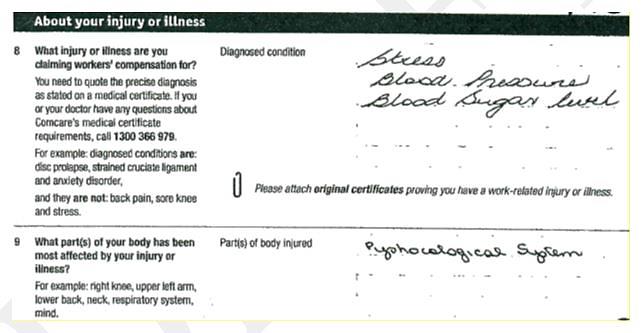
3 On 8 June 2006 Comcare accepted liability to pay compensation. Of the claims made, the delegate who made that decision accepted “adjustment reaction with depressive reaction” which occurred on 19 September 2005. The statement of reasons provided in respect to that decision included the following:
Findings
In his medical report dated 26 April 2006, Dr Saboisky offered the view that your condition was the result of being moved from one workplace to another and feeling that your new role was not commensurate with your former experience and training. Apparently, this ‘move was due to a rationalisation of work functions’.
Dr Saboisky elaborated that the employment factors relevant to your claim were:
(a) Being moved without consultation from Belconnen to Curtin;
(b) Perceiving that your role function had been significantly reduced.
The statement of reasons also contained the following “Finding”:
Based on all of the evidence it seems to me as though your ‘adjustment disorder with depressed mood’ has been materially contributed to by events that, in fact, occurred during the course of your employment. In this respect, your perception (whilst potentially different to the perception held by others) in respect of the relevant events seems to have led to your suffering a diagnosed ‘adjustment disorder with depressed mood’.
4 In December 2014, however, a further decision was made that Ms Bromham had no present entitlement to compensation for medical expenses under s 16 and no entitlement to compensation for incapacity payments under s 19 of the Safety, Rehabilitation and Compensation Act. That decision was expressed in the following terms:
Having assessed the evidence on your claim file, I have determined you do not presently suffer from the effects of your compensable condition.
In relation to this decision I have taken into regard a report received from Dr Graham Vickery, Psychiatrist and Pain Management Consultant, dated 20 October 2014, a copy of this report has previously been sent to you.
Comcare affirmed that decision in 2015.
5 Ms Bromham sought review by the Administrative Appeals Tribunal. That Tribunal set aside Comcare’s decision: Re Bromham and Comcare [2016] AATA 484.
6 Comcare now appeals to this Court pursuant to s 44 of the Administrative Appeals Tribunal Act 1975 (Cth). Such an appeal is confined to a “question of law”: s 44(1).
The Questions of Law
7 The Supplementary Notice of Appeal dated 5 October 2016 identifies the following three Questions of Law which Comcare poses for resolution on appeal:
1. For the purposes of determining whether, as at 9 December 2014:
(a) the Respondent was entitled to compensation for medical expenses under s16 of the Safety, Rehabilitation and Compensation Act 1988 (the SRC Act); and
(b) the Respondent was entitled to compensation for incapacity for work under s19 of the SRC Act,
was the Tribunal required to consider whether the Respondent continued to suffer from an injury (being a disease), which continued to be materially contributed to by the Respondent’s employment.
2. If the Tribunal was required to consider the question identified in Amended Question of Law #1, did the Tribunal fail to consider and resolve a submission of substance which was worthy of serious consideration and that was seriously advanced by the Applicant?
3. Did the Tribunal fail to provide reasons for its decision in breach of its obligation to do so under s43(2B) of the Administrative Appeals Tribunal Act 1975 (AAT Act)?
8 In very summary form, Comcare’s principal submission is that “the Tribunal [was] required to consider [but failed to consider] whether [Ms Bromham] continued to suffer from an injury (being a disease), which continued to be materially contributed to by [her] employment”.
9 It has proved unnecessary to resolve two of the Questions of Law sought to be raised. But the appeal is to be allowed upon the basis that the Tribunal has failed to provide adequate reasons for its decision as required by s 43(2B) of the Administrative Appeals Tribunal Act 1975 (Cth).
The Tribunal’s decision
10 After introducing the factual background and the relevant legislative provisions, the Tribunal identified the “issues” which it had to determine as follows:
[36] The Tribunal stands in the shoes of the original decision-maker and it must take into account all of the evidence before it. The issues we must decide follow.
(1) Has Ms Bromham any entitlement to compensation for medical expenses incurred at any time on or since 9 December 2015, in relation to the compensable injury?
(2) Has Ms Bromham any entitlement to incapacity payments at any time on or since 9 December 2015, in relation to the compensable injury?
The Tribunal summarised the submission advanced before it by Comcare as follows:
[38] It was put on behalf of Comcare that “there is insufficient evidence to establish that the compensable condition continues to contribute to Ms Bromham’s psychological condition, if she suffers from one”. We do not agree that this is the correct approach to the task before us. Ms Bromham does not have to again show that Comcare is liable to compensate her in respect of the injury she suffered in 2005. Whilst neither party bears an onus of proof, there is an evidentiary burden on Comcare which must be discharged if the decision under review is to be affirmed. For this to occur we have to be satisfied on the evidence before us that, on the balance of probabilities, Ms Bromham no longer suffers from the effects of the compensable injury such that she does not require medical treatment and that she is not incapacitated for work. If we cannot be so satisfied the reviewable decision must be set aside.
(Footnote omitted)
11 In summarising the events which Ms Bromham said contributed to her mental condition, the Tribunal’s reasons record the following:
[68] In the report Dr Sjostedt provided a list, expressed in Ms Bromham’s own words, of the circumstances she said led to her psychological condition. These are:
• the incident in 1996 when Ms Bromham was told she needed special furniture because she had “fat legs”;
• the treatment of her complaint concerning a male employee walking through the office not wearing a shirt;
• her being transferred to the Emergency Services stores where she felt “out of sight, out of mind”;
• being told she was not wanted in stores and becoming frustrated as she had no work to do;
• being told to “stop acting like a girl” during a public meeting after she had complained about the conduct of fellow-employees towards another employee;
• a discussion in August 2005 concerning her impending transfer back to the Curtin office;
• an incident in August 2005 when she was told to “shut up” by her supervisor in the presence of several other employees.
Dr Sjostedt was a psychologist whom Ms Bromham first consulted in February 2012.
12 The Tribunal then proceeded to set forth the evidence relied upon by both Ms Bromham and Comcare. It then set forth a “Discussion” of the matters arising as follows:
DISCUSSION
[76] Having considered all of the evidence, including all of the documents in exhibit R1 (the documents filed in accordance with section 37 of the Administrative Appeals Tribunal Act 1975), we are not satisfied that, at any time on or since 9 December 2014, Ms Bromham has not been entitled to compensation in respect of the cost of medical treatment obtained in relation to the injury sustained by her in September 2005. We are also not satisfied that, at any time on or since 9 December 2014, Ms Bromham has not been incapacitated for work as a result of the injury. We have reached these conclusions as we are not satisfied on the balance of probabilities that Ms Bromham has, at any time, ceased to suffer from the condition of adjustment disorder with depressed mood first suffered on 9 September 2005 and for which Comcare accepted liability to pay compensation until 9 December 2014.
[77] Counsel for Comcare argued that:
(a) when Ms Bromham was assessed by Dr Vickery and Mr O’Neill (20 October 2014 and 18 June 2015 respectively) she was not suffering from a mental condition outside the boundaries of normal behaviour and that she has not suffered a relapse since;
(b) alternatively, if she has suffered a relapse of a psychiatric condition her employment by the Authority did not contribute to the relapse; and
(c) even if she suffered a relapse to which her employment contributed, there is no entitlement to either the refund of medical expenses or the payment of compensation for any period of incapacity.
The Tribunal then immediately set forth its essential finding of fact as follows:
[78] On the evidence before us we are satisfied that Ms Bromham has suffered from the depressive condition continuously since 9 December 2014.
The Tribunal continued:
[79] We find that Ms Bromham was an honest witness who gave her evidence to the best of her recollection. It may be that at times she perceived situations to be more detrimental to herself than may have been perceived by others, but we are satisfied that any such perceptions were based on situations which did occur. In this regard it is to be noted that liability was accepted on the basis that it was events which occurred within the workplace which initially gave rise to her injury and this has not been challenged.
[80] There is no doubt that Ms Bromham suffered several serious medical conditions prior to the accepted injury and that these conditions have continued to have an effect on her physically. However, based on Ms Bromham’s evidence we are satisfied that these conditions did not prevent her working, before the accepted injury and would not have prevented her working thereafter.
[81] We accept also that events in the workplace, other than those initially specified by Ms Bromham, probably contributed to her ongoing condition. Counsel for Ms Bromham argued that her claim should not be interpreted so narrowly as to restrict it to the one event. It was put that it was clear that her injury arose from a series of work-related incidents.
[82] Whilst there is considerable weight in this argument we do not have to decide the scope of Ms Bromham’s claim. The claim has been accepted by Comcare and there has been no reconsideration of that acceptance. We are not satisfied that the accepted injury has resolved as alleged.
13 The final paragraphs of the Tribunal’s reasons, which assume some prominence, were the following:
[91] We have taken into account also that Dr Newlyn agrees with Dr Sjostedt that Ms Bromham continues to suffer from a Major Depressive Disorder caused by incidents which occurred to her at work, including the transfer in 2005.
[92] The evidence of Ms Bromham, Mrs Gotts and Mrs Halsey supports our finding that Ms Bromham continues to suffer from a psychiatric disorder.
[93] We prefer the views expressed by Dr Sjostedt and Dr Newlyn to those of Dr Vickery and Mr O’Neill. Dr Sjostedt has the advantage of having been able to assess Ms Bromham’s mental state during more than 50 consultations since February 2012.
[94] Both Dr Vickery and Mr O’Neill each assessed Ms Bromham on one occasion only. It may be that Ms Bromham presented in a better state on those days than on others. We also accept that she may have been in remission to some extent due to her travels throughout several states in her camper van. However, this is not the period under consideration.
The misunderstanding of Comcare’s argument?
14 It is unnecessary to resolve Questions 1 and 2 as raised in the Supplementary Notice of Appeal. It is unnecessary to do so because the third Question of Law is resolved in favour of Comcare. All the Questions of Law, it must nevertheless be recognised, tend to overlap and it perhaps matters not how the questions are framed; what matters is the identification of the basis upon which the Tribunal’s decision should be set aside.
15 Brief observations may nevertheless be expressed with respect to the arguments advanced in support of the first two Questions.
16 The case for Comcare, in very summary form, was that the Tribunal had failed to properly understand the argument being advanced for its consideration. Comcare argued that the Tribunal lacked jurisdiction to resolve any entitlement to compensation other than that which had been the subject of determination. The arguments as set forth in para [77] of the Tribunal’s reasons for decision and (in particular) para [77(b)], it was submitted, failed to adequately express the argument as advanced.
17 Reliance was placed upon Comcare v Muir [2016] FCA 346, (2016) 150 ALD 321. The Administrative Appeals Tribunal, it was there concluded, erred in “reformulating” a claim for compensation as extending beyond an injury suffered in 2013 and including a claim for injuries suffered in 2010-2012. The conclusion reached by this Court in that case was as follows:
[36] In so concluding, the Tribunal erred either because:
• the “reviewable decision” which was before the Tribunal did not include any decision made in respect to any injury that may have been suffered “prior to the 2013 matters” (cf. Lees v Comcare); and/or
• the claim as made never included a claim for any injury other than one suffered in October 2013.
The conclusion of the Tribunal also does not sit comfortably with the finding previously made (at para [13] of its reasons for decision) that “each of the six matters referred to in paragraph 6 above contributed significantly to the condition that Ms Muir has claimed for…”. Those “six matters” included, of course, events which post-dated “the events of 2010-2012…”. Not fully explained is how such later events could have “contributed significantly” to a claim for an injury “sustained … prior to the 2013 matters…”. Given the conclusion that the Tribunal erred for either of the two reasons identified, it is unnecessary further to pursue the manner in which paras [6], [13], [36] and [65] may possibly be reconciled.
[37] Although limited flexibility is conferred upon the Tribunal to reformulate a claim, and whatever may be the outer limits of the power to do so, a claim confined to an injury suffered in October 2013 cannot be transformed into a claim for an injury suffered in 2010-2012.
18 The determination that had been made in respect to Ms Bromham’s claim in June 2006 was a determination founded upon the view accepted by the delegate that her “condition was the result of being moved from one workplace to another and feeling that [her] new role was not commensurate with [her] former experience and training.” Significantly, it was submitted on behalf of Comcare that the acceptance of liability was confined to that cause; liability was not accepted as having been occasioned by other events which had occurred in the workplace. There can be no questioning the fact that this was a submission advanced on behalf of Comcare. Counsel then appearing for Comcare thus submitted to the Tribunal as follows:
Secondly, the applicant’s perception is not that the compensable work event continues to contribute to her current condition. It is that she perceives that her current symptoms are the result of the culmination of the work events. Most of them liability - all of them but for the August 2005 liability has never been accepted for. No, claim for compensation has ever been lodged with respect to them. There is no determination, no reviewable decision.
A little later the submission was repeated as follows:
Now her oral evidence in my submission demonstrates that the workplace factors that she described as continuing to trouble her go well beyond the compensable incident and that the compensable incident no longer features in the factors that contribute to her ongoing - if there is an ongoing - psychological condition outside the boundaries of normal mental functioning behaviour.
19 If this be the correct starting point, it was then submitted on behalf of Comcare that a course not open to the Tribunal was to accept liability to pay compensation on any basis other than the one which had been the subject of determination in June 2006.
20 But Senior Counsel for Ms Bromham questioned the starting point from which Comcare proceeded.
21 On the approach advocated on behalf of Ms Bromham, the “reviewable decision” which was before the Tribunal was the one made on 3 March 2015 which, in turn, affirmed the earlier decision made on 9 December 2014 that Ms Bromham did not at that point in time “suffer from the effects of [her] compensable condition”.
22 If this be the correct starting point, it was then submitted on behalf of Ms Bromham that it was open to the Tribunal to form its own assessment as to whether her condition as at 9 December 2014 was compensable – provided, of course, that the accepted basis of liability fell within the claim as made in December 2005. And, in doing so, the Tribunal was free of any constraint that may have been imposed by reference to the earlier 2006 determination. So long as her condition fell within the ambit of her claim for compensation as first made in December 2005, it was open to the Tribunal to find that Comcare was liable to pay compensation on any of the bases that fell within her claim, including both the claim founded upon the effect on her of her move to Curtin and other work related events.
23 It is understood that the solicitor appearing for Comcare accepted that the delegate who made the decision in December 2014 could have made any one of a number of decisions, including a decision that on the basis of the existing evidence:
Ms Bromham no longer suffered from any mental condition.
Other decisions the delegate could have made were decisions that, on the basis of the existing evidence:
Ms Bromham continued to be entitled to compensation in respect to her mental condition by reason of the effects upon her of her relocation; and
Ms Bromham may no longer suffer any mental condition by reason of the decision to relocate her to Curtin but did suffer from a mental condition attributable to other work related events.
If this be correct, it would necessarily follow that a decision could have been made – had the delegate thought it appropriate to do so – upon a basis or bases quite separate from those that guided the earlier delegate’s decision in June 2006.
24 Given this position, and assuming the starting point be that advanced by Senior Counsel on behalf of Ms Bromham, the “fall-back” position adopted by Comcare was that the claim as made in December 2005 should not be construed so broadly as to include a claim for compensation in respect of injuries other than that as formulated in June 2006.
25 Had it been necessary to do so, it would most probably have been concluded that:
the decision in Muir would not stand in the way of the Tribunal reviewing the claim for compensation upon any basis that legitimately fell within the ambit of the claim made in December 2005; and that
the claim as made in December 2005 could well be construed as a claim founded upon work related events other than the relocation decision. A claim, it is to be recalled, should be given “a broad, generous and practical interpretation” (Abrahams v Comcare [2006] FCA 1829 at [18], (2006) 93 ALD 147 at 152 per Madgwick J) and “need not be expressed with the same degree of particularity or formality of a pleading or a statement of claim in a superior court” (Farrell v Comcare [2015] FCA 1337 at [31], (2015) 148 ALD 527 at 536 per Flick J).
An inadequacy in reasoning?
26 It was correctly submitted on behalf of Comcare that all three Questions of Law as set forth in the Supplementary Notice of Appeal overlapped.
27 Senior Counsel for Ms Bromham, for example, contended that it was apparent from the reasons of the Tribunal that it had not confined itself to the basis of liability as expressed in June 2006 and considered itself free to consider all of the heads of injury upon which Ms Bromham relied. Why else, he submitted rhetorically, would the Tribunal have canvassed the entirety of the evidence which went well beyond the effects upon Ms Bromham of her relocation. So much was also apparent, it was submitted, from the Tribunal’s statement of reasons at (for example) paras [78] and [81]. The decision of the Tribunal, it was ultimately submitted on Ms Bromham’s behalf, was a decision as to fact which gave rise to no question of law.
28 That may well have been the basis upon which the Tribunal proceeded. But what matters is that it did not explain why. Nor did it explain why its ultimate decision on the facts fell within the claim as originally formulated.
29 An important part of the role discharged by the Tribunal is that it provides an independent forum in which persons may seek review on the merits of their application. An important part of that role is to provide reasons for its decisions: Administrative Appeals Tribunal Act 1975 (Cth), s 43. That section relevantly provides as follows:
(2) … the Tribunal shall give reasons either orally or in writing for its decision.
…
(2B) Where the Tribunal gives in writing the reasons for its decision, those reasons shall include its findings on material questions of fact and a reference to the evidence or other material on which those findings were based.
Sufficient reasons need to be provided “to make the system of appeals effective”: Roncevich v Repatriation Commission [2005] HCA 40 at [62], (2005) 222 CLR 115 at 135 per Kirby J. “One of the central objects behind the statutory obligation to give reasons is to expose the Tribunal’s reasoning process which may facilitate appeals on a question of law or judicial review”: Summers v Repatriation Commission [2015] FCAFC 36 at [110], (2015) 230 FCR 179 at 209 per Kenny, Murphy and Beach JJ.
30 On the facts of the present case there were potentially at least two issues which the Tribunal did not expressly address in its reasons, namely:
the fate of the submission advanced on behalf of Comcare that the jurisdiction of the Tribunal did not extend to accepting liability to pay compensation on the basis of “the culmination of the work events” – most of which, it was submitted, had not been “accepted”; and/or
• the basis upon which the Tribunal apparently concluded that it was open to it to resolve the claim for compensation afresh.
It may be that both of these issues are but different ways of expressing the same concern.
31 Both of these issues are nevertheless of importance. The former of the two issues was an argument expressly advanced on behalf of Comcare and was the subject of some degree of “testing” by the Tribunal members during the course of submissions. Not every submission advanced before the Tribunal need necessarily be resolved; but submissions which are “worthy of serious consideration” and which have been “seriously advanced” should be addressed in the reasons provided: Rand v Comcare [2014] FCA 584 at [30], (2014) 140 ALD 666 at 674 per Flick J. Why the submission advanced on behalf of Comcare in the present case was not dealt with or why it was considered but rejected remains unknown. The latter issue was an issue going to the jurisdiction being exercised by the Tribunal and the perimeter of the matters open for it to consider when exercising that jurisdiction.
32 In the absence of these issues being resolved, questions of the very kind now being pursued on appeal inevitably arose because neither party to the Tribunal proceeding knew with certainty the basis upon which the Tribunal proceeded. Without knowing the basis upon which the Tribunal proceeded, it is difficult to know whether any error of law may have arisen along the pathway to decision.
33 However expressed, that which is left unexplained is why the Tribunal did not consider itself confined to a review of the determination made in June 2006 and, if that be the manner in which the Tribunal proceeded, why its decision that Ms Bromham was entitled to compensation fell within the claim as first made.
CONCLUSIONS
34 During the course of the hearing, it emerged that payments of compensation to Ms Bromham had ceased but would be voluntarily reinstated pending the decision of this Court.
35 The appeal should be allowed.
36 It was also indicated that Comcare would not seek its costs of the appeal in the event that it was successful. It may be that the same decision may ultimately be reached by the Tribunal. In allowing the appeal, no view is expressed – nor should it be expressed – as to the factual merits of the claims advanced by Ms Bromham.
THE ORDERS OF THE COURT ARE:
1. Leave is granted to file the Supplementary Notice of Appeal dated 5 October 2016.
2. The appeal is allowed.
3. The matter is remitted to the Tribunal for reconsideration in accordance with law.
4. There is to be no order as to costs.
I certify that the preceding thirty-six (36) numbered paragraphs are a true copy of the Reasons for Judgment herein of the Honourable Justice Flick. |


