

FEDERAL COURT OF AUSTRALIA
Australian Building and Construction Commissioner v Construction, Forestry, Mining and Energy Union [2017] FCA 157
REASONS FOR JUDGMENT
AUSTRALIAN BUILDING AND CONSTRUCTION COMMISSIONER Applicant | ||
AND: | CONSTRUCTION, FORESTRY, MINING AND ENERGY UNION First Respondent ANDREW WATSON Second Respondent SHAUN DESMOND Third Respondent | |
1 This proceeding centres on a series of twice-daily, two hour union meetings that occurred at the Carrara Sports and Recreation Project on the Gold Coast, in Queensland, during the period between 9 May 2016 and 1 June 2016.
2 In short compass, the Director of the Fair Work Building Industry Inspectorate, now entitled the Australian Building and Construction Commissioner (the Commissioner – see Item 19 Schedule 2 to the Building and Construction Industry (Consequential and Transitional Provisions) Act 2016 (Cth)), alleges that the Construction, Forestry, Mining and Energy Union (the CFMEU) and two of its officials, Mr Andrew Watson and Mr Shaun Desmond, arranged the union meetings in question in order to coerce Hansen Yuncken Pty Ltd, the managing contractor of the Carrara Sports and Recreation Project, to enter into an enterprise agreement with it. This conduct, so the Commissioner alleged, contravened ss 343 and 348 of the Fair Work Act 2009 (Cth) (the FWA).
3 The broader factual context to these allegations is set out in the following paragraphs. Most of these facts are admitted on the pleadings between the Commissioner and the CFMEU (the first respondent). For ease of reference, except where the context otherwise requires, hereafter in these reasons I will refer to the respondents collectively as “the CFMEU”. I should also add that Mr Watson (the second respondent) and Mr Desmond (the third respondent) invoked the privilege against self-exposure to a penalty and therefore did not file a defence to the Commissioner’s amended statement of claim. Instead, they simply denied the Commissioner’s claims for relief against them. Consistently with that position, they did not give evidence at the trial.
The factual context
The Carrara Sports and Recreation Project
4 The Carrara Sports and Recreation Project involves the construction of a range of facilities for the XXI Commonwealth Games. Those Games are to be held on the Gold Coast in April 2018. The construction project is valued at approximately $126 million and is funded by the Federal Government, the Queensland Government and the Gold Coast City Council.
Hansen Yuncken and the structural subcontractors
5 In its role as the managing contractor of the Carrara Sports and Recreation Project, Hansen Yuncken engaged a range of subcontractors that specialised in various structural trades to undertake different parts of the construction work at the project site. They included the following:
(a) Steel Fabrications Australia Pty Ltd (Steel Fabrications), which, in turn, subcontracted its work to Mulherin Rigging & Cranes Australia Pty Ltd (Mulherin);
(b) Australian Post Tensioning Pty Ltd (Post Tensioning);
(c) Bosform Labour Hire Pty Ltd (Bosform);
(d) ECB Scaffolding Pty Ltd (ECB Scaffolding);
(e) Freyssinet Australia Pty Ltd, formerly Austress Freyssinet Pty Ltd (Freyssinet);
(f) FTF Bricklaying Pty Ltd (FTF Bricklaying);
(g) Gold Coast Cranes Pty Ltd (GC Cranes); and
(h) Lindores Construction Logistics Pty Ltd (Lindores).
Henceforth, I will refer to these eight subcontractors collectively as “the structural subcontractors”.
The union meeting clauses
6 During 2015, each of the structural subcontractors mentioned above made an enterprise agreement (EA) under the FWA which covered its employees and the CFMEU (the structural subcontractor EAs). Each of those EAs was subsequently approved by the Fair Work Commission (as it then was) and by May/June 2016 none had passed its nominal expiry date. Further, each of these EAs contained a clause which provided for a dispute resolution process involving the Fair Work Commission.
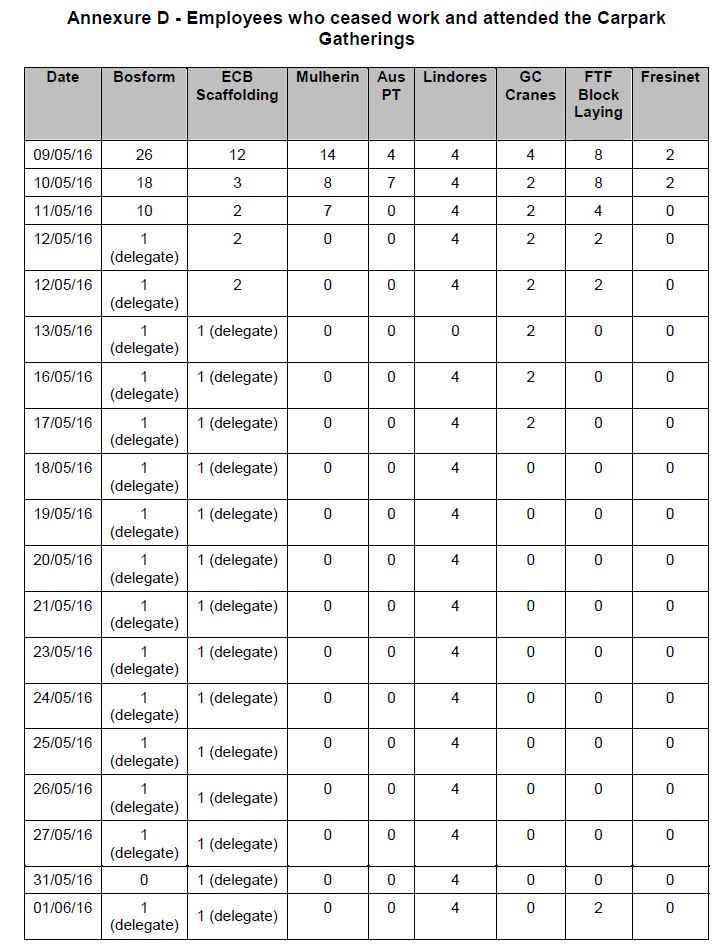
7 Importantly for this proceeding, each of the structural subcontractor EAs also contained a clause allowing its employees to attend or participate in union meetings of up to two hours (the union meeting clauses). Among the eight structural subcontractor EAs, there were three different forms of these union meeting clauses. First, there was the clause contained in the EAs with Mulherin, Bosform, FTF Bricklaying and Lindores. That clause was expressed in the following terms:
32.9 The Employer agrees to Employees attending Union meetings or participating in Union activities during working hours and that the Employees shall be entitled to receive payment for attendance at those meetings/ activities provided that:
(a) the Union provides the Employer with written notice of the intention to hold the meeting / undertake the activities prior to commencement;
(b) the duration of the meeting / activities is two hours or less (the duration of the meeting / activities may be extended beyond two hours by way of agreement between the Union and the Company). Authority to grant extension by the Employer rests with the General Manager or their nominee;
(c) up to two meetings / activities of up to two hours each may be held per shift, either consecutively or separately, provided that notice is given in accordance with clause 32.9(a) above.
8 Next, there was the clause contained in the EAs with Post Tensioning, ECB Scaffolding and Freyssinet. That clause was expressed as follows:
33.9 Employees are entitled to have paid time off to attend union meetings of up to 2 hours (or more by agreement) or participate in union activities.
9 The third and final clause was that contained in the EA with GC Cranes. It was expressed as follows:
32.8 Employees are entitled to have paid time off to attend union meetings of up to 2 hours (or more by agreement) or participate in union activities but not more than once per week.
It should be noted that this was the only union meeting clause that limited the number of meetings to one per week. In contrast, the Mulherin, Bosform, FTF Bricklaying and Lindores clauses expressly permitted up to two such two hour meetings per shift (see [7(c)] above. The remaining clauses were silent on the question of the frequency of the meetings (see at [8] above)
The Hansen Yuncken EA
10 In 2014, Hansen Yuncken entered into an EA which covered its employees and the CFMEU. It was approved by the Fair Work Commission and was entitled the “Hansen Yuncken Pty Ltd and CFMEU Union Collective Agreement 2013 - 2015” (the Hansen Yuncken EA). That EA had a nominal expiry date of 30 September 2015. It is worth noting, however, that although Hansen Yuncken employed foreman, engineers and administrative staff in connection with the Carrara project site, it did not directly employ any construction workers at the project.
11 In early February 2016, Mr Andrew Sutherland, the Assistant State Secretary of the CFMEU, requested Mr Baumann, the Queensland State Manager of Hansen Yuncken, to commence discussions on a new enterprise agreement. Accordingly, on 15 February 2016, Mr Baumann and Mr Michael Vicenzino, Hansen Yuncken’s Queensland Construction Manager, met with Mr Sutherland for that purpose. Those discussions continued at a meeting on 19 February 2016 when it was agreed that the CFMEU would draft a new enterprise agreement for Hansen Yuncken to review. The CFMEU provided a draft of the new enterprise agreement to Hansen Yuncken on 25 February 2016. However, after reviewing that document during March and April 2016, and holding further discussions with Mr Sutherland, Mr Baumann and Mr Vicenzino formed the view that it would not comply with the 2013 Code or the Draft 2014 Code (see at [12]–[16] below). This was of concern to Hansen Yuncken because it received a considerable amount of work from the Federal Government. Consequently, on 5 May 2016, Mr Baumann telephoned Mr Sutherland and informed him that Hansen Yuncken would not sign the proposed new enterprise agreement for this reason.
The 2013 Code and the Draft 2014 Code
12 The 2013 Code is a legislative instrument under the Fair Work (Building Industry) Act 2012 (Cth). It came into effect on 1 February 2013. For present purposes, it relevantly provides:
(a) by s 6(2), that a building contractor becomes subject to the Code of Practice in it if the contractor submits an expression of interest or tender for building work that is described in any of items 1 to 8 of Schedule 1 to the 2013 Code;
(b) by item 1 of Schedule 1, that it applies to building work that is being undertaken by or on behalf of a funding entity as defined in s 4;
(c) by item 2 of Schedule 1, that it applies to building work that is indirectly funded by the Commonwealth by a grant or other program in circumstances in which funding for the building work is an explicit component of the grant or program and for which the value of the Commonwealth’s contribution to the project is at least $5 million and represents at least 50% of the total construction project value, or the Commonwealth’s contribution is at least $10 million irrespective of the proportion of the total construction project value.
From time to time, Hansen Yuncken submitted expressions of interest, or tenders, for building work which fell within the terms of items 1 and 2 of Schedule 1 (see (b) and (c) above) and which were therefore subject to the 2013 Code. The Carrara project site was such an instance.
13 On or about 13 May 2016, the Commissioner issued an e-alert to the building industry advising that, from Wednesday 18 May 2016, any new EAs entered into by building contractors or building industry participants would need to be compliant with the 2013 Code in order for contractors to be eligible for work on future Commonwealth-funded construction projects and any prior approval by the Fair Work Commission would not be deemed compliant. The background to, and effect of, this announcement was explained by Mr Vicenzino in one of his affidavits in the following terms:
28. Until recently, the Australian Government has adopted a policy of deeming any enterprise agreement as being compliant with the 2013 Code. However, the Fair Work Building Industry Inspectorate (FWBC) recently issued guidance advising construction employers that the Minister for Employment has now formally rescinded that policy and that the effective date of the policy change was 18 May 2016. As a result, if any construction employers make enterprise agreements after 18 May 2016 that are not consistent with the Building Code 2013, they will not be compliant with it, and may be excluded from tendering or expressing interest in Federally-funded construction work. The policy change will apply in respect of all Federally-funded construction work procured after 1 June 2016.
…
29. In addition, new Supporting Guidelines to the 2013 Code have recently been published. The new Supporting Guidelines provide that the Minister (with advice from the FWBC) may issue either a formal warning or exclusion sanction where a building contractor is not compliant with the 2013 Code. …
30. The new Support Guidelines also include a requirement that Commonwealth funding entities not contract with construction employers where there are reasonable grounds to believe that the employer is covered by an enterprise agreement that is not consistent with the 2013 Code.
14 There was another policy development affecting the 2013 Code that was of some importance in this proceeding. In approximately April 2014, the Commonwealth Government published an advance release of the Building and Construction Industry (Fair and Lawful Building Sites) Code 2014 (Draft 2014 Code) under the Building and Construction Industry (Improving Productivity) Bill 2013. This 2013 Bill was partly directed to the re-establishment of the Australian Building and Construction Commissioner. It was introduced into the House of Representatives in November 2013. However, the Senate subsequently negatived it on two occasions, first in August 2015 and secondly in April 2016. It then became one of the Bills upon which the double dissolution Federal election of 2 July 2016 was based. To complete this legislative history, the 2013 Bill was re-introduced into the House of Representatives in August 2016 as the Building and Construction Industry (Improving Productivity) Bill 2013. It was eventually passed by both houses of Parliament in an amended form in late November 2016 and most of its provisions came into effect on 2 December 2016. Thus, the change of title mentioned in [2] above.
15 Describing his understanding of the position, Mr Vicenzino said in one of his affidavits that the original stated intention was that, once the 2013 Bill became law, the Draft 2014 Code, as originally published, was to apply retrospectively to all EAs made after 24 April 2014. Mr Vicenzino also described the types of EA clauses that he understood would be in breach of the Draft 2014 Code once it came into effect. They included clauses that:
(a) prescribe the number of employees or subcontractors that may be employed or engaged on a particular site, in a particular work area, or at a particular time;
(b) restrict the employment or engagement of persons by reference to the type of contractual arrangement that is, or may be, offered by an employer;
(c) require a code covered entity to consult with, or seek the approval of, a building association or an officer, delegate or other representative of the building association in relation to the source or number of employees to be engaged, or type of employment offered to employees;
(d) require a code covered entity to consult with, or seek the approval of, a building association or an officer, delegate or other representative of the building association in relation to the engagement of subcontractors;
(e) prescribe the terms and conditions on which subcontractors are engaged (including the terms and conditions of employees of a subcontractor);
(f) prescribe the scope of work or tasks that may be performed by employees or subcontractors;
(g) limit or have the effect of limiting the right-of an employer to make decisions about redundancy, demobilisation or redeployment of employees based on operational requirements;
(h) prohibit the payment of a loaded rate of pay (whether or not expressed as an annual amount);
(i) require, or have the effect of requiring, the allocation of particular work to individual employees only if that allocation is extended to all other employees in the class of employees to which the individual employee belongs;
(j) provide for the monitoring of agreements by persons other than the employer and employees to whom the agreement applies;
(k) include requirements to apply building association logos, mottos or indicia to company supplied property or equipment;
(l) directly or indirectly require a person to encourage, or discourage, a person from becoming, or remaining, a member of a building association;
(m) directly or indirectly require a person to indicate support, or lack of support, for persons being members of a building association or any other measure that suggests that membership is anything other than a matter for individual choice;
(n) limit the ability of an employer to determine with its employees when and where work can be performed to meet operational requirements or limit an employer’s ability to determine by whom such work is to be performed;
(o) provide for the establishment or maintenance of an area which is intended to be designated to be used by members, officers, delegates or other representatives of a building association in that capacity.
16 Mr Vicenzino’s evidence on this topic is broadly consistent with the somewhat tentative evidence that Mr Gregory Alfred, a Fair Work Building Industry Inspector, gave at the trial of this proceeding. Under cross-examination, he described the practical effect of the introduction of the Draft 2014 Code in the following terms:
MR FRIEND: You won’t be able to have a term of an agreement that restricts the way in which employers are engaged, that is, as direct employees or contractors; correct?---I believe so, yes.
You won’t be able to have a term which requires a builder to seek the approval of a union or consult with a union in relation to the number of employees to be engaged; correct?---Yes, I – I believe that is the case, but I haven’t read that. I mean, we’re talking about something hypothetical here. It’s not - - -
…
… You won’t be able to have a term which prescribes the terms and conditions on which subcontractors are engaged; correct?---I believe so, yes.
Yes. And many of these things – in fact, all of those ones I put to you – are permitted under the current 2013 code or at least contained in many agreements?---Yes.
…
… So what I was putting to you, sir, was that the effect of the – sorry, the Commonwealth have said to builders such as Hansen Yuncken, “You can’t have these provisions in your agreements if you want any Commonwealth work.” That’s correct, isn’t it?---Yes.
Yes. And to your knowledge the Commonwealth funds a great deal of work in the building industry?---Yes.
So, in effect, you would agree, wouldn’t you, that it’s using its market power to ensure that agreements conform with what it wants; correct?---You could put it that way, yes.
17 Two things should be noted about the evidence set out above. First, while each party emphasised different aspects, it was not disputed that these two policy developments – the publication of the Draft 2014 Code and the announcement of the removal of deemed compliance with the 2013 Code – would be likely to have the effects described by Mr Vicenzino and Mr Alfred. Secondly, these two policy developments were sometimes confused, or at least conflated, in the evidence presented at the trial of this proceeding.
18 Finally on this topic, it is worth recording the views Mr Vicenzino expressed in his affidavit about the importance of Hansen Yuncken complying with the 2013 Code and Draft 2014 Code. He said:
It is crucial for Hansen Yuncken to comply with the 2013 Code in order to be able to continue to undertake Federally-funded construction work. Although the enactment of the Draft [Building Code] is uncertain, Hansen Yuncken has a commercial imperative to not agree to any enterprise agreement terms that could put it in breach of the Draft Code’s content requirements.
The twice daily, two hour union meetings at the Carrara project site
19 On 9 May 2016, four days after the telephone call described in [11] above, Mr Desmond, an organiser employed by the CFMEU, sent a notice by email to Mr Baumann (copied to Mr Sutherland) which stated that the CFMEU would be holding “2 hour communication meetings” that day under “clause 32.9 of the Hansen Yuncken and CFMEU Union Collective Agreement 2015–2019”. It is common ground that the latter aspect of this statement was erroneous because, as at 9 May 2016, there was no Hansen Yuncken and CFMEU Union Collective Agreement 2015–2019 in existence.
20 On the same day, Mr Watson, a CFMEU delegate at the Carrara project site, Mr Desmond and most of the employees of the structural subcontractors who were working at the project site attended a meeting at the Council car park which is located beside the project site. That meeting continued from approximately 10.00 am until approximately 12.30 pm. It was the only union meeting conducted at, or near, the project site on 9 May. However, from and including 10 May, similar union meetings were conducted twice daily.
21 In his amended statement of claim, the Commissioner claimed, and the CFMEU admitted, that:
34. On 10 May 2016 and on each working day of the [Carrara Sports and Recreation Project] until and including 1 June, except Saturdays:
(a) Desmond sent two notices by email to various persons, including Baumann, giving notice that the CFMEU would be holding “2 hour communication meetings”;
…
(c) Certain employees of the Structural Subcontractors present at the Site attended the Council Carpark for at least 2-hour periods twice each day in accordance with the notices referred to in sub-paragraph (a).
(Particulars omitted)
22 As will be apparent from the admitted facts, it is not in dispute that all of the union meetings were held at the Council car park mentioned in [20] above (see 34(c) of the amended statement of claim above). It is also not in dispute that certain employees of the structural subcontractors responded to the meeting notices by attending at that car park (see 34(a) of the amended statement of claim above). However, there is a dispute on the pleadings about the number of union meetings that were actually held during the period from 9 May to 1 June 2016 (inclusive). This appears from the CFMEU’s defence where it claimed that, on and from 10 May 2016, the structural subcontractors sent their workers away from the project site in an attempt to avoid their obligations under the union meeting clauses. As a result, it claimed that, whilst meetings were called, they did not, in fact, proceed with them because the employees of the structural subcontractors were not present at the project site. This dispute did not therefore relate to the number of meetings that were called, but rather to whether the notices of meetings resulted in union meetings being held.
23 In Annexure C to his amended statement of claim, the Commissioner set out the details of the union meetings that he claimed were called and held at the Carrara project site. That annexure is as follows:
Annexure C - Dates and times of Carpark Gatherings
Day | Date | Start | Finish | Duration |
Monday | 09/05/16 | 10:00am | 12:30pm | 2.5 hrs |
Tuesday | 10/05/16 | 7:30am | 9:30am | 2 hrs |
Tuesday | 10/05/16 | 11:00am | 1:30pm | 2.5 hrs |
Wednesday | 11/05/16 | 7:30am | 9:30am | 2 hrs |
Wednesday | 11/05/16 | 11:00am | 1:00pm | 2 hrs |
Thursday | 12/05/16 | 7:30am | 9:30am | 2 hrs |
Thursday | 12/05/16 | 11:00am | 1:00pm | 2 hrs |
Friday | 13/05/16 | 7:30am | 9:30am | 2 hrs |
Friday | 13/05/16 | 11:00am | 1:00pm | 2 hrs |
Monday | 16/05/16 | 7:30am | 9:30am | 2 hrs |
Monday | 16/05/16 | 11:00am | 1:00pm | 2 hrs |
Tuesday | 17/05/16 | 7:30am | 9:30am | 2 hrs |
Tuesday | 17/05/16 | 11:00am | 1:00pm | 2 hrs |
Wednesday | 18/05/16 | 7:30am | 9:30am | 2 hrs |
Wednesday | 18/05/16 | 11:00am | 1:00pm | 2 hrs |
Thursday | 19/05/16 | 7.30am | 9.30am | 2 hrs |
Thursday | 19/05/16 | 11:00am | 1:00pm | 2 hrs |
Friday | 20/05/16 | 7:30am | 9:30am | 2 hrs |
Friday | 20/05/16 | 11:00am | 1:00pm | 2 hrs |
Monday | 23/05/16 | 7:30am | 9:30am | 2 hrs |
Monday | 23/05/16 | 11.00am | 1.00pm | 2 hrs |
Tuesday | 24/05/16 | 7:30am | 9:30am | 2 hrs |
Tuesday | 24/05/16 | 11:00am | 1:00pm | 2 hrs |
Wednesday | 25/05/16 | 7:30am | 9:30am | 2 hrs |
Wednesday | 25/05/16 | 11:00am | 1:00pm | 2 hrs |
Thursday | 26/05/16 | 7:30am | 9:30am | 2 hrs |
Thursday | 26/05/16 | 11:00am | 1:00pm | 2 hrs |
Friday | 27/05/16 | 7:30am | 9:30am | 2 hrs |
Friday | 27/05/16 | 11:00am | 1:00pm | 2 hrs |
Tuesday | 31/05/16 | 7:30am | 9:30am | 2 hrs |
Tuesday | 31/05/16 | 11.30am | 2.30pm | 3 hrs |
Wednesday | 01/06/16 | 7.30am | 9:30am | 2 hrs |
Wednesday | 01/06/16 | 11:30am | 2:30pm | 3 hrs |
24 The details of the numbers of employees of the structural subcontractors who attended the meetings described in Annexure C above were set out in Annexure D to the Commissioner’s amended statement of claim. Ultimately, there was no substantial dispute about those numbers. Annexure D is as follows:
The effect of the two hour union meetings on Hansen Yuncken
25 It can be seen from Annexure D above that one of the direct effects of the two hour union meetings was that the number of employees of the structural subcontractors working at the Carrara project site reduced significantly after 9 May: from 74 on 9 May, to 11 on 12 May, to 4 on 13 May, to 8 on 1 June. It can be readily inferred that this reduction in the workforce occurred because the structural subcontractors removed their employees from the site to avoid having to pay them to attend the two hour union meetings. This inference is supported by one of Mr Vicenzino’s affidavits where he said that, as well as having to bear “the burden of paying for each of the two hour stoppages”, the structural subcontractors also had to :
(a) carry the burden of paying for all their plant and equipment on the site that is not being productively used;
(b) face the risk of breaching their contractual obligations to Hansen Yuncken and being exposed to liquidated damages; and
(c) face the commercial damage that their inability to undertake work on the Project will have on their reputations in the market place.
26 As for Hansen Yuncken, in one of his affidavits, Mr Vicenzino described the effect the two hour union meetings (which he described as “stoppages”) had on the construction works at the Carrara project site, in the following terms:
66. The stoppages at the Project and the subsequent redeployment of most of the staff of the Structural Contractors are causing a major disruption to each working day. Initially, they effectively halved potential productive time. Since Structural Subcontractors have begun redistributing their labour …, this has further significantly affected productivity, including in respect of subcontractors in Services Trades, which are not taking part in the stoppages.
67. I estimate that productive output achieved across the Project by subcontractors in the Services Trades who are not involved in the stoppages has dropped by approximately 30%. This estimate is based on the fact that nature of the work performed by the Services Trades substantially depends on the work performed by the Structural Trades, for example the crane crew is required for handling materials and scaffolding is necessary for some of the work at heights. This is also due to the nature of the coordination required between the Structural and Services works.
…
70. Hansen Yuncken’s ability to finish on time is also adversely affected because, once works do recommence, there are likely to be delays associated with re-establishing a Structural Trades workforce that has, for the most part, been redeployed to other projects. Based on my experience and qualifications I believe that even when productive works resumes following a stoppage, those works will not be as productive as compared to the usual course of works because the initial stages of recommencement will be similar to starting a new project with all workers having to work their way onto the Project again. This could effectively result in as little as fifty percent productive outputs in the first week of work, with output only being at previous capacity by close of the second week.
27 Mr Vicenzino claimed that these disruptions to work at the Carrara Sports project caused in excess of three weeks delays to the construction program and, therefore, the project’s critical path. He claimed that these delays had the following cost impacts for Hansen Yuncken:
(a) Hansen Yuncken has 15 staff associated with and employed on the Project. The approximate cost to Hansen Yuncken in respect of these staff is $13,500 per day. As at 30 May 2016 the Project has suffered non-recoverable staff-related costs of $243,000.
(b) The site office, amenity and subcontractor facilities amount to an approximate cost to Hansen Yuncken of $2,500 per day with a total non-recoverable cost to 30 May 2016 of $45,000.
(c) Liquidated damages for every day that the Project runs late is a cost of $20,000 per day. I estimate that the delays caused to the project program are likely to result in total liquidated damages of at least $420,000 (based on a delay to the program of at least 21 days).
(d) It is difficult to assess the approximate costs of scaffold hire, tower crane hire and all of the idle boom lifts, scissor lifts and other plant and equipment on site and paid for by Hansen Yuncken. The costs of these alone would amount to tens of thousands of dollars per week.
(e) Any delays would also result in delayed use of the facility by the client and owners.
28 In a later affidavit, Mr Vicenzino increased his estimate of the number of calendar days that were lost to 24, thus increasing the potential total liquidated damages to $480,000 and the total cost impact for Hansen Yuncken to “over $700,000”. He also claimed that Hansen Yuncken had suffered reputational damage as a result of the “significant media attention” to the two hour union meetings. Mr Baumann confirmed the latter effect in one of his affidavits. He said that the project was the first project with a value of more than $50 million that Hansen Yuncken had undertaken in South East Queensland. He claimed that this meant the project had increased importance for Hansen Yuncken because “it is a platform for [it] to demonstrate its ability to deliver large scale projects in South East Queensland”. He also said that the events surrounding the two hour union meetings at the project “received significant media attention which has caused me to report these matters to the Hansen Yuncken CEO and Board”.
The Commissioner’s specific allegations
29 In his amended statement of claim, the Commissioner alleged that the two hour union meetings were not held in accordance with the union meeting clauses, for the following reasons:
(a) to the extent that employees of GC Cranes attended the carpark gatherings, they were held in breach of the relevant union meetings clause as more than one meeting was held per week; and
(b) otherwise the carpark gatherings did not amount to the employees of the structural subcontractors:
(i) attending union meetings; or
(ii) participating in union activities.
30 Further, the Commissioner alleged that the two hour union meetings were not held:
(a) for the genuine purpose of the employees of the structural subcontractors participating in union activities;
(b) for the purpose of representing the legitimate interests of the employees of the structural subcontractors.
31 In response, in its defence, the CFMEU claimed that the two hour union meetings were called for legitimate purposes, namely to enable it to discuss with its members, the employees of the structural subcontractors, the following matters (paragraph 35 of its defence):
A. The effect of Hansen Yuncken’s refusal to make an enterprise agreement containing terms to the effect … [pleaded above] on the employees of the Structural sub-contractors and the industry generally;
B. the effect of the 2013 Code and the proposed 2014 Code on the existing terms and conditions of the Structural Sub-contractor employees;
C. the procedural steps that would need to be taken in the event that the existing Structural Sub-contractor enterprise bargaining agreements were found to be in breach of either the 2013 Code or the 2014 Code;
D. the ways in which the Structural Sub-contractor enterprise agreements could be amended to preserve existing conditions and ensure compliance with the 2013 Code and/or the 2014 [Code]; and
E. obtaining the Structural Sub-contractor employees’ approval for renegotiation of the Structural Sub-contractor enterprise agreements if necessary;
Some procedural aspects
The interim relief granted
32 In his originating application filed on 1 June 2016, the Commissioner sought both a permanent and interlocutory injunction to prevent the CFMEU from continuing to organise or hold the two hour union meetings as described above. An interim injunction order was made on 3 June 2016 in terms that were largely (but not entirely) agreed between the parties. It was in the following terms:
1. The [CFMEU] (whether by themselves, their servants, officers or agents) will not convene a meeting at the Carrara Sports Project under any of the union activities clauses as defined in the originating application filed on 1 June 2016, until 15 June 2016.
2. On and from 16 June 2016, until the hearing and determination of the proceeding, the [CFMEU] (whether by themselves, their servants, officers or agents) will not convene more than one meeting of all the Carrara Sports Project Subcontractors (as defined in the originating application) per calendar week, under any of the union activities clauses as defined in the originating application filed on 1 June 2016.
3. The [CFMEU] is to provide to Hansen Yuncken Pty Ltd and each Carrara Sports Project Subcontractor (as defined in the originating application) concerned with written notice of the intention to hold a meeting referred to in Order 2 above.
The final relief sought
33 At the time the interim relief was granted, the matter was set down for trial to commence in late July 2016. At that trial, the Commissioner stated that he was no longer pressing for a permanent injunction and that he therefore sought only the declaratory relief and consequential penalties outlined below. It was also agreed that any question of penalties should be dealt with at a separate stage of the proceeding.
34 The final relief therefore sought by the Commissioner consisted of a declaration pursuant to s 545(1) of the FWA that each of the respondents had contravened ss 343 and 348 of the FWA. With respect to the CFMEU as a body corporate, the Commissioner relied on s 793 of the FWA to claim that the CFMEU was liable for the conduct and state of mind of its officials, Mr Watson and Mr Desmond. Alternatively, the Commissioner sought a declaration that Mr Watson and Mr Desmond were involved in the CFMEU’s contraventions within the meaning of s 550 of the FWA. Finally, the Commissioner sought orders for the imposition of pecuniary penalties pursuant to s 546 of the FWA with respect to the contraventions of ss 343 and 348.
Formal matters not in contention
35 At the trial, the parties also identified a number of formal matters that were not in contention. They included that:
(a) the Commissioner was entitled to bring his application pursuant to ss 10(d), 59A and 59C of the Fair Work (Building Industry) Act 2012 (Cth) and had standing to bring the proceeding under s 539 of the FWA;
(b) the CFMEU was an industrial association within the meaning of s 12 of the FWA and a body corporate under s 27 of the Fair Work (Registered Organisations) Act 2009 (Cth); and
(c) at all material times, Mr Watson was an employee of Bosform and an official of the CFMEU and Mr Desmond was an employee, organiser and official of the CFMEU.
The coercion and other legislative provisions in contention
36 As is apparent from the final relief sought by the Commissioner, ss 343 and 348 are central to this matter. Those sections provide:
343 Coercion
(1) A person must not organise or take, or threaten to organise or take, any action against another person with intent to coerce the other person, or a third person, to:
(a) exercise or not exercise, or propose to exercise or not exercise, a workplace right; or
(b) exercise, or propose to exercise, a workplace right in a particular way.
Note: This subsection is a civil remedy provision (see Part 4-1).
(2) Subsection (1) does not apply to protected industrial action.
348 Coercion
A person must not organise or take, or threaten to organise or take, any action against another person with intent to coerce the other person, or a third person, to engage in industrial activity.
Note: This section is a civil remedy provision (see Part 4-1).
37 The notes to these sections provide that they are both designated as civil penalty provisions under s 539 of the FWA. One consequence of those designations is that this Court may order a person to pay a pecuniary penalty if it is satisfied that he, she or it has contravened those provisions.
38 It is not in dispute that Hansen Yuncken had a workplace right under s 341(1)(b) of the FWA for the purposes of s 343 in that it initiated, or participated in, a process or proceeding under a workplace law by making an EA. It is also not in dispute that Hansen Yuncken engaged in industrial activity under s 347(f) for the purposes of s 348.
39 As I have already mentioned above, there are two other issues raised under other provisions of the FWA. It is convenient to identify what they are at this point. First, the Commissioner claimed that, pursuant to s 550 of the FWA, Mr Watson and Mr Desmond were “involved in” the CFMEU’s contraventions of ss 343 and 348 of the FWA. That provision relevantly provides:
(1) A person who is involved in a contravention of a civil remedy provision is taken to have contravened that provision.
(2) A person is involved in a contravention of a civil remedy provision if, and only if, the person:
(a) has aided, abetted, counselled or procured the contravention; or
(b) has induced the contravention, whether by threats or promises or otherwise; or
(c) has been in any way, by act or omission, directly or indirectly, knowingly concerned in or party to the contravention; or
(d) has conspired with others to effect the contravention.
40 Secondly, the Commissioner claimed that, as a body corporate, the CFMEU was liable for the conduct of its officials, Mr Watson and Mr Desmond, pursuant to s 793 of the FWA. That provision relevantly provides:
Conduct of a body corporate
(1) Any conduct engaged in on behalf of a body corporate:
(a) by an officer, employee or agent (an official) of the body within the scope of his or her actual or apparent authority; or
(b) by any other person at the direction or with the consent or agreement (whether express or implied) of an official of the body, if the giving of the direction, consent or agreement is within the scope of the actual or apparent authority of the official;
is taken, for the purposes of this Act and the procedural rules, to have been engaged in also by the body.
State of mind of a body corporate
(2) If, for the purposes of this Act or the procedural rules, it is necessary to establish the state of mind of a body corporate in relation to particular conduct, it is enough to show:
(a) that the conduct was engaged in by a person referred to in paragraph (1)(a) or (b); and
(b) that the person had the state of mind.
Meaning of state of mind
(3) The state of mind of a person includes:
(a) the knowledge, intention, opinion, belief or purpose of the person; and
(b) the person’s reasons for the intention, opinion, belief or purpose.
The effect of section 361 of the FWA
41 Since ss 343 and 348 are in Part 3-1 of the FWA, the Commissioner relied on s 361, which provides:
(1) If:
(a) in an application in relation to a contravention of this Part, it is alleged that a person took, or is taking, action for a particular reason or with a particular intent; and
(b) taking that action for that reason or with that intent would constitute a contravention of this Part;
it is presumed that the action was, or is being, taken for that reason or with that intent, unless the person proves otherwise.
(2) Subsection (1) does not apply in relation to orders for an interim injunction.
42 Accordingly, in his amended statement of claim, the Commissioner made allegations which activated these provisions as follows:
57. By reason of the matters pleaded in paragraphs 3, 4, 24 to 29 and 32 to 56 hereof:
(a) The CFMEU, Watson and Desmond organised, and took, action, namely the holding of the Carpark Gatherings, between 9 May and including 1 June 2016;
(b) The action referred to in sub-paragraph (a) was taken against the Structural Subcontractors, and further or alternatively against Hansen Yuncken and with the intention of disrupting and delaying the programed structural work at the Project;
…
(c) The Carpark Gatherings were organised, and undertaken, with intent to coerce Hansen Yuncken to enter into an enterprise agreement with the CFMEU;
…
(d) Further or alternatively to the preceding sub-paragraph, the Carpark Gatherings were organised, and undertaken, with intent to coerce Hansen Yuncken to enter into an enterprise agreement on terms required by the CFMEU;
…
(e) The intention to coerce Hansen Yuncken to enter into an enterprise agreement with the CFMEU, or alternatively to enter into an enterprise agreement with the CFMEU on terms required by the CFMEU, involved an intention to coerce Hansen Yuncken to:
(i) exercise a workplace right as defined in s.341 FW Act; or
(ii) exercise a workplace right as defined in s.341 FW Act in a particular way.
(f) Further or alternatively to the preceding sub-paragraph, the intention to coerce Hansen Yuncken to enter into an enterprise agreement with the CFMEU, or alternatively to enter into an enterprise agreement with the CFMEU on terms required by the CFMEU, involved an intention to coerce Hansen Yuncken to engage in industrial activity as defined in s.347 FW Act.
58. By reason of the matters pleaded in paragraph 57 hereof, the CFMEU, Desmond and Watson breached s.343 and s.348 of the FW Act.
The particulars of these allegations have been omitted.
43 Neither Mr Watson nor Mr Desmond gave any evidence at the trial and the CFMEU itself did not call any evidence. Instead, the CFMEU sought to rely upon the responses it had elicited from the Commissioner’s witnesses in cross-examination and on submissions. The Commissioner therefore contended that the combined effect of the provisions of s 361 and the allegations in paragraphs 57 and 58 of his amended statement of claim above was that the CFMEU was presumed to have committed all of the elements of a contravention of each of ss 343 and 348 of the FWA. In support of this contention, the Commissioner relied upon the following observations of Tracey J in Director, Fair Work Building Industry Inspectorate v Construction, Forestry, Mining and Energy Union [2015] FCA 225 (Grocon) (at [264]):
A respondent will only be found to have contravened ss 348 and 355 if he or she is shown to have intended to coerce another person. Section 361 raises a presumption that a person has acted with a particular alleged intention “unless the person proves otherwise”. That presumption is not easily displaced. Normally, it will require direct testimony from the actor which is accepted by the Court if the onus is to be discharged: see Board of Bendigo Regional Institute of Technical and Further Education v Barclay (2012) 248 CLR 500 at 517 (French CJ and Crennan J).
While these observations related to s 348 of the FWA, earlier in his reasons (at [232]) Tracey J referred to, and agreed with, the decision of Siopis J in Fair Work Ombudsman v Maritime Union of Australia [2014] FCA 440 at [304], where his Honour held that s 361 applied equally to the expression “intention to coerce” in ss 348 and 343. I respectfully join with his Honour in that agreement.
44 In response, the CFMEU contended that the presumption set out in s 361 of the FWA only applied to the “intention” element of the expression “intention to coerce” and the Commissioner was still required to prove the other element, namely that its conduct in organising, or taking the action of calling and conducting, the union meetings was “unlawful, illegitimate or unconscionable”.
45 In this context, it is well-established that coercion requires two elements to be proved, namely negation of choice and the use of unlawful, illegitimate or unconscionable conduct: see Finance Sector Union of Australia v Commonwealth Bank of Australia (2000) 106 FCR 16; [2000] FCA 1468 at [20]–[23] per Gyles J and Seven Network (Operations) Ltd v Communications, Electrical, Electronic, Energy, Information, Postal, Plumbing and Allied Services Union of Australia (2001) 109 FCR 378; [2001] FCA 456 at [38]–[41] per Merkel J dealing with the analogous provision of the Workplace Relations Act 1996 (Cth) and the Building and Construction Industry Improvement Act 2005 (Cth), respectively; and Williams v Construction, Forestry, Mining and Energy Union (2009) 179 IR 441; [2009] FCA 223 (Williams) at [105] per Jessup J, Fair Work Ombudsman v National Jet Systems Pty Ltd (2012) 218 IR 436; [2012] FCA 243 at [12]–[33] per Buchanan J (National Jet Systems), Victoria v Construction, Forestry, Energy and Mining Union (2013) 218 FCR 172; [2013] FCAFC 160 (Victoria) at [7] per Kenny J and [70]–[72] per Buchanan and Griffiths JJ and Esso Australia Pty Ltd v The Australian Workers’ Union (2016) 258 IR 396; [2016] FCAFC 72 (Esso) at [174] per Siopis and Buchanan JJ, all dealing with the FWA.
46 Esso is the most recent reaffirmation of these two elements. In that judgment, Buchanan J (with whom Siopis J agreed at [1]), said (at [174]–[176] and [194]):
174 Coercion has been held to require the satisfaction of two elements: negation of choice; and, the use of unlawful, or illegitimate or unconscionable means (see the discussion in Finance Sector Union of Australia v Commonwealth Bank of Australia (2000) 106 FCR 16; 106 IR 158; Seven Network (Operations) Ltd v Communications, Electrical, Electronic, Energy, Information, Postal, Plumbing and Allied Services Union of Australia (2001) 109 FCR 378; 106 IR 404 (Seven Network); Fair Work Ombudsman v National Jet Systems Pty Ltd (2012) 218 IR 436 and Victoria v Construction, Forestry, Mining and Energy Union (2013) 218 FCR 172; 239 IR 441).
175 The AWU argued before the primary judge and on appeal, that an intent to coerce could not be established unless it was proved that there was intent with respect to both elements — i.e. an intent to negate choice and an intent to use unlawful, illegitimate or unconscionable means to bring about that result. At the same time, however, the AWU submitted that the second element had also to be objectively established and that it was not sufficient to point to a belief or understanding that action might, if taken, be unlawful, etc.
176 In my view, it should not be accepted that it is necessary to establish that a person intended to act unlawfully etc. Nor would it be a defence to show that a person believed their action would be, or was, lawful.
194 The requirement of intent applies to the purpose of negating choice. The additional element that the means employed be unlawful, etc. involves an objective test. That approach is consistent with the common law origins of the notion of coercion which can be traced back to the tort of economic duress… In that common law context, the notion of purpose, or intent, applies to the first element but not the second. There is no reason to think that the statutory adoption of the common law concept has altered its nature.
47 It should be noted that the High Court has granted special leave to appeal Esso: see [2016] HCA Trans 311. However, on the current state of the authorities as they bind me, it is quite clear that the expression “intention to coerce” involves two elements: a subjective intention and conduct which is objectively unlawful, illegitimate or unconscionable. Nonetheless, this conclusion does not address the interaction between s 361 and s 343 or s 348 of the FWA. As it happens, that question was examined by Bromberg J in Construction, Forestry, Mining and Energy Union v McCorkell Constructions Pty Ltd (No 2) (2013) 232 IR 290; [2013] FCA 446. In that matter, Bromberg J pointed out that the presumption in s 361 applied to two aspects of s 343: the intention to coerce involved in the expression “intent to coerce” and the reason for the coercion identified in subs 343(1)(a) and (1)(b). Specifically, his Honour said (at [230]):
Section 343(1) is a provision which, in the words of s 361, depends upon action taken “for a particular reason or with a particular intent”. The intent which s 343(1) deals with has two aspects. The first aspect is addressing the nature or character of the intent. The particular intent required is an intent to coerce. The second aspect of the requisite intent is addressing the purpose or reason of the action taken. The purpose or reason for the taking of the action must be to have the other person (or third person) do or not do one of those things specified by paras (a) and (b) of s 343(1). The first aspect may be characterised as a “particular intent” and the second as a “particular reason” within the meaning of those terms in s 361(1).
48 Importantly, his Honour went on to observe that the State respondent in that matter would therefore need to discharge an onus to rebut the presumption in s 361 as it applied to both of these aspects of s 343 and the second element involved in the expression “intent to coerce”. His Honour expressed that conclusion in these terms (at [231]):
On the facts and allegations made in this case, it seems to me that s 361 imposed on the State an obligation to negate that a substantial and operative reason for the action it took was a desire to have Eco and its employees take steps to vary the Eco Agreement and that any such motivation was not pursued with an intent to negate the choice of Eco and its employees not to take those steps. Further and by reference to the second element which arises from the words “intent to coerce”, the State will need to establish that if it did negate choice, the exertion of the pressure involved was not unlawful, illegitimate or unconscionable.
49 More importantly still, while in Victoria the Full Court upheld an appeal against his Honour’s judgment on the grounds that the State had discharged its onus on the first element of the expression “intent to coerce”, in the joint judgment of Buchanan and Griffiths JJ, their Honours expressly approved his Honour’s treatment of the operation of s 361. Their Honours said (Victoria at [82]):
The assessment made by the primary judge was that, when Ms Cato’s evidence was assessed for what it did and did not say, the statutory presumption in s 361 was not displaced. Contrary to the submission of the Federal Minister, we do not agree or accept that the primary judge exhibited any misunderstanding of the nature and effect of s 361, or any error of principle in its application. However, in our view the evidence to which we have referred was sufficient to discharge the onus on the State of showing that Ms Cato (and thus the State) did not have an intent to negate choice in relation to the question of whether the Eco Agreement should be varied. In our view, the evidence showed that Ms Cato had in fact no position about that issue.
50 It seems to me that this part of the Full Court decision in Victoria was central to the ratio decidendi of that judgment and is therefore binding on me. Even if I am wrong about that conclusion, I respectfully agree with each of the observations above. It follows that s 361 places an onus on the CFMEU in this matter to establish one or more of the following:
(a) that its purpose or reason in taking the action of calling and conducting the two hour union meetings was not to have Hansen Yuncken do one of the things described in s 343(1)(a) or s 343(1)(b); or
(b) in taking the action of calling and conducting the two hour union meetings, it did not have an intention to coerce Hansen Yuncken; or
(c) in taking the action of calling and conducting the two hour union meetings, the pressure it applied to Hansen Yuncken was not unlawful, illegitimate or unconscionable.
51 I therefore reject the CFMEU’s submission (at [44] above) that the Commissioner bears the onus of establishing the second element involved in the expression “intent to coerce”, namely that expressed in [50(c)] above. Instead, for the reasons given above, in order to succeed in its defence of the alleged contraventions of ss 343 and 348, I consider the CFMEU bears the onus of establishing that element.
52 The practical consequences of this conclusion in this matter are as follows. First, while s 361 does not relieve the Commissioner from proving on the balance of probabilities each of the three elements of the contravention of s 343 set out in [50] above, the allegations in the amended statement of claim set out at [42] above will stand as sufficient proof of those matters unless the CFMEU proves otherwise: see Davids Distribution Pty Ltd v National Union of Workers (1999) 91 FCR 463; [1999] FCA 1108 at [109] per Wilcox and Cooper JJ (Burchett J dissenting). Secondly, because the allegations in the Commissioner’s amended statement of claim were pleaded against each of the CFMEU, Mr Watson and Mr Desmond, the presumptions in s 361 apply to each of them individually. Thirdly, and as a consequence of the aforegoing, it is unnecessary to consider the Commissioner’s reliance on s 793 of the FWA to fix liability on the CFMEU as a body corporate for the conduct and state of mind of its officials, Mr Watson and Mr Desmond. Fourthly, and for a similar reason, it is also unnecessary to consider whether Mr Watson and Mr Desmond were “involved” in the CFMEU’s contravention under s 550 of the FWA. Fifthly, by not calling the persons who were centrally involved in the action of calling and conducting the union meetings, namely Mr Watson and Mr Desmond, the CFMEU has failed to discharge its onus with respect to the first two elements above ([50(a)] and [50(b)]). This is a necessary consequence of the judgment in Board of Bendigo Regional Institute of Technical and Further Education v Barclay (2012) 248 CLR 500; [2012] HCA 32 (Barclay), as illuminated by Tracey J in Grocon (see at [43] above). Sixthly and finally, with respect to the third and remaining element above (at [50(c)]), by not calling any other evidence of its own, the CFMEU is confined to relying on the evidence adduced from the Commissioner’s witnesses and its final submissions. Whether it has discharged its onus with respect to that element is therefore the central and sole issue in this case, to which I will now turn.
The evidence on the two hour union meetings
53 In considering this issue, it is first necessary to summarise the evidence that the Commissioner called at the trial. Some of this evidence is no longer directly relevant to this remaining issue. Nonetheless, I have included a summary of all the evidence to provide a complete context to this issue.
Mr Gregory Baumann
54 As is already mentioned above, Mr Baumann is the Queensland State Manager of Hansen Yuncken. In his evidence about the two hour union meetings, Mr Baumann began by describing how they commenced as follows:
30. On 9 May 2016, I received an email from Desmond advising that 2 hour communication meetings would be held on that day at the Carrara project, purportedly under “clause 32.9 of the Hansen Yuncken and CFMEU Collective Agreement 2015-2019”. This was the draft CFMEU Agreement that had not been signed This was the first time since the commencement of Project works on site in February 2015 that I had received notice of a 2 hour communication meeting, despite the fact that a similar clause existed in the current Hansen Yuncken EBA. Hansen Yuncken had no employees working at the Project at the time to which this notice could apply.
31. I am not aware of the 2 hour communication clause being used in relation to any of the subcontractors on the Project prior to this date.
55 Then, on the following day, Mr Baumann said he received an email from Mr Desmond notifying him that “2 hour communication meetings” would be held on that day pursuant to the union meeting clauses. He said he responded soon after and advised Mr Desmond that he did not consent to the meetings being extended beyond two hours. Thereafter, he said he received similar emails on each work day from 10 May until 1 June and he responded to each of those emails in similar terms. During cross-examination, Mr Baumann was asked whether he consented to the meetings being conducted. He said:
[MR FRIEND]: You understood that the meetings were permissible under the enterprise agreements that the subcontractors held?---That – so I wasn’t responding on behalf of the subcontractors, of course.
No, but on behalf of Hansen Yuncken, Hansen Yuncken, for its part, consented to the meetings extended for up to two hours but no further?---Correct, based on that response.
56 From and including 11 May 2016, Mr Baumann said he had a number of meetings, telephone discussions and email communications with Mr Sutherland in an attempt to resolve the difficulty Hansen Yuncken had with the draft new enterprise agreement. These negotiations focused on clause 41 of the draft new enterprise agreement which provided for the new enterprise agreement to be varied should Hansen Yuncken be notified that the new enterprise agreement did not comply with the 2013 Code, or the Draft 2014 Code. On a number of occasions during the course of those negotiations he said that he asked Mr Sutherland to cease the two hour union meetings but he said Mr Sutherland did not respond.
Mr Michael Vicenzino
57 In his role as the Queensland Construction Manager of Hansen Yuncken, Mr Vicenzino has “overall responsibility for project delivery, project staffing and being part of Hansen Yuncken State executive team” and he reports to Mr Baumann. In an affidavit made on 1 June 2016, Mr Vicenzino described his involvement in, and observations of, the two hour union meetings in the following terms:
52. I attended at the Project on Wednesday 11 May 2016. I parked my car in the car park used exclusively for Hansen Yuncken staff (the Staff Car Park). The Staff Car Park takes up approximately 20-30 metres of the Council Car Park and is approximately 20-30 metres from the Project site entrance.
53. Once I had parked my car, I looked northwards from the Staff Car Park area and observed that there were two men in hi-viz construction clothing. I recognised one of those men as Watson. I also saw that there was a trailer, a gazebo, red flags with the letters CFMEU on it and a BBQ in the Council Car Park. There were 2 or 3 other men in hi-viz clothing in the Council Car Park, but I did not know who those men were.
54. I have attended the Project on a number of occasions in the last three weeks and have on each of those occasions seen Watson, and a few other people, a trailer, a gazebo, red flags with the letters CFMEU on it and a BBQ in the Council Car Park.
55. As a consequence of the stoppages being held for two hours twice a day (except for Monday 9 May 2016, when one 2 hour stoppage was held, and for Saturdays), no productive structural work has been able to be carried out on the Project during these stoppages.
(Emphasis omitted)
58 In his oral evidence, Mr Vicenzino provided some further details of the two hour union meetings. He said:
Did you attend this site everyday?---No.
How often did you attend?---It varies, but generally one day a week, sometimes two, sometimes three, depending on meetings and other responsibilities at the site.
Sure. The first time you attended during a meeting was, what, 11 May?---Yes.
Okay. And you, parking in the staff car park, could see a gathering of workers nearby in the council car park; is that right?---Yes.
Yes. And there was a gazebo? You need to speak your answers, sorry?---Yes. Sorry. Yes.
A barbeque?---Yes.
An Esky?---Yes.
All right. And a trailer?---Yes.
As well as CFMEU flags?---Flags, yes.
Yes. And, at that stage, you knew Mr Watson and Mr Desmond, did you?---I don’t know Mr Desmond.
You knew Mr Watson?---Yes.
And you saw him there?---Yes.
You didn’t see the – your workers standing together as a group being addressed by anyone; is that right?---No, I didn’t. Not at the time that I arrived on that day.
Not the time you arrived. But you did see people talking to each other?---Yes.
Yes. Did you – were they using the barbeque at the time you arrived?---Sorry, I couldn’t give that level of detail. I didn’t - - -
You can’t – you can’t remember?---No.
Did you see any other of these meetings or just that one?---People congregated down there, I saw a few times, yes.
Did you ever see the barbeque being used?---No, I couldn’t say that for sure.
You can’t remember; is that right?---No.
59 He also described some conversations he said he had with Mr Sutherland about the effect the two hour union meetings were having on the works at the project site, as follows:
61. On 20 May 2016, Baumann and I spoke with Sutherland over the phone about the ongoing two hour stoppages and we both made comments to the effect that Hansen Yuncken was working in an amicable manner towards an agreed amendment of Clause 41.
I said words to the following effect:
“Andy, please stop the 2 hour meetings, let’s talk The subbies have had a gutful of this.”
Sutherland said;
‘‘I’ll have to go and talk to others about this. I’ll get back to you.”
62. Since Tuesday 24 May 2016, there have been a number of press articles about Hansen Yuncken’s “dispute” with the CFMEU concerning the New CFMEU Agreement.
63. On Tuesday 24 May 2016 at approximately 3.30pm, I telephoned Sutherland and we had a conversation to the following effect:
I said:
“Andy, this matter is getting media attention. Let’s promote a message that Hansen Yuncken and the CFMEU are working together toward a mutually acceptable agreement. Can you please stop the 2 hour meetings and let us get back to work.”
Sutherland said:
“I’m in Darwin with Michael Ravbar. I will have to discuss with him and get back to you, but I don’t know.”
Baumann or I said:
“That would be appreciated as the stoppages are really hurting all parties and it’s unfair to continue the current actions.
64. Baumann and I also requested that Sutherland arrange a meeting with Michael Ravbar and himself to discuss the matter further on their return to Brisbane. Michael Ravbar is the CFMEU Queensland Divisional Branch Secretary.
65. I have not heard from Sutherland since this telephone call on 24 May 2016. I am also informed and believe to be true that Baumann has also not heard from Sutherland since this time.
Mr Timothy Carey
60 Mr Carey is the Precinct and Project Manager of the Gold Coast Football Club Limited. In that role, he is responsible, among other things, for the “coordination of activities involving Metricon Stadium”, which adjoins the Council car park at the Carrara project site. In his affidavit, Mr Carey said that, at the request of one of the Commissioner’s staff, he obtained access to video footage from the surveillance cameras at Metricon Stadium in order to determine whether any of those cameras captured the presence of employees of the structural subcontractors gathering in the Council car park between 9 May 2016 and 1 June 2016. Attached to his affidavit was a video that showed some surveillance footage taken on 11 May 2016 from 8.58 am to 9.02 am. That video was played at the trial. During those four minutes, the video showed workers wearing hi-viz orange shirts gathered in the grassed area near the Council car park. Some of the workers were standing and others were lying down.
61 In his affidavit, Mr Carey also described the observations that he made of the gatherings in the Council car park as follows:
20. As part of my role, during the period 9 May 2016 to 1 June 2016, I attended at the Project site approximately 3 times per week.
21. I did so because one of the portions of work involved in the Project, is a $22 million training and administration facility for the Gold Coast Suns football team, and I am responsible for managing that project.
22. On at least half of the occasions that I attended the Project, I observed workers from the Project wearing orange shirts gathered in the grassed area near the car park. I also saw a trailer which contained a barbecue, a van and feather banner flags in the trailer.
23. On these occasions, I observed the workers to be sitting under or around trees in the grassed area. I did not see the workers being addressed or any formal meetings taking place.
Mr Christopher Lindores
62 Mr Lindores is the Managing Director of Lindores, one of the structural subcontractors at the Carrara project site. In oral evidence, Mr Lindores said that he was aware that employees of Lindores attended the two hour union meetings. He said that he did not have a problem with those employees attending those meetings in accordance with the union meeting clause in the Lindores EA.
Mr Darren Skinner
63 Mr Skinner is a Senior Project Manager at Hansen Yuncken. His role includes “project based time, cost, quality and stakeholder management of Hansen Yuncken projects, including the Carrara Project”. In his affidavit, Mr Skinner said that on 9 May 2016 at between 8.00 am and 9.00 am he had a conversation with Mr Watson in his office. He said that when he asked Mr Watson why the two hour union meetings were being held, Mr Watson responded with words to the effect that “I will let you know tomorrow, but it has something to do with Hansen Yuncken’s EBA”. On the next day, Mr Skinner had another conversation with Mr Watson at approximately 8.30 am. He said Mr Watson informed him that the two hour union meetings were being held “[b]ecause of Hansen Yuncken’s EBA”.
64 With respect to the two hour union meetings that were held during the remainder of that week, Mr Skinner said:
On each of the days Wednesday 11 May to Friday 13 May 2016, I arrival [sic] at Project at around 7:30am. On each of those days, I saw Watson and Desmond in the GCCC Car Park with the CFMEU Trailer which appeared to contain a BBQ and eskies. Watson did not come to my office on these days nor did I ask him why two 2 hour stoppages were continuing in the GCCC Car Park as I had other work duties over these two days that required my immediate attention.
65 On 11 May 2016, Mr Skinner wrote a letter to Mr Robert Fairweather, the Construction Manager of Post Tensioning, and a number of other structural subcontractors setting out Hansen Yuncken’s views about the interpretation of the union meeting clauses and the use the CFMEU was making of those clauses. He concluded his letter by outlining what he considered to be the structural subcontractors’ responsibilities under their contracts with Hansen Yuncken.
66 Mr Skinner ceased working at the Carrara project site on 16 May 2016. In cross-examination, he said he observed the following about the two hour union meetings that were conducted up to that date and the effect they had on the work at the project:
MR FRIEND: …And when you saw the meeting you saw people gathered around, correct?---Yes.
A gazebo or type of thing?---Correct.
Yes. A barbeque?---Yes.
Yes. And people talking amongst themselves?---Yes.
Yes. All right. Now, during that period, did the numbers fluctuate?---The numbers of people?
…
And so when the meetings were going on work was being done?---Very little work at all.
But work was being done?---No work being done on the – no work being done on the critical path of the project - - -
Yes?--- - - - at all.
All right. But work was being done?---Some work was being done.
Yes. All right. It was a concern to you that no work was being done on the critical path?---Yes, it was concerning.
Yes. And that was affecting Hansen Yuncken?---Correct.
Mr Ryan Alexiou
67 Mr Alexiou is the HSE and Systems Manager for Queensland at Hansen Yuncken. In that role, he is responsible for the “development of management plans and compliance of HSE and system matters to regulatory and business requirements”. Mr Alexiou said he attended the Carrara project site approximately once or twice per week in order to undertake site inspections and safety audits. In his affidavit, he described what he observed during those visits, as follows:
6. During the period 9 May 2016 to 1 June 2016, I attended at the Project site regularly. Most of these occasions, I arrived at the Project site at around 8.00am. Sometimes I attended in the afternoon at approximately 2.00pm.
7. On the occasions that I arrived at the site at or around 8.00am, I observed that there was a barbeque, blue gazebo, trailer and red “CFMEU” flags present in the car park near the Project site …
8. I also observed Andrew Watson and Scott Vink often present near the gazebo.
9. Workers from the Project, some of whom I recognised as the crane crew would be sitting near the gazebo, some on wooden logs.
68 In oral evidence, Mr Alexiou said that when he observed the two hour union meetings, he did not see the employees having group discussions, but rather he saw them talking amongst themselves.
Mr Jason Caswell
69 Mr Caswell is the Manager of Caswell Civil and Landscape Pty Ltd. Caswell was engaged by Hansen Yuncken to perform civil works and earthmoving at the Carrara project site. It commenced working on the project in or about late March 2015. Mr Caswell described his observations of the two hour union meeting during the period 9 May to 1 June 2016 in the following terms:
11. When I was at the Project site at around 9am I observed workers of the structural trades on the Project sitting in a grassed area near the Car Park.
12. I observed that present in the Car Park was a trailer, flags and a barbecue. During the week in which I attended the Project site every day, I observed these items in the Car Park for approximately 10 hours per day.
13. I observed Andrew Watson who I know to be a CFMEU delegate, also gathered in the Car Park area with the workers of the structural trades.
14. I observed that the workers remained in the Car Park area for a couple of hours.
15. Each day that I was on the Project site after the day referred to above until around early June 2016, workers of the structural trades ceased work and gathered in the Car Park on two occasions each day, with each gathering lasting approximately a couple of hours.
16. I observed that during these gatherings, the workers would be sitting or lying around a grassed area near the Car Park or sitting around a barbecue.
Mr Neil Kerr
70 Mr Kerr was previously employed as a Project Manager at Steel Fabrications. He described that role as involving “the supply, fabrication, protective coating, transport and site erection of structural steel” to the Carrara project site. As is already mentioned above (at [5]), Steel Fabrications subcontracted its work at the Carrara project site to Mulherin. In his affidavit, Mr Kerr described what he observed of the two hour union meetings when he attended the project site:
14. On each occasion that I attended the Project site in the period after 9 May 2016 to around early June 2016, I observed workers of the construction trades gather in the Car Park for approximately two hours before returning to the Project site.
15. After the first week, fewer workers of the structural trades attended at the Project site and attending the meetings. By June 2016 there were very few workers attending at the Project.
16. From around 12 May 2016 until 2 June 2016 when there were meetings in progress I observed the workers sitting and lying in the grassed area near the Car Park. There may have been one occasion that I attended the site and the workers appeared to be having a group discussion but I cannot recall what date this was.
17. The stoppages impacted any progression of the structural steel erection and stopped most construction works onsite for the period, including that being performed by Mulherin and [Steel Fabrications].
Mr Christopher Sydes
71 Mr Sydes is a Safety Advisor at Hansen Yuncken. His role involves “overseeing safety on the Project, managing subcontractors and overseeing their work from a safety-specific perspective”. In his précis of evidence, Mr Sydes said that, on 9 May, he spoke to Mr Desmond and Mr Watson in the Council car park at the Carrara project site. He said he asked Mr Desmond “What’s going on?” to which Mr Desmond responded “Hansen Yuncken has to sign the EBA”. He gave the following account of his observations of the two hour union meetings:
[8] From 9 May 2016 to early June 2016, … from time to time [I] saw workers leaving the Project site through the turnstile gate to the site and walk to the Hansen Yuncken staff car park.
[9] [I] observed workers of Structural Subcontractors stopped productive works for two hours on two separate occasions on each day. In respect of each occasion, workers of the Structural Subcontractors attended the area of the Hansen Yuncken staff car park where [I] observed Desmond and Watson were located with a barbeque and blue gazebo.
72 Mr Sydes also said that he observed that the first meeting each day commenced at approximately 7.30 am and ended at approximately 9.30 am. He said that the second meeting commenced at approximately 11.00 am and ended at approximately 1.00 pm.
73 During his examination-in-chief, Mr Sydes gave the following evidence regarding the timing of the meetings in relation to the scheduled smoko and lunch breaks of the employees:
MR BRADY: Okay. So when is the lunch break taken?---They stagger their lunch breaks. It can be from about 12 to 12.30. Might be from 12.30 to 1. It just depends on the – on the – on the amount of people that they get into the sheds. So they will stagger them to make them fit.
And are there any other breaks during the day as well as lunch?---You have your smoko break around about 9.30 till 10, or from 10 to 10.30, and some are little bit later. Some are from actually 10.30 to 11.
And in relation to the meetings that occurred starting on 9 May, correct me if I’m wrong, but you might recall that on 10 May I think there were two stoppage meetings held that day. Is that correct?---Yes.
Can you just explain for his Honour briefly the sort of course of events that happened those days? What happened at particular times?---It’s normally around about 7 o’clock they would leave to go outside, and then they would have their meetings, and then come back in around about 9.30, and then they would come in for their smoko, and then they would go out around about 11 o’clock till 1 o’clock or 1.30, depending on what time they went out there in the afternoon.
And would they have lunch at some point as well?---Yes.
What time would lunch be taken? Before or after that meeting?---Probably lunch was taken when they come back in.
74 In cross-examination, Mr Sydes said that the number of employees who attended the two hour union meetings over the period from 9 May to 1 June “decreased very substantially”. At the end of the period, he agreed “maybe three or four” attended, including Mr Desmond and Mr Watson.
Mr Daniel Westley
75 Mr Westley is Hansen Yuncken’s Senior Site Manager at the Carrara project site. He described his role as “setting the target programmes issued to subcontractors engaged by Hansen Yuncken on the Project”. In his précis of evidence, Mr Westley said that work at the Carrara project site generally commenced at approximately 6.30 am each day and ended between 3.00 pm and 5.00 pm (corrected in oral evidence to between 3.00 pm and 3.30 pm). On 9 May 2016, he said that, at approximately 10.00 am, he saw about 60 to 70 structural subcontractor employees congregating in the Council car park at the Carrara project site. He said the workers stayed there until approximately midday and they did not do any work during this period. On 12 May 2016, he said he had a conversation with Mr Watson during which Mr Watson said to him “I don’t know why you don’t just sign the EBA”.
76 Furthermore, on each day during the period from 10 May 2016 to 18 May 2016, Mr Westley said he observed the first two hour union meeting commenced at approximately 7.00 am and ended at approximately 9.30 am. He then observed the second meeting commenced at approximately 11.00 am and ended at approximately 1.00 pm. During these meetings, he said he did not see the structural subcontractors’ employees engage in any group discussions, but instead he saw them lying down in the car park area, either individually, or in small groups. From 10 May 2016, he said that the number of employees attending the meetings declined. He produced a table similar to that relied on by the Commissioner (see at [24] above). While his table contains slightly different numbers to the Commissioner’s table, the differences are so insignificant that it is not necessary to reconcile them or produce both tables.
77 In a similar manner to Mr Sydes (see at [73] above), during his examination-in-chief, Mr Westley described the timing of the two hour union meetings in relation to the scheduled work breaks during the day, as follows:
[MR MURDOCH]: … Now, what breaks did they have during the normal day?---Normally smoko. The times range depending on the individual contractors, so morning tea smoko and then lunchtime.
Yes. Now, the allocated period for smoko is how long?---20 minutes.
All right. And is the smoko a paid break or an unpaid break?---It’s a paid break, I believe.
…
All right. And the lunchbreak, what was the period of the lunchbreak?---Half an hour.
And was that a paid or an unpaid break?---Unpaid.
...
Did you observe any actual work being done before the first meeting?---Minimal. Very minimal from the structural trades that were involved.
Yes. And was there reason for that that you were aware of?---It was because of the start time being 6.30, pre-start meetings being conducted, which takes about 10 or 15 minutes, and then mobilisation to the work face, generally takes them up to, sort of, close to 7 o’clock. Then there was a slow commencement of work until the first meetings were called at 7.30 am.
All right. And then what did you observe after the first meeting?---The meeting ran for approximately two hours, from 7.30 to 9.30. You know, it was the – pretty much the daily format for the duration of the activity.
On that – on that Tuesday, what happened after the first meeting that you saw?---After the first meeting, the workers returned to work to have their smoko break. After smoko, they mobilised to the work face again, albeit slowly, until the second meeting was conducted at approximately 1 o’clock.
And what, if any, actual work did you observe being undertaken between the smoko break and the second meeting?---Very minimal. Very minimal work. I think it was understood by all the – all the parties involved in the meetings that there would be another meeting and people, more or less, waited out for the attendants – to attend that second meeting.
And then, after the second meeting, what did you observe happened?---The workers return to work following the second meeting to engage in their lunchbreak.
Yes?---And then, after their lunchbreak, there was a period probably an hour where they were able to return to work or resume work activities but that never – never went really smoothly or in an expedient manner.
What do you mean by that?---It was a general go-slow, is the industry term ...... the go-slow switch had been flicked in terms of the parties that were involved in it.
And later in the week, if we can use that expression, say, by the time it [got] to the Friday, did you make any observation in relation to the pattern of the day?---Yes, there was definitely a pattern to the – to the operation. It was – there was a two hour am meeting followed by smoko and then a two hour pm meeting followed by lunch. Minimal work prior to the meetings, minimal works during and in between the meetings and then minimal work following the last pm meeting.
78 As a result of the two hour union meetings, Mr Westley claimed that there was a steady decline in the number of hours worked at the Carrara project site over the period in question. However, in cross-examination, he did volunteer that he thought the employees of the structural subcontractors were within “their right to attend” the two hour union meetings.
Mr Stuart Creighton
79 Mr Creighton is the Queensland Supervisor for Freyssinet. As mentioned above, Freyssinet is one of the structural subcontractors at the Carrara project site. Mr Creighton gave evidence that Freyssinet was subcontracted to complete 18 concrete slabs at the Carrara project site. By 10 March 2016, it had completed 16 of those slabs. He said on or about 4 May 2016, Freyssinet returned to the Carrara project site to complete the remaining two “in-fill slabs”. Mr Creighton gave the following evidence about the work that was undertaken at that time:
[MR BRADY]: Okay. When was that?---That was 4 May. We were instructed by Hansen Yuncken to return to the site, the deck was ready to do and for us to install our post-tensioning which is a reinforcement in the concrete. So we worked there for the next four days until the Saturday with a team of four men. On the Monday, 9 May, I sent two men back there just to complete a minimal amount of work to do maybe half a days work so that it could be poured with concrete after that.
80 He said that he was expecting the concrete pour to be completed by 10 or 11 May 2016. However, he said Freyssinet employees finished their work on 9 May between approximately 10.30 am and 11.00 am. Since there was no other work to be completed at the Carrara project site at that time, Mr Creighton said he instructed the employees to go home. He then described the progress of this concrete pour in the succeeding days and weeks in the following terms:
MR BRADY: Now, was there any further suggestion that the concrete pour might proceed the next week?---Yes.
Tell me about – tell his Honour about that?---Again, my project engineer, who was liaising with Hansen Yuncken at the time, was told that the project was most likely the pour was going to be Friday the 13th, on the 12th, which was Thursday, she was also told that that was being cancelled until Monday the 16th, which she told me that we would need the man to go to watch the pour on Monday 16 May, which I instructed the man to go to do.
…
And to your knowledge he attended at the site on that Monday 16 May?---He attended the site, yes. Yes. He – he did the work.
And what happened then?---Well, as he was going home, there was a – apparently, a union meeting - - -
Yes. … but did the concrete pour proceed on the 16th?---No.
No. And what did Mr Heperi tell you about that? Did he tell you that the pour wasn’t proceeding?---That’s correct. He rang me at around about 7.30 am on Monday 16 May and said that the pour was not proceeding.
And what did you tell him to do?---Go home.
81 Mr Creighton said that the concrete pour did eventually proceed on the project site on 7 June 2016.
Mr William Mulholland
82 Mr William Mulholland is a Project Manager at ECB Scaffolding, which is also one of the structural subcontractors at the Carrara project site. He gave evidence that ECB Scaffolding employees attended the two hour union meetings at the Carrara project site pursuant to its EA with the CFMEU. In cross-examination, Mr Mulholland quibbled with the proposition that those employees attended the meeting with his permission. Instead, he said that they were allowed to attend “if it’s part of their EBA and that [it] is a two-hour safety meeting”.
Mr Steven Mulholland
83 Mr Steven Mulholland is a Senior Projects Manager at Mulherin. He described his role as “ensuring adequate resourcing and planning, and communicating with Mulherin Site Supervisor and with Hansen Yuncken”. In his oral evidence, he said that, as a result of the two hour union meetings, he decided to withdraw all of his employees from the Carrara project site, save for one. He said he did that because he did not consent to them attending the union meetings. However, he agreed that, by that time (about 16 May) “there was no one there to go to [the meetings]”.
Mr Robert Fairweather
84 Mr Fairweather is the Construction Manager of Post Tensioning, which is also a structural subcontractor at the Carrara project site. Mr Fairweather said he was aware that the two hour union meetings were being held during the relevant period and that the employees of the structural subcontractors were entitled to attend those meetings pursuant to the union meeting clauses. He gave evidence that after the meetings commenced a number of employees resigned from Post Tensioning and obtained work elsewhere as the company had no other work on the Gold Coast.
85 As well as the evidence relating to the two hour union meetings, the Commissioner tendered affidavits made by the senior personnel of a number of construction companies operating in South East Queensland about their experience with union meeting clauses similar to those in contention in this matter. That evidence is summarised hereunder.
Mr David Redding
86 Mr Redding is the Regional Director of Brookfield Multiplex Australasia Pty Ltd. In his précis of evidence, Mr Redding said Brookfield Multiplex has a number of construction contracts in Queensland, however it did not have any involvement with the Carrara project site. He said its contracts included construction work at the following sites: 1 William Street in Brisbane, 300 George Street in Brisbane, Brisbane Casino Towers in South Brisbane and Jewel at the Gold Coast. He said Brookfield Multiplex had an EA with the CFMEU which covered its employees and that agreement contained a clause which permitted its employees to attend union meetings and to participate in union activities.
87 Mr Redding said he was aware that two hour union meetings had been held at Brookfield Multiplex’s construction sites to discuss the Federal election, to consider the receivership of a concrete subcontractor and to address certain safety issues. Apart from these instances, he said he was not aware of any employees of Brookfield Multiplex exercising their rights under the union meeting clause.
Mr David Tracey
88 Mr Tracey is a Project Manager at Watpac Limited. In his précis of evidence, Mr Tracey said that Watpac had a contract to undertake construction work at the Ibis Pullman Brisbane Hotel at Brisbane Airport. In relation to this project, he said Watpac had an EA with the CFMEU which covered its employees, and that EA contained a clause which permitted employees to attend union meetings and participate in union activities. Mr Tracey said he was not aware of any Watpac employees exercising their rights under that clause.
Mr Gary Butler
89 Mr Butler is the Operations Manager (Queensland and Northern Territory) at Lend Lease Group. In his précis of evidence, Mr Butler said that Lend Lease was currently contracted to undertake work on construction projects at: the Sunshine Coast University Hospital; The Yards in Bowen Hills; and Detention Basin in Bowen Hills. He said that Lend Lease had an EA with the CFMEU which covered its employees, and that EA permitted employees to attend communication meetings with the CFMEU of not more than two hours. He said he was only aware of two such communication meetings being held on each of the Sunshine University Hospital project and The Yards in Bowen Hills project.
Mr Grant Beckett
90 Mr Beckett is a Project Manager at Grocon Pty Ltd, which is the head contractor for the Commonwealth Games Athletes Village at Parkwood in Queensland. In his précis of evidence, Mr Beckett said that Grocon did not employ any workers at the Athletes Village Project, but instead it engaged a number of subcontractors. He said some of those subcontractors employed workers who were eligible to be members of the CFMEU. He said some structural subcontractors had EAs which contained similar two hour union meeting clauses to the clauses in dispute in this proceeding. However, he said that he was not aware of “any worker of a Village Project subcontractor attending a union meeting under a ‘2 hour clause’”; or “the CFMEU entering the Village Project for the purpose of holding a 2 hour meeting with workers of Village Project subcontractors”.
Mr Gregory Quinn
91 Mr Quinn is the Managing Director of J Hutchinson Pty Ltd t/a Hutchinson Builders. In his précis of evidence, Mr Quinn said Hutchinson Builders was the managing contractor of 29 building and construction projects in Brisbane and the surrounding suburbs. He said Hutchinson Builders had an EA with the CFMEU which covered its employees and that EA permitted employees to attend union meetings and participate in union activities. With respect to the use that had been made of that clause, he said that on 21 June 2016 a “2 hour meeting” was held at the Hutchinson Builders “Spire” project during which issues including the upcoming Federal election were discussed. He said he understood the meeting lasted approximately 40 minutes and that, at the conclusion of the meeting, the workers returned to work. Otherwise, he said he was not aware of any Hutchinson Builders employees exercising their rights to attend union meetings or participate in union activities with the CFMEU. Further, he said he was not otherwise aware of any employees of a subcontractor exercising their rights under a similar clause in an EA covering them.
The contentions on unlawful, illegitimate or unconscionable conduct
92 To put the CFMEU’s submissions in their proper context, it is convenient to state, first, why the Commissioner claimed its conduct was either unlawful, or illegitimate or unconscionable (in that order) and to then set out why the CFMEU claimed it was not.
The contentions on unlawful conduct
93 The Commissioner contended that the two hour union meetings were unlawful because they were not authorised by the union meeting clauses. He relied on four propositions to establish that unlawfulness. First, he contended that the CFMEU gave no notice of an intention to engage in union meetings or union activities, but instead Mr Desmond gave notice of “communication meetings”. Further, he contended that the CFMEU had not adduced any evidence to establish that the work stoppages involved a meeting, or even a “communication meeting”. Instead, he contended the evidence demonstrated that no meetings took place. Rather, it showed that the workers concerned were sitting, or lying down, in the Council car park. Indeed, he went so far as to submit that the “meetings” were a sham or pretext.
94 Secondly, the Commissioner contended that, although a narrow or pedantic approach to the construction of the union meeting clauses should be avoided, it was necessary to construe them in a fair and industrially sensible manner, citing Callinan J in Amcor Ltd v Construction, Forestry, Mining and Energy Union (2005) 222 CLR 241; [2005] HCA 10 (Amcor) at [131]. Applying that approach, the Commissioner contended that those clauses could not be construed to permit union meetings for the purpose of delaying and disrupting the orderly progress of work at a workplace.
95 Thirdly, the Commissioner contended that the union meetings were unlawful because they constituted industrial action within the meaning of s 19 of the FWA. Specifically, he submitted that s 19(1)(a) applied in this case because the employees of the subcontractors performed their work in a manner different from that in which it was customarily performed. That was so, he submitted, because their attendances at the two hour union meetings meant they were absent from work for four hours each day and that was a very different manner of performance of work to the norm that prevailed at the Carrara project site. Next, he submitted that s 19(1)(b) applied because, whilst the purported union meetings were occurring, there was no work being done and there was, for all practical purposes, a series of rolling stoppages at the Carrara project site. Finally, he submitted that s 19(1)(c) also applied because, as a result of the union meetings, the employees of the structural subcontractors failed to attend work at the Carrara project site for the eight hours per day expected of them. The Commissioner contended that the exclusion provided by s 19(2)(a) did not apply in this instance because the CFMEU’s action was not authorised, as it was not making a bona fide use of the union meeting clauses.
96 Fourthly, the Commissioner contended that the union meetings were used by the CFMEU to interfere with the contractual relations between Hansen Yuncken and the structural subcontractors in that they significantly delayed the work at the Carrara project site. In support of this contention, he relied upon the decision of Tracey J in Grocon.
97 The CFMEU began by submitting that the union meeting clauses should be construed according to the plain words used in them and the basic conventions of the English language, relying on Transport Workers’ Union of Australia v Linfox Australia Pty Ltd (2014) 318 ALR 54; [2014] FCA 829 (Linfox) at [29]–[32]. Based on that approach, it submitted that the union meeting clauses, properly construed, conferred an entitlement on the employees of the structural subcontractors to attend a union meeting, or a union activity, during working hours and to receive their usual wages. It submitted the union activities concerned might include a demonstration, a rally, a political exercise such as handing out flyers or pamphlets, or attending a union barbecue. Provided that the activity could be described as a “union activity” within the CFMEU’s purposes and objects, it submitted that activity was authorised by those clauses. Further, it submitted those clauses did not oblige the employees to attend any meetings it happened to call. In response to the Commissioner’s submission that the union meeting clauses should be construed in a “fair and industrially sensible manner”, the CFMEU contended that such an approach to construction would “redraft the parties’ agreements”. In any event, it submitted that the duration of the meetings, or the nature of the activities that were to be conducted at them, had already been limited by the clauses. Finally on this aspect, it contended that the Commissioner has not identified what a “fair and industrially sensible” construction of the clauses would entail.
98 With respect to the Commissioner’s submissions about the application of s 19 of the FWA, the CFMEU contended that the Commissioner had not proved that the employees of the structural subcontractors were required to work at the time of the meetings, such that attendance at the meetings could be described as a failure, or refusal, to perform work. It therefore contended that the crucial elements of s 19(1)(a), (b) or (c) of the FWA had not been made out. In any event, it contended that the union meeting clauses were included in the structural subcontractor EAs and the action of the employees of the structural subcontractors in attending the meetings were authorised or agreed under s 19(2)(a).
99 Finally, the CFMEU contested the Commissioner’s submission that it had interfered with the contractual relations between the structural subcontractors and Hansen Yuncken by procuring the employees of the structural subcontractors to withdraw their labour from the Carrara project site. It submitted it was necessary for the Commissioner to demonstrate that the withdrawal of labour was unlawful and he could not do that because it was lawfully entitled to call the meetings under the union meeting clauses. Further, it submitted that the making of EAs was consistent with the union’s objectives and the application of pressure to employers, such as Hansen Yuncken, to secure advancements in working conditions was a quintessential union activity.
The contentions on illegitimate conduct
100 The Commissioner submitted that the two hour union meetings were not held for a legitimate purpose. Instead, he submitted that “the attempt to describe them as ‘communication meetings’ was bogus” and the purpose of the union meetings was to disrupt and delay the construction work at the Carrara project site to put pressure on Hansen Yuncken to enter into an EA. Further, he submitted that the meetings were illegitimate as they involved the use of lawful means to achieve an unlawful demand, that is, to deprive Hansen Yuncken of its rights to freely negotiate an EA. In making these submissions, the Commissioner placed particular reliance on the approach adopted in Williams.
101 The CFMEU contended that its conduct was not illegitimate. It contended that the Commissioner had not identified any unlawful or wrongful demand it had made. It claimed there was nothing inherently unlawful or wrongful in it, as an industrial union, applying pressure to cause Hansen Yuncken to make an EA. It submitted that the application of pressure in such circumstances was an ordinary incident of commercial relations. It submitted that the “lawful application of pressure, including pressure which is overwhelming, in support of a lawful demand is not illegitimate, even if it inhibits a person’s ability to bargain under the [FWA]”. In making these contentions, the CFMEU relied on National Jet and on Victoria at [95]–[99].
The contentions on unconscionable conduct
102 The Commissioner contended that the CFMEU’s conduct was unconscionable because, in the circumstances, Hansen Yuncken was at a special disadvantage vis-à-vis the CFMEU. He submitted that special disadvantage arose because Hansen Yuncken did not employ any tradespeople at the Carrara project site and, accordingly, all of the construction work was carried out by the employees of the structural subcontractors, over which it had no direct control. The Commissioner contended that Hansen Yuncken was a “stranger” to the EAs between the structural subcontractors and the CFMEU and that the CFMEU “exploited” Hansen Yuncken’s special disadvantage by calling and conducting the union meetings. The Commissioner also claimed that Hansen Yuncken was at a disadvantage because of its limited ability to seek redress in the Fair Work Commission, or from a court. He submitted this exploitation occurred through the systematic abuse of the union meeting clauses thereby rendering the structural subcontractors “ineffective in relation to their contractual obligations [with the] result that Hansen Yuncken was put in a situation where it was, firstly, crippled in terms of its structural program” and “it was subjected to ongoing daily adverse publicity”.
103 The CFMEU submitted that Hansen Yuncken was not at a special disadvantage because the structural subcontractor EAs were publicly available to it and it was therefore aware of the terms of those agreements before it entered into its contracts with the structural subcontractors. It also submitted that there is no evidence to suggest that Hansen Yuncken was not capable of making a decision about its best interests, relying on Australian Competition and Consumer Commission v C G Berbatis Holdings Pty Ltd (2003) 214 CLR 51; [2003] HCA 18 (Berbatis).
Consideration
Introduction
104 I will consider the three aspects of the CFMEU’s conduct mentioned above in the following order: unconscionable conduct, unlawful conduct and illegitimate conduct. Before doing so, it is appropriate to note that the following things need to be borne in mind. First, for the reasons stated above, it is the CFMEU that needs to establish that its conduct did not fall within one of the three descriptors. Secondly, that assessment has to be conducted on an objective basis. And thirdly, in making that assessment, since the allegations against the CFMEU involve serious misconduct, “reasonable satisfaction” as to their proof is required: s 140 of the Evidence Act 1995 (Cth) and Briginshaw v Briginshaw (1938) 60 CLR 336 at 362.
The CFMEU’s conduct was not unconscionable
105 I do not accept the Commissioner’s contention that the CFMEU’s conduct can, in the circumstances, be characterised as unconscionable (see at [102] above). Specifically, I do not consider the contractual arrangements Hansen Yuncken chose to employ at the Carrara project site with respect to the structural subcontractors and their employees can properly be characterised as placing it at a “special disadvantage”, as the Commissioner has claimed. One must assume that, as a large construction company, Hansen Yuncken deliberately chose those contractual arrangements after having made all necessary inquiries, obtained all appropriate advice about the risks and benefits associated with them and determined that they served to advance its commercial interests. Putting aside any unlawful or illegitimate intervention by the CFMEU, which I will address below, if those contractual arrangements turned out to be disadvantageous to it, I do not consider that outcome permits a finding that Hansen Yuncken suffered a “special disadvantage” in the way in which that expression is understood in this context as illuminated in Berbatis (see at [135] below). Furthermore, as the CFMEU has correctly pointed out (see at [103] above), there is no evidence to suggest that Hansen Yuncken was relevantly deprived of the ability to make a decision in its own best interests in the Berbatis sense.
The CFMEU did not breach the union meeting clauses
106 In considering whether the CFMEU’s conduct was unlawful, I will address, in order, the four propositions upon which the Commissioner has relied (see above at [93]–[96]). The first three of those propositions do not, in my view, support a finding of unlawfulness, but the fourth does. First, I do not consider the CFMEU’s conduct was unlawful in the sense that it involved a breach of any of the union meeting clauses (see at [93] above). All of those clauses allowed the employees of the structural subcontractors to participate in union meetings, or union activities, and to receive their pay while doing so (see at [7]–[9] above). The only express obligation placed upon the CFMEU in those clauses was the notice requirement in the clauses contained in the EAs concerning Mulherin, Bosform, FTF Bricklaying and Lindores. Those clauses placed an obligation on the CFMEU to provide the employer, that is, the four structural subcontractors concerned, with “written notice of the intention to hold the meeting / undertake the activities” (see at [7] above). The other four union meeting clauses contained no such requirement (see at [8] and [9] above). As to the four union meeting clauses that contained a notice provision, I reject the Commissioner’s contention that Mr Desmond’s notices of “communications meetings” did not meet that obligation. In the first place, I consider the expression “union meetings, or union activities”, extends to include communications. That is so because one of the main purposes of any meeting, union or otherwise, is to communicate information to those who attend. Furthermore, and in any event, in his amended statement of claim, the Commissioner pleaded, and the CFMEU admitted, that Mr Desmond had provided written notice of all of the two hour meetings in question. This admitted fact is plainly antithecal to the Commissioner’s contention on this first proposition. I should add that, because of the conclusions I have reached below on the unlawful and illegitimate aspects of the CFMEU’s conduct, I have not considered it necessary to deal with the Commissioner’s contentions that the meetings were a sham or pretext (see at [93] above).
The union meeting clauses cannot be construed as the Commissioner claims
107 Secondly, I reject the Commissioner’s contention that the union meeting clauses should not be construed to permit union meetings for the purpose of delaying and disrupting the orderly progress of work at a workplace. While some flexibility is allowed in construing industrial instruments to take account of their industrial context and without being too astute to discern infelicitous expression or absurdity, the general approach to their construction is similar to that taken with commercial contracts (see the cases quoted in Linfox at [30]–[31]). That is, they should be “construed practically so as to give effect to their presumed commercial purposes and so as not to defeat the achievement of such purposes by an excessively narrow and artificially restricted construction”: see Pan Foods Co Importers & Distributors Pty Ltd v Australia and New Zealand Banking Group Ltd (2000) 170 ALR 579; [2000] HCA 20 at 584 per Kirby J. The union meeting clauses have, in reasonably clear terms, expressed the nature of the activities that may be undertaken: “union meetings or participating in union activities”. They have also variously stated the duration of the meetings: “up to two hours”. Finally, five of the clauses contain limitations on the frequency of the union meetings (see at [7] and [9] above). Given these features of the union meeting clauses, I agree with the CFMEU that the Court is not permitted to redraft them to achieve the outcome identified by the Commissioner above. Furthermore, even if that were permitted, the Commissioner has not specified how that drafting or construction exercise would proceed.
The actions of the employees was authorised or agreed under section 19(2)
108 Thirdly, I reject the Commissioner’s contentions about the operation of s 19 of the FWA. That section provides:
(1) Industrial action means action of any of the following kinds:
(a) the performance of work by an employee in a manner different from that in which it is customarily performed, or the adoption of a practice in relation to work by an employee, the result of which is a restriction or limitation on, or a delay in, the performance of the work;
(b) a ban, limitation or restriction on the performance of work by an employee or on the acceptance of or offering for work by an employee;
(c) a failure or refusal by employees to attend for work or a failure or refusal to perform any work at all by employees who attend for work;
(d) the lockout of employees from their employment by the employer of the employees.
Note: In Automotive, Food, Metals, Engineering, Printing and Kindred Industries Union v The Age Company Limited, PR946290, the Full Bench of the Australian Industrial Relations Commission considered the nature of industrial action and noted that action will not be industrial in character if it stands completely outside the area of disputation and bargaining.
(2) However, industrial action does not include the following:
(a) action by employees that is authorised or agreed to by the employer of the employees;
(b) action by an employer that is authorised or agreed to by, or on behalf of, employees of the employer;
(c) action by an employee if:
(i) the action was based on a reasonable concern of the employee about an imminent risk to his or her health or safety; and
(ii) the employee did not unreasonably fail to comply with a direction of his or her employer to perform other available work, whether at the same or another workplace, that was safe and appropriate for the employee to perform.
(3) An employer locks out employees from their employment if the employer prevents the employees from performing work under their contracts of employment without terminating those contracts.
Note: In this section, employee and employer have their ordinary meanings (see section 11).
109 Having regard to the exception contained in s 19(2)(a) above, I agree with the CFMEU that the actions of the employees of the structural subcontractors in attending the union meetings did not fall with the expression “industrial action” in s 19(1) because they were authorised or agreed under the provisions of the various union meeting clauses.
Grocon does not assist the Commissioner
110 The Commissioner’s fourth proposition (see at [96] above) cannot, however, be disposed of so easily. While I do not consider Grocon assists the Commissioner, I consider there is merit in his claim that the union meetings were unlawful because they interfered with the contractual relations between the structural subcontractors and Hansen Yuncken. I will deal, first, with Grocon. In that matter, the Commissioner (then the Director) alleged that the CFMEU had contravened s 348 of the FWA, among others. He alleged it did that by taking action against Grocon with the intention of coercing it to comply with certain demands, the central one of which was that Grocon “should employ persons nominated by it at the Myer Emporium Site and other Grocon sites throughout Victoria so that those persons could then perform the duties of union shop stewards on the sites”. In dealing with this allegation, Tracey J first identified the two elements of coercion under s 348 of the FWA (at [228]–[232]) and, with respect to the second element, recorded the Director’s contentions as follows (at [239]):
As to the second element the Director characterised each action as being unlawful or illegitimate. This was because each formed part of conduct which amounted to obstruction and besetting and which interfered with Grocon’s enjoyment of the sites which it had a right to occupy. The obstruction and besetting also directly interfered with the contractual relations between Grocon and its clients, employees and sub-contractors. This, it was submitted, was illegitimate in a practical business and commercial sense, if not also in a legal sense: cf Williams v Construction, Forestry, Mining and Energy Union (2009) 179 IR 441 at 478-80 (Jessup J). The Director further submitted that the blockade at the Myer Emporium Site on 28 to 31 August 2012 constituted a public nuisance because, at times on those days, some of those in the crowd spilled on to the footpath and roadways abutting the site thereby interfering with the free passage of people and vehicles along Lonsdale Street and Little Bourke Street.
(Emphasis added)
111 After recounting the details of the dispute between the CFMEU and Grocon (at [240]–[243]), his Honour held (at [244]):
The impugned conduct of the individual respondents was both unlawful and illegitimate for the reasons advanced by the Director. The blockades obstructed the unimpeded passage of Grocon employees into the two sites or along public roads. There was actual obstruction constituting a nuisance. Proof of actual obstruction is not, however, necessary to establish the tort. …
(Emphasis added)
112 It is worth interposing at this point that, since the only reference to illegitimacy in the “reasons advanced by the Director” was to the “practical business and commercial sense” identified by Jessup J in Williams (Grocon at [239] emphasised at [110] above), this must be the illegitimate conduct to which his Honour was referring (Grocon at [244] immediately above). I will return to this aspect when considering the CFMEU’s illegitimate conduct below.
113 In the paragraphs following [244] above, Tracey J proceeded to consider the CFMEU’s unlawful conduct in some detail (at [245]–[247]) as follows:
245 Whilst picketing, per se, does not necessarily constitute a nuisance “it becomes so if it involves obstruction and besetting” …
…
The obstruction of the entrances to the two sites and the obstruction of vehicles on roadways adjacent to the sites was, in each case, unlawful.
246 When the obstruction of the sites was accompanied by threatening and abusive conduct, as it was when workers sought to enter the Myer Emporium Site on 28 August, 31 August and 4 September 2012, the picketing was thereby rendered unlawful for an additional reason. For similar reasons, the obstruction of the vehicle being driven by Mr Andrew Brinzi in McNab Avenue on 17 August 2012 was also undoubtedly unlawful because it was accompanied by verbal abuse.
247 Other unlawful acts were also identified. These included the assaults by Mr Setka and others on Mr Smith in Albion Lane on 22 August 2012 and the punching, by Mr Setka, of the windscreen of the vehicle driven by Mr Andrew Brinzi on McNab Avenue on 17 August 2012.
(Citations and quotations omitted)
114 It can therefore be seen that in determining whether the CFMEU’s conduct was unlawful, his Honour relied upon a broader range of conduct, including its obstruction and besetting conduct, threatening and abusive behaviour, and the assaults that had been committed by its officials. There is, however, in this matter, no evidence of the CFMEU engaging in such conduct. It is the absence of such evidence that leads me to conclude that Grocon does not assist the Commissioner on this unlawfulness aspect.
The principles on intentionally inducing a breach of contract
115 As I have already mentioned above, in addition to relying on Grocon, the Commissioner claimed that the CFMEU’s conduct was unlawful because it constituted the tort of intentionally inducing or procuring a breach of contract. In Daebo Shipping Co Ltd v The Ship Go Star (2012) 207 FCR 220; [2012] FCAFC 156 (Daebo) (at [89]), the Full Court said that “[t]he gravamen of [this] tort is the defendant’s intention to induce or procure the breach in the knowledge that such a breach will interfere with the plaintiff’s contractual rights”, citing Allstate Life Insurance Company v Australia & New Zealand Banking Group Ltd (1995) 58 FCR 26 (Allstate) at 43A–43C per Lindgren J with whom Lockhart and Tamberlin JJ agreed; Fightvision Pty Ltd v Onisforou (1999) 47 NSWLR 473; [1999] NSWCA 323 at [159]–[171] per Sheller, Stein and Giles JJA; LED Technologies Pty Ltd v Roadvision Pty Ltd (2012) 199 FCR 204; [2012] FCAFC 3 at [40]–[54] per Besanko J with whom Mansfield and Flick JJ agreed.
116 Earlier in Daebo, the Court identified the elements of the tort as follows (at [88]):
(1) there must be a contract between the plaintiff (or applicant) and a third party;
(2) the defendant (or respondent) must know that such a contract exists;
(3) the defendant must know that if the third party does, or fails to do, a particular act, that conduct of the third party would be a breach of the contract;
(4) the defendant must intend to induce or procure the third party to breach the contract by doing or failing to do that particular act;
(5) the breach must cause loss or damage to the plaintiff.
117 Malice, or its absence, is not a relevant factor: Quinn v Leathem [1901] AC 495 at 510 and South Wales Miners Federation v Glamorgan Coal Co Ltd [1905] AC 239.
118 On the second element above, in Allstate (at 43C), Lindgren J observed that the alleged tortfeasor need not know the precise term of the contract that is breached, but he or she “must have ‘a fairly good idea’ that the contract benefits another in the relevant respect”. See also Daebo at [89].
119 In Donaldson v Natural Springs Australia Ltd [2015] FCA 498 (Donaldson), Beach J made two pertinent observations about the fourth element above. First, his Honour noted that a distinction is made between “procuring” or “inducing” a breach of contract and “advising” one, the former being actionable, but the latter not (see at [208]). His Honour also noted a distinction between a direct interference and an indirect one, describing the two forms of interference in the following terms (at [211]):
Direct interference occurs where the defendant's act or omission, whether as intervener or persuader, acts on the mind or position of one of the parties to the contract. Indirect interference occurs where the defendant's act or omission acts on the mind or position of a third party (for example an employee or officer of a contracting party) which causes that third party to take or not take a step which then acts on the mind or position of one of the contracting parties.
(Emphasis in original)
Beach J went on to observe (at [211]) that direct interference is prima facie unlawful, whereas indirect interference requires some additional unlawfulness.
120 Finally, a breach of contract may be induced or procured in one two ways: either by representations made to a person to induce him or her to break the contract with the plaintiff, or by actions which inhibit performance of, and thereby breach, the terms of the contract with the plaintiff. The latter may occur if the contracting party is deprived “of his only possible means of performing the contract … as, for example, by removing the only available essential tools, or by kidnapping a necessary or irreplaceable servant, or by persuading a necessary or irreplaceable servant to break his contract”: see DC Thomson & Co Ltd v Deakin [1952] Ch 646 at 702 per Morris LJ and at 694-695 per Jenkins LJ.
The CFMEU intentionally procured breaches of the structural subcontractors’ contracts with Hansen Yuncken
121 On the evidence, I consider each of the elements set out above has been established. First, there is no dispute that there were contracts between each of the eight structural subcontractors and Hansen Yuncken. Secondly, because of its dealings with Hansen Yuncken and because its members, the employees of the structural subcontractors, were engaged in performing the work at the Carrara project site upon which those contracts depended, I find that the CFMEU knew of the existence of those contracts and knew that they benefited Hansen Yuncken. Thirdly, and for similar reasons, I find that the CFMEU was aware that, if the employees of the structural subcontractors failed to perform that work, those subcontractors would be in breach of their contracts with Hansen Yuncken.
122 Fourthly, I find that the CFMEU intended to procure the structural subcontractors to breach their contracts with Hansen Yuncken by removing the essential means by which they could be performed, namely the labour provided by their employees. It did that by calling and conducting the two hour union meetings twice a day and by timing those meetings during the normal working day so that minimal work was performed at the Carrara project site. On this aspect, I accept as accurate Mr Daniel Westley’s description of the pattern employed to call and conduct the two hour union meetings (see at [77] above): “there was a two hour am meeting followed by smoko and then a two hour pm meeting followed by lunch. Minimal work prior to the meetings, minimal works during and in between the meetings and then minimal work following the last pm meeting.”
123 Based on this evidence and the other evidence outlined above, I find that both the pattern in which the two hour union meetings were called and their duration was a part of a deliberate strategy by the CFMEU to divert the structural subcontractors’ employees from performing the work on the Carrara project site that was essential to the performance of the structural subcontractors’ contracts with Hansen Yuncken. Further, I find that, to reinforce this strategy, the CFMEU persisted in calling and organising union meetings with the same pattern and duration after 11 May 2016 for a further 14 work days with the deliberate intention of procuring the structural subcontractors’ withdrawal from the Carrara project site and thereby effectively bringing about a complete cessation of work at that site.
124 The CFMEU’s conduct I have described above was applied directly to the structural subcontractors in the sense that it did not relevantly involve a third party. In the circumstances of this matter, I do not consider the employees of the structural subcontractors can be treated as a third party. It follows that the CFMEU’s conduct was unlawful per se, no additional unlawfulness was required. I therefore reject the CFMEU’s contention that its conduct was not unlawful because it was acting in accordance with the union meeting clauses.
125 I should add two things. First, these conclusions do not apply to all of the structural subcontractors for the whole of the period in question. For example, as Annexure D shows (see at [24] above), Lindores had four employees on site throughout that period. Nonetheless, as that Annexure also shows, these conclusions certainly apply to the structural subcontractors with the largest number of employees on site: Bosform, ECB Scaffolding, Mulherin and FTF Bricklaying. Secondly, in reaching these conclusions, I have ignored the assertions the CFMEU made during the trial to the effect that it continued to call the meetings after the structural subcontractors withdrew their employees from the site on about 11 May, because the absence of the employees after that date meant that it was not able to effectively conduct any union meetings. In the first place, there is no evidence to support these assertions and, in any event, on an objective assessment of all the surrounding circumstances, I consider they are nonsensical.
126 Fifthly and finally, based on the evidence of Mr Vicenzino and Mr Baumann (see at [26]–[28] above) I find that the breaches of the structural subcontractors’ contracts with Hansen Yuncken caused it significant loss and damage.
The CFMEU’s conduct was unlawful
127 For these reasons, I consider the CFMEU intentionally procured breaches of the structural subcontractors’ contracts with Hansen Yuncken and thereby committed the tort of intentionally procuring a breach of contract. It follows that its conduct was unlawful. It also necessarily follows that the CFMEU has failed to establish that its conduct was not unlawful. Thus, the CFMEU would fail on this aspect even if my conclusion above (at [51]), about where the onus lies, is wrong. Accordingly, on either approach to the onus question, I conclude that the CFMEU took action against Hansen Yuncken with intent to coerce it to exercise a workplace right and to engage in industrial activity in contravention of ss 343 and 348 of the FWA, respectively.
The principles on illegitimate conduct
128 This brings me to the third aspect of the CFMEU’s conduct: was it illegitimate? Having already reached the conclusion that the CFMEU contravened ss 343 and 348 of the FWA because its conduct was unlawful, it is not strictly necessary to answer this question. Nonetheless, because it became the focal point in the oral final submissions of both parties at the trial, I will proceed to consider it. Since those submissions centred on a number of single judge decisions and one Full Court decision, I will begin my consideration by reviewing the principles illuminated in those decisions.
129 The first single judge decision in time was the decision of Jessup J in Williams. In that matter, the applicant, Mr Andrew Williams, was an Australian Building and Construction Inspector appointed under the Building and Construction Industry Improvement Act 2005 (Cth) (BCII Act). Mr Williams claimed that the CFMEU and one of its organisers, Mr Robert Mates, had contravened ss 38 and 43 of the BCII Act. Putting aside the reason for the coercion, those provisions are similar in terms to ss 343 and 348 of the FWA. Specifically, Mr Williams claimed that Mr Mates had organised a work stoppage on 31 July 2006 with intent to coerce Kane Constructions Pty Ltd, a building contractor, to employ, engage or designate a labourer with occupational health and safety responsibilities at one of its work sites. The circumstances surrounding this work stoppage have close similarities to those of the present matter. This can be seen from the following passage of Williams where his Honour sought to establish a “baseline of normality” against which the legitimacy of Mr Mates’ conduct could be assessed:
Was it illegitimate for Mr Mates to seek to achieve his purpose of having Kane employ a labourer on the site by organising the workers to have themselves relocated elsewhere, thereby bringing about a stoppage of work on the site itself? He was careful to do so in a way that did not involve any obvious breach of the workers’ contracts of employment. Whether the withdrawal of labour by subcontractors (Northwest Concrete and BV Rigging) was a breach of their contracts with Kane was unclear: as matters were left in the evidence, I could not hold that it was in either case. However, the subcontractors had sent their employees to work on the site in accordance with normal commercial arrangements made by Kane and for the purpose of carrying out tasks which, at least to a significant extent, were on the critical path. It does not, in my view, require knowledge of the terms of the contracts between the subcontractors and Kane to conclude, as I do, that Kane was entitled - in a business if not a legal sense - to expect that, in the normal course, those employees would remain on site and carry out those tasks. It would, I consider, be rather odd for a court to hold that it was perfectly alright for a stranger to the relationship between the subcontractors and Kane to prevail upon the employees of the former to make a request to their employers that they be taken off site. I express these views not to suggest that they reflect anything like the actual situation on the site on 31 July 2006, but rather to establish a base-line of normality, as it were, by reference to which it should then be regarded as lying upon the respondents to establish that the situation on the site was such as to give legitimacy to Mr Mates’ actions.
130 Given the obvious factual parallels with the present matter, I consider that a similar baseline could be struck here. That is to say, the baseline in this matter is that Hansen Yuncken was entitled to expect that, in the normal course of business and commercial arrangements, the employees of the structural subcontractors would remain on the Carrara project site and carry out the tasks that they were employed to undertake there and which their employers, the structural subcontractors, had contracted with Hansen Yuncken to perform. However, aside from reinforcing the need for this assessment to be objective, the remaining facts and surrounding circumstances of Williams are so different to the present matter that it provides no assistance in identifying any factors that may have a bearing on determining whether the CFMEU’s conduct was illegitimate. For example, there is no evidence in this matter (as there was in Williams) that Mr Desmond or Mr Watson prevailed on the employees of the structural subcontractors to request their employers that they be taken off the Carrara project site. It is, however, worth recording that Jessup J ultimately determined Williams against the respondent based on the illegitimacy of Mr Mates’ conduct (see at [114], [125] and [126]), having earlier rejected Mr Williams’ contention that he had acted unlawfully (see at [74] and [108]). Furthermore, while his Honour does not appear to have considered whether Mr Mates acted unconscionably, it is reasonably clear that he considered illegitimacy to be a separate and distinct category from unlawfulness.
131 The second single judge decision in chronological order was the decision of Buchanan J in National Jet Systems. In that matter, the question for determination was whether National Jet Systems had applied duress to some of its employees in order to have them make new Australian Workplace Agreements with it under the provisions of the Workplace Relations Act 1996 (Cth). In the course of determining that question, his Honour examined a number of authorities which identified what conduct could be characterised as unlawful, illegitimate or unconscionable conduct so as to constitute duress for the purposes of the statutory provisions in question. His Honour began (at [12]) by stating the two elements necessary to constitute duress as: “conduct negating effective or real choice; and application of pressure by unlawful, unconscionable or illegitimate means”. Thereafter, he proceeded to examine the “emerging idea of economic duress” in explaining why those two elements were required. His Honour began that exercise by quoting from the majority and minority advices in Barton v Armstrong [1976] AC 104 and from Lord Scarman’s advices in Pao On v Lau Yiu Long [1980] AC 614 and in Universe Tankships Inc of Monrovia v International Transport Workers Federation [1983] 1 AC 366 (Universe Tankships). These authorities demonstrated, among other things, how the law in relation to duress had developed and come to be applied, first, to threats to property and, thereafter, to threats to a person’s business or trade. This development was described by Lord Scarman in Universe Tankships (at 400 quoted in National Jet Systems at [18]) as: “[T]he thread of principle which links the early law of duress (threat to life or limb) with later developments when the law came also to recognise as duress first the threat to property and now the threat to a man’s business or trade.” This led Buchanan J to note (at [19]) that Lord Scarman had identified the two elements involved in the wrong of duress as “pressure amounting to compulsion of the will and illegitimacy of pressure.”
132 As to what was meant by the term “illegitimate”, his Honour further quoted (at [20]) from Lord Scarman’s advice in Universe Tankships (at 401), as follows:
In determining what is legitimate two matters may have to be considered. The first is as to the nature of the pressure. In many cases this will be decisive, though not in every case. And so the second question may have to be considered, namely, the nature of the demand which the pressure is applied to support.
The origin of the doctrine of duress in threats to life or limb, or to property, suggests strongly that the law regards the threat of unlawful action as illegitimate, whatever the demand. Duress can, of course, exist even if the threat is one of lawful action: whether it does so depend upon the nature of the demand. Blackmail is often a demand supported by a threat to do what is lawful, e.g. to report criminal conduct to the police.
133 In his subsequent analysis (at [21]), Buchanan J equated the first question above to the negation of choice element or the “application of pressure which vitiated consent”. His Honour then turned to consider the second question, which he described as the “illegitimacy” element, and highlighted the difficulties that arose where the action concerned was lawful but nevertheless considered to be illegitimate, as follows (at [22]):
The other element, illegitimacy, may be more elusive. In his further discussion of this issue Lord Scarman observed (at 401) that unlawful action would be illegitimate. A more difficult question arises in cases where action, or threatened action, might be lawful, but is nevertheless “illegitimate”. Lord Scarman gave, as an example, a case of blackmail constituted by a threat to do a lawful act, such as reporting a matter to the police. With respect, the example has a tendency to confuse because blackmail itself may be an unlawful act. However, it is clear that Lord Scarman intended to draw attention to the difference between an illegitimate demand (e.g. blackmail) and the means (perhaps a threat of otherwise lawful action) by which the demand was, if necessary, to be enforced. The point is an important one. If the means used to apply pressure are unlawful, the pressure will be illegitimate. The use of lawful means to achieve an unlawful demand will also constitute illegitimate pressure. And, as earlier observed, the pressure must be accurately described as compulsive, in the sense that it vitiates consent.
These difficulties obviously arise in this matter, so I will return to them later in these reasons.
134 Buchanan J next referred to the decision of McHugh J in Crescendo Management Pty Ltd v Westpac Banking Corporation (1988) 19 NSWLR 40 (Crescendo) and set out two quotations from that decision, one of which related to illegitimacy as follows (at [24]):
Pressure will be illegitimate if it consists of unlawful threats or amounts to unconscionable conduct. But the categories are not closed. Even overwhelming pressure, not amounting to unconscionable or unlawful conduct, however, will not necessarily constitute economic duress.
It is to be noted that the first part of this quotation is addressing the second element of coercion (illegitimacy, unlawfulness or unconscionable conduct) and the second part is addressing the first element (negation of choice).
135 Buchanan J then observed (at [25]): “What is unlawful conduct may be readily ascertained in many cases. What is unconscionable, or otherwise illegitimate, conduct may be more difficult to establish.” As to what conduct constituted unconscionable conduct, his Honour quoted (at [26] and [27]) from the judgments of Gleeson CJ and of Gummow and Hayne JJ in Berbatis, as follows:
26 Unconscionable conduct involves more than just taking advantage of someone, or their inferior bargaining position. In Australian Competition and Consumer Commission v CG Berbatis Holdings Pty Ltd (2003) 214 CLR 51 (Berbatis Holdings), Gleeson CJ said (at [7]):
7 … unconscionability is a legal term, not a colloquial expression. In everyday speech, “unconscionable” may be merely an emphatic method of expressing disapproval of someone’s behaviour, but its legal meaning is considerably more precise.
and (at [11]):
11 A person is not in a position of relevant disadvantage, constitutional, situational, or otherwise, simply because of inequality of bargaining power. Many, perhaps even most, contracts are made between parties of unequal bargaining power, and good conscience does not require parties to contractual negotiations to forfeit their advantages, or neglect their own interests.
27 Similarly, Gummow and Hayne JJ accepted (at [56]) that:
56 … a person in a greatly inferior bargaining position nevertheless may not lack capacity to make a judgment about that person’s own best interests.
136 On this point, Buchanan J concluded (at [28]):
In my view a similar rigour should be applied to the notion of what is illegitimate conduct. Conduct correctly described as illegitimate in this context must infringe a legal standard. The issue is not a moral one, nor one for personal value judgments. The test is necessarily objective.
137 His Honour reiterated these observations later in his reasons when he said (at [39]):
… The cases make it clear that unconscionable pressure is pressure which must pass a legal, not a moral, threshold. Although there may be value judgments involved, it is legal values, not moral values, which must be assessed.
I interpolate that, during oral final submissions, the CFMEU placed particular emphasis on the need to adopt and apply a legal standard in determining whether its conduct was illegitimate, rather than one based on moral or personal values.
138 In the intervening paragraphs of his reasons in National Jet Systems ([29]–[37]), Buchanan J reviewed the authorities dealing with coercion under the FWA or its predecessors. In that process, his Honour stated (at [31]) that the element of illegitimacy “generally [involved] either unlawful or unconscionable conduct”. It would appear that his Honour intended this observation to be read with his earlier observations, for example, those in the penultimate sentence of [22] (see at [133] above) and with the open ended categories of illegitimacy described by McHugh J in Crescendo (see at [134] above). That is so because, in the concluding paragraphs of his consideration of this issue when he turned to consider the decision in Williams, his Honour raised the possibility of what he described as “freestanding legitimacy”. In those paragraphs, he said (at [40]–[42]):
40 The concept of “illegitimate” pressure (when it is not used to signify unlawful or unconscionable pressure, but something else) is not without its difficulties. Until recently it does not appear to have been used as a separate category in its own right. In Crescendo McHugh J used it as a term to embrace both unlawful and unconscionable pressure. So did Lord Scarman in Universe Tankships. However, it has in this Court recently been spoken of separately from unlawful or unconscionable pressure.
41 In Williams v Construction, Forestry, Mining and Energy Union (2009) 179 IR 441, and in Williams v Automotive, Food, Metals, Engineering, Printing and Kindred Industries Union (2010) 196 IR 365 Jessup J found that illegitimate conduct occurred without finding that the conduct was unlawful or unconscionable. Detailed reasons were given.
42 In my respectful view, some further discussion of this aspect is necessary, when a suitable case is presented. However, in light of my factual conclusions it will not be necessary to explore the concept of free-standing illegitimacy in the present case, and it would be inappropriate to do so.
139 Finally, there are the primary judge and Full Court decisions in Victoria. Those decisions post-date Williams and National Jet Systems and pre-date Grocon. Parts of Victoria have already been quoted above with respect to the effect of the presumption in s 361 of the FWA (see at [49]). In their judgment, Buchanan and Griffiths JJ also considered the question of unlawfulness and illegitimacy under the second element of coercion in s 343 of the FWA. That question arose because the primary judge had decided that the conduct of the State was not unlawful, but was illegitimate. That conclusion appeared from [255]–[257] of the primary judge’s findings, which are set out in Victoria at [88].
140 In considering this question, Buchanan and Griffiths JJ examined the judgments in National Jet Systems and Williams. With respect to the former, their Honours noted the quote from Crescendo (set out at [134] above) and observed (Victoria at [92]): “In that passage, McHugh J folded the category of illegitimate conduct into the other two categories of unlawful or unconscionable conduct.” By this statement, I do not consider their Honours intended to suggest that illegitimate conduct did not represent a separate and distinct category and would always be subsumed by the categories of unlawful or unconscionable conduct. The inclusion of the concluding words of the quote from Crescendo, “[b]ut the categories are not closed”, speaks against such a conclusion. Moreover, after pointing out that the primary judge had found that the State’s conduct was not unlawful and that it did not meet the “legal content of the notion of unconscionable conduct” (Victoria at [92]), their Honours proceeded to consider whether the approach to illegitimacy adopted by Jessup J in Williams might be relevant to the determination of the appeal. Of the first Williams case (the second Williams case, Williams v Automotive, Food, Metals, Engineering, Printing and Kindred Industries Union (2010) 196 IR 365; [2010] FCA 754, is not relevant for present purposes) their Honours said (at [93]):
… In the first of the cases, Jessup J found the conduct constituted an interference (“in a business if not a legal sense”, at [109]) with the terms of the contracts between a contractor and subcontractors. His Honour found, further, that the conduct was not “legitimised” by concerns about safety. His Honour appeared, therefore, to regard the conduct as illegitimate because it constituted, at least in a practical sense, an interference with contractual relations and with the normal expectation that subcontractors would perform their works without outside intervention. There was no appeal.
141 Ultimately their Honours did not consider Williams assisted them to determine the appeal because it was distinguishable on its facts. They said (Victoria at [94]):
Whilst we appreciate that that case was mentioned in argument as illustrative of the concept of illegitimacy, its circumstances were entirely different from those in these appeals and it has no relevant parallels with the present case. It is not desirable that we attempt to forecast how a circumstance of that kind might be viewed in any future case, or whether in some future case the same view would be taken about what might constitute illegitimate conduct which might evidence an intent to coerce. It is sufficient to concentrate on the facts of the present case.
142 Two observations may be made about the above observations and the conclusions reached. First, their Honours did not need to, and did not, disapprove of the approach taken by Jessup J in Williams. In particular, I reject the CFMEU’s contention that the words “[t]here was no appeal” (Victoria at [93], see at [140] above) suggest such disapproval. Secondly, it would appear from their Honours’ comments in Victoria at [94], and the observations in the succeeding four paragraphs (Victoria at [95]–[98]), that they accepted that illegitimacy, or illegitimate conduct, constituted a separate category of conduct for the purposes of coercion under s 343 of the FWA. This is, of course, consistent with the views of Jessup J in Williams (see at [130] above) and also those of Tracey J in Grocon (see at [112]–[114] above). However, for his part, Buchanan J left this question open in National Jet Systems (see at [138(42)] above), after positing the need for illegitimate conduct to infringe some legal standards.
143 This need to determine illegitimacy by reference to a legal standard was adverted to by Steyn LJ in CTN Cash and Carry Ltd v Gallaher Ltd [1994] 4 All ER 714 at 718 where his Lordship cited similar views expressed by Professor Birks (albeit with respect to a threat of lawful action in the restitutionary context) as follows:
Can lawful pressures also count? This is a difficult question, because, if the answer is that they can, the only viable basis for discriminating between acceptable and unacceptable pressures is not positive law but social morality. In other words, the judges must say what pressures (though lawful outside the restitutionary context) are improper as contrary to prevailing standards. That makes the judges, not the law or the legislature, the arbiters of social evaluation.
See also R v Moncilovic (2011) 280 ALR 221; [2011] HCA 34 at [400].
144 In Edelman J and Bant E, Unjust Enrichment (2nd ed, Hart Publishing, 2016) at p 211, after citing Professor Birks’ views above, the authors note that “the prospect of developing an inherently uncertain doctrine of lawful act illegitimate pressure” led the New South Wales Court of Appeal in Australia and New Zealand Banking Group Ltd v Karam (2005) 64 NSWLR 149; [2005] NSWCA 344 (Karam) to reject its existence outright. Karam involved a commercial dispute between banker and customer. However, in the course of reaching its conclusion, the Court did acknowledge the possibility that the concept of illegitimate pressure may apply in the field of industrial relations as follows (Karam at [61]):
Concepts of “illegitimate pressure” and “unconscionable conduct”, if they do not refer to equitable principles, lack clear meaning, outside, possibly, concepts of illegitimate pressure in the field of industrial relations.
(Emphasis added)
145 Of course, on this aspect, I am bound by the ruling in Esso and the other cases cited above (at [45]–[46]) that illegitimate conduct is one of three kinds of conduct that meets the second element of coercion under ss 343 and 348 of the FWA. The critical question then is to identify the legal standard that is to be applied in the field of industrial relations to determine when the threat, or application, of lawful pressure is illegitimate.
146 Before I endeavour to answer that question, it is well to recall that the characterisation of conduct constituting coercion as “unlawful, illegitimate or unconscionable” emerges from authorities in England which reflected developments in the common law and equity relating to the law of duress (see the discussion in National Jet Systems reviewed at [131]–[133] above). They are not therefore statutory constructs appearing in the FWA, whether that be in ss 343 and 348, or elsewhere. That being so, it is worth recalling what Allsop CJ said in Paciocco v Australia and New Zealand Banking Group Ltd (2015) 236 FCR 199; [2015] FCAFC 50 at [262] speaking about the construction of the word “unconscionable” in s 12CC of the Australian Securities and Investments Commission Act 2001 (Cth), as follows:
… an understanding of the meaning conveyed by the word “unconscionable” in the statute is not simply restated by substituting other words for those chosen by Parliament; danger easily lurks in the use of other words to capture the meaning of the statutory language. The task involved is not the choice of synonyms; rather, it is to identify and apply the values and norms that Parliament must be taken to have considered relevant to the assessment of unconscionability: being the values and norms from the text and structure of the Act, and from the context of the provision.
147 Ultimately, therefore, it remains necessary to construe ss 343 and 348 of the FWA having regard to their text, context and purpose. The purpose of Part 3-1 of the FWA (in which ss 343 and 348 appear) was described by the Full Court in Construction, Forestry, Mining and Energy Union v Endeavour Coal Pty Ltd (2015) 231 FCR 150; [2015] FCAFC 76 (at [182]) as follows:
The evident purpose of Pt 3-1 is to protect the workplace rights conferred by that Part including by protecting the exercise of those rights and providing effective relief for persons discriminated against, victimised or otherwise adversely affected. So much may be discerned from the title to Pt 3-1, the summary of Div 3 given by s 334 and the objects of Pt 3-1 set out in s 336.
148 Sections 343 and 348 are therefore intended to protect the victims of coercive action when, among other things, it constitutes illegitimate conduct, and where that coercive action is applied with respect to the exercise of their workplace rights or engaging in industrial activity. With that purpose and context in mind, I return to the question posed above: what legal standard is to be applied to determine when the threat, or application, of lawful pressure is illegitimate? In answering this question I consider some further guidance can be obtained from authorities in the commercial field relating to duress. One such authority on point is Electricity Generation Corporation T/As Verve Energy v Woodside Energy Ltd [2013] WASCA 36 (Verve Energy), where McLure P observed (at [25]):
If the pressure involves an actual or threatened unlawful act, it is prima facie illegitimate. If the pressure is lawful, it may be illegitimate if there is no reasonable or justifiable connection between the pressure being applied and the demand which that pressure supports: Universe Tankships Inc of Monrovia v International Transport Workers Federation [1983] 1 AC 366 at 401 (Lord Scarman); R v Her Majesty’s A-G for England and Wales (NZ) [2003] UKPC 22 [15]-[20]
149 In Unjust Enrichment by Edelman and Bant, addressing threats of action in the restitutionary context, the authors referred to the above judgment and stated the principle arising from it as the “disproportionality between (i) the lawful threat and (ii) the defendant’s legitimate interest in the demand it supports” (p 212). They then proceeded to provide a number of examples of decisions where this approach has been applied in the courts in various contexts (see at pp 212–214). They included a threat of a prosecution to pressure a person to enter into a settlement agreement (Tsarouhi v Tsarouhi [2009] FMCAfam 126), a “return to unit” threat issued by the Ministry of Defence (MOD) for any member of the United Kingdom Special Forces who failed to sign a confidentiality agreement (R v Attorney-General for England and Wales [2003] UKPC 22 – this threat was held to be proportionate to the goal which the MOD sought to achieve), blackmail (Thorne v Motor Trade Association [1937] AC 797) and an abuse of legal process (too numerous to list – see footnote 112 on p 213).
150 Later (at p 216), the authors discussed Universe Tankships, the decision Buchanan J examined in National Jet Systems (see at [131]–[132] above). Importantly in the present context, Universe Tankships related to an industrial dispute involving action taken to “black” (prevent services to) a ship. In that discussion, the authors mentioned the peculiar statutory provisions – the Trade Union and Labour Relations Act 1974 – which provided an immunity for certain tortious acts, if they were committed in the furtherance of a trade dispute. In this respect, it is worth interpolating that a similar form of legislative immunity has applied in England dating back to 1906 and its existence has effected a difference in the judicial approach to the development of the economic torts in England with respect to industrial disputes compared with that in Australia: see Balkin & Davis, Law of Torts (5th ed, LexusNexus, 2013) p 608. For completeness, it is to be noted that, while Part 3-3 Div 2 of the FWA grants some immunity along similar lines, those provisions do not appear to have the same significance for Australian jurisprudence in this area.
151 Returning to the discussion of Universe Tankships, the authors of Unjust Enrichment made the following pertinent observations about disproportionality in the English industrial and legislative environment described above:
The provisions of the [Trade Union and Labour Relations Act 1974] were a strong indication of where the line was to be drawn between legitimate (proportionate) union pressure and illegitimate pressure. On the other hand, a separate threat to black the ship unless money was paid into the union’s welfare fund was illegitimate, because it was disproportionate to the legitimate goals of the defendant in the context of a trade dispute.
152 So, having regard to all these matters, I consider the disproportionality principle identified in Verve Energy and discussed in Unjust Enrichment provides an answer to the question I have posed above. That is, disproportionality between a lawful threat of action, or the lawful action itself, and the legitimate interest in the demand the threat, or action, supports is the appropriate legal standard to be applied to determine whether the threat of action, or actual action, is illegitimate.
The CFMEU’s conduct was illegitimate
153 Applying this standard in this matter, there was, on any objective assessment, such a disproportionality between the legitimate interests the CFMEU claimed to be pursuing and the actions it took to support or advance those interests. As to the former, the CFMEU claimed its legitimate interests were to put pressure on Hansen Yuncken to enter into an EA. There was, of course, no evidence from the CFMEU to support this claim. It was an assertion made from the Bar table during oral final submissions. Moreover, the CFMEU did not call any evidence to provide any content to this assertion, for example, to support the concerns it outlined in its defence about the implications associated with the 2013 Code and the Draft 2014 Code (see at [31] above). Nonetheless, even if this assertion were to be accepted, I consider there was a gross disproportionality between those commonplace industrial interests and the extraordinary combined effect of the lawful actions (accepting for present purposes they were lawful) that the CFMEU took to advance them. That is, in summary, the actions of calling and conducting a series of two hour union meetings strategically staged during the working day over a period of 17 working days so as to, initially, divert the employees of the structural subcontractors from carrying out their normal daily activities at the Carrara project site and, ultimately, but within a matter of days, to result in the complete cessation of any effective work at that site. This gross disproportionality between the extraordinary combined effect of the CFMEU’s lawful actions and the relatively mundane interests it claimed to be pursuing, is sufficient to conclude that the CFMEU’s conduct was illegitimate.
154 For these reasons, the CFMEU has failed to establish that its conduct was not illegitimate. Indeed, as with the unlawfulness aspect above, the CFMEU would fail on this illegitimacy aspect, even if my conclusion above (at [51]), about the onus resting with it, is wrong. It follows that, on either approach to the onus question, the Commissioner has, on this illegitimacy aspect, established that the CFMEU took action against Hansen Yuncken with intent to coerce it to exercise a workplace right and to engage in industrial activity in contravention of ss 343 and 348 of the FWA, respectively.
Conclusion
155 I therefore propose to make declarations of contravention against each of the respondents consistent with these reasons. Since the form of the declarations set out in the Commissioner’s originating application are not presently consistent with these reasons, I require him to prepare and submit an appropriate set of declarations which achieve that purpose. Further, as indicated above (at [33]), I will also hear the parties on an appropriate program for a hearing to determine what penalties should be imposed on the respondents for their contraventions of ss 343 and 348 of the FWA.
I certify that the preceding one hundred and fifty-five (155) numbered paragraphs are a true copy of the Reasons for Judgment herein of the Honourable Justice Reeves. |


