FEDERAL COURT OF AUSTRALIA
Thunder Studios Inc (California) v Kazal [2016] FCA 1598
Table of Corrections | |
In paragraph 4, fifth sentence, the word “whom” has been replaced with “which”. | |
24 February 2017 | In paragraph 23, last sentence, the word “cost” has been replaced with “the”. |
24 February 2017 | In paragraph 24, second dot point, the word “the” has been inserted after “bore”. |
24 February 2017 | In paragraph 33, second sentence after the word “Sydney” the comma has been replaced with a full stop, the word “and” has been replaced with “On 18 November 2016, he”. |
ORDERS
THUNDER STUDIOS INC (CALIFORNIA) First Applicant RODRIC MARC DAVID Second Applicant | ||
AND: | First Respondent ADAM KAZAL Second Respondent | |
DATE OF ORDER: |
THE COURT ORDERS THAT:
1. The applicant file and serve any affidavits on which they propose to rely and submissions limited to 10 pages on sentence on or before 14 February 2017.
2. The second respondent file and serve any affidavits on which he proposes to rely and submissions on sentence on or before 21 February 2017.
3. The second respondent be granted bail on condition that on or before 4:00pm on 22 December 2016:
(a) he surrender to the Registrar all passports that he holds and file an affidavit of his compliance with this order;
(b) failing compliance with the requirement to surrender all passports in order 3(a), he provide a surety in the sum of $100,000 in a form acceptable to the Registrar.
4. The interlocutory application be stood over for hearing on sentence to 27 February 2017 at 9:30am and the second respondent personally attend on that occasion.
5. The second respondent, until further order, not leave Australia.
Note: Entry of orders is dealt with in Rule 39.32 of the Federal Court Rules 2011.
(REVISED FROM THE TRANSCRIPT)
RARES J:
1 This is an interlocutory application to deal with a series of nine alleged contempts of court. The substantive proceedings commenced on 15 August 2014 when the applicants, Thunder Studios Inc. (California), and its chairman and chief executive officer, Rodric Marc David, filed an originating application and statement of claim against the respondents, Charif Kazal and, his brother, Adam Kazal (to whom I will refer in these reasons by their first names for clarity).
Background
2 Relevantly, the applicants claimed that Charif owned and operated a website located at www.kazalfamilystory.com and that Adam owned and operated a Twitter account under the name @AdamKazal. The applicants contended that the website published, both in Australia and elsewhere in the world, matter and representations that were defamatory, amounted to injurious falsehoods and also were misleading or deceptive in contravention of s 18 of the Australian Consumer Law in Sch 2 to the Competition and Consumer Act 2010 (Cth). The applicants sought a permanent injunction restraining further publication of the allegedly defamatory, or misleading or deceptive, or injuriously false, imputations on the website.
3 Previously, Charif and Mr David had a business relationship that had ended badly, as the brief summary I have given suggests. They had had litigation overseas and been involved in a public inquiry before the New South Wales Independent Commission Against Corruption (ICAC). The material complained of related to Charif’s and Adam’s accounts as to matters going to the merits of their past interactions with Mr David and another man with whom he was associated, David Singh.
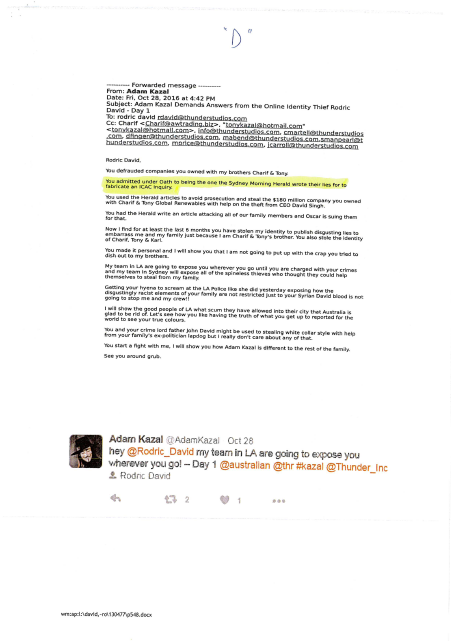
4 Over the last year until October 2016, Adam had not appeared to play an active part in the litigation. However, in about October 2016 Adam became interested in agitating publicly his opinions and assertions about Mr David. On 28 October 2016 he wrote an email (the 28 October publication) to Mr David, copied to Charif and another of their brothers, Tony Kazal, and numerous persons at Thunder Studios. The email asserted that Mr David had defrauded companies owned by Charif and Tony. It alleged that Mr David had lied to the ICAC inquiry and that he had been responsible for publication of lies about members of the Kazal family to The Sydney Morning Herald, several journalists of which, including Kate McClymont, have had involvements with the Kazal brothers’ sense of grievance. The email complained that Mr David used articles in The Sydney Morning Herald to:
steal the $180 million company you owned with Charif & Tony … with help on the theft from CEO David Singh.
It continued:
You made it personal and I will show you that I am not going to put up with the crap you tried to dish out to my brothers. My team in LA are going to expose you wherever you go until you are charged with your crimes and my team in Sydney will expose all of the spineless thieves who thought they could help themselves to steal from my family. (emphasis added)
The next paragraph contained a vitriolic attack on Mr David and his racial background. The email proceeded:
I will show the good people of LA what scum they have allowed into their city that Australia is glad to be rid of. Let’s see how you like having the truth of what you get up to reported for the world to see your true colours.
The next paragraph made other acerbic assertions about Mr David and his family, and the email then concluded:
You start a fight with me, I will show you how Adam Kazal is different to the rest of the family. See you around grub.
5 Adam posted his 28 October email on his Twitter account, above a profile picture of a masked person that is associated with the well-known hacking group “Anonymous”, and the words:
hey @Rodric_David my team in LA are going to expose you wherever you go! – Day 1 ...
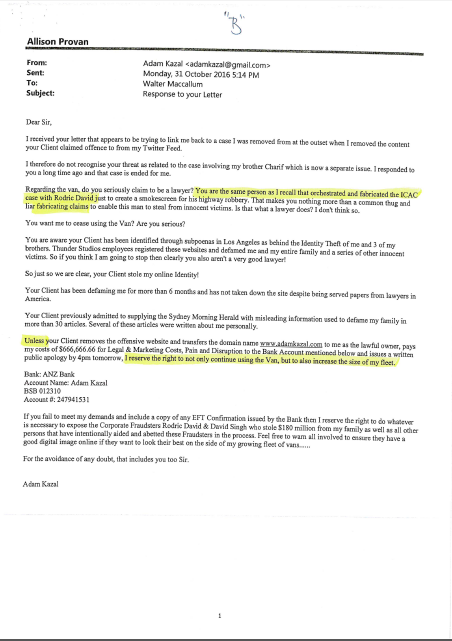
6 On 31 October 2016, Adam sent an email (the 31 October publication) to the solicitor for the applicants, Walter MacCallum. The email was headed “Response to your Letter” and said that Adam had received Mr MacCallum’s letter and that the letter appeared:
to be trying to link me back to a case I was removed from at the outset when I removed the content your Client claimed offence to from my Twitter feed.
7 The email said that Adam did not regard Mr MacCallum’s threat in his letter as being related to the case involving his brother, Charif, being, I infer, these proceedings, which he said was a separate issue and was a case that, for him, had ended a long time before. The email then proceeded to say among other things:
Regarding the van, do you seriously claim to be a lawyer? You are the same person as I recall that orchestrated and fabricated the ICAC case with Rodric David just to create a smokescreen for his highway robbery. That makes you nothing more than a common thug and liar fabricating claims to enable this man to steal from innocent victims. Is that what a lawyer does? I don’t think so.
You want me to cease using the Van? Are you serious? (emphasis added)
8 In the email Adam made a series of allegations accusing Mr David of creating or being involved in the creation of false webpages that purported to be associated with members of the Kazal family, including Adam, but were, in fact, operated and controlled by Mr David and Thunder Studios and which allegedly defamed Adam and his entire family, as well as others. Adam wrote in the email:
So if you think I am going to stop then clearly you also aren’t a very good lawyer!
9 It continued by referring to Mr David allegedly supplying The Sydney Morning Herald with misleading information that was used to defame, allegedly, the Kazal family in more than 30 articles, including some concerning Adam personally. It then said:
Unless your Client removes the offensive website and transfers the domain name www.adamkazal.com to me as the lawful owner, pays my costs of $666,666.66 for Legal & Marketing Costs, Pain and Disruption to the Bank Account mentioned below and issues a written public apology by 4pm tomorrow, I reserve the right to not only continue using the Van, but to also increase the size of my fleet.
Bank:…
Account Name:…
BSB…
Account #:…
If you fail to meet my demands and include a copy of any EFT Confirmation issued by the Bank the I reserve the right to do whatever is necessary to expose the Corporate Fraudsters Rodric David & David Singh who stole $180 million from my family as well as all other persons that have intentionally aided and abetted the Fraudsters in the process. Feel free to warn all involved to ensure they have a good digital image online if they want to look their best on the side of my growing fleet of vans……
For the avoidance of any doubt, that includes you too Sir. (emphasis added)
10 Adam’s reference to the growing fleet of vans related to vehicles that, as will shortly appear, form a basis for the present nine charges of contempt that the applicants have brought against him. The circumstances in which the charges arise are that the applicants sought and obtained on 4 November 2016 ex parte relief from Perram J that enjoined the further publication of a variety of apparently defamatory matters of and concerning Mr David, including publications displayed on vans that had been seen travelling around Sydney.
11 The application for continuation of the injunctive relief came before me, as the docket judge, and I set that down for an interlocutory hearing on 11 November 2016. On that occasion, Adam was represented by senior and junior counsel and his solicitor, as were the applicants. In the event, the parties agreed to consent orders that were taken out and bore endorsements addressed to Adam that if he refused or neglected to do any act within the time specified in the orders for doing the act or disobeyed the orders by doing an act that the order required him not to do, he would be liable to imprisonment and sequestration of property or other punishment. As is by now evident, that is what the applicants now seek. I have attached orders 1, 2, 3 and 4 as an annexure to these reasons (the 11 November orders).
The 11 November orders and the nine charges of contempt
12 Relevantly, order 1 prohibited Adam from displaying, or causing to be displayed, on a motor vehicle, where the vehicle was visible to the public or any member of the public, any material that made, conveyed, or was capable of conveying, any imputation or imputations to the same or similar effect that Mr David is a corporate thief, stole $180 million, is guilty of fraud, is a conman and or conspired with Mr Singh to steal $180 million. Order 2 restrained Adam from retaining, hiring, engaging or directing any person to carry out any conduct prohibited by order 1.
13 Charge 1 in the statement of charge alleged that Adam had breached orders 1 and 3 by displaying, and causing to be displayed, the words and images visible:
(a) on two vans, on 18 November 2016 at about 2.05pm, in O’Connell Street in the central business district of Sydney; and
(b) on four vans, on 22 November 2016 at about 9.00am, in O’Connell Street, Sydney, when Adam himself was present.
14 Charge 2 alleged that Adam breached order 2 by retaining, hiring, engaging or directing a person or persons to cause one or more of the two and four vans respectively to be present in O’Connell Street on 18 and 22 November 2016.
15 Order 3 restrained Adam, relevantly, from publishing in hard copy or electronic form, including on the internet and Twitter:
(a) a video entitled “Street protests and vans exposing corporate thieves Rodric David and David Singh” displayed on YouTube and the website (www.kazalfamilystory.com) (order 3(d)); and
(b) any imputation, or imputations to similar effect, arising from any material published on or after 26 October 2016 that Mr David, alone or together with his legal representatives, had fabricated a case before ICAC, perverted the course of justice, lied to ICAC, lied or fabricated claims to enable him to steal from innocent people and or is a thief (order 3(e)).
16 Order 4 required Adam, by 4.00pm on 12 November 2016, to remove or cause to be removed from the internet, Twitter and any third party website to which it had been distributed, the material, including the video, referred to in order 3.
17 Charge 3 alleged that Adam had breached orders 1 and 3 by including visibly, that is, on each van, the words identified in charge 1, being words that directed readers to the website on which one or more of 22 posts had been made between 11 and 21 November 2016.
18 Charge 4 alleged that Adam had breached orders 1 and 3 by publishing and displaying on his Twitter account copies of emails that he had addressed to Ms McClymont on 15, 16, 17, 18, 19, 20 and 21 November 2016 (the seven tweets). The seven tweets each referred to the vans and included a reference to the website, displayed as if it were hyperlinked, in paragraphs that asserted that the website “has all the facts” or had all the detail, or more detail, on how Mr Singh had committed the alleged $180 million fraud and the various other misdeeds that, before the 11 November orders, Adam had also asserted against Mr David, as is evidenced in the emails being 28 and 31 October publications.
19 Charge 5 refined the allegation in charge 4 by alleging that each of the seven tweets included a direction to its readers to visit the website.
20 Charge 6 alleged that Adam had breached order 3(d) because the video continued to be published on and after 11 November 2016 and remained accessible to persons who, as one of the applicant’s solicitors, Ms Sambrook, had done, searched for the term “van” on the website.
21 Charge 7 alleged that Adam had breached order 4 by failing to remove:
(a) the video from the website;
(b) the seven tweets from Twitter; and
(c) the 22 posts made on the website between 11 and 21 November 2016.
22 Charges 8 and 9 alleged that Adam had committed contempts that did not involve any alleged breach of 11 November 2016 orders. Those two charges respectively alleged that, as to charge 8, between 31 October 2016 and 11 November 2016, and as to charge 9, after 11 November 2016, Adam had made public statements that were both intended and calculated to influence a party, namely, Mr David, in the conduct of pending proceedings, namely, the substantive proceedings in this matter, and also exposed him to the risk of public prejudgment of the issues or merits of those proceedings, being:
(a) in respect of both charges, the publications consisting of :
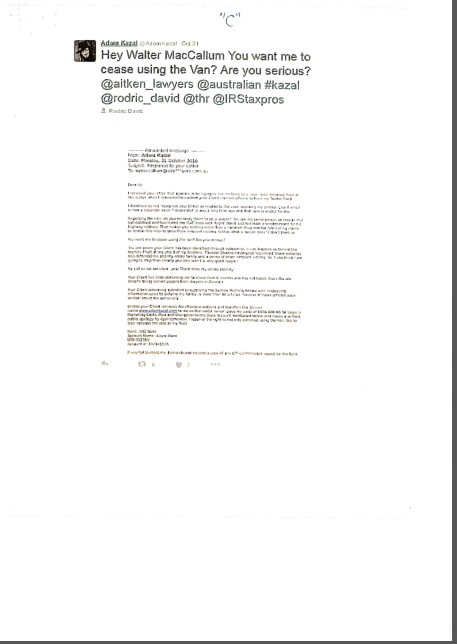
(i) Adam’s tweet entitled, “Hey Water MacCallum You want me to cease using the Van? Are you serious?” being a reproduction of the 31 October publication, the subject of order 3(b);
(ii) Adam’s Twitter feed reproduction of the 28 October publication entitled, “Adam Kazal Demands Answers from the Online Identity Thief Rodric David – Day 1”, being the subject of order 3(c); and
(iii) the video being the subject of order 3(d); and
(b) in respect of charge 9, additionally:
(i) the 22 posts;
(ii) the seven tweets; and
(iii) the publications on the vans on 18 and 22 November 2016.
Formal matters
23 A charge of contempt of court must be proved by the evidence that the prosecutor, here, the applicants, adduces beyond reasonable doubt: Witham v Holloway (1995) 183 CLR 525 at 534 per Brennan, Deane, Toohey and Gaudron JJ. I make the following findings in relation to service of the orders of 11 November 2016, the statement of charge, interlocutory application and associated documents about which there was no dispute.
24 I am satisfied beyond reasonable doubt that:
Adam was aware of the 11 November 2016 orders, at the time they were pronounced in open Court by consent, and also when his solicitor subsequently informed him by telephone at 1.50pm on 11 November 2016 of the orders in accordance with order 6 made that day;
Adam was served on 15 November 2016 with a copy of those orders that bore the endorsement warning him, as I have noted above, of his liability to punishment for disobeying the order;
Kiki Kyriacou, Adam’s solicitor, told his client of the orders at about 1.50pm on 11 November 2016 and that Adam indicated that he understood them;
Mr Kyriacou emailed the solicitors for Adam’s brother Charif at about 5.23pm on 11 November 2016, requesting that they ask Charif to remove the video referred to in order 3(d) from the website;
Adam was served personally on 28 November 2016, in his solicitor’s office, with the interlocutory application, statement of charge and affidavit of Walter MacCallum sworn on 25 November 2016.
25 I ordered that Adam attend the hearing in person, and he complied with that order on both 9 December 2016 and today.
26 As was his right, Adam did not give evidence, but there was no formal or other suggestion, in submissions by Adam’s counsel or on the evidence, that he had not been aware of the 11 November 2016 orders at the time they were made and at all times thereafter.
The evidence relating to the charges
27 The admissible evidence in support of the charges narrowed considerably after many of Adam’s objections to the hearsay material sought to be led against him caused me to reject that material. The contents of the video referred to in order 3(d) are not themselves in evidence, although there are four screenshots in evidence, taken at various points, in what appears to be a video that lasted for around 2 minutes and 22 seconds.
The seven tweets
28 I am satisfied beyond reasonable doubt by Mr MacCallum’s affidavit that Adam published the seven tweets between 15 and 21 November 2016. These consisted of reproductions of emails that Adam had sent to Ms McClymont at The Sydney Morning Herald.
29 None of the seven tweets, 22 posts or other publications complained of made after 11 November 2016, that Adam authored, as will appear, referred directly to Mr David by name. They concentrated on making allegations, first, against Mr Singh and, secondly, directing readers to the website where, in substance, as will appear, they were invited to read all about how Mr Singh engaged in the allegedly heinous conduct that Adam asserted had occurred. In his email of 15 November 2016 that is reproduced on Twitter, Adam told Ms McClymont that he had been breaking news for her upcoming article on:
the Corporate Thief David Singh who stole $180 million from my brothers Charif & Tony …
He wrote that he had been exercising his legal right to free speech:
… by having a van promoting his theft of $180 million drive around the Eastern Suburbs.
30 The email also stated that Ms McClymont might:
have heard about [this] as many people have contacted me to voice their support so I expect a good many have contacted the media.
31 The email then referred to a number of matters to do with Mr Singh and allegations relating to him, his wife and Adam’s brothers. Towards its conclusion, the email said:
My brother Charif’s website, www.kazalfamilystory.com [which was hyperlinked in the email and was displayed as a hyperlink in the tweet] has all the facts on how Singh defrauded him and participated in a Court case as a witness where he acted as part of a conspiracy to defraud Charif & Tony and lied under Oath about the company and what had occurred prior to the Court action beginning. Charif’s website outlines the history of lies you, Linton Besser and Richard Baker have all written about me and my family in more than 30 malicious articles.
32 The next day, Adam emailed Ms McClymont and posted a tweet that stated that his vans would continue “to expose” Mr Singh and again included a link to his brother Charif’s website that appeared as a hyperlink in the tweet for the ease of a reader to access it. The subsequent five tweets rehearsed the same themes, each of them having a paragraph that specifically stated that Charif’s website, which was always displayed as if it were hyperlinked, “explains all of the detail” or “goes into greater detail” about how Mr Singh was part of a conspiracy to defraud Tony and Charif out of $180 million “as outlined on my vans”, as, for example, he wrote on 19 November 2016.
The vans
33 I accept beyond reasonable doubt all Mr MacCallum’s evidence (that I admitted). Relevantly, he photographed the vans on 18 and 22 November 2016 when he was present in O’Connell Street, Sydney. On 18 November 2016, he saw two vans there. One of the vans displayed “$180 Million Theft” in large red script on the driver’s and passenger’s doors and underneath in black, smaller script, but still noticeable, “All involved to be exposed”. One photograph that Mr MacCallum took on this occasion is below.
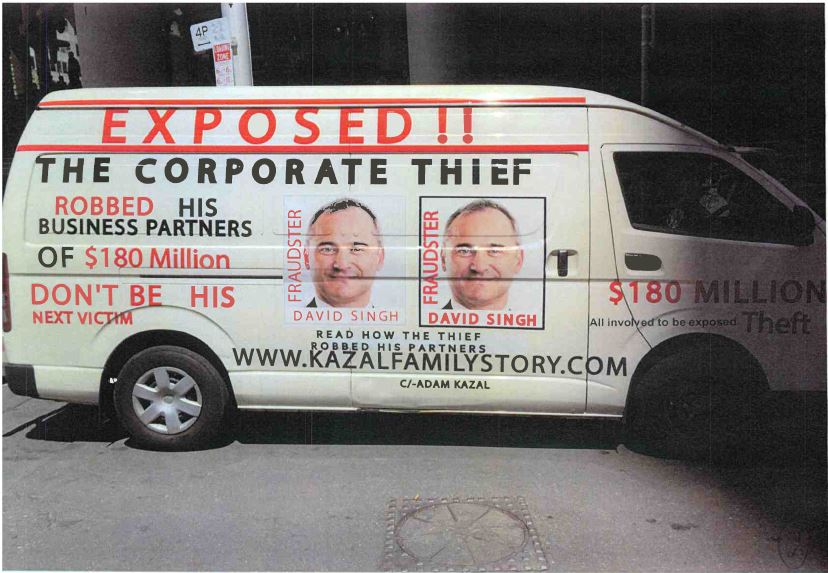
34 On both sides of the van, underneath Mr Singh’s photographs, appeared the statement, “Read how the thief robbed his partners”, and, in much larger print, the website’s address, underneath which appeared “c/- Adam Kazal”. The second van was in much the same get-up except that, under the passenger’s door statement of “$180 Million Theft”, no reference appeared to “All involved to be exposed”.
35 Mr MacCallum again saw four vans in O’Connell Street on 22 November 2016. Two of them appeared to be identical to the ones he had seen earlier on 18 November 2016. He took the photographs below of another one.
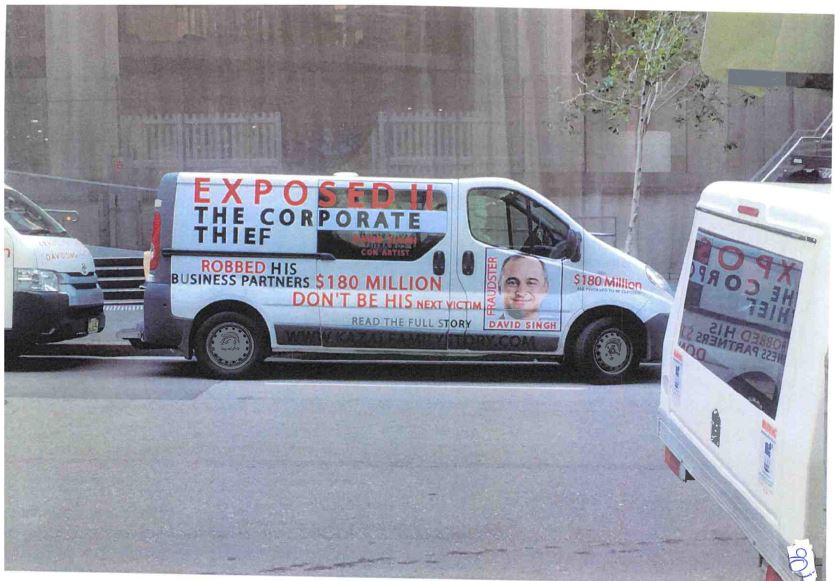
36 This photograph appears to have obscured the large print in which the website’s address appeared along the bottom, between the front and rear mudguards of the two sets of tyres, under the heading “read the full story”.
37 One of the vans also had a back section that appeared in another photograph taken by Mr MacCallum as follows.
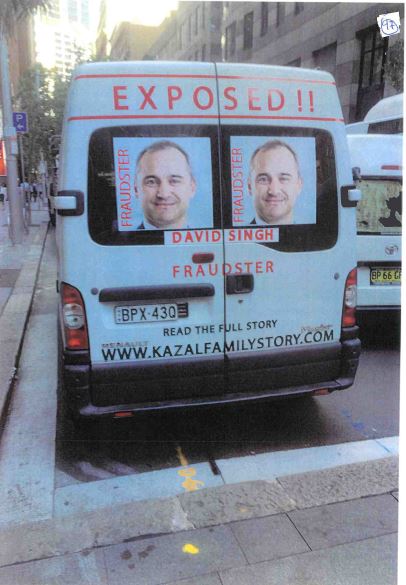
38 This photograph, again, showed the van displaying the website’s address under the statement “read the full story”. Mr MacCallum also photographed Adam walking around in the vicinity and in front of the vans on 22 November 2016.
The 22 posts
39 Mr MacCallum also gave unchallenged evidence that, after the orders had been made on 11 November 2016, between 11 and 21 November 2016 each of the 22 posts had been made on, or added to, the website. The first of those was made on 11 November 2016 on a page headed “Kazal family story. By Charif Kazal”. Under that heading the words “Know the Truth!” appeared. Underneath that there appeared to be a set of links to various parts of the website, including home, press, Rodric David, Linton Besser, Richard Baker, David Singh and archives. There was also a search box. On the right-hand side of the webpage appeared what I infer to be a picture of Charif (as its caption stated) giving his curriculum vitae at some length. Juxtaposed with that, on about two-thirds of the remaining part of the webpage, was a picture of Mr Singh with the words “The Corporate Thief #2” emblazoned across it, under which was a headline “Charif Kazal reminds David Singh he can’t hide behind Rodric David forever? – day 47”. On that webpage, Charif addressed what appeared to be a letter to Mr Singh asserting that he could not hide behind Mr David forever and that his website:
is tracking all of the despicable acts Corporate Thief #1 (C1) Rodric David and Corporate Thief # 2 (C2) David Singh committed against my brother Tony & I ...
40 The webpage then asserted that both Mr Singh and, critically for present purposes, Mr David “lied, cheated and stole from us”. It asserted that “I have the truth behind me and will not stop until I get justice before the Courts against C1 and C2”.
41 Much of the other 21 posts were in the same vein. At 4.32pm on 11 November 2016, Charif posted a further publication with a picture of Mr David against a Thunder Studios logo emblazoned with the stamp “The Corporate Thief – Rodric David”, under which was a headline as follows:
Charif Kazal tells Rodric David only a liar, a cheat and a fraud would behave so desperately – day 109.
The text of the post included another statement that the website:
is recording all of your lives, corruption and contradictions for the world to see and judge for themselves. The truth will never go away!
42 Another post on 12 November 2016, being, an article by Tony Kazal, was to similar effect. The article again referred to the website tracking what it said was the “truth” of what occurred in the dealings between Mr David “and your co-conspirators against Charif & I” and was signed by Tony. It was addressed to Mr David and referred to what the 31 October publication appeared to have concerned, namely that the Kazal family’s Los Angeles based lawyers had identified Thunder Studios as the operator of allegedly malicious websites. This post asserted that those lawyers had uncovered evidence “involving you stealing my identity and that of 3 of my brothers”. It continued in a similar vein about Mr David being a corporate thief who had caused Ms McClymont to write a story in The Sydney Morning Herald that:
focused entirely on my brother Adam’s reply to you stealing his identity which was to broadcast your crimes against my family in LA and Sydney where he promoted the work by you and Singh to steal from our family. You are a shameless thief who already has litigation running against Charif & Adam that is forever running late when it comes to you meeting your Court nominated deadlines. (emphasis added)
43 On 15 November 2016, Charif posted another article headed:
Charif Kazal tells Rodric David you are a serial fraudster & thief who thought he got away with his crimes! – day 111. (emphasis added)
44 On 16 November 2016, a post appeared under Tony’s by-line, addressed to Mr David, accusing him of having been “backed” by ICAC and stating that it was necessary for a Royal Commission with powers to “get to the bottom of how you duped ICAC”. The earlier reference to the website’s utility in exposing the “truth” was repeated.
45 On 17 November 2016, Charif posted an article that asserted that Mr David had lodged a vexatious complaint with ICAC that had led to an ICAC inquiry. This post asserted that Mr David had “admitted to being the person who had provided misleading information to the Sydney Morning Herald” and also initiated a false complaint to ICAC that was “all a complete sham”.
46 It concluded with the statement that the website was recording all of Mr David’s alleged misdeeds for the world to judge and that:
My family will continue to pursue you and your co-conspirators for your crimes including breaching the Australian Corporations Act and a series of fraudulent actions to line your pockets with the multiple businesses we held with you.
47 On 21 November 2016, Tony Kazal posted a story addressed to Mr Baker, which made a number of disparaging comments about him. It included a photograph of Mr David above the caption, “Rodric David The Corporate Thief”, and asserted that the website was:
… tracking what Rodric David and Fairfax Media have done colluding to intentionally discredit and defame Charif & I for taking Corporate Thief Rodric David to Court.
Despite the crimes of Rodric David and David Singh against my family, you and your employer write only to protect these Corporate Thieves who conspired to defraud us and attack Charif & I their innocent victims.
48 Charif made the last of the 22 posts on 21 November 2016. The post asserted to Mr Singh that his action was not that of an innocent man. It said:
My brother Adam has been running Vans all over town with your face on it exposing you for stealing Global Renewables and defrauding Tony & I.
49 Underneath that a picture of Mr David appeared emblazoned with the statement: “The Corporate Thief”. The picture’s caption read: “Rodric David The Corporate Thief”. The post referred to Mr Singh having gone “along with the crimes of Rodric David”. It said:
Yet you chose to partner in crime with Rodric David over partner [sic] in legitimate business success with Tony & I.
50 The post then referred again to the role of the website to track “all of the despicable acts” of Mr David and Mr Singh, described both of them as “corporate thieves”, and stated that: “Rodric David lied, cheated and stole it [the company] from us”.
The video
51 Mr MacCallum said that when he attempted to access the video in various ways on the internet, he found that the content had been blocked. However, on 8 December 2016, Ms Sambrook carried out a search on the website when she typed the word “van” into the search box. That brought up a result:
Street protests and vans exposing the corporate thieves Rodric David and David Singh.
52 Ms Sambrook followed that result to other links on the website and was able to play the entire video. She captured four screenshots that appeared to record the date of the original posting of the video as being 5 November 2016. Each of the screenshots depicted posters or signs with separate pictures of Mr Singh and Mr David captioned correctly with each of their names in large red lettering. One screenshot had those pictures displayed on the sign above the words: “Don’t be their next victim”.
53 A caption (common to all four screenshots) at the top of the video screenshot forming part of the video, stated:
Street protests and vans exposing the corporate thieves Rodric David and David Singh.
Another screenshot appeared to show about nine people holding up signs. The screenshot captured the contents of signs that were not particularly legible in it, except that the signs displayed some photographs with captions “Rodric David” or “David Singh”, and other photographs of Mr David and Mr Singh under the heading “The Corporate Thieves”, next to which was a sign in large letters stating: “ROBBED their business partners of $180 million”.
54 As is apparent, the material displayed on the vans and in the seven tweets was crafted to avoid any direct reference to Mr David. That material referred to Mr Singh and gave the website’s address, with an invitation, expressed in various ways, but that effectively sought to persuade the reader to go to the website “to find out all about” the alleged thief, Mr Singh, and stated that, by doing so, either the full story or all who allegedly were “involved” would be exposed.
Adam’s submissions on publication
55 A critical submission in Adam’s defence of the charges was that his inclusion of the website’s URL address in the material displayed on the vans and, with its appearance as a hyperlink, in the seven tweets did not amount to a publication of any kind of any matter that might be found on the website itself. He contended that, first, the 11 November orders did not prohibit him from referring to or directing readers to the website, and, secondly, the applicants had not proved publication to anyone. That was because, he argued, the only persons who gave evidence of reading or having viewed anything on the website were the applicants’ solicitors, whom, he argued, were their agents and, so, were incapable of being treated as third persons to whom any actionable publication had been made. He contended that it was essential, if liability for contempt were to be established against him, that there be proof of publication to a third party of each of the 22 posts on the website that contained material conveying one or some or all of the imputations proscribed by orders 1 and 3. He argued that Giles JA, with whom Heydon JA and Ipp AJA agreed, in State Bank of New South Wales v Currabubula Holdings Pty Ltd (2001) 51 NSWLR 399 at 408-417 [105]-[141], supported the proposition that a publication to someone acting purely as agent of a party, at least in the context of a publication about a corporation for which the individuals worked, was not sufficient to establish a publication of defamatory matter for the purposes of the law of defamation. He also relied on what McCallum J had said in Kermode v Fairfax Media Publications Pty Ltd [2009] NSWSC 1263 at [24], where her Honour had found that it was open to the plaintiff in that case to plead each separate webpage as a separate matter complained of because he would have a cause of action:
If a single person downloaded only that page (assuming it is defamatory), even if it contained the clearest invitation and internal reference to other material available on the same web site.
Publication – principles
56 Any person who authorises, or is an accessory in any way to, a publication is, as a matter of law, a publisher, as Isaacs J explained in Webb v Bloch (1928) 41 CLR 331 at 363-366. A person is also liable in defamation, as a publisher, if he or she gives information to another where, either, the giver intends the second person will republish the information or such a republication is a natural and probable consequence of the provision of the information: John Fairfax & Sons Limited v Cojuangco (1988) 165 CLR 346 at 350, per Mason CJ, Wilson, Deane, Toohey and Gaudron JJ. Every republication of a defamatory libel is a new libel and gives the person defamed a new cause of action against the publisher, whether he, she or it is the same person as the original publisher.
57 As Lord Bingham of Cornhill, giving the judgment of the Privy Council (consisting of himself, Lord Scott of Foscote, Lord Walker of Gestingthorpe, Baroness Hale of Richmond and Dame Sian Elias) said in Buchanan v Jennings [2005] 1 AC 115 at 127 [12]:
A defendant may be liable for republishing by reference to a statement originally published on another occasion by himself or another.
58 Their Lordships held that, when he subsequently gave an interview outside the House of Representatives in which he confirmed and adopted as true what he had said in the House, a member of the New Zealand Parliament had republished the serious attack on the plaintiff’s integrity that he had made earlier under absolute privilege during a speech in the House (see the facts set out in [2005] 1 AC at 121 [2]-[3]). Their Lordships held that a claim for defamation arises where a person confirms or adopts an earlier publication by that person or another, because that conduct amounts to a republication “for which the parliamentary record will supply only the text” ([2005] 1 AC at 132 [18]).
59 Accordingly, the republication made outside the House did not attract the defence of absolute privilege (that attached to the original speech given in Parliament). Such a republication had to be defended on the basis of an ordinary publication with whatever defences were available to the member of Parliament, even though he did not repeat verbatim anything that he had said earlier in the House ([2005] 1 AC at 133 [20]).
60 Every communication of defamatory matter founds a separate cause of action: Dow Jones & Company Inc v Gutnick (2002) 210 CLR 575 at 600 [27]. There, Gleeson CJ, McHugh, Gummow and Hayne JJ reaffirmed that a publication is a bilateral act. They held that in the case of an allegedly defamatory publication on the internet, it is necessary for the plaintiff to prove that a person in the jurisdiction downloaded the matter complained of in a comprehensible form (210 CLR at 606-607 [44]).
61 In Duke of Brunswick v Harmer (1849) 14 QB (NS) 185 at 188-189 [117 ER 75], Coleridge J (delivering the judgment of himself, Wightman and Erle JJ), held that when the Duke, in 1847, sent a person to buy a copy of a newspaper containing a defamation originally published in 1830, a fresh publication occurred on the new sale. The Court of Queen’s Bench held that, although, in one sense, the 1847 sale and delivery was made to the Duke himself because his agent was the purchaser, yet, “it was also a publication to the agent”. The act of publication to a third person, even if he were the agent, was as capable of lowering the plaintiff’s reputation in the eyes of the agent as in the eyes of a stranger. Indeed, in Gutnick 210 CLR at 600 [27], Gleeson CJ, McHugh, Gummow and Hayne JJ expressly approved of Harmer 14 QB (NS) 185 as affirming the rule that a single act of publication to one person is a new cause of action.
62 However, the publication, to be actionable, must be made to a third person. It is not sufficient if the plaintiff is the only person to whom the evidence establishes a publication was made. A cause of action in defamation comes into existence if a publication or communication of defamatory matter is made to any person, other than the person defamed: R v Grassby (1988) 15 NSWLR 109 at 114E, per Lee CJ at CL, Yeldham and Hunt JJ applying Traztand Pty Limited v Government Insurance Office of New South Wales [1984] 2 NSWLR 598 at 599, per Hunt J. It is unnecessary to consider in these reasons the issues that arise in relation to whether there is any qualified privilege when a person gives an employee, such as a typist, the task of preparing a defamatory publication. That is not this case.
63 In Currabubula 51 NSWLR at 415 [129], Giles JA expressed a preference (without referring to Grassby 15 NSWLR 109 and its express approval of Traztand [1984] 2 NSWLR at 599) for the view that a publication of defamatory matter to an employee of a company, when acting on behalf of the company, was not a communication to a third person. I do not need to decide the correctness of Giles JA’s observations. That is because the publication to each of Mr MacCallum, Ms Sambrook and, as is evidenced from some of the posts, Tony Kazal, who knew of what was contained on the side of the vans, was, at least, so far as Mr David was concerned, a publication to a third person: Gutnick 210 CLR at 600 [26]-[27], Harmer 14 QB at 188-189, and Grassby 15 NSWLR at 114E. In addition, as Adam himself stated in his email to Ms McClymont of 15 November 2016, in relation to what appeared then to be just one van that was being driven around Sydney’s eastern suburbs promoting the alleged theft by Mr Singh of $180 million, “many people have contacted me to voice their support” (see [29]-[31] above).
64 I am not persuaded by what McCallum J said in Kermode [2009] NSWSC 1263 at [24], that a reference to a webpage was not a republication of it. That is because her Honour said that she had expressed her view “with some hesitation” and without hearing argument as to its correctness, and that, in any event, she was satisfied that, in the circumstances of the case before her, it was open for the plaintiff to plead as he had without incorporation of any other material that was allegedly referred to in the matter complained of. To the extent that her Honour’s view may conflict with that that I have expressed above, it appears also to conflict with the considered view of an experienced Privy Council in Buchanan [2005] 1 AC 115 (to which she was not referred), which I consider to be a correct statement of the law.
65 Publication of the website’s address on the vans and in the seven tweets, that each contained the apparent form of a hyperlink to the website, was an act of republication of all of the contents of the website. If a reader went to the website and downloaded, and read, as Mr MacCallum did, any of the 22 posts, the material that each post contained relating to Mr David entailed that that downloading and reading was a publication of that material by Adam. That is because he caused its republication through his invitation to visit the website: Cojuangco 165 CLR at 350. Adam was aware that the website had material in the progressively appearing 22 posts relating to Mr David that conveyed, and was capable of conveying, each of the proscribed imputations referred to in orders 1(b) and 3(e)A, E, G, H and I.
66 I am satisfied beyond reasonable doubt that Adam’s reference to the website address in the publications on the vans and the seven tweets, and his use of the hyperlink reference in the seven tweets, was a republication of the contents of each of the 22 posts and that all 22 posts were published to Mr MacCallum.
The applicants’ submissions as to charges 1 and 2
67 The applicants alleged that Adam had committed contempt of orders 1 and 3 by “displaying or causing to be displayed words and images on the vans”. They asserted that those words and images fell within the literal words of order 1(b) because they were “capable of making or conveying” any, and indeed, all, of the imputations about Mr David that order 1(b) proscribed. They submitted that the material displayed on the vans was capable of being understood as adopting the contents of the website, which in turn conveyed all of the imputations. The applicants contended that the terms of order 1 prohibited display of material that had the capacity to convey any of the proscribed imputations and that the display on the vans of the invitation to visit the website, coupled with the statements, “All involved to be exposed” or “Read the full story”, had that capacity. They submitted that by consenting to order 1, that operated to prohibit him displaying anything that had the capacity to convey the proscribed content, Adam should be held liable for doing so, as they alleged he had. They argued the material displayed on the vans incorporated the proscribed content by reference. They contended that the omission of the words “or published” from charge 1 was of no consequence because the display of the reference to the website sufficed as a publication. They argued that the display on the vans breached order 3 per se. They argued that it was illusory to distinguish between the meaning and operation of the words “display” and “publish” and their analogues in order 1.
Charges 1 and 2 - consideration
68 In my opinion, charge 1 must fail. The charge is framed exclusively by reference to the words “displaying, or … causing to be displayed” in order 1 and is limited to the words and images that appear on the vans themselves. Those words and images do not convey, and in themselves are not capable of conveying, any of the proscribed imputations. The wording of order 1 prevented Adam both from displaying matter and publishing matter. The natural and ordinary meaning of “display” is to exhibit, manifest or present. The words and images on the vans did not expressly or by necessary implication relate to Mr David. The act of publication is different to, but can overlap with, the act of display. But, any meaning or imputation complained of about or concerning Mr David that the applicants relied on could only be conveyed if a person visited the website and downloaded or read the material on it relating to him. This would require a publication to the reader of the, or the relevant parts of the, website, independent of what words and images the vans displayed.
69 Here, charge 1 complained of an act of display of words and images that, in themselves, could not convey any proscribed imputation of or concerning Mr David. I am not satisfied beyond reasonable doubt that the applicants have proved that Adam contravened order 1 or, necessarily, it follows, order 2, on either 18 or 22 November 2016 when he displayed and caused to be displayed on O’Connell Street the words and images on the vans. Charge 1 must be dismissed, as must charge 2, which is dependent on proof of the conduct alleged in charge 1 that I found to be deficient.
Adam’s submissions on charge 3
70 Adam argued that in order to prove a publication in breach of orders 1 and 3, the applicants had to establish that someone other than they or their lawyers had downloaded one or more of the 22 posts on the internet in the manner that I have explained in discussing what constitutes a republication. He submitted that the absence of any evidence of a third party, other than the applicants’ lawyers, such as a member of the public, downloading any of the 22 posts, meant that charge 3 could not be proved. He contended that merely including a hyperlink or providing a reference to the website did not amount to a publication of any of its contents. He argued that directing or suggesting that a person look at a website was not an act of publication of the contents of that website or, indeed, the particular contents of the webpages that contained the 22 posts, which may or may not have been but a small part of a much larger website containing a variety of other material. He said that there was no evidence as to how big or otherwise the website was, how it was structured or its contents had been accessed or in what way one would access any of the 22 posts, so that he should not be found liable as a publisher of any of them. He also argued that, because I have dismissed charge 1, it must follow that each of charges 3, 4 and 5, which refer cognately to a breach of orders 1 and 3, will also fail.
Charge 3 – consideration
71 Adam’s last submission overlooked the fact that order 1 prohibited not merely, as charge 1 had alleged, the display of the proscribed material, but also its publication. Charge 3 referred to the fact that, by directing readers to the website on which each of the 22 posts was posted, Adam republished each post at various times, having regard to the dates on which each appeared, in breach of the proscription of him publishing any of the defamatory imputations in both orders 1 and 3.
72 As appears from my recitation of the contents of the website, I am satisfied beyond reasonable doubt that:
Adam breached orders 1 and 3 by including, in visible words on the vans, directions to the website on which one or more of the 22 posts appeared from time to time over that period between 11 and 21 November 2016; and
that act of republication conveyed, or was capable of conveying, each of the imputations that Mr David was a corporate thief, stole $180 million, was a guilty of fraud, was a conman, and had conspired with Mr Singh to steal $180 million, or imputations to like effect, in contravention of order 1. As I have mentioned, many of the posts, in terms, call Mr David the, or a, corporate thief. They refer internally to other portions of the website, in which, among other places, the video can be found that also contains the statements, at least in the screenshots to which I have referred, of $180 million being stolen.
73 Moreover, the website described Mr David as “a serial fraudster and thief”, as appeared in the headline of a post by Charif on 15 November 2016, a link to which had been added at the end of a post by Tony of 12 November 2016. The website contained, in one or more of the 22 posts, matter that accused Mr David of:
publishing lies to ICAC (see the post on 20 November 2016);
lodging a vexatious complaint with ICAC;
being guilty of “lies, corruption and contradictions for all the world to judge ” and of being guilty of “a series of fraudulent actions to line your pockets” (see the post on 17 November 2016); and
a panoply of other misdeeds.
74 Those 22 posts suffice to establish that Adam caused imputations to be republished after 26 October 2016 that Mr David had fabricated a case before ICAC, had lied to ICAC, had lied to enable him to steal from innocent people, had fabricated claims to enable him to steal from innocent people and was a thief, or imputations to that effect, in contravention of order 3(e)A, E, G, H and I.
75 I am satisfied beyond reasonable doubt that, for the reasons I have explained, the use of the apparent hyperlink to the website in the seven tweets and the appearance of the website’s address in that hyperlink, together with the publication on the vans on 18 and 22 November 2016, amounted to republications of the contents of the website, including those that accused Mr David of the serial misdeeds that they alleged, to which I have referred.
76 For these reasons, I am satisfied beyond reasonable doubt that Adam is guilty on count 3.
Charge 4 – the applicants’ arguments
77 The applicants argued that charge 4 had been proved because of the publication or display of the seven tweets on the Twitter account in Adam’s name.
Charge 4 – consideration
78 In my opinion, the mere publication and display of the seven tweets, as I have found in relation to charge 1, do not amount to a republication of the website. The allegation in charge 4 was that merely publishing and displaying the seven tweets constituted a breach of orders 1 and 3, as opposed to the act of republishing, by that activity, what was on the website. Indeed, that activity is captured by the distinct allegation in charge 5.
79 For these reasons, I am not satisfied beyond reasonable doubt that Adam is guilty of breaching any part of orders 1 and 3 merely by his posting any of the seven tweets. Charge 4 must be dismissed.
Charge 5 – Adam’s arguments
80 Adam repeated his argument, that I rejected in relation to count 3, as to the construction of the reference in charge 5 to orders 1 and 3 as a cognate requirement. He also repeated his argument as to republication that I have also rejected. He argued that all he was doing in the seven tweets was saying that if one went to the website, one would see what Mr Singh allegedly had done, and that was as far as his publication went.
Charge 5 – consideration
81 For the reasons I have given already, I am satisfied beyond reasonable doubt that Adam republished the contents of the website, from time to time as they appeared, being relevantly, the 22 posts, and that each such publication breached orders 1 and 3 in the way that I have found in respect of charge 3. For these reasons, I am satisfied that Adam is guilty on charge 5.
Charges 6 and 7 – Adam’s submissions
82 Adam argued that he had used his best endeavours to remove the video by having his solicitor, Mr Kyriacou, write on 11 November 2016 to his brother Charif’s solicitor, Mr Mitry, who himself had been present in Court when the 11 November orders were made. He contended, in relation to order 3(d), that he had not published the video in breach of that order. He submitted that order 3(d) should be construed in the same way as he suggested the words “remove or cause to be removed” in order 4 should be construed. He argued that the words “remove or cause to be removed” in order 4 should be read as requiring him to use his best endeavours either not to allow a publication proscribed by order 3(d) or to cause the video to be removed from the internet, Twitter and any third party website to which it had been distributed. But, he submitted, he had no absolute liability to prevent the publication of the video on the website by people viewing it or to cause it to be removed where he tried and failed to do so, and when that failure was beyond his control.
83 He argued that the applicants carried the onus of proof that it was possible for him to comply with orders 3(d) and 4 and that they had led no evidence, beyond his consent to those orders, that he had power to do more than he had done in having his solicitor write the 11 November 2016 email to Charif’s solicitor. He contended that if it were not possible, because of, for example, Charif’s control of the website, for him, Adam, to remove the video or to cause cessation of its publication on the website, order 4 envisaged that what he did through his solicitor would satisfy his obligation to cause its removal. He repeated his arguments as to the incapability of a reference to the website to be a republication of its contents.
Consideration – charges 6 and 7
84 Order 3(d) restrained Adam, in terms, from publishing in hard copy or electronic form, including on the internet, the video “displayed on YouTube and the website”. The evidence satisfies me beyond reasonable doubt that the video continued to be published on the website as at 8 December 2016, when Ms Sambrook viewed it there. Adam admitted that he was the publisher of the video when he consented to order 3(d). That consent and the order acknowledged, in terms, that Adam had control of publication of the video on the two sites, YouTube and the website, on which it was then currently, as at 11 November 2016, being displayed and, so, that he was the publisher of it.
85 The only evidence of an attempt by Adam to comply with orders 3(d) and 4 is the one email written by his solicitor on the day the orders were made. There is no evidence that Adam did anything to check whether Charif or anyone else had complied with the request made in his solicitor’s email or whether that request had been acted on, or that there was some difficulty that would have caused an evidentiary onus to fall on the applicants to demonstrate that Adam could have complied with orders 3(d) and 4. Moreover, Mr Kyriacou only made his affidavit on 8 December 2016, in which he revealed for the first time that he had written on 11 November 2016 to Charif’s solicitor requesting that the video be removed.
86 I am satisfied beyond reasonable doubt that Adam published the video on the website when Ms Sambrook was able to access it on 8 December 2016 and that that was a breach of order 3(d), and further, that its publication and availability to be downloaded on the website remained unchanged since the orders were made on 11 November 2016. I am also satisfied beyond reasonable doubt that Adam, who was represented by senior and junior counsel and solicitors on 11 November 2016, agreed to orders 3(d) and 4 because the acts that they required him to perform, namely, to bring about the result that the video would cease to be published on the website and would be removed from it, could and would be brought about by his own acts or his causing others to act to do so. I am satisfied beyond reasonable doubt that Adam had the capacity to cause that to happen: cf Davies v Beyond Building Systems Pty Ltd [2009] NSWSC 1282 at [30] per Brereton J; Blacktown City Council v Wilkie (No 15) (2016) 219 LGERA 1 at 57-58 [217]-[220] per Pepper J.
87 In Wilkie 219 LGERA at 57-62 [217]-[231], Pepper J discussed the evidentiary position where the alleged contemnor fails to comply with a mandatory order to do an act and an issue arises as to whether the alleged contemnor had the capacity to comply with it. Her Honour followed (at 57 [217]-[218], 62 [231]) what Brereton J had held in Davies [2009] NSWSC 1282 at [30], namely that such a mandatory order, as order 4 in the present case, “at least imposes on the party bound by it an obligation to use their best endeavours to comply with it”. The party alleging contempt continues to have the ultimate onus of showing that the alleged contemnor could comply with such a mandatory order, but as Brereton J said (at [30]):
… in cases of [alleged] impossibility [of compliance], there will ordinarily be some evidentiary onus on the respondent, at least to raise the issue and adduce some evidence on it.
88 Between the making of orders 3(d) and 4 on 11 November 2016 and 22 November 2016, Adam made concerted efforts to have any reader of what was on the vans, and any of the seven tweets, go to the website. There is no evidence of any response by Charif or his solicitor, Mr Mitry, to Mr Kyriacou’s email of 11 November 2016 to Charif’s solicitor. Nor is there any evidence of anything else that Adam did, including checking whether the video had been removed to comply with orders 3(d) and 4.
89 In my opinion, there is no suggestion in the evidence that Adam did anything in relation to the publication of the video on the website, except to rely on his solicitor’s email. That email was not sufficient in itself to amount to Adam using his best endeavours to comply with the orders or to cast any evidentiary onus, if there be one, back onto the applicants to demonstrate, to the extent that Adam’s consent to orders 3(d) and 4 did not establish it, that removal of the material was within Adam’s capacity. The way in which the consent orders were expressed and in the circumstances in which they were made, satisfy me beyond reasonable doubt that the power to cause the removal of the video from the website was within Adam’s capacity. I am satisfied beyond reasonable doubt that Adam is guilty in respect of charge 6 and also guilty on charge 7 in respect of breaching order 4, because he failed to remove the video from the website.
90 However, that is not the end of the applicants’ allegations of breaches of order 4. The particulars on which the applicants relied asserted that Adam had failed to remove the seven tweets and the 22 posts.
91 I am not satisfied beyond reasonable doubt that Adam breached order 4 in respect of the seven tweets. That order required him to remove ‘by 4 pm on 12 November 2016’ material that he had published, to which order 3 referred. Each of the seven tweets was posted after that time. In my opinion, order 4 did not operate in respect of those seven tweets, and Adam is not guilty of any breach of order 4 in that regard.
92 Only four posts appear to have been put onto the website on either 11 or 12 November 2016 before the deadline of 4.00pm on 12 November 2016 for removal of matters to which orders 3 and 4 related. Those posts were posted, apparently, by Tony and Charif. There is no evidence that Adam had any role in the original publication of any of those four posts, other than as a republisher by inviting people to refer to the website.
93 In my opinion, properly construed, order 3(e) restrained Adam from publishing or distributing any imputation arising from material of the nature proscribed in order 3(e) that he himself had published on or after 26 October 2016. His act of republishing the seven tweets by inviting persons to go to the website is one thing, and any material in which he published that invitation, prior to 12 November 2016, would be caught by order 4. However, the independent acts of third parties, such as Adam’s brothers, who posted material onto the website, where there is no evidence that Adam had any causative or operative role in those postings, is not, in my opinion, a breach by Adam of order 4. It would only be a breach of that order if I were satisfied beyond reasonable doubt, which I am not, that he was in some way responsible for those postings.
94 I am not satisfied beyond reasonable doubt that Adam had control of the contents of the website on which any of the 22 posts appeared, other than in respect of his acknowledgement, in consenting to orders 3(d) and 4, that he did have control over the appearance of the video on it. For these reasons, I am not satisfied that Adam contravened order 4 in respect of the publication of any of the 22 posts.
Charges 8 and 9 – general
95 The final way in which the applicants asserted that Adam was guilty of contempt is in charges 8 and 9. There is a species of contempt that involves the bringing of improper pressure on a party to proceedings. The bringing of such improper pressure amounts to a contempt involving the obstruction of the administration of justice, irrespective of whether or not the pressured party, in fact, is deterred from litigating: Y and Z v W (2007) 70 NSWLR 377 at 384 [38] per Ipp JA, with whom Spigelman CJ agreed at 379 [9].
96 A publication that has a tendency to disparage or vilify a litigant because he, she or it is a litigant, or because of litigation or allegations made in it, can constitute a contempt. That tendency must be evident from the publisher’s intention or the nature of the publication being such that, as a matter of practical reality, it is calculated, in the sense of “likely”, to deter the litigant from pursuing the litigation: Harkianakis v Skalkos (1997) 42 NSWLR 22 at 42A-D per Mason P with whom Beazley JA agreed; see too Commercial Bank of Australia Limited v Preston [1981] 2 NSWLR 554 at 564F-G and 565C-F.
97 In John Fairfax & Sons Pty Ltd v McRae (1955) 93 CLR 351 at 370, Dixon CJ, Fullagar, Kitto and Taylor JJ emphasised, as Mason CJ repeated in Hinch v Attorney-General (Vic) (1987) 164 CLR 15 at 27-28, that the summary jurisdiction to punish for contempt by publication should be exercised:
... only if it is made quite clear to the court that the matter published has, as a matter of practical reality, a tendency to interfere with the due course of justice in a particular case.
98 Their Honours were there addressing contempt by a publication, a slightly different species of contempt to that, invoked in the present case, of bringing improper pressure. Nonetheless, both parties referred to what Mason CJ said in Hinch 164 CLR at 28, where he discussed the need to identify and assess whether there was a real risk of serious injustice by reference to the subject matter of the litigation, in the context of what was sought to be done by the alleged contemnor. In Skalkos 42 NSWLR at 27E-30D, Mason P set out nine general principles applicable in cases of contempt by bringing improper pressure on a litigant.
99 Like all species of contempt, it is not necessary in a case such as that alleged in charges 8 and 9 to prove that the alleged contemnor actually had an intention to interfere in the course of justice, although, proof of such an intention can aid in determining the question of the alleged contemnor’s liability (cf Skalkos 42 NSWLR at 28B-C, proposition 4).
Charges 8 and 9 – Adam’s submissions
100 Adam argued, initially, that charge 8 should be regarded as a form of abuse of process, since it had not been evident when he consented to the 11 November orders that, at that time, the applicants were contending that the 28 and 31 October publications amounted to contempt by bringing improper pressure. However, as senior counsel for the applicants pointed out, their written submissions filed on 9 November 2016 in respect of their interlocutory application for injunctions that had been listed for hearing on 11 November 2016, referred to this very species of contempt in a number of paragraphs.
101 Adam argued that each of the 28 and 31 October publications was largely hyperbole that was not realistically to be categorised as an attempt to bring improper pressure. He argued that his admission, by consenting to the injunctions made on 11 November 2016 requiring him to remove each of those two publications, could not be used as evidence against him on charges 8 and 9.
102 Adam argued that each of the 28 and 31 October publications was not a public statement, and indeed, the subsequent publications of references to the website were not themselves public statements of so much of what was in the 22 posts as referred to Mr David. He argued that there was no evidence that either any of the 22 posts or the video was a public statement by him. He argued correctly, in my opinion, that, in the absence of any evidence of the full contents of the video, there was no evidence that publication of the video, viewed in its context as a whole, was capable of constituting the contempt currently alleged in charges 8 and 9.
103 Adam argued that, because the principal proceedings were not likely to be heard by a jury, having regard to the ordinary rule provided in s 39 of the Federal Court of Australia Act 1976 (Cth), the trial of proceedings in the Court, unless the Court otherwise orders under s 40, will be by judge alone. He contended that a judge, including myself, is not likely to be influenced by any of the material appearing on the website or other publications of the kinds complained of, and that, accordingly, none of the material complained of would give rise to any risk of public or judicial prejudgment. However, that argument did not address the substantive thrust of the allegation of contempt in charge 8, which was that it amounts to contempt to bring improper pressure to bear on a party, as opposed to what constitutes a contempt by publication.
104 Adam argued that there was no context to the 28 and 31 October publications at the time they were made and that they appeared to relate to distinct matters, quite apart from the substantiative proceedings. Indeed, he pointed to the opening portions of the 31 October publication that rejected Mr MacCallum’s attempt to link the conduct complained of, including what appeared to have been some earlier driving of vans, to the principal proceedings that had been filed in 2014.
Charges 8 and 9 – consideration
105 In Construction, Forestry, Mining and Energy Union v Boral Resources (Vic) Pty Ltd (2015) 256 CLR 375 at 388 [41], French CJ, Kiefel, Bell, Gageler and Keane JJ said:
In Re Colina; Ex parte Torney [(1999) 200 CLR 386 at 429 [112] – with emphasis in the original], Hayne J described “the cardinal feature of the power to punish for contempt” as being that it “is an exercise of judicial power by the courts, [the words “by the courts” being emphasised] to protect the due administration of justice”. (italic emphasis in original)
106 Adam admitted, for the reasons I have given above, that he had made each of the 28 and 31 October publications and he was able to remove each from his Twitter account. On the evidence before me, that admission was based on facts that were undeniable. For example, the 28 October publication appeared to be a reproduction of an email from Adam on his Twitter account, to the authenticity of which there is no contrary evidence. That publication referred to matters that appeared to relate to a considerable history of dealings between him and Mr David. Similarly, the 31 October publication was made on what appeared to be Adam’s Twitter account, and its authenticity does not appear to be seriously capable of being disputed. It referred to, among other things, a van that was being driven around Sydney and various allegations made against Mr David that are substantively repeated many times in the 22 posts and on the vans. On the evidence before me, that repetition on the vans (leaving aside any republication on the vans by reference to the website), subsequent to 11 November 2016, was confined to allegations about Mr Singh, rather than Mr David, allegedly stealing $180 million. However, the whole tenor of the 22 posts directly, and the other material in evidence indirectly, implicated Mr David in that activity because, for example, some of the seven tweets named Mr Singh as a co-conspirator.
107 I am satisfied beyond reasonable doubt that Adam knew, when he sent and posted on his Twitter account each of the 28 and 31 October publications, of the substantive issues in the current proceedings. And, he knew that the applicants were pursuing the substantive proceedings. That is because he was a respondent to the substantive proceedings, albeit not then an active one, while his brother Charif was an active respondent. Each of the 28 and 31 October publications referred to allegations about Mr David, together with Mr Singh, of whom was being alleged to have stolen $180 million from Adam’s brothers Charif and Tony. Each of the 28 and 31 October publications also referred, with some perhaps understandable degree of passion, to Adam’s complaints that Mr David allegedly had impersonated him and other members of his family by setting up websites that had the effect of defaming them.
108 However, each of the 28 and 31 October publications was expressed in very threatening terms. For example, in the 28 October publication, Adam wrote:
I will show you that I am not going to put up with the crap you tried to dish out to my brothers.
109 Adam also made threats to use his team in Los Angeles to “expose” Mr David and to use another team in Sydney to do so in respect of what Adam alleged were Mr David’s “crimes” against Adam’s family. He stated that:
[T]he truth of what you get up to [will be] reported for the world to see your true colours.
110 In the 31 October publication, Adam went further. He accused Mr MacCallum in a public forum, namely Adam’s Twitter account, of what could only amount to Mr MacCallum being party to a conspiracy to pervert the course of justice.
111 I am satisfied beyond reasonable doubt that the nature of the threats and accusations against Mr MacCallum in the 31 October publication had the tendency to intimidate him in relation to his association with, and acting for, the applicants. I am also satisfied beyond reasonable doubt that each of the 28 and 31 October publications had the tendency to interfere, in a serious and deliberate way, with the administration of justice by seeking to bring improper pressure to bear on the applicants as well as, in the 31 October publication, on Mr MacCallum, in relation to their conduct or wish to pursue the principal proceedings. For example, in the 31 October publication, Adam made a threat, that his counsel asserted was hyperbolic, but which, in my opinion, was deliberate and, as events have proved, real, that he reserved the right to not only continue using one van, but also to increase the size of his fleet unless his demands, as he dictated them, were met. Adam threatened that he would continue to agitate the very subject matter of the present principal litigation as part of his campaign to seek, so he said, redress for the alleged misdeeds of Mr David and Thunder Studios in publishing matters in which they had assumed the Kazal family members’ identities. Adam asserted there that if Mr MacCallum thought he was “going to stop then clearly you also aren’t a very good lawyer” and went on to threaten that he would post images and derogatory, and presumably defamatory, matter about Mr MacCallum on his “growing fleet of vans” if his demands were not met.
112 I am satisfied beyond reasonable doubt that those threats amounted to the bringing of improper pressure on the applicants and their lawyer that had the real and serious tendency of obstructing the administration of justice by seeking to threaten an escalation of the conduct complained of unless Adam’s demands were met by a complete capitulation.
113 For these reasons, I am satisfied beyond reasonable doubt that Adam is guilty on charge 8.
114 Charge 9 relied on evidence, first, as to Adam’s intention, as revealed in the 28 and 31 October publications, to mount an escalating campaign against Mr David and, secondly, to his acts of republication of the contents of the 22 posts by the publication of the website address on the vans and in the seven tweets and their invitations to readers to go to the website itself, so as to create the republications that I have found in respect of counts 3 and 5, as well as the seven tweets.
115 I am satisfied beyond reasonable doubt that Adam knew that each of his republications would take any person who went to the website to material in it that published the very things that he had threatened to do in the 31 October publication, namely, to allegations about Mr David and his alleged theft of $180 million in association with Mr Singh. Adam’s escalation of activity, including, for example, increasing the number of vans he used from one to two and then four, that from time to time he caused to be parked in the city of Sydney, displaying the references to Mr Singh being a corporate thief and the invitations to visit the website, as also contained in each of the seven tweets, demonstrated, beyond reasonable doubt, that Adam’s conduct constituted a contempt by bringing of improper pressure on the applicants that had the tendency to obstruct the administration of justice.
116 For these reasons, I find Adam guilty of charge 9.
Conclusion
117 I have found Adam guilty of contempt of court in respect of Charges 3, 5 and (to the extent that I have found) 6 and 7, as well as 8 and 9.
118 I will stand the proceedings over to 27 February 2017 for submissions as to sentence on the basis that I presently consider that, having regard to my substantiative findings, a custodial sentence appears, on the material presently before me, to be necessary.
I certify that the preceding one hundred and eighteen (118) numbered paragraphs are a true copy of the Reasons for Judgment herein of the Honourable Justice Rares. |
Associate:
ANNEXURE
BY CONSENT (OTHER THAN AS TO ORDER 7), THE COURT ORDERS THAT:
Upon the Applicants providing the usual undertaking as to damages:
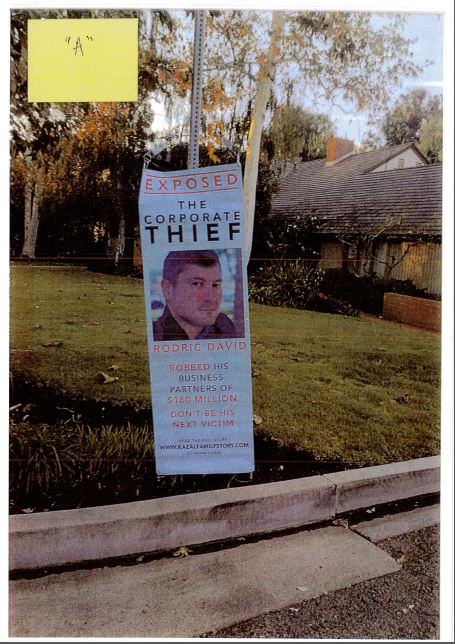
1. Until the final disposition of these proceedings, the Second Respondent be restrained from posting, affixing or displaying, or directly or indirectly causing to be posted, affixed or displayed on any structure, building, signpost, pole, wall, mobile or immobile structure, or to any motor vehicle, any kind any sign, placard, poster, banner, pamphlet, flyer or any like item, or otherwise publishing or distributing any such material, whether or not displaying images or likenesses of Rodric David or any members of his family, where such object may be or is in fact visible or distributed to the public or any member of the public and which:
a. is in the form of or to the same or similar effect as the sign or poster, a copy of which is annexure "A" to this Order 1; or
b. makes, conveys, or is capable of making or conveying, any imputation that Rodric David:
A. is a corporate thief;
B. stole $180 million;
C. is guilty of fraud;
D. is a con man;
E. conspired with David Singh to steal $180 million;
or any imputation to the same or similar effect.
2. Until the final disposition of these proceedings, the Second Respondent be restrained from retaining, hiring, engaging or directing any person to carry out any of the conduct referred to in order 1 above.
3. Until the final disposition of these proceedings , the Second Respondent be restrained from publishing or distributing (otherwise than to his lawyers for the purpose of obtaining legal advice or for use in litigation), in hard copy or electronic form, whether on the internet or any form of social media, including Twitter:
a. the material contained in the e-mail dated Monday 31 October 2016, a copy of which is annexed and marked "B";
b. the material contained on the Second Respondent's Twitter feed entitled "Hey Walter MacCallum You want me to cease using the Van? Are you serious? @aitken_lawyers @australian #kazal @rodric_david @thr @IRStaxpros”, a copy of which is annexed and marked "C";
c. the material located on the internet at https://twitter.com/ AdamKazal/status/793388384311996416, a copy of which is annexed and marked "D";
d. the video entitled "Street protests and vans exposing corporate thieves Rodric David and David Singh" displayed on YouTube and the website at www.kazalfamilystory.com;
e. any imputation arising from any material (whether in hard copy or electronic form) published on or after 26 October 2016 that Rodric David, alone or together with his legal representatives:
A. fabricated a case before the ICAC;
B. perverted the course of justice;
C. is guilty of contempt of the ICAC;
E. lied to the ICAC;
F. engaged in thuggery, to enable him to steal from innocent people;
G. lied, to enable him to steal from innocent people;
H. fabricated claims, to enable him to steal from innocent people;
I. Is a thief,
or any imputations to the same or similar effect.
4. The Second Respondent remove or cause to be removed by 4 pm Australian Eastern Standard Time on 12 November 2016, the material referred to in order 3 above from the internet, Twitter and any third party website to which it has been distributed.