

FEDERAL COURT OF AUSTRALIA
Shepard, in the matter of Quest Minerals Limited v Mutual Holdings Pty Limited [2016] FCA 1559
ORDERS
DATE OF ORDER: |
THE COURT ORDERS THAT:
1. Pursuant to s 444GA of the Corporations Act 2001 (Cth), the first plaintiff have leave to transfer to the second plaintiff:
(a) 23,333 fully paid ordinary shares in the capital of Quest Minerals Limited (subject to deed of company arrangements) (Company) held by the first defendant; and
(b) 233,333 fully paid ordinary shares in the capital of the Company held by the second defendant,
and following such transfer:
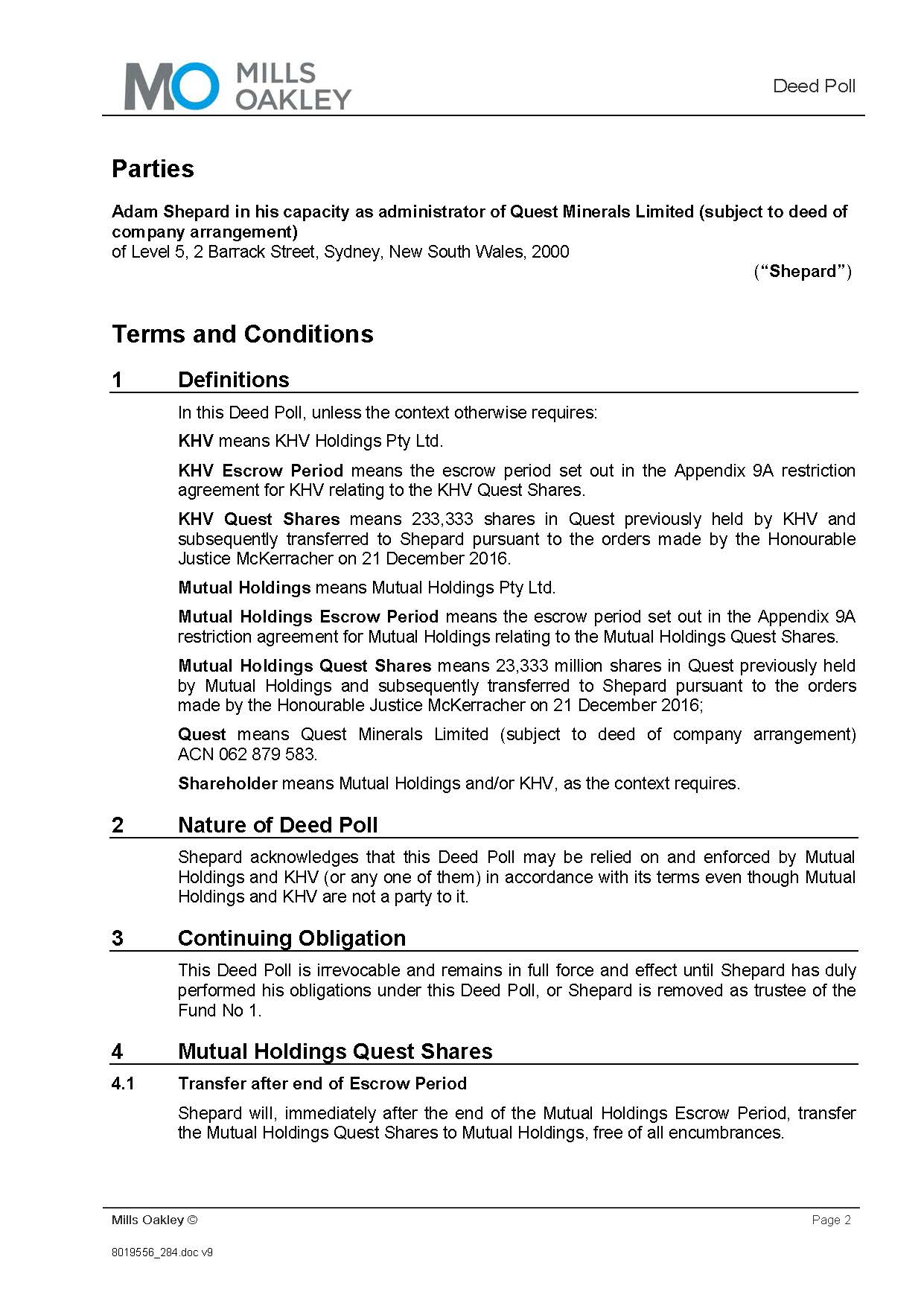
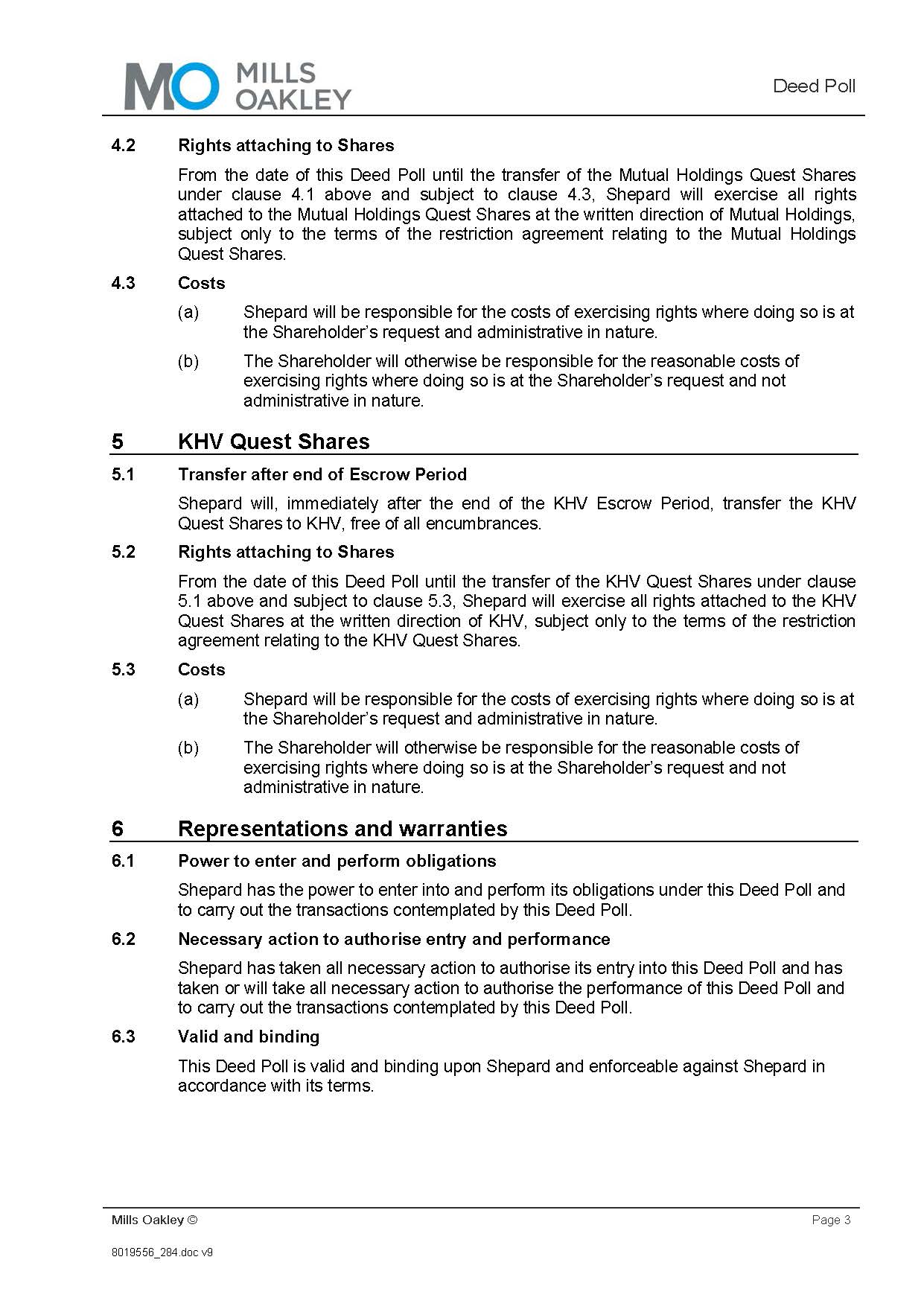
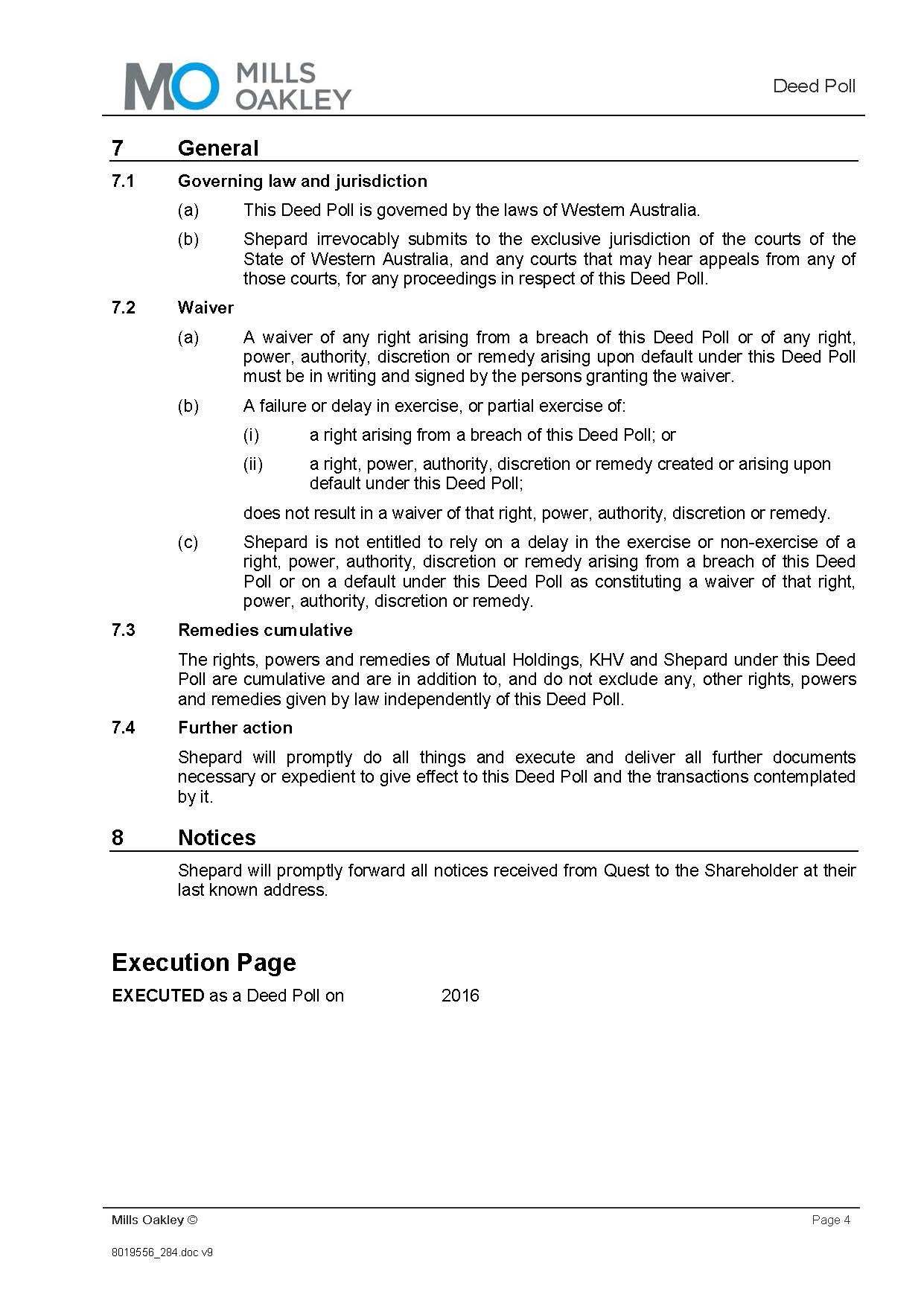
(c) the second plaintiff have the authority to execute a Deed Poll in the same terms as Annexure A;
(d) the second plaintiff have the authority to execute an Appendix 9A restriction agreement substantially in the same terms as that annexed as Tab 20 to the affidavit of Adam Shepard sworn 1 December 2016; and
(e) the first plaintiff instruct the Company’s share registry to place a holding lock over such shares to prevent any dealing in those shares.
2. The defendants’ interlocutory application filed 8 December 2016 be dismissed.
3. There be no order as to costs.
Note: Entry of orders is dealt with in Rule 39.32 of the Federal Court Rules 2011.
ANNEXURE A

MCKERRACHER J:
INTRODUCTION
1 The plaintiffs, being Mr Adam Shepard acting in his capacity both as Deed Administrator of the company, Quest Minerals Limited (subject to deed of company arrangement), and as Trustee of the Quest trust fund, apply for urgent relief under s 444GA of the Corporations Act 2001 (Cth) for leave to transfer shares held by the defendants in the issued capital of Quest to Mr Shepard in his capacity as trustee of Trust Fund No.1 created by the Quest’s Creditors’ Trust Deed of 18 August 2014, entered into between Quest and Mr Shepard.
2 The defendants not only oppose the relief sought and seek the opportunity to cross-examine unspecified deponents of affidavits in support of the relief, but also seek to strike out the application or stay the application in favour of certain Supreme Court of Western Australia proceedings. The dispute between the parties relates not only to the defendants’ opposition to the relief, but the defendants’ arguments as to why these proceedings should be stayed in favour of the Supreme Court proceedings recently commenced by the defendants. The defendants’ arguments advanced on both topics were essentially the same.
3 For reasons set out below, putting aside for one moment the defendants’ arguments, I consider that the relief sought by Quest should be granted. I will deal with that issue briefly and then consider the issues raised by the defendants’ interlocutory application to strike out or stay the initiating application.
BACKGROUND
4 Quest was officially listed on the Australian Securities Exchange (ASX) on 13 February 1995. Its shares have been suspended from trading on the ASX since 1 October 2013, initially for a failure to lodge statutory accounts and subsequently as a result of self-reported breaches of the ASX Listing Rules, which will be discussed in detail below.
5 Mutual Holdings Pty Limited and Quest entered into an impugned sale agreement on 23 October 2009 and debt agreement on 8 August 2012. On 21 August 2012, Quest issued 60,000,000 pre-consolidation shares to satisfy the sale agreement and on 10 September 2012, a Form 604 (Notice of change of interests of substantial holder) was lodged with Quest by Mr Nikolaenko. Mutual transferred 60,000,000 shares to the second defendant, KHV Holdings Pty Ltd, on 16 November 2012 and on 11 January 2013, Quest issued 10,000,000 pre-consolidation shares to Mutual. On 12 February 2013, Mutual transferred 10,000,000 shares to KHV.
6 In August 2013, the directors of Quest determined that Mr Nikolaenko was a shadow director when he entered into the sale agreement and advised the Australian Securities and Investments Commission (ASIC) and ASX of breaches which had allegedly thus occurred. On 1 October 2013, the shares were suspended from quotation for failure to lodge full year accounts for the period ended 30 June 2013.
7 On 19 December 2013, a solicitor for Quest first wrote to a solicitor for the defendants concerning the defendants’ voting rights. Communications then took place with the ASX, including the 1 February 2014 letter from the ASX that stipulated the requirement that restriction agreements be signed as a precondition to reinstatement.
8 On 9 May 2014, the directors of Quest resolved to place Quest into voluntary administration, an administrator was appointed, and a report was prepared by the administrator as to Quest’s affairs. On 16 June 2014, a meeting of creditors was convened. It was adjourned and reconvened on 18 August 2014. On that date, the creditors resolved to execute the DOCA. It was executed, Mr Shepard was appointed as Deed Administrator and Trust Fund No.1 was established.
9 The relevant provisions of the Deed of Company Arrangement (DOCA) are as follows:
(a) Clause 6.1 – The Deed Administrator, to the extent permitted by the Act, shall not be responsible for the day-to-day management, control, supervision and administration of the business and affairs of Quest and will not be responsible for any debts incurred by, or claims against, Quest the circumstances of which occur after the commencement date.
(b) Clause 6.2 – Quest shall return to the control of its Board of Directors who shall be responsible for the day-to-day management, control, supervision and administration of the business and affairs of Quest, subject to the Deed Administrator’s right and entitlement, in his sole and unfettered discretion, to exercise all or any of the powers conferred by the DOCA to the exclusion of the powers of Quest or the Board.
(c) Clause 6.3 – During the Arrangement Period (being the period between the execution of the DOCA and the date the DOCA terminates), Quest and the directors shall (amongst other things):
(i) until the Deed Administrator has certified in writing that Quest has satisfied its obligations under the DOCA, not dispose of any assets other than in the ordinary course of business except with the prior written consent of the Deed Administrator;
(ii) negotiate with the ASX and seek reinstatement of Quest’s securities to quotation on the ASX;
(iii) comply with any ASX requirements or conditions precedent to re-quotation of Quest’s securities on the ASX; and
(iv) negotiate and agree (on behalf of Quest) terms with third parties to recapitalise Quest on terms that maximise payments to be made to Trust Fund No.2.
In performing their obligations under this clause and during the Arrangement Period, the directors must act in the best interests of participating creditors and, if there is a conflict between participating creditors’ interests and the interests of shareholders, give priority and precedence to the participating creditors’ interests.
(d) Clause 7.6 – The Deed Administrator must as soon as reasonably practicable transfer the Deed Fund or the balance of the Deed Fund that has not been distributed to the Trustee, to be distributed in accordance with the Creditors’ Trust Deed.
(e) Clause 8.2 – Two creditors’ trusts will be established, being Trust Fund No.1 and Trust Fund No.2. Cash held by Quest on the date of the Deed Administrator’s appointment as administrator (approximately $300,000 including a research and development grant) and the proceeds from the sale of property and assets of Quest will be paid to Trust Fund No.1. Trust Fund No.2 will comprise an amount to be negotiated and agreed upon by the Deed Administrator or the Trustee in the event that Quest, by its directors or any third party, puts forward a proposal that would enable Quest to retain its ASX listing and for the suspension from listing of Quest to be lifted and the quotation for trading of Quest’s securities to be reinstated on the ASX with or without the need for Quest to meet the requirements of Chapters 1 and 2 of the Listing Rules.
(f) Clause 8.3 – Immediately upon the Deed Fund being transferred to the Trustee under cl 7.6, the following events shall occur in the following order:
(i) all claims of participating creditors will be novated and assumed by the Creditors’ Trust;
(ii) Quest will be released from all claims by participating creditors;
(iii) all claims of participating creditors against Quest will be extinguished;
(iv) participating creditors must accept their right to prove under the Trust Deed in full satisfaction and complete discharge of all claims which they have or claim to have against Quest and each of them will, if called upon to do so, execute such forms of release of any such claim as the Deed Administrator or Trustee may require; and
(v) the Deed Administrator will be entitled to terminate the DOCA.
(g) Clause 10.2 – The Deed Administrator in his capacity as Deed Administrator and voluntary administrator and the Trustee are entitled to be indemnified out of the property and assets of Quest, including out of the Deed Fund and Trust Fund for:
(i) his remuneration, costs, fees and expenses incurred by him;
(ii) all liabilities incurred during the Administration Period, the Arrangement Period and the period of operation of the Creditors’ Trust; and
(iii) all actions, suits, proceedings, accounts, claims and demands which may be commenced, incurred by or made on the Deed Administrator (whether as voluntary administrator of Quest, Deed Administrator of this Deed and Trustee of the Creditors’ Trust), his partners or staff by any person and against all costs, charges and expenses incurred by the Deed Administrator and the Trustee in respect of them,
provided that the Deed Administrator or the Trustee shall not be entitled to an indemnity in respect of any liabilities or demands if the Deed Administrator or the Trustee, or any partner, employee, authorised agent or delegate of them has acted fraudulently or dishonestly.
(h) Clause 10.6 – The Deed Administrator and the Trustee shall have a first and paramount lien over all of the assets and property of Quest, including the Trust Fund, as security for the indemnity and all payments (whether presently payable or not) under cl 10.
10 On 21 August 2014, exploration licence E57/550-I, known as Victory Bore, was surrendered. On 25 August 2014, the Deed Administrator issued notices to creditors to formally approve debts, and on 4 September 2014, the Deed Administrator transferred funds to a trust account established under the Creditors’ Trust. On 11 September 2014, the formal proof of debt from Mutual was received, together with two proofs of debt for another entity controlled by Mr Nikolaenko. The proofs of debt were rejected in October 2014. There was an appeal of the rejection of the proofs of debt to the Supreme Court. Justice Mitchell held that the proofs of debt lodged by Mutual should be admitted.
11 Quest re-applied for the grant of an exploration licence over Victory Bore on 29 June 2015.
12 On 17 December 2015, a recapitalisation proposal was received. On 20 April 2016, the solicitor for Mr Shepard wrote to the solicitor for Mr Nikolaenko in relation to the proposed recapitalisation, specifically referring to the ASX policy that an escrow deed must be executed in the circumstances. In May 2016, Quest received an informal proposal for the Recapitalisation. Communications ensued in May 2016 about whether ASX would accept escrow deeds signed by Mr Shepard.
13 On 1 July 2016, Quest was granted the exploration licence over the area applied for. In correspondence of 14 July 2016, then solicitors for Quest explained their proposed application for s 444GA orders to Mr Rowe of the ASX and sought confirmation that their planned approach, in particular the administrator signing the escrow deed for whatever period the ASX determines, would be acceptable for compliance purposes. In early August 2016, there was an email from Mr Vitale (the Managing Director of Quest) to Mr Rowe of the ASX requesting a response to Quest’s Recapitalisation proposal. On 17 August 2016, there was an email from Mr Atkinson for the plaintiffs to Mr Rowe seeking a response to Quest’s 14 July 2016 request. On 19 August 2016, Mr Mark Ryckmans for the creditors’ Trustee wrote to Mr Bennett for the defendants attaching an proposed originating process, supporting affidavits and restriction agreements. There was a telephone discussion on 19 August 2016 between Mr Atkinson and Mr Rowe, with Mr Atkinson advising he would send draft notices of the meeting as soon as possible. Those drafts were circulated three days later. There were exchanges over the next week concerning ASX’s conditions for reinstatement and correspondence with the defendants’ solicitors during that week concerning restriction agreements. On 29 August 2016, the ASX agreed to extend the reinstatement date to 24 October 2016. During September 2016, there were further emails concerning the restriction agreements and draft notices of meeting. Communications concerning the latter extended into October 2016.
14 On 6 October 2016, a copy of a proposed ASX announcement of the Recapitalisation proposal was sent to Mr Nikolaenko’s lawyer. On 7 October 2016, Quest announced the Recapitalisation, which would result in its shares being reinstated to trading on the ASX and a return for creditors and existing shareholders maintaining an equity position in Quest. The announcement also noted Quest’s intention to make an application to this Court to validate the proposed shareholder meeting (which was the subject of the related proceedings in WAD 469 of 2016). There were further communications with Mr Rowe in relation to the draft notice of meeting. On 11 October 2016, there was an announcement from the ASX updating shareholders as to the Federal Court application for orders under s 1322 of the Act and on 12 October 2016, an announcement of the draft notice of the meeting. On 13 October 2016, I heard Quest’s application for orders pursuant to s 1322.
15 On 14 October 2016, the notice of meeting seeking shareholder approval for the Recapitalisation was sent, as well as notices of Annual General Meetings (AGMs) for 2015 and 2016. On 8 November 2016, a timetable was announced for a 300:1 share consolidation (this being one of the components of the Recapitalisation). On 11 November 2016, Quest issued 93,810,000 pre-consolidation shares to a ‘sophisticated investor’ (a description which obviates the need for compliance with the prospectus provisions).
16 On 14 November 2016, the Extraordinary General Meeting (EGM) was held. Quest announced the results of the EGM on the same date. The resolutions regarding the Recapitalisation, including consolidation of the share capital, passed (although this is of course subject to the Supreme Court proceedings). On 15 November 2016, Quest signed a mandate to raise $1.82 million through the placement of 91,000,000 shares, and Quest lodged a prospectus for the offer of 91,000,000 shares.
17 On 16 November 2016, the defendants commenced the Supreme Court proceedings. On 23 November 2016, the ASX confirmed that it would grant Quest an extension to comply with the reinstatement conditions to 3 January 2017. On 24 November 2016, an ASX announcement was made concerning the 300:1 consolidation of Quest’s share capital. On 25 November 2016, the ASX confirmed that the s 444GA application must be completed and effected prior to reinstatement. On 29 November 2016, a supplementary prospectus was lodged with ASIC. On the same day, the solicitors for the plaintiffs emailed the solicitors for the defendants attaching a draft originating process, affidavits (excluding annexures) and submissions in this proceeding. From 29 November 2016 to 1 December 2016, there were various communications with my Chambers concerning the urgent listing of the application. Various steps were taken in connection with the proceedings before the hearing on 14 December 2016, including a case management hearing on 2 December 2016.
PLAINTIFFS’ APPLICATION
18 The ASX has made the Recapitalisation conditional upon the holder and controller of 77 million pre-consolidation shares in Quest (currently the defendants and their controller, Mr Vladimir Nikolaenko) signing restriction agreements. The circumstances and nature of restriction agreements are set out in Appendix 9A to r 9.1 of the ASX Listing Rules. To date, Mr Nikolaenko has not signed any restriction agreement.
19 The ASX has, however, advised that it will accept a restriction agreement signed by Mr Shepard where the transfer is made with the leave of the Court pursuant to s 444GA of the Act.
20 Orders under s 444GA are now sought urgently so that Quest can transfer the shares to Mr Shepard in his capacity as trustee. He would then sign an restriction agreement for the shares so as to satisfy one of the conditions specified by the ASX for reinstatement of Quest. If the relief is granted, he will return the shares to the defendants at the end of the escrow period. If the relief is not granted, Mr Shepard, as administrator, will seek to have Quest wound up.
Relevant principles
21 Section 444GA of the Act provides as follows:
444GA Transfer of shares
(1) The administrator of a deed of company arrangement may transfer shares in the company if the administrator has obtained:
(a) the written consent of the owner of the shares; or
(b) the leave of the Court.
(2) A person is not entitled to oppose an application for leave under subsection (1) unless the person is:
(a) a member of the company; or
(b) a creditor of the company; or
(c) any other interested person; or
(d) ASIC.
(3) The Court may only give leave under subsection (1) if it is satisfied that the transfer would not unfairly prejudice the interests of members of the company.
22 It follows from this provision that the administrator of the deed of company arrangement may transfer shares in a company if he or she has obtained either the written consent of the owner of the shares or the leave of the Court. It is only possible for the Court to grant leave where satisfied that the sale would not unfairly prejudice the interests of shareholders. In Re Nexus Energy Ltd [2014] NSWSC 1910, Black J (at [19]) interpreted the provision as involving two interrelated considerations when determining whether there is unfair prejudice. The first was to have regard to the interests of the shareholders, and the second was to have regard to the broader purposes of Pt 5.3A and the other interests affected by the administration of a company.
23 The parties accept that the principles applicable relevant to the exercise of the Court’s discretion in an application for leave of this nature have been considered in a number of cases, including, in particular, Weaver v Noble Resources Ltd (2010) 41 WAR 301, although, see also Re Nexus, Re Lewis [2014] FCA 53 and Re BCD Resources (Operations) NL [2014] VSC 259.
24 The following points were made by Martin CJ in Weaver (at [79]-[80] and [87]):
79 ... If the shares have no value, if the company has no residual value to the members and if the members would be unlikely to receive any distribution in the event of a liquidation, and if liquidation is the only alternative to the transfer proposed, then it is difficult to see how members could in those circumstances suffer any prejudice, let alone prejudice that could be described as unfair. As Master Newnes identified in Fleet Broadband Holdings, it is also important to note s 435A which sets out the objects of Pt 5.3A of the Act, of which s 444GA forms part. That section provides:
The object of this part is to provide for the business property and affairs in an insolvent company to be administered in a way that:
(a) maximises the chances of the company or as much as possible of its business, continuing in existence; or
(b) if it is not possible for the company or its business to continue in existence - results in a better return for the company’s creditors and members than would result from an immediate winding up of the company.
80 Before moving on to the circumstances of this case I would also observe that a mere transfer of shares without compensation cannot of itself constitute unfair prejudice, otherwise the section’s operation would be significantly constrained. So, something more would have to be established before it could said that unfair prejudice to the members of the company could arise.
…
87 However, s 444GA clearly focuses attention upon the interests of the members of the company. Other provisions of the Act provide for remedies to creditors and, in particular, s 445D of the Act provides a potential remedy to Noble in its capacity as creditor, should it wish to pursue that remedy.
25 It is clear that mere prejudice alone is insufficient. There must be unfair prejudice, as stipulated by the statute.
26 Consideration of unfair prejudice may involve examining:
a comparison between the members’ position in the event that the transfer of shares occurs and the members’ position in the event that the transfer does not occur;
whether the shares have any residual value that may be lost if leave is granted;
whether there is a prospect of the shares obtaining some value within a reasonable time frame on both scenarios;
the steps or measures necessary before the prospect of the shares obtaining some value may be realised; and
the attitude of existing shareholders toward providing the means by which the shares may obtain some value or by which the company may continue to exist.
27 In Re Lewis, White J observed (at [24]-[25]):
24 The evidence in the affidavits and, in particular, the conclusions of the applicants which I accept, indicate that the shares in DBS have no residual value and that it is likely to be a considerable time, if ever, before they do gain some value.
25 On a winding-up, the unsecured creditors of DBS will not receive any return at all. It follows that the shareholders would not receive any return either. On the other hand, if the conditions subsequent in the DOCA are realised, the majority of creditors of DBS will receive payment in full.
The parties’ arguments
28 The relief sought by Quest is supported by affidavits of Mr Shepard of 1 December 2016, Mr Jerome Vitale of 9 October 2016, 13 October 2016, 30 November 2016 and 6 December 2016, Mr Christopher Seotis of 7 December 2016 and 13 December 2016, Mr Ariel King of 13 December 2016 and Mr Julian Atkinson of 13 December 2016.
29 As indicated in the affidavit material, Trust Fund No.1 was established on 18 August 2014. As a result of the establishment of that trust fund and pursuant to cl 8.3 of the DOCA, all claims from the defendants were extinguished. The DOCA has not yet come to an end because it is expected that Trust Fund No.2 will be created under the current Recapitalisation proposal. This will enable a payment to be made to ‘participating creditors’, as that term is defined in the DOCA.
30 Consistent with authority, the plaintiffs have compared the position of the shareholders if leave is granted and their position if the Recapitalisation does not proceed.
31 An analysis of the relevant outcomes of both the Recapitalisation and a liquidation are set out in the affidavit of Mr Shepard from which it is apparent that:
(a) Recapitalisation will allow existing shareholders, including the defendants, to retain an interest in Quest. Those shares may have some value. Liquidation, on the other hand, will result in no return to shareholders;
(b) under the Priority Offer, existing shareholders, including the defendants, have an opportunity to subscribe for shares on a pro rata basis to their existing holding. This will negate the dilutive effect of the Recapitalisation. In the event the defendants do not wish to participate, their voting power in Quest will be reduced from 10.7% to 0.24%;
(c) whilst under the Recapitalisation the defendants will not be able to deal with their shares for 12 months from the date a restriction agreement is signed, they will, at least, be able to deal in the shares once the escrow period ends; and
(d) the Recapitalisation will result in a higher return for Quest’s creditors and shareholders generally than would result from an immediate winding up of Quest.
32 The defendants seek to rely upon the following indicators of ‘unfair prejudice’ that they would occasion if the relief sought is granted:
(a) the defendants would be ‘non-suited’ in the Supreme Court proceedings against Quest, including for relief regarding resolutions relating to director remuneration, as they would no longer be members of Quest;
(b) the view of the majority of members would be overridden, in circumstances that the members of Quest would have voted against proposed Recapitalisation absent the exclusion of the defendants’ votes or the issue of the 93,810,000 shares;
(c) the application expressly discriminates against the defendants as it is made against them only and not against all members;
(d) the defendants have incurred time and expense, which would otherwise be wasted, by:
(i) intervening in the earlier, related proceedings in this Court;
(ii) attending and attempting to vote at the EGM, including instructing solicitors to attend;
(iii) commencing proceedings regarding the EGM;
(e) the defendants’ shares would ultimately be escrowed for two years, where Mr Shepard has delayed for two years in making the application; and
(f) by the proposed deed poll, Mr Shepard is to hold the shares for the escrow period of two years, preventing the defendants from holding the shares and exercising rights that would be unaffected by the escrow terms, including as to subscribing pro rata for shares in any Recapitalisation.
33 The defendants make the point that there is no evidence of any investigation by Mr Shepard into the directors’ conduct, which would be scrutinised in the context of liquidation. Quest may have claims against its past and present directors that have not been considered. The transfer of shares is only in the interests of creditors and the Recapitalisation proponents, not in the interests of the members of Quest, the defendants argue.
Consideration
34 The Recapitalisation has been sought over an extensive period of time. The current proposal represents the only substantive proposal that has been put forward, and, given the 3 January 2017 ASX deadline for completion of the Recapitalisation, there is little scope for any alternative recapitalisation proposal to be put, even if one existed.
35 There are also broader considerations as discussed by Martin CJ in Weaver (at [90]-[93]), including providing employment and an opportunity for companies to supply goods and services to a project, and the disadvantages of liquidating the assets of a mining company as opposed to selling the assets to a third party as a whole package.
36 It is relatively clear that without the Recapitalisation, Quest’s pre- and post-DOCA creditors will see little or no return. It is appropriate to have regard to the broader considerations of Quest’s creditors in deciding whether to grant leave. Those interests clearly favour the grant of leave. Following the transfer of the shares back to the defendants after the 12 month escrow period, they will enjoy all of the rights normally accompanying those shares. There is no residual value in Quest if it is wound up, meaning that Quest’s shares have no value. If the Recapitalisation fails, the value of the members’ equity will be negative because there will be a significant excess of liabilities over assets, meaning that there will be no possibility of return to shareholders, including the defendants. The shares in Quest can only be restored to value if the Recapitalisation proceeds and that can only by achieved if the orders sought or orders similar to those sought are made. The Recapitalisation will maximise the chances of Quest continuing in existence and for there to be a better outcome for shareholders, creditors and prospective employees. There is no evidence to demonstrate any unfair prejudice to the defendants, save to the extent considered below under the next heading.
37 Subject to consideration of the defendants’ arguments, I consider that the orders urgently sought by the plaintiffs pursuant to s 444GA of the act should be made.
DEFENDANTS’ APPLICATION TO STAY OR STRIKE OUT THIS PROCEEDING
38 The defendants’ arguments are chiefly in support of its own interlocutory application filed on 8 December 2016 for orders that:
(1) The originating process be struck out.
(2) In the alternative to order 1, the hearing of the plaintiffs’ originating process be stayed pending the determination of the Supreme Court of Western Australia proceeding COR 248 of 2016.
(3) The plaintiffs pay the defendants’ costs of this application personally and not limited to their right of indemnity from company or trust assets.
39 The defendants’ arguments rely upon the affidavit of Mr Shepard of 1 December 2016, the affidavit of Mr Vitale of 30 November 2016 and the affidavit of Mr Alexander Tharby, solicitor, of 8 December 2016. The defendants also referred to various of the affidavits on which the plaintiffs relied.
40 Orally, counsel for the defendants, Mr MacLennan, relied on three principal grounds. First, the unavailability of the defendants’ usual and preferred counsel, Mr Bennett. Secondly, that the Supreme Court proceedings ought be determined first. Thirdly, the delay in seeking the relief.
Unavailability of preferred counsel
41 While it was true that Mr Bennett was unable to make oral submissions as to the interlocutory application and in opposition to the plaintiffs’ application, the Court was assisted with detailed written submissions bearing Mr Bennett’s name and very capable argument advanced by Mr MacLennan. It may be accepted that Mr Bennett (very experienced counsel) was particularly familiar with the materials the subject in the applications, but there were no indications that Mr MacLennan was unable to deal with any particular factual submission or any aspect of the history relevant to the applications. To the contrary, the defendants, through counsel, were ably represented. Given the urgency of the matter, in that relief was sought, in substance, within 48 hours of hearing of the application, there was no practical alternative other than to proceed. It was not apparent that the defendants suffered prejudice by taking that course. Although availability of counsel will certainly be taken into account where it is practical to do so, there are certain exceptions and this case was one.
42 The question of delay will be considered in greater detail below, but it is necessary to note at this point that my conclusion on delay is that steps could have been taken sooner by the defendants to advance their position, just as steps could have been taken sooner by the plaintiffs to advance their position. Had the defendants taken steps at an earlier time, perhaps the choice of counsel might have been more flexible.
Supreme Court proceedings
43 As the evidence makes clear, on 14 November 2016, Quest held an EGM of its shareholders to consider resolutions, amongst other things, approving the proposed Recapitalisation of Quest. Prior to that EGM:
(a) Quest had determined that the defendants’ votes in respect of their shareholdings of a combined 77 million shares would be excluded; and
(b) Quest issued 93,810,000 shares one business day prior to the meeting and those shares presumably voted in favour of the Recapitalisation.
44 It is apparent that, absent the exclusion of the defendants’ votes and the issue of the shares, separately or together, Quest shareholders would have voted against the Recapitalisation of Quest. The defendants voted against the Recapitalisation by proxy that was disallowed.
45 On 16 November 2016, only two days after the EGM, the defendants commenced proceedings against Quest impugning the validity of some of the resolutions passed at the EGM on the basis of their exclusion from voting. The defendants also sought relief from oppression under s 233 of the Act and an order for winding up on the just and equitable ground pursuant to s 461(1)(k) of the Act on the bases of the exclusion of their votes at the EGM and the prior issue of the shares.
46 The defendants argue that it is quite apparent on the basis of this material that the defendants have a strong case in the Supreme Court proceedings, given that:
(a) the exclusion of the defendants’ votes was improper and contrary to Quest’s Constitution where the issue of whether Mr Nikolaenko was a ‘shadow director’ of Quest (the basis for excluding the defendants’ votes) arises from unsubstantiated allegations made by Quest that have never been determined by a court; and
(b) the 93,810,000 shares were issued to a ‘sophisticated and professional investor’, presumably a proponent of the Recapitalisation and that would have voted in favour of the Recapitalisation, where:
(i) the stated purpose for the issue was to raise capital of only $6,250, which funds were to be applied to Recapitalisation expenses; and
(ii) Quest had the ability to borrow; and indeed, had already borrowed funds from ‘investors’.
47 The defendants stress that, absent this conduct, the resolutions to the Recapitalisation proposal would have been clearly defeated on the poll. If the application in the Supreme Court proceedings are successful, Quest is likely to be wound up and these proceedings would be unnecessary. The plaintiffs’ application would only need to be considered if the defendants were unsuccessful against Quest in the Supreme Court proceedings.
Have the plaintiffs delayed in the making the application?
48 The defendants strongly argue that the plaintiffs have brought about the urgency of this application by reason of their own delay. The defendants point out that the application could have been made by the plaintiffs long ago, but he vacillated as to whether or not to do so to the detriment of the defendants.
49 The defendants rely upon the following chronology:
(a) on 3 October 2014, ASX wrote to the plaintiffs’ solicitors regarding escrow arrangements for the defendants’ shares;
(b) on 14 January 2015, the plaintiffs’ solicitors stated in an email to Mr Nikolaenko’s solicitors that escrow requirements ‘[had] not been formally expressed by ASX in so many words’ and that the requirements for escrow deeds to be signed by the defendants were ‘based on discussions with ASX’;
(c) on 30 July 2015, the plaintiffs’ solicitors wrote to Mutual’s solicitor advising that Mr Shepard would make an application to compel a transfer of Mutual’s shares under s 444GA of the Act. He did not do so.
(d) on 14 January 2016, the plaintiffs had resiled from his previous position, stating that if the defendants ‘will not agree to any escrow of their shares then it is likely that Mr Shepard will simply finalise the liquidation of Quest’:
(e) on 20 April 2016, the plaintiffs produced ASX’s letter dated 3 October 2014 to Mutual for the first time;
(f) by 19 August 2016, the plaintiffs had instructed his solicitor to make an application pursuant to s 444GA of the Act;
(g) on 25 August 2016, Mutual’s solicitor responded to the letter of 19 August 2016; and
(h) on 8 September 2016, Mutual’s solicitor followed up their response. the plaintiffs did not respond.
50 It follows from this summary, the defendants contend, that despite foreshadowing these proceedings as early as 30 July 2015, drafting the application in July 2016 and instructing solicitors to make the application in August 2016, the plaintiffs delayed initiating the proceedings until 1 December 2016. No explanation is proffered, the defendants say, by the plaintiffs for their delay. Moreover, even after the convening of the EGM on 14 November 2016 and the relisting of this application, there is no explanation for the further delay.
51 The defendants say that they are prejudiced by this delay for the following reasons:
(a) if a successful application had been made by the plaintiffs, time would already have been running on the escrow period;
(b) the defendants have incurred time and expense, as set out above at [32(d)]; and
(c) if the plaintiffs are successful, it is unlikely that the defendants will have an ability to bring an appeal and have it determined before the subject matter is overtaken by events.
52 The defendants also contend that the urgent listing of the application (caused by the delay in its filing) prejudices the defendants in that:
(a) Mr Bennett, who has acted for Mutual in previous proceedings with Quest and with the plaintiffs and who has detailed knowledge of the matters, is unavailable to argue the matter in this application;
(b) the defendants have insufficient time:
(i) to seek any security for costs;
(ii) to take any objections to evidence; and
(iii) to object to Quest’s solicitors representing the plaintiffs; and
(c) the defendants are forced to accept the plaintiffs’ waiver of without prejudice privilege (by Mr Shepard attaching without prejudice correspondence to his affidavit without warning to Mutual) to demonstrate Mr Shepard’s delay.
53 I have already dealt with the first of these points concerning counsel (see [41]-[42]).
54 In relation to security for costs, I was informed without objection that the defendants accepted the provision of $25,000 as security for costs.
55 No oral argument was advanced in relation to objections to evidence and no objections were taken. There were no objections manifestly open, which would have significantly affected the consideration of the matter. An ‘without prejudice’ communication was adduced, but that did not assist the plaintiffs.
56 The question of conflict was not advanced at the hearing.
57 As to reliance by the plaintiffs on without prejudice correspondence, the defendants also sought to rely on that correspondence themselves in order to underline prevarication and inconsistent positions taken by the plaintiffs. There is some force in the defendants’ complaint.
58 In particular, the defendants point to an offer made in without prejudice communications in litigation between Mutual and Corporate Admin Services Pty Ltd, an entity related to Mr Nikolaenko. The correspondence concerned an appeal against rejection by Mr Shepard of proofs of debt in the administration of Quest. The offer noted that, as part of any settlement, Mr Shepard was prepared to inform ASX that on further review of the material and based on legal advice, there was insufficient evidence that would support any finding that Mr Nikolaenko was either a shadow director of Quest or that the transactions were in breach of either the Act or the ASX Listing Rules. On this topic, the explanation given by counsel for the plaintiffs, Mr Healy, was that it could not be disputed that Mr Shepard did explore that possibility at the time, although it came to nothing. But, contrary to that position, Quest and the directors of Quest at all times have maintained the view that Mr Nikolaenko was a shadow director and the relevant transactions breached the ASX Listing Rules. It was not possible on the basis of the information before the Court to ascertain what information may have led Mr Shepard to make the offer in the without prejudice communications that he annexed. It does not appear to be a position consistent with that which he now advances, but in any event, as Mr Healy observes, it is certainly not the position that has been and continues to be advanced by Quest.
Consideration
59 The plaintiffs contend that Mr Nikolaenko and those advising have neither deposed to nor made submissions as to Mr Nikolaenko’s shadow directorship to the contrary effect. The entirety of their submissions is directed to consequential factors, rather than the underlying reasoning behind the advice given to members of the company on giving notice of the EGM and action taken at the EGM to preclude the defendants from exercising votes in respect of their shares for reasons of the shadow directorship and breach of the ASX Listing Rules.
60 As a first observation, it might be said that the issue fundamental to all these proceedings is the question of whether or not Mr Nikolaenko was a shadow director, as asserted by Quest at all times. Nothing in any of the submissions and in any of the affidavit material filed by the defendants appears to expressly deny that Mr Nikolaenko acted as a shadow director. Nor has there been any explanation why the position taken by Quest, through its directors, that he was a shadow director was incorrect. If it is inferred (as I do) that this position would be taken by the defendants, the defendants further note, correctly, that it is not the ASX that has independently arrived at the conclusion that Mr Nikolaenko was a shadow director. The ASX has simply relied upon the reporting by Quest. This, it might be said, is hardly surprising, as it is the Quest directors who are acquainted with all the relevant circumstances which may give rise to that conclusion. It has not been suggested for the plaintiffs that it is the ASX that has reached the conclusion that Mr Nikolaenko was acting as a shadow director. The ASX has responded to the position conveyed to it by Quest. Nonetheless, from that point, the ASX has acted consistently with the provisions of the Listing Rules and, in doing so, has indicated the need for the restriction agreement to be signed.
61 It is clear from the material supplied by Quest that there is a reasonable prospect of obtaining the re-listing and Recapitalisation if the relief is granted due to the following facts established on the evidence. I accept that delay by the plaintiffs in seeking the relief is a relevant consideration. In considering delay, however, the position is more complex than that asserted by the defendants.
62 As indicated at the outset, when the more detailed chronology was examined, while I do not consider that the plaintiffs have acted as swiftly as they should have acted, I consider that the urgency of the current situation has also been brought about by defendants’ own delay and that the prejudice to the defendants is unlikely to be as great as they suggest.
63 The defendants were aware for many months of Quest’s view. This was certainly made clear more recently at the time of the hearing before me in October 2016 in WAD 469. It was also made clear in the notice of the EGM given to members of Quest. There is no evidence of the defendants taking any action to protect their position. Had the defendants taken action earlier, it may not be necessary to resolve the difference between two positions of suggested prejudice.
64 The practical effect of granting the relief the defendants seek would be that they would, for all practical purposes, obtain final relief. This is because, as a consequence of the relief, Quest’s Recapitalisation would fail due to inability to satisfy the ASX’s conditions of reinstatement by 3 January 2017. The defendants have known of this position for some time and have taken no steps to progress or resolve the matter. Given the nature of the exchanges with the ASX and the history of those exchanges, there is no reason to believe that it would be likely to further extend the deadline (previously extended largely at the Court’s suggestion in the October hearing) beyond 3 January 2017 simply on the request of the plaintiffs or Quest alone.
65 Initially, in an exchange of correspondence, there was a suggestion that the institution of these proceedings may be an abuse of process. This was not developed as an argument by the defendants orally or in written submissions and, in my opinion, rightly so. It could not be said that the Court’s processes were being invoked for an illegitimate or collateral purpose, that the use of the Court’s procedures are unjustifiably oppressive to a party, or that the use of the Court’s procedures were bringing the administration of justice into disrepute. There is no basis on which it could be concluded that the timing of the s 444GA application was brought about to frustrate the Supreme Court proceedings. The sequence of events was that:
(a) Quest advised the defendants that while they are in breach of the ASX Listing Rules and Quest’s Constitution, the defendants could not vote their 77,000,000 shares. This advice was given as early as 19 December 2013;
(b) the ASX advised that a condition of reinstatement was obtaining restriction agreements for those shares held by the defendants in a letter dated 3 October 2014;
(c) preliminary notification of this application, including requests for the defendants to sign the restriction agreements, was given before notice of the EGM;
(d) notice of the EGM was given on 14 October 2016;
(e) the results of the EGM were announced on on 14 November 2016;
(f) the Supreme Court proceedings were commenced on 16 November 2016;
(g) on 29 November 2016, a further request was made for the defendants to sign the escrow agreements; and
(h) on 1 December 2016, this application was lodged.
66 At the latest, the defendants knew at the time of the EGM notice that they could take proceedings to protect their position in terms of casting votes at the EGM.
67 From a neutral perspective, however, the urgency of the application, at least in recent months, was dictated by the timeframe of providing notice of the EGM to shareholders so as to enable satisfaction of the conditions prior to 3 January 2017.
68 Following the filing of the Supreme Court proceedings, the defendants took no particularly urgent steps to seek injunctive relief or have those proceedings listed with urgency. The plaintiffs have now acted more urgently in this Court.
69 It is true that the plaintiffs have not taken proactive action seeking confirmation from a court in relation to the defendants’ voting of the 77,000,000 shares, but the position taken by Quest was first advised to the defendants on 19 December 2013. It was equally as open to the defendants to challenge the position taken by Quest at an earlier time, as it was for the plaintiffs to pursue these proceedings on an urgent basis. The defendants exercised a willingness to challenge related issues when pursuing the challenge in relation to the proofs of debt as considered by Mitchell J in Mutual Holdings Pty Ltd v Shepard [2015] WASC 412.
70 The plaintiffs also point to the fact that the defendants have at no time put forward to Quest any other recapitalisation proposal in the period of over three years since it was placed in administration. Nor have they participated in a capital raising pursuant to their priority entitlement under the Supplementary Prospectus, dated 30 November 2016. I give little weight to these arguments. The defendants’ position is that Quest should be wound up.
71 Most importantly, I do accept, however, the plaintiffs’ argument that if the stay were granted, there would be prejudice to Quest, its creditors and shareholders because the likely outcome would be that the ASX preconditions to reinstatement would not be satisfied and Quest would be placed into liquidation. It does appear to me clear on the financial analysis appearing in the materials that Quest members would be substantially worse off if the Recapitalisation does not proceed. In contrast to that, the defendants did not raise any specific grounds in opposition to the substantive application as to the underlying financial consequences of the substantive application, nor is it apparent that they could easily do so.
72 Finally, and not unimportantly, there is nothing to preclude the defendants from continuing to pursue the Supreme Court proceedings if the relief sought by the plaintiffs in this Court is granted. The defendants can still maintain their claim for the EGM resolutions be to set aside or a claim for damages, and doubtless other claims, regardless of whether the s 444GA orders are made. The orders the plaintiffs seek do not require any ruling to be made with respect to the validity of the EGM resolutions.
73 For all those reasons, I consider that the defendants have not established that the relief sought in their interlocutory application should be granted. That application will be dismissed.
CONCLUSION
74 The plaintiffs’ arguments in support of leave are accepted. As the only other impediment to granting the relief sought by the plaintiffs were the matters advanced in support of the defendants’ interlocutory application, I considered that when making orders without reasons on 15 December 2016 the relief sought by the plaintiffs should be granted and, accordingly, made the orders sought.
75 The orders published with these reasons today vary those orders very slightly as a result of yet further exchanged brief submissions pursuant to a grant of liberty to apply. The effect of the variation is to account for an amendment to the description of the responsibility for costs in the Deed Poll. The variation achieves a compromise between the respective positions advanced by the parties. I am satisfied that the compromise was both reasonable and consistent with legal principle.
76 Although the plaintiffs have had success in their application, the complaints raised by the defendants as to the plaintiffs’ delay were not unreasonable. At considerable strain to the already pressed resources of the Court, this matter was listed and resolved urgently last week so as to enable completion by the 3 January 2017 deadline. Not only was that deadline brought about by what I perceive to be the plaintiffs’ inefficiency, but it has apparently now been rendered futile as the Court is now informed that the ASX re-listing (if any) will not be permitted until after resolution of the Supreme Court proceedings – a decision which can be understood. It follows that the now unnecessary urgency of this process has had the effect of displacing the business of other litigants patiently awaiting the disposition of their matters. I direct none of these criticisms to Mr Healy who has been of considerable assistance. But, for that further reason, the plaintiffs will not be compensated with costs. The appropriate disposition is that there be no order as to costs.
I certify that the preceding seventy-six (76) numbered paragraphs are a true copy of the Reasons for Judgment herein of the Honourable Justice McKerracher. |
Associate:


