

FEDERAL COURT OF AUSTRALIA
Australian Competition and Consumer Commission v Harrison [2016] FCA 1543
ORDERS
DATE OF ORDER: |
THE COURT ORDERS THAT:
1. By 4.00 pm on 10 February 2017, each party file and serve a written submission (not exceeding 10 pages) on relief, the form of orders and costs.
2. By 4.00 pm on 17 February 2017, each party file and serve any written submission (not exceeding 2 pages) in response.
3. There be liberty to apply.
Note: Entry of orders is dealt with in Rule 39.32 of the Federal Court Rules 2011.
MOSHINSKY J:
Introduction
1 The second to eleventh respondents (the Harrison Companies) were incorporated progressively between 2010 and 2015. The first respondent (Mr Harrison) was the controller of each of those companies. The companies provided telecommunications services to customers (individuals and small businesses) in Australia. In the first part of the relevant period, the services were provided under the name “Sure Telecom”. Subsequently, the services were provided under the name “SoleNet”.
2 The applicant (the ACCC) alleges that, between 2013 and 2015, following customer complaints, a number of the Harrison Companies faced regulatory action by or incurred significant debts to regulatory authorities, namely the Australian Communications and Media Authority (ACMA) and the Telecommunications Industry Ombudsman (TIO). It is alleged that Mr Harrison’s modus operandi has been to cease trading through those companies subject to regulatory action and to create new companies under his control which then carried on the business of the previous companies, often with the same business name.
3 The ACCC alleges that a consequence of this system of conduct or pattern of behaviour was that Mr Harrison transferred or purported to transfer the customers’ contracts (that is, both rights and obligations) from one Harrison Company to another, without the customer’s knowledge or consent. It is alleged that the following transfers or purported transfers (transfers) of customer contracts occurred:
(a) in December 2013, from the third respondent (trading as Sure Telecom) to the fourth respondent (also trading as Sure Telecom);
(b) in September 2014, from the fourth respondent (trading as Sure Telecom) to the fifth respondent (trading as SoleNet);
(c) in June 2015, from the fifth respondent to the sixth respondent (both trading as SoleNet);
(d) in July 2015, from the sixth respondent to four State-based retailing companies, the eighth, ninth, tenth and eleventh respondents (each trading as SoleNet).
4 The series of transfers is depicted in the following corporate chart prepared by the ACCC and attached to its Concise Statement. The first, second and fifth to eleventh respondents admit the correctness of the diagram, save for the word “unauthorised”.
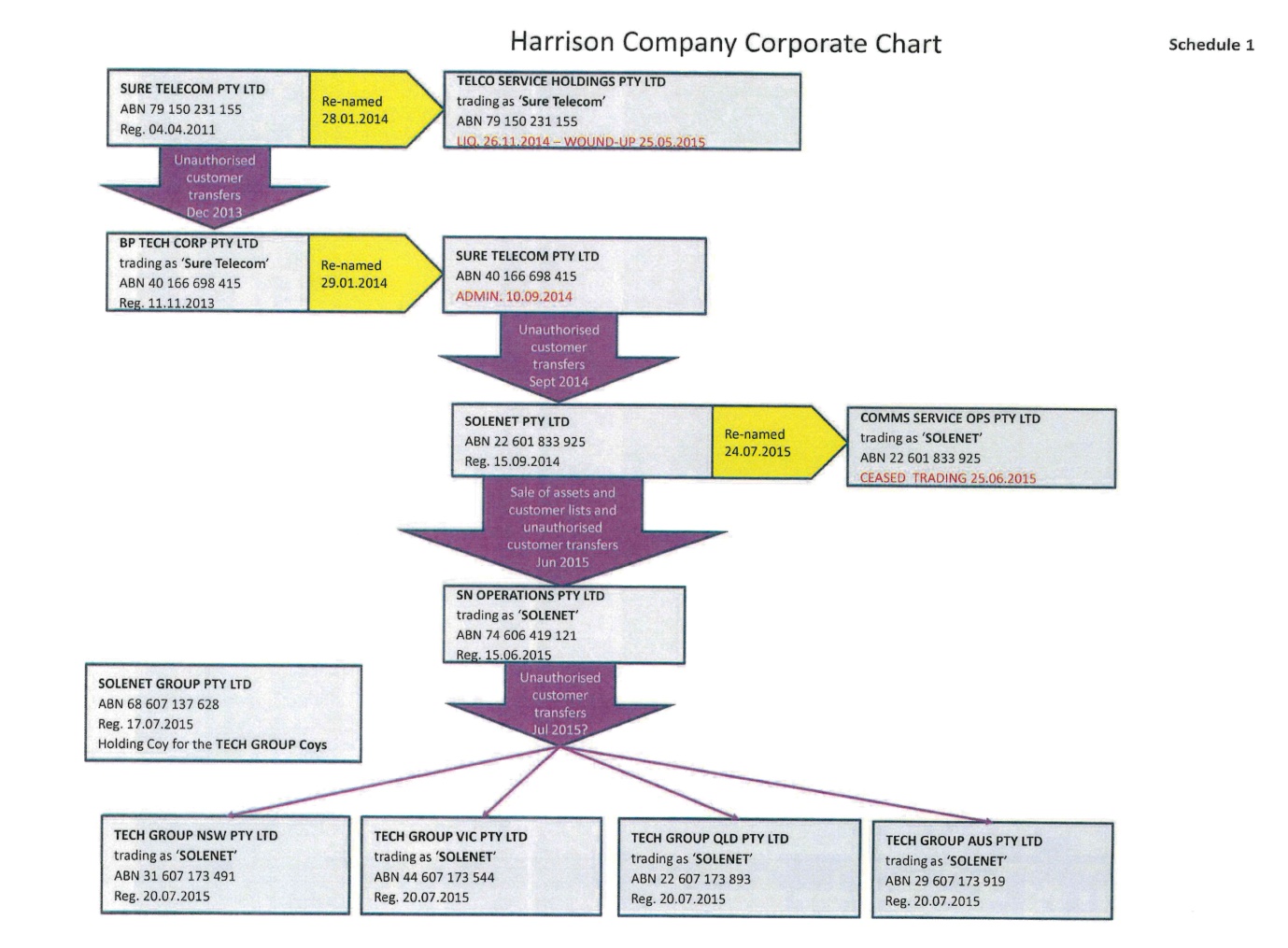
5 The ACCC contends that the terms of the contracts with the customers did not permit the transfer or assignment of the contracts without the consent of the customer, which was not obtained. It is contended that customers were unlikely to be or become aware that their contract had been transferred as (in many cases) the successor company used the same trading name, letterhead, address and logo as the previous company.
6 The ACCC alleges, in summary, that:
(a) the transferee companies made unjustified demands of customers who were not in any contractual relationship with the transferee company; for example, in some cases, the transferee company sought to enforce contractual terms that provided for the payment of early termination fees and cancellation fees when the customers sought to cancel the contracts; there was no basis for making such demands; on the contrary, the cessation of trade by the transferor company (with which the customer had a contractual relationship) meant that the customers were entitled to terminate the contracts;
(b) when customers whose contracts had purportedly been transferred refused demands for payment, they were subjected to persistent threats of legal action or threats of referral to debt collection agencies or law firms for debt recovery; the threats were calculated to intimidate in circumstances where there was no legitimate basis for the making of the demands.
7 The ACCC contends that, by engaging in the alleged conduct, the Harrison Companies engaged in unconscionable conduct in contravention of s 21 of the Australian Consumer Law (being Sch 2 to the Competition and Consumer Act 2010 (Cth)) (Australian Consumer Law) and conduct amounting to undue harassment and coercion in connection with the supply or possible supply of goods or services and/or the payment for goods or services in contravention of s 50 of the Australian Consumer Law.
8 The ACCC also contends that, at all material times, Mr Harrison was involved (within the meaning of s 2(1) of the Australian Consumer Law) in the alleged contraventions in circumstances where: Mr Harrison was or is the sole director of the Harrison Companies; Mr Harrison personally managed and controlled the day-to-day operations of the Harrison Companies; and Mr Harrison was often the author of, or had direct knowledge of, correspondence with customers and the regulators including, but not limited to, payment demands.
9 The hearing was in relation to both liability and relief. The respondents requested that I publish reasons on liability and then provide an opportunity for the parties to put on further written submissions on relief. The ACCC did not oppose this course. Accordingly, these reasons deal only with issues of liability.
10 My conclusions and reasons can be summarised as follows:
(a) In my view, the Harrison Companies engaged in a system of conduct or pattern of behaviour which was unconscionable in all the circumstances, in contravention of s 21 of the Australian Consumer Law. The key elements of the system or pattern were: the transfer of customer contracts from one Harrison Company to another without the customer’s consent; the failure to notify the customer of the transfer; save in relation to the second transfer, the adoption of the same trading name before and after the transfer; at least in the case of the third and fourth transfers, the sending of invoice documentation in substantially the same form before and after the transfer; and the ‘transferee’ company demanding payment of an early termination fee (or threatening to impose such a fee) if the customer wished to end a contract early. Additional elements in some cases were: the ‘transferee’ company threatening to refer the customer to a debt collection agency or lawyers if the customer did not pay the early termination fee; referral of the customer to a debt collection agency or lawyers if the fee was not paid; and the debt collection agency or lawyers threatening legal proceedings if the customer did not pay the early termination fee and additional charges. The conduct of the Harrison Companies was unconscionable in all the circumstances for the following main reasons. First, in general there was an imbalance in the strength of the bargaining positions of the Harrison Companies and the customer. Secondly, in the absence of a contractual term permitting the transfer, and in the absence of the customer’s consent, the transfers were invalid and ineffective. Consequently, there was no legitimate basis for the ‘transferee’ company to demand an early termination fee (or to threaten to impose such a fee). Thirdly, the process by which the Harrison Companies transferred the customer contracts from one company to another, at best, lacked transparency and, at worst, involved trickery and deception. Fourthly, the Harrison Companies placed undue pressure on the customer to pay the early termination fee or to ‘remain’ with the ‘transferee’ company.
(b) The system of conduct or pattern of behaviour described above was applicable in relation to each of the six customers who gave evidence in the proceeding. On this basis, the conduct of the relevant Harrison Companies in relation to these customers was unconscionable in contravention of s 21 of the Australian Consumer Law. There are also additional facts and matters which support the conclusion that the conduct of the relevant Harrison Companies in relation to the six customers was unconscionable in all the circumstances.
(c) In my view, in the cases of four of the six customers who gave evidence in the proceeding, the Harrison Companies used “undue harassment” in connection with the supply of services and the payment for services in contravention of s 50 of the Australian Consumer Law. The conduct amounted to persistent disturbance or torment; it was “undue” because the amounts were not owing.
(d) Mr Harrison was well aware of each of the elements of the system of conduct or pattern of behaviour. I am satisfied that he had knowledge of the aspects which lead to the conclusion that the conduct was unconscionable. It follows that I am satisfied that he was a person “involved” in the contraventions of s 21 of the Australian Consumer Law based on the system of conduct or pattern of behaviour of the Harrison Companies. However, I do not think the evidence establishes that he was aware of the particular conduct in relation to the six customers who gave evidence in the proceeding. As my conclusion in relation to s 50 of the Australian Consumer Law is based on particular conduct in relation to four of the customers, it follows that I am not satisfied that he was “involved” in the contraventions of s 50.
Procedural matters
11 Before the commencement of this proceeding, the ACCC sought and obtained freezing orders against the Harrison Companies in proceeding VID 220/2016.
12 The present proceeding was commenced by originating application. At the same time, the ACCC filed a Concise Statement setting out its case. The ACCC seeks the following relief in the originating application:
(a) a declaration that each of the Harrison Companies, in trade or commerce, engaged in conduct that was, in all the circumstances, unconscionable, in contravention of s 21 of the Australian Consumer Law;
(b) a declaration that each of the Harrison Companies used undue harassment or coercion, in connection with the supply or possible supply of goods or services and/or the payment for goods or services, in contravention of s 50 of the Australian Consumer Law;
(c) a declaration that Mr Harrison was directly or indirectly knowingly concerned in, and a party to, or aided and abetted, counselled or procured, the contraventions by the Harrison Companies of ss 21 and 50 of the Australian Consumer Law;
(d) injunctions restraining the Harrison Companies and Mr Harrison from engaging in certain kinds of conduct;
(e) pecuniary penalties against the Harrison Companies and Mr Harrison;
(f) an order disqualifying Mr Harrison from managing corporations for a period of time;
(g) orders for the payment of refunds to consumers and requiring the Harrison Companies to discontinue debt collection procedures against certain consumers;
(h) orders for Mr Harrison to undertake training in relation to ss 21 and 50 of the Australian Consumer Law;
(i) leave to proceed against the third and fourth respondents under s 471B of the Corporations Act 2001 (Cth);
(j) an order that a copy of the reasons for judgment, with the Court’s seal thereon, be retained in the Court for the purposes of s 137H of the Competition and Consumer Act; and
(k) costs.
13 The Concise Statement is summarised in [2]-[8] above. In the Concise Statement, the ACCC also contends that:
(a) the nature and intent of Mr Harrison’s system or pattern of behaviour is exposed in an email dated 17 December 2012 (the December 2012 Email), in which he responded to a demand by the TIO for debts owed by the third respondent by stating that he would seek to counter-claim against the TIO to delay any court process and that, by the time the hearing took place, the third respondent would have become a shell company and a different company would have taken over the customers;
(b) the Harrison Companies referred approximately 2,400 purportedly transferred customers to a debt collection agency or law firm acting for Mr Harrison or a Harrison Company seeking to recover approximately $2.4 million in purported debts;
(c) the debt collection agency, e-Collect.com.au Pty Ltd (eCollect), and the associated law firm, EC Legal Litigation Lawyers (EC Legal), recovered “debts” from at least 540 Harrison Company customers, with a value of at least $380,000;
(d) in at least one case, a Harrison Company commenced proceedings in the Magistrates’ Court of Victoria for unpaid debts allegedly owed by a customer whose contract had been transferred to that Harrison Company without that customer’s consent or knowledge;
(e) in some cases where a transferred customer resisted subsequent payment demands made by the debt collection agency or law firm, successor Harrison Companies, either directly or via the debt collection agency, offered to settle the disputed debt for a reduced, but still substantial, amount; customers often accepted this reduced offer in order to avoid the stress and time cost of being involved in the threatened legal action.
14 A Concise Response was filed. Although the document purports to be filed on behalf of all the respondents, I assume it was filed on behalf of the first, second and fifth to eleventh respondents (who were and are jointly represented by the firm of solicitors whose name appears on the document). The heading on this document refers to proceeding VID 220/2016 but, at the hearing before me, counsel for the first, second and fifth to eleventh respondents confirmed that the document should be treated as filed in this proceeding. In the document:
(a) the respondents deny that there was a pattern of behaviour to cease trading and to leave wholesalers and other creditors unpaid; they say that the transfers of customers took place due to difficulties with wholesalers, including the risk of litigation by the wholesaler against the relevant Harrison Company;
(b) Mr Harrison acknowledges sending the December 2012 Email and acknowledges that it was intemperate;
(c) in relation to the transfer from the third respondent to the fourth respondent, the respondents deny that the customers were not advised of the transfer of the contract and deny that there was a deliberate plan of establishing shell companies;
(d) the respondents admit the alleged transfers of customer contracts from the fourth respondent to the fifth respondent in September 2014 and say that all customers were given notice of the transfer; this was by way of an SMS referring the customer to the notice on the website and a written notice;
(e) the respondents admit the transfer of customer contracts from the fifth respondent to the sixth respondent in June 2015, and the transfer of customer contracts from the sixth respondent to the eighth, ninth, tenth and eleventh respondents in July 2015;
(f) the respondents admit the contents of paragraph 8 of the Concise Statement, which states that a series of transfers took place as depicted in the corporate chart in Schedule 1 to the Concise Statement (set out in [4] above); (it is convenient to note at this point that, in the course of the hearing, the respondents objected to an exhibit to Ms Snell’s affidavit which comprised a corporate chart to substantially the same effect; the respondents indicated that their objection was to the use of the word “unauthorised”; they were otherwise content with the chart);
(g) the respondents admit there was no provision in the customer contracts to transfer customers to another entity but state that the customers were advised of the proposed transfer at the time of the transfer and in all cases clients were sent an advice of transfer in compliance with Part 7 of the Telecommunications Consumer Protections Code (the TCP Code);
(h) in relation to the unjustified demands allegations, the respondents do not admit that there was a pattern of behaviour of attempting to recover fees from customers by an entity which was not entitled to the payment; the respondents admit that their collection agent “may have on some occasions attempted to recover from a customer under no legal obligation to make the payment” but say that this was done without the respondents’ knowledge at the time;
(i) the respondents deny that there was a systematic process of harassing customers, but admit that “there may have been some matters where payments which were not legally justified have been collected”;
(j) the respondents state that the value $380,000 in the Concise Statement would be for all collections made by eCollect for the five years, being the total of all customers since the beginning of the business, and would only partially relate to the matters alleged;
(k) the respondents admit paragraphs 16 and 17 of the Concise Statement (set out in [13](d) and (e) above);
(l) the respondents deny that the conduct referred to in the Concise Statement is a pattern of behaviour in breach of s 21 or 50 of the Australian Consumer Law;
(m) Mr Harrison “acknowledges”, which I take to mean admits, sub-paragraphs (a) and (b) of paragraph 21 of the Concise Statement, which are to the effect that at all material times Mr Harrison was the sole director of the Harrison Companies and personally managed and controlled the day-to-day operations of those companies;
(n) Mr Harrison denies that he had direct involvement in the collection process carried out by eCollect.
15 The ACCC filed a Concise Reply. In this document:
(a) the ACCC states that, irrespective of whether an SMS message or written notice was given to the customers (which is not admitted), the ACCC denies that all customers transferred from the fourth respondent to the fifth respondent were transferred in compliance with the TCP Code;
(b) the ACCC states that: eCollect was engaged by the various Harrison Companies as an agent and, as such, those Harrison Companies were responsible for the acts and omissions of eCollect regardless of whether the Harrison Companies knew about them; further, extensive email and telephone communications took place between eCollect and Mr Harrison or various Harrison Companies evidencing a detailed knowledge of Mr Harrison and the various Harrison Companies of the proposed and executed debt collection activities of eCollect, including activities directed at collecting debts from customers after they had been transferred without their consent; further, the various Harrison Companies and Mr Harrison were provided with direct access to the eCollect database by eCollect, so that those Harrison Companies and Mr Harrison could directly input into the eCollect system debts purportedly owed and customer details, with the intention that there would be follow-up debt collection activities by eCollect as agent for the various Harrison Companies.
The hearing
16 At the outset of the hearing, a representative of the third and fourth respondents (which are in liquidation) appeared as a matter of courtesy and indicated that the third and fourth respondents did not propose to participate in the proceeding, but sought to be heard in due course if any orders were proposed to be made against the third and fourth respondents. On the basis that such opportunity would be afforded to them, the third and fourth respondents did not participate in the hearing.
17 The first, second and fifth to eleventh respondents were jointly represented by counsel and solicitors at the hearing.
18 The ACCC led evidence from the following witnesses:
(a) Mr Clements (a customer);
(b) Heidi Snell (the Director of the Victorian and Tasmanian branch of the ACCC’s Enforcement Division);
(c) Ms Bomford (a customer);
(d) Mr Phillips (a customer);
(e) Mr O’Neill (a customer);
(f) Ms Krepak (a customer);
(g) Ms Adams (a customer).
19 Each of the above witnesses prepared an affidavit. Ms Adams was not required to attend for cross-examination. The other witnesses were cross-examined by the respondents. Mr Clements, Mr O’Neill and Ms Krepak gave evidence by video-link.
20 During the course of the cross-examination of the customer witnesses, audio files were played which were recordings of conversations between staff working for a telemarketing company in India on behalf of the Harrison Companies and the customer. Generally speaking, the Harrison Company representatives spoke quickly and with an accent. The audio files were admitted into evidence. The parties prepared transcripts of the audio files, which were treated as forming part of the exhibits for the audio files.
21 The affidavit of Ms Snell annexed, among other things, a copy of the transcript of an examination of Mr Harrison pursuant to s 155 of the Competition and Consumer Act.
22 Mr Harrison reserved his position as to whether or not he would go into evidence until after the ACCC had closed its case. After the ACCC closed its case (on day two of the hearing), Mr Harrison indicated that he would go into evidence. The matter was adjourned for several days, during which Mr Harrison filed and served an affidavit. He was then cross-examined on day three of the hearing. The case proceeded on the basis that his evidence was also relied on by the second and fifth to eleventh respondents. No other witnesses were called by the respondents.
23 During the cross-examination of Mr Harrison, I gave him a certificate under s 128 of the Evidence Act 1995 (Cth) in relation to questions that he was asked and answers that he gave on the topics of customer transfers between different respondents and the reasons for those transfers. It was common ground that the evidence he gave could be used against him in this proceeding: see Cornell v The Queen (2007) 231 CLR 260 at [88] per Gleeson CJ, Gummow, Heydon and Crennan JJ.
24 I found all of the customer witnesses to be credible witnesses and generally accept their affidavit and oral evidence. In some cases, these witnesses accepted during cross-examination that their affidavit evidence needed to be modified, for example, after the audio file of a conversation was played. In such cases, the witness did not have the benefit of listening to the audio file when preparing the affidavit.
25 In relation to Mr Harrison’s evidence, I make the following general observations. I have doubts about the reliability of much of Mr Harrison’s evidence. The corporate behaviour of his companies (for example, in repeatedly not paying debts due to the TIO), which companies he closely controlled, does not instil confidence as to the reliability of his evidence. The evidence as a whole establishes that he adopted a cavalier attitude to legal and regulatory requirements. He made self-serving statements in his evidence which were unsupported by objective evidence such as contemporaneous documents. I am not inclined to accept such statements.
Factual findings
26 The following factual findings are based on the admissions in the Concise Response, the affidavit evidence and the oral evidence during the hearing.
General matters
27 Mr Harrison was born in Australia. He spent some time living in the United Kingdom. He returned to Australia in 2009 and has resided here since then. In 2010, Mr Harrison established a telecommunications business. In 2011, he established the third respondent.
28 At all material times, Mr Harrison was the sole director of each of the Harrison Companies. He was the Chief Executive Officer (CEO) of the companies which traded as Sure Telecom, and was (and is) the CEO of the companies which traded, or are now trading, as SoleNet. At all material times, he oversaw the operations of each of the Harrison Companies and supervised the staff of each of these companies. Mr Harrison was in charge of compliance for each of the Harrison Companies. Mr Harrison also carries on business as a sole trader under the name “HSS Consulting”. On the website for this business he offers one-on-one business training and describes himself as a seasoned professional in sales, systems, operations, investing and asset protection.
29 The Harrison Companies and relevant details are as follows:
Company name | Date registered | Date of winding up | |
Second Respondent | TELCOLLECT PTY LTD (ABN 82 147 481 758) | 22 November 2010 | |
Third Respondent | TELCO SERVICE HOLDINGS PTY LTD (FORMERLY SURE TELECOM PTY LTD) (IN LIQ) (ABN 79 150 231 155) | 4 April 2011 | 26 November 2014 |
Fourth Respondent: | SURE TELECOM PTY LTD (FORMERLY BP TECH CORP PTY LTD) (RECEIVERS AND MANAGERS APPOINTED) (IN LIQ) (ABN 40 166 698 415) | 11 November 2013 | 4 March 2015 |
Fifth Respondent: | COMMS SERVICE OPS PTY LTD (FORMERLY SOLENET PTY LTD) (ABN 22 601 833 925) | 15 September 2014 | |
Sixth Respondent: | SN OPERATIONS PTY LTD (ABN 74 606 419 121) | 15 June 2015 | |
Seventh Respondent: | SOLENET GROUP PTY LTD (ABN 68 607 137 628) | 17 July 2015 | |
Eighth Respondent: | TECH GROUP NSW PTY LTD (ABN 31 607 173 491) | 20 July 2015 | |
Ninth Respondent: | TECH GROUP QLD PTY LTD (ABN 22 607 173 893) | 20 July 2015 | |
Tenth Respondent: | TECH GROUP AUS PTY LTD (ABN 29 607 173 919) | 20 July 2015 | |
Eleventh Respondent: | TECH GROUP VIC PTY LTD (ABN 44 607 173 544) | 20 July 2015 |
30 The second respondent is a billing and management company; it received all payments on behalf of the other companies and paid all expenses on their behalf. The third to sixth and eighth to eleventh respondents carried on, or carry on, the business of supply of telecommunications services to residential customers and small businesses. The seventh respondent was created for the purpose of investment in private and publicly listed telecommunications businesses. As at July 2016, this company owned the trading name “SoleNet”. The eighth, ninth, tenth and eleventh respondents were at times referred to by the parties in their submissions as the Tech Group companies. The eighth, ninth and eleventh respondents supply services in the geographical areas indicated in their names, and the tenth respondent supplies services in the rest of Australia.
31 Initially, in about 2010, Mr Harrison obtained customers by door-knocking in the Parramatta area in Sydney. He did this himself. Subsequently, he engaged companies with staff in India to conduct telemarketing activities (also referred to as cold calling) on behalf of his companies. From about 2012 to November 2015, the Harrison Companies used Vishnu Solutions to carry out telemarketing. The Harrison Companies engaged a company in the Philippines to carry out some administrative tasks and a company in Sydney (Servcorp Ltd) to dispatch the Welcome Packs and contracts to new customers.
32 The Harrison Companies used four wholesalers from 2011 to 2016:
(a) ispONE Pty Ltd (ispONE), from about 2012 to 19 August 2013;
(b) iTelecom Wholesale Pty Ltd (iTelecom), from about 19 August 2013 to 29 August 2014;
(c) Wireline Pty Ltd (Wireline), from about 29 August 2014 to 4 June 2015;
(d) Telco in a Box, since about 4 June 2015.
33 At all material times, eCollect, a debt collection agency, acted on behalf of the Harrison Companies. eCollect maintained a database to manage its debt collection activities for each client. This was accessible by staff of the Harrison Companies through a login in Mr Harrison’s name. The policy of the Harrison Companies was to send files to eCollect after the account was 60 days in arrears. eCollect was contacted directly by the Philippines administration staff, who would enter the customer and debt details into the eCollect portal. The decision to send a file to eCollect was made either by the Philippines staff, following company practice, or by the accounts manager for the Harrison Companies. Harrison Company staff had authority to compromise debts up to 50% of their value without speaking with Mr Harrison. Mr Harrison accepted during cross-examination that he set up the debt collection policy for the Harrison Companies and that he engaged and gave the authority to eCollect to collect debts.
34 During the same period, EC Legal, a firm of solicitors, acted on behalf of the Harrison Companies.
35 It is admitted in the Concise Response, and I find, that there was no provision in the customer contracts to transfer customers to another entity.
36 The TIO was established by the Telecommunications (Consumer Protection and Service Standards) Act 1999 (Cth) to investigate, make determinations and give directions relating to complaints about telephone or internet services by end-users of those services. As an industry-funded ombudsman, the TIO imposes complaint charges on industry participants for consumer complaints it investigates.
37 ACMA is the independent statutory authority established by the Australian Communications and Media Authority Act 2005 (Cth) to regulate, among other things, telecommunications in accordance with the Telecommunications Act 1997 (Cth) and the Telecommunications (Consumer Protection and Service Standards) Act 1999 (Cth) and the TCP Code.
38 The TCP Code (as published in May 2012) contained a number of provisions of present relevance. The TCP Code was published by Communications Alliance Ltd, described in the document as a company formed in 1997 to provide a unified voice for the Australian communications industry. The introductory statement to the document noted that the code is a code of conduct designed to ensure good service and fair outcomes for all consumers of telecommunications products in Australia and that carriage service providers who supply telecommunications products to customers in Australia are required to observe and comply with the code. As noted in the introductory statement, the code was registered with ACMA which had powers of enforcement of the code. The parties proceeded on the basis that this version of the code was in place at all material times.
39 Clause 2.1 of the TCP Code contained the following definitions of present relevance:
Corporate Reorganisation
means a reorganisation of the corporate group of which the Supplier is a part with the result that a Customer will be provided with Telecommunications Services by another supplier after that reorganisation is complete.
…
Transfer
means the transfer of all or part of a Consumer’s Telecommunications Service from one Supplier to the Gaining Supplier.
40 Clause 6.10 of the TCP Code (headed “Debt collection”) provided in part:
Suppliers must ensure that their arrangements with debt collection agents include provisions which comply with the requirements of legislation, and debt collection codes and guidelines as determined from time to time by recognised bodies such as the ACCC and ASIC.
6.10.1 A supplier must take the following actions to enable this outcome:
…
(b) Collection activities: while ever it is in force, adopt best practice as set out in the ACCC guideline “Debt collection guideline for collectors and creditors: joint publication by ACCC and ASIC” issued in October 2005 when collecting amounts due;
41 Chapter 7 of the TCP Code dealt with changing suppliers. The summary at the commencement of the chapter stated:
Summary
This chapter sets out Consumer rights and Supplier obligations when Consumers seek to change their current Supplier of a Telecommunications Service to an alternative Supplier. It also sets out Suppliers’ obligations to Customers when a transfer of a Customer’s Telecommunications Service arises as a result of the sale of a Supplier’s business or a corporate reorganisation of the Supplier.
42 Clause 7.2 of the TCP Code provided:
Obtaining Consent
A Gaining Supplier must use reasonable endeavours to ensure that a Consumer is only the subject of a Transfer by a Gaining Supplier if the Consumer has provided their consent to such Transfer.
7.2.1 A Gaining Supplier must take the following steps to enable this outcome:
(a) Consent: the Gaining Supplier must ensure that the Consumer provides consent to the Transfer; and
(b) Authorisation: the Gaining Supplier must use its reasonable endeavours to ensure that person requesting the Transfer is the Rights Of Use Holder of the Telecommunications Service to be transferred, or is authorised to do so.
43 Clause 7.3 dealt with what constitutes consent. Clause 7.4 dealt with information to be provided regarding a transfer. Clause 7.6 dealt with keeping consumers informed of certain matters regarding a transfer. Clause 7.7 dealt with notification of completion of a transfer. Clause 7.9 dealt with access to records regarding a transfer.
44 Clause 7.11 of the TCP Code provided as follows:
Sale of Supplier’s Business or Supplier Reorganisation
If a Supplier proposes to Transfer a Customer’s Telecommunications Service as the result of a sale of the Supplier’s business or a Corporate Reorganisation, the Supplier must notify the Customer in writing prior to that Transfer being initiated. The Supplier must ensure that that Customer may terminate its Customer Contract for that Telecommunications Service within the period specified in this clause 7.11.
7.11.1 A Supplier must take the following actions to enable this outcome:
(a) Notification of Transfer: before the Transfer is initiated, notify the Customer in the manner in which the Supplier normally communicates with the Customer:
(i) that the Customer’s Telecommunications Service will be Transferred to the Gaining Supplier as a result of a sale of the Supplier’s business or a Corporation Reorganisation;
(ii) of any details then known to the Supplier regarding how the Customer’s Telecommunications Service may be the subject of a materially adverse effect regarding its features, characteristics or pricing as a result of the Transfer;
(iii) of any impact this change has on the Customer’s use of existing equipment;
(iv) of the contact details of the Gaining Supplier;
(v) of the proposed date by which the Transfer will be completed;
(vi) that the Supplier will use reasonable efforts to notify the Customer of the completion of the Transfer on the day it occurs;
(vii) of the appropriate contact details for lodging an inquiry or a Complaint about any aspect of the Transfer; and
(viii) of the applicable termination rights for that Customer that may result from the Transfer, including the applicable notice period and contract termination charges for that Customer.
(b) Termination by a Customer: ensure that, if so notified by the Customer who is exercising the applicable termination right, if any, as a result of a Transfer, the Supplier terminates the relevant Customer Contract relating to the Telecommunications Service within 5 Working Days of receiving the Customer’s notice.
7.11.2 Provided that a Supplier complies with the terms of this clause 7.11 in circumstances where a Transfer of a Customer’s Telecommunications Service arises as a result of a sale of the Supplier’s business or a Corporate Reorganisation, the Supplier is not required to comply with the other provisions of this Chapter in relation to such a Transfer except for clauses 7.6, 7.7 and 7.9.
45 It is convenient to note at this point that the TCP Code is not an “applicable industry code” for the purposes of s 22(1)(g) of the Australian Consumer Law, but is an “industry code” for the purposes of s 22(1)(h). The expression “industry code” is defined in s 2(1) of the Australian Consumer Law by reference to s 51ACA of the Competition and Consumer Act. It is there defined as a code regulating the conduct of participants in an industry towards other participants in the industry or towards consumers in the industry. The TCP Code falls within this definition.
December 2012
46 On 17 December 2012, Simon Holmes from the TIO sent an email to Mr Harrison attaching a copy of a letter which had been sent to him by registered post on 14 December 2012 from the TIO’s Industry Engagement Manager, Simon McKenzie. Mr Harrison sent an email in reply on 17 December 2012. The email was in the following terms:
Mr McKenzie must realise that if court action proceeds, then we do have a large case for losses caused by TIO and it will take 3 years to go through court as we will file a large defence and maybe a claim against the TIO for over $100,000 which we mean there will need to be a date set for the higher courts of which there are 18 month waiting lists to even hear a case and by that time Sure Telecom would have become a shell company and a different company would have taken the customers or the customer would have died off, you have no personal Guarantee from me.
Anyway this the above is hyperthetical as per Simons hyperthetical TIO Ltd may take us to court.
It doesn’t seem as though the TIO are willing to let me have a little time to look at the cases surrounding the alleged debt and to put my case across.
(Errors in original.)
August 2013 to December 2013 (including the first transfer)
47 On 19 August 2013, ispONE was placed into voluntary administration. On the same day, the third respondent switched wholesalers, to iTelecom. Between August 2013 and December 2013, there was a dispute between the third respondent and the administrator of ispONE about the amount owed by the third respondent. On Mr Harrison’s calculations, about $40,000 was owed. But the administrator was claiming in excess of $200,000. It seems that the administrator was relying on provisions in the contract to contend that the amount was owed, notwithstanding Mr Harrison’s contention that he had changed providers due to a breach of contract by ispONE.
48 On 4 October 2013, a default judgment was entered against the third respondent in the Magistrates’ Court of Victoria in a proceeding commenced by the TIO. The judgment amount was $50,649.
49 On 11 November 2013, Mr Harrison incorporated the fourth respondent. On the same day, Mr Harrison sent an email to eCollect asking for all payments to go into a new bank account, and providing the details.
50 On 22 November 2013, ACMA issued the third respondent with a preliminary investigation report relating to breaches of the TCP Code by the company.
51 During December 2013, the third respondent (trading as Sure Telecom) transferred its customer contracts to the fourth respondent (also trading as Sure Telecom).
52 Mr Harrison stated in his affidavit that the transfer of customers had nothing to do with the TIO or ACMA, and that it was entirely due to what he considered was the erratic, and wrong, position of ispONE and its administrators. Mr Harrison did not explain in his affidavit why the amount claimed by the TIO was not paid or why the third defendant allowed judgment in default to be entered against it. I do not accept that the actions of the TIO and ACMA formed no part of the reason for the transfer. The timing suggests that this is likely to have been, at least, a factor in the decision to transfer the contracts.
August 2014 to March 2015 (including the second transfer)
53 On 26 August 2014, the fourth respondent received a demand from the TIO for $3,974.
54 By about August 2014, the fourth respondent’s relationship with the wholesaler, iTelecom, had broken down. On 29 August 2014, Mr Harrison caused the fourth respondent to switch wholesalers from iTelecom to Wireline.
55 On 4 September 2014, Mr Harrison sent an email to iTelecom setting out his complaints, including about $200,000 in disputed charges.
56 On 10 September 2014, ACMA issued the fourth respondent with a direction to comply with the TCP Code after ACMA found that it had breached 19 separate clauses of the code.
57 On the same day, iTelecom responded to Mr Harrison’s email and demanded payment of $146,946. They also appointed receivers and managers to the fourth respondent. Mr Harrison considered these to be invalid appointments, because the dispute had not first been referred to arbitration.
58 On 15 September 2014, Mr Harrison incorporated the fifth respondent. On the same day, Mr Harrison provided new bank account details to eCollect.
59 During September 2014, the fourth respondent (trading as Sure Telecom) transferred its customer contracts to the fifth respondent (which commenced trading as SoleNet). 1,895 customers were transferred. The invoice documentation before and after the transfer was similar. The format was the same, but the trading names were different and the colours (at least of the logos, but possibly of the invoices generally) were different (Sure Telecom was orange and black and SoleNet is bright purple and black). (The copies of the invoices in evidence were black and white, but Mr Harrison gave evidence, which I accept, about the colours.)
60 Mr Harrison stated in his affidavit that his reason for the transfer was that he was concerned that any Sure Telecom customers would be caught up in the dispute with iTelecom; and that it had nothing to do with the TIO or ACMA. I do not accept that the actions of the TIO and ACMA formed no part of the reason for the transfer. Again, the timing suggests that the actions of the TIO and ACMA are likely to have been, at least, a factor in the decision to transfer the contracts.
61 On 26 September 2014, Mr Harrison sent a letter to eCollect. It is to be inferred that eCollect had received a request from the receivers and managers of the fourth respondent to pay moneys received to them. The gist of Mr Harrison’s letter was to insist that all moneys collected be paid to the second respondent (being the billing company) rather than to the receivers and managers of the fourth respondent.
62 On 14 November 2014, a default judgment was entered in the Magistrates’ Court of Victoria against the fourth respondent in a claim brought by the TIO. The amount was $4,990.
63 On 21 January 2015, the TIO brought an application to wind up the fourth respondent in the Supreme Court of Victoria, on the basis of failure to comply with a statutory demand dated 2 December 2014.
64 On 4 March 2015, the fourth respondent was wound up.
April 2015 to June 2015 (including the third transfer)
65 In about April-May 2015, Mr Harrison was becoming increasingly concerned with the levels of service provided by the wholesaler, Wireline, and complained in writing about billing errors. Wireline did not accept his position in relation to these complaints.
66 On 9 April 2015, ACMA gave the fifth respondent a direction to comply with the TCP Code. ACMA found that the company had contravened several clauses of the code.
67 On 4 June 2015, Mr Harrison received an email from Wireline, demanding payment of $50,000. On the same day, Mr Harrison signed a contract with a new wholesaler, Telco in a Box. That evening, Wireline disconnected about 150 SoleNet customers due to its dispute with the fifth respondent. These customers were lost to SoleNet.
68 On 10 June 2015, a default judgment was entered against the fifth respondent in the Magistrates’ Court of Victoria. The proceeding had been brought by the TIO. The amount of the judgment was $11,917.
69 On 15 June 2015, Mr Harrison registered the sixth respondent.
70 In June 2015, the fifth respondent transferred its customer contracts to the sixth respondent. Both traded as SoleNet. The invoice documentation was in substantially the same form before and after the transfer.
71 Mr Harrison stated in his affidavit that the transfer was due to the actions of Wireline; and that he was concerned that Wireline might take some other action (cancelling the customer connections or speculative court action to try to recover the clients). However, the further actions of the TIO and ACMA (see [66] and [68] above) are likely to have been, at least, a factor in the decision to transfer the contracts.
July 2015 (including the fourth transfer)
72 In July 2015, the sixth respondent purported to transfer its customer contracts to State-based companies, namely the eighth, ninth, tenth and eleventh respondents. All of these companies traded as SoleNet. The invoice documentation was in substantially the same form before and after the transfer.
73 Mr Harrison stated in his affidavit that the “initial reason” for these transfers was the “extreme behaviour of Wireline”. However, the further actions by the TIO and ACMA suggest that these actions are likely to have been, at least, a factor in the decision to transfer the contracts.
74 Mr Harrison also stated in his affidavit that these customers were transferred on a geographical basis, as he had decided that it might be possible in the future to sell the client base on a State-by-State basis; and he considered there were potential tax, sale and accounting benefits in having the companies structured like this, which was primarily why the structure was adopted. I do not take this evidence to be an explanation of why the fourth transfer occurred, but merely why it involved transferring the assets and customer contracts to four companies rather than one.
December 2015 to June 2016
75 On 29 December 2015, Mr Harrison incorporated a company called JRD Investments Ltd, which has a registered address in the Cook Islands. On 14 January 2016, he applied on behalf of this company to open a bank account with Bank of Saint Lucia International Limited.
76 In February 2016, the TIO commenced proceedings in the Magistrates’ Court of Victoria against each of the fifth, eighth, ninth, tenth and eleventh respondents for unpaid complaint charges.
77 On 29 February 2016, Mr Harrison sent an email to eCollect requesting them to “please pay the larger account payment to the following business account” and providing details of an account in the name of JRD Investment Ltd with Bank of Saint Lucia. Shortly after this, the ACCC applied in proceeding VID 220/2016 for ‘freezing orders’ and the Court made such orders. Mr Harrison stated in his affidavit that the payment to Bank of Saint Lucia was a “one-off” payment to fund a proposed new venture. It is unnecessary to make a finding about this.
78 As at 16 March 2016, there were approximately 1,400 retail customers with the Harrison Companies. In his affidavit dated 25 July 2016, Mr Harrison stated that at that time his companies had about 1,600 active services for customers.
79 As at 27 June 2016, the status of TIO recovery actions in relation to the Harrison Companies for unpaid complaint charges was as follows:
(a) In relation to the fifth respondent, the TIO commenced a proceeding in the Magistrates’ Court of Victoria on 12 February 2016 seeking payment of $7,552 plus interest and costs. Judgment was entered by consent in the sum of $8,000 on about 29 April 2016. The TIO sought compliance with the judgment on 6 June 2016 but the company did not comply. As at 27 June 2016, the TIO intended to enforce the judgment including by taking winding up action.
(b) In relation to the eighth respondent, proceedings were commenced in the Magistrates’ Court of Victoria on 8 February 2016 seeking payment of $7,719 plus interest and costs. Judgment was obtained in default of a defence in the sum of $9,070. The TIO sought payment of the judgment amount by 16 March 2016. No payment was received. As at 27 June 2016, the TIO intended to enforce the judgment, including by taking winding up action. In addition, a solicitor’s demand had been sent for $1,929 owing pursuant to the TIO’s January invoice. No reply or payment had been received and recovery action was being considered. A further solicitor’s demand was sent on 10 March 2016 for $1,776 owing pursuant to the TIO’s February invoice and recovery action was being considered.
(c) In relation to the ninth respondent, proceedings were commenced in the Magistrates’ Court of Victoria on 8 February 2016 seeking payment of $1,872 plus interest and costs. Judgment was obtained in default of a defence in the sum of $2,902. The TIO sought payment of the judgment amount by 16 March 2016. No payment was received. As at 27 June 2016, the TIO intended to enforce the judgment, including by taking winding up action. In addition, a solicitor’s demand had been issued in respect of $143 owing pursuant to the TIO’s January invoice. No reply or payment had been received and recovery action was being considered.
(d) In relation to the tenth respondent, proceedings were commenced in the Magistrates’ Court of Victoria on 9 February 2016 seeking payment of $3,190 plus interest and costs. Those proceedings were initially defended. Subsequently, the Court made orders striking out the company’s defence and entering judgment in default of appearance. The TIO sought compliance with the judgment by 25 May 2016. No payment was received. As at 27 June 2016, the TIO intended to enforce the judgment, including by taking winding up action. In addition, a solicitor’s demand had been sent in respect of $2,330 owing pursuant to the TIO’s January invoice. No reply or payment had been received and recovery action was being considered. Also, $285 was overdue pursuant to the TIO’s February invoice.
(e) In relation to the eleventh respondent, proceedings were commenced in the Magistrates’ Court of Victoria by the TIO on 8 February 2016 seeking payment of $3,102 plus interest and costs. Judgment was obtained in default of a defence in the sum of $4,051. The TIO sought payment of the judgment amount by 16 March 2016. No payment was received. As at 27 June 2016, the TIO intended to enforce the judgment, including by taking winding up action. In addition, a solicitor’s demand had been sent in respect of $718 owing pursuant to the TIO’s January invoice; no reply or payment had been received and recovery action was being considered. A further solicitor’s demand had been sent in respect of $2,205 owing and unpaid pursuant to the TIO’s February invoice and recovery action was being considered.
The entire period
80 One of the factual issues in dispute is whether or not the Harrison Companies sent notifications of the transfers to customers. The ACCC in its Concise Statement alleged that Mr Harrison purported to transfer the customers’ contracts from one Harrison Company to another without the customer’s knowledge. In the Concise Response, the respondents contended that all customers were given notice of the transfers. The ACCC, in its Concise Reply, stated that that contention was “not admitted”.
81 Of the six customers who gave evidence, five gave evidence to the effect that they did not recall being notified of the transfer. There was no cross-examination on this issue. Mr Harrison’s affidavit evidence in relation to the notification issue was as follows:
(a) In the part of Mr Harrison’s affidavit dealing with the first transfer (December 2013), Mr Harrison did not refer to customers being notified.
(b) In relation to the second transfer (September 2014), Mr Harrison stated: “All customers were notified of the transfer from Sure Telecom to SoleNet”. He stated that annexure “JH-10” was a copy of the notification. That annexure is a standard form letter on Sure Telecom letterhead in the following terms:
13th September 2014
FIRST NAME LAST NAME
STREET ADDRESS
SUBURB
STATE POSTCODE
Dear FIRST NAME
RE: Transfer of your account
Thank you for your custom, we appreciate the opportunity that we have had to support your services. Please be advised that your service will now be transferred to SoleNet Pty Ltd due to an agreement with SoleNet to continue the supply your contract. Your service and pricing will remain as agreed and there will be no service disruption or equipment change required.
If you wish to speak with SoleNet regarding the move, please contact them on 1300 660 196 or email support@solenet.com.au. The transfer will be completed with the next 10 Business Days and we will notify you if we are unable to transfer your service for any reason. You may terminate your contract in accordance with the terms and conditions of your agreements by notifying SoleNet.
James Harrison
Director
Sure Telecom
(c) In relation to the third transfer (June 2015), Mr Harrison stated that he “did notify the customers of this transfer”.
(d) After dealing with the fourth transfer (July 2015), Mr Harrison made some general comments regarding notifications to customers. These appear under the heading “Notifications to customers” and appear to relate to all four transfers. He stated:
92. … At the time of the transfers all customers were advised in writing and a notice was placed on the website. Copies of these notices are attached and marked “JH17. Attached is a copy of the letters sent to customers for the transfer from Sure Telecom to Solenet and the transfer from Solenet to the various Techgroup companies. I cannot locate the notice for the transfer from Sure Telecom to BP Tech Corp as data in Sure Telecom was lost when the administrators were appointed. To the best of my recollection the notice from Sure Telecom Pty Ltd to BP Tech Corp Pty Ltd was in a similar format to the attached notices.
93. In addition, where contact details existed, an email and SMS message about the transfers was sent. I no longer have access to the Sure Telecom SMS system.
(e) Annexure “JH17” comprises a standard form letter and a notice. The letter is the same as “JH10” (set out above). The notice is as follows:
SoleNet Pty Ltd assets were purchased by SN Operations Pty Ltd at which time SN Operations Pty Ltd began a Corporate Restructure.
Tech Group NSW Pty Ltd t/a SoleNet now own and operate customer contracts in the state of New South Wales and Australian Capital Territory.
Tech Group VIC Pty Ltd t/a SoleNet now own and operate customer contracts in the state of Victoria.
Tech Group QLD Pty Ltd t/a Sole Net now own and operate customer contracts in the state of Queensland.
Tech Group AUS t/a SoleNet now own and operate customer contracts in the state and territory of Western Australia, South Australia, Northern Territory and Tasmania.
All customer services and plan pricing and terms will remain as per the agreed contract terms of service and there will be no disruption to your services or required equipment.
All Contract Details and Payment Methods will remain the same, there will be no change in the way you communicate with SoleNet.
OUR Contact Details
PH. 1300 660 196
FAX 02 8458 6105
EMAIL support@solenet.com.au
ADDRESS: Level 32, 1 Market Street, Sydney, NSW 2000
We thank you for your continued support and we will continually produce innovative products and services and seek more ways to communicate with customers better and provide a more proactive customer service approach.
James Harrison
CEO
SoleNet
82 Mr Harrison’s affidavit does not provide any details of the process by which a letter or notice was sent to customers in relation to any of the transfers. The only transfer in respect of which a form of letter has been produced is the second transfer. But even in respect of this transfer, there is no detailed evidence about the process by which the letter was sent out, and no documentary evidence to verify that such letters were sent. As for the statement that, where contact details existed, an email and SMS message were also sent, no detailed evidence has been provided as to the process by which this occurred, and no documentary evidence has been provided to verify that this occurred. Mr Harrison was cross-examined on the topic of whether notifications were sent to customers in respect of the transfers. It was put to him several times that no notifications were sent. He maintained that notifications were sent. However, he did not (whether in cross-examination or re-examination) explain the process by which letters were sent to customers or produce any documentary evidence to support his evidence that this occurred. One would ordinarily expect there to be at least some documents verifying that this occurred, particularly as the Harrison Companies outsourced many administrative functions (for example, Servcorp in Sydney mailed out the Welcome Packs). But, apart from “JH10” and “JH17”, no documents have been produced. In relation to emails, no copy has been produced of emails sent to customers. In relation to SMS messages, no copy has been produced of SMS messages sent to customers. Mr Harrison stated in his affidavit that he no longer has access to the Sure Telecom SMS system, but did not refer to the SoleNet SMS message system. Mr Harrison said during cross-examination that the emails were on the server of a staff member in the Philippines who used to work for him, but did not explain why he could not obtain copies from other sources (for example, customers).
83 In closing submissions, the respondents submitted that: it was never put to Mr Harrison during his section 155 examination that the notifications were a fiction; at no time before Mr Harrison’s cross-examination had the ACCC alleged that Mr Harrison’s evidence during that examination was a fiction; despite the notifications being squarely raised in the Concise Response, the ACCC did not allege that the notification documents were a fraud in its Concise Reply – it was required to do so; and none of the ACCC’s witnesses gave evidence to the effect that his or her recollection supported the ACCC’s contentions.
84 Insofar as the respondents submit that the ACCC did not put to Mr Harrison during the section 155 examination that notifications were not sent, I do not accept that this precludes the ACCC from so contending during the proceeding (provided proper notice is given). The section 155 examination forms part of the investigatory phase. The fact that a certain matter was not put to a witness during the examination does not in itself preclude the ACCC putting the matter to the witness at trial. I do not think it was incumbent on the ACCC to allege fraud in its Concise Statement or Concise Reply because that is not the submission it makes in closing submissions. The ACCC’s submission is that notifications were not sent to customers. Acceptance of that proposition does not necessarily carry with it that the documents at “JH10” and “JH17” are fraudulent. The standard form letter at “JH10” may be a genuine document, prepared at the time, but not sent. The notice forming the second part of “JH17” may be a genuine document that was placed on the website but not mailed to customers. Thus it was not incumbent on the ACCC to allege fraud in order to contend that notifications were not sent. I do not accept the contention that the recollections of the customers who gave evidence did not support the contention that notifications were not sent to customers. Five out of six gave evidence to the effect that they did not recall being notified of the transfer (see [94](g), [96](g), [98](o), [102](k), [104](m)). And the other customer’s evidence was silent on the matter. Further, the issue of whether notifications were sent to customers in relation to the transfers was squarely raised. The Concise Statement included the allegation that Mr Harrison purported to transfer customer contracts from one Harrison Company to another without the customer’s knowledge; the respondents themselves contended in the Concise Response that notifications were sent; and that contention was “not admitted” in the Concise Reply.
85 In light of the matters referred to above, I do not accept Mr Harrison’s evidence that letters or notices were sent by mail to customers in respect of the transfers. Although Mr Harrison stated in his affidavit that this occurred, and maintained this position during cross-examination, I do not accept this in light of: the evidence of five of the customer witnesses to the effect that they did not recall being notified of the transfer (and the absence of any cross-examination on this matter); the general lack of reliability of Mr Harrison’s evidence; the absence of documentary evidence other than “JH10” and “JH17” which supports that letters or notices were sent by mail to customers in circumstances where one would ordinarily expect such evidence to exist; and the absence of detailed evidence as to the process by which such letters/notices were sent.
86 Further, I do not accept Mr Harrison’s evidence that, in addition, where contact details existed, an email and an SMS message were sent to customers in respect of the transfers. Although Mr Harrison stated in his affidavit that this occurred, and maintained this position during cross-examination, I do not accept this in light of: the evidence of five of the customer witnesses to the effect that they did not recall being notified of the transfer (and the absence of any cross-examination on this matter); the general lack of reliability of Mr Harrison’s evidence; the absence of copies of any such email or SMS message (with only a partial explanation for the failure to adduce such evidence); and the absence of detailed evidence as to the process by which such emails and messages were sent.
87 I acknowledge that, in other circumstances, it might be thought to be improbable that a company would transfer contracts with its customers to another company and not even send a notification to customers that it was doing so. However, in circumstances where, as the evidence generally establishes, the Harrison Companies often failed to conduct themselves in accordance with normal standards of commercial behaviour (for example, repeatedly failing to pay debts due to the TIO), it does not strike me as implausible that they did not send notifications of the transfers to customers.
88 Accordingly, I am satisfied that the Harrison Companies did not send notifications of any of the transfers to customers.
89 Turning to the question of consent, the evidence is clear that the Harrison Companies did not seek or obtain the express consent of customers to the transfer of the customer’s contract.
90 A further issue, which it is convenient to deal with at this stage, is Mr Harrison’s belief as to the validity and propriety of the transfers. (Later in these reasons I consider the validity of the transfers and their compliance with the TCP Code and conclude that they were not valid and that they did not comply with the Code.) Mr Harrison stated in his affidavit that it was his belief at the time that the transfers were legitimate and valid and complied with the TCP Code. He stated that he does not have a legal background and was relying on his interpretation of the Code. He did not, however, set out in any detail his reasoning process for coming to these views. Mr Harrison’s evidence during cross-examination was to the same effect.
91 I do not accept that evidence. I think it likely that Mr Harrison knew that notifications had not been sent to customers and therefore that the transfers were not valid. (Mr Harrison’s evidence that he believed that the transfers were valid was premised on notifications having been sent.) Given Mr Harrison’s close control of each of the Harrison Companies, it is likely that he knew whether or not notifications were sent. Further, given that (as is admitted) there was no provision in the customer contracts to transfer customers to another entity, and the likelihood that Mr Harrison was aware of this, it is likely that he knew that customer consent was required in order to transfer the contracts. Yet, as Mr Harrison well knew, customer consent was not sought or obtained. In light of these matters, I am satisfied that Mr Harrison knew that the transfers were not valid and effective.
92 Further, I think it likely that Mr Harrison knew that the transfers did not comply with the TCP Code. Mr Harrison did not produce any contemporaneous documentation to support his evidence that he believed at the time that the transfers complied with the TCP Code. Nor did he explain in any detail the reasoning process by which he formed this view at the time. Mr Harrison gave evidence (which I accept) that he was familiar with the TCP Code. The straightforward way to read ch 7 of the Code is that a Gaining Supplier must use reasonable endeavours to ensure that a consumer is only the subject of a transfer if the consumer has provided his or her consent to the transfer (clause 7.2, set out in [42] above). Mr Harrison was well aware that no steps had been taken to seek or obtain the consent of customers to the transfers. During cross-examination Mr Harrison made a number of references to corporate reorganisation and in closing submissions counsel for the respondents presented an argument that the transfers constituted a “corporate reorganisation” within the meaning of the TCP Code and therefore it was sufficient to comply with clause 7.11 of the Code (set out in [44] above). That clause requires that the customer be notified of a series of matters before the transfer is initiated. There is no contemporaneous documentation to show an attempt to comply with the notification requirements of clause 7.11. Nor is there any contemporaneous documentation to support the proposition that Mr Harrison believed at the time that the transfers complied with the TCP Code on the basis that they constituted a “corporate reorganisation”. In light of these matters, I am satisfied that Mr Harrison knew that the transfers did not comply with the TCP Code.
93 Information in the eCollect database for the Harrison Companies indicates that between June 2011 and March 2016:
(a) eCollect sought to recover debts on behalf of the Harrison Companies from approximately 2,400 customers;
(b) the total value of debts pursued was approximately $2.4 million;
(c) approximately 540 customers paid the debt in full or paid an agreed lesser amount in satisfaction of the debt;
(d) over $400,000 was recovered from customers by eCollect;
(e) at least 100 of the customers pursued were customers who had been subjected to transfers the value of whose debts amounted to more than $100,000.
Ms Adams and Sure Telecom/SoleNet (March 2014 to April 2015)
94 Ms Adams gave evidence by way of an affidavit and was not cross-examined. I accept her evidence. On the basis of her affidavit, I make the following findings:
(a) Ms Adams is a pensioner. Before turning 65 years old, and commencing to receive the aged pension, she received a disability pension for several years. Her physical disability requires her to permanently use a wheelchair and it is essential for her to have a reliable and affordable landline telephone service to access healthcare and support services.
(b) In late March 2014, Ms Adams received a telephone call from a man with an Indian accent. The man said words to the following effect: “You’re a long term Telstra customer and a pensioner; we’re offering you a special, cheaper deal of just $29 per month. Your bill will be so much cheaper with us.” The man told her that she would also have to pay 20 cents for each local call she made. Because of the statements made by the man (that Ms Adams was a long term Telstra customer and a pensioner), Ms Adams believed that the company the man was phoning from was affiliated with, or a subsidiary of, Telstra. Based on what the man said, Ms Adams thought the $29 a month plan was cheaper than her existing plan for her home landline phone and so she agreed to transfer her landline phone service to the company. She also agreed to the company direct debiting her bank account for payment of monthly invoices.
(c) In early April 2014, Ms Adams received in the post at her home address a Sure Telecom Welcome Pack. The Welcome Pack included a covering letter thanking Ms Adams for becoming a customer of Sure Telecom, a receipt for $69.00, comprising a $20.00 connection fee, a $20.00 security deposit and a $29.00 product plan fee, and a contract with Sure Telecom. The company details on the Welcome Pack (ABN ending 415) indicate that it was issued by the fourth respondent.
(d) Ms Adams received invoices from Sure Telecom for the months of May 2014, June 2014 and July 2014. She has been unable to locate these. They were paid by direct debit.
(e) In early August 2014, Ms Adams received an invoice from Sure Telecom. This was dated 4 August 2014 and was for the amount of $91.33. Ms Adams was surprised and annoyed at the very high amount of this invoice. She had made relatively few landline phone calls during July 2014 and thought her bill from Sure Telecom should not have been much over the standard monthly plan amount of $29. After she received the August 2014 invoice she phoned Sure Telecom on the phone number stated near the bottom of the invoice under “Contact Details” and spoke to a man. They had a conversation to the following effect. Ms Adams introduced herself and said: “I’m phoning to complain about the very high bill I’ve just received from your company for $91.33. I don’t make many landline calls so how possibly could I receive a bill as high as this?” The man said: “Oh yes, we’ve had some complaints about doubling-up on this month’s bills. Sorry, there’s been a glitch and they have been doubled-up.” Ms Adams said: “They haven’t been doubled-up, they’ve been tripled-up.” He said: “Oh, oh, don’t worry, we’ll make sure that it’s fixed up for next month.”
(f) In early September 2014, Ms Adams received an invoice from Sure Telecom. This was dated 4 September 2014 and was for the amount of $18.36. The low amount of the invoice reflected the adjustment promised to Ms Adams by the Sure Telecom representative when she phoned Sure Telecom in early August 2014 to complain about the high amount of the August 2014 invoice.
(g) In early October 2014, Ms Adams received an invoice from SoleNet. This was dated 4 October 2014 and was for the amount of $47.95. The company details (ABN ending 925) indicate that it was issued by the fifth respondent. Ms Adams was confused and worried because she did not know who SoleNet was. She got other bills out that she had received from Sure Telecom and saw that the address details on the SoleNet invoice were the same. Shortly after receiving the October 2014 invoice, she phoned SoleNet and complained about receiving a bill from them. She had a conversation to the following effect with a man from SoleNet. Ms Adams introduced herself and said: “I was a customer of Sure Telecom. I’ve just got a bill from another company called SoleNet. What’s going on? Why am I getting a bill from this company when I am a customer of Sure Telecom?” The man said: “It’s the same company, it has just changed name.” Ms Adams said: “You just can’t do this without telling your customers. You have to let people know. It’s not good practice, it’s not on.” Ms Adams stated in her affidavit that she did not remember Sure Telecom or SoleNet asking for her permission to change provider; and she did not agree to it.
(h) In early November 2014, Ms Adams received a bill from SoleNet. This was dated 4 November 2014 and for the amount of $66.11. The company details (ABN ending 925) indicate that it was issued by the fifth respondent. Given that she was on a $29 monthly plan and did not make many landline calls, Ms Adams was again concerned at the high amount she was being charged on her monthly bill and phoned SoleNet to complain about it. She said to a man at SoleNet, words to the effect: “Why are you doing these things to me? I just don’t understand. You haven’t kept any of your promises”, referring to the statements made in late March 2014 that if she changed to Sure Telecom she would only have to pay Sure Telecom $29 a month plus 20 cents for each of the landline calls she made, and that Sure Telecom would be cheaper than what she was being charged at the time by Telstra. Ms Adams did not receive a satisfactory explanation. Ms Adams considered the representative to be very condescending. He talked over her and said that the charges were in line with the contract and monthly plan.
(i) In early December 2014, Ms Adams received an invoice from SoleNet. This was dated 4 December 2014 and was for the amount of $73.49. The company details (ABN ending 925) indicate that it was issued by the fifth respondent. Shortly after she received the December 2014 invoice, Ms Adams phoned SoleNet again to complain about the high amount she was being charged on her monthly bill. As with the previous month, Ms Adams did not receive a satisfactory explanation, other than that the charges were in line with the contract and the plan she was on with SoleNet. Ms Adams said to the man at SoleNet, words to the effect: “For heaven’s sakes, this is ridiculous. I’m sick and tired of these issues”, referring to Sure Telecom/SoleNet continually breaking their promises to her and charging her far more than the promised $29 a month for her landline service plus 20 cents for each local call that she made. After receiving the December 2014 invoice, Ms Adams started to seriously think about cancelling her contract, as she was fed up with continually receiving high bills from Sure Telecom/SoleNet, and their broken promise that she would save money if she transferred from Telstra. She was also very dissatisfied with the poor service that she received from Sure Telecom/SoleNet when she phoned them to complain about the high bills.
(j) In early January 2015, Ms Adams received an invoice from SoleNet. This was dated 4 January 2015 and was for the amount of $60.86. The company details (ABN ending 925) indicate that it was issued by the fifth respondent.
(k) In early February 2015, Ms Adams received another invoice from SoleNet. This was dated 4 February 2015 and was for the amount of $60.79. The company details (ABN ending 925) indicate that it was issued by the fifth respondent. After receiving this invoice, Ms Adams decided to cancel her contract.
(l) On or about 11 February 2015, Ms Adams phoned Bankwest about cancelling her authority for SoleNet to direct debit her account. Bankwest suggested that she visit their nearby local branch to arrange this. On or about the same day, she visited her local branch and instructed Bankwest to immediately cancel her authority for Sure Telecom/SoleNet to direct debit her account. The final date for the direct debit for Sure Telecom/SoleNet was 11 February 2015.
(m) On or about 11 February 2015, Ms Adams also phoned Telstra about transferring her landline phone service back to Telstra. Telstra transferred her landline phone service back to them on 12 February 2015.
(n) On 26 February 2015, Ms Adams paid the amount owed on the February 2015 invoice at an Australia Post office.
(o) In mid to late February 2015, after Ms Adams had transferred her landline phone service back to Telstra, she received a phone call from a man at SoleNet regarding having transferred from SoleNet. They had a conversation to the following effect. The man said: “You’ve broken your 24 month contract with us. Under your contract you are now liable to pay SoleNet early termination fees. If you don’t, we’ll refer it to our debt collector.” Ms Adams said: “Me, broke my contract, you must be kidding me, you’ve broken every promise to me. I’m a pensioner mate. I won’t be paying it. You can do whatever you want. You can’t get blood out of a stone. I don’t owe your company anything because you haven’t kept your side of the contract. I was promised savings if I transferred to Sure Telecom and only having to pay a monthly plan of $29 plus the cost of 20 cents for each local call. I never made many landline calls and yet you’ve continually charged me a lot more than what I paid Telstra and broken all your promises to me.” The man said: “You’ve broken your contract and you have to pay early termination fees.”
(p) In early March 2015, Ms Adams received an invoice from SoleNet. This was dated 4 March 2015 and for the amount of $473.49 and stated that the due date for payment was 18 March 2015. The amount claimed was $473.49. The company details (ABN ending 925) indicate that it was issued by the fifth respondent.
(q) As Ms Adams had transferred her landline phone service back to Telstra on 12 February 2015 and had paid the February 2015 SoleNet invoice, and based on what the man had said, she assumed that the $473.49 was an early termination fee. She did not pay the March 2015 invoice.
(r) In mid-March 2015, Ms Adams received a letter dated 12 March 2015 from SoleNet headed “SoleNet Collection Referral Notice”. This notice referred to “Overdue Amount - $859.90”. The company details (ABN ending 925) indicate that it was issued by the fifth respondent. Ms Adams stated in her affidavit (and I accept) that, as she is a disability pensioner with very limited income, she felt threatened, nervous and scared about SoleNet’s demand that she pay them $859.90, which she could not afford to pay. Shortly after receiving the March 2015 SoleNet Collection Referral Notice, she phoned SoleNet and spoke to a man. They had a conversation to the following effect. Ms Adams introduced herself and said: “I received your letter demanding that I pay SoleNet $859.90. I’m not paying this. I owe you nothing. You’ve broken every promise to me.” The man said: “You owe this. You’ve broken your 24 month contract, and we’ll pursue you if you don’t pay.” Ms Adams said: “No, you broke the contract, you’ve never kept the contract, you’ve never given me the promised service.” The man said: “We’ll be pursuing it.” Ms Adams said: “Go for it. Go for it.” Mr Harrison accepted during cross-examination that the $859.90 amount was incorrect and was not due. He said that the Philippines staff had used the wrong template and had entered the wrong amount (being the amount for another customer) and that this was an administrative error. He did not explain, however, why the correct information was not available to the representative with whom Ms Adams spoke and therefore why that representative maintained, incorrectly, that $859.90 was due.
(s) Shortly after this, some friends suggested to Ms Adams that she complain to the TIO about SoleNet. In about mid-March 2015, Ms Adams phoned the TIO and told them the story of her unhappy experience with SoleNet, including SoleNet’s demand that she pay $859.90. The TIO said they would assist her by contacting SoleNet on her behalf and would seek a resolution of the matter with SoleNet. Approximately three weeks after she had complained to the TIO, Ms Adams received a phone call from a man at SoleNet. They had a conversation to the following effect. The man said: “We’re prepared to settle the matter up if you pay $100.” Ms Adams said: “I want everything in writing. I can’t give you $100. I can give $50 this pay and the other $50 the next pay.” He said: “Yes, we’ll accept that.” Ms Adams said: “I want your settlement offer in writing as proof so that I can go back to the TIO if I need to.” He said: “We’ll send you a letter confirming our offer.” Ms Adams decided to pay $100 to SoleNet so that she could end her dealings with them. She stated in her affidavit (and I accept) that, while she had acted bravely in her dealings with them, she was actually quite nervous. A couple of days after the phone call, Ms Adams received a letter from SoleNet dated 30 March 2015, confirming that if she paid them $100 in two $50 instalments, her dispute with SoleNet would be resolved. Ms Adams paid SoleNet $100 in two instalments. She paid the first $50 on 30 March 2015. She paid the second $50 on 9 April 2015.
95 The events concerning Ms Adams took place during the period, March 2014 to April 2015. During that period, the assets and customer contracts of the fourth respondent were transferred to the fifth respondent (in September 2014). Ms Adams was not cross-examined, in a context where she had stated in her affidavit that she did not know why she was getting a bill from SoleNet and that she did not remember Sure Telecom or SoleNet asking for her permission to change provider and she did not agree to this. In these circumstances, I find that Ms Adams was not notified of, and did not consent to, the transfer.
Ms Bomford and Sure Telecom/SoleNet (June 2014 to September 2015)
96 Ms Bomford gave evidence by way of an affidavit and during the hearing. I accept her evidence, save as indicated below. On the basis of Ms Bomford’s affidavit and oral evidence, and the audio files played during cross-examination, I make the following findings:
(a) Ms Bomford is a pensioner.
(b) In mid-2014, Ms Bomford received a phone call from a woman with what sounded to her like an Indian accent. The woman said words to the following effect: “Are you with Telstra?” Ms Bomford said: “Yes.” The woman said: “Because you’ve been a good customer, Sure Telecom can do a deal for you that would be cheaper.” The woman said Ms Bomford’s contract with Sure Telecom would be for two years and for an amount that was less than the monthly amount Ms Bomford was paying Telstra. During the call, Ms Bomford agreed to transfer her landline phone service to Sure Telecom.
(c) An audio file of a conversation between a Sure Telecom representative and Ms Bomford was played during cross-examination. The audio file does not contain the conversation referred to in the preceding sub-paragraph, but the audio file does not purport to be an entire record. It seems that the process involved different sales representatives speaking with a potential customer during different parts of the call. During the conversation recorded in the audio file, Sure Telecom’s agent asked Ms Bomford to confirm various matters including her pensioner card number. During the conversation the agent referred to the termination fees that would be payable on early termination. Ms Bomford accepted during cross-examination that she was aware that termination fees might be payable if she cancelled her contract early.
(d) In or around early September 2014, Ms Bomford received an invoice from Sure Telecom. This was dated 4 September 2014 and was for an amount of $69.80. The company details (ABN ending 155) indicate that it was issued by the third respondent.
(e) On 22 September 2014, Ms Bomford paid the September 2014 invoice at Australia Post.
(f) In or around early November 2014, Ms Bomford received a bill from a company called “SoleNet”. This was dated 4 November 2014 and was for the amount of $70.59. The company details (ABN ending 925) indicate that it was issued by the fifth respondent.
(g) Ms Bomford stated in her affidavit that: she had never heard of SoleNet; she does not recall Sure Telecom ever telling her that they were going to transfer her account to another company or asking for her permission to do so; and she did not agree to Sure Telecom transferring her account to SoleNet. Ms Bomford was not challenged on these statements and I accept them.
(h) On 14 November 2014, Ms Bomford paid this bill at Australia Post. She decided to pay the bill as she thought that SoleNet was probably associated with Sure Telecom or that Sure Telecom had changed its name to SoleNet.
(i) In or around December 2014, Ms Bomford received a call from Spaci Telecom offering her a deal on her landline phone service where she would not get any monthly bills over $59. Ms Bomford considered this a good deal (better than the deal she had with Sure Telecom/SoleNet) and she agreed to transfer to Spaci Telecom. She had not forgotten that termination fees may be payable under her existing plan.
(j) Ms Bomford then started receiving monthly bills from both Spaci Telecom and SoleNet.
(k) In January 2015, Ms Bomford phoned SoleNet. In her affidavit Ms Bomford stated that she called to cancel her landline phone service with SoleNet. She stated in her affidavit that she had a conversation with a woman in words to the following effect. Ms Bomford said: “Hello, I recently transferred my phone service to another company but I’m still getting bills from SoleNet. I want to cancel my service with SoleNet.” The woman said: “If you cancel your contract with us, you’ll have to pay us $1,426.50 in early termination fees.” Ms Bomford said: “I can’t afford to pay that.” The woman said: “If you break your contract with us, you are liable to pay us early termination fees.” Ms Bomford stated in her affidavit: “Following this conversation I felt sick at having to pay SoleNet so much money. But I thought I had to pay it, I had no choice. I therefore decided to pay SoleNet the early termination fees of $1,426.50 to get rid of them and to stop receiving bills from them.” On about 13 January 2015, Ms Bomford sent a bank cheque for the amount of $1,426.50 to SoleNet.
(l) During cross-examination, an audio file (with the date 29 January 2015 in the name of the digital file) of a conversation between a SoleNet representative and Ms Bomford was played. The transcript of the audio file is as follows:
Agent: Okay, so I would just like you to know that I am currently recording this call. So I just need to hear a confirmation from you that you are authorizing Solenet to transfer back your phone service with us, are you?
Ms Bomford: Yes.
Agent: Okay, and that Solenet will always transfer back the service if it gets churned out again by another company while you are under contract so that you may finish your contract with us, alright?
Ms Bomford: Ahum, yeah.
Agent: Okay.
(m) It was put to Ms Bomford during cross-examination that, far from cancelling, she had actually agreed with SoleNet to switch back (or, more precisely, switch) to them and that SoleNet said that it would be waiving any early termination fees. Ms Bomford said that she had no memory of that. In fairness to Ms Bomford, it should be said that the conversation was brief, the agent spoke quickly, and used words such as “churned out” which may not have been understood. The agent did not say, as was put to Ms Bomford, that SoleNet would be waiving any early termination fees.
(n) In light of the evidence referred to in the three preceding sub-paragraphs, I conclude that Ms Bomford had at least two conversations with SoleNet in January 2015. I accept Ms Bomford’s account of the earlier conversation, as this is corroborated by her sending a bank cheque in the amount of $1,426.50 to SoleNet. (The evidence referred to below confirms that she sent this money.) However, there was also a conversation as set out in the transcript of the audio file. Notwithstanding the text of this conversation, it seems likely that Ms Bomford did not appreciate from this conversation that she was agreeing to contract with SoleNet, given that she subsequently sought to demonstrate to SoleNet that she had paid the early termination fee they had required (see below). In any event, the context of this conversation was the conversation set out in (k) above.
(o) In or around early February 2015, Ms Bomford received an invoice from SoleNet. This was dated 4 February 2015 and was for the amount of $147.57. The company details (ABN ending 925) indicate that it was issued by the fifth respondent. The invoice records, under the heading “Adjustments”, a credit of $1,410 and, under the heading “Received”, a credit of $16.50. This confirms that Ms Bomford did in fact pay the sum of $1,426.50 to SoleNet.
(p) Ms Bomford’s affidavit evidence is to the effect that, even though she had cancelled her contract and paid SoleNet $1,426.50 in early termination fees, she thought it likely that for at least part of the billing period covered by the February 2015 SoleNet invoice she was still with SoleNet and being provided with a landline phone service by them; therefore, on 13 March 2015, she paid the February 2015 SoleNet invoice at Australia Post. I accept that this evidence reflects Ms Bomford’s understanding of the position.
(q) In early March 2015, Ms Bomford received an invoice from SoleNet. This was dated 4 March 2015 for the amount of $70.59. The company details (ABN ending 925) indicate that it was issued by the fifth respondent. Shortly after she received the March 2015 invoice, Ms Bomford phoned SoleNet to complain about still receiving bills from them. She had a conversation with a woman in words to the following effect. Ms Bomford said: “Why am I still receiving bills from SoleNet when I have already paid your company the money you demanded from me to cancel my contract? I sent a cheque to SoleNet back in January.” The woman said: “We never received a cheque from you.” Ms Bomford said: “You must have received it.” The woman said: “No, we didn’t.” The woman and Ms Bomford argued about it for some time but the woman did not accept what Ms Bomford was saying. I accept Ms Bomford’s account of the conversation, which was not challenged. The statements made by SoleNet’s representative were plainly incorrect because SoleNet had in fact received her cheque for $1,426.50, as shown on the February 2015 SoleNet invoice.
(r) In early June 2015, Ms Bomford received an invoice from SoleNet. This was dated 4 June 2015 and was for the amount of $67.96. The company details (ABN ending 925) indicate that it was issued by the fifth respondent.
(s) In early July 2015, Ms Bomford received an invoice from SoleNet. This was dated 4 July 2015 and was for the amount of $69.00. The company details (ABN ending 925) indicate that it was issued by the fifth respondent. This invoice indicates that Ms Bomford paid the June 2015 SoleNet invoice of $67.96.
(t) Shortly after receiving the July 2015 SoleNet invoice, Ms Bomford phoned the Commonwealth Bank to confirm that SoleNet had received her bank cheque for $1,426.50. The Commonwealth Bank did a trace for her and provided that confirmation. Shortly after receiving this, Ms Bomford phoned SoleNet to complain about them still sending monthly bills and to tell them about the results of the Commonwealth Bank transaction trace. Ms Bomford had a conversation with a woman to the following effect. Ms Bomford introduced herself and said: “I’m still getting bills sent to me by SoleNet when I cancelled my service with your company back in January and paid the termination fees to your company. The Commonwealth Bank has confirmed to me that SoleNet received my cheque for $1,426.50 dated 13 January 2015 and deposited the money into its account two days later.” The woman said: “There’s no record we ever received your cheque.” Ms Bomford said: “You did receive it. I asked the Commonwealth Bank to do a trace on the cheque I posted to SoleNet on 13 January 2015 and the bank confirmed that my cheque was deposited into your company’s account two days later. I’ll post a copy of the Commonwealth Bank trace to you.” The woman said: “We never got any cheque from you.”
(u) Ms Bomford stated in her affidavit: “By now I was very upset at SoleNet saying that they had never received my cheque when my bank had proved that SoleNet had already put the money into their account. I was sick of it. I was angry.” I accept this evidence.
(v) In early August 2015, Ms Bomford received an invoice from SoleNet. This was dated 4 August 2015 and was for the amount of $69.00. The company details (ABN ending 491) indicate that it was issued by the eighth respondent. It appears from this invoice that Ms Bomford paid the previous invoice of $69.00.
(w) In mid-September 2015, Ms Bomford received her monthly Mastercard credit card statement from the Commonwealth Bank. She noticed that on 10 September 2015, “Telecollect Pty Ltd Sydney AUS” had taken $858.00 from her Mastercard credit card account without her permission or without informing her. Ms Bomford does not know how they obtained her credit card details. She may have given it to them, but cannot recall when. Ms Bomford stated in her affidavit, and I accept, that she was very cross that they had charged her credit card without her permission. Ms Bomford knew that Telcollect was connected with SoleNet because she had made payments to them for SoleNet invoices.
(x) Ms Bomford was very concerned about Telcollect charging her credit card, so she decided to complain to the TIO. In mid to late September 2015, Ms Bomford phoned the TIO and said that: she had phoned SoleNet in January 2015 to cancel her contract and they had said that she would have to pay $1,426.50 in early termination fees; she had paid this amount; SoleNet kept sending her monthly bills and denying that they had received the bank cheque; Telecollect had taken $858.00 out of her credit card account in September 2015 without her permission or authority; she wanted this $858.00 refunded to her. The TIO said they would contact SoleNet on her behalf and would assist her in getting SoleNet to refund the $858.00. In mid to late October 2015, Ms Bomford received her next monthly credit card statement. The $858.00 had been credited to her account by SoleNet.
97 The events concerning Ms Bomford took place during the period, June 2014 to September 2015. During that period, the assets and customer contracts of the fourth respondent were transferred to the fifth respondent (in September 2014), the assets and customer contracts of the fifth respondent were transferred to the sixth respondent (in June 2015) and the assets and customer contracts of the sixth respondent were transferred to the eighth, ninth, tenth and eleventh respondents (in July 2015). It was not put to Ms Bomford that she received notification of any of these transfers or that she consented to the transfers, in a context where she had stated in her affidavit that she did not remember Sure Telecom ever telling her that they were going to transfer her account to another company or asking for her permission to do so. In these circumstances, I find that Ms Bomford was not notified of, and did not consent to, any of these transfers.
Ms Krepak and Sure Telecom/SoleNet (August 2014 to November 2014)
98 Ms Krepak gave evidence by way of an affidavit and during the hearing. I accept her evidence. On the basis of Ms Krepak’s affidavit and oral evidence, and the audio files played during cross-examination, I make the following findings:
(a) In early August 2014, Ms Krepak received a telephone call on her home telephone from Sure Telecom. The person stated that they could offer her a better deal on her home telephone service. The person also stated that they knew her current address details and that she was no longer under contract with anyone. The representative told Ms Krepak that they could offer her a plan for $29 per month on a 24 month contract. She was interested because she was paying more with her then current provider, XLN Telecom.
(b) In her affidavit, Ms Krepak stated that she said, during the conversation, that she would only agree to a transfer if she was not under contract with her current provider; she was transferred to two other representatives and again said that she would only transfer to Sure Telecom if she did not have a contract with XLN Telecom; the representative then asked her a lot of questions and told her that she had to answer either “Yes” or “No” to each question; she tried to say more, but they told her she could not; at the end of the call, Ms Krepak said “Yes” to being transferred.
(c) During cross-examination, two audio files of parts of conversations between Ms Krepak and Sure Telecom representatives were played. During one of the audio files, which includes reference to the conversation taking place on 13 August 2014, the Sure Telecom representative (named Michael) referred to termination fees and also stated:
It is your responsibility to check the terms and conditions of any pre-existing contracts which you may have with your previous provider for your landline services. You are transferring to Sure Telecom today.
(d) The Sure Telecom representative had an accent and spoke quickly, which may have made his statements difficult to understand. It was put to Ms Krepak that she had not stated in the conversation or conversations with Sure Telecom that she wanted to stay with her current provider. She accepted that she did not say this, but reiterated that, as stated in her affidavit, she said that she did not want to transfer if she was still under contract with her then current provider. I accept this evidence. The audio files are not a recording of the complete conversation but merely extracts. Ms Krepak was consistent in her affidavit and oral evidence that she said that she did not want to transfer if she was still under contract.
(e) In mid-August 2014, Ms Krepak received a Welcome Pack, contract and direct debit form from Sure Telecom. These documents were dated 13 August 2014. The company details (ABN ending 415) indicate that they were issued by the fourth respondent. The contract was for a $29 per month telephone landline service for a period of 24 months.
(f) In early September 2014, Ms Krepak received a telephone call from XLN Telecom. The person asked whether she still wanted to be transferred to Sure Telecom as she still had about five months remaining on her contract. Ms Krepak was surprised to hear this as she had said to the Sure Telecom representative that she did not want to be transferred if she was still under contract with her current provider. Ms Krepak told the XLN Telecom representative that she wanted to stay with them.
(g) In early September 2014, Ms Krepak received an invoice from Sure Telecom for $40.00. The company details (ABN ending 155) indicate that it was issued by the third respondent. Ms Krepak was surprised when she received the invoice as she thought that her telephone service was with XLN Telecom. She did not pay the invoice.
(h) In early October 2014, Ms Krepak received an invoice from SoleNet for $119.00. The company details (ABN ending 925) indicate that it was issued by the fifth respondent. Ms Krepak stated in her affidavit that she did not notice at the time she received the invoice that it came from a different company, called SoleNet.
(i) After receiving the October 2014 invoice, Ms Krepak called the 1300 number that appeared on the invoice. She asked the representative why she had received the bill. She also asked the representative to confirm that any services she had with Sure Telecom had been cancelled. Ms Krepak told the representative again that she had only wanted to be transferred if she was no longer under contract with XLN Telecom. The representative said words to the effect that it must have been a mistake that she received a bill and the account was not active. The representative did not mention that Ms Krepak would have to pay any early termination fees or cancellation fees. Ms Krepak stated in her affidavit, and I accept, that at the end of the conversation, she thought that she did not have any services with Sure Telecom.
(j) In early November 2014, Ms Krepak received a letter from EC Legal dated 6 November 2014. The letter stated that Solenet Pty Ltd had given “exclusive authority” to EC Legal to deal with the matter. The letter stated that Ms Krepak had a debt amount of $1,027.34 for “Telecom Services Inc. (Cancellation fees)”. When Ms Krepak saw the letter, she was shocked. The letter threatened legal action and she did not understand why she had received it. She was frustrated by the company involving lawyers without first sending her a bill for the amount they said she owed. She did not understand why they were chasing such a huge amount. She got out the contract and tried to work out how they had calculated the amount. On her calculation, the amount should have been much smaller. Ms Krepak stated in her affidavit, and I accept, that she was very scared about having to deal with a legal matter; she was under the impression that if she did not pay the amount they were claiming, she would have to face lawyers and she would not be able to afford that. The letter also stated the following: “Should payment of the debt not be received at our office within 10 days, legal action may proceed without further notice that may result in additional costs to you.” It also stated: “All enquiries MUST be made to our client’s recovery agent, eCollect whose account manager’s details are above. Note that SOLENET PTY LTD has given exclusive authority to eCollect to deal with this matter.”
(k) After Ms Krepak received the EC Legal letter, she emailed the contact on the letter, George, on 12 November 2014 at the email address george@ecollect.com.au. The same day she received a response by email from Evelyn M at eCollect. This stated:
As you had already entered into a 24 month contract agreement with their company, even though you cancelled to prevent a contract breech with your old provider, you have now in consequence, breeched a service agreement with SoleNet.
With all agreements, customers are allowed to cancel in writing within 10 days of the initial agreement, according to their records, you did not submit a written request for cancelation within their 10day cooling off period and your account was cancelled when your current provider reconnected you back with them.
Since you’re now in breech of the agreed 24 month agreement, you are required to pay for the remaining months left on your 24 month agreement as per your monthly rate plan plus the cost for disconnection and cost of connection, if this wasn’t paid at the beginning.
A copy of their terms and conditions would have been sent to you, following the initial call.
(Errors in original.)
(l) On 13 November 2014, Ms Krepak replied to Evelyn M’s email questioning the amount that, it was asserted, she needed to pay.
(m) On 19 November 2014, Ms Krepak received a response from Evelyn M. It was in the following terms:
Sorry for the delay, still trying to make arrangements with SoleNet to see what your options are as they have sent me the below balance history repost that shows when your balance increased to $1027.34.
As you can see from their list below, you had not made payment for 30/09 and 08/10 bill. Your service was then terminated on 17/10/2014 which incurred the $737.00 bill at the time. Your account then increased to $856.12 for failing to make that payment then increased to $1027.34 when your account was referred to Debt recovery as there is an additional percentage added on the account to cover the costs of debt recovery.
Be aware that the balance may only continue to increase, should you fail to make arrangements to finalize payment.
Alternatively, I have been discussing with SoleNet the possibility of having you return as a customer to fulfil your 24month service agreement to avoid being charged for early exit. They are happy to have you come back on board to resume your contract agreement otherwise, Ecollect is required to pursue the full balance outstanding.
Please let me know what you wish to do.
(n) On 19 November 2014, Ms Krepak paid the full amount of $1,027.34 from her bank account. She decided to pay because she was worried that she would have to pay interest on the debt amount the longer the issue went on. She stated in her affidavit, and I accept, that she felt like it was an impossible situation and there was nothing else she could do. Ms Krepak then emailed Evelyn M and attached the receipt to show that she had paid the required amount.
(o) Ms Krepak stated in her affidavit, and I accept, that she does not recall Sure Telecom ever contacting her (whether by phone, email, SMS, letter or otherwise) and asking her whether it was okay for them to transfer her account from Sure Telecom to SoleNet; so far as she knows, they do not have her mobile telephone number; and she did not agree to them transferring her account from Sure Telecom to SoleNet.
99 The events concerning Ms Krepak took place during the period, August 2014 to November 2014. During that period, the assets and customer contracts of the fourth respondent were transferred to the fifth respondent (in September 2014). It was not put to Ms Krepak that she received notification of this transfer or that she consented to the transfer, in a context where she had stated in her affidavit that she did not recall Sure Telecom contacting her and asking her whether it was okay for them to transfer her account to SoleNet; and that she did not agree to them transferring her account from Sure Telecom to SoleNet. In these circumstances, I find that Ms Krepak was not notified of, and did not consent to, the transfer.
Mr Clements and SoleNet (March to August 2015)
100 Mr Clements gave evidence by way of an affidavit and during the hearing. During cross-examination, he made some modifications to the evidence in his affidavit. I accept Mr Clements’s evidence as set out in his affidavit, subject to the modifications he made during cross-examination. On the basis of Mr Clements’s affidavit and oral evidence, I make the following findings:
(a) Mr Clements receives a carer’s pension for caring for his wife. He is not otherwise employed.
(b) In or around March and April 2015, Mr Clements received at least three phone calls from people saying they were calling from SoleNet offering him a better deal on his home phone service. Each time he said he was not interested and asked them to stop calling.
(c) In or around late April 2015, he received another call from a man saying he was from SoleNet. The man said he would like to offer a better deal on Mr Clements’s home phone. Mr Clements told him he was not interested. The man then said it would only take a moment and Mr Clements agreed to listen. The man offered Mr Clements $39 per month on a 24 month contract for a landline telephone service. He thought it sounded like a good deal so he agreed to sign up with SoleNet. Mr Clements asked him whether he could pull out of the service if he was not happy with it. He said Mr Clements could do so anytime he liked. Although in his affidavit Mr Clements said that the man did not say anything about termination or cancellation fees, Mr Clements accepted during cross-examination (having heard the audio file) that he was told about a possible termination fee that would arise in the event of an early termination of a SoleNet contract.
(d) In late April or early May 2015, Mr Clements received a Welcome Pack and contract from SoleNet. The documents were dated 27 April 2015. Based on the date, I assume that the relevant company was the fifth respondent. Mr Clements read the Welcome Pack, but not fully. On the second page, the Welcome Pack referred to “Termination” and outlined fees that would be payable, namely a termination fee of $99 plus “Plan fee multiply with remaining months of your contract”.
(e) In his affidavit, Mr Clements stated that: a few days after he agreed to transfer his phone to SoleNet it stopped working; he called SoleNet from work to report the problem; in response, a SoleNet representative said that the issue would be followed up; approximately one week later, he still had not heard from SoleNet, so he called Telstra; the Telstra representative told him his account had been disconnected from Telstra; Mr Clements asked whether he could reconnect with Telstra; the Telstra representative said he could for a fee of approximately $80; Mr Clements agreed to pay the reconnection fee to reconnect with Telstra. During cross-examination, Mr Clements added that, when he spoke with SoleNet about the fault, he said that his wife needed a phone because of a medical condition and that she needed to be able to call him or a medical service if she was unwell.
(f) It was suggested to Mr Clements in cross-examination that his line was not actually transferred to SoleNet until 15 May 2015. Subsequently, evidence to this effect was provided in Mr Harrison’s affidavit (which had not been served when Mr Clements gave evidence). Accepting that to be correct, I do not think it undermines the substance of Mr Clements’s evidence as set out in the preceding sub-paragraph. It may well be that the events he described happened later, in the second half of May 2015. I think it is unlikely that the line fault occurred before Mr Clements’s phone line was switched to SoleNet; if this were the case, the conversations he described (as set out in the preceding sub-paragraph) would, in all likelihood, have been quite different. For example, the SoleNet representative would most likely have indicated that the line had not been transferred yet; and the Telstra representative would not have said that his line had been disconnected from Telstra. Accordingly, I accept the substance of Mr Clements’s evidence as set out in the preceding sub-paragraph.
(g) In early June 2015, Mr Clements received a tax invoice from SoleNet for $123.48. The issue date is 4 June 2015. Mr Clements did not pay the invoice. He was surprised to receive the invoice because he had not received any service from SoleNet. The company details on the invoice (ABN ending in 925) suggest that the invoice was issued by the fifth respondent.
(h) In early July 2015, Mr Clements received a tax invoice from SoleNet for the amount of $1,160.26 (including an “adjustment” of $957). The issue date was 4 July 2015. The company details (ABN ending 925) again suggest that the invoice was issued by the fifth respondent. The invoice does not indicate why the adjustment was being charged. Mr Clements then contacted SoleNet and asked why he was receiving a bill. The woman from SoleNet said the charges were for cancellation fees. They had a conversation to the following effect. Mr Clements said, “No one ever mentioned anything to me about cancellation fees.” The woman said, “Yes, this would have been discussed during the call when you signed up.” She then said they recorded the conversation when he signed up and had a copy of it and would read it out to him. She then quoted something to Mr Clements. She said words to the effect that if he pulled out he would have to pay termination fees. The conversation then continued to the following effect. Mr Clements said, “Can I have a copy of that?” She said, “I can’t provide that to you. It’s confidential information.” Mr Clements then hung up in frustration.
(i) Subsequently, Mr Clements received a phone call from SoleNet regarding the charges. He said he would not be paying them. The SoleNet representative told him that he could make repayments over time. Mr Clements was not happy with this offer so he said he did not agree to going on a payment plan.
(j) In mid-July 2015, Mr Clements received a letter headed “Collection Referral Notice” from SoleNet dated 16 July 2015. The company details (ACN ending 925) indicate that it was sent by the fifth respondent. By this stage, however, the transfer from the fifth to the sixth respondent had taken place. The letter stated that the June 2015 invoice was overdue and that “[a] suspension notice and a discontinuation notice was communicated to you previously however you have not comply (sic) with these notices hence your service and account is now disconnected”. It is difficult to understand these statements in light of the matters referred to above. The letter proceeded on the basis that, up until this point, Mr Clements had an active contract with the company sending the letter, rather than on the basis that he had previously cancelled his service. The letter stated: “Any Early Termination Fee for services under contract are liable and payable by you”. The letter also stated: “We have referred you to a national, third party collection agency and a 20% fee will be added in accordance with SoleNet’s Schedule of Fees, and we reserves (sic) the right to collect further”.
(k) In early August 2015, Mr Clements received a letter dated 4 August 2015 from EC Legal. The letter stated that he had a debt amount of $1,392.31 for “Unpaid Telephone Account (Termination fee)” and collection fees of $27.50. Legal costs of $44 were also claimed. Thus the total was $1,463.81.
(l) After Mr Clements read the letter, he called the telephone number for eCollect on the letter. He asked the person he spoke with why they were chasing him for the money. The person said they were acting on behalf of SoleNet. Mr Clements said that he did not even receive any service from SoleNet and he was going to get legal advice.
(m) After the call, Mr Clements attended the Kimberley Community Legal Service (KCLS) in Broome to get legal advice. The legal representative at the KCLS contacted SoleNet and the TIO for Mr Clements. The KCLS negotiated with SoleNet on Mr Clements’s behalf. It was agreed that if he paid $302.26 (comprising $203.26 of “usages” and $99 of administrative fees), SoleNet would not chase him anymore. This was confirmed in a letter dated 21 August 2015. The letter is on SoleNet letterhead, but does not include the ABN, and thus does not make clear which company sent the letter.
(n) In or around late August 2015, Mr Clements paid the amount of $302.26. He decided to pay this amount because he wanted to get the whole thing out of the way. He thought the matter might go to court if he did not pay the amount.
101 The events concerning Mr Clements took place during the period, March to August 2015. During that period, the assets and customer contracts of the fifth respondent were transferred to the sixth respondent (in June 2015) and the assets and customer contracts of the sixth respondent were transferred to the eighth, ninth, tenth and eleventh respondents (in July 2015). There is no evidence of Mr Clements having consented to a transfer of his contract from the fifth respondent to another Harrison Company. Nor is there any evidence of his being notified of a transfer. Although he does not refer to this in his affidavit, he purports to give a full account of his dealings with SoleNet. It was not put to him during cross-examination that he had consented to a transfer or had received notice of a transfer. In these circumstances, I find that he did not consent and was not notified.
Mr Phillips and SoleNet (April 2015 to January 2016)
102 Mr Phillips gave evidence by way of an affidavit and made some minor corrections to the affidavit in his oral evidence in chief. I accept his evidence, save as indicated below. On the basis of Mr Phillips’s affidavit and oral evidence, and the audio files played during cross-examination, I make the following findings:
(a) Mr Phillips is an electrician.
(b) On 15 April 2015, at about 7.30 pm, Mr Phillips received a phone call from a woman who had an Indian accent. The woman initially said words to the following effect: “Hello, this is your telecommunications provider here.” The woman said she was offering a cheaper home landline phone plan for $29 per month for two years. It appears that there were about two or three parts to the call, during which different sales representatives spoke. One of these representatives referred to “SoleNet”. Mr Phillips then realised it was not Telstra phoning him. One audio file is a recording of a part of the conversation during which the SoleNet representative asked Mr Phillips a series of questions (to obtain details from him) and sought and obtained confirmation that he wanted to proceed with the plan. In Mr Phillips’s affidavit it is suggested that the telephone call was over very quickly, without Mr Phillips having the chance to say he was not interested. But in light of the series of questions and answers in the audio file, I do not accept this aspect of his affidavit.
(c) Mr Phillips stated in his affidavit that, on 29 April 2015, he received in the post at his home address a SoleNet Welcome Pack which included a 10-day cooling-off period cancellation notice. Mr Phillips did not want to transfer his home landline phone service to SoleNet so he filled in the cancellation notice informing SoleNet that he was exercising his 10-day cooling-off right. The following day, 30 April 2015, he posted the completed cancellation form and all the other Welcome Pack documents back to SoleNet at the address stated on the Welcome Pack documents which was Level 32, 1 Market Street, Sydney, NSW 2000. It was put to Mr Phillips during cross-examination that the Welcome Pack had been sent to him on or around 16 April 2015 and would have arrived within “about a week or so from that” (ie around 23 April 2015) and that when he sought to exercise the cooling-off rights on 30 April 2015 he was outside the 10-day period. Mr Phillips responded that the cooling-off period was 10 days from receipt of the Welcome Pack and that he sent the form back within that period. I accept Mr Phillips’s evidence as to when he received the Welcome Pack and when he sent back the form. Thus he sent back the form well within the cooling-off period.
(d) In his affidavit, Mr Phillips stated that, on or about 5 May 2015, he received a phone call at his home from a man at SoleNet in relation to the completed 10-day cooling-off period cancellation form. He stated in his affidavit that they had a conversation to the following effect. The man said: “Sorry, you cannot access your cooling off period; your 10-day cooling-off period has expired”. Mr Phillips said: “Mate, your own paperwork says I have 10 days to cool off.” The man said: “Your 10-day time-period has expired.” Mr Phillips said: “But I only received your Welcome Pack and cancellation form on the 29th April and posted the cancellation form back to SoleNet the following day, so it’s only been three or four business days.” The man said: “It has expired.” In his affidavit, Mr Phillips stated that, while he was not happy about what the SoleNet man had said and considered that the cooling-off period had not expired, he thought that the SoleNet contract was only for two years and it was unlikely that anything would go wrong.
(e) During cross-examination, an audio file was played of a conversation between Mr Phillips and a SoleNet representative. The recording includes reference to the date being 7 May 2015. The recording is of a standard conversation to sign up a new customer. During the conversation, Mr Phillips provided all of his details and answered “Yes” to the relevant questions, to sign up as a customer. It is difficult to relate the terms of this conversation with the earlier conversation in which Mr Phillips had already signed up as a customer. Given that the audio file forms only part of the conversation between Mr Phillips and SoleNet, it is possible that, during another part of the conversation, there was a conversation to the effect described in his affidavit. It is also possible that the conversation described in Mr Phillips’s affidavit (set out in the preceding sub-paragraph, above) took place during a different telephone call. I therefore accept Mr Phillips’s evidence, set out in the preceding sub-paragraph above. I also accept that, on 7 May 2015, he agreed (again) to sign up with SoleNet. During cross-examination, Mr Phillips accepted that he did not seek to exercise cooling-off rights after the 7 May 2015 call. Given the date of this call, it would appear that he signed up with the fifth respondent.
(f) In early June 2015, Mr Phillips received an invoice from SoleNet. This was dated 4 June 2015 and for the amount of $100.58 which included a connection fee. The company details (ABN ending in 925) indicate that the invoice was issued by the fifth respondent. On the top of this invoice Mr Phillips handwrote “1st Bill 18 June 15 PAID” referring to it being the first bill that he had received from SoleNet and that he had paid it.
(g) In late June 2015, Mr Phillips’s telephone line became seriously faulty with a lot of background noise or static sound. Near the end of June 2015, the telephone line dropped out completely and he could not phone anyone. Mr Phillips visited a Telstra shop near the end of June 2015 or in early July 2015 and explained the problem to a Telstra representative who said they could “seize” the line back from SoleNet if Mr Phillips wanted them to do so. Mr Phillips said to the Telstra representative, “Do it”, so that he could resume having a normal landline phone service. He was transferred back to Telstra around 15 July 2015. Mr Phillips was aware that he may be subject to early cancellation fees from his current provider. But he was determined to end the contract with SoleNet, so he went ahead.
(h) In early July 2015, Mr Phillips received an invoice from SoleNet. This was dated 4 July 2015 and for the amount of $32.59. The company details (ABN ending in 925) indicate that the invoice was issued by the fifth respondent. On top of this invoice he handwrote “18 July 15 PAID” which referred to his having paid it.
(i) On 28 August 2015, Mr Phillips received a letter from SoleNet headed “SoleNet Collection Referral Notice”. This was dated 24 August 2015 and referred to an overdue amount of $737.00. The company details (ACN ending 544) indicate that it was issued by the eleventh respondent. The notice stated that the July 2015 invoice was overdue by more than 30 days. This was incorrect as Mr Phillips had paid the July 2015 SoleNet Invoice on 18 July 2015. The notice stated: “A suspension notice and a disconnection notice was communicated to you previously however you have not complied with these notices hence your services and account are now disconnected. Any Early Termination Fee for services under contract are liable and payable by you.” The notice also stated: “We have referred you to a national, third party debt collection agency and a 20% fee will be added in accordance with SoleNet’s Schedule of Fees, and we reserves (sic) the right to collect further legal costs. A default may be registered in your name for non-payment of your final account”. Mr Phillips handwrote on the left margin of the August 2015 SoleNet Collection Referral Notice: “* Never received by mail (or phone)” which referred to the fact that he had not received any previous communication from SoleNet concerning a suspension notice and a disconnection notice as claimed.
(j) Mr Phillips assumed that the $737.00 “overdue amount” stated in the August 2015 SoleNet Collection Referral Notice referred to SoleNet imposing an early termination fee for Mr Phillips pulling out of his contract with 22 months still remaining. He decided to pay SoleNet the $737.00 they had demanded and see what he could do about it later in terms of seeking a refund. On 28 August 2015, Mr Phillips sent an Australia Post money order for $737.00 to SoleNet at its Sydney address.
(k) When preparing his affidavit for the purposes of this proceeding, Mr Phillips noticed for the first time that the company that issued the August 2015 SoleNet Collection Referral Notice had a different company number from the ABN on the invoices that he had previously received from SoleNet. Mr Phillips stated in his affidavit that he never agreed to be transferred to another SoleNet company. I accept this evidence, which was unchallenged.
(l) On 3 September 2015, Mr Phillips sent a letter to SoleNet’s General Manager describing his unhappy experience with SoleNet including that he had terminated the contract with SoleNet within the specified 10-day cooling-off period and that the telephone line had been seriously faulty and then had failed totally. Mr Phillips sought reimbursement of the demanded fees.
(m) In early September 2015, Mr Phillips received a payment demand dated 4 September 2015 for $955.90 from EC Legal acting on behalf of SoleNet. The demand comprised an alleged debt of $884.40, collection charges of $27.50 and legal costs of $44.00. The letter is headed “SoleNet -v- … Phillips”. The letter stated: “Should payment of the debt not be received at our office within 10 days, legal action may proceed without further notice …”.
(n) Immediately after receiving the EC Legal demand, Mr Phillips phoned the TIO and lodged a complaint about SoleNet’s conduct. He complained about SoleNet’s failure to give him the 10-day cooling-off period and the poor landline phone service. He also asked the TIO to help him get a refund of the $737.00 that he had paid SoleNet in response to the August 2015 SoleNet Collection Referral Notice. The TIO informed him that it would assist him with his complaint and that it would contact SoleNet about the issues he had raised.
(o) On 9 September 2015, Mr Phillips sent a handwritten letter by fax to “George” at EC Legal stating that he had already paid SoleNet in response to its letter of demand of 24 August 2015. He also stated in his letter to EC Legal that the matter was currently being reviewed by the TIO.
(p) Subsequent to faxing the letter to EC Legal, Mr Phillips handwrote some comments on a copy of the letter, namely, “Letter (fax) to EC Legal”, “Note – no other communication, post or phone has come from ‘EC Legal’ – also no one ever answers their phone!!”, and “‘George’ is the only voice on any ‘EC Legal’ answering machine”.
(q) On 10 September 2015, Mr Phillips received a phone call from a man at SoleNet who identified himself as “Kussh” concerning Mr Phillips’s complaint to the TIO. (Although the name is spelled “Kuush” in Mr Phillip’s affidavit, it appears from other material in evidence that the man’s name is spelled “Kussh”.) They had a conversation to the following effect. Kussh said: “Your proposal for reimbursement on the grounds stated in your letter has been rejected by management.” Mr Phillips said: “Well, thanks for your time mate, this matter has not been finalised and I’ll be going back to the TIO.” Kussh said: “Well, we’ll continue the matter.”
(r) In mid-September 2015, Mr Phillips received a letter from SoleNet headed “SoleNet Resolution”. This was dated 10 September 2015 and referred to Mr Phillips’s discussion with SoleNet on 10 September 2015. The letter acknowledged that Mr Phillips’s payment for early termination of his contract had been received by SoleNet. The letter then stated that his account had been recalled from SoleNet’s debt collection agency and that his account with SoleNet had been closed and terminated.
(s) On 25 September 2015, Mr Phillips posted a typed letter to the General Manager of SoleNet restating his request for reimbursement of the $737.00 he had paid SoleNet in response to the August 2015 SoleNet Collection Referral Notice. Mr Phillips restated that he thought he should get a refund of this amount because SoleNet had refused to honour the contract cooling-off period and had failed to give him an adequate phone service.
(t) On 1 October 2015, Mr Phillips received a phone call from Kussh at SoleNet suggesting a compromise to settle his dispute with SoleNet. They had a conversation to the following effect. Kussh said: “Do you have a suggestion of how this can be resolved?” Mr Phillips said: “Well, I feel that a 50% reimbursement is fair.” Kussh said: “I will take this back to management.” Mr Phillips said: “Okay, you do that.”
(u) On 15 October 2015, Mr Phillips mailed another typed letter to the General Manager of SoleNet referring to the phone call on 1 October 2015.
(v) In late October 2015, Mr Phillips received a letter from the TIO dated 22 October 2015. This stated that the TIO had notified Tech Group VIC Pty Ltd, trading as SoleNet, that Mr Phillips’s complaint against SoleNet was to be conciliated and that the TIO would manage the conciliation process and would assist in developing options to resolve the complaint.
(w) On 2 November 2015, Mr Phillips received a phone call from Kussh at SoleNet, concerning Mr Phillips’s complaint to the TIO and his suggested compromise to resolve the dispute. They had a conversation to the following effect. Kussh said: “Your suggested resolution is still rejected by management.” Mr Phillips said: “Well then, this matter isn’t resolved, expect a call from the TIO.” Kussh said: “Well, I’ll take that back to management.”
(x) In early November 2015, Mr Phillips received a letter from SoleNet headed “SoleNet Final Resolution” dated 2 November 2015. The letter referred to the phone conversation that Mr Phillips had had with Kussh on 2 November 2015. The letter stated that: “As per your request, SoleNet has agreed to refund you 50 percent of the Early Termination Fee amounting to $368.50 as the full and final resolution. Please see the attached cancellation form for you to fill and send back a sign (sic) copy of it so we can arrange this refund accordingly within 30 days, counting from the day we received this signed document.” Mr Phillips completed the form and sent it back on 6 November 2015. He made a note to this effect on a copy of the document which he retained.
(y) In mid-November 2015, Mr Phillips received a letter from the TIO dated 9 November 2015 referring to the “Resolution of complaint with Tech Group VIC Pty Ltd.” The letter referred to the agreement Mr Phillips had reached with SoleNet to refund him 50% of the $737.00 that he had paid to them.
(z) In mid-December 2015, Mr Phillips had still not received the $368.50 partial refund. He phoned the TIO and informed TIO Principal Investigator Jillian Brewer that 32 days after he had mailed the cancellation/refund form back to SoleNet they still had not paid him. Ms Brewer said she would follow this up with SoleNet. Shortly after this conversation, Mr Phillips received a phone call from Ms Brewer who told him that she had contacted SoleNet who had stated to her that they had not received Mr Phillips’s cancellation/refund form.
(aa) In mid-January 2016, Mr Phillips received a letter from the TIO dated 12 January 2016. The letter stated that Ms Brewer had contacted SoleNet and advised them that they had not paid him the agreed refund of $368.50 despite his having returned the refund form to SoleNet. The letter stated that Ms Brewer had told SoleNet that they had to pay this amount to Mr Phillips by 19 January 2016.
(bb) On 20 January 2016, SoleNet deposited $368.50 into Mr Phillips’s bank account.
103 The events concerning Mr Phillips took place during the period, April 2015 to January 2016. During that period, the assets and customer contracts of the fifth respondent were transferred to the sixth respondent (in June 2015) and the assets and customer contracts of the sixth respondent were transferred to the eighth, ninth, tenth and eleventh respondents (in July 2015). It was not put to Mr Phillips that he received notification of or consented to these transfers, in a context where he had stated in his affidavit: (a) that the first time he noticed that the August 2015 SoleNet Collection Referral Notice had a different company number from the ABN on the invoices that he had previously received from SoleNet was when he was preparing his affidavit; and (b) that he never agreed to be transferred to another SoleNet company. In these circumstances, I find that Mr Phillips was not notified of, and did not consent to, these transfers.
The O’Neills and SoleNet (June 2015 to August 2015)
104 Mr O’Neill gave evidence by way of an affidavit and during the hearing. I was informed at the outset of his oral evidence that counsel for the parties had agreed that Mrs O’Neill was not required to give evidence, because Mr O’Neill’s affidavit was going in in its entirety, including the paragraphs that were originally objected to on the ground of hearsay. I accept Mr O’Neill’s evidence. On the basis of Mr O’Neill’s affidavit and oral evidence, and the audio file of a conversation between Mrs O’Neill and SoleNet, I make the following findings:
(a) Mr O’Neill works as a part-time factory hand.
(b) In June 2015, Mrs O’Neill received a telephone call. At the time of the call, Mr O’Neill was in a different room. He heard Mrs O’Neill raise her voice and say, “Don’t call back”. After a few minutes, Mrs O’Neill received another telephone call. After the second telephone call, Mrs O’Neill told him that both calls were from a man from a company called “SoleNet”. Mrs O’Neill told him that she got the impression from the man that SoleNet had taken over their Telstra landline and they would now be receiving a bill from SoleNet.
(c) Since about 2006, their home phone had been in Mr O’Neill’s name.
(d) Mrs O’Neill did not say to Mr O’Neill that she had agreed to the transfer of their landline to SoleNet. However, on the basis of the audio file, and the fact that a Welcome Pack was sent and arrived (referred to below), I find that Mrs O’Neill did agree to the landline being transferred to SoleNet. However, as noted above, the landline was not her in her name and there is no evidence that she had authority to transfer it.
(e) In early August 2015, Mrs O’Neill received an invoice from SoleNet. The invoice was dated 4 August 2015 and was for $91.82. The company details (ABN ending 491) indicate that it was issued by the eighth respondent. When Mr O’Neill saw the SoleNet August 2015 invoice, he realised (or thought) it was from the company that had called Mrs O’Neill in June. He asked Mrs O’Neill if she had heard anything further from them after the two telephone calls she had received. Mrs O’Neill then retrieved some papers from their filing cabinet and showed them to Mr O’Neill. The documents were a Welcome Pack dated 16 June 2015, a contract and a direct debit form each with a letterhead which said “SoleNet”. This was the first time Mrs O’Neill had shown or told Mr O’Neill about these documents. The documents were addressed to Mrs O’Neill. The company details on the Welcome Pack (ABN ending 121) indicate that it was issued by the sixth respondent.
(f) In early to mid-August 2015, Mr O’Neill went to the Telstra store. He asked the person he spoke with why SoleNet had taken over his Telstra account. He could not answer Mr O’Neill’s question. Mr O’Neill told the person he would like the account to stay with Telstra. He told Mr O’Neill there was nothing Telstra could do and suggested he contact the TIO.
(g) In early to mid-August 2015, Mr O’Neill called the TIO. The representative at the TIO advised him to email SoleNet so that Mr O’Neill could provide the TIO with SoleNet’s response in writing.
(h) On 14 August 2015, Mr O’Neill emailed SoleNet. Because the account was addressed to Mrs O’Neill, Mr O’Neill prepared and sent the email as an email from Mrs O’Neill. In the email, it was made clear that the O’Neills wanted to terminate any contract immediately and return to Telstra. It was stated that the SoleNet contract should not have been offered to Mrs O’Neill in the first place as the phone was not in her name.
(i) On 25 August 2015, Mr O’Neill called SoleNet. The representative at SoleNet told him that Mrs O’Neill had entered into a two-year contract with SoleNet and the cooling-off period had expired. The representative said the SoleNet Welcome Pack stated the minimum cost to exit the contract. The representative said that the minimum cost to exit the contract was $29 over the 24 months because the contract had only just commenced. Mr O’Neill stated in his affidavit, and I accept, that the representative was very confrontational. Mr O’Neill argued that the landline was in his name and he had not agreed to the transfer from Telstra. The representative did not seem to regard that as relevant and said that they had spoken with Mrs O’Neill and she had agreed.
(j) On 25 August 2015, following the call to SoleNet, the SoleNet Complaint Team sent Mr O’Neill an email. The email stated: “We do hold that Solenet did all the necessary procedures to be done for this account to be made right and legitimate”. It stated that if the O’Neills wanted to transfer to their preferred provider they would have to pay 80% of the Early Termination Fees.
(k) On 26 August 2015, Mr O’Neill emailed the SoleNet Complaint Team asking for time to make a decision about whether he would exit the contract. After receiving the email stating they would have to pay 80 per cent of the early termination fees, which they had worked out was about $550, the O’Neills decided it was too expensive to exit the contract; if they went back to Telstra, they would have to pay for those services as well as SoleNet. Mr O’Neill thought that they might as well just pay SoleNet and at the end of two years they could go back to Telstra if they wanted to.
(l) They are currently receiving their home landline service under contract with SoleNet.
(m) While preparing his affidavit for the proceeding, it was pointed out to Mr O’Neill that the company identification number on the Welcome Pack is different from the company identification number on the SoleNet August 2015 Invoice. Mr O’Neill stated in his affidavit, and I accept, that he had not previously noticed this. Mr O’Neill stated in his affidavit (and I accept) that he and Mrs O’Neill did not agree to a change in the identity of the company providing the home phone service.
105 The events concerning the O’Neills took place during the period, June to August 2015. During that period, the assets and customer contracts of the sixth respondent were transferred to the eighth, ninth, tenth and eleventh respondents (in July 2015). It was not put to Mr O’Neill that he or Mrs O’Neill received notification of or consented to the transfer, in a context where Mr O’Neill had stated in his affidavit that he had not previously noticed the difference in the company identification numbers on the documents, and that he and Mrs O’Neill did not agree to a change in the identity of the company providing the home phone service. In these circumstances, I find that the O’Neills were not notified of, and did not consent to, the transfer.
Applicable principles
106 Sections 21 and 22(1) of the Australian Consumer Law provide (and at the material times provided) as follows:
21 Unconscionable conduct in connection with goods or services
(1) A person must not, in trade or commerce, in connection with:
(a) the supply or possible supply of goods or services to a person (other than a listed public company); or
(b) the acquisition or possible acquisition of goods or services from a person (other than a listed public company);
engage in conduct that is, in all the circumstances, unconscionable.
(2) This section does not apply to conduct that is engaged in only because the person engaging in the conduct:
(a) institutes legal proceedings in relation to the supply or possible supply, or in relation to the acquisition or possible acquisition; or
(b) refers to arbitration a dispute or claim in relation to the supply or possible supply, or in relation to the acquisition or possible acquisition.
(3) For the purpose of determining whether a person has contravened subsection (1):
(a) the court must not have regard to any circumstances that were not reasonably foreseeable at the time of the alleged contravention; and
(b) the court may have regard to conduct engaged in, or circumstances existing, before the commencement of this section.
(4) It is the intention of the Parliament that:
(a) this section is not limited by the unwritten law relating to unconscionable conduct; and
(b) this section is capable of applying to a system of conduct or pattern of behaviour, whether or not a particular individual is identified as having been disadvantaged by the conduct or behaviour; and
(c) in considering whether conduct to which a contract relates is unconscionable, a court’s consideration of the contract may include consideration of:
(i) the terms of the contract; and
(ii) the manner in which and the extent to which the contract is carried out;
and is not limited to consideration of the circumstances relating to formation of the contract.
22 Matters the court may have regard to for the purposes of section 21
(1) Without limiting the matters to which the court may have regard for the purpose of determining whether a person (the supplier) has contravened section 21 in connection with the supply or possible supply of goods or services to a person (the customer), the court may have regard to:
(a) the relative strengths of the bargaining positions of the supplier and the customer; and
(b) whether, as a result of conduct engaged in by the supplier, the customer was required to comply with conditions that were not reasonably necessary for the protection of the legitimate interests of the supplier; and
(c) whether the customer was able to understand any documents relating to the supply or possible supply of the goods or services; and
(d) whether any undue influence or pressure was exerted on, or any unfair tactics were used against, the customer or a person acting on behalf of the customer by the supplier or a person acting on behalf of the supplier in relation to the supply or possible supply of the goods or services; and
(e) the amount for which, and the circumstances under which, the customer could have acquired identical or equivalent goods or services from a person other than the supplier; and
(f) the extent to which the supplier’s conduct towards the customer was consistent with the supplier’s conduct in similar transactions between the supplier and other like customers; and
(g) the requirements of any applicable industry code; and
(h) the requirements of any other industry code, if the customer acted on the reasonable belief that the supplier would comply with that code; and
(i) the extent to which the supplier unreasonably failed to disclose to the customer:
(i) any intended conduct of the supplier that might affect the interests of the customer; and
(ii) any risks to the customer arising from the supplier’s intended conduct (being risks that the supplier should have foreseen would not be apparent to the customer); and
(j) if there is a contract between the supplier and the customer for the supply of the goods or services:
(i) the extent to which the supplier was willing to negotiate the terms and conditions of the contract with the customer; and
(ii) the terms and conditions of the contract; and
(iii) the conduct of the supplier and the customer in complying with the terms and conditions of the contract; and
(iv) any conduct that the supplier or the customer engaged in, in connection with their commercial relationship, after they entered into the contract; and
(k) without limiting paragraph (j), whether the supplier has a contractual right to vary unilaterally a term or condition of a contract between the supplier and the customer for the supply of the goods or services; and
(l) the extent to which the supplier and the customer acted in good faith.
Comparable provisions, in the context of the supply or possible supply of financial services, are contained in ss 12CB and 12CC of the Australian Securities and Investment Commission Act 2001 (Cth) (the ASIC Act).
107 Prior to 1 January 2012, both ss 21 and 22 of the Australian Consumer Law and ss 12CB and 12CC of the ASIC Act were constructed differently, but to broadly similar effect.
108 In Paciocco v Australia and New Zealand Banking Group Ltd (2016) 333 ALR 569, the appellants were customers of a bank and contended, among other things, that the imposition of late payment and other fees contravened statutory provisions including those proscribing unconscionable conduct. Keane J (with whom French CJ at [2] and Kiefel J at [70] relevantly agreed) dealt with the appellants’ statutory claims at [286]-[304]. Keane J (at [292]) noted that Allsop CJ in the Full Court of this Court had rejected the appellants’ unconscionable conduct claim and set out a passage from his Honour’s judgment (Paciocco v Australia and New Zealand Banking Group Ltd (2015) 236 FCR 199 at [347]). In the context of the pre-1 January 2012 version of s 12CB of the ASIC Act, Keane J said (at [293]-[294]):
293 The appellants submitted that s 12CB of the ASIC Act was introduced to address “the general disparity of bargaining power” [Trade Practices Act Review Committee, Report to the Minister for Business and Consumer Affairs, 1976, p 67 at [9.59]] between financial services providers and consumers. That submission may be accepted as far as it goes; but it does not go very far. While a disparity in bargaining power may be necessary to attract the operation of the provision, the mere existence of the disparity is not sufficient to do so. The existence of a disparity in bargaining power, which is an all-pervading feature of a capitalist economy, does not establish that the party which enjoys the superior power acts unconscionably by exercising it. In this latter regard, s 12CB of the ASIC Act, as in force immediately prior to 1 January 2012, relevantly provided:
(1) A person must not, in trade or commerce, in connection with the supply or possible supply of financial services to a person, engage in conduct that is, in all the circumstances, unconscionable.
(2) Without limiting the matters to which the court may have regard for the purpose of determining whether a person (the supplier) has contravened subsection (1) in connection with the supply or possible supply of services to a person (the consumer), the court may have regard to:
(a) the relative strengths of the bargaining positions of the supplier and the consumer; and
(b) whether, as a result of conduct engaged in by the supplier, the consumer was required to comply with conditions that were not reasonably necessary for the protection of the legitimate interests of the supplier; and
(c) whether the consumer was able to understand any documents relating to the supply or possible supply of the services; and
(d) whether any undue influence or pressure was exerted on, or any unfair tactics were used against, the consumer or a person acting on behalf of the consumer by the supplier or a person acting on behalf of the supplier in relation to the supply or possible supply of the services; and
(e) the amount for which, and the circumstances under which, the consumer could have acquired identical or equivalent services from a person other than the supplier.
…
(4) For the purpose of determining whether a person has contravened subsection (1) in connection with the supply or possible supply of financial services to another person:
(a) the court must not have regard to any circumstances that were not reasonably foreseeable at the time of the alleged contravention; and
(b) the court may have regard to conduct engaged in, or circumstances existing, before the commencement of this section.
294 The appellants’ argument focused upon s 12CB(2)(a) and (b) of the ASIC Act without regard to the other provisions which may be relevant. The argument that the Full Court should have concluded that the fee was unconscionable on the basis that it was not set at an amount limited to cost recovery only must be rejected because of its erroneously narrow assumption as to the legitimate interests of ANZ. Further, to focus upon the relative strengths of the bargaining positions of Mr Paciocco and ANZ is to ignore the requirement of s 12CB(1) to consider “all the circumstances”. Section 12CB(1) does not proscribe the existence of a disparity in bargaining power as opposed to the manner of its exercise. And, as has been noted, nothing in the manner of ANZ’s exercise of its superior bargaining strength fell foul of the other provisions of s 12CB(2).
109 Gageler J dealt with the appellants’ statutory claims at [178]-[202]. His Honour stated (at [187]) that, in focusing on s 12CB(2)(a) and (b) (of the pre-1 January 2012 version of the provision), the appellants’ argument implicitly overstated the significance of those provisions within the overall scheme of s 12CB of the ASIC Act. Gageler J continued (at [188]-[189]):
188 The statutory question raised by the customers’ claim that ANZ engaged in unconscionable conduct within the meaning of s 12CB(1) of the ASIC Act when it entered into and then implemented its standard contractual stipulation for the charging of the late payment fee to Mr Paciocco was whether that conduct was objectively to be characterised as “unconscionable” according to the ordinary meaning of that term, requiring as it does a “high level of moral obloquy” on the part of the person said to have acted unconscionably [Attorney-General of New South Wales v World Best Holdings Ltd (2005) 63 NSWLR 557; 223 ALR 346; [2005] NSWCA 261 at [121]]. The answer to that question necessarily turned on a consideration of that conduct in the context of what s 12CB(1) described as “all the circumstances”.
189 The word “may” in s 12CB(2) of the ASIC Act was not permissive, but conditional. The import of s 12CB(2) was to spell out that circumstances relevant to the determination of whether conduct was objectively to be characterised as “unconscionable” according to the ordinary meaning of that term might or might not include, in respect of particular conduct, all or any of the particular matters referred to in s 12CB(2). The provision made clear that, where any one or more of those matters existed in respect of particular conduct, each of those extant matters was to form part of the totality of the circumstances mandatorily to be taken into account for the purpose of determining the statutory question posed by s 12CB(1). The provision did not leave it open to a consumer who alleged that conduct of a supplier was in breach of s 12CB(1) to pick and choose. The customers could not choose to rely on matters referred to in s 12CB(2)(a) and (b), yet to ignore matters referred to in s 12CB(2)(c), (d) and (e).
110 The principles concerning statutory unconscionability provisions were recently considered by the Full Court of this Court (Flick, Murphy and Griffiths JJ) in NRM Corporation Pty Ltd v Australian Competition and Consumer Commission [2016] FCAFC 98 at [158]-[164]. The Full Court quoted with approval the passages from Australian Competition and Consumer Commission v Lux Distributors Pty Ltd [2013] ATPR 42-447; [2013] FCAFC 90 and Paciocco v Australia and New Zealand Banking Group Ltd (2015) 236 FCR 199 set out in [111] and [112] below.
111 In Lux Distributors, Allsop CJ, Jacobson and Gordon JJ observed at [23] and [41]:
23 The task of the Court is the evaluation of the facts by reference to a normative standard of conscience. That normative standard is permeated with accepted and acceptable community values. In some contexts, such values are contestable. Here, however, they can be seen to be honesty and fairness in the dealing with consumers. The content of those values is not solely governed by the legislature, but the legislature may illuminate, elaborate and develop those norms and values by the act of legislating, and thus standard setting. The existence of State legislation directed to elements of fairness is a fact to be taken into account. It assists the Court in appreciating some aspects of the publicly recognised content of fairness, without in any way constricting it. Values, norms and community expectations can develop and change over time. Customary morality develops “silently and unconsciously from one age to another”, shaping law and legal values: Cardozo, The Nature of the Judicial Process (Newhaven, Yale University Press, 1921) pp 104-105. These laws of the States and the operative provisions of the ACL reinforce the recognised societal values and expectations that consumers will be dealt with honestly, fairly and without deception or unfair pressure. These considerations are central to the evaluation of the facts by reference to the operative norm of required conscionable conduct.
…
41 In our view, the above conduct was unconscionable. It is unnecessary to deal with the cases on s 51AB of the TPA and s 21 of the ACL in any detail. The word “unconscionability” means something not done in good conscience: for example, Hurley v McDonald’s Australia Ltd [1999] FCA 1728 at [22]; ACCC v Allphones Retail Pty Ltd (No 2) [2009] FCA 17; 253 ALR 324 at [113]; Tonto Home Loans Australia Pty Ltd v Tavares [2011] NSWCA 389 at [291], [293], and the cases discussed therein. No argument was put that required any consideration of the authorities. Notions of moral tainting have been said to be relevant, as often they no doubt are, as long as one recognises that it is conduct against conscience by reference to the norms of society that is in question. The statutory norm is one which must be understood and applied in the context in which the circumstances arise. The context here is consumer protection directed at the requirements of honest and fair conduct free of deception. Notions of justice and fairness are central, as are vulnerability, advantage and honesty.
112 In Paciocco, Allsop CJ (with whom Besanko and Middleton JJ agreed) stated at [304]-[305]:
304 In any given case, the conclusion as to what is, or is not, against conscience may be contestable. That is inevitable given that the standard is based on a broad expression of values and norms. Thus, any agonised search for definition, for distilled epitomes or for shorthands of broad social norms and general principles will lead to disappointment, to a sense of futility, and to the likelihood of error. The evaluation is not a process of deductive reasoning predicated upon the presence or absence of fixed elements or fixed rules. It is an evaluation of business behaviour (conduct in trade or commerce) as to whether it warrants the characterisation of unconscionable, in the light of the values and norms recognised by the statute.
305 The task is not limited to finding “moral obloquy”; such may only divert the normative inquiry from that required by the statute, to another, not tied to the words of the statute…
See also, his Honour’s discussion of principles at [259]-[303]. See also at [402]-[406] per Middleton J.
113 Section 21(4)(b) of the Australian Consumer Law, set out above, provides that it is the intention of the Parliament that the section is “capable of applying to a system of conduct or pattern of behaviour, whether or not a particular individual is identified as having been disadvantaged by the conduct or behaviour”. This provision, which was introduced by the Competition and Consumer Legislation Amendment Act 2011 (Cth), reflects observations made by the Full Court of this Court in Australian Securities and Investments Commission v National Exchange Pty Ltd (2005) 148 FCR 132. In that case, the Court stated at [30]: “There is no foundation in the language or purpose of s 12CC to impose limitations from the unwritten law, such as the necessity to identify a specific or particular person.” The Court also stated at [33]:
… In a case where the discrepancy in price and value is great, as in the present case, and the conduct is systematically and directly focused on vulnerable but unnamed members, some of whom who can be expected to accept the offers, such conduct can reasonably be described as being against good conscience. The targeted offerees in this case could reasonably be expected to include persons who are unacquainted with share values, inexperienced in trading their interests, lacking in commercial experience and some of whom act inadvertently and are elderly. The evidence shows that Tweed believed from his past experience that such persons were more likely to accept the offer.
114 In Australian Competition and Consumer Commission v EDirect Pty Ltd [2012] FCA 1045, Reeves J stated (at [73]) that the expression of intention by the legislature in s 21(4)(b) of the Australian Consumer Law largely reflects what the Full Court said in National Exchange. See also Australian Securities and Investments Commission v Kobelt [2016] FCA 1327 at [214] per White J; and the explanatory memorandum to the Competition and Consumer Legislation Amendment Bill 2011 (Cth) at [2.21]-[2.24].
115 Section 50(1) of the Australian Consumer Law provides (and provided at the material times):
50 Harassment and coercion
(1) A person must not use physical force, or undue harassment or coercion, in connection with:
(a) the supply or possible supply of goods or services; or
(b) the payment for goods or services; or
(c) the sale or grant, or the possible sale or grant, of an interest in land; or
(d) the payment for an interest in land.
Note: A pecuniary penalty may be imposed for a contravention of this subsection.
116 The word “harassment” means in the present context persistent disturbance or torment: see Australian Competition and Consumer Commission v Maritime Union of Australia (2001) 114 FCR 472 at [60] per Hill J; see also Macquarie Dictionary (6th ed, 2013), p 678 (“harass”). The section does not relate to harassment unless it is “undue”. In Australian Securities and Investments Commission v Accounts Control Management Services Pty Ltd [2012] FCA 1164, Perram J stated (at [14]) that the content of the word “undue” will vary with the circumstances.
117 There has been some debate as to whether the word “undue” qualifies “coercion” as well as “harassment”: see Maritime Union of Australia at [59]-[62]; Accounts Control Management Services at [15]; cf Australian Competition and Consumer Commission v McCaskey (2000) 104 FCR 8 at [51] per French J (as his Honour then was). It is unnecessary to determine this for the purposes of this case. The word “coercion” is stronger than “harassment”. It connotes some negation of choice or freedom to act: Maritime Union of Australia at [61].
118 Section 224 of the Australian Consumer Law deals with pecuniary penalties. It is applicable in relation to both s 21 and s 50. Pecuniary penalties can be sought against the contravener and also a person involved in a contravention. In relation to the latter, s 224(1) provides:
224 Pecuniary penalties
(1) If a court is satisfied that a person:
…
(c) has aided, abetted, counselled or procured a person to contravene such a provision; or
(d) has induced, or attempted to induce, a person, whether by threats or promises or otherwise, to contravene such a provision; or
(e) has been in any way, directly or indirectly, knowingly concerned in, or party to, the contravention by a person of such a provision; or
(f) has conspired with others to contravene such a provision;
the court may order the person to pay to the Commonwealth, State or Territory, as the case may be, such pecuniary penalty, in respect of each act or omission by the person to which this section applies, as the court determines to be appropriate.
119 These paragraphs mirror the definition of a person “involved” in a contravention in s 2(1) of the Australian Consumer Law. There is a body of case law on the notion of a person “involved” in a contravention within the meaning of such provisions. In relation to s 75B of the Trade Practices Act 1974 (Cth), the High Court held in Yorke v Lucas (1985) 158 CLR 661 at 670 that, before a person can be said to have been knowingly concerned in a contravention, or a party to a contravention, within s 75B, the person must be an intentional participant, the necessary intent being based upon knowledge of the essential elements of the contravention. In order to know the essential facts, and thus to satisfy provisions such as s 75B, it is not necessary to know that those facts are capable of characterisation in the language of the statute: Rural Press Ltd v Australian Competition and Consumer Commission (2003) 216 CLR 53 at [2] per Gleeson CJ and Callinan J, [48] per Gummow, Hayne and Heydon JJ.
120 The essential elements constituting a contravention of the Australian Consumer Law will necessarily depend upon the terms of the provision that has been contravened: Rafferty v Madgwicks (2012) 203 FCR 1 at [254] per Kenny, Stone and Logan JJ. See also at [255]-[257].
Application of principles to the facts of this case
Unconscionable conduct
121 The ACCC contends that the Harrison Companies engaged in a system of conduct or pattern of behaviour in relation to customers whose contracts were transferred which was unconscionable in all the circumstances, in contravention of s 21 of the Australian Consumer Law. In particular, the ACCC contends that the customer contracts were not validly transferred from one Harrison Company to another because the contracts were transferred without the knowledge or consent of the customers. In these circumstances, the ‘transferee’ company had no right to demand payment of moneys from the customer, including early termination fees. This is because, the ACCC contends, the ‘transferee’ company was not in a contractual relationship with the customer. Indeed, it was the ‘transferor’ company that had terminated the contract early, by going out of business. The ACCC also contends that the Harrison Companies contravened the TCP Code in transferring the customer contracts without giving proper notice to, and seeking consent from, the customers; and that the Harrison Companies’ conduct involved deception in that they disguised the fact that the transfers had taken place and did not make clear to customers that they had a choice whether or not to contract with the new company.
122 A threshold issue to be determined is whether the transfers were valid and effective to transfer the customer contracts to the ‘transferee’ company. The respondents contend that the transfers were effective on the basis of an implied novation, in that, having become aware of the transfers the customers paid monthly fees to the new company and can thereby be taken to have agreed to a novation of the contract such that the ‘transferee’ company was substituted for the ‘transferor’ company. The respondents rely on the discussion of implied novation by Nettle JA (as his Honour then was), with whom Neave and Dodds-Streeton JJA agreed, in McMahon v National Foods Milk Ltd (2009) 25 VR 251 at [77]. The respondents’ contention is premised on the factual proposition that notifications of the transfers were sent to customers. However, I have found, at [88] above, that the Harrison Companies did not send notifications of the transfers to customers. In light of this finding, the implied novation contention is very difficult to sustain. It is likely that most customers were not aware of the change of company and thus cannot be taken to have agreed to the change. (Even in respect of the second transfer, where the trading name changed, many customers may not have appreciated that the company providing the services – as distinct from the trading name – had changed.) Further, even if a customer did notice that the company on an invoice was different, and then paid one or more monthly invoices, I doubt that this is sufficient to find an implied novation. I think it would need to be shown that the customer knew that it was proposed to transfer the customer’s contract from one company to another and that the customer had a choice whether or not to agree to the transfer. Unless the customer had that knowledge, I do not think it is possible to imply a novation from the customer’s conduct because the element of consent would be absent. It is not established as a general proposition that customers had such knowledge. In these circumstances, I reject the implied novation contention. It follows that I conclude that, apart from individual cases where there may be particular facts and circumstances, the customer contracts were not validly transferred from one Harrison Company to another.
123 It follows from this that, absent particular facts and circumstances, the ‘transferee’ company was not entitled to payment of moneys from the customers under the contracts. The ‘transferee’ company was not in a contractual relationship with the customer. If the customer sought to terminate his or her contract before the end of the term, the ‘transferee’ company had no entitlement to payment of an early termination fee under the contract.
124 Another issue is whether the transfers complied with the TCP Code. Chapter 7 of the Code, the relevant provisions of which have been set out at [39]-[44] above, deals with transfers of services from one Supplier to another (referred to as the Gaining Supplier). The general position under that chapter is that the Gaining Supplier must use reasonable endeavours to ensure that a consumer is only the subject of a transfer if the consumer has provided consent to the transfer (clause 7.2). An exception is provided in clause 7.11 for corporate reorganisations. In such circumstances, it is sufficient to notify the customer of certain specified matters before the transfer is initiated. The respondents submitted in closing submissions that the transfers constituted corporate reorganisations and fell within the exception. In my view, the definition of “corporate reorganisation” in the TCP Code is referring to a bona fide reorganisation within a group of companies. In the present case, I do not think the transfers were bona fide reorganisations. In each case, the transfer was prompted, at least in part, by actions taken by the TIO and ACMA, including the fact that the TIO had sued and obtained judgment against the company and ACMA had taken regulatory action for breaches of the TCP Code. Even in the case of the fourth transfer, the decision to transfer the assets to four companies rather than one, was merely the mechanism that was adopted not the reason for the transfer. Accordingly, I conclude that the transfers needed to comply with the general provisions of ch 7 of the TCP Code, including the requirement of clause 7.2 to use reasonable endeavours to ensure that a consumer is only the subject of a transfer if the consumer has provided their consent to the transfer. In the present case, customer consent was not sought in respect of any of the transfers.
125 Having dealt with those issues, I now turn to a consideration of whether or not the Harrison Companies engaged in unconscionable conduct in contravention of s 21, having regard to the matters referred to in s 22 of the Australian Consumer Law. In my view, the Harrison Companies engaged in a system of conduct or pattern of behaviour which was unconscionable in all the circumstances. The key elements of the system or pattern were: the transfer of customer contracts from one Harrison Company to another without the customer’s consent; the failure to notify the customer of the transfer; save in relation to the second transfer, the adoption of the same trading name before and after the transfer; at least in the case of the third and fourth transfers, the sending of invoice documentation in substantially the same form before and after the transfer; and the ‘transferee’ company demanding payment of an early termination fee (or threatening to impose such a fee) if the customer wished to end a contract early. Additional elements in some cases were: the ‘transferee’ company threatening to refer the customer to a debt collection agency or lawyers if the customer did not pay the early termination fee; referral of the customer to a debt collection agency or lawyers if the fee was not paid; and the debt collection agency or lawyers threatening legal proceedings if the customer did not pay the early termination fee and additional charges. The evidence establishes that these elements were adopted systematically by the Harrison Companies during the relevant period. For the following reasons, in my view this conduct was unconscionable in all the circumstances. First, in general, there was an imbalance in the strength of the bargaining positions of the Harrison Companies and the customer (s 22(1)(a)). The customer was in many cases an individual who, it may be inferred, was not in a financial position to challenge the early termination fee that the Harrison Companies threatened to impose or demanded. Secondly, in the absence of a contractual term permitting the transfer, and in the absence of the customer’s consent, the transfers were invalid and ineffective. Consequently, there was no legitimate basis for the ‘transferee’ company to demand an early termination fee (or threaten to impose such a fee). (Section 22(1)(j) sets out certain matters to which regard may be had “if there is a contract between the supplier and the customer”. But here there was no contractual relationship between the ‘transferee’ company and the customer.) Thirdly, the process by which the Harrison Companies transferred the customer contracts from one company to another, at best, lacked transparency and, at worst, involved trickery and deception (s 22(1)(i)). At least in relation to the third and fourth transfers, it is hard to escape the inference that the Harrison Companies sought to disguise the transfers from customers: no notice was given; the trading name stayed the same; and the invoice documentation was substantially the same before and after the transfers. Even in the case of the first and second transfers, there was a lack of transparency regarding what had occurred and the options open to the customer. Fourthly, the Harrison Companies placed undue pressure on the customer to pay the early termination fee or ‘remain’ with the ‘transferee’ company (s 22(1)(d)). The pressure was “undue” because there was no legitimate basis to require the customer to pay the fee. The early termination fee was often a substantial amount of money. The demand for payment of the fee, or the threat to impose the fee, was likely to pressure some customers to ‘remain’ with the ‘transferee’ company. Where the Harrison Companies threatened to refer (or did refer) the matter to a debt collection agency or lawyers, this was likely to pressure the customer to ‘remain’ with the ‘transferee’ company or to pay the early termination fee. Similarly, in cases where the debt collection agency or lawyers (on behalf of the Harrison Companies) threatened legal proceedings unless the customer paid the early termination fee and additional charges, this was likely to pressure the customer to pay the amounts claimed. Fifthly, insofar as some customers may have acted on the reasonable belief that the Harrison Companies would comply with the TCP Code, the transfers did not comply with the Code (see s 22(1)(h)). Insofar as some of the matters referred to in s 22(1) have not been referred to, it does not appear that any support the respondents’ position. Further, there do not appear to be other material matters which bear on whether or not the conduct was unconscionable.
126 The circumstances of this case may be contrasted with those involving the imposition of late payment and other fees on banking customers considered in Paciocco. In that case, Allsop CJ expressed his conclusions at [347] as follows:
In all the circumstances, in particular, the lack of any proven predation on the weak or poor, the lack of real vulnerability requiring protection, the lack of financial or personal compulsion or pressure to enter or maintain accounts, the clarity of disclosure, the lack of secrecy, trickery or dishonesty, and the ability of people to avoid the fees or terminate the accounts, I do not consider the conduct of ANZ to have been unconscionable. To do so would require the court to be a price regulator in banking business in connection with otherwise honestly carried on business in which high fees were extracted from customers.
127 In contrast, in the present case, there was a lack of transparency and a failure to seek consent in connection with the transfers, there was no legitimate basis to demand payment of an early termination fee from the customer, and pressure was applied to pay the early termination fee or ‘remain’ with the ‘transferee’ company. Taking the above matters into account, I consider the conduct of the Harrison Companies to have been, in all the circumstances, unconscionable. Putting the matter simply, it was against good conscience to demand payment of an early termination fee (or to threaten to charge such a fee) in circumstances where the company making the demand/threat had no contractual relationship with the customer and thus no entitlement to such a fee and, moreover, the company with which the customer had contracted had itself ended the contract by going out of business.
128 The conduct described above was engaged in, at least, by the ‘transferor’ and ‘transferee’ companies. I think it was also engaged in by the second respondent as this company sent out the invoices and collected all payments and was jointly controlled and operated with the other Harrison Companies.
129 In describing the system of conduct or pattern of behaviour, I have included as an element the threat to impose, or the demand for payment of, an early termination fee. Where the ‘transferee’ company merely demanded payment of a monthly invoice for services rendered, I am not satisfied that the conduct was unconscionable. In such circumstances, the customer had received and enjoyed the benefit of the services for which payment was demanded.
130 The system of conduct or pattern of behaviour described above was applicable in relation to each of the six customers who gave evidence in the proceeding. On this basis, the conduct of the relevant Harrison Companies in relation to these customers was unconscionable in contravention of s 21 of the Australian Consumer Law. There are also additional facts and matters which support the conclusion that the conduct of the relevant Harrison Companies in relation to the six customers was unconscionable in all the circumstances. In particular, I note:
(a) In relation to Ms Adams: there was a significant imbalance in the strength of the bargaining positions of the parties in circumstances where (as the Harrison companies knew: see [94](b) above) Ms Adams was a pensioner; the SoleNet representative’s statement, “You’ve broken your 24 months contract with us. Under your contract you are now liable to pay SoleNet early termination fees” (see [94](o) above) was false and misleading; the threat to refer Ms Adam to SoleNet’s debt collector if she did not pay the early termination fee (see [94](o) above) involved placing pressure on her to pay a fee that was not due; the statement, “You’ve broken your contract and you have to pay early termination fees” (see [94](o) above) was false and misleading; the sending of the Collection Referral Notice for $859.90 involved placing pressure on Ms Adams to pay an amount that was not due; the SoleNet representative’s statement that, “You owe this. You’ve broken your 24 month contract, and we’ll pursue you if you don’t pay” (see [94](r) above) was false and misleading and involved placing pressure on Ms Adams to pay an amount that was not due. I note for completeness that, although Ms Adams noticed the change in name from Sure Telecom to SoleNet, she was told, incorrectly, by a SoleNet representative that it was the same company and it had just changed its name (see [94](g) above); in these circumstances, she did not have the knowledge necessary for it to be inferred that she consented to a novation.
(b) In relation to Ms Bomford: there was a significant imbalance in the strength of the bargaining positions of the parties in circumstances where (as the Harrison companies knew: see [96](c) above) Ms Bomford was a pensioner; the statement by the SoleNet representative, “If you cancel your contract with us, you’ll have to pay us $1,426.50 in early termination fees” (see [96](k) above) was false or misleading; the statement, “If you break your contract with us, you are liable to pay us early termination fees” (see [96](k) above) was false or misleading. Although there was a conversation (set out in [96](l) above) during which Ms Bomford agreed to enter into a contract with SoleNet, the context for this conversation was conversation set out in [96](k) above. Also, she was asked whether she wanted to “transfer back” to SoleNet, which did not accurately reflect the true situation, which was that she had never been in a contractual relationship with the Harrison Company trading as SoleNet. I note for completeness that, although Ms Bomford noticed the change in name from Sure Telecom to SoleNet, she was not told that a transfer of her contract from one Harrison Company to another was proposed or had taken place and that she had the opportunity to decide whether or not to continue the contract; in these circumstances, she did not have the knowledge necessary for it to be inferred that she consented to a novation.
(c) In relation to Ms Krepak: there was no legitimate basis for the demand by EC Legal that she pay cancellation fees of $1,027.34; the sending of this letter, which threatened legal action if she did not pay, placed pressure on Ms Krepak to pay an amount that was not due; the statement by Evelyn M at eCollect, “even though you cancelled to prevent a contract breech (sic) with your old provider, you have now in consequence, breeched (sic) a service agreement with SoleNet” (see [98](k) above) was false and misleading; the statement, “Since you’re now in breech (sic) of the 24 month agreement, you are required to pay for the remaining months” (see [98](k) above) was false and misleading; there was no legitimate basis for the Harrison Companies to impose a charge of $737.00 on Ms Krepak for termination of the contract, or to increase that amount to $856.12 for failing to make that payment, or to increase the amount to $1,027.34 when her account was referred to debt recovery (see [98](m) above); the statement, “Be aware that the balance may only continue to increase, should you fail to make arrangements to finalize payment” (see [98](m) above) placed pressure on Ms Krepak to pay an amount that was not due.
(d) In relation to Mr Clements: the SoleNet letter dated 16 July 2015 proceeded on the basis that the company sending that letter had a contractual relationship with Mr Clements; by this time the transfer from the fifth to the sixth respondent had taken place and Mr Clements did not have a contractual relationship with the sixth respondent; the statement in that letter, “We have referred you to a national, third party collection agency and a 20% fee will be added in accordance with SoleNet’s Schedule of Fees, and we reserves (sic) the right to collect further” placed pressure on Mr Clements to pay an amount that was not due; the letter from EC Legal claiming $1,463.81, and threatening legal action if the amount was not paid, placed pressure on Mr Clements to pay an amount that was not due. I note that, in the case of Mr Clements, the respondents argue that the obligation to pay an early termination fee crystallised before the transfer in June 2015 from the fifth respondent to the sixth respondent, and in these circumstances the debt was capable of assignment without Mr Clements’s consent. I do not accept that argument. There was no legal assignment of any such debt (as no notice of assignment was given to Mr Clements). Moreover, the letter from SoleNet dated 16 July 2015 proceeded on the basis that the company sending that letter itself had a contract with Mr Clements, and not on the basis that it had taken an assignment of a debt and was merely collecting that debt. In these circumstances, I do not think the evidence supports the contention that there had been an assignment of the debt and that the sixth respondent was merely collecting that debt. In any event, there was no disclosure or transparency in the Harrison Companies’ dealings with Mr Clements about any assignment of a debt.
(e) In relation to Mr Phillips: there was no legitimate basis for the eleventh respondent to demand, in the Collection Referral Notice dated 24 August 2015, payment of the amount of $737.00; the sending of the Collection Referral Notice, which stated that SoleNet had referred Mr Phillips to SoleNet’s collection agency and a 20% fee would be added and SoleNet reserved the right to collect further legal costs, placed pressure on Mr Phillips to pay an amount which was not due; he paid the amount of $737.00 in that context; there was no legitimate basis for the demand by EC Legal on behalf of the Harrison Companies that Mr Phillips pay $955.90. If and to the extent that the respondents make a similar argument in relation to Mr Phillips as in relation to Mr Clements (namely that the obligation to pay an early termination fee crystallised before the relevant transfer and in these circumstances the debt was capable of assignment without consent), for the same reasons, I do not accept that argument.
(f) In relation to the O’Neills: the sixth respondent purported to enter into a contract with Mrs O’Neill in circumstances where the existing phone account was not in her name and she had no authority to transfer the account; the sixth respondent transferred its business including the contract to the eighth, ninth, tenth and eleventh respondents without notifying the O’Neills or seeking their consent; the O’Neills made clear in the 14 August 2015 email that they wanted to terminate any contract immediately and that it should not have been offered to Mrs O’Neill in the first place; when Mr O’Neill called SoleNet on 25 August 2015, he was told by the SoleNet representative that Mrs O’Neill had entered into a two-year contract with SoleNet and that the Welcome Pack stated the minimum cost to exit the contract (see [104](i) above); those statements were misleading because any contract was with the sixth respondent not the ‘transferee’ company; the statements by the SoleNet complaints team in the email dated 25 August 2015 that SoleNet had complied with all the necessary procedures and that if the O’Neills wanted to “transfer” to their preferred provider they would have to pay 80% of the Early Termination Fee were false or misleading; in the context of what had gone before, this was tantamount to a threat to charge 80% of the early termination fee (a substantial amount) if the O’Neills decided to transfer to Telstra; this placed pressure on them to ‘remain’ with the ‘transferee’ company.
131 For these reasons, I conclude that the Harrison Companies engaged in unconscionable conduct in contravention of s 21 of the Australian Consumer Law.
Undue harassment or coercion
132 In closing submissions on this part of the case, the ACCC focused on “undue harassment” (as distinct from coercion) and on the facts and circumstances relating to the six customers who gave evidence in the proceeding. I will therefore limit my consideration of this part of the case to “undue harassment” and to the conduct of the Harrison Companies in relation to the six customers.
133 In my view, in the cases of Ms Adams, Ms Krepak, Mr Clements and Mr Phillips, the Harrison Companies used “undue harassment” in connection with the supply of services and the payment for services in contravention of s 50 of the Australian Consumer Law. The conduct amounted to persistent disturbance or torment; it was “undue” because the amounts were not owing. I refer to the descriptions of the conduct in relation to these customers set out above and, in particular, the facts and matters highlighted in [130] above. However, in relation to Ms Bomford and the O’Neills, it does not appear that a demand was made, and in these cases I am not satisfied that the conduct of the Harrison Companies is properly described as “harassment”.
Person “involved” in the contraventions
134 The ACCC contends that Mr Harrison was a person “involved” in the contraventions within the meaning of s 2(1) of the Australian Consumer Law. As noted above, before a person can be said to have been knowingly concerned in a contravention, or a party to a contravention, the person must be an intentional participant, the necessary intent being based upon knowledge of the essential elements of the contravention.
135 I have found that: at all material times, Mr Harrison was the sole director of each of the Harrison Companies; he was the CEO of the companies which traded as Sure Telecom, and was (and is) the CEO of the companies which traded, or are now trading, as SoleNet; at all material times, he oversaw the operations of each of the Harrison Companies and supervised the staff of each of these companies; and he was in charge of compliance for each of the Harrison Companies.
136 The contraventions of s 21 of the Australian Consumer Law based on a system of conduct or pattern of behaviour are described in [125]-[127] above. For present purposes, it is necessary to consider whether Mr Harrison had knowledge of, not only the elements of the system of conduct or pattern of behaviour, but also the aspects which lead to the conclusion that the conduct was unconscionable. I do not think there is any doubt that Mr Harrison was well aware of each of the elements of the system of conduct or pattern of behaviour described in [125] above. He controlled each of the Harrison Companies at all material times and designed or supervised the design of the processes adopted by each of those companies, including each element of the system of conduct or pattern of behaviour. The aspects which lead to the conclusion that the conduct was unconscionable can be summarised as follows:
(a) First, in general there was an imbalance in the strength of the bargaining positions of the Harrison Companies and the customer.
(b) Secondly, in the absence of a contractual term permitting the transfer, and in the absence of the customer’s consent, the transfers were invalid and ineffective. Consequently, there was no legitimate basis for the ‘transferee’ company to demand an early termination fee (or to threaten to impose such a fee).
(c) Thirdly, the process by which the Harrison Companies transferred the customer contracts from one company to another, at best, lacked transparency and, at worst, involved trickery and deception.
(d) Fourthly, the Harrison Companies placed undue pressure on the customer to pay the early termination fee or to ‘remain’ with the ‘transferee’ company.
(e) Fifthly, insofar as some customers may have acted on the reasonable belief that the Harrison Companies would comply with the TCP Code, the transfers did not comply with the Code.
137 I am satisfied that Mr Harrison had knowledge of each of these matters. As the main person running the business of the Harrison Companies, he was aware of the imbalance in the strength of the bargaining positions of the Harrison Companies and the customer. I have found, in [91] above, that he knew that the transfers were not valid and effective. It logically follows, and I am satisfied, that he knew that there was no legitimate basis for the ‘transferee’ company to demand or threaten to impose an early termination fee if the customer wanted to end the contract early. Mr Harrison was well aware of the process by which the transfers occurred, having designed or been closely involved in that process. He was aware that the transfers involved, at best, a lack of transparency or, at worst, trickery or deception, vis-à-vis customers. (He knew that no notifications were sent; that the trading name had not changed (save in relation to the second transfer); and that the invoice documentation (at least in relation to the third and fourth transfers) was substantially the same before and after the transfers.) He was well aware of the pressure that was placed on customers to pay the early termination fee or ‘remain’ with the ‘transferee’ company, having designed or supervised the design of these processes. Finally, he knew that the transfers did not comply with the TCP Code: see [92] above. Accordingly, I am satisfied that he knew each of the aspects set out in [136] (a) to (e) above. It follows that I am satisfied that he was a person “involved” in the contraventions of s 21 of the Australian Consumer Law based on the system of conduct or pattern of behaviour of the Harrison Companies described above.
138 However, I do not think the evidence establishes that he was aware of the particular conduct in relation to the six customers who gave evidence in the proceeding. As my conclusion in relation to s 50 of the Australian Consumer Law is based on particular conduct in relation to four of the customers, it follows that I am not satisfied that he was “involved” in the contraventions of s 50.
Conclusion
139 For these reasons, I have concluded as set out in [10] above.
140 As noted above, the respondents requested that I publish reasons on liability and then provide an opportunity for the parties to put on further written submissions on relief; and the ACCC did not oppose this course. The liquidators for the third and fourth respondents also sought the opportunity to be heard on whether any orders should be made with respect to those respondents. I will therefore make orders for the filing and service of submissions on relief, the form of orders and costs.
I certify that the preceding one hundred and forty (140) numbered paragraphs are a true copy of the Reasons for Judgment herein of the Honourable Justice Moshinsky. |
Associate:
VID 277 of 2016 | |
SURE TELECOM PTY LTD (FORMERLY BP TECH CORP PTY LTD) (RECEIVERS AND MANAGERS APPOINTED) (IN LIQ) (ABN 40 166 698 415) | |
Fifth Respondent: | COMMS SERVICE OPS PTY LTD (FORMERLY SOLENET PTY LTD) (ABN 22 601 833 925) |
Sixth Respondent: | SN OPERATIONS PTY LTD (ABN 74 606 419 121) |
Seventh Respondent: | SOLENET GROUP PTY LTD (ABN 68 607 137 628) |
Eighth Respondent: | TECH GROUP NSW PTY LTD (ABN 31 607 173 491) |
Ninth Respondent: | TECH GROUP QLD PTY LTD (ABN 22 607 173 893) |
Tenth Respondent: | TECH GROUP AUS PTY LTD (ABN 29 607 173 919) |
Eleventh Respondent: | TECH GROUP VIC PTY LTD (ABN 44 607 173 544) |


