

FEDERAL COURT OF AUSTRALIA
Australian Competition and Consumer Commission v Lifestyle Photographers Pty Ltd [2016] FCA 1538
ORDERS
AUSTRALIAN COMPETITION AND CONSUMER COMMISSION Applicant | ||
AND: | LIFESTYLE PHOTOGRAPHERS PTY LTD ACN 102 810 640 First Respondent EASY PAYMENTS PTY LTD ACN 102 810 640 Second Respondent | |
DATE OF ORDER: |
THE COURT DECLARES BY CONSENT THAT:
1. During the period from 2012 to 2014, the First Respondent, trading as Expression Sessions, by the conduct of sales consultants engaged by it, in trade or commerce, engaged in conduct in connection with the supply or possible supply to customers at its mobile photo studios (Mobile Studios) of photographic prints and other products derived from or incorporating photographic images (collectively Photographic Products) and packages that consisted of one or more products constituting the Photographic Products (Packages), that was, in all the circumstances, unconscionable within the meaning of s 21 of the Australian Consumer Law by:
(a) offering inducements (Inducements) to the customer to entice them to agree to have their child or children or grandchild or grandchildren (which will be referred to as child or children) participate in a photo shoot, but not disclosing to the customer that the predominant purpose of the photo shoot was to sell Photographic Products to them;
(b) applying pressure on the customer by making repeated approaches to the customer to have them agree to have their child or children participate in a photo shoot;
(c) not making or having available to the customer at its Mobile Studios:
(i) a price list;
(ii) prices of any Photographic Products in its promotional material; or
(iii) prices of any Photographic Products on any of its displays;
(d) failing to advise the customer of the prices of its Photographic Products:
(i) when offering the Inducements; and/or
(ii) immediately prior to, during or immediately after the photo shoot offered to and accepted by the customer;
(e) on the day of the photo shoot either:
(i) arranging a date for the customer to return to the Mobile Studio at the same or a different location for a viewing of the photographic prints or images taken of the customer’s child or children (Viewing) and then engaging in the conduct at paras 1(f) to 1(p) below; or
(ii) having the customer sign a written document to confirm their intention to purchase particular Photographic Products and/or Packages (Contract), prior to the Viewing;
(f) at the Viewing, displaying to the customer between approximately 20 and 30 photographic prints or images of the customer’s child or children, which was designed to:
(i) create in the customer an emotional attachment to the photographic prints or images; and/or
(ii) create a sense of obligation in the customer to purchase the photographic prints and other Photographic Products; and/or
(iii) make the customer susceptible to undue pressure to buy the photographic prints and other Photographic Products;
(g) applying pressure on the customer at the photo shoot or Viewing to enter into a Contract to buy Photographic Products by:
(i) repeatedly using highly complimentary language to describe the photographic prints or images of the customer’s child or children; and/or
(ii) informing the customer that the photographic prints would be destroyed if the customer did not buy them; and/or
(iii) rushing or pressuring the customer into making a quick decision about whether to buy the Photographic Products;
(h) only offering to sell the photographic prints shown to the customer as part of a Package comprising, at least, the whole set of those photographic prints;
(i) failing to disclose to the customer:
(i) that the minimum price of each photographic print was $75; and/or
(ii) the manner in which the Packages were priced; and/or
(iii) the cheapest options in the range of Photographic Products and/or Packages that Expression Sessions offered for sale;
(j) with respect to the Contract:
(i) failing to give the customer adequate time to read and understand the Contract; and/or
(ii) failing to explain the Contract to the customer, including the terms which applied to that particular customer transaction;
(k) failing to explain to the customer what Photographic Products or Packages they would be agreeing to purchase by signing the Contract;
(l) using unfair tactics and/or withholding information from the customer about the price of the Photographic Products or Packages that were to be supplied to the customer:
(i) by writing the price on the Contract in a way that was either indecipherable or difficult to read; and/or
(ii) by stating to the customer a different price to that which was recorded in the Contract; and/or
(iii) by informing the customer only of the instalment amount payable by the customer and not disclosing the total price and the duration of the Contract; and/or
(iv) by explaining the price in a way that was difficult to understand;
(m) failing to disclose the full Contract price until after the Contract had been completed by the sales consultant;
(n) accepting a guarantee from a third party related to the customer, but failing to advise the guarantor:
(i) the total amount guaranteed; and
(ii) the terms and conditions of the guarantee,
(paras 1(a) to 1(n) are collectively, the Sales Method);
(o) in selling the Photographic Products, not providing the customer with a cooling off period, which was not reasonably necessary for the protection of Expression Sessions’ legitimate interests;
(p) in selling its Photographic Products, requiring the customer to comply with the following terms that were not reasonably necessary to protect Expression Sessions’ legitimate interests:
(i) supplying the customer with photographic prints already produced by Expression Sessions on the day they signed a Contract with Expression Sessions in circumstances where the customer failed to pass a third party credit check but where another person who passed a third party credit check provided a guarantee and the customer paid a $50 deposit;
(ii) if the customer was supplied with the photographic prints already produced by Expression Sessions on the day they signed the Contract:
(A) the customer was not supplied with the other Photographic Products specified in the Contract until six weeks after the Contract price was fully paid; and
(B) the customer could not cancel the Contract at any time;
(iii) if the customer was not supplied with the photographic prints selected by them on the day they signed the Contract;
(A) the photographic prints and any other Photographic Products specified in the Contract were not supplied until six weeks after the Contract price was fully paid; and
(B) a customer could cancel the Contract as a lay-by agreement only in writing to Expression Sessions’ Head Office and upon payment of a $314 fee,
(paras 1(o) and 1(p) above are collectively, the Sales Terms),
and thereby:
(q) knowingly exploited its superior bargaining position relative to certain customers who were vulnerable to it, including customers who were Aboriginal or Torres Strait Islander, did not have English as their first language and had low levels of literacy and/or numeracy, in order to induce those customers to enter into contracts to purchase children’s photography products and packages;
(r) used unfair tactics and undue pressure in seeking to sell the Photographic Products to its customers;
(s) did not provide clear and accurate information to its customers about the contractual terms, including the total price and package options, on which the photographic products were supplied;
(t) in selling the Photographic Products, required customers to comply with terms that were not reasonably necessary to protect Expression Sessions’ legitimate interests; and
(u) by reason of the matter at para 1(s) above, making it difficult for its customers, including customers who were Aboriginal or Torres Strait Islander, did not have English as their first language and had low levels of literacy and/or numeracy, to understand the contractual terms on which the photographic products were supplied.
2. During the period from 2012 to 2014, the First Respondent, trading as Expression Sessions, by reason of the conduct identified in para 1 above, together with the conduct of Hussein Chaaban, Accounting Manager (Aus), engaged by the First Respondent, in trade or commerce, engaged in conduct in connection with the supply or possible supply of children’s Photographic Products and Packages to customers at its Mobile Studios that was, in all the circumstances, unconscionable within the meaning of s 21 of the Australian Consumer Law by:
(a) advising, or authorising the giving of advice to, a customer or the customer’s agent to the effect that the customer could not cancel a Contract because the customer:
(i) had already received some of the Photographic Products they had purchased; or
(ii) had signed the Contract;
(b) demanding payment of debts allegedly owing under the Contract entered into by that customer by:
(i) sending or causing to be sent to customers letters from Expression Sessions or letters from a debt-collection agency acting on behalf of Expression Sessions; and
(ii) making, or authorising to be made, telephone calls and/or text messages from Expression Sessions,
in circumstances where:
(iii) such amounts were not lawfully payable by the customer under the Contract; and/or
(iv) the customer had been subjected to some or all of the Sale Methods (as particularised at paras 1(a) to 1(n) above).
3. Other than Ratified Contracts as defined in order 16, the whole or any part of a contract made between the First Respondent, trading as Expression Sessions, and customers who purchased Photographic Products from the First Respondent, trading as Expression Sessions, at Mobile Studios during the period from 2012 to 2014 inclusive, is void ab initio.
THE COURT ORDERS BY CONSENT THAT:
4. The First Respondent, whether by itself, its servants, agents or otherwise howsoever, is restrained for a period of three years, when engaging with a person for the purpose of entering into any negotiation, discussion or dealing directed towards the offer of a photo shoot of the person’s child or children, from continuing to negotiate, discuss or deal with the person, unless it has first disclosed to the person that the predominant purpose of the photo shoot is to sell Photographic Products or Packages to the person.
5. The First Respondent, whether by itself, its servants, agents or otherwise howsoever, is restrained for a period of three years, when engaging with a person for the purpose of entering into any negotiation, discussion or dealing directed towards the making of an agreement that includes a term that permits or has the effect of permitting Expression Sessions to direct debit payments from the person’s bank account (Payment Plan) to supply Photographic Products or Packages to the person, from:
(a) continuing to negotiate or deal with the person; or
(b) presenting agreement documents for signature by the person;
unless:
(c) it has:
(i) clearly explained to the person:
(A) the full effect and operation of the Payment Plan;
(B) the number and type of Photographic Products that are being purchased;
(C) the manner in which the total price of the Photographic Products or Package is calculated; and
(D) the total price of the Photographic Products or Package, the amount of each direct debit payment from the consumer’s bank account, and the number and frequency of those payments;
(ii) after taking reasonable steps, formed the view that the person has the capacity to understand the terms of the agreement;
(iii) obtained the person’s consent to enter into the agreement and Payment Plan; and
(d) the agreement documents given to the person prior to entering into the agreement:
(i) clearly and conspicuously explain to the person the full effect and operation of the Payment Plan;
(ii) clearly and conspicuously set out the total price of the Photographic Products or Package and the amount, number and frequency of each direct debit payment from the person’s bank account; and
(iii) clearly and specifically require the person’s written consent to enter into the Payment Plan prior to any moneys being deducted from the person’s nominated bank account.
6. Within 60 days of the date of this order, the First Respondent pay to the Commonwealth of Australia a pecuniary penalty in the sum of $1,100,000 in respect of its contravention of s 21 of the Australian Consumer Law.
7. Within 60 days of the date of this order, the First Respondent publish, or cause to be published, on the website located at the URL http://www.expressionsessions.com.au or such other website as the First Respondent controls (Website) the notice set out in Annexure A to these orders (Notice), such that:
(a) the Notice shall be viewable by clicking a ‘click-through’ icon located on the homepage of the Website (Webpage);
(b) the ‘click-through’ icon referred to in the previous sub-paragraph is located at the top of the Webpage and is not obscured, blocked or interfered with by any operation of the Website;
(c) the ‘click-through’ icon shall have the following specifications – CLICK HERE”:
(i) have the words “FALSE, MISLEADING AND UNCONSCIONABLE CONDUCT BY EXPRESSION SESSIONS – NOTICE ORDERED BY FEDERAL COURT OF AUSTRALIA” in uppercase 18 point, bold, black sans serif font on a white background, centred and in a bordered box;
(ii) have the words “Click here for more information” in 14 point, black sans serif font on a white background, centred below the words “FALSE, MISLEADING AND UNCONSCIONABLE CONDUCT BY EXPRESSION SESSIONS – NOTICE ORDERED BY FEDERAL COURT OF AUSTRALIA” and in the same bordered box;
(iii) the bordered box and its contents, including the white space, is to operate in the form of a one-click hyper-link to the said notice; and
(iv) the border will be black;
(d) the Notice shall occupy the entire webpage that is accessed via the ‘click-through’ icon referred to above;
(e) the Notice shall have the following specifications:
(i) the heading of the Notice is to be in font that is no less than 12 point bold black sans serif font on white background;
(ii) the body of text of the Notice is to be in font that is no less than 12 point size black sans serif font on white background; and
(iii) the border and text of the Notice will be black;
(f) the Notice will be displayed on a stand-alone webpage that is coded in standard 'HTML' format;
(g) the Notice will not be displayed as a 'pop-up' or ‘pop-under’ window;
(h) the Website nor any of the webpages that are accessed via the ‘click-through’ icon referred to above shall have in place any mechanism which would preclude search engines from:
(i) indexing the page; or
(ii) scanning the page for links to follow; and
(i) the Notice shall remain on the Website for a period of 90 continuous days from the date it is first accessible on the Website.
8. Pursuant to s 239 of the Australian Consumer Law, the First Respondent will undertake the following process for redress of loss or damage suffered by, and prevention of further loss or damage to, customers who purchased Photographic Products from the First Respondent, trading as Expression Sessions, at Mobile Studios during the period from 2012 to 2014 inclusive:
(a) within 60 days of these orders, the First Respondent will send a letter in the terms set out in Annexure B to these orders to all customers who purchased Photographic Products from the First Respondent, trading as Expression Sessions, at Mobile Studios during the period from 2012 to 2014 inclusive;
(b) within 120 days of these orders, the First Respondent will refund all moneys paid to it by customers who purchased Photographic Products from the First Respondent, trading as Expression Sessions, at Mobile Studios during the period from 2012 to 2014 inclusive other than those customers named in the affidavit referred to in order 18 below by electronic funds transfer to the bank account from which each customer made their last payment or an alternative bank account nominated by the customer.
9. No later than 140 days from the date of these orders, the proper officer of the First Respondent file and serve on the Applicant an affidavit (or affidavits):
(a) regarding compliance with the obligations under order 8 above as at the date the affidavit (or affidavits) is sworn or affirmed, including an itemised statement of amounts refunded to each customer; and
(b) annexing a copy of the notices caused to be published in accordance with these orders.
10. A copy of the reasons for judgment, with the seal of the Court affixed thereon, be retained on the Court file for the purposes of s 137H(3) of the Competition and Consumer Act 2010 (Cth).
11. The First Respondent pay the Applicant’s costs of the proceedings.
12. The Second Respondent, whether by itself, its servants, agents or otherwise howsoever, is restrained from enforcing contracts or taking any steps to enforce contracts under which each of Witnesses A and C to J, as defined in the Amended Statement of Claim, purchased Photographic Products from the First Respondent, trading as Expression Sessions, at Mobile Studios during the period from 2012 to 2014 inclusive.
13. Within 60 days of these orders, the proper officer of the Second Respondent will file and serve on the Applicant and First Respondent an affidavit verifying a list of:
(a) all customers who:
(i) purchased Photographic Products from the First Respondent, trading as Expression Sessions, at Mobile Studios during the period from 2012 to 2014 inclusive; and
(ii) have not completed their Contracts as at the date of these Orders (Customers),
containing at least the following information in relation to each customer:
(iii) name;
(iv) Contract date;
(v) total Contract amount;
(vi) total amount paid (if any) to the Second Respondent under each Contract.
14. Within 60 days of these orders, the Second Respondent will send a letter (email being acceptable) (Customer Letter) in the terms set out in Annexure C to the Customers who have been contacted by the Second Respondent (including by email) or from whom the Second Respondent has received any payment (Current Customers).
15. Within 14 days of sending the Customer Letter, the proper officer of the Second Respondent will file and serve on the Applicant an affidavit in relation to its compliance with its obligations in order 14.
16. The Second Respondent, whether by itself, its servants, agents or otherwise howsoever, is restrained from enforcing or taking any steps to enforce any Contract with a Current Customer unless the Second Respondent has received a response to the Customer Letter from that Current Customer indicating their consent to continue the Contract by the date stipulated in the Customer Letter (Return Date) (Ratified Contracts).
17. Other than in relation to the Ratified Contracts, the Second Respondent will refund all moneys paid to it by Current Customers by electronic funds transfer within 21 days of the Return Date.
18. Within 14 days of the Return Date, the proper officer of the Second Respondent will file and serve on the Applicant and First Respondent an affidavit verifying a list of those customers who responded to the Customer Letter.
19. Within 90 days of the Return Date, the proper officer of the Second Respondent will file and serve on the Applicant an affidavit verifying an itemised statement of amounts refunded to each customer in accordance with order 17.
20. As against the Second Respondent, there be no order as to costs.
Note: Entry of orders is dealt with in Rule 39.32 of the Federal Court Rules 2011.
Annexure A
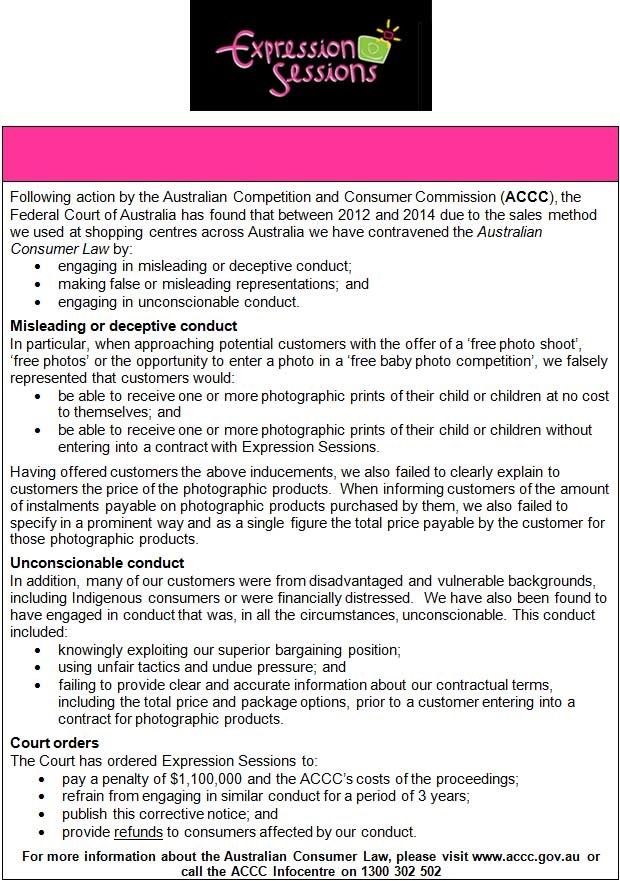 Annexure B
Dear [Customer]
Expression Sessions – Entitlement to refund
Our records say that you bought photos from Expression Sessions between 2012 and 2014.
The Federal Court of Australia has found that Expression Sessions broke the law in the way it sold the photos at that time.
If you have received all of your photos: the Court has ordered Expression Sessions to refund the amounts you paid to us.
If you have not received all of your photos and do not wish to continue to pay: the Court has ordered Expression Sessions to refund the amounts you have paid so far.
Your refund will be paid into the same bank account used to make your last payment to us. If you would like to have your refund paid into a different account, please send your bank details (BSB and account number) to us by no later than [Date of letter +21 days] at:
The Proper Officer
Lifestyle Photographers Pty Ltd
Unit 62, 5 Gladstone Road
Castle Hill NSW 2154
If you wish to continue to pay and to receive the photos that you ordered: please contact Easy Payments to make further arrangements in relation to your order. Their contact details are:
The Proper Officer
Easy Payments
Unit 62, 5 Gladstone Road
Castle Hill NSW 2154
If you have any questions about this, please contact [name] at [number].
Yours sincerely
Expression Sessions
(Lifestyle Photographers Pty Ltd)
Annexure C
Dear [Customer]
Expression Sessions
Our records say that you bought photos from Lifestyle Photographers Pty Ltd trading as Expression Sessions (Expression Sessions) between 2012 and 2014.
The Federal Court of Australia has found that Expression Sessions broke the law in the way it sold the photos at that time.
Our company - Easy Payments - bought the print production business from Expression Sessions on 29 December 2015. If you made payments after that date, the money was sent to Easy Payments.
The Court has ordered that if you do not wish to continue with your order, Easy Payments will refund the amounts you paid to Easy Payments.
If you want a refund and do not want to proceed with your order, you do not have to do anything. Easy Payments will pay back the money you paid to Easy Payments to your bank account on our file by [Date of letter +81 days].
If you want the refund to go to a different bank account, please write and tell us the BSB and account number where you would like the refund paid by [Date of letter + 60 days], failing which the refund will be paid into your bank account held on our file.
If you do want the photos and other products (if any) and you agree to pay Easy Payments what is owing under your Expression Sessions contract then please respond to this letter by no later than [Date of letter +60 days] confirming that you agree to pay the rest of the amount owing in accordance with the existing payment arrangements. Following payment of the full amount owing, Easy Payments will send you your ordered products within 6 weeks.
For payments made before 29 December 2015, you may contact Lifestyle Photographers Pty Ltd to determine whether any refund is available. The contact details for Lifestyle Photographers Pty Ltd are:
The Proper Officer
Lifestyle Photographers Pty Ltd
Unit 62 5 Gladstone Road
Castle Hill NSW 2154
If you have any questions about this, please contact [name] at [number].
Yours sincerely
Easy Payments Pty Ltd
MARKOVIC J:
1 Lifestyle Photographers Pty Ltd trading as Expression Sessions (Expression Sessions), the first respondent, carried on a business across various states and territories in Australia, principally from mobile studios, offering to sell and selling photographic products and packages which incorporated images of children.
2 The Australian Competition and Consumer Commission (ACCC) commenced this proceeding against Expression Sessions seeking relief for contraventions of ss 18, 21, 29(1) and 48 of the Australian Consumer Law (ACL) being Sch 2 to the Competition and Consumer Act 2010 (Cth) (CC Act) when offering to supply and supplying those products during the period January 2012 to the end of 2014 (the Period).
3 Since 25 February 2016 Expression Sessions has been subject to a deed of company arrangement. On 15 December 2015 Expression Sessions filed a defence and shortly thereafter stopped taking an active role in this proceeding. Its solicitors ceased acting for it on 2 February 2016.
4 The second respondent, Easy Payments Pty Ltd (Easy Payments), was joined to the proceeding on 17 March 2016 upon the filing by the ACCC of its amended originating application and its amended statement of claim. Easy Payments has participated in the proceeding and has filed a defence pleading only to the allegations against it.
5 The parties have agreed to consent orders to dispose of the proceeding. In support of those consent orders the parties made some submissions by consent. Having considered the evidence relied on by the ACCC, the submissions made both on a joint basis by the parties and an individual basis by the ACCC and the terms of the consent orders I will make orders in the form proposed by the parties. These are my reasons for doing so.
The ACCC’s Claim
6 The ACCC’s claim is set out in its amended statement of claim. It alleges that during the Period:
(1) Expression Sessions:
(a) operated mobile photo studios across Australia including at 12 particular locations in Queensland, Western Australia, Victoria and the Northern Territory;
(b) employed staff, including photographers, photography assistants and sales consultants, at its mobile studios. It also employed Hussein Chaaban as its Accounting Manager (Aus & NZ). His role included management of all customer accounts and contracts;
(c) promoted its business through its staff and by signage offering inducements to potential customers for the purpose of having the customers’ children or grandchildren participate in a photo shoot. The inducements offered were a free photo shoot, free entry into a photo competition, free photographs and a free keyring (the Inducements);
(d) offered to supply or supplied customers with photographic services and products which incorporated images of the customers’ children including photographic prints; wall posters; canvases; tiles; four and triple split canvases; CDs or discs; and keyrings (Photographic Products); and
(e) predominantly offered the Photographic Products for sale in packages consisting of one or more of the Photographic Products and as part of a customer transaction carried out credit checks using a third party credit reference agency;
(2) in the course of or in relation to customer transactions Expression Sessions, by reason of the conduct of its staff:
(a) offered the Inducements to customers to entice them to have their children participate in a photo shoot but did not tell them that the predominant purpose of the shoot was to sell Photographic Products;
(b) applied pressure to customers by making repeated approaches so that they would agree to have their children participate in a photo shoot, did not make or have available prices of the Photographic Products or packages in its promotional material or on display;
(c) failed to advise customers of the price of its Photographic Products and packages when offering the Inducements or immediately prior to, during or after the photo shoot;
(d) on the day of the photo shoot either arranged a date for the customer to return to the mobile studio for a viewing of the prints taken of the children or had the customer sign a written document to confirm their agreement to purchase Photographic Products and packages prior to the viewing;
(e) at the viewing displayed a number of photographic prints of the customer’s children which was designed to create an emotional attachment to the photographic prints in the customer, create a sense of obligation to purchase the prints and/or make the customer susceptible to undue pressure to buy the prints and other Photographic Products;
(f) applied pressure to the customer at the viewing to enter into a contract to buy photographic products by repeatedly using highly complementary language to describe the photographic prints of the customer’s children; informing the customer that the prints would be destroyed if they were not purchased and/or rushing the customer into making a quick decision about whether to buy the Photographic Products;
(g) only offered to sell the photographic prints as part of a package comprising at least the whole set of those photographic prints;
(h) failed to disclose to the customer that the minimum price of each photographic print was $75; the manner in which the package was priced; the cheapest options in the range of Photographic Products and/or packages that it offered for sale;
(i) failed to give the customer adequate time to read and understand the contract and/or failed to explain the contract to the customer;
(j) failed to explain what Photographic Products and/or packages the customer would be agreeing to purchase by signing the contract;
(k) used unfair tactics and/or withheld information from the customer about the price of the Photographic Products and/or packages that were to be supplied to the customer by writing the price on the contract in a way that was either indecipherable or difficult to read; by representing to the customer that the price was a different amount to that recorded in the contract; by only informing the customer of the instalment amount payable and not disclosing the total price and duration of the contract and/or by explaining the price in a way that was difficult to understand;
(l) failed to disclose the full contract price until after the contract had been signed; and
(m) accepted a guarantee from a third party related to the customer but failed to inform the guarantor of the total amount guaranteed and of the terms and conditions of the guarantee;
(collectively, the Sales Method)
(3) Expression Sessions sold its Photographic Products and packages on terms by which:
(a) there was no cooling off period;
(b) a customer could pay for the products and packages in weekly or fortnightly direct debit payments until the total of the contract price was fully paid;
(c) a customer was supplied with the photographic prints already produced by Expression Sessions on the day he or she signed the contract if the customer passed a third party credit check or, where the customer failed to pass a third party credit check, if another person who provided a guarantee passed such a check and the customer paid a $50 deposit;
(d) if a customer was supplied with photographic prints on the day of signing the contract he or she was not supplied with the other Photographic Products specified in the contract until six weeks after the contract price was fully paid and the customer could not cancel the contract at any time; and
(e) if the customer was not supplied with the photographic prints selected by them on the day they signed the contract the photographic prints and any other Photograph Products specified in the contract were not supplied until six weeks after the contract price was paid in full and the customer could cancel the contract as a lay-by agreement in writing to Expression Sessions’ head office and on payment of a fee of $314;
(collectively, the Sales Terms);
(4) among those to whom Expression Sessions, by its staff, promoted and sold its Photographic Products were customers who they knew or ought to have known from their dealings with them were vulnerable to Expression Sessions’ attempts to sell its Photographic Products to them because they were Aboriginal or Torres Strait Islander, their first language was not English and/or they had low levels of literacy and/or numeracy;
(5) on or about 28 November 2013 Expression Sessions introduced a policy concerning Aboriginal customers in the Northern Territory and the northern part of Western Australia such that those customers could only purchase packages that did not exceed one or more photographic prints plus one only of a canvas, a tile, a split canvas or a poster and could only purchase packages which included more Photographic Products with the approval of Expression Sessions’ head office;
(6) in relation to certain customer transactions, which are further particularised and are the subject of evidence, Expression Sessions by the conduct of Mr Chaaban:
(a) advised or authorised the giving of advice to the customer or his or her agent to the effect that the customer could not cancel a contract because he or she had already received some of the Photographic Products or because he or she had signed a contract;
(b) sent or caused to be sent letters to customers from Expression Sessions or from a debt collection agency acting on its behalf; and/or
(c) made or authorised telephone calls and/or text messages from Expression Sessions demanding payment of debts allegedly owing under the contract entered into by that customer when such amounts were not lawfully payable by the customer under the contract and/or the customer had been subject to some or all of the Sales Method;
(collectively, the Post Contract Conduct)
(7) Expression Sessions, by the conduct of its staff and Mr Chabaan, subjected consumers to the Sales Method and the Post Contract Conduct, as a consequence of which they entered into contracts that contained the Sales Terms:
(a) each staff member and Mr Chaaban engaged in that conduct in trade or commerce in connection with the supply or possible supply of Photographic Products and did so on behalf of Expression Sessions and within the scope of its actual or apparent authority and that conduct, for the purposes of s 139B(2) of the CC Act, is deemed to have also been engaged in by Expression Sessions;
(b) the Photographic Products promoted, supplied and offered for supply by Expression Sessions were goods and/or services of a kind ordinarily acquired for personal, domestic or household use; and
(c) by reason of the matters set out above, Expression Sessions has, in trade or commerce, in connection with the supply or possible supply of the Photographic Products to consumers, engaged in conduct that was unconscionable within the meaning of and in contravention of s 21 of the ACL because it:
(i) knowingly exploited its superior bargaining position relative to its customers in order to induce the customers to enter into contracts to purchase Photographic Products;
(ii) used unfair tactics and undue pressure in seeking to sell the Photographic Products to customers;
(iii) required customers to comply with the Sales Terms which were not reasonably necessary to protect Expression Sessions’ interests;
(iv) did not provide clear and accurate information to its customers about the contract terms, including the price and package options, on which the Photographic Products were supplied; and
(v) made it difficult for customers to understand the contractual terms on which the Photographic Products were supplied.
7 By way of particulars of the alleged unconscionable conduct engaged in by Expression Sessions, the ACCC sets out alleged conduct in relation to particular witnesses referred to as witnesses A, C, D, E, F, G, H, I and J and alleges that, in relation to each set of conduct, Expression Sessions engaged in conduct that was either in breach of ss 18, 21 and 29(1) of the ACL (witnesses A, C, G, H and I) or ss 18, 21 and 48 of the ACL (witness D) or ss 18 and 21 of the ACL (witnesses E, F and J).
8 As against Easy Payments the ACCC alleges that by an agreement dated 29 December 2015 Expression Sessions transferred the benefit and burden of all contracts in existence at that time under which customers purchased Photographic Products from it at mobile studios during the Period to Easy Payments. It further alleges that Easy Payments was on notice of the circumstances under which those contracts were entered into, the matters pleaded as against Expression Sessions and the existence of this proceeding. The ACCC seeks injunctions restraining Easy Payments from enforcing contracts entered into by customers for the purchase of Photographic Products in the Period including the particular contracts entered into by witnesses A and C to J.
The efect of the consent orders
9 The Court’s power to make consent orders is found at r 39.11 of the Federal Court Rules 2011 (Cth). In considering whether to make the proposed consent orders the Court must be satisfied not only that it has the power to make the orders that are proposed but that the orders are otherwise appropriate. In that regard, in Australian Competition and Consumer Commission v Virgin Mobile Australia Pty Ltd (No 2) [2002] FCA 1548 at [2] French J (as his Honour then was) observed that in considering proposed consent orders it was not a function of the Court “to impede settlement between parties legally represented and able to understand and evaluate the desirability of the settlement by refusing to make orders or accept undertakings when they are within the Court’s jurisdiction and are otherwise unobjectionable” and that the Court will not substitute its own view of orders which it would have ordered “if those proffered fall within the range of an appropriate disposition of the case”.
10 Despite the parties having agreed to declarations and orders, including orders for injunctions and a pecuniary penalty, there is no statement of agreed facts. In Thomson Australia Holdings Pty Ltd v Trade Practices Commission (1981) 148 CLR 150 at 164 a majority of the High Court (Gibbs CJ, Stephen, Mason and Wilson JJ) said:
In deciding whether consent orders sought are in conformity with legal principle the Court is entitled to treat the defendants’ consent as involving an admission of all facts necessary or appropriate to the granting of the relief sought.
11 In Australian Competition and Consumer Commission v Francis (2004) 142 FCR 1 at [75] Gray J observed that:
In an ordinary case, the view might be taken that the consent of a party to the orders sought by an opposite party in a proceeding constitutes an admission by the consenting party of all of the elements of each cause of action that would justify each of the orders.
12 His Honour also observed at [76] that where parties are legally represented the Court can be more readily persuaded that orders sought by consent are within the Court’s jurisdiction but that this readiness may be tempered in some cases by a resource imbalance between parties.
13 The ACCC submitted that Expression Sessions’ consent to the making of the declarations of contravention in proposed orders 1 and 2 of the consent orders can only be interpreted as constituting acceptance that the conduct set out in those declarations occurred and that it involved contraventions of the ACL. While I accept that submission, in addition, I note that, having considered the evidence relied on by the ACCC, which was tendered unopposed, I am satisfied that Expression Sessions engaged in conduct which supports the making of those orders. To illustrate that, I set out below a summary of the critical facts.
relevant facts
14 The ACCC relies on the evidence of witnesses A and C to J to establish breaches of ss 18, 21, 29(1) and 48 of the ACL. As noted, I have considered and accept that evidence. I do not propose to set out all of the evidence in full but set out below the evidence of a number of the witnesses which clearly establishes a breach of s 21 of the ACL and support the making of the declarations in orders 1 and 2 and the consequential orders.
15 Witness A is Ms Helen Joan Ryder. Her evidence, contained in an affidavit sworn on 24 February 2016, is that:
(1) she is 27 years old and has two daughters, aged 7 and 3. She finished school at the age of 15 and understands simple spoken English but cannot read or write well;
(2) in about January 2014 Ms Ryder was at Palmerston shopping centre, in Palmerston Darwin, with her two daughters. As she was walking past an Expression Sessions photo booth a woman approached her and asked her if she wished to have photos taken of her children saying that “the first few will be free” and that “you can get some photos for free”. Ms Ryder said that she tried to walk past but the woman got in front of her and she felt harassed;
(3) she told the woman that she was “in a rush to go” and, notwithstanding that, the woman took her daughters and dressed them up and then a second woman took photos of them. Ms Ryder said that the woman who had spoken to her showed her some picture frames that she could put the photos in, how the photos could be put on a canvas and a keyring;
(4) she recalls signing an appointment card, a copy of which is annexed to her affidavit, on an iPad screen. The appointment card has Ms Ryder’s details recorded on it, her children’s names and the time and day for a subsequent appointment, 7 February 2014. Ms Ryder was not told what the form was about at the time she signed it and she was not provided with a copy of it. She thinks she signed the form during the photo shoot. After the photo shoot finished Ms Ryder and her children left. No one told her whether she would have to pay for anything and she believed that the first few photos would be free;
(5) on 7 February 2014 Ms Ryder returned to the shopping centre and to the Expression Sessions mobile studio which was set up in the same area. Upon introducing herself an Expression Sessions staff member took out a folder of photos and put the photos on a stand for her to look at and Ms Ryder picked some photos from those on display. The staff member also offered Ms Ryder a number of different things, including a canvas and the balance of the photos. Ms Ryder told the staff member a couple of times that she could not “afford all of this”;
(6) after she picked the photos the staff member got out a piece of paper, filled out Ms Ryder’s name and address in the top part of the page and asked her if she had a contact number. Ms Ryder provided her mobile phone number. Ms Ryder asked “how much is it” and the answer from the staff member was “$500”. The woman then asked for her bank details and whether she had a debit card and asked how much could be taken out of her account. Ms Ryder told the woman that only $100 could be taken out and, in response to a query as to whether that could be done every week, she said “no, I can’t afford that as I am not getting much from Centrelink”. Ms Ryder and the Expression Sessions staff member agreed a fortnightly deduction of $100. Ms Ryder did not think it would take long to pay $500;
(7) she signed the document after this without anyone reading it to her or explaining it. She was told to sign in a particular part of the document and she said to the Expression Sessions staff member “I am not good at understanding can you please explain the high words?”. The Expression Sessions staff then got Ms Ryder to write an amount in words on the paperwork and, as she could not spell the words, they spelt them out for her. The Expression Sessions staff member said “fifty three hundred and eighteen dollars” and she wrote that out on the contract;
(8) she understood “fifty three hundred and eighteen” written on the document to mean “$530.18” at the time she signed the document and she recalls that when she asked how much it would cost she was told $500 and no one told her that the amount was $5,318 otherwise she would not have signed the contract. A copy of the contract which is annexed to Ms Ryder’s affidavit shows the amount written in numbers as “5318.00” and in handwriting “fifty three hundred and eighteen”;
(9) she was informed that she would get the photos and the canvas once she had paid off the contract and she did not take any photos home on the day even though she was told that the first few would be free. Because she did not take any photos home with her on that day, the terms and conditions of Ms Ryder’s contract meant that she entered into a layby contract. The applicable cancellation fee of $314 for that contract was not explained to her;
(10) if she was told the photos cost $5,318 she would not have agreed to purchase them as she is on a Centrelink disability pension and she could not have afforded to pay that amount;
(11) in March 2014 she was contacted by a man from Expression Sessions who said that she owed money on her account. When she asked how much she was told $5,000. In response Ms Ryder said “that can’t be right I thought it was $500”. Ms Ryder asked the man whether she could cancel the contract and he said that she could not because she had “signed the paper”; and
(12) with the help of Centrelink, Mr Ryder then sought the assistance of Ms Maggie McGowan, a solicitor with the North Australian Aboriginal Justice Agency (NAAJA).
16 Ms McGowan, who affirmed an affidavit on 1 April 2016, contacted Expression Sessions on Ms Ryder’s behalf and dealt with Mr Chabaan who informed her that Ms Ryder had made 5 payments of $106.36 each, being a total of $531.80, and negotiated a refund with Mr Chabaan which she assumed would be for the total amount paid without applying the $314 cancellation fee for a layby contract. Despite a subsequent agreement by Mr Chabaan to cancel Ms Ryder’s contract and refund the full amount paid, as at the date of Ms Ryder swearing her affidavit, she had not yet received a refund of the moneys paid.
17 The witness referred to as witness C is Ms Sandra Charlene Barlow. Her evidence, set out in an affidavit sworn on 9 March 2016, is that:
(1) she is an Aboriginal woman who finished school in year 9;
(2) in about September 2012 she was at Raintree shopping centre in Manunda in Cairns with two of her children aged 9 months and 4 years old at the time. Expression Sessions had a mobile studio set up in the middle of the shopping centre. At the time an Expression Sessions staff member approached her and offered to take photos of her children. She said that the staff member told her that the photos would be taken for free and that there would not be a “sitting fee”. Ms Barlow agreed to the photo shoot. They then took her children and dressed them up in different clothes and took photos of them. During that time no one from Expression Sessions spoke to her;
(3) one of the staff members started to fill out a form and talk to her about the different packages offered by Expression Sessions for sale and said:
There are a few different packages, small, medium and large. One of our packages includes a pack of photos, a glass frame, a keyring and four canvases.
(4) she replied that she would take “the biggest package” and she was then invited to go to the computer and pick the photos she would like on the canvas and tile. Ms Barlow picked out about five photos but was told she could only pick a certain number of photos to go on each canvas. Ms Barlow told them which photos she wanted on the canvas, which she wanted on a glass tile and which she wanted on a keyring. Ms Barlow was then asked to sign a document and for her bank details;
(5) as she did not have her bank account details with her the Expression Sessions staff member called her bank for her without Ms Barlow providing her bank details to the woman. After the Expression Sessions employee first spoke to someone at the bank, the phone was passed to Ms Barlow who asked for her bank account details to provide to Expression Sessions. Upon receiving them, she gave her bank account number to the Expression Sessions employee who wrote it down;
(6) she was told that the photos would “cost $50 a fortnight” by which she understood that she was going to have to pay $50 more than once but she did not know for how long she would need to pay that amount. Ms Barlow says that she was never told how much the package would cost in total and she did not ask how much it would be;
(7) the Expression Sessions employee told her to write her signature, showed her where to sign and then handed her the piece of paper which she signed at the bottom of the page and initialled on another part of the document. At the time of signing, the woman did not explain anything to Ms Barlow and she felt rushed. It seemed to Ms Barlow that the Expression Sessions staff wanted to do everything as quickly as possible;
(8) after signing, the Expression Sessions employee told her to come back a week later to get her photos “from Raintrees” and informed her of a day and time on which to return. Ms Barlow took the form that she had signed with her. That document annexed to Ms Barlow’s affidavit is dated 20 September 2012 and shows a total contract price of over $7,000 with weekly payments of $50 to be made from a nominated bank account;
(9) she only became aware of the total amount of the contract when she showed it to her children’s father. Ms Barlow had not realised that it was for that amount of money, she did not have that amount of money and she realised that $7,000 was a lot of money. Ms Barlow did not listen to her children’s father because she really wanted the photos;
(10) she returned about a week later and found that the Expression Sessions mobile studio was located in a different position. Upon her return she informed the employees at the Expression Sessions mobile studio that she had some photos to collect. A big folder of photos was produced. Ms Barlow was told to pick those she wanted, that she would need to pay $50 to be able to take her photos home that day and that as soon as she paid off “the amount”, the rest of the package would be delivered to her. Ms Barlow says that she took home the folder of photos (this evidence is inconsistent with the terms of Ms Barlow’s contract which does not record that she received any photos);
(11) around November 2014 Ms Barlow moved into emergency housing provided by Shelter Housing Action Cairns (SHAC). At the time she called Expression Sessions to give them her new bank details, as she had changed banks, and her new address. Immediately after that she started getting letters from Expression Sessions, copies of which she no longer has; and
(12) in late 2014 Ms Barlow started getting help from SHAC and, in particular, from Kesaia Vunibokoi, a financial adviser.
18 Ms Vunibokoi, whose evidence is set out in an affidavit sworn 9 March 2016, was Ms Barlow’s case worker who started working with Ms Barlow around December 2014. Ms Vunibokoi found out about Ms Barlow’s payments to Expression Sessions in December 2014 when going through her bank statements. After enquiring of Ms Barlow what the payments to Expression Sessions were for, Ms Vunibokoi:
(1) organised for her and Ms Barlow to contact Expression Sessions on 23 December 2014 and then on 12 January 2015. In those conversations Ms Barlow asked for a copy of her invoice. Following those conversations, on about 20 January 2015, Ms Barlow received a pack of photos, despite no request being made for them;
(2) contacted Expression Sessions on 5 February 2015 with Ms Barlow present. At the time she spoke to Mr Chabaan. Ms Vunibokoi informed Mr Chabaan that Ms Barlow wished to cancel her contract. Mr Chabaan informed Ms Vunibokoi that “she can’t cancel because she signed the contract. Why can’t she pay?”. Ms Vunibokoi then explained why Ms Barlow could not pay the contract and asked why Ms Barlow could not cancel. Mr Chabaan said she could not cancel “because she has signed the contract”. Ms Vunibokoi told Mr Chabaan, upon being informed by him that they had been trying to get money out of her account, that Ms Barlow had changed banks and, upon being asked, would not release her new bank details. Ms Vunibokoi informed Mr Chabaan that in her view the photos were not even worth $1,000, that Ms Barlow was not going to pay and that she would return the photos. Mr Chabaan said that Ms Barlow could not return the photos because “they are copyright”;
(3) tried to get a full copy of the contract signed by Ms Barlow and on 9 February 2015 had a further telephone conversation with Mr Chabaan in which she asked for a complete copy of the contract and asked why he could not cancel the contract. Mr Chabaan said that he could not cancel the contract “because she has received the photos”;
(4) received the missing page of Ms Barlow’s contract on 23 February 2015 and subsequently prepared a letter addressed to Expression Sessions on Ms Barlow’s behalf requesting a detailed statement and that all money, less the termination fee, be refunded to Ms Barlow’s account. Ms Barlow signed that letter on 16 March 2015 and emailed it to Mr Chabaan; and
(5) Mr Chabaan informed Ms Vunibokoi by email on 25 March 2015 that Expression Sessions would not provide a refund because the photos had been received so that Ms Barlow’s contract was no longer a layby contract but that Expression Sessions would be willing to charge a discounted price.
19 Witness D in the amended statement of claim is Nancy Rarrkminy Gondorra. Ms Gondorra gives evidence in an affidavit sworn on 10 February 2016 that:
(1) she is a 50 year old Aboriginal woman who is from and lives in the Galiwinku community, Elcho Island in the Northern Territory. Her first language is Djambarrpuyngu and her affidavit was read to her in Djambarrpuyngu;
(2) she had limited education having attended boarding school from about age 8 to 10 and thereafter attending school from time to time. She has spent most of her life on Elcho Island and is not well acquainted with city life. She reads a bit of English but she does not understand “big words”;
(3) on 28 August 2012, when on holiday in Darwin, she went to Karama shopping centre with her grandchild. An Expression Sessions mobile studio was set up there and a photographer approached Ms Gondorra and asked whether he could take her granddaughter’s photo, to which she agreed. At no time did the man who approached her tell Ms Gondorra that she would have to pay for the photos. Ms Gondorra recalls the man filling out two pieces of paper when she was there and that she signed one of the pieces of paper. She recalls paying $15 for a key ring but she thought that the photos would be free;
(4) about two weeks later Ms Gondorra received a phone call in which she was asked to come and pick up the photos of her grandchild. She returned to the shopping centre on 14 September 2012. When she attended the Expression Sessions mobile studio she was given a piece of paper and asked to sign her name. Ms Gondorra did not understand what was written on the paper which used “big words”. She was told “just sign here so you can pick up your photos”. The man at Expression Sessions briefly explained the paper but she did not understand and the man said “we’ll take it out of your account” and asked for her credit card number which she provided. Ms Gondorra asked how much it would be and recalls that the man said “it’s ok, we will just take it from your account every two weeks” but that he did not tell her the total cost and said, in the context of discussing fortnightly payments, “$50”. A copy of the contract signed by Ms Gondorra is annexed to her affidavit. It discloses a fortnightly payment of $50.20 and a total contract price of $7,932. Ms Gondorra says that if she had been told the total cost of the contract she would have said “no”;
(5) she took home a couple of folders of photos and a keychain and was not told anything about other orders and she did not ask for any extra photos; and
(6) on 1 May 2014 she received a letter from Guardian Credit Services requesting payment of $6,877.40. Ms Gondorra did not know what the letter was about and, upon receiving it, she sought the assistance of Ms McGowan of NAAJA.
20 Ms McGowan gives evidence that:
(1) upon Ms Gondorra contacting her she in turn contacted Mr Chabaan at Expression Sessions to inform him that Ms Gondorra wished to cancel her contract and to obtain a copy of the contract that Ms Gondorra had entered into with Expression Sessions and any other relevant material;
(2) on 7 July 2014 Mr Chabaan informed Ms McGowan by email that Ms Gondorra had paid $1,016 and offered to cancel the additional orders and only charge Ms Gondorra for the 25 photos that she had received, which would require her to pay a further $202;
(3) there was further correspondence between Ms McGowan on behalf of Ms Gondorra and Mr Chabaan and on 19 September 2014 Ms McGowan received a telephone call from Mr Chabaan in which he said that Expression Sessions could not refund the money that Ms Gondorra had paid to date because she had already received 26 photos valued at $1,331 but that Expression Sessions could offer to accept what Ms Gondorra had already paid for the 26 photos and to close the account and cancel it. The offer made by Mr Chabaan was confirmed in an email of the same date; and
(4) she lost contact with Ms Gondorra for a period but located her on 26 May 2015. From her conversations with Ms Gondorra at that time Ms McGowan understood that she had not been refunded any money by Expression Sessions and that position was subsequently confirmed by Ms Gondorra on 10 February 2016 when Ms McGowan again spoke with her.
21 Witnesses E and F are respectively Judith Morgan and Marlon Kelly. Ms Morgan gives evidence in an affidavit affirmed on 1 March 2016 and Mr Kelly gives evidence in an affidavit affirmed on 1 March 2016. Their evidence is that:
(1) Ms Morgan is 21 years old and Mr Kelly, her partner, is 22 years old. They are both Aboriginal. Ms Morgan left school during year 11 and Mr Kelly left school during year 10. Ms Morgan receives a Centrelink benefit;
(2) Ms Morgan and Mr Kelly were shopping at Mildura central shopping centre in July 2013 with their daughter who was about 4 months old at the time. Ms Morgan saw an Expression Sessions mobile photo studio set up at the shopping centre. An Expression Sessions sales person came up to her and Mr Kelly and asked whether they wanted a free photo. Ms Morgan said that the staff member also said “you can enter the photo in a free baby photo contest, you can win something if you enter”. Mr Kelly gives evidence that the staff member said “we can put you in a baby photo contest, your family can win stuff” and that “it is free and your baby will go in a contest”;
(3) Ms Morgan thought that the offer of a free baby photo contest meant that she would look at the photos on a computer and then choose which one would go into the competition, she did not think that she would have to buy any photos. Accordingly, she agreed to have her daughter photographed. Nothing was said to Ms Morgan at any point about having to buy the photos or entering into a contract and nothing was said to her about the price of the photos. She thought that the photos were being taken for the baby competition and that the photos were being taken for free;
(4) the sales person asked Ms Morgan some questions about her contact details and her daughter’s name and then gave her a contact card and asked her to sign. At no time did the Expression Sessions staff explain to Ms Morgan what she was signing. The sales person then gave Ms Morgan an appointment card and told her to come back on the day written on the card “to choose a photo to put into the contest”. A copy of the appointment card is annexed to Ms Morgan’s affidavit. It records Ms Morgan’s name and her daughter’s name and age and that the session was free;
(5) on 8 August 2013 Ms Morgan and Mr Kelly returned to the shopping centre and to the Expression Sessions mobile studio. At that time an Expression Sessions staff member approached them with a folder of photos and spread all the photos on the table. Ms Morgan gives evidence that the woman said to them “just quickly choose one photo that you want to go in the contest” and Mr Kelly gives evidence that she said “which one do you want to go in the competition? If you win you can win all kinds of things for your baby”. Both Ms Morgan and Mr Kelly felt a bit rushed by the sales person. Ms Morgan chose a photo and was told that her name and her daughter’s name would be placed in the competition but was not provided with any further information about it;
(6) Ms Morgan was concerned about what would happen to the photos and made an enquiry of the Expression Sessions sales person who told her that she could buy them and that if she did not then “we’ll chuck them away”. Ms Morgan thought they were good photos and she did not want them to be thrown away so she told the sales person that she would buy them. She asked if she could just have the photos but the sales person said “no, you’ve got to get them in a package”. Ms Morgan says that there was a display and that there were a few packages on offer but there were no prices displayed. The Expression Sessions sales person told Ms Morgan and Mr Kelly what was in the packages but did not tell them how much they were;
(7) Ms Morgan and Mr Kelly chose a package. They were not made aware of the price of the package before or at the time they chose it. Another Expression Sessions staff member undertook a credit check of Ms Morgan and she was informed that she did not pass. Ms Morgan gives evidence that the same employee who had done her credit check then asked Mr Kelly “what is your name and address” and that Mr Kelly responded. Ms Morgan gives evidence that after typing into his laptop that same sales person said to Mr Kelly “ok, you can do it”;
(8) Ms Morgan said that the female sales person asked her if she wanted to take the photos home with her and that she said that if she paid a $50 deposit she could do so. Ms Morgan agreed to that. Ms Morgan said that while she was talking to the woman, Mr Kelly was talking to the other sales person;
(9) Ms Morgan remembers signing something on the day but she was not given a chance to read what she signed because she felt that she was being rushed and that she could only have a quick glance. Ms Morgan could also remember giving the woman her bank account details and her photo identification. Ms Morgan saw the male sales person give Mr Kelly a different piece of paper to sign and, while Mr Kelly was signing the paper, the female sales person said to her “the total price was $3,978”;
(10) Ms Morgan says that the paperwork took a short amount of time to complete and that she was not really thinking because there were so many people around. She recalls thinking that $3,978 was too much but she wanted the photos and did not want them to be thrown out. Ms Morgan can also recall that either the female or male sales person told her something about taking money out of her account but she cannot recall exactly what was said. Ms Morgan says this was the only thing that either one of them explained to her on the paper that she signed;
(11) Ms Morgan says that the woman then gave her and Mr Kelly a folder with the photos and that she folded up the paper and put it inside with the photos but that she did not read it. However, when she got home Ms Morgan showed her mother-in-law the paper and her mother-in-law was concerned at the amount;
(12) Mr Kelly said that he was asked to sign a paper but was not told why. He was not shown the contract signed by Ms Morgan and he did not know that he signed a document that was a guarantee;
(13) in late 2013, Ms Morgan and Mr Kelly were assisted by a lawyer from Legal Aid NSW. It was the Legal Aid lawyer who explained what a guarantor was to Mr Kelly;
(14) on about 18 December 2013 Ms Morgan cancelled her credit card so that Expression Sessions could not continue to take payments out. Expression Sessions then sent her letters and text messages but the letters stopped coming after she told the Legal Aid lawyer about them.
22 The ACCC also relies on an affidavit affirmed by Ms Eloise Chevalier on 24 March 2016. Ms Chevalier was in Australia from November 2014 on a working holiday visa. She worked for Expression Sessions as a photographer from November 2014 until January 2015. During that time she worked in shopping centres in Cairns, Gladstone, Dalby and Hervey Bay in Queensland, spending 1 to 2 weeks at each location. Ms Chevalier gives evidence that:
(1) she was not a professional photographer. She did not receive any formal training from Expression Sessions but when she first started spent about 1 to 2 hours with her manager, the only person with whom she worked who had any experience with taking photos outside working for Expression Sessions, who gave her information about using the camera and how to use light and who provided her with some information on how to take photos. In relation to customers the manager told her “make sure you do not tell them the price”;
(2) her role as a photographer required her to approach customers to offer them a free photo shoot and then to take the photos if they agreed. At the end of the session Ms Chevalier says she would take down the customer’s details and give them an appointment card with a time and date to come back and look at their photos. The return visit would usually occur at the end of the month. Ms Chevalier was not involved in selling packages to customers as when they came back for their appointment to buy the photos she had always moved on to another location. She sold keyrings and magnets to customers at the time of the photo sessions. She did not tell customers that by having a free photo session they were not obliged to purchase the photographs when they came back and she was not told to tell customers this by anyone at Expression Sessions;
(3) on her first day at Expression Sessions at a shopping centre at Mount Sheridan, her manager said “when you have a photo session and then make an appointment for the customer, if they ask the price, don’t tell them. Say ‘we don’t know what the price is’”. Ms Chevalier said that Zelda Baravykas from Expression Sessions, who had called her to offer her the job, also told her something similar a number of times in messages on the work iPad;
(4) there were signs at each studio that said “free session” which were on a small blackboard set up at the front of the studio;
(5) when she approached customers she regularly said what she was told including: “The session is free. The photos don’t cost very much. Your child is so cute you should have some photos taken”;
(6) she always walked out to customers in the shopping centre to ask them to have a photo session and never waited for them to come to her. She was told to do this by her manager and other people. There was a camera in the studio through which she understood Ms Baravykas would watch them. On one occasion Ms Baravykas sent her a message on the iPad that said “I saw someone with kids walk past and you didn’t ask them if they wanted photos done”;
(7) Expression Sessions did not tell her how much the photos cost. She did not have a price list to look at or to show customers and she did not see a price list the entire time she worked for Expression Sessions. If a customer asked how much a photograph was she would say, as instructed by her manager, “I am just a photographer, you will need to speak with our commercial team to find that out”; and
(8) Ms Baravykas was in contact with the team every day. She was given an iPad on which Ms Baravykas would message her throughout the day. Ms Baravykas gave the team targets to meet each day and each employee was required to complete five photo shoots per day and to send her information about the number of sessions that had been completed at the end of each day as well as the customers’ details. If they did not meet their targets Ms Baravykas would say “if you don’t meet the targets you will have no job and no money”. Ms Baravykas applied a lot of pressure to the employees and threatened them regularly, harassing them to meet their targets.
Declarations: Proposed Orders 1 and 2
23 By proposed orders 1 and 2 the parties ask the Court to make declarations that Expression Sessions engaged in conduct that was unconscionable within the meaning of s 21 of the ACL.
24 The Court has, by reason of s 21 of the Federal Court of Australia Act 1976 (Cth) (Federal Court Act), a wide discretionary power to make declarations. In Australian Competition and Consumer Commission v Dimmeys Stores Pty Ltd [2011] FCA 372 (ACCC v Dimmeys) at [12] Gordon J, applying Forster v Jododex Australia Pty Ltd (1972) 127 CLR 421 at 437-438, observed that:
The pre-requisites to the making of a declaration are threefold: (1) the question must be real and not a hypothetical or theoretical one, (2) the applicant must have a real interest in raising it and (3) there must be a proper contradictor.
25 I am satisfied that those pre-requisites are met here. First, the conduct which is the subject of the declarations occurred over a period of two years and is of a nature that gives rise to consequences under the CC Act. Secondly, the ACCC, whose function it is to investigate and prosecute contraventions of the ACL, has a clear interest in seeking the declarations which define the scope of the contravening conduct. There is also a public benefit in having the contravening conduct clearly defined. Thirdly, Expression Sessions and Easy Payments, having agreed to orders insofar as they affect them, are each proper contradictors to the claims against them.
26 There are further reasons to make the declarations sought in this case. Applying the reasoning set out in Australian Competition and Consumer Commission v The Construction, Forestry, Mining and Energy Union (2007) ATPR 42-140; [2006] FCA 1730 at [6] (Nicholson J), they:
(1) are an appropriate vehicle to record the Court’s disapproval of the contravening conduct;
(2) serve to vindicate the ACCC’s claim that Expression Sessions contravened the ACL;
(3) are of some assistance to the ACCC in carrying out the functions and duties conferred on it in the future;
(4) inform consumers of the contravening conduct; and
(5) act as a deterrent to other corporations from contravening the ACL.
Injunctions: Proposed Orders 4 and 5
27 The parties seek injunctions on agreed terms. Their effect is to restrain Expression Sessions for three years:
(1) when engaging with a person for the purpose of negotiating a photo shoot of that person’s child or children, from continuing to negotiate unless it has disclosed that the predominant purpose of the photo shoot is to sell Photographic Products; and
(2) when entering into a negotiation or dealing directed towards making an agreement that includes a term or has the effect of permitting Expression Sessions to direct debit payments from the person’s bank account, from continuing to negotiate or deal with the person and present documents for signature unless the terms of the agreement have been explained, including total price, and Expression Sessions is of the view the person has understood the terms and the agreement given to the person prior to signing is clear in its effect and operation.
28 Section 232 of the ACL gives the Court a broad power to grant injunctive relief. It relevantly provides:
232 Injunctions
(1) A court may grant an injunction, in such terms as the court considers appropriate, if the court is satisfied that a person has engaged, or is proposing to engage, in conduct that constitutes or would constitute:
(a) a contravention of a provision of Chapter 2, 3 or 4; or
(b) attempting to contravene such a provision;
…
29 Section 233 of the ACL permits the Court, if it considers it appropriate to do so, to grant an injunction by consent of all the parties to the proceeding whether or not it is satisfied as required by s 232(1).
30 In ACCC v Dimmeys Gordon J observed at [16]:
Section 232 of the Australian Consumer Law is relevantly identical to s 80 of the TPA. The power of the Court to grant an injunction under s 232 is broad. It is, however, subject to at least three limitations:
1. the power is confined by reference to the scope and purpose of the Act. The relief should be designed to prevent a repetition of the conduct for which the relief is sought;
2. because the jurisdiction to grant an injunction is enlivened by an alleged or actual contravention of Pt V of the TPA, there must be a sufficient nexus or relationship between the contravention and the injunction; and
3. the Federal Court exercises judicial power under Ch III of the Constitution in respect of “matters” and therefore the injunction must relate to the case or controversy,
see Australian Competition and Consumer Commission v Z-Tek Computers Pty Ltd (1997) 78 FCR 197 at 203-4.
31 I accept the joint submission of the parties that the injunctions are appropriate because they will prevent repetition of key aspects of Expression Sessions’ contravening conduct as set out in the declarations, they are directed towards the conduct that is the subject of the claim and they are for a defined period of three years.
32 Expression Sessions is subject to a deed of company arrangement. There is a possibility that it will resume trading given that the deed is in force for a limited and defined period. That being so there is utility in the injunctions as at that point, namely upon resumption of trading, its operation would be properly constrained by their terms.
Non-Party Consumer Redress Orders: Proposed Orders 3, 8 and 9
33 Section 239 of the ACL relevantly provides:
239 Orders to redress etc. loss or damage suffered by non‑party consumers
(1) If:
(a) a person:
(i) engaged in conduct (the contravening conduct) in contravention of a provision of Chapter 2, Part 3‑1, Division 2, 3 or 4 of Part 3‑2 or Chapter 4; or
(ii) is a party to a consumer contract who is advantaged by a term (the declared term) of the contract in relation to which a court has made a declaration under section 250; and
(b) the contravening conduct or declared term caused, or is likely to cause, a class of persons to suffer loss or damage; and
(c) the class includes persons who are non‑party consumers in relation to the contravening conduct or declared term;
a court may, on the application of the regulator, make such order or orders (other than an award of damages) as the court thinks appropriate against a person referred to in subsection (2) of this section.
(2) An order under subsection (1) may be made against:
(a) if subsection (1)(a)(i) applies—the person who engaged in the contravening conduct, or a person involved in that conduct; or
(b) if subsection (1)(a)(ii) applies—a party to the contract who is advantaged by the declared term.
(3) The order must be an order that the court considers will:
(a) redress, in whole or in part, the loss or damage suffered by the non‑party consumers in relation to the contravening conduct or declared term; or
(b) prevent or reduce the loss or damage suffered, or likely to be suffered, by the non‑party consumers in relation to the contravening conduct or declared term.
34 Section 240(1) of the ACL provides that in determining whether to make an order under s 239(1) the Court may have regard to the conduct of the person against whom the order is to be made and of the non-party consumers in relation to the contravening conduct, since the contravention occurred. The Court does not need to make any finding about which persons are non-party consumers or the nature of their loss or damage: s 240(3). Further, s 241 provides that a non-party consumer who accepts the redress is bound by that order and gives up the right to make any other claim in relation to the conduct.
35 Section 243 of the ACL sets out the types of orders that can be made under s 239(1) including:
Without limiting section 237(1), 238(1) or 239(1), the orders that a court may make under any of those sections against a person (the respondent) include all or any of the following:
(a) an order declaring the whole or any part of a contract made between the respondent and a person (the injured person) who suffered, or is likely to suffer, the loss or damage referred to in that section, or of a collateral arrangement relating to such a contract:
(i) to be void; and
(ii) if the court thinks fit—to have been void ab initio or void at all times on and after such date as is specified in the order (which may be a date that is before the date on which the order is made);
…
(d) an order directing the respondent to refund money or return property to the injured person;
36 By proposed order 3 the parties seek an order that the contracts made between Expression Sessions and customers who purchased Photographic Products during the Period are void ab initio and by proposed order 8 they seek an order that Expression Sessions undergo a process to refund moneys paid by customers who purchased Photographic Products during the Period.
37 In Australian Competition and Consumer Commission v Clinica Internationale Pty Ltd (No2) [2016] FCA 62, Mortimer J said the following at [293] about the power conferred by s 239 of the ACL:
Section 239 is a remedial power. It is designed to allow the Court to undo damage to third parties caused by contravening conduct. The manner in which damage caused might need to be undone will inevitably need to be tailored to the circumstances of the contravening conduct, to the loss or damage suffered, and to the circumstances of the contravener and those involved in the contravention. There are no boundaries drawn in express terms in the way the power is conferred. The terms of s 243 provide examples of the way power might be exercised but should not be construed as confining s 239: Acts Interpretation Act 1901 (Cth), s 15AD. Rather, the use of the standard of appropriateness is a clear indicator that the legislature intends the Court to be able to fashion orders to suit the circumstances of a given case. It is precisely the kind of power where what is important is to look at the “reality” of the financial circumstances of the contraveners, and those involved in the contravention.
38 The making of orders under s 239 for the benefit of third parties is neither novel nor uncommon. The parties have modelled proposed orders 3 and 8 on the orders made by the Court in Australian Competition and Consumer Commission v Yellow Page Marketing BV (No 2) (2011) 195 FCR 1. In that case the Court made orders voiding contracts between the respondents and customers and requiring the respondents to refund moneys to customers which had been paid in reliance on misleading statements that the respondents were affiliated with Telstra. There the Court fashioned an opt-in procedure, allowing customers to confirm contracts if they wished. Those contracts which were not confirmed by a specified time were declared to be void ab initio and were thus subject to the refund procedure.
39 Insofar as this matter is concerned I am satisfied that Expression Sessions’ consent to the making of the proposed orders can be taken as an admission by it of the factual elements in s 239(1)(a)(i), (b) and (c): see paragraphs [10] to [13] above. In any event I am satisfied that the facts establish that Expression Sessions has engaged in conduct in contravention of a provision of Ch 2 of the ACL.
40 Notwithstanding that there is evidence that some of the customers who are witnesses in this proceeding were able to negotiate the cancellation of their contracts, I accept the submission that their experiences indicate that consumers suffered loss or damage by entering into contracts with Expression Sessions. The loss or damage suffered is the moneys paid pursuant to the contracts entered into by consumers. This was occasioned by the unconscionable conduct of Expression Sessions which employed unfair sales practices to procure the entry into of the contracts by the customers and/or misled customers about the price of the product being acquired.
41 Many of the consumers will have received some of the products which they contracted to purchase. The ACCC and Easy Payments submitted that, notwithstanding that fact, proposed orders 3 and 8 are appropriate given that, in contrast to s 236 of the ACL, there is no requirement in s 239 that the consumer be placed as far as possible in a position in which he or she would have been in but for the contravention. Rather the purpose of s 239 is to make an order that is appropriate in the circumstances. I accept that submission. Further, a requirement that consumers return a collection of photos with which they may have been supplied some years ago in order to be eligible for a refund would place a burden on the consumers and Expression Sessions alike and would lead to the return of products which, given their nature, would be of no real value to Expression Sessions.
42 In my opinion orders 3 and 8 meet the object of redressing the loss or damage suffered by non-party consumers and are appropriate for disposition of the case. Order 9 is consequential on the relief granted by order 8. It requires Easy Payments to provide evidence of its compliance with order 8 to the ACCC. It will permit the ACCC to monitor compliance with order 8. It is consented to by Expression Sessions and is appropriate to be made.
Consequential Relief Against Easy Payments – Proposed Orders 12 to 19
43 The consequential relief sought against Easy Payments falls into two categories:
(1) injunctive relief restraining Easy Payments from enforcing the contracts entered into by witnesses A and C to J as defined in the amended statement of claim and restraining Easy Payments from enforcing any contract unless the customer has indicated his or her consent to continue the contract (proposed orders 12 and 16); and
(2) consequential orders setting out a mechanism by which refunds can be provided to those customers who do not confirm their contracts and providing a process for Easy Payments to report to the ACCC on the steps taken by it pursuant to the orders (proposed orders 13 to 15 and 17 to 19).
44 The contracts were assigned to Easy Payments. By proposed order 3, when made, the contracts will be declared void ab initio such that Easy Payments will not have acquired any rights against customers under those contracts and will have no entitlement to enforce them.
45 The Court’s jurisdiction to grant the injunctions envisaged by proposed orders 12 and 16 is conferred by s 39B(1A) of the Judiciary Act 1903 (Cth) (Judiciary Act). In Commonwealth v Westwood (2007) 163 FCR 71 at [52] Sackville J held that the expression “The Commonwealth” as used in s 39B(1A)(a) of the Judiciary Act is not to be construed narrowly and included statutory corporations but was not limited to those entities noting that in Commonwealth v Lyon (2003) 133 FCR 265 a Full Court of this Court had considered it likely that the Commissioner of the Australian Federal Police was to be regarded as the Commonwealth for the purpose of the section. Applying that reasoning, the ACCC would also be the Commonwealth for the purpose of s 39B(1A)(a) of the Judiciary Act.
46 In the alternative, the claim for injunctive relief against Easy Payments would be within the Court’s accrued jurisdiction as part of the controversy arising from Expression Sessions’ conduct and the relief sought can be granted under ss 22 and 23 of the Federal Court Act. The fact that the claim is against another party does not prevent it being part of the same matter: see Re Wakim; Ex Parte McNally (1999) 198 CLR 511 at 583-588, [134]-[147]. The relief sought against Expression Sessions is within the ACL and the relief sought against Easy Payments is consequential upon a declaration that the contracts between Expression Sessions and the consumers are to be declared void ab initio as a result of that conduct.
47 An aspect of this consequential relief is that the ACCC seeks orders that Easy Payments refund the amounts received by it pursuant to the contracts assigned to it but which will be declared void ab initio. It is not controversial that, having been declared void ab initio, any payments made pursuant to those contracts were not required to be made. Those payments were made under a mistake of law and are recoverable as moneys had and received: see Equuscorp Pty Ltd v Haxton (2012) 246 CLR 498 at [30]. The consumers who are parties to the contracts would have a claim for restitution. If they each pursued such a claim there would be a multiplicity of actions.
48 The ACCC seeks relief in the form of a mandatory injunction requiring Easy Payments to refund the moneys paid under the contracts. Such relief would avoid the multiplicity of actions that might otherwise occur and achieve the same purpose. In those circumstances, it is appropriate to grant the relief sought in proposed orders 13 to 15 and 17 to 19. The relief sought in those proposed orders is within the Court’s jurisdiction either under s 39B(1A)(a) of the Judiciary Act or in the Court’s accrued jurisdiction.
Penalty: Proposed Order 6
49 By proposed order 6, Expression Sessions and the ACCC have agreed to a pecuniary penalty payable by Expression Sessions of $1.1 million.
50 Section 224 of the ACL empowers the Court to order a person to pay a pecuniary penalty in respect of each act or omission where it is satisfied that a person has contravened, has been knowingly concerned in or party to a contravention of a provision of Pt 2-2 of the ACL, which includes s 21 of the ACL. The maximum penalty payable by a body corporate under s 224(1) for breach of a provision of Pt 2-2 is $1.1 million.
51 Section 224(2) provides that in determining the appropriate pecuniary penalty the Court must have regard to all relevant matters including:
(1) the nature and extent of the act or omission and of any loss or damage suffered as a result of the act or omission; and
(2) the circumstances in which the act or omission took place; and
(3) whether the person has previously been found by a court in proceedings under Ch 4 or Pt 5-2 of the ACL to have engaged in any similar conduct.
52 In Australian Competition and Consumer Commission v Singtel Optus (No 4) (2011) 282 ALR 246; [2011] FCA 761 (ACCC v Singtel) at [11] Perram J, in considering the predecessor section to s 224, s 76 of the Trade Practices Act 1974 (Cth), set out a summary of additional factors to be taken into account which considers the imposition of a penalty as follows:
The requirements of s 76E(2) are, however, inclusive; other matters thought relevant may also be taken into account. Several decisions in this court have confirmed that the principles relevant to the imposition of a civil penalty under the former s 76 (which dealt with the civil penalties to be imposed in the case of breaches of Pt IV) are applicable in principle to s 76E: Australian Competition and Consumer Commission v Global One Mobile Entertainment Ltd [2011] FCA 393 at [110]–[112] (Global One Mobile Entertainment) per Bennett J; Australian Competition and Consumer Commission v Gourmet Goody’s Family Restaurant Pty Ltd [2010] FCA 1216 at [6] per Jagot J; and my own decision in MSY Technology (No 2) at [68]–[69]. Those principles, which derive from several decisions concerned with penalties in the context of Pt IV, suggest that relevant non-mandatory factors under s 76E will include:
(1) The size of the contravening company.
(2) The deliberateness of the contravention and the period over which it extended.
(3) Whether the contravention arose out of the conduct of senior management of the contravener or at some lower level.
(4) Whether the contravener has a corporate culture conducive to compliance with the Act (or the new Australian Competition and Consumer Law) as evidenced by educational programmes and disciplinary or other corrective measures in response to an acknowledged contravention.
(5) Whether the contravener has shown a disposition to cooperate with the authorities responsible for the enforcement of the Act in relation to the contravention.
(6) Whether the contravener has engaged in similar conduct in the past.
(7) The financial position of the contravener.
(8) Whether the contravening conduct was systematic, deliberate or covert.
53 The principle objective of a penalty in the context of consumer protection legislation is deterrence: Australian Competition and Consumer Commission v TPG Internet Pty Ltd (2013) 250 CLR 640 at [65]-[66]. The fact that the penalty may not be recoverable, given that Expression Sessions has been in administration and is subject to a deed of company arrangement, is not a reason not to impose a penalty in the amount agreed or at all. In Australian Competition and Consumer Commission v ACN 135 183 372 (in liquidation) (formerly known as Energy Watch Pty Ltd) [2012] FCA 749 at [19]-[20] Marshall J said:
19 The Court observes that Energy Watch was a medium sized company which earned large cash flows during the currency of its advertising campaign. In the year ending 30 June 2011, Energy Watch made close to $12 million in income before expenses. In the year ending 30 June 2012, its income before expenses exceeded $14 million. Why it is now in liquidation with debts of about $8 million is not explained by any evidence before the Court. … Further, the Court should not be deterred from imposing the appropriate penalty by the fact of Energy Watch’s liquidation. Otherwise, insufficient attention will be paid to the very important consideration of general deterrence.
20 As the Full Court said in Australian Competition and Consumer Commission v Dataline.Net.Au Pty Ltd (2007) 161 FCR 513 at [21]:
…there will be cases where other factors make it clearly desirable to impose a penalty on a company even though it is in liquidation.
This is such a case. It does not matter that the $1.95 million penalty which the Court will impose on Energy Watch will never be paid. The penalty will serve as a warning to all business people who engage in energy brokering services, not to replicate the conduct recorded in the declarations.
54 This is a case which involves multiple contraventions. Based on the evidence nine cases of contravention have been proved each involving a transaction which was unconscionable. The ACCC submitted that the nine cases of contravention also evidenced a pattern of behaviour which is itself a contravention of s 21 of the ACL and that, while each individual case would or could be characterised as an act or omission attracting a penalty under s 224 of the ACL, to approach the matter that way would fail to take account of the pattern of behaviour and its effect on the class of consumers that entered into contracts with Expression Sessions in the Period. The ACCC submitted that the appropriate approach is for the Court to determine penalty assisted by an understanding that the pattern of behaviour contains within it, potentially, a very large number of acts or omissions which would give rise to a significant number of contraventions. The ACCC further contended that an aggregate penalty can be imposed for that course of conduct and all of the contraventions included in it but that this ought not mean treating the whole course of conduct as one contravention for assessment purposes.
55 In Australian Competition and Consumer Commission v EDirect Pty Ltd (in liq) (2012) 206 FCR 160 at [74(10)] Reeves J referred to the maximum penalty for each contravention, $1.1 million, the fact that he had found at least 438 contraventions over a period of approximately five months and continued:
However, I consider all of these contraventions were part and parcel of the one course of conduct and, in relation to each customer, the breach of each section (ss 53 and 58) occurred almost concurrently. That is, the false or misleading representations under s 53(c) and the acceptance of payments for the non-existent services under s 58, occurred at about the same time and during the same five months period. For these reasons, I consider I should impose one aggregate penalty for the whole course of conduct and all the contraventions of both sections. This does not, of course, mean that the aggregate penalty for all the contraventions in this one course of conduct is limited to the maximum penalty that could be imposed for one contravention, viz $1.1 million.
56 In this case I accept that, based on the evidence, there has been a pattern of behaviour evidencing a course of conduct by Expression Sessions. Although there is no evidence before me of how many potential breaches there may have been based on the number of contracts entered into over the Period, I would infer, given the evidence before me and the nature of and way in which Expression Sessions operated its business, that there were numerous breaches. The ACCC submitted that the Court is not limited to $1.1 million as the maximum penalty for the entire course of conduct, a submission which I accept. On the other hand the Court must take care not to impose multiple penalties for essentially the same contravention: Construction, Forestry, Mining and Energy Union v Cahill (2010) 269 ALR 1 at [39]; [2010] FCAFC 39.
57 As I have observed, in determining the appropriate penalty, the Court must have regard to the matters set out in s 224(2) of the ACL. In that regard, I note the following in relation to Expression Sessions:
(1) the acts and omissions by Expression Sessions the subject of the claim against it were serious and numerous:
(a) they included unfair sales tactics, failure to properly disclose price information and preventing consumers from exercising their rights to cancel a contract;
(b) the behaviour and the use of unfair sales tactics was intentional and deliberate;
(c) the acts or omissions occurred at different times over the Period and at different locations;
(d) the acts or omissions arose out of an intentional exploitation of characteristics of consumers, namely as parents or grandparents;
(e) the non disclosure of price information at the time of the photo shoot was devised and directed by senior management;
(f) the acts and omissions and the contravening conduct was characteristic of the way in which Expression Sessions interacted with its customers. It was, in effect, systemic; and
(g) while some of the witnesses on which the ACCC relies were able to arrange refunds or cancellation of their contracts, I accept the ACCC’s submission that their experiences indicate that consumers have suffered loss by paying moneys under the contracts which were substantial amounts, given the characteristics of the people entering into the contracts;
(2) during the Period in which the contraventions occurred Expression Sessions was a substantial enterprise with an annual turnover of between $4.69 million and $5.57 million and between 21 and 26 employees. Its operations were structured so that systems could have been put in place to achieve compliance with the ACL but this was not done; and
(3) it has not previously been found by a court to have contravened the ACL or to have engaged in any similar conduct.
58 In terms of additional matters which may be taken into account I note that Expression Sessions did show a disposition to cooperate with the ACCC. During its investigation and until the date of commencement of this proceeding, it provided the ACCC with an undertaking that it would not continue to pursue debts of consumers in selected locations across Australia. Thereafter, at the first return date of the proceeding, Expression Sessions provided an undertaking to the Court to take steps prior to entering into a contract with a consumer to ensure that the consumer understood what he or she was agreeing to.
59 On the other hand, Expression Sessions filed a defence denying all contraventions of the ACL and thus requiring the ACCC to prove its case against it. It ceased actively participating in the proceeding in December 2015 and its solicitors ceased acting for it at the commencement of February 2016. It was only immediately prior to the hearing that Expression Sessions resumed communication with the ACCC, by which time significant public resources had been expended. It agreed to the consent orders during the hearing of the proceeding.
60 In all of the circumstances, and having regard to the matters set out above, in my opinion the penalty agreed between the parties of $1.1 million represents an appropriate penalty. Contraventions which have been found against Expression Sessions ought not be viewed as a single act or omission. I accept that they involve a system of conduct in respect of a number of consumers and potentially numerous individual consumers. I will make an order in the terms of proposed order 6.
Non PUNITIVE orders: proposed orders 7 and 10
61 Expression Sessions and the ACCC have consented to an order requiring Expression Sessions to have the notice set out in annexure A to the proposed consent orders published on the websites referred to in that order. The parties have also agreed that a copy of the reasons for judgment together with the Court’s orders be retained in the Court for the purposes of s 137H of the CC Act. Both of these orders are appropriate in the circumstances of this case. The former order will provide information to consumers and the latter order will assist consumers who do not accept the orders made by way of non party redress and would prefer to bring their own claims.
costs: PROPOSED orders 11 and 20
62 The parties have agreed to costs orders which I shall make and which are in the following terms:
(1) Expression Sessions has agreed to pay the ACCC’s costs of the proceeding; and
(2) Easy Payments and the ACCC have agreed that there should be no order as to costs as against Easy Payments.
disposition
63 I will make orders accordingly.
I certify that the preceding sixty-three (63) numbered paragraphs are a true copy of the Reasons for Judgment herein of the Honourable Justice Markovic. |
Associate:


