FEDERAL COURT OF AUSTRALIA
Basetec Services Pty Ltd v Leighton Contractors Pty Ltd (No 6) [2016] FCA 1534
ORDERS
DATE OF ORDER: |
THE COURT ORDERS THAT:
1. Leighton is granted leave to file a Second Further Amended Defence in terms of the document provided to the Court on 10 March 2016.
2. Basetec’s application to amend paragraph 197 of its Further Amended Statement of Claim be refused.
3. The parties be heard as to the form of the orders, interest, GST and costs on 20 December 2016 at a time to be fixed.
Note: Entry of orders is dealt with in Rule 39.32 of the Federal Court Rules 2011.
BESANKO J:
[1] | |
[8] | |
[11] | |
[20] | |
[21] | |
[36] | |
[48] | |
[49] | |
[86] | |
[88] | |
[101] | |
[315] | |
[334] | |
The Cause of Action based on Misleading or Deceptive Conduct | [351] |
The Cause of Action based on Inducing or Procuring a Breach of Contract | [406] |
[461] | |
[461] | |
The Amount Claimed for the Original Scope of Works for Condabri | [469] |
[478] | |
[480] | |
[494] | |
[521] | |
[539] | |
[550] | |
[550] | |
[567] | |
[589] | |
[603] | |
[609] | |
[612] | |
[615] | |
[621] | |
[622] | |
Defective GRP Pipe and Fittings and the Cost of Additional Site Jointing | [649] |
[686] | |
Appendix A | |
Appendix B | |
Appendix C | |
Appendix D |
1 This proceeding involves claims by Basetec Services Pty Ltd (“Basetec”) against Leighton Contractors Pty Limited (“Leighton”) arising out of the supply by Basetec to Leighton of Glass Reinforced Plastic (“GRP”) pipe and fittings, and the performance by Basetec of associated site installation work in central Queensland. The principal events with which this proceeding is concerned occurred between approximately September 2012 and May 2013.
2 On 9 May 2012, Leighton entered into a contract with Australia Pacific LNG Pty Limited (“APLNG”) to construct Water Treatment Facilities in the vicinity of Condabri and Reedy Creek in Queensland. I will refer to the work Leighton was required to perform as the “Project”, and the contract under which it was to perform it as the “Head Contract”. The Water Treatment Facilities treat brine produced in the extraction of coal seam gas and convert it to water that may be used for irrigation and injection into underground aquifers.
3 There was a need for Leighton to arrange a contractor to supply the GRP interconnecting pipe and fittings to be used in the Water Treatment Facilities at both Condabri and Reedy Creek. The Water Treatment Facilities, or at least the GRP interconnecting pipe and fittings, at Condabri and Reedy Creek were identical or virtually identical. Leighton entered into a Works Contract with Basetec for the supply of GRP interconnecting pipe and fittings and, on Basetec’s case, associated site installation work, in relation to both Condabri and Reedy Creek.
4 Basetec does not manufacture the GRP pipe and fittings itself. It arranges for that to be done by a company in Malaysia called Hexagon. Basetec aligned itself with Hexagon, then operating under a different name, in 2005, and by 2007, it had agreed that it would (to use the words of Basetec’s principal witness, Mr Paul Figallo) “partner with” Hexagon and Hexagon would manufacture all GRP equipment required by Basetec. Basetec would import the GRP pipe and fittings into Australia where it would be spooled, joined, assembled and installed. There is another supplier of GRP pipe and fittings in Australia called RPC Technologies Pty Ltd (“RPC”) and it is a manufacturer of GRP pipe and fittings. It has manufacturing facilities in Geelong, Victoria and in Broadmeadows which is near Newcastle, New South Wales. I will refer to the second facility as the Newcastle facility. It also has an overseas manufacturing facility in Batam, Indonesia. In circumstances which will require close analysis, RPC came to manufacture GRP pipe and fittings for Basetec to supply to Leighton under the Works Contract. On 20 May 2013, the GRP interconnecting pipe and fittings for Condabri were complete or almost complete. On that day, Leighton terminated the Works Contract with Basetec “for convenience”. A short time after it did that, it engaged RPC to supply the GRP interconnecting pipe and fittings it had manufactured for Condabri, to carry out site works and to carry out equivalent works for Reedy Creek.
5 Basetec relies on three causes of action in its claim against Leighton. First, it makes a claim in contract against Leighton and its claim comprises compensation for the original scope of works for Condabri, site installation works it performed on the Condabri site, and three variations to the original scope of works which it performed in relation to Condabri. Secondly, it makes a claim against Leighton under the Australian Consumer Law (Competition and Consumer Act 2010 (Cth), Schedule 2) for alleged misleading or deceptive conduct by Leighton in connection with the scope of works to be performed under the Works Contract. It does not seek monetary relief against Leighton in relation to this claim, but rather it seeks an order under ss 237 and 243 of the Australian Consumer Law that would have the effect of removing what is said to be “a cap” in the Works Contract on the compensation Basetec can recover under the contract in respect of variations carried out by it. Thirdly, Basetec makes a claim in tort against Leighton for allegedly procuring or inducing RPC to breach its contract with Basetec. It claims damages against Leighton for the loss and damage it claims it has suffered by reason of the commission of this tort.
6 Leighton makes a cross-claim against Basetec for defective workmanship in connection with the GRP pipe and fittings supplied by Basetec and for the creation of site joints which were not authorised under the Works Contract. It also claims damages or compensation for various acts Basetec allegedly carried out without authority in connection with its performance of the Works Contract.
7 I delivered various rulings during the course of the trial and reserved my decision on two applications made during the course of the trial. The reasons for my rulings, and my rulings and reasons with respect to the outstanding applications, are set out in Appendix A to these reasons.
8 Basetec was incorporated on 19 March 1999. Mr Charles Figallo is the sole director and sole secretary of the company. Basetec was established to provide engineering and maintenance services to various industries. Basetec’s speciality is the manufacture, supply and installation of GRP pipe. Basetec is, in essence, a family business which currently has approximately 25 employees. Three of Mr Charles Figallo’s four children work in senior roles at Basetec. Mr Paul Figallo is the general manager of the company. He was previously a project manager. Mr David Figallo is employed by the company as a project manager, and Ms Renee Figallo is employed by the company as administration manager. Basetec also employs mechanical and materials science engineers, an in-house accountant, a construction supervisor, a number of skilled labourers, and an in-house lawyer. The company engages various consultants on a contract basis and these consultants include project managers and specialist engineers. The business of the company has grown over time and in 2011, the company began employing engineers and other support staff.
9 Basetec has issued 10,100 shares and all of these shares are fully paid. The shares are owned by Renior Pty Ltd (“Renior”). Mr Charles Figallo is the sole shareholder, sole director and sole secretary of Renior. It is the trustee of the Figallo Family Trust. The trust is a discretionary trust and the main beneficiaries of the trust are Mr Charles Figallo and his children. Mr Charles Figallo’s children work long hours in the business and are paid a salary for that work. In addition, they will usually receive what Mr Charles Figallo called a dividend from the Figallo Family Trust when possible at the end of each financial year. Mr Charles Figallo said that only the children working in the business receive this dividend. The “dividend” is a distribution by the Figallo Family Trust.
10 Leighton is a “Tier One” construction company involved in projects around Australia, some of which are worth billions of dollars.
11 The Project was part of a much larger project being carried out by APLNG. The larger project involved a coal gas scheme which was said to be “worth” in the vicinity of $26 billion. Origin Energy Limited (“Origin”) was APLNG’s agent in relation to the scheme. The scheme had an upstream aspect and a downstream aspect. As part of the upstream aspect, when gas is removed from the ground, it is accompanied by quantities of highly saline water. That water is fed underground in high density polyethylene pipes and when those pipes come out of the ground, they are connected to GRP pipe and then, in turn, feed into a feeder pond, a buffer pond and a water treatment facility. The water is treated in the water treatment facility by microbe filtering and reverse osmosis which desalinates the water. The treated water is then directed to irrigation and aquifers. There is a by-product of the process which contains hydrocarbons and is released into a brine pond.
12 GRP pipe as a finished product is strong, relatively inflexible, heat, chemical and pressure resistant to the degree specified in the specification used in its manufacture. These qualities mean that it is suitable for above ground installation and exposure to harsh atmospheric conditions. The pipe is custom-made to meet a client’s particular specifications and, as a result, there is a lead time in producing large volumes of the pipe and associated fittings.
13 There was an event in this case which was significant and which the parties referred to as “First Water”. In general terms, First Water may be described as an event which arises when there is the need to store water which has been produced, but which cannot be treated because the water treatment facility has not yet been commissioned. The water is put into the feeder pond, the buffer pond and then the brine pond. GRP pipe were required to accommodate First Water.
14 GRP pipe and fittings were also used in other aspects or processes in the Water Treatment Facilities. They were used in connection with Pre-Assembled Units (“PAUs”) which counsel for Leighton described (a description sufficient for present purposes) as “big cages basically” in which the microbe filtration and reverse osmosis plants sit (see, in addition, the descriptions in [105] below). GRP pipe, stainless steel pipe and PVC are used to connect the various processes. GRP pipe was used within the PAUs and also to connect the supply and exit of water from them. A third process in the Water Treatment Facilities was ion exchange (“IX”) which is a process which is designed to soften the water. GRP pipe was used in connection with this process. The GRP pipe for the interconnecting aspect, the PAUs and the IX process were subject to separate tender packages. As it happened, Basetec was a contractor to Leighton in relation to the interconnecting aspect (which is the subject of the proceeding) and also a subcontractor in relation to the PAUs and the IX process.
15 Spooling is a term used in the industry. A complex section of pipe which has bends, elbows, t-sections and the like in it is referred to as a spool. Spooling is the process of connecting the spools to straight sections of pipe. Another way of describing spooling is the production process of completing a complex section of pipe. The GRP pipe is often manufactured overseas and transportation can be expensive, so separate sections of GRP pipe is transported. I mention at this stage that Mr Paul Figallo said that Basetec normally completes spooling in Australia, but because of the tight time-frame associated with the Project, Basetec arranged for the spooling to be completed overseas. This circumstance adds a level of complexity and risk because the GRP pipe needs to be packed into shipping containers.
16 Transport joints and site or field joints were described by Mr Neil Flounders who was one of Leighton’s witnesses in this case. I accept his description. A transport joint is a break in the pipe which allows it to be shipped in two (or more) pieces. Such a joint will be allowed where it would otherwise be very difficult to ship the GRP pipe in one piece, for example, if the length of the GRP pipe is greater than the length of a shipping container. To create a transport joint, the GRP pipe is manufactured to the correct dimensions as shown on an isometric drawing and then cut, prepared and sealed so that the only work to be completed on site is lamination. The term “site joint” is used interchangeably with a field joint. A field joint is a break in the pipe with an amount of excess left on the end of the pipe. This excess is used to take up variances when fitting the pipe on site. Field joints are more expensive to install on site because they have to be measured, grinded and cut on site before being laminated. GRP pipe is generally designed in such a way as to minimise the number of necessary field and transport joints. Depending on the positioning of the particular piece of GRP pipe in relation to the part of the project to which it is attached, jointing may also require scaffolding and the use of a crane to lift the GRP pipe into place in order for it to be joined. That means for every joint in a piece of GRP pipe there will be costs incurred to join the pipe which would not be incurred if the GRP pipe is shipped in one piece. The site jointing of the GRP pipe was the only on-site work that Basetec was carrying out at Condabri under the Works Contract. Mr Paul Figallo said, and I accept, that site jointing work can be quite profitable if it is done properly and efficiently.
17 The term assembly is used in the industry to describe the situation of aligning completed spools on the pipeline “run” for joining on the pipeline run, and the term installation is used to describe the handling, lifting and pipe fitting of spools.
18 GRP pipe is installed on racks or frames specifically designed for the purpose. Basetec was not involved in the design or construction of these frames, but the pipes are fixed in supports or metal fastening known as saddles, and those saddles run around the circumference of the pipe and are attached to a cross-member of the frame below. The position of the saddle is fixed by the position of a cross-member designed and constructed below the pipe and the effect of that is that it is necessary to ensure that the pipe joints avoid the saddles, or failing that, can be accommodated by a saddle of a sufficient size.
19 Mr Paul Figallo was Basetec’s principal witness. He gave a description of the steps Basetec carries out from the point it receives a client’s instructions to the completion of supply. I accept that description at a general level and it is convenient to set it out in this section of the reasons. It is as follows:
(1) A review of the client’s drawings and specifications to check for errors and “non-conformances” is carried out.
(2) A project delivery program and a manufacturing priority program are prepared in consultation with the manufacturer.
(3) A review of international shipping schedules is carried out and an international freight forwarding schedule is prepared.
(4) The performance requirements of the pipes as shown in the client’s specifications are considered.
(5) Engineering calculations are prepared in accordance with the specifications. External consultants may be engaged to assist in this process.
(6) Quality assurance documents are prepared in accordance with the specifications for the project.
(7) A plan called an “inspection and test plan” (ITP) is prepared which outlines the important client inspection and release points.
(8) In the usual case, Basetec instructs its manufacturer to construct standard length pipes and fittings in accordance with the detailed design and quality documents (but see [15] above).
(9) A quality engineer from Basetec attends the manufacturer’s premises overseas to manage and control the manufacturing process. Labour costs in certain places overseas are considerably cheaper than such costs are in Australia.
(10) The project is managed from Basetec’s office in Adelaide.
(11) Basetec inspects the finished product and conducts quality assurance tests to ensure that it meets the specifications and is fit for purpose.
(12) The international shipping of the GRP pipe and fittings is arranged.
(13) After the pipe and fittings are cleared by Customs, they are sent to Basetec’s workshop which for the APLNG Project was in Rocklea in Queensland. The goods are laid for inspection by the end user and this inspection is called an inspection and test sign off.
(14) Basetec arranges for the goods to be transported to the site of the project.
(15) Basetec provides to the client “as built” engineering drawings and engineering work packs based on the client’s drawings.
20 I set out a brief summary of the qualifications and, in general terms, the role in the relevant events of the witnesses called by each party. In those cases where a witness has only given short evidence which was largely uncontested, I have then proceeded to summarise their evidence.
21 As I have said, Mr Paul Figallo was Basetec’s principal witness. He is the general manager of the company. Mr Paul Figallo said, and I accept, that he studied estimating, drafting, design and project management and other relevant topics while working for Basetec. From about 2008, he has been involved in all aspects of Basetec’s business. At that stage his title was Project Manager.
22 Mr Charles Figallo swore an affidavit, but large parts of his affidavit were not read by Basetec. His affidavit, subject to those exclusions, was received into evidence and he was not cross-examined. In his affidavit, he sets out the general circumstances of Basetec and identifies the members of his family who are employed by the company. He states that in 2012, Basetec’s business started to grow substantially as a result of work on oil and gas coal seam gas projects in Australia. He states that Basetec’s regular oil and gas industry clients suddenly experienced high demand. He states that he considered that Basetec was well positioned for the future because of its successful work with those regular clients. This evidence was admitted subject to argument as to the weight to be given to it. I accept the evidence at a general level. Mr Charles Figallo also addresses the Payment Claim made by Basetec under the Building and Construction Industry Payment Act 2004 (Qld) (“BCIP Act”). In addition, he addresses the abandonment of certain claims made by Basetec in its Amended Statement of Claim. Mr Charles Figallo produced a true copy of his individual tax return for the financial year ended 30 June 2013 and that return showed the receipt by him of income from Basetec and significant amounts received by him from trusts.
23 Mr David Figallo described himself as the operations manager at Basetec. He produced his individual tax return for the financial year ended 30 June 2013 and that return also shows that he received a salary from Basetec and distributions from trusts. Mr David Figallo was cross-examined briefly. He said that he started working for Basetec in 2005 and that, at the end of 2012 and during the first half of 2013, he was a construction site supervisor. Basetec was a growing business at that time and it had a number of projects. These projects were described in the evidence in the most general terms and, for the most part, there is no detail as to what each of them involved. Mr David Figallo worked on the Sandstone Gladstone Project for WDS Limited, and Mr Paul Figallo had some involvement in that project. Mr David Figallo agrees that he would have travelled to Sydney in connection with the contract with Intercon Engineering Pty Ltd in relation to the IX process. He was not involved in a project described as the GRP Tanks Project for PMT Water Engineering.
24 Ms Renee Figallo described herself as an administration manager at Basetec. She produced her individual tax return for the financial year ended 30 June 2013 and again, that return shows the receipt of a salary from Basetec and the receipt of distributions from trusts. She was cross-examined briefly. She said that Basetec’s main office was on Regency Road and that the company operated a factory at Gepps Cross. She agreed that Basetec was a growing business between June 2012 and the middle of 2013, and that the company was involved in a number of projects. She said that Mr King Tan was the company’s accountant and he was responsible for reconciling the invoices and receipts with the bank statements. Before Mr Tan joined the company, that function was carried out by Ms Janet White.
25 Mr King Tan is employed by Basetec as an accountant. He holds a Bachelor of Commerce (Accounting) degree which he obtained from Flinders University in South Australia in 2010. He commenced his employment with Basetec in January 2013, and, in his role as Basetec’s accountant, he has access to Basetec’s business records, including financial documents. He is responsible for all record keeping and reporting for the business. Basetec uses a software package called MYOB. Mr Tan is responsible for entering data in MYOB. He provides information to Basetec’s external accountants at the end of each financial year to enable them to produce financial accounts. Mr Tan said that Ms Janet White is a contractor who worked for Basetec as a bookkeeper and did payroll on a part time basis.
26 The MYOB package records the general expenses of Basetec that are not project specific and its payroll. Mr Tan allocates expenses on each project in MYOB and this exercise is referred to as “job costing”. Mr Tan said that Basetec uses the software to record expenses and invoices on the project and to record payments. He said that the software was not used to generate invoices. When Mr Tan receives a supplier’s account or a claim for reimbursement, he asks Mr Paul Figallo to tell him which job it relates to and, after he receives that information, he allocates it to that job. Mr Tan does not record staff time to particular projects. He said that accounts that are relevant to general business overheads are kept separate and are not allocated to a particular job. He said that he was brought into the business to oversee and manage the accounting records for the business as there was a demand within the business for a full time “in-house” accountant. Mr Tan said that, in relation to the GRP interconnecting pipe project, he had responsibility within Basetec to issue invoices, attend to payroll management, allocate expenses to the Project, attend to payments to suppliers to ensure the timely delivery of goods, and attend to the filing and maintaining of records relevant to the Project. Mr Tan identified the categories of expenses which are posted to projects in the MYOB chart of accounts. He identified reports compiled by him during the Project and why the expenses summary report lists expenses which are allocated to the Project but which do not appear in the MYOB job transactions report.
27 Mr Tan said that he was asked by Mr Paul Figallo to extract all the invoices and timesheets which related to the GRP interconnecting pipe project. He was asked to compile with Mr Paul Figallo a charge rate build-up for employees of Basetec, request the fringe benefit tax from the company’s external accountants (Sims Richmond), and obtain details of motor vehicle expenses relating to the Holden utility used by Mr David Figallo.
28 Mr Tan said that Mr Paul Figallo identified certain topics and that he (Mr Tan) reviewed the project records, identified all the documents, and then sorted them into the topics. The documents which he extracted from the records reflect in large measure the documents in Exhibit A17. This exhibit was referred to as Basetec’s Business Records. It is an important document in terms of Basetec’s claim in contract.
29 Mr Tan was briefly examined during which he produced documents referred to in his affidavit. He was subject to a brief cross-examination. He said that Basetec did not have a factory at Gepps Cross at the time he joined the company. He said that Basetec does not pay payroll tax on distributions made by the Figallo Family Trust. He said that, in relation to each entry in the MYOB package, it is the usual practice of Basetec for the company to have a hard copy record. Mr Tan explained that when he was asked by Mr Paul Figallo to extract all the invoices and timesheets which related to the GRP interconnecting pipe project, he “pretty much” gave Mr Paul Figallo all of the receipts for him to sort through. Mr Tan was asked about tax invoices for office rent, including outgoings, rendered by Renior to Basetec. Mr Tan said that there was no record of the invoices being paid from Basetec’s bank account. Mr Tan confirmed that Mr Con Koutsounis provided services to Basetec through a company called Aperant Pty Ltd (“Aperant”). I think that the conclusion to be drawn from Mr Tan’s brief cross-examination is that Mr Paul Figallo, and not Mr Tan, was responsible for the allocation of expenses to the GRP interconnecting pipe project.
30 Mr Brian Morris is a chartered accountant at Morris Forensic. He was engaged by Basetec to provide an independent expert opinion for use in the proceeding. He prepared a report dated 31 August 2015.
31 Leighton objected to the tender of Mr Morris’ report. After discussions between the parties, Leighton’s objections were resolved on the basis that Mr Morris’ report would be received on the following limited basis. First, the report was received on the basis that it is a summary of the information given to Mr Morris by Mr Paul Figallo, together with the application of percentages (where appropriate) as nominated in clause 33.7 and Annexure A of the Works Contract to those figures, and not as an expert opinion. Secondly, Appendix 3 to Mr Morris’ report (which is a calculation of a charge out rate for employees of Basetec), was tendered as a calculation performed by Mr Morris based on a Basetec document entitled “Basetec Services Pty Ltd Rate Build Up (2012-2013) Leighton’s Contractors Date 11/8/2015 (BAS.014.001.0001_0001)”, together with the matters identified in paragraphs 3.10 to 3.15 of Mr Morris’ report, (these paragraphs contain assumptions about income and reference to documents such as income tax returns and payroll advices) and not as an expert opinion. Mr Morris was cross-examined briefly. In the course of that cross-examination, Mr Morris agreed that, in the ordinary sense, a distribution from a trust would not be thought to be salary and allowances.
32 Mr Rocky Mazzone refers to himself as a cost manager. He said that he uses that term interchangeably with the term, quantity surveyor. Mr Mazzone is a member of the Royal Institute of Chartered Surveyors which he described as a leading international professional body for quantity surveyors. He said that he had extensive experience in complex cost estimation and particular experience in water infrastructure. He is a manager (mechanical and engineering services) at Aquenta Consulting Pty Ltd (“Aquenta”). Mr Mazzone said that over the last few years he had performed cost management and cost estimation on many large South Australian infrastructure projects and he identified those projects. Mr Mazzone worked as an “A” class electrical mechanic for Wilson Electric from about 1983 to 1992. He began his career in cost estimation as an employee of Leighton. In 1993, he commenced employment at Mayfields as an electrical mechanic working in industrial, commercial and domestic fields. Mayfields was acquired by AMEC which was in turn acquired by Leighton. He worked in the business throughout those acquisitions. He said that when he began employment with Mayfields, he worked as an electrical mechanic, but that as he gained experience, he worked as a leading hand and subsequently as a supervisor.
33 Mr Mazzone’s early estimating experience at Leighton was when he was working on projects as a contract supervisor. He said that his role as contract supervisor involved extensive on-site and on-the-job estimating of portions of work, generally using the process known as “estimation from first principles”. Mr Mazzone described that process as one whereby cost estimates are constructed by using objective, comparative and experiential data to estimate project cost. Mr Mazzone gave a simple example of a number of men digging a trench and “building-up” the overall costs by determining the labour rates, the cost of materials and other expenses.
34 Mr Mazzone worked on-site on projects for Leighton for a number of years before he commenced to work full time in Leighton’s cost estimating team based in its office in Adelaide in 2007. He said that when he worked in the Leighton estimating team, all of the estimating staff had, like him, significant “hands-on” experience and had more than 20 years’ experience. He underwent training in Leighton’s cost estimation process. He received both formal training and on-the-job training, and he described that training. In 2010, he left Leighton to move into consulting as a cost manager employed by Aquenta.
35 Aquenta is a national practice with a speciality in cost management and estimating. Mr Mazzone commenced working at Aquenta as a senior estimator, and after about two months was promoted to associate cost manager. He is currently senior cost manager at Aquenta and the main contact person in the business in Adelaide in the fields of infrastructure, utilities, mechanical and electrical engineering. He supervises the Adelaide infrastructure, utilities, mechanical and electrical systems team at Aquenta. Mr Mazzone said that a significant portion of his work at Aquenta is for SA Water and that Aquenta is on SA Water’s panel for cost estimation work. He is Aquenta’s lead representative to SA Water and his team at Aquenta performs the majority of SA Water’s cost estimation work. Mr Mazzone said that he had significant experience working with GRP pipe on a range of projects, although he could not recall having worked on a project with GRP pipe of such high specification as that required for the GRP interconnecting pipe project. Mr Mazzone was engaged by Basetec to provide his expert opinion about the cost of three variations carried out by Basetec allegedly pursuant to the Works Contract. In order to perform his valuation, he claims that he spoke to, and obtained information from, a Mr Andrew Sarich of RPC Pipe Systems Pty Ltd (“RPC Pipe”) about the price of GRP pipe in the second half of 2015.
36 Mr Simon Lewis holds a Higher National Diploma in Civil Engineering by Trent Polytechnic. He is a project manager and civil engineer with over 27 years of professional experience in the construction industry. He is currently a project leader and bid leader at Laing O’Rourke Australia Pty Ltd. He is involved in the management of, and tendering for, a number of large infrastructure projects in Australia. More specifically, he is responsible for managing large multi-disciplinary teams on major infrastructure projects. This role requires him to combine construction knowledge with skills in design, estimating, industrial relations, costing, controls and monitoring. Between January 2009 and August 2014, Mr Lewis was employed by Leighton to work on a number of large infrastructure projects, and between May 2012 and August 2014, he was the project director responsible for the design, construction and operation of the Project.
37 Mr Neil Flounders was awarded a City and Guilds “A” Electrical Theory Diploma and a Northern Counties, Electrical Engineering Installation Bias Diploma in 1981. He is a senior project manager with over 30 years of professional experience in the construction industry, with a focus on the water industry for the last 25 years. He is currently employed by the BMD Group as a senior project manager and, in that role, he is managing three contracts for small infrastructure projects in various locations around Australia. Between March 2012 and August 2014, Mr Flounders was employed by Leighton as a construction manager – mechanical and electrical. He said that as construction manager – mechanical and electrical, he was responsible for managing the construction aspects of the Project. He reported to Mr Lewis who he described as the project manager. He said that he worked closely with Mr Lewis. They were both based on site at Condabri.
38 Mr Murray Hill was awarded an Electrical Fitter Mechanic Certificate from the Hunter Institute of TAFE in 1984 and he was awarded a Teaching Certificate from the Hunter Institute of TAFE in 1992. He is a construction industry manager with over 30 years’ professional experience leading major projects across industry, infrastructure and the oil and gas industry sectors of Australia and the Asia Pacific region. Mr Hill has been employed by Leighton since February 2010, and his roles have included being the deputy project director of the Project. As deputy project director of the Project, Mr Hill was responsible for the senior customer interface with Leighton’s client, APLNG. He was also responsible for overseeing a number of other aspects of the Project, including financial results and reporting, legal issues, research and development, planning, project controls, and design change management.
39 Mr Michael Kitchin is a contracts administrator at Fulton Hogan. He has over four years of professional experience in the construction industry, and almost 20 years of experience in senior financial roles. He commenced working with Leighton as a subcontractor providing contract administration services on the Whyalla Blast Furnace Shutdown Project in Whyalla, South Australia in February 2011. He was then employed by Leighton in a commercial manager role from August 2011 until July 2014. Mr Kitchin was the commercial manager of the Project and was primarily responsible for the administration of the Head Contract between APLNG and Leighton. He also assisted with the negotiation and administration of subcontracts between Leighton and its subcontractors. However, he generally became involved in the negotiations when there were particular difficulties in respect of those contracts. Mr Kitchin’s involvement with the Works Contract began with the receipt of Basetec’s first (and major) variation claim on 7 March 2013 and, thereafter, he attended meetings and received correspondence relevant to Leighton’s dealings with Basetec.
40 Mr Jeremy Torpy holds a Bachelor of Engineering (Chemical) (Hons) from the University of Melbourne. He graduated in 2001. He is currently employed by Queensland Urban Utilities (“QUU”) as a senior program engineer for QUU’s capital works program for wastewater treatment plants. Mr Torpy is a registered professional engineer of Queensland in the areas of chemical and mechanical engineering, and he is a member of the Institute of Engineers Australia and a Chartered Professional Engineer in the chemical and mechanical colleges since February 2012. Between July 2012 and August 2014, Mr Torpy worked for Leighton as a mechanical engineer on the Project.
41 Mr David Anderson is a management consultant working in the building and construction industry. He has 45 years’ experience in the construction industry and has had extensive experience in estimating the value of construction work and in assessing claims for payment arising under contracts for construction work. In 2005, he became a registered adjudicator under the BCIP Act. In mid-April 2013, Mr Anderson was approached by a Mr Berry Freshney of Leighton to assist his team to review how the Project was progressing as against the time and cost budgets that had been set within Leighton for the Project. He was physically stationed at the Condabri work site from 29 April 2013 to 17 May 2013, and he visited the Reedy Creek site from Condabri as required. On 21 May 2013, he was transferred from the site to Leighton’s Brisbane office in Fortitude Valley, and upon transfer, reported to Mr Hill. Mr Anderson refers to the Payment Claim, described as Tax Invoice 301-76, received from Basetec in the sum of $6,398,760.14 including GST, and the instruction which he received from Mr Hill to make an assessment of the fair and reasonable value of the work based on the available information and to prepare a Payment Schedule in response. Mr Anderson described how he went about that task. He said that he made a decision as to the values set out in the Payment Schedule and that the quantities and values were adopted and approved by Mr Lewis and forwarded to Basetec on 3 June 2013 under the cover of a letter. Counsel for Leighton told me that Mr Anderson’s evidence was adduced because he carried out the exercise he described. He said that Mr Anderson was a qualified arbitrator and adjudicator, but that he was not being called as an expert and he was being called as a “factual witness”. Basetec did not require Mr Anderson for cross-examination.
42 Mr Stephen O’Brien is a qualified quantity surveyor employed by Gray Robinson Cottrell which is a firm of quantity surveyors in Brisbane. He is an associate director. He was awarded a Bachelor of Urban Development (majoring in Quantity Surveying) by the Queensland University of Technology in 2010, and he is an affiliate of the Australian Institute of Quantity Surveyors. He has worked on a number of major projects as a quantity surveyor, primarily in concept design, schematic design, detailed design, bills production, and administering post-contract payments. Mr O’Brien was asked by Mr Hill to quantify the number of site joint(s) marked on certain GRP pipe spools as specified in drawings referred to in the cross-claim which were issued to Basetec and which Basetec admits it delivered to the Condabri site. Mr O’Brien was also asked to search Leighton’s electronic and documentary records dealing with variations under the Head Contract in order to ascertain whether Leighton had made a claim or received a variation payment for the works which were the subject of Basetec’s first variation claim.
43 Mr Gary Thompson is a quantity surveyor and partner at Mitchell Brandtman located in Toowong in Queensland. Mr Thompson was asked to provide an expert opinion as to the reasonable cost of undertaking and completing repairs to certain defects in the GRP pipe described in Shipment 1, Shipment 2 and Shipment 3. I will describe the relevance of the reference to the numbered shipments below. Mr Thompson provides his expert opinion as to those matters in a report dated 31 August 2015. Mr Thompson was also asked to provide an expert opinion as to a number of other matters, including the value of the variations carried out by Basetec, some of which were addressed by Mr Mazzone. I will refer to Mr Thompson’s evidence and indicate my findings in relation to his evidence later in these reasons.
44 Mr Peter Groch holds a Bachelor of Civil Engineering with Honours from the University of Wollongong in 1978 and a Masters of Civil Engineering from the University of Wollongong in 1982. He is a civil engineer with over 35 years’ experience in engineering, project management, planning and cost control, and contract administration. He has been employed by RPC since 1993. He is currently employed by the company as the general manager for infrastructure and rail systems.
45 Mr Timothy Reardon is a project coordinator employed by RPC. He commenced employment with the company in 2010. In the second half of 2012, he began working in a project/contract administration role within RPC and this role required him to manage the production of work required under contracts for the various projects with respect to which RPC had been engaged. He described his role as coordinating the manufacture of the various RPC products required for various projects to ensure that RPC was able to produce and deliver products in accordance with the contracts it had entered into. As part of his role, he was involved in producing documentation recording how the RPC product had been manufactured for quality assurance purposes. He said that he was made redundant towards the end of 2012 due to a temporary decline in the projects that RPC had been engaged on. He was re-employed by RPC on 21 May 2013, and he was deployed to the Condabri site to manage the work that RPC had been engaged to perform at that site. He described his role on the site. He gave detailed evidence of the defective work which was the subject of Leighton’s cross-claim.
46 From May 2004 to October 2011, Mr Sarich was employed by RPC in various executive management roles. Thereafter, he became the general manager of RPC Pipe, which is a wholly owned subsidiary of RPC. Mr Sarich addressed the evidence given by Mr Mazzone of his alleged contact with him in the second half of 2015 concerning the price of GRP pipe.
47 Mr Larry How is the managing director of Conveyor and General Engineering (“C & GE”). That company is currently involved in litigation against Basetec in proceeding number BS10241 of 2013 in the Supreme Court of Queensland. Mr How gave evidence concerning C & GE’s involvement in the Project and its relationship with Basetec. Mr How gave evidence about a meeting involving Mr Flounders in early July 2012 which I accept. Mr How also gave some evidence about difficulties C & GE experienced in their dealings with Basetec and evidence which seemed to be directed towards establishing how Basetec was disposed to behave. As to this latter matter, there was but passing reference to Mr How’s evidence being used in this fashion in Leighton’s closing submissions. In the circumstances, I do not propose to consider using the evidence in that way.
48 It is convenient to deal with this topic at this point, although, in order to fully appreciate the significance of the matters I refer to, it will be necessary to read this section with my findings of fact.
49 For the reasons which follow, I will approach the evidence of Mr Paul Figallo with caution, particularly his evidence in support of the various monetary claims made by Basetec. Leighton submitted that I should not accept Mr Paul Figallo’s evidence unless it is corroborated by another witness or by unequivocal, contemporaneous documents. I do not think the matters which follow justify that approach, but they do justify the approach which I have identified.
50 For convenience, I divide the matters which I rely on into two categories. The first category consists of matters which relate to the monetary claims made by Basetec for expenses associated with the works performed, or allegedly performed, by Basetec under the Works Contract. These expenses include labour costs and what were referred to as direct expenses. These monetary claims are said by Basetec to be supported by the “business records” in Exhibit A17. I set out my reasons for admitting these records insofar as they relate to labour costs in Appendix A to these reasons. Leighton’s submission is that a number of claims made by Basetec at various stages of the Works Contract and then as presented to this Court were false or made without any real concern as to whether they were claims that could be properly made. The fact that this occurred (so Leighton submitted) reflected adversely on the credibility and reliability of Mr Paul Figallo. Even in those cases where he was not involved, the fact that this occurred reflected adversely on the reliability of Basetec’s claims. The second category consists of a number of instances where it is submitted by Leighton that Mr Paul Figallo’s evidence was unsatisfactory. The examples given by Leighton are not exhaustive and there are a number of other areas which I deal with in these reasons where I am required to resolve a conflict between Mr Paul Figallo and a witness called by Leighton and I do not accept Mr Paul Figallo’s evidence.
51 I begin with the first category.
52 At the meeting on 28 March 2013, Leighton provided its first principles assessment of Basetec’s first variation claim. Basetec’s first variation claim was referred to as V001 and that is a convenient description. Basetec responded on or about 5 April 2013. Basetec said that the assessment or valuation was “incomplete, incorrect and without any basis”. In a schedule attached to Basetec’s letter, it asserted that, with respect to Mr Becks Cheong, it was entitled to $136,800 for work done by Mr Cheong over a three month period at $150 per hour. These figures produce a figure for hours of 912 hours. Such a claim is not consistent with Basetec’s claim made at trial with respect to V001. This claim includes a claim with respect to the work carried out by Mr Becks Cheong and the hours claimed by Basetec for Mr Cheong between 22 November 2012 and 20 March 2013 (no claim is made for hours worked between that date and 4 April 2013) are a total of 708 hours.
53 On or about 25 July 2013, Basetec provided a response to Leighton’s Payment Schedule dated 3 June 2013. In Basetec’s response, it said that it disputed Leighton’s Payment Schedule and had found it “confusing, inaccurate and misleading”. In the response, Basetec divided its claim into four parts, being the fabrication of pipe for Condabri, the site installation of pipe for Condabri, the fabrication of pipe for Reedy Creek, and the site installation of pipe for Reedy Creek. Basetec’s total claim for the fabrication of pipe for Condabri was for an amount of $5,446,456.72 less amounts paid by Leighton. The total amount was comprised of amounts identified in invoices 301-41, 301-54, 301-59, 301-60 and 301-73. Basetec’s claim in relation to the fabrication of pipe for Condabri was said to be supported by documents marked “A” and provided with the response. Mr Paul Figallo was cross-examined at length about the claims made in the documents marked “A”. He said that he was involved in preparing Basetec’s response and that he was familiar with all the work that had been done. He said that he had read the response. When he was asked whether he was the only person who could put the documents together, he responded by saying that he had assistants, but that he was the responsible person. Mr Paul Figallo was taken to a table which purported to record the hours spent on the Project by various employees of Basetec between 22 November 2012 and 22 May 2013. There are notes to the table stating that timesheets were available upon request and that the times did not include the site works for Condabri in the documents marked “B” and provided with the response.
54 The table records Mr Theo van Mil working 40 hours in the week from 22 November 2012 to 28 November 2012. Mr Paul Figallo admitted in cross-examination that Mr van Mil did not work 40 hours during that week. He also admitted that Mr van Mil did not commence his employment with Basetec until February 2013. The table records hours worked by Mr van Mil between 22 November 2012 and 30 January 2013. Mr Paul Figallo admitted that the table recorded a claim for hours worked by Mr van Mil during that period when, in fact, he was not employed by the company.
55 The table also records hours worked by Mr Tan between 22 November 2012 and 9 January 2013. Mr Paul Figallo agreed that Mr Tan did not commence his employment with Basetec until 10 January 2013. It was put to Mr Paul Figallo that he knew that the claims for hours worked by Mr van Mil and Mr Tan respectively were false. In response, Mr Paul Figallo said that they portrayed the “wrong image”. He said that he believed the claim captured what had happened, but it had not been “portrayed correctly”.
56 The table records that Mr David Figallo worked a total of 146 hours between 22 November 2012 and 26 December 2012. Mr Paul Figallo was taken to the payslips for Mr David Figallo in Exhibit A17 and it was put to him that the table claimed hours for Mr David Figallo when he was not working on the GRP interconnecting pipe project. He agreed that the business records indicated that Mr David Figallo was not working on the GRP interconnecting pipe project. Mr Paul Figallo was taken to timesheets which were included in the documents marked “A”. He agreed that it was not the practice of Basetec to keep timesheets in this form. When asked whether the timesheets were created specifically for the response to Leighton’s Payment Schedule, Mr Paul Figallo said:
It appears that way, yes.
57 The documents prepared in support of Basetec’s response in relation to the site installation of pipe for Condabri were, as I have said, supported by the documents marked “B”. Leighton had conducted an analysis of hours claimed for various employees of Basetec in the documents marked “A” and the hours claimed in the documents marked “B”. It became clear in cross-examination that there were many unexplained differences between the timesheets and it does seem that, in some cases, there was an attempt by Basetec to charge Leighton twice for some of the hours worked. It does seem that for the week ending 15 May 2013, Mr Paul Figallo claimed 49.5 hours in invoice 301-72, and 53.5 hours in invoice 301-75. In the same period, Mr Paul Figallo claimed 63 hours in relation to the fabrication of pipe for Condabri. When it was put to Mr Paul Figallo that he was simply fabricating the time that was spent on the Project to justify Basetec’s claim, he said the following:
No. We had already put in our claim of 3.156 million. This documentation, as far as I understood it, goes to a – a third party, who’s supposed to look through it. So this documentation is telling them that it’s a big project. But the justification I had provided I had already provided to Leightons. This documentation ..… Put together after termination, and it’s not correct capturing of what happened.
58 Mr Paul Figallo said that the documents were not a correct record. He said that he did not know who created the documents. He said he would have had input into them and that he was responsible. He said that the documents were put together in a very short amount of time and that Basetec was “panicked”. He agreed that he reviewed the document before it went out. When asked whether he provided the times for the timesheets, he said “not particularly, no”. He said that he did not know who provided the specific numbers. When it was put to him that the information contained in the timesheets was false, he said that the information in the timesheets was not correct.
59 I come now to the claims made at the beginning of the trial. It is true that by the end of the trial, Basetec had made a number of concessions. For example, the original claim (i.e., the claim at the beginning of the trial) for “other costs and expenses” in relation to V001 was for an amount of $437,524.80 excluding GST, and by the end of the trial, the claim was for $157,413. However, it is instructive to a consideration of Mr Paul Figallo’s credit and reliability and to the reliability of Basetec’s monetary claims to consider the original claims.
60 Mr Paul Figallo included in Basetec’s claim for direct expenses in relation to V001 (Appendix 12 of Exhibit A17), the amount of $5,444.72 including GST shown in an invoice from Direction Freight International dated 15 January 2013. The shipper named on the invoice was Hexagon Composite Engineering. Mr Paul Figallo was cross-examined about whether this expense was a proper claim in relation to V001 when Basetec was not getting any shipments with respect to the GRP interconnecting pipe project in January 2013. Mr Paul Figallo said that Basetec was getting shipments and that Shipment 1 “sat in our Rocklea holding yard in Brisbane in January”. He said that invoices were issued to Basetec in advance. When Mr Paul Figallo was later questioned about this topic, I think it was established that this invoice did not relate to Shipment 1. He said that he believed that it did, although he accepted that the documents which were put to him established that that was not the case.
61 Mr Paul Figallo included in Basetec’s claim for direct expenses in relation to V001, a claim for an airfare for a Mr Philip Asher on 14 March 2013. In cross-examination, he agreed that Mr Asher was not one of the site crew and that he was not part of the contract. When it was put to him that the airfare had nothing to do with the GRP interconnecting pipe project, he said that he did not agree. There was no further explanation in relation to this claim and this is the extent of the evidence. I would not allow this claim, having regard to that evidence. I would add that there are a number of other claims similar to this where the evidence goes no further than a challenge by Leighton and a denial by Mr Paul Figallo.
62 Mr Paul Figallo included in Basetec’s claim for direct expenses in relation to V001, a claim for a restaurant bill for $68.10 on 14 May 2013. It was put to him that the bill had nothing to do with the contract and in response he seemed to suggest that it did when he said that he was not in his home town of Adelaide and that Basetec liked to do business face-to-face. By the end of the trial, this claim was not pressed by Basetec, although the precise reasons for the abandonment of the claim were not identified.
63 Mr Paul Figallo included in Basetec’s claim for direct expenses in relation to V001, a claim in relation to a new security system for its office on Regency Road. He agreed that this appeared to be a general business expense. Basetec also made a claim for the purchase of a photocopier on 29 April 2013. This photocopier was installed in Basetec’s office on Regency Road where it remains. Mr Paul Figallo did not agree that this was a general business expense. He said that the photocopier was bought to deliver the work to Leighton. He denied that it was bought for the general purposes of Basetec’s business and to deal with other jobs Basetec was undertaking. The amounts claimed in relation to the security system and the photocopier were conceded by Basetec by the end of the trial.
64 Mr Paul Figallo included in Basetec’s claim for direct expenses in relation to V001, a claim for a line trimmer which is a grass cutter. Mr Paul Figallo agreed that a line trimmer would have nothing to do with V001.
65 Mr Paul Figallo included in Basetec’s claim for direct expenses in relation to V001, a claim for purchases from Officeworks on 14 May 2013. It was put to him in cross-examination that the items purchased had nothing to do with the Works Contract, but he did not agree. When it was put to him that the claim was general purchases, he said (as he said in relation to a number of items) that he would leave that question for the lawyers to argue.
66 Mr Paul Figallo included in Basetec’s claim for direct expenses in relation to V001, a claim for rental payments to Renior in relation to Basetec’s Adelaide office. That claim was for the period from 1 November 2012 to 31 May 2013. It was put to Mr Paul Figallo that this expense was not one which was specific to V001. His response was to say that it was specific to running the business which was needed for Basetec to perform the work comprised in V001. Mr Tan’s evidence established that rent was never paid to Renior from Basetec’s bank accounts. By the end of the trial, Basetec did not press the claim for rental payments to Renior.
67 Mr Paul Figallo included in Basetec’s claim for direct expenses in relation to V001, a claim for airfares for himself and Mr Koutsounis for flights on 7 January 2013. It appears that the booking was made on 4 January 2013 and that the flight was from Brisbane to Adelaide. The same claim was made as part of Basetec’s claim for $3.156 million made on 25 July 2013. The e-ticket itinerary, receipt and tax invoice in the documents presented to Leighton at that time contained a note to the effect that it (i.e., the expense) related to the “Crestmead job”. Mr Paul Figallo agreed that C & GE has a place of business at Crestmead and that a visit to Crestmead would have related to the work involving the supply of GRP pipe in connection with the PAUs. The e-ticket itinerary, receipt and tax invoice in the documents presented to the Court as part of Exhibit A17, did not include the reference to the “Crestmead job”. Mr Paul Figallo was asked about the redaction of the document. He said that he did not make the redaction. It was put to him that the redaction was an attempt to mislead the Court as to whether the particular expense was claimable. Mr Paul Figallo said that he did not give instructions for the redaction to be made. The only explanation he could provide for the redaction is that the notation on the invoices was incorrect in the first place. I do not think Mr Paul Figallo was involved in the redaction of the document. Somebody at Basetec was involved and the reasons for the redaction were not explained. At the very least, the fact of the redaction, together with the other matters I identify in this section of my reasons, severely undermines the strength and reliability of Basetec’s claim for monetary amounts.
68 Basetec claimed the costs of the third variation, V003, and those costs included what were called the direct cost of sales. This item was RPC’s costs of the suspension and the claim was for $82,700 excluding GST. The sequence of events was as follows. On 16 April 2013, RPC submitted a claim to Basetec for the costs of the suspension of $82,700. That claim comprised costs in Indonesia and costs in Australia, and the breakdown of the costs in tabular form included the number of hours personnel were on standby and an hourly rate. Basetec submitted a claim to Leighton for the costs associated with the suspension on 28 April 2013 (i.e., V003) and the claim, which was for $215,647, included subcontractor costs of $138,180. With its claim, Basetec provided a table of the subcontractor’s costs which was in the same format as the table which had been provided to Basetec by RPC, but with a number of changes to the figures. Those changes had the effect of increasing the amount claimed. On 29 April 2013, RPC rendered an invoice to Basetec for the suspension costs in the amount of $82,700 excluding GST.
69 Mr Paul Figallo was cross-examined about the changes made to the table which was part of the claim Basetec made to Leighton. He said that he believed that somebody at Basetec had altered the document. He said that there was a discussion with RPC at about the time of the filing of the claim about whether the relevant period was five days or seven days. He denied that he knew that the document submitted to Leighton was false. His evidence in cross-examination included the following:
And part of that claim was for RPCs subcontractor costs? --- Yes.
Based on document A17, page 883? --- Yes.
Which was false? --- No. I don’t agree.
It has been changed by someone at Basetec, hasn’t it? --- I accepted that, yes.
And it has been presented to Leighton as RPCs costs? --- It has. Yes.
And to your knowledge now, that is false? --- No. I don’t agree.
And to your knowledge at the time, it was false? --- My knowledge at the time – there was definitely a difference between the days, and I remember that clearly.
And there is no document from RPC that claims seven days suspension? --- None that we’ve – none that we’ve received.
So someone at Basetec has fabricated a document. That’s right, isn’t it? --- It has not been fabricated. In my understanding, it was communicated with RPC.
Someone at Basetec has fabricated a document, haven’t they? --- Somebody at Basetec has made this document. Yes.
And has sent it – I withdraw that – and it has been sent to Leighton by Basetec? --- It was sent by me. Yes.
With your approval? --- With my approval. Yes.
Knowing it was false? --- No. I don’t agree.
…
And you knew that the amount claimed from Leighton for RPCs costs by Basetec was false? --- No. Not false, but different. Yes.
The document was created by someone at Basetec, wasn’t it? --- Yes. It was.
And it was done with the intention of changing RPCs costs? --- It was done with their knowledge as well, I believe.
… Put the question to you again. It was done with the intention of changing RPCs costs? --- It changed the costs. Yes.
Without RPCs knowledge? --- I do not agree with that. No.
And for the purpose of extracting the sum of one hundred and thirty-one thousand – $138,180 from Leighton for variation 3? --- That’s what I have submitted. Yes. And that was submitted on 28 April.
70 As I have said, RPC claimed its costs in relation to the suspension in the amount of $82,700 on 16 April 2013 and sent an invoice in that amount on 29 April 2013. In the meantime, Basetec had claimed from Leighton the amount of $138,180 for this item. There is no evidence that supports a conclusion that RPC took a view about its claim, changed its mind and then changed it back again. Mr Groch never claimed any other amount, nor did he at any point advise Basetec that RPC had incurred any further suspension costs.
71 I find that somebody at Basetec inflated the claim in order to benefit the company. I am not prepared to find that Mr Paul Figallo was a party to the making of the claim. Nevertheless, the claim was made when it should not have been.
72 I turn now to the second category of matters. This category consists of a number of matters which bear adversely on Mr Paul Figallo’s reliability as a witness. Some are quite minor and of themselves would not lead to a conclusion of unreliability. However, it is necessary to consider the matters as a whole.
73 As I have said, I bring to account the fact that, as indicated elsewhere in these reasons, I do not accept Mr Paul Figallo’s evidence about some of the statements he said were made by Mr Flounders at meetings they both attended.
74 Mr Paul Figallo was cross-examined about a Quality Manual produced by Basetec which he said was prepared by his staff under his instruction. He was taken to an organisation chart in the document and said that it did not reflect how Basetec “ran this Project”. When asked why Basetec prepared the document, Mr Paul Figallo said that he was not sure.
75 Mr Paul Figallo said in the course of his cross-examination in connection with Leighton’s termination of the Works Contract that he had never before been put through the process of termination. A little later, he was forced to admit that in April 2013, C & GE terminated its contract with Basetec for the supply of GRP pipe in connection with the PAUs. He also admitted that Basetec’s contract with the Clough Downer joint venture was terminated, although that may have been after Leighton’s termination of 20 May 2013.
76 Mr Paul Figallo said that Mr Koutsounis was devoted to the GRP interconnecting pipe project from the time Basetec received the notice of award. This is inconsistent with Mr Koutsounis’ record of billable hours which suggest that only a relatively modest proportion of his total recorded hours was spent in relation to the Project.
77 In his affidavit of evidence, Mr Paul Figallo said that Basetec’s quotation on 29 October 2012 nominated the same schedule of rates for site jointing as had Basetec’s earlier quote to C & GE. In cross-examination, he was forced to concede that the earlier quote to C & GE did not include a schedule of rates.
78 Mr Paul Figallo’s evidence was difficult to follow in certain respects. An example is the following passage (at transcript p 262):
Now, there is nothing in this document, I suggest to you, that allows or requires Basetec Services to pay Mr Tan anything in excess of his salary for work done in excess of 38 hours per week? --- Is that a question, sorry?
Yes. I’m suggesting that’s the position? --- We have to follow workplace laws, so, no, I don’t agree.
He is, in fact, paid on the basis of a 38 hour week, isn’t he? --- In accordance with workplace law yes.
79 Mr Paul Figallo was asked in cross-examination whether he was involved in the finances of Basetec at all and he said that no, he was not. In an affidavit which he swore on 14 July 2014 in opposition to a pre-trial application by Leighton for security for costs, he said that as the general manager of Basetec he was able to depose accurately to Basetec’s financial position, its solvency and its capacity to meet an order for costs. His evidence whereby he sought to reconcile these two statements was not convincing.
80 Mr Paul Figallo was asked about Basetec’s Design and Data document which became Exhibit A16. He was taken to the three parts of the document, being the Basetec part, the Hexagon part and the RPC part. In cross-examination, Mr Paul Figallo agreed that the Basetec and Hexagon calculations were produced on or about 30 October 2012, and that was at a time when Basetec had not yet received the new drawings. I found his evidence confusing when it was put to him that the detailed engineering calculations which Basetec performed in relation to the new drawings were not those contained in Exhibit A16.
81 On 6 May 2013, Mr Paul Figallo swore a statutory declaration in relation to six invoices which had been issued by Basetec to Leighton. The Works Contract contained a clause dealing with the provision of statutory declarations (clause 35.5(a)). In his statutory declaration Mr Paul Figallo declared that the secondary subcontractors on the work under the Works Contract had been paid “all monies due and payable to them”. Mr Paul Figallo was asked about his statutory declaration in cross-examination. He agreed that Hexagon and RPC fell within the term “secondary subcontractors” and he agreed that they had done work under their subcontracts for which they had not been paid. However, he did not agree that his statutory declaration was false. As I understood it, he contended that he had agreements with Hexagon and RPC about the payment of monies and that those agreements meant that the monies were not due and payable to them. I have read this evidence carefully and I have decided that I should give Mr Paul Figallo the benefit of the doubt in relation to this matter and not draw any inference against him.
82 Leighton submitted that Mr Paul Figallo and, more generally Basetec, was and is angry with Leighton and has a sense of entitlement with respect to the work it allegedly performed for Leighton. It also submitted that Basetec was a small family-owned company and that Mr Paul Figallo was motivated by self interest.
83 There is a good deal of evidence of animosity between Basetec and Leighton in 2013 and at the time of trial. Mr Kitchin said, and I accept, that there was “a lot of emotion” coming from the Basetec side of the table during his meeting with Mr Paul Figallo and Mr Koutsounis on 11 April 2013 to discuss V001. Mr Paul Figallo said that when Basetec was asked to leave the site on 13 May 2013 “we were pretty angry” and “there was a lot of emotion”. Mr Charles Figallo was angry at the meeting on 28 March 2013 and was asked to leave by Mr Lewis. In a letter to Leighton on 21 June 2013, Mr Charles Figallo expressed his frustration and anger. He made the following statements in the letter:
We did all the hard work while you just past [sic] on your exorbitant cost to your client.
…
We were naive you saw that and used it to your benefit. You do this as a means to financially benefit.
…
Considering what you have put Basetec through we would accept $6.2million for damages and losses etc, plus we would supply you with all the Reedy Creek Pipes and fittings that were built for Conveyor and General under your instructions. Failing this we will commence legal action for far more costs and damages in the vicinity of $20million.
84 In his evidence, Mr Paul Figallo, when being questioned about Basetec’s claim for direct expenses in connection with V001, referred to being put through this process. He said that all he had done was to gather consumables, expenses. He referred to the pain Leighton had put Basetec through because “you wouldn’t pay us and you sought to terminate us and put us through this problem”. Mr Paul Figallo said that Basetec felt that it was entitled to be paid for the work it had delivered and when it was put to him that Basetec received some payments, he said the following:
We received petty cash that they threw at us.
85 I do not think that there is much to be gained by trying to analyse motives. Certainly it seems clear that Basetec considered then and considers now that it has been treated unfairly and unjustly by Leighton.
86 The other non-expert witnesses called by Basetec were straightforward witnesses. Other than asking me to note that Mr Tan was still an employee of Basetec and that the other non-expert witnesses were members of the Figallo family, Leighton did not make a submission to the contrary.
87 Leighton was very critical of Mr Mazzone’s method and conclusions and it submitted that his expert evidence should not be accepted. I deal with these criticisms elsewhere in these reasons. There is one issue of credit (as distinct from whether I should accept expert evidence) which concerns Mr Mazzone’s alleged telephone conversation with Mr Sarich and I address that issue below.
88 I accept a good deal but not all of the evidence given by Mr Lewis. The areas where I do not accept his evidence are set out below. He did not have a good recollection in relation to some events and was inclined to engage in reconstruction.
89 I do not accept all of the evidence given by Mr Flounders. The areas where I do not accept his evidence are set out below. For example, I do not accept his evidence as to when he first became aware of the First Water requirement and his evidence of aspects of the meeting in Batam on 8 February 2013 and its aftermath. Nor did I find his evidence of Leighton’s contact with RPC in early May 2013 and the reasons for that contact at all convincing. Furthermore, I think that he used more forceful and “urgent” language in some of his meetings with Mr Paul Figallo than his affidavit of evidence suggests, although as I will make clear, I do not think that he made a number of the statements Mr Paul Figallo attributed to him.
90 I should say at this point that, as will become apparent, where there is a conflict between Mr Lewis or Mr Flounders on the one hand, and Mr Paul Figallo on the other, as to statements made at meetings, I have not in all cases accepted the evidence on one side as against evidence on the other side. That is because there is other evidence of what occurred at the meeting, or events before or after the meeting that throw light on what is likely to have occurred.
91 Mr Kitchin, Mr Hill, Mr Torpy, Mr Reardon, Mr O’Brien and Mr Thompson were all straightforward witnesses. I will consider Mr Thompson’s expert evidence in more detail later in these reasons. As I have said, a good deal of Mr How’s evidence is not relevant to any issue.
92 Subject to one matter which I must address, Mr Sarich was a straightforward witness. The one matter is the submission made by Basetec that Mr Sarich’s denial of having had a conversation or conversations with Mr Mazzone in the second half of 2015 about the price of GRP pipe, should be rejected. Mr Sarich said that he has no recollection of speaking to Mr Mazzone and that, in any event, there would be limited information RPC Pipe could provide because, unlike RPC, it did not provide “in-plant” piping. He said that RPC Pipe has a system for recording budget prices or quotes on pipe or other product, and that there is no record of RPC Pipe providing such information to Mr Mazzone. Mr Sarich said that the content of Mr Mazzone’s notes do not accord with his method of addressing requests for budget prices or quotes. He said that it was rare for RPC Pipe to provide bespoke products. He said that he was contacted by Mr Groch in early December 2015 and asked whether he had given any information to Aquenta.
93 In this context, it should be noted that one submission made by Basetec in its written submissions on witnesses was withdrawn on 19 April 2016. The submission was as follows:
… indeed a remarkable thing, and the inference is clearly open that Groch expresses displeasure at what Sarich had done, with the result that Sarich chose to deny it.
Basetec was right to withdraw this submission because it was never put to Mr Sarich in cross-examination that he had falsely denied speaking to Mr Mazzone because of pressure brought to bear on him by Mr Groch. Mr Sarich said he received a telephone call from Mr Groch, but he said Mr Groch was not cross or angry with him.
94 The question remains whether I should accept the evidence of Mr Mazzone or Mr Sarich about the telephone contact. I should say that the resolution of this issue does not seem to go to a substantive issue in the case.
95 I am satisfied that Mr Mazzone did speak to a person from RPC or RPC Pipe and obtain information about the price of GRP pipe from that person. Even if he is wrong and it was not Mr Sarich to whom he spoke, that would not affect my approach to his evidence. There would be an element of unfairness in making a finding against Mr Mazzone when it was not put to him that he had not spoken to Mr Sarich. In fact, without being critical of counsel for Leighton, the cross-examination of Mr Mazzone seemed to proceed on the assumption that he had spoken to Mr Sarich. As far as Mr Sarich is concerned, his evidence only went to the telephone contact with Mr Mazzone, and his evidence does not bear on any other substantive issue. He appeared, in giving his evidence, to be a straightforward witness. In the circumstances, I do not see the need to resolve the issue.
96 Mr Groch’s evidence was criticised by Basetec on two grounds. First, it was submitted that his evidence of his contact with Mr Sarich in December 2015 was evasive and reflected adversely on him. In this context, I must identify another submission which was made by Basetec, but which was later modified. In its closing written submissions, Basetec made the following submission:
When Groch was tackled about this [i.e., the telephone contact with Mr Sarich in December 2015] initially he clearly and emphatically denied any such contact.
This submission was modified in counsel’s closing oral submissions to read as follows:
When Groch was tackled about this initially he appeared to clearly and emphatically deny such contact.
97 There was an issue about whether the transcript at page 1,323 lines 8-10 correctly recorded Mr Groch’s evidence. I asked Auscript to check the transcript against the recording and it did that. I was advised that the transcript is correct.
98 I do think that Mr Groch was defensive and seemed to hedge in that part of his cross-examination which dealt with his telephone contact with Mr Sarich.
99 Basetec submitted that that part of Mr Groch’s evidence which was critical of Basetec and its work should be rejected. Mr Groch was certainly critical of Basetec and its work. However, the evidence he gave was very general and I do not propose to act on it for that reason.
100 I accept Mr Groch’s evidence about the dealings between Leighton and RPC in April and May 2013. Basetec did not make a submission to the contrary.
101 I will set out the facts in chronological order and identify my findings of fact in relation to the disputed facts as I do so. It will be convenient to refer to some of the facts in more detail when I address the particular causes of action.
102 In 2010, Basetec was engaged by Leighton to provide GRP pipe and fittings for a project at Christies Beach. The value of the contract was approximately $250,000. Mr Paul Figallo said that he had not studied commercial contracts and this was his first involvement with what he called a “Commercial Project Contract”. The project involved variations which were handled informally and the cost of the project increased to approximately $400,000.
103 As I have said, GRP pipe and fittings was relevant to at least three aspects of the Project, being the GRP interconnecting pipe, which is the subject of the Works Contract, the GRP pipe associated with the PAUs, and the GRP pipe associated with the IX process. Mr Paul Figallo first met Mr Flounders in connection with the Project on 20 May 2012.
104 C & GE was incorporated in 2000 and it is a steel manufacturing company and licensed builder. C & GE designs and manufactures materials handling equipment, structural steel, tanks and building works. At the time of trial, it employed 24 staff comprising metal trade workers, a draftsman, a factory manager and one staff administrator. Between approximately June 2012 and August 2014, C & GE was involved in work on the Project.
105 On 7 August 2012, C & GE entered into a written contract with Leighton for the supply of the PAUs. Mr How described PAUs as structural steel and pre-assembled pipe rack units and he said that they comprise glass resin pipe, which he called GRP, plus structural supporting elements such as flanges and backing rings. Mr Torpy described the PAUs as running down the centre of the Water Treatment Facilities and as holding a series of different pipes on steel racks. The PAUs were delivered to site and bolted down. As C & GE did not manufacture GRP pipe, it needed to engage a subcontractor to manufacture the GRP pipe in connection with the PAUs. Prior to 7 August 2012, C & GE approached three companies to provide a price for the GRP pipe. That had been done after Mr Flounders advised Mr How of the three companies which had been approved as potential suppliers of GRP pipe in connection with the PAUs on the Project. One of those companies was Basetec and it provided its tender for the GRP pipe in connection with the PAUs to C & GE on 8 June 2012. RPC was one of the other companies and Mr How favoured its tender. However, Basetec’s tender had the advantage of a shorter delivery time of two weeks.
106 During the course of the negotiations, C & GE received a copy of the proposed supply contract from Leighton and sent a copy of the contract to Basetec on or about 22 June 2012.
107 As I have said, C & GE were successful in obtaining the contract in relation to the PAUs and Basetec was the preferred supplier of the GRP pipe. On 18 July 2012, C & GE sent a notice of award to Basetec with respect to the PAUs for Condabri. The value of the contract was $1,394,127.19.
108 Mr How gave evidence of his dealings with Basetec in connection with the contract for the supply of GRP pipe in association with the PAUs. He referred to difficulties with the quality of the pipe delivered by Basetec and revisions in relation to the PAUs for Reedy Creek. Ultimately, there were difficulties about variations concerning Reedy Creek and a dispute arose between Basetec and C & GE which is the subject of proceedings in the Supreme Court of Queensland. In the result, Basetec did not deliver any GRP pipe to C & GE in relation to the works at Reedy Creek. This evidence is at odds with Mr Paul Figallo’s statement that the Project in relation to the PAUs for Condabri and Reedy Creek was “very straight forward”. Leaving aside the “rights and wrongs” of the dispute, it is not correct to say that the Project was very straightforward.
109 On 19 September 2012, Leighton issued a request for a quotation with respect to the interconnecting pipe associated with Condabri and Reedy Creek to C & GE (Mr Matthew Folpp), EDE Engineering and Fusion. Mr Folpp was the project manager at C & GE. On 26 September 2012, Mr Paul Figallo received an email from Mr Folpp with respect to the request for a quotation for “WC-050 – Fabrication and Supply of Interconnecting Pipe Spools and GRP Site Jointing”. That email attached Leighton’s email to C & GE dated 19 September 2012 requesting a quotation from C & GE. In Mr Folpp’s email to Basetec, Mr Folpp said that he required “a price back by the COB on the 3/10/2012”. There were 92 tender drawings relevant to the work. It appears that sometime later, Leighton sent a request for a quotation to RPC. Leighton had a poor response in terms of tenderers wanting to supply GRP pipe, PVC and stainless steel pipe, and it decided that the GRP pipe would be a separate scope of work.
110 On 8 October 2012, Basetec provided a tender to C & GE for the GRP interconnecting pipe for Condabri. Basetec’s price for the fabrication and supply of interconnecting pipe spools and GRP site jointing with respect to Condabri was $996,450 plus GST. At a time prior to 22 October 2012, C & GE submitted a tender to Leighton which involved Basetec supplying the GRP interconnecting pipe component.
111 Mr Paul Figallo was involved in approving estimates of the costs of work which estimates are provided to clients by Basetec. Mr Paul Figallo said, and I accept at a general level, that in costing Basetec’s original tender to C & GE for the supply of GRP interconnecting pipe and fittings for the Project, he addressed the following matters:
(1) The cost to Basetec of labour for the work, the estimated duration of the work, and then the application of standard charge out rates.
(2) The direct costs of the manufactured goods and component.
(3) The costs of international freight.
(4) The direct expenses of the work.
(5) The direct overheads.
(6) Miscellaneous costs.
112 Mr Paul Figallo said that he did not consider the Leighton pro-forma or standard contract when he was preparing his initial tender of $996,450 to C & GE for the GRP interconnecting pipe project. Basetec’s tender to C & GE showed a price for each drawing and those prices had been prepared by Mr Cheong of Basetec.
113 On 17 October 2012, RPC provided a tender to Leighton for the GRP interconnecting pipe spools and GRP site jointing at Condabri and Reedy Creek, and RPC’s price was $512,711.07 for Condabri, and $492,527.10 for Reedy Creek.
114 On or about 24 October 2012, Mr Paul Figallo received a telephone call from Mr Flounders. Mr Paul Figallo’s account of this conversation was that Mr Flounders told him that Basetec’s price was too high. Mr Paul Figallo was surprised by this statement as Basetec had not provided a tender directly to Leighton and he was unsure as to the reasons Leighton had been given the price put forward by Basetec. Mr Flounders told Mr Paul Figallo that RPC, who had also tendered for the GRP interconnecting pipe through C & GE, was also tendering directly to Leighton. Mr Flounders said in evidence that he did not specifically recall the details of the conversation. He did ask Basetec to provide a price for the GRP interconnecting works direct to Leighton. He said that he did not recall and does not think that he would have told Mr Paul Figallo that RPC had provided a tender for the interconnecting package. He does recall telling Mr Paul Figallo that the C & GE price was too high, perhaps because it involved a margin on a margin. Mr Flounders’ recollection is that Mr Paul Figallo was enthusiastic about the possibility of tendering direct to Leighton and he did not say anything about feeling uncomfortable about doing that. I am disposed to accept the account of Mr Flounders, particularly as I accept Mr Torpy’s account over that of Mr Paul Figallo about the discussions that took place the following day.
115 Mr Paul Figallo said that on 25 October 2012, Mr Torpy contacted him by telephone. Mr Torpy said words to the effect that he was doing a cost comparison of the tenders and that he would send Mr Paul Figallo a list of topics for a teleconference between Mr Flounders and Mr Paul Figallo. Mr Paul Figallo said that Basetec had provided a tender through C & GE and asked why Leighton wanted to have a conversation with him instead of C & GE. Mr Paul Figallo said that Mr Torpy did not respond and, in effect, dismissed the question. He told Mr Torpy that he “should follow up” with C & GE. Later on the same day, Mr Torpy sent Mr Paul Figallo an email which attached an Excel file which included an evaluation by Leighton of the tenders for the GRP interconnecting pipe made by C & GE and RPC respectively. Mr Paul Figallo said that the spreadsheet in the file included a costs comparison of the tenders. RPC’s price and Leighton’s assessment of its tender was “hidden”, but that part of the spreadsheet could be opened quite easily. Mr Paul Figallo opened that part of the spreadsheet which revealed RPC’s price and Leighton’s evaluation of RPC’s tender. He said that he was asked to attend a teleconference for a clarification meeting about the differences, both technically and commercially between the two tenders. He said that he was asked during the course of the teleconference to explain to Leighton the reasons the RPC price was non-conforming and, therefore, much cheaper than the tender made by C & GE. He was asked at the teleconference to tender directly to Leighton. Mr Paul Figallo said that he was uncomfortable with this as C & GE was his client and he was still working with them on the package in connection with the PAUs. He said that he was very hesitant to comply with the request to tender directly to Leighton and that he told Mr Flounders that he was uncomfortable. Mr Flounders asked Mr Paul Figallo to tender saying that he was not happy with the price put forward by C & GE.
116 Mr Flounders said that he does not recall Mr Paul Figallo ever telling him that he was uncomfortable about providing a tender directly to Leighton. Mr Flounders said that, in fact, Mr Paul Figallo seemed excited about the opportunity to provide a tender directly to Leighton. Mr Flounders said that he is certain he never said to Mr Paul Figallo that he would provide Basetec with a copy of RPC’s tender. He did not provide Basetec with a copy of any other tender and his knowledge at the time was that Basetec was not in a position to review RPC’s tender. Mr Flounders said that he has subsequently become aware as part of these proceedings that a document sent to Basetec by Mr Torpy inadvertently contained information about RPC’s tender. He said that he did not know that at the time and that that was something he would never intentionally cause to be done.
117 Mr Torpy said that meetings with C & GE and RPC were arranged to take place separately in Leighton’s offices in Fortitude Valley in Brisbane on 25 October 2012. He had prepared a spreadsheet addressing aspects of the respective bids of C & GE and RPC and he called this document a Technical Bid Evaluation (“TBE”). He planned to use the TBE as, in effect, an agenda for the meetings. Mr Torpy met C & GE and RPC separately. Basetec attended the meeting involving C & GE as its technical representative and Mr Folpp was also present. In addition to Mr Torpy, Mr Flounders and Mr Boris Ninkovic of Leighton were present and perhaps, Mr Frank Porter. Arrangements had been made for Mr Paul Figallo to attend by telephone and, before the meeting, Mr Torpy sent him a copy of the TBE. Mr Torpy said that he never said to Mr Paul Figallo that he was doing a cost comparison of the tenders. That was not the task he was undertaking and it was not his role. Mr Torpy said that he does not think RPC was ever mentioned at the meeting involving C & GE and Basetec, and that he cannot see any reason why RPC would have been mentioned. He said that, although he had “hidden” the non-C & GE details in the TBE he sent to Mr Paul Figallo, he had failed to delete some columns from the spreadsheet which contained his technical evaluation of the RPC tender. It was possible to “unhide” the hidden columns. Mr Torpy accepted that this was a mistake on his part. He said that after the teleconference on 25 October 2012, he received a telephone call from Mr Paul Figallo concerning the TBE which he had sent to him. Mr Paul Figallo asked Mr Torpy whether he realised that the spreadsheet had other pricing information on it and that he (Mr Paul Figallo) did not need to see that. Mr Torpy said that at the time of that telephone conversation he thought that Mr Paul Figallo was referring to the final price mark-up that C & GE had added to Basetec’s price and that he was intimating that C & GE had added a larger mark-up to Basetec’s price than he expected. Mr Torpy did not realise that he had made a mistake in connection with the hidden columns in the TBE until this was pointed out to him by Mr Hill during a telephone conversation in or about April 2014.
118 Both RPC and Basetec had “submitted” non-conforming tenders and both were asked to provide revised information.
119 There is an issue of credit concerning the meeting on 25 October 2012. Leighton submits that the RPC tender was not discussed at the meeting involving C & GE and Basetec, and that Mr Paul Figallo has fabricated his evidence concerning the meeting in order to justify the fact that he had “unhidden” that part of the spreadsheet which addressed RPC’s tender. In other words, it submitted that, having opened that part of the spreadsheet which showed details of RPC’s tender, Mr Paul Figallo then tried to justify his conduct by inventing a story to the effect that Leighton was unconcerned about Basetec knowing of the details of RPC’s tender. He said that at the teleconference, he was asked to provide his opinion as to the reasons RPC’s bid was non-conforming and, therefore, its tender price was much cheaper than that of C & GE which included the Basetec price. This dispute is not relevant to a substantive issue in the case. It is relevant (so Leighton submits) to my assessment of Mr Paul Figallo’s credit and reliability.
120 I prefer Mr Torpy’s evidence that he did not say to Mr Paul Figallo that he was doing a cost comparison of the tenders and that there was no discussion about RPC or its price or whether its offer conformed with the specifications during the teleconference. Mr Torpy was a straightforward witness and his evidence seems to me to be consistent with his role in the TBE process, at least the primary purpose of the meeting, and the fact that the information was hidden in the first place. Mr Paul Figallo admitted in cross-examination that he had opened the hidden part of the spreadsheet and that he did not actually say at the meeting on 25 October 2012 that he had seen the details of the RPC offer. As I have said, Mr Paul Figallo’s evidence is to be approached with caution.
121 On 26 October 2012, RPC provided a further or revised tender for the GRP interconnecting pipe and fittings and the price for Condabri was $655,142.05, and the price for Reedy Creek was $632,481.54.
122 Mr Paul Figallo said that on 26 October 2012, Mr Flounders contacted him by telephone and said words to the effect that he wanted Basetec to provide a better price and that it was a great opportunity for Basetec as APLNG “wants the same subcontractor all the way through”. Mr Flounders agrees that he spoke to Mr Paul Figallo on 26 October 2012. He does not recall telling Mr Paul Figallo that “Origin wants the same subcontractor all the way through”. Mr Flounders acknowledged that the technical specifications provided with the tender package (Q-LNG01-50-TS-0007) stated that all of the pipe and fittings for the Project would be fabricated by one manufacturer and supplied by one supplier. However, he was aware that Mr Lewis had previously sought and obtained a relaxation from Origin with respect to that specification. It is clear from the documents that Leighton sought a relaxation of the requirement by letter dated 26 July 2012, and that it was granted by Origin, subject to conditions, on 6 September 2012. Mr Flounders said that he had discussed the need for this with Mr Lewis to prevent price gouging. I accept what Mr Flounders said about this topic. He was not shaken in cross-examination.
123 On 29 October 2012, Mr Flounders sent an email to Mr Paul Figallo asking him whether Basetec would be supplying “a direct price” for the interconnecting pipe. Mr Flounders also asked Basetec for information about its relationship with Hexagon.
124 On 29 October 2012, Basetec sent a quotation to Leighton for Condabri only in the amount of $921,716 plus GST and specified rates for site work.
125 Mr Paul Figallo gave evidence that on 1 November 2012, he attended a meeting in Brisbane at the offices of C & GE. He said that he was invited to attend the meeting by Mr Flounders and that the purpose of the meeting was to discuss the GRP interconnecting pipe project. In addition to Mr Flounders and himself, Mr Alex Nixon of Basetec and Mr Folpp of C & GE were present. Mr Paul Figallo said that at the meeting, Mr Flounders said that notwithstanding its quotation to Leighton, Basetec should reduce its price to match a revised RPC tender because if Basetec was successful in obtaining the contract, Leighton would retain Basetec for the balance of the APLNG Interconnecting Project. If, on the other hand, Basetec did not match RPC’s tender price, then Mr Flounders would approach APLNG and do what he could to have Basetec removed as an approved supplier of GRP pipe to the APLNG Project. Mr Flounders allegedly said that Mr Paul Figallo should do as he asked because the APLNG Interconnecting Project was a good project to get on to as APLNG required that all GRP pipe for the APLNG Interconnecting Project be manufactured by one manufacturer and supplied by that one supplier. Mr Paul Figallo said that Mr Flounders said that the APLNG Interconnecting Project would provide work for years and that the project was proceeding in a series of stages, each of which was to be tendered and approved separately as packages or on a schedule of rates. The project would provide the successful tenderer with $20 million to $25 million worth of very profitable work over an effectively open ended contract. Mr Paul Figallo said that Mr Flounders also said that Basetec would be offered a contract to supply the IX pipe package which Mr Paul Figallo understood to be a reference to another part of the Water Treatment Facility called the Ion Exchange. Mr Paul Figallo said that at the meeting, he said words to the effect that Basetec would review its price for the GRP interconnecting pipe and provide another price. Mr Flounders said that Leighton had approached RPC and requested that RPC provide a conforming tender and thereby a new price. Mr Flounders said that RPC had complied with the request and provided a conforming tender to Leighton. Mr Flounders said that RPC would be given the interconnecting package if Basetec did not reduce its tender price further. Mr Paul Figallo said that Basetec wanted the Project and was delivering successfully on the PAU project and was disappointed that Mr Flounders was threatening him with giving the work to RPC. He said that the meeting concluded on the basis that he would go away and do what he was asked to and then be awarded the work.
126 Mr Flounders’ evidence about the meeting on 1 November 2012 was that Mr Tony Carbone from Leighton was also present at the meeting. Mr Flounders said that he had a private conversation with Mr Paul Figallo and he recalls saying to Mr Paul Figallo words to the effect that the projects relating to coal seam gas were all very large projects and expected to have long life times. He recalls saying to Mr Paul Figallo that if Basetec “got in” with Leighton on this contract, then who knows where it could take Basetec in relation to future works connected to the coal seam gas industry. He also told Mr Paul Figallo that other contractors on the Project were receiving work as part of the wider APLNG Project, that work was likely to recur, and that the GRP interconnecting pipe project could be a stepping stone for Basetec to win additional work. He also recalls saying to Mr Paul Figallo that if Basetec was successful on the interconnecting pipe tender then they would probably get the IX pipe package. This was because Mr Flounders considered it to be efficient to have one contractor carrying out the GRP pipe aspects of the work related to the PAUs, interconnecting works and the IX works. Other than the above, Mr Flounders denied the statements attributed to him by Mr Paul Figallo.
127 Mr Paul Figallo was cross-examined about his account of what Mr Flounders said at the meeting on 1 November 2012. It was suggested to him that his account mirrored almost word for word the allegations in Basetec’s Statement of Claim. That is true, but it does not take the matter very far because, as Mr Paul Figallo said, he gave the instructions for the preparation of the Statement of Claim. He did acknowledge that he had had some assistance from his legal team in preparing his affidavit, but he did not acknowledge that the words used in his affidavit did not in substance reflect his evidence. Mr Flounders was briefly cross-examined about his account of what he said at the meeting.
128 I prefer Mr Flounders’ account of what he said to Mr Paul Figallo at the meeting on 1 November 2012. I think it is the more likely of the two versions and I do not think it likely that Mr Flounders would have threatened to have Basetec removed as an approved supplier. I make findings in accordance with Mr Flounders’ account of the discussions at the meeting.
129 It is important to note that the statements allegedly made by Mr Flounders at the meeting on 1 November 2012 (or the statements he made as I have found) are not alleged by Basetec to have been false or to constitute misleading or deceptive conduct. As I understand Basetec’s Further Amended Statement of Claim (“FASOC”), the statements do not of themselves give rise to a cause of action. They are part of the events leading up to the notice of award and the Works Contract. On the statements as I have found them to be (i.e., Mr Flounders’ account), I have no doubt they were made by Mr Flounders with a view to encouraging Basetec to put in the lowest quote it possibly could.
130 Later on 1 November 2012, Mr Flounders spoke with Mr Paul Figallo on the telephone. Mr Paul Figallo said that Mr Flounders told him that RPC had offered pipe supports to the value of $25,000 per site and that he wanted Basetec to match this offer. He also told Mr Paul Figallo that if Basetec would do the work for $716,800 for each site, inclusive of the cost of pipe supports for both sites to a total value of $50,000, then he would give Basetec the Project.
131 Mr Flounders recalls having a telephone conversation with Mr Paul Figallo on 1 November 2012 and discussing pipe supports and telling Mr Paul Figallo that Basetec’s tender was a percentage higher than RPC’s tender. He could not recall the percentage he specified. In cross-examination, he said that he did not think that he stated a percentage. I found Mr Flounders’ evidence about whether he nominated a percentage to be confusing and I accept Mr Paul Figallo’s account of the telephone conversation.
132 On 2 November 2012, Basetec provided a quotation for the fabrication and supply of interconnecting pipe spools and GRP site jointing for Condabri of $716,800 plus GST. Mr Paul Figallo said that were Basetec to provide the GRP pipe at $716,800 it would not make any profit or receive any contribution to its overheads. It would, however, make a profit with respect to site jointing works. He said that in deciding to make a tender for $716,800 he was influenced by the belief that APLNG wanted the same subcontractor all the way through and that a great deal of further profitable work was likely. He might have believed these matters, but, as I have said, Mr Flounders’ statements are not pleaded as actionable misrepresentations or misleading or deceptive conduct. Furthermore, he said that he would not have reduced Basetec’s tender price had he known of the existence of the revised and new drawings. I will return to this evidence when considering the allegation that Leighton engaged in misleading or deceptive conduct.
133 On or around 5 November 2012, Mr Flounders spoke to Mr Paul Figallo on the telephone and asked Basetec to submit a quotation for both Condabri and Reedy Creek. On 6 November 2012, Basetec provided a quotation for both Condabri and Reedy Creek and in each case the quotation was for $716,800 plus GST, and the completion of site joints on a schedule of rates set out in the quotation.
134 On 8 November 2012, Leighton sent a message to Basetec whereby it reissued to it the original request for quotation which had been issued to C & GE.
135 There is a dispute between Mr Paul Figallo and Mr Flounders about whether Mr Flounders advised Mr Paul Figallo on or about 1 November 2012 and then at Hexagon’s factory in Malaysia on or about 8 November 2012, that new drawings were being received by Leighton and inquiring as to whether Basetec could take on additional work. Mr Flounders said that he did tell Mr Paul Figallo these things and that, in response, Mr Paul Figallo said that Basetec could take on more work. Mr Paul Figallo denied that Mr Flounders had told him these things and, in addition, he said he had not read or understood Leighton’s standard form supply contract.
136 For reasons I give in dealing with the cause of action based on misleading or deceptive conduct, I accept the evidence of Mr Flounders (at [376]).
137 On 13 November 2012, Basetec provided Leighton with a price for pipe supports. Basetec advised Leighton that it had “allowed to cover a maximum of $50,000 value of Pipe supports in our offer”.
138 On 23 November 2012, Mr Torpy gave his recommendation to Mr Lewis as to which tender or offer should be accepted. Mr Flounders had approved the recommendation. There was little difference in terms of technical compliance, but there was concern about the quantified technical and project risk associated with selecting a different pipe manufacturer to those manufacturers and suppliers already under contract in connection with the PAUs.
139 On 23 November 2012, Mr Frank Porter of Leighton sent Basetec an email attaching a notice of award for the contract described as “WC-050 Interconnecting Pipe Work; Basetec Q1461-WC-050”. In his email, Mr Porter said that he would prepare and issue the full set of contract documents by Wednesday of the following week. The notice of award is a letter from Leighton dated 23 November 2012 to Mr Paul Figallo of Basetec. It is signed by Mr Lewis and it contains provision for the execution of the document by Basetec. It provides as follows:
This Notice of Award shall constitute the Contractors [sic] authorisation to proceed with the fabrication, supply and site jointing of the Goods in accordance with the Tender documents with the exception of the exception of [sic] the Talinga Transfer Pump Spools which are on hold and subject to change. The issue of this Notice of Award also creates a binding agreement between Leighton and the Contractor.
…
Except as expressly provided in this letter of commitment, the work under this Notice of Award shall be performed in accordance with the relevant terms and conditions of Leighton’s standard form Supply Contract, including the special conditions, subject to mutual agreement between Leighton and Basetec Services Pty Ltd
….
Until the formal Contract Document is agreed and executed by both parties this Notice of Award will evidence the Contract.
140 The notice of award provides that the contract value is $1,463,600 plus site jointing which is to be carried out on a schedule of rates basis.
141 Basetec started work on the original scope of works as defined in the tender package immediately upon receipt of the notice of award and instructed Hexagon to commence preparations for the manufacturing process. Mr Paul Figallo, as general manager and as project director for the job (his father was the other project director), gave directions to various employees of Basetec about the roles they were to perform in relation to the original scope of works.
142 In the week or so after the notice of award, Basetec started to carry out a technical review of the drawings and specifications for errors and non-conformances. It also started to create a project delivery program and manufacturing priority program in consultation with Hexagon. Finally, it reviewed international shipping schedules and started to prepare an international freight forwarding schedule.
143 On 26 November 2012, Basetec, through Mr Charles Figallo as managing director, executed the acceptance of the notice of award. Basetec added the following rider to the document:
- Please note that pricing for Reedy Creek was based on multiplier of 100% for all plant areas/systems for Condabri. Pricing will be reviewed as necessary when drawings become available.
144 There was a project meeting in Leighton’s offices in Brisbane on 29 November 2012. The meeting was attended by Mr Flounders, Mr Torpy and Mr Carbone of Leighton, and Mr Paul Figallo and Mr Koutsounis of Basetec. Mr Paul Figallo said that during this meeting, Mr Flounders advised him and others present at the meeting that there was a new scope of works. Mr Flounders denied saying that there was a new scope of works. He said that there were new drawings which, if Basetec performed the works in the drawings, would be treated as a variation. I accept the evidence of Mr Flounders. It is consistent with what Mr Torpy wrote on 30 November 2012.
145 After the meeting, Mr Paul Figallo received an email from Mr Torpy and the email enclosed 11 revised drawings for Condabri and an instruction to Basetec to fabricate the pipe and fittings in accordance with the revised drawings. I will refer to these drawings as Basetec did in its pleadings as the Revised Drawings. Mr Torpy’s email states as follows:
The file attached to this email contains updated revisions of drawings for the Condabri Interconnecting Pipe contract. Please fabricate to these advise if you believe any scope adjustments are required.
(Emphasis added.)
146 On 30 November 2012, Mr Torpy sent an email to Mr Paul Figallo in the following terms:
Following our discussion at yesterday’s meeting, here is a copy of the set of new drawings for Condabri Interconnecting Pipe. The intention is to purchase these items as a variation to the initial interconnecting pipe contract if the terms of the quote are assessed as satisfactory.
Please quote your best price and delivery for these items. Please send your quote to Frank and myself and also CC Neil Flounders.
(Emphasis added.)
147 There were 66 new drawings. I will refer to these drawings as Basetec did in its pleadings as the Additional Drawings.
148 Mr Torpy said that he deliberately sent the Revised Drawings and Additional Drawings separately and that his understanding was that there was no obligation on Basetec to do the work identified in the drawings.
149 Mr Paul Figallo claims the 11 Revised Drawings changed the scope of works.
150 Leighton had the power under the Works Contract to seek a quotation or valuation from Basetec in relation to the variations before Basetec proceeded with the variations. The quotation or valuation would be considered by Leighton which would then decide whether to give a direction in relation to the variations. This is what Mr Torpy seems to have had in mind when he wrote his email of 30 November 2012. However, it never happened. Some months later, Basetec provided details of its costs for the variation and Leighton did not agree with the proposed costs. However, there is no suggestion that Leighton did not authorise Basetec to carry out the variations.
151 Mr Paul Figallo said that the Additional Drawings “significantly increased” the scope of works in relation to Condabri and he inferred Reedy Creek. He provided an analogy of the conversion of a single storey house to a high rise building.
152 Mr Paul Figallo described the work Basetec was required to carry out and his description basically accords with the company’s usual practice which I have summarised (at [19] above).
153 On or about 1 December 2012, Mr Lewis attended a meeting with a Mr Mark Beighton in the offices of Origin in Brisbane. He said that Mr Beighton was Origin’s project manager. Mr Lewis cannot recall whether Mr Flounders was present at the meeting. He said that even if Mr Flounders was not present at the meeting, it was his practice to inform Mr Flounders of the details of relevant meetings very soon after they occurred. At the meeting, Mr Beighton said to Mr Lewis words to the following effect:
The gas well are [sic] producing more water than anticipated and we need to put water into the brine ponds earlier than anticipated. We need to use the GRP to transfer the water to these ponds, and hold the water in the ponds temporarily, until an alternative solution is found.
We are calling this connection “first water”. It is a soft milestone – you will not be penalised if you don’t achieve it.
154 Mr Lewis could not recall what the milestone date was, but he does recall Mr Beighton informing him of a delivery date sometime in March 2013 for the First Water scope. Mr Lewis said that because the date was later changed to 28 March 2013, his recollection is that the date must have been earlier than that in March 2013.
155 Mr Lewis said that the First Water milestone was never the subject of a direction to Leighton under the Head Contract and it followed from that, that Leighton was not exposed to penalties in relation to the milestone. Mr Lewis said that nevertheless he was keen to deliver the milestone to APLNG, because Leighton’s role on the project was to facilitate delivery of the Project and, as best they could, to meet the requests of the client. He said that like any other service provider, Leighton was interested in keeping the client happy. He said that Mr Beighton made it clear to him that the GRP pipe was a crucial part of First Water. Mr Lewis said that the First Water scope was largely original scope with some marginal changes as a result of the Revised Drawings. His recollection was that it was not overly complicated and he considered that Origin’s request could be accommodated fairly easily in light of the proposed delivery schedule for GRP pipe and fittings at that time. For these reasons, he endeavoured to make it happen.
156 I broadly accept Mr Lewis’ evidence concerning First Water, although it must be read with the further findings I make in connection with the meeting in Batam on 8 February 2013 (at [234]-[238]). In particular, I accept that the milestone for First Water at that stage was a date earlier in March 2013 than 28 March 2013. I think Mr Lewis is wrong about the First Water GRP pipe being part of the original scope of works. Although the evidence is not as clear as it should be, it seems that the First Water GRP pipe, or at least the bulk of it, was part of the Additional Drawings. It is possible, but remains unclear, that the First Water GRP pipe drawings were within the tender package, but not part of the 92 relevant drawings.
157 By 4 December 2012, Mr Paul Figallo had formed the view that the scope of works for the GRP interconnecting pipe and fittings was now so large that Basetec could not complete the works within the time-frame set out in the Works Contract. There is a dispute about the contents of an alleged telephone conversation between Mr Paul Figallo and Mr Flounders on 4 December 2012. Mr Paul Figallo said that he spoke to Mr Flounders on the telephone on 4 December 2012 and that he told him that the works could not be completed within the time-frame set out in the contract and that the works were too big for Basetec. Mr Flounders allegedly said “you better get this damn thing delivered because if you don’t the penalties for not delivering are huge”. Mr Flounders said he never said to Mr Paul Figallo that “the penalties for not delivering are huge”. He also said that Basetec never suggested that they could not do the work, only that the question was the appropriate or proper time-frame.
158 I find that there was a telephone conversation at about this time and that the effect of it was Mr Paul Figallo said that Basetec would not be capable of producing such a large scope of work within such a short time-frame. Both parties were concerned about the time-frame. Mr Flounders suggested another supplier of GRP pipe. I do not think that Mr Flounders said anything about penalties.
159 It is convenient at this point to refer to a document prepared by Basetec and which it described as a Drawings Register. This document contained a program for the manufacture, transport, shipment and delivery of GRP pipe and fittings. It records for each pipe or fitting shown in an isometric drawing, a manufacture, transportation, shipment and delivery date. At the outset, the pipe was to be manufactured overseas by Hexagon in Malaysia, and after RPC became involved, by RPC in Batam, Indonesia. The GRP pipe and fittings were to be shipped to Australia. The GRP pipe and fittings were put into categories by reference to different shipments. Initially, there were to be five shipments, but later that became six shipments.
160 Basetec from time to time revised the Drawings Register so that in the end, there were six versions identified as 0 to Revision 5. The parties to the Works Contract came to view the works as the shipments, rather than an original scope of works and a varied scope of works. Version 0 was prepared on 4 December 2012 and all the GRP pipe and fittings were to be shipped to Australia and the last Brisbane arrival date shown on Version 0 is 16 August 2013. On the other hand, Revision 5 was produced on 18 March 2013 and sent to Leighton on the same day. By reference to that document the following may be noted:
(1) Hexagon manufactured Shipments 1 and 3. Shipment 1 comprised pipes which were predominantly within the original scope of works.
(2) RPC manufactured Shipments 2, 4, 5 and 6 and the First Water pipes (which were large diameter pipes) were comprised in Shipment 2. As it happens, all of the pipes comprising Shipment 2 were manufactured in Australia.
(3) Shipment 3 is old or original scope of works.
(4) Shipments 4 and 5 are partly original and partly varied scope of works.
(5) Shipment 6 is varied scope of works.
161 Mr Paul Figallo said, and I accept, that Version 0 was created for the first time to manage the changes and revisions to the drawings and ensure that Basetec was working on the correct revisions. Basetec also used the Drawings Register to track its projected time for the Project. Mr Paul Figallo said that it was usually the client who produced documents of this nature and that usually Basetec was given what he called “issued for construction” drawings once and asked to build.
162 On 5 December 2012, Mr Paul Figallo commenced discussions with Mr Tony Caristo, who is the managing director of RPC, about the possibility of Basetec entering into a joint venture with RPC for the GRP interconnecting pipe and fittings. Mr Groch, who worked closely with Mr Caristo, was party to a telephone conversation between Mr Caristo, Mr Paul Figallo and himself in early December 2012 when Mr Paul Figallo said that there had been a large variation for the supply of GRP pipe under Basetec’s contract with Leighton, and that Basetec would like to work with RPC. I accept this evidence of Mr Groch.
163 Mr Paul Figallo gave evidence of two meetings on consecutive days at Leighton’s offices in Brisbane. The first meeting occurred on 6 December 2012 and involved Mr Paul Figallo, Mr Koutsounis and Mr Flounders. Mr Paul Figallo informed Mr Flounders that Basetec was unable to meet the increased scope of works with its available resources. Mr Flounders told Mr Paul Figallo to go away and make it happen and to find a way for delivering the work. He told Mr Paul Figallo of the consequences of not delivering and that there were “great penalties” associated with a failure to deliver.
164 The second meeting occurred on 7 December 2012 and involved Mr Paul Figallo, Mr Koutsounis and Mr Flounders. Mr Flounders said that he had seen Basetec’s Drawings Register Version 0 and said that Basetec should make the Condabri works happen “whatever the cost may be”. He said that the change in the scope of the works was a variation and that Basetec could put in its price. He told Mr Paul Figallo to deliver the work “no matter what”. He said that the work had to be delivered as a priority and that there were immense consequences if it was not delivered. Mr Paul Figallo said that he would go away and work on it.
165 Mr Flounders said that he could not recall meetings on consecutive days. He said that he could not recall Basetec telling him that it could not meet the increased scope from its own resources. He does recall Mr Paul Figallo saying something to the effect that Basetec may not be able to achieve delivery within the time-frame from its own resources. He recalls that he suggested that Mr Paul Figallo could look at subcontracting some of the work to another supplier. He cannot recall ever discussing the amount or nature of the penalties under the contract. He did not tell Mr Paul Figallo to make it happen “whatever the cost may be”.
166 After Mr Paul Figallo’s cross-examination, it was clear that a meeting did not take place on 7 December 2012 and that there was one meeting at about this time and that took place on 6 December 2012. I refer to my discussion of Leighton’s application to withdraw an admission in Appendix A to these reasons.
167 Mr Koutsounis sent an email to Mr Flounders on 7 December 2012 providing details of Basetec’s schedule and raising options in order to progress manufacture in an orderly fashion, including a third shift in the factory. Mr Koutsounis concludes his email with the following:
Please rest assured we fully understand your constraints and are exploring all options to deliver these works in the shortest possible timeframe.
I think it likely that at the meeting on 6 December 2012, Mr Paul Figallo and Mr Flounders discussed the time constraints in delivering the works. I think that they discussed the difficulties facing Basetec and that the possibility of introducing another supplier was discussed. I think Mr Flounders would have told Mr Paul Figallo to come up with a solution and that he said that Basetec could claim a variation under the Works Contract. I do not accept that Mr Flounders said that Basetec was to meet the time-frame whatever the cost. Mr Paul Figallo might have inferred that, but I do not think that Mr Flounders said that. Nor am I satisfied that the question of penalties was raised.
168 On 10 December 2012, Mr Torpy sent an email to Basetec specifying the dates for the delivery of eight categories of pipe and fittings shown in new pipe spool drawings.
169 On 14 December 2012, Mr Caristo of RPC sent an email to Mr Paul Figallo with a copy to, among others, Mr Groch, which under the subject heading of “APLNG interconnecting pipe and ion exchange works” reads in part as follows:
Further to our discussion of yesterday and as discussed RPC will be interested (and in principal [sic] agree to) forming a Joint Operation in managing and executing the above project in similar terms as outlined for the Inpex project.
As I understand it, the contract is for approx. $1.5m for Condabri and Reedy Creek Interconnecting pipe and a further $800 for the Ion exchange package. In addition to the above I understand that the scope has increased by approx. a further 300 drgs of spools plus the site works.
A detail [sic] proposal will follow shortly.
At that time, Mr Paul Figallo made it clear to RPC that he wanted any joint venture to cover all future works in connection with the APLNG Project, not just the “interconnecting package”.
170 There was a meeting in Leighton’s office in Brisbane between Mr Paul Figallo, Mr Koutsounis, Mr Flounders and Mr Lewis on 17 December 2012.
171 Basetec’s FASOC sets out a number of allegations of statements made at the meeting by Mr Lewis or Mr Flounders on the one hand, and Mr Paul Figallo on the other. It contains allegations of acts Mr Paul Figallo carried out as a result of what Mr Lewis and Mr Flounders said at the meeting. I mention these matters because it is not clear what Basetec says follows should I accept Mr Paul Figallo’s account of the meeting. Basetec pleads that the statements were a direction to accelerate the works under the Works Contract pursuant to clause 28.10, albeit not in writing as required by clause 28.12. I do not think that it was such a direction, but even if it was, it is not clear to me what follows from that circumstance as I do not understand Basetec to identify and claim particular costs caused by the requirement to meet the First Water milestone. It seems that the statements are part of Basetec’s allegation of foregone opportunities in the context of its misleading or deceptive conduct case which I address below. It may also be that the statements are part of a context (i.e., substantial variations; First Water requirement) illustrating both the pressure and time constraints imposed on Basetec by the Works Contract and Leighton’s conduct.
172 Mr Paul Figallo’s account of the meeting on 17 December 2012 was as follows. Mr Flounders said that there was a new delivery milestone called “First Water” which was due on 28 March 2013 and which was “not negotiable” and would be “heavily penalised”. Mr Flounders said that the new deadline, which was not part of the contract, had to be met and it was crucial to make sure the water was flowing at the time. If the water could not flow, it meant that the gas company could not produce gas and that meant the penalties for Leighton which would be “greater than life itself”. The requirement was for First Water to be running at the end of March 2013. Mr Flounders said words to the effect that the focus on the works was now on the time for delivery. He said words to the effect that the size of the Water Treatment Facilities project would double, including the interconnecting, PAU and IX Valve projects. He said that if Basetec was able to deliver First Water on 28 March 2013 and otherwise deliver the works within substantially the same time-frames as the tender package, then “money will be no object” and that the client would pay whatever the cost of the accelerated work may be. He said words to the effect that it did not matter even if Basetec had to air freight GRP materials if that is what it took to achieve delivery in accordance with the accelerated time-frame. He said words to the effect that Leighton did not care how Basetec achieved the outcome as long as it achieved delivery within the accelerated time-frame. Mr Paul Figallo gave evidence that in response he said that Basetec had the capacity to manufacture at a reasonable cost in China. Mr Flounders said that APLNG would not accept pipe manufactured in China. Mr Paul Figallo said that another option was to engage 50 staff in Brisbane who would assemble the pipe. Mr Flounders accepted that this was an option. Mr Paul Figallo said words to the effect that Basetec could not achieve the accelerated time-frame out of its own resources as contemplated by its tender and words to the effect that Basetec would use its best endeavours to achieve the accelerated time-frame. Mr Paul Figallo said words to the effect that Basetec would investigate other solutions, including “possible joint venture arrangements with RPC” in order to have sufficient resources to do so and he said words to the effect that if Basetec did enter into a joint venture, it would ask Leighton to “novate” the contract to the joint venture. Mr Flounders said words to the effect that “that would be fine”.
173 Mr Paul Figallo said that Mr Flounders’ statements led him to believe that Leighton did not care about the costs associated with the works as long as the works were completed. He believed that Leighton welcomed options put forward by Basetec to complete the works efficiently, that the variation price would not be an issue, and that Basetec was free to allocate the appropriate resources to the Project.
174 Mr Flounders’ account of the meeting on 17 December 2012 was as follows. He recalls attending a meeting with Mr Paul Figallo and Mr Koutsounis on 17 December 2012, but he could not recall anybody else from Leighton attending the meeting. He considered the meeting to be a general catch up and planning meeting. He was aware that Basetec had been in possession of the Revised Drawings and Additional Drawings since the end of November and he wanted to check how Basetec was progressing to that point. He does not recall discussing the topic of First Water at the meeting.
175 I digress at this point to identify Mr Flounders’ evidence about First Water. He said, and it is not in dispute, that the GRP pipe which were necessary for First Water was designated in Shipment 2. The GRP pipe was part of the drawings provided to Basetec on 29 and 30 November 2012. He said that it was his understanding that First Water was a soft milestone and that the delivery date was 2 March 2013. Mr Flounders said that, although he could not remember “the specifics”, he thinks that he became aware of the First Water milestone in early or mid-January 2013. On or about 17 January 2013, he was sent a copy of Mr Ninkovic’s email to Mr Paul Figallo wherein Mr Ninkovic indicated on Revision 2 of the Drawings Register the spools required for First Water. Most of the drawings were original scope, although some Revised Drawings relating to First Water had been issued on 29 November 2012. I have already referred to the uncertainty about whether the GRP pipe comprising First Water was part of the original scope of works or part of the Additional Drawings. As I have said, I think that the latter is the appropriate finding.
176 Returning to the meeting on 17 December 2012, Mr Flounders recalls telling Mr Paul Figallo and Mr Koutsounis that the focus should now be on delivery. He said that he meant by this that Basetec had had the original scope and the new and revised drawings for some time already and he expected that it would have made progress towards arranging the manufacturing and settling delivery time-frames for the GRP pipe. He did not tell Mr Paul Figallo or anyone from Basetec that the size of the Water Treatment Facility would double and he did not tell Mr Paul Figallo that if Basetec could meet delivery time-frames, then money would be no object. Mr Flounders said that he would not have told a contractor that so long as they met the time-frame, money would be no object and that he considers that making such a statement would be “completely reckless”. Mr Flounders did not discuss sending GRP pipe or fittings by air freight with Mr Paul Figallo or anyone else from Basetec. He did not tell Mr Paul Figallo that he did not care how Basetec achieved the outcome as long as it met the “accelerated time frame”. He never told Basetec that there was an “accelerated time frame for delivery”.
177 Mr Flounders recalls that at some point Mr Paul Figallo did raise the possibility of manufacturing the product in China. However, he does not believe that he did this during the meeting on 17 December 2012 because at that stage he was relatively happy with the delivery schedule and nothing was said at the meeting which would have warranted such an option. Mr Paul Figallo did raise the possibility of manufacturing the product in China at some stage and Mr Flounders told him that it was extremely unlikely that Origin would approve of a Chinese subcontractor to manufacture the product. Mr Flounders said that he did not discuss the possibility of engaging 50 staff in Brisbane to assemble the pipe and he said that he would not have accepted that as a possibility. He said that there was simply no need to have 50 men assembling the pipe. He does not believe that Basetec had the facilities in Brisbane that would have allowed it to engage 50 staff in Brisbane. Mr Flounders does not recall discussing the possibility of a joint venture with RPC at this point. He does recall having a discussion with Mr Paul Figallo to the effect that Basetec could consider bringing in another subcontractor to help it complete the works. He recalls that Mr Paul Figallo said that he could not “hit the dates” and that Mr Flounders said words to the effect of “there is more than one GRP supplier out there, go and see what you can do”. Mr Flounders said that he did not think that Basetec would approach RPC because they were competitors and “Paul had been bad mouthing RPC prior to this time”.
178 Mr Lewis said that he did not have a clear and specific recollection of the meeting. I think he accepted that First Water was discussed and that he or Mr Flounders said that there was a new delivery milestone of First Water and that, even though it was a soft milestone and would not be penalised, Leighton would like to achieve it. The focus now was on delivery of the First Water GRP pipe by a certain date and Mr Paul Figallo was asked whether that would be a problem. In response, Mr Paul Figallo said that it would not be a problem. Mr Lewis said that neither he nor Mr Flounders said that the size of the Water Treatment Facilities would double. Mr Lewis denied saying that money would be no object or that APLNG/Origin would pay whatever the cost of the “accelerated work”. Mr Lewis said that Leighton did not receive a direction from APLNG/Origin to accelerate the works and did not itself issue a direction to Basetec under clause 28.10 of the Works Contract to accelerate the works. Mr Lewis said that there was no discussion about air freighting GRP pipe or fittings if needed. Mr Lewis said that he never said anything that could constitute a direction to accelerate the works and that there was no discussion that Basetec could not meet delivery dates or could not do particular work. He does not recall any discussion about a joint venture with RPC.
179 Mr Koutsounis was at the meeting on 17 December 2012. Mr Koutsounis no longer provides services to Basetec. Mr Paul Figallo contacted him with a view to asking him to give evidence in the case. Mr Koutsounis told Mr Paul Figallo that he was busy on another project and that he was unable to provide an affidavit of evidence. In the absence of any evidence of a conflict between Basetec and Mr Koutsounis, I think that he is a witness one might reasonably have expected Basetec to call. His absence is not adequately explained. He could have been served with a subpoena. I infer that his evidence about the events of the meeting on 17 December 2012 would not have assisted Basetec’s case.
180 There are difficulties in accepting either Mr Paul Figallo’s account of the meeting on 17 December 2012 or that of Mr Flounders and Mr Lewis. As to the former, I do not accept that there was a reference to 28 March 2013 in connection with First Water. That date was not agreed until sometime later. I am satisfied that APLNG/Origin did not agree to that date until February 2013. I refer to the discussion below in connection with Mr Flounders’ email of 12 February 2013. Further support for this conclusion is the fact that Mr Ninkovic’s email and revised Drawings Register of 17 January 2013 shows a delivery date for the First Water pipes of 1 March 2013. Furthermore, I do not accept that Mr Lewis or Mr Flounders said that money would be no object or that Origin would pay whatever the cost of the accelerated time-frame may be. It seems to me that this is an exaggeration which I do not think Mr Lewis would have said or would have allowed Mr Flounders to say. At the same time, I find it impossible to accept that First Water was not discussed. I do not accept that Mr Flounders only heard about First Water in early to mid-January 2013. Mr Lewis found out about it on 1 December 2012 and I cannot accept that he would not have passed the information on to Mr Flounders shortly thereafter.
181 I think Leighton were keen to achieve the First Water milestone, but I am not satisfied that its failure to do so would activate penalties, and I do not think Mr Flounders said that the penalties would be greater than life itself. Nor do I think that Mr Flounders said that money would be no object. I think that Mr Lewis and Mr Flounders would have been pressing Basetec to achieve the First Water milestone, but I think the statements attributed to Mr Founders by Mr Paul Figallo are an exaggeration.
182 In light of the evidence and these conclusions, I am prepared to go no further than to make the following findings with respect to the meeting on 17 December 2012. First Water and its ramifications were discussed at the meeting. I do not think that it was referred to as an acceleration, although I acknowledge that there is evidence that Leighton later referred to the First Water requirement as an acceleration. For example, there is correspondence from Leighton to Origin or APLNG in April 2013 referring to First Water as an acceleration and that Leighton was considering the consequences thereof. However, I accept Mr Hill’s evidence that Leighton did not make any acceleration claims in relation to the Project. First Water might have been referred to as a soft milestone, but I think even if it was, Mr Lewis and Mr Flounders made it clear that they were keen to meet the client’s request. I think Mr Paul Figallo did mention the possibility of Basetec involving RPC in the Works Contract. That conclusion is supported by correspondence Basetec sent to RPC shortly after the meeting.
183 On the same day as the meeting (i.e., 17 December 2012), Mr Paul Figallo sent two emails to Mr Caristo of RPC. In the first, he said that he was notifying Leighton of “our JV intentions” and that Basetec was “very keen to get this JV going”. He followed that with a second email in which he said that he had “just now spoken” to Leighton and that it was “supportive of us working together in a JV on this project”. He also advised Mr Caristo that Basetec was currently being issued with more drawings.
184 On 18 December 2012, Mr Paul Figallo sent an email to Mr Flounders which attached Revision 1 of Basetec’s Drawings Register. In the email, Mr Paul Figallo said to Mr Flounders:
As discussed Basetec and RPC have agreed and implemented a joint venture arrangement for the Icthys LNG project and we intend to expand this agreement to also cover your APLNG project.
185 The Drawings Register showed that the last shipment was scheduled to arrive in Brisbane on 1 June 2013, which was approximately 11 weeks earlier than the date shown in Version 0. On the same day, Mr Caristo sent to Basetec an outline of the proposed joint operation between Basetec and RPC. He said:
As discussed please the [sic] brief outline of the proposed Joint Operation for the Leighton APLNG work for the Design, supply, manufacture, spooling and site jointing of the GRP pipe and fittings. We understand this will commence with the Interconnecting pipe and the Ion Exchange and then expand into other packages.
186 On 19 December 2012, and following the provision by RPC of the joint operation proposal to Basetec, Mr Groch sent an email to Mr Paul Figallo with a list of matters to be attended to in order to progress the joint operation. Mr Groch said that the key items on that list included Basetec providing a copy of the Works Contract to RPC, and securing the assignment of the Works Contract from Basetec to the Basetec and RPC “joint operation”.
187 On 21 December 2012, Basetec received a purchase order from Intercon Engineering Pty Ltd for the supply of GRP pipe in connection with the IX process. On the same day, according to Mr Paul Figallo, Mr Flounders spoke to him in Brisbane and said words to the effect that all IX interconnecting plant piping forming part of Shipments 1 and 3 should be produced by Hexagon and that RPC can supply the rest of the pipe in respect of the GRP interconnecting works at Condabri. Mr Flounders said that he did not give any direction as to the entity which should make particular sections of GRP pipe and fittings. I find that there was a discussion about which entity would manufacture the GRP pipe described in the various shipments, but that the result of that discussion was an agreed position about that matter, rather than a direction by Leighton to Basetec. I note the email from Mr Paul Figallo to Mr Groch dated 21 December 2012 wherein he advised that Mr Flounders requested that Hexagon build Shipments 1 and 3, and that RPC “can build the second shipment and others thereafter”. On the same day, Basetec executed the Works Contract with an amendment which involved the striking out of the liquidated damages clause and returned it to Leighton.
188 On 27 December 2012, Basetec prepared Revision 2 of its Drawings Register and it showed deliveries from 17 February 2013 to 15 May 2013. According to Mr Paul Figallo, this Revision of the Drawings Register was not provided to Leighton.
189 On 2 January 2013, Basetec prepared Revision 3 of its Drawings Register. Like Revision 2, it had the last shipment arriving in Brisbane on 15 May 2013.
190 On 14 January 2013, Mr Lewis wrote to APLNG giving the company notice in accordance with clauses of the Head Contract of “a potential delay and/or variation cost in respect to the continuing design changes to interconnecting pipe work”. I have already referred to this letter.
191 On 16 January 2013, Mr Lewis visited Hexagon’s factory in Malaysia. The purpose of his visit was so that he could form an understanding of Hexagon’s facility and consider its adequacy from a quality assurance perspective. Mr Lewis said that he felt that Leighton had been misled by Basetec about its relationship with Hexagon as Basetec had, in the tender process for the GRP interconnecting pipe project, represented to Leighton that Hexagon was a subsidiary or other part of Basetec. Mr Lewis said that he recalled that it emerged following the notice of award that Hexagon was, in fact, no more than a subcontractor to Basetec.
192 On 17 January 2013, Leighton, through Mr Ninkovic, for the first time identified the specific requirements of First Water to Basetec in two emails from Mr Ninkovic to Mr Paul Figallo. As I have said, the pipe and fittings for First Water formed part of Shipment 2.
193 On 31 January 2013, Basetec sent invoice 301-41 dated 30 January 2013 to Leighton for $292,720 excluding GST for “APLNG Water Treatment Facilitties [sic] – GRP Interconnecting Pipe Spools – 20% Deposit Payment”.
194 On 31 January 2013, Basetec asked Leighton to novate the Works Contract to Basetec and RPC operating through what was described as a joint operation company. On the same day, Mr Flounders sent an email to Mr Koutsounis in which he advised Basetec that Leighton was not prepared to novate the Works Contract to Basetec and RPC as joint venture partners, but that it would accept an arrangement whereby Basetec would subcontract part of the works to RPC. Basetec’s case as advanced through Mr Paul Figallo is that it then entered into a “back-to-back” arrangement with RPC without any formal written subcontract and that RPC was to be paid for the work when Leighton paid Basetec for that work. Mr Paul Figallo said that he spoke to Mr Caristo of RPC on or about 31 January 2013 and they agreed that, with respect to the work done to that date and any future work, RPC would be in a subcontracting arrangement with Basetec. There would be a “back-to-back” arrangement and when Basetec received payment from Leighton, it would pass on a portion to RPC “to keep them going”. The arrangements, whether contractual or otherwise, between Basetec and RPC are addressed later in these reasons.
195 Mr Paul Figallo said that between 2 January 2013 and 31 January 2013, Basetec continued to progress the works. It managed RPC’s work and provided RPC with its intellectual property such as design and data calculations, quality manuals, inspection and test plans, and Drawings Registers.
196 Mr Paul Figallo said that by 31 January 2013, Basetec had done the following:
(1) Reviewed the drawings and specifications;
(2) Considered the performance requirements of the pipes;
(3) Prepared detailed construction drawings based on the drawings;
(4) Received international shipping schedules and established an international freight forwarding schedule;
(5) Instructed Hexagon and RPC to manufacture the pipes;
(6) Prepared detailed quality assurance documents in accordance with the project specification; and
(7) Managed the process, including the preparation of draft production schedules.
At the general level at which that evidence is pitched, I accept it.
197 Mr Paul Figallo said that some of the early work Basetec did, such as a review of the drawings, was as relevant to Reedy Creek as it was to Condabri in that the drawings for each were identical or nearly identical.
198 Throughout January 2013, RPC were working on some of the original scope of works and had commenced the works comprising the variation. It was doing this in anticipation of the execution of a joint operating agreement. As the month progressed, RPC became concerned about the fact that such an agreement had not yet been executed. On 7 February 2013, RPC was advised that Leighton would not agree to an assignment of the Works Contract. Despite this setback, RPC was optimistic that an internal joint operating arrangement could be agreed between Basetec and RPC. On this basis, RPC was prepared to continue the work involved in the varied scope of works.
199 There was a meeting at RPC’s manufacturing facility in Batam, Indonesia on 8 February 2013. Basetec’s case is that the following persons were present at the meeting: Mr Charles Figallo and Mr Paul Figallo on behalf of Basetec; Mr Lewis, Mr Flounders and Mr Carbone on behalf of Leighton; Mr George Berger, Mr Gary Reid and Mr Darren Bishop on behalf of RPC.
200 Basetec’s case is that at this meeting, it was agreed that the pipes which comprised Shipment 2 would be manufactured in Australia, that the fittings for First Water would be manufactured in Batam, Indonesia and sent by air freight to Australia, and that the spooling of the pipes comprising Shipment 2 and the fittings would be carried out at RPC’s Newcastle facility. Leighton’s case is that, whilst a number of options for ensuring that the required schedule was met were discussed at the meeting, it did not agree to either manufacturing taking place in Australia or the air freighting of fittings from Batam, Indonesia to Australia. The significance of this issue relates to two matters. First, Basetec claims that its direct costs in relation to V001 in an assessment under clause 33.7 of the Works Contract are $1,995,838.30 and that figure includes an amount of $767,505.43 as an Australian manufacturing premium, and $34,500 being the cost of air freight from Batam, Indonesia to Australia. Basetec claims the contractual percentage of 10% on that amount as well as other amounts on the basis that Basetec incurred the liability of $1,995,838.30 to RPC. Ultimately, Leighton paid RPC and Basetec does not seek to recover the amount it allegedly owed to RPC. However, it does seek to recover 10% of $1,995,838.30. The issue has far greater financial significance in the case of the cross-claim. Leighton seeks to recover the amount of $802,005.43 on the basis that those costs are not amounts it could ever be held reasonably liable for, either as an amount properly paid or payable to a subcontractor (clause 33.7(d)) or as a reasonable cost of goods reasonably ordered by Basetec (clause 43.1(e)).
201 Mr Paul Figallo gave evidence that at the meeting on 8 February 2013, he tabled Basetec’s Drawings Register Revision 3 and that that document was discussed. He said that Mr Flounders said words to the effect that the pipes which were part of Shipment 2 should be manufactured in Australia and that the fittings to be manufactured should be manufactured in Batam. Mr Flounders said words to the effect that the First Water fittings should be air freighted from Batam to Australia with the remainder of the goods to be sent by container, and that the spooling of the pipes and fittings should be undertaken at the RPC facility in Newcastle. Mr Flounders said words to the effect that the First Water spools were to be installed on site by 28 March 2013. Mr Paul Figallo said that he said words to the effect that Basetec would do its best to meet the deadline.
202 It seems that Mr Berger of RPC prepared some minutes of the meeting. The minutes are not signed. The unsigned minutes refer to the meeting having taken place on 8 January 2013 when, in fact, the meeting took place on 8 February 2013. I will come back to the unsigned minutes in due course.
203 An affidavit of Mr Charles Figallo was tendered as part of Basetec’s case and he was not required for cross-examination. His affidavit did not include any evidence relating to the meeting on 8 February 2013 even though, on Basetec’s case, he was present at the meeting. The reason Mr Charles Figallo did not address the issue in circumstances where he might reasonably have been expected to do so is unexplained. In those circumstances, I am entitled to infer, and do infer, that his evidence would not have assisted Basetec.
204 Mr Lewis said that he recalled Mr Paul Figallo saying to Mr Flounders that Basetec could not meet the delivery schedule and that Mr Flounders responded by complaining that he had not heard of this before the meeting. Mr Lewis considered that it was obvious from Mr Paul Figallo’s comments that Basetec had fallen behind in production, both in respect of the First Water scope and the rest of the contract scope. Mr Lewis said that he was deeply concerned about this. He said that there was then a discussion about possible options. He described the discussion as “workshopping” and that matters were written on a whiteboard in the meeting room. He said that he used his mobile phone to take a photograph of the whiteboard, but that he no longer has the mobile phone and he has not been able to locate the photograph. Mr Lewis said that, although a number of options were discussed, both he and Mr Flounders made it clear to those present at the meeting that Leighton would have to secure the approval of Leighton’s client before it could agree to the payment of any extraordinary expenses. Mr Lewis said that Mr Flounders did not give any directions or indicate Leighton’s agreement to the various matters identified by Mr Paul Figallo. He recalls discussions about the possibility of manufacturing certain items in Australia, discussions about fittings, and about whether certain fittings could be manufactured in Australia or Batam. There were also discussions about the First Water milestone. Mr Lewis recalls the topic of air freight being discussed, but he said that he and Mr Flounders almost immediately discounted the idea. He said that it would be “an absolute last ditch solution” if signed off as an extra by the client.
205 Mr Flounders said that Mr Paul Figallo handed him a revised delivery schedule and that he noticed from the schedule that the delivery date for Shipment 2 had slipped from 2 March 2013 to 28 March 2013. Mr Flounders said that this was the first time he had heard from Mr Paul Figallo of a slippage in the schedule and that he complained to Mr Paul Figallo about that fact. There were then discussions about how to solve the problem. Mr Flounders described the discussions as a “spitballing” session. There was a discussion about air freighting goods produced in Batam to Australia. Mr Flounders told Mr Paul Figallo that he would ask the client whether they wanted to pay the additional costs and that he would advise Mr Paul Figallo about air freight and manufacturing out of Australia. Mr Flounders said that at no time did he or anyone else from Leighton commit to any change to the existing agreement. He did not indicate or direct Basetec to undertake the manufacturing of pipe in Australia or to air freight fittings from Batam to Australia. Mr Flounders said that no firm decisions were made at the meeting.
206 Mr Flounders was shown the unsigned minutes of the meeting. He did not consider that those minutes were an accurate record of what was discussed at the meeting. His main point of disagreement with the unsigned minutes was with the suggestion that agreement was reached at the meeting with respect to manufacturing in Australia or the air freighting of goods from Batam to Australia. He said that he did not give any directions or indicate the agreement of Leighton to the matters deposed to by Mr Paul Figallo.
207 Mr Groch was not at the meeting. On 21 February 2013, he was provided with a copy of the unsigned minutes of the meeting by Mr Berger. As he was not at the meeting, he said that he was unable to say whether the minutes were accurate or not.
208 The unsigned minutes refer to a site visit by Leighton “to inspect RPC manufacturing facilities for the GRP pipe spools at Condabri Central and Reedy Creek”. The minutes record the fact that Leighton advised that expectations were for a first shipment from Batam by 21 February 2013 and that Leighton was disappointed that that would not be honoured as previously committed with Basetec. The minutes record the tight delivery requirements for the First Water spool in Shipment 2 and the fact that, as a result, the shop hydro testing was waived. The minutes record a discussion about the delivery schedule and the following appears under that heading:
It was agreed that pipes for shipment 2 will be manufactured in Australia. All fittings will be manufactured in Batam and 1st water fittings airfreighted. Balance of goods to be sent by container.
Fittings will be manufactured for 1st water shipment 2 in Batam and air freighted to Newcastle. Pipes to connect with a 14th Feb departure from Singapore. Subsequent to meeting (emphasis added), first available sailing from Singapore was 21 Feb 13.
Spooling of pipes and fittings to be undertaken at the RPC facility in Newcastle …
Leighton subsequently advised (emphasis added) that the 1st water spools are to be installed at site by 28th March 2012 [sic].
Leighton to confirm subsequent installation dates for the remaining spools from shipment 2.
209 The passages I have emphasised suggest that Mr Berger (assuming Mr Berger prepared the unsigned minutes) had the benefit of subsequent information in doing so.
210 It seems that Mr Reid prepared some notes of the discussions at the meeting on 8 February 2013. He forwarded these notes to Mr Groch on 10 February 2013. Mr Reid’s notes record the fact that Leighton was advised that the first shipment was expected for 21 February 2013, and that Mr Flounders became extremely upset when told this. Mr Flounders said that the first priority area of spools was in by the first week of March. Mr Bishop advised that RPC had just received the resin which it needed. Various problems were discussed, including the fittings being air freighted from Batam to Australia. There was a suggestion that RPC could make the pipe in Newcastle and truck it to Brisbane and then spool with air freighted fittings from Batam. Mr Reid’s notes record that after considerable debate, there was a commitment to the shipment of five pipes out of Newcastle to Brisbane, the shipment of five pipes out of Batam next week (15 February) if a vessel was available, and air freighting fittings to Brisbane. Mr Paul Figallo insisted that Basetec could do the spooling, but RPC was keen to do the spooling. Mr Reid’s notes record that Mr Flounders was very upset and believed that he had been misled on lead times. Mr Flounders advised that he had made commitments to the client on the basis of the information he had received from Basetec. Mr Reid’s notes record that, in his opinion, the only way to achieve the timeline was to wind pipe in Australia and air freight the fittings. He records the fact that RPC needs to consider spooling in Newcastle even if it means using RPC site crew.
211 As will become clear, subsequent events, including correspondence between the parties, throw light on the discussions which occurred at the meeting and I turn to consider those subsequent events before making findings about the meeting.
212 Mr Lewis said that after the meeting, he and Mr Flounders had a conversation with Mr Beighton who, it will be recalled, was representing Leighton’s client, and that Mr Beighton indicated that he was not prepared to pay for air freight and that the First Water milestone could be pushed back to 28 March 2013.
213 On 12 February 2013, Mr Flounders sent an email to Mr Paul Figallo which was in the following terms:
Paul
We have just finished a conversation with the client in regards to the first water, he has accepted a final date of the 28/03/13 as completed installation.
On this basis you need to contact RPC and get them back on the original schedule with all items made overseas and deliveries to site on the 3 week of March
I tried to contact you early [sic] on the phone but you were engaged.
I do apologise for the inconvenience
Regards
Neil
214 Mr Paul Figallo responded early on the following day in the following terms:
Hi Neil,
Thankyou for this time extension.
I will speak with RPC and relook at the approach with them.
We will submit you a revised schedule as indicated.
Also for your information shipment 1 pipework for interconnecting is scheduled to arrive next week into Brisbane and we will be arranging to send this straight into site.
Regards
Paul Figallo
215 Mr Paul Figallo sent a copy of Mr Flounders’ email to Mr Berger, Mr Groch and Mr Bishop at RPC. His email read as follows:
Hi Guys,
Read below email for your information. This constant changing of plans has happen [sic] to Basetec throughout the whole job.
George can you please make your schedule reflect the changes and Neil has asked me to have all of Shipment 2 pipework by the 28th March. We should still send the shipment 2 pipework out in 2 separate lots. Buffer and Feed valves are priority and then the rest.
This date is absolute. If we don’t think we can make all shipment 2 in Indonesia then let me know and please come up with the best approach.
Backing rings have also been ordered in Australia, this is another problem. But we can reuse these on other piping later if you want to order new ones in Indonesia.
Regards
Paul Figallo
216 Mr Paul Figallo said that immediately after sending this email, he received a telephone call from Mr Groch who said words to the effect that it was too late now to change the manufacturing that had been started in Australia. Mr Groch said that everything had been arranged and was underway and that if that changed Basetec could forget about First Water. Mr Groch said that he had received instructions that RPC had commenced manufacturing in Australia and that a one week extension was not enough to change that. Mr Paul Figallo said that manufacturing by RPC had substantially progressed by 13 February 2013. He said that Mr Groch’s reference to a one week extension was a reference to the delivery date shifting from 21 March 2013 to 28 March 2013.
217 Mr Groch did not give any evidence-in-chief in relation to this telephone conversation. He was asked about a conversation of this nature in cross-examination. He said that he had no recollection as to whether he contacted Mr Paul Figallo in relation to Mr Flounders’ email of 12 February 2013. He did not recall a conversation like the one put to him involving him indicating to Mr Paul Figallo that if Mr Flounders wanted to revert to some different timetable and manufacture overseas, that would present difficulties for RPC meeting the timetable.
218 Mr Paul Figallo said that after he had spoken to Mr Groch, he contacted Mr Flounders by telephone and told him that it was too late to shift the manufacturing back to overseas when RPC had already commenced the work and progressed it substantially. He notified Mr Flounders of the effect of his telephone conversation with Mr Groch. According to Mr Paul Figallo, Mr Flounders said words to the effect of:
Okay, just don’t let he [sic] schedule slip.
219 On 20 February 2013, Mr Berger wrote to Mr Flounders under the letterhead of Basetec (for reasons which were not explained) in the following terms:
Subject: J320 – GRP Pipes and Fittings for Condabri Central and Reedy Creek.
Further to your site visit to the RPC Indonesia manufacturing facilities in Batam on the 8th of February 2013, we wish to confirm the following actions with regard to expediting the delivery of the GRP spools urgently required for First Water as well as the balance of the Shipment 2 balance for the Condabri Central:
a) GRP Pipes to be manufactured at the RPC Newcastle facility.
b) All Fittings to be manufactured at the RPC Indonesia facility.
c) Fittings to be airfreighted from RPC Batam to RPC Newcastle.
d) Steel Backing rings for Shipment 2 spools to be manufactured at the RPC Seven Hills workshop.
e) Spooling of the pipes and fittings to be undertaken at the RPC facilities, Newcastle.
…
220 On 21 February 2013, Mr Flounders sent an email to Mr Paul Figallo in the following terms:
Paul
I thought the relaxation of the timeframe for first water GRP meant that you returned to the original manufacturing procedure which was everything made in Indonesia as per previous email below
[Mr Flounders’ email of 12 February 2013 is set out]
Please call and discuss
Regards
Neil
221 Mr Paul Figallo said that he spoke to Mr Flounders about the email after he received it, but he could not recall what was said. He is certain that there was no change to the agreement to manufacture in Australia. He said that it would not be possible to meet Leighton’s deadline of 28 March 2013 if manufacturing occurred overseas.
222 On the same day (i.e., 21 February 2013), Mr Groch sent the unsigned minutes to Mr Paul Figallo.
223 In early March 2013, RPC was providing Basetec with information as to its costs, and in the correspondence it refers to the increase in PN14 pipes and the cost to manufacture pipes and assemble pipe spools for Shipment 2 in its Newcastle facility with the fittings for Shipment 2 manufactured in Batam. In his email dated 5 March 2013, Mr Groch states that the Australian manufacture for First Water was discussed and agreed with Leighton when Mr Flounders and Mr Lewis visited Batam on 8 January 2013. Mr Groch said that the cost could be reduced by manufacturing the balance of the pipes for Shipment 2, including the PN14 pipes and spools and the spool, in Batam. He advised that RPC had manufactured approximately 90% of the Shipment 2 fittings and that the First Water fittings less nine elbows had been dispatched by air freight to Newcastle. On 5 March 2013, Mr Paul Figallo wrote to Mr Groch saying that under Leighton’s directions, RPC should continue with its schedule “with supplying Shipment 2, with works in Australia”.
224 On 5 March 2013, Basetec submitted its claim in relation to the first variation (V001) to Leighton. In the letter Basetec sent to Leighton, the following appears:
In order to mitigate the increased fabrication time associated with the additional scope of work Basetec intend to follow the following fabrication methodology:
• For shipment 2 RPC will fabricate concurrently in both their Indonesian and Australian facilities.
• For shipment 2 GRP components manufactured in Indonesia will be air freighted to RPC’s Australian facility where final spooling will be completed.
• The fabrication of the GRP pipework for shipment 2 has been split in order to facilitate your nominated “First Water” milestone
• Shipments 4, 5 and 6 will be completed in full at RPC’s Indonesian facility.
225 Mr Flounders said that he could not remember responding directly to the letter on or about 5 March 2013.
226 Mr Flounders denied saying to Mr Paul Figallo on 13 February 2013 that it was okay to manufacture in Australia providing there was no slippage in the schedule.
227 As I understood it, Basetec submitted that dealings between Leighton and APLNG under the Head Contract in relation to the First Water deadline were an important contextual matter in determining the content of the discussions in Batam on 8 February 2013. Basetec invited the Court to find that the First Water deadline was an acceleration under the Head Contract or a change in scheduling which amounted to a variation under the Head Contract. Furthermore, Basetec seemed to invite the Court to find that Leighton received compensation from APLNG because it submitted that it was “quite possible” that the cost of Australian manufacture and air freight was included in a variation claim made by Leighton under the Head Contract. If that is so, Basetec submitted that it was not open to Leighton to contend that the cost of Australian manufacture and air freight is not a cost properly incurred under the Works Contract. In the alternative, Basetec submitted that even if the evidence does not support findings in these terms, it does support a finding that the First Water deadline was considered extremely important by Leighton and that is an important contextual matter when considering the findings which should be made about the discussions at the meeting on 8 February 2013. The submission is that the evidence supports a finding that Leighton regarded accommodating APLNG with respect to the First Water deadline as a matter of priority and, in those circumstances, it is likely that Leighton agreed to Australian manufacture and air freight.
228 I turn to consider the evidence concerning the First Water deadline.
229 On 15 February 2013, Leighton wrote to APLNG and advised that it confirmed its commitment to meet revised First Water deliverable dates, including First Water for Brine Pond 1 by 28 March 2013. On 28 February 2013, APLNG prepared a Contractual Document Clarification (“CDC”) in which it said that the contractor (i.e., Leighton) shall provide accelerated construction services to enable APLNG to receive First Water “as per agreed schedule”. Basetec seems to submit that on 28 February 2013, Leighton made a variation claim by reason of the acceleration of construction. I do not think the evidence supports such a finding. On 17 April 2013, Leighton wrote a letter to APLNG in which it made a number of statements concerning the effect of APLNG’s request for it to prioritise the completion of Brine Ponds 1 and 2, including First Water. Leighton’s letter includes the following statement:
Furthermore, the Contractor, as instructed by the Company under the First Water Services Scope (Ref 1 above) [the CDC] and in contemplation of the Project Charter dedicated critical project resources from Separable Portion 1, 2 and 7 to scope related to the Company’s First Water Milestone, ensuring that this significant milestone was achieved for the success of the greater APLNG Project.
230 On 19 April 2013, Leighton wrote to APLNG advising it that the “Condabri Central – First Water In” scope as described in the CDC had been completed and inspected and that Leighton was in the process of evaluating the “affects” the First Water acceleration had had on “the Works” and that Leighton would advise APLNG in due course. Mr Lewis, who wrote this letter, was asked about it in cross-examination. He said that Leighton was contemplating making a claim, but he does not know whether it in fact did make a claim. He said that “many of these things” were settled after he left Leighton. APLNG responded to Leighton’s letter dated 17 April 2013 by letter dated 29 April 2013 in which it said that if Leighton believed the CDC had given rise to differences to scope and timing under the Head Contract, then it should identify those differences “under the relevant clauses of the contract”. On 9 May 2013, APLNG wrote to Leighton asking it to submit a detailed analysis of the effect of accommodating First Water “to determine the overall schedule impact to Separable Portion 1 and Separable Portion 2”.
231 This evidence falls short of establishing that APLNG gave Leighton a direction under the Head Contract to accelerate the works to achieve the First Water milestone or that Leighton’s works to achieve the First Water milestone were a variation under the Head Contract. Furthermore, Mr Hill said, and I accept, that Leighton did not make any acceleration claims under the Head Contract.
232 On the other hand, the correspondence between APLNG and Leighton does establish that Leighton committed itself to achieving the First Water milestone.
233 I return to the 8 February 2013 meeting and the issue of Australian manufacture and air freight.
234 Mr Paul Figallo’s evidence was not entirely satisfactory. I have already referred to difficulties with his evidence in other areas. With respect to the meeting on 8 February 2013, I find, contrary to his evidence, that a First Water deadline of 28 March 2013 was not discussed at the meeting as he asserted. That date was first mentioned some days after the meeting. Furthermore, I find that Mr Paul Figallo did say that the schedule for the delivery of pipe had slipped. Nor was the evidence of Mr Lewis and Mr Flounders entirely satisfactory. I do not think Mr Lewis had a particularly good recollection of the discussions that took place at the meeting. I have and will refer to difficulties I have in accepting Mr Flounders’ evidence in some other areas. With respect to events in February 2013, I have difficulty accepting Mr Flounders’ explanation of the instruction he was intending to convey in his email dated 12 February 2013.
235 The unsigned minutes and, to a lesser extent, Mr Reid’s notes support Basetec’s case. RPC did go ahead with Australian manufacture and air freight and this was in a context where Leighton was determined to meet the First Water deadline and, in fact, shortly afterwards was to give a commitment to APLNG to do so. On the other hand, Mr Charles Figallo’s failure to give evidence about the discussions was unexplained and the fact is that Mr Lewis did seek (and obtain) instructions about the First Water requirement from APLNG shortly after the meeting.
236 It seems to me that the decisive factor, having regard to the state of the evidence, is Mr Flounders’ email dated 12 February 2013. I am unable to read the words, “you need to contact RPC and get them back on the original schedule with all items made overseas” in any other way than as supporting by implication a finding that an agreement was reached on 8 February 2013 that certain pipe or fittings would be manufactured in Australia. He then goes on to apologise for any inconvenience caused. The same point might be said of his email of 21 February 2013 where he referred to returning to the original manufacturing procedure which was everything made in Indonesia. I find that at the meeting in Batam on 8 February 2013, Leighton agreed to, or authorised, the manufacture of the pipe in Shipment 2 in Australia and the transportation of First Water fittings manufactured in Batam to Australia by air freight.
237 As far as whether that approval or authorisation was countermanded by Leighton after the meeting on 8 February 2013, the documentary evidence is that Mr Paul Figallo sought the views of RPC upon receiving Mr Flounders’ email dated 12 February 2013 and there is no evidence to contradict Mr Paul Figallo’s account of his telephone conversation with Mr Groch. Mr Groch was called by Leighton as a witness, but he did not address the topic in his evidence-in-chief. I have already referred to what he said in cross-examination. I accept Mr Paul Figallo’s account of the conversation. I find that thereafter Basetec, and probably RPC, were set upon the course which had been agreed at the meeting on 8 February 2013. For its part, Leighton was focused on meeting the First Water deadline. I think Mr Flounders, whilst not conceding the issue of Australian manufacture and air freight, decided not to push the issue and that explains his apparent agreement when discussing the issue with Mr Paul Figallo on 13 February 2013, the fact that he raised it again in his email dated 21 February 2013, and the fact that he did not immediately challenge the statements Basetec made in its letter to Leighton dated 5 March 2013.
238 I find that Leighton did not effectively countermand the agreement or authorisation it gave to Basetec concerning Australian manufacture and air freight at the meeting on 8 February 2013.
239 On or about 15 February 2013 and/or 15 March 2013 (the evidence is unclear in this respect), Basetec delivered and Leighton accepted the pipes and fittings identified as Shipment 1. This comprised 16 drawings, six of which were part of the Additional Drawings.
240 On 25 February 2013, the Works Contract between Leighton and Basetec was executed by Leighton. Mr Lewis authorised the execution of the Works Contract on behalf of Leighton and it was signed by his deputy, Mr Hill, and by Mr Ben Lonsdale of Leighton. General Condition 2 of the Works Contract provided that its terms applied from the date of Leighton’s written acceptance of Basetec’s tender which in this case was 23 November 2012. In the alternative, at the latest it was on 26 November 2012 when Basetec executed the notice of award.
241 On 1 March 2013, Mr Groch of RPC sent Mr Paul Figallo and Mr Koutsounis an email providing a complete cost breakdown of RPC’s costs for Shipments 2, 4, 5 and 6. The revised costing reflected the fact that Shipment 2 was largely to be manufactured and assembled in Australia.
242 On 4 March 2013, Basetec prepared Revision 4 of the Drawings Register and sent a copy of it by email to Mr Flounders on the same day. Revision 4 had the last shipment arriving in Brisbane at the end of June 2013. On the same day, there was a meeting in Leighton’s offices in Brisbane between Mr Paul Figallo and Mr Flounders. Leighton had received the revised production schedule from Basetec which included 21 March 2013 for First Water.
243 Basetec prepared an assessment of $4,612,678 for the costs of V001, being the increased scope of works as a result of additional new GRP isometric drawings in relation to Condabri and, by letter dated 5 March 2013, it advised Leighton of its assessment.
244 Mr Flounders considered that the information provided by Basetec in connection with V001 did not allow Leighton to carry out an assessment of the variation, and on 8 March 2013, Mr Flounders wrote to Mr Koutsounis requesting a “detailed price breakdown” of the works and he referred to a price for isometric drawings and details of freight charges. In a separate email on the same day, Mr Flounders raised the revised production schedule which he had been given on 4 March 2013 and he said that he accepted the proposed dates for Shipments 4 and 5, but not for the other shipments.
245 On 12 March 2013, RPC submitted to Basetec a breakdown of the costs on a per drawing basis as had been requested by Mr Flounders.
246 On 13 March 2013, Basetec sent a production schedule dated 4 March 2013 to Mr Flounders. The schedule identified the dates by which each of the shipments shown in Revision 4 of Drawings Register would be produced, shipped and delivered. On the same day, Mr Koutsounis sent an email to Mr Flounders attaching details of price breakdowns for V001.
247 Basetec rendered invoice 301-52 to Leighton dated 15 March 2013 in the amount of $922,535.60 plus GST. The invoice was described as being for “APLNG Water Treatment Facilitties [sic] – GRP Interconnecting Pipe Spools – 20% Deposit Payment for Variation V001 ($4,612,678)”. It seems that this invoice was later cancelled.
248 It is convenient at this point to refer to the developments in the relationship between Basetec and RPC. Problems in the relationship were starting to appear in the first part of March 2013 with Basetec raising concerns about RPC’s costs in relation to Shipments 2, 4, 5 and 6, and the parties being unable to agree about the exact nature of the relationship which was to exist between them. RPC had progressed the works, but there was no purchase order, and Basetec had not agreed to pay RPC the amount which RPC had quoted for the performance of the works.
249 On 18 March 2013, Basetec prepared Revision 5 of the Drawings Register. Revision 5 was different from Revision 4 in that it incorporated changes to pipe specifications which had been notified by email dated 10 February 2013, First Water was specifically isolated and identified in the Register, the dates were updated for the deliveries and the sequence of deliveries changed in that First Water was prioritised.
250 Between 15 March 2013 and 20 March 2013, Mr Paul Figallo was seeking from Leighton payment of invoice 301-41 and an indication that it accepted V001. There were refusals by Basetec to release the pipe until there had been acceptance.
251 On 19 March 2013, Mr Koutsounis sent an email to Mr Flounders in which he advised him that the First Water pipes (which were part of the Additional Drawings) were ready for delivery and that Basetec was seeking a variation order from Leighton with respect to V001.
252 On 20 March 2013, Mr Flounders wrote to Mr Paul Figallo, with a copy to Mr Lewis and others, in the following terms:
In response to our conversation last night and the email below. Leighton Contractors acknowledge that Basetec’s scope of work has increased and a variation to the contract needs to be raised in regards to additional / New Isometrics.
Leighton Contractors are reviewing Basetec variation 001, We require at least a week before we can table our response.
Based on the variation submitted Leighton are prepared to pay $250,000 upfront
I suggest we get together next Thursday to review this VO. I will confirm the time later
I trust the foregoing meets your requirements and the release of the pipe work can be approved
253 In his evidence, Mr Lewis described the payment of $250,000 as an advanced “good faith” payment in respect of V001.
254 On 20 March 2013, there was a telephone conversation between Mr Paul Figallo, Mr Charles Figallo and Mr Koutsounis who were present in Adelaide, and Mr Lewis and Mr Flounders who were present in Brisbane. Basetec sought to tender a recording of the conversation which was opposed by Leighton. The transcript of the telephone conversation was marked for identification, but the tender of the document was not pressed by Basetec.
255 Mr Lewis said that he might have said during this conversation that Basetec was “protected under the contract”, but that he would have done so only as part of a broader discussion. He agrees that he did say during this period to Mr Paul Figallo and Mr Charles Figallo that if there was money due and substantiated, Basetec was entitled to and would be paid under the contract. He never said anything to Basetec to the effect that all costs and variations would be paid, or that Basetec would be paid in the sense that they could claim any amount they wanted. He said that he would never say that. He said that the message he continually gave to Mr Paul Figallo and Mr Charles Figallo during this period was that if Basetec followed the contractual procedures in respect of the progress claims and variation claims, it would be paid fairly for its work. He never said that Leighton would definitely pay the reasonable costs of the accelerated work, but he may have said that Leighton would definitely pay the reasonable costs of works. He never said anything about accelerated works and Leighton did not view any of the works as accelerated. He may have said that Basetec should continue to exercise all efforts to deliver the Project. He may have said that Leighton would address variations in a timely manner, but it is unlikely that he said that Leighton saw no problem with the variations. I found it difficult to accept Mr Lewis’ evidence in cross-examination that there was no agreement that Leighton would pay the two amounts it in fact paid to Basetec on 21 March 2013, and I do not accept that evidence.
256 Mr Flounders said that he recalled saying words to the effect of “the price of the variation is high and that it requires justification”. He vaguely recalls Mr Koutsounis saying words to the effect of “if you have another value in mind let us know and we can discuss it”. He recalled saying that he needed to understand V001. He recalled Mr Paul Figallo saying something about wanting a commitment to pay the variation price. He recalled Mr Lewis saying words to the effect that Basetec was protected under the contract. I found it difficult to accept Mr Flounders’ evidence that there was no connection between the agreement by Leighton to pay and the payments made on the one hand, and its desire to secure the release of the First Water GRP pipe and fittings one the other, and I do not accept that evidence.
257 On 21 March 2013, Leighton paid invoices 301-41 and 301-54 (less a 5% retention for security under clause 5 of the Contract) for $488,448. On the same day, Basetec paid RPC an amount of $217,937.80 as a deposit for the work it had done to that time. The email from Mr Koutsounis to Mr Groch states that the payment is made on account. The First Water pipes and fittings identified in Shipment 2 of Basetec’s Drawings Register were delivered on 21 March 2013. The evidence as to when the balance of the pipes and fittings in Shipment 2 were delivered is conflicting. It appears that the bulk of the pipes and fittings were delivered in April and May 2013 and before Leighton’s termination of the Works Contract. As will become clear when I come to consider Leighton’s cross-claim, one of the pipes in Shipment 2 and referred to in the Additional Drawings, was not delivered to site until on or about 6 June 2013.
258 On 22 March 2013, Mr Torpy sent an email to Mr Flounders and he attached to the email new drawings which were for GRP pipe, but which were not covered by any contract at that time. It is convenient to refer to these works in the same way the parties did as the works in the 44 drawings contract. Mr Torpy suggested to Mr Flounders and Mr Peter Ross of Leighton in a subsequent email that Leighton approach Basetec and RPC to bid for the work. Mr Torpy only suggested that RPC bid for the work because they were already on the site completing separate works. On the same day, Mr Flounders sent an email to Mr Paul Figallo instructing Basetec to cease the manufacturing of the GRP pipe and fittings identified in Revision 5 of Basetec Drawings Register as new drawings. The email was in the following terms:
With reference to our conversation this morning in regards to completion to date. Please advise current status on original scoped items on both interconnecting pipe and PAU pipe work as well as the variations in question.
Rather than go through the same scenario in regards to payment of works completed. I hereby instruct Basetec to cease manufacturing of GRP pipe and fittings associated with the new Isometric drawings and as identified on your shipment spreadsheets New Drawings. I understand that the remaining shipment 2 items may be affected you will need to advise this.
As also discussed today we have another package of 45 Isometrics which need to be priced our procurement team will send over shortly
At our meeting on Thursday we will discuss the prices that Basetec has submitted and a way forward with the remaining works
This instruction does not affect the work which is still to be carried out under your original scope items
259 Mr Lewis said that the reason for that instruction at that point in time was that Leighton wished to ensure that Basetec did not fabricate materials that were not authorised. He said that there was uncertainty about what Basetec was charging, and Leighton was trying to understand why V001 was so costly. He said that he did not want Leighton to be “stung” on exorbitant costs of future works. Mr Flounders said a similar thing. He wanted Basetec to cease the variation works because Leighton was unable to agree a value with Basetec and he did not want Basetec to accrue costs against a variation which Leighton disagreed with and where the costs being sought were extremely high.
260 On 23 March 2013, Mr Paul Figallo sent an email to Mr Flounders which included the following passages:
Your correspondence of 22 March 2013 suggests that we should cease manufacture of some of the pipes and fittings associated with the variation but continue with others. This is inconsistent with your conduct to date and it is too late to selectively stop the work now. Our work force, suppliers, staff and overheads have already been engaged on the variation works and we cannot simply stop, these expenses have already been committed to the works.
In the circumstances we do not propose to cease work or change our manufacturing schedules at this time.
261 On 25 March 2013, Mr Flounders sent an email to Mr Koutsounis asking Mr Koutsounis for a cost breakdown for Shipment 3. Mr Koutsounis replied by email on the same day advising Mr Flounders that there were no net changes for the drawings allocated to Shipment 3 and, therefore, no increase in costs. Mr Flounders said that he understood this to mean that there was no aspect of variation V001 which applied to Shipment 3.
262 On 28 March 2013, there was a meeting which Mr Lewis, Mr Flounders, Mr Charles Figallo and Mr Paul Figallo attended. Prior to the meeting, Mr Flounders had received a “first principles” assessment of V001 and that assessment was in the amount of $1,206,500.58. Mr Flounders believes that he discussed this document with Mr Lewis prior to the meeting and his recollection is that he told Mr Lewis that he was happy to agree a value for V001 of around this figure at the meeting with Basetec. Mr Flounders told Mr Lewis that he could manage the cost within his budget. Mr Lewis told Mr Flounders that it was “okay” to agree V001 at around that figure. Mr Paul Figallo said that Leighton confirmed at the meeting the suspension referred to in the email of 22 March 2013. I accept that evidence. Mr Paul Figallo said that if Leighton’s client accepted the variation, then so would Leighton. At the meeting, Mr Flounders explained the first principles calculation which had been done by Leighton and he advised Mr Paul Figallo of the figure. Mr Flounders recalls that a representative of Basetec said that Leighton’s assessment of V001 was wrong. Mr Lewis’ recollection is that at the meeting, he said words to the effect that Basetec was protected under the contract as long as it could substantiate and justify the amounts claimed. He did not simply say that Basetec would be paid. I think Mr Lewis’ version of what he said at the meeting is the more likely and I make a finding in accordance with his evidence. Mr Lewis’ recollection was that Mr Charles Figallo became agitated during the course of the meeting. Mr Flounders’ recollection is that he said to Mr Paul Figallo words to the following effect:
Paul, why are you ripping us off? …
Paul forget the Contract and Variation and all that, just tell me why are you ripping us off Paul.
Mr Flounders said that Mr Paul Figallo replied by saying that he was not ripping Leighton off.
263 On 3 April 2013, Mr Torpy followed up Mr Ross about the work involved in the 44 drawings contract. On 11 April 2013, Mr Torpy again inquired of Mr Ross as to whether Basetec or RPC had provided a quotation for the new drawings. On 22 April 2013, Mr Torpy sent an email to Mr Ross and Mr Flounders regarding the quotations received from Basetec and RPC in respect of RFQ26/03 which comprised the drawings referred to in this paragraph. In his email, Mr Torpy summarised the quotations which were $762,510 by Basetec and $312,165 by RPC. Mr Torpy said:
I anticipate we will now switch GRP supply to RPC for the remainder of the project(?). I am preparing a scope of works to set up a contract with RPC.
Mr Torpy said that in making this statement he was referring to moving to have RPC supply any new or additional GRP piping that was required for the Project, rather than asking Basetec to do it as a variation to the contract.
264 On 3 April 2013, Mr Flounders sent an email to Mr Paul Figallo instructing Basetec to discontinue any works allocated to RPC and identified in Revision 5 of the Drawings Register as Shipments 4, 5 and 6, to summarise the quantum of work completed on Shipments 4, 5 and 6 and to provide a revised cost breakdown for variations on Shipments 1 to 6.
265 On 5 April 2013, Mr Paul Figallo responded to Leighton and he advised Leighton that Basetec had reduced the cost of V001 down from $4,613,678 to $4,384,481.72. Basetec rejected Leighton’s valuation of V001 and said that it was “incomplete, incorrect and without any basis”.
266 On 5 April 2013, Mr Paul Figallo sent an email to Mr Berger and Mr Groch of RPC asking RPC to “hold” the deliveries leaving Batam and all production as it then stood.
267 On or about 8 April 2013, Basetec sent invoice 301-59 to Leighton for the sum of $651,896.34 plus GST as a further deposit on V001 in addition to invoice 301-54. At about the same time, Basetec sent invoice 301-60 for the sum of $1,385,280.70 plus GST, being a progress claim under the Works Contract as varied by variation V001, being an amount in addition to the amounts in invoices 301-41, 301-54 and 301-55.
268 On 9 April 2013, Basetec sent a purchase order to RPC. The purchase order was for the original contract works and it was in the sum of $417,491.41. The order covered only the Condabri aspect of the works. RPC was not prepared to supply GRP pipe to Basetec on the terms set out in the purchase order and, as a result, Mr Groch did not sign the purchase order or approve anyone else from RPC to sign the purchase order.
269 On 9 April 2013, Mr Flounders sent to Mr Paul Figallo Leighton’s revised valuation of V001 which was $2,259,632. On the same day, Basetec gave Leighton notice of a claim for costs arising from the directions given by Leighton on 22 March 2013 and 3 April 2013 respectively, being the costs of the suspensions. This came to be known as variation 3 or V003.
270 On 10 April 2013, Basetec wrote to Leighton and submitted a variation claim which came to be known as variation 2 or V002 in respect of additional pipe supports for $114,528 plus GST. The claim in the variation was included in invoice 301-73. Mr Flounders was of the view that the supply of pipe supports was part of the original tender price.
271 On 11 April 2013, a number of events occurred. Leighton served a notice under the contract on Basetec requiring it to provide a detailed breakdown of price variations by 15 April 2013. Leighton wrote to Basetec and lifted the suspensions Leighton had directed on 22 March 2013 and 3 April 2013. Mr Koutsounis sent an email to Mr Groch informing him that RPC could recommence all works and deliveries. There was a meeting at Leighton’s office in Brisbane between Mr Paul Figallo, Mr Koutsounis, Mr Lewis, Mr Flounders, Mr Lonsdale and Mr Kitchin. Mr Paul Figallo said that it was agreed at the meeting that there would be part payment of 50% of Basetec’s invoices 301-59 and 301-60, and that Basetec would raise a new invoice reflecting this amount. Mr Flounders said that he did not recall any agreement to make an advance payment to Basetec for some of the claims in V001. He said that he did not want to agree to pay anything based on a percentage or partial amount of V001 at that time because he did not want it to be said that in some way Leighton had accepted Basetec’s valuation of V001. Mr Lewis did not recall the meeting. As I understand Mr Kitchin’s evidence, he did not rule out the possibility of it being agreed that a payment be made, but was clear in his mind that it would be a payment on account. It is clear enough that at this time, Basetec were seeking a payment from Leighton and that Leighton was not adverse to making a payment providing the liability was justified by appropriate evidence. These matters would have been discussed at the meeting on 11 April 2013. In fact, Leighton wrote to Basetec on 30 April 2013 stating that the invoice Basetec sent to it on 11 April 2013 (invoice 301-63), had been authorised for payment, but apparently subject to Basetec providing the statutory declaration and other material identified in clause 35.5 of the Works Contract. I say “apparently”, because Mr Kitchin’s evidence (which I have no reason to doubt) was that the invoice was in the system for payment and that the reason it was not actually paid was because the relationship between Leighton and Basetec had broken down.
272 On 15 April 2013, Mr Flounders wrote to Mr Koutsounis asking Basetec for a breakdown of materials and labour in relation to V002. He did this because he knew that C & GE supplied the pipe supports to Basetec. He had obtained details of the cost of pipe supports from C & GE in case Leighton needed to have some made and he had been provided with the details by Mr How at C & GE. On around the same day, Basetec sent invoice 301-65 dated 15 April 2013 to Leighton for $301,330.90 plus GST for site works at Condabri.
273 On 16 April 2013, Mr Flounders wrote to Basetec concerning Basetec’s performance on site. He was responding to queries raised by Mr David Figallo on 9 April 2013.
274 On 17 April 2013, Mr Paul Figallo sent an email to Mr Berger of RPC in which he said:
Please hold all deliveries in Batam and Broadmeadows but keep manufacturing. We will need to organise inspections first and Leightons need to finalise our variations and pay a progress claim to Basetec/RPC first before we send anything further out.
On the same day, the GRP pipe and fittings identified in Shipment 3 in the Drawings Register were delivered.
275 On 26 April 2013, Mr Lewis sent an email to Mr Flounders with a copy to Mr Kitchin in which he said the following:
I am starting to get tired of this, Kitch can you confirm we are filling our contractual arrangement with Basetec, if not what do we have to do to get back on track.
If or when we are, we need to terminate the contract ASAP. I don’t think we can continue to do so [sic] business on the current arrangement.
276 On 26 April 2013, Mr Paul Figallo sent an email to Mr Lewis providing an update on the delivery status of various shipments of GRP pipe and stating that the “final date” for the resolution of V001 was 10 May 2013.
277 On 28 April 2013, Mr Charles Figallo sent an email to Mr Lewis in which he advised Mr Lewis that as of 29 April 2013, all of Basetec’s men would be stopping work and leaving the site if necessary. The evidence of Basetec was that it resolved to take this action because it was not receiving any payments from Leighton. On the same day, Basetec wrote to Leighton and submitted the variation claim which came to be described as variation V003 for $215,647 plus GST in respect of costs incurred by reason of the suspensions directed by Leighton on 22 March 2013 and 3 April 2013 respectively.
278 On 29 April 2013, Mr Paul Figallo sent an email to Leighton to which he attached a notice to Leighton under clause 45.1 of the Works Contract (i.e., notice of a claim) in respect of payments due under the contract for work under the contract and site works on the agreed schedule of rates basis and V001, V002, and V003.
279 On 30 April 2013, Basetec removed its men from the site. Mr Paul Figallo said that the reason for this was the failure by Leighton to make payments owed to Basetec. He said that Basetec had been working under the Works Contract for over five months without a single progress payment being made by Leighton and that all Basetec had received was payments by way of deposits. I have already referred to the fact that on 30 April 2013, Basetec received a letter from Leighton approving for payment, subject to a retention, the amount of $1,099,648.57. This amount was never paid.
280 On 1 May 2013, Mr Paul Figallo sent an email to Mr Kitchin. In that email, Mr Paul Figallo requested payment or confirmation of payment of V001 and other invoices by certain dates and stated that Basetec’s site crew would remain off site until resolution. On the same day, Leighton gave notice by letter under clause 30.3(c) of the Works Contract (i.e., Leighton’s right of inspection and review) that it wished to inspect the work carried out under the Works Contract at RPC’s Newcastle facility on 6 May 2013 and at its facility in Batam, Indonesia on 17 May 2013.
281 On 2 May 2013, Leighton sent the isometric drawings for the GRP interconnecting pipe at Reedy Creek to RPC with a request for a quotation. It seems that these drawings related to the equivalent of V001 for the Condabri site. This suggests that by that time, Leighton was already dealing with RPC with respect to the matters it might reasonably be expected would be covered by the Works Contract. Emails passed between Leighton and RPC showing that RPC was planning to get onto the site and that Mr Ninkovic of Leighton was of the view that RPC would be engaged instead of Basetec. I will analyse the facts about Leighton’s contact with RPC in early May 2013 later in these reasons.
282 On 3 May 2013, RPC wrote a letter to Basetec in which it demanded that Basetec issue it with a purchase order for the Condabri GRP interconnecting pipe spools and the substantial variation works. The letter stated that RPC had completed the manufacture of Shipments 2, 4 and 5 and approximately 98% of Shipment 6. RPC requested a purchase order for $2,413,014. The letter stated the following:
Accordingly, RPC formally informs Basetec that RPC has been exposed to considerable commercial and financial risk. Despite RPC having completed $2,413,014 of work, Basetec has only placed a purchase order for $417,491. This situation is untenable and completely unacceptable to RPC.
RPC demanded that the purchase order be issued by 5 pm on Friday, 10 May 2013 and warned that if such a purchase order was not placed by that time, RPC would regard the failure by Basetec to do this as a repudiation of the “current arrangement/understanding” between RPC and Basetec. RPC warned Basetec that if a purchase order was not issued, then it would be left with no alternative but to refuse “to ensure the supply to Basetec of the GRP pipe spools”.
283 On the same day, Mr Paul Figallo sent an email to Mr Kitchin with a copy to Mr Lewis in which he advised that if invoice 301-63 was paid on 3 May 2013, “we will be back on site straight away to keep the works going”. On the same day, Leighton advised that it was proceeding to value V001 in accordance with clause 33.6(a)(iii) of the Works Contract.
284 On 6 May 2013, Mr Flounders inspected the GRP interconnecting pipe at RPC’s Newcastle facility. He asked Mr Groch what RPC’s position was with Basetec and whether it would consider selling the GRP interconnecting pipe directly to Leighton. Mr Flounders’ recollection of the conversation (which I accept) is that Mr Groch told him that RPC did not have a contract with Basetec. Mr Groch told Mr Flounders that RPC had informed Basetec that if Basetec did not give RPC a purchase order for the GRP pipe by 3 May 2013, then RPC would look for an alternative means of releasing the pipe. Mr Groch said that RPC had not heard from Basetec by the deadline which it had imposed of 3 May 2013 and that RPC would consider selling the GRP interconnecting pipe directly to Leighton if a contract could be agreed. Mr Groch’s version of these events is that he said to Mr Flounders words to the following effect:
If I don’t get a purchase order from Basetec, then I’m not releasing that pipe to anybody.
On the same day, Mr Flounders sent an email to Mr Lewis advising him as follows:
Simon/Kitch
I have just finished a review of the GRP pipe with RPC in Newcastle and everything is available for shipment both Newcastle and Batam I spoke about Leightons taking over the equipment and they said they have advised Basetec that if they do not receive a PO by Friday 3/05/13 they will look for an alternative means to release the pipe.
Apparently Basetec has not replied and RPC has advised that they will release the pipe to ourselves once a contract is established
They will send through a detailed schedule highlighting the costs.
On this basis I [sic] think we should formally advise RPC of the undertaking straight away.
I will organise a trip to Batam next week to check on the delivery and sort out with Basetec via a trip to Malaysia to see what pipe/resins they have available this will give me the opportunity to advise RPC of the exact Reedy Creek Scope
Mr Lewis said that he understood this email to contain advice from Mr Flounders that Leighton should be purchasing the GRP interconnecting pipe from RPC.
Also on 6 May 2013, Mr Paul Figallo sent an email to Mr Kitchin to which he attached a letter from Basetec where it said that if invoice 301-63 was paid immediately, Basetec would recommence works on site. The letter also referred to Basetec awaiting action by Leighton before inspection and despatch to site of the GRP interconnecting pipe it was to supply under the Works Contract. In addition, there was a statutory declaration stating, in summary, that RPC had been paid all monies due and payable by Basetec. Mr Lewis said that he could not recall if he read this at the time, but he does recall being told subsequently that a statutory declaration had come in from Basetec under clause 35.5 of the Works Contract which said that its subcontractors had been paid. Mr Lewis did not recall actually seeing the statutory declaration.
285 On 9 May 2013, Leighton issued Basetec with a notice to remedy a breach of the Works Contract. The notice alleged that the demobilisation by Basetec on 29 April 2013 was a breach of the contract. Later that day, Basetec wrote to Leighton and confirmed that despite being entitled to suspend the works due to Leighton’s breach, Basetec would in good faith remobilise its personnel to site on Monday, 13 May 2013.
286 On 10 May 2013, RPC sent an email to Leighton with an updated summary of RPC’s original submission for “Condabri scope of value” of $2,413,014.36. On the same day, Mr Flounders spoke to Mr Groch on the telephone and said words to the following effect:
Can you please send me a copy of your original tender price, because I can’t find it on my system. And can you also send me a costing of the additional work you have been performing in relation to the scope changes.
Mr Groch said that he would comply with that request.
On the same day, Leighton wrote to RPC instructing it to commence the supply process immediately.
287 On 13 May 2013, emails passed between Leighton and RPC concerning when RPC could mobilise its men on the site (see [449] below). On the same day, Basetec attempted to remobilise its men on the site. Mr Paul Figallo said that once Basetec’s men had arrived at the site, Leighton advised them that no accommodation was available for them on that day and Leighton asked Basetec’s personnel to leave the site. Mr Lewis said that the documents he had been shown established that the first attempt made by Basetec to arrange accommodation at the Condabri site for four people was at 10.28 am on the morning of 13 May 2013, being the day that Basetec proposed to remobilise. On the same day, Basetec sent invoice 301-72 dated 13 May 2013 to Leighton for $295,506.05 plus GST for site works at Condabri. Basetec also sent invoice 301-73 dated 13 May 2013 to Leighton for $3,012,919.68 plus GST being a sum which was a progress claim under the Works Contract as varied by V001, V002 and V003, but in addition to invoices 301-41, 301-54, 301-59 and 301-66.
288 On 16 May 2013, Mr Paul Figallo went to RPC’s factory in Batam, Indonesia and prepared for the proposed inspection the following day.
289 There was a meeting at RPC’s factory in Batam, Indonesia on 17 May 2013. Mr Paul Figallo said that he and Mr Navin Gunatilleke attended the factory at about 9.00 am which was one hour ahead of the scheduled meeting with Leighton. Mr Paul Figallo was surprised to see that Mr Lewis and Mr Flounders had arrived before he did. He approached Mr Lewis and Mr Flounders and asked them to sign the release notes for the inspection. They refused to do so. Mr Lewis and Mr Flounders remained in the warehouse for approximately five minutes and departed without completing the inspection saying that they had a flight to catch. Mr Paul Figallo asked RPC to explain what had happened and he was informed that Leighton had met with RPC the night before and arranged an earlier “secret” inspection. Mr Paul Figallo was angry and felt that he had been cheated. He said that he had never been treated in this manner by a client. He was particularly aggrieved because he had travelled overseas and not just “up the road at Basetec office”. Mr Paul Figallo said that RPC explained to him what had occurred and Mr Groch advised that Leighton had met with RPC the night before in Batam, Indonesia.
290 Mr Lewis said that he went to Batam to determine that the GRP interconnecting pipe was actually at RPC’s facility, that it was fit for the Project and that there was a demonstration of ownership. He said that he did not propose to, nor did he in fact, carry out a complete inspection of the pipe. He said that he and Mr Flounders arrived in Batam the night before. They “ran into” Mr Groch on the ferry on the way over to Batam and ultimately had dinner with him and his wider RPC team. Mr Lewis said that the dinner was social, and he did not recall there being any discussion about details of the business with respect to the Project. He said that he and Mr Flounders then travelled to RPC’s facility early on the morning of 17 May 2013. No representative of Basetec was present on their arrival. Mr Lewis said that Mr Paul Figallo arrived at the RPC factory after he and Mr Flounders had arrived. He recalled that they were all in a meeting room and that Mr Paul Figallo said words to the effect that he was “annoyed that we were there”. Mr Lewis told Mr Paul Figallo that Leighton was entitled under the Works Contract to inspect the premises of subcontractors and that he routinely inspected premises of subcontractors when he has concerns about the works. Mr Paul Figallo asked Mr Lewis to sign an inspection and test plan, but Mr Lewis told Mr Paul Figallo that “we are not here to do a quality inspection”. Mr Lewis said that the extent of his inspection of the GRP pipe that day was to identify Leighton identification and drawing numbers that were printed on the sides of the GRP pipe. He said that he did not conduct a full inspection of the GRP pipe and again, reiterated that he and Mr Flounders were not there to carry out a quality inspection. Mr Lewis satisfied himself that the GRP pipe was actually there and he took photographs of the GRP pipe. He did not confirm that the GRP pipe and fittings were completed, wrapped, labelled as directed by Leighton free from any liens, charges, claims or any other encumbrances or confirm that arrangements were in place for delivery to site. Mr Lewis said that his discussion with Mr Paul Figallo was very brief and that it lasted for no more than five minutes. He said that his recollection was that they left because they had a plane to catch. He said that at some point Mr Groch excused himself from the room. He also recalled that by the time he and Mr Flounders left, Mr Paul Figallo was getting annoyed.
291 Mr Flounders said that he and Mr Lewis had dinner with Mr Groch on the evening of 16 May 2013. The next morning, he and Mr Lewis travelled to RPC’s factory in Batam. Mr Flounders saw the GRP pipe wrapped in plastic. He said that it was not his intention to undertake a complete inspection and quality test for all of the pipe that RPC had manufactured. He said that he was more interested in just generally some of the GRP pipe to see if it looked right and see how much had been produced. Mr Flounders did not sign anything or say words to the effect that the product was complete, nor did he undertake inquiries as to whether the goods were free from charges or liens. Mr Flounders explained that Leighton only accepts goods when they arrive on site. Mr Flounders could not confirm that all of the product was there. Mr Flounders’ recollection was that he and Mr Lewis asked Mr Groch whether or not he had a contract with Basetec for the supply of GRP pipe. Mr Groch indicated that he did not have a contract with Basetec. Mr Flounders said that at this point he was not sure whether the GRP pipe was in RPC’s control or whether Basetec had title to it. He thinks it was at about this point that Mr Lewis asked Mr Groch if he could send him an email to confirm the position. Mr Flounders said that Mr Paul Figallo arrived at the factory at around 8.30 am and that upon arrival, he approached Mr Flounders and said words to the effect of:
You’re not supposed to be here without us.
Mr Flounders said that Mr Paul Figallo seemed to be “pretty worked up”. Mr Flounders said something to the following effect:
Paul I’m your client. I don’t believe there is anywhere in the contract that I have to seek permission to do any of this.
Mr Flounders said that he and Mr Lewis left the factory and caught the ferry back to Singapore.
292 Mr Groch said that Mr Lewis and Mr Flounders arrived at the RPC factory in Batam at approximately 8.30 am on 17 May 2013. They asked for a “walk through” of the factory. Mr Groch and the factory manager at Batam, Mr Bishop, took them for a tour of the factory. Mr Flounders and Mr Lewis did not inspect the pipes and fittings. However, they observed that the work was complete and tagged to Origin. Sometime later, Mr Paul Figallo and Mr Gunatilleke arrived at the RPC factory. The receptionist invited them to wait in the boardroom. Mr Bishop met Mr Paul Figallo and Mr Gunatilleke in the boardroom. Mr Paul Figallo demanded that everyone return to the boardroom. When Mr Lewis, Mr Flounders and Mr Groch all arrived back in the boardroom, Mr Paul Figallo was visibly upset. Mr Groch advised him that it was an informal walk through of the factory and not a formal inspection. Mr Paul Figallo demanded that either Mr Lewis or Mr Flounders sign the inspection and test plan. Mr Flounders advised Mr Paul Figallo that an inspection was not conducted and that what occurred was a walk through of the factory. Mr Groch said that it was obvious that there were issues that Basetec and Leighton had to resolve and then he left the room. Mr Flounders and Mr Lewis exited the room shortly thereafter and Mr Groch walked them to their car. When Mr Groch returned to the boardroom, Mr Paul Figallo was still visibly upset. Mr Groch reiterated that he had just taken Mr Lewis and Mr Flounders for an informal tour and he apologised if this was the wrong thing to do. Mr Paul Figallo informed him that they were his clients and that he should not have taken them for a tour without him being present. Mr Groch asked Mr Paul Figallo when he was going to pay RPC for the pipe that had been manufactured so far and Mr Paul Figallo indicated that a purchase order would be issued in due course. Mr Paul Figallo and Mr Gunatilleke then left the RPC factory.
293 I find that there was a meeting in Batam, Indonesia on 17 May 2013 at RPC’s manufacturing factory. Mr Lewis, Mr Flounders, Mr Paul Figallo and Mr Groch, among others, were present. Mr Lewis and Mr Flounders arrived at approximately 8.30 am, and Mr Paul Figallo arrived after 9.00 am, but well before the scheduled time of the meeting at 10.00 am. When Mr Paul Figallo arrived, Mr Lewis, Mr Flounders and Mr Groch were engaged in a tour of the factory. Mr Lewis and Mr Flounders spoke to Mr Paul Figallo briefly and then left the facility and, it seems, Batam.
294 I do not think Mr Lewis or Mr Flounders attended the meeting on 17 May 2013 with a view to furthering the Basetec Works Contract. I think that they wanted to inspect the GRP pipe and that they had in mind establishing a contractual relationship with RPC in respect of the balance of the GRP interconnecting pipe project. Whatever might have been the position when Leighton served the notice on 1 May 2013, I think that on and from 6 May 2013, Leighton contemplated that it would change from Basetec to RPC. In cross-examination, Mr Lewis agreed that on no fair reading of Mr Flounders’ email of 6 May 2013, could it be said that Mr Flounders was suggesting that the inspection take place for the purposes of the Basetec Works Contract.
295 Mr Groch said that later on 17 May 2013, he had a telephone conversation with either Mr Lewis or Mr Flounders when the following occurred. Mr Groch said words to the following effect:
What is going on? It looks like your relationship with Basetec is in very bad shape and I am becoming concerned that no-one is going to purchase all of the pipe that we have manufactured.
I have been constantly frustrated by Basetec and I can’t get a commitment to be paid.
In response, Mr Lewis or Mr Flounders said to Mr Groch words to the following effect:
Does RPC have a contract with Basetec?
Mr Groch replied with words to the following effect:
No. We keep sending them requests for purchase orders but they never agree to anything.
Mr Lewis or Mr Flounders then said words to the following effect:
How have you communicated these concerns to Basetec?
Mr Groch replied with words to the following effect:
I have sent Basetec a letter of demand.
I accept that a conversation in these terms took place.
296 On 17 May 2013, all the pipes and fittings identified in Shipments 4, 5 and 6 of Revision 5 of the Drawings Register had been completed and were available in Batam, Indonesia to be shipped to Australia.
297 On 20 May 2013, Leighton wrote to Basetec and purported to terminate the Works Contract for convenience pursuant to clause 43.1. On about the same day, Basetec sent invoice 301-75 dated 20 May 2013 to Leighton for $115,850 plus GST for site works at Condabri and its demobilisation from Condabri.
298 At about the same time, Mr Groch of RPC received a formal tender invitation from Mr Ross to supply a tender for the supply of GRP fittings and connecting works for the Project. At about the same time, he received an email from Mr Paul Figallo attaching two revised purchase orders and the first purchase order dated 18 May 2013 was for the amount of $417,491.41 and was said to cover the “original purchase”, and the second purchase order was dated 26 April 2013 and was for the amount of $1,995,522.94 and was said to cover the “variation works”.
299 On 21 May 2013, RPC made a formal tender submission to Leighton for WC-184. WC-184 covered the GRP interconnecting pipe scope that was originally awarded to Basetec less the cost of Shipments 1 and 3 (which had been manufactured by Hexagon), and, in addition, the costs of the variations and the air freight of “First Water”. The tender price was for a figure of $2,495,714.36. On the same day, Mr Reardon returned to work at RPC. Mr Reardon gave evidence to the effect that he was contacted by RPC about a month before and told about Condabri about a week before.
300 On 22 May 2013, RPC received a letter from Piper Alderman who were then acting for Basetec. On 22 May 2013, Basetec’s solicitors also wrote to Leighton and provided a tax invoice 301-76 dated 22 May 2013 which effectively compiled and reconciled all of the previous invoices Basetec had issued to Leighton and the payments received to that time with a net balance owing of $5,817,054.67 plus GST.
301 On 23 May 2013, Leighton issued a purchase order to RPC in the amount of $2,495,714.36.
302 On 3 June 2013, Leighton delivered a Payment Schedule to Basetec in the amount of $164,636.82, and on 8 July 2013, Leighton made a payment of this amount to Basetec.
303 On 25 June 2013, Leighton and RPC entered into a contract for RPC to deliver GRP pipe to the Project and to carry out site jointing works on site at Condabri and Reedy Creek. Mr Lewis said that this was unrelated to the scope of works in the Works Contract.
304 On 9 July 2013, Basetec wrote to Leighton and advised that it would only accept the payment made on 8 July 2013 as partial payment towards its claim and refused to accept it as full payment of its claim. On 25 July 2013, Basetec sent its response to Leighton’s Payment Schedule dated 3 June 2013 together with supporting evidence. Basetec claimed that the total amount still owing to it by Leighton was $3,156,704.49 plus GST.
305 On 12 December 2013, Basetec delivered a dispute notice pursuant to s 46 of the Works Contract claiming an amount of $3,156,000 plus GST together with general damages.
306 A table summarising the invoices Basetec sent to Leighton (number, date of invoice and amount) and the works the individual invoices stated that they related to, appears below.
Number | Date | Amount | Nature of Payment | |
1 | 301-41 | 30.1.13 | $292,720 plus GST | 20% of contract value of $1,463,600 |
2 | 301-54 | 20.3.13 | $250,000 less 5% retention for security plus GST | A deposit for V001 |
3 | 301-59 | 31.3.13 | $651,896.34 plus GST | Further deposit for V001 ($4,384,481.72 x 20% - $225,000) |
4 | 301-60 | 8.4.13 | $1,385,280.70 plus GST | Progress claim under the Works Contract as varied by V001 |
5 | 301-63 | 11.4.13 | $1,018,588.52 plus GST | Agreed 50% of 301-59 and 301-60 |
6 | 301-65 | 15.4.13 | $301,330.90 plus GST | Site works at Condabri |
7 | 301-72 | 13.5.13 | $295,506.05 | Site works at Condabri |
8 | 301-73 | 13.5.13 | $3,012,919.68 plus GST | Progress claim on Works Contract and three variations |
9 | 301-75 | 20.5.13 | $115,850 plus GST | Site works at Condabri and demobilisation from Condabri |
10 | 301-76 | 22.5.13 | $5,817,054.67 plus GST | All previous invoices minus payments received |
307 Before leaving the facts, I address the issue of whether Leighton made a claim under the Head Contract for the works identified in the Revised Drawings and Additional Drawings which were the subject of V001. That issue was the subject of evidence in the case.
308 Mr Lewis said in cross-examination that variation claims by subcontractors would be considered by Leighton and then passed on to the principal and he described the process whereby this was done. Mr Lewis said that variation claims under the Head Contract would have been made by Leighton with respect to new drawings. He agreed that the increase in the cost of the Project from an original cost of $350 million to $805 million would have been due to variation claims.
309 During the period of the adjournment of the trial, the solicitors for Basetec wrote to the solicitors for Leighton and they referred to the evidence of Mr Lewis which I have just summarised, and sought discovery from Leighton of any documents relating to any variation claims made by it under the Head Contract relating to any work performed by Basetec or any other subcontractor on the interconnecting packages which were the subject of the Works Contract. This request led to a second affidavit from Mr O’Brien.
310 Before addressing that affidavit, it is convenient to refer to the evidence of Mr Kitchin and Mr Hill. In his evidence-in-chief, Mr Kitchin said that Leighton made a number of variation claims under the Head Contract and that finalising the claims was an extremely difficult and contentious process. He said that ultimately, there was a settlement between APLNG and Leighton which was not necessarily based on a detailed assessment of each individual claim. He described the process of dealing with variations as between APLNG and Leighton. He could not say whether Leighton received any payments attributable to V001, V002 or V003.
311 Mr Kitchin described the changes to the drawings between August and November 2012 as an “almost unprecedented amount of change”. Basetec criticised aspects of Mr Kitchin’s evidence, but I consider that he was a straightforward witness and I reject those criticisms.
312 Mr Hill had a discussion with Origin in which he was told that it was too late to make a claim under the Head Contract for the variations which comprised V001. He inferred from this that Leighton must have made a claim for the variations within V001. He said that Leighton did not get paid for those variations.
313 Mr O’Brien was instructed by Leighton to conduct a search of its electronic and documentary records to locate any documents relating to a Variation Request Order by Leighton under the Head Contract and approvals issued by APLNG under the Head Contract with respect to the Revised Drawings and the Additional Drawings. He was not involved at the time in the variations which were the subject of his instructions. He used the search terms “pipe”, “GRP” and “interconnecting”, but not First Water. He located 55 documents which he annexed to his affidavit. Mr O’Brien prepared a document called a “Variation Chronology” which he described as a step-through of the different pieces of correspondence contained within Variation 040A. Mr O’Brien was not able to find any document that recorded a payment to Leighton by APLNG for V001 as performed by Basetec.
314 Basetec’s submission was that Leighton had it within its power to prove either way what claims it made under the Head Contract with respect to the works comprised in V001. It had failed to do so and the consequence was that the Court should be more confident in “accepting” a generous, rather than a conservative valuation of these claims. Mr O’Brien was a straightforward witness and I accept his evidence. I also accept the evidence of Mr Hill. Leighton has established that, although it may have made a claim under the Head Contract for the works comprised in V001, that claim was not accepted and it did not receive a payment for those works. Even if that were not so, I cannot see by what process of reasoning that bears upon the assessment of Basetec’s entitlement under clause 33.7 of the Works Contract for the works comprised in V001 and, for that matter, V002 and V003. Basetec must establish its claims under the Works Contract in accordance with the terms of that contract.
315 I repeat very briefly the chronology in relation to the notice of award and the Works Contract. The Works Contract was preceded by a notice of award issued by Leighton to Basetec on 23 November 2012. The notice of award stated that Basetec was authorised to proceed with the works and that the notice of award created a binding agreement. The notice of award also stated that it was subject to Leighton’s standard form supply contract and that until that document was executed, the notice of award was evidence of the contract. The notice of award was executed by Basetec on 26 November 2012.
316 On 11 December 2012, Basetec received from Leighton the proposed conformed contract (i.e., the proposed Works Contract).
317 Basetec made amendments to the proposed Works Contract which it had received from Leighton. It executed the Works Contract with those amendments on or about 21 December 2012 and returned the document to Leighton. Basetec and Leighton thereafter negotiated changes to the Works Contract. Those negotiations were carried out by Mr Koutsounis on behalf of Basetec, and Mr Lonsdale on behalf of Leighton. Mr Lonsdale worked in contracts administration with Mr Kitchin. Leighton executed the Works Contract on 25 February 2013. Neither party suggested that the amendments were significant for the purposes of determining the issues in this proceeding. Neither party suggested that their relationship was governed by any terms and conditions other than those set out in the Works Contract. Clause 2 of the General Conditions in the Works Contract provides that it applies from the date of Leighton’s written acceptance of Basetec’s tender which in this case is 23 November 2012.
318 The Works Contract consists of Works Contract Instrument, General Conditions, Special Conditions and Annexures, and Leighton’s Scope of Work documents for Condabri and Reedy Creek respectively.
319 Annexure M, which is entitled “Price Schedules”, identifies the works to be carried out by Basetec under the Works Contract, and the payments to be made by Leighton. The works are identified in 92 drawings with respect to Condabri which are listed in the annexure. Each of those drawings has a price next to the drawing. Annexure M provides that there is a fixed lump sum component and a schedule of rates for site work. The fixed lump sum component for pipe spools for Condabri is $731,800 excluding GST, and for pipe spools for Reedy Creek is $731,800 excluding GST. The total fixed lump sum is $1,463,600. Annexure M provides that the above values, that is to say, the fixed lump sum component, are based on the provision of $25,000 of supports for each site and “should quantity of supports vary this would be a variation to the Contract”. The schedule of rates for site work for Condabri and Reedy Creek is set out later in these reasons.
320 General Condition 35 provides for progress claims to be made by Basetec, and payments of progress claims by Leighton. Clause 35.5 sets out the information Basetec is to provide with progress claims, and clause 35.6 sets out the obligation on Leighton to make a determination with respect to the amount to be paid in relation to a progress claim and the time for payment of progress claims. The time for the submission and payment of progress claims is specified in Annexure A which is entitled “Works Contract Details”. The annexure provides that progress claims may be submitted on the fifteenth day of a month and General Condition 35.3 provides that any claim submitted earlier will not be taken to have been submitted until that time. The annexure also provides that the period for payment is the Friday following the 30 day period from the last day of the month to which the claim relates. For example, if a progress claim is made on 31 January, then it is taken to be received on 15 February and the period for payment is up to the Friday following the expiration of 30 days from 28 February (being the last day of the month to which the claim relates). Progress payments are payments on account only.
321 The Works Contract in Annexure A provides dates for substantial completion. Those dates are specified as 15 April 2013 for Condabri, and 31 August 2013 for Reedy Creek. General Condition 27.3 provides that the works may comprise Separable Portions, and that Special Condition 10 will indicate whether the works comprise Separable Portions. Special Condition 10 provides that there are no Separable Portions or Sections of the Works. Annexure A also specifies a date for commencement on site. It provides as follows:
Start date on Site to be 3 days after delivery to Site for Condabri Central and Reedy Creek. Deliveries to be progressive to both sites. Delivery dates to be mutually agreed between Leighton and Contractor.
322 The Works Contract gives Leighton the power to suspend the whole or any part of the works (clause 26).
323 The Works Contract also provides for the acceleration of the Works. Clauses 28.10 and 28.12 are in the following terms:
28.10 Leighton may at any time direct the Contractor to accelerate the work under the Works Contract in order to reduce the time to bring the Works to Substantial Completion. The Contractor shall be entitled to be paid an amount valued under Clause 33.6 for additional costs properly and reasonably incurred as a result of such direction.
…
28.12 No direction by Leighton shall constitute a direction under Clause 28.9 or Clause 28.10 unless it is in writing and expressly states that it is a direction under such clause.
324 By reason of clause 38, Basetec provides certain express warranties with respect to the performance of the Works, and the goods and material provided, and clause 39 provides for a defects liability period. I will return to consider these clauses when addressing Leighton’s cross-claim.
325 The Works Contract contains provisions which are relevant to variations to the scope of works. Clause 7.1 provides, relevantly:
7.1 The Contractor understands and accepts that:
(a) the design and documentation of the Main Contract Works may be carried out progressively and concurrently with the construction of the Main Contract Works;
(b) the Specification(s) and the Drawings identified in the Works Contract are not necessarily the final documents for the performance of the work under the Works Contract;
(c) further documents and other information and/or changes to previously issued documentation and other information may be issued progressively to the Contractor during the performance of the work under the Works Contract. Such documents and other information shall form part of the Works Contract;
(d) any changes to the work under the Works Contract and/or the timely issue of documents and other information shall be dealt with in accordance with the terms of the Works Contract. The Contractor’s entitlement under the Works Contract with respect to such matters shall be its sole entitlement;
…
326 Special Condition 2 entitled “Increased Scope of Works” is also relevant. It provides as follows:
Leighton may, at its sole discretion direct the Contractor to carry out work required for the Project of the type or trade normally carried out by the Contractor in addition to the General Scope of Works described in Annexure A. Such work shall be deemed to be a variation to the work under the Works Contract and a valuation shall be made under Clause 33.6 of the Works Contract Conditions. Leighton may declare such work to be a Separable Portion and/or a Section(s) of the Works. The Date(s) for Substantial Completion and/or the Key Date(s) for finishing Section(s) of such work shall be a reasonable date is determined by Leighton after consultation with the Contractor.
327 Variations and their valuation is dealt with in clause 33 of the Works Contract. Clause 33.1 provides:
33.1 The Contractor shall only vary the Works or the work under the Works Contract if so directed in writing by Leighton (a variation). No variation shall invalidate the Works Contract. Variations include:
(a) an increase, decrease or omission of any part of the Works or the work under the Works Contract;
…
Clause 33.4 provides:
33.4 In the event that Leighton directs the Contractor to submit a quotation with respect to a proposed variation, the Contractor shall submit the quotation within the period requested by Leighton. Such quotation shall be in writing and include:
(a) details of any indirect effect and/or any extension or reduction to the Date for Substantial Completion or a Key Date that would be caused by the proposed variation; and
(b) a detailed break-up of the price proposed by the Contractor to undertake the proposed variation.
The Contractor shall not proceed with a proposed variation unless and until Leighton directs it to do so in accordance with Clause 33.1. In giving any such direction Leighton is not bound to accept the details provided by the Contractor pursuant to this Clause 33.4.
Clauses 33.5, 33.6 and 33.7 deal with the topic of valuations. Those clauses relevantly provide:
33.5 Unless stated otherwise a valuation shall be made under Clause 33.6 in respect of the following matters:
(a) a variation directed pursuant to Clause 33.1;
…
33.6 Where a valuation is made under this Clause 33.6, the Contract Sum shall be increased or decreased, as the case may require, by an amount agreed by the parties or, failing such agreement, as ascertained by Leighton as follows:
(a) if the valuation to be made is in respect of a variation described in Clause 33.5(a) or any other matter for which the Contractor is entitled to an adjustment to the Contract Sum, other than a matter described in Clause 33.5(c), then:
(i) if the Works Contract prescribes specific rates or prices to be applied in determining the value, those rates or prices shall be used;
(ii) if paragraph (i) above does not apply, and if the Works Contract includes rates or prices for similar work such rates and prices shall be used to the extent that it is reasonable to use them; and/or
(iii) to the extent that neither paragraphs (i) or (ii) above apply, subject to Clauses 33.7 and 33.8, reasonable rates or prices shall be used;
…
33.7 Unless agreed otherwise, valuations in accordance with Clauses 33.6(a)(iii), (b)(ii) and (c)(i) shall not exceed:
(a) the amount of any wages and allowances paid or payable by the Contractor or Leighton, as the case may be, to its employees;
(b) the percentage stated in Annexure A of the amount of wages and allowances valued under paragraph (a) above;
(c) the actual cost to the Contractor or Leighton, as the case may be, of any constructional plant and equipment;
(d) any amounts properly paid or payable to Secondary subcontractors or other contractors, as the case may be; and
(e) subject to Clause 33.8, the percentage stated in Annexure A of the sum of paragraphs (a) to (d) inclusive above to compensate the Contractor or Leighton, as the case may be, for its overheads, profit and other costs.
328 Annexure A provides that the percentage for wages and allowances for the purposes of clause 33.7(b) is 45%, and the percentage for overheads, profit and other costs for the purposes of clause 33.7(e) is 10%.
329 Clause 42 sets out the powers of the innocent party where the other party to the Works Contract is in default.
330 Clause 43 deals with termination of the Works Contract. It provides, relevantly:
43.1 In the event that:
(a) Leighton (or the Principal, if Leighton is the agent of the Principal) elects to terminate the Works Contract for Leighton’s convenience (or the Principal’s convenience, if Leighton is the agent of the Principal);
(b) the Main Contract is terminated for any reason; and/or
(c) work which includes the Works is taken out of the hands of Leighton under the Main Contract,
then Leighton may terminate the Works Contract by written notice to the Contractor. Subject to Clause 43.2 and without prejudice to Leighton’s and/or the Principal’s rights under the Works Contract or otherwise, upon such termination the Contractor shall be paid:
(d) for work executed prior to the date of termination, the amount which would have been payable if the Works Contract had not been terminated and the Contractor had made a progress claim on the date of termination;
(e) the reasonable cost of materials and/or goods reasonably ordered by the Contractor for the work under the Works Contract, which the Contractor is legally liable to accept, but only if the materials and/or goods are:
(i) delivered to the Site or other place as directed by Leighton;
(ii) labelled as directed by Leighton ; and
(iii) free from any liens, charges, claims and other encumbrances,
and ownership of the materials and/or goods passes to Leighton (or the Principal, if Leighton is the agent of the Principal) upon their delivery to and acceptance by Leighton;
(f) costs reasonably incurred by the Contractor in demobilisation; and
(g) subject to Clause 37, retention and security held by Leighton ,
but Leighton (or the Principal, if Leighton is the agent of the Principal) shall not be liable to the Contractor for any other costs, losses, expenses or damages.
…
43.3 In the event the Works Contract is terminated pursuant to clause 43.1, the Contractor shall, promptly upon request by Leighton, execute a deed of novation in the form set out at Schedule 11 to the Main Contract. This Clause 43.3 survives termination of the Works Contract for whatever reason.
331 Clause 45 deals with claims. It provides relevantly:
45.1 Leighton (or the Principal if Leighton is the agent of the Principal) shall not be liable to the Contractor and the Contractor shall not be entitled to make any claim:
(a) in respect of a matter:
(i) arising our [sic] of or in connection with a breach of the Works Contract by Leighton;
(ii) arising out of or in connection with the subject matter of the Works Contract; or
(iii) arising out of or in connection with any direction or approval by Leighton; or
(b) in respect of a claim or proposed claim by the Contractor:
(i) under or in connection with any provision of the Works Contract;
(ii) for any payment under the Works Contract;
(iii) for any valuation or other determination made by Leighton under the Works Contract;
(iv) for damages for negligence;
(v) for damages or any other remedy under any statute; or
(vi) for quantum meruit or for restitution or based on unjust enrichment.
unless within the period stated in Annexure A, or if nothing is stated in Annexure A within 15 Business Days, after the first day upon which the Contractor could reasonably have been aware of the matter at issue the Contractor has submitted to Leighton a prescribed notice.
A prescribed notice is a notice titled “Prescribed Notice” which includes particulars of all of the following:
(c) the breach, act, omission, direction, approval or other circumstance or event on which the claim is or will be based;
(d) the provision of the Works Contract or other basis for the claim or proposed claim;
(e) the quantum or likely quantum of the claim; and
(f) any measures taken by the Contractor to reduce the impact of the circumstance or event on which the claim is based.
Updates of the quantum or likely quantum of a claim for ongoing events or circumstances on which the claim is based shall be submitted by the Contractor to Leighton at weekly intervals until the events or circumstances have ceased.
With respect to the preceding two paragraphs, the amount of any claim which the Contractor is entitled to make under this Clause 45 shall be valued:
(g) in accordance with Clause 33.6; and
(h) after taking into account measures which were reasonably available to the Contractor to reduce the impact of the circumstance or event on which the claim is based.
This Clause 45.1 shall not have any application to:
(i) any claim for payment to the Contractor of the Contract Amount, for which the provisions of Clause 35 shall apply;
(j) any claim for payment for a variation directed by Leighton, for which the provisions of Clause 33 shall apply; or
(k) any claim for an extension of time to the Date for Substantial Completion, for which the provisions of Clause 28 shall apply,
however, this Clause 45.1 shall apply where Leighton has made a valuation or determination under any of those clauses and the Contractor disagrees with that valuation or determination.
Nothing in this Clause 45.1 shall limit the operation or effect of any other notice provision, time-bar provision, condition precedent or limitation clause contained in the Works Contract.
…
45.3 The Contractor acknowledges that:
(a) a notice or claim required by the Works Contract to be submitted by the Contractor to Leighton must be in writing and must be clearly identified as a notice or claim and must state the provision of the Works Contract relevant to the notice or claim; and
(b) unless stated otherwise, if the Contractor submits a notice or a claim in respect of a matter later than the time for submission of such notice or claim stated in the Works Contract, such matter shall be time barred and the Contractor shall be deemed to have waived its entitlement (if any) in respect of such matter.
332 Finally, clause 46 deals with disputes and addresses expert determinations, arbitrations and litigation.
333 It is convenient at this point to deal with a submission made by Leighton concerning the effect of clauses 43 and 45 on Basetec’s claim in contract.
Clause 45 of the Works Contract – Claims
334 I begin by noting that the principles concerning the construction of commercial contracts were not in dispute in this case and it is not necessary for me to make other than brief reference to them.
335 The principles were identified by the High Court in Pacific Carriers Ltd v BNP Paribas [2004] HCA 35; (2004) 218 CLR 451 at [22]; Toll (FGCT) Pty Limited v Alphapharm Pty Limited and Others [2004] HCA 52; (2004) 219 CLR 165 at [40]; Electricity Generation Corporation (t/as Verve Energy) v Woodside Energy Ltd [2014] HCA 7; (2014) 251 CLR 640 at [35] per French CJ, Hayne, Crennan and Kiefel JJ, Mount Bruce Mining Pty Ltd v Wright Prospecting Pty Ltd and Another [2015] HCA 37; (2015) 256 CLR 104 (“Mount Bruce Mining v Wright Prospecting”) at [46]-[52] per French CJ, Nettle and Gordon JJ, and by the Full Court of this Court in JR Consulting & Drafting Pty Ltd & Anor v Cummings & Ors [2016] FCAFC 20 at [51]-[61]; (2016) 329 ALR 625. The meaning of a commercial contract is to be determined objectively, that is to say, by reference to what a reasonable business person would understand the words to mean and not by reference to what the parties intended to say or by what they understood the words to mean. In the process of construction, regard is had not only to the words used, but also to the context in which the words appear, and subject to certain limitations identified in Mount Bruce Mining v Wright Prospecting by French CJ, Nettle and Gordon JJ at [48]-[49], the factual background in which the document was created. A court should prefer a construction which gives effect to the commercial purpose or object of the agreement. French CJ, Nettle and Gordon JJ in Mount Bruce Mining v Wright Prospecting said (at [51]):
Other principles are relevant in the construction of commercial contracts. Unless a contrary intention is indicated in the contract, a court is entitled to approach the task of giving a commercial contract an interpretation on the assumption “that the parties … intended to produce a commercial result”. Put another way, a commercial contract should be construed so as to avoid it “making commercial nonsense or working commercial inconvenience”.
(Citations omitted.)
336 In Leighton’s Further Amended Defence, it pleads that following the delivery of its Payment Schedule, which was in writing and sent under cover of a letter dated 3 June 2013 from Mr Lewis to Basetec, it made a payment to Basetec of $164,636.82. That allegation is not disputed by Basetec. Nor does Basetec dispute that the Payment Schedule responded to the Payment Claim. The Payment Claim was a tax invoice from Basetec dated 22 May 2013 which contained the following notation:
This is a payment claim under the Building and Construction Industry Payments Act 2004 (QLD).
337 Leighton pleads that the Payment Schedule constituted a valuation pursuant to clause 33.6 of the Works Contract of Basetec’s claims for, amongst other things, V001, V002 and V003. Basetec denies this allegation. It pleads that the Works Contract was terminated on 20 May 2013. That fact is not in dispute. Basetec pleads that Leighton’s right to provide a valuation under clause 33.6 did not survive the termination of the Works Contract. In the alternative, Basetec pleads that the Payment Schedule was not a valuation for the purposes of the Works Contract. Finally (in this respect), it pleads that if the Payment Schedule was a valuation for the purposes of the Works Contract, Leighton failed to apply reasonable rates and prices as required by clause 33.6(a)(iii).
338 Leighton alleges that Basetec did not deliver a Prescribed Notice or any notice to it within 15 business days of receiving the Payment Schedule. Basetec admits this allegation. Leighton contends that, by reason of the matters it has alleged, pursuant to clause 45.1 of the Works Contract, Basetec is not entitled to make a claim in respect of the valuation, and it is not liable to Basetec for any claim in respect of its valuation of V001, V002 and V003. It also alleges that pursuant to clause 45.3, Basetec is “time barred” from making any claim in respect of its valuation of V001, V002 and V003 and if (which is denied) Basetec had any entitlement to be paid in respect of the matters the subject of the Payment Claim and the Payment Schedule in addition to the sum of $164,636.82, Basetec is deemed to have waived its entitlement in respect of such matters.
339 I note that clause 45.1 specifies a period of 15 Business Days if no period is specified in Annexure A. In fact, Annexure A specifies a period of 10 Business Days and that is the relevant period. That difference is of no consequence in this case because Basetec did not serve a Prescribed Notice or any notice within 15 Business Days of receiving the Payment Schedule.
340 To finalise this summary of the pleadings relevant to clause 45, I record that Basetec pleads that its right to provide a Prescribed Notice did not survive the termination of the Works Contract. It also pleads that its rights following the delivery of the Payment Schedule by Leighton were prescribed by the provisions of the BCIP Act and were not the subject of the provisions in the Works Contract, and that the effect of s 100 of that Act was expressly to preserve the parties’ rights under the Works Contract.
341 Basetec’s argument is as follows. First, clause 45 provides that it does not have any application to any claim for payment to Basetec to which the provisions of clause 35 (i.e., progress claims) or clause 33 (i.e., variation claims) apply, but then goes on to provide that it does apply where Leighton has made a valuation or determination under those clauses and the Contractor disagrees with that valuation or determination. Secondly, the evidence of Mr Anderson was not put forward as expert evidence and it was admitted subject to arguments concerning weight and, in the circumstances, it is irrelevant and should not be accorded any weight. Thirdly, the Payment Schedule was not a valuation for the purposes of the Works Contract, but rather a response under the BCIP Act. Fourthly, even if the Payment Schedule was a valuation for the purposes of the Works Contract, Leighton was in breach of the Works Contract in failing to apply reasonable rates and prices. Fifthly, Basetec submits that the procedures prescribed in clause 45.1 did not survive the termination of the Works Contract. Finally, Basetec submits that the Works Contract was subject to the BCIP Act and that Act, by s 100, expressly preserved the parties’ rights under the Works Contract. Furthermore, it submits that the BCIP Act did not apply after the termination of the Works Contract and its Payment Claim did not attract the operation of the BCIP Act.
342 Leighton submits that clause 45 survives the termination of the Works Contract. I will come back to its submissions in support of that key contention. It submits that clause 45.1 bars Basetec’s claim and that Basetec is taken to have expressly waived any entitlement it had in respect of the claims addressed in the Payment Schedule. Leighton submits, correctly in my view, that even though the Payment Schedule is said to be a schedule under s 18 of the BCIP Act, it also involves and is said to involve a determination of Basetec’s entitlements pursuant to clause 43 and valuations of the variations in accordance with clause 33.6. Leighton submits that it is not necessary for it to prove that Basetec knew of clause 45.1, but submits that even if it is, it has been established that Basetec, with the benefit of legal advice, was notified.
343 Leighton submits that clause 45 survived termination for the same reasons clause 43.1 survived termination. The way it puts the argument is that clause 43.1 is clearly intended to survive termination “as are those other payment clauses incorporated expressly or by necessary implication”. In support of this contention, Leighton submits that the plain meaning of clause 43.1 is that it applies upon termination for convenience. That proposition is clearly correct. Next, it is submitted that there is nothing to suggest that the parties intended that the Court should carry out a valuation by proxy, and had the parties intended that, they could easily have said it. Leighton submits that clause 43.1 is intended to operate by reference to the mechanisms in clauses 33 (variations and valuations) and 35 (progress claims and determinations), and that to hold that they had come to an end by the termination of the contract, would produce a result which would not be commercially sensible. It would mean that unless Leighton was prepared to go to court, it would have to accede to whatever claim the Contractor made.
344 Ordinarily, termination of a contract does not affect rights which have accrued before breach. A contract is valid up to the point of termination and clauses may continue to operate after termination if that be the intention of the parties objectively ascertained according to the ordinary principles of construction (Port Jackson Stevedoring Proprietary Limited v Salmond & Spraggon (Australia) Proprietary Limited (1980) 144 CLR 300 at 306-307; Codelfa Construction Proprietary Limited v State Rail Authority of New South Wales (1982) 149 CLR 337 at 364-365 per Mason J (as his Honour then was); Seddon NC and Ellinghaus MP, Cheshire and Fifoot’s Law of Contract, (8th Australian ed, LexisNexis Butterworths, 2002) at [21.34]).
345 Under clause 33, variations are to be valued by Leighton unless the parties agree otherwise and under clause 35, progress claims by Basetec are to be determined by Leighton. A valuation and a determination are a step in the process envisaged by these clauses. However, there is nothing to indicate that the valuation and determination are final and binding in the way that, for example, an expert’s determination may be where, because of what the parties have agreed, the determination is final and binding unless it was not carried out or performed in accordance with the terms of the contract. The valuation or determination may be challenged by the Contractor as clause 45.1 itself makes clear, and the “commercial inconvenience” attending Basetec’s construction also attends, in large measure, Leighton’s construction.
346 It is to be noted that if the clauses dealing with valuations and determinations survive termination, then they do so in circumstances where there is no period specified within which Leighton must make the valuation or determination. It is also to be noted that in the case of a termination for convenience, Leighton has control over the timing of the termination. Leighton can choose to delay the termination until the relevant valuation or determination has been carried out.
347 An important element of Leighton’s argument is its construction of clause 43.1(d) which I repeat here for convenience:
(d) for work executed prior to the date of termination, the amount which would have been payable if the Works Contract had not been terminated and the Contractor had made a progress claim on the date of termination;
348 In essence, Leighton’s argument is that this clause clearly operates notwithstanding termination of the contract and that it imports the procedure attending progress claims in clause 35, including determinations, and in the case of progress claims involving or including claims with respect to variations, the procedure attending variations in clause 33, including valuations. It followed that Leighton retained the power to make a valuation or determination even after termination.
349 The point is not an easy one, but I have reached the conclusion that Leighton’s argument should be rejected. It seems to me that the principal purpose of clause 43 is to make it clear in a case where Leighton has terminated for convenience, that it is not liable for loss of bargain damages and to identify the amounts which may be recovered by the Contractor. Clause 43.1(d) is fixing a point in time by reference to a counterfactual. As I would read it, the subclause’s purpose is to identify an amount as if a claim had been made on the relevant date. I do not read the clause as going further than that, and there is no need to import all of the procedure in clause 35 (i.e., a determination by Leighton) and the procedure in clause 33 (i.e., a valuation by Leighton).
350 In the circumstances, I have reached the conclusion that Leighton had no power to make a determination or valuation after 20 May 2013, and that Basetec’s claim is not defeated or extinguished by clause 45.1 of the Works Contract. This conclusion does not mean that Basetec’s claim for damages is at large. Basetec accepts that its entitlement is governed by the measures identified in clauses 33.6(a)(iii) and 33.7. Before leaving this topic, I would add that had I reached the conclusion that the procedures in clauses 35 and 33 survived the termination of the Works Contract, I would have held that the Payment Schedule was at least a valuation under clause 33.6(a)(iii) of the Works Contract. I think that that is clear enough from the document itself.
The Cause of Action based on Misleading or Deceptive Conduct
351 It is important to pay close attention to Basetec’s case as pleaded because that is the case which was presented at trial and is the case which must now be considered.
352 Basetec’s case is that between 24 October 2012 and 23 November 2012, it proceeded on the basis that the scope of works under the proposed contract with Leighton was reflected in the tender drawings, being the 92 drawings directly relevant to the cost of the GRP interconnecting pipe project at Condabri in Leighton’s tender package. Its case is that had it been advised that the scope of works under the proposed contract included the works identified in the Revised Drawings and the Additional Drawings, then it would not have reduced its tender price from $921,716 plus GST to $716,800 plus GST, and would have insisted on the former price. Its case is that at all times from 24 October 2012 to 23 November 2012, Leighton and Mr Flounders knew, but did not disclose to Basetec, that Leighton’s tender package did not accurately describe the true scope of the GRP interconnecting pipe project at Condabri and Reedy Creek. In support of that allegation, Basetec alleges that each of the Revised Drawings and the Additional Drawings had been created and issued to Leighton by APLNG under the Head Contract on a “for construction” basis prior to 24 October 2012. This non-disclosure by Leighton and Mr Flounders is characterised by Basetec as silence and is said to constitute the misleading and deceptive conduct by Leighton. In its Amended Statement of Claim dated 15 December 2014, Basetec relied on the difference between the contract value in the Works Contract and its tender price on 29 October 2012 as representing the loss and damage which flowed from Leighton’s misleading and deceptive conduct. It sought to change and add to its case at trial. The way in which Basetec sought to change and add to its case and the reasons I granted its application for leave to amend the Amended Statement of Claim are described in Appendix A to these reasons. This section of my reasons should be read with those reasons.
353 The important point to note about Basetec’s pleading is that the misleading and deceptive conduct is alleged to be Leighton’s failure to disclose the Revised Drawings and the Additional Drawings to it. Although a number of statements at meetings are referred to in Basetec’s pleadings and submissions, for example, statements allegedly made by Mr Flounders at the meeting on 17 December 2012, and leaving aside the factual question of whether the statements were made (as to which see my earlier findings at [182]), it is important to bear in mind it is not alleged by Basetec that the statements themselves were false or were misleading or deceptive.
354 Basetec claims that it believed that the scope of the works for the GRP interconnecting pipe project was defined by the 92 drawings in the tender package. I do not accept that it had that belief without adding the qualification that there was the possibility and perhaps even the likelihood, of variations. I do not think that there is any dispute that variations are not uncommon in building contracts and Basetec would have been aware of that. Indeed, there had been reasonably substantial variations (relative to the contract value) in relation to the contract Basetec had with Leighton for the project at Christies Beach in 2010. Furthermore, Basetec in its closing submissions at paragraph 69.3, seemed to accept that there might be variations in the ordinary course, but that that was to be distinguished from any further substantial work. In addition to these matters, Leighton sought to rely on the fact that its standard form supply contract was available to Basetec and more particularly, Mr Paul Figallo, and that variations were possible, if not likely. Leighton submitted that the fact that he chose not to read it is immaterial because he could not rely on his own failure to take reasonable care. As to the latter proposition, Leighton referred to Australian Competition and Consumer Commission v TPG Internet Pty Ltd (2013) 250 CLR 640 where French CJ, Crennan, Bell and Keane JJ said (at [39]):
Whether speaking of representations to the public at large or in negotiations between parties of equal bargaining power and competence, the quoted observations in Puxu and Miller go to the characterisation of conduct as misleading or deceptive. Conduct is misleading or deceptive, or likely to mislead or deceive, if it has a tendency to lead into error. That is to say there must be a sufficient causal link between the conduct and error on the part of persons exposed to it. It is in that sense that it can be said that the prohibitions in ss 52 and 18 were not enacted for the benefit of people who failed to take reasonable care of their own interests.
(Citation omitted.)
355 As to Basetec’s knowledge of Leighton’s standard form supply contract, Leighton points to the following circumstances.
356 On 22 June 2012, Mr How and Mr Folpp of C & GE had a meeting with Mr Flounders. They were given a copy of the proposed supply terms for the contract. They forwarded those terms to Basetec and, among other things, asked Basetec to consider the attached contracts “as will be asking you to go back to back with us on the LD’s and the Defect Liability Period”.
357 Leighton pointed to the following features of the supply contract.
358 Clause 7.1 of the supply contract provided as follows:
7.1 The Supplier understands and accepts that:
(a) the design and documentation of the Main Contract Works may be carried out progressively and concurrently with the construction of the Main Contract Works;
(b) the Specification(s) and the Drawings identified in the Supply Contract are not necessarily the final documents for the performance of the work under the Supply Contract;
(c) further documents and other information and/or changes to previously issued documentation and other information may be issued progressively to the Supplier during the performance of the work under the Supply Contract. Such documents and other information shall form part of the Supply Contract;
(d) any changes to the work under the Supply Contract and/or the timely issue of documents and other information shall be dealt with in accordance with the terms of the Supply Contract. The Supplier’s entitlement under the Supply Contract with respect to such matters shall be its sole entitlement.
…
359 Clause 8(a) provides that the supplier shall be deemed to have fully and properly satisfied itself of the requirements of the supply contract.
360 Clauses 33.6(a)(iii) and 33.7 of the supply contract are in similar terms to the same clauses in the Works Contract. Furthermore, the valuation percentages for the purpose of clause 33.7, unless stated otherwise, is 45% for wages and allowances, and 10% for overheads, profit and other costs.
361 Mr Paul Figallo agreed that he received Leighton’s standard contract terms and conditions, but said that he did not read them.
362 Basetec responded by submitting an offer to C & GE in respect of the PAUs for the Condabri works on 26 June 2012. The letter was signed by Mr Paul Figallo and in it he recorded the fact that Basetec accepted the Leighton’s defect liability period as noted “in your contract”, and that liquidated damages needed to be clarified against the schedule and a fixed maximum figure.
363 On 26 September 2012, Basetec received a link to Leighton’s tender package for the GRP interconnecting works which included a tender invitation letter and the proposed Works Contract document. The tender invitation letter provided that the tenderer acknowledged that in submitting a tender, it shall be deemed to have warranted and represented to Leighton that it had carefully examined the contents of the tender documents and any other information made available to Leighton for the purpose of tendering. Clause 5 also contained an acknowledgement by the tenderer that Leighton would rely upon the warranties and representations set out in tender condition 5 in considering the tenderer’s tender submission and in entering into any works contract. The tender invitation letter also contained the following in clause 7:
With respect to the technical documents included in the tender documents, the Tenderer is advised that the design and documentation of the Project may be being carried out progressively and concurrently with the construction of the Project and as such:
(e) the documents may not necessarily be the final documents for the performance of the work under the Works Contract; and
(f) further documents and information and/or changes to previously issued documentation and other information may be issued progressively to the successful Tenderer during the performance of the work under the Works Contract.
364 The proposed Works Contract conditions contained the same clauses which I identified in the case of the supply contract. On 8 November 2012, Leighton reissued to Basetec a copy of the original request for quotation package that was sent to C & GE. The package included the tender invitation letter and Works Contract document. In addition, the addressee of the letter, Mr Paul Figallo, was asked if on behalf of Basetec “you conform to all other terms and conditions and other attachments included in the RFQ”.
365 On 15 November 2012, the tender package was again sent to Basetec. It seems that the material was reviewed by Mr Koutsounis. In a letter dated 19 November 2012, Mr Koutsounis refers to special conditions and annexures in the proposed Works Contract and makes comments thereon.
366 I do not think that the High Court in the passage I have set out was expounding a general principle that conduct cannot be misleading and deceptive because the person complaining about the conduct does not take care of their own interests. However, I do not need to explore this issue any further because I think that Mr Paul Figallo did know of the possibility of variations from his own general experience. In any event, Mr Koutsounis and, therefore, Basetec knew of the terms and conditions of Leighton’s standard form supply contract. Mr Koutsounis had been a project director at Leighton and would have been familiar with Leighton’s standard form supply contract. Furthermore, Mr Koutsounis was reviewing the terms and conditions of the proposed Works Contract.
367 The provisions in the Leighton standard form supply contract only take the matter so far. They operate to put a person on notice of the possibility or perhaps even the likelihood of variations. That seems to me to be different from a case where it is known to one of the parties that there are variations of a substantial nature. This case falls into the latter category.
368 Basetec’s case is that APLNG’s document transmittal register discloses that the 66 new drawings (i.e., the Additional Drawings) were transmitted to and received by Leighton variously on 6, 27 and 28 September 2012. I do not understand this proposition to be challenged by Leighton. It is consistent with the evidence from each of Messrs Lewis, Flounders and Kitchin about the large number of drawings Leighton was receiving from its principal during this period.
369 Leighton sent the notice of award to Basetec on 23 November 2012, and Basetec executed it and returned it to Leighton on 26 November 2012.
370 Leighton provided the Revised Drawings to Basetec on 29 November 2012, and the Additional Drawings on 30 November 2012. It is not possible to make a clear and precise finding about the extent to which the Revised Drawings and Additional Drawings expanded the scope of the works. On any view, it was substantial. Basetec pleaded that the enlarged scope of works was “substantially greater” than the original scope of works. Mr Kitchin described the increase in the scope of work effected by the Revised Drawings and the Additional Drawings as a significant change, and Mr Hill described it as a “large addition”.
371 Leighton’s explanation for not disclosing the Revised Drawings and Additional Drawings to Basetec came from Mr Lewis and Mr Flounders. Mr Lewis said that in the second half of 2012, Leighton was receiving a large number of revised or new drawings from APLNG, not only in relation to the GRP interconnecting pipe project, but also in relation to other aspects of the Project. Mr Lewis said that in October 2012, Leighton was receiving new or revised drawings from Origin on behalf of APLNG almost every day. No-one at Leighton knew what, if any, further changes would be made to the scope of the GRP interconnecting pipe. The fact that the design of the interconnecting pipe had not been finalised was the subject of discussion at meetings of the Project Design and Technical Review Committee meetings between August and November 2012 and ultimately led to a letter from Mr Lewis to APLNG dated 14 January 2013 which Mr Flounders described as giving notice of a potential variation. The Project Design and Technical Review Committee consisted of representatives of Origin and representatives of Leighton. Neither Mr Lewis nor Mr Flounders could be confident that the flow of new drawings would not continue. They gave evidence that Leighton decided to “draw a line in the sand” on a certain date and ask contractors to tender on the basis of a scope of work that was available at the time. Mr Lewis gave an accurate description of the reason Leighton adopted the approach which it did. He said:
At the time of Basetec submitting its tender, LCPL did not know the extent of the final scope of works. For that reason, given the need to begin the GRP scope (the GRP scope had a long ‘lead-in’, long manufacturing times, and needed to be delivered to site on time in order to maintain the contract program), it was necessary to request a tender for that scope based on the scope of works known to LCPL at that time, and to deal with any additional or revised scope as a variation in the future. All tenderers for the GRP scope, not just Basetec, were asked to provide a tender price based on the same set of drawings. We took this approach of using the drawings we had at the time that we issued requests for quotes as a ‘baseline’ across the board to subcontractors as otherwise, given the regularity of receiving new and revised drawings from Origin’s designer, and the sheer number of those drawings, we would never get a price if we were to continually provide those to the parties tendering for works, and the work would never start.
372 Mr Lewis said that it was his practice and that of his team to have an open channel of communication with the tendering parties and that included telling them that Leighton was expecting additional drawings, and any work coming out of those drawings would be dealt with as a variation. Mr Lewis agreed in cross-examination that, as a matter of proper practice, his team should advise tenderers of variations to the drawings which had been the subject of the tender, and of the magnitude of the changes if that was available to his team.
373 Mr Flounders was busy and did not know of the quantum of drawings sent to Leighton during this period.
374 For the reasons which follow, I find that Leighton did advise Basetec that there were additional drawings.
375 In early July 2012, there was a pre-award meeting between Mr How, Mr Flounders and Mr Charles Figallo. Mr How said that he wanted a representative of Basetec to attend this meeting because the GRP elements of the PAUs was a significant component of the PAUs and he wanted to ensure that everyone was operating “on the same page”. Mr How said that during the meeting Mr Flounders said that the scope and design of the pipework for the Project, being the Water Treatment Facilities project, was under review, and that approved-for-construction drawings could be issued in due course after the contracts were awarded. That evidence was not challenged.
376 Mr Flounders said that on or around 1 November 2012, he spoke to Mr Paul Figallo on the telephone. He told Mr Paul Figallo that Leighton was still receiving additional drawings and he asked him whether Basetec was capable of taking on additional works, that is to say, works additional to the original scope under the proposed contract. Mr Paul Figallo indicated that Basetec could take on more work. Mr Flounders said that he also discussed this issue with Mr Paul Figallo at Hexagon’s facility in Malaysia on or about 8 or 9 November 2012. He said that he told Mr Paul Figallo that Leighton had received new drawings in relation to the Project and the scope of the GRP work under the contract was likely to increase. Again, he asked Mr Paul Figallo whether Basetec could take on additional work. Mr Paul Figallo said yes, and Mr Flounders’ recollection is that he was enthusiastic about the prospect of getting more work in relation to the Project. Mr Paul Figallo denied these conversations. I accept the evidence of Mr Flounders. It seems to me that there is no reason why Mr Flounders would not advise Mr Paul Figallo of these matters and, in fact, in terms of the orderly progression of the Project, it was in Mr Flounders’ interests to do so.
377 Although not necessary for the above conclusion, I note that Mr Flounders told Mr How at the meeting in early July 2012, that further drawings could be issued in relation to that contract and that Mr Groch gave evidence that during his discussions with Mr Flounders in connection with RPC’s tender, Mr Flounders said that there was likely to be a lot of variation work.
378 Basetec put an alternative argument that, even if Mr Flounders had provided the advice he deposed to, it did not convey in any meaningful way, the extent of the variations. Mr Flounders conceded in cross-examination the statements made by Mr Lewis to APLNG in the letter dated 14 January 2013 whereby Leighton gave notice in accordance with clauses 36.6.2(a) and 38.6.1 of the Head Contract of a potential delay and/or variation cost in respect of the continuing design changes to interconnecting pipes, and he (Mr Flounders) agreed that despite his knowledge of a continuous “dump” of new documents and new drawings, many of which must have related to GRP interconnecting pipes, all he disclosed to Basetec was that Leighton had received and were receiving additional drawings.
379 Basetec sought to rely on the decision of the Court of Appeal in Abigroup Contractors Pty Ltd v Sydney Catchment Authority (No 3) [2006] NSWCA 282; (2006) 67 NSWLR 341 (“Abigroup Contractors”). In that case, the appellant was a successful contractor for the construction of a spillway at a dam. The contract was a lump sum contract under which the appellant bore all risks, including the cost of work not included in the contract but which was necessary to be done to bring the project to completion. Additional work which might need to be carried out because of site conditions was within the scope of the contract “risk” clause. The appellant was required to undertake additional work because the rock level in one area of the site was substantially lower than indicated in the respondent’s concept design drawings and detailed specifications. There was a plan which revealed the true level of the rock. The tender documents contained an express representation that no further information of a particular kind as to the, or any, outlet pipe existed. That representation was incorrect. The respondent argued that the correct approach in relation to causation was to assume the representation had not been made. If that had been the case, the appellant would have entered into the contract at the tender price and borne the risk of any discrepancy between the likely extent of excavation indicated in the tender documents and the actual extent of excavation required. The Court of Appeal held that that was not the correct test of causation in the case of misleading or deceptive conduct. Beazley JA (with whom Ipp and Tobias JJA agreed) said at [58]-[59]:
…That question is not answered in this case by the application of a “but for” test: viz, what would the appellant have done “but for” the representation. That test would involve excising the contravening conduct in a way which in this case I consider to be impermissible.
Rather, what has to be done is to ascertain what would have occurred for the respondent not to have engaged in conduct which was misleading. In my opinion that would require that the existence of the plan be disclosed.
(See also [113]-[116].)
380 I do not think the decision in Abigroup Contractors bears on the issue in this case because the issue in this case is a different one. There was disclosure of additional drawings and the issue is whether the disclosure was sufficient. I do not think Leighton was required to disclose the Revised Drawings and Additional Drawings themselves. It is difficult to think that they would be disclosed as variations before the tenders were submitted. If they were disclosed as part of the original scope of works, the tender process may not be finalised, depending on the frequency of drawings being issued, for a very long time. I think oral advice was sufficient and the difficulty for Basetec is in drawing a clear distinction between additional drawings on the one hand, and additional drawings of a substantial nature on the other. That is an imprecise distinction at the very least, and neither party put forward evidence of an industry norm which suggested a clear distinction.
381 In my opinion, sufficient disclosure was made by Leighton to Basetec, and Leighton’s conduct was not misleading or deceptive.
382 In case I am wrong, I turn to consider the further issues of causation and loss and damage.
383 I deal with one of Leighton’s causation arguments at the outset. Leighton submitted that any misleading or deceptive conduct was immaterial because it was corrected by the provision of the Revised Drawings and Additional Drawings before the Works Contract was executed by it on 25 February 2013. I reject this argument. The relevant date is 23 November 2012 or 26 November 2012 at the very latest. As I have said, the Works Contract contained a provision which had the effect that the contract operated from the date the notice of award was issued and, furthermore, it is plain from the date of the notice of award, that the parties proceeded on the basis that there was a contract between them which involved the execution in due course of the proposed Works Contract.
384 Next, Leighton submitted that Basetec was not compelled to perform the variations and that it did so voluntarily. The argument is that, even if Basetec was misled, that circumstance did not have any effect on its conduct. As part of this submission, Leighton argued that it did not have the power to compel Basetec to carry out the variations. In a sense this argument is not to the point because Leighton did not issue a direction to Basetec to perform the variations. As to the legal proposition advanced by Leighton, it would not appear to be correct having regard to Special Condition 2 of the Works Contact.
385 I will address two particular submissions as to causation and loss and damage below, but at this point, I express the conclusion that Basetec’s conduct in December 2012 does not suggest that it would have acted any differently had it been advised of the variations before the notice of award. In expressing this conclusion, I am assuming, contrary to my earlier finding, that Basetec was not advised of the variations.
386 Between 5 and 18 December 2012, Mr Paul Figallo told Mr Groch how much work there was and, in a telephone conversation in early December 2012, Mr Groch thought that Mr Paul Figallo was ecstatic about securing the variation. Mr Paul Figallo admitted in cross-examination that at no point did he tell Leighton that Basetec could not do the work. Basetec did not give a notice to Leighton under clause 33.2 of the Works Contract after 30 November 2012 stating that the Revised Drawings and Additional Drawings were likely to prevent it from fulfilling its obligations under the Works Contract. Nor did Basetec suggest any amendments to the Works Contract and, in particular, the clauses dealing with variations and their valuation between the date the Works Contract was sent to it, being 11 December 2012, and the date it executed the Works Contract and returned it to Leighton, being 21 December 2012.
387 Basetec pointed to the fact that it had agreed to enter into a joint venture with its competitor, RPC, and that was because of (or partly because of) the variations. The difficulty in placing any weight on this matter is that Basetec had been negotiating a joint venture arrangement with RPC since earlier in 2012. Basetec also relied on statements allegedly made by Mr Flounders during December 2012 which either encouraged or pressured him to proceed with the variations. I have already made findings about what Mr Flounders said (at [163]-[173]). In any event, Basetec has not pleaded that any of the statements were false or, more significantly, has not pleaded that they are part of the alleged misleading or deceptive conduct.
388 I turn to the two particular causation and loss and damage arguments advanced by Basetec. It is important to bear in mind that in this case there is a third step. Basetec seeks a particular order which would have the effect of removing the cap in clause 33.7 and entitle Basetec to have its compensation for the variations assessed by reference to reasonable rates and prices under clause 33.6(a)(iii). The Court’s power to make an order of the nature sought by Basetec is contained in ss 237 and 243 of the Australian Consumer Law which provides:
237 Compensation orders etc. on application by an injured person or the regulator
(1) A court may:
(a) on application of a person (the injured person) who has suffered, or is likely to suffer, loss or damage because of the conduct of another person that:
(i) was engaged in a contravention of a provision of Chapter 2, 3 or 4; or
(ii) constitutes applying or relying on, or purporting to apply or rely on, a term of a consumer contract that has been declared under section 250 to be an unfair term; or
(b) on the application of the regulator made on behalf of one or more such injured persons;
make such order or orders as the court thinks appropriate against the person who engaged in the conduct, or a person involved in that conduct.
(2) The order must be an order that the court considers will:
(a) compensate the injured person, or any such injured persons, in whole or in part for the loss or damage; or
(b) prevent or reduce the loss or damage suffered, or likely to be suffered, by the injured person or any such injured persons.
…
243 Kinds of orders that may be made
Without limiting section 237(1), 238(1) or 239(1), the orders that a court may make under any of those sections against a person (the respondent) include all or any of the following:
…
(b) an order:
(i) varying such a contract or arrangement in such manner as is specified in the order; and
(ii) if the court thinks fit—declaring the contract or arrangement to have had effect as so varied on and after such date as is specified in the order (which may be a date that is before the date on which the order is made);
389 In Murphy and Another v Overton Investments Pty Limited (2004) 216 CLR 388, the High Court said (at [45]):
The Act’s references to “loss or damage” can be given no narrow meaning. Section 4K of the Act provides that loss or damage includes a reference to injury. It follows that the loss or damage spoken of in ss 82 and 87 is not confined to economic loss. What kinds of detriment constitute loss or damage, when a detriment is to be identified as occurring or likely to occur, and what remedies are to be awarded, may all raise further difficult questions. Especially is that so when it is recalled that remedies may be awarded to compensate, prevent or reduce loss or damage that has been or is likely to be suffered by conduct in contravention of the Act.
(Citation omitted.)
390 Section 13 of the Australian Consumer Law provides that in the Australian Consumer Law, a reference to loss or damage, other than a reference to the amount of any loss or damage, includes a reference to injury.
391 Basetec’s first causation and loss and damage argument is that had it known of the variations, it would not have reduced its tender price from $921,716 plus GST to $716,800 plus GST. The link between the lump sum amount for the original scope of works and the variations is not readily apparent. Nor is it apparent why, if Mr Paul Figallo was not aware of the cap in clause 33.7 (as I find to be the case), the variations would have any effect on his approach to the price. Mr Paul Figallo said that he did not want his low price for the original scope of works to form the basis of the price for any additional works. It is difficult to follow this reasoning, particularly in light of the relief sought. What Mr Paul Figallo said he feared was more likely to happen with an assessment pursuant to clause 33.6(a)(iii) which is the clause which would apply if Basetec obtains the relief it seeks.
392 In any event, I am not satisfied that Basetec suffered loss and damage as claimed.
393 I am satisfied that had Basetec not reduced its price, it would not have been awarded the Works Contract. Mr Flounders considered the Basetec tender price of $921,716 as “still too high” and significantly more expensive than RPC’s offer. Mr Flounders said that, as Basetec was already working on the PAU package of works, there were some efficiencies in Leighton having Basetec perform the interconnecting works. However, if Leighton and Basetec could not agree a reasonable price for those works, then Mr Flounders said he would have recommended that RPC be offered the interconnecting works contract.
394 The RPC tender price was $655,142.05 which was $61,617.95 less than the price at which Basetec ultimately won the work. The fact that Leighton was prepared to accept the slightly higher price does not justify a conclusion that Leighton would have accepted a contract price of $921,716. I accept Mr Torpy’s evidence in this respect. He said that at the time he made his recommendation, there was little concern left about the differences between RPC and Basetec in terms of technical compliance. There was, however, an expectation that yet to be quantified technical and project risk may be associated with selecting a different pipe manufacturer to those already in contract for the PAUs as this would involve the introduction of an unknown party to the project and, therefore, increase the possibility of delay or dispute.
395 Even if this analysis is wrong, there is no rational link between a reduction in the tender price and an order that the so-called cap in clause 33.7 not apply. There might be a damages claim, but it could not lead to the order sought by Basetec.
396 Basetec’s second causation and loss and damage argument is not easy to follow. This is because the purport of the pleas in paragraphs 182A, 182B and 182C which are set out in Appendix A to these reasons is not easy to discern. One important thread in the pleas is that by 17 December 2012, Basetec was committed to carry out the variations and that it would not otherwise have done so and would have pursued other opportunities. There are a number of difficulties with this analysis.
397 First, there are a number of alleged operating causes as pleaded in paragraph 182A which complicates the issue, including First Water, and not just the variations.
398 Secondly, there is evidence that Basetec did not cease seeking other opportunities. First, Basetec entered into a contract with Intercon Engineering on 21 December 2012 for the IX project. Secondly, in February 2013, Basetec entered into a subcontract with PMT Water Engineering for the manufacture of GRP pipe components. Thirdly, on 23 April 2013, Basetec submitted a tender to the Clough Downer Joint Venture (“CDJV”) to install GRP for the Fairview Gladstone LNG Upstream Project and was subsequently engaged by CDJV to perform the work. Fourthly, Basetec entered into a contract with the CH2M Hill-UGL Joint Venture in respect of the Ichthys LNG Project. Fifthly, Basetec was engaged by WDS to perform work on the Santos G LNG Project. Basetec’s involvement in the CDJV Project and the PMT Project began after 17 December 2012. There is no evidence as to when its involvement in the CH2M Project and the WDS Project commenced.
399 Leighton tendered timesheets of Aperant (Mr Koutsounis) for the period between 12 November 2012 and 19 May 2013. Those invoices show that Mr Koutsounis was on an overseas visit to Sinoma, a Chinese manufacturer, unrelated to the Project, on 15 – 18, 21 and 24 January 2013. The invoices also show that in the weeks of 28 January 2013, 4 February 2013, 11 February 2013, 18 February 2013, 25 February 2013, 4 March 2013, 11 March 2013, 18 March 2013, 25 March 2013, 1 April 2013 and 8 April 2013, Mr Koutsounis charged Basetec for time spent on “Commercial Management and Business Development Support”. The invoices also show that between 20 February 2013 and 26 February 2013, Mr Koutsounis was engaged in visits to Malaysia and Dubai. The statements in the invoices are inconsistent with Mr Paul Figallo’s evidence that Mr Koutsounis spent all of his time with Basetec working on the GRP interconnecting pipe project and with any suggestion that Basetec ceased pursuing other opportunities.
400 Leighton contends that Basetec has not adduced any evidence of the rates which were paid to GRP suppliers on any of the projects Mr Paul Figallo identified and, therefore, no evidence that Basetec would have received “reasonable industry rates and prices” even if it had pursued and won other opportunities.
401 Mr Paul Figallo gave evidence that Basetec expected to make a profit overall on any project undertaken. Leighton contended that this was inconsistent with Mr Paul Figallo’s evidence that Basetec did not look at its projects on an individual basis to see whether or not it was returning a profit. Mr Paul Figallo said that the company would not drill down into the activities of the company to determine whether or not a particular project made a profit or loss, but he did go on to say that “we would have good understanding of whether we making a profit or loss”. He agreed that in 2012 and 2013 there are no records of Basetec on a project specific basis as to whether or not a particular project made a profit or a loss.
402 Leighton submits that there is no credible or reliable evidence that Basetec did not seek and/or accept opportunities to tender for other work at reasonable industry rates and prices as a result of the conduct of Leighton or indeed at all, that Basetec’s claim that it has suffered a loss of opportunity is not made out, and that the position is unaffected by whether the Works Contract was varied or not. Leighton further submits that Basetec has not established that its actual costs are higher than the assessment of reasonable rates or prices. It submits that there is no reliable evidence that Basetec has suffered a loss by reason of the application of the cap in clause 33.7 to its claim under the Works Contract.
403 The loss of a valuable commercial opportunity may be loss and damage which will entitle the innocent party to relief (Sellars v Adelaide Petroleum NL and Others (1994) 179 CLR 332; Commonwealth of Australia v Amann Aviation Pty Limited (1991) 174 CLR 64). The difficulty for Basetec is that its evidence falls well short of establishing the matters it needs to establish to obtain the particular relief it seeks. Basetec would need to establish that it forwent commercial opportunities involving reasonable rates and prices for the duration of V001. Its evidence fell well short of establishing that matter.
404 I think that follows from the fact that an applicant must show that the order will compensate for or prevent or reduce loss or damage suffered, or likely to be suffered, by the applicant. The order sought must be proportionate to the loss or damage suffered, or likely to be suffered and, in this case, that requires Basetec to establish the matter I have identified.
405 For these reasons, Basetec’s claim for misleading and deceptive conduct must fail.
The Cause of Action based on Inducing or Procuring a Breach of Contract
406 Basetec made an application at the conclusion of the trial to amend the FASOC to reformulate the loss and damage claimed in relation to this cause of action. I deal with that application in Appendix A to these reasons. I refuse Basetec’s application to amend. There are difficulties with the existing plea of loss and damage which I identify in Appendix A. I do not need to address these difficulties because, as the reasons which follow show, this claim fails for other reasons.
407 The legal principles which govern this cause of action are not in dispute. The principles were summarised by the Full Court of this Court in Daebo Shipping Company Ltd v The Ship Go Star [2012] FCAFC 156; (2012) 207 FCR 220 at [88]-[89]:
The tort of inducing a breach of contract consists of the following elements:
(1) there must be a contract between the plaintiff (or applicant) and a third party;
(2) the defendant (or respondent) must know that such a contract exists;
(3) the defendant must know that if the third party does, or fails to do, a particular act, that conduct of the third party would be a breach of the contract;
(4) the defendant must intend to induce or procure the third party to breach the contract by doing or failing to do that particular act;
(5) the breach must cause loss or damage to the plaintiff.
The gravamen of the tort is the defendant’s intention to induce or procure the breach in the knowledge that such a breach will interfere with the plaintiff’s contractual rights: Allstate Life Insurance Co v Australia and New Zealand Banking Group Ltd (1995) 58 FCR 26 at 43A-C per Lindgren J with whom Lockhart and Tamberlin JJ agreed; Fightvision Pty Ltd v Onisforou (1999) 47 NSWLR 473 at [159]-[171] per Sheller, Stein and Giles JJA; LED Technologies Pty Ltd v Roadvision Pty Ltd (2012) 199 FCR 204 [40]-[54] per Besanko J with whom Mansfield and Flick JJ agreed. As Lindgren J explained, the defendant must have “a fairly good idea” that the contract benefits another person in the relevant respect. He said that knowledge of the contract may be sufficient for the purpose of grounding the necessary intention to interfere with contractual rights, even though the defendant does not know the precise term that will be breached. Reckless indifference or wilful blindness can amount to knowledge for this purpose: Allstate at 43C-44F; Fightvision at [171]; LED at [54].
408 Three elements of the cause of action are of particular relevance in this case. First, it is necessary for Basetec to establish that there was a contract between it and RPC. If it cannot do that, then the cause of action fails. Secondly, assuming there was a contract, Basetec must establish that Leighton knew of that contract. If it cannot do that, then the cause of action fails. Thirdly, assuming Basetec can establish the first two matters, Basetec must establish that Leighton induced or procured a breach of the contract. As to the third matter, Basetec relied on communications between Leighton and RPC between late April and mid-May 2013 and contended that by no later than 1 May 2013, Leighton and RPC had entered into an agreement, arrangement or understanding to the effect that RPC would sell and deliver the GRP pipe and fittings directly to Leighton. In its closing written submissions, Leighton’s characterisation of these communications is that, faced with an underperforming contractor (i.e., Basetec) which was behaving in an unreasonable and aggressive way, all it was doing was making inquiries and putting in place a contingency plan to swap suppliers in an orderly manner whilst maintaining the right of the underperforming contractor to be paid for that work which it was, in fact, carrying out. Leighton’s case is that there was nothing “untoward about this process”, and that it was normal and prudent commercial practice by a construction company with a significant project to deliver.
409 I have reached the conclusion that Basetec has failed to establish that there was a contract between it and RPC. I have also reached the conclusion that Leighton was told by RPC that it did not have a contract with Basetec. In those circumstances, it is not necessary for me to consider whether (assuming there was a contract and that Leighton knew of it) the acts of Leighton between late April and mid-May 2013 were such as to induce or procure RPC to breach its contract with Basetec. However, there was a good deal of evidence and submissions directed to this issue and I will make findings of fact with respect to it in case I am wrong in my first two conclusions.
410 I start by summarising Basetec’s pleaded case of its contract with RPC. Basetec describes the contract as the RPC subcontract.
411 Basetec’s pleaded case is that initially it negotiated a joint venture agreement with RPC. Basetec and RPC were to be joint venture partners with respect to the supply of GRP pipe and fittings to Leighton. The joint venture agreement did not proceed and instead, Basetec and RPC entered into a subcontract whereby RPC would manufacture the GRP pipe and fittings, and then supply it to Basetec which would, in turn, supply it to Leighton under the Works Contract. Basetec alleges that under the subcontract, it agreed to provide its relevant intellectual property to RPC. It is important to note Basetec’s pleaded allegations concerning the nature of the RPC subcontract because they make clear that, on Basetec’s case, the RPC subcontract was not concluded before 9 April 2013. Prior to that date, the RPC subcontract was in its formative stages. Basetec’s pleaded case is that the RPC subcontract was partly written and partly oral. The written part of the contract was set out in a purchase order issued by Basetec on 9 April 2013, Basetec’s Drawings Register Revision 5 which was incorporated by reference to it in the purchase order, and the terms of the Works Contract which were incorporated by reference to it in the purchase order. As far as Revision 5 of the Drawings Register is concerned, that document was produced by Basetec on 18 March 2013. Basetec alleges that the oral part of the RPC contract comprised a series of telephone calls between Mr Paul Figallo on behalf of Basetec, and Mr Caristo on behalf of RPC at Adelaide between 5 December 2012 and 18 December 2012 whereby RPC said that it would provide GRP pipe to Basetec’s specification within “the accelerated time-frame”, and Basetec said that it would pay RPC’s reasonable costs of producing and delivering portion of the GRP products required for the Works Contract within “the accelerated time-frame”. Basetec alleges that it was an express written term of the RPC subcontract that RPC would manufacture and supply to Basetec, the pipe and fittings identified in the drawings nominated to it in Basetec’s Drawings Register Revision 5. Although it is not expressly pleaded, it would seem that Basetec alleges that the express written term referred to above is set out in the purchase order dated 9 April 2013.
412 Basetec’s pleaded case as to the acts of inducement is that by 20 May 2013, Leighton had approached RPC and had informed RPC that it would not pay Basetec for the RPC product. It had by that date invited RPC to sell the remaining GRP pipe and fittings it had manufactured in Indonesia for Basetec directly to Leighton or it might be left with the goods without payment.
413 I turn to the facts which are relevant to the issue of whether there was a contract between Basetec and RPC.
414 In early 2012, there were some discussions between Mr Caristo of RPC and Mr Charles Figallo of Basetec about a possible joint venture operation between the companies. Discussions continued, but nothing concrete eventuated at that stage. Mr Paul Figallo contacted RPC in early December 2012 advising it of the large variation to the GRP interconnecting pipe project and that it would like to work with RPC on the Project.
415 On 18 or 19 December 2012, Basetec and RPC were negotiating about a joint operation agreement for the design, supply, manufacture, spooling and site jointing of the GRP pipe and fittings for Leighton for the Project commencing with the interconnecting pipe and the IX process, and then expanding into other packages. The proposal at that stage was that the joint operation or venture would be incorporated and that it would subcontract the works to RPC. A document entitled “Points for a Heads of Agreement” was signed by Mr Paul Figallo on behalf of Basetec, and Mr Caristo on behalf of RPC.
416 On or about 31 January 2013, Basetec asked Leighton to agree to the novation of the Works Contract from Basetec to a joint venture between Basetec and RPC. On the same day, Mr Flounders, on behalf of Leighton, indicated that Leighton did not agree to the novation of the Works Contract, although it did not object to RPC being a subcontractor to Basetec.
417 By 7 February 2013, RPC had been advised that Leighton would not agree to the novation of the Works Contract. Mr Caristo of RPC wrote to Mr Charles Figallo and Mr Paul Figallo stating that he proposed that the joint operation exist internally between the parties and that he would draft up a contractual relationship chart that would help to resolve this for discussion.
418 On 8 February 2013, Mr Caristo sent an email to Mr Charles Figallo and Mr Paul Figallo to which he attached a revised relationship chart. He said that Basetec would be the head contractor and would subcontract to RPC “the Interconnecting pipe, fittings and shop spooling DDP basis (design, supply and delivery)” and that a purchase order would be issued.
419 On 14 March 2013, Mr Charles Figallo sent an email to Mr Groch and others in which he said the following:
Dear Peter,
We are in receipt of your draft Joint Operation Agreement and have briefly reviewed it.
As you are aware when we originally proposed a joint operation between Basetec and RPC to our client this proposal was completely rejected and we were unable to proceed down that avenue. To allow our two companies to have benefit from these projects and as RPC is aware we intend to enter into a Sub Contract Agreement with RPC as per RPC requests and as agreed in Basetec offices on Tuesday the 19th February 2013.
As you are aware and as per our commercial clarifications over the last week we will be providing to RPC a Purchase Order with Basetec Terms and Conditions for Condabri Interconnecting Pipework package only at this stage. Basetec will request quotes and schedules from RPC for other packages going forward as Basetec require.
Regards,
Charles Figallo
Managing Director – Basetec Services Pty Ltd
420 None of the Basetec witnesses gave evidence of a meeting on 19 February 2013. Mr Groch denied that a meeting took place on 19 February 2013. I accept Mr Groch’s evidence.
421 I have previously referred to the fact that on 9 April 2013, Basetec sent a purchase order to RPC (at [268)]. Mr Groch did not sign the purchase order or give approval for anyone else from RPC to sign the purchase order.
422 On 10 April 2013, Mr Groch wrote to Mr Koutsounis advising him that Basetec’s purchase order should reflect the scope of work in Basetec’s contract with Leighton, that is to say, for both Condabri and Reedy Creek. He returned Basetec’s purchase order with his comments on it, and those comments included a deletion of the price of $417,491.41 and the insertion of the price of $1,099,165.45, and the deletion of the statement “that all technical and commercial terms and conditions are back to back” with the Works Contract and the insertion of the statement that “All technical and commercial terms and conditions are based on RPC negotiated commercials and technical conditions with Leighton at time of tender”.
423 On 15 April 2013, Mr Koutsounis wrote to Mr Groch stating that he did not accept “your negotiated commercial terms with Leighton”, and that all commercial terms were to be as per Basetec’s contract. There followed correspondence from RPC on 17, 22 and 26 April 2013 wherein RPC indicated that it would not be signing the purchase order in its current form.
424 On 26 April 2013, Mr Caristo sent an email to Mr Paul Figallo raising various matters concerning the relationship between RPC and Basetec. This email indicates that the parties were negotiating with a view to reaching an agreement. On 28 April 2013, Basetec sent a response to RPC. In response to RPC’s query as to whether Basetec was intending to subcontract all of the works for Reedy Creek to RPC at the quoted pricing, Basetec said:
Basetec intends to subcontract works to RPC for Reedy Creek Interconnecting Pipework. The extent of the works is undefined at this point. As we have always maintained once Leighton confirm the scope of works for Reedy Creek we will be in a position to subcontract.
425 I have earlier set out the terms of RPC’s letter of demand to Basetec dated 3 May 2013 (at [282]).
426 On 6 May 2013, Mr Paul Figallo, having taken advice from Piper Alderman, wrote to RPC in the following terms:
To suggest that RPC has still not received a PO that reflects the existing arrangement/understanding between Basetec and RPC is both inaccurate and misleading. RPC’s reluctance to accept the PO that it has received to date suggests a repudiation by RPC of the existing arrangement/understanding and certainly suggests a repudiation of the way forward as agreed in your email of the 10th April 2013.
Basetec also highlights that until a signed PO is in place there is no legal obligation on the part of Basetec to sanction progress claims and variation claims. No variation orders will be issued until such time as RPC Technologies sign off the initial PO. This is the same commercial model as advised back in Dec 2013 [sic].
…
Basetec re-iterates that in the absence of a signed PO all progress claims submitted by RPC will be deemed as on hold.
427 On 20 May 2013, Basetec issued purchase orders to RPC for the original scope of works for Condabri and the variation. The purchase orders were in the total sum of $2,413,014.35 which was the amount which RPC notified to both Basetec and Leighton on 4 April 2013. However, the orders once again included commercial terms that were “back to back” with Leighton’s terms. This was unacceptable to RPC, and Basetec had known this was the case since at least 10 April 2013. Mr Paul Figallo accepted in evidence that RPC never signed a purchase order with Basetec.
428 RPC had issued a number of invoices to Basetec between 26 March 2013 and 30 April 2013. The invoices total an amount of $2,413,014.35 and cover the whole of the works. The major invoice was dated 30 April 2013 and was in the amount of $1,759,680.50. The invoice required payment within 30 days, namely 30 May 2013. This invoice was issued once RPC had completed the manufacturing of the GRP pipe and fittings. Basetec made one payment to RPC of $217,937.80 which was subsequently repaid by RPC.
429 RPC had performed considerable manufacturing work at the request of Basetec and it is difficult to think that there was not a contract of some type between it and Basetec. Furthermore, each party at one point referred to an arrangement or understanding between them and repudiatory conduct by the other, RPC did so on 3 May 2013 and Basetec did so on 6 May 2013. Despite these matters, I do not think that there was a contract between Basetec and RPC. Basetec’s pleaded case is that the written part of the RPC subcontract was the purchase order dated 9 April 2013, and it is clear that that purchase order was never accepted by RPC. I have considered whether it can be found that there was a contract as to at least part of the works with the parties still negotiating as to the full extent or scope of the works covered by the proposed contract. I do not think that that conclusion is open because RPC was primarily concerned with the works which comprised V001, and those works were not within the purchase order and, in any event, the parties did not agree the terms which were to govern their arrangement.
430 Leighton submits that even if there was, in fact, a contract between Basetec and RPC, it did not know that fact. It relies on the conversation between Mr Flounders and Mr Groch at RPC’s Newcastle facility on 6 May 2013 (see [284]), and the conversation between Mr Groch on the one hand, and Mr Lewis or Mr Flounders on the other, on 17 May 2013 (at [295]).
431 In light of these conversations, I do not think that even if (contrary to my earlier conclusion) there was a contract between Basetec and RPC, it can be found that Leighton knew of the existence of such a contract.
432 I turn now to the matters Basetec relied on as to the acts of inducement or procurement by Leighton.
433 On 4 April 2013, Mr Groch sent Mr Flounders a document which summarised RPC’s price for the original scope of works and variations for Condabri and the Reedy Creek contract value.
434 Mr Groch admitted that he had discussions with Mr Flounders between 4 April 2013 and 2 May 2013 about RPC taking over, in effect, the Basetec contract for the balance of Shipments 2, 4,5 and 6, and I so find.
435 I have already referred to the terms of Mr Torpy’s email dated 22 April 2013 concerning the tenders for the 44 drawings contract (at [263]).
436 In evidence, Mr Torpy agreed that there had been discussions within his group at Leighton until that time about whether RPC would provide GRP pipe for the rest of the Project.
437 Relations between Mr Paul Figallo and Mr Flounders were strained by 26 April 2013, if not before, and by email of that date, Mr Paul Figallo advised Mr Lewis that in future Basetec would be submitting all inquiries to Mr Lewis. Mr Paul Figallo pointed out that Mr Lewis was the nominated person in the Works Contract and only authorisation on all matters from Mr Lewis in the future would be accepted by Basetec. He said that he had had enough of “the abuse and constant attacks on myself and our company”. On the same day, Mr Lewis sent an email to Mr Flounders with a copy to Mr Kitchin wherein he said that Leighton needed to terminate the contract with Basetec as soon as possible. The terms of the email are set out above (at [275]).
438 Mr Reardon had a vague recollection that he was contacted by Mr Jason Haggarty about one month before 21 May 2013 advising him that there was a position for him on site.
439 Basetec demobilised its personnel from the site on 30 April 2013.
440 There was correspondence put before the Court about RPC mobilising on the Condabri site in early May 2013 and it appears from the evidence that there were a number of possibilities as to why RPC were mobilising on the Condabri site in early May 2013. The first possibility is that RPC was taking over or preparing to take over the Basetec contract in relation to the variations. The second possibility is that the mobilisation of RPC related to the 44 drawings contract.
441 On 30 April 2013, Mr Ninkovic of Leighton sent an email to Mr Berger of RPC in which he said:
Hi George,
Please send me the list of drawings which were revised however changes not yet made due to an instruction from Basetec.
I would also like a price to modify the spools to the latest revision.
I would like to keep this strictly between RPC and Leighton and any costs to be covered by Leighton.
Thanks
Boris
Mr Flounders said that the subject of this email was the 44 drawings contract.
442 On 1 May 2013, there was a project management meeting within Leighton. Mr Flounders, Mr Torpy and Mr Ninkovic, among others, were present. The minutes refer to “GRP” and state in relation to “interconnecting pipe for Reedy Creek” and “Ron G are doing GRP for PAUs” that “BN [Boris Ninkovic] to issue variation to RPC to fabricate all IC pipe for Reedy Creek”. On 2 May 2013, Mr Ninkovic of Leighton sent to Mr Groch of RPC a request for quotation in relation to the GRP interconnecting pipe for Reedy Creek. Mr Flounders said and I find that the drawings referred to in Mr Ninkovic’s communication were the equivalent of the variation drawings for the Condabri works.
443 Beginning on 2 May 2013, there was correspondence within RPC regarding arrangements to engage laminators for site work on the Project. Mr Flounders was a party to some of this correspondence which he said related to the 44 drawings contract. The 44 drawings contract was awarded to RPC in May 2013. There was no evidence as to precisely when in May the contract was awarded to RPC and Mr Flounders could not recall the precise date. The evidence before me suggests that the 44 drawings contract was informally awarded to RPC on or about 10 May 2013, and that a formal contract was entered into on 25 June 2013. Basetec submits that there was unlikely to have been any significant production of GRP pipe under the 44 drawings contract that could have been delivered to site before the termination of Basetec’s contract on 20 May 2013. I think that that submission is correct.
444 Basetec submits that Leighton had arranged with RPC to attend the site to perform site works prior to 20 May 2013 and that I should reject Mr Flounders’ evidence that the relevant correspondence referred to events relating to the 44 drawings contract. Mr Flounders confirmed in his evidence that a formal contract in relation to the 44 drawings was entered into on 25 June 2013. Mr Groch was taken to Leighton’s request for quotation dated 2 May 2013 and he agreed that the request for quotation identified all of the then available drawings for the GRP interconnecting pipe in relation to Reedy Creek, and that the request for quotation was sent to RPC with a view to it producing the pipe. On 3 May 2013, Mr Ninkovic wrote to Ms Melissa Lamb of Leighton asking her to send a site mobilisation pack to RPC, including their requirements prior to arrival on site. Mr Ninkovic went on to say the following:
They will be engaged instead of Basetec now that Basetec have left site.
445 Mr Flounders said that, as at 3 May 2013, to his knowledge Leighton had not made a decision to terminate the Works Contract. Nevertheless, he had a general crew of probably 100 to 150 men on site and that was costing Leighton in the region of $150,000 per day. Mr Flounders seemed to say that the site mobilisation related to procuring workers to do the existing site jointing work or for work under the 44 drawings contract.
446 I have earlier referred to Mr Flounders’ inspection on 6 May 2013 and his email to Mr Lewis (at [284]).
447 On 10 May 2013, Mr Groch wrote to Mr Caristo in the following terms:
Tony,
Neil Flounders requires a price for the spools currently held in Broadmeadows, so that a PO can be issued to secure a release of the pipes from the factory.
The value of these spools is $971,735.92, and the value of the 1st Water spools already delivered to site is $576,820.92, making the combined value of all the Shipment 2 spools delivered from BM $1,548,556.15.
I have attached a price list for drawings which totals $2,306,558.36 and this corresponds to the high level summary previously forwarded to LCPL.
I would like to claim the value of the entire shipment 2 ($1,548,556.15), but feel that LCPL could baulk. They did ask for the value of the pipes in the shop, which is priced at $971,735.92 and not what I am proposing at $1,548,556.15).
Your thoughts?
Best regards,
Peter Groch
448 Mr Flounders said that, to his knowledge, no decision to terminate the Works Contract had been made at that point, although it looked very likely.
449 On 13 May 2013, Mr Berger wrote to Mr Ninkovic in the following terms:
Hi Boris,
We shall mobilize our people this week, shall advise details asap. Thank you for your confirmation received on Saturday, I am proceeding with modifications in Batam at once. Delivery is much dependent on how quickly we can get the required backing rings delivered. Shall keep you informed.
Mr Flounders suggested that this email related to the 44 drawings contract.
450 Mr Groch gave evidence in relation to a number of the documents which I have identified and his evidence was to the effect that Leighton was arranging from no later than 2 May 2013 for RPC to attend at site to perform site jointing works in lieu of Basetec.
451 Basetec submits that at some time between 26 April 2013 and 6 May 2013, Leighton resolved to terminate the Works Contract, subject to attending to any necessary legal formalities to that end and that all actions from that time were taken with that end in mind.
452 On 9 May 2013, Basetec gave notice to Leighton that it would remobilise its personnel to the site effective Monday, 13 May 2013. It said that it confirmed it was always its intention to return to the site and complete all works. Separately, RPC had agreed to have its men on site during the week commencing 13 May 2013.
453 Basetec workers arrived on the site on 13 May 2013 and, at approximately midday, Leighton informed them that there was no accommodation available on site and that the personnel were to leave the site. On the same day, Basetec wrote to Leighton to confirm that Basetec had remobilised. Basetec submits that it gave sufficient notice of its intention to remobilise on the site by its letter of 9 May 2013, and that Leighton’s real reason for not accepting the Basetec personnel back onto the site was because it had previously arranged for the RPC personnel to commence on site from about 13 May 2013 doing Basetec work.
454 On 14 May 2013, Ms Karen Karklins of Leighton sent a purchase order to Mr Ross of Leighton and advised him that it had not yet been sent to the supplier. The purchase order was directed to RPC and was in the amount of $2,495,714.36 consisting of the amount of $2,413,014.36 for “RPC Notification for Condabri Interconnecting GRP Pipework”, and an amount of $82,700 for “Suspension of manufacturing work costs”.
455 On 17 May 2013, Mr Lewis and Mr Flounders attended at RPC’s facility in Batam, Indonesia. That meeting had been convened by the notice dated 1 May 2013 from Mr Kitchin of Leighton to Mr Paul Figallo which is referred to earlier in these reasons (at [280]). I have already set out my findings as to the reasons Mr Lewis and Mr Flounders attended the meeting (at [294]).
456 After the meeting in Batam on 17 May 2013, Mr Lewis sent an email to Mr Groch which was in the following terms:
Peter
I will email the po to you tomorrow or Sunday Hope that’s ok Thanks for your hospitality Regards
Simon Lewis
457 On the same day, Mr Caristo wrote to Mr Groch in terms which included the following:
And what do we tell Basetec.? We can’t say anything yet because we need to delay.
And we need to discuss with Mick to terminate our not existant [sic] PO
458 On the following day, Mr Caristo wrote to Mr Groch in these terms:
Peter
LCPL should not issue a PO to RPC. We still need to clarify our position with Basetec. Therefore should be told not to issue a PO and we will get back to them in relation to this. Please advise this immediately and no more.
Please call to discuss.
Best regards,
Tony Caristo
459 Whether Leighton was contractually bound to offer Basetec the site installation works or the works at Reedy Creek which were the equivalent of V001, or whether some of the correspondence in early to mid-May 2013 related to the 44 drawings contract are, in a sense, not of great significance. The key pieces of correspondence in revealing Leighton’s intentions and plans in April and May 2013 are Mr Lewis’ email of 26 April 2013 ([at 275]), Mr Flounders’ email of 6 May 2013 (at [284]) and Ms Karklin’s act in sending a purchase order to Mr Ross on 14 May 2013 (at [454]). I think Leighton had decided in late April 2013 that it was unlikely to proceed with the Works Contract and that its resolve in that respect hardened after Basetec demobilised from the Condabri site from 30 April 2013. It needed the GRP interconnecting pipe for the Project and, in early and mid-May 2013, it was negotiating with RPC to purchase the pipe from it. Had there been a contract between Basetec and RPC, and had Leighton known of the contract, then it seems to me that its acts plainly constituted acts of inducing or procuring RPC to breach such a contract.
460 However, for the reasons I have given, the cause of action of inducing or procuring a breach of contract fails.
The Cause of Action based on the Works Contract
Introduction
461 Basetec claims from Leighton amounts which it contends are due and payable under the Works Contract.
462 First, it claims that it is entitled to the original lump sum amount for the works at Condabri, being the amount of $600,076 calculated by deducting an amount paid by Leighton of $131,724 from the fixed lump sum amount for the original scope of works for Condabri of $731,800. It claims that it is entitled to retain an amount of $131,724 it contends was paid by Leighton in relation to the works at Reedy Creek, but it does not claim the balance of the fixed lump sum amount for the original scope of works for Reedy Creek because it acknowledges that no further work was done by it in relation to the works at Reedy Creek.
463 Secondly, Basetec claims from Leighton amounts due in respect of invoices 301-65, 301-72 and 301-75.
464 Finally, Basetec claims from Leighton amounts it alleges are due in relation to V001, V002 and V003. In relation to V001, Basetec acknowledges that a payment of $225,000 made by Leighton to it must be credited to Leighton in respect of the amount Leighton owes for V001. It also acknowledges that Leighton made a payment to it on 8 July 2013 of $164,637 and that that amount must be credited to Leighton as against the amount Leighton owes to it.
465 As far as the amounts Basetec claims Leighton owes it in respect of V001, V002 and V003 are concerned, Basetec has prepared an analysis by reference to clause 33.6(a)(iii) of the Works Contract and, on that analysis, it claims an amount of $4,760,979. It acknowledges that certain payments made by Leighton to RPC must be deducted from this amount. The amount to be deducted (according to Basetec) is $2,495,714 consisting of payments for the original scope of works in relation to Condabri ($417,176), V001 ($1,995,838) and V003 ($82,700). The effect of these deductions is to leave a claim of $2,265,265 plus interest and GST. Basetec submits that if, in relation to V001, it is entitled to an allowance for design work of 11% instead of the 8.5% used in the analysis resulting in the figure of $4,760,979, then a further $53,146 is added to the claim. For convenience, I will refer to this claim as the clause 33.6 claim. The details of the claim are set out in a document entitled “Clause 33.6 Reasonable Prices in 160315 Basetec’s Claim.xlsx”. For convenience, I will refer to this spreadsheet as the clause 33.6 spreadsheet.
466 Basetec has also prepared an analysis of its claim where the claim in respect of the variations is assessed by reference to clause 33.7 of the Works Contract. For convenience, I will refer to this as the clause 33.7 claim. The amounts claimed for the original scope of works for Condabri and Reedy Creek are the same as they are in the clause 33.6 claim, and the deductions for payments made by Leighton to Basetec and RPC respectively are the same. The amounts which Basetec claims in relation to the three invoices and the three variations are less than the amounts in the clause 33.6 claim. The total amount claimed is $1,209,280 plus interest and GST. The details of this claim are set out in a document entitled “Clause 33.7 Morris Attachment A in 160315 Basetec’s Claim.xlsx”. For convenience, I will refer to this spreadsheet as the clause 33.7 spreadsheet. This is an alternative calculation of the clause 33.7 claim. The details of this claim are set out in a document entitled “Clause 33.7 Morris Attachment B in 160315 Basetec’s Claim.xlsx”. This alternative calculation produces a higher total amount of $1,395,303. The difference is explained by the fact that the alternative calculation has higher labour amounts and, as a result, higher amounts for “overheads, profit and other costs” (clause 33.7(e) of the Works Contract). The higher labour amounts result from the fact that the hourly rate for members of the Figallo family include trust distributions.
467 In my opinion, the alternative calculation of the clause 33.7 claim can be dismissed as irrelevant. The distributions are not “wages and allowances” within clause 33.7(a) of the Works Contract. The distributions are not paid by the employer (i.e., Basetec) and there is nothing to suggest that there is a close link between aspects of the relevant employee’s employment, for example, hours worked, and the calculation of the amount of the distribution. Basetec’s expert accountant, Mr Morris, agreed that, in the ordinary sense, a distribution under a trust would not be thought to be salary and allowances.
468 For reasons I have already given, Basetec’s claim against Leighton for misleading or deceptive conduct must be rejected. It follows that Basetec’s contractual claim in relation to the variations is subject to the “cap” in clause 33.7 of the Works Contract. In other words, the amount which may be recovered with respect to the variations under clause 33.6 is not to exceed the amount calculated by reference to clause 33.7.
The Amount Claimed for the Original Scope of Works for Condabri
469 By the date of termination, the GRP interconnecting pipe and fittings in Shipments 1, 2 (as to at least the bulk of the pipes and fittings) and 3 had been delivered to site. These shipments contained some, but not all, of the pipe and fittings in the Condabri original scope of works. Some of the GRP interconnecting pipe and fittings in Shipments 4, 5 and 6 were also part of the Condabri original scope of works. By 3 May 2013, RPC was able to advise that the manufacture of Shipments 4, 5 and approximately 98% of Shipment 6 was complete. As I understand it, by 20 May 2013, all of the manufacturing of the GRP pipe and fittings was complete.
470 By the date of termination, Leighton made one payment to Basetec in the sum of $488,448 plus GST. Basetec submit that this amount, which was paid on 21 March 2013, was comprised of $131,724 on account of a deposit for the works at Condabri (invoice 301-41), $131,724 on account of a deposit for the works at Reedy Creek (invoice 301-41), and $225,000 on account of a deposit in respect to V001 (invoice 301-54).
471 The starting point for Basetec’s claim in relation to the Condabri original scope of works is the contention that the entire amount of the unpaid lump sum for Condabri of $731,800 was payable when the Works Contract was terminated. From that amount, Basetec then deducts the amount of $131,724 (on account of the deposit paid by Leighton) and it then provides a credit of $417,176.06 on account of amounts paid by Leighton directly to RPC for the Condabri original scope of works. This results in a net amount claimed of $182,899.94 in respect of the Condabri original scope of works.
472 Leighton, on the other hand, appears to contend that the value of the original works completed for Condabri is $325,867.17. This amount is derived from the report of Mr Thompson. Mr Thompson provides a valuation of “Goods delivered to site” at [248] of his report. Mr Thompson assumed that the GRP pipe and fittings that formed Shipments 1, 2 and 3 was delivered to site and then reviewed the price of the original scope of drawings which formed those shipments as listed at Annexure M of the Works Contract. Mr Thompson values the original works that formed part of Shipments 1, 2 and 3 as $325,867.17 (being $137,189.10 for Shipment 1, $63,385.80 for Shipment 2, and $125,292.27 for Shipment 3). This amount forms part of the total amount Leighton contends is owed to Basetec at termination. From the total amount that Leighton contends is owing at termination, it deducts, inter alia, a sum of $63,385.80 on account of the amounts paid by Leighton to RPC for the performance of the direct costs component of the Shipment 2 original scope of works and $488,448 on account of the 21 March 2013 payment.
473 The approach adopted by Basetec has its difficulties. It seems to proceed on the basis that there is an entitlement in the contractor to be paid the fixed lump sum amount upon termination of the Works Contract. In fact, the entitlement of the contractor is set out in clause 43.1 and it is to be paid for work executed prior to the date of termination. The only way the fixed lump sum for Condabri could be owing is if Shipments 1, 2 and 3 which had been completed prior to termination constituted the entirety of the original works, or the GRP pipe and fittings comprised in the original works in Shipments 4, 5 and 6 had been completed.
474 Leighton's approach also has its difficulties. Leighton values goods actually delivered to site (purportedly under the allowance in clause 43.1(e)). This does not seem to take into account clause 43.1(d) which allows amounts which would have been payable if the Works Contract had not been terminated and Basetec had made a progress claim. The amount of a progress claim for work undertaken as at the date of termination may be a different amount to the value of the original scope goods actually delivered to site.
475 It is difficult to compare the respective claims of Basetec and Leighton in relation to the Condabri original scope of works due to the different ways in which each party has set out its calculations. Ultimately, the difference between the two claims may be fairly small. For example, if it is accepted that $131,724 is, in fact, the amount of the 21 March 2013 payment by Leighton which can be attributed to a deposit for Condabri original scope of works, then Leighton's contention, as I understand it, would be that the net amount of $130,757.37 is owing in respect to Condabri original works (i.e., $325,867.17 less $131,724 paid to Basetec as a deposit, and less $63,385.80 paid to RPC for Shipment 2). This compares with the net amount of $182,899.94 claimed by Basetec (i.e., $731,800 less $131,724 paid to Basetec as a deposit, and less $417,176.06 paid to RPC for the original scope works).
476 It appears that Mr Morris also provides an alternative formulation of the claim in the amount of $116,256.60 for work carried out designing the Condabri component. It is not clear to me how Basetec reconciles this with its claim (and Mr Morris' own conclusion at [5.10]) that it is entitled to receive the entire Condabri fixed lump sum amount. The alternative formulation is made up of $101,973.32 of expenses incurred with Hexagon (of which $32,631.46 remains owing); $12,337.60 for 50% of the hours of work said to be undertaken by employees of Basetec in the period 22 to 28 November 2012; and $1,945.68 for 50% of the fees charged by Aperant for work undertaken in the period 18 to 25 November 2012. Leighton address this alternative formulation submitting that it is unclear whether these claims relate to works that was actually delivered to Leighton prior to termination and, in the event they do, that work is included in the lump sum prices listed at Annexure M to the Works Contract. If they relate to work carried out but not delivered before termination, Leighton's main submission is there is insufficient evidence to support the claims. I would not place any weight on the alternative formulation because it is quite unclear to me how Basetec seeks to deploy it.
477 I am persuaded that I should adopt the primary approach advanced by Basetec. I do that, not because Basetec is in some way automatically entitled to the fixed lump sum amount for Condabri upon termination of the Works Contract, but rather because I am satisfied on the evidence, and I include in that RPC’s letter dated 3 May 2013, that on the date of termination, the GRP interconnecting pipe and fittings within the original scope of works for Condabri was complete and, therefore, Basetec’s work in relation to that scope of works had been executed for the purposes of clause 43.1 of the Works Contract. Again, Mr Morris appears to offer an alternative calculation of the claim in the amount of $14,283.28 for labour and Aperant fees connected to Reedy Creek. Again, it is not clear to me how Basetec seek to employ this alternative formulation, but it should be rejected because I am not satisfied on the evidence that any work was actually carried out on the Reedy Creek component of the Project.
478 Basetec’s calculations in relation to Reedy Creek proceeded on the basis that it has a prima facie entitlement to the fixed lump sum amount of $731,800. The deposit is credited against that amount and then the balance is credited against the overall amount said to be owing by Leighton. The difficulty with this approach is that Basetec did not perform any works with respect to Reedy Creek. In fact, the drawings for Reedy Creek were never even issued to Basetec. Basetec acknowledges as a payment received from Leighton the sum of $131,724 on account of the deposit apparently paid for the Reedy Creek original scope of works, but then does not appear to deduct that amount from the total amount said to be owing to Basetec at termination. This has the effect of Basetec receiving $131,724 which is never brought to account.
479 It is unclear why Basetec has not accounted for this payment. One explanation is that Basetec is treating this amount as if Leighton had “lost” its deposit in relation to the works at Reedy Creek. I do not think that is an appropriate way to treat the amount. The amount was apparently paid in response to invoice number 301-41 in the amount of $292,720 which had the description: “APLNG Water Treatment Facilitties [sic] – GRP Interconnecting Pipe Spools – 20% Deposit Payment”. There is no provision in the Works Contract which entitled Basetec to demand a deposit. Notwithstanding the description on the invoice, I think that the payment should be treated as simply a progress claim under the Works Contract which was on account (see clause 35.6). In any event, the description does not, in fact, contain an express reference to a specific amount being a deposit only in relation to Reedy Creek. The payment of $131,724 by Leighton to Basetec needs to be accounted for in determining how much remains owing to Basetec.
The Three Invoices for Site Works
480 Basetec issued three invoices to Leighton for site works at Condabri and those invoices form part of Basetec’s claim in contract against Leighton. The details of the invoices are as follows:
Invoice | Date | Amount |
301-65 | 15 April 2013 | $301,330.90 plus GST |
301-72 | 13 May 2013 | $295,506.05 plus GST |
301-75 | 20 May 2013 | $115,850.00 plus GST |
481 The amounts claimed in the invoices are part of Basetec’s clause 33.6 claim as set out in the clause 33.6 spreadsheet, but Basetec did not seek to prove the amounts. They can be dismissed because Basetec has no entitlement to these amounts simply because they are the amounts claimed in the invoices.
482 The amounts Basetec sought to prove at trial were as follows:
Invoice | Amount |
301-65 | $238,545.02 plus GST |
301-72 | $195,070.76 plus GST |
301-75 | $85,365.63 plus GST |
483 Basetec sought to prove these amounts through Mr Paul Figallo who gave evidence that these were the amounts for the works, materials and other expenses relevant to each invoice. He produced records and other documents in support of the claims. The records and other documents are part of Exhibit A17. Mr Paul Figallo was cross-examined about various items included in the claims. Leighton submitted that Mr Paul Figallo’s evidence could not be relied on to support the claims in the same way as his evidence in support of various claims within V001, V002 and V003 could not be relied upon.
484 Mr Mazzone did not address the claims made by Basetec in relation to the invoices.
485 Mr Morris carried out calculations in support of the claims in the invoices. However, he was relying on what he had been told by Mr Paul Figallo and records produced to him by Mr Paul Figallo. He had no independent knowledge of the matters which are the subject of the claims, and his evidence is not independent evidence in support of the claims.
486 There were some minor differences in the amounts claimed by Mr Paul Figallo and Mr Morris, but I do not think that there is any need to explore the reasons for these differences.
487 The amounts claimed in relation to the invoices have been reduced even further in Basetec’s closing submissions to recognise that Basetec’s proof in support of the claims is not precise. The reduced figures are as follows:
Invoice | Amount |
301-65 | $217,029 |
301-72 | $176,648 |
301-75 | $75,668 |
The amount of $238,545.02 has been reduced to $217,029 because Basetec has applied a 15% deduction to what it has described as the “Cost of Labour” in the clause 33.7 spreadsheet which covers Site Supervisor, Site GRP Jointing Crewman, Administrator and Travel to/from Site.
488 Before summarising Leighton’s case in relation to the claims in the invoices, it is convenient to set out that part of the Works Contract which governed Basetec’s entitlement in relation to site works. As I have said, site work was governed by a Schedule of Rates set out in Annexure M of the Works Contract and that Schedule is as follows:
Item | Description | Unit | Rate (Excl GST) |
1 | Site Supervisor | $/hr | $128.00 |
2 | Site GRP Jointing Crewman | $/hr | $108.00 |
3 | Administrator | $/hr | $90.00 |
4 | Travel to/from Site | $/one way trip | $928.00 per person |
5 | Site Jointing Equipment Hire – All equipment and tooling required for the Contractor to complete site joints (excluding carnage and scaffold) to be supplied by Contractor | $/Day | $680.00 (this allows for tools) |
6 | Site Accommodation and Meals | - | Provided by Leighton |
7 | Consumables and materials | - | At cost (+15%) |
8 | On-Site Storage Container | - | 1 x 20' Container at costs (+15%) |
9 | On-Site Vehicle | - | 1 x 4WD Vehicle at costs (+15%) |
489 Leighton’s expert, Mr Thompson, addressed Basetec’s entitlement in relation to the site works which were the subject of the invoices. He expressed his opinion as to the proper scope of various items identified in the Schedule of Rates. He examined the documents produced by Mr Paul Figallo which formed part of Exhibit A17. He expressed opinions about whether there was a sufficient connection between an item claimed as identified in a document and an item identified in the Schedule of Rates.
490 Mr Hill also addressed Basetec’s entitlements in relation to the invoices, both as to the claims in the invoices and also the modified claims presented at trial.
491 Leighton’s case is that Basetec’s entitlement for site works identified in the invoices may be summarised as follows:
Invoice | Amount |
301-65 | $152,650.15 |
301-72 | $30,342.31 |
301-75 | Nil |
492 I note for the sake of completeness that Basetec rendered an invoice to Leighton (301-76) on or about 22 May 2013 which included the three earlier invoices and was said to be a Payment Claim under the BCIP Act. Leighton issued a response on 3 June 2013 in which it nominated the following amounts in relation to the three invoices: 301-65 $182,093.90; 301-72 $66,412.30; 301-75 $5,800.
493 I turn now to address each individual invoice and the claims therein.
494 The items comprising this invoice were some or all of the items in the Schedule of Rates. For convenience, Basetec divided the claim into “Cost of Labour” ($115,666) which included a deduction of 15% and “Overheads and other expenses” ($101,363) in the clause 33.7 spreadsheet. That gives the appearance of the claims being similar to the claims in relation to the variations. They are quite different. The site works are governed by the Schedule of Rates, whereas the variations are governed by clauses 33.6 and 33.7.
495 Mr Paul Figallo was cross-examined at length about a number of Basetec’s claims. He was specifically cross-examined about claims in invoice 301-65.
496 With respect to amounts claimed for Site Supervisor ($29,785.60) and Site GRP Jointing Crewman ($97,124.40), Mr Paul Figallo produced payroll advices, timesheets and his own calculations of hours worked. The hours were worked between 23 March 2013 and 10 April 2013, although labour for some employees is claimed from 7 March 2013 on account of “set up”.
497 Mr Thompson’s calculations for these items were Site Supervisor ($29,824) and Site GRP Jointing Crewman ($97,308). Mr Hill’s amounts were $24,655.60 for Site Supervisor and $97,254 for Site GRP Jointing Crewman. In view of the fact that these amounts are all nearly the same, I will allow the amount claimed by Basetec without the deduction of 15%.
498 With respect to the amount claimed for Administrator ($3,600), Mr Paul Figallo produced the payroll advices and his own calculation of the hours worked by the relevant employee administering the site works, Mr Tan. Mr Tan was not on-site when he carried out the work which is the subject of this claim. Mr Thompson expressed the opinion that an allowance for “Administrator” within the Schedule of Rates would only be awarded in respect of an Administrator working on-site and keeping records of hours worked in the same way other personnel working on-site. The cost of a person carrying out work off-site would be considered an indirect cost.
499 Basetec’s response to that contention was to submit that the Works Contract clearly contemplated the need for administration in relation to site works as established by the inclusion of “Administrator” in the Schedule of Rates and there is no reason to restrict the item to an Administrator working on-site. Basetec also contended that there was limited accommodation on the site and it referred by way of example to Mr Flounders’ statement in Exhibit A107.
500 I do not think much weight can be placed on the fact that there was limited accommodation on the site in the absence of more precise evidence of a request for accommodation for an Administrator on-site and accommodation facilities being refused in response to that request.
501 I do not think that an Administrator need necessarily be on-site and, in fact, it might be more expensive for an Administrator to be on-site in the case of remote locations. However, where an Administrator is not on-site, then coherent and sound records of the time spent might be expected before a claim is allowed. Those coherent and sound records do not exist in this case and, in addition, it is to my mind significant that Mr Tan actually gave evidence and said nothing at all about any work he carried out as an Administrator. I disallow this claim.
502 With respect to the amount claimed as a travel allowance ($5,568), Mr Paul Figallo has claimed for six trips.
503 Mr Thompson’s allowance is $4,640 based on five trips, being one trip per employee. Mr Thompson places weight on the absence of an agreed travel roster and states that in those circumstances he would allow an amount which he considered to be reasonable. He considers one trip per employee to be reasonable based on the fact that Basetec’s “Site Jointing Calendar” provided for a continuous claim for tools for “a 19 day period straight”. Mr Hill also allowed for five trips not six. He said that the replacement of an employee part way through shift was done for the convenience of Basetec, not by reason of a direction issued by Leighton. That seems to me to be correct and I think that an allowance of five trips is appropriate. I would allow a total amount of $131,550 for the “Cost of Labour”, being the Site Supervisor, Site GRP Jointing Crew, Administrator (no allowance) and Travel to/from Site.
504 With respect to the amount claimed for Site Jointing Equipment Hire ($12,920), Basetec’s claim is based on 19 days for the period from 23 March 2013 to 10 April 2013.
505 Mr Thompson’s allowance is $11,560 based on 17 days. He expresses the view that there should be no allowance for Site Jointing Equipment Hire for those days where no site jointing work was being carried out. The employee timesheets indicate that an induction was being carried out for two of the 19 days. Mr Hill said that, in his experience, subcontractors are ordinarily entitled to claim equipment allowances only for days where they are working on site and using the equipment necessary to undertake the site works.
506 Basetec’s response was to point to evidence of Mr Hill in cross-examination where he agreed that it would have been impractical for Basetec to remove its site jointing equipment for those days where it was not doing any site jointing work.
507 Basetec must act reasonably and I think it did in this instance. I would allow 19 days.
508 With respect to the amount claimed for Consumables and materials ($37,667.91), Mr Paul Figallo produced a schedule showing the items claimed and their cost, and invoices and receipts in relation to the items.
509 Mr Thompson would not allow a number of the items claimed on various grounds, including the following:
(1) An invoice for signage is not related to site works;
(2) Some of the consumables were purchased in South Australia and there is no evidence that they were shipped to the Condabri site;
(3) Invoices relating to the modification of motor vehicles, administration or bookkeeping services and pre-employment medical examinations (drug testing) are not within the Schedule of Rates.
510 Mr Thompson would allow only two consumables totalling $5,484.15 excluding GST. Mr Hill’s evidence was to similar effect as that of Mr Thompson.
511 I would allow the sign for the storage container. It seems to me to be reasonably related to the site works. I would allow the amounts for the purchase of the consumables, even though the purchases were in South Australia. Undoubtedly, work was performed and there is nothing untoward about the nature of the items or the dates of purchase. I would not allow the cost of medical examinations or drug testing as those costs do not fall within any item in the Schedule. I would allow vehicle modifications and I deal with the vehicle below. I would not allow the bookkeeping costs which have been claimed. They do not fall within any item in the Schedule. That claim, in any event, seems to have been withdrawn. Overall, the amount which I would allow for Consumables and materials is $35,800.67.
512 With respect to the amount claimed for On-Site Storage Container ($12,098), Mr Paul Figallo produced two invoices. One invoice related to a 10 feet Dangerous Cargo Unit, and the other invoice related to a 20 feet General Purpose Container and an accessory.
513 Mr Thompson said, correctly, that the Schedule of Rates made allowance for only one 20 feet container. As to that container, Mr Thompson said that, whilst purchasing a container for a project was not uncommon, a contractor would typically apportion the cost of the container for the project on the basis of a return-use value. He would allow one-tenth of the cost of the purchase of the 20 feet container plus 15% (as per the Schedule of Rates), being $334 excluding GST. Mr Hill said that subcontractors would ordinarily hire storage containers. He said that Basetec removed all its storage containers from the Condabri site once it had demobilised.
514 The force of the matters raised by Leighton may be acknowledged. Nevertheless, the terms of the Schedule are clear and Basetec is entitled to a container at cost and 15%. I would allow the full cost of $2,900 plus 15% (being $3,335).
515 Mr Paul Figallo said that the smaller container was purchased at the request of Leighton to store chemicals. There is nothing to contradict that evidence and I would allow the amount claimed in relation to the smaller container (i.e., $7,620 plus 15%, being $8,763).
516 With respect to the amount claimed for an On-Site Vehicle ($38,677.11), Mr Paul Figallo produced an invoice from Main North Nissan for the purchase of a Nissan Nirvana Dual Cab Ute with certain modifications.
517 Mr Thompson said that a contractor would typically hire a vehicle that was “site compliant in relation to modifications”. If a contractor purchased a vehicle, he would apportion the costs over a number of projects by charging an equivalent market hire rate. Mr Thompson’s market hire rate was $100 per day, and he would allow $3,500 based on the 35 days Basetec was on-site for the claim period. Mr Hill said that, in his experience, subcontractors would hire a vehicle for use on-site. He said that Basetec had removed the vehicle and Leighton had not had the benefit of the vehicle or its modifications.
518 Basetec’s response to these matters was to point to two matters. First, it submitted that Mr Hill conceded that the rental of a vehicle over the anticipated life of the Works Contract would have cost Leighton more than the cost of the purchase of the vehicle. I do not think he conceded in those terms, but he did accept that RPC was on site for about 18 months and charging $3,100 per month for the hire of an on-site vehicle. Secondly, Leighton could have asked for the vehicle back at the time it terminated the contract for convenience, but it did not do so.
519 Again, the force of the matters raised by Leighton may be acknowledged. Nevertheless, the terms of the Schedule are clear and Basetec is entitled to a vehicle at cost and 15%. I would allow $38,677.12.
520 I would allow a total amount of $231,045.78 in relation to the site works identified in invoice 301-65.
521 At the end of the trial, the claim in relation to this invoice was for $176,648 said to be comprised of the Cost of Labour of $101,269 (which included a 15% discount) and Overheads and other expenses of $75,379. Again, it is important to note that these labels are used for convenience only and it is important to examine the claims by reference to the items in the Schedule of Rates.
522 Mr Paul Figallo was specifically cross-examined about claims in invoice 301-72. With respect to the amounts claimed for Site Supervisor ($26,624) and Site GRP Jointing Crewman ($75,924), Mr Paul Figallo produced payroll advices, timesheets and his own calculations of hours worked. A number of the timesheets were unsigned or not signed by both the employee and the principal. The period of work covered by the invoice is 11 April 2013 to 13 May 2013.
523 Mr Thompson expressed the opinion that he would not make an allowance for hours allegedly worked unless a timesheet was signed by both principal and contractor because he could not be sure the work that is claimed is a “true reflection of the activities completed on site”. On that basis, he made an allowance of $8,192 for site supervisor and $16,632 for site GRP jointing crew. Mr Hill has calculated a broadly equivalent amount. He said that, in his experience, unless a timesheet is signed by a Leighton employee, it could not be considered an accurate timesheet.
524 Basetec’s response was that there was nothing in the Works Contract which limited a claim to hours worked for which there were signed timesheets. Furthermore, Leighton accepted a claim from RPC even though Mr Reardon’s timesheets were not signed. In response to this submission, Leighton points out that in his evidence Mr Reardon was referring to site diaries not timesheets.
525 As with invoice 301-65, Basetec has reduced these two items by 15% to reflect the fact that some of the timesheets are not signed by both parties and the lack of precision in the evidence. I do not think that the lack of signed timesheets is fatal in all cases. It is certainly good practice to have signed timesheets, but it is not fatal where the claim is otherwise established. Of more concern is that part of the claims relate to a period after Basetec had voluntarily demobilised from the site. Basetec demobilised from the Condabri site on 30 April 2013 and, as I will explain later in these reasons, that was a breach, albeit not a repudiation, of the Works Contract by Basetec. Furthermore, there are no timesheets at all for the period after 30 April 2013. I would not allow any amount for pay periods commencing after demobilisation. This results in an amount for Site Supervisor of $15,360 and an amount for Site GRP Jointing Crewman of $37,908.
526 I would not allow the claim for the Administrator for the same reasons I did not allow it in the case of invoice 301-65.
527 With respect to the amount claimed as a travel allowance ($12,992), Mr Paul Figallo has claimed for 14 trips.
528 Mr Thompson’s allowance is $5,568 based on one trip for each of the six employees. Again, he bases his assessment on Basetec’s “Site Jointing Calendar” which indicates a continuous claim for tools for “a 21 day period straight”.
529 Of the two approaches, I think Mr Thompson’s approach is the more reasonable and I would allow $5,568 for this item.
530 I therefore allow $58,836 for the “Cost of Labour” being the Site Supervisor, Site GRP Jointing Crewmen, Administrator (no allowance) and Travel to/from Site. I would not apply the 15% discount to this amount.
531 With respect to the amount claimed for Site Jointing Equipment Hire ($22,461), Basetec claimed for 33 days from 11 April 2013 to 13 May 2013.
532 Mr Thompson allows $4,760 because on his assessment of the timesheets, the Basetec site jointing team carried out work on-site for seven days. Again, Mr Hill adopts a similar approach to that of Mr Thompson.
533 I would allow 20 days from 11 April 2013 to 30 April 2013 (i.e., up until the date Basetec voluntarily left the site) which results in a figure of $13,600.
534 With respect to the amount claimed for Consumables and materials ($52,917.76), Mr Paul Figallo, as with invoice 301-65, produced a schedule showing the items claimed and their cost, and invoices and receipts in relation to the items.
535 Mr Thompson’s approach (and that of Mr Hill) was similar to the approach he had taken in relation to invoice 301-65.
536 I would not allow the major item of an amount paid to Hexagon of $40,000 for the manufacture of GRP spares. The Works Contract does not contain any provision dealing with GRP spares. The only evidence given about GRP spares was some brief evidence from Mr Paul Figallo in cross-examination. Mr Paul Figallo said that the spares were requested by Mr Flounders, but he provided no details of when that was done and why it was done. Basetec did not deliver the spares to the site and Mr Paul Figallo said that that was because Basetec was terminated, but again, no details were provided. It is up to Basetec to prove its claim and, in this instance, it has failed to do so. I should say that GRP spares are not, in any event, an item in the Schedule of Rates. Nevertheless, I would have allowed the item under the Works Contract had it been established that they were specifically ordered or were a necessary part of the contract.
537 As to the balance of the Consumables and materials, I would allow them, other than the medical expenses and the bookkeeping expenses. I think that the latter are, in any event, conceded. I would allow $6,733.76 for Consumables and materials.
538 I would allow a total amount of $79,169.76 in relation to the site works identified in invoice 301-72.
539 In Basetec’s clause 33.7 spreadsheet, it claims $54,842 for the Cost of Labour and $20,846 for Overheads and other expenses.
540 Again, Mr Paul Figallo was specifically cross-examined about the claims made in invoice 301-75.
541 With respect to the amounts claimed for Site Supervisor ($14,336) and Site GRP Jointing Crewman ($48,384), Mr Paul Figallo produced payroll advices, timesheets and his own calculations of hours worked. None of the timesheets were signed by either the employee or the principal and the duties said to be performed were “demobilisation” or “standby” from 9 May 2013 to 27 May 2013.
542 Mr Thompson made no allowance for Site Supervisor and Site GRP Jointing Crewman on the basis that none of the timesheets are signed, and the claim made on 20 May 2013 includes a claim for the period up to and including 27 May 2013. I agree with Mr Thompson’s approach. Another reason not to make any allowance is that it was Basetec which voluntarily left the site on 30 April 2013.
543 With respect to the amount claimed for Administrator ($1,800), the issue between the parties is the same as in the case of invoices 301-65 and 301-72 and, for the same reasons, I would not allow the claim.
544 With respect to the amount claimed for Site Jointing Equipment Hire ($4,760), Mr Paul Figallo claimed for seven days between 14 May 2013 and 20 May 2013.
545 Mr Thompson makes no allowance for Site Jointing Equipment Hire on the basis no site jointing work was undertaken on a particular day.
546 I am not satisfied that an allowance should be made. It was Basetec that voluntarily left the site on 30 April 2013 and, thereafter, the position between the parties as to whether site work would resume and, if so, when, was quite unclear.
547 With respect to the amount claimed for Consumables and materials ($16,085.63), Mr Paul Figallo, as with invoices 301-65 and 301-72, produced a schedule showing the items claimed and their cost, and invoices and receipts in relation to the items.
548 Mr Thompson would not make any allowance for Consumables and materials. He observes, correctly, that the items relate to demobilisation costs. Mr Thompson would allow under the rubric of demobilisation costs, an amount for transport of a container and crane hire costs totalling $2,267.50.
549 I would follow Mr Thompson’s approach, save that I would allow for two containers resulting in a figure of $3,467.50. These costs are recoverable under clause 43.1(f) of the Works Contract and not pursuant to the Schedule of Rates. Accordingly, I would not apply the 15% mark-up found in the Schedule of Rates.
Introduction
550 Basetec is entitled to the lower of the value of the variations assessed in accordance with clause 33.6(a)(iii) or in accordance with clause 33.7.
551 Clause 33.6(a)(iii) refers to reasonable rates or prices. Leighton submitted that it would be erroneous to view this as some type of quantum meruit. I note that Leighton’s own expert said that the process he adopted “would typically be adopted when assessing a quantum meruit claim” (paragraph 161 of Mr Thompson’s second report).
552 Clause 33.7 provides for a cap by reference to particular costs, most of which have been paid or are payable or are actual costs. This suggests that the assessment in clause 33.7 is one undertaken after the work has been done and the costs incurred.
553 The following general observations may be made about the structure of the clause in the Works Contract dealing with variations. First, Basetec cannot undertake a variation without a direction in writing from Leighton. Secondly, Leighton can, in fact, give a direction to a contractor to submit a quotation with respect to a proposed variation. Clause 33.4 sets out the information which the contractor is to provide. It would seem that if Leighton is unhappy with the contractor’s quotation, it can either negotiate further or decide not to proceed with the variation with the contractor. Thirdly, the balance of clause 33 (i.e., clauses 33.5 to 33.9) deals with valuations not only of variations, but also of other matters arising under the Works Contract. Fourthly, it seems likely that, in a number of cases, the parties will agree the amount to be paid for a variation and there will be no need to activate the valuation procedure, or at least that part of it which engages reasonable rates or prices, or the matters identified in clause 33.7. Fifthly, clause 33.6(a) envisages that the valuation will be carried out by Leighton and absent contractually prescribed rates or prices or similar rates or prices for similar work, that will be done by reference to “reasonable rates or prices” which is a phrase not defined in the Works Contract. Sixthly, clause 33.7 provides a limit to the recovery of the amount assessed by reference to reasonable rates or prices. The way in which clause 33.7 and the nature of the items to be included in an assessment under that clause suggests that the draftsperson assumed that the assessment under clause 33.7 will ordinarily be less than the assessment under clause 33.6(a)(iii). That is a fair assumption, but it must be remembered that where, in a particular case the assessment under clause 33.6(a)(iii) is less than an assessment under clause 33.7, then the entitlement is to the assessment under clause 33.6(a)(iii).
554 There are three issues of construction in relation to clause 33.7. I have already dealt with the first of them and held that distributions by a trust are not within the expression, “wages and allowances” in clause 33.7(a). The second issue of construction concerns what “add-ons” fall within “wages and allowances” or fall outside the expression and are presumed to be covered by the “uplift” provided for by clause 33.7(b). Mr Morris in his calculations includes in the concept of “wages and allowances”, the costs associated with annual leave, sick leave, compassionate leave, public holidays, redundancy severance pay, WorkCover, superannuation, payroll tax and long service leave. Mr Hill said that these items would be considered in the industry as “on-costs” and the purpose of the “uplift” provided for in clause 33.7(b) was to cover these on-costs. By the conclusion of the trial, Basetec had conceded the costs associated with WorkCover and payroll tax and these items had been removed from its calculation of “wages and allowances” under clause 33.7(a). I think that those concessions were correctly made. On the other hand, despite Mr Hill’s evidence, I think that the other items he claimed were “on-costs” fall within the concept of “wages and allowances”. I have reached that conclusion because I think that the items fall within the natural and ordinary meaning of the word, “allowance” when it appears in combination with the word, “wages”. The third issue of construction is whether the reference to amounts properly paid or payable to “Secondary subcontractors or other contractors” in clause 33.7(d) of the Works Contract includes entities which provide services such as travel, accommodation and meals. Basetec makes a claim for payments made to the providers of travel, accommodation and meals. The Works Contract defines “Secondary subcontractors” as meaning “the Contractor’s subcontractors, suppliers, and/or consultants as the context may require”. I think that a provider of travel, accommodation or meals may be a supplier within this definition providing there is a sufficiently direct and close link between the goods or services and the performance of the works which comprise the variation. The same conclusion applies with respect to the purchase of other goods and materials.
555 Basetec’s case on the assessment of the value of the variations by reference to reasonable rates and prices is as follows:
V001 | $3,564,330 |
V002 | $139,528 |
V003 | $158,995 |
556 Basetec’s case on the assessment of the value of the variations by reference to the criteria in clause 33.7 of the Works Contract is as follows:
V001 | Cost of labour Direct Costs “Overheads” and other expenses Contract percentage | $380,309 $1,995,838 $157,413 $253,356 |
$2,786,916 | ||
V002 | Cost of labour Direct Costs Contract percentage | $19,522 $94,757 $11,428 |
$125,707 | ||
V003 | Cost of labour Direct costs “Overheads” and other expenses Contract percentage | $26,026 $82,700 $16,335 $12,506 |
$137,567 |
557 A couple of points should be noted about this claim. At least from Basetec’s point of view, its own reference to “Overheads” is a misnomer. Compensation for overheads (as well as what are described as “profit and other costs”) is achieved by the application of the contract percentage (clause 33.7(e)). Secondly, and at the risk of stating the obvious, the contract percentage will vary with the allowances made in relation to the other items.
558 It is important to note the way in which this case, and in particular Basetec’s case, has developed since the parties instructed their experts and those experts prepared their reports.
559 Basetec engaged Mr Mazzone to address the value of V001, V002 and V003 by reference to reasonable rates and prices (i.e., clause 33.6). Unfortunately, there were deficiencies in Mr Mazzone’s first report which were acknowledged by Basetec. Basetec sought leave to file and serve a second report from Mr Mazzone which I granted. My reasons for doing so are set out in Appendix A to these reasons. Mr Thompson was instructed by Leighton to carry out the same exercise (among other tasks).
560 Mr Paul Figallo, in a manner which I will describe, made estimates and collected documents with a view to establishing the amounts Basetec was entitled to in the case of an assessment carried out under clause 33.7 of the Works Contract. In the case of V001, Mr Paul Figallo has collected documents in support of claims for direct cost of sales, labour costs (Appendix 11 of Exhibit A17), costs or expenses or, what Basetec calls, direct expenses (Appendix 12), and the contract percentage. Subject to the fact that Mr Morris’ figure for labour costs was approximately $60,000 more than that of Mr Paul Figallo, Mr Morris supported the claims of Mr Paul Figallo.
561 By the conclusion of the trial, Basetec had reduced its claim for labour costs for V001 (excluding, correctly in my view, trust distributions) from $755,906.52 (Mr Morris) or $693,045.53 (Mr Paul Figallo) to $380,309. That came about because Basetec conceded the following:
(1) that the costs associated with WorkCover and payroll tax should not be included in “wages and allowances”;
(2) that in terms of Mr Paul Figallo’s estimates of hours worked by various employees, the maximum number of hours should not exceed the hours for which they were paid by Basetec and shown in the payroll advices; and
(3) the overall amount should be reduced by 15% to recognise that Mr Paul Figallo’s calculations are estimates and not precise calculations.
562 By the conclusion of the trial, Basetec had reduced its claim for costs or expenses or direct expenses for V001 from $437,524.80 to $157,413. Mr Paul Figallo was cross-examined at length about various items in Basetec’s claim for direct expenses. He made a number of concessions to the effect that items were not direct expenses. Basetec attached to its Closing Written Submission as Attachment C, a reworked summary of Appendix 12 showing the concessions and matters not pursued. Another way of illustrating the shift in Basetec’s case is as follows. If one accepts the direct cost of the pipe at $1,995,838, the other matters claimed totalled $1,512,358.28 (Mr Morris), $1,443,211.20 (Mr Paul Figallo) before, and $791,078 by the end of the trial.
563 In the case of V002, Mr Paul Figallo has again gathered documents in support of claims for direct costs of sales, labour costs and the contract percentage.
564 By the conclusion of the trial, there had been a slight reduction in the claim for the cost of labour from $23,086.84 (Mr Paul Figallo) or $24,269.34 (Mr Morris) to $19,522. The direct costs remained the same and there was a small reduction in the contract percentage because of the reduction in labour costs.
565 In the case of V003, Mr Paul Figallo has again gathered documents in support of claims for the cost of labour, direct costs, costs and expenses or direct expenses and contract percentage.
566 By the conclusion of the trial, there had been a small reduction in the cost of labour from $35,070.81 (Mr Paul Figallo) or $37,335.80 (Mr Morris) to $26,026. The direct costs remained the same and there was a small reduction in the contract percentage because of the reduction in labour costs.
V001 – Reasonable Rates and Prices
567 Mr Mazzone assessed the value of V001 by reference to reasonable rates and prices at $3,715,476.69. He did so by identifying the drawings comprising V001 and allocating a price per drawing and then adding the prices to reach a total figure. He then added various items, including engineering support, quality and design, project engineering and administration support. He determined his prices for the pipe and fittings after he had a telephone conversation with a supplier, RPC Pipe. Mr Mazzone, after deducting 12% for design and engineering so that he could make a more appropriate allowance, made the following allowances:
1. | Project engineering | 11% |
2. | Engineering support | 10% |
3. | Quality and design | 18% |
4. | A reasonable average additional cost required to review revisions of documents for changes and to perform design and engineering work on a fast-track basis | 5% |
44% |
568 Mr Mazzone also makes an allowance for project management and other items which he identifies in a document he prepared and described as Appendix 4 Table 2.
569 Mr Mazzone was cross-examined at some length. The person at RPC Pipe who he said he spoke to was called as a witness and he denied speaking to Mr Mazzone.
570 In closing submissions, Basetec did not rely on Mr Mazzone’s basic approach to the assessment of the value of V001. It submitted that the value of V001 assessed by reference to reasonable rates and prices was $3,564,330 comprised as follows:
1. | Direct cost of pipe | $1,582,906 | |
2. | Basetec design review 8.5% of direct cost of pipe | $134,547 | |
3 | Allowance for RPC design review 8.5% of direct cost of pipe | $134,547 | |
4. | First Water Australian Manufacture | $767,505 | |
5. | First Water Air Freight | $34,500 | |
Sub-total | $2,654,006 | [sic] | |
6. | Allowance for Basetec profit of 10% of sub-total | $265,401 | |
7. | Allowance for Basetec indirect costs of 24.3% of sub-total | $644,923 | |
Total | $3,564,330 | [sic] |
571 Mr Thompson has a different starting point from that of Mr Mazzone. He considered that the RPC tender dated 26 October 2012 reflected the market at the time for the direct costs for the design, manufacture and supply of the original contract works. He used the prices that he extrapolated from the tender and applied them to V001, being the Revised Drawings and the Additional Drawings. He calculated an amount for direct costs of $1,007,956.41 to which he added an assessed allowance for indirect costs of 24.3% or $244,933.41 and then allowance for profit of 10% (relying on the figure in Annexure A) or $125,889.98. The total figure is $1,378,178.80.
572 Before I consider Basetec’s formulation as set out above in paragraph 570 above, I set out my views on the two expert witnesses.
573 Mr Mazzone was an honest witness who did his best to assist the Court. However, I did not find his evidence as an expert particularly persuasive. He prepared his valuation of V001 by reference to first principles estimating which involves placing a value on each unit that goes to make the works. He could not do that in relation to the pipe itself as that was something that could only be done by the manufacturer. Mr Mazzone said that, in order to ascertain a value or price for the pipe, he spoke to Mr Andrew Sarich of RPC Pipe.
574 Leighton called Mr Sarich who said that he did not speak to Mr Mazzone and who commented on the notes Mr Mazzone allegedly prepared of his conversation with Mr Sarich.
575 I have addressed this conflict earlier in my reasons and, as I have said, I do not find it necessary to resolve the conflict (at [92]-[95]).
576 I did not find Mr Mazzone’s expert evidence persuasive for the following reasons:
(1) Mr Mazzone agreed that he had made a mistake in uplifting a 5% EO for fast tracking by 24%.
(2) Mr Mazzone did not identify in his report all the documents he had seen or relied on (e.g., Statement of Claim regarding First Water, “time sheets”). His evidence about whether he relied on Basetec’s travel itinerary was confusing.
(3) Mr Mazzone’s evidence about the amount of $800,000 for overseas factory spooling was confusing. He said that it was just a “different terminology” for joints. As I understand it, he later explained that the amount related to a combination of spooling and re-spooling overseas and in Australia.
(4) Mr Mazzone’s statement in his second report that he used SmartCost (Aquenta’s national database) as a cross-check or benchmark was true in only a very general or loose sense (see also the statement in his first report, p 8, regarding SmartCost and Expert Estimator).
(5) Mr Mazzone’s reasons for not relying on the amount Leighton paid RPC for V001 were not persuasive.
(6) The prices were obtained from a person at RPC Pipe who did not know the following:
(a) the terms of the specification, including the stiffness of the pipe;
(b) the program;
(d) the length of the sections and coupling system; and
(e) the resin or liner system.
(7) In his discussions with the person from RPC Pipe, Mr Mazzone was given prices per metre and he converted those figures to prices per millimetre.
(8) It is difficult to follow Mr Mazzone’s evidence as to the time of his third telephone conversation with Mr Sarich and the delay in effecting the correction to his report dated 11 December 2015.
(9) Mr Mazzone’s value for original and varied scope of works for Condabri was 96% greater than the costs of Hexagon and the amount Leighton paid to RPC.
(10) Mr Mazzone agreed quite fairly that he had not written down in his report every assumption which he made.
(11) Mr Mazzone’s evidence about the period used with hourly rates used to assess the cost of project management was not convincing.
(12) Mr Mazzone’s valuation includes site jointing or at least what he called spooling in Australia and that would ordinarily be covered by the Schedule of Rates.
(13) I was not persuaded that there was a sufficiently firm basis in the evidence or comparable projects for Mr Mazzone’s allowance of nearly 40% for design and engineering which comprised project engineering, engineering support, and quality and design. The percentage is very high and I would not allow it in the absence of clear and persuasive evidence. There was no such evidence.
577 I found Mr Thompson to be a straightforward witness. His approach was to identify the changes between the original scope of works and the varied scope of works. He did that by comparing the original contract drawings, and the revised drawings and new drawings. He then “priced” the quantity and material changes between the original scope of works and the new and revised drawings. In doing that, he had regard to Basetec’s tender prices and to RPC's tender dated 26 October 2012. He then considered other industry suppliers. He reached the conclusion that the RPC rates were reflective of the market at the time for the direct costs for the design, manufacture and supply of the original scope of works. He then applied these rates to determine the value of the direct costs (i.e., design, manufacture and supply) of the GRP pipe in the new and revised work. He then allowed 24.3% for indirect costs for reasons he explained, and he allowed 10% for a profit margin, noting that that was the profit allowance specified in the Works Contract.
578 Mr Thompson was asked in cross-examination about an allowance for design. As I understand it, he had not made a separate allowance for design because he considered that it was included in the reasonable rates he had calculated by reference to RPC’s tender dated 26 October 2012. He said that if he was to make a separate allowance for design, he would make an allowance of 4 to 5%.
579 As I have said, Mr Thompson was a straightforward witness. His report was clear and I had no difficulty in following his reasoning. Nevertheless, I think the best evidence of market value of the pipe and fittings in V001 was the value attributed to the identical work for Reedy Creek. I reject Mr Thompson’s valuation of the direct costs of the design, manufacture and supply of the GRP piping. I also think his figure for design is too low and the design proportion extrapolated from RPC’s offer of October 2011 is likely to be a more accurate reflection of a subcontractor’s design costs.
580 I think that the best evidence of the reasonable price of the pipe and fittings for V001 is the cost of the equivalent work for Reedy Creek.
581 The assessment is performed having regard to the following. On 28 June 2013, Leighton gave RPC notice of a variation to works contract between them for the fabrication, supply and delivery from Batam, Indonesia to the Reedy Creek site. The value of the variation was $2,215,388 and, although referred to as a variation, it included the original scope of works and the varied scope of works for Reedy Creek. There was evidence that the original scope of works and the varied scope of works for Reedy Creek and for Condabri were, in substance, the same. In the end, I do not think that was in dispute and I so find.
582 RPC’s tender of 26 October 2012 to Leighton included a price of $632,481.54 for the original scope of works for Reedy Creek. If this is subtracted from the value for Reedy Creek stated by Leighton on 28 June 2013, then the resulting amount for the works constituting the variation for Reedy Creek is $1,582,906.46. I accept Basetec’s submission that this is a reliable indicator of the value (assessed on a reasonable rates and prices basis) of V001. Neither expert took this approach, but I think it is the best evidence of market value which is available.
583 Basetec submits that there are amounts then to be added for a design review at two stages. First, there is a design review conducted by RPC itself. Basetec submits that an allowance of 8.5% is appropriate. I agree that there needs to be an allowance, and an allowance of 8.5% is appropriate. The question is whether the allowance is already included in the amount of $1,582,906.46. An RPC offer for the design, manufacture, supply and site jointing of the required GRP pipe and fitting systems for the Condabri and Reedy Creek Water Treatment Facilities dated 10 October 2011 contained an amount within the offer for Condabri for design work of approximately 8.5% of the direct pipe cost. There was no allowance within the offer for design work in relation to Reedy Creek, and I am prepared to infer that that was because once the design work had been undertaken in relation to Condabri, it was unnecessary to repeat it in relation to Reedy Creek. It follows that the figure for the variation for Reedy Creek set out above (i.e., $1,582,906.46) did not include any allowance for design. The amount for Condabri must do so and I would add 8.5% or $134,547 for RPC design review to the amount of $1,582,906.46.
584 Basetec submits that there should also be an allowance of 8.5% of the direct pipe cost for the design review carried out by it. I agree with this contention. I accept that Basetec had significant design responsibilities and, as Mr Hill pointed out, the party with contractual responsibility for the goods remained Basetec. Mr Paul Figallo gave evidence that Basetec gave its design and data calculations (among other schedules, registers, etc.,) to RPC, and, although Mr Groch said the information provided by Basetec was of no use, I am not prepared to reach that conclusion. I do not think there is any basis to suggest that at that stage Basetec was doing anything other than carrying out its obligations under the Works Contract. I would allow 8.5% of the direct pipe cost for a design review carried out by Basetec. I do not think that it should be 5% as Mr Thompson suggested. Nor do I think that it should be 11% as Mr Mazzone suggested. I think Mr Thompson’s figure is too low and I was not persuaded by Mr Mazzone’s evidence generally on the topic of design engineering (see [576]).
585 Basetec then seeks an allowance of $767,505 for what it calls “First Water Australian Manufacture” and of $34,500 for “First Water Air Freight”. These are the amounts identified in RPC’s tender of $2,413,014.36 (excluding $82,700 for the costs associated with the suspension of manufacturing at Newcastle and Batam as directed by Leighton) to Leighton dated 21 May 2013. The tender price is comprised (according to RPC) of $466,683.91 (being the RPC original tender price for Shipments 1 – 6 of $655,142.05 minus credit for Shipments 1 and 3 of $188,458.14), and $1,946,330.45 for increased scope, Australian Manufacturing Premium and “Variations”. If the amount of $49,507.85 for the “P14 Talinga Transfer Pumps” is added to this amount, then the overall amount for V001 is $1,995,838.30.
586 In its assessment of loss under clause 33.6, Basetec includes a claim for Australian Manufacturing Premium and Air Freight Shipment 2 – First Water, but then credits the amount of $1,995,838.30 to Leighton on the basis that Leighton paid RPC’s account and, in particular, these two items. Leighton’s submission is that the amounts for Australian manufacturing premium and air freight should not be included in the first place because the incurring of such charges was not authorised by it and, therefore, the amounts are not reasonable rates and prices. I reject that contention for the reasons given earlier (at [236]-[238]).
587 Basetec also claims in connection with reasonable rates and prices for V001, a profit allowance of 10% and an allowance of 24.3% for indirect costs. Both experts supported an allowance for profit of 10% and Basetec was content to adopt what it claimed was Mr Thompson’s conservative allowance of 24.3% for indirect costs.
588 I find that the amount for V001 assessed by reference to reasonable rates and prices is $3,564,330.
V001 – Assessment under clause 33.7
589 As to the cost of labour, I would make the following adjustments:
(1) Ms Renee Figallo was administration manager at Basetec during the relevant period and her duties would have been spread across a number of projects. It is something of a broad axe approach, but I would allow one quarter of the overall costs claimed (I therefore deduct $37,626.05 from the total amount claimed for labour by Basetec);
(2) with respect to Mr Cheong for the week from 10 January 2013 to 16 January 2013, the number of hours should be 38 and the amount should be $3,027.08 (I therefore deduct $1,194.90 from the total amount claimed for labour by Basetec);
(3) with respect to Mr Tan, he commenced employment on 14 January 2013 and I am not disposed to allow any amount for him for the week from 10 January 2013 to 16 January 2013 (I therefore deduct $1,019.20 from the total amount claimed for labour by Basetec); and
(4) I do not think that there should be any allowance for the period after Leighton terminated the Works Contract. The costs associated with Mr Charles Figallo, Mr David Figallo and Mr Paul Figallo respectively for the period from 23 May 2013 to 29 May 2013 will not be allowed (I therefore deduct $6,332.14 from the total amount claimed for labour by Basetec).
590 I am satisfied that Basetec carried out substantial work in relation to V001. As I have said, by 3 May 2013, all but 2% of the GRP pipe and fittings in Shipment 6 had been completed. Basetec did not keep records which show the time spent by particular employees on particular projects. The evidence is very imprecise, but I must do the best I can. I think a greater deduction than that applied by Basetec (15%) should be made to reflect the imprecision in the evidence. I would apply a deduction of 30% after making the particular deductions referred to above. I would therefore allow an amount of $280,874.75 for labour on V001.
591 As to the direct expenses or, more accurately, payments made to subcontractors, suppliers or other contractors, there were in the order of 395 pages of invoices and receipts produced. I have reduced those invoices and receipts which Basetec continues to press into 11 categories. The categories and the amounts claimed in relation to each category are as follows:
Category | Pursued (Ex. GST) |
Flights | $22,510.69 |
Accommodation | $9,487.26 |
Food | $1,371.13 |
Transport | $1,247.11 |
Freight | $27,396.29 |
Tools & Hardware | $22,987.06 |
Printing | $1,174.67 |
Stationery | $1,562.14 |
Janet White | $5,392.00 |
Aperant | $22,884.52 |
Other | $41,400.00 |
Total | $157,412.87 |
592 I have prepared a document which is Appendix B to these reasons which identifies each expense in its particular category and which contains a statement of whether I allow the cost or not, and a brief comment as to the reason for my decision. Where the comment is a reference to a Leighton submission, that means that I accept Leighton’s submission. The document generally lists the expenses in chronological order and exclusive of GST.
593 Two issues have arisen in relation to the costs which Basetec claims. The first is whether it has been established that a particular cost is related to the variation. I do not think Mr Paul Figallo’s general evidence that he has collected the invoices and receipts that relate to the variation is sufficient of itself to establish that fact. Something more is required. That something more might appear from the face of the invoice or receipt or, more generally, from the circumstances. The second issue is whether a cost or expense, albeit linked to the variation, falls within costs associated with subcontractors or suppliers or other contractors (i.e., clause 33.7(d)), or are overheads or other costs (clause 33.7(e)). Mr Thompson provided a helpful working definition of an overhead as an indirect cost which cannot be allocated to individual items of work because they represent costs of a more general nature. Mr Thompson said that overheads can be divided into “on-site overheads” and “off-site overheads”. Mr Thompson gave examples of off-site management, office consumables, office running costs, such as power costs and lease payments, travel expenses, depreciation, accommodation, telephone and vehicles. I do not accept all of Mr Thompson’s examples in this case. The Works Contract must be read such that its various clauses act in a coherent and consistent fashion. I think travel, accommodation and food expenses can be the costs of a supplier within clause 33.7(d) where there is a sufficiently direct link between the cost and the variation. The other point I make is this. Some of the expenses claimed in relation to the variation, particularly tools and hardware, bear a similar character to the expenses claimed as “Consumables and materials” in the claim for site installation works. In considering my approach to each, it is necessary to bear in mind two differences. First, the criteria are different with a variation involving the question of whether the cost is an amount properly paid or payable to subcontractors, suppliers or other contractors, and the site installation works involving the question of whether the cost is a consumable or material. Secondly, Basetec’s position is stronger in relation to site installation works because it is clear that works were performed and it is easier to infer a link between the works and the materials. It is not so easy to draw that inference in the case of V001 where the work done to which the materials relate was not clearly identified.
594 I add the following comments in relation to the costs within each of the 11 categories.
595 First, as to the four categories of flights, accommodation, food and transport, I have allowed and only allowed those items where there is other evidence in the case of a meeting concerning the GRP interconnecting pipe project at about the time the expense was incurred.
596 Secondly, as to the category of freight, I would allow those items where it is clear that the freight charges relate to a particular shipment. I would not allow the other items because there is no evidence linking them to the Works Contract and, in the case of the spares, I would not allow the freight charges for the same reasons I would not allow the cost of the spares.
597 Thirdly, as to the categories of tools and hardware, printing and stationery, I would not allow any of the items because I am not satisfied that they relate to the Works Contract or, even if there is a link between the expense and the Works Contract, that they do not fall within the category of overheads and, therefore, clause 33.7(e) and not clause 33.7(d).
598 Fourthly, as to the bookkeeping services of Ms White, I am not satisfied on the evidence that her expenses are not an overhead within clause 33.7(e), rather than a cost or expense within clause 33.7(d).
599 Fifthly, as to the expenses involving Aperant (Mr Koutsounis), I would allow all items which refer to the “APLNG Project”, other than those where Mr Paul Figallo conceded that the particular item was unrelated to the Works Contract. Mr Koutsounis was directly involved in the GRP interconnecting pipe project and, in fact, Leighton criticise Basetec for not calling him as a witness. I would apply the same 30% discount as applied to labour claimed instead of the 15% discount suggested by Basetec. This is because I cannot be satisfied that references to “APLNG Project” necessarily related to the interconnecting project and V001.
600 Finally, I make the following observation as to the category of “Other”. As to the item described as Dennis Southam, I do not think Mr Paul Figallo’s explanation is sufficiently clear to justify allowing this item. I would allow the second item because I am satisfied from Mr Paul Figallo’s explanation that it is appropriate to do so. I would not allow the third item because even Mr Paul Figallo said that he was not sure with respect to this item. As to the timber moulds, I am satisfied that these relate to the Works Contract and that K & D Carpentry is a supplier within the Works Contract. It is true that the moulds were not used and that Basetec still has the moulds, but they were manufactured for the variation and not used because Leighton terminated the Works Contract for convenience. I would allow this item.
601 I would allow an amount of $77,689.92 for other expenses or costs within clause 33.7(d) for V001. This amount is made up of the following items:
Category | Pursued (Ex. GST) |
Flights | $12,417.04 |
Accommodation | $3,551.32 |
Food | $402.49 |
Transport | $796.42 |
Freight | $17,836.10 |
Tools & Hardware | - |
Printing | - |
Stationery | - |
Janet White | - |
Aperant | $5,086.55 |
Other | $37,600.00 |
Total | $77,689.92 |
602 Overall, on the evidence presented, I would allow the following for V001 assessed by reference to clause 33.7 of the Works Contract:
1. | Cost of labour (clause 33.7(a) and (b)) | $280,874.75 |
2. | Direct costs (clause 33.7 (d)) | $1,995,838.30 |
3. | Other expenses (clause 33.7(d)) | $77,689.92 |
4. | Contract % (clause 33.7(e)) | $235,552.81 |
Total | $2,589,843.27 |
The amount of $225,000 already paid to Basetec apparently on account of V001 will need to be deducted from this amount.
V002 – Reasonable Rates and Prices
603 V002 relates to additional pipe supports or saddles. Basetec made the claim for $114,528 on 10 April 2013, and the claim for this amount was calculated after allowing a credit of $25,000 which was the sum included in the fixed lump sum component as set out in Annexure M of the Works Contract.
604 Mr Mazzone reached a lower figure for V002. His figure was $101,608.50 comprising manufacturer’s unit costs, an allowance for delivery, an allowance for Basetec management and a profit allowance of 10%.
605 Mr Thompson expresses the opinion that Basetec is not entitled to any amount for V002 and, in fact, that Leighton is entitled to a credit of $25,000. He bases his opinion on a number of factual assumptions and these assumptions are as follows. Basetec purchased the pipe supports it provided to Leighton from C & GE. Basetec used C & GE drawings for the pipe supports and simply advised C & GE of the number of pipe supports which needed to be manufactured. Mr Thompson was instructed to proceed on the basis that Basetec did not at any time deliver the pipe supports contained within the revised drawings and the new drawings. Mr Thompson was instructed that C & GE supplied the pipe supports contained within the revised drawings and the new drawings pursuant to a variation to its subcontract issued on or about 25 July 2013 for $99,135 plus GST. In other words, Leighton directly engaged C & GE to provide the pipe supports which would otherwise have been supplied under V002, and paid C & GE for the pipe supports.
606 Leighton sought to establish the factual assumptions made by Mr Thompson through the evidence of Mr Hill. Mr Hill said that he has searched Leighton’s records and found no evidence of Basetec delivering the additional pipe supports said to be the subject of V002, nor any evidence of Basetec having title over the materials. Mr Hill said that Leighton varied an existing contract with C & GE and purchased and paid for the pipe supports from C & GE.
607 Mr How of C & GE said that Leighton did not issue a variation in relation to the pipe supports and Leighton had not paid C & GE for the pipe supports.
608 It is puzzling to say the least that the issue of whether C & GE had been paid for the pipe supports was not capable of being clearly established and then agreed by the parties. Although Mr Hill was generally a satisfactory witness, I will act on the basis of the evidence of Mr How who was a disinterested party.
V002 – Assessment under clause 33.7
609 The amount owing to C & GE of $94,757 is established by the documents produced by Mr Paul Figallo. The cost of labour is calculated by reference to estimates made by Mr Paul Figallo and is reached after a 15% deduction has been applied to reflect this fact. As with V001, I think a deduction of 30% (rather than 15%) is appropriate.
610 The amount I would allow under clause 33.7 of the Works Contract is as follows:
1. | Cost of labour (clause 33.7(a) and (b)) | $16,077.01 |
2. | Direct costs (clause 33.7(d)) | $94,757.00 |
3. | Contract % (clause 33.7(e)) | $11,083.40 |
4. | Credit as per Works Contract | $25,000.00 |
Total | $96,917.41 |
611 Mr Mazzone’s figure of $101,608.50 does not take into account, as far as I can see, the credit due to Leighton of $25,000 and when that is done, the resulting figure is $76,608.50. Unlike V001, in the case of V002 the amount calculated by reference to reasonable rates and prices is lower than the amount calculated by reference to clause 33.7 of the Works Contract. The amount Basetec can recover is the amount calculated by reference to reasonable rates and prices.
V003 – Reasonable Rates and Prices
612 Basetec’s claim in relation to V003 was for $215,647 plus GST in respect of costs incurred by reason of the suspensions directed by Leighton on 22 March 2013 and 3 April 2013 respectively comprised of estimated subcontractor’s costs ($138,180), a Basetec subcontractor’s mark-up of 15% ($20,727) and Basetec’s direct costs ($56,740). I have already addressed the veracity of this claim in terms of the subcontractor’s costs earlier in these reasons.
613 Mr Mazzone took a different approach. He calculated an amount of $158,995 on the assumption that there was a stoppage of nominated personnel between 22 March 2013 and 11 April 2013 and the stoppage involved personnel in Adelaide (market rates in Adelaide), Newcastle (market rates in Newcastle) and in Batam, Indonesia (researched rates in Batam).
614 Mr Thompson has performed his calculations on the basis that the direct costs of the suspension were RPC’s costs of $82,700. However, Leighton has paid this amount to RPC and so it cannot be recovered by Basetec. That is true, but the direct costs should be included in the initial calculation to ensure Basetec is entitled to 10% on the amount. Mr Thompson has allowed indirect costs of 24.3% of $20,096.10 and 10% profit calculated on the indirect costs (i.e., $2,009.61). Mr Thompson’s allowance for V003 is $22,105.71. Mr Thompson’s figure, if calculated in the way I think it should be, results in a figure for V003 of $113,075.71.
V003 – Assessment under clause 33.7
615 The cost of labour claimed by Basetec is $26,026. Again, this figure has been reached after a deduction of 15%. For reasons I have already given in relation to V001 and V002, I think instead a deduction of 30% is appropriate and I would allow an amount of $21,433.43.
616 The direct costs in terms of RPC’s costs are $82,700. Basetec also claims as costs under clause 33.7(d) costs of $16,335 on account of three invoices issued by Aperant. I have considered Aperant’s invoice carefully. I am not satisfied that Basetec has established that the costs are related to the suspension and I will not allow this item.
617 The amount I would allow under clause 33.7 of the Works Contract is as follows:
1. | Cost of labour (clause 33.7(a) and (b)) | $21,433.43 |
2. | Direct costs (clause 33.7(d)) | $82,700.00 |
3. | Contract % (clause 33.7(e)) | $10,413.34 |
Total |
618 As with V002, the amount calculated by reference to reasonable rates and prices is lower than the amount calculated by reference to clause 33.7 of the Works Contract and the amount Basetec can recover is the amount calculated by reference to reasonable rates and prices.
619 I attach as Appendix C to these reasons a calculation of the amount owing to Basetec if all of the variations were to be assessed by reference to clause 33.7 of the Works Contract. In fact, V002 and V003 are to be assessed by reference to reasonable rates and prices which results in lower figures. Basetec is entitled to $676,211.34 and Appendix D to these reasons sets out the way in which this figure is calculated.
620 I will hear the parties on GST and interest.
621 Leighton claims damages against Basetec for various breaches of the Works Contract. It quantifies the damages it claims in the amount of $1,118,602.43. This amount is comprised of two main elements. First, it is comprised of an amount of $990,385.43 paid by Leighton to RPC pursuant to Leighton’s engagement of RPC following Leighton’s termination of the Works Contract and includes the increased cost of manufacturing GRP pipe and fittings forming part of Shipment 2 ($767,505.43), the cost of sending certain fittings by air freight from Batam, Indonesia to Australia ($34,500), the costs to RPC of suspending works in RPC’s manufacturing facilities in Newcastle and Batam ($82,700), and the costs to RPC in mobilisation, induction and demobilisation as a result of its engagement by Leighton ($105,680). Secondly, the balance of the amount of $128,217 comprises, on Leighton’s case, the cost of rectifying defective GRP pipe and fittings and the cost of site jointing said to arise from the fact that Basetec created a number of joints contrary to the provisions of the Works Contract.
The amounts paid to RPC by Leighton
622 After Leighton terminated the Works Contract with Basetec, it entered into a contract with RPC for the completion of the works at Condabri and the carrying out of the works, including site works at Reedy Creek. It paid amounts to RPC to complete those works at Condabri and those amounts included the amounts for manufacturing certain GRP pipe in Australia, the sending by air freight of a number of fittings, the suspension costs and the costs associated with RPC’s mobilisation, induction and remobilisation at the Condabri site.
623 Mr Flounders, Mr Lewis and Mr Groch gave evidence of the circumstances in which, shortly after Leighton terminated the Works Contract with Basetec, Leighton engaged RPC.
624 Basetec submits that it is not liable for any of these costs because Leighton itself chose to incur these costs when it entered into the contract it did with RPC. Leighton submits that it can recover these costs by way of a damages award because Basetec was guilty of breaches of the Works Contract which would have entitled Leighton to terminate the Works Contract. Even though Leighton terminated the Works Contract for convenience, Leighton’s submission is that it can recover damages for a breach of contract which, in fact, entitled it to terminate. Leighton submits the same principle applies to the circumstances of this case as applies where an innocent party terminates on the basis of a breach and there are, in fact, other breaches by the party in breach which entitled the innocent party to terminate (see Shepherd v Felt and Textiles of Australia Ltd (1931) 45 CLR 359; Seddon NC and Ellinghaus MP, Cheshire and Fifoot’s Law of Contract, (8th Australian ed, LexisNexis Butterworths, 2002) at [21.21] and the case identified in footnote 133).
625 Leighton points out that in the clause in the Works Contract which gives it the right to terminate for convenience i.e., clause 43, the statement of the rights of the contractor in the position of Basetec are preceded by the following clause:
Subject to clause 43.2 and without prejudice to Leighton’s and/or the Principal’s rights under the Works Contract or otherwise ...
626 This preserves, so Leighton argues, its common law rights to claim damages for breach of contract entitling it to terminate the Works Contract.
627 Leighton relies on two breaches of the Works Contract by Basetec which it submits entitled it to terminate the Works Contract. They are first, the failure to deliver the GRP pipe and fittings on dates which the parties agreed, and secondly, Basetec’s demobilisation from the Condabri site on and from 30 April 2013. For reasons I will give, I am not satisfied that the parties agreed delivery dates as alleged by Leighton and, in my opinion, that alleged breach of the Works Contract is not made out. Furthermore, I am not satisfied that Basetec’s demobilisation from the Condabri site on and from 30 April 2013, even if it was a breach of the Works Contract by Basetec, was a breach which entitled Leighton to terminate the Works Contract. In those circumstances, it is not necessary for me to consider whether Leighton could recover damages for breach of contract entitling it to terminate in circumstances where it, in fact, exercised a contractual power to terminate for convenience.
628 I should add the following. I have found earlier in these reasons that Leighton authorised the manufacturing in Australia and the sending of fittings by air freight. Furthermore, I think the suspension costs were incurred as a result of suspensions imposed by Leighton and that RPC mobilisation, induction and demobilisation costs were incurred as a result of Leighton’s termination of the Works Contract for convenience. Neither of those categories of costs were the responsibility of Basetec. In those circumstances, I do not think any of those costs could be recovered by Leighton even if it could pursue a common law claim for damages for breaches of the Works Contract entitling it to terminate.
629 I will, in any event, consider the two alleged breaches of the Works Contract by Basetec.
630 The Works Contract contains provisions dealing with the date for Substantial Completion and the dates for the delivery of the GRP pipe and fittings. I have already referred to the provisions of Annexure A to the Works Contract which refer to the date for Substantial Completion and agreed delivery dates. I should point out that the Scope of Work document for Condabri included in the Works Contract referred in Section 6.0 to “Scheduled Delivery Dates” by Plant Area ranging from 17 January 2013 to 10 February 2013. Those dates are not the dates relied on by Leighton in connection with its allegation of breach.
631 Leighton’s case is that the parties agreed to the following delivery dates:
Shipment | Delivery Date |
1 | 17 February 2013 |
2 | 2 March 2013 |
3 | 16 March 2013 |
4 | 30 March 2013 |
5 | 12 April 2013 |
6 | 13 May 2013 |
These dates are the dates set out in a document produced by Basetec on 27 December 2012 entitled “APLNG Interconnecting (IC) Pipework Condabri Central Production Schedule”.
632 There is no dispute that Basetec produced a document of this nature and that it showed the delivery dates set out above. There is no dispute that the GRP pipe in Shipment 1 was delivered to the site on or about 15 March 2013, that certain GRP pipe in Shipment 2 was delivered to the site between 26 April 2013 and 20 May 2013, and that the GRP pipe in Shipment 3 was delivered to the site on or about 17 April 2013.
633 Furthermore, there is no dispute that Mr Paul Figallo sent an email to Mr Lewis and others on 26 April 2013 in which he advised Leighton that Basetec would aim to deliver the remaining GRP pipe to the site as follows:
Shipment | Proposed Delivery Date |
2 (remaining GRP pipe) | After 7 May 2013 |
4 | In or after the third week of May 2013 |
5 | In or after the third week of May 2013 |
6 | In or after the last week of May 2013 |
634 It is clear that the delivery dates in the Production Schedule dated 27 December 2012 were not met. In those circumstances, the critical question is whether those delivery dates were agreed between the parties.
635 In his evidence, Mr Flounders referred to the delivery dates in the Scope of Works document in the Works Contract. He then referred to the Revised Drawings and Additional Drawings sent to Basetec on 29 November 2012 and 30 November 2012 respectively, and said that, in view of those documents, he considered that it might be necessary to revise the dates of delivery. He then referred to the Production Schedule and said that he used the dates in the Schedule as a basis on which to schedule other aspects of the work to be completed on the Project. He said that he could not now recall sending an email expressly agreeing to these dates for delivery or telling anyone from Basetec that he agreed to them.
636 Basetec’s Drawings Register Revision 2 dated 27 December 2012 reflected the dates in the Production Schedule. Mr Paul Figallo said that this revision of the Drawings Register was not sent to Leighton. Basetec’s Drawings Register Revision 3 was prepared on 2 January 2013, but, according to Mr Paul Figallo, was not given to Leighton until the meeting on 8 February 2013. It shows similar delivery dates to Revision 2.
637 Mr Paul Figallo wanted to know what pipes were required as a matter of priority for First Water and he sent a copy of Revision 2 to Mr Ninkovic on 17 January 2013 asking him to mark the pipes which were to be given priority. Mr Ninkovic responded the same day and marked the relevant pipes in blue. Mr Paul Figallo is wrong about not sending Leighton a copy of Revision 2. He did so on 17 January 2013.
638 Mr Paul Figallo gave evidence that delivery dates were not agreed between Basetec and Leighton.
639 Leighton pointed to the fact that Basetec produced Drawings Register Revision 4 on or about 4 March 2013 and that the actual delivery dates were inconsistent with the delivery dates Mr Flounders agreed for Shipments 4 and 5. That does not seem to me to advance Leighton’s case, but rather to show that there was no agreement between the parties about delivery dates.
640 In my opinion, it is not possible to find on the basis of Mr Flounders’ evidence, that the parties agreed the delivery dates set out in the Production Schedule dated 27 December 2012 or the Drawings Register Revision 2 of the same date. That means that this alleged breach of the Works Contract has not been made out.
641 On 30 April 2013, Basetec removed its men from the Condabri site. Mr Paul Figallo said that the reason Basetec removed its men from the site was because, although Leighton had made promises of payment, those promises had not been kept, and that other than deposits, Basetec had been working for over five months under the contract without receiving a single progress payment. Leighton would not even indicate when payment might be made. Mr Paul Figallo said that he and his father considered that Leighton was in breach of contract.
642 I do not understand from Basetec’s closing submissions that it contends that it was entitled to demobilise from the site on and from 30 April 2013. It if was putting that contention, it did not identify any clear basis upon which it was entitled to demobilise from the site. It seems to me that the demobilisation from the site by Basetec was a breach of the Works Contract. It would seem to have been a breach of clause 27.1 of the Works Contract (among others) which provided that Basetec was to diligently progress the works under the Works Contract. The issue then becomes whether the breach and Basetec’s subsequent conduct amounted to such a breach as to give rise to a right to terminate the Works Contract (see, for example, Koompahtoo Local Aboriginal Land Council and Another v Sanpine Pty Limited and Another (2007) 233 CLR 115). Leighton made the following submission:
It gave rise to a right of LCPL to terminate the Works Contract for the Applicant’s failure to remedy that breach pursuant to clause 42.2(f), and at common law, and to a claim for damages.
643 Clause 42.2 of the Works Contract provided, relevantly:
In the event that:
(a) the Contractor commits a breach of the Works Contract and that breach is not remedied within 5 Business Days of being required to do so by Leighton;
…
then Leighton (and/or the Principal where Leighton is the agent of the Principal) may in its absolute discretion:
…
(f) terminate the Works Contract.
644 On 9 May 2013, Leighton served on Basetec a Notice requiring defaults to be remedied in accordance with clause 42.2(a) of the Works Contract. It is not necessary for me to set out the terms of the Notice. It is sufficient to say that the Notice identified the clauses to which I have previously referred. In broad terms, the default was said to be the failure to attend the site and diligently progress the works. Basetec was required to remedy the default within five business days.
645 Basetec wrote to Leighton on the same day arguing that it was Leighton which was in breach of contract and that Basetec’s demobilisation was justified under clause 42.4(c) of the Works Contract. That clause empowers the contractor to suspend the works under the contract where Leighton fails to make a payment under the contract. The suspension operates until the payment is made. The breach alleged was the failure to pay Basetec’s invoices. Neither of the two invoices specifically mentioned (i.e., 301-59 dated 31 March 2013 and 301-63 dated 11 April 2013) had fallen due for payment according to the terms of the Works Contract. In its letter, Basetec said it would remobilise on the site on Monday, 13 May 2013. Mr Paul Figallo described the initial mobilisation procedure for Basetec’s on-site team which was carried out. He regarded his letter dated 9 May 2013 as sufficient notice that Basetec’s on-site team would remobilise on 13 May 2013. Unfortunately, when Basetec’s on-site team went to the site on 13 May 2013, they were told by Leighton that there was no accommodation available, and they were asked to leave the site. Basetec sent a letter to Leighton on the same day complaining about what it considered to be poor treatment by Leighton. It seems that Basetec did not give advance notice other than the letter dated 9 May 2013 of the need for accommodation on the site. The first notice given by Basetec was on 13 May 2013 at approximately 10.28 am.
646 It was put to Mr Lewis in cross-examination that Basetec was told that there was no accommodation because RPC had mobilised, or were preparing to mobilise, on the site. He said that there was a camp manager who managed questions of accommodation and that Basetec had not followed the protocol for booking accommodation. Whatever the rights or wrongs of what occurred, it cannot be said that Basetec’s attempt to remobilise on the site was a sham.
647 If one adds to these circumstances the fact that the inspection of RPC’s manufacturing facility in Batam, Indonesia which Leighton had sought in its letter to Basetec dated 1 May 2013 and sent pursuant to clause 30.3(c) of the Works Contract went ahead on 17 May 2013, and the circumstance of that inspection, I do not think that it can be said that Basetec failed to remedy defaults or otherwise evinced an intention no longer to be bound by the Works Contract.
648 In my opinion, that part of Leighton’s cross-claim that relates to amounts it paid to RPC following Leighton’s engagement of RPC must be rejected.
Defective GRP Pipe and Fittings and the Cost of Additional Site Jointing
649 Leighton’s claim in respect of defective pipe is for $27,386.24 plus an allowance for wages and allowances and an allowance for off-site overheads. Leighton identified the defective pipe by reference to the first three shipments.
Leighton claimed that certain GRP pipe spools contained delamination of the internal surface of the elbow sections of the pipe. It also claimed that the GRP pipe spool identified in one drawing contained a flange face which was not in accordance with the drawing.
Leighton claimed that the GRP pipe spool in one drawing did not contain a correctly built up 600mm x 600mm branch connection.
Leighton claimed that the GRP pipe spool in one drawing contained mylar film on the internal surface of the pipe.
650 Leighton alleged that these defects were a breach of the express warranties Basetec gave to Leighton under the Works Contract. Clauses 38.1 and 38.3 provided relevantly, as follows:
38.1 The Contractor expressly warrants that:
(a) all goods, materials and workmanship satisfy the specified requirements, are free from all defects and comply with all relevant warranties expressly or impliedly available at law;
…
(e) the Contractor will diligently perform the work under the Works Contract utilising Good Construction Practices;
…
38.3 Without limiting any other specific obligation of the Contractor, in performing the work under the Works Contractor [sic] the Contractor shall:
(a) use Good Construction Practices including providing those things and taking those measures necessary to protect people, property and the environment;
…
651 There was no dispute between the parties that if the defects were established as a matter of fact, then they would be in breach of the express warranties.
652 Leighton’s claim in respect of additional site joints, that is, additional site joints not specified in certain revised drawings is for $63,583.50 plus an allowance for wages and allowance and an allowance for off-site overheads.
Shipment 1
Leighton claimed that Basetec created 23 additional site joints.
Shipment 2
Leighton claimed that Basetec created one additional site joint.
Shipment 3
Leighton claimed that Basetec created 24 additional site joints.
653 Mr Thompson addressed the costs of the remedial work for the alleged defects in the GRP pipe and additional site joints in his first report. He was not cross-examined about the contents of that report.
654 Basetec put two preliminary arguments that it was not liable for the defects and additional site joints even if they are established as a matter of fact. The first relates to all three shipments and the second relates only to Shipment 2.
655 First, Basetec submits that it is not liable because it was not given the opportunity to remedy the defects itself.
656 The Works Contract provides for a defects liability period. The period is from the date of Substantial Completion and, thereafter, for a period of 24 months. The relevant clause (clause 39.2) provides that if work performed by the contractor is found to be defective within 15 days of the end of the defects liability period, then the contractor must remedy the defect at its own expense. Defects include omissions or faults. If the contractor fails to remedy the defect, Leighton can remedy the defect and the costs of doing so are to be assessed under clause 33.6. Alternatively, Leighton can give a direction that it will accept non-complying works and that has certain consequences as set out in clause 39.2. I do not need to address those consequences because Leighton did not give such a direction.
657 Basetec’s argument involves the following steps. First, Leighton terminated the Works Contract for convenience. Secondly, although the termination of the contract by Leighton did not relieve Basetec of any liability it may have for defective works, the continuation of such a liability carried with it the requirements of the defects liability clause. Thirdly, one of those requirements is that the contractor is to be given the option of carrying out the remedial work itself. Fourthly, Leighton did not give Basetec that opportunity. Mr Hill acknowledged that if there is a defect in a contractor’s work, then Leighton would, in the normal course, give the contractor the opportunity to come back and repair the defect. Fifthly, although it may not be a necessary element of Basetec’s argument, there is evidence that Basetec would have repaired at least some of the defects itself had it been requested to do so. Mr Paul Figallo gave some evidence to this effect. Finally, the effect of Leighton not giving Basetec the opportunity to remedy the defects and carrying out the work itself is that it cannot now recover the costs of the remedial work from Basetec.
658 The difficulty with this argument is clause 39.4 of the Works Contract. It is in the following terms:
39.4 Nothing in this Clause 39 shall operate to limit or exclude the Contractor’s liability at law for defective work under the Works Contract.
The terms of this clause are plain and it seems to me that Basetec’s liability for defective work under the Works Contract, and in particular the express warranties in the Works Contract, survives termination of the Works Contract and does so irrespective of the provisions of clauses 39.1 and 39.2.
659 Secondly, Basetec argues that it is not liable for any defects in relation to GRP pipe comprised in Shipment 2. It submits that the relevant GRP pipe spools (identified in Drawing Q4520-50-D1-1100_5 rev 0) was delivered to the site by RPC under a contract between RPC and Leighton. There is no doubt that the relevant GRP pipe spool was manufactured by RPC. The relevant GRP pipe spools were delivered to the site on 6 June 2013. That was after the Works Contracts had been terminated by Leighton. In my opinion, Basetec’s argument is correct and that, even if Basetec was liable to Leighton until Leighton entered into a contract with RPC, once that occurred RPC assumed the obligation with respect to that pipe. Basetec is not liable for the defective work or additional site joint in relation to Shipment 2.
660 I turn now to consider the other matters relevant to Leighton’s claim in relation to Shipments 1 and 3. I will also consider the other matters in relation to Shipment 2 in case I am wrong in expressing the conclusion I have in the previous paragraph.
661 Mr Reardon gave evidence on behalf of Leighton. As I have said, he is a project coordinator and he was employed by RPC from 2010 to the end of 2012. He was then re-employed by RPC as from 21 May 2013. On 21 May 2013, he was deployed to the Condabri site where his role was to manage the work that RPC was engaged to perform at the site. RPC was engaged to carry out field or site jointing. Mr Reardon said that he was required to work closely with Leighton’s staff on the site and he described how he met with Leighton’s staff and then with RPC’s own site crew. He described RPC’s inspections of the pipe and his communications with staff from Leighton when it seemed that rectification was required. He described the rectification work in relation to the pipes supplied by Basetec.
662 Mr Reardon described the defects in relation to the pipe spools comprising Shipment 1 as follows:
(1) The delamination of the internal GRP jointing typically where laminate was applied over the wax surface.
(2) Various instances of air entrapment in the laminate that had been applied.
(3) In relation to two spools, the GRP elbow supplied was missing one of the two flanges required to be attached to the DN300 pipe.
(4) A flange face contained entrapped air.
663 In relation to the pipe which comprised Shipment 2, Mr Reardon described the defects as follows:
(1) The GRP spool supplied contained an insufficient build-up of fibreglass around the pipe, in both the main section of the spool, and the branch section, and was not of the thickness required for the spool under the RPC contract.
(2) The branch joint was not supplied in one piece as the drawing specified, but was instead severed shortly after the commencement of the branch section on its western side. The form in which this branch joint was supplied meant that RPC was required to perform a field joint and a modification on this spool in circumstances where only a modification should have been required.
Mr Reardon described the remedial work which was carried out.
664 In relation to Shipment 3, Mr Reardon said that in relation to the GRP pipe spools in one drawing, he observed that the mylar coating was stuck within the GRP supplied. He said that mylar is a type of plastic coating that is applied to a mandrel (which is the formwork used to manufacture GRP) to allow the pipe to release once manufactured. Mr Reardon said that, in his experience, mylar coating was applied to the mandrel in the course of the manufacturing process.
665 Mr Reardon described the process of site jointing, that is to say, the work required and the way in which the work is recorded and costed. He referred to the additional site jointing work required.
666 Mr Flounders did not give evidence of having observed the defects. However, he did give evidence of defects in the nature of delamination, entrapped air, the incorrect building up of a branch connector and the retention of a mylar coating.
667 Mr Paul Figallo gave evidence by reference to the photographs he was shown of what could have caused the alleged “defects”. He said that the cause could have been delamination, but there were other causes such as impact damage.
668 Basetec challenged Mr Reardon’s opinion. It submitted that he had conceded in cross-examination that he did not have the expertise to provide an opinion as to whether particular problems shown in the photographs was delamination.
669 Mr Reardon was a straightforward witness. He and his site crew were on the site at the time and they observed certain defects in the GRP pipe and fittings and repaired them. I see no reason not to accept and act on this evidence.
670 I turn now to Leighton’s complaint that Basetec created a number of additional site joints. Leighton’s case is that there were amended versions of the drawings between 23 November 2012 and March 2013. Mr O’Brien, a quantity surveyor, examined the drawings and compared them with Basetec’s drawings of 20 April 2013. He provided his opinion as to the number of additional site joints shown in Basetec’s drawings.
671 Basetec submits that it has not been established that Mr O’Brien was shown the correct drawings. Mr Paul Figallo claims that 92 site joints were shown on the tender drawings. In the Works Contract Annexure M, there is a record next to each drawing of the number of site joints involved. The total figure is in the order of 60. In the scope of works for Condabri, the following statement appears:
4.2.1. Spool Demarcation and Jointing Allowance.
The drawings attached to this document are marked with red crosses to show where spools are to be demarcated and divided for transport. Wherever a red cross is shown, the vendor is to provide an additional 100mm of ‘green’ length for the pipes on each side of the cross for the purpose of site jointing.
672 Basetec acknowledges that there were no red crosses on the Revised Drawings or the Additional Drawings. However, it submits that Mr O’Brien’s opinion is flawed because he was not asked to review the tender drawings. Basetec is entitled to 60 joints in relation to the 92 drawings identified in Annexure M of the Works Contract, and Mr O’Brien’s opinion does not enable one to determine the number of joints above 60. Basetec also submits that the technical specification applicable to the contract provided in clause 4.2 as follows:
4.2 Drawings
Where “field fit and weld” (FFW) is shown in the drawings the Contractor shall allow an additional 150mm length of pipe to the dimension shown in the drawings to facilitate fitting and cutting on site.
Additional field fit welds may be included in a spool by the Contractor for those spools which may have restricted site access or which may be cumbersome for transportation.
673 I do not think that Basetec can rely on this to support the additional joints. There is no evidence of additional joints being created because of restricted site access or difficulties for transportation. Basetec also submits that had it not created additional joints, then the cost of transportation would have been higher. I do not think that this assists Basetec because there is no quantification of the alleged higher cost.
674 Leighton submits that irrespective of whether the version of the drawings available at tender had provided for a number of site joints, the revised drawings in respect of the original scope of works did not, and Basetec’s obligation under the Works Contract was to deliver GRP in accordance with the final version of the drawings it was issued. Leighton’s submission is that it was not for Basetec to unilaterally decide to include site joints wherever it saw fit. It appears to have done that on the incorrect assumption that it was entitled to do the site jointing work, and on the basis that it would make a profit on the site jointing work.
675 Leighton relies heavily on the following correspondence.
676 There are emails which passed between Mr van Mil of Basetec on 7 March 2013 in which Mr van Mil is referring to a number of joints and Mr Flounders is making it clear that any decisions about joints must be approved by Leighton.
677 On 13 March 2013, Mr van Mil wrote to Mr Flounders referring to the drawings for First Water and stating that these spools will include transport joints as well as field joints. Mr van Mil states that all other shipments will be delivered in maximum spools length as indicated on the isometric drawings apart from necessary transport joints. Mr Flounders replies by stating that as previously discussed, Leighton does not agree with the field joints, only transport joints.
678 On 9 April 2013, Mr David Figallo sent an email to Mr Flounders in which he said, amongst other things, that he thought that “GRP pipe installation works has been underestimated”. Mr Flounders responded on 16 April 2013, and one of his comments is as follows:
The underestimation has been driven by the amount of Field joints which have been sent to site by Basetec. As per emails date [sic] the 7th March and 13th March Leighton’s would accept transport joints only. (definition of a transport joint is a pipe manufactured to the correct dimension as per the Isometric the pipe is them [sic] cut and prepped and sealed basically we it would only be the lamination on site.
We were coerced into accepting the joints in lieu of a delay to first water pipe shipment. At this present time Leightons are expending quite a considerable amount of time aligning these pipes for your people, we are correlating back charges to reflect this work.
Leighton have no problem with carrying out pipe alignment on Leighton nominated transport joints.
Shipment No. 1 has a lot of field fit joints on the spool work even though no field fit were shown on the Iso’s We presume Basetec will carry out this work at their own cost.
679 On 19 April 2013, Mr Flounders wrote to Mr Paul Figallo and said that, as had been discussed earlier that day, Leighton had an issue with the number of transport joints and field joints in Shipment 1 and Shipment 3. Leighton was only prepared to pay for fit-out and pipe alignment for Leighton nominated joints.
680 Mr Paul Figallo responded the following day. In his response, Mr Paul Figallo said that Basetec recognised that there are more field joints than Leighton’s request for transport joints only. Basetec accepted this. Mr Paul Figallo went on to say that Basetec would cover the costs for completing the extra joints. Mr Paul Figallo offered to send “2 more laminating men on top of the existing 5 men to Leighton’s site”.
681 Mr Flounders responded on 22 April 2013 and said that of the five men Basetec had on site, two were required to finish the works associated with First Water, and the other three were needed to work on issues related to misalignments in Shipments 1 and 3. Mr Flounders informed Mr Paul Figallo that Leighton was incurring additional cost because of these issues. On 23 April 2013, Mr Paul Figallo responded. He said that Basetec’s offer of two men to undertake the Basetec jointing was fair and reasonable. Mr Flounders responded by advising Mr Paul Figallo that Leighton was incurring costs because of partly spooled pipe and those costs included additional craneage and additional scaffolding for field joints.
682 On 26 April 2013, Mr Paul Figallo wrote to Mr Lewis indicating that Basetec would not be doing any more work on Shipments 1 and 3 without a clear direction from Leighton and a clear understanding of what works Leighton would be paying for. Without that clear direction, then the costs of jointing works on site would be 100% to Leighton’s account. Mr Flounders responded on 28 April 2013 stating that Leighton did not accept the number of field joints present in Shipments 1 and 3, and that Basetec would be responsible for carrying out site jointing work at their own cost.
683 On 29 April 2013, Mr Paul Figallo sent to Mr Kitchin a “Site Works Letter”. In the letter, Mr Paul Figallo said the following:
Contrary to the above which we discussed many months ago Basetec to date have only been instructed to supply pipe with transport joints.
684 It seems to me that the best evidence in relation to this issue are the statements made by Mr Paul Figallo at the time. These statements, together with Mr O’Brien’s evidence, establishes Leighton’s case in relation to the additional site joints.
685 Leighton’s cross-claim succeeds in relation to Shipments 1 and 3 and it is entitled to an amount of $88,329. I will hear the parties as to interest.
686 As to Basetec’s claim, it is entitled to an amount of $676,211 and I will hear the parties as to GST, interest and costs. As to Leighton’s cross-claim, it is entitled to an amount of $88,329 and I will hear the parties as to interest and costs.
687 Leighton is granted leave to file a Second Further Amended Defence in terms of the document provided to the Court on 10 March 2016. Basetec’s application for leave to amend paragraph 197 of its FASOC is refused.
I certify that the preceding six hundred and eighty-seven (687) numbered paragraphs are a true copy of the Reasons for Judgment herein of the Honourable Justice Besanko. |
Associate:
Reasons for Rulings made during the course of the Trial and Rulings on Two Applications
1. I delivered three rulings during the course of the trial and said that I would deliver reasons for those rulings. Those reasons follow. Two applications were made during the course of the trial and I said that I would deliver my rulings and the reasons for those rulings in my reasons dealing with the substantive claims. Those rulings and reasons follow.
Mr Mazzone
2. Mr Rocky Mazzone swore three affidavits. Those affidavits were sworn on 31 August 2015, 30 November 2015 and 11 December 2015 respectively. He was instructed by Basetec to provide his opinion as to the valuation of variations, V001, V002 and V003 by reference to reasonable rates and prices. He prepared two reports dated 31 August 2015, one providing his opinion as to the valuation of V001 and the other providing his opinion as to the valuation of V002 and V003. Both those reports were exhibited to his affidavit sworn on 31 August 2015 (Mr Mazzone’s August reports).
3. Mr Mazzone’s first affidavit was filed and served within the time fixed by orders of the Court.
4. Leighton engaged a quantity surveyor to provide an opinion on the matters which were the subject of Mr Mazzone’s first affidavit. It filed and served a report of Mr Gary Thompson dated 9 October 2015, and that too was filed and served within the time fixed by orders of the Court.
5. Leighton objected to various aspects of Mr Mazzone’s reports. Mr Mazzone’s second affidavit exhibited a further report from him which he described as a supplementary report and which identified the underlying information and methodology he used to reach his opinions. Basetec sought to rely on Mr Mazzone’s second affidavit and supplementary report.
6. Counsel for Basetec frankly acknowledged the deficiencies in Mr Mazzone’s August reports describing the deficiencies as involving a Makita v Sprowles (Makita (Australia) Pty Ltd v Sprowles [2001] NSWCA 305; (2001) 52 NSWLR 705) objection, and he acknowledged that Mr Mazzone had not laid out his reasoning. He also acknowledged the importance of Mr Mazzone’s evidence to Basetec’s case on reasonable value, that is, reasonable rates and prices. Basetec sought a variation of the order requiring it to file and serve its evidence by 31 August 2015 in the case of Mr Mazzone’s second affidavit. Leighton opposed the application.
7. Mr Mazzone’s third affidavit is not relevant for present purposes.
8. Leighton’s objections to Basetec’s application may be summarised as follows:
(1) the report is unacceptably late and there is no explanation for the delay;
(2) a “significant” amount of new information is referred to in Mr Mazzone’s supplementary report which has not been provided to Leighton; and
(3) Mr Thompson needed in the order of four weeks to respond to Mr Mazzone’s supplementary report.
9. Basetec called Mr Adam Rosser who is a solicitor at Cosoff Cudmore Knox (Basetec’s solicitors) to provide an explanation for the delay. Mr Rosser said that Cosoff Cudmore Knox was engaged by Basetec shortly before 4 September 2015. He gave evidence that he did not appreciate the force of Mr Thompson’s criticisms of Mr Mazzone’s August reports until shortly prior to trial. Nor did he appreciate the force of Leighton’s objections to Mr Mazzone’s August reports conveyed to his firm on 10 November 2015. He or his firm might be criticised for that, but I accept that the explanation for not responding earlier to Mr Thompson’s criticisms or Leighton’s objections was not a sinister one.
10. I reached two conclusions in connection with Basetec’s application. First, the deficiencies in Mr Mazzone’s August reports and the delay in not responding to Mr Thompson’s criticisms and Leighton’s objections are not the result of a deliberate tactic or manoeuvre by Basetec. Secondly, allowing Basetec’s application would not result in an extended adjournment of the trial. There might be some disruption to the orderly progress of the trial, but it could be accommodated by appropriate orders, including orders as to costs.
11. In the circumstances, I granted Basetec’s application. As events transpired, there was no significant disruption to the orderly progress of the trial.
Estimates of time spent by Basetec employees
12. One component of Basetec’s monetary claims in relation to the variations and the invoices for site installation works is labour costs. Basetec seeks to recover labour costs from Leighton in relation to the variations and the installation works, and it must prove the quantum of those labour costs. It did not keep records in the course of its business which identify the number of hours a particular employee spent on a particular day in connection with the variations and site installation works. It seeks to prove the hours spent on the variations and site installation works by reference to estimates made by Mr Paul Figallo. Mr Paul Figallo produced schedules which show his estimates of the hours spent by particular employees during identified weeks and that was done after this proceeding had been commenced. When Basetec sought to tender these schedules, Leighton objected to the tender submitting, correctly, that unlike invoices and similar documents, the schedules were prepared in connection with this proceeding and they did not fall within the business records section of the Evidence Act 1995 (Cth) by reason of s 69(3).
13. Basetec submitted that the schedules were admissible by reason of s 29(4) of the Evidence Act and I think that contention is correct. Section 29 deals with the manner and form of questioning witnesses and their responses. I think Mr Paul Figallo was entitled to provide an estimate of the hours spent by Basetec employees on particular tasks. The value of that evidence and the weight to be accorded to it might be the subject of considerable debate and submission, but that did not of itself make the evidence inadmissible.
14. Mr Paul Figallo carried out the exercise of estimating the hours spent by Basetec employees and explained how he had gone about it. He reduced his estimates to writing and they provide no more than a convenient written record of his estimates. In those circumstances, I considered that they were admissible and I so ruled.
The Application to Amend the Amended Statement of Claim
15. At the beginning of the trial, Basetec gave notice of an application to amend its Amended Statement of Claim (“ASOC”). The proposed amendment related to Basetec’s claim that Leighton engaged in misleading or deceptive conduct contrary to the Australian Consumer Law.
16. In order to understand the precise nature of the proposed amendment, it is necessary to understand, at least in general terms, the existing pleading in the ASOC.
17. Basetec claims that Leighton failed to disclose to it the increased scope of works set out in the Revised Drawings and the Additional Drawings (particularly the latter) prior to Basetec entering into a contract with Leighton by executing the notice of award on 26 November 2013. This was said by Basetec to constitute misleading or deceptive conduct. The failure to disclose was material to Basetec because it would have acted differently had the disclosure been made. The thrust of Basetec’s case that it would have acted differently was that it would not have reduced its tender price from the tender price it advanced on 29 October 2012. Paragraph 180.5 of the ASOC was in the following terms:
180.5 Had Leighton disclosed to Basetec the full scope of the works as described by the Revised Tender Drawings and the Amended Drawings, Basetec:
180.5.1 would not have agreed to enter into the Works Contract on the basis of the reduced tender price; and
180.5.2 would have negotiated with Leighton to enter into the Works Contract in respect of the scope of works set out in the Relevant Tender Drawings on the basis of the 29 October 2012 price.
18. Had this case succeeded, Basetec would have been awarded monetary relief in the order of $380,000. Basetec advanced an alternative route leading to the same relief in its ASOC. Basetec contended that the Court could exercise the powers in ss 237 and 243 of the Australian Consumer Law to vary the Works Contract so that it reflected the tender price provided by Basetec on 29 October 2012.
19. By its proposed amendment, Basetec abandons a claim for monetary relief in relation to the alleged misleading or deceptive conduct. It relies on the same conduct by Leighton as constituting the misleading or deceptive conduct, but seeks an order pursuant to the powers in ss 237 and 243 of the Australian Consumer Law that, in the case of the Works Contract, clause 33.7 not apply as a cap on the amount that might be recovered by Basetec. The order sought is as follows:
Remedies
AND the Applicant claims:
a) …
b) Orders pursuant to sections 237 and 243 of the Australian Consumer Law varying the provisions of the Works Contract from 23 November 2012 as follows:-
Clause 33.7 be altered to replace the words “not exceed” with the words “,in respect of clause 33.6(a)(iii) valuations, be the greater of the value obtained on such a valuation or a value calculated in accordance with (a) to (e) of this clause.
20. The proposed amendment also sought to introduce the following paragraphs:
182A By virtue of:
182A.1 the Conduct;
182A.2 the matters pleaded in paragraphs 35 to 39;
182A.3 the matters pleaded in paragraphs 42 to 56 and 60 to 67;
182A.4 the matters pleaded in paragraphs 76 to 80;
182A.5 the Further Conduct; and
182A.6 the failure of Leighton to deliver a proposed conformed contract document to Basetec until 11 December 2012 and to execute the copy executed by Basetec until about 19 February 2013;
Basetec was contractually and/or practically required to undertake the work necessary to give effect to the Additional Drawings.
182B In the context of the circumstances referred to in paragraph 182A, Basetec did not:
182B.1 seek and/or accept opportunities to undertake other work at reasonable industry rates and prices;
182B.2 will suffer loss and damage if it is not entitled to recover for the works effected as described in Variations V001, V002 and V003 pursuant to clause 33.6 of the Works Contract without the limit imposed by clause 33.7.
182C In the premises of the matters pleaded in paragraphs 182A and 182B, Basetec seek to have the words in the Contract varied pursuant to section 243(b) of the Act so as to delete clause 33.7 insofar as it applies to the work referred to in paragraph 182B.2.
21. The “conduct” referred to in paragraph 182A.1 is the alleged failure to disclose the fact of the Revised Drawings and the Additional Drawings. The matters referred to in paragraph 182A.2 are the matters concerning the issuing and execution of the notice of award. The matters referred to in paragraph 182A.3 are the alterations and provisions of the Works Contract, and the variations and the matters in paragraph 182A.4 are the allegations of statements at meetings on 6 and 7 December 2012 respectively. The “further conduct” referred to in paragraph 182A.5 are the alleged statements made by Leighton representatives to Basetec at the meeting on 17 December 2012.
22. A corollary of the proposed amendment was an application by Basetec to adduce further evidence from Mr Paul Figallo as to the allegation in paragraph 182B.1. Basetec contends in this plea that by reason of Leighton’s conduct it was “locked in” to the Works Contract and variations under the Works Contract and lost the opportunity to pursue other contracts at reasonable rates and prices.
23. I heard submissions during the trial on 7 December 2015. Leighton’s main submission in opposition to the application was that the proposed amendment sought to reintroduce pleas which made Basetec’s profitability as a company a relevant issue in the case. Pleas raising that issue had been abandoned well before trial and, as a result, Leighton had decided not to engage a forensic accountant to examine the profitability of Basetec as a company. Leighton submitted that Basetec was seeking to reintroduce the issue by its plea that it lost opportunities to undertake other work at reasonable industry rates and prices. I considered that, before ruling on the application, I should have a clear indication of the evidence Mr Paul Figallo proposed to give in relation to that issue by way of a statement or affidavit. I adjourned the application (and the trial proceeded) so that such a statement could be prepared.
24. Mr Paul Figallo swore an affidavit on 8 December 2015. Mr Paul Figallo said that immediately prior to 17 December 2012, he was project manager at Basetec. He said that after 17 December 2012, Basetec did not seek other project work which might interfere with its capacity to deliver its scope of works on the GRP interconnecting pipe project within the accelerated time-frame. He said that there were two sites which published information about new projects and he would consult those sites. Basetec’s work included supplying other types of glass reinforced pipe and it performed painting and coating work for corrosion and acid resistance in industrial environments. After 17 December 2012, Mr Paul Figallo said that he stopped looking for new project work. He said that by 17 December 2012, he considered that Basetec had received a direction from Leighton to proceed with the additional works identified in the Additional Drawings.
25. Mr Paul Figallo did not have an independent recollection of projects Basetec did not tender for after 17 December 2012. He produced the results of searches for email updates from one of the sites previously referred to. He produced a bundle of emails which identified tender opportunities in the period between 17 December 2012 and 20 March 2013 which he claimed that Basetec did not pursue. He said that the Gorgon Project involved packages Basetec may have tendered for and those packages would have been in the order of $1 million. He identified other projects (Beach Energy, Petronas Gas Berhad in Malaysia, and the QFC Curtis Island Project) that Basetec did not pursue or investigate because of the Works Contract with Leighton.
26. Mr Paul Figallo outlined in first affidavit, the methodology which he used in calculating Basetec’s tender price, and he said that he would have used this methodology in calculating the price for tenders which Basetec would have otherwise made. He acknowledged that Basetec would not have succeeded on all tenders, but expresses the opinion that Basetec would have succeeded on a reasonable proportion of tenders and “would have expected to make a profit overall on any project undertaken”.
27. The argument resumed on 9 December 2015. Leighton submitted that the proposed amendment should not be allowed because if it was, it would wish to retain a forensic accountant to investigate Basetec’s tendering process with a view to ascertaining whether Leighton could establish that compensation assessed in accordance with clause 33.7 of the Works Contract was not unreasonable in light of any other opportunities Basetec had foregone.
28. I made it clear to the parties that if I allowed further evidence, it would be strictly limited to the evidence in Mr Paul Figallo’s affidavit sworn on 8 December 2015. I indicated that I would allow Leighton time to consider the further documents which it might wish to obtain from Basetec should the amendment be allowed, and indicated that my concern at that time was whether there was any question of further experts’ reports. I adjourned the hearing for approximately one hour and, on the resumption of the hearing, counsel for Leighton indicated that Leighton did not seek any further disclosure from Basetec, and would not be cross-examining Mr Paul Figallo on his affidavit of 8 December 2015.
29. It seemed to me appropriate to allow the amendment. Leighton had an expert’s report dealing with an assessment under clause 33.6(a)(iii) of the Works Contract and had always had the opportunity to address, in such manner as it wished, the assessment under clause 33.7. I formed the view that the affidavit of Mr Paul Figallo sworn on 8 December 2015 was not going to cause Leighton any embarrassment as evidenced by its approach of not seeking further disclosure of documents from Basetec and indicating that it would not be cross-examining Mr Paul Figallo on that affidavit.
The Application to Amend the Further Amended Statement of Claim
30. At the conclusion of the trial, Basetec made an application to amend its FASOC. It sought to amend paragraph 197 of the FASOC which contained its plea of the loss and damage allegedly suffered by it as a result of Leighton’s conduct in inducing or procuring RPC to breach its contract with Basetec. That claim fails for reasons unrelated to the issue of loss and damage and it is not strictly necessary for me to deal with the application to amend paragraph 197 of the FASOC. However, I do so for the sake of completeness. I would not allow the proposed amendment, even if the other elements of the claim were made out.
31. In paragraph 197 of the FASOC, Basetec claims that it would have supplied the GRP pipe manufactured for delivery under the subcontract between Basetec and RPC to Leighton at a price which would have included a margin for profit for it of 15%, and a contribution to its overheads of 15%. The loss and damage claimed is $723,904.31 plus GST. That figure is 30% of $2,413,014.36. The figure of $2,413,014.36 is said to be the value of RPC pipe and fittings supplied directly by RPC to Leighton and being part of V001 in relation to Condabri.
32. Counsel for Basetec made two observations about this claim in his opening. First, he said that the correct figure is 10% and, therefore, the correct amount is $241,304.44. Secondly, he said that the claim for damages for inducing or procuring a breach of the subcontract between Basetec and RPC would not figure prominently in the presentation of Basetec’s case. That indication did not prove to be accurate.
33. The existing claim for damages for inducing or procuring a breach of the subcontract between Basetec and RPC, at least as far as the loss and damage claimed is concerned, duplicates wholly, or to a large extent, Basetec’s claim against Leighton under the Works Contract for compensation in relation to V001.
34. I turn now to the application to amend paragraph 197 of the FASOC.
35. The proposed amendment involves a different method of calculating the loss and damage said to follow from Leighton inducing or procuring RPC to breach its subcontract with Basetec. The proposed amendment is in the following terms:
197. Basetec has suffered loss and damage as a result as it would have supplied the GRP manufactured for delivery under the RPC subcontract, to Leighton at a price which would have included a margin of profit for it of 15% and contribution to its overheads of 15%.
Particulars
a. On the estimate pleaded in paragraph 168.1 above of $2,413,014.36 Basetec has lost $207,854 $723,904.31 plus GST.
b. $158,291 being a loss of the margin it would have charged under the Contract of 10% on the cost of the supply by RPC of the GRP which comprised the varied scope of works to Reedy Creek equivalent to the Additional Drawings;
c. $2,705,931 being the loss of profit which it suffered by reason of not carrying out site jointing and site installation works on the Schedule of Rates in the Contract at Condabri and Reedy Creek after the date of the termination of the Contract.
36. Three points about the proposed amendment should be noted at the outset. First, the amount of the claim is increased from $723,904.31 to $3,072,076. Secondly, loss and damage is claimed with respect to Reedy Creek as well as Condabri, whereas the existing plea is limited to Condabri. Thirdly, loss and damage is claimed with respect to loss of profit for site jointing and site installation works, whereas the existing plea is limited to amounts calculated by reference to GRP pipe and fittings supplied by RPC to Leighton.
37. Leighton opposed the application to amend.
38. Basetec submits that the proposed amendment should be allowed. It submits that the proposed amendment corrects the quantum sought on the amount of $2,413,014.36 and adds particulars of loss based on the evidence of witnesses called by Leighton, being Mr Murray Hill, Mr Peter Groch and Mr Gary Thompson. It submits that the Court has the power to permit an amendment to a pleading after a party has closed its case in order for the particulars to accord with the evidence led at trial.
39. Mr Rosser, a member of the firm of solicitors representing Basetec, swore an affidavit on 8 April 2016 which was read on Basetec’s application. His affidavit was directed to the “provenance” of an RPC invoice list of three pages which became an exhibit in the proceeding (Exhibit A97). Basetec issued a subpoena directed to RPC on 18 November 2015. RPC sought to have the subpoena set aside. The solicitors for Basetec and RPC attempted to negotiate a resolution of the matter and, in the result, RPC provided a spreadsheet in response to a request for a summary of claims by, and payments to, RPC in respect of the Project.
40. Basetec submits that at the commencement of the trial it could not ascertain, on the face of the documents discovered by Leighton, “the contract under which RPC supplied additional GRP and performed site works”. That became clear (so Basetec contends) during the cross-examination of Mr Hill. Furthermore, Basetec submits that, at the commencement of the trial, it was not aware of “the extent of additional GRP piping supplied by RPC to Reedy Creek, the quantum of site works carried out by RPC or the rates upon which the RPC site works were carried out”. These matters became clear, so Basetec contends, when Basetec received and analysed the spreadsheet (Exhibit A97) and had the benefit of Mr Groch’s evidence in cross-examination. Mr Groch’s evidence enabled Basetec to understand for the first time the spreadsheet and, in light of Mr Hill’s evidence, Leighton’s invoice register in relation to RPC which became Exhibit A106. Leighton’s invoice register in relation to RPC was discovered by it as a directly relevant document.
41. Basetec submits that RPC’s spreadsheet and Leighton’s invoice register, and Mr Groch’s evidence about RPC’s profit enabled Basetec to calculate, with reasonable precision, the profit which Basetec lost the opportunity to earn and that the proposed amendment would mean that the pleadings would reflect the findings it asks the Court to make on the evidence received at trial. It points out that Mr Groch gave evidence on the seventeenth day of trial, and Mr Hill and Mr Thompson on the eighteenth day of trial. The application to amend was made on the nineteenth day of trial. The nineteenth day of trial was the day upon which the parties made their respective closing submissions.
42. Basetec submits that, in those circumstances, there has been no delay by it in making the application, that Leighton will suffer no prejudice and that the proposed amendment will do no more than reflect the evidence led at trial. Basetec submits that, in the interests of justice, the proposed amendment should be allowed.
43. Leighton’s opposition to the proposed amendment focuses on the claim for the loss of the margin in relation to the varied scope of works for Reedy Creek and the claim for the loss of profit on the site jointing and site installation works in relation to both Condabri and Reedy Creek. It relies on an affidavit sworn by Mr Hamish Macpherson on 14 April 2016. Mr Macpherson is a member of the firm of solicitors representing Leighton.
44. The matters Leighton advanced in support of its opposition to the proposed amendment may be summarised as follows.
45. First, Leighton submits that Basetec has had Leighton’s invoice register in relation to RPC (Exhibit A106) since May 2015. This is established by Mr Macpherson’s affidavit (paragraph 16(a)). Leighton submits, correctly in my view, that there is no explanation as to why the subpoena directed to RPC was not issued until approximately two weeks before trial. Furthermore, there is no explanation of how the information in RPC’s spreadsheet is different from that in Leighton’s invoice register in relation to RPC or the evidence in paragraph 19 of Mr Hill’s affidavit sworn on 9 October 2016. In paragraph 19 of his affidavit, Mr Hill identifies primary documents he has located demonstrating, he contends, the amount Leighton paid RPC for the completion of the works at Reedy Creek. Mr Hill refers to a number of the same invoices as those which are listed in RPC’s spreadsheet. Leighton points out, correctly in my view, that Basetec has provided no explanation as to when it received Leighton’s invoice register in relation to RPC or the RPC spreadsheet or when a claim for the loss identified in the proposed amendment was first contemplated. Leighton submits that the claim for the loss of profit for site jointing and site installation works was available or could have been available by the exercise of reasonable diligence prior to the commencement of the trial. Leighton points to the fact that in its closing written submissions, Basetec relies on information it had before trial, being Leighton’s invoice register in relation to RPC, its own business records and the affidavit of Mr Timothy Reardon, and that RPC’s spreadsheet is only deployed as a cross-check. Leighton also submits that the information in relation to the loss claimed as a loss of margin on the equivalent of V001 for Reedy Creek (paragraph 197(b) of the proposed amendment) was available before trial. The calculation is based on the assumption that the varied scope of works was identical to V001 for Condabri, and Leighton submits, correctly in my view, that information as to the direct cost of GRP pipe and fittings for V001 was available to Basetec before this proceeding was commenced. These matters are relevant considerations.
46. Secondly, Leighton submits that it is relevant to the determination of this application that Basetec has previously abandoned a claim in its Statement of Claim for the same loss. That submission is correct (ASOC paragraph 177), although the loss was said to flow from a different cause of action, being Leighton’s alleged repudiation of the Works Contract. That cause of action and the loss said to flow from it was abandoned by Basetec on 31 August 2015. Mr Macpherson states that once this claim had been abandoned, Leighton proceeded on the basis that it did not have to meet a claim for the loss now claimed in the proposed amendment (Mr Macpherson’s affidavit, paragraphs 12 and 25). This matter is a relevant consideration.
47. Thirdly, Leighton submits that the proposed amendment is untenable. First, it submits that the Works Contract between it and Basetec was lawfully terminated on 20 May 2013, or at least, it is not alleged by Basetec that the termination was unlawful. It follows as a matter of fact (so Leighton contends) that Basetec had no further entitlement to work in relation to Reedy Creek or site jointing and site installation work in relation to Condabri or Reedy Creek and cannot claim loss in relation thereto. Alternatively, and in any event, Leighton submits that Basetec was not entitled to be awarded the variation in relation to Reedy Creek or site jointing and site installation works in relation to Condabri or Reedy Creek. Basetec’s submission in response to the submission that its claim is untenable is that, as a matter of practical reality, had RPC not breached its contract with Basetec, then Basetec would have carried out the works for Reedy Creek and the site jointing and site installation works. On an application to amend, the issue is whether the amendment is untenable, and whilst I acknowledge the force of Leighton’s arguments, I do not think the proposed amendment is untenable.
48. Finally, Leighton contends that it will suffer prejudice if the proposed amendment is allowed. Mr Macpherson deals with this issue in his affidavit. As it is the decisive consideration in the context of all the relevant matters, I set out his statements of the prejudice Leighton will suffer should the proposed amendment be allowed:
25. In advising the Respondent about the evidence it should adduce, and steps it should take in the prosecution of its defence, I had regard to the abandonment of paragraph 177 of the Amended Statement of Claim by the Applicant on 31 August 2015 outlined above. Had I known that, despite the abandonment of that paragraph, the Respondent would be required to meet a claim for loss of profit on site works in respect of Condabri and Reedy Creek, and for loss of margin on the original and/or varied scope of GRP supplied on Reedy Creek, I would have advised that:
(a) Documentary and oral evidence be led from the Respondent, and potentially RPC (whether voluntarily or pursuant to a subpoena or third party discovery application), about:
(i) what was paid to RPC for the supply of the varied scope of works for supply of GRP to Reedy Creek (being the original scope and revised drawings, but not the new drawings), as opposed to the extrapolation that the Applicant has carried out at paragraph 482 of the Closing Submissions of the Applicant;
(ii) the work that was awarded to RPC on Reedy Creek, including the giving of site instructions to authorise the performance of site works, how much of the site installation and jointing work was done on original scope under the Applicant’s contract, and how much was for other work unrelated to that contract;
(iii) the amount of site installation and site jointing work carried out by RPC on Condabri that was outside the original Condabri scope and V001;
(iv) the work that was actually performed by RPC and charged for in the site installation and site jointing work invoices referred to in Exhibit A106, so as to identify any element of those amounts that was not payment for actual site installation or jointing work arising from original or varied scope;
(v) the number of supervisors and crewman used by RPC and/or permitted by the Respondent to be used, to compare to the ratio of one supervisor to 4 crewman that the Applicant relies upon in Attachment E of the Supplement to the Closing Submissions of the Applicant;
(vi) the Modern Awards or registered industrial agreements which governed the minimum terms on which workers carrying out site installation and site jointing work were required to be engaged;
(vii) what is involved in supporting site workers performing installation and jointing work – for example, personal protective equipment (PPE) and travel allowances; and
(viii) whether the Applicant would have been engaged to supply any GRP outside of the scope of the Works Contract or awarded any further site work had the Respondent not engaged RPC after the Works Contract between the Respondent and the Applicant was terminated on 20 May 2013.
(b) Further discovery be sought from the Applicant about its costs of performing site installation and site jointing works and the terms on which its site workers were engaged. This is because the Applicant’s “calculation of profit” (in Attachment E to the Applicant’s supplementary submissions) does not appear to make any allowance for costs such as the provision of PPE or other overheads, and does not address the terms of the Modern Awards or industrial agreements that applied, as while payslips for the two employees relied upon by the Applicant in Attachment E disclose that those employees received various rates of pay and other allowances (see pages 40 and 63 of exhibit A17 by way of example), the “calculation of profit” applies a flat hourly rate;
(c) Discovery be sought from the Applicant about site works that the Applicant was awarded on other projects in the period from termination of the Applicant’s contract with the Respondent on 20 May 2013 until the time at which RPC ceased to perform site works for the Respondent, the terms on which the Applicant engaged its site workers for those projects, and whether the site workers in question were redeployed to perform those works;
(d) Consideration be given to whether Paul Figallo, and possibly King Tan and David Figallo, be cross-examined about matters including those referred to in paragraphs (a) – (c) above; and
(e) The profits claimed by the Applicant in the Amendment for site work be the subject of expert evidence, including the “Basetec Margin” of 62% for a supervisor and 61% for a crewman referred to in Attachment E.
49. I do not accept that all of these matters would need to have been attended to, although I do not question the genuineness of Mr Macpherson’s belief. Nevertheless, I have no hesitation in finding that Leighton would have conducted itself differently had it known of the proposed amendment. The trial had concluded so, in my opinion, there was no question of allowing Leighton to further cross-examine or call further evidence. The prejudice to Leighton, should the proposed amendment be allowed, is decisive and the proposed amendment should not be allowed. Although not necessary for my decision, I also find that it was open to Basetec to have pursued the matters which are the subject of the proposed amendment well before trial.
50. The application to amend paragraph 197 of the FASOC is refused. In the circumstances, I do not need to consider whether I will receive MFI A108, which are the invoices referred to in Leighton’s invoice register in relation to RPC (Exhibit A106).
The Application by Leighton to withdraw an Admission
51. Leighton seeks to file and serve a Second Further Amended Defence (“SFAD”) in terms of the document provided to the Court on 10 March 2016. This document responds to the FASOC which Basetec was given leave to file and serve on 9 December 2015.
52. In the SFAD, Leighton pleads to the amendments made by the FASOC. Basetec does not object to the document in this respect. The SFAD also purports to withdraw an admission made in the previous Defence that there was a meeting in Leighton’s offices in Brisbane on or around 7 December 2012 between Mr Paul Figallo, Mr Koutsounis and Mr Flounders. Basetec does not consent to the withdrawal of this admission. It submits that it did not cross-examine Mr Flounders on the date. In any event, Basetec submitted that nothing turns on the precise date.
53. Basetec’s case as pleaded was that there was a meeting in Leighton’s office in Brisbane on 6 December 2012 between Mr Paul Figallo, Mr Koutsounis and Mr Flounders, and then a further meeting between the same persons on the following day.
54. Mr Flounders’ evidence filed and served before trial was that there was a meeting around 6 December 2012, but he could not recall two meetings on consecutive days given that he was very busy at the time.
55. By reference to certain records, Mr Paul Figallo conceded in cross-examination that there could not have been a meeting between him, Mr Koutsounis and Mr Flounders on 7 December 2012.
56. It might be said that Leighton might have pleaded more carefully to the allegations concerning the meetings said to have taken place on 6 and 7 December 2012. However, I think the position is quite clear, having regard to Mr Paul Figallo’s admission, and Leighton should be given leave to withdraw the admission. I will grant leave to Leighton to file and serve a Second Further Amended Defence in terms of the document provided to the Court on 10 March 2016.
Appendix B
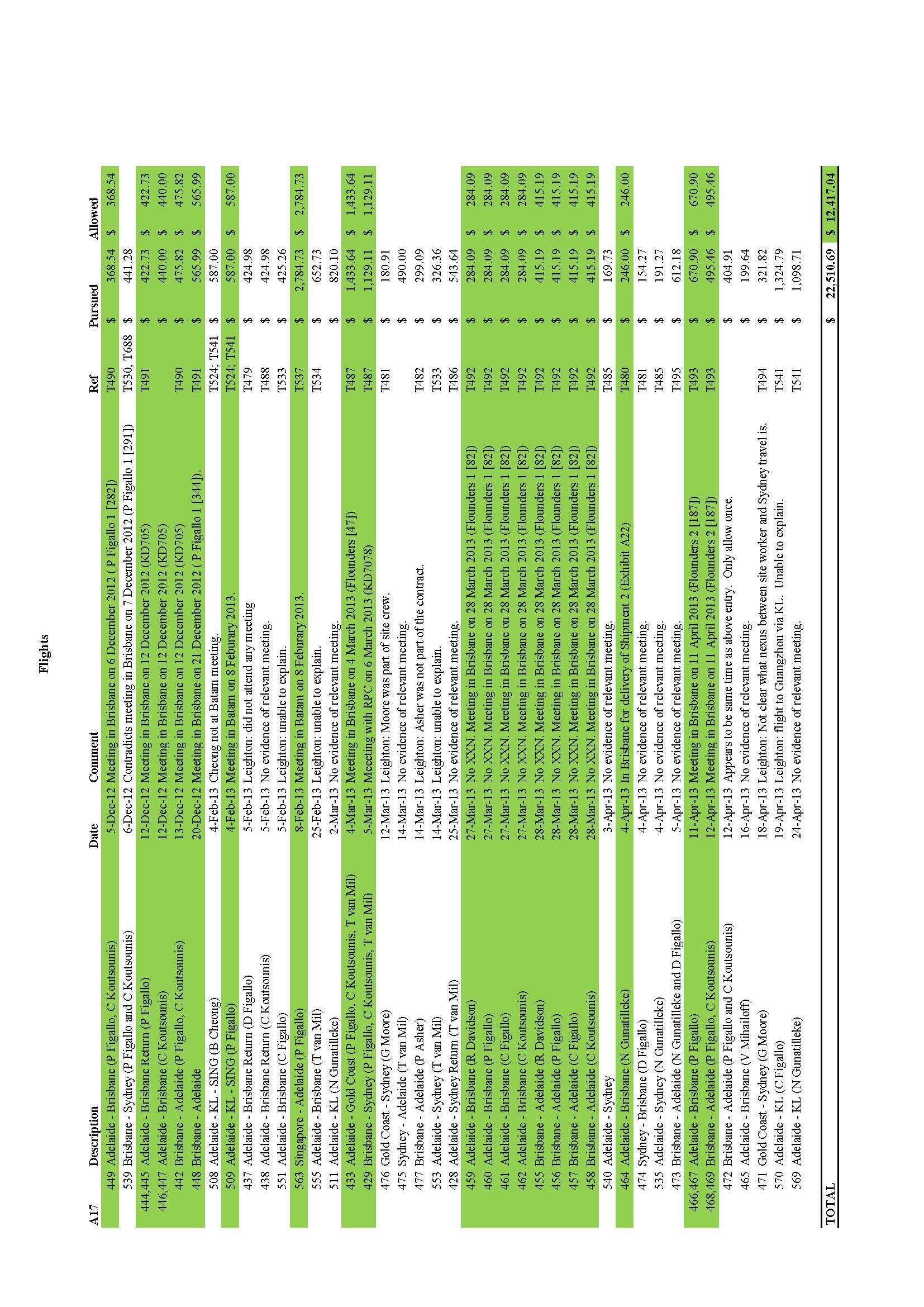
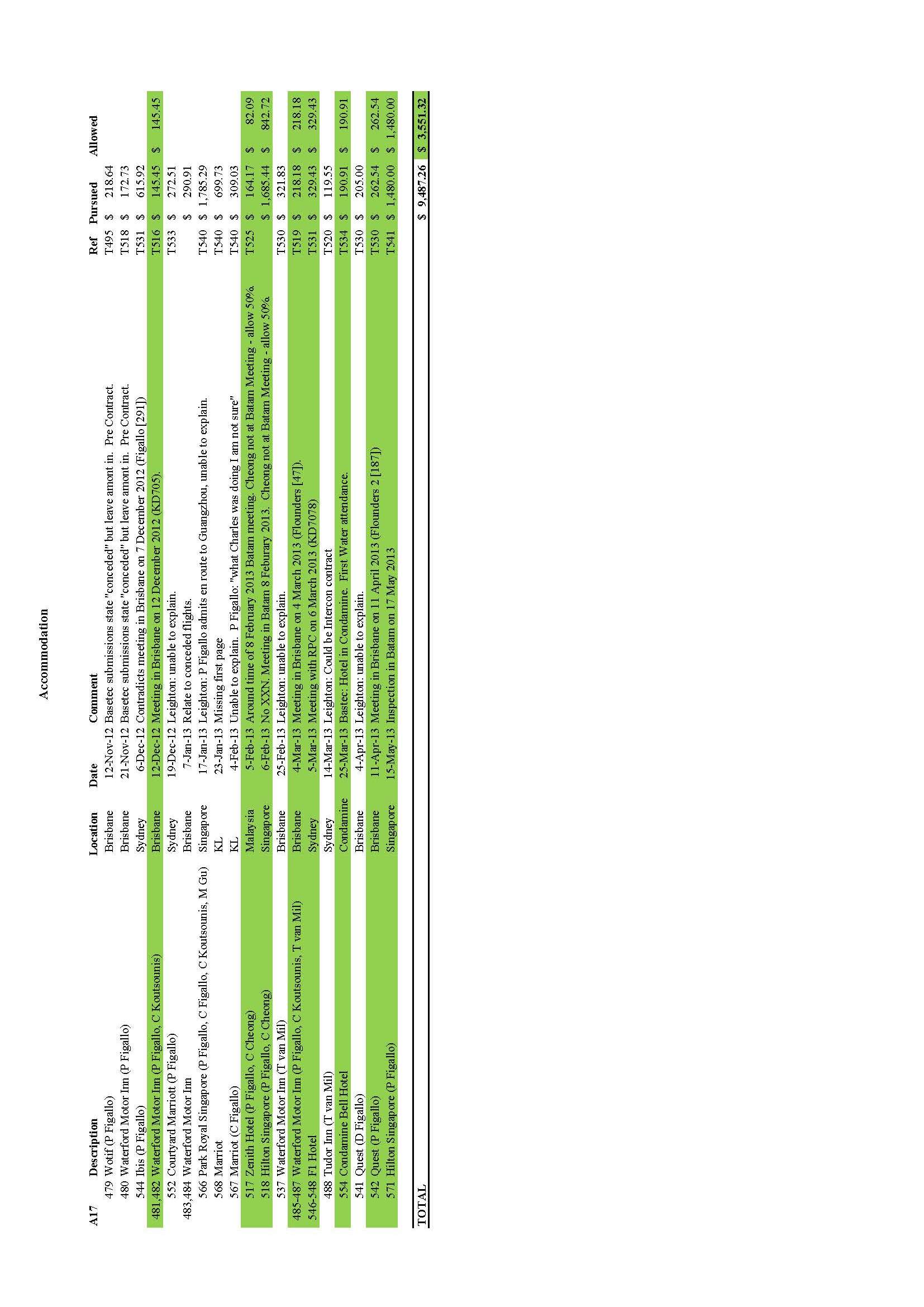
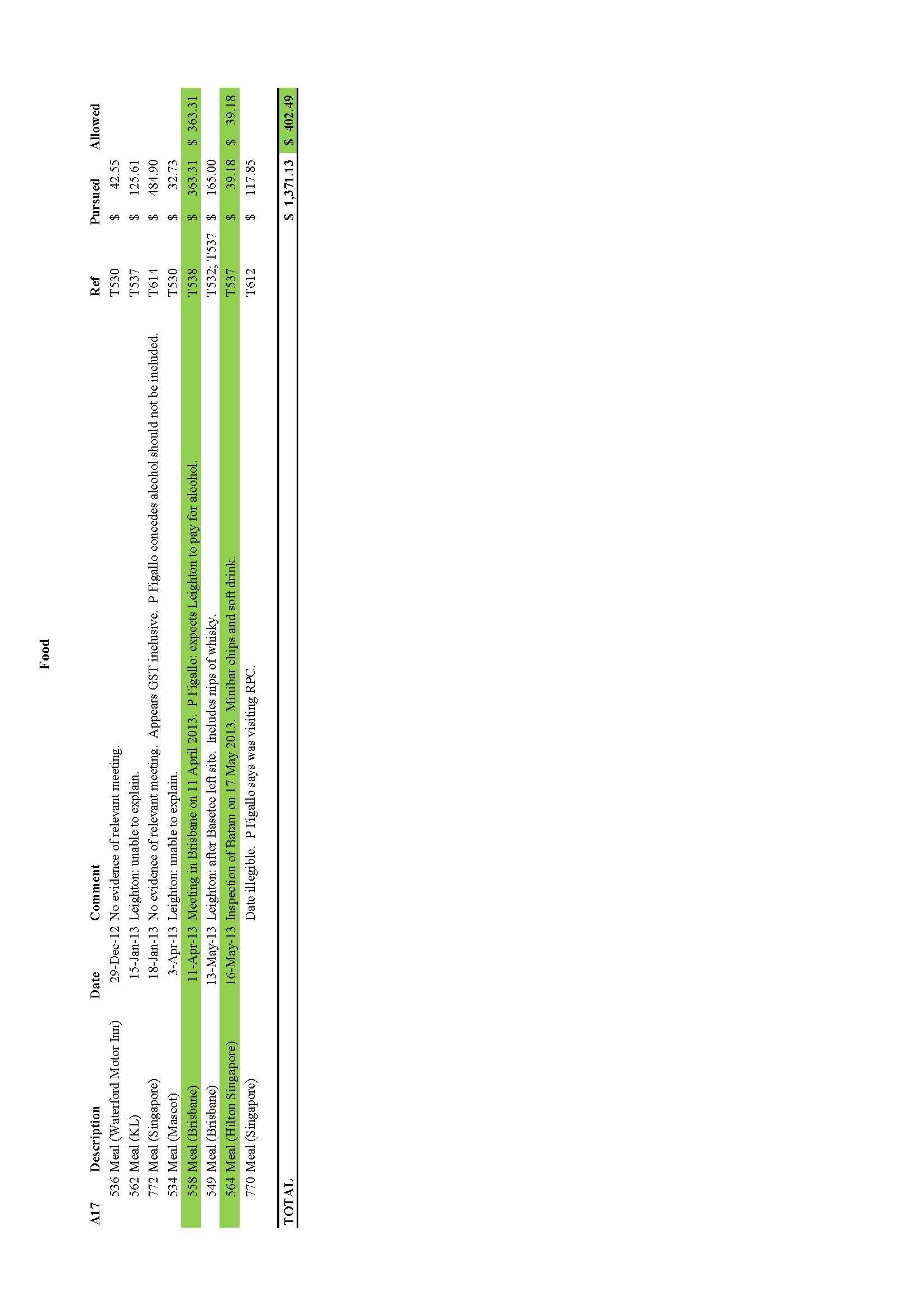
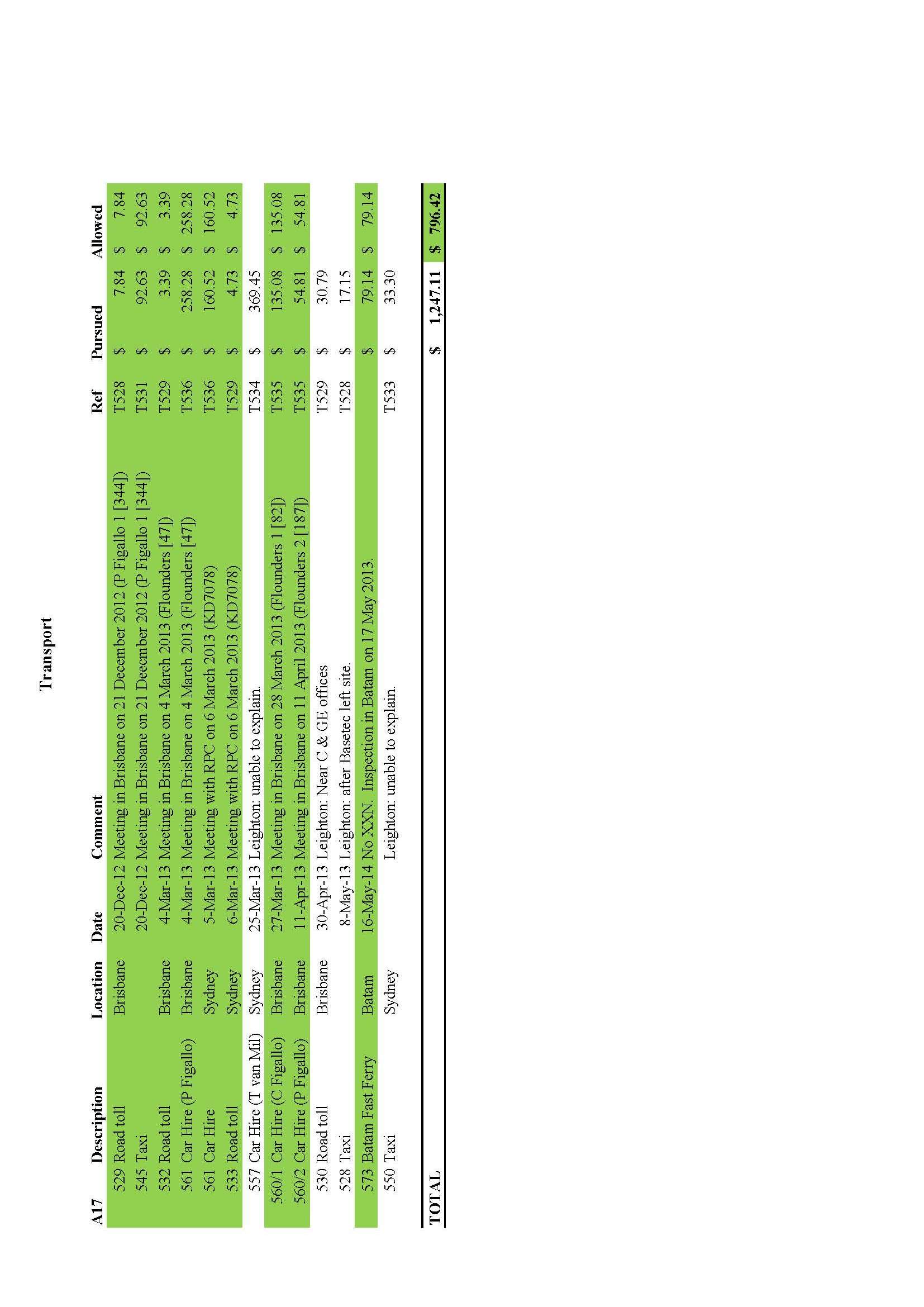
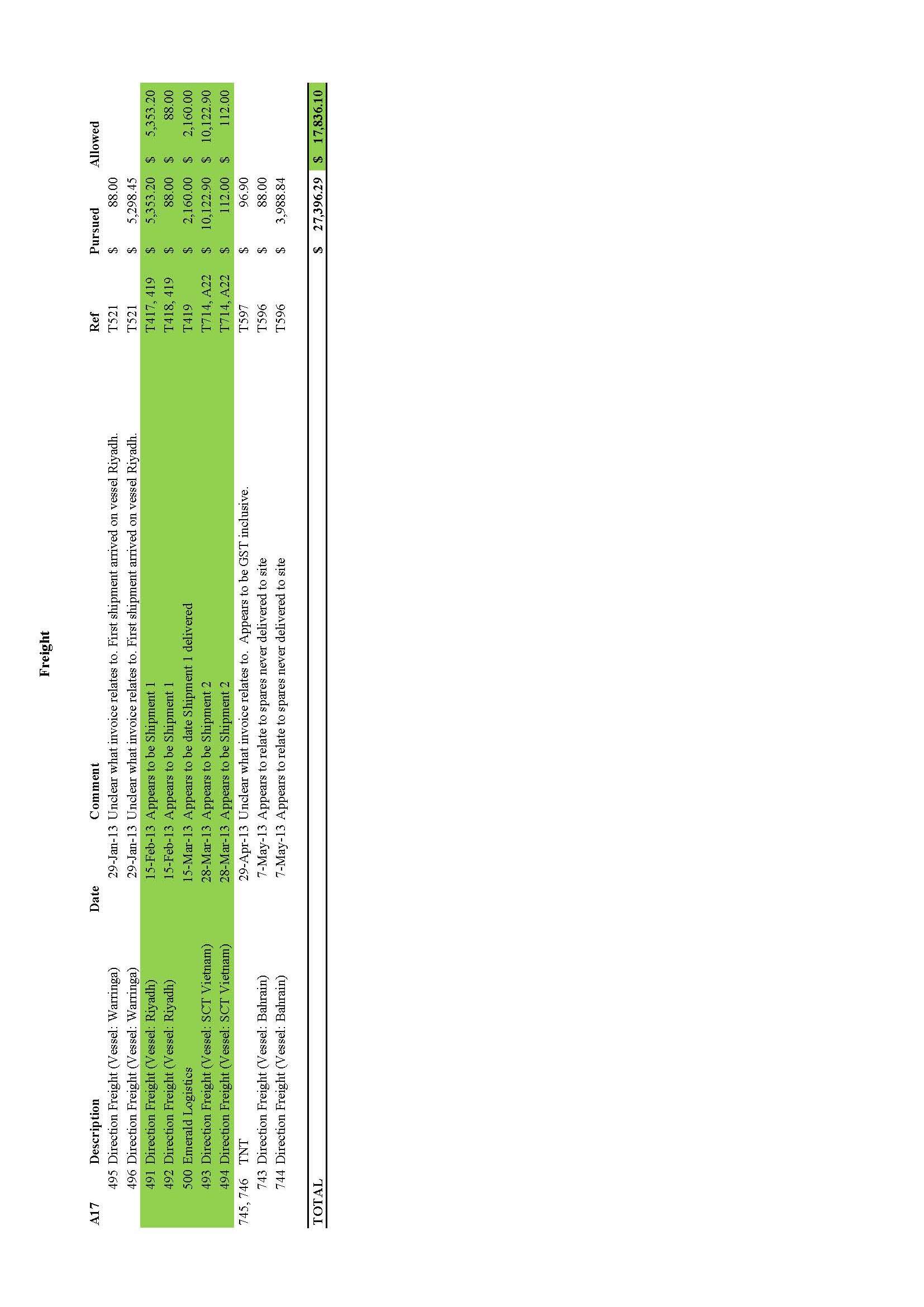
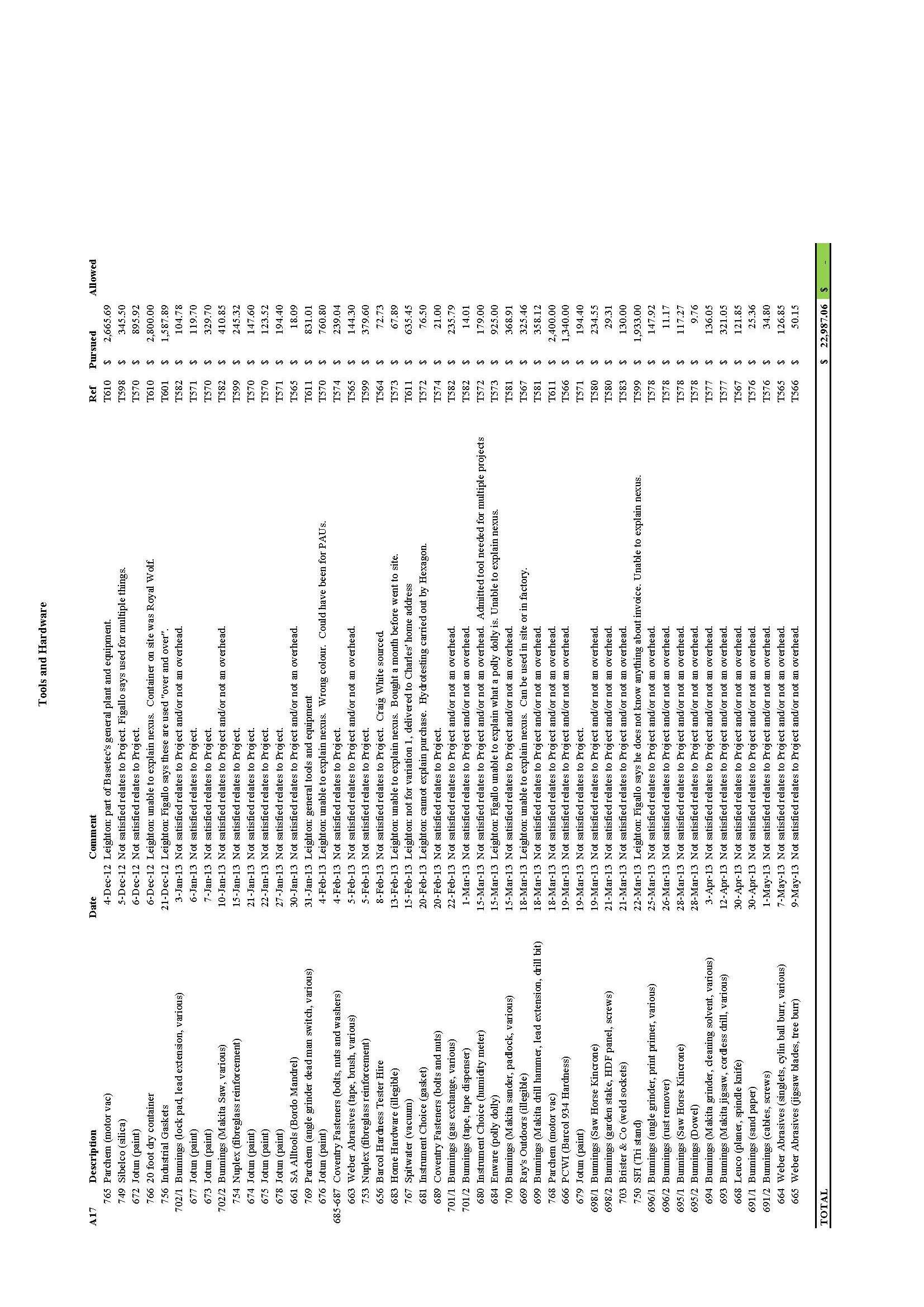
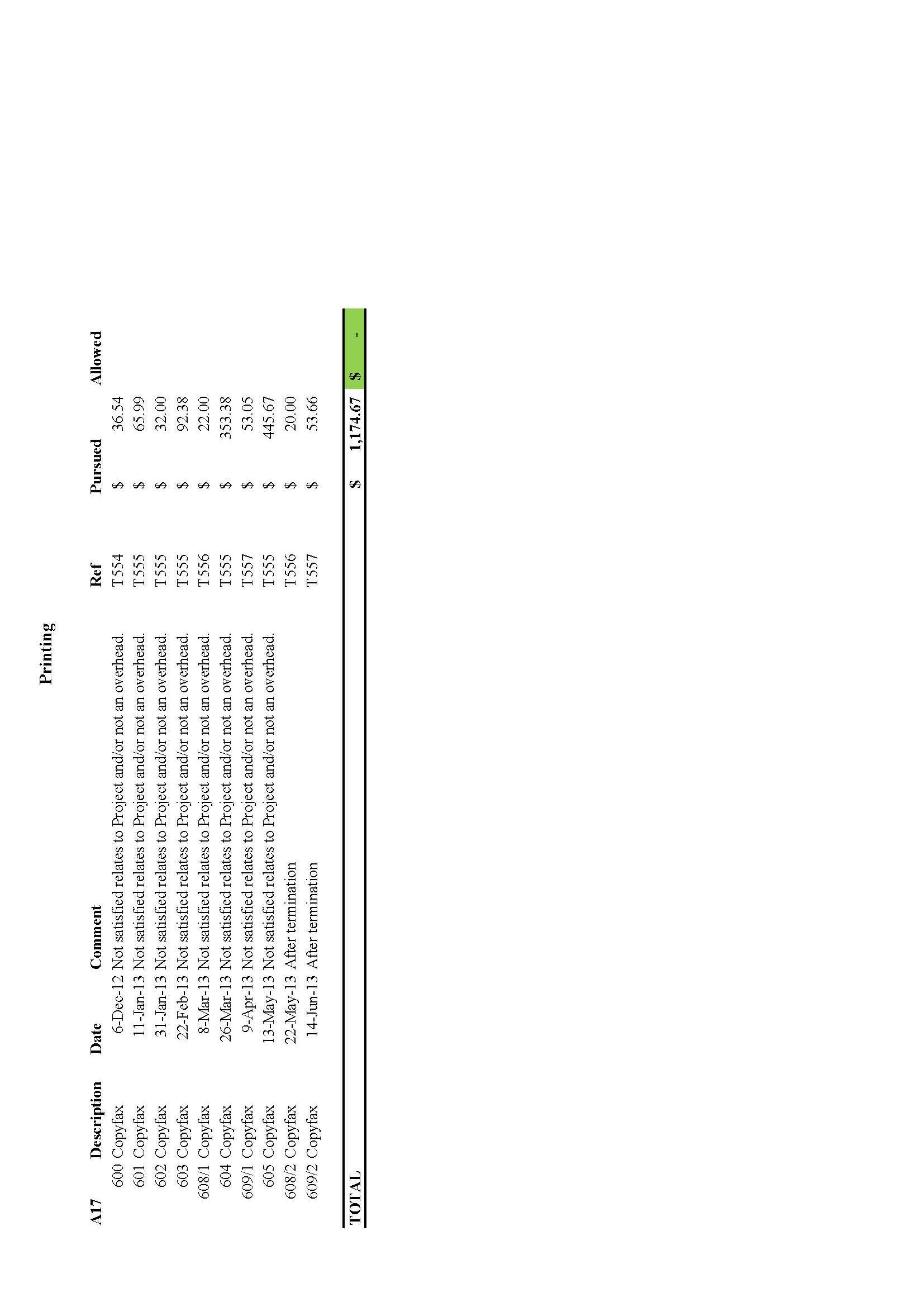
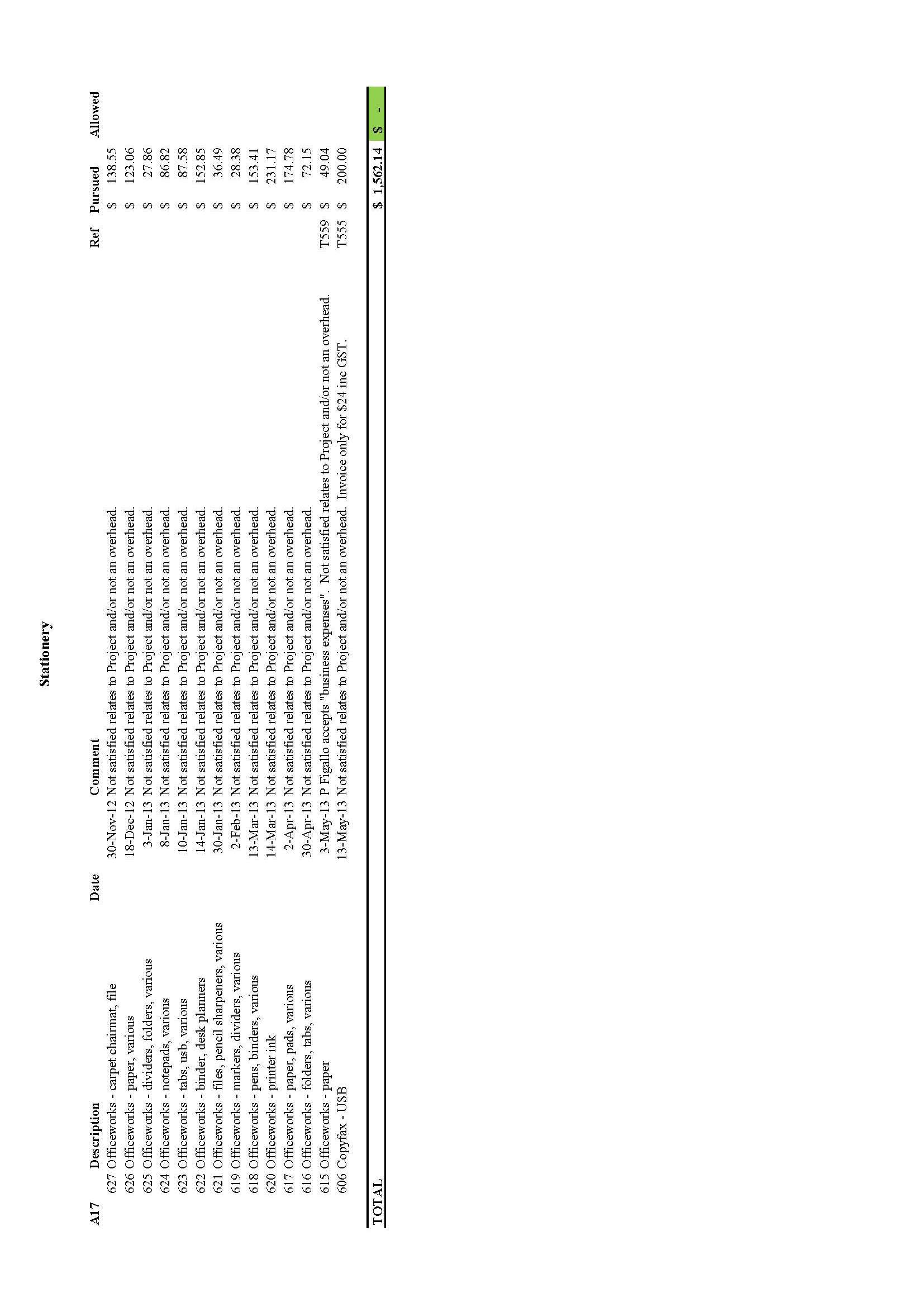
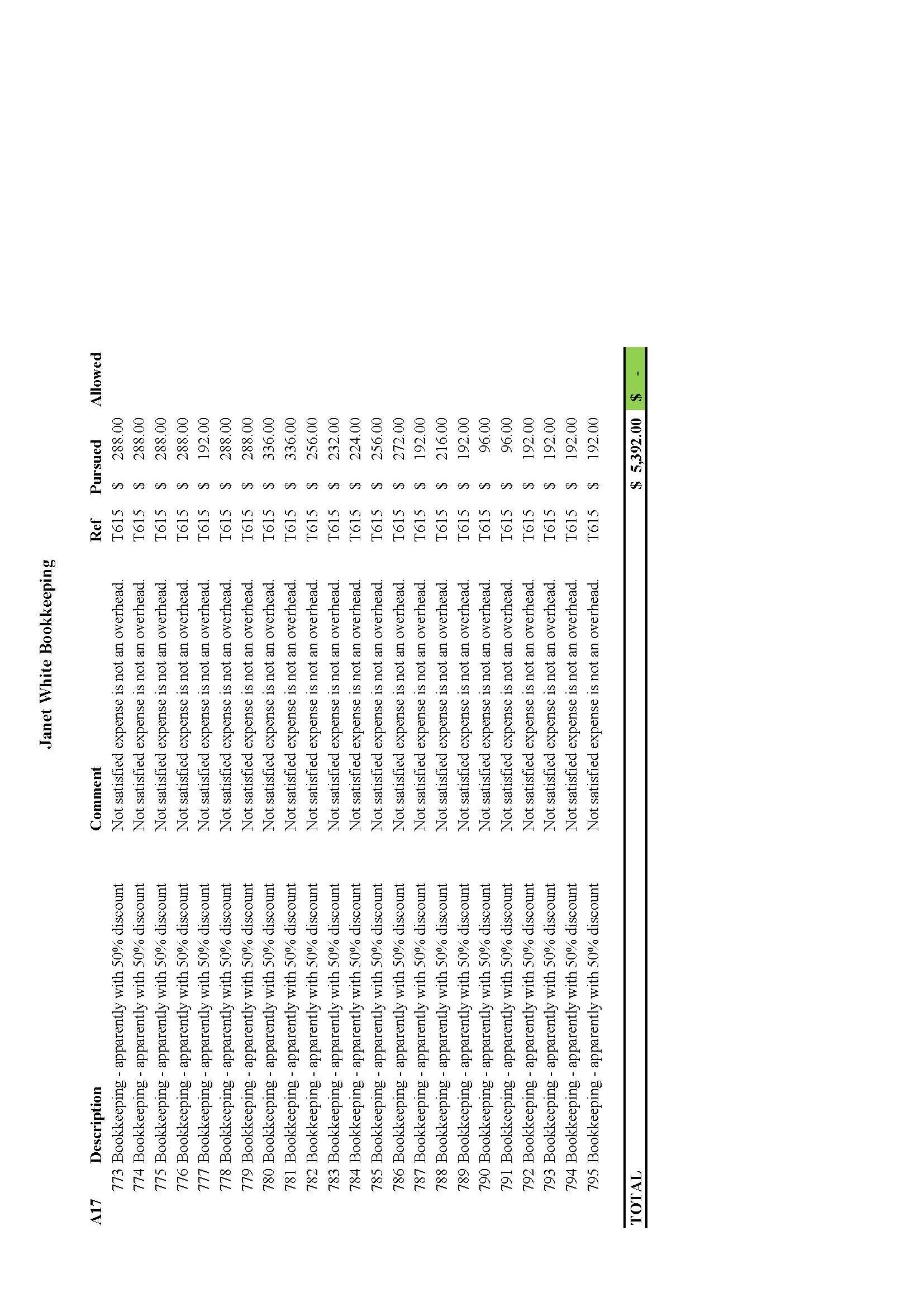
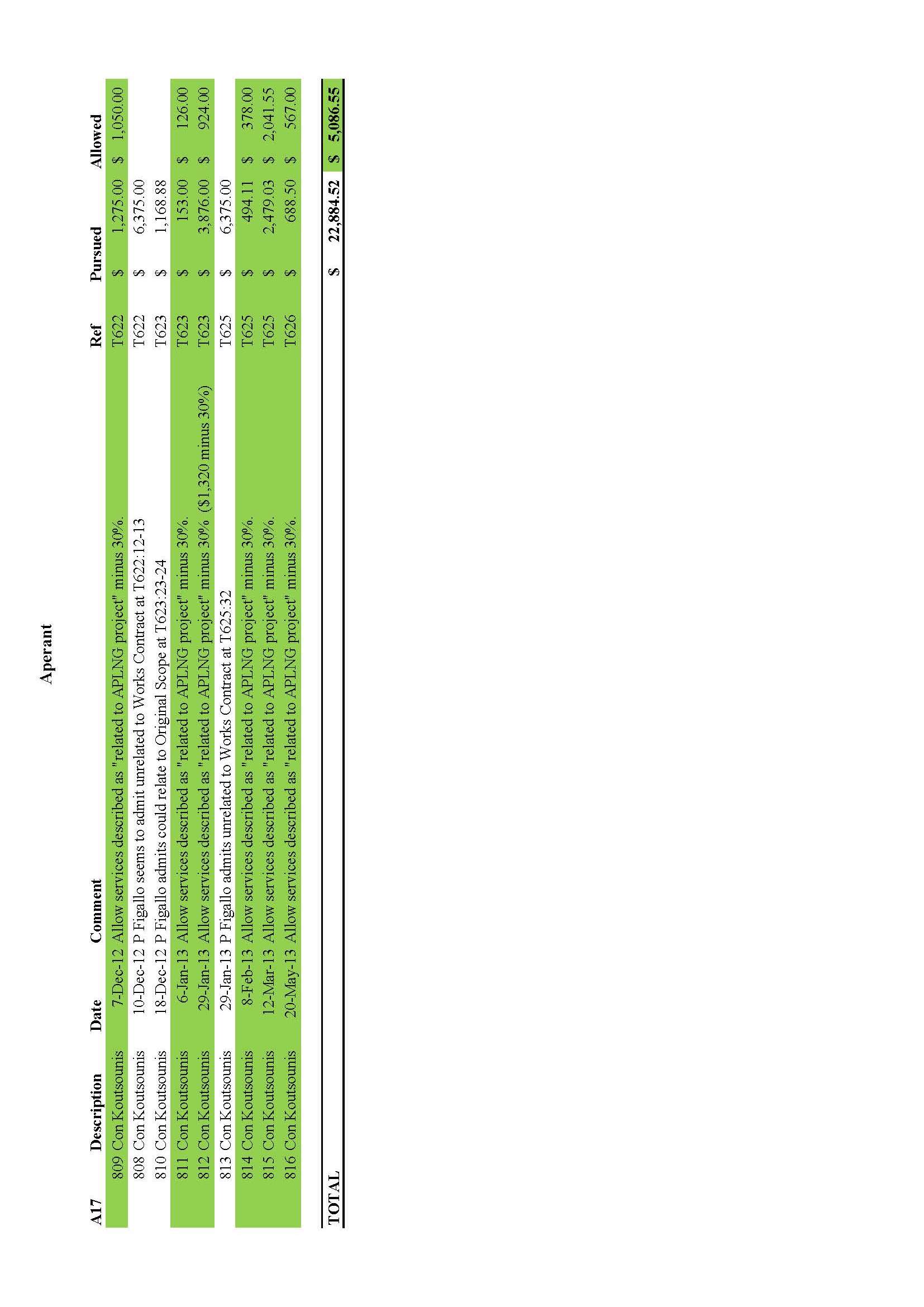
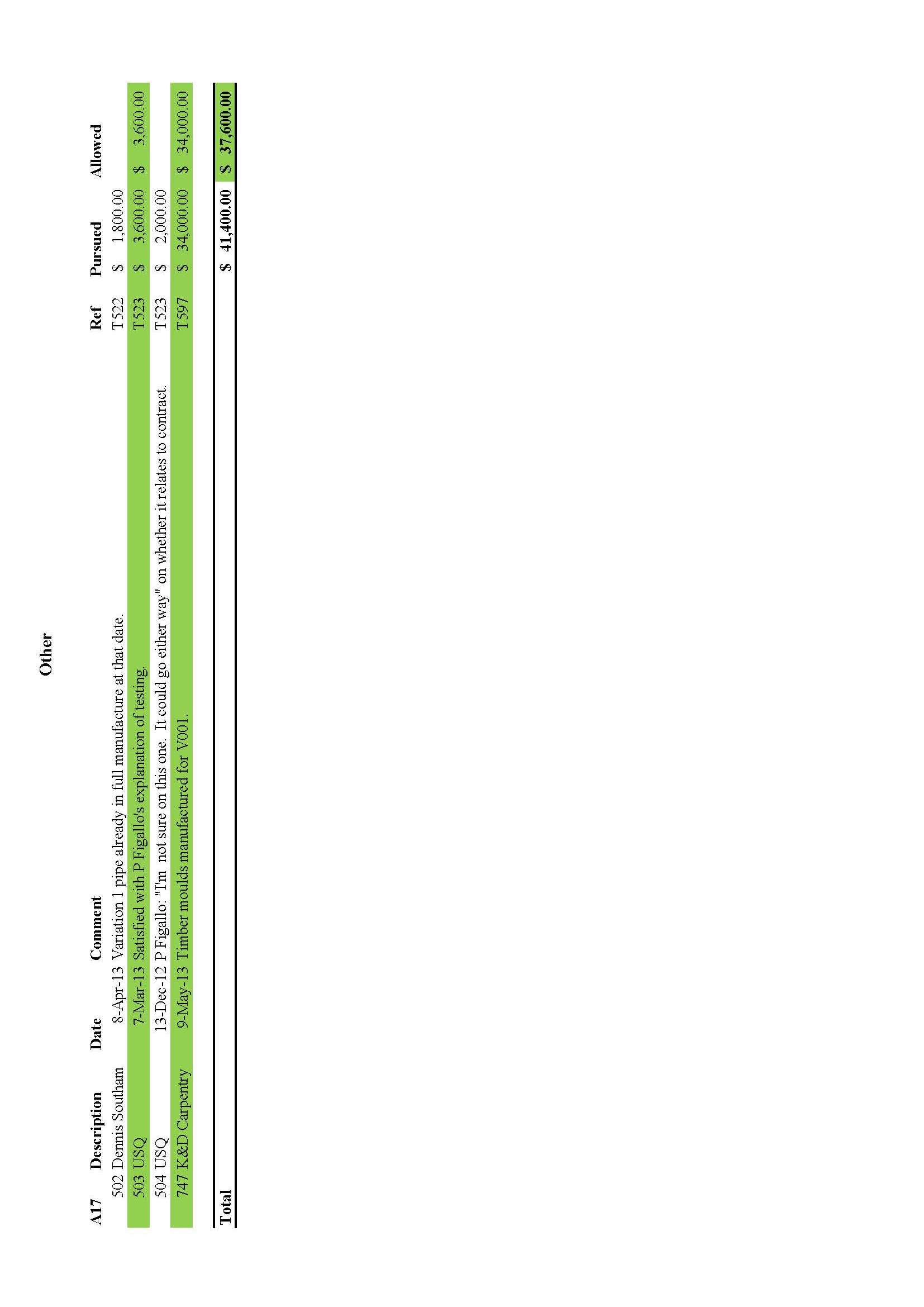
Appendix C
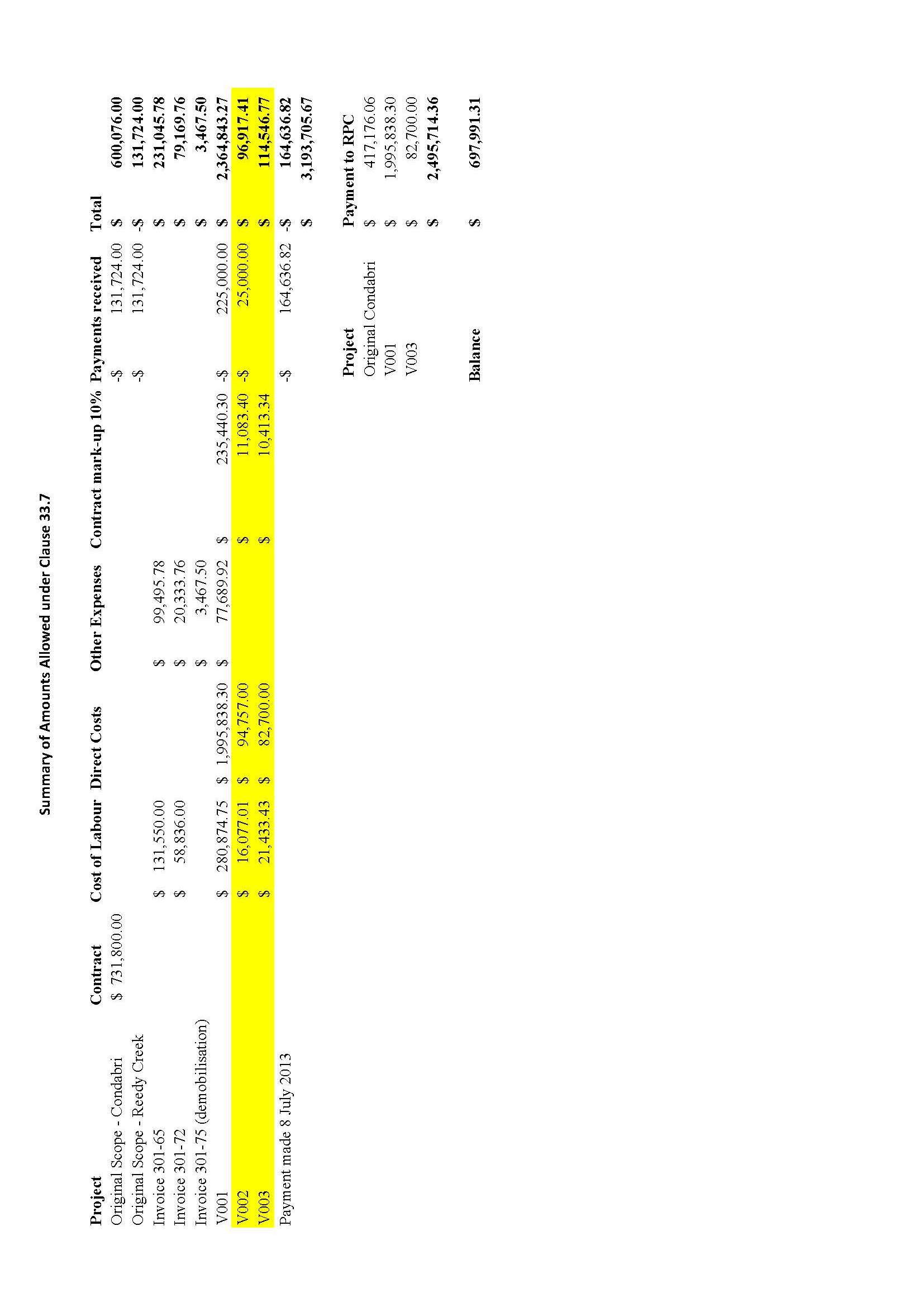
Appendix D