

FEDERAL COURT OF AUSTRALIA
Peterson on behalf of the Wunna Nyiyaparli People v State of Western Australia [2016] FCA 1528
Table of Corrections | |
The Appearance on the cover page in the field Counsel for the Wunna Nyiyaparli and Nyiyaparli #3 Applicants has been amended to “Counsel for the Nyiyaparli and Nyiyaparli #3 Applicants”. |
ORDERS
BETTY PETERSON, ERNEST WILLIAM COFFIN, MARJORIE DRAGE, AILSA ROY AND STEPHEN PETERSON ON BEHALF OF THE WUNNA NYIYAPARLI PEOPLE Applicant | ||
AND: | STATE OF WESTERN AUSTRALIA & ORS Respondent | |
DATE OF ORDER: |
THE COURT ORDERS THAT:
1. The separate question be answered in the negative.
2. The Claimant Application filed on 25 January 2012 be dismissed.
Note: Entry of orders is dealt with in Rule 39.32 of the Federal Court Rules 2011.
ORDERS
WAD 6280 of 1998 | ||
BETWEEN: | DAVID STOCK & ORS (Nyiyaparli) Applicant | |
AND: | STATE OF WESTERN AUSTRALIA & ORS Respondent | |
JUDGE: | WHITE J |
DATE OF ORDER: | 16 December 2016 |
THE COURT ORDERS THAT:
1. The separate question be answered in the negative.
2. Ailsa Roy, Marjorie Drage and Ernest Coffin be removed as Respondents.
3. The matter be adjourned for further directions at a date to be fixed by the Court.
Note: Entry of orders is dealt with in Rule 39.32 of the Federal Court Rules 2011.
ORDERS
WAD 196 of 2013 | ||
BETWEEN: | DAVID STOCK & ORS (Nyiyaparli #3) Applicant | |
AND: | STATE OF WESTERN AUSTRALIA & ORS Respondent | |
JUDGE: | WHITE J |
DATE OF ORDER: | 16 December 2016 |
THE COURT ORDERS THAT:
1. The separate question be answered in the negative.
2. The matter be adjourned for further directions at a date to be fixed by the Court.
Note: Entry of orders is dealt with in Rule 39.32 of the Federal Court Rules 2011.
WHITE J:
1 This judgment concerns a dispute about the existence of a native title claim group. The dispute affects three proceedings in the Court.
2 The first proceeding in time is an application for the determination of native title filed on 2 October 1998 on behalf of the Nyiyaparli People in respect of an area of approximately 40 square kms in the Pilbara district of Western Australia which includes the town of Newman (Action WAD 6280 of 1998).
3 The second proceeding in time is an application filed on 25 January 2012 “on behalf of the Wunna Nyiyaparli People” by Betty Peterson, Ernest William Coffin, Marjorie Drage, Ailsa Roy and Stephen Peterson (Action WAD 22 of 2012). It claims a determination of native title in respect of an area which coincides substantially, if not exactly, with the area of the Roy Hill Pastoral Lease which is wholly within the area to which the Nyiyaparli People claim relates. I shall refer to this as the “the Wunna Nyiyaparli Claim” and to the applicant in this proceeding as the “the Wunna Nyiyaparli Applicant”. When it is necessary to refer to the five persons comprising the Wunna Nyiyaparli Applicant, I will use the expression the “Wunna Nyiyaparli Applicants”.
4 The third proceeding in time is an application on behalf of the Nyiyaparli People in respect of two separate areas which are contiguous with the south western boundary of the area which is the subject of the 1998 claim (Action WAD 196 of 2013). Except when it is necessary to distinguish between the 1998 and 2013 claims, I will refer to them collectively as the “the Nyiyaparli Claim” and to the applicants in those claims as “the Nyiyparli Applicant”.
Background
5 The dispute which is the subject of this judgment has its origins in the exclusion of members of the Coffin family from the claim group on whose behalf the Nyiyaparli Claim is made. They identify themselves as the Wunna Nyiyaparli. They are persons who are descendants of Bill Coffin, born circa 1903.
6 The 1998 application in the Nyiyaparli Claim was made by five applicants, but listed the names of 78 persons who were to be registered as the native title claimants for themselves and on behalf of “the Nyiyaparli People of the Nyiyaparli Language Group and all of who[m] are for [the] purposes of the law … together recognised as the claim group”.
7 In 2001, the Nyiyaparli application was amended (the 2001 Amendments). One of the 2001 Amendments was to increase to 137 the named persons on whose behalf the application was brought. The additional persons included members of the Coffin family, being David and Ernest Coffin and Betty and Stephen Peterson.
8 The 1998 Nyiyaparli application was amended again on 26 October 2005 (the 2005 Amendment). The persons on whose behalf the application was brought were now identified in Sch A and in an attachment in the following way:
The persons on whose behalf the application is made are those persons who:
(a) are the descendants of the Nyiyaparli apical ancestors listed below;
(i) Mintaramunya
(ii) Pitjirrpangu
(iii) Yirkanpangu (Jesse)
(iv) Kitjiempa (Molly)
(v) Mapa (Rosie)
(iv) Billy Martin Moses
(b) the descendants of Bill Coffin who identify and are accepted as Nyiyaparli people through Nyiyaparli traditional law and custom; and
(c) the following Jigalong People who, according to traditional law and custom, have rights and interests within the Nyiyaparli native title claim:
…
9 As can be seen, the 2005 Amendment indicated explicitly that the application was being made on behalf of, amongst others, some of the descendants of “Bill Coffin”.
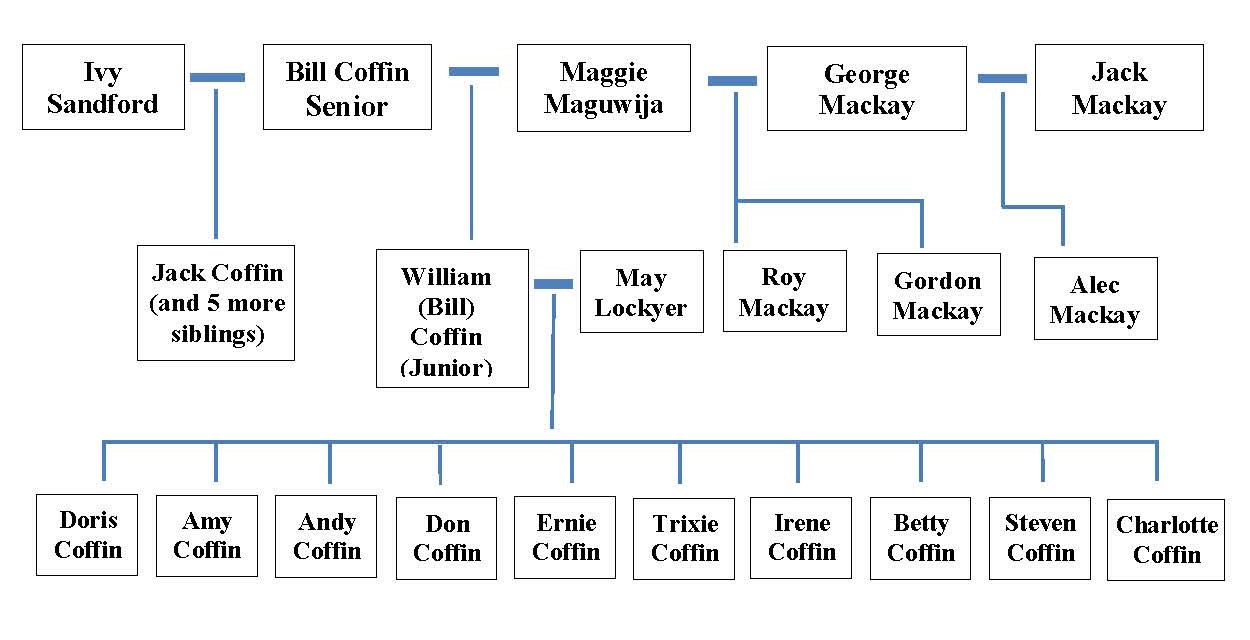
10 On 10 June 2010, the application for the determination of native title was amended again (the 2010 Amendment). The effect of the 2010 Amendment, amongst other things, was to exclude the descendants of Bill Coffin from those on whose behalf the application was made. Sch A to the 2010 Amendment identified the claim group as follows:
The persons who comprise the Nyiyaparli People’s native title claim group are those persons who are the descendants of the Nyiyaparli apical ancestors listed below:
(i) Mintaramunya;
(ii) Pitjirrpangu;
(iii) Yirkanpangu (Jesse);
(iv) Kitjiempa (Molly);
(v) Mapa (Rosie);
(vi) Billy Martin Moses;
(vii) Parnkahanha;
(viii) Wirlpangunha (Rabbity-Bung); and
(ix) Wuruwurunha.
11 The general description of native rights and interests claims set out in Sch F in the 2010 Amendment included the following:
[6] Under the Nyiyaparli traditional laws and customs, Nyiyaparli People must be descended from a Nyiyaparli person. The Nyiyaparli ancestors named in Schedule A are the ancestors of the Nyiyaparli people today. Those ancestors are in turn descended from Nyiyaparli people who, along with other Nyiyaparli people at the time who may not have any Nyiyaparli descendants today, formed part of the Nyiyaparli society at the time of sovereignty. In this way the Nyiyaparli people today believe, and their laws and customs provide, that they are the descendants of the Nyiyaparli people who belong to Nyiyaparli country when it was created in the Mangunpa time.
[7] Under the traditional laws and customs of the Nyiyaparli people, the area claimed in this application is, and has been since prior to sovereignty, the traditional country of the Nyiyaparli People.
12 The removal of the descendants of Bill Coffin from the claim group followed the provision of anthropological opinion concerning connection to country. That opinion was to the effect that the members of the Coffin family did not have a Nyiyaparli ancestor.
13 The chronology of amendments outlined above is not a complete list of the amendments which have been made from time to time to the Nyiyaparli application. It contains only those which are pertinent to the resolution of the separate question.
14 It seems that it was the removal of the Coffin family from the Nyiyaparli Claim in June 2010 which led to the filing of the Wunna Nyiyaparli Claim in 2012. The filed Wunna Nyiyaparli Claim contains the following description of the native title claim group:
1. The native title claim group comprises the descendants of Bill Coffin (born c. 1903), excluding those persons listed in paragraph [2].
2. The following descendants of Bill Coffin are excluded from the native title claim group because they do not have an unbroken chain of filiation to Bill Coffin as Nyiyaparli People:
(a) Evelyn Coffin, Dennis Coffin, Trixie Coffin, Julie Coffin and Eddy Coffin (children of Don Coffin, son of Bill Coffin) and their descendants, because they took their cultural identity from their non-Nyiyaparli mother;
(b) Kirk Coffin and Paula Ellis nee Coffin (children of Steven Coffin and grandchildren of Bill Coffin) and their descendants, because they took their cultural identity from their non-Nyiyaparli grandmother;
(c) All six children of Trixie Dhu nee Coffin (daughter of Bill Coffin) and their descendants, because all six children took their cultural identity from their non-Nyiyaparli father;
(d) The descendants of David Coffin (son of Don Coffin and grandson of Bill Coffin) because his children took their cultural identity from their non-Nyiyaparli mother; and
(e) Peter Dershow, Dale MacDonald and Joan Grove (children of Amy Dhu and grandchildren of Bill Coffin) and their descendants, because they took their cultural identity from their non-Wunna Nyiyaparli paternal grandfather (ie, a Nyiyaparli person who did not hold rights to speak for Roy Hill).
15 Schedule F to the Wunna Nyiyaparli Claim indicated that the members of the native title claim group relied upon their biological descent from Bill Coffin on the following bases:
[10] Bill Coffin (the named ancestor from whom the members of the native title claim group for this application are descended) was born at Roy Hill Station circa 1903. He was generally identified within the Western Desert society as a Nyiyaparli man whose traditional country was Roy Hill. …
[11] The members of the applicant believe that Bill Coffin obtained his Nyiyaparli identity through his paternal grandmother, a woman about whom little is presently known, aside from the fact that she was Aboriginal, and that her name was “Maggie”. However, the members of the applicant for the amended Nyiyaparli application WAD6280 of 1998 filed in September 2005 were of the belief that Bill Coffin had been incorporated into the Nyiyaparli people, as evidenced by the fact that each of them swore affidavits in support of that application in approximately August 2005 to the effect that the Nyiyaparli People included: “those persons who, through traditional law and customs, have been incorporated as the Nyiyaparli People, in particular, descendants of Bill Coffin”.
[12] Whichever is the case, the fact that Bill Coffin was generally accepted as Nyiyaparli by other Nyiyaparli People in his own time is sufficient to support the inference that he was Nyiyaparli, and – taken together with the fact that he was generally identified within the Western Desert society in his own time as a Nyiyaparli man whose traditional country was Roy Hill – to establish the necessary link between him and the Western Desert society which occupied the wider area which includes the application area at sovereignty. …
(Citations omitted)
16 As can be seen, the Wunna Nyiyaparli Applicant claimed descent from Bill Coffin (born circa 1903) and asserted that he had obtained his “Nyiyaparli identity through his paternal grandmother … ‘Maggie’”. This put Maggie’s status as a Nyiyaparli person at the heart of the Wunna Nyiyaparli Claim. The Wunna Nyiyaparli asserted in addition that Bill Coffin was generally identified within the Western Desert society as a Nyiyaparli man and that he had been accepted as Nyiyaparli by other Nyiyaparli.
17 As already noted, the Wunna Nyiyaparli claim for native title is in respect of an area, being the area comprising the Roy Hill Pastoral Lease, within the larger area claimed by the Nyiyaparli People.
The order for the trial of a separate question
18 At a directions hearing on 28 October 2015, Barker J identified, with the agreement of counsel, that a central issue to the future conduct of the three claims was whether the Wunna Nyiyaparli could make out their claim that the paternal grandmother of Bill Coffin, Maggie, was Nyiyaparli. In that circumstance, and again after discussion with counsel, Barker J ordered, pursuant to r 30.01 of the Federal Court Rules 2011 (Cth), that a question be decided separately from any other questions in the Nyiyaparli and Wunna Nyiyaparli proceedings, namely:
Was the paternal grandmother (that is, father’s mother) of William (Bill) Coffin (born circa 1903), being a woman described by the Wunna Nyiyaparli Applicant as Maggie, a Nyiyaparli person, that is, a person descended from Nyiyaparli ancestors or possessing rights and interests in the land and waters comprised in the area of the Wunna Nyiyaparli claim and with a connection to those land and waters, both in accordance with traditional laws acknowledged and traditional customs observed by the Nyiyaparli People?
I will refer to this as “the separate question”.
19 Barker J then made orders that the participating parties in the trial of the separate question be the Wunna Nyiyaparli Applicant, the Nyiyaparli Applicant, the State of Western Australia and any of the respondents who gave notice of intention to participate, as well as programming orders and orders with respect to the manner in which the hearing of the separate question should be conducted. In addition, Barker J made orders as to the effect which the Court’s determination of the separate question should have:
[27] In the event that the Court answers the separate question negatively, and decides that the paternal grandmother of William (Bill) Coffin (born circa 1903), being a woman described by the Wunna Nyiyaparli Applicant as Maggie, was not a Nyiyaparli person, that is, not a person descended from Nyiyaparli ancestors or possessing rights and interests in the land and waters comprised in the area of the Wunna Nyiyaparli claim and with a connection to those land and waters, both in accordance with traditional laws acknowledged and traditional customs observed by the Nyiyaparli People:
(a) the claimant application in WAD 22 of 2012 should be dismissed; and
(b) Ailsa Roy, Marjorie Drage and Ernest Coffin shall be removed as respondents to WAD 6280 of 1998.
[28] The orders to be made if the Wunna Nyiyaparli Applicant receives an affirmative answer to the separate question shall be subject to further consideration at a directions hearing on 9 November 2015 at 2.15 pm.
(Emphasis in the original)
Subsequent directions concerning the hearing of the separate question
20 The hearing of the separate question took place in Perth on 11 July 2016. It is appropriate to record some of the procedural history leading to that hearing in order that the course which the hearing took, and the orders made during its course, may be understood.
21 The programming orders made by Barker J on 28 October 2015 included orders requiring the Wunna Nyiyaparli Applicant to file witness statements and expert evidence by 13 November 2015, orders requiring the Nyiyaparli Applicant and any other participating party to file witness statements by 30 November 2015 and any expert reports by 31 March 2016, orders concerning the taking of evidence on country, orders concerning the production of documents and the making of objections to the evidence foreshadowed by another party, orders that the participating parties file and serve written outlines of opening submissions, as well as numerous other orders for the orderly preparation for the hearing of the separate question. Barker J did not fix the hearing date at that time, directing only that the hearing would take place on a date after 27 May 2016.
22 On 13 November 2015, Barker J made orders concerning the manner in which the hearing of the separate question would take place. His Honour ordered that the hearing of the separate question commence in the week commencing 11 July 2016, with the Court hearing opening submissions and the evidence of witnesses on country in that week; that the anthropologists retained by the Wunna Nyiyaparli and the Nyiyaparli confer in a conference convened by a Registrar in the week commencing 18 July 2016 and, by 22 July 2016, provide a joint statement; and that in the week commencing 25 July 2016, the anthropologists give concurrent evidence and the parties make their final submissions (an order of Barker J on 16 March 2016 varied this last order and directed that the anthropological evidence and the parties’ closing submissions be heard, instead, in the week of 29 August 2016).
23 On 1 December 2015, Barker J made orders adjusting some of the timelines in the programming orders and, in particular, extending to 4 December 2015 and 29 January 2016 respectively, the times within which the Wunna Nyiyaparli were to file and serve their expert evidence and their witness statements.
24 The Wunna Nyiyaparli were represented by senior counsel at the direction hearings on 28 October, 13 November and 1 December 2015.
25 The Wunna Nyiyaparli filed a report from an anthropologist, Mr de Gand, on 4 December 2015 and witness statements from Ernest William Coffin, Ailsa Roy and Charlotte Perry in December 2015, January 2016 and March 2016 respectively.
26 In mid-March 2016, the Wunna Nyiyaparli Applicant changed course. It terminated the instructions of the Wunna Nyiyaparli Applicant’s solicitors, Newton Vincent. On 14 March 2016, Marjorie Drage filed a notice of address for service in the Court. Ms Drage indicated in the notice that she was filing it on behalf of the Wunna Nyiyaparli People and gave her own address as the address for service of the Wunna Nyiyaparli People. Four days later, Newton Vincent filed a Notice of Ceasing to Act for the Wunna Nyiyaparli Applicant.
27 Despite the apparent indication by the Notice of Address for Service that the Wunna Nyiyaparli Applicant would proceed without legal representation, the Wunna Nyiyaparli Applicants thereafter took no steps to prepare for the hearing of the separate question or to participate in the arrangements being made by the Court for that hearing. They chose to ignore the proceedings. In particular, the Wunna Nyiyaparli Applicants did not appear at a directions hearing conducted by Barker J on 24 March 2016 (at which Barker J ordered that the Wunna Nyiyaparli Claim should be taken as the lead proceeding in the hearing of the separate question) and at a case management hearing conducted by a Deputy Registrar on 13 April 2016. In fact, on 12 April 2016, Mr Coffin informed a Deputy Registrar in the Perth Registry of the Court that the Wunna Nyiyaparli Applicants wanted no part in the separate question. Consistently with that approach, the Wunna Nyiyaparli Applicants did not, after 4 March 2016, comply with any of the programming orders made by Barker J including the orders requiring the filing and service of a witness proposal, the filing and service of a notice indicating whether any part of another party’s witness proposal was disputed, the filing of a list of documents and the photographs to be tendered at the hearing, and the filing and service of an outline of submissions.
28 In those circumstances, and having regard to the significant amount of time which the Court had set aside for the hearing including the arrangements for a hearing on country, the Court decided, of its own motion, to conduct a pre-trial directions hearing on 3 May 2016.
29 The Wunna Nyiyaparli Applicants were given adequate notice of the pre-trial directions hearing and of the nature of the matters to be addressed. On 20 April 2016, a Deputy Registrar of the Court wrote to the Wunna Nyiyaparli Applicants. In that letter, the Deputy Registrar reminded the Wunna Nyiyaparli Applicants of the order made by Barker J for the hearing and determination of the separate question and provided them with copies of the orders made by Barker J relating to that hearing. The letter informed the Wunna Nyiyaparli Applicants of the pre-trial directions hearing to be held on 3 May 2016 and stated the Court’s expectation that the Wunna Nyiyaparli Applicants, the Nyiyaparli Applicants and the State of Western Australia (as well as any other party who had given notice of intention to participate in the trial) would attend the hearing. The letter continued:
At that hearing, Justice White will wish to address a number of matters, including:
(i) confirming the arrangements for the trial and making any final arrangements;
(ii) the way in which the Wunna Nyiyaparli intend to participate in the trial, taking into account the circumstance that presently they do not have legal representation;
(iii) the way in which the evidence in chief of all witnesses in the trial is to be led, for example, is it to be entirely oral, or may some or all be in affidavit form;
(iv) the place or places at which the evidence is to be taken and, in particular, the evidence which may be taken conveniently in Newman and in Perth;
(v) the estimated length of the respective cases of each party.
I confirm that the Court is continuing to make arrangements for the trial, including arranging a hearing place and accommodation in Newman, transport to Newman and transcription services. Justice White wishes to be satisfied that these arrangements remain necessary and appropriate.
I would also be grateful if each party would confirm … who will be attending the Pre-Trial Directions Hearing at 9.30 am (WST) on Tuesday, 3 May 2016.
30 The Wunna Nyiyaparli Applicants did not attend the hearing on 3 May 2016. At that hearing, the Court noted, in addition to the matters recorded above, that the Wunna Nyiyaparli Applicants had not responded since 9 March 2016 to correspondence from the Yamatji Marlpa Aboriginal Corporation (YMAC), which represents the Nyiyaparli Applicant; had not responded to correspondence from the Deputy Registrar of the Court dated 20 April and 29 April 2016 regarding the hearing; and had not informed the Court or the other parties in writing of their intentions with respect to participation in the hearing of the separate question.
31 These circumstances in combination gave rise to real apprehension that the Wunna Nyiyaparli Applicant would not participate in the hearing of the separate question, that the arrangements being made for the hearing would be wasted and that both the Court and the other parties would be caused needless expense.
32 Accordingly, the Court made the following substantive orders:
1. The Wunna Nyiyaparli Applicants are by 4:30pm on 13 May 2016 to file and serve on all the other parties a notice indicating one way or another whether they wish to participate in the hearing of the separate question, and if so, the manner in which they propose to participate.
2. The matter be adjourned for further directions at 2:00pm WST on 18 May 2016 in the expectation that, subject to any further submissions and any further evidence received by the Court at that hearing, the Court will, on the basis that the Wunna Nyiyaparli will not be participating in the hearing of the separate question and on the basis that the evidence the Wunna Nyiyaparli have filed and served to date will not be received as evidence in the hearing, unless tendered by some other participating party, make orders to the effect that:
(a) the evidence-in-chief of all the witnesses of the other parties to the proceedings be in the form of affidavits to be filed and served by a date in early June;
(b) none of those witnesses will be required to attend for cross examination unless a notice to that effect is filed and served by the First Respondent, that is, the State of Western Australia, by a date shortly after 1 June; and
(c) the hearing take place in Perth, commencing at 10 am on Monday, 11 July 2016, together with consequential orders.
3. The Nyiyaparli Applicants provide by email a copy of today’s orders to each of the Wunna Nyiyaparli Applicants.
4. The Nyiyaparli Applicants file and serve by 4:30pm on 16 May 2016 minutes of orders they will ask the Court to make on 18 May 2016
5. Counsel for the Nyiyaparli Applicants and the State of Western Australia confer by 4:30pm on 17 May 2016, with a view to agreeing the orders to be made by the Court at the adjourned pre-trial directions hearing.
6. The costs of today’s hearing be reserved
33 As can be seen, these orders required the Wunna Nyiyaparli Applicant to file and serve a notice indicating whether they intended to participate in the hearing and, if so, the manner in which they proposed doing so. The orders also put the Wunna Nyiyaparli Applicants on notice that, subject to any further evidence or submissions, the Court anticipated making orders on 18 May 2016 for the hearing of the separate question to take place on the basis that the Wunna Nyiyaparli Applicant would not be participating in it, with orders for the evidence in chief of all witnesses to be in the form of affidavits with none required to attend for cross-examination, and for the hearing of the separate question to take place wholly in Perth.
34 YMAC gave each of the Wunna Nyiyaparli Applicants in accordance with Order 5 a copy of the orders made on 3 May 2016.
35 Despite Order 1 made on 3 May 2016, the Wunna Nyiyaparli Applicant did not file any notice at all in the Court and did not attend the adjourned hearing on 18 May 2016. The Court then made orders on the basis that it would be only the Nyiyaparli Applicant and the State of Western Australia who would participate in the trial of the separate question and that it was only the Nyiyaparli Applicant who had indicated an intention to adduce evidence at the trial. The Court noted that, as no party had given notice that any of the Nyiyaparli Applicant’s witnesses was required to attend for cross-examination, it was not necessary for the Nyiyaparli Applicant to procure the attendance of its witnesses at the trial. The substantive orders made by the Court on 18 May 2016 were as follows:
1. The evidence-in-chief of the witnesses of the Nyiyaparli Applicant be by way of affidavits, noting the parties’ expectation that the contents of the affidavits will, in substance, conform with the content of the written statements from each witness which have already been filed and served.
2. The Nyiyaparli Applicant file and serve the affidavits by no later than 4:30pm on 3 June 2016.
3. The Nyiyaparli Applicant by 15 June 2016 deliver to the Court and to the State of Western Australia a bound volume, paginated and indexed, containing copies of the affidavits from its witnesses, with that bound volume to be a working copy for the use of the trial judge.
4. The State of Western Australia file and serve by 20 May 2016 notice of any objections to the statements of the Nyiyaparli Applicant’s witnesses together with a short statement of the grounds for each objection.
5. Order 3 made on 13 November 2015 be vacated and in lieu thereof there be an order that the trial of the Separate Question commence at 10:00am on 11 July 2016 in Perth.
6. Orders 4, 5 and 6 made on 13 November 2015 are revoked.
7. The time fixed by Order 24 made on 28 October 2015, within which the Nyiyaparli Applicant and the State of Western Australia are to file and serve an outline of their opening submissions, be extended to 4:30pm on 1 July 2016.
8. The matter be adjourned for trial to 10:00am on 11 July 2016 in Perth.
9. There be liberty to all parties to apply, including with respect to the determination of any objections to the written evidence in chief of the Nyiyaparli Applicant’s witnesses.
10. Costs be reserved.
36 There matters stood until the commencement of the trial on 11 July 2016 although the Nyiyaparli Applicant did, on 20 May 2016, file some objections to the evidence previously filed by the Wunna Nyiyaparli. It did so in order not to be in breach of the orders made by Barker J.
The course of events at the hearing on 11 July 2016
37 Three of the Wunna Nyiyaparli Applicants attended the hearing of the separate question on 11 July 2016. These were Ailsa Roy, Marjorie Drage and Ernest William Coffin. The Court was told that the other two Wunna Nyiyaparli Applicants (Betty Peterson and Steven Peterson) “couldn’t make it”. Ms Roy, Ms Drage and Mr Coffin did not have legal representation.
38 The Court was told that there was agreement that Mr Coffin would be the spokesperson for all five of the Wunna Nyiyaparli Applicants. Mr Coffin was of course entitled to speak for himself but I granted him leave to speak for the other four Wunna Nyiyaparli Applicants as well.
39 Mr Coffin acknowledged that the Wunna Nyiyaparli Applicants had not given the Nyiyaparli Applicants any notice of their intention to appear at the hearing.
40 The submissions which Mr Coffin made were, with all respect to him, a little unfocused. At one stage, he submitted that the Wunna Nyiyaparli sought an order that the Court “dismiss” the separate question and said that it did not propose to call any evidence. A later submission appeared to indicate that the Wunna Nyiyaparli did wish to adduce the evidence it had filed in accordance with the orders of Barker J. Mr Coffin also said at one stage that the Wunna Nyiyaparli Applicant wished to adduce evidence to prove that the grandmother, Maggie, was a Nyiyaparli person. At another time, Mr Coffin said that the Wunna Nyiyaparli Applicant had not known about the hearing of the separate question and had not consented to it. The former statement was clearly incorrect and, as to the latter, senior counsel for the Wunna Nyiyaparli Applicant had participated in the directions hearing on 28 October 2015 in which the terms of the separate question had been finalised and the programming orders made.
41 The Nyiyaparli Applicant objected to the Wunna Nyiyaparli Applicant being permitted to lead evidence. Counsel for the Nyiyaparli Applicant referred to the procedural history outlined above. He submitted that the Nyiyaparli Applicant would be prejudiced in a number of respects if the Wunna Nyiyaparli were, despite their non-compliance with the Court’s programming and procedural orders, permitted to lead evidence.
42 First, the process which the Court had earlier put in place for the resolution of objections by one party to the foreshadowed evidence of another would have to be completed.
43 Secondly, the Nyiyaparli Applicant had prepared for the hearing on the basis that the affidavits from its witnesses would be received without them being required to attend for cross-examination. It had not arranged the attendance of those witnesses.
44 Thirdly, counsel said that he had not prepared to cross-examine the foreshadowed witnesses of the Wunna Nyiyaparli.
45 Finally, counsel said that YMAC had not taken instructions on statements in response to the foreshadowed evidence of the Wunna Nyiyaparli and would need the opportunity to do so.
46 Each of these submissions was in my opinion soundly based and understandable. The matters raised by the Nyiyaparli meant that, if the Court did permit the Wunna Nyiyaparli to depart from the requirements of its programming and procedural orders and to lead evidence, an adjournment of the hearing on 11 July 2016 would be necessary. I considered that such a course was inappropriate, especially as it seemed that the Wunna Nyiyaparli Applicants had, until on or shortly before 11 July 2016, made a deliberate decision not to comply with the orders intended by the Court for the conduct of an orderly and fair trial. I ruled that the Wunna Nyiyaparli Applicant should not be permitted to lead evidence in the hearing, and should be confined to making submissions. My reasons for that decision are contained in the transcript of the hearing on 11 July 2016.
47 This meant that the trial proceeded without the Wunna Nyiyaparli adducing evidence, although, as indicated, they were given the opportunity to make submissions on the evidence presented by the Nyiyaparli.
The evidence at the hearing
48 The only evidence adduced at the hearing was that tendered by the Nyiyaparli Applicant. That evidence comprised the following:
(1) Affidavit of David Stock made 17 May 2016;
(2) Affidavit of Hilda Flann made 17 May 2016;
(3) Affidavit of Bruce Bung (Snr) made 30 May 2016;
(4) Affidavit of Keith Hall made 2 June 2016;
(5) Witness Statement of David Stock dated 21 May 2014 (for the preservation of evidence hearing);
(6) Witness Statement of Bonny Tucker dated 21 May 2014 (for the preservation of evidence hearing);
(7) Affidavit of Louis Warren made 31 March 2016.
All of these persons, other than Mr Warren, are Nyiyaparli.
49 For the reasons already given, none of these witnesses was required to attend for cross-examination. I accept their evidence to the extent that it is necessary for the findings which I make below.
50 The Nyiyaparli Applicant and the State of Western Australia also agreed that regard should be had to the evidence of David Stock and Bonny Tucker given at a preservation of evidence hearing conducted on 11-13 June 2014. I add that the agreement of Western Australia to the tender of this evidence was on the basis that it be used only in the trial of the separate question. The Nyiyaparli Applicant accepted that that was so.
51 In addition, the Nyiyaparli Applicant relied on the evidence of two anthropologists, being an affidavit of Kirsty Wissing made 30 November 2015 and an affidavit of Kim McCaul made 6 May 2016. Ms Wissing’s affidavit was confined to limited subject matters but Mr McCaul’s was more extensive and directed to the issues arising on the separate question.
52 Mr McCaul is a well-qualified and experienced anthropologist. He obtained a BA in Social Anthropology (with Honours) from the University of Kent at Canterbury in 1997 and a Professional Certificate in Applied Anthropology Native Title Practice (High Distinction) from the University of Adelaide 2001. In 2008, he completed a Masters in Applied Linguistics at the University of New England. Mr McCaul has worked as an Anthropologist since March 2000, initially at the Crown Solicitor’s Office in South Australia, and later in the South Australian Aboriginal Heritage Branch of the Department of Premier and Cabinet. Since July 2011, he has worked as a private consultant. Mr McCaul has carried out anthropological work in South Australia, New South Wales, Queensland, Victoria and Western Australia. In particular, he has worked on a number of native title claims in the eastern part of the Western Desert cultural bloc. His report focused on the ancestry of Bill Coffin Senior and on the question of whether Nyiyaparli laws and customs allow for people to become Nyiyaparli through pathways other than descent. I consider his evidence and opinions to be reliable, and accept them.
The Coffin Family Tree
53 The father of the William (Bill) Coffin named in the separate question was also William (Bill) Coffin. In order to distinguish between them, I will, like Mr McCaul, refer to the former as Bill Coffin Senior and to the latter as Bill Coffin Junior. The mothers of both Bill Coffin Senior and Bill Coffin Junior had the name Maggie. Again, in order to distinguish between them, I will refer to the mother of Bill Coffin Senior as Maggie and to the mother of Bill Coffin Junior as Maggie Maguwija, this being her full documented name.
54 Bill Coffin Senior died in 1929 and Bill Coffin Junior died in 1984.
55 The contentions of the Wunna Nyiyaparli Applicant which give rise to the separate question are seen not only in Sch F to its application, but also in a Statement of Issues, Facts and Contentions it filed on 30 April 2015. That Statement asserts that Bill Coffin Junior was born at Roy Hill to Maggie Maguwija and Bill Coffin Senior (who is described in the Statement as “a ‘half-cast’ Malay”); that Bill Coffin Junior’s paternal grandfather was a Malay man (Sidong); and that his paternal grandmother was a full blood Nyiyaparli woman named Maggie. Other evidence indicates that Bill Coffin Junior had two half-brothers (Gordon Mackay and Roy Mackay) resulting from Maggie Maguwija’s relationship with a George Mackay. Maggie Maguwija also had a relationship with George Mackay’s brother, Jack Mackay, resulting in Bill Coffin Junior having another half-brother, Alec Mackay.
56 Using information from his own research and from that provided by Mr de Gand (who had provided an anthropological report at the request of the Wunna Nyiyaparli), Mr McCaul provided the following family tree for Bill Coffin Junior. It is a little more complex than many family trees of its kind because Bill Coffin Senior had also had a relationship with Ivy Sandford, who bore him six children and Maggie Maguwija had the relationships just mentioned with George and Jack Mackay, bearing children to both.
57 Mr McCaul described this family chart as uncontroversial and, on the evidence received in the trial, there is no reason to dispute the accuracy of that assessment.
Approach to the determination of the separate question
58 The separate question identifies two alternative means by which Maggie may be held to be a Nyiyaparli person:
(a) by descent;
(b) as a person possessing rights or interests in the land and waters claimed and with a connection to those land and waters, both in accordance with the traditional laws acknowledged and the traditional customs observed by the Nyiyaparli people.
59 The question of whether Maggie was a Nyiyaparli person by one or other of these means is to be determined on the balance of probabilities. This is consistent with the approach adopted in Banjima People v Western Australia (No 2) [2013] FCA 868, (2013) 305 ALR 1 at [599] (Barker J); Wallace on behalf of the Boonthamurra People v State of Queensland [2014] FCA 901, (2014) 313 ALR 138 at [98] (Mansfield J); and Dempsey on behalf of the Bularnu, Waluwarra and Wangkayujuru People v State of Queensland (No 2) [2014] FCA 528, (2014) 317 ALR 432 at [790] (Mortimer J). The Wunna Nyiyaparli Applicant has the onus. This is reflected in the order of Barker J that the Wunna Nyiyaparli Claim be the lead proceeding on the hearing of the separate question.
60 The second limb of the separate question directs attention to the traditional laws acknowledged, and traditional customs observed, by the Nyiyaparli people. Identification of the relevant laws and customs is therefore required.
The laws and customs of the Western Desert People
61 In Attachment F to its Claim, the Wunna Nyiyaparli Applicant asserts that it is the laws and customs of the Western Desert Society which govern the holding of rights in relation to land, the use and exploitation of resources and the protection of sites of significance in the area the subject of its claim, and, for that matter, in the area claimed by the Nyiyaparli Applicant. Specifically, the Wunna Nyiyaparli claim that the Nyiyaparli “have continued to hold rights and interests in relation to their traditional country under the laws and customs acknowledged and observed by the members of the Western Desert Society”
62 Attachment F to Wunna Nyiyaparli Claim included the following:
[1] Immediately prior to 11 June 1829, the members of the Western Desert Society acknowledged and observed a set of laws and customs which governed, inter alia, the holding of rights in relation to land, the use and exploitation of resources and the protection of sites of significance. These laws governed the exercise of the rights and interests throughout the Western Desert (including the claim area) and who could exercise them, including such rights as those claimed in this application. These laws set down rules for the ownership of and responsibility for country.
[2] The Western Desert Society was described by anthropologist Robert Tonkinson in his 1966 manuscript, Social Structure and Acculturation of Aborigines in the Western Desert (“the Tonkinson manuscript”) at pp. 32-33:
“Extending over a million square miles, the Western Desert covers a vast area of the interior of the continent. It extends across western South Australia into central and central-northern Western Australia (south of the Kimberleys) and south-western Northern Territory, and it includes most of the hill country in northern South Australia.
The area is marked by an overall similarity in both climatic conditions and physiological characteristics. More importantly, however, is its delineation as a distinct culture area; its Aboriginal inhabitants share a common language (with dialectical variations), social organization, relationship to the natural environment, religion and mythology and aesthetic expression. The term Western Desert, then, refers both to a cultural bloc and a geographical entity.” (References omitted).
(Citations omitted)
63 This makes it necessary to determine whether the Nyiyaparli traditional laws and customs to which the separate question refers are those of the Western Desert Society.
64 The Nyiyaparli Applicant accepted that the existence of a Western Desert Society at sovereignty and at the present time is well recognised. See, for example, James on behalf of the Martu People v Western Australia [2002] FCA 1208; De Rose v State of South Australia [2003] FCAFC 286, (2003) 133 FCR 325 at [41]-[43]; Jango v Northern Territory of Australia [2006] FCA 318, (2006) 152 FCR 150 at [442]-[497]; Billy Patch and Others on behalf of the Birriliburu People v State of Western Australia [2008] FCA 944 at [16]-[17]; Lennon on behalf of the Antakirinja Matu-Yan Kunytjatjara Native Title Claim Group v The State of South Australia [2011] FCA 474 at [19]-[21]; Starkey v State of South Australia [2014] FCA 924, (2014) 319 ALR 231 at [41]. However, the Nyiyaparli Applicant disputed the claim that it is the laws and customs of the Western Desert Society which are applicable in their country.
65 For the reasons already given, the Wunna Nyiyaparli Applicant did not adduce any evidence to support the contention that they or the Nyiyaparli are part of the wider Western Desert Society. It is true that their filed claim includes extracts from some anthropological literature which may support the contention, but that did not become evidence in the separate hearing.
66 Mr Stock addressed the topic in his statement for the preservation evidence hearing, saying:
[158] … Nyiyaparli is not from desert. We from the Pilbara. I have been all my life with the Western Desert people but I am a Nyiyaparli man, we are different, we have a different law.
[159] Nyiyaparli and Western Desert are different, we have a different area. The law side is little bit different. For us where your grandfather [and] grandmother comes from we believe that is it, that is where you belong so we are a little different to the Western Desert.
67 I understand Mr Stock to be saying in these passages that the rights and interests of the Nyiyaparli arise by descent, rather than by any other means which may be recognised by the Western Desert people.
68 Mr McCaul addressed the issue in some detail in his report. He concluded that Western Desert laws and customs do not govern the way that the Nyiyaparli obtain rights and interests in land.
69 Mr McCaul reached this conclusion by relying, in part, on the ethnographic works of others. These included Norman Tindale, the ethnologist at the South Australian Museum who had gathered genealogical data in various field expeditions; Carl-Gustaf von Brandenstein, the linguist who had carried out field work with a number of Nyiyaparli speakers in the 1960s; Professor Tonkinson, the Professor of Anthropology at the University of Western Australia who had conducted long term field work at Jigalong (which is towards the eastern border of the area claimed by the Nyiyaparli); Professor Sutton of the University of Adelaide who is an acknowledged linguistic and anthropological consultant; and Professor Berndt who, as Professor of Anthropology at the University of Western Australian, undertook extensive field work with the Western Desert People.
70 Mr McCaul gave a number of reasons for his conclusion that the Nyiyaparli do not obtain interests in land in accordance with Western Desert law and custom:
(a) the ethnographic evidence indicates that Nyiyaparli country is to the west of that of the Western Desert cultural bloc. In particular, the map drawn by Professor Tonkinson published in his work in 1991 showing the approximate boundaries of the Western Desert Society indicates that the western boundary of Western Desert country is a little to the east of Jigalong which is the approximate eastern boundary of Nyiyaparli land. This is significant given the extensive field work Tonkinson had carried out at Jigalong in the 1960s and 1970s;
(b) in his seminal work in 1959, Professor Berndt did not include the Nyiyaparli in the list of the various dialect names which he considered comprised the Western Desert cultural bloc. This was significant as Professor Berndt was aware of the Nyiyaparli, having noted the presence of some of them at Jigalong Mission;
(c) Professor Tonkinson distinguished the Western Desert bloc from the Nyiyaparli, suggesting that:
The rangeland country on the fringes of the western boundary was another significant physiographic boundary between desert groups and those like Nyamal and Nyiyaparli who traditionally occupied the upland areas west of the [Martu] claim area.
Later, Professor Tonkinson recorded explicitly that “the Nyiyaparli are not a desert group”;
(d) both Professors Berndt and Tonkinson regarded a common language composed of a network of related dialects as one of the defining features of the Western Desert cultural bloc. However, Nyiyaparli is not a Western Desert dialect. This was recognised by RMW Dickson, an authority on Australian language classification, who has provided a nationwide classification of dialect into languages and of languages into linguistic groups. Dickson classified the Nyiyaparli as a dialect of a different language, being part of what he called the Pilbara/Ngayarta language group;
(e) contemporary Nyiyaparli claimants such as David Stock in the passage quoted above do not consider themselves be part of the Western Desert bloc;
(f) there are differences in the laws and customs of the two groups. For the Nyiyaparli, the primary path to rights and interests in land is by inheritance from parents and grandparents whereas in the Western Desert cultural bloc, rights and interests may be acquired by other means and, in particular, by long term occupation accompanied by intimate knowledge of the land and its religious geography;
(g) the laws and customs of the Nyiyaparli people are consistent with those of other Pilbara groups rather than with those of the Western Desert cultural bloc.
71 I accept Mr McCaul’s opinions about these matters. He has personal experience with the Western Desert bloc, albeit with its members in South Australia rather than in Western Australia. Mr Caul’s opinion is soundly based and there is no evidence contradicting it. Mr McCaul did have access to the opinion of Mr de Gand at the time of preparing his opinion but it is not clear that Mr de Gand was in fact expressing an opinion to the contrary.
72 Counsel for the Nyiyaparli drew attention to an apparent inconsistency in the reliance by the Wunna Nyiyaparli Applicant on the laws and customs of the Western Desert cultural bloc. Their contention is that those laws and customs allow that a right or interest in land may be acquired by reason of the place of one’s birth, with the consequence that Bill Coffin Senior acquired the claimed rights and interests in Roy Hill Station by virtue of having been born there. However, if that be right, it should apply to the other descendants of Bill Coffin Senior as well, and yet the Wunna Nyiyaparli Claim specifically excluded some of those descendants.
73 I accept that there is this inconsistency, but prefer not to attach significant weight to it for the purposes of determining the separate question. On my assessment, the matters to which Mr McCaul refers on this issue are much more significant.
Nyiyaparli traditional law and custom
74 As noted, the second limb of the separate question requires consideration of whether Maggie was a Nyiyaparli person possessing rights and interests in, and a connection with, the land and waters of the claimed area in accordance with traditional laws acknowledged and traditional customs observed, by the Nyiyaparli people. Mr McCaul reported on the pathways by which people obtain rights and interests in land and waters in accordance with Nyiyaparli laws and customs. He noted at the outset that there is no substantial ethnographic record regarding such pathways. In that circumstance, Mr McCaul made use of three sources of information:
(a) general anthropological understandings;
(b) relevant ethnographic data from neighbouring groups; and
(c) information provided by the Nyiyaparli claimants.
75 As to the first, Mr McCaul noted that across most of Australia, descent is the fundamental principle and a basic requirement for membership in a landowning group. There are, however, exceptions. Mr McCaul referred in this respect to the work of Professor Sutton:
The land-holding groups of classical Aboriginal societies are widely reported as being based on descendedness, but they were most frequently formed on a basis of serial patrifiliation, not on descent from particular named, apical ancestors. Post-classical Aboriginal societies have moved towards the formation of groups of descendants based on common relationships to named individual ancestors. It is important to recall that relationships with forebears are not the exclusive pathway to membership of country-holding groups or sets of people. There are parts of Australia where neither descent groups nor groups formed by a serial parental filiation play a privileged role or perhaps any role in the formation of such groups or sets. The Western Desert is the prime example of this.
76 Mr McCaul also referred to Professor Sutton’s statement that it was commonly patrifiliation which gave rise to rights and interests in land:
Patrifiliation, serial or otherwise, is often the normative or privileged basis of recruitment to groups that are corporate with respect to land and waters as property in classical Aboriginal Australia.
77 Having regard to the extensive review of nationwide ethnographic data undertaken by Professor Sutton and his own native title work in various regions of Australia, Mr McCaul expected that “descent”, or more appropriately “serial-filiation” (the relationship between parents and child) would be a critical factor in establishing rights and interests in land in the Pilbara region. I accept that this is so, while at the same time noting Professor Sutton’s observation that relationship by ancestry is not the exclusive means by which a person may obtain rights and interests in land.
78 In relation to the laws and customs of neighbouring groups, Mr McCaul referred to ethnographic data concerning the Kariyarra People and the Pandjima (Banjima). With respect to the Kariyarra, Mr McCaul referred to the work of Radcliffe-Brown in 1930 who had reported that the social organisation of the Kariyarra was also found in other tribes including the Pandjima (Banjima) and the Bailgu (Palyku). Mr McCaul gave reasons for considering that Radcliff-Brown’s reference to the Bailgu could be taken as applying also to the Nyiyaparli. Radcliff-Brown reported the following concerning group membership among the “Kariera Type” groups:
A tribe is divided into hordes, each with its own defined territory. Membership of the horde is determined by descent in the male line; that is to say, a child belongs to the horde of its father and inherits hunting rights over the territory of the horde. The horde is exogamous and since marriage is apparently always patrilocal a woman changes her horde on marriage, passing from that of her father to that of her husband. There are no specific names for the hordes, but any given horde can be identified by naming any of the important camping places in its territory.
79 With respect to the Pandjima (Banjima), Mr McCaul referred to the work of Palmer in 2008. Palmer found that “descent is a fundamental principle to which claimants make reference when asserting their rights to country”, with such rights able to be gained from both patri-filiates and matri-filiates. That is to say, it seems that the strict patri-filial descent on which Radcliff-Brown reported has evolved among the Banjima to include both matrilineal and patrilineal descent.
80 In relation to information provided by the Nyiyaparli claimants, Mr McCaul referred, by way of example, to what he had been told by six of those claimants:
(a) Gordon Yuline answered the question of how a Nyiyaparli person becomes a landowner by saying: “All depends on your parents. Where they come from. You look after their country. Your children come and look after it then.”
(b) Reggie Malana and John Cadigan said that Bruce Bung should be looking after a hill at Mount Newman “because that was his father’s country”;
(c) Reggie Malana talked about his connection to a place called Wuruwurunha because it was his grandfather’s country;
(d) Raymond Drage said that your “main area” was determined by your grandfather’s country;
(e) Bonny Tucker described her country as “Marilana – that’s my country now. My mother’s country. Weela Wolli Creek – that’s where my grandfather come from”;
(f) Michael Stream said that your country is “where the bloodline is”.
81 Some of the Nyiyaparli witnesses spoke on this topic in their witness statements. Hilda Flann said:
[8] A person becomes Nyiyaparli by having a Nyiyaparli parent and grandparent. You cannot become Nyiyaparli by just being born on Nyiyaparli country. I was born at Shaw River and lived at Marble Bar but cannot claim Nyamal country though (sic) being born or living there.
82 Bruce Bung (Snr) said that he was a Nyiyaparli man through his father and his mother who were both Nyiyaparli and continued:
[5] To be a Nyiyaparli person you need to know your family and how you fit into the country. I was born in Onslow but my country is Nyiyaparli, so being born somewhere does not give you a say in that country, you need to go back to that family connection. Where you are buried does not give you a right to speak for that country, you need to go back to that family connection. If I passed away in Meekathara, I am still a Nyiyaparli man and my country is around Mount Newman and Jigalong – I would not become boss for Meekathara.
Thus, Bruce Bung said that Mintaramunha (Mount Newman) is part of his Nyiyaparli country through his father and the Watch Point Hill area near Jigalong is part of his country through his mother.
83 Keith Hall described himself as being Nyiyaparli by following his mother’s line. He said:
[14] You have to follow your bloodline back to where your people came from. I was born in Port Hedland but that does not give me a right to claim Port Hedland. Cheryl Yuline, Paru, was born in the Spinifex in Googlegong in Nyamal country and my sister Edith was born in Googlegong, but we are all still Nyiyaparli people. People can be born anywhere.
84 David Stock accepted that a lot of Western Desert people did have a strong connection to Nyiyaparli country “because that is where they came in from the desert a long time ago”. Mr Stock continued:
We share Jigalong, but it is in Nyiyaparli country and belongs to the Nyiyaparli. We go and join up with them at law time but we are the boss.
Mr Stock gave evidence to a similar effect in his oral evidence at the preservation hearing.
85 I consider it pertinent that Mr Stock, who had been living in Roebourne was prompted to come back to Nyiyaparli country by Long Bob, Pommy Charlie and Munda Stevens, who he described as “the old fellows that I used to work with in Roy Hill” and who were from the Western Desert. These men had told Mr Stock that he should come and speak for the place because it was not for them to do so. The circumstance that Western Desert men encouraged Mr Stock to come to speak for the country is not necessarily inconsistent with rights and interests in land being acquired in accordance with the laws and customs of the Western Desert cultural bloc but it does seem to reflect a recognition by older Western Desert people that it is not their laws and customs but instead Nyiyaparli laws and customs which govern rights and interests in land in Nyiyaparli country.
86 Finally, I note that in her witness statement provided as part of the preservation evidence hearing, Bonny Tucker said:
[67] Martu are desert people. They came in from the desert long time ago and stopped in Nyiyaparli country. Our languages are different. Our country and culture is different and different ways of eating food. At law time we come together with the desert people. But we have different painting and dress and different songs.
87 I accept all of this evidence. I accept that there has been some intermingling of Western Desert people with Nyiyaparli people as the former came out of the desert and commenced living on Nyiyaparli land. That movement seems to have been the result of mission activity. However, the evidence does not support the view that the laws and customs of the Western Desert people, particularly those governing the holding of rights and interests in land and waters, have supplanted those of the Nyiyaparli.
Bill Coffin Senior
88 There is very little evidence about Maggie, the subject of the separate question. Mr McCaul attributes this in part to the “shallowness of genealogical reckoning” in Australian Aboriginal societies. This is a consequence of the traditional practice of avoidance of mention of the names of deceased persons and the associated limitation of explicit discussion of deceased people more generally, thereby reducing the extent to which knowledge of deceased forebears is transmitted down the generations. Mr McCaul considers it not unusual therefore, that the current generations of the Nyiyaparli and Wunna Nyiyaparli Applicants have limited knowledge only of the generations before that of William Coffin Junior.
89 Accordingly, it is convenient to commence with the consideration of the evidence concerning Bill Coffin Senior, as it is uncontroversial that he was the father of Bill Coffin Junior.
90 In 1978, Bill Coffin Junior was interviewed as part of a Battye Library oral history program, and answered a number of question concerning the identity of his parents:
A: My mother was a full blood but she had plenty of brains.
Q: She was a full blood from what tribe, do you know what tribe she came from?
…
A: Munda Station near Port Hedland.
Q: Oh Munda Station, yes.
A: Yes, near Port Hedland. That was owned by Mackays too. And Roy Hill was owned by Mackays.
…
Q: Right. And who was your father?
A: Bill Coffin.
Q: Was he a part aborigine was he?
A: He was half cast like myself now.
Q: And where did he come from?
A: Millstream. Roebourne district.
91 Later in the same interview, Bill Coffin Junior said that his father had been a teamster who carted goods between different locations. This lead Mr McCaul to surmise that Bill Coffin Senior had originally come to the Roy Hill area when he carted goods there from Roebourne. Whether that be right or wrong, Bill Coffin Junior’s belief that his father had come from the Millstream Roebourne district is inconsistent with him having been a Nyiyaparli man.
92 As represented in the family chart set out earlier, Bill Coffin Junior had a half-brother, Jack Coffin, who was a child of Bill Coffin Senior and Ivy Sandford. That is to say, Bill Coffin Senior fathered both Bill Coffin Junior and Jack Coffin.
93 On 14 May 1996, Jack Coffin was interviewed by Louis Warren who was then employed in the Western Australian Departments of Aboriginal Sites and Aboriginal Affairs. In that interview (conducted by Mr Warren in a private capacity), Jack Coffin gave the following history concerning his father and Bill Coffin Junior:
Bill [Coffin] was my half-brother – had a different mother. He was older than me. My father was called Bill – he named his son William and thought it was a different name, didn’t know that it would end up as Bill. Bill Coffin was born on Roy Hill. His mother was also born on Roy Hill. My father came from Roebourne way, Cooyapooya (ie Station) or somewhere from down that way. It was a long way for him to travel at that time. People didn’t travel as much in those days.
(Emphasis added)
94 Thus, both Bill Coffin Junior and Jack Coffin thought that their father had come from an area near Roebourne, some distance to the northwest (and well outside) of the Nyiyaparli claim area. Like Mr McCaul, I regard this as suggesting that Bill Coffin Senior had been born and grown up in an area near Roebourne. On the basis that Bill Coffin Senior is likely to have been born before the significant population movements which occurred after colonisation reached the Pilbara, this makes it likely that his mother, Maggie, had also been from that area.
95 Mr McCaul examined the available documentary information concerning Sidong who is said to have been the father of Bill Coffin Senior. That information does not provide any evidence that he fathered Bill Coffin Senior to a Nyiyaparli woman named Maggie. It does indicate that he married an Aboriginal woman named Diana in 1896 in Roebourne and that he had some association with Roy Hill from 1900 to 1914. The evidence concerning Sidong does not permit any inferences to be drawn regarding the identity of Bill Coffin Senior’s mother.
96 None of the Nyiyaparli witnesses had any knowledge of Maggie, with Mr Stock saying that he had never heard about “any old Nyiyaparli Maggie before”, although he had heard of Maggie Maguya (Bill Coffin Junior’s mother).
97 I note that in an interview with Ms Wissing on 3 March 2010, Amy Dhu (Bill Coffin Junior’s daughter) said that all that she knew of her father’s grandmother was that her name was Maggie.
98 The Nyiyaparli Applicant also adduced evidence concerning the identity of Bill Coffin Junior’s mother (Maggie Maguwija). However, it is not necessary to make findings concerning her identity for the purposes of the resolution of the separate question, which focuses on the identity of Bill Coffin Senior’s mother. I note, however, that the evidence suggests that she was a Kariyarra woman from Mundabullangana Station.
99 I conclude therefore that the Wunna Nyiyaparli Applicant has not established on the balance of probabilities that Maggie was a Nyiyaparli person by descent. I turn then to the second limb of the separate question.
Obtaining rights and interests in land through pathways other than descent
100 Mr McCaul accepted that the laws and customs of the Nyiyaparli did allow for the possibility of persons becoming Nyiyaparli other than by descent. In fact, Mr Stock stated that Gordon Mackay had been accepted by the old people as Nyiyaparli. Bonny Tucker spoke of a child of non-Nyiyaparli parents who had been adopted by a Nyiyaparli parent and brought up as Nyiyaparli. Mr McCaul stated that that person, and her descendants, are today recognised by the Nyiyaparli community as Nyiyaparli. The Nyiyaparli witnesses were agreed that, for this to occur, the person had, at the least, to have knowledge of Nyiyaparli law and custom. In some cases this was made evident by them going “through the law.”
101 Mr McCaul described this process as being “exceptional”, suggesting that the circumstance that the Nyiyaparli claimants to whom he had spoken had referred to only two cases was an indication of the rarity of the circumstances in which persons had acquired interests other than by descent.
102 I accept the evidence which indicates that mere birth or burial on Nyiyaparli country, speaking the Nyiyaparli language, or marrying a Nyiyaparli person does not make a person Nyiyaparli. I accept in this respect Mr McCaul’s opinion that “if incorporation occurs it is as the result of an ongoing social process, not the simple result of a singular event, such as one-off participation in ceremony, or simple co-residence. It is a process that ultimately requires acceptance both by the community members and by the person being incorporated”.
103 The evidence does not support the conclusion that Maggie, Bill Coffin Senior or Bill Coffin Junior had been recognised by the Nyiyaparli in this way.
104 David Stock is a Nyiyaparli elder. He was born in the early 1930s on Roy Hill Station. Mr Stock’s father was a Banjima man and his mother a Nyiyaparli woman. Mr Stock’s parents worked on Roy Hill Station and sometimes at the adjacent Marilana Station and he grew up on those stations, but mostly at Roy Hill. As an adult, he himself worked for many years on Roy Hill Station. He is acknowledged as authorised to speak on behalf of the Nyiyaparli and is one of the five persons who have brought the Nyiyaparli claim.
105 In his witness statement tendered as part of the preservation evidence, David Stock referred to the claims of the Wunna Nyiyaparli:
[134] I don’t know the name Wunna Nyiyaparli. I have been told by our lawyers that the Coffin family have a claim over Roy Hill Station. But I have never heard of any place or name or people in Nyiyaparli country that is called Wunna or Wunnagnuthagnuthada. I know the Roy Hill area well. I was born and raised there. I have never heard of any place called Wunna at Roy Hill. I believe that if there was a place at Roy Hill, I would know it. If their country was Roy Hill then that name should be there.
[135] I knew William Coffin and his son Ernest. Ernest was the father of Ernest Coffin Jnr and Ailsa Roy and Marjorie Drage. William Coffin was a half-brother to Alec, Gordon and Roy Mackay. Gordon and Roy were the big brothers and Billy Coffin was the nytiy [little one]. … I knew the brothers Gordon and Roy Mackay and I have seen their half-brother Alec Mackay and their half-brother William Coffin. Gordon and Roy Mackay worked on Roy Hill Station as stockmen. I remember seeing William Coffin at Roy Hill when I was young but he moved away. …
[136] The Mackay brothers were all called Wunna. That name Wunna or Wunnanganarra is not the name of a place in Roy Hill or in Nyiyaparli country. I think from what people use to say about them that their family came from around Kariyarra country, near Port Hedland, but I did not know where exactly. Men are often named after a place in the area where their family comes from. I thought Wunna must have been the name of the place where their family came from.
106 Mr Stock said that the mother of Bill Coffin Junior was a Kariyarra woman called “Margaret or Maggie or Maguya”. He had also heard from “the old people” that William Coffin Junior’s father was a “white fellow”. He then said that “if William Coffin had a white father and had a Kariyarra mother, I can’t see how he could become Nyiyaparli. That would not be right under Nyiyaparli laws and customs. He would have to have a Nyiyaparli ancestor to be Nyiyaparli.”
107 Bonny Tucker said in the statement provided as part of the preservation of evidence hearing:
[47] That Coffin mob are not Nyiyaparli, they are Kariyarra. Roy and Gordon Mackay were living with my aunties Annie and Angelina and my mother. They could speak Nyiyaparli very well because they lived in the camp with Nyiyaparli people. I use to hear them and used to cook for them. My mum told me they were Kariyarra. She used to say “I got a Kariyarra man”. She told me that Roy was with her and Angelina was living with Gordon Mackay. My mother said that they came from Munda Station. She said there was a sandy hill near Whim Creek and that was their country. My mother told me Gordon Mackay use to say “good people the Nyiyaparli – looking after me”.
[48] I have heard that the Coffin mob have been claiming to be Nyiyaparli and claiming Nyiyaparli country recently but that’s not right.
…
[51] Billy Coffin [Junior] was a younger brother to those Mackay men. I remember seeing Billy Coffin [Junior] when he visited his brothers. I was told by my mum that they had the same mum Muguya, but a different dad. … I never heard anyone say [Billy Coffin Junior] had any Nyiyaparli family.
108 Hilda Flann is a Nyiyaparli elder. She deposed that she had never heard from her mother or other old people about the Coffin family being Nyiyaparli or that they could speak for, or have rights, in the Roy Hill area; that she never heard about any place at Roy Hill or anywhere else in Nyiyaparli country called Wunna or Wunnanganna or Wunnagnuthugnuthada. Ms Flann asserts that it is her family which can speak for Roy Hill because her grandmother’s father had his “special country” in that area. Ms Flann knew Billy Coffin Junior and confirmed that he could speak some Nyiyaparli. She said however, that Billy Coffin Junior never claimed to be Nyiyaparli and that she did not know him or his children to be Nyiyaparli.
109 Bruce Bung Senior is a Nyiyaparli man. He worked in and around Roy Hill Station in the mid to late 70s. He deposed that he has not heard of any place at Roy Hill called Wunna, Wunnagnuthugnuthada or Wunnanganara and, further, that he had never heard anything about the Coffins being Nyiyaparli until the meetings concerning native title commenced.
110 Mr McCaul spoke to a number of the current generation of Nyiyaparli claimants. They could provide little information about Bill Coffin Senior or his mother Maggie, both of whom had died before any of them were born. However, they did have views about whether Bill Coffin Junior and his descendants were Nyiyaparli. The persons to whom Mr Caul spoke were Gordon Yuline, David Stock, Bill Cadigan, Michael Stream, Bruce Bung, Cheryl Yuline, Lindsay Yuline, Raymond Drage, Reggie Malana. These persons were unanimous in their view that neither Bill Coffin Senior nor Bill Coffin Junior were Nyiyaparli people. Some acknowledged that Bill Coffin Junior and some of his children had shared significant life experiences with Nyiyaparli people and were considered by some to be relations, but none of the Nyiyaparli considered that Bill Coffin Junior and his descendants were Nyiyaparli.
111 None of the persons to whom Mr McCaul spoke knew a place in Nyiyaparli country called “Wunna” or similar. Instead, it seems that the name Wunna may derive from a place in Kariyarra country which is to the northwest of the area claimed by the Nyiyaparli and separated from it by the area claimed by the Palyku People. It is common for family names to derive from the name of a place and to be handed down in successive generations. Several of the Nyiyaparli persons to whom Mr McCaul spoke suggested that the name Wunna is a family name associated with the river known as Wananangara which is said to be in Kariyarra country on Mundaballangana Station. Peter Dershow, a descendant of Bill Coffin Junior but one of those specifically excluded from the Wunna Nyiyaparli claim group, told Mr McCaul that he considered the name Wunna to be a family name which belonged not only to the descendants of Bill Coffin Senior but also to the descendants of his half-brothers Roy, Gordon and Alec Mackay.
112 This evidence was not challenged. I accept it as reliable.
113 None of this evidence supports a conclusion that Maggie was a Nyiyparli person, whether by descent or otherwise, or that she possessed rights and interests in the land and waters which are the subject of the Wunna Nyiyaparli Claim.
The exclusion of the Wunna Nyiyaparli from the Nyiyaparli Claim
114 Before expressing a conclusion on the separate question, it is appropriate to refer to the changes which have led to the descendants of Bill Coffin Junior being excluded from the Nyiyaparli Claim. The evidence on this topic came from Ms Wissing and from some of the Nyiyaparli witnesses.
115 Ms Wissing was formerly employed by YMAC in its South Hedland office. In that capacity, she attended a series of meetings in Newman between 9 and 13 November 2009 with the separate groups within the Nyiyaparli Claim group description. Ms Wissing was assisting two consultant anthropologists, Mr Vachon and Ms Pannell, who had conducted research into the Nyiyaparli Claim for the preparation of a connection report. Mr Vachon provided his findings to the meetings.
116 Ms Wissing deposes that Mr Vachon informed those at the meetings that the research indicated that the current claim group description of the Nyiyaparli Claim was incorrect and required amendment. In particular, he informed the meetings that the research indicated that Bill Coffin Junior had not been Nyiyaparli so that his descendants could not claim to be Nyiyaparli through him. Mr Vachon also informed the meetings that it was only descendants of Nyiyaparli ancestors who could hold native title rights in Nyiyaparli country.
117 It is evident that resolutions adopted at these meetings led to the 2010 Amendment of the Nyiyaparli Claim to which I referred earlier in these reasons.
118 Bruce Bung Senior said that he had first heard about “the Coffin mob” being Nyiyaparli when native title meetings started happening. He had not heard it before, even though he had been at school with one of the Coffins. Mr Bung explained the circumstances in which the Coffins came to be included in the Nyiyaparli Claim as follows:
[13] Around 2005 or 2006 Gordon Yuline invited the Coffins to be on the Nyiyaparli Claim. Gordon said they made him feel sorry for them and he then invited them on the claim but I had never known them to be Nyiyaparli. I was shocked about this. I didn’t know or think they were Nyiyaparli but we were waiting to see what the anthropologist said. They were allowed to be part of the claim until the anthropologist could work out if they had any connection to the area or not.
119 Keith Hall gave a similar account:
[16] I was at the community meeting in Newman back in 2005 when the Coffins were put into a separate category. They were not included in the same list as the Nyiyaparli people. I remember Betty Peterson, Stephen Peterson and Irene Coffin talking at the meeting and wanting Bill Coffin (Jnr) to be put on the claim as a Nyiyaparli ancestor. The old fellows didn’t want to tell them that they weren’t Nyiyaparli until the research was completed for the claim.
120 David Stock’s account was slightly more extensive:
[155] In the early days when Gumala (Aboriginal Corporation) was set up, we wanted to share the money with family and friends so were happy to look after Amy and the other Coffin women like Betty Peterson, Irene Coffin. We were happy for them to be part of Gumala because we wanted to look after them and felt sorry for them. It is marlpa way to look after one another. This did not mean that we thought that they were Nyiyaparli. We thought it does not matter if they are Nyiyaparli or not. It is different from talking for country. They have no right to talk for country. It is not their country.
[156] I was at the Nyiyaparli community meeting in June 2005 when we talked about the claim group description for the Nyiyaparli Claim. I said that I was raised up Nyiyaparli and put through Nyiyaparli law and custom and that gave me connection. Jodi Neale from PNTS (Pilbara Native Title Service) asked questions about how the Coffins could be Nyiyaparli. Irene Coffin was talking loudly and getting angry about this. I tried to make them feel better by saying that I knew Gordon and Roy Mackay at Roy Hill Station. I said they spoke Nyiyaparli. I never said that Ernest Coffin’s sisters were Nyiyaparli. I did not believe that they were Nyiyaparli. We didn’t want to have a fight with those women or to kick them out. PNTS said they would carry out full research and then if people were Nyiyaparli or had rights in Nyiyaparli country they could be in the claim and if not they should be removed. That was a way of keeping away from trouble at the time.
[157] I did not know that they were claiming to be Nyiyaparli people. The children and grandchildren of Bill Coffin have never been given any traditional rights and interests in Nyiyaparli country.
121 The chronology of amendments set out earlier in these reasons shows that members of the Coffin family were included in the Nyiyaparli Claim from 2001. It seems, however, that particular attention was given to the Coffin family in 2005. The evidence from Bruce Bung Senior, Hilda Flann and David Stock just set out explained how that came about. It was a compromise which the claim group adopted but subject to a condition, namely, the carrying out of further anthropological research. In these circumstances, I do not consider that the inclusion of the descendants of Bill Coffin by the 2005 Amendment should be regarded as a form of admission which now binds the Nyiyaparli Applicant or which should be treated as evidence warranting a different conclusion from that indicated by the other evidence. Instead, the inclusion of the descendants of Bill Coffin was, as I have said, a compromise to resolve a difficult issue which arose at the meetings in 2005. The compromise was reached on the basis that there would be further anthropological research. That further research has confirmed that the descendants of Bill Coffin Senior are not Nyiyaparli.
Summary and answer to separate question
122 It is unfortunate that the Wunna Nyiyaparli chose not to participate in an appropriate way in the preparation for, and hearing of, the separate question, Nevertheless, the evidence indicates clearly, in my opinion, that Maggie (the mother of Bill Coffin born circa 1903) was not a Nyiyaparli person, whether by descent or otherwise by possessing rights and interests in the lands and waters comprised in Wunna Nyiyaparli Claim and with a connection to those land and waters in accordance with the traditional laws acknowledged and traditional customs observed by the Nyiyaparli people.
123 This means that the separate question should be answered in the negative.
124 In accordance with Order 27 made by Barker J on 28 October 2015 as to the effect of this answer, there will be orders that the claimant application in WAD 22 of 2012 be dismissed. Ailsa Roy, Marjorie Drage and Ernest Coffin will be removed as respondents to Action WAD 6280 of 1998. The two proceedings of the Nyiyaparli will be adjourned for further directions at a date to be fixed by the Court.
125 I will hear from the parties as to any further orders.
I certify that the preceding one hundred and twenty-five (125) numbered paragraphs are a true copy of the Reasons for Judgment herein of the Honourable Justice White. |


