

FEDERAL COURT OF AUSTRALIA
Kasbah Resources Limited, in the matter of Kasbah Resources Limited (No 2) [2016] FCA 1518
ORDERS
KASBAH RESOURCES LIMITED ACN 116 931 705 Plaintiff | ||
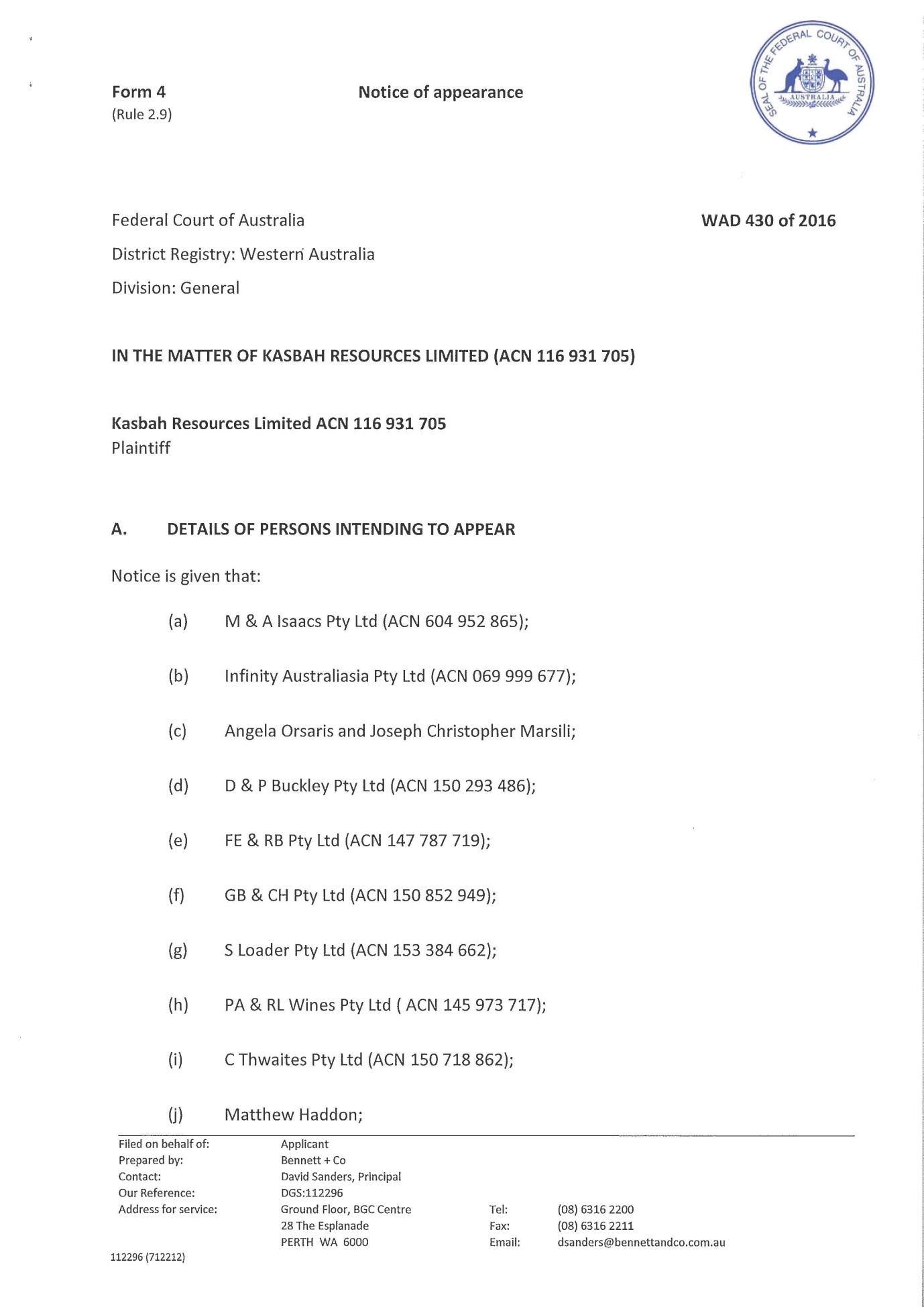
LOIS LANE INVESTMENTS PTY LTD ACN 109 342 654 (and others named in the attached Notice of Appearance) Objecting Shareholders | ||
DATE OF ORDER: |
THE COURT ORDERS THAT:
1. The plaintiff’s application by originating process filed 20 September 2016, for approval of a Scheme of Arrangement between the plaintiff and its members, be dismissed.
2. The plaintiff is to pay the objecting shareholders’ reasonable costs of and incidental to the conduct of their opposition to the application for approval of the Scheme of Arrangement to be assessed if not agreed, including but limited to 50% of any reserved costs.
Note: Entry of orders is dealt with in Rule 39.32 of the Federal Court Rules 2011.
MCKERRACHER J:
1 I recently dismissed with costs an application for court approval for the Scheme discussed in Kasbah Resources Limited, in the matter of Kasbah Resources Limited [2016] FCA 1131 (Kasbah No 1).
2 In Kasbah No 1, I declined to order a deferral or adjournment of the scheme meeting at which shareholders were invited to approve the proposed Scheme as I was not satisfied there was sufficient evidence warranting such a course and, in any event, rights would only be permanently affected, if at all, following the second court hearing. Prior to the second court hearing a deal of additional material was supplied, including an opposing independent expert report filed on behalf of a larger shareholder group comprising some 4% of the shareholding. On reviewing that material, Kasbah’s expert who had initially advised that the Scheme was ‘fair and reasonable’, was required to acknowledge a fundamental error in the valuation methodology and change the expert’s opinion of the Scheme to ‘not fair, but reasonable’. On the strength of that significant occurrence, shortly prior to and at the hearing, the Court was informed that Kasbah would seek to adjourn the second hearing in order to confer and attempt to renegotiate with the offeror. That application was opposed by the now considerably larger shareholder group, which sought dismissal of the application. That group also sought costs, including reserved costs.
3 It was pointless simply adjourning the Scheme and leaving the commercial state of affairs in some substantial uncertainty, in my view. From a costs perspective, even if new terms could be renegotiated in relation to the Scheme, all of the expense of revising that material, reporting and re-submitting it to the shareholders, obtaining further expert reports, convening further meetings and conducting further court hearings would continue to be necessary. As the very the basis on which shareholders had voted in favour of the Scheme had substantially changed, my view was that it was better to start afresh, even if there were prospects of some new arrangement being made. Accordingly, I decided to dismiss the application.
4 As to costs, there is no doubt that the requirement to abandon the Scheme in its current form and subsequent dismissal was brought about by the actions of the opposing shareholder group and the experts that group engaged. In those circumstances there seemed no reason why costs should not follow the event. Kasbah opposed being required to pay the reserved costs ordered in Kasbah No 1, as none of the three issues there raised was subsequently relied upon and the true basis for abandonment of the Scheme in its present form was a new consideration. While there was something in this argument, it still appeared to me that the shareholder group was not only entitled to its reasonable costs, preferably to be negotiated, but also to some compensation for the urgent interlocutory hearing on 29 November 2016, the primary focus of which was by reference to fluctuating prices in the underlying commodity, which had not been drawn to the attention of shareholders. More importantly, it was inevitable that a deal of the work done by that group in preparation for that hearing involved much of the work to be carried out for the second court hearing, including examination of the independent expert report supporting the Scheme. My view was that a reasonable compromise was for the shareholder group to be awarded 50% of the reserved costs in relation to that hearing.
5 Accordingly, I dismissed the application with costs orders restoring the parties’ positions, including reserved costs limited to 50% in favour of the objecting shareholders.
I certify that the preceding five (5) numbered paragraphs are a true copy of the Reasons for Judgment herein of the Honourable Justice McKerracher. |
Associate:


