

FEDERAL COURT OF AUSTRALIA
Samuel Smith & Son Pty Ltd v Pernod Ricard Winemakers Pty Ltd [2016] FCA 1515
ORDERS
SAMUEL SMITH AND SON PTY LTD (ACN 007 534 278) First Applicant S SMITH AND SON PTY LTD (ACN 007 871 427) Second Applicant | ||
AND: | PERNOD RICARD WINEMAKERS PTY LTD (ACN 007 870 046) Respondent | |
DATE OF ORDER: |
THE COURT ORDERS THAT:
1. The application is dismissed.
Note: Entry of orders is dealt with in Rule 39.32 of the Federal Court Rules 2011.
CHARLESWORTH J:
1 The parties to this action own and operate winemaking businesses in the Barossa Valley in South Australia.
2 The second applicant is a wholly owned subsidiary of the first. It trades under the name “Yalumba”. I will refer to the applicants jointly by that name. The historical genesis of the Yalumba winemaking business dates back to 1849 when Mr Samuel Smith first turned a sod in the Barossa Valley and planted vines there.
3 The first applicant is the owner of registered trade mark 805652 (the Yalumba Mark). The Yalumba Mark comprises the words THE SIGNATURE depicted, as here, in block capitals. It is registered in relation to goods including table wines.
4 The respondent (Pernod Ricard) trades under various names, including the name “Jacob’s Creek”. Pernod Ricard’s business in the Barossa Valley dates back to 1847 when its founder Mr Johan Gramp planted the first commercial vines in the region.
5 From September 2015, Pernod Ricard has produced, supplied and sold three red wine products with labels and associated promotional material bearing the words BAROSSA SIGNATURE. Yalumba claims that by using the words BAROSSA SIGNATURE in that context and without its authority, Pernod Ricard has infringed, and continues to infringe, the Yalumba Mark.
6 The questions that arise in these proceedings are:
(1) Has Pernod Ricard used the words BAROSSA SIGNATURE as a trade mark within the meaning of s 17 of the Trade Marks Act 1995 (Cth) ( TM Act)?
(2) Has Pernod Ricard used the words BAROSSA SIGNATURE as a sign that is deceptively similar to the Yalumba Mark within the meaning of s 10 of the TM Act?
(3) If the first and second questions are both answered yes, has Pernod Ricard used the words BAROSSA SIGNATURE in good faith to indicate the kind, quality, intended purpose, geographical origin or some other characteristic of the relevant products within the meaning of s 122(1)(b) of the TM Act?
7 For the reasons that follow, the first of those questions should be answered yes. The second should be answered no. It follows that Yalumba’s application must be dismissed. Had it been necessary to answer the third question, I would have determined that issue against Pernod Ricard.
FACTS AND EVIDENCE
8 For the most part, the following narrative of facts is not contentious. It otherwise constitutes my findings on those facts that are disputed. The narrative should be understood as the result of my consideration of all of the evidence, whether or not particular testimony or a particular document is expressly referred to. Where rulings were made at trial pursuant to s 136 of the Evidence Act 1995 (Cth), the evidence forming the subject of the rulings has been used only for the admitted purposes.
The Yalumba Mark
9 The registration of the Yalumba Mark was entered on the register of trade marks under the TM Act on 3 November 2000. The registration is effective from 2 September 1999. The first applicant has the exclusive right to use, and to authorise the use of, the Yalumba Mark as a trade mark in relation to the goods and services in respect of which it is registered (s 20(1)(a)), as well as the right to obtain relief for infringement (s 20(1)(b)).
10 The second applicant is an authorised user of the Yalumba Mark: see s 8 of the TM Act. Since 1994, the second applicant has used the Yalumba Mark under the control of the first applicant. In most years since 1990, the second applicant has produced and sold a cabernet sauvignon and shiraz blend made from grapes exclusively sourced from the Barossa region with labels bearing the Yalumba Mark.
11 The words THE SIGNATURE had been used on the labels of Yalumba’s product for about 20 years prior to the registration of the Yalumba Mark. They have featured more prominently on the labels from 1990. From about 2012, the word THE appeared in smaller font and became enveloped by a stylised first letter “S” in the word SIGNATURE. Since about 2000, Yalumba has produced about 60,000 bottles of wine each year bearing the words THE SIGNATURE on the label. The wines have been awarded trophies and medals at Australian wine shows. The products currently sell at a retail price of $60 a bottle.
12 In each vintage, the label of the Yalumba product has borne the signature of a person who has contributed to Yalumba’s business. That practice commenced in about 1966 when Yalumba first released a cabernet sauvignon and shiraz blend with a label bearing the name and signature of the founder of the business, Samuel Smith.
The Jacob’s Creek Reserve products
13 Since early 2000 Pernod Ricard has produced a range of wines referred to as its Reserve range. The Reserve range is promoted under the brand “Jacob’s Creek”.
14 The parties in the action referred to the names “Jacobs Creek” and “Yalumba” as house brands. Both house brands are well known among Australian wine consumers. Pernod Ricard also sells wines by reference to the house brands “Orlando”, “Wyndham Estate” and “St Hugo”. It has registered many trade marks under the TM Act to protect its house brands. Jacob’s Creek was described in evidence as the highest volume and value house brand within the Pernod Ricard “portfolio” of brands.
15 The Reserve range of wines forms one of a number of ranges of red wines marketed and sold under the Jacob’s Creek house brand. Wines in the Reserve range are sold at a higher price than other Jacob’s Creek wines.
16 Until September 2015, the Reserve range included a Coonawarra cabernet sauvignon, an Adelaide Hills pinot noir and chardonnay, and a Barossa riesling and shiraz. Since that time, the Reserve range has included three products (being the impugned products) bearing the words BAROSSA SIGNATURE on the front and rear labels, each of which is produced from grapes sourced exclusively from the Barossa Valley: a cabernet sauvignon, a shiraz cabernet blend and a shiraz. For convenience, I will refer to those three products collectively as the Barossa Signature sub-range. The shiraz product that is now sold in the Barossa Signature sub-range is the same wine previously sold in the Reserve range.
17 All of the wines in the Reserve range fall into what was described in evidence as the “premium” or “super premium” price tier, which means they are sold for between $15 and $25 a bottle. For reasons that will soon become apparent, the products in the Barossa Signature sub-range are sold at $2 more than the other products in the Reserve range.
18 The front and rear labels appear on the bottles of the impugned products respectively as follows:
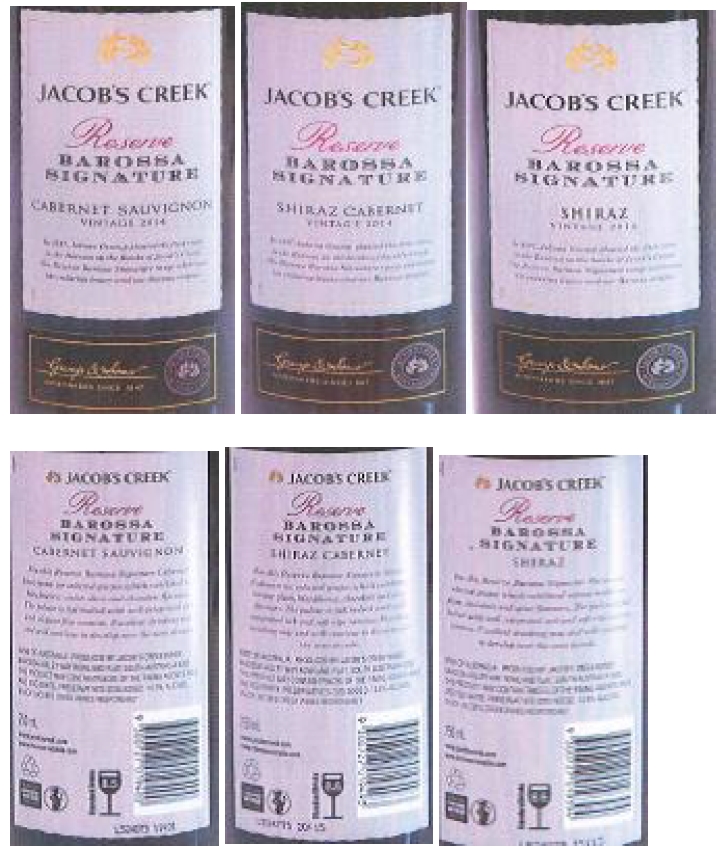
19 The labels are light grey in colour, in contrast to the white labels of the other wines within the Reserve range.
20 The Barossa Signature sub-range is promoted on the website www.jacobscreek.com/au, as well as on printed in-store displays. The Barossa Signature sub-range in-store promotional display is a poster of about A3 size. A version of the artwork for the promotional materials appears like this:
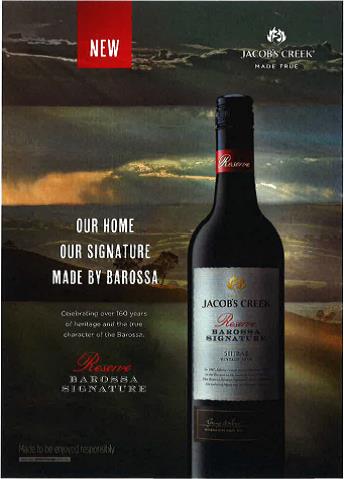
21 The in-store promotional displays actually used by Pernod Ricard differed from that artwork in some respects, including the addition of another bottle in the photographic image and the placement of the words RESERVE BAROSSA SIGNATURE in larger typeface toward the top of the display above the words OUR HOME OUR SIGNATURE MADE BY BAROSSA.
Development of the Barossa Signature sub-range
22 Pernod Ricard forms one of a group of companies known as the Pernod Ricard Group. In April 2015 the Pernod Ricard Group held an annual global sales and marketing meeting in France. At that meeting, concerns were raised about the increasing price of Barossa shiraz grapes. Supply of the varietal had become limited compared with other varietals in the then-existing Reserve range. It was no longer considered feasible to produce a Barossa shiraz product within the Reserve range at the existing price. Options were put forward to deal with the grape price and to avoid its adverse effect on the profitability of the Reserve range. Consideration was given to increasing the price of the existing Reserve shiraz product. That option was rejected because it was thought that increasing the price of a single product in the Reserve range would displease consumers. Nor was it considered feasible, in the prevailing market conditions, to increase the price of all existing products in the Reserve range.
23 During a lunch break in the meeting, Pernod Ricard’s Chief Executive Officer, Mr Jean-Christophe Coutures, conceived of a project to introduce additional products into the Reserve range, to be comprised of red wines sourced only from the Barossa Valley and to be sold in a higher price bracket than other wines within the Reserve range. He coined the name SIGNATURE to define the project. In his affidavit evidence, Mr Coutures claims that he used the word SIGNATURE in the sense that the new products would be identifiable as “quintessential Barossa red wine and that of Jacob’s Creek’s renowned or Signature region, the home of the brand, the Barossa”. I accept that was in fact Mr Coutures’ subjective intention in using the word at that stage to define the project.
24 The so-called Signature Project was assigned to Jacob’s Creek’s marketing personnel to develop. That team was led by Ms Caroline Parrott who, in turn, reported to a committee known as the Innovation Steering Committee (ISC). Ms Parrott’s title at the relevant time was “Brand Manager, Architecture, Australian Brands”. Her duties included “growing the market” for Pernod Ricard’s existing wine portfolios, as well as developing names and packaging designs for new products through the first stages of “innovation”. In her affidavit, Ms Parrott described the process of innovating a new product as follows:
Generally speaking, the process of creating a new product involves conducting an analysis of what the possible market opportunity is (including the size of the opportunity and the relevant consumer target), and then looking at product concepts. Often the process involves consumer research (including in relation to pack designs), and ordinarily, the process takes at least 12 months. The [Jacob’s Creek Reserve Barossa Signature] project did not follow this timeline. It was a speed-to-market project. There was a need to have the project finished as soon as possible, to reduce the adverse financial impact of the more expensive grapes. As a result, there was no formal consumer research conducted prior to launch.
25 According to Ms Parrott, the main focus of the marketing team was to prepare a label for the new product which was readily identifiable as a part of the existing Reserve range, but which also distinguished the new products from the other less expensive wines within that range. In short, the new products were to be recognisable by consumers as forming a “sub-tier” within the Reserve range.
26 It was the role of the ISC to formally approve decisions made at various stages of the Signature Project, including the final product name and packaging. The marketing team put forward the name “Barossa Signature Series” as the first option to name the new products at an ISC meeting on 22 April 2015. From that time onward, the project was variously referred to as “Project Barossa Signature” and “Signature Series”.
27 In the various presentations made by Ms Parrott to the ISC, the “principles” of the Signature Project were described relevantly in the following terms:
• Leverage Reserve awareness and equity to create sub tier;
• Price of Reserve Barossa Shiraz to be elevated to a new Barossa Signature tier at a $2 price premium;
• Barossa Cabernet and Merlot to be added to Barossa Signature tier at $2 price premium;
• Limestone Coast Shiraz introduced at Reserve tier.
28 The agenda for the 22 April 2015 meeting was circulated the day prior. Among its recipients was Ms Kylie Thomas, Pernod Ricard’s Legal Manager for Intellectual Property and Marketing. When Ms Thomas received the agenda, she searched the word SIGNATURE on the Australian Trade Marks Register. She identified that Yalumba had trade mark registrations for the word marks SIGNATURE SERIES and THE SIGNATURE (the latter being the Yalumba Mark). Ms Thomas sent an email to Ms Gwenola Hanaut, Pernod Ricard’s Innovation Director. She informed Ms Hanaut of her initial trade mark search results.
29 In the meantime, Pernod Ricard engaged a packaging design agency named Landor to design labels for the proposed new products. Landor provided some initial label design concepts on 20 May 2015.
30 On 29 May 2015, Ms Thomas sent an email to Pernod Ricard’s Legal Corporate Affairs and Communications Director, Ms Kate Thompson regarding an ISC meeting to be held later that day. The email states:
This is just FYI before ISC today, see below. I’ve identified some potential risks with the use of Signature, for project Barossa signature. I’m told it’s just the project name at this stage, but I keep seeing it in the slides and I thought it worth mentioning in case anyone starts to get attached to the name. We haven’t had instructions to search yet, I’ve just done a very quick search myself.
31 Ms Thompson replied in the following terms:
… The label is being redesigned so there may be options to lock it up with “Barossa”, but they will need to get trademark advice asap as the label design is now super urgent and they will need to understand the risks before they can brief it.
32 At the ISC meeting, Ms Parrott gave a presentation of the initial label designs that had been produced by Landor. The labels were not approved by the ISC because they too closely resembled the labels of the existing products in the Reserve range. The rejected labels were white in colour. Each used the words SIGNATURE and BAROSSA, although in different typefaces and sizes than each other. It was nonetheless decided that the words BAROSSA SIGNATURE would be used on the labels for the new products. Ms Parrott was tasked with investigating, in conjunction with Pernod Ricard’s legal advisors, the legal implications of using the words.
33 On 3 June 2015, Ms Thomas instructed the Pernod Ricard Group’s so-called Global IP Hub (GIPH) to carry out detailed trade mark searches. The GIPH gave advice to the effect that there was no obstacle using the words SIGNATURE and SERIES provided that they were used in combination with the word BAROSSA, and provided that the words were “not prominent or isolated”. The GIPH then gave written advice in what was referred to in evidence as “template form”. The advice template uses a traffic light system, indicating a green, amber or red light to signify the likelihood of a challenge to the use of the proposed words BAROSSA SIGNATURE. The advice refers to the Yalumba Mark and shows a green light, signifying a low risk. A key at the base of the advice states that the green light signifies:
Low risk – means that it is unlikely that there will be a challenge (for instance, because there is no obstacle to use or registration at the time the search was conducted) and that, even if challenged, [Pernod Ricard] would have at least about 70% chances of success.
34 The GIPH advice recommended “using BAROSSA SIGNATURE as a single phrase (ie. same font, same size, same colour for both words) so that Signature will not be isolated”. Ms Thomas then restated the effect of that advice to Ms Parrott in an email of 15 June 2015. She added that the words BAROSSA SIGNATURE were “descriptive of product origins or characteristics and ought to be available for use by others” and that the word “Barossa” and the word “Signature” should be used together “to make it a descriptive use”.
35 In an email dated 15 June 2015, Ms Parrott conveyed further design instructions to Landor in relation to three label design options. Her email states:
I have also just received advice from legal this morning about the use of ‘Signature’ and in order to not infringe an existing trademark, we will need to use ‘Barossa’ and ‘Signature’ together (legal are saying same line, same font, colour and size with no lines or other graphic text in between the words). Can you follow these guidelines and amend the lock-up accordingly across all 3 designs? The only one that I think we have flexibility with is the ‘same line’, so feel free to stagger over 2 if you feel it is required.
36 Two days later, Landor produced new options for the label design, numbered 1 to 9. The options were provided to Ms Thomas, who gave advice about their risks. She rejected the options numbered 1, 2, 3 and 8 because she considered that they “probably wouldn’t be successful if challenged by Yalumba as ‘Signature’ appears separately and could be interpreted as trademark use, rather than a descriptor of the wine.” Ms Thomas described the remaining five label designs as “the best legal options”. She ranked them in descending order of risk. The label design ultimately used by Pernod Ricard was that ranked third in the list. The two options thought to be of lesser risk each used the words BAROSSA SIGNATURE on the same line rather than staggered over two lines. The decision to stagger the words was made having regard to the width of the label and the desire to increase the size of the font. With the increase in font size came an increase in the prominence of the words relative to other words on the labels.
37 The ISC gave its final approval for the label design at a meeting on 27 August 2015. The impugned products were then released for sale in September 2015.
The public relations message
38 Ms Ruth Harris is the Global Public Relations Manager for Australian Brands at Pernod Ricard. She described her role as requiring a deep understanding of the “overall message” for each of the Pernod Ricard wine brands. In her own words:
This means that I work closely with the Winemaking and Marketing departments of Pernod Ricard when new products are being developed to ensure the messages are credible and consistent with other brand communications. When introducing a new product or new range of products, it is important to be able to describe how the new product fits within the overall brand personality, but also to be able to distinguish it from existing products within the range.
39 In her day to day role, Ms Harris was responsible for (among other things) the preparation of background material and external communications concerning Pernod Ricard’s brands to be pitched to journalists and editorial desks, the preparation of media releases and the development of public relations campaign ideas. Ms Harris gave evidence to the effect that she considered it necessary for the products in the Barossa Signature sub-range to be “adequately differentiated from the Reserve range, so that consumers could perceive the additional value in the Reserve Barossa Signature range”. That task involved some “PR challenges”, which Ms Harris set out in an email to Ms Parrott, among others, on 22 May 2015. The challenges identified by Ms Harris may be summarised as follows:
(1) Pernod Ricard had worked hard to establish the Reserve range as representing the best region for each varietal. The credibility of that message might be affected by the reorganisation of products within the range, particularly the introduction of a Limestone Coast shiraz within the range, coupled with an increase in price for the proposed BAROSSA SIGNATURE shiraz.
(2) Consumers would be asked to pay $2 more for what was effectively the same Barossa shiraz in circumstances where the increase in the price of shiraz grapes was not relevant to them.
(3) The Barossa Signature sub-range seemed to be “just a more expensive sub-range of Reserve”.
40 Ms Harris subsequently formulated “communications messages” and signed off on a draft media release which was ultimately used to both promote the new products and to explain the change in composition of wines within the existing Reserve range. She also signed off on a “Q & A document” to be referred to by Pernod Ricard’s representatives when responding to questions about the new products. The media release opens with these paragraphs:
Iconic Australian wine brand JACOB’S CREEK is celebrating its roots with the launch of a new range of premium red wines that pay tribute to the brand’s home in the Barossa.
Launching exclusively in Australia in September 2015, the JACOB’S CREEK Reserve Barossa Signature range is designed to express the unique character of the brand’s signature wine region through a range of premium Barossa reds.
The notional consumer
41 The wine market is one in which the general public participates. It is not a specialist market: compare C A Henschke & Co v Rosemount Estates Pty Ltd [2000] FCA 1539; (2000) 52 IPR 42 (Henschke) at [17]. The Court heard evidence, including expert evidence, about the typical circumstances surrounding a notional retail purchase of wine by a member of the public in the relevant price bracket. I make the following findings on the basis of that evidence:
(1) Consumers ordinarily enter a retail wine store with at least a wine colour and price range in mind. Some will also have a grape variety in mind.
(2) The factors that would typically affect the consumer’s purchase decision are price, style, brand and grape variety.
(3) The market is a crowded one. A typical wine retail store will stock hundreds of wine on display.
(4) Wines are typically displayed according to grape variety and to some extent by price. They are displayed for retail sale with their labels clearly visible to the purchaser.
(5) Wine consumers spend, on average, about two to three minutes in front of a shelf making a purchase decision for a wine product. Although short, the time spent choosing a wine product is nonetheless considerably longer than that spent choosing more mundane grocery items.
(6) It is common practice for wines to be labelled with product names that may also form the function of a brand or, as referred to in evidence, a “sub-brand”.
(7) In common with the purchase of other retail products in stores, consumers tend to use subconscious learned behaviours to make a faster decision based upon cues that they notice (including brands and sub-brands), particularly when choosing wine for consumption at home. The decision does not typically involve significant cognitive effort.
(8) Many wine purchases are repeated, with consumers drawing on their prior experience with a brand or product name to inform their next purchase.
(9) Some consumers are more “involved” than others, meaning that they have a deeper appreciation of varieties, appellations and other wine characteristics, and so will be more discerning than an “uninvolved” consumer.
42 Not only is the concept of sub-branding common in the development and marketing of wine products, the evidence adduced at trial suggests that it is a matter of considerable commercial importance. The importance of sub-brands was explained in the expert report of Professor Lawrence Lockshin, Senior Researcher and Head of School of Marketing at the University of South Australia, as follows:
Wine is a more complex category than most if not all other [Fast Moving Consumer Goods]. There are more brands and the brands have a greater number of attributes, e.g., brand name, sub-brand name, grape variety, region/country of origin, price, medals and awards, and vintage, compared to typical categories like soap, detergent, even confectionery. But consumers react as they do regarding all retail store-based shopping by using learned behaviours drawn from the subconscious to make quick decisions, rather than spending time contemplating each decision.
…
When the category is complex, like wine, sub-branding becomes more important. Sub-brands can include a range within a larger brand. These sub-brands are usually distinguished by a sub-name and sometimes a different colour scheme, such as Wolf Blass having a red label, yellow label, or black label. Sub-brands can have different names instead, such as reserve or old vine, or different regions or even sub-regions, such as Barossa Ebenezer and Barossa Lyndoch. Sub-brands can use generic terms to distinguish them within the overall brand range, like old vine or reserve, which have a general meaning and can be found within the branding structures of multiple wine brands. Sub-brands can also use proprietary terms as the distinguishing feature within an overall brand range, such as a named vineyard producing several different wines or even a proprietary name, like the ‘portrait series’, or the ‘old wall range’.
Consumers learn about these distinctions to a greater or lesser degree. More involved consumers might learn about different regions or sub-regions or different sub-brand names and use them in subsequent purchasing, while low involvement consumers might not learn the difference and therefore might not use these distinctions in future purchasing.
43 Mr Luigi Pargaliti, the owner of a retail wine store in Adelaide’s inner suburbs, gave evidence consistent with the opinion expressed by Professor Lockshin in respect of the use of sub-brands. Mr Pargaliti confirmed that “a lot” of wines were labelled with particular product names, as well as the winemaker’s house brand. He said that traders and customers alike referred to wines in a shorthand manner by their product names only. In that regard, the product names served the function of a brand.
44 The importance of sub-brands was also confirmed by Ms Annette Druce, Pernod Ricard’s Global Consumer Insights Director. Ms Druce described her role as one that supported Pernod Ricard’s marketing teams “in the development of brand strategy in terms of brand positioning, portfolio architecture and providing insights into the consumer decision making process”. The Global Insights team managed by Ms Druce is responsible for “monitoring brand health metrics across the global wine portfolio, to measure consumers’ awareness of Pernod Ricard’s brands”. The team relies heavily on consumer surveys for that purpose, including a survey commissioned by Pernod Ricard known as the Brand Equity Monitor (BEM). Consumers who participate in the BEM survey are asked about their awareness of wine brands in Australia. The questions in the BEM survey are approved by Pernod Ricard. Question G1 of a survey relating to a period ending in December 2015 asks “which of the following ... brands have you seen or heard of?”. The survey includes a list of “innovation brands” to be put to the consumer in aid of that question. Among the “innovation brands” to be put to the consumer are “Jacob’s Creek Twin Pickings”, “Jacob’s Creek Double Barrel” and “Jacob’s Creek Reserve Barossa Signature”.
45 The products “Double Barrel” and “Twin Pickings” are sub-brands of the house brand Jacob’s Creek. Each of those product names are registered trade marks owned by Pernod Ricard. The Jacob’s Creek portfolio of trade marks amounts to about 150 registrations. Other house brands within Pernod Ricard have a trade mark portfolio of similar magnitude. Some of those registrations include the word BAROSSA, together with another word, such as PEARL or BARON.
46 Pernod Ricard has not made any application to register the words BAROSSA SIGNATURE as a trade mark.
THE FIRST ISSUE: USE AS A TRADE MARK
47 Section 120 of the TM Act provides:
A person infringes a registered trade mark if the person uses as a trade mark, a sign that is substantially identical with, or deceptively similar to, the trade mark in relation to goods or services in respect of which the trade mark is registered.
48 A “sign” may include a word or combination of words: s 6 of the TM Act. Use of a sign “in relation to goods” includes use upon or in physical or other relation to the goods: see s 7(4) and s 7(5) of the Act.
49 Pernod Ricard does not dispute that it has used the words BAROSSA SIGNATURE as a sign in relation to the wine products in the Barossa Signature sub-range. It has, it admits, used those words on or in physical or other relation to the three products sold and promoted for sale since September 2015. The goods are the same goods in respect of which the Yalumba Mark is registered: namely, goods in Class 33 designated as “wines, especially still table wines”.
50 The contentious issue of whether Pernod Ricard has used a sign “as a trade mark” is to be determined in accordance with s 17 of the TM Act. It provides:
A trade mark is a sign used, or intended to be used, to distinguish goods or services dealt with or provided in the course of trade by a person from goods or services so dealt with or provided by any other person.
51 In E & J Gallo Winery v Lion Nathan Australia Pty Ltd (2010) 241 CLR 144, French CJ, Gummow, Crennan and Bell JJ said (at [42] — [43]):
42 … the requirement that a trade mark ‘distinguish’ goods encompasses the orthodox understanding that one function of a trade mark is to indicate the origin of ‘goods to which the mark is applied’. Distinguishing goods of a registered owner from the goods of others and indicating a connection in the course of trade between the goods and the registered owner are essential characteristics of a trade mark. There is nothing in the relevant Explanatory Memorandum to suggest that s 17 was to effect any change in the orthodox understanding of the function or essential characteristics of a trade mark.
43 In Coca-Cola Co v All-Fect Distributors Ltd a Full Court of the Federal Court of Australia said:
Use ‘as a trade mark’ is use of the mark as a ‘badge of origin’ in the sense that it indicates a connection in the course of trade between goods and the person who applies the mark to the goods … That is the concept embodied in the definition of ‘trademark’ in s 17 — a sign used to distinguish goods dealt with in the course of trade by a person from goods so dealt with by someone else.
(footnotes omitted)
52 The assessment of the nature and purpose of the use of a sign is an objective one, to be made with proper regard to the context in which the allegedly infringing use occurs. In making that assessment, the Court may take into account factors such as the positioning of the sign relative to other packaging features, the type and size of any font in which the sign is presented and the trade setting in which the use occurs.
53 In The Shell Company of Australia Limited v Esso Standard Oil (Australia) Limited (1963) 109 CLR 407 (Shell Co), Kitto J discussed the test in the context of a trade mark infringement claim concerning television advertisements for petrol. His Honour said (at 425):
… the question becomes whether, in the setting in which the particular pictures referred to were presented, they would have appeared to the television viewer as possessing the character of devices, or brands, which the appellant was using or proposing to use in relation to petrol for the purpose of indicating, or so as to indicate, a connexion in the course of trade between the petrol and the appellant. Did they appear to be thrown on to the screen as being marks for distinguishing Shell petrol from other petrol in the course of trade?
54 In determining the nature and purpose of the impugned use of a sign, the Court is to have regard to the totality of the packaging and ask what a person looking at the label would see and take from it: Anheuser-Busch, Inc v Budějovický Budvar, Národní Podnik [2002] FCA 390; (2002) 56 IPR 182 (Anheuser-Busch) at [186]. The way in which the words are displayed in relation to the goods will be relevant. So, too, will be the existence on the label of a clear and dominant brand: Johnson & Johnson Australia Pty Limited v Sterling Pharmaceuticals Pty Limited (1991) 30 FCR 326 (Caplets) at 347.
55 Although the principles I have summarised are well settled, there is little assistance to be found in the decided cases as to their practical application in the case at hand. Each case must depend upon its own facts and must necessarily involve a fair degree of impression: Pepsico Australia Pty Ltd (t/as Frito-Lay Australia) v Kettle Chip Co Pty Ltd (1996) 135 ALR 192 (Pepsico) at 193 (Lockhart J) and 216 (Sackville J).
56 Pernod Ricard submitted that the following related considerations (at least) supported a finding that it had not used the words BAROSSA SIGNATURE so as to indicate the trade origin of the products to which the words were applied:
(1) the only features of the label that would be understood by consumers to serve the function of a “brand” are the words JACOB’S CREEK and RESERVE;
(2) the words are, and would be understood by consumers to be, descriptive of the relevant product and accordingly would not appear to consumers to possess the character of a brand;
(3) Pernod Ricard subjectively intended to use the words exclusively for a descriptive purpose and not as a trade mark and it may readily be inferred that this subjective purpose was achieved in fact.
57 The first and second of those contentions will be considered together, first by reference to the appearance of the relevant labels and promotional material, then by reference to the meaning conveyed by the impugned sign itself and finally having regard to the wider trade context.
The appearance of the labels and promotional displays
58 The words JACOB’S CREEK appear at the top of the front labels below a gold embossed leaf symbol. It is common ground that those words are the first feature that consumers would notice on the labels. The word RESERVE next appears in elegant red cursive. The words BAROSSA SIGNATURE appear in capital letters in a prominent and central position. The font differs from that used for the words JACOB’S CREEK and RESERVE. The font is decorative and distinctive. There is a gold line separating the words from the remaining content of the label. The grape variety then appears in a basic black capitalised font, followed by a description of the vintage in the same (although smaller) typeface.
59 These words appear at the bottom of the front label in smaller italic font:
In 1847, Johann Gramp planted the first vines in the Barossa, on the banks of Jacob’s Creek. The Reserve Barossa Signature range celebrates his enduring legacy and our Barossa origins.
60 As I have mentioned, in addition to the use on the labels themselves, the words BAROSSA SIGNATURE are utilised in point of sale promotional material produced by Pernod Ricard. The poster-style material is displayed in retail stores in close proximity to the products. The material depicts two wine bottles against a photographic backdrop of a brooding sea-side scene. The words RESERVE and BAROSSA SIGNATURE appear prominently on the material in the same typefaces and configuration in which they appear on the labels of the products. The material includes, in prominent white capital letters, the words “OUR HOME OUR SIGNATURE MADE BY BAROSSA” across three lines.
The impugned sign
61 Pernod Ricard’s primary submission is that the only signs used as brands on the labels of the products are JACOB’S CREEK, RESERVE or JACOB’S CREEK RESERVE. If, contrary to Pernod Ricard’s primary submission, it is found to have used the words BAROSSA SIGNATURE as a badge of origin, it contends that the relevant sign for the purposes of comparison with the Yalumba Mark is JACOB’S CREEK RESERVE BAROSSA SIGNATURE or RESERVE BAROSSA SIGNATURE.
62 As to that latter submission, the only alleged infringing sign that falls for consideration in the proceedings is that identified by Yalumba’s pleaded case. The pleaded case is that Pernod Ricard has used the sign BAROSSA SIGNATURE as a trade mark in relation to wine: Fast Track Application [20]. It is only the words BAROSSA SIGNATURE that are alleged to be deceptively similar to the Yalumba Mark: Fast Track Application [21]. The question of whether those particular words are used by Pernod Ricard as a trade mark is to be determined having regard to the setting in which they are used, which includes consideration of all of the other features on the product labels as identified above.
63 Pernod Ricard contends that the words BAROSSA SIGNATURE are “descriptive” both in their objective meaning and in their intended use and that consumers would not therefore perceive the words to be used as a trade mark. The following paragraphs constitute my own observations as to the meaning conveyed by the impugned sign.
64 The word BAROSSA is the name of a famous South Australian wine region. The region is well known for its production of a superior shiraz grape variety. The word is a regional name that winemakers, including Yalumba, are entitled to use, subject to legal restrictions regulating the use of geographic indicators for wine: Australian Grape and Wine Authority Act 2013 (Cth).
65 The word SIGNATURE may be used both as a noun and as an adjective. Pernod Ricard submitted that the word SIGNATURE “forms part of the lexicon of those in the wine industry” in its adjectival sense, and that it is only in that sense that the word would be understood by consumers in connection with the impugned products. That descriptive use, it is contended, is “entirely ordinary”. On that aspect of its case, Pernod Ricard relies upon a series of publications in which the word “signature” was used in relation to wine or winemakers. The publications are heavily populated with adjectives, most of which would be understood by the ordinary reader of the publications to bear their ordinary meanings. Except in its reference to Yalumba’s product, the word is used in the publications in an adjectival sense that is synonymous (or at least nearly so) with words such as “quintessential”, “defining”, “typical” or “characteristic”.
66 When used in the phrase “signature wine”, the word bears the same meaning as it does in the phrases “signature dish”, “signature tune” or “signature look”. In each case, the adjective precedes the noun. In its ordinary adjectival usage, the word SIGNATURE is usually employed in conjunction with the name of a thing or endeavour that is (or that at least has pretensions of being) creative or culturally refined. In ordinary English, phrases such as “signature dish cloth” or “signature crankshaft” are uncommon. In the musings of wine writers, the word is commonly used in conjunction with such nouns as vintage, red, vineyard, region, winery, producer and variety.
67 Overall, I am satisfied that the word SIGNATURE is a familiar word in wine parlance and that it would be understood by the readers of the publications, including members of the public, to be used in the publications themselves usually in its ordinary adjectival sense. However, I am not satisfied that the use of the word in its adjectival sense in the various publications to which Pernod Ricard referred would result in the ordinary consumer excluding from his or her mind other senses of the word when used in other contexts, such as within a wine product name. Nor am I satisfied that the word SIGNATURE is commonly used as a descriptor for wine in the same sense as words such as “red”, “white”, “shiraz”, “dry” or “sparkling” might be. Each of those words is neutral in terms of the standard of the wine so described. In contrast, the word SIGNATURE in connection with wine conveys (whether truthfully or not) a sense that the wine so described is not only typical of something but an excellent example (in terms of quality) of that something. It is a descriptor that is capable of being used (or misused as the case may be) in a laudatory sense.
68 All of that is not to say that there is no commonality at all between the noun and adjectival senses of the word SIGNATURE. The adjectival meaning of the word borrows something from the noun: both senses of the word signify something of a unique and identifying sign or thing, either (as a noun) in relation to an individual or (as an adjective) in relation to an individual, enterprise or place.
69 The evidence did not establish that the word SIGNATURE was commonly used in trade marks in relation to wine.
70 Finally in relation to the word SIGNATURE, it was submitted that the word has acquired a secondary meaning in respect of wine by reason of Yalumba’s own use of the word for about 50 years “as a trade mark for high quality red wine”. Although I am satisfied that the word has indeed been used by Yalumba as a trade mark for about 50 years, the evidence did not rise to the heights contended for by Yalumba. In the context of a crowded and complex market, I am not satisfied that the relevant consumer would understand the word to have a secondary meaning associated with high quality red wine, notwithstanding that some consumers, traders or wine writers who are familiar with Yalumba’s product might refer to the product in shorthand by the word SIGNATURE alone.
71 I give separate consideration to the relevance of Yalumba’s reputation in its registered mark later in these reasons.
72 The fact that each of the words BAROSSA and SIGNATURE are descriptive words is relevant to, but by no means determinative of the issues arising on Yalumba’s infringement application. The words are presented on the Pernod Ricard labels in the same font and size and in such proximity that they are clearly intended to be read together as a composite phrase. I am satisfied that they would be understood by consumers as constituting a sign separate and apart from the words JACOB’S CREEK and RESERVE.
73 Whilst each of the words BAROSSA and SIGNATURE are common in ordinary English usage, they are not commonly (if at all) seen or heard in the company of each other in that particular order. I am not satisfied that BAROSSA SIGNATURE is an ordinary combination of words commonly employed to described wine, whether in the adjective-ridden lexicon of the wine industry or otherwise in ordinary English usage. The words themselves may be ordinarily descriptive, but their peculiar combination is not. The peculiar order of the words is a feature of the impugned sign that is significant.
74 That is not to say that consumers would not also take from the label the same or a similar idea or impression that is conveyed by the literal meaning of each word, namely that the wines are “typical of a style”, being a style of wine that is sourced from and characteristic of the Barossa region. It is simply to note that the meaning is conveyed indirectly by an unconventional use of conventional words.
75 In Caplets, Gummow J said at 347 — 348:
Where the trade mark allegedly used by the defendant comprises ordinary English words … that circumstance may be taken into account by the court in the process of reasoning by which it accepts or rejects a submission that the use in question is not a trade mark use but a description of the goods in question. To say that is not to gainsay the point made by Dixon CJ in Mark Foys Ltd v Davies Coop and Co Ltd (the Tub Happy case) (1956) 95 CLR 190 at 194-195 that language is not always used to convey a single, clear idea; a mark may have a descriptive element but still serve as a badge of trade origin. However, where the issue is one of infringing use by use of a word mark (as in the present case), the fundamental question remains, to paraphrase what was said by Williams J in the same case (supra) (at 205), whether those to whom the user is directed are being invited to purchase the goods (or services) of the defendants which are to be distinguished from the goods of other traders ‘partly because’ (emphasis supplied) they are described by the words in question.
(emphasis added)
76 See also Playgro Pty Ltd v Playgo Art & Craft Manufactory Limited (No 2) [2016] FCA 478 at [18] (Moshinsky J).
77 I am satisfied that the phrase BAROSSA SIGNATURE has a “descriptive element” of the kind referred to in Caplets in that the words do convey a message about the underlying goods. The meaning, however, is conveyed impressionistically rather than literally. The unusual combination of words creates the impression of a softly spoken slogan. That conclusion weighs heavily in my consideration of whether the impugned sign serves as a badge of trade origin.
The trade context
78 On the facts as I have found them it is clear (and indeed acknowledged and intended by Pernod Ricard) that the words BAROSSA SIGNATURE do perform a distinguishing function. On Pernod Ricard’s own case, the words are intended to distinguish, in the minds of consumers, the three products in the Barossa Signature sub-range from other wines in the Reserve range. The words were devised and employed with a view to ensuring that consumers would not resist paying more for wine falling within the familiar Reserve range. In that regard, the words delineate a further tier within the Reserve range.
79 The effect of the submission advanced by Pernod Ricard is that although the words BAROSSA SIGNATURE would be understood by consumers as distinguishing products within the JACOB’S CREEK house brand (being goods originating from the same trader) the words would not be understood by the same consumers as a sign distinguishing the relevant goods from those of other traders. That submission is not supported by the evidence of the wider trade context in which the impugned sign is used. As I have already observed, in that wider trade context, consumers:
(1) do not employ significant cognitive effort in making wine purchases;
(2) are familiar with the concept of a sub-range; and
(3) are accustomed to the use of words or signs performing the function of a sub-brand in connection with a sub-range of products and, indeed, utilise sub-brands as a short cut (and perhaps unconscious) means of decision-making.
80 Against that trade context, I have rejected Pernod Ricard’s submission that the only features on the labels that would be understood by consumers as serving as brands are JACOB’S CREEK or JACOB’S CREEK RESERVE. As Allsop J (as he then was) said in Anheuser-Busch at [191]:
It is not to the point … to say that because another part of the label … is the obvious and important ‘brand’, that another part of the label cannot act to distinguish the goods. The ‘branding function’, if that expression is merely used as a synonym for the contents of ss 7 and 17 of the TM Act, can be carried out in different places on packaging, with different degrees of strength and subtlety. …
81 It is to be accepted that where other words used on packaging clearly serve the function of a trade mark, it will be more difficult to draw the conclusion that other words occupying a “subsidiary position” on the packaging also serve that function: Pepsico at 216 (Sackville J). However, in the case at hand, I would not describe the words BAROSSA SIGNATURE as occupying a subsidiary position on the labels or on the promotional materials. The visual impact of the words on the labels is conveniently and correctly described in Yalumba’s closing submissions as follows:
The words stand out from the surrounding words as the name of this particular range. The words BAROSSA SIGNATURE appear in capital letters, in a prominent and central position on both the front and back labels. The font used is elegant, evoking an art-deco style. Each letter is rendered in thick black letters, accented by thin white and grey horizontal lines. The word SIGNATURE is underlined in gold. The rendering of the words SIGNATURE and BAROSSA is designed to contrast sharply with that of the surrounding words including the red italics of the word ‘Reserve’, the basic black font of the name of the grape variety, and the smaller grey font of the words ‘Vintage’ and the year of production of the wine.
82 Having regard to the physical presentation of the sign on the labels, the unusual combination of words and the trade context to which I have referred, I do not accept that consumers would perceive the words BAROSSA SIGNATURE as a sign distinguishing the wines in the Barossa Signature sub-range from others in the Reserve range, and yet not also perceive the words as a sign distinguishing the wines from those of other traders. In all of the circumstances, the fact that each word used in the sign is descriptive does not prevent the words from distinguishing Pernod Ricard’s goods: Caplets at 347 — 348.
83 To adopt the words of Ms Harris, sub-brands are readily understood by consumers as forming a part of a particular trader’s overall “brand personality”. The sign BAROSSA SIGNATURE serves as one such sub-brand: its use, in context, would be understood by consumers of wine to form a part of the so-called “brand personality” of Pernod Ricard. The sign is used as a trade mark as defined in s 17 of the TM Act.
Subjective evidence
84 Both parties urged the Court to have regard to the subjective intentions of Pernod Ricard in determining the question of whether, considered objectively, the words BAROSSA SIGNATURE were used as a trade mark. Although the test is an objective one, the subjective intentions of the alleged infringer may be taken into account in applying it: Lift Shop Pty Ltd v Easy Living Home Elevators Pty Ltd [2014] FCAFC 75; (2014) 311 ALR 207 at [38] (Besanko, Yates and Mortimer JJ).
85 I give consideration to Pernod Ricard’s subjective intention in employing the impugned sign in [114] to [131] below in the context of s 122 of the TM Act. In the final analysis, I have accorded my conclusions concerning Pernod Ricard’s subjective intentions little weight in determining the discrete and objective question of whether the sign BAROSSA SIGNATURE was used by Pernod Ricard “as a trade mark” as defined in s 17 of the TM Act. As will be seen, my conclusions in relation to Pernod Ricard’s subjective intentions do not assist Pernod Ricard on the question of trade mark use in any event. I would, in the final analysis arrive at the same conclusion as to trade mark use without regard to Pernod Ricard’s subjective intentions.
the second issue: DECEPTIVE SIMILARITY
Principles
86 The concept of deceptive similarity is defined in s 10 of the TM Act as follows:
… a trade mark is taken to be deceptively similar to another trade mark if it so nearly resembles that other trade mark that it is likely to deceive or cause confusion.
87 That definition requires an assessment to be made of the “effect or impression” that would be produced on the minds of persons of ordinary intelligence and memory by the normal use of the registered mark: Australian Woollen Mills Limited v F S Walton & Company Limited (1937) 58 CLR 641 at 658 (Dixon and McTiernan JJ); Shell Co at 415 (Windeyer J); Registrar of Trade Marks v Woolworths Ltd (1999) 93 FCR 365 (Woolworths) at [49] — [50] (French J). It is that effect or impression which forms the basis of the comparison to be made with what the alleged infringer has actually done. In Wingate Marketing Pty Limited v Levi Strauss (1994) 49 FCR 89, Gummow J described the relevant comparison as follows (at 128 — 129):
… (i) The comparison is between any normal use of the plaintiff’s mark comprised within the registration and that which the defendant actually does in the advertisements or on the goods in respect of which there is the alleged infringement, but ignoring any matter added to the allegedly infringing trade mark; for this reason disclaimers are to be disregarded, price differential was considered irrelevant ... [as were] the differences in use by the parties of colour and display panels, and ... the differences in the respective sections of the public to whom the goods were sold. (ii) However, evidence of trade usage … is admissible but not so as to cut across the central importance of proposition (i). …
88 The effect or impression of the Yalumba Mark includes “the idea which the mark will naturally suggest to the mind of one who sees it”: Jafferjee v Scarlett (1937) 57 CLR 115 at 121 (Latham CJ). The idea suggested by the mark may be that which is conveyed by a “significant and distinctive element”, or an “essential feature” of the mark, or “some feature in it which strikes the eye and fixes itself in the recollection”; see respectively Effem Foods Pty Ltd v Wandella Pet Foods Pty Ltd [2006] FCA 767; (2006) 69 IPR 243 at [36], Crazy Ron’s Communications Pty Ltd v Mobileworld Communications Pty Ltd [2004] FCAFC 196; (2004) 209 ALR 1 at [93].
Evidence of reputation in the Yalumba Mark
89 The Court heard evidence from witnesses called by Yalumba to the effect that the Yalumba Mark and the product associated with it were both well known. Yalumba’s reputation in the mark was alleged to be such that the “bundle of ideas” conveyed by the Yalumba Mark would include an association with Yalumba and its product, so that consumers would likely wonder whether the Pernod Ricard product emanated from the same source. I have dealt with a similar contention in relation to trade mark use at [70] of these reasons.
90 In Henschke the Full Court (Ryan, Branson and Lehane JJ) undertook a detailed review of the authorities concerning the relevance and admissibility of evidence concerning the reputation in a registered trade mark when determining the issue of deceptive similarity between a registered mark and the sign of an alleged infringer. That case, like the present, involved an allegation of trade mark infringement under s 120(1) of the TM Act. Unlike the case at hand, the owner of the mark alleged further and alternative causes of action in passing off and misleading and deceptive conduct in contravention of what was then s 52 of the Trade Practices Act 1974 (Cth). An issue arose as to whether the primary judge erred in failing to give any or sufficient weight to evidence of the trade mark owner’s reputation in its mark in determining the issue of deceptive similarity under the TM Act. The Full Court’s analysis begins (at [44]) with this statement:
Essentially what is required is a comparison between the mark of the registered owner and that of the alleged infringer. A wider inquiry of the kind that might be undertaken in a passing off action, or in a proceeding in which contravention of Pt V of the Trade Practices Act is alleged, is not appropriate.
91 The Court continued (at [45]):
Consistently with the nature of the test of deceptive similarity and the authorities to which we have referred, it is not easy to see what relevance the reputation an applicant may have in a particular mark (even the ‘icon status’ of that mark) has in an action for infringement brought in reliance on s 120(1) of the Trade Marks Act. (Clearly, and by contrast, it is relevant under s 120(3) and may be relevant under s 120(2)). Nor, with certain exceptions to which we shall come, were we directed to a course of authority in which, where there has been a question of infringement by use of a deceptively similar mark, the reputation of the plaintiff in the mark allegedly infringed has been taken into account. Indeed, the course of authority has been quite to the contrary. The search has concentrated on such matters as ascertaining the essential element of a mark, the impression taken away by one who looks at it, and how it sounds when pronounced.
92 Upon their review of the authorities relied upon by the appellant, their Honours expressed caution in divining principles of evidence too readily from cases in which the alternative causes of passing off or misleading and deceptive conduct are alleged. In that regard I would add that care must also be taken to distinguish cases in which infringement under s 120(3) of the TM Act is alleged, in which cases the question of whether the registered mark is well known will always be a relevant enquiry. Their Honours concluded with an analysis of two Full Court decisions: Coca-Cola Company v All-Fect Distributors Ltd (1999) 96 FCR 107 (Coca-Cola) and Woolworths. The latter was not an infringement case but an appeal affirming a decision of a primary judge to set aside a decision of a delegate of the Registrar of Trade Marks. The delegate had rejected an application to register a mark comprising the words WOOLWORTHS METRO on the basis that the mark applied for was deceptively similar to (among others) the registered mark METRO. The primary judge had held that it was only possible to say that the aural use of the term “Woolworths metro” was deceptively similar to “metro” if one ignored or discounted the word “Woolworths”. The primary judge continued (as extracted at 45 IPR 411 at 431):
In comparing the marks, it is not legitimate to ignore a major element in one of them; and, for the reasons I have given, I do not think that word should be discounted. On the contrary, having regard to its aural prominence and familiarity to Australians, it is the element of the mark most likely to be noticed and remembered.
93 On appeal, French J approved that approach. His Honour said (as extracted at 45 IPR 411 at 431):
His Honour's reference to the familiarity of the name ‘Woolworths’ in Australia was appropriate. Where an element of a trade mark has a degree of notoriety or familiarity of which judicial notice can be taken, as is the present case, it would be artificial to separate out the physical features of the mark from the viewer’s perception of them. For in the end the question of resemblance is about how the mark is perceived. In the instant case the visual impact of the name ‘Woolworths’ cannot be assessed without a recognition of its notorious familiarity to consumers.
94 The Full Court in Henschke posited a narrow proposition that could be drawn from all of the authorities to which the Court had referred, including but not limited to the decisions in Woolworths and Coca-Cola. The Court concluded (at [52]):
Woolworths was not an infringement case and, of course, the notoriety taken into account was not any notoriety attaching to marks already registered (or marks applications for which had been lodged before the Woolworths application); the notoriety attached to an element of the mark for registration of which Woolworths had applied. Nevertheless, in our view, Woolworths suggests a proposition for which the cases on which the appellants rely may be taken as authority. It is that, in assessing the nature of a consumer’s imperfect recollection of a mark, the fact that the mark, or perhaps an important element of it, is notoriously so ubiquitous and of such long standing that consumers generally must be taken to be familiar with it and with its use in relation to particular goods or services is a relevant consideration. It is unnecessary to consider whether the cases are authority for precisely that proposition. All that is necessary for present purposes is to hold, as we would, that they are authority for no wider proposition in relation to the relevance, on a question of deceptive similarity in proceedings where it is alleged under s 120(1) that a registered mark has been infringed, of evidence as to the reputation attaching to the mark. A wider proposition would not, in our view, be consistent with the earlier, and binding, authority to which we have referred. …
(emphasis added)
95 Thus, it is not correct to say that evidence of reputation in the Yalumba Mark is irrelevant as a matter of principle in determining the issue of deceptive similarity. The evidence may be relevant if it establishes that the Yalumba Mark, or an important element of it, is notoriously so ubiquitous and of such long standing that consumers must be taken to be familiar with it and its use in relation to wine. If such a reputation is established as a question of fact, then the reputation will be relevant in assessing the nature of the consumer’s imperfect recollection of the Yalumba Mark.
Yalumba’s submissions
96 Yalumba submits that the essential feature of the Yalumba Mark was the word SIGNATURE. It then submits that the word SIGNATURE has been incorporated into the impugned sign coupled only with the word BAROSSA, which should be regarded, in the relevant context of wine sales, as nothing more than a “bland descriptor”. The word SIGNATURE as used in the impugned mark is, the submission goes, further emphasised by its “stacked” configuration under the word BAROSSA (rather than on the same line) and its underscoring with a fine gold line.
97 Yalumba submits that the ideas conveyed by both marks, insofar as they convey ideas at all, are “the bundle of ideas that would be expected to be recalled by any consumer who sees the word ‘Signature’ used in relation to a wine”. There was, it was submitted, a risk that consumers who are familiar with wines sold under the Yalumba Mark will wonder whether those wines and Pernod Ricard’s wines originate from the same source, despite the presence of the Barossa appellation in the impugned mark. It was at least in this aspect of Yalumba’s case that some reference to reputation evidence was made.
98 Support was drawn from a number of authorities in which it was held that a registered word mark had been infringed. For example, in In the Matter of John Fitton & Company Limited’s Application for a Trade Mark (1949) 66 RPC 110, use of the word EASYJEST was held to infringe the registered mark JESTS. In De Cordova v Vick Chemical Co (1951) 68 RPC 103, use of the words “Karsote Vapour Rub” was held to infringe a registered trade mark containing the words “Vicks VapoRub Salve” (the essential feature of the registered mark being VapoRub). In Telstra Corporation Limited v Phone Directories Company Australia Pty Ltd (2015) 237 FCR 388 (Besanko, Jagot and Edelman JJ), use of the word YELLOWBOOK was affirmed on appeal to have infringed the registered mark YELLOW PAGES (the impression left by the registered mark being YELLOW). In each of those cases it appears that a distinctive component of the registered mark had been incorporated in the impugned sign, accompanied only by some merely descriptive or otherwise banal element: see: Vivo International Corporation Pty Ltd v Tivo Inc [2012] FCAFC 159; (2012) 294 ALR 661 (Keane CJ, Dowsett and Nicholas JJ agreeing) at [145] – [146] and [150] and cases cited therein.
Consideration
99 The marks in the present case are not complex composite marks. They are simple word marks. The question of deceptive similarity is to be decided in that context.
100 There are differences and similarities between the marks under comparison. They are similar in that they each contain the word SIGNATURE. They are otherwise visually and aurally different.
101 I deal first with the impression conveyed by the Yalumba Mark.
102 The protection of the Yalumba Mark is not limited to the manner of its actual use, but extends to all normal and fair uses. A normal and fair use of the mark would include its application in relation to red wine produced from grapes sourced exclusively from the Barossa Valley in South Australia. The normal and fair use of the mark does not, however, extend to use of the word SIGNATURE standing alone. The definite article THE forms a necessary part of the registration. That is not to say that the definite article THE cannot, in normal and fair use, be diminished in its significance relative to the other word in the Yalumba Mark. So much is shown by the present use of the Yalumba Mark, in which the word THE appears in a considerably smaller font, largely encompassed in a large stylised S.
103 Whilst ordinarily the first word of a registered trade mark comprised only of words might be regarded as the most significant, that approach is not wholly appropriate in cases where the first word is THE: see PB Foods Ltd v Malanda Dairyfoods Ltd [1999] FCA 1602; (1999) 47 IPR 47 at [33] (Carr J), citing Carnival Cruise Lines Inc v Sitmar Cruises Ltd [1994] FCA 68; (1994) 120 ALR 495 at 513 (Gummow J).
104 The trade setting, particularly the circumstance of the market being a crowded one, is a relevant consideration in determining the issue of deceptive similarity. As Gummow J said in New South Wales Dairy Corporation v Murray-Goulburn Co-operative Co Ltd [1989] FCA 124; (1989) 86 ALR 549 at 589, the deceptiveness of similarity between marks under comparison:
… flows not only from the degree of similarity itself between the marks, but also from the effect of that similarity considered in relation to the circumstances of the goods, the prospective purchasers and the market covered by the monopoly attached to the registered trade mark.
105 Having regard to the trade setting to which I have previously referred, it is likely that a potential consumer of the goods in question would not loiter in a wineshop for long pondering the literal meaning of the words contained in the Yalumba Mark in their ordinary usage. However, nor would a consumer give such fleeting or rushed consideration to the mark that the word THE would not register in the consumer’s conscious or unconscious mind.
106 Mr Hill-Smith, CEO for Yalumba, gave evidence that a number of products sitting within Yalumba’s “Rare & Fine” range of products had names preceded by the definite article THE, for example “The Octavius”, “The Menzies”, “The Tri-Centenary” and “The Virgilius”. The word THE serves a purpose in each of those marks, as it does in the mark under consideration. It attaches definitive significance to the noun that follows. The Yalumba Mark does not refer to “a signature” as an abstract concept, nor to “any old signature”, but to THE signature. The definite article THE affects the idea conveyed by the mark’s more distinctive component in two ways. First, it causes the word SIGNATURE to convey its ordinary meaning as a noun. Second, it assists in creating a subtle impression that the signature referred to is a signature of some particular importance. That, in my opinion, is the essential and memorable element of the registered mark, based on an imperfect recollection of an ordinary consumer. In making that objective assessment, I have not taken into account evidence given by Yalumba’s witnesses about their subjective appreciation of the meaning of the Yalumba Mark and its importance to Yalumba in continuing a long-standing tradition of honouring those who have contributed to its business. It so happens, however, that my objective analysis coincides closely, with that subjective appreciation of the mark’s essential idea and the “story” behind it.
107 As to reputation stored in the Yalumba Mark, I am not satisfied that the evidence established to the requisite standard that the Yalumba Mark, or an important element of it, is so notoriously ubiquitous and of such long standing that the relevant consumer (being an ordinary member of the public) must be taken to be familiar with it and its use in relation to wine. There is insufficient direct and cogent evidence concerning the degree to which the notional consumer (as opposed to experts and wine enthusiasts) would be personally familiar with the Yalumba Mark.
108 Although Mr Ryan gave evidence expressing an opinion that Yalumba’s product is “highly regarded” and “commonly regarded as impressive” particularly by wine judges and “those knowledgeable about fine wine”, that evidence was not admitted as constituting an expert opinion concerning the familiarity of the Yalumba Mark among consumers likely to purchase wine at a price point of about $20. A finding concerning consumers’ familiarity with the Yalumba Mark cannot be safely extrapolated from Mr Ryan’s opinions, however genuinely expressed. Although the Court heard objective evidence concerning the volume of production and sales of the Yalumba product, that evidence was insufficient, of itself or in combination with other evidence, to prove the necessary degree of familiarity among relevant consumers of the Yalumba Mark in the context of a crowded and complex market. The evidence is insufficient to affect my judgment as to the idea or impression conveyed by the mark or to otherwise affect my judgment concerning the likelihood of confusion.
109 I turn now to consider the impression or idea conveyed by Pernod Ricard’s sign.
110 Pernod Ricard submits that the sign BAROSSA SIGNATURE conveys that the wine is “typical of a style of wine which is sourced from and characteristic of the Barossa region”. As I have said earlier in these reasons, in context, the word SIGNATURE is to be understood as used in an adjectival sense and not as a noun. I accept Pernod Ricard’s submission insofar as it identifies a general impression conveyed by the words. As I have already said, the literal meaning of the phrase is contorted by the noun preceding the adjective, but that circumstance does not ultimately affect the general impression or idea that would be conveyed by the words to the relevant consumer in the relevant trade setting. The impression is conveyed, however, through what I have described as an unconventional combination of words, and it is that unusual combination which has influenced my conclusion that the sign is used as a trade mark and not as a purely descriptive phrase. That element of grammatical nonsense in the sign, in my opinion, creates a further and important difference between the registered mark and the impugned sign. Although the words under comparison are ordinary and descriptive when viewed in isolation, there is a lesser likelihood of confusion where ordinary words are used in an invented combination as they are here. The invented combination further removes the impugned sign from the idea or impression conveyed by the Yalumba Mark as I have identified it.
111 Thus, although I am satisfied that a distinctive part of the Yalumba Mark is used in Pernod Ricard’s impugned sign, it is not used in such a way and in such a context that its use would be likely to cause confusion.
112 In so concluding, I have given little weight to the opinions expressed by Professor Lockshin and other opinion evidence directly concerning the likelihood of confusion. In closing submissions, counsel for Pernod Ricard said this of Professor Lockshin’s evidence on the topic of confusion:
It is significant that Professor Lockshin did not undertake any empirical research in relation to the likelihood of confusion relating to the Pernod Ricard labels as expressed by him in response to Question 6 in the Lockshin Report. Whilst Professor Lockshin has conducted or reviewed several general studies in relation to consumers’ perceptions of wine products, the Professor agreed that ‘as far as I’m concerned, talking to people will give you an idea of what those people think. But unless you take a sample that is projected to the wine-buying population, you can’t really make any generalisation’.
113 Counsel referred to CA Henschke & Co v Rosemount Estates Pty Ltd [1999] FCA 1561; (1999) 47 IPR 63, at [130] — [131] (Finn J), Re Application by Pianotist Company Ltd (1906) 23 RPC 774, (1906) 1a IPR 379 at 380 and Henschke at [42] (Ryan, Branson and Lehane JJ). I accept Pernod Ricard’s submission. I have ultimately formed my own conclusion on the question of the likelihood of confusion having regard to the evidence (including that of Professor Lockshin) concerning the relevant trade context, whilst not adopting or agreeing with the Professor’s conclusory opinion on the substantive and critical issue of the likelihood of confusion. The opinion evidence of an expert on such questions, whilst admissible, is of lesser utility in the context of a market in which the general public participates: compare Henschke at [17]. I have ultimately determined that Professor Lockshin, on the question of the likelihood of confusion, has placed insufficient weight on the differences in the ideas and impressions conveyed by the marks under comparison. Professor Lockshin’s conclusion was also founded on an unproven assumption that the word SIGNATURE would be “strongly associated [by consumers] with Barossa and Cabernet and Shiraz” by reason of Yalumba’s own long standing use of its mark. If that assumption was in fact a further opinion formed by Professor Lockshin, I am not satisfied that there is an adequate basis for it.
PERNOD RICARD’S INTENTIONS
114 It was submitted (correctly) by both parties that Pernod Ricard’s state of mind was relevant to my assessment of whether the impugned sign had been used as a trade mark. It is therefore appropriate that I set out my findings in relation to Pernod Ricard’s subjective purposes for using the impugned sign. I will assess the facts concerning Pernod Ricard’s state of mind against the requirements of s 122(1)(b)(i) of the TM Act, even though the application of that provision to the facts does not strictly fall for determination. As will be seen, s 122(1)(b)(i) of the TM Act would not have assisted Pernod Ricard had I determined that the impugned sign was deceptively similar to the Yalumba Mark.
115 Section 122(1)(b(i) of the TM Act provides:
(1) In spite of section 120, a person does not infringe a registered trade mark when:
…
(b) the person uses a sign in good faith to indicate:
(i) the kind, quality, quantity, intended purpose, value, geographical origin, or some other characteristic, of goods or services.
116 As Mansfield J observed in Britt Allcroft (Thomas) LLC v Miller (t/as The Thomas Shop) [2000] FCA 699; (2000) 49 IPR 7 (Thomas) at [66], s 122(1)(b)(i) is expressed in different terms than its legislative predecessor in s 64(1)(b) of the Trade Marks Act 1955 (Cth). The predecessor protected the use of a sign in good faith “of a description of the character or quality” of the goods or services in question. The words “kind, quality, quantity, intended purpose, value, geographical origin, or some other characteristic, of goods or services” in s 122(1)(b)(i) are broader. They have, as their underlying genus, some objective description of the goods: Thomas at [67].
117 Pernod Ricard’s case was that it intended to use the sign for the sole purpose of indicating the kind, quality, geographical origin or some other characteristic of the goods promoted and sold in the Barossa Signature sub-range. More specifically, it alleged that the objective characteristic of the goods sought to be indicated was the characteristic of being “quintessential” or “typical” of wines produced from grapes grown in the geographical region of the Barossa Valley (the relevant characteristic).
118 The relevant characteristic is, I am satisfied, a characteristic falling within the broad range of objective characteristics to which s 122(1)(b) of the TM Act may apply. It is a characteristic that concerns (at least) the value, kind and quality of the goods in question. I am also satisfied that the sign BAROSSA SIGNATURE in fact indicates the relevant characteristic, albeit by the indirect means of a peculiar phrase.
119 However, I am not satisfied that Pernod Ricard in fact had the narrowly confined state of mind for which it contends. Rather, Pernod Ricard intended to use the sign BAROSSA SIGNATURE both to indicate the relevant characteristic and to distinguish its goods from those of other traders.
120 I have weighed in the balance the facts as found at [22] – [46] above to support that conclusion. I add the following observations and inferences.
121 Although Mr Couture was not aware of the Yalumba Mark at the time that he first favoured the word SIGNATURE to name the new sub-range, the existence of the Yalumba Mark came to the attention of the ISC very early in the product development stage.
122 Thereafter, the project was heavily characterised by legal risk assessments, as demonstrated accumulatively by the provision of legal advice, the search of trade mark registers, the involvement of the GIPH, the proposal of label ideas by Landor and the progressive elimination of label ideas by the ISC. It is apparent from the communications to and from Pernod Ricard’s legal advisers that the decision to use the words BAROSSA and SIGNATURE together and in that order was influenced by a desire to address the legal risk that Yalumba may sue Pernod Ricard for infringement of the Yalumba Mark. In part to address that risk, the attachment of the word BAROSSA to the word SIGNATURE was intended to convey a different message to that conveyed by the Yalumba Mark.
123 The relevant decision makers and advisors within Pernod Ricard nonetheless sought to have the impugned sign appear in prominent and fancy typeface on the labels and to market the products by reference to the impugned sign displayed prominently on the promotional displays. In other words, the thinking within Pernod Ricard did not seek first to solve the problem of best to describe the characteristics of the goods in question, but instead sought to solve the problem of a potential infringement action by its intended use of a proposed new sub-brand. The latter problem was approached by developing a sign that would be more likely to appear descriptive. At the same time, a public relations and marketing message was developed to promote the products by direct reference to the very message conveyed by the impugned sign. That branding message coincided with the descriptive purpose: the products were quintessential or typical of wines produced from grapes sourced from the Barossa Valley. There was, in effect, a dual imperative: to develop a sign that conveyed a descriptive meaning (so as to reduce the risk of a successful infringement action) and that would also serve the purpose of an effective and attractive sub-brand (so as to distinguish Pernod Ricard’s goods from those of other traders).
124 I have already determined that, on an objective assessment, the sign did in fact serve to distinguish the goods dealt with by Pernod Ricard from goods dealt with by other traders. That, in my opinion, was a result intended by Pernod Ricard.
125 Consistent with my objective assessment, I consider it improbable that Pernod Ricard would have subjectively intended that the impugned sign be regarded by consumers as serving only as a line of demarcation between goods within the Reserve range but not also as a badge of origin in its own right. Further, I find that Pernod Ricard is a sophisticated enterprise which applied considerable human and other resources to the innovation of new products and brands, and that the innovation process employed in respect of the goods and mark in question in the present case was no less sophisticated and deliberated upon (except to the extent that the project was expedited). The process was one in which the development of the underlying product, the product name, its position within Pernod Ricard’s “portfolio” and the design of its label was an organic one in which the marketing potential and descriptive purposes of words necessarily interrelated.
126 All of the above tells against an intention to use the impugned sign purely for the purpose of indicating the relevant characteristic. The intention to give the impression of a brand is reinforced by my observations at [73] above as to the unusual order in which the words in the impugned sign appear, and my observations at [58] – [60] in respect of the objective appearance of the sign on the labels and promotional materials. Those features are, to my mind, intended to have an impressionistic effect upon consumers standing before a crowded shelf in a wine retail store beyond the effect of indicating the relevant characteristic.
127 Although I have determined that Pernod Ricard did not have the state of mind contended for at trial, it does not follow that Pernod Ricard acted dishonestly in its use of the impugned sign. On the contrary, I am satisfied that Pernod Ricard did not intend to cause confusion by its use of the sign BAROSSA SIGNATURE on its goods. I would arrive at that finding even if I am wrong in my objective assessment on the issue of deceptive similarity. Moreover, I am satisfied that Pernod Ricard did not subjectively intend to infringe the Yalumba Mark, nor did it intend to wrongfully exploit the goodwill residing in the Yalumba Mark.
128 The facts as I have found them would nonetheless deprive Pernod Ricard of the protection afforded by s 122(1)(b) of the Act.
129 It is important to observe the terms in which s 122(1)(b) is expressed. The provision does not have as its primary concern the question of whether a trader intends to cause confusion or to exploit the reputation in a registered mark (although the presence of such an intention will determinative of the issue of “good faith” in most, if not all, instances). Rather, the focus of the provision is on the protection of descriptive uses of words or signs that ought not to fall within the exclusive rights enjoyed by the registered owner of a trade mark. In F H Faulding & Co Limited v Imperial Chemical Industries of Australia and New Zealand Limited (1965) 112 CLR 537 at 543, McTiernan J made similar observations of the policy considerations underlying two previous statutory iterations of the “defence”:
It is convenient first to deal with the defence based on s 64 (1)(b). This provision is as follows: ‘Notwithstanding anything contained in this Act, the following acts do not constitute an infringement of a trade mark:- ... (b) the use in good faith by a person of a description of the character or quality of his goods’. The verbiage varies somewhat from s 53A of the Trade Marks Act 1905-1948 (Cth). Section 53A was in these terms: ‘No registration under the Act shall interfere with any ... use by any person of a bona fide description of the character or quality of his goods’. Lord Herschell said in Eastman Photographic Materials Company Ltd v Comptroller-General of Patents, Designs, and Trade-Marks (The Solio Case) ([1898] AC 571): ‘... it would obviously have been out of the question to permit a person by registering a trade-mark in respect of a particular class of goods to obtain a monopoly of the use of a word having reference to the character or quality of those goods. The vocabulary of the English language is common property: it belongs alike to all; and no one ought to be permitted to prevent the other members of the community from using for purposes of description a word which has reference to the character or quality of goods’ ([1898] AC at p 580). His Lordship made these observations with respect to a provision corresponding to s 24 (1)(d) of the present Australian Act. I think that these observations are apposite to the policy inspiring a provision of the nature of s 64 (1)(b).
What this provision protects is the use of a mark that is genuinely descriptive of the character or quality of goods in connexion with which it is used, where the use is purely for the purposes of description.
(emphasis added)
130 The same principles apply on a purposive construction of s 122(1)(b)(i) of the TM Act as now in force. A trader relying on the provision must demonstrate that its intention was to indicate, and only to indicate, certain characteristics (broadly defined) of its goods. A trader who intentionally uses a sign to distinguish its goods in the course of trade from those of another trader will not have used the sign “purely for the purposes of description” as required by s 122(1)(b)(i) of the TM Act. It matters not whether the trader has otherwise acted honestly.
131 For these reasons, had I determined that the impugned sign was deceptively similar to the Yalumba Mark, Pernod Ricard would not have established its pleaded case under s 122(1)(b)(i) of the TM Act and Yalumba’s application, in that event, would have been allowed.
132 I will hear the parties as to costs.
I certify that the preceding one hundred and thirty-two (132) numbered paragraphs are a true copy of the Reasons for Judgment herein of the Honourable Justice Charlesworth. |
Associate:


