

FEDERAL COURT OF AUSTRALIA
Kynuna on behalf of the Bar Barrum People #5 v State of Queensland [2016] FCA 1504
ORDERS
DATE OF ORDER: |
BEING SATISFIED that an order in the terms set out below is within the power of the Court, and it appearing appropriate to the Court to do so, pursuant to s 87 of the Native Title Act 1993 (Cth),
BY CONSENT THE COURT ORDERS THAT:
1. There be a determination of native title in the terms set out below (“the determination”).
2. Each party to the proceeding is to bear its own costs.
BY CONSENT THE COURT DETERMINES THAT:
3. The Determination Area is the land and waters described in Schedule 1A, and depicted in the map attached to Schedule 1B.
4. Native title exists in relation to that part of the Determination Area described in Part 1 and Part 2 of Schedule 1A.
5. The native title is held by the Bar Barrum People described in Schedule 3 (“the native title holders”).
6. Subject to paragraphs 8, 9 and 10 below the nature and extent of the native title rights and interests in relation to the land and waters described in Part 1 of Schedule 1A are:
(a) other than in relation to Water, the right to possession, occupation, use and enjoyment of the area to the exclusion of all others; and
(b) in relation to Water, the non-exclusive rights to:
(i) hunt, fish and gather from the Water of the area;
(ii) take and use the Natural Resources of the Water in the area; and
(iii) take and use the Water of the area,
for personal, domestic and non-commercial communal purposes.
7. Subject to paragraphs 8, 9 and 10 below the nature and extent of the native title rights and interests in relation to the land and waters described in Part 2 of Schedule 1A are the non-exclusive rights to:
(a) access, be present on, move about on and travel over the area;
(b) camp, and live temporarily on the area as part of camping, and for that purpose build temporary shelters;
(c) hunt, fish and gather on the land and waters of the area for personal, domestic and non-commercial communal purposes;
(d) take and use Natural Resources from the land and waters of the area for personal, domestic and non-commercial communal purposes;
(e) take and use the Water of the area for personal, domestic and non-commercial communal purposes;
(f) conduct ceremonies on the area;
(g) be buried and bury native title holders within the area;
(h) maintain places of importance and areas of significance to the native title holders under their traditional laws and customs and protect those places and areas from physical harm;
(i) teach on the area the physical and spiritual attributes of the area;
(j) hold meetings on the area;
(k) light fires on the area for domestic purposes including cooking, but not for the purpose of hunting or clearing vegetation.
8. The native title rights and interests are subject to and exercisable in accordance with:
(a) the Laws of the State and the Commonwealth; and
(b) the traditional laws acknowledged and traditional customs observed by the native title holders.
9. The native title rights and interests referred to in paragraphs 6(b) and 7 do not confer possession, occupation, use or enjoyment to the exclusion of all others.
10. There are no native title rights in or in relation to minerals as defined by the Mineral Resources Act 1989 (Qld) and petroleum as defined by the Petroleum Act 1923 (Qld) and the Petroleum and Gas (Production and Safety) Act 2004 (Qld).
11. The nature and extent of any other interests in relation to the Determination Area (or respective parts thereof) are set out in Schedule 4.
12. The relationship between the native title rights and interests described in paragraphs 6 and 7 and the other interests described in Schedule 4 (the “other interests”) is that:
(a) the other interests continue to have effect, and the rights conferred by or held under the other interests may be exercised notwithstanding the existence of the native title rights and interests;
(b) to the extent the other interests are inconsistent with the continued existence, enjoyment or exercise of the native title rights and interests in relation to the land and waters of the Determination Area, the native title continues to exist in its entirety but the native title rights and interests have no effect in relation to the other interests to the extent of the inconsistency for so long as the other interests exist; and
(c) the other interests and any activity that is required or permitted by or under, and done in accordance with, the other interests, or any activity that is associated with or incidental to such an activity, prevail over the native title rights and interests and any exercise of the native title rights and interests.
DEFINITIONS AND INTERPRETATION
13. In this determination, unless the contrary intention appears:
“land” and “waters”, respectively, have the same meanings as in the Native Title Act 1993 (Cth);
“Laws of the State and the Commonwealth” means the common law and the laws of the State of Queensland and the Commonwealth of Australia, and includes legislation, regulations, statutory instruments, local planning instruments and local laws;
“Local Government Act” has the meaning given in the Local Government Act 2009 (Qld);
“Local Government Area” has the meaning given in the Local Government Act 2009 (Qld);
“Natural Resources” means:
(a) any animal, plant, fish and bird life found on or in the lands and waters of the Determination Area; and
(b) any clays, soil, sand, gravel or rock found on or below the surface of the Determination Area,
that have traditionally been taken and used by the native title holders, but does not include:
(a) animals that are the private personal property of another;
(b) crops that are the private personal property of another;
(c) minerals as defined in the Mineral Resources Act 1989 (Qld); or
(d) petroleum as defined in the Petroleum Act 1923 (Qld) and the Petroleum and Gas (Production and Safety) Act 2004 (Qld);
“Reserve” means a reserve dedicated or taken to be a reserve under the Land Act 1994 (Qld);
“Water” means:
(a) water which flows, whether permanently or intermittently, within a river, creek or stream;
(b) any natural collection of water, whether permanent or intermittent;
(c) water from an underground water source.
Other words and expressions used in this Determination have the same meanings as they have in Part 15 of the Native Title Act 1993 (Cth).
THE COURT DETERMINES THAT:
14. The native title is not held in trust.
15. The Mbabaram Aboriginal Corporation ICN 8449, incorporated under the Corporations (Aboriginal and Torres Strait Islander) Act 2006 (Cth), is to:
(a) be the prescribed body corporate for the purpose of s 57(2) of the Native Title Act 1993 (Cth); and
(b) perform the functions mentioned in s 57(3) of the Native Title Act 1993 (Cth) after becoming a registered native title body corporate in relation to the determination.
Schedule 1 – DETERMINATION AREA
Schedule 1A – Description of Determination Area
The Determination Area comprises all of the land and waters described in Parts 1 and 2 below, and depicted in the map contained in Schedule 1B, excluding the areas described in Schedule 2.
To the extent of any inconsistency, the written description set out in Part 1 and Part 2 of Schedule 1A and Schedule 2 prevails over the map contained in Schedule 1B.
Part 1 - Exclusive Areas:
All of the land and waters described below and shown on the map at Schedule 1B:
Area Description |
Lot 10 on HG651 |
Lot 157 on USL21437 |
Part 2 - Non-Exclusive Areas:
All of the land and waters described below and shown on the map at Schedule 1B:
Area Description |
That part of Lot 1 on AP19246 south and west of a line which commences at the north easternmost corner of Lot 619 on OL72 and extends generally south easterly along the southern boundary of former Lot 5 on USL21414 to its south eastern corner; then south easterly to the junction of the headwaters of Scrubby Creek and the watershed of the Great Dividing Range; then generally southerly and generally south westerly along that watershed to Lot 567 on OL57 |
Lot 2 on CP891168 |
Lot 9 on HG690 |
Lot 1 on PER4790 |
Lot 1 on PER4789 |
Lot 1 on PER5540 |
Lot 7 on HG647 |
That part of Lot 567 on OL57 excluding an area covered by the QUD6222 of 1998 Bar Barrum People (QCD2001/007) determination and further identified as being former Lots 91 and 100 on USL21437 |
Lot 569 on OL58 |
Data Reference and source
Boundary data for that part of Lot 1 on AP19246 compiled by National Native Title Tribunal based on data sourced from Department of Natural Resources and Mines (2013)
Native title determination QUD6222/98 Bar Barrum People (QCD2001/007) as determined by the Federal Court on 28 June 2001.
Cadastre data sourced from Department of Natural Resources and Mines, Qld (1 August 2012).
Great Dividing Range watershed boundary sourced from Department of Natural Resources and Mines, Qld (February 2012).
Reference datum
Geocentric Datum of Australia 1994 (GDA94).
Schedule 1B – Map of Determination Area
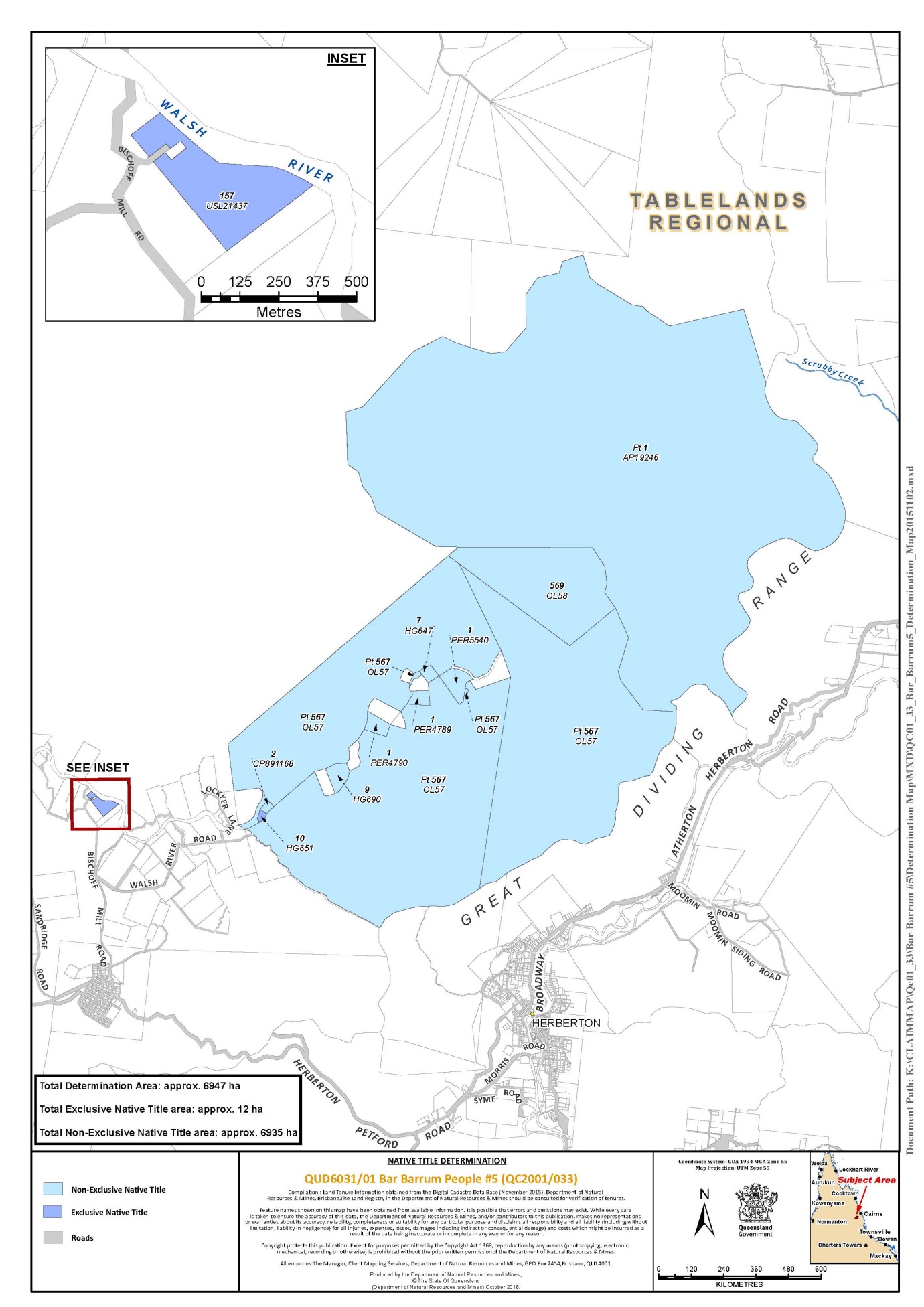
Schedule 2 – AREAS NOT FORMING PART OF THE DETERMINATION AREA
The following areas of land and waters are excluded from the Determination Area.
1. Those land and waters which at the time the native title determination application was made were the subject of one or more Previous Exclusive Possession Acts, within the meaning of s 23B of the Native Title Act 1993 (Cth) are excluded from the Determination Area as they could not be claimed in accordance with s 61A of the Native Title Act 1993 (Cth).
2. Specifically, and to avoid any doubt, the land and waters described in (1) above includes:
(a) the Previous Exclusive Possession Acts described in ss 23B(2) and 23B(3) of the Native Title Act 1993 (Cth) to which s 20 of the Native Title (Queensland) Act 1993 (Qld) applies; and
(b) the land or waters on which any public work, as defined in s 253 of the Native Title Act 1993 (Cth), is or was constructed, established or situated, and to which ss 23B(7) and 23C(2) of the Native Title Act 1993 (Cth) and to which s 21 of the Native Title (Queensland) Act 1993 (Qld), applies, together with any adjacent land or waters in accordance with s 251D of the Native Title Act 1993 (Cth).
Schedule 3 – NATIVE TITLE HOLDERS
1. The native title holders are the Bar Barrum People.
2. The Bar Barrum People are the biological descendants of one or more of the following people:
(a) Rosie aka Lucy (mother of William Congoo);
(b) Nellie (mother of Albert Bennett);
(c) Millie (mother of Alick/Aleck Collins aka Chalk aka Stevens) or of her siblings Fred and Jack Solomon;
(d) Maggie Watsonville (mother of May Thynne);
(e) Nora Miller nee Clark or of her brother Billy;
(f) Arkaragan and Kurimbu (parents of Jack Robinson);
(g) Jack Brumby (father of Peter Fagan and Monday);
(h) Archie Perrott aka Campbell (father of Margaret Perrott);
(i) Lizzie Simmonds (mother of Mamie Simmonds);
(j) John Burt Grainer (father of John Grainer and Paddy Hastie);
(k) Nellie Williams or of her sister Ethel Perrott;
(l) Bessie Tiger (mother of Peter Freeman); or
people who are or were adopted into one of the above descent groups in accordance with the traditional laws and customs of the Bar Barrum People.
Schedule 4 – OTHER INTERESTS IN THE DETERMINATION AREA
The nature and extent of the other interests in relation to the Determination Area are the following as they exist as at the date of the determination:
1. The rights and interests of the parties under the following agreements:
(a) the agreement between Thomas Congoo and John Edward Wason on behalf of themselves and the Bar Barrum People and the Mareeba Shire Council as parties to the Indigenous Land Use Agreement QI2001/053 entered on the Register of Indigenous Land Use Agreements on 8 March 2002; and
(b) the agreement between Tom Congoo and John Wason on their own behalf and on behalf of the Bar Barrum People #2, Tom Congoo and John Wason on their own behalf and on behalf of the Bar Barrum People #3, Layne Malthouse, Tom Congoo and John Wason on their own behalf and on behalf of the Bar Barrum People #4, John Wason, Tennyson Kynuna and Lynette Burke on their own behalf and on behalf of the Bar Barrum People #5, Layne Malthouse, Tennyson Kynuna and Lynette Burke on their own behalf and on behalf of the Bar Barrum People #6 and Jean Rosas, Tom Congoo and John Wason on their own behalf and on behalf of the Bar Barrum People #7 and the Tablelands Regional Council (now the Mareeba Shire Council) as parties to the Indigenous Land Use Agreement QI2012/056 entered on the Register of Indigenous Land Use Agreements on 24 January 2013; and
(c) the agreement between the Bar Barrum People and Ergon Energy Corporation Limited (ACN 087 646 062), which was authorised by the Bar Barrum People native title claim group on 18 April 2013 and will be known as the Bar Barrum People and Ergon Energy ILUA and, depending on the version that is registered first in time on the Register of Indigenous Land Use Agreements, will either be:
(i) the Bar Barrum People and Ergon Energy body corporate agreement between the Applicant, Ergon Energy Corporation Limited and the registered native title body corporate to be nominated as the Prescribed Body Corporate in accordance with paragraph 15 of the Determination; or
(ii) the Bar Barrum People and Ergon Energy area agreement between the Applicant and Ergon Energy Corporation Limited.
2. The rights and interests of Ergon Energy Corporation ACN 087 646 062:
(a) as the owner and operator of any “Works” as that term is defined in the Electricity Act 1994 (Qld) within the Determination Area;
(b) as a distribution entity and the holder of a distribution authority under the Electricity Act 1994 (Qld)
(c) created under the Electricity Act 1994 (Qld) and the Government Owned Corporations Act 1993 (Qld) including:
(i) rights in relation to any agreement relating to the Determination Area existing or entered into before the date on which these orders are made;
(ii) rights to enter the Determination Area by its employees, agents or contractors to exercise any of the rights and interests referred to in this paragraph; and
(iii) to inspect, maintain and manage any Works in the Determination Area.
3. The rights and interests of the Mareeba Shire Council as the local government for that part of the Determination Area within its Local Government Area, including:
(a) its powers, functions, responsibilities and jurisdiction under a Local Government Act;
(b) its rights and interests under any interest in land or waters within the Determination Area including under any lease, licence, access agreement, easement or reserve in the Determination Area;
(c) its rights to use, operate, maintain, replace, restore, remediate, repair and otherwise exercise all other rights as the owner and operator of infrastructure, structures, earthworks, access works, facilities and other improvements within the Determination Area;
(d) its rights under any agreements between the Council and third parties which relate to land or water in the Determination Area; and
(e) the right of its employees, agents and contractors to enter upon the Determination Area for the purpose of performing its powers and responsibilities under paragraphs (a) – (d).
4. The rights and interests of the holder of Water Licence No. 53578K granted under the Water Act 2000 (Qld).
5. The rights and interests of Simon Knight (formerly Birrel) under Permit to Occupy 9/6248 over Lot 9 on HG690, Title Reference 17689078.
6. The rights and interests of Robert Liddle, Isabelle Liddle and Sheila Manning Stanley under Permit to Occupy 9/5540 over Lot 1 on PER5540, Title Reference 17685133.
7. The rights and interests of Martha Wright (formerly Blewitt) under Permit to Occupy 9/6434 over Lot 7 on HG647, Title Reference 17728165.
8. The rights and interests of Carmel Maureen Martin under Permit to Occupy 9/4790 over Lot 1 on PER4790, Title Reference 17682226.
9. The rights and interests of Jeffrey James Perkes under OL9/567 over Lot 567 on CP OL57, Title Reference 17662146 and OL9/569 over Lot 569 on CP OL 58, Title Reference 17662147.
10. Any other rights and interests:
(a) held by the State of Queensland or Commonwealth of Australia; or
(b) existing by reason of the force and operation of the Laws of the State and the Commonwealth.
11. To avoid any doubt paragraphs 10(a) and 10(b) include:
(a) the rights and interests of the State of Queensland in Reserves, the rights and interests of the trustees of those Reserves and of the persons entitled to access and use those Reserves for the respective purpose for which they are reserved; and
(b) so far as confirmed pursuant to s 212(2) of the Native Title Act 1993 (Cth) and s 18 of the Native Title Act (Queensland) Act 1993 (Qld) as at the date of this Determination, any existing public access to, and enjoyment of, the following places in the Determination Area:
(i) waterways;
(ii) beds and banks or foreshores of waterways;
(iii) stock routes; and
(iv) areas that were public places at the end of 31 December 1993.
Note: Entry of orders is dealt with in Rule 39.32 of the Federal Court Rules 2011.
REEVES J:
Introduction
1 On 10 June 2016 at Dimbulah in North Queensland, I made determinations of native title by consent under s 87 of the Native Title Act 1993 (Cth) (the NTA) in relation to four applications made by the Bar Barrum People: Congoo on behalf of the Bar Barrum People #2 v State of Queensland [2016] FCA 693 (Bar Barrum #2); Congoo on behalf of the Bar Barrum People #3 v State of Queensland [2016] FCA 694 (Bar Barrum #3); Congoo on behalf of the Bar Barrum People #4 v State of Queensland [2016] FCA 695 (Bar Barrum #4) and Malthouse on behalf of the Bar Barrum People #6 v State of Queensland [2016] FCA 696 (Bar Barrum #6).
2 This application, the Bar Barrum #5 application – which was filed on 28 September 2001 – was not ready to proceed to a consent determination at that time as it was the subject of a dispute between the Bar Barrum #5 Applicant and twenty respondent parties who are collectively known as the Walsh River Respondents. The application has been amended on four occasions over the years since 2001 and it remains on the Register of Native Title Claims. Mr Tennyson Kynuna and Ms Lynette Burke became the Bar Barrum #5 Applicant in the most recent amendment made by leave on 28 October 2016. The remaining respondent parties to the application are the State of Queensland, Mareeba Shire Council, Ergon Energy Corporation Limited, Mr Perkes and the aforementioned Walsh River Respondents.
The dispute with the Walsh River Respondents
3 The dispute I have mentioned above essentially revolved around the requirements of s 225 of the NTA, and, specifically s 225(c). That subsection requires a determination of native title to include a determination as to: “the nature and extent of any other interests in relation to the determination area”. The expression “interest”, in relation to land or waters, is defined in s 253 of the NTA to mean:
(a) a legal or equitable estate or interest in the land or waters; or
(b) any other right (including a right under an option and a right of redemption), charge, power or privilege over, or in connection with:
(i) the land or waters; or
(ii) an estate or interest in the land or waters; or
(c) a restriction on the use of the land or waters, whether or not annexed to other land or waters.
4 It does not appear to have been in dispute that Mr Perkes holds an interest of the kind described above, in a part of the claim area. It also does not appear to have been in dispute that, of the 20 Walsh River Respondents, a number holds varying levels and forms of tenure over the land they occupy within the claim area which constitute interests within the terms of the above provisions of the NTA. However, the critical issue in dispute was whether the remaining Walsh River Respondents, who became referred to as the “untenured respondents”, hold any such interests over any part of the claim area.
5 As I have alluded to above, this dispute has affected the progress of the Bar Barrum #5 application towards a consent determination. On a number of occasions in the past 15 months, the parties have informed the Court that they have reached an agreement to resolve the dispute. Regrettably, on each such occasion that statement was negated a short time later when an agreement could not be reached about the terms of a set of orders for the purposes of s 87 of the NTA.
6 In mid-2016, following the penultimate occasion on which the parties informed the Court they had reached such an agreement, the proceeding was listed for a consent determination hearing on 5 December 2016. After that statement was subsequently negated, the proceeding continued in intense case management before a Registrar of the Court. By early November 2016, it became apparent that the parties had reached an impasse about the terms of a set of determination orders. Accordingly, I listed the proceeding for an urgent case management hearing on 11 November 2016.
7 At that case management hearing, the Bar Barrum #5 Applicant informed the Court that it wished to bring an interlocutory application, pursuant to s 84(8) of the NTA, seeking orders to dismiss the Walsh River Respondents as respondent parties in the proceeding. Its stated intention was that, once the Walsh River Respondents were removed as respondent parties, the consent determination would proceed on 5 December 2016 unaffected by their opposition. Since the consent determination hearing was, by that time, only 3½ weeks away, the interlocutory application in question was set down for an urgent hearing on 25 November 2016.
8 In the days leading up to that hearing, the parties attended a mediation before a member of the National Native Title Tribunal in a final attempt to resolve their differences. Fortunately, that mediation was successful and, at the commencement of the hearing on 25 November 2016, all of the parties announced to the Court that they had finally reached an agreement as to the terms of a set of determination orders (the proposed orders). Those orders were provided to the Court in the form of an annexure to an agreement (the s 87 agreement) that was filed with the Court on that day. Following that announcement, the Bar Barrum #5 Applicant was given leave to withdraw its urgent interlocutory application and the consent determination hearing fixed for 5 December 2016 was confirmed.
The conditions to be met under s 87
9 The power of the Court to give effect to the parties’ agreement is founded on s 87 of the NTA. In the event that the parties reach agreement on the terms of orders to resolve a proceeding, a part of a proceeding, or a matter arising out of proceedings, that section sets out various conditions which, if met, will trigger the jurisdiction of the Court to make those orders (s 87(1)). The first of those conditions is that the notice period under s 66 of the NTA must have ended prior to the parties’ written agreement being filed with the Court (s 87(1)). The National Native Title Tribunal’s notification of the Bar Barrum #5 application was completed in June 2003 and so that condition has been met. Secondly, in this instance, the agreement of the parties must relate to the whole of the Bar Barrum #5 proceeding (s 87(1)(a)). On its face, the proposed orders relate to the whole of this proceeding, so that condition, too, has been met. Thirdly, s 87(1)(b) of the NTA requires that the parties’ agreement must be reduced to writing, signed by them, or on their behalf, and filed with the Court. As I have already mentioned above, the s 87 agreement was filed with the Court on 25 November 2016 and it is apparent from it that all of these requirements have also been met.
10 Having satisfied those three conditions, the next condition is that the Court must be satisfied that the proposed orders, or orders consistent with them, would be within the power of the Court (s 87(1)(c)). An order will be within the power of the Court if it complies with the various provisions of the NTA including ss 94A and 225. Section 94A requires that:
An order in which the Federal Court makes a determination of native title must set out details of the matters mentioned in section 225 (which defines determination of native title).
11 This provision obviously requires attention to the matters mentioned in s 225 of the NTA. I have already mentioned s 225(c) above. While that subsection is directed to interests other than native title rights and interests, s 225(a) and s 225(b) are directed to native title rights and interests. Those two subsections provide:
A determination of native title is a determination whether or not native title exists in relation to a particular area (the determination area) of land or waters and, if it does exist, a determination of:
(a) who the persons, or each group of persons, holding the common or group rights comprising the native title are; and
(b) the nature and extent of the native title rights and interests in relation to the determination area; and
…
12 In turn, these subsections require consideration of the provisions of s 223 of the NTA, which define what the expression “native title”, or “native title rights and interests”, means. It should also be noted that there are other provisions of the NTA which affect the power of the Court to make a determination of native title. They include s 61A, which identifies various circumstances in which a native title determination application must not be made. Included is the circumstance where there is already an approved native title determination over the area in question (see s 61A(1)). I will return to s 61A later in these reasons.
13 In my reasons for the four determinations I made earlier this year with respect to Bar Barrum #2, Bar Barrum #3, Bar Barrum #4 and Bar Barrum #6, I described (see, for example, Bar Barrum #2 at [11]–[13]) the matters that had caused me to be satisfied about the above matters, and therefore the power of the Court to make the orders I did in those four proceedings. It is not necessary for me to repeat that reasoning here. It is sufficient to note that, since this Bar Barrum #5 application relies on essentially the same materials, I consider that reasoning applies equally to it. I therefore consider this fourth condition has been met. I should add that, because no party elected to file an agreed statement of facts, for the purposes of this consent determination, it is unnecessary for me to consider the provisions of s 87(8) to s 87(11) inclusive.
The question of “appropriateness”
14 The final condition the parties need to meet in order to have the Court make a determination of native title under s 87 concerns the operation of s 87(1A). That section requires the Court to be satisfied that it is appropriate to make orders in accordance with s 87(2) or s 87(3), that is, in this instance, s 87(2): “to make an order in, or consistent with,” the terms of the proposed orders.
15 In Nelson v Northern Territory of Australia (2010) 190 FCR 344; [2010] FCA 1343 (at [5]–[13]) (Nelson), I canvassed the authorities that identified the factors to which the Court will routinely have regard in determining this question of “appropriateness”. It is not necessary for me to repeat all those observations here, it will suffice to set out the concluding summary as follows (at [14]):
It follows from all these considerations that the central issue in an application for a consent determination under s 87 is whether there exists a free and informed agreement between the parties. In this respect, the process followed by the State party respondent, particularly how it goes about assessing the underlying evidence as to the existence of native title is critical. Other critical factors, all directed to the processes that lead to the agreement and what was agreed, that have been previously identified by the Court include: whether the parties have independent and competent legal representation..; whether the terms of the proposed order are unambiguous and clear …; and whether the agreement has been preceded by a mediation process …
See also Pwerle v Northern Territory [2016] FCA 304 at [20] where I set out a list of these matters.
16 In determining this question, first, I have been assisted by the detailed outline of submissions filed by the Bar Barrum #5 Applicant. Secondly, I have taken account of my review of the materials that were placed before the Court in Bar Barrum #2, Bar Barrum #3, Bar Barrum #4 and Bar Barrum #6 (see at [1] above) to demonstrate that native title existed in the claim area for those claims (see, for example, Bar Barrum #2 at [18]–[22]). Since the claim areas of those claims surround this claim area, I consider those materials, and my analysis of them, can generally be translated to this claim area. Thirdly, as has already been mentioned above, the s 87 agreement in this matter was reached after long and complex negotiations relating to the dispute with the Walsh River Respondents, involving intensive case management on the part of a Registrar of this Court and, more recently, a mediation by a member of the National Native Title Tribunal. Throughout those negotiations, all the parties were represented by independent and competent lawyers. Furthermore, the terms of the agreement that has been reached and which is filed with the Court are, in my view, unambiguous and clear. So, taking into account all these factors, I am satisfied that the s 87 agreement was reached on a free and informed basis.
The tenure-related issue
17 Thus far, I have been addressing the native title related features of the proposed orders as raised by s 225(a) and s 225(b) of the NTA. It is convenient, next, to turn to, what I will describe as, the tenure-related issues raised by s 225(c) to s 225(e) inclusive. Those subsections are as follows:
A determination of native title is a determination whether or not native title exists in relation to a particular area (the determination area) of land or waters and, if it does exist, a determination of:
…
(c) the nature and extent of any other interests in relation to the determination area; and
(d) the relationship between the rights and interests in paragraphs (b) and (c) (taking into account the effect of this Act); and
(e) to the extent that the land or waters in the determination area are not covered by a non‑exclusive agricultural lease or a non‑exclusive pastoral lease—whether the native title rights and interests confer possession, occupation, use and enjoyment of that land or waters on the native title holders to the exclusion of all others.
18 In the format which has now become common for consent determination orders under s 87 of the NTA, the matters described above were dealt with in the body of the proposed orders by reference to the contents of a number of schedules attached thereto. Hence, clauses 3, 11 and 12 of the proposed orders provided:
3. The Determination Area is the land and waters described in Schedule 1A, and depicted in the map attached to Schedule 1B.
11. The nature and extent of any other interests in relation to the Determination Area (or respective parts thereof) are set out in Schedule 4.
12. The relationship between the native title rights and interests described in paragraphs 6 and 7 [not reproduced] and the other interests described in Schedule 4 (the “other interests”) is that:
(a) the other interests continue to have effect, and the rights conferred by or held under the other interests may be exercised notwithstanding the existence of the native title rights and interests;
(b) to the extent the other interests are inconsistent with the continued existence, enjoyment or exercise of the native title rights and interests in relation to the land and waters of the Determination Area, the native title continues to exist in its entirety but the native title rights and interests have no effect in relation to the other interests to the extent of the inconsistency for so long as the other interests exist; and
(c) the other interests and any activity that is required or permitted by or under, and done in accordance with, the other interests, or any activity that is associated with or incidental to such an activity, prevail over the native title rights and interests and any exercise of the native title rights and interests.
19 Schedules 1, 2 and 4 attached to the proposed orders relevantly provided:
Schedule 1 – DETERMINATION AREA
Schedule 1A – Description of Determination Area
The Determination Area comprises all of the land and waters described in Parts 1 and 2 below, and depicted in the map contained in Schedule 1B, excluding the areas described in Schedule 2.
To the extent of any inconsistency, the written description set out in Part 1 and Part 2 of Schedule 1A and Schedule 2 prevails over the map contained in Schedule 1B.
Part 1 – Exclusive Areas:
[The area of land and waters was described by reference to the map]
Part 2 - Non-Exclusive Areas:
[The area of land and waters was described by reference to the map]
Schedule 1B – Map of Determination Area
[Map attached]
Schedule 2 – AREAS NOT FORMING PART OF THE DETERMINATION AREA
The following areas of land and waters are excluded from the Determination Area.
1. Those land and waters which at the time the native title determination application was made:
(a) were the subject of one or more Previous Exclusive Possession Acts, within the meaning of s 23B of the Native Title Act 1993 (Cth); and
(b) to which none of ss 47, 47A or 47B of the Native Title Act 1993 (Cth) applied at the time of the native title determination application;
are excluded from the Determination Area as they could not be claimed in accordance with s 61A of the Native Title Act 1993 (Cth).
2. Specifically, and to avoid any doubt, the land and waters described in (1) above includes:
(a) the tenure based exclusions under ss 23B(2) and 23B(3) of the Native Title Act 1993 (Cth) to which s 20 of the Native Title (Queensland) Act 1993 (Qld) applies; and
(b) the land or waters on which any public work, as defined in s 253 of the Native Title Act 1993 (Cth), is or was constructed, established or situated, and to which ss 23B(7) and 23C(2) of the Native Title Act 1993 (Cth) and to which s 21 of the Native Title (Queensland) Act 1993 (Qld), applies, together with any adjacent land or waters in accordance with s 251D of the Native Title Act 1993 (Cth).
Schedule 4 – OTHER INTERESTS IN THE DETERMINATION AREA
The nature and extent of the other interests in relation to the Determination Area are the following as they exist as at the date of the determination:
…
10. The rights and interests of the State of Queensland in Reserves, the rights and interests of the trustees of those Reserves and of the persons entitled to access and use those Reserves for the respective purpose for which they are reserved.
11. The rights and interests of the State of Queensland or any other person existing by reason of the force and operation of the laws of the State of Queensland, including those existing by reason of the following legislation or any regulation, statutory instrument, declaration, plan, authority, permit, lease or licence made, granted, issued or entered into under that legislation:
(a) the Land Act 1994 (Qld).
12. So far as confirmed pursuant to s 212(2) of the Native Title Act 1993 (Cth) and s 18 of the Native Title Act (Queensland) Act 1993 (Qld) as at the date of this Determination, any existing public access to, and enjoyment of, the following places in the Determination Area:
(a) waterways;
(b) beds and banks or foreshores of waterways;
(c) stock routes; and
(d) areas that were public places at the end of 31 December 1993.
13. Any other rights and interests:
(a) held by the State of Queensland or Commonwealth of Australia; or
(b) existing by reason of the force and operation of the Laws of the State and the Commonwealth.
20 I have set out these parts of the proposed orders verbatim in order to explain below why it became necessary to make some amendments to them before making the final determination of native title in this matter. First, I should record that, in the days before the consent determination hearing on 5 December 2016, I asked the parties to make written submissions about the appropriateness of including certain of the above clauses (particularly those in Schedules 2 and 4 above) in the final determination orders.
21 In its written submissions, the Bar Barrum #5 Applicant set out three basic reasons for the inclusion of all of the above clauses in the final determination, as follows:
a. certainty of effect of the determination orders, which operate in rem, for parties and non-parties;
b. clarity for parties and non-parties seeking to understand the breadth of the effect of the determination orders; and
c. consistency with the other determinations made on behalf of Bar Barrum People (Bar Barrum #2 QUD6015/2001; Bar Barrum #3 QUD6017/2001; Bar Barrum #4 QUD6030/2001 and Bar Barrum #6 QUD6032/2001).
The Bar Barrum #5 Applicant also submitted that the Court should be slow to depart from the proposed orders where they had resulted from negotiations to resolve this proceeding under the NTA.
22 Mr Perkes indicated he was content to submit to whatever orders the Court deemed appropriate.
23 The Walsh River Respondents submitted that all of the clauses should be included in the final determination “as a means of quick reference that might assist parties to come to a speedy resolution of any dispute/question/issue that may arise in the future”. They also submitted that making orders in the terms of the proposed orders would dispose of the substantive proceeding consistently with the overarching purpose of civil litigation set out in ss 37M and 37N of the Federal Court of Australia Act 1976 (Cth). Finally, they submitted that the Court should not refuse to give effect to the proposed orders where those orders were within the Court’s jurisdiction and otherwise unobjectionable.
24 As the party most directly interested in the clauses in question, the State’s submissions were extensive and detailed. What follows is a summary of the pertinent parts of those submissions. First, the State submitted that the Court was not bound to make orders in the exact terms agreed upon by the parties, however, it submitted s 87(2) of the NTA required that any departure from those terms must nonetheless be consistent with the agreed terms.
25 Secondly, it submitted that the terms of the proposed orders reflect the need to balance the limited availability of public resources with the competing need to resolve native title claims in an efficient, cost effective and timely manner. Consequently, it submitted that, in the majority of native title determinations in Queensland, a “catch all public works clause” has been incorporated. This was done, it submitted, because: “The time taken to investigate each lot for the potential existence of a public work, and the further time required to document the necessary evidence for each work and reach agreement with the relevant landholder and the Applicant, has led to criticisms from the Federal Court that parties need to be creative and work smarter.” In response, the State pointed to the fact that, since approximately 2012, the present form of Schedule 2 of the proposed orders has been used in a number of native title determinations in order to streamline the process of performing tenure research. This approach, it submitted, has resulted in a shift away from performing full tenure histories for each lot within a determination area. The State submitted that the removal of this “catch all public works clause” would require it to perform detailed tenure investigations which would, in turn, require it to devote more public resources to the task and extend the period of time it would take for native title applications to be resolved.
26 Thirdly, the State submitted that, as the applicants in a native title determination application are permitted to use formulaic descriptions of the areas excluded from the claim area, the present form of Schedule 2 of the proposed orders is in keeping with that approach by describing in generic terms what areas are not included in the determination area. Finally, the State submitted that the present form of Schedules 1 and 2 of the proposed orders minimises the risk of the parties needing to later seek a variation of a native title determination pursuant to s 13 of the NTA. The State submitted that this is the case because: “Where an area is described in Schedule 1 as being an area where native title exists, the proviso to that statement makes clear that Schedule 2 prevails in the event that a public work or tenure based previous exclusive possession act is identified.”
27 The written submissions (above) were supplemented by oral submissions which were made at the consent determination hearing on 5 December 2016. Following those submissions and after a short adjournment to seek instructions, the State agreed to provide amended versions of Schedules 2 and 4 above:
(a) to delete clause 1(b) from Schedule 2;
(b) to amend clause 2(a) in Schedule 2 to express it in more appropriate terms;
(c) to delete clause 11 from Schedule 4; and
(d) to amend clauses 10, 12 and 13 in Schedule 4 to express clauses 10 and 12 as specific instances of interests falling within the general provisions of clause 13.
28 In the paragraphs below, I will endeavour to explain why I consider these amendments were necessary and appropriate.
29 It is convenient to begin by reiterating the nature of the judicial exercise the Court is performing under s 87 of the NTA. It is to consider the terms of the orders the parties have agreed the Court should make and to decide whether it is appropriate to make orders “in, or consistent with” those terms without holding a hearing (ss 87(1A) and 87(2)). Three observations may appropriately be made about this exercise. First, the Court is not bound to make any orders. Ultimately, it is a matter for the Court, and only the Court, to decide whether the orders it makes are appropriate to be made. Dowsett J emphasised this point in Brooks on behalf of the Mamu People v State of Queensland (No 3) [2013] FCA 741 at [35] (Brooks). Nonetheless, s 87 does place some constraints on the Court in that it is required to consider whether orders “in, or consistent with” the terms of the orders proposed by the parties should be made. Thus, the Court is not permitted to make orders that are substantially different from the terms of the orders agreed by the parties. In the event that the Court wished to make orders of that kind, it would presumably refuse to make any orders at all and leave the parties to decide how to progress the matter from there.
30 Secondly, and relatedly, the Court is nonetheless bound to take account of the significance of the fact that an agreement has been reached by the parties to the proceedings and that, all the more so, in proceedings under the NTA where the resolution of native title litigation by agreement is facilitated and encouraged: see Kuuku Ya’u People v State of Queensland [2009] FCA 679 at [12] per Greenwood J and Peterson v State of Western Australia [2013] FCA 518 per McKerracher J.
31 Thirdly, and perhaps most importantly, in determining whether it is appropriate to make the tenure-related orders in the terms proposed by the parties, the Court will adopt a similar approach to that it commonly takes with respect to the appropriateness of making the agreed orders in relation to the existence of native title, as outlined above (see at [15]). That is, it will look to the process employed by the State respondent party to decide whether it has duly discharged its role as public guardian acting in the public interest: see, for example, King on behalf of the Eringa Native Title Claim Group and the Eringa No 2 Native Title Claim Group v State of South Australia [2011] FCA 1387 (King) at [21] per Keane CJ and Starkey v State of South Australia (2014) 319 ALR 231; [2014] FCA 924 at [20] per Allsop CJ.
32 It should, however, be noted that the process leading to the agreement about tenure-related orders is different to that relating to the agreed orders about the existence of native title. In the first place, with the former, the State will be relying on its own Titles Office, surveying, and other administrative records rather than assessing the anthropological, genealogical and other materials provided to it by the applicant. Furthermore, the State will often own, or have a direct interest in, areas of land and waters within the claim area, or will have an indirect interest in whether the freehold, leasehold and other grants it has made under its own legislation have validly extinguished native title under the NTA. Dowsett J alluded to some of these considerations in Brooks at [35] where he observed:
… The various States are generally more closely involved in Native Title cases than are other levels of government. There are three reasons for this. First, the relevant State is generally the source of all non-indigenous title to alienated land and, itself, the holder of substantial areas of land. Secondly, the State generally holds relevant records concerning European settlement and observations made by early settlers concerning indigenous people. Thirdly, it generally holds records concerning alienation of land and other actions which may have extinguished Native Title.
33 When making its assessment of tenure-related matters, the State will therefore have to engage in a similar, but different, balancing exercise with respect to the competing demands and obligations to that I described in Nelson. There, of course, I was addressing its role in assessing the evidence relating to the existence of native title. I said (at [12]):
It is appropriate to make some comments about the difficult balance a State party needs to strike between its role in protecting the community's interests, including the stringency of the processes it follows in assessing the underlying evidence going to the existence of native title, and its role in the native title system as a whole, to ensure that it, like the Court and all other parties, takes a flexible approach that is aimed at facilitating negotiation and achieving agreement. …
34 Hence, when it comes to investigating the tenure history of the land within the claim area, the State will invariably need to balance the certainty that it may achieve by conducting complete historical tenure searches against the time, delay and resources required to undertake such searches. The delays caused when a State party fails to achieve proportionality in this balancing exercise were the subject of the following forceful observations by Jagot J in Barkandji Traditional Owners #8 v Attorney-General (New South Wales) [2015] FCA 604 at [12]:
But, I have said before, and I say again today, that no one in Australia should have to wait for 18 years to have their claim resolved. Timeliness, efficiency and proportionality are part and parcel of just outcomes. When justice is delayed, it is also denied. No one should be in any doubt. The winds of change are still blowing though [sic – through] how parties deal with native title claims. The glacial pace at which they have moved in the past is palpably unjust. Because one of the factors which delays resolution, tenure searching, is so significant, directions have been made emphasising the need for a reasonably proportionate approach – that is, an investment of resources proportionate to the outcomes to be achieved. No claim can justify the kind of tenure searching which may take years, even decades, to complete. The agreements contemplated by s 87A of the Act, which are an important means of ensuring that the object of resolution by conciliation rather than adversarial litigation is achieved, necessarily involve all kinds of mutual compromises. There is no reason that such compromises cannot extend to the determination of issues of tenure. …
35 By comparison, the State Government in South Australia appears to have adopted a more proportionate, less time-consuming and less resource-intensive approach to tenure-related issues whilst, at the same time, ensuring that a sufficiently thorough assessment is undertaken commensurate with the discharge of its obligations as the public guardian. Keane CJ described this approach in King as follows (at [65]):
A tenure history of the claim area was provided by the State and made available to all the parties to the claims. Rather than carry out a detailed historical analysis of this tenure, the State has described generically in the Determination, where the parties are agreed that areas exist, where native title has been wholly extinguished. Those areas within the determination area where native title has been extinguished are described in Schedule 3 of the proposed determination.
See also Lennon on behalf of the Antakirinja Matu-Yankunytjatjara Native Title Claim Group v State of South Australia [2011] FCA 474 at [53] per Mansfield J.
36 In Queensland, the State Government has adopted a similar approach, the streamlined approach it has described in its written submissions above (see at [24]–[26]). Those submissions show that it has reacted to the Court’s entreaties to “be creative and work smarter” by employing a generic or “catch all” public works clause and avoiding the costs and delays associated with detailed and comprehensive searching. Like the South Australian Government, it has also taken a proportionate approach to performing tenure research by streamlining and confining its tenure searches, rather than performing complete historical tenure searches. At the same time, it has used generic exclusion clauses to protect the public interest should its streamlined searches fail to identify an act that has resulted in the extinguishment of native title. In my view, the approaches adopted by these two State Governments are commendable. Their approach to these tenure-related issues is proportionate, efficient, conserving of public resources and yet appropriately responsive to their role as public guardians acting in the public interest.
37 With these observations in mind, I turn to explain why it was necessary and appropriate to make the amendments described above to the original set of orders proposed by the parties. I will do so by reference to the four items set out above (at [27]). At the outset, it is important to record that I do not consider any of those amendments is inconsistent with the terms of the proposed orders. Put differently, I do not consider they are substantially different from the terms of the orders proposed by the parties (see the discussion at [29] above).
(a) Delete clause 1(b) of Schedule 2
38 The main reason why this clause was included in the orders proposed by the parties was, so the State’s counsel informed me, to make it consistent with the orders I made in the other Bar Barrum applications (see at [1] above). Consistency is to be applauded, however, as I have explained below, the problem with this submission is that it does not take account of the particular issues that were raised for determination in this Bar Barrum #5 application.
39 Section 61A of the NTA, which is already mentioned above (see at [12]), identifies a number of circumstances in which a native title determination application must not be made over an area of land and waters. Stated broadly, there are three such circumstances:
(a) where an area is already the subject of an approved determination of native title (s 61A(1);
(b) where a previous exclusive possession act was done in relation to an area and that act meets the conditions described in s 61A(2)(b); and
(c) where a previous non-exclusive possession act was done in relation to an area and that act meets the conditions stated in s 61A(3)(b).
However, s 61A(4) contains an exception to the circumstances described in [39(b)] and [39(c)] above. That is, those subsections are expressed not to apply if:
(a) the only previous exclusive possession act or previous non‑exclusive possession act concerned was one whose extinguishment of native title rights and interests would be required by section 47, 47A or 47B to be disregarded were the application to be made; and
(b) the application states that section 47, 47A or 47B, as the case may be, applies to it.
40 Stated compendiously, ss 47, 47A and 47B provide that the extinguishment of native title brought about by a previous exclusive possession act, or a previous non-exclusive possession act, are to be disregarded where the area concerned is a pastoral lease held by the native title claimants (s 47), or where the area is set aside or vested for the benefit of Aboriginal peoples or Torres Strait Islanders (s 47A), or where the area is vacant Crown land, provided that, in the latter two instances, when the application is made, one or more members of the native title claim group occupy that area (s 47B).
41 Schedule L to the Form 1 Native Title Determination Application filed by the Bar Barrum #5 Applicant (the Form 1) is headed “Tenure & Land Use Issues”. Within the body of this Schedule the above provisions of the NTA are expressly mentioned. This is then followed by a statement that: “There are no such areas in the claim area.” However, as the State’s counsel pointed out during oral submissions, this clear statement was contradicted somewhat by a clause in Schedule B of the Form 1, as follows:
However, if the acts specified in paragraphs a) – l) above fall within the provisions of s47, s47A, s47B, s23B(9), s23B(9A), s23B(9C), or s23B(10) of the Native Title Act 1993 (Cth) [sic] [the NTA] the area covered by the act is not excluded from this application.
42 To remove this possible contradiction, during oral submissions the Bar Barrum #5 Applicant’s counsel informed the Court that Schedule L above accurately stated the position with respect to this issue. In other words, the Bar Barrum #5 application expressly disclaims reliance on the exception stated in s 61A(4) above. Since no claim is being pursued by the Bar Barrum #5 Applicant under s 47, s 47A or s 47B, it necessarily follows that clause 1(b) of Schedule 1 of the proposed orders was inappropriate.
(b) Amend clause 2(a) of Schedule 2
43 At the consent determination hearing on 5 December 2016, I raised two concerns about clause 2(a) of Schedule 2. The first was that the expression “tenure based exclusions” does not accurately describe the nature of the acts specified in s 23B of the NTA. The second was whether it was truly necessary to incorporate an exclusion in the terms of this clause when it merely restated the effect of the apposite Commonwealth and State native title legislation.
44 On the first concern, the State agreed that the clause should more appropriately refer to the particular acts described in s 23B of the NTA and, accordingly, it agreed to provide an amended form of that clause. I consider the second concern is met by the State’s submissions about its streamlined tenure assessment process and the use it makes of generic exclusion clauses to protect the public interest in the event that a valid grant may not have been detected by that streamlined process. As I have already observed above (at [36]), in my view, this approach achieves a sensible and responsible balancing of the competing interests concerned. I therefore consider that, in the circumstances, it is appropriate to include a clause in the amended form of clause 2(a) of Schedule 2. I should add the same observations apply to the appropriateness of the “catch all” public works clause 2(b) (see at [25] above).
(c) Delete 11 of Schedule 4
45 On its face, clause 11 of Schedule 4 described, in specific terms the same rights and interests as those that were described in more general terms in clause 13. That being so, I was concerned that retaining two clauses describing the same rights and interests in different forms may be productive of ambiguity and confusion. At the consent determination hearing on 5 December 2016, the State agreed that the rights and interests described in clause 11 were, indeed, the same as those covered by clause 13. Moreover, it agreed that clause 11 did not serve the same purpose as clauses 10 and 12 (see below). Accordingly, it agreed that clause 11 was not necessary. It necessarily followed that it was not appropriate to include it in the final determination orders. It is worth noting that this same issue arose, and the same course was taken, in my recent decision in Miller on behalf of the Birriah People v State of Queensland (No 2) [2016] FCA 1434 at [20].
(d) Amend clauses 10 to 13 (inclusive) of Schedule 4
46 My concern about clauses 10 and 12 of Schedule 4 was that, as with clause 11, they appeared, on their face, to cover the same rights and interests as were described in general terms in clause 13. However, the State’s counsel informed me that, in this instance, the rights and interests concerned were held by particular parties, or groups, as well as the State itself and they were included to provide assurances to those persons that their rights and interests had been specifically accommodated in the determination orders. Having received this explanation, I considered orders in the terms of clauses 10 and 12 were appropriate to be included in the final determination orders. However, in order to avoid any confusion that may arise from describing the same rights and interests in sequential clauses, in specific and general terms, I considered that clause 13 should be amended so that, after stating the general rights and interests concerned, it then described the rights and interests in clauses 10 and 12 as specific instances of those general rights. The State and the other parties agreed to such an amendment. The final form of the amended clause to replace clauses 10, 12 and 13 is as follows:
10. Any other rights and interests:
(a) held by the State of Queensland or Commonwealth of Australia; or
(b) existing by reason of the force and operation of the Laws of the State and the Commonwealth.
11. To avoid any doubt paragraphs 10(a) and 10(b) include:
(a) the rights and interests of the State of Queensland in Reserves, the rights and interests of the trustees of those Reserves and of the persons entitled to access and use those Reserves for the respective purpose for which they are reserved; and
(b) so far as confirmed pursuant to s 212(2) of the Native Title Act 1993 (Cth) and s 18 of the Native Title Act (Queensland) Act 1993 (Qld) as at the date of this Determination, any existing public access to, and enjoyment of, the following places in the Determination Area:
(i) waterways;
(ii) beds and banks or foreshores of waterways;
(iii) stock routes; and
(iv) areas that were public places at the end of 31 December 1993.
The prescribed body corporate
47 Finally, it is necessary to address ss 56 and 57 of the NTA. In keeping with s 56, Order 14 of the proposed orders provides that native title is not to be held in trust. That brings into operation the provisions of s 57 of the NTA and, specifically, s 57(2). In compliance with that subsection, order 15 of the proposed orders provides that the Mbabaram Aboriginal Corporation ICN 8449 (the Corporation) is to be the prescribed body corporate to perform the functions set out in s 57(3) of the NTA. The Corporation was registered on 15 July 2016 and the Bar Barrum #5 Applicant has filed all relevant material setting out the steps taken to satisfy the requirements of s 57 of the NTA. I therefore determine that the Corporation is the body corporate that is to perform the functions mentioned in s 57(3) of the NTA.
Conclusion
48 For these reasons, I am satisfied that all of the conditions in s 87 of the NTA have been met and it is appropriate to make a determination of native title that is consistent with the terms of the proposed orders, as amended, without holding a hearing.
I certify that the preceding forty-eight (48) numbered paragraphs are a true copy of the Reasons for Judgment herein of the Honourable Justice Reeves. |
Associate:
QUD 6031 of 2001 | |
WALSH RIVER COMMUNITY AND SPORTS CLUB INCORPORATED | |
Fifth Respondent: | MARTHA BLEWITT |
Sixth Respondent: | BONNIE CLYMA |
Seventh Respondent: | ANN-MARIE DILLON (SHOBEK) |
Eighth Respondent: | JOHN HELMUT DOVE |
Ninth Respondent: | MICHELLE ROBYN DOVE |
Tenth Respondent: | SIMON KNIGHT |
Eleventh Respondent: | SCOTT WILLIAM GEORGE KOOTOOFA |
Twelfth Respondent: | GARY THOMPSON LEECH |
Thirteenth Respondent: | ISABELLE LIDDLE |
Fourteenth Respondent: | ROBERT LIDDLE |
Fifteenth Respondent: | DEAN ALEXANDER LOCARNINI |
Sixteenth Respondent: | CARMEL MAUREEN MARTIN |
Seventeenth Respondent: | KEVIN MELON |
Eighteenth Respondent: | PATRICIA RICHARDSON |
Nineteenth Respondent: | ANDREW ROULSTONE |
Twentieth Respondent: | KEAVAN J ROULSTONE |
Twenty-First Respondent: | KEITH ALAN SIMPSON |
Twenty-Second Respondent: | SHEILAH MANNING STANLEY |
Twenty-Third Respondent: | SIMON JOHN ZAICZ |
Twenty-Fourth Respondent: | JEFFREY JAMES PERKES |


