FEDERAL COURT OF AUSTRALIA
Ferella v Official Trustee in Bankruptcy [2016] FCA 1270
ORDERS
Applicant | ||
AND: | OFFICIAL TRUSTEE IN BANKRUPTCY Respondent | |
DATE OF ORDER: |
THE COURT ORDERS THAT:
1. The interlocutory application filed by the applicant on 3 December 2015 is dismissed.
2. The applicant is to pay the respondent’s costs of and incidental to the application.
Note: Entry of orders is dealt with in Rule 39.32 of the Federal Court Rules 2011.
PERRY J:
[1] | |
[6] | |
[15] | |
[15] | |
[18] | |
3.3 Dismissal of the appeal in the s 66G Supreme Court Proceedings | [25] |
3.4 Other Proceedings in which the Official Trustee has incurred legal costs | [31] |
[31] | |
[37] | |
4 EVIDENCE AS TO THE FINANCIAL POSITION OF THE BANKRUPTS’ ESTATES | [41] |
[49] | |
[49] | |
[51] | |
[62] | |
[62] | |
[71] | |
[82] |
1 By an originating application filed on 16 October 2015, the applicant, Mr Gustavo Ferella, seeks orders pursuant to ss 153A, 154, 178 and 179 of the Bankruptcy Act 1966 (Cth) (Bankruptcy Act) for the annulment of his bankruptcy. The barrier to annulment is the existence of a dispute as to the liability of the bankrupt estate to reimburse the respondent, the Official Trustee in Bankruptcy (the Official Trustee), for costs and expenses expended in the administration of the bankruptcy. All other creditors have been paid.
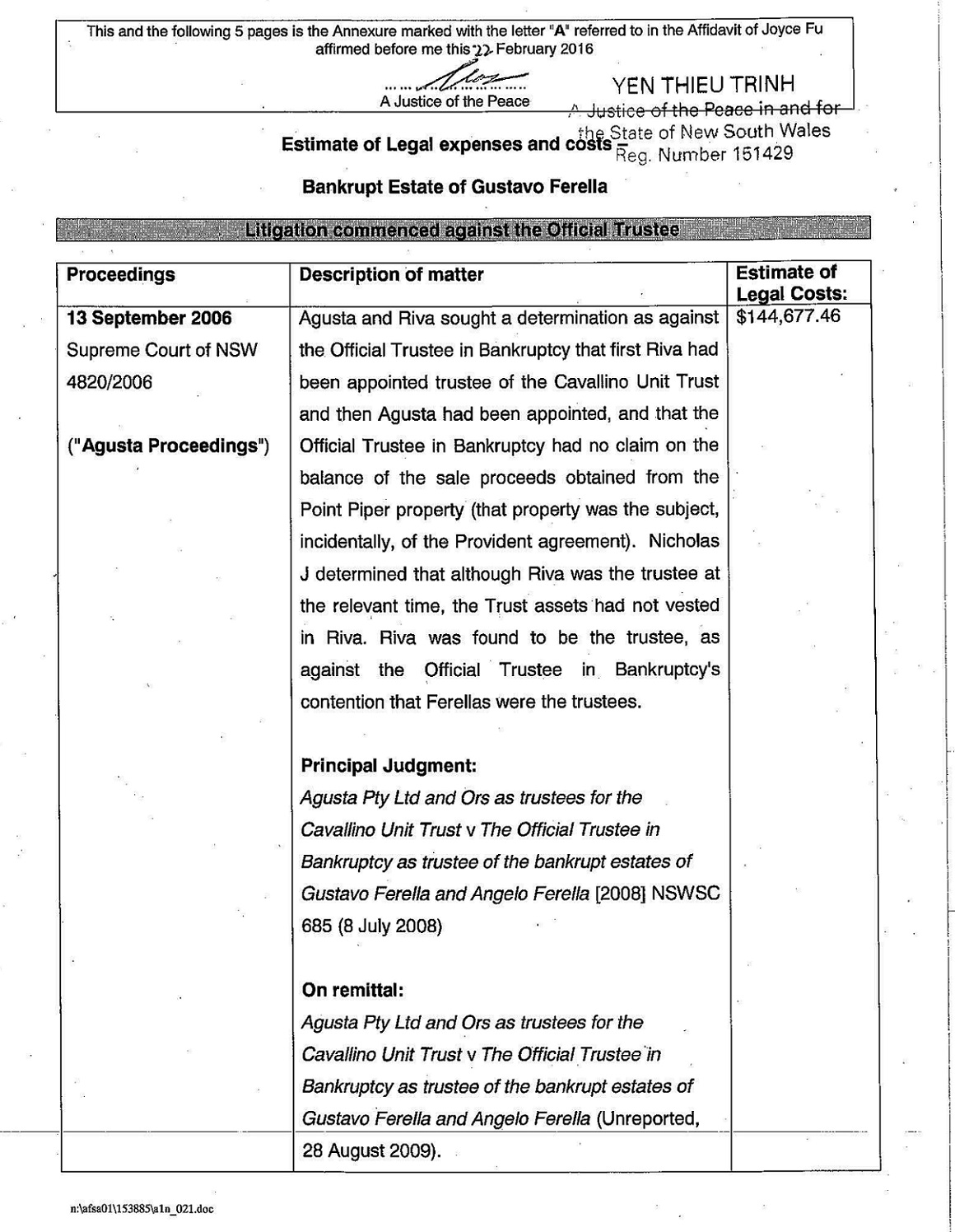
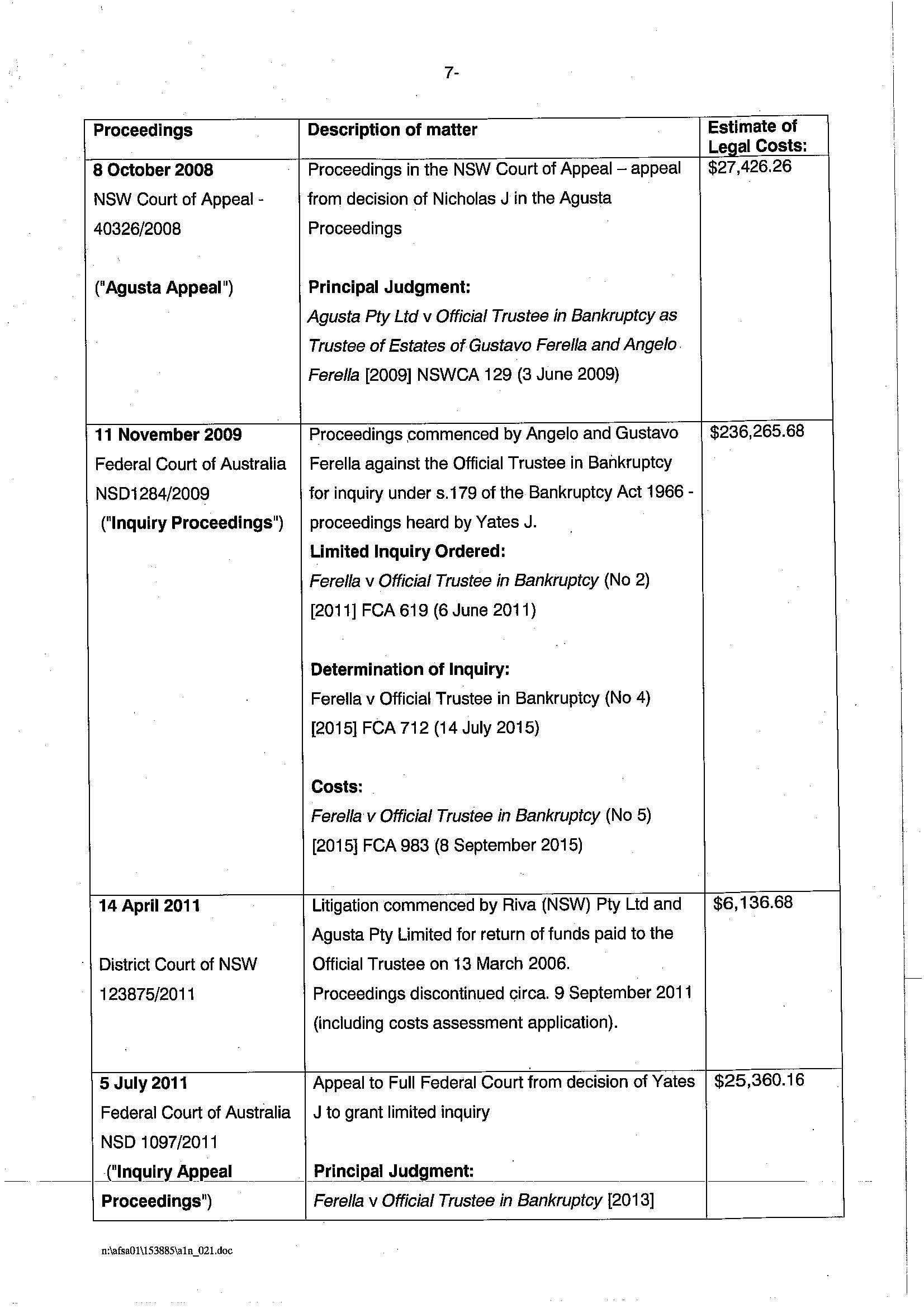
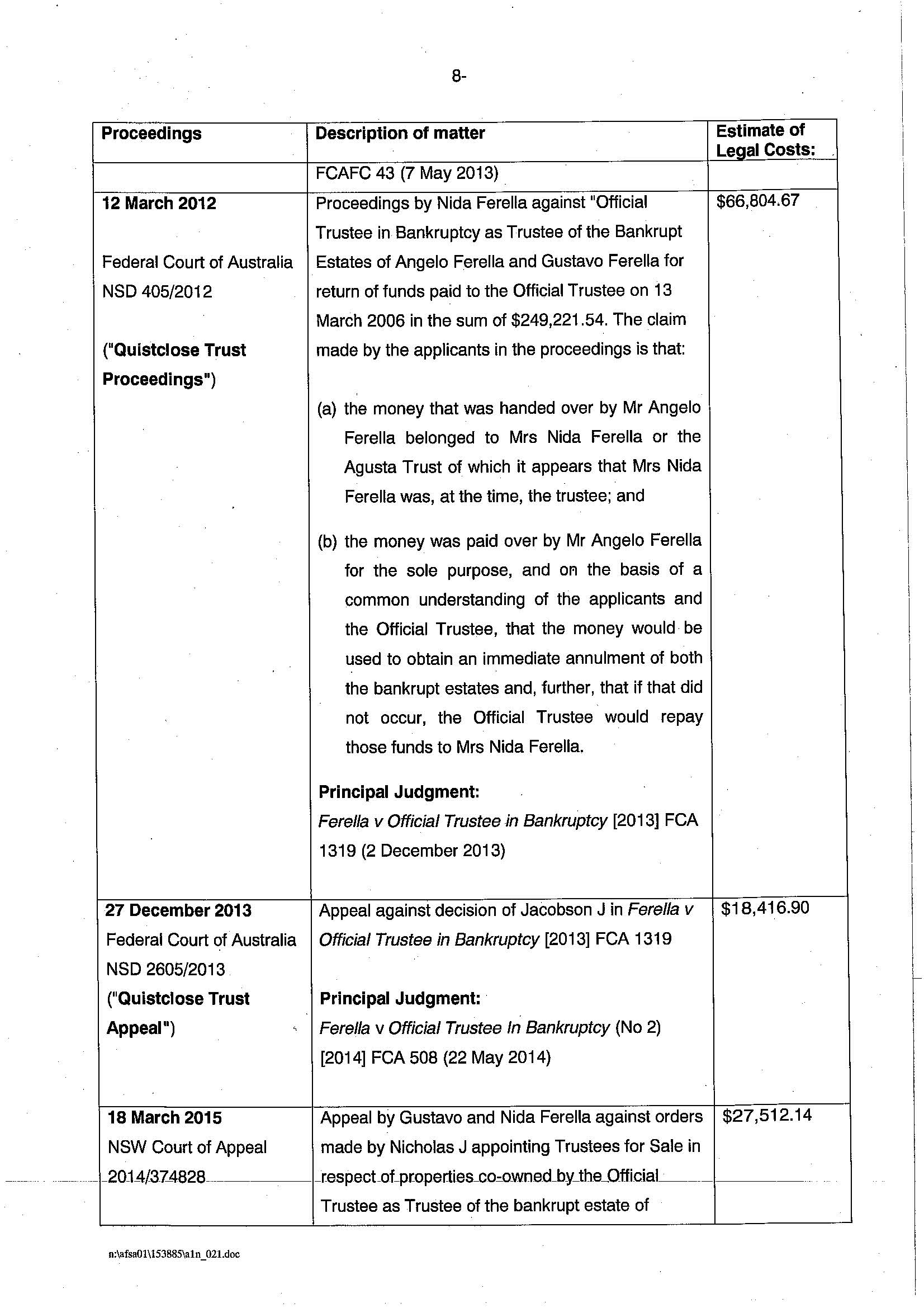
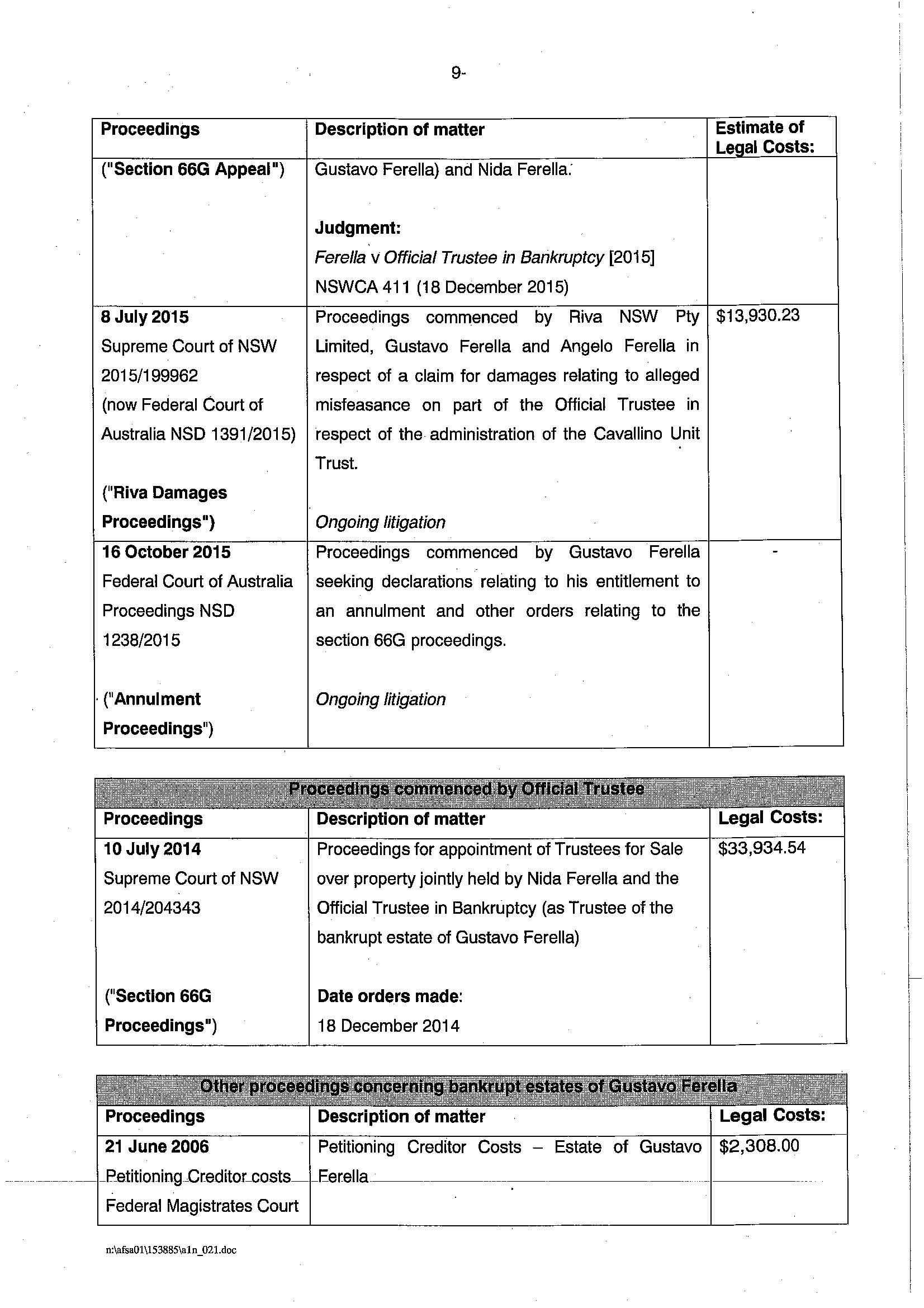
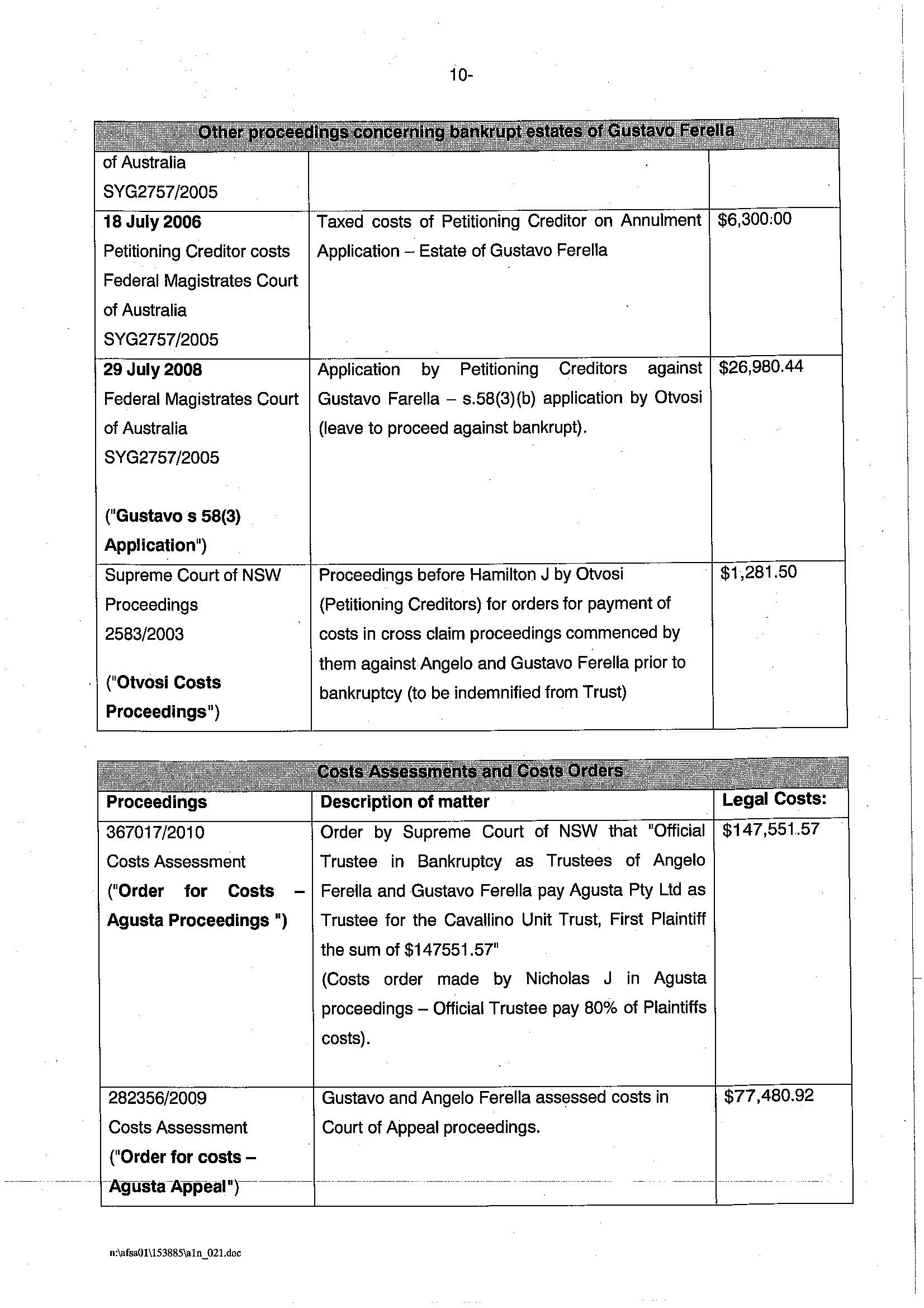
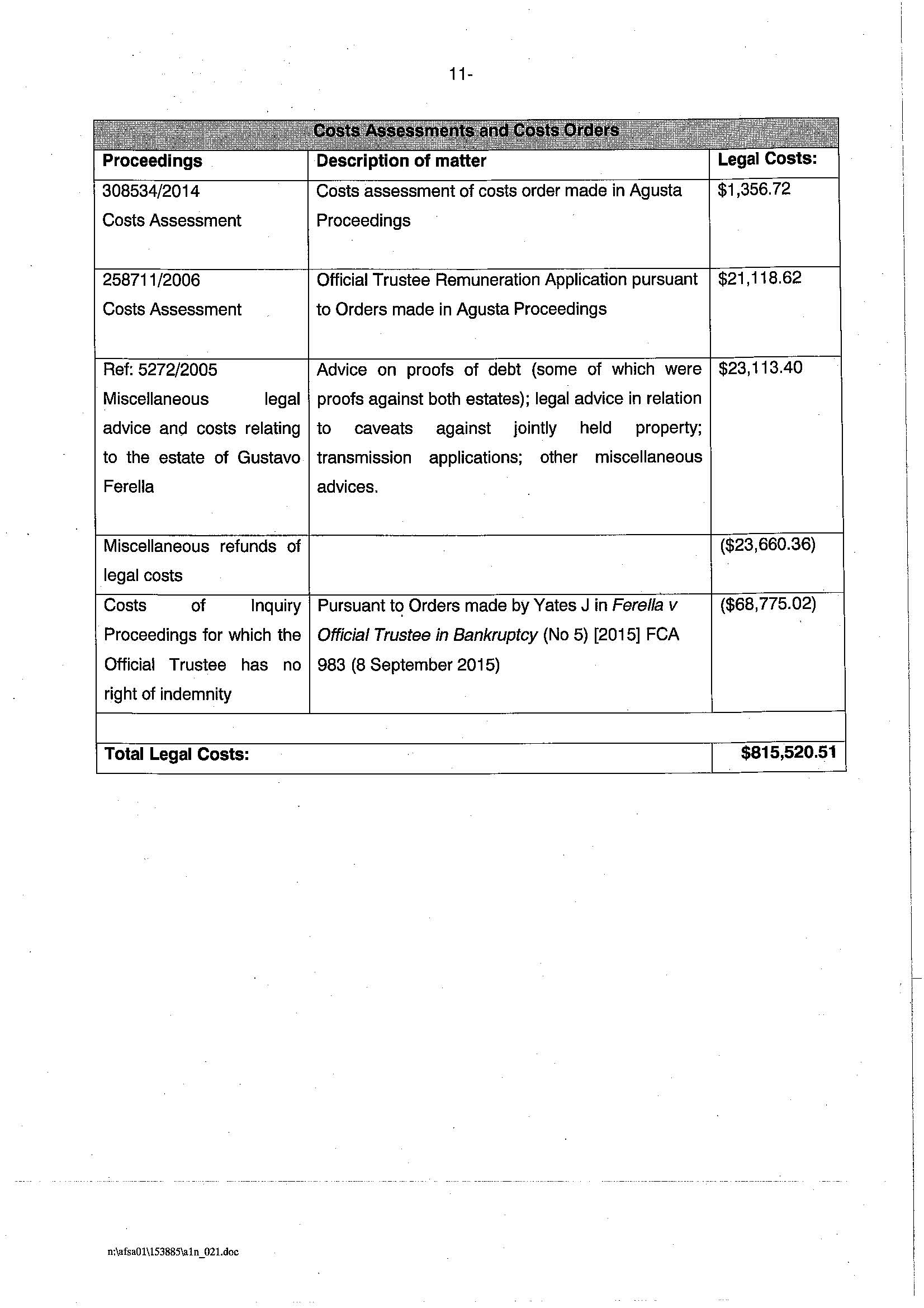
2 The bulk of the expenses claimed by the Official Trustee are legal expenses incurred by it in the complex and costly network of litigation that this bankruptcy has unfortunately spawned. The legal costs estimated by the Official Trustee in relation to each set of proceedings, together with a description of those proceedings, are set out in the table annexed to these reasons. The applicant maintains that it is likely, on a proper investigation, that the Official Trustee would be bound to make a determination under s 153A of the Bankruptcy Act which would have the result that the applicant would be entitled to an annulment and a re-vesting of the residue of his assets. He contends that no monies are payable to the Official Trustee or alternatively that a significantly reduced amount is payable.
3 By an interlocutory application filed on 3 December 2015, the applicant seeks a mandatory interlocutory injunction requiring the Official Trustee to consent to a stay, until further order of this Court, of the orders made on 18 December 2014 by Nicholas AJ in proceedings in the Supreme Court of New South Wales, Equity Division, No 2014/00204343 (the s66G Supreme Court Proceedings). By those orders, the Supreme Court appointed trustees for sale of certain properties pursuant s 66G of the Conveyancing Act 1919 (NSW) (Conveyancing Act) in which a half interest had vested in the Official Trustee. The applicant also seeks an order that the Official Trustee be restrained from seeking or procuring the issue of any writ for possession referred to in the said orders made in the s 66G Supreme Court Proceedings.
4 For the reasons that follow, the interlocutory application is refused with costs. First, the applicant has failed to establish that there is a serious question to be tried. Secondly and in any event, I would refuse to grant the injunctive relief sought in the exercise of discretion.
5 Finally, I note that the interlocutory application is addressed not only to the Official Trustee, but also to the applicant’s wife, Nida Ferella. However, Nida Ferella is not a party to this proceeding and naming her on the interlocutory application does not suffice to join her. No application has been made to join her to these proceedings.
6 In support of the interlocutory application, the applicant relied upon three affidavits of his son, Mr Angelo Ferella, sworn on 15 October 2015, 30 November 2015 and 9 December 2015 (the first, second and third Ferella affidavits respectively). The first Ferella affidavit was also filed in support of, and together with, the originating application. The second Ferella affidavit was filed in support of the interlocutory application and seeks to raise matters said to be relevant to the exercise of discretion by this Court to grant the interlocutory injunctions sought. The third Ferella affidavit corrected a statement in the second affidavit.
7 There was no objection to those affidavits being read. Nonetheless there are serious deficiencies in the applicant’s evidence which require explanation.
8 Turning first to the first Ferella affidavit, it is apparent that this affidavit contains material which is argumentative in nature, expressions of opinion such as to the correctness of amounts of expenses, and bare assertions of improper conduct and overcharging by the Official Trustee (including “improper intermeddling … and thwarting of attempts” to refinance a property and “improper receipt and disposition” of proceeds of a mortgagee sale by the Official Trustee: see e.g. paragraphs 5, 31 and 32 of the first Ferella affidavit). I give no weight for the purposes of this application to such bald and serious assertions against the Official Trustee in terms of the truth which they assert, or to the opinions expressed which are inadmissible under s 76(1) of the Evidence Act 1995 (Cth) (Evidence Act).
9 In this regard, it is important to note that no evidence has been given by the applicant himself or by his legal representatives as to the grounds on which the applicant intends to pursue the litigation. This leads to a situation which is highly unsatisfactory in a number of respects. First, while Angelo Ferella deposes that the applicant does not speak English well and is elderly, that does not mean that he is unable to give affidavit evidence with the assistance of a translator. Secondly, and more importantly, this does not mean that it is satisfactory for the applicant’s son, who may have his own or another’s interests to pursue, to give such evidence allegedly on the applicant’s behalf. In contrast to a legal representative of a party who may swear an affidavit setting out, for example, the grounds on which an application is made by her or his client, Angelo Ferella does not owe any ethical or other relevant obligations to his father or to the Court as an officer of the Court. Thirdly, Angelo Ferella gives evidence such as that he is unable to identify a reason for a particular claim by the trustee or that certain matters concern him (see e.g. paragraphs 31 and 32, first Ferella affidavit). However, the fact that the applicant’s son may have particular concerns does not mean that the applicant shares them. The applicant’s son’s views are irrelevant.
10 These matters notwithstanding, no objection was taken by the respondent to Angelo Ferella’s affidavits on any of these grounds, at least at this stage. Moreover, the present application is interlocutory in nature with the result that evidence can be given on information and belief even though this does not cure the particular deficiencies to which I have referred above: s 75, Evidence Act. In all of the circumstances therefore, and notwithstanding the highly unsatisfactory nature of the evidence as to the grounds on which the substantive application is pursued, for the purposes of determining this application I will treat the concerns expressed by Angelo Ferella in his first affidavit as indicating the grounds on which the applicant wishes to rely in support of his claims for final relief given that they are generally consistent with the submissions made by the applicant’s legal representatives.
11 In the second Ferella affidavit filed in support of the interlocutory application, the applicant’s son again purports to speak on behalf of the applicant (as well as for his mother who is not a party). In the circumstances, I have treated the second Ferella affidavit as indicating the grounds on which the applicant seeks to rely in support of the interlocutory application with the exception of paragraph 10, and consider later in these reasons the weight which can be given to this evidence as to the prejudice which Angelo Ferella says the applicant and his mother would suffer if the relief were not granted. In however his second affidavit at paragraph 10, Angelo Ferella describes a comment which he alleges was made by a member of the New South Wales Court of Appeal during the course of the hearing of the appeal in the s 66G Supreme Court Proceedings regarding an affidavit affirmed by Ms Joyce Fu affirmed on 6 November 2015. The comment is not reflected in the reasons of any member of the Court of Appeal and accordingly I have not taken that paragraph of Angelo Ferella’s second affidavit into account.
12 Finally, attached to Angelo Ferella’s first and second affidavits were bundles of documents which were tendered as exhibits including an incomplete set of documents relating to the s 66G Supreme Court Proceedings, documents relating to other court proceedings (discussed further below), information obtained by Angelo Ferella from the Official Trustee pursuant to a freedom of information request relating to the costs and expenses of his and the applicant’s respective bankruptcies, and correspondence between the parties.
13 The Official Trustee relied upon an affidavit of Ms Joyce Fu affirmed 22 February 2016 and the exhibit to that affidavit (the contents of which are described at [41] – [48] below). Ms Fu is a public servant employed with the Australian Financial Security Authority as a Team Leader, Estate Administration. Ms Fu has assisted in the administration of the Ferellas’ bankrupt estates since about February 2010 and has had the day-to-day conduct of the administration of their estates from about mid-2015, when she took over that role from Ms Sally Wooderson, whose evidence in other Court proceedings involving the Ferellas is addressed below.
14 None of the witnesses were required for cross-examination.
3.1 The substantive proceedings
15 The applicant and his son, Angelo Ferella, were made bankrupt on 14 October 2005. They were discharged from bankruptcy on 3 December 2008 by operation of law. Prior to his bankruptcy, the applicant and his wife were the registered proprietors of four properties: 3 Chester Street, Blacktown and 15 Chester Street, Blacktown (the Blacktown Properties); 2/20-32 Hutton Road, North Entrance (the North Entrance Property); and 6 Alan Street, Box Hill (collectively, the Properties). Upon the applicant being made bankrupt, his half interest in the Properties vested in the Official Trustee by virtue of the combined operation of s 58(1)(a) of the Bankruptcy Act and s 90 of the Real Property Act 1900 (NSW): Ferella v Official Trustee in Bankruptcy [2015] NSWCA 411 (Ferella (s 66G) (NSWCA)) at [3].
16 As noted earlier, these proceedings were instituted by an originating application filed on 16 October 2015 supported by the first Ferella affidavit. By the originating application, the applicant challenges the outstanding costs and expenses claimed by the Official Trustee and seeks an annulment of the bankruptcy and re-vesting of any remaining assets or, in the alternative, an inquiry under s 179 of the Bankruptcy Act (albeit as I later explain, one such inquiry has already been undertaken). In addition, the applicant seeks an order that the Official Trustee compensate or pay damages to the applicant in respect of (unidentified) assets in the bankrupt estate said to have been “improperly appropriated or applied” and a declaration that the Official Trustee was not justified in commencing proceedings against Nida Ferella and the applicant in the s 66G Supreme Court Proceedings (which are explained below).
17 Before considering whether to grant the interlocutory injunctions, it is necessary to set out the factual background of these and other proceedings in this Court and the Supreme Court of New South Wales relating to the administration of the bankruptcy.
3.2 The s66G Supreme Court Proceedings
18 It is the sale of the Properties for the purpose of recouping the costs and expenses of the Official Trustee that lay at the heart of the s 66G Supreme Court Proceedings, as is the case also in these proceedings.
19 By a summons dated 10 July 2014 filed in the Supreme Court of NSW, the Official Trustee sought an order for the appointment of trustees for sale of the Properties pursuant to s 66G of the Conveyancing Act. The parties to those proceedings were the Official Trustee, the Registrar-General, and Gustavo and Nida Ferella. In this regard, I note that on appeal, the Court of Appeal held that Gustavo Ferella ought not have been joined to the proceedings because, as a bankrupt, his one half interest in the Properties had vested in the Official Trustee: Ferella (s 66G) (NSWCA) at [8] and [49(d)] (Tobias AJA (Bergin CJ in Eq agreeing)), [66] (Emmett AJA).
20 On 18 December 2014, Nicholas AJ made orders under s 66G appointing Messrs Steven Nicols and Richard Brien as Trustees (the Trustees for Sale) for the sale of the Properties. Those orders included that:
4. … the Trustees [for Sale] be empowered to offer the Properties for sale and to sell the Properties by public auction with power to fix a reserve price, or alternatively, to sell the Properties by private treaty at the best available price.
…
8. …the Trustees [for Sale] pay their remuneration and the Plaintiff’s [the Official Trustee’s] costs out of the proceeds of sale, prior to any payment to either the Plaintiff [Official Trustee] or First Defendant [Mrs Nida Ferella] and the Trustees for Sale shall be entitled to be remunerated on the basis of their fees attached to their Consent to Act.
9. …the Trustees [for Sale] hold the proceeds of sale … on trust for the Plaintiff as Trustee of the bankrupt estate of GUSTAVO FERELLA, and on trust for the First Defendant [Mrs Nida Ferella] in equal shares.
…
11. That vacant possession of the Properties be given 21 days after the date of this order.
12. An order that a Writ of Possession be issued in favour of the Trustees [for Sale] forthwith.
…
21 In addition, specific provision was made for the potential sale of the Properties to Nida Ferella in order 5 which provided that:
… any sale by the Trustees [for Sale] may be made to the First Defendant [Mrs Nida Ferella] either as a result of sale at auction or by private treaty, without the requirement for the payment of a deposit and upon such terms as to the payment of the balance of the purchase price as the Trustees [for Sale] consider appropriate.
22 I note that, following the Orders of 18 December 2014, Mrs Nida Ferella purchased the interest vested in the Official Trustee in the North Entrance Property for $210,000.
23 Finally, order 13 of the Orders of 18 December 2014 stayed the effect of the Orders on the Box Hill Property.
24 While the making of orders under s 66G was initially opposed by Gustavo and Nida Ferella, it was unnecessary for Nicholas AJ to give reasons because ultimately the orders were, in effect, agreed to by Gustavo and Nida Ferella or at least not opposed by them. The circumstances in which this occurred are set out in detail in the reasons of Tobias AJA in Ferella (s 66G) (NSWCA). Given the potential relevance of this to the exercise of my discretion to grant the interlocutory injunctions sought here which are intended to halt the execution of these orders, it is helpful to set out the relevant passages in Tobias AJA’s reasoning, namely:
9. The Summons came on for hearing before the primary judge on 18 December 2014. The relief sought was opposed by the appellants on a number of grounds, one of which was that his Honour should have exercised his discretion to not grant the relief sought by the Official Trustee until the result was known of proceedings in the Federal Court of Australia between Angelo Ferella and the second appellant (as applicants) and the Official Trustee (as respondent) in respect of an inquiry conducted under s 179 of the Bankruptcy Act (“the Federal Court proceedings”). Those proceedings were heard by Yates J on 6 August 2014 and 8 September 2014. On the latter date his Honour reserved judgment. It remained reserved when the present matter was heard by the primary judge on 18 December 2014.
….
13. As the transcript of the proceedings before the primary judge reveals, it was submitted on behalf of the appellants that if Yates J accepted the submissions made on behalf of the applicants in the Federal Court proceedings, then it was likely that the consequences in terms of disallowing the costs paid to the Official Trustee’s own lawyers as well as the possibility of costs orders against him personally would have the effect of materially reducing the amount alleged to be owing in respect of the costs and expenses of the Official Trustee in administering the estate of the second appellant, the payment of which was holding up the application by that appellant for annulment of his bankruptcy. In fact, it was submitted that there was a possibility that it would be found that no further costs or expenses were owing to the Official Trustee and that the Official Trustee may even be required to refund monies to the second appellant – and all this without any of the Properties being sold.
14. Having stated the effect of s 153A of the Bankruptcy Act, the appellants then referred to s 154(1), which deals with the situation when the bankruptcy of a person is annulled. The effect of s 154 is, relevantly, that the trustee may apply the property of a former bankrupt still vested in the trustee in payment of the costs, charges and expenses of the administration of the bankruptcy, including the remuneration and expenses of the trustee, and then subject to certain sub-sections not currently relevant, the remainder (if any) of the property of the former bankrupt still vested in the trustee reverts to the bankrupt. It was therefore submitted that the effect of s 154(1)(c) was to create a statutory trust in favour of the former bankrupt although, as the primary judge observed, that trust did not yet exist, if it could exist at all.
15. It was then submitted that it would be contrary to the duties of the Official Trustee contained in s 19(1)(j) and (k) of the Bankruptcy Act to seek an order under s 66G of the Conveyancing Act because of the Trustee’s duty to administer the bankrupt estate as efficiently as possible by avoiding unnecessary expense and by exercising powers and performing functions in a commercially sound way.
16. It was thus submitted that the most efficient way of moving forward with the administration of the estate of the second appellant in a manner which would incur minimum expense was, firstly, to ascertain exactly what has to be paid to discharge any monies properly payable to the Official Trustee and secondly, to defer the sale of any of the Properties until the precise amount had been ascertained. It was submitted that the amount claimed ($939,277) did not call for the wholesale realisation of all four of the Properties in circumstances where that amount was, on the evidence, substantially less than their combined value. There was substance in this last point and it was ultimately reflected in the orders made by the primary judge.
17. It was then contended that although an order under s 66G could not be opposed on the grounds of general unfairness, nevertheless in the present case the second appellant had an equity in relation to the proceeds of sale and the manner of their application given the total value of the Properties as against the amount alleged to be owing to the Official Trustee. However, despite the suggestion that the second appellant had some kind of undefined equity, it was not submitted that pursuant to s 116(2)(a) of the Bankruptcy Act, the interest of the second appellant in the Properties was not available for division amongst his creditors upon the ground that his interest in the Properties was held in trust for another person. No such equity of that kind was or could have been asserted.
18. It was finally submitted that, as a matter of discretion, the primary judge should take account of the interests of the second appellant as he was in the position of being, in effect, a residuary beneficiary of any property vested in the Official Trustee and not required for the payment of either his creditors or the costs and expenses of his trustee. It was thus submitted that to realise any of the Properties would be unnecessary and would be prejudicial to the first appellant, the other co-owner.
19. At that point the primary judge suggested to the parties that, from a practical point of view, the sale of the Properties should be staged so that the first Blacktown property should be sold and, if the proceeds of that sale were sufficient to pay the costs and expenses of the Official Trustee, no further order would need to be made with respect to the other properties. If the proceeds of sale were insufficient, then the second Blacktown property could be sold or one of the other properties where it was accepted that the proceeds of sale would be sufficient to pay out any balance due to the Official Trustee. His Honour therefore suggested that the parties should discuss the matter and, in effect, come up with a solution that avoided the making of a s 66G order for sale.
20. Although it was submitted on behalf of the appellants that there should be complete deferment of any sale until “we know all the answers”, his Honour resisted that proposition whereupon counsel for the appellants requested an adjournment to obtain instructions, a course which his Honour encouraged.
21. After a short adjournment, his Honour was informed by counsel for the appellants that the adjournment had not produced an agreed outcome but had resulted in his side proposing a slight variation of the orders which might simplify matters. The following exchange then occurred between counsel for the appellants and his Honour:
“His Honour: Well, Mr Newton, where are we?
Newton: Well, your Honour, whilst I do not have instructions either to consent or oppose those orders, and I’d have to concede that to some extent the temporary excision of the Box Hill property would partly meet the submissions that I made earlier. It does seem to me a course which is potentially open to your Honour.
His Honour: I entirely agree. And you are protected in this sense, or everybody is, because there’s liberty to apply in any event. But it does seem to me that that’s a absolutely commercially sensible and realistic way of going about things.
Newton: As the Court pleases.
His Honour: So I see no reason in the circumstances why I shouldn’t make these orders.
Newton: Yes, your Honour.”
3.3 Dismissal of the appeal in the s 66G Supreme Court Proceedings
25 Despite the position ultimately adopted by Gustavo and Nida Ferella with respect to the making of the s 66G orders by Nicholas AJ, they both appealed from those orders and sought to establish that the exercise of discretion in making the orders had miscarried in various respects. The Court of Appeal dismissed that appeal on 18 December 2015.
26 First, the Court of Appeal held that the appellants had effectively consented to, or not opposed, the s 66G orders. As Tobias AJA in Ferella (s 66G) (NSWCA) held:
22. It is apparent from the foregoing exchange that there was agreement that the Box Hill property, which was clearly the most valuable of the Properties, was to be excised, at least temporarily, from the orders that his Honour should make in accordance with Short Minutes of Order provided to him by the parties. Apart from the appointment of trustees for sale of the Properties and the making of the usual consequential orders for the sale and the distribution of the proceeds, the orders included the right of the first appellant to acquire the Official Trustee’s interest in any of the Properties without the requirement for the payment of a deposit; an order that the trustees hold the net proceeds of sale on trust for the Official Trustee as trustee of the bankrupt estate of the second appellant and for the first appellant in equal shares; and, importantly, an order staying until further order the sale of the Box Hill property, being the most valuable.
23. In effect, counsel for the appellants consented to the making of those orders, or at least did not oppose them, which makes it somewhat difficult for the appellants to now assert that his Honour was in error in making them. In this respect that the orders were made, in effect, by consent is borne out by the fact that his Honour did not give reasons for the making of the orders and was not requested to do so. In other words, the appellants did not require the primary judge to consider or determine the various submissions which had been made initially in opposition to the Official Trustee’s application.
(emphasis added.)
27 In this regard, Tobias AJA held at [44] that “…what I would regard as the hopelessness of the appellants’ case is that they, in effect, consented to the making of the orders by the primary judge or at least did not oppose their making in accordance with Short Minutes of Order in the preparation of which they appeared to co-operate.”: see also Ferella (s 66G) (NSWCA) at [1] (Bergin CJ (In Eq)) and at [63] (Emmett AJA).
28 Secondly, the appellants submitted that, given the commencement of these proceedings in the Federal Court challenging expenses and charges allegedly due to the Official Trustee and seeking annulment of the bankruptcy, the Official Trustee ought not to be permitted to embark upon what “might ultimately prove to be an unnecessary and, therefore, wasteful” realisation of assets (Ferella (s 66G) (NSWCA) at [49(d)]; see also at [47]). In rejecting that argument, Tobias AJA held that:
One of many difficulties with this submission is that whatever benefits, if any, to which the second appellant would be ultimately entitled if and when his bankruptcy is annulled, can hardly assist him in the present appeal in circumstances where he was inappropriately joined as a party and where he is no longer a co-owner of the Properties as a consequence of his bankruptcy. Once it is accepted that the second appellant was not a proper party and should never have been joined in the application, it follows that his position either now or in the future, is irrelevant as he has no standing given the nature of the proceedings. Whatever interests the second appellant might ultimately have in respect of the reversion to him of property vested in the Official Trustee or otherwise acquired is irrelevant to the exercise of the discretion provided by s 66G. He may have some form of remedy in the Federal Court but not in the present proceedings.
29 Finally, the appellants relied upon material obtained under freedom of information legislation which, so it was asserted, indicated that “costs and expenses incurred by the Official Trustee in the administration of the bankrupt estate of Angelo Ferella had been wrongly attributed to the second appellant [Gustavo Ferella]” (Ferella (s 66G) (NSWCA) at [51]). Those submissions were emphatically rejected by the Court of Appeal. In this respect, Tobias AJA held (at [51]-[53]):
…The Court was not referred to any evidence that supported this assertion; and it only was an assertion. The fact that the second appellant has now applied to the Federal Court for the annulment of his bankruptcy provided no support to any of the appellants’ contentions. The simple fact, as pointed out during the course of argument, was that that information was obtained and the institution of annulment proceedings could have occurred long before the Official Trustee sought the sale of the Properties under s 66G. In particular, counsel for the appellants accepted that as at December 2014 the question of annulment was “front and centre” but no application had then been made to the Federal Court for an annulment. Counsel was unable to explain the second appellant’s delay in making that application.
In my view, none of the foregoing submissions have the slightest merit. Submissions were put to this Court that were not put to the primary judge, and it was accepted that counsel made it perfectly clear to his Honour that he was not opposing the making of the orders in question. In these circumstances it hardly lies in the mouth of the appellants to challenge the exercise of the primary judge’s discretion in the making of those orders.
30 Similarly, Emmett AJA noted (at [66]):
The thrust of the complaint made to this Court by the Bankrupt is that the amount of the costs and expenses claimed by the Official Trustee is excessive. He points out that he would be entitled, upon the payment of all outstanding costs and expenses and the consequential annulment of his bankruptcy, to any surplus remaining in the estate. The Bankrupt has no standing to make that complaint in these proceedings. So far as the Supreme Court is concerned, the only persons interested in the properties are the co-owners, being the Official Trustee and Mrs Ferella. The administration of the bankrupt estate is a matter entirely for the court of bankruptcy, in the present case, the Federal Court of Australia. It is not a matter that is relevant to the exercise of the jurisdiction conferred on the Supreme Court by s 66G of the Conveyancing Act.
3.4 Other Proceedings in which the Official Trustee has incurred legal costs
31 In October 2000, Gustavo and Angelo Ferella purchased a property at 1 Wingadal Place, Point Piper (the Point Piper property) as trustees of the Cavallino Unit Trust. By deed dated 19 April 2005, the Gustavo and Angelo Ferella resigned as trustees and Riva (NSW) Pty Ltd (Riva) was appointed trustee of the Cavallino Unit Trust in place of the Ferellas. Subsequently, by deed of 9 February 2006, Riva resigned and Agusta Pty Ltd (Agusta) was purportedly appointed as Trustee.
32 When the Point Piper property was sold in 2006, the Official Trustee held the sum of $1,788,532, being the net proceeds of the sale of the Point Piper property by its mortgagee (the Fund).
33 By summons filed on 13 September 2006 (which was subsequently amended), Agusta, Riva, Angelo Ferella and Gustavo Ferella sought various declarations and orders against the Official Trustee including a declaration that the Fund was held by the Official Trustee on trust for the Cavallino Unit Trust and an order that the Official Trustee pay the Fund to the trustee of the Cavallino Unit Trust (the Agusta proceedings).
34 At trial, the applicants argued that Agusta was the trustee of the Cavallino Unit Trust, whereas the Official Trustee contended that the trustees remained the Gustavo and Angelo Ferella. The primary judge held that the trustee had been Riva from 19 April 2005: Agusta Pty Ltd and Ors as trustees for the Cavallino Unit Trust v The Official Trustee in Bankruptcy as trustee of the bankrupt estates of Gustavo Ferella and Angelo Ferella [2008] NSWSC 685 (Agusta (No 1)) at [34]. That finding was not challenged on appeal: Agusta Pty Ltd v Official Trustee in Bankruptcy as Trustee of Estates of Gustavo Ferella and Angelo Ferella [2009] NSWCA 129 (Agusta (NSWCA)) at [7].
35 Due in part to the parties’ respective cases being conducted differently at trial, an appeal from the decision in Agusta (No 1) was allowed by the Court of Appeal (Agusta (NSWCA)). As a result, the matter was remitted to the primary judge, and finalised on 28 August 2009 (Agusta Pty Ltd and Ors as trustees for the Cavallino Unit Trust v The Official Trustee in Bankruptcy as trustee of the bankrupt estates of Gustavo Ferella and Angelo Ferella (Unreported, 28 August 2009) (Agusta (No 2)).
36 The Point Piper property is not in issue in these proceedings. However, insofar as Official Trustee has incurred legal costs in Agusta (No 1), Agusta (NSWCA) and Agusta (No 2) (estimated to be $144,677.46 for Agusta (No 1) and Agusta (No 2) and $27,426.26 for the appeal), the applicant seeks to put challenge in these proceedings the liability of his estate to pay the Official Trustee those costs.
3.4.2 The inquiry proceedings before Yates J
37 Finally by proceedings NSD1284/2009 instituted in the Federal Court against the Official Trustee, Angelo Ferella and Gustavo Ferella sought an inquiry under s 179 of the Bankruptcy Act of their respective estates (the inquiry proceedings). In essence they alleged that:
(1) the administration of their respective bankrupt estates was a relatively simple matter that should have been undertaken expeditiously;
(2) the Official Trustee participated unnecessarily in the Agusta proceedings in relation to the Point Piper land (described at [31]-[36] above);
(3) other assets were available to the Official Trustee to meet the claims of all creditors, as well as its remuneration and costs; and, as a consequence,
(4) the administration of the bankrupt estates had been unnecessarily delayed and the estates exposed to the burden of additional costs which they should not bear.
See Ferella v Official Trustee in Bankruptcy (No 2) [2011] FCA 619 (Ferella (Inquiry) (No 2)) at [4]-[7]).
38 In Ferella (Inquiry) (No 2), Yates J rejected the application for an inquiry save for ordering a limited inquiry against the Official Trustee as to:
(1) whether the Official Trustee was justified in not disclosing a letter dated 16 July 2008 from the Australian Taxation Office (ATO) regarding the liability of the applicants for capital gains tax in relation to the sale of the Point Piper property; and, if not,
(2) as to the consequences (if any) of the non-disclosure for the orderly administration of the applicants’ bankrupt estates together with what relief (if any) should lie.
39 In limiting the inquiry to these narrow issues, Yates J rejected the submission that from the commencement of the Agusta proceedings in September 2006 until their final resolution in August 2009, the Official Trustee engaged in litigation on a substantially misconceived basis or in a manner which was unnecessary or extravagant (Ferella (Inquiry) (No 2) at [185]). To the contrary, his Honour held that the Official Trustee “…was justified in defending the [Agusta] proceedings in the way that it did and in prosecuting its claim to be entitled to be indemnified from the Point Piper funds.” That decision was upheld on appeal in Ferella v Official Trustee in Bankruptcy [2013] FCAFC 43.
40 Judgment on the limited inquiry was delivered on 14 July 2015 by Yates J (Ferella v Official Trustee in Bankruptcy (No 4) [2015] FCA 712 (Ferella (Inquiry) (No 4)), and the matter was finalised on 8 September 2015, when the costs decision was delivered (Ferella v Official Trustee in Bankruptcy (No 5) [2015] FCA 983). In Ferella (Inquiry) (No 4), Yates J held that the Official Trustee was not justified in failing to disclosing the letter from the ATO to the applicants during the Agusta proceedings then ongoing before the Supreme Court (at [92]). However, his Honour was not satisfied that this non-disclosure had any material consequences for the orderly administration of the bankrupt estates (at [94]). His Honour also held at [95] that the applicants’ submissions ignored his earlier finding in Ferella (Inquiry) (No 2) at [185] as to the conduct of the Official Trustee otherwise with respect to the Agusta proceedings. Yates J therefore held that the applicants had not made a proper case for the relief they sought (at [95]).
4. EVIDENCE AS TO THE FINANCIAL POSITION OF THE BANKRUPTS’ ESTATES
41 Ms Fu gave evidence as to the financial situation of the Ferellas’ estates. As earlier mentioned, she was not required for cross-examination on this application. First, she explained that:
(1) where an estate is in funds, such as where there has been a sale of a vested property, costs and expenses incurred in its administration may be paid directly from those funds although that is not always done;
(2) the Official Trustee ordinarily allocates joint expenses between the relevant estates in such a way as to have them paid from estate funds rather than as expenses to be funded by it (from public funds); thus the whole of or an unequal part of a joint expense may be allocated to one estate rather than another because the former is in funds and the other is not, or is not sufficiently in funds; and
(3) where an estate is not in funds, the Official Trustee itself funds the payment of expenses.
42 Secondly, Ms Fu stated that:
As the estates of Gustavo and Angelo have not been in funds since 13 October 2015, no further transactions have been recorded on the Account Transaction Reports since that date. The Official Trustee continues to fund payment of expenses relating to the estates, which payments have been recorded to the Expense accounts of each estate as appropriate.
43 Thirdly, the Account Transaction Reports as at 13 October 2015 and the Expense Reports as at 9 February 2016 for the bankrupt estates of Angelo and Gustavo Ferella respectively are exhibited to Ms Fu’s affidavit. The Account Transaction Report records as a credit any receipt of funds into, and as a debit any disbursement of funds from, an estate and the running balance of the funds held in the estate. The Expense Report accounts for each estate record (as an “Amt”) the amount of any expense incurred by the Official Trustee in the administration of the estate (other than those debited from the estate) (recorded as an “Estate Amt”), and the amount of any expense thereafter outstanding to the Official Trustee (as “ITSA Paid”).
44 It is apparent, as Ms Fu deposes, that most of the expenses incurred by the Official Trustee with respect to the administration the bankrupt estates of Angelo and Gustavo Ferella are legal expenses incurred with respect to the series of legal proceedings which I have summarised above. The total legal costs are estimated at $815,520.51. A copy of Annexure “A” to Ms Fu’s affidavit detailing the history of extensive litigation in which the Ferellas’ bankrupt estates have been involved, together with the estimated legal costs incurred by the Official Trustee in that litigation, is annexed to this judgment. Those legal costs which are referable solely to Angelo Ferella’s estate were not included.
45 Ms Fu explained that the summary of legal costs and expenses is an estimate only because:
(1) legal costs continue to be incurred by the Official Trustee in litigation commenced by the applicant;
(2) the Official Trustee has not been able to estimate the unbilled and future legal costs; and
(3) the Official Trustee’s system of accounting applies refunds of legal costs generally to the expense or transaction accounts as opposed to against any specific invoice.
46 Fourthly, Ms Fu annexed a table to her affidavit (Annexure B) containing an estimate of debt and expenses in Gustavo’s estate indicating its net position as at 12 February 2016. That table estimates the liabilities of the estate which the Official Trustee considers are required to be satisfied before the applicant is entitled to an annulment upon payment of the debts. The table reads as follows:
Estimate of Debts and expenses in the bankrupt of Gustavo Ferella
Description | Amount | Total |
Debts | $0.00 | |
Costs of Administration | $845,621.32 | |
Insurance premium | $0.00 | |
Total debts plus costs | $845,621.32 | |
OT’s Fees $4,000 + 20% x $845,621.32 (Reg. 16) | $173,124.26 | |
OT’s Fees | $173,124.26 | |
Debts plus costs plus OT’s fees | $1,018,745.58 | |
Less Funds received from Petitioning Creditors 8 March 2006 | ($74,656.00) | |
Less Funds received from bankrupt 13 March 2006 | ($249,321.54) | |
Less Realisation of interest in North Entrance property 23 March 2015 | ($210,000.00) | |
Plus 8% Realisation Charge (for funds received from 1/11/1996 – 30/6/06) | $25,918.20 | |
Plus 6% Realisation Charge (for funds received from 1/7/14-30/6/15) | $12,600.00 | |
$523,286.24 | ||
Plus 7% Realisation Charge (for $562,673.39 required from 1/7/15) | $39,387.14 | |
Total amount required to annul bankruptcy | $562,673.38 | |
Plus interest claims on Cavalino Unit Trust Debts pursuant to order 5K of the Supreme Court Orders dated 24 July 2008 | $70,596.21 | |
Plus OT’s remuneration outstanding pursuant to the Supreme Court Orders dated 15/10/2013 | $39,326.70 | |
$672,596.29 |
47 In addition to the matters set out at [44] above, Ms Fu explained that:
…as matters concerning the bankrupt estate of Gustavo is yet to be finalised, the total amount of costs, charges and expenses payable in Gustavo’s bankrupt estate changes from time to time. Additionally, there has been over the course of the administrations regulatory changes including calculation of insurance premiums payable in respect of the estate. Accordingly, it is not yet possible to provide a final amount for debts and cost of the administration.
In particular:
(a) regulatory changes in relation to insurance premiums recoverable from bankrupt estates changed on 1 December 2015 with the effect of abolishing the recovery of the premiums from the estate.
(b) costs of realising vested assets have not been included, for example the costs of trustees for sale of the real properties; and
(c) the Official Trustee has a claim for remuneration claim pursuant to the Orders made in the Supreme Court of NSW Proceedings No. 4820/06. This relates to work of the Official Trustee done in paying the trust creditors using the Point Piper property sale proceeds. In addition, trust creditors have a claim for interest on trust debts.
48 Finally, Ms Fu explained that, in respect of the estate of Gustavo Ferella, the “‘total costs of administration’ includes the whole of the expenses incurred jointly with the estate of Angelo Ferella which (as at 12 February 2016)” were:
(a) $84,890.85 in respect of the expenses in the Angelo Ferella Transaction Report; and
(b) $328,293.88 in respect of expenses in the Angelo Ferella Expenses Report.
49 In seeking to require the Official Trustee to consent to a stay, the applicant is asking the Court to grant a mandatory interlocutory injunction. A prohibitory injunction is also sought so as to restrain the Official Trustee from seeking or procuring the issue of any writ for possession. In both cases, underlying the applicant’s submissions is the proposition that the interlocutory injunctions are necessary to ensure the effective exercise of the Court’s jurisdiction including so as to prevent the frustration of its processes in these proceeding: Binetter v Deputy Commission of Taxation [2012] FCA 377; (2012) 128 ALD 10 at [40].
50 The test to be applied in determining whether an interlocutory injunction should be granted is well settled: see Australian Broadcasting Corporation v O’Neill [2006] HCA 46; (2006) 227 CLR 57 (O’Neill) at 68 [19] (Gleeson CJ and Crennan J), 82 [65] - 84 [71] (Gummow and Hayne JJ); Beecham Group Limited v Bristol Laboratories Pty Ltd (1968) 118 CLR 618 and 622-623 (Kitto, Taylor, Menzies and Owen JJ). The proper approach is first to inquire as to whether there is a serious question to be tried, and then to determine the matter on the balance of convenience. It is sufficient to show a serious question to be tried if the applicant demonstrates a “prima facie case”, that is, a sufficient likelihood of success to justify in the circumstances the preservation of the status quo pending the trial: O’Neill at 82 [65] (Gummow and Hayne JJ). In this regard, “the requisite strength of the probability of ultimate success depends upon the nature of the rights asserted and the practical consequences likely to flow from the interlocutory sought”: O’Neill at 84 [71] (Gummow and Hayne JJ). In considering the balance of convenience and the justice of the case, the Court must assess and compare the prejudice and hardship likely to be suffered if an injunction is granted as against that which is likely to be suffered if one is not granted, including whether the applicant is likely to suffer injury for which damages will not be an adequate remedy: O’Neill at 68 [19] (Gleeson CJ and Crennan J).
5.2 Is there a serious question to be tried?
51 As earlier mentioned, the evidence of Angelo Ferella contained various allegations which I have treated as indicating the grounds on which the applicant wishes to challenge the costs and expenses which the Official Trustee seeks to claim as against Angelo Ferella’s estate.
52 In his written submissions in support of the interlocutory application, the applicant contended that:
12. The primary relief sought in these proceedings is predicated upon the exorbitant amount claimed by the respondent in the bankrupt estate of the applicant. In general terms the following attacks are made in respect of that claim:
(a) In proceedings No. NSD 1284 of 2009 [being the s 179 inquiry proceedings before Yates J], in this Court, reliance was placed on the said affidavit of Sally Jane Wooderson in establishing the level of debt to the respondent. Various components in the amount claimed on behalf of the respondent in that affidavit are challenged seriatum in the affidavit of Angelo Ferella sworn on 15 October 2015 in these proceedings;
(b) In proceedings NSD 1284 of 2009 there are substantial unresolved costs orders between the parties;
(c) There are pending proceedings in this Court in NSD 1391/2015 for damages against the respondent; and
(d) The amount otherwise claimable by the respondent has been reduced by $210,000 paid by Nida Ferella in respect of the North Entrance property.
13. The affidavit of Joyce Fu of 6 November 2015 which was read on behalf of the present respondent in the NSW Court of Appeal conceded, at paragraph 15, that the said affidavit Sally Jane Wooderson was erroneous in at least one respect. The unsatisfactory position with respect to the respondent’s claims is further amplified by material obtained under freedom of information legislation and referred to in the affidavit of Angelo Ferella of 15 October 2015.
14. The various amounts claimed by the respondent as remuneration for realisation of assets are set out in paragraph 4 of the said Wooderson affidavit are quite opaque to the outside reader. That is sufficient to give rise to a grave concern that some of those amounts relate to the receipt of part of the proceeds of a mortgagee’s sale in respect of a valuable property at Point Piper which was an asset of the Cavallino Unit Trust and not an asset falling within the bankrupt estates of the present applicant or that of Angelo Ferella. It was held by Nicholas J in Agusta & Ors v Official Trustee in Bankruptcy [2008] NSWSC 685, and not disturbed in the NSW Court of Appeal, that the subject property was an asset of the Cavallino Unit Trust and restorative orders were made in favour of the trustee of that trust Riva NSW Pty Ltd.
53 Contrary to the applicant’s submissions, I am not satisfied that any of these matters give rise to a serious question to be tried.
54 First, insofar as the applicant’s submission is “predicated upon the exorbitant amount claimed” by the Official Trustee, that submission does not acknowledge that some of the Official Trustee’s claimed costs and expenses have been already accepted as legitimate by this Court. In particular, Yates J determined in the inquiry proceedings that the Official Trustee was justified in defending the Agusta proceedings in the way that it did and in prosecuting its claim to be entitled to be indemnified from the Point Piper funds (see above at [39]). While this does not address the entirety of the applicant’s complaints relating to the Official Trustee’s costs and expenses, it cannot simply be ignored, as the applicant appears to do.
55 Secondly, no evidence was referred to in support of the assertion “there are substantial unresolved costs orders between the parties” in the inquiry proceedings (NSD 1284/2009). If this means, however, that costs may not yet have been assessed, the point takes the applicant’s case no further. That does not mean that no costs will be recoverable, as is the applicant’s primary contention; nor to the extent that costs still need to be assessed, that the costs estimated by the Official Trustee (which were unchallenged on this application) are likely to be substantially reduced when those costs were assessed.
56 Thirdly, with respect to the applicant’s reliance upon the Wooderson affidavit in earlier proceedings, no evidence was referred to which demonstrated any possible errors in the level of debt said to be owed to the Official Trustee, save for the error which was corrected by Ms Fu’s evidence on the appeal in the s 66G Supreme Court Proceedings (where this issue was also raised and evidence was admitted subject to relevance): Ferella (s 66G) (NSWCA) at [28]. The basis on which it is said that this correction made (and apparently accepted) in earlier proceedings casts doubt upon the Official Trustee’s estimates as to the amounts owing to him is completely unclear. Nor was any ground for asserting error demonstrated by reference to the material obtained under the freedom of information legislation. The evidence of Angelo Ferella on which the applicant relies can be put no higher than mere assertions as to the existence of error, as I have earlier held (see above at [8]); see also the findings to like effect by the NSW Court of Appeal in Ferella (s 66G) (NSWCA) set out above at [29]).
57 Fourthly, the proceedings in this Court in NSD 1391/2015 are docketed to me with judgment currently reserved on an interlocutory application filed by the respondent. In those proceedings, Riva Pty Ltd seeks damages against the Official Trustee in relation to the Point Piper property. Those proceedings have nothing to do with whether or not injunctions should issue against the Official Trustee requiring him to consent to a stay of the sale of other properties and restraining him from seeking or procuring the issue of any writ for possession, and say nothing about the liability of Gustavo Ferella’s bankrupt estate for costs and expenses incurred in other proceedings.
58 Fifthly, Annexure B to Ms Fu’s affidavit (quoted above at [46]) takes account of the realisation of the Official Trustee’s interest in the North Entrance property in the sum of $210,000 and her evidence to that effect was not challenged on this application. The evidence before the Court of Appeal also acknowledged that that payment had reduced the amount then alleged to be owing to the Official Trustee: Ferella (s 66G) (NSWCA) at [28]. As such, the applicant’s submission as to the need for this to be taken into account to reduce the liability to the Official Trustee is without merit. There is no dispute about the issue.
59 Finally, insofar as it was ultimately pressed, I am not satisfied that there is any serious question to be tried with respect to the challenge to amounts claimed by the Official Trustee “as remuneration for realisation of assets”. In this regard, Ms Fu gave evidence in Annexure B of amounts described as “realisation charges” in varying percentages for different periods: quoted above at [46]. The Official Trustee submitted at the hearing that those charges did not remunerate the Official Trustee but rather were charges payable to the Commonwealth under the bankruptcy laws. At the hearing, I made orders requiring the Official Trustee to provide a note identifying and explaining by reference to the evidence the statutory provisions said to authorise these charges, with the statutory provisions as at the relevant date to be attached. I also granted leave to the applicant to file and serve any note in response. In compliance with those orders, the Official Trustee filed a note on 12 May 2016. That note and the accompanying legislation was to the following effect:
(1) The calculation of the Official Trustee’s fees at the rate of $4000 plus 20% of the costs of administration accord with the remuneration authorised by cl 3.05 of the Bankruptcy (Fees and Remuneration) Determination 2015 (Cth) made pursuant to s 163 of the Bankruptcy Act 1966. Clause 3.05 provides that:
If a bankruptcy is annulled under section 153A or 153B of the Act, the remuneration payable to the Official Trustee for acting as trustee in a bankruptcy is $4 000 plus 20% of the realised balance.
(2) The 8% realisation charge for funds received between 1 November 1996 and 30 June 2006 is authorised by ss 6 and 7 of the Bankruptcy (Estate Charges) Act 1997 (Cth) (Bankruptcy (Estate Charges) Act) as in force prior to 1 July 2006. Relevantly, s 6 provided that:
(1) A charge calculated in accordance with sections 7 and 8, is imposed in respect of amounts received by a person (including the Official Trustee) who, during a charge period:
(a) is the trustee of the estate of the bankrupt under the Bankruptcy Act 1966;…
…
(2) The charge is payable by the person to the Commonwealth.
(3) The charge is payable within 35 days after the end of the charge period.
Section 7 in turn provided that the amount of the charge payable for a charge period is an amount equal to 8% of the amount on which the charge is payable for the period or if a different percentage is prescribed by the regulations, the prescribed percentage.
(3) The 6% realisation charge for funds received between 1 July 2014 and 30 June 2015 was authorised by ss 6 and 7 of the Bankruptcy (Estate Charges) Act as in force from 1 July 2007. Specifically, the percentage of 6% was prescribed for the purposes s 7(2), by the Bankruptcy (Estate Charges) (Amount of Charge Payable) Determination 2014 (Cth) made on 27 March 2014.
(4) Finally, the 7% realisation charge levied for the $562,673.39 required from 1 July 2015 accords with the percentage prescribed for the purposes of s 7(2) of the Bankruptcy (Estate Charges) Act by the Bankruptcy (Estate Charges) (Amount of Charge Payable) Determination 2015 (Cth) dated 30 April 2015.
60 No note was received from the applicant in response pursuant to the leave granted and therefore no issue was ultimately taken on this application with the legislative references given by the Official Trustee as authorising the relevant costs and charges.
61 It follows that, having regard to the evidence (or lack thereof) on this application, I do not consider that the applicant has made out a serious case to be tried as to the existence of errors in the fees and charges estimated to be owed to the Official Trustee. In other words, the applicant has not demonstrated a sufficient likelihood of success to justify in the circumstances the preservation of the status quo pending the final hearing: O’Neill at 82 [65] (Gummow and Hayne JJ). However, even if there were among the many allegations made by the applicant, some issue that raised a serious question to be tried, I would not grant the interlocutory relief sought in the exercise of discretion in any event.
5.3.1 The applicant’s submissions
62 The applicant submits first that there is a “dispute and uncertainty concerning the alleged debt” in the applicant’s bankrupt estate as to the amounts claimed by the Official Trustee as costs and expenses of the bankruptcy. In the applicant’s submission, the question of what amounts are payable to the Official Trustee, and whether the Official Trustee should make a determination under s 153A of the Bankruptcy Act, are “questions which are properly antecedent to allowing a forced sale of the Blacktown properties to proceed”. As to the reasons why it is said that the disputed expenses and costs should be determined first, counsel for the applicant submitted that:
… before there should be any permanent destruction of the prospective property on an annulment, one should first ascertain what is the proper amount so that either Mr Gustavo Ferella or Mrs Nida Ferella can make intelligent and reasonable attempts to buy out, if need be, what is still owed or if there is nothing still owed, for Mr Gustavo Ferella to call for a return of the residue property without it having gone through the wasteful process of compulsory sale.
Now, I think it would be common ground that the process of properly ascertaining what is due would take some considerable period of time, but it is certainly Mr Ferella’s case that fairness dictates that the correct position should be ascertained before he prospectively loses something to which he said he would be entitled and having regard to the public duty of a trustee in bankruptcy, the destruction of property which is owned by Mrs Nida Ferella and the wastage of costs and expenses of realisation.
63 In this regard, Angelo Ferella deposed at paragraph 12 of his second affidavit as to Nida Ferella’s alleged position, namely that:
The position of Nida Ferella in relation to the Blacktown properties is that she wishes to maintain her ownership of the half share currently held by her undiminished by unnecessary sale costs and trustees fees. She is ready willing and able to pay out to the present respondent the value of the half share in those properties currently claimed by the respondent up to the full extent of such monies as may be determined by this Court to be properly due to the present respondent, if any, as a precondition for the annulment of the bankruptcy of my father Gustavo Ferella, the present applicant. She is willing to be joined as a party to these proceedings.
64 Similarly, Angelo Ferella deposed at paragraph 13 of his second affidavit as to Gustavo Ferella’s alleged position, namely that:
The position of the present applicant is that the present respondent already has received ample funds so as to entitle him to an annulment of his bankruptcy. In the event of an annulment of his bankruptcy he wishes the other half share in the Blacktown Properties to be revested in him and that unnecessary expenses in [sic] about the forced realisation of those properties by trustees for sale should be prevented. In the event the present applicant is not already entitled to an annulment because some funds remain owing to the present respondent, the present applicant is ready willing and able to pay whatever the proper balance is as determined by this Court, if any.
65 No evidence was however given as to Nida Ferella’s or the applicant’s respective financial positions and their capacity to pay out the Official Trustee in support of the assertions made in this evidence by the applicant’s son.
66 Secondly, the applicant relies upon the evidence of Angelo Ferella in his second affidavit that:
My said parents are likely to be further prejudiced by any precipitate forced sale of the Blacktown Properties because an advanced stage has been reached in arranging development approval for 3 Chester Street which, once granted, will greatly enhance its value. So far as 15 Chester Street is concerned my mother through a family company has undertaken extensive renovations costing in excess of $100,000.00. Those renovations are incomplete but on completion thereof the said property would be worth considerably in excess of the current value.
67 While there was no documentary evidence of the renovations and amounts allegedly spent on them, no issue was taken by the respondent with that evidence and I am prepared to accept for the purposes of this application that extensive renovations have been undertaken which are incomplete. However, the opinion expressed by Angelo Ferella that on completion, the property would be worth considerably in excess of the current value is plainly inadmissible: see s 76(1), Evidence Act. While I am prepared to infer for the purposes of this application that completion of the renovations may have some positive impact on the value of the property, no more can be inferred on the state of the evidence: see also below at [79].
68 Thirdly, the applicant submits that there is ample security in the properties themselves to protect the Official Trustee’s position pending a determination of what is due to the Official Trustee in these proceedings or by virtue of any further inquiry ordered under s 179 of the Bankruptcy Act.
69 In the fourth place, the applicant relies upon the passages in Ferella (s 66G) (NSWCA) indicating that any proceedings needed to be instituted in the Federal Court which had exclusive jurisdiction over the administration of the bankruptcy: see also the second Ferella affidavit at paragraph 9.
70 Finally, the applicant relies upon Angelo Ferella’s evidence in his second affidavit that his parents “oppose” the making of the notice of motion filed in the s 66G Supreme Court Proceedings on 23 October 2015 by the Trustees for Sale for possession over the Blacktown properties and have maintained the position that the Trustees for Sale have no standing to seek that relief.
5.3.2 The exercise of discretion
71 While I accept that the value of the Properties are more than sufficient to meet the costs and expenses claimed by the Official Trustee, for the reasons set out below I consider that the balance of convenience nonetheless falls heavily in favour of refusing the interlocutory injunctions.
72 First, I have given significant weight to the fact that Gustavo and Nida Ferella did not oppose the orders made by Nicholas AJ on 18 December 2014 pursuant to s 66G of the Conveyancing Act appointing the Trustees for Sale of the Properties. In that case, it will be recalled that similar submissions to those made here were put on behalf of Gustavo and Nida Ferella in the s 66G Supreme Court Proceedings, namely, that no order under s 66G should be made until the outcome of the inquiry in the Federal Court under s 179 of the Bankruptcy Act on which judgment was then reserved by Yates J. This course, it was submitted, would avoid unnecessary expense in line with the Official Trustee’s duties in administering the estate and would prejudice the interests of the Nida Ferella as co-owner. However, Gustavo and Nida Ferella did not ultimately oppose the s 66G orders being made on the basis that the sale of the Properties was staged so as to ensure that, if the proceeds of sale were sufficient to pay the Official Trustee’s costs and expenses, no further order would need to be made with respect to the other properties. In this regard, the Court of Appeal held in effect that counsel for Gustavo and Nida Ferella consented to the making of the orders or at least did not oppose them (Ferella (s 66G) (NSWCA) at [23]). This matter is highly relevant to the exercise of discretion and no explanation was given for the change in the applicant’s position. In this regard, the fact that the Court of Appeal held that the applicant ought not to have been a party to the s 66G Supreme Court Proceedings does not detract from the fact of his consent as a party nonetheless to the orders made by Nicholas AJ or his decision not to oppose them.
73 Secondly, the applicant has failed to establish on the evidence that there is uncertainty and a genuine dispute about the alleged debt: cf applicant’s submissions at [52] above. In so saying, I recognise that the submission overlaps with the first question to be addressed, namely, whether the applicant has established that there is a serious question to be tried.
74 Thirdly, Nida Ferella is not a party to these proceedings and has no interest in the administration of the bankruptcy. Furthermore, her appeal against the s 66G orders was dismissed by the Court of Appeal: see above at [25]. However, I accept that her interests are affected in that she is a co-owner with Official Trustee of the Blacktown Properties which are the subject of the s 66G orders. Nonetheless, those interests have been taken into account by orders 5 and 13 of the orders made by Nicholas AJ which she did not oppose. As noted earlier, order 13 stays the operation of the orders for sale as against the Box Hill property (which was the single most valuable property). That excision was accepted by Gustavo and Nida’s counsel before Nicholas AJ as “partly meet[ing] the submissions that [he] made earlier” in opposing the application for orders under s 66G of the Conveyancing Act: see above at [24]. Order 5 gives Nida Ferella the right to acquire the Official Trustee’s interest in any of the Properties without the requirement for the payment of a deposit.
75 Fourthly, absent realisation of the Blacktown properties, the Official Trustee is presently funding the administration of the estate itself (that is, from public monies): see [41] and [42] above. The principal costs of the administration are the legal expenses in the order of $815,000.00, much of which has been incurred in the defence of the series of litigation commencing in September 2006 which I have referred to, including the appeal against the orders in the s 66G Supreme Court Proceedings which was held to be completely without merit.
76 Fifthly, there has been substantial delay in instituting these proceedings as a result of which the Official Trustee has been bearing these costs for a significant period of time. No explanation has been given for the delay. The observations in Ferella (s 66G) (NSWCA) to the effect that the Supreme Court lacks jurisdiction over bankruptcy matters does not justify delay in instituting these proceedings but was a reference to jurisdictional limits which should have been obvious to the applicant’s legal representatives. Furthermore, I agree with the observation by Tobias AJA in the Court of Appeal in Ferella (s 66G) (NSWCA) at [51] that “[t]he simple fact… was that [the material obtained under the freedom of information legislation] was obtained and the institution of annulment proceedings could have occurred long before the Official Trustee sought the sale of the Properties under s 66G.”
77 Equally, contrary to the implication to be drawn from the applicant’s submissions, the observations of the Court of Appeal as to its jurisdictional limits did not suggest that there would be any merit in any application which might be instituted in this Court which is directed to halting the execution of the s 66G orders. To the contrary, Tobias AJA held in Ferella (s 66G) (NSWCA) at [53]:
As the appellants clearly appreciate, what remedies, if any, they may have lie in the Federal Court and belatedly that now seems to be appreciated. Of course, it would be open to the appellants to apply to the Federal Court for an order restraining the Official Trustee from proceeding to sell the Blacktown Properties. But the fact that that opportunity exists, which I am certainly not seeking to encourage, cannot reflect upon the outcome of this appeal which, at all times, has been without a scintilla of merit.
(emphasis added.)
78 Those observations become the more pertinent when it is appreciated that the appellants’ submissions in the Court of Appeal that the Official Trustee had wrongly attributed costs and expenses to the bankrupt estate of Gustavo Ferella were based upon some of the same evidence as is relied upon here, namely, the material obtained under the freedom of information laws (Ferella (s 66G) (NSWCA) at [33]). Furthermore, as earlier explained, the evidence of Ms Fu correcting in one respect Ms Wooderson’s evidence as to the amounts owing to the estate was admitted into evidence (subject to relevance) on the appeal in the s 66G Supreme Court Proceedings and no issue was apparently then taken with respect to that correction.
79 In the sixth place, neither Nida Ferella nor the applicant reside in either of the Blacktown properties. Rather, 3 Chester Street is occupied by tenants and the other Blacktown property, 15 Chester Street, is currently unoccupied undergoing renovations. Furthermore, while I have inferred for the purposes of this application, that completion of the renovations may have some positive impact on the value of 15 Chester Street, the matter can be taken no further on the state of the evidence. Quite apart from other difficulties with the reliance sought to be placed on the renovations, there is no direct evidence of any intention by Nida Ferella to complete those renovations, no evidence as to the nature of the renovations, no evidence as to how long completing the renovations might take, no evidence as to how far advanced the renovations are save that $100,000 is said to have been spent already on them, and no expert advice as to the impact which completion of the renovations might have upon the likely price for which the property might be realised. Nor does the appointment of the Trustees for Sale necessarily mean that the renovations will not be completed before sale. That will be a matter for the Trustees for Sale to determine in the execution of their duties.
80 In the circumstances, therefore, the applicant has not demonstrated that it is likely to suffer harm in the event that the injunctions were not granted for which damages would not be an adequate remedy: O’Neill at 68 [19] (Gleeson CJ and Crennan J).
81 Finally, while the Official Trustee submitted that in circumstances where the Trustees for Sale were not party to these proceedings and were in any event independent of the Official Trustee, there would be no utility in granting the injunctions against the Official Trustee. No authorities were referred to in this regard by the Official Trustee. In any event, in the circumstances it is not necessary for me to consider the correctness of that proposition and I have assumed in the applicant’s favour that there may be utility for the purposes of determining this application. However, that does not suffice to outweigh the other factors which I have set out above which in my view weigh heavily against the interlocutory injunctions sought by the applicant.
82 For the reasons set out above, the interlocutory application should be dismissed with costs.
I certify that the preceding eighty-two (82) numbered paragraphs are a true copy of the Reasons for Judgment herein of the Honourable Justice Perry. |
Associate:
ANNEXURE “A” TO THE AFFIDAVIT OF JOYCE FU AFFIRMED 22 FEBRUARY 2016