

FEDERAL COURT OF AUSTRALIA
Director of the Fair Work Building Industry Inspectorate v Construction Forestry, Mining and Energy Union (Quest Apartments and Greek Community Centre) [2016] FCA 1262
Table of Corrections | |
Corrected the spelling of Mr Zivislav Matic’s name in Orders 1 and 2, and in paragraph [6] | |
10 November 2016 | Correction to quotation underneath paragraph [33] |
ORDERS
DATE OF ORDER: |
THE COURT DECLARES THAT:
1. On 11 March 2014, each of the Third Respondent and Fourth Respondent contravened s 349(1)(a) of the Fair Work Act 2009 (Cth) (FW Act) by recklessly making a false or misleading representation about the obligation on the part of Mr Zivislav Matic and other individuals engaged by the Third Respondent to perform building work for the Third Respondent to engage in industrial action, namely the obligation of Mr Matic and other individuals to:
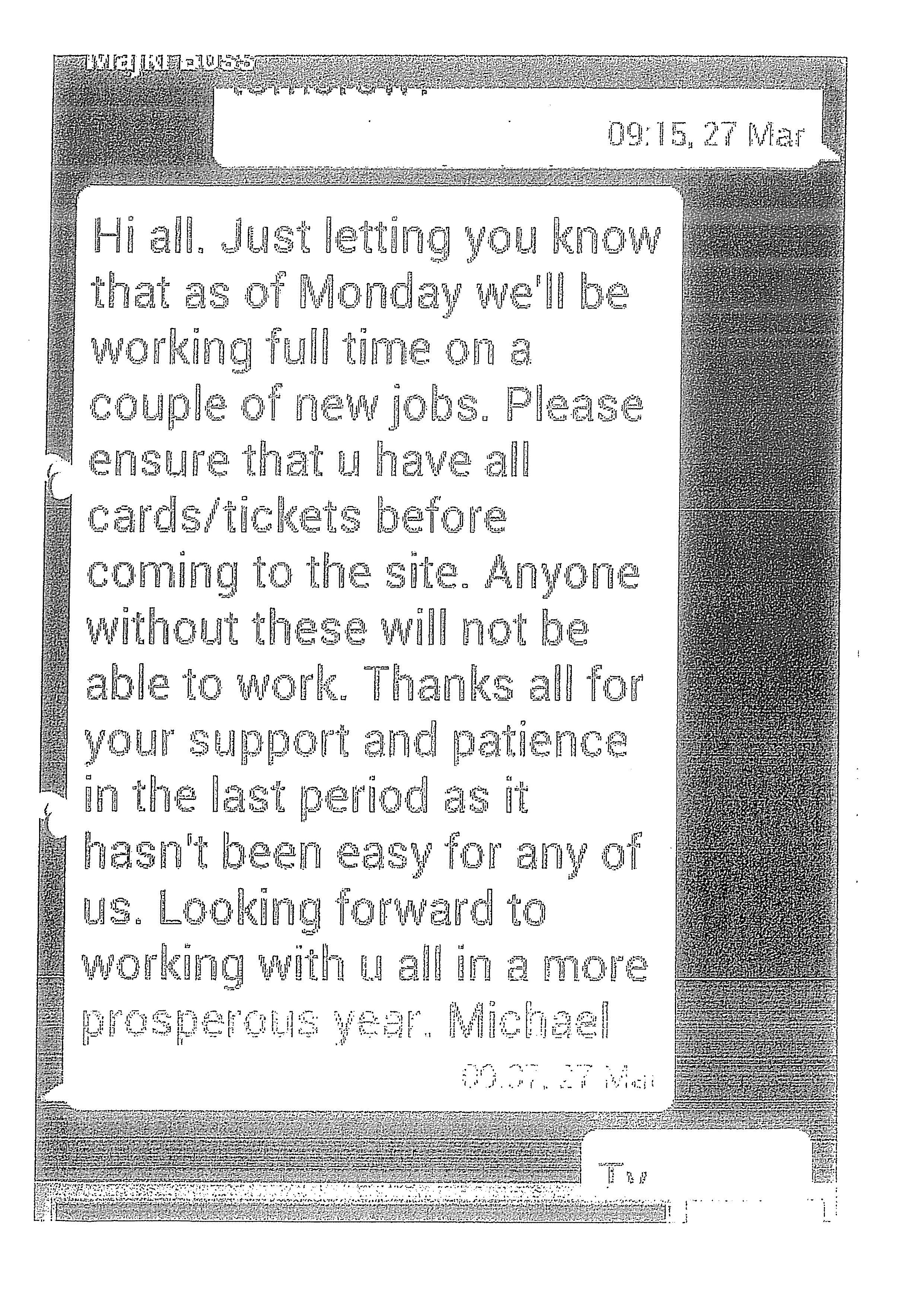
(a) become or remain a member of the Construction, Forestry, Mining and Energy Union (CFMEU); and
(b) pay membership fees to the CFMEU.
2. On 27 March 2014, each of the Third Respondent and the Fourth Respondent contravened s 349(1)(a) of the FW Act by recklessly making a false or misleading representation about the obligation of the part of Mr Zivislav Matic to engage in industrial activity, namely the obligation of Mr Matic to:
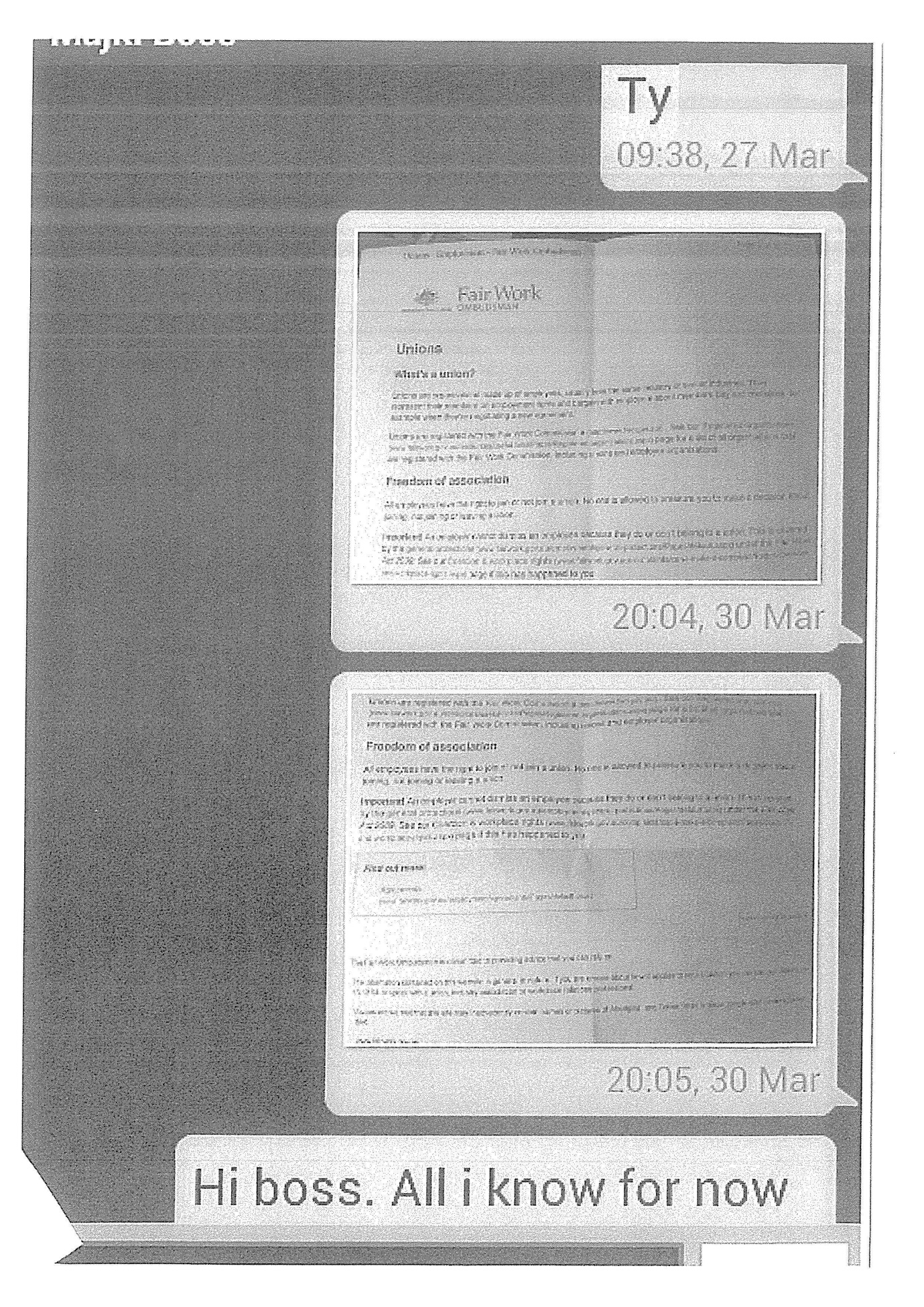
(a) become or remain a member of the CFMEU; and
(b) pay membership fees to the CFMEU.
THE COURT ORDERS THAT:
3. The Third Respondent pay the following pecuniary penalties:
(a) a penalty of $8,800 in respect of its contravention of s 349(1)(a) of the FW Act referred to in paragraph 1 above; and
(b) a penalty of $8,800 in respect of its contravention of s 349(1)(a) of the FW Act referred to in paragraph 2 above.
4. The Fourth Respondent pay the following pecuniary penalties:
(a) a penalty of $1,200 in respect of his contravention of s 349(1)(a) of the FW Act referred to in paragraph 1 above; and
(b) a penalty of $1,200 in respect of his contravention of s 349(1)(a) of the FW Act referred to in paragraph 2 above.
5. The pecuniary penalties referred to in paragraphs 3 and 4 above be paid to the Commonwealth of Australia within 90 days of these orders being made by the Court.
6. In default of payment of the penalties imposed pursuant to paragraphs 3 and 4 above, the Applicant has liberty to apply for directions for enforcement of payment of the pecuniary penalties.
7. There be no order as to costs of this proceeding as between the Applicant and the Third and Fourth Respondents.
Note: Entry of orders is dealt with in Rule 39.32 of the Federal Court Rules 2011.
TRACEY J:
1 The applicant Director commenced the present proceeding against four respondents. The first two respondents are the Construction, Forestry, Mining and Energy Union (“the CFMEU”) and one of its members, Mr Godwin Farrugia. The third and fourth respondents are Arteam Pty Ltd (“Arteam”) and its owner and sole director Mr Michael Hanna.
2 The Director has alleged that each respondent had contravened one or more provisions of the Fair Work Act 2009 (Cth) (“the Act”) and has sought various forms of relief.
3 The CFMEU and Mr Farrugia have made no admissions of culpable conduct and the proceeding, insofar as it concerns them, will go to a contested hearing next year.
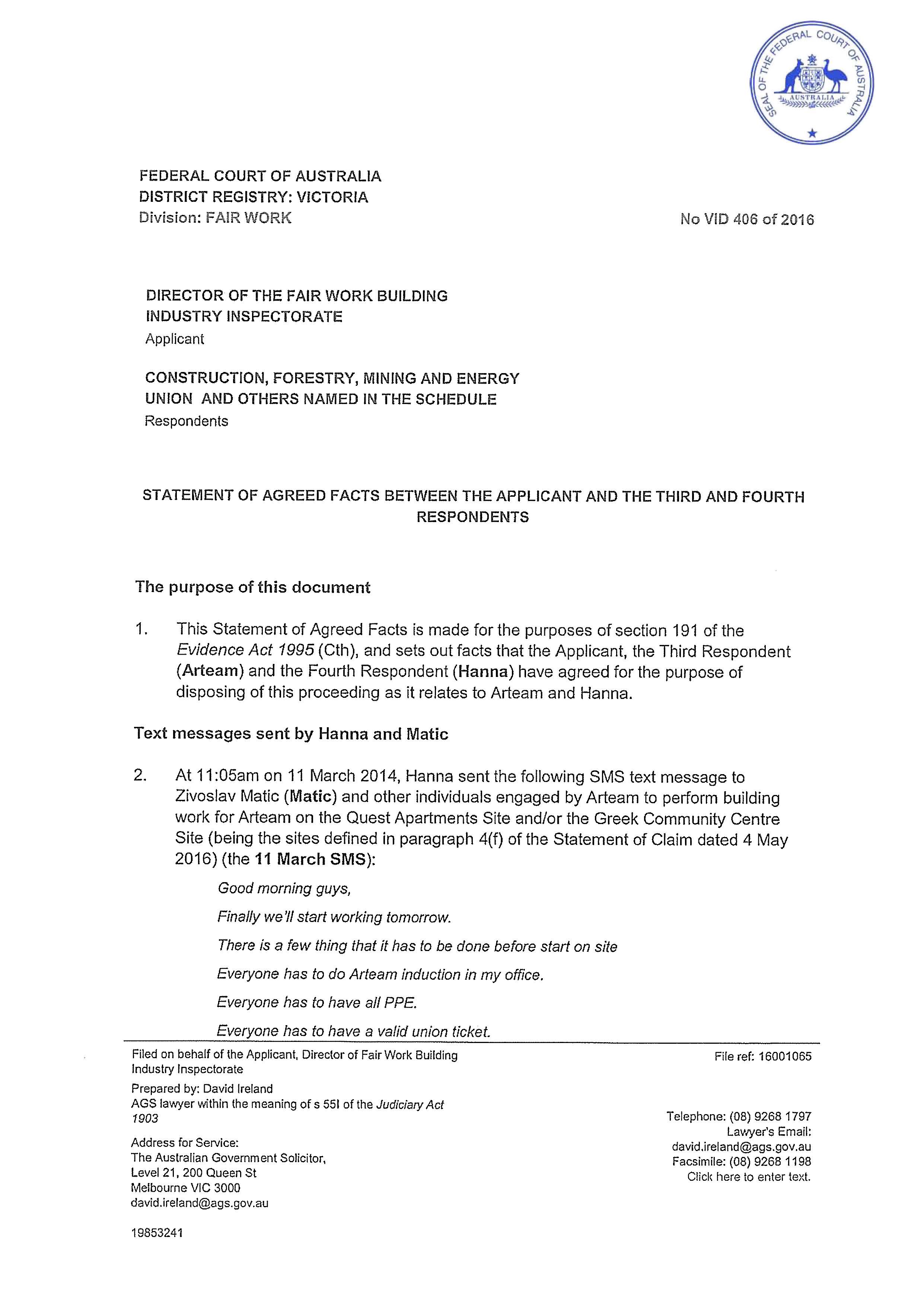
4 In the meantime Arteam and Mr Hanna have admitted, in amended defences filed on 18 August 2016, that they had contravened s 349 of the Act. Together with the Director they have filed a statement of agreed facts and minutes of proposed consent orders. A copy of the statement of agreed facts is an Annexure to these reasons.
5 Arteam and Mr Hanna have asked the Court to deal with the proceeding insofar as it affects them without awaiting the outcome of the trial. This application was supported by the Director and agreed to by the Court. No prejudice will thereby be occasioned to the CFMEU and Mr Farrugia. The facts have been agreed solely for the purpose of the Court’s disposal of the issues between the parties to the agreement.
BACKGROUND
6 Arteam is a small company which undertakes painting and related work on construction sites. In early 2014 it was engaged by principal contractors to do painting and related work at two construction sites in the Melbourne area. One of them was the Greek Community Centre site and the other was the Quest Apartments site. In order to perform this work Arteam engaged the services of a number of individuals, including Mr Zivislav Matic. The capacities in which these persons were engaged (as employees or independent contractors) was a matter of dispute. Nothing turns on their status because it was common ground that they were engaged to perform building work at the two sites.
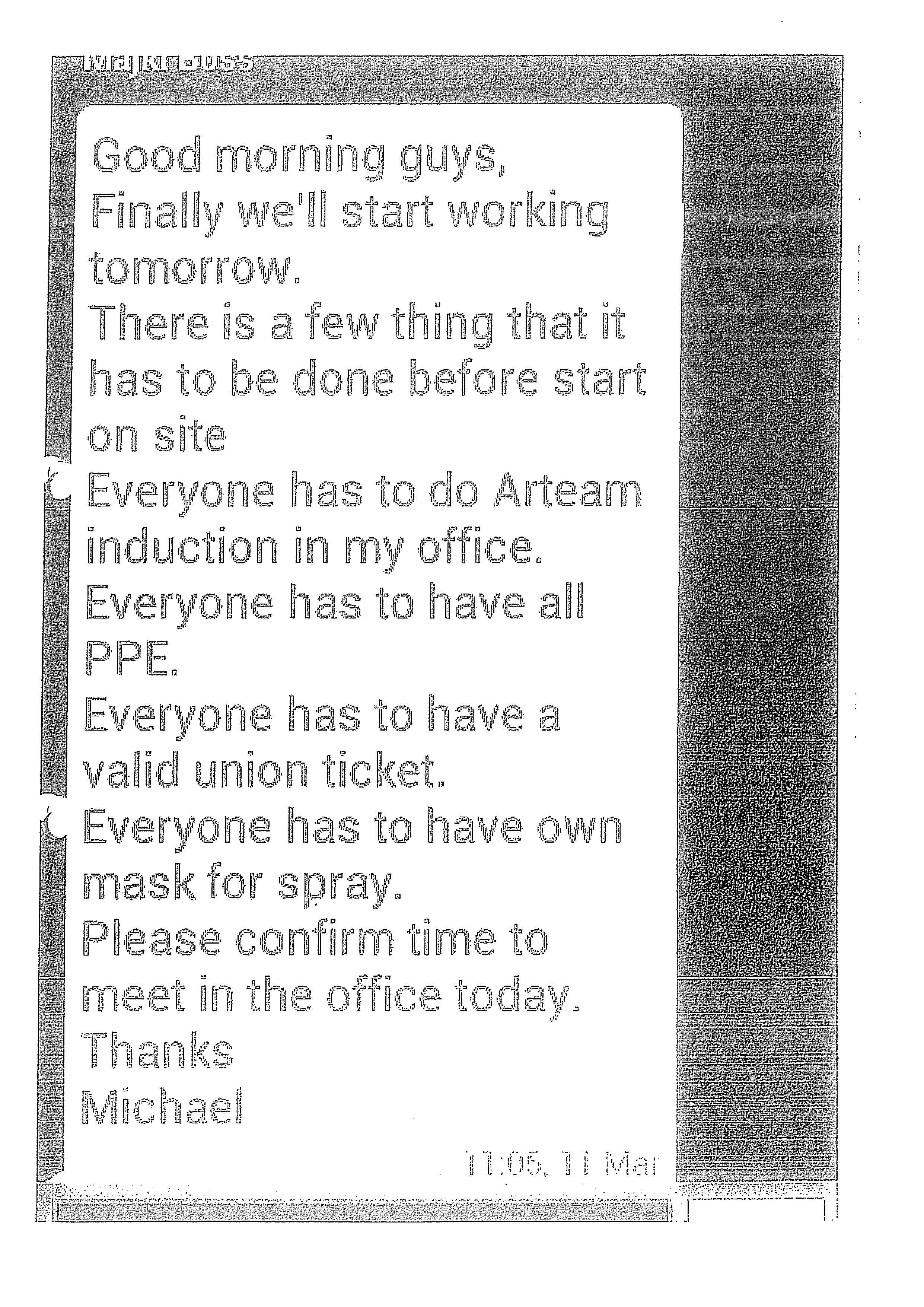
7 Arteam’s work was due to commence on 12 March 2014. On the previous day Mr Hanna sent an SMS text message to Mr Matic and others saying:
“Good morning guys,
Finally we’ll start working tomorrow.
There is a few thing that it has to be done before start on site.
Everyone has to do Arteam induction in my office.
Everyone has to have all PPE.
Everyone has to have a valid union ticket.
Everyone has to have own mask for spray.
Please confirm time to meet in the office today.
Thanks
Michael”
(Emphasis added, errors in original.)
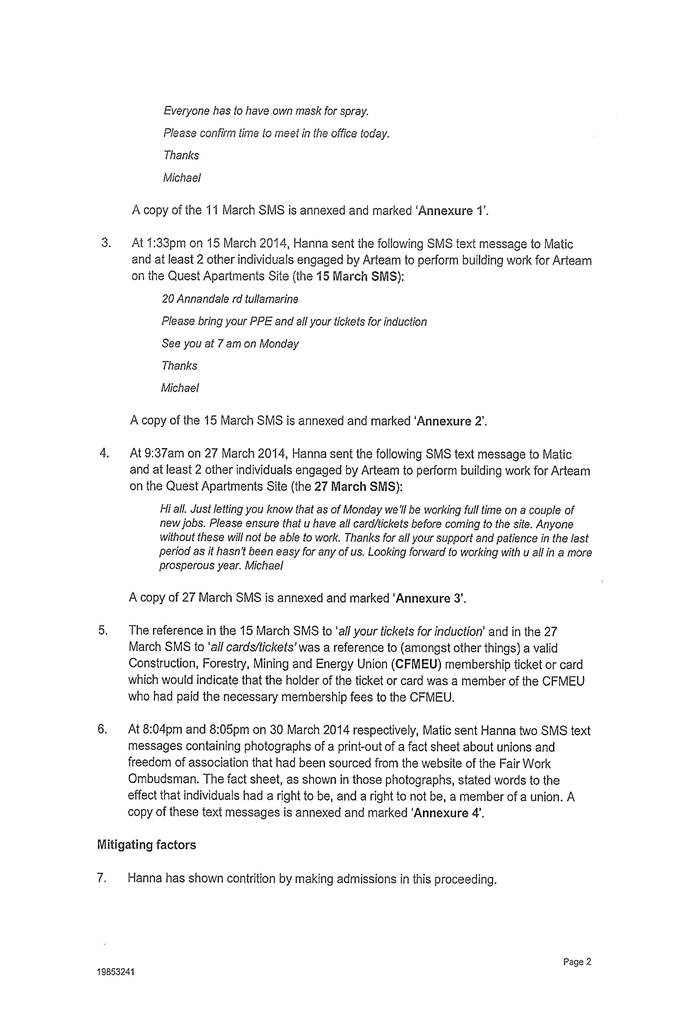
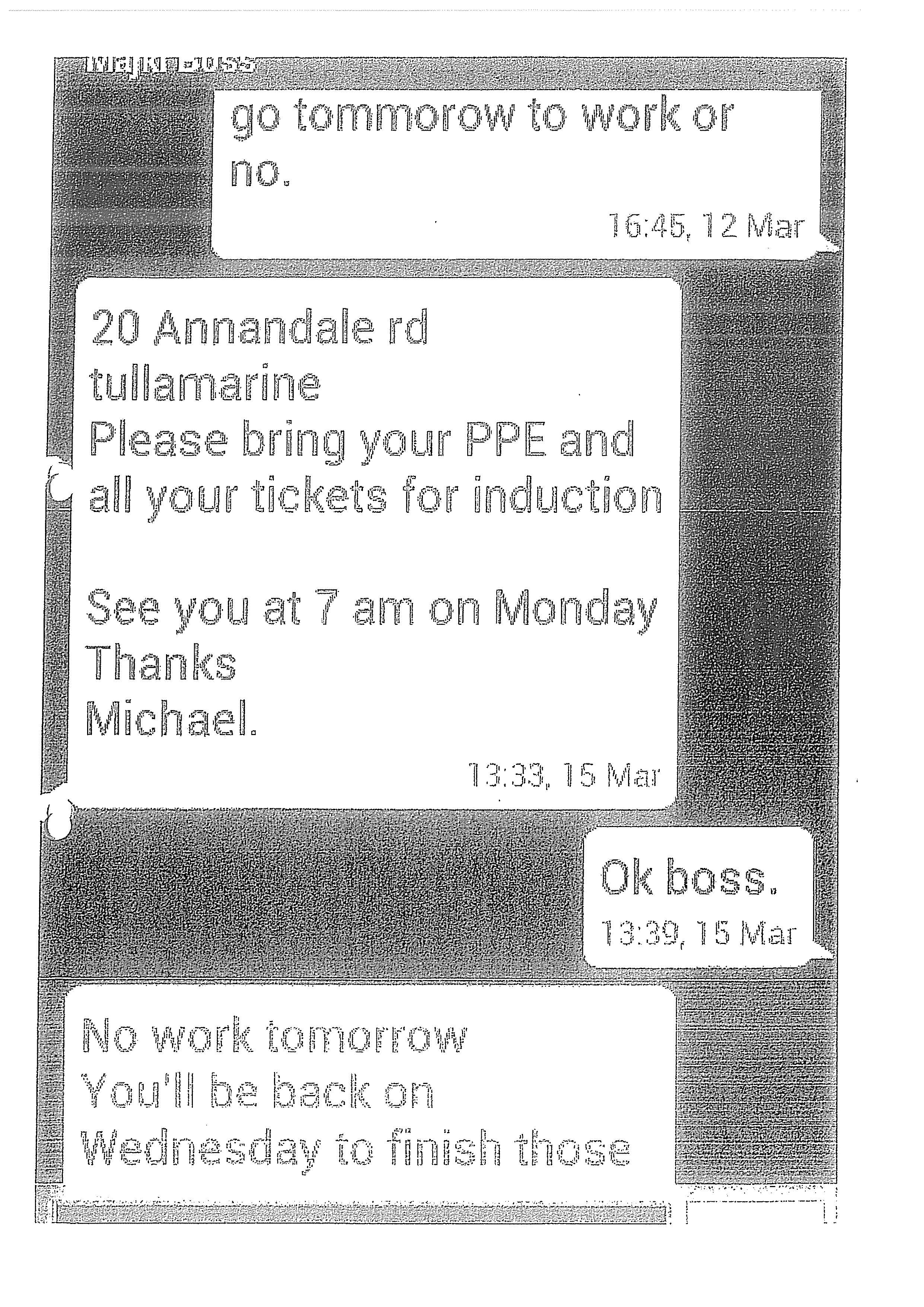
8 Mr Hanna sent a further text to Mr Matic on 15 March 2014 in which he asked Mr Matic to “bring your PPE and all your tickets for induction.”
9 On 27 March 2014, Mr Hanna sent another text to Mr Matic. It read:
“Hi all. Just letting you know that as of Monday we’ll be working full time on a couple of new jobs. Please ensure that u have all card/tickets before coming to the site. Anyone without these will not be able to work. Thanks for all your support and patience in the last period as it hasn’t been easy for any of us. Looking forward to working with u all in a more prosperous year. Michael” (Emphasis added).
10 It was an agreed fact that the references in the text sent on 15 March 2014 to “all your tickets for induction”, and in the text sent on 27 March 2014 to “all cards/tickets”, were references to, inter alia, a valid CFMEU membership ticket or card which would indicate that the holder of the ticket or card was a member of the CFMEU who had paid the necessary membership fees to the CFMEU.
11 Mr Hanna filed an affidavit in which he deposed that, at the times he sent the text messages, he believed that it was compulsory for workers on building sites to be members of the CFMEU. He had formed this belief because of things he had been told, on other projects, by head contractors and other sub-contractors and by CFMEU officials and delegates. These assertions were not challenged at the penalty hearing.
12 Mr Matic, however, appears to have been better informed. In the course of a telephone conversation with Mr Hanna on 30 March 2014 Mr Matic said that he had not paid outstanding membership fees to the CFMEU and that the CFMEU could not prevent him from working onsite because he had not done so. Mr Matic had obtained some fact sheets about unions and freedom of association from the website of the Fair Work Ombudsman. The fact sheet advised that it was a matter of individual choice as to whether a worker joined a union or decided not to do so.
13 On 31 March 2014 at the Quest Apartments site Mr Hanna and Mr Farrugia had a discussion about Mr Matic not being a financial member of the CFMEU. Whilst they were talking Mr Matic joined them. Mr Matic told them that he did not want Mr Hanna to pay any outstanding fees to the CFMEU because he was not required to be a member. Shortly afterwards, Mr Hanna told Mr Matic that if he, Mr Matic, remained on the site without paying outstanding membership fees to the CFMEU, the CFMEU could “close” the site and prevent others from working on the site. As a result of these discussions Mr Matic left the site and did not subsequently perform any work on it.
14 In his affidavit Mr Hanna acknowledged receiving the fact sheet from Mr Matic but said that he did not look at it until after the present proceeding had commenced.
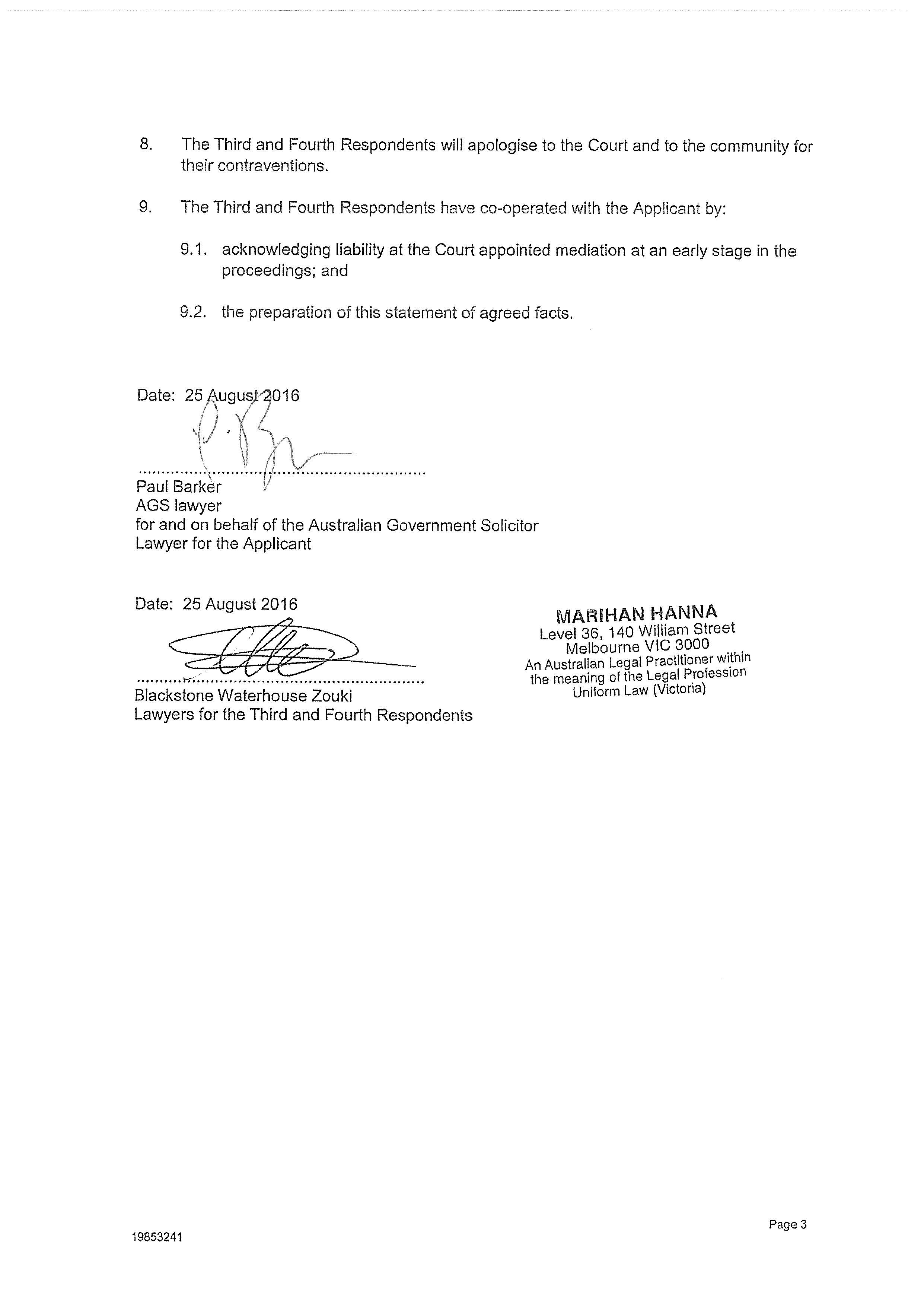
15 Mr Hanna further deposed that, since the commencement of the proceeding, he had received advice and now knows that the statements he made about workers needing to join the CFMEU were wrong. He accepted that it was reckless for him to give the advice. He apologised, on his own behalf and on behalf of Arteam, to the Court and to the community for his contraventions of s 349. He expressed an intention to make sure that, in future, all Arteam workers are given correct information about their right to join or not to join a union. He proposes to apologise to Mr Matic. He does not have the contact details of other affected workers.
THE CONTRAVENTIONS
16 Arteam and Mr Hanna both admitted contraventions of s 349(1)(a) of the Act. Relevantly, s 349 provides:
“(1) A person must not knowingly or recklessly make a false or misleading representation about either of the following:
(a) another person’s obligation to engage in industrial activity;
(b) …
(2) Subsection (1) does not apply if the person to whom the representation is made would not be expected to rely on it.”
17 The phrase “engages in industrial activity” is defined in s 347 of the Act to mean:
“A person engages in industrial activity if the person:
(a) becomes or does not become, or remains or ceases to be, an officer or member of an industrial association; or
(b) does, or does not:
…
(iv) comply with a lawful request made by, or requirement of, an industrial association;
…
(vi) pay a fee (however described) to an industrial association, or to someone in lieu of an industrial association; …”
18 The Director alleged and Arteam and Mr Hanna admitted that they contravened s 349(1)(a) by recklessly making a false or misleading representation about Mr Matic’s obligation to become or remain a member of the CFMEU or to pay membership fees to that industrial association.
THE RELIEF SOUGHT
19 The Director, Arteam and Mr Hanna jointly submitted that, in the circumstances, the Court should:
(a) declare that Arteam and Mr Hanna had contravened s 349(1)(a) of the Act on each of 11 March 2014 and 27 March 2014;
(b) order Arteam to pay a total pecuniary penalty of $17,600 calculated as follows:
(i) $8,800 in respect of its contravention on 11 March 2014; and
(ii) $8,800 in respect of its contravention on 27 March 2014;
(c) Order Mr Hanna to pay a total penalty of $2,400 calculated as follows:
(i) $1,200 in respect of his contravention on 11 March 2014; and
(ii) $1,200 in respect of his contravention on 27 March 2014.”
20 I will deal immediately with the proposed monetary penalties and then consider the proposed declarations.
THE COURT’S APPROACH TO THE PROPOSED PENALTIES
21 The approach which the Court should adopt, when dealing with joint submissions about penalties by the parties in cases such as the present, was recently considered by the High Court. In Commonwealth v Director, Fair Work Building Industry Inspectorate (2015) 326 ALR 476 at 491 [58] (“the Queensland Construction Sites Case”), the plurality (French CJ, Kiefel, Bell, Nettle and Gordon JJ) held that:
“Subject to the court being sufficiently persuaded of the accuracy of the parties’ agreement as to facts and consequences, and that the penalty which the parties propose is an appropriate remedy in the circumstances thus revealed, it is consistent with principle and, for the reasons identified in Allied Mills, highly desirable in practice for the court to accept the parties’ proposal and therefore impose the proposed penalty.”
(Emphasis in original; citations removed.)
22 The reasons for adopting such an approach were earlier explained by their Honours at 489 [46] and 491 [57]:
“… there is an important public policy involved in promoting predictability of outcome in civil penalty proceedings and that the practice of receiving and, if appropriate, accepting agreed penalty submissions increases the predictability of outcomes for regulators and wrongdoers. As we recognised in Allied Mills and authoritatively determined in NW Frozen Foods, such predictability of outcome encourages corporations to acknowledge contraventions, which, in turn, assists in avoiding lengthy and complex litigation and thus tends to free the courts to deal with other matters and to free investigating officers to turn to other areas of investigation that await their attention.
… it is entirely consistent with the nature of civil proceedings for a court to make orders by consent and to approve a compromise of proceedings on terms proposed by the parties, provided the court is persuaded that what is proposed is appropriate.”
The reference to NW Frozen Foods is to a decision of a Full Court of this Court: see NW Frozen Foods Pty Ltd v Australian Competition and Consumer Commission (1997) 71 FCR 285.
23 The principles which emerge from the joint judgment of Burchett and Kiefel JJ (Carr J agreeing) in NW Frozen Foods were summarised by Branson, Sackville and Gyles JJ in Minister for Industry, Tourism & Resources v Mobil Oil Australia Pty Ltd [2004] FCAFC 72 at [51] as follows:
“(i) It is the responsibility of the Court to determine the appropriate penalty to be imposed … .
(ii) Determining the quantum of a penalty is not an exact science. Within a permissible range, the courts have acknowledged that a particular figure cannot necessarily be said to be more appropriate than another.
(iii) There is a public interest in promoting settlement of litigation, particularly where it is likely to be lengthy. Accordingly, when the regulator and contravenor have reached agreement, they may present to the Court a statement of facts and opinions as to the effect of those facts, together with joint submissions as to the appropriate penalty to be imposed.
(iv) The view of the regulator, as a specialist body, is a relevant, but not determinative consideration on the question of penalty. In particular, the views of the regulator on matters within its expertise … will usually be given greater weight than its views on more “subjective” matters.
(v) In determining whether the proposed penalty is appropriate, the Court examines all the circumstances of the case. Where the parties have put forward an agreed statement of facts, the Court may act on that statement if it is appropriate to do so.
(vi) Where the parties have jointly proposed a penalty, it will not be useful to investigate whether the Court would have arrived at that precise figure in the absence of agreement. The question is whether that figure is, in the Court’s view, appropriate in the circumstances of the case. In answering that question, the Court will not reject the agreed figure simply because it would have been disposed to select some other figure. It will be appropriate if within the permissible range.”
24 The question which thus falls to be determined is whether the proposed penalties fall within the “permissible range”. They will do so if they are neither manifestly inadequate nor manifestly excessive.
25 The starting point for identifying that range is the statutory provisions prescribing the maximum penalties available for particular contraventions. The maximum penalty payable by an individual for a contravention of s 349 of the Act is 60 penalty units. A contravention of s 349 by a body corporate attracts a maximum penalty of 300 units: see ss 539(2) and 546(2) of the Act. A “penalty unit” was, at relevant times, a sum of $170: see s 12 of the Act and s 4AA of the Crimes Act 1914 (Cth).
26 As a result the maximum penalty which may be imposed on Arteam for each of the contraventions was $51,000 and for Mr Hanna $10,200.
27 I have recently had occasion to summarise the principles which guide the exercise of the Court’s power to impose penalties for contravention of the Act: see Director of Fair Work Building Industry Inspectorate v Construction, Forestry, Mining and Energy Union [2015] FCA 1213 (“the Grocon case”) at [12]–[26], [39]–[42]. I adhere to what I there said save that the Full Court’s decision in Director, Fair Work Building Industry Inspectorate v Construction, Forestry, Mining and Energy Union (2015) 229 FCR 331 has since been overruled in the Queensland Construction Sites Case with the result that the Court is no longer precluded from receiving joint submissions from parties as to the amount of a pecuniary penalty which they propose should be imposed under legislation providing for the imposition of civil penalties. I have had regard to these principles when forming my judgment as to whether or not the proposed penalties fall within the appropriate range.
28 It is common ground that separate contraventions had occurred on 11 March and 27 March 2014.
29 The proposed penalties were at the lower end of the appropriate range. The aggregate penalty proposed for Arteam was, for each contravention, about 17 per cent of the maximum available penalty. The aggregate penalty proposed for Mr Hanna was, again in each case, around 12 per cent of the maximum applicable to an individual.
30 The leniency is explicable for a number of reasons. The contraventions were reckless rather than deliberate. Mr Hanna had become immersed in the culture of at least some commercial construction sites on which compulsory union membership was accepted by both employers and employees. Mr Hanna had not familiarised himself with the relevant provisions of the Act. It is, perhaps, surprising that, despite working in the construction industry for some 11 years at the time of the contraventions, Mr Hanna had remained ignorant about the laws protecting freedom of association and had not made enquiries when Mr Matic told him that he was not obliged to be a member of the CFMEU. Arteam was a small company with a transient workforce and a limited capacity to pay monetary penalties. It was accepted that some difficulty would be occasioned by the need to assemble funds necessary to pay the proposed penalties. There was no suggestion that either Arteam or Mr Hanna had, on any previous occasion, contravened the Act. Furthermore, there was no evidence that Mr Matic (or anyone else) had suffered any economic loss as a result of the contraventions. Once the proceeding had commenced Arteam and Mr Hanna were co-operative. They made an early admission of liability and became parties to an agreed statement of facts. These steps obviated the need for a trial of contested issues.
31 I should add that I accept that Mr Hanna (and, through him, Arteam) have, by making a public apology, exhibited contrition for the contraventions. I am also mindful of their undertaking to ensure that, in future, they understand their legal obligations and comply with them.
32 It is necessary, in cases such as the present, to recall that one of the purposes served by s 349 of the Act is to uphold the principle of freedom of association. That principle is recognised in general object (e) in s 3 of the Act and in the objects of Part 3-1 in which s 349 appears: see s 336(1)(b).
33 It must, also, be borne in mind that deterrence, both specific and general, has the potential to assume great importance in pecuniary penalty cases. In the Queensland Construction Sites Case, the High Court identified civil penalties regimes as being “primarily if not wholly protective in promoting the public interest in compliance” (at 490 [55]). Their Honours quoted with approval the observation of French J in this Court that:
“The principal, and I think probably the only, object of the penalties imposed by s 76 [of the Trade Practices Act] is to attempt to put a price on contravention that is sufficiently high to deter repetition by the contravenor and by others who might be tempted to contravene the Act”: Trade Practices Commission v CSR Limited (1991) ATPR 41-076 at 52,152.
34 The importance of deterrence in this context has been emphasised repeatedly by judges in this Court: see, for example, Fair Work Ombudsman v Skilled Offshore (Australia) Pty Ltd [2015] FCA 275 at [59]–[62] (Gilmour J) and, on appeal, Maritime Union of Australia v Fair Work Ombudsman [2015] FCAFC 120 at [32] (Allsop CJ, Mansfield and Siopis JJ); Australian Licensed Aircraft Engineers Association v International Aviation Service Assistance Pty Ltd (No 2) [2011] FCA 394 at [19] (Barker J); Fair Work Ombudsman v Kentwood Industries Pty Ltd (No 3) [2011] FCA 579 at [36] (McKerracher J) and Fair Work Ombudsman v Offshore Marine Services Pty Ltd [2012] FCA 498 at [39] (Gilmour J).
35 I accept the respondents’ submission that specific deterrence does not weigh heavily in the circumstances of this case. Mr Hanna is now well aware of the need for him to understand and comply with the legal obligations which fall on him and his company. The proposed penalties will impose a meaningful and salutary reminder to them of the consequences of contraventions of the Act. The penalties will constitute a significant burden on the finances of both Mr Hanna and his company.
36 General deterrence, however, looms as a far more significant consideration.
37 There are thousands of small contractors involved in the construction industry. Many are, potentially, susceptible to pressure to require employees to join a union, fearing that if they do not do so they will not be engaged to work on commercial construction sites. Any penalties must, therefore, be fixed at a level which may operate to deter other contractors from succumbing to such pressure.
38 Having had regard to all these considerations I have come to the conclusion that the proposed penalties fall within the permissible range.
DECLARATIONS
39 In the Grocon case at [5]–[7], I dealt with the circumstances in which it is appropriate for declaratory relief to be granted and the purposes served by such relief. I do not repeat what I there said.
40 The declarations, proposed by the parties in the present proceeding, have been carefully drafted. They identify clearly the contravening conduct of Arteam and Mr Hanna. In doing so they serve the useful purposes of explaining, for the benefit of those who might, in future, be tempted to act in a similar manner, why such conduct is unlawful and should not be repeated.
41 The declarations should be made.
CONCLUSION
42 The declarations and orders sought by the Director, Arteam, and Mr Hanna will be made.
I certify that the preceding forty-two (42) numbered paragraphs are a true copy of the Reasons for Judgment herein of the Honourable Justice Tracey. |
ANNEXURE
VID 406 of 2016 | |
MICHAEL HANNA |


