

FEDERAL COURT OF AUSTRALIA
Bradley v Voltex Group Holdings Pty Limited [2016] FCA 1230
ORDERS
DATE OF ORDER: |
THE COURT ORDERS THAT:
1. The parties confer and within 14 days of today’s date file agreed or competing proposed orders (including as to costs) reflecting the reasons for judgment.
Note: Entry of orders is dealt with in Rule 39.32 of the Federal Court Rules 2011.
JAGOT J:
1 Matthew Bradley claims that the respondents are liable to him in damages for breach of contract and unconscionable conduct in contravention of the Australian Consumer Law (Schedule 2, s 21, of the Competition and Consumer Act 2010 (Cth)).
2 The determinant of liability for the contractual claim will be the terms of an agreement, styled a “Business Venture Agreement” (or BVA), into which the parties entered on 3 December 2013.
3 The determinant of liability for the unconscionable conduct claim will be the characterisation of the conduct of the respondents.
4 For the reasons set out below Mr Bradley succeeds in part on his contractual claims but fails in his unconscionable conduct claims.
5 Because the BVA was not executed until some five months after Mr Bradley began working with the respondents, it is convenient to start by identifying the relevant facts. Most of the disputes between the parties do not concern what happened or when but, rather, the characterisation of what happened.
Dealings between Mr Bradley and the respondents
6 In or around 2010, the fourth, fifth and sixth respondents, Michael Weston, Richard Ratcliffe and Raul Barrera established a business specialising in electrical power systems, trading under the group name of “Voltex”. Mr Ratcliffe and Mr Barrera are electrical engineers, and work hands on in the group’s business of providing electrical power systems to customers. Mr Weston is the business manager. The first respondent is Voltex Group Holdings Pty Ltd (VGH), a holding company established for the Voltex business, including Voltex Power Engineers Pty Ltd (VPE). Mr Weston, Mr Ratcliffe and Mr Barrera are all directors of VGH. I refer to them collectively as the directors.
7 By 2013, the directors recognised that Voltex’s business would be improved if they could offer a systems integration service, meaning a service automating the operation of the electrical power systems which they provided. In addition to the general opportunity presented by the capacity to offer these services as part of its business model, Voltex had two big projects on the go – a sludge treatment facility in Hong Kong and the Lihir Gold Project in Papua New Guinea (PNG) – and saw an opportunity to enter the automation market by providing automation services to these projects. As the projects were underway, the opportunity for Voltex to provide these services to these projects was subject to the pressure of time. Voltex wanted to take advantage of the opportunity the two projects presented but did not have the expertise in-house to provide such services.
8 This is where Mr Bradley enters the picture. Mr Bradley is an engineer specialising in the automation of plant.
9 Mr Bradley had been involved in a business venture known as PlantWeave Technologies Pty Ltd (PlantWeave), which provided automation services. The business relationship between Mr Bradley and his partner in the PlantWeave business was failing and Mr Bradley was in the process of exiting that venture subject, however, to a restraint of trade, the terms of which (as opposed to the parties’ understanding of the effect of the restraint) do not matter.
10 Mr Bradley knew Mr Barrera. In early 2013 he had sought Mr Barrera’s advice about his problems with PlantWeave and, in that context, discussed a possible investment in PlantWeave by Voltex. Mr Barrera thought this option was impossible and instead, no doubt with an eye to Voltex’s needs, raised with Mr Bradley the establishment of a new company offering automation services for electrical power systems. Mr Bradley was keen, given that his involvement with PlantWeave appeared to be going nowhere. By 17 April 2013, Mr Weston and Mr Ratcliffe were on board with the idea that a new company should be established to provide automation services involving Mr Bradley.
11 A first draft of a business venture agreement – or BVA – was provided to Mr Bradley on 23 April 2013 which included provisions by which Mr Bradley could gain equity in the new company of up to 20% of the shares, amongst other things, by sacrificing part of his salary. Discussions continued throughout April and much of May 2013. By 15 May 2013, Mr Weston was suggesting that they could “adjust the eventual new company name to Voltex Systems & Integration (VSI) which for the next six months will be run as a separate [b]usiness [u]nit within VPE, then once you are completely clear of Plant[W]eave, we will spin off into a separate company as discussed” and would “clarify the market rate for your position is estimated to be $200k pa, as the basis for current ‘Salary Sacrifice’ contributions to ownership”. In response, Mr Bradley recorded his understanding of the discussions saying that he was to be the CEO and a director of the new company, as well as a shareholder, with the “share breakdown” to be determined.
12 Mr Bradley’s position was that because he did not have any funds to contribute but wanted equity in the new company (by then being referred to as VSI although not yet incorporated) he would contribute financially by way of the sacrifice of salary. Gaining equity in the new company was essential from Mr Bradley’s perspective, and it was clear to Mr Weston (and, I infer, Mr Barrera and Mr Ratcliffe) that Mr Bradley would proceed with the proposal only if he could gain equity, despite his lack of funds to contribute. Versions of the BVA continued to circulate while the discussions continued.
13 Mr Bradley contends that in or about June 2013, he and VGH had orally agreed that a company would be established to conduct a new automation business and he would work in that business from July 2013. The oral agreement is relevant only to the unconscionable conduct claim because it is accepted for Mr Bradley that the BVA which was executed subsequently superseded the oral agreement. The respondents admit that there was an oral agreement but the terms are in dispute, the dispute largely reflecting that which exists in respect of the BVA. Mr Bradley contends that a term was that VGH would receive an 80% shareholding in the new business and he would receive a 20% shareholding six months later and could contribute by way of salary sacrifice, shareholder’s loan or by providing intellectual property. The respondents contend that the term was that Mr Bradley would receive a 20% shareholding six months after the establishment of the new business, “contingent upon Mr Bradley contributing 20% of the initial value of the new business”. This value was to be calculated in various ways including by reference to the value of salary sacrifice of part of an agreed base salary of $200,000, the value to the new business of any intellectual property provided by Mr Bradley, or the value of any shareholder’s loan he made.
14 At this point, it is appropriate to record that I have no doubt that the capacity to gain a 20% shareholding in the new business was essential to Mr Bradley and was understood to be such by the respondents. However, the contention that the oral agreement was that if Mr Bradley worked for VSI then, six months later, he would get a 20% shareholding even if he made no contribution to the new business apart from his labour, is inconsistent with Mr Bradley’s own evidence. The contemporaneous emails and discussions disclose that Mr Bradley knew that in order to get his shareholding he would need to make some contribution over and above working in the business. This is the reason there are references in the evidence of the negotiations to his capacity to salary sacrifice. Because he had no spare funds, salary sacrifice and the contribution of intellectual property (if he held any) were probably the only practical options he had to make a contribution over and above working for the new business, as necessary to secure his right to equity.
15 The evidence also shows that because the common focus was on his capacity to salary sacrifice, none of the parties were particularly bothered by the value of the contribution required and how the value of the contribution would be calculated. It seems to me that it was a common assumption at this time that Mr Bradley would be able to make a contribution considered to be satisfactory by way at least of salary sacrifice, and thus in six months would be issued his shareholding. Mr Bradley appears to have been happy to proceed on that assumption because he wanted to be involved in the new business and wanted the 20% equity. The directors appear to have been happy to proceed on that assumption because the two projects they had on the go in Hong Kong and PNG required the provision of automation services, and without the new business and Mr Bradley’s involvement Voltex was not equipped to take advantage of these opportunities.
16 This is consistent with the reason for the six months’ delay. It was common ground that the reason for the delay in the issue of shares to Mr Bradley was not related to assessment of or agreement about the value of his contributions, but resulted from a concern that Voltex not be complicit in any breach of the restraint to which Mr Bradley was subject in favour of PlantWeave.
17 It should be accepted, therefore, that when the time came for Mr Bradley to start working with Voltex, he and the directors shared an assumption that he could contribute satisfactorily to the new business by one of the three identified methods and, as a result, in six months he would be issued a 20% shareholding in VSI.
18 The second and third respondents, Voltex Systems Holdings Pty Ltd (VSH) and Voltex Systems & Integration Systems Pty Ltd (VSI), were incorporated on 11 June 2013. VGH owned all of the 80 shares issued in each of VSH and VSI on incorporation. Mr Weston was also the director of VSH and VSI, with Mr Ratcliffe becoming another director of VSH and VSI on 13 August 2013. It was intended that VSH would hold the relevant intellectual property rights to the new automation business and the business would be conducted through VSI. The fact that the 80 shares in VSI and VSH were issued to VGH is consistent with the common assumption which I have identified – everyone assumed that Mr Bradley would make a satisfactory contribution by one of the identified methods and, in six months’ time, would be issued 20 shares in VSH and VSI, equivalent to a 20% shareholding.
19 This context – pressure on Voltex to be able to take advantage of the opportunities in Hong Kong and PNG and Mr Bradley’s keenness to be involved in the new business on the basis that he would receive 20% equity – explains why the parties proceeded without a final BVA having been executed. The context also explains why, by 29 May 2013, Mr Bradley had executed a contract of employment with VPE. VSI had not yet been incorporated. Mr Weston sent Mr Bradley two contracts of employment, one with VPE and one with the (as yet non-existent) VSI. Mr Bradley executed the contract with VPE (unsurprisingly given that VSI did not exist). Under this contract of employment with VPE, Mr Bradley was to work as a “Systems & Integration Manger”, initially on a casual basis, on a base annual salary of $150,000, with no period of notice required for termination. By this time, Mr Bradley was gearing up to work in the new business, reviewing a business plan Mr Weston had sent and the projects Voltex had on the go. It is apparent that the terms of this agreement with VPE had been overtaken by events almost before it was executed. It had already been agreed that Mr Bradley’s base salary for managing VSI would be $200,000 per year, for example. It was also not the case that Mr Bradley would be working casually in VSI once it was incorporated. He was to be the full time Systems and Integration Manager of VSI, as reflected in the unexecuted contract of employment between VSI and Mr Bradley, and principally responsible for managing VSI’s business.
20 Again, it is appropriate to interpose some observations here. One unpleaded and unexplored issue in this case is the contract of employment under which Mr Bradley worked as the manager of VSI from July 2013 until January 2015. In closing submissions, the respondents referred to the contract with VPE which Mr Bradley executed as if this were the relevant contract of employment to support the proposition that termination of Mr Bradley without notice was authorised. But the contract with VPE could not have been the relevant contract of employment. Apart from the fact that it was with VPE not VSI, as noted, it provided for Mr Bradley to work casually at a rate of $150,000. This contract must have been understood by all involved to have been an interim measure and was overtaken by events when Mr Bradley started to work as the full-time manager of VSI on a salary of $200,000. Nor can the unexecuted contract between VSI and Mr Bradley be the relevant contract of employment for the simple reason that it was never executed. No doubt there was a contract of employment. The position, however, is this. No contract of employment was pleaded. No question was asked of any witness about the contract of employment. The interrelationship between the contract of employment and the BVA was neither pleaded nor explored. As such, it is not open to either party to suggest that the contract of employment is relevant to resolution of the issues.
21 By 3 June 2013, Mr Bradley wanted to let PlantWeave know that he was working for Voltex and had accepted a full-time position to do so as the general manager of the new business. By early July 2013 he was working full-time in the newly incorporated VSI, in effect as its manager and, as noted, at a salary of $200,000 per year. While there is a dispute about Mr Bradley’s contributions to VSI apart from working as its manager, it is apparent that Mr Bradley did not receive his full salary and this was understood at the time by Mr Bradley and the directors to constitute a “salary sacrifice” as provided for in the oral agreement. It is not in dispute that between July and December 2013 $18,062.50 of Mr Bradley’s salary was retained by VSI and that, on or around 14 January 2014, VSI repaid all but $9,000 of those funds to Bradley, the balance being held in VSI as a “shareholder’s loan” from Mr Bradley, with Mr Bradley thereafter contributing a further $1500 per month to VSI until July 2014, when Mr Weston (on behalf of VGH) agreed that Mr Bradley’s salary sacrifice could cease and all shareholder loans in VSI’s accounts were repaid in full.
22 Mr Bradley was sent VPE’s account categories on 12 July 2013 by Ms Schilpzand, Voltex’s in-house accountant and asked what he wanted to set up for VSI. He updated the directors about the work he was doing for VSI, including quotes for work related to the two existing VPE projects and other quotes being prepared for new projects, as well as the finalisation of a business plan for VSI. Mr Bradley also focused on employing people to work in VSI and developing new clients for VSI. By 5 September 2013, Nick Cuevas, Louis Tamburini and Wesley Hess had been employed by VSI. Another focus of Mr Bradley was VSI’s job management systems, as well as a draft budget for VSI. In other words, Mr Bradley was doing all the things that might be expected of a manager of a new business which had an advantage of tendering for work on two big projects on which its parent was already working and wanted to expand to attract new work.
23 Not everything was smooth sailing, however. For his part, Mr Bradley found it difficult to get time with Mr Weston to discuss and finalise matters relevant to VSI’s business. In this regard, it needs to be understood that Mr Barrera and Mr Ratcliffe are engineers and were very busy doing Voltex’s project engineering work and were often (perhaps mostly) out of Australia, so it was inevitable that most of the work involving the management of the new business would involve dealings between Mr Bradley and Mr Weston. Mr Bradley, however, had a pre-existing relationship with Mr Barrera and thus, if dissatisfied with his dealings with Mr Weston, seems to have tended to deal directly with Mr Barrera thus by-passing his problems with Mr Weston. For his part, over time, Mr Weston perceived Mr Bradley’s dealings with Mr Barrera as Mr Bradley trying to get his own way even if Mr Weston thought he had made the overall business position clear. Everyone was also concerned that a business plan for VSI had not been adopted. By 13 September 2013, Mr Barrera was asking Mr Bradley when the business plan would be finished and, in a response characteristic of Mr Bradley’s perception of his dealings with Mr Weston generally, Mr Bradley said he hoped to get some of Mr Weston’s time so the plan could be finalised the following week.
24 Mr Bradley sent Mr Weston a draft business plan on 17 September 2013. Mr Weston did not think much of the draft but seems to have kept his own counsel in this regard. While Mr Bradley wanted to meet to discuss the draft business plan Mr Weston saw it as nothing more than a “wish list” so, from his point of view, there was nothing to discuss in the draft. Mr Ratcliffe, whenever he came to look at it, also did not think much of the draft business plan.
25 Another major difference was surfacing between Mr Weston and Mr Bradley. Mr Bradley envisaged that it would be best if each business within the Voltex group operated independently according to its own requirements. He sought to resolve the relationship between VSI and the rest of the Voltex group on this basis. Mr Weston accepted that Mr Bradley repeatedly pressed him for clarification of VSI’s role within the group but, as far as Mr Weston was concerned, the position had been made clear in discussions from the outset that VSI was to be a Voltex group member and was to function as part of the group, and Mr Bradley’s repeated raising of the issue was a result of the fact that Mr Bradley did not accept this position.
26 If it is necessary to decide between the versions of Mr Weston and Mr Bradley, the contemporaneous emails support Mr Weston’s view. This is not to say that Mr Bradley was doing other than giving truthful evidence in this regard. It is to say that, having regard to all of the evidence (written and oral), it seems clear that Mr Bradley held strong views about the new business and, no matter how he couched his communications – whether as requests for clarification or direction or as a need to settle a business strategy – he wanted VSI to be autonomous and independent of the rest of the group and was prepared to repeatedly raise this issue despite Mr Weston considering it settled. So much is evident from an email Mr Weston sent in response to Mr Bradley on 23 October 2013, where he proposed a face to face meeting to thrash out the issue but stressed that “the vision is one for all Voltex Group”. The friction was increasing because, although presented by Mr Bradley as an issue that needed to be resolved, there seems to have been no issue apart from in Mr Bradley’s mind. Mr Weston was clear that VSI had to function as part of the Voltex group, and Mr Ratcliffe and Mr Barrera had never suggested to the contrary. Mr Bradley simply did not agree with or accept the vision of VSI being part of the group, and wanted to press his case for a different approach. Given these fundamentally different objectives, it was almost inevitable that the friction between Mr Weston and Mr Bradley would increase, and so it did, despite VSI gaining substantial work on the Hong Kong and PNG projects as the directors had wished.
27 One trigger for the deterioration of the relationship between Mr Bradley and Mr Weston was Mr Bradley’s work to create a document management system for VSI. Mr Weston, when he became aware of this work, pointed out that VPE “ALREADY” had a system and this system needed to be applied to “ALL Voltex group companies” (Mr Weston’s emphasis in his email to Mr Bradley of 7 October 2013). Mr Weston ended this email with the statement that:
As discussed, our branding is quite important, we have spent a lot of time and money on this, and it is equally important that we maintain a consistency of systems, even with the “look and feel”.
28 Mr Bradley, consistent with his overall approach, pushed back in a return email saying that the purpose of “commonality” needed to be considered, and that “[f]undamentally a business needs autonomy to be effective and successful”.
29 Another trigger was Mr Bradley’s desire for VSI representatives to attend a training session about some software known as “ETAP Realtime” in Malaysia which Mr Weston wanted VPE alone to control. On 30 October 2013, Mr Bradley notified Mr Weston of the fact that he and a VSI employee would be booking flights and accommodation in a few days. Mr Weston was irritated by the email, and expressed his irritation in an email to Mr Ratcliffe and Mr Barrera, which he copied (in all likelihood accidentally, despite his suggestion to the contrary) to Mr Bradley. While it is likely that there had been some discussion about this beforehand, it is apparent that Mr Weston felt that it had not been agreed that Mr Bradley and the other VSI employee would be attending or that Mr Bradley could take it upon himself to make arrangements to attend. The relevant point is that the email reflects what was already becoming obvious. Mr Weston thought it important for VSI and Mr Bradley to function as part of the overall Voltex group, whereas Mr Bradley wanted VSI to operate independently. Mr Weston was becoming exasperated by what he saw as Mr Bradley continually operating in this autonomous way, despite it being understood by Mr Weston to be clear that VSI was part of the overall Voltex group. Contrary to the submissions for Mr Bradley, there is no suggestion that the other directors thought Mr Weston was doing other than communicating to Mr Bradley a position common between them.
30 Having received the email in which Mr Weston expressed his exasperation, Mr Bradley suggested that a business orientated facilitator be appointed for a number of purposes including “identifying…our objectives” and “what our roles and responsibilities are”. From Mr Weston’s perspective, this was not a helpful suggestion. It was another way for Mr Bradley to put in issue the status of VSI and his own status as VSI’s manager when, so far as everyone else was concerned (Mr Weston expressly and the other directors by implication), VSI was part of the overall Voltex group. It is not difficult to sympathise with Mr Weston. Even if Mr Bradley was issued a 20% shareholding, the shareholding structure gave a majority interest to the Voltex parent, VGH. Despite Mr Bradley’s protestations, contemporaneous and otherwise to the contrary, it is apparent that to all bar Mr Bradley the role of VSI as a part of the group rather than an independent company had been clear from the outset. I do not accept that Mr Weston was of a “combative nature” and unwilling to talk to Mr Bradley. To the contrary, Mr Bradley continued to press for his preferred view of the role of VSI (and his own role as its manager) and his constant pressure for a changed position frustrated Mr Weston.
31 Accordingly, it would be wrong to characterise events as Mr Weston making issues about Mr Bradley’s conduct when there were no issues. It is not that Mr Bradley was doing something “wrong” or “improper”. It is that there was a fundamental difference between Mr Weston (and, by implication, the other directors) and Mr Bradley about the role of VSI and the degree of independence it should have from the Voltex group as a whole. There was real friction as a result and it was inevitable that the other VGH directors, Mr Barrera and Mr Ratcliffe, who were busy doing engineering work, would have to get more actively involved. A meeting of the directors of VGH and Mr Bradley was thus scheduled.
32 Mr Barrera emailed Mr Bradley on 19 November 2013 in anticipation of the meeting. He identified various “[s]ensitive topics” which he felt Mr Bradley should be prepared to discuss at the meeting, including Mr Bradley’s “directorship at group level” and identified this as a topic:
Issue of VSI shares to you (needs to happen now)
33 Mr Barrera confirmed in evidence that he thought Mr Bradley should be issued his shares then and there. Mr Barrera raised this with Mr Weston but Mr Weston disagreed because of continuing concern about Mr Bradley’s PlantWeave restraint. It is also evident that Mr Barrera and Mr Ratcliffe (and, no doubt, Mr Weston too) wanted VSI to succeed. They had no reason to wish otherwise. They saw that there was a real opportunity in the provision of these services and VSI was the way they could take advantage of the opportunity.
34 Mr Bradley made his position clear in an email to the directors of 29 November 2013. In that email he raised (again) the role of VSI within the group. While Mr Weston agreed there was nothing improper in Mr Bradley doing so, as noted, impropriety is not the point. The Voltex group was a small business dependent for its success on a high degree of co-operation and trust between its principals. Whether Mr Bradley liked it or not, VSI was structurally part of the Voltex group as a result of the VGH shareholding, and it was reasonable of Mr Weston to consider that it would be managed as such, at least unless and until the directors agreed otherwise. They had not agreed otherwise and did not so agree at the meeting which was held on 3 December 2013.
35 What did happen on 3 December 2013 was, despite any misgivings in the minds of Mr Bradley (who still wanted VSI to be independent) and Mr Weston (who must have recognised by this time that his working relationship with Mr Bradley was troublesome), the impetus towards continuation of the relationship was too great and the BVA was executed by VGH and Mr Bradley. Execution of the BVA, despite the misgivings, is not difficult to understand. The directors still had the Hong Kong and PNG projects on foot and needed VSI and Mr Bradley to take advantage of the opportunity for automation services those projects offered. Mr Bradley could see that VSI had real potential and was keen for the new venture to succeed, given the disappointment of his failed experience with PlantWeave.
36 It was put to Mr Weston that if the directors of VGH had any concerns about Mr Bradley’s competency, they would not have permitted VGH to enter into the BVA. This misses the point. VGH had projects on the go and needed VSI to work to take advantage of the position those projects offered, and needed Mr Bradley for that purpose. The directors made a pragmatic decision. However, that did not mean that they were unconcerned about, not so much Mr Bradley’s competency, but his fit within their business. Mr Weston said as much, describing the decision to proceed with the BVA as one based on an assessment that the business had the pressure of valuable projects, they wanted to make VSI work, and thus were willing to take the “risk” on Mr Bradley.
37 The construction of the BVA is in dispute but one thing that is clear is that in it, the date for the issue of shares to Mr Bradley had been moved backwards to September 2014. Mr Bradley asked about this and Mr Weston explained that it was done to ensure that Mr Bradley was not in breach of the PlantWeave restraint. Mr Bradley must be inferred to have accepted this because he entered into the BVA. Mr Weston’s concern was not unfounded. PlantWeave’s lawyers had written to Mr Bradley on 12 August 2013 raising the issue and possible breach by Mr Bradley of a deed with PlantWeave by reason of Mr Bradley’s involvement with Voltex.
38 The BVA also contained a definition of “Directors” that included Mr Bradley, but he was not appointed as a director of VSI or VSH then or subsequently.
39 Also on 3 December 2013, and reflecting concerns about Mr Bradley’s push for greater autonomy, Mr Bradley was asked to, and did, execute a document called a delegation of authority. Mr Weston said, and I accept, that the directors had not wanted to have such a document in place but felt it was necessary. The document required Mr Bradley to obtain approval from “the Voltex Group” and “VGH” for certain actions. Not unimportantly, this document disclosed that the delegation was for the purpose of ensuring adherence to “Voltex Group global policies and procedures”. It must be inferred that all three directors of VGH knew about and approved of the content of the delegation of authority, by which Mr Bradley’s authority as manager of VSI was subjected to authorisation from “the Voltex Group” and “VGH” for many matters.
40 It was submitted for Mr Bradley that he was entitled to put his views about the role of VSI and it should not be assumed he had no entitlement (as a proposed director and shareholder of VSI) to challenge Mr Weston’s views. This too misses the point. The point is that VSI was part of the Voltex group. Mr Weston had made it repeatedly clear that this was fundamental. The delegation of authority confirmed this to be the position. The other directors must be inferred to have agreed with Mr Weston, because they ensured Mr Bradley signed the delegation of authority. At the same time the directors wanted VSI to work and, it is apparent, Mr Barrera and Mr Ratcliffe wanted the working relationship between Mr Weston and Mr Bradley to improve. But this does not mean that Mr Barrera and Mr Ratcliffe agreed with Mr Bradley that VSI should be managed as if it were not part of the Voltex group.
41 Unsurprisingly, given this dynamic, things did not go well between Mr Bradley and the Voltex group. Before execution of the BVA, Mr Bradley had inquired about the pay rate of Rommel Matheou. Mr Ratcliffe had hired Mr Matheou to work for VPE. He was employed on a casual basis and paid an hourly rate. Mr Matheou had particular expertise that was critical to the Hong Kong project. Mr Barrera emailed Mr Bradley saying “Please do not set any arrangements for Rommel as he is working for VPE. Talk to me first”. But Mr Bradley talked to Mr Matheou and emailed him suggesting a much higher rate of pay for Mr Matheou to work for VSI. Mr Bradley informed Mr Ratcliffe after doing so. Mr Ratcliffe expressed concern about the increase. Mr Barrera got involved. Mr Weston said that the directors thereafter approved the arrangement because they felt they had little choice as Mr Matheou was critical to the success of the Hong Kong project. I accept Mr Weston’s evidence. It is obvious that the directors would have had no reason to increase Mr Matheou’s pay to such an extent. He was due for a pay review by VPE three months after Mr Bradley’s intervention and the directors could have negotiated with him then. Mr Bradley said he began discussing Mr Matheou working for VSI instead of VPE because most of Mr Matheou’s work was done for VSI. This exposes Mr Bradley’s focus on VSI rather than the Voltex group. The effect of Mr Matheou working for VSI instead of VPE was that in future some $744,000 of revenue attributable to his work on the Hong Kong project was booked to VSI, and not to VPE.
42 It was put for Mr Bradley that any concern about Mr Bradley’s conduct with respect to Mr Matheou (or otherwise) were “inventions stubbornly clung to in the context of contested litigation to justify Mr. Bradley’s removal after the event”. This submission is divorced from reality. It may be accepted that the directors approved the transfer of Mr Matheou to VSI at the higher rate of pay. But they did so because they felt they had no choice given Mr Bradley’s discussions with Mr Matheou and the importance of retaining Mr Matheou’s services. It may be accepted further that VGH did not serve on Mr Bradley any notice of breach of the BVA about this or any other issue (if his conduct amounted to breach). But none of this means that the directors did not have genuine concerns about actions Mr Bradley had taken and their impact on the Voltex group. They plainly did, not only about what occurred with Mr Matheou, but about numerous issues all of which, in essence, come back to the point that Mr Bradley wanted VSI to function independently from the Voltex group.
43 In addition to the Hong Kong and PNG projects where VSI had obtained work off the back of the work VPE was doing on those projects, VSI obtained another, smaller, contract working for Horizon Power in Western Australia in late 2013. It was put for Mr Bradley that the work VSI obtained on these projects was a result of quotes Mr Bradley prepared. This is true. Nevertheless, the further suggestion that VSI obtained the work independently because no commercial entity would give VSI the work merely because of VPE’s prior involvement with the customer is unrealistic. It was VPE’s work on those projects which gave VSI the opportunity to quote for the work (and an advantage over competitors in quoting). The fact that VSI did not always succeed in obtaining work off the back of VPE contracts is immaterial and does not indicate to the contrary.
44 The work done by VSI for Horizon Power did not get off to a good start, with Mr Bradley acknowledging that VSI had engaged in “over promising”, and that other errors were made. Later, the work on this project would cause other difficulties for VSI and thus the Voltex group as a whole.
45 Apart from these problems, it must have been apparent to Mr Ratcliffe and Mr Barrera that things had not improved between Mr Bradley and Mr Weston. While Mr Bradley was in Hong Kong, where Mr Barrera and Mr Ratcliffe were working, they arranged a meeting to deal with various issues including “issues with communication”. At the meeting Mr Bradley described Mr Weston as having a “dictator” approach when he was only one of three directors of VGH. It was agreed that given what had been happening between Mr Weston and Mr Bradley there needed to be a clear understanding of the separate roles of each, and the joint roles. It is not entirely clear what this means but some other things are clear – the minutes of the meeting record that VSI was part of the Voltex group and there is no suggestion by Mr Ratcliffe or Mr Barrera that VSI should operate independently from the Voltex group.
46 It is revealing that in an email to Mr Barrera about VSI entering into an agreement to enable it to sell the ETAP Real Time software in Asia, not copied to Mr Weston or Mr Ratcliffe, Mr Bradley said to Mr Barrera that the delegation of authority he had signed did not require approval from the directors of VSI (Mr Weston and Mr Ratcliffe) but from VGH directors so “you [Mr Barrera] have full say and approval”. Again, it may be accepted that each of Mr Weston, Mr Ratcliffe and Mr Barrera were VGH directors and thus had an equal say in group affairs, but it is not difficult to see that having a manager of VSI who used a “divide and conquer” approach to his dealings with VGH directors was a problem and unlikely to be sustainable. In any event, and as to be expected, Mr Weston was unhappy when he found out that Mr Bradley had agreed with Mr Barrera and Mr Ratcliffe about VSI selling the ETAP Real Time software in Asia and made his view clear at a subsequent meeting with Mr Bradley.
47 Yet another autonomy issue arose about action Mr Bradley took in April 2014 to dismiss a VSI employee for changing a quote without approval. During an exit interview in which Mr Ratcliffe was involved, Mr Ratcliffe reached the view that the employee should not have been sacked. Mr Ratcliffe’s email to the employee of 12 April 2014 reinstating him is also revealing. Mr Ratcliffe described his role in the exit interview as representing the interests of Mr Weston, himself, “as well as the Group”. Again, it is not difficult to infer that Mr Ratcliffe thought Mr Bradley had overstepped the mark by peremptorily sacking the employee.
48 Yet another meeting on 4 April 2014 disclosed the problem between Mr Bradley and Mr Weston, which was so serious by this time that Mr Ratcliffe agreed to act as an intermediary. Mr Ratcliffe sent an email to Mr Bradley confirming this arrangement on 13 April 2014. It was put for Mr Bradley that this shows how difficult it was to work with Mr Weston. I disagree. What the email discloses, in my view, is that the directors wanted VSI to work given the ongoing projects in Hong Kong and PNG, and were willing to take action to ensure it could work, despite Mr Bradley’s management style being manifestly disruptive to the Voltex group as a whole.
49 At the same meeting, and in response to a request made by Mr Bradley, it was proposed that given VSI’s financial performance (which was strong given the work on the Hong Kong and PNG projects) Mr Bradley’s loan contributions by way of salary sacrifice to VSI should cease. This subsequently occurred in July 2014, after Mr Weston confirmed in an email of 12 June 2014 that “As VSI is becoming cash positive, it was agreed that Matt’s loan contributions should cease and be capped at the current amount of $16,500”.
50 Another document forwarded by Mr Ratcliffe on 17 May 2014 attaches an agenda of a meeting said to have occurred on 10 April 2014. Whether or not this is so, the relevant point is that the attachment discloses Mr Bradley’s view that treating VSI as an extension of VPE was not what he wanted as VSI would not then be a saleable proposition. He wanted a strategy for VSI adopted which would enable VSI to function as a stand-alone entity. I do not accept that this and similar documents mean that Mr Bradley was in the venture merely to make a “quick profit” and get out. But it is clear that he had a vision for VSI that was different from the directors. The willingness of Mr Barrera and Mr Ratcliffe to listen to Mr Bradley’s views and to explore the best strategy for VSI does not mean that they believed that Mr Bradley was right and Mr Weston wrong.
51 For example, it was put for Mr Bradley that an email dated 18 May 2014 from Mr Ratcliffe, encouraging discussion about VSI’s strategic direction proved that Mr Weston’s evidence, that Mr Bradley was repeatedly raising things that had already been decided, was wrong. The email does not have this effect. The email is directed toward enhanced efficiency between VPE’s business and VSI’s business. It is about what work VSI should focus on and how VSI and VPE could both function and grow without negatively impacting on each other. It does not suggest that Mr Weston was wrong to insist that VSI be managed as part of the overall Voltex group. All of the directors, including Mr Weston, had an interest in seeing VSI gain work and succeed. Mr Ratcliffe’s further communications thereafter about strategy are no different. They do not undermine Mr Weston’s view that VSI was part of the Voltex group and had to be managed as such. They were intended to identify the ways in which VSI could grow as part of the Voltex group, and thus support Mr Weston’s evidence.
52 The suggestion also made for Mr Bradley that Mr Weston just wanted to use VSI as a part of the group to offset losses, and Mr Bradley was right to insist to the contrary, is without foundation.
53 Mr Bradley returned to his theme in a draft business plan he prepared in June 2014. Again, this was presented as Mr Bradley doing no more than trying to get a business plan for VSI adopted and the incapacity of the directors to agree on a plan and strategy for VSI. The reality is Mr Bradley was again pressing his own case for VSI to be independent from the Voltex group. In these circumstances, the fact that a business plan for VSI was never adopted is merely another example of the fundamental difference between the directors and Mr Bradley about the role of VSI. It is not evidence of any dysfunction between the directors, apart from the dysfunction resulting from Mr Bradley’s attempts to have his vision for VSI prevail.
54 The other key fact is that by June 2014, VSI had no significant new confirmed projects in the pipeline. The position remained that VSI’s profit was predominantly driven by the Hong Kong and PNG projects, with the remaining profit resulting from work on only the relatively small Horizon Power project (and one even smaller project not mentioned during the hearing) otherwise obtained by VSI. It was put for Mr Bradley that VSI’s profitability was substantially due to Mr Bradley’s efforts but this is unfounded. VSI was quickly profitable because it had the benefit of VPE having already been involved in the Hong Kong and PNG projects. The transfer of Mr Matheou from VPE to VSI also increased VSI’s revenues. This context must be recognised when dealing with submissions for Mr Bradley to the effect that VSI was the most profitable business in the Voltex group for the 2013/2014 year. It was, but this was in large part because of the transfer of Mr Matheou and wholly because VSI had the benefit of obtaining work off the back of projects in which VPE was already involved.
55 At this point, another submission for Mr Bradley must be rejected. It was put that by this time, seeing how profitable VSI was, the VGH directors then had an incentive (on which they later acted) to ensure they had 100% control of VSI and exclude Mr Bradley. This had to be put squarely to the directors but was not, and is without foundation. It is also inconsistent with the fact that, despite the transfer of Mr Matheou contributing to VSI’s profitability, the directors did not hesitate to ensure Mr Bradley was given a 20% share of a dividend (dressed up as management fees) of $100,000 which was distributed by VSI in September 2014. This payment does not, however, prove that the directors had no problem with Mr Bradley’s management of VSI. As discussed above, they plainly did have a problem and it is not surprising they did. Mr Bradley’s management was incompatible with the status of VSI as a company within a group and created ongoing conflicts. While the conflicts were mainly with Mr Weston, this was not because Mr Weston was out on his own unsupported by the other directors. It was because the other directors were mainly overseas working on projects.
56 Another submission for Mr Bradley also must be rejected. It is that the directors refused to assist Mr Bradley in getting work for VSI. The submission is without substance. Mr Bradley was an experienced business person. He was expected to be able to generate work for VSI. VSI started with the advantage of the work VPE had on the two large projects in Hong Kong and PNG. Despite this, which assisted VSI to obtain work on the same projects, Mr Bradley never succeeded in attracting any substantial ongoing work to VSI. The argument that it must be inferred that the directors held no concerns about the lack of success in obtaining new work because no contemporaneous document discloses such a concern is unpersuasive. It was obvious that new work was not being obtained which, to a business like VSI, must have been of concern. Moreover, such concerns partly explain Mr Ratcliffe’s involvement in VSI strategy, as discussed above.
57 It was submitted for Mr Bradley that the directors did not respond to emails for contacts or business leads in July 2014, accompanied again by the unfounded suggestion that the explanation might be that they wanted him gone so they could gain 100% control of VSI because it had been so successful. A less dramatic explanation is apparent. By June 2014, Mr Bradley had been running VSI for a year. The year had been exemplified by one conflict after another, all basically a result of Mr Bradley’s objective of autonomy for VSI and himself. At the same time, there was no sign that Mr Bradley was succeeding in obtaining new work. It would be no surprise if the directors might have had enough of Mr Bradley by this time and were thinking it might be best if he left VSI, not because they wanted 100% control of VSI, but because the relationship between VSI as managed by Mr Bradley and the Voltex group was manifestly dysfunctional.
58 Consistent with this inference, the directors arranged a meeting with Mr Bradley on 15 July 2014 in Brisbane. Before the meeting the directors discussed and agreed that Mr Bradley should be asked to leave VSI. It was put to Mr Weston that he had made this decision before any discussion with the other directors, which he denied. I accept Mr Weston’s evidence. I accept that Mr Weston wanted Mr Bradley to go but felt he could only make his mind up in consultation with the other directors.
59 At this meeting, Mr Bradley was told that they considered it best if they and he went their separate ways. There is a dispute about the exact terms of the conversation but the relevant parts are that Mr Bradley agreed the relationship should end and, I accept based on Mr Ratcliffe’s evidence, raised the issue of payment out for his shares (which, in accordance with the BVA which provided for issue of the shares from September 2014, had not yet been issued to him). In any event, there is no doubt that payment out for the unissued shares was an issue to be resolved in the context of Mr Bradley exiting VSI because Mr Bradley sent an email on 18 July 2014 to the directors expressing both his disappointment about but understanding of their position, and asked for the directors’ preferences for his “shareholding exit” to be identified, on the basis that the “sale” would be to the VGH group.
60 I also consider it clear that in the minds of Mr Weston and Mr Ratcliffe at least, Mr Bradley was not entitled to any shares because they thought that he had not made contributions satisfying the requirement of the BVA. I do not accept that they were giving other than honest evidence when they said this, nor that it is inconsistent with their conduct. It is apparent that, rightly or wrongly, with Mr Bradley’s exit in mind, they formed a view that there was no entitlement on Mr Bradley’s part to 20% of the shares in VSI in the circumstances.
61 It was put for Mr Bradley that a subsequent conversation with Mr Ratcliffe disclosed that Mr Barrera and Mr Ratcliffe wanted Mr Bradley to stay, and only Mr Weston wanted Mr Bradley gone. I disagree. Mr Barrera had a relationship with Mr Bradley before VSI and, I accept, even after the July 2014 meeting wanted or hoped things could be worked out so Mr Bradley could stay. Mr Ratcliffe knew this to be Mr Barrera’s position. But this does not mean that Mr Weston had made the decision that Mr Bradley should leave VSI on his own. It means only that the other directors left open the possibility that the agreed position might change. Mr Ratcliffe’s view, which he expressed to Mr Bradley, was that if Mr Bradley wanted to stay then he had to win major work for VSI because all of VSI’s work had been derived from VPE’s work. What this conversation discloses is that, contrary to the submissions for Mr Bradley, concerns about Mr Bradley’s apparent inability to gain work for VSI were real and, if not the reason for the directors wanting Mr Bradley to leave (dysfunction being the operative reason), were a relevant background factor. Mr Ratcliffe’s willingness to have this conversation also shows that far from the directors wanting to have 100% of VSI to themselves, they wanted to see VSI succeed, and two of them might have been willing to reconsider Mr Bradley’s exit if Mr Bradley managed to win work for VSI. This does not show, however, that Mr Ratcliffe believed that Mr Bradley was entitled to 20% of the shares in VSI. It shows that Mr Ratcliffe’s interest was the success of VSI.
62 The submissions for Mr Bradley attacked the credit of Mr Ratcliffe (and Mr Weston), it being put that Mr Ratcliffe’s speculation in his affidavit that Mr Bradley might have been involved in directing work to an entity other than VPE in the PNG project was “outrageous”, an example of the “desperate” attempts by the respondents to “throw mud” at Mr Bradley to “justify their actions on 30 January, 2015” (when Mr Bradley’s services were purportedly terminated) and “transparently untrue”. I reject these submissions. Mr Ratcliffe never suggested that when the work was being carried out in 2014 it crossed his mind that Mr Bradley might have directed work away from VPE, in his own interests of currying favour with the other entity. His speculation was presented as the “only explanation” he could think of at the time of preparing his affidavit given that VPE could have done the work. The fact that there were communications from Mr Bradley to Mr Ratcliffe at the time saying that the client wanted the other entity to do the work does not mean that Mr Ratcliffe was engaging in “outrageous” and “untrue” allegations. Mr Ratcliffe accepted that, at the time, what Mr Bradley said seemed reasonable and that he did not then “question his capability or his motives”. It is only later, after the relationship breakdown, that Mr Ratcliffe had any reason to question Mr Bradley’s motives. His speculation, in terms, rose no higher than that. Mr Ratcliffe’s expression of the speculation did not undermine his credibility as a witness, which I accept.
63 In any event, despite Mr Ratcliffe’s encouragement, the fact is that Mr Bradley never won any other significant work for VSI, despite continuing to work at VSI for another six months.
64 Another thing that occurred later in July 2014 was that VSI repaid to Mr Bradley the balance of the money that he had salary sacrificed.
65 It was submitted for Mr Bradley that the lack of any communication from the respondents disputing his entitlement to the 20% shareholding, despite repeated efforts by Mr Bradley to resolve the issue, and the absence of any suggestion of breach by him of the BVA, puts their complaints about his management of VSI “in an extremely poor light”. I disagree. The complaints of the respondents about Mr Bradley reflect what was happening at the time and are not a recent invention to justify Mr Bradley’s termination. It did not take a notice of breach of the BVA, or even an allegation of breach, for it to be apparent that Mr Bradley’s management of VSI was incompatible with the harmony of the Voltex group as a whole. As noted, it would be one thing to put up with the problems if Mr Bradley was winning substantial work for VSI. It was obviously another when he was not.
66 The same conclusion applies to the payment to Mr Bradley of the 20% share of the $100,000 dividend from the profits of VSI which was paid in September 2014. The payment is not inconsistent with Mr Ratcliffe and Mr Weston considering that Mr Bradley had no entitlement under the BVA to a 20% shareholding. The payment had been proposed many months earlier when it appeared that VSI would post a healthy profit, with an 80/20% split in accordance with what Mr Weston described in an email of 12 June 2014 as “ownership plans”. The payment was in accordance with what had been proposed when it was assumed that Mr Bradley would remain at VSI.
67 This does not mean that there was no problem with the lack of response from the directors about the position in respect of Mr Bradley’s shares. But the evidence discloses why there was no response. Mr Weston and Mr Ratcliffe thought he had no entitlement. Mr Barrera still preferred Mr Bradley to stay with VSI, if a way forward could be worked out. In other words, the directors had not agreed a joint position about the shares, and thus did not respond to Mr Bradley about his shares or his exit date from VSI.
68 The lack of communication with Mr Bradley about the issue does not mean the directors were not thinking about it. On 22 September 2014, Mr Weston sent an email to Mr Ratcliffe and Mr Barrera, discussing the appropriate payment to be made. It was put for Mr Bradley that the email is inconsistent with Mr Weston believing Mr Bradley had no entitlement to shares. I disagree. Read as a whole, what emerges is that Mr Weston thought Mr Bradley had not contributed as required by the BVA and thus had no legal entitlement to the shares or a payment out for them, but that the BVA could be used to assess what might or might not be fair for an ex gratia pay out to Mr Bradley. Mr Weston thought using the formula in the BVA as the basis for any such payment would be unfair. He suggested a payment equivalent to 20% equity in VSI as calculated by the company’s accountant.
69 Mr Bradley repeatedly tried to get clarification over the next few months but it is apparent that the directors had still not resolved their agreed position. Again, it was put for Mr Bradley that their silence was inconsistent with any belief in the directors’ minds that he was not entitled to 20% of the shares under the BVA, and that Mr Weston and Mr Ratcliffe invented this after the event. I disagree, for the reasons already given. Throughout this period, the directors were trying to work out what should be paid to Mr Bradley but, in the minds of Mr Weston and Mr Ratcliffe at least, this was a payment outside the terms of the BVA. Mr Ratcliffe also said, and I accept, that the directors were extremely busy at this time given VPE’s ongoing work in Hong Kong, PNG and on other projects, and thus did not manage to agree about what should be done in respect of Mr Bradley’s exit between July and December 2014.
70 It is regrettable that the directors did not manage to agree a position and communicate it to Mr Bradley over this period. It should be appreciated, however, that Mr Bradley continued to work for VSI, being paid his salary equivalent to $200,000 per year. Further, while he did not know what the directors’ view about his shareholding was, despite the issue date in the BVA (September 2014) passing, he did know that he had not been issued shares and had not received any response to his requests for clarification. I consider that far from silence confirming that shares would be issued, the silence meant that Mr Bradley must have known there was an issue about his entitlement to shares from the directors’ (or VGH’s) perspective. So much would have been obvious from the lack of any response to his repeated requests for clarification.
71 The contemporaneous documents support this conclusion. In one of his emails, of 8 November 2014, Mr Bradley said that his preference was to work for VSI for a full two years (that is, until June 2015). This, of course, was the relevant period under the BVA to obtain protection from forfeiture of shares for an early (within two years) exit. In other words, it is clear that Mr Bradley believed that had he been issued shares and had he wished to exit as a shareholder within two years, his shares would have been forfeited. He wished to avoid this possibility, but to do so could not leave VSI before the two year period had expired.
72 As a result, submissions to the effect that Mr Bradley stayed on working at VSI after July 2014 in reliance upon some kind of representation that there was no issue about his entitlement to shares defy common sense. If it had been common ground that he had the entitlement he would not have felt the need to have clarification from the directors. Further, the directors would have had no reason not to clarify the position quickly. Their continued silence in the face of Mr Bradley’s repeated requests would have spoken volumes to him – he would have known that the directors (or some of them) did not necessarily agree that he was entitled to a shares (or payment out instead) under the BVA, but he chose to stay working for VSI because it suited him to do so, given his awareness of the terms of the BVA and the relevance of the two year period. The two year period was not relevant from the directors’ perspective, however, because Mr Weston and Mr Ratcliffe at least (the majority) believed that Mr Bradley had no entitlement to the shares in any event.
73 As I have said, I reject the submission that the directors’ intent in removing Mr Bradley was to gain control of 100% of the financial rewards offered by the VSI business. The relationship was not working. Mr Bradley’s objectives for VSI, and his management style were incompatible with the operation of the Voltex group as a whole. This incompatibility was a bona fide reason for the directors’ wish to terminate Mr Bradley’s management of VSI. Mr Bradley knew this as well as the directors did. Mr Bradley effectively accepted as much in his email of 8 November 2014 to Mr Barrera, in which he said:
As discussed:
What do I want to do? We need to continue what we started in July, get divorced. It just is not going to work. There is a fundamental misalignment on too many levels. Deep down I think it is the right thing to do, as disappointing as it is for me to lose the opportunity.
1. A good result for everyone.
1. For VGH an ongoing successful energy integration business.
2. For Matt a good payout and exit/ongoing employment/consulting
3. Future partners.
2 Exit the business as a shareholder, Reasons for exiting
1. Agreement was reached that it would be better for Matt to exit in July 2014, this is where my head is at. Agree that want to complete original 2 years and see VSI continue with success.
2. Original desire to do software business, moving towards this.
3. Conflict between individuals, Mick and Matt don’t play well together. Isolating Mick from the interface will just manifest further discontent. You need to remove me from the picture, so VHG Group can refocus on success.
4. Conflict of interests at shareholding and directors levels (What’s best for the group versus individual companies VSI).
5. Conflict at objectives, e.g. VGH grow for 10 years and sell, Matt move on in 2-3 years to do software business
6. Conflict at operational levels
7. I am seen as a necessary evil…this is not good business, you want someone you can trust and believe in running VSI.
8. I am not a good employee, have been too long doing my own thing
9. Misalignment/different paradigms/culture of operation – e.g. I cause to many problems doing the wrong thing. [sic] (emphasis removed)
74 In this email, Mr Bradley suggested a plan be created for a shareholder exit and sale using calculations as per the BVA, with a transition period operating until June 2015 (the end of the two year period under the BVA), when Mr Bradley would cease to manage VSI.
75 The submissions for Mr Bradley urged acceptance of contemporaneous records as the best evidence of what occurred, in preference to subsequent recollections. At least insofar as documents exist and do not show the signs of being self-serving at the time created, I agree with this approach. But there is a difference between accepting contemporaneous documents as good evidence about the matters to which they refer and drawing an inference that a lack of contemporaneous documents about an issue means the issue did not exist (the latter being approach put for Mr Bradley).
76 In any event, the email from Mr Bradley of 8 November 2014 is good evidence of what happened between the directors and Mr Bradley. It exposes exactly why the relationship had failed and why the directors were acting bona fides in deciding that Mr Bradley had to leave the business. The email is also inconsistent with the case theory for Mr Bradley that the directors were acting in bad faith (in order to gain 100% control of VSI) and that he was somehow duped into continuing to work for VSI after July 2014 on a promise that he would receive the 20% shareholding or the value equivalent to it calculated in accordance with the BVA. It is apparent that Mr Bradley was staying, not because he believed the relationship was successful and he wished to remain, but because he thought it was in his best interests, including securing his right to the 20% shares or what he believed was his entitlement to a buy out of the shares for value rather than forfeiture under the BVA.
77 Finally, on 30 January 2015 Mr Weston met Mr Bradley and said the directors had agreed that Mr Bradley’s role with VSI should be terminated immediately, he would be paid $40,000, the offer was open for 7 days, and was conditional on Mr Bradley signing a release.
78 Mr Bradley responded by email on the same day. Tellingly, the email does not express surprise at the offer. It says only that Mr Bradley wanted justification for the value of the offer and the “early” (that is, before his preference of June 2015) termination. This is consistent with the conclusions above. Mr Bradley believed he was entitled to the shares but decided to continue working for VSI to avoid forfeiture of his rights under the BVA, despite knowing that the directors did not necessarily share his view about his entitlement.
79 On 2 February 2015, Mr Bradley repeated his position that his 20 shares as per the BVA should be issued. There was no response but, again, this does not mean Mr Bradley believed the shares would be issued. To the contrary, by 4 February 2015, he had consulted a solicitor and advised the directors that he would not cease working at VSI “until an agreement is reached”. This must mean an agreement about the shares to which he believed he was entitled. The relevant point is that this position was also consistent with Mr Bradley’s earlier position – he was staying at VSI because he considered that the best way to achieve what he wanted (the issue of the shares or equivalent value calculated under the BVA rather than forfeiture by reason of an early exit) and it suited him to do so.
80 This prompted a letter from VSI to Mr Bradley, which each director signed on 4 February 2015, saying that formal notice of termination had been given to him on Friday, and:
Voltex is willing to pay to you an additional amount for services for the month of February, although we do not require those services to be provided. I request that you issue an invoice to us for payment in accordance with the prior monthly contractual payments. You are otherwise not entitled to any further payments from Voltex.
81 This discloses the lack of focus by all of the parties on the difference between the BVA and the contract of employment. It seems that this letter was seen by all to be, or to confirm, the termination of the BVA and the contract of employment between VSI and Mr Bradley. In any event, Mr Bradley did not work for VSI after 4 February 2015. He was not paid $40,000. Nor was he paid anything for February 2015, although it is unclear whether any such invoice was rendered, the most recent invoice in evidence referring to services in January 2015. While non-payment was said to show the high-handed approach of Mr Weston in particular, the lack of payment may not be unconnected to the fact that Mr Bradley commenced these proceedings in March 2015.
82 As noted, the directors also later paid themselves another $100,000 dividend from VSI for the 2014/2015 financial year but, by that time, were engaged in this litigation so, again, Mr Bradley got no part of this payment.
83 Much was made of the fact that VSI’s revenues collapsed after Mr Bradley left, in order to support the submission that he was responsible for VSI’s early success and that the directors undermined VSI’s value by not replacing Mr Bradley and trying to continue VSI’s work themselves when they had no handover from Mr Bradley and another VSI employee, Mr Hess, who also left. It is accurate to say that Mr Bradley was not replaced and VSI’s revenues collapsed but, otherwise, the submission is unfounded. As noted, VSI was successful because it had immediate access to a large volume of work off the back of the contracts VPE had in place. Otherwise, the only significant work Mr Bradley won was Horizon Power. Horizon Power was not well managed and after Mr Bradley left, VSI had to perform major rectification work at its own cost. Whether this is Mr Bradley’s fault or not is not the real point. The point is that the client was unhappy with VSI, and efforts were made in 2015 after Mr Bradley had left to ensure the client was satisfied. This was reasonable and appropriate. I thus accept the submissions put for the respondents about the problem which Mr Bradley left for them in terms of Horizon Power, as follows:
… the notion that the Horizon’s sign off on the project absolved VSI of responsibility for the system’s deficiencies might be contractually correct but is commercially unreal. The client’s infrastructure had not been properly assessed to determine whether the system could function. The program the client had paid for did not work. The client was dissatisfied. Bradley did not inform the VPE Principals of any of the difficulties despite the obvious risk of disputation.
Whether or not is was contractually obliged to do so, the reality is that VSI, for commercial and reputational reasons, had no option but to carry out the rectifications works that it did.
84 Further, the work in Hong Kong and PNG was always going to run out. As noted, one of the concerns the directors had with Mr Bradley was the lack of new work which he had obtained. Revenues were bound to drop catastrophically after the completion of the work in Hong Kong and PNG unless Mr Bradley managed to find substantial new work, which he did not. Thus, while VSI was still earning money in January 2015, this does not mean the business was not in decline at that time. It was in decline because it had no secured work in the pipeline. Contrary to the submissions for Mr Bradley, business development was his responsibility. It is referred to in the responsibilities of both VGH and Mr Bradley in Schedules 1 and 2 of the BVA, but Mr Bradley was the sole full time manager of VSI being paid a salary by that business. It was fundamental to his role that he obtain work for VSI. His conduct in preparing quotes and seeking new clients confirms that he understood this to be the case. The point is not that he did not try to do so; it is that despite his efforts for 18 months, he did not succeed other than in limited respect of the projects identified above.
85 Mr Bradley emphasised an observation by Mr Lytras, a valuer called by the respondents, that VSI was dependent on Mr Bradley’s specialist skills and “Mr Bradley’s departure would reasonably have significantly diminished VSI’s prospects”. There is no doubt VSI was dependent on Mr Bradley’s specialist skills. This was the reason VGH entered into the BVA. However, Mr Bradley’s specialist skills were of no material utility if he could not win ongoing work for VSI. There is no basis to infer that had Mr Bradley stayed until June 2015, as he wished, VSI’s financial performance would have been materially different from what it was. The fact that Mr Bradley and Mr Hess were not replaced is immaterial unless it can be inferred that there would have been new work for VSI to do in that period, but none of the tenders Mr Bradley submitted came to fruition, and there is no basis to think that a further 6 months would have resulted in any significant new project being secured by VSI.
86 Nor does the payment of $100,000 to VGH by VSI in the period between January and June 2015 indicate to the contrary. It is not in dispute that while the Hong Kong and PNG projects were continuing in 2014, VSI had a good revenue stream. The issue is that it did not have a viable future once that work was completed. The payment of a profit share of $100,000 for the 2014/215 financial year was a result of the early success of VSI off the back of contracts held by VPE.
87 After Mr Bradley left, it is no particular surprise that the directors decided to try to keep VSI going themselves in preference to finding a substitute for Mr Bradley; bringing Mr Bradley on board had failed. However, the directors had always been very busy with VPE work and, taking into account the work needed to rebuild the relationship with Horizon Power and thus protect the reputation of the Voltex group, it is also no surprise that they had no capacity to find new work for VSI. But this position was no different from that when Mr Bradley was in charge of VSI. VSI thus withered on the vine, but not due to any deliberate ploy by the directors to destroy the value of Mr Bradley’s asserted equity. Given their own investment in VSI, the directors had no reason to wish to do so and thereby destroy the value of their own majority equity in VSI.
88 Having explained the rocky course of the dealings between Mr Bradley and the respondents, consideration can now be given to the claims for damages for contractual breach and unconscionable conduct.
The contractual claims
Construction of the BVA
89 The relevant principles of construction are well-known, and have been expressed in many decisions.
90 It is convenient to refer to Electricity Generation Corporation v Woodside Energy Ltd [2014] HCA 7; (2014) 251 CLR 640 in which French CJ, Hayne, Crennan and Kiefel JJ said at [35] (citations excluded]:
…this Court has reaffirmed the objective approach to be adopted in determining the rights and liabilities of parties to a contract. The meaning of the terms of a commercial contract is to be determined by what a reasonable businessperson would have understood those terms to mean. That approach is not unfamiliar. As reaffirmed, it will require consideration of the language used by the parties, the surrounding circumstances known to them and the commercial purpose or objects to be secured by the contract. Appreciation of the commercial purpose or objects is facilitated by an understanding “of the genesis of the transaction, the background, the context [and] the market in which the parties are operating”. As Arden LJ observed in Re Golden Key Ltd [[2009] EWCA Civ 636 at [28]], unless a contrary intention is indicated, a court is entitled to approach the task of giving a commercial contract a businesslike interpretation on the assumption “that the parties … intended to produce a commercial result”. A commercial contract is to be construed so as to avoid it “making commercial nonsense or working commercial inconvenience”.
91 The submissions for Mr Bradley also referred to another principle which should be identified. It is that it is presumed that the parties to an agreement did not intend that one or other of them could take advantage of their own breach. The relevant principles were identified by Sackar J in Sydney Attractions Group Pty Ltd v Schulman [2013] NSWSC 858 as follows:
[188] The legal principles in this area are not controversial. In Alghussein Establishment v Eton College [1991] 1 All ER 267 the House of Lords was faced with a question of construction. A literal construction of the relevant provision of a lease would have led to an absurd result that a contractor who failed to complete a development without fault could not call for a lease, whereas a contractor who wilfully defaulted could do so. Lord Jauncey’s judgment (with which the other Law Lords agreed) was, as noted in the headnote to the report, to the effect that:
in the absence of clear express provisions in a contract to the contrary it was not to be presumed that the parties intended that a party should be entitled to take advantage of his own breach as against the other party was not limited to cases where a party was relying on his own wrong to avoid his obligations under the contract but applied also where a party sought to obtain a benefit under a continuing contract on account of his breach.
…
The principle that a party in default under a contract cannot take advantage of his own wrong is in general a rule of construction rather than an absolute rule of law and morality, although there may be situations, such as self-induced frustration, where an absolute rule exists.
[189] The principle was accepted, without much elaboration, in TCN Channel 9 Pty Ltd v Hayden Enterprises Pty Ltd (1989) 16 NSWLR 130 (at 147 per Hope JA, with whom Priestley and Meagher JJA agreed).
[190] In Brothers v Park (2004) 12 BPR 98,114, Giles JA (with whom Ipp JA [and] Wood CJ at CL agreed) said (at [82]):
[82] There was reference … to a … principle, described by Lord Diplock in Cheall v Association of Professional Executive Clerical and Computer Staff [1983] 2 AC 180 at 189 that “a man cannot be permitted to take advantage of his own wrong”. An application of the principle is that a party to a contract terminating upon an event or conferring a benefit upon an event can not rely on his own breach of contract bringing about the event; many of the cases are discussed in the speech of Lord Jauncey in Alghussein Establishment v Eton College [1988] 1 WLR 587, and a local illustration of this application is TCN Channel 9 Pty Ltd v Hayden Enterprises Pty Ltd (1989) 16 NSWLR 130 at 147–8,161. It is applied as a rule of construction (ibid), but has also been seen as an implied term: Thompson v ASDA-MFI Group Plc [1988] Ch 241; [1988] 2 All ER 722. The principle itself has a broader reach, for example in the interpretation of statutes (Grozier v Tate (1946) 16 LGR (NSW) 57 at 61; Allen v Bega Valley Council (NSWCA, Full Court, No CA 40500 of 1994, 22 December 1994, unreported, BC9403478)) and in the common law rules that an arsonist cannot recover under a fire insurance policy and murderer cannot claim in the estate of his victim.
[191] Giles JA, in the later case of Ruthol Pty Ltd v Tricon (Australia) Pty Ltd (2005) 12 BPR 98,225 gave further consideration to the principle and said (at selected passages from [19]–[24], Santow JA and Hunt AJA agreeing):
[19] … the principle is not concerned with arriving at compensatory damages for breach by the wrongdoer, but with whether the wrongdoer can enforce its contractual right.
[20] … in the absence of clear words, a contractual entitlement upon a particular event will not be enlivened if the event came about through breach of the party seeking to rely on it …
[21] … But … the operation of the principle is qualified … [citing Hooper v Lane (1859) 6 HL Cas 443 at 460–461 per Bramwell B]:
… that rule only applies to the extent of undoing the advantage gained, where that can be done, and not to the extent of taking away a right previously possessed. Thus, if A lends a horse to B, who uses it, and puts it in his stable, and A comes for it and B is away, and the stable locked, and A breaks it open, and takes his horse, he is liable to an action for the trespass to the stable, and yet the horse could not be got back, and so A would take advantage of his own wrong.
[22] Thus a party in breach of contract may be precluded from relying on a contractual entitlement arising from the breach, but will not be precluded from relying on a contractual entitlement which does not arise from the breach.
…
[24] … the maxim only applies to the extent of undoing the advantage gained by the wrongdoer and not the extent of taking away a right previously possessed.
[192] Ruthol involved a breach of a contract for the sale of land by the vendor. The vendor did not complete a contract for sale of land on the date fixed for completion. The purchaser was in possession as lessee. The vendor/lessor claimed arrears of rent from the date of contractual completion to the date of actual completion. The purchaser submitted that the vendor was prevented from relying upon its own wrong. The purchaser claimed damages for breach by the vendor. After discussing the principle that a party cannot take advantage of its own breach (see quoted passages above), Giles JA held that the principle had no application to the case (at [25]):
[25] In my opinion, the principle did not apply to preclude the appellant from recovering the rent claimed. The respondent was obliged from the beginning to pay the rent to the appellant for the term of the lease and while holding over as a monthly tenant, and to pay it without any set-off or deduction. The respondent remained in possession of the property, and its right to possession was referable only to its position as lessee and then as tenant holding over; it did not have a right to possession under the uncompleted contract for sale. The appellant’s breach of contract by failing to complete the contract for sale on 19 July 2001, or its breach of a contract found in the lease with its option to purchase rather than the contract for sale (which I doubt is correct), meant that the respondent was obliged to pay the rent for longer than would otherwise have been the case; but the obligation to pay the rent did not arise from the breach of contract.
92 Otherwise I accept the submissions for the respondents that:
(e) The contract should be construed as a whole and in a way which allows its various provision[s] to be read harmoniously: Australian Broadcasting Commission v Australasian Performing Right Association Ltd (1973) 129 CLR 99 at 109.
(f) As a corollary, a contract should be construed so as to give effect to each part of it on the basis of a presumption that each provision has been inserted intentionally: Chapmans Ltd v Australian Stock Exchange Ltd (1996) 67 FCR 402 at 411; Perpetual Custodians Ltd v IOOF Investment Management Ltd [2013] NSWCA 231; (2013) 278 FLR 49 at [80]–[82].
(g) Apparent internal inconsistency between provisions is to be resolved on the basis that one provision qualifies the other and, hence, that both have meaning and effect: Re Media Entertainment & Arts Alliance (No 1) (1993) 178 CLR 379 at 386-387.
93 For the present case, it is also worth emphasising the further statement in Australian Broadcasting Commission v Australasian Performing Right Association Ltd (1973) 129 CLR 99 at 109-110 that:
If the words used are unambiguous the court must give effect to them, notwithstanding that the result may appear capricious or unreasonable, and notwithstanding that it may be guessed or suspected that the parties intended something different. The court has no power to remake or amend a contract for the purpose of avoiding a result which is considered to be inconvenient or unjust. On the other hand, if the language is open to two constructions, that will be preferred which will avoid consequences which appear to be capricious, unreasonable, inconvenient or unjust, “even though the construction adopted is not the most obvious, or the most grammatically accurate”, to use the words from earlier authority cited in Locke v Dunlop [(1888) 39 Ch D 387, at p 393], which, although spoken in relation to a will, are applicable to the construction of written instruments generally; see also Bottomley’s Case [(1880) 16 Ch D 681, at p 686]. Further, it will be permissible to depart from the ordinary meaning of the words of one provision so far as is necessary to avoid an inconsistency between that provision and the rest of the instrument. Finally, the statement of Lord Wright in Hillas & Co Ltd v Arcos Ltd [[1932] UKHL 2; (1932) 147 LT 503, at p 514], that the court should construe commercial contracts “fairly and broadly, without being too astute or subtle in finding defects”, should not, in my opinion, be understood as limited to documents drawn by businessmen for themselves and without legal assistance (cf Upper Hunter County District Council v Australian Chilling and Freezing Co Ltd [(1968) 118 CLR 429, at p 437)].
94 The principle last identified – that commercial contracts should be construed “fairly and broadly, without being too astute or subtle in finding defects” – is particularly apposite to the present case because it is common ground that the BVA was prepared by Mr Weston, without the benefit of legal advice. Mr Weston took the form of the agreement into which he had entered with Mr Ratcliffe and Mr Barrera (and the fourth person who left the business soon after its inception) to constitute the Voltex group business and attempted to adapt it to the relevant circumstances with Mr Bradley. Clarity and consistency are not hallmarks of the BVA. Nevertheless, and despite a late suggestion to the contrary by the respondents which was withdrawn, there is no doubt that the parties intended the BVA to govern their legal relationship in accordance with its terms. This said, it is time to confront the BVA and its terms.
The BVA
95 The BVA is an agreement between VGH and Mr Bradley executed on 3 December 2013. As noted, Mr Weston, Mr Ratcliffe and Mr Barrera are each directors of VGH.
96 The BVA is styled as “Voltex Group Holdings Pty Ltd Systems & Integration Business Venture Agreement”.
97 By the time the BVA was executed on 3 December 2013, Mr Bradley had been working as the full-time manager of VSI for 5 months, on a salary of $200,000 per year. He had agreed to sacrifice a proportion of the salary that would have been paid to him each month, and this money was to remain in the business of VSI and be accounted for in VSI’s accounts as a “shareholder’s loan”. This had been referred to routinely by the directors of VGH and Mr Bradley as a “salary sacrifice” by Mr Bradley.
98 The BVA records as follows:
WHEREAS
A. VOLTEX GROUP HOLDINGS propose to develop a Systems & Integration Business.
B. Matthew Bradley intends to provide Business Development, Operational Management and provide Intellectual Property to the Business, and to become a Shareholder in the Business.
C. VOLTEX SYSTEMS HOLDINGS PTY LTD (“The Holding Company”) will hold the Intellectual Property for the purposes of the business.
D. The Company legal advisors are McCullough Robertson and the Company financial advisors are Valhalla Accounting Services. All other parties have been encouraged to obtain independent professional advice.
NOW THIS AGREEMENT WITNESSES that the parties agree to use their best endeavours to negotiate and settle the creation of a proprietary company limited by shares, “Voltex Systems & Integration Pty Ltd” (The Company) in accordance with the diagram in Schedule 5 and the General Conditions and Schedules to this Agreement.
99 Despite recital D, it appears that the parties did not obtain any independent professional advice about the BVA.
100 Schedule 5 appears as follows:
SCHEDULE 5
COMPANY STRUCTURE
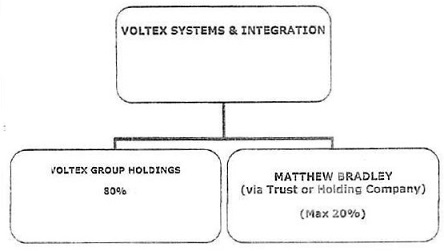
101 The general conditions of the contract include these terms:
1 SCOPE OF THE BUSINESS VENTURE
1.1 The Venturers agree to operate an incorporated company limited by shares in the World for:-
(a) Systems & Integration engineering consulting, Systems & Integration design, Systems & Integration commissioning and testing services, including power systems
(b) any other project the Shareholders unanimously decide.
1.2 The Company shall be incorporated as soon as practical from the date of execution of this agreement. From the date of execution of this agreement eighty (80) shares in each of VOLTEX SYSTEMS & INTEGRATION and VOLTEX SYSTEMS HOLDINGS shall be issued to VOLTEX GROUP HOLDINGS. From 1 September 2014, a further twenty (20) shares in each of VOLTEX SYSTEMS & INTEGRATION and VOLTEX SYSTEMS HOLDINGS shall be issued to MATTHEW BRADLEY through his nominated trust or company.
1.3 The Company and The Holding Company names shall be registered with ASIC.
1.4 In respect of the Scope of the Business Venture, the Venturers will:-
(a) confine to The Company their respective activities concerning the Scope of the Business Venture; and
(b) refrain from any activity in competition with The Company either directly or indirectly;
(c) commit their services as defined in Clause 2.1 below to The Company for a minimum period of two years from the first operational day of The Company's Business and
(d) contribute their time and skills to The Company, and from the time that The Company is incorporated these contributions shall not be compromised by any other Business Ventures not controlled by Voltex Group Holdings.
1.5 In the event a Venturer is in breach of their obligations under this clause of the Business Venture Agreement within a period of two (2) years from the first operational day of The Company’s Business, and within seven (7) days of notice in writing such breach is not corrected, they can be evicted as a Shareholder in which case forfeiture of their shares shall apply, and the sequence of share offers set out in Clause 6.1 will be annulled. The shares thus forfeited will be distributed among the remaining Shareholders in their respective proportions.
2 CONTRIBUTIONS
2.1 As a basis for their respective involvements in The Company, VOLTEX GROUP HOLDINGS and MATTHEW BRADLEY shall contribute their complementary skills towards the Scope of the Business venture in the manner set out in Schedules 1 and 2 respectively.
2.2 VOLTEX GROUP HOLDINGS shall contribute 80% of the initial value of the Company, representing the four shareholders in the Holding Company, at 20% each, and MATTHEW BRADLEY shall contribute 20% of the initial value of the Company for his respective shareholding.
2.3 VOLTEX GROUP HOLDINGS contributions may be by way of working capital, value of projects and goodwill brought to the company, assets, tools and equipment, systems and procedures or IP.
2.4 MATTHEW BRADLEY’s contribution for the Scope of the Venture may be contributed by means of IP, Shareholder’s Loan or by Salary Sacrifice.
(a) For the purposes of Salary Sacrifice calculations, the market rate for Matthew Bradley's base salary shall be considered to be $200,000 pa. Any amounts paid for base salary at a rate less than this shall be retained in the company for working capital as a Shareholder’s Loan, until such time as The Company cashflow, including one quarter's forward provisions, allows the return.
2.5 The values of various non-cash contributions shall be calculated by mutual agreement between the parties. The value of initial IP contributions shall be assessed on current value to the Company rather than any future potential.
2.6 The contributions may be amended from time to time by unanimous decision of the Shareholders.
2.7 In the event a Venturer is considered by the remaining venturers to be in significant breach of their obligations under this Business Venture Agreement, after a period of two (2) years from the first operational day of The Company’s Business, either by consistent negligence of their duties or due to incapacitation for a continuous period exceeding six (6) months, a vote of “no confidence” can be raised by unanimous decision of the remaining Venturers. If within seven (7) days of notice in writing such breach is not corrected, they can be evicted as a Shareholder in which case the sequence of share offers set out in Clause 6.1 shall apply. Examples of a significant breach may include, but not be limited to:
(a) a breach of The Company Code of Conduct;
(b) charges brought against a Venturer by the Australian Securities and Investments Commission;
(c) embezzlement of the company’s funds or assets;
(d) negligence of general duties of a director under the Corporations Act
2.8 The shareholders acknowledge their participation in the business venture and their respective shareholding is dependent on their respective ongoing proper provision of their Contributions as defined herein.
3 ADMINISTRATION
...
3.5 All Decisions referred to in Schedule 4 shall be made by unanimous vote of all shareholders at an Extraordinary General Meeting, with the exception of eviction of a Shareholder by a vote of “no confidence” which shall require a unanimous vote of all shareholders except the Shareholder, the subject of the vote of “no confidence”.
…
4 KEY PERSON INSURANCE
4.1 The Company shall purchase a "Key Person" Insurance policy with the insured as Matthew Bradley, and with The Company as beneficiary in the event of death or Total and Permanent Disablement of the insured.
…
4.3 For the first two (2) years from the first operational day of The Company’s Business, any benefits payable under these policies shall be used at The Company’s discretion:
(a) to ensure the ongoing stability of the business; or
(b) to recruit replacement personnel; or
(c) for any other purpose the remaining Directors see fit.
4.4 After the first two (2) years from the first operational day of The Company’s Business, these policies will be extended to include “Buy/Sell” Insurance. The benefits payable under these policies shall be used by The Company as outlined in Clause 4.7.
4.5 In the event of the death or Total and Permanent Disablement of a Shareholder, after a period of two (2) years from the first operational day of The Company’s Business, the Shareholder’s shares shall be offered for purchase by The Company.
...
6 EXIT
6.1 Notwithstanding the foregoing, and in the event a Shareholder wishes to sell their shares, they shall offer them at a price determined in accordance with Schedule 3 to:-
(a) firstly, the remaining Shareholders in their respective proportions;
(b) then, to the extent that all shares are not thereby acquired, to the remaining Shareholders out of proportion to their Shareholding; and
(c) finally, to the extent that any shares are still thereby available, the Shareholder may sell them to a third party provided that party is not a competitor of The Company and is acceptable to the remaining Venturers. The Directors reserve their right to decline to register any transfer, as set out in the Company Constitution.
(d) The price determined under Schedule 3 shall not apply in the event of death or Total and Permanent Disablement of a Shareholder, where Key Person Insurance is payable to The Company.
6.2 In the events outlined in Clauses 1.5, 2.7 or 4.5, the provisions of those clauses shall apply.
7 DIVIDENDS AND PROFIT SHARING BONUSES
7.1 The Company proposes to offer an annual dividend, with the total distribution equal to twenty (20) percent of NPAT [net profit after tax] in the first instance. This amount shall be distributed proportionally according to shareholdings, only where the minimum value of any shareholder’s dividend would exceed $1,000.00, and after ensuring the minimum forward provision of one quarter of projected operating costs. This dividend distribution percentage shall be reassessed annually, with any amendment requiring a unanimous vote in accordance with Schedule 4.
…
8 RESTRAINT
8.1 Upon termination of their respective involvement within the current business venture for whatever reason, the Venturers undertake to The Company and each other as follows namely:-
(a) not to compete with the Entity directly or indirectly within the Scope of the Business Venture; or
(b) represent any other person in relation to activities within the Scope of the Business Venture; or
(c) have any dealings with existing clientele of The Company
for a period of not less than six (6) months from the date of termination in the states of QUEENSLAND or NEW SOUTH WALES.
…
9 INTERPRETATION
…
Directors the directors of The Company will be in the first instance, MATTHEW BRADLEY, RICHARD RATCLIFFE, MICHAEL WESTON;
…
Venturers all Directors and Shareholders at the time and from time to time;
102 Schedule 1 appears (in part) as follows:
SCHEDULE 1
CONTRIBUTION OF VOLTEX GROUP HOLDINGS PTY LTD
1. Provision of working capital for the Scope of the Venture by means of an Inter-company Loan.
...
3. Supervision, training, motivation and mentoring of staff of The Company in the above fields.
…
9. Provide leadership in Business Development to support existing customers, clarify their needs, and design and implement optimal solutions.
…
13. Liaise with the Business Development Manager to identify new opportunities, revenue streams, customers and projects.
…
18. Contribute to the development of systems, policies and procedures, to deliver on The Company’s missions, objectives and goals.
103 Schedule 2 includes this:
SCHEDULE 2
CONTRIBUTION OF MATTHEW BRADLEY
1. Provision of working capital for the Scope of the Venture by means of a Shareholder’s Loan or Salary Sacrifice.
2. Provision of technical expertise in design, commissioning and testing services for industrial integration systems, including IP for systems simulation.
…
104 Schedule 3 needs to be identified as a whole. It appears as follows:
SCHEDULE 3
METHOD FOR VALUATION OF SHARES PURSUANT TO A
SHAREHOLDER EXIT FROM THE COMPANY
1. In the event a Shareholder wishes to sell their shares in accordance with Clause 6.1, the following methods shall be adopted to determine the fair value of the shares at the time of sale.
2. If the exit of the shareholder is prior to the minimum term under Clause 1.4, then the shares shall be forfeited as per the conditions of that Clause.
3. In the event that at the time of shareholder exit, the equity of The Company as calculated by The Company Accountants, is less than the cash contribution of the exiting shareholder/s, then no value is assigned to the shares for the purpose of this Clause and the shares shall be forfeited. The shares thus forfeited will be distributed among the remaining Shareholders in their respective proportions.
4. In the event that at the time of shareholder exit, the equity of The Company as calculated by The Company Accountants, is greater than the cash contribution of the exiting shareholder/s, and the proportion of the equity equal to the exiting shareholder/s’ proportion of total company shares is less than the cash contribution of the exiting shareholder/s, then this proportion of the equity shall be the value assigned to the shares for the purpose of this Clause.
5. In the event that at the time of shareholder exit, the equity of The Company as calculated by The Company Accountants, is greater than the cash contribution of the exiting shareholder/s, and the proportion of the equity equal to the exiting shareholder/s’ proportion of total company shares is greater than the cash contribution of the exiting shareholder/s, then the total value of the exiting shareholder/s’ shares shall be calculated by the following formula:-
V = S x 4.5 x E, where
V = Exiting shareholder total value
S = Exiting shareholder proportion of total company shares
E = Average reported EBIT over the preceding three (3) financial years.
105 Schedule 4 includes this:
SCHEDULE 4
DECISIONS OF AN EXTRAORDINARY GENERAL MEETING
REQUIRING A UNANIMOUS VOTE
…
14. Eviction of a Shareholder via a vote of “No Confidence”
Alleged contractual terms and breaches
106 Mr Bradley’s statement of claim alleges that:
12. Clause 1.2 of the BVA provided that from 1 September 2014, 20 shares in each of VSI and Voltex Systems Holdings shall be issued to Bradley through his nominated trust or company (‘Share Issue Term’).
107 In response, the respondents pleaded that:
12. The Respondents admit paragraph 12 of the Claim, but further say that the Agreement provided for the meaning and effect of clause 1.2 of the BVA to be that pleaded in paragraph 8(a) above.
108 Paragraph 8(a) says:
it was agreed that any shares to which Bradley would be entitled would only be issued six months after the issue of shares to Voltex Group Holdings and contingent upon Bradley contributing 20% of the initial value of the Company for his respective shareholding; …
109 Mr Bradley alleged also that:
19. After execution of the BVA, and in reliance on its terms including the Share Issue Term, Bradley continued to:
(a) Work for VSI and made the contributions in Schedule 2 of the BVA;
(b) Contributed intellectual property to VSI;
(c) Made a shareholder’s loan to VSI; and
(d) Salary sacrificed.
110 The respondents pleaded in answer that:
19. As to paragraph 19 of the Claim, the Respondents:
(a) admit that Bradley continued to work for VSI, and that Bradley made some of the contributions set out in Schedule 2 of the BVA, but say that these contributions were made as a basis for Bradley’s involvement in the Company in accordance with clause 2.1 of the BVA, and were not the contributions contemplated and required by clause 2.4 of the BVA;
(b) deny that Bradley contributed intellectual property to VSI. The Respondents repeat and rely on paragraphs 10(b)(iii) and 10(b)(iv) above;
(c) admit that, by June 2014, Bradley had made a shareholder’s loan, but deny that Bradley contributed to VSI in this way. The Respondents repeat and rely on paragraph 10(b)(v) above;
(d) admit that, by January 2014, Bradley had salary sacrificed, but deny that Bradley contributed to VSI in this way. The Respondents repeat and rely on paragraph 10(b)(vi) above; and
(e) do not admit that Bradley took any steps in reliance on the terms of the BVA because that allegation is peculiarly within the knowledge of the Applicants and the Respondents are therefore unable to attest to the truth or falsity of the allegation.
111 Paragraphs 10(b)(v) and (vi) of the defence are in these terms:
(v) as to paragraph 10(d)(ii), admit that Bradley made shareholder’s loans to VSI in the amount of $1,500 per month for five months from January 2014 to June 2014, totalling $7,500, and say all of the shareholder’s loan was repaid to Bradley on about 28 July 2014 and, otherwise, Bradley made no contributions by way of shareholder’s loans; and
(vi) as to paragraph 10(d)(iii), admit that Bradley salary sacrificed funds to VSI between the dates of July 2013 and December 2013 which totalled $18,062.50, and say that, on or around 14 January 2014, VSI repaid all but $9,000 of those funds to Bradley, with the remaining $9,000 of those funds recorded in VSI’s accounts as the opening balance of Bradley’s shareholder’s loan with VSI, and that balance amount was repaid to Bradley on about 28 July 2014, and, otherwise Bradley made no contributions by way of salary sacrifice;
112 In paragraph 20 of the statement of claim, Mr Bradley alleged that:
20. On or around 12 June 2014, Bradley had made all contributions to his 20% Entitlement pursuant to the BVA and Weston directed that Bradley’s loan contributions should cease.
113 In answer, the respondents said that:
20. As to paragraph 20 of the Claim, the Respondents:
(a) cannot plead in response to the allegation that on or around 12 June 2014 Bradley had made all contributions to his 20% Entitlement pursuant to the BVA, as the Applicants have failed to particularise:
(i) the monetary value of the intellectual property that Bradley allegedly contributed to VSI by 12 June 2014;
(ii) the monetary value of all contributions allegedly made by Bradley to VSI by 12 June 2014 (being the monetary value of the intellectual property allegedly contributed as referred to in paragraph (i) above together with the sum of any funds allegedly contributed by way of shareholder’s loan or salary sacrifice); and
(iii) the initial value of VSI, and accordingly, the amount equivalent to 20% of the initial value of VSI, that Bradley was required to contribute in accordance with clause 2.4 of the BVA in order receive a 20% shareholding in VSI;
(b) in the alternative, deny that on or around 12 June 2014 Bradley had made all contributions to his 20% Entitlement pursuant to the BVA, because:
(i) at as 12 June 2014, Bradley had contributed a total of $16,500 to VSI, being:
A. no contribution of intellectual property, for the reasons set out in paragraphs 10(b)(iii) and 10(b)(iv) above; and
B. total monetary contributions in respect of salary sacrifice (up until January 2014) and shareholder's loan (commenced with an opening balance of the salary sacrificed amount of $9,000 as at January 2014 and increased by monthly instalments of $1,500 until June 2014) of $16,500, as set out in paragraphs 10(b)(v) and 10(b)(vi) above;
(ii) Bradley's total contribution of $16,500 as at 12 June 2014 was not equivalent to 20% of the initial value of VSI, as the initial value of VSI greatly exceeded $82,500, and accordingly Bradley's contributions as at 12 June 2014 were not sufficient enough to satisfy his obligations under clause 2.2 of the BVA; and
(iii) in any event, on or around 28 July 2014, VSI repaid to Bradley the total amount of his shareholder's Joan of $16,500, such repayment not being made in accordance with clause 2.4 of the BVA (in circumstances where a shareholder's loan is to be returned to the shareholder when VSI's cashflow, including one quarter's forward provisions, allows the return) but instead made to repay a commercial loan on VSI's accounts in readiness for Bradley's exit from the business;
(c) deny that on 12 June 2014 Weston directed that Bradley's loan contributions should cease, because on 12 June 2014 Weston confirmed with Bradley that it was agreed that Matt's loan contributions should cease' and therefore this was an agreement between Weston and Bradley and not a direction from Weston; and
(d) deny the inference that the loan contributions ceased because Bradley had made all contributions to his 20% Entitlement pursuant to the BVA, because this is untrue for the reasons set out in paragraph {b) above.
114 In paragraph 23 of the statement of claim, Mr Bradley alleged that:
In breach of the Share Issue Term, Voltex Group Holdings did not on or after 1 September, 2014 issue, or take steps to issue Bradley or Wise Dragon [Wise Dragon Technologies Pty Ltd, the second applicant, an incorporated company of which Mr Bradley was director, and which was Trustee of the “Bradley Family Trust”]with:
(a) 20 shares in each of Voltex System Holdings or VSI; or
(b) 20% of the issued shares in each of Voltex System Holdings or VSI.
115 In answer, the respondents said that:
23. As to paragraph 23 of the Claim, the Respondents:
(a) admit that Voltex Group Holdings did not on or after 1September 2014 issue, or take steps to issue, Bradley or Wise Dragon with shares in Voltex Systems Holdings or VSI; and
(b) deny that in doing so, Voltex Group Holdings was in breach of the Share Issue Term, because as set out in paragraph 8 above, the parties agreed that the Share Issue Term was contingent upon Bradley contributing 20% of the initial value of VSI pursuant to clause 2.2 of the BVA which Bradley failed to do for the reasons set out in paragraph 20(b) above.
116 Mr Bradley also alleged that:
24. In breach of clause 9 of the BVA, Voltex Group Holdings did not appoint or take steps to appoint Bradley a director of VSI.
117 The respondents admitted that VGH did not appoint or take steps to appoint Bradley a director of VSI, but denied it was obliged to do so for the reasons set out in paragraph 20(b) of the defence.
118 Mr Bradley further pleaded that:
25. On 4 February, 2015:
(a) Weston and Ratcliffe on behalf of VSI purported to give notice to Bradley that his services were terminated; and
(b) Barrera on behalf of Voltex Group Holdings purported to give notice to Bradley that the Business Venture Agreement was terminated.
26. In the premises:
(a) No notice was given to Bradley of the reasons for the purported termination of his services or the BVA;
(b) The purported termination of the BVA was not in accordance with the terms of the BVA; and
(c) The purported terminations referred to in paragraph 25(a) and (b) above were invalid and of no legal effect.
27. Voltex Group Holdings failed to pay any moneys to:
(a) Bradley or Wise Dragon equivalent to the value of 20% of the shares in VSI and Voltex Systems Holdings calculated in accordance with Schedule 3 of the BVA or at a reasonable value;
(b) Bradley or Wise Dragon in respect of the loss of future dividends and profit sharing pursuant to clause 7 of the BVA;
(c) Bradley in respect of his contributions referred to at paragraphs 10(d) and 19 above.
119 The respondents answered as follows:
24. As to paragraph 24 of the Claim, the Respondents:
(a) admit that Voltex Group Holdings did not appoint or take steps to appoint Bradley a director of VSI; and
(b) deny that it was obliged to do so for the reasons set out in paragraph 20(b) above.
25. As to paragraph 25 of the Claim, the Respondents:
(a) admit paragraph 25(a); and
(b) deny paragraph 25(b) because it is untrue.
26. As to paragraph 26 of the Claim, the Respondents:
(a) deny paragraph 26(a), because Weston and Ratcliffe on behalf of VSI and Bradley had discussed Bradley's exit from the business and the reasons why his services were no longer desired by VSI from as early as July 2014;
(b) deny paragraph 26(b) for the reasons set out at paragraphs 25(b) and 26(a) above; and
(c) deny paragraph 26(c):
(i) because the termination by VSI of the services provided by Bradley as an independent contractor, referred to in paragraph 25(a) of the Claim, was valid because VSI was not required to provide Bradley with advance notice of the termination and in any event, notified Bradley by letter sent on 4 February 2015 that VSI was prepared to pay Bradley for services to be provided for the month of February 2015 despite the fact that VSI did not require those services to be provided; and
(ii) because the Respondents deny the allegation in paragraph 2S(b) of the Claim.
27. The Respondents admit paragraph 27 of the Claim, but deny that Voltex Group Holdings has or ever had any legal obligation to pay Bradley or Wise Dragon any moneys as so alleged.
Contractual terms and breaches - discussion
120 Mr Bradley contends that cl 1.2 of the BVA means that, on 1 September 2014, he was entitled to the issue of 20 shares in VSI and VSH. According to this contention, “from” in cl 1.2 must mean “on”, given that the same word is used for the issue of shares to VGH “from incorporation” and VGH in fact received its shares on incorporation of VSI and VSH. As such, cl 1.2 vested an unconditional right in Mr Bradley to the issue of 20 shares on 1 September 2014.
121 The respondents contend that cl 1.2 must be read in the context of the BVA as a whole and, when read with cl 2.2 in particular, it is apparent that Mr Bradley’s right to the issue of the 20 shares was conditional upon him contributing 20% of the initial value of VSI in accordance with cll 2.4 and 2.5. As such, “from” in cl 1.2 is said to take its ordinary meaning of “on or after”, consistent with the requirement of the BVA that Mr Bradley earn his shares by contributing 20% of the initial value of VSI. As the respondents put it, it is unlikely that they (as the controlling minds of VGH) would agree to give 20% of the value of the new business to Mr Bradley without him making the contribution specified in cl 2.2 of the BVA. Given that the “initial value” of VSI was not agreed or otherwise determined, Mr Bradley could not satisfy the condition precedent to his right to be issued shares.
122 The competing contentions of the parties do not provide a coherent answer to the meaning of this part of the BVA. It may be that there is no satisfactory construction of this part of the BVA (or the BVA as a whole for that matter). However, I consider that when the BVA was executed certain factors indicate that it was the objective intention of the parties that Mr Bradley would be entitled to the issue of 20 shares in VSI and VSH on or about 1 September 2014 if, by that time, he continued to work at VSI as contemplated by the BVA and had sacrificed salary at the same rate he had been doing for five months before execution of the BVA (unless such sacrifices ceased at an earlier time by agreement – which they did).
123 First, many provisions of the BVA are nothing more than artefacts reflecting events that had already occurred by 3 December 2013. For example, cl 1.2 provides for the incorporation of VSI in cl 1.2 but not VSH, yet both had been incorporated on 11 June 2013. This is because the incorporation of VSH seems to have been an afterthought based on the same company pattern as existed for VGH and VPE. Further, and importantly, it is also apparent that the BVA was never updated to account for events which had occurred between the first draft being created in April 2013 and the execution of the document in December 2013. As a result, cl 1.2 provides for the issue of 80 shares in VSI and VSH to VGH from the date of execution of the BVA, yet VGH had been issued these shares on incorporation of VSI and VGH in June 2013. Clause 2.1 also provides for VGH to make contributions of “complementary skills” as a basis for its involvement in VSI and cl 2.2 specifies that VGH shall contribute 80% of the initial value of VSI representing the “four shareholders in the Holding Company” (an apparent relic from the VGH version of the document in which there were initially four venturers). Yet whatever VGH had contributed for its shareholding of 80 shares in each company was a contribution which must have been made already – or had been accepted by the parties to have been made already – by the date of incorporation of VSI and VSH in June 2013. Otherwise, VGH would not have been entitled to the issue of the 80 shares.
124 Second, there is no suggestion that VGH alone or in consultation with Mr Bradley determined or agreed the “initial value” of VSI or calculated how any contribution made by VGH was equal to 80% of the initial value of VSI. Accordingly, when the BVA was executed six months after the incorporation of VSI and VSH and the issue of 80 shares to VGH in each, it must be inferred to have been common ground between VGH and Mr Bradley that VGH had contributed the equivalent of 80% of the initial value of VSI and was entitled to its 80 shares.
125 Third, I consider it reasonably clear that the only form of non-cash contribution for the purposes of the BVA is IP. Mr Bradley contends he contributed IP but there is a factual dispute about that. If it were necessary to resolve this dispute (which I do not think it is), I would reject Mr Bradley’s contention because the intellectual property he alleges he contributed was confined to the creation of some pro-forma document templates, whereas I consider it clear that what was meant by “IP” in the BVA, construed in the context of Mr Bradley’s role as a systems integration expert, is software to facilitate the integration of electrical power systems. There is no suggestion that Mr Bradley contributed any such software to VSI. But the important fact is this. Mr Bradley had been working full-time as VSI’s manager for five months before the BVA was executed. If he had IP to contribute, he would have contributed it before 3 December 2013. He did not, because everyone knew he was contributing by salary sacrifice, which was being treated as a shareholder’s loan to VSI in VSI’s accounts.
126 Against this background, the better view is that the parties intended Mr Bradley’s salary sacrifice to be a cash contribution within the meaning of the BVA which did not need to be valued. It did not need to be valued because every dollar sacrificed was treated as a shareholder’s loan to VSI and thus equal to a dollar’s contribution to the initial value of VSI.
127 Fourth, the fact that by 3 December 2013 Mr Bradley had already contributed to VSI by salary sacrifices over five months which were treated in VSI’s accounts as a shareholder’s loan by him to VSI reflects the terms of cl 2.4(a) of the BVA. In accordance with this clause, the repayment of these amounts by VSI to Mr Bradley is immaterial. Clause 2.4(a) expressly contemplates that Mr Bradley’s contribution by way of salary sacrifice would be treated as a shareholder’s loan and therefore was to be repaid once the cashflow of VSI allowed the return. The relevant point is that when the BVA was executed Mr Bradley had already made salary sacrifices for five months as the BVA contemplated.
128 Fifth, and as a result, it should also be inferred that it was common ground between Mr Bradley and VGH that the amount of salary he was sacrificing would be (and thus was) sufficient to amount to 20% of the initial value of VSI by 1 September 2014. Otherwise, the options in the BVA for Mr Bradley to obtain 20% equity, by salary sacrifice or shareholder’s loan or IP would involve meaningless alternatives.
129 To explain this last proposition further, everyone knew Mr Bradley was contributing to VSI by salary sacrificing at a particular rate (which, it should be inferred, was an agreed rate between Mr Bradley and VGH), and had been doing so for five months. They also knew that he could not obtain his shareholding in VSI and VSH until 1 September 2014, due to the concerns about the PlantWeave restraint. Moreover, it appears to be common ground between them that the only reason Mr Bradley was not issued shares on 3 December 2013 was the PlantWeave restraint, not any concern about him making sufficient contributions. Against this background, the terms of the BVA are best understood as reflecting a common intention that Mr Bradley would gain his shareholding on 1 September 2014 by continuing to manage VSI and being willing to salary sacrifice at the same rate until, at the latest, 1 September 2014 (unless otherwise varied by agreement earlier). If it were otherwise, the bargain between the parties would have been uncommercial and unreasonable.
130 Understood in context, the respondents’ case to the contrary is that despite it always being known that Mr Bradley would only be involved in the venture if he could gain equity, and known by 3 December 2013 that he did not have IP or cash to contribute and that he had been salary sacrificing for 5 months and was willing to continue to do so, he nevertheless could not gain his equity by the agreed method of salary sacrifice either by 1 September 2014 – or indeed at all – because he and VGH had omitted to define and agree on the initial value of VSI as the BVA allegedly required.
131 In my view, it is objectively unlikely that by 3 December 2013, when VGH already held 80 shares in VSI and VSH, Mr Bradley had already salary sacrificed some $18,000, and VSI had performed well financially, the parties intended thereafter to undertake a process of determining the “initial value” of VSI to work out if Mr Bradley could comply with cl 2.2 by 1 September 2014. It follows that I do not accept the respondents’ contention that the lack of any determination of or agreement about the “initial value” of VSI cruels Mr Bradley’s entitlement to the 20% shareholding in VSI and VSH.
132 Further, to construe the BVA otherwise would mean VGH had obtained its 80 shares for a contribution not capable of being determined to be equivalent to 80% of the initial value of VSI, but Mr Bradley would be denied his 20 shares on the basis that his salary sacrifices were not capable of being determined to be equivalent to 20% of the initial value of VSI. In the circumstances of the creation of the BVA described above, in which the directors needed Mr Bradley on board in the new business as much as he wanted that opportunity, such a result seems unlikely. The preferable construction is that the BVA reflects the fact that it was common ground that VGH had contributed what was accepted to be 80% of the initial value of VSI to obtain its 80 shares in each of VSI and VSH and that Mr Bradley would contribute 20% of the initial value of VSI by the salary sacrifice he had made and was willing to continue to make until 1 September 2014.
133 Sixth, this approach is consistent with the terms of the BVA which treat a Venturer (as defined in cl 9) as a shareholder. Mr Bradley, of necessity, was a Venturer under the BVA. This must be so given that the parties are VHG and Mr Bradley and the parties (the Venturers) are expressly bound by the terms of cll 1.1, 1.4, 1.5, 2.7, 3.1, 5.1, 5.2, and 8.1. Many of these provisions also disclose that within the BVA Venturer is used interchangeably with shareholder. This is important because it discloses the common objective intention of the parties that both VGH and Mr Bradley were assumed to be shareholders in the corporate vehicles necessary to effect the venture, with Mr Bradley’s right to shares merely being deferred until 1 September 2014.
134 Seventh, this construction is open on the terms of the BVA, gives effect to all of the relevant provisions of the BVA and provides a relatively harmonious construction of cll 1.2, 1.4 and 2.1 to 2.5. The alternatives proffered by the parties do not.
135 This construction of the BVA makes it unnecessary to deal with the contention for Mr Bradley that, if there were conditions precedent to his entitlement to the issue of a 20% shareholding, those conditions precedent were waived by Mr Weston agreeing in response to Mr Bradley’s request that salary sacrifices were no longer required. As the respondents said, the concept of waiver was not explored in any meaningful way during the hearing and it is not possible now to seek to resolve the case on that basis.
136 Accordingly, I accept that from 1 September 2014, Mr Bradley had a contractual entitlement to the issue of 20 shares in VSI and VSH. As VGH owned all 80 shares in VSI and VSH, this must be understood as involving an obligation on VGH to procure the issue of 20 shares to Mr Bradley in VSI and VSH on or about 1 September 2014. It is common ground that this was not done.
137 I should say, at this point, that I do not accept, however, that the subsequent position of Mr Weston and Mr Ratcliffe that Mr Bradley was not entitled to the 20% shareholding should be understood as them acting in bad faith, deliberately withholding from Mr Bradley the shares to which they knew he was entitled. I accept the evidence of Mr Weston and Mr Ratcliffe that they genuinely believed that Mr Bradley had no such entitlement under the BVA because he had not contributed sufficiently for that purpose. It was clear from their evidence that this was a genuinely held view founded on the fact that the BVA was based on the agreement regulating the VGH business and their understanding of what they had risked in order to gain entitlement to a shareholding in VGH when it had started out, as well as the fact that their fourth partner who had exited that business early did not receive any payout. They did not see Mr Bradley as having accepted any risk and equated his early exit to that of their original fourth partner in the Voltex group.
138 However, it is the BVA, objectively construed in the context as it existed at 3 December 2013, which is paramount. For the reasons given, I consider the BVA operated to vest in Mr Bradley a right to his 20% shareholding on 1 September 2014 because, at the time the BVA was entered into, it was the objective common intention of the parties that this occur based on the contributions by salary sacrifice he had made to that time and the continuation of such salary sacrifice until 1 September 2014 (if not earlier agreed between VGH and Mr Bradley to cease, as occurred in June 2014).
139 For these reasons, I consider that by not procuring the issue of 20 shares to Mr Bradley in VSI and VSH on and about 1 September 2014, VGH was in breach of the BVA.
140 I also consider that the only way in which cl 9 of the BVA, in particular the definition of “Directors”, can work is to accept that the definition reflects the common intention of the parties that Mr Bradley would be appointed a director of VSI on execution of the BVA. Otherwise Mr Bradley would not be a “Venturer” between 3 December 2013 and 1 September 2014 (when his shares were to be issued), yet the entire BVA is predicated on the concept of Mr Bradley being one Venturer (and shareholder) and VGH being the other Venturer (and shareholder). The only way to makes sense of the BVA is to construe it on the basis that it was agreed that Mr Bradley was to be appointed a director (with Mr Weston and Mr Ratcliffe) on or within a reasonable period after 3 December 2013, and this is reflected in the definition of “Director” in cl 9. VGH, which owned all the shares in VSI, did not procure Mr Bradley’s appointment as a director. Accordingly, this breach is also established. It is not, however, suggested that Mr Bradley suffered any loss by reason of this breach.
141 What is the consequence of the shareholding breach? The submission for Mr Bradley is that as at 1 September 2014, but for VGH’s breach, Mr Bradley would have owned 20% of the shares in VSI and VSH. I agree.
142 The next contention for Mr Bradley is that the respondents unilaterally and unlawfully terminated the BVA without cause in January 2015, thereby depriving Mr Bradley of the capacity to fulfil the two year requirement in cl 1.4(c) of the BVA, with the consequence that cl 2 of Schedule 3 (the forfeiture of shares) does not apply. Rather, it was submitted, clause 5 of Schedule 3 applies (or would be applied by a court in an oppression suit which Mr Bradley could have taken in reliance on ss 232 and 233 of the Corporations Act 2001 (Cth) (Corporations Act) had his shares been issued) on the basis that the average reported earnings before interest (EBIT) over three years must be construed as the available period of reported EBIT. Otherwise, it was said, the respondents would be benefiting from their own wrong.
143 There are many threads to this argument. It is necessary to consider the BVA in more detail before resolving the many issues to which this submission gives rise.
144 The BVA does not contain a termination provision. It contains a number of other mechanisms by which the business venture can be brought to an end (apart from mutual agreement).
145 Under cl 1.4(c) the Venturers, VGH and Mr Bradley, agreed that they would commit their services to VSI “for a minimum period of two years from the first operational day” of VSI’s business. If (as I think it must be) the first operational day was the date of VSI’s incorporation, 11 June 2013, this two year period extended until 11 June 2015.
146 By cl 1.5, a breach by a Venturer of the BVA within the initial two year period, which was not corrected after written notice, meant that the shareholder in breach could be “evicted” as a shareholder, with the consequence that the shares of that shareholder would be forfeited (a provision showing the interchangeability of the phrases “Venturer” and “shareholder” in the BVA). By this, it is clear that the shareholder would be required to transfer their shares to the other shareholder at no cost. VGH never gave Mr Bradley notice of any breach, and thus cl 1.5 was never engaged.
147 By cl 2.7, a “significant breach” by a Venturer of the BVA which was not corrected after written notice following the expiry of the initial two year period, enabled the other shareholder to raise a vote of “no confidence” and to “evict” the defaulting shareholder (another provision showing the interchangeability of Venturer and shareholder in the BVA). In that event, the shares of the defaulting shareholder were to be offered for sale in accordance with cl 6.1. This is consistent with Schedule 4 which required a unanimous vote for eviction of a shareholder via a vote of “no confidence”, albeit that cl 2.7 would operate to make the relevant unanimous vote that of the other shareholder, excluding the defaulting shareholder. This exclusion of the defaulting shareholder is made express by cl 3.5.
148 Clause 2.8 provided that the “shareholders acknowledge their participation in the business venture and their respective shareholding is dependent on their respective ongoing proper provision of their Contributions as defined herein”. In my view, this cannot be read as giving either Venturer a power to “evict” the other merely by reason of an allegation of not providing contributions on an ongoing basis. Rather, the acknowledgment in cl 2.8 reinforces the capacity given by cl 1.5 to evict a defaulting Venturer within two years by share forfeiture and by cl 2.7 to evict a defaulting Venturer after the two year period by requiring an offer of sale to the remaining Venturer as required by cl 6.1, with the price to be determined in accordance with Schedule 3.
149 Clause 3.5, referred to above, provides that all decisions in Schedule 4 shall be by unanimous vote of all shareholders except a vote of “no confidence” which required “a unanimous vote of all shareholders except the Shareholder, the subject of the vote of “no confidence””.
150 There is no suggestion that Mr Bradley was the subject of a vote of “no confidence” at an extraordinary general meeting of VSI and VSH. However, cl 3.5 is still relevant to the counter-factual proposition on which Mr Bradley relies that but for VGH’s breach he would have been a shareholder. This is because, in the real world, he was not a shareholder and thus there could not be a vote of “no confidence” in him. In the counter-factual world, however, he would have been a shareholder from 1 September 2014. The issue is whether he could have been subject to a vote of “no confidence” whether or not cl 1.5 (within two years) or cl 2.7 (after two years) were invoked. In other words, and as the respondents argued, did the BVA contemplate that a shareholder may be forced to exit the venture other than for a breach not rectified after written notice as set out in cll 1.5 or 2.7? Mr Bradley’s answer to this question was “no”, whereas the respondents submitted that the answer was “yes”.
151 Some considerations suggest the question should be answered “yes”. The venture was the operation of a company for systems and integration engineering, design, commissioning and testing, including power systems (see cl 1.1). The parties were VGH (the alter ego of the three directors) and Mr Bradley. They had never been in business together before. They saw an opportunity and wished to take it. There was no guarantee the venture would succeed. Even if it did succeed, there was no guarantee the Venturers could work together. While cl 2.7 is the only provision to refer expressly to a vote of “no confidence” after the expiry of the two year period, what if one of the Venturers lost confidence in the other within the two year period? Would they be bound to continue the Venture despite the loss of confidence if the other Venturer was not in breach? This seems unlikely. Nevertheless, the agreement does not expressly provide for either a vote of “no confidence” (other than in cl 2.7) or the consequences of such a vote.
152 Assume that cl 3.5 enabled a “no confidence” vote to be taken by a shareholder absent unrectified breach by the other shareholder within two years. What then? A number of provisions of the BVA indicate that if things did not work out within the two year period, the party in breach would receive nothing because their shares would be forfeited – see cl 1.5 and also cll 4.1 to 4.5. This is the thrust of the respondents’ case that they were entitled to bring the venture to an end within the two year period and not bound to issue shares to Mr Bradley or pay him anything in lieu thereof. But a “no confidence” vote at large is different from such a vote for breach of the BVA. Test the proposition this way. Mr Bradley might have lost confidence in VGH, just as much as they lost confidence in him. Yet neither asserted breach on the part of the other while their relationship continued. What if Mr Bradley had alleged he had lost confidence in VGH and passed a vote of “no confidence” in VGH within two years? Would VGH’s shares then be forfeited to Mr Bradley? The answer must be no. The same answer must apply to any counter-factual possibility of a vote of “no confidence” in Mr Bradley by VGH, outside the context of an unrectified breach as provided for in cll 1.5 and 2.7 (depending on whether the breach was within or after the initial period of two years).
153 In any event, there is nothing in the BVA which provides that a shareholder who has been the subject of such a vote (if such a vote were permissible) or otherwise has lost the confidence of the other Venturer forfeits their shares or is required to offer their shares for sale. Clause 6.1 (which outlines the order in which any offer to sell shares must occur), by cl 1.5, does not apply if there is an unrectified breach within two years. Clause 6.1, by cl 2.7, applies if there is an unrectified breach after the two years. Clause 6.1 also applies if a shareholder wishes to sell. It does not apply, however, if a shareholder does not wish to sell and had not been in breach. As such, for the respondents’ argument to work it would be necessary to read into the BVA a number of provisions, specifically for forfeiture of shares by a party not said to be in breach, which do not exist. As a result, I do not consider that in the counter-factual world, it can be inferred that VGH would have been entitled to pass a vote of “no confidence” in Mr Bradley within the two year period and, as a result, to require him to forfeit his shares. The BVA does not make provision for any such vote or the effect of any such vote. Equally, it makes no provision for one shareholder to evict another as a result of a loss of confidence if that other shareholder is not in breach.
154 What then is the position? The respondents submitted that:
91. The parties’ mutual intention as recorded in the clauses of the BVA mentioned above was, therefore, that a person leaving the business within the first two years would receive no compensation other than any wages or management fees already paid. That is a commercially unremarkable arrangement.
92. The rationale for it is self-evident and is in fact demonstrated by the facts of this very case. The two year requirement was designed to ensure that a person who, for any reason, invested less than two years in the business did not leave with a windfall gain. In that respect it was unimportant whether the person left voluntarily, as was the case with Mr El-Merhabi [the fourth founder of VGH and VPE who left the business], or because he was unable to retain the confidence of the existing shareholders, as was the case with Bradley.
155 If VGH had alleged that Mr Bradley was in breach of the BVA and complied with cl 1.5, so much may be accepted. Then cl 1.5 would have been engaged and, failing rectification of the breach, Mr Bradley’s shares would have been forfeited. However, it is not suggested Mr Bradley was in breach of the BVA. As I have said, it is apparent and must be inferred that the reason the directors required him to leave was not breach, but the failure of the relationship against the background that new work to enable the venture to continue successfully had not been secured. For his part, by November 2014 at the latest, Mr Bradley agreed that the relationship had failed, but wanted to work for the minimum two years and, thereby, secure rights under the BVA to avoid the forfeiture provision in item 2 of Schedule 3. In my view, the BVA did not provide to VGH a mechanism to prevent him from so doing, other than by invoking cl 1.5 if it was available to be invoked.
156 The respondents relied on the unexplored employment contract to justify their position, referring to the fact that both the unexecuted employment contract between Mr Bradley and VSI and the executed employment contract between VPE and Mr Bradley allowed termination without notice. As I have said, however, the latter contract cannot be relevant and the former was never executed. Accepting that there must be an employment contract between VSI and Mr Bradley, it is not one which was pleaded or explored and, as such, cannot be used to reach a different construction of the BVA from that which the terms of the BVA support.
157 The end result is that in the counter-factual world, on or about 1 September 2014, Mr Bradley would have been a 20% shareholder in VSI and VSH. Within the two year period, not by reason of breach by either party, it was apparent that the venture was not working out and it was agreed that Mr Bradley would exit the venture. What was not agreed was when, or the terms on which he would do so. Mr Bradley wished to stay until the minimum two years had expired. By January 2015 the directors of VGH, the other venturer, wanted him out immediately. The BVA, however, did not allow VGH to force Mr Bradley out before he was willing to go, except in the case of breach, in which event cl 1.5 could have been invoked. There being no breach, Mr Bradley was entitled to remain at VSI until June 2015 if that was the basis upon which he was prepared to exit the venture. The best result the directors could achieve was termination of the BVA by consent in June 2015 as Mr Bradley proposed. However, Mr Bradley was forced to exit earlier by a purported termination of the BVA other than in accordance with its terms.
158 Contrary to the respondents’ case, the fact that Mr Bradley agreed he should exit the venture in June 2015 does not mean that he agreed to do so within the period of two years. He plainly did not agree to go within two years. He wanted his shares issued, wanted to work for the full two years, and then wanted to leave. As long as he was not in breach of the BVA, he was entitled to do so and the respondents could not force his hand by purporting to terminate the BVA. The termination of the BVA, a repudiation of its terms which Mr Bradley must be taken to have accepted given that his claim is now one for damages only, meant that he had not complied with cl 1.4. As submitted for Mr Bradley, however, the respondents should not be permitted to take advantage of their own wrong because the “exit” of Mr Bradley, and his resulting failure to satisfy the two-year service requirement, was a consequence of VGH’s unlawful termination of the BVA. Clause 1.4 cannot be engaged in those circumstances.
159 However, Mr Bradley’s case on damages for contractual breach is one in which he wants to both have his cake and eat it. It is proposed that Mr Bradley would have been a shareholder from 1 September 2014, so that when he was forced out in 30 January 2015 he could have taken oppression proceedings and obtained an order for VGH to purchase his shares valued as at January 2015 (the date he was forced out) in accordance with the formula in item 5 of Schedule 3 on the basis of the available reported EBIT at January 2015. Given that it is common ground that the value of VSI was on a precipitous downward slide, a valuation as at January 2015, rather than later, is the best outcome Mr Bradley could obtain.
160 But there are problems with this approach.
161 First, item 2 of Schedule 3 (for forfeiture of shares) applies in two situations. If a shareholder is in breach of cl 1.4 within the initial period of two years and cl 1.5 is engaged then the shares are forfeited. Otherwise, a shareholder might wish to exit as a shareholder within two years and then, as per item 1 of Schedule 3, item 2 would also apply and the shares would be forfeit. The words of items 1 and 2 are important. They are in the event a “shareholder wishes to sell their shares” in item 1 and “exit of the shareholder” in item 2. That is to say, even if Mr Bradley wished to keep working at VSI until June 2015 but had wished to sell his shares at an earlier time, he would not have been able to do so under the BVA without forfeiting his shares.
162 Accordingly, in the counter-factual situation of but for the breaches, Mr Bradley could never have wanted to sell his shares within the two year period because, if he wanted to do so, items 1 and 2 of Schedule 3 (the forfeiture of his shares) would apply. Given the terms of items 1 and 2 of Schedule 3, Mr Bradley must be inferred to have been willing to hold his shares for the same period (had they been issued) for which he was willing to continue working for VSI (this willingness being itself a method to secure his rights under the BVA). On this basis, the earliest he would have stopped working for VSI would have been as he wished in June 2015. In addition, this also would have been the earliest time at which he could be taken to have been willing to sell his shares, so that item 2 of Schedule 3 would have been inapplicable.
163 Second, item 5 involves a formula based on “[a]verage reported EBIT over the preceding three (3) financial years”. Even as at June 2015, there would have been an average reported EBIT for two financial years only. Contrary to the submissions for Mr Bradley, there is no justification for reading the formula as if it said “available reported EBIT”. This is particularly so given that there is no obligation in the BVA for VGH to purchase Mr Bradley’s shares in accordance with any formula. The obligation in cl 6.1 is only upon Mr Bradley to offer to sell the shares in accordance with a price determined in accordance with Schedule 3. It follows that Mr Bradley’s own calculations of his damages and the submissions for Mr Bradley to the effect that he lost an opportunity to obtain a price for the shares in accordance with the formula in item 5 to Schedule 3 are wide of the mark. Mr Bradley never had a right to a price calculated in accordance with the formula in item 5 to Schedule 3. If the formula applied, he had a duty to offer the shares for sale for that price to the persons and in the order of preference as set out in cl 6.1. There was never a corresponding obligation on any person to purchase at that or any other price.
164 As the respondents submitted:
… the BVA formula is not capable of application because there were not three years’ EBIT available at the relevant time. The three year requirement is plainly designed to ensure that the EBIT integer used in the formula reflects actual EBIT over a reasonable period and ensure that the price is not distorted by unusually strong or weak performance. To substitute a one year EBIT for the three years provided in the formula removes that control and substantially alters the parties’ bargain.
165 An oppression suit under s 232 of the Corporations Act does not provide an answer to the problem. There is no reason to infer that in an oppression suit Mr Bradley would have obtained an outcome better than that provided for in the BVA. As noted, Mr Bradley necessarily would have held the shares until at least June 2015 and, thereafter, would have been bound to offer them for sale as set out in item 5 to Schedule 3 and cl 6.1. As the formula could not be applied, a question would have arisen about cl 6.1. In my view, the preferred construction of that clause is that if the price could not be determined in accordance with Schedule 3 (which would have been the present case) then the order of offers to be made in that clause nevertheless applied. If this is so (and even if not), Mr Bradley would have been faced with a choice as at June 2015. He could have either tried to agree a price for the shares with persons as set out in cl 6.1 irrespective of the BVA formula and sell the shares at that price or held the shares. What he could not have done was to require the purchase of the shares by VGH at any time or for any particular price. Nor would there have been any rational basis for a court to order VGH to acquire the shares for a value calculated in accordance with item 5 of Schedule 3 as at January 2015 given that, but for the breaches, Mr Bradley must be inferred to have held his (notional) shares until at least June 2015 and the formula in item 5 could not have applied even at that time.
166 As the respondents submitted, there is no basis to infer that any person would have been willing to purchase shares in VSI for a price calculated in accordance with the inapplicable formula in item 5 of Schedule 3. Contrary to the submissions for Mr Bradley, it would have been obvious to anyone interested in purchase who looked at VSI’s financial accounts that the business had not successfully established itself despite the high profits of the first two years. This is because the respondents’ submissions accurately capture the real position of VSI. The early profitability of VSI was due to the work it obtained in Hong Kong and PNG off the back of the VPE contracts for those projects. A quarter of VSI’s revenue was attributable to the work of Mr Matheou alone (who Mr Bradley had enticed from VPE to VSI at a much higher rate of pay). Despite 18 months of effort by Mr Bradley, no substantial new work had been secured.
167 The respondents said this about the financial position of VSI:
21. It is sufficient in this respect to consider two exhibits: the VSI invoices issued over the relevant periods, and Bradley’s September 2014 report on the status of VSI. The invoices show that:
(a) VSI’s total income during the financials years 2013–2014 and 2014–2015 was $2.88M.
(b) Two-thirds of that income derived from a single project, HKSTF [Hong Kong]. Another quarter derived from Lihir [PNG]. Together the two accounted for almost 90% of VSI’s income ($2.54M of $2.88M).
(c) 60% of VSI’s income was earned between March and November 2014 as the HKSTF project peaked.
(d) One-quarter of VSI’s total work invoiced related to the work of a single employee engaged on the HKSTF project, Rommel Matheou.
…
23. Bradley’s report of September 2014 neatly captures the company’s position at that date. Although the document was probably designed to paint a rosy picture, it has the opposite effect. Leaving aside the author’s very optimistic (perhaps self-serving) forecasts, the report shows:
(a) all three existing projects would conclude by the end of the year;
(b) the only new work in view at that stage were two further stages of the Lihir and Horizon projects; and
(c) the total value of those potential projects was $700,000.
24. At the point of Bradley’s departure four months later in January 2015, neither of the two potential projects had been quoted, let alone won. In fact at the point of Bradley’s departure in January 2015, he had not won any new work since Horizon in September 2013—notwithstanding that he had at various stages ramped up business development and made a heavy investment of time in business development. Identified opportunities to obtain work from water plants, big energy users, Thiess, CSR, Petronas, Forge Group Roy Hill, Newmont Boddington, Western Power, Elextric, BESST, Vanderlan, Santos and others never materialised.
… [sic] (footnotes removed)
168 I accept these submissions.
169 Another submission of the respondents should be accepted – it is that any valuer of VSI would have recognised that “VSI was entirely project-driven, that virtually all of VSI’s income derived from three projects which had ended, and that there was little or no work in prospect” as at January 2015.
170 Mr Lytras valued VSI at 3 December 2013 on a maintainable earnings basis by reference to the reported EBIT at that time multiplied by 4.5 (which is the multiplier in in the inapplicable item 5 of formula 3) and fair market value. Mr Lytras also valued VSI using a realisation method rather than a maintainable earnings method as at 30 January 2015. For the reasons given, these values are irrelevant. No-one was or would have been interested in selling shares as at the date of the BVA or January 2015.
171 Despite adducing evidence from a valuer (Mr Ross) which did not suggest any value contrary to that of Mr Lytras as at January 2015 (Mr Ross’s principal complaint being that Mr Lytras should have used a maintainable earnings approach as at January 2015), it was put for Mr Bradley that I should adopt an analysis set out in a table to the written submissions purporting to be a valuation of VSI as at January 2015 on a maintainable earnings basis yielding a value of $1,751,132 (20% of which is $350,226).
172 If my analysis that the January 2015 date is immaterial is incorrect, I would reject this invitation in any event. I accept the submissions for the respondents in this regard which disclose the numerous serious problems with this submission for Mr Bradley:
149. It might be regarded as unusual that a party would file a valuer’s report which did not actually include any opinion as to fair market value. The explanation for this unusual course is almost certainly that the applicants’ expert regarded the respondents’ valuation as accurate or perhaps generous. That would be an unsurprising view, for the reasons put cogently by counsel for the applicants in opening (noting that the applicants’ position at that point was that they were entitled to compensation at the price set by the BVA formula):
Your Honour will be painfully aware that this is a 20 per cent interest in a subsidiary of a group, so if one is going to ask the average arm’s length purchaser in the street to come along and pay 20 per cent or fair market value, one would struggle to see this having much value, although Mr Lytras puts it at around $96,000. So our fall-back position is, well, we adopt Mr Lytras’ position of 96,000…
150. Notwithstanding the failure to lead evidence on the point and the concession that “one would struggle to see [VSI] having much value”, it appears the applicants now resile from the position that they adopt Mr Lytras’ valuations in the alternative to the BVA formula. Instead the applicants now, by way of a lengthy and tortuous analysis, urge the Court to disregard the expert evidence and substitute an extraordinary finding that the fair market value of one-fifth of VSI was $350,000.
173 I also accept the following submissions of the respondents about this aspect of the matter:
…
153. The extent of the applicants’ expert’s contribution was to make a series of ad hoc comments on Mr Lytras’ valuation methodology, some of which suggested that the valuation was understated and at others overstated. He did not challenge Mr Lytras’ actual conclusion and was not prepared to say that it understated the value of the shares. Nonetheless the applicants urge the Court to conclude that it was understated by a factor of four. In other words, they ask the Court to adopt a position which their own expert declined to take.
154. Second, the conclusion does not pass the common sense test. VSI was a two year old project-based subsidiary with no guaranteed future work and which earned $2.9M in total revenue over its first two years of operation. The fact that the applicants’ analysis sets its fair market value at $1.75M demonstrates that the analysis is seriously flawed.
155. That view is buttressed by a consideration of the reality of the position. The evidence demonstrates that VSI was generating little income or operating at a loss from March 2015 on.
156. Third, it is not a legitimate approach for a party to decline to lead expert evidence and instead recommend to the Court its own valuation, cobbled together ad hoc from miscellaneous aspects of the expert reports, speculation and doubtful arithmetic.
157. It is important that the Court avoid being cast in the role of a “third valuer” [Brewarrana Pty Ltd v Commissioner of Highways (No 2) (1973) 6 SASR 541 at 544-545; Bronzel v State Planning Authority (1979) 21 SASR 513 at 523; Tyler v Thomas (2006) 150 FCR 357; [2006] FCAFC 6 at [55] [56]]. [here, second valuer]. Although the Court may use available evidentiary material to correct any defective or incomplete aspect of the expert’s opinion, that is not what is being suggested here. In the present case the applicants urge the Court to adopt a valuation method rejected by the expert and, by a convoluted process of valuation, speculation and doubtful arithmetic, reach a conclusion unrelated to the expert evidence. That approach is wrong in principle. (footnotes removed)
174 It is also appropriate to record here that if, contrary to my conclusions, a valuation of VSI at January 2015 is a relevant exercise, I would be satisfied that the approach of Mr Lytras gives a sufficiently reliable indicator of the value of VSI at that time to be adopted (that is, $480,356, 20% of which is $96,071). There is nothing wrong with Mr Lytras having used a realisation method given the trading circumstances of VSI at that time. Mr Lytras did not engage in impermissible hindsight, as the accounts of VSI disclosed the lack of new work in the future. In any event, the task is to assess the real value of the shares, which may be different from the market value (HTW Valuers (Central Qld) Pty Ltd v Astonland Pty Ltd [2004] HCA 54; (2004) 217 CLR 640 at [36] – [39]). The suggestion that Mr Lytras accepted that a maintainable earnings method should be used if Mr Matheou’s revenues were treated differently is not correct when his evidence is considered in context. It is also agreed between the parties that the treatment of Mr Matheou’s revenue makes no difference to this valuation. Mr Ross did not proffer any alternative. All of these reasons would support a conclusion that if value is to be assessed at January 2015 then the value proposed by Mr Lytras should be accepted.
175 Given the above, where are we left?
176 A relevant principle is that a party which proves breach need only prove damage “with as much precision as the subject matter reasonably permitted”(Placer (Granny Smith) Pty Ltd v Thiess Contractors Pty Ltd [2003] HCA 10; (2003) 196 ALR 257 at [37]), so that some degree of estimation or guesswork is permissible in the assessment of damages. But in the present case, for the value of VSI at June 2015, is there anything but speculation and guesswork? This requires consideration of the evidence of Mr Lytras which, as I have said, provides good evidence of the value of VSI at January 2015. Is there a rational basis to apply that value to the position at June 2015? Given that Mr Lytras’s valuation depends on an analysis of VSI’s balance sheet at 30 January 2015 and there is no equivalent analysis by Mr Lytras for the position at 30 June 2015, I consider this question must be answered in the negative.
177 Mr Bradley chose to run his case on the basis of a valuation of his notional 20% shareholding as at January 2015 in accordance with item 5 of Schedule 3 of the BVA. However, I have rejected the propositions which found this approach. It was not for the respondents to make Mr Bradley’s case of loss for him. The consequence is that Mr Bradley has not proved any loss in respect of VGH’s breaches of the BVA by not procuring the issue to Mr Bradley of 20 shares in VSI and VSH on or about 1 September 2014. While VSH has been mentioned, I should record that it is the holding company, and it was not suggested that it had any value at any time. I should also record here that if it was appropriate for me to attempt to value VSI as at June 2015 then, as I have said, the financial records of the company strongly suggest that it had no or little value at that date. The work had dried up. Revenues had collapsed. The company was posting losses for the previous six months, given the rectification works that had to be carried out for Horizon Power and the lack of new work. If it is not clear already, I reject the contention for Mr Bradley that the dire financial position of VSI at this time was the result of Mr Bradley being forced out and not replaced. Mr Bradley had not won any new work so the position was always going to be that the work would dry up around this time. The dispute with Horizon Power was also going to emerge at some time and the respondents, rightly and reasonably, would have thought it necessary to undertake the rectification works for no cost.
178 In summary, my conclusions are as follows. VGH breached the BVA by not procuring the issue of 20 shares in VSI and VSH to Mr Bradley on or around 1 September 2014. It also breached the VGA by its purported termination of the BVA in January 2015. But for the breaches, Mr Bradley would have worked at VSI until June 2015 and would have continued to hold his shares. The BVA gave him no option to sell his shares for value (as opposed to forfeiture) within the two year period. At that time, June 2015, he could have tried to sell his shares for value without risking forfeiture. However, he has failed to prove any value of the shares at June 2015 and, insofar as can be gleaned from the evidence, it appears that VSI was worth little, if anything, by this time. For its part, VGH has also been left with worthless shares in VSI and VSH.
179 Mr Bradley claims other classes of loss, being the loss of 6 months’ salary ($100,000) and the loss of a 20% profit share of the $100,000 in “management fees” which VSI paid to VGH for the 2014/2015 financial year. The first thing to note is that these claims are inconsistent with the claim for the value of the shares as at January 2015. As discussed, it should not be inferred that Mr Bradley could have sold his shares in January 2015. If he did, however, he could not also have been entitled to a 20% profit share and there would be no basis to infer that he would still have been working at VSI after January 2015.
180 The 6 months’ restraint of trade in the BVA is also immaterial. Mr Bradley cannot both claim salary for 6 months and loss by reason of the restraint of trade for the same 6 months. Moreover, there is no evidence to support an inference that he would have been able to earn an income from work in the relevant field between January and June 2015. Any claim on the basis of the restraint of trade is thus misconceived.
181 Rather, and in accordance with the discussion above, Mr Bradley’s real loss arises from the unlawful termination of the BVA in January 2015 when Mr Bradley wished to continue working at VSI until June 2015. The respondents submitted that Mr Bradley could not claim the loss of his salary because his salary was not paid pursuant to the BVA. It was paid pursuant to his contract of employment which was not alleged to be the subject of breach. This, however, misses the point. By the terms of the BVA, Mr Bradley was bound to apply his skills to the venture and VGH was bound to allow him to do so until the arrangement was lawfully brought to an end. The ways in which the arrangement could be brought to an end lawfully have been identified above. VGH unlawfully terminated the BVA, thereby preventing Mr Bradley from continuing to work at VSI. The loss of salary until June 2015 was thus caused by VGH’s breach. If the bargain in the BVA had been fulfilled, Mr Bradley would have worked at VSI until June 2015 and would have been paid the agreed salary for that period. The loss of the salary was a reasonably foreseeable consequence of the breach of the BVA. Accordingly, it cannot be said that the loss was too remote or is not compensable for breach of the BVA.
182 For these reasons, the unlawful termination of the BVA deprived Mr Bradley of 6 months’ salary ($100,000) assuming that he was not paid for January 2015 (which may not be the case). If he was paid for January 2015, his loss of salary is $83,333.33. It also deprived him of 20% of the profit share because, but for the breaches, he would have been a shareholder in VSI (and VSH) at least until June 2015 and VSI paid $100,000 to VGH as a profit share in the period January to June 2015. Mr Bradley would have been entitled to $20,000 of this payment.
183 Accordingly, I consider that Mr Bradley’s damages from the identified breaches of the BVA should be assessed in the sum of $120,000 if he was not paid for January 2015 or $103,333.33 if he was paid for January 2015.
Unconscionable conduct claims
184 Section 21 of the Australian Consumer Law proscribes conduct in trade and commerce in connection with the supply or possible supply of goods or services to a person that is, in all the circumstances, unconscionable. Section 22 provides that for the purpose of determining whether a person has contravened s 21, the court may have regard to a range of factors including the relative strengths of the bargaining positions of the parties (s 22(1)(a)) and the extent to which the parties acted in good faith (s 22(1)(l).
185 Trade and commerce are not defined in the statute, but the requirement is satisfied in the present case. Further, “services” is defined in s 2 to include “any rights … benefits, privileges or facilities that are, or are to be provided, granted or conferred in trade or commerce”.
186 Mr Bradley pleaded that the oral agreement (insofar as it involved representations as to Mr Bradley’s entitlement to 20% of the shares in the new company to be incorporated) and the identified breaches of the terms of the BVA constituted unconscionable conduct in contravention of s 21 of the Australian Consumer Law, by reason of which Mr Bradley suffered loss, and that the directors were each knowingly involved in that loss. The respondents admitted that the BVA and its terms constituted a service in trade or commerce within the meaning of s 21 but otherwise denied the claims.
187 Conduct in breach of contract is not necessarily, for that reason alone, unconscionable conduct (Hurley v McDonald’s Australia Ltd [1999] FCA 1728 at [31]). In that case, the Full Court of the Federal Court said at [22] that the conduct was required to be “serious misconduct or something clearly unfair or unreasonable” to be unconscionable.
188 In this context, the Full Court observed that unconscionable conduct has been said to require some act against good conscience. While “dishonesty, sharp practice or conscious wrongdoing” likely involves unconscionable conduct, the presence of these characteristics is not essential (Australian Competition and Consumer Commission v South East Melbourne Cleaning Pty Ltd (in liq) [2015] FCA 25 at [116(i)]). In Australian Competition and Consumer Commission v Lux Distributors Pty Ltd [2013] FCAFC 90, a case involving door-to-door sales, the Full Court said at [41]:
Notions of moral tainting have been said to be relevant, as often they no doubt are, as long as one recognises that it is conduct against conscience by reference to the norms of society that is in question. The statutory norm is one which must be understood and applied in the context in which the circumstances arise. The context here is consumer protection directed at the requirements of honest and fair conduct free of deception. Notions of justice and fairness are central, as are vulnerability, advantage and honesty.
189 The context of the present case is different. Mr Bradley was an experienced businessman. There is no suggestion that the BVA or entry into it by Mr Bradley and VGH or anything done by the directors at that time was in any way unconscionable. It was also accepted for Mr Bradley that the BVA superseded the terms of the oral agreement. Even if this had not been accepted, this must be correct. Mr Bradley, from 3 December 2013, was working for VSI not on the basis of any representation that might have been made leading up to the BVA, but on the basis of the BVA itself. As such, the references to representations said to have been made in the context of the oral agreement are immaterial.
190 As noted, a case theory proposed in the submissions for Mr Bradley was that the directors wished to have for themselves the whole of VSI, despite their promise to Mr Bradley that he would be given a 20% shareholding. I have rejected this case theory above. It must be accepted that the directors were knowingly involved in VGH’s actions. But VGH’s actions were only that it breached the contract in the identified respects and failed to respond to Mr Bradley’s requests for clarification in a timely manner. The failures to respond were not due to a desire to dupe Mr Bradley into continuing to work for VSI on the mistaken belief that he would be issued shares. They were due to the directors not having agreed their view about Mr Bradley’s entitlement, despite Mr Weston and Mr Ratcliffe believing he had no entitlement. And as I have said, Mr Bradley must have known that there was an issue about his entitlement and continued to work at VSI because it suited him to do so – he wanted to continue working there until June 2015 to satisfy the minimum term stipulated in the BVA.
191 Some other points should be made. As noted, I accept the evidence of Mr Weston and Mr Ratcliffe that they honestly believed Mr Bradley had no entitlement to shares under the BVA. The BVA is not easy to understand. They are not lawyers. More importantly, their explanation for why they held this belief is cogent. The BVA was based on the agreement into which they had entered four years earlier to establish the companies in the Voltex group. As noted, there had been a fourth venturer in that venture but he exited the business before two years and received nothing. Moreover, they considered that, in comparison to what they had risked in establishing the Voltex group under the same basic agreement, Mr Bradley had risked nothing in working for VSI because he had merely sacrificed a part of his salary (their honest and not unreasonable belief being that he had not contributed any IP worth anything). While I have concluded that VGH breached the BVA in the identified respects, I do not doubt that the directors all acted in good faith in their dealings with Mr Bradley. They wanted the relationship to work. It did not (eventually even Mr Barrera, who held onto hope for longer than Mr Weston and Mr Ratcliffe about the potential to rectify the problems, must be taken to have agreed with this). Mr Weston and Mr Ratcliffe did not think Mr Bradley was entitled to shares (and Mr Barrera must be inferred ultimately to have agreed with this too or was outvoted, the result being the same either way), and they terminated the relationship, believing they were entitled to do so on that basis (the failure of the relationship).
192 While the consequences of the directors’ mistaken view about the BVA were that Mr Bradley was not issued shares or made a director, his salary was not paid between January and June 2015, and the directors took for themselves the $100,000 profit share from VSI for the 2014/2015 financial year, the suggestion that they were motivated to act for these reasons finds no traction in the evidence. They were motivated to act, as I have said, because the relationship with Mr Bradley had failed, they did not believe he had made contributions as required by the BVA to qualify for the shares, and they did not want him to continue working for VSI until June 2015 in the face of the failed relationship. While Mr Bradley’s inability to obtain new work was not the reason the directors wished to terminate the relationship, as discussed, it is one thing to put up with a colleague found to be difficult and disruptive who is bringing in business, it is another to do so if the person is not. It is obvious that Mr Bradley was seen by Mr Weston from the outset and ultimately by Mr Ratcliffe to be difficult and disruptive and, in the event, more trouble than he was worth given their need to focus on the business of VPE and lack of resources to deal with the issues of concern to which Mr Bradley’s management of VSI repeatedly gave rise.
193 The failure to appoint Mr Bradley as a director of VSI is not an example of the respondents “ignoring the BVA and seeking to impose control over Mr Bradley on their terms”. I have found it was in breach of the BVA, but it is not a breach resulting in any loss. The submission to this effect overlooks the fact that Mr Bradley executed the delegation of authority document which ensured that, for important matters, the directors of VGH did have control over Mr Bradley’s management of VSI. That position would have been the same if Mr Bradley had been made a director of VSI. It is not suggested that there was anything unconscionable in respect of Mr Bradley’s execution of the delegation of authority, the consequence of which is that he was always subject to the control of the directors of VGH in all important matters, leaving aside the fact that VGH was VSI’s majority shareholder.
194 The references in the submissions for Mr Bradley to the respondents being in a stronger bargaining position than Mr Bradly are misconceived. The bargain – the BVA – was made before any complaint of unconscionable conduct arises. It may be accepted that if Mr Bradley rather than the directors controlled VGH, then shares would have issued to him and he would have continued to work at VSI until June 2015. But Mr Bradley never controlled VGH and never had any claim to any role in VGH. VGH was also always going to be the majority shareholder in VSI. VGH acted on a misunderstanding of the BVA by not making Mr Bradley a director of VSI, not issuing the shares, and terminating the BVA in January 2015 but that was not a result of exploiting a position of unfair bargaining power, nor unfair tactics. It was a result of the majority shareholder’s incorrect view of the terms of the BVA. There was no exploitation of Mr Bradley in a manner offensive to “commercial conscience” (Paciocco v Australia and New Zealand Banking Group Ltd [2015] FCAFC 50; (2015) 236 FCR 199 at [286]). There was no dishonest, unreasonable or unfair attempt to deprive Mr Bradley of the benefit of the BVA. Rather, there was a mistaken belief that the BVA did not entitle Mr Bradley to have shares issued to him and that, the relationship having failed, the BVA could be terminated before the date on which Mr Bradley was willing to exit VSI, no breach having been alleged against him. The conduct in question was not contrary to ordinary expectations of commercial decency; it was merely in breach of contract.
195 Further, and as the respondents submitted, there is a difference between unequal positions in a commercial relationship and unconscientious taking advantage of such a position (Australian Competition and Consumer Commission v CG Berbatis Holdings Pty Ltd [2003] HCA 18; (2003) 214 CLR 51 at [11]). Mr Bradley wanted to work at VSI until June 2015. While he worked there, he was paid his agreed salary. The failure to issue shares resulted in no proven loss, given he could not have sold the shares for value before June 2015. He was deprived of his salary and 20% profit share, but is entitled to damages for contractual breach for those losses. The statutory provisions relating to unconscionable conduct take the matter no further.
196 Mr Bradley’s submissions referred to the observations of Allsop P (as he then was) in Macquarie International Health Clinic Pty Ltd v Sydney South West Area Health Service [2010] NSWCA 268; (2010) 15 BPR 28,563 at [12] that:
The usual content of the obligation of good faith that can be extracted from Renard Constructions (ME) Pty Ltd v Minister for Public Works (1992) 26 NSWLR 234, Hughes Bros Pty Ltd v Trustees of the Roman Catholic Church for the Archdiocese of Sydney (1993) 31 NSWLR 91, Burger King Corporation v Hungry Jack’s Pty Ltd [2001] NSWCA 187;(2001) 69 NSWLR 558; Alcatel Australia Ltd v Scarcella (1998) 44 NSWLR 349 and United Group Rail Services Ltd v Rail Corporation New South [[2009] NSWCA 177 ; (2009) 74 NSWLR 618] is as follows:
(a) obligations to act honestly and with a fidelity to the bargain;
(b) obligations not to act dishonestly and not to act to undermine the bargain entered or the substance of the contractual benefit bargained for;
(c) an obligation to act reasonably and with fair dealing having regard to the interests of the parties (which will, inevitably, at times conflict) and to the provisions, aims and purposes of the contract, objectively ascertained.
197 It was submitted that the conduct of the respondents in undermining the bargain and failing to act reasonably having regard to the provisions, aims and purposes of the BVA, objectively ascertained, constituted a failure to act in good faith. If that were so in the present case it would mean that a mere breach of contract, and no more, necessarily involves unconscionable conduct. I do not accept this proposition.
198 It was put for Mr Bradley that he was entitled to receive notice of his shortcomings and be given an opportunity to rectify them. This submission goes nowhere. By November 2014 at the latest, Mr Bradley wanted to leave VSI, albeit in June 2015. He knew exactly why the directors wanted to bring the venture to an end, as his email of 8 November 2014 to Mr Barrera discloses. Before this he knew also that Mr Ratcliffe and Mr Barrera thought that, if he wished to stay, he would need to secure a large project for VSI for there to be any reconsideration of the position that had been explained in July 2014 (that the directors wanted the venture to be terminated). Mr Bradley was never denied any opportunity to “rectify shortcomings”. He was not given formal notice of any breach, but that can hardly be cause for complaint because it is not suggested he was in breach of the BVA.
199 For these reasons, the unconscionable conduct claims must fail. Had they succeeded then, in any event and for the reasons set out above, Mr Bradley’s loss is confined to the $120,000 (or $103,333.33 if he was paid for January 2015) on account of loss of salary between January and June 2015 and loss of the profit share payment for the 2014/2015 financial year. No additional loss was suffered or is compensable.
Conclusions
200 Mr Bradley’s claim for damages for unconscionable conduct should not be accepted. His claim for damages against VGH for breach of contract should be accepted to the extent that VGH breached the contract by not procuring the issue of 20 shares to him in VSI and VSH on or around 1 September 2014 and by unlawfully terminating the BVA in January 2015. Mr Bradley’s damages in respect of these breaches should be assessed in the sum of $120,000 if he was not paid his salary for the month of January 2015 or $103,333.33 if he was paid his salary for January 2015. This amount consists of lost salary between January and June 2015 (at a pro-rata rate of $100,000 for this period) and a lost share of the profit paid out by VSI in the same period to VGH (in the sum of 20% of the payment of $100,000). Mr Bradley is also entitled to pre-judgment interest on this sum in accordance with s 51A of the Federal Court of Australia Act 1976 (Cth). Otherwise, loss by reason of not being able to sell the shares has not been proved and, if required to be estimated, would be nil at the earliest date on which Mr Bradley might have tried to sell the shares, being June 2015, as the shares appear to have been worthless at that time.
201 The parties should confer and agree orders reflecting these reasons for judgment (including, if possible, orders as to costs) and should submit agreed or competing orders within 14 days. If competing orders are submitted, directions will then be made to enable the outstanding issues to be resolved.
I certify that the preceding two hundred and one (201) numbered paragraphs are a true copy of the Reasons for Judgment herein of the Honourable Justice Jagot. |
NSD 192 of 2015 | |
MICHAEL NEIL WESTON | |
Fifth Respondent: | RICHARD WILLIAM RATCLIFFE |
Sixth Respondent: | RAUL BARRERA |


