

FEDERAL COURT OF AUSTRALIA
HC Foods Pty Ltd v Carmichael [2016] FCA 1214
ORDERS
HC FOODS PTY LTD (ACN 141 276 753) Prospect Applicant | ||
AND: | Prospective Respondent | |
DATE OF ORDER: |
THE COURT ORDERS THAT:
1. Within 21 days of this order the prospective respondent give discovery to the prospective applicant of the following documents supported by an affidavit disclosing amongst other things, where, when and how the prospective respondent shredded or caused to be shredded the documents which are referred to in the letter from Kitto and Kitto to Kott Gunning dated 9 June 2016 and which is annexure “KC3” to the affidavit of the prospective respondent sworn on 20 June 2016.
Documents
1. Correspondence and/or communications between the prospective respondent and Simon Reynolds, Brandon Reynolds or any other officer, employee or other representative of The Yoghurt Shop (including handwritten notes of any conversations) from, and including, 1 April 2015 to 15 July 2015 and, in particular, relating to:
(a) the events that took place on 18 May 2015 and plans made prior to, but for the purposes of that day;
(b) the events that occurred between 18 May 2015 and the date of the prospective respondent entering into business arrangements (including a verbal supply agreement) with Simon Reynolds, Brandon Reynolds or any other officer, employee or other representative of The Yoghurt Shop;
(c) the prospective applicant’s prices and volume of sales;
(d) the identity of the prospective applicant’s customers;
(e) comments and/or representations about the prospective applicant’s financial circumstances including, but not limited to, words or representations to the effect that the prospective applicant was struggling financially or going broke;
(f) the business (and former business) of the prospective applicant;
(g) the creation and/or proposed creation and establishment of a company called Carmichael Distributors Pty Ltd trading as “Gourmet Foods”; and
(h) negotiations, proposals and agreements with Simon Reynolds, Brandon Reynolds or any other officer, employee or other representative of The Yoghurt Shop.
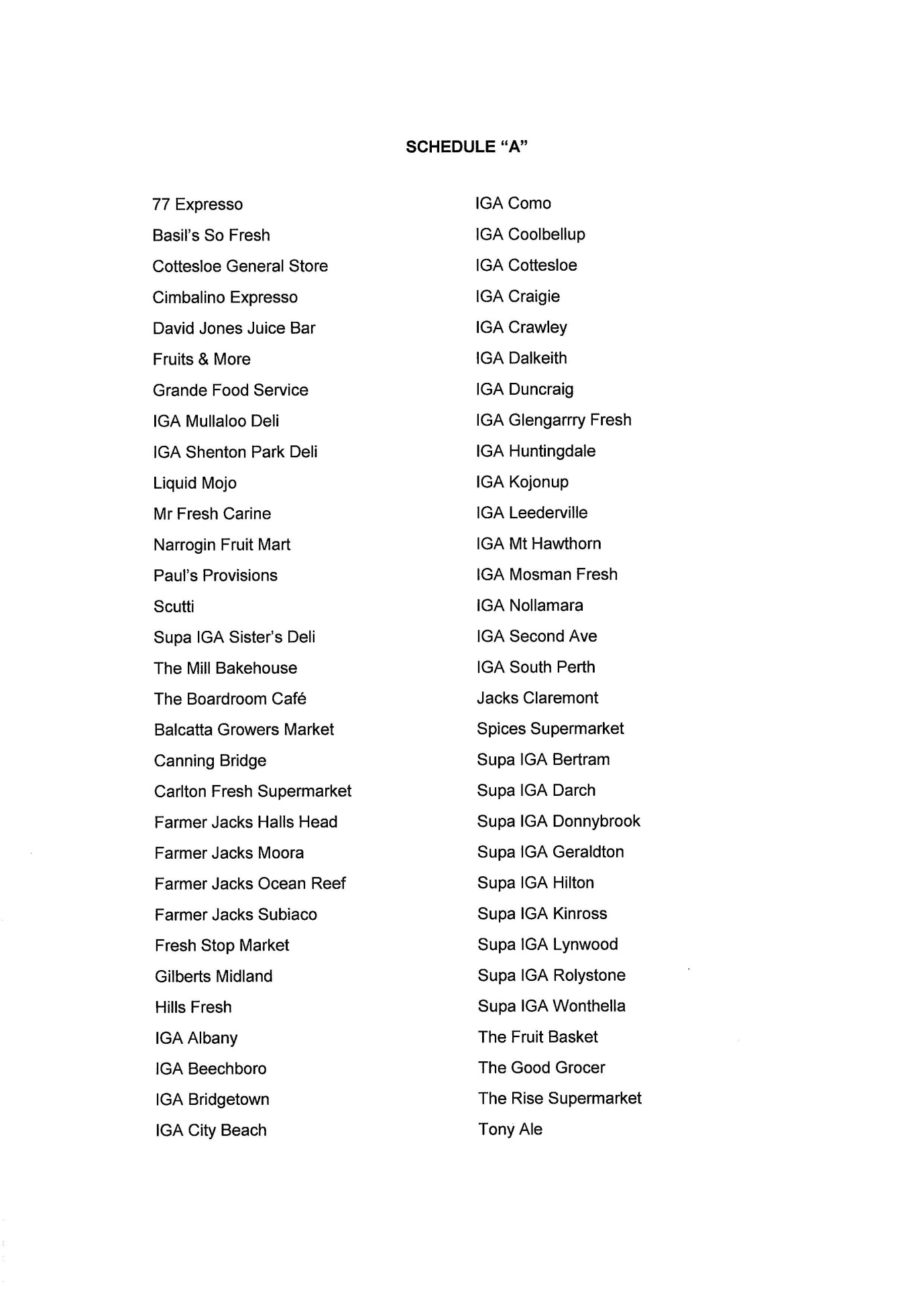
2. Correspondence and/or communications between the prospective respondent and any officer, employee or other representative of any of the companies, businesses or entities listed in the attached Schedule A (including handwritten notes of any conversations) from, and including, 1 April 2015 to 15 July 2015 and, in particular, relating to:
(a) attempts, by the prospective respondent, to commence to do business with any companies, businesses or entities listed in Schedule A annexed to these orders;
(b) negotiations, proposals and agreements relating to proposed or actual business dealings between the prospective respondent and the companies, businesses or entities listed in the attached Schedule A;
(c) the events that took place on 18 May 2015 and plans made prior to, but for the purpose of that day;
(d) the Yoghurt Shop generally and particularly to the fact that The Yoghurt Shop was supplier of bulk yoghurt to prospective applicant;
(e) comments and/or representations about the prospective applicant’s financial circumstances including, but not limited to, words or representations to the effect that the prospective applicant was struggling financially or going broke;
(f) the business (and former business) of the prospective applicant;
(g) The prospective respondent’s business relationship (or former business relationship) with The Yoghurt Shop; and
(h) The creation and/or proposed creation and establishment of a company called Carmichael Distributors Pty Ltd trading as “Gourmet Foods”.
3. Documents or electronic documents containing any of the following information:
(a) the identity and contact details of any HC Foods customers who purchased berry products and yoghurt products;
(b) the types of products (berries and yoghurt) that customers bought from HC Foods and the amount of product bought;
(c) the types of berry products bought by HC Foods from its supplier/s;
(d) the types of yoghurt products bought by HC Foods from The Yoghurt Shop;
(e) HC Foods’ pricing structures related to the price that it could and did purchase yoghurt from its suppliers (including The Yoghurt Shop); and
(f) the price at which berry and yoghurt products were sold to each of HC Foods’ customers and the amount of each product sold;
which are or were:
(g) in the possession, power or custody of the prospective respondent as at 5pm on 1 May 2015;
(h) stored, as at 5pm on 1 May 2015, in any electronic device in the control of the prospective respondent (including any mobile telephone device or laptop computer in the control of the prospective respondent); or
(i) sent or received, between 1 April 2015 and 15 July 2015, to or from any e-mail address or addresses, or mobile telephone or telephones, over which the prospective respondent had control, or access to, between 1 April and 15 July 2015.
Note: Entry of orders is dealt with in Rule 39.32 of the Federal Court Rules 2011.
GILMOUR J:
1 This application for pre-action discovery is brought by HC Foods Pty Ltd (HC Foods) as the prospective applicant pursuant to rule 7.23 of the Federal Court Rules 2011 (Rules).
2 HC Foods read the following affidavits:
(a) the affidavit of Murray Russell Griffiths affirmed on 31 March 2016 (first Griffiths affidavit);
(b) the affidavit of Murray Russell Griffiths affirmed on 8 July 2016 (second Griffiths affidavit); and
(c) the affidavit of Vivien Stern affirmed on 31 March 2016 (Stern affidavit).
3 The prospective respondent (Carmichael) relied upon his affidavit sworn on 20 June 2016.
Background
4 HC Foods has, since 1997, been a distributor of frozen fruit products to restaurants, cafes and retail stores. Since 2002-03 it has expanded its business to include “pick and mix” berries in freezers supplied to retail outlets and later also supplying frozen berries in bags. Since 2009 it has also been distributing yoghurt to retailers. An important strategy employed by it in its business was not to disclose to its customers the identity of its berry and yoghurt suppliers.
5 Carmichael was employed by HC Foods between September 2013 and May 2015.
Legal Principles
6 The relevant principles are not contentious.
7 Rule 7.23 of the Rules provides as follows:
(1) A prospective applicant may apply to the Court for an order under sub rule (2) if the prospective applicant:
(a) reasonably believes that the prospective applicant may have the right to obtain relief in the Court from a prospective respondent whose description has been ascertained; and
(b) after making reasonable enquiries, does not have sufficient information to decide whether to start a proceeding in the Court to obtain that relief; and
(c) reasonably believes that:
(i) the prospective respondent has or is likely to have or has or is likely to have had in the prospective respondent’s control documents directly relevant to the question whether the prospective applicant has a right to obtain the relief; and
(ii) inspection of the documents by the prospective applicant would assist in making the decision.
(2) If the Court is satisfied about matters mentioned in sub rule (1), the Court may order the prospective respondent to give discovery to the prospective applicant of the documents of the kind mentioned in subparagraph (1)(c)(i).
8 The general principles were summarised by Hely J in St George Bank Ltd v Rabo Australia Ltd (2004) 211 ALR 147 at 153 – 154 and adopted with approval by the Full Court: Bonham v Iluka Resources Limited [2015] FCA 713 at [65] and [67].
9 The rule is to be beneficially construed, given the fullest scope that its language will reasonably allow, with the proper brake on any excesses lying in the discretion of the Court, exercised in the particular circumstances of each case: Paxus Services Ltd v People Bank Pty Ltd (1990) 99 ALR 728 at 733.
10 A prospective applicant does not have to make out a prima facie case. Nor does an applicant have to establish every element of the cause of action: Sandhurst Trustees Limited v Clarke [2015] FCAFC 21 at [24]. That said, it remains necessary to examine the various elements of the potential cause of action that is sought to be relied on to determine whether there is a reasonable cause to believe that each of the necessary elements exist: Optiver Australia Pty Ltd v Tibra Trading Pty Ltd (2008) 169 FCR 435 at [48], where the Court was dealing with 0 15A r 6 of the Federal Court Rules 1979, the predecessor to r 7.23(1) of the Rules.
11 An applicant for preliminary discovery may be entitled to discovery in order to determine what defences are available to the respondent and the possible strength of those defences, or to determine the extent of the respondent’s breach and the likely quantum of any damages award: Bonham at [26], [65] and [67].
12 Although a prospective applicant can reasonably believe that it may have a right to obtain relief as contemplated by r 7.23(1)(a), this does not equate to sufficient information to make a decision as required by r 7.23(1)(b). The states of satisfaction required of a prospective applicant by these two paragraphs are quite distinguishable: Construction, Forestry, Mining and Energy Union v Orica Australia Pty Ltd [2014] FCA 592 at [21].
13 Granting an order for limited preliminary discovery at this point may potentially save time, unnecessary expenditure of costs, and perhaps avoid the need for further interlocutory litigation between the parties at a later date: see Orica [21].
14 There should be little scope for refusing relief when the requirements of r 7.23(1) have been satisfied: see Optiver Australia at 504.
Reasonable belief
15 HC Foods submits that it has reason to believe that it may be able to obtain relief, in the Court, against Carmichael.
16 It also submits it has reason to believe that Carmichael may have committed contraventions of section 183(1) of the Corporations Act 2001 (Cth), breached his contract and breached his equitable obligations in connection with his employment.
17 Section 183(1) of the Corporations Act 2001 (Cth) provides as follows:
(1) A person who obtains information because they are, or have been, a director or other officer or employee of a corporation must not improperly use the information to:
(a) gain an advantage for themselves or someone else; or
(b) cause detriment to the corporation.
18 Griffiths deposes in the first Griffiths affidavit that:
62. In the course of his employment, I sent e-mails to Kerry which, to my knowledge and belief, he received on his personal laptop.
63. During Kerry’s employment, I gave him both hard and electronic copies of information including:
(a) the identity and contact details of all HC Foods customers who bought berry products and yoghurt products;
(b) the types of products (berries and yoghurt) that customers bought from HC Foods and the amount of product bought;
(c) the types of berry products bought by HC Foods from its supplier/s;
(d) the types of yoghurt products bought by HC Foods from TYS;
(e) HC Foods pricing structures relating to the price that it could and did purchase yoghurt from its supplier/s (including TYS); and
(f) the price at which products were sold to each of HC Foods customers and the amount of each product sold.
64. I also told Kerry:
(a) that he was not to tell any of HC Foods’ customers (the purchasers of TYS bulk yoghurt products) the identity of T?YS or its connection as maker and supplier, to HC Foods;
(b) that he was not to tell TYS the identify of our HC Foods customers and, in particular, the identify of those who purchased TYS bulk yoghurt from it; and
(c) that the reasons for telling Kerry the things above was because that information was commercially sensitive and that I was concerned that if that information was disclosed to TYS or to any customer, arrangements could be made for TYS and any customer to deal with each other directly rather than through HC Foods.
65. Kerry knew:
(a) that in relation to berries, HC Foods selling price was calculated by the amount of berries to be bought by a customer. He knew this because I told him;
(b) about HC Foods’ relationship with TYS and, in particular, the fact that TYS only sold yoghurt, in Western Australia, to HC Foods;
(c) that in places other than Western Australia, TYS dealt directly with retailers. One example of how he knew that is because of what Simon Reynolds wrote in his e-mail dated 12 February 2014 (See MRG-6);
(d) about the poor quality of Evia and that TYS was a superior product;
(e) that a significant factor in determining HC Foods sale price, for “bulk” yoghurt, bought from TYS, was the absence of any commercial competitor in Western Australia. Kerry knew this because I told him;
(f) about the fact that TYS wanted HC Foods to sell more of its (TYS) products in Western Australia than HC Foods had been doing and to buy more yoghurt products from TYS (see paragraphs 56 – 65 above);
(g) that HC Foods was reluctant to reduce the price at which it sold TYS yoghurt because it did not consider that it had to due to the lack of any competitor. Kerry knew this because I told him; and
(h) about the fact that TYS wanted HC Foods to seel TYS bulk yoghurt to HC Foods customers for less money than HC Foods was selling it for. I believe that Kerry must have known this, because:
(i) He was the person primarily responsible for dealing with Simon and TYS;
(ii) I believe he was the person who told Simon how much I was selling the bulk yoghurt to customers for; and
(iii) He told me that TYS wanted me to sell more yoghurt.
19 In early June 2015, shortly after being made redundant on 24 April 2015, Carmichael registered his own company, Carmichael Distributors Pty Ltd, in competition with HC Foods. Very soon thereafter, HC Foods supplier of yoghurt began supplying to Carmichael’s company and would not supply HC Foods. Carmichael’s company began to supply some of HC Foods former customers, resulting in a significant drop in yoghurt sales.
20 There is evidence that even before this, Carmichael began contacting HC Foods customers from early May 2015.
21 There is a cogent foundation in the evidence that Carmichael has used information which was confidential to HC Foods in commencing and carrying on his new business. It would appear that very soon after his redundancy Carmichael was in touch with HC Foods yoghurt supplier (The Yoghurt Shop) and reached an agreement with them to take over distribution of its yoghurt formerly distributed by HC Foods. The substance of the evidence is that within a very short time Carmichael, through his new company, stepped into the shoes formerly filled by HC Foods and employed essentially the same business model, engaging with HC Foods’ former suppliers and customers.
22 I am satisfied that it is reasonable for HC Foods to believe that it may have the right to obtain relief against Carmichael based in what Griffiths has said in his written evidence.
23 It is reasonably likely that Carmichael used documents and information as to HC Foods business, obtained in the course of his employment, which would have assisted him to set up his business in competition with HC Foods so swiftly after his employment was terminated.
24 It matters not that this information may, by other means, have been ascertained by Carmichael. The question is whether he used confidential documents and confidential information provided to him by HC Foods in the course of his employment.
25 I do not accept Carmichael’s submission that, in effect, even assuming he had used:
(a) HC Foods’ price lists when devising his own pricing structure for the new business;
(b) its contact list to ascertain potential new clients for his business; and
(c) his knowledge of the price list to make a business proposal to The Yogurt Shop;
this could not constitute an improper use of HC Foods’ information.
26 As to his submission that HC Foods price list was not confidential, Carmichael relied upon Pet Tech Pty Ltd v Batson [2013] NSWSC 1954 at [32]. However, as Young AJ there stated, this was not a “broad rule that applies to every case” and went on to describe some circumstances where a company’s price list would be confidential. Arguably, this is such a case. The prices at which HC Foods purchased from its suppliers and sold to retailers was not information which was generally available.
27 It is not necessary, at this stage, to seek to resolve credit issues even although some aspects of Carmichael’s evidence are, at face value, internally inconsistent.
Reasonable inquiries
28 I am also satisfied that HC Foods has made reasonable inquiries to Carmichael but does not believe that it has sufficient information to decide whether to institute Court proceedings to obtain relief.
29 Carmichael claims that he does not have any of the documents sought in the amended application. This, even were it so, is not to the point. If HC Foods is successful, the list of documents to which Carmichael will be required to depose and file, in accordance with rr 7.25 and 20.17 of the Rules, must include a statement of the documents that he had in his control, when the documents were last in his control, and what has become of those documents.
Reasonable belief that prospective respondent has or had documents
30 I am satisfied that HC Foods has reason to believe that Carmichael, at least, has had or is likely to have had in his control, documents directly relevant to the question whether HC Foods has a right to obtain relief. Accordingly, to grant the relief sought would not, contrary to Carmichael’s submission, be nugatory.
31 This is so despite Carmichael’s evidence that since first receiving correspondence from HC Foods’ solicitors in September 2015, Carmichael has maintained his position that he does not have any of the documents sought by the prospective applicant.
32 He has deposed that none of the documents sought in the amended application are in his possession, custody or control and that:
(a) all hard-copy documents received from the prospective applicant were shredded following termination of his employment; and
(b) all emails relating to the prospective applicant's business were deleted upon the prospective respondent receiving legal advice in September 2015.
Hard copy documents
33 Carmichael claims that he shredded each and every hard copy document given to him by HC Foods relating to its business, either on 24 April 2015 or shortly thereafter.
34 Griffiths and Vivien Stern have deposed that there is no paper shredder at the office of HC Foods and that Carmichael was not seen to destroy any documents. Carmichael fails to identify where, when and/or how he shredded the documents. I will require that he do so.
35 The evidence reasonably suggests that Carmichael deleted electronic documents containing HC Foods confidential information only in September 2015 after receiving legal advice. Therefore, it is at least an issue that he did not shred all hard copy documents given to him by HC Foods relating to its business as early as April 2015.
36 Moreover, the electronic documents could potentially still be in the “deleted” file on his computer. If that is so then, of course, they should not now be permanently deleted by Carmichael. Even if the documents have been cleared from the deleted file, there are nonetheless forensic processes available for retrieving them.
37 Furthermore, there is unchallenged evidence that Carmichael had a blue diary that he used to record information about his work for HC Foods. He does not assert that this has been destroyed or that it was not used to record information relevant to HC Foods case between 1 April and 15 July 2015.
Reasonable belief that inspection of the documents will assist in making a decision
38 HC Foods has limited the scope of the discovery sought by consent orders made on 17 June 2016.
39 Discovery of the documents listed in Orders 1 and 2 of HC Foods’ proposed orders will, I am satisfied, likely reveal whether or not Carmichael used HC Foods’ confidential information or otherwise breached his obligations to it in forming his business relationships with The Yoghurt Shop and with the businesses or entities listed in Schedule A to the original application. Conversely, should discovery show that Carmichael did not utilise HC Foods’ confidential information in this way, then HC Foods may decide it does not have a basis to commence substantive proceedings against Carmichael. In either case the administration of justice will be advanced.
40 Discovery of the documents listed in Order 3 of the proposed orders will reveal what confidential information Carmichael had at his disposal during the period in which he was developing his new business.
41 HC Foods subjectively holds its beliefs as disclosed by Griffiths’ affidavits and its beliefs are, I find, reasonably held. I would in the exercise of my discretion make the orders sought by the prospective applicant.
Costs
42 In a letter dated 9 June 2016, Kitto and Kitto advised HC Foods' solicitors that Carmichael did not have any of the documents sought in its amended application and offered not to oppose the orders sought on the basis set out on page 2 of the letter.
43 Carmichael, on this basis, submits that HC Foods has in any event elected to proceed with a nugatory application, in circumstances where the outcome of the application could not assist it in deciding whether to commence proceedings against him.
44 Carmichael submits that in these circumstances, even if the Court were to make the orders sought in the amended application, HC Foods should pay his costs of the application.
45 However his offer not to oppose the Orders, as amended, was, relevantly, on the basis that HC Foods agreed that there be no order as to costs. HC Foods did not agree, quite reasonably. First, the application had already been filed before the solicitor’s letter of 9 June 2016 was sent. Costs had already been incurred by HC Foods. Second, Carmichael put on an affidavit, in effect, opposing the application. This was done pursuant to orders made on 17 May by consent, relevantly that Carmichael file and serve any affidavits in opposition to the discovery application. The orders also required the parties to file and serve written submissions.
46 Other procedural orders were made by consent on 7 June extending time for compliance with the previous orders. Thereafter HC Foods, on 23 June 2016, was granted leave by consent to amend its application. Consequently the application was thereby amended.
47 Written submissions were then put on by both parties. The application has been resolved in favour of HC Foods.
48 Carmichael has unsuccessfully opposed the making of the orders and should pay HC Foods costs of the application.
Orders
49 There will be orders in terms of the amended originating application filed on 31 August 2016. I will also order that Carmichael depose to where, when and how he shredded or caused to be shredded the hard copy documents he had in his possession. Compliance with these is to be within 21 days of order. Carmichael must pay HC Foods’ costs of the application.
I certify that the preceding forty-nine (49) numbered paragraphs are a true copy of the Reasons for Judgment herein of the Honourable Justice Gilmour. |
Associate:


