

FEDERAL COURT OF AUSTRALIA
Folau v Minister for Immigration and Border Protection [2016] FCA 1149
REASONS FOR JUDGMENT
Applicant | ||
AND: | MINISTER FOR IMMIGRATION AND BORDER PROTECTION Respondent | |
1 Mr Moses Folau has applied under s 476A of the Migration Act 1958 (Cth) (“the Act”) for review of a decision made by the Minister for Immigration and Border Protection to cancel Mr Folau’s visa. Mr Folau arrived in Australia with his parents and seven siblings in 1990 as a child aged six. He has since lived in Australia with only temporary absences over the 26 years in which Australia has been his home. On 17 March 2016 the Minister personally cancelled Mr Folau’s sub-class 444 visa pursuant to s 501(2) of the Act with the result that Mr Folau became an unlawful non-citizen. He was taken into immigration detention and is awaiting deportation to New Zealand pending the outcome of this application.
2 Mr Folau was the holder of a Class TY sub-class 444 Special Category (Temporary) visa as a New Zealand citizen entering Australia. Section 501(2) empowered the Minister, however, to cancel the visa if the Minister reasonably suspected that Mr Folau did not pass the character test in s 501(6). The Minister’s power to cancel the visa was expressed in s 501(2) as follows:
(2) The Minister may cancel a visa that has been granted to a person if:
(a) the Minister reasonably suspects that the person does not pass the character test; and
(b) the person does not satisfy the Minister that the person passes the character test.
Section 501(6)(a) provided that a person did not pass the character test if the person had a substantial criminal record as defined by s 501(7). The definition of a substantial criminal record in s 501(7) included having been sentenced to a term of imprisonment of 12 months or more. On 30 August 2013 Mr Folau was convicted in the County Court of Victoria for an offence for which he was sentenced to a term of imprisonment of 25½ months. A consequence of that sentence was that Mr Folau had a substantial criminal record within the meaning of s 501(7) and, therefore, failed to pass the character test within the meaning of s 501(6) for the purposes of the exercise by the Minister of the discretion in s 501(2) to cancel Mr Folau’s visa. On 17 March 2016 the Minister personally cancelled Mr Folau’s visa, who was notified of the Minister’s decision on 1 April 2016.
3 Mr Folau sought to have set aside the Minister’s decision relying upon four grounds that the cancellation of the visa was affected by jurisdictional error. The first of the grounds relied upon by Mr Folau was that the Minister had failed to discharge his statutory task, or alternatively had made a legally unreasonable decision, by considering the risk of harm to the Australian community if Mr Folau were to reoffend without the Minister having considered the likelihood of reoffending. It was submitted for Mr Folau that the Minister was obliged in exercising the discretion under s 501(2) to consider the risk of harm to the Australian community if Mr Folau were to reoffend by weighing two considerations against each other, namely the seriousness of any harm that might be caused and the likelihood of that harm occurring. It was submitted that the Minister could only evaluate the risk of harm by making findings about the seriousness of any harm that might be caused and the likelihood of that harm occurring but that the Minister had made no findings as to the likelihood of harm occurring and had made no finding that the risk was unacceptable however unlikely it might have been.
4 The Minister’s discretion under s 501(2) is broad. In Moana v Minister for Immigration and Border Protection (2015) 230 FCR 367 Rangiah J (with whom North J agreed) considered that the Minister was required in the exercise of the discretion under s 501(2) to consider whether there was a risk of harm to the Australian community posed by the continued presence of the visa holder in Australia and to take into account any such risk: see also Tanielu v Minister for Immigration and Border Protection (2014) 225 FCR 424; AZAFQ v Minister for Immigration and Border Protection [2016] FCAFC 105, [49]-[54]. Any obligation on the Minister to take into account the continued risk of harm to the Australian community posed by the continued presence of a visa holder, however, does not require the Minister to evaluate the risk of harm in a particular way or to ascribe the risk with any particular characterisation. In Moana, Rangiah J said at [71]-[74]:
71 If the Minister is to be held to be bound to examine the likelihood of a person engaging in future conduct which may cause harm in every exercise of the discretion under s 501(2), then an implication to that effect must appear from the subject matter, scope and purpose of the Act. It is not enough to argue that principles concerning other statutory provisions with a protective purpose must apply analogously to s 501(2). It is one thing to conclude, as I have, that the Minister must consider the risk of harm, but it is a step removed to decide that the statute contains an implication that the Minister must evaluate the risk of harm in a particular way.
72 The cases concerning s 501A relied on by the Minister (at [63] above) establish that the seriousness of an offence may, of itself, lead the Minister to conclude that a visa should be cancelled in the national interest. I consider that the seriousness of an offence or other relevant past conduct may also lead the Minister to conclude that a visa should be cancelled in the discretion under s 501(2) without evaluating the likelihood that the visa holder will reoffend or engage in harmful conduct. It is implicit in s 501 that Parliament considers that a person who does not pass the character test poses a risk of harm of some kind, although that does not lead to a presumption that the discretion should be exercised in a particular way. In a particular case, however, the Minister may take the view the seriousness of the offence or conduct means that any risk is intolerable. It follows that in exercising the discretion in s 501(2), the Minister is not bound to engage in an evaluation of the likelihood of a person engaging in future conduct which may cause harm.
73 Contrary to the appellant’s submission, I doubt whether Mortimer J held that the Minister must evaluate the static and dynamic factors personal to an individual that may affect the risk that the person may pose when exercising the discretion. I think that her Honour was merely illustrating the factors of the type that might influence the likelihood of a person engaging in future conduct which may cause harm. In any event, there is direct authority against the proposition that the Minister is bound to consider factors personal to the visa holder: Huynh at [74] per Kiefel and Bennett JJ. I am unable to see how s 501(2) can be construed to require the Minister to take into account such personal factors when considering the risk of harm.
74 I consider that the Minister is not bound to conduct an evaluation of the likelihood of the visa holder engaging in future conduct that may cause harm when exercising the discretion under s 501(2). That is not to say that evaluation of such likelihood will not be centrally relevant to the exercise of the Minister’s discretion in most cases. The exercise of the discretion to cancel a visa without examining the likelihood of future harm may in some circumstances be unreasonable, in the sense of lacking an evident and intelligible justification: cf Minister for Immigration and Citizenship v Li (2013) 249 CLR 332 at [76] per Hayne, Kiefel and Bell JJ. However, s 501(2) cannot be construed to require the Minister to take into account that likelihood in all cases.
A similar view was taken by the Full Court in AZAFQ v Minister for Immigration and Border Protection [2016] FCAFC 105 when the Court, in dealing with an argument by the appellant, said at [55]:
The appellant also argued that the Minister was obliged not only to take into account the risk of harm to the Australian community but also to quantify that risk and that he failed to do so. That argument should be rejected. It is inconsistent with both Moana and Ayoub, as well as Brown. In Brown, Rares, Flick and Perry JJ said at [41]:
First, even if the Minister had a duty to consider the risk of harm to the Australian community, he had no duty to evaluate that risk in any particular way or to ascribe any particular characterisation to the quality of the risk: Moana [2015] FCAFC 56 at 71; Ayoub [2015] FCAFC 83 at [44].
The Minister’s consideration of the likelihood of harm if Mr Folau were to reoffend did not require the Minister to undertake the assessment or analysis as submitted for Mr Folau.
5 The Minister’s decision in the present case would appear harsh and unreasonable to many. But the test for the Court is not whether the Court would not have made the decision which the Minister made, but whether the Minister’s decision was lawful. In Minister for Immigration and Border Protection v Stretton (2016) 237 FCR 1 Allsop CJ said at [21]:
[…] The correct question, or perspective, if one is looking at the outcome in question, is not whether the Court thinks the decision is reasonable, or necessary for the purpose, or not, as the case may be; rather it is whether a decision-maker could reasonably come to the conclusion. […]
6 The Minister was required to consider the risk of harm to the Australian community posed by Mr Folau’s remaining in Australia if he were to reoffend, but the Minister was not obliged by the authorities to “evaluate the risk of harm in a particular way” (Moana at [71]). In this case the Minister considered the risk of harm posed by the applicant in his statement of reasons at [21]-[39]:
Risk to the Australian Community
21. In considering the risk to the Australia community, posed by Mr FOLAU I have had regard to the nature of the harm caused by his past offending. Mr FOLAU has appeared before the courts on multiple occasions for violent offences. I note that the victim of the intentionally cause injury offence for which Mr FOLAU was convicted on 30 August 2013 experienced serious physical injuries and psychological harm. I note that his past offending has also caused minor injuries to his victims.
22. In considering whether Mr FOLAU poses a risk to the Australian community through re-offending I have had regard to the mitigating or causal factors in his offending, and I have considered the steps Mr FOLAU has undertaken to reform and address his behavior. I have also taken into account Mr FOLAU’s overall conduct in the custodial and non-custodial environment, and his insight into the offending.
23. Judge Ryan has described the antecedents of Mr FOLAU’s offending, and I note that the prevalence of alcohol abuse within his family, his difficult upbringing due to the death of his father and the tragic death of his brother, have had an ongoing emotional effect on Mr FOLAU.
24. Alcohol abuse and drug addiction have been factors in Mr FOLAU’s offending, and I note that he was intoxicated at the time of the intentionally cause injury offence. Mr FOLAU and Mrs Rodan on his behalf, have acknowledged the role of alcohol and drugs in his offending. I have also considered the psychological reports of Mr Healey which also describe the role of alcohol and illicit drugs in his offending.
25. While I accept that Judge Ryan commented favourably on Mr FOLAU’s efforts at rehabilitation, I am mindful that Judge Ryan also observed at the time of sentencing that Mr FOLAU had not learnt from his past court appearances, and in addressing Mr FOLAU and his co-offenders, Judge Ryan was guarded about their future prospects for rehabilitation.
26. During his time in prison, and since his release from prison Mr FOLAU has completed a number of drug and alcohol rehabilitation courses, attended counselling, and has been involved in re-integration programs. I note that pathology test results provided by community corrections and Mr FOLAU indicate that he is free of illicit drugs. I find that Mr FOLAU has made progress in his rehabilitation.
27. Have considered Mr FOLAU’s account of his time in prison and I note he completed further education and training courses while in prison and while in prison he was consistently employed. I further considered his efforts at organising a Waitangi day event which was positively recognized by the General Manager of the prison. Since his release from prison, Mr FOLAU has a consistent employment record, and I find that this to be a reflection of his efforts to re-integrate into the community.
28. Mr FOLAU has provided references from his de facto partner, family, and his extended professional and social networks. I find that Mr FOLAU has supportive familial and social networks and that this would assist with his efforts at rehabilitation.
29. I have considered Mr FOLAU’s account of his offending and his efforts at rehabilitation, and I acknowledge that he has expressed remorse and a desire to maintain good conduct in the future.
30. I note that Mr FOLAU’s past criminal conduct involves breaches of judicial orders.
31. While I note that Mr FOLAU has engaged positively with his parole orders, I have also considered that Mr FOLAU was involved in one breach of curfew and this resulted in him being subject to electronic monitoring for the remainder of his parole order. In considering this, I am mindful of Mr FOLAU and Mrs Rodan’s explanations of the breach.
At [62] the Minister concluded that Mr Folau’s continued presence could expose the Australian community to a risk of harm. At [62] the Minister said:
I find that the Australian community could be exposed to harm should Mr FOLAU reoffend in a similar fashion. I could not rule out the possibility of further offending by Mr FOLAU. The Australian community should not tolerate any further risk of harm.
The Minister considered that Mr Folau’s continued presence in Australia posed a risk of harm to the Australian community and weighed that risk against the countervailing factors but considered that Mr Folau’s continued presence was an unacceptable risk that weighed against the countervailing considerations.
7 The countervailing factors were in part in the Minister’s reasons at [21]-[39] set out above and in part in other paragraphs of the Minister’s reasons. At [40]-[46] the Minister considered the best interests of the minor children who would be affected by Mr Folau’s removal from Australia. At [50]-[55] the Minister considered Mr Folau’s ties to Australia and at [56]-[59] the Minister considered the extent of the impediments that Mr Folau would face if removed from Australia in establishing himself and in maintaining basic living standards. Each of these matters weighed strongly against the Minister’s decision to cancel Mr Folau’s visa, but the Minister nevertheless concluded at [63] that the potential risk of harm to the Australian community outweighed the countervailing considerations in Mr Folau’s case. The Minister said at [63]-[65]:
63. I found the above consideration outweighed the countervailing considerations in Mr FOLAU’s case, including the best interests of Kaizes Folau and his nieces and nephews, the impact on family members including his de facto partner Ms Victoria Harvey and his mother Mrs Isapela Folau. I have also considered the length of time Mr FOLAU has made a positive contribution to the Australian community, noting his consistent employment history, volunteer efforts and extended social and professional ties in the community.
64. I am cognisant that where great harm could be inflicted on the Australian community even strong countervailing considerations are insufficient for me not to cancel the visa. This is the case even applying a higher tolerance of criminal conduct by Mr FOLAU, than I otherwise would, because he has lived in Australia for most of his life.
65. In reaching my decision I concluded that Mr FOLAU represents an unacceptable risk of harm to the Australian community and that the protection of the Australian community outweighed any countervailing considerations above.
The Minister’s statement of reasons reveal that he did take into account the risk of harm and that he weighed that risk against countervailing factors: see AZAFQ v Minister for Immigration and Border Protection [2016] FCAFC 105, [12], [54]-[56]; see also Ayoub v Minister for Immigration and Border Protection (2015) 231 FCR 513; and Maxwell v Minister for Immigration and Border Protection (2016) 149 ALD 604. The Minister’s conclusion cannot be said to be legally unreasonable in the sense of lacking “an evident and intelligible justification”: see Minister for Immigration and Citizenship v Li (2013) 249 CLR 332, [76].
8 The second ground relied upon for Mr Folau was that the Minister had taken into account, as an impermissible irrelevant factor, Australia’s sovereign right to determine whether non-citizens who are of character concern are allowed to remain in Australia. The Minister’s statement of reasons began the consideration of the discretion in s 501(2) by stating at [9]:
Having found that Mr FOLAU does not pass the character test and having assessed the information set out in the Issues Paper and attachments, I considered whether to exercise my discretion to cancel Mr FOLAU’s visa, taking into account factors that I considered weighed against and in favour of cancelling Mr FOLAU’s visa. In making my decision I was mindful that Australia has a sovereign right to determine whether non-citizens who are of character concern are allowed to remain in Australia.
It was submitted on behalf of Mr Folau that the Minister’s statement in this paragraph of being mindful of Australia’s sovereign right had demonstrated that the Minister misunderstood the power he had set out to exercise and had taken into account an impermissible irrelevant consideration. It was accepted on behalf of Mr Folau that there was no doubting that Australia had a sovereign right to determine whether non-citizens who are of character concern are allowed to remain in Australia, but it was submitted that there was no sensible relationship between that right and the exercise of power under s 501(2).
9 The Minister’s statement of being mindful that Australia has a sovereign right to determine whether non-citizens who are of character concern are allowed to remain in Australia was not something that was impermissible for the Minister to consider in the exercise of the statutory discretion in s 501(2) of the Act. In Minister for Immigration and Multicultural and Indigenous Affairs v Huynh (2004) 139 FCR 505 Kiefel and Bennett JJ said at [71]:
[…] A relevant consideration in an administrative law sense has a limited meaning. It is one which the decision-maker is bound to take into account in making the decision in question. The factors which the decision-maker is bound to take into account are determined by the construction of the statute conferring the discretion. If they are not stated, they are to be determined by implication from the subject-matter, scope and purpose of the Act: Minister for Aboriginal Affairs v Peko-Wallsend Ltd (1986) 162 CLR 24 at 39-40 per Mason J.
The subject matter, scope and purpose of the Act determines whether or not a decision-maker is either bound to take into account a matter or bound not to take into account a matter. The sovereign right considered by the Minister in this case was not something which was legally impermissible for the Minister to consider. The sovereign right was the jurisprudential foundation for the validity of the provision under which the Minister was purporting to exercise the statutory power and it was not an impermissible irrelevant factor to commence the consideration of the exercise of a discretion with an observation of the legal foundation upon which the discretion is based.
10 Having taken the sovereign right of Australia into account would not, in any event, give rise to jurisdictional error even if it had been an irrelevant consideration. That is because it was not that consideration that led to the Minister’s decision under s 501(2) of the Act. It is not a jurisdictional error to consider an irrelevant consideration if it does not affect the outcome in question. In Buchwald v Minister for Immigration and Border Protection [2016] FCA 101 Bromberg J said at [72]:
Nor does the failure to consider or take into account some evidence necessarily lead to a conclusion that a decision-maker has failed to consider the merits of a claim, or that there has been a failure by the decision-maker to give proper and genuine consideration to a relevant matter. As Robertson J said at [97] of Minister for Immigration and Citizenship v SZRKT (2013) 212 FCR 99 by reference to the judgment of McHugh, Gummow and Hayne JJ in Minister for Immigration and Multicultural Affairs v Yusuf (2001) 206 CLR 323, “merely to ignore ‘relevant material’ does not establish jurisdictional error”. That is so because jurisdictional error is only established if ignoring relevant material affects the tribunal’s exercise or purported exercise of power (Yusuf at [82]). Where relevant evidence is ignored, it is crucial to the assessment of whether jurisdictional error is established that consideration be given to the consequence of that omission. As Robertson J said in SZRKT at [111]:
The fundamental question must be the importance of the material to the exercise of the Tribunal’s function and thus the seriousness of any error.
See further VAAD v Minister for Immigration & Multicultural & Indigenous Affairs [2005] FCAFC 117 at [77] (Hill, Sundberg and Stone JJ) and SZSSC v Minister for Immigration and Border Protection (2014) 317 ALR 365 at [81(b)] and [81(f)] (Griffiths J).
The reference in Mr Folau’s case to the Minister being mindful of Australia’s sovereign right was not dispositive of the exercise of the Commissioner’s discretion under s 501(2). The Minister, rather, took into account the various factors set out in the remainder of the reasons for decision to reach the conclusion that the risk of harm associated with Mr Folau’s previous conduct and the risk of Mr Folau re-offending weighed against the countervailing considerations that Mr Folau had submitted to the Minister.
11 The third ground relied upon for Mr Folau was that the Minister had impermissibly taken into account the punitive effect of the visa cancellation. It is well established that the Minister cannot regard visa cancellation as a form of punishment for past events: Djalic v Minister for Immigration and Multicultural and Indigenous Affairs (2004) 139 FCR 292; Moana v Minister for Immigration and Border Protection (2015) 230 FCR 367; Tanielu v Minister for Immigration and Border Protection (2014) 225 FCR 424; and Minister for Immigration and Border Protection v Stretton (2016) 237 FCR 1. That is because punishing a crime is an exclusively judicial function (see Chu Kheng Lim v Minister Immigration, Local Government and Ethnic Affairs (1992) 176 CLR 1, 27) and because the Australian system of criminal justice does not permit double punishment (see NBMZ v Minister for Immigration and Border Protection (2014) 220 FCR 1, 183).
12 The cancellation powers in s 501 were described by Buchanan J in NBMZ v Minister for Immigration and Border Protection (2014) 220 FCR 1 at [192] as “fundamentally forward, rather than backward, looking”. In that case his Honour considered whether the Minister’s assessment of the risk to the Australian community had imposed a form of punishment and at [192] his Honour said:
Risk to the Australian community
If the Minister’s decision was to avoid the charge that he was intent on some form of punishment (normally the preserve of the courts) then his assessment of whether the applicant should be granted a visa should also have been directed to some assessment of the consequences for the Australian community if the applicant was granted a visa. Normally, there should be an attempt to assess the likelihood of similar, or other, criminal conduct of the kind which had aroused the Minister’s displeasure and provoked the censorious conclusion that the applicant had demonstrated a fundamental disrespect for Australian laws, standards and authorities. That is because the discretion to be exercised under s 501 is fundamentally forward, rather than backward, looking. It concerns the future, not the past.
It was submitted for Mr Folau that a fair reading of the Minister’s reasons in this case revealed an impermissible intention to punish Mr Folau for past conduct. The submissions for Mr Folau referred to passages in the Minister’s reasons for decision in which the Minister referred to events which had occurred in the past. The issues paper which had been given to the Minister had referred to past events and advised the Minister at [104] as follows:
You may wish to consider Australian community expectations that non-citizens obey Australian laws while in Australia. Where a non-citizen has breached or where there is an unacceptable risk that they will breach this trust or where the non-citizen has been convicted of offences in Australia or elsewhere, it may be appropriate to cancel the visa held by such a person.
The reference in the issues paper plainly refers to past events as relevant considerations for the Minister’s decision. The Minister’s decision itself also referred to the Minister being mindful of the principle that the Australian community would expect that non-citizens who had committed serious crimes in Australia can and should have their visa cancelled. However, the Minister’s decision was based upon the Minister’s view about the future risks rather than as punishment for past conduct.
13 The Minister took into account at [47] and [48] what he considered to be the legitimate expectations of the Australian community that a person who had committed serious violent crimes should have their visa cancelled. The Full Court in Djalic v Minister for Immigration and Multicultural and Indigenous Affairs (2004) 139 FCR 292 had said that taking into account such a consideration was not to impose punishment for a criminal offence. In that case the Minister’s statement of reasons had included a statement under the heading “Expectations of Australian Community” which stated:
However, in view of Mr Djalic’s long pattern of criminal offending and the seriousness of some of these offences, I believed that the Australian community would expect Mr Djalic’s visa to be cancelled and him to be removed from Australia. I gave this consideration moderate weight.
The Full Court in Djalic considered at [72] that s 501(2) was sufficiently broad to allow the Minister to take into account his or her assessment of the expectations of the Australian community as to whether or not a non-citizen who committed serious criminal offences should be permitted to remain in the country. At [74] the Court went on to say:
Similarly, the authorities indicate that, insofar as s 501(2) permits the Minister to take account of community expectations as to whether non-citizens who commit serious offences should not be permitted to remain in the country, it does not contravene Ch III of the Constitution. To take account of community expectations is to give effect to the Minister’s conception of the public interest. Sometimes this consideration may work in favour of the non-citizen. In the present case, for example, the Minister said that he took into account that some members of the Australian community would feel compassion for the appellant, since he had lived in Australia as a young child. Often, however, the Minister’s assessment of community expectations will work against the non-citizen. This will be so, for example, where the Minister gives effect to his or her assessment of “community expectations” in determining that the non-citizen has engaged in behaviour that is unacceptable to the Australian community. To take account of such a consideration, however, is not to impose punishment for a criminal offence. […]
The Minister’s assessment of the expectation of the Australian community, and the Minister’s consideration of Mr Folau’s past conduct, were not taken into account as a form of additional punishment. The Minister’s exercise of the discretion in s 501(2) was based, rather, upon an assessment of the exposure to harm to the Australian community if Mr Folau re-offended in a similar fashion in the future, and upon the Minister’s conclusion that the exposure to harm in the future outweighed the countervailing considerations in Mr Folau’s case.
14 The fourth ground relied upon for Mr Folau was that the Minister had not made a proper, genuine or realistic personal consideration of the merits of Mr Folau’s case but had rather, “unthinkingly adopted someone else’s reasons”. In that regard the submissions for Mr Folau relied also upon some facts deemed to have been admitted pursuant to r 22.04 of the Federal Court Rules 2011 (Cth). On 29 August 2016 a notice to admit was served upon the Minister requiring the Minister to admit the truth of the following facts:
1. The Minister was given an “Issues” paper (see p. 2 of the Court Book) and a draft “Statement of Reasons” (see p. 25 of the Court Book) under cover of a “Submission” (see p. 1 of the Court Book).
2. The Minister signed the “Statement of Reasons” without making or requesting any amendments to it.
3. From the date he became the Minister until 17 March 2016, the current Minister for Immigration and Border Protection has made other cancellation and refusal decisions under s 501 of the Act (the other decisions).
4. All of the Statements of Reasons in respect of the other decisions (the other statements) were prepared by somebody else and signed by the Minister.
5. The Minister made or requested no changes to any of the other statements before signing them.
The Minister had, under r 22.02, 14 days after service of the notice to admit to serve upon Mr Folau a notice of dispute in accordance with Form 42 disputing the truth of any fact specified in the notice to admit. Rule 22.04 provided that the Minister would be taken to have admitted the truth of any fact specified in the notice to admit if he had not served a notice of dispute in accordance with r 22.02. The time for the Minister to provide a notice disputing facts had not formally expired by the time of the hearing of the proceeding but the Minister accepted for the purposes of the hearing that the 14 days within which he could serve a notice disputing facts had expired. The Minister had, in any event, also served upon Mr Folau a document purporting to be a notice of dispute in which the Minister admitted the first three facts in Mr Folau’s notice to admit but purported to respond to the fourth and fifth facts by neither disputing nor admitting their truth.
15 Rule 22 does not contemplate that a party can avoid the consequence of deeming a fact to be admitted by providing a document asserting that a fact was neither admitted nor denied. Rule 22.04 operates to deem a fact to be admitted where a party does not serve a notice of dispute in accordance with r 22.02. A notice contemplated by that rule is one in which a party filing the notice in accordance with Form 42 disputes the truth of the fact specified in the notice to admit. The procedure provided for by these rules is designed to facilitate litigation by narrowing what an opposing party may need to prove. A party receiving a notice to admit facts is not obliged to admit facts but faces the risk of an adverse costs order if the opposing party is required to prove them. The Minister in this case was not obliged to admit the facts in paragraphs 4 and 5 of the notice to admit and could have required Mr Folau to prove them by serving upon Mr Folau a notice disputing them. The Minister could also have done nothing if, as was the Minister’s view, the facts in paragraphs 4 and 5 in the notice to admit were irrelevant to the disposition of this proceeding. In that event the deemed admission effected by r 22.04 by effluxion of time would not have had an adverse effect upon the Minister’s position in the proceeding. The Minister’s document purporting to be a notice of dispute, however, did not dispute the facts numbered 4 and 5 in Mr Folau’s notice to admit. Rule 22.02 provides:
The second party may, within 14 days after service of the notice to admit, serve on the first party a notice of dispute, in accordance with Form 42, disputing the truth of any fact or the authenticity of any document specified in the notice to admit.
Rule 22.04 provides:
If the second party does not serve a notice of dispute in accordance with rule 22.02, the second party will be taken to have admitted the truth of each fact or the authenticity of each document specified in the notice to admit.
Note: The Court may dispense with compliance with this rule—see rule 1.34.
A notice under r 22.02 must dispute a fact for the notice given under that rule to avoid the consequence provided by r 22.04. Its effect is not avoided by filing a document purporting to be a notice within the meaning of r 22.02 to the extent that such a document does not do what that rule contemplates; namely, giving notice that a fact is disputed. The facts numbered 4 and 5 in Mr Folau’s notice to admit were not disputed by the Minister’s document described as a “Notice Disputing Facts”. For the purposes of this proceeding it may be taken, therefore, that the truth of all five of the facts in Mr Folau’s notice to admit were deemed to be admitted by the Minister.
16 Mr Folau submitted that the many paragraphs in the Minister’s reasons for decision which purported to be the decision of the Minister contained normative reasons and views idiosyncratic to a decision-maker which could not of their nature have been of a person other than the author of the document rather than of the Minister to whom it was given as a draft for his adoption. The refusal or cancellation of a visa under s 501 of the Act may be exercised either by the Minister personally or by a delegate, but there are different consequences depending upon whether the decision is made by the Minister personally or by a delegate. A decision made by a delegate of the Minister under s 501 is, for example, reviewable by the Administrative Appeals Tribunal under s 500(1)(b) but a decision by a Minister under s 501 of the Act is not reviewable by the Tribunal. The different consequences flowing from whether a visa is cancelled by the Minister or by the Minister’s delegate express significant public policy considerations. A Departmental decision by a delegate is treated by the Act as an administrative act reviewable by an administrative tribunal able to review the decision. A decision by the Minister does not have that safeguard but is required to be made by a Minister responsible to Parliament and subject to judicial review.
17 The process adopted in this case, as in Navarrete v Minister for Immigration and Multicultural and Indigenous Affairs [2004] FCA 1723, was that a Departmental officer provided a draft for the Minister to adopt as his own. In Navarrete Allsop J (as the Chief Justice then was) rejected at [39]-[40] a submission that the provision of “a set of draft reasons was undermining of, or inimical to, [the] statutory distinction” between a decision amenable to merits review by the Administrative Appeals Tribunal and a decision amenable to judicial review. The Minister in this case was also given an issues paper with a draft statement of reasons which the Minister signed without making or requesting any amendment other than by circling the cancellation outcome decided upon by the Minister. The Minister indicated, by a deletion, the rejection of the non-cancellation outcomes which were open for the Minister to decide, and then signed and dated the draft statement of reasons which had been prepared by a Departmental officer for the Minister. The draft statement of reasons was in the second attachment to a submission made by the Department to the Minister for his consideration. The submission contained four recommendations and next to each recommendation there were options for the Minister to select as follows:
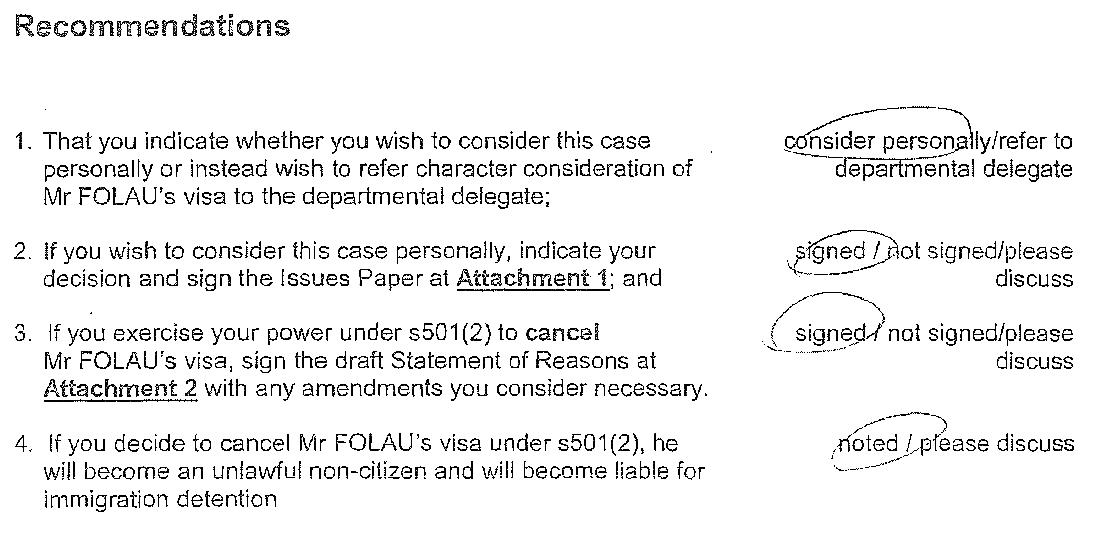
The Minister selected from the options presented to him as indicated above and by the Minister signing and dating the page. That process can be taken to have been followed in every other case in which the Minister made other cancellation and refusal decisions under s 501 of the Act since becoming the Minister until 17 March 2016. The facts deemed to have been admitted by the Minister include that all of the statements of reasons in respect of the other decisions were prepared by someone other than the Minister, and that they were all signed by the Minister, and that in each case the Minister made or requested no changes to any of the other statements before signing them.
18 The facts that the Minister did not make any changes to the statement of reasons and that he did not make any changes to any of the other statements of reasons do not alter the facts that the decision was made by the Minister and that he adopted the statement of reasons as his own. The fact that the Minister made the decision himself can be seen from the formal selection by the Minister personally of the cancellation outcome option which had been set out as one of the options available to him. The formal decision included the Minister’s selection of the cancellation outcome by circling that option and by the subsequent signing and dating of the formal decision. The adoption of the draft statement of reasons by the Minister can be seen by the Minister having signed and dated the last page of the draft which had been prepared for his consideration. The process adopted in this case is similar to that upheld in Maxwell v Minister for Immigration and Border Protection (2016) 149 ALD 604 and Navarrete v Minister for Immigration and Multicultural and Indigenous Affairs [2004] FCA 1723. In Maxwell Perry J said at [31]:
As to the second issue, it can be inferred from the evidence that the Minister adopted the draft reasons prepared by the Department: see by analogy in Javillonar v Minister for Immigration and Multicultural Affairs (2001) 114 FCR 311; [2001] FCA 854 (Javillonar). In those circumstances, the fact that the Minister’s reasons were not prepared by the Minister personally is not relevant: Javillonar at [24]. In particular:
(1) The Department’s brief to the Minister contained all of the relevant material to the decision whether or not to cancel the applicant’s visa (see above at [14]).
(2) In making the cancellation decision, the Minister signed the following statement:
I have considered all relevant matters including an assessment of the character test as defined by s 501(6) of the Migration Act 1958, and all evidence before me provided by, on behalf of, or in relation to Mr Raymond Wilson MAXWELL in connection with the possible cancellation of his Class BB Return (Residence) Subclass 155 (Five Year Resident Return) visa.
In so doing, the Minister confirmed that she had personally considered the issues paper and all of the material relied upon by the applicant. In any case, it can be inferred that the Minister considered all of the material before her: Ayoub v Minister for Immigration and Border Protection (2015) 231 FCR 513; [2015] FCAFC 83 (Ayoub) at [49] per Flick, Griffiths and Perry JJ.
(3) The Minister made a decision consistent with the draft reasons prepared by the Department.
(4) By crossing-out the “non-cancellation outcomes” on the front page of the issues paper and signing the base of that page, the Minister expressed her intention to select the “Cancellation outcome” option which expressly adopted the draft reasons in stating that “[m]y reasons for this decision are set out in the attached Statement of Reasons” (emphasis added).
(Emphasis in original)
In Navarrete Allsop J (as the Chief Justice then was) said at [39]-[40]:
39 Before turning to the terms of the draft reasons, it is necessary to deal with an anterior point. The applicant was critical of the procedure whereby draft reasons were provided for adoption. It was a procedure, it was said, which was conducive to poor decision-making. It was put at one point that in a context where there is merits review by the Administrative Appeals Tribunal for a decision of this kind made by a delegate, but no merits review when the decision is made personally by the Minister a set of draft reasons was undermining of, or inimical to, that statutory distinction. Whether the process is one which will promote good decision-making is not for me to comment on or decide. My concern is legality: Attorney-General (NSW) v Quin (1991) 170 CLR 1 at 25-6 and 33-4. In Minister for Immigration and Multicultural Affairs v W157/00A (2002) 125 FCR 433, in the context of an issues paper being found not to be reasons, and of the Minister having failed to comply with s 501G of the Act, Branson J said the following at [39] (with which Goldberg J at [84] and I at [88] agreed):
I doubt that s 501G(1) is intended to require that the notice therein referred to should emanate from the Minister in the sense that it must be drafted by the Minister. In my view, it would be sufficient for the Minister to adopt as his or her own written reasons prepared by a departmental officer provided, of course, that such reasons actually reflected the reasons why the Minister had reached his or her decision. …
40 If the Minister gave no consideration to the terms of the draft, for instance because the author was known to be reliable and she was prepared to sign a memorandum from that person without giving it consideration, it might be said that there was jurisdictional error for the failure by the Minister to make the decision personally. However, there was no evidence here upon which I could conclude otherwise than that the draft reasons were adopted by the Minister as her own reasons after due consideration and that she made the decision for herself and adopted the draft reasons therefor.
It is true, as was submitted for Mr Folau, that the draft reasons contained normative statements and expressed reasoning of the author of the draft. It is also true that a different author might have expressed different normative views or might have expressed the reasons differently or might have considered different matters in reaching the same conclusion. However, that does not alter the fact that the actual decision was made by the Minister and that the Minister adopted the draft reasons as his own in making the decision which he made.
19 Accordingly, the application will be dismissed.
I certify that the preceding nineteen (19) numbered paragraphs are a true copy of the Reasons for Judgment herein of the Honourable Justice Pagone. |
Associate:


