

FEDERAL COURT OF AUSTRALIA
Minister for the Environment v Hansen [2016] FCA 1146
ORDERS
Applicant | ||
AND: | Respondent | |
DATE OF ORDER: |
THE COURT DECLARES THAT:
On 6 April 2014, the respondent, Christopher George Hansen, contravened s 354(1)(f) of the Environment Protection and Biodiversity Conservation Act 1999 (Cth) (the Environment Protection Act) by conducting commercial rock lobster fishing activities in the Marine National Park Zone of the Tasman Fracture Commonwealth Marine Reserve.
THE COURT ORDERS THAT:
1. The respondent, Christopher George Hansen, pay to the Commonwealth of Australia a pecuniary penalty of $28,000 pursuant to s 482 of the Environment Protection Act by reason of the above contravention.
2. The respondent, Christopher George Hansen, pay the applicant’s costs of and incidental to these proceedings as taxed or agreed.
3. In lieu of proceeding to taxation or seeking to reach agreement as to the applicant’s costs, the applicant may, within 7 days, or such further time as the Court allows, elect to file and serve an application by way of an affidavit for a fixed costs order pursuant to s 43(3)(d) of the Federal Court of Australia Act 1976 (Cth).
4. If the applicant does make an application in accordance with order 3 above, the respondent, Christopher George Hansen, be given a further 7 days, or such further time as the Court allows, in which to file any affidavit or submission in opposition to a fixed costs order being made.
5. If any application is made in accordance with order 3 above, whether or not it is opposed the determination of the application will be made on the papers in Chambers.
Note: Entry of orders is dealt with in Rule 39.32 of the Federal Court Rules 2011.
BROMWICH J:
Introduction
1 The applicant, the Minister for the Environment, brought civil penalty proceedings in this Court against the respondent, Christopher George Hansen, a commercial fisherman. The Minister alleged that in April 2014, Mr Hansen engaged in illegal fishing for rock lobsters in a Commonwealth Marine Reserve south-west of Hobart, Tasmania. Mr Hansen ultimately did not dispute that was so.
2 The Minister sought the imposition on Mr Hansen of a civil penalty under s 481 of the Environment Protection and Biodiversity Conservation Act 1999 (Cth) (the Environment Protection Act) for a breach of s 354(1)(f) of that Act. The Minister also sought a declaration and an order for costs under ss 21 and 43 respectively of the Federal Court of Australia Act 1976 (Cth). None of that relief was ultimately opposed by Mr Hansen, either in concept or in quantum. For the reasons that follow, it is appropriate to grant all of the relief sought by the Minister, in order to deter such conduct in the future.
Legislative regime
3 The following provisions of the Environment Protection Act are relevant:
354 Activities that may be carried on only under management plan
(1) A person must not do one of the following acts in a Commonwealth reserve except in accordance with a management plan in operation for the reserve:
(a) kill, injure, take, trade, keep or move a member of a native species; or
(b) damage heritage; or
(c) carry on an excavation; or
(d) erect a building or other structure; or
(e) carry out works; or
(f) take an action for commercial purposes.
Civil penalty:
(a) for an individual—500 penalty units;
(b) for a body corporate—5,000 penalty units.
…
481 Federal Court may order person to pay pecuniary penalty for contravening civil penalty provision
Application for order
(1) Within 6 years of a person (the wrongdoer) contravening a civil penalty provision, the Minister may apply on behalf of the Commonwealth to the Federal Court for an order that the wrongdoer pay the Commonwealth a pecuniary penalty.
Court may order wrongdoer to pay pecuniary penalty
(2) If the Court is satisfied that the wrongdoer has contravened a civil penalty provision, the Court may order the wrongdoer to pay to the Commonwealth for each contravention the pecuniary penalty that the Court determines is appropriate (but not more than the relevant amount specified for the provision).
Determining amount of pecuniary penalty
(3) In determining the pecuniary penalty, the Court must have regard to all relevant matters, including:
(a) the nature and extent of the contravention; and
(b) the nature and extent of any loss or damage suffered as a result of the contravention; and
(c) the circumstances in which the contravention took place; and
(d) whether the person has previously been found by the Court in proceedings under this Act to have engaged in any similar conduct.
…
482 What is a civil penalty provision?
A subsection of this Act (or a section of this Act that is not divided into subsections) is a civil penalty provision if:
(a) the words “civil penalty” and one or more amounts in penalty units are set out at the foot of the subsection (or section); or
(b) another provision of this Act specifies that the subsection (or section) is a civil penalty provision.
483 Contravening a civil penalty provision is not an offence
A contravention of a civil penalty provision is not an offence.
…
485 Recovery of a pecuniary penalty
If the Federal Court orders a person to pay a pecuniary penalty:
(a) the penalty is payable to the Commonwealth; and
(b) the Commonwealth may enforce the order as if it were a judgment of the Court.
(Bold and italics in original.)
4 The relevant provision relied upon by the Minister was s 354(1)(f), which proscribed taking an action for commercial purposes, in this case commercial fishing, in a Commonwealth reserve except in accordance with a management plan in operation for the reserve. The reserve in question is detailed further below.
5 At the time of the events to which this proceeding relates in April 2014, a penalty unit was $170. That amount has since increased to $180, and from now on will automatically increase in line with inflation every three years. A contravention of s 354(1) of the Environment Protection Act in April 2014 therefore carried a maximum civil penalty of $85,000 for an individual and $850,000 for a company.
Facts
6 The established facts in this case have been arrived at by way of a statement of agreed facts dated 29 January 2016, a further statement of agreed facts dated 20 May 2016 and a supplementary statement of agreed facts dated 21 June 2016. Similarly, the submissions made by the Minister were adopted by counsel for Mr Hansen, who described them orally as essentially joint submissions.
7 While all of those agreed facts, including detailed annexures with maps, diagrams, photographs and scientific information, have been taken into account in arriving at the decision in this case, I set out in summary form what seems to me the most important of those facts.
Background
8 The Minister is responsible for the administration and enforcement of the Environment Protection Act. He is assisted in his functions by the Department of the Environment.
9 Mr Hansen is a commercial fisherman with about 10 years’ experience. He is currently, and was in 2014:
(1) conducting business as a commercial fisherman;
(2) a supervisor on a Fishing Licence and Fishing Certificate issued under the Living Marine Resources Management Act 1995 (Tas), the Licence including a rock lobster licence with a specified entitlement number; and
(3) the owner of a fishing boat, the Breakwater Bay.
10 In April 2014, Mr Hansen was authorised under the Licence to use the Breakwater Bay to conduct commercial rock lobster fishing activities in the Tasmanian Rock Lobster Fishery, using a maximum of 42 rock lobster pots.
The South-east Commonwealth Marine Reserves Network
11 On 28 June 2007, the South-east Commonwealth Marine Reserves Network (the SEC Marine Reserves Network) was proclaimed pursuant to s 344(1) of the Environment Protection Act. The SEC Marine Reserves Network comprises 14 reserves covering over 388,000 square kilometres in the south-eastern part of Australia off the coasts of South Australia, Victoria, New South Wales and Tasmania. The 14 reserves in the SEC Marine Reserves Network were established to protect and maintain marine biodiversity, to contribute to what is known as the National Representative System of Marine Protected Areas, and to help ensure the long-term ecological viability of Australia’s marine ecosystems.
12 The SEC Marine Reserves Network is the subject of the South-east Commonwealth Marine Reserves Network Management Plan 2013-2023 made pursuant to s 366(1) of the Environment Protection Act (the Management Plan). The Management Plan provides a broad description of the South-east Marine Region, and a summary of regional features represented in the SEC Marine Reserves Network.
13 The Management Plan also identifies the conservation values protected by the SEC Marine Reserves Network and includes information about pressures and potential threats to those values requiring active management and monitoring to ensure the conservation and other objectives are achieved. Each reserve is categorised, and when divided into zones, each zone is categorised, in accordance with International Union for Conservation of Nature (IUCN) categories. Schedule 8 of the Environment Protection and Biodiversity Conservation Regulations 2000 (Cth) provides administrative guidance and also defines what activities are allowable and under what circumstances they may be undertaken. These arrangements, detailed further below, indicate the national and international significance of the areas of the environment sought to be protected, and the careful and thorough nature of the regulatory regime established to achieve that purpose.
14 Two of the 14 reserves in the SEC Marine Reserves Network are located immediately off the southernmost coast of Tasmania. One of those two reserves is the Tasman Fracture Commonwealth Marine Reserve (the Tasman Fracture Reserve), located in the area from the continental shelf near the coast south-west of Hobart and stretching to the southern border of Australian waters, which is also the southern border of Australia’s main 200 nautical mile exclusive economic zone. The Tasman Fracture Reserve is depicted in the map below, copied from the main statement of agreed facts.
15 As depicted in the map below, the Tasman Fracture Reserve is divided into:
(1) a 21,313 km2 southern special purpose zone, coloured in darker blue;
(2) a 20,496 km2 northern multiple use zone, coloured lighter blue; and
(3) a relatively much smaller 692 km2 north-eastern marine national park zone closest to the Tasmanian coast (the Marine National Park Zone), coloured in green, and also reproduced in larger format on the bottom right hand side of the map.
This case concerns illegal rock lobster fishing in the smaller Marine National Park Zone, closest to the Tasmanian coast.
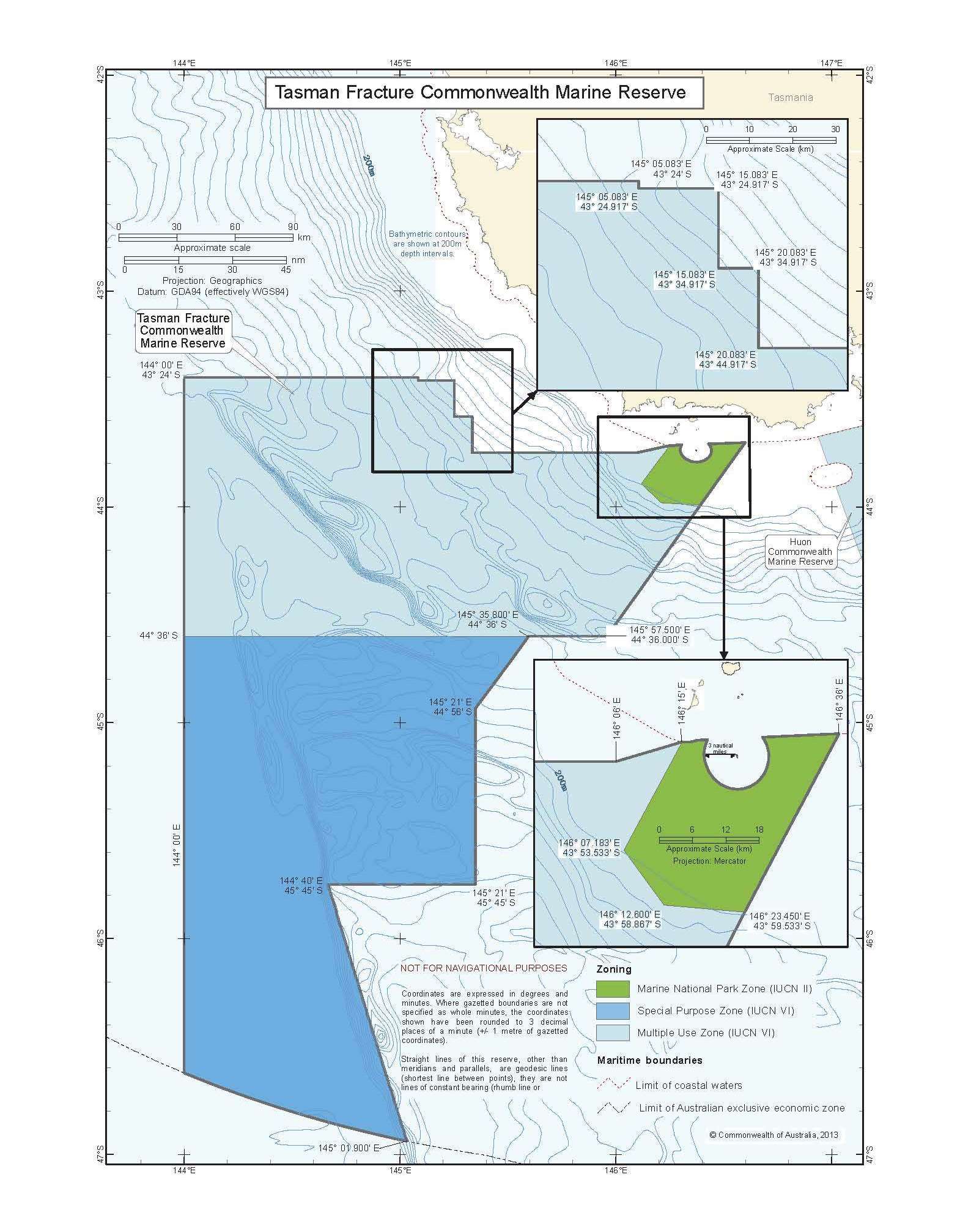
16 The Marine National Park Zone has been separately identified as an area subject to particular management arrangements. In particular, it was managed as a “Sanctuary Area Zone” in accordance with IUCN “category Ia” from June 2007. It has been managed as a “Marine National Park Zone” in accordance with IUCN “category II” since 1 July 2013. No fishing of any kind is permitted in the Marine National Park Zone. As noted above, the illegal rock lobster fishing activities by Mr Hansen took place in the Marine National Park Zone.
17 The boundaries of the Marine National Park Zone fall within the Tasmanian Rock Lobster Fishery, which is Tasmania’s most valuable wild harvest fishery. It has a value to the Tasmanian economy of about $84 million per annum at the point of first landing, supporting some 230 licensed businesses and a further 20,000 recreational fishing licenses. Areas where rock lobster fishing is permitted and areas where rock lobster fishing is not permitted adjoin one another. Once a rock lobster has been taken from a forbidden area and moved into a permitted area, it may be impossible for enforcement authorities to be able to establish its illegal status. This necessarily makes effective enforcement of the regime to prevent illegal fishing, an already difficult task, inherently more difficult to carry out.
Physical features of the Marine National Park Zone
18 As described above, and depicted in the map above, the Marine National Park Zone is a relatively small area on the north-eastern tip of the much larger Tasman Fracture Reserve. The map depicts an almost circular carve-out which forms part of Tasmanian State waters and is therefore not part of the Marine National Park Zone. That carve out is about six nautical miles in diameter. Fishing generally, and rock lobster fishing in particular, is permitted within that carve-out area, which includes a location known as “Mewstone” (also referred to as “the Mewstone”). The map below shows Mewstone, the Marine National Park Zone and, by an “X”, the location of the illegal fishing detailed below.
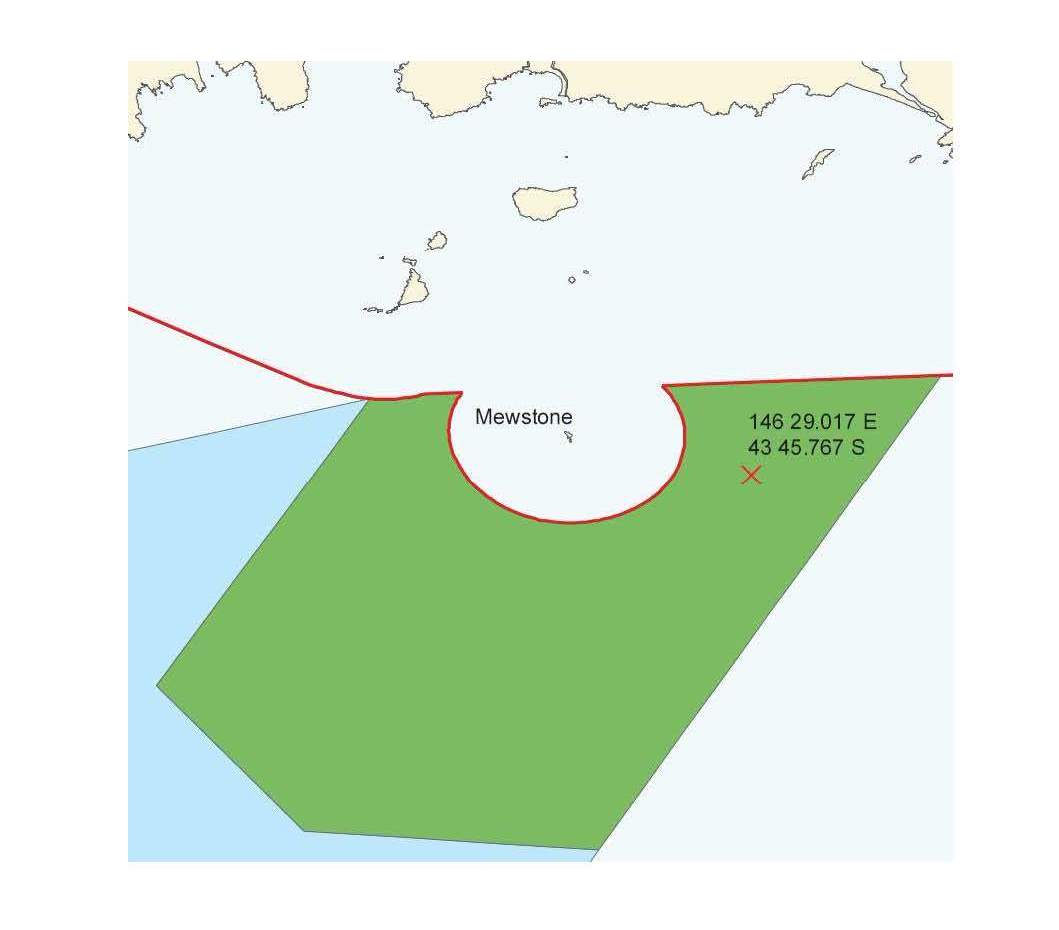
19 The area to the east of Mewstone and within the green Marine National Park Zone is part of the area where fishing generally, and rock lobster fishing in particular, is forbidden. As noted above, the area where fishing in general, and rock lobster fishing in particular, is forbidden adjourns the area where this activity is permitted. However, as the description of the protected Marine National Park Zone area below makes clear, this area is more likely to produce rock lobster fishing success than legal fishing areas such as Mewstone.
20 Until he finally capitulated, Mr Hansen had admitted to being in the Marine National Park Zone, but did not admit to fishing there and maintained that he had instead fished only in the nearby permitted area at Mewstone. The red X on the map above indicates where the Breakwater Bay was sighted by aerial surveillance on 6 April 2014. Mr Hansen subsequently admitted in the further statement of agreed facts that while he was aware that commercial rock lobster fishing in the Marine National Park Zone was unlawful, he chose to fish there because he believed that his chances of catching good-sized rock lobsters were good, and that his risk of being detected was low.
21 Mr Hansen’s assessment of a low risk of detection was sound. The further statement of agreed facts makes it clear that the monitoring of commercial fishing in the SEC Marine Reserves Network is difficult and costly. As a practical matter, this must take place by physical surveillance by air or sea, neither of which can easily be carried out covertly. Over the preceding three years, the Department has spent almost half a million dollars on active compliance monitoring in the SEC Marine Reserves Network.
22 The assessment by Mr Hansen of good fishing prospects in the area of the Marine National Park Zone where he fished illegally was doubtless based on his lengthy experience. That assessment is supported by the objective scientific evidence before the Court. The sea floor in between Mewstone and the area of the Marine National Park Zone from where Mr Hansen retrieved his rock lobster pots (i.e., where the contravention in question occurred) is predominantly sandy in character. There is a rocky reef outcrop in the vicinity of the location where the lobster pots were retrieved. That rocky reef outcrop is approximately 1,000 metres long and 400 metres wide at its widest point, and rises approximately 40 metres from the sea floor to within 100 metres of the surface. It is the only rocky reef outcrop in the area of the Marine National Park Zone east of Mewstone.
23 The sea floor in the Marine National Park Zone has been extensively mapped in full three-dimensional detail with soundings of the sea floor taken for every square metre. This mapping produces what is effectively a photographic image of the sea floor. Maps produced from this data, showing the physical features and depths of the sea floor of the Marine National Park Zone and the area where Mr Hansen retrieved the rock lobster pots formed part of the evidence attached to the statement of agreed facts. Those maps show the location of the Breakwater Bay when it was observed by aerial surveillance and the physical features of the sea floor in relation to Mewstone. They also include a detailed “top-down” view of the physical features of the sea floor, focussing on the region where the Breakwater Bay was observed by the surveillance flight. The maps provide a detailed isometric view map showing the physical features of the rocky reef outcrop.
24 The maps in evidence demonstrate starkly the difference between the area where the Breakwater Bay was positioned to lay and retrieve the pots illegally and the surrounding area. The rocky reef outcrop is an ecologically significant feature in the Marine National Park Zone as it provides a habitat and shelter for a range of native species, including rock lobsters, which is not available on the generally sandy sea floor which otherwise characterises the area. Rock lobsters seldom travel any great distance across open terrain and usually seek out structures, such as the rocky reef outcrop, for shelter and to forage for food.
25 Sustained commercial fishing, even through the use of only a few pots at a time, can destroy rock lobster populations in marine protected areas. Even low levels of fishing can have substantial impacts on rock lobster populations, detracting from the benefits and objectives of prohibiting fishing in those areas. Other impacts of illegal fishing in marine reserves include physical damage to sea-floor habitats, especially from setting and dragging fishing gear, for example, by natural currents. Moreover, the loss of larger rock lobsters upsets the ecological balance. Reduced consumption by rock lobsters of their prey, especially sea urchins which strip reefs of seaweed and algae, produces a vicious cycle of habitat degradation for rock lobsters and other species. None of these collateral detriments can be quantified, let alone attributed to this particular episode of illegal fishing. But they strongly inform the need for general deterrence.
Rock lobster fishing using commercial rock lobster pots
26 Commercial rock lobster fishing involves trapping rock lobsters in pots baited with fish heads. Rock lobster fishers seek out sea floor areas characterised by reefs and rocky ledges, known as “rock lobster bottom”, on which to set their pots.
27 Rock lobster bottom is found using plotters and maps and also by using scanners to determine the character of the sea floor. The areas in which fishing is forbidden are naturally more likely to have greater numbers of rock lobsters, especially if the protected area, as in this case, contains prime rock lobster habitat.
28 Rock lobster pots are “set” by lowering them onto the sea floor at the end of a line made of rope. The pots are weighted so that they are heavier on the bottom to ensure they remain upright on the sea floor. They are designed so that undersized rock lobsters and other animals can escape. Once a rock lobster has entered the pot it remains there unless it is small enough to exit through the escape gaps or is able to exit the entrance at the top of the pot.
29 To facilitate location and retrieval, buoys are attached to the other end of the line attached to the pot. Because the buoys cannot suspend the pot above the sea floor due to the weight of each pot, the lines must be long enough to enable the buoys to remain visible on the surface.
30 Rock lobster pots are only allowed to be left for a maximum of 48 hours. Accordingly, the fishing vessel that has set them needs to return to the location to retrieve them within that time. Ordinarily, multiple buoys are attached to the end of the line going down to the pot so that the line can be more easily retrieved by a gaff or grappling hook and also more easily seen.
31 Rock lobster pots are usually retrieved using a type of mechanical winch known as a “pot hauler”. Although Mr Hansen used a combination of mechanical hauling and hauling without mechanical assistance depending on the circumstances, in relation to the events to which these proceedings relate, due to the weather conditions and depths involved, Mr Hansen used a pot hauler.
32 When rock lobsters are caught they must be assessed to determine whether they can be legally kept, especially having regard to their size.
Mr Hansen’s commercial fishing trip
33 In March and April 2014, including in particular the period from 29 March 2014 to 6 April 2014, Mr Hansen used the Breakwater Bay to conduct a commercial fishing trip in the waters off the southern coast of Tasmania. Throughout this trip, Mr Hansen was the skipper of the Breakwater Bay and had one crew member. The fishing actions taken by the Breakwater Bay’s crew member were taken at Mr Hansen’s direction, or with his agreement.
34 In accordance with his Licence conditions, Mr Hansen maintained a limit of 42 rock lobster pots. Each of those 42 pots used by Mr Hansen during the fishing trip was set in accordance with the methodology outlined above and was:
(1) up to 850 mm in diameter and up to 400 mm high with a “bee-hive” or “domed” shape;
(2) made of tea tree sticks and wire, with a wire base, and weighed between approximately 13 and 20 kg out of the water; and
(3) attached to four buoys which were at least 195 mm in diameter at the widest point.
35 As required by law, at least one of the four buoys displayed the Breakwater Bay’s distinguishing mark, in this case, “L25”. As was pointed out during the course of oral submissions, it is significant that a marked buoy was used by Mr Hansen, because it signified a lack of subterfuge and therefore the opportunistic nature of his conduct. That the conduct was opportunistic only means that it was not planned in advance, but rather spurred by opportunity. It remained deliberate and was carried out over a sufficient period of time for reconsideration and a decision not to engage in illegal fishing. It still entailed, albeit in a shorter timeframe, an assessment of the risk of being caught against the benefits to be derived from illegal fishing.
36 Every pot set by Mr Hansen or his crew member during the March-April 2014 fishing trip was set for the purpose of commercial rock lobster fishing.
37 As required by law, Mr Hansen completed the required catch records. The catch record book had standard instructions issued by the relevant Tasmanian department. In accordance with the instructions in his catch record book, Mr Hansen completed entries in the record on each day he was fishing during the trip until the book was confiscated by police on 7 April 2014.
Mr Hansen’s knowledge of the Reserve
38 At all times during the March-April 2014 fishing trip, Mr Hansen knew the approximate geographic location of the Marine National Park Zone of the Tasman Fracture Reserve, and knew that commercial rock lobster fishing was not permitted there. During that fishing trip, Mr Hansen was aware of and kept copies of a guide for users of the SEC Marine Reserves Network and a document entitled “Class Approval – Commercial Fishing – South-east Commonwealth Marine Reserves Network Management Plan 2013-2023 – Section 5.2.7”.
Mr Hansen’s actions and detection by surveillance
39 On 6 April 2014, a Commonwealth marine surveillance flight observed the Breakwater Bay within the Marine National Park Zone of the Tasman Fracture Reserve. The requirements in that zone are that a transiting vessel must travel at a minimum speed of 5 knots (5 nautical miles per hour) with fishing gear kept stowed and secured at all times. Although it is not expressly stated, I infer that Mr Hansen may have been noticed by the surveillance flight because, as a result of seeking to retrieve the lobster pots, the Breakwater Bay was either stationary or moving more slowly than the required minimum speed of 5 knots. I infer this would have drawn the attention of those conducting the surveillance because of the possibility that the activity signified illegal fishing was taking place (as indeed it was).
40 The surveillance flight took photographs of the Breakwater Bay and of the three sets of four rock lobster pot buoys in the vicinity of the vessel. One of those photographs shows the Breakwater Bay near one of the rock lobster pots marked with three white buoys and one red buoy.
41 Another of the photographs taken by the surveillance flight shows the geographic coordinates of the Breakwater Bay when the photograph was taken. Those coordinates place the Breakwater Bay and the rock lobster pot buoys at a location approximately 3.5 kilometres inside the nearest boundary of the Marine National Park Zone.
42 The aerial surveillance photographs are remarkably clear; so much so that they could be mistaken as having been taken from another vessel nearby. They demonstrate the effectiveness of this expensive mode of detection and enforcement. Once observed, a fishing boat engaged in illegal fishing is very exposed and its operators are unable to hide. The advantage of being on the open sea and until then hard to detect becomes a disadvantage. In this case, Mr Hansen was effectively caught red-handed. His denials and attempt to give an innocent explanation for his conduct as detailed below was a doomed enterprise.
43 At the time Mr Hansen was observed by the surveillance flight, he knew that the Breakwater Bay and the three lobster pots attached to the buoys were inside the Marine National Park Zone of Tasman Fracture Reserve where fishing is prohibited. When Mr Hansen heard and saw the surveillance flight pass over, he started driving the vessel out of the Tasman Fracture Reserve. Photographs were taken of the Breakwater Bay departing the area.
44 After being outside the boundaries of the Tasman Fracture Reserve for around two hours, Mr Hansen returned to the location in the Marine National Park Zone and retrieved the three rock lobster pots. I note that there was no surveillance of this taking place and therefore it was a fact agreed to by Mr Hansen. However, I also note that it was a fact that was readily able to be inferred, especially in civil penalty rather than criminal proceedings.
45 Each rock lobster pot retrieved was raised from the sea floor using a pot hauler. Each rock lobster pot was attached to four buoys by about 120 metres of rope and had the physical characteristics summarised above and referred to in more detail in the agreed statement of facts.
Rock lobsters unloaded to the fish processor
46 On 7 April 2014, Mr Hansen unloaded the rock lobsters he caught during the fishing trip for sale to the fish processor “Southern United Seafood” at Nubeena. Nubeena is the place of mooring for the Breakwater Bay. Nubeena is near Port Arthur, south-east of Hobart.
47 Mr Hansen completed a commercial rock lobster quota docket in respect of the rock lobsters caught during the fishing trip. That document reveals that the total number of rock lobsters unloaded and therefore caught during the fishing trip was 785.
Interview with Tasmania Police
48 On the same day that Mr Hansen unloaded the rock lobsters at Nubeena, three officers from the Marine Division of Tasmania Police attended the Breakwater Bay at Nubeena wharf and interviewed Mr Hansen. The officers also took several photographs. During the course of the interview, Mr Hansen:
(1) said he had been fishing at Mewstone off and on for the previous ten days, that about three or four days ago the swell had been quite large (up to five metres), and that it was fairly windy at about 25-30 knots from the west;
(2) pinpointed that day as being 4 April 2014;
(3) described having had a day shot and was working east of Mewstone;
(4) said that he discovered that he was six out of the 42 lobster pots down;
(5) said that each of his pots had four buoys on them;
(6) said that because the tide was being a bit of an issue for the crew, they had a bit of a scout around and gave up on the other six pots;
(7) said that he kept fishing with the remaining 36 pots and was hoping that the others would bob up, which they would normally do if they were down with the tide but because the pots he used, being stick pots, were not all that heavy he presumed that they had taken off;
(8) said that he had fished until the previous day, 6 April 2014, until they were out of bait and it was time to head home;
(9) said that he started heading east when he got about two and a half miles away from where they had “shot the gear”, and saw a cluster of three pots within 25 or 35 metres of each other;
(10) said the pots were all very close and that he was about to throw a grapple on them because he identified that they bore his markings;
(11) said that he was about to start pulling them in and realised they were in the sanctuary zone;
(12) said that he did not know if there was a procedure but being on the seas he just wanted to pull them up and go home;
(13) said that he was about to start pulling them in when he heard a noise and saw the plane go straight over the top of them;
(14) said that he panicked and started driving out of the zone;
(15) said that he knew straight away, in effect, that he was in the wrong place because he had the Commonwealth zoning book on board;
(16) said that he knew the rules that you had to be travelling at 5 knots when transiting a Commonwealth zone with fishing gear on board and they were fully loaded up with fishing pots, being the 36 remaining pots;
(17) said that he zoomed out of the zone and contemplated what to do; and
(18) said that in the end he “went back in, pulled the gear and steamed home”. That is, he pulled in the three pots that they had found but could not see the other three pots.
49 It follows that the essential story that Mr Hansen had constructed, falsely as it turns out, was that the reason why the three pots had ended up within the Marine National Park Zone in which rock lobster fishing was forbidden was that they had been dragged there by a combination of wind and tide. This story was fanciful in the extreme and was unlikely to have convinced any judge that it was a remotely plausible explanation for what had taken place in light of the surveillance evidence in particular. Undoubtedly, it was a recognition of this reality that ultimately caused Mr Hansen to capitulate and to admit that he had been caught out fishing illegally.
Subjective circumstances
50 The further statement of agreed facts dated 20 May 2016 stated that Mr Hansen is 38 years of age and is married with two young children. According to that statement, his wife is employed part-time, earning approximately $100,000 per annum before tax.
51 Mr Hansen completed high school and commenced casual farming work for several years, after which he was employed to operate boats at a commercial salmon producer. He first purchased a boat for commercial rock lobster fishing in about 2004. He obtained his Masters 5 certification in 2010, which enabled him to purchase and operate the Breakwater Bay for commercial rock lobster fishing. Mr Hansen’s commercial rock lobster fishing business is carried on through a trust in which he and his wife are the trustees and unit holders.
52 Mr Hansen’s taxable income for the financial years ending 30 June 2012 – 2015 peaked at just over $59,000 in 2015, but with a net income of just over $14,000 before tax. There had been a degree of profit and loss volatility over the immediately preceding years. There has not been a positive cash return to the trust over the past five years by reason of any surplus funds being rolled over for operational purposes. The trust has never paid a dividend. At the end of the 2015 financial year, the trust had negative net assets of just over –$72,000. Although the Breakwater Bay is valued at about $235,000, as at the end of the 2015 financial year the business owed just over $82,000 to a bank. Neither the trust, nor Mr Hansen owns or has ever owned the licence under which the Breakwater Bay operates, instead leasing rock lobster fishing quota from third party licence holders.
53 Notwithstanding the above, no submission was made that Mr Hansen was not in a position to pay either the agreed penalty or the Minister’s costs, although the quantum of costs was not able to be agreed. Nor was any application made for time to pay. In light of the findings I have made, that was probably a wise forensic choice and it is unlikely that any such submissions would have enjoyed success without compelling evidence, able to be tested. As discussed below, Mr Hansen has achieved quite a favourable agreed outcome in all the circumstances.
Consideration
Primacy of deterrence
54 The plain and express objective of the Minister in bringing these proceedings was not to punish, but rather to deter. That approach accords with the decision of the High Court in Commonwealth v Director, Fair Work Building Industry Inspectorate [2015] HCA 46; (2015) 326 ALR 476 (the CFMEU civil penalty case). The plurality in the CFMEU civil penalty case made it clear at 490 [55] that the proper function of a civil penalty is “primarily if not wholly protective in promoting the public interest in compliance”, citing and quoting from Trade Practices Commission v CSR Ltd (1991) ATPR 41-076 at 52,152.
55 This case involves a clear example of the application of the principles endorsed in the CFMEU civil penalty case, given that the gain from the conduct of about $200 was relatively trivial compared to the sanction and costs to be imposed, and the need for deterrence, both general and specific, was substantial. The notion of deterrence in the context of this case warrants some further elaboration.
56 Applying the CFMEU civil penalty case approach to deterrence for the purposes of the protection of the environment, and having regard to the circumstances of this specific contravention, the Minister, on behalf of the community, simply wants Mr Hansen and other would be wrongdoers to think twice and decide not to act against the strong public interest in properly maintaining Australia’s marine reserves. Importantly, such reserves are a vitally important contribution to the maintenance of a viable and sustainable recreational and commercial fishing industry, for the benefit of the entire Australian community.
57 The cost and difficulties of enforcement of any environment protection law, and of marine environment protection laws in particular, from detection, through to investigation and on to commencing and conducting civil penalty (or for that matter, criminal prosecution) proceedings makes specific and general deterrence of particular importance. Any effective enforcement of positive obligations and of prohibitions to protect the environment necessarily depends on successful compliance activity, including surveillance and other enforcement activity and the bringing of proceedings such as these, increasing the risks associated with non-compliance. That is especially so when the benefits of non-compliance are not just matters of convenience or self-indulgence, but material benefits such as profit or other personal gain. It is not that convenience or self-indulgence are in any way mitigatory, but rather that those motives may be seen to be more easily displaced by the deterrence of a risk of a substantial monetary sanction.
58 The more difficult the task of detection and enforcement, the greater the sanction required, so as to make the risk/benefit equation less palatable to a potential wrongdoer and the deterrence sufficiently effective in achieving voluntary compliance. Tipping the balance of the risk/benefit equation in this way is even more important when the benefit in contemplation is profit or other material gain, even if not substantial. It is especially important if there are disadvantages, including costs, in complying with legal obligations for those who decide to be law-abiding. If it costs more to obey the law than to breach it, a failure to enforce and to adequately sanction contraventions de facto punishes all who do the right thing.
59 The incentives for fishers to cheat on their competitors by fishing illegally are substantial if no more needs to be considered than a perceived low risk of being caught with minimal financial consequences: see Minister for Sustainability, Environment, Water, Population and Communities v Woodley [2012] FCA 957; (2012) 194 LGERA 290 at 301 [62]. It follows that inadequately sanctioning cheating of this kind when detected detracts from the better instinct of honest fishers to obey the law, and to act in the best interests of the environment. It is therefore important that those who do voluntarily comply see that those who do not are dealt with appropriately. That is, in a sense, the flip side of deterrence; it is in fact a dimension of the general deterrence equation. This is not to give any licence to impose a disproportionate or oppressive penalty, which cannot take place, but rather that proportionality is measured in the wider context of the demands of effective deterrence and the corresponding virtue of voluntary compliance: see Minister for the Environment v Thermal Dell Pty Ltd [2014] FCA 1442 at [51] and the cases there cited of Walden v Hensler (1987) 163 CLR 561 at 570; and NW Frozen Foods Pty Ltd v Australian Competition and Consumer Commission (1996) 71 FCR 285 at 293F; see also CSR Ltd at 52,152-3.
60 Even if not extensively planned, or even considered much in advance, breaches of the kind carried out by Mr Hansen will usually entail a degree of contemplation and choice. In this case, it was expressly agreed that, although opportunistic rather than pre-planned, his contravention was deliberate. The right decision is more likely to be made if the sanction is substantial relative to the possible gain. The critical importance of deterrence has therefore informed the approach to be taken to what might otherwise be seen as less serious conduct by Mr Hansen. It is the primary consideration in assessing the objective seriousness of his conduct and in deciding whether the civil penalty sanction the parties have agreed should be imposed is sufficient.
Sufficiency of civil penalties in general and as agreed by the parties
61 In considering the sufficiency of a proposed civil penalty, regard must be had to the maximum penalty. In Markarian v The Queen [2005] HCA 25; (2005) 228 CLR 357 at 372 [31], it was observed, in a criminal sentencing context, that “careful attention to maximum penalties will almost always be required, first because the legislature has legislated for them; secondly, because they invite comparison between the worst possible case and the case before the court at the time; and thirdly, because in that regard they do provide, taken and balanced with all of the other relevant factors, a yardstick.” Markarian reasoning as to the need to have regard to the maximum penalty when considering the quantum of a civil penalty was applied in the Environment Protection Act cases of:
(1) Woodley at 298 [40]-[41], 300 [50];
(2) Thermal Dell at [37];
(3) Minister for the Environment v Karstens [2015] FCA 649 at [20]; and
(4) Minister for the Environment v Lucky S Fishing Pty Ltd [2015] FCA 10; (2015) 323 ALR 723 at 729-731 [53].
62 It is important to note that, in an appropriate case, the maximum penalty may be imposed for a breach in the worst category even when worse cases can be envisaged: see by further analogy Saffron (No 3) v R (1988) 39 A Crim R 123 at 126.5, citing Veen v The Queen (No 2) (1988) 164 CLR 465 at 478.2. It cannot safely be assumed that a civil penalty will always be less than the maximum just because substantially worse contraventions can be contemplated.
63 Having regard to the fact that a maximum penalty of $85,000 for an individual applies and is to be considered even if not a single fish or rock lobster is caught, illegal fishing of the kind engaged in by Mr Hansen entails a serious civil penalty contravention. With some reservations, I accept the submission by counsel for the Minister, not disputed by counsel for Mr Hansen, that this contravention as measured by the penalty figure is capable of being characterised as being at the lower end of the mid-range of objective seriousness. However, this characterisation should not be applied mathematically to produce a middle band civil penalty range from which the quantum to be imposed should be derived. Such an approach is contrary to principle, at least in the hands of a judge, and therefore for a judge in assessing whether an agreed penalty is appropriate: see NW Frozen Foods at 292, 295F as to the importance of evaluating all of the factors; see also by analogy Barbaro v The Queen [2014] HCA 2; (2014) 253 CLR 58 at 72 [34]. Yet such an approach appears to have informed the figure arrived at between the parties, for practical reasons that are understandable. That approach gives too much primacy to the maximum penalty, instead of treating it as one of a number of relevant factors, albeit one of considerable importance. Put another way, a contravention that is objectively in the mid-range of objective seriousness may not, for that reason alone, transpose into a penalty range somewhere in the middle between zero and the maximum penalty.
64 Given that the primary objective is deterrence, then objective seriousness of the instant contravention must be weighed principally against that consideration. If, for example, there had been evidence of any significant prevalence of this kind of contravention, a particular threat to the rock lobster habitat or that rock lobster populations were endangered, then that would have elevated further the need for deterrence and justified a higher penalty. As Markarian reasoning makes clear, the maximum penalty, while important, is but one yardstick that must be applied.
65 Counsel for the Minister submitted, counsel for Mr Hansen did not dispute, and I readily accept, that the primacy of deterrence discussed above is required to be considered in the context of the mandatory considerations applying to the fixing of the amount of a pecuniary penalty in s 481(3) of the Environment Protection Act. Three of those four mandatory (but not exhaustive) considerations apply to this case. They are:
(1) the nature and extent of the contravention;
(2) the nature and extent of any loss or damage suffered as a result of the contravention; and
(3) the circumstances in which the contravention took place.
Detailed consideration of Mr Hansen’s contravention, the legal and factual context in which it arose and Mr Hansen’s particular conduct and circumstances has been carried out above.
66 The fourth mandatory consideration in deciding what the appropriate deterrent penalty should be, namely any prior like conduct, does not arise in this case. If it had applied, the principles for subsequent contraventions would apply, most likely to reduce any first time contravention discount (as opposed to being a circumstance of aggravation): see Veen at 477.6, adjusted to focus on civil penalties and deterrence, and not punishment, retribution and rehabilitation.
67 Mr Hansen’s total illegal catch was three rock lobsters, with a market value of about $200. At first blush, and out of context, that does not appear to be especially serious. However, that first impression is incorrect. For the reasons detailed above, Mr Hansen’s conduct was sufficiently serious to require a real and effective sanction to deter both him and others from conduct in contravention of the Environment Protection Act, including but not limited to illegal fishing. That deterrence should help to reduce the risk of damage to the environment.
Authorities on civil penalties for illegal fishing by individuals
68 I was referred to two civil penalty authorities dealing with illegal fishing by an individual. While authority suggests the outcome in prior civil penalty cases should not be used by a Court to determine for itself what the appropriate penalty is in a given case, that restriction does not so aptly apply to a Court in assessing whether a proposed agreed penalty is, or is not, permissible or appropriate: cf NW Frozen Foods at 295C.
69 It may be, in any event, that the time has come to reassess the true scope of the limitation expressed in NW Frozen Foods on taking into account the civil penalties imposed in other cases. Prior civil penalties can legitimately form an important part of the instinctive synthesis to be applied in deciding what an appropriate civil penalty should be, both when one has been agreed upon, and when no agreement has been reached. This is especially so for three reasons.
70 First, the restriction identified in NW Frozen Foods was not advanced by the Full Court as being against the virtue of reasonable consistency, nor as an abstract principle of wide-ranging application to all classes of civil penalty cases. To the contrary, their Honours made specific reference to equality before the law being a hallmark of justice and endorsed prior authority stating that “corporations guilty of similar contraventions should incur similar penalties” and “[t]here should not be such an inequality as would suggest that the treatment meted out has not been even-handed”: at 295A.
71 Secondly, the restriction on having regard to the outcome in prior civil penalty cases was expressed in the context of a heterogeneous class of civil penalty cases which gave rise to real difficulties of comparison: NW Frozen Foods at 295B. The problem identified in NW Frozen Foods was that the class of civil penalty cases under consideration involved complicated competition law provisions in which the variety of factors from case to case made meaningful comparison difficult. Comparison by reference to the penalty imposed in such cases was likely to be an illusory benefit, having regard to such things as differing circumstances, size, market power and responsibility for the contraventions: NW Frozen Foods at 295B. Those wide ranging differences do not necessarily apply, at least to the same extent, to all other kinds of civil penalty provisions. In employment cases, and even more so in environmental cases, there will often be greater similarity of circumstances allowing for better comparisons to be made. It is axiomatic that any comparative cases sought to be relied upon must bear some reasonable degree of similarity to the case at hand, and for such similarities (and any material differences) to be identified.
72 Thirdly, the approach to the fixing of civil penalties, especially when not agreed, should probably be reviewed in light of the parallel jurisprudence developed over recent years in relation to the careful and limited use of comparative sentences in criminal proceedings in aid of the fundamental objective of any justice system that like cases are treated in a like manner, working as a system that is systematically fair by way of such things as reasonable consistency: see Barbaro at 73 [38], Wong v The Queen [2001] HCA 64; (2001) 207 CLR 584 at 591 [6], Hili v The Queen [2010] HCA 45; (2010) 242 CLR 520 at 535 [47]-[48], 538 [57], and R v Pham [2015] HCA 39; (2015) 325 ALR 400 at 405-7 [24]-[29] and 410 [46].
73 In any event, I do not consider that NW Frozen Foods, properly understood as outlined above, stands in the way, in all cases, of having regard to the outcomes in other broadly comparable civil penalty cases in the process of deciding whether or not a proposed agreed penalty is permissible and appropriate (cf Thermal Dell at [52] and Lucky S Fishing at 733-4 [67]). This approval is not dissimilar to the process contemplated by the Full Court in Minister for Industry, Tourism & Resources v Mobile Oil Australia Pty Ltd [2004] FCAFC 72; (2004) ATPR 41-993 at 48.627 [54] in referring to a permissible range, and by the High Court in the CFMEU civil penalty case at 484-5 [32] in referring to the range of permissible penalties, to appropriate penalties, and to verification; see CFMEU civil penalty case at 490-1 [56].
74 Prior civil penalties imposed for broadly similar conduct, while no more than historical statements of what has happened in the past, remain useful in appropriate cases as guidance by way of a yardstick against which to examine a proposed agreed civil penalty. An analogy is the accepted reasoning for deciding upon the duration of gaol terms for serious criminal offences by reference to comparative sentences considered, with express limitations, in Director of Public Prosecutions (Cth) v De La Rosa [2010] NSWCCA 194; (2010) 79 NSWLR 1 at 70-1 [303]-[305], cited and quoted with approval in Hili at 537 [54], to be read in the context of the immediately preceding and following paragraphs and in the context of 527 [18].
75 Of course, a prior civil penalty does not create any binding precedent, any more than a prior criminal sentence does: see Wong at 605 [57], 608 [66], endorsed in Pham at 406-7 [29]. Whether deciding upon a civil penalty or deciding whether a proposed agreed penalty is appropriate, there is no single correct figure: see NW Frozen Foods at 290.9-291.1; see by analogy Pearce v The Queen [1998] HCA 57; (1998) 194 CLR 610 at 624 [46]; Markarian at [27]. Rather the task is to arrive at, or approve, a penalty upon the basis that it falls within an acceptable range, without it ordinarily being possible to know, let alone state precisely, what the upper or lower limits are: Barbaro at 70 [27], 74 [41]; and Hili at 535 [53]-[54]. What is required is reasonable consistency of outcomes to ensure systemic fairness.
76 Any analogy between criminal sentence comparatives and prior civil penalty cases must be applied with caution, not least because of the obvious differences between civil penalty and criminal proceedings, including in particular those identified by the High Court in the CFMEU civil penalty case at 490-3 [52]-[64]. However, notwithstanding those important and fundamental differences, especially as to the role of the regulator in legitimately seeking to influence the quantum of penalty and the proper role of agreed penalties, prior civil penalty outcomes can be a useful guide, by way of a yardstick as part of a process of instinctive synthesis in deciding whether a proposed agreed civil penalty is permissible and appropriate in all the circumstances. The alternative would be to treat prior penalties imposed in other comparable cases as wholly irrelevant, whereas the vice to be avoided is in treating prior penalties as being, in themselves, in any way determinative of the penalty to be imposed in the case at hand, a point well recognised in the effective ban on numerical tables, bar charts and graphs of gaol terms in criminal sentencing: Pham at 406 [28(5)] and 407 [32]; see also 405 [24] and 410 [46]. It is not the civil penalty previously imposed on its own and out of context that is useful as any sort of fixed guide or precedent, but rather that outcome in context as the end product of a process of instinctive synthesis, having regard to the principles applied and the weight given to the various facts and circumstances, as a civil penalty yardstick.
77 Regard may also be had to Pham at 405-7 [24]-[29] as to the use of comparative sentence yardsticks and their limitations, which again has some application in appreciating the limitations of prior civil penalty cases beyond their usefulness in identifying and applying legal principles. An additional cautionary note is that, as with federal criminal sentencing for less common serious criminal offences, there is not yet a large pool of environmental civil penalty case outcomes from which to derive any sense of what emerges as to penalty outcomes from the reasonably consistent application of the relevant principles, especially as to deterrence. As such a pool of cases grows over time, the principled use of them will become more important and more valuable.
78 As I was only directed to a handful of broadly comparable cases, there not being very many such cases available, the yardstick value of the outcomes in those cases is very limited even though the nature of the contraventions in each is not substantially different to the present case. In the first case that I was referred to, Woodley, illegal rock lobster fishing took place in the same protected area as in this case, namely the Marine National Park Zone of the Tasman Fracture Reserve. No rock lobsters were caught and it was accepted that, unlike this case, the contravention was unintentional. Other aspects of the objective seriousness of the breach and the considerations taken into account, especially as to general deterrence, were similar to this case. Foster J ordered the payment of $13,000 by a fisher and $65,000 by his family company. His Honour also ordered payment of an agreed contribution towards the Minister’s costs of $17,000 and $28,000 respectively. The maximum civil penalty at that time was $55,000 for an individual, and $550,000 for a corporation.
79 Mr Woodley had similarly poor financial circumstances to those of Mr Hansen. A single case does not make a range, but it would be difficult for Mr Hansen to think he is hard done by in comparison to Mr Woodley, which may well explain his agreement to the penalty proposed by the Minister and the sound legal advice he must have received. But for the agreement reached, taking Woodley into account in the limited way I have identified, in the context of all the other factors present, may well have contributed to an inclination to impose a more severe penalty on Mr Hansen than that agreed by the parties. I note in that regard the view expressed in NW Frozen Foods at 291F (and the prior cases cited therein) that judges should refrain from stating the penalty that they would have imposed but for agreement.
80 The potential for a difference in outcome alone is not such as to permit me to decline to accept the agreed penalty as being within a permissible and appropriate range, even though the metes and bounds of such a range can never be identified with precision. Even if a substantial body of prior civil penalty cases establishes a range of penalties that have in fact been imposed, that history does not establish that such a historic range is the correct range for the case at hand, or that the upper or lower limits so disclosed are the correct upper or lower limits: again, see Hili at 537 [54]; see also Barbaro at 70 [24] – 71 [28] and Pham at 405-6 [27].
81 The second case I was referred to was Karstens. In that case, Jagot J was dealing with a case of illegal commercial handline fishing in another sanctuary zone in the Solitary Islands Commonwealth Marine Reserve on the north coast of New South Wales off Coffs Harbour. Mr Karstens knew fishing was illegal there, but thought the risk of detection was low and took his chances and did in fact catch a fish. When detected, he unsuccessfully attempted to flee. Mr Karstens had a prior summary criminal conviction, but he did not persist with fiction about not fishing illegally once proceedings were commenced. By contrast, Mr Hansen’s proceedings were headed towards a contested hearing, albeit with most objective facts agreed, when he finally gave up the fight and admitted to the contravention as well.
82 Jagot J in Karstens had regard to the case of Woodley discussed above and also to the other Environment Protection Act cases against corporate respondents, Thermal Dell and Lucky S Fishing, as well as more general civil penalty cases and principles. The same maximum penalty of $85,000 applied in Karstens, and the penalty imposed was $45,000 after a discount from $60,000 of 25% for significant cooperation. This is substantially more than the penalty proposed for Mr Hansen, for conduct that appears to me to be at least as serious. That has caused me to pause and consider whether this casts doubt on the appropriateness of what has been proposed. In the final result, I do not consider that I can say that the penalty proposed for this case is outside what is permissible and appropriate. A single more severe result in a similar prior case on its own does not of itself allow that conclusion to be reached, applying by analogy the first five of seven criminal sentencing principles summarised by the High Court in Pham at 406 [28] as follows, citations omitted (the remaining two principles address only the role of intermediate appeal courts):
…
(1) Consistency in sentencing means that like cases are to be treated alike and different cases are to be treated differently.
(2) The consistency that is sought is consistency in the application of the relevant legal principles.
(3) Consistency in sentencing for federal offenders is to be achieved through the work of intermediate appellate courts.
(4) Such consistency is not synonymous with numerical equivalence and it is incapable of mathematical expression or expression in tabular form.
(5) For that and other reasons, presentation in the form of numerical tables, bar charts and graphs of sentences passed on federal offenders in other cases is unhelpful and should be avoided.
…
83 The outcome in Karstens would have been part of a range of factors that may have inclined me towards imposing a higher penalty had agreement not been reached between the parties. After all, while numerical equivalence is neither possible nor desirable, it remains the case that, akin to the system of criminal justice, civil penalty justice should be systematically fair and entail reasonable consistency in the application of the relevant penalty setting principles and therefore in the outcomes reached: see Hili at 535 [47]-[48]; see also Pham at 406-7 [29].
84 Counsel for the Minister described the agreed figure as reflecting the lower end of the mid-range of objective seriousness, with a discount of about 15% for cooperation including consent to the facts, submissions, quantum of penalty and a costs order. Although agreed to, the size of the penalty imposed is only just within the range that I consider was appropriate for this conduct once regard is had to the deliberateness of the breach and the delay in conceding the contravention had occurred. That state of satisfaction is necessary before the agreed penalty figure can be adopted and ordered to be paid: see Mobile Oil at 48,627–48,628 [52]-[58], which was approved and succinctly summarised by the High Court in the CFMEU civil penalty case at 484-5 [32].
85 If I was not satisfied that the agreed proposed penalty was appropriate, I would have needed either to return to the parties for further evidence or information, or given the parties an opportunity to withdraw their agreement and proceed to a contested penalty hearing. However, the Court’s mere preference for a different figure would not suffice to reject the agreed figure except in a clear case: NW Frozen Foods at 291B; quoted with apparent approval in the CFMEU civil penalty case at 483 [28]. That does not confine the Court to starting with the agreed figure, but does require some process of comparison with an independent assessment of what would be an appropriate or permissible range to apply to the case at hand: Mobile Oil at 48,626 [51(vi)]. The Court must be independently satisfied that the submitted penalty is appropriate: CFMEU civil penalty case at 489 [48]. As I have already indicated, regard can be had to the outcomes in other reasonably comparable cases in reaching that state of independent satisfaction.
86 In the broadly similar case of Karstens referred to above, costs of the Minister were agreed and ordered in the sum of $45,000, a figure that counsel for Mr Hansen referred to in oral submissions. Once Mr Hansen has met his own costs and those of the Minister, which in combination are going to be substantial, his brief foray into illegal fishing will have cost him well over $50,000 and most likely something approaching $100,000. To this must be added the additional inconvenience, burden and stress on Mr Hansen of being involved in the investigation and legal proceedings for a period of over two years since the incident in April 2014. Mr Hansen and others minded to engage in such conduct in the future should seriously consider whether it is worth the risk of such a significant overall impost, stress and inconvenience, and the risk of serious damage to the environment, for such a paltry gain of only about $200.
87 Even with a low risk of being caught, the consequences of a substantial civil penalty, costs and the Minister’s costs should make it plain to Mr Hansen and others like him that such a small gain, even if multiplied by a factor of 100 or more, means it is simply “not worth the candle” to engage in conduct of this nature: see Australian Securities and Investments Commission v Vizard [2005] FCA 1037; (2005) 145 FCR 57 at 68 [48].
88 Had Mr Hansen disputed his liability, taken this matter to trial and had the case proven against him, a greater penalty would have been inevitable. The comparative cases that I was referred to, detailed above, indicate that after a contested hearing a much more substantial penalty would have been justified as being within reasonable contemplation, because: (1) there was room for a significantly higher starting point, (2) there would have been little or no discount for cooperation, and (3) the need for specific deterrence would have been greater.
89 A post-contested hearing in which the Minister succeeded would also have been accompanied by a costs order in favour of the Minister involving much higher costs, and would have involved much greater costs of his own for Mr Hansen to meet. Mr Hansen has been very well advised not to take that course. The approach he has taken has undoubtedly saved him quite a lot of money.
90 Given his conduct, Mr Hansen was also fortunate not to have been investigated and prosecuted for a possible criminal offence under s 354A of the Environment Protection Act, for which the maximum penalty at the time for an individual such as Mr Hansen was imprisonment for two years and/or a fine of $170,000. For a body corporate, the maximum fine for the criminal offence under s 354A could be up to five times that amount, ie $850,000, pursuant to s 4B(3) of the Crimes Act 1914 (Cth). It should be noted that since 31 July 2015, the maximum fine for the criminal offence for an individual has increased to $180,000 ($900,000 for a body corporate) and the maximum civil penalty for an individual has increased to $90,000 ($900,000 for a body corporate): see s 4AA(1) of the Crimes Act 1914 (Cth). As noted earlier, those criminal and civil penalties will continue to rise as they are indexed to increase every three years.
91 Taking all of the above facts and circumstances into account, I am satisfied that the agreed penalty of $28,000, being about a third of the maximum penalty applicable at the time, is permissible and appropriate, if somewhat lenient. In my assessment, the agreed penalty of $28,000 is at or towards the bottom of the acceptable range. It follows that I would also have been willing to agree to a more severe penalty. While Mr Hansen’s ultimate cooperation reduced the penalty that would otherwise have been imposed for his breach, I would not have been willing to agree to a less severe penalty, at least without some greater degree of mitigation. He has been well-served by his lawyers.
92 In light of all of the above, I am satisfied that it is appropriate and permissible to:
(1) grant declaratory relief as to Mr Hansen’s contravention of the Environment Protection Act, in that I am satisfied that the declaration sought by the Minister and agreed to by Mr Hansen is desirable, necessary and appropriate;
(2) impose upon Mr Hansen a civil penalty of $28,000, which is the amount the parties agreed upon; and
(3) order Mr Hansen to pay the Minister’s costs, which are not agreed but which may be resolved by agreement, assessment or the seeking of a fixed costs order by the Minister.
Costs
93 In my view it is not in the interests of the parties to prolong the time and expense of a costs assessment process, and for that reason I decided to allow the Minster to apply for a fixed costs order, should he wish to do so. This approach was foreshadowed at the penalty hearing. Mr Hansen may respond to any such application as he sees fit. If made, the application will be determined on the papers.
Conclusion
94 Mr Hansen is to pay a pecuniary penalty of $28,000. He is also to pay the Minister’s costs as agreed or assessed, or as may be ordered in response to an application for a fixed costs order.
I certify that the preceding ninety-four (94) numbered paragraphs are a true copy of the Reasons for Judgment herein of the Honourable Justice Bromwich. |
Associate:


