FEDERAL COURT OF AUSTRALIA
Bropho v City of Perth [2016] FCA 1098
ORDERS
Applicant | ||
AND: | First Respondent STATE OF WESTERN AUSTRALIA Second Respondent | |
DATE OF ORDER: |
THE COURT ORDERS THAT:
1. The originating application filed 3 June 2016 be dismissed.
2. Within 5 days the first respondent (and the second respondent, if the second respondent seeks to be heard on the matter) file a minute as to the appropriate orders as to costs to be made in the proceedings, supported by submissions.
3. Within 5 days thereof the applicant file corresponding material in response.
4. The question of final orders as to costs is to be determined by the Court on the papers.
Note: Entry of orders is dealt with in Rule 39.32 of the Federal Court Rules 2011.
MCKERRACHER J:
THE DISPUTE
1 Ms Bropho seeks a declaration that cl 30(3) of the Local Government Property Local Law 2005 (WA) (Local Law) is of no effect as against her and such other persons as enjoy native title rights on Heirisson Island on the Swan River in Perth (also known as Matagarup). Heirisson Island is located within the municipality of the City of Perth, the first respondent. The State of Western Australia has also been joined as a respondent. Ms Bropho, her predecessors and others have resided on and used that land from time to time for many years. Ms Bropho says they are entitled to be recognised as holders of native title. To restrain interference with such usage, Ms Bropho relies on s 211 of the Native Title Act 1993 (Cth) (NTA).
2 The City applies for summary dismissal of the claim against Ms Bropho primarily on the basis that it has no reasonable prospect of success. The State supports that application.
3 The Local Law prohibits certain activities, such as camping. Ms Bropho argues that as she will be entitled in due course, with others, to hold native title over Heirisson Island that s 211 NTA has the result that she is protected from application of the Local Law. She seeks orders confirming the entitlement she asserts and restraining the City from acting on the Local Law. There are several problems with this. Most significantly, assuming native title was held in respect of Heirisson Island, it has now been extinguished. For this and other reasons discussed below, the City and the State are entitled to have Ms Bropho’s application dismissed. It has no reasonable prospects of success.
GROUNDS OF DISMISSAL APPLICATION
4 The grounds of the City’s application for dismissal are that:
1. Pursuant to section 31A(2) of the Federal Court of Australia Act 1976 (Cth), alternatively rule 26.01 of the Federal Court Rules 2011, the Originating application under [the NTA] dated 10 June 2016 (Originating Application) be dismissed on the grounds that [Ms Bropho] has no reasonable prospects of successfully prosecuting the proceeding or no reasonable cause of action is disclosed, because:
(a) Any native title rights or interests which may have existed in the area of Matagarup (Heirisson Island) have been wholly extinguished:
(i) as confirmed by section 23B(7) of the Native Title Act 1993 (Cth) and section 12J of the Titles (Validation) and Native Title (Effect of Past Acts) Act 1995 (WA), by reason of Heirisson Island being a major earthwork and thereby a public work; alternatively
(ii) by the vesting of reserve 23063 on 22 December 1975; further or alternatively
(b) By-Law 30(3) of the City of Perth Local Government Property Local Law 2005 is not a law which prohibits or restricts persons from carrying on a class of activity to which section 211 of the Native Title Act 1993 (Cth) applies; further or alternatively
(c) The Originating Application is not an application under the Native Title Act 1993 (Cth) and therefore does not invoke the jurisdiction of the Court to make the order sought.
2. Further, or alternatively to order 1, pursuant to section 31A(2) of the Federal Court of Australia 1976 (Cth), alternatively rule 26.01 of the Federal Court Rules 2011, the Originating Application be dismissed insofar as it seeks a declaration that By-Law 30(3) of the City of Perth Local Government Property Local Law 2005 is of no effect as against persons other than [Ms Bropho], on the grounds that [Ms Bropho] does not have standing and is not authorised to seek such a declaration.
3. Alternatively to orders 1 and 2, in accordance with section 213(1) of the Native Title Act 1993 (Cth), the Originating Application be stayed pending the making of an approved determination of native title in respect of Matagarup (Heirisson Island).
....
EVIDENTIARY CONTEXT
5 Ms Bropho’s application is supported by a detailed affidavit affirming that she is a Swan River Nyungah. She is also an applicant in the National Native Title Tribunal WC 2011/002, Federal Court of Australia WAD 24/2011, known as the Swan River #2 Claim. The Swan River #2 Claim includes Matagarup (also known as Heirisson Island) to the east of the Perth Central Business District. The registration test decision in the Swan River #2 Claim was delivered on 11 October 2013. The conclusion was reached that the claim satisfied the registration test in s 190B NTA. It has not progressed.
6 There have been negotiations culminating in a document referred to as the South West Aboriginal Land and Sea Council Agreement (SWALSC Agreement). Presently before the Full Court of this Court are 107 objections to the SWALSC Agreement. Ms Bropho says that if the SWALSC Agreement is found not to be effective over land in respect of which native title is claimed in the Swan River #2 Claim, then the Swan River #2 Claim for native title will progress.
7 Matagarup is a registered Aboriginal site pursuant to the Aboriginal Heritage Act 1972 (WA) for camping, hunting and use as a meeting place. In Nyungah culture, Ms Bropho says that Matagarup is very important and a sacred place for Swan River Nyungah people. It was an important place for crossing the Swan River, it is sacred to women giving birth and Matagarup is ‘sacred in the river coming up there’. It is said to be sacred as a meeting place for corroborees and is on a songline that connects Uluru to the north and Matagarup. The songline is connected by corroborees. Corroborees and songlines keep the Nyungah culture strong. It is important, she says, for Matagarup that it have a traditional corroboree to keep the spirits of the river and of the trees strong. She affirms that elders from Uluru and the north-west of the State are saying that it is time to wake up the songline; that the songline has been dormant and that the good spirits must come back. Matagarup is a most important point in the songline, she says. No amount of money can replace these traditions and beliefs which keep the Nyungahs and traditional social structures strong. As a female elder, she has the role of keeping Matagarup spirits strong and the camp running smoothly. The elder women speak for the Island and the men have a supportive role.
8 Ms Bropho gives evidence that during 2012, 2015 and 2016 she and members of her family, Nyungahs and non-Nyungahs, both Aboriginal and non-Aboriginal people, camped on Matagarup. They looked after each other, cooking, teaching children about the river, maintaining the sacred fire, having music, storytelling and ceremonies. They called on the spirits in the trees, the river, ancestors and the sacred fire. They welcomed other Aboriginal and non-Aboriginal people to Matagarup in the traditional way and shared their food and belongings with many of those people. Many of those people were homeless and had nowhere else to stay where they felt safe.
9 In addition, Ms Bropho confirms that they have tourists come to meet with them and talk and learn about their culture. She explains that the tourists come and talk to them as there is no other cultural place in Perth to meet and talk with Nyungahs, according to the tourists. There are no alcohol and drugs in the Matagarup camp.
10 Rangers from the City used to visit them on Matagarup on a regular basis to see how the camp was being run, who was there and what their positions were. They saw that there were no drugs or alcohol or ‘anything to cause any problem’. The camp was kept tidy, rubbish collected and put out for the scheduled rubbish removal by the City. The camp is barely visible from the main causeway, according to Ms Bropho. It does not interfere with the traffic or other people going about their business in any way.
11 Ms Bropho used to go to Matagarup to fish and camp in her younger days with her grandmother, her mother and her father. She grew up listening to the Waugal making noises and hearing stories about the Waugal. City rangers used to visit in those times to ask if there was anything they needed. The rangers would bring firewood for cooking, they were friendly and helpful and those camping had no trouble from the rangers or the police.
12 On 19 February 2012, according to Ms Bropho, the City and the West Australian Police descended in numbers on Matagarup for the purpose of ‘tearing up’ the Nyungah camp there. This action was repeated on 23 February 2012 and 22 March 2012.
13 Ms Bropho says that on each of these occasions there were more than 60 police officers, including members of the tactical response group, horses and mounted police, police dogs, helicopters, river police in patrol boats, City rangers and contractors. They came in ‘large convoys’ of police vehicles, police vans and also rubbish trucks. There was substantial media coverage.
14 The scene painted by Ms Bropho depicts alarm and anxiety. She says that there were more than 50 police officers in attendance and more substantial media attention. There were about 60 campers on Matagarup and about 50 tents. Horses were ridden through the camping area. Ms Bropho says that the horses were lined up and then galloped towards the people as though they were ‘rounding us up’. The horses were enormous and came very close to the people and children. It was dangerous and frightening. She was terrified ‘by the hooves coming so close and the horses backing onto us.’ At one point, Ms Bropho says a mounted policeman rode his horse into and hit a young woman who was holding a baby. The police were apparently escorting the rangers from the City. The operation was conducted with ‘military precision’. The rangers and police spread across the camp and went where they were instructed. The City rangers had trucks and vans as well as people who appeared to be contractors. They started dismantling the tents, and throwing all of the tents, camping gear and supplies into the trucks. The supplies included food, bedding, clothes, personal effects, fishing rods, children’s toys and books, generators, and a wide range of miscellaneous material. The drivers of the trucks used the lifting equipment on the trucks to lift items from the ground and drop them into the trucks. Ms Bropho says the people of Matagarup were terrified. The children ran and hid in the trees. The City rangers did not take anybody’s name or make any lists of items that were taken or ‘tell us anything about what they would do with the goods they had taken’. When the City rangers left, there was nothing left of the peoples’ possessions which had been taken. Some items were removed by the owners. The City did not give any person any infringement notice for breaching any by-laws. There were no prosecutions for illegal camping as a result of the raid and seized goods were not returned. The raid was obviously expensive.
15 In 2015, there were nine further raids by the City, in March, April, June and July conducted to similar effect and causing considerable emotional trauma. No infringement notices were issued. Although, Ms Bropho says that, to the best of her knowledge, there were ‘a few’ move-on notices issued by police, and a few people were charged with disorderly conduct.
16 Again, this year, in 2016, there have been three raids conducted by the City on 5, 6 and 7 April 2016 to similar effect.
17 Other actions have included turning off water in the ablution block and the cessation of maintenance of septic tanks, creating urgent and serious health risks. Complaints were made to the Minister for Health. The City also installed concrete bollards to prevent vehicle access to the Island. When fires were lit by non-Aboriginal people to an area of Matagarup, the concrete bollards meant that emergency vehicles had difficulty accessing the area. Ms Bropho has not returned to Matagarup since the last raid. To the best of her knowledge a few people have camped on Matagarup since the last raid and a number of people have expressed an intention to camp there in coming weeks for traditional Nyungah activities, including those discussed in her affidavit.
18 Ms Bropho’s affidavit is supported by an affidavit from Ms Bahemia, Ms Bropho’s solicitor and counsel. Ms Bahemia annexes the reserve of the Department of Lands and Surveys, dated 20 March 1950 as to Swan No 23063 (the Reserve), published at p 722 of the Government Gazette of 24 March 1950, the proclamation as to Reserve number 23063, published at p 711 of the Gazette of 24 March 1950, and the revocation on 7 September 1960 of the Order in Council dated 20 March 1950, published at p 2921 of the Gazette of 19 September 1960.
19 As will be seen in the course of arguments, this material is produced to support a contention advanced on behalf of Ms Bropho that the proclamation of 1950 and the vesting order of 1950 were invalid, being inconsistent with the provisions of the relevant legislation; as a result there was no extinguishment of native title. The precise wording of these extracts from the Gazette is of some significance, as will be seen in the arguments concerning the validity of the proclamation.
20 The evidence in support of the City’s application is of a formal nature. The evidence from the solicitor for the City, proves that Heirisson Island is Lot 5268 on Deposited Plan 213977, and an A Class Reserve 23063 for the purpose of a public park, with the interest identified as a reserve under management order and the primary interest holder being the City. It was originally created as a Class A Reserve in 1950 by Proclamation of the Governor and publication of an order in the Gazette dated 24 March 1950 at p 722. On 1 December 1975, the purpose of the Reserve was changed from ‘Recreation (National Fitness)’ to ‘Public Park’. The Gazette for that purpose is produced. On 22 December 1975, the Reserve was vested in the City. The vesting order to that effect from the City’s public record was produced, as well as a Landgate search of Deposited Plan 213977, depicting the Reserve.
21 Ms Stevenson, the City’s solicitor, also puts into evidence a Master Plan Report entitled ‘Heirisson Island Sculpture Park’, produced in June 2008 for the City. On the basis of the content of that Report, Ms Stevenson deposes to her belief that the history of Heirisson Island is to the following effect:
(a) it was originally two small islands surrounded by mud flats;
(b) in 1842, a toll bridge was constructed over the two islands, close to the location of the exiting causeway;
(c) the mud flats were dredged over time, which resulted in the fusing of the two small islands with the material from the dredging;
(d) by 1900, a single landmass was formed, and, by 1930, the Island had been extended to its current size through dredging, the dumping of building rubble and the importing of sand and soil;
(e) the existing causeway was constructed in 1955;
(f) the Island was the site of the dumping of waste material until the 1960s; and
(g) in the late 1970s, major landscaping works were undertaken to develop the Island into parkland.
22 Photographs depicting these interesting developments were annexed to Ms Stevenson’s affidavit.
23 Ms Rebecca Moore, the Director of Community and Commercial Services for the City, produced records from the State Records Office relating to the construction of Heirisson Island showing the Public Works Department Plan 23644, a letter from the Under-Secretary for Works and Labour to Mr AL Ballantyne of 1 September 1993 and a letter from the Under-Secretary Premier’s Department to the Under-Secretary for Works of 13 June 1939. The letter to Mr Ballantyne deals with Mr Ballantyne’s apparent offer, as then registered proprietor of Heirisson Island, to sell it to the Government for £730 or government bonds or debentures. The offer was rejected. It was pointed out that the land was for years ‘awash’ and useless for all practical purposes and therefore ‘valueless’ from a market point of view. It was also pointed out that any land below and above the high water mark that may, in any event, be acquired for the then Swan River improvement scheme or resumed for the purpose of the improvement scheme, including the provision of roads to a level of six feet above the high water line.
24 The communication in 1939, referred to above, dealt with the irregular surface on Heirisson Island after dredging operations and a request (to assist the Police Department training their horses, amongst other things) for a grader to be run over the surface.
25 Ms Moore also produced the Order in the Gazette of 24 March 1950 at p 712, and the Order in Council in the Gazette of 31 December 1975, at p 4700, showing the vesting of the Reserve.
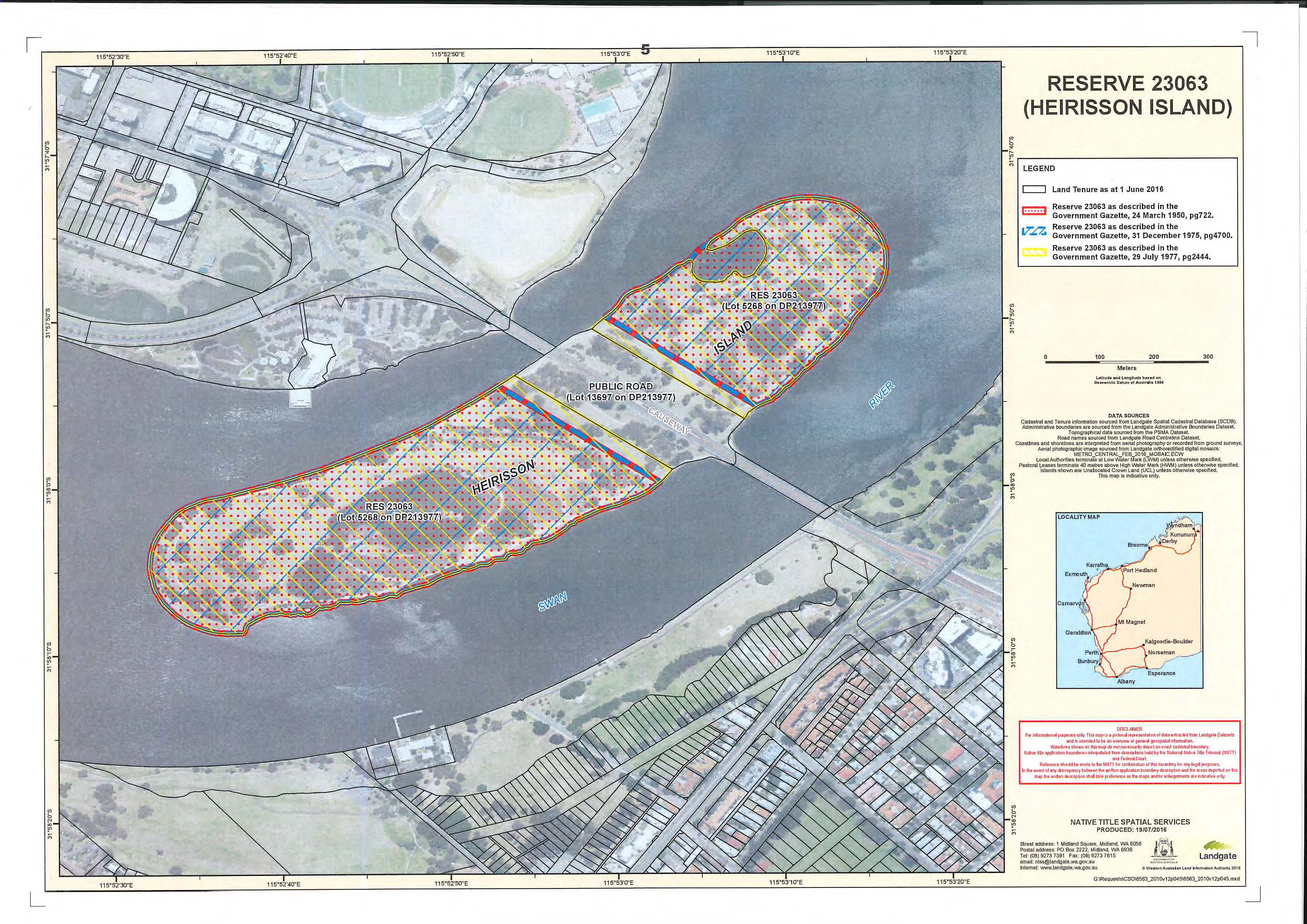
26 The State relies upon an affidavit by Mr Werner, Senior Consultant of the Graphic Services section of the Western Australian Land Information Authority, trading as Landgate. Landgate is, amongst other things, the statutory authority responsible for Western Australia’s land and property information and maintains the State’s official register of land ownership and survey information. Within Landgate is a section called Graphic Services. It is partially responsible for capturing and mapping native title application boundaries, collating information provided by other government agencies and supplying current and historical tenure. Mr Werner is a qualified cartographer and has held senior positions in that capacity. Mr Werner prepared a map showing the geographical extent of the Reserve as described in the Gazette entries proclaiming the creation and original vesting of the Reserve on 24 March 1950, the subsequent vesting of the Reserve on 31 December 1975, and the amendment of the Reserve on 29 July 1977, which established the current Reserve area. The map is annexed to these reasons as Annexure 1.
SUMMARY JUDGMENT
27 Section 31A of the Federal Court of Australia Act 1976 (Cth) relevantly provides as follows:
31A Summary judgment
…
(2) The Court may give judgment for one party against another in relation to the whole or any part of a proceeding if:
(a) the first party is defending the proceeding or that part of the proceeding; and
(b) the Court is satisfied that the other party has no reasonable prospect of successfully prosecuting the proceeding or that part of the proceeding.
(3) For the purposes of this section, a defence or a proceeding or part of a proceeding need not be:
(a) hopeless; or
(b) bound to fail;
for it to have no reasonable prospect of success.
(4) This section does not limit any powers that the Court has apart from this section.
…
28 The City relies upon s 31A(2) of the Federal Court of Australia Act and/or r 26.01 of the Federal Court Rules 2011 (Cth). In Corunna v South West Aboriginal Land and Sea Council (2015) 235 FCR 40, Barker J said (at [22]):
In Spencer v Commonwealth (2010) 241 CLR 118 the plurality (Hayne, Crennan, Kiefel and Bell JJ) at [60] said of the expression “no reasonable prospect” that full weight must be given to it as a whole. Their Honours confirmed that the power to dismiss an action summarily is not to be exercised lightly, but their Honours also emphasised that the evident legislative purpose revealed by the text of the provision will be defeated if its application is read as confined to cases of a kind which fell within earlier, different, procedural regimes. Thus, s 31A(3) provides that the certainty of failure (“hopeless” or “bound to fail”) need not be demonstrated in order to show that a plaintiff has no reasonable prospect of prosecuting an action.
29 I am mindful that the power to dismiss an action summarily is not to be exercised lightly, but, equally, the evident legislative purpose revealed by the text of the provision will be defeated if its application is read as confined to cases of a kind which fell within earlier, different procedural regimes. Certainty of failure or ‘hopelessness’ is not a requirement to be demonstrated in order to show that an applicant has no reasonable prospect of prosecuting an action.
30 It is clear that s 31A is directed to matters of substance, not technicalities or matters of form: White Industries Aust Ltd v Commissioner of Taxation (2007) 160 FCR 298 per Lindgren J (at [50]), and McAleer v University of Western Australia (No 3) (2008) 171 FCR 499 (at [39]).
31 Ms Bropho points to a reluctance on the part of this Court to determine native title cases on a summary basis where matters of extinguishment may arise. Principally, however, Ms Bropho argues the case on the basis that Western Australia v Ward (2002) 213 CLR 1 on which the respondents heavily rely has no relevant application to this proceeding.
THE ARGUMENTS
An overview
32 A key aspect of Ms Bropho’s quite succinct argument is that the vesting of the Reserve in 1950 was invalid. By that vesting, it was directed that the Reserve ‘vest in and be held by the Minister for Education in trust for the purpose of Recreation (National Fitness)’ (emphasis added). The invalidity arises, it is said, because the vesting was described as being a vesting ‘in trust’, which was then in 1950 no longer a valid means by which land could be vested following 1948 amendments to s 33 of the Land Act 1993 (WA) which repealed the former s 33 and removed the concept of land being held ‘in trust’. That form of vesting had been contained in the original s 33 to the Land Act. Ms Bropho says that because of the invalidity of that vesting, there can be no extinguishment of native title which may be found to presently exist at Heirisson Island. Further, she says, nothing done since then changes the position.
33 Ms Bropho does not seek any determination in this proceeding as to the existence of native title, but seeks declaratory relief on the basis that native title may well be established in the Swan River #2 Claim. If native title is not established, she accepts the declaration and accompanying injunction would fall away and be discharged.
34 The City raises several arguments as to why the claim for a declaration by Ms Bropho should be summarily dismissed. Chief amongst these, and supported by the State, is that the High Court decision of Ward dictates that any native title must be extinguished. It is said that the effect of the 1950 vesting was to wholly extinguish native title which may then have existed in the area of the Reserve. As the vesting is a previous exclusive possession act, extinguishment is confirmed by the NTA and also by the Titles (Validation) and Native Title (Effect of Past Acts) Act 1995 (WA) (TVA): Ward (at [249]-[261]).
35 Ms Bropho says, in response, that there was no occasion in Ward to consider the particular argument here advanced (being the effect of the 1948 amendments to the Land Act) and nothing in Ward dictates the outcome contended for by the City and the State. Ms Bropho accepts, however, that if this argument is wrong, then native title will be extinguished. Ms Bropho says that her application does not require this Court at present to reach any ruling as to whether or not native title presently exists, but the Court should apply conventional principles concerning the grant of injunctive relief, especially in circumstances where, if native title is found to exist, it will be deemed to have always existed.
Some preliminary matters
36 There are some key statutory provisions which arise on the arguments between the parties. Clause 30(3) of the Local Law is made pursuant to s 3.5 of the Local Government Act 1995 (WA). Clause 30(3) of the Local Law provides that:
A person shall not without a permit: –
(a) camp on, lodge at or occupy any structure at night for the purpose of sleeping on local government property; or
(b) erect any tent, camp, hut or similar structure on local government property other than a beach shade or windbreak erected for use during the hours of daylight and which is dismantled during those hours on the same day; or
(c) bring any material, man-made or natural, onto local government property for the purpose of constructing a hut or similar structure on local government property.
37 The expression ‘local government property’ is defined in cl 6 of the Local Law as meaning, relevantly, anything except a thoroughfare of which the City is the management body under the Land Administration Act 1997 (WA). There is no debate as to whether or not the Local Law would be applicable, but for the arguments advanced under the NTA and the Land Act.
38 Section 211 NTA provides as follows:
211 Preservation of certain native title rights and interests
Requirements for removal of prohibition etc. on native title holders
(1) Subsection (2) applies if:
(a) the exercise or enjoyment of native title rights and interests in relation to land or waters consists of or includes carrying on a particular class of activity (defined in subsection (3)); and
(b) a law of the Commonwealth, a State or a Territory prohibits or restricts persons from carrying on the class of activity other than in accordance with a licence, permit or other instrument granted or issued to them under the law; and
(ba) the law does not provide that such a licence, permit or other instrument is only to be granted or issued for research, environmental protection, public health or public safety purposes; and
(c) the law is not one that confers rights or interests only on, or for the benefit of, Aboriginal peoples or Torres Strait Islanders.
Removal of prohibition etc. on native title holders
(2) If this subsection applies, the law does not prohibit or restrict the native title holders from carrying on the class of activity, or from gaining access to the land or waters for the purpose of carrying on the class of activity, where they do so:
(a) for the purpose of satisfying their personal, domestic or non-commercial communal needs; and
(b) in exercise or enjoyment of their native title rights and interests.
Note: In carrying on the class of activity, or gaining the access, the native title holders are subject to laws of general application.
Definition of class of activity
(3) Each of the following is a separate class of activity:
(a) hunting;
(b) fishing;
(c) gathering;
(d) a cultural or spiritual activity;
(e) any other kind of activity prescribed for the purpose of this paragraph.
39 Section 7 and ss 31-34 inclusive of the Land Act as it stood prior to the 1948 amendment provide:
7. (1.) The Governor is authorised, in the name and on behalf of His Majesty, to dispose of the Crown lands within the State, in the manner and upon the conditions prescribed by this Act or by regulations made thereunder.
(2.) All grants and other instruments disposing of any portion of Crown lands in fee simple or for any less estate made in accordance with this Act shall be valid and effectual in law to transfer to and vest in possession in the purchasers the land described in such grants or other instruments for the estate or interest therein mentioned.
(3.) The Governor is authorised to make such grants and other instruments, upon such terms and conditions as to resumption of the land or otherwise as to him shall seem fit.
…
31. (1.) Whenever the Governor has reserved or may hereafter reserve to his Majesty any lands of the Crown for the purpose of parks, squares, or otherwise for the embellishment of towns, or for the recreation or amusement of the inhabitants, or for cemeteries, or for any other public purpose, the Governor may, by notice of reservation published in the Gazette, or by any subsequent notice so published, and subject to such conditions as may be expressed therein, classify such lands as of Class A; and if so classified, such lands shall for ever remain dedicated to the purpose declared in such notice, until by an Act of Parliament in which such lands are specified it is otherwise enacted.
(2.) Whenever the Governor has reserved or may hereafter reserve to His Majesty any lands of the Crown, and such lands are not classified as of Class A, the Governor may, at any time he thinks fit, classify such lands as of Class B, and on notice of such classification being published in the Gazette, such lands shall remain reserved from alienation or from being otherwise dealt with unless and until the Governor cancels such reservation by notice in the Gazette.
Provided that, in such case the Minister shall present a special report to both Houses of Parliament setting forth the reasons for such cancellation, and the purpose to which it is intended to devote the land; and such report shall be made to both Houses of Parliament within fourteen days from the cancellation, if Parliament is then in session, and, if not, within fourteen days after the commencement of the next session.
(3.) All other reserves made under this Part of this Act shall be classified as of Class C.
(4.) Nothing in this section shall prevent the survey and declaration of any necessary roads and streets through or over any reserve; or, in case of any reserve being made before the land is surveyed, shall prevent the amendment of the boundaries and area in such manner as may he found necessary on survey, but so that the total area shall not be reduced by more than one-twentieth part thereof.
32. When any reserve is not immediately required for the purpose for which. it was made, the Governor may grant a lease or leases thereof, for not exceeding ten years, for any purpose, at such rent and subject to such conditions as he may think fit. Provided no lease for a term exceeding one year shall be granted unless applications are called for by notice in the Gazette.
33. The Governor may by Order in Council published in the Gazette-
(a) direct that any reserve shall vest in and be held by any municipality, road board, body corporate, or persons to be named in the order, in trust for the like or other public purposes, to be specified in such order; or
(b) may lease the reserve in the form in the Fourth Schedule, or grant the fee simple, to secure the use thereof for the purpose for which such reserve was made.
In either case a power to sublet the reserve or any portion thereof may be conferred.
34. (1.) The Governor may, by Order in Council published in the Gazette, place any reserve under the control of any municipality, road board, body corporate, or persons, as a board of management, with power to make, repeal, and alter by-laws for the control and management of such reserves, for prescribing fees for depasturing thereon, or other use thereof, for directing the manner in which such fees shall be imposed, paid, collected, and disposed of, and to impose penalties for breach of such by-laws not exceeding in any case five pounds, and two pounds a day for a continuing breach, but not more than twenty pounds in the aggregate.
(2.) Such by-laws, and any alteration thereof, if opproved [sic] by the Governor, shall be published in the Gazette, and shall be laid before both Houses of Parliament within fourteen days after such publication, if Parliament be then sitting; and, if Parliament be not then sitting, with in fourteen days after its next meeting; and all such by-laws, when so published, shall have the force of law, and shall continue in force, unless repealed or altered as aforesaid, or disallowed by both Houses of Parliament.
40 The Land Act Amendment Act 1948 (No 53 of 1948) (WA) relevantly to the current arguments provided:
5. Section thirty-three of the principal Act is repealed and the following section substituted:-
33.(1)(a) In this section, unless the context otherwise requires-
"land" means land reserved pursuant to the provisions of this Act;
"Order" means Order in Council;
"person" means any municipality, constituted pursuant to the provisions of the Municipal Corporations Act, 1906-1947, and road board, constituted pursuant to the provisions of the Road Districts Act, 1919-1947, any other body corporate or any other persons;
"purpose" means the purpose for which the land is reserved pursuant to the provisions of this Act.
(b) Every Order made in pursuance of the provisions of this section shall-
(i) be published in the Gazette so soon after being made as is practicable;
(ii) commence to take effect upon publication in the Gazette;
(iii) describe the land affected by the Order;
(iv) specify the purpose for which the land affected by the Order is reserved, or may be leased or granted in fee simple;
(v) name the person -
in whom land is directed to be vested; to whom a lease of, or the fee simple in, the land is directed to be granted-
by the Order;
(vi) specify the conditions and limitations subject to which the Governor-
confers any power to lease or sub-lease the land;
directs the grant of a lease of, or the fee simple in, the land
by the Order.
(2) By Order the Governor may direct that-
any land shall, vest in and be held by any person for the purpose-
and by the same or any subsequent Order the Governor may, subject to such conditions and limitations as the Governor shall deem necessary to ensure that the land is used for the purpose-
confer upon that person, power to lease for the purpose the whole or any part of the land.
(3)(a) By Order the Governor may direct that-
any land shall be leased for the purpose, by instrument of lease in accordance with the form in the Fourth Schedule to this Act, to any person.
(b)(i) The person to whom the land is leased pursuant to the provisions of the last preceding paragraph may, with the consent of the Governor, sublet, for the purpose, the whole or part of the land, or mortgage for the purpose, the whole of the land.
(ii) The consent of the Governor may be given subject to such conditions and limitations as the Governor shall deem necessary to ensure that the land is used for the purpose and the consent shall be endorsed on the instrument of sublease or mortgage, as the case may be.
(4)(a) By Order the Governor may direct that-
any land shall be granted in fee simple to any person subject to the condition that the person shall not lease or mortgage the whole or any part of the land without the consent of the Governor and subject to such other conditions and limitations as the Governor shall deem necessary to ensure that the land is used for the purpose.
(b) The consent of the Governor may be given subject to such conditions and limitations as the Governor shall deem necessary to ensure that the land is used for the purpose.
(5) When the mortgagee of any land mortgaged with the consent of the Governor, whether before or after the commencement of the Land Act Amendment Act, 1948, completes the exercise of the power of sale or foreclosure pursuant to the mortgage, the land shall by force of this enactment be freed from any trust, condition, limitation, or other restriction, created or imposed in relation to the purpose.
(6) The provisions of this section shall apply in respect of all land reserved pursuant to the provisions of this Act prior to or after the commencement of the Land Act Amendment Act, 1948.
…
(emphasis added)
41 It is common ground (but for a key argument as to validity) that the whole of Heirisson Island, as it presently exists, is the subject of the Reserve, except for that portion which is the subject of the Causeway road reserve. The portion which is the subject of the road reserve does not require consideration because the Local Law does not apply to it and therefore it cannot be subject of the declaration or the injunction sought in the originating application.
42 As noted when considering the evidence, the Reserve was originally created by proclamation published in the Gazette on 24 March 1950 at p 722 for the purpose of ‘Recreation-National Fitness’. It was vested in the Minister for Education in trust pursuant to s 33 of the Land Act by order published in the Gazette on the same day at p 712 (emphasis added).
43 In September 1960, the 1950 Order vesting the Reserve was revoked. Subsequently, the purpose of the Reserve was changed to ‘Public Park’ by s 8 of the Reserves Act 1975 (WA), as noted in the Gazette on 22 December 1975 at p 4504. The Reserve was vested in the City to be held on trust for that purpose under s 33 of the Land Act by order made on 22 December 1975 and published in the Gazette on 31 December 1975 at p 4700 (emphasis added).
44 The 1950 and 1975 Orders were each in the following terms:
The Land Act, 1933-1948
ORDER IN COUNCIL
Corr. No. 1325/50.
WHEREAS by section 33 of the Land Act, 1933-1948, it is made lawful for the Governor to direct that any reserve shall vest in and be held by any municipality, road board, or other person or persons to be named in the order in trust for the like or other public purposes to be specified in such order; and whereas it is deemed expedient that reserve No. A 23063 (Swan Location 5268) should vest in and be held by the Minister for Education in trust for the purpose of Recreation (National Fitness); Now, therefore, His Excellency the Governor, by and with the advice and consent of the Executive Council, doth hereby direct that the before-mentioned reserve shall vest in and be held by the Minister for Education in trust for the purpose aforesaid, subject nevertheless to the powers reserved to him by section 37 of the said Act.
The Land Act, 1933-1972
ORDER IN COUNCIL
WHEREAS by section 33 of the Land Act, 1933-1972, it is made lawful for the Governor to direct that any Reserve shall vest in and be held by any person or persons to be named in the order in trust for the like or other public purposes to be specified as follows:-
…
File No. 1125/50, V6. – That Class “A” Reserve No. 23063 should vest in and be held by the City of Perth in trust for the purpose of “Public Work”.
…
Now, therefore, His Excellency the Governor, by and with the advice and consent of the Executive Council, does hereby direct that the before-mentioned Reserves shall vest in and be held by the abovementioned bodies in trust for the purpose aforesaid, subject nevertheless to the powers reserved to him by section 37 of the said Act.
45 The City and the State argue that the effect of the vesting in 1950 was to wholly extinguish any native title, which may then have existed in the Reserve.
EXTINGUISHMENT AND WARD
46 At the heart of the first and key dispute is whether the decision in Ward has the effect for which the respondents contend or whether the contention for Ms Bropho was not addressed in Ward and remains open to be argued.
47 The seminal decision of Ward, occupying 400 pages in the Commonwealth Law Reports, concerned an area of some 7,900 square kilometres of land in the East Kimberley region of Western Australia and some adjacent land in the Northern Territory. Some of the land in that area was subject to existing pastoral leases. Most of it involved land previously the subject of pastoral leases which had been abandoned or forfeited for non-payment of rent, for non-compliance with lease conditions or resumed for the purposes of the Ord River Project.
48 In considering the effect of designating land for reserves, a plurality of the High Court made clear (at [219]) that by designating land as a reserve for public purposes, even a purpose as broadly described as ‘public utility’, the executive acting pursuant to legislative authority decided the use or uses to which the land could be put. The executive was exercising the power that was asserted at settlement by saying how the land could be used. ‘The exercise of that power was inconsistent with any continued exercise of power by native title holders to decide how the land could or could not be used.’ The plurality of the High Court stressed (at [228]) that the relevant starting point is the legislation. It started with an examination of the vesting under the Land Acts, noting that under both s 42 of the Land Act 1898 (WA) and s 33 of the Land Act, provision was made for the Governor, by Order in Council published in the Gazette, to direct that a reserve ‘shall vest in and be held by’ the named body or persons ‘in trust for the like or other public purposes, to be specified in such order’. It was emphasised (at [234]) that ‘looking to the use that has actually been made of land distracts from the central inquiry which is an inquiry about rights created in others or asserted by the executive, not the way in which they may have been exercised at any time.’ Specifically, in relation to vestings under s 33 of the Land Act, the plurality of the High Court noted (at [235]) that the power given to the Governor, by Order in Council published in the Gazette, to direct that a reserve ‘shall vest in and be held by’ a named body or person ‘in trust for the like or other public purposes, to be specified’ in the Order (emphasis added). Against that, the Court stressed that s 33 was to be understood in its context, having regard to s 7, which empowered the Governor to ‘dispose of the Crown lands within the State, in the manner and upon the conditions’ prescribed by the Act or regulations. Crown lands were, in turn, defined. The plurality of the High Court (at [237]) then focussed on the four different kinds of transactions in relation to reserved lands catered for by ss 32, 33 and 34 of the Land Act, noting that under s 33 the Governor might direct that a reserve vest in a body or person to be held in trust for the identified purposes or might lease the reserve ‘to secure the use thereof for the purpose for which such a reserve was made’. The Court noted (at [238]) that not only did s 33 refer to ‘vesting’, it refer to holding the land in trust for the specified (public) purposes. Many of the purposes for which land may be reserved under the Land Act were charitable purposes, either because they were ‘purposes beneficial to the community’ as that expression is understood in connection with the charitable trusts or simply because they fall within some other head of charitable purposes; for example, s 29(j) permits creation of reserves ‘for places necessary … for the health, recreation, or amusement of the inhabitants [of towns]’.
49 Significantly, for the purposes of this appeal, their Honours added (at [238]), as Windeyer J had pointed out in Randwick Municipal Council v Rutledge (1959) 102 CLR 54 (at 75-76), ‘vesting of land in trustees for the purposes of this last kind, and we would add any other charitable purpose, may create a public trust.’ Their Honours further said (at [239]) that:
The step of vesting reserved land to be held in trust for stated purposes was in contrast with the steps, for which s 34 provides, of placing reserves ‘under the control of any municipality, road, board or body corporate as a board of management’.
50 The plurality of the High Court explained (at [240]) that s 33 must be understood as providing for the creation of a public trust in cases where the purposes for which the person was to hold the land were for charitable purposes. That is, if the purpose specified in the direction vesting the land was a charitable purpose, the effect of s 33 was to vest the legal estate of the land in the person or body named, to be held by the person or body as trustee of a public charitable trust, a trust which could, no doubt, be enforced in the same way as any other public charitable trust (see at [240]) (emphasis added).
51 The plurality of the High Court went on to explain (at [241]) that all of the purposes for which land may be reserved under the Land Act may be seen as having some public element, but it may be that not all could found a valid charitable trust. Which of the purposes could and which could not did not need to be decided. The Court noted what was said by Isaacs J of different statutory provisions in his dissenting reasons in New South Wales v The Commonwealth (the Garden Island Case) (1926) 38 CLR 74 (at 91) that the step of vesting the land ‘impressed upon dedicated lands a statutory status limiting their use and benefit, and consequently their possession, and conforming to the purpose to which they were dedicated’. What was created by these means was a ‘statutory trust’, compliance with which could be enforced by the Attorney-General: Municipality of South Perth v Hackett (1908) 8 CLR 44 per Griffiths CJ (at 48).
52 Accordingly, and specifically in relation to the effect on native title of vesting reserves under s 33 of the Land Act, their Honours said (at [249]) (footnotes omitted):
It follows from what has been said earlier that, because the vesting under s 33 of the Land Act 1933 of a reserve in a body or person vests the legal estate in fee simple to the land in that body or person and obliges the body or person to hold the land on trust for the stated purposes, rights are vested in that body or person which are inconsistent with the continued existence of any native title rights or interests to the land. Accordingly, if, pursuant to the Land Act 1933, a reserve was vested in a body or person before the RDA came into operation, native title was extinguished by that vesting. In relation to reserves vested in a body or person after the RDA came into operation, other questions arise.
(emphasis added)
53 The City also argues that native title, if it then existed and had not been extinguished, would also have been further extinguished by the vesting of the Reserve in 1975.
54 The proclamation of Heirisson Island as a Class ‘A’ reserve on 24 March 1950 was made pursuant to s 31 of the Land Act, a Class ‘A’ reserve being land which shall forever remain dedicated to the purpose declared in such notice until an Act of Parliament specifies otherwise. According to Ms Bropho, the sole effect of the proclamation was to act as a further restriction on the purposes to which the reserve land may be put, but it does not affect legal rights and interests in any way. Under the Order in Council of 20 March 1950, Heirisson Island was vested and held by the Minister for Education ‘in trust’ for the purpose of ‘Recreation (National Fitness)’.
55 Ms Bropho says that the passage in Ward (at [249] set out above at [52]) makes it clear that the vesting of a reserve ‘in trust’ in a person vests the legal fee simple of the land in that person and obliges the person to hold the land on trust for a stated purpose. Rights are vested in that person which are inconsistent with the continued existence of native title rights or interests in the land. It follows, Ms Bropho says, that if, pursuant to the Land Act, a reserve was validly vested in a person before the Racial Discrimination Act 1975 (Cth) (RDA) came into operation, native title would be extinguished by that vesting. However, Ms Bropho argues that the vesting was not valid, as s 33 of the Land Act as it stood at the time of the vesting in 1950 was affected by the 1948 amendments which repealed the earlier s 33 of the Land Act and specifically removed the concept of land being vested ‘in trust’ which had been provided for in the original s 33 of the Land Act. Ms Bropho argues that as Ward did not consider the effect of the 1948 amendments to the Land Act, the argument was not raised. The effect of the invalid and unauthorised ultra vires 1950 vesting was that it had no effect, according to Ms Bropho.
56 Ms Bropho also referred to the revocation of the vesting of the Reserve in September 1960, which did not alter the proclamation of the Reserve as a Class A reserve for the purpose of ‘Recreation (National Fitness)’.
57 Ms Bropho argues that as the vesting ‘in trust’ was invalid, the Crown itself has declared that the vesting is obliterated. It no longer continues to assert rights over the Reserve as though it has exclusive possession; the Crown could not assert a right in fee simple as the basis for that asserted right has been obliterated; and, insofar as the obliteration will thereby give rise to a fiction that native title was not extinguished by the 1950 vesting, ‘as a matter of both legal theory and legal reality springing from the basic doctrine of parliamentary sovereignty, it is unquestionably correct to say that Parliament may proclaim that the law as presently declared always was the law’: University Of Wollongong v Metwally (1984) 158 CLR 447 per Mason J in dissent (at 465).
58 Accordingly, Ms Bropho says the effect of the 1960 revocation was that the vesting was obliterated and any existing native title rights and interests were as though the vesting had never taken place.
59 As to the 1975 vesting in the City (in December 1975, after the 31 October 1975 enactment of the RDA), Ms Bropho argues that if native title rights had been extinguished by the 1950 vesting and the extinguishment was a ‘transaction past and complete’, the 1960 revocation would be of no effect and the 1975 vesting would not be inconsistent with native title rights and interests and RDA considerations would not arise according to Ward (at [222]). However, if it is accepted that the revocation had the effect for which Ms Bropho contends, any continuing native title rights and interests remaining in the Reserve would attract the provisions of the RDA.
60 The effect of the 1948 amendments, Ms Bropho argues, was to completely remove the concept of holding the land ‘in trust’. But, notwithstanding this important repeal, both the 1950 and 1975 Orders purported to vest the Reserve ‘in trust’. Ms Bropho argues that the vesting in trust would be unlawful, unless it has the legal authority of s 33. She relies on A v Hayden (No 2) (1984) 156 CLR 532 (at 540 and 580). To dispose of property for the fulfilment of ends considered beneficial to the community is an entirely different thing from creating equitable estates and interests and limiting these to beneficiaries: Attorney-General (NSW) v Perpetual Trustee Co (Ltd) (1940) 63 CLR 209 (at 222).
61 Ms Bropho contends that there is no room for the validity of the vesting ‘in trust’ on the ground of Crown prerogative. Section 7 of the Land Act requires all grants and other instruments disposing of any portion of Crown lands in fee simple or for any less estate to be made in accordance with the Land Act to be valid and effectual in law.
62 The upshot of all of this, Ms Bropho says, is that, in relation to both vestings of the Reserve in trust:
(a) the power to ‘vest in and be held by a person’ is not congruent with the act of vesting in and being held by the person ‘in trust’. The interest vested by the executive is less than the interest intended by Parliament to be vested and is outside the field of operation of the Land Act;
(b) the vesting in trust creates a lesser estate than vesting in fee simple. Any perceived benefit to the community to the holding of the land on trust is irrelevant;
(c) there is no construction of the rights and interests of holding land on trust which may be seen as equivalent to holding both the legal and beneficial title to the land; and
(d) the person or body in whom the land was vested in trust was deprived of the benefit of the amendments which deleted the requirement to vest the land in trust. The executive had taken it upon itself to determine who may or may not obtain the benefit of full title intended by Parliament.
63 It is argued that the effect of the vesting in trust after the 1948 amendments were beyond the power of the executive and ultra vires. There is no scope to rely upon an unlawful exercise of power by the executive to claim lawful extinguishment of native title rights and interests. It is only the valid and lawful exercise of the power to vest land that has the consequence of extinguishing native title rights and interests. Neither vesting can operate to extinguish native title rights and interests held over Heirisson Island or Matagarup. The 1975 vesting is not a ‘past act’ for the purposes of the NTA and the TVA as it was not a valid act as required by s 228(2)(b) NTA.
Consideration of the non-extinguishment argument
64 In my view, in light of the vestings, be it the 1950 vesting or the 1975 vesting, native title cannot now exist in relation to the Reserve. For reasons discussed below, this is determinable at a summary stage. While in some previous cases the Court has declined to summarily dismiss a claim by application of Ward to a vested reserve (Ward v State of Western Australia [2013] FCA 281 and on appeal in State of Western Australia v Ward [2013] FCAFC 54 (Ward [2013] FCAFC 54), I accept the City’s submission that the particular factors that led to the result in that case included the fact that:
(a) the Reserve was created and the vesting occurred after commencement of the RDA. The argument which the Court declined to summarily dismiss relied upon both those facts: see Ward [2013] FCAFC 54 (at [2(a)], [16], [20] and [21]);
(b) the case was an important test case on compensation under the NTA: see Ward [2013] FCAFC 54 (at [13] and [24]); and
(c) the vesting of that reserve was one of a number of issues in that case. In other words, it would not be dispositive. The Full Court (at [25]) was of the view that the contention that native title was not extinguished by the vesting ‘would take little extra time at the hearing’ and would require ‘no evidence additional to that which would be led to support the claim’ expressed in that part of the pleading that was not the subject of the summary dismissal application. As the hearing had to proceed, it was ‘desirable for all evidence to be adduced at the one hearing.’
65 Bodney v State of Western Australia [2001] FCA 323 dealt with land owned by the University of Western Australia (UWA), a body established and incorporated by the University of Western Australia Act 1911 (WA). The UWA was the holder of a Crown lease granted to it by the State for a period of 999 years from 1 July 1919. The purpose of the lease was there expressed to be the use of a site of the main buildings of UWA and for no other purpose. The purpose was, plainly, educational. Justice Beaumont had no hesitation in holding that the granting of the lease was a previous exclusive possession act attributable to the State which extinguished any native title in relation to the area in question. His Honour struck out the native title claim in favour of UWA.
66 It is common ground that at the time of the vestings in 1950 and 1975, s 33(2) of the Land Act relevantly provided that ‘[b]y Order of the Governor may direct that – any land shall vest in and be held by any person for the purpose’. In other words, it is common ground that it expressly did not use the words ‘in trust’, which had been used prior to the 1948 amendments. Despite this, each of the 1950 and 1975 vesting orders did use the words ‘in trust’. In the 1950 Order it was to be held in trust by the Minister for Education for a certain purpose and in 1975 was to be held by the City in trust for a different purpose.
67 Although Ms Bropho suggests that this raises issues such as those in Hayden (No 2), as to whether the executive Government could authorise an action that was contrary to statute law or make regulations going outside the field of operation of the enabling legislation, in my opinion, the discussion in those cases does not assist Ms Bropho’s argument. The effect of the vesting orders will have to be determined by construction of the Land Act itself as it stood at the relevant time. If the Land Act did not have the effect of permitting the vesting of reserves in trust, then it is common ground that orders could not achieve that purpose. It is a question of statutory construction rather than evaluating the conduct of the executive.
68 The starting point is to note that, in each instance, the orders as published in the Gazette contained all of the words required by s 33(2) of the Land Act and satisfied the requirements set out in s 33(1)(b)(iii), (iv) and (v). More specifically, the orders described the land, specified the purpose of the Reserve and named the persons in whom the land was directed to be vested. The real question is whether the addition of the words ‘in trust’ had the effect that the orders failed to satisfy the legislative requirements and therefore did not validly vest the Reserve.
69 The City contends, and I accept, that each of the vestings did in fact vest the Reserve ‘in trust’ in accordance with s 33(2) of the Land Act in its then current form. The removal of the express words ‘in trust’ by the 1948 amendments to the Land Act did not alter the proper characterisation of the effect of the vesting under s 33 as resulting in a reserve being held ‘in trust’. That is essentially because the words ‘in trust’ do not refer to a trust obligation as is it is understood in private law, but rather, refers to ‘statutory trust’ which binds the land and controls what otherwise would have been the freedom of disposition enjoyed by the registered proprietor of an estate in fee simple. The trust is not a trust created for persons, but a trust created for statutory purposes. The distinction is discussed in Bathurst City Council v PWC Properties Pty Ltd (1998) 195 CLR 566 (at [67]), referred to in Ward (at [241] and footnote 389).
70 In Ward, the plurality referred to the 1948 amendments to the Land Act and explained that the amendments made explicit what was implicit from the nature of the vesting as being subject to a statutory trust, that is, that there could be no leasing of the land which would be inconsistent with the purposes for which it was to be held by the body or person in whom it was vested. Their Honours say (at [243]) (footnote omitted):
Even if a power of leasing a vested reserve was conferred in unconfined terms on the body or person in whom the reserve was vested, because the land was vested in trust for the purposes specified, the power to lease or sublet would not be untrammelled. There could be no letting of the land which would be inconsistent with the purposes for which it was to be held by the body or person in which it was vested. This implicit limitation on a power to lease was made explicit by amendments made to s 33 of the Land Act 1933 in 1948. As amended, the Act provided that the Governor may, “subject to such conditions and limitations as the Governor shall deem necessary to ensure that the land is used for the purpose”, confer power to lease.
71 It is true that the orders carried over the former language used under the Land Act prior to the 1948 amendments, but it is not apparent, in my view, that this made any difference as a matter of legal effect.
72 Nothing in Ms Bropho’s argument pointed to a specific distinction between a vesting in trust and a vesting not so described. In Ward (at [241]), the plurality noted that, notwithstanding some of the purposes for which land could be reserved, it would not necessarily found a valid charitable trust. There was:
… no reason to conclude from that fact, that vesting land in a person or body to be held for a purpose that was not charitable did not pass to that person or body a legal estate in fee simple in the land and did not oblige the person or body in whom the land was vested to devote the land to the stated purpose and no other purpose.
This was later explained at [241] on the basis that ‘dedication’ has come to mean that land is impressed with a statutory trust of the kind referred to above: see, for example, Randwick per Windeyer J (at 73-76).
73 There was further discussion on this topic in Ward (at [238] and [241]), where the plurality cited Randwick (at 76). In that case Windeyer J observed that there can be no dedication in a strict sense unless a public trust be created, and that ‘[i]n the case of land vested in trustees as a public reserve in the form of a park or open space, to be maintained for the recreation of the public generally and not for the profit of any individuals… the devotion of land to such a purpose is clearly charitable.’ On the basis of that reasoning, and consistent with the relevant facts, the purpose of the Reserve, being first for ‘Recreation (National-Fitness)’ and later for ‘Public Park’, is charitable in the sense discussed in Randwick. A vesting for those purposes created a public charitable trust.
74 It is also pertinent to contrast vestings under s 33 of the Land Act with other forms of transactions under that legislation. This, the High Court also dealt with in Ward (at [237] and [239]). So, for example, granting of a lease under s 32 or the placing of a reserve under the care and control of a body under s 34 are different forms of transaction from the vesting created under s 33, before and after the 1948 amendments of the Land Act.
75 In my view, the absence of any effect of the words ‘in trust’ (and the effect of the ‘dedication’ in analogous cases) puts an end to any argument that the addition of the words ‘in trust’ was not authorised at statute and somehow changes the effect of the vesting of land under s 33 of the Land Act.
76 As a footnote to this discussion and, although little appears to turn on it, there are indications from the Parliamentary Debates in the Legislative Council that the purpose of the 1948 amendments was to clarify the procedure for freeing a vested reserve of the statutory trust in the event a mortgagee wished to exercise a power of sale or foreclosure (Parliamentary Debates, Legislative Council, 23 November 1948 pp 2609-2610 (Second Reading Speech), and 30 November 1948, pp 2819-2820 (in Committee, advice from the Departments of Lands). That purpose (as discussed in the Parliamentary Debates) is reflected in amended s 33(5) of the Land Act, which provides that on completion of the power of sale or foreclosure pursuant to mortgage, the land shall by force of this enactment be freed from any trust, condition, limitation or other restriction created or imposed in relation to the purpose.
77 In my view, the use of the words ‘in trust’ in this context mean no more than the public or charitable trust made evident from the purpose for which the land is vested. In the present context, nothing in the addition of the words ‘in trust’, in my view, has the result that the vesting orders are invalid. I accept the submission for the City and the State that the Orders correctly characterised their effect under the Land Act and did not widen, add to or depart from, and are in no way repugnant to, the enabling legislation.
78 Finally, on this topic, it is to be noted that the vestings under consideration in Ward also contained the words ‘in trust’. While the precise argument advanced now does not appear to have been specifically advanced or expressly considered in Ward, it seems to me that the discussion to which I have alluded in Ward as to ‘in trust’ disposes of any possibility of the argument for Ms Bropho succeeding.
79 That is an end to the matter, but under this specific topic there are further arguments advanced by the City, supported by the State. Those parties contend that if the vesting under s 33 of the Land Act did not in fact result in the land being vested ‘in trust’, the vesting orders are nonetheless valid. The City argues that the inclusion of the additional words in the orders would engage the principles in Project Blue Sky Inc v Australian Broadcasting Authority (1998) 194 CLR 355 (at [91]-[93]). As the purpose of publication of an Order under s 33 of the Land Act is to declare publicly that a reserve is vested in a person or body for a particular purpose, the vesting orders achieved that purpose. Even if the words ‘in trust’ are inaccurate rather than superfluous, then all they would do is impose a further limitation on the nature of the interest of the person or body in whom the reserve was vested. That further limitation to the effect that the land could not be used for any other purpose is reflected in the terms of s 33(2) in any event. This form of imposition of a further limitation should not be equated with invalidity.
80 It is not apparent to me from any argument advanced by Ms Bropho that a limitation of that kind would be repugnant to the express words or the purpose of s 33. In circumstances where all the required information is dictated by s 33(1)(b) is included, there is no discernible legislative intention that the inclusion of additional, albeit inaccurate words (assuming they are on this argument), should invalidate the vesting Order and therefore the vesting.
81 A conclusion that the vesting orders were invalid by reason of addition of the words ‘in trust’ would, in my view, defeat the evident intention of the 1948 amendments in any event, pursuant to this alternative argument. If those two additional words were not authorised, the City argues that those words can be severed so as to ensure the validity of the instrument in accordance with the legislative intention: Ibbotson v Chaney (1998) 101 A Crim R 515 (at 522) and by the majority on appeal Ibbotson v Chaney (1998) 19 WAR 404. I am less persuaded, at least at a summary level, that the reasoning of the majority (Pidgeon and Wallwork JJ) relating to wording in search warrants in Ibbotson v Chaney (1998) 19 WAR 404 could extend to severance of the words ‘in trust’ in the vesting of a reserve. The argument was not greatly developed by the respondents and I do not rely on it for present (summary dismissal) purposes.
82 I stress though that it is unnecessary to consider an argument based on invalidity because, in my view, there is no invalidity in the form of the vesting orders. On any view, it appears to me that Ward is binding authority that the vestings under s 33 of the Land Act wholly extinguish native title. The subject of analysis in Ward was specifically directed to reserves created after 1948 and before the commencement of the RDA in 1975. There was specific reference to the 1948 amendments in [243] of Ward. That being so, it appears to me that Ward is precisely on point and binding.
83 Any subsequent revocation of the 1950 vesting did not have the effect that the vesting never occurred. I accept the City’s submission that there is no basis for concluding the revocation of a vesting order requires the Court to treat the vesting order as having never existed. Even in the case of repeal of a statute ‘all matters that have taken place under it before its repeal are valid and cannot be called in question’: Victorian Stevedoring & General Contracting Co Pty Ltd v Dignan (1931) 46 CLR 73 (at 105). Once native title was extinguished by the 1950 vesting, no subsequent revocation of the vesting or its terms revived the native title, even if the extinguishing act ceased to exist; this was established in Fejo (on behalf of Larrakia People) v Northern Territory (1998) 195 CLR 96 (at [56]) where the plurality said ‘[n]ative title to the land was not, and could not be, revived when the land came to be held again (as it was) by the Crown’, and (at [112]) where Kirby J explained more expansively why this was so, saying (footnotes omitted):
For a number of reasons of legal authority, principle and policy, I cannot accept the proposition that the extinguishment occasioned by the grant of a fee simple interest is other than irreversible:
1. In Wik I explained why it was impossible to accept the "factual conflict test" for resolving the suggested inconsistency between the estate or interest in the land held under Australian law and the actual exercise of surviving native title rights. No member of this Court has expounded such a test. It would be inconsistent with the very nature of the native title interest as recognised by the Court. Although the appellants denied that their concept of "extinguishment" was an attempt, illicitly, to revive a principle based on the factual use of land, this is what it amounts to. The true test propounded by this Court involves a comparison between the legal character of the interest in the land under Australian law and the native title interest in the same land. By that test there is always inconsistency where the interest in question under Australian law is one of fee simple. So fragile is native title and so susceptible is it to extinguishment that the grant of such an interest, without more, "blows away" the native title forever.
2. The suggestion that native title might nonetheless revive in certain factual circumstances is incompatible with the explanations of the incidents of fee simple under our law. That form of title is incomprehensible except by reference to the pre-existing common law. There is nothing in Wik which is inconsistent with this proposition. On the contrary, it was the peculiar incidents of the pastoral leases examined in that case which led the Court to hold that they fell outside traditional land law. They were to be viewed as a creature of an Australian legislature with features distinguishing their legal character from an ordinary "lease" with a legal right to exclusive possession and reversion to the Crown. There is no such distinction in the case of a fee simple interest. Once granted, it amounts to the assertion of the sovereign rights of the grantor to establish its power in respect of the land and to exclude any claim not specifically granted by it. There may indeed be exceptions where the particular legislation envisages, expressly or by necessary implication, the co-existence of fee simple and native title rights. There is absolutely no suggestion that this was the case with the Northern Territory Land Act 1872 (SA). If it be relevant, any such suggestion was expressly excluded by the operation of the Lands Acquisition Act 1906 (Cth) under which the subject land later became vested in the Commonwealth.
3. In effect, what the appellants are seeking, once extinguishment is acknowledged as the legal consequence of the conferral of an interest in fee simple, is the affirmative provision of new rights arising out of circumstances which occurred after the initial grant. The conferral of such new rights by common law would be completely incompatible with the notion that native title rights have their origin in Aboriginal custom: not in the Australian legal system. There is a difference in principle between the recognition of the native title of the indigenous people of Australia which pre-dated the sovereignty of the Crown and "revival" of a right which has, in law, earlier been extinguished. To be enforceable under Australian common law, native title must adjust to the incidents of that law. Where one of those incidents is extinguishment, the native title in question cannot be revived. At least, it would require legislation to achieve that result and to confer the "new rights" propounded by the appellants.
4. Although this result will be disappointing to the appellants, and in some ways understandably so, it follows from Australia's legal history, authority and principle. It is also supported by strong practical considerations. Were the position otherwise, a serious element of uncertainty would be introduced into a body of law which should be as clear and certain as the law can make it. Far from giving any authority for the notion of contingent extinguishment and subsequent revival of native title rights, the law governing the legal incidents of fee simple is clear. The absolute nature of fee simple is a central feature of Australia's land system. It is not susceptible to alteration by the Court as a re-expression of the common law. Even if it were, there are countless practical reasons why the Court would stay its hand on such a matter.
84 In relation to the 1975 vesting, it is also apparent from Ward (at [254]) that a vesting commencing after the RDA on 31 October 1975 remains valid and is not a past act. I am bound by Ward on that point as well as all others.
85 As to the further proclamation in 1977 made under s 31(4) of the Land Act, it provided only for amendment of boundaries of reserves following a survey in relation to roads passing through a reserve. The amendment is located near to the Causeway which bisects the Reserve. It would appear to show that a small part of the Reserve (two strips either side of the Causeway shaded only in yellow on the annexed map) was not the subject of the 1950 vesting. Notwithstanding this, the wording of the 1977 proclamation indicates that this was not an amendment as such, but, rather, a more precise confirmation of the area of the Reserve following a survey. In my view, the vesting in 1950 of the Reserve should be taken to have always covered the 1977 surveyed reserve boundary.
86 Whether or not that was so, in 1977 the Reserve was still the subject of the vesting in 1975 and, therefore, that vesting applied to the whole of the Reserve, including the area as redefined in 1977. The consequence of that is that native title is wholly extinguished in the whole of the current Reserve.
87 Even if that were not so, it is clear that that small portion of land was previously part of the Causeway land excluded from the Reserve and, rather, was dedicated at common law as part of the Causeway public road. Native title was wholly extinguished by reason of that dedication or as part of the public work comprising the Causeway and the areas necessary for or incidental to it: see the recent discussion in Murray on behalf of the Yilka Native Title Claimants v State of Western Australia (No 5) [2016] FCA 752 (at [1428]-[1430], [1973]-[1978], [2188] and [2199]).
88 In light of my conclusion as to the effect of Ward, it is unnecessary to consider the remaining arguments at the same length, but I will refer to them as some of those arguments also make clear, in my view, that the claim should be summarily dismissed. If I am wrong on the effect of Ward, it seems to me that Ms Bropho also faces real difficulties in other areas raised in argument.
REMAINING ARGUMENTS
Extinguishment by public works
89 The first of these topics is the effect of public works. The City argues that native title has been wholly extinguished over the whole of Heirisson Island by reason of the whole island being ‘major earthworks’ as defined in s 253 NTA, and thereby a ‘public work’ as defined in s 253. ‘Major earthworks’ is defined as ‘earthworks (other than in the course of mining) whose construction causes major disturbances to the land, or to the bed or subsoil under waters. In turn, the definition of ‘public work’ in that section provides that:
…
public work means:
(a) any of the following that is constructed or established by or on behalf of the Crown, or a local government body or other statutory authority of the Crown, in any of its capacities:
(i) a building, or other structure (including a memorial), that is a fixture; or
(ii) a road, railway or bridge; or
(iia) where the expression is used in or for the purposes of Division 2 or 2A of Part 2—a stock-route; or
(iii) a well, or bore, for obtaining water; or
(iv) any major earthworks; or
(b) a building that is constructed with the authority of the Crown, other than on a lease.
Note: In addition, section 251D deals with land or waters relating to public works.
(emphasis added)
90 If the major earthwork is a public work, it would be the subject of a ‘previous exclusive possession act’ under s 23B(7) NTA. Section 12J(1)(a) TVA confirms that if an act is a previous exclusive possession act under s 23B(7) NTA, native title is extinguished ‘in relation to land or waters on which the public work concerned (on completion of its construction or establishment) was or is situated’. As such, extinguishment is taken to have happened when construction or establishment of the public work began, pursuant to s 12J(1)(b) TVA. Logically, this precedes any extinguishment by the 1950 and 1975 vestings of the Reserve. I am prepared to accept on the evidence at this stage that Heirisson Island, which is the subject of the Reserve, was at first settlement a series of smaller islands surrounded by swamp. This is apparent from photographs produced in evidence. The area was reclaimed from the Swan River and reformed as a single island. The evidence is that the reclamation works were conducted by the Minister for Works pursuant to the Swan River Improvement Act 1925 (WA) at some time between 1933 and 1939. The land so reclaimed became vested in His Majesty pursuant to s 8 of that Act. Clearly the works were done on behalf of the Crown. In Banjima People v Western Australia (No 2) (2013) 305 ALR 1 (at [1464]-[1467]), Barker J considered the term ‘major earthworks’. His Honour applied the ordinary meaning of ‘major’ as prominent or significant in size, amount or degree, and said (at [1467]):
Whether an earthwork is major would also depend, I consider, on the terrestrial context of the earthworks, for example a pit of this size [between 1 and 5 hectares, dug by a bulldozer [see [1462]] in somewhere like Kings Park, Perth, in a nature reserve, would I think be considered a major earthwork, but in a vast area of remote country near a gravel road, probably not so.
91 Similarly, in Rubibi Community v State of Western Australia (No 7) [2006] FCA 459, Merkel J considered (at [132]) that a partially constructed oval in Broome, Western Australia, was a major earthwork. Applying those tests, the City argues that the construction of Heirisson Island is a major earthwork.
92 Ms Bropho resists this contention on the basis that, on authority, it is necessary to consider the appropriate ‘terrestrial context’ of the land the subject of the Swan River #2 Claim and it is necessary to receive evidence as to the extent of the earthworks. It is submitted that visual inspection of the photographs shows that much of the original island extended north of the Causeway. The part of the Island closest to the Causeway on the northern side was least affected by earthworks. Ms Bropho argues that determination of which parts of the Island(s) are affected by earthworks and to what extent would require expert evidence and the analysis of core samples of the soil. It cannot form the basis of a summary dismissal of the claim.
93 The City says, however, that whether or not some part of the land now comprising Heirisson Island was previously also land, rather than part of the river or mudflat, it is apparent from a simple visual comparison of the Island at various times that the whole of the present Heirisson Island have been the subject of major earthworks which have entirely transformed the area from low-lying scrub and mudflats to the present contoured parkland. The landscaping work done since the Reserve was vested in the City in 1975 has been done by or on behalf of the local government body (the City) and therefore validly forms part of the public work.
94 It is also argued by the City that, by s 251D NTA, the land on which a public work is constructed, established or situated includes any adjacent land the use of which is or was necessary for, or incidental to, the construction, establishment or operation of the work. In that context, it is said that Heirisson Island as it exists today simply constitutes a single public work, which covers not only the areas reclaimed from the Swan River, but all the land that together comprises the Reserve.
95 Secondly, any question about whether something is a major earthwork or not should be assessed objectively. It should not be assessed, the City says, on the basis of evidence from Ms Bropho or other native title claimants as to their own subjective perspective. The approach taken in Banjima by Barker J was simply for the Court to apply the ordinary natural meaning of the words.
Consideration of the public works argument
96 The City’s submission, in short, is that it is perfectly obvious that whole of Heirisson Island is a major earthwork from any objective perspective.
97 It is unnecessary for me to resolve this question in light of my conclusion on the binding effect of Ward. If the public works argument was the only argument, I would be inclined to receive further evidence on the historical development of the Island. This would preclude summary dismissal. While there are indications as to the intent of the historical development and photographic evidence showing, apparently, what occurred, there may be other explanations and other descriptions of activity which Ms Bropho has not had the opportunity to explore and/or advance. While it does appear from the photographic evidence that Heirisson Island has effectively been rebuilt in large measure, the evidence on this particular issue has not been as comprehensive as the parties might reasonably and properly advance after discovery. I would not summarily dismiss the originating application on this ground.
No reasonable prospect – s 211 NTA
98 There is a further difficulty for Ms Bropho. For the City and the State it is argued that a necessary condition of the application of s 211 NTA is that, according to s 211(1)(a), ‘the exercise or enjoyment of native title rights and interests in relation to land or waters consists of or includes carrying on a particular class of activity (defined in subsection (3))’. Those activities are identified as hunting, fishing, gathering, a cultural or spiritual activity, or any other kind of activity prescribed for the purpose of s 211(3) (there being no additional kinds of activities prescribed). The activities to which the Local Law applies are camping (including lodging at or occupying a structure), erecting a tent or camp, hut or similar structure, or bringing building material for that purpose. It does not appear to me that any of those activities constitute hunting, fishing or gathering. Giving the words their ordinary natural meaning, the Local Law is simply inapplicable. It does not (in itself) prohibit hunting, fishing or gathering.
Consideration of the prospects of the s 211 NTA argument
99 It is conceivable that some of the activities may be included under s 211(3)(d), being ‘a cultural or spiritual activity’. But, even if some of the activities described by Ms Bropho in her affidavit could be considered to form part of the sacred category, it is clear that there are many activities which do not fall into any capacity described in s 211 NTA. The purpose of that section is to exempt those who hold native title when conducting those specific activities from being required, for example, to obtain a permit or pay a fee under such Local Law and to be at risk of prosecution for failing to do so (see the discussion in Karpany v Dietman (2013) 252 CLR 507). Shortly put, the section may well have some relevant application once native title is established. In Karpany (at [5]-[6]) (footnotes omitted) the Court (French CJ, Hayne, Crennan, Kiefel, Bell, Gageler and Keane JJ) said:
5. First, the [Fisheries Act 1971 (SA)] did not extinguish the applicants' native title right to take fish. The [Fisheries Act 1971 (SA)] prohibited a person taking fish except as provided by the Act or unless the person held a licence. But the [Fisheries Act 1971 (SA)] permitted a person without holding a licence to take fish by certain means and "otherwise than for the purpose of sale". Further, the [Fisheries Act 1971 (SA)] gave the Minister power to grant any person a special permit to take fish during such period and in such waters and subject to such terms and conditions as were specified in the permit. For the reasons given in Akiba v The Commonwealth, and the cases there cited, the [Fisheries Act 1971 (SA)] regulated, but was not inconsistent with, the continued enjoyment of native title rights.
6. Second, s 211(2) of the NTA applied. The exercise or enjoyment of native title rights and interests in relation to the relevant waters included carrying on the activity of fishing for or gathering abalone. A law of a State, the FMA 2007, prohibited or restricted persons from fishing for or gathering abalone "other than in accordance with a licence, permit or other instrument" and the FMA 2007 was not said to be a law of a kind described in s 211(1)(ba) or (c). Accordingly, the FMA 2007 did not prohibit or restrict the applicants, as native title holders, from gathering or fishing for abalone in the waters concerned where they did so for the purpose of satisfying their personal, domestic or non-commercial communal needs and in exercise or enjoyment of their native title rights and interests.
100 It is unnecessary for me to resolve this question in light of my conclusion on the first point as to the effect of Ward, but it appears to me that Ms Bropho’s case would encounter insurmountable difficulties in relying upon s 211 NTA, particularly as authority relied upon by the City and the State (such as Stewart v Wreck Bay Aboriginal Community Council (2014) 291 FLR 428 (at [87]) indicates that camping does not fall within the classes of activities in s 211(3).
Originating application incompetent
101 There is a further fundamental, but overlapping difficulty with s 211 NTA. The application for a declaration is a matter arising under the NTA within the meaning of s 213(2). Section 213 provides:
213 Provisions relating to Federal Court jurisdiction
Native title to be determined in accordance with this Act
(1) If, for the purpose of any matter or proceeding before the Federal Court, it is necessary to make a determination of native title, that determination must be made in accordance with the procedures in this Act.
Matters arising under this Act
(2) Subject to this Act, the Federal Court has jurisdiction in relation to matters arising under this Act.
102 The declaration turns on a requirement that there is native title. That is a statutory requirement under s 211 NTA. An authorised claimant application must be made under s 61 NTA. Section 213(2) NTA does not, in my opinion, confer jurisdiction on this Court to make a declaration of the kind sought in the originating application in proceedings commenced by the filing of an application under s 69(2) NTA and r 34.107 of the Federal Court Rules.
103 Persons seeking the benefit of s 211 NTA would be required to do so by way of a claim for interlocutory or ancillary final relief in a proceeding commenced by a properly authorised claimant application.
104 A further difficulty is that the originating application seeks a declaration that in its terms makes reference to ‘such other persons as enjoy native title rights’ on Heirisson Island or Matagarup. None of those persons are identified. The Swan River #2 Claim is made by other persons as well as Ms Bropho. This application is brought only by her and not as the authorised applicant in the Swan River #2 Claim or any other claimant application. Ms Bropho, as one only of the persons who comprise the applicant in that case, does not have standing to unilaterally take any steps in relation to that application (even if, which is not apparent, the originating application purpose to be seeking interlocutory or ancillary relief in those proceedings).
Consideration of argument that originating application incompetent
105 The effect of s 211, it is argued, is that the applicant can only succeed in obtaining the declaration sought in the originating application if and when there is a determination of the Court that native title exists in relation to Heirisson Island. Nothing in s 211 NTA itself creates or revives extinguished native title. In my view, this submission is correct: see the discussion in Yanner v Eaton (1999) 201 CLR 351 (at [79] and [124]), Karpany (at [36]-[37]), and Commonwealth v Akiba (2012) 204 FCR 260 (at [33]).
106 It seems, in effect, that Ms Bropho is actually seeking a partial or interlocutory declaration on the basis of an assumption (which may or may not prove to be correct) that native title exists. This is not possible. A declaration must finally declare stated circumstances: see, for example, Telstra Corporation Ltd v Queensland (2013) 217 FCR 181 (at [31]-[40]).
107 A further (or alternative) difficulty is that the declaratory relief sought (and I accept that there may be modification of it) seeks a declaration at a presently unascertainable time in the future, if and when native title in another application is determined to exist. The City contends there is no ‘matter’ in respect of which the Court can exercise federal jurisdiction. I have doubt as to that submission as there is certainly a dispute between the parties. But I do accept the submission that it would be inappropriate to grant a declaration (perhaps in contradistinction to an injunction) in relation to circumstances that have not arisen, and might never arise. The fundamental purpose of Ms Bropho’s submission, as counsel has made clear, is to bring the originating application in order to now obtain an interlocutory injunction in relation to application of the Local Law. In my view, however, the proper course is, subject to all other issues including authorisation and standing, to commence ancillary or subsequent proceedings, if and when native title is determined to exist in respect of Heirisson Island.
CONCLUSION
108 The effect of the High Court decision in Ward is that Ms Bropho has no reasonable prospects of success in obtaining a declaration and injunction because native title has been wholly extinguished by reason of the vestings of the Reserve. Further, the jurisdiction of the Court has not been properly invoked by the originating application and it must be dismissed. It is not apparent that Ms Bropho has standing to bring this originating application.
109 The interlocutory application for summary dismissal of the proceeding must succeed and consequently, the primary application will be dismissed. The parties should file submissions not exceeding 5 pages, within 10 days as to whether or not there should be any order as to costs. That issue will be determined on the papers.
I certify that the preceding one hundred-nine (109) numbered paragraphs are a true copy of the Reasons for Judgment herein of the Honourable Justice McKerracher. |
Associate:
ANNEXURE 1