FEDERAL COURT OF AUSTRALIA
ABL Nominees Pty Ltd v Trinick (Trustee) [2016] FCA 996
ORDERS
DATE OF ORDER: |
THE COURT ORDERS THAT:
1. The parties be heard as to the appropriate orders in light of these reasons.
Note: Entry of orders is dealt with in Rule 39.32 of the Federal Court Rules 2011.
BESANKO J:
Introduction
1 This is an application by ABL Nominees Pty Ltd (“ABL Nominees”) and Bendigo and Adelaide Bank Limited (“Bendigo and Adelaide Bank”) for an order pursuant to s 222(1) of the Bankruptcy Act 1966 (Cth) (“the Act”) setting aside a Personal Insolvency Agreement (“PIA”) executed by Mr Glenn Trinick as Controlling Trustee and Mr David Irvin as the debtor on 9 October 2015. In the alternative to an order setting aside the PIA, the applicants seek an order that the PIA be terminated pursuant to s 222C of the Act. In the event that either of the aforementioned orders is made, the applicants seek a sequestration order against Mr Irvin’s estate (s 222(10) or s 222C(5)). In addition to these orders, the applicants seek an inquiry into Mr Trinick’s conduct as Controlling Trustee pursuant to s 179 of the Act. Before trial, I made an order which meant that the trial proceeded with respect to the orders sought pursuant to s 222 or s 222C of the Act. The application for an inquiry pursuant to s 179 of the Act remains to be determined.
2 The Controlling Trustee, Mr Trinick, is the first respondent. He appeared by counsel at the trial and he opposed the applicants’ application. He gave evidence. Sadly, he passed away recently. The debtor, Mr Irvin, is the second respondent. He appeared in person at the trial from the second day onwards.
3 The starting point for the procedure which may lead to a PIA under Part X of the Act is the authorisation of a Controlling Trustee pursuant to s 188. A debtor who wishes his or her estate to be dealt with under Part X rather than being sequestrated, may sign an authority for a Controlling Trustee to call a meeting of the debtor’s creditors and to take control of the debtor’s property. The decision whether the debtor be required to enter into a PIA is one for the creditors and must be made by special resolution.
4 A special resolution is a resolution passed by a majority of creditors in number and by at least three-fourths in value of the creditors present at a meeting of creditors and voting on the resolution. In this case, the special resolution requiring Mr Irvin to enter into a PIA was passed by a majority of two creditors to one creditor. The creditors in favour of the special resolution were a company called Wideview Holdings Pty Ltd (“Wideview Holdings”) which was admitted to vote for the value of $1, and a Mr Lou Vartesi who was admitted to vote for the value of $16,500. Among other activities, Mr Irvin worked as a photographer and he conducted his photography business through Wideview Holdings trading as “Group Portraits”. Wideview Holdings is a company related to Mr Irvin. Mr Vartesi was an accountant with TJ Edwards & Associates and he provided professional accountancy services to Mr Irvin. The applicants were the “creditor” which voted against the special resolution and collectively they were admitted for voting purposes as having one vote with a value of $1.
5 The applicants claim that they are creditors of Mr Irvin and they have standing to bring this application under s 222 and s 222C of the Act. ABL Nominees claims that it is a creditor of Mr Irvin in the amount of $781,587.36, and Bendigo and Adelaide Bank claims that it is a creditor of Mr Irvin in the amount of $1,000,801.68. The grounds of their application are as follows:
(1) They should have been allowed to vote on the special resolution for the full amount of their respective debts. They were opposed to the special resolution that Mr Irvin enter into a PIA and had they been admitted for the full amount of their respective debts, the special resolution would not have been passed. They point out, correctly, that even if they had been allowed to vote only for a small part of their debts (in the order of at least $5,500), the special resolution would have not been passed because there would not have been at least three-fourths in value of creditors in favour of the resolution. The applicants also point out, correctly, that in the alternative, had they each been allowed one vote instead of being admitted collectively with one vote, the special resolution would not have been passed because there would not have been a majority in number of creditors in favour of the special resolution.
(2) Wideview Holdings should not have been allowed to vote on the special resolution.
(3) Mr Vartesi should not have been allowed to vote on the special resolution.
(4) Mr Trinick as Controlling Trustee did not investigate matters properly or apply an appropriate degree of rigour to his investigation, including (but not limited to) as to the following:
(a) a property transferred by Mr Irvin to his mother in 2013 allegedly at an undervalue;
(b) certain superannuation contributions made by Mr Irvin and the potential to claim them back;
(c) various trusts in which Mr Irvin had an interest;
(d) the income and assets of the Mr Irvin; and
(e) the security position of the National Australia Bank.
(5) The PIA executed by the debtor and Mr Trinick as Controlling Trustee on 9 October 2015 differed in material respects from that put forward to the creditors.
(6) Mr Trinick as Controlling Trustee did not act with the required degree of impartiality.
6 For the following reasons, I have reached the conclusion that the PIA executed on 9 October 2015 should be set aside pursuant to s 222 of the Act.
The Key Events
7 On 10 June 2015, Mr Trinick was appointed the Controlling Trustee of Mr Irvin’s property. On the same day, Mr Irvin signed a Statement of Affairs in which he listed the Bendigo and Adelaide Bank as one of his unsecured creditors in the amount of $1.8 million, and he executed a proposed PIA by executing a pro forma document. At that point, the PIA provided that the antecedent transactions provisions of the Act (ss 120 – 125) applied to the agreement (s 188A(4)).
8 The Controlling Trustee was required by the Act to make such inquiries and investigations in connection with the debtor’s property and examinable affairs as the trustee considered necessary (ss 190(2)(b) and 190A(1)(f)). The Controlling Trustee was required to report to creditors, and must state whether he or she believes that the creditors’ interests would be better served by accepting the debtor’s proposal for dealing with his or her affairs under Part X or by the bankruptcy of the debtor (s 189A(1)).
9 It will be necessary for me to examine in some detail the events between the appointment of Mr Trinick as Controlling Trustee and the execution of the PIA. Before doing that, it is necessary for me to summarise Mr Irvin’s financial affairs and to consider events from 27 September 2013 to 10 June 2015.
10 I have already mentioned Wideview Holdings. Mr Irvin was the director and shareholder of that company. There were a number of other companies or entities in which he had or had had an interest which were operating or dormant or which had, in fact, been deregistered. There were two family trusts, a winery business, a restaurant business and the ownership of patents. There was a self-managed superannuation fund and a holiday timeshare. There was a property at Weaponess Road, Scarborough in the State of Western Australia, and a property previously mentioned as having been transferred to Mr Irvin’s mother in 2013 at Hidaway Drive, Bindoon in the State of Western Australia (“the Bindoon property”). The banker to Mr Irvin and his various companies was the National Australia Bank and it made various loans and took various security interests over assets owned or controlled by Mr Irvin. This is a sufficient description of Mr Irvin’s assets and liabilities at this stage.
11 In addition to these assets and liabilities, Mr Irvin had made investments in managed investment schemes involving Great Southern Finance Pty Ltd and companies associated with it and ABL Nominees Pty Ltd. Mr Irvin’s investments in what I will call the Great Southern investment schemes had given rise to very substantial liabilities. A number of investors were involved in the schemes and there was a class action in relation to the schemes in the Supreme Court of Victoria which, as far as I can see, was commenced in 2010 and settled in December 2014. I will refer to this as the Great Southern class action.
12 At all times relevant to this proceeding, Mr Trinick, Mr Ian Patterson and a Mr Shaun Boyle were directors of Frais Pty Ltd trading under the name of “Debt Crisis Solutions”. The business employed a number of staff, including Mr Thompson Goh and Ms Natasha Petrie. Debt Crisis Solutions provided, according to Mr Patterson’s evidence, “various debt related services to clients such as analysis of debts, debt restructuring, consolidation loans, creditor and summons negotiations, credit and debt management and budgeting, advice regarding late and overdue business activity statements, taxation due, debt agreements, Personal Insolvency Agreements and bankruptcy solutions under Parts IX & X of the Bankruptcy Act 1966”. In order to do that, it was necessary for the business to obtain as much detail as it could about a client’s financial affairs, including the client’s assets and liabilities.
13 Mr Irvin was a client of Debt Crisis Solutions from on or about 27 September 2013 to 10 June 2015. Plainly, a matter of importance during that period was Mr Irvin’s liabilities in relation to the Great Southern investment schemes and the outcome of the Great Southern class action.
14 For this period, Mr Patterson was the principal at Debt Crisis Solutions who was advising Mr Irvin about his financial affairs and his options. He met with Mr Irvin on a number of occasions and he or his staff collected information from Mr Irvin and third parties about Mr Irvin’s assets and liabilities.
15 Mr Patterson swore a lengthy affidavit in which he out set details of his meetings with Mr Irvin and the information he or his staff collected about Mr Irvin’s assets and liabilities. These details included company records, trust deeds and financial statements. He was assisted by Mr Goh, Ms Petrie and others. He annexed to his affidavit a number of the documents he or his staff obtained. Mr Patterson sets out the events in chronological order in his affidavit. It is not necessary for me to identify every meeting or event. It is sufficient if I set out the more important events. Some of the matters not mentioned in this section of these reasons will be identified later in these reasons when I deal with specific matters.
16 Mr Patterson met Mr Irvin on 27 September 2013 and the topics discussed included the loans in relation to the Great Southern investment schemes, the Great Southern class action, interests in Wideview Holdings and a family trust.
17 Mr Patterson met with Mr Irvin on 22 November 2013 and they discussed, among other things, what could occur under a bankruptcy or under a PIA.
18 Mr Patterson and Mr Trinick met Mr Irvin on 25 November 2013 and the topics discussed were Mr Irvin’s superannuation fund, the business of Wideview Holdings, the Bindoon property and companies including Howling Wolves Wine Group Pty Ltd, Bluezinnea Pty Ltd, Boxcella Pty Ltd, Wideview Holdings and a winery and restaurant at Yellingup. A “flowchart” showing various entities was prepared.
19 Mr Patterson met with Mr Irvin on 11 February 2014. Mr Patterson gave Mr Irvin an estimate of $300,000 “to fund a Part X offer to the creditors including the fees and disbursements of a trustee”.
20 Mr Patterson and Mr Trinick had a discussion on 22 September 2014. Mr Trinick said a minimum of $30,000 would be required “to start moving forward with a Personal Insolvency Proposal”.
21 Mr Patterson met Mr Irvin on 5 January 2015. Mr Patterson told Mr Irvin that he could not be a director if he went bankrupt or whilst a PIA was on foot.
22 In January 2015, the applicants had an action against Mr Irvin pending in the District Court of South Australia and, on 13 January 2015, the action was listed for hearing on 21 May 2015. The applicants consented to an order vacating the trial dates fixed by the District Court of South Australia.
23 Mr Patterson met Mr Irvin on 11 March 2015. Mr Irvin told Mr Patterson that he proposed to have the photographic business sold to his partner, Ms Carol Bull. Mr Patterson told Mr Irvin that if he wished to appoint Debt Crisis Solutions to progress the PIA, then Debt Crisis Solutions required funds to be deposited “up front”.
24 A search of the records held by the Australian Securities and Investments Commission reveals that Ms Carol Bull became the owner of the shares in Wideview Holdings previously held by Mr Irvin effective on 31 March 2015.
25 On 24 April 2015, Mr Irvin executed a Section 188 (Controlling Trustee) Authority in Mr Trinick’s favour.
26 Mr Patterson met Mr Irvin on 30 April 2015 and they discussed the information required for the completion of Mr Irvin’s Statement of Affairs.
27 On 5 May 2015, Mr Chris Milne (of Jarrett Business Assessments) provided a valuation of the business of Wideview Holdings.
28 On 12 May 2015, Debt Crisis Solutions received indemnity monies from Mr Irvin in the sum of $53,000.
29 With this background in mind, I turn to the period after Mr Trinick had been appointed Controlling Trustee on 10 June 2015.
30 On 12 June 2015, Mr Trinick signed a report to creditors which he had prepared (“the First Report to Creditors”). On 18 June 2015, the applicants received that report, together with a letter from Mr Trinick. In his declaration of relationships in the First Report to Creditors, Mr Trinick said that Mr Patterson first met Mr Irvin on 27 October 2013 and had since met with Mr Irvin and his adviser sporadically to discuss Mr Irvin’s financial position. The first meeting and subsequent discussions did not exceed 50 hours and were made for the purpose of gathering sufficient information to enable a determination to be made as to the solvency of Mr Irvin, the likelihood of recovery action in respect of sundry debtors and related party transactions, the commerciality and quantum of assessment recovery, and the various options available to Mr Irvin, taking into consideration the interests of creditors.
31 The First Report to Creditors disclosed the fact that Mr Irvin had signed a draft PIA. It referred to Mr Irvin as director, secretary and shareholder of Wideview Holdings. It referred to Lowline Holdings Pty Ltd as trustee of Lowline Holdings Superannuation Fund as a related entity. It enclosed a Form 8, proof of debt and requested the lodgement of a proof of debt with supporting documentation, in particular, invoices, statements and other documents. It referred to Projected Unsecured Creditors’ Claims drawn from the Statement of Affairs, being Bendigo and Adelaide Bank ($1.8 million), National Australia Bank ($1.13 million), TJ Edwards & Associates (Mr Vartesi) ($20,000). In total, seven entities were listed totalling about $3.335 million. Wideview Holdings was not named as a projected unsecured creditor.
32 On 3 July 2015, Mr Trinick signed a second report to creditors which he had prepared (“the Second Report to Creditors”). The creditors were advised that there would be a meeting of creditors on 15 July 2015. The creditors were given a copy of the proposed PIA executed by Mr Irvin and dated 10 June 2015. The Second Report to Creditors disclosed the following matters to the creditors. First, Mr Irvin considered the main cause of his insolvency to be his investment in the Great Southern investment schemes which was financed by Great Southern Finance and the Bendigo Bank. He said that he did not receive any return on his investment and there was a significant shortfall resulting from the debts. Secondly, Mr Trinick said that, based on his preliminary investigations, he agreed with Mr Irvin’s views as to the reasons for his financial circumstances. Thirdly, Mr Trinick said that Mr Irvin disclosed in his Statement of Affairs that he started having difficulties in paying his debts in 2009. The available documents indicated that Mr Irvin was unable to meet his financial commitments in early 2010 when he failed to make payments to the Bendigo Bank and the latter issued written notices of demand for the debt owing. Mr Trinick said that it was fair to conclude that Mr Irvin was possibly insolvent from January 2010. Fourthly, Mr Trinick advised the creditors that his agent had provided a valuation of Group Portraits and the business had a market value of between $370,000 and $390,000, and Group Portraits had a net worth of $599,080. Mr Trinick went on to say that the business was heavily dependent on Mr Irvin’s experience, technical skills and personal relationship with the existing client base and that without Mr Irvin’s cooperation with the handover process in the event of the sale of the business, the likely value of the business was nil. Fifthly, in addressing transfers to defeat creditors, Mr Trinick referred to the fact that Mr Irvin’s bank accounts revealed a transaction whereby an amount of $100,000 was transferred by Group Portraits on 29 October 2013, and then between 11 November 2013 and 14 November 2013, a total amount of $80,000 was transferred to Ms Bull, the “Debtor’s business partner”. Mr Trinick advised the creditors that Mr Irvin had later clarified that it was their intention to transfer the monies directly from Group Portraits to Rivendeel Wines. Ms Bull is a director and shareholder of Rivendeel Wines. Sixthly, Mr Trinick advised the creditors that the proposed PIA provided a greater, more certain and timely return to creditors than a likely nil return in bankruptcy, and he expressed the opinion that the creditors’ interest would be better served by resolving that Mr Irvin be required to execute the proposed PIA. Seventhly, Mr Trinick advised the creditors that the primary purpose of the meeting was to consider the proposed PIA, and the agenda for the meeting included the tabling of that document. Eighthly, Mr Trinick advised the creditors of the need to provide a written statement setting out (a) the amount the creditor claims the debtor is indebted to the creditor; (b) if a creditor has been assigned a debt, the value of the consideration the creditor gave for the assignment; (ab) whether the creditor is a related entity; (b) as it is the first meeting of creditors, whether the creditor holds security, and, if so, the value of the security and the amount of the debt after deducting that value, and brief particulars of the transaction and circumstances that gave rise to the debt. Ninthly, the creditors are advised that completing the Form 7 – Statement of Claim and Proxy Form enclosed will comply with the above requirements. Finally, the creditors are advised that they may vote by proxy and that if they wished to do so, the form of appointment of proxy enclosed should be submitted with the s 64D statement.
33 On the day before the first meeting of creditors, the applicants sent information to the Controlling Trustee’s firm in support of their claims to be creditors of Mr Irvin. The details of the claims are set out in the following table which is taken from paragraph 26 of the first affidavit of Mr Stephen James Flamer-Smith:
Loan No | Annexure | Loan date | Original Lender | Loan amount | Current creditor | Claimed amount |
1 | “SFS11” “SFS12” | 01/07/2003 | GSF | $485,050 | Bendigo & Adelaide Bank Limited (BABL) | $256,201.71 |
2 | “SFS13” “SFS14” | 01/07/2003 | GSF | $303,250 | ABL Nominees Pty Ltd (ABL) | $160,285.50 |
3 | “SFS15” | 15/06/2006 | ABL | $240,960 | ABL | $280,642.84 |
4 | “SFS16” | 15/06/2007 | ABL | $222,450 | ABL | $340,659.02 |
5 | “SFS17” “SFS18” | 01/07/2005 | GSF | $305,017.50 | BABL | $345,342.40 |
Guaranteed | “SFS19” “SFS20” | 01/07/2004 | GSF | $354,760 | BABL | $399,257.57 |
34 The documents sent by the applicants to Mr Trinick at that point were four statements of claim and proxy forms and, in addition, as to each loan, the loan application form, the Loan Deed, and the current account statement for the loans.
35 The first statement of claim and proxy form relates to Loans 1 and 5. The correspondence from the applicants enclosing this document stated the following:
These loans are held by Bendigo & Adelaide Bank Ltd. The loans were purchased by the Bank at full face value under a securitisation arrangement with Great Southern Finance.
The Bank paid 100 cents in the dollar for the loan and should therefore be entitled to vote for the full value of the debt as at 10 June 2015.
The first statement of claim indicates that the debts had been assigned to the Bendigo and Adelaide Bank Ltd and the consideration paid for the assignments was “100c/$ (full face value)”.
36 The second statement of claim and proxy form relates to Loan 6 (i.e., “Guaranteed”). The correspondence from the applicants enclosing this document stated the following:
This loans [sic] is held by Bendigo & Adelaide Bank Ltd and was issued in the name of Lowline Holdings Pty Ltd – Mr Irvin is the guarantor of the loan. The loan was purchased by the bank at full face value under a securitisation arrangement with Great Southern Finance. The bank paid 100 cents in the dollar for the loan and should therefore be entitled to vote for the full value of the debt as at 10 June 2015.
The second statement of claim indicates that the debt was assigned to the Bendigo and Adelaide Bank and contains a similar statement as to the consideration paid for the assignment as the statement in the case of Loans 1 and 5.
37 The third statement of claim and proxy form relates to Loans 3 and 4. The correspondence from the applicants enclosing this document stated the following:
These loans are held by ABL Nominees Pty Ltd a wholly owned subsidiary (but separate legal entity) of Bendigo & Adelaide Bank Ltd. These loans were issued by ABL Nominees Pty Ltd directly to Mr Irvin.
The third statement of claim contains a statement that the debts were not assigned to ABL Nominees.
38 The fourth and final statement of claim and proxy form relates to Loan 2. The correspondence from the applicants enclosing this document stated the following:
This loan is held by ABL Nominees Pty Ltd a wholly owned subsidiary (but separate legal entity). The loan was provided to David Irvin in his capacity as trustee of the David Irvin trust. The loan was purchased by the Bank under securitisation arrangement with Great Southern Finance. The Bank paid 100 cents in the dollar for the loan and should therefore be entitled to vote for the full value of the debt as at 10 June 2015.
The fourth statement of claim indicates that the debt was assigned and contains a similar statement as to the consideration provided for the assignment as is the case with Loans 1, 5 and 6.
39 The applicants gave proxies to the chairperson in relation to the first meeting of creditors held on 15 July 2015. Mr Irvin, through his accountant, advised Mr Trinick approximately 30 minutes before the meeting that he sought to amend the PIA so that the antecedent transactions provisions of the Act did not apply to him.
40 Mr Trinick, Mr Patterson, Mr Irvin (by telephone), Mr Vartesi, Mr Goh and Ms Petrie attended the first meeting of creditors. Mr Trinick ruled on the statements of claim. The applicants and Mr Vartesi were each admitted for voting as to the full amount of their claims. In the case of ABL Nominees that was for $781,587.36, and in the case of the Bendigo and Adelaide Bank, that was for $1,000,801.68. In the case of Mr Vartesi, that was for $16,500. It is relevant to note that Wideview Holdings were not identified as a creditor at that stage. Mr Trinick was appointed the President of the meeting. He outlined Mr Irvin’s proposed PIA and the proposed change to it. He confirmed that there was no material change to the status, remuneration or recommendation contained in his Second Report to Creditors. However, he recommended that the meeting be adjourned because of the proposed change and the need for him to review the legitimacy of creditors’ claims in the estate and to conduct further investigations to resolve outstanding issues. A resolution was passed that the meeting of creditors be adjourned to a date not later than 10 October 2015.
41 It seems that it was around this time that relations between the applicants and Mr Trinick began to sour. Mr Stephen Flamer-Smith, on behalf of the applicants, had asked for details of Mr Trinick’s work-in-progress and those details had been provided. On 15 July 2015, Mr Flamer-Smith advised Mr Goh that the Bendigo and Adelaide Bank did not intend to submit a proof of debt at that stage. Mr Trinick sent an email to Mr Flamer-Smith asking for a proof of debt if Bendigo and Adelaide Bank wish to be considered a creditor and advising him that he should make a complaint against him, “rather than being blunt, rude and arrogant to my staff”.
42 On 16 July 2015, the Bendigo and Adelaide Bank lodged a complaint against Mr Trinick with the Australian Financial Security Authority (“AFSA”) in which it raised concerns over a lack of independence.
43 In August 2015, Mr Irvin approached Bennett and Co, solicitors, to provide assistance “to investigate and liaise with Bendigo and Adelaide Bank”. On 18 September 2015, Mr Thaw Thaw Htin of Bennett and Co sent an email to Mr Irvin and Mr Patterson (copy to Mr Martin Bennett) in the following terms:
I have reviewed the documents provided by both of you and attach a draft letter for the Controlling Trustee to send to Stephen Flamer-Smith of Bendigo & Adelaide Bank.
In summary, we recommend that the Controlling Trustee should request all supporting documentation about the assignments of the debts from Great Southern. Under section 64ZB(8) of the Bankruptcy Act, the bank can only vote for the amount of the consideration paid for the debts assigned by Great Southern Finance. The Trustee must value the vote having regard to section 64ZB(8) and is not limited by what the bank estimates was the consideration paid in the statement of claim form. This is an objective determination and the Trustee can ascribe a nominal value of $1 to the value of the vote if there is insufficient or no information about the consideration paid for the assignment (Bechrose Pty Ltd v Jefferson (Trustee) [1999] FCA 1153).
Attached to the email was a letter Mr Htin had drafted for Mr Trinick to send to the applicants.
44 On 24 September 2015, Mr Trinick signed a third report to creditors (“the Third Report to Creditors”) in which he addressed a number of matters. First, he expressed the opinion that the likely dividend under the proposed PIA was $0.05 to $0.06 in the dollar compared to a nil return in bankruptcy. He recommended that the creditors accept the proposed PIA. Secondly, he provided advice to the creditors about the possibility of recovering the Bindoon property under s 120 of the Act. His advice was that the property was not recoverable because, even if Mr Irvin did not hold the property on trust for his mother when he bought the property in 2002, he did after she repaid the purchase price in 2005. Mr Trinick advised the creditors that, in those circumstances, it may be considered that the transfer for the purposes of the section took place in 2005 and Mr Irvin was not insolvent at that time and this occurred outside the relation back period of four years specified in s 120(3)(a) of the Act. Thirdly, Mr Trinick advised the creditors that Mr Irvin had an entitlement in a joint self-managed superannuation fund and they are told that the value of that entitlement as at 30 June 2014 is $1,198,235. The creditors are advised that there might be recoverable transactions in the sum of $43,000, but that there would be the difficulty of establishing an intention to defeat creditors. There was a lack of evidence of an intention to defeat creditors and, in addition, in light of the ongoing Great Southern class action, Mr Irvin may argue that he was not insolvent until December 2014 when the action was concluded. Fourthly, Mr Trinick identified Wideview Holdings as a creditor of Mr Irvin in the amount of $334,986. Mr Trinick said that he had spoken to Mr Irvin’s accountant and that he was satisfied that the debt was legitimate. He referred to the fact that, in the event of a PIA, Wideview Holdings had agreed not to rank for a dividend. Fifthly, Mr Trinick summarised the effect of the proposed PIA. He advised the creditors that in his opinion, “in the event of bankruptcy there is a high degree of certainty that there would be no return to creditors”. Sixthly, Mr Trinick advised the creditors that there was the potential of a shortfall to the National Australia Bank. Seventhly, Mr Trinick advised the creditors that the Bendigo and Adelaide Bank had provided particulars of their debt, but they were yet to lodge a proof of debt form. The creditors were advised that the bank may have security. Finally, Mr Trinick expressed the view that the creditors’ interests would be better served by resolving that Mr Irvin be required to execute the proposed PIA and he advised that there was a “high probability” that bankruptcy would yield no return to creditors.
45 On 25 September 2015, Mr Goh emailed to Mr Flamer-Smith a letter from Mr Trinick dated 24 September 2015. His letter is largely based on the draft letter Mr Htin of Bennett and Co sent with his email dated 18 September 2015. In his letter, Mr Trinick pointed out to the applicants that they had not provided any supporting documentation concerning the assignment of the loans. He advised the applicants that he was in the process of reviewing the voting entitlements of each of them, and he asked that they provide information confirming that the loans which were allegedly assigned were in fact assigned and were purchased for 100 cents in the dollar. He also raised a query as to the applicants’ security over Mr Irvin’s property. He asked the applicants to advise as to the form of consideration used to purchase the book debts and the conditions which were attached. He asked for the information by close of business on 29 September 2015. In concluding his letter, he said:
If I do not receive the information requested, I will have no alternative but to ascribe a nominal value of $1 to the votes of ABL and BAB at the reconvened creditors meeting on 7 October 2015. In this regard, I refer you to section 64ZB(8) of the Bankruptcy Act 1966 which permits a creditor by assignment to vote only for the value of the consideration it gave for the assigned debt owed by the debtor. In determining the value of the debt said to be assigned, I am not confined to the value that ABL and BAB chooses to ascribe to that consideration in the statement of claim form (Bechrose Pty Ltd v Jefferson (Trustee) [1999] FCA 1153).
46 On 28 September 2015, the applicants’ solicitors wrote to Mr Trinick enclosing a draft creditors’ petition and details of the debts with all supporting information. As I understand it, the supporting information included, where appropriate, a document called a Loan Sale and Servicing Deed, a Sale Notice, a document called a Settlement Report (as at a certain date), documents detailing the restructuring arrangement between Adelaide Bank Limited and Bendigo and Adelaide Bank and correspondence to Mr Irvin. A document identified later in these reasons which was not provided to Mr Trinick at that time was the document recording the payments of the consideration for the assignments.
47 On 5 October 2015, Mr Htin of Bennett and Co sent an email to Mr Irvin and Mr Patterson attaching another draft letter for Mr Trinick to send to the applicants’ solicitors. The draft letter contained the following two paragraphs:
In my letter to your client dated 24 September 2015, I explained that section 64ZB(8) of the Bankruptcy Act 1966 permits a creditor by assignment to vote only for the value of the consideration it gave for the assigned debt owed by the debtor. In determining the value of the debts said to be assigned, I am not confined to the value that your clients choose to ascribe to that consideration in the statement of claim form and I can have recourse to all of the information provided to me by your client. I have already referred your client to the case of Bechrose Pty Ltd v Jefferson (Trustee) [1999] FCA 1153 in relation to my discretion to admit your clients’ debts in the amount of $1 if I consider this is necessary. Your assertion that there is no proper basis to admit your clients’ debts in the amount of $1 and that it is only appropriate where a debt is contingent is misconceived in the circumstances.
Please provide me with evidence of the actual payments made by your clients for the assignment of the loans under the Sales Notices so that I can determine the value of your clients’ votes. Javelin Asset Management v Byrne [2015] VSC 491 only deals with Javelin’s right to sue for the loan and not whether sufficient information has been provided in relation to section 64ZB(8).
48 Mr Trinick did send a letter to the applicants’ solicitors on 6 October 2015. The comparable paragraphs in Mr Trinick’s letter to the applicants’ solicitors are as follows:
In my letter to your client dated 24 September 2015, I explained that section 64ZB(8) of the Bankruptcy Act 1966 permits a creditor by assignment to vote only for the value of the consideration it gave for the assigned debt owed by the debtor. In determining the value of the debts said to be assigned, I am not confined to the value that your clients choose to ascribe to that consideration in the statement of claim form and I can have recourse to all of the information provided to me by your client. I have already referred your client to the case of Bechrose Pty Ltd v Jefferson (Trustee) [1999] FCA 1153 in relation to my discretion to admit your clients’ debts in the amount of $1 if I consider this is necessary. Your assertion that there is no proper basis to admit your clients’ debts in the amount of $1 and that it is only appropriate where a debt is contingent is misconceived in the circumstances.
I require a dollar value on the assignment of each debt and evidence of how the amount was derived.
In relation to the proxies submitted by your client for the debts owing to Bendigo and Adelaide Bank Ltd and ABL Nominees Pty Ltd, I have given your client one (1) vote as the information provided by yourselves and your client shows that all of the rights attributable to ABL Nominees Pty Ltd were transferred to Bendigo and Adelaide Bank Ltd.
49 The differences between Mr Htin’s draft letter to the applicants’ solicitors and the letter Mr Trinick actually sent to the applicants’ solicitors is explained by the fact that after receiving Mr Htin’s letter dated 5 October 2015, Mr Trinick sought and obtained his own legal advice from Carles Solicitors. On 5 October 2015, Mr Goh wrote to Mr Carles enclosing the documentation relevant to the applicants and asking for advice as follows:
Please provide your opinion as to whether the Controlling Trustee would be able to reduce Bendigo Bank’s vote to $1. In addition, if the debt was assigned with no cash paid, then would the debt be valued as of the date of the assignment or the face value?
50 A redacted copy of a letter of advice from Mr Carles to Mr Trinick dated 6 October 2015 was tendered by the applicants. In the section entitled “Summary of Advice”, the following appears:
1. A statement of claim form for voting purposes should specify the actual dollar amount paid for an assignment of debt. It is not sufficient in my view for such a form to simply state that “100 cents in the dollar (full face value)” was paid as this is insufficient to enable a bankruptcy trustee to determine the dollar amount at which the vote should be allowed i.e. the current amount claimed for the debt is likely to include accrued interest etc and may well be different to the amount which was paid for the assignment.
2. If the creditor rectifies the above issue then the voting statement will comply with s64D (and in particular s64D(aa)) and the creditor should be entitled to vote for the amount paid for the amount paid for [sic] the assignment without further evidence being required.
The letter goes on to identify the difficulties caused by different figures appearing in relation to Loan 6.
51 The applicants’ solicitors responded to Mr Trinick’s letter dated 6 October 2015 by letter dated 7 October 2015. In addition, on the same day, they sent to Mr Trinick a statutory declaration made by Mr Flamer-Smith dealing with the debts. In that statutory declaration, Mr Flamer-Smith identifies the purchase price in relation to each of the loans.
52 The second meeting of creditors was held on 7 October 2015. Mr Flamer-Smith, on behalf of the applicants, attended the meeting by telephone. Mr Flamer-Smith said that Mr Trinick told the meeting that he had legal advice about the legitimacy of the applicants’ claim. That advice was that the form received pursuant to s 64D of the Act did not stipulate a specific amount for the consideration of any assignment and, therefore, could not be accepted. His legal advice was that the expression “100c/$ full face value” was not permitted, and because the form did not have the completed details, it could not be accepted. Mr Trinick told the meeting that he was bound to follow the legal advice. The applicants would be allowed one vote collectively for the value of $1. Wideview Holdings, a related party creditor, was admitted as a creditor for $1 on the basis of discussions Mr Trinick had with Mr Irvin’s accountant to satisfy himself that a debt existed and Mr Vartesi of TJ Edwards & Associates (Mr Irvin’s accountants) was admitted as a creditor to vote for $16,500 based on an invoice dated 15 June 2015. The creditors by a majority passed a special resolution which, according to Mr Flamer-Smith’s account, required Mr Irvin to execute a PIA which, by its terms, appoints the trustee as trustee.
53 On 9 October 2015, Mr Trinick, as Controlling Trustee, and Mr Irvin signed a PIA. The key features of the PIA as executed are as follows:
(1) The Deed defines “Creditors” as “creditors of Mr Irvin as at 10 June 2015”.
(2) The property available to pay the creditors’ claims is described as follows:
(a) the sum of $53,000 paid to the trustee prior to the date of the Deed;
(b) Ms Carol Bull will pay to the trustee the sum of $200,000 for the purchase of Mr Irvin’s shares (100%) held in the company, Wideview Holdings trading as Group Portraits, payable on the following terms: upfront payment of $100,000 upon execution of the Deed, and four payments of $25,000 each with the first payment to be made within 90 days after the execution of the Deed and each subsequent payment to be made within 90 days thereafter (total payments within 12 months from the date of execution of the Deed).
(3) There is no income or future income of Mr Irvin which is to be made available to pay the creditors’ claims.
(4) The property of Mr Irvin received under the PIA is to be distributed in the manner set out in cl 7.
(5) The void (antecedent) provisions in ss 118 and 120 to 125 of the Act are not applicable.
(6) Mr Irvin is released and discharged from all provable debts, save and except that Wideview Holdings is an excluded party. The Deed provides that Wideview Holdings is not entitled to make a claim against the debtor during the term of the Deed, whether under the deed or otherwise, for the payment of a dividend, but it also provides that the debt of Wideview Holdings is not extinguished as a result of the Deed.
Witnesses and Evidence
54 The applicants called Mr Flamer-Smith as a witness and tendered a number of documents. Mr Flamer-Smith is a manager, Legal and Resolutions, employed by the Bendigo and Adelaide Bank. ABL Nominees is a wholly owned subsidiary of the Bendigo and Adelaide Bank. Mr Flamer-Smith swore three affidavits which were tendered in evidence and which comprised his evidence-in-chief. Mr Flamer-Smith was cross-examined about the following topics. First, he was cross-examined about each of the loans and the fact that there was no bank statement or bank cheque or electronic funds transfer evidencing the payment of the consideration for the assignments of the loans. Mr Flamer-Smith was also cross-examined about the screenshots generated by the bank’s program called Quantum which showed (according to the applicants), the payment for loans in batches, that is to say, the payment for the assignment of a number of loans at the one time. Secondly, Mr Flamer-Smith was cross-examined about certain internal assignments which had apparently taken place in relation to Loans 3 and 4, and the paucity of documents in relation to those assignments. Thirdly, Mr Flamer-Smith was cross-examined about “claw back” provisions in favour of the assignees and the establishment of a collateral account (see, by way of example, cl 11 of the Loan Sale and Servicing Deed in relation to Loan 1). Finally, Mr Flamer-Smith was cross-examined about the notes he made of the meeting of creditors on 7 October 2015. Mr Flamer-Smith had produced handwritten notes he took at the time of the meeting and typed notes which he prepared two days after the meeting. One of Mr Trinick’s witnesses, Mr Patterson, produced Mr Trinick’s minutes of the meeting of creditors held on 7 October 2015. The two versions were not the same and that is of significance in considering the precise terms of the special resolution.
55 I will deal with the effect of Mr Flamer-Smith’s evidence as I deal with particular topics. At this stage, I record the fact that I found Mr Flamer-Smith to be a straightforward witness and I accept his evidence.
56 Mr Trinick gave evidence and he called evidence from Ms Petrie and Mr Patterson.
57 Mr Trinick swore three affidavits which were tendered and comprised his evidence-in-chief. He was cross-examined at length by counsel for the applicants. Unfortunately, he was not a satisfactory witness. He displayed considerable frustration with, and anger towards, the applicants throughout his evidence. His frustration and anger was at times directed towards the applicants’ counsel who he referred to as a liar and time-waster. More than once he described the applicants’ claims as fraudulent. At times, he gave long-winded and rambling answers containing what appeared to be internal inconsistencies and which were, at the very least, difficult to follow. He appeared to date the deterioration of his relationship with the applicants to the first meeting of creditors on 15 July 2015 and the applicants’ complaint about him to the AFSA. I will refer to aspects of Mr Trinick’s evidence later in these reasons when I deal with specific topics. At this stage, I record the fact that I found him an unsatisfactory witness and I do not think that I can rely on his evidence.
58 An affidavit of Ms Natasha Margaret Petrie was tendered and she was not required for cross-examination. Ms Petrie has worked as a manager at Debt Crisis Solutions since 12 January 2015. Ms Petrie gave evidence about a meeting she had with Mr Trinick, Mr Paresh Rathod, and Mr Goh of Debt Crisis Solutions on 22 September 2015. The meeting was called to discuss a draft of the third report to creditors and two major issues which remained to be finalised. Those two issues were the superannuation payments made by Mr Irvin to his superannuation fund, and whether any of those payments could be recovered as superannuation contributions made to defeat creditors pursuant to ss 128B, 128C or 121 of the Act. The second major issue concerned the transfer of the Bindoon property by Mr Irvin to his mother on 12 February 2014. Ms Petrie deposed to the consideration which was given to the question of whether that transfer might constitute an undervalued transaction within s 120 of the Act. Ms Petrie also gave evidence of the recording of pre-appointment time charges in relation to work performed by Debt Crisis Solutions before Mr Trinick was appointed as Controlling Trustee.
59 Mr Patterson swore a lengthy affidavit which was tendered in evidence as his evidence-in-chief. He was cross-examined about his contact with Mr Irvin in 2013 and whether he was monitoring developments in the Great Southern class action. He was cross-examined about his discussions with Mr Irvin about the ramifications of entering into a PIA as against being made bankrupt. He was also cross-examined about the minutes of the second meeting of creditors and, in particular, the resolution which is recorded in the minutes to have been passed in relation to the PIA.
60 It is not necessary to say a great deal about Mr Patterson’s evidence. I did not find him to be particularly helpful as he seemed to have a relatively poor recollection of a number of events.
61 Mr Irvin appeared on the second day of the trial. He had sat in the body of the Court on the first day of trial. When he appeared, he sought to make a statement. I pointed out to him that he had not appeared earlier and that he had not complied with orders of the Court made before trial concerning the filing and serving of any affidavit material on which the respondents intend to rely at the hearing of the application. I told Mr Irvin that if he wished to, he could file an application supported by the information or affidavit he sought to rely on. Mr Irvin sat at the bar table for the rest of the trial, but he did not file an application.
62 On the third day of trial, Mr Irvin applied to ask Mr Trinick some questions. I decided not to allow him to do so and my reasons are set out in the transcript (p 241).
63 On the final day of trial, I received, subject to relevance, a five page handwritten statement of Mr Irvin and four pages of a Discharge Summary dated 10 May 2015. Counsel for the applicants did not seek to cross-examine Mr Irvin.
64 Mr Irvin’s statement dealt with the following matters. First, he said that he had recently suffered a stroke. Secondly, he set out the reasons he did not want to be made bankrupt. Thirdly, he said that the decline of his school photography business was due to market competition. Fourthly, he referred to the support he had received from his partner and love, Carol Bull. Fifthly, he said that he received $53,000 as a result of the class action and that he paid that to the Controlling Trustee. Finally, he addressed briefly the Bindoon property, his daughter’s motor vehicle, and the superannuation contributions which he had made.
Are the Applicants Creditors of Mr Irvin?
65 In order to bring an application under s 222 or s 222C of the Act, each applicant must show (relevant to this case) that it is a creditor. Section 222 provides, relevantly, as follows:
222 Court may set aside personal insolvency agreement
Setting aside on grounds of unreasonableness etc.
(1) If a personal insolvency agreement is in force, the Court may, on application by:
(a) the Inspector General; or
(b) the trustee; or
(c) a creditor;
make an order setting the agreement aside if the Court is satisfied that:
(d) the terms of the agreement are unreasonable or are not calculated to benefit the creditors generally; or
(e) for any other reason, the agreement ought to be set aside.
Setting aside on grounds of non compliance with this Part etc.
(2) If a personal insolvency agreement is in force, the Court may, on application by:
(a) the Inspector General; or
(b) the trustee; or
(c) a creditor; or
(d) the debtor;
make an order setting the agreement aside if the Court is satisfied that:
(e) the agreement was not entered into in accordance with this Part; or
(f) the agreement does not comply with the requirements of this Part.
(3) The Court must not make an order setting aside a personal insolvency agreement on the ground that it does not comply with the requirements of this Part if the agreement complies substantially with those requirements.
…
(10) The trustee or a creditor may include in an application under subsection (1), (2) or (5) an application for a sequestration order against the estate of the debtor. If the Court, on the first mentioned application, makes an order under this section setting the personal insolvency agreement aside, it may, if it thinks fit, immediately make the sequestration order sought.
…
66 Each of the applicants in this case claims to be a creditor of Mr Irvin.
67 Mr Trinick’s first submission in response to the applicants’ claims that each is a creditor of Mr Irvin is that neither is a creditor of Mr Irvin because neither applicant had lodged a proof of debt. Mr Trinick relied on ss 83 and 84 of the Act in support of the proposition that a person is not a creditor unless and until he or she had lodged a proof of debt. I reject this submission. There is no warrant for reading the word “creditor” in ss 222 and 222C as subject to compliance with ss 83 and 84. If s 83 qualified ss 222 and 222C in this way, then not only would a proof of debt have to be lodged, but it would also have to be admitted. As far as s 84 is concerned, that section identifies the procedure to be followed in lodging a proof of debt. Mr Trinick’s submission seems to be inconsistent with the fact that far from claiming under the PIA, the applicants are applying to have it set aside and with the notion that the authorities say in relation to an earlier form of the section that the term “creditor” has been used in a wide sense and includes any person who could prove in bankruptcy (Beard v Prestige Baking Industries Pty Ltd and Another (1981) 52 FLR 384 at 404 per Fox J).
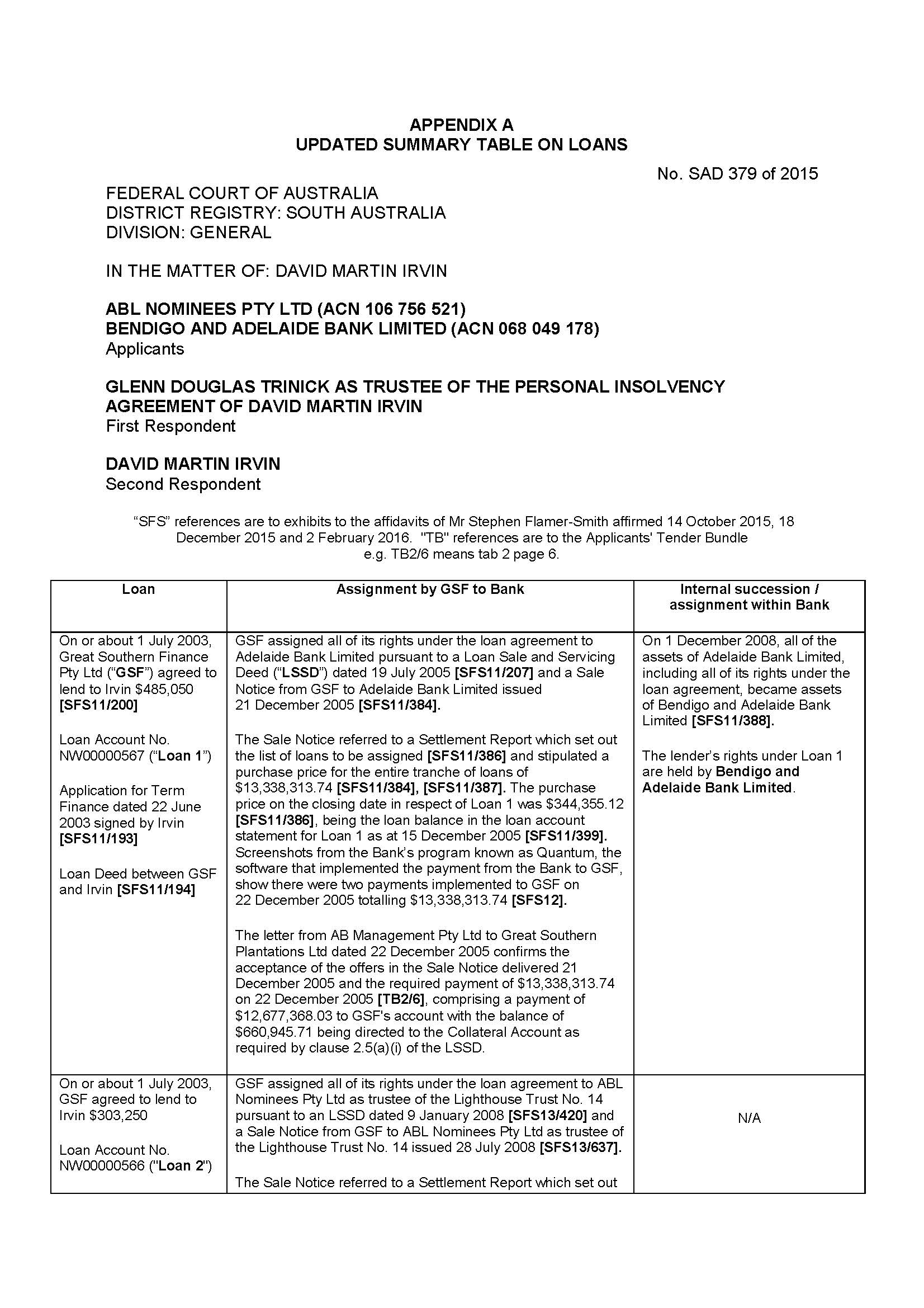
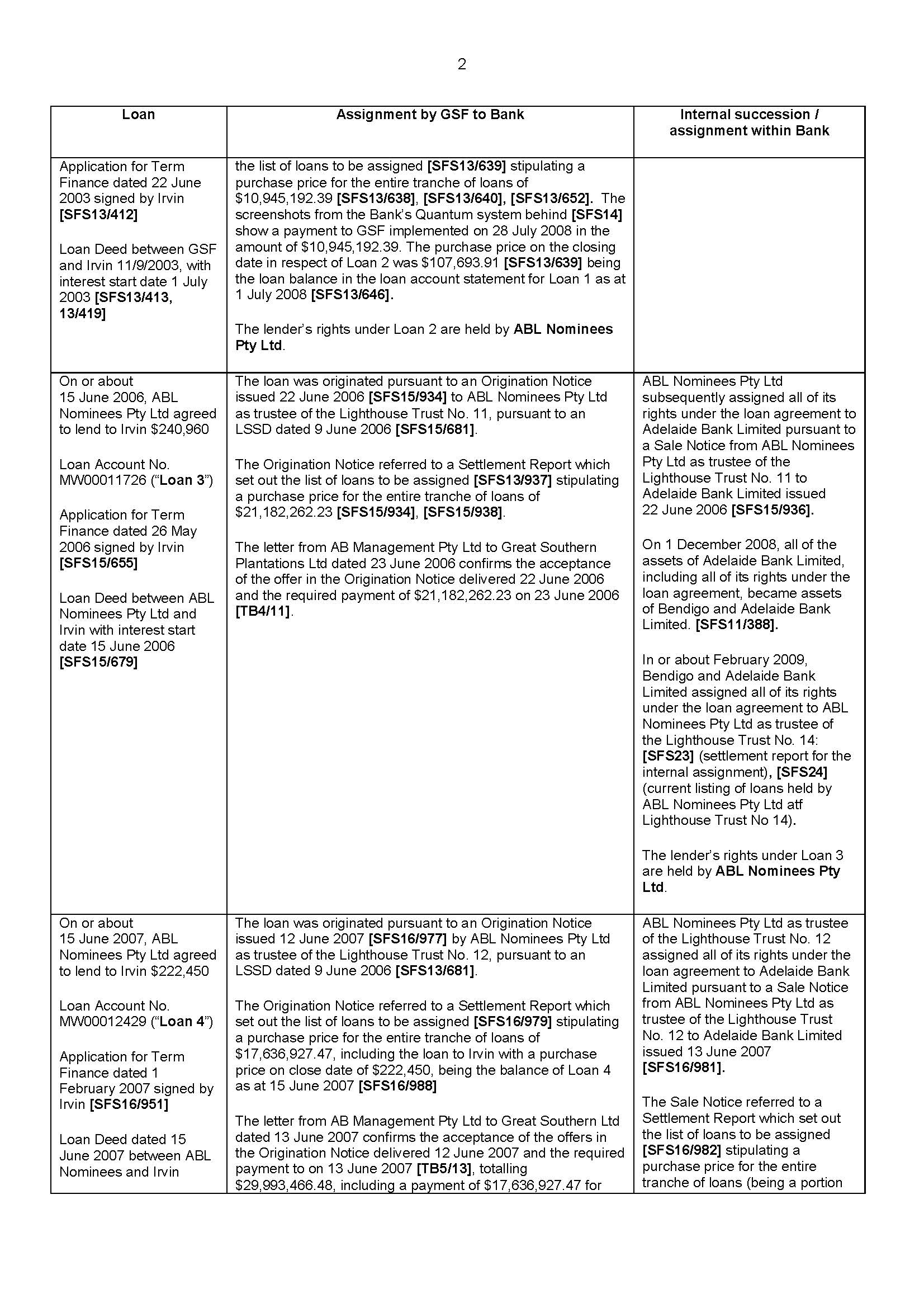
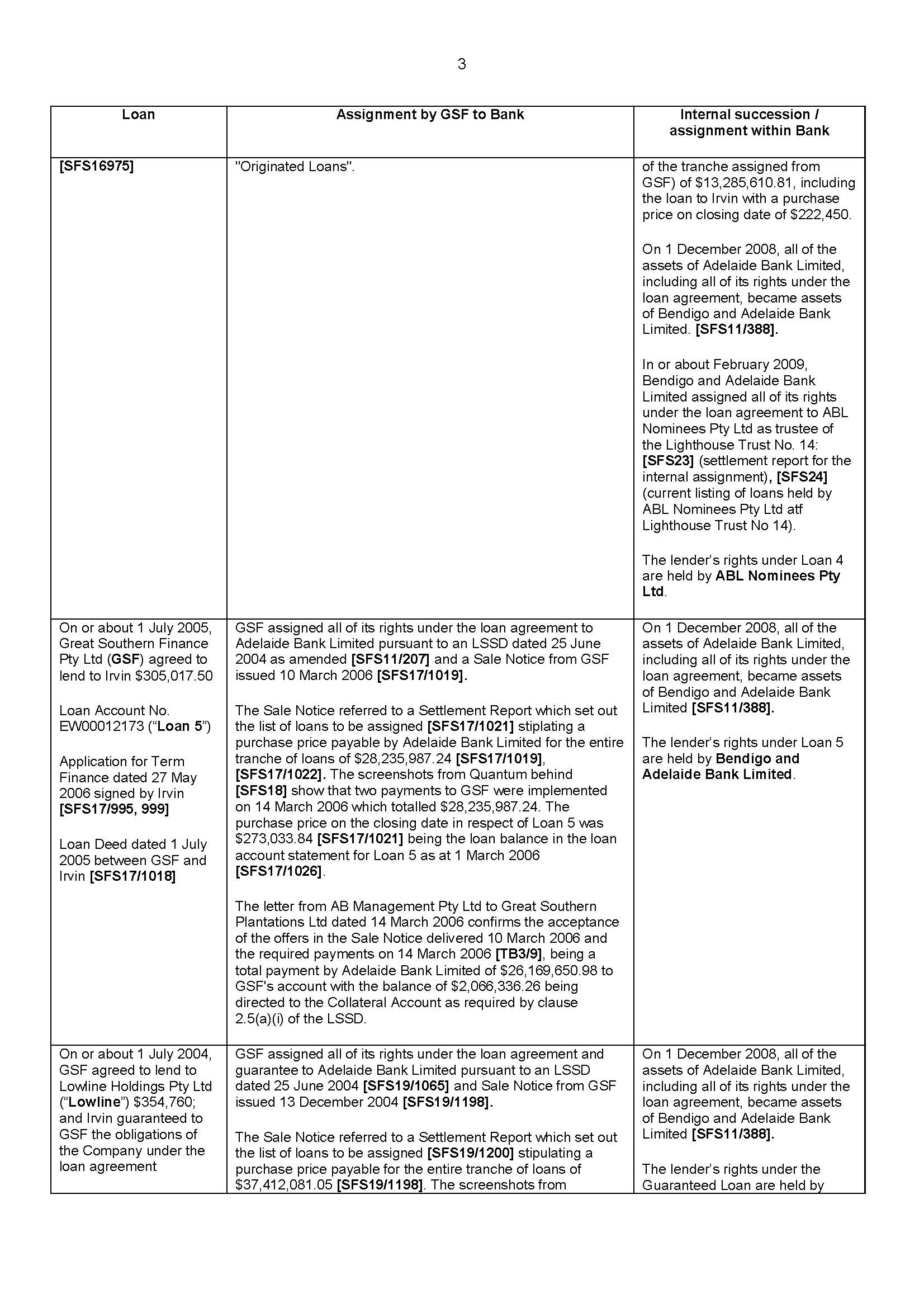
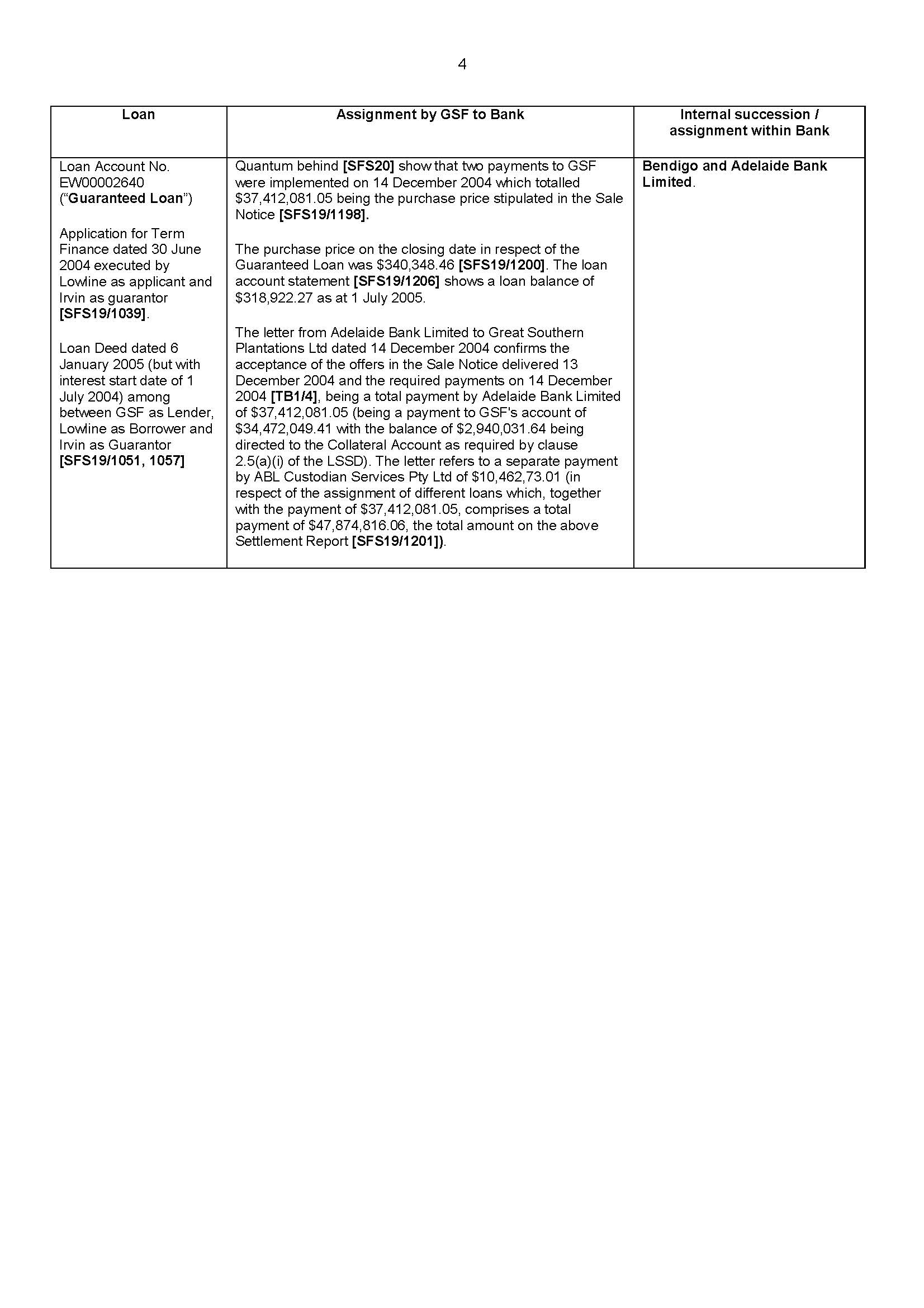
68 The applicants handed up as an aide mémoire a document which summarised their case to the effect that they are creditors of Mr Irvin. I am satisfied that this table accurately reflects the evidence and I attach it to these reasons as Appendix A. The reference to “SFS” followed by a number is a reference to an annexure to one of Mr Flamer-Smith’s affidavits, and the reference to “TB” followed by a number is a reference to one of the documents in the Tender book which became Exhibit A1. In the left hand column of Appendix 1, the details and documents relating to each loan are identified. I do not understand any of that material or indeed the loans themselves to be in dispute. As I understand it, these documents were provided to Mr Trinick with the applicants’ statements of claim. In the middle column of Appendix 1, the documents relating to the assignment of the loans are identified. Documents such as Loan Sale and Servicing Deeds, Sale Notices, Origination Notices and Settlement Reports were provided to Mr Trinick by the applicants’ solicitors on 28 September 2015 and certainly before the second meeting of creditors on 7 October 2015. The documents in the middle column described as screenshots from the bank’s program known as Quantum and as letters from AB Management Pty Ltd and Adelaide Bank Limited were not provided to Mr Trinick, but have been tendered as exhibits in this proceeding. As far as the right hand column is concerned, there is no issue concerning the fact that on 1 December 2008, all of the assets of Adelaide Bank Limited, including all of its rights under the loan agreement, became assets of Bendigo and Adelaide Bank. As I understand it, apart from the documents described as SFS23 and SFS24 which were tendered in evidence, but not provided to Mr Trinick, the other documents referred to were provided to Mr Trinick on 28 September 2015 by the applicants’ solicitors.
69 Mr Trinick’s principal submission was that neither applicant has proved that it was or is a creditor of Mr Irvin because neither has proved that it paid the consideration for the assignment of the loans. He points out that the payment of consideration has not been proved by the production of a bank statement or a bank cheque or an electronic funds transfer.
70 I have read the documents carefully and I reject the submission. The following general points should be noted at the outset. First, as I have said, I do not think there is any dispute about the fact that the loans were made and the outstanding balances. Secondly, the Loan Sale and Servicing Deeds have a definition of purchase price which means the aggregate principal amount outstanding at a particular date (cl 1.2). Thirdly, the seller of the loans, being loans identified in a Settlement Report can give a Sale Notice to the purchaser which the purchaser may accept by payment (cl 2.5). Fourthly, there is provision for the seller to establish a collateral account to which the purchaser has certain rights in relation to unpaid amounts (cl 11). I refer to this because Mr Trinick referred to these “claw back” provisions as affecting the consideration the applicants provided for the assignments. The Schedules to the Deed contain forms for various notices referred to in the Deed and they include the format for a Settlement Report. Fifthly, the Sale Notices had attached to them the Settlement Reports which related to the relevant sale. The loans were sold in batches and the total amounts involved were very large. The Settlement Reports tendered have been redacted to exclude references to other debtors. Finally, Mr Flamer-Smith explained that his understanding was that the payment for a “batch” of loans was made using the bank’s program known as Quantum and he produced what he called “screen dumps” from the Quantum system.
71 I will take the evidence produced in relation to Loan 1 as an example for the purposes of Loans 1, 2, 5 and 6, and the evidence produced in relation to Loan 3, as an example for the purposes of Loans 3 and 4.
72 The making of Loan 1 is established. The Loan Sale and Servicing Deed relevant in the case of Loan 1 is dated 25 June 2004, and Great Southern Finance Pty Ltd, ABL Nominees, Adelaide Bank Limited and Great Southern Managers Australia Limited were parties to the Deed. A Sale Notice under the Deed was given to Adelaide Bank Limited by Great Southern Finance Pty Ltd on 21 December 2005 and the accompanying Settlement Report identified the purchase price on closing date of Loan 1 ($344,355.12) and an overall consideration for the relevant batch of loans of $13,338,313.74. The loan account statement, although not having an exactly matching date, supports the figure in the Settlement Report. A letter from Adelaide Bank Limited to Great Southern Plantations Limited dated 22 December 2005 states that the offer in the Sale Notice dated 21 December 2005 is accepted and that Adelaide Bank Limited had paid a total of $13,338,313.74. The screenshots confirm the payments. The statutory declaration made by Mr Flamer-Smith identifies the purchase price on closing date of $344,355.12. The pattern of documents in relation to Loans 2, 5 and 6 is similar.
73 I am satisfied that Loans 1, 2, 5 and 6 were assigned for their full value on the dates alleged.
74 As I have said, I will take the evidence produced in relation to Loan 3 as an example for the purposes of Loans 3 and 4.
75 The original loan by ABL Nominees to Mr Irvin is not in dispute. An Origination Notice dated 22 June 2006 was issued pursuant to cl 2.1 of the Loan Sale and Servicing Deed as amended on 9 June 2006. The loan was assigned by ABL Nominees to Adelaide Bank Limited pursuant to a Sale Notice from ABL Nominees as trustee of the Lighthouse Trust No. 11 to Adelaide Bank Limited issued on 22 June 2006. I am prepared to accept that the loan was transferred from ABL Nominees to Adelaide Bank Limited. The second internal assignment was from Bendigo and Adelaide Bank to ABL Nominees. This is said to have taken place in or about February 2009. A Settlement Report, including Loan 3 and a listing of loans, including Loan 3 presently owned by ABL Nominees in its capacity as trustee of the Lighthouse Trust No. 14, have been tendered. Mr Flamer-Smith explains that he has been unable to locate any other documents concerning the second internal assignment. He explains that, given the assignment was between non-arm’s length companies who were wholly owned subsidiaries of the Bendigo and Adelaide Bank, there would not have been a payment by way of cheque, cash or electronic funds transfer via the electronic banking system. It is likely the payment would have been recorded by book entries, leading to adjustments to each entity’s general ledger to reflect on the movement of money and the change of ownership of the loan, although Mr Flamer-Smith has not been able to locate the specific entry for the movement of money. Mr Flamer-Smith said that the fact that Loan 3 appears on the listing of loans owned by ABL Nominees means that ABL Nominees and the Bendigo and Adelaide Bank regard the payment as having been made. Mr Flamer-Smith said that such internal assignments were always affected at the full face value of the loan balance at the time, not at a discount. Any internal sales of loan assets at a discount would have required a detailed process of writing down each of the assets.
76 In my opinion, the second internal assignment of Loan 3 took place. If for some reason the assignment was ineffective, that would mean no more than that the Bendigo and Adelaide Bank was the creditor in relation to the loan.
77 I reject the suggestion that the applicants have not established that they are not creditors because of what were referred to as “claw back” provisions. There is no suggestion, having regard to the substantial documentation produced in this case that those provisions are relevant to the outstanding amounts due to the applicants.
78 The applicants are each creditors of Mr Irvin in the amounts claimed and have standing to bring this application under s 222 and s 222C of the Act.
Should each of the Applicants have been admitted to vote for the value of their debts as set out in their respective statements of claim?
79 At the second meeting of creditors held on 7 October 2015, the applicants were admitted to voting collectively as a creditor with a value of one dollar ($1).
80 The applicants’ case is that each of them should have been admitted to vote as a creditor and, in the case of ABL Nominees, with a value of $781,587.36 and, in the case of Bendigo and Adelaide Bank, with a value of $1,000,801.68.
81 There are two aspects to Mr Trinick’s case. First, the applicants were not admitted for the value of their respective loans because they did not specify in their respective statements of claim a dollar amount as the actual amount paid for each assignment. This approach is reflected in the minutes of the second meeting of creditors which were produced by Mr Patterson. Although, as I have said, I found parts of Mr Trinick’s evidence confusing, the approach is also reflected in answers he gave in cross-examination suggesting that there would not have been a problem had the applicants specified a dollar amount as the actual amount paid for each assignment. The second aspect is seen most clearly in Mr Trinick’s closing submissions and is to the effect that he was entitled to take the position he did in the absence of proof from the applicants of the amount actually paid for each assignment. This aspect of Mr Trinick’s approach is also reflected in Mr Flamer-Smith’s recollection confirmed in his notes, and which I accept is accurate, that at the second meeting of creditors Mr Trinick said that there was no evidence of cash changing hands and, therefore, there was no evidence of the assignment.
82 In Re Dingle; Westpac Banking Corporation v Worrell and Another (1993) 47 FCR 478 at 486, the Full Court of this Court made it clear that in determining whether a person is entitled to vote as a creditor, the Court must act on the material before it and is not limited to the material before the trustee.
83 Mr Trinick called the meeting of creditors under s 188 of the Act, and Division 5 of Part IV of the Act which deals with meetings of creditors of a bankrupt applies to the meetings as if the debtor was bankrupt and the Controlling Trustee was the trustee in the bankruptcy (s 196).
84 Section 64D deals with notices of meetings and relevantly provides:
64D Statement by creditor as to amount of debt
The notice must state that each creditor must give to the trustee at or before the meeting a written statement setting out:
(a) the amount in respect of which the creditor claims that the bankrupt is indebted to the creditor; and
(aa) if the creditor has been assigned a debt that the bankrupt owes to the creditor—the value of the consideration that the creditor gave for the assignment of the debt; and
(b) if the meeting is the first meeting of the bankrupt’s creditors:
(i) whether the creditor holds a security in respect of the debt and, if so, the value of the security as estimated by the creditor and the amount of the creditor’s debt after deducting that value; and
(ii) brief particulars of the transaction and circumstances that gave rise to the debt.
85 Section 64ZA deals with entitlement to vote and relevantly provides:
64ZA Entitlement to vote
(1) This section applies to voting:
(a) at an election under section 64P of a person to preside at a meeting; and
(b) on any motion proposed at a meeting or an amendment proposed to such a motion.
(2) In this section:
“creditor” means a creditor who, or whose proxy or attorney, participates in the meeting in person or by telephone.
(3) A person other than a creditor is not entitled to vote.
(4) Subject to subsections (5) and (6), each creditor is entitled to vote and has one vote.
(5) If a creditor is a secured creditor, the creditor is not entitled to vote unless the debt, or the total amount of the debts, owed to the creditor exceeds the amount estimated by the creditor in the statement given to the trustee under section 64D to be the value of the security.
(6) A creditor who has failed to give to the trustee a statement in accordance with section 64D is not entitled to vote.
(7) A creditor is not disqualified from voting merely because the creditor is the President or the minutes secretary.
(8) The trustee may determine any question that arises as to the entitlement of a person to vote.
…
86 Section 64ZB deals with the manner of voting and in that context s 64ZB(8) deals with the value of a creditor who has been assigned a debt, is present at the meeting and is voting on the motion. The subsection provides as follows:
(8) For the purposes of determining whether a motion proposed at the meeting is resolved, the value of a creditor who:
(a) has been assigned a debt; and
(b) is present at the meeting personally, by telephone, by attorney or by proxy; and
(c) is voting on the motion;
is to be worked out by taking the value of the assigned debt to be equal to the value of the consideration that the creditor gave for the assignment of the debt.
87 These provisions were considered by Drummond J in Bechrose Pty Ltd v Jefferson and Another (1999) 94 FCR 494 (“Bechrose”), a case relied on by Mr Trinick both at the time of the relevant events and at the trial before me. I should note at this point that the first reference to Bechrose at the time of the relevant events was in Mr Htin’s email dated 18 September 2015. I am not prepared to find, based on Mr Trinick’s evidence, that he had any real appreciation of the case before it was raised by Mr Htin. Before considering Bechrose, I note the following.
88 French J (as his Honour then was) considered the obligations of a trustee in bankruptcy in determining whether a person who claimed to be a creditor (in that case not a creditor by way of an assignment of a debt) should be permitted to vote in Starkey v Rondo Building Services Pty Ltd [2005] FCA 1081 (“Starkey”). His Honour said that the admission by the trustee of a person to vote does not involve a final determination of that person’s proof of debt. The trustee may decide from the particulars provided that a claim is frivolous or without a proper basis or involves a debt not provable in bankruptcy and refuse to admit it for voting purposes. To that extent, the particulars provide “a procedural protection against frivolous or baseless claims” (at [46]). On the other hand, the section contemplates that the trustee will act in a summary way, having regard to the information available to him or her (at [46]).
89 The information the trustee may require in the context of a proof of debt is set out in s 84(2) and (3) of the Act.
90 Section 64D(aa) and 64ZB(8) use the word, “gave”. The definitions of “give” in the Macquarie Dictionary (3rd ed, Macquarie, 1997) are as follows:
1. to deliver freely; bestow; hand over: to give someone a present. 2. to deliver to another in exchange for something; pay. 3. to grant permission or opportunity to; enable; assign; award. 4. To set forth or show; present; offer …
91 Mr Trinick emphasised the reference in the second definition to the word “pay”.
92 The Explanatory Memorandum for the amendment which introduced s 64D(aa) and s 64ZA(8) identified the mischief to which those provisions were directed in the following way.
93 Creditors with significant debts in a bankruptcy analyse the bankrupt’s financial circumstances. They may conclude that they are unlikely to receive any substantial return and decide to assign their debts to get what they can. The assignees who purchase the debts then vote in favour of proposals that are beneficial to or favour the bankrupt. In this process, the wishes of smaller creditors who are not in a position to bargain for the assignment of their debts are overruled. This mischief is overcome, it is considered, if the assignee is entitled to vote only for the value he or she actually gave for the debt. The Explanatory Memorandum states:
59.2 In some cases, a creditor will determine not to continue to pursue his or her rights against a debtor, but will assign a debt to another person for some consideration which the assigning creditor considers to be reasonable in the circumstances. The assignee is able to vote at a meeting of creditors for the full amount of the debt owed to the original creditor, even though the assignee may have paid only a fraction of the amount of the original value of the debt. It has occurred that a bankrupt or debtor arranges for friends or relatives or persons favourably disposed toward the bankrupt to acquire from independent creditors an assignment of a debt, and be in a position, at a creditor’s meeting, to control the outcome of resolutions and special resolutions which can determine the future course of the debtor’s or bankrupt’s affairs. Frequently, it is institutional creditors who are owed large sums who assign debts. That a person favourably disposed towards a debtor or bankrupt can by this device acquire control over voting at a meeting can appear to work, if not actually work, an injustice to smaller creditors. This is because the assigning creditor has made a commercial judgment that in reality, his or her debt is only worth the value that the assignee is prepared to pay for it. Smaller creditors may not be in the position to assign debts, and their small entitlement to vote may be insufficiently attractive to a person wishing to purchase the creditor’s debt to make any offer worthwhile. However, the commercial judgment of the assigning creditor may have placed the voting power at a meeting in the hands of a person whose interest is not in actually collecting dividends in respect of the debt, but rather, in assisting the debtor or bankrupt to achieve his or her objectives, of for example getting an annulment of bankruptcy.
59.3 Accordingly, the Bill proposes to amend the Act so that an assignee of a debt can vote at a meeting only for the amount of consideration that he or she gave to the assigning creditor. Thus if ABC Bank was owed $lm. by Peter, the bankrupt, and Richard acquired the debt for $500, Richard would be able to vote to a value of $500, and not $lm, the $500 being the amount for which Richard acquired the debt.
59.4 Item 166 proposes the insertion into subsection 64D a new paragraph (aa) which provides that if a creditor has been assigned a debt that the bankrupt owes to the creditor, the creditor should state in the notice to the trustee setting out the amount which the creditor claims the bankrupt owes the value of the consideration the creditor gave for the assignment of the debt.
94 In Bechrose the property assigned by the bank (Westpac Banking Corporation) to Bechrose were two mortgages granted by a company called Chelmscliff Pty Ltd over a farming property, a floating charge over the company’s undertaking and a guarantee given by the bankrupt that the company would repay loan monies to Westpac. There was also the benefit of a costs order in favour of Westpac. The issue before the Court was the value of the consideration which Bechrose had given for the guarantee. Bechrose had chosen for its own purposes not to apportion any part of the price it paid for the assignment of the guarantee, the mortgages and the costs order to the guarantee. Drummond J said that the inference was strong that Bechrose was not at arm’s length from the bankrupt. The trustee admitted Bechrose as a creditor for voting purposes at the meeting of creditors and had estimated that the value of the proof was the sum of $1. Importantly in terms of the ratio of the case, Drummond J accepted that the evidence showed that the monetary consideration paid by Bechrose to Westpac for the assignments was paid solely as consideration for the transfer of the two mortgages (at [56] et seq.)
95 Drummond J said that the value of the consideration given was a matter for objective determination and that a creditor cannot control the value of the vote it is entitled to cast at a meeting of creditors by what it claims to be the consideration for the assigned debt when the true position is that it in fact gave consideration of lesser value. It seems to me that Bechrose is something of a special case. Drummond J was confronted with a case where the consideration was provided for the assignment of a debt and other assets and the assignee refused to place a value on the debt. Bechrose failed to comply with s 64D(aa) and that meant, having regard to s 64ZA(6), it was not entitled to vote at the meeting. Drummond J said that strictly, the trustee should have ruled that Bechrose was not entitled to vote at the meeting. In the alternative, having regard to the evidence, the trustee was entitled to conclude that Bechrose “can only fairly be regarded as having given nominal consideration for the assignment to it of debt on the guarantee” (at [72]).
96 The following passages from his Honour’s reasons illustrate these points (at [69], [70] and [71]):
69. The applicant contends that it gave a single undivided consideration for the assignment to it of the debts secured by the mortgages and the mortgage debenture, the debt under the guarantee and the benefit of the costs order obtained by Westpac against the Sherrys. For the reasons given, there are good grounds for thinking that it adopted that position to ensure that the application of s 64ZB(8) to the valuation by the trustees of the applicant's right to vote at the meeting would require that vote to be valued at the very large figure contended for by the applicant.
70. But s 64ZB(8) does not require the trustees to stand impotent in the face of the applicant's refusal to ascribe a value to the consideration it gave for the debt on the guarantee, as distinct from the consideration it gave for the debts under the mortgages and the benefit of the costs order. It obliges the trustees to value the applicant’s vote by reference to the consideration it gave for the assignment to it of the debt on the guarantee, and that alone.
71. The applicant was required by s 64D(aa) to provide that information in writing to the trustees at or prior to the creditor’s meeting. It failed to do that. Section 64ZA(6) accordingly disentitles the applicant, though undoubtedly a creditor of the bankrupt, to vote at the meeting of creditors in question. Strictly, the trustees should have ruled that the applicant was not entitled to vote at the meeting. Instead, they ascribed to the applicant’s entitlement to vote, which they accepted, a nominal value only.
97 There is clearly a difference between stating the value of the consideration given for the assignment of a debt and proving the value of the consideration given for the assignment of the debt. The first must be done. It was not done in Bechrose. I do not think the second must be done. It seems to me that it depends on the circumstances. There is the type of case identified by French J in Starkey where the claim appears frivolous or without a proper basis. The trustee would be entitled in those circumstances to ask for more information. There is the type of case that arose in Bechrose where one consideration was paid for a number of assets of which the assignment of debt was but one. I think a trustee in those circumstances would be entitled to ask for evidence which provides a rational basis for the valuation of the consideration given for the assignment of the debt.
98 Subject to these types of cases, one must go back to the words of s 64D to determine the obligation of a person who claims to be a creditor by reason of the assignment of a debt. That person must give the trustee a statement which includes the value of the consideration that he or she gave for the assignment of the debt and brief particulars of the transaction and circumstances that gave rise to the debt. That is the extent of the obligation. Again, subject to the type of cases I have mentioned, I do not think that the later section, s 64ZB(8), dealing with the working out of the value of the creditor, enlarges the obligation of the person who claims to be a creditor as a result of the assignment of a debt. That subsection merely provides that the value of the creditor is to be determined by reference to the value of the consideration given for the assignment of the debt.
99 The other point to be made is that I do not think that the value stated in the statement of claim lodged by the creditor is necessarily decisive if the appropriate figure is clear from all the documents lodged by the person claiming to be a creditor. If the person provides information showing the value of the consideration given for the assignment of the debt and another figure for the debt as at the date of the statement of claim, I do not think the trustee is entitled simply to reject all the figures. There may be different figures which result from the fact that the debt has increased because interest has accrued since the assignment or from the fact that the debt has been reduced because the debtor has made repayments since the assignment. At the very least, the trustee should take the lowest figure in those circumstances. This means I reject the approach taken by Mr Trinick at the second meeting of creditors as revealed in the minutes of that meeting produced by Mr Patterson. Mr Trinick said that there were three different figures for Loan 6 and that that justified or at least supported his approach. The documents provided to him by the applicants in relation to Loan 6 clearly identified the value given by the assignee for the debt ($340,348.46) and the amount owing with respect to the debt as at 10 June 2015 ($399,257.57). If he was in any doubt, it was open to him to accept the lower of these two figures.
100 In my opinion, Mr Trinick should have proceeded on the basis that the value of ABL Nominees as a creditor and the value of the Bendigo and Adelaide Bank as a creditor was as asserted in their respective statements of claim. Even if he was justified in taking the lower figure (in those cases where it was a lower figure) of the amount at the time of the assignment, both applicants were substantial creditors of Mr Irvin. On either view, the special resolution would not have been passed.
101 I should say before leaving this topic that, even if the law was that in the case of an assignment of debt the amount actually paid for the assignment had to be shown (as Mr Trinick asserted), I do not accept the assertion that that could only be done by the production of a bank statement, bank cheque or electronic funds transfer. In fact, as to at least some of the loans (and acceptance of only one of the loans and the assignment thereof would have meant that the special resolution was not passed), the transactional documents provided, including the Deeds, led to the inference that payment for the assignment had in fact taken place.
Should Wideview Holdings and Mr Vartesi been admitted to Vote?
Wideview Holdings
102 As I have said, in his Third Report to Creditors, Mr Trinick said that a balance sheet of Wideview Holdings as at 30 June 2014 showed that Mr Irvin owed the company an amount of $334,986. He said that he had had discussions with the company’s accountant and was satisfied that the debt was legitimate. At the second meeting of creditors, Wideview Holdings was admitted to vote with a value of $1. There is a dispute as to Mr Trinick’s explanation for not admitting Wideview Holdings for the full amount of its claimed debt. Mr Flamer-Smith’s account of the meeting was that Mr Trinick said it was because Wideview Holdings was a related party, whereas the minutes of the meeting produced by Mr Patterson record Mr Trinick as saying that it was because “full detailed transactions” were not yet available. Although nothing appears to turn on the resolution of that dispute, Mr Flamer-Smith was a reliable witness and I would be disposed to accept his version of events.
103 The applicants submitted that, having regard to a number of matters which they identified, Wideview Holdings should not have been permitted to vote because it was not a creditor of Mr Irvin. The onus is on the applicants to prove this allegation (Re McLean and Another; Ex parte Friends’ Provident Life Office (1992) 36 FCR 502; George v Deputy Commissioner of Taxation and Another (2004) 57 ATR 450; [2004] FCA 1433).
104 The applicants relied on the following matters. First, a balance sheet of Wideview Holdings as at 30 June 2014 printed on 5 February 2015 showed as assets of the company a loan to Mr Irvin of $10,299.67 and a loan to the David Irvin Trust of $370,456.92, whereas, a balance sheet as at the same date (i.e., 30 June 2014) but printed on 23 February 2015 (i.e., 18 days later) showed as an asset a loan to Mr David Irvin of $344,116.19. These allegations are accurate as matters of fact. Secondly, Mr Trinick and his staff made repeated requests of Mr Vartesi for the ledger of Wideview Holdings in the two week period leading up to the meeting on 7 October 2015 and yet it was not provided. This allegation is correct as a matter of fact. Thirdly, Wideview Holdings did not appear as an unsecured creditor in the Statement of Affairs and it was not a creditor admitted to vote at the first meeting of creditors held on 15 July 2015. These allegations are correct as matters of fact. Fourthly, there is a statement of claim by Wideview Holdings dated 7 October 2015 claiming the amount of $334,986. It is signed by Ms Bull. The applicants submitted that it did not identify the amount claimed because it refers to “Loans” of $334,986, but has nothing in the section entitled “Total amount claimed after deducting value of security (if any)”. I reject this argument. I think it is clear from reading the statement of claim as a whole that Wideview Holdings is claiming that Mr Irvin is indebted to it in the amount of $334,986. Mr Trinick could not recall whether he had seen the statement of claim of Wideview Holdings before the second meeting of creditors on 7 October 2015. In the draft minutes prepared on the previous day by Mr Trinick, Wideview Holdings is shown as having been admitted to vote as a creditor.
105 The applicants also relied on the fact that Mr Irvin transferred his shares in Wideview Holdings to Ms Bull effective on 31 March 2015. I think that any reasonable creditor reading the Second Report to Creditors and the Third Report to Creditors would assume the transfer of the shares in Wideview Holdings was a transaction which was to take place, not a transaction which had taken place. Furthermore, the fact that the shares had been transferred was a fact that any reasonable creditor would have wanted to know. In terms of the present issue, the applicants seem to argue that Mr Trinick knew about it and that it, with the other matters they have identified, should have led him to reject Wideview Holdings as a creditor for voting purposes.
106 Mr Trinick’s evidence about his knowledge of the transfer of shares in Wideview Holdings and his actions in relation to the transaction was unsatisfactory. He was vague as to when he found out about the transfer of the shares. His evidence was unclear as to whether the creditors were advised about the transfer of the shares at the second meeting on 7 October 2015. He said that his office lodged a complaint with AFSA about the share transfer and he said that his office had not heard back about the complaint. The complaint was not produced to the Court. He seemed to say that he did not think he had the opportunity to advise the creditors about it and then he said that advising the creditors would be “jumping the gun”. Mr Trinick admitted that from the point of view of the creditors, the fact that the shares had been transferred, was material information.
107 There is force in the applicants’ submission that the matters they identified, considered as a whole, mean that Mr Trinick should have rejected Wideview Holdings as a creditor for voting purposes. There would be greater force in the argument had it been admitted for the full amount of its alleged debt. However, I accept Mr Trinick’s evidence that he spoke to Mr Vartesi about the debt and that what he was told satisfied him that “there was at least $1 genuine debt in there”. I do not think that the applicants have established that Wideview Holdings was not a creditor of Mr Irvin and I do not think Mr Trinick erred in admitting Wideview Holdings to vote for a value of one dollar ($1).
Mr Vartesi
108 Mr Vartesi of TJ Edwards & Associates was admitted to vote for a value of $16,500 at the second meeting of creditors. The applicants submitted that he should not have been admitted to vote as a creditor of Mr Irvin or alternatively, he should have been admitted to vote for a value of only one dollar ($1). Again, it is relevant to note that the onus is on the applicants to prove that Mr Vartesi was not a creditor of Mr Irvin. I should say at the outset that the evidence is that Mr Vartesi was doing professional work for Mr Irvin and, at a general level, it can be said that it is likely he would be a creditor for some amount.
109 Mr Vartesi, or more accurately TJ Edwards & Associates, was named as a creditor of Mr Irvin for the amount of $20,000 in Mr Irvin’s Statement of Affairs. He was admitted to vote for a value of $16,500 at the first meeting of creditors held on 15 July 2015. The same approach was adopted by Mr Trinick at the second meeting of creditors held on 7 October 2015, and Mr Trinick advised the meeting that the claim was supported by an invoice for services rendered dated 15 June 2015.
110 It seems that Mr Vartesi provided what might be called a timesheet to Mr Trinick at the first meeting of creditors, although even that is not clear. The timesheet purports to set out time spent by Mr Vartesi in relation to Mr Irvin’s Great Southern investments between 20 February 2010 and 24 August 2015. A total sum of $24,187.50 is shown on the document. If it was provided at the first meeting of creditors on 15 July 2015, then the time spent between 15 July 2015 and 24 August 2015 must be an estimate of time likely to be spent. The value of the time spent in the 2015 calendar year up to 15 July 2015 amounts to $4,312.50. There is no explanation of why Mr Vartesi would not have rendered invoices earlier for work done dating back to as early as 2010.
111 Although the proof of debt from Mr Vartesi could not be found at the time of correspondence between solicitors for the parties in December 2015, it was found and tendered before the end of the trial. It has a note on it to the effect it was delivered by hand by Mr Lou Vartesi on 13 July 2015. The proof of debt is signed by Mr Vartesi and attached to it is a tax invoice from Mr Vartesi to Mr Irvin dated 15 June 2015 in the amount of $16,500. The tax invoice has the date 15 July 2015 stamped on it. The professional services rendered by Mr Vartesi were described in the invoice as follows:
Professional services for the period ended June 2015 including general business and taxation advice. Discussions with respect to outstanding debts.
112 Again, Mr Trinick’s evidence in relation to this topic was unsatisfactory. At one point, he described counsel for the applicants’ questions (which I consider were quite reasonable) as “getting ridiculous”. He did not know a great deal about the timesheet and gave long-winded answers in response to questions about it. He told counsel he was wasting time and “waffling on about this” and he referred to the applicants’ claims as “fraudulent”.
113 The applicants accepted that Mr Vartesi could be a creditor of Mr Irvin, despite the fact that his invoice was dated 15 June 2015 which was after Mr Trinick’s appointment as Controlling Trustee on 10 June 2015, providing he did the relevant work before the appointment. Their submissions were to the following effect. The position was quite unclear and Mr Trinick made insufficient inquiries. In those circumstances, Mr Vartesi should have been admitted as a creditor for voting purposes for a value of only one dollar ($1). I think that that submission is correct.
114 It is relevant that Mr Trinick had allegedly lodged a complaint with AFSA about Mr Vartesi’s conduct in lodging the share transfer in relation to the shares in Wideview Holdings. Mr Vartesi had failed to provide the ledger of Wideview Holdings to the Controlling Trustee’s office despite requests to do so. Mr Trinick knew nothing of the terms of the retainer between Mr Irvin and Mr Vartesi, or indeed between Mr Irvin’s companies and Mr Vartesi. The timesheet raises a number of questions which required answers and the tax invoice describes the work in very general terms and without more, cannot be reconciled with the timesheet.
115 When all these matters are considered, I think Mr Trinick should not have admitted Mr Vartesi as a creditor for voting purposes for a value beyond one dollar ($1) before these queries were resolved. Even if (contrary to my earlier conclusion) Mr Trinick’s approach to the applicants’ claims was correct, had Mr Vartesi been admitted as a creditor for a value of only one dollar ($1), the special resolution would not have been passed because the requirement of three-fourths in value would not have been met.
116 I think that by the time of the second meeting of creditors, Mr Trinick had lost his objectivity as far as the applicants’ claims were concerned. It was not so much that he had reason to favour Mr Irvin, but more that his relationship with the applicants had become a deeply antagonistic one, probably dating from the request for details of his work-in-progress and the applicants’ complaint about him (see [41]-[42] above). He accepted the draft letter of Bennett and Co dated 18 September 2015 and largely adopted it for the purposes of his letter dated 24 September 2015 (see [43] and [45] above). I do not accept his evidence that he had a draft letter waiting “in the wings” and that he adopted the Bennett and Co letter because it was a better letter. As I have said, I think that he should have accepted the applicants for voting purposes for the full value of their respective debts. Even if he was entitled to insist that the relevant figures be in the statements of claim, that was a matter that could have been easily remedied. His approach seems to have been inconsistent with his own legal advice. Two further matters are relevant. First, there seems to be no basis for him not admitting each of the applicants as a creditor for a value of one dollar ($1) at the very least and had that been done, the special resolution would not have been passed. Secondly, the rigour he applied to the applicants’ claims is to be contrasted with his lack of rigour in relation to Mr Vartesi’s claim (albeit not an assignment of debt claim). Finally, the following should be noted. I have reached the conclusion about Mr Trinick’s loss of objectivity without taking into account the antagonism Mr Trinick displayed towards the applicants in the witness box because that was after the relevant events. At the same time, nothing he said in the witness box caused me to doubt the conclusion I have reached.
Conclusions to this Point
117 Each of the applicants are creditors and has standing to bring this application. Furthermore, the applicants should have been admitted to vote for the value of their claims and, had that occurred, the special resolution would have been overwhelmingly defeated. Wideview Holdings was correctly admitted to vote for a value of one dollar ($1). Mr Vartesi should have been admitted to vote for a value of one dollar ($1) and not $16,500 and, had that alone occurred, then the special resolution would not have been passed. Although not necessary for the purposes of my conclusions, it is probably relevant in terms of the exercise of the discretion, to take into account the fact that one of the parties in support of the special resolution (Wideview Holdings) was a creditor who was not to participate in any dividend under the PIA and whose debt was to survive the execution of the PIA. These conclusions alone suggest to me that the PIA should be set aside. There is no disentitling conduct by the applicants or reason to think the PIA was or remains in the best interests of the creditors.
118 The applicants also advanced a case that Mr Trinick did not adequately investigate Mr Irvin’s affairs and did not provide proper advice to creditors. I turn to consider those matters.
The Investigations carried out by Mr Trinick and his Reports to Creditors
119 The applicants acknowledged that a Controlling Trustee has a far shorter period of time to investigate the affairs of a debtor than a trustee in bankruptcy. However, their point was that a person in the positon of Mr Trinick must either investigate a matter or advise the creditors that he has not investigated the matter. Where he has investigated a matter to a point but forms an opinion based on what he has been told by the debtor, then he should advise the creditors of that fact. The applicants provided examples and not an exhaustive list of matters in which they contended that Mr Trinick did not investigate and report in that way.
120 In the discussion which follows, I bear in mind the following. A Controlling Trustee ordinarily has limited time within which to investigate a debtor’s affairs. He or she is required to form and express an opinion and is entitled to provide a summary of that opinion to creditors. The circumstances will vary between different cases and the level of investigation and report will be dictated by the particular circumstances. These matters are in a sense obvious, but I mention them in case it be thought that they have been overlooked.
The Bindoon Property
121 Mr Patterson discussed the transfer of the Bindoon property with Mr Irvin on 8 October 2013. In November 2013, Mr Patterson or staff acting under his direction, conducted searches which revealed the following:
(1) Mr Irvin purchased the Bindoon property on 8 February 2002 for $155,000; and
(2) Mr Irvin transferred the Bindoon property to his mother, Ms Anne Irvin, on 8 March 2013 for $150,000.
122 At a meeting on 8 November 2013, Mr Irvin explained the transaction involving the Bindoon property to Mr Patterson. His explanation was as follows. Ms Anne Irvin wanted to purchase the Bindoon property, but until she sold a property at Maddern Road, Chittering (“the Chittering property”), she did not have the funds to do so. Mr Irvin agreed to assist by way of a loan, but by mistake the Bindoon property was put into his name. The loan was repaid by Ms Anne Irvin upon the sale of the Chittering property, but “the situation on the title” was not rectified until March 2013.
123 It seems that, although the transfer from Mr Irvin to his mother was dated 8 March 2013, the transfer was not registered until February 2014.
124 On 30 June 2015, Mr Goh sought advice from a real estate agent about the property market in Bindoon between 2002 and 2004.
125 In July 2015, Mr Patterson received a valuation of the Bindoon property from QWest Paterson, Valuers and Property Consultants. The market value of the property as at 8 March 2013 according to the valuation was $420,000.
126 On 1 July 2015, Ms Anne Irvin provided bank statements of her Commonwealth Bank bank account showing that she received $185,000 on 29 April 2005 and made a payment of $55,000 on 5 May 2005 (according to Ms Anne Irvin the payment was made to Mr Irvin).
127 The transactions involving the Bindoon property were analysed by Mr Trinick, Mr Goh and Ms Petrie on or about 14 July 2015, and the effect of their consideration was that the property could not be recovered. Ms Anne Irvin had paid the purchase price of the property in two instalments, being $100,000 on 4 January 2005 and $55,000 on 5 May 2005.
128 In September 2015, Mr Goh continued to seek and to receive information concerning the Bindoon property.
129 Mr Irvin provided to Mr Trinick’s office an unsigned “statutory declaration” on or about 7 October 2015. There also seems to be a signed copy of the document, although the copy in evidence is very small and is difficult to read. One notable feature of the statutory declaration is that it contains a statement that the transfer in 2002 into Mr Irvin’s name was deliberate and done so that Ms Anne Irvin’s then boyfriend would not be aware of the purchase.
130 Mr Trinick referred to the Bindoon property and the possibility of its sale falling within s 120 of the Act in his Second Report to Creditors dated 3 July 2015. He referred to it as a potential undervalued transaction and said that he would be seeking a legal opinion on the matter, “[i]f this matter is to be pursued”.
131 Ms Petrie who, as I have said, was not cross-examined, said that there was a meeting involving Mr Trinick, Mr Goh, Mr Rathod and herself on 22 September 2015. The purpose of the meeting was to discuss a draft of the Third Report to Creditors. One of the issues discussed was whether the Bindoon property could be recovered by a trustee in bankruptcy as an undervalued transaction pursuant to s 120 of the Act. Those present at the meeting agreed that it was unlikely that it could be recovered because Ms Anne Irvin was the equitable owner from the date of purchase in February 2002 based on the intention of the parties, or from no later than May 2005 when Ms Anne Irvin repaid the loan or purchase price to Mr Irvin. As I understand it, the view was formed that either way the transfer took place outside the relation back period. Ms Petrie believed that any action would be successfully defended on the basis that Ms Anne Irvin had a constructive trust over the Bindoon property from at least May 2005.
132 In his Third Report to Creditors dated 24 September 2015, Mr Trinick advised the creditors that he had formed the opinion that the Bindoon property could not be recovered under s 120 of the Act and the reasons he gave reflect the discussions which took place at the meeting on 22 September 2015.
133 In cross-examination, Mr Trinick agreed that he had documents showing that Ms Anne Irvin had sold the Chittering property for $285,000 in May 2006. When asked how Ms Anne Irvin could have repaid her son in 2005 when she had not sold her Chittering property until May 2006, Mr Trinick said that he could only think that payments had been made in instalments. He said that the questions he was being asked should be directed to Ms Petrie. Mr Trinick agreed that he did not know when Ms Anne Irvin had originally purchased the Chittering property. He agreed that Mr Irvin’s company, Wideview Holdings, was granted an overdraft facility by the National Australia Bank of $400,000 on or about 8 May 2013, and one of the securities provided was a registered mortgage over the Bindoon property. He agreed that Mr Irvin may have also provided the property as security for the Great Southern Finance loans.
134 Mr Trinick’s recollection of the circumstances surrounding the Bindoon property as revealed in his cross-examination was, I think, fairly superficial.
135 It cannot be said that Mr Trinick’s office did not investigate the transactions involving the Bindoon property in some detail. However, a number of questions remain. For example:
(1) How did Ms Irvin repay the loan in 2005 if she did not sell the Chittering property until 2006?
(2) Why did Mr Irvin appear to say initially that the transfer of the Bindoon property into his name was inadvertent and later say that it was deliberate?
(3) If Mr Irvin held the property on trust for Ms Anne Irvin, why was it being used as security for an overdraft facility granted to Wideview Holdings?
The significance of the circumstances surrounding the Bindoon property is as follows. First, I think Mr Trinick should have qualified his opinion about the Bindoon property to recognise the unanswered questions raise matters which are potentially significant. Secondly, Mr Trinick based his opinions about the Bindoon property largely on what he had been told by Mr Irvin. The unanswered questions meant that he needed to scrutinise what Mr Irvin told him about other relevant transactions with extra care. Finally, the circumstances surrounding the Bindoon property are such that there is a basis for further investigations by a trustee in bankruptcy of the transactions involving the Bindoon property.
The Superannuation Contributions
136 Lowline Holdings Pty Ltd was a company controlled by Mr Irvin and it acted as the trustee of Lowline Holdings Superannuation Fund, being Mr Irvin’s self-managed superannuation fund. Mr Patterson said that no “financials” were available in relation to the company. From time to time, Mr Irvin made contributions to his superannuation fund and Mr Trinick’s office conducted an analysis of Mr Irvin’s wages and his contributions to the superannuation fund between 2010 and 2015. It identified potential recoveries of superannuation contributions ranging from $38,707 to $84,976.20. The analysis included a costs as against benefits analysis and the conclusion reached was that, based on the costs and time involved in a recovery action, such action was “[n]ot commercially viable”. There is a calculation of the value of the investments and other assets of the superannuation fund which totalled $1.4 million approximately.
137 Mr Trinick’s office was provided with the following documents:
(1) Mr Irvin’s taxation returns for the years 2010, 2011, 2012, 2013 and 2014;
(2) A Return of the Lowline Holdings Superannuation Fund showing member details, balance sheet as at 30 June 2014 showing accrued benefits for the debtor of $1,198,235 as at 30 June 2014 ($1,104,052 as at 30 June 2013).
(3) Lowline Holdings Superannuation Fund taxation returns for the years 2010, 2011, 2012, 2013 and 2014 and Financial Statements and Reports for the period from 1 July 2013 to 30 June 2014.
(4) Lowline Holdings Superannuation Fund Trust Deed and Deed of Amendment and Consolidation and Change of Trustee.
138 Mr Trinick obtained research and information papers dealing with superannuation contributions.
139 Ms Petrie deposed to the fact that the other major issue discussed at the meeting which she attended on 22 September 2015 were the contributions which Mr Irvin made to his self-managed superannuation fund. The participants in the meeting were directing their minds to the question of whether it was likely that a trustee in bankruptcy could recover some or all of the contributions under s 128B, s 128C or other sections of the Act. Ms Petrie said that she and the other participants at the meeting agreed as follows:
(1) in light of the amounts of the contributions over the years and the lack of consistency in those amounts, it would be difficult to show that the debtor’s main purpose was to defraud creditors (see s 128C(1)(e) of the Act); and
(2) in any event, recovery proceedings were not commercially viable in view of a maximum recovery of $85,000, the prospects of success, and the substantial costs associated with a defended action.
140 In his Second Report to Creditors, Mr Trinick advised the creditors that the statements provided to him did not show any abnormal payments into the superannuation fund or funds withdrawn.
141 In his Third Report to Creditors, Mr Trinick advised creditors of the following matters:
(1) that the Lowline Holdings Superannuation Fund was a compliant superannuation fund;
(2) the effect of s 116(2)(d) of the Act;
(3) the sections in the Act (ss 128B, 128C and 121) which may permit a trustee in bankruptcy to recover superannuation contributions;
(4) the possibility of recovering $43,000 in superannuation contributions based on the nature of the payments, Mr Trinick’s belief that Mr Irvin was insolvent in early 2010 and Mr Irvin’s knowledge that he was insolvent at the time the contributions were made; and
(5) the difficulties in proving an intention to defeat creditors and insolvency and the potential recovery costs of $150,000. He advised creditors that there was a lack of evidence to establish Mr Irvin’s intention and he said that Mr Irvin may argue that he was not insolvent until the Great Southern class action was settled in December 2014.
142 Mr Trinick advised the creditors that in his opinion a bankruptcy trustee “would not pursue the contributions made towards the LHSF, as it would not be commercially viable”.
143 The difference in the range of $38,707 and $84,976 referred to in the analysis carried out by Mr Trinick’s office on the one hand (at [136]), and $43,000 referred to in the Third Report to Creditors on the other (at [141]), results from two matters. First, a small difference results from reliance on different financial documents. Secondly, the lower figures result from, in effect, giving “credit” for years where Mr Irvin made a contribution which was less than Superannuation Guarantee percentage.
144 In cross-examination, Mr Trinick agreed that he considered Mr Irvin to be insolvent in 2010. He was asked why if he considered Mr Irvin to be insolvent in 2010, he considered that there would be any difficulty in recovering superannuation contributions made in 2011. He said that the contributions were inconsistent and that there would be a difficulty in proving the required intent.
145 Mr Trinick was cross-examined at length about his knowledge of the Great Southern class action and the significance of the settlement of the action to the prospects of recovering the superannuation contributions. The applicants submitted that Mr Trinick’s evidence about these matters was unsatisfactory. At one level, this is correct. He was frustrated and angry and his answers ranged from the dismissive to the long-winded and rambling. I have already referred to the general nature of his evidence. As I have said, he referred to the applicants’ claims as “fraudulent”. I must say that I do not understand the basis upon which he would make that assertion. Plainly, Mr Irvin borrowed significant amounts of money in connection with the Great Southern managed investment schemes. He was obliged to repay that money. There might be a question in Mr Trinick’s mind about the effectiveness of the assignments, but it is difficult to see how the applicants’ claims could be described as fraudulent. Mr Irvin might claim that he was not insolvent until the resolution of the Great Southern class action, but it is to be noted that that would have to be assessed against the fact that Mr Irvin told Mr Trinick that he was having difficulties paying his debts during 2009 and Mr Trinick himself considered Mr Irvin to be insolvent in 2010.
146 In one sense, Mr Trinick’s analysis of the superannuation contributions in his Third Report to Creditors was fairly comprehensive. However, the following is to be noted. First, there seemed to be no reason for allowing Mr Irvin credit for contributions below the Superannuation Guarantee percentage and there was potential for the recovery of a larger amount than the amount of $43,000 referred to in the Third Report to Creditors. Secondly, there was reason to doubt any statements made by Mr Irvin, having regard to Mr Trinick’s own opinion as to when Mr Irvin became insolvent and the matter referred to above (at [135]). As with the Bindoon property, the circumstances surrounding the superannuation contributions are such that there is a basis for further investigations by a trustee in bankruptcy of the superannuation contributions.
The Various Trusts in which Mr Irvin had an interest
147 Mr Irvin had an interest in the David Irvin Trust and the David Irvin Family Trust. The applicants have criticised Mr Trinick’s investigation of these trusts.
148 It seems that, prior to the second meeting of creditors on 7 October 2015, limited investigations were undertaken in relation to the trusts. On 11 June 2015, Mr Trinick or his staff conducted an “ABN Lookup” search of the David Irvin Trust. This search indicated that the ABN status was active from 1 May 2000 and had the trading name “Group Portraits”. There is no evidence of any other investigations concerning the trusts prior to the second meeting of creditors.
149 Further investigations were, in fact, undertaken after the second meeting of creditors. Mr Goh had a telephone conversation with Mr Irvin concerning the trusts on 7 October 2015. A file note of this telephone discussion is in evidence. In relation to the David Irvin Trust, it appears that Mr Irvin advised Mr Goh that the trust does not hold any assets or liabilities and he was unable to advise whether it had been wound up. Mr Irvin advised Mr Goh that there would be no recent financials. In relation to the David Irvin Family Trust, it appears Mr Irvin advised Mr Goh that it was established “1/2 years” ago and its only asset was as a unit-holder in the Rivendale Unit Trust. Mr Irvin advised that he would check whether financials had been prepared and said that they may not have been. Mr Goh asked for a copy of both trust deeds and made a note that it may be difficult for Mr Irvin to provide this information as Mr Vartesi was away at the time.
150 Mr Goh also had a telephone conversation with Mr Vartesi concerning the trusts on 27 October 2015. A file note of this telephone discussion is in evidence. Mr Vartesi advised that one of the trusts had not been operating for about 10 years and the other trust was new and did not have financials. Mr Goh requested Mr Vartesi to advise him of any known assets or liabilities of the new trust.
151 Mr Trinick or his staff did obtain a copy of the David Irvin Family Trust Deed. Mr Patterson produced an undated file note in relation to the David Irvin Trust which stated that it ceased in September 2007 and that Mr Vartesi was unable to locate any documents. Mr Patterson also produced a similar file note in relation to the David Irvin Family Trust which noted that its beneficiary was David Irvin and that it had no financials. The note stated that the trust was a unit holder in the Rivendell Unit Trust and that it was “not profitable – refer to file note re Bluezinnia Pty Ltd”. Bluezinnia Pty Ltd was the trustee of the Rivendell Unit Trust and traded as Rivendell Wines and Rivendell Restaurant.
152 I did not receive any detailed submissions concerning the implications of the investigations into the trusts. The applicants merely submitted that the trusts were only investigated by Mr Trinick and his staff after these proceedings had commenced and after the applicants had started raising these matters in their proceeding. The evidence would suggest that the bulk of the investigations commenced on 7 October 2015 (these proceedings were commenced a week later on 14 October 2015).
153 The applicants also submitted that the financial documents relating to the trusts were not obtained and there was no proper investigation of the trusts. The evidence suggests that after 7 October 2015, Mr Trinick or his staff did undertake some investigation into these matters and ascertained that there were no financials for the trusts. Mr Trinick also obtained the trust deed establishing the active trust and formed a view as to its asset position. It does seem, however, that most of this work was undertaken after the second meeting of creditors on 7 October 2015. The applicants made no submission as to whether further investigations into the trusts are now warranted.
The Income and Assets of Mr Irvin
154 The applicants contended that Mr Trinick had not properly investigated Mr Irvin’s income and assets.
155 The principal criticism concerning the alleged failure to investigate Mr Irvin’s income is that Mr Trinick has not produced any analysis or summary of Mr Irvin’s income. The applicants submit that the failure to investigate Mr Irvin’s income is particularly concerning in circumstances where Mr Trinick had documents showing that Mr Irvin had substantial income of $576,000 for the year ended 30 June 2014 and other documents showing that Mr Irvin’s related corporate entities had substantial income and profits. It also appears that Mr Trinick did not investigate a transfer of $100,000 from Wideview Holdings to Mr Irvin in the 2014 financial year and simply accepted Mr Irvin’s explanation that it was a mistake (see [32] above). It seems to me that Mr Trinick’s investigations into Mr Irvin’s income were limited.
156 The principal criticism about the investigation into Mr Irvin’s asset position concerns the valuation of the Group Portraits business. Mr Trinick’s office was provided with a valuation in May 2015 which stated that as at 31 March 2015, the business had a net worth of between $370,000 and $390,000 and the company had a net worth of $599,080. The valuer identified as a main weakness of the business, the high level of personal goodwill attached to the owner (i.e., Mr Irvin). Mr Irvin told Mr Trinick that, were he to go bankrupt, he would not, in that event, have any further involvement in the company or business. Mr Trinick formed the view that the business had a nil value and he prepared his estimates of the likely dividend in the event of bankruptcy on that basis. I am not sure a great deal can be made of this in terms of Mr Trinick’s advice to creditors. On the one hand, he may have been quick to reach the conclusion after speaking to Mr Irvin that the most likely value of the business was nil. On the other hand, he was entitled to form and express an opinion which I think was open to him. That is not to say that another person investigating the matter may not reach a different view.
The security position of the National Australia Bank
157 The National Australia Bank had provided finance to Wideview Holdings and a company called Howling Wolves Wine Group Pty Ltd. The National Australia Bank held security in respect of these loans, including a personal guarantee from Mr Irvin, personal guarantees from other parties and mortgages over real property.
158 It is submitted by the applicants that Mr Trinick did not investigate the security position of the National Australia Bank. The only evidence of investigations into the National Australia Bank’s security position was a request for information sent to the National Australia Bank by Mr Goh on 26 October 2015 which was answered on the same day. This was well after the meeting on 7 October 2015. There is no evidence of any further investigation being undertaken by Mr Trinick in relation to the real estate security held by the National Australia Bank or the position of the co-guarantors.
Conclusions with respect to the investigations carried out by Mr Trinick and his Report to Creditors
159 The matters which I have identified provide additional reasons for an order setting aside the PIA executed on 9 October 2015. Whether they would be sufficient in themselves to justify such an order is not a matter I need to address. It would be difficult to do that because I would have to consider all the circumstances and make assumptions about the other circumstances.
Was the PIA as executed authorised by a Special Resolution?
160 In view of the conclusions I have reached, I do not strictly need to address this issue. However, I will identify the arguments and indicate my views as to the major arguments.
161 Section 188A(1) of the Act identifies the nature of a PIA. It is a deed that is expressed to be entered into under Part X and complies with subsection (2). Section 188A(2) sets out the matters which must be in a PIA. The required contents of a PIA include an identification of the debtor’s property that is available to pay creditors’ claims and a specification of the extent to which the debtor is to be released from his or her provable debts. Section 204(1) provides that the creditors may at a meeting called in pursuance of an authority under s 188, by special resolution, require the debtor to execute a PIA. Section 204(2) provides that a special resolution requiring a debtor to execute a PIA must specify the provisions to be included in the agreement.
162 The proposed PIA executed by Mr Irvin on 10 June 2015 was a completed pro forma document. It was tabled at the first meeting of creditors held on 15 July 2015. The proposed PIA provided that the debtor’s property that was to be available to pay creditors’ claims included all divisible property of the debtor as defined by s 116 of the Act. Furthermore, the proposed PIA provided that “the debtor shall be absolutely released and discharged from all provable debts owed by him or her to each of the creditors respectively and from all claims, actions, suits, demands and other proceedings by each of the creditors in respect of or on account of those debts”.
163 The Third Report to Creditors stated that the lump sum offered under the PIA was $53,000 and the payments to be made by Ms Carol Bull would total $200,000. The report also stated that Mr Irvin had amended his proposed PIA to exclude any antecedent transactions. That was a variation to the proposed PIA which Mr Irvin executed on 10 June 2015. The Third Report to Creditors also stated that Wideview Holdings would not participate in any dividend under the PIA.
164 Mr Flamer-Smith said that the special resolution passed at the meeting on 7 October 2015 was a special resolution requiring Mr Irvin to execute a PIA which by its terms appoints the trustee as trustee. Mr Trinick said that a motion was proposed that Mr Irvin execute a PIA in accordance with the draft PIA previously tabled on 15 July 2015 and the Third Report to Creditors dated 24 September 2015. The minutes of the meeting produced by Mr Patterson contain the following:
IT WAS RESOLVED “That David Martin Irvin execute a Personal Insolvency Agreement. The provisions to be included in the Personal Insolvency Agreement executed by Mr Irvin are to be in accordance with the draft Personal Insolvency Agreement previously tabled at the meeting of creditors on 15 July 2015 and the Third Report to Creditors dated 24 September 2015”.
165 The applicants contend that the PIA executed on 9 October 2015 was not authorised by a special resolution. As I understand it, they put their argument in two ways. First, they contend that Mr Flamer-Smith’s account of the special resolution passed at the second meeting of creditors on 7 October 2015 is accurate and that that resolution did not specify the provisions to be included in the agreement. In other words, the special resolution did not comply with s 204(2) of the Act. Secondly, and in the alternative, the applicants contend that there are material differences between the proposed PIA executed by Mr Irvin on 10 June 2015 as amended so as to provide that the antecedent transactions provisions of the Act do not apply to Mr Irvin, and the PIA executed on 9 October 2015. The differences are as follows:
(1) Under the proposed PIA executed by Mr Irvin on 10 June 2015, the debtor’s property that was to be available to pay the creditors’ claims included all divisible property of Mr Irvin as defined in s 116 of the Act, whereas, that was not the case under the PIA as executed.
(2) Under the proposed PIA executed by Mr Irvin on 10 June 2015, Mr Irvin was to be released from all provable debts, whereas, under the PIA as executed, whilst Wideview Holdings was not to participate in any dividend paid under the Deed, its debt was not to be extinguished as a result of the Deed.
(3) Under the PIA as executed, there are broad provisions making the trustee not liable in relation to certain matters and entitled to an indemnity in relation to other matters (cll 21 and 22), whereas, there were no such provisions in the proposed PIA executed by Mr Irvin on 10 June 2015.
(4) Under the PIA as executed, the release and discharge from all provable debts operated from 10 June 2015, whereas, there was no similar provision in the proposed PIA executed by Mr Irvin on 10 June 2015.
166 Section 222(2) of the Act provides that a PIA may be set aside by a court if the Court is satisfied that the agreement was not entered into in accordance with the requirements of Part X or does not comply with the requirements of Part X. Section 222(3) provides that the Court must not make an order setting aside a PIA on the ground that it does not comply with the requirements of Part X if the agreement complies substantially with those requirements.
167 As I have said, I accept Mr Flamer-Smith as a credible and reliable witness. I accept his version of the special resolution passed at the second creditors’ meeting. The special resolution did not comply with s 204(2). However, that conclusion does not lead as a matter of course to an order setting aside the PIA as executed. The Court has a discretion and one of the important discretionary considerations is the differences between what the creditors thought they were voting on and the PIA as executed. This, in effect, brings me to the applicants’ second way of putting its argument because I think it reasonable to infer that the creditors considered that they were voting on the proposed PIA as amended by the antecedent transactions not applying to Mr Irvin and as amended by the statement in the Third Report to Creditors to the effect that Wideview Holdings was not to participate in the dividend payable under the PIA
168 The four matters identified by the applicants represent differences between the proposed PIA with the antecedent transactions provisions not to apply to Mr Irvin, and the PIA as executed. I do not understand the applicants to suggest that the PIA as executed did not comply with the requirements of Part X (for example, s 188A(2)). That limb of s 222(2) is not relevant. The relevant limb (if there is one) is the reference to the agreement not being entered into in accordance with the requirements of Part X. The effect of the applicants’ submission is that the PIA as executed was not the subject of a special resolution in the sense required by s 204(1) and (2).
169 Section 222(3) does not apply because it relates to 222(2)(f) and not to s 222(2)(e). Nevertheless, the power in s 222(2) is a discretionary power and the degree of departure from the provisions of the Act is a relevant consideration in terms of the exercise of the discretion.
170 As to the first matter identified by the applicants, that is, the property which is the subject of the PIA as executed, I do not think the creditors would have been misled. The Second Report to Creditors (at p 14) clearly identifies the property which is the subject of the PIA as the amount of $53,000 and an amount of $200,000 to be paid by Ms Bull for the purchase of the shares in Wideview Holdings. In addition, (at that stage) the antecedent transactions provisions of the Act were to apply. The estimated dividend was calculated on the basis that an amount of $253,000 would be available. The Third Report to Creditors is to similar effect. I do not think that, even though the proposed PIA executed by Mr Irvin on 10 June 2015 referred to all divisible property of Mr Irvin as defined by s 116 of the Act, any creditor could have reasonably thought that there was more than an amount of $253,000 to be dealt with in accordance with the PIA.
171 As to the second matter identified by the applicants, that is, the fact that Wideview Holdings was excluded from the class of creditors entitled to participate in a dividend paid under the PIA as executed, although Mr Irvin was not released from its provable debt, the creditors were advised that Wideview Holdings were not to participate in the dividend to be paid under the PIA. They were not advised that Mr Irvin was not to be released from the company’s provable debt. I have difficulty seeing how this matter of itself would warrant an order setting aside the PIA as executed. It seems to me that all other things being equal, and there being a reasonable basis for Mr Trinick’s opinion as to the likely dividend on bankruptcy, that the creditors, other than Wideview Holdings, are not adversely affected by the fact that the company’s debt is not extinguished. However, as I have said, the fact that Wideview Holdings was excluded is relevant to another aspect of the applicants’ case. I think the fact that Wideview Holdings was excluded is relevant to the applicants’ case insofar as their case is based on Mr Trinick’s decision as to the value of the votes cast on the special resolution. Without its vote, the special resolution would not have been passed, and yet it was not to participate under the PIA authorised by the special resolution and its debt was not to be affected by the PIA.
172 As to the third matter, that is, the exclusion of liability of Mr Trinick and his right of indemnity, Mr Trinick submitted that these provisions did not represent a substantial departure from his common law and statutory rights (see ss 189AC and 224). There were no detailed submissions on this point and, as I am satisfied that the PIA as executed should be set aside on other grounds, I refrain from expressing a view on the point.
173 As to the fourth matter, that is, that in the PIA as executed, the release and discharge operates from 10 June 2015, the position is the same as it was in relation to the third matter and I take the same approach.
Conclusions
174 For the reasons I have given, an order should be made pursuant to s 222 of the Bankruptcy Act 1966 (Cth) setting aside the PIA executed on 9 October 2015. It would seem to follow that a sequestration order should be made against Mr Irvin’s estate. However, the parties indicated a desire to be heard as to the orders and, to the extent it is consistent with these conclusions, I will give them an opportunity to do that. I will also hear the parties as to other orders.
I certify that the preceding one hundred and seventy-four (174) numbered paragraphs are a true copy of the Reasons for Judgment herein of the Honourable Justice Besanko. |
Associate: