

FEDERAL COURT OF AUSTRALIA
Haque v Jabella Group Pty Ltd [2016] FCA 962
ORDERS
Applicant | ||
AND: | First Respondent JASON BAKER Second Respondent | |
DATE OF ORDER: |
THE COURT ORDERS THAT:
1. The application for an extension of time and for leave to appeal be dismissed.
2. The applicant pay the respondents’ costs as taxed or agreed.
Note: Entry of orders is dealt with in Rule 39.32 of the Federal Court Rules 2011.
BROMWICH J:
1 This is an application for an extension of time and leave to appeal orders made by a judge of the Federal Circuit Court of Australia on 4 February 2016. The primary judge granted the respondents’ application in a case for summary dismissal of the applicant’s amended application filed in that Court on 13 January 2015. The respondents’ application in a case was filed on 14 May 2015 and was brought pursuant to rr 13.10(b) and 13.10(c) of the Federal Circuit Court Rules 2001 (Cth) (the FCC Rules) asserting that the amended application was frivolous or vexatious and/or an abuse of process.
The application for an extension of time and leave to appeal filed by the applicant
2 Because the respondents’ successful application for summary dismissal of the amended application was interlocutory, s 24(1A) of the Federal Court of Australia Act 1976 (Cth) (the Federal Court Act) requires leave to appeal. Rule 35.13 of the Federal Court Rules 2011 (Cth) provides that a written application for leave to appeal must be filed within 14 days after the date on which the judgment was pronounced or the order was made, or such other date as is fixed by the Court. No other date was fixed, so the application for leave to appeal was required to be made by 18 February 2016. The 18 February 2016 deadline was not met. Instead, the applicant filed the present application for an extension of time and for leave to appeal 19 days late on 8 March 2016.
3 The applicant, who appeared unrepresented, as he has been throughout the proceedings in the Court below, told me from the Bar table that while he had presented at the Registry on 18 February 2016, being the last day for filing an application for leave to appeal in accordance with r 35.13, a Registry staff member told him to seek legal advice. There is no evidence to support that assertion, and I regard it as inherently improbable that a Registry staff member would have intended to convey to the applicant that he need not file an application for leave to appeal within time by reason of seeking legal advice. However, I am prepared to give the applicant the benefit of the doubt and accept that was what he understood had occurred, without necessarily accepting that that was in fact what was said to him. Accordingly, I do not treat the delay in filing the application for leave to appeal as being late by reason of any unacceptable or unexplained delay.
4 The Full Court has confirmed that the factors which the Court should generally take into account in determining whether to grant an extension of time include the length of delay and whether there is any acceptable explanation, the merits of the proposed appeal and any prejudice to the opposing party, noting that the mere absence of prejudice is not sufficient: SZTRY v Minister for Immigration and Border Protection [2015] FCAFC 86 at [6]. While the respondents did take issue with the explanation proffered, relying on SZTRY, for the reasons outlined above I am prepared to accept that application to the point of not placing any reliance on the ultimate lateness of the application for leave to appeal.
5 The respondents did not make any reference to there being any particular prejudice in either granting the extension of time or in granting leave to appeal. The main barrier advanced to the grant of an extension of time or of leave to appeal was the lack of merit in the proposed appeal. The respondents also pointed to the lack of any error on the part of the primary judge in granting their application for summary dismissal.
6 The discretion to grant leave to appeal in s 24(1A) of the Federal Court Act is unfettered. However, the Full Court in Decor Corporation Pty Ltd v Dart Industries Inc (1991) 33 FCR 397 at 399-400 accepted a line of authority as to the general guidance to be applied which a court should normally accept in the exercise of the discretion. That guidance comes down to two tests:
(1) whether, in all the circumstances, the decision is attended with sufficient doubt to warrant it being reconsidered on appeal; and
(2) whether substantial injustice would result if the leave were refused, supposing the impugned decision to be wrong.
7 The two guideline tests endorsed by the Full Court in Decor v Dart are not in separate compartments, but are cumulative and also bear on each other, so that the degree of doubt which is sufficient in one case may be different from that required in another. There will continue to be cases raising special considerations and, accordingly, a court should not regard its hands as tied by the guidance in the two tests. Neither party has suggested that any special consideration applies to this case, and none is apparent.
8 The application for an extension of time and leave to appeal was not accompanied by the judgment or order from which leave to appeal was sought. However, as that judgment in the form of the order and reasons of the primary judge is available, nothing turns on that. Similarly, the application was not accompanied by the reasons but, again, they are available. The application is accompanied by an affidavit, but it does not, as required, briefly but specifically identify the facts upon which the application relies nor why the application for leave to appeal was not filed within time. I have already dealt with the reasons for the late application above. Nor is the application accompanied by a draft notice of appeal, let alone one that complies with rr 36.01(1) and 36.01(2). In any event, the judgment below and draft notice of appeal were filed as annexures to a subsequent affidavit sworn 7 March 2016.
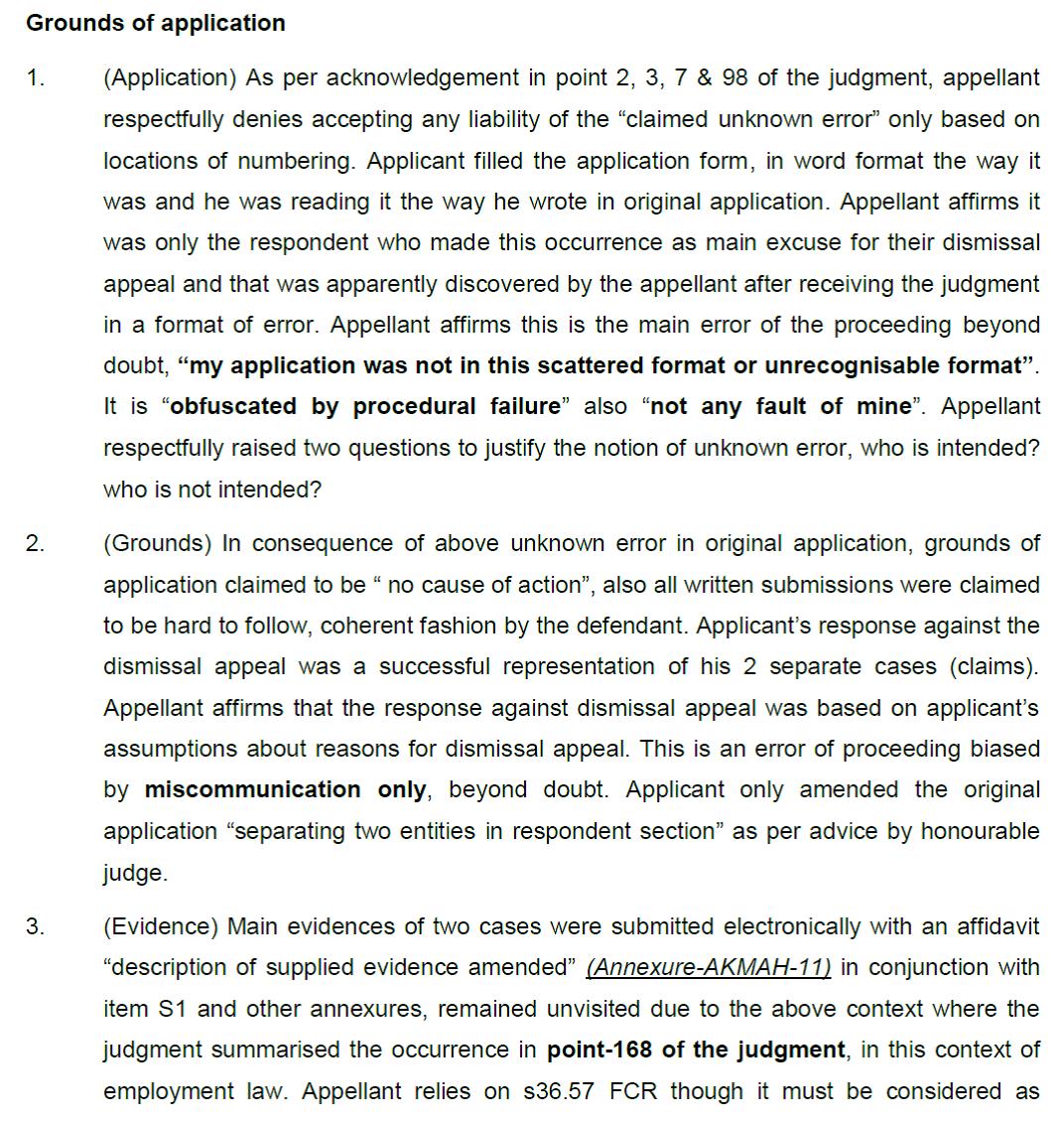
9 The application itself sets out what are said to be “Grounds of application” in seven numbered paragraphs, and under a further heading “Other applications” sets out a further six matters. In order that the totality of the case being advanced is made clear in this judgment, I reproduce those parts of the application for an extension of time and leave to appeal below (emphasis as per original but text font altered for consistency):
Grounds of application
1. (Application) As per acknowledgement in point 2, 3, 7 & 98 of the judgment, appellant respectfully denies accepting any liability of the “claimed unknown error” only based on locations of numbering. Applicant filled the application form, in word format the way it was and he was reading it the way he wrote in original application. Appellant affirms it was only the respondent who made this occurrence as main excuse for their dismissal appeal and that was apparently discovered by the appellant after receiving the judgment in a format of error. Appellant affirms this is the main error of the proceeding beyond doubt, “my application was not in this scattered format or unrecognisable format”. It is “obfuscated by procedural failure” also “not any fault of mine”. Appellant respectfully raised two questions to justify the notion of unknown error, who is intended? who is not intended?
2. (Grounds) In consequence of above unknown error in original application, grounds of application claimed to be “no cause of action”, also all written submissions were claimed to be hard to follow, coherent fashion by the defendant. Applicant’s response against the dismissal appeal was a successful representation of his 2 separate cases (claims). Appellant affirms that the response against dismissal appeal was based on applicant’s assumptions about reasons for dismissal appeal. This is an error of proceeding biased by miscommunication only, beyond doubt. Applicant only amended the original application “separating two entities in respondent section” as per advice by honourable judge.
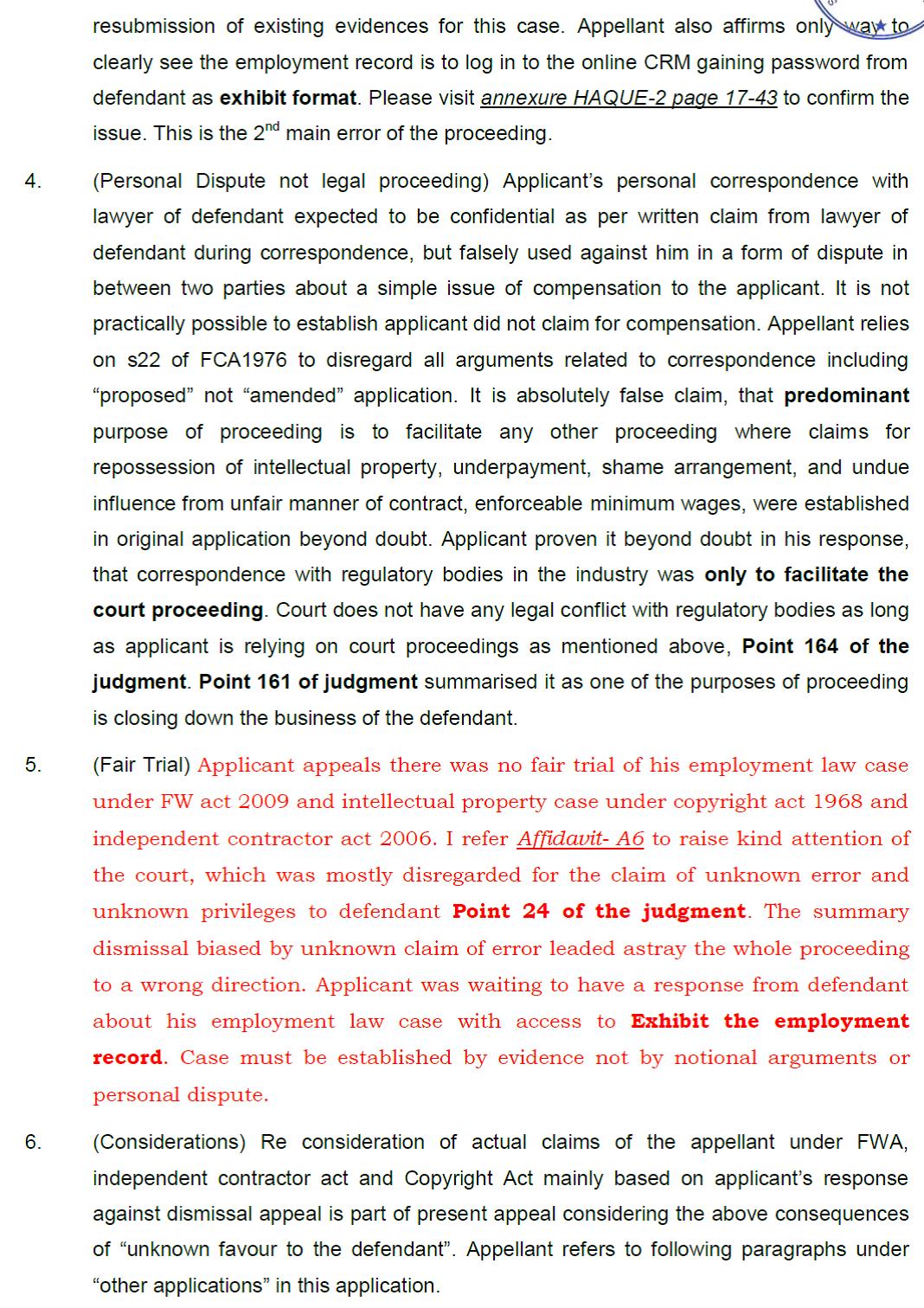
3. (Evidence) Main evidences of two cases were submitted electronically with an affidavit “description of supplied evidence amended” (Annexure-AKMAH-11) in conjunction with item S1 and other annexures, remained unvisited due to the above context where the judgment summarised the occurrence in point-168 of the judgment, in this context of employment law. Appellant relies on s36.57 FCR though it must be considered as resubmission of existing evidences for this case. Appellant also affirms only way to clearly see the employment record is to log in to the online CRM gaining password from defendant as exhibit format. Please visit annexure HAQUE-2 page 17-43 to confirm the issue. This is the 2nd main error of the proceeding.
4. (Personal Dispute not legal proceeding) Applicant’s personal correspondence with lawyer of defendant expected to be confidential as per written claim from lawyer of defendant during correspondence, but falsely used against him in a form of dispute in between two parties about a simple issue of compensation to the applicant. It is not practically possible to establish applicant did not claim for compensation. Appellant relies on s22 of FCA1976 to disregard all arguments related to correspondence including “proposed” not “amended” application. It is absolutely false claim, that predominant purpose of proceeding is to facilitate any other proceeding where claims for repossession of intellectual property, underpayment, shame arrangement, and undue influence from unfair manner of contract, enforceable minimum wages, were established in original application beyond doubt. Applicant proven it beyond doubt in his response, that correspondence with regulatory bodies in the industry was only to facilitate the court proceeding. Court does not have any legal conflict with regulatory bodies as long as applicant is relying on court proceedings as mentioned above, Point 164 of the judgment. Point 161 of judgment summarised it as one of the purposes of proceeding is closing down the business of the defendant.
5. (Fair Trial) Applicant appeals there was no fair trial of his employment law case under FW act 2009 and intellectual property case under copyright act 1968 and independent contractor act 2006. I refer Affidavit- A6 to raise kind attention of the court, which was mostly disregarded for the claim of unknown error and unknown privileges to defendant Point 24 of the judgment. The summary dismissal biased by unknown claim of error leaded astray the whole proceeding to a wrong direction. Applicant was waiting to have a response from defendant about his employment law case with access to Exhibit the employment record. Case must be established by evidence not by notional arguments or personal dispute.
6. (Considerations) Re consideration of actual claims of the appellant under FWA, independent contractor act and Copyright Act mainly based on applicant’s response against dismissal appeal is part of present appeal considering the above consequences of “unknown favour to the defendant”. Appellant refers to following paragraphs under “other applications” in this application.
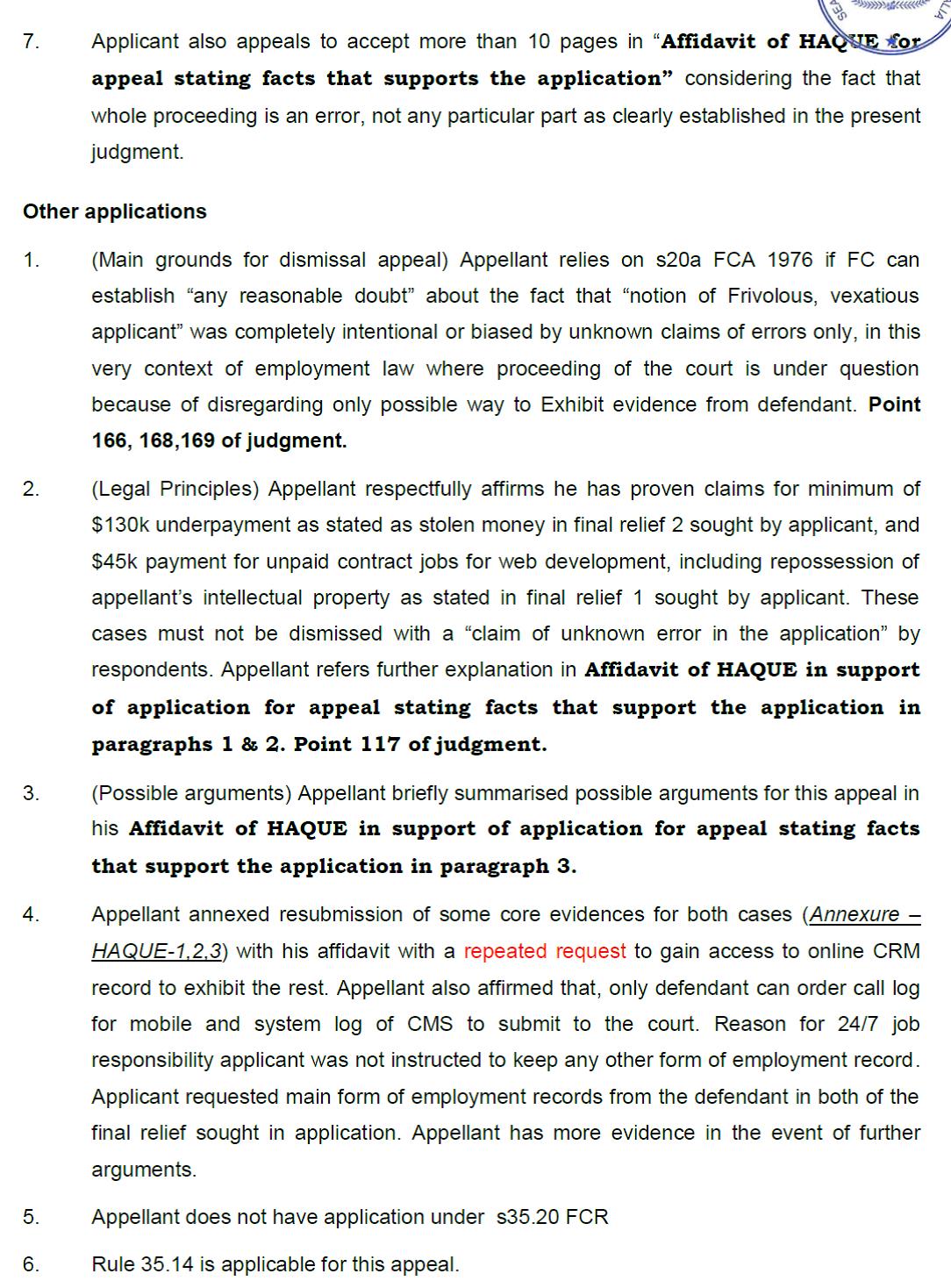
7. Applicant also appeals to accept more than 10 pages in “Affidavit of HAQUE for appeal stating facts that supports the application” considering the fact that whole proceeding is an error, not any particular part as clearly established in the present judgment.
Other applications
1. (Main grounds for dismissal appeal) Appellant relies on s20a FCA 1976 if FC can establish “any reasonable doubt” about the fact that “notion of Frivolous, vexatious applicant” was completely intentional or biased by unknown claims of errors only, in this very context of employment law where proceeding of the court is under question because of disregarding only possible way to Exhibit evidence from defendant. Point 166, 168,169 of judgment.
2. (Legal Principles) Appellant respectfully affirms he has proven claims for minimum of $130k underpayment as stated as stolen money in final relief 2 sought by applicant, and $45k payment for unpaid contract jobs for web development, including repossession of appellant’s intellectual property as stated in final relief 1 sought by applicant. These cases must not be dismissed with a “claim of unknown error in the application” by respondents. Appellant refers further explanation in Affidavit of HAQUE in support of application for appeal stating facts that support the application in paragraphs 1 & 2. Point 117 of judgment.
3. (Possible arguments) Appellant briefly summarised possible arguments for this appeal in his Affidavit of HAQUE in support of application for appeal stating facts that support the application in paragraph 3.
4. Appellant annexed resubmission of some core evidences for both cases (Annexure – HAQUE-1,2,3) with his affidavit with a repeated request to gain access to online CRM record to exhibit the rest. Appellant also affirmed that, only defendant can order call log for mobile and system log of CMS to submit to the court. Reason for 24/7 job responsibility applicant was not instructed to keep any other form of employment record. Applicant requested main form of employment records from the defendant in both of the final relief sought in application. Appellant has more evidence in the event of further arguments.
5. Appellant does not have application under s35.20 FCR
6. Rule 35.14 is applicable for this appeal.
10 Because an issue was taken as to formatting at the hearing before me, I also reproduce images of the document extracted above:
Primary judge’s reasons and conclusions
11 The primary judge’s reasons in granting the application for summary dismissal are methodical and detailed, running to 170 paragraphs. The reasons make a valiant attempt to outline the substance of the amended application relied upon by the applicant before his Honour. They also address the authorities in relation to unrepresented litigants and what constitutes frivolous and vexatious proceedings, and proceedings that are an abuse of process.
12 It is helpful to summarise some aspects of the conclusions his Honour reached in aid of the final decision and order to dismiss the applicant’s amended application. His Honour observed that there was no doubt that the applicant had a deeply felt grievance against the second respondent and, by extension, the first respondent. However, his Honour noted that the extensive reference in his reasons to the applicant’s purported answer to the respondents’ application for summary dismissal illustrated the difficulty, if not impossibility, of establishing any coherent case brought by the applicant, let alone one that was amenable to recognition as a case at law. His Honour observed that, while the material submitted by the applicant was in the form of affidavits and annexures to affidavits, it could not, even on a generous view, be said to be recognisable as an attempt to put evidence before the Court. Rather, his Honour noted, the material consisted, in large part, of narrative expressions of the applicant’s grievances.
13 I have reviewed all of that material and am unable to find any basis to disagree with his Honour’s conclusion. I agree with his Honour that the material presented by the applicant before the Federal Circuit Court was, for the most part, impenetrable, and in parts, incoherent. I agree that even on a number of close readings, that material is immune from conveying meaning relevant to progressing what is, after all, a legal proceeding. That approach continued in the applicant’s presentations of arguments, such as they were, in support of his application for an extension of time and for leave to appeal in this Court.
14 As in the case before the Federal Circuit Court, this Court was left to speculate, to a significant degree, as to the real nature of the grievances that the applicant advances, the relief he seeks, and the relevance or otherwise of the various statements and assertions that he makes to any identifiable cause(s) of action. The applicant’s attitude and approach to the proceedings seemed very much to be one in which he would make a series of sweeping assertions and generalisations and then complain that the respondents had failed to identify what, specifically, was unclear about any of them. The applicant maintains before this Court that it was the responsibility of the respondents and the Court to tell him what was wrong with the case that he was seeking to bring.
15 The applicant takes issue with the description by the primary judge at [98] that the orders sought by the applicant were not “in any recognisable form but appear to be expressions of grievance by the applicant against the respondents”. The applicant referred to the text reproduced from the applicant’s orders reproduced in the primary judge’s reasons at [7] and said the suggestion that they were not in a proper “format” was wrong. The applicant strenuously asserted that he should not be penalised for the way in which the paragraphs in his leave application had been numbered. I endeavoured to point out to him that the reference to “recognisable form” was not a reference to formatting but, rather, to a lack of appropriate content. The applicant refused to accept this. I also indicated to the applicant that, on this point, I would refer to his original document in the Court below, rather than the form in which the orders had been reproduced in the primary judge’s reasons with the formatting objected to by the applicant. An extract of the original document is below:
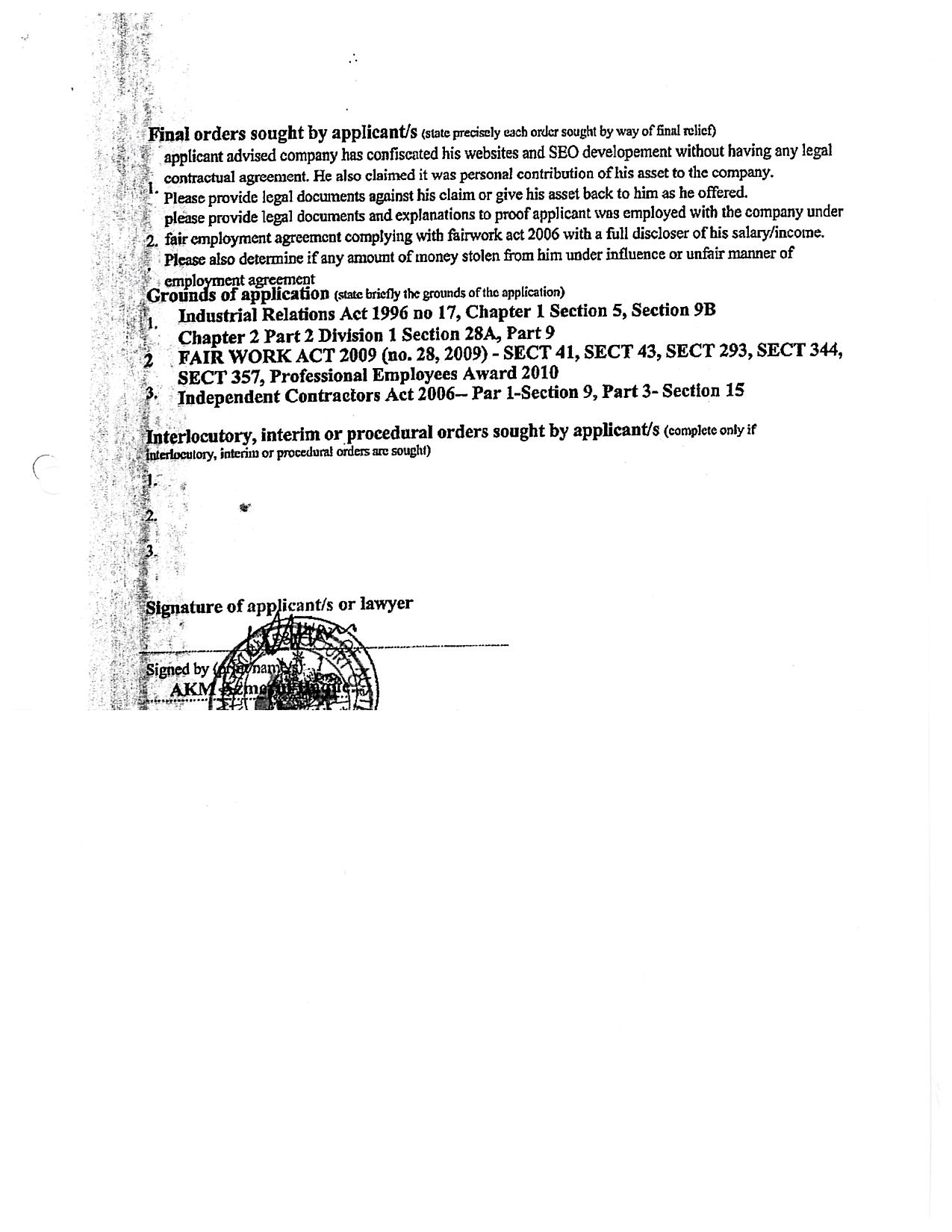
16 The primary judge reached the conclusion that the amended application constituted a proceeding that was frivolous or vexatious upon the basis that it did not disclose a cause of action and had been brought, on the applicant’s own repeated statements, for a collateral purpose. I do not need to explore the question of whether there was any collateral purpose because I accept without reservation or qualification that no cause of action is disclosed in the manner in which the amended application is drafted and presented. In particular, I agree with his Honour’s conclusion at [155]:
In all, the applicant’s affidavits, which seek to put submissions and other material before the Court, in support of the amended application, can only be fairly characterised as long, incoherent and incomprehensible narratives. They contain large amounts of unexplained, and irrelevant matters. The applicant’s position is that the respondents should discern a cause of action in what he has put before the Court. I agree with the respondents, and find that the circumstances are such that they are left to speculate as to meaning, let alone whether there is any case to answer or what that case might be. The applicant’s approach to the Court is to request the Court to assist him in deciding what his case could, or may, be. This too is frivolous in the sense explained by the authorities set out above.
17 I can discern no error on the part of the primary judge in concluding that the respondents succeeded in showing that both elements of r 13.10(b) of the FCC Rules were made out.
18 His Honour observed that the finding that the proceedings brought by the applicant in his amended application were frivolous and vexatious was sufficient to dismiss the substantive application. However, his Honour also went on to consider the second part of the application brought by the respondents, namely that the proceedings were also an abuse of process under r 13.10(c) of the FCC Rules.
19 His Honour found that the respondents had made good their case in this respect because, on what the applicant himself had put before the primary judge, “a dominant purpose in the applicant bringing these proceedings is to then be able to use a Court judgment to progress his complaints with other bodies (ATO, ASIC and MFAA), and to close down the business of the first respondent and obtain the imprisonment of the second respondent”: see [161].
20 His Honour also found an abuse of process because the proceedings were brought without reasonable grounds and were doomed to failure, including because an arguable case was not discernible or made available by the applicant. His Honour also noted that the applicant had sought relief from the Federal Circuit Court which was not within its power to grant, such as orders to close the business of the first respondent and to gaol the second respondent.
21 His Honour concluded that the proceedings were therefore also an abuse of process for all of the reasons his Honour set out in relation to frivolous and vexatious proceedings. His Honour therefore found that the respondents had discharged the heavy burden, as identified in the authorities cited by his Honour, of making out the matters in r 13.10(c) of the FCC Rules. Again, I am unable to discern any error in his Honour’s reasoning.
Consideration
22 At the hearing of the application for an extension of time and for leave to appeal, the respondents relied upon their written submissions and did not seek to make any further arguments. That is understandable, because the submissions were comprehensive and the applicant made no meaningful attempt to respond to them.
Proposed grounds of appeal
23 The respondents submit that the proposed notice of appeal suffers from the same vice that led to the primary judge dismissing the applicant’s amended application as frivolous and vexatious and an abuse of process. I consider that to be a fair characterisation of the grounds taken as a whole. As the respondents point out, even after a reading of the applicant’s affidavits in support of his application for an extension of time and leave to appeal, no insight can be gained as to the grounds of appeal and it is unfair to expect the Court or the respondents to guess what they might be.
24 Turning to the submissions about the specific grounds advanced, the respondents submit that proposed ground 1 appears to assert that the form of the applicant’s amended application was a formatting error. The applicant enlarged upon this at the hearing of the application and said that he had since followed the forms provided by the Federal Circuit Court and accordingly was not responsible for any deficiency.
25 The respondents point out in the supporting affidavit of the applicant filed 11 May 2016 at [1.2] that the applicant quotes the following to describe the matter: “no fault of his own”, “obfuscated by procedural failing”, “idea of error” and “scattered format”. As the respondents submit, the meaning of these expressions cannot be penetrated. The respondents submit that no error of law or fact is identifiable and that, in any event, the amended application was not dismissed by the primary judge because of any formatting errors. I consider that each part of those submissions and the totality of those submissions are correct.
26 In relation to proposed ground 1, I consider that there is no meaningful ground of appeal able to be discerned from the material provided by the applicant.
27 The respondents submit that proposed grounds 2 and 3 do not identify any error of law or fact on the part of the primary judge. In my view that is correct. There is no suggestion of any error on the part of the primary judge and the only references to the primary judge’s reasons appear to be raising questions of formatting.
28 The respondents describe proposed ground 4 as misguided. The respondents somewhat generously suggest that this proposed ground is suggesting that the primary judge did not consider the applicant’s material before his Honour. The respondents’ submissions then point to the fact that this was not so because of the extensive reference to that material. Whilst I do not disagree with the content of that submission, I prefer to regard proposed ground 4 as failing to identify any ground of appeal.
29 The same observation can be made about proposed ground 5. The respondents submit that that ground does not assert any discernible error of law or fact. In my view that characterisation is correct.
30 Proposed ground 6 states, amongst other allegations, “there was no fair trial of [the applicant’s] employment law case under the FW act 2009 …”. The respondents point out that ground 6 is effectively a complaint that the applicant’s matter was not taken to trial, which was an inevitable consequence of the summary dismissal. That cannot be a ground of appeal per se. Even generously interpreted as being an error in the exercise of discretion, as it is unaccompanied by any proper explanation of any error that was made by the primary judge, it too is not a sustainable ground of appeal.
31 The respondents submit that grounds 7 and 8 also fail to identify any error of law or fact and again I agree with that characterisation.
32 The respondents point out that the applicant ultimately says that he has a contractor and employment claim, but that such a descriptor is too general and broad to be helpful. The respondents point out that no attempt is made by the applicant to provide specific details of the claim that he seeks to bring. To illustrate that point, the respondents noted that before the primary judge, the applicant relied upon the entirety of the Fair Work Act 2009 (Cth) because all of its sections had been breached by the respondents: see the primary judge’s reasons at [122].
33 In the applicant’s supporting affidavit of 11 May 2016 for this application for an extension of time and leave to appeal, the applicant still maintains “that a huge number of sections have been breached” (see [1.11]) but does little to identify the sections nor any basis on which it is alleged they have been breached. The respondents submit that, as the primary judge said at [122], such an approach was unhelpful and at [138] that “no reasonable argument can be discerned from the applicant’s list of sections from the FWA in his amended application”.
34 The respondents submit, and I agree, that it is readily apparent from a review of the primary judge’s reasons that his Honour considered all relevant material, had regard to proper legal principles and correctly applied those principles to the facts of this case. There is no discernible error in principle or approach by his Honour.
35 The primary judge had regard to all of the applicant’s affidavits before him and made detailed and extensive reference to his complaints and submissions. His Honour identified and correctly applied the legal principles concerning the grounds for dismissal relied upon, namely that the proceedings were frivolous or vexatious and an abuse of process.
36 In the exercise of discretion, the primary judge properly recognised that summary dismissal powers should be exercised with great caution and was expressly mindful of the heavy onus to be met to make good such a claim.
37 As the respondents point out, the primary judge was acutely aware that the applicant was self-represented and considered the principles in relation to self-represented litigants carefully and thoroughly.
38 As the respondents also pointed out, the primary judge disclosed that he had conducted “a number of close readings” of the applicant’s material and in reviewing that material did not expect a standard such as might be expected from a legal practitioner. Rather, the primary judge gave the applicant’s material, for the purposes of assessing the respondents’ application in a case for summary dismissal, a “fair or beneficial” reading. In my view, the primary judge bent over backwards to give the applicant a fair hearing and due process. In my view, the critical findings made of the applicant’s pleadings and other material were properly available to his Honour. This is not a case in which I might have come to a different view but nonetheless found no error. To the contrary, I consider that his Honour was correct in the conclusions he reached and would have reached the same conclusions myself had the summary dismissal application been made before me.
Conclusion
39 There is no prospect that I can see for any of the proposed grounds of appeal succeeding. In those circumstances there cannot be any injustice at all in refusing leave to appeal, let alone substantial injustice. If there is to be no leave to appeal, the application for an extension of time must also fail because granting it would be futile.
40 The application for an extension of time for leave to appeal and the application for leave to appeal must be dismissed with costs.
I certify that the preceding forty (40) numbered paragraphs are a true copy of the Reasons for Judgment herein of the Honourable Justice Bromwich. |
Associate:


