

FEDERAL COURT OF AUSTRALIA
Geneva Laboratories Limited v Prestige Premium Deals Pty Ltd (No 4) [2016] FCA 867
ORDERS
DATE OF ORDER: |
THE COURT ORDERS THAT:
1. Pursuant to r 5.23(2)(c) of the Federal Court Rules 2011 (Cth), judgment be given against the first, second, third and fourth respondents for the relief of declarations, injunctions and forfeiture orders claimed in the statement of claim as set out in the amended fast track application.
2. The first, second, third and fourth respondents pay the applicants’ costs of the interlocutory application as taxed or agreed.
3. Pursuant to r 15.13(f) of the Federal Court Rules 2011 (Cth), the fourth respondent’s cross-claim be dismissed.
4. The fourth respondent pay the applicants’ costs of the cross-claim as taxed or agreed.
5. The first to fourth respondents pay the applicants’ costs of the proceedings to date as otherwise not covered by the costs orders above, including reserved costs.
6. Within 14 days, the applicants file and serve draft short minutes of order for the terms of the declarations and injunctions that are to be made consequent upon order 1 above.
7. The matter be listed at 9.30 am on 23 August 2016 for directions to be made for the conduct of the damages inquiry phase of the proceedings and to make the declarations, injunctions and forfeiture orders arising from the judgment in favour of the applicants.
Note: Entry of orders is dealt with in Rule 39.32 of the Federal Court Rules 2011.
[1] | |
[6] | |
[11] | |
[13] | |
[29] | |
Present history of the proceedings and the application for default judgment | [32] |
[44] | |
[54] | |
[76] | |
[88] | |
[96] | |
[96] | |
[115] | |
[118] | |
[131] | |
[140] | |
[153] | |
[154] | |
[155] | |
[163] | |
[165] | |
[168] | |
[171] | |
[176] | |
[178] | |
[179] | |
[181] |
1 This is an application for default judgment in a case concerning allegations of importing and selling a counterfeit version of a skin care oil product known as “Bio-Oil”. The applicants allege misleading and deceptive conduct, trade mark and copyright infringement and passing off on the part of the respondents. The applicants seek relief by way of declarations, injunctions, forfeiture orders, damages, interest and costs.
2 The applicants’ case for default judgment turns on allegations of prolonged, persistent and continuing failure on the part of the respondents to comply with orders of the Court. That case is substantially assisted by fundamental failures on the part of the respondents to comply with the rules of Court concerning pleading a defence.
3 For the reasons set out below, I am of the view that the applicants should mostly succeed in relation to the causes of actions pleaded, and wholly succeed in relation to the declaratory, injunctive and forfeiture relief sought at this stage, albeit with some limitations due to the failure of some of the causes of action against the second and third respondents. Accordingly, paragraphs 1 to 3 of the interlocutory application should be allowed to the extent detailed below, with costs as sought by paragraphs 4 and 5 of the interlocutory application.
4 The applicants are to file and serve short minutes of the declarations, injunctions and forfeiture orders sought consequent upon judgment in their favour. The matter will then proceed to a damages inquiry.
5 As a preliminary matter, because an aspect of the relief sought pertains to material seized by the then Australian Customs and Border Protection Service, the Chief Executive Officer of Customs was formally joined as the fifth respondent. He has filed a submitted appearance save as to costs. In these reasons, any collective reference to “the respondents” or “all the respondents” or the like in these reasons is to be taken to exclude any reference to the fifth respondent.
6 In March 2014, Customs seized what was alleged to be counterfeit Bio-Oil. On 2 April 2014, the applicants commenced proceedings against the respondents by way of a fast track application.
7 A year of interlocutory processes and orders followed the filing of the fast track application. On 1 June 2015, the applicants filed an amended fast track application and a statement of claim. The fact of intellectual property being held in Bio-Oil products by the applicants, as detailed below, was common ground in the proceedings.
8 The statement of claim detailed the basis for the entitlement to the relief sought in the amended fast track application. The substance of the applicants’ case, as pleaded, was that:
(a) the first applicant (Geneva) was the owner of Australian trade mark registrations 1540111, 1503757 and 1222258 (Geneva’s Trade Marks) related to Bio-Oil;
(b) the second applicant was an authorised user of Geneva’s Trade Marks, with exclusive rights to apply Geneva’s Trade Marks for the purpose of manufacturing, distributing and selling Bio-Oil in all countries other than certain African nations, and therefore including Australia;
(c) another company, Aspen Pharmacare Australia Pty Ltd, was the exclusive distributor of Bio-Oil in Australia;
(d) Aspen Pharmacare sold Bio-Oil only to three other companies in Australia and authorised those three companies to resell that Bio-Oil;
(e) the first respondent had, in concert with the other respondents and in particular the fourth respondent, imported and sold counterfeit Bio-Oil; and
(f) the first respondent, in concert with the other respondents, and directed by the fourth respondent as the sole shareholder and director of the three corporate respondents, had passed off the counterfeit Bio-Oil (in both the general and tort sense) as, in effect, parallel imported genuine product.
9 The statement of claim also detailed how the alleged counterfeiting had been detected and investigated, how proceedings had been commenced against customers of the first respondent, Prestige Premium Deals Pty Ltd, or of the respondents, and how the purported Bio-Oil imported and supplied by Prestige Premium had been tested and shown to be counterfeit.
10 In summary, the applicants seek:
(a) declarations that each and all of the respondents have:
(i) contravened s 120 of the Trade Marks Act 1995 (Cth);
(ii) contravened s 18 of Schedule 2 to the Competition and Consumer Act 2010 (Cth) (the CCA) and/or the corresponding New South Wales provisions in s 18 of Schedule 2 to the Australian Consumer Law (NSW) (the ACL), and that the fourth respondent (the only natural person respondent) was also an accessory (in the extended statutory sense) to those contraventions by the corporate respondents; and
(iii) contravened s 29 of Schedule 2 to the CCA and/or the corresponding New South Wales provisions in s 29 of Schedule 2 to the ACL, and that the fourth respondent was also an accessory (in the extended statutory sense) to those contraventions by the corporate respondents;
(iv) contravened ss 36, 37, and/or 38 of the Copyright Act 1968 (Cth);
(v) engaged in the tort of passing off;
(b) a declaration that the fourth respondent authorised, directed and procured the conduct of any or all of the other three (corporate) respondents which contravened the Trade Marks Act, CCA, ACL, Copyright Act or amounted to the tort of passing off, so as to be liable as a joint tortfeasor;
(c) orders for the forfeit of the goods seized by Customs in March 2014;
(d) injunctions restraining the respondents, either themselves or by an agent, from infringing trade marks or copyright and from continuing to engage in various types of conduct which gave rise to those complaints;
(e) an inquiry into damages or profits made arising from the conduct complained of;
(f) damages under s 236 of the CCA and/or ACL;
(g) additional damages under s 126(2) of the Trade Marks Act and s 115(4) of the Copyright Act;
(h) interest; and
(i) costs.
The interlocutory application for default judgment
11 In paragraphs 1 to 5 of the interlocutory application, the applicants seek:
(a) pursuant to r 5.23(2)(c) of the Federal Court Rules 2011 (Cth), judgment be given against the first to fourth respondents for the relief claimed in the applicants’ statement of claim as set out in the amended fast track application – this necessarily must be read as seeking relief up to, but not including, quantum of damages or an account of profits, and interest, for which an inquiry is still required;
(b) pursuant to r 15.13(f) of the Rules, the fourth respondent’s cross-claim be dismissed;
(c) the fourth respondent pay the applicants’ costs of the cross-claim;
(d) the first to fourth respondents pay the applicants’ costs of the interlocutory application; and
(e) the first to fourth respondents pay the applicants’ costs of the proceedings.
12 The balance of the interlocutory application did not need to be pressed by the applicants at this stage as it only concerned issues to do with evidence in the event the proceedings went to trial.
13 On 3 July 2015, the respondents filed a sparse defence on behalf of all of them which did not differentiate between their respective positions, save for the pleadings to the paragraphs of the statement of claim which were directed to only one respondent. The respondents’ defence:
(a) admitted a large proportion of the allegations pleaded, albeit these were largely uncontroversial matters pertaining to the applicants’ business arrangements and intellectual property rights, but also aspects of the conduct of the first respondent in relation to overseas purchases and the like;
(b) pleaded “Does not Admit” to a significant number of other allegations;
(c) pleaded “Does not plead as there is no allegation made” to a number of other allegations;
(d) made qualified admissions as to various importations, but asserted that the products imported were genuine; and
(e) denied or did not admit that the effect of their conduct constituted any of the alleged contraventions and denied any entitlement to the relief sought.
14 In relation to the respondents pleading “Does not Admit”, the Rules provide that any allegation that is not specifically denied is taken to be admitted: r 16.07(2). The only exception to that, which was not utilised by the respondents, is to plead “does not know and therefore cannot admit”, which is then taken to be a denial for pleading purposes: rr 16.07(3) and 16.07(4). I will use the term “deemed admitted” to reflect the operation of r 16.07(2). Further, relevant to this particular case, the note to r 16.07 provides:
This rule requires a party to address each material fact pleaded in an opposing party’s pleading. A general denial or an evasive answer will not be sufficient.
15 The operation of r 16.07(2) affects certain allegations that the purported Bio-Oil obtained from the domestic customers and supplied by the respondents was counterfeit, to which the respondents pleaded in their defence an assertion of importing genuine Bio-Oil.
16 If r 16.07(2) applies according to its terms, the resulting deemed admissions are significant as they are said by the applicants to establish that customers had obtained counterfeit Bio-Oil from the first respondent (or from the respondents more generally). They are, on their face, deemed admissions that the applicants had “reason to believe” counterfeit Bio-Oil was obtained by each of the domestic customers from the first respondent, as alleged in paragraphs 76, 94(b), 113(b), 129(a), 150(a), 162(b), 177(b), 193(b) and 199 of the statement of claim.
17 The phrase “reason to believe” on the part of the applicants is a less-than-ideal addition to the statement of claim, at least when it comes to considering the effect of deemed admissions. That phrase was somewhat opaque as to its effect in this context. However, counsel for the applicants argued that it should be interpreted as an allegation of the underlying fact as to which a belief was held. It also remains an assertion that is prima facie deemed admitted, and accordingly the effect of that deemed admission must be determined.
18 In the context of the allegations pleaded, the terms of the defence also indicate the extent to which the respondents were not cooperating in the carriage of the proceedings by proper pleadings. That assumes particular significance when regard is had to the orders made during the course of the proceedings for the respondents to provide particulars to their defence. This order followed correspondence from the applicants’ solicitors seeking particulars.
19 In a letter sent by the applicants’ solicitors to the respondents’ solicitors dated 21 July 2015 the following was stated:
Pursuant to rule 16.07 of the Federal Court Rules 2011 (Cth), your clients are required to specifically admit or deny every allegation of fact in the [sic] our clients’ Statement of Claim except in circumstances where your clients state that they do not know and therefore cannot admit a particular fact.
The Defence fails to meet the requirements of the above rule and, as such, your clients’ Defence is not properly pleaded and should be struck out.
So that our client can properly understand the particular facts that your client traverses, our clients require further particulars of your clients’ Defence.
20 The letter then listed the allegations in paragraphs 67, 71, 87, 92, 109, 123, 127, 146, 148, 159, 174 and 190 of the statement of claim relating to tests demonstrating that purported Bio-Oil was not genuine and therefore counterfeit and stated:
In respect of each of the Allegations your client has pleaded that “it does not admit”.
In circumstances where our clients have provided your clients with the evidence in support of the Allegations, our clients do not understand why your clients have not properly set out their position in relation to the Allegations. Your clients are now in a position to state whether they admit or deny the Allegations.
If your clients deny the Allegations, please let us know whether your clients intend to test each of the samples and serve and rely on expert reports in relation to them.
21 The letter then asked questions about concessions concerning the testing and concluded:
Please let us have your clients’ response on or by 31 July 2015.
If your clients fail to respond to our clients’ request for particulars of the Defence by 31 July 2015, then our clients will file an application to strike out the Defence and this letter will be produced on the question of costs.
22 This was followed by reminder correspondence and ultimately Court orders to supply the particulars sought. All of this had no effect and no particulars of the defence were provided.
23 The applicants, in seeking particulars of the defence, and in seeking and obtaining orders from this Court that such particulars be provided, may simply have been cautious in relation to the operation of r 16.07(2). However, in so doing they were effectively throwing the respondents a lifeline. If particulars had been supplied, that may have been a compelling reason not to apply r 16.07(2) according to its terms. But if, as it transpired, they were not supplied, then the respondents had a more difficult task in persuading the Court that r 16.07(2) should not be literally applied so that “Does not Admit” is a deemed admission to whatever was pleaded against them.
24 In all the circumstances I accept the applicants’ submissions, and accordingly treat the pleadings prefaced by the phrase “reason to believe” as constituting an allegation of the underlying fact asserted. The defence pleading in response of “Does not Admit” is to be treated as a deemed admission to that underlying fact.
25 As noted above, the respondents also have pleading problems with a number of other paragraphs of the defence in which it is asserted that there is no pleading because there is no allegation. For example, the statement of claim alleges:
(a) per paragraph 83, that one of the domestic customers, Pharmacy 4 Less Pty Ltd, a franchisor buyer on behalf of over 30 franchisee pharmacies, did not purchase Bio-Oil from any supplier other than the first respondent over a two-year period from July 2012 to July 2014; and
(b) per paragraph 84, that on 26 and 27 June 2014, the applicants’ lawyers, as agents for the applicants, purchased Bio-Oil from various Pharmacy 4 Less locations (referred to as trap purchases).
26 The defence response to both of those allegations is “Does not plead as there is no allegation made”, rather than, e.g., “does not know and cannot admit”. However, it is plain that the combined effect of paragraphs 83 and 84 of the statement of claim is to make an allegation, namely to allege that the Bio-Oil purchased by the applicants’ solicitors had been supplied to Pharmacy 4 Less by the first respondent. In the context of paragraphs 85 to 87 that follow, that is an important combined allegation, because those subsequent paragraphs allege that what was purchased from Pharmacy 4 Less was tested and found to be counterfeit. The effect of the chain of allegations from paragraphs 85 to 87 of the statement of claim is that the first respondent supplied the counterfeit Bio-Oil to Pharmacy 4 Less that was purchased by the applicants’ solicitors.
27 In any event, as the allegations in paragraphs 83 and 84 are not specifically denied, they too are taken to be admitted by the ordinary operation of r 16.07(2). The same result applies to the other like allegations surrounding all the other sales to other pharmacies, trap purchases on behalf of the applicants and testing of the trap purchases to prove the purported Bio-Oil was counterfeit. As a consequence, the combined allegation from paragraphs 83 to 87, and the same allegations for the other trap purchases pleaded, are taken to be admitted. The applicants are taken to have established that the first respondent supplied at least the counterfeit Bio-Oil purchased by the applicants’ solicitors on each occasion pleaded. Each time, unless, by an unhappy coincidence, this was the only time that those pharmacies sold counterfeit Bio-Oil supplied by the respondents, this may support an inference that this was a part of the business activities of the respondents. However, for such serious allegations that will be at least a potentially fragile inference, and in any event may be of indeterminate scope. This reality is an important consideration when it comes to non-compliance with the orders of the Court considered below.
28 Paragraphs 62, 104, 118, 132, 141, 154 and 169 of the statement of claim each summarise the effect of a number of preceding paragraphs. In response to those paragraphs, the defence legitimately pleads “Does not plead as there is no allegation made”. In response to paragraph 185, which is similarly a summary allegation, the defence pleads “Does not Admit as there is no allegation made”. However, this does not make any difference to the overall conclusions I have reached on the pleading issue and accordingly does not require any further consideration.
Potential factual gap arising from the defective defence
29 With the deemed admissions arising from failures in the defence to deny allegations specifically as required, the applicants have been able to establish a significant part of their case on the pleadings alone. However, there did remain the respondents’ assertion in their defence, not supported by any evidence filed at all, of importing genuine Bio-Oil, even though there were deemed admissions of the sale by them of particular items of counterfeit Bio-Oil. This creates a potential factual gap, because, without the contribution or cooperation of the respondents, there remained a potential question as to whether the applicants could exclude a competing inference that the respondents may have supplied both counterfeit and genuine Bio-Oil. If so, the proportions of each may have been impossible to determine.
30 Imperfect inferences might have been able to be drawn at trial from the juxtaposition of deemed admitted counterfeit imports, and proof of no legitimate imports and domestic sales. However, this still left the applicants at an unavoidable forensic disadvantage in not being able to prove a complete account of what had taken place due to information best or only known by one or more of the respondents. It was in that context that the applicants sought access to the respondents’ computers, via orders made by the Court. It was the alleged repeated failure to comply with those orders detailed below that was the centrepiece of the applicants’ case for default judgment.
31 The conduct of the respondents indicates that they were quite content for the proceedings to continue in this way to trial, leaving it to the applicants to make their case as best they could, and relying on any shortcomings that emerged. That approach of effectively relying on any inability of the applicants to discharge the necessary evidentiary onus is only legitimate to the extent that it does not entail defying orders made by the Court to assist the applicants legitimately to ascertain the true position. The respondents’ “no evidence” strategy required, for success, at the very least careful adherence to the Rules concerning defence pleading and on compliance with pre-trial orders made by the Court. These reasons demonstrate that neither precautionary requirement was observed.
Present history of the proceedings and the application for default judgment
32 On 10 February 2016, Yates J listed the matter for a five-day trial commencing on 18 April 2016. The matter, including that hearing, was subsequently reallocated to my docket.
33 The present interlocutory application was filed on 1 April 2016. On 6 April 2016, the matter was listed before me for directions. At that directions hearing, the interlocutory application for default judgment was listed for hearing on the Wednesday before the trial, 13 April 2016. Also at that 6 April 2016 directions hearing, I extended the time for compliance with computer access orders detailed below to Friday, 8 April 2016. I made it clear that continued non-compliance with the orders of the Court could weigh heavily in the exercise of the discretion on the question of default judgment already sought by the present interlocutory application.
34 On 22 April 2016, I heard those parts of the applicants’ interlocutory application dated 1 April 2016 outlined at [11] above. The reasons why the hearing did not proceed as originally scheduled on 13 April 2016 are detailed below.
35 The applicants rely upon allegations of serious and persistent default by way of the respondents’ failure to comply with the Rules and with orders made by the Court. This includes, in particular, acts of non-compliance in the period between June 2014 and April 2016 with orders made by three different Judges of this Court granting the applicants access to the respondents’ computers.
36 Other defaults alleged by the applicants were said to have exacerbated antecedent failures to comply with the Rules, including, in particular, breaches of the formal and fundamental requirements for properly pleading the respondents’ defence adverted to above. The applicants sought to overcome the defects in the defence by requesting particulars. It is not disputed that the respondents failed to furnish those particulars despite repeated orders of this Court requiring that to take place.
37 As noted above, the hearing of this interlocutory application was originally set down to be heard on 13 April 2016. However, on that day I was informed by counsel for the respondents, Mr Eardley, that his instructing solicitor, Mr Russo, had been struck off the previous day, 12 April 2016. The grounds for striking off concerned issues related to failing to account for and pay counsel’s fees already paid by another client in 2009, rather than any issue concerning performance of legal work: see Legal Services Commissioner v Russo [2016] NSWCATOD 42. Those grounds for striking off therefore concerned matters entirely unrelated to these proceedings or to the respondents.
38 Mr Eardley of counsel had been retained in this matter by a now struck off solicitor, Mr Russo, who was the only person at his firm with an unrestricted practising certificate. Accordingly, as at 12 April 2016, Mr Eardley was no longer retained by a firm of solicitors with anyone able to give him instructions. Mr Eardley’s retainer with Mr Russo’s firm was therefore at an unavoidable end.
39 As a result of Mr Russo being struck off, on 13 April 2016 Mr Eardley was retained directly by the respondents for the limited purpose of making applications to adjourn this application for default judgment, to vacate the 18 April 2016 trial, and also to adjourn a 26 April 2016 contempt hearing against the respondents to be heard by Perram J (which I was not able to entertain, but which was subsequently adjourned).
40 I acceded to the applications concerning vacating and adjourning the matters before me. The trial to commence on 18 April 2016 was therefore vacated, and the hearing of this application was adjourned to 22 April 2016. That was necessary to ensure that the respondents were not denied procedural fairness in respect of either hearing. There was not, nor could there have been, any suggestion that the respondents were in any way responsible for either of those events (the vacation of the trial and the delay in the hearing of this interlocutory application).
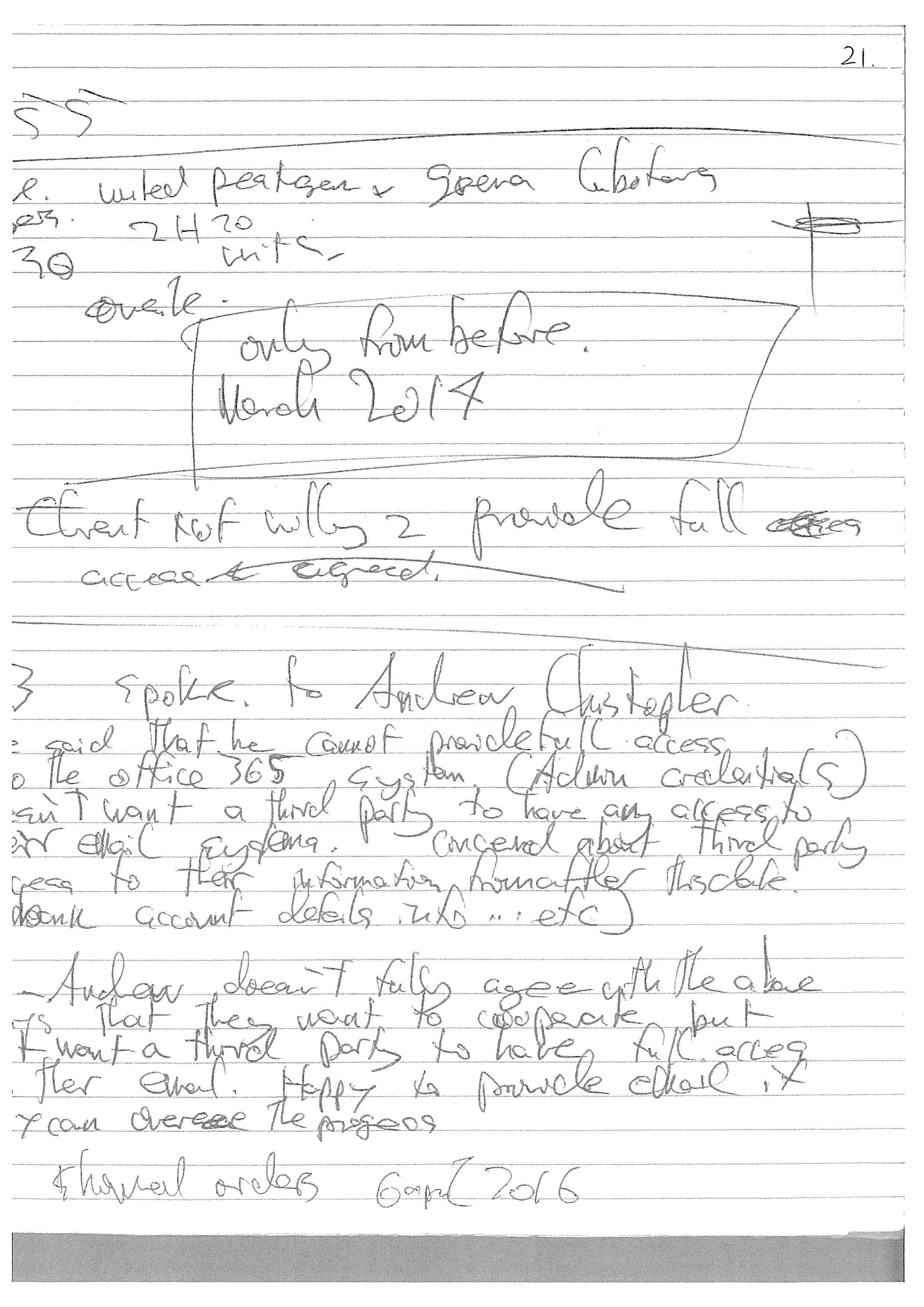
41 Importantly, the delay in the hearing of this application was deliberately made long enough to permit an alternative solicitor to be retained to instruct Mr Eardley. In that regard, it is important to note that Mr Eardley had been instructed to appear for the respondents at the trial listed to be heard from 18 to 22 April 2016, and was therefore already available and well-versed in the issues in this case, as well as already knowing about the allegations of non-compliance by the respondents.
42 I gave directions that the applicants were to file and serve an outline of submissions by 4.00 pm on Monday, 18 April 2016; and that the respondents were to file and serve any evidence in reply and an outline of submissions by 4.00 pm on Wednesday, 20 April 2016. Both parties filed their submissions as directed. The unfortunate events by which Mr Russo was no longer able to act therefore did not have any discernible adverse impact on the respondents’ ability to meet the present interlocutory application.
43 The live issues in the interlocutory application were:
(a) the findings of fact that should be made from the evidence in support of, and contradicting, the allegations of default;
(b) whether any findings of default are of a sufficiently serious nature to support the ultimate sanction of closing the door on the respondents from defending themselves as to liability in these proceedings; and
(c) if so, whether the statement of claim pleads the applicants’ case with sufficient clarity and compliance with the Rules to allow default judgment (and consequent dismissal of the fourth respondent’s cross-claim); and
(d) if so, whether:
(i) the declarations sought should be made;
(ii) the injunctions sought should be ordered;
(iii) the forfeiture orders should be made (there was no contest in this regard);
(iv) an assessment as to damages should proceed; and/or
(The question whether the damages (or alternatively an account of profits), costs and interest sought should be awarded necessarily would only need consideration if the applicants reached that point.)
44 Rule 1.32 provides:
Court may make any order it considers appropriate in the interests of justice
The Court may make any order that the Court considers appropriate in the interests of justice.
45 Rule 5.23 provides (emphasis added after heading):
Orders on default
(1) If an applicant is in default, a respondent may apply to the Court for an order that:
(a) a step in the proceeding be taken within a specified time; or
(b) the proceeding be stayed or dismissed for the whole or any part of the relief claimed by the applicant:
(ii) on conditions specified in the order.
(2) If a respondent is in default, an applicant may apply to the Court for:
(a) an order that a step in the proceeding be taken within a specified time; or
(b) if the claim against the respondent is for a debt or liquidated damages — an order giving judgment against the respondent for:
(i) the debt or liquidated damages; and
(ii) if appropriate, interest and costs in a sum fixed by the Court or to be taxed; or
(c) if the proceeding was started by an originating application supported by a statement of claim, or if the Court has ordered that the proceeding continue on pleadings — an order giving judgment against the respondent for the relief claimed in the statement of claim to which the Court is satisfied that the applicant is entitled; or
(d) an order giving judgment against the respondent for damages to be assessed, or any other order; or
(e) an order mentioned in paragraph (b), (c) or (d) to take effect if the respondent does not take a step ordered by the Court in the proceeding in the time specified in the order.
46 It follows that in bringing this application under r 5.23(2)(c), the applicants must establish that the respondents are “in default”.
47 Rule 5.22 defines “in default”. It provides that:
When a party is in default
A party is in default if the party fails to:
(a) do an act required to be done, or to do an act in the time required, by these Rules; or
(b) comply with an order of the Court; or
(c) attend a hearing in the proceeding; or
(d) prosecute or defend the proceeding with due diligence.
48 The applicants rely on all four paragraphs of r 5.22 to establish default on the part of the respondents, but mostly on alleged failures to comply with the Rules and failure to comply with orders of the Court: rr 5.22(a) and 5.22(b).
49 The LexisNexis loose-leaf service Practice and Procedure High Court and Federal Court commentary on r 5.22 suggests at [r 5.23.30] that r 5.22(b) contemplates an order that is “mandatory or coercive on the party said to be in default”, and further suggests that r 5.22(a) should be read in the same way as being confined to “a mandatory or coercive requirement of the Rules”. For my part, I do not think that such a gloss on the words used in r 5.22, especially as to any coercive aspect, is warranted or even necessary. However, even if it is, that threshold is met in this case.
50 The formal trigger for an application for default judgment under r 5.23(2)(c) in reliance on r 5.22 requires no more than any of a failure to do an act (required by the Rules, whether at all or by the time required), a failure to comply with an order, a failure to attend a hearing, or a failure to prosecute or defend with due diligence. In the case of rr 5.22(a) or 5.22(b), the nature of the order or rule that is shown not to have been complied with, and the nature and extent of the non-compliance may be, and in many cases will be, an important consideration in deciding whether or not to exercise the discretion to act upon the default in some way. Individual acts of default may not be sufficient, but their cumulative effect, especially on the progress of the proceeding, the capacity to bring them to trial, and costs and other burdens on the party not in default, may be sufficient.
51 All other things being equal, a deliberate or persistent breach of a mandatory or coercive requirement will obviously be more serious than an isolated or inadvertent breach of a less important requirement. An application based on no more than the latter may be doomed to fail, especially having regard to the authority referred to below, with possible cost consequences for vexing the opposing party and the Court with a weak or otherwise inappropriate application.
52 The applicants also rely on r 15.13(f) in seeking the dismissal of the fourth respondent’s cross-claim. Rule 15.13 provides (emphasis added after heading):
Hearings in relation to cross-claims
A party to a cross-claim may apply to the Court for an order:
(a) that any claim, question or issue arising in the cross-claim be tried in accordance with an order of the Court; or
(b) permitting a cross-respondent to defend the claim made in the principal proceeding or any other cross-claim in the proceeding, either alone or with another party; or
(c) permitting a cross-respondent to appear at the hearing of the principal proceeding or any other cross-claim in the proceeding, and to participate in the hearing as the Court considers appropriate; or
(d) determining the extent to which the cross-claimant, and a cross-respondent, are to be bound as between each other by an order or a decision made in relation to the principal proceeding or any other cross-claim in the proceeding; or
(e) for the hearing and determination of the principal proceeding and the cross-claim; or
(f) dismissing the cross-claim.
53 The fourth respondent’s cross-claim would be the only part of the litigation as to liability remaining if the default judgment application succeeded. I do not understand the fourth respondent to be contending that his cross-claim should remain on foot if default judgment was otherwise successfully obtained against him. But even if I am wrong about that, in my view the outcome of this part of the application, must, as a practical matter, follow the success or failure of the default judgment application.
Default judgment principles and authority
54 The discretion conferred by r 5.23(2)(c) (and also r 15.3(f)) is unfettered, being conditioned on failure to do any of the things identified in r 5.22(a) to (d). There is no requirement of intentional default or contumelious conduct, although those aspects, if present, will be important. Nor is there any requirement within the text that delay or other impugned conduct was inordinate or inexcusable, although again that is likely to be a significant matter: see Lenijamar Pty Ltd v AGC (Advances) Limited (1990) 27 FCR 388 at 395-396. Nor is there any requirement of prejudice to the other party, although that again is also likely to be significant. It should be remembered that in almost every case delay adversely affects the quality of a trial and is an additional burden upon the parties: again, see Lenijamar at 395-396; see also Yeo v Damos Earthmoving Pty Ltd, Re Beachwood Developments Pty Ltd (in liq) [2011] FCA 1129 at [16].
55 The above view of the wide potential scope for an application to be made under r 5.23(2)(c) does not mean that any failure to comply amounting to default will result in default judgment. That rule and the Rules in general must be administered sensibly and with an appreciation that some defaults are unavoidable and unpredictable, even by the most conscientious parties and their lawyers, and having regard to the likely serious consequences of entering default judgment: see Lenijamar at 396.5.
56 Because it is impossible to envisage all the circumstances in which default judgment might be sought, an exhaustive statement of the circumstances in which such an application will be granted is undesirable, if not impossible. However, that does not prevent the Court from providing illustrative examples of the circumstances in which the power is likely to be exercised so as to assist litigants and their lawyers in deciding whether or not to make an application. Such guidance helps to ensure a measure of consistency as a hallmark of justice, whilst retaining individualised justice.
57 The Full Court in Lenijamar at 396.7 identified two such situations, described as “candidates”:
(a) cases in which the history of non-compliance indicates an inability or unwillingness to cooperate with the Court and the other party or parties in having the matter ready for trial within an acceptable time period; and
(b) cases in which, irrespective of attitude or resources, the non-compliance is continuing and occasioning unnecessary delay, expense or other prejudice to the party seeking the relief.
58 The Full Court in Lenijamar went on to indicate that the history of the matter, although always relevant, is more likely to be decisive in the first of the above situations, and that even if the most recent non-compliance may be minor, the cumulative effect of default may be sufficient to satisfy a court that the other party is either subjectively unwilling to cooperate or, for some reason, is unable to do so. The Full Court noted that such a conclusion would not readily be reached, but where it was, fairness to the other party would normally require default judgment.
59 Such guidance is to be regarded as doing no more than providing signposts to guide the exercise of discretion, not fences erected to limit the breadth of the field within which discretion has been conferred upon the Court: see Pozniak v Minister for Health (unreported, Federal Court, Burchett J, 14 March 1986), quoted with approval in Seiler v Minister for Immigration, Local Government and Ethnic Affairs (1994) 48 FCR 83 at 97C-D. Lenijamar is, however, a most useful indication of a sound way to approach a default judgment application.
60 In the second of the above two situations identified in Lenijamar, that of a significant continuing default occasioning some form of prejudice to the other party or parties, it may not really matter whether there have been earlier omissions because the default relied upon is continuing and imposing an unacceptable burden on the other party. Continuance of the non-compliance is the essence of this second situation. If, in that second situation, the default has since been remedied, then the defaulting party may be ordered to pay wasted costs but it would be difficult to justify default judgment solely because of a purely historic default.
61 An applicant for default judgment need go no further than the face of the statement of claim to determine whether the relief sought is made out: see Australian Competition and Consumer Commission v Dataline.Net.Au Pty Ltd (ACN 075 400 529) [2006] FCA 1427; (2006) 236 ALR 665 at 677 [45], citing in support Arthur v Vaupotic Investments Pty Ltd [2005] FCA 433 and Luna Park Sydney Pty Ltd v Bose [2006] FCA 94 at [20]; see also Speedo Holdings B.V. v Evans (No 2) [2011] FCA 1227 at [23] and the cases there cited.
62 The process associated with giving default judgment involves deeming an admission to the facts alleged, but does not entail any concession as to the relief sought: Dataline at 677 [44]. That may give rise to separate arguments in some cases as to what the proper relief should be, especially when it comes to the text and ambit of declarations and injunctions.
63 The requirement as to sufficiency of pleadings is met if “each element of the relevant civil wrong involved is properly and discretely pleaded”: Macquarie Bank Ltd v Seagle [2005] FCA 1239; (2005) 146 FCR 400 at 406 [24]; see also Macquarie Bank Ltd v Seagle [2008] FCA 1417; (2008) 79 IPR 72 at 76 [20].
64 In this case, a significant part of the work able to be carried out by the operation of r 5.23(2)(c) has already been carried out by the pleaded admissions, and by the deemed admissions brought about by the operation of r 16.07(2), as discussed above.
65 In addition to the facts alleged in a statement of claim, the Court may permit an applicant for default judgment to rely on limited further evidence, provided that evidence does not alter the case as pleaded: Speedo Holdings at [25]; see also Dataline at 678-9 [48]-[51] and Australian Competition and Consumer Commission v Yellow Page Marketing BV (No 2) [2011] FCA 352; (2011) 195 FCR 1 at 21 [61], [63]. No such further evidence was relied upon by the applicants beyond that adduced to establish default.
66 The rules allowing for default judgment, although expressed as applying to formally pleaded cases with a statement of claim, can also apply to process or pleadings that achieve the same purpose and can be appropriately adopted to that end: see Yellow Page at 9 [17]-[18]. As relevant to this case, I consider that in deciding whether “each element of the relevant civil wrong involved is properly and discretely pleaded”, I am entitled to have regard to both the amended fast track statement, and the statement of claim, not just to the statement of claim alone in artificial isolation.
67 There is nothing in the terms of the definition of default in r 5.22, nor in the terms of the power to grant default judgment in r 5.23(2)(c), to preclude default judgment when a defence has been filed. That was the case even when the earlier regime of Orders for the Court rather than the present Rules were not as clear in permitting this to take place. In Luna Park at [8] it was noted that a defence had been filed, yet default judgment was granted for want of diligence in defending the case: see also Luna Park at [19].
68 The default giving rise to the power should be a serious failure before the power is exercised: see Deppro Pty Ltd v Daly [2006] FCA 1727 at [45]; Jianshe Southern Pty Ltd v Turnbull Cooktown Pty Ltd (No 2) [2007] FCA 903 at [26]; and ACOHS Pty Ltd v Ucorp Pty Ltd [2009] FCA 577 at [27].
69 In Deppro, Nicholson J did not consider that there had been such a serious failure to comply with an order relating to discovery as to entitle the applicants to attain a self-executing default order, and particularly found that there was no absolute failure to comply.
70 In Jianshe, there was no dispute that:
(a) expert evidence had not been filed and exchanged by a court deadline or indeed by a later date (and that this was a principal reason why the commencement of the trial was adjourned);
(b) the applicant had not filed and served on the respondents by the required date a list of witnesses to be called at the hearing and a copy of the statement in the form of an outline of the evidence of each witness with references to the court book, or that this had not been done by a later date; and
(c) the applicant’s solicitors did not, by the required date, serve on the respondents’ solicitors a draft index for the proposed court book.
71 Besanko J in Jianshe at [26] was not willing to draw an inference that the non-compliance relied upon and the absence of an explanatory affidavit was such as to indicate an inability or unwillingness to cooperate with the Court or other parties in having the matter ready for trial within an acceptable period. Nor was his Honour satisfied that it was a case in which non-compliance was continuing and occasioning unnecessary delays, expense or other prejudice.
72 While there had been non-compliance in Jianshe, Besanko J would not describe it as continuing, bearing in mind that the outlines of evidence had by that time been filed and the experts’ reports would be filed. There had been delay and there had been some expense, but that could be sufficiently remedied by an order for costs. His Honour concluded that he would not describe the applicant’s comment as amounting to a “significant continuing default”.
73 In ACOHS at [27], Jessup J described giving default judgment as “a very large step for the court to take” and further said that his Honour did not understand counsel for the applicant to suggest such a step should be taken “save in a clear case of quite serious defaults by the respondent concerned”. In subsequent paragraphs, his Honour considered each of the alleged defaults and either found that they were not made out, that there had been subsequent compliance, that they were not sufficiently serious, or that the lateness in complying was by a relatively small margin. His Honour characterised the defaults that were established as not being of a seriousness required to justify default judgment, either individually or taken together.
74 There is an additional reason why the extreme and effectively final power of default judgment in r 5.23(2)(c) (and in this case, as a practical matter, the dismissal power in r 15.13(f)), should be exercised cautiously and sparingly. Because such orders are interlocutory, discretionary and heavily fact-and-circumstance driven with adverse value judgments being required, once the power is exercised it is generally difficult to overturn that decision. Leave to appeal must be obtained and it will not be enough that the Full Court might not have made the same decision: error must be shown. Questions of assessment and value judgment in the making of the order, and in reaching the factual conclusions that ground such an order, are therefore not readily amendable to appellate intervention. Those considerations have weighed heavily in the approach that I have taken. I have not reached the conclusions outlined in these reasons lightly.
75 By parity of reasoning, I have treated the remedy of injunctions sought with similar caution, noting the additional inherent concerns in constraining future conduct, and the sanctions and other consequences that may flow from non-compliance.
Declaratory relief as a part of default judgment
76 The traditional reluctance to grant declaratory relief other than on the basis of evidence, largely because of the concern of giving an impression of adjudication by a court, is not reflected in the terms of r 5.23(2)(c). That restriction and thereby refusal by courts in the past to make declarations in cases of default and resultant deemed admissions was based on a practice rather than a rule of law: Dataline at 679-681 [52]–[59], especially [58]; endorsed in Bank of Kuwait and the Middle East v Ship MV “Mawashi Al Gasseem” (No 2) [2007] FCA 815; (2007) 240 ALR 120 at 123 [15] and in Damos Earthmoving at [16].
77 It nonetheless remains the case that declaratory relief must focus on the determination of legal controversies, not abstract or hypothetical questions. Declaratory relief is not appropriate for circumstances that have not occurred and might never happen, or if a declaration will produce no foreseeable consequences for the parties: Ainsworth v Criminal Justice Commission (1992) 175 CLR 564 at 582.2.
78 Care needs to be taken in granting declaratory relief which affects other parties because it may be incorrectly taken to have been made following adjudication by the Court on the merits, rather than being as a result of a default judgment. It follows that declaratory relief should be confined to the proceedings and the parties at hand: see Bank of Kuwait at 126 [25].
79 It appears to have been established that a declaration usually cannot be made in the absence of a contradictor. This long-standing position was considered by the High Court in Forster v Jododex Australia Pty Limited (1972) 127 CLR 421 at 437-8, in which it was found “in general” to be a requirement to be satisfied before the discretion is exercised. However, this is not as onerous as it first appears when regard is had to what is meant by the presence of a contradictor. For the reasons that follow, it does not even mean that a contradictor appears at the hearing of the application, let alone that such a party opposes the making of declarations. Consent is no barrier to relief being granted.
80 The Full Court considered the requirement of a contradictor in Australian Competition and Consumer Commission v MSY Technology Pty Ltd [2012] FCAFC 56; (2012) 201 FCR 378 in the context of the grant of power in s 21 of the Federal Court of Australia Act 1976 (Cth) (the Federal Court Act). Their Honours noted at 382 [14] that “[t]here is a difference between having an interest to oppose the granting of declaratory relief and, having that interest, choosing whether or not to oppose the granting of that relief”.
81 The Full Court in MSY Technology held at 387 [30] that the requirement for a contradictor was met if there is a party who had an interest to oppose the declaratory relief sought. This was necessary as well because it went to the existence of federal jurisdiction to exercise the power under s 21 of the Federal Court Act, due to the jurisdictional need for a controversy between the parties, even if resolved after commencement of proceedings: MSY Technology at 385 [20].
82 I interpret the requirement for no more than a joined party having an interest to oppose declaratory relief as encompassing a range of responses from a respondent, from outright opposition, to not turning up despite knowing that a declaration was to be sought, especially if there was precise knowledge of the date of the hearing of the application. It cannot be that a choice made not to participate puts a respondent in a better position than one who attends and presents arguments against relief being granted. Fortunately, that was not a question that I had to resolve as both parties were represented at the hearing of the application for default judgment by solicitors and counsel.
83 Once the formal but indispensable requirement of a contradictor is met (and therefore the requirements of a controversy and jurisdiction are met), a question remains as to whether the discretion to grant declaratory relief should be exercised in the circumstances of the case at hand. In particular, there must be some utility to making the declaration sought, because, as the Full Court has pointed out, it is not appropriate to use the remedy of declaration merely to be a summary recording of conclusions reached in reasons for judgment: Warramunda Village Inc v Pryde [2001] FCA 61; (2001) 105 FCR 437 at 440 [8] (cited with approval in MSY Technology at 388 [35]).
84 In Rural Press Limited v Australian Competition and Consumer Commission [2003] HCA 75; (2003) 216 CLR 53, at 92 [95] utility was found in making declarations by consent because the degree to which the ACCC had succeeded had changed at different stages of the proceedings and it was “convenient to have set out in the declarations not only the basis for the primary liability and accessorial liability found, but also the basis for the penalties ordered as it must now be understood”. Such convenience may be seen, in a suitable case, to have some parallel application to the outcome of the making of declarations as a part of default judgment in order to make clear the basis for the remedies that follow, provided it is made clear that there has not been adjudication on the merits.
85 Counsel for the respondents did not advance any argument as to why, if default judgment was otherwise appropriate against any given respondent, a distinction should be drawn between the different types of relief sought. Specifically, it was not suggested that if default judgment were granted, it should not extend to declaratory relief.
86 No other barriers to the grant of declaratory relief exist separate to those advanced for the relief of default judgment at all in this case because:
(a) there was not only a formal contradictor, but an active contradictor opposing default judgment;
(b) declaratory relief can be confined to the respondents; and
(c) the historic concern with declarations having the appearance of an adjudication can be met, if relief is otherwise appropriate, by the use of a statement of the kind suggested by Kiefel J in Dataline at 681 [59], namely that all the orders are made “upon admissions which [the respondent in question] is taken to have made, consequent upon non-compliance with orders of the court”.
87 In any event, as Kiefel J also noted in Dataline at 679 [53], it may be preferable to regard the entitlement arising from pleadings to which provisions such as r 5.23(2)(c) refer as being distinct from the particular relief sought. What is required is that there be, on the face of the statement of claim (or like process), a right to some form of relief. It is satisfaction of that nature that is required in order for default judgment to be available. Once that gateway is passed, it is a matter for the Court’s discretion as to whether some form of relief should be granted, and precisely what form that relief should take, including having regard to any other considerations. For that reason it may be prudent for the party seeking particular relief consequent upon being granted default judgment to provide proposed short minutes of order as to the precise terms of the relief sought, as there may yet be some scope for debate as to the precise terms and ambit of the orders that should be made.
Overarching purpose and objectives of the relevant rules
88 The overarching purpose of the Court’s civil practice and procedure provisions is set out in s 37M(1) of the Federal Court Act. That overarching purpose is to facilitate the just resolution of disputes according to law and as quickly, inexpensively and efficiently as possible. The wider objectives of that purpose are set out in s 37M(2), encompassing the concepts of just determination of all proceedings, efficient use of the Court’s resources, efficient and timely disposal of cases and the resolution of disputes at a cost that is proportionate to the importance and complexity of the matters in dispute.
89 The civil practice and procedure provisions to which the Court’s overarching purpose applies are the Rules and the provisions in the Federal Court Act and other Acts with respect to the practice and procedure of the Court: s 37M(4), Federal Court Act. That purpose and those objects therefore apply to each of the rules relied upon by the applicants in seeking default judgment.
90 The Court’s overarching purpose in civil litigation is ordinarily able to be achieved by the cooperation of litigants and their legal representatives in complying substantially with Rules and with procedural orders made by the Court. Parties to civil proceedings in the Court have a statutory obligation to conduct proceedings in a way that is consistent with the overarching purpose: s 37N. That obligation is supported by wide ranging remedial powers also with statutory force: s 37P. The particular rules under consideration in this application, and reproduced below are consistent with and supportive of the modern framework established in 2009 by ss 37M, 37N and 37P.
91 To encourage compliance with the Rules and with the Court’s orders, and to address non-compliance, the Court has available a range of remedies, including such practical and immediate things as costs orders, denial of further amendments, and refusal of adjournments. However, in some situations, that will not be enough in dealing with serious default in relation to the Rules or orders of the Court. The applicants assert that this is such a case.
92 Rule 5.23, providing for orders that may be made upon application by a party by reason of default of an opposing party, including, at the extreme, default judgment, may be seen as an important support and enforcement mechanism for the Rules, the Federal Court Act and for orders made by the Court. In the case of default judgment, it is a mechanism of last resort.
93 Occasional resort to sterner than usual procedural orders under r 5.23, and relatively rare resort to default judgment orders under r 5.23(2)(c), serves to reinforce the ultimate effectiveness of the Rules and orders of the Court in requiring the proper and diligent conduct of proceedings, which accrues to the benefit of all cases and all litigants. It also facilitates the orderly and timely dispatch of the Court’s caseload.
94 Periodic enforcement of harsh rules when truly justified helps to ensure the Court’s overarching purpose and objects are a reality. It ensures that the Rules and related procedures and orders are taken seriously, with consequences beyond costs as a last resort if they are not. This in turn helps to realise the demands and objectives of an effective civil litigation system in modern society for the benefit of all litigants, as identified by the High Court in Aon Risk Services Australia Limited v Australian National University (2009) 239 CLR 175 (Aon v ANU) at 211-213 [93]-[98] and since reflected in ss 37M, 37N and 37P of the Federal Court Act. This is not done as a sanction, but as a consequence of the conduct, but collaterally it serves to make sure that others in a like position take the requirements of procedural orders seriously.
95 Objects and purposes provisions such as ss 37M and 37N of the Federal Court Act are intended to guide the exercise of discretion in the application of the Rules: Aon v ANU at 205 [72]. It follows that rr 5.23(2)(c) and 15.13(f) should be interpreted and applied in the context of, and in conformity with, ss 37M, 37N and 37P, informed by the body of authority concerning default judgments discussed above, especially as to care and caution in ordering default judgment or dismissal, and in particular in deciding whether or not to grant declaratory or injunctive relief. In doing so, however, the focus must at all times remain on the dictates of justice and not merely on individualistic ideas of what is fair in a given case: Expense Reduction Analysts Group Pty Ltd v Armstrong Strategic Management and Marketing Pty Limited [2013] HCA 46; (2013) 250 CLR 303 at 323 [57].
Default allegations and evidence
Orders made by the Court and compliance
96 The primary basis advanced by the applicants for passing the first gateway for default judgment, namely, whether or not there were acts of default, and whether they were sufficiently serious to move to the second step of considering the adequacy of the pleadings, related to a series of unmet orders over a long period of time for access to the respondents’ computers in the nature of a combination of a search order and discovery.
97 Such orders were made on six occasions by three different judges over 21 months:
(1) Gleeson J on 9 July 2014;
(2) Gleeson J on 6 August 2014;
(3) Yates J on 24 July 2015;
(4) Yates J on 14 September 2015;
(5) Yates J on 10 February 2016; and
(6) by me on 6 April 2016
(collectively, the search orders).
98 There were two aspects of the access ordered. The first aspect was physical access to the premises and computers of the respondents. The second aspect was the nature and extent of the access granted to those computers. The distinction is important, and is critical in light of what has transpired.
99 On 9 July 2014, Gleeson J ordered as follows:
1. The Computer Experts and no more than two solicitors of Marque Lawyers be permitted during business hours only to enter and remain on the Premises for the purpose of accessing the Computers to:
a) Conduct searches of any Computers and any network to which the Computers are connected; and
b) make a Copy of the Computers for inspection at the Computer Experts’ office.
2. The Fourth Respondent identify to the Computer Experts:
a) any information necessary to access and/or login to the Computers with administrative privileges, including but not limited to the username and password for the Computers;
b) any Computers from which:
i. any emails were sent to and received from the Email Address; and/or
ii. any Correspondence or Purchase Documents were sent to or received by any of the First to Fourth Respondents.
for the purpose of the Computer Experts undertaking the steps referred to in Order 1 above.
100 Those orders were preceded by certain definitions. Those orders did not provide any particular timeframe for compliance.
101 When the matter was next before Gleeson J on 6 August 2014, her Honour ordered (so far as is relevant to computer access) as follows:
1. The Respondents allow access to the Computer Experts and solicitors of Marque Lawyers in accordance with Order 1 of the orders made on 9 July 2014 between 9 am and 5 pm on 20 August 2014 and 22 August 2014.
2. Leave be granted to the parties to inspect in the Registry the documents produced in accordance with the Notice to Produce addressed to the Australian Customs and Border Protection Service dated 22 July 2014.
3. Leave be granted to the solicitors for the parties to uplift the documents, for the purposes of inspection and copying, on the following conditions:
(a) Where the documents are originals, the legal representatives for the party provide to the proper officer of the Registry a letter of consent from the person to whom the subpoena is addressed.
(b) The documents not leave the custody of the solicitor, or counsel instructed by the solicitor.
(c) The documents be returned to the Registry in the same condition, order and packaging as when uplifted.
(d) The documents be returned promptly and when an officer of the Registry so requests.
102 As with the orders of 9 July 2014, “Computer Experts” was defined to mean Mr Nigel Carson of KordaMentha Pty Ltd and at least two employees of that company. That is, in keeping with computer search orders generally, the first search process was to be carried out by independent experts.
103 The unchallenged affidavit evidence of Nathan Mattock (of 31 March 2016) on what followed from the making of those two orders was as follows (emphasis in original):
12. On 20 and 22 August 2014, I attended the Respondents’ premises along with Mr Nigel Carson, a partner of KordaMentha, and an employee of KordaMentha to conduct the search of the Respondents’ computers as contemplated by the Court’s orders made on 9 July 2014.
13. At the time of the computer search referred to in the preceding paragraph:
(a) the Fourth Respondent/Cross-claimant (Mr Christopher) was unable to identify to Mr Carson the password to access the Respondents’ Microsoft Office 365 subscription; and
(b) I was informed by Mr Dominic Christopher, who I believe to be Mr Christopher’s son that he would make enquiries with a third party who had set up the Microsoft Office 365 subscription to obtain the password.
104 At paragraph 14 Mr Mattock deposed to causing correspondence to be sent to the respondents’ then solicitors seeking the password to the Microsoft Office 365 subscription, but received no response in respect of the matters raised regarding the password. The relevant passages of those letters are:
4 September 2014: At the inspection, was [sic] Mr Carson was unable to access your client’s Office 365 subscription, as your clients indicated that their IT provider was unavailable at that time.
16 September 2014: We refer to our letter dated 4 September 2014, to which we have not received a response.
As set out in that letter, our client requires your clients to obtain the relevant details from their IT provider and provide them to Mr Carson, so that he can complete his inspection of your clients’ computers in accordance with her Honour’s orders of 9 July 2014.
We repeat our request for you to confirm that your clients will provide these details to Mr Carson by 5pm on Friday, 19 September 2014.
6 November 2014: On 4 September 2014 and 16 September 2014 we wrote to you seeking the relevant details from your clients’ IT provider for Mr Carson to complete his inspection of your clients’ computers in accordance with her Honour’s orders of 9 July 2014. We did not receive any response to either of those letters.
105 On 24 July 2015, Yates J made the following orders in relation to the computer access:
3. Pursuant to Order 2(a) made on 9 July 2014, the fourth respondent identify to the Computer Experts all information necessary to access and/or log in to access the respondents’ Office 365 subscription on or by 29 July 2015.
4. The Computer Experts complete a search of the respondents’ Computers using the Search Terms and provide the results of the search to the respondents’ solicitors on or by 21 August 2015.
106 Annexure “A” to those orders provided certain definitions but also defined certain terms in relation to the period 1 January 2013 to 20 August 2014.
107 There was no dispute that the orders made by Gleeson J on 9 July 2014 and renewed by Yates J just over a year later on 24 July 2015 were not complied with in either respect. That is, the applicants were denied access to the respondents’ premises and therefore necessarily denied substantially unfettered access by the independent experts to their computers.
108 On 14 September 2015, Yates J, as relevant to access to the respondents’ computers, ordered:
3. The fourth respondent file and serve an affidavit setting out all information necessary for the Computer Experts to access and/or login to access the respondents’ Office 365 subscription, on or by 18 September 2015.
4. The Computer Experts access the respondents’ Office 365 subscription and complete the balance of the search of the respondents’ Computers using the Agreed Search Terms and provide the results of the search to the respondents’ solicitors, on or by 2 October 2015.
5. The respondents produce to the applicants the Further Relevant Documents, on or by 9 October 2015.
6. Should the respondents fail to comply with Order 5, the Computer Experts be authorised to provide the applicants’ solicitors access to all documents that form part of the search results of the respondents’ Computers by the Computer Experts, referred to in Order 4 above, on or by 13 October 2015.
7. The Computer Experts be authorised to search the respondents’ Computers in respect of documents which fall within the discovery categories set out in Annexure “B” to these orders.
109 As previously, the agreed search terms covered the period 1 January 2013 to 20 August 2014. Additionally, Annexure “B” to the orders listed the discovery categories, which included documents up to the date of the order and other documents up to June or July 2015. That is, there was no limitation back to the period of the Customs seizure which triggered the proceedings in March 2014.
110 It is important to note that the 24 July 2015 and 14 September 2015 orders made by Yates J expressly contemplated that the computer experts would provide the results of their search to the respondents’ solicitors first. The use of independent experts in a situation like this is so that there is an appropriate filter in place to ensure that the parties obtaining the benefit of the Court’s order do not attain access to anything more than they are properly entitled to. The respondents’ solicitors would then produce such of those documents as were relevant to the applicants’ solicitors. It would only be if there was a failure to comply with that on-provision of documents that the computer experts would be authorised to supply the applicants’ solicitors directly with access to the search result material.
111 Thus, there should never have been any issue or suggestion arising from the search orders that the independent computer experts directly supply documents to the applicants’ solicitors, unless there was non-compliance with the obligations placed on the respondents’ solicitors to provide relevant parts of the search material to the applicants’ solicitors. That point was never reached.
112 The provision for the role and presence of the independent computer experts, and the requirement that they provide search material first to the respondents’ solicitors, means that there is virtually no proper reason, let alone any excuse, for any voluntary refusal to comply in full with the Court’s orders. That assumes particular importance in this case, and for this application, in light of what transpired on the last attempt to enforce the search orders on 8 April 2016, considered in greater detail below by reference to the competing evidence of the parties.
113 On 10 February 2016, Yates J extended the date for compliance with his Honour’s 24 July 2015 orders for log-in details and 14 September 2015 orders for carrying out the search to 2 March 2016. Those orders were not complied with in either sense of access to the premises and computers, nor full access to the contents of the computers.
114 On 6 April 2016, by which time the matter was only one and a half weeks from trial and the present interlocutory application had already been filed on 1 April 2016, I gave the respondents a final opportunity to comply with the search orders by extending the time for compliance to Friday of that week, 8 April 2016.
Computer access on 8 April 2016
115 There is a degree of dispute as to precisely what happened on Friday, 8 April 2016. I detail the evidence further below, but it appears to be common ground that at least the following occurred:
(a) access was given by the respondents to their premises, meeting the first aspect or requirement of the search orders;
(b) there was a form of access given to the respondents’ computers, albeit not by way of the computer being operated by the KordaMentha representative, Daniel Walton, but rather by Jonathan Tan, who is also referred to as John and was apparently a friend of the fourth respondent; and
(c) there was no provision of unlimited or full access by the independent computer experts to the respondents’ computer system because the respondents’ representative refused to give either password access or, more particularly, administrator access.
116 The parties relied upon affidavit evidence of what had taken place at the respondents’ premises on 8 April 2016. Neither side sought to cross-examine the witnesses for the other side. Upon it being apparent that there was not proposed to be any cross-examination, I advised the parties that to the extent that there was evidence on the face of the affidavits which conflicted in a way that mattered, my thoughts were that it was going to be impossible to choose between them based on who had done a better job in drafting the affidavits. As I indicated in the course of giving that warning, there would be conflicts in the evidence on the face of the affidavits which did not matter, but there would also be conflicts which did matter and may not be capable of resolution. Neither side sought to change their position in relation to cross-examination upon being given that warning. I have therefore done the best I can on the evidence before me.
117 The applicants relied upon two affidavits from Daniel Walton, a manager in the Forensics Technology team at KordaMentha, affirmed in chief on 12 April 2016 and in reply on 22 April 2016. The respondents relied upon two affidavits in response to Mr Walton’s first affidavit, being those of Andrew Christopher, the fourth respondent, sworn 20 April 2016 and from a temporary employee of the second respondent, Hamish Bradley Mathers-Jones, sworn 20 April 2016.
Mr Walton’s affidavit of 12 April 2016
118 Mr Christopher agreed with paragraphs 8 to 14 of Mr Walton’s 12 April 2016 affidavit. Accordingly, I can reproduce those paragraphs as agreed evidence as to part of what took place at the respondents’ premises on 8 April 2016 (emphasis in original):
Computer Inspection
8. On Friday, 8 April 2016 at around 9:30am, I attended the premises located at Unit 102a Vanessa Street, Kingsgrove NSW 2208 (Premises).
9. When I arrived at the Premises, I met a man who introduced himself as Andrew Christopher (Andrew). At this time, I also met another man who introduced himself as Dominic Christopher (Dominic). I also met a male staff member but I cannot recall his name.
10. I was introduced to a man named John who indicated that he was a family friend of Andrew and Dominic and that he was responsible for looking after all of their computer and IT issues.
11. I explained to Andrew, Dominic and John that the purpose of my visit was to obtain the administrator credentials for the Microsoft Office 365 subscription belonging to the First Respondent (Prestige) and Andrew (365 Subscription) in accordance with orders made by the Court, so that I could access and download emails in the 365 Subscription.
12. Andrew then said words to the following effect:
Andrew: “I don’t want to give you the login detail or full access to the computers because you are going to search through my recent emails. I’ll provide access to emails from March 2014 or earlier. I’m not giving you access to anything after March 2014.
I am not going to provide you with full access to the email as the other side will be able to look at my personal details like bank details, passwords and pin numbers.
I don’t trust the other side. They are South African [word disputed and deleted].”
13. I then explained to Andrew that:
(a) I was a manager at KordaMentha and that KordaMentha was an independent third party who was engaged for the purpose of undertaking the computer searches in accordance with the Court’s orders.
(b) KordaMentha are only entitled to provide the Applicants with anything that fell within the scope of the Court’s orders.
14. I then showed Andrew a copy of the Court’s orders on 24 July 2015, 14 September 2015, 10 February 2016 and 6 April 2016 (Orders). Annexed hereto and marked “A” is a copy of those orders.
119 As noted at [108] above, order 3 made on 14 September 2015 by Yates J required the fourth respondent, Mr Christopher, to file and serve an affidavit setting out all information necessary for the computer experts to access and/or login to access the respondents’ Office 365 subscription by 18 September 2015. The above described refusal to provide that password on 8 April 2016 needs to be considered in the context of the failure to file that affidavit.
120 There is one qualification to the acceptance of the above paragraphs in that Mr Christopher, at paragraph 21 of his affidavit of 20 April 2016, denied using the word deleted at the end of paragraph 12 of the Walton affidavit quoted above, which in content was offensive. I will disregard that word as it is not agreed it was said and it does not in any event make any difference to the conclusions I have reached.
121 Mr Christopher, at paragraph 20 of his affidavit of 20 April 2016, said that he did not agree with paragraph 15 of Mr Walton’s affidavit at which it is deposed “I asked John and Andrew for the administrator credentials to access the 365 Subscription but Andrew refused to provide them to me.”
122 In relation to paragraph 16 of Mr Walton’s affidavit, Mr Christopher said at paragraph 22 of his affidavit of 20 April 2016 that he did not recall having seen the handwritten note referred to in that paragraph which was stated as having been made by Mr Walton at the premises that day, and was marked as Annexure “B” to Mr Walton’s affidavit. As that indeterminate expression of non-agreement is not a denial of that evidence and as there was no cross-examination of Mr Walton challenging his evidence, I accept that evidence.
123 The evidence I therefore accept is as follows:
16. At this time, I recorded in my notebook my understanding of Andrew’s position in respect of the 365 Subscription and asked him to confirm whether my understanding was correct. Annexed hereto and marked “B” is a copy [of] the note recorded in my notebook.
124 Mr Walton’s note at Annexure “B” reads as follows (square brackets and question marks indicating words which were omitted or indistinguishable in part or in full in the scan below of the original note forming Annexure “B” to Mr Walton’s affidavit):
united [???] & Geneva laboratory
[???]
[???]
[???]
only from before March 2014 |
___________________________________________________________________
Client not willing 2 provide full access
___________________________________________________________________
Spoke to Andrew Christopher. [??] said that he cannot provide full access [?]o the office 365 system (Admin credentials)
[]sn’t want a third party to have any access to [???] email system. Concerned about third party [??]cess to their information from after this date (bank account details, info, … etc).
Andrew doesn’t fully agree with the above [??] that they want to cooperate but [??]t want a third party to have full access [??] the[i]r email. Happy to provide email if [?] can oversee the progress.
Showed orders 6 April 2016.
125 For completeness, a scanned copy of Mr Walton’s Annexure “B” note is reproduced below:
126 This again needs to be considered in the context of Mr Christopher’s failure to comply with an order of the Court to file and serve an affidavit disclosing the Office 365 subscription password.
127 Mr Christopher did not agree with paragraphs 17 to 20 of Mr Walton’s 12 April 2016 affidavit which are in the following terms:
17. Andrew then said words to the following effect:
Andrew: “I cannot provide full access to the Office 365 system. I do not want a third party to have any access to our email systems. I am unable to trust a third party with access to our information especially all our email including after March 2014.
I don’t fully agree with your statement of my position and I want to cooperate but do not want a third party to have full access to our email. I am happy to provide email, but only if we oversee the process.”
18. I then repeated that the Orders required Andrew to provide KordaMentha with full access to the 365 Subscription. Andrew indicated that he would not provide me with the necessary details to gain full access.
19. Andrew then said words to the following effect:
Andrew: “I am going to write a document on my computer to provide to you and my lawyer which sets out my position.
I am not going to provide KordaMentha with the administrator credentials and full access to all my email accounts.
I am going get my lawyer to communicate what’s happened because we are going to Court.”
20. At around midday, I left the Premises without receiving full administrative credentials to access the 365 Subscription or any access to the 365 Subscription whatsoever.
128 While Mr Christopher stated at paragraph 20 of his affidavit of 20 April 2016 that he did “not agree” with paragraphs 17 to 20 above, they substantially align with what was said and not disputed in paragraph 12 of Mr Walton’s affidavit, and with Mr Walton’s contemporaneous note. Mr Walton is an independent expert. He has not been cross-examined. For that combination of reasons, I accept this part of his evidence. I find that Mr Christopher deliberately withheld the Office 365 subscription password. The significance of that refusal is outlined below.
129 Mr Christopher declined to respond to paragraphs 1 to 7 and 21 to 23 of Mr Walton’s affidavit, describing those passages at paragraph 18 of his affidavit of 20 April 2016 as relating to either background matters or to the opinion of Mr Walton. In circumstances where those paragraphs are not denied, contradicted or made the subject of any cross-examination, I accept that evidence and reproduce it as follows:
1. I am a Manager in the Forensics Technology team at KordaMentha.
2. Except as otherwise stated, I make this affidavit from my own knowledge and belief. Where I depose to matters on information and belief, I believe those matters to be true.
KordaMentha
3. KordaMentha is an Australian advisory and investment firm that provides specialist forensic, real estate, turnaround/restructuring and investment management services.
4. I have been a Manager with KordaMentha since December 2013.
5. As my role as Manager, I am responsible for assisting and supporting the Forensic Technology team with electronic evidence acquisition and analysis.
6. Prior to my role as Manager, I held the following roles:
(a) Senior Executive Analyst at KordaMentha from September 2012 until December 2013; and
(b) Senior Forensic Technician at e.law Asia Pacific from March 2009 to August 2012.
7. I studied at the University of South Australia and have been awarded with:
(a) a Graduate Certificate in Science (Forensic Computing);
(b) a Graduate Diploma in Science (Cyber Security and Forensic Computing); and
(c) a Master of Science (Cyber Security and Forensic Computing).
…
21. Based on my experience, I am aware that:
(a) if I had been provided with full administrative credentials to access the 365 Subscription, I would be able to:
(i) recover deleted emails;
(ii) recover purged emails and attachments, being emails and attachments that have been deleted and erased from the computer server or local computer drive; and
(iii) identify devices including computers synchronised to the 365 Subscription.
and
(b) without full administrator credentials to the 365 Subscription, I would only have been able to recover deleted emails but not purged emails. A purged email is one that has also been deleted from the deleted emails repository.
22. By reason of the preceding paragraph above, even if Andrew had provided me with access to the 365 Subscription other than full administrative access, then it would have been of very limited utility to search the 365 Subscription.
Forgotten password
23. Based on my experience and reading Microsoft’s documentation in relation to Microsoft Office 365, I am aware that:
(a) a user who forgets his or her password to a Microsoft Office 365 subscription can take the following steps to reset the password:
(i) using a self-service password reset wizard;
(ii) if the administrator has turned on the capability to let the user reset the user’s own password, then the user will able to reset his or her password; or
(iii) contact the administrator.
and
(b) an administrator who forgets his or her password to a Microsoft Office 365 subscription can take the following steps to reset the password:
(i) assuming there is more than one administrator, ask another administrator to reset the password;
(ii) assuming an alternate email address and a mobile phone number have been provided to Microsoft Office 365, reset the password by requesting that the relevant details be sent to the alternate email address; and
(iii) if there is only administrator, contact Microsoft support.
130 It follows that Mr Christopher’s deliberate refusal to furnish the Office 365 subscription password, and his prior failure to do so by filing and serving an affidavit by 18 September 2015, has significantly hampered the efforts of the applicants to utilise effectively the orders of this Court.
Mr Christopher’s affidavit of 20 April 2016
131 Paragraphs 23, 24 and the main part of 25 of Mr Christopher’s affidavit of 20 April 2016 are not disputed, although the conversation attributed to Mr Walton in the subparagraphs to paragraph 25 is disputed by him. I therefore reproduce as evidence that I accept paragraphs 23 and 24 and the chapeau of paragraph 25 as follows:
23. On 8 April 2016 I had a conversation with my staff and I said words to the effect to them.
Me: “There will be a computer expert here today and we need to help him to comply with the Court orders.”
24. On 8 April 2016 at approximately 9.30 Mr Walton attended my business which is located at 102a Vanessa Street Kingsgrove (“Property”). I was present at the time as was Mr John Tam, a computer expert that I had organised to assist Mr Walton. Present also were 2 employees, Mr Hamish Mather[s]-Jones and Mr Dominic Christopher.
25. I had arranged Mr Tam to attend as I have limited experience and understanding of computers or how to access the relevant information that the applicants are entitled to because of the orders made by the Court. When Mr Walton arrived I had a conversation with words to the effect.
132 The disputed conversation in the subparagraphs to paragraph 25 of Mr Christopher’s affidavit is as follows:
Me: “We are all here for one purpose and that is to comply with the orders of the Court.”
Walton: “This is the second time that I have visited your offices.”
Me: “Last time you came we gave you all the computers, and you took all the hard drives from the computers, you took them away and there was nothing to find. Once again we are all here to work together and John Tam is here [to] help you and assist you in every way as you and John speak the same language.”
Walton: “That’s great.”
133 Even if there had not been a dispute in relation to that conversation, I would have had difficulty accepting it in light of the undisputed components whereby Mr Christopher plainly did not intend to comply fully with the orders of the Court in relation to access to the Office 365 subscription including administrator credentials. To that extent, the disputed conversation extracted above is not a reliable account of the approach Mr Christopher was taking to the orders. In any event, it has no bearing on what took place on that day. I therefore do not accept Mr Christopher’s evidence at paragraph 25 of his conversation with Mr Walton.
134 Mr Walton did not dispute paragraph 26 of Mr Christopher’s affidavit and I reproduce that in full:
26. I instructed Mr Tam to provide access to the computer systems so that Mr Walton could access the data. At that time there was a further conversation in my presence with words to the following effect.
Walton: “John you should go to a website called Store Finder. This software can be used to recover email. We can use this.”
John: “Ok. Not a problem.”
I then observed that they began downloading the program and emails and spent about 40 minutes in doing this. During this process there was small talk between John, Dominic and John about New Zealand and skiing. Walton was talking about going back to New Zealand with his family. Coffee was organised for Mr Walton. I observed that everything appeared to be progressing well and everything was progressing well in a friendly atmosphere.
135 Mr Walton disputed the last sentence of the conversation recorded in paragraph 27 of Mr Christopher’s affidavit. Accordingly, it is not disputed that Mr Christopher said the first sentence of the conversation recorded in paragraph 27 to Mr Walton, which was:
“Do you know that this case has been going on to the Court for five years and these people will stop at nothing to discredit us.”
136 The disputed last sentence in paragraph 27 was Mr Christopher recording himself as saying “[y]ou have to stick to the Court orders”, whereas Mr Walton said that he did not recall Mr Christopher saying those words. Mr Walton instead said that he told Mr Christopher repeatedly that he needed to fully comply with the Court orders. I find that Mr Christopher had no intention of giving Mr Walton full access to the respondents’ computers.
137 Mr Walton disputed those parts of the conversation with Mr Christopher that were attributed to him in Mr Christopher’s affidavit at paragraph 28. I therefore reproduce that conversation, placing no weight on the words attributed to Mr Walton but accepting the words Mr Christopher attributes to himself, especially the last passage:
28. Mr Walton then took a phone call and we had a conversation with words to the effect:
Walton: “Andrew, Nathan wants everything.”
I assumed that Mr Walton was referring to Mr Mattock, the solicitor for the Applicants.
Me: “What do you mean he wants everything?”
Walton: “He wants everything until today and he wants the master password.”
Me: “That’s not what the order says. Mr Nathan knows very well that the orders said until March 2014 ... Why is Mr Nathan trying to change the orders?”
Walton: “Sorry but Nathan wants the master password.”
Me: “John has explained to me that with the master password Nathan can go to all of our personal accounts, family and client accounts. He will have access to all our banking details, change pin numbers. He will have access to my emails personal and business and he will [have] the power to use the Prestige emails, to change everything. With the master Password he will be able to change emails, send emails. He will be able to see our client details across 40 countries. The banks that we pay, who pays us. All our personal and Business details will be on his disposal. Our details will be exposed to people we do not know. We will also be exposed to hackers or our information can be exposed on the net. Daniel we are here to comply with the orders, we are here to follow the instructions of the court. Already you have been downloading for 40 minutes. John is here to give you access to the systems.”
138 Apart from noting that there does not appear to be any foundation for Mr Christopher’s assertion that the orders did not extend beyond March 2014 (as plainly and expressly they did), this exchange serves to reinforce the deliberate refusal by Mr Christopher to provide full access to the respondents’ computers as required by orders repeatedly made by this Court, and to a ritual incantation of an intention to comply with the orders of the Court, while in fact intending to do so only to the extent that it suited him.
139 Mr Walton disputes the words attributed to him in paragraph 30 of Mr Christopher’s affidavit. For completeness, I reproduce those words but cannot in those circumstances attach much weight to them, save as to indicate that obtaining evidence beyond March 2014 was considered important:
30. Then there was a conversation with words to the effect.
Walton: “I have instructions from Nathan to get everything up until today.”
John: “So what’s the point keep downloading then?”
Walton: “No point at all.”
Me: “John is here to help you. I have told him to give you access to Microsoft 365”.
Mr Mathers-Jones’ affidavit of 20 April 2016
140 No issue was taken with paragraphs 1 to 8 of that affidavit save as to a dispute between the accounts given by him and by Mr Walton. With that qualification I reproduce those paragraphs of Mr Mathers-Jones’ affidavit which read as follows:
1. I make this statement from my own knowledge and belief. Where I depose to matters on information and belief, I believe those matters to be true.
2. I am twenty-two years old. I work for United Prestige Pty Ltd (“Prestige”) at the Kingsgrove office located at Unit 102A Vanessa Street Kingsgrove NSW 2208. I have worked there for close to two months.
3. I have read the affidavit of Daniel Walton made 12 Apri1 2016, and believe that I am the unnamed fourth worker who was present at my workplace on Friday 8 April 2016, as mentioned in this affidavit. After reading Daniel’s recount of what occurred, I believe there to be some inaccuracies within his statement.
4. At approximately 9.30am on Friday 8 April 2016, I was working in my office. I share an office with Dominic Christopher, who is also an employee of Prestige. Andrew Christopher was also present.
5. Andrew Christopher said to Dominic and me words to the effect: “Jonathan is here to supervise access to computer records for an expert who is coming this morning.”
6. At approximately 9.30am the office doorbell rang and Dominic went to answer it. He returned with a man who identified himself as Daniel Walton. Daniel said he was here to access our computer in accordance with a court order.
7. Andrew said to Daniel words to the effect: “This is Jonathan Tam, he is a family friend who handles our computer and IT issues. He is going to help you access the documents.”
8. I left the room for several minutes to get a coffee. When I returned Andrew, Jonathan and Daniel were standing and talking amongst themselves, and the conversation was general and polite. Nobody was using a computer at this time. Daniel said words to the effect: “I have some forensic software and I’ll be checking Windows 365.” I was present for the remainder of the time Daniel was at our office.
141 Paragraph 9 of Mr Mathers-Jones’ affidavit is as follows:
9. Then Jonathan set Daniel up at a computer near my desk. I share an office with Dominic, and we each have our own computers which we were using while Daniel and Jonathan worked. The third computer is located near my workstation. Daniel said to Jonathan words to the effect: “I need you to go to an IT forensics website.” I observed Jonathan typing at the computer while Daniel watched. Jonathan then sat at the computer and used it for approximately forty minutes. Jonathan stood behind him and watched him during this time.
142 Mr Walton’s reply affidavit of 22 April 2016 said of that paragraph the following:
10. In response to paragraph 9 of the Mathers-Jones Affidavit, I deny being given access to any of the Respondents’ computers at any time. I set up a KordaMentha laptop and sat by John as he worked on one of the Respondents’ computers.
143 I do not see any material distinction between the two accounts and accordingly am prepared to accept the evidence of Mr Mathers-Jones to the effect that it was Mr Christopher’s expert rather than Mr Walton who operated the respondents’ computers.
144 Paragraph 10 of Mr Mathers-Jones’ affidavit had one sentence which was rejected. The balance of that paragraph, without that sentence, is as follows:
10. There was some more discussion between Daniel and Jonathan, and Daniel said to Jonathan words to the effect that “the forensic software I am using detects deleted emails on the Windows 365 software”. … Most of the time Daniel worked silently with Jonathan watching.
145 Mr Walton says of that paragraph:
11. In response to paragraph 10 of the Mathers-Jones Affidavit, I never had any access to the Respondents’ computer system. The only computer I used was the KordaMentha laptop referred to in the preceding subparagraph. I did not use any forensic software while I was at the Premises.
146 I prefer and accept Mr Walton’s evidence to the extent of any conflict as I regard it as more credible and more reliable, especially as to what Mr Walton was and was not in fact doing.
147 The picture that emerges from all of this evidence is that Mr Christopher was prepared to permit only very limited access to the respondents’ computers. He was not prepared to allow any administrator access by giving the necessary passwords to allow that to take place. Importantly, having regard to paragraph 21 of Mr Walton’s 12 April 2016 affidavit, the limited access that was being provided would only enable a correspondingly limited range of emails and like documents to be accessed on the respondents’ computers. Any purged emails or purged other documents would not be able to be accessed.
148 The practical effect of this, allowing for the long delay until access was finally obtained to the respondents’ computers, was that the files able to be accessed would be limited to only those left in place by the respondents. Anything else was impossible to access by reason of the limited access that was provided, especially any items deliberately deleted. In my view, this directly thwarts the intention of the Court’s orders. It is deliberate defiance of the Court’s orders and denied the applicants the access to the evidence to which they were entitled. In my view, this was a serious breach of the Court’s orders. I stop short of making any further conclusion as that may yet be the subject of further proceedings, if that is not already the case, given that I have had no access to and had no regard to the separate contempt proceedings that are before Perram J.
149 It follows from the foregoing that there has been a protracted and deliberate refusal to comply with the Court’s orders for the applicants to have suitably controlled access to the respondents’ computers. I now turn to the significance of that refusal to the applicants’ case, which must be carefully considered as it is of such importance to the success of the application for default judgment.
150 The applicants made the point during the course of oral arguments that the importance of access to the respondents’ computers for the purposes of the applicants’ case was that their case was circumstantial. At a contested hearing, the applicants would be asking the Court to make findings by drawing inferences. Those inferential findings include that the Bio-Oil obtained by the applicants’ solicitors from the respondents’ retail customers had indeed been supplied by the respondents, and that this was not confined to the isolated instances proven by the testing of the trap purchases. That is, on the applicants’ case, the respondents supplied counterfeit Bio-Oil to a number of pharmacies throughout Australia in breach of the applicants’ trade marks and artistic works.
151 The applicants regarded unfettered access to the respondents’ computers (via the filter of the independent experts and the respondents’ solicitors as provided for by the Court’s orders) as enabling them to be able to paint a more complete picture of where the Bio-Oil was coming from, when it was supplied, how much was supplied, and how much money was made by the respondents. That was the forensic importance and purpose of the search orders. The last part would remain relevant to an account of profits if that is the manner in which the quantum of any damages was to be calculated.
152 It was also pointed out by the applicants that there was never any great debate before Gleeson J or Yates J as to the making of the computer access orders, which was essentially by consent. I infer from this that the relevance of the access was readily apparent. It may be that the relevance and importance of the access goes some way to explaining the efforts of the respondents, and most particularly, the fourth respondent, to limit the scope of that access to the point of rendering it ineffective. However that goes further than I need to for the purposes of this application. I confine myself to an assessment of what in fact happened regarding access, and its practical effect, without needing to speculate upon or even infer the motivation for the defiance of the Court’s orders.
153 The main other area of default concerned non-compliance with the orders for particulars. That has largely been taken into account in deciding the effect of the defence as pleaded. It does, however, remain relevant to the overall exercise of discretion.
154 It follows from the foregoing that I have found that there has been sufficiently serious non-compliance, and indeed defiance, of the Court’s orders to justify the ordering of default judgment provided the applicants’ pleadings are sufficient for that purpose.
155 As noted above at [63], for a party to be granted default judgment, the pleadings must be sufficient in properly and discretely pleading each element of the relevant civil wrong asserted. As also summarised above (at [10]), the applicants rely upon four principle causes of action, being: (1) trade mark infringement; (2) copyright infringement; (3) misleading and deceptive conduct; and (4) passing off. It was also alleged that the only natural person respondent, the fourth respondent, Mr Christopher, was liable as a joint tortfeasor in authorising, directing or procuring the conduct of the three corporate respondents in relation to each of those causes of action.
156 It is necessary to outline the way in which the statement of claim is structured, because it reveals both the strength and certain weaknesses in what has been pleaded, leading to the conclusion that the applicants cannot wholly succeed in their application for default judgment. It is also necessary to outline the respondents’ defence pleadings to illustrate further the deficiencies in the defence as pleaded and the consequent impact of those deficiencies for the applicants’ application.
157 The statement of claim, which runs for some 36 pages, is structured under 27 headings. To assist in following these reasons, the headings in the statement of claim and the verbatim defence pleading to each paragraph has been summarised in a table as a schedule to these reasons.
158 The schedule illustrates that the formal part of the pleadings in relation to the parties (heading 1 paragraphs), and most of the pleadings in relation to the trade marks (heading 2 paragraphs) are admitted, save as to the use of the pleaded trade marks by the applicants (paragraph 14 only). That pleading as to use of the trade marks by the applicants (paragraph 14) and the pleadings as to the relationship between the two applicants (heading 3 paragraphs), the Australian distributor (heading 4 paragraphs), the Bio-Oil product (heading 5 paragraphs) and Geneva’s copyright (heading 6 paragraphs) are all pleaded as “does not admit” in the defence and accordingly for the reasons outlined above are all deemed to be admitted.
159 The pleading as to the purchase and importation of products purporting to be Bio-Oil (heading 7 paragraphs) are all admitted, save as to a qualification to paragraph 25 that the respondents understood and believed the products imported were genuine Bio-Oil. Similarly, the pleading as to the Customs interception of Bio-Oil (heading 8 paragraphs) are admitted, save again as to a reservation to paragraph 43 as to genuineness. The pleading as to the testing of the intercepted Bio-Oil (heading 9 paragraphs), and the importation and sale of Bio-Oil following Customs seizure (heading 10 paragraphs) are admitted with the same qualification.
160 The first ten headings referred to above comprise 57 paragraphs. Paragraphs 58 to 194 then plead the sale of counterfeit Bio-Oil by the first respondent to various pharmacies, pharmacy organisations or individuals under headings 11 to 19, including the process of trap purchases and testing of those trap purchases to establish that the products were counterfeit. Those paragraphs do not refer to the other three respondents at all. As discussed below, that ends up being a pleading problem for the applicants in respect of the second and third respondents in relation to the allegations of trade mark and copyright infringement.
161 Until the end of the pleading under heading 19 at paragraph 194 of the statement of claim, virtually all of the conduct relied upon by the applicants is pleaded only against the first respondent. That particularly affects all of the importations from which Bio-Oil was alleged to be supplied to the various pharmacies, pharmacy organisations or individuals. Heading 20 asserts that it deals with a summary of the conduct of the first four respondents under the umbrella term “Prestige Entities’ Conduct”, but in fact the paragraphs that follow under heading 20 from 195 to 200 refer only to the first respondent.
162 It is only when the statement of claim turns to the trade mark infringement, copyright infringement, misleading or deceptive conduct and passing off allegations under headings 21 to 24 that references to the second to fourth respondents appear. The notable exceptions which encompass conduct beyond the first respondent are:
(a) at paragraph 207, there is a bare pleading that the “Prestige Entities”, meaning the first to fourth respondents, engaged in certain conduct described as representations, which is then pleaded to have been misleading or deceptive at paragraphs 209 to 211;
(b) at paragraph 208, there is a bare pleading against the first to fourth respondents (pleaded as an “and/or” and therefore referring to one or any combination thereof) concerning conduct, which is then pleaded to have been misleading or deceptive at paragraphs 209 to 211; and
(c) at paragraph 212, the fourth respondent is alleged to have aided, abetted, counselled or procured the misleading and deceptive conduct pleaded against him and the other three respondents. That bare pleading is then adopted in relation to the passing off allegations.
163 In respect of the trade mark infringement claim, the applicants have pleaded that:
(a) the trade marks in question (Geneva’s Trade Marks) are registered trade marks: see paragraphs 9 – 14 of the statement of claim and ss 6, 17 and 120 of the Trade Marks Act;
(b) the applicants have the necessary capacity to bring the proceedings as either the registered owner (in the case of the first applicant) or authorised user (in the case of the second applicant) of Geneva’s Trade Marks: see paragraphs 1 – 2 and 9 – 16 of the statement of claim and ss 8, 20(2), 26(1)(b), and 120 of the Trade Marks Act;
(c) the first respondent engaged in conduct including the importation and sale of products bearing trade marks as signs which were identical, substantially identical or deceptively similar to Geneva’s Trade Marks in relation to goods in respect of which Geneva’s Trade Marks are registered: see, in particular, paragraphs 52 and 195 – 202 of the statement of claim and s 120(1) of the Trade Marks Act; and
(d) the fourth respondent was a joint tortfeasor in the conduct of the first respondent in his capacity as sole director and shareholder – addressed in further detail below.
164 I am satisfied that the allegations of trade mark infringement have been sufficiently pleaded as against the first and fourth respondents, but not as against the second and third respondents.
165 In relation to the copyright infringement claim, the applicants have pleaded that:
(a) copyright subsists in identified works and is owned by Geneva: see paragraphs 20 – 24 of the statement of claim and ss 31, 32 of the Copyright Act;
(b) the first respondent reproduced or substantially reproduced or authorised the reproduction or substantial reproduction of the works: see paragraphs 203(a) – 203(b) of the statement of claim and s 36 of the Copyright Act;
(c) the first respondent imported copies of the works into Australia for the purposes of, at least, sale or by way of trade offering or exposing for sale: see paragraph 203(c) of the statement of claim and s 37 of the Copyright Act;
(d) the first respondent knew, or ought reasonably to have known at the time of the importation or sale, that if the copies had been made in Australia that would constitute infringement of Geneva’s copyright: see paragraph 205 of the statement of claim and s 37 of the Copyright Act;
(e) the first respondent was not authorised to do any acts comprised in the copyright works: see paragraph 204 of the statement of claim; and
(f) the fourth respondent was a joint tortfeasor in the conduct of the first respondent in his capacity as sole director and shareholder – addressed in further detail below.
166 It was conceded that, had the matter gone to trial, the case would have been run as an indirect infringement (authorisation) case rather than a direct infringement case. To that end, there was nothing in the statement of claim on its face that provided further detail in relation to the authorisation allegations aside from the bare assertion of authorisation. However, that is sufficient in my view for the purposes of default judgment.
167 I am satisfied that the allegations of breach of copyright have been sufficiently pleaded as against the first and fourth respondents, but not as against the second and third respondents.
Misleading and deceptive conduct
168 In relation to the claim of misleading and deceptive conduct under both the CCA and ACL, the applicants pleaded that:
(a) all of the respondents, pleaded as “the Prestige Entities”, used the packaging and get-up of genuine Bio-Oil, which represented that the products imported by the Prestige Entities were genuine Bio-Oil products, and thereby represented that Geneva’s Trade Marks were applied to the counterfeit imports with the first applicant’s licence or authority;
(b) the Prestige Entities represented that the counterfeit imports were genuine Bio-Oil;
(c) the representations above and other pleaded representations were made in the course of trade and commerce: see paragraph 209 of the statement of claim and ss 18(1) and 29 of Schedule 2 of each of the CCA and ACL; and
(d) the representations were misleading and deceptive: see paragraph 210 of the statement of claim.
169 The requirement to plead reputation was said to be met by referring, especially at paragraph 213, to various retailers that the products were provided to which the applicants assert, and I accept, was sufficient to raise reputation: see also paragraph 215 of the statement of claim.
170 I am therefore satisfied that the allegations of misleading and deceptive conduct have been sufficiently pleaded as against each of the first to fourth respondents.
171 The ‘holy trinity’ or ‘classic trinity’ of passing off requires the following elements:
(a) goodwill or reputation in the get-up of a particular good or service;
(b) misrepresentation by the defendant that its goods or services are the plaintiff’s goods and services; and
(c) damage to the plaintiff.
172 The applicants pleaded goodwill or reputation in the Bio-Oil products by reference to sales in national pharmacies and large retailers in Australia, global sales and market share statistics, marketing in Australia and accrued reputation that assisted in the registration of Geneva’s Trade Marks: see paragraphs 213 – 216 of the statement of claim.
173 The applicants pleaded misrepresentation by the first, second, third and/or fourth respondent based on the same conduct as that leading to the misleading and deceptive conduct contraventions: see paragraphs 207 – 212 of the statement of claim.
174 The applicants pleaded loss in the statement of claim as follows:
221. Geneva and Union-Swiss have suffered loss and damage by reason of the [trade mark infringement], [copyright infringement], [misleading and deceptive conduct contraventions] and [p]assing [o]ff.
175 As the trinity of elements has been pleaded, I am of the view that that the applicants have sufficiently pleaded passing off in the statement of claim as against each of the first to fourth respondents.
Fourth respondent as joint tortfeasor
176 In relation to the claim that the fourth respondent, Mr Christopher, was liable as a joint tortfeasor in respect of the alleged trade mark and copyright infringements and passing off, as adverted to above, the applicants pleaded that:
(a) Mr Christopher, the fourth respondent, was the sole director and shareholder of the first, second and third respondent companies at all relevant times;
(b) Mr Christopher authorised, directed and procured the conduct that constituted the alleged trade mark infringement, copyright infringements and/or passing off; and
(c) by reason of that conduct, Mr Christopher should be held liable for the alleged trade mark infringement, copyright infringements and/or passing off.
177 The allegations outlined above were not supported by any particulars and in essence were bare assertions of liability on the part of Mr Christopher. However, that is sufficient for the purposes of default judgment in the context of the rest of the pleadings.
Conclusion on pleading of the elements
178 The specific elements have been sufficiently pleaded for default judgment against the first and fourth respondents in relation to all of the causes of action relied upon by the applicants. There is only sufficient pleading for default judgment against the second and third respondents in respect of misleading or deceptive conduct and passing off. That is sufficient for the bulk of the relief sought to be granted, subject only to the limitations identified above in relation to the success against each respondent, at this stage, if otherwise appropriate.
179 The dominant considerations in the ultimate discretionary decision whether to give default judgment turn on: (1) whether there have been sufficiently serious acts of default by the respondents; (2) whether the applicants have, to a sufficient extent, properly and discretely pleaded each cause of action; and (3) whether there is any reason to withhold the relief sought at this stage.
180 The first two, of default and pleading, are met for the reasons outlined above. As to discretion, in all the circumstances I can see no reason, let alone any compelling reason, to withhold relief.
181 The application for default judgment should be granted with costs. The fourth respondent’s cross-claim should be dismissed with costs. As the applicants have overwhelmingly succeeded against the respondents (excluding the fifth respondent), the first, second, third and fourth respondents should pay the applicants’ costs in the proceedings to date.
182 The applicants are to file and serve short minutes of the orders they seek as to the declarations, injunctions and forfeiture orders consequent upon their success on their interlocutory application for default judgment as detailed above.
I certify that the preceding one hundred and eighty-two (182) numbered paragraphs are a true copy of the Reasons for Judgment herein of the Honourable Justice Bromwich. |
Associate:
Schedule of statement of claim (SOC) headings and verbatim defence pleading in response
No. | Heading name | SOC paragraphs | Defence pleading to paragraphs under heading (quoted in full) |
1 | The Parties | 1 – 8 | Admit |
2 | Geneva’s Trade Marks | 9 – 13 | Admit |
14* | Does not admit | ||
3 | Relationship between Geneva and Union-Swiss | 15 – 16 | Does not admit |
4 | Australian Distributor | 17 – 18 | Does not admit |
5 | Bio-Oil product | 19 | Does not admit |
6 | Geneva’s Copyright | 20 – 24 | Does not admit |
7 | Purchase and importation of products purporting to be Bio-Oil by Prestige [first respondent] | 25 | Admit. Further, the Respondents say that they understood and believed the product to be genuine Bio-Oil |
26 – 42 | Admit | ||
8 | Customs Interception of Bio-Oil | 43 | Admit. Further, the Respondents say that they understood and believed the product to be genuine Bio-Oil |
44 – 50 | Admit | ||
9 | Testing of Intercepted Bio-Oil | 51 – 53 | Admit |
54 | Admit. Further, the Respondents say that they understood the product to be genuine Bio-Oil. The Bio-Oil was never sold to any customers of the Respondents’ and in consequence, no loss was caused to the Applicants. No loss was caused by sales of this product as no sales occurred by virtue of the seizure. There was no passing off in relation to this Bio-Oil and no misleading and deceptive conduct occasioned by the Respondents. | ||
10 | Importation and sale of Bio-Oil following Customs Seizure | 55 – 57 | Admit |
11 | Sale of counterfeit Bio-Oil by Prestige to Oze | 58 – 59 | Does not admit |
60 – 61 | Admit. The Respondents say that genuine Bio-Oil was sold by them | ||
62 | Does not plead as there is no allegation made | ||
63 | Does not admit | ||
12 | Trap Purchase of Bio-Oil | 64 – 77 | Does not admit |
13 | Sale of Counterfeit Bio-Oil by Prestige to Pharmacy 4 Less | 78 – 79 | Does not admit |
80 – 81 | Admit. The Respondents say that genuine Bio-Oil was sold by them | ||
82 | Admit | ||
83 – 84 | Does not plead as there is no allegation made | ||
85 – 96 | Does not admit | ||
14 | Sale of Counterfeit Bio-Oil to MT | 97 | Does not admit |
98 – 103 | Admit. The Respondents say that genuine Bio-Oil was sold by them | ||
104 | Does not plead as there is no allegation made | ||
105 – 114 | Does not admit | ||
15 | Sale of Counterfeit Bio-Oil to Health Line Pharmacy | 115 | Does not admit |
116 – 117 | Admit. The Respondents say that genuine Bio-Oil was sold by them | ||
118 | Does not plead as there is no allegation made | ||
119 – 130 | Does not admit | ||
16 | Sale of Counterfeit Bio-Oil to Inspired Health | 131 | Does not admit |
132 | Does not plead as there is no allegation made | ||
133 – 140 | Admit. The Respondents say that genuine Bio-Oil was sold by them. | ||
141 | Does not plead as there is no allegation made | ||
142 – 151 | Does not admit | ||
17 | Sale of Counterfeit Bio-Oil to Vinod Negi | 152 – 153 | Admit. The Respondents say that genuine Bio-Oil was sold by them |
154 | Does not plead as there is no allegation made | ||
155 – 163 | Does not admit | ||
18 | Sale of Counterfeit Bio-Oil to Joseph Cincotta | 164 | Does not admit |
165 – 168 | Admit. The Respondents say that genuine Bio-Oil was sold by them | ||
169 | Does not plead as there is no allegation made | ||
170 – 178 | Does not admit | ||
19 | Sale of Counterfeit Bio-Oil to Samer Megalli | 179 | Does not admit |
180 – 184 | Admit. The Respondents say that genuine Bio-Oil was sold by them | ||
185 | Does not admit as there is no allegation made | ||
186 – 194 | Does not admit | ||
20 | Summary of Prestige Entities’ Conduct | 195 | Admit. The Respondents say that genuine Bio-Oil was sold by them. The Respondents repeat paragraph 54 of this defence |
196 | Admit. The Respondents repeat paragraph 54 of this defence | ||
197 – 200 | Does not admit | ||
21 | Trade Mark Infringement | 201 – 202 | Does not admit. The Respondents otherwise repeat the pleadings at paragraphs 25 – 54 of this defence |
22 | Copyright Infringement | 203 – 206 | Does not admit |
23 | Misleading or Deceptive Conduct | 207 – 212 | Denied |
24 | Passing Off | 213 – 217 | Does not admit |
25 | Joint Tortfeasor | 218 | Admit |
219 – 220 | Denied | ||
26 | Loss | 221 | Does not admit |
27 | Final relief claimed | 222 | Denied. The Respondents’ say that the Applicant are not entitled to the relief claimed in the Amended Fast Track Application filed on 2 June 2015 |
* Note: the defence pleading incorrectly noted paragraph 14 of the Statement of Claim as under the heading ‘Relationship between Geneva and Union-Swiss’, rather than under the heading ‘Geneva’s Trade Marks’
NSD 344 of 2014 | ||
ANDREW CHRISTOPHER | ||
CHIEF EXECUTIVE OFFICER OF AUSTRALIAN CUSTOMS AND BORDER PROTECTION SERVICE | ||
UNITED PRESTIGE CLEARANCE PTY LIMITED (ACN 147 508 709) | ||
Third Cross-Claimant: | UNITED PRESTIGE GROUP PTY LTD (ACN 163 773 162) | |
Fourth Cross-Claimant: | ANDREW CHRISTOPHER | |


