

FEDERAL COURT OF AUSTRALIA
Hughes on behalf of the Eastern Guruma People v State of Western Australia (No 3) [2016] FCA 840
ORDERS
MICHAEL HUGHES & OTHERS ON BEHALF OF THE EASTERN GURUMA PEOPLE Applicant | ||
AND: | STATE OF WESTERN AUSTRALIA & OTHERS Respondent | |
DATE OF ORDER: |
THE COURT ORDERS THAT:
1. The application for leave to appeal is dismissed.
2. The second respondents have liberty to apply on the question of costs within 14 days of this order.
Note: Entry of orders is dealt with in Rule 39.32 of the Federal Court Rules 2011.
ORDERS
WAD 226 of 2016 | ||
BETWEEN: | MICHAEL HUGHES & OTHERS ON BEHALF OF THE EASTERN GURUMA PEOPLE Applicant | |
AND: | TJ ON BEHALF OF THE YINDJIBARNDI PEOPLE & OTHERS Respondent | |
JUDGE: | GILMOUR J |
DATE OF ORDER: | 25 july 2016 |
THE COURT ORDERS THAT:
1. The applicant, Michael Hughes, have leave to appeal from Order 3 made on 10 March 2016.
2. The interlocutory application for leave be otherwise dismissed.
3. The parties have liberty to apply on the question of costs within 14 days of this order.
Note: Entry of orders is dealt with in Rule 39.32 of the Federal Court Rules 2011.
GILMOUR J:
1 There are two applications before the Court seeking leave to appeal. The first (WAD 225 of 2016) challenges a judgment of dismissal of a claim instituted on behalf of the Eastern Guruma people WAD 750 of 2015 (2015 proceeding) delivered on 10 March 2016. The second (WAD 226 of 2016) challenges costs orders (Orders 2 and 3) concerning a joinder application made by Michael Hughes in a cognate proceeding WAD 6005 of 2003 (2003 proceeding) also delivered on 10 March 2016. The reasons in relation to the judgment and the costs orders were published in a combined judgment: TJ (on behalf of the Yindjibarndi People) v State of Western Australia [2016] FCA 553.
2 On 20 June 2016, the Yindjibarndi people filed an interlocutory application seeking orders that the application for leave to appeal and the appeal be heard separately and that the hearing be expedited. Orders to that effect were made by consent.
3 I have concluded for the reasons which follow that the applications for leave should each be dismissed save in respect of Order 3 made in the 2003 proceeding as to which I would grant leave to appeal.
4 The following procedural history and background, which are uncontroversial, are substantially drawn from the reasons of the primary judge.
5 On 22 December 2015, Michael Hughes, Judith Hughes, Terry Hughes, July Hicks, Dennis Hicks and Michael Hicks filed a Form 1 application (the 2015 Form 1) in the 2015 proceeding as applicant on behalf of the Eastern Guruma native title claim group (the Eastern Guruma applicant) seeking a determination of native title under s 61(1) of the Native Title Act 1993 (Cth) (NTA).
6 The 2015 Form 1 claimed exclusive native title rights and interests over areas in the approximately 722 square kilometres that it covered, in which such rights and interests could be recognised, and a range of non-exclusive rights and interests over the balance of the areas. Those areas are immediately to the north of areas the subject of two consent determinations of non-exclusive native title rights and interests in favour of the Eastern Guruma people, made by Bennett J in 2007 and 2012, in proceedings that commenced in this Court in 1998 as a result of having been filed earlier in the National Native Title Tribunal in 1997 (the 1998 proceeding): Hughes (on behalf of the Eastern Guruma people) v State of Western Australia [2007] FCA 365 and Hughes on behalf of the Eastern Guruma People v the State of Western Australia (No 2) [2012] FCA 1267.
7 The claim in the 1998 proceeding covered an area of about 8700 square kilometres: Hughes [2007] FCA 365 at [2]. The area claimed in the 2015 Form 1 overlapped (the overlap area) the centre of, and bifurcated the much larger area, the subject of the 2003 proceeding, brought by TJ (deceased) and others on behalf of the Yindjibarndi people (the Yindjibarndi applicant). The 2003 proceeding also made claims for a determination of exclusive or, alternatively non-exclusive, native title rights and interests over a larger area, which lies immediately to the south of the area the subject of the determination of non-exclusive native title rights and interests made as a result of the decision of the Full Court in favour of the Yindjibarndi people in Moses v State of Western Australia (2007) 160 FCR 148.
8 The overlap area covers the Solomon Hub, which is a very large iron ore mine operated by the third respondent, Fortescue Metals Group Limited and its related companies (FMG).
9 In September 2015, the primary judge heard evidence in the trial of the 2003 proceeding on country in the Pilbara, and adjourned the balance of the trial to be completed in Perth between 4 and 11 March 2016.
10 On 25 January 2016, the Yindjibarndi applicant filed an interlocutory application in the 2015 proceedings seeking that first, it be joined as a respondent, and secondly, relevantly, the 2015 proceedings be dismissed on the ground that they are an abuse of process of the Court pursuant to r 26.01 of the Federal Court Rules 2011 (Cth) or as having no reasonable prospects of success pursuant to s 31A(2) of the Federal Court of Australia Act 1976 (Cth) (the summary dismissal application).
11 Also on 25 January 2016, Michael Hughes, one of the persons constituting the Eastern Guruma applicant, filed an interlocutory application in the 2003 proceeding seeking that he be joined as a respondent pursuant to s 84(5) of the NTA (the joinder application).
12 On 29 January 2016, orders were made, by consent, that the Yindjibarndi applicant and the active respondents in the 2003 proceeding be joined as respondents in the 2015 proceeding.
13 On 9 February 2016, orders were made that vacated the unperformed programming orders made on 23 October 2015 and those for the final hearing dates of the 2003 proceeding and instead the two interlocutory applications, for summary dismissal and joinder, were set down for hearing together on 8 and 9 March 2016.
14 Orders were made on 10 March 2016 that:
(1) The proceeding (the 2015 proceeding) brought by the Eastern Guruma applicant for a determination of NTA under s 61 of the NTA be dismissed;
(2) The Eastern Guruma applicant pay the Yindjibarndi applicant’s costs in that proceeding;
(3) The interlocutory application filed on 25 January 2016 by Michael Hughes for his joinder as a respondent in the 2003 proceedings under s 84(5) of the NTA be dismissed;
(4) Michael Hughes pay the Yindjibarndi applicant’s costs of the interlocutory application for joinder on an indemnity basis; and
(5) Michael Hughes pay the costs thrown away by the Yindjibarndi applicant in this proceeding as a result of the filing and prosecution of the 2015 proceeding on a party-party basis.
15 In 1997, the Eastern Guruma native title claim group made a claim in the Tribunal for a determination of native title that became the 1998 proceeding. Susanne Boyd, an elder of the Eastern Guruma people is the sister of Michael Hughes. Both are children of Nelson Hughes, the senior surviving Eastern Guruma man who is now in his 90s and whose memory, the primary judge found, has begun to fail. Ms Boyd and, at least her father, were involved in the formulation of the 1998 proceeding and, its prosecution.
16 Dr Edward McDonald, a consultant anthropologist since 1994, has provided and project managed anthropological ethnographic and archaeological research services for members of the Eastern Guruma claim group and its associates, including the Wintawari Guruma Aboriginal Corporation (WGAC). He wrote an expert anthropological report in support of the 2015 application that was attachment T to the 2015 Form 1, verified by affidavit, which was relied upon by the Eastern Guruma people in the interlocutory applications.
17 The 1998 proceeding involved a claim over the 8700 square kilometres to the southwest of the area that the Yindjibarndi applicant claimed in the 2003 proceeding. However, when the 2003 proceeding was filed, the Yindjibarndi applicant also filed a related proceeding in which it sought to claim an area that overlapped the northern portion of the area claimed by the Eastern Guruma people in the 1998 proceeding. Between June 2003 and early August 2003, elders from both the Yindjibarndi claim group and the Eastern Guruma claim group met at Roebourne and discussed their respective claims. Nelson Hughes and his daughter, Susanne Boyd, attended that meeting. Ms Boyd gave evidence, accepted by the primary judge, that at that meeting the elders met to discuss, without lawyers, and they then agreed what the boundaries for each native title claim should be.
18 Evidence to the same effect was given and relied on by the Yindjibarndi applicant. Indeed, on 1 August 2003, the Yindjibarndi applicant withdrew, in its entirety, its other claim that extended south over areas claimed by the Eastern Guruma people in the 1998 proceeding. That action resulted in the boundaries of the two claims becoming contiguous so that the boundary of the areas claimed in the 1998 proceeding by the Eastern Guruma was to the southwest of the common boundary line, and that area claimed in the 2003 proceeding by the Yindjibarndi was to the northeast.
19 As the primary judge observed, this consensual resolution in context was not surprising, because at some time earlier, the Eastern Guruma elders authorised a publication of a book by Brehaut and Vitenbergs (the 2001 book) called “The Guruma Story”, to which, among others, the late Peter Stevens, an Eastern Guruma elder, and Nelson Hughes, contributed information. Both of them were described as Top End, or Hill Country, Muntalgura Guruma. The authors of the 2001 book said that the elders had cross checked the parts of the book that were relevant to them. The book depicted the boundaries of the three different sub-groups of Guruma people, being the Robe River Guruma whose lands lay in the northwest, the Bottom End Guruma, whose lands lay to the south of those of the Robe River Guruma and immediately to the west of the Top End Guruma’s lands. A map on page 16-17 of the 2001 book depicted the lands of the Top End Guruma as follows:
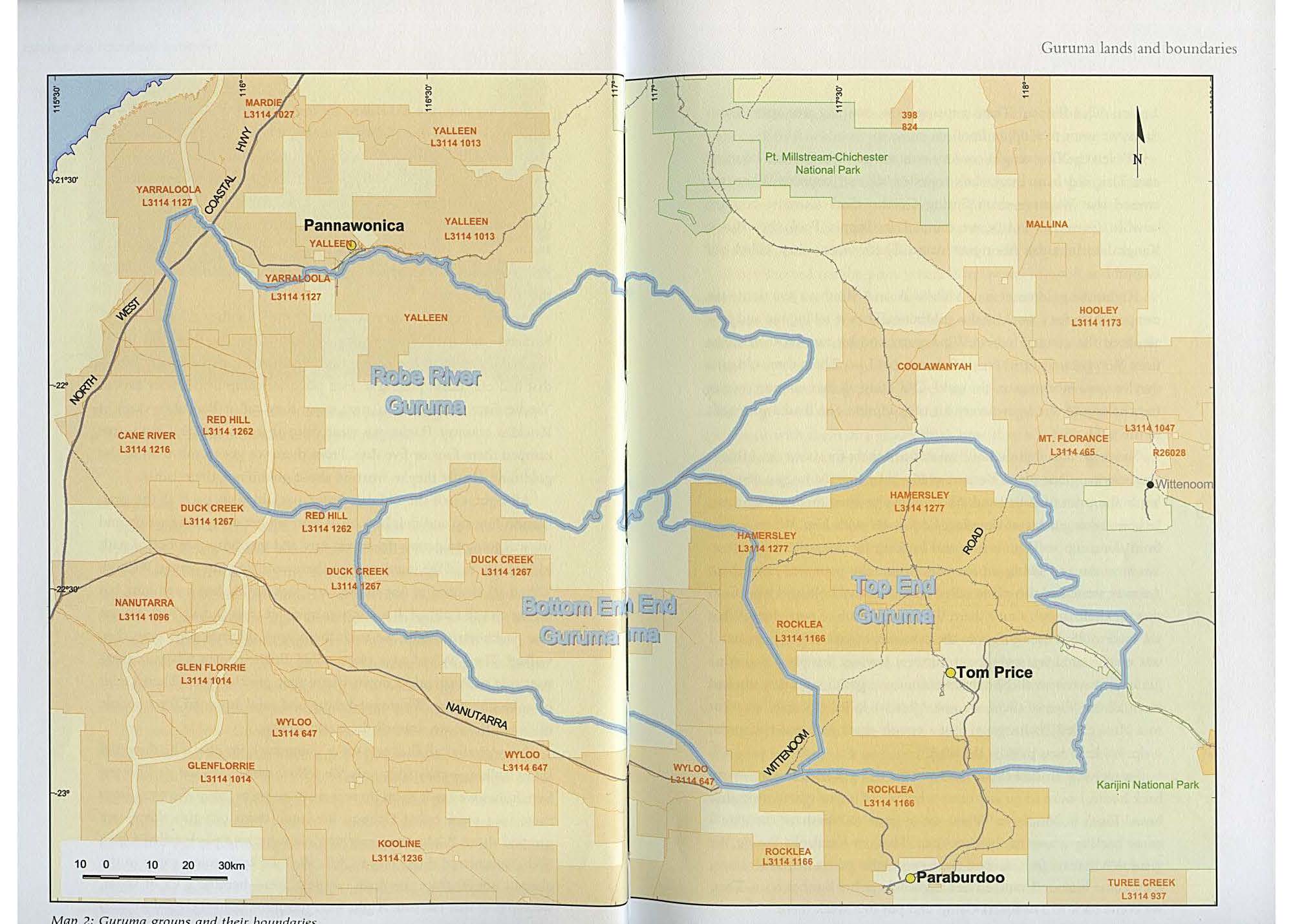
20 The 2001 book map’s boundaries and location of the Top End or Eastern Guruma claim area closely correspond with that, the subject of the 1998 proceeding and the two determinations of native title that Bennett J subsequently made. The map depicted the location of “Coolawanyah” to the north of the Top End Guruma claim, and Mount Florance to the east.
21 The further map below shows the boundaries settled by the elders in 2003 between the area claimed by the Yindjibarndi applicant to the north and the common boundary south of which Bennett J made the determinations of the East Guruma people’s native title, together with the overlap area and the earlier and wider 2015 overlap claim made by WGAC, which had been dismissed by the primary judge in 2015: Wintawari Guruma Aboriginal Corporation RNTBC v State of Western Australia [2015] FCA 1053. The circumstances which gave rise to the Wintawari proceeding are referred to in more detail later in these reasons.
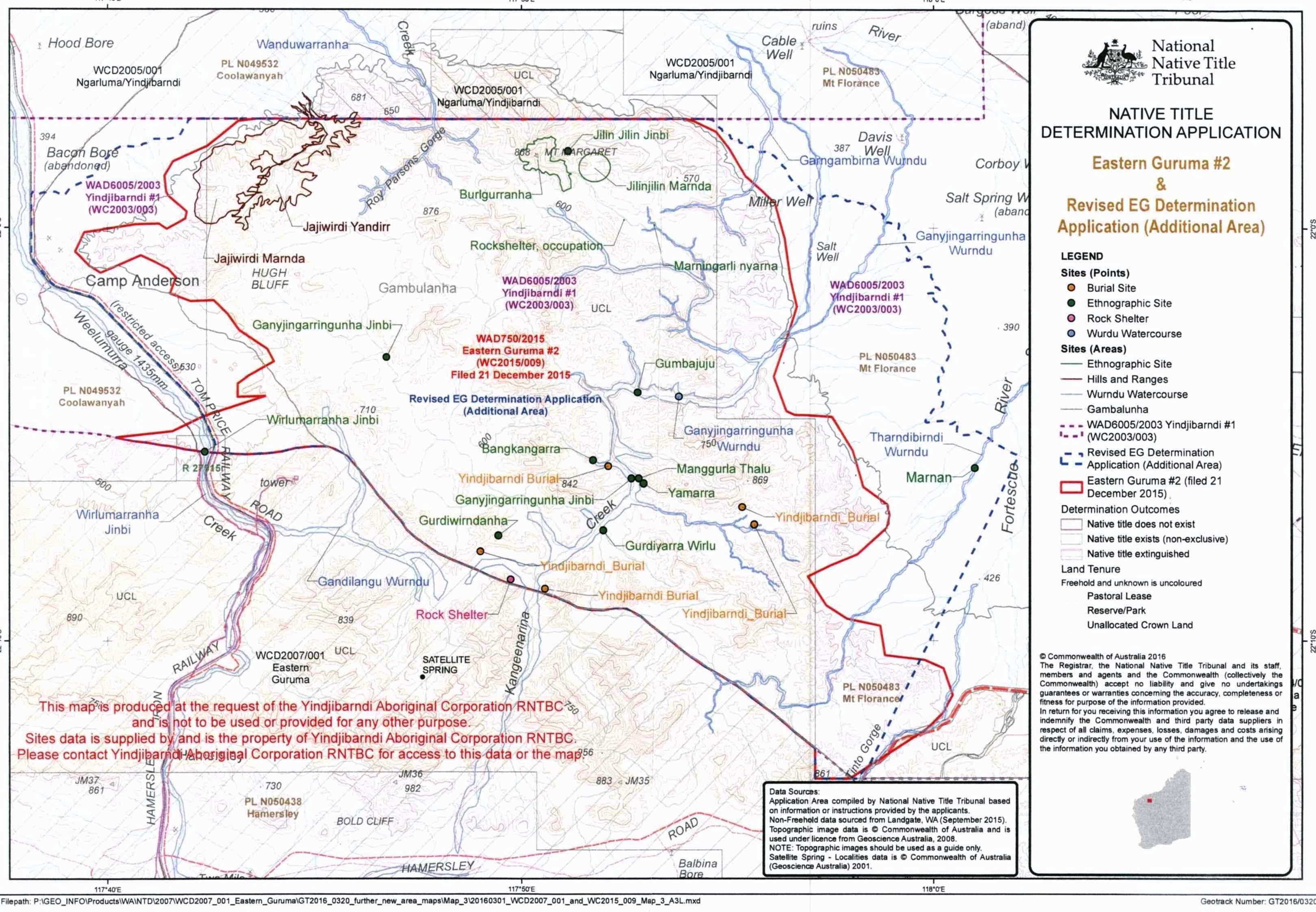
22 Considered together, the maps depict that those members of the native title claim group acting on behalf of the Eastern Guruma people claimed in the 2015 proceedings an area that significantly overlaps part of the Yindjibarndi claim to the north of the common boundary that had been settled by the elders of both peoples in 2003.
23 It is important to understand in detail the material evidence before the primary judge as described by him as well as his Honour’s findings of fact and reasons. These relevantly were as follows.
24 Ms Boyd proffered an explanation as to why the new claim in the 2015 proceeding had arisen. She said that she had made a mistake when she had drawn the Eastern Guruma claim boundary on the map for the 1998 proceeding because she had thought that she had included within the claim area a place called “Satellite Springs”. Until Michael Hughes’ affidavit of 1 December 2015, which was included in the 2015 Form 1, that place had always been described as Satellite Springs in material relied on by the Eastern Guruma people. All other witnesses in the 2015 proceeding, as well as the summary dismissal and joinder applications used that European name to describe that location, except Susanne Boyd in her affidavit of 27 January 2016. The European name alone was used in the related proceedings that WGAC brought earlier in 2015 (Wintawari [2015] FCA 1053), as did all anthropological reports and solicitors’ correspondence written on behalf of WGAC or the Eastern Guruma applicant.
25 The evidence disclosed that there were potentially three places called Satellite Springs, or Satellite Spring, in close proximity to the boundaries of the Eastern Guruma determination area and the Yindjibarndi claim area.
26 The explanation for there being two sites called “Satellite Springs” within the Eastern Guruma determination area appeared in the affidavit of Phillip Davies, the General Manager of Culture, Heritage and Religion of the Yindjibarndi Aboriginal Corporation (YAC). YAC holds the native title rights and interests on behalf of the Yindjibarndi people the subject of the Full Court’s determination in Moses 160 FCR 148. Mr Davies explained that the Geographic Names Department of Landgate had identified that the name “Satellite Springs” was approved on 28 November 1969 as part of an Army field check that had occurred about three years earlier. However, the geographical co-ordinates of that site, and the site depicted as “Satellite Springs” on maps differed slightly, because one was about 2.5 kilometres south-southeast of the other. Significantly, both of those locations were wholly within the Eastern Guruma determination area.
27 Ms Boyd gave evidence that she erroneously thought that the site named Satellite Springs on the map, that she had used to draw the boundaries of the claim area for the 1998 proceeding was the location of the place that the Eastern Guruma people, in the 2015 proceedings, claimed to be the differently located Satellite Springs, which was located in the overlap area (the FMG Satellite Springs). This site apparently had been named “Satellite Springs” by FMG. It is located in an area in close proximity to FMG’s Solomon Mine. The Yindjibarndi people call that site Bangkangarra which is noted on the map of the compromise boundaries settled by the elders in 2003. It is some distance to the north of the agreed boundary between the two claim groups and to the south of Mount Margaret. Ms Boyd gave evidence that she thought that the FMG Satellite Springs had been included in her drawing of the boundary that was used to form the basis of the 1998 proceeding.
28 The claim in the 1998 proceeding was last amended in 1999 by slightly reducing the area claimed. The primary judge inferred that the decision to make such a reduction would have been the subject of an authorisation meeting of the Eastern Guruma people, either, pursuant to s 251B of the NTA, which had come into effect by then, or by a considered decision of the then persons who comprised the applicant in the 1998 proceeding. A number of elders of both the Eastern Guruma and Yindjibarndi peoples present at the meeting held in mid-2003, to resolve the earlier overlap dispute, have since passed away and cannot give evidence about that meeting and what they understood, if anything, about the inclusion of the FMG Satellite Springs in the areas that they agreed could, and would, be claimed by one group without opposition from the other. This fact was of some significance to the disposition of the applications by the primary judge.
29 In March 2006, Dr McDonald wrote a supplementary anthropological report in support of the Eastern Guruma applicant’s claimed determination that ultimately led to the consent determination made in 2007 by Bennett J. Dr McDonald referred to there being, “not surprisingly”, a degree of contestation between the various native title claim group parties regarding the precise definition of the sub-boundaries. He opined that there had been broad community support and acceptance of the boundaries presented in the 2001 book. He said that the authors, Brehaut and Vitenbergs, had mapped the Guruma lands after “extensive consultation with a wide range of Guruma and other elders”, including, Peter Stevens senior and Nelson Hughes. Dr McDonald wrote in this report that in January 2004, at least partly due to his instigation, preservation evidence had been taken in respect of the 1998 proceeding. He said that he was mindful at that time of the ill-health of the late Peter Stevens and the increasing frailty of Nelson Hughes. He explained that he had sought to maximise the range of evidence that would be available to the Court and to minimise the stress and negative impacts on those two elders.
30 In his report dated December 2015 (at [5.3]), Dr McDonald said that no evidence had been given in the preservation evidence stage of the 1998 proceeding in relation to either “the location of the boundary in the north-east corner of the [area claimed in those proceedings] or of the Satellite Spring [sic] area. … The boundary in this area at the time was thought to be non-problematic”. He stated that in June 2007, shortly after Bennett J’s determination, he had conducted a survey in relation to the impact of the Solomon Mine project. When he arrived in the general area with Nelson Hughes on 6 June 2007, Mr Hughes expressed his concern to Dr McDonald about “potential impacts on Satellite Spring” [sic] which Mr Hughes thought was located somewhere outside and northeast of the survey area, however, he was unable to identify its location. Furthermore at that time, Dr McDonald also was not able to find where this site was. He said that it was clear that, at that time, Mr Hughes’ memory was failing, and that on 7 June 2007 he became very distressed and requested to be taken home to Karratha. Dr McDonald formed the view that it was clear that Satellite Spring [sic] was a place of importance and significance to Mr Hughes and other Eastern Guruma consultants who accompanied them on the survey. His Honour noticed that at no point up to that episode was any description given to Dr McDonald, so far as the evidence goes, of the characteristics of the place being referred to as “Satellite Springs” or “Spring”.
31 On 26 May 2008, Michael Woodley, one of the elders of the Yindjibarndi people and current CEO of YAC, wrote a letter addressed to the Eastern Guruma prescribed body corporate, being WGAC, and the Eastern Guruma people. In it he referred to the Yindjibarndi people’s withdrawal of their overlapping claim in 2003 as having been “decided by elders from both Yindjibarndi and Guruma in the full understanding of reaching a mutual agreement at a later date based on respect for each other’s country”. He wrote that the groups should try to meet and develop such proposals.
In the December 2015 report, Dr McDonald recorded that members of the Eastern Guruma claim group, particularly the men in Mr Nelson Hughes’ immediate family, had started their own independent search for Satellite Spring. However, no-one within the Eastern Guruma claim group appears to have found the FMG Satellite Springs until Ms Boyd informed him in an email of 18 August 2009 that her brothers had located it although none of them gave evidence of having had such an experience in locating this area. The primary judge noted that Michael Hughes gave radically inconsistent evidence about how he came to learn of the “rediscovery” of the FMG Satellite Springs. This finding is revisited later in these reasons.
32 On 3 September 2009, Dr McDonald’s colleague, Bryn Coldrick visited the FMG Satellite Springs in order to record the details of that place for listing on the Register of Aboriginal sites. In the registration form that he completed on 3 September 2009, Mr Coldrick noted, in the statement of importance and significance, about the place he there called “Satellite Spring”, that Nelson Hughes and other Eastern Guruma representatives had expressed concerns about the increasing amount of mining exploration in the area. He recorded that the Eastern Guruma people had requested that a three kilometre buffer zone be established around the site to protect the hydrological system feeding the spring.
33 As the primary judge observed at [34], importantly, Mr Coldrick had crossed out the options in the statement of importance and significance in the form that had been available to signify that the site had ceremonial or mythological significance and, instead, recounted the following:
Middle aged Eastern Guruma representatives recalled visiting the spring as children and fishing at the pool, and they reported that it was probably, a camping place and meeting place due to its proximity between the upper and lower Guruma groups, and that the paperbarks and fig trees along the riverbed could have been utilised as plant resources.
34 Thus, as at September 2009, when the site was located by Mr Coldrick and members of the Eastern Guruma claim group, they attributed no spiritual, mythical, ceremonial or cultural significance to the FMG Satellite Spring(s) site at all. In particular, Mr Coldrick had not been given any information at that time of any stories that had been passed on by their ancestors or their elders about its significance as a spiritual, mythological, ceremonial or similar site. Rather, as Mr Coldrick noted, his informants had described the site as only being a meeting and camping place with a water source.
35 Dr McDonald said, in his December 2015 report, that the location of the FMG Satellite Springs was approximately 11 kilometres northeast of the position of the site named “Satellite Springs shown on topographic maps”, that is within the Eastern Guruma determination area. He said that his Eastern Guruma consultants had confirmed that the FMG Satellite Springs site was of “major significance” and they had noted the presence of a rock engraving.
36 His Honour considered it of some importance that, until Michael Hughes swore his affidavit of 1 December 2015 in the 2015 Form 1, no member of the Eastern Guruma group is recorded in any of the material in evidence as having given any Aboriginal name to the FMG Satellite Springs site. Indeed, the primary judge had commented on the absence of any mention of an Eastern Guruma indigenous name for that site in Wintawari [2015] FCA 1053 at [14].
37 The primary judge also observed that at no point until Michael Hughes swore his affidavit of 1 December 2015 was there any evidence of anyone in the Eastern Guruma claim group ever saying to anyone else that any place named Satellite Springs had any spiritual, mythological or cultural significance for them at all.
38 Dr McDonald’s report noted that, in addition to Ms Boyd and her brothers (one of whom the primary judge inferred was Michael Hughes), in August 2009, knowing of the location of FMG Satellite Springs, six representatives from WGAC attended in September 2009 with Mr Coldrick to record the site, namely Chris Devine, Kristan Camille, Ronald Hicks, Ken Hughes, Dennis Hicks and Justin Gilba. Dennis Hicks senior, a member of the applicant, swore an affidavit in these proceedings that made no mention of that visit, or anything that he learnt on it. He and Mr Gilba had been directors of WGAC since April 2013.
39 Dr McDonald noted that Mr Coldrick had visited FMG Satellite Springs for a second time in November 2009 to do another survey for FMG with WGAC members, Peter Stevens junior, Pauline Hicks, Darren Hicks, and Kalysa Hicks, together with archaeologists and others from FMG. He said that the WGAC personnel were keen to visit and to talk with FMG about the long term preservation. Dr McDonald said that a third visit occurred in March 2010. On that occasion, Michael Hughes, Peter Stevens junior and Mr Coldrick had returned because both Eastern Guruma men wanted to explore the site for hydrology.
40 Accordingly, as his Honour found, by March 2010 at least 13 members of the Eastern Guruma claim group, including elders and persons connected to WGAC, the prescribed body corporate holding the land and waters by then the subject of the 2007 consent determination of native title, knew of the location of the FMG Satellite Springs site.
41 Next, in May 2010, Mr Coldrick and Dr McDonald prepared a report for both WGAC and FMG as an ethnographic survey of FMG’s mining tenements on Hamersley Station in the Pilbara (the 2010 report). That report noted that the ethnographic field survey had occurred between 9 and 12 March 2010 with the participation of Michael Hughes and Peter Stevens junior. It noted that Nelson Hughes had participated in earlier heritage surveys of the study area, having once commented to Dr McDonald that; “No-one can tell him [sic] anything about that country.” The report said that Satellite Spring [sic] had been an ongoing concern for the Eastern Guruma people, in particular, Nelson Hughes, since FMG first began operating in the area:
… largely due to the fact that its precise location had been lost a for some time … [and that it had been] finally relocated by the Eastern Guruma Native Title Holders in August 2009.
…
… the site is actually located outside the Eastern Guruma Native Title determination area within the adjacent Yindjibarndi native title claim. (emphasis added)
42 The 2010 report went on to say that during the site inspection in September 2009:
… previously unreported engravings were identified at the site which further supported the group’s assertion that this is a place of major significance. (emphasis added)
Delay by the Eastern Guruma applicant
43 This is relevant to the order of dismissal made by the primary judge on the grounds of abuse of process.
44 The Eastern Guruma applicant sought to explain in the following way the delay in taking any action to assert a claim over FMG Satellite Springs, let alone the much larger 722 square kilometre area, the subject of the 2015 proceeding, as follows.
45 They instructed their solicitors, Castledine Gregory, and in particular, Matthew Hansen, only on 27 August 2014. The primary judge, for reasons given, held serious reservations about the veracity and accuracy of the instructions given to Mr Hansen. He said that he had been asked to investigate whether Satellite Springs was located in the Eastern Guruma determination area. The primary judge noted, as a matter of importance, that no witness gave evidence on behalf of WGAC in these proceedings. However, WGAC in early August 2015 commenced proceedings seeking a determination of native title over a larger area that wholly enclosed the overlap area. On 25 August 2015, as I have mentioned, the primary judge dismissed those proceedings as misconceived because WGAC, as a prescribed body corporate, did not have any power to initiate fresh proceedings over a new area outside that which it held on trust for the Eastern Guruma native title claim group: Wintawari [2015] FCA 1053.
46 Mr Hansen explained how his firm’s instructions evolved. He said that WGAC instructed Castledine Gregory that Terra Rosa Cultural Resource Management had advised WGAC that Satellite Springs was included within the Yindjibarndi applicant’s claim area. As the primary judge found, WGAC knew that fact by no later than May 2010 because it was stated in the report that Mr Coldrick and Dr McDonald had provided to it on its instructions. There was no report or any other document in evidence from Terra Rosa.
47 Moreover, on 29 July 2014, FMG had invited WGAC, through Tony Bevan, to nominate four to six representatives to “join us at the Solomon Project for the commencement of Wirlumurra Yindjibarndi Aboriginal Corporation (WMYAC) and Gamburlarna Project” during the week commencing 11 August 2014. WMYAC is an organisation of some Yindjibarndi people that has a working relationship with FMG and is distinct from YAC, which is aligned with the Yindjibarndi applicant (Mr Bevan was not a director of WGAC at that time but soon after he was appointed to that office.) This was the first use in the evidence of the word “Gamburlarna” involving Eastern Guruma people. The invitation explained that there would be a one day ethnographic consultation on the FMG Satellite Springs with Yindjibarndi elders and proposed that a nominated Eastern Guruma person perform a joint welcome to country ceremony at that launch with a Yindjibarndi person.
48 Mr Woodley, however, had used the word “Gamburlarna” in his 2009 evidence, quoted in the Tribunal’s decision to permit the State to grant a mining lease to FMG as a future act: FMG Pilbara Pty Ltd v Cheedy and Others [2009] NNTTA 91 at pp 20-22. Mr Woodley said that “Gamburlarna” was the Yindjibarndi word for the whole of the Hamersley Ranges.
49 On 12 August 2014, FMG told Mr Bevan about the statement in the 2010 report that the FMG Satellite Springs was in the Yindjibarndi claim area. That communication occurred after Mr Bevan had emailed FMG saying that he had been in to look at the map of the Eastern Guruma determination area in WGAC’s office in Karratha and had seen that Satellite Springs was located within the determination made by the Court in favour of the Eastern Guruma people.
50 These emails came to light only immediately before the hearing when FMG produced them on subpoena. Mr Hansen, the primary judge inferred, had no knowledge of these facts before he saw the subpoenaed material. However, as his Honour found, the impression that his instructions conveyed, and were intended to convey, was that WGAC had only received advice in 2014 as to the location of the FMG Satellite Springs site. That impression was reinforced by a number of other affidavits, in particular, those of Michael Hughes and Ms Boyd. Yet, as was found by his Honour, both knew in 2009 where the FMG Satellite Springs site was, and they knew at that time it was not in the Eastern Guruma determination area.
51 Initially, in his affidavit of 27 January 2016, Michael Hughes said that he found out in late August 2014 that the FMG Satellite Springs was not in the Eastern Guruma determination area by “bush telegraph” after some Eastern Guruma people had seen a television program showing that the Yindjibarndi applicant was claiming it. In fact, it was found as a fact that FMG had paid him over $1,000 for his attendance on 14 and 15 August 2014 as one of the Eastern Guruma representatives at the FMG Satellite Springs, WMYAC, Gambularna project.
52 The primary judge concluded that there was no reasonable basis to find other than that by the time of that occasion Michael Hughes was fully aware that the Yindjibarndi claim group were asserting a claim over the FMG Satellite Springs. Indeed, his Honour found that he knew that fact by no later than May 2010 at the time of Dr McDonald’s report and, further, that the Eastern Guruma elders, WGAC, and Michael Hughes knew by about May 2010 that the FMG Satellite Springs was, first, not in the Eastern Guruma determination area, and, secondly, was in the Yindjibarndi claim area. This finding was underpinned by his Honour’s observation that other than Michael Hughes, at least 10 Eastern Guruma claim group members who had visited the site with Mr Coldrick, and Ms Boyd and her “brothers” (who “discovered” it) knew of it.
53 The primary judge referred to the following facts: first, that Michael Hughes had reported the “discovery” of the FMG Satellite Springs site to Ms Boyd in August 2009 and that report caused Mr Coldrick to visit it shortly afterwards to record it as a heritage site; second, that Michael Hughes had visited the site again with Mr Coldrick in March 2010 to deal with his concerns about its hydrology. His Honour found it inconceivable that Michael Hughes did not know or learn at that time, or shortly after WGAC received the 2010 report that the FMG Satellite Springs was in the area that the Yindjibarndi applicant was claiming.
54 Ms Boyd had sought in her evidence to explain her involvement in what occurred in August 2009. She said that when Dr McDonald had told her that, at that time, the FMG Satellite Springs was outside the Eastern Guruma determination area, she had asserted to him that this must have been a mistake. Dr McDonald’s December 2015 report stated that Ms Boyd was very assertive in 2009 that the site was in the Eastern Guruma determination area. The primary judge concluded, however, that it was inconceivable that she did not realise, even if he had not told her, that the site was in the Yindjibarndi claim area. However, having regard to his close connection to the Eastern Guruma people since he began working with them, his Honour inferred that Dr McDonald had informed her of this either directly or through his 2010 report in order to deal with her concerns.
55 The primary judge noted Ms Boyd asserted in her affidavit, remarkably, that despite what must have been a stunning revelation in 2009 to her about this supposedly important site, she ceased involvement with WGAC and did nothing about it. She asserted in her 27 January 2016 affidavit:
I also thought that Satellite Spring/Gamburlarna and the area around it would be protected as we had asked FMG to protect it and I thought that Eddie McDonald was asked to protect it. When my dad found out that Satellite Springs/Gambularna was not in the Eastern Guruma determination area, he became very upset. (emphasis added)
56 Tellingly, as the primary judge observed, she gave no date for when her father found out and became upset. She gave no evidence of what she or anyone else to her knowledge had done to protect the site. Yet, she asserted that only five years later, in 2014, she did learn that, as a fact, the FMG Satellite Springs was in the Yindjibarndi claim area.
57 This evidence was rejected as false. The primary judge did not accept that she did not know contemporaneously what Dr McDonald had reported in the May 2010 report, namely, that the FMG Satellite Springs was in the Yindjibarndi claim area. His Honour went further, stating that it was difficult not to think that the reason why the Eastern Guruma people did nothing to claim the site was because they knew that it was protected by and had been agreed by the elders in 2003 to be part of the Yindjibarndi claim and so the Yindjibarndi applicant had responsibility to protect it from any further potential acts that might affect native title rights and interests in it.
58 His Honour concluded that it was inconceivable that a person concerned about protecting native title rights and interests in an important site, as Ms Boyd asserted that the FMG Satellite Springs was to her, would have allowed it to be left simply to be protected by a mining company that was building and operating a significant iron ore mine very close to the site. His Honour said that he could not accept that she or other Eastern Guruma people would have taken no steps in, or soon after, May 2010 to protect a site in which they believed they had native title rights and interests from the economic interests of FMG. He found that it was obvious that there was at least a very real risk that FMG’s interests would have dictated that if the site were not the subject of a native title claim, it would try to do whatever was legally and legitimately open to it to prevent the land being burdened by such a claim if it could.
59 His Honour did not accept that the Eastern Guruma applicant had given any credible explanation for leaving the FMG Satellite Springs unprotected for the period beginning no later than May 2010 up to August 2015 and rejected their explanation that they believed that FMG or Dr McDonald had been asked to protect it.
60 The primary judge, importantly, noted that Ms Boyd was the only claim group witness who had given any evidence about the asserted spiritual significance to the Eastern Guruma people of the FMG Satellite Springs, but which she did only in her affidavit, on the applications before him, sworn on 27 January 2016. There she made various assertions about it being a sacred site, protected by a water serpent. However, as the primary judge found there was no record of any other Eastern Guruma person asserting any of that information, including her father, her brother (Michael Hughes), or others such as the elders, Linda Camille, Dennis Hicks senior and Judith Hughes.
61 The primary judge found that the Eastern Guruma applicants’ evidence (other than Ms Boyd’s 27 January 2016 affidavit) was devoid of any reference or mention of there being some cultural, spiritual, ceremonial or mythological significance of the site. His Honour also found that had Nelson Hughes, or anyone else, said that the site had such significance or engravings on earlier visits in the 1970s or at any later time, that fact would have been impressed on those persons at that time. The primary judge concluded that the absence of prior reference to any cultural, spiritual, ceremonial or mythological significance of the FMG Satellite Springs for Eastern Guruma people reinforced that there was no reasonable prospect (for the purposes of s 31A(2) of the Federal Court of Australia Act) that a claim by the Eastern Guruma people, based on Ms Boyd’s recent evidence of such significance, would have any prospect of success.
62 The primary judge found, having regard to the consistent evidence, prior to Ms Boyd’s affidavit of 27 January 2016, of Eastern Guruma people reporting on the FMG Satellite Spring site that its significance for them was that it was only a camping, hunting or meeting ground and a source of fresh water, and that there was no reasonable prospect of the Eastern Guruma applicant establishing any other significance to them of the site.
Explanation for delay in bringing the 2015 proceeding
63 The explanation proffered by the Eastern Guruma applicant was rejected by the primary judge. There is no challenge to this important finding. Nonetheless I consider it important to set out the reasons which led his Honour to this conclusion. They are compelling indeed and were necessarily relevant to the exercise of discretion by the primary judge in ordering dismissal of the 2015 proceeding as being an abuse of process.
64 The primary judge found that there was an unexplained delay of over five years between the Eastern Guruma people’s asserted rediscovery of the FMG Satellite Springs site in about August 2009 and the instructions given to Castledine Gregory in late August 2014. The purported explanations for that delay, his Honour found, were not credible.
65 Ms Boyd and Mr Hughes were the only persons who gave direct evidence seeking to explain the delay of the Eastern Guruma people in taking steps since August 2009 to protect any native title rights and interests they might assert in relation to the FMG Satellite Springs site. However, there was no explanation as to the delay in making a claim over the balance of the 722 square kilometres claimed in the 2015 Form 1. The primary judge found that there was no explanation for any delay in making the claim in the 2015 proceeding.
66 Michael Hughes and his sister, Ms Boyd, explained that the cause of the reinvigoration of the interest of the Eastern Guruma people in the site was the broadcast of a television program in about late August 2014. That evidence was rejected as not being plausible given the sequence of events referred to by the primary judge, involving each of them that occurred before the broadcast of the television program. Mr Hughes did not mention in any affidavit that he and his brother(s) had found the site by August 2009. He had visited it with Mr Coldrick in March 2010 and had been paid over $1,000 to attend with Yindjibarndi people there on 14 and 15 August 2014, shortly before the broadcast. The primary judge found that those omissions of his knowledge were coupled with his false explanation that he found out that the Yindjibarndi people were claiming the FMG Satellite Spring “by the bush telegraph” after the television broadcast.
67 Following a WGAC board meeting on 11 November 2014, Mr Hansen’s firm was instructed that the board wanted to refer the matter to an Eastern Guruma elders’ meeting for direction from them. Following a meeting of elders on 11 December 2014, and a subsequent WGAC board meeting on 12 January 2015, Castledine Gregory received further instructions from WGAC on 19 January 2015. His firm was asked to review existing anthropological evidence and other materials prepared for the previous Eastern Guruma native title determination application and references to Satellite Spring within that process. He said that his firm made requests to WGAC’s previous lawyers, its anthropologists, and other consultants regarding those materials.
68 On 3 March 2015, Castledine Gregory wrote to YAC seeking a meeting between elders of the two claim groups to discuss Satellite Spring[s] and associated issues and to explore non-litigious means of resolving points of difference. The letter asserted that “WGAC only discovered late last year (August/September 2014) that there were two places named Satellite Springs [sic]”.
69 On 5 March 2015, Mr Irving responded by email. He pointed out that there was only one site called Satellite Springs on official maps which was located within the Eastern Guruma determination area, as shown on a copy map that he attached. He said that the Yindjibarndi had a distinct name for the FMG Satellite Springs site and that FMG and those associated with WMYAC only recently had begun to use the name “Satellite Springs” in connection with that site. Mr Irving enquired whether the Eastern Guruma people may have been confused by that recent use of the name “Satellite Springs” for a site not in their determination area.
70 On 5 May 2015, Mr Irving sent an email to Mr Tolcon asking, for the purposes of conducting negotiations, for clarification of what native title rights and interests the Eastern Guruma people asserted in respect of the FMG Satellite Springs site, that the Yindjibarndi called “Bankangarra” [sic], whether they only asserted those rights in respect of that site or more broadly, and why those asserted rights and interests had not been previously claimed by the Eastern Guruma people. Mr Irving asked for copies of any anthropological research on the issues that Castledine Gregory had.
71 On 22 May 2015, Castledine Gregory responded on instructions. In its letter Castledine Gregory stated that WGAC asserted non-exclusive rights and interests “only in respect of the Satellite Springs [sic] (aka Barnkangarra [sic]) site”. The letter attached Mr Coldrick’s Aboriginal site recording form of 3 September 2009. It also attached a map on which the two sites called “Satellite Springs” were marked. The letter stated that the marked site within the Yindjibarndi applicant’s boundary “is the site our client calls Satellite Springs [sic]”. It added that:
As indicated in our earlier email to you of 3 March 2015, our client only discovered late last year through a documentary on television, that the site of particular significance to our client was located in the Yindjibarndi No 1 native title claim area. (emphasis added)
72 Castledine Gregory’s letter asserted that the WGAC was making the claim because it always had believed that the actual site was within its boundaries, and that what had occurred had been:
… simply a mapping error resulting from when Sue Boyd of the Eastern Guruma initially prepared the Eastern Guruma claim. She was of the mistaken belief that the claim encompassed the Satellite Springs site (aka Bangkangarra).
73 The letter candidly admitted that the site had been located by Eastern Guruma native title holders in August 2009 and attached a copy of extracts from the 2010 report. The letter also attached Michael Hughes’ affidavit of 5 October 2005 in support of the determination of native title in which Mr Hughes identified the boundaries of the claim in the 1998 proceeding, including those proximate to the FMG Satellite Springs, near Hamersley Gorge:
At the Hamersley Gorge area it goes in a north westerly direction over the mountain ranges and along a narrow valley. Going to the northern edge of the Hamersley Range north of the Willumarranha a law meeting ground of Guruma and Yindjibarndi meeting ground and north Galiwinji Spring area. It is a very old meeting ground. (emphasis added)
74 He repeated that description substantively in his subsequent affidavits in these proceedings and in the earlier proceedings brought in 2015 by WGAC.
75 The primary judge observed, as can been seen on the map of the overlap area, Mr Hughes’ description did not bear a real relationship to the claim area in the 2015 Form 1 or its boundaries. For example, he did not describe the newly claimed boundary that runs for approximately 20 kilometres in a direct line east-west at the foot of the Yindjibarndi people’s determination of native title made by the Full Court in Moses 160 FCR 148. Mr Hughes gave a new description at [16] of his affidavit of 1 December 2015, that was an attachment in the 2015 Form 1 that he substantially repeated at [53] of his affidavit of 27 January 2016 as follows:
At the Hamersley Gorge (Minijikuntinha) area, [the boundary] goes in a northwest direction along the eastern edge of the Hamersley Ranges, heading in a northwest direction following the ranges. It continues along the ranges until it rounds the range at the north end of the range From the north end of the range it follows the range in a southwest direction going to a law meeting ground for the Guruma people, known as Willumarranha. This law ground is a meeting place from both Guruma and Yindjibarndi people: it is a very old meeting ground. From Willumarranha it goes to the Galiwinji Spring area. (emphasis added)
76 His Honour found that once again, that description omits any reference to the part of the claimed boundary that runs due east-west and does not seek to relate itself to any named geographical reference points in the area of the eastern edge of the Hamersley Range. His Honour went on to remark that having regard to the nature and extent of the new area that was being claimed, Mr Hughes’ description was remarkable for its lack of detail or explanation as to how or why the metes and bounds of the new 722 square kilometre claim area in the 2015 Form 1 application or the even larger area claimed by WGAC in its 2015 application were chosen.
77 The primary judge noted, in this respect, that Mr Hughes had said in his affidavit of 27 January 2016 that on 26 June 2015 he was “involved in the drawing of the boundary of the area to be covered by WGAC’s [2015] application”. Hughes had asserted that he drew the new boundary line on 26 June 2015 and, because of time pressures, that task had to be done very quickly without a proper survey. He had also asserted that he and other Eastern Guruma elders attended on a field trip with Archae-Aus in mid-September 2015 because they “wanted to make sure that this boundary was correct” and that this “resulted as a more accurate claim boundary”.
78 The primary judge did not accept this as an explanation of the nature or reasons why the 722 square kilometre area in the 2015 Form 1 was being claimed. He found that apart from broad, generalised assertions in the affidavits in support of that claim, there was no explanation in the 2015 Form 1 as to how the Eastern Guruma people have a connection with the FMG Satellite Springs site. In particular, the 2015 Form 1 contained no description of that or any other site within the claimed boundaries having spiritual or religious significance for Eastern Guruma people.
79 It is of the essence of native title that there be such connection. In Western Australia v Ward (2003) 213 CLR 1 at 64 [14], Gleeson CJ, Gaudron, Gummow and Hayne JJ said:
As is now well recognised, the connection which Aboriginal peoples have with “country” is essentially spiritual. In Milirrpum v Nabalco Pty Ltd [(1971) 17 FLR 141 at 167], Blackburn J said that: “the fundamental truth about the aboriginals' relationship to the land is that whatever else it is, it is a religious relationship … There is an unquestioned scheme of things in which the spirit ancestors, the people of the clan, particular land and everything that exists on and in it, are organic parts of one indissoluble whole”. It is a relationship which sometimes is spoken of as having to care for, and being able to “speak for”, country. “Speaking for” country is bound up with the idea that, at least in some circumstances, others should ask for permission to enter upon country or use it or enjoy its resources, but to focus only on the requirement that others seek permission for some activities would oversimplify the nature of the connection that the phrase seeks to capture. The difficulty of expressing a relationship between a community or group of Aboriginal people and the land in terms of rights and interests is evident. Yet that is required by the NTA. The spiritual or religious is translated into the legal. This requires the fragmentation of an integrated view of the ordering of affairs into rights and interests which are considered apart from the duties and obligations which go with them. The difficulties are not reduced by the inevitable tendency to think of rights and interests in relation to the land only in terms familiar to the common lawyer. Nor are they reduced by the requirement of the NTA, now found in par (e) of s 225, for a determination by the Federal Court to state, with respect to land or waters in the determination area not covered by a “non-exclusive agricultural lease” or a “non-exclusive pastoral lease”, whether the native title rights and interests “confer possession, occupation, use and enjoyment of that land or waters on the native title holders to the exclusion of all others”. (emphasis added)
80 His Honour concluded that the absence of any articulated, essentially spiritual or religious connection between the Eastern Guruma people and any identified part of the large area the subject of the 2015 Form 1 claim is significant, having regard to the very late making of the new claims, their knowledge by that time of what they were claiming, and because since at least 3 March 2015, as appeared in Castledine Gregory’s letter of that date to Mr Irving, they knew that the final hearing on country for the Yindjibarndi application had been set down for later in 2015.
81 The primary judge correctly observed that ordinarily a Form 1 application for a determination of native title will not be expected to identify matters in support of the claim with the degree of precision necessary at a trial to do so, as this is not the function of such a form. However, his Honour remarked that here there was a void of evidence concerning connection of an essentially spiritual nature, other than Ms Boyd’s subsequent assertion that FMG Satellite Springs was a sacred site that she belatedly made in her affidavit of 27 January 2016. The balance of the evidence and anthropological material before his Honour in support of this “last minute claim” was, as he found, bereft of any such material.
82 That fact, his Honour concluded, was more remarkable because the claim involved a very large overlap area that extended well beyond the specific, limited claim for non-exclusive rights over just the FMG Satellite Springs that Castledine Gregory had said was all that was claimed in their letter of 22 May 2015. He noted that no explanation had been given on behalf of the Eastern Guruma applicant as to why that position changed or the basis for the current claim.
83 The primary judge [86] stated that the superficiality of the material on which the Eastern Guruma applicant and Mr Hughes relied in the 2015 Form 1 and on the two interlocutory applications needed also to be considered in the context of his Honour’s reasons in Wintawari [2015] FCA 1053 at [13]-[14], [39]-[40]. There his Honour held that the Court had no power, and WGAC had no status to seek, to amend by expanding, beyond the original outer boundary, the area of the consent determinations made by Bennett J in 2007 and 2012. His Honour set out the following paragraphs from Wintawari:
[13] Indeed, the revised application had, as attachment F, an affidavit filed in support of the joinder application on 11 August 2015 by Susanne Boyd, a member of WGAC and elder of the Eastern Guruma people. There she said that she had drawn the original map to show the area claimed in the Eastern Guruma application when it was lodged in October 1997. She asserted that she “inadvertently missed out the section the subject to these proceedings” (i.e. the new claim area). Ms Boyd then asserted that she could see that the area that her 1997 map claimed “included a place marked as Satellite Springs” and that she knew both its significance and that it was in Eastern Guruma country. She said that she now knew that “the area marked as Satellite Springs, had been recorded by white men in the wrong place” and that the location of that site was in the Yindjibarndi claim area.
[14] Attachment G to the revised application was another affidavit filed on 11 August 2015 in support of the joinder application, affirmed by another elder of the Eastern Guruma people, Michael Hughes. Mr Hughes said that “[f]ollowing a revision of the Eastern Guruma Claim boundaries by WGAC, I now believe that the northern boundary of the Eastern Guruma Claim are incorrect” and that the boundary should extend into the Yindjibarndi claim area. Mr Hughes attached to that affidavit the affidavit that he had affirmed on 5 October 2005 in support of the claim to the area in the proceedings before Bennett J. In his 2005 affidavit, Mr Hughes gave a detailed description of the northern and other boundaries of the area claimed and made no mention of Satellite Springs. The northern boundary is that in the 2007 determination made by Bennett J. No indigenous language name for Satellite Springs appeared anywhere in the revised application.
…
[39] Moreover, the applications were made very late in the piece, in circumstances where WGAC’s own evidence in the revised application showed that for at least one year it had been aware of the asserted error in the description of the Eastern Guruma determination area. Yet, WGAC made no attempt to assert this new claim until 11 August 2015, immediately before, as it knew, the Court was to sit on country to determine the Yindjibarndi proceeding.
[40] In my opinion, such unreasonable behaviour was calculated to cause significant disruption and expenditure of significant costs by the Yindjibarndi applicant, by reason of the interruption to its preparation of its case for the imminent hearing. The Yindjibarndi applicant would have incurred significant costs in meeting what, in my opinion, were two misconceived, baseless applications. (emphasis added)
84 The primary judge observed that the evidence relied on by the Eastern Guruma applicant and Mr Hughes had not advanced substantively beyond what he had summarised at Wintawari [2015] FCA 1053 at [13]-[14]. Noting that it was difficult to attribute states of mind to collective bodies such as WGAC or a meeting of a claim group or elders, the primary judge was not satisfied that Ms Boyd's evidence was capable of establishing the state of mind of those who authorised the boundaries sought in the 1998 application, being the original Eastern Guruma claim. His Honour found that her assertions of a mistake by her were not consistent with the ultimate settlement of the boundaries between the Eastern Guruma and Yindjibarndi claims arrived at by the elders of both claim groups in 2003.
85 His Honour inferred that the reason that WGAC and the Eastern Guruma native title group members did nothing until 2015 was that the 2003 settlement of the boundary issue was being respected by them.
The disruption to the 2003 proceeding
86 The primary judge was satisfied relevantly that if the 2015 proceeding remained on foot, there would be further, as there already has been, significant disruption of the progress of the 2003 proceeding. Completion of the final hearing had been fixed to occur during the course of the week of the interlocutory hearings. However, on 9 February 2016, his Honour had to vacate the unperformed orders that would have led to the evidence and submissions being concluded during as, the then vacated hearing dates.
87 He also concluded, relevantly:
(1) that if the 2015 application were to proceed to hearing, then it would be necessary to obtain evidence from the Eastern Guruma witnesses in support of their new claim to the overlap area;
(2) that evidence would need to have been dealt with by witnesses called by the Yindjibarndi applicant and other respondents; and
(3) the preparation of all the lay evidence would require a considerable amount of detailed work having regard to what seemed like a broad ambit claim to a very large area that was unsupported then by any specific evidence about the Eastern Guruma people’s basis for asserting native title rights and interests in the whole of the newly claimed area.
88 His Honour concluded also that the Eastern Guruma applicant would need to file anthropological evidence to support the claim for that new area, and Dr Kingsley Palmer, the anthropologist engaged by the Yindjibarndi applicant, would need to respond to that. It would have been necessary to retake much of the evidence of witnesses who had given evidence previously on country or in Roebourne during the period of 7-13 September 2015, so that they would deal with what would be said by the Eastern Guruma lay witnesses.
89 Then, as his Honour found, there would be further delay because much of the lay evidence would be given only during a time of year when weather conditions in the Pilbara permit the convenient taking of that evidence on-country, and because of the significance of the site, it was likely that it would be necessary for a further hearing to occur at Bangkangarra or FMG Satellite Springs at which further evidence be taken. That site, his Honour remarked, was difficult to access.
90 His Honour concluded, in these circumstances, that the delay caused by the time needed to provide further evidence and, to organise a further hearing on-country and then a subsequent one to take anthropological evidence and final submissions, would be significant. It was his Honour found, unlikely that the trial would conclude before the end of 2017, and might possibly extend into 2018, assuming that the litigation was conducted relevantly by the Eastern Guruma applicant with a degree of efficiency and dispatch that it had not shown to date in seeking the protection of their recently asserted rights.
91 Moreover, his Honour referred to the fact that several senior elders of both the Yindjibarndi and Eastern Guruma peoples had died in the intervening years since the settlement of the boundary dispute in 2003, including Cheedy Ned, Guinness Gilby, Kenny Jerrold, and Alec Ned of the Yindjibarndi claim group, and Peter Stevens of the Eastern Guruma claim group. Further, as his Honour noted, Nelson Hughes was now very old and his memory was already failing in 2007, as Dr McDonald noted.
92 The primary judge concluded, relevantly, if the 2015 proceeding went to trial there would be a range of new issues, a need to revisit all or much of the evidence already given in the part heard trial, and a need to require witnesses to give evidence again after they had already undergone the experience of giving evidence and being cross-examined. A number of the witnesses who gave evidence on-country, to his Honour’s observation, had found that experience confronting, stressful and difficult.
93 For those reasons, the primary judge was satisfied that if the new claim proceeded, there would be significant delay caused before a final resolution of the 2003 proceeding could occur. He noted that the Eastern Guruma applicant and the members of its native title claim group have known about the 2003 proceeding since at least the time that their elders settled the boundary dispute in 2003. The new issues, he found, would require detailed case management, at least two further hearings, one on-country and one in Perth, before the whole matter could be brought to completion.
The findings and conclusions of the primary judge
94 It is important to recognise the context of the relevant principles acknowledged by the primary judge as applicable to his consideration of the applications before him.
95 The primary judge at [97] was alive to the need for great caution in considering applications for summary disposal under s 31A and relevant authority underpinning that proposition: Spencer v Commonwealth (2010) 241 CLR 118 at 131 [22] and the majority judgment in Williams v Spautz (1992) 174 CLR 509 at 529.
96 His Honour at [98] was also conscious of the need for a cautious approach said to be particularly apposite in native title proceedings, having regard to the principles discussed by the Full Court in State of Western Australia v Fazeldean (No 2) (2013) 211 FCR 150 at 156 [34].
97 His Honour appreciated too that summary dismissal of the 2015 proceeding would effectively prevent the Eastern Guruma people maintaining a claim that sought to recognise native title rights and interests in the overlap area, which reinforced the need for caution in the application before him: [99].
98 It was acknowledged, by the Eastern Guruma applicant before the primary judge, that the 2015 proceeding, were it permitted to be prosecuted, would cause a significant delay in the progress of the 2003 proceeding: [102].
99 It cannot be doubted, nor was it contended by the applicant or any other party, that relevant delay in the conduct of proceedings is capable of constituting an abuse of the process of the Court: see e.g. Batistatos v Roads and Traffic Authority of New South Wales (2006) 226 CLR 256 per Gleeson JJ at 266 [11] – [12] and 267 [15].
100 The general approach taken by the primary judge at [136] was to ask the question whether the objective effect of the continuation of the 2015 proceeding, in all the circumstances, including the Eastern Guruma applicants delay, and the consequences of that delay, had been shown to have a sufficiently burdensome effect on the Yindjibarndi applicant, that the processes of the Court should not be permitted to be used to hear and determine the matter: Batistatos 226 CLR at [63] – [65], and at [69] – [71].
101 Whilst again acknowledging the need for caution, the primary judge correctly observed that this does not mean that the power of dismissal should not be exercised in an appropriate case. His Honour identified the relevant circumstances as involving considerations about both the use of the Court’s processes as well as the evaluation of the prospects of the success of the 2015 proceeding.
102 The primary judge concluded that the lengthy delay in asserting its claim to native title rights and interests in the overlap area was, in all the circumstances, an abuse of process. This proceeded, in part, from a finding that the Eastern Guruma claim group had known for at least six years before commencing the 2015 proceeding that the FMG Satellite Springs was not in the Eastern Guruma determination area, yet had done nothing to assert their claims at any earlier time:[138]. They were also aware of the Yindjibarndi applicant’s claims of the overlap area since at least when the boundaries of the two claim groups were settled in the 2003 meeting between the respective elders and others including Ms Boyd. They knew that the boundary that they claimed in the 1998 proceeding was contiguous to that claimed by the Yindjibarndi applicant in the 2003 proceeding. The Eastern Guruma applicant also knew that the Yindjibarndi applicant had withdrawn an overlap claim over some lands and waters the subject of their claim to what became part of the determinations of native title that Bennett J made in 2007 and 2012.
103 The primary judge then set out again the details of the 2003 compromise and that this would objectively have been recognised as foregoing claims made in the overlap area as it existed at that time.
104 His Honour referred to the lack of any intelligent or specific explanation as to the way the applicant asserted native title rights and interests of a spiritual nature. This, and other references by his Honour to this lack of evidence, are central to the applicant’s contentions on this leave application and I will consider these in some detail later in these reasons.
105 The primary judge, in dismissing the 2015 proceeding on the basis that it was an abuse of process, set out his principle conclusions and reasons as follows: [144] – [149]:
[144] Over many years, the Yindjibarndi applicant prepared its case and proceeded to the first stage of the final hearing on the basis that there was no overlapping claim. Indeed, all parties in the 2003 application had accepted that the Yindjibarndi applicant’s native title claim group had connection to its claimed land and waters. The 2003 proceeding has been heard on the basis that there is a limited dispute as to whether the Yindjibarndi people, through their traditional laws and customs, can establish a continuing observance since the time of white settlement of those laws and customs sufficiently to demonstrate that their native title rights and interests are held exclusive of all others over land and waters where native title subsists.
[145] If the 2015 proceeding were allowed to go to trial, it would cause further disruption to and delay in the part-heard trial of the 2003 proceeding and it would undermine the acceptance, by all parties, including the State, in the 2003 proceeding that the Yindjibarndi applicant had non-exclusive native title rights and interests in the land and waters that it claimed. That proceeding had been listed for the period 4-11 March 2016 for the taking of the balance of the evidence and final submissions.
[146] The Eastern Guruma people were involved in pursuing the 2012 determination that Bennett J made at a time when, as litigants, they were bound by Pt VB of the Federal Court Act. They had an obligation also to move promptly upon their rediscovery of the FMG Satellite Springs, in August 2009, to ensure that the claims that they seek belatedly to make in the 2015 proceeding could be dealt with promptly and in a fair and just way with a minimum of disruption to the 2003 proceeding.
[147] There is no acceptable explanation for the Eastern Guruma applicant’s delay since 2009. Indeed, it resorted to relying on palpably false explanations for that delay including the Eastern Guruma applicant’s asserted ignorance of the Yindjibarndi applicant’s claim over the FMG Satellite Springs. That delay and conduct would lead right thinking people to question the genuineness of the claims in the 2015 proceeding and to think that it would be an affront to justice to hear them: Hunter [1982] AC at 536C-D; Bastistatos 226 CLR at 264 [6].
[148] Even if the Eastern Guruma applicant had made a mistake, that has had the consequence that, since the 2003 meeting, the Yindjibarndi applicant has pursued the 2003 proceeding to the point of a part-heard hearing without any knowledge of, or participation in, such a mistake. In those circumstances, it would be an unfair and unjust use of the Court's procedures to allow the Eastern Guruma applicant, to maintain, the 2015 proceeding.
[149]These factors demonstrate that to allow this recent claim to be ventilated at this time would be an abuse of process of the Court despite the fact that it is brought within any applicable limitation period.
106 The primary judge remarked, concerning s 31A of the Federal Court of Australia Act 1976 (Cth), that the evaluation of a reasonable prospect of an outcome at an earlier, and perhaps protean, stage of litigation, is a task that invites a cautious approach, not least because, ordinarily, the decision must be made without the benefit of the ordinary preparation of evidence and issues for a full trial. Nonetheless, as his Honour correctly observed, the purpose of the Parliament in enacting s 31A was to broaden the power of the Court to bring to an end, and to summarily end, litigation that the Court had evaluated judicially as having no reasonable prospect of success an evaluation which is substantively different to one determining whether a party has no prospect of success.
107 His Honour referred to his earlier conclusion that the claim in the 2015 proceeding had been put forward in such a way that it lacked reasonable coherence in all of the circumstances. Although the Eastern Guruma applicant had put on evidence in which its witnesses asserted that they are people of the hill country, they had done nothing to establish a spiritual connection to the land and waters in the claimed area, other than in the recent affidavit evidence of Ms Boyd. His Honour considered, for the reasons already given, that there was no reasonable prospect that Ms Boyd’s recent assertions of there being some spiritual dimension to the FMG Satellite Springs would be believed having regard to all of the evidence and earlier considered statements, including those of her father in relation to that specific site, none of which suggested that it was anything other than a meeting or camping place, hunting ground and a place at which water was to be found year-round.
108 Moreover, as his Honour noted, there was no other evidence whatsoever of the Eastern Guruma people having any stories of a spiritual or other nature to tell about the land and waters the subject of the 722 square kilometre claim in the 2015 proceeding, and no explanation as to how that claim has been made.
109 His Honour referred to the fact that Michael Hughes’ affidavits describing the nature of the north-western boundary did not engage in any way with the shape of the northern boundary running due east-west of the claim in the 2015 application. His description of the boundary was, his Honour concluded, incoherent with the document to which it related, namely the 2015 application. He did not explain how that boundary, as it appears in the 2015 Form 1, was chosen. The primary judge was of the opinion that there was no reasonable prospect that the unexplained assertions of its metes and bounds would be able to be established, having regard to the lack of any coherent explanation for the making of this claim or WGAC’s earlier, slightly larger claim. His Honour noted that WGAC made its claim in 2015 soon after Castledine Gregory on 22 May 2015, on instructions from the Eastern Guruma people and WGAC, had told the Yindjibarndi applicant’s solicitor that the Eastern Guruma people were seeking to claim non-exclusive rights and interests only in the far smaller area around the FMG Satellite Springs.
110 His Honour made clear that he was conscious that a summary dismissal of the proceedings would have the practical effect of precluding other Eastern Guruma people’s claims in or over the overlap area, but as he found there was no evidence before him that would suggest that there was any reasonable prospect of any such claim being established. Moreover, he was mindful that the Eastern Guruma people and their elders, as opposed to simply Ms Boyd, first in 1999 and later in the 2003 elders’ meetings authorised the selection of the final boundaries claimed in the 1998 proceeding as reflected in the determinations Bennett J made in 2007 and 2012 and their elders also recognised those boundaries in the 2001 book.
111 His Honour said that whatever Ms Boyd may have thought in her own mind was not probative, let alone determinative, of the thought processes of any other person. Even if it were accepted that she had made a mistake, as she asserted, because she thought the FMG Satellite Springs was included in the area claimed in the 1998 proceeding, there was no reason to think, his Honour said, that the location of Satellite Springs as marked on the map, which was inside the claimed area in the 1998 proceeding, was not the area intended to be the subject of the claim. Indeed, there was no evidence, his Honour found, that the Eastern Guruma people responsible for making the 1998 application had made any error in their claim, or that they had or had not visited the overlap area, or erred in making the acknowledgment of the top end Guruma boundaries in the 2001 book or the decisions in the 2003 meeting of elders, or that the area claimed in the 1998 proceeding is not the entire location about which they sought to make their claim now reflected in the consent determinations. His Honour found that Ms Boyd’s assertions of her thought processes did not prove or tend to prove that any of the relevant decision-makers or elders made any mistake in about 1998, 1999, 2001, 2003 or later.
112 He went on to conclude that if Ms Boyd’s state of mind did establish that the decision-makers in about 1998, 1999, 2001 or 2003 made a mistake about the correct boundaries or the location of the FMG Satellite Springs, the Eastern Guruma applicant, on its own case, made that error unilaterally. Moreover, his Honour said that it induced another claim group to proceed to the point of nearly completing the final hearing, many years after 2003 when elders of the two claim groups had settled the location of the common boundary and resolved a previous dispute about it.
113 His Honour found that there was no evidence of any spiritual basis on which the Eastern Guruma applicant claimed a connection to the land and waters in the 2015 Form 1, other than Ms Boyd’s recent evidence. It followed, his Honour concluded, that there was no reasonable prospect to think that the Eastern Guruma applicant would succeed in establishing native title rights and interests in the overlap area or any part of it: Ward 213 CLR at 64 [14].
The general test for leave to appeal in interlocutory applications
114 The judgments and orders in question are interlocutory and therefore leave is required to appeal: Federal Court of Australia Act 1976 (Cth) ss 24(1A) & (1D).
115 Generally it is established that two conjunctive criteria require to be satisfied: Décor Corporation Pty Ltd v Dart Industries Inc (1991) 33 FCR 397 at 398 – 399.
(a) The primary decision was attended with sufficient doubt to warrant being reconsidered on appeal; and.
(b) If leave were refused, substantial injustice would occur assuming the original decision to have been wrong.
116 However, even if substantial injustice would occur, leave to appeal will not be granted unless the party can also 'show that the judgment below is attended with sufficient doubt as to its correctness': Ogawa v Minister for Immigration [2004] FCAFC 315, [21].
117 It is not enough that a 'different view might be taken' by a different judge: Construction Union v Abigroup Contractors [2012] FCA 1134, [64].
118 A case of sufficient doubt may arise where a contrary position is reasonably arguable or where the view taken by the trial judge is debatable: eg. Welsh v Digilin Pty Ltd [2008] FCA 78, [8] per Collier J and not challenged on appeal: Welsh v Digilin Pty Ltd [2008] FCAFC 149.
119 Where, as here, the decisions being challenged concern the exercise of judicial discretion then the appeal court will not review that exercise of discretion unless the primary judge's decision:
(a) was upon a wrong principle;
(b) allowed extraneous or irrelevant matters to guide or affect [the decision];
(c) mistook the facts;
(d) did not take into account some material consideration; or
(e) was, upon the facts, unreasonable or plainly unjust.
House v The King [1936] 55 CLR 499.
120 The fact that the Court's orders effectively finally determined the right of the Eastern Guruma people and their descendants to ever claim native title in the overlap area is relevant. In determining whether to grant leave to appeal, the Court will distinguish between interlocutory decisions on a point of practice where leave to appeal is rarely granted and 'an interlocutory decision determining a substantive right - where leave will more readily be granted': Decor Corp v Dart Industries at 400; Johnson Tiles Pty Ltd v Esso Australia Ltd (2000) 104 FCR 564 at [42] – [44]. Justice French (as he then was) observed that where the decision has the practical effect of finally determining the rights of the parties "a prima facie case exists for granting leave to appeal": Ian Duncan v Secretary, Department of Family and Community Services [2007] FCA 507 at [18]. In the same passage his Honour added that leave, even in such a circumstance, may be refused where an appeal would appear to achieve no useful purpose.
121 I will now turn to the proposed grounds of appeal upon each application for leave in turn. Whilst not sequential, I have addressed the relevant grounds in the order they appeared in the Eastern Guruma applicant’s written submissions.
122 Where I state that I have rejected a proposed ground of appeal, I mean this in the sense that I have not been persuaded that it, and the submissions made in support, have demonstrated that the judgment or order under challenge is attended by sufficient doubt so as to warrant its reconsideration by a Full Court.
Application for leave in No WAD 225/2016
The decision to dismiss the Eastern Guruma native title application as an abuse of process
123 Grounds 2(a)(iii) and 2(a)(iv) were not pressed as discrete grounds on which to argue for leave.
124 In exercising his discretion to dismiss the 2015 proceeding as an abuse of process the primary judge considered the absence of evidence of "spiritual connection". This, the Eastern Guruma applicant submits, was in the context where his Honour was looking at the legal merits/strength of the claim as one relevant factor in the broader exercise of weighing up whether to dismiss the claim as an abuse of process.
125 The Eastern Guruma applicant contends that, in this respect, the primary judge made two errors. First, in treating it as a requirement of s 223(1)(b) of the NTA that an applicant prove its "spiritual connection" to the land claimed. Second, in failing to appreciate that connection is established through proof of traditional laws and customs.
126 It was submitted that where in his reasons [64] the primary judge referred to what the High Court plurality said in Western Australia v Ward at [64] (Gleeson CJ, Gaudron, Gummow & Hayne JJ) he misconstrued its effect.
"In its terms, s 223(1)(b) is not directed to how Aboriginal peoples use or occupy land or waters. Section 223(1)(b) requires consideration of whether, by the traditional laws acknowledged and the traditional customs observed by the peoples concerned, they have a "connection" with the land or waters. ... Whether there is a relevant connection depends, in the first instance, upon the content of traditional law and custom and, in the second, upon what is meant by "connection" by those laws and customs…we need express no view on when a "spiritual connection" with the land …will suffice"
127 The submission in effect was that the primary judge had erroneously read this as meaning that there must be proof of spiritual connection, whereas in Ward at [64] the plurality makes it plain that under certain circumstances spiritual connection may suffice, but this is in no sense making it a requirement.
128 The Eastern Guruma applicant submits that the pre-eminent role that "spiritual connection" assumed in the primary judge's mind is evident from his “dismissive approach” to non-spiritual forms of connection. For example, the applicant referred to [65] where his Honour states:
[65] I find that, because of the consistent evidence, prior to Ms Boyd's affidavit of 27 January 2016, of Eastern Guruma people reporting on the FMG Satellite Spring site that its significance for them was that it was only a camping, hunting or meeting ground and a source of fresh water, and that there is no reasonable prospect of the Eastern Guruma applicant establishing any other significance to them of the site. [emphasis supplied]
129 Other passaged in the Reasons are said to show a similar approach:
[64] …The absence of prior reference to any cultural, spiritual, ceremonial or mythological significance of the FMG Satellite Springs for Eastern Guruma people reinforces that there is no reasonable prospect (for the purposes of s 31A(2) of the Federal Court of Australia Act) that a claim by the Eastern Guruma people, based on Ms Boyd's recent evidence of such significance, would have any prospect of success.
[84] Ordinarily, of course, a Form 1 application for a determination of native title will not be expected to identify matters in support of the claim with the degree of precision necessary at a trial to do so. That is not the function of such a form. But here there was a void of evidence concerning connection of an essentially spiritual nature, other than Ms Boyd's subsequent assertion that FMG Satellite Springs was a sacred site that she belatedly made in her affidavit of 27 January 2016. The balance of the evidence and anthropological material before me in support of this last minute claim is bereft of any such material.
[142] Moreover, the Eastern Guruma applicant has given no intelligible or specific explanation as to the way in which it asserts native title rights and interests of a spiritual nature over the vast expanse of overlap land and waters. That dearth of evidence is especially significant in relation to their central claim over the FMG Satellite Springs: Ward 213 CLR at 64 [14]. Prior to Mr Coldrick's September 2009 visit to the FMG Satellite Springs, no Eastern Guruma person had referred to the rock art there. Both before and after that visit, with the exception of Ms Boyd's 27 January 2016 affidavit, no Eastern Guruma person, including her father and brother, suggested that the FMG Satellite Springs had any significance beyond being a hunting area, a meeting or camping ground, and a water source.
[143] The Eastern Guruma applicant brought the 2015 proceeding knowing that doing so inevitably would interfere with the conclusion and final hearing of the 2003 proceeding. Despite that, it did not make a properly articulated claim that identified any spiritual connection that would suffice to establish a claim for native title. The evidence on which the Eastern Guruma applicant relied is bereft of details of such spiritual connection (other than Ms Boyd's recent assertions) or any explanation, other than in respect of the location of the FMG Satellite Springs, as to why such a very large area of land had been overlooked in its earlier claims in the 1998 proceeding.
130 These paragraphs, it was submitted by the Eastern Guruma applicant, demonstrate that his Honour determined that spiritual connection to the area under claim was indispensable to the ultimate success of the 2015 proceeding for a determination of native title and that his Honour’s view about the weakness of the claim (due to lack of evidence of spiritual connection) formed an important part of the weighing exercise his Honour undertook to conclude the application was an abuse of process.
131 This error was said to be an error of law.
132 The Eastern Guruma applicant referred to the following cases as authority that connection was a multifaceted concept.
133 First, Bodney v Bennell (2008) 167 FCR 84 at [164], where the Full Court noted that:
[164] As cases in this Court on s 223(1) clearly demonstrate, the connection concept is multifaceted, with differing aspects of it being emphasised in differing factual contexts'
134 Second, State of Western Australia v Graham (Ngadju People) [2013] FCAFC 143 at [41] where the Full Court confirmed that 'not every right or interest enjoyed by every Aboriginal has to have a "spiritual" aspect to it and ... cultural and social connections may also be sufficient'. Their Honours also made the following observations.
[36] The requirement that claimants "have a connection" is not qualified by any adjective or adverb that suggests the connection should be of any particular qualitative or quantitative nature. ...
[37] There is nothing in the use of the expression "have a connection" to suggest that the connection must be physical, although plainly it can be that. There is every reason to accept, having regard to authority, that the connection may well be, or also be, religious or mythological in nature, but it need not necessarily be so. [emphasis supplied]
[38] There is no requirement that connection be made out by reference to any particular features within the land or waters or activities in respect of the land or waters. Indeed, the authorities disclose that the laws and customs, and facts and circumstances of each claim, will guide the connection judgment to be made.
[43]...recognition of native title rights was not to be limited only to those places where the evidence showed they are currently exercised: [2013] FCAFC 143
135 It was submitted for the Eastern Guruma applicant that frequently native title rights will be 'merely' usufructuary where the area is part of the group's traditional country but this particular area or use is to go camping, hunting, fishing, obtain water, or forage. Here, as the Eastern Guruma applicant contends, the primary judge found that, for the Eastern Guruma people, Satellite Spring's 'significance' included it being 'a source of fresh water'. This was said in the context of the arid Pilbara obviously to have been a matter of extreme importance.
136 The Eastern Guruma applicant referred to the reasons of the primary judge at [34] - [36] where passages are quoted from the anthropologists Mr Coldrick and Dr McDonald in order to draw adverse conclusions that the Eastern Guruma people did not regard the site of Satellite Springs as having "spiritual" significance. However, the Eastern Guruma applicant points out that each of those paragraphs contains positive evidence of entitlement to camp at and use the resources of that area and that it was of "major significance" to the Eastern Guruma.
137 This foregoing evidence, it was submitted, was plainly an assertion that the traditional law and custom of the Eastern Guruma entitled them to possess and use the resources of the application area, and that the use of Satellite Springs as an area for camping, hunting or as a meeting ground, and a source of fresh water, should be understood as evidence that the Eastern Guruma people were entitled to do this. The Eastern Guruma applicant submitted that the primary judge erred in law in treating those uses as inconsistent with, or even a negation of, having a connection with and native title rights in the area in question.
138 The Eastern Guruma applicant submits that the primary judge in effect imposed an additional requirement of proving 'spirituality' which involved impermissibly modifying how Parliament has explicitly defined native title and native title rights in the NTA, particularly ss 223 and 225. Thus it was contended that the primary judge determined the case upon wrong principle and allowed an irrelevant matter to affect his discretion: House v King.
139 The Eastern Guruma applicant’s submissions in this respect were supported by both the State of Western Australia and the FMG parties.
140 I do not accept these submissions for two distinct reasons.
141 First, because his Honour’s consideration of native title rights and interests of a spiritual nature were subsequent to his then concluded view, in the exercise of his discretion, that the 2015 proceeding was an abuse of process by reason of delay and relevant prejudice to the Yindjibarndi applicant as is evident from his conclusionary reasons at [141]. The conclusions concerning spiritual connection were but additional criticisms. The conclusion as to abuse of process was one which was also discrete from the further conclusion of the primary judge, that the 2015 proceeding had no reasonable prospects of success.
142 I accept the submission of the second respondent (the Yindjibarndi) that the primary judge properly articulated the abuse of process inquiry as a question of "whether the use of the Court's procedures, having regard to the Eastern Guruma applicants' delay, is oppressive to the Yindjibarndi applicant, or will bring the administration of justice into disrepute". His Honour correctly noted that abuse of process determinations require "a weighing process involve[ing] a subjective balancing of a variety of factors and considerations". The primary judge exercised his discretion based on findings of delay and prejudice, and on issues of credit that related to the findings of delay, supported by detailed evidence.
143 As the Yindjibarndi correctly submit, the primary judge made multiple credit-based findings that are not challenged and which are therefore entitled to deference upon these leave applications.
144 It is important to appreciate that whilst there was no cross-examination of Michael Hughes or Susanne Boyd, this was by reason of certain concessions made before the primary judge at the hearing. I have set out these exchanges between his Honour, senior counsel for the Yindjibarndi (Mr Hughston) and for the Eastern Guruma applicant and Mr Hughes (Mr Neal):
MR HUGHSTON: Your Honour will recall that we wanted to cross-examine Mr Hughes and Ms Boyd really for procedural fairness because we intended to make submissions that their evidence should not be accepted, that it was internally inconsistent and it was inherently not to be believed, particularly based upon various objective facts that have been ascertained elsewhere in the evidence.
And the response of the Eastern Guruma is to say that they don’t require those allegations or assertions to be put to the witnesses. There will be no objection to us making submissions.
And they then go on to say that as far as they’re concerned that we can make adverse submissions in relation to inherent incredibility, illogicality, or internal inconsistency about their evidence.
MR NEAL: if you can demonstrate on the face that the affidavits are inconsistent, illogical, or inherently implausible, then you’re at liberty to do so; we can’t complain that you didn’t, by a conventional trial method, put those propositions.
It’s a question of what they can demonstrate on the face of the documents. That’s the position that we say would not justify. It’s not a question of fairness because we can’t be heard to say, “Your criticism of our affidavits is something that you didn’t put to the witnesses. If you can demonstrate it on the affidavit, you can demonstrate it on the affidavit.”
HIS HONOUR: So am I correct in understanding, Mr Neal – yes or no – you do not require Mr Hughston to attempt to persuade me that I should allow cross-examination of these witnesses; he can make these criticisms without seeking to cross-examine and me deciding that he shouldn’t be allowed to?
MR NEAL: Yes.
145 I have set out his Honour’s reasons concerning delay and prejudice above at some length. They demonstrate a very careful and detailed exegesis of the evidence bearing on these issues.
146 The prejudice to the Yindjibarndi applicant as a result of delay is both general and particular. It is distracting to attempt to compartmentalise what are multifactorial aspects of such prejudice. The proper approach, employed by the primary judge, was to weigh the mix of factors together.
147 An illustration of such compartmentalising of separate ingredients of prejudice may be seen in the consideration of ground 2(a)(viii) below. This deals with whether the 2015 proceeding could have been accommodated together with the 2003 proceeding with less resultant prejudice to the Yindjibarndi applicant than was assessed by the primary judge. Even were this the case it does not alter the fact that to have allowed the 2015 proceeding to be prosecuted would likely have resulted in the completion of the trial not being completed, as his Honour found, before the end of 2017 and possibly not until 2018.
148 It is to be remembered that the 2003 proceeding has been a foot for approximately 13 years. The Yindjibarndi applicant has, until last year, had the reasonable expectation that the confined issues in their claim would be resolved sometime this year. To have allowed the 2015 proceeding, the subject of such lengthy delay, to be prosecuted, with attendant further delay, would have dashed those expectations.
149 Delay was foundational to his Honour's conclusion that there was an abuse of process. At [148], his Honour states that "[e]ven if the Eastern Guruma applicant had made a mistake, that has had the consequence that, since the 2003 meeting, the Yindjibarndi applicant has pursued the 2003 proceeding to the point of a part-heard hearing without any knowledge of, or participation in, such a mistake. In those circumstances, it would be an unfair and unjust use of the Court's procedures to allow the Eastern Guruma applicant, to maintain, the 2015 proceeding".
150 Where abuse of process is engaged in through unacceptable and unexplained (in this case falsely explained) delay with attendant relevant prejudice it is no answer merely to demonstrate that the party against whom that finding is made nonetheless has some arguable claim. Indeed, it will ordinarily be the case that such an arguable claim exists. The relevant question is whether that claim should be dismissed, not as having no merit, but on the basis that its prosecution constitutes an abuse of process.
151 Significantly, the primary judge was satisfied, upon that evidence, not only that there was no acceptable explanation for the delay, but that the explanations given were “palpably false”. They are not attended with sufficient doubt to warrant intervention by a Full Court.
152 The primary judge at [113] – [119] paid important and necessary regard to the principles and the statutory requirements found within Pt VB of the Federal Court of Australia Act 1976 (Cth) within the framework of caution, as I have described, governing the conduct of litigation, as it now prevails, generally in the Common Law countries including Australia and particularly as they apply to this Court.
153 His Honour, for example, at [118] – [119] said:
[118] French CJ, Kiefel, Bell, Gageler and Keane JJ emphasised this in relation to interlocutory proceedings in Expense Reduction Analysts Group Pty Limited v Armstrong Strategic Management and Marketing Pty Limited (2013) 250 CLR 303 at 321 [51]. They said that in Aon 239 CLR at 211 [92]-[93], 213 [98]:
… it was pointed out that case management is an accepted aspect of the system of civil justice administered by the courts in Australia. It had been recognised some time ago by courts in the common law world that a different approach was required to tackle the problems of delay and cost in the litigation process. Speed and efficiency, in the sense of minimum delay and expense, are essential to a just resolution of proceedings. The achievement of a just but timely and cost-effective resolution of a dispute has effects not only upon the parties to the dispute but upon the court and other litigants. (emphasis added)
154 The application for leave to appeal fails at the threshold in relation to the finding of abuse of process as a result of delay and prejudice.
155 Second, for reasons I will explain, I am of the opinion that, in any event, his Honour did not fall into the error contended for by the Eastern Guruma applicant. It is apparent that the applicant has seized upon passages from his Honour’s reasons out of context and misconceived their meaning and effect.
156 The first relevant context was the primary judge’s consideration of the belated claim by Ms Boyd in her affidavit evidence in the 2015 proceeding that the FMG “Satellite Springs” was not in the Eastern Guruma determined area but in the Yindjibarndi claim area that is in the overlap area.
157 The primary judge had made a number of critical findings concerning Ms Boyd’s evidence in a number of respects. He rejected her evidence that she had not known prior to 2014 that the FMG Satellite Springs was within the Yindjibarndi claim area. He found that she had known since at least May 2010. A similar conclusion was reached by the primary judge in rejecting Michael Hughes’ evidence as to this crucial matter of knowledge.
158 The primary judge did not accept that Ms Boyd and other Eastern Guruma people would have done nothing between 2010–2015 to protect the FMG Satellite Springs site if they believed they had native title rights in it. He did not accept that the Eastern Guruma applicant had given any credible explanation for leaving the FMG Satellite Springs site unprotected during that period. He rejected their explanation as false that they believed that FMG and Dr McDonald had been asked to protect it.
159 Importantly, in a contextual sense, the primary judge, as I mentioned above, observed that Ms Boyd was the only claim group witness who had given any evidence about the asserted spiritual significance to the Eastern Guruma people of the FMG Satellite Spring, which she did for the first time in her affidavit of 27 January 2016, employed before him on the interlocutory application. There, she made various assertions about it being a sacred site protected by a water serpent. However, as the primary judge found, there was no record of any other Eastern Guruma person asserting information to that effect, including her father, her brother (Michael Hughes), or others such as the elders, Lindra Camille, Dennis Hicks Senior and Judith Hughes.
160 The rejection of the evidence of Ms Boyd and Michael Hughes on these crucial matters was not, as the Eastern Guruma applicant submits, the rejection of plausible evidence. It is quite apparent from the reasons that the primary judge rejected their evidence as false. For the first time, in reply, the Eastern Guruma applicant sought to counter this finding as being irrelevant to the “corporate” mind of the Eastern Guruma people. That some Eastern Guruma people were in a “state of confusion” as to the whereabouts of Satellite Springs or that “they” had “laboured” under a mistake until about 2014/early 2015 as was submitted on behalf of the Eastern Guruma applicant, even assuming this to be so, does not answer the primary judge’s findings as to delay.
161 I have referred to these variously in these reasons. However, it bears repeating as his Honour found in reasons at [41] that by March 2010 at least 13 members of the Eastern Guruma claim group including elders and persons connected to WGAC, the prescribed body corporate holding the land and waters by then the subject of the 2007 consent determination of native title, knew of the location of the FMG Satellite Spring site. So too is the case with paragraphs [42] and [45] of the reasons which state:
[42] Next, in May 2010, Mr Coldrick and Dr McDonald prepared a report for both WGAC and FMG as an ethnographic survey had occurred between 9 and 12 March 2010 with the participation of Michael Hughes and Peter Stevens junior. It noted that Nelson Hughes had participated in earlier heritage surveys of the study area, having once commented to Dr McDonald that: “No-one can tell him [sic] anything about that country.” The report said that Satellite Springs [sic] had been an ongoing concern for the Eastern Guruma people, in particular, Nelson Hughes, since FMG first began operating in the area:
… largely due to the fact that its precise location had been lost for some time … [and that it had been] finally relocated by the Eastern Guruma Native Title Holders in August 2009.
…
… the site is actually located outside the Eastern Guruma Native Title determination area within the adjacent Yindjibarndi native title claim. (emphasis added).
[45] By May 2010, WGAC and, I infer, the Eastern Guruma claim group, were well aware that the FMG Satellite Springs was located outside their determination area and within the area claimed by the Yindjibarndi applicant in the 2003 proceedings. Yet, no Eastern Guruma person did anything about that matter until they began dialogue with the Yindjibarndi claim group through solicitors in March 2015.
162 Accordingly, the primary judge made adverse findings on the issue of delay referrable not only as to the knowledge of Ms Boyd and Hughes but also as to the Eastern Guruma claim group.
163 Moreover, the evidence of Ms Boyd, who is an elder of the Eastern Guruma people and a member of the Eastern Guruma native title claim group in the 2015 proceedings, was tendered on behalf of the Eastern Guruma native title claim group. The position in relation to Hughes is exactly the same. His evidence was tendered on behalf of the Eastern Guruma native title claim group in the 2015 proceeding. He too is an Eastern Guruma elder and a named applicant.
164 In their affidavits about the significance of the site, those persons, like Mark Lockyer, who was a Western Guruma elder said that in the late 1960s to 1970s they went to “Satellite Spring” with Nelson Hughes when he took his family there to camp, and others, such as Linda Camille, added that they also went dogging. They also said that Nelson Hughes had told them that the site was in Eastern Guruma country. None of those persons, as his Honour found, referred to the engravings at that site that Mr Coldrick had noted, as at September 2009 had been “previously unreported” (see [43] above). And when Mr Coldrick visited the site and completed the Aboriginal site recording on 3 September 2009, his informants had said nothing to him about the sacred or other spiritual significance of the site or the engravings, despite them having said it was an important site.
165 The passages in the judgment ([64], [84], [141] and [143]) dealing with “spiritual connection” relied upon by the applicant have to be seen in this light. The primary judge was not concerned with what was required to prove connection but rather with an analysis of the evidence of Ms Boyd that the FMG Satellite Springs site had spiritual significance. In effect he concluded that it was only she who had made this claim. No other Eastern Guruma person made such a claim nor did anything written by Dr McDonald. His Honour, for this reason, rejected Ms Boyd’s evidence on this issue. It was not based on a conflict between her evidence and that of Michael Hughes on the one hand with that of the Yindjibarndi on the other. Rather, it was that the evidence of Boyd and Hughes was glaringly inconsistent with evidence from within the Eastern Guruma people as well as other sources over many years.
166 This is why the primary judge in each of the identified paragraphs relied upon by the Eastern Guruma applicant expressly distinguished between what Ms Boyd had claimed and the lack of evidence from any other source.
167 It is instructive to repeat [64] – [65] of his Honour’s reasons:
[64] The Eastern Guruma applicants’ evidence (other than Ms Boyd’s 27 January 2016 affidavit) was devoid of any reference or mention of there being some cultural, spiritual, ceremonial or mythological significance of the site. Had Nelson Hughes, or anyone else, said that the site had such significance or engravings on earlier visits in the 1970s or at any later time, that fact would have been impressed on those persons at that time. The absence of prior reference to any cultural, spiritual, ceremonial or mythological significance of the FMG Satellite Springs for Eastern Guruma people reinforces that there is no reasonable prospect (for the purposes of s 31A(2) of the Federal Court of Australia Act) that a claim by the Eastern Guruma people, based on Ms Boyd’s recent evidence of such significance, would have any prospect of success.
[65] I find that, because of the consistent evidence, prior to Ms Boyd’s affidavit of 27 January 2016, of Eastern Guruma people reporting on the FMG Satellite Spring site that its significance for them was that it was only a camping, hunting or meeting ground and a source of fresh water, and that there is no reasonable prospect of the Eastern Guruma applicant establishing any other significance to them of the site.
168 Paragraphs [35] and [38] of the primary judge’s reasons also bear on this analysis:
[35] Thus, as at September 2009 when the site was located by Mr Coldrick and members of the Eastern Guruma claim group, they attributed no spiritual, mythical, ceremonial or cultural significance to the FMG Satellite Spring(s) site at all. In particular, Mr Coldrick had not been given any information at that time of any stories that had been passed on by their ancestors or their elders about its significance as a spiritual, mythological, ceremonial or similar site. Rather, as Mr Coldrick noted, his informants had described the site as only being a meeting and camping place with a water source.
[38] Indeed, at no point until Michael Hughes swore his affidavit of 1 December 2015, is there any evidence of anyone in the Eastern Guruma claim group ever saying to anyone else that any place named Satellite Springs had any spiritual, mythological or cultural significance for them at all.
169 It may be seen, clearly, that the primary judge was dealing with evidence, integral to his fact finding exercise, not a construct of s 223(1) of the NTA. His Honour’s conclusion was that because of this “a claim by the Eastern Guruma people, based on Ms Boyd’s recent evidence of such significance (i.e. FMG Satellite Springs having spiritual significance) would not have any prospect of success”: [64].
170 Again, dealing with this conflict of evidence, internal to the Eastern Guruma applicant, the primary judge found in effect that the only reasonable prospects they had of establishing any significance attaching to the FMG Satellite Springs site was as a place of camping, hunting, meeting, and a source of fresh water.
171 This was a positive finding that native title rights and interests may be constituted by such use. His Honour was not dismissive of those uses in this context. Rather, the opposite was the case.
172 The second relevant context is where the primary judge considered the factual question of spiritual connection in relation not merely to FMG Satellite Springs, but to the whole of the overlap area.
173 The passage at [83] of the reasons is referring to the whole of the overlap area claimed by the Eastern Guruma people in August and then in December of 2015. It is important to bear in mind that the overlap area claimed was approximately 720 square kilometres, whereas the FMG Satellite Springs site, to be generous, was no more than approximately an area within a 3 kilometre radius of the actual Springs.
174 I have set out again below [83] of the reasons of the primary judge:
[83] The absence of any articulated, essentially spiritual or religious connection between the Eastern Guruma people and any identified part of the large area the subject of the 2015 Form 1 claim is significant, having regard to the very late making of the new claims, their knowledge by that time of what they were claiming, and because some time since at least 3 March 2015, as appears in Castledine Gregory’s letter of that date to Mr Irving, they knew that the final hearing on country for the Yindjibarndi application had been set down for later in 2015.
175 The use of the expression “essentially spiritual or religious connection” was not used by his Honour to exclude uses such as hunting, camping, meeting or water extraction. Rather, he was employing the conceptual language of the plurality in Western Australia v Ward at [14] found in the passage excerpted by his Honour in the previous paragraph [82] of his reasons, which I have set out below:
[82] As is now well recognised, the connection which Aboriginal peoples have with “country” is essentially spiritual. In Milirrpum v Nabalco Pty Ltd [(1971) 17 FLR 141 at 167], Blackburn J said that: “the fundamental truth about the aboriginals' relationship to the land is that whatever else it is, it is a religious relationship … There is an unquestioned scheme of things in which the spirit ancestors, the people of the clan, particular land and everything that exists on and in it, are organic parts of one indissoluble whole”. It is a relationship which sometimes is spoken of as having to care for, and being able to “speak for”, country. “Speaking for” country is bound up with the idea that, at least in some circumstances, others should ask for permission to enter upon country or use it or enjoy its resources, but to focus only on the requirement that others seek permission for some activities would oversimplify the nature of the connection that the phrase seeks to capture. The difficulty of expressing a relationship between a community or group of Aboriginal people and the land in terms of rights and interests is evident. Yet that is required by the NTA. The spiritual or religious is translated into the legal. This requires the fragmentation of an integrated view of the ordering of affairs into rights and interests which are considered apart from the duties and obligations which go with them. The difficulties are not reduced by the inevitable tendency to think of rights and interests in relation to the land only in terms familiar to the common lawyer. Nor are they reduced by the requirement of the NTA, now found in par (e) of s 225, for a determination by the Federal Court to state, with respect to land or waters in the determination area not covered by a “non-exclusive agricultural lease” or a “non-exclusive pastoral lease”, whether the native title rights and interests “confer possession, occupation, use and enjoyment of that land or waters on the native title holders to the exclusion of all others”. (emphasis added)
176 These observations are descriptive of native title in a conceptual and generic way.
177 The fundamental spiritual or religious relationship between Aboriginal people and their “country” has been identified in other cases, e.g. Yanner v Eaton (1999) 201 CLR 351 at 37; R v Toohey; Ex parte Meneling Station Pty Ltd (1982) 158 CLR 327; Griffiths v Northern Territory (2007) 165 FCR 391 at [127]; Banjima People v Western Australia (2015) 231 FCR 456 at [32].
178 When one has regard to the passage at [14] from Western Australia v Ward, and his Honour’s use, in his reasons at [82], of the opening conceptual phrase as to the connection which Aboriginal people have with the land as being essentially spiritual, this has to be understood by reference to the way this phrase was explicated by the plurality thereafter, and in particular, in the second part of the emphasised text. This is to the effect that native title rights and interests, such as, in this case, camping, hunting, meeting and as a fresh water source, emanate from and are a legal expression of the overarching spiritual connection in the way that phrase was utilised. As the plurality said in Western Australia v Ward at [14] “(t)he difficulty of expressing a relationship between a community or group of Aboriginal people and the land in terms of rights and interest is evident. Yet that is required by the NTA. The spiritual or religious is translated into the legal.”
179 There was, as his Honour found, no articulation of such manifest rights and interests beyond what had been asserted and accepted by the primary judge, other than as to Ms Boyd’s belated claims concerning FMG Satellite Springs. In circumstances where the Eastern Guruma applicant commenced the 2015, proceeding knowing that doing so inevitably would interfere with the conclusion and final hearing of the 2003 proceeding, it was not an arguable error on his Honour’s part to expect there to have been “a properly articulated claim that identified any spiritual connection that would suffice to establish a claim for [exclusive possession] native title”: reasons [143].
180 This conclusion, concerning the whole of the overlap area, was revisited by the primary judge at [142], referring as he did to the “vast expanse of overlap land and waters”. His Honour there also repeats the evidentiary conflict concerning the significance of FMG Satellite Springs as between Ms Boyd and other Eastern Guruma persons or experts.
181 I would for these reasons reject the submission that the primary judge arguably erred in law in the way contended for by the Eastern Guruma applicant, the State of Western Australia, and the FMG parties. Accordingly, I reject this proposed ground of appeal.
182 The Eastern Guruma applicant contends that there is a second cognate error which concerns the primary judge's treatment of "evidence" in the 2015 Form 1. At [84] to [86], the primary judge was critical of the quality of evidence to be found in the 2015 Form 1, particularly the absence of evidence of "spiritual connection" .
183 The Eastern Guruma applicant submits that the 2015 Form 1 is a function of s 61(5) of the NTA and that unlike a conventional pleading, it is not a comprehensive statement of all the material facts relied on by the applicant but must satisfy certain statutory requirements.
184 It follows, the Eastern Guruma applicant submits, that the contents of the 2015 Form 1 are not exhaustive of the evidence the applicant would adduce and should not have been factored into the primary judge's assessment of how strong or otherwise the case of the applicant would be at trial. To have done so was, the applicant contends, to act on a wrong consideration and this caused the discretion to dismiss for abuse of process to miscarry.
185 I reject this proposed ground.
186 Section 62(1)(b) of the NTA, when read in conjunction with s 62(2)(d)-(f), requires that a Form 1 application contain particulars of the claim that is being made, including particulars going to the factual basis of the claim. Dr McDonald’s anthropological report was an attachment to the 2015 Form 1 application. Nonetheless the primary judge was alive to the fact that a Form 1 application is not a pleading. At [84] of his reasons his Honour explained the very point advanced by the applicant when he stated that ordinarily a Form 1 application will not be expected to identify matters in support of the claim with the degree of precision necessary at a trial to do so. His Honour’s observation as to the absence of any proper articulation of the applicant’s native title claim was made in the context of the lateness in instituting the claim and the consequent impact this would have upon the progress of the Yindjibarndi 2003 proceeding.
187 At reasons [85], the primary judge identified that the lack of any evidence of any connection of a spiritual nature was all the more remarkable because this new claim involved a very large overlap area, which extended well beyond the very limited claim for non-exclusive rights of the FMG Satellite Springs site that Castledine Gregory, in their letter of 22 May 2015 had said (on instructions) was all that was claimed. The vast bulk of the overlap area, contrary to this clear indication by the applicant’s solicitors, was first advanced in the August 2015 application and repeated in the 2015 proceeding.
188 The Eastern Guruma applicant challenges the inference drawn by the primary judge at [88] that 'the reason that WGAC and Eastern Guruma native title group members did nothing until 2015 is that the 2003 settlement of the boundary issue was being respected by them'.
189 This inference, the Eastern Guruma applicant contends, is clearly at odds with the evidence from the Eastern Guruma people that they were actively reviewing the omission of Satellite Springs from their claim area from at least November 2014 onwards. To that extent the Eastern Guruma applicant submits that the inference is wrong, an error which it says is replicated at [138] of the reasons of the primary judge.
190 The Eastern Guruma applicant then submits that if one accepts that the inference should be "corrected" to accord with this earlier time but that it otherwise was reasonably open then it begs the question of why those who had been conscientiously respecting the 2003 arrangement changed their position. The applicant submits that, although the primary judge made numerous adverse reflections on the explanation proffered by the Eastern Guruma applicant's witnesses, he offered no explanation of why that position changed.
191 The applicant points to the fact that the Eastern Guruma have sworn to the fact that they were labouring under a mistake in thinking that the site they regarded as Satellite Springs was within their claim area, and that at para [29] his Honour appears to accept that Satellite Springs was a place of importance and significance to Mr [Nelson] Hughes and other Eastern Guruma consultants who accompanied them on the June 2007 survey. There was, it submits, evidence that Nelson Hughes was "very upset" upon learning that Satellite Springs was not in the Eastern Guruma consent determination area, which is utterly consistent with the mistake the Eastern Guruma were asserting. That the primary judge had placed weight on this senior man being part of the 2003 meeting on boundaries, yet ignored his distress on discovering where the true Satellite Springs was located, was, the Eastern Guruma applicant contends, illogical.
192 The Eastern Guruma applicant submits that given that the primary judge did not accept that this mistake, if made, was operative post 2010, it would be logical to infer that their position till at least 2010 was the result of a mistaken belief, yet the primary judge rejected that position.
193 The Eastern Guruma applicant for these reasons submits that when considering his discretion to dismiss for abuse of process the primary judge should have inferred that there was a reasonable explanation for their inaction till at least 2010. Accordingly, it must be concluded, the Eastern Guruma applicant submits, that the primary judge exercised his discretion adversely to the Eastern Guruma people on the basis that there was no rational or reasonable explanation for their delay at all and that they wrongfully/arbitrarily resiled from the 2003 arrangement in raising the inconsistent 2015 proceeding.
194 The applicant submits that the supposedly delinquent quality of this arbitrary behaviour impacted the relevant consideration of whether there was a reasonable explanation for the delay and adversely "informed the conscience of the court" when weighing how to exercise its discretion. It contends that it was an unreasonable basis upon which to proceed and caused the discretion to miscarry.
195 I reject this proposed ground.
196 I accept the Yindjibarndi submissions that this inference was not material to the primary judge's conclusions on abuse of process in the sense that it was not an essential or necessary step in the primary judge's reasoning process. The primary judge's conclusions were based principally upon the delay between May 2010 and the commencement of the 2015 proceeding. The primary judge at [148] noted that even if the applicant had made the claimed mistake about its 1998 boundaries, this had had the consequence that since the 2003 meeting, the Yindjibarndi applicant had pursued the 2003 proceeding to the point of a part-heard hearing without any knowledge, of or participation in, such a mistake and in those circumstances, it would be an unfair and unjust use of the Court's procedures to allow the applicant to maintain the 2015 proceeding.
197 Moreover, as the Yindjibarndi submit, there were findings of fact which support the inference made:
(a) The fact the Eastern Guruma people and their elders (as opposed to simply Ms Boyd), first in 1999 and later in the 2003 elders' meetings, authorised the selection of the final boundaries claimed in the Eastern Guruma 1998 proceeding as reflected in the determinations of Bennett J made in 2007 and 2012.
(b) The Eastern Guruma elders also recognised the same boundaries in the Brehaut and Vitenbergs book titled "The Guruma Story" (2001 Book) (at [157]). The late Peter Stevens and Nelson Hughes contributed to, and authorized the publication of the 2001 Book. The authors said that Eastern Guruma elders had cross checked those parts of the book regarding the boundaries.
(c) In March 2006, the Eastern Guruma people's anthropologist gave evidence to the same effect. Dr McDonald wrote a supplementary anthropological report in support of the Eastern Guruma people's claimed determination that ultimately led to the consent determination in 2007. Dr McDonald wrote that there had been broad community support and acceptance of the boundaries presented in the 2001 Book. He said that the authors of the 2001 Book, had mapped the Guruma lands after "extensive consultation with a wide range of Guruma and other elders", including Peter Stevens Snr and Nelson Hughes.
(d) In Dr McDonald's December 2015 report that was filed in support of the applicant’s Claim in the 2015 proceeding (Dr McDonald's 2015 Report) at [5.3] he said that no evidence had been given in the preservation evidence stage of the 1998 proceeding in relation to either "the location of the boundary in the north-east corner of the [area claimed in those proceedings] or of the Satellite Spring [sic] area. ... The boundary in this area at the time was thought to be non-problematic".
(e) On 26 May 2008, Michael Woodley, the CEO of the Yindjibarndi Aboriginal Corporation, wrote to WGAC and the Eastern Guruma people, referring to the Yindjibarndi people's withdrawal of their overlapping claim in 2003 as having been "decided by elders from both Yindjibarndi and Guruma in the full understanding of reaching a mutual agreement at a later date based on respect for each other's country".
(f) There was no evidence that the Eastern Guruma people who were responsible for making the 1998 application, had made any error in their claim or that they had or had not visited the overlap area, or erred in making the acknowledgment of the Eastern Guruma boundaries in the 2001 Book or the decisions in the 2003 meeting of elders or that the area claimed in the 1998 proceeding is not the entire location about which they sought to make their claim now reflected in the consent determinations.
(g) If Susanne Boyd did make a mistake (as she asserted) because she thought the FMG Satellite Springs was included in the area claimed in the 1998 proceeding, there is no reason to think that the location of Satellite Springs as marked on the map, which was inside the claimed area in the 1998 proceeding, was not the area intended to be the subject of the claim.
(h) The Eastern Guruma applicant had resorted to relying on palpably false explanations for its delay in making the claim that it now makes in the 2015 proceeding.
198 In any event I do not accept that the primary judge made any error of fact which gave rise to illogicality in his reasoning process.
199 At [88] the primary judge stated that “the Eastern Guruma native title group members did nothing until 2015”. This has to be read in the context of the reasons as a whole including at [138] where his Honour stated that the group members had known for at least six years before they “initiated the 2015 proceeding” that the FMG Satellite Springs was not in the Eastern Guruma determination area yet “they did nothing to assert their claims” at any earlier time.
200 The primary judge was not referring to internal investigations by some members of the group but rather the act of raising this claim to the overlap area with the Yindjibarndi applicant which his Honour correctly identified as not having been done until 2015.
201 This is seen again in his Honour’s reasons at [45] when he stated that, despite knowing since May 2010 that the FMG Satellite Springs were outside their determination area and within the area claimed by the Yindjibarndi in the 2003 proceeding, “no Eastern Guruma person did anything about that matter until they began a dialogue with the Yindjibarndi claim group through their solicitors in March 2015”. The same theme is repeated in the reasons at [47] which speaks of “delay in taking any action to assert a claim”.
202 The Eastern Guruma applicant contends that the primary judge made an erroneous finding at [148] when he said the following:
[148] Even if the Eastern Guruma applicant had made a mistake, that has had the consequence that, since the 2003 meeting, the Yindjibarndi applicant has pursued the 2003 proceeding to the point of a part-heard hearing without any knowledge of, or participation in, such a mistake. In those circumstances, it would be an unfair and unjust use of the Court's procedures to allow the Eastern Guruma applicant, to maintain, the 2015 proceeding.
203 It submits that, even within his Honour's own reasons, the Yindjibarndi applicant did know of the assertion of a mistake from at least March 2015 which is well before the Yindjibarndi hearing began in September 2015.
204 The applicant submits that the Eastern Guruma people endeavoured to negotiate a resolution with the Yindjibarndi applicant and, when no resolution was achieved, brought an expeditious proceeding to raise the matter with the Court and other parties which was commenced in August 2015, again before the Yindjibarndi hearing began.
205 The applicant submits that this asserted mistaken finding at [148], that the Yindjibarndi applicant pursued the 2003 proceeding to the point of a part-heard hearing, is important in that it entirely exonerates the Yindjibarndi people of any responsibility for the commencement of the hearing in the face of that unresolved dispute. It submits that the prejudice to that part-heard proceeding if the 2015 proceeding were permitted to continue is clearly one of the bases for the conclusion at reasons [150], that the claim should be dismissed as an abuse of process, which finding and its conclusion were based on a mistake affecting the weighing of the discretionary considerations and thereby caused the discretion to miscarry.
206 I reject this proposed ground.
207 The relevant facts were as follows.
208 Castledine Gregory on behalf of the WGAC wrote to the Yindjibarndi applicant on 3 March 2015 stating that “the real site of particular significance to the Eastern Guruma people (and the site of concern), is actually located just outside the then native title claim area and is within the Yindjibarndi native title boundary”. Despite this correspondence the Eastern Guruma applicant did not file a native title claim until 22 December 2015.
209 The knowledge of the Yindjibarndi applicant of the asserted mistake from at least March 2015, whilst preceding the hearing in September 2015, must be seen in the procedural context. Directions were made in April 2014 for a hearing in June 2015. The June dates were vacated after 3 March 2015 when the Yindjibarndi evidence was due to be filed in May 2015. The orders were varied and the Yindjibarndi evidence was filed on 3 July 2015.
210 The Yindjibarndi applicant’s expert anthropological report and agreed issues in dispute were filed in October 2014, and evidence on the agreed connection issues and evidence in response to the Todd Respondents were well underway by March 2015. Importantly, that evidence was limited to the confined issues in dispute, being whether the Yindjibarndi people admitted native title rights and interests included a right of exclusive possession and whether the Todd Respondents were part of the claim group.
211 I do not accept that any error arises characterised by the applicant as one whereby the primary judge’s findings at [148] “exonerated the Yindjibarndi of any responsibility for the commencement of the hearing in the face of that unresolved dispute”. It was for the applicant to advance its belated overlapping claim.
212 It was accepted before the primary judge by the Eastern Guruma applicant that its claim would result in the re-opening of issues in the 2003 proceeding. They did not articulate the extent of the work required or the additional costs of preparing a hearing that would necessarily require to consider significant issues previously not in dispute nor was any offer made to pay the costs thrown away.
213 There were other factors identified by the primary judge amongst the mix of factors considered by him including that the seasons in which the Pilbara can be accessed for an on-country hearing, as well as his Honour’s and other parties availability to complete the claim that had by then been listed twice for its final 5 days of hearing. There was, his Honour concluded, the possibility of the trial not being concluded until 2018 and at least very likely not before the end of 2017. There was also the factor of the death and ageing of Yindjibarndi elders with the consequent difficulty of obtaining evidence and the stress on witnesses who had already given evidence but who would be required to give evidence again.
214 As to the stresses on witnesses, the primary judge made the following pertinent observations at [116] of his reasons:
[116] The stresses on witnesses of delays and interruptions to the ordinary process of litigation cannot be gainsaid. So much was recognised by Gummow, Hayne, Crennan, Kiefel and Bell JJ in Aon Risk Services Australia Limited v Australian National University (2009) 239 CLR 175 particularly at 213-215 [98]-[103], where their Honours said, among other things (at 214 [101]):
… whilst corporations have no feelings, their employees and officers who may be crucial witnesses, have to bear the strain of impending litigation and the disappointment when it is not brought to an end.
215 Moreover, the likely adverse effect upon the administration of justice as the result of the adjournment of a trial, as would inevitably have happened in this case were the 2015 proceeding have been allowed to procced, is a question in relation to which the trial judge employs a peculiar advantage. So much was recognised by the Full Court in Cement Australia Pty Ltd v Australian Competition and Consumer Commission (2010) 187 FCR 261 at [69].
216 The Court went on there to state:
In the Federal Court, individual matters are allocated to the dockets of particular judges. The docket judge is charged with responsibility for the efficient management and determination of the cases within his or her docket. The extent to which an adjournment consequential upon an amendment of a pleading may adversely affect the due administration of justice in terms of a judge’s docket is an issue which that judge is peculiarly well-place to determine. This Court should be slow to attempt to “second guess” the primary judge.
217 Whilst Cement Australia concerned a late amendment these observations are nonetheless apt to consideration of delay and the effect upon the administration of justice in the present case.
218 The compromise reached in 2003 between the elders of the two claim groups was also important to the question of prejudice as the primary judge explained. His Honour considered the 2003 agreement regarding boundaries, between the Yindjibarndi and Eastern Guruma elders, had continued to be respected by both groups. His Honour found that a meeting in 2003 of Yindjibarndi and Eastern Guruma elders "reached a compromise" and that "[a] reasonable person in the position of each claim group [would] have recognised that the agreed boundaries involved some imprecision and that some areas with which the other claim group may have had some connection thereafter would be located in their neighbour's claim". His Honour noted the fact that the Yindjibarndi applicant withdrew its overlapping claim to give effect to that compromise and the fact that the Eastern Guruma people obtained their consent determinations in 2007 and 2012 without opposition from the Yindjibarndi applicant.
219 The Eastern Guruma applicant submits that the primary judge's assessment of prejudice to the Yindjibarndi 2003 proceeding failed to properly consider the August 2015 application for joinder. Albeit legally flawed, that August 2015 application, it submits, was a serious step on the part of the Eastern Guruma to protect their native title rights in the application area and this factor should have weighed in the primary judge's assessment of how the prejudice to the part-heard Yindjibarndi 2003 proceeding actually arose. It submits that his Honour appears to have treated the August 2015 application as having dubious bona fides, whereas, in context, it should have been considered as a serious escalation of their assertion of rights made after bona fide attempts to reach consensual resolution which was in accordance with the overarching principles of the Federal Court Act 1976 (Cth) but which had proven abortive.
220 In the face of the August 2015 joinder application, the Eastern Guruma applicant contends it was appropriate for the primary judge to have considered whether the actions of the Yindjibarndi applicant were, in part at least, implicated in creating the situation whereby part-heard proceedings were threatened with delay, which was relevant to the exercise of discretion but was not properly considered by his Honour.
221 I reject this proposed ground.
222 The applicant’s submissions concerning this ground are rather selective.
223 It is to be recalled that the August 2015 application for joinder was not merely an application for joinder, but was filed at the same time as an application under s 13 of the NTA to seek a variation of the 2007 and 2012 Eastern Guruma consent determinations. The primary judge attached to the reasons a map showing, inter alia, the boundaries of the WGAC overlapping claim. That claim is discussed in the reasons at [48] and [86].
224 The August application by the WGAC was not taken, on any view, as a serious step to protect the Eastern Guruma people’s native title rights, nor was it done in a timely manner. At [86] of the Reasons, his Honour repeats paras [13], [14], [39] and [40] from his reasons for judgment in the WGAC applications in Wintawai. Significantly, at [40] his Honour said of this belated, erroneous application that it was unreasonable behaviour which was “calculated to cause significant disruption and expenditure of significant costs by the Yindjibarndi (in the 2003 proceeding), by reason of the interruption to its preparation of its case for the imminent hearing”.
225 The Eastern Guruma applicant submits that the primary judge erred in assessing the prejudicial impact of the 2015 proceeding on the 2003 proceeding. The reasons included the need 'to retake much of the evidence of witnesses who had given evidence previously on country', 'a further hearing on-country', and 'the trial which may possibly extend into 2018'.
226 The Eastern Guruma applicant submits that the Eastern Guruma parties had previously informed the court, at his Honour's request, as to how the impacts could be minimised, stating in written submissions as follows concerning the proposed Eastern Guruma trial evidence and materials:
8. The Eastern Guruma parties, whether in the context of the Yindjibarndi proceedings or the Eastern Guruma #2 proceedings, propose to call five lay witnesses and one expert. This evidence would be substantially in the form of affidavits already filed and, whilst not the course preferred in most circumstances, could be taken in Perth.
9. Given much of the Eastern Guruma evidence has been provided in the affidavits already filed, the essential steps to be taken by Mr Hughes qua respondent in the Yindjibarndi proceedings are the following:
(a) Mr Hughes and his legal and anthropological advisers would be granted access to the transcript and exhibits in the Yindjibarndi proceedings.
(b) Subject to the review of the transcript and exhibits, Mr Hughes would file and serve any further material by a date to be fixed (being a reasonable period after having accessed transcript and exhibits). This could occur in February 2016.
(c) Mr Hughes produce any witnesses for cross examination, on reasonable notice on a date to be fixed (noting that, as presently advised, the EG anthropologist Dr McDonald will be absent overseas in March and first week of April).
(d) Subject to its review of the transcript and exhibits, Mr Hughes would decide whether to seek leave to cross examine any relevant witnesses regarding overlap area.
10. If the Eastern Guruma parties, after examining the existing evidence, consider they wish to introduce new evidence/witnesses or cross-examine previous witnesses, the Court can address any potential prejudice, and how it might be ameliorated, at the time of that application.
227 The Eastern Guruma applicant points out that the Eastern Guruma parties, as part of the August 2015 application by their prescribed body corporate, and knowing of the impending on-country hearings in the Yindjibarndi proceedings, had 'sought to file with the Court a witness proposal to enable the evidence of WGAC's witnesses about the Yindjibarndi Claim to be heard on the days already set down by the Court for the on-country hearing'.
228 The Eastern Guruma applicant submits that the weighing of the prejudice to the 2003 proceedings from the continuance of the 2015 proceeding involved considering more than what was effectively a 'worst case scenario', and that this Court had various mechanisms through which it could ameliorate the impact which the Eastern Guruma claim would have had on the 2003 proceeding, which included, but were not limited to, making directions about the form in which, and the venue at which, evidence from the Eastern Guruma would be received, and costs orders.
229 The Eastern Guruma applicant submits that what the Court should do, when concerned that a delayed claim will impact existing proceedings, is to manage the claims in a way that has as its superordinate goal the fair determination of all the native title interests in the area. That, it submits, did not occur here, with the primary judge simply dismissing the 2015 proceeding in its entirety. It then contends that given that the prejudice to the 2003 proceedings, which the primary judge actually considered did not allow for the real potential of a far less prejudicial form of running the two matters (to which the Eastern Guruma had shown they were amenable), the outcome was, in House v King terms, unreasonable or plainly unjust.
230 I reject this proposed ground. It does not appear from the reasons of the primary judge that he failed to consider these proposals.
231 These proposals had regard only to the evidence necessary to support the 2015 proceeding and failed to address in a substantive way the additional time and costs to be incurred by the Yindjibarndi applicant in the 2003 proceeding in collecting and adducing new evidence of connection over the overlapping area, in circumstances where the respondents to the 2003 proceeding had admitted the existence of non-exclusive native title rights and interests over the whole of the Yindjibarndi claim area. The issues of the hearing venue and the additional costs to be incurred did not take into account the extra time and cost it would take the Yindjibarndi applicant to gather the new evidence and present it. These factors going to the prejudice, which would affect the Yindjibarndi applicant, were very significant and prevailed in the course of the weighing exercise in which his Honour engaged.
232 The Eastern Guruma applicant submits that it was difficult for them to answer the question as to how their overlap claim would impact evidentially on the 2003 proceeding. This, it was said, was for reasons including that they will only be able to determine and explain their position in relation to Yindjibarndi evidence once they are privy to the evidence, concessions and agreements which the respondent parties have made in those proceedings. It is by no means clear that this particular submission was put to the primary judge but, in any event, it actually serves to illustrate prejudice to the Yindjibarndi of a general kind.
233 The Eastern Guruma applicant submits that the projected prejudice identified by the primary judge was unduly onerous. This is not reflective of arguable error. The assessment of likely prejudice is self-evidently not generally capable of precise calculation. It is a matter of judgment made prospectively in light of known facts combined with judicial experience and knowledge as to what may generally result, in particular kinds of cases, where proceedings are delayed and additional proceedings are instituted.
234 Certainly the conclusion of the primary judge that the trial might not be completed until sometime in 2018 is of itself a very significant prejudice to the Yindjibarndi applicant in its long running 2003 proceeding.
235 The Eastern Guruma applicant submits that para [141] of the reasons of the primary judge reveals an error in that his Honour over-estimated the prejudicial effect caused by the 2015 proceeding to the 2003 proceeding in two respects. First, the fact that the 2003 proceeding came on for hearing in late 2015 had nothing to do with the commencement of the 2015 proceeding. Second, the Yindjibarndi applicant, in its proceeding, were obliged to prove their present connection to the land with whatever evidence was then available to them. The Eastern Guruma applicant submits that unavailability of certain witnesses to prove connection in the 2003 proceeding could not be causally linked to the timing of the 2015 proceeding.
236 Finally the Eastern Guruma applicant submits, in any event, the unavailability of certain Yindjibarndi witnesses through the passage of time does not yield the detriment which the primary judge attributed to it, because if the Yindjibarndi applicant is to succeed they must establish the vitality of a society in which law and custom is passed on from generation to generation. Hence, it submits, contemporary witnesses, in 2015, must give evidence of ongoing connection through traditional law and custom but this is able to be done by contemporary witnesses recounting what they have been told by those knowledgeable Yindjibarndi persons who have either passed away or are incapable of giving evidence. Thus it submits that the unavailability of such older witnesses is, in the context of oral tradition, not the determinant the primary judge supposed it to be.
237 I reject this proposed ground.
238 As the Yindjibarndi correctly observe, the primary judge’s findings at [141] refer to the unavailability of “knowledge elders” in both claim groups. The important evidence to which the primary judge was referring did not concern proof as to the vitality of a Yindjibarndi society or to establishing connection. As I have mentioned, those matters had already been admitted by the respondents and were not a necessary part of the Yindjibarndi applicant’s case to be proved. The primary judge considered that prejudice was suffered by the Yindjibarndi applicant with the passing of some of the elders because they could not now be called to give evidence of the 2003 boundary negotiations and of the compromise reached between the Yindjibarndi and Eastern Guruma elders, the recognition of boundaries in the 2001 Book and the contest regarding connection to the overlap area as well as the changing extent of that overlap area.
Conclusion
239 I have rejected the submission as to each of the above proposed grounds of appeal as not demonstrating that the order of dismissal for abuse of process is attended by sufficient doubt as to warrant reconsideration by a Full Court. I should emphasise, as I earlier mentioned, that my rejection of the submissions concerning delay and prejudice which were foundational to the dismissal of the 2015 proceeding as an abuse of process are fatal to the application as a whole in WAD 225 of 2016. This conclusion is quite independent from any consideration as to whether there is any merit in the claims advanced in the 2015 proceeding or any arguable appealable error in his Honour’s summary judgment of dismissal pursuant to s 31A(2) of the Federal Court Act.
240 I am well satisfied that the primary judge applied the correct legal principles, reached conclusions of fact which were well open to him to do (and which are not challenged) and approached his discretionary judgment upon a detailed and reasoned consideration of the length of the delay, the explanation given for the delay and the prejudice flowing to the Yindjibarndi applicant as a consequence, balancing the mix of factors relevant to that consideration.
The decision to summarily dismiss the Eastern Guruma native title application under s31A
241 The Eastern Guruma applicant submits that just as he had done in determining whether to dismiss for abuse of process the primary judge required proof of spiritual connection from the Eastern Guruma applicant when considering whether the application was so wanting in prospects of success that he should give summary judgment against it.
242 The Eastern Guruma applicant’s submissions as to the alleged error of law repeat those concerning the perceived need to prove spiritual connection in order to establish native title rights and interests in the overlap area.
243 I reject this proposed ground primarily for the reasons I have already explained in relation to Ground 2(a)(ii) and (vi).
244 Section 31A(2) of the Federal Court of Australia Act 1976 (Cth) involves an assessment of the prospects of an applicant’s success in the litigation. Section 31A(3), relevantly, provides that for the purpose of s31A a proceeding need not be either hopeless or bound to fail for it to have no reasonable prospects of success.
245 The court is able to consider and weigh the evidence to assess the prospect of the claim succeeding at trial. The primary judge, as I earlier explained, weighed the belated claims in the evidence of Ms Boyd and Michael Hughes against that of other Eastern Guruma witnesses, and reached his conclusion which involved his according the evidence of Michael Hughes and Susanne Boyd little if any weight. This was an entirely orthodox and permissible approach disclosing no arguable error.
246 Moreover, the primary judge, when considering Michael Hughes' affidavits describing the nature of the north-western boundary found that they did not engage in any way with the shape of the northern boundary running due east-west of the claim in the 2015 proceeding. Mr Hughes' description of the boundary was, the primary judge found, incoherent with the document to which it relates, namely the 2015 application. Thus, his Honour concluded that there was no reasonable prospect that the unexplained assertions of the overlap claim area's metes and bounds would be able to be established including taking account of the lack of any coherent explanation for the making of this claim or of WGAC's earlier, slightly larger claim.
247 As I mentioned previously the primary judge also referred to the fact that WGAC had made its August 2015 claim shortly after Castledine Gregory on 22 May 2015, on instructions, had told the Yindjibarndi applicant’s solicitor that the Eastern Guruma people were seeking to claim non-exclusive rights and interests only in the far smaller area around the FMG Satellite Springs.
248 This is the same submission as was made by the Eastern Guruma applicant in ground 2(a)(vi). I reject it for the same reasons as were referrable to that proposed ground.
249 The Eastern Guruma applicant submits that it is apparent from the primary judge's consideration of the applicant's Form 1 and interlocutory application evidence that he was considering these to assess the strength of the applicant's case at trial and hence its prospects of success. This, the Eastern Guruma applicant submits, involved his Honour drawing inferences from the Form 1 and interlocutory affidavit evidence as to what the Eastern Guruma applicant could likely produce at trial and then using that inference to assess the strength of the its case.
250 It was submitted that this inference was not reasonably open for two reasons. First, because it ignores the special evidentiary approaches favourable to the applicant, qua respondent to a summary dismissal application to the effect that:
(a) Summary applications are not to become mini trials.
(b) Where there are factual issues capable of being disputed and in dispute, summary dismissal should not be awarded to the respondent simply because the Court has formed the view that the applicant is unlikely to succeed on the factual issue.
(c) More complex cases are unlikely to be capable of being resolved (by summary judgment without conducting a mini-trial on the documents without discovery and without oral evidence).
(d) An application for summary judgment based on abuse of process is to be determined on the same basis as any other summary judgment application. Any conflicts of evidence are resolved in favour of the party whose claim is sought to be dismissed.
251 The Eastern Guruma applicant submits that these evidentiary approaches are equally applicable to native title proceedings and here the Court should not, upon such an application, generally undertake any weighing of conflicting evidence or of the inferences which might be drawn from such evidence, citing for this last proposition Quall v Northern Territory [2009] 180 FCR 528 at [11].
252 Second, because it was reasonable to infer that the evidence at the interlocutory stage, which is only on affidavit and essentially defensive anyway, would be enhanced once the Eastern Guruma applicant has had the benefit of interlocutory processes and further expert evidence.
253 The Eastern Guruma applicant submits that these favourable approaches were not applied to its evidence which led the primary judge to form adverse views about the strength of the Eastern Guruma applicant's case and hence its prospects of success. Thus, it submits, the discretion to summarily dismiss miscarried on this account.
254 I reject these submissions. As I explained at [226] above, the Eastern Guruma applicant in its written submission of January 2016 informed the primary judge that the evidence it proposed to call was limited to five lay witnesses and one expert that "would be substantially in the form of affidavits already filed and [the evidence] could be taken in Perth". In those submissions it also stated that for its claim in the 2015 proceeding it would be relying "on the same evidence as has been led by Mr Hughes qua respondent in the Yindjibarndi proceeding". The primary judge was thus entitled to proceed on the basis that, as to substantive content, there was no further evidence of substance to be adduced in the 2015 proceeding. The primary judge considered a significant portion of the evidence before him in dismissing the 2015 proceeding. This included Dr McDonald's 2015 Report which was an attachment to the Form 1 application.
255 Moreover, as the Yindjibarndi correctly submits, the test applied to the level of proof in relation to summary judgments is a different test since s 31A of the Federal Court of Australia Act 1976 (Cth) was introduced in 2005. The cases cited in the applicant’s submissions are not concerned with s 31A. Cases, such as Quall are of no assistance to an application under s 31A. In Spencer at [56], Hayne, Crennan, Kiefel and Bell JJ cautioned that subsequent to the introduction of s 31A(3), "it is dangerous to seek to elucidate the meaning of the statutory expression 'no reasonable prospect of successfully prosecuting the proceeding' by reference to what is said in those earlier cases". Parliament intended that the bar be lowered for the obtaining of summary judgments: White Industries Ltd v FCT (2007) 160 FCR 298 at 310-312 [51]-[60].
Application for leave in No WAD 226/2016
Costs orders in the joinder application
256 The applicant, Michael Hughes, does not challenge the substantive order to dismiss his application for joinder to the 2003 proceeding but seeks leave to appeal the consequential costs orders.
257 Orders 2 and 3 made on 10 March 2016 in the 2003 proceeding which are the subject of challenge are that:
(2) Michael Hughes pay the Yindjibarndi applicant’s costs of the interlocutory application for joinder to this proceeding on an indemnity basis.
(3) Michael Hughes pay the costs thrown away by the Yindjibarndi applicant in this proceeding as a result of the filing and prosecution of the proceeding Michael Hughes & Ors v State of Western Australia (Eastern Guruma #2) (WAD 750/2015) on a party-party basis.
258 As to Order 2, the applicant submits that his application for joinder proceeded on the basis that he was one of the Eastern Guruma who claimed native title over the overlap area. The claim of the Eastern Guruma to hold native title in that area was rejected in the summary judgment application.
259 Mr Hughes submits that Order 3 involves a manifestly unreasonable exercise of the costs discretion because the party who filed and prosecuted the 2015 proceeding was the "Eastern Guruma applicant" as a collective. Accordingly, he submits that any order for costs thrown away should be against that entity not against him as an individual.
260 He refers to what the primary judge stated in his reasons at [177] which he submits was the correct approach but which is not reflected in Order 3.
261 The application by Hughes for joinder to the 2003 proceeding was made in his own right, albeit he was one of the persons named as applicant in the 2015 proceeding. His interlocutory application for joinder was supported by an affidavit approved by Dr Edward McDonald of 25 January 2016. He deposed at [1] that he made his affidavit in relation to the interlocutory application by “Michael Hughes”. This is in contradistinction to what he deposed in [3] and [4] when he referred to work he had done in supporting a native title determination application “filed by Michael Hughes and others on behalf of the Eastern Guruma People”.
262 It was appropriate, in my view, for the costs orders in the joinder application to have been made against Hughes personally (Costs order No 2). The primary judge’s reasons at [162] – [171] disclose a clear appreciation by the primary judge that the application was made by Hughes in his own right. The order for costs against Mr Hughes, was not "a manifestly unreasonable exercise of the costs discretion". The making of the order is not attended with sufficient doubt to warrant reconsideration by a Full Court.
263 However the position so far as concerns Order 3 is different.
264 It is apparent that the costs thrown away in the 2003 proceeding were those occasioned by reason of the vacation of the final hearing dates which in turn was caused because it was necessary for the primary judge to decide the two interlocutory applications (one of which was Hughes joinder application) and also because s 67 of the NTA would have required the 2015 proceeding to be heard together with the 2003 proceeding because of the overlap: reasons [173] – [124].
265 In those circumstances Hughes could be said to be only partly responsible for the costs thrown away, the other part being the responsibility of the Eastern Guruma applicant in the 2015 proceeding.
266 This order is attended with sufficient doubt as to its correctness to warrant reconsideration by the Full Court. Substantial injustice would be occasioned to Mr Hughes if leave were refused, supposing the decision to be wrong.
267 I would grant leave to Hughes to appeal from Order 3. It does however seem to me that this issue ought to be capable of resolution by agreement of the parties.
Orders
WAD 225/2016
(1) The application for leave to appeal is dismissed.
(2) The second respondent have liberty to apply on the question of costs within 14 days of this order.
WAD 226/2016
(1) The applicant, Michael Hughes, have leave to appeal from Order 3 made on 10 March 2016.
(2) The interlocutory application for leave be otherwise dismissed.
(3) The parties have liberty to apply on the question of costs within 14 days of this order.
I certify that the preceding two hundred and sixty seven (267) numbered paragraphs are a true copy of the Reasons for Judgment herein of the Honourable Justice Gilmour. |
Associate:


