

FEDERAL COURT OF AUSTRALIA
Colin R Price & Associates Pty Ltd v Four Oaks Pty Ltd [2016] FCA 764
ORDERS
DATE OF ORDER: |
THE COURT ORDERS THAT:
1. Within seven days, the parties provide agreed minutes of proposed orders to give effect to these reasons. If they cannot agree, each party provide minutes of proposed orders to give effect to these reasons, together with a short outline of submissions in support of those proposed orders.
Note: Entry of orders is dealt with in Rule 39.32 of the Federal Court Rules 2011.
MOSHINSKY J:
INTRODUCTION
1 In mid-2006, a syndicate of investors, through a trustee company, purchased a property at 33 Albion Road, Box Hill, Victoria for the purposes of renovating and building apartments and sale of those apartments (the Project). The syndicate comprised several of the respondents and the second applicant (Grovan). The trustee company was Twentieth Green Pty Ltd, the seventh respondent (Twentieth Green).
2 During the period November 2006 to November 2008, the first applicant (CRP) carried out the building work for the Project.
3 A dispute has arisen between the parties. In brief terms, CRP claims payment for the building works on a reasonable remuneration (or quantum meruit) basis calculated at cost plus a margin of 10 or 15%. It claims that a written “Australian Building Industry Contract ABIC SW-1 2002 Simple Works Contract”, which it entered into with Twentieth Green in November 2006 (the Simple Works Contract), does not govern the relationship between the parties, either on the basis that the parties agreed that it would only be used to obtain finance and would not record the terms under which CRP was to perform the works, or because it is void for uncertainty. CRP has alternative claims for misleading or deceptive conduct and unconscionable conduct.
4 Grovan claims that it has not been paid its share of the profits of the Project. One of the issues that arises in this regard concerns documents signed by Colin Price, the principal of CRP and a director of Grovan, on 3 September 2008 (the First Payment Authority) and 24 December 2008 (the Second Payment Authority). The first to seventh respondents rely on these documents as permitting approximately $100,000 of Grovan’s entitlements to be withheld from Grovan and paid to other persons. (The eighth respondent did not file an appearance and did not appear at trial.) Grovan contends that the Payment Authorities did not authorise Twentieth Green to apply the amount in this way. Grovan makes this contention on various grounds, including that the Payment Authorities were not validly executed by or on behalf of Grovan and that it is unconscionable for the respondents to rely on the documents. Grovan also contends that certain adjustments are required to the accounts of the unit trust for the Project.
5 The first to seventh respondents cross-claim against CRP. In brief, they contend that CRP repudiated the Simple Works Contract (by ceasing to work on the Project from about August 2008), which repudiation was ‘accepted’ by those respondents; that CRP breached the Simple Works Contract by not completing the works on time or to the required standard; and that Twentieth Green has suffered loss and damage as a result.
6 Orders were made for the separate determination of certain questions, namely:
(a) the basis upon which CRP was entitled to be remunerated for performing the works (or so much of them as it performed);
(b) all of the claims made by Grovan; and
(c) all of the claims made by the respondents in the cross-claim.
The effect of these orders was that the trial of the separate questions covered all aspects of CRP’s claims other than the quantum of any amounts payable to CRP, all aspects of Grovan’s claims and all aspects of the respondents’ cross-claim.
7 In summary, my conclusions are as follows:
(a) In relation to the basis upon which CRP was entitled to be remunerated, I conclude that the Simple Works Contract governed the relationship between the parties. The question whether the parties intended the Simple Works Contract to govern their relationship is to be determined objectively. The Simple Works Contract takes the form of a concluded legal agreement. It was signed both by Mr Price, on behalf of CRP, and Mr Stephen Power, on behalf of Twentieth Green. While it is true that the bank required a fixed price contract as a condition of funding the Project, and the contract was prepared to satisfy that requirement, the conduct of the parties in signing the Simple Works Contract evinced an intention to be bound by that document in relation to the building work for the Project. Further, it is not established that the parties agreed that the Simple Works Contract would not govern their relationship. In relation to the contention that the Simple Works Contract lacked certainty, I conclude that the document contained or incorporated sufficient detail about the works to be carried out to constitute a binding agreement notwithstanding that, at the date the document was signed, the engineering drawings and working drawings did not yet exist. I find that a ten-page scope of works document did exist at the time the contract was signed. The engineering and working drawings were produced in the months after the Simple Works Contract was signed. There was no issue between the parties about their content. The works were performed in accordance with those drawings without any issue about what they required. In relation to CRP’s alternative claims for misleading or deceptive conduct and unconscionable conduct, I conclude that the alleged representations underpinning these claims were not made, and consequently the claims are not made out.
(b) In relation to Grovan’s claims, I conclude that the First and Second Payment Authorities were not validly executed by or on behalf of Grovan. Neither document was signed by Faye Price, one of the two directors, despite the First Payment Authority expressly providing for her signature. Mr Price did not have actual or ostensible authority to sign the Payment Authorities on behalf of Grovan. It follows that Grovan is not bound by the Payment Authorities and that the amounts that were withheld from Grovan on the basis of the Payment Authorities should not have been withheld. Grovan is entitled to payment of those amounts. Further, in relation to the unit trust accounts, Grovan has established that an adjustment is required to be made.
(c) In relation to the cross-claim, I conclude that this is not made out. I find that Mr Price (or CRP) did continue to work on the Project in the period August to November 2008; that Twentieth Green did not comply with the procedure in the Simple Works Contract for making defect claims; and that Twentieth Green waived (in the sense of estoppel) its right to require CRP to complete the works by the date in the Simple Works Contract.
PROCEDURAL BACKGROUND
Parties
8 The applicants are CRP and Grovan. CRP was the builder for the Project. Grovan was one of the unit holders in a unit trust which carried out the Project, known as the Twentieth Green Unit Trust (the Unit Trust). The unit holders, and their respective interests, were:
(a) the first respondent (Four Oaks), a company associated with the fourth respondent, Noel Reynolds, and which had a 25% interest;
(b) the second respondent (NJC), a company associated with the fifth respondent, Stephen Power, and which had a 10% interest;
(c) the third respondent (ESA), a company associated with the sixth respondent, Geoffrey Rice, and which had a 25% interest;
(d) Retail Treasury Pty Ltd (in liq) (Retail Treasury), a company associated with the eighth respondent, Clestus Weerappah, and which had a 30% interest;
(e) Grovan, the directors of which were Mr and Mrs Price, and which had a 10% interest.
9 The trustee of the Unit Trust, Twentieth Green, is the seventh respondent to the proceeding.
10 The first to seventh respondents were jointly represented in the proceeding. As noted above, the eighth respondent, Mr Weerappah, did not file an appearance or appear at trial. He was, however, a witness called by the first to seventh respondents.
Pleadings
11 By their amended originating application (the Originating Application), the applicants seek declarations and make monetary claims. The declarations the applicants seek are that:
(a) the respondents have breached the agreements alleged in the amended fast track statement (the Fast Track Statement);
(b) the Simple Works Contract is void for uncertainty;
(c) the First Payment Authority and the Second Payment Authority provided no proper basis for the payment of any part of Grovan’s entitlement to the profits of the Project to any party other than Grovan;
(d) by making the representations alleged in the Fast Track Statement, the individual respondents engaged in conduct that was misleading or deceptive, or likely to mislead or deceive, contrary to s 9 of the Fair Trading Act 1999 (Vic) (the Fair Trading Act);
(e) the corporate respondents:
(i) made representations to CRP which were misleading or deceptive, or likely to mislead or deceive, contrary to s 52 of the Trade Practices Act 1974 (Cth) (the Trade Practices Act); and
(ii) engaged in unconscionable conduct within the meaning of s 51AC of the Trade Practices Act;
(f) the individual respondents aided, abetted, counselled or procured, or were directly or indirectly knowingly concerned in, or party to, the conduct of the corporate respondents which contravened ss 52 and 51AC of the Trade Practices Act.
12 In the Originating Application, CRP claims:
(a) as against Twentieth Green, the sum of $1,431,364;
(b) as against all of the respondents:
(i) damages for breach of the alleged agreements;
(ii) damages pursuant to s 82 of the Trade Practices Act of an amount to be determined;
(iii) damages pursuant to s 159 of the Fair Trading Act of an amount to be determined.
13 Grovan claims, in the Originating Application:
(a) orders requiring the respondents to repay such moneys they received from Twentieth Green as dividends or return of capital from the Project;
(b) as against all of the respondents:
(i) the sum of $156,563 as reimbursement for Grovan’s capital contribution less the sum of Grovan’s capital return;
(ii) an amount to be determined representing Grovan’s share of the profit derived by the Unit Trust from the Project;
(iii) damages pursuant to s 82 of the Trade Practices Act of an amount to be determined;
(iv) damages pursuant to s 159 of the Fair Trading Act of an amount to be determined.
14 I now summarise the applicants’ claims as set out in the Fast Track Statement, together with the first to seventh respondents’ responses to those claims:
(a) The applicants allege that an agreement (the First Agreement) was formed in or about early to mid-2006 between Mr Reynolds, Mr Rice, Mr Stephen Power, Mr Price and Mr Weerappah under which each agreed:
(i) to contribute such funds as were required (after financing part of the costs from a third party), to purchase the property and to complete the Project, in proportion to each unit holder’s unit holding in the Unit Trust;
(ii) on completion of the Project, to sell the units developed on the property and, after payment of all liabilities incurred in relation to the Project, to repay any moneys borrowed by Twentieth Green from financiers and then to distribute the balance of the moneys to each unit holder in the Unit Trust in proportion to its unit holding.
(b) In their fast track response, cross-claim and rejoinder (Fast Track Response), the first to seventh respondents admit the First Agreement save that they say that the terms of the agreement differed in the following respects:
(i) the First Agreement, while negotiated by the individual respondents and Mr Price, was made between the unit holders and Retail Treasury;
(ii) the unit holders and Retail Treasury were required to contribute equity before finance could be obtained;
(iii) the apartments developed on the property were not to be sold after completion, but were to be sold off the plan before construction commenced to obtain finance; and
(iv) each of the unit holders and Retail Treasury was entitled to elect to take title to a completed apartment in lieu of part of its right to profits from the Unit Trust.
(c) In the Fast Track Statement, the applicants alleged a second agreement (the Second Agreement) to the following effect: in or about November 2006, Mr Reynolds, Mr Stephen Power, Mr Weerappah and Mr Rice agreed with Mr Price that CRP would undertake the required building works on the property to renovate and build new units on the basis that CRP would be paid the cost of all materials and labour incurred in relation to the works plus a margin of 15%. However, at trial, the applicants said that they would not rely on the Second Agreement, in view of the provisions of the Domestic Building Contracts Act 1995 (Vic) (the Domestic Building Contracts Act). (See, in particular, ss 13 and 31 of that Act.)
(d) The applicants allege a third agreement (the Third Agreement) to the effect that, in or about November 2006, Mr Reynolds, Mr Stephen Power, Mr Weerappah and Mr Rice agreed with Mr Price that they would enter into the Simple Works Contract and that it would only be used to obtain finance for the Project and would not record the terms under which CRP was to perform the works. The particulars in relation to this allegation state that the agreement was negotiated at a meeting held at the offices of Holiday Concepts Corporation Pty Ltd (Holiday Concepts) (a company associated with Mr Reynolds and Mr Rice) in Richmond, Victoria in or about November 2006 at which Mr Reynolds, Mr Stephen Power, Mr Weerappah, Mr Rice and Mr Price were present. The first to seventh respondents deny the alleged agreement and make some positive allegations in their Fast Track Response, but it is not necessary to set them out.
(e) In a pleading introduced with leave at the beginning of the trial, the applicants allege that the Simple Works Contract is void for uncertainty. The particulars to that allegation state that the works to be carried out were not specified or agreed, nor was there any mechanism provided within the contract by which those matters would be determined. The allegation is denied.
(f) The applicants allege that Mr Reynolds, Mr Power, Mr Weerappah and Mr Rice made representations (the Contract Representations) to similar effect as the Third Agreement, namely that the Simple Works Contract would only be used to obtain finance for the Project and would not record the terms under which CRP was to perform the works. The allegation is denied.
(g) The applicants allege that CRP performed the works in reliance on (i) a representation to similar effect as the Second Agreement, namely that CRP would be paid the cost of all materials and labour incurred in relation to the works plus a margin of 15%; and (ii) the Contract Representations (together defined as the Works Payment Representations). The allegation is denied.
(h) In the Fast Track Statement, the applicants alleged a fourth agreement (the Fourth Agreement) to the following effect: in early 2008, Mr Reynolds, Mr Power, Mr Weerappah and Mr Rice agreed with Mr Price that if CRP continued to undertake the works still to be completed, and funded the costs to complete those works, they would ensure that CRP was paid the cost of all materials and labour plus a margin of 15%. However, the applicants indicated at trial that they would not rely on this alleged agreement, in view of the provisions of the Domestic Building Contracts Act.
(i) The applicants alleged that Mr Reynolds, Mr Stephen Power, Mr Weerappah and Mr Rice made representations (the Variation Representations) to similar effect, namely that if CRP continued to undertake the works still to be completed, and funded the costs to complete those works, they would ensure that CRP was paid the cost of all materials and labour plus a margin of 15%. The allegation is denied.
(j) CRP contends that the individual respondents, by making the Contract Representations, the Works Payment Representations and the Variation Representations, made representations to CRP which were misleading or deceptive, or likely to mislead or deceive, contrary to s 9 of the Fair Trading Act; further or alternatively, the corporate respondents made representations to CRP which were misleading or deceptive, or likely to mislead or deceive, contrary to s 52 of the Trade Practices Act, and engaged in unconscionable conduct within the meaning of s 51AC of the Trade Practices Act. CRP also contends that the individual respondents aided, abetted, counselled or procured, or were directly or indirectly knowingly concerned in, or party to, the conduct of the corporate respondents which was in contravention of ss 52 and 51AC. These allegations are denied.
(k) CRP contends, further or in the alternative, that on a quantum meruit basis it was entitled to be paid an amount of $678,634 (being the amount funded by CRP to complete the works); an amount of $453,123 (being 15% of the actual cost); and an amount of $299,605 (being interest paid by CRP to its financiers to fund the completion of the works after about April 2008), before any payments were made by Twentieth Green to any of the unit holders, and that Four Oaks, NJC and ESA should be ordered to repay such moneys as they received from Twentieth Green as dividends or return of capital. These allegations are denied.
(l) Grovan contends that in breach of the First Agreement and the terms of the trust deed for the Unit Trust, the respondents have failed to:
(i) account to Grovan for the profit or loss derived from the Project after payment of all liabilities incurred in relation to the Project and after repaying moneys borrowed by Twentieth Green from financiers;
(ii) account to Grovan for the returns of capital to the unit holders in the Unit Trust after payment of all liabilities incurred in relation to the Project and after repaying moneys borrowed by Twentieth Green from financiers;
(iii) provide to Grovan any accounting for the activities of the Unit Trust;
(iv) reimburse Grovan for its contribution of capital to the Project; and
(v) distribute to Grovan in accordance with its unit holding in the Unit Trust the profit derived by the Unit Trust from the Project after payment of all liabilities incurred in relation to the Project and after repaying moneys borrowed by Twentieth Green from financiers.
(m) The first to seventh respondents deny these allegations. They also allege in the Fast Track Response that:
(i) at the conclusion of the Project, Grovan’s entitlement to a share of the proceeds of the Project was $272,297;
(ii) Twentieth Green distributed $157,156 directly to Grovan, as to $135,000 in the 2008 financial year and as to $22,156 in the 2009 financial year;
(iii) $10,105 was retained by Twentieth Green to pay for rectification of defects in the works for which CRP was responsible; and
(iv) $100,141 was paid by Twentieth Green, as instructed by Mr Price on behalf of Grovan, to Resort Systems Pty Ltd (Resort Systems) as repayment of moneys owed by CRP or Mr Price to Resort Systems, pursuant to the First Payment Authority and the Second Payment Authority.
(n) In response to the allegations regarding the First and Second Payment Authorities, the applicants contend in their amended fast track reply and defence to cross-claim:
(i) that the Payment Authorities were not signed by Mr Price (but this contention was not pressed at trial);
(ii) if they were signed by Mr Price, they were not signed by Mrs Price and therefore were not binding on Grovan;
(iii) if they were signed by Mr Price, Mr Price breached his fiduciary duties to Grovan by signing them as Grovan received no corporate benefit from signing the Payment Authorities; the directors of Twentieth Green were directors of Resort Systems (the beneficiary of the Payment Authorities) and were aware of Mr Price’s breach of fiduciary duties; Mr Reynolds, Mr Stephen Power and Mr Rice and through them the unit holders (excluding Grovan) knowingly assisted Mr Price in the breach of his fiduciary duties to Grovan; each of the unit holders (except Grovan) knowingly received the benefits of the payments made pursuant to the Payment Authorities; each of the respondents is obliged to repay the amount of $100,141 (referred to in sub-paragraph (m) above) to Grovan;
(iv) if the Payment Authorities were signed by Mr Price, it is unconscionable in all the circumstances for the respondents to seek to rely on them;
(v) the First Payment Authority only applied to present or past indebtedness as at the date of execution (namely, 3 September 2008); only applied to advances made by Resort Systems; and only applied to advances made to “C.R. Price and Associates”;
(vi) in fact, there was no such entity as “C.R. Price and Associates”; there was no indebtedness of $150,000 (as referred to in the First Payment Authority) owed by “C.R. Price and Associates” or any other entity to Resort Systems as at 3 September 2008; the payments relied on by the first to seventh respondents as ‘advances’ in their affidavit evidence were not all made by Resort Systems; in the premises, the First Payment Authority is void for uncertainty;
(vii) the First Payment Authority required Grovan to be answerable for alleged advances made to “C.R. Price and Associates” and, as such, was in the nature of a guarantee; in purporting to make Grovan answerable for the alleged advances made to “C.R. Price and Associates”, Grovan was a volunteer; if Mr Price did sign the First Payment Authority, he did so under a special disadvantage or disability (in that the effect of the document was not explained to him and he was given no opportunity to obtain legal or financial advice in relation to it; the effect of the document was confused and confusing; to the knowledge of the respondents, Mr Price was under significant financial and emotional distress and duress caused by the respondents’ failure to pay CRP for the work carried out on the Project and CRP and Mr and Mrs Price were facing financial ruin; Mr Price had enjoyed a trusting relationship with the respondents for a long time); the respondents took unconscientious advantage of Mr Price’s position of special disadvantage or disability in procuring his signature on the First Payment Authority; in the premises, Grovan is entitled to avoid the First Payment Authority and have it set aside, delivered up or cancelled;
(viii) the First Payment Authority, being in the nature of a guarantee, was not executed by Grovan, the party to be bound, in accordance with s 126 or 127 of the Corporations Act 2001 (Cth) (the Corporations Act) and is therefore void pursuant to s 126 of the Instruments Act 1958 (Vic) (the Instruments Act);
(ix) in the premises, the First Payment Authority provided no basis upon which Twentieth Green was entitled to apply Grovan’s entitlements to a share of the proceeds of the Project otherwise than by payment to Grovan;
(x) in respect of the Second Payment Authority: it identified the party undertaking to “repay principal and interest” as Mr Price; it made provision for execution by “Grovan Pty Ltd By Colin Price”; it did not identify to whom the “advances” the subject of the document were made; it referred to “various advances made by Resort Systems Pty Ltd and other associated Companies”; it provided for Mr Price to repay principal and interest out of “distributions from Twentieth Green Pty Ltd and Gruboc Pty Ltd [(Gruboc)] as and when they fell due”;
(xi) in fact, the Second Payment Authority fails to identify to whom the advances were made and in respect of what advances the undertaking to pay was made; it is unclear whether the party undertaking to be bound is Mr Price in his personal capacity or is Grovan; if the party undertaking to be bound is Mr Price personally, he did not sign the document in that capacity; the undertaking provided for Mr Price personally to repay principal and interest out of proceeds of distributions that were payable, not to him, but rather to Grovan; the payments relied upon by the respondents as ‘advances’ in their affidavit evidence were not all made by Resort Systems; and one of the ‘advances’ was paid by NJC, a company that was not associated with Resort Systems;
(xii) in the premises, the Second Payment Authority is void for uncertainty and provided no basis upon which Twentieth Green was entitled to apply Grovan’s entitlements to a share of the proceeds of the Project otherwise than by payment to Grovan;
(xiii) the Second Payment Authority purports to require Mr Price, or in the alternative Grovan, to be answerable for unspecified advances made to an unspecified party, but insofar as it may be found to have some meaning, it was in the nature of a guarantee; in purporting to make Mr Price, alternatively Grovan, answerable for the alleged advances, Mr Price or Grovan was a volunteer; if Mr Price did sign the Second Payment Authority, he did so under a special disadvantage or disability (for similar reasons to those set out in sub-paragraph (vii) above); the respondents took unconscientious advantage of Mr Price’s position of special disadvantage or disability in procuring his signature on the Second Payment Authority; in the premises, Grovan is entitled to avoid the Second Payment Authority and have it set aside, delivered up or cancelled;
(xiv) the Second Payment Authority, being in the nature of a guarantee, was not executed by the person to be charged, Mr Price personally, or in the alternative Grovan (pursuant to s 126 or 127 of the Corporations Act), and is therefore void pursuant to s 126 of the Instruments Act;
(xv) in the premises, the Second Payment Authority provided no basis upon which Twentieth Green was entitled to apply Grovan’s entitlements to a share of the proceeds of the Project otherwise than by payment to Grovan.
(o) In the Fast Track Response, the first to seventh respondents have a rejoinder (the Rejoinder) to the above allegations regarding the Payment Authorities. They deny the allegations and say, further or alternatively, that:
(i) on or about 3 September 2008, CRP informed Twentieth Green that CRP did not have the financial resources needed to complete the Project;
(ii) by an agreement made on 3 September 2008, Twentieth Green, CRP and Grovan agreed that Twentieth Green would procure that the moneys required to enable CRP to complete the Project were advanced to it (the Advance); and Grovan authorised Twentieth Green to withhold and apply an amount equal to the Advance from Grovan’s entitlement as unit holder to 10% of the proceeds of the Project, in satisfaction of the Advance; and
(iii) in performance of the agreement referred to in sub-paragraph (ii) above, Twentieth Green procured that the Advance was made to CRP and CRP was thereby able to complete the Project;
(iv) CRP and Grovan have accepted the Advance and the benefit thereof;
(v) by reason of the matters set out in sub-paragraphs (i) to (iv) above, it would be unconscionable for CRP and Grovan to deny the making of the said agreement;
(vi) accordingly, CRP and Grovan are estopped from denying the making of the said agreement and that Twentieth Green was duly authorised to withhold and apply an amount equal to the Advance, from Grovan’s entitlement as unit holder to 10% of the proceeds of the Project, in satisfaction of the Advance;
(vii) further, Twentieth Green is entitled to set off, alternatively it is just and equitable that Twentieth Green be entitled to set off, against any amount otherwise payable to Grovan by way of distribution from the Project as is necessary to satisfy the Advance and so to satisfy the Advance before the payment of any distribution to Grovan.
15 The first to seventh respondents’ cross-claim (and the pleadings in response) can be summarised as follows:
(a) It is alleged that there were terms of the Simple Works Contract as follows:
(i) CRP was to: complete the works to the standard set out in the contract documents; begin the works within 10 working days after receiving possession of the site; and carry out all necessary work diligently;
(ii) CRP was to direct the manner of performance of the necessary works and supervise the necessary works competently;
(iii) CRP warranted that its estimate of the number of working days needed to complete the works included a reasonable allowance for reasonable delays;
(iv) CRP was to bring the works to practical completion by 8 November 2007;
(v) CRP warranted that the contract price of $2,133,285 allowed for everything reasonably required to complete the works.
(b) The first to seventh respondents allege that, in or about August 2008, CRP repudiated the Simple Works Contract. The particulars under this allegation state that CRP ceased work on the Project and left the property without having completed the works. It is also pleaded that Twentieth Green accepted the repudiation.
(c) The first to seventh respondents allege that, in breach of the Simple Works Contract, CRP failed to bring the works to practical completion by 8 November 2007, and CRP failed to complete the works to the standard set out in the contract documents.
(d) It is alleged that CRP’s breach of contract, alternatively repudiation of contract, has caused Twentieth Green loss and damage. The particulars under this allegation state that: from the date of practical completion in the Simple Works Contract until actual practical completion, Twentieth Green paid $205,048 in interest to its financier, Bank of Western Australia Ltd (BankWest); and Twentieth Green caused defects to be rectified at a cost of $10,105 (which it claims if, contrary to its primary contention, it was not entitled to withhold that amount).
(e) The first to seventh respondents also contend that if CRP succeeds in its claim against Twentieth Green for all or part of its claim, then Twentieth Green claims from Grovan the amount that is equal to 10% of the amount of CRP’s successful claim, being Grovan’s contribution in proportion to its unit holding in the Unit Trust.
(f) In response to the cross-claim, the applicants in their amended fast track reply and defence to cross-claim admit that the terms of the Simple Works Contract are as alleged but say that the Simple Works Contract did not govern the terms upon which CRP agreed to undertake the works, and say that CRP and the respondents did not undertake the Project in accordance with the Simple Works Contract. Nine examples are provided to support these propositions; it is not necessary to set them out.
(g) CRP denies that it ceased work on the Project or that it left the property without completing all aspects of the works. CRP also says that, if the Simple Works Contract governed the terms upon which CRP undertook the works, CRP admits the works were not completed by 8 November 2007, but says that the respondents took no action when this occurred and allowed CRP to complete the works after 8 November 2007.
(h) In relation to the defects claim, CRP says that, if the Simple Works Contract governed the terms upon which CRP undertook the works, CRP denies that the alleged defects existed at handover, or that the Simple Works Contract required CRP to undertake such works.
(i) The applicants admit that Grovan’s claim in the proceeding is to be reduced by 10% of any sum awarded in favour of CRP, excluding any sum of costs or interest awarded in this proceeding against Twentieth Green in favour of CRP.
(j) Save as indicated above, the applicants deny the allegations in the cross-claim.
(k) The first to seventh respondents filed a fast track reply in response to cross-claim. Among other things, by this document the first to seventh respondents contend that to the extent, if at all, Twentieth Green did not enforce its rights under the Simple Works Contract, this did not constitute a waiver by virtue of a ‘no waiver’ clause in the contract.
Separate questions
16 On 6 December 2013, a judge of this Court made orders for the determination of separate questions in the following terms:
2. The issues set out in Orders 3 and 4 be determined before any other issues.
3. The Court determine on what basis the First Applicant (CRP) was entitled to be remunerated for performing the Works (or so much of them as it performed), in particular, whether:
(a) the terms of CRP’s engagement to undertake the Works for the Project is governed by the Contract;
(b) CRP and any or all the Respondents entered into agreements on the terms of the First Agreement, Second Agreement, Third Agreement and Fourth Agreement;
(c) the Second Agreement is void pursuant to the Domestic Building Contracts Act 1995 (Vic);
(d) the Third Agreement was capable of acceptance and accepted by the parties, was supported by consideration and was enforceable;
(e) the Fourth Agreement was supported by consideration;
(f) the Representations were:
(i) made;
(ii) misleading and deceptive;
(iii) relied upon by CRP;
(g) CRP is entitled to claim payment from the Respondents for goods and services supplied by it or contractors it engaged and paid to perform the Works for the Project on a quantum meruit basis and that the appropriate margin for the works was 15%;
(h) in all the circumstances concerning the course of dealings between the parties over many years, the circumstances surrounding the signing of the Contract and the making of the Representations, it would be unconscionable for:
(i) the First to Seventh Respondents to assert the Contract against CRP; and
(ii) for the First to Seventh Respondents not to pay the Claimed Amount or in the alternative an amount determined on a quantum meruit basis and that the appropriate margin for the works was 15%.
4. The Court determine all of the claims made by the Second Applicant (Grovan) in the Applicants’ Fast Track Application and all of the claims made by the First to Seventh Respondents in their Fast Track Cross-Claim.
17 As noted above, the effect of these orders was that the trial of the separate questions covered all aspects of CRP’s claims other than the quantum of any amounts payable to CRP, and all aspects of Grovan’s claims and the respondents’ cross-claim.
Trial
18 At trial, the applicants adduced evidence from the following witnesses:
(a) Mr Price, the sole director of CRP and a director of Grovan. Three affidavits of Mr Price were filed in the proceeding. Of these, only his first affidavit (dated 5 July 2013) and his third affidavit (dated 22 September 2015) were tendered in evidence by the applicants. His second affidavit, which related to a security for costs application, was not tendered by the applicants, but a paragraph from this affidavit was tendered by the first to seventh respondents.
(b) Faye Price, a director and the secretary of Grovan, and the wife of Mr Price.
(c) Jamie Vanderschoot, a builder engaged by Mr Price in relation to the Project.
(d) John Pimlott, a sub-contractor engaged by Mr Price in relation to the Project.
19 Mrs Price, Mr Vanderschoot and Mr Pimlott were not required for cross-examination. The evidence contained in their affidavits is therefore unchallenged and is accepted.
20 The first to seventh respondents adduced evidence from the following witnesses:
(a) Mr Reynolds.
(b) Mr Rice.
(c) Trevor Joyce, a forensic document examiner, who gave expert evidence in two affidavits about the signatures on the First Payment Authority and the Second Payment Authority. He was not required for cross-examination and his evidence is to be accepted.
(d) Mr Weerappah.
(e) Robert Power, who is the brother of Stephen Power. He was engaged by Twentieth Green to carry out some work on the Project from about mid to late 2008.
(f) Mr Stephen Power.
21 During the trial, the applicants served two notices to produce on the first to seventh respondents requiring production of documents relating to the accounting for the Project. This was in a context where there had been no orders for discovery by the first to seventh respondents. In response to the notices to produce, financial and other documents were produced during the course of the trial and then formed part of the cross-examination of the first to seventh respondents’ witnesses. This meant that some of the matters raised with those witnesses during cross-examination had not been the subject of prior particularisation or evidence adduced by the applicants.
ISSUES TO BE DETERMINED
22 In light of the pleadings and concessions set out above, the issues to be determined on the trial of the separate questions can be summarised as follows:
(a) In relation to CRP’s claims:
(i) Did the parties agree that the Simple Works Contract would only be used to obtain finance for the Project and would not record the terms under which CRP was to perform the Works?
(ii) Was the Simple Works Contract void for uncertainty?
(iii) Did the respondents make the Contract Representations?
(iv) Did the respondents make the Works Payment Representations?
(v) Did the respondents make the Variation Representations?
(vi) Have the respondents engaged in misleading or deceptive conduct which was relied on by CRP?
(vii) Is CRP entitled to be paid on a quantum meruit basis and, if so, at a margin of 15%?
(viii) Would it be unconscionable for the respondents to assert the Simple Works Contract against CRP, and for the respondents not to pay CRP the amount it claims or an amount determined on a quantum meruit basis?
(b) In relation to Grovan’s claims:
(i) Did the parties make the first agreement alleged in the Fast Track Statement?
(ii) Were the respondents entitled to rely on the First Payment Authority, the Second Payment Authority or the agreement pleaded in the Rejoinder to otherwise apply amounts due to Grovan?
(iii) Were Grovan’s entitlements wrongly withheld to pay for defects work?
(iv) Has Grovan been underpaid its entitlements?
(c) In relation to the cross-claim:
(i) Did CRP repudiate the Simple Works Contract in about August 2008 and was any repudiation accepted?
(ii) Did CRP breach the Simple Works Contract by failing to complete the works by 8 November 2007?
(iii) Did CRP breach the Simple Works Contract by failing to complete the works to the required standard?
(iv) Has Twentieth Green suffered loss and damage as a result of any repudiation or breach by CRP?
FACTUAL FINDINGS
23 I set out below my factual findings relevant to the issues to be determined, based on the affidavit and oral evidence and the documents in evidence. Where I do not refer to the evidentiary source of a factual finding, the matter was common ground or at least not controversial. I first make some observations about the witnesses.
24 The events with which this proceeding is concerned happened some time ago and none of the witnesses who were cross-examined had a good recollection of the relevant conversations or a precise recall of the detail or sequence of events. All of the witnesses who were cross-examined (with the exception of Mr Robert Power) had an interest in the outcome of the proceeding which may have affected their evidence.
25 In relation to Mr Price, while I consider his evidence to have been honestly given, he did not have a clear recollection of the events in question. There were significant inconsistencies between his first and third affidavits. There were also inconsistencies between his affidavit and oral evidence. I think these deficiencies were a product of insufficient familiarity with the process of preparation of affidavits and poor recollection of matters of detail, rather than any dishonesty. Mr Price made concessions during cross-examination, indicating that he was genuinely attempting to assist the Court to establish the relevant facts. Mr Price was a somewhat hesitant witness who, in his oral evidence, did not seek to exaggerate matters or advocate for the applicants’ case. If anything, on occasion, he understated matters that assisted the applicants’ case.
26 Mr Reynolds is a successful business man, now 80 years old. Prior to the Project, he was involved in the development of several time-share resorts. In his evidence at trial, he emphasised that both he and Mr Rice took a “back role” or “back seat” in relation to the Project, leaving the management of the project principally to others. Perhaps inconsistently with this, Mr Reynolds expressed himself in strong terms about many aspects of the Project and arrangements with Mr Price. Mr Reynolds did not appear to have a clear recollection of the relevant conversations.
27 Mr Rice played a limited role in relation to the Project. His evidence did not deal in detail with many of the matters in issue.
28 Mr Weerappah pleaded guilty and was convicted of three counts of using his position dishonestly with the intention of gaining an advantage contrary to s 184(2)(a) of the Corporations Act. He also pleaded guilty to making a false or misleading statement or admission in a document lodged with the Australian Securities and Investments Commission contrary to s 1308(2) of the Corporations Act and to an offence of falsifying books relating to the affairs of a company contrary to s 1307(1) of the Corporations Act. He was sentenced to imprisonment for these offences, with a total effective sentence of four years’ imprisonment, and with a non-parole period of two years. These offences, while not relating to the same subject matter as this proceeding, involved dishonesty. In these circumstances, I will generally place no weight on Mr Weerappah’s affidavit and oral evidence unless it was not challenged or was confirmed by objective evidence (such as unchallenged documents).
29 Mr Robert Power’s role in relation to the Project was limited to the period from mid to late 2008. His evidence was not material to many of the issues in dispute.
30 Mr Stephen Power’s background was in the sales and marketing side of the Holiday Concepts business. The Project was his first involvement in a property development project. He had the day-to-day responsibility for managing the Project and had general supervision of matters such as payments in and out in respect of the Project.
31 Taking into account the matters set out in paragraphs [24]-[27] and [29]-[30], I will generally place little weight on the affidavit and oral evidence of each of the witnesses discussed in those paragraphs unless it is unchallenged or supported by objective evidence (such as unchallenged documents). In relation to Mr Reynolds, Mr Rice and Mr Stephen Power, the applicants contend that each of them was involved in the preparation of false or misleading documents and this constitutes ‘tendency evidence’ which is relevant to the issues to be determined. I deal with this issue in paragraphs [230] to [235] below. For the reasons there given, I do not consider that the relevant evidence is admissible to prove that they had a tendency to act in a particular way. While the evidence referred to in those paragraphs is admissible in relation to credibility, in view of the general approach I will adopt to the affidavit and oral evidence of these witnesses, I do not consider any further allowance to be required.
The period before October 2005
32 Mr Price qualified as an architectural draftsman at Moorabbin TAFE. From about 1979, he worked for architectural firms. In about 1981, while he was working for a firm of architects, he met Mr Reynolds. Initially, Mr Price undertook drafting or design work for Mr Reynolds’s projects. Over time, the amount of work he carried out for Mr Reynolds increased.
33 In 1987, Mr Price incorporated CRP. From 1987 onwards, CRP provided drafting, design, building and construction services to clients.
34 From 1989, Holiday Concepts, which was involved in building time-share resorts, was the major client of CRP. In about 2000, Mr Price moved his business to the Richmond offices of Holiday Concepts.
35 CRP was commissioned by Holiday Concepts to work on numerous projects. In some cases, it carried out design work; in some cases, it acted as a project supervisor (or building supervisor); and in some cases from 1996 onwards it acted as the builder or principal contractor. Mr Price obtained registration with the Building Practitioners Board as a domestic builder in 1996; it was after he obtained this registration that he carried out work as builder or principal contractor.
36 When Mr Price (or CRP) undertook design work or project supervision work for Holiday Concepts, he charged on an hourly rate basis.
37 Where Mr Price (or CRP) was engaged as the builder, he charged on a ‘cost plus’ basis, that is, he charged the cost of labour and materials plus a percentage margin. This was accepted by Mr Reynolds and Mr Stephen Power during cross-examination.
38 There was dispute, however, as to the percentage of the margin in such cases. Mr Reynolds’s evidence was that it was always 10%. Indeed, he said during cross-examination: “I had an agreement with him for 10 per cent”. On the other hand, Mr Price’s evidence was that it was 10 or 15%, as he considered appropriate given the complexity of the job.
39 In paragraph 12 of his first affidavit, Mr Price said that when CRP was engaged as principal contractor, CRP charged and was paid on a costs plus percentage basis, being a margin of 15% which was added to the total labour and materials costs per progress claim of the project. He stated that CRP was never required to submit, and never submitted, quotes in advance of commencing the works. He also stated (in the last sentence of paragraph 12): “CRP always charged the 15% margin to the total labour and material costs, and that margin was never questioned or objected to by Holiday Concepts.” During cross-examination, Mr Price accepted that the last sentence of paragraph 12 was untrue and said that the amount charged varied, from 10 to 15%.
40 In his third affidavit, Mr Price stated that he determined whether CRP would charge Holiday Concepts a margin of either 10 or 15%, depending on the nature of the work involved in the project. He annexed to that affidavit some examples of invoices with a 10% margin and said that he had not been able to locate invoices where CRP charged a margin of 15% as these jobs were before 2006 and he had not kept the records. He said that whether CRP charged a margin of 10 or 15% for a particular project was not something he first discussed with Mr Reynolds, Mr Rice or anyone else at Holiday Concepts.
41 During cross-examination, Mr Price accepted that on most projects with Holiday Concepts where he was engaged as the builder, he charged a margin of 10%.
42 In light of the evidence discussed above, and in the absence of documentary evidence that Mr Price (or CRP) charged a margin higher than 10% when engaged as the builder by Holiday Concepts, I conclude that when Mr Price (or CRP) was engaged as the builder by Holiday Concepts this was on the basis of the cost of labour and materials plus a margin of 10%.
43 There was a conflict between the evidence of Mr Price and Mr Reynolds as to whether a ‘ballpark’ figure was provided in advance of work being carried out as the builder. Mr Price gave evidence that he was not required to, and did not, provide such a figure; Mr Reynolds said that this was provided. It is unnecessary to resolve this.
44 Mr Price stated in his third affidavit: “I had enjoyed a long relationship with Noel Reynolds, Geoff Rice and Holiday Concepts and I trusted them and I believed they trusted me to do the fair thing by them.” Mr Reynolds accepted during cross-examination that he had a trusting relationship with Mr Price. Their evidence to this effect is to be accepted.
October 2005 to October 2006
45 In late 2005, Mr Reynolds invited Mr Price to become an equity participant in some property development projects together with Mr Reynolds, Mr Rice, Mr Stephen Power and Mr Weerappah. Mr Price accepted. (Although in Mr Price’s first affidavit, he referred to this as occurring in early 2006, it is likely to have taken place in late 2005, as the trust deed for the Unit Trust (in which Grovan is named as a unit holder) is dated 14 October 2005.) In Mr Price’s first affidavit he gave evidence, which I accept, that it was explained to him by Mr Reynolds that:
(a) for each residential development project, the Syndicate set up a unit trust with each of the Syndicate member’s respective family trust companies holding units in the unit trust in proportion to their level of participation;
(b) CRP would project manage the residential development projects from feasibility through to completion, including design management, land acquisition, permit applications, negotiations with statutory authorities and project and construction management;
(c) CRP would be paid on hourly rates for work undertaken by me in relation to the services set out in paragraph … (b) above;
(d) Stephen Power’s role involved land acquisition, finance and sales; and
(e) Clestus Weerappah had a property investment background and had expertise in selecting properties for development, and for undertaking the feasibility studies for each project including build and construction costs.
46 On 14 October 2005, the Twentieth Green Unit Trust was formed. The corporate entities and percentage interest of each unit holder are set out in paragraph [8] above. The reason the company and trust were called Twentieth Green was because the syndicate members were initially interested in buying a golf course in Frankston. Ultimately, they did not acquire that property. They then looked for other opportunities.
47 In or about July 2006, the property in Box Hill was identified by Mr Weerappah. At this stage, town planning documents (Ex R10, tab 9) for the refurbishment of 15 apartments and the construction of eight new apartments were in existence, having been prepared in 2005, and a planning permit for this work had been obtained.
48 In July 2006, emails were exchanged between Mr Weerappah, Mr Rice and Mr Stephen Power in relation to the potential project in Box Hill. On Tuesday 25 July 2006, Mr Weerappah sent an email to Mr Rice and Mr Stephen Power with the subject line, “Update on Projects”. In the email, Mr Weerappah stated that he attached a feasibility for a set of apartments in 33 Albion Street, Box Hill; it had 15 apartments to be refurbished and plans for eight new apartments; he had sent the plans to Build Rite to finalise their costings for the work; and “I need to know if Colin [ie, Mr Price] is able to perform the work on the refurbished apartments himself and therefore the brief to Build Rite is only extending to the build of the new apartments”. Build Rite were a firm of builders carrying out a project in Oakleigh for Mr Reynolds. The email also stated:
I also know we are looking for Projects with a 30%+ return. Although this is around 20%, it is only a 9 month Project and would bring in $1,200,000 in profit. At around $56k per apartment profit, with little work and no risk, this is very reasonable and provides an alternative property to be offered to buyers instead of only having 1 standalone Project.
49 Mr Rice sent an email on the same day, in response to that email. His email stated in part: “Any chance of getting the plans ect (sic) for Box Hill so Pricey [ie, Mr Price] can determine the cost of refurb”.
50 Mr Weerappah then sent a further email to Mr Rice and Mr Stephen Power. This stated that Mr Weerappah would contact Mr Price and “try and get him past the site in Box Hill tomorrow in preparation for Thursday’s meeting”. This email attached an updated version of the feasibility document for the Box Hill project, indicating that Mr Weerappah had deleted an amount referable to marketing. The effect was to increase the projected profit per apartment to $70,000. I infer that the feasibility document attached to the email was an earlier version of the Feasibility Document in evidence, referred to in paragraph [58] below.
51 In late July or early August 2006, a site visit or site meeting took place, attended by all the syndicate members and two representatives of Build Rite. They were Bob Walpole and David Hanna. (Although Mr Reynolds during cross-examination referred to the first representative of Build Rite as Bob Newbold, most of the witnesses referred to him as Bob Walpole.) During the course of the site visit, the syndicate members and Build Rite representatives were walking around the site and talking in different groups; they did not stay together throughout the visit.
52 Mr Price gave evidence during cross-examination (and in his affidavits) that during the site visit he was discussing the cost of the project with the representatives of Build Rite and, in passing, Mr Hanna turned to him and said, “You won’t get much change out of three million, Col”. Mr Price said during cross-examination that he could not recall if Mr Reynolds or Mr Rice were present when this was said.
53 Mr Reynolds stated in his affidavit evidence that a representative of Build Rite at the site meeting said words to the effect, “You could build it for 2.2 million or 2.4 million if you used high quality finishes. But you don’t need high quality finishes on a place like this”. During cross-examination, Mr Reynolds said that Bob Newbold (it seems that this was Mr Walpole) told Mr Weerappah that “2.2 would do” to carry out the works, unless you want it “flashy”, in which case “you could probably spend 2.4”. Mr Reynolds said that Mr Rice and Mr Price were also present when this was said.
54 Mr Rice gave evidence in his affidavits and during cross-examination that during the site visit, Mr Walpole said in response to a question from Mr Reynolds that the cost of the development would be between $2.1 and $2.3 million, depending on the finishes. Mr Rice said during cross-examination that he could not recall whether Mr Price was present when this was said.
55 The evidence of Mr Reynolds and Mr Rice was put to Mr Price during cross-examination. He said that he could have been elsewhere on site and he did not know if he heard these statements or not.
56 Mr Reynolds also said during cross-examination that in the car on the way back (after the site visit), Mr Price said to him, “I believe there’s money to be made out of it” and that he replied, “Colin, if that’s what you feel, you do your numbers and you talk to the guys about it”. The reference to the “guys” was to the other syndicate members. Mr Reynolds did not refer to this conversation in his affidavits.
57 I express my findings in relation to the site visit below, after considering a meeting of syndicate member that took place soon after.
58 In or about early August 2006 (perhaps on the same day as the site visit or perhaps a few days later), there was a meeting of the members of the syndicate at the offices of Holiday Concepts in Richmond. Mr Weerappah tabled a one-page spreadsheet he had prepared assessing the feasibility of the Project (the Feasibility Document) (Ex R10, tab 3). The Feasibility Document included a box on the bottom left headed, “Project Summary”. This estimated revenue of $7,717,029, total cost (excluding land) of $2,807,145, land cost of $3,323,250, producing a profit of $1,586,634 which equated to a profit of 25.9% on costs and $68,984 profit per apartment. In the middle of the page was a section headed, “Construction Elemental Breakdown” with a total construction price of $2,105,000. That figure then appeared in the left-hand section of the spreadsheet. After adding GST, the figure for building costs was $2,315,300. Mr Stephen Power said during cross-examination (and I accept) that the Feasibility Document was a “a document brought to a table for people to consider as to whether it’s worth pursuing[;] so it’s a starting point”.
59 Mr Weerappah gave evidence that a written estimate of the constructions costs had been provided to him by Build Rite, but no such document was produced. Mr Stephen Power stated during cross-examination that at the time when the offer to purchase the property was made (15 August 2006), the only document he had relating to the Project costs was the Feasibility Document.
60 During cross-examination, it was put to Mr Price and he accepted that if the $3 million figure (referred to by Mr Hanna) was right, that would have a big impact on the profitability of the venture. It was put to Mr Price that if there had been a statement that the building cost was about $3 million, he would have raised this at the meeting at which the Feasibility Document was considered (that document containing a $2.1 million estimate). Mr Price accepted that he did not raise it at the meeting.
61 Mr Price stated in his third affidavit that during the August 2006 meeting, after it had been resolved to proceed with the purchase of the property, Mr Reynolds said to him, “You can build this one for us Col” and no-one at the meeting said anything to the contrary or expressed any disagreement or concern with Mr Price’s appointment as the builder.
62 Mr Stephen Power during cross-examination said that he agreed with Mr Price’s account of the meeting to the effect that, after the decision was made to proceed with the Project, Mr Reynolds suggested that Mr Price could be the builder and no-one disagreed.
63 Mr Reynolds’s evidence during cross-examination was that he did not recommend that Mr Price be engaged as the builder for the Project. Mr Reynolds said: “Mr Price told me that he believed there was money to be made in that job. After it was quoted by Build Rite at 2.2 million, he said there was money to be made.” Mr Reynolds said that he told Mr Price, “If the numbers are right, don’t see me, see the guys”, being a reference to the other syndicate members. Mr Reynolds denied that he said, “You can build this one for us, Col”. But he accepted that he did not have a clear recollection about how Mr Price was appointed the builder.
64 Mr Rice in his affidavit and during cross-examination said that a meeting of the syndicate members after the site visit, Mr Price said that he would like to build the Project.
65 Mr Robert Power may also have been present at the meeting in or about early August 2006. In his affidavit, he stated that at a meeting at which he was present Mr Price said words to the effect that he could be the builder for the development for the same price as Mr Weerappah had calculated, and asked if the others would agree to him being the builder. During cross-examination, Mr Robert Power said that he was surprised that Mr Price asked if he could carry out the work because he (Mr Robert Power) thought it was a fait accompli that Mr Price would build it.
66 In his first affidavit, Mr Price stated that he was not asked to quote or to undertake any costing of the Project; he had a set of town planning drawings, but had no working drawings or specifications that would enable him to cost the building works for the Project; he did not know what the structural, electrical or mechanical engineering specifications or the final materials would be, which he would have needed to price building costs to complete the Project.
67 In relation to the site visit and the meeting of syndicate members soon after, my conclusions are as follows. Given that the syndicate members and Build Rite representatives did not stay together during the site visit, but rather broke into various groups at different times, it is possible that Mr Price’s account of what Mr Hanna said, and Mr Reynolds’s and Mr Rice’s accounts of what Mr Walpole said, are both correct. In other words, it is possible that Mr Hanna said to Mr Price words to the effect that, “You won’t get much change out of three million, Col” and that Mr Walpole gave an estimate of $2.1 or $2.2 million, but that Mr Reynolds and Mr Rice were not present for the former and Mr Price was not present for the latter statement (and hence do not recall the statements being made). I think it is likely, and I find, that Mr Walpole did provide an estimate in the order of $2.1 or $2.2 million as the Feasibility Document discussed at the meeting is consistent with such an estimate. (Although Mr Walpole was not called by the first to seventh respondents, I do not regard him as being in their ‘camp’ and therefore do not consider that any Jones v Dunkel (1959) 101 CLR 298 inference arises from the failure to call him.) I am also prepared to accept that Mr Hanna made a statement to the effect described by Mr Price. Mr Price was clear in his recollection that such a statement was made. Given that the group did not stay together at all times, the other witnesses are not in a position to contradict that such a statement was made. Although it seems surprising that Mr Price did not raise this with the other members of the syndicate, there are a number of possible explanations for why he did not raise it. One is that, based on his experience, he considered that he could build it for less. Another is that he was unfamiliar with the feasibility process, being a new participant in such a project. In relation to the meeting of syndicate members, I accept Mr Price’s account, which is supported by Mr Stephen Power’s evidence, that after the decision was made to proceed with the Project, Mr Reynolds suggested that Mr Price be the builder for the Project and no-one disagreed. Mr Price had a clear recollection of this occurring. Mr Stephen Power’s recollection is more likely to be accurate than that of Mr Reynolds, given Mr Stephen Power’s closer involvement in the Project. I do not accept Mr Reynolds’s account of the conversation in the car on the way back from the site visit, given that it was not mentioned in his affidavits. I accept Mr Price’s evidence that he was not asked to provide, and did not provide, a quote or tender for the construction work before this meeting. I also find that Build Rite did not provide a written estimate, notwithstanding Mr Weerappah’s evidence to this effect. No such document has been produced, and Mr Stephen Power’s evidence, noted in paragraph [59] above, suggests the contrary.
68 On 15 August 2006, the syndicate made an offer to purchase the property for $3 million.
69 On 8 September 2006, a contract of sale was entered into for the purchase of the property for $3,150,000. The completion date was 8 December 2006.
70 Mr Price gave evidence in his third affidavit (and I accept) that once the syndicate agreed to undertake the Project and that CRP would build it, matters progressed relatively quickly; that no building works could commence until after settlement or before a building permit was obtained, but Mr Price engaged consultants, designers and engineers to prepare drawings and to undertake works in relation to the Project; and that the tasks he undertook included the following:
(a) Mr Price attended the property many times in the period September to November 2006 to meet consultants, obtained a preliminary existing condition survey, liaised with land subdivision consultants and building surveyors, commissioned the various consultants required, co-ordinated the design development with the architects.
(b) Mr Price obtained a soil test report.
(c) He commissioned the preparation of detailed working drawings including full elevations, roof plans and hydraulic drawings. On 2 October 2006, Stephen Quon of Archestral Designs Pty Ltd (Archestral Designs) provided a quotation (marked to the attention of Mr Price) to prepare working drawings for the Project. The quotation was accepted by Mr Price counter-signing the letter on 11 October 2006.
(d) Mr Price commissioned the preparation of detailed structural drawings, to be prepared by Macleod Consulting.
(e) Mr Price commissioned the preparation of mechanical and electrical drawings, to be prepared by Newton Engineering Services Pty Ltd. The quotation is dated 15 November 2006. This was accepted by Mr Price on behalf of Twentieth Green on 20 November 2006.
(f) Mr Price commissioned the preparation of detailed demolition plans, which were prepared and ready in November 2006.
71 On or about 18 September 2006, Mr Price measured each of the 15 apartments at the property and provided this information by fax to Mr Weerappah. Mr Weerappah had requested Mr Stephen Power to ask Mr Price to measure the internal areas.
72 On 19 September 2006, BankWest provided a financing proposal in relation to the Box Hill project. This was not an offer of finance but merely provided indicative terms. The document proposed a facility of $800,000 for construction of stage one and a facility of $1,400,000 for construction of stage two. The indicative terms included proposed conditions precedent, one of which was: “Agreement between you and a builder acceptable to us for the building works. This agreement must: (a) be a fixed price and time contract or on such other terms acceptable to us; …”. Another proposed condition precedent related to a quantity surveyor’s report and stated: “A quantity surveyor’s report satisfactory to us confirming the development costs, that the building contract is acceptable and other matters that we typically require a quantity surveyor to report on.”
73 In late September and early October 2006, emails were exchanged between Mr Stephen Power and BankWest in relation to finance for the Project. The person he was dealing with at BankWest was Andrew Samios. On 29 September 2006, Mr Stephen Power sent an email to Mr Samios which stated that the guarantors for the Project would be the five individuals associated with the five corporate entities, and identified the individuals by name. In the email, Mr Stephen Power stated that he would ask Mr Price to provide construction timelines which would determine cashflow drawings, but that it was their intention to have the required presales at a very early date which would facilitate the drawing down of funds required to refurbish and build the “super structure”. The email also stated that the building contract and the contract of sale would be forwarded to him early the following week.
74 On 3 October 2006, Mr Samios sent an email in response. This stated: “Received Colin’s [ie, Mr Price’s] information yesterday and also received a call from Clestus Weerappah re 20th Green.” The email stated that Mr Samios was yet to receive the development cashflow, résumé of the builder, building contract and contract of sale.
75 A two-page document headed, “Required Information” with handwritten annotations was in evidence. This was a standard document prepared by BankWest setting out the information it requested in order to consider the application for finance. The document stated: “Please ensure that all information that you provide to us is correct and is not misleading”. The document set out eleven items of information required and some of these were annotated by hand, “Col” or “Steve”, referring to Mr Price and Mr Stephen Power respectively. Mr Price accepted during cross-examination that the responsibility for provision of the material to BankWest was divided up between him and Mr Stephen Power. Item 9 (Documents) was annotated “Steve/Col” (indicating that they were jointly responsible) and requested provision of a copy of the following documents: land purchase or sale agreements (including pre-sales agreements); building or construction agreement; joint venture agreement; and partnership agreement. Item 10 dealt with licences and approvals and item 11 dealt with building approvals. Both of these were annotated “Col” and Mr Price had responsibility for provision of these documents to BankWest.
76 In early October 2006, Mr Price set about preparing the documents requested by BankWest in respect of which responsibility had been allocated to him.
77 On or about 5 October 2006, BMT & Associates (BMT), quantity surveyors, at the request of Mr Price, produced a document titled, “Preliminary Cost Plan” (Annexure CRP-39). This contained a cover letter addressed to Mr Price which stated:
Please find attached our Preliminary Cost Plan for the above-mentioned development.
Please refer to the attached indicative elemental trade breakup for an indication of the respective costs of the projects elements. Please note the following indicative elemental trade breakup has been derived from the total project costs, and only illustrates a very broad indication of the percentage of the total cost that can be allocated to the projects trade elements.
These figures have been derived from previous project of similar nature and do not necessarily reflect this project directly and as such can only be treated as a very broad indication.
We draw your attention to the lists of “Exclusions” and “Finishes” appended.
78 In the section headed, “Financial Summary” BMT estimated that the construction costs would be $2,442,210 (GST exclusive) or $2,686,431 (GST inclusive). A contingency of $122,111 (GST exclusive) or $134,322 (GST inclusive) was added, producing a total development cost of $2,564,321 (GST exclusive) or $2,820,753 (GST inclusive).
79 Underneath these figures, in a section headed “Descriptive Summary”, the document stated that the “development involves the construction of a Residential Development consisting of 23 units located at 33 Albion Road, BOX HILL”.
80 The Preliminary Cost Plan contained a schedule listing the information used in the preparation of the estimate. The information was: architectural drawings for the project (the numbers of the documents indicate that these were the town planning drawings); and written and verbal information provided by Mr Price. The Preliminary Cost Plan also included a one-page “Schedule of Finishes” which comprised a brief, high-level list of assumed finishes. The Preliminary Cost Plan included a page headed, “Indicative Trade Summary” which contained a one-page breakdown of costs which were used to derive the total cost estimate. Percentages for each item were included. The percentage for “Preliminaries & Margin” was 18.1%. Mr Reynolds accepted during cross-examination that this percentage was typical for these items. A note under these figures stated: “Please note the above trade costs have been derived from [a] previous project of similar nature and do not necessarily reflect this project directly and as such can only be treated as a very broad indication”.
81 Mr Stephen Power said during cross-examination that he could not recall the reason why the Preliminary Cost Estimate was sought. He rejected the proposition that it was obtained in order to check the figures used by Mr Weerappah in the Feasibility Document. He said that if the price for the building work had been $2.8 million, the syndicate would not have proceeded with the Project. He accepted that he saw the Preliminary Cost Estimate before the Project commenced.
82 In relation to the Preliminary Cost Estimate, CRP submits that this indicated that the price in the Simple Works Contract was not realistic. The first to seventh respondents submit that the document proceeded on the mistaken basis that the Project involved the construction of 23 apartments, rather than the refurbishment of 15 apartments and the construction of eight apartments. They rely on the statement quoted in paragraph [79] above and an item in the table under the heading “Financial Summary”, which stated that the construction cost per unit was $106,183. I do not think these matters demonstrate that this costing proceeded on a mistaken basis.
The Simple Works Contract (November 2006)
83 In November 2006, the Simple Works Contract was signed by Mr Stephen Power on behalf of Twentieth Green and Mr Price on behalf of CRP. The document utilised a standard form of contract prepared by the Master Builders Association Incorporated and the Royal Australian Institute of Architects. Mr Price purchased the document and inserted the required details by hand. The document is not dated but the evidence on both sides was that it was prepared and signed in November 2006. There were different contentions as to when during November 2006 it was most likely signed, but I do not think the evidence enables a conclusion to be drawn as to when during the month it was signed.
84 The document commenced with a section headed, “Introduction” which identified in item 1 (execution of the contract) the owner as Twentieth Green, the lending institution as BankWest, and the contractor as CRP. Although item 1 of the Introduction was the place provided for execution by the owner and the contractor, neither Twentieth Green nor CRP executed the contract in the places provided for execution in this part of the document. However, no point was taken in relation to this, given that the document was signed elsewhere.
85 Item 2 in the “Introduction” section dealt with the architect and was completed with details for Archestral Designs. However, as discussed below, Archestral Designs was not actually engaged; nor was any other architect engaged.
86 Item 3 of the “Introduction” was headed “Special conditions for houses and dwellings, the owner remaining in occupation, and other special conditions”. This item contained three questions, with “Yes” or “No” alongside each question, and the instruction to strike out the alternative which was not applicable. The first question had “No” struck through, but the other two questions did not have “Yes” or “No” struck through. Immediately after the third question, there was provision for signatures of the owner and the contractor. It is here that the document was signed, by Mr Stephen Power on behalf of the owner and by Mr Price on behalf of CRP.
87 Item 4 in the “Introduction” dealt with the contract price. The following figures were written in by Mr Price in the places provided:
(a) for the cost of the building work: $1,939,350;
(b) for GST: $193,935;
(c) for the contract price: $2,133,285.
88 This item was signed by Mr Stephen Power on behalf of the owner in the space provided. Immediately after those figures, the document set out a “warning” that the contract price could be subject to adjustment and then listed a number of relevant provisions of the contract.
89 Item 5 in the “Introduction” dealt with the works. The form stated that “this contract is for the *works set out in the *contract documents, as briefly described below”. (Words or expressions appearing in italics and preceded by an asterisk were defined in the definitions section, which was Section S.) The following description was written in by Mr Price:
REFURBISHMENT OF 15 no EXISTING APARTMENTS TOGETHER WITH THE CONSTRUCTION OF 8 no NEW APARTMENTS
90 The expressions “works” and “contract documents” were defined in Section S as follows. “Works” was defined as “the completed construction set out in the *contract documents (briefly described in item 5 of the Introduction)” and “contract documents” was defined as “any special conditions shown in schedule 2, the conditions in this contract, the specifications, the drawings and any other documents shown in schedule 3”.
91 Section A of the Simple Works Contract was headed, “Overview” and dealt with matters such as the obligations of the contractor and the obligations of the owner. Clause A6 was headed, “Architect to administer the contract” and provided as follows:
1. The architect for the purposes of this contract is shown in item 2 of the Introduction.
2. The architect is appointed to administer this contract on behalf of the owner. The architect is the owner’s agent for giving instructions to the contractor. However, in acting as assessor, valuer or certifier, the architect acts independently, not as the agent of the owner.
3. The owner must ensure that the architect, in acting as assessor, valuer or certifier, complies with this contract and acts fairly and impartially, having regard to the interests of both the owner and the contractor. The owner must not compromise the architect’s independence in acting as assessor, valuer or certifier.
4. The owner warrants that the architect has authority to administer this contract.
5. If the architect resigns, or becomes incapable of acting as architect, or if the owner terminates the engagement of the architect, the owner must immediately nominate another architect and give written notice of the name and address of the architect to the contractor.
6. If the contractor has no reasonable objection to the nominated architect, that person will be appointed as the architect for the purposes of this contract.
7. The newly appointed architect is bound by the written decisions of any previous architect.
92 Clause A10 provided that, where the contractor or the owner is entitled to compensation as determined under the contract, that compensation, when paid in full, was a sole and complete remedy for the contractor or the owner in those circumstances.
93 Section B was headed, “Documents”. Clause B1 provided that if either the contract or the owner discovered any discrepancy or omission in, or between, any of the contract documents, that party must promptly give written notice to the architect; and the architect must promptly resolve the discrepancy or omission by giving a written instruction to the contractor and a copy to the owner. Clause B2 dealt with the order of precedence of documents.
94 Section C dealt with security. Section D dealt with liability. Section E dealt with insurance. At the end of this section, there was a handwritten annotation (in Mr Price’s handwriting) to refer to the special conditions in schedule 2. Section F dealt with the site. Section G was headed, “Building the works”. Clause G2 within this section set out the contractor’s obligations.
95 Section H was headed “Claims to adjust the contract”. Within this section, clause H1 dealt with the time for making a claim to adjust the contract, and provided that the contractor was entitled to make a claim to adjust the contract only if the contractor promptly notified the architect in writing of its intention to make a claim after receiving an instruction or, if no instruction was issued, promptly notified the architect after becoming aware of an event that would result in a claim; and submitted the detailed claim to adjust the contract to the architect within a time agreed in writing between the contractor and the architect (or if no time was agreed, within 20 working days). The clause provided that if the claim resulted from a delay in the progress of the works, the contractor was not required to give the first notification required under subclause H1.1 but the detailed claim was required to be submitted within 20 working days after the end of the delay. Clause H2 set out the details required for a claim, and clause H3 provided for the architect to assess the claim.
96 Section J was headed, “Variation to the works”. Clauses J1 to J4 were crossed out and a handwritten note in the margin (in Mr Price’s handwriting) referred to the special conditions in schedule 2. Section K was headed, “Adjustment of provisional and prime cost sums”.
97 Section L was headed, “Adjustment of time” and, among other things, set out a process for adjustment of the practical completion date. Clause L1 provided that the contractor could make a claim for an adjustment to the date for practical completion in respect of a delay affecting working days in certain circumstances, as there set out. The requirements for making a claim to adjust the contract and the procedures to be followed were set out in section H.
98 Section M dealt with completion of the works.
(a) Clause M1 provided that the contractor was required to bring the works to practical completion by the date for practical completion shown in item 16 of schedule 1, as adjusted in accordance with the contract. It was provided that the works would be at practical completion when, in the reasonable opinion of the architect, certain matters had occurred (as there set out). The date for practical completion in item 16 of schedule 1 was 8 November 2007.
(b) Clause M2 provided for the contractor to notify the architect when the works were near practical completion. It provided for the contractor and architect to agree a program for inspection of the works.
(c) Clause M3 provided for the architect to decide whether the works had reached practical completion. Clause M4 provided that, if the architect considered that the works were not at practical completion, the architect was to give a written statement to this effect to the contractor and owner. Clause M5 provided that, if the architect gave a written statement to the contractor, the contractor was required to do whatever was necessary for practical completion to be reached. The contractor was then to notify the architect when it considered the works to have reached practical completion.
(d) Clause M6 provided that, if the architect failed to issue a notice under clauses M3 or M4 within a certain time, the contractor could request the architect to issue a notice.
(e) Clause M7 provided that if the owner took possession of the works before the architect issued the notice of practical completion, the works were to be treated as as having reached practical completion.
(f) Clause M8 dealt with liquidated damages. It provided that if the works had not reached practical completion by the date for practical completion as adjusted, the architect was to promptly notify the owner and the contractor in writing of the owner’s entitlement to liquidated damages. It provided that the owner could then, at any time until the final certificate was issued under clause N11 or a certificate under clause Q9 or Q17 was issued, advise the architect in writing of the owner’s entitlement to liquidated damages against the contractor. The clause provided that the contractor was liable to pay or allow the owner liquidated damages at the rate shown in item 18 of Schedule 1. This provided that the rate for liquidated damages was “Nil” dollars per calendar day. Clause M9 dealt with deduction of liquidated damages in the certificates prepared by the architect.
(g) Clause M10 provided that the contractor was required to correct any defects (a defined expression) or finalise any incomplete work, whether before or after the date for practical completion, within the agreed time as stated in an instruction or, if no time limit was stated, within 10 working days after receiving a written instruction from the architect to do so.
(h) Clause M11 provided that if the contractor failed to correct a defect or finalise any incomplete work within the time nominated under clause M10 or failed to show reasonable cause for the failure together with a timetable for correcting the problem that was acceptable to the architect, the owner could use another person to correct the problem at the cost of the contractors; that if the owner was required to use another person to rectify a problem, the owner was entitled to make a claim to adjust the contract; and that if the owner made a claim to adjust the contract, the architect was required promptly to assess the claim and could issue a certificate under clause N4.
(i) Clause M12 provided that the defects liability period was as shown in item 19 of Schedule 1. This item specified 12 months. The clause provided that this commenced on the date of practical completion of the works.
(j) Clause M13 provided for the contractor’s obligations during and after the defects liability period. The clause provided that if there was any remaining defect or incomplete work, or the contractor became aware by instruction from the architect or from its own observation of any defect or incomplete work during the defects liability period, it was required to promptly return to the site and correct the defect or finalise the incomplete work.
99 Section N dealt with payment for the works. Clause N1 provided that the contract price shown in item 4 in the “Introduction” was a lump sum and the contractor represented that the contract price allowed for everything reasonably required to complete the works and various other matters (as there set out). Clauses N3 and N4 (which related to progress payments) were crossed out and there was a note in the margin referring to the special conditions in schedule 2. Section P dealt with dispute resolution. Clause P3, which related to alternative dispute resolution, was crossed out. Section Q dealt with termination of the engagement and section R was headed, “Miscellaneous”. Clause R4 was an ‘entire agreement’ clause and provided:
This contract contains everything the owner or the architect has agreed with the contractor in relation to the matters it deals with. Neither party may rely on an earlier contract, or on anything else said or done by the other party (or by an officer, agent or employee of the other party) before this contract was entered into.
100 Clause R7 dealt with waiver and provided as follows:
The fact that a party or the architect fails to do, or delays in doing, something it is entitled to do under this contract, does not amount to a waiver of that party’s or the architect’s right to do it. Any waiver by a party or the architect must be in writing. A written waiver is only effective in relation to the particular obligation or breach in respect of which it is given. It is not to be taken as an implied waiver of any other obligation or breach, or as an implied waiver of that obligation or breach in relation to any other occasion.
101 Schedule 1 was headed, “Contract information” and most of the items in this schedule were completed by hand (by Mr Price). Each page of the schedules was initialled by Mr Stephen Power and Mr Price in the spaces provided at the foot of each page for the owner’s initials and the contractor’s initials. Item 11 within Schedule 1 set out the percentage for the contractor’s overheads and profit for the purposes of clause H2 (which concerned claims to adjust the contract) and 10% was inserted. Item 20 concerned the date for submitting progress claims; the words, “15th of the month” were inserted.
102 Schedule 2 to the contract set out special conditions, including particular conditions relevant to houses in Victoria. This included clauses N3 and N4 dealing with progress payments. Within clause N3, option 1 (which provided for monthly progress payments) was selected and initialled by Mr Stephen Power and Mr Price in the space provided. Schedule 10 (which appeared next, evidently being an inserted page) was headed, “Checklist required under section 31(1)(r) of the Domestic Building Contracts Act 1995” and set out a list of questions with the instruction, “Check this list and make sure you can tick the ‘yes’ column for every answer before signing your building contract”. The list included the questions:
Is the work shown and clearly described in the contract, plans or specifications and any other relevant documents such as engineering computations or soil report?
Have you included all special requirements and finishes in your plans or specifications?
103 As with the other pages of the schedules, this page was initialled by Mr Stephen Power and Mr Price in the space provided at the foot of the page.
104 Next, Schedule 3 was headed, “Order of precedence of contract documents”. Following the statement, “The order of *contract documents is”, the following was inserted by hand (by Mr Price):
SCOPE OF WORKS
WORKING DRAWINGS
105 Schedule 4 was headed, “Site information”. Following the statement, “The *site information is”, the following was inserted by hand (by Mr Price):
PLANNING PERMITS
BUILDING SURVEYORS REPORT
SCOPE OF WORKS
WORKING DRAWINGS
106 Schedule 5 dealt with the form of any unconditional guarantee; schedule 6 (relating to provisional sums) was crossed out; schedule 7 (relating to prime cost sums) was crossed out; and schedule 8 (headed, “Items to be supplied by owner for incorporation in the works”) was crossed out.
107 No documents, such as a scope of works, were attached to the Simple Works Contract as signed. This was accepted by Mr Stephen Power during cross-examination.
108 At the time the Simple Works Contract was signed, the town planning drawings were in existence, but engineering drawings and working drawings were not yet in existence.
109 In his third affidavit, Mr Price stated that he prepared the Simple Works Contract in November 2006, two months after CRP had been appointed the builder of the Project “for the purpose of Twentieth Green Pty Ltd obtaining its finance for the Project from BankWest”. He said that he was asked to provide a breakdown of the amount to be funded by the bank, and prepared the two page, handwritten document, with the total $1,939,345 (Ex R10, tab 4). He stated in his affidavit that with GST of 10% added to it, the amount is $2,133,279, which correlated with the build costs to be funded by BankWest specified in the Simple Works Contract. Mr Price said during cross-examination (and I accept) that this document was prepared before the Simple Works Contract was entered into. I note that it does not contain any item for margin or overheads.
110 In his third affidavit, Mr Price also said:
16. I have never agreed to undertake a substantial development or renovation on a fixed price. For such work I have always operated on a cost plus basis where I have charged for all materials consumed and labour or trades engaged to perform the work and added a contractor’s margin of 10% or 15%. I believe it is too risky to agree to a fixed price due to the many unknowns and potential unforseen (sic) issues that can arise. I certainly would never agree to a fixed price in the following circumstances:
(a) If I did not have detailed working drawings and final structural and engineering drawings as the costs of the building will be massively affected by the details of slab design, structural steel requirements, wall and roof design and window types and fire rating issues and all specifications, measurements and details concerning these matters. This was a significant issue in relation to the development, as the final design as designed by the structural engineer required a suspended slab over the car park, which added enormous cost to the Project.
(b) If I did not have final soil reports as the construction costs can be massively affected by the ground conditions and any particular issues on the site which may affect slab design, pylons and footings, remediation and clean up costs and any fill or soil removal and contouring requirements. This was a significant issue in relation to the development because due to the soil conditions and contours at the Site, there was substantial amount of excavation, stabilising and removal of existing soil. This added significantly to excavation costs and soil removal costs and importation of a suitable medium to stabilise the ground.
(c) If I did not have final approved building plans as the Council may impose costly variations or requirements as conditions of the building approval.
(d) If I did not have a final sewage plan which has [been] approved by Council. There can be massive costs variations if sewage works are required or not required. This is what happened at the Project. When I started the Project I did not believe there would be any sewage works required but the Council subsequently required that there be an upgrade to the sewage works on the property to accommodate the increased number of units. This work cost $70,000.
(e) If I did not have a detailed specification of all finishes, fit out and painting. The costs can vary quite significantly depending on the level of finishes and fit out required. A granite bench is far more expensive than laminate, stainless steel balustrading is far more expensive than timber, a Miele appliance is far more expensive than Dishlex, Porter’s paints are far more expensive than Dulux. The quality of fittings in bathrooms and kitchens can vary enormously. As has been demonstrated in the respondents’ evidence they believe CRP should have smoothed or painted surfaces when I do not and they believe some finishes in the car park in particular should have been completed to a standard of finish that I do not. A detailed specification is necessary to ensure these matters are known and can be priced to an agreed quality and standard. Working under a costs plus basis makes this unnecessary as the owner can be consulted on such matters and they can be agreed upon as they arise. … There was no specification prepared in relation to the Project. …
17. I did not have any of the documents or necessary information referred to in paragraph 16 above and consequently never would have agreed to build the Project to a fixed cost in the circumstances. I was not asked to put in a fixed price quote for the Project and if asked in the circumstances I would have declined the opportunity to do so.
111 During cross-examination, the following exchange took place between senior counsel for the first to seventh respondents and Mr Price in relation to the reason for signing the Simple Works Contract:
Mr Price, it seems that you want his Honour to accept that the only reason this signed written contract was for bank finance; is that your case?---That was its intent at the beginning, as I understood it.
Does at the beginning – does it mean that things changed after the beginning? Are you suggesting that once you got the development check estimate in February 2007 from BMT confirming that the price was fair and competitive that it was actually the contract between your parties; is that your position?---My position is that I am of the understanding that to get that – to get finance for our first project, Bankwest finance, we had to have a building contract as a part of the letter of offer for a certain amount. And that’s what – what the basis it was prepared on.
112 Mr Price did not give evidence, either in his affidavits or orally, of any specific conversation with members of the syndicate to the effect that the document which became the Simple Works Contract would not govern the relationship between the parties and would only be used to obtain finance.
113 Mr Price accepted during cross-examination that at no stage in the period between December 2006 and November 2008 did he render an invoice to Twentieth Green which was on the basis of the cost of labour and materials plus a 15% margin.
114 In his second affidavit, Mr Stephen Price rejected the proposition (set out in the Fast Track Statement) that the syndicate members said to Mr Price that the written contract would only be used to obtain finance for the Project and would not record the terms under which CRP was to be engaged. He said: “In my view, showing a bank a signed contract with a builder in order to gain finance when the contract was not in fact the true arrangement with the builder would be dishonest. I would not do such a thing.”
115 Mr Stephen Power accepted during cross-examination that he told Mr Price that he needed to sign a building contract to provide to the bank to facilitate the loan. He accepted that he could well have asked Mr Price to produce a Master Builders Association simple works contract. Mr Stephen Power said during cross-examination that he had no recollection of asking Mr Price to complete the contract with the building costs to be approximately the sum to be provided by the bank. Mr Stephen Power strongly disputed that he said to Mr Price that the building contract would only be used to obtain finance and did not record the actual terms of the engagement.
116 Mr Stephen Power said during cross-examination (and I accept) that he did not show the Simple Works Contract to the other syndicate members and that he was “charged with getting it sorted for the bank’s purposes”. Mr Reynolds said during cross-examination (and I accept) that he did not see the Simple Works contract and that there were other people handling it.
117 As noted above, schedules 3 and 4 of the Simple Works Contract referred to a scope of works.
118 In his third affidavit, Mr Price stated that there was no specification prepared in relation to the Project and that “the only document that was prepared for the purposes of the BankWest loan, was a scope of works document … which was prepared on or about 17 November 2006, but it contains very little detail”. The document Mr Price identified in that evidence is a three-page document on CRP letterhead headed, “Development of existing apartment complex at 33 Albion Road, Box Hill for Twentieth Green Pty Ltd” (the Three Page Scope of Works) (Ex R10, tab 10). The document has a fax header dated 17 November 2006 indicating it was in existence by that date. The fax header also indicates that it was sent from a fax machine at Holiday Concepts and comprised pages 8, 9 and 10 of a fax. The document contained a sub-heading, “Refurbished apartments – Scope of Works” and then provided details for items such as “Windows”, “Planning”, “Joinery”. At the end of the document was a second sub-heading, “2 New Works” followed by the following sentence: “To construct eight (8) no. new apartments as per drawings provided and in accordance with schedule of finishes as prepared.” During cross-examination, Mr Price said that the “schedule of finishes” referred to in this sentence was the finishes set out in the first part of the document, dealing with the apartments to be refurbished.
119 During cross-examination, Mr Price accepted that he took responsibility for preparing the scope of works in relation to the Project.
120 During cross-examination, senior counsel for the first to seventh respondents handed Mr Price a document which was produced by BMT in response to a subpoena issued by the applicants. The document is ten pages in length, on the letterhead of CRP, bears the date, September 2006, and headed, “Development of existing apartment complex at 33 Albion Road, Box Hill for Twentieth Green Pty Ltd” (the Ten Page Scope of Works) (Ex R5). Parts of this document are the same as, or very similar to, the Three Page Scope of Works. But the document contained a significant amount of additional material. Immediately after the heading on the first page, the following was stated:
Following your instructions, please find enclosed our inclusive pricing for the abovementioned project.
The pricing is tendered in accordance with providing fifteen (15) No. refurbished apartments together with eight (8) No. new apartments as per architectural drawings TP2-TP10.
This price is also in accordance with the schedule of finishes as prepared.
We have divided this submission into the following sections:
1. Refurbished apartments
2. New works
121 Following those statements, there was a section headed, “Refurbished apartments – Scope of Works”, which was similar to the Three Page Scope of Works, but also had prices at the end. The sub-total for this work was $737,300. Then there was a section headed, “2 New Works” followed by the same sentence as in the Three Page Scope of Works quoted in paragraph [118] above. However, unlike the Three Page Scope of Works, a price was provided ($1,106,550). It is noteworthy that the total price (taking into account landscaping and fire hydrant) was $1,939,350 (without GST) or $2,133,285 (including GST), which are the same amounts as in the Simple Works Contract.
122 The fourth to tenth pages of the Ten Page Scope of Works comprised a schedule of finishes for the works. It included details about such matters as the brands of appliances in the kitchen and the brands of fittings in the bathrooms.
123 Mr Price accepted during cross-examination that “with exhibit R5 we have 10 pages which fully describe, with precision, the price and the finishes”. It was put to him that he prepared it and he answered, “It seems as though it was”. He said that he did not know for whom the document was prepared. In re-examination, Mr Price said that he could not say who prepared the Ten Page Scope of Works, and that he did not prepare it; and that the Project was not far advanced as at September 2006. He was asked a series of questions which compared the level of detail in the Ten Page Scope of Works, the one page “Schedule of Finishes” forming part of the BMT Preliminary Cost Plan dated 5 October 2006, and the “Trade Breakup” forming part of BMT’s Development Check Estimate dated 12 February 2007 (discussed below). Based on that comparison, Mr Price said that the BMT Preliminary Cost Plan “would have come first” and that he could not tell which came first as between the other two documents as they specified the same finishes. Mr Price also said during re-examination that he did not show the Ten Page Scope of Works document to another syndicate member.
124 During re-examination, Mr Price was taken to a contract of sale for one of the units (unit 18) which included a schedule of finishes with a fax header on it (Ex A5). The fax header on those pages is similar to the fax header on the Three Page Scope of Works. Both documents were sent from the same fax machine (that is, the Holiday Concepts fax) on the same date and at almost the same time. The schedule of finishes forming part of the sales contract is marked pages 2 to 7 in the fax header, while the Three Page Scope of Works is marked pages 8 to 10. It is to be inferred that the two documents were faxed together on 17 November 2006. The schedule of finishes forming part of the sales contract is similar to, or the same as, the schedule of finishes comprising pages 5 to 10 of the Ten Page Scope of Works, indicating that a document with this level of detail had been prepared by 17 November 2006. CRP and Mr Price did not have any employees at this time and Mr Price had access to and used the Holiday Concepts fax machine.
125 During cross-examination, Mr Stephen Power was taken to the Ten Page Scope of Works. He accepted that he never sat down and discussed the document with Mr Price. He also accepted that the document was not put forward by Mr Price as a formal tender document, nor did Twentieth Green accept it as such.
126 In my view, it is likely that the Ten Page Scope of Works was created by Mr Price in October or November 2006. It is likely that it was prepared by Mr Price given that he was the person charged with preparing the scope of works, it is on CRP letterhead, and he did not employ anyone. Although it bears the date September 2006, it is likely to have been prepared later; most likely during October or November 2006. If it had been in existence in September, it would probably have been provided to BMT and formed part of the Preliminary Cost Plan of 5 October 2006; but that document does not reflect the level of detail of finishes contained in the Ten Page Scope of Works. It is likely that the Ten Page Scope of Works was in existence by 17 November 2006, given that the two documents faxed on that date (the Three Page Scope of Works, and the schedule of finishes attached to the contract of sale for unit 18) contain nearly all of the material in the Ten Page Scope of Works other than the prices. The price in the Ten Page Scope of Works correlates with the price in the Simple Works Contract and in the two-page handwritten document prepared by Mr Price referred to in paragraph [109] above. I think it is likely that, as with that two-page handwritten document, the Ten Page Scope of Works was prepared by Mr Price before the Simple Works Contract, in order to support or explain the price in that contract. Accordingly, I find that the Ten Page Scope of Works was prepared during October or November 2006 and that it was prepared before the Simple Works Contract was signed.
127 Some of the cross-examination of the first to seventh respondents’ witnesses concerned whether the Simple Works Contract lacked certainty. On a number of occasions, amounts were charged by CRP and paid by Twentieth Green outside the normal progress payment regime established by the Simple Works Contract. This evidence is dealt with later in these reasons. However, it is convenient to note at this point the following exchange between counsel for the applicants and Mr Stephen Power during cross-examination:
So what I want to suggest to you, sir, is that having regard to the state of this contract at the time – that is, the lack of working drawings, the lack of a detailed specification, no discussion about finishes, no discussion about prime cost items – the truth is you didn’t really know what was going to be delivered for the price that was in the contract, did you?---I trusted Colin, so I was happy – if Colin prepared it I was happy enough to accept it.
You may have trusted him, but the truth is you, on behalf of the syndicate, did not know what was going to be delivered. That has got to be right, doesn’t it, on the state of this contract? ---On the state of this contract, yes.
Yes, thank you. And I want to suggest to you that, in the end, you didn’t really care about that, because as long as the bank accepted the document and allowed the project to go forward with the borrowing, that was fine. That was the situation, wasn’t it? ---The – we needed a contract for the first time.
Yes? ---I would be lying if I said I – I was sure of my ground here, but I did have faith in Colin’s ability to prepare it and to be fair and reasonable about it.
Be fair and reasonable? So you relied – when you say “be fair and reasonable” do you mean about what was delivered? ---No, you know, the price that he agreed to build it for, and there was a schedule of finishes. It may not be as comprehensive as it should have been but there was – you know, the bare bones were there.
So do you know where – you wouldn’t know whether you were going to get Miele appliances or Whirlpool or whether the finishes were going to be stainless steel or they were going to be cheap chrome. You wouldn’t know any of that, would you? ---No, but Colin had done a lot of refurbishments for us in the past, so we knew what to expect in terms of finish, not necessarily the type of appliances, but, you know, the quality of the finish.
And to the extent that – I don’t know – that he produced a particular standard of work that you were unhappy with, if you went back to the contract, the contract wouldn’t tell you whether he had met the requirement or not; correct? ---Possibly.
Yes. Sir, I just want to – I will restate the question in light of what we’ve just discussed, that the truth is it didn’t really matter as long as the bank ticked it off and you could get on with the project. That’s correct, isn’t it? ---It mattered inasmuch as we wanted to know what it was going to cost us to build.
Yes? ---We needed to put a contract in place for the very first time.
Yes? ---We needed timeframes, so there were elements there that were important that … the contract did contain. Now, there are certain – obviously some deficiencies as well.
128 In re-examination, Mr Stephen Power said (and I accept) that he did not recall any conversation with Mr Price where he said that he did not know what work he had to do under the contract.
November 2006 to February 2007
129 The Project was broken into two stages: stage one was the refurbishment of the 15 existing apartments; stage two was building eight new apartments.
130 CRP commenced work on stage one just before Christmas 2006.
131 Although the Simple Works Contract stated that Archestral Designs was the architect for the purposes of the contract, and many of the clauses in the document referred to the architect, no architect was engaged in relation to the Simple Works Contract. Mr Reynolds accepted during cross-examination that no architect was appointed to superintend the contract and said, “We didn’t need one”. Mr Stephen Power also accepted during cross-examination that no architect was engaged.
132 On or about 12 February 2007, engineering drawings in relation to the Project were produced (Ex R10, tab 11). These comprised both structural drawings and civil drawings. They were prepared by MacLeod Consulting. On or about 14 February 2007, working drawings in relation to the Project were produced (Ex R10, tab 13). These were prepared by Archestral Designs. Mr Stephen Power accepted during cross-examination that he never sat down with Mr Price and discussed the detail of the working drawings.
133 On 12 February 2007, BMT produced a document entitled, “Development Check Estimate” in relation to the Project (Ex R10, tab 15). It was prepared for BankWest. The first page of the document was headed, “Financial Summary” and contained the following table:
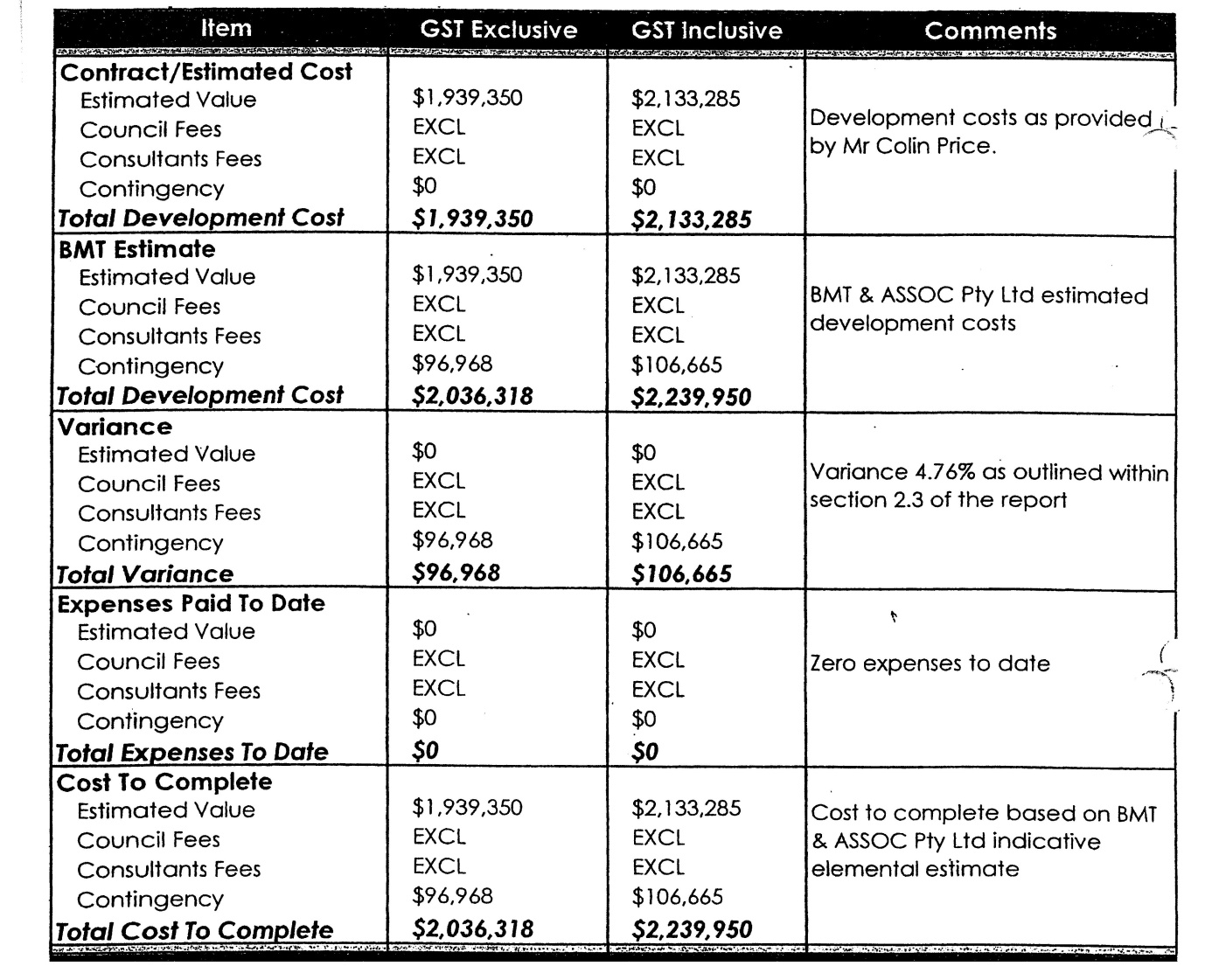
134 Mr Price accepted during cross-examination that he provided the “Estimated Value” figures set out in the first row of the above table (as indicated in the comments in that row).
135 As indicated in the table set out above, BMT took the estimate provided by Mr Price and added to it a contingency of approximately $96,000.
136 The next part of the document took the form of a letter from BMT to BankWest. In their conclusion, BMT expressed the view that the estimated costs provided by CRP were fair and reasonable based on current market conditions; the scale of work to be undertaken by CRP in its role was appropriate; and that CRP appeared to have the experience to undertake a project of this nature.
137 Appendix 1 to the letter was headed, “Full Estimate Summary”. This contained a two-page breakdown of costs in relation to stages one and two of the Project. The amount allowed for the contractor’s margin was $67,448 for stage one and $64,034 for stage two. The next section was headed, “Trade Breakup” and comprised 16 pages. This contained details about finishes, including the brands for the kitchen and bathroom fixtures. In relation to the contractor’s margin, the dollar amounts specified for the contractor’s margin were the same as in the Full Estimate Summary. The total of these dollar amounts ($131,482) is in the order of 6.5% of the total cost to complete, in contrast with the 18% provided for in BMT’s Preliminary Cost Plan of 5 October 2006.
138 Appendix 2 was a copy of Simple Works Contract. Appendix 3 was the planning permit. Appendix 4 set out the contractor’s previous experience. Appendix 5 was a cashflow forecast and Appendix 6 comprised photographs.
139 Mr Stephen Power accepted during cross-examination that the Development Check Estimate was prepared for the bank; that it was prepared for the bank’s purpose of certifying how much would be advanced progressively throughout the Project. He also said that it was prepared to certify for the bank that the Project could be built for the contract price. He accepted that he did not sit down with Mr Price and agree the detail of the Development Check Estimate. He also said that he did not have any discussion with BMT in relation to the preparation of the document. I accept Mr Stephen Power’s evidence as set out in this paragraph.
Three other projects
140 Mr Price gave evidence in his first affidavit (and I accept) that, apart from the Project, Grovan had an interest in three other projects involving Mr Reynolds, Mr Rice, Mr Stephen Power and Mr Weerappah. These projects commenced later than the Box Hill Project. The other projects were:
(a) the Ornum unit trust, which related to a development of 20 apartments in Munro Street, Coburg, Victoria and in respect of which Grovan had a 10% interest;
(b) the Gruboc unit trust, which related to a development of 45 apartments in Bell Street, Coburg, Victoria, and in respect of which Grovan had a 15% interest; and
(c) the Rose Anna unit trust, which related to a development of 20 apartments in Beetham Parade, Rosanna, Victoria, and in respect of which Grovan had a 10% interest.
141 Mr Price gave evidence in his first affidavit (and I accept) that CRP was engaged as the project manager in relation to the three projects; he invoiced the relevant unit trust for the hours that he worked as project manager, charging approximately $100 per hour for his work; CRP did not sign a contract with the unit trusts for these services. Mr Price also gave evidence, which I accept, in his first affidavit about the arrangements in relation to the three projects, as follows:
(a) The acquisition of the land and any existing buildings was always financed with funds contributed by the unit holders in the relevant trust in proportion to their unit holding.
(b) The building costs were as far as possible and usually 100% completed with bank finance.
(c) The contract for the construction was tendered to a number of builders which were provided with detailed working drawings (including structural, mechanical, electrical and civil drawings), a detailed specification of works which included all finishes, fixtures and fittings, planning permits and planning drawings. With this information tendering builders were able to cost the works with precision.
(d) The tendering builders submitted a fixed lump sum quotation to complete the works for the relevant projects.
(e) The Syndicate members met and reviewed the quotations and selected the builder.
(f) The selected builder signed a fixed lump sum contract for the tendered amount.
(g) The Syndicate then sought to finance 100% of the fixed lump sum through various banks, BankWest funded a number of projects.
(h) BankWest paid the builder upon the project reaching set stages and upon the financier’s satisfaction that stages had been completed. BankWest had quality surveyors who attended the site and were satisfied that the stage of completion had been reached.
(i) CRP submitted invoices each month for my services in project managing these projects. These were paid from the Unit Holders’ contributions.
(j) If the projects needed more money, Stephen Power advised the Syndicate members that they needed to make a further contribution relative to their unit holding in each relevant project.
142 As indicated in the above passage, in relation to each of the other three projects, a lump sum contract was tendered out to builders. In each case, the tender documents included working drawings, including structural, mechanical, electrical and civil drawings, and a specification of the works including all finishes, fixtures, fittings, planning permits and planning drawings.
March 2007 to March 2008
143 During the period March 2007 to March 2008, work proceeded on stage one of the Project.
144 Mr Price said during cross-examination (and I accept) that there were meetings on a regular basis at the Richmond offices of Holiday Concepts between Mr Reynolds, Mr Rice and Mr Price, and that at these meetings they discussed the things that were planned for the weeks and months ahead to complete the projects.
145 CRP submitted progress claims to BankWest on a monthly basis. In his first affidavit, Mr Price stated that “CRP submitted progress-claims to BankWest during the Project in accordance with the Contract”, that is, the Simple Works Contract. Copies of a number of the progress claims were annexed to that affidavit. In support of the progress claims, reports were prepared by BMT for BankWest. For example, on 7 March 2007, BMT prepared “Progress Payment Report No. 1”, which assessed the progress payment claim against BMT’s original estimate (contained in the Development Check Estimate, referred to above).
146 In or about March 2008, settlements took place of the contracts of sale of apartments in stage one of the Project.
147 Mr Rice gave evidence in his affidavit and during cross-examination that Mr Price was absent from the building site from late 2007 to early 2008. He accepted that he had no direct knowledge of this. In view of the evidence of Mr Vanderschoot and Mr Pimlott (discussed below) I find that Mr Price was not absent from the site from late 2007 to early 2008.
April 2008 meeting
148 In his first affidavit, Mr Price stated that in around April 2008, he met with Mr Reynolds, Mr Stephen Power and Mr Rice in the boardroom of Holiday Concepts in Richmond and advised them that the cost of completing the stage one works had been significantly higher than had been allowed for by Mr Weerappah and higher than was available under the BankWest finance, and that the stage two works would cost significantly more than had been allowed for by Mr Weerappah or which would be available under the BankWest finance; and that Mr Reynolds said words to Mr Price to the effect: “we understand that”; “just get the project completed so we can settle and get the money in”; and “make it happen and we will sort it out at the end”. Mr Price went on to state in his first affidavit that he would have stopped work on the Project if he had not been assured by Mr Reynolds, in the presence of Mr Stephen Power and Mr Rice, that CRP should complete the Project and that they would sort out payment for the costs of completing the Project which were in excess of the bank funding; and that he relied on what Mr Reynolds told him and believed that the Project would be treated by him, Mr Stephen Power and Mr Rice and the other members of the syndicate in the same way as the other projects he had undertaken for Holiday Concepts; and that, accordingly, he caused CRP and Grovan to finance the costs of the Project above the amounts funded by BankWest through the following borrowing facilities: a line of credit from Bendigo Bank secured against a property in Shepparton, Victoria owned by Mr and Mrs Price; an overdraft facility CRP had with the Bendigo Bank; moneys on deposit held by CRP and Grovan; and the sale of shares held by Grovan and Mr Price.
149 During cross-examination, when asked what he said at the meeting, Mr Price said, “What I said, I guess, in that meeting was, ‘Hey, this project’s costing a lot more than what the sum on the contract says and I need help’”. It was put to Mr Price, and he accepted, that in relation to the earlier work for Holiday Concepts, he never really discussed the 15% but rather decided for himself whether it should be 10 or 15% according to whether he judged the project to be complex or simple. The following exchange then occurred between the respondents’ senior counsel and Mr Price:
And having started in December 2006 and run into financial trouble by April 2008, I am suggesting to you the obvious thing to have put to Mr Reynolds is, “Look, you blokes owe me a 15 per cent margin, and that will get me out of my present predicament and you should pay it”. But you never give a suggestion that that’s what happened, do you?---I didn’t think there was a need to, because I was being told, “Just get the project completed so we can get settlement”.
I don’t think there’s - - -?---“Keep it going”.
Sorry?---Sorry. That was – yes: “Just keep it going. Get on to this and get the settlements done”.
Mr Price explained in answer to a subsequent question that the reference to “settlements” in the above passage was to settlements of the sales of the apartments.
150 Mr Reynolds accepted during cross-examination that there was a meeting at which Mr Price advised the syndicate members that he was running out of money to complete the Project. He disputed that Mr Price said the Project was costing more than available under the BankWest facility. He disputed that Mr Price said that stage two would cost significantly more than had been allowed for. He said that there was no meeting at which Mr Price said such things. Mr Reynolds said that at many meetings he said words to the effect, “Just hurry up so that we can settle and get the money in”. Mr Reynolds said that he repeatedly said, “There’s [sunset] clauses, Colin, and these contracts will fall down if we don’t finish the Project”. He denied saying words to the effect, “Hurry and get it all completed so we can settle and get the money in, and we will sort it all out in the end”.
151 Mr Reynolds also gave evidence during cross-examination that in about mid-2008 the syndicate members wanted Mr Price to be thrown off the job, and Mr Reynolds said, “This guy has done a lot of work for me over the years. He will finish it. We’re better off not bringing another builder in”. Mr Reynolds said the other syndicate members had quotes from another builder to finish the job. There was no reference to such quotes in his affidavits.
152 In relation to the meeting in or about April 2008 between Mr Price and Mr Reynolds, Mr Rice and Mr Stephen Power, I find that Mr Price said that the costs of completing stage one of the Project had been significantly higher than had been allowed for; that the costs of stage two of the Project were likely to be significantly higher than had been allowed for; and that CRP had run into financial trouble as a result. That words to this effect were said is plausible given the stage that the Project had reached and CRP’s financial situation. I find that Mr Reynolds said words to the effect that Mr Price should just get the Project completed so they could achieve settlements on sales of apartments. I also find that Mr Reynolds said words to the effect, “We will sort it out at the end”. A statement to this effect was pragmatic and consistent with Mr Reynolds’s general approach. Given the evidence (which I accept) that Mr and Mrs Price drew on their own funds and used their own property as security to complete the Project, it is likely that Mr Price was given some form of comfort. However, even if (as I accept) these words were said, they did not amount to any clear commitment to pay CRP its costs or its costs plus a margin. I find that Mr Price did not raise, and the other syndicate members did not say, that CRP would be paid on the basis of cost plus a margin for past or future work on the Project. Mr Price’s affidavit evidence does not state that he raised this or that the others said this at the meeting. Similarly, in his oral evidence, Mr Price did not state that he raised this or that the others said this.
April 2008 to November 2008
153 During the period April to about November 2008, stage two of the Project was completed.
154 One of the issues raised by the first to seventh respondents is whether Mr Price (and CRP) continued to carry out work on the Project during the period August to November 2008.
155 In his first affidavit, Mr Price stated that neither CRP nor he ceased working on the property before the Project was completed. It was put to Mr Price during cross-examination that one of the problems that happened in relation to completion of the Project was that people could not find him. He rejected that and said they could always find him. He accepted that from time to time in 2008 the first to seventh respondents were ringing subcontractors trying to find out where Mr Price was, and no-one knew where he was. Mr Price said: “… in my capacity as far as I could I was onsite trying to get the project completed”. Mr Price clarified that the reference to “in my capacity” meant “as far as I could with funds available, I was trying to get the project completed to the best of my ability on behalf of the shareholders”.
156 Mr Vanderschoot stated in his affidavit (and I accept) that from 1998 to 2009 he was regularly engaged by Mr Price to work as a builder on many projects; during that time, he and his partner, Mr Pimlott, worked almost exclusively for Mr Price; from late 2006 until late 2008 or early 2009, he and Mr Pimlott worked for Mr Price on the Project; throughout the entire period:
(a) he and Mr Pimlott worked at the site virtually every day undertaking renovation of the existing apartments and construction of the new apartments;
(b) there were many other tradespeople on site, including bricklayers, plumbers, electricians, glaziers, tilers, painters and carpet layers, and Mr Price met with and gave instructions to these people on site;
(c) other people regularly came to the site, including suppliers and the quantity surveyor, and Mr Price met with and gave instructions to these people on site;
(d) as far as he was aware, Mr Price was the project manager of the Project;
(e) as far as he was aware, no-one else was the project manager of the Project;
(f) Mr Price visited the site regularly; during busy periods he attended at least three or four days a week;
(g) he spoke to Mr Price in person or by telephone on a daily basis, often many times a day;
(h) no-one other than Mr Price attended the site, met with him or called him to give him directions as to any work required to be undertaken in relation to the Project; and
(i) Mr Robert Power visited the site a couple of times, at least once with Mr Price; Mr Robert Power did not give Mr Vanderschoot any directions concerning work to be undertaken on the Project.
157 Mr Pimlott stated in his affidavit (and I accept) that he was a subcontractor and during the period from the mid-1990s to around 2009 he was employed regularly by Mr Price in relation to many building projects; in late 2006, he and Mr Vanderschoot were employed by Mr Price to work on the Project; as far as he was aware, Mr Price was the project manager for the Project; no-one else gave him instructions and he did not observe anyone else give instructions to other tradesmen working on the Project; Mr Price visited the site at least a couple of days a week, on average; he spoke with Mr Price on a daily basis during the course of the Project, either in person or over the phone; as far as he was aware, Mr Price was still the project manager when the Project was completed; he recalled Mr Robert Power visiting the site during the course of the Project, but cannot recall how frequently; Mr Robert Power did not give him instructions and he did not observe him giving instructions to other tradespeople working on the Project.
158 Mr Robert Power stated in his first affidavit that in mid to late 2008, Mr Reynolds instructed him to finish the management of the Project; that he (Mr Robert Power) was onsite every day and spoke to the tradesmen who told him day after day that they had not seen Mr Price; that stage two was only about a quarter of the way to being complete; that Twentieth Green did not engage another builder to complete the Project; rather, the works were completed using Mr Price’s building licence, with Mr Robert Power project-managing the existing subcontractors. Mr Robert Power’s company submitted an invoice for $7,000 for this work in January 2009.
159 In his second affidavit, Mr Robert Power stated that he was responsible, from about mid-2008, for managing the Project to completion. Mr Robert Power did not produce any document showing an order he placed with a subcontractor, any document showing an order placed with a supplier, any document showing a formal instruction to any tradesman on site, any communication by him with the accountants for the trust, or any communication by him with the quantity surveyor. He accepted during cross-examination that he had produced no document to substantiate the assertion that he managed the Project to completion.
160 In his second affidavit, Mr Stephen Power said that Mr Price had left the site in about August 2008 and never returned. However, Mr Stephen Power accepted during cross-examination that this was incorrect.
161 I find that Mr Price (and CRP) continued to carry out work on the Project during the period August to November 2008. Mr Vanderschoot and Mr Pimlott were not cross-examined and therefore their evidence is to be accepted. In light of that evidence, I find that Mr Price and CRP continued to work on the Project during the period August to November 2008.
162 On 3 September 2008, a meeting took place between Mr Stephen Power, Mr Reynolds and Mr Price. Immediately after the meeting, Mr Stephen Power prepared (that is, typed up), and Mr Price signed, the First Payment Authority. The First Payment Authority was a one-page document as follows:
In consideration of several advances made to C.R. Price and Associates from Resort Systems Pty. Ltd. to the total of $150,000.00
The first such advance of $30,000.00 effected 03/09/08
Colin and Faye Price on behalf of Grovan Pty. Ltd. hereby undertake to repay the total sum together with interest at 10% p.a. calculated daily.
Such repayments will be made by a minimum $50,000.00 being part proceeds from Twentieth Green Pty. Ltd. $50,000.00 being part proceeds from Rose Anna Pty. Ltd. and the balance being part proceeds from Gruboc Pty. Ltd.
We hereby authorize and direct the above amounts to be repaid to Resort Systems Pty. Ltd. from settlements at the earliest possible opportunity as circumstances permit.
Dated 3rd day of September 2008
Signed Grovan Pty. Ltd. by Colin Price (signed)
In the presence of
Signed Grovan Pty. Ltd. by Faye Price ……………………….
In the presence of
Signed On behalf of Resort Systems Pty. Ltd. ……………………….
In the presence of
163 Resort Systems was a company owned by Mr Stephen Power, Mr Reynolds and Mr Rice.
164 The document was signed by Mr Price in the place provided for his signature, but was not signed by Mrs Price or Resort Systems.
165 Although the First Payment Authority referred to advances totalling $150,000 having been made, that sum had not been advanced as at 3 September 2008. Amounts totalling $150,000 were advanced or paid by Resort Systems and NJC to CRP in the period 3 to 17 September 2008 as follows:
(a) $30,000 on 3 September 2008;
(b) $50,000 on 4 September 2008;
(c) $40,000 on 5 September 2008;
(d) $10,000 on 11 September 2008;
(e) $20,000 on 17 September 2008.
The first four advances or payments were from Resort Systems; the fifth from NJC. Resort Systems subsequently reimbursed NJC for the $20,000.
166 It is convenient to refer to the Second Payment Authority before setting out some further facts relating to the signing of both Payment Authorities.
167 On 24 December 2008, a meeting took place between Mr Stephen Power and Mr Price. Immediately after the discussion, Mr Stephen Power prepared (that is, typed up), and Mr Price signed, the Second Payment Authority. The Second Payment Authority was a one-page document as follows:
I Colin Price of Canberra Grove Brighton, in consideration of various advances made by Resort Systems Pty. Ltd. and other associated Companies hereby undertake to repay principal and interest out of distributions from Twentieth Green Pty Ltd and Gruboc Pty Ltd. as and when they fall due,
Interest will be calculated at a daily rate of 18% from 24/12/08
Dated this 24 day of December 2008
Signed on behalf of Grovan Pty. Ltd
By Colin Price (signed)
In the presence of (signed)
Name and Address of Witness Brett Maher
1 Seaview Court Dandenong North
168 The document was signed by Mr Price. No further funds were advanced or paid pursuant to the Second Payment Authority.
169 Mr Stephen Power gave evidence during cross-examination that the document was witnessed by Brett Maher who signed at the same time as Mr Price.
170 Mrs Price stated in her affidavit (and I accept) that she had been shown copies of the First and Second Payment Authorities by the applicants’ solicitors; that this was the first time she had seen either of them; that she had no recollection of being shown the Payment Authorities or discussing them with Mr Price prior to that time; and that, had she been told about the Payment Authorities and had it been explained to her or had she known that their effect would be that Grovan agreed to apply its share of the profits from the Project to pay liabilities incurred by CRP in relation to the Project, she would never have signed such a document and she would have urged Mr Price not to do so.
171 In his first affidavit, Mr Price stated in relation to the First and Second Payment Authorities that he had no recollection of signing them; if he signed them, he had no understanding of what he was signing or what their effect was; if he signed them, he did so without seeking any advice from an accountant or a solicitor and without first consulting or advising his wife, who was also a director of Grovan. He also stated that in the period September to December 2008:
(a) he was under “significant financial duress”, as CRP had not been paid by the unit trust for the costs incurred by CRP in relation to the Project;
(b) various contractors and trades-people who had provided goods and services in relation to the Project had not been paid, and CRP and Grovan had no more money to pay them; some had threatened to commence legal proceedings;
(c) he was receiving calls (both during business hours and after hours) from contractors and trades-people demanding payment; these included calls making threats against him;
(d) he was facing up to the likelihood of having to sell the properties that he and his wife owned to repay bank loans;
(e) his relationship with his wife was very strained due to the financial situation they were then in;
(f) he was feeling quite depressed about the situation.
172 Mr Price also stated in his first affidavit that, had it been explained to him or had he known that by signing the First and Second Payment Authorities, Grovan’s share of the profits from the Project would be applied to pay liabilities incurred by CRP in relation to the Project, he would not have signed the documents without first seeking advice from an accountant or a solicitor and consulting his wife and obtaining her agreement as well.
173 In his third affidavit, Mr Price stated that in around early September he advised members of the syndicate that due to the Project costing significantly more than had been allowed by the syndicate, the inability to obtain more from the BankWest facility, the fact that he had used up all his available lines of credit to try to complete the Project on the assurance that it would all be sorted out at the end, and the fact that the syndicate was not reimbursing him all the amounts CRP had incurred which it could not obtain from the BankWest facility:
(a) he was experiencing severe financial difficulties;
(b) he was being threatened by tradesmen and suppliers;
(c) he was constantly having his cheques bounced;
(d) his relationship with his wife was not good;
(e) he was extremely stressed; and
(f) he had developed a drinking problem.
174 In relation to the First Payment Authority, Mr Price accepted during cross-examination that he recognised the signature on the document as his own. He said that he did not recall signing it because, at this point in time, there were “that many pieces of paper being put on my desk for me to sign or not sign, I have no idea”. He also said, “if I signed it, I signed it. But what it was, I don’t know”. Mr Price was asked during cross-examination whether he recalled attending a meeting with Mr Stephen Power on 3 September 2008 at which it was agreed that Grovan’s share of the distribution from the Project would be applied to repay $150,000. Mr Price said: “There were many meetings. At that particular point in time how many meetings were there? I’ve got no idea. Hundreds, probably. Subjects about finance and subjects about this, that and everything else. Utter confusion”. Mr Price accepted during cross-examination that it was his signature on the Second Payment Authority.
175 The following exchange took place between the first to seventh respondents’ senior counsel and Mr Price during cross-examination, in relation to the sum of $150,000:
You agreed with the syndicate that the 150,000 that was made available could be repaid from Grovan’s entitlement from the project, didn’t you?---Repaid? There were funds made available.
Is that your evidence?---That’s my answer.
I will be submitting to his Honour that that answer was non-responsive, and I will invite you again: you agreed that Grovan’s share of distributions from the Box Hill project would be applied first in satisfaction of that $150,000 advance to complete this project, didn’t you?---It was mentioned.
When it was mentioned you didn’t say, “No way on Earth is that going to happen”, did you?---No, I did not.
Because if that had been said by you the immediate difficulty that would have presented the syndicate, including you, was, “Well, Mr Price, how do we finish the project?”. That’s what would have happened, wasn’t it?---That would have been the question asked.
Yes. But you were content for the money to be advanced in order to allow the project to be completed, because that allowed for the settlement and that allowed Grovan to share in the proceeds of the project, didn’t it?---Yes.
Albeit that sharing meant first pay off your creditors?---Yes.
176 Mr Price accepted during cross-examination that he controlled Grovan just as he controlled CRP.
177 Mr Stephen Power accepted during cross-examination that in September 2008 he knew that CRP was in financial trouble. He also accepted that he wanted CRP to continue to conclude the Project. He accepted that it “could well be right” that Mr Price was behaving strangely and was very stressed at about the time of the First Payment Authority or a bit earlier. He also said that he did not dispute Mr Price’s evidence that he advised the syndicate members in about early September 2008 of the following matters: that the project was costing more than estimated; that he had obtained as much money as he could out of BankWest; that he had run out of moneys of his own to complete the Project based on earlier assurances that it would all be sorted out at the end; that he was being threatened by contractors; that he was stressed and his relationship with his wife was in trouble; and that he had been drinking. Mr Stephen Power said during cross-examination that at the meeting on 3 September 2008, Mr Reynolds said to Mr Price that the unit holders would lend him the money to finish the Project, but the loan would have to be repaid from his entitlements in the other three projects and Mr Price agreed to those terms. Mr Stephen Power accepted that the First Payment Authority was a “pretty faithful record of the discussion” between Mr Reynolds, Mr Price and himself. Mr Stephen Power said during cross-examination that he knew already, before the 3 September 2008 meeting, that Mrs Price was a director of Grovan.
178 Mr Reynolds gave evidence in his first affidavit that the First Payment Authority reflected the agreement reached at the meeting. Mr Reynolds said during cross-examination that he convinced the syndicate to lend money to Mr Price so he could finish the job. He said that he told the other syndicate members that if they did not lend him the money, he would do so, provided it was secured. Mr Reynolds said during cross-examination that he and Mr Stephen Power said to Mr Price that the money would have to come out of dividends or capital return to Grovan. Mr Reynolds said during cross-examination that Mr Price during 2008 “was obviously under some pressure”. He also said that Mr Price’s contractors were complaining, “This guy is crazy, you know. There’s something wrong”. Mr Reynolds said: “So I really thought he was – he was under mental stress, quite frankly.”
179 In light of the above, I conclude that at the times Mr Price signed the First and Second Payment Authorities he was under significant financial and emotional pressure and that this was evident to Mr Stephen Power and Mr Reynolds. There was no substantial challenge to Mr Price’s evidence that he was under significant financial and emotional pressure and that he told Mr Stephen Power and Mr Reynolds this. Mr Stephen Power’s and Mr Reynolds’s evidence is generally consistent with this. In particular, I find that Mr Price conveyed to Mr Stephen Power and Mr Reynolds the substance of the matters set out in paragraph [173] above before the First Payment Authority was signed. This was not disputed by Mr Stephen Power in his evidence during cross-examination. I also find that, had Mr Price not been under such pressure, it is likely that he would have sought independent advice and consulted Mrs Price in relation to the First and Second Payment Authorities and may not have signed them. I also find that Mrs Price was not aware of the First and Second Payment Authorities and did not agree to their being entered into. I find that each of the Payment Authorities reflected the substance of the conversation that preceded its preparation.
180 Mr Stephen Power said during cross-examination that there were three copies of the First Payment Authority and that he gave the copy signed by Mr Price to Tracey Cameron, the office manager, who put it in the safe. He said that he did not touch it again until after the commencement of the proceeding. In relation to the Second Payment Authority, he said that he gave this to Ms Cameron to put with the First Payment Authority, and that the first time he had occasion to refer to it was after the proceeding commenced. During cross-examination, Mr Stephen Power was taken to the second report of Mr Joyce which stated that, in relation to the handwritten name of Brett Maher and his address, an indentation of those words appears on the First Payment Authority; and that he concludes that the Second Payment Authority was sitting on top of the First Payment Authority when those words were written. Mr Joyce did not say that an indentation of the signature appears on the First Payment Authority. Mr Stephen Power accepted that it “sounds likely” that the Second Payment Authority was sitting on top of the First Payment Authority when Brett Maher’s name and address were written. He accepted that his previous evidence to the effect that the First Payment Authority was put in the safe and not touched until after the commencement of the proceeding was false. He said that Brett Maher’s name and address were in his (Mr Stephen Power’s) handwriting. He said that he “would have” written them on the document when it was signed. He rejected the proposition that he wrote these on the document later, to improve the document. In light of this evidence, I do not think it is established that Mr Stephen Power wrote Mr Maher’s name and address on the Second Payment Authority some time later, to improve the document.
181 On or about 19 September 2008, Mr Price asked Mr Stephen Power for a letter which he could provide to his bank to assure it that Grovan’s share of dividends in the Project and the Rosanna and the Bell Street, Coburg projects would be paid to Grovan shortly. Mr Stephen Power wrote a letter dated 19 September on Holcon Residential letterhead addressed “To whom it may concern” (Annexure CRP-58) and presumably provided this to Mr Price to be used for the purpose he had outlined. The letter stated that Grovan was a stakeholder in several developments which were sold out or close to sold out and which were due to settle between the date of the letter and November 2008. In relation to the Project, the letter stated that it was “sold out”; indicated that the proceeds of settlement were “due October”; and stated that Grovan’s share was $170,000. In his third affidavit Mr Stephen Power stated that the amount due to Grovan from the Project was in fact $272,000. If the First Payment Authority (dated 3 September 2008) was validly executed and binding, the amount Grovan would receive from the Project was much less than the $170,000 referred to in the letter. As noted above, by 17 September 2008 (two days before the letter), the sum of $150,000 had been advanced by Resort Systems and NJC. Mr Stephen Power accepted during cross-examination that, on his view, Grovan would have to pay the amount that had been advanced by Resort Systems and NJC. He also accepted that, on his view, Grovan would receive nothing out of the Project after the date of the letter; indeed, Grovan would owe a small debt to the Unit Trust. Mr Stephen Power accepted during cross-examination that insofar as the letter was written and intended to show the bank that Grovan would soon receive an amount of $170,000 it was “entirely misleading”.
182 The Project was completed by November 2008 and was profitable, albeit not as profitable as originally estimated because it had been delayed for so long. Mr Price accepted this during cross-examination.
183 Mr Stephen Power in his second affidavit calculated the additional interest expense incurred by Twentieth Green by reason of the Project being completed a year later than originally planned. He calculated (and I accept) that additional interest of $216,138 was incurred by reason of the late completion of the Project.
The period after November 2008
184 In or about January 2009, settlements took place of the contracts of sale of apartments in stage two of the Project.
185 On or about 19 October 2009, Mr Price wrote a letter to Mr Stephen Power requesting information concerning the distributions to unit holders in relation to the Project and the other three projects. The letter set out a series of questions regarding the total revenue pool, the dividend distributions based on percentage invested to all shareholders (that is, unit holders), confirmation of CRP loan accounts for which distributions had been withheld from Grovan, and other matters. Mr Stephen Power accepted during cross-examination that he received the letter and did not respond.
186 On or about 11 December 2009, Mr Price met with Mr Reynolds at his home to discuss the Project. Mr Price stated in his first affidavit that he said to Mr Reynolds that he expected Twentieth Green and if necessary the unit holders to pay the shortfall between the costs incurred by CRP and the amount received by CRP; and Mr Reynolds said that he would contribute his share of the shortfall if the other unit holders agreed to contribute their respective shares. Mr Reynolds stated in his first affidavit that at the meeting Mr Price told him that he had lost about $300,000 on the Project; that Mr Reynolds asked him why he hadn’t put a claim in during the Project; that Mr Reynolds told him to put a claim in to the team and it would be considered; and that he did not receive any detailed claim, documentation or invoices to support the alleged amount. I accept Mr Price’s account of this meeting. I also accept Mr Reynolds’s account, save that I doubt that Mr Price would have referred to a shortfall of $300,000 given that, only a few days later, in the letter referred to below, he stated that the shortfall was approximately $678,000. I think it likely that Mr Price would have calculated the approximate shortfall before the meeting with Mr Reynolds given his evidence (referred to below) that he and Mrs Price had been working on this for some time.
187 On or about 14 December 2009, about a year after practical completion of the Project, Mr Price sent a letter to Mr Stephen Power at Twentieth Green. It was a two-page letter, with an attached, “Variation Order (Overruns)”. The letter detailed progress payments that had been paid for the Project, totalling $2,335,070. The variation order, under the heading, “Actual Job Costs”, set out the following claim:
. Cheques Presented | $2,702,525.06 |
. E.F.T. Transactions/Transfers | $ 274,390.13 |
. Rent Oakleigh Apartment (Refam) | $ 36,790.00 |
Total | $3,013,705.19 |
Less total Progress Claims | $2,335,070.30 |
TOTAL ADDITIONAL | $ 678,634.89 |
188 The letter sought to recover the difference between the amount CRP calculated that it had spent to complete the Project and the amount it had been paid. Mr Price was asked during cross-examination why the letter was sent more than 12 months after the Project achieved practical completion and responded:
It was because within that period I was concentrating on trying to find alternative income. I was concentrating with my wife on trying to go through cheque butts, bank statements and so forth to get a real handle on what we spent on that project versus what we were paid on that project.
My wife was working so she could – she could either contribute income to the household – as I said, I was trying to find employment and it took that time to put all the pieces together as best as we possibly could following the disaster of that project, and it was decided that we have to try and recover the moneys owed to us, spent versus what we were paid, and that’s probably it in a nutshell.
189 As Mr Price accepted during cross-examination, nowhere in the letter was there a contention that CRP was entitled to be paid on the basis of cost plus a margin of 15%. Nor was there a contention that CRP was entitled to be paid on the basis of cost plus 10%.
190 Mr Stephen Power accepted during cross-examination that he did not write back in response to the letter.
191 On or about 17 February 2010, Mr Price sent a letter to Twentieth Green (to the attention of Mr Weerappah) requesting a meeting of shareholders (that is, unit holders) to discuss the construction of the residential development in Box Hill and the subsequent losses incurred by CRP. The letter proposed a meeting on 2 March 2010. Initially, there was agreement to the meeting taking place. Subsequently, Mr Stephen Power called Mr Price to say that they wanted Mrs Price to attend the meeting. However, Mr Price did not agree to this happening, and the meeting did not take place.
192 On or about 5 August 2010, Mr Price received a telephone call from Mr Stephen Power requesting that he put in a project management fee submission for services rendered in relation to the Project for $60,000. Mr Stephen Power asked that the fee submission be back-dated to 17 February 2008. Mr Price sent a project management fee submission for $60,000 dated 17 February 2008 in accordance with the request. Mr Price stated in his first affidavit that he did not see any issue with the request and assumed it was how the syndicate wanted to account for moneys due to CRP. Mr Stephen Power said during cross-examination that Twentieth Green was the subject of a GST audit; there were debits or refunds in Twentieth Green but underpayments in Gruboc (the trustee of the unit trust for the Bell Street, Coburg project); Mr Price knew nothing of this because he was “completely estranged”; it was thought that it would be useful to have the document on file; it did not represent work that was actually done; it was not shown to the Australian Taxation Office; and it was a mistake to have asked for it to be prepared.
193 On 26 October 2012, solicitors for Mr Price sent a letter of demand to the respondents. Mr Price accepted during cross-examination that this letter was the first suggestion, orally or in writing, that he was entitled to a 15% margin for labour and materials for the Project. He said, “It wasn’t mentioned along the way, no”.
Payments made by Twentieth Green
194 In connection with CRP’s claim that the Simple Works Contract did not govern the relationship between the parties, there was evidence about a number of amounts charged by CRP, and paid by Twentieth Green, outside the progress payment regime in the Simple Works Contract. CRP submits that the payment of these amounts indicates that the parties were not operating under the Simple Works Contract.
195 In this regard, Mr Price in his third affidavit referred to four payments made by Twentieth Green in relation to preliminary work:
(a) an amount of $4,664, paid on 14 December 2006;
(b) an invoice for $53,332, of which $20,000 was paid on 22 December 2006;
(c) an amount of $40,000, which was paid on 7 March 2007;
(d) an amount of $4,848, which was paid on 30 July 2007.
196 Further, in his third affidavit, Mr Price referred to a number of other amounts which were paid by Twentieth Green:
(a) an amount of $7,196 for supply and installation of a fire hydrant, reimbursed by Twentieth Green on 20 August 2008;
(b) an amount of $17,864 for fire services, reimbursed by Twentieth Green on 28 November 2008;
(c) an amount of $20,864 for cabinetry for the Project, paid by Rose Anna Pty Ltd on behalf of Twentieth Green;
(d) an amount of $20,915 to a supplier for the Project, reimbursed by Twentieth Green (date not specified);
(e) an amount of $18,000 for blinds, reimbursed by Twentieth Green on 14 May 2008;
(f) an amount of $40,000 paid by Twentieth Green on 7 March 2007 (Mr Price could not recall the reason for this payment).
197 There was also evidence regarding a payment of $70,000 by Twentieth Green in respect of sewerage works. In his third affidavit, Mr Price stated that the sewerage works were required because the existing sewerage could not cope with 23 units and the depth required for suitable sewerage meant that a significant amount of excavation was required; that the Simple Works Contract under the definition of “Works” referred to “refurbishment of the existing apartments together with the construction of eight new apartments”; that if the Simple Works Contract applied to the relationship between CRP and Twentieth Green, then CRP was required to undertake the sewerage works as part of the contract; that the funding approval from BankWest and the BMT estimates did not include any amount for sewerage works and so he could not seek payment from the bank for those works; that seeking payment from Twentieth Green, and the payment of the amount by Twentieth Green, were consistent with his belief that CRP was operating on a cost plus basis; and that no variation was submitted to or approved by Archestral Designs. The evidence of the first to seventh respondents’ witnesses was to the effect that this payment was made because the sewerage works were a variation. Evidence to this effect was contained in Mr Rice’s affidavit. Mr Stephen Power said during cross-examination, in relation to the sewerage works, “Nobody could expect Colin [ie, Mr Price] to have reasonably known that that was going to be a problem. He came to the syndicate and it was agreed that we would pay it”.
198 In relation to the issue of payments by Twentieth Green to CRP which were over and above amounts the bank would fund, Mr Stephen Power said during cross-examination that there was a great level of trust with the builder at the stage these payments were made, and the builder was part of the syndicate undertaking the development. He also said that Mr Price was “wearing two hats” as he was both a member of the syndicate and the builder; therefore, if he said that it was an amount for the syndicate to pay, this was generally accepted.
199 Mr Stephen Power accepted during cross-examination that Twentieth Green had paid an amount of $5,082 on 22 May 2007 for design work. When asked whether, upon the first to seventh respondents’ case, this amount would fall within the works to be performed under the Simple Works Contract, and hence there would be no proper basis for Twentieth Green to pay them, he accepted that “if that was the case, it would normally form part of a progress claim”. He said that Twentieth Green paid it because Mr Price had invoiced the company and that he (Mr Stephen Power) “pretty much” just paid what Mr Price asked him to pay.
200 Mr Stephen Power accepted during cross-examination that, with respect to a number of the payments made by Twentieth Green to CRP (in other words, payments which were outside the progress payment regime), he really did not know whether they did, or did not, fall within the building contract. He also accepted the proposition that “because the contract was so unspecific, none of you really knew what was in or what was out”.
201 The evidence set out above establishes that, on many occasions, Twentieth Green paid for matters relating to the construction works outside of the progress payment regime set out in the Simple Works Contract. It appears that at least some of these payments concerned matters which were covered by the works description in the Simple Works Contract and hence one would have expected these costs to be borne by CRP and subsumed in a progress payment claim rather than paid for by Twentieth Green.
Unit Holders’ Loan Account
202 To facilitate the resolution of the claims made by Grovan, an order was made on 12 April 2013 by a judge of this Court that a director of Twentieth Green file and serve an affidavit in relation to the Unit Trust deposing to and exhibiting:
(a) all of the financial statements of the trustee and the Unit Trust;
(b) the income derived by the trustee or the Unit Trust from the Project;
(c) the expenses incurred by the trustee or the Unit Trust in relation to the Project;
(d) the profit derived by the trustee or the Unit Trust from the Project;
(e) the capital contributions made by each of the unit holders to the Unit Trust;
(f) the payments made to any of the directors or shareholders of the trustee or to the unit holders in the Unit Trust.
203 Pursuant to that order, the affidavit of Mr Stephen Power dated 23 July 2013 was filed which exhibited a schedule prepared by Neil O’Shannassy of Miller Goldie Accountants, the accountants for the Project, identifying the total amount that was contributed to the Project by each unit holder in each relevant year and the total amount that was distributed to each unit holder in each relevant year (the Unit Holders’ Loan Account) (Exhibit SGP-4). The schedule was as follows:
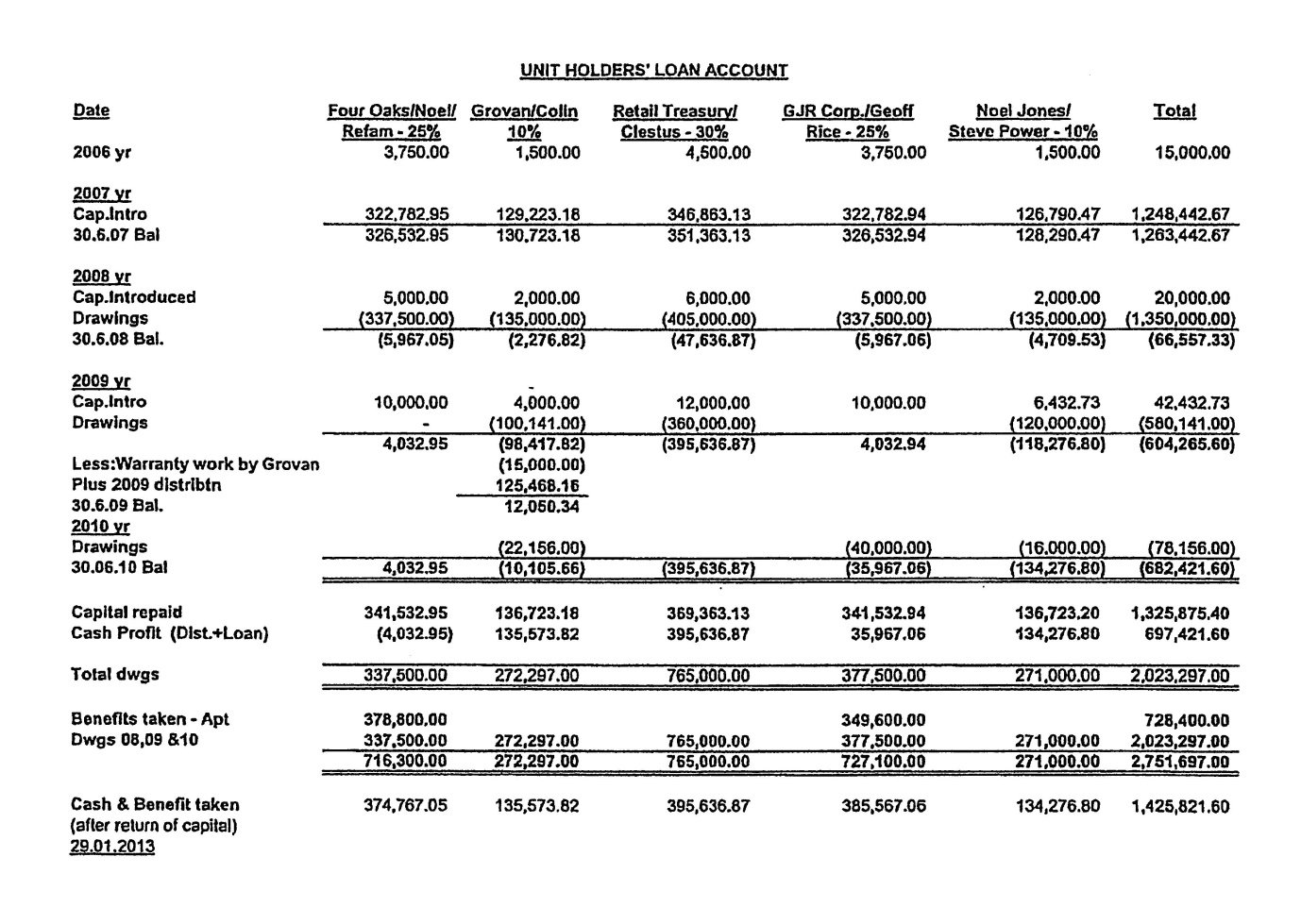
204 In his third affidavit, Mr Stephen Power stated that the table shows that Grovan’s entitlement from the proceeds of the Project (after return of capital) was $272,297; and that this entitlement was accounted for as follows:
(a) Grovan was paid $135,000 in the 2008 financial year. (This does not appear to be contentious.)
(b) In relation to the 2009 financial year, Twentieth Green paid $100,141 to third parties pursuant to the First and Second Payment Authorities, namely:
(i) $80,000 was paid by Twentieth Green to Resort Systems during January 2009;
(ii) $20,000 was paid by Twentieth Green to Tool Properties Pty Ltd (a company associated with Mr Stephen Power) by way of reimbursement of an amount of $20,000 which Tool Properties Pty Ltd paid on an invoice issued by Design Inferno to CRP on 31 December 2008;
(iii) $141 was paid by Twentieth Green to A1 Handyman Services on 30 April 2009 to pay an invoice for painting and plastering work needed to fix defects.
(c) In relation to the 2010 year, Twentieth Green paid $22,156 to Mr and Mrs Price (not Grovan) by three cheques (the amounts being $10,000, $4,900 and $6,981) in late 2009 and 2010.
205 On the basis of this evidence, it is established that, in relation to the 2009 year, amounts totalling $100,141 that constituted Grovan’s entitlements were paid to others, as set out above.
206 In relation to the 2010 year, it is established that amounts totalling $22,156 that constituted Grovan’s entitlements were paid to Mr and Mrs Price. Mr Stephen Power gave evidence in his second and third affidavits and during cross-examination that the three cheques were paid to Mr and Mrs Price at Mr Price’s request. He accepted that he did not deal with Mrs Price and that he did not obtain her agreement to the payment of these cheques other than to Grovan. I accept Mr Stephen Power’s evidence as set out in this paragraph.
207 Mr Stephen Power accepted that the following amounts (totalling $20,915) were paid by Twentieth Green during February 2008 and then debited to Grovan (Ex A21, tab 3):
(a) Darren Boxer - $4,680;
(b) Pimlott invoice - $3,960;
(c) Vanderschoot invoice - $3,960;
(d) Fashion Road - $1,000;
(e) Unique Crete - $7,315.
Mr Stephen Power accepted during cross-examination that these amounts were liabilities of CRP and not Grovan; and that they “should have gone to Colin [ie, Mr Price], yes”.
208 Mr Stephen Power was asked during cross-examination about the last line in the Unit Holders’ Loan Account. It was pointed out that it did not represent the percentages of each unit holder and that, while Grovan’s percentage interest was 10%, the last line represented only 9.5%. On this basis, it was put to him that a rebalancing would need to be done so that everyone received the correct percentages. He responded, “If we were going to square it off, yes, I would imagine so”. It was put to him that this would mean that Grovan would receive an additional $7,129 and he responded, “If you say so, yes”.
Defects
209 In the Unit Holders’ Loan Account, an amount of $15,000 was deducted from Grovan’s account in relation to warranty work. Mr Reynolds gave evidence in his first affidavit and during cross-examination regarding an amount of $15,000 in relation to defects (which I infer was the same amount). The effect of this evidence was that the purchaser of one of the apartments (it appears this was unit 20) would not settle because there were defects; Mr Robert Power was engaged to carry out (or cause to be carried out) the works; and the amount was deducted from Grovan’s entitlements. Mr Stephen Power during cross-examination accepted that, if there was a claim for the $15,000, it was against CRP and not against Grovan.
210 The first to seventh respondents rely on a letter from Twentieth Green to CRP dated 18 March 2009 (Ex R10, tab 43) which set out a list of works required to complete the Project. In relation to this letter:
(a) The letter stated that the quality of finishes fell “well short of the standard delivered on all the resorts you built for us over a period of 20 years”. The letter stated that Mr Price had undertaken to perform the required, additional works in December 2008 and that assurances had been given to the owners’ corporation based on that assurance. The letter stated that, as three months had now passed, Twentieth Green had decided to accept the lowest of the quotes it had obtained, being $16,800, and the works would now be undertaken by Twentieth Green’s selected contractor. The letter concluded that CRP could either pay the amount prior to the works being commenced or Twentieth Green would deduct the amount from moneys due to “you” from settlements in relation to the Coburg or Rosanna projects. It would seem that the reference to “you” is in fact to Grovan rather than CRP, as it was Grovan that would be entitled to proceeds from those projects.
(b) Mr Price stated in his third affidavit that he disputed that he received the letter or that he agreed to do any more work in relation to the Project; and that after he (and the builders he engaged) left the site in December 2008, and after the certificates of occupancy were obtained, and all landscaping works were completed, he did not receive any written instructions to fix any defects and did not agree to do any more works. I accept Mr Price’s evidence.
(c) Mr Reynolds said in cross-examination that the matters specified in the letter dated 18 March 2009 were raised by the body corporate manager. Although the letter said that the amount claimed ($16,800) would be deducted from amounts due from Coburg and Rosanna settlements, Mr Reynolds during cross-examination said that he did not know if the amount had been deducted. There does not appear to be other evidence to clarify this. Mr Robert Power accepted during cross-examination that he had not produced any quotes as referred to in the letter dated 18 March 2009. He was challenged on whether any such quotes existed and maintained that they existed. The first to seventh respondents did not produce any such quotations. It is unnecessary to determine whether or not quotations were in fact obtained.
Units purchased by unit holders
211 The apartments in stage one (apartments numbered 1 to 15) were sold for amounts in the order of $330,000 to $340,000. Mr Reynolds accepted in cross-examination that this was the market price for these units at the time they were sold. Typically, a deposit of 10% was required and paid upon signing the contract of sale. The apartments in stage two were numbered 16 to 23. Four of these apartments were sold for a price of $390,000.
212 Mr Reynolds gave evidence during cross-examination that the syndicate had an arrangement that members of the syndicate could purchase apartments at around cost. Mr Reynolds said that the arrangement was that a valuation of the apartment was obtained and 3.5 or 4% was taken off that figure to account for the lack of sales and marketing expenses; the unit holder paid ‘cost’ for the apartment and then the difference between that figure and the valuation (less 3.5 or 4%) was treated as a drawing by the unit holder. He said that these drawings were recorded in the Unit Holders’ Loan Account in the fourth last line, headed “Benefits taken – Apt”. Mr Stephen Power gave evidence during cross-examination to similar effect. There was no contrary evidence led by the applicants. I accept the evidence of Mr Reynolds and Mr Stephen Power about the arrangement described in this paragraph.
213 Pursuant to this arrangement, four apartments in stage two were sold ‘off the plan’ to companies associated with Mr Rice and Mr Reynolds:
(a) Unit 16 was sold to GJR Investments Pty Ltd, a company owned by Mr Rice, for $205,000 (with a deposit of $2,000). The contract date was 30 March 2007. The transfer took place on 19 December 2008.
(b) Unit 17 was sold for $202,000, with a $2,000 deposit, to GJR Corp Pty Ltd, a company owned by Mr Rice. The contract was signed on 30 March 2007. The settlement (to ESA) took place on 21 January 2009.
(c) Unit 18 was sold for $203,000, with a deposit of $2,000, to Refam Investments Pty Ltd (Refam Investments), which was one of Mr Reynolds’s superannuation companies. The contract was signed on 12 November 2006. The settlement took place on 15 January 2009.
(d) Unit 19 was sold for $204,000, with a deposit of $2,000 to Refam Investments. The contract was signed on 10 November 2006. Settlement occurred on 15 January 2009.
214 The transfers for each of the above transactions stated the contract price as the consideration.
215 In relation to the above four apartments, I infer that the deposit amounts were paid by the purchaser in each case. This is what would occur in the ordinary course. I do not consider there to be clear evidence to contradict this.
216 As noted above, the Unit Holders’ Loan Account contains a line for “Benefits taken – Apt”. In respect of Four Oaks, the figure was $378,800; in relation to Mr Rice’s company, the figure was $349,600. A valuation of the apartments by Charter Keck Cramer valued the stage two apartments at amounts ranging from $370,000 to $390,000. Assuming a value of $390,000, if 4% is deducted for sales and marketing, this leaves a value of $374,400. The difference between that amount and the amount paid for each apartment was approximately $171,400. Each of Mr Reynolds and Mr Rice, through their companies, purchased two apartments; thus (on the basis of these calculations) they obtained a discount of approximately $342,800, which is lower than the amount provided in the accounts for “Benefits taken – Apt”.
217 Unit 5, which was part of stage one, was sold for $200,000 to Refam Investments. The original purchaser of this apartment was unable to settle (in about March 2008) and in these circumstances Refam Investments agreed to purchase the apartment. Settlement took place on 9 May 2008.
218 Mr Reynolds gave evidence during cross-examination that the original purchaser was having difficulty settling and the syndicate members were told that the unit was for sale. Mr Reynolds said that he offered to purchase it for $200,000, as he had that amount available, with another $120,000 or $160,000 (Mr Reynolds initially could not recall) to be paid “out of the next stage”, that is, out of the proceeds of stage two of the Project. A bank statement was later produced showing a deposit of $120,000 into the Twentieth Green account on 19 October 2009. On this basis Mr Reynolds said the balance payable was $120,000 and that this amount had been paid to Twentieth Green. Mr Stephen Power gave evidence during cross-examination generally to similar effect, save that he said that a portion of the purchase price for unit 5 (he suggested the figure was $20,000) was included in the “drawings” amount in the Unit Holders’ Loan Account; if that is correct, the total purchase price for unit 5 was higher than $320,000 (namely, $340,000).
219 The transfer of land for unit 5 (Ex A17) stated that the consideration for the sale was $200,000 (rather than $320,000 or $340,000) and showed stamp duty as having been paid only on consideration of $200,000. The transfer was signed by Mr Rice and Mr Stephen Power on behalf of Twentieth Green and by Mr Reynolds and Lesley Reynolds on behalf of Refam Investments. Mr Reynolds accepted during cross-examination that he realised that he had to pay more than $200,000 at the time he entered the purchase contract. Mr Rice accepted during cross-examination that the consideration for the transfer was $320,000 rather than the figure of $200,000 appearing on the transfer. He accepted that the transfer understated the consideration by $120,000. Mr Stephen Power’s evidence during cross-examination was that regardless of the amount stated in the contract, the agreement was that that Twentieth Green would receive either $320,000 or $340,000 for the apartment. He also stated that he was aware that a purchaser was required to lodge with the stamps office the transfer of land so that it could be assessed and impressed with stamp duty; and that he knew that a transfer of land was required to state the consideration passing between the purchaser and vendor for the property; and that in this case one would expect the transfer to contain the consideration being either $320,000 or $340,000.
220 In the applicants’ written submissions they refer to an amount of $3,150 being held back by Mr Reynolds in respect of unit 18. They submit that the accounts show no evidence of the amount ever having been repaid by him. However, this matter was not put to Mr Reynolds. Mr Stephen Power gave evidence during cross-examination that he “would have thought” that Twentieth Green collected the money from Mr Reynolds. On the basis of this evidence, I am not satisfied that this amount was not paid.
Other claims relating to the accounts
221 Mr Stephen Power was taken during cross-examination to the general ledger for the Unit Trust for the 2009-2010 financial year (Ex A21, tab 5). One of the last payments before the Twentieth Green bank account was closed was a payment of $52,670 to Resort Systems on 15 December 2009. The same amount appeared on page 6 of the ledger in the defects account. Mr Stephen Power said that he did not know why Resort Systems was essentially receiving the balance of the money that was in the Twentieth Green bank account. He said that he “imagined” that it was the money earmarked towards the GST responsibility of Gruboc, and that it was “parked” in Resort Systems. He said that Resort Systems “certainly wasn’t entitled” to the money.
222 Mr Stephen Power was taken during cross-examination to the 2008-2009 accounts of the Unit Trust (Exhibit SGP-2) which showed an expense for consultancy fees in the amount of $60,000. He was also taken to the accountants’ notes (Ex A21, tab 21) which referred to a “Mgr Fee to Gruboc” of $60,000. He was asked why Twentieth Green was paying $60,000 to Gruboc and said he didn’t know. He said he assumed that this was Mr Robert Power’s wages, but he did not know the mechanics.
223 Mr Stephen Power was taken during cross-examination to pages in the accounts for the Unit Trust which showed that approximately $70,000 was paid to Saremto Nominees Pty Ltd, a company associated with Mr Robert Power, from 2006 onwards. Mr Stephen Power said that the syndicate members commissioned Mr Robert Power to go out and find sites for other projects and the fees were for this work; that the syndicate members of those other projects obtained the benefit of this work; and that it was agreed between all unit holders of the Project that Mr Robert Power would be paid out of Twentieth Green for this work. He also said during re-examination that the other three projects involving the same syndicate came about later than the Box Hill Project and that Mr Robert Power was involved in locating the sites for those other projects. I accept Mr Stephen Power’s evidence. There was no contrary evidence adduced by the applicants.
224 The accounts showed that approximately $2,500 was paid, from 2006, for computers for Mr Robert Power. Mr Stephen Power’s evidence during cross-examination that this was in connection with Mr Robert Power’s consultancy to locate sites for other projects. I accept Mr Stephen Power’s evidence. There was no contrary evidence adduced by the applicants.
225 The accounts of the Unit Trust show that approximately $20,000 was paid to Resort Systems for “rent and outgoings”. Mr Stephen Power said during cross-examination that the payment of this rent was agreed by unit holders. I accept Mr Stephen Power’s evidence. There was no contrary evidence adduced by the applicants.
226 The accounts of the Unit Trust show that Twentieth Green paid approximately $122,000 to Leisure Time Services Pty Ltd (Leisure Time Services). Mr Stephen Power said during cross-examination that Leisure Time Services was a company controlled by Mr Rice, Mr Reynolds and himself; that it had the resources to generate appointments for Mr Weerappah to market the Project to financial planners; and that these payments were reimbursement for doing so. I accept Mr Stephen Power’s evidence. There was no contrary evidence adduced by the applicants.
227 During cross-examination, Mr Stephen Power accepted (subject to checking the arithmetic) that in the 2006-2007 financial year Retail Treasury should have contributed $380,370 but had only contributed approximately $346,000. He accepted that, to this extent, Twentieth Green had had to pay interest in respect of the amount that had not been paid.
228 In the applicants’ closing written submissions they refer to Refam Investments receiving and being invoiced for extras in relation to units 18 and 19 and Mr Rice receiving extras for units 16 and 17. The applicants submit that there is no record of the accounts for those amounts being paid by Twentieth Green to CRP and that an allowance should be made in favour of CRP to this extent. Mr Stephen Power said during cross-examination that he did not know if the accounts had been paid.
229 In the applicants’ closing written submissions, they set out contentions regarding interest calculations. These do not need to be dealt with at this stage.
Tendency evidence
230 Section 97 of the Evidence Act 1995 (Cth) (Evidence Act) provided:
(1) Evidence of the character, reputation or conduct of a person, or a tendency that a person has or had, is not admissible to prove that a person has or had a tendency (whether because of the person's character or otherwise) to act in a particular way, or to have a particular state of mind unless:
(a) the party seeking to adduce the evidence gave reasonable notice in writing to each other party of the party's intention to adduce the evidence; and
(b) the court thinks that the evidence will, either by itself or having regard to other evidence adduced or to be adduced by the party seeking to adduce the evidence, have significant probative value.
(2) Paragraph (1)(a) does not apply if:
(a) the evidence is adduced in accordance with any directions made by the court under section 100; or
(b) the evidence is adduced to explain or contradict tendency evidence adduced by another party.
231 Section 94(1) provides that Part 3.6 (which includes s 95) does not apply to evidence that relates only to the credibility of a witness. Section 95(1) provides that evidence that under Part 3.6 is not admissible to prove a particular matter must not be used to prove that matter even if it is relevant for another purpose. The “probative value” of evidence is defined in the Dictionary in the Evidence Act to mean “the extent to which the evidence could rationally affect the assessment of the probability of the existence of a fact in issue. The onus is on the party adducing tendency evidence to establish that the requirements of both paragraphs (a) and (b) of s 97(1) are satisfied: Astram Financial Services Pty Ltd v Bank of Queensland Ltd [2010] FCA 1010 at [235]-[239] per Buchanan J. In IMM v The Queen (2016) 330 ALR 382, French CJ, Kiefel, Bell and Keane JJ said at [46]:
The significance of the probative value of the tendency evidence under s 97(1)(b) must depend on the nature of the facts in issue to which the evidence is relevant and the significance or importance which that evidence may have in establishing those facts. So understood, the evidence must be influential in the context of fact-finding.
232 The applicants seek to rely on the evidence of Mr Rice and Mr Reynolds having executed the transfer of land relating to unit 5 (see paragraph [219] above) to demonstrate a tendency to make a document to be utilised to show other parties when the document does not properly reflect the commercial arrangements between the parties. They submit that this is probative of the fact that the Simple Works Contract between the parties was only to be used to satisfy the requirements of BankWest rather than governing the relationship between the parties. The evidence was admitted on the basis that it was relevant, at least, to credit. The question whether it was also admissible to prove tendency was reserved to be dealt with in these reasons. The applicants acknowledge that, under s 97 of the Evidence Act, this evidence is not admissible to prove tendency unless: (a) the party seeking to adduce the evidence (here, the applicants) gave reasonable notice in writing to each other party of the party’s intention to adduce the evidence; and (b) the Court thinks that the evidence will, either by itself or having regard to other evidence adduced or to be adduced by the party seeking to adduce the evidence, have significant probative value. The applicants accept that, in this case, they did not give notice to the respondents. The applicants note that under s 100(1), the Court may, on the application of a party, direct that the tendency rule is not to apply to particular tendency evidence, despite the party’s failure to give notice under s 97. The applicants submit that they could not give notice in relation to the transfer of land as the issue in respect of unit 5 was not known until the production of a statement of adjustments in respect of that unit, which occurred on the third day of trial; upon receiving that document, a copy of the transfer of land was obtained and cross-examination on the document took place the next day. I accept that this provides a reasonable explanation for the failure to give notice under s 97. However, I do not think that the second element of the tendency rule is satisfied, and accordingly would not give a direction under s 100(1). In my view, the evidence relating to Mr Rice and Mr Reynolds having signed the transfer of land does not have “significant probative value” in relation to the relevant fact in issue, namely the asserted fact that the Simple Works Contract between the parties was only to be used to satisfy the requirements of BankWest rather than governing the relationship between the parties. Neither Mr Rice nor Mr Reynolds was involved in preparing the document or in providing it to the bank; those matters were handled by Mr Stephen Power. In these circumstances, any tendency that may be demonstrated by their having signed the transfer of land does not have significant probative value.
233 The applicants also seek to rely on Mr Stephen Power’s role in relation to three documents to demonstrate a tendency to make a document to be utilised to show other parties when the document does not properly reflect the commercial arrangements between the parties. The three documents are: the letter dated 19 September 2008 indicating that Grovan’s share of the proceeds would be $170,000 (see paragraph [181] above); the request on or about 5 August 2010 that Mr Price prepare a backdated submission for $60,000 of services (see paragraph [192] above); and the transfer of the land in relation to unit 5 (see paragraph [219] above). The applicants submit that Mr Stephen Power’s role in relation to these documents is probative of the fact that the Simple Works Contract between the parties was only to be used to satisfy the requirements of BankWest rather than governing the relationship between the parties. As noted above, the evidence relating to the transfer of land was admitted on the basis that it was relevant, at least, to credit, and the question whether it was also admissible to prove tendency was reserved to be dealt with in these reasons. The position is the same in relation to the other two documents.
234 Section 97(2)(b) of the Evidence Act provides that paragraph (1)(a) of s 97 (the reasonable notice requirement) does not apply if the evidence is adduced to explain or contradict tendency evidence adduced by another party. The first to seventh respondents adduced the following evidence in Mr Stephen Power’s second affidavit. He said: “In my view, showing a bank a signed contract with a builder in order to gain finance when the contract was not in fact the true arrangement with the builder would be dishonest. I would not do such a thing.” That evidence was admitted without objection. In my view, this constitutes tendency evidence adduced by the first to seventh respondents. The applicants rely on Mr Stephen Power’s role in relation to the three documents in order to contradict the tendency evidence contained in his second affidavit. In these circumstances, paragraph (1)(a) of s 97 does not apply.
235 However, there remains the question, under s 97(1)(b), whether the Court thinks that the evidence will, either by itself or having regard to other evidence adduced by the applicants, have “significant probative value” in relation to the relevant fact in issue, namely the asserted fact that the Simple Works Contract between the parties was only to be used to satisfy the requirements of BankWest rather than governing the relationship between the parties. As discussed below, this issue is to be determined objectively, by reference in particular to the acts done and words spoken by the parties (Mr Stephen Power on behalf of Twentieth Green and Mr Price on behalf of CRP). Analysed in this way, the tendency evidence upon which the applicants seek to rely does not have the capacity rationally to affect the assessment of the probability of the existence of the fact in issue and to a significant degree. (By parity of reasoning, the evidence of Mr Stephen Power set out in paragraph [234] above has no or little probative value.) Accordingly, the evidence sought to be relied on by the applicants is not admissible to prove that Mr Stephen Power has or had a tendency to act in a particular way.
CRP’S CLAIMS
Did the parties agree that the Simple Works Contract would only be used to obtain finance for the Project and would not record the terms under which CRP was to perform the works?
236 The issue raised by the applicants can be analysed in one of two ways. First, it can be analysed as a question of whether the Third Agreement alleged by the applicants has been established. As set out in paragraph [14](d) above, the Third Agreement alleged by the applicants is to the effect that, in or about November 2006, Mr Reynolds, Mr Stephen Power, Mr Weerappah and Mr Rice agreed with Mr Price that they would enter into the Simple Works Contract and that it would only be used to obtain finance for the Project and would not record the terms under which CRP was to perform the works. Secondly, the issue can be analysed as a question of whether the parties, when they signed the Simple Works Contract, intended to enter legal relations. I will consider both ways of looking at the question although, in the end, they lead to the same conclusion.
237 It is well established that the question whether parties intend to enter legal relations, or whether they have formed an agreement as alleged, is to be determined objectively. The position was authoritatively set out in the judgment of the High Court in Ermogenous v Greek Orthodox Community of SA Inc (2002) 209 CLR 95. In that case, Gaudron, McHugh, Hayne and Callinan JJ said at [24]-[25]:
24 “It is of the essence of contract, regarded as a class of obligations, that there is a voluntary assumption of a legally enforceable duty.” To be a legally enforceable duty there must, of course, be identifiable parties to the arrangement, the terms of the arrangement must be certain, and, unless recorded as a deed, there must generally be real consideration for the agreement. Yet “[t]he circumstances may show that [the parties] did not intend, or cannot be regarded as having intended, to subject their agreement to the adjudication of the courts”.
25 Because the inquiry about this last aspect may take account of the subject-matter of the agreement, the status of the parties to it, their relationship to one another, and other surrounding circumstances, not only is there obvious difficulty in formulating rules intended to prescribe the kinds of cases in which an intention to create contractual relations should, or should not, be found to exist, it would be wrong to do so. Because the search for the “intention to create contractual relations” requires an objective assessment of the state of affairs between the parties (as distinct from the identification of any uncommunicated subjective reservation or intention that either may harbour) the circumstances which might properly be taken into account in deciding whether there was the relevant intention are so varied as to preclude the formation of any prescriptive rules. Although the word “intention” is used in this context, it is used in the same sense as it is used in other contractual contexts. It describes what it is that would objectively be conveyed by what was said or done, having regard to the circumstances in which those statements and actions happened. It is not a search for the uncommunicated subjective motives or intentions of the parties.
(Footnotes omitted, emphasis added.)
238 In Toll (FGCT) Pty Limited v Alphapharm Pty Limited (2004) 219 CLR 165, a case concerning the identification of the terms of a contract rather than intention to enter legal relations, Gleeson CJ, Gummow, Hayne, Callinan and Heydon JJ said (at [42]):
Consistent with the objective approach to the determination of the rights and liabilities of contracting parties is the significance which the law attaches to the signature (or execution) of a contractual document.
239 The Court then set out passages from a number of cases emphasising the significance placed on the signing of a contractual document. One of these cases was Parker v South Eastern Railway Co (1877) 2 CPD 416, where Mellish LJ said (at 421):
In an ordinary case, where an action is brought on a written agreement which is signed by the defendant, the agreement is proved by proving his signature, and, in the absence of fraud, it is wholly immaterial that he has not read the agreement and does not know its contents. The parties may, however, reduce their agreement into writing, so that the writing constitutes the sole evidence of the agreement, without signing it; but in that case there must be evidence independently of the agreement itself to prove that the defendant has assented to it.
240 The High Court also quoted from Wilton v Farnworth (1948) 76 CLR 646, where Latham CJ said at 649:
In the absence of fraud or some other of the special circumstances of the character mentioned, a man cannot escape the consequences of signing a document by saying, and proving, that he did not understand it. Unless he was prepared to take the chance of being bound by the terms of the document, whatever they might be, it was for him to protect himself by abstaining from signing the document until he understood it and was satisfied with it. Any weakening of these principles would make chaos of every-day business transactions.
241 After setting out those passages, the High Court in Toll said (at [45]):
It should not be overlooked that to sign a document known and intended to affect legal relations is an act which itself ordinarily conveys a representation to a reasonable reader of the document. The representation is that the person who signs either has read and approved the contents of the document or is willing to take the chance of being bound by those contents, as Latham CJ put it, whatever they might be.
242 The applicants submit that the entry into the Simple Works Contract by CRP and Twentieth Green must be understood in the context of the purchase of the property and the finance which Twentieth Green had obtained from BankWest. They refer to the contract to purchase the property (see paragraph [69] above) and BankWest’s offer of finance (see paragraph [72] above). The applicants rely on Mr Price’s evidence (which I have accepted in paragraph [67] above) that at a meeting of the syndicate Mr Reynolds suggested that Mr Price be the builder for the Project and no-one disagreed. The applicants rely on Mr Price’s evidence as set out in paragraphs [109]-[111] above, to the effect that he prepared the Simple Works Contract for the purpose of Twentieth Green obtaining its finance for the Project from BankWest, and that he did not have any of the documents or necessary information to undertake a substantial development or renovation on a fixed price, and consequently would never have agreed to build the Project to a fixed cost in the circumstances. The applicants submit that the evidence regarding the need to provide a building contract to the bank explains why Mr Price prepared and signed the Simple Works Contract notwithstanding his evidence that he was not in a position to agree a fixed lump sum price at the time the contract was signed. The applicants submit that, if not for the requirement of the bank, Mr Price would not have signed the document and upon this basis they contend that it was never intended to bind the parties.
243 In my view, the applicants have not established that the parties made the alleged Third Agreement, namely an agreement to the effect that they would enter into the Simple Works Contract and that it would only be used to obtain finance for the Project and would not record the terms under which CRP was to perform the works. As noted in paragraph [112] above, there is no evidence of any specific conversation with the members of the syndicate to the effect that the document which became the Simple Works Contract would not govern the relationship between the parties and would only be used to obtain finance. While it may or may not have been Mr Price’s subjective intention that the Simple Works Contract would only be used to obtain bank finance (a matter about which it is unnecessary to reach a concluded view), that is beside the point because the question whether the alleged Third Agreement was made is to be determined objectively, that is, by looking at the actual words and acts of the parties. When one looks at the words and acts of the parties, there is no evidence to suggest an agreement of the kind alleged. To the contrary, the act of signing the Simple Works Contract points very strongly to the fact that the parties intended (objectively) that contractual document to govern their relationship in relation to the Project.
244 It may be accepted that the bank’s requirement that there be a fixed price building contract was the reason why the Simple Works Contract was prepared. But that proposition does not have the corollary that the parties, in signing the Simple Works Contract, did not intend it to govern their relationship. To the contrary, it may be inferred that, in circumstances where the bank required there to be a fixed price building contract, the parties intended to satisfy that requirement by entering into such a contract (namely, the Simple Works Contract).
245 I note that the evidence generally suggests that, in the course of the Project, the parties paid little attention to the Simple Works Contract. In particular, the evidence set out in paragraphs [194]-[201] above shows that there were many payments made by Twentieth Green rather than by BankWest as part of the progress payment regime. It may be the case that in some or all of these cases, on the true construction of the Simple Works Contract, the cost was claimable (if at all) under the progress payment regime and therefore Twentieth Green was not obliged to make the payment. However, the fact that Twentieth Green made some payments that it was not contractually obliged to make does not support an inference that the parties agreed to make the alleged Third Agreement. It equally supports an inference that, notwithstanding the contractual position, Twentieth Green was prepared to make some payments over and above its contractual obligations because it considered it appropriate to do so.
246 For these reasons, I do not accept that the parties made the alleged Third Agreement.
247 If the matter were to be analysed in the second way referred to above, namely as a question of whether the parties intended to enter into legal relations when they signed the Simple Works Contract, the same conclusion is reached. The fact that the parties signed the document is strong evidence that they intended (objectively) to enter into legal relations when they signed the document. The document is contractual in form, being a standard form of contract prepared by two professional associations. The document was completed by hand by Mr Price, with details being written into the document in numerous places. Both Mr Price and Mr Stephen Power initialled the document in various places, including on each page of the schedules. The actions of the parties in signing the Simple Works Contract demonstrate an intention to enter into legal relations.
Was the Simple Works Contract void for uncertainty?
248 As noted in paragraph [14](e) above, the applicants also allege that the Simple Works Contract is void for uncertainty. The particulars to that allegation state that the works to be carried out were not specified or agreed, nor was there any mechanism provided within the contract by which those matters would be determined. Although expressed in terms of “uncertainty”, the issue may also be described as one of alleged “incompleteness”.
249 In Thorby v Goldberg (1964) 112 CLR 597 at 607, Menzies J cited with approval the statement by Sugarman J at first instance: “It is a first principle of the law of contracts that there can be no binding and enforceable obligation unless the terms of the bargain, or at least its essential or critical terms, have been agreed upon.” See also Booker Industries Pty Ltd v Wilson Parking (Queensland) Pty Ltd (1982) 149 CLR 600 at 604 per Gibbs CJ, Murphy and Wilson JJ; Australian and New Zealand Banking Group Ltd v Frost Holdings Pty Ltd [1989] VR 695 at 700 per Kaye J; Vroon BV v Foster’s Brewing Group Ltd [1994] 2 VR 32 at 67 per Ormiston J. In Vroon, Ormiston J said at 67:
I would accept that in commercial transactions the court should strive to give effect to the expressed arrangements and expectations of those engaged in business, notwithstanding that there are areas of uncertainty and notwithstanding that particular terms have been omitted or not fully worked out. Where one should draw the line is difficult to state and equally difficult to apply. The court’s desire to give effect to commercial bargains has in recent years been frequently reiterated but occasionally overstated. For example, in Corpers (No 664) Pty Ltd v NZI Securities Australia Ltd (1989) ASC 58,402, at 58,415, Young J said this in approving the analysis of this problem in Greig and Davis, The Law of Contract: “The logically correct view reflected in cases such as May and Butcher Ltd v King (1929) [1934] 2 KB 17n. So that if parties did not direct their minds to vital terms of their contract, there was no contract. This being a commercially unrealistic point of view, the judges in England were within a few years made to reconsider the matter…”
The passages in Greig and Davis referred to are included in an elaborate discussion of the problem contained in ch 7, at 361-3 and 376-400 (to which must be added the discussion in the 4th supplement, at 87-9 and 94-104). The passage from Corper's Case was referred [to] with qualified approval by Kirby P in Custom Credit Corporation Ltd v Cenepro Pty Ltd (unreported, CA(NSW), 7 August 1991), at 38, but at 39 of his reasons his Honour said: “There are, of course, limits. They arise where, to an unacceptable extent, the parties have themselves failed to agree upon essential terms.”
I am not entirely clear as to the distinction drawn between “vital” and “essential” terms, although some caution has been expressed as to defining what are “essential” terms by Lloyd LJ in Pagnan SpA v Feed Products Ltd [1987] 2 Lloyds Rep 601, at 619. Where parties have deliberately written the terms upon which they wish to bargain but have omitted or inadequately expressed a term which might in other circumstances have been expressly or more precisely stated, the courts will endeavour to give effect to the fact that the parties did not see the absence or deficiency of such a term as preventing them from reaching agreement. The significance of each term omitted or inadequately expressed will doubtless depend upon the nature of the contract. It is by no means uncommon, although perhaps less common than in earlier years, for parties to omit the price of goods sold, particularly when they are dealing in a market where the standard or fair price is easily ascertainable. It does not follow, however, that the omission of a series of terms, each of significance, can ordinarily be overcome and the courts will be less likely to overlook the deficiencies where they have good reason to doubt that the parties have set down or expressed the whole of the terms upon which they wish to deal.
250 After a detailed discussion of the scope for implication of terms to address seeming incompleteness, Ormiston J said (at 71):
… I would accept that in those circumstances where the court is satisfied that the parties have reached agreement, judged by objective standards, then it should be more generous in giving effect to what is necessary to achieve business efficacy and the parties’ intentions, although their communications may have had an air of uncertainty and incompleteness about them.
Finally I would refer to the observations of Kennedy J in Terrex Resources NL v Magnet Petroleum Pty Ltd [1988] 1 WAR 144 (FC), at 159: “An agreement does not have to be worked out in meticulous detail. A bargain can be made containing certain terms, regarded as essentials, whilst the parties recognise that a formal document will eventually be drawn up in the full expectation that a number of additional terms will, by consent, be included in that document: see Love and Stewart Ltd v S Instone and Co Ltd (1917) 33 TLR 475 per Lord Loreburn (at p 476).”
251 In Vroon, Ormiston J also addressed (at 79-83) the question whether agreement may be implied in the absence of offer and acceptance. At page 80, his Honour recorded the argument in the case before him that it was unnecessary to analyse the parties’ arrangements strictly in terms of offer and acceptance and that “the court may imply that agreement had been reached by looking at the whole of the circumstances”. Ormiston J (at 82) quoted the following passage from the judgment of McHugh J in Integrated Computer Services Pty Ltd v Digital Equipment Corp (Aust) Pty Ltd (1988) 5 BPR 11,110 at 11,117-11,118:
It is often difficult to fit a commercial arrangement into the common lawyers’ analysis of a contractual arrangement. Commercial discussions are often too unrefined to fit easily into the slots of “offer”, “acceptance”, “consideration” and “intention to create a legal relationship” which are the benchmarks of the contract of classical theory. In classical theory, the typical contract is a bilateral one and consists of an exchange of promises by means of an offer and its acceptance together with an intention to create a binding legal relationship. … A bilateral contract of this type exists independently of and indeed precedes what the parties do. Consequently, it is an error “to suppose that merely because something has been done then there is therefore some contract in existence which has thereby been executed”: Howard, “Contract, Reliance and Business Transactions”, [1987] Journal of Business Law, at 127. Nevertheless, a contract may be inferred from the acts and conduct of parties as well as or in the absence of their words: Empirnall Holdings Pty Ltd v Machon Paull Partners Pty Ltd (1988) 14 NSWLR 523. The question in this class of case is whether the conduct of the parties viewed in the light of the surrounding circumstances shows a tacit understanding or agreement. The conduct of the parties, however, must be capable of proving all the essential elements of an express contract …
Moreover, in an ongoing relationship, it is not always easy to point to the precise moment when the legal criteria of a contract have been fulfilled. Agreements concerning terms and conditions which might be too uncertain or too illusory to enforce at a particular time in the relationship may by reason of the parties’ subsequent conduct become sufficiently specific to give rise to legal rights and duties.
252 It may be difficult for a party to show uncertainty or incompleteness where it has performed or partly performed the contract without the alleged uncertainty occasioning practical difficulty. In York Air Conditioning and Refrigeration (A/asia) Pty Ltd v Commonwealth (1949) 80 CLR 11, Latham CJ said (at 53): “… where the parties have shown by their conduct that they understand and can apply the terms of a contract without difficulty, a court should be very reluctant indeed to pay no attention to such conduct by holding that the terms of the contract are unintelligible by reason of uncertainty.”
253 In the present case, the applicants submit:
(a) On any view, at the time the Simple Works Contract was signed, there was no basis upon which CRP could give a fixed price for the works because the following did not exist: scope of works, specifications or working plans, structural or engineering drawings, soil analysis reports, approved building plans or final approved sewerage plans.
(b) The Simple Works Contract was manifestly incomplete and the majority of the materials which would be required for a builder in CRP’s position to provide a fixed cost estimate to undertake the works (in particular, the working drawings and the engineering drawings) were not yet in existence.
(c) Schedule 3 to the Simple Works Contract specifies the “contract documents” as being the scope of works and the working drawings. Schedule 4 refers to “planning permits”, “building surveyors report”, “scope of works” and “working drawings”. Other than the planning permit, the other documents did not exist before the Simple Works Contract was signed.
(d) Mr Stephen Power accepted that there were no working drawings attached to the Simple Works Contract when he signed it and he never discussed the working drawings with Mr Price. Mr Stephen Power also accepted that the scope of works and planning permits were probably not attached to the Simple Works Contract at the time he signed it. If working drawings were in existence at the time the contract was signed, the usual practice would be to attach them to the contract.
(e) Mr Reynolds accepted in cross-examination that “at best” (on the respondents’ case) Mr Price knew what was going to be built at the time that the Simple Works Contract was signed but that what was going to be built was not reduced to writing at that point. The unexpressed and subjective belief of Mr Price as to what was to be built cannot form the basis of an executed agreement which is wholly in writing (as the respondents allege). Mr Reynolds accepted that he never had a discussion with Mr Price in which they discussed the works being completed for any particular price; the result appears to be that Mr Reynolds accepted that he did not agree with Mr Price what works would be built or the price.
(f) The Simple Works Contract is so lacking in detail that the parties simply could not know the scope of the works that were to be delivered by CRP pursuant to the contract. Mr Stephen Power accepted that he, on behalf of the syndicate, did not know what works were going to be delivered under the Simple Works Contract. Despite his written evidence that the lack of detail was a risk everyone was willing to take, he accepted in cross-examination that, if the Simple Works Contract governed the relationship, the only person taking the risk was Mr Price.
(g) A substantial factor tending to the conclusion that the Simple Works Contract did not govern the relationship between the parties is the contemporaneous conduct of the parties themselves. The applicants submit that there were many instances, during the course of the Project, where Twentieth Green paid for matters which, on the respondents’ case, should have been paid by BankWest in accordance with the Simple Works Contract. They submit that it is apparent from the respondents’ evidence that no regard was had to the Simple Works Contract once it had been signed; and that the most instructive written evidence may be that given by Mr Stephen Power, who deposed in his third affidavit that, “I had a good idea in my own mind of what expenses should be paid for by a builder, and what should be paid for by the owner. Where I considered that an expense should be paid for by the owner, I had no hesitation in arranging for Twentieth Green to pay it”. The applicants submit that, rather than relying on the Simple Works Contract, the other members of the syndicate decided on a case by case basis whether or not a payment was to be made by Twentieth Green; and that numerous examples in the evidence bear this out.
254 For the following reasons, the Simple Works Contract is not void for uncertainty or incompleteness.
255 First, the Simple Works Contract took the form of a standard form contractual document, prepared by professional associations, which was signed by both parties. The standard form contract had been completed by Mr Price. Both Mr Price and Mr Stephen Power initialled the document in various places, including on each page of the schedules. As set out above, in the circumstances, assessing the matter objectively, the parties intended to enter legal relations. This is to be borne in mind in considering whether the contract is void for uncertainty or incompleteness.
256 Secondly, the Simple Works Contract itself contained a significant amount of detail. It identified the parties, the property, the works (in general terms), the price, the time, as well as containing a raft of boilerplate or machinery provisions (see paragraphs [84]-[106] above). The definition of “contract documents” in the Simple Works Contract included any special conditions shown in Sch 2 to the contract and the conditions in the contract (see paragraph [90] above).
257 Thirdly, although no documents, such as a scope of works, were attached to the Simple Works Contract, the reference to the “scope of works” in Sch 3 to the contract is to be taken to refer to the Ten Page Scope of Works which (I have found) was in existence at the time the contract was signed (see paragraph [126] above). At the time the pleading of uncertainty was formulated, it appears that the applicants were proceeding on the basis that the only ‘scope of works’ type document in existence at the time the Simple Works Contract was signed was the document described in paragraph [118] above as the Three Page Scope of Works. However, as described in paragraph [120] above, during the course of cross-examination, the Ten Page Scope of Works was brought to attention. This document contains a significant amount of detail about finishes, including matters such as the brands of appliances and fittings, not present in the Three Page Scope of Works. It is true that the Ten Page Scope of Works was not attached to the Simple Works Contract. But it can still constitute (and, I find, did constitute) the “scope of works” referred to in Sch 3 to the Simple Works Contract. While Mr Stephen Power accepted that he never sat down and discussed the document with Mr Price (see paragraph [125] above), the substance of the document was annexed to contracts of sale between Twentieth Green and purchasers of apartments (see Ex A5 and Ex A11). In these circumstances, it is to be inferred that both CRP and Twentieth Green agreed to the substance of the Ten Page Scope of Works.
258 Fourthly, while I accept that the specifications, working drawings and engineering drawings were not yet in existence when the Simple Works Contract was signed (see paragraph [108] above), the parties knew that the documents were not yet in existence but were prepared to sign the contract without them. At the time the Simple Works Contract was signed, Mr Price had commissioned the preparation of the working drawings, engineering drawings and other such documents (see paragraph [70] above). It is to be inferred that both Mr Price and Mr Stephen Power were aware that the specifications, working drawings and engineering drawings did not yet exist, but were nevertheless prepared to sign the document. This indicates that they did not envisage any difficulty in finalising these documents, most likely because this was a matter that Mr Stephen Power was content to leave to Mr Price and because the parameters were provided by the town planning drawings, the Ten Page Scope of Works, and the brief description of the works in the Simple Works Contract itself. This tends against the proposition that finalisation of the specifications, working drawings and engineering drawings was necessary before a contract could be formed. It is to be noted that Sch 3 to the Simple Works Contract provides an order of precedence of contract documents and that the scope of works (which was in existence) had precedence over the working drawings. This order of precedence reduced the prospect of difficulty in finalising the working drawings.
259 Fifthly, in the event, there was no difficulty finalising the working drawings or the engineering drawings. There is no suggestion that there was any dispute or difference of view about what CRP was to build. In these circumstances, the suggestion, first raised some years after completion of the works, that the contract was void for uncertainty because of failure to have agreed the working drawings and engineering drawings, has (with respect) an air of unreality about it.
260 Sixthly, I do not think the concessions made by Mr Stephen Power during cross-examination (see paragraph [127] above) assist in the resolution of this issue. The tenor of this evidence was that he relied heavily on Mr Price to prepare the working drawings and other such documents and had faith in him being fair and reasonable about it. This is consistent with the proposition that the parties did not envisage any difficulty finalising the working drawings and other such documents and did not see it as necessary to finalise these documents before entering a contract. Mr Stephen Power also accepted that he did not know the appliances and finishes to be used. But the Ten Page Scope of Works was already in existence at the time the Simple Works Contract was signed and, for the reasons set out above, it is to be inferred that both CRP and Twentieth Green agreed to the substance of the document.
261 Seventhly, I do not think any lack of clarity about what fell under the progress payment regime and what fell outside the contract (see paragraphs [194]-[201] above) is a basis for concluding that the contract is void for uncertainty or incompleteness. It may be accepted that Twentieth Green paid CRP on some occasions where it was not contractually obliged to do so. That may simply mean that, on those occasions, Twentieth Green was not concerned to investigate and rely upon its contractual rights.
262 Eighthly, although paragraphs (c), (d) and (k) of s 31(1) of the Domestic Building Contracts Act require certain matters to be included in a major domestic building contract (and there is no dispute that the Simple Works Contract was such a contract), non-compliance with those provisions does not render a contract void for uncertainty. Section 31(2) provided that a major building domestic contract was of no effect unless it was signed by the builder and the owner; that provision was silent on a failure to comply with the requirements in s 31(1). Further, s 133 of the Act provided that a failure by a builder to comply with any requirement in the Act in relation to a domestic building contract did not make the contract illegal, void or unenforceable, unless the contrary intention appeared in the Act. See also Dover Beach Pty Ltd v Geftine Pty Ltd (2008) 21 VR 442 at [73]-[89] per Ashley JA (Coghlan JA agreeing). Further, those requirements do not necessarily reflect what is required for contractual certainty or completeness. I also note that the obligation to comply with s 31(1) rests on the builder and it would be odd if the builder could rely on its own failure to comply with s 31(1) to establish uncertainty.
263 For these reasons, the Simple Works Contract is not void for uncertainty or incompleteness.
264 Finally, if (contrary to the above) the failure to have finalised and agreed the working drawings and engineering drawings at the time the Simple Works Contract was signed meant that the contract was uncertain or incomplete, it may be inferred that a contract was concluded at some point in time after those drawings were prepared and the works proceeded on the basis of those drawings, adopting the reasoning set out in paragraph [251] above.
Did the respondents make the Contract Representations?
265 As set out in paragraph [14](f) above, the applicants allege that Mr Reynolds, Mr Power, Mr Weerappah and Mr Rice made representations to similar effect as the Third Agreement, namely that the Simple Works Contract would only be used to obtain finance for the Project and would not record the terms under which CRP was to perform the works. As noted in paragraph [112] above, Mr Price did not give evidence of any specific conversation with members of the syndicate to the effect that the document which became the Simple Works Contract would not govern the relationship between the parties and would only be used to obtain finance. I do not think it can be implied from the mere fact that the Simple Works Contract was prepared in order to satisfy a requirement of the bank. The allegation that the Contract Representations were made is not made out.
Did the respondents make the Works Payment Representations?
266 As set out in paragraph [14](g) above, the applicants allege that CRP performed the works in reliance on (i) a representation to similar effect as the Second Agreement, namely that CRP would be paid the cost of all materials and labour incurred in relation to the works plus a margin of 15%; and (ii) the Contract Representations (together defined as the Works Payment Representations).
267 In relation to paragraph (i), there is no evidence of a specific conversation where members of the syndicate said words to this effect to Mr Price. Insofar as the applicants rely on previous dealings, these were with Holiday Concepts not the syndicate, and I have found that Mr Price charged and was paid 10% not 15% for work as a builder (see paragraph [42] above). Further, if there had been a representation to the effect that Mr Price would be paid cost plus 15% for work on the Project, one would have expected Mr Price to have raised this during the meeting in or about April 2008. But he did not (see paragraph [152] above). As noted in paragraph [113] above, Mr Price accepted during cross-examination that at no stage in the period between December 2006 and November 2008 did he render an invoice to Twentieth Green which was on the basis of the cost of labour and materials plus a 15% margin. Taking these matters into account, it is not established that representations were made.
268 In relation to paragraph (ii), for the reasons set out above, it is not established that the Contract Representations were made.
Did the respondents make the Variation Representations?
269 The alleged Variation Representations are set out in paragraph [14](i) above. The applicants allege that Mr Reynolds, Mr Stephen Power, Mr Weerappah and Mr Rice made representations to similar effect as the alleged Fourth Agreement, namely that if CRP continued to undertake the works still to be completed, and funded the costs to complete those works, they would ensure that CRP was paid the cost of all materials and labour plus a margin of 15%. The Fourth Agreement is alleged to have been made in early 2008, and therefore it may be assumed that these representations are alleged to have been made at the same time.
270 In relation to the meeting in or about early April 2008, I have found that Mr Price did not raise, and the other syndicate members did not say, that CRP would be paid on the basis of cost plus a margin for past or future work on the Project. In the absence of any other evidence that the alleged representations were made, I conclude that it has not been established that the Variation Representations were made.
Have the respondents engaged in misleading or deceptive conduct which was relied on by CRP?
271 The applicants’ misleading or deceptive conduct allegations are set out in paragraph [14](j) above. As the applicants have not established that the pleaded representations were made, it follows that the misleading or deceptive conduct case is not made out. Those allegations depended on the applicants establishing that the alleged representations were made.
Is CRP entitled to be paid on a quantum meruit basis and, if so, at a margin of 15%?
272 It follows from the above that the Simple Works Contract governed CRP’s engagement to undertake the works for the Project. Accordingly, there is no basis for CRP to recover on a quantum meruit.
273 If (contrary to the above), I had concluded that CRP was entitled to be paid on a quantum meruit basis, this would have been on the basis of cost plus 10% rather than cost plus 15%, in light of the finding set out in paragraph [42] above.
Would it be unconscionable for the respondents to assert the Simple Works Contract against CRP, and for the respondents not to pay CRP the amount it claims or an amount determined on a quantum meruit basis?
274 The applicants’ unconscionable conduct case relating to payment for the works is set out in paragraph [14](j) above. These allegations depend on the applicants establishing that the pleaded representations were made. For the reasons set out above, this has not been established. It follows that this unconscionability claim is not made out.
GROVAN’S CLAIMS
Did the parties make the first agreement alleged in the Fast Track Statement?
275 The alleged First Agreement is set out in paragraph [14](a) above. The first to seventh respondents admit the agreement, save that they say that the terms of the agreement differed in a number of respects: see paragraph [14](b) above. Thus there is no dispute that there was some form of agreement between the syndicate members or unit holders; there is a dispute about who the parties were and some of the terms. To the extent that there is dispute about these matters, it is to be resolved as a matter of inference from the facts generally rather than from any particular discussion among the syndicate members. Taking each of the matters raised by the first to seventh respondents in turn:
(a) I find that the agreement was made between the unit holders rather than the individual syndicate members. It is the unit holders (being the corporate entities) which were parties to the trust deed for the Unit Trust. In this context, it is to be inferred that the parties intended that the unit holders (rather than the individuals) would have rights and obligations in relation to the Project.
(b) As to whether unit holders were required to contribute equity before finance was obtained, the Unit Holders’ Loan Account indicates that there was an initial capital contribution. I therefore infer that unit holders were required to contribute equity before finance was obtained.
(c) I accept that the apartments were to be sold ‘off the plan’ rather than after completion of the Project. This is what in fact occurred and seems to have always been intended.
(d) I accept the evidence that there was an arrangement between the unit holders that they could take title to a completed apartment in lieu of part of their right to profits from the Unit Trust (see paragraph [212] above).
276 For these reasons, I accept that there was an agreement as alleged by the applicants, but with the differences pleaded by the first to seventh respondents.
Were the respondents entitled to rely on the First Payment Authority, the Second Payment Authority or the agreement pleaded in the Rejoinder to otherwise apply amounts due to Grovan?
277 This group of issues arises in the following way. As noted in paragraph [14](l) above, Grovan contends that in breach of the alleged First Agreement and the terms of the trust deed for the Unit Trust, the respondents have failed to account to Grovan for the profit or loss derived from the Project. The first to seventh respondents, as noted in paragraph [14](m), respond in part by saying that $100,141 was paid by Twentieth Green, as instructed by Mr Price on behalf of Grovan, to Resort Systems as repayment of moneys owed by CRP or Mr Price to Resort Systems, pursuant to the First Payment Authority and the Second Payment Authority. (At trial, the first to seventh respondents said that the money was withheld pursuant to the First Payment Authority, and therefore they did not need to rely on the Second Payment Authority unless the First Payment Authority was invalid.) As noted in paragraph [14](n) above, the applicants make a series of contentions relating to the First Payment Authority and the Second Payment Authority. These include contentions that the Payment Authorities were not signed by Mrs Price (one of the two directors of Grovan) and therefore were not binding on Grovan; that the Payment Authorities were in the nature of guarantees and were not executed in accordance with s 126 or 127 of the Corporations Act and were thus void pursuant to s 126 of the Instruments Act; and that it is unconscionable in all the circumstances for the respondents to rely on the Payment Authorities. (At trial, the applicants did not press the contention that Mr Price did not sign the Payment Authorities.) Finally, as noted in paragraph [14](o) above, the first to seventh respondents, in the Rejoinder, seek to rely on an alleged oral agreement which is said to have preceded the signing of the First Payment Authority. It will be convenient to deal, first, with the issue of whether, by reason of the absence of Mrs Price’s signature, the Payment Authorities were not binding on Grovan; second, with the issue of whether the Payment Authorities were in the nature of guarantees; third, with the issue of whether it is unconscionable for the first to seventh respondents to rely on the Payment Authorities; fourth, with the oral agreement alleged by the first to seventh respondents; and fifth, with other matters raised in relation to the Payment Authorities.
Whether, by reason of the absence of Mrs Price’s signature, the Payment Authorities were not binding on Grovan
278 In Junker v Hepburn [2010] NSWSC 88, Hammerschlag J set out the following principles concerning the authority of an agent of a company (at [39]-[48]):
39 The authority of an agent may be:
a actual (either express or implied) where it results from a manifestation of consent that the agent should represent or act for the principal expressly or impliedly made by the principal to himself; or
b apparent, where it results from such a manifestation made by the principal to third parties: Bowstead and Reynolds on Agency, 17th ed (2001) Sweet & Maxwell at Ch 3, Art 22.
40 The rules concerning actual and apparent authority apply where the principal is a company. They are supplemented by provisions of the Act where companies are concerned. The usual starting point in any consideration of a director’s actual authority is the constitution of the company, which invariably provides for directors’ powers. Express actual authority of a director usually derives from the constitution of the company or from some antecedent act such as a resolution of the board of directors: Northside Developments Pty Ltd v Registrar-General [1990] HCA 32; (1990) 170 CLR 146 at 205; Perkins v National Australia Bank Ltd [1999] SASC 39; (1999) 30 ACSR 256 at 262.
41 Implied actual authority is the authority which the law regards as having been given to an agent because of the interpretation put by the law on the relationship and dealings of the two parties: Bowstead and Reynolds on Agency, 17th ed (2001) Sweet & Maxwell par 3-003. The Court’s inquiry concerns the intention of the principal in conferring authority on the agent: Gino Evan Dal Pont, Law of Agency, 2nd ed (2008) LexisNexis Butterworths par 8.1.
42 Ordinarily, where a company has more than one director, a single director does not have authority to bind it. A director’s normal power is to bind the company only by joining with other directors in a collective resolution of the board of directors: Northside Developments Pty Ltd v Registrar-General [1990] HCA 32; (1990) 170 CLR 146 at 198, 205.
43 An implied grant of actual authority can result from acquiescence in the course of behaviour by persons who have actual authority to delegate. For example, if directors as a board stand by whilst a single director enters into transactions outside his or her authority, the board’s acquiescence in that course of dealing can constitute the grant, by implication, of actual authority to enter into those transactions.
44 In Equiticorp Finance Limited (in liq) v Bank of New Zealand (1993) 32 NSWLR 50 at 134, Clarke JA and Cripps JA said in relation to implied actual authority:
A recent example of the application of the principle in Australia is to be found in Brick and Pipe Industries Ltd v Occidental Life Nominees Pty Ltd [1992] VicRp 68; [1992] 2 VR 279, where (at 360-361) the Appeal Division of the Supreme Court of Victoria applied Hely-Hutchinson v Brayhead Ltd. In the joint judgment there was a finding of implied actual authority in relation to one Goldberg to manage the business and to hold out a person as secretary who was in fact not the secretary. The facts and circumstances there relied upon to justify such a finding included the following: Goldberg had actual control over the group of companies and invariably asserted control over each of the companies in the group; Goldberg was known as the alter ego of group companies; Goldberg made decisions for the group companies; there was no evidence that he found it necessary to refer to any board to seek approval for the course of action he proposed; the boards in question had never previously attempted to interfere with his action; Goldberg had obtained board approval of transactions to which he had already committed Brick and Pipe without first seeking authorisation from the board; and that individual directors in evidence confirmed the acquiescence of board members in the activity of Goldberg which culminated in completed transactions for which the board gave no prior approval. One final and, perhaps, decisive element in the scope of the authority the court was prepared to find vested in Goldberg, was that: “... in most, if not all, cases, the transactions committed assets of Brick and Pipe or its subsidiaries as security for borrowings by other Goldberg companies”.
Whether authority is to be implied and, if so, the scope of the authority implied is, in our view, to be found in a close analysis of the evidence before the court which is relied upon to support the implication of actual authority.
45 The authors of Company Directors: Principles of Law and Corporate Governance (2005), LexisNexis Butterworths at par 3.41, citing Freeman & Lockyer v Buckhurst Park Properties (Mangal) Ltd [1964] 2 QB 480 opine that to confer implied actual authority there would have to be not only the acquiescence of the individual board members but evidence of communication by word or conduct of their respective consents to one another and to the agent.
46 Apparent or ostensible authority is conferred where a principal represents that another has authority. The principal will be bound as against a third party by the acts of that other person within the authority which that person appears to have, though the principal had not in fact given that person such authority or had limited the authority by instructions not made known to the third party: Pacific Carriers Ltd v BNP Paribas [2004] HCA 35; (2004) 218 CLR 451 at 466; Bowstead and Reynolds on Agency, 17th ed (2001) Sweet & Maxwell par 3-005.
47 Ostensible authority often coincides with, but sometimes exceeds, actual authority. For instance, when a board appoints a managing director, they may expressly limit his authority, but his ostensible authority will include all the usual authority of a managing director. The company is bound by his ostensible authority in his dealings with those who do not know of the limitation: Hely-Hutchinson v Brayhead Ltd [1968] 1 QB 549 at 583 per Lord Denning M.R.
48 An ordinary individual director of a company does not have ostensible authority to bind it. Directors can act only collectively as a board and the function of an individual director is to participate in decisions of the board. In the absence of some representation made by the company, a director has no ostensible authority to bind it: Northside Developments Pty Ltd v Registrar-General [1990] HCA 32; (1990) 170 CLR 146 at 205.
(Emphasis added.)
279 In Northside Developments Proprietary Limited v Registrar-General (1990) 170 CLR 146, Dawson J (with whom Toohey J agreed) said at 205:
Nor does an ordinary, individual director of a company have any ostensible authority to bind the company. A managing director may have wide powers, actual or ostensible. In Freeman and Lockyer v. Buckhurst Park Properties (Mangal) Ltd. it was held that a person who had assumed the powers of a managing director of a property company with the company’s approval had apparent authority to engage architects on the company’s behalf, this being within the ordinary ambit of the authority of a managing director of a company of that kind. And even ordinary directors may have quite significant functions entrusted to them by the company, although usually these are of a more or less formal nature, such as affixing the company seal to documents which the company requires to be executed: see Lennard’s Carrying Company Limited v. Asiatic Petroleum Company Limited. But the position of director does not carry with it any ostensible authority to act on behalf of the company. Directors can act only collectively as a board and the function of an individual director is to participate in decisions of the board. In the absence of some representation made by the company, a director has no ostensible authority to bind it.
(Footnote omitted.)
280 Although ss 126 and 127 of the Corporations Act are raised in connection with the guarantee contention, it is convenient to set them out at this stage. Those sections provide:
126 Agent exercising a company’s power to make contracts
(1) A company’s power to make, vary, ratify or discharge a contract may be exercised by an individual acting with the company’s express or implied authority and on behalf of the company. The power may be exercised without using a common seal.
(2) This section does not affect the operation of a law that requires a particular procedure to be complied with in relation to the contract.
127 Execution of documents (including deeds) by the company itself
(1) A company may execute a document without using a common seal if the document is signed by:
(a) 2 directors of the company; or
(b) a director and a company secretary of the company; or
(c) for a proprietary company that has a sole director who is also the sole company secretary—that director.
Note: If a company executes a document in this way, people will be able to rely on the assumptions in subsection 129(5) for dealings in relation to the company.
(2) A company with a common seal may execute a document if the seal is fixed to the document and the fixing of the seal is witnessed by:
(a) 2 directors of the company; or
(b) a director and a company secretary of the company; or
(c) for a proprietary company that has a sole director who is also the sole company secretary—that director.
Note: If a company executes a document in this way, people will be able to rely on the assumptions in subsection 129(6) for dealings in relation to the company.
(3) A company may execute a document as a deed if the document is expressed to be executed as a deed and is executed in accordance with subsection (1) or (2).
(4) This section does not limit the ways in which a company may execute a document (including a deed).
281 Sections 126 and 127 draw a distinction between execution by the company itself – which is governed by s 127 – and execution by an agent on behalf of the company – which is governed by s 126: Knight Frank Australia Pty Ltd v Paley Properties Pty Ltd (2014) 120 SASR 532 at [80] per Blue J (Sulan and Parker JJ agreeing). As noted by Whelan, Santamaria and Kyrou JJ in Boz One Pty Ltd v McLellan (2015) 105 ACSR 325 at [205]-[209], s 127(4) preserves all legal bases upon which a company may execute a document (including a deed) irrespective of whether those bases are to be found in another statute, the common law, the company’s constitution or otherwise. The Court of Appeal in that case referred (at [209]) to Martin v New South Wales [2011] NSWLEC 50, in which Preston CJ stated that the benefit of a company executing a document in accordance with s 127(1) or (2) was that people would be able to rely on the assumptions in s 129(5) or (6) of the Corporations Act; however, as s 127(4) made clear, s 127 did not require a company to execute a document in one of the ways specified in s 127(1) or (2) and, therefore, a failure to comply with those sections would not cause the execution of the document to be ineffective in law: Martin v New South Wales [2011] NSWLEC 50 at [118]-[120].
282 The first to seventh respondents make the following submissions in relation to whether Grovan is bound by the First Payment Authority. They accept that Mrs Price did not sign the First Payment Authority but say that this is irrelevant. They submit that Mr Price was a director of Grovan; all the evidence shows that Mr Price was the relevant Grovan director with responsibility for the Project; Mr Price gave evidence that he controlled Grovan. The first to seventh respondents refer to a page from Grovan’s accounts (Ex R6) which was signed by Mr Price alone, notwithstanding that a space was provided for Mrs Price’s signature. The first to seventh respondents also refer to the fact that, when Mr Stephen Power asked that Mrs Price attend a meeting to try to resolve disputes about CRP’s payments, Mr Price refused to have her attend.
283 It is convenient to note at this point that, in response to the applicants’ guarantee contention (discussed below), the first to seventh respondents submit that: the First Payment Authority is in writing; while not in accordance with s 127, that is not a mandatory provision (s 127(4)); the First Payment Authority is signed in accordance with s 126 of the Corporations Act; Mr Price was an agent with implied authority to sign the First Payment Authority. They also submit that, even if Grovan did not execute the document in accordance with the Corporations Act, this is not a case like Knight Frank, where the company’s failure to execute in accordance with the Corporations Act was fatal because its constitution limited the ways in which it could execute documents; here, there is no evidence that Grovan was so limited.
284 In relation to the Second Payment Authority, the first to seventh respondents submit that it is not necessary to address the applicants’ contentions because no moneys were advanced pursuant to the Second Payment Authority; however, if the Court were to find that the First Payment Authority was invalid, Grovan’s obligations to repay the money (they refer to $150,000) should be found to be supported by the Second Payment Authority.
285 The facts relating to the Payment Authorities are set out in paragraphs [162]-[180] above. The First Payment Authority included the statement, “Colin and Faye Price on behalf of Grovan hereby undertake …”. It also included the words, “We hereby authorize and direct …”. The reference to “We” is probably a reference to Mr and Mrs Price, although it could be to the company. The signature clauses were expressed in terms of Grovan itself signing the document (by Mr and Mrs Price signing it). In contrast, provision is made for the document to be signed “on behalf of” Resort Systems, that is, by an agent. Unlike the First Payment Authority, the Second Payment Authority did not make provision for Mrs Price to sign, and was expressed as a being signed by Mr Price “on behalf of” Grovan.
286 Although the signature clauses of the First Payment Authority were expressed in terms of Grovan itself executing the document, the document was not executed by the company itself in accordance with s 127(1) or (2). Nor is it suggested that, on some other basis, the company itself executed the document. The question, then, is whether it was signed by Mr Price as agent for the company.
287 In my view, Mr Price did not have actual (express or implied) authority or ostensible authority to sign the First Payment Authority on behalf of Grovan. Mrs Price’s evidence (which I accept) is that she had no recollection of the documents or of discussing them with Mr Price. There is no evidence to suggest that the board of Grovan resolved to authorise Mr Price to sign the document on behalf of the company. There is no evidence to suggest that the constitution of Grovan authorised Mr Price to execute such documents on behalf of the company. In light of these matters, I conclude that Mr Price did not have actual (express) authority. Further, I conclude that he did not have actual (implied) authority. As the extracts from the cases set out above make clear, where a company has more than one director, a single director does not ordinarily have implied authority to bind the company. The evidence does not establish that implied authority arose, for example, by the board standing by while Mr Price entered into transactions on behalf of Grovan which were outside his authority. The first to seventh respondents point to Mr Price alone signing Grovan’s accounts (despite there being a place for Mrs Price’s signature). But there was very little evidence about this document; and it does not involve entering into a transaction. The fact that Mr Price during cross-examination said that he controlled the company is insufficient to establish implied authority. The fact that Mr Price did not agree to Mrs Price attending a particular meeting after the dispute arose (see paragraph [191] above) is not relevant to whether, at the time the First Payment Authority was signed, Mr Price had implied authority. Accordingly, there are no circumstances to take this out of the ordinary situation. Further, Mr Price did not have ostensible authority to bind the company. There was no evidence of the company itself representing or holding out Mr Price as having authority to bind the company. The presumptions in s 129 are not relied on by the first to seventh respondents. The First Payment Authority itself made provision for Mrs Price to sign, implicitly, if not explicitly, recognising that her signature was necessary to bind the company. It follows that the First Payment Authority was not executed or signed by or on behalf of Grovan, and therefore the company is not bound by the document.
288 For substantially the same reasons, in my view, Mr Price did not have actual (express or implied) authority or ostensible authority to sign the Second Payment Authority on behalf of Grovan. There was no relevant change in circumstances between the time of the First Payment Authority and the time of the Second Payment Authority. Although the Second Payment Authority did not make provision for Mrs Price to sign, I do not think this is significant. The question is whether Mr Price had actual (express or implied) or ostensible authority. For the above reasons, he did not. It follows that the Second Payment Authority was not signed on behalf of Grovan, and therefore the company is not bound by the document.
Whether the Payment Authorities were in the nature of guarantees
289 The applicants contend that the Payment Authorities were in the nature of guarantees and were not executed by Grovan, the party to be bound, in accordance with ss 126 or 127 of the Corporations Act and are therefore void pursuant to s 126 of the Instruments Act. I do not consider it necessary to determine whether or not each Payment Authority was in the nature of a guarantee (more specifically, a “special promise to answer for the debt, default or miscarriage of another person”, being the phrase used in s 126(1) of the Instruments Act) because, in any event, the Payment Authorities were not executed or signed by or on behalf of Grovan, which is necessary for it to be bound by those documents.
Whether it is unconscionable for the first to seventh respondents to rely on the Payment Authorities
290 In view of my conclusion, above, that the First and Second Payment Authorities did not bind Grovan, it is unnecessary to consider the applicants’ unconscionability contentions. However, for the reasons that follow, I consider that the facts as found do establish that it would be unconscionable for the first to seventh respondents to rely on the Payment Authorities, and consider it appropriate to set out my reasons for that conclusion. This provides an alternative basis for the conclusion that Grovan is not bound by the Payment Authorities.
291 The applicants rely on s 51AC of the Trade Practices Act in the Originating Application and specifically refer to that provision in connection with CRP’s claims. I will assume that they also seek to rely on this provision, alternatively general law unconscionability, in relation to the Payment Authorities. Section 51AC(1) provided that a corporation must not, in trade or commerce, in connection with (a) the supply or possible supply of goods to a person (other than a listed public company); or (b) the acquisition or possible acquisition of goods or services from a person (other than a listed public company), engage in conduct that is, in all the circumstances, unconscionable. Section 51AC(2) was in similar terms but applied to supply to persons generally in the context of supply to, or acquisition from, a corporation. Section 51AC(3) set out a non-exhaustive list of factors that the Court may have regard to for the purpose of determining whether a corporation or person in the position of the supplier contravened subsection (1) or (2). Section 51AC(4) set out a non-exhaustive list of matters which the Court may have regard to for the purpose of determining whether a corporation or person in the position of the acquirer contravened subsection (1) or (2).
292 In Hurley v McDonald’s Australia Ltd (2000) ATPR 41-741; [1999] FCA 1728, the Full Federal Court (Heerey, Drummond and Emmett JJ) said (at [22] and [31]):
22 For conduct to be regarded as unconscionable, serious misconduct or something clearly unfair or unreasonable, must be demonstrated – Cameron v Qantas Airways Ltd [1995] FCA 1304; (1994) 55 FCR 147 at 179. Whatever “unconscionable” means in sections 51AB and 51AC, the term carries the meaning given by the Shorter Oxford English Dictionary, namely, actions showing no regard for conscience, or that are irreconcilable with what is right or reasonable – Qantas Airways Ltd v Cameron [1996] FCA 1483; (1996) 66 FCR 246 at 262. The various synonyms used in relation to the term “unconscionable” import a pejorative moral judgment – Qantas Airways Ltd v Cameron [1996] FCA 1483; (1996) 66 FCR 246 at 283-4 and 298.
31 Before sections 51AA, 51AB or 51AC will be applicable, there must be some circumstance other than the mere terms of the contract itself that would render reliance on the terms of the contract “unfair” or “unreasonable” or “immoral” or “wrong”. …
(Emphasis in original.)
293 In Australian Securities and Investments Commission v National Exchange Pty Ltd (2005) 148 FCR 132, a case concerning contravention of s 12CC(1) of the Australian Securities and Investments Commission Act 2001 (Cth) (which prohibited unconscionable conduct by a person in trade or commerce in connection with the supply of financial services), the Full Federal Court (Tamberlin, Finn and Conti JJ) said:
There is no foundation in the language or purpose of s 12CC to impose limitations from the unwritten law, such as the necessity to identify a specific or particular person. Authority on s 51AC supports the proposition that the prohibition in s 12CC is not to be read down by limiting its operation only to circumstances where the common law would grant relief in respect of unconscionable conduct: Australian Competition and Consumer Commissioner v C G Berbatis Holdings Pty Ltd [2000] FCA 2; (2000) 96 FCR 491 at 502ff per French J; Australian Competition and Consumer Commissioner v Keshow [2005] FCA 558 at [97] per Mansfield J and the cases and authorities there cited. It is equally clear both from the actual language of s 51AC and of s 12CC and from the extrinsic materials relating to s 51AC that these provisions were intended to build on and not to be constrained by common law case law: see Australian Competition and Consumer Commission v Radio Rentals [2005] FCA 1133 at [24]; and Hansard … The language must be given its ordinary meaning and must not qualified by pre-existing constraints on liability: see Australian Competition and Consumer Commission v Simply No-Knead (Franchising) Pty Ltd [2000] FCA 1365; (2000) 104 FCR 253 at [30]- [37]; G Pearson, ‘The ambit of unconscionable conduct in relation to financial services’ (2005) 23 C&SLJ 105 at 123; R Bigwood, ‘Curbing Unconscionability: Berbatis in the High Court of Australia’ [2004] MelbULawRw 6; (2004) 28(1) MULR 203.
294 In Australian Competition and Consumer Commission v Lux Distributors Pty Ltd [2013] ATPR 42-447; [2013] FCAFC 90, a case concerned with s 51AB of the Trade Practices Act and its successor provision in relation to conduct directed at consumers, Allsop CJ, Jacobson and Gordon JJ said (at [41]):
In our view, the above conduct was unconscionable. It is unnecessary to deal with the cases on s 51AB of the TPA and s 21 of the ACL in any detail. The word “unconscionability” means something not done in good conscience: for example, Hurley v McDonald’s Australia Ltd [1999] FCA 1728 at [22]; ACCC v Allphones Retail Pty Ltd (No 2) [2009] FCA 17; 253 ALR 324 at [113]; Tonto Home Loans Australia Pty Ltd v Tavares [2011] NSWCA 389 at [291], [293], and the cases discussed therein. No argument was put that required any consideration of the authorities. Notions of moral tainting have been said to be relevant, as often they no doubt are, as long as one recognises that it is conduct against conscience by reference to the norms of society that is in question. The statutory norm is one which must be understood and applied in the context in which the circumstances arise. The context here is consumer protection directed at the requirements of honest and fair conduct free of deception. Notions of justice and fairness are central, as are vulnerability, advantage and honesty.
See also Director of Consumer Affairs Victoria v Scully (2013) 303 ALR 168 at [37]-[49] per Santamaria JA (Neave and Osborn JJA agreeing).
295 The first to seventh respondents submit that there is nothing unconscionable about the advance made and recorded in the First Payment Authority; CRP was in financial trouble and was otherwise unable to continue the Project; that would have been a serious blow to CRP and to Mr Price’s reputation as a builder; but because of his financial trouble it is most unlikely that he could have found an alternative lender; accordingly, the parties made the best arrangement they could in the circumstances; not only were project-saving funds advanced, but no interest was charged.
296 Those respondents also submit that it is to be remembered that Mr Price was just as keen as the other members of the syndicate to have the Project finished; if it was late, purchasers may not have settled and additional financing expenses would have been incurred; further, CRP would be unlikely to obtain further work from the syndicate members if it failed to finish the Project; it must also be borne in mind that Mr Price was a director of Twentieth Green at this time; the applicants’ contention involves saying that one company of which he was a director (Grovan) could not have agreed to repay on behalf of another company of which he was a director (CRP) an unconscionable loan from a third company of which he was a director (Twentieth Green); the Court should reject such a contrivance.
297 Further, those respondents submit that the allegation that Grovan was under a special disadvantage should be rejected; Mr Price was under financial pressure – frequently the impetus for taking on a loan – but was far from being unable to make a judgment as to his best interests; the Court should not accept that he did not understand that an advance would have to be repaid, or that any legal or financial advice he took would have been to the effect that the loan should not be undertaken – it was the only way of saving the Project; even if the First Payment Authority was in some way confusing, its import could hardly have been clearer.
298 In my view, for the reasons that follow, in requiring Grovan to enter into the First Payment Authority as the condition for the provision of funds by Resort Systems to CRP to complete the works, Twentieth Green, in trade or commerce, in connection with the supply of goods or services (the funds to be provided) or the acquisition of services (the building work to be carried out), engaged in conduct that was, in all the circumstances, unconscionable, in contravention of s 51AC of the Trade Practices Act or contrary to general law principles of unconscionability.
299 In paragraph [179] above, I concluded that, at the times Mr Price signed the First and Second Payment Authorities, he was under significant financial and emotional pressure and that this was evident to Mr Stephen Power and Mr Reynolds. In particular, I found that Mr Price conveyed to Mr Stephen Power and Mr Reynolds the substance of the matters set out in paragraph [173] above before the First Payment Authority was signed. In circumstances where (to the knowledge of Mr Stephen Power and Mr Reynolds) Mr Price was experiencing extreme financial difficulties, he was being threatened by tradesmen and suppliers, his relationship with his wife was not good, he was extremely stressed, and he had developed a drinking problem, he was evidently not in a position to look after Grovan’s interests. Putting to one side the construction issues raised by the applicants in relation to the First Payment Authority, the deal that is reflected in the document in effect required Grovan to give up its right to share in a large part of the proceeds of the Project to pay for cost overruns. No other unit holder was required to make a comparable sacrifice. Notwithstanding the possibility that Resort Systems may not have been prepared to provide the money had Grovan not agreed to these terms, it is far from clear that the deal was in the interests of Grovan (a mere 10% unit holder). In any event, it was not in a position (because of the financial and emotional stress that Mr Price was under) properly to consider its best interests. As noted above, Mr Reynolds said in cross-examination: “So I really thought he was – he was under mental stress, quite frankly”. I think that Twentieth Green took advantage of Mr Price’s predicament to extract these terms. In the language of the cases, Twentieth Green’s conduct was not done in good conscience.
300 In relation to the specific matters set out in s 51AC(3) and (4), I note the following:
(a) in relation to the relative strengths of the bargaining positions of the parties, by reason of the financial and emotional stress that Mr Price was under, and Grovan’s inability to access funds, Grovan was in a weaker bargaining position and Twentieth Green was in a stronger bargaining position;
(b) in relation to whether Grovan was required to comply with conditions that were not reasonably necessary for the protection of the legitimate interests of Twentieth Green, Grovan was in effect being required to share the whole of the burden of the cost overruns while the other unit holders were not;
(c) in relation to whether Grovan was able to understand the First Payment Authority, while I think it likely that Mr Price understood the basics of the deal, I do not think he was in a position properly to consider Grovan’s best interests;
(d) in relation to whether any undue influence or pressure was exerted on, or any unfair tactics were used against, Grovan, I consider that, given the significant financial implications of the document for Grovan, having Mr Price sign the document shortly after the discussion, without the opportunity to take it away and consider his position, discuss it with Mrs Price or obtain advice, involved undue pressure and an unfair tactic;
(e) in relation to whether parties acted in good faith, I do not consider that either party acted in bad faith.
While the last matter does not support a finding of unconscionability, the other matters do. Taking into account these matters and the other matters referred to above, I consider that the conduct of Twentieth Green was, in all the circumstances, unconscionable.
301 For substantially the same reasons, I consider that Twentieth Green’s conduct in relation to the Second Payment Authority was also unconscionable. At the time the Second Payment Authority was signed, the relevant funds had already been made available. But apart from this difference, the other circumstances are equally applicable.
302 In paragraph [179] above I found that, had Mr Price not been under such pressure, it is likely that he would have sought independent advice and consulted Mrs Price in relation to the First and Second Payment Authorities and may not have signed them. I also found that Mrs Price was not aware of the First and Second Payment Authorities and did not agree to their being entered into. In these circumstances, Grovan is not bound by the First or Second Payment Authorities.
The oral agreement alleged by the first to seventh respondents
303 The first to seventh respondents rely, in the alternative to the Payment Authorities, on an oral agreement said to have been made during the discussion between Mr Stephen Power, Mr Reynolds and Mr Price which immediately preceded the preparation and signing of the First Payment Authority on 3 September 2008. Those respondents allege that Twentieth Green, CRP and Grovan agreed that: Twentieth Green would procure that the moneys required to enable CRP to complete the Project were advanced to it; and that Grovan authorised Twentieth Green to withhold and apply an amount equal to the Advance from Grovan’s entitlement as unit holder to 10% of the proceeds of the Project in satisfaction of the Advance.
304 In paragraph [179] above, I found that each of the Payment Authorities reflected the substance of the conversation that preceded it. Given this, I do not accept that there was a tri-partite oral agreement as alleged. The First Payment Authority was prepared as an agreement between Twentieth Green and Grovan; CRP was not a party. I am therefore not satisfied that an agreement as alleged by the first to seventh respondents was made. In any event, any such oral agreement would run into the difficulty that, for the reasons set out above, Mr Price as a single director of the company, did not have actual or ostensible authority to bind Grovan. Further, any such agreement would run into the difficulty that, for the reasons set out above, it would be unconscionable for Twentieth Green to rely on the agreement.
Other matters raised in relation to the Payment Authorities
305 In light of the conclusions reached above, it is unnecessary to consider the other issues raised by the applicants in relation to the First and Second Payment Authorities.
306 It follows from the conclusions reached above, that the $100,141 that was withheld from Grovan’s entitlements in respect of the 2009 financial year, as described in paragraph [204] above, should not have been withheld.
Were Grovan’s entitlements wrongly withheld to pay for defects work?
307 As set out in paragraph [209] above, an amount of $15,000 was withheld from Grovan on account of defects work. If there was a valid claim for defects, it was against CRP rather than Grovan. Accordingly, that amount was wrongly withheld from Grovan.
308 The first to seventh respondents submit that if Twentieth Green was not entitled to withhold the $15,000 for defects rectification, then the amount constitutes a loss suffered by Twentieth Green as a result of CRP’s breach of contract. This is dealt with below under the cross-claim.
309 As set out in paragraph [210] above, an amount of $16,800 may have been deducted from Grovan’s entitlements in respect of other projects on account of defects work. If there was a valid claim for defects, it was against CRP rather than Grovan, and the amount should not have been withheld from Grovan’s entitlements (if it was withheld). However, given that it is unclear whether or not the amount was deducted from Grovan’s entitlements, I consider that it would be inappropriate to decide this aspect of the matter at this stage.
Has Grovan been underpaid its entitlements?
310 As concluded in paragraph [206] above, in relation to Grovan’s entitlements for the 2010 year, amounts totalling $22,156 were paid to Mr and Mrs Price. Given that the money was paid both to Mrs Price as well as Mr Price, I infer that both of them in effect authorised this payment. Accordingly, the claim that this amount has been wrongly withheld is not established.
311 As noted in paragraph [207] above, amounts totalling $20,915 were debited to Grovan. The evidence in relation to these debits is possibly incomplete. I therefore consider that it would be inappropriate to decide this aspect of the matter at this stage.
312 As noted in paragraph [208] above, the amount allocated to each unit holder in the last line of the Unit Holders’ Loan Account does not represent their percentage. However, I consider the evidence in relation to this matter to be possibly incomplete and therefore consider that it would be inappropriate to decide this aspect of the matter at this stage.
313 In paragraphs [212]-[216] above, I dealt with the purchase of four apartments by companies associated with Mr Reynolds and Mr Rice. Grovan’s claims in relation to the purchase of these apartments are not established. I have concluded that the deposits for these apartments were paid. I have concluded that the discount received in relation to these apartments was taken into account as notional drawings, in accordance with the arrangement between the unit holders.
314 In paragraphs [217]-[219] above, I dealt with the purchase of unit 5 by Refam Investments, which is associated with Mr Reynolds. On the basis of the evidence there set out, I am satisfied that the full purchase price was accounted for. The initial amount of $200,000 was paid upon transfer. The sum of $120,000 was paid later, in accordance with an agreement between members of the syndicate. It may be that an additional amount of $20,000 was taken into account as notional drawings. For these reasons, Grovan’s claims in relation to the purchase of this unit are not established.
315 In paragraph [220] above, I stated that I was not satisfied that the amount of $3,150 was not paid. It follows that Grovan’s claim in relation to this amount is not made out.
316 In paragraph [221] above, I dealt with an amount of $52,670 which was paid by Twentieth Green to Resort Systems as one of the last payments before the account was closed. I consider the evidence in relation to this matter to be possibly incomplete. I therefore consider that it would be inappropriate to decide this aspect of the matter at this stage.
317 In paragraph [222] above, I dealt with an amount of $60,000 which was paid to Gruboc for consultancy fees. Again, the evidence in relation to this matter is possibly incomplete. I therefore consider that it would be inappropriate to decide this aspect of the matter at this stage.
318 In paragraph [223] above, I dealt with amounts paid as consultancy fees in respect of Mr Robert Power. This work related to finding sites for new projects (before the sites for the three other projects had been found) and was agreed to by the unit holders. Accordingly, Grovan’s claim in relation to this amount is not made out.
319 For the same reasons, the claim in relation to computer expenses in relation to Mr Robert Power, discussed in paragraph [224] above, is not made out.
320 In paragraph [225] above, I concluded that the payment of rent and outgoings to Resort Systems was agreed by unit holders. It follows that Grovan’s claim in relation to this amount is not made out.
321 In paragraph [226] above, I accepted Mr Stephen Power’s evidence that the payments totalling approximately $122,000 to Leisure Time Services represented reimbursement for expenses it incurred in relation to the marketing of the Project. On this basis, I am not satisfied that the payment of this amount to Leisure Time Services was not a proper expense of the Project.
322 In paragraph [227] above, I noted that Mr Stephen Power accepted that Retail Treasury had contributed less than its share in the 2006-2007 year. Based on the Unit Holders’ Loan Account it appears that Retail Treasury ultimately contributed its share, and therefore this claim relates only to timing and the additional interest costs incurred due to the late payment by Retail Treasury. I am not satisfied, given the state of the evidence, that this matter has not been properly dealt with as between the unit holders. Accordingly, this claim is not made out.
323 In paragraph [228] above, I stated that it is unclear if CRP was paid for the relevant work. In these circumstances, I consider there to be a deficiency in the evidence making it inappropriate to decide this point.
324 In paragraph [229] above, I referred to the applicants’ submission regarding interest. It is not necessary to deal with this at this stage.
CROSS-CLAIM
Did CRP repudiate the Simple Works Contract in about August 2008 and was any repudiation accepted?
325 This aspect of the first to seventh respondents’ cross-claim was not pressed in final submissions. It was not mentioned in their closing written submissions. In any event, this aspect of the cross-claim fails because it is not established that CRP ceased work on the Project in or about August 2008 as alleged by the first to seventh respondents.
Did CRP breach the Simple Works Contract by failing to complete the works by 8 November 2007?
326 The first to seventh respondents submit that CRP promised to complete the works by 8 November 2007; it broke that promise; unlike many construction contracts, no liquidated damages apply (this is because, although the liquidated damages provision (clause M8) has not been deleted, the rate of liquidated damages has been set at nil); an exclusion clause of this nature will not be enforced, leaving damages to be assessed in the usual way. Those respondents claim two types of losses. First, they claim interest costs incurred in the period after 8 November 2007. They submit that, if the Project had been finished on time, the sales of the units to purchasers would have settled and the proceeds of those sales would have been used to repay the loans from BankWest, meaning that no more interest would have been charged. They submit that the quantum of interest payments from 10 November 2007 is $216,138 and note that that figure was not challenged in cross-examination.
327 The applicants submit that the effect of clause M1 of the Simple Works Contract was that it required CRP to bring the Project to practical completion, and that practical completion was subject to the reasonable opinion of the architect; clause M4 of the Simple Works Contract provided that if the architect considered that the works were not at practical completion, the architect was required to give the contractor and owner a written statement to that effect, listing what had to be done for practical completion to be reached; there is no evidence that any such statement was issued by the architect; clause M8 provided that if the works had not reached practical completion, the architect was required to promptly notify the owner and the contractor in writing of the owner’s entitlement to liquidated damages; there is no evidence that any such notification was issued by the architect. Further, the applicants submit that it is apparent from the respondents’ evidence that they were aware of the delays to completion of the Project at all times; the respondents, by their conduct, acquiesced in the delays and accordingly waived any rights they may have had to now pursue CRP for failing to complete the works during the relevant time period.
328 In my view, the matters relied on by the applicants give rise to a waiver in the sense of estoppel (cf Agricultural and Rural Finance Pty Ltd v Gardiner (2008) 238 CLR 570 at [51] per Gummow, Hayne and Kiefel JJ, Heydon J agreeing; Byrnes v Kendle (2011) 243 CLR 253 at [74] per Gummow and Hayne JJ) and provide reasons why Twentieth Green should not be permitted to rely on a breach of contract by CRP failing to complete the works by 8 November 2007.
329 First, at the meeting held in or about April 2008, Twentieth Green in effect represented that it would not insist on the contractual deadline; CRP relied on this representation to its detriment; and it would be unconscionable for Twentieth Green now to resile from it. The meeting in or about April 2008 is discussed in paragraph [148]-[152] above. Given that the meeting took place some months after the date for practical completion specified in the Simple Works Contract, it would have been obvious to all present that the works had not been finished by that date and that they would not be finished for some time. But there is no suggestion that Mr Stephen Power or Mr Reynolds reserved Twentieth Green’s rights to sue CRP for late completion. To the contrary, as I have found in paragraph [152] above, Mr Reynolds said words to the effect that Mr Price should just get the Project completed so they could achieve settlement on sales of apartments, and “we will sort it out at the end”. These words, in the circumstances, amounted to a representation that Twentieth Green would not insist on the contractual deadline. I accept that, in reliance on words to that effect being spoken, Mr and Mrs Price drew on their own funds and used their own property as security in order to complete the Project. CRP also used its own resources to finance the Project over and above the amounts funded by BankWest through various borrowing facilities. I accept the evidence to this effect set out in paragraph [148] above. I also accept that, had words to that effect not been spoken, Mr and Mrs Price and CRP would not have funded the Project in this way. In these circumstances, it would be unconscionable for Twentieth Green to rely on its strict legal rights.
330 Secondly, Twentieth Green failed to appoint an architect to act as its representative and to perform the other tasks allocated to the architect under the Simple Works Contract; the failure to appoint an architect led CRP to assume that strict legal rights in relation to practical completion would not be enforced; and it would be unconscionable for Twentieth Green now to resile from that. Clause M1, which dealt with the time for performance, provided for the time to be adjusted in accordance with the provisions of the contract, but those provisions depended on there being an architect. Further, the test for practical completion depended on the architect forming a particular opinion, and this could not occur if no architect had been appointed. However, as found in paragraph [131] above, the parties did not appoint an architect. Although Archestral Designs was named as the architect in the Introduction section of the contract, the parties did not in fact appoint an architect. To the extent that responsibility to do so fell more on one party than the other, it rested with Twentieth Green, given that the architect was to administer the contract on behalf of the owner and the owner was to appoint a new architect in certain circumstances: see clause A6 in Section A of the contract, set out in paragraph [91] above. Given the critical role to be played by the architect in adjusting the time for completion and in determining whether or not practical completion had occurred, I infer that Twentieth Green’s failure to appoint an architect led CRP to assume that strict legal rights in relation to practical completion would not be enforced. Although there is no direct evidence to this effect, I infer this from the fact that, in the absence of an architect, there was no mechanism to adjust the completion date and there was no mechanism to demonstrate practical completion. I also infer that CRP relied on this assumption in financing the costs of the Project over and above the amounts funded by BankWest (as set out in paragraph [148] above). It seems unlikely that it would have done so in the absence of the assumption. In these circumstances, it would be unconscionable for Twentieth Green now to resile from that assumption.
331 Although clause R7 of the Simple Works Contract (set out in paragraph [100] above) provided that any waiver by a party was required to be in writing, I do not think this clause precludes an estoppel as found above.
Did CRP breach the Simple Works Contract by failing to complete the works to the required standard?
332 The first to seventh respondents claim that, if Twentieth Green was not entitled to withhold from Grovan any of the amount of $15,000 for defects rectification, then the amount constitutes a further loss suffered by Twentieth Green as a result of CRP’s breach of the Simple Works Contract.
333 In my view, it is not open to Twentieth Green to claim this amount because it has not adhered to the contractual mechanism for such a claim (in part because of its failure to appoint an architect). The relevant clauses of the Simple Works Contract are set out in paragraph [98](g) and (h) above. Clause M10 provided that the contractor was required to correct any defects (a defined expression) or finalise any incomplete work, whether before or after the date for practical completion, within the agreed time as stated in an instruction or if no time limit was stated, within 10 working days after receiving a written instruction from the architect to do so. In the absence of any evidence to suggest that an instruction was given, I find that no such instruction was given. Clause M11 provided (in part) that if the contractor failed to correct a defect or finalise any incomplete work within the time nominated under clause M10 or failed to show reasonable cause for the failure together within a timetable for correcting the problem that was acceptable to the architect, the owner could use another person to correct the problem at the cost of the contractors. In the absence of any instruction under clause M10, clause M11 could not operate. In these circumstances, Twentieth Green is not entitled to claim the defects rectification amount.
Has Twentieth Green suffered loss and damage as a result of any repudiation or breach by CRP?
334 This issue does not arise, in light of the conclusions set out above.
CONCLUSION
335 For the reasons set out above, I conclude that:
(a) Subject to paragraph [337] below, CRP’s claim is to be dismissed.
(b) In relation to Grovan’s claim:
(i) The amount of $100,141 was wrongly withheld from Grovan in respect of the 2009 financial year.
(ii) The amount of $15,000 (in respect of defect rectification) was wrongly deducted from Grovan.
(c) The cross-claim is to be dismissed.
336 I conclude that, due to the possibly incomplete state of the evidence, it would be inappropriate to answer as part of the determination of the separate questions the following aspects of Grovan’s claims:
(a) the claim for $16,800 which may have been deducted for defects rectification (see paragraph [309] above);
(b) the debits totalling $20,915 referred to in paragraph [311] above;
(c) the claim for approximately $7,000 relating to the percentages in the Unit Holders’ Loan Account referred to in paragraph [312] above;
(d) the amount of $52,670 paid by Twentieth Green as referred to in paragraph [316] above; and
(e) the amount of $60,000 paid by Twentieth Green as referred to in paragraph [317] above.
337 I also conclude that, due to the possibly incomplete state of the evidence, it would be inappropriate to answer the claim by CRP that certain accounts were not paid (see paragraph [323] above).
I certify that the preceding three hundred and thirty-seven (337) numbered paragraphs are a true copy of the Reasons for Judgment herein of the Honourable Justice Moshinsky. |
Associate:
VID 1009 of 2012 | |
NOEL REYNOLDS | |
Fifth Respondent: | STEPHEN POWER |
Sixth Respondent: | GEOFFREY RICE |
Seventh Respondent: | TWENTIETH GREEN PTY LTD (ACN 007 258 933) |
Eighth Respondent: | CLESTUS WEERAPPAH |


