

FEDERAL COURT OF AUSTRALIA
Australian Competition and Consumer Commission v Online Dealz Pty Ltd [2016] FCA 732
ORDERS
AUSTRALIAN COMPETITION AND CONSUMER COMMISSION Applicant | ||
AND: | ONLINE DEALZ PTY LTD ACN 601 156 156 First Respondent JANET LUCAS Second Respondent | |
DATE OF ORDER: |
THE COURT DECLARES THAT:
1. The First Respondent contravened s 106(1) of the Australian Consumer Law (ACL) (being Schedule 2 to the Competition and Consumer Act 2010 (Cth)) by supplying, in trade or commerce, household cots advertised as “NEW 3 IN 1 BABY SLEIGH COT WITH DRAWER & TODDLER RAIL + MATTRESS AUS CERTIFIED” (in white) and labelled as “3 in 1 Wooden Sleigh Cot (white)” (Sleigh Cot):
(a) which were intended to be used, or were of a kind likely to be used, by a consumer;
(b) to which the standard AS/NZS 2172:2003 entitled “Cots for household use – safety requirements” approved by Standards Australia on 19 September 2003 subject to certain variations prescribed by “Consumer Protection Notice No.6 of 2005 – Consumer Product Safety Standard: Children’s Household Cots” (the Household Cot Standard) applied; and
(c) in circumstances where the Sleigh Cots did not comply with clauses 6.8(b), 9.2, 9.7, 11.2, 12.1 and 12.2 of the Household Cot Standard by reason that:
(i) for the purposes of clause 6.8(b) of the Household Cot Standard, the edges of the vertical bars at the ends of the drop side and fixed side had a radii less than 2 mm and were not chamfered as specified in the standard;
(ii) for the purposes of clause 9.2 of the Household Cot Standard, failed the entrapment hazard test because:
A. the horizontal gaps at ends of the Sleigh Cot were sufficiently large to allow a sphere of 30 mm diameter to pass through but not sufficiently large to allow a sphere of 50 mm diameter to pass through and so were limb entrapment hazards;
B. the gap between the mattress base and one cot end when the mattress base was in the lower position was not sufficiently large to allow a cylindrical probe of 12 mm diameter to enter and so was a finger entrapment hazard; and
C. the gap between the upper portion of one end of the dropside and the adjacent cot end was not sufficiently large to allow a cylindrical probe of 12 mm diameter to enter and so was a finger entrapment hazard;
(iii) for the purposes of clause 9.7 of the Household Cot Standard, a deep crack was found on the bottom rail of the drop side after the drop side mechanism was tested as required;
(iv) for the purposes of clause 11.2 of the Household Cot Standard, the labelling on the Sleigh Cot did not include the recommended mattress size and the manufacturer’s name and address;
(v) for the purposes of clause 12.1 of the Household Cot Standard, the following information was not marked on either side of the mattress base of the Sleigh Cot:
A. the cot’s country of origin;
B. the importer’s name and address;
C. the recommended mattress size;
D. a warning notice regarding the maximum mattress thickness; and
E. the month and year of manufacture; and
(vi) for the purposes of clause 12.2 of the Household Cot Standard, the wording of the warning label was not clearly legible.
2. The First Respondent contravened s 106(1) of the ACL by supplying, in trade or commerce, portable cots advertised as “PORTACOT 7 IN 1 BABY TRAVEL PORTACOT PLAYPEN COT 2012 TRAVEL COT BASSINET ” and labelled as “Frank Masons Portable Cot PL5007 (in Pink) Ref: 2012203PL5007” (Portable Cot):
(a) which were intended to be used, or were of a kind likely to be used, by a consumer;
(b) to which the standard AS/NZS 2195:1999 entitled “Folding Cots – Safety requirements” published by Standards Australia on 15 November 1999 subject to certain variations prescribed by “Consumer Protection Notice No.4 of 2008 – Consumer Product Safety Standard for Children’s Portable Folding Cots” (the Portable Cot Standard) applied; and
(c) in circumstances where the Portable Cots did not comply with clauses 8.1(d), 10.2, 10.14 and 13.2 of the Portable Cot Standard by reason that:
(i) for the purposes of clause 8.1(d) of the Portable Cot Standard, the supplied mattress did not fit snugly within the cot and parts of the mattress near the corners of the cot sides were not touching the adjacent cot side;
(ii) for the purposes of clause 10.2 of the Portable Cot Standard, failed the entrapment hazard test because a number of gaps accessible within the cot allowed a 95 mm diameter probe to pass through;
(iii) for the purposes of clause 10.14 of the Portable Cot Standard, failed the folding side entrapment test because the gap in the Portable Cot end folding mechanism was less than 80 mm; and
(iv) for the purposes of clause 13.2 of the Portable Cot Standard, the Portable Cot did not include adequate instructions for assembly and locking procedures, and did not include required mattress warnings.
3. The First Respondent contravened s 106(1) of the ACL by supplying, in trade or commerce, baby strollers advertised as “ALUMINIUM BABY STROLLER PRAM Jogger with SEAT + BASSINET + Rain Cover + Insert” and labelled as “’Frank Masons’ brand stroller ‘Multifunctional Luxury Baby Stroller’” (Baby Stroller):
(a) which were intended to be used, or were of a kind likely to be used, by a consumer;
(b) to which the standard AS/NZS 2088:2000 entitled “Prams and strollers – Safety requirements” approved by Standards Australia on 15 December 2000 subject to certain variations prescribed by “Consumer Protection Notice No. 8 of 2007 – Consumer Product Safety Standard: Prams and Strollers (the Stroller Standard) applied; and
(c) in circumstances where the Baby Stroller did not comply with clauses 7.8.1.3, 8.6.2(b), 11.1, 11.2 and 11.3 of the Stroller Standard by reason that:
(i) for the purposes of clause 7.8.1.3 of the Stroller Standard, the waist straps were not effectively secured and substantial displacement of the seating surface was observed when the waist straps were pulled;
(ii) for the purposes of clause 8.6.2(b) of the Stroller Standard:
A. the gap between the stroller handle (in certain positions) and the stroller surface was an entrapment hazard; and
B. the gap between the stroller surface (in a reclining position) and the canopy support bar (in certain positions) was an entrapment hazard;
(iii) for the purposes of clause 11.1 of the Stroller Standard, the model name and address was not provided;
(iv) for the purposes of clause 11.2 of the Stroller Standard, the warning label contained undersized lettering; and
(v) for the purposes of clause 11.3 of the Stroller Standard, the markings on the warning label were not permanent.
4. The First Respondent contravened s 106(2) of the ACL by offering to supply, in trade or commerce, Sleigh Cots:
(a) which were intended to be used, or were of a kind likely to be used, by a consumer;
(b) to which the Household Cot Standard applied; and
(c) in circumstances where the Sleigh Cots did not comply with clauses 6.8(b), 9.2, 9.7, 11.2, 12.1 and 12.2 of the Household Cot Standard by reason of the matters referred to in paragraph 1(c) above.
5. The First Respondent contravened s 106(2) of the ACL by offering to supply, in trade or commerce, Portable Cots:
(a) which were intended to be used, or were of a kind likely to be used, by a consumer;
(b) to which the Portable Cot Standard applied; and
(c) in circumstances where the Portable Cots did not comply with clauses 8.1(d), 10.2, 10.14 and 13.2 of the Portable Cot Standard by reason of the matters referred to in paragraph 2(c) above.
6. The First Respondent contravened s 106(2) of the ACL by offering to supply, in trade or commerce, Baby Strollers:
(a) which were intended to be used, or were of a kind likely to be used, by a consumer;
(b) to which the Stroller Standard applied; and
(c) in circumstances where the Baby Stroller did not comply with clauses 7.8.1.3, 8.6.2(b), 11.1, 11.2 and 11.3 of the Stroller Standard by reason of the matters referred to in paragraph 3(c) above.
7. In publishing or causing to be published on the website:
(a) stores.ebay.com.au/Online-Dealz-Store a page with an advertisement for the Sleigh Cot that included the statements:
(i) “Certified to Australian Standard”; and
(ii) “Meeting Australian & New Zealand standards AS/NZS 2172”;
(b) www.gumtree.com.au a page with an advertisement for the Sleigh Cot that included the statements:
(i) “Certified to Australian Standard”; and
(ii) “Certified to Highest Australian Standards (AS/NZS 2172:2003)”;
the First Respondent has, in trade or commerce:
(c) engaged in conduct that was misleading or deceptive or likely to mislead or deceive in contravention of s 18 of the ACL;
(d) in connection with the supply, the possible supply or the promotion of the Sleigh Cot, made a false or misleading representation that the Sleigh Cot was of a particular standard or quality, in contravention of s 29(1)(a) of the ACL;
(e) in connection with the supply, the possible supply or the promotion of the Sleigh Cot, made a false or misleading representation that the Sleigh Cot had particular performance characteristics or benefits in contravention of s 29(1)(g) of the ACL;
(f) engaged in conduct that is liable to mislead the public as to the characteristics and the suitability for their purpose of the Sleigh Cots, in contravention of s 33 of the ACL.
8. The Second Respondent aided, abetted, counselled, procured, induced and was knowingly concerned in or party to the contraventions of the First Respondent referred to in paragraphs 1, 4 and 7(d), (e) and (f) above within the meaning of s 224(1)(c), (d) and (e) of the ACL.
THE COURT ORDERS THAT:
9. Pursuant to s 232 of the ACL the First Respondent be restrained, for a period of five years from the date of this order, whether by itself, its officers, servants or agents, in trade or commerce in Australia, from supplying or offering to supply:
(a) the Sleigh Cot;
(b) the Portable Cot;
(c) the Baby Stroller; and
(d) any household cot, portable cot or baby stroller (Baby Products) which is subject to a safety standard for the purposes of Division 1 of Part 3-3 of the ACL in force at the time of supply or offer to supply, unless the First Respondent has first obtained written evidence from a person accredited by the National Association of Testing Authorities Australia (NATA) to test the particular Baby Product for compliance with the safety standard, certifying that that person has tested a Baby Product that is of the same style and composition as the Baby Product to be supplied or offered for supply for compliance with the safety standard and found that it complied with the safety standard, and provided a copy of that written evidence to the Applicant.
10. Pursuant to s 232 of the ACL the Second Respondent be restrained, for a period of five years from the date of this order, whether by herself, her agents or otherwise on her behalf, in trade or commerce in Australia from supplying or offering to supply:
(a) the Sleigh Cot; and
(b) any household cot which is subject to a safety standard for the purposes of Division 1 of Part 3-3 of the ACL in force at the time of supply or offering to supply, unless the Second Respondent has first obtained written evidence from a person accredited by NATA to test the particular household cot for compliance with the safety standard, certifying that that person has tested a household cot that is of the same style and composition as the household cot to be supplied or offered for supply for compliance with the safety standard and found that it complied with the safety standard, and provided a copy of that written evidence to the Applicant.
11. Pursuant to s 232 of the ACL the Respondents will:
(a) for 12 months from the date of this order, provide a monthly update to the Applicant about the progress of the recall of the Sleigh Cot, the Portable Cot and the Baby Stroller being undertaken by the First Respondent;
(b) at their own expense, destroy all Sleigh Cots, Portable Cots and Baby Strollers that are in, or come into, the possession or control of the First Respondent or the Second Respondent.
12. Pursuant to s 246(2)(d) of the ACL the First Respondent will at its own expense:
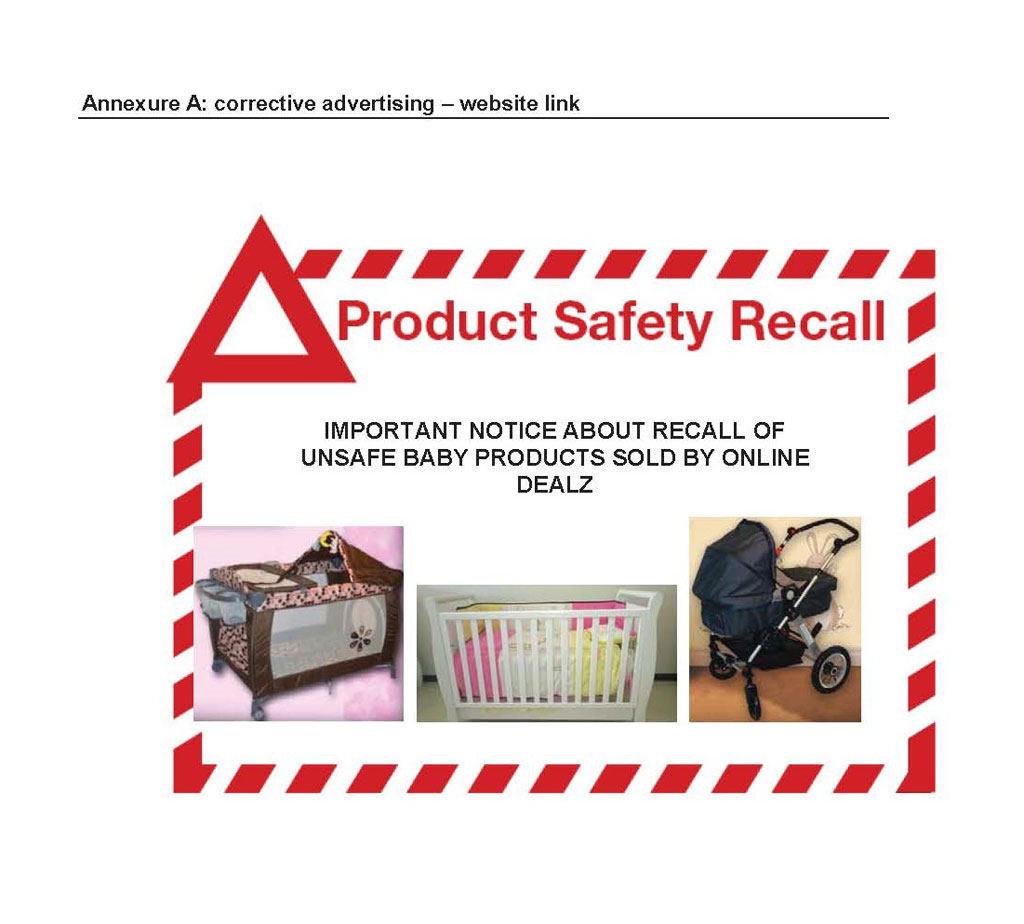
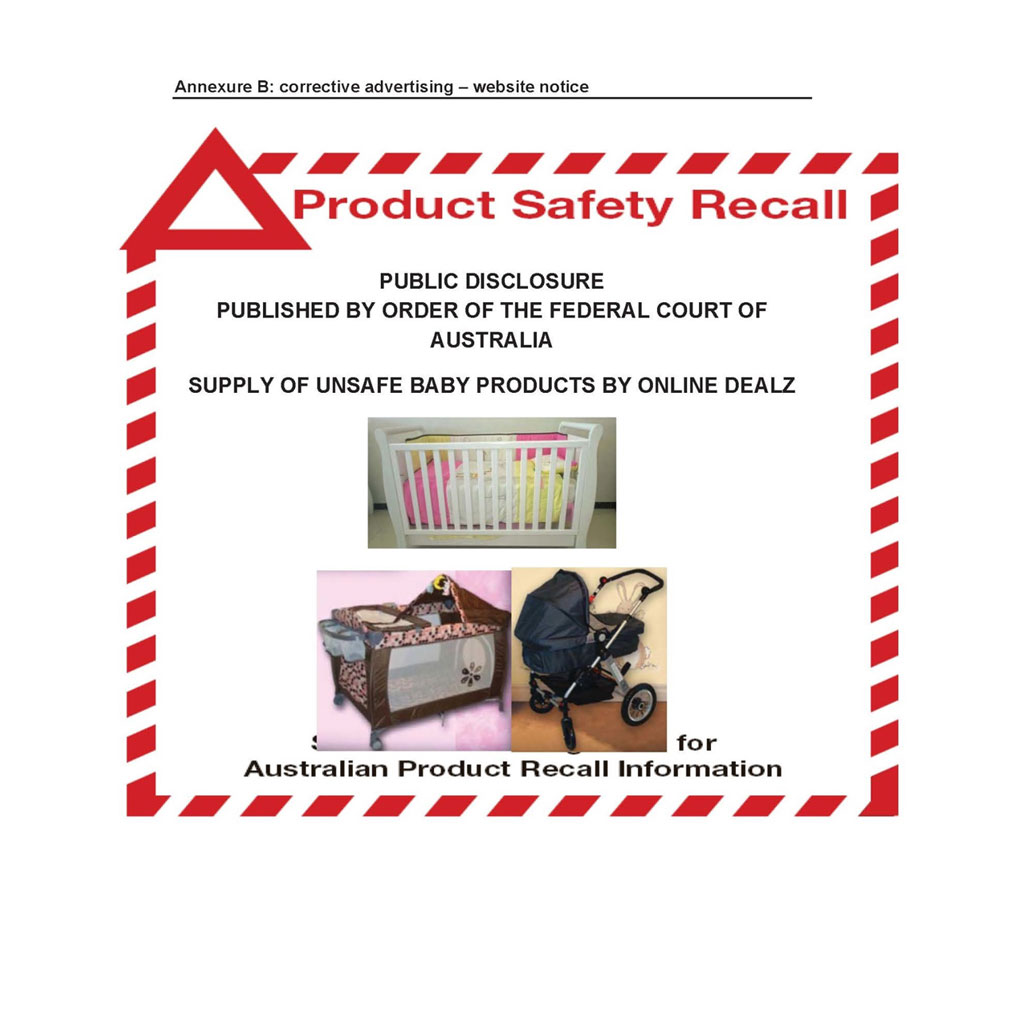
(a) within 14 days of the date of this order, cause to be published at the top of the home page of the Online Wholesalers website and such other page that the http://www.onlinedealz.com.au/ web address may automatically redirect to, Ebay store (http://stores.ebay.com.au/Online-Dealz-Store) and Gumtree store (http://www.gumtree.com.au/s-seller/online%20dealz/1003389713) and any other URL used by the First Respondent to market its products or otherwise interact with consumers that directs consumers to the Online Dealz website, a hyperlink in the form of Annexure A (Website Link) to an advertisement on the Online Dealz website in the terms and form of Annexure B (Website Notice);
(b) use its best endeavours to ensure that the Website Link:
(i) appears immediately upon access by a person to the Online Wholesalers website (and such other website as the http://www.onlinedealz.com.au/ web address may automatically redirect to), the Ebay store and the Gumtree store;
(ii) is no less than 540 pixels wide by 500 pixels high;
(iii) has a red hatched border with the red safety triangle in the upper left hand corner in the form shown at Annexure A;
(iv) contains the headline ‘Product Safety Recall’ in red characters and at least 16 point font size;
(v) includes an image of each product as shown at Annexure A;
(c) use its best endeavours to ensure that the Website Notice:
(i) at the top of the page, has a red hatched border with the red safety triangle in the upper left hand corner in the form shown at Annexure B;
(ii) contains the headline ‘Product Safety Recall’ in red characters and at least 16 point font size;
(iii) inside the red hatched border contains the words ‘PUBLIC DISCLOSURE – PUBLISHED BY ORDER OF THE FEDERAL COURT OF AUSTRALIA – SUPPLY OF UNSAFE BABY PRODUCTS BY ONLINE DEALZ’ appearing in upper case, not less than 14 point typeface and an image of each product as shown at Annexure B;
(iv) includes an image of each product as shown at Annexure B;
(v) includes the words ‘See www.recalls.gov.au for Australian Product Recall Information’ at the base of the red hatched border;
(vi) displays the body of the text in a black typeface of at least 12 point typeface on a white background;
(vii) contains hyperlinks, as set out in Annexure B, to separate web pages containing information substantially in the form of the Disclosure Notices for each of the relevant products;
(viii) is maintained on the Online Wholesalers homepage and any other relevant URL for a period of not less than 90 consecutive days;
(d) within 14 days from the end of the 90 day period referred to in subpara 12(c)(viii) above, provide the applicant with written evidence of its compliance with subparas 12(a), (b) and (c) above.
13. Pursuant to s 246(2)(d) of the ACL the First Respondent will, at its own expense:
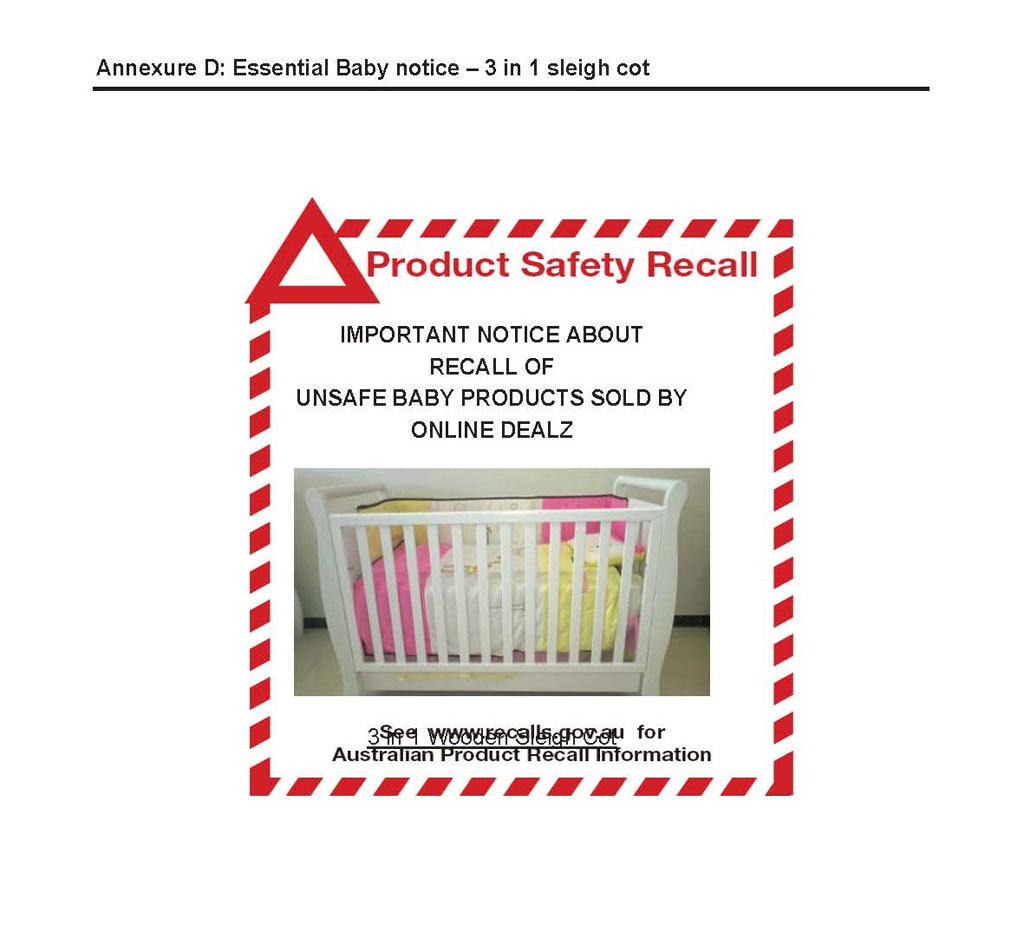
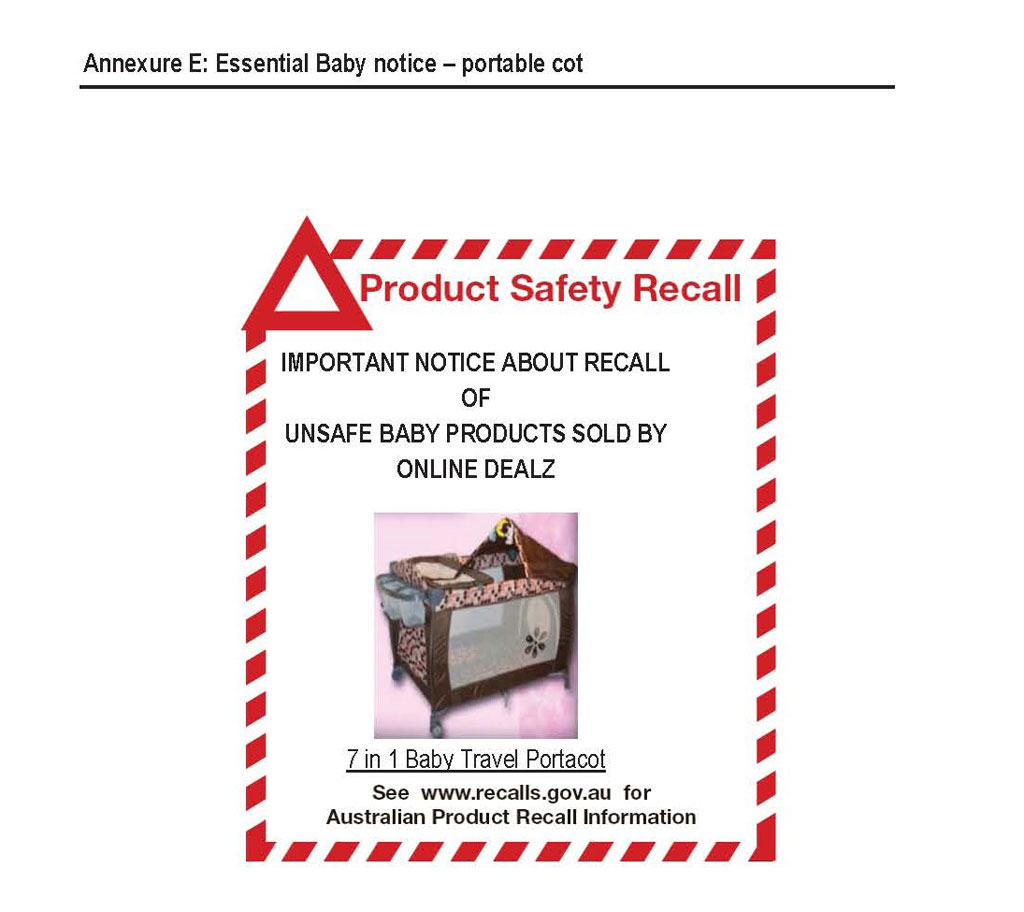
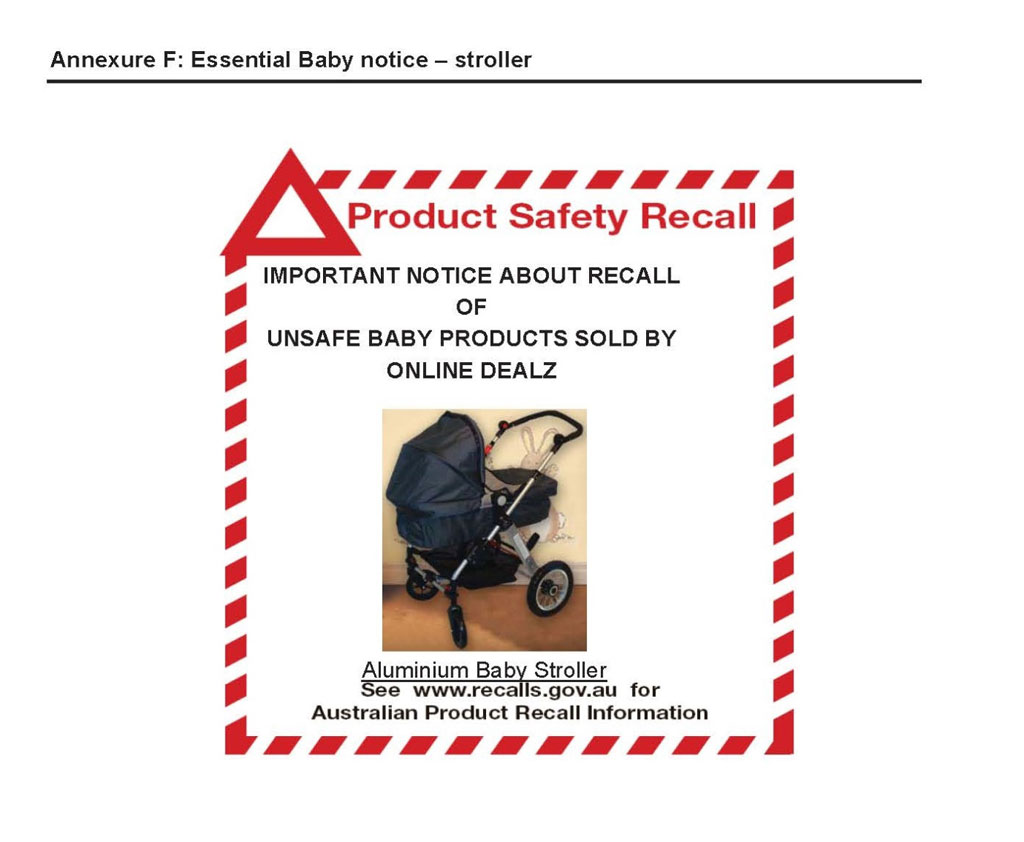
(a) commencing within 14 days of the date of this Order, cause to be published three notices, one each in the form and terms of Annexures D, E and F, on the website www.essentialbaby.com.au;
(b) use its best endeavours to ensure that each notice:
(i) is no less than 300 pixels wide by 250 pixels high;
(ii) links to the Website Notice maintained on the Online Dealz website in accordance with paragraph 12 above;
(iii) has a red hatched border with the red safety triangle in the upper left hand corner;
(iv) contains the headline ‘Product Safety Recall’ in red characters;
(v) contains an image of the relevant product;
(vi) includes the words ‘See www.recalls.gov.au for Australian Product Recall Information’ at the base of the red hatched border; and
(vii) is maintained on the website for a period of not less than 24 hours;
(c) within 7 days of each publication of the notice, provide the Applicant with evidence of the notice published in accordance with subparas 13(a) and (b) above.
14. Pursuant to s 224 of the ACL the First Respondent pay to the Commonwealth of Australia, in respect of the contraventions of ss 29(1)(a), 29(1)(g), 33, 106(1) and 106(2) of the ACL referred to in paragraphs 1 to 6 and 7(d), (e) and (f) above, pecuniary penalties in the amount of $100,000.
15. Pursuant to s 224 of the ACL the Second Respondent pay to the Commonwealth of Australia, in respect of the contraventions of s 224(1)(c), (d) and (e) of the ACL referred to in paragraph 8 above, pecuniary penalties in the amount of $20,000.
16. The Respondents to pay 70% of the Applicant’s costs of these proceedings and the full costs of the further testing undertaken pursuant to the orders of the Court made on 26 May 2015.
Note: Entry of orders is dealt with in Rule 39.32 of the Federal Court Rules 2011.
Following legal action by the Australian Competition and Consumer Commission, the Federal Court of Australia has declared that Online Dealz Pty Ltd (Online Dealz) contravened the Australian Consumer Law by supplying and offering to supply baby products which did not comply with the mandatory safety standards in place for those products. The Federal Court also found that Ms Janet Lucas was involved in some of those contraventions.
The affected products are being recalled. Consumers who purchased an
affected product are entitled to a refund.
For further information please follow the links below:
THE FOLLOWING WORDS TO HYPERLINK TO A PAGE SUBSTANTIALLY IN THE FORM OF THE DISCLOSURE NOTICE FOR THE HOUSEHOLD COT [3 in 1 Wooden Sleigh Cot (also described as ‘Haben Cot’ or ‘Baby Bear Cot’]
THE FOLLOWING WORDS TO HYPERLINK TO A PAGE SUBSTANTIALLY IN THE FORM OF THE DISCLOSURE NOTICE FOR THE PORTABLE COT [Portable Cot] T
HE FOLLOWING WORDS TO HYPERLINK TO A PAGE SUBSTANTIALLY IN THE FORM OF THE DISCLOSURE NOTICE FOR THE STROLLER [Stroller]
CONTACT US
Contact details:
Online Dealz Pty Ltd
14B/8 Gladstone Road, Castle Hill NSW
onlinedealz@outlook.com
[insert phone number]
MARKOVIC J:
INTRODUCTION
1 Online Dealz Pty Limited (Online Dealz), the first respondent, is an online retailer of a range of products including the products at the heart of these proceedings: household cots, portable cots and baby strollers. The second respondent, Mrs Janet Lucas, is the sole director and shareholder of Online Dealz.
2 These proceedings relate to the supply, offer to supply and online advertising of those products. The applicant, the Australian Competition and Consumer Commission (the ACCC), alleges that the products that were supplied or offered for supply failed to comply with the safety standards in force for each category of product. It also alleges that, notwithstanding the failure to comply, online advertising for the household cot and the portable cot represented that those products complied with the applicable safety standard that applied to each of those products.
3 The ACCC alleges that, as a result, Online Dealz contravened ss 18, 29(1)(a), 29(1)(g), 33, 106(1) and 106(2) of the Australian Consumer Law (ACL), being Schedule 2 to the Competition and Consumer Act 2010 (Cth), and that Mrs Lucas aided, abetted, counselled, procured, induced and/or was knowingly concerned in or party to the contraventions of Online Dealz within the meaning of s 224(1)(c), (d) and (e) of the ACL and seeks relief in relation to those breaches.
THE RELEVANT FACTS
Frank Masons Pty Ltd
4 Prior to establishing Online Dealz, Mrs Lucas was, from the date of its registration on 27 August 2010, a director and secretary of and shareholder in Frank Masons Pty Ltd (Frank Masons), an online retailer selling a range of goods. The other director and secretary of and shareholder in Frank Masons, from its registration, was Frank Criniti. From November 2013, Dominic Criniti, Frank Criniti's brother, replaced him as the director and secretary of Frank Masons.
5 In or about late January 2014, following receipt of accounting advice, Mrs Lucas transferred her shares in Frank Masons to Treasure Games Pty Ltd (Treasure), a company of which she is the sole director and shareholder. At about that time, Frank Criniti transferred his shares in Frank Masons to Criniti Group Pty Ltd (Criniti Group).
6 In January 2014 Mrs Lucas was also negotiating with Frank Criniti for the sale of her and then Treasure's shares in Frank Masons. Mrs Lucas no longer wished to be in business with Frank Criniti. After what Mrs Lucas described as a long battle, of approximately six months, Frank Criniti declined to acquire Treasure’s shares. Instead, in July 2014 Treasure acquired Criniti Group's shares in Frank Masons and thus became its sole shareholder.
7 Mrs Lucas had always planned to sell the Frank Masons business. She had contacted brokers for advice on how to achieve the sale and informed her accountant, as well as friends and family, of her intention to do so. After acquiring all of the shares in Frank Masons she continued her discussions with brokers and with Treasure's accountant, Mr Kris Prasad of Pherrus Financial Services, in relation to the proposed sale. Despite her desire to sell, Mrs Lucas never listed the business with a broker as their fees were too high.
8 On 25 June 2014 the ACCC wrote to Frank Masons informing it that it had recently purchased the wooden baby sleigh cot bed – BC-026 household cot - supplied by Frank Masons (the Frank Masons Cot) and had it tested to the mandatory standard, being Consumer Protection Notice No. 6 of 2005 – Consumer Product Safety Standard: Children’s Household Cots which references AS/NZS 2172:2003 Cots for household use – Safety requirements (the Household Cot Standard), by Furntech–AFRDI (Furntech), an independent national association of testing authorities (NATA) accredited test laboratory. The ACCC informed Frank Masons that the Frank Masons Cot failed to comply with nine clauses of the Household Cot Standard and provided Frank Masons with a copy of the Furntech report.
9 In its letter the ACCC informed Frank Masons of s 106 of the ACL and set out the enforcement options open to the ACCC if it considers traders are supplying non compliant products. Frank Masons was informed that, given the nature of the hazards identified in the Frank Masons Cot, it would be prudent for it to immediately cease supplying the product until an assessment could be made as to whether current stock is compliant and suggested that Frank Masons may wish to conduct a voluntary product recall of affected products. The ACCC sought a written response to its letter by 4.00 pm on Monday, 30 June 2014.
10 The Furntech report for the Frank Masons Cot obtained by the ACCC found that the Frank Masons Cot failed the following clauses of the Household Cot Standard:
(1) clause 6.4 – drop side guides;
(2) clause 6.8 – sharp edges and sharp points;
(3) clause 9.6 – durability of the access fastening devices;
(4) clause 9.7 – durability of the drop side mechanism;
(5) clause 11.1 – informative labelling;
(6) clause 11.3 – information on external packaging;
(7) clause 12.1 – marking requirements;
(8) clause 12.2 – marking legibility; and
(9) clause 12.3 - marking durability.
11 Upon receipt of the Furntech report from the ACCC Mrs Lucas realised that she could no longer rely on a report that had previously been provided to Frank Masons for the cot which had been prepared by another testing facility, SGS–CSTC Ltd (SGS), and that the Frank Masons Cot had to be taken off the market. SGS had tested the Frank Masons Cot against the Household Cot Standard excluding cl 11.1 and cl 12.1. Clause 11.1 concerns the information required on a leaflet and cl 12.1 concerns marking requirements. Other than in relation to the clauses excluded from testing and those which did not apply, SGS had found that the Frank Masons Cot complied with the Household Cot Standard.
12 On 2 July 2014 Mrs Lucas, in her capacity as a director of Frank Masons, responded to the ACCC’s letter dated 25 June 2014. In doing so, she provided the ACCC with a copy of the SGS test report dated 22 August 2013 for the Frank Masons Cot and responded to the specific queries raised by the ACCC.
13 On 24 July 2014 Joshua Leach of the ACCC sent an email to Mr Stephen Booth of Coleman Grieg, solicitors for Frank Masons, which included the following:
Withdrawing the products from sale does not alleviate the risk presented to consumers who are already in possession of the product, the ACCC wishes to advise Frank Masons that we are extremely concerned that the cots they have already sold are presently exposing consumers to immediate and very serious safety hazards. In consequence of this the ACCC is of the view that Frank Masons should give serious consideration to alerting consumer [sic], as soon as possible, to the hazard posed by the product and offering a remedy, such as a refund to those affected consumers.
… Due to the additional mandatory safety standard failures identified, the number of units in the market place, the vulnerability of the consumers involved, the ACCC cannot see any benefit to consumers in delaying recall actions any further.
14 On 25 July 2014, Mr Booth sent an email to Mr Leach in which he said, among other things, "[we] understand the safety concern and I have prepared a revised draft of the recall notice which I sent 2 weeks ago. I expect to be in a position to send that to you later today also”.
15 There was then further correspondence between Frank Masons' lawyer, Mr Booth, and the ACCC in relation to the proposed recall and the draft recall notice. On 30 July 2014, Mr Leach sent Mr Booth the draft recall notice that the ACCC intended to "go live with" the following day and asked for any feedback from Mr Booth. On 31 July 2014, Mr Booth responded saying "no changes".
16 In early August 2014 there was an exchange of correspondence between Mrs Lucas and the ACCC about the batch of cots to which the recall should apply. The ACCC’s website said that cots sold in 2012 were to be recalled but Frank Masons had only been using its current supplier for the cots since November 2013. Mrs Lucas asked to have the dates altered on the ACCC’s website as "previous customers should not be affected" and she did not want anyone to be alarmed for no reason.
17 Mrs Lucas secured a purchaser for Frank Masons, Mr Ehsan Parvastan, through her accountant, Mr Prasad. Mrs Lucas does not know how Mr Prasad found Mr Parvastan.
18 On or about 30 August 2014 Treasure sold its shares in Frank Masons to Mr Parvastan. At that time, Mrs Lucas also resigned as a director of Frank Masons. The sale was not documented other than via the execution of a share transfer and by Mrs Lucas signing documents relating to her resignation as a director and secretary of Frank Masons for lodgement with the Australian Securities and Investments Commission (ASIC). A search of the ASIC database for Frank Masons shows that Mrs Lucas resigned as a director and secretary of Frank Masons on 15 July 2014. Despite this, Mrs Lucas says that she remained a director until 30 August 2014 when she signed the transfer and other documents prepared by Pherrus Financial Services.
19 Mr Parvastan did not make any payment for the acquisition of the shares in Frank Masons from Treasure. Mrs Lucas says that the effect of the sale was that Mr Parvastan acquired the intellectual property of Frank Masons and its website and, as the sole shareholder in Frank Masons, took on Frank Masons’ voluntary recall liability for the household cot while Online Dealz had the continued use of the warehouse at Gladstone Road, Castle Hill, used by Frank Masons until the sale, and took on the remaining Frank Masons stock that was in the warehouse.
20 Mrs Lucas recalled advising Mr Prasad of the investigations by the ACCC into Frank Masons, the recall notice and its sale of the Frank Masons Cot when she discussed the sale of Treasure's shares in Frank Masons with him. In her affidavit, Mrs Lucas recalled that when she was informed by Mr Prasad that a buyer was interested in acquiring her Frank Masons shares that he said words to the effect: "I told him about the ACCC investigation and he is happy to proceed". Mrs Lucas said that Mr Prasad may have said he had informed the buyer of the recall notice in this conversation. In cross-examination, Mrs Lucas was firmer in her recollection saying she knows, from general conversations she had with Mr Prasad, at a time before Mr Parvastan acquired the shares, that the buyer knew about the recall. Mrs Lucas could not explain why the statement in her affidavit on this issue was equivocal. I accept her evidence about her conversations with her accountant, Mr Prasad.
21 Mrs Lucas denied that she sold her shares in Frank Masons in order to avoid liability for the recall of the Frank Masons Cot or that the sale was a sham. She said she sold Frank Masons because of its association with her former business partner, Frank Criniti. The company was partially his, he thought he had built the business, it had his name in it, she wanted nothing to do with it and she wanted to start with a clean slate.
22 In order to assist the purchaser, Mr Parvastan, with the recall Mrs Lucas provided all email addresses and passwords to her accountant to pass on. Having put everything in place, Mrs Lucas said that Mr Parvastan only had to take care of the actual recall. Mrs Lucas recollects having spoken with someone at the ACCC about the response rate to a recall of the nature of the Frank Masons recall and that she had been told by that person that there would not be many responses.
23 On 19 September 2014 the ACCC received an email from Pherrus Financial Services advising of the email and telephone number of the new owner of Frank Masons.
24 Mrs Lucas became aware that Mr Parvastan subsequently sold his shares in Frank Masons to Constantine Soosai Croos. Mrs Lucas was not involved in that sale and does not know Mr Croos. The documents lodged with ASIC effecting the share transfer to Mr Croos and notifying the change of director and secretary were signed on 11 November 2014 but record that the transaction occurred on 15 July 2014. Mrs Lucas does not know why this is so.
25 On 8 December 2014, a liquidator was appointed to Frank Masons pursuant to a creditors’ voluntary winding up.
Online Dealz
26 Online Dealz was incorporated on 8 August 2014. It operates a business selling a range of goods online including baby items, camping gear and sporting goods. The products sold by Online Dealz are sourced from China through an agent. The business operates through a number of sites including its own online store, its eBay store and through the “Gumtree” site classifieds.
The Sleigh Cot
27 In about July 2014 Mrs Lucas was approached by Ronald Liang of Zhuhai Babyworth Co Limited (Zhuhai), a company based in Guangndong province, China. Mrs Lucas had not previously dealt with Zhuhai. Mr Liang, who lived in Sydney, offered Mrs Lucas a range of products, including a cot known as the baby bear or the H-B cot (the Sleigh Cot). At the time, Mr Liang provided Mrs Lucas with a copy of an SGS certification of the Sleigh Cot dated 13 January 2014 which was in Chinese. Mrs Lucas did not have the report translated because, prior to supply, she intended to have the Sleigh Cot tested in Australia regardless of the findings in the SGS report provided by Mr Liang.
28 A sample of the Sleigh Cot was provided to Online Dealz' agent, Mr Ron Wong of Ron International, for the purpose of testing.
29 On 8 September 2015 Sharon on behalf of Lucas Holdings Aus Pty Ltd (Lucas Holdings), a company of which Mrs Lucas is also the sole director, secretary and shareholder, requested Furntech to undertake testing of the Sleigh Cot. Mrs Lucas described Sharon as a friend who she asked to assist in obtaining the report as she was busy.
30 On 17 September 2014 Mr Richard Levett of Furntech sent an email to Sharon with which he provided a document with pictures of the dropside catch and a list of "the other clauses that fail". In the attached document the following was included:
Dropside catch issue
The dropside catch on one side does not protrude properly and therefore does not catch and lock the dropside in the closed position. See image of catch below.
…
The catch becomes jammed behind the metal guide rail.
…
The countersunk fasteners on the metal guide rail don’t allow adjustment and it returns to its original position.
The other side works fine. See image below.
Other areas that failed
Section 11 – Informative Labelling – parts 11.1(a) to (f), 11.2(b) and 11.3.
Section 12 – Marking – parts 12.1(b)(ii), (f)
(images omitted)
31 After receiving the email dated 17 September 2014 from Mr Levett, Mrs Lucas met with Mr Liang of Zhuhai and showed him the drop side catch. In Mrs Lucas’ presence, Mr Liang made a minor adjustment to the catch. Mrs Lucas had a conversation to the following effect with Mr Liang:
Mrs Lucas: Make sure this issue does not arise in any future deliveries.
Mr Liang: Yes we will do that.
Mrs Lucas then arranged for the drop side to be returned to Furntech for further testing.
32 On 8 October 2014 Mr John Brock of Furntech sent an email to Sharon in which he said that there was “at least a day’s testing to finalise testing” and attached a document setting out the issues that remained to be addressed before the Sleigh Cot met the requirements of the Household Cot Standard. This included meeting the requirements of clauses 11.1, 11.3, 12.1, 12.2 and 12.3.
33 On 9 October 2014 Mr Brock sent an email to Sharon notifying her that he had completed testing of the Sleigh Cot and that it had passed the balance of testing. He said that he would send the testing failure reports “in relation to the area of the cot that did not pass the requirement” and noted that the last email he had sent outlined these issues that all relate to "information leaflet, assemble instructions and safety requirements". He also identified another issue in relation to the warning notice on the outer box of the cot.
34 On 14 October 2014 Mr Levett provided Sharon with a five page document setting out the cot’s failures. They related to cl 11.1 - information on leaflet in cot package, cl 11.3 - information on external packaging and cl 12.2 - marking requirements.
35 On 19 October 2014 Sharon provided Mr Brock with a copy of the cot instructions to be included with each cot. In that email she also informed him that:
Also carton lable [sic] sticker. I have the durable lables [sic] in my warehouse that will have the manufacture date and also importer. Would you like me to take a photo of these or arrange to have these posted out to you.
36 In response, on 21 October 2014 Mr Brock sent an email to Sharon in the following terms:
The base currently has the marking printed on the timber. If your new durable labels are different to that then we will need to see them to test them. If it is the same then we would like to see a picture.
37 Between 27 October 2014 and 10 November 2014, there was email communication between Mrs Lucas and her agent and supplier in China in relation to the labelling that needed to be included on the Sleigh Cot. The emails are not easy to follow but it seems that there was an initial request to “Ron/Ronald” for a picture of the base of the cot with the warning and a request that “this must have manufacture date and also business name, ‘Lucas Holdings P/L’”. The request was described as “urgent” so that the writer could get the “certificate”. On 28 October 2014, there was an email from “Queenie”, who is an employee of Zhuhai, to rongroup8@163.com, evametro@hotmail.com, which appears to be Mrs Lucas’ email address, and ronald@kang-fa.com. The email was directed to “Rainbow”, who is an employee of Ron International, and in it Queenie wrote:
Pls confirm the printed as attachment and will do it after get your confirmation. Thanks and await from you.
38 On the same day, 28 October 2014, Mrs Lucas emailed Queenie and Rainbow in the following terms:
Yes confirm
please send me picture when completed
thanks
janet
39 On 30 October 2014 Queenie again emailed asking the recipients to check the “HB cot for base printer” and noting “the production will same as this. Pls confirm”. In response Mrs Lucas wrote:
This is good
please make manufacture date the month and year eg may 2014
when can you ship this container .. I need very urgent
40 There was then an exchange about the warning for the mattress thickness and the size of the carton stickers. There was a response from Mrs Lucas in the following terms:
yes this is good..
please also put business name and address
“Imported by Lucas Holdings Aust 12B/8 Gladstone Rd Castle Hill”
Thanks
41 On 10 November 2014 Rainbow requested an update from Mrs Lucas on the “stick information”. In response Mrs Lucas said that she “already confirmed this with the company” and to “please ask if you need to”.
42 On 10 November 2014 Sharon provided Mr Brock with a picture of the base of the cots by email and asked him when he could issue the certificate as the cots were on their way.
43 On 12 November 2014 Furntech issued its report for the Sleigh Cot. That report notes that the Sleigh Cot was tested to the requirements of the Household Cot Standard and states that the Sleigh Cot is fully compliant. Furntech issued certification no 12147/1 to Lucas Holdings certifying that the Sleigh Cot complied with the requirements of the Household Cot Standard.
44 Following receipt of the Furntech certification of the Sleigh Cot, Mrs Lucas ordered a batch of those cots in white and walnut colours. The order, comprising 235 cartons, left China on 4 December 2014 and arrived in Sydney on 18 December 2014. Each of the Sleigh Cots arrived in a separate sealed box ready for delivery to Online Dealz’ customers. Upon their arrival, Online Dealz did not check whether each of the Sleigh Cots complied with the sample that had been tested by Furntech or whether the appropriate markings and labels were included. Mrs Lucas assumed that the matters that had been discussed had been attended to by the supplier. Mrs Lucas conceded in cross examination that it would have been easy to check the cots on arrival at the warehouse for compliance with the labelling and marking requirements (clauses 11.1, 11.3 and 12.3 of the Household Cot Standard), that there was nothing preventing her from doing so and that it was a silly error. She was aware of the importance of compliance with the Household Cot Standard at the time.
45 Following receipt of the Sleigh Cot, Online Dealz advertised it for sale on its eBay store and on the Gumtree website. Mrs Lucas noted that the advertisement stated that the Sleigh Cot was certified to Australian Standards and included the “tick of approval” authorised by Furntech. Mrs Lucas said that the statement and “tick of approval” were included based on Furntech’s report dated 12 November 2014.
46 Online Dealz sold 154 Sleigh Cots. The first sale was on 24 December 2014 and the last sale was on 30 March 2015. A list of customers to whom the cot was sold shows that, as at the date of the list, five of the cots were not yet received by customers. In addition, Online Dealz sold at least 13 of the cots through its warehouse. Records were not kept of those sales.
47 As at 22 April 2015, Online Dealz held stock of 26 Sleigh Cots.
The Online Dealz Portable Cot
48 At the time Mrs Lucas sold her shares in Frank Masons, Online Dealz acquired stock of portacots model/style No. P5007 also coded as 2012P5007 from Frank Masons (the Portable Cot). The Portable Cot, which was manufactured by Cixi Babyhome Products Co Ltd based in Ningbo China (Cixi Babyhome Products), had been sold for several years by Frank Masons.
49 When Frank Masons first started selling the Portable Cot, about two years before Frank Masons closed down, it requested and was provided with a copy of the certification of its compliance with Australian standards by the manufacturer. Mrs Lucas could not subsequently find a copy of the certification that was originally provided to Frank Masons but it had always been her understanding that the Portable Cot complied with the applicable Australian standard. Frank Masons had not received any complaints about the Portable Cot.
50 Following commencement of these proceedings, Mrs Lucas arranged for the certification for the Portable Cot to be sent to her again. That report was provided by SGS and is dated 16 June 2009. It records the test requested as “AS/NZS 2195: 1999 Folding Cots – Safety Requirement excluding clause 6.1 & 6.2 & 6.3.1 & 6.3.3” and the conclusion as “the submitted sample met the test requirement”. The matters which were not tested were:
clause 6.1 – metals;
clause 6.2 – plastic materials, paints, lacquers and varnishes and the requirement that all the painted coatings and plastic components shall comply with the relevant toxological requirements specified in AS 1647.3 or NZS 5820;
clause 6.3.1 – textile material used in the construction of folding cots shall meet the toxological requirement of AS 1647.3;
clause 6.3.3 – flammability and the requirement that textile material shall comply with the requirement of flammability of fabrics and padding materials specified in AS/NZS 1754.
51 At the time Online Dealz started selling the Portable Cot Mrs Lucas did not think to have it retested because Frank Masons had the SGS report. She thought SGS was a company that did its job. Nor did Mrs Lucas think to get a further report at that time. She relied on the certification of the Portable Cot previously provided to Frank Masons although she did not read it at the time Online Dealz started to sell those cots.
52 The Portable Cot was advertised on eBay, Gumtree and Online Dealz’ website. Mrs Lucas says that the reference in the advertisement to “AS/NZS 2195:1999” was a reference to the Portable Cot’s compliance with that standard and SGS’ certification of the Portable Cot.
53 The Portable Cot tested by the ACCC was from the batch delivered in June 2014.
54 Online Dealz sold 52 Portable Cots between 15 September 2014 and 27 March 2015. As at 22 April 2015 Online Dealz held stock of 98 Portable Cots. It had not received any complaints in relation to the Portable Cot from any customers.
The Online Dealz Baby Stroller
55 At the time of sale by Mrs Lucas of her shares in Frank Masons, Online Dealz acquired stock of baby strollers model No. K-121 from Frank Masons (the Baby Stroller). The Baby Stroller, which was also manufactured by Cixi Babyhome Products, had been sold by Frank Masons for several years.
56 Mrs Lucas recalled that when Frank Masons first started selling the Baby Stroller, it requested a copy of certification of its compliance with Australian standards from the manufacturer and that it was provided with a copy of that certification. Mrs Lucas could not subsequently find a copy of the certification that was originally provided to Frank Masons but it was always her understanding that the Baby Stroller complied with the Australian standards. Frank Masons had not received any complaints about the Baby Stroller.
57 Following commencement of these proceedings, Mrs Lucas arranged for the certification for the Baby Stroller to be sent to her again. That report was provided by Intertek Testing Services Shenzhen Ltd (Intertek) and is dated 2 June 2011. On page 1 of the report it records under the heading “Conclusion”:
Prams and Strollers – Safety Requirements AS/NZS 2088: 2009 (Excluding clause 6.1: Toxicity, clause 11.1: Plastic packaging, clause 11.2: Printed instructions & clause 12: Marking)
58 At the time Online Dealz started selling the Baby Stroller Mrs Lucas did not think to have a sample of the Baby Stroller tested. Mrs Lucas is not aware of any change to the Baby Stroller since it was first ordered and sold by Frank Masons. The Baby Stroller that was tested for the ACCC was part of a batch delivered to Frank Masons. Online Dealz has no more of those Baby Strollers.
59 Online Dealz subsequently ordered its own batch of Baby Strollers which was delivered in December 2014. It has only received one complaint in relation to the Baby Stroller concerning how to properly operate it.
60 The Baby Stroller was advertised on eBay, Gumtree and Online Dealz’ own website. Online Dealz sold 50 Baby Strollers and, as at 22 April 2015, it held stock of 99 Baby Strollers.
National association of testing authorities
61 According to evidence given by Mr McDonald, the respondents’ solicitor, NATA’s role, as set out on its website, is as follows:
NATA is the authority that provides independent assurance of technical competence through a proven network of best practice industry experts for customers who require confidence in the delivery of their products and services. NATA provides assessment, accreditation and training services to laboratories and technical facilities throughout Australia and internationally.
62 Mr McDonald undertook a search of the NATA webpage to ascertain if SGS and Intertek were NATA accredited. By carrying out a number of steps starting at the NATA website, Mr McDonald located a search page headed “Find an Accredited Body” on the webpage for China National Accreditation Services for Conformity Assessment (CNAS). SGS and Intertek were included in the “List of Accredited Laboratories” on the CNAS website, although the date on which each laboratory obtained accreditation was not included.
The ACCC investigation into Online Dealz
63 On or about 27 August 2014, the ACCC received a complaint from a consumer regarding difficulty obtaining a refund from Frank Masons. That consumer also informed the ACCC that Online Dealz was selling the same product and that Frank Masons shared the same customer service operator and postcode as Online Dealz. The contemporaneous summary of the complaint prepared by an ACCC officer records:
C bought a faulty table from T before T initiated the sleigh cot recall (PRA number: 2014/14229). C lives in Darwin and was pursuing a remedy from T before the recall was initiated. T promised to provide a remedy, but C never received his remedy. C tried to contact T on the same customer service phone number he was using pre- sleigh cot recalls, but the number was deactivated.
C conducted some research: C found the same faulty table sold by Online Dealz on Gumtree with a phone number. C called the number and Jamie (the same customer service officer who previously worked for Frank Masons) answered the phone. Online Dealz and Frank Masons share the same postcode. C checked the ABN registration date for Online Dealz 08 August 2014 - which is 1 day after the Sydney Morning Herald reported on the sleigh cot recall.
C has concerns that T are seeking to avoid their responsibilities under the recall. C wants to inform the ACCC. T may also be supplying the sleigh cot under the Online Dealz name.
64 In October 2014, the product safety branch of the ACCC became aware of social media commentary in which consumers suggested that Online Dealz had taken over Frank Masons and that consumer attempts to access the Frank Masons Cot recall were unsuccessful. The ACCC began investigating Online Dealz in relation to its offer to supply baby and children’s products.
65 As part of its investigation into Online Dealz, the ACCC purchased four products from Online Dealz through its eBay store:
(1) on or around 30 October 2014:
(a) a portable cot advertised as “Portacot 7 in 1 baby travel portacot playpen cot 2012 travel cot bassinet” (in pink) (the Portable Cot Test Sample); and
(b) a baby stroller advertised as “aluminium baby stroller pram jogger with seat + bassinet + rain cover + insert” (the Baby Stroller Test Sample);
(2) on or around 13 January 2015, a household cot advertised as “new 3 in 1 baby sleigh cot with drawer & toddler rail + mattress Aus certified” (in white) (the First Sleigh Cot); and
(3) on or around 6 March 2015, a household cot advertised in the same way as the First Sleigh Cot (the Second Sleigh Cot).
66 The ACCC requested Furntech to test the First Sleigh Cot for compliance with the Household Cot Standard. The report issued by Furntech dated 24 February 2015 found that the First Sleigh Cot failed 7 clauses of the Household Cot Standard. Those failures were:
Failure 1
Requirement:
Clause 9.2 – Entrapment hazard test
When tested in accordance with Appendix A, all holes and gaps within the cot shall be:
(a) sufficiently large to allow a sphere of 50mm diameter to pass through but not allow a sphere of 95 mm to pass through; or
(b) sufficiently large to allow a cylindrical probe of 12 mm diameter to enter but not allow a sphere of 30 mm diameter to pass through;
Actual Failure:
The top horizontal gaps in the cot ends do not allow the 50mm probe to pass or pass freely for full length of the gap.
The left hand of the cot does not allow the probe to pass with 100 N of force. See following images.
…
The right hand cot end allows the 50 mm probe to pass freely for most of its length but the front 1/5 of the gap requires 50 N of force for the probe to pass through. See following images.
…
Failure 2
Requirement:
Clause 11.2 - information on swing tag or label
(a) RECOMMENDED MATTRESS SIZE:
XX mm wide x YY mm long x ZZ mm thick’
Actual Failure:
This information was not on a swing tag or label on the cot. See image below.
…
Failure 3
Requirement:
Clause 11.2 Information on swing tag or label
(b) The manufacture’s name and address.
Actual Failure:
Only a company name was present on the label on the mattress base – LUCAS HOLDINGS P/L, AUSTRALIA. No address was present. See image above.
Failure 4
Requirement:
Clause 12.1 Marking requirements
All parts of the marking in this Clause (12.1) shall be able to pass the tests specified in Clauses 12.2 and 12.3. All cots shall be prominently marked on the top surface of the mattress base, or on both surfaces if the base is reversible as follows:
(b) for cots not manufactured in Australia or New Zealand:
(i) the country of origin; and
(ii) the importer’s name and address
Actual Failure:
Only a company name was present on the label on the mattress base - – LUCAS HOLDINGS P/L, AUSTRALIA. No address was present. See image below.
…
Failure 5
Requirement:
Clause 12.1 Marking requirements
All parts of the marking in this Clause (12.1) shall be able to pass the tests specified in Clauses 12.2 and 12.3. All cots shall be prominently marked on the top surface of the mattress base, or on both surfaces if the base is reversible as follows:
(c) ‘RECOMMENDED MATTRESS SIZE:
XX mm wide x YY mm x ZZ mm thick’
Actual Failure
The above information was not present on the mattress base. See image above.
Failure 6
Requirement
Clause 12.1 Marking requirements
All parts of the marking in this Clause (12.1) shall be able to pass the tests specified in Clauses 12.2 and 12.3. All cots shall be prominently marked on the top surface of the mattress base, or on both surfaces if the base is reversible as follows:
(d) A warning notices as follows:
WARNING: TO PREVENT FALLS, THE MAXIMUM MATTRESS THICKNESS HSOULD NOT EXCEED ZZ mm
Actual Failure
The above warning was not present on the mattress base. See image below.
…
Failure 7
Requirement
Clause 12.1 Marking requirements
All parts of the marking in this Clause (12.1) shall be able to pass the tests specified in Clauses 12.2 and 12.3. All cots shall be prominently marked on the top surface of the mattress base, or on both surfaces if the base is reversible as follows:
(f) The month and year of manufacture.
Actual Failure
A space was provided for the date of manufacture (MANUFACTURED……….) but the date had not been added. See image above.
(images omitted)
67 The ACCC requested Test Research, a division of the Australian Consumers’ Association, to test the Second Sleigh Cot for compliance with the Household Cot Standard. The report issued by Test Research for test no. B2854, which showed that the Second Sleigh Cot was tested on 23-24 March 2015, found that the Second Sleigh Cot did not comply with clauses 6.8(b), 9.2, 9.7, 11.2 and 12.1 of the Household Cot Standard.
68 The ACCC requested Furntech to test the Portable Cot Test Sample for compliance with the standard AS/NZS 2195:1999 titled “Folding Cots – Safety requirements” published by Standards Australia on 15 November 1999 subject to certain variations prescribed by “Consumer Protection Notice No. 4 of 2008 – Consumer Product Safety Standard for Children’s Portable Folding Cots” (the Portable Cot Standard). The report issued by Furntech dated 6 March 2015 found that the Portable Cot Test Sample failed three clauses of the Portable Cot Standard. Those failures were:
Failure 1
Requirement
Clause 10.2 Entrapment hazard test (modified by CPN)
The folding cot shall be tested in accordance with Appendix A using the 95 mm probe. All gaps accessible within the folding cot shall not allow the 95 mm probe to pass through.
Actual Failure
There are various gap failures on the Portable Cot PL5007 as follows:
1) Between the sides and corners of the cot frame and the bassinette sides and ends (upper position). See following images with the 95 mm probe.
…
2) Between the mattress base end and the bassinette base. There is no means to hold the matterss base down to the bassinette base. See the following image.
…
3) Between the bassinette base and support rods. See the following image with base folded back.
…
4) The zippered end flap of the cot could be left partially open and form an entrapment gap. See the following image.
…
5) Between the mattress base and cot floor/bottom fabric (lower position). The Velcro tab that is to secure the mattress base in place does not stop the probe from entering this gap. See the following image.
…
Failure 2
Requirement
Clause 10.14 Folding Side Entrapment
When tested in accordance with Appendix L there shall be no gaps between any elements of the side rails of the cot where the side elements are inclined to each other at an angle of less than 90 degrees or which are less than 80 mm wide when measured 80 mm above or from the apex of the gap.
NOTE: The intention of this requirement is to ensure that if the sides of a cot begin to fold while a child is present in the cot that no entrapment points are formed in the folding sides which could lead to strangulation or injury.
Actual Failure
The cot folding sides and ends are of the two locking device type of mechanism as per Figure 1 on page 8 of the Standard. The sides of the folding cot passed this test but the ends failed.
…
Failure 3
Requirement
Clause 13.2 Safety marking
The cot shall be permanently, prominently and legibly marked on the inside of the cot with at least:
(a) Instructions for assembly and locking procedures;
(b) A warning to check before each use that the cot is correctly assembled and locking devices are fully engaged;
(c) Either a warning to use a mattress of specified dimensions or a warning to use the mattress supplied by the manufacturer; and
(d) A warning not to add an extra mattress as this may cause suffocation;
The above statements must be permanently, prominently and legibly marked on the inside of the cot.
Actual Failure
Neither instructions nor the required warnings are permanently printed on the inside of the Portable Cot PL5007.
A one sentence instruction on how to unlock the base in various languages is the only instruction printed on the inside base of the cot.
…
(images omitted)
69 The ACCC arranged for Sinclair X-Ray Inspection Services Pty Limited (Sinclair X-Ray) to test the Baby Stroller Test Sample for compliance with the standard AS/NZS 2088:2000 titled “Prams and strollers – Safety requirements” approved by Standards Australia on 15 December 2000 subject to certain variations prescribed by “Consumer Protection Notice No. 8 of 2007 – Consumer Product Safety Standard: Prams and Strollers” (the Stroller Standard). The report issued by Sinclair X-Ray dated 17 March 2015 found that the Baby Stroller Test Sample failed the requirements of clauses 8.6.2(b) Entrapment (in some handle positions), 11.1 (model name and name and address not provided), 11.2 (warning label undersize lettering) and 11.3 (markings of warning label not permanent) of the Stroller Standard.
70 The ACCC located the following advertisements by Online Dealz for sale of the Sleigh Cot and the Portable Cot:
(1) the Sleigh Cot on eBay containing the statements “Certified to Australian Standard” and “meeting Australian & New Zealand standards AS/NZS 2172” captured as at 26 March 2015;
(2) the Sleigh Cot on Gumtree containing the statements “Certified to Australian Standard” and “Certified to Highest Australia Standards (AS/NZS 2172:2003) Furntech Certified” captured as at 26 March 2015; and
(3) the Portable Cot on eBay containing the statement “AS/NZS 2195:1999” captured as at 26 March 2015.
Events after commencement of these proceedings
Undertakings given by Online Dealz and Mrs Lucas
71 These proceedings were commenced by the filing of an originating application on 30 March 2015. On that day, the respondents gave undertakings to the Court, including the following:
1. Until further order the First Respondent maintain possession or control over any Sleigh Cots, Portable Cots, Baby Strollers that are in its possession or control as at the date of these undertakings or that come into its possession or control after the date of these undertakings.
2. Until further order the First Respondent be restrained, whether by itself, its officers, servants, agents or howsoever otherwise, in trade or commerce in Australia from supplying or offering to supply:
a. the household cots advertised as “NEW 3 IN 1 BABY SLEIGH COT WITH DRAWER & TODDLER RAIL + MATTRESS AUS CERTIFIED” (in white) and labelled as “3 in 1 Wooden Sleigh Cot (white)” (Sleigh Cots);
b. the portable cots advertised as “PORTACOT 7 IN 1 BABY TRAVEL PORTACOT PLAYPEN COT 2012 TRAVEL COT BASSINET ” and labelled as “Frank Masons Portable Cot PL5007 (in Pink) Ref: 2012203PL5007” (Portable Cots);
c. the baby strollers advertised as “ALUMINIUM BABY STROLLER PRAM Jogger with SEAT + BASSINET + Rain Cover + Insert” and labelled as “’Frank Masons’ brand stroller ‘Multifunctional Luxury Baby Stroller’” (Baby Strollers); and
d. any household cot, portable cot or baby stroller (Baby Products) which is subject to a safety standard for the purposes of Division 1 of Part 3-3 of the ACL in force at the time of supply or offering to supply.
3. Until further order the Second Respondent be restrained, whether by herself, her servants, agents or howsoever otherwise, in trade or commerce in Australia from supplying or offering to supply:
a. the Sleigh Cots;
b. the Portable Cots;
c. the Baby Strollers; and
d. any Baby Product which is subject to a safety standard for the purposes of Division 1 of Part 3-3 of the ACL in force at the time of supply or offering to supply.
4. Until further order the Second Respondent be restrained from aiding, abetting, counselling, procuring, or inducing any person to, and/or being knowingly concerned in or party to the, supply or offer to supply, in trade or commerce in Australia, of:
a. the Sleigh Cots;
b. the Portable Cots;
c. the Baby Strollers; and
d. any Baby Product which is subject to a safety standard for the purposes of Division 1 of Part 3-3 of the ACL in force at the time of supply or offering to supply.
Further testing
72 On 26 May 2015 by consent the Court made orders that the First Sleigh Cot, the Portable Cot Test Sample, the Baby Stroller Test Sample, an additional Sleigh Cot purchased by the ACCC on 3 March 2015, an additional Portable Cot purchased by the ACCC on 27 March 2015, an additional Baby Stroller purchased by the ACCC on 27 March 2015 and the Sleigh Cot which was the subject of the Furntech report obtained by Online Dealz dated 12 November 2014 (the Online Dealz Cot Test Sample) be tested by CHOICE (Test Research) on terms to be agreed between the parties and that the Second Sleigh Cot be tested by Furntech on terms to be agreed between the parties.
73 The results of that further testing are set out in the tables at [112], [124] and [131] below for the Sleigh Cot, the Portable Cot and the Baby Stroller respectively. In each case, the testing revealed failures to comply with aspects of the applicable standard.
Steps taken to effect a voluntary recall
74 On 12 November 2015 the respondents, through their solicitors, informed the ACCC that they agreed to a voluntary recall of the Sleigh Cot, the Portable Cot and the Baby Stroller (the Online Dealz Products) and provided draft letters that they intended to send to the purchasers of each of the products for review by the ACCC. Online Dealz also informed the ACCC that it agreed to advertise the recall on its website and in a Sydney based paper as some of the Online Dealz Products were sold to customers directly from its warehouse with no records kept of those customers’ details. Draft advertisements were to be provided shortly.
75 On 20 November 2015 the ACCC responded, through its solicitors, to the respondents. It sought confirmation about whether the proposed recall was to apply to each colour of the Sleigh Cot and the Portable Cot, whether the refund to customers would include shipping costs paid by customers, how it was proposed to send the letters to customers and how it was proposed that refunds would be calculated for customers who purchased an affected product as part of a package of products with a single price. The ACCC also sought information about the whereabouts of some of the Online Dealz Products having regard to the number imported, the number sold either online or from the warehouse and the number that Online Dealz said remained in stock. The ACCC requested Online Dealz to create a page on its website advertising the recall and to enclose a copy of the ACCC’s Product Safety Australia web page with the letters.
76 On 15 December 2015 the respondents responded to the ACCC’s queries. They agreed to create a page on Online Dealz’s website providing information about the recall and to provide a copy of the Product Safety Australia webpage in their letters to customers. They also provided an explanation for the discrepancy in the numbers of Sleigh Cots and Portable Cots.
77 On 23 December 2015, after the conclusion of the hearing, the ACCC, through its solicitors, wrote to Online Dealz and Mrs Lucas. Among other things, it provided drafts of the letters that Online Dealz should send to those customers who had purchased the Sleigh Cot, the Portable Cot and/or the Baby Stroller and drafts of the advertisements of the recall.
78 On 24 December 2015 the solicitors for the respondents informed the ACCC that they would send the letters in the form proposed by the ACCC as soon as possible but, given the time of year, it would probably be in the following week and informed the ACCC that it would revert in relation to the advertisements.
79 On or about 5 January 2016 Mrs Lucas caused an email to be sent about the recall to each customer for whom Online Dealz had an email address and who purchased a Sleigh Cot, a Portable Cot and/or a Baby Stroller and caused a letter to be sent about the recall to each customer for whom Online Dealz had a physical address and who purchased a Sleigh Cot, a Portable Cot and/or a Baby Stroller.
80 On 6 January 2016 the solicitors for the respondents informed the ACCC that Online Dealz had written to its customers by email and that letters to customers would be finalised that week. Several customers had requested a refund but would not return the product. Those solicitors sought the ACCC’s input about how Online Dealz should address that issue and informed the ACCC that the outstanding issues regarding the recall would be addressed on their return to work.
81 On 21 January 2016 the solicitors for the ACCC responded raising the following issues:
(1) the respondents had not yet notified the Product Safety Branch of the ACCC of the recall. The Product Safety Branch had prepared draft recall notices for each of the Online Dealz Products to be published on the Product Safety Recalls Australia website and social media pages in accordance with standard practice for voluntary recalls. Copies of the notices were provided with an invitation to provide any feedback by 2.00 pm on 22 January 2016, failing which the notices would be published;
(2) sought confirmation that the letters had been sent to customers by post or, if not, that they would be sent by post to all customers for whom they had a postal address by 25 January 2016. The ACCC also pointed out an error in the letters that had been sent by email which it requested be amended in any further letters;
(3) reminded Online Dealz that it had previously agreed to include information about the recall on its website, that no such information was on the website and sought confirmation that the relevant page would be added to the website by 25 January 2016;
(4) requested that the proposed form of advertisement be provided;
(5) sought a response to the query it raised in relation to the amount of refund where one of the Online Dealz Products had been sold as part of a package;
(6) raised the issue of communication with the Court once the arrangements for the recall had been finalised;
(7) informed Online Dealz that, where a customer did not return the relevant Baby Product or could not provide evidence of having destroyed or disposed of it, Online Dealz was not required to provide a refund.
82 On 22 January 2016 the solicitors for the ACCC informed the solicitors for the respondents that the recall notices had been published on the Product Safety Recalls Australia website and provided links to the published notices.
83 On 11 February 2016 the solicitors for the ACCC informed the solicitors for the respondents that the ACCC was in the process of contacting consumers who had purchased the Online Dealz Products subject to the recall being conducted by Online Dealz and provided a copy of the template communication together with an example of a communication sent by email to consumers in relation to the Sleigh Cot.
84 On 12 February 2016 the solicitors for the ACCC provided the solicitors for the respondents with examples of the email communications the ACCC had sent to consumers in relation to the Portable Cot and Baby Stroller.
85 On 15 February 2016 the solicitors for the ACCC wrote to the solicitors for the respondents about the page that was to be published on Online Dealz’ website providing information about the recall of the Baby Products. The solicitors for the ACCC noted that the Online Dealz website appeared to be offline and that it may have been offline since 21 January 2016 as a result of which it appeared that no Online Dealz website page providing information about the recall had been available to consumers.
86 On 14 March 2016 the solicitors for the ACCC wrote to the solicitors for the respondents relevantly seeking a progress report on the conduct of the recall in accordance with the ACCC’s Consumer Safety Product Safety Recall Guidelines and seeking a response to the issue of advertising the recall in a national newspaper and on the Online Dealz website, neither of which had occurred. On 30 March 2016, the solicitors for the ACCC sent an email to the solicitors for the respondents following up their letter of 14 March 2016.
87 On 20 April 2016 Mrs Lucas caused an advertisement to be published in the Australian Newspaper in relation to the recall of the Baby Products.
88 In April 2016 the former website for Online Dealz, which was pulled down in mid-January 2016, was linked to the website of Online Wholesalers. As at 29 April 2016, Mrs Lucas was arranging for the advertisement that had been placed in the Australian newspaper to be placed on the front page of that website. She envisaged that would be done from the week commencing 2 May 2016.
89 On 22 April 2016 the solicitors for the respondents provided an update on the recall to the solicitors for the ACCC informing them that:
(1) their client had written to and/or emailed all clients that purchased the products advising of the recall and paid refunds, including the cost to return the product, to all customers who had responded. Some customers had removed the product or no longer had it. Schedules were being prepared of the action taken;
(2) there had been an advertisement in the Australian newspaper; and
(3) the Online Dealz webpage had been “pulled down” in or about January 2016 as the majority of sales were through Gumtree and eBay. Recently “they linked the former site to Online Wholesalers. They are placing an advertisement on this website regarding the recall of the three products subject to recall”.
90 As at 29 April 2016, the returned Online Dealz Products had been destroyed. Where customers no longer had the product, Online Dealz was unable to recover the products sold.
91 As at 11 June 2016 Online Dealz had paid the following amounts, excluding the cost of returning each product which it had paid in addition, for recall of the Baby Products:
for the Sleigh Cot - $13,041.95;
for the Portable Cot - $1,039.95; and
for the Baby Stroller - $2402.00.
92 In her affidavit sworn on 18 May 2016 Mrs Lucas gives evidence that in the week commencing 2 May 2016 a heading “PRODUCT RECALLS” was added to the front page of the Online Wholesalers website. Mrs Lucas says that underneath the heading are the three products the subject of the recall and that on clicking on the product headings one is taken directly to the ACCC webpage which lists the information concerning the recall of those products. A copy of the front page of that website is in evidence. The matters she describes appear on the webpage but at the bottom of it.
93 On 25 May 2016 Mrs Lucas caused a recall notice to be published on the Gumtree website and on the Online Dealz store within eBay. The recall notice published on the eBay website provides a link to the three ACCC Product safety Recalls for Online Dealz.
CLAIMS BY THE ACCC
94 The ACCC’s case against the respondents concerns Online Dealz’ supply and offer to supply the Online Dealz Products and the advertising of two of those products. The ACCC alleges that the Online Dealz Products fail to comply with the safety standards in force for goods of that kind and that, where advertised, statements were contained in those advertisements which were misleading, deceptive or false.
95 Before proceeding further, it is appropriate to set out with some particularity the claims made by the ACCC against the respondents.
96 The ACCC alleges that Online Dealz contravened s 106(1) of the ACL by:
(1) supplying in trade or commerce the Sleigh Cot advertised as “New 3 in 1 baby sleigh cot with drawer & toddler rail + mattress Aus certified” and labelled as “3 in 1 wooden sleigh cot (white)” which was intended to be used or was likely to be used by a consumer, to which the Household Cot Standard applied and in circumstances where the Sleigh Cot did not comply with cll 6.8(b), 9.2, 9.7, 11.2, 12.1 and/or 12.2 of the Household Cot Standard;
(2) supplying in trade or commerce the Portable Cot advertised as “Portacot 7 in 1 baby travel portacot playpen cot 2012 travel cot bassinet” and labelled as “Frank Masons portable cot PL 5007 (in pink) ref: 2012203PL5007” which was intended to be used or was likely to be used by a consumer, to which the Portable Cot Standard applied and in circumstances where the Portable Cot did not comply with cll 8.1(d), 10.2, 10.14 and/or 13.2 of the Portable Cot Standard;
(3) by supplying, in trade or commerce, the Baby Stroller advertised as “Aluminium baby stroller pram jogger with seat + bassinet + rain cover + insert” and labelled as “Frank Masons’ brand stroller ‘multi functional luxury baby stroller’” which was intended to be used or was of a kind likely to be used by a consumer, to which the Stroller Standard applied and in circumstances where the Baby Stroller did not comply with cll 7.8.1.3, 8.6.2(b), 11.1, 11.2 and/or 11.3 of the Stroller Standard.
97 The ACCC also alleges that Online Dealz contravened s 106(2) of the ACL by offering to supply in trade or commerce:
(1) the Sleigh Cot which was intended to be used, or was likely to be used, by a consumer, to which the Household Cot Standard applied and in circumstances where the Sleigh Cot did not comply with cll 6.8(b), 9.2, 9.7, 11.2, 12.1 and/or 12.2 of the Household Cot Standard;
(2) the Portable Cot which was intended to be used, or was likely to be used, by a consumer, to which the Portable Cot Standard applied and in circumstances where the Portable Cot did not comply with cll 8.1(d), 10.2, 10.14 and/or 13.2 of the Portable Cots Standard;
(3) the Baby Stroller which was intended to be used, or was likely to be used, by a consumer, to which the Stroller Standard applied and in circumstances where the Baby Stroller did not comply with cll 7.8.1.3, 8.6.2(b), 11.1, 11.2 and/or 11.3 of the Stroller Standard.
98 The ACCC alleges that in publishing or causing to be published on its eBay store and/or on the Gumtree website advertisements for the Sleigh Cot and that in publishing or causing to be published on its eBay store advertisements for the Portable Cot, all of which included statements as to certification, Online Dealz has in trade or commerce:
(1) engaged in conduct that was misleading or deceptive or likely to mislead or deceive in contravention of s 18 of the ACL;
(2) in connection with the supply, the possible supply or the promotion of the Sleigh Cot and/or the Portable Cot made a false or misleading representation that it was of a particular standard or quality in contravention of s 29(1)(a) of the ACL and/or made a false or misleading representation that it had particular performance characteristics or benefits in contravention of s 29(1)(g) of the ACL;
(3) engaged in conduct that is liable to mislead the public as to the characteristics and/or the suitability of the Sleigh Cot and/or the Portable Cot for its respective purpose in contravention of s 33 of the ACL.
99 As against Mrs Lucas the ACCC alleges that she aided, abetted, counselled, procured, induced and/or was knowingly concerned in or party to the contraventions of Online Dealz which are set out above within the meaning of s 224(1)(c), (d) and (e) of the ACL.
THE ALLEGED CONTRAVENTIONS OF S 106 OF THE ACL
Relevant legal principles
100 Section 106 of the ACL relevantly provides that:
106 Supplying etc. consumer goods that do not comply with safety standards
(1) A person must not, in trade or commerce, supply consumer goods of a particular kind if:
(a) a safety standard for consumer goods of that kind is in force; and
(b) those goods do not comply with the standard.
(2) A person must not, in trade or commerce, offer for supply (other than for export) consumer goods the supply of which is prohibited by subsection (1).
101 Section 104 of the ACL relates to the making of safety standards for consumer goods and product related services. Subsection 1(a) provides that the Commonwealth Minister may, by written notice published on the internet, make a safety standard for, relevantly, consumer goods of a particular kind.
102 Pursuant to s 65E(1) of the Trade Practices Act 1974 (Cth) (the Trade Practices Act), the Minister at the relevant time declared that the consumer product safety standards for:
(1) children's household cots was either Australian/New Zealand Standard AS/NZS 2172:1995, Cots for household use – safety requirements approved by Standards Australia on 30 January 1995 or Australian/New Zealand standard AS/NZS 2172:2003, Cots for household use – safety requirements approved by Standards Australia on 19 September 2003 subject to certain variations set out in Consumer Protection Notice Number 6 of 2005 that is the Household Cot Standard;
(2) children's portable folding cots was Australian/New Zealand Standard AS/NZS 2195:1999, Folding cots - safety requirements published by Standards Australia on 15 November 1999 subject to the variations set out in Consumer Protection Notice Number 4 of 2008 that is the Portable Cot Standard; and
(3) prams and strollers Australian/New Zealand Standard AS/NZS 2088:2000, Prams and strollers - Safety requirements approved by Standards Australia and published on 15 December 2000 subject to the variations set out in Consumer Protection Notice Number 8 of 2007 that is the Stroller Standard.
103 Pursuant to s 65E(2)(a) these standards, subject to any variations specified in the consumer protection notices, were taken to be prescribed consumer product safety standards for the purpose of s 65C of the Trade Practices Act. Schedule 7 of Sch 3 of the Trade Practices Amendment (Australian Consumer Law) Act (No.2) 2010 addresses transitional matters from the Trade Practices Act to the ACL. Item 4 of Sch 7 provides:
A prescribed consumer product safety standard under s 65C of the Trade Practices Act 1974 that was in force immediately before the commencement of this item continues in force after that commencement as if it were a safety standard made under s 104 of the Australian Consumer Law.
104 Thus for the purposes of s 106(1)(a) of the ACL the standards referred to in [102] above are the safety standards in force for the relevant categories of product with which these proceedings are concerned namely, household cots, portable cots and strollers.
105 In Australian Competition and Consumer Commission v MHG Plastic Industries Pty Ltd [1999] FCA 788 (MHG Plastic Industries) Emmett J considered, on the application of the ACCC, whether the supply in trade or commerce by the respondent of certain protective helmets manufactured by it contravened s 65C(1)(a) of the Trade Practices Act, the predecessor to s 106(1) of the ACL. An issue arose about differing test results carried out by the ACCC on the one hand and the respondent on the other. The respondent contended that goods would comply with the relevant standard if a test which satisfied the standard is devised and the goods passed that test. The respondent developed that submission by saying that if the goods had been tested in accordance with a test which was devised “bona fide and the test demonstrates that the goods ‘comply’ with the relevant standard, no question of non compliance can then arise”. In considering that submission Emmett J said at [34]–[35]:
34 However, I do not consider that that is sufficient. The Standard specifies performance requirements. The performance requirements are to be determined by tests. Clearly, there will be a variety of tests that might be conducted that would satisfy the specification in the Standard. I consider that if goods will not satisfy a test conducted in accordance with a standard, the goods do not comply with that standard, notwithstanding that they might satisfy another test conducted in accordance with the standard.
35 The position may be different if a standard were formulated with such precision that there was no judgment involved in conducting a test. However, clause 6.1 of the Standard requires that the tests specified in clauses 6.2 and 6.3 are to be applied “at any points” above the test line. Under clause 6.3, “at least two penetration sites” must be tested. Thus, in conducting a test, the testing party may choose two sites from the, at least theoretically, infinite number of sites on a helmet. The fact that one testing agency has, in good faith, chosen two sites and conducted tests at those sites which the helmet passes does not preclude another agency from choosing two other sites. If the helmets fail the test conducted at those two other sites, there will be a failure to comply with the Standard.
106 MHG Plastic Industries was subsequently overturned on appeal. However, Emmett J’s observations about the effect of different test results were not the subject of comment: see MHG Plastic Industries Pty Ltd v Australian Competition and Consumer Commission [2000] FCA 1069.
Consideration
107 There is no issue between the parties that Online Dealz supplied or offered for supply consumer goods. Consumer goods are defined in s 2(1) of the ACL as goods either intended to be used or of a kind likely to be used for personal, domestic or household use or consumption. Clearly the Sleigh Cot, the Portable Cot and the Baby Stroller are consumer goods.
108 In their written submissions, the respondents accept that the Sleigh Cots, Portable Cots and Baby Strollers failed the marking requirements of the relevant standards to a certain degree as alleged by the ACCC. They also accept that some of the Sleigh Cots, Portable Cots and Baby Strollers failed the assembly and design requirements of the relevant standards as alleged by the ACCC. However, they submit that the extent of such failure is not apparent given discrepancies in test results and between samples.
109 In order to determine whether Online Dealz has breached s 106, it is necessary to consider each of the products in turn.
The Sleigh Cot
110 The evidence in relation to the Sleigh Cot establishes that, prior to offering the Sleigh Cot for sale, Online Dealz obtained a report from Furntech. That report dated 12 November 2014 signed by team leaders Richard Levett and Lee Bowkett certified that the Sleigh Cot complied with the Household Cot Standard. Certificate number 12147/1 was issued by Furntech to Lucas Holdings stating that:
The above cot has been assessed by Furntech – AFRDI and found to comply with the requirements of the Standard.
The supplier having agreed to maintain the compliance of the product and to submit to retesting and auditing as appropriate, the Australasian Furnishing Research and Development Institute hereby certifies the product to the Australian Standard under the AFRDI Blue Tick Product Certification Program.
111 Subsequently the ACCC purchased two samples of the Sleigh Cot from Online Dealz and arranged for their testing:
(1) Furntech undertook a test of a sample of one of the Sleigh Cots that had been acquired by the ACCC at this time, the First Sleigh Cot. Its report dated 24 February 2015 signed by team leaders Messrs Levett and Bowkett found that the First Sleigh Cot failed seven clauses of the Household Cot Standard. The details of those failures are set out at [66] above; and
(2) Test Research undertook a test of the second sample of the Sleigh Cot acquired by the ACCC at this time, the Second Sleigh Cot. Its report for test number B2854 found that the Second Sleigh Cot failed to comply with five clauses of the Household Cot Standard. The details of those failures are set out at [67] above.
112 Pursuant to orders made by the Court after commencement of these proceedings the two samples of the Sleigh Cot first acquired and tested by the ACCC, the First Sleigh Cot and the Second Sleigh Cot, the Online Dealz Cot Test Sample and a further sample of the Sleigh Cot purchased by the ACCC on 3 March 2015 were submitted for testing. A summary of the results of the initial tests undertaken of the samples of the Sleigh Cot and the further tests undertaken pursuant to the orders of the Court is as follows:
Household Cot Standard | First Sleigh Cot | Second Sleigh Cot | Additional sample acquired by the ACCC | Online Dealz Cot Test Sample | |||
Clause | First Test | Second Test | First Test | Second Test | Test | First Test | Second Test |
6.8(b) Sharp edges and points – edges | PASS | FAIL | FAIL | FAIL | FAIL | PASS | PASS |
9.2 Entrapment Hazard Test | FAIL | FAIL | FAIL | FAIL | FAIL | PASS | FAIL |
9.7 Durability of dropside mechanism | PASS | PASS | FAIL | N/A | PASS | PASS | PASS |
11.1 Information on leaflet | PASS | PASS | PASS | PASS | PASS | PASS | FAIL |
11.2 Information on swing tag or label | FAIL | FAIL | FAIL | FAIL | FAIL | PASS | FAIL |
11.3 Information on external packaging | PASS | PASS | PASS | PASS | PASS | PASS | FAIL |
12.1 Marking requirements | FAIL | FAIL | FAIL | FAIL | FAIL | PASS | FAIL |
12.2 Marking legibility | PASS | PASS | PASS | FAIL | PASS | PASS | PASS |
113 Based on the testing, the Sleigh Cot did not comply with the Household Cot Standard.
114 Clause 6.8(b) of the Household Cot Standard requires that:
Edges within the cot and along the top of the cot, that are accessible to the 95mm diameter head form specified in Appendix A, shall have a radius of at least 2mm or chamfered in accordance with Figure 4.
The headform access check in Clause 6.8(b) shall include: with and without the mattress; with the mattress base in both positions and with the access in the open and closed positions.
115 Other than the Online Dealz Test Sample, all samples of the Sleigh Cot that were tested failed to comply with cl 6.8(b). This was because a number of the edges of the vertical bars at the ends of the dropside and fixed side that were accessible to the 95mm probe were found to have radii of less than 2 mm and were not chamfered or shaped as required.
116 Clause 9.2 of the Household Cot Standard headed “Entrapment hazard test” requires that:
When tested in accordance with Appendix A, all holes and gaps within the cot shall be-
(a) sufficiently large to allow a sphere of 50 mm diameter to pass through but not allow a sphere of 95 mm to pass through; or
(b) sufficiently large to allow a cylindrical probe of 12 mm diameter to enter but not allow a sphere of 30 mm diameter to pass through; or
(c) sufficiently small so as not to allow a cylindrical probe of 5 mm diameter to enter to a distance of at least 10 mm unless it allows lateral movement of the probe by at least 20mm in any direction.
117 All samples of the Sleigh Cot that were tested failed to comply with cl 9.2(b). In the case of all samples a 50 mm probe could not be passed through the gap under the upper horizontal sleigh bar which is a limb entrapment hazard. For two of the samples tested, the further sample of the Sleigh Cot purchased by the ACCC on 3 March 2015 and the Online Dealz Test Sample, the gap between the mattress base and one cot end, when the mattress was in the lower position, was not sufficiently large to allow a 12 mm probe to pass through thus creating a finger entrapment hazard.
118 One of the samples of the Sleigh Cot failed to comply with cl 9.7 of the Household Cot Standard headed “Durability of the dropside mechanism” which requires no damage to the dropside when tested in accordance with the requirements of the standard because damage to the dropside was observed after completion of the required number of drops. A deep crack was found on the bottom rail about 25 to 28 cm from one end at a spot where the paint appeared to have been retouched.
119 All of the Sleigh Cot samples failed cl 11.2 “Information on swing tag or label” and cl 12.1 “Marking requirements” of the Household Cot Standard. In relation to cl 11.2 the samples tested did not have an information leaflet included and/or a swing tag or label attached including information on the recommended mattress size and the manufacturer’s name and contact address and/or the external packaging did not have the required information on it. In relation to cl 12.1 the samples tested did not have printed on the mattress base or, where the base is reversible, on both sides of the base, the importer’s name and contact details and country of origin and/or the prescribed warning notice and/or the required mattress size and/or the month and year of manufacture.
120 One of the samples of the Sleigh Cot when tested the second time failed cl 12.2 “Marking legibility” in that the wording of the warning label was not clearly legible but was found to be faint. Furntech, who authored the report, observed that this may have been the result of previous testing but noted that as they tested the darkest part of the label with no further fading, they concluded that the wording was poorly printed in the first place.
121 The test results were, in some respects, inconsistent. However, that does not prevent a breach. In MHG Plastic Industries Emmett J left open the issue of whether, in the case of a standard that was formulated with precision such that no judgment was involved in conducting a test, different test results would amount to a breach. No evidence was brought about the nature of the tests involved and whether they were of a type that involved no judgment, particularly those that were not related to labelling. This is also the case in relation to the testing undertaken of the Portable Cot and the Baby Stroller discussed below.
122 Online Dealz sold at least 167 Sleigh Cots in the period commencing 24 December 2014 and ending on 30 March 2015. The Sleigh Cots did not comply with the Household Cot Standard. Online Dealz has breached s 106(1) and (2) of the ACL in that it has in trade or commerce supplied and offered for supply consumer goods which did not comply with a safety standard for those goods which is in force, the Household Cot Standard.
The Portable Cot
123 Online Dealz acquired its initial stock of Portable Cots for supply from Frank Masons. Mrs Lucas says that she satisfied herself that the products complied with the Portable Cot Standard because Frank Masons had obtained test results from the manufacturer of the Portable Cot certifying it to be compliant at the time of its initial supply. When Online Dealz commenced supply of the Portable Cot, Mrs Lucas did not seek to review the report previously provided to Frank Masons nor did Online Dealz obtain a new report.
124 There have been three tests carried out on the Portable Cot to test its compliance with the Portable Cot Standard since February 2015. The first test was undertaken at the request of the ACCC on the Portable Cot Test Sample by Furntech. The other two tests were undertaken by Test Research pursuant to the orders made after commencement of these proceedings on the Portable Cot Test Sample and on the further sample of the Portable Cot acquired by the ACCC on 27 March 2015. Each of the tests found that the Portable Cot failed to comply with the Portable Cot Standard. A summary of the results of those tests is as follows:
Portable Cot Standard | Portable Cot Test Sample | Additional Sample acquired by the ACCC | |
Clause | First Test | Second Test | Test |
8.1(d) Dimensions – Distance between the mattress and the sides or ends of the folding cot | PASS | FAIL | FAIL |
10.2 Entrapment Hazard Test | FAIL | PASS | PASS |
10.14 Folding Side entrapment test | FAIL | FAIL | PASS |
13.2 Safety Marking | FAIL | FAIL | FAIL |
125 Clause 8.1(d) of the Portable Cot Standard relates to the distance between the mattress and the material at the sides or ends of the cot and requires that “the mattress complying with the recommended size on warning labels specified in Clause 12.1(i), 12.2 and 13.2(b) (measured horizontally) shall touch the cot on all sides …. i.e. fit snugly”. The Portable Cot failed to comply with cl 8.1(d) because the mattress did not fit snugly and parts of the mattress near the corners of the cot sides were not touching the adjacent cot side.
126 Clause 10.2 of the Portable Cot Standard relates to the entrapment hazard test. Only the Portable Cot Test Sample failed this test and only when first tested. The failure occurred because there were numerous gaps which, contrary to cl 10.2(b), allowed a 95mm probe to pass through thus presenting an entrapment or strangulation hazard.
127 Clause 10.14 of the Portable Cot Standard relates to the folding side entrapment test. The Portable Cot Test sample failed the requirements of that clause on both occasions that it was tested. This was because when tested the gap between the two sections of the rails at the cot ends were less than 80 mm from the bottom of the gap creating an entrapment hazard should the cot begin to fold when a child is present.
128 Both samples of the Portable Cot failed cl 13.2 of the Portable Cot Standard which requires permanent, prominent and legible markings on the inside of the cot including instructions showing assembly and locking procedures and certain warnings. The Portable Cots tested did not comply with any of the requirements of cl 13.2.
129 Online Dealz sold at least 52 Portable Cots in the period commencing 15 September 2014 and ending on 27 March 2015. Despite the variation in test results, the Portable Cots did not comply with the Portable Cot Standard. Online Dealz has breached s 106(1) and (2) of the ACL in that it has in trade or commerce supplied and offered for supply consumer goods which did not comply with a safety standard for those goods which is in force, the Portable Cot Standard.
The Baby Stroller
130 Once again, Online Dealz acquired its initial stock of the Baby Stroller from Frank Masons. At the time of initial sale of the Baby Stroller Online Dealz relied on the certification that had been provided to Frank Masons by the manufacturer of the Baby Stroller to satisfy itself that it complied with the Baby Stroller Standard. It had been Mrs Lucas’ understanding that the Baby Stroller complied with the Baby Stroller Standard.
131 There have been three tests carried out on the Baby Stroller since March 2015 to test its compliance with the Baby Stroller Standard. The first test was undertaken at the request of the ACCC on the Baby Stroller Test Sample by Sinclair X-Ray which provided a report dated 17 March 2015. Test Research then carried out two tests pursuant to the orders made by the Court: one on the Baby Stroller Test Sample and the other on the sample of the Baby Stroller purchased by the ACCC on 27 March 2015. Each of the tests found that the Baby Stroller failed to comply with the Baby Stroller Standard. A summary of the results of those tests is as follows:
Stroller Standard | Baby Stroller Test Sample | Additional Sample acquired by the ACCC | |
Clause | First Test | Second Test | Test |
7.8.1.3 Occupant retention safety restraint – waist straps | PASS | FAIL | FAIL |
8.6.2(b) Occupant Retention – Head Barrier – Entrapment | FAIL | FAIL | FAIL |
11.1 Marking | FAIL | FAIL | FAIL |
11.2 Legibility of marking | FAIL | Not tested for the markings not present on the vehicle or which were already rubbed off | PASS |
11.3 Durability of marking | FAIL | Not tested for the markings not present on the vehicle or were already rubbed off | PASS for those markings that were present |
132 Clause 7.8.1.3 of the Stroller Standard relates to the requirements for waist straps. Test Research, the laboratory that tested both samples of the Baby Stroller, found that those samples failed to comply with that clause because the waist straps were not effectively secured and because there was substantial displacement of the seating surface when the waist straps were pulled.
133 Clause 8.6.2(b) of the Stroller Standard relates to head barrier entrapment. It requires that when the fabric trims or upholstery at the head end of a stroller can be removed or partially removed there should be no gap that allows the passage of a 75 mm probe and no gap measuring less than 250 mm above the reclining surface. This is to ensure there is no head entrapment hazard or risk of a child’s body slipping through a gap and being caught by the neck or strangled by a part of the structure. The Baby Stroller failed this test. One testing laboratory found a non compliant gap between the Baby Stroller’s surface and its handle in certain positions and the other testing laboratory found a non compliant gap between the Baby Stroller’s surface and the canopy support bar in certain positions.
134 Clauses 11.1, 11.2 and 11.3 of the Stroller Standard require certain markings to be included on a stroller and set out requirements for legibility and durability of markings. Both samples of the Baby Stroller failed different aspects of the requirements of this clause on testing. The first test of the Baby Stroller Test Sample found that it failed cll 11.1(a) and (b) because it did not have the supplier’s details and the model name and number on it, it failed cl 11.2 because the warning label was smaller than required and it failed cl 11.3 because the markings of the warning label were not permanent. The second test of the Baby Stroller Test Sample found that it failed cll 11.1(a) and (b) because it did not have the supplier’s details or the model name or number on it. The second test did not test for compliance with cll 11.2 or 11.3 to the extent that the required markings or warnings were not included on the stroller. The test of the additional sample of the Baby Stroller acquired by the ACCC found that it failed cll 11.1(a), (b) and (c) because it did not have the supplier’s details, the model name or number or the warning notices on it. There was no testing for compliance with cll 11.2 or 11.3 to the extent that the required markings or warnings were not included on the stroller.
135 Online Dealz sold at least 50 Baby Strollers in the period commencing 2 October 2014 and ending on 27 March 2015. The Baby Strollers did not comply with the Stroller Standard. Online Dealz has breached s 106(1) and (2) of the ACL in that it has in trade or commerce supplied and offered for supply consumer goods which did not comply with a safety standard for those goods which is in force, the Stroller Standard.
THE ALLEGED CONTRAVENTIONS OF SS 18, 29(1)(A) AND (1)(G) AND 33 OF THE ACL
Relevant legal principles
136 Section 18(1) of the ACL provides that:
A person must not, in trade or commerce, engage in conduct that is misleading or deceptive or is likely to mislead or deceive.
137 Section 29(1) of the ACL relevantly provides that:
A person must not, in trade or commerce, in connection with the supply or possible supply of goods or services or in connection with the promotion by any means of the supply or use of goods or services:
(a) make a false or misleading representation that goods are of a particular standard, quality, value, grade, composition, style or model or have had a particular history or particular previous use; or
…
(g) make a false or misleading representation that goods or services have sponsorship, approval, performance characteristics, accessories, uses or benefits; or
…
138 Section 33 of the ACL provides that:
A person must not, in trade or commerce, engage in conduct that is liable to mislead the public as to the nature, the manufacturing process, the characteristics, the suitability for their purpose or the quantity of any goods.
139 In Taco Company of Australia Inc & Anor v Taco Bell Pty Ltd & Others (1982) 42 ALR 177 at 202 (Taco Company v Taco Bell) Deane and Fitzgerald JJ, sitting as part of a Full Court of this Court, found that for the purposes of s 52 of the Trade Practice Act conduct cannot be misleading or deceptive unless it contains or conveys, in all of the circumstances of the case, a misrepresentation. Whether or not conduct amounts to a misrepresentation is a question of fact to be decided having regard to of all of the surrounding circumstances. Their Honours set out the established propositions which, in their view, applied where, as in the case before them, the suggested misrepresentation had not been expressly made but it was alleged that the relevant deception or misleading conduct was, or was likely to have been, of the public:
First, it is necessary to identify the relevant section (or sections) of the public (which may be the public at large) by reference to whom the question of whether conduct is, or is likely to be, misleading or deceptive falls to be tested.
Second, once the relevant section of the public is established, the matter is to be considered by reference to all who come within it, “including the astute and the gullible, the intelligent and the not so intelligent, the well educated as well as the poorly educated, men and women of various ages pursuing a variety of vocations”.
Thirdly, evidence that some person has in fact formed an erroneous conclusion is admissible and may be persuasive but is not essential. Such evidence does not itself conclusively establish that conduct is misleading or deceptive or likely to mislead or deceive. The court must determine that question for itself. The test is objective.
Finally, it is necessary to inquire why proven misconception has arisen … . The fundamental importance of this principle is that it is only by this investigation that the evidence of those who are shown to have been led into error can be evaluated and it can be determined whether they are confused because of misleading or deceptive conduct on the part of the respondent.
(citations omitted)
140 In Australian Competition and Consumer Commission v Dukemaster Pty Ltd [2009] FCA 682 (Dukemaster) Gordon J considered s 53 of the Trade Practices Act, the predecessor to s 29(1) of the ACL. While her Honour was concerned with s 53(e), relating to the price of goods and services, now found in s 29(1)(i), she observed at [14] that the first element of s 53(e) is that it requires the representation to be “false or misleading”, as opposed to s 52 of the Trade Practices Act which prohibits conduct that is “misleading or deceptive”, and noted that she was not taken to and could not find any authority which attributed a meaningful difference to “this dichotomy” for the purposes of the Trade Practices Act. Gordon J observed that the vast majority of cases that discuss an alleged breach of s 53(e) of the Trade Practices Act couple it with a breach of s 52 and dealt with the “false or misleading” and “misleading or deceptive” aspect of the conduct “mutatis mutandis”.
141 In Australian Competition and Consumer Commission v Coles Supermarkets Australia Pty Ltd (2014) 317 ALR 73 (ACCC v Coles) Allsop CJ considered ss 18, 29(1)(a) and 33 of the ACL. He summarised the relevant legal principles (omitting citations) as follows:
(1) the inquiry under s 18 of the ACL requires identification of the impugned conduct and a consideration of whether that conduct, considered as a whole and in context, is misleading or deceptive or likely to mislead or deceive. The same principles apply to the inquiry as to representations and conduct under ss 29(1)(a) and 33: at [38];
(2) conduct is misleading or deceptive or likely to mislead or deceive if it has the tendency to lead into error, if there is a sufficient causal link between the conduct and the error on the part of the person exposed to the conduct. The causing of confusion or questioning is insufficient; it is necessary to establish that the ordinary or reasonable consumer is likely to be led into error: at [39];
(3) there is no meaningful difference between the words and phrases “misleading or deceptive” and “mislead or deceive” (s 18), “false or misleading” (s 29(1)(a)) and “mislead” (s 33): at [40];
(4) it is necessary to view the conduct as a whole and in its proper context: at [41];
(5) in assessing advertising material, the “dominant message” of the material will be of crucial importance: at [42];
(6) where conduct or representations is or are directed to members of the public at large the conduct or representations must be judged by their effect on “ordinary” or “reasonable” members of the class of prospective purchases: at [43];
(7) while the words and phrases “misleading or deceptive”, “mislead or deceive”, “false or misleading” and “mislead” are synonymous, the authorities reveal that a distinction is to be made between “likely to mislead or deceive” (s 18) and “liable to mislead” (s 33). The latter has been said to apply to a narrower range of conduct: at [44];
(8) evidence that someone was actually misled or deceived may be given weight. The presence or absence of such evidence is relevant to an evaluation of all the circumstances relating to the impugned conduct. Where the conduct and representations are to the public generally and concern a body of simple direct advertising, the absence of individuals saying they were misled may not be of great significance: at [45]; and
(9) half-truths may be misleading by the insufficiency of information that permits a reasonably open but erroneous conclusion to be drawn: at [46].
Was the alleged conduct misleading or deceptive, false or misleading or liable to mislead?
142 The statements which the ACCC alleges breached ss 18, 29(1)(a), 29(1)(g) and 33 of the ACL are those contained in the advertisements published by Online Dealz for the Sleigh Cot and the Portable Cot. They are:
(1) the advertisement published by Online Dealz for the Sleigh Cot on its eBay store containing the following statements:
(a) “certified to Australian Standard”; and
(b) “Meeting Australian & New Zealand standards” appearing in the following image:
 ;
;
(2) an advertisement by Online Dealz for the Sleigh Cot on the Gumtree website containing the following statements:
(a) “Certified to Australian Standard” appearing in the following image:
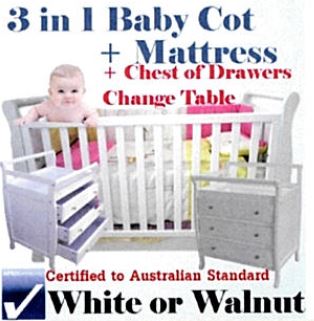
(b) in another part of the advertisement the statement “certified to Highest Australian Standards (AS/NZS 2172:2003) (Furntech Certified)”; and
(3) the advertisement published by Online Dealz for the Portable Cot on its eBay store containing the statement “AS/NZS 2195:1999”.
143 The ACCC alleges that the statements as to certification of the Sleigh Cot and the Portable Cot contained in these advertisements were misleading or deceptive or likely to mislead or deceive within the meaning of s 18, constituted a false or misleading representation about the products for the purposes of s 29(1)(a) and (g) and were liable to mislead the public about the characteristics or the suitability of the products for their purpose pursuant to s 33.
144 The advertisements published by Online Dealz and thus the statements contained in them about the Sleigh Cot and the Portable Cot were made to members of the public at large. It is for the Court to determine how these statements would be understood by an ordinary or reasonable member of the public and whether they would, as the ACCC submits, understand that the Sleigh Cot and the Portable Cot complied with the applicable safety standards when in fact they did not.
145 No evidence was led by the ACCC as to the effect of these statements on the ordinary or reasonable consumer. However, as Allsop CJ identified in ACCC v Coles at [45] where the “conduct and representations are to the public generally and concern a body of simple direct advertising, the absence of individuals saying they were misled may not be of great significance”. In that case no such evidence was led and Allsop CJ found that any criticism levelled at the ACCC for the absence of such evidence was unfounded. His Honour said at [45] that the task of “evaluating the objective character and meaning of the language in the minds of reasonable members of the public is not necessarily one that will be assisted in any cost effective manner by calling members of the public”. The question was one for the Court.
146 Online Dealz submits that all that is represented in these advertisements is that a certification exists: nothing more, nothing less. The statements in the advertisements do not rise to representations that each and every one of the products that is sold by Online Dealz meets the Australian Standard.
147 In relation to the advertisements for the Sleigh Cot, Online Dealz contends that the advertisements state that the product has been certified as meeting the Australian Standard and New Zealand Standard and that representation needs to be read as a whole incorporating the AFRDI Furntech certified tick of approval. These representations were not misleading or deceptive or otherwise false or misleading but were correct. Online Dealz had a certification from Furntech that the Sleigh Cot complied with the Australian and New Zealand standards.
148 In relation to the Portable Cot, Online Dealz submits that the bare reference to the standard by way of letters and numbers would not necessarily be understood by an ordinary or reasonable member of the public as a reference to a product standard. Online Dealz also submits that the representation is correct because the statement could only be taken to represent that the Portable Cot had been certified to comply with the standard and that the only way that a party can determine if a standard is complied with is to have it certified. A reasonable or ordinary prospective purchaser would not expect every product to be opened and certified separately for sale.
149 In my view an ordinary or reasonable member of the public would have some familiarity with the concept of product standards sufficient to know that certification to a standard was a positive thing, particularly in the purchase of a product such as a cot where the ordinary or reasonable member of the public is more likely to be conscious of safety when considering a product for a baby or young child.
150 Taking the advertisements in relation to the Sleigh Cot first, in my opinion the representations contained in those advertisements would convey to an ordinary or reasonable member of the public that the Sleigh Cot was certified to the Australian Standard and that it met or complied with that standard. An ordinary or reasonable member of the public would be left with the impression that the cot that was offered for sale met the standards which such a product was required to meet.
151 Whilst an ordinary or reasonable member of the public may not have familiarity with the numeric reference of the standard, there is sufficient conveyed by the words “certified to Australian Standard” and “meeting Australian Standard and New Zealand Standard” for an ordinary or reasonable member of the public to understand that certification had been given in relation to the Sleigh Cot and to understand that the cot being offered for sale complied with that standard. That was the representation that was made.
152 The next issue is whether that representation is misleading or deceptive or likely to mislead or deceive in that it will have a tendency to lead the consumer into error. In that regard, it is necessary to view the conduct as a whole.
153 True it is that Online Dealz had obtained certification of a sample of the product from Furntech and relied on the certificate issued by it that the sample was compliant to include the Furntech “tick of approval” and the representation as to certification. However, given the context in which the representations were made, that is an advertisement to promote the sale of the Sleigh Cot, an ordinary or reasonable member of the public would take the representation to mean something more than general certification of a sample. An ordinary or reasonable member of the public would understand the representation to mean, and would expect, that the product being offered for sale in fact complied with the standard. It is difficult to see how the representations were included other than to give members of the public confidence in the product being offered to them and to encourage them to purchase it. To the extent that those cots did not comply with the standard, the ordinary or reasonable consumer would be likely to be led into error.
154 I do not think the issue of whether every single Sleigh Cot (or Portable Cot) was tested is to the point. The expectation of the ordinary or reasonable consumer would be that the cots met the requirements of the relevant standard. The ordinary or reasonable consumer would expect that the cot that he or she purchased met that standard. As it transpired, the Sleigh Cots did not meet the relevant standard.
155 In the circumstances, Online Dealz has contravened ss 18, 29(1)(a), 29(1)(g) and 33 of the ACL in relation to the advertisements of the Sleigh Cots through its eBay store and on the Gumtree website. The conduct engaged in by Online Dealz was misleading or likely to mislead, the representations included in the advertisements were also false or misleading as they represented that the Sleigh Cot was of a particular quality or standard or that it had approval or certain performance characteristics or benefits and Online Dealz engaged in conduct that was liable to mislead the public about the nature, characteristics or the suitability for its purpose of the Sleigh Cot in the sense that there was an actual probability that the public would be misled by the representation contained in the advertisements.
156 I do not reach the same conclusion in relation to the advertisements by Online Dealz of the Portable Cot for sale through its eBay store. The representation included in that advertisement was a reference to the Portable Cot Standard by setting out the letters and numbers of the standard namely “AS/NZS 2195:1999”. In my view, that reference is unlikely to have a particular meaning to the ordinary or reasonable member of the public. Without more, it does not seem to me that the ordinary or reasonable member of the public would likely know that this was a reference to a product standard.
157 In contrast to the advertisements for the Sleigh Cot, there is no accompanying statement in the advertisement that the Portable Cot complies with the standard. To the extent that there is a representation in this advertisement it is a reference to letters and numbers which may or may not mean something to an ordinary or reasonable member of the public. There is no representation that the Portable Cot is compliant with the standard let alone that it had been certified as being so compliant. In my view, Online Dealz has not breached ss 18, 29(1)(a), 29(1)(g) or 33 of the ACL by its publishing or causing to be published on its eBay store website the advertisement for the Portable Cot that included the statement “AS/NZS 2195:1999”.
MRS LUCAS’ LIABILITY
158 The ACCC alleges that Mrs Lucas aided, abetted, counselled, procured, induced and/or was knowingly concerned in or party to the contraventions by Online Dealz of ss 106(1) and (2), 29(1)(a), 29(1)(g) and 33 within the meaning of s 224(1)(c), (d) and (e) of the ACL.
Relevant legal principles
159 Section 224 of the ACL is included in Div 1 of Pt 5.2 which deals with “Remedies”. Section 224 sets out the circumstances in which a court can order payment of a pecuniary penalty. In relation to a claim that a person aided, abetted, induced or procured a breach by another person of a relevant provision of the ACL s 224(1) relevantly provides that:
(1) If a court is satisfied that a person:
(a) has contravened any of the following provisions:
…
(ii) a provision of Part 3-1 (which is about unfair practices);
…
(viii) section 106(1), (2), (3) or (5), … or 132(1) (which are about safety of consumer goods and product related services);
…
(c) has aided, abetted, counselled or procured a person to contravene such a provision; or
(d) has induced, or attempted to induce, a person, whether by threats or promises or otherwise, to contravene such a provision; or
(e) has been in any way, directly or indirectly, knowingly concerned in, or party to, the contravention by a person of such a provision; or
…
the court may order the person to pay to the Commonwealth, State or Territory, as the case may be, such pecuniary penalty, in respect of each act or omission by the person to which this section applies, as the court determines to be appropriate.
160 In Yorke v Lucas (1985) 158 CLR 661 (Yorke v Lucas) the High Court considered s 75B of the Trade Practices Act which provided the circumstances in which a person was “involved in a contravention” for the purposes of that Act. Section 75B(a), (b) and (c) of the Trade Practices Act use the same language as s 224(1)(c), (d) and (e) respectively.
161 A majority of the Court in Yorke v Lucas observed at 667 that the words “aided, abetted, counselled or procured” were taken from the criminal law where they are used to designate participation in a crime as a principal in the second degree or as an accessory before the fact. The Court noted that a person will only be found guilty of the offence of aiding and abetting or counselling or procuring the commission of an offence if he intentionally participates in it and that to form the requisite intent he must have knowledge of the essential matters that go to make up the crime, whether or not he knows that those matters amount to a crime. The Court said at 667 that:
If par. (a) of s. 75B imports the requirements of the criminal law, it is clear in the light of Giorgianni v. The Queen that Lucas could only be brought within that paragraph if he intentionally aided, abetted, counselled or procured a contravention by the Lucas company of s. 52 of the Trade Practices Act. Upon the findings of the trial judge, however, Lucas lacked the knowledge necessary to form the required intent. A contravention of s. 52 involves conduct which is misleading or deceptive or likely to mislead or deceive and the conduct relied upon in this case consisted of the making of false representations. Whilst Lucas was aware of the representations — indeed they were made by him — he had no knowledge of their falsity and could not for that reason be said to have intentionally participated in the contravention.
162 The Court also considered s 75B(c) of the Trade Practices Act which is replicated in s 224(1)(e) of the ACL. In relation to that section the Court said that there “can be no question that a person cannot be knowingly concerned in the contravention unless he has knowledge of the essential facts constituting the contravention” and that the “proper construction of par. (c) requires a party to a contravention to be an intentional participant, the necessary intent being based upon knowledge of the essential elements of the contravention”. The Court also commented at 670 that s 75B(b), which is replicated in s 224(1)(d), clearly required intent based upon knowledge.
163 It is necessary to show an intentional participation in and actual knowledge of the essential elements of the contravention. However, it is not necessary to show that the person appreciated that the conduct constituted a contravention. In Rural Press Limited v Australian Competition and Consumer Commission (2003) 216 CLR 53 at [48] a majority of the High Court confirmed that the trial judge had rightly held that it was necessary to find that the relevant individuals participated in, or assented to, the companies’ contraventions with “actual knowledge of the essential elements constituting the contraventions” and that in order to “know the essential facts, and thus satisfy s 75B(1) of the Act and like provisions, it is not necessary to know that those facts are capable of characterisation in the language of the statute”.
164 In Australian Competition & Consumer Commission v IMB Group Pty Ltd [2003] FCAFC 17 a Full Court of this Court held at [133] that for a person to be involved in a contravention pursuant to s 75B(1)(c) of the Trade Practices Act, the person must be an “intentional participant in the contravention, the necessary intent being based upon knowledge of the essential elements of the contravention” relying on Yorke v Lucas. The Court went on to say that while it was not necessary to establish that the individual respondents had “knowledge that there was such a contravention … of the Act, it is necessary to demonstrate that each individual respondent had knowledge of each of the essential elements of the contravention”. At [135] the Court said:
It is not necessary to establish any subjective element in relation to a contravention of Pt V of the Act. A contravention may be committed unintentionally. That is to say, a person may contravene a provision of Pt V even though that person does not have knowledge of all of the essential elements that constitute the contravention. However, before any accessorial liability will arise, it is necessary to establish the subjective element of knowledge of each of the essential elements of the contravention. That knowledge may be constructive in the sense that it may be possible to show wilful blindness in relation to the elements of a contravention. However, absent a finding of wilful blindness, it is necessary to establish actual knowledge on the part of a person to whom it is sought to sheet home accessorial liability in respect of a contravention of Pt V.
Was Mrs Lucas involved in the alleged contraventions of the ACL by Online Dealz?
165 Mrs Lucas is the sole director and shareholder of Online Dealz. The evidence shows that Mrs Lucas was responsible for identifying and sourcing products sold by Online Dealz, negotiating and dealing with Online Dealz’ agent and its suppliers, managing Online Dealz’ inventory, causing advertisements to be placed on Online Dealz’ website, eBay page and on Gumtree and that Online Dealz’ employees reported to her. She is in effect the controlling mind of Online Dealz.
166 I have found that Online Dealz contravened s 106(1) and (2) in supplying and offering for supply in trade or commerce the Sleigh Cot, the Portable Cot and the Baby Stroller in circumstances where safety standards for consumer goods of that kind are in force and those goods did not comply with the relevant safety standards. The question which then arises for determination is whether Mrs Lucas had actual knowledge of the essential elements of the conduct giving rise to Online Dealz’ contraventions of s 106(1) and (2).
167 In relation to each of the products sold and offered for sale, that is the Sleigh Cot, the Portable Cot and the Baby Stroller, Mrs Lucas knew that they were offered for supply and being supplied in trade or commerce by Online Dealz, she knew that each of the products was of a kind in relation to which a safety standard was in force, she was familiar with the requirements of those safety standards and she had knowledge about the general make up of those products.
168 In the case of the Portable Cot and the Baby Stroller, Mrs Lucas had, while a director of Frank Masons, received certification that those products complied with the Portable Cot Standard and the Stroller Standard. Online Dealz took over Frank Masons’ existing stock of the Portable Cots and the Baby Strollers at the time of the sale by Mrs Lucas of her shares in Frank Masons. Online Dealz relied on the prior certifications provided to Frank Masons, of which Mrs Lucas was aware, in continuing to sell those products.
169 The ACCC submits that in order for Mrs Lucas to be liable she had to have actual knowledge of the essential elements of the relevant contravention and to have intentionally participated in or assented to the conduct which gave rise to it. However, it is not necessary to show that Mrs Lucas appreciated that in supplying the products Online Dealz was contravening s 106 of the ACL.
170 That is, in order to establish Mrs Lucas’ accessorial liability it is not necessary to establish that she knew that the products did not comply with the relevant safety standard as that would be tantamount to having to show that Mrs Lucas knew that the conduct was a breach of the Act and contrary to the High Court’s findings in Rural Press. I do not think it is the case that awareness or knowledge of the characteristic of the products supplied or offered for supply is sufficient to complete the requisite knowledge in this case. The essential elements of the contravention in the case of s 106 must include the fact that the products supplied or offered for supply did not meet the requirements of the applicable standard. That being so, in order to establish that a person aided, abetted or was knowingly concerned in such a breach, it is necessary to show that a person had knowledge of that essential element. That approach does not, in my view, fall foul of what the Court said in Rural Press. The Court’s approach in Rural Press was to find that the relevant individuals did not need to know that the essential facts were “capable of characterisation in the language of the statute” or in other words amounted to a breach of the relevant provisions of the statue. To similar effect the Court in Yorke v Lucas found that in order to form the requisite intent the person must have knowledge of the essential matters or facts that go to make up the crime whether or not he or she knows those matters amount to a crime.
171 Mrs Lucas was indeed aware of the fact that the Portable Cot and the Baby Strollers were being supplied or offered for supply in trade or commerce, she knew that there were mandatory safety standards which applied to those products, she knew of the content of those safety standards and she was aware of the nature of the products being supplied. However, she had no knowledge that the products did not comply with the safety standards. On the contrary, she was aware that there were certifications, previously supplied to Frank Masons, that they did comply. Notwithstanding that the statutory provision creating the principal offence imposes strict liability, the secondary participation required pursuant to s 224(1) of the ACL requires intent based upon knowledge. As in Rural Press, it is not an essential element that Mrs Lucas knew that Online Dealz’ conduct breached s 106 of the ACL. However, it is an essential element, in order to find accessorial liability, that Mrs Lucas knew that the products offered for sale did not comply with the relevant standard. There is, in my view, a distinction. Consistent with the findings in Yorke v Lucas, Mrs Lucas cannot be said to have intentionally participated in the contravention by Online Dealz.
172 In the case of the Sleigh Cot, Mrs Lucas was aware of the Household Cot Standard and was aware of the need for the Sleigh Cot to comply with that standard. She once again had a certification that the Sleigh Cot complied with the Household Cot Standard. However, the circumstances of obtaining that certification were different. Mrs Lucas caused a certification to be obtained prior to Online Dealz supplying the Sleigh Cot or offering it for supply. In the course of testing for certification an issue arose with the labelling of the Sleigh Cot. Mrs Lucas negotiated with her supplier and agent to ensure that labelling, which was compliant with the Household Cot Standard, was affixed to the Sleigh Cot prior to the packaging of the cot. The evidence is contained in a series of emails which show that the matter was one which Mrs Lucas required her agent and supplier to attend to with some urgency. However, on arrival of the shipment and before supplying or offering the Sleigh Cot for supply Mrs Lucas did not check or cause anyone else to check that the labelling had been provided and affixed as required and thus that the Sleigh Cot was compliant with the Household Cot Standard. Mrs Lucas frankly conceded that there was nothing preventing her from checking the Sleigh Cot to ensure the labelling requirements had been attended to as required. She did not think about doing so at the time despite being aware of the importance of the labelling being correct.
173 In my opinion, Mrs Lucas, knowing of the issue of potential non compliance, failed to ensure compliance. In the result, the Sleigh Cots failed to comply with, among other things, the labelling requirements of the Household Cot Standard. That leads to a different conclusion. Mrs Lucas was aware of the essential element of non compliance with the standard. Knowing of the risk of non compliance with the Household Cot Standard, she nonetheless did not have the Sleigh Cot checked before it was supplied or offered for supply. In those circumstances in my view Mrs Lucas was involved in the contravention by Online Dealz of s 106(1) and (2) of the ACL pursuant to s 224(1)(c), (d) and (e) of the ACL in respect of the Sleigh Cot.
174 The ACCC also alleges that Mrs Lucas had actual knowledge of the essential elements of the conduct giving rise to Online Dealz’ contraventions of ss 29(1)(a), 29(1)(g) and 33 of the ACL. In that regard, I have found that Online Dealz breached those provisions in relation to the advertisements placed for the Sleigh Cot on its eBay store and on the Gumtree website.
175 My findings in [173] above are equally applicable to this claim against Mrs Lucas. As noted, Mrs Lucas arranged for certification of the Sleigh Cot. In the course of testing an issue arose with the labelling, of which she was aware and which she took steps to address. However, Mrs Lucas failed to check or to cause Online Dealz to check that her supplier had complied with her requests. Mrs Lucas was aware of and indeed instrumental in arranging for and placing the advertisements. She was aware of the statements made in those advertisements. Those statements were made in circumstances where she had not taken steps for Online Dealz to check any of the Sleigh Cots to ascertain if they complied with the labelling requirements of the Household Cot Standard. In those circumstances, in my view, she had the requisite knowledge of the essential elements of the contravention and intentionally participated in or assented to the conduct giving rise to the contravention. In my view, Mrs Lucas was involved in the breach by Online Dealz of ss 29(1)(a), 29(1)(g) and 33 of the ACL pursuant to s 224(1)(c), (d) and (e) in relation to the advertisements placed by Online Dealz for the Sleigh Cot on its eBay store website and on the Gumtree website.
RELIEF
176 I turn now to the question of relief. Before doing so it is convenient to summarise my findings.
177 In relation to Online Dealz my findings are that:
(1) it contravened s 106(1) of the ACL by supplying in trade or commerce:
(a) the Sleigh Cot which was intended to be used, or was of a kind likely to be used, for personal, domestic or household use or consumption, that is by a consumer, and to which a safety standard for consumer goods of that kind is in force, namely the Household Cot Standard, and in circumstances where the Sleigh Cot did not comply with cll 6.8(b), 9.2, 9.7, 11.2, 12.1 and 12.2 of the Household Cot Standard;
(b) the Portable Cot which was intended to be used, or was of a kind likely to be used, for personal, domestic or household use or consumption, that is by a consumer, and to which a safety standard for consumer goods of that kind is in force, namely the Portable Cot Standard, and in circumstances where the Portable Cot did not comply with cll 8.1(d), 10.2, 10.14 and 13.2 of the Portable Cot Standard;
(c) the Baby Stroller which was intended to be used, or was of a kind likely to be used, for personal, domestic or household use or consumption, that is by a consumer, and to which a safety standard for consumer goods of that kind is in force, namely the Stroller Standard, and in circumstances where the Baby Stroller did not comply with cll 7.8.1.3, 8.6.2(b), 11.1, 11.2 and 11.3 of the Stroller Standard.
(2) it contravened s 106(2) of the ACL by offering to supply, in trade or commerce:
(a) the Sleigh Cot which was intended to be used, or was of a kind likely to be used, for personal, domestic or household use or consumption, that is by a consumer, and to which the Household Cot Standard applied and in circumstances where the Sleigh Cot did not comply with cll 6.8(b), 9.2, 9.7, 11.2, 12.1 and 12.2 of the Household Cot Standard;
(b) the Portable Cot which was intended to be used, or was of a kind likely to be used, for personal, domestic or household use or consumption, that is by a consumer, and to which the Portable Cot Standard applied and in circumstances where the Portable Cot did not comply with cll 8.1(d), 10.2, 10.14 and 13.2 of the Portable Cot Standard;
(c) the Baby Stroller which was intended to be used, or was of a kind likely to be used, for personal, domestic or household use or consumption, that is by a consumer, and to which the Stroller Standard applied and in circumstances where the Baby Stroller did not comply with cll 7.8.1.3, 8.6.2(b), 11.1, 11.2 and 11.3 of the Stroller Standard.
(3) by publishing or causing to be published on the website:
(a) stores.ebay.com.au/online-dealz-store a page with an advertisement for the Sleigh Cot that included the statements:
“Certified to Australian Standard”; and
“Meeting Australian and NZ standards AS/NZS2172”.
(b) www.gumtree.com.au a page with an advertisement for the Sleigh Cot that included the statements:
“Certified to Australian Standard”; and
“Certified to Highest Australian Standards (AS/NZS2172:2003)”
Online Dealz has in trade or commerce :
(c) engaged in conduct that was misleading or deceptive or likely to mislead or deceive in contravention of s 18 of the ACL;
(d) in connection with the supply, the possible supply or the promotion of the Sleigh Cot, made a false or misleading representation that it was of a particular standard or quality, in contravention of s 29(1)(a) of the ACL;
(e) in connection with the supply, the possible supply or the promotion of the Sleigh Cot, made a false or misleading representation that it had particular performance characteristics or benefits in contravention of s 29(1)(g) of the ACL;
(f) engaged in conduct that was liable to mislead the public as to the characteristics and suitability for their purpose of the Sleigh Cots, in contravention of 33 of the ACL.
178 In relation to Mrs Lucas my findings are that she aided, abetted, counselled, procured, induced and was knowingly concerned in or party to the contraventions of Online Dealz referred to in paragraphs 177(1)(a), (2)(a) and (3)(d), (e) and (f) above within the meaning of s 224(1)(c), (d) and (e) of the ACL.
Declarations
179 The ACCC seeks declarations pursuant to s 21 of the FCA Act in relation to each of the breaches of the ACL by Online Dealz and Mrs Lucas. Section 21 of the FCA Act gives the Court a wide discretionary power to make declarations. In Australian Competition and Consumer Commission v Spreets Pty Ltd [2015] FCA 382 (Spreets) Collier J at [108], referring to the decision of the High Court in Forster v Jododex Australia Ltd (1972) 127 CLR 421 at 437-8, identified three requirements that should be satisfied before making a declaration:
(1) the question must be a real and not a hypothetical or theoretical one;
(2) the applicant must have a real interest in raising it; and
(3) there must be a proper contradictor.
180 No submissions were made by either party as to whether declarations of breach should be made although such relief is sought by the ACCC. However, in my opinion, each of the requirements set out by Collier J in Spreets has been satisfied:
(1) insofar as I have made findings, the declarations which the ACCC seeks relate to conduct that contravenes the ACL. The claims have been the subject of evidence and detailed submissions. Those set out above at [177] and [178] have been made out by the ACCC;
(2) the ACCC, as a regulator, has a real interest in raising the issues and seeking the declaratory relief. It is in the public interest for the ACCC to seek to have the declarations made;
(3) finally, there are proper contradictors in this case, namely Online Dealz and Mrs Lucas, the parties who are alleged, by their conduct, to have contravened the ACL and who will be the subject of the declarations that are made. They have appeared and have led evidence and provided submissions to the Court.
181 I am satisfied that it is appropriate to make the declaration sought by the ACCC in relation to the breaches of the ACL that I found have been made out.
Injunctions
182 Injunctive relief is sought by the ACCC pursuant to s 232 of the ACL or alternatively s 23 of the FCA Act. The ACCC seeks injunctions:
(1) in [7] and [8] of the further amended originating application, restraining Online Dealz, by itself, its officers, servants, agents or otherwise and Mrs Lucas, whether by herself, her agents, or otherwise on her behalf, in trade or commerce in Australia for a period of ten years from supplying or offering to supply:
(a) the Sleigh Cot, the Portable Cot or the Baby Stroller;
(b) any household cot, portable cot or baby stroller (baby products) which are subject to a safety standard for the purposes of Div 1 of Pt 3-3 of the ACL in force at the time of supply or offer to supply unless Online Dealz or Mrs Lucas has obtained written evidence from a person accredited by NATA to test the particular baby product for compliance with the applicable safety standard, certifying that person has tested a baby product of the same style and composition as the product to be supplied or offered for supply and found that it complied with the safety standard and provided a copy of that written evidence to the ACCC.
(2) in [9] of the further amended originating application, restraining Mrs Lucas, for a period of ten years, from aiding, abetting, counselling, procuring or inducing any person to, and/or being knowingly concerned in or party to the supply or offer to supply, in trade or commerce in Australia:
(a) the Sleigh Cot, the Portable Cot or the Baby Stroller;
(b) any baby products to which a safety standard applies unless she has first obtained or caused to be obtained written evidence from a person accredited by NATA to test the particular baby product for compliance with the relevant safety standard, certifying that the person has tested a baby product that is of the same style and composition as the baby product to be supplied or offered for supply for compliance with the safety standard and found that it complied the safety standard and provided a copy of that written evidence to the ACCC.
(3) in [10] of the further amended originating application, requiring Online Dealz and/or Mrs Lucas:
(a) to refund all amounts paid by any person to Online Dealz in relation to the purchase of any of the Sleigh Cot, the Portable Cot or the Baby Stroller;
(b) at its own expense to recall all of the Sleigh Cots, the Portable Cots and the Baby Strollers that have been supplied to any person;
(c) to provide a monthly update to the ACCC regarding the progress of the recall; and
(d) at its own expense to destroy all of the Sleigh Cots, the Portable Cots and the Baby Strollers that are in, or come into their possession or control.
183 Section 232(1) of the ACL gives the Court broad powers. It relevantly provides:
(1) A court may grant an injunction, in such terms as the court considers appropriate, if the court is satisfied that a person has engaged, or is proposing to engage, in conduct that constitutes or would constitute:
(a) a contravention of a provision of Chapter 2, 3 or 4; or
…
(c) aiding, abetting, counselling or procuring a person to contravene such a provision; or
(d) inducing, or attempting to induce, whether by threats, promises or otherwise, a person to contravene such a provision; or
(e) being in any way, directly or indirectly, knowingly concerned in, or party to, the contravention by a person of such a provision; or
…
(5) Without limiting subsection (1), the court may grant an injunction under that subsection restraining a person from carrying on a business or supplying goods or services (whether or not as part of, or incidental to, the carrying on of another business):
(a) for a specified period; or
(b) except on specified terms and conditions.
(6) Without limiting subsection (1), the court may grant an injunction under that subsection requiring a person to do any of the following:
(a) refund money;
…
(d) destroy or dispose of goods.
184 The power of the Court to grant an injunction under s 232(1) restraining a person from engaging in conduct can be exercised whether or not it appears to the Court that the person intends to engage again or to continue to engage in conduct of a kind referred to in s 232(1): s 232(4)(a). Similarly the power of the Court to grant an injunction under s 232(1) requiring a person to do an act or thing may be exercised whether or not it appears to the Court that the person intends to refuse or fail again, or continue to refuse or fail, to do that act or thing: s 232(7)(a).
185 Section 23 of the FCA Act gives the Court a broad power to make orders in relation to matters in which it has jurisdiction including the making of interlocutory orders.
186 In BMW Australia Limited v Australian Competition and Consumer Commission (2004) 207 ALR 452 (BMW v ACCC) at [36] a Full Court of this Court recognised that s 80(1) of the Trade Practices Act, the predecessor to s 232(1) of the ACL, gave the Court a wide discretion as to the terms of an injunction. A relevant factor to consider in determining whether to grant an injunction is whether the existing sanctions for the conduct to be the subject of the injunction, in this case in the ACL, are required to be supplemented by the availability of the range of sanctions applicable to contempt of court. That is, the purpose of granting an injunction to restrain conduct that is already prohibited by legislation can only be to add to whatever consequences the legislation attaches to that conduct: BMW v ACCC at [39]. The Court in BMW v ACCC identified that the question in each case was “whether the conduct concerned warrants the application of those more stringent consequences”: at [39].
187 In Australian Competition and Consumer Commission v Star Promotions Club Pty Ltd [2010] FCA 139 (Star Promotions Club) at [36] Rares J observed that “[o]rdinary reasonable members of the community understand that when a court grants an injunction or makes an order prohibiting a person from acting in a particular way, that the person’s conduct has been such as to warrant the invocation of this substantial power, limiting an individual’s or corporation’s freedom of action.”. His Honour recognised that there was a public interest in identifying, in that case, the misrepresentations and contraventions that he had found and making orders against the contravener preventing the conduct from being repeated.
188 Online Dealz has engaged in conduct that contravenes provisions of Ch 2 (s 18) and Ch 3 (ss 29, 33 and 106) of the ACL. Mrs Lucas has engaged in conduct that constitutes aiding, abetting, counselling, procuring or inducing, or was directly or knowingly concerned or party to the contravention by Online Dealz of provisions of Ch 3 (ss 29, 33 and 106).
189 Online Dealz does not oppose the terms of the injunction sought against it. It agrees to no longer sell the Sleigh Cot, the Portable Cot and the Baby Stroller and since 30 March 2015 it ceased supplying those products when it undertook to the Court that it would maintain possession of all Sleigh Cots, Portable Cots and Baby Strollers that were in or came into its possession and that it be restrained from supplying or offering to supply the Sleigh Cot, the Portable Cot and the Baby Stroller. Those undertakings are in place until further order. Online Dealz also undertook, until further order, not to supply or offer to supply any baby product that is subject to a safety standard for the purposes of Division 1 of Part 3-3 of the ACL.
190 In my opinion, Online Dealz should be restrained from supplying or offering to supply the Sleigh Cot, the Portable Cot and the Baby Stroller. Online Dealz was supplying and offering to supply those products in a form which did not comply with the applicable safety standards. Their continued supply or offer to supply should be prevented. The conduct that has occurred, across more than one baby product, warrants the application of the more stringent circumstances. To adopt the words of Rares J in Star Promotions Club there is a public interest in identifying the contraventions that I have found and in making orders against Online Dealz that prevent the conduct being repeated. I am also of the opinion that, having regard to what has occurred and the breaches that occurred across a range of products, it is appropriate to restrain Online Dealz from supplying baby products that are subject to a safety standard for the purposes of Div 1 of Pt 3-3 of the ACL in force at the time of supply or offer to supply without first obtaining certification from a NATA accredited agency and providing a copy of that certification to the ACCC.
191 The ACCC seeks the injunction against Online Dealz for a period of ten years from the date of the order. It submits that a period of this length is appropriate given the circumstances in which the conduct took place:
(1) there was the earlier supply of the non compliant Frank Masons Cot which, the ACCC contends, should have been a reminder to Mrs Lucas of the critical need to ensure the products sold complied with applicable safety standards;
(2) against that background, having taken steps to have the Sleigh Cot tested by a NATA accredited testing facility, Mrs Lucas failed to check any of those cots to ensure that they had been labelled and marked as required, despite being made aware by Furntech, who carried out the testing of the sample, that steps had to be taken to ensure compliance;
(3) in relation to the Portable Cot and the Baby Stroller, acquired from Frank Masons and supplied by Online Dealz, the only way in which Mrs Lucas satisfied herself that these products were compliant was because Frank Masons, prior to selling what she understood to be the same products, had been provided with test reports by the products’ manufacturer in China. Those tests had been undertaken in 2009 and 2011 respectively by overseas testing agencies. Mrs Lucas gave evidence that she read parts of those reports when they were received by Frank Masons but did not notice the dates of the tests or the clauses excluded from testing and conceded that she did not read nor look for those reports before Online Dealz sold the products.
192 No submissions were made on behalf of Online Dealz or Mrs Lucas about the period of ten years. In my opinion, ten years is an excessive period in which to restrain the sale of a particular product or a class of products generally without first taking steps which are, in any event required by the ACL, prior to sale but with the added requirement that any certification received must be provided to the ACCC. This is so even taking into account the relevant circumstances in which the contravening conduct took place. The conduct was careless but it is difficult to put it in the category of acting with total disregard for the requirements of safety and certification given that Mrs Lucas took steps to have the Sleigh Cot tested and she was aware of the existence of certifications for the Portable Cot and the Baby Stroller. In my opinion five years is a more appropriate period for an order restraining Online Dealz from selling the Online Dealz Products and from selling any product in the category of the Online Dealz Products without first obtaining certification and notifying that certification to the ACCC.
193 The injunction sought by the ACCC in [7] of the further amended originating application includes the words “or otherwise” such that Online Dealz would be restrained whether by itself, its officers, servants, agents “or otherwise” from doing the things then specified in the order. The words “or otherwise” are ambiguous and do not add anything to the order that is sought. The terms of the order that I will make will not include those words.
194 The ACCC seeks two injunctions against Mrs Lucas. The first is an order in the same form as that sought against Online Dealz but against Mrs Lucas by herself, her agents or otherwise on her behalf.
195 Mrs Lucas submits that it is unnecessary and inappropriate to order an injunction against her personally in the event that no liability is found against her. I have found that Mrs Lucas was involved in the breach by Online Dealz of s 106(1) and (2) in relation to the supply and offer of supply of the Sleigh Cot. Given that finding it is appropriate to make an order pursuant s 232 of the ACL that Mrs Lucas be restrained, whether by herself, her agents or otherwise on her behalf, from supplying or offering to supply the Sleigh Cot. It is also appropriate to make an order restraining Mrs Lucas by herself, her agents or otherwise on her behalf from supplying any product in the nature of the Sleigh Cot, that is a household cot, which is subject to a safety standard without first obtaining certification from a NATA accredited agency and providing a copy of that certification to the ACCC. For the same reasons set out at [192] above, I do not think that such an order should be made for a period of ten years. Rather, I will make the order for a period of five years.
196 The second injunction sought against Mrs Lucas is that she be restrained for a period of ten years from “aiding, abetting, counselling, procuring, or inducing any person to, and/or being knowingly concerned in or party to the supply or offer to supply” of any of the Online Dealz Products and any baby product without first having the product certified and providing a copy of the certification to the ACCC. Insofar as I have found a breach against Mrs Lucas in relation to her being involved in the breach of s 106(1) and (2) of the ACL by Online Dealz in connection with its supply or offer to supply the Sleigh Cot, I do not think a further injunction of this nature has any utility. The order that I will make restraining Mrs Lucas will be to restrain her, her agents or anyone acting on her behalf from supplying or offering to supply the Sleigh Cot. The second injunction sought does not, in my opinion, add anything further to that injunction or to the consequences of the conduct that the legislation already prohibits.
197 Insofar as there has been no finding that Mrs Lucas is liable as an accessory to Online Dealz’ contravention, the ACCC relies on s 23 of the FCA Act to seek injunctive relief against her.
198 In Cardile v LED Builders Pty Ltd (1999) 198 CLR 380 (Cardile) the High Court considered the question of whether a Mareva order could be granted against a third party to proceedings where that third party had not been shown to have an interest in the assets or funds of the potential judgment debtor. In the course of its consideration, the High Court considered s 23 of the FCA Act. At [25] a majority of the High Court (Gaudron, McHugh, Gummow and Callinan JJ) said, referring to the judgment in CSR Limited v Cigna Insurance Australia Ltd (1997) 189 CLR 345, that the counterpart of the Court’s power to prevent its processes being abused is its power to protect the integrity of those processes once set in motion. In the case before it the integrity of the processes extended to preserving the efficacy of the execution which would lie against the actual or prospective judgment debtor. The protection of the administration of justice might, in the proper case, extend to asset preservation against third parties to the principal litigation.
199 At [33] the majority of the High Court held that, while s 23 of the FCA Act empowered the Court to make orders of such a kind, including interlocutory orders, as the Court thinks appropriate, the “Federal Court is not thereby authorised to grant injunctive relief where jurisdiction is acquired under another statute which provides an exhaustive code of the available remedies and that code does not authorise the grant of an injunction”. The majority of the Court said that s 23 does not provide authority for the granting of an injunction where, whether under the general law or by statute, there is otherwise no case for injunctive relief.
200 In Cardile the majority of the Court had regard to Patrick Stevedores Operations No 2 Pty Ltd v Maritime Union of Australia (1998) 195 CLR 1 which also concerned the jurisdiction of the Federal Court to grant a Mareva order. In considering the power of the Court to grant interlocutory relief under s 23 of the FCA Act, the majority (Brennan CJ, McHugh, Gummow, Kirby and Hayne JJ) said at [35]:
… One limitation on the powers of the Federal Court to grant interlocutory injunctions is that those powers must be exercised for the purpose for which they are conferred. In a later passage of the judgment of Deane J in Jackson v Sterling Industries Ltd, his Honour said a power to prevent the abuse or frustration of a court's process should be accepted “as an established part of the armoury of a court of law and equity” and that “the power to grant such relief in relation to a matter in which the Federal Court has jurisdiction is comprehended by the express grant to that Court by s 23 of the Federal Court of Australia Act”. But, his Honour observed, orders must be framed “so as to come within the limits set by the purpose which [the order] can properly be intended to serve”. The Mareva injunction is the paradigm example of an order to prevent the frustration of a court's process but other examples may be found. The moulding of an interlocutory injunction must depend upon the circumstances of each case. …
(citations omitted)
201 Mrs Lucas submits that, as the ACL sets out the specific requirements to obtain an injunction for a relevant breach of the ACL (as opposed to a threatened breach or in respect of pending proceedings as was the case in Cardile), it is intended to be a code when such breaches are established. Otherwise, the specific requirements to obtain an injunction are rendered meaningless. Mrs Lucas relies on Cardile at [54] and [57] where the majority set out some of the bases on which relief under s 23 of the FCA Act could be made against a person not otherwise a party to the proceedings. Mrs Lucas contends that they involve the third party somehow being ultimately liable to disgorge property or being otherwise liable in respect of the conduct that was the subject of the proceedings. Whilst Mrs Lucas concedes that she is not a third party to the proceedings, she says that where she is not found to be liable for any breach she is, by analogy, equivalent to a non party and, more importantly, she is a non party against whom no liability can attach.
202 The ACCC submits that the ACL is not an exhaustive code of the remedies available to the Court in connection with its jurisdiction under the ACL. Further, it contends that, in any event, in circumstances where the Court determines that Mrs Lucas is not liable as an accessory, the injunctions sought by it under s 23 are directed at protecting the integrity of orders that may be made against Online Dealz rather than providing a remedy in respect of Mrs Lucas’ own contraventions of the ACL. The ACCC submits that as the guiding mind of Online Dealz the grant of an injunction is necessary to protect the efficacy of the relief granted against Online Dealz and to prevent against the stultification of the administration of justice where there is foreseeable risk that Mrs Lucas may cause Online Dealz not to comply with the terms of the relief. This, the ACCC says, is especially so given Mrs Lucas’ conduct in relation to the Frank Masons Cot recall.
203 The conclusion I have come to is that the injunctive relief sought against Mrs Lucas in relation to the Portable Cot and the Baby Stroller is not necessary as a measure to protect the integrity of the orders made against Online Dealz in relation to those Baby Products. Accordingly I do not need to determine whether s 232 of the ACL is an exhaustive code for breaches of the ACL.
204 The order that is to be made against Online Dealz restrains it, its officers, servants or agents from supplying, or offering to supply, the Online Dealz Products including the Portable Cot and the Baby Stroller or products of the same type as the Portable Cot or the Baby Stroller without first obtaining certification and providing that certification to the ACCC. Mrs Lucas is currently the sole director of Online Dealz. She is effectively restrained by that order. True it is that there could be a change in office holders of Online Dealz or Mrs Lucas could sell that company and set up another company. However, should that occur, sufficient protection is provided by the prohibitions under the ACL not to sell consumer products for which there is an applicable standard and that do not comply with the applicable standard. There is evidence that Mrs Lucas is aware of the product safety standards, is conscious of maintaining the integrity of the process by not offering non compliant products for sale and that she obtained certification or was aware of the existence of certification before supplying the Online Dealz Products or offering them for supply.
205 In seeking injunctive relief against Mrs Lucas, the ACCC placed reliance on Mrs Lucas’ role in Frank Masons and the sale of the Frank Masons Cot which the ACCC said was non compliant and in relation to which Mrs Lucas agreed to a voluntary recall. In particular the ACCC refers to the subsequent sale by Mrs Lucas of her shares in Frank Masons to a third party on the basis that Online Dealz acquired all of the stock held by and the warehouse premises of Frank Masons and left the liability for the Frank Masons Cot recall with the new owner. The ACCC contends that the only inference that can be drawn is that Mrs Lucas entered into that transaction to avoid the liability of the recall.
206 The issue of whether the Frank Masons Cot breached the Household Cot Standard has never been the subject of findings by a Court. Mrs Lucas voluntarily agreed to the recall of the Frank Masons Cot. There is evidence that her decision to sell her shares in Frank Masons was because she no longer wanted to be associated with that company given her history with her former partner. Her evidence is that she informed her accountant about the ACCC investigation and the recall of the Frank Masons Cot and that the buyer knew about the recall. There is no evidence that the sale was a sham entered into by Mrs Lucas to avoid the liability for the recall. That is a serious allegation and not a matter which can be inferred.
207 The last category of injunction sought by the ACCC is a mandatory injunction in the terms of [10] of its further amended originating application (the recall order). The ACCC has attempted to amend the recall order in its submissions “regarding order for recall” dated 4 May 2016. No application has been made to amend the recall order. The respondents oppose the amendment in the current form. Given the lateness of the proposed amendment and the manner in which the ACCC attempts to make it, I will not allow it.
208 The evidence discloses that Online Dealz has commenced a voluntary recall of the Online Dealz Products and that the following steps have been taken to give effect to the recall:
(1) letters have been sent by Online Dealz to those consumers who purchased the affected products and for whom Online Dealz has contact details notifying them of the recall;
(2) the ACCC has also contacted those consumers by email and/or post in substantially similar terms;
(3) recall notices for each of the Online Dealz Products have been published on the ACCC’s Product Safety Recalls Australia website and the recall has been advertised on the ACCC’s social media pages including Facebook and Twitter;
(4) Online Dealz advertised the recall in the Australian Newspaper published on 20 April 2016;
(5) in the week commencing 2 May 2016, a heading titled “PRODUCT RECALLS” was added to the front page of the Online Wholesaler’s website, being the website now used by Online Dealz, which links to the ACCC’s webpage which provides information about the recall; and
(6) Online Dealz has provided refunds to those consumers who have returned the Online Dealz Products and has destroyed any of the Online Dealz Products returned to it.
209 Despite the fact that Online Dealz has commenced a voluntary recall, the ACCC continues to press for the recall order. In short, it submits that such an order is necessary and has utility because the recall is incomplete and the respondents’ conduct to date is such that an order of the Court is necessary to ensure the recall is completed.
210 The ACCC submits that there are an unknown number of people to whom Online Dealz has supplied the Online Dealz Products who could not be contacted by email or letter and it is with those people in mind that the ACCC seeks an order that the respondents publish advertisements about the recall as set out in paragraph 15 of the further amended originating application and on the revised terms provided to the Court under cover of the ACCC’s supplementary submissions dated 4 May 2016. The publication order is sought for the Online Dealz website, or a website to which it redirects, the eBay and Gumtree webpages and the Essential Baby website. The ACCC contends that the recall can only be properly effected once it has been properly advertised and affected consumers have had an opportunity to participate in it.
211 Further the ACCC says that it is unable to monitor the progress and effectiveness of the recall without the provision of progress reports at regular intervals. The ACCC submits that the respondents have been generally unwilling to voluntarily provide, or have unduly delayed providing it with, information or updates about the progress of the recall and that they did not commence the recall until after the hearing, despite knowing for some time that the Online Dealz Products were not compliant with safety standards. In circumstances where the respondents have not demonstrated that they are reliably undertaking the proper advertising and not willingly engaging with the ACCC about the recall, the ACCC submits that a court order and the threat of the sanction of contempt for failure to comply is appropriate to ensure the recall is properly advertised and effected.
212 The fact of the agreement to voluntary recall by the respondents and the steps they have taken to put the recall into effect calls into question the utility of the whole of an order in the form of the recall order. The fact that such an order is still sought by the ACCC is best explained by the submission made on behalf of the ACCC that, even in the event of an agreed recall, it would still wish to have one that was subject to an order of the Court for its enforceability.
213 The ACCC seems to be most concerned by the need to advertise more fully to ensure the recall is effective and the need for Online Dealz to provide timely and regular progress reports. The recall order seeks an order that:
(1) Online Dealz and/or Mrs Lucas refund all amounts paid by any person to Online Dealz in relation to the purchase of any of the Baby Products. However, to the extent that Online Dealz has been able to notify consumers of the recall and a consumer has returned the affected product, Online Dealz has provided a refund and paid the costs of return of the product. It can be inferred that the respondents will continue to provide refunds for the return of the Online Dealz Products. In fact, by their most recent submissions dated 18 May 2016, they undertake to do so. There is no evidence to the contrary;
(2) at their own expense the respondents will take all steps to effect the recall of the Online Dealz Products that have been supplied to any person by Online Dealz, such recall to be commenced within 7 days of the order. However, the respondents have already put in place the recall by the despatch of emails and letters to customers where their addresses were known and, thus far, by advertising the recall in the Australian newspaper on 20 April 2016;
(3) a monthly update be provided to the ACCC regarding the progress of the recall. There is no evidence that this has occurred with any regularity. The evidence discloses that information has been provided but not regularly and, in some cases, only after persistent requests; and
(4) at their own expense destroy all of the Online Dealz Products that are in or come into the possession or control of the respondents. There is evidence that all of the Online Dealz Products that have been returned have been destroyed. It is not clear what has happened to the Online Dealz Products that remained in possession of Online Dealz when these proceedings were commenced. At one stage the solicitors for the respondents queried whether the Online Dealz Products being held in Online Dealz’ warehouse that were not sold could be returned to the manufacturer in China to seek a refund. Based on the evidence before the Court that issue has not been resolved.
214 Given that Online Dealz has implemented a recall in consultation with the ACCC and steps have been taken to effect that recall, there is little utility in making an order in the terms sought in the recall order. However, given the failure by the respondents to provide regular updates on the progress of the recall and the status of the issue of destruction of the Online Dealz Products that are in the respondent’s possession or control, I will make orders addressing those two matters in the form of [10(c)] and [10(d)] of the recall order but will, as submitted by the ACCC, impose an end date of 12 months from the date of the making of the order in [10(c)]. The order sought in relation to advertising by the ACCC is addressed below.
Publication order
215 The ACCC seeks an order pursuant to s 246(2)(d) and/or s 247 of the ACL that Online Dealz and/or Mrs Lucas at their own expense publish an advertisement on the terms specified by it and approved by the Court. The form of the publication order now sought is as included in the ACCC’s submissions “regarding order for recall” dated 4 May 2016. The respondents contend that the ACCC has impermissibly sought to amend [15] of the further amended originating application. That is not what has occurred. Paragraph 15 of the further amended originating application seeks an order for publication of an advertisement on terms recommended by the ACCC and approved by the Court. Because of events that have occurred the ACCC now recommends different terms. The principal change is to remove the requirement for advertising in a national newspaper.
216 Section 246 of the ACL provides that a court may, on application of the regulator, make one or more of the orders in subs (2) in relation to a person who has engaged in conduct that contravenes a provision of Chs 2, 3 or 4 or constitutes an involvement in a contravention of such a provision. Subsection (2)(d) provides that a court may make an order requiring the person who has engaged in the conduct to publish, at the person’s expense, and in the way specified in the order, an advertisement in the terms specified in, or determined in accordance with, the order.
217 Section 247 of the ACL provides that a court may, on application of the regulator, make an adverse publicity order in relation to a person who has contravened a provision of Part 2-2 or Chapter 3 or has committed an offence against Chapter 4. The term “adverse publicity order” is defined in subs (2). It is an order that requires the person to disclose, in the way and to the persons specified in the order, such information that is so specified, being information that the person has possession of or access to and to publish, at the person’s expense and in the way specified in the order, an advertisement in the terms specified in, or determined in accordance with, the order.
218 I have found that Online Dealz has engaged in conduct that breached ss 18, 29, 33 and 106 of the ACL. I have found that Mrs Lucas was involved in the contravention by Online Dealz of those sections but only in relation to the Sleigh Cot. Section 18 is found in Part 2-1 of Chapter 2 while the remaining provisions are found in Chapter 3 of the ACL.
219 As noted above, the ACCC submits that further publication is necessary so that those customers who purchased any of the Online Dealz Products for whom Online Dealz did not have email or postal addresses, or up to date email or postal addresses, or where the affected product had been passed on, could become aware of the recall. The publication order is pressed in relation to websites which are likely to target consumers who may have been or may be using the affected products. Complete publication will ensure that the voluntary recall is properly effected.
220 The respondents submit that publication is not necessary. I do not agree. There is evidence that the ACCC has been attempting to have Online Dealz publish notice of the recall on its website, its eBay and Gumtree pages and on the Essential Baby website for some time. Publication has now occurred on the Online Wholesalers website, which Online Dealz uses in lieu of its own website which has now been taken down, and on the Gumtree and eBay websites. There has been no publication on the Essential baby website. The publication that has occurred is not in accordance with the terms sought by the ACCC.
221 Subject to two matters, the publication in the terms sought by the ACCC will ensure that as many of those consumers who potentially purchased one of the Online Dealz Products is aware of the issues relating to those products and the recall. The publication will ensure that the net is cast as wide as possible in terms of notifying those consumers who have not yet become aware of the issues and the recall and will, as the ACCC submits, make the recall more effective. The two matters which arise and which necessitate an amendment to the form of the publication order proposed by the ACCC are:
(1) Online Dealz no longer has its own website. It uses the Online Wholesalers website and has published the recall on that website but not in the form required by the ACCC. Thus the publication order does not need to require Online Dealz to publish the recall on its homepage but should require Online Dealz to publish the recall on the Online Wholesalers website and such other homepage to which the Online Dealz website redirects; and
(2) the form of the advertisement to be published on the site other than the Essential Baby Website includes a statement that “The Federal Court also found that Ms Janet Lucas was involved in the contraventions”. Given the findings I have made that statement will need to be amended so that it reads “The Federal Court also found that Ms Janet Lucas was involved in some of those contraventions”.
222 Subject to those matters, it is appropriate that an order on the terms sought by the ACCC be made pursuant to s 246(2)(d) of the ACL.
PECUNIARY PENALTIES
223 The ACCC seeks an order against each of Online Dealz and Mrs Lucas pursuant to s 224 of the ACL for payment to the Commonwealth of Australia of such pecuniary penalty as the Court determines appropriate.
224 Section 224 of the ACL empowers the Court to order a person who has, relevantly for the purposes of this matter, contravened a provision of Part 3-1 or ss 106(1) and (2) or has aided abetted, counselled or procured or induced or attempted to induce a person to contravene such a provision or has been in any way directly or indirectly knowingly concerned in or party to a contravention by a person of such a provision, to pay to the Commonwealth “such pecuniary penalty, in respect of each act or omission by the person to which this section applies, as the Court determines to be appropriate”. Sections 29(1)(a) and (g) and 33 are found in Part 3-1 of the ACL.
225 In determining the appropriate penalty s 224(2) requires the Court to have regard to all relevant matters including:
(a) the nature and extent of the act or omission and of any loss or damage suffered as a result of the act or omission; and
(b) the circumstances in which the act or omission took place; and
(c) whether the person has previously been found by a court in proceedings under Chapter 4 or this Part to have engaged in any similar conduct.
226 The maximum penalty payable for each contravention is $1.1 million for a body corporate and $220,000 for a natural person: see s 224(3).
227 Section 224(4) provides that if conduct constitutes a contravention of two or more provisions referred to in subs (1)(a) a proceeding can be commenced against a person in relation to the contravention of any one or more of the provisions but a person is not liable to more than one pecuniary penalty under s 224 in respect of the same conduct.
228 In Australian Competition and Consumer Commission v Singtel Optus Pty Ltd (No 4) (2011) 282 ALR 246 (Singtel) Perram J set out at [11] a summary of additional factors that can be taken into account in considering the imposition of a penalty:
1. the size of the contravening company;
2. the deliberateness of the contravention and the period over which it extended;
3. whether the contravention arose out of the conduct of senior management of the contravener or at some lower level;
4. whether the contravener has a corporate culture conducive to compliance with the Act (or the new Australian Competition and Consumer Law) as evidenced by educational programmes and disciplinary or other corrective measures in response to an acknowledged contravention;
5. whether the contravener has shown a disposition to co-operate with the authorities responsible for the enforcement of the Act in relation to the contravention;
6. whether the contravener has engaged in similar conduct in the past;
7. the financial position of the contravener;
8. whether the contravening conduct was systematic, deliberate or covert.
229 These factors were referred to by Allsop CJ in Australian Competition and Consumer Commission v Coles Supermarkets Australia Pty Limited [2015] FCA 330 (Coles (No 2)) at [8] as a convenient summary of the matters that would “usually be relevant in such cases”. At [9] in Coles (No 2) Allsop CJ observed that there was a degree of overlap between these factors and the mandatory considerations in s 224(2) of the ACL. His Honour also noted that these factors do not “necessarily exhaust potentially relevant considerations” or “regiment the discretionary sentencing function”.
230 The purpose of a penalty is deterrence, both of the contravener but also of others who might, but for the penalty imposed on the contravener, be tempted to engage in the same behaviour: Singtel at [75].
Mandatory considerations
Nature and extent of the act or omission and of any loss or damage suffered as a result: s 224(2)(a)
231 The ACCC submits that the nature and extent of Online Dealz’ and Mrs Lucas’ contravening conduct was significant and serious; there were numerous failings and the risk was heightened because the cots and stroller are used by infants and young children who are vulnerable. Further, the safety hazards were unlikely to be apparent to consumers on inspection of the products which was exacerbated by the labelling and marking failures. The ACCC submits that the fact that there were three products that were non compliant with safety standards should also be taken into account.
232 The Online Dealz Products were supplied and offered for supply for use by infants, a vulnerable section of the community. While there is no evidence of any damage being suffered, the risk that there might have been was exacerbated by the fact that the failings were not obvious, they were numerous and the users of the products were infants who would not be able to take defensive steps should they find themselves in danger due to the non compliance.
The circumstances in which the act or omission took place: s 224(2)(b)
233 The ACCC submitted that it was necessary to consider the respondents’ conduct giving rise to the contraventions against the backdrop of the earlier supply of the non compliant Frank Masons Cot. Mrs Lucas had been reminded of the need to ensure that products sold complied with applicable safety standards as a result of the events which took place in relation to the Frank Masons Cot. In those circumstances, the respondents’ efforts to satisfy themselves that the Sleigh Cot, the Portable Cot and the Baby Stroller sold by Online Dealz were in fact compliant, fell far short of what was reasonably expected and required and the conduct was careless or reckless.
234 The conduct in relation to the Frank Masons Cot relied upon by the ACCC is not the subject of any findings by a court. That is, whether the Frank Masons Cot breached the relevant product standards has not been established. Accordingly, it is not something that I am required to consider pursuant to s 224(2)(c). However, it is a relevant matter which could be taken into account: see Coles (No 2) at [30].
235 The respondents point out that there were two, if not three, competing certifications for the Frank Masons Cot, the certifications obtained by Frank Masons from SGS and the report obtained by the ACCC from Furntech; no court proceeding has ever established a breach by Frank Masons nor the veracity of the Furntech report.
236 I do not propose to take the conduct relating to the Frank Masons Cot into account on the issue of penalty. This is because that conduct was not the subject of findings by a court and thus the weight that could be given to it in assessing the appropriate penalty would reflect that fact. There was no hearing on the merits in relation to the issues surrounding the Frank Masons Cot. As the respondents submit, without challenging the Furntech report obtained by the ACCC, Mrs Lucas voluntarily agreed to a recall of the Frank Masons Cot.
237 Turning then to the Sleigh Cot, the ACCC submitted that Online Dealz obtained certification from a NATA accredited testing facility but the certification provided depended on the cots being labelled and marked in accordance with the requirements of the Household Cot Standard.
238 The Sleigh Cots did not comply with the marking or the labelling requirements. The ACCC submitted that as Mrs Lucas had no prior dealings with the Sleigh Cots’ manufacturer and, given her earlier experience with the Frank Masons Cot, her failure to even think about whether the new cots were labelled and marked as required revealed a substantial carelessness in the respondents’ approach to supplying the Sleigh Cots and that Mrs Lucas’ effort to ensure that the cots were safe was totally inadequate. Had Mrs Lucas or anyone else at Online Dealz checked the labels and markings and found them to be non compliant, that should have raised doubts about the adequacy of the construction of the cots.
239 The respondents accept that the initial testing of a product sample by Furntech undertaken at its request identified issues with labelling and marking and concede that they should have checked the final product, prior to supply or offer for supply, to ensure that the labelling had been properly applied. However, I do not think that it is likely that, had they checked the marking and labelling prior to supply, as they should have, any absence of markings would alert the respondents to product construction issues.
240 The Portable Cots and the Baby Strollers that Online Dealz sold at the commencement of its operations were acquired from Frank Masons. Online Dealz subsequently imported its own shipment of the Baby Stroller. The ACCC submitted that, prior to sale of these products by Online Dealz, Mrs Lucas had been reminded of the need to ensure the products sold by her company complied with any applicable mandatory standard and that the Furntech report reporting the non compliance of the Frank Masons Cot had made her aware that an earlier testing report from SGS recording compliance was not a reliable indicator of the safety of the Frank Masons Cot.
241 The ACCC submitted that, given Mrs Lucas’ awareness of the unreliability of the SGS test of the Frank Masons Cot, her reliance upon the 2009 and 2011 test results for the Portable Cot and the Baby Stroller prior to Online Dealz selling those products was inadequate. In circumstances where Mrs Lucas did not even seek to locate the reports, Online Dealz’ conduct in supplying a non compliant Portable Cot and Baby Stroller was reckless.
242 Mrs Lucas satisfied herself that the Portable Cot and the Baby Stroller supplied by Online Dealz were compliant because Frank Masons, prior to having sold the same products, had been provided with test reports by the products’ manufacturer in China. Those tests were conducted in 2009, for the Portable Cot, and in 2011, for the Baby Stroller. Mrs Lucas read some parts of those reports when they were received by Frank Masons but did not notice the dates on which the tests were performed or what clauses of the applicable product safety standard were excluded from assessment. Mrs Lucas conceded that she neither read, nor looked for, either of those reports before Online Dealz sold the products.
243 In relation to the Portable Cot, the respondents submitted that, had Mrs Lucas read the report prior to Online Dealz offering the Portable Cot for supply, there would have likely been no difference in the outcome. There is no evidence to suggest that the construction of the product had changed since it was tested by SGS in 2009 and there was no basis for the respondents not to trust or rely upon the SGS certification. The respondents contend that the fact that Mrs Lucas did not read the SGS report about the Portable Cot prior to it being sold by Online Dealz does not undermine the importance of its existence and Mrs Lucas’ awareness that it stated the product complied with the relevant product safety standards. That is so. I accept that there is no evidence that the structure of the portable Cot had changed since it was tested in 2009. However, the testing by SGS expressly excluded some of the requirements of the applicable standard from testing. Had Mrs Lucas reviewed the report that may have caused her to consider whether further testing was required.
244 In relation to the Baby Stroller, the respondents similarly submitted that there is no evidence to suggest that the construction of the model of the Baby Stroller which was certified by Intertek for Frank Masons and which was subsequently the subject of testing by the ACCC had changed. Again, that is so. The respondents concede that the Intertek certification did not include the labelling obligations of cl 11.1 and cl 11.2 of the Stroller Standard. Again, had Mrs Lucas reviewed the report prior to offering the Baby Stroller for supply, that omission may have caused here to consider whether further testing was required.
245 While Mrs Lucas’ conduct in not locating and reviewing the reports that had previously been provided by SGS and Intertek respectively in relation to the Portable Cot and the Baby Stroller may not fall into the category of reckless conduct, it certainly fell short of what she should have done given her awareness of the existence of applicable standards and the ongoing supply of the products by a new entity.
Other Considerations
Size and financial position
246 Online Dealz is a small privately owned company. The evidence discloses that in the financial year ended 30 June 2015 it generated gross sales of $1,728,969 and a profit before tax of $140,761. As at 30 June 2015 its net assets were $140,861.
Similar conduct in the past
247 The ACCC submitted that the fact that Frank Masons sold the Frank Masons Cot, which was non compliant, when Mrs Lucas was an owner and director of that company should be taken into account as an aggravating factor when considering the penalty to be imposed upon the respondents. I note my comments above in relation to my approach to the conduct concerning the Frank Masons Cot.
Cooperation
248 Upon commencement of these proceedings, the respondents cooperated with the ACCC by providing undertakings in the form of the interlocutory relief it sought. The ACCC submitted that such cooperation should be weighed alongside Mrs Lucas’ conduct in relation to the Frank Masons Cot recall. That is, shortly after Frank Masons incurred the liability of the cot recall, Mrs Lucas entered into an arrangement to transfer her shares in that company to a third party on the basis that Online Dealz acquired all of the substantive assets of Frank Masons and commenced trading as a substantially identical business. The ACCC submits that the only reasonable inference to draw is that Mrs Lucas did so in order to avoid the liability and consequences of the Frank Masons Cot recall. The respondents submit that the Frank Masons events cannot diminish the effectiveness of Mrs Lucas’ cooperation in withdrawing from sale the products that are the subject of these proceedings.
249 The allegations made by the ACCC in relation to the sale of Frank Masons are serious and there is no evidence that the sale was a sham entered into for the purpose of avoiding the liability of the Frank Masons Cot recall. The Frank Masons Cot was immediately withdrawn from sale and Frank Masons agreed to undertake a recall. In my opinion, the respondents have been cooperative since the commencement of these proceedings, a matter which weighs in their favour. Upon the filing of the proceedings, Mrs Lucas immediately agreed to stop selling the Online Dealz Products and entered into undertakings in the form sought by the ACCC. She has taken steps to cooperate since that time, albeit not in ideally as timely a fashion as she might have, at least in relation to the recall.
The appropriate penalty
250 I now turn to a consideration of those factors relevant to formulation of the appropriate penalty. As noted above the principal purpose of imposition of a penalty is deterrence: both general and specific. That, as Perram J observed in Singtel at [75], is the starting point.
251 In relation to general deterrence the ACCC submits that it is significant that the cots and strollers sold and offered for sale were intended to be used by infants and young children. It relies on the comments of Gordon J in Australian Competition and Consumer Commission v Dimmeys Stores Pty Ltd [2011] FCA 372 at [61]–[63] where her Honour said:
61 … The primary object of s 65C(1) is the protection of consumers. In the present case, infants and children are a significantly vulnerable class of consumers. Standards were enacted to protect them. Standards that Dimmeys and other retailers are fully aware of.
…
63. … The goods which were the subject of the Standard were to be used by children. For those reasons, deterrence (specific and general) must be given significant weight. In the context of Dimmeys, the penalty for specific deterrence must be substantial – this is not the first time: see the 1999 and the 2001 Dimmeys’ Decisions. The only saving grace, if there be one, is that the previous episodes were 10 years ago.
252 In Australian Competition and Consumer Commission v Robinson [2011] FCA 17 (ACCC v Robinson), which involved baby sleeping bags that did not comply with the applicable safety standards in relation to fire hazard labelling, at [66] Besanko J observed:
… In the context of general deterrence, I take into account the fact that the risk of fire and burning is a very dangerous one and that the goods which were the subject of the Standard were goods to be used by infants.
253 A similar approach was taken in Director of Consumer Affairs Victoria v Dimmeys Stores Pty Ltd [2013] FCA 1371 (Dimmeys [2013] FCA 1371) by Marshall J who held at [33]:
The Court is satisfied that general deterrence, in the context of the breach of provisions dealing with the safety of products used by children, demands a significant penalty.
254 The ACCC submits that, given the circumstances in which the contravening conduct occurred, the need for specific deterrence is clear. However, the respondents submit that the principal fault in respect of the products concerns their labelling and that a failure to label, being something that can be readily corrected, is far less culpable than selling a product that is inherently dangerous.
255 It is clear that deterrence is an important factor in determining an appropriate penalty. The Online Dealz Products at the heart of the findings of breach were to be used by infants who are a vulnerable class of consumer unable to detect deficiencies themselves and who could be injured as a result of the failure to comply with the standards which are in place to protect that very class of consumers. A number of the failings related to labelling but not all of them. Further, while labelling deficiencies can be easily corrected and are not the same as a failing which might make a product dangerous, the labelling requirements have a purpose: for example, they act as warnings or provide advice to consumers to ensure that the product is used properly and does not become unsafe.
256 Taking Online Dealz first, the maximum penalty for any single contravention by it is $1.1m. This is the upper limit of the penalty and would be imposed for the most serious of breaches. The next issue to consider is the number of contravening acts engaged in by Online Dealz. Based on my findings there were effectively four separate courses of conduct by Online Dealz that gave rise to the contraventions of the ACL. Three courses of conduct are the supply, and offer to supply, each of the non compliant products, being the Sleigh Cot, the Portable Cot and the Baby Stroller, which give rise to contraventions of ss 106(1) and 106(2) of the ACL. The fourth course of conduct is the false and misleading representations conveyed in the advertising of the Sleigh Cot which, relevantly for the purpose of s 224(1), gives rise to contraventions of ss 29(1)(a), 29(1)(g) and 33 of the ACL.
257 The ACCC submitted that an appropriate range of total pecuniary penalties in respect of five separate courses of conduct by Online Dealz is $100,000 to $150,000. I take that to mean that it submits that the appropriate range in relation to each course of conduct is $20,000 to $30,000. No rationale or explanation is provided as to why this range is appropriate.
258 Online Dealz submitted that no penalty should be imposed on it given the cost to it of the recall of the Baby Products, relative to its total net profit before tax in the financial year ended 30 June 2015. Online Dealz says that if a penalty is imposed, given that its real culpability concerns labelling of the products, any penalty should be small and in the range of $10,000 to $15,000. Online Dealz referred to a number of judgments which concerned failures to correctly label products and in which, they submitted, considerably lower or no penalty was imposed:
(1) Gardam v Splendid Enterprises Pty Ltd (1987) ATPR 40-779 concerned allegations of false labelling of children’s night wear in contravention of the applicable standard. The defendant was charged with four counts of contravention of the Trade Practices Act. Between the time that the contravening conduct occurred and the time of the hearing s 79(1) of the Trade Practices Act was amended such that the maximum fine for a contravention by a body corporate of the relevant section was increased from $50,000 to $100,000. French J (as his Honour then was) said that he regarded the contravention as serious but that it was caused by carelessness rather than a deliberate intention to deceive. His Honour thought that each of the offences sprang from the same transaction and imposed fines totalling $5,000 broken up between the four counts;
(2) in Pretorius v Venture Stores (Retailers) Pty Ltd [1992] ATPR 41-166 Northrop J considered three charges brought against the defendant, to which the defendant pleaded guilty, for breach of s 65C(1)(a) of the Trade Practices Act, the predecessor section to s 106(1) of the ACL. At the time s 79(1) of the Trade Practices Act provided that a body corporate that contravened s 65C was guilty of an offence punishable on conviction by a fine not exceeding $100,000. The offences related to the supply of flotation devices for use by children which did not have the labelling required by the applicable safety standard. His Honour found that only one penalty should be imposed, in what he described as the general offence, and that the other two charges merged into that general offence. His Honour found that the offence was wide but that no damage or injury had been suffered and that the offence came within the less serious range and imposed a penalty of $7000;
(3) in Australian Competition and Consumer Commission v Hungry Jack’s Pty Ltd [1996] ATPR 41-538 Carr J considered the extent to which the respondent should be ordered to publish corrective advertisements to mitigate the consequences of its admitted contravention of s 65C(1)(a) of the Trade Practices Act by the supply of sunglasses which did not comply with the applicable consumer product safety standard. No penalty was imposed. However, it does not appear that a penalty was sought by the ACCC;
(4) in Australian Competition & Consumer Commission v MNB Variety Imports Pty Ltd [1998] FCA 81 Emmett J considered two charges brought against the defendant, to which the defendant pleaded guilty, for breach of s 65C(1)(a) of the Trade Practices Act. At that time, s 79(1) of the Trade Practices Act provided that for a body corporate the maximum fine was $200,000. One offence concerned the inadequacy of markings on swimming aids. The second offence was in relation to an aspect of the labelling on sunglasses and three issues of non compliance in relation to the lenses. Emmett J found the offences in question were not anywhere near the top of the range and, taking into account that the two offences were similar, fixed a fine, which he divided equally between the two offences, at $12,500 per offence: at 13;
(5) in ACCC v Robinson Besanko J considered the penalty that should be imposed on the defendant who was charged with eight offences under s 75AZS(1)(a)-(c)(i) of the Trade Practices Act in connection with the supply of an infant sleeping bag which did not comply with the labelling requirements of the applicable standard in one respect. The defendant pleaded guilty to the eight charges. The maximum penalty under the applicable section for an individual for each offence was 2000 penalty units which was $220,000. Besanko J recorded a conviction for each charge and imposed a fine of $1,000 for each of the first two charges and a fine of $1,500 for each of the third to eighth charges, making total fines of $11,000.
259 The judgments relied on by Online Dealz do not provide any assistance. With the exception of ACCC v Robinson, they were decided some 20 years ago and in one case almost 30 years ago. In all cases the maximum penalty available under the statutory scheme was significantly lower and the penalty imposed reflected that fact, being set relative to a lower maximum. Finally, each case was determined on its own facts and in most of the cases, the defendant pleaded guilty.
260 I do not think the fact that Online Dealz must bear the cost of the recall means that no penalty should be imposed. The purpose of the recall, to ensure that people who are in possession of the affected products are aware of their issues and can, at their election, return them and be put in the same position as they were in prior to purchase i.e. by reimbursement for their costs including shipping costs, is quite different to the purpose of imposition of a penalty.
261 In any event, the costs of the recall do not come near the estimated cost as at 15 December 2015 of $138,848, a figure based on the refund of the purchase price and original and return shipping costs for all of the Online Dealz Products supplied. As at 11 June 2016, the actual cost of the recall in refunding moneys to customers, exclusive of the costs paid for the return shipping of the Baby Products, was $16,483.90. The cost of placing the advertisement in the Australian newspaper as part of the recall was $4,870.80.
262 In my opinion having regard to my conclusions set out above the appropriate penalty is $25,000 for each course of conduct which amounts to a total penalty of $100,000.
263 Turning then to Mrs Lucas. The ACCC submitted, on the basis of there being five courses conduct, that an appropriate range in respect of Mrs Lucas’ involvement in the contraventions is $30,000 to $70,000 which equates to $6,000 to $14,000 per course of conduct. Mrs Lucas submitted that she should not be ordered to pay any penalty as she had no relevant involvement in any of the contraventions. That is contrary to my findings. Mrs Lucas was the sole director of Online Dealz. She was its guiding mind and I have found that she was involved in five of the contraventions by Online Dealz, arising out of two courses of conduct. In my opinion, having regard to my conclusions set out above, the appropriate penalty to be imposed on Mrs Lucas is $10,000 per course of conduct being a total penalty of $20,000.
DISQUALIFICATION ORDER
264 Section 248(1) of the ACL provides that a Court may, on application of the regulator, make an order disqualifying a person from managing corporations for a period that the Court considers appropriate if the Court is satisfied that the person has relevantly contravened, attempted to contravene or has been involved in a contravention of a provision of Pt 3-1, which includes ss 29(1)(a), 29(1)(g) and 33, or ss 106(1) and 106(2) and the Court is satisfied that the disqualification is justified. Section 248(2) sets out the matters to which the Court may have regard in determining whether a disqualification is justified. Those matters are:
(a) the person’s conduct in relation to the management, business or property of any corporation; and
(b) any other matters that the court considers appropriate.
265 In ACCC v Halkalia Pty Ltd (No 2) [2012] FCA 535, the ACCC sought an order under s 86E(1B) of the Trade Practices Act that one of the respondents be disqualified from managing corporations. The order was not opposed. It seems that this was the first time that the Court had been asked to make an order of this kind under s 86E of the Trade Practices Act. Tracey J at [110] noted that the ACCC had drawn his attention to the principles which had been developed in relation to the banning of officers under ss 206C and 206E of the Corporations Act 2001 (Cth) (Corporations Act) and that s 86E of the Trade Practices Act was in identical terms to s 206C. At [111] Tracey J observed that the principles which had been developed under the Corporations Act were distilled by Santow J in Australian Securities and Investments Commission v Adler (2002) 42 ACSR 80 (ASIC v Adler) and that, subject to the rejection of the principle by the High Court in Rich v Australian Securities and Investments Commission (2004) 220 CLR 129 (Rich v ASIC) that banning orders were purely protective in nature and not punitive, there was no reason to doubt that these principles would provide useful assistance when the Court was considering opposed applications under s 86E of the Trade Practices Act.
266 The principles distilled by Santow J in ASIC v Adler at [56], subject to the modification by the High Court in Rich v ASIC, are that:
(1) disqualification orders are designed to protect the public from the harmful use of the corporate structure or from use that is contrary to proper commercial standards;
(2) the banning order is designed to protect the public by seeking to safeguard the public interest in the transparency and accountability of companies and in the suitability of directors to hold office;
(3) protection of the public also envisages protection of individuals that deal with companies, including consumers, creditors, shareholders and investors;
(4) the banning order is protective against present and future misuse of the corporate structure;
(5) the object of personal and general deterrence are sought to be achieved by banning orders and they may also be punitive;
(6) in assessing the fitness of an individual to manage a company, it is necessary that they have an understanding of the proper role of the company director and the duty of due diligence that is owed to the company;
(7) longer periods of disqualification are reserved for cases where contraventions have been of a serious nature such as those involving dishonesty;
(8) in assessing an appropriate length of prohibition, consideration has been given to the degree of seriousness of the contraventions, the propensity that the defendant may engage in similar conduct in the future and the likely harm that may be caused to the public;
(9) it is necessary to balance the personal hardship to the defendant against the public interest and the need for protection of the public from any repeat conduct;
(10) a mitigating factor in considering a period of disqualification is the likelihood of a defendant reforming.
267 In Australian Competition and Consumer Commission v Artorios Ink Co Pty Ltd (No 2) [2013] FCA 1292 Mortimer J had to consider the appropriateness of undertakings offered by two of the respondents to be disqualified from managing, or being a director of, any corporation for a period of five years. The undertakings were offered in place of what otherwise might be disqualification orders under s 248 of the ACL. In considering the appropriateness of those undertakings Mortimer J noted at [37] and [38] that:
(1) the nature and seriousness of the contraventions are critical considerations to the exercise of any disqualification power; and
(2) the disqualification is a consequence imposed both to prevent future occurrences of the contravening conduct and to provide a deterrence to persons involved in managing corporations.
268 In Dimmeys [2013] FCA 1371 Marshall J made an order disqualifying Mr Zappelli, a director of the corporate respondents, from managing companies for a period of six years for having been involved in the contravention of s 106 of the ACL. In that matter each of the respondents admitted the contraventions. However, Mr Zappelli opposed the making of a disqualification order and sought that the Court accept an undertaking from him to cease acting as a director of the first respondent within 30 days of the Court’s order and not seek to be reappointed for a period of six years. Marshall J said at [26]:
Given the seriousness of the contraventions in this matter, the Court considers it appropriate to make an order disqualifying Mr Zappelli from managing companies. The Court is particularly concerned about the potential impact of the contraventions on the safety of children and Dimmeys’ prior contravening conduct when controlled by Mr Zappelli (discussed further below). …
269 The ACCC seeks an order disqualifying Mrs Lucas from managing a corporation for a period of five years. It submitted that the seriousness of the contraventions, the potential impact of the contraventions on the safety of children and Mrs Lucas’ evasion of liability in relation to the Frank Masons Cot recall, which was a harmful use of a corporate structure and one that was contrary to proper commercial standards, support a period of disqualification of five years. The ACCC submitted that a disqualification order would serve to protect the public, in particular consumers, from any similar future harmful use of a corporate structure by Mrs Lucas.
270 Mrs Lucas submits that no disqualification order is warranted.
271 I have found that Mrs Lucas was involved in the contravention by Online Dealz of ss 106(1) and (2) of the ACL in relation to the Sleigh Cot and that she was involved in the contravention by Online Dealz of ss 29(1)(a), (1)(g) and 33 of the ACL in relation to the advertising of the Sleigh Cot. Those contraventions are serious. As I have already observed there was a failure to comply with standards in the supply of a product which impacted on the safety of children and that same product was advertised in a way that suggested it was compliant. However, as I have also already noted there is no evidence that the sale of Frank Masons was effected to avoid the liability of the Frank Masons Cot recall. There is evidence that Mrs Lucas is cooperating with the ACCC and that Online Dealz, through her, has put in place a voluntary recall. That is, even if there was evidence that Mrs Lucas had sought to avoid liability in that way, there is no evidence of that conduct being repeated.
272 Given that, I do not think that a banning order is required in order to prevent future occurrences of the same conduct. Mrs Lucas is aware of the requirements of the ACL and has demonstrated her willingness to cooperate. She continues to operate Online Dealz. There is no evidence of her misuse of that corporate structure. Nor do I think the banning order is required for specific or general deterrence. That objective has been achieved through the imposition of penalties. I am concerned that the hardship caused by the imposition of a banning order would outweigh the public interest and in my opinion it is not required to protect the public from a repeat of the same conduct. The hardship of these proceedings and their outcome are, in my view, sufficiently punitive without the need for a banning order. In the circumstances, I decline to make a banning order.
COSTS
273 The ACCC seeks an order that the respondents pay its costs of and incidental to these proceedings including the full costs of further testing undertaken pursuant to the orders of 26 May 2015.
274 The ACCC submitted that the additional testing was undertaken by consent upon the respondents’ application. The order made for the additional testing required the parties to share the upfront costs of the testing equally. The parties’ rights to seek a different costs order was reserved pending the outcome of the testing. The ACCC was of the view that the additional testing was unnecessary because there was no basis to doubt the tests it had already commissioned. It made the point at the time that, if the additional testing found that the products were non compliant, the respondents should pay the full costs of those tests.
275 In the result, the ACCC submitted that the additional tests found that each of the samples tested did not comply with the applicable safety standard and thus the respondents should be ordered to pay the full costs of the additional testing.
276 The respondents have not made any submissions in relation to the costs of the additional testing. The additional testing did result in findings that the samples did not comply with the applicable safety standards, albeit those tests varied in their findings. In those circumstances, I accept the submissions made by the ACCC that the respondents should bear the full costs of the additional testing and I will make an order accordingly.
277 The ACCC was not successful in all aspects of the proceedings. However, the proceedings were brought in the public interest and, as the ACCC has been substantially successful in them, it should recover a fair proportion of its costs of them. The ACCC seeks the order on terms that its costs of and incidental to the proceedings be paid. I propose to make the order on the usual basis. What is included in those costs will be a matter for the parties to agree or, in the absence of agreement, for resolution in the assessment process. I will order that the respondents are to pay 70% of the ACCC’s costs of the proceedings.
DISPOSITION
278 I will make orders in accordance with my findings set out above.
I certify that the preceding two hundred and seventy-eight (278) numbered paragraphs are a true copy of the Reasons for Judgment herein of the Honourable Justice Markovic. |


