Perazzoli v BankSA (No 3) [2016] FCA 677
File number: | SAD 307 of 2014 |
Judge: | MANSFIELD J |
Date of judgment: | |
Date of last submissions: | 28 May 2016 |
Registry: | South Australia |
Division: | General Division |
National Practice Area: | Commercial and Corporations |
Sub-area: | Corporations and Corporate Insolvency |
Category: | No Catchwords |
Number of paragraphs: | |
Solicitor for the Applicants: | Johnson Winter & Slattery |
Counsel for the First Respondent: | B Roberts SC and T Besanko |
Solicitor for the First Respondent: | Fisher Jeffries |
Counsel for the Non-Party: | M Douglas |
Solicitor for the Non-Party: | Norman Waterhouse |
ORDERS
DATE OF ORDER: |
THE COURT ORDERS THAT:
1. The first respondent has leave to uplift, inspect and copy the following documents, subject to the usual undertakings:
1.1 email of 15 July 2011 in the envelope marked NDC-2 referred to at paragraph 5 of the affidavit of Thomas William Burke sworn on 31 March 2015;
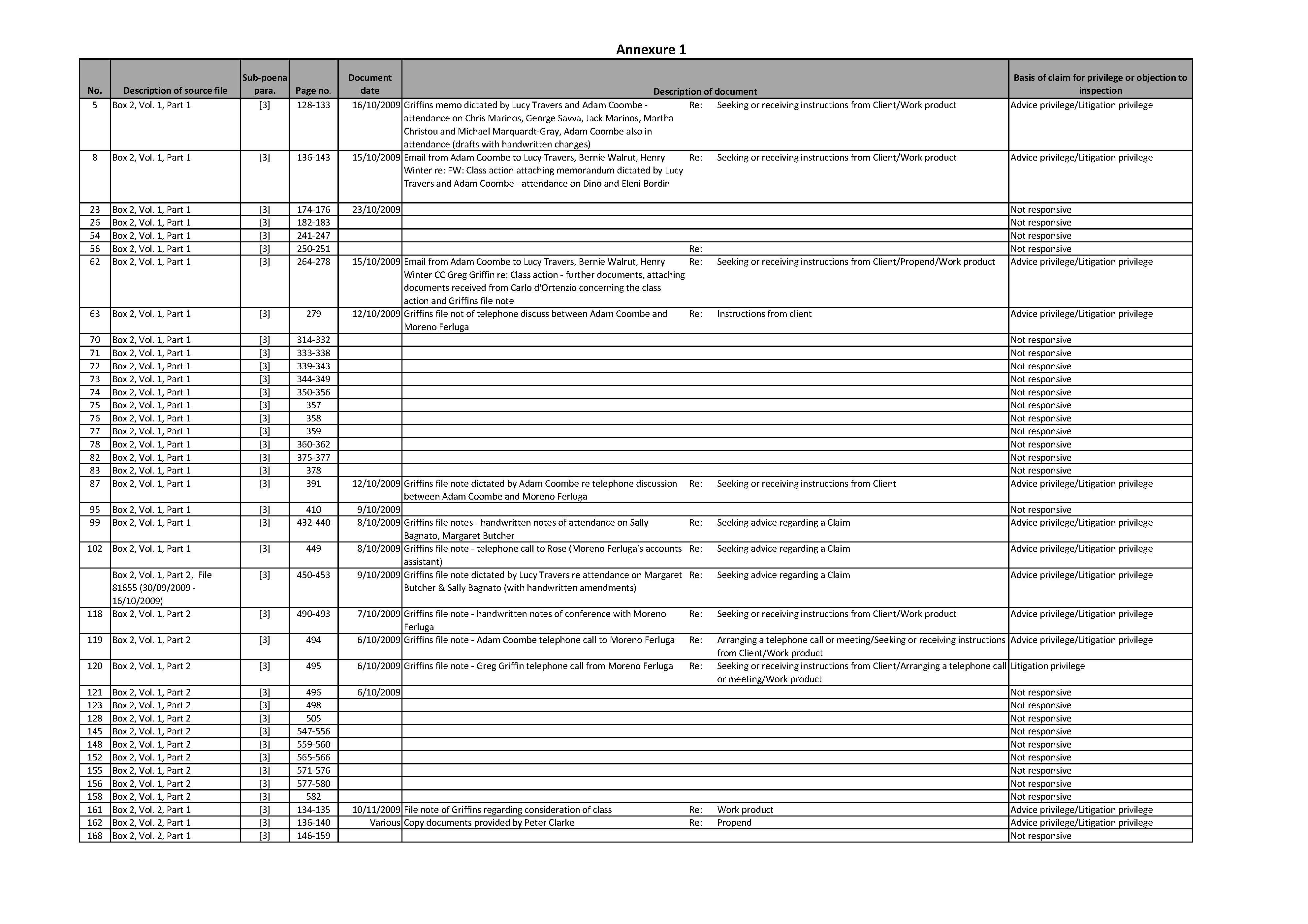
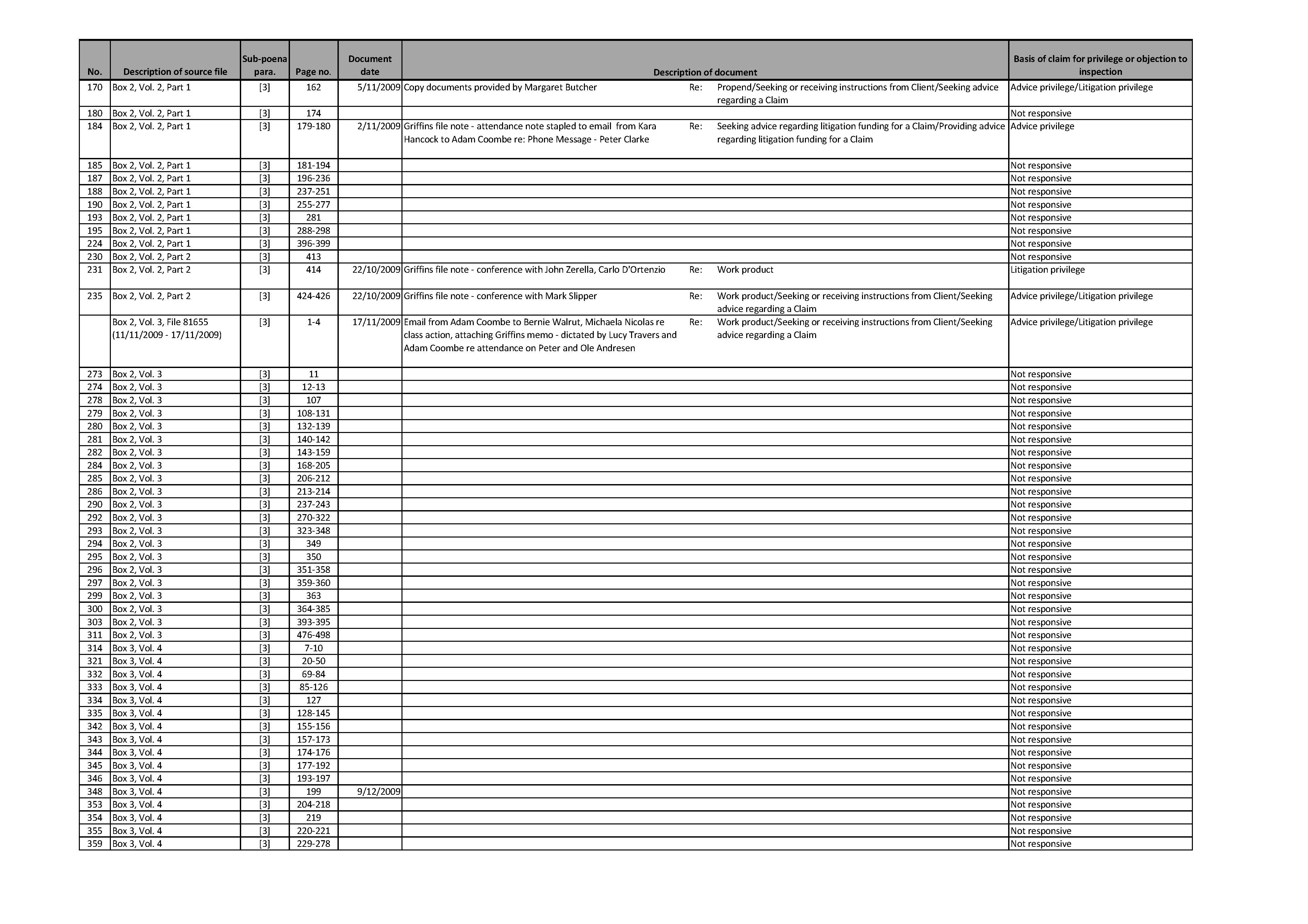
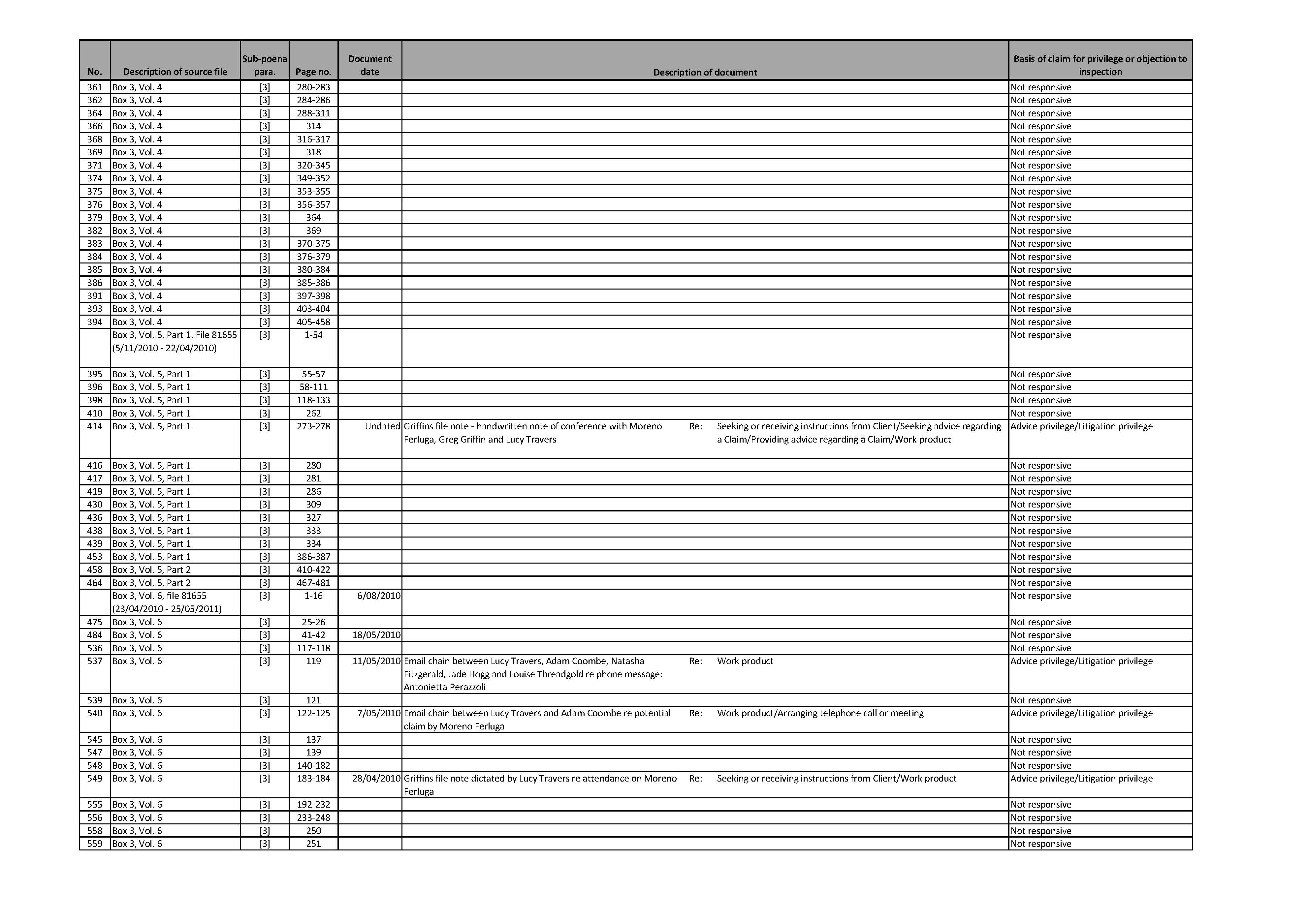
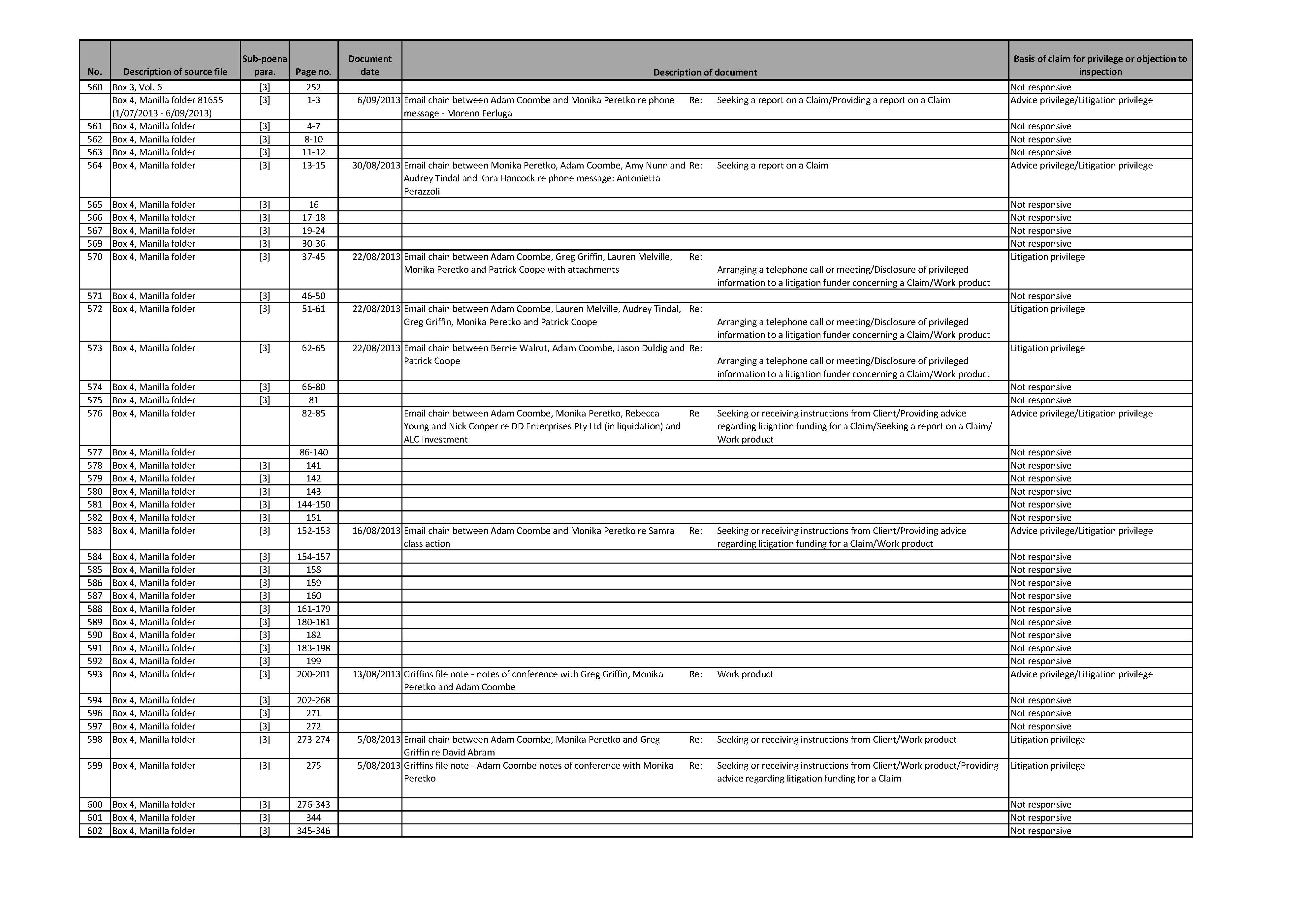
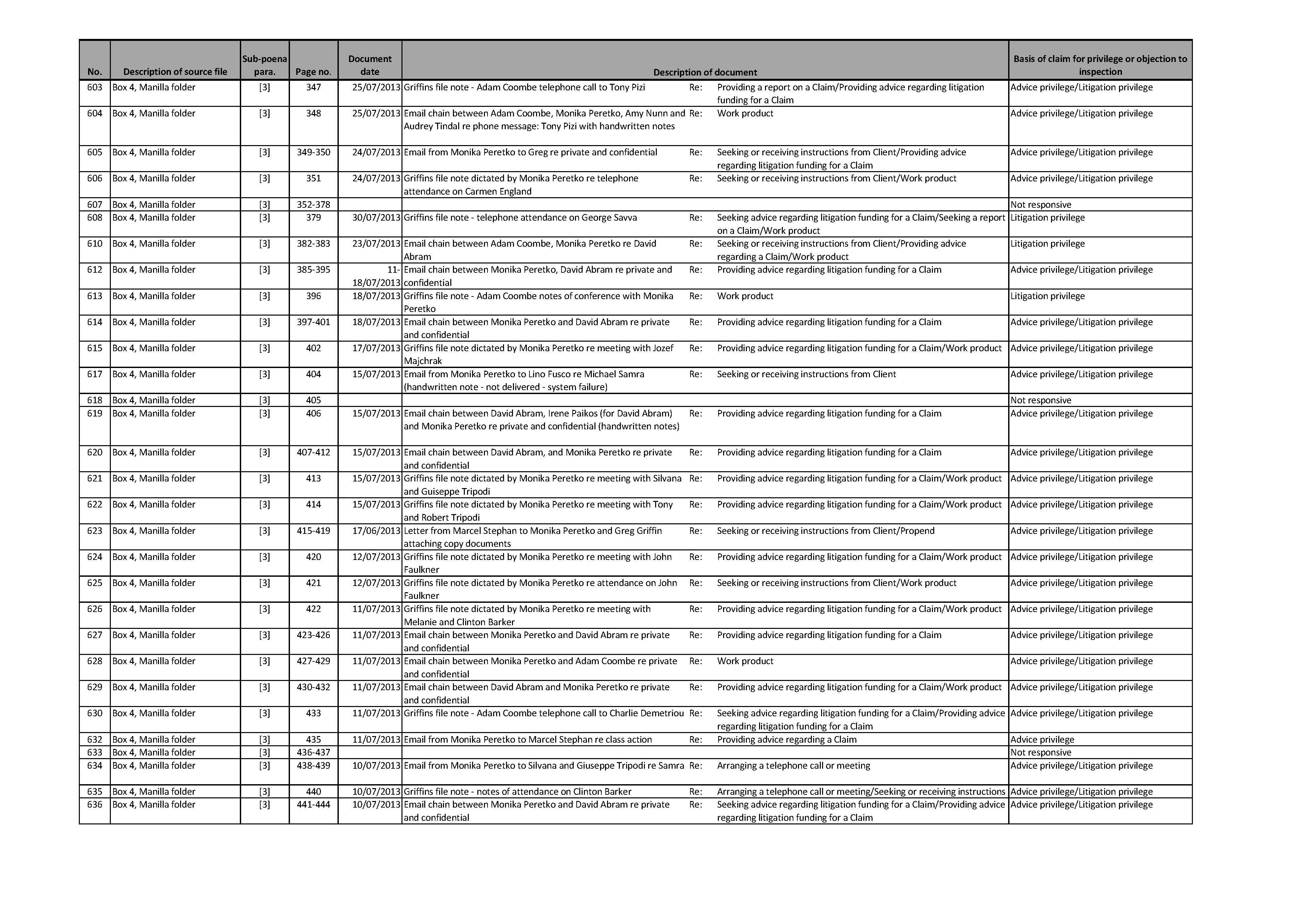
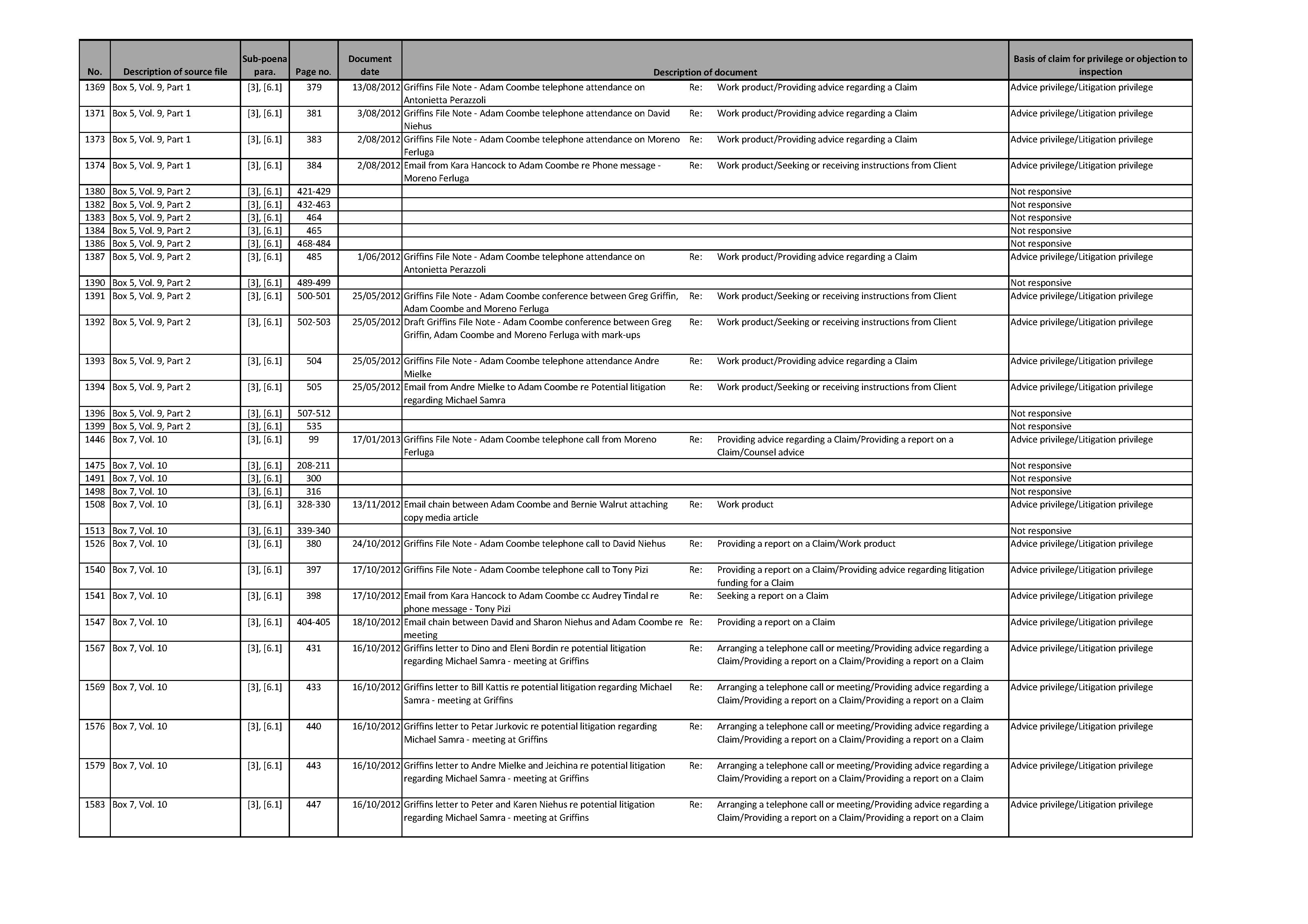
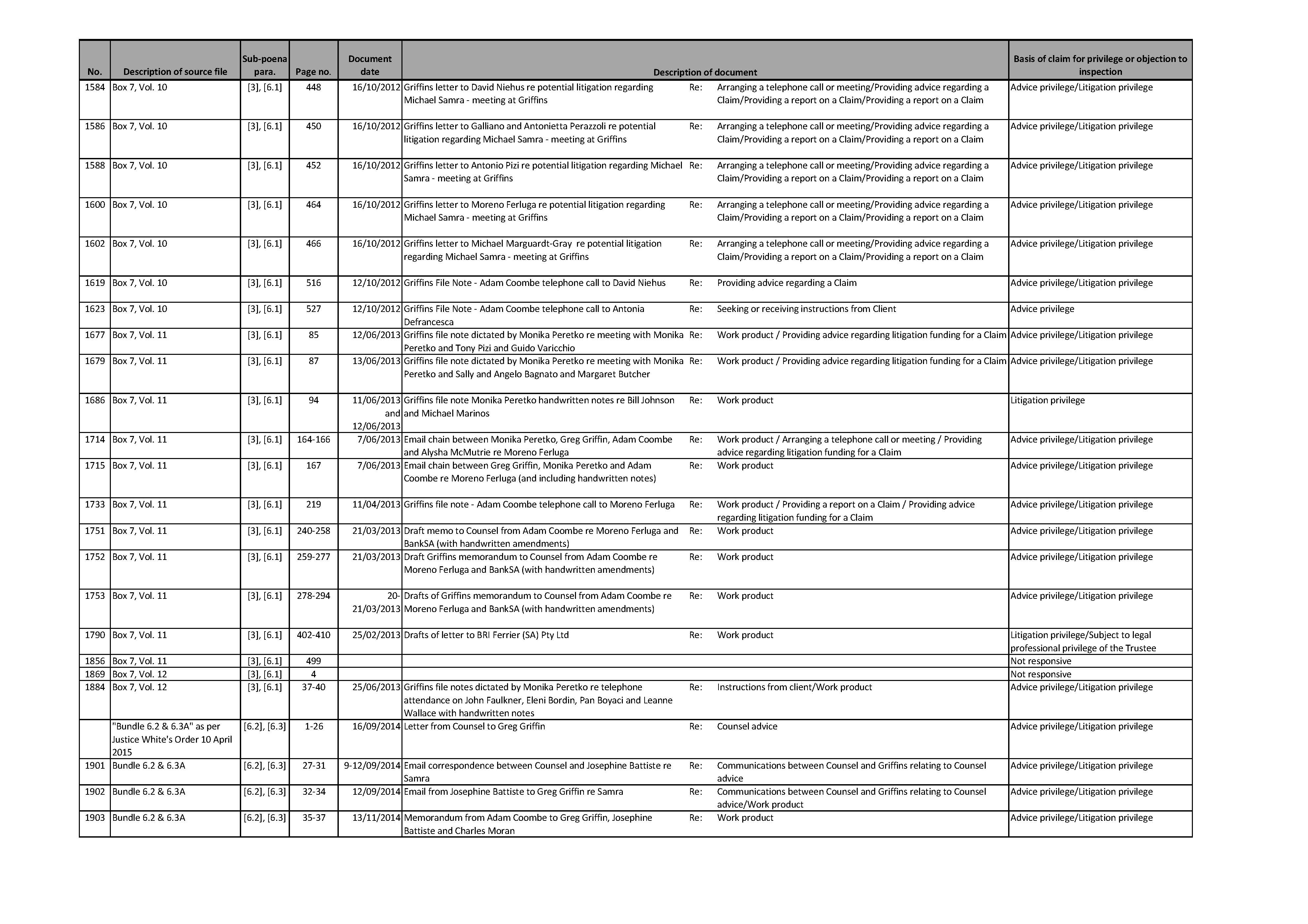
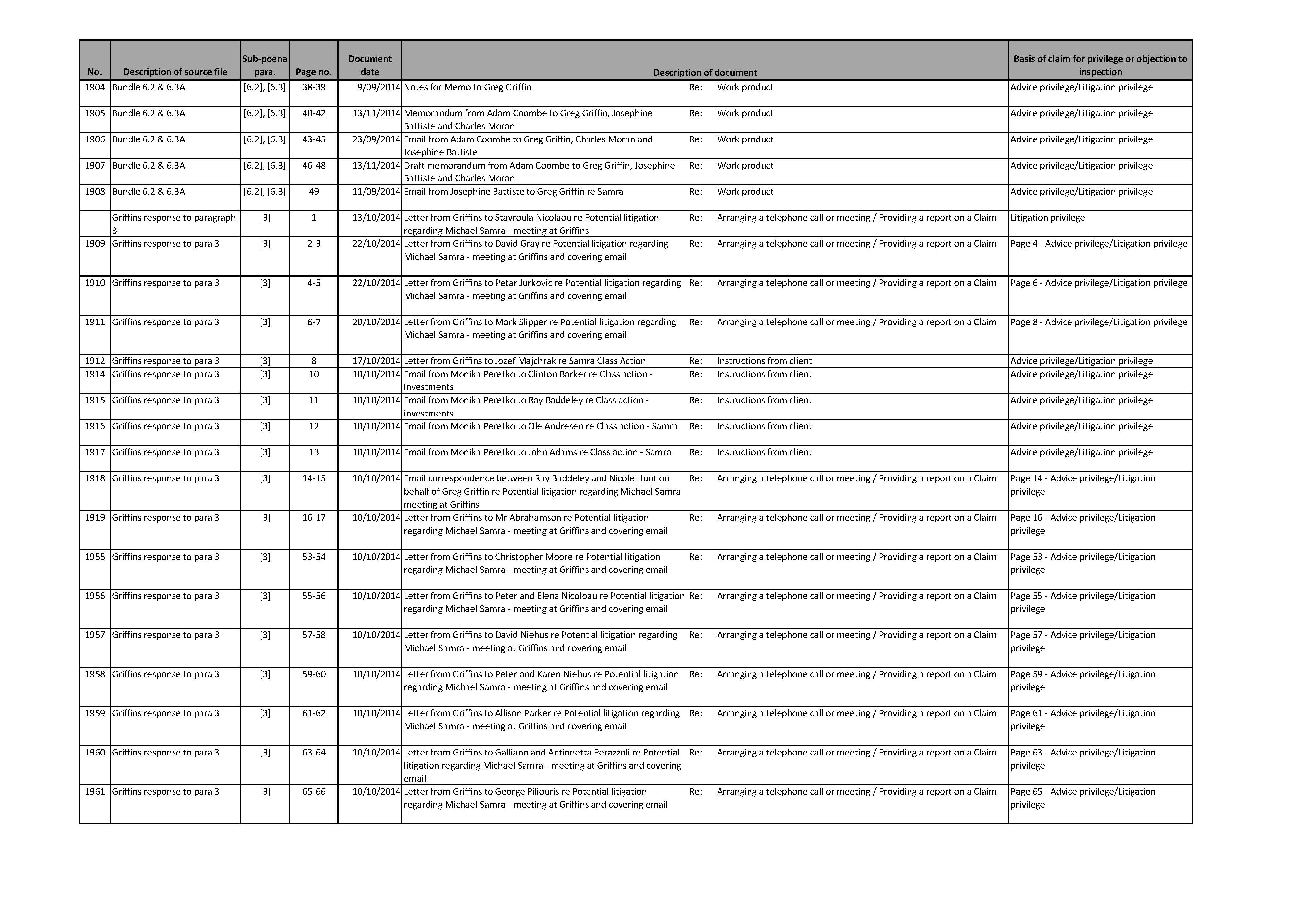
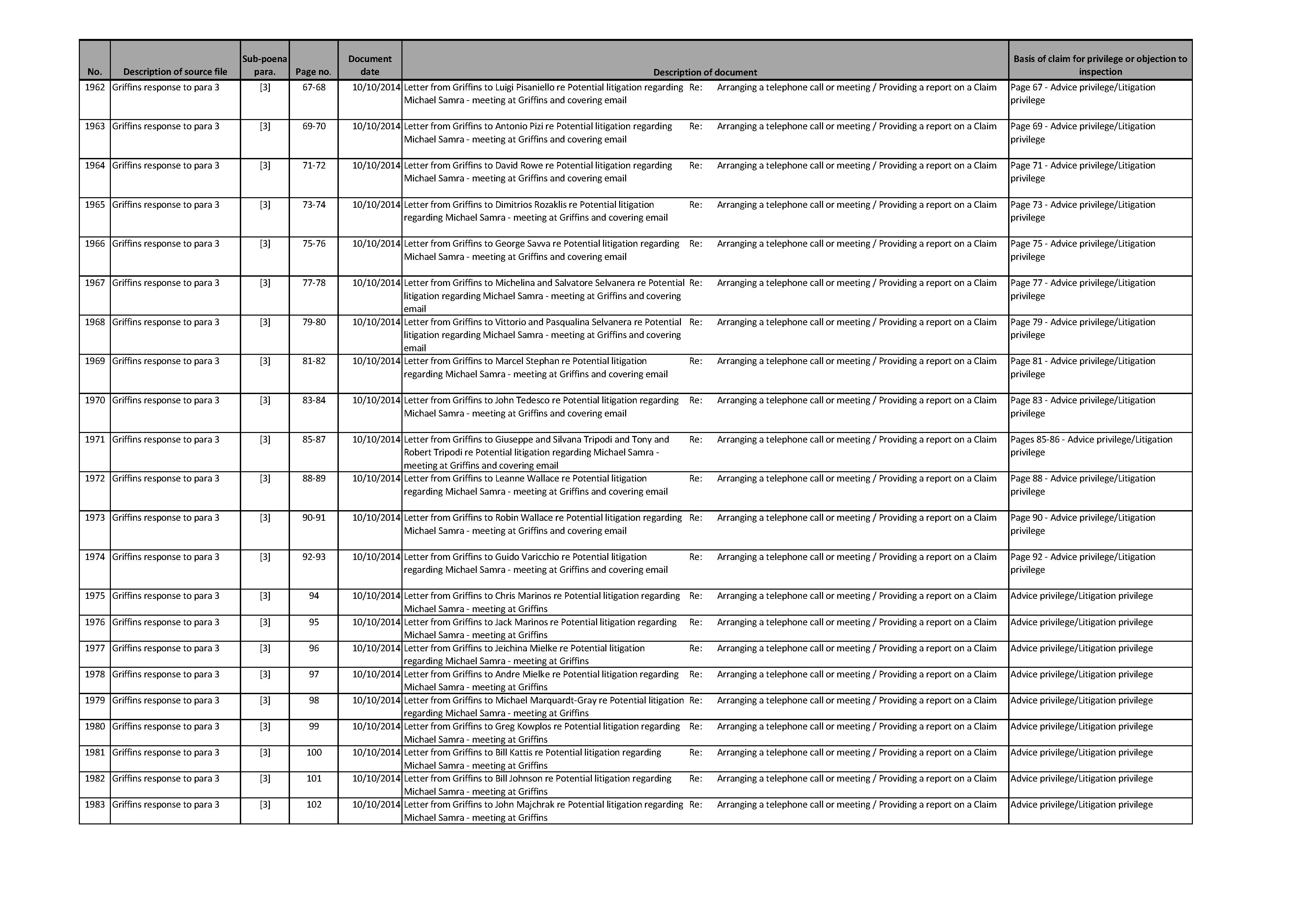
1.2 all documents identified in exhibit AV.1 to the affidavit of Antonietta Vozzo sworn on 21 April 2015 except for those documents identified in Annexure 1 to this Order; and
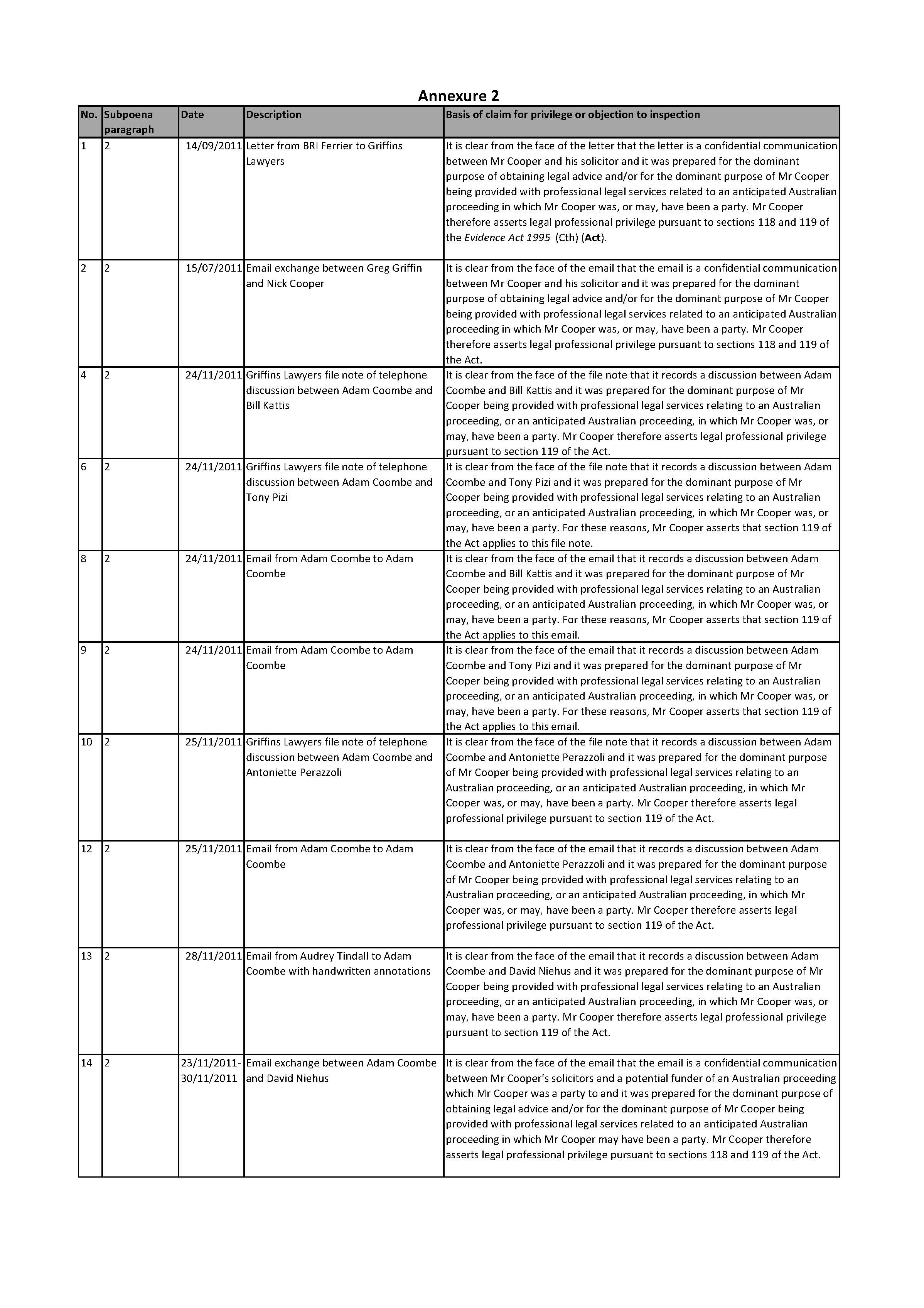
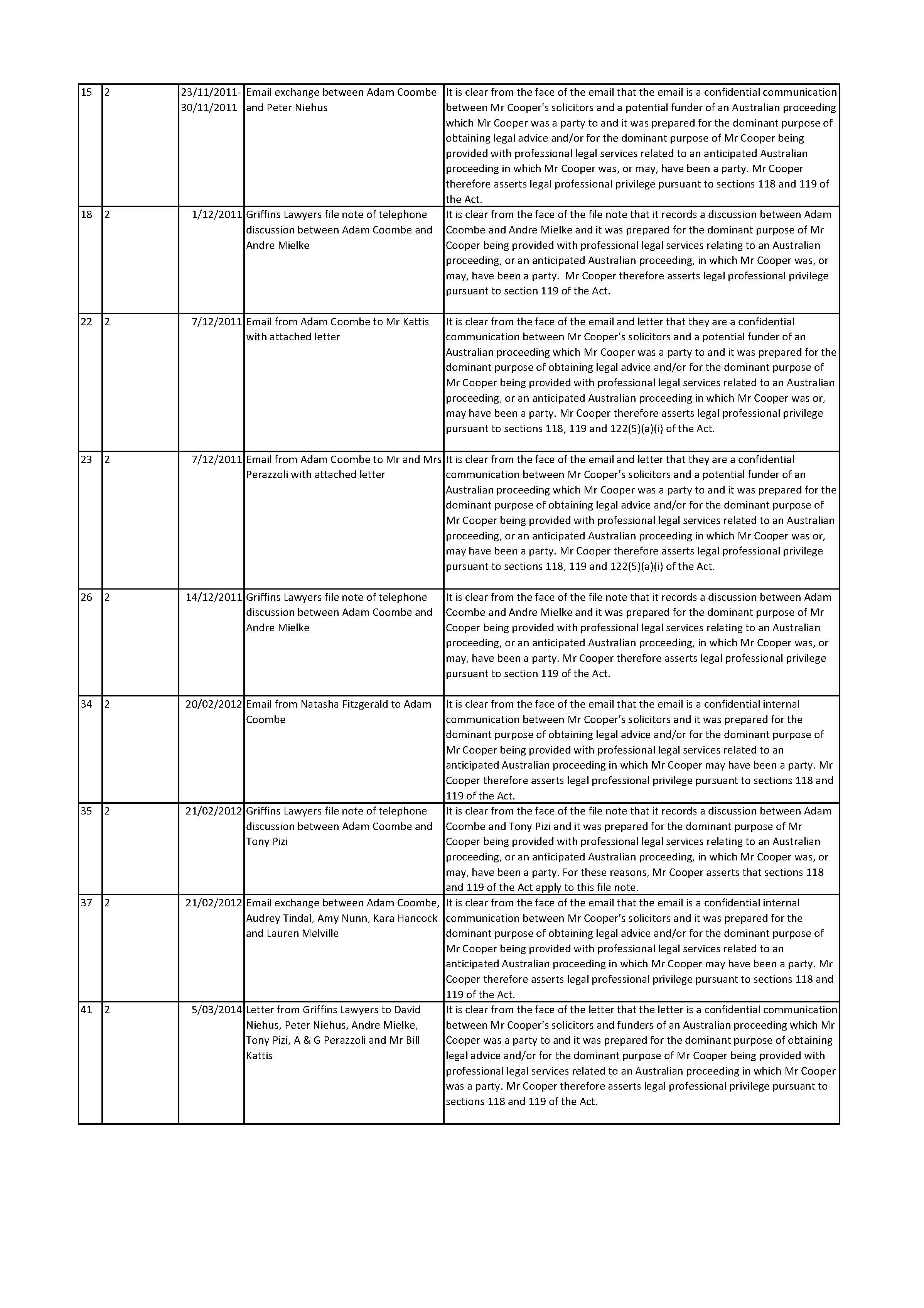
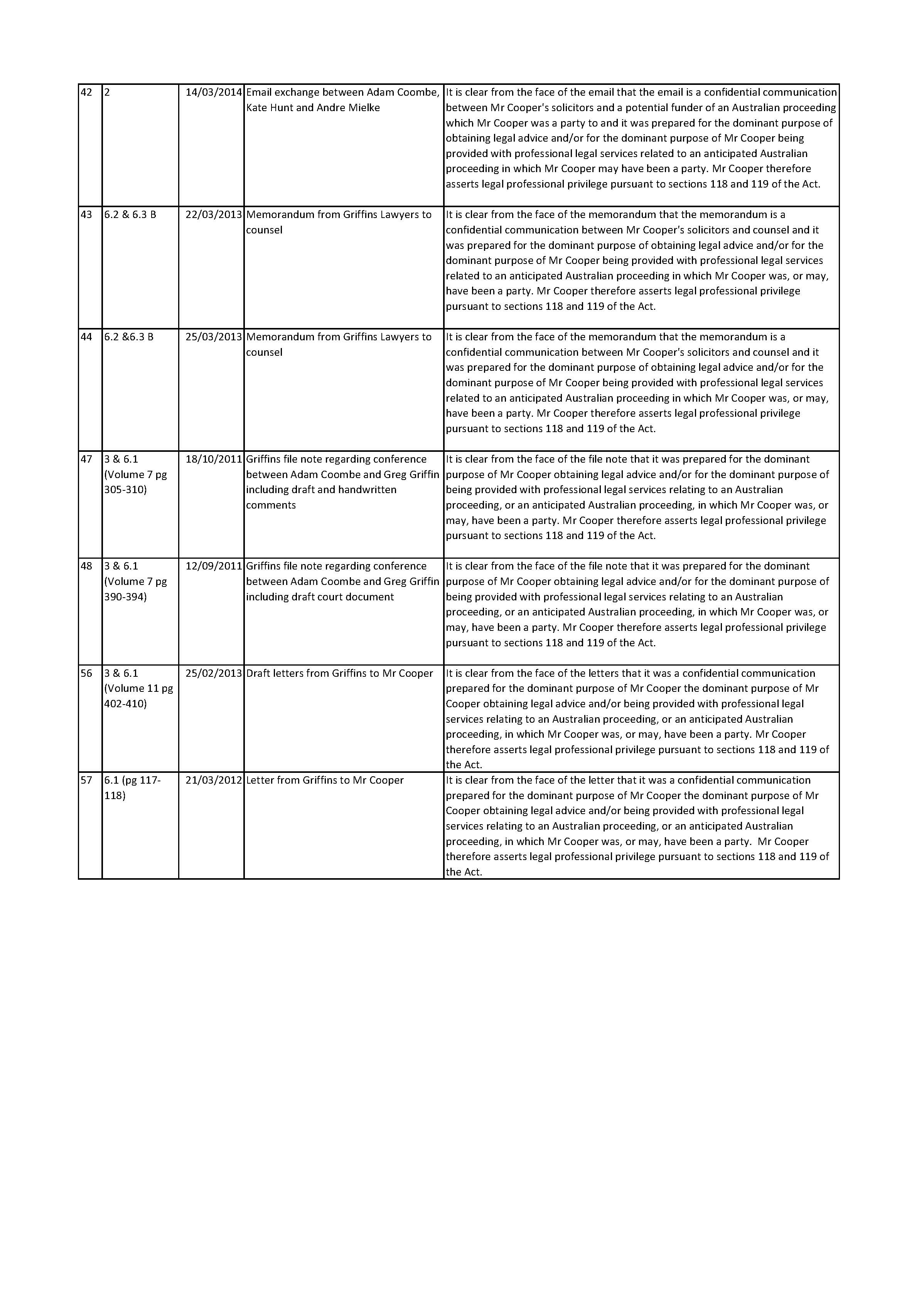
1.3 all documents identified in Exhibit TWB.1 to the affidavit of Thomas William Burke sworn on 21 April 2015 except for those documents identified in Annexure 2 to this order.
2. The application of the applicants for leave to appeal from the orders made in Order 1 be refused.
3. Leave to the first respondent to provide to the Court by 10 June 2016, and to serve on the applicants such affidavit or other material as may properly inform the Court on the maintenance of its proposed cross-appeal, including the extent to which that cross-appeal (if pursued and successful) may materially advance the resolution of their interlocutory application to summarily dismiss the proceeding.
4. Leave to the applicants to provide to the Court by 15 June 2016 and to serve material in response.
5. The applicants pay the first respondent 60% of its costs of the Privilege Argument to be taxed.
6. The first respondent pay to the non-party, Nicholas David Cooper, 30% of his costs of and incidental to the Privilege Argument to be taxed.
Note: In these orders “Privilege Argument” means the costs of and incidental to the hearing and determination of the claims to privilege between the parties addressed in the reasons for judgment and incurred on and after 30 April 2015.
Note: Entry of orders is dealt with in Rule 39.32 of the Federal Court Rules 2011.
MANSFIELD J:
INTRODUCTION
1 Reasons for judgment (the Reasons) were given in this matter on 16 March 2016. The first respondent was to submit its proposed minutes of order to give effect to the Reasons.
2 As the preparation of the proposed minutes of order was apparently more complex than had been anticipated, the Court called the matter on for further directions on 13 May 2016. On that occasion, a period of seven days was fixed to submit the proposed minutes of order, and a timetable for submissions as to costs was also fixed.
3 Proposed minutes of order have now been submitted. To understand their significance, and how they relate to the Reasons, it is necessary to refer back to the Reasons.
4 The applicants have brought this proceeding as a class action against the respondents, but relevantly BankSA, for damages arising from their (and other investors) losses in an investment scheme operated by the third and/or fourth respondents, through Mr Samra. Mr Samra was declared bankrupt, and in the course of the administration of his bankrupt estate, BankSA was required to produce extensive documentation to the Trustee of his estate and two of its officers were examined by the Trustee. The solicitors acting for the Trustee were, at least over part of the period of so acting, also giving intermittent legal advice on specific topics to certain of the applicants, and were also exploring the prospect of securing litigation funding for the purpose of considering whether to bring a class action on behalf of the investors against BankSA for their losses. The litigation funding was duly secured, and the potential claim investigated. Ultimately, this proceeding was commenced. The same solicitors were acting for the applicants and the investors group. They ceased to do so after the present issues arose.
5 BankSA applied promptly to summarily dismiss the proceeding by application dated 24 December 2014 (the SD Application). It issued subpoenas to the Trustee, Mr Samra, the solicitors, and the litigation funder to produce documents relating to the summary dismissal application.
6 The Trustee answered the subpoena, but claimed legal professional privilege with respect to certain of the documents produced. The applicants, the solicitors and the litigation funder applied to set aside the subpoenas, but the subpoenas to the solicitors and the litigation funder were largely required to be answered. At about that point, new solicitors were appointed to act for the applicants.
7 The subpoenas when answered very extensively claimed legal professional privilege over the documents produced, that is the privilege of the applicants in those documents.
8 That is the dispute which is the subject of the Reasons. The solicitors for the applicants provided an affidavit of a solicitor of 21 April 2015 explaining the grounds upon which privilege was claimed by reference to categories of documents: affidavit of Antonietta Vozzo, Exhibit AV.1. BankSA by Notice of Grounds of Objection with eight Annexures (the Notice) responded to that affidavit. The categories of documents in Annexures overlap to some extent, as the several grounds of opposition in the Notice apply variously to the documents over which privilege is claimed. The generic description of the documents in issue, as listed in the eight Annexures are set out in [12] and [13] of the Reasons.
9 I found that:
(1) the general claims to legal professional privilege of the documents in Annexure 1 were not made out, but that some of those documents might be privileged on more discrete grounds: Reasons at [84];
(2) the claim to litigation privilege for the documents in Annexure 2, up to 30 June 2013, were not made out: Reasons at [89];
(3) the claim by BankSA that all privilege had been lost in the documents in Annexure 3 by reason of the documents having been brought into existence as a colourable case of abuse of process was not accepted, so to the extent that those documents were otherwise privileged (under their listing in other Annexures) that privilege was not lost;
(4) the claims by BankSA that the evidence with respect to particular documents did not make out that they were brought into existence for the dominant purpose of giving or receiving legal advice were partly made out:
(i) the documents in Annexure 4.1 and referred to in Reasons at [153] are privileged, and the other documents in that Annexure are not;
(ii) the documents in Annexure 4.7 and referred to in the Reasons at [155] are privileged and the other documents in that Annexure are not;
(iii) the documents in Annexure 4.3 are not privileged: Reasons at [159];
(iv) the documents in Annexure 4.4 and referred to in Reasons at [161] are privileged;
(v) the documents in Annexure 4.5 and referred to in Reasons at [163] are privileged, and the other documents in that Annexure are not;
(5) the documents in Annexure 5 and referred to in Reasons at [164] are privileged, and the other documents in that Annexure are not;
(6) the documents in Annexure 6 and 8 and referred to in Reasons at [186] and [190] are privileged, and the other documents in those Annexures are not;
(7) the documents in Annexure 7 and referred to in Reasons at [190] are privileged and the other documents in that Annexure are not;
(8) the Trustee’s separate claim to privilege as addressed in Reasons at [192]-[198] are privileged.
10 I have set that out at some length in part so that the proposed order which the parties have submitted may more readily be comprehensible. The proposed orders, which I will make to reflect the Reasons, are:
1. The First Respondent has leave to uplift, inspect and copy the following documents, subject to the usual undertakings:
1.1 email of 15 July 2011 in the envelope marked NDC-2 referred to at paragraph 5 of the affidavit of Thomas William Burke sworn on 31 March 2015;
1.2 all documents identified in Exhibit AV.1 to the affidavit of Antonietta Vozzo sworn on 21 April 2015 except for those documents identified in Annexure 1 to this Order; and
1.3 all documents identified in Exhibit TWB.1 to the affidavit of Thomas William Burke sworn on 21 April 2015 except for those documents identified in Annexure 2 to this Order.
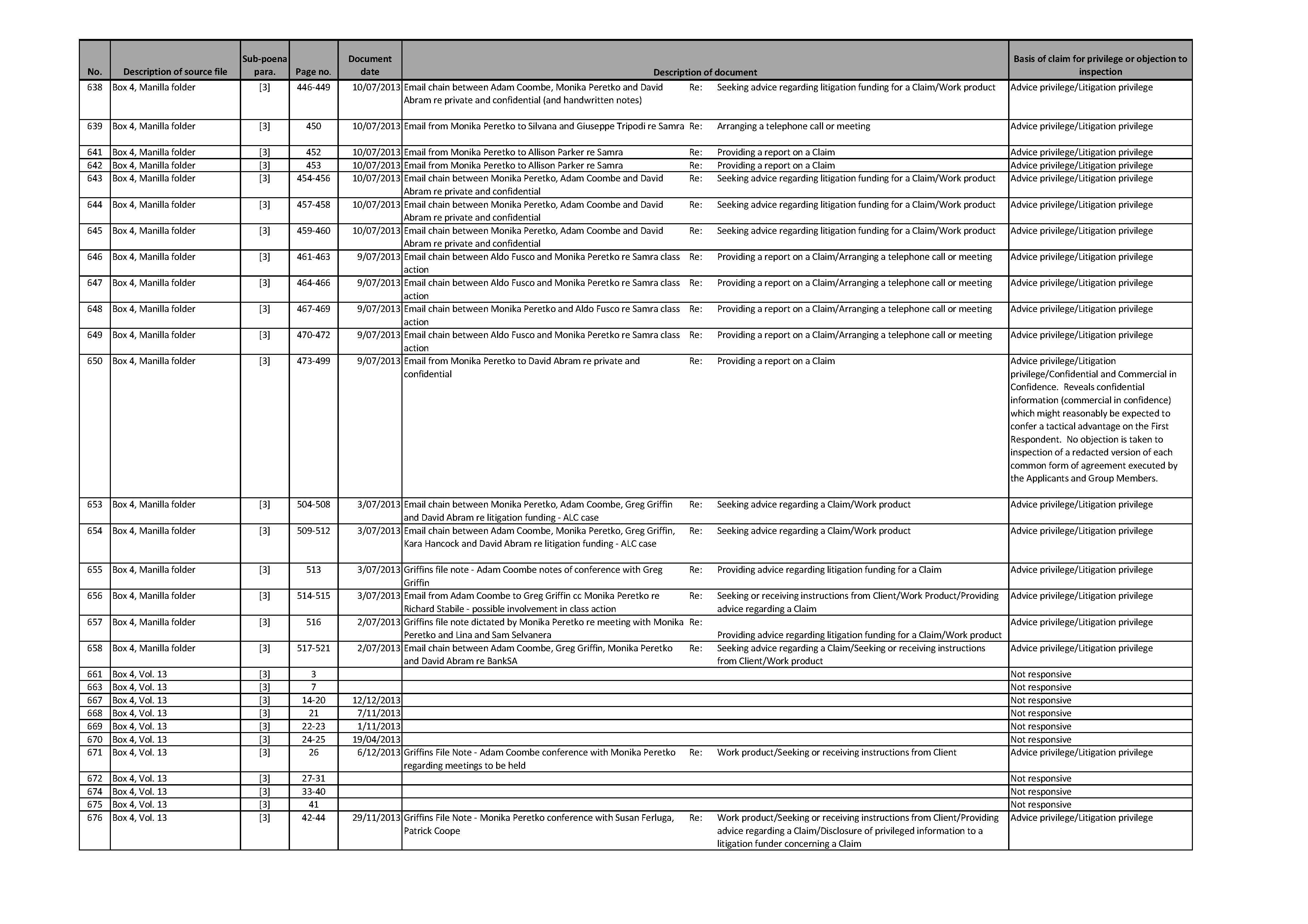
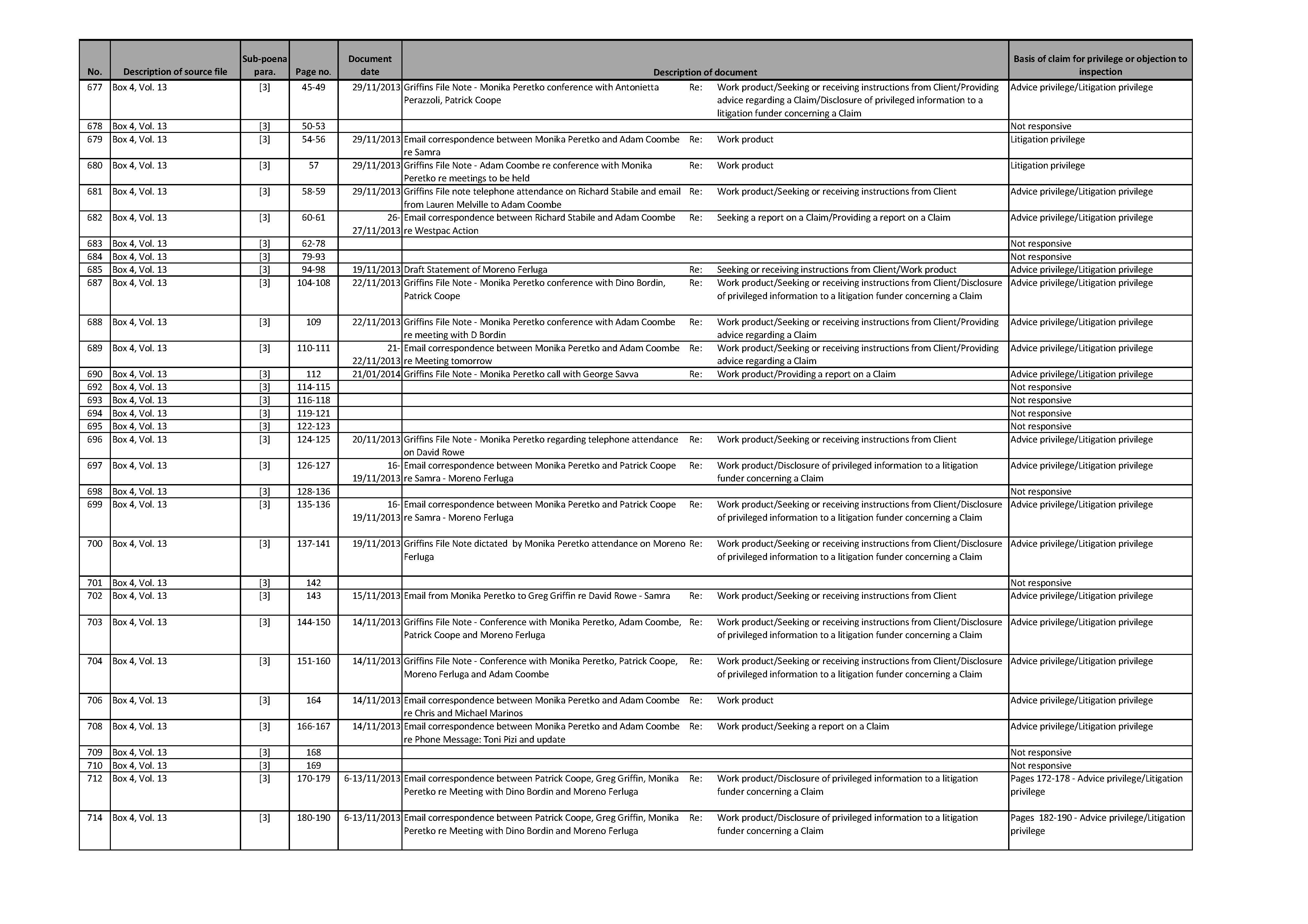
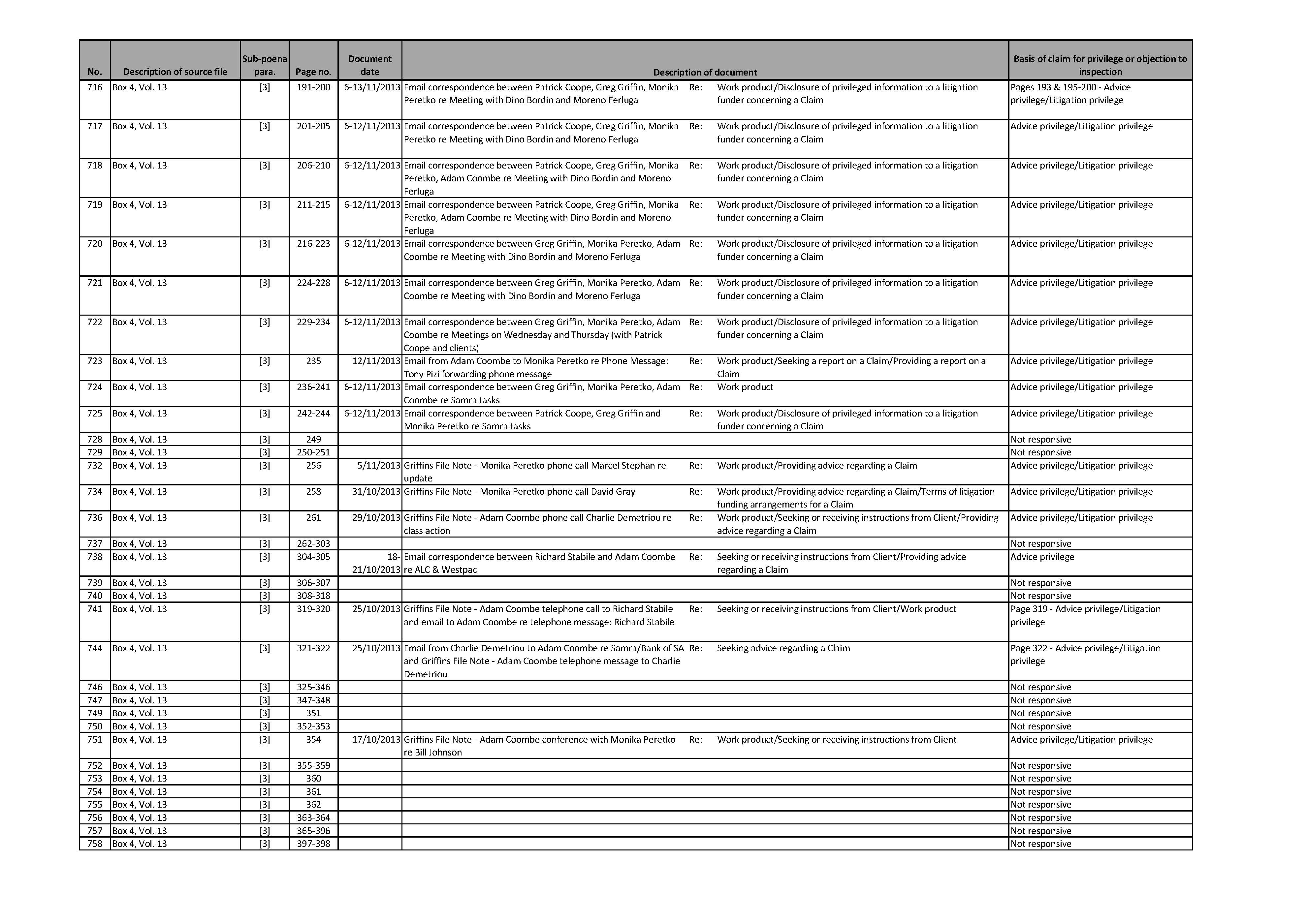
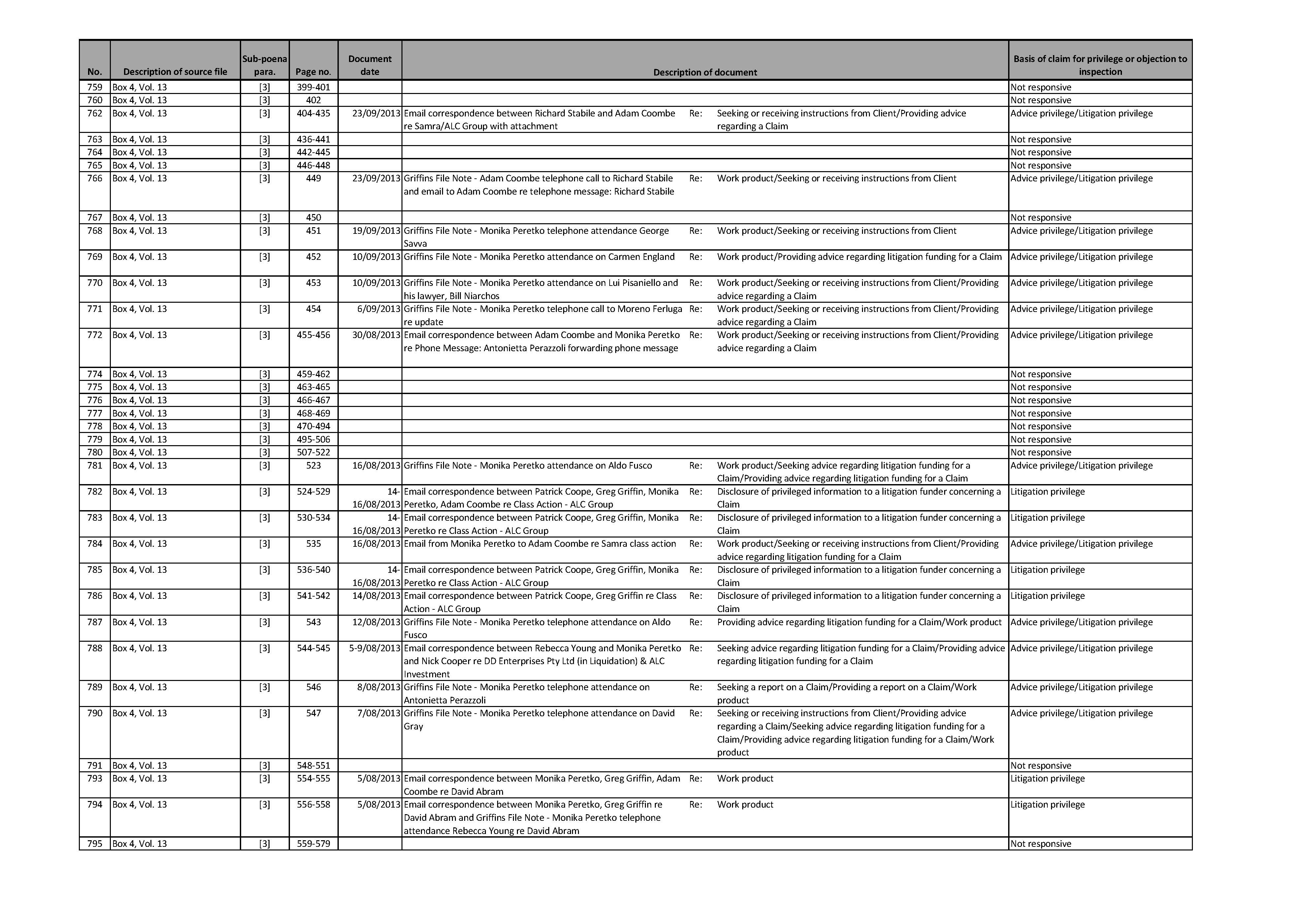
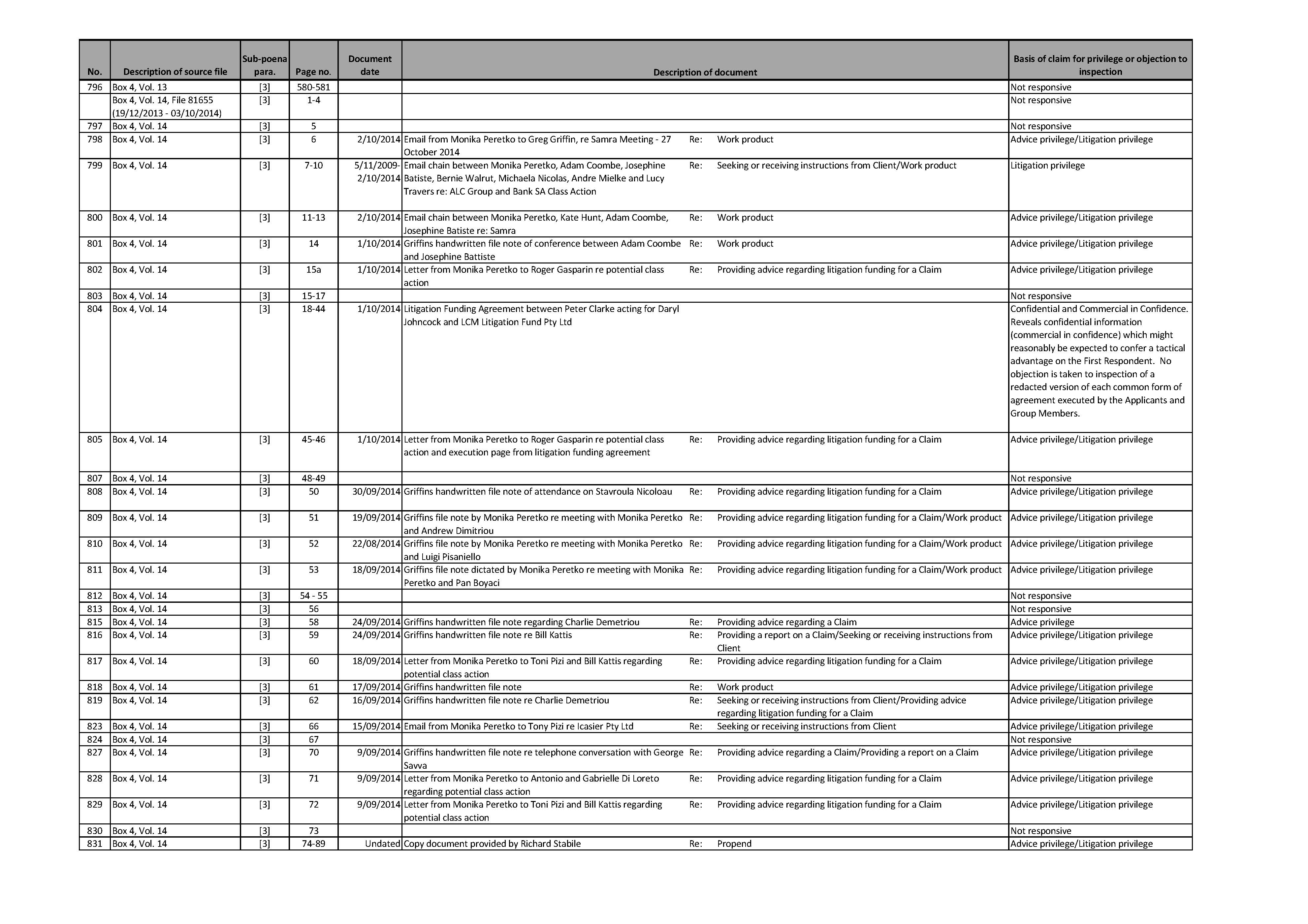
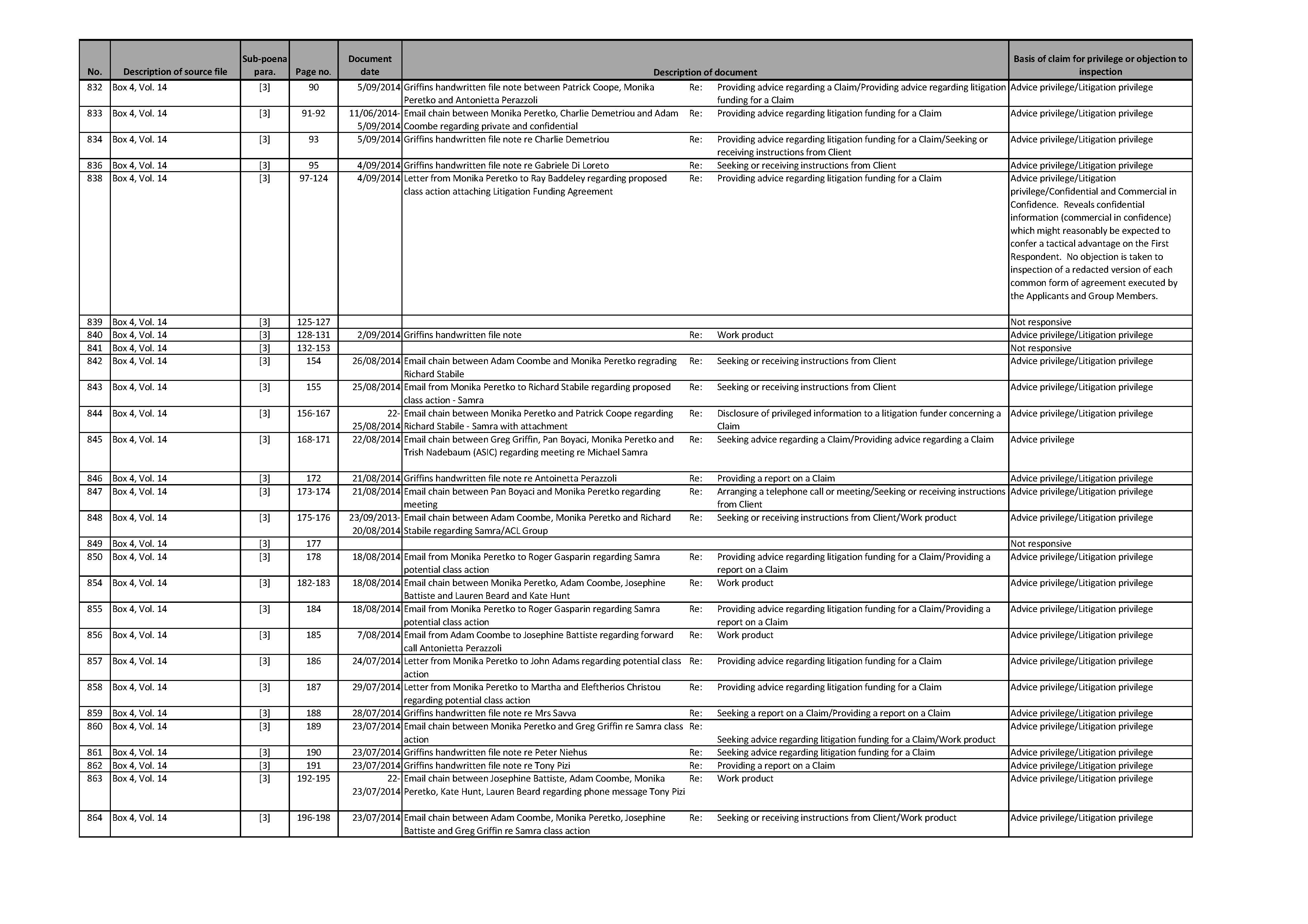
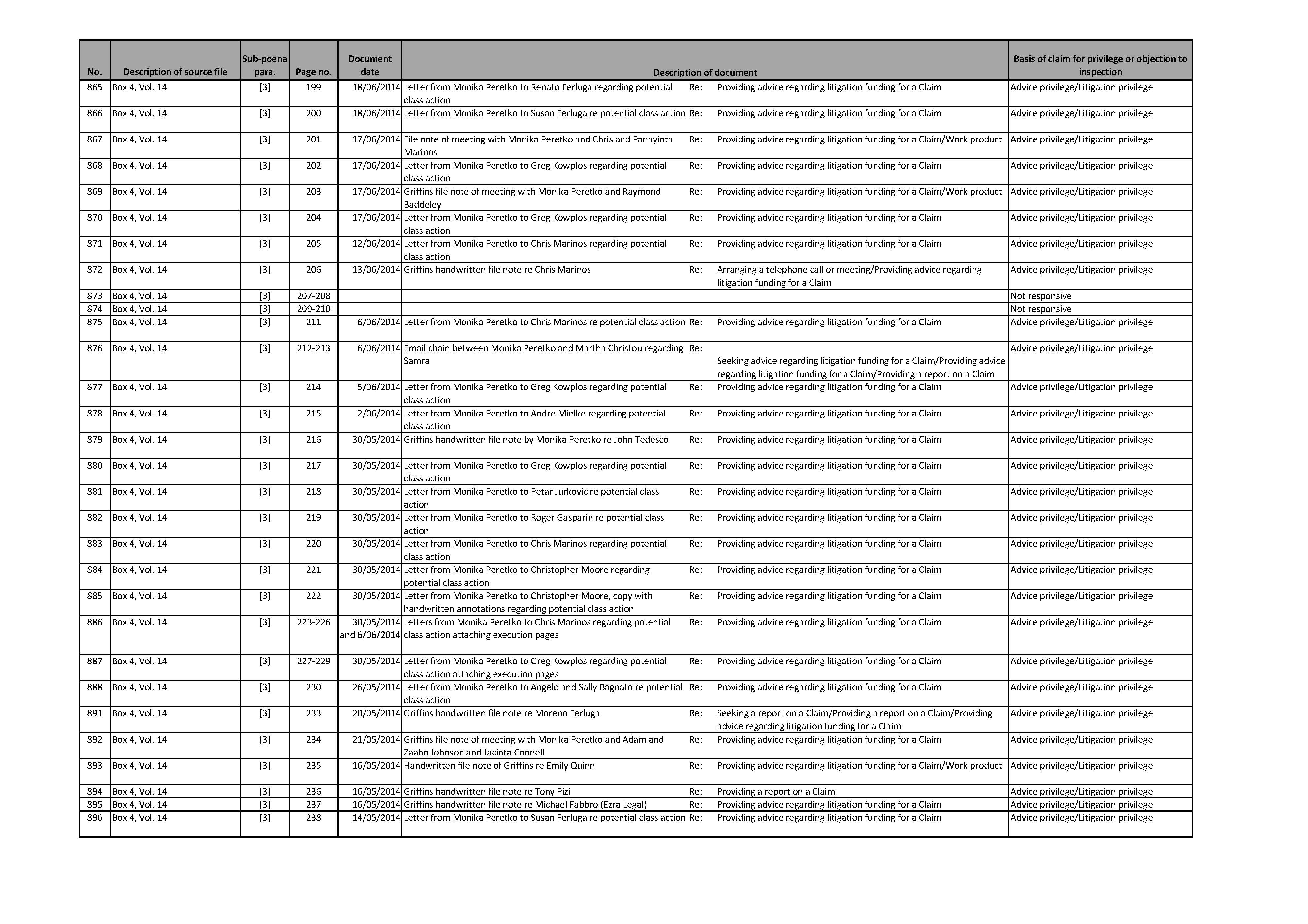
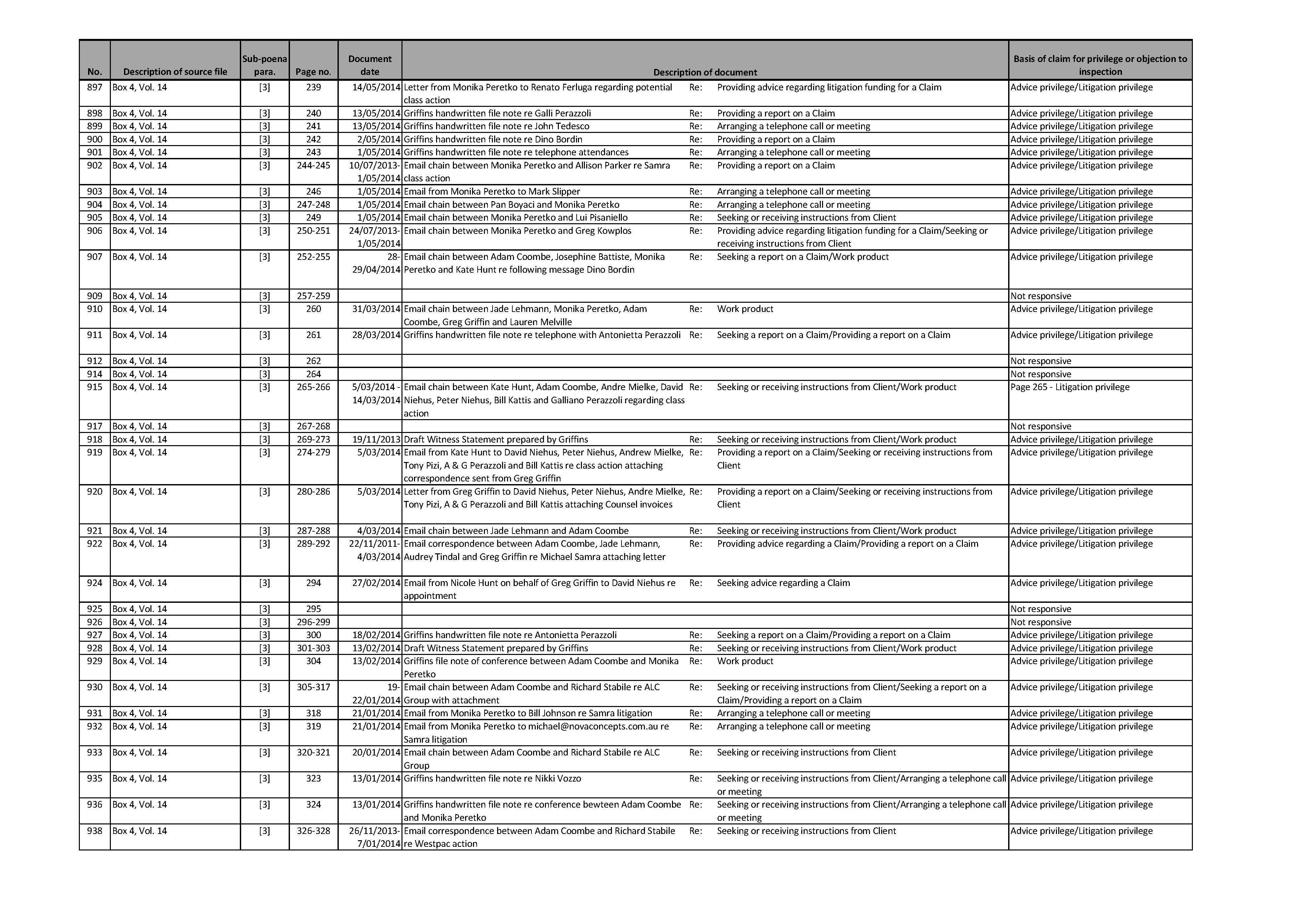
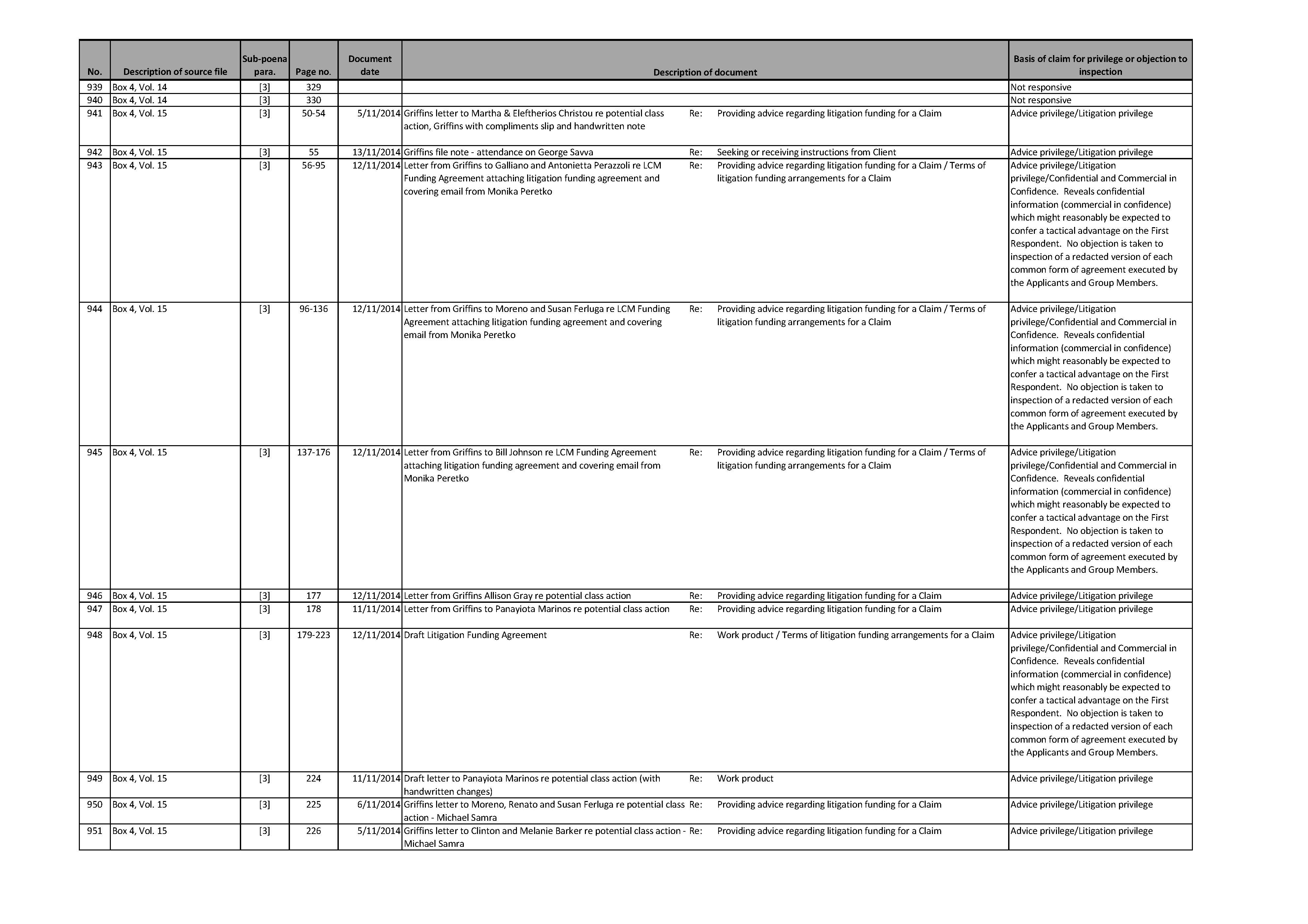
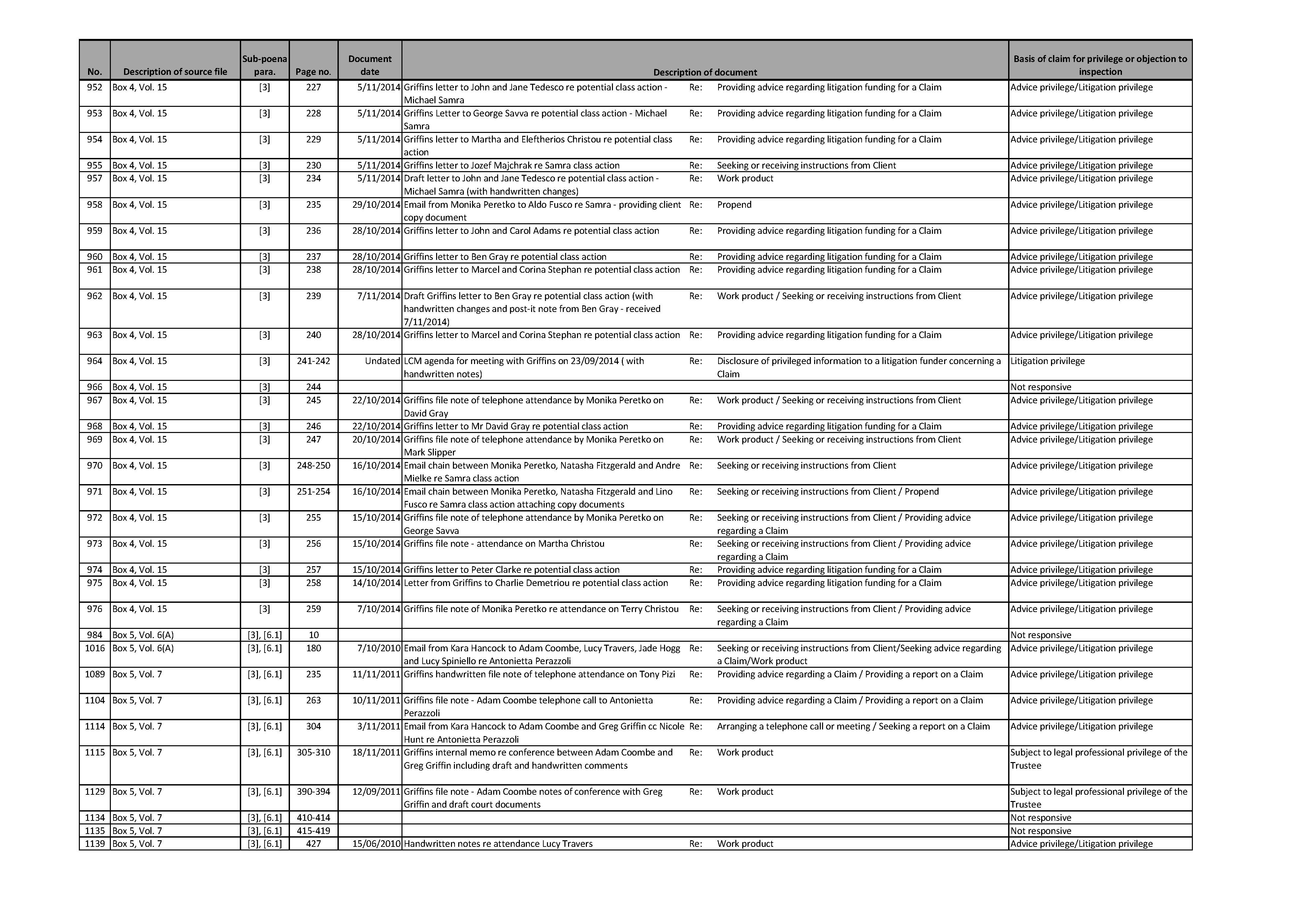
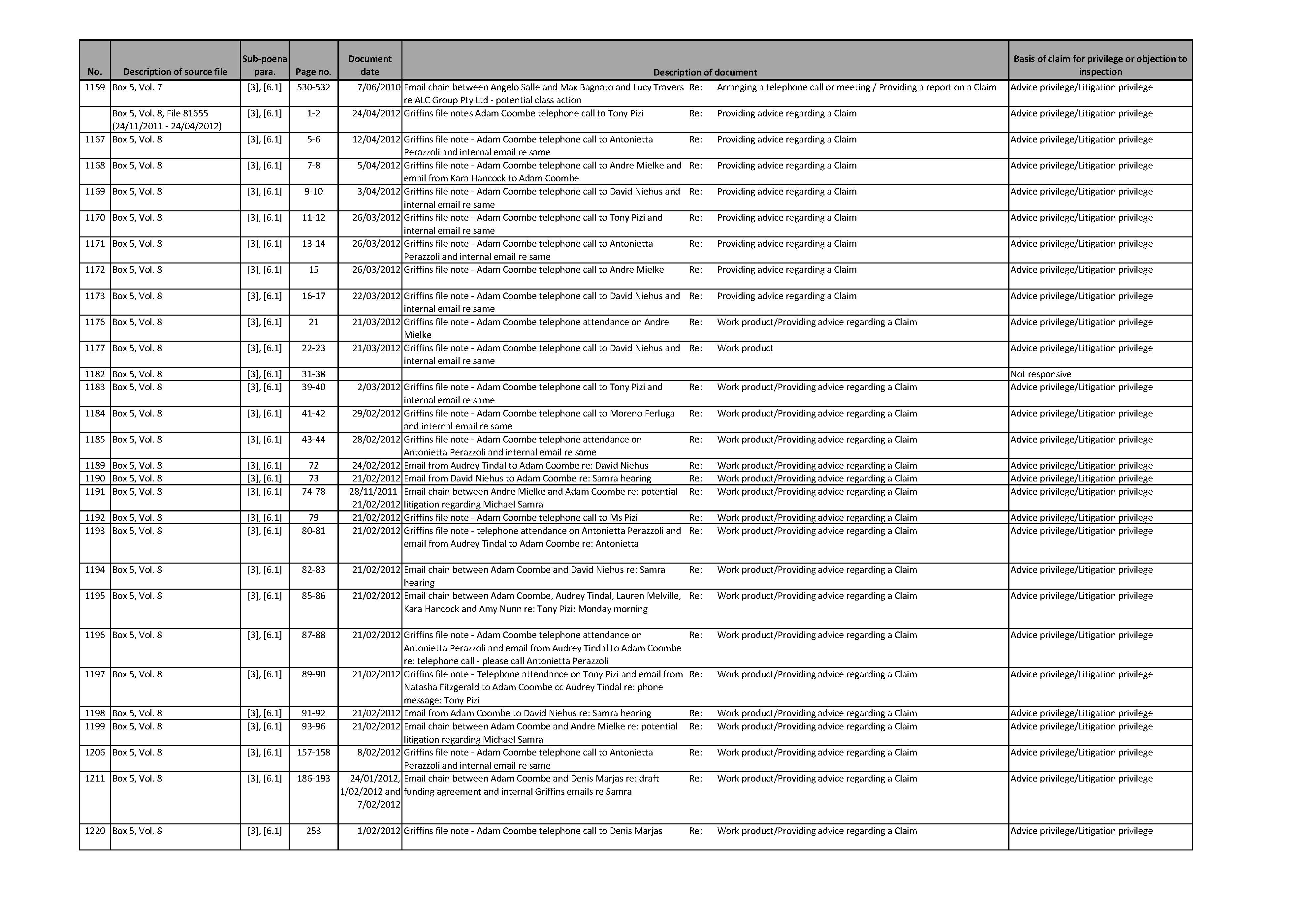
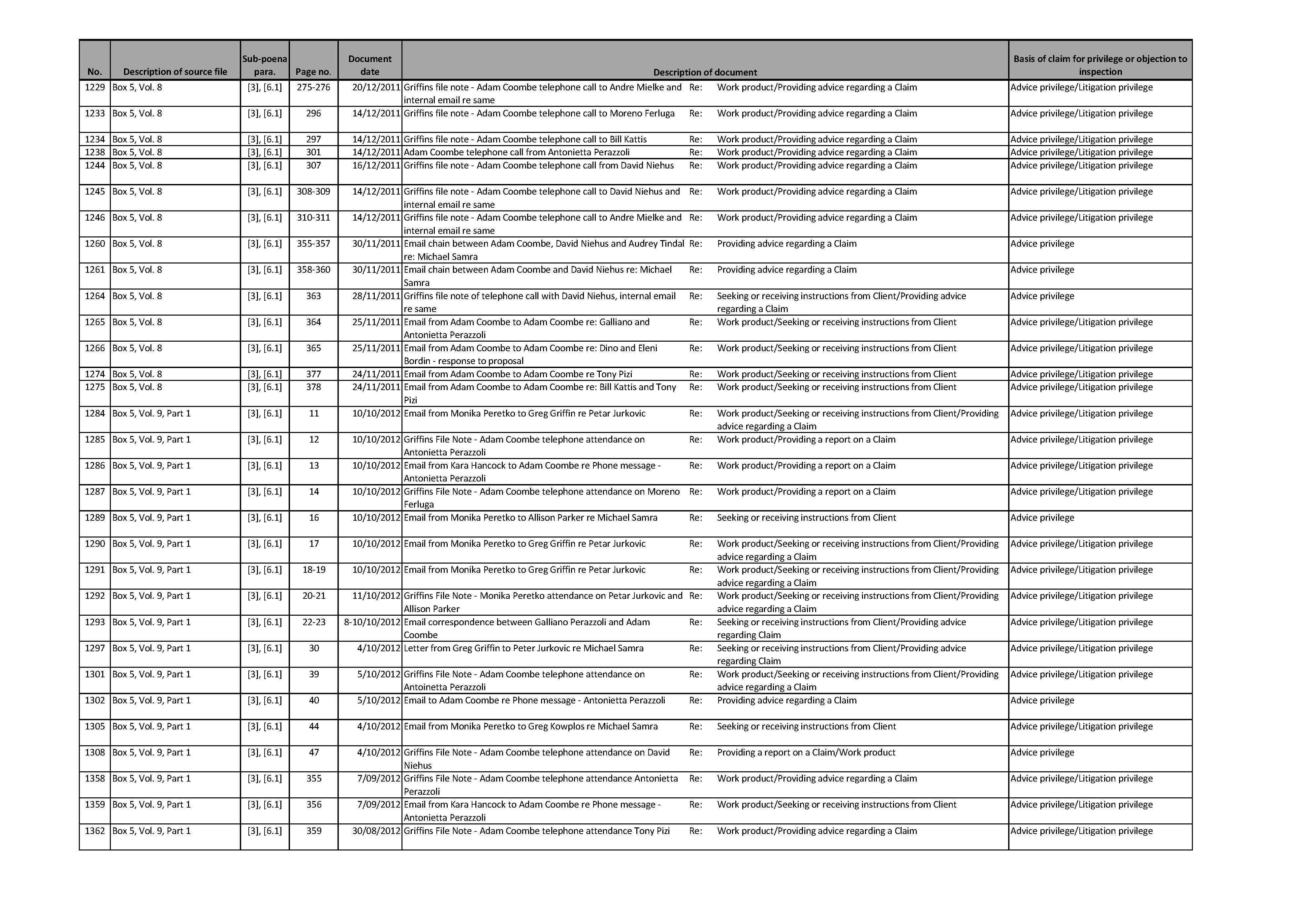
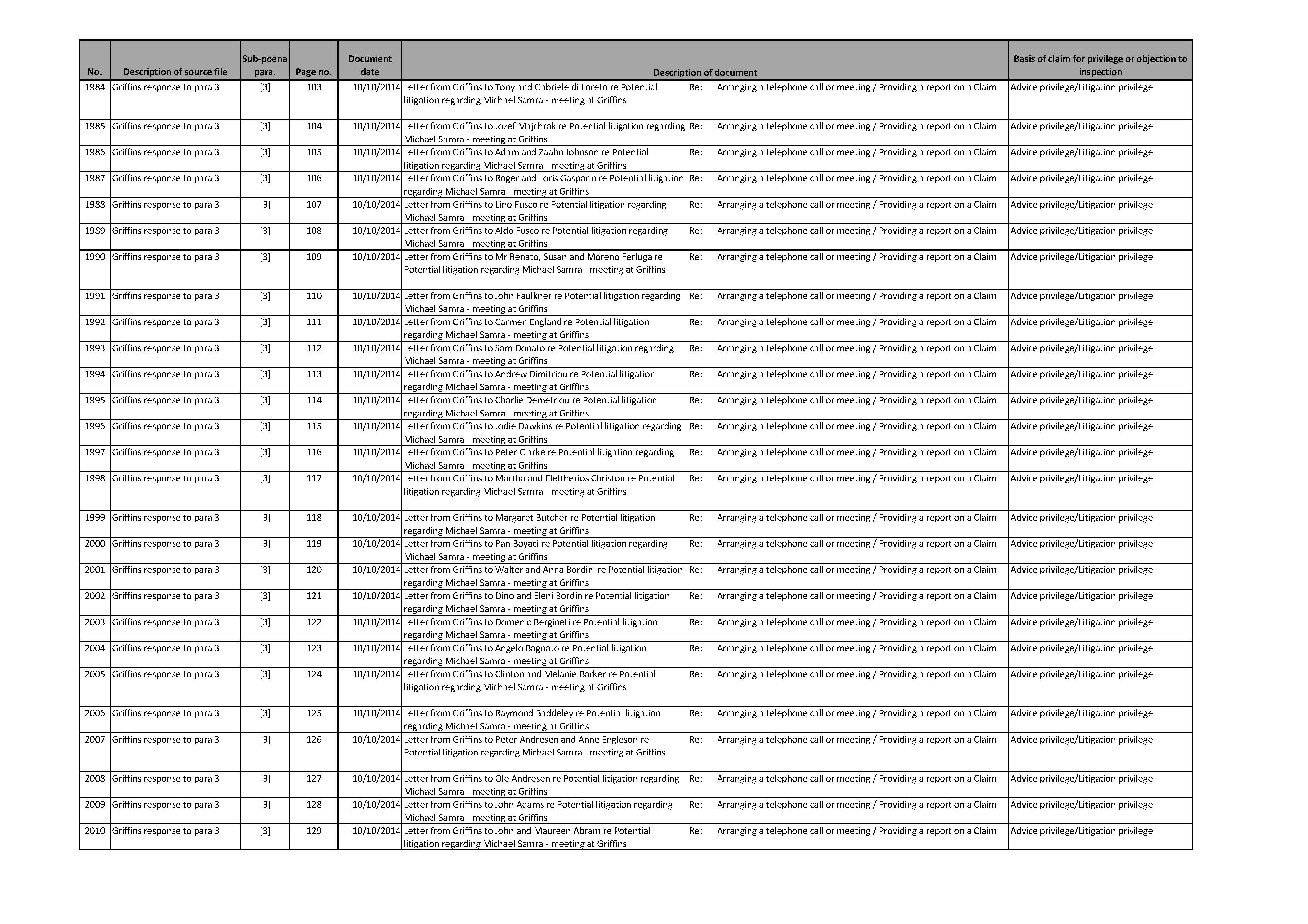
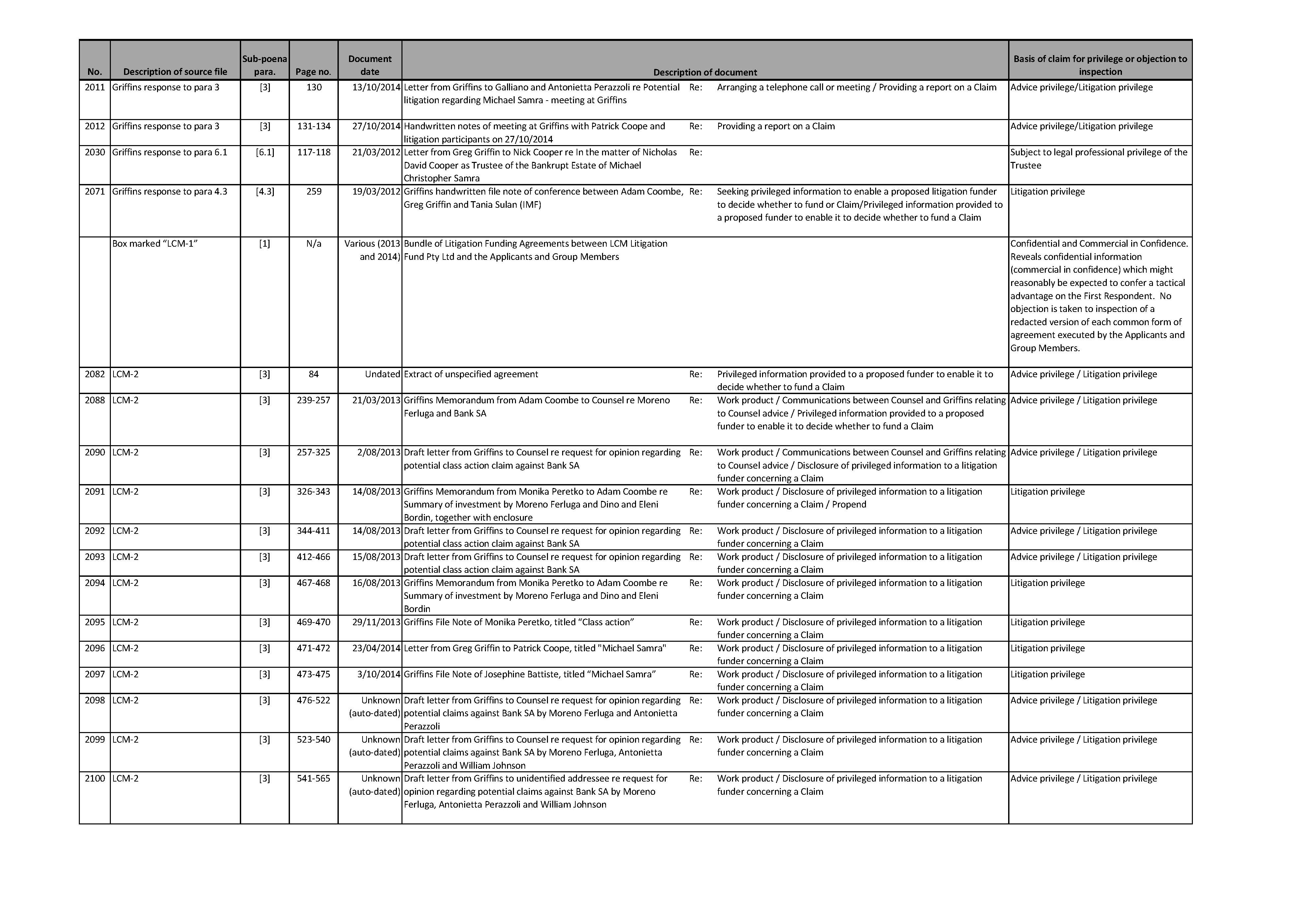
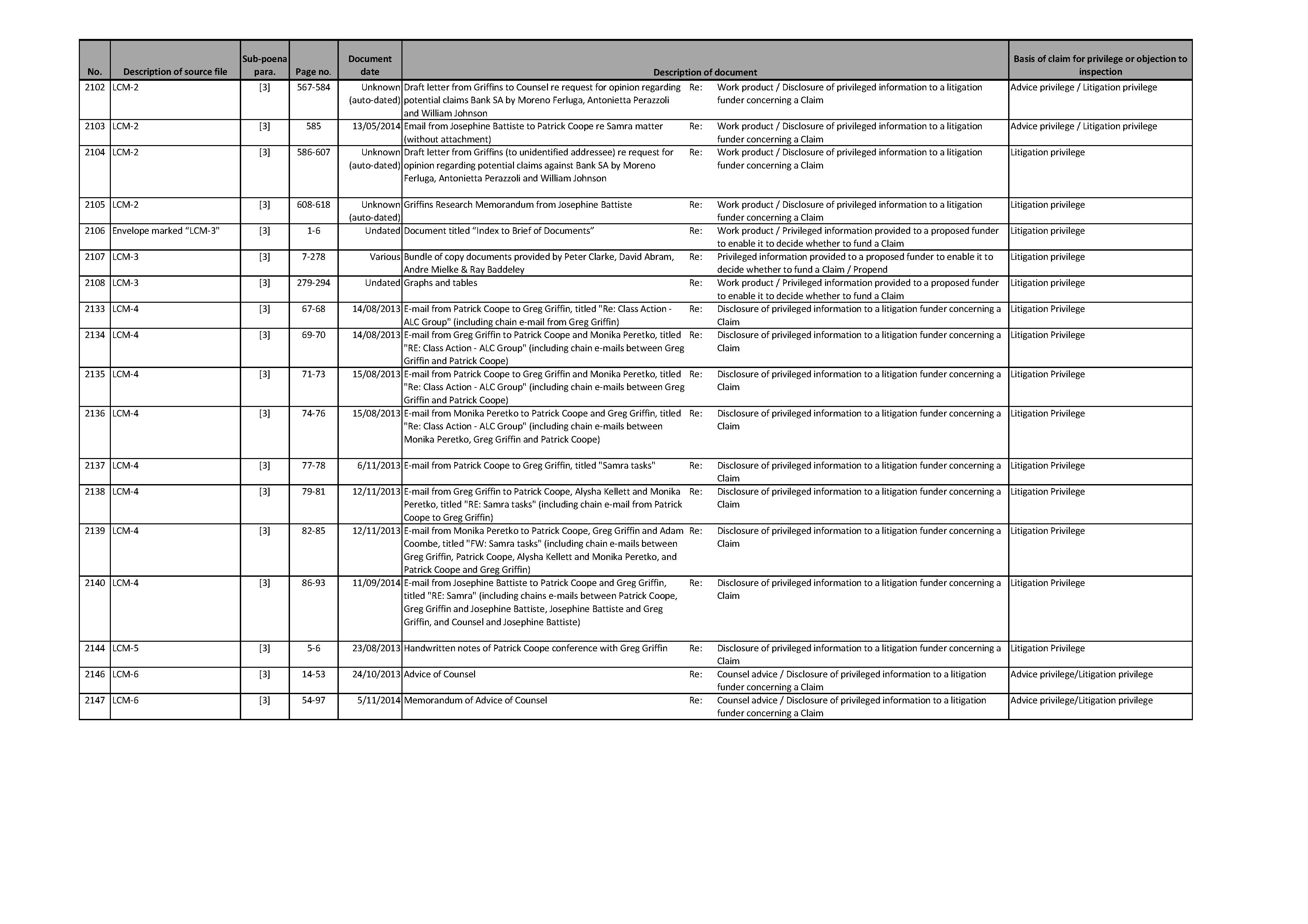
[Annexures 1 and 2 are not set out but will of course be part of the orders.]
11 I proceed on the basis that, putting aside the documents of the Trustee addressed in orders 1.1 and 1.3, order 1.2 represents what the parties accept are the documents in Annexure 1 to the Notice (the comprehensive list over which claims to privilege were made) and the Annexure 1 to order 1.2 lists the documents which I have found to be privileged by reason of my decision in relation to the documents listed in relation to Annexure 3, 4.1, 4.2, 4.4 and 4.5 of the Notice. The Annexures 6-8 concerned the Trustee’s claims to privilege.
12 It remains to address the two oral applications for leave to appeal from the orders made in accordance with the proposed orders, and the questions of costs.
Leave to Appeal – the applicants
13 This application is supported by an affidavit of Vozzo of 19 May 2016. It accepts that any appeal must be from the orders made.
14 It has identified the material to be relied on for the purposes of any appeal in terms which indicate that, subject to other considerations, any appeal will be focused and confined to sensible proportions. That is, to that point, it satisfies my concern that any appeal should be on matters of principle, not detail, by reference to clear material.
15 It exhibits the proposed notice of appeal.
16 It is to appeal from “the whole of the judgment … and the whole of the orders”. The term “judgment” is defined in s 4 of the Federal Court of Australia Act 1976 (Cth) as meaning a “judgment, decree or order”. It has the same meaning as in s 73 of the Constitution: a formal order which disposes of or deals with the proceeding: Ah Toy v Registrar of Companies (1985) 10 FCR 280. The Reasons did not have that character. In this instance, the “judgment” is the orders which were proposed and are now made to reflect the Reasons.
17 I observe that there is no distinction drawn between orders 1.1 (dealing with one document only), 1.2 or 1.3 and it seeks all of the orders be set aside.
18 The proposed grounds of appeal are as follows:
Solicitor/Client Relationship
1. The learned Judge erred by requiring proof of a retainer or the indicia of a retainer as a prerequisite to the existence of a solicitor/client relationship between Griffins Lawyers (on the one hand) and the Appellants and group members (on the other) (see Reasons [77]-[78]).
2. The learned Judge erred by finding that there was no sufficient evidence of a solicitor/client relationship prior to 30 June 2013 (see Reasons [81]):
2.1 the learned Judge erred by placing insufficient weight on the evidence of the solicitor, Mr Griffin, that the relationship between his firm and the putative clients was that of a solicitor and client;
2.2 there are over 75 putative clients in this class action, and to require an affidavit from each deposing to their relationship with Griffin Lawyers was neither necessary nor consistent with section 37M of the Federal Court of Australia Act 1976 (Cth); and
2.3 the learned Judge erred by placing insufficient weight on the inspection and description of the documents in the Kadlunga list prepared by the Appellants’ solicitors.
Litigation Privilege
3. The learned Judge erred by misapplying the test of a “real prospect of litigation” by equating it with the ability to bring, and the likelihood of bringing, litigation by reference to entry into funding agreements and in finding that there was no evidence to demonstrate that a real prospect of litigation existed before mid-2013 (see Reasons [87], [149]).
Funder Involvement
4. The learned Judge erred in finding that privilege in communications between a solicitor and client could not be maintained where the communication takes place in the presence of, or documents recording the communication are sent to, a litigation funder (see Reasons [151]).
19 In the submissions in support of the application there are said to be three matters of principle identified by those proposed grounds:
1. whether the learned Judge’s decision is consistent with Brookfield Multiplex Ltd v International Litigation Funding Partners Pty Ltd (No 4) [2014] FCA 796 [clarified in reply submissions to be Brookfield Multiplex Ltd v International Litigation Funding Partners Pty Ltd (No 2) (2009) 180 FCR 1] as to the test for the existence of the solicitor/client relationship, and whether the requisite indicia were proved by evidence;
2. whether the learned Judge correctly applied the test of a “real prospect” of litigation, or whether he erred by considering when the investors were able to litigate upon receipt of litigation funding; and
3. whether the learned Judge’s decision is consistent with the Victorian Court of Appeal decision in Spotless Group v Premier Building & Consulting Pty Ltd (2006) 16 VR 1, which held that clients’ communications with funders on a confidential basis to secure funding for litigation is not inconsistent with the maintenance of privilege.
20 As to the first matter, the proposed ground 2 does not indicate an issue of principle. On its terms, it is a challenge to the qualitative assessment of the evidence as to the existence of a solicitor/client relationship.
21 As to the proposed ground 1, it is not said in the submissions that it was erroneous to require proof of a retainer or the indicia of a retainer as the prerequisite to the evidence of a solicitor client relationship. It is not asserted that, for example paras [77] and [78] of the Reasons represent the findings on the material presented. The submissions do not identify a passage in the Reasons which is said to express the asserted error of principle.
22 As the complaints concern a qualitative assessment, I do not think the factual consistency with the decision in Brookfield Multiplex Ltd v International Litigation Funding Partners Pty Ltd (No 2) (2009) 180 FCR 1 gives rise to any matter of principle. Nor does the submission identify any issue of principle as to the proper test to be applied. It is asserted that the factual conclusions on the evidence are wrong.
23 As to the second matter of principle claimed, the issue is whether the test of “a real prospect of litigation” was misapplied. The written submission, apart from the assertion of a wrong ultimate finding, says that the error is in finding that litigation privilege could not be maintained where the communication took place in the presence of, or documents recording the communication are sent to, a litigation provider. There is no part of the written submission which appears specifically to address ground 3 of the proposed appeal. The proposed ground 3 of the appeal refers to the Reasons [87] and [149], and the submissions to the extent that they apply refer to the Reasons at [151].
24 There is nothing asserting that the identification of the relevant principles in Reasons [27]-[28] is erroneous. The Reasons at [87] record the finding as to when a real prospect of litigation existed, based on the evidence. The references to Reasons [149] and [151] are in that section addressing the dominant purpose test (relating to Annexure 4 to the Notice), albeit at [132] records in a way related to the first proposed ground of appeal. I cannot see that either [87], [149] or [151] includes a finding that there was no evidence to demonstrate that a real prospect of litigation existed before mid-2013. The finding at [87] is that, having regard to all the evidence, that asserted state of affairs is not shown to have existed. Indeed [87] at its commencement notes that there was some evidence which might have supported that conclusion. There is no submission to support the proposition that the Reasons at [87] equated a “real prospect of litigation” with the ability to bring, and the likelihood of bringing, litigation by reference to entry into funding agreements. The distinction between those two things is recognised in the first sentence of [87], and generally in [87]. Nor is the asserted elision of those two things apparent in [149] or [151].
25 Consequently, I do not consider that the second matter identifies an error of principle, as distinct from a complaint that the finding of fact applying the principles identified at [27]-28] should not have been made.
26 The third claimed matter of principle relates to ground 4 of the proposed notice of appeal and the Reasons at [151]. The written submission concerning it is referred to above. The submission overstates the finding referred to. It does not say what is asserted. The short point in [151] is that a communication between a solicitor and a litigation funder, where that is not undertaken pursuant to a solicitor/client retainer or relationship is not the subject of a client’s legal professional privilege. There is simply no client in the “equation”. The proposed ground 4 misstates the effect of [151]. The matter of principle identified does not arise.
27 The principles applicable when considering whether to grant leave to appeal from an interlocutory judgment are well settled: Decor Corporation Pty Ltd v Dart Industries Inc (1991) 33 FCR 397. Although there may be some injustice to the applicants by refusing leave to appeal, assuming the Reasons for the orders are wrong, for the reasons given, the applicants have not presented material which makes out to my satisfaction that any of the three “matters of principle” arise. They have not sought separately to demonstrate an arguable proposition that, as findings of fact, the findings are wrong. If that course had been adopted, the nature of the proposed appeal may have been significantly different and other discretionary considerations may have come into play.
28 I accordingly refuse the applicant’s application for leave to appeal from the orders.
Leave to Cross-appeal – BankSA
29 BankSA itself seeks leave to cross-appeal from that part of the Reasons (called the “judgment” in its proposed notice of cross-appeal which addresses the issue headed “Issue 3 – Abuse of Process”), and dealing with the documents listed in Annexure 3 to the Notice.
30 It is not presently clear the extent to which those documents remain in contention, that is the extent to which they are presently (by the orders made) excluded from inspection by being included in Annexure 1 to the orders. That aspect was noted in the Reasons at [90].
31 It is possible either that the proposed cross-appeal is taken to protect the position of BankSA, in respect of this category of documents, in the event that the applicants were to be given leave to appeal.
32 Thus, it is not presently clear whether the order sought, if leave to cross-appeal is given and the cross-appeal is successful, would operate extensively (on all or a significant number of the documents listed in Annexure 3 to the Notice) or only on a few of them. The proposed order is expressed as encompassing all the documents there listed.
33 Rather than indicate what view I might take to the application, subject to that matter being clarified, in my view the appropriate course is to give BankSA an opportunity to indicate, now that the orders made are not to be the subject of an appeal by the applicants, whether they wish to pursue as an appeal their proposed cross-appeal, and if so to indicate the extent to which their proposed cross-appeal (if pursued and if successful) will expose documents presently listed in Annexure 1 to the orders in a way which may materially advance the resolution of their SD Application.
34 At this point, I give leave to BankSA if it wishes to maintain its proposed cross-appeal to provide to the Court by 10 June 2016, and to serve on the applicants, such affidavit or other material as may properly inform the Court on that topic and the applicants have leave to respond by 15 June 2016. I will then further consider the application.
Costs
35 The relevant principles are not contentious. The starting point is s 43 of the Federal Court of Australia Act 1976 (Cth). Toohey J in Hughes v Western Australian Cricket Association (Inc) [1986] ATPR 40-748 at 48,136 set out the following general principles as to costs:
(1) ordinarily, costs follow the event and a successful litigant receives his costs in the absence of special circumstances justifying some other order;
(2) where a litigant has succeeded only upon a portion of his claim, the circumstances may make it reasonable that he bear the expenses of litigating that portion upon which he has failed; and
(3) a successful party who has failed on certain issues may not only be deprived of the costs of those issues but may be ordered as well to pay the other party’s costs of them. In this sense, “issue” does not mean a precise issue in the technical pleading sense, but any disputed question of fact or of law.
36 The applicants added that in Hockey v Fairfax Media Publishing Pty Ltd (No 2) [2015] FCA 750 at [88], White J said:
… courts are now more ready to apportion the costs awarded to a party who succeeds in only some of the claims he or she brings. This may reflect the increasing factual and legal complexity of modern litigation and the multiplicity of factual and legal issues it entails, and the tendency of applicants to pursue multiple claims involving different factual enquiries in the one proceeding. It may also reflect an encouragement by the courts to applicants to exercise some discrimination in their selection of the claims they litigate …
37 The applicants submit that the appropriate order as to costs should be that they be costs in the cause of the first respondent’s SD Application. That is because, if they are successful in resisting the SD Application, they should be able to make a submission that they should have all of their costs of the “Privilege Argument” awarded. If, on the other hand, BankSA is successful in the SD Application, costs of the Privilege Argument should be made on the basis of the applicants paying 60% of BankSA’s costs of, and incidental to, the Privilege Argument and BankSA paying 40% of their costs of, and incidental to, the Privilege Argument.
38 They urge that several cost orders should be made (rather than simply netting them off) because the applicants have been put to the significant expense of inspecting the documents and drawing the Kadlunga list, in circumstances where the first respondent subpoenaed a solicitor’s file and a great deal of that material (40%) is not required to be disclosed to the first respondent. The applicants’ costs, they say, will be likely to be higher than the first respondents’ costs.
39 BankSA says it has been largely successful in resisting the applicants’ claims of privilege, and so it seeks an order that it recover a substantial proportion of its costs relating to the Privilege Argument.
40 I am not prepared to make the costs of the Privilege Argument costs in the cause on the SD Application. As the applicants’ submission shows, that would only operate to defer the proper allocation of costs of the Privilege Argument if the SD Application were unsuccessful. If it were successful, the applicants want the costs of the Privilege Argument allocated specifically, rather than that they be costs in the cause on the SD Application.
41 I cannot, and do not attempt to, predict the outcome of the SD Application. I am not prepared to impose on the judge hearing that application the possible task of costs allocation, to the extent they ought be allocated, when I am in as good, if not better, a position to do so. I have had the benefit of the full hearing of the Privilege Argument and am to a significant degree presently in a position to assess the validity of the competing submissions.
42 The Privilege Argument was a substantial and separate step in this proceeding. It was prompted by the subpoenas of BankSA on the SD Application, but it has been heard as a discrete issue with extensive preparation and detailed submissions. It was also prompted by the decision of the applicants (and to a degree the Trustee) to claim legal professional privilege over the many documents in issue. That is not to be critical of the applicants. They were entitled to make those claims. But the issue of costs arises in the present context because, to a large extent, their claims have been unsuccessful.
43 The applicants propose separate costs orders, the outcome of one to set off the outcome of the other, by the following route: approximately 16% of the 2174 documents subpoenaed were not the subject of claims to privilege. Of the documents over which privilege was claimed, some 13% were not inspected (as they were not responsive to the subpoenas), 19% were accepted by BankSA as privileged, and 8% were then found to be privileged and 60% were found not to be privileged.
44 It might also be said that, after the preparation of the list of “privileged” documents, excluding the documents which were not responsive to the subpoena and those which were accepted as privileged, the applicants’ disputed claims to privilege were upheld with respect to only about 12% of those documents.
45 Of course, such percentage analyses are apt to convey a false picture when documents are addressed in blocs, by reference to issues. They also do not account for the substantial costs of drawing the Kadlunga list properly describing the documents over which the privilege claims were made and the basis for them, although (it might be said) the outcome of the disputed privilege claims shows that the list should have been considerably shorter. In any event, I accept the applicants’ contention that their costs of preparation for the hearing of the Privilege Argument, because of the nature of the work involved, are likely to be significantly greater than those of BankSA.
46 On an analysis of the issues, BankSA says it was wholly successful in its challenge to documents over which the applicants claimed only litigation privilege; was largely successful in its challenge to documents over which the applicants claimed advice privilege; and in its challenge in respect of documents listed in Annexures 4 and 5 (third party communications, want of confidentiality and the like). It accepts it unsuccessfully advanced a challenge to privilege on its claims that there is a colourable case of abuse of process. I accept that the hearing was not substantially elongated by BankSA having advanced this contention as the role performed by the former solicitors for the applicants and for the Trustee was necessarily considered in relation to the claims of advice privilege and litigation privilege.
47 I accept the contention of BankSA that, in light of the mixed level of success, the Court should take a broad-axe approach to the question of costs. It is common ground that it is not possible to allocate costs based on the parties’ respective successes on an individual document basis. For the reasons given, I do not think it appropriate to allocate costs simply by reference to the outcome in relation to the number of documents in issue.
48 In my view, the appropriate course is to award a proportion of the costs of the Privilege Argument to BankSA as the largely successful party. I adopt that course mindful of the alternative of several costs orders: see eg Cadbury Schweppes Pty Ltd v Darrell Lea Chocolate Shops Pty Ltd (No 3) [2007] FCAFC 119 at [11]. I do not consider this to be a suitable case for such orders as the taxing task of isolating the work allocated to one issue over or as against that of another. The alternative of several orders each based on a percentage of the costs would also either involve that exercise or would require the sort of broad brush approach which can be undertaken by a single percentage order, having regard to the extent to which the other party succeeded on certain issues and the particular features of the relative degree of work involved in preparation for the Privilege Argument, as noted above.
49 Obviously, there is no science in such an approach. It is a matter of judgment, with the benefit of the submissions, the other material referred to, and of course the degree to which BankSA succeeded on its claims and the time taken for various issues during the course of the hearing.
50 Having regard to those considerations, I order that the applicants pay to BankSA 60% of its costs of the Privilege Hearing to be taxed.
51 The issue of costs between the Trustee and BankSA can be shortly addressed. I have considered the submissions made on 13 May 2016. The Trustee claimed privilege on his own behalf over a number of documents, and those claims were partly upheld over the contention of BankSA. Separately, he identified a number of documents which he held, and which he said may have been subject to the applicant’s privilege. He did not simply adopt the course of providing them to the applicants to decide whether to assert their potential privilege. So, to a degree, he seems to have asserted also a privilege in those documents on his own behalf. The latter aspects of his claims were rejected.
52 In my view, as between the Trustee and BankSA, and having regard to the considerations to which I have generally referred, the proper order in the circumstances is that BankSA should pay to the Trustee 30% of his costs of and incidental to the Privilege Argument. That, of course, leaves the issue of costs incurred in complying with the subpoena to be addressed by the judge dealing with the SD Application.
53 There will be orders accordingly.
54 At the hearing on 13 May 2016, I observed that the prospects of granting leave to appeal would be greater if there were a clear point of principle, rather than the application of principle. The orders now made do not themselves expose any clear point of principle, and as I have found neither the proposed grounds of appeal nor the submissions do that either.
I certify that the preceding fifty-four (54) numbered paragraphs are a true copy of the Reasons for Judgment herein of the Honourable Justice Mansfield. |
Associate:
ANNEXURE 1
ANNEXURE 2