

FEDERAL COURT OF AUSTRALIA
Fair Work Ombudsman v Complete Windscreens (SA) Pty Ltd [2016] FCA 621
ORDERS
Applicant | ||
AND: | COMPLETE WINDSCREENS (SA) PTY LTD (ACN 090 479 324) First Respondent LINDSAY DEAN Second Respondent | |
DATE OF ORDER: |
THE COURT ORDERS THAT:
1. The applicant file and serve within 10 days draft minutes of order reflecting the conclusions expressed in these reasons and setting out such other orders as the applicant contends should now be made.
2. The proceeding be adjourned to a date to be fixed.
Note: Entry of orders is dealt with in Rule 39.32 of the Federal Court Rules 2011.
BESANKO J:
Introduction
1 This is a proceeding brought by the Fair Work Ombudsman (“FWO”) against Complete Windscreens (SA) Pty Ltd (ACN 090 479 324) (“Complete Windscreens”) and Mr Lindsay Dean. On 25 March 2013, the proceeding was commenced in the then Federal Magistrates Court of Australia and on 2 February 2015 the proceeding was transferred to this Court pursuant to s 39 of the Federal Circuit Court Act 1999 (Cth).
2 The FWO seeks declarations that, in relation to seven employees of Complete Windscreens, the company has contravened the following legislative provisions and awards:
(1) Section 182(1) (basic periodic rates of pay) of the Workplace Relations Act 1996 (Cth) (“WR Act”);
(2) Item 5 of Schedule 16 of the Fair Work (Transitional Provisions and Consequential Amendments) Act 2009 (Cth) (“Transitional Act”);
(3) Section 185(2) (casual loading) of the WR Act;
(4) Each of clauses 6.2 (breaks), 6.3 (overtime), 6.3.10 (meal allowance), 6.5 (Saturday rates), 7.1 (annual leave) and 7.2 (personal leave) of the Notional Agreement Preserving a State Award (“NAPSA”) derived from the Vehicle Industry (South Australia) Repair Service and Retail Award [AN150167 – SA] (“State Award”) (“Vehicle NAPSA”);
(5) Section 44(1) of the Fair Work Act 2009 (Cth) (“FW Act”) by contravening s 99 (personal leave) of the FW Act;
(6) Section 45 of the FW Act by contravening each of clauses 19.5(b) (meal allowance), 26.3 (meal breaks), 28.2 (overtime), 29.7(a) (annual leave), 33 (minimum weekly wages), 38.2 (Saturday work) and 41.1(b) (casual loading) of Vehicle Manufacturing Repair Service and Retail Award 2010 [MA000089] (“Modern Award”);
(7) Regulations 19.4 (records relating to employees) and 19.20 (pay slips) of the Workplace Relations Regulations 2006 (Cth) (“WR Regulations”); and
(8) Sections 535 (records relating to employees) and 536 (pay slips) of the FW Act.
3 The FWO also seeks declarations that Mr Lindsay Dean was involved in the contraventions by Complete Windscreens within s 728 of the WR Act and s 550 of the FW Act. Mr Lindsay Dean was at all material times the sole director and secretary of Complete Windscreens and he was a shareholder in the company.
4 In addition to the declarations which I have identified, the FWO seeks orders against Complete Windscreens that the company pay the amounts it should have paid to the employees and interest on those amounts. Those orders are sought pursuant to ss 719(6) and 719(7) of the WR Act and s 545(2) of the FW Act.
5 Finally, the FWO seeks orders against both Complete Windscreens and Mr Lindsay Dean that each of them pay pecuniary penalties in respect of each of the contraventions. Those orders are sought pursuant to s 719(1) of the WR Act and s 546 of the FW Act. On 10 July 2015, I made an order that the hearing proceed as to all issues other than the fixing of civil penalties, if that be appropriate.
6 The FWO also seeks other ancillary or consequential orders which need not be addressed at this stage in the reasons.
7 The basis of the FWO’s claim as set out in her Further Amended Statement of Claim (“FASOC”) is the alleged failure by Complete Windscreens to pay seven employees of the company their proper entitlements. The seven employees are Mr Gregory Shaw, Mr Matthew Mathews (formerly Mr Matthew Lamb), Mr Brian Flynn, Mr Thomas Moala, Mr Warren Priest, Mr Joseph Nakhoul and Mr Wiremu Waretini-Rewita. Each employee, other than Mr Waretini-Rewita, gave evidence in the proceeding. Mr Waretini-Rewita did not give evidence. The claim in relation to him is limited to a period of five months approximately and relates to the failure to pay casual loading and casual overtime. I will address the FWO’s claim in relation to him at the end of these reasons.
The Parties
8 The FWO is appointed by the Governor-General by written instrument and is a Fair Work Inspector by the operation of s 701 of the FW Act. The FWO has standing to bring this proceeding.
9 Complete Windscreens is an incorporated body and an employer within s 6(1) of the WR Act and a national system employer within s 14 of the FW Act. The company operates a business in the State of South Australia of repairing and fitting windscreens to motor vehicles and tinting windows of motor vehicles, and the company’s principal place of business is located at 220 Main North Road, Prospect. There is an office and a workshop at that location. As I have said, Mr Lindsay Dean is and has been at all material times the sole director, sole secretary and a shareholder of Complete Windscreens. His brother, Haydn, and his mother, Coral, also work in the business.
The FWO’s Case
10 The FWO’s case is that the contraventions by Complete Windscreens and Mr Lindsay Dean took place over a number of years. The earliest date is November 2007, and the latest date is November 2011. The following is a summary of the way in which the FWO structured her case.
1. Minimum Wages (including unpaid work contraventions)
Period | Employee |
First Pay Rate Period 29 November 2007 – 30 June 2009 Industrial Instrument: Australian Pay and Classification Scale (“APCS”) derived from the Vehicle Industry – Repair, Services and Retail Award 2002 [AP824308 – Fed] (“Federal APCS”) | Mr Flynn Mr Moala Mr Nakhoul |
Second Pay Rate Period 1 July 2009 – 31 December 2009 Industrial Instrument: Federal APCS | As above |
Third Pay Rate Period 1 January 2010 – 30 November 2011 Industrial Instrument: Modern Award | All employees other than Mr Waretini-Rewita |
2. Casual Loading
Period | Employee |
First Casual Loading Period 12 February 2009 – 30 June 2009 Industrial Instruments: Federal APCS and s 185(2) and (3) of the WR Act | Mr Moala |
Second Casual Loading Period 1 July 2009 – 31 December 2009 Industrial Instruments: Federal APCS and s 185(2) and (3) of the WR Act | Mr Moala |
Third Casual Loading Period 1 January 2010 – 30 November 2011 Industrial Instrument: Modern Award | Mr Mathews Mr Moala Mr Priest Mr Waretini-Rewita |
3. Overtime
Period | Employee |
First Overtime Period 29 November 2007 – 30 June 2009 Industrial Instrument: Vehicle NAPSA | Mr Flynn Mr Nakhoul |
Second Overtime Period 1 July 2009 – 31 December 2009 Industrial Instrument: Vehicle NAPSA | Mr Flynn Mr Nakhoul |
Third Overtime Period 1 January 2010 – 30 November 2011 Industrial Instrument: Modern Award | Mr Flynn Mr Mathews Mr Nakhoul Mr Priest Mr Shaw |
4. Meal Breaks
Period | Employee |
First Meal Break Period 29 November 2007 – 30 June 2009 Industrial Instrument: Vehicle NAPSA | Mr Moala Mr Nakhoul |
Second Meal Break Period 1 July 2009 – 31 December 2009 Industrial Instrument: Vehicle NAPSA | As above |
Third Meal Break Period 1 January 2010 – 30 November 2011 Industrial Instrument: Modern Award | Mr Mathews Mr Moala Mr Nakhoul Mr Priest Mr Shaw |
5. Meal Allowances
Period | Employee |
First Meal Allowance Period 29 November 2007 – 30 June 2009 Industrial Instrument: Vehicle NAPSA | Mr Moala Mr Nakhoul |
Second Meal Allowance Period 1 July 2009 – 31 December 2009 Industrial Instrument: Vehicle NAPSA | As above |
Third Meal Allowance Period 1 January 2010 – 30 November 2011 Industrial Instrument: Modern Award | Mr Mathews Mr Moala Mr Nakhoul Mr Priest |
6. Saturday Penalty
Period | Employee |
First Saturday Penalty Period 1 July 2009 – 31 December 2010 Industrial Instrument: Vehicle NAPSA | Mr Moala |
Second Saturday Penalty Period 1 January 2010 – 30 November 2011 Industrial Instrument: Modern Award | Mr Mathews Mr Moala |
7. Annual Leave
Period | Employee |
First Annual Leave Period 29 November 2007 – 30 June 2009 Industrial Instrument: Vehicle NAPSA | Mr Flynn |
Second Annual Leave Period 1 July 2009 – 31 December 2009 Industrial Instrument: Vehicle NAPSA | Mr Flynn |
Third Annual Leave Period 1 January 2010 – 30 November 2010 Industrial Instrument: Modern Award | Mr Flynn |
8. Annual Leave Loading
Period | Employee |
First Annual Leave Loading Period 29 November 2007 – 30 June 2009 Industrial Instrument: Vehicle NAPSA | Mr Flynn |
Second Annual Leave Loading Period 1 July 2009 – 31 December 2009 Industrial Instrument: Vehicle NAPSA | Mr Flynn |
Third Annual Leave Loading Period 1 January 2010 – 30 November 2011 Industrial Instrument: Modern Award | Mr Flynn |
9. Personal Leave
Period | Employee |
First Personal Leave Period 29 November 2007 – 30 June 2009 Industrial Instrument: Vehicle NAPSA | Mr Flynn |
Second Personal Leave Period 1 July 2009 – 31 December 2009 Industrial Instrument: Vehicle NAPSA | Mr Flynn |
Third Personal Leave Period 1 January 2010 – 30 November 2011 Industrial Instrument: s 99 of FW Act | Mr Flynn |
11 The FWO’s case also includes allegations that Complete Windscreens did not make or keep records for the employees as required by law and did not issue pay slips to the employees as required by law. The following is a summary of the way the FWO structured this part of her case.
1. Record Keeping
Period | Employee |
First Period 29 November 2007 – 30 June 2009 Industrial Instrument: WR Regulations reg 19.4 and Chapter 2, Part 19, Division 3 | Mr Flynn (overtime) |
Second Period on and after 1 July 2009 Industrial Instrument: s 535 of FW Act and Part 3-6, Division 3, Subdivision 1 of the Fair Work Regulations 2009 (Cth) (“FW Regulations”) | Mr Shaw (overtime) |
2. Pay Slips
Period | Employee |
First Period 29 November 2007 – 30 June 2009 Industrial Instrument: WR Regulations reg 19.20 and Chapter 2, Part 19, Division 6 | Mr Flynn Mr Shaw (at least) |
Second Period on and after 1 July 2009 Industrial Instrument: s 536 of FW Act and Part 3-6, Division 3, Subdivision 2 of FW Regulations | Some or all of the employees |
Instrument Coverage and Classification Level
12 If one has regard only to the pleadings, the parties appear to be in dispute about one issue concerning instrument coverage and this is whether, as the FWO contends and the respondents deny, the Federal APCS applied to the relevant employees up to and including 31 December 2009. At the hearing, the respondents’ submissions ranged beyond that issue. As to the relevant classification level, the FWO contends, and the respondents deny, that the relevant classification for the employees was Level 1 for the first four weeks of their employment and thereafter, Level 3 for adult employees and Level 4 for junior employees.
The Relevant Instrument
13 For the periods indicated, Complete Windscreens and its employees were subject to the following legislation: the WR Act between 29 November 2007 to 30 June 2009; the WR Act as it continued to apply by reason of the Transitional Act between 1 July 2009 and 31 December 2009 (“the Bridging Period”); and the FW Act from 1 July 2009 to 30 November 2011.
14 From the pleadings, it seems to be common ground that from 27 March 2006 to 31 December 2009, Complete Windscreens was covered by the Vehicle NAPSA with respect to the terms and conditions of employment of the employees employed during that period. However, at the hearing that proposition was denied by the respondents. Complete Windscreens became a member of the Motor Trade Association of South Australia (“MTA (SA)”) on 24 October 2006 and the FWO contends, and as I have said, the respondents deny, that from 24 October 2006 to 31 December 2009 the company was covered by the Federal APCS with respect to the basic periodic rates of pay payable to the employees. In their respective pleadings, the respondents contend that the preserved APCS was not derived from the Federal Award, but was derived from the Vehicle NAPSA preserving the State Award. Again, from the pleadings, it seems to be common ground that on and after 1 January 2010, the Modern Award applied to Complete Windscreens and its employees. Again, that proposition was denied by the respondents at the hearing.
15 The FWO pleaded that Complete Windscreens was predominantly in the business of repairing and fitting windscreens and window tinting to motor vehicles. This allegation was denied by the respondents, which led a good deal of evidence about whether Complete Windscreens was predominantly in the business of repairing windscreens. As I will make clear, this is not the decisive point.
16 As I understood their final submissions, the respondents submitted that neither the Vehicle NAPSA nor the Modern Award applied to the relationship between Complete Windscreens and the employees. Despite the admissions in the pleadings, I will consider the submission on its merits.
17 The Vehicle NAPSA applied to every operation where the “undertaking is principally concerned with the selling, distributing, repairing, maintaining, towing, wrecking, servicing and/or parking of motor vehicles of all kinds, caravans, trailers or the like and equipment or parts or components thereof or the supply of running requirements for such vehicles and the like” (emphasis added). There are differences between the wording in the Vehicle NAPSA and the Modern Award, but they are not material for the purposes of the submission advanced by the respondents. The respondents submit that the undertaking of Complete Windscreens is not principally concerned with the repairing of windscreens. I think that factually that is correct, but it does not mean that the company does not fall within the coverage clauses.
18 The evidence of the various witnesses is summarised below. One of the employees, Mr Priest, gave evidence that it was only if the area of damage or cracking to a windscreen was the size of a 20 cent piece or less that the windscreen would be repaired rather than replaced. Another employee, Mr Flynn, agreed that repairs to windscreens, as distinct from replacing windscreens, was a fairly small part of the work he performed. The weight of the evidence in this case as referred to below is that windscreen repair as distinct from windscreen replacement was a minor part of the company’s business. I accept that only a small number of windscreens were repaired and that it was a small part of the company’s business. I also accept that if the extent to which the company repaired windscreens, in the sense described above, was the determining factor in terms of the coverage clauses of the Vehicle NAPSA and the Modern Award, then there would be force in the suggestion that the relevant industrial instruments were not engaged (CFMEU v Dyno Nobel Asia Pacific Limited [2005] AIRC 622).
19 It seems to me that the respondents’ submission is beside the point because fitting windscreens, tinting them and repairing them all fall within the concept of selling, repairing and/or servicing equipment or component parts of motor vehicles, that is to say, windscreens and car windows. Alternatively, in my opinion, replacing a windscreen in a motor vehicle can be properly viewed as repairing a vehicle. This conclusion applies as much to the coverage clause which engages the Federal APCS as it does to the coverage clauses in the Vehicle NAPSA and the Modern Award.
20 Prior to 27 March 2006, Complete Windscreens was covered by the State Award (i.e., Vehicle Industry (South Australia) Repair Service and Retail Award [AN150167 – SA]). On 27 March 2006, significant amendments to the WR Act came into operation. Their effect was to freeze all awards as at that date. The effect of that was that if an employer was not a respondent to an award as at 27 March 2006, it could not become a respondent to that pre-reform award by virtue of employer association membership subsequent to 27 March 2006. The effect of items 31, 32 and 33 of Part 3 of Schedule 8 of the WR Act was that immediately after 27 March 2006, Complete Windscreens became bound by the Vehicle NAPSA with respect to the terms and conditions of the employees and with respect to wage rates and classifications. The Federal APCS applied for pay rates and classifications after Complete Windscreens joined MTA (SA) on 24 October 2006. The FWO’s contention, which I think is correct, is that an employer could come within the coverage provisions of an APCS if the coverage provision so provided.
21 Section 204(1) of the WR Act provided as follows:
The question whether the employment of a particular employee is covered by a particular APCS is to be determined by reference to the coverage provisions of the APCS.
22 As I have said, Complete Windscreens and the employees fell within the coverage provision of the Federal APCS.
23 Section 205(2)(c) of the WR Act sets out the manner of determining the applicable APCS where two or more potentially applied. It provided as follows:
Subject to paragraphs (a) and (b):
(i) a new APCS prevails over a preserved APCS; and
(ii) a preserved APCS that is derived from a pre-reform federal wage instrument prevails over a preserved APCS that is derived from a pre-reform non-federal wage instrument.
24 The pre-reform federal wage instrument is the Federal Award (i.e., Vehicle Industry – Repair, Services and Retail Award 2002 [AP824308 – Fed]), and the pre-reform non-federal award instrument is the State Award. The Federal APCS takes priority over the NAPSA APCS. It follows from this that from 24 October 2006 to 31 December 2009, Complete Windscreens was covered by the Federal APCS with respect to the basic periodic rates of pay payable to the employees.
The Classification Level
25 An element in the FWO’s case that the employees were not paid their proper entitlements is their proper classification under the Vehicle NAPSA and Federal APCS and the Modern Award. The FWO’s case is summarised in a schedule in paragraph 13 of her FASOC which is as follows:
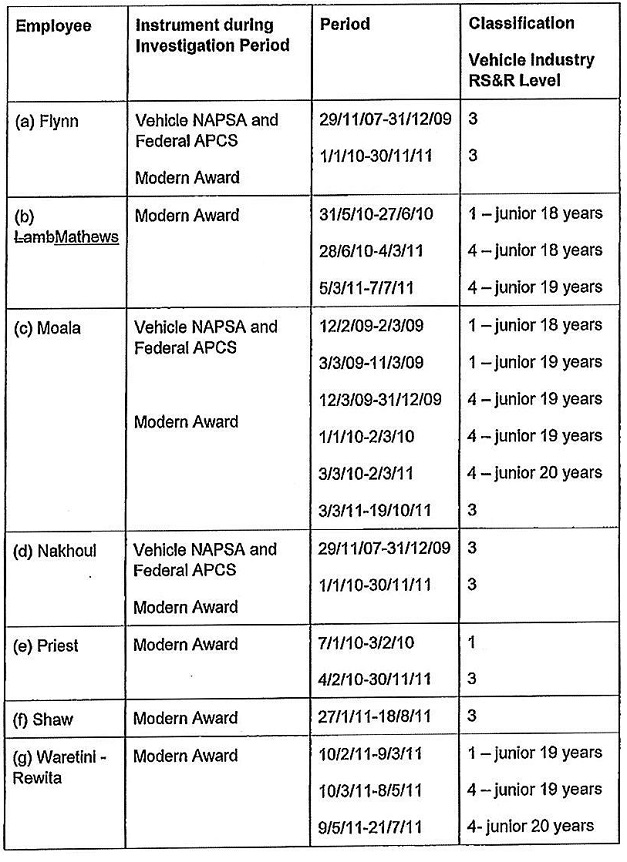
26 Mr Flynn, Mr Nakhoul, Mr Priest and Mr Shaw were at all material times adult employees. Mr Mathews was born on 5 March 1992 and he worked for Complete Windscreens from 31 May 2010 to 8 July 2011. He was a junior employee during this period. Mr Moala was born on 3 March 1990 and he worked for Complete Windscreens from early 2009 to 19 October 2011. He was a junior employee until 2 March 2011. Mr Waretini-Rewita is said to have been a junior employee throughout the period of his employment by Complete Windscreens.
27 The principles governing the interpretation of industrial instruments were not in dispute. An industrial instrument is not to be interpreted narrowly or pedantically. If the terms of the instrument are clear and unambiguous, then the instrument is to be interpreted in accordance with its clear and unambiguous meaning. The persons who draft industrial instruments are likely to be of a practical bent of mind, and that is to be borne in mind when interpreting or construing the instrument as is the practical purpose the instrument was designed to achieve and the context in which it was made. A strict and literal interpretation of the provisions of an industrial instrument is to be avoided and the provisions are to be viewed broadly. Ordinary and well-understood words are to be given their ordinary and usual meaning and, where necessary, the surrounding circumstances of an industrial instrument should be considered. Where the provisions of an industrial instrument will reasonably admit of an interpretation or construction which will give effect to the intention of the persons drafting the industrial instrument, then that interpretation or construction should be adopted (Kucks v CSR Limited (1996) 66 IR 182; Amcor Limited v Construction, Forestry, Mining & Energy Union and Others (2005) 222 CLR 241; Australasian Meat Industry Employees Union v Coles Supermarkets Australia Pty Ltd (1998) 80 IR 208). Where the particular issue is whether an employee is engaged in a particular classification or class of work, then the Court takes a practical approach and will consider the aspect of the employee’s employment which is the principal or major or substantial aspect (Ware v O’Donnell Griffin (Television Services) Pty Ltd [1971] AR (NSW) 18; Director of The Fair Work Building Industry Inspectorate v Linkhill Pty Ltd (No 7) [2013] FCCA 1097 at [77]).
28 Subject to the matters I will mention, there are no significant differences between the Federal Award (adopted by the Federal APCS) and the Modern Award in terms of the classification level. As far as employees at Level 1 are concerned, the key concepts are a degree of training, and a level of expectation of the acquiring or the possession of skills relevant to the performance of routine duties, essentially of a manual nature and appropriate to the level of training. There is reference to the employees at this level exercising minimal judgment and working to defined procedures and under direct supervision. Level 2 is for better trained employees and employees who have completed up to three months structured training. Nevertheless, the description for Level 2 refers to employees who work under direct supervision, either individually or in a team environment. Level 3 is for better trained and more highly skilled employees than employees at Level 2 and is an employee who works with only general supervision of daily duties. An employee at Level 4 is better trained and more skilled than an employee at Level 3. The rates for juniors are a percentage of a Level 1 rate or a Level 4 rate.
29 One point of difference between the Federal Award and the Modern Award is that, in the case of the Modern Award, “Windscreen fitter and/or repairer” appears under the heading, “Classifications contained within Level 4 R4”, whereas in the case of the Federal Award, windscreen fitter and repairer is said to be pre-existing award classification for both Level 3 and Level 4. This is an important matter in favour of the approach taken by the FWO because the general criteria which I have summarised raise questions of degree which are not otherwise easy to resolve. The identification of a particular position or class of work offers practical guidance. The FWO’s approach of classifying employees after an initial period of employment at Level 3 rather than Level 4 (as they could have been) would appear to operate in favour of the respondents, at least as far as the Modern Award is concerned.
30 In terms of how the employees should be classified under the industrial instruments, the parties emphasised different considerations.
31 The FWO emphasised the fact that all the employees – other than Mr Mathews who was a window tinter and, therefore, spent most of his time in the company’s workshop – were travelling by themselves from job to job at a very early stage in their employment. In other words, their training by others had been completed and they were carrying out their employment duties without supervision or at least direct supervision.
32 The respondents emphasised the following matters:
(1) whether the employee was good at his job or average or below average;
(2) whether the employee could be trusted to work on more complex jobs such as those involving modern luxury vehicles;
(3) whether the employee could be trusted to perform jobs for crash repairers; and
(4) the number of jobs the employee could carry out in a day.
The respondents contend that there were differences between the employees as to these matters and the FWO’s “one size fits all approach” of allowing one month at Level 1 and then classifying the adult employees at Level 3, was erroneous. I accept that there would have been differences between the employees in terms of the matters the respondents identified. However, I do not think that the respondents’ approach is the correct one.
33 All the employees, other than Mr Mathews, gave evidence that they were on the road by themselves doing jobs involving the replacing of windscreens within a month or months of commencing employment. That, to my mind, is the critical matter because by then whatever training by others they received was over and they were working unsupervised or, at most, subject to general supervision. They had moved from Level 1, and Level 2 was not appropriate because they did not work under direct supervision, either individually or in a team environment.
34 As far as the adult employees are concerned, the issue is in fact quite straightforward in the case of Mr Flynn, Mr Nakhoul and Mr Shaw. Each of them had commenced employment with the company well before the start of the relevant period for each of them. In Mr Nakhoul’s case, it was over a year before and, in the case of Mr Flynn and Mr Shaw, it was many years. They were clearly employees at (at least) Level 3 at the start of the relevant periods. The same may be said of Mr Moala when he became an adult employee in March 2011. The critical matter is that their initial period of training was over and they were working by themselves as mobile windscreen repairers or fitters and not under the direct supervision of any other person.
35 The other adult employee is Mr Priest. He said that he was out on the road by himself after a month or two. Having regard to the evidence of a number of other employees, I think it is appropriate to interpret his rather general evidence as meaning that after about a month he was out on the road by himself, and the approach of the FWO in classifying him at Level 1 for the first month of his employment and thereafter at Level 3 is correct.
36 A different approach is required for those starting as a junior employee. There are no material differences between the Federal Award and the Modern Award. There were, on the evidence in this case, no material differences between the training and duties of junior employees engaged in windscreen fitting, repairing and tinting and adult employees performing the same functions. The Awards provided for indicative positions at the various levels, but they did not contain criteria for each relevant level as they did in the case of adult employees. I have considered the various indicative positions set out in the Awards and I agree with the FWO’s submission that the nearest indicative positions to the position occupied by the junior employees were “Assembler, accessories” and “Automotive parts, salesperson”. Both those positions result in a classification of a percentage of Level 4 total rate. In the case of the junior employees, as with the adult employees, it is appropriate to allow a one month period at Level 1. Thereafter the appropriate classification for the junior employees is a percentage of the Level 4 rate based on the age of the person.
37 I accept the FWO’s case as to the applicable industrial instruments and the classification levels for the employees.
Background
38 The following background is not in dispute.
39 Mr Lindsay Dean and Mr Haydn Dean established Complete Windscreens in 1976. The company was one of the first specialist windscreen fitting businesses in South Australia. Before the establishment of Complete Windscreens, vehicle windscreens were generally repaired or replaced by motor mechanics. Mr Lindsay Dean and his brother saw an opportunity for a specialist windscreen fitting business after returning from Darwin following Cyclone Tracy. In or about 1993, a company, which had to that point supplied windscreens to Complete Windscreens, ceased manufacturing operations in South Australia. For reasons which I need not relate, Complete Windscreens had difficulties finding a reliable windscreen manufacturer and the company made the decision to commence a glass and windscreen manufacturing operation at Largs Bay. The factory was built and Complete Windscreens manufactured windscreens and other glass products in the factory until 1999. At about this time, the company experienced financial difficulties. It was unable to repay the loan it owed to its bank and it was placed into receivership. There were changes in the ownership of the company, but again, it is not necessary for me to relate the details. The company was subsequently repurchased by Mr Lindsay Dean and Mr Haydn Dean. Between 2006 and 2011, the company employed an average of 20 employees at any one time. In June 2015, the company employed approximately 15 windscreen fitters and two window tinters.
40 Mr Lindsay Dean said that the main type of work done by the company is the fitting of windscreens. The company also provides a window tinting service. Mr Lindsay Dean said that the company also does some window fitting in the housing industry, “however this is only a small part of the business”. Mr Lindsay Dean said that approximately 50% of the company’s business was retail, that is to say, doing work for private clients at their homes or work-places, and approximately 50% was trade, that is to say, work for crash repairers, car yards and wreckers. The difficulties encountered in fitting a windscreen to a vehicle depends on the work required and the type of vehicle. Mr Lindsay Dean said that some windscreens are more difficult to fit than others and that the degree of difficulty can depend on the type of technology in the vehicle. For example, it may be more difficult to remove a windscreen from a vehicle which has rain sensors and European models may present more difficulties than Australian models.
41 Mr Lindsay Dean said that the work done for crash repairers was the most difficult and always required the most experienced windscreen fitters. The difficulty with the work results from the fact that windscreens or windows are to be removed from damaged vehicles and it is important that the vehicle is not damaged when the windscreen or window is refitted to the vehicle. In addition, the work also involves removing side windows which are generally more difficult than windscreens. A windscreen fitter must have tools and the tools are mostly cutting tools, as well as tools to remove urethane sealant and to reapply the sealant. Mr Lindsay Dean said that fitting windscreens to large vehicles such as trucks and inserting windows into vans can be difficult and may require two people and the use of power tools. Mr Lindsay Dean said that he considered that it is very important that difficult jobs are given to his most qualified and experienced employees because if that is not done, there is a risk that a vehicle will be damaged. Mr Lindsay Dean gave an example of a recent event when a windscreen was not correctly fitted to a motor car and water leaked into the car and into the car’s computer causing approximately $10,000 worth of damage.
The Witnesses
42 The FWO called Mr Shaw, Mr Mathews, Mr Flynn, Mr Moala, Mr Priest and Mr Nakhoul as witnesses. The Court made orders before the trial that the parties reduce the evidence-in-chief of their witnesses into affidavit form. In addition, in the case of a number of witnesses, there were affidavits in reply. Each of the six employees who gave evidence swore or affirmed an affidavit in chief and an affidavit in reply and that formed the witnesses’ evidence-in-chief at trial.
43 Two matters loomed large in the cross-examination of the employee witnesses.
44 First, the company kept a day book which recorded a list of the jobs for a particular day, including the name and address of the relevant customer and, by their initials next to the name and address of the relevant customer, the employee of the company designated to perform the job. Mr Lindsay Dean produced extracts from the company day book for the period between 7 July 2010 and 24 August 2010 as well as the period between 20 April 2011 and 23 August 2011. Often the text in the day book was illegible or difficult to read.
45 Secondly, the company installed GPS devices in all of its utility vehicles progressively from February 2010 to November 2012. The GPS device records inter alia the time and location of the vehicle each time the ignition is turned on and off and these records can be extracted. Mr Lindsay Dean produced the GPS records for the vehicles operated by each of the employees the subject of these proceedings (other than Mr Mathews and Mr Waretini-Rewita who were not provided with a vehicle) from 2010 onwards. These GPS records total over 2,000 pages. In addition, on the final day of the trial, counsel for the respondents told me that the GPS records initially produced were deficient in that they did not include the records for the period between 8 August 2011 to 26 August 2011 and I accepted an additional volume of documents containing the GPS records for this period.
46 The accuracy of the GPS records is disputed by the applicant. A number of the employees gave evidence of examples of times when they believed their GPS devices had been inaccurate. For example, Mr Flynn recalled an occasion at some time in 2011 when he received a printout of his vehicle’s GPS records which showed that his vehicle had been on Port Road that day when in fact Mr Flynn had actually been attending to jobs in the hills. Mr Shaw recalled an occasion in around 2009 when Mr Lindsay Dean showed him a computer screen with his vehicle’s GPS location displayed. The computer screen showed a street map and indicated that Mr Shaw’s vehicle was located at the intersection of Port Road and Findon Road when it was in fact many kilometres away at the Complete Windscreens workshop.
47 The applicant also submits that there are a number of self-evident deficiencies in the GPS records themselves. The applicant points to examples of where the entries are simply blank or where they are nonsensical such as a circumstance where the vehicle had moved but the odometer reading had not changed or where the vehicle ignition had been turned off in one street but next turned on in a completely different street.
48 The respondents submit that a GPS is a well-known and accepted technology and that I should presume that the GPS records were produced as a result of the GPS devices (s 147 of the Evidence Act 1995 (Cth)).
49 The respondents called Mr Darren Husson as a witness. Mr Husson is the Business Development Manager of Vhetec Pty Ltd, the company that installed the GPS devices in the company’s vehicles. Mr Husson gave evidence about how the GPS devices work. He said that at two minute intervals the GPS devices automatically record the date, time, current location, ignition status (on or off) and the vehicles velocity at that time. He said that the GPS positioning data is accurate to within 5 metres. Mr Husson was cross-examined by counsel for the FWO. I think what emerged from Mr Husson’s evidence in cross-examination is that when the devices malfunction, it generally means that they do not work at all rather than that they yield incorrect information. The FWO submitted that Mr Husson’s evidence about the GPS devices should be ignored because he had no tertiary qualifications relevant to the GPS devices and did not purport to give evidence as an expert. I do not accept that submission and I accept the substance of Mr Husson’s evidence.
50 I think that the GPS records can be relied upon as being generally accurate. It is apparent that there may be some instances when the GPS devices have recorded information that is plainly wrong, but on the whole I am prepared to accept that the GPS records are sufficiently precise to provide an indication as to the location of the vehicles at particular times.
51 I turn now to consider the purpose and effect of the evidence comprising the GPS records and the evidence about the entries in the company’s day book. Whilst a substantial volume of GPS records covering a number of years were produced, the employee witnesses were only cross-examined about the location of their vehicles during one or more days between 8 to 12 August 2011 (and, in the case of Mr Priest, two days in April 2011). I will refer to some particular examples when examining the evidence of the employee witnesses.
52 As I understood it, the respondents sought to rely on the GPS evidence to show that the employees were not as busy as they claimed and that they had and took numerous opportunities to have breaks during the course of the day. They also sought to rely on the GPS evidence to undermine or rebut the evidence of the employees as to the hours they worked.
53 The respondents provided by way of written submissions two documents which are relevant to these contentions. The first was a document with the title “GPS Analysis & Submissions”. These submissions deal only with particular days between the period 8 to 12 August 2011. The submissions refer to each witness in turn and purport to summarise:
2.1 The authorised jobs assigned to and performed by the claimant employees on each of the subject days together with time spent performing those jobs (‘Assigned Jobs’); and
2.2 The time spent on each of the subject days wholly unrelated to any of the claimant employees’ assigned employment duties (‘Unrelated Activities’).
54 I understand the reference to “subject days” to mean selected days between the period 8 to 12 August 2011 which were the subject of cross-examination.
55 The document then refers to the GPS records and day book and contains submissions about the time each employee spent with respect to “Assigned Jobs” and “Unrelated Activities” each day. For example, the respondents made the following submissions concerning Mr Nakhoul’s movements on 8 August 2011:
8 August 2011
31. The Day Book indicates that Mr Nakhoul performed twelve Assigned Jobs at 8 locations on 8 August 2011:
No. | Job no. | Customer | Suburb | Job Type | Duration |
1. | 24 | Australian Crash | West Hindmarsh | Remove Liberty cargo glass | |
2. | 63 | Australian Crash | West Hindmarsh | Remove BMW rear screen | 28 mins |
3. | 30 | Cash Sale | Woodcroft | Charade windscreen supply/fit | 4 mins (cancelled) |
4. | 15 | Midcoast Crash | Lonsdale | Fiesta tailgate fit back in | 20 mins |
5. | 20 | Triumph Rover Spares | Lonsdale | Supply/fit windscreens | |
6. | 21 | Triumph Rover Spares | Lonsdale | Install 4 windows | 70 mins |
7. | 74 | Claridge Crash | Unley Park | Install Rav4 ¼ glass | |
8. | 85 | Claridge Crash | Unley Park | Remove Falcon rear screen | |
9. | 86 | Claridge Crash | Unley Park | Remove Subaru Cargo Glass | 35 mins |
10. | 72 | City Truck Dismantlers | Gepps Cross | Supply/fit CH Mack windscreen | 35 mins |
11. | 76 | Cash Sale – ‘Mike’ | Ingle Farm | Supply/fit lexus windscreen | 21 mins |
12. | 55 | Budget Rent-A-Truck | Marleston | Supply/fit Rosa Bus Windscreen | 16 mins |
Total: | 229 mins |
32. The Day Book and GPS records indicate that Mr Nakhoul engaged in the following Unrelated Activities on 8 August 2011:
No. | Location | Arrival | Departure | Evidence Reference | Duration |
1. | Dudley Park | 08:10 | 08:28 | Journeys 1 & 2, Page 1, R7 | 18 mins |
2. | Beverley | 08:42 | 08:44 | Journeys 2 & 3, Page 1, R7 | 2 mins |
3. | Woodville Park | 08:46 | 08:55 | Journeys 3 & 4, Page 1, R7 | 11 mins |
4. | Lonsdale | 12:14 | 12:20 | Journeys 5 & 6, Page 2, R7 | 6 mins |
5. | Woodcroft | 12:33 | 12:53 | Journey 6, page 2, R7 & Journey 1, page 3, R7 | 20 mins |
Total: | 57 mins |
33. The Court should find that Mr Nakhoul was able to, and did, avail himself of well in excess of one hours in total for personal activities unrelated to his employment this day.
34. The Respondents emphasise that the period of 57 minutes does not capture any of the travel time expended in relation to any of Mr Nakhoul’s Unrelated Activities on this day.
56 The other relevant document provided by way of written submission is titled “Summary Analysis - 8 August 2011 to 26 August 2011”. This document was provided to the Court at the same time as the additional volume of GPS records for the period between 8 August 2011 and 26 August 2011. The document is two pages and purports to summarise the GPS records for this 8 August 2011 to 26 August 2011 period. For each employee witness with a vehicle it states the average period each day in which the employee took no Assigned Jobs (in all cases this was more than two hours) as well as highlighting any days that the employee apparently arrived to work late or finished work early. This document was not the subject of detailed oral submissions.
57 Leaving aside the matters referred to by the FWO (which I have already addressed), in considering the GPS records and the evidence about the company’s day book, I am not prepared to look beyond the records and material to which I was specifically referred to by counsel. Those records and material relate to 8, 9, 10, 11 and 12 August 2011 which were the topic of cross-examination and for which express submissions were made by counsel; the dates in April that Mr Priest was cross-examined about; and, to a lesser extent, the other dates between 8 August 2011 to 26 August 2011 which were the subject of the “Summary Analysis” written submissions.
58 It is convenient as well at this point to outline how the respondents sought to deploy the GPS evidence and my approach to it.
59 First, the respondents submit that the GPS evidence shows that the employees were not as busy as they claimed and took breaks of at least 30 minutes before 1 pm or at 1 pm each day. If the GPS records and day books show significant periods of time where the employee had no assigned jobs prior to 1 pm each day, it might provide some evidence to support the argument that they had the opportunity for a lunch break over this time, at least for those specific days to which I was referred. The evidence is capable of raising a doubt about whether the employees were as busy as they claimed. The evidence is capable of corroborating the evidence of Mr Timothy Lee (which I detail below at [65]) about the use of the PGI lunchroom. For reasons set out later, I am not satisfied that the FWO has proved that the employees did not have a meal break of at least 30 minutes duration before or at 1 pm each day.
60 Secondly, and at least by implication, the respondents submit that the evidence supports an argument that the employees took total breaks of at least one hour each day (that is an additional 30 minutes in addition to a 30 minute lunch break). I do not think that the GPS evidence supports this conclusion. The GPS evidence from the particular dates which I have been specifically referred to is only a small sample and is not necessarily representative of each employee’s working pattern each day. Further, the absence of an “Assigned Job” in the day book or the presence of an “Unrelated Activity” on the GPS records does not necessarily lead to the inference that that time was available for a break, or indeed that a break was actually taken. The employees often had credible explanations for the periods of time that the respondents suggested to them were breaks such as that they were performing non-paying tasks or were working on a particularly difficult job. Even if they were not doing that, as I will explain, the employees were still “on call” during this time and could not be considered to have had a properly structured break.
61 Finally, the respondents submit that the GPS evidence indicates that some employees actually worked less hours than what they were paid to work. For example, although employees were paid to work 8 am to 5 pm, they did not actually work these hours. As a result, the employees cannot now be entitled to further payment such as casual loading because they were, in effect, overpaid in the first place.
62 This argument cannot be sustained for at least three reasons. First, it cannot be inferred that the GPS evidence which was for a limited period represented the position for the whole of the periods which are in issue in this case. For example, the business of the company no doubt fluctuated, and I accept that at times the employees would have been very busy. Secondly, the absence of an “Assigned Job” does not mean that an employee was not working. When they were not at the workshop, the employees were at all times on the road and on call and there is nothing to suggest they were not. Thirdly, and more fundamentally, Complete Windscreens has proceeded on the basis that the employees worked certain hours and it is not open to it to go behind what it has done. The company’s records show the employees working certain hours, at least to the extent there are records and the company itself, through its agent, EMA Consulting, said on 13 October 2011 in a letter to the FWO that the employees’ normal hours of work were from 8 am to 5 pm.
63 The FWO called two other witnesses. Ms Brodie Janelle Smith is a Fair Work Inspector and she gave evidence of the FWO’s investigation in 2011 and, in particular, the records she obtained from the company which are relevant to the employees’ employment by the company. Her affidavit was tendered and she was not required for cross-examination. The other witness was Mr James Klousia who holds various positions within the FWO. Based on various assumptions which he identifies, he provided a calculation of the amounts which the FWO contends should have been but were not paid to the employees. He was cross-examined briefly by the respondents’ counsel and he confirmed that the accuracy of his calculations depended on the correctness of his assumptions.
64 The respondents called evidence from Mr Lindsay Dean and Mr Haydn Dean. Ms Coral Dean was not called as a witness. Since the company was established, she has worked as an administration or office manager. However, by July 2015 she had ceased doing any work for the company. Mr Lindsay Dean gave evidence explaining the reasons Ms Coral Dean was not called to give evidence. The FWO did not submit that any adverse inference should be drawn from the fact that Ms Coral Dean did not give evidence and, in those circumstances, it is sufficient for me to say that Ms Coral Dean is 82 years of age and has some health issues. The respondents also called evidence from Mr Husson to whom I have already referred.
65 The final witness for the respondents was Mr Timothy Lee who is the Regional Manager of Protection Glass Industries Pty Ltd (“PGI”). PGI supplies windscreens and windows to the company. On a number of occasions, an employee of the company was required to travel to PGI’s premises in Beverley to collect windscreens or windows for use in a job. Mr Lee gave evidence about, among other things, the use of PGI’s lunchroom by one or more of the employees. I should say that Mr Lee’s affidavit was served late and the respondents needed leave before they could rely on it. An unsworn affidavit containing some of the evidence set out in Mr Lee’s sworn affidavit had been sent to the FWO shortly before the commencement of the trial (i.e., that part of it dealing with the use of PGI’s lunchroom). However, the matter thereafter languished and Mr Lee’s sworn affidavit was not served until after the employees had given evidence. The respondents’ solicitor filed an affidavit explaining that this conduct was due to him and not the respondents. On the one hand, Mr Lee’s evidence was relevant and was not advanced in a timely fashion because of the omission of the respondents’ solicitor and not the respondents. Furthermore, the respondents face pecuniary penalties if the contraventions are made out. On the other hand, not all of the allegations in Mr Lee’s evidence were put to the employee witnesses (Browne v Dunn (1893) 6 R 67 (UKHL); Heydon JD, Cross on Evidence (10th ed, LexisNexis Butterworths) pp 605-616). I asked the FWO whether it sought the recall of the employees so that they could deal with the allegations (Reid v Kerr (1974) 9 SASR 367). She did not wish to pursue that course. I decided that it was in the interests of justice to allow Mr Lee to give evidence of a number of matters in his affidavit and that I would take into account the failure to put some matters to the employee witnesses in assessing the evidence (Burke v Corruption and Crime Commission [2012] WASCA 49; (2012) 289 ALR 150 at [177]-[192] per Buss JA with whom Martin CJ and Mazza JA agreed).
66 The FWO submitted that I should draw a Jones v Dunkel ((1959) 101 CLR 298) inference from the respondents’ failure to call Mr Peter Bruce. It seems that Mr Bruce worked for the company during part of the relevant period and that he was stationed in the company’s offices. It was submitted that he would have had some knowledge of whether Mr Lindsay Dean and Mr Haydn Dean pressed the employees to keep working rather than taking a break. As I will explain, I am prepared to accept that from time to time the employees were told to keep working when the company was particularly busy. I do not think that the absence of Mr Bruce from the witness box is of particular significance in this case.
The FWO’s Case
The Relevant Obligations
67 A broad description of the relevant obligations and their source is as follows:
(1) Minimum wages and unpaid work
Mr Flynn was not paid the minimum hourly rate for ordinary hours worked being a contravention of s 182(1) of the WR Act and s 45 of the FW Act. This failure had a “flow-on” effect in terms of the annual leave, annual leave loading and personal leave paid to Mr Flynn. These items only involve Mr Flynn.
The unpaid work raises the lunch break and other breaks issue. It concerns five of the employees (it does not concern Mr Flynn and Mr Waretini-Rewita) and it was described by the FWO as a key feature of the case and the most egregious contravention. The relevant employees were not paid for one hour for each weekday they worked on the basis that they had a break or breaks for one hour. The FWO’s case was that they did not have such a break or breaks.
(2) Meal break contraventions
These contraventions and the unpaid work contraventions revolve around the issue of whether breaks and, in particular, lunch breaks were taken. They call for a more detailed explanation than the other alleged contraventions.
The Vehicle NAPSA provides that meal breaks will be for a period of not less than 30 minutes and not more than 60 minutes. Subject to exceptions not material in the circumstances of this case, an employee will not be required to work for more than five hours without a break for a meal. The Modern Award is in similar terms and provides that an employee must not be required to work for more than five hours without a break for a meal.
The Vehicle NAPSA provides that an employee will be paid at the rate of time and one half for all time worked:
(a) where the employee is required to work beyond five hours without a break for a meal; or
(b) during meal breaks and thereafter until a meal break is allowed.
The Modern Award provides that an employee working beyond five hours must be paid at the rate of time and one half until they receive a break.
Neither party suggested that the differences in the text of the Vehicle NAPSA and the Modern Award led to any difference in the interpretation of the two Awards in this case.
The company’s defence to the alleged meal break contraventions was that the employees were told to take a 30 minute meal break within the first five hours of their service each day, both in an induction manual and given to them verbally, and that they had an opportunity to do so and that they took such a break on some or all of the days in the relevant period.
The FWO submitted that the effect of the provisions in the two Awards dealing with meal breaks was that there was an obligation on the employer to ensure that the employees had meal breaks. In the alternative, the FWO submitted that the employer was required to direct its employees to have meal breaks. In the further alternative, the FWO submitted that whether the obligation was met depended on whether the employees in fact had meal breaks.
It seems to me, having regard to the terms of the Awards, that the issue is whether an employee has been required by his or her employer to work beyond the five hour period without taking a meal break and whether that has happened will depend on the facts of the particular case. The issue may arise in an almost infinite range of circumstances depending on the instructions or absence of instructions from the employer, the type of work carried out by the employee and the place where the work is carried out. I will come to consider these factors later in these reasons. It is sufficient to say at this point that the employees in this case (other than Mr Mathews) were for the most part carrying out their duties on the road and by themselves.
There is limited case law on an employer’s obligation with respect to meal breaks. I was referred to Wilkey, Wilkey and Luck v Ballingvale Pty Ltd [1995] SAIRC 77 (“Wilkey”), and Jeisman v B & S Anderson Family Trust and J & M May Family Trust [2003] SAIRC 25 (“Jeisman”).
In Wilkey, the employees worked in a store with customers coming and going throughout the day. The relevant award provided that the employees shall be allowed a meal break. In that case, the Industrial Magistrate found that the employees were expected by their employer to take meal breaks. The important point made by the Industrial Magistrate was that, although the stores were not always busy, and although there was often a “clear” 30 minutes where an employee could take a meal break, the fact was that the employees were always “on call”, that is to say, if a customer came into the store the employees were expected to attend to their needs. In those circumstances, it could not be said that the employees were allowed a 30 minute meal break. The FWO submits that this is a similar case in that even if the employees on the road had the opportunity from time to time to take a meal break, the fact is they were always on call.
In Jeisman, although the employee who was an apprentice hairdresser working in a hairdressing salon was never told not to take an evening meal break, the fact was that she was always busy in the evenings and did not take an evening meal break. In those circumstances, the Industrial Magistrate found that the employee was entitled to be paid for the extra time she worked on late night trading days because the employer had not been proactive in ensuring meal breaks were in fact taken.
(3) Casual loading
Casual employees were entitled to be paid a casual loading. The WR Act prescribed a guaranteed casual loading of 25% of the basic periodic rate of pay and cl 41.1(b) of the Modern Award provided for a casual loading where the amount of the casual loading depended on when the work was performed and whether it was part of ordinary hours or overtime.
(4) Overtime
Employees were entitled to be paid overtime. This obligation was imposed by cl 6.3 of the Vehicle NAPSA and cl 28.2 of the Modern Award. The quantum of overtime depended on when it was performed: Sunday (double time), Public Holiday (double time and-a-half), not the aforesaid but beyond ordinary hours (time and-a-half for the first three hours and double time thereafter).
(5) Meal allowance contraventions
Employees who were required, without being given notice the previous day, to work more than one and-a-half hours overtime were entitled to a meal or a meal allowance. This obligation was imposed by cl 6.3.10 of the Vehicle NAPSA and cl 19.5(b) of the Modern Award.
(6) Saturday penalty contraventions
Employees who worked some of their ordinary hours on a Saturday were entitled to be paid at the rate of time and-a-half for such work. This obligation was imposed by cl 6.5 of the Vehicle NAPSA and cl 38.2 of the Modern Award.
(7) Annual leave
Before going on annual leave, employees were entitled to receive the wages they would have received in respect of the ordinary time they would have worked had they not been on annual leave during the relevant period. This obligation was imposed by cl 7.1 of the Vehicle NAPSA and cl 29.7(a) of the Modern Award.
(8) Annual leave loading
In addition to the annual leave referred to above, the same provisions required the payment of an annual leave loading of 17.5%.
(9) Personal leave contraventions
Employees were entitled to personal leave when they were too sick to work without reduction of pay, which should be at least their guaranteed basic periodic rate of pay. This obligation was imposed by cl 7.2 of the Vehicle NAPSA and s 99 of the FW Act.
The Evidence of the Employees
68 I turn now to examine the evidence of the various employees. For convenience, and to make these reasons easier to follow, I express some conclusions about the witness at the end of my summary of their evidence. I stress that I have reached these conclusions having considered all of the evidence.
Mr Shaw
69 The relevant period for Mr Shaw is 27 January 2011 to 18 August 2011. By relevant period, I mean the period to which the FWO allegations relate and the period of assessment for the purposes of Mr Klousia’s calculations of underpayments and non-payments. During the relevant period, Mr Shaw was an adult full time employee and the claims in relation to him relate to a failure to pay overtime and meal breaks. The evidence Mr Klousia had available to him for the relevant period was the evidence of Mr Shaw.
70 Mr Shaw was born on 4 July 1970 and he was employed by Complete Windscreens between March 1995 and September 2013. In March 1995, Mr Shaw did a two week training course at the company through the then Commonwealth Employment Service and he was then offered employment by the company as a trainee windscreen fitter. Mr Shaw said that there are no formal qualifications in South Australia for a windscreen fitter and repairer. He also said that he did not sign a written contract of employment with the company.
71 Mr Shaw said that no-one in management at the company told him what award or agreement applied to his employment or advised him of his classification level. He said that he did not receive an occupational health and safety checklist when he commenced working for the company. He did not have any formal induction or structured training when he started his employment. Mr Shaw said that he never received a Complete Windscreens induction manual. He learnt his job through “on-the-job” training and, as far as he was aware, that was how all new employees of the company learnt the job. He said that in order to learn the job he went out on the road with an experienced worker from the company for two weeks and learnt what he did. He said that once he secured his employment, he did another two weeks on the road with an experienced worker. After that he was on the road by himself.
72 Mr Shaw said that he was never given any written policies or procedures during his employment by the company. He is not aware of any other new employees receiving any policies or procedures.
73 Mr Shaw said that at various times during his employment by the company, he raised with management the question of lunch breaks and the applicable award. Generally, these conversations were with Mr Lindsay Dean or Mr Haydn Dean. Mr Shaw recalls being told on one occasion that if he was not happy at the company, he could leave.
74 Mr Shaw described the business of Complete Windscreens as involving removing, refitting and repairing and installing windscreens and glass to motor vehicles. The company’s clients were crash repairers, car yards and members of the general public. In addition to these operations, the company did window tinting for vehicles, homes and businesses. Mr Shaw said that a small part of the company’s business was fitting glass to houses. He said that he was involved in the windscreen fitting side of the business and not the tinting side.
75 Mr Shaw said that when he started with the company in 1995, Mr Lindsay Dean was, what Mr Shaw called, the director of windscreen fitting. That meant that he was in charge of all windscreen fitting Australia wide. From 1 July 2013, Mr Haydn Dean has been the director of the business. Mr Shaw described Mr Lindsay Dean and Mr Haydn Dean as managers of the business. Their mother, Ms Coral Dean, attends to the administrative and office side of the business. Mr Shaw said that there was another person employed in the office at the company and that was Mr Peter Bruce. Mr Bruce started with the company in late 2010.
76 Mr Shaw described Mr Lindsay Dean’s tasks as managing the daily operations of the business, including answering the telephone, booking in jobs and allocating jobs to the employees. He described Mr Lindsay Dean’s role as very “hands on” and he said that Mr Haydn Dean was there to take Mr Lindsay Dean’s role when needed. He said Mr Bruce’s tasks included monitoring the activities of windscreen fitters on the road by use of the information generated by the GPS and answering the telephones if Mr Lindsay Dean did not get to the telephone first.
77 Mr Shaw said that during his employment, the company generally employed 20 to 25 people. There were four to five people in the office, three to four tinters, and the rest were windscreen fitters. There was one person who did the glass work for houses.
78 Mr Shaw said that between 1995 and 2013, he was a mobile windscreen fitter and that that required him to travel to various locations in Adelaide to remove and install vehicle windscreens. He would be given his jobs at the start of each work day in the form of invoices which set out the job type and customer details. Mr Shaw said that the only jobs that were documented in the invoices and in the company’s day book were the paying jobs. He said that there were other non-paying jobs for him to do in between the paying jobs, such as collecting materials including glass, obtaining parts and what he described as other miscellaneous tasks for the business. He said that the company’s day books did not record every job that each windscreen fitter would do in a day. Mr Shaw said “this is because Lindsay and Haydn would usually write the jobs in when they were on the phone and sometimes we would swap our allocated jobs around depending on our locations and how long jobs were taking. The day books do not show that often after attending a job and assessing it, we needed to go and pick up parts in order to complete the job”.
79 Mr Shaw said that usually the business had about one-third of the day’s work booked in the day before, and that thereafter the business received telephone calls about further jobs during the course of the day. For the pre-booked jobs, the paperwork was usually ready. Mr Shaw said that he was usually given five or six jobs to start with and that at the completion of these jobs, he called the office of the company to get further instructions about the next lot of jobs he was to perform. From time to time, Mr Shaw was required to visit the premises of PGI to pick up glass and bring it back to the company’s workshop. Mr Shaw said that he could do anywhere between 4 and 16 jobs in a day, although on average he did 10 to 12 jobs a day. Mr Shaw said there was no limit on the type or size of vehicle that the company worked on and that it took work on buses, trucks, trains, cars and marine vessels.
80 The company provided Mr Shaw with a Toyota HiLux for the purposes of his work. He took this vehicle home at night for most of the time that he worked at the company. In about December 2011, Mr Haydn Dean told Mr Shaw that he was no longer allowed to take the work car home at the end of the day. He had to leave it overnight at the company’s office and workshop.
81 Mr Shaw said that he bought his own tools and that he spent approximately $1,000 or more a year on tools. He was not reimbursed for these amounts by the company. The company did supply the disposable blades to cut off urethane (the glue that holds the glass on) and material such as the glass and glues. They also supplied Windex for cleaning the glass.
82 Mr Shaw said that he usually started work at about 8 am. On occasions, he was late for work and may have started as late as 8.30 am. Mr Shaw said that he was a sole parent and he had to wait for the bus that picked up his daughter to take her to school. He said that he was paid from the time he started work. He said that he usually finished work at 5 pm or 6 pm depending on the time he finished his jobs for the day. He said that on a regular basis he was not free before 6 pm. Mr Shaw estimated that he worked 45 to 50 hours most weeks throughout his employment with Complete Windscreens. Mr Shaw said that on occasions he started work at 7 am and whether this occurred depended on the needs of the customer.
83 Mr Shaw said that he also worked on Saturdays. He started at 8 am on a Saturday and ended when he finished his work. This might be as early as 12 noon or as late as 3 pm. Mr Shaw was paid for the work he performed on Saturdays at time and-a-half and this was the rate of pay he received regardless of when he finished. He was never paid double time for work on Saturdays.
84 Mr Shaw said that he was paid at the rate of $21.62 per hour and that this was his rate of pay for approximately two to four years between at least 2009 and 2013 with no pay rises. He asked Mr Lindsay Dean and Ms Coral Dean about the possibility of obtaining a pay rise, but was not successful.
85 Mr Shaw was paid his weekly salary in cash until sometime in 2011. He could not be any more specific than to say that at some stage in 2011, the company began paying his salary by the electronic transfer of funds into his bank account.
86 Mr Shaw claims that he was not paid for all the hours he worked for the company. He said that the company deducted one full hour per day from his pay for lunch breaks that he never had. He said that his standard working week was Monday to Friday from 8 am to 5 pm and that he was paid for 40 hours per week even though he had done 45 hours in the week. He said that at one point during the course of his employment, Mr Lindsay Dean, in response to a question from Mr Shaw about the deduction of the five hours every week, said that this had been done because the company paid him a higher rate of pay to make up for the fact that he did not get a lunch break. Mr Shaw said that he tried to negotiate with Lindsay, Haydn and Coral Dean about this matter, but he had no success. Mr Shaw said that prior to 2003, he kept a time book for his work each day at the company, but that he stopped doing that in approximately 2003.
87 In relation to overtime, Mr Shaw said that he was paid overtime for work before 8 am and after 5 pm Monday to Friday, and for all work on Saturdays. If Mr Shaw worked overtime, he received one and-a-half times his normal rate.
88 Mr Shaw said that he often worked beyond 5 pm. He said that three or four times a week on a regular basis he ended up working until 6 pm. He said that on occasion if he did something extra for the company, he was paid in cash for that work by Mr Lindsay Dean and that these hours and the cash payments were not recorded on his pay slips. Mr Shaw said that he was paid to 5 pm and that he was not paid if it took him an hour to return to the workshop at the end of the day. Mr Shaw referred to the pre-drawn time books which the company has used since November 2011, “once the FWO started getting involved”.
89 Mr Shaw said that Ms Coral Dean dealt with the payroll tasks at the company and that before 2011 Ms Coral Dean arranged all of the pays herself. He said that he did not regularly receive his pay slips from the company and that there was usually a gap of four to six weeks between being paid and getting his pay slips. Mr Shaw said that the effect of withholding the pay slips was that it was difficult for him to remember what hours he actually worked. This meant it was difficult to challenge what he had been paid.
90 Mr Shaw said that in the last year of his employment, Complete Windscreens paid him for 38 hours per week at the ordinary rate and two hours at time and-a-half (i.e., as overtime).
91 With respect to lunch breaks, Mr Shaw said that the company expected him to work through his lunch breaks even though payment for that hour each day was withheld by the company. He said that when he started with the company in 1995, Mr Lindsay Dean said to him words to the effect of “a lunch break is a screwdriver in one hand and a hot dog in the other”. On more than one occasion, Mr Lindsay Dean said to him words to the effect of “your lunch break is the time it takes between driving from one job to another”.
92 Mr Shaw said that he generally worked and ate at the same time, meaning that he ate while driving or whilst on site at a job working on a car. He said that at times he made a quick stop to buy lunch and that at times he was nearly always caught out and told to get back to work. He would receive a telephone call from Mr Lindsay Dean or Mr Haydn Dean or Mr Bruce asking him why he had stopped. He said that this happened approximately three to four times a week. Mr Shaw said that at times he left the car running while he bought his lunch because this would not alert those in the company’s office that the vehicle had stopped. He then ate whilst he was driving. Mr Shaw said that at times when he had attempted to take a break, he had either been told directly that he could not have a break, or just loaded up with work to make taking a break impossible. Sometimes if he was back at the workshop, Mr Shaw was allowed to go across the road to Hungry Jacks. Mr Shaw said that on occasions when he asked Mr Lindsay Dean or Mr Haydn Dean whether he could take a break, he was told that he could not or he was given another job to do. He said that he always received the same answer from Mr Lindsay Dean when he asked about lunch breaks and that was words to the effect of “You do not get a lunch break here. That is part of working here. You do not get a lunch break”. Mr Shaw said that he never received a break of at least 30 consecutive minutes during a working day at the company. He said that he certainly never received a break of an hour a day.
93 Mr Shaw said that by the time he left his employment with the company, all of its vehicles contained a GPS device and that the company used this device to locate each individual windscreen fitter. The GPS was only a locating device or tracking system and it was not a navigation system which could be used by the driver. It cannot be seen in the vehicle. Mr Shaw said that a GPS device was installed in his vehicle sometime in 2009 and that he was not told when it was installed. Mr Shaw said that he would regularly receive calls from Mr Lindsay Dean or Mr Haydn Dean or Mr Bruce, and more rarely Ms Coral Dean, if they did not believe that he was working. Mr Shaw said that he did not think the GPS was always accurate and he gave examples of the inaccuracy of the GPS, including the occasion in 2009 referred to at [46].
94 Mr Shaw lodged a complaint with the FWO in July 2011. His main complaint about his employment was having to work nine hours per day without a break and the company then deducting an hour each day from his pay for lunch breaks that he did not take. He found it difficult to work without taking a break. Mr Shaw said that after the FWO became involved, the company tried to create lunch break waivers and contracts. In September or October 2012, he was presented with what he described as an out of date contract to sign by Mr Haydn Dean. I note that in this document, Mr Shaw’s employment was said to be covered by the Modern Award and his classification is said to be Level 3. In September 2012, the management at the company asked Mr Shaw to sign a lunch break waiver document, but he declined to do so.
95 It is convenient at this point to refer to a matter which were raised in the cross-examination of Mr Shaw and, indeed, in the cross-examination of all employee witnesses. The matter involves what was said by the respondents to be a number of similarities in the text of the affidavits of the employee witnesses. As I understood it, the suggestion of the respondents was not so much that the employees had put their heads together, but that the FWO had put words in their mouths. There are similarities in the text of the affidavits and those similarities are summarised in a two page schedule handed up by the respondents during their closing submissions. I think that the most likely explanation for the similarities is as follows. None of the employees has attained a high level of education. The FWO would have known what information needed to be elicited from the employees and probably did so by question and answer using fairly standard questions linked to topics she had identified. I do not think that there was anything sinister in this, but at the same time, I need to bear the similarities in mind.
96 Mr Shaw was cross-examined by reference to the GPS records and the company’s day book about his movements on 8 and 10 August 2011. It was established that he did four jobs on 8 August 2011 and there was a substantial period of time on 10 August 2011 when he was not engaged on any jobs.
97 There is reason to approach Mr Shaw’s evidence with caution. First, there was an interruption in Mr Shaw’s employment by Complete Windscreens after the company had dismissed him for stealing. It seems that that occurred in 1995 and that he was re-employed by the company within the year. His account was that he gave away property of his employer which he thought was rubbish. It is not possible on the evidence to gauge the seriousness of this incident. Secondly, Mr Shaw was doing some jobs on his own behalf and for reward which could have been done by the company. Thirdly, Mr Shaw tried to block the GPS device in his vehicle with a piece of lead and eventually he removed the GPS device from the vehicle. Fourthly, Mr Shaw said that he would purchase the glass which he needed for private jobs from PGI. Mr Shaw said that he did not collect glass he used for private jobs from PGI during ordinary business hours. Instead, Mr Lee would leave the glass outside of PGI’s premises and Mr Shaw would collect it outside ordinary business hours. Mr Shaw denied that he would have a break of 45 minutes approximately three times per week at Mr Lee’s premises. As I have said, the respondents called Mr Lee to give evidence and he contradicted Mr Shaw’s evidence. He said that Mr Shaw did come to PGI’s premises during normal business hours in a Complete Windscreens vehicle and purchased PGI’s products for himself and not for Complete Windscreens. He said that he never arranged with Mr Shaw to leave products out for him. I accept Mr Lee’s evidence in preference to that of Mr Shaw. Finally, the respondents submit that Mr Shaw threatened Mr Nakhoul with consequences if the latter withdrew his complaint against Complete Windscreens. The evidence is not very clear, but it seems that Mr Shaw approached Mr Nakhoul at about the time Mr Nakhoul went back to Complete Windscreens and told him something along the lines that if he withdrew his complaint he might go to gaol.
Mr Mathews
98 The relevant period for Mr Mathews is 31 May 2010 to 7 July 2011. Mr Mathews was a junior throughout his employment by Complete Windscreens. He was employed as a casual until 29 December 2010 and a full time employee thereafter. The claims made in relation to him related to casual loading and casual overtime, overtime, Saturday penalties, meal breaks, meal allowances and unpaid work. The evidence Mr Klousia had available to him were time books showing start and finish times for the period from 27 January 2011 to 29 June 2011, and a payroll history for the period from 2 June 2010 to 13 July 2011.
99 Mr Mathews was born on 5 March 1992 and he was employed by Complete Windscreens from 31 May 2010 to 8 July 2011. He changed his surname from Lamb to Mathews in May 2012. Mr Mathews was employed as a trainee window tinter and his hours of work were 8 am to 5 pm Monday to Friday and every second Saturday 8 am to 12 noon. He did not sign a contract of employment with the company. The only thing he signed at the commencement of his employment was a tax file number declaration form and that was the only paperwork he received during his employment by the company. He did not sign any documents to suggest that he was a trainee or an apprentice. Mr Mathews never received an employee induction manual or occupational health and safety checklist during his employment by Complete Windscreens. In November 2010 he received a letter from the company that advised him that he was a casual on $12 per hour. He said that he had similar letters from the company when his hourly rate as a casual was increased to $18, and when he became a full time employee. Mr Mathews said that he was never told what award or agreement covered him nor was he advised of his classification level.
100 Mr Mathews had no formal induction or structured training and he was not given any written policies or procedures. His training was “on-the-job” training from the other tinters. Mr Mathews said that it took him about three to four months to feel confident enough to do a tinting job properly and without any assistance. Most of his work was done in the workshop, although there were some mobile tinting jobs he did on the road. After about two to three months, he said he was doing jobs on the road by himself.
101 Mr Lindsay Dean was his direct supervisor, and as far as he could see, Mr Lindsay Dean was the day to day manager and manned the desk in the office. He appeared to spend most of the day answering the telephones and booking windscreen and window tinting jobs. Mr Lindsay Dean allocated the jobs for the day. Mr Haydn Dean did maintenance work around the place and sometimes allocated jobs to the staff. Both were there during the week and took it in turns working on Saturdays. Mr Mathews also noted that Mr Peter Bruce and Ms Coral Dean worked in the office. Mr Mathews said that occasionally he was sent out on the road to pick up a windscreen or to assist windscreen fitters in the fitting of a windscreen. He said that once every one to two months he went on the road with windscreen fitters and that towards the end of his employment, he tended to go out more often. Mr Mathews said that he usually did at least one mobile tint job per day. Mr Mathews said that for mobile tint jobs he took a company motor vehicle and drove to the job location. Mr Mathews said that in summer he might tint 15 to 20 cars in a day. By contrast, in winter, there might only be five cars to tint in a day. He said that if there were no cars to tint, Mr Lindsay Dean sent him out to pick up material for the company, such as windscreens or glass and he said that he was always kept busy. He said that a tinting job took half an hour to 45 minutes. Mr Mathews said that although he was provided with some tools by the company, they were not of good quality and in the result he went out and bought his own tinting tools.
102 Mr Mathews said that he worked from 8 am to 5 pm Monday to Friday and every second Saturday from 8 am until 12 noon or sometimes later. His salary when he started was $11.80 per hour as a casual employee. On Saturdays he was paid time and-a-half. He said that his rate of pay was not discussed when he started his employment. He queried with Mr Haydn Dean and then Mr Lindsay Dean his rate of $11.80 per hour and was told that the rate reflected his lack of experience. He asked for pay rises from time to time and his requests were refused. In July 2010, he obtained his driver’s licence and his pay was increased from $11.80 to $12 per hour. At some time in 2010, he asked Mr Lindsay Dean to be made a full time employee but this request was refused. He left the company for one month in November or December 2010 and worked for Instant Windscreens. Eventually he returned to Complete Windscreens as a full time employee on $18 per hour. He was paid time and-a-half on Saturdays.
103 With respect to overtime, Mr Mathews could only recall starting before 8 am on one occasion. He did finish late from time to time and he thought that he averaged four to five hours of overtime per week. He said that he was paid for work after 5 pm as long as he wrote it in his time book. He said that overtime was paid at time and-a-half. Mr Mathews said that as far as he could tell from his pay slips, he was, for the most part, paid for the overtime hours he worked. Overtime was paid at time and one half for any hours above 40 hours in a week.
104 Mr Mathews said that he did not get paid for all of the hours he worked at Complete Windscreens. Leaving aside overtime, he was paid for 40 hours per week when in fact he worked 45 hours per week from 8 am to 5 pm Monday to Friday. Mr Mathews said that there were many times when he did not get a break at all. He said that he took 30 minutes or more for a break during a shift around 25% of the time that he worked at the company. He said that he often went and purchased his lunch at Hungry Jacks which would take a maximum of 5 to 10 minutes. He then went back to the workshop to eat and then worked whilst he was eating. He said that he could remember times when he came back to the workshop with food and Mr Lindsay Dean came out and told him to get back to the car and continue to work on it because the car had to be done quickly. He said that if he ever did take a full half an hour he recorded it in his time book the same way as he did for days where he did not have a break. This did not happen often. Unfortunately, this means that his time book is not accurate when it comes to breaks. He did speak to Ms Coral Dean about how to record this and she said words to the effect of “you always put 8 am until 5 pm because they dock you an hour for lunch whether you work it or not”. He recalls an occasion when Ms Coral Dean said to him words to the effect of “you just eat your lunch and get back to work”. From various conversations he had with Mr Lindsay Dean, Mr Haydn Dean and Ms Coral Dean, Mr Mathews said that he understood them to be saying that he could not go out and get lunch in summer and that they wanted him to bring his lunch from home and keep working while eating it. At one point he recalls Ms Coral Dean saying to him “you do not get a break”. Mr Mathews said that for the majority of time if he stopped at lunch time, it was for no more than 10 to 15 minutes. If he was on the road he would often receive telephone calls asking him if he had reached his destination. Occasionally he might be able to take a 30 minute break. When he received a telephone call from Mr Lindsay Dean, he was often told to do the particular job and then get his lunch. Often he did not have lunch or it was very late in the day. Mr Mathews summarised his evidence by saying that, over the course of his employment, he took a break of at least half an hour approximately 25% of the time and that 75% of the time he did not get a break of at least half an hour. He said that when he did not get a full 30 minute break, he either did not get a break at all or if he stopped, it was more like 10 to 15 minutes maximum.
105 Mr Mathews said that he kept a time book for most of the time he was employed by Complete Windscreens and at the end of each day he filled out his time book. He put in the time he started and the time he finished, that is, 8 am to 5 pm. He cannot remember exactly what happened with meal breaks and whether he took out half an hour for a break when he took these breaks. He said that it did not really matter because he always had one hour deducted each day. If he did overtime and finished, for example, at 6.30 pm, he wrote in one and-a-half hours for overtime. He said that Ms Coral Dean filled out his time book for him a few times. There were a few times when he forgot to do his time book and a couple of times when she wanted him to change something in the time book. Ms Coral Dean made changes a couple of times when he had written in his time book that he did not take a lunch break. Ms Coral Dean made other changes concerning overtime, although this did not happen often.
106 Mr Mathews said that Ms Coral Dean carried out the payroll functions at the company. Mr Mathews was paid weekly and he was paid cash receiving the cash and a pay slip. At a later point, his salary was paid into his bank account by electronic transfer. Mr Mathews said that sometimes pay slips were not in the envelope. He said that once he began to be paid by electronic funds transfer he did not automatically get a pay slip and that sometimes he did, but on other occasions he did not. He said that he did not receive a pay slip approximately once a month and that in those cases he would approach Ms Coral Dean.
107 Mr Mathews said that certain jobs were not recorded in the company’s day book and he said that specifically “cash jobs” would not be recorded in the day book. He said that the day book did not accurately reflect the work being performed by an employee on a given day. He said that, for example, if he had 15 tinting jobs on a certain day, then 10 of them might have been on the books and five jobs might have been cash and, therefore, not recorded in the day book. In addition, he said that sometimes jobs would be swapped between tinters during the day and this change was not recorded in the day book.
108 Mr Mathews was made casual in July 2011 because Complete Windscreens was not happy with him. He was not offered any further work after July 2011.
109 Mr Mathews lodged a complaint with the FWO on 25 July 2011. He did not think he was being paid for all the hours he worked and he was not getting lunch breaks. He was also concerned that he had to follow up the company all the time for his pay slips.
110 The main point to emerge from Mr Mathews’ cross-examination was that he does not assert that he never took a lunch break. He agreed that were at least occasions upon which he had a lunch break. He agreed that he did not have a record of when that occurred. He did not have a record of the length of time that he took for the break. Mr Mathews agreed that he had a general expectation that he would be able to go out and get something to eat and that on occasions he was interrupted and told to go and do something. It was more likely that he would be interrupted rather than the other window tinter who did not have a driver’s licence. At some point, he had an arrangement with the other window tinter that they would pool their resources and buy a pizza for lunch.
111 For reasons I will give, I do not accept Mr Mathews’ evidence as to lunch breaks without substantial qualification. Otherwise, I accept his evidence, and in particular, his evidence about not receiving an induction manual or occupational health and safety checklist, hours of work and non-receipt of pay slips.
Mr Flynn
112 The relevant period for Mr Flynn is 29 November 2007 to 30 November 2011. He was an adult full time employee during that period. The claims made in relation to Mr Flynn related to the fact that he was paid below the minimum hourly rate and were for minimum wages, overtime, annual leave, annual leave loading and personal leave. The records Mr Klousia had available to him were a timesheet for the period from 5 December 2007 to 30 November 2011 and a payroll history for the periods from 5 December 2007 to 26 January 2011, and from 24 August 2011 to 23 November 2011.
113 Mr Flynn was employed by Complete Windscreens as a mobile windscreen fitter and repairer for approximately five years from 1984 to 1989. He left the employ of Complete Windscreens in 1989 and worked for Windscreens O’Briens and then for Car Class and finally for Budget. In each of these jobs he worked as a windscreen fitter. In 2000, Mr Lindsay Dean asked Mr Flynn if he wanted a job as a windscreen fitter and repairer. Mr Flynn met Mr Lindsay Dean and Mr Haydn Dean and they offered him a job as a windscreen fitter and repairer and said that they would pay him the same amount of money that he was receiving at Budget, which was $500 per week. They told Mr Flynn that his hours of work would be from 8 am to 5 pm on Monday to Friday and they said that he could work on Saturdays if he missed any time at work during the week. He did not sign a contract of employment with Complete Windscreens. He said that he possibly signed a contract of employment document sometime before 2007, but he said that he did not remember “its contents at all”. He was not told in 1984 or in 2000 by anyone in management at Complete Windscreens of the award or agreement which covered his employment and nor was he advised of his classification level. He did not have any formal induction or structured training and no-one gave him any written policies or procedures. He said that he never received an occupational health and safety checklist. Mr Flynn said that he did receive an induction manual towards the end of his employment at Complete Windscreens in 2012 or 2013. He said that he did not receive any specific “on-the-job” training. He said that in 1984 after about two months he was on the road doing jobs on his own.
114 Mr Flynn said that Mr Lindsay Dean was in charge of Complete Windscreens and that Mr Haydn Dean was second in charge. He said that Mr Lindsay Dean booked the jobs and then allocated them to the fitters and tinters. He said that Mr Lindsay Dean made the decision as to who was to do a particular job and he allocated the job. Mr Haydn Dean watched the trackers on the computers to see where the fitters were. Both Mr Lindsay Dean and Mr Haydn Dean dealt with employing and interviewing new staff. Mr Flynn said that Mr Bruce also worked in the office at Complete Windscreens. As he understood it, Mr Bruce took telephone calls from customers and bookings for jobs. Mr Bruce worked under Mr Haydn Dean. He did not allocate jobs.
115 Mr Flynn said that Complete Windscreens installed GPS devices in their vehicles in about 2010 or 2011. He said that either Mr Lindsay Dean or Mr Haydn Dean or Mr Bruce monitored the GPS using a laptop in the office. In 2014, Ms Coral Dean worked in the office and carried out the payroll functions. She also did the debt collection for the business and managed another female who worked in the office performing administrative and typing functions.
116 Mr Flynn described his job as a full time mobile windscreen fitter and repairer. The tasks that he was required to perform included removing, supplying, installing and refitting windscreens, windows and door glass to vehicles, including trucks. He was involved in cutting glass and removing encapsulated glass. As part of his job, he was required to pick up stock and that stock included windscreens, urethane and sometimes tint. He was also required to collect parts and take them back to the workshop, for example, he might collect a part from a crash shop that needed to be tinted. He also did stone chip repairs every now and again as part of his duties. Although he worked in the workshop on occasions, most of his work was done on the road. He said that he could travel as far as Gawler, Yankalilla, Mount Pleasant, Murray Bridge and North Haven for jobs. He said that Mr Lindsay Dean usually tried to give him jobs in the same area. Mr Flynn said that when he went back to Complete Windscreens in 2000, he did all the encapsulated glass work and worked on premium and classic cars.
117 Mr Flynn said that his daily procedure was as follows. At the start of the day he would go to the company’s workshop and Mr Lindsay Dean would give him two or three jobs on the road. Mr Lindsay Dean gave Mr Flynn the paperwork for the first couple of jobs. He would go out and do those jobs. He would receive calls throughout the day sending him to job after job and these calls usually came from Mr Lindsay Dean. If Mr Lindsay Dean was engaged elsewhere, then the call would come from Mr Haydn Dean. Mr Flynn said that sometimes he had to go back to the workshop for more jobs. When he was required to do this, it was usually after lunch. He said that on any given day he did between 6 and 12 jobs. Mr Flynn said that Mr Lindsay Dean often told him of the order in which he should do the jobs which had been allocated to him.
118 Mr Flynn said that after he returned to Complete Windscreens in 2000, he was supplied with a motor vehicle which he took home each night and on weekends. He understood that he could use the vehicle for personal use as long as he paid for the petrol.
119 Mr Flynn said that Complete Windscreens supplied the materials for his jobs, such as windscreens, the urethane, the sealer and the window cleaner. The company supplied some, but not all, of the tools he required. Mr Flynn bought the tools he required which were not provided by the company. Mr Flynn used his own mobile phone for work purposes and the company paid his telephone bill each month. Mr Flynn said that after he returned to Complete Windscreens in 2000, he had, on occasions, trained new employees on how to do the job. That involved teaching the new employee to fit a windscreen, to fit urethane, to “problem solve” and how to do “bits and pieces” on different cars. He did not get any extra remuneration for providing this instruction.
120 Mr Flynn said that he worked from 8 am to 5 pm Monday to Friday and that he worked these same hours for the whole time he worked at the company between 2007 and 2011. There were occasions when he had left work early because he was sick or because he had a medical appointment. Generally, he did not work on Saturdays because he had football commitments at that time. He did work on a few Saturdays but this was only when he had been behind in his hours during the week. He said that if he only worked four days in a week, Mr Lindsay Dean asked him to come in and work a half a day Saturday to make up the time. On these occasions, he was paid the same flat rate for Saturday work, that is to say, $12.50 per hour. On occasions, Mr Flynn said he had to leave home early in the morning so that he could be at a job in a remote location by 8 am. In addition, there were occasions where he did not finish a job until after 5 pm and sometimes there was a long drive home after 5 pm. He said that he did not work beyond 7 pm on a week day except on approximately 12 occasions. He said that he remembered that on one occasion he left Noarlunga at 6 pm and Complete Windscreens stopped paying him at that time even though he did not get home until 7.30 pm.
121 Mr Flynn said that since 2000, he has been paid an ordinary rate of $12.50 per hour. He has never been paid any allowances. When he has been paid overtime, it was time and-a-half of the $12.50 per hour rate. He received $500 per week for a full working week, being 40 hours at $12.50 per hour. In those cases where he has worked less than 40 hours in a week, he has been paid for the hours he worked at a rate of $12.50 per hour. Mr Flynn said that he did not question the rate of $12.50 per hour because he did not know any better.
122 Mr Flynn’s hourly rate changed from $12.50 per hour to $18 per hour shortly prior to Christmas 2012. From late 2012, Mr Flynn’s pay slips showed a rate of $18 per hour.
123 Mr Flynn asked Mr Lindsay Dean for a pay rise at some time before 2007. Mr Lindsay Dean said that he would look into it. After he did not hear anything for about a month, Mr Flynn approached Mr Lindsay Dean again. Mr Lindsay Dean said he could offer Mr Flynn an extra $1.50 per hour. Mr Flynn told him to forget about it.
124 Mr Flynn was paid his salary in cash until about the middle of 2011 when the company started paying him by the electronic transfer of his salary into his bank account.
125 With respect to lunch breaks, Mr Flynn said that a lunch hour was rarely if ever taken. He said that he was on the road and away from the workshop for most of the working day. He said that he was so busy that he did not have time to take breaks. He tried to take breaks but the company monitored his movements on the GPS. If it appeared that he had stopped his vehicle, he would receive a telephone call from Complete Windscreens and told to return to work. He believed that a GPS device was installed in his vehicle in 2010 or 2011. Mr Flynn said that if he stopped for any longer than 15 minutes he would receive a telephone call from Mr Haydn Dean or Mr Bruce asking him what he was doing. He said that it was Mr Haydn Dean who monitored the GPS. Mr Flynn said that he did not think that the GPS device was always accurate. He said that there had been times when he has said that he was going to take a lunch break and in response Mr Lindsay Dean, and sometimes Mr Haydn Dean, would ask him to just do this one job or tell him that they had a couple of urgent jobs for him to do now. He said that their tone of voice made it clear that there was no room for discussion and he felt pressured to do the jobs. He said that he had always found it difficult to confront them and that they are both very intimidating individuals. Mr Flynn went so far as to say that he believed that not having meal breaks had impacted on his long term health. He raised this with Mr Lindsay Dean and Mr Haydn Dean and was told to “eat and drive while you are going along” or words to that effect. He said that his estimate was that he spoke to Mr Lindsay Dean or Mr Haydn Dean about four or five times in 2012 and 2013 about this issue. Mr Flynn said that very occasionally he was able to stop and have a counter meal at the Windmill Hotel on Main North Road. He said that when he did this, he only stopped for a maximum of 15 minutes. Mr Flynn said that he believed that between 2007 and 2011, on average, he took a break of between 5 to 10 minutes once or twice a week.
126 With respect to unpaid work, Mr Flynn said that he believed that he was underpaid in that he was paid for working 40 hours per week when he, in fact, worked 45 hours per week. With respect to overtime, Mr Flynn said that if he worked overtime he was paid time and-a-half of his hourly rate. Overtime was paid for work performed after 5 pm. Mr Flynn did not like to work overtime and he estimated that on average he probably did an hour of overtime a month.
127 Mr Flynn said that he did not fill in a time book between 2007 and 2010 as well as a part of 2011. In 2011 and shortly after a meeting involving the FWO, Mr Flynn was given a time book to fill out at work again. Sometime in 2012, Ms Coral Dean told Mr Flynn that he had to write a lunch break in his time book between 11 am and 1 pm whether he had one or not. Ms Coral Dean said that this was to cover Complete Windscreens and it did not matter whether he had a break or not. Mr Flynn said that he had to sign the time book each day after he filled it in. Mr Flynn remembered an occasion in 2012 when Ms Coral Dean made him fill in his time book again as he was writing “NL” (i.e., no lunch) for a lunch break. Ms Coral Dean said that he had to include the break even though it was not taken. Mr Flynn said that Ms Coral Dean also made inaccurate changes to his time book. She went over his time book entries and wrote in that he had had a lunch break when he had recorded in it previously that he had not. She made him sign the time books after she made these changes and would say to him “if you do not sign your time book, you do not get paid”.
128 Mr Flynn said that Ms Coral Dean did the pay slips at Complete Windscreens and that she did not give them out weekly. When she did decide to give them out, he was given a “whole pile of them”. He said that Ms Coral Dean did not give out pay slips for up to eight weeks at a time and then he would receive the whole eight weeks’ worth all at once. Mr Flynn said that being given his pay slips this late made it very difficult to go back and work out whether he had been short changed as he had to try and remember the hours he had worked a number of weeks ago. He did not have timesheets he could use to verify that he had been paid correctly. If he ever asked Ms Coral Dean for his pay slip she said that it was not ready. He said that throughout his employment, he never received a pay slip just after he had been paid. The earliest he had been given his pay slip was two weeks after being paid.
129 Mr Flynn said that since late 2012, he has felt very intimidated by Complete Windscreens. The company had started giving him forms and documents they wanted him to sign. In particular, in 2012, Mr Haydn Dean gave him a document entitled “Private and Confidential Letter of Offer permanent full time Agreement” which he wanted him to sign. This letter is similar to the letter given to Mr Shaw. The letter is said to be from Mr Lindsay Dean. Mr Flynn said that he did not want to sign this document as he had some concerns about it and he tried to put Mr Haydn Dean off. Mr Haydn Dean said that if he did not sign the document, then there would be no work for him. Mr Flynn said that he signed the document because he needed to be working and he did not want to lose his job. He did not understand a number of the statements in the document, although he did understand that it was about his working conditions, his hours of work and that he was to work a 38 hour week. The document was not explained to him.
130 In approximately 2010, Mr Flynn was given a one page document about his wages by Mr Lindsay Dean. The document was entitled “Employment Agreement”. That document stated “Payment $100.00 per nominal day, as required & able to come to work”.
131 In early October 2012, Mr Haydn Dean gave Mr Flynn an “Induction Manual for New Employees” to sign with a date of 1995/1996. Mr Flynn did not sign this document as it was outdated. Mr Flynn said that Mr Haydn Dean pressed him to sign the document and that at one point when he refused to sign the document, Mr Haydn Dean tore up a copy of the document in front of him.
132 In January 2013, Mr Haydn Dean gave Mr Flynn a document headed “Brian Affidavit”. This was in Mr Haydn Dean’s handwriting. At the same time, Mr Haydn Dean gave Mr Flynn a statutory declaration. Mr Flynn said that he felt that he had no choice but to sign the document and that if he did not sign it, he would be out of a job. In the end, the anxiety became too much for him and he stopped work in February 2013. The document suggests that Mr Flynn had a child with special needs and that he could come and go from work as required. He received a “constant dollar amount each week” and he and all other employees at the company had lunch breaks.
133 In September 2012, Mr Flynn was asked to sign a document which was entitled “Agreement between Brian Flynn and Complete windscreens (SA) Pty Ltd – wages to Mr Brian Flynn”. Mr Flynn said that although the document was dated 30 April 2007, the first time he was given the document was in September 2012. This document was in the following terms:
Date : 30th April 2007
Address : 220 Main North Rd
Prospect SA 5082
Agreement between Brian Flynn & Complete windscreens(SA) Pty Ltd
Subject : Wages to Mr Brian Flynn
It is agreed between the above parties that Complete Windscreens(SA) Pty Ltd pays Mr Brian Flynn a gross figure of $500 per week (before Tax) for the maximum of 25 hours for week that Mr Brian Flynn is to work for the company.
This equates to $20 per hour. It is a ‘Full Time’ position of employment with all the benefits that implies.
The reason for the above agreement is that Mr Brian Flynn has a child needing special care on a constant but Ad Hoc basis, and as such is unable to work from 8 am to 5 pm for 5 days a week shift. He will be called away from work whenever his wife needs his help, but warrants to work 25 hours per week.
Either party can end this agreement at any time, if this arrangement become untenable.
It is proposed that Mr Brian Flynn starts at 8 am and finish at 5 pm and his family responsibilities will be cared for within those times, because of the complexity of keeping record/track of what time he works, Mr Brian Flynn is to ensure the above is adhered to.
Name : Lindsay Dean
Signed : ……………………… Date : ……………
Name : ………………………. Date : ……………
I will refer to this document as the April 2007 document.
134 Mr Flynn said that the April 2007 document was inaccurate in many respects. For example, he never worked a maximum of 25 hours per week and he did not have a child who needed special care as his wife provided the care. Nor was there any “complexity” in keeping records of the hours he worked. Mr Flynn did not sign the document, although he was told by Mr Lindsay Dean and Mr Haydn Dean that he could be fined as a result of the FWO investigation.
135 Mr Flynn made a complaint to the FWO because he had been underpaid for so long by Complete Windscreens. He discovered shortly prior to January 2014 that other fitters were being paid between $18 and $24 per hour. Previously, he had considered that everyone else was being paid the same as him, that is to say, at a rate of $12.50 per hour.
136 Mr Flynn denied telling Mr Lindsay Dean that he was not able to earn more than $500 per week gross as it would affect his Centrelink payments. He said that he did not receive Centrelink payments when he was working for Complete Windscreens. He denied that he was an unreliable employee and that he did cash jobs for other people for his own benefit.
137 Mr Flynn also said that not all jobs were recorded in the company’s day book and that as part of his job he had to pick up stock and do other non-paying jobs. Those types of jobs were not recorded in the day book and took up time in his day. In addition, the jobs that were recorded in the day book were not always accurate as sometimes the windscreen fitters swapped jobs around between themselves depending upon where they were or if a job was not ready on time. Mr Flynn denied that the day book and the GPS records showed that he was able to have a lunch break every day.
138 A number of matters emerged during Mr Flynn’s cross-examination.
139 Mr Flynn is associated with the Central Districts Football Club. He was involved in training and for a significant part of the year he left work early on two nights each week. On those nights, he left at 4.30 pm. He was paid on the basis of the hours he worked. He agreed that his statement that he worked from 8 am to 5 pm for the whole period from 2007 to 2011 was not correct.
140 With respect to lunch breaks, the following exchange occurred in the course of Mr Flynn’s cross-examination:
Yes. Are you seriously suggesting that you never had a lunch break of any description?---I’ve had the odd occasional ones, but not every day.
So an assertion that you never had a lunch break would be wrong; correct?---I would like to have lunch breaks every day.
Yes, not doubt, but what I’m saying to you – an assertion that you never had lunch breaks would be wrong?---Can you ask that in a differing sort of way, please.
….. challenging the - - - ?---No. No. I’m just – I’m not very good with words, so - - -
No. Sorry. I wasn’t trying to be rude to you?---Yes.
It wouldn’t be correct to say that while working at Complete Windscreens you didn’t have lunch breaks, would it?---Not every day I didn’t.
No. I understand what you’re saying. You’re saying that there were days when you didn’t have lunch breaks, but there were also days when you did have lunch breaks?---Yes, there was.
Yes. And do you have any records of when you did or didn’t have lunch breaks?---I did have them in my workbook, which disappeared.
The ones that we’ve seen – the workbook? What, do you mean the time book?---That’s correct.
Yes. The time books just show straight 8 to 5?---That’s correct.
They don’t show a lunch break?---They’re – they’re supposed to show a lunch break.
Well, they may have been meant to show a lunch break, but what I’m suggesting to you is they didn’t?---I didn’t have one.
Let’s make the point. You did have – even on your own evidence, you did have some lunch breaks; correct?---I said on occasions.
And you have no records as to when those occasions were; correct?---Well, no. In my workbook. That’s when I had my lunch breaks.
141 Mr Flynn agreed that there were occasions when he was late for work, that is to say, he arrived at work after 8 am.
142 Mr Flynn agreed that while jobs involving the replacement of windscreens were recorded in the day book of the company, jobs like collecting stock (sealant, glass, tint, etc.) or bringing back a part for tinting at the workshop were not recorded.
143 Mr Flynn was asked about his movements in his vehicle in August 2011, but I do not think that anything in particular was established.
144 As with Mr Mathews, I do not accept Mr Flynn’s evidence about lunch breaks without substantial qualification. As to the balance of his evidence, the respondents submit that Mr Flynn was an evasive witness. I do not accept that as I think it was more a case of what he himself said, that is, that he was not very good with words. I think that he should have mentioned in his evidence-in-chief his regular commitment involving the Central Districts Football Club. There was a suggestion that Mr Flynn was doing private jobs for his own benefit and, in fact, Mr Lee said that Mr Flynn paid cash for product that was delivered to Mr Flynn’s private address. Mr Flynn denied doing private jobs for cash for other people and, in my opinion, there was no sufficient cross-examination of him to rebut that denial. There was insufficient clear evidence for me to make a finding about whether Mr Flynn wanted to be paid no more than $500 per week and, if so, the reason for it. It would not appear to be relevant because an employee cannot contract out of the industrial legislation and instruments. Subject to these observations, I accept the substance of Mr Flynn’s evidence.
Mr Moala
145 The relevant period for Mr Moala is 12 February 2009 to 19 October 2011. Mr Moala was employed as a casual junior until 3 March 2011, and a casual adult employee thereafter. The claims made in relation to him related to casual loading, casual overtime, Saturday penalties, meal breaks, meal allowances and unpaid work. The records Mr Klousia had available to him were time books showing start and finish times from 10 December 2009 to 19 October 2011, and from 2 February 2011 to 24 August 2011, timesheets from 18 February 2009 to 17 June 2009, and a payroll history from 18 February 2009 to 17 June 2009, 4 November 2009 to 26 January 2011, and 24 August 2011 to 19 October 2011.
146 Mr Moala was born on 3 March 1990 and he was employed by Complete Windscreens for approximately two and-a-half years between early 2009 and 19 October 2011. He was almost 19 years of age when he commenced working for Complete Windscreens. Complete Windscreens had advertised for a windscreen fitter and Mr Moala decided to apply for the job. He was interviewed by Mr Lindsay Dean and he was told that he would be employed by Complete Windscreens as a casual employee and at an hourly rate of $19 per hour. He accepted the offer and was employed (as I have said) as a casual employee during the entire period of his employment at the company. He said that there was a period in late 2009 when he was not working for Complete Windscreens, and he thought that that was because he did not have a driver’s licence.
147 Mr Moala did not sign a written contract of employment with the company. The only document he signed when he started working for Complete Windscreens was a tax file number declaration. Mr Moala said that he was never given an employee induction manual or an occupational health and safety list. He was never told by anyone in management what award or agreement applied to his employment or advised of his classification level.
148 Mr Moala said that Mr Lindsay Dean and Mr Haydn Dean conducted the business and that Ms Coral Dean worked in the office and did the payroll tasks for the company. There was another man called Peter who worked in the office.
149 Mr Moala said that he was employed by Complete Windscreens as an auto glazier/windscreen fitter and repairer. He worked primarily on the road as a mobile repairer and his duties as a windscreen fitter and repairer included driving to customers’ houses or businesses and removing and refitting windscreens, side mirrors and glass. He also did chip repairs to windscreens. Complete Windscreens also did work for businesses such as crash repairers and panel beaters. He said that he rarely worked in the workshop at Complete Windscreens’ premises. He was never given any formal training. His training was on-the-job training and given by another employee of the company. After about two or three weeks he was out on the road doing jobs on his own. On occasions, he would train a new employee. He did not receive any extra payment for training new employees. Mr Moala did not work on premium or luxury vehicles.
150 Mr Moala said that he started work at the workshop at around 8 am each day. He collected his list of jobs from Mr Lindsay Dean and the paperwork he was given included the invoices which were given to customers on completion of the job. Mr Moala said that he was usually allocated 8 to 11 jobs in a day. He said that the most jobs he ever did in a day was 17. He said that on occasions he was allocated his jobs for the whole day. On other occasions, he was allocated 4 to 6 jobs for the morning and then had to go back to the workshop for more jobs once those jobs which had been allocated had been done. Sometimes Mr Lindsay Dean or Mr Haydn Dean called him whilst he was out on the road and advised him of further jobs he was required to do. Mr Moala said that if he returned to the workshop for more jobs there was no time to sit down and have a lunch break as the Deans would quickly give him the rest of his jobs for the day so that he could get back onto the road. Mr Moala said that each job took approximately half an hour to complete and that this did not include travelling time. He said that on occasions travelling time could be as much as one to two hours because some of the jobs were outside the Adelaide metropolitan area. Mr Moala said that he was given a utility vehicle for his job and that he took it home every night after work and used it to travel to work in the morning. Complete Windscreens paid for the petrol in this vehicle. He was given some tools by Complete Windscreens and bought others himself.
151 The materials used by Complete Windscreens came from two suppliers, being PGI and National Auto Glass, and Mr Moala said that he often had to go and pick up materials for Complete Windscreens from these suppliers.
152 Mr Moala’s usual hours of work were 8 am to 5 pm Monday to Friday. He said that he often worked beyond 5 pm. He was paid up until the time he left his last job but not for the journey home. He said that on average he worked two or three shifts in a week beyond 5 pm.
153 Mr Moala also worked for four hours every Saturday from 8 am to 12 noon and on occasions he worked until later than 12 noon on Saturdays. He was paid a higher rate of pay for his work on Saturdays. Mr Moala said that the first two hours on Saturdays were paid at time and-a-half of his hourly rate of $19 and the final two hours should have been paid at double time of $19 per hour. He thought that all the hours he worked on Saturdays were paid at time and-a-half by Complete Windscreens.
154 Mr Moala said that his normal pay for the week without overtime and without Saturday work was $670 to $680 net. When he worked on a Saturday, he was paid approximately $750 net for the week. He said that for all work on a weekday after 5 pm he was paid his normal rate of $19 per hour, and on Saturdays it was time and-a-half so that he received approximately $28 per hour. Mr Moala said that he was paid on Fridays and generally got his pay slip on the following Monday. Sometimes he received his pay slip later than this. He can recall receiving a pay slip a week after being paid and when this happened he would receive two pay slips at once. He said that when he was paid cash he still received a pay slip and the cash was given to him in an envelope which had his name on the front of it.
155 Mr Moala states that he was only ever paid for 40 hours per week when in fact he worked a total of 45 hours per week. Complete Windscreens deducted one hour each day for a lunch break even though he did not take a one hour lunch break during his employment with Complete Windscreens. Mr Moala said that he occasionally took a lunch break but it was rarely more than a 10 to 15 minute break and that for the most part he just worked non-stop each day without any break at all.
156 Mr Moala referred to the fact that there was a GPS device in his vehicle and that he thought it was installed in his vehicle between 2009 and 2011. He believes that when his vehicle’s engine was turned off, the operator in the office was notified on the computer. He believes that the GPS was not always accurate and he gave an example of an inaccuracy in his affidavit.
157 Mr Moala said that he was not always paid for the work he did after 5 pm.
158 Mr Moala said that he does not recall ever getting a 30 minute lunch break or longer throughout his employment at Complete Windscreens. He considered that the culture of management at Complete Windscreens was to make it very difficult, if not impossible, to take lunch breaks. He observed that other workers were not having lunch breaks and ate their lunches while they kept working. He said that Mr Lindsay Dean and Mr Haydn Dean would become angry when he tried to take a break or hinted that he might take one. They would say things to him like “get back to work” if they thought he was going to take a break. He was never told by management at Complete Windscreens that it was up to him to organise or take his own lunch breaks and in fact the opposite occurred and he was told to eat whilst he was working. Mr Moala raised it with Mr Lindsay Dean on a number of occasions and Mr Lindsay Dean told him to have his lunch on the way to the job. Mr Moala said that if his vehicle was stopped and he was not at a job he received a telephone call, generally from Mr Lindsay Dean, asking him what he was doing. The telephone calls usually came within five minutes or less of the vehicle’s engine being turned off. Mr Moala said that on occasions when he was back at the workshop he got a lunch break. He said that he had to ask either Mr Lindsay Dean or Mr Haydn Dean for permission and the break was never for half an hour or more. His best estimate was that he took 10 to 15 minutes on each occasion. Sometimes he had a lunch break at the workshop when the business was not busy. He said that he sometimes had a quick lunch at Complete Windscreens’ suppliers (PGI or National Auto Glass) of no more than 10 to 15 minutes. Mr Moala said that on one occasion he went to Mr Nakhoul’s house for lunch and within 10 minutes of their arrival, Mr Haydn Dean arrived and told them to make their way to the next job.
159 Mr Moala completed a time book during his employment with Complete Windscreens.
160 Mr Moala resigned from Complete Windscreens in 2011. He lodged a complaint with the FWO about his work at Complete Windscreens because he was not getting paid for all the hours he worked, he was not getting paid properly for all of the overtime he worked, and he did not get lunch breaks.
161 Mr Moala said that not every job that was done was recorded in the day book. Cash jobs and non-paying jobs were not recorded in the day book and Mr Moala said that the day book was not a good reflection of the jobs actually done on a daily basis. Mr Moala denied ever driving around completing personal business during work hours.
162 Mr Moala agreed in cross-examination that it was a number of months after he commenced employment with Complete Windscreens before he considered himself to be a competent windscreen fitter.
163 Mr Moala admitted that he overstated in earlier evidence the extent to which his affidavit was dictated by him. The FWO prepared his affidavit. I think Mr Moala’s evidence about dictating his affidavit was an innocent misunderstanding on his part. I do not think he had a precise appreciation of the meaning of the word.
164 He said that he only ever did repairs to windscreens (as distinct from windscreen replacement) in the workshop.
165 Mr Moala was cross-examined about the movements of his vehicle on 8 August 2011. In the course of that he said that he would expect most of the company’s jobs to be recorded in the day book. He did four jobs on that day. He agreed that he spent some time in Pooraka having lunch. He said the following in cross-examination:
See, what I want to suggest to you is that the basis of the claim that you routinely took no lunch breaks is simply – there is no basis to it. It was the practice of Complete Windscreens to not follow up its installers such that they couldn’t take a break when they wanted one. Are you willing to agree with me?---Yes.
So Complete Windscreens allowed breaks to be taken such that you could spend an hour and 40 minutes in one spot with no consequence?---Sorry. Rephrase that for me.
So if you spend an hour and 40 minutes in one spot, there has not been any consequence, as far as you can remember?---Yes.
166 He agreed that he was at the workshop from approximately 2.30 pm to just after 5 pm.
167 He was asked about his vehicle movements on 10 August 2011. He agreed that he had a lunch break of approximately one hour on that day. He was asked about his vehicle movements on 11 August 2011 and he agreed that he did seven jobs that day. He agreed that he was at the workshop for nearly three hours in the afternoon and that during that time he had a lunch break of more than 30 minutes.
168 I accept the substance of Mr Moala’s evidence, subject to the fact that I think his evidence in cross-examination about lunch breaks is more likely to be accurate than his evidence-in-chief about this topic.
Mr Priest
169 The relevant period for Mr Priest is 7 January 2010 to 30 November 2011. He was a casual adult employee until 18 August 2010 and a full time employee thereafter. The claims made in relation to Mr Priest relate to casual loading, casual overtime, overtime, personal leave, meal breaks, meal allowances, and unpaid work. The records which Mr Klousia had available to him were time books showing start and finish times from 14 April 2011 to 31 August 2011, timesheet for the period 13 January 2010 to 30 November 2011, and a payroll history for the periods 13 January 2010 to 26 January 2011, and 24 August 2011 to 30 November 2011.
170 Mr Priest was born on 30 September 1984 and he was employed by Complete Windscreens from 7 January 2010 until early February 2013. He secured employment with the company after he was interviewed by Mr Lindsay Dean. At that interview, he was told by Mr Lindsay Dean that he would start as a casual employee on $16 per hour for the first three months of his employment. If his employment proved satisfactory, then he would be made a full time employee. Mr Lindsay Dean told him that his job would be to fit windscreens and that the hours of work were from 8 am until 5 pm Monday to Friday and half a day every second Saturday, or every Saturday if he wished to work every Saturday.
171 After six months working for the company, Mr Priest approached Mr Lindsay Dean and asked him why he had not been made a full time employee. On 19 August 2010, Mr Priest was made a full time employee of the company.
172 Mr Priest said that he was not given a letter of offer at the time he commenced his employment with Complete Windscreens and that he did not sign a written contract of employment. He had no previous experience in fitting windscreens. He was not advised of any award or agreement which applied to his employment and nor was he advised of his classification level. Mr Priest said that when he first commenced employment with Complete Windscreens he was not provided with an occupational health and safety checklist and that he received such a checklist in January 2013. He was not provided with an employee induction manual before the commencement of the FWO’s investigation in November 2011, and he said that he received one after the investigation had commenced. Mr Priest was involved in fitting windscreens. He did not tint windows, although he would help in stripping off the tint on occasions when he arrived back at the workshop earlier than his finishing time.
173 Mr Priest said that Mr Lindsay Dean and Mr Haydn Dean took all of the bookings and allocated them to fitters and tinters at the start of the day. In addition, they would call him when he was on the road and give him jobs to do during the day. Mr Lindsay Dean was the one who was primarily involved in the allocation of jobs and Mr Haydn Dean “helped out”. Ms Coral Dean did the payroll and accounting tasks and she collected the time books at the end of the week and did the pays. Mr Priest went to see Ms Coral Dean if he had a query about his pay. Another lady worked in the office and there was a man in the office named Peter.
174 Mr Priest said that he might be allocated more jobs whilst on the road or he might go back to the workshop and be allocated jobs by Mr Lindsay Dean at the workshop. Mr Priest said that his duties on the road involved supplying, removing and fitting windscreens, windows and glass to vehicles. He said that he received “on-the-job” training and he said that after a month or two of working at Complete Windscreens he was out on the road by himself doing jobs. Mr Priest said that he also trained new people but that he did not receive any extra pay for providing this training.
175 Mr Priest said that the primary service provided by Complete Windscreens was mobile windscreen and glass repair of motor vehicles.
176 Complete Windscreens provided Mr Priest with a vehicle which he was allowed to take home after work.
177 Mr Priest said that he could drive up to 150 to 200 kms per day between jobs.
178 Mr Priest said that he often received calls from Mr Lindsay Dean during the day with instructions.
179 If Mr Priest was given an extra job he may use the existing supplies in his vehicle or return to the workshop to obtain further supplies, or he would travel to one of Complete Windscreens’ suppliers.
180 Mr Priest said that on average he did approximately 10 jobs per day, but the number of jobs could vary between 7 and 15 per day. The length of time spent on a job depended on the type of vehicle and there may be other circumstances which extended the time it took to complete a job. Mr Priest said that Complete Windscreens supplied him with some basic tools to do the job, and that he purchased other tools. He said that his ordinary working hours were 8 am to 5 pm Monday to Friday and 8 am until 12 noon on Saturdays. Sometimes he would work past 12 noon on a Saturday if the company was busy. He also worked beyond 5 pm on weekdays on occasions.
181 Mr Priest referred to the changes implemented by Complete Windscreens during his last year of employment with the company between January 2012 and February 2013. He said that the hours were still 8 am until 5 pm, but Complete Windscreens only deducted a half an hour for a lunch break instead of one hour. He was actually permitted to take the 30 minute lunch break in contrast, he said, to the previous practice when he was required to work through his lunch break. In addition, he was paid an extra half an hour of overtime each day.
182 Mr Priest was given some tools by Complete Windscreens, but purchased other tools out of his own funds.
183 When Mr Priest first commenced employment at Complete Windscreens he was paid $16 per hour. After about three or four months his hourly rate was increased to $17 and at a time later in 2010, his hourly rate was increased to $18. In August 2011 his hourly rate was increased to $19. At some point after the investigation by the FWO, his hourly rate was increased to $20. Mr Priest was paid on a weekly basis and when he first started with the company he was paid in cash. After a time, his wages were paid into his bank account by the electronic transfer of funds.
184 Mr Priest’s evidence is that he “never got” his lunch break. The effect of that was that he worked nine hours each day (i.e., from 8 am to 5 pm) but he was only paid for eight hours.
185 Mr Priest said that he was paid for any overtime he worked after 5 pm on a weekday and he was paid overtime for the work he performed on Saturdays. Mr Priest was not sure whether he was paid overtime at time and-a-half for the whole period he worked on Saturdays, or whether the first three hours were at time and-a-half and then double time thereafter. Mr Priest said that Ms Coral Dean would sometimes make mistakes with the overtime, but she would correct the mistakes once they were brought to her attention. Mr Priest said that on occasions he felt that he was forced to work overtime and at times he told Mr Lindsay Dean that he did not want to work overtime.
186 Mr Priest said that when he started with the company there was a GPS device in his vehicle and that it was a tracking device. When the engine was turned off, the GPS device recorded the location of his vehicle on a map on a computer screen in the offices of Complete Windscreens.
187 Mr Priest described the company’s attitude to him taking a lunch break in the following terms. A couple of weeks after he had started his employment with the company, he noticed that an hour a day was taken out of his pay for lunch. However, about a month after he had started, Mr Lindsay Dean said to him words to the effect that “[You] do not need to stop for lunch” and that “[You] can just eat on the run”. Mr Priest said that if he was on the road working and he stopped at around lunch time, he would often receive a call on his mobile phone from Mr Lindsay Dean who would ask him what he was doing and tell him to get back to work because the company was really busy. When Mr Priest advised Mr Lindsay Dean that he was eating his lunch, the latter told him to “Just eat on the road”. Mr Priest said that he was never told by the management at Complete Windscreens to take a lunch break of half an hour, or indeed, any break at all. Mr Priest’s understanding from his conversations with Mr Lindsay Dean was that lunch breaks should not be taken. Mr Priest said that when he was on the road he ate his lunch between 11 am and 3 pm. When he brought his lunch from home, he would eat it in the vehicle and would not stop at all. If he bought his lunch and stopped, then he would stop for no more than 10 or 15 minutes. He would eat his lunch while driving to his next job. Mr Priest said that on some days he did not eat lunch at all. He thought that he had not eaten lunch a couple of days per week during the period from January 2010 to December 2011. Mr Priest said that sometimes he was very busy with up to 15 jobs in a day and large distances to travel. In those circumstances, he did not have a break during the day. Mr Priest did acknowledge that if he was working at the company’s workshop and there was not a lot of work for him to do, then he would take 15 to 20 minutes to buy and eat his lunch. There is no designated area in the workshop at the company’s premises to sit down and eat lunch. Mr Priest said that there was a little section in one of the tint bays that had a microwave and a fridge in it but there was not a lunchroom or table for employees to sit down and eat lunch. Mr Priest did acknowledge that approximately once every three weeks he did stop and purchase his lunch and then eat it and that this would take approximately 30 minutes.
188 With respect to pay slips, Mr Priest said that on occasions he did not receive pay slips for two or three weeks and then he would receive them all at once.
189 Mr Priest said that he kept a time book for the whole period he worked at Complete Windscreens except for a period of four to six months. At about the time the FWO became involved in the matter, the company took his time book away. Shortly before that, he took some photographs of his time book and sent them to the union. After his time books were taken away, Mr Priest bought his own time books and started filling them out.
190 Mr Priest resigned from Complete Windscreens in early 2013.
191 Shortly before Mr Priest left Complete Windscreens, Mr Haydn Dean approached him and said to him that somebody had told him that Mr Priest was “involved”. Mr Priest understood Mr Haydn Dean to be referring to the FWO investigation. Mr Priest told him that he was not involved because he was fearful that if he said that he was he would be dismissed. Mr Haydn Dean asked him to make a statutory declaration and he took him to see a Justice of the Peace. Mr Priest signed the jurat to a statutory declaration because he was fearful that if he did not, he would lose his job. He said that he may have briefly been shown another piece of paper that Mr Haydn Dean intended to attach to the statutory declaration that he had drafted. However, he said that at the time he signed the jurat, he was not given the time or opportunity to read this document. The other piece of paper was not something that Mr Priest had drafted and he said that he had no idea what, if anything, was written on the other piece of paper. He did not get a copy of the document after he had signed it.
192 Mr Priest’s main complaint concerning his employment by Complete Windscreens was that he worked nine hours a day but was paid for eight hours a day. He wanted a lunch break and he did not want to feel that he had to do overtime every night. Those were his reasons for lodging a complaint with the FWO.
193 Mr Priest said that the company’s day books did not include the non-paying jobs, such as picking up parts from suppliers and taking them back to the company’s premises, and they did not include other deliveries that employees were required to do in the ordinary course of work. Mr Priest said that these were regular occurrences and he would often receive a telephone call from either Mr Lindsay Dean or Mr Haydn Dean whilst on the road and be asked to perform these additional jobs. They were not recorded in the day books. Mr Priest also expressed the view that the GPS records were not always accurate and he said that he was always performing work related tasks during the majority of times and “only rarely took a break of 30 minutes during a working day” as set out earlier. Mr Priest said that he might have pulled over to speak on his mobile phone or he might have visited a supplier or been picking up a part.
194 Mr Priest admitted in cross-examination that some days he did get a lunch break, but for the most part he did not get a lunch break for the one hour. He said that roughly he had “one lunch hour each three weeks”.
195 Mr Priest admitted that it might take up to a year before a windscreen fitter could change the windscreen in a complex vehicle, for example, say a Mercedes with rain sensors. He agreed that he generally did repairs in circumstances where a customer had a chip in his or her windscreen. Generally, a windscreen would be replaced rather than repaired if the size of the chip was greater than the size of a 20 cent piece. Such chips were not very common.
196 Mr Priest agreed that he went to PGI’s premises, perhaps every day, but he denied having breaks at the premises.
197 Mr Priest said that he signed the blank page of the statutory declaration with the jurat, but that he did not see the attached document. In that document he states that he was told at the commencement of his employment that he needed to take a lunch break and that in fact he often went home for lunch taking in total more than his “allotted 30 minutes lunch break”. I do not think that there is any reason to doubt the date on the document of 18 January 2013 and that means that Mr Priest’s evidence about whether he had already given notice to Complete Windscreens, or at least decided that he would leave, was neither clear nor entirely satisfactory.
198 I think that the respondents established by cross-examination and the GPS records that Mr Priest overstated in his time book the number of hours of overtime he worked on 20 April 2011 and 28 April 2011.
199 I think that the respondents also established by cross-examination that Mr Priest did five jobs on 8 August 2011, that he spent approximately two hours in the morning at the workshop, that he probably visited a friend during the course of the day and that it was not “the most onerous of days”.
200 Mr Priest was cross-examined about the movements of his vehicle on 9 August 2011. Mr Priest could not explain a period of approximately two to three hours at an address in Salisbury and not apparently related to a job recorded in the company’s day book. Mr Priest was also asked about his movements on 10 August 2011. He did four jobs on this day. He was at the company’s workshop for approximately two hours between midday and 2 pm. The following exchange occurred in cross-examination about whether he had a lunch break during that period:
Wouldn’t have had a lunch break during that period, would you?---I don’t recall.
I know you don’t recall, but you’ve given fairly pointed evidence about always being unable to take them or to only take short ones?---Yes.
Is your evidence to the court that that two-hour period you would have been run off your feet and unable to take a meaningful lunch break?---Wouldn’t have been for an hour lunch break, no.
Would decide how long it would be. You’re suggesting to the court that two-hour period you were at the Complete Windscreens head office between 2.08 [sic] and 2.11. There was too much on or the direction was such that you simply couldn’t take a lunch break beyond a quick bite?---Yes.
That’s your evidence to the court?---Yes.
201 Notwithstanding his evidence about his time book referred to earlier, I accept at a general level Mr Priest’s evidence as to his hours of employment. I accept that he did not receive an occupational health and safety checklist or induction manual. For reasons I will give, his evidence about lunch breaks cannot be accepted without significant qualification.
Mr Nakhoul
202 The relevant period for Mr Nakhoul is 29 November 2007 to 30 November 2011. Mr Nakhoul was an adult full time employee during that period. The claims in relation to Mr Nakhoul relate to public holidays, overtime, meal breaks, meal allowances, and unpaid work. The records Mr Klousia had available to him were timesheets for the period 5 December 2007 to 30 November 2011, and a payroll history for the periods 5 December 2007 to 26 January 2011, and 24 August 2011 to 23 November 2011.
203 Mr Nakhoul was born on 25 February 1984 and he was employed by Complete Windscreens from 18 October 2006 until approximately August 2012. He responded to an advertisement in the paper for the position of windscreen fitter with mechanic’s experience. Mr Lindsay Dean and Mr Haydn Dean interviewed Mr Nakhoul and they told him that the job was for a windscreen fitter and that the hours of work were from 8 am to 5 pm Monday to Friday. Mr Nakhoul was employed on a full time basis and he started his employment on an hourly rate of $13.
204 Mr Nakhoul did not sign a contract of employment with Complete Windscreens. Mr Nakhoul said that he was never given an employee induction manual or occupational health and safety checklist. The company provided him with on-the-job training and after about three to four weeks Mr Nakhoul was on the road on his own repairing windscreens. No-one in the management of Complete Windscreens told him what award or agreement applied to his employment and nor was he advised of his classification level. Mr Nakhoul referred to the staff who worked in the office being Mr Lindsay Dean, Mr Haydn Dean, Ms Coral Dean and Mr Peter Bruce. Mr Lindsay Dean allocated most of the jobs. Mr Nakhoul would go to the workshop in the morning and Mr Lindsay Dean would allocate him a certain number of jobs. He may be allocated further jobs during the course of the day. Occasionally, the jobs ran out and Mr Nakhoul would return to the workshop and clean or sweep the floors. Mr Nakhoul said that when he was busy, he could do 20 jobs in one day. He mainly replaced damaged windscreens. He did chip repairs but he did not do this very often. Mr Nakhoul said that he could travel widely to do the jobs he was allocated and that on most occasions he was on his own. Sometimes an extra person was sent with him if the job was a big one. Mr Nakhoul said that on average he did approximately 16 to 17 jobs a day.
205 Mr Nakhoul said that Complete Windscreens provided some tools, but he also purchased tools that he thought that he needed. He thinks a GPS device was installed in his car in approximately 2009.
206 Mr Nakhoul said that he worked from 8 am to 5 pm Monday to Friday and he sometimes worked on Saturdays from 8 am to 12 noon or later. He always started at 8 am during the week and occasionally he would work to 7 or 8 pm at night. He thought that he had worked after 5 pm about once or twice a week.
207 Mr Nakhoul said that for the first three months of his employment his hourly rate was $13. After this period, his hourly rate went up to $17. At some point, his hourly rate was increased to $18 and, after a number of requests for a pay rise in approximately February 2008, his hourly rate was increased to $20. In relation to work on Saturdays, he was paid time and-a-half and when the union became involved in 2011 or 2012, the hourly rate after 11 am was double time. Mr Nakhoul was paid in cash until some point when Complete Windscreens began paying his wages into his bank account by an electronic transfer of funds. He did not receive any pay slips when he was paid in cash. After the company changed to paying wages by electronic transfer, Mr Nakhoul started to receive pay slips showing his rate of pay, overtime and superannuation. Sometimes Mr Nakhoul received two pay slips at a time.
208 Mr Nakhoul believes that he was underpaid because he worked 45 hours per week, but was only paid for 40 hours per week. The company deducted a one hour lunch break which Mr Nakhoul said he never took. Mr Nakhoul said that the failure to provide lunch breaks was his main issue in terms of his treatment by Complete Windscreens. He said that almost every time he stopped, Mr Lindsay Dean called him and told him to get back to work. He would receive a call within 15 minutes or less telling him to return to work. He said that after he had started working at Complete Windscreens he realised “pretty quickly” that there was no such thing as a lunch break. He came to appreciate this from talking to his co-workers and, in particular, Mr Greg Shaw. He said that he does not recall ever being told by management at Complete Windscreens that he could take a lunch break or that he should take one. He can recall Mr Lindsay Dean telling him that there was no lunch break rather, “You just stop and quickly grab something to eat on the run”. He thought that this conversation took place about a year after he started work at Complete Windscreens. Mr Nakhoul said that there were only three quiet months in the year at Complete Windscreens and these were before the end of the financial year in winter and around Christmas time. It was only at these quiet times that he might get to take a lunch break, but only if he was back at the workshop. He said that when he was on the road, he never took lunch breaks other than stopping for 10 minutes to grab something to eat or to drink. He said that if he stopped for lunch on the road, he usually only stopped for about 15 to 20 minutes maximum in a day as he had too much work to get through in the day. He said that he could not recall stopping for a full hour lunch break and cannot recall ever stopping for half an hour. Mr Lindsay Dean and Mr Haydn Dean said to him that he could have lunch on the road as he went and eat while driving. On occasions, he brought his own lunch and did not stop to buy lunch.
209 Mr Nakhoul said that he can remember on one occasion stopping at his house with Mr Moala to get something to eat. His house was a 10 minute drive from the company’s workshop. He said that he received a call from Mr Lindsay Dean almost as soon as he turned the car’s engine off and as he walking through the door of his house. He said that he did not answer the call. He and Mr Moala stayed at the house for 10 to 15 minutes and on leaving they saw Mr Haydn Dean driving past the house in his car. He had a conversation with Mr Lindsay Dean wherein he said to him that he had an hour break, but had taken 15 minutes. Mr Lindsay Dean said that he had taken more than 15 minutes and that he had taken in the order of 25 minutes. Mr Nakhoul responded by saying that he had another 40 minutes left. He asked Mr Lindsay Dean why he had sent Mr Haydn Dean to the house. Mr Lindsay Dean said that the business was under pressure and needed to get the jobs done in a hurry. Mr Nakhoul admitted that he sometimes stopped at his house to make a sandwich if he was sent on jobs near his house. If he stopped for too long, Mr Lindsay Dean would call him. Mr Nakhoul recalled an incident in April 2012 when Mr Lindsay Dean asked him to interrupt his lunch at the workshop and help with work being done in relation to a truck.
210 With respect to overtime, Mr Nakhoul said that he was paid for 40 ordinary hours per week at his ordinary rate of pay, and that if he did overtime, he was paid at time and-a-half of his ordinary rate of pay. Overtime was worked after 5 pm on weekdays and at any time on Saturdays. Mr Nakhoul said that towards the end of his employment with Complete Windscreens, the company changed the system so that of the 40 hours per week he worked, 38 hours were treated as ordinary hours and two hours were treated as overtime at time and-a-half. At about the same time, the rate of pay on Saturdays changed to double time from 11 am.
211 Mr Nakhoul said that during the time he was paid cash, he kept a time book for about a year or 18 months and that he filled in the time book.
212 Mr Nakhoul considers that the GPS device may be inaccurate in that it shows the wrong time by up to 15 minutes and it may not accurately show locations. He disputed the geographical accuracy of the GPS records and he gave an example.
213 Mr Nakhoul said that in early 2013 and about five months after he left Complete Windscreens, Mr Haydn Dean made him sign a document that said he had had breaks of at least half an hour for lunch each day. Mr Nakhoul said that he did not want to sign this document, but that Mr Haydn Dean had pressured him to sign it. Mr Haydn Dean had gone to Mr Nakhoul’s place of employment. He told Mr Haydn Dean that he (Mr Nakhoul) did not want to go to court, that he was moving to Melbourne and that he did not want any trouble. Mr Haydn Dean said that if he signed the document, he would not have to go to court. Mr Nakhoul said that he felt like he was being pressured into signing it and mislead about what would occur if he did sign it. Mr Nakhoul said that he disagrees with the content of the document. He said that he never took breaks of half an hour or more and that he may have got a couple of breaks throughout the day of 10 minutes each, but never half an hour straight.
214 Mr Nakhoul lodged a complaint with the FWO about his work at Complete Windscreens in July 2011. He made his complaint because he worked through his lunch breaks and did not get paid for them. Mr Nakhoul denied engaging in misconduct during his employment.
215 In cross-examination, Mr Nakhoul agreed that the FWO prepared his affidavits and that she obtained the information by a process of asking questions and receiving answers. He said he was told by Mr Shaw that he could go to gaol if he went “against Complete Windscreens with the court”. Mr Nakhoul had resumed employment with Complete Windscreens and he said that at one point he wanted to withdraw his complaint against the company, but he was told that he could not because he had already completed his affidavit. It was also pointed out to him that the amount Mr Flynn was being paid was not fair. Mr Nakhoul was asked about his statutory declaration to the effect that when he worked at Complete Windscreens he had a 30 minute break from work each day when he felt like it. He said that he never had a one hour break and that he never had a continuous break of 30 minutes.
216 Mr Nakhoul said that within four weeks to two months he was on the road on his own. Mr Nakhoul agreed that he had a meal break of a total period of 30 minutes (15 minutes + 15 minutes) and he agreed that it was up to him whether it was continuous.
217 Mr Nakhoul was cross-examined about the movements of his vehicle on 8, 9 and 10 August 2011. In the course of cross-examination, Mr Nakhoul agreed that he was a car enthusiast and that at times he would stop at “U-Pull-It” places to collect parts for private purposes. On 9 August 2011, Mr Nakhoul stopped at the Yiros King for approximately 11 minutes.
218 For reasons I will give, Mr Nakhoul’s evidence concerning lunch breaks cannot be accepted without significant qualification. Other than that, I accept the substance of his evidence.
The Evidence of the Other FWO Witnesses
219 Ms Brodie Janelle Smith was appointed a FWO Inspector under s 700(1) of the FW Act on 6 July 2009. Ms Smith and other Fair Work Inspectors have had the carriage of the FWO investigation into the matters involving the respondents.
220 The investigation of the respondents which was carried out by Ms Smith and other Fair Work Inspectors related to the period from 29 November 2007 to 30 November 2011.
221 On or around 27 July 2011, the FWO received complaints each dated 25 July 2011 from the employees, including Mr Waretini-Rewita. Ms Smith described the complaints as relating to the employment of the employees by Complete Windscreens as windscreen fitter/repairers and/or window tinters, and the alleged underpayment of minimum wages; casual loadings; non-payment of overtime; not receiving meal breaks; not receiving pay slips; and not receiving pay for time worked during meal breaks that were not taken.
222 On 4 August 2011, Ms Smith conducted an internet search of the website of Complete Windscreens. The information shown on the website was to the effect that Complete Windscreens was in the business of windscreen fitting, repairs and replacement and tinting for cars, buses, trucks and earthmoving equipment. She conducted a further search of the website on 11 December 2013 and the information shown was to the effect that Complete Windscreens was a family owned and run auto glass business and that the services provided by the company included windscreens replacement, tinting, security tinting, shopfront window replacement, cars, trucks, buses and earthmoving equipment, scratch removal and glass polishing. The company searches of Complete Windscreens carried out between 4 August 2011 and 6 December 2011 show that at all relevant times Mr Lindsay Dean is and has been the sole director and secretary of Complete Windscreens.
223 On 23 August 2011, Ms Smith served on Mr Lindsay Dean a Notice to Produce addressed to Complete Windscreens by its proper officer. The notice required production by 7 September 2011 of documents relating to the engagement of all employees of Complete Windscreens for the period from 1 February 2011 to 23 August 2011.
224 On 7 September 2011, Ms Smith received a letter from EMA Consulting, which was acting on behalf of Complete Windscreens, and the information forwarded to Ms Smith was as follows:
a. written offers of employment for Moala and Flynn;
b. payroll register records including wages and leave payments for Moala, Lamb, Priest, Nakhoul, Flynn, Shaw and Waretini-Rewita;
c. copies of time books as follows:
i. Lamb for the period 27 January 2011 to 29 June 2011;
ii. Moala for the period 2 February 2011 to 24 August 2011;
d. Employee Leave document;
e. Payslips/pay advices for Lamb, Moala, Priest, Nakhoul, Flynn, Shaw and Waretini-Rewita;
f. List of Trainees document.
225 On 13 October 2011, and in response to an alleged Failure to Comply letter dated 5 October 2011, Ms Smith received correspondence from EMA Consulting enclosing the following further documents:
a. proof of payment documents – bank statements of Complete Windscreens for the period 1 February 2011 to 23 August 2011;
b. day book;
c. sample GPS record;
The letter stated that the employees of Complete Windscreens worked their normal hours of work from 8 am to 5 pm.
226 On 21 November 2011, Ms Smith served a Notice to Produce on Complete Windscreens addressed to the proper officer and care of EMA Legal. On 9 December 2011, Mr Love of EMA Legal sent documents in response to the Notice to Produce dated 21 November 2011. The documents were as follows:
a. copies of time books for Thomas Moala for the period 10 December 2009 to 19 October 2011 and copy time sheet for the period 18 February 2009 to 17 June 2009;
b. copy timesheet for Brian Flynn for the period 5 December 2007 to 30 November 2011;
c. copy timesheet for Warren Priest for the period 13 January 2010 to 30 November 2011;
d. copy timesheet for Joseph Nakhoul for the period 5 December 2007 to 30 November 2011;
e. copy time sheet for Wiremu Waretini-Rewita dated 16 February 2011 to 21 July 2011.
227 On 9 December 2011, Mr Love sent further documents to Ms Smith in response to the Notice to Produce dated 21 November 2011. Those documents were as follows:
a. payroll history for Matthew Lamb from 2 June 2010 to 13 July 2011;
b. payroll history for Thomas Moala from 18 February 2009 to 17 June 2009, 4 November 2009 to 26 January 2011 and 24 August 2011 to 19 October 2011;
c. payroll history for Warren Priest dated 13 January 2010 to 26 January 2011 and 24 August 2011 to 30 November 2011;
d. payroll history for Joseph Nakhoul dated 5 December 2007 to 26 January 2011 and 24 August 2011 to 23 November 2011;
e. payroll history for Brian Flynn from 5 December 2007 to 26 January 2011 and 24 August 2011 to 23 November 2011;
f. payroll history for Wiremu Waretini-Rewita from 10 February 2011 to 13 July 2011.
228 The respondents did not seek to cross-examine Ms Smith.
229 Mr Klousia is a technical manager employed in the centralised calculations team of the FWO. On 6 July 2009, he was appointed a Fair Work Inspector under s 700(1) of the FW Act. Mr Klousia said that during the period of the FWO investigation into this matter, he worked as a Fair Work Inspector within the centralised calculations team of the FWO. He said that this team’s role is to undertake calculations for matters being investigated by the FWO, and to review calculations performed by other inspectors. Mr Klousia prepared calculations in this matter as part of his role within the centralised calculations team. In the course of preparing his calculations he consulted with Ms Smith and members of the FWO legal group about the FWO investigation and the various assumptions to be made for the purposes of the calculations. He identified the data or evidence used in the preparation of the FWO calculations and the assumptions made in preparing the calculations. He said that there were three categories of data or evidence used in the FWO calculations. First, there were time books showing start and finish times (category 1) which the FWO had for Mr Moala, Mr Mathews and Mr Priest for the periods he identifies. Secondly, there were time sheets and/or pay slips showing the total number of hours worked in a week (category 2) for Mr Moala, Mr Flynn, Mr Priest, Mr Nakhoul, Mr Waretini-Rewita and Mr Mathews for the periods he identifies. Thirdly, there was the evidence of the witnesses (category 3) for Mr Nakhoul, Mr Shaw and Mr Priest in relation to the period between January and August 2011.
230 The assumptions that Mr Klousia made in preparing the FWO’s calculations were as follows.
231 First, the applicable instruments and the periods they apply are from 29 November 2007 to 31 December 2009 are as follows: the NAPSA for terms and conditions of employment from 24 October 2006 to 31 December 2009 and the Federal APCS for pay rates and classification; and the Modern Award from 1 January 2010 to 30 November 2011. Secondly, Mr Klousia assumed that the adult employees are classified at RS&R Level 1 for the first month of employment, and at RS&R Level 3 thereafter. Thirdly, Mr Klousia assumed that the junior employees were classified at RS&R Level 1 for the first month of employment, and a percentage of RS&R Level 4 adult rate thereafter. Fourthly, Mr Klousia assumed that there is a five day working week unless it is obvious from the documents in categories 1 and 2 above that less days have been worked in a given week. Fifthly, Mr Klousia assumed that ordinary hours in the week are 38 hours per week. Sixthly, Mr Klousia assumed that a pay week started on Thursday and ended on a Wednesday. Seventhly, Mr Klousia assumed that only hours worked in excess of 46.5 hours per week attracted a meal allowance. Under cl 6.3.10 of the NAPSA and cl 19.5(b) of the Modern Award, if an employee is not given advanced notice of overtime (on a previous day or earlier) and works at least 1.5 hours overtime, they are entitled to a meal allowance. Mr Klousia said that he understood that the employees always had notice that they would be working 45 hours in their working week, as they knew their standard week was 45 hours (i.e., 8 am to 5 pm five days per week). Therefore, it was only when they worked a further 1.5 hours in a week (i.e., over 46.5 hours) in respect of which they did not receive advance notice that the obligation to pay the meal allowance was triggered. Eighthly, Mr Klousia assumed that overtime only became payable after the employee worked 38 ordinary hours in a week (i.e., for hours in excess of 38 hours in a week). Ninthly, for the purposes of calculating weekly overtime payments, Mr Klousia counted any annual leave, sick leave and paid public holidays taken in that week towards the ordinary hours worked for that week. Tenthly, Mr Klousia assumed that prior to 1 January 2010 the casual loadings under the Federal APCS were 25% at all times. Eleventhly, Mr Klousia assumed that on and after 1 January 2010, transitional rates applied in respect of casual loadings. Twelthly, Mr Klousia assumed that overtime for casuals was to be calculated in accordance with cl 41.1(b) of the Modern Award and appears under the heading “Casual Overtime” in the calculations. Thirteenthly, Mr Klousia assumed that those employees for whom meal break penalty contraventions are claimed are owed a meal break penalty of time and-a-half for all hours worked after five hours work in a day. This is because the necessary 30 minute meal break after five hours of work was allegedly not received. This triggered the obligation to pay the penalty rate for the remainder of the shift. For example, an employee who started work at 8 am began attracting a penalty rate of time and-a-half for all hours worked after 1 pm that day.
232 For the category 2 employees where there were only pay slips or time sheets showing the number of hours for the week only (i.e., where there is no evidence of the daily hours worked) the calculations proceed on the following assumptions. First, Mr Klousia assumed that it is appropriate that the weekly hours be divided by five to calculate daily hours worked. Secondly, Mr Klousia assumed that it is appropriate to take the start time for these employees as 8 am each day and the average daily hours applied from that point onwards. Thirdly, Mr Klousia assumed for each day worked each employee, except Mr Flynn and Mr Waretini-Rewita, had added an additional one hour per day or five hours per week, and these hours were paid at base rate and added into the “Unpaid Work” column. This is to account for the one hour per day or five hours per week not being paid to the employees for a meal break that was never taken. Fourthly, Mr Klousia assumed that overtime is to be calculated on any hours worked above 38 hours in a week. The first 15 hours of overtime in a week are calculated at time and-a-half (as time and-a-half only applied for the first three hours of any shift), and any additional hours were calculated at double time.
233 For the category 3 employees where there is oral evidence only as to the record of hours (i.e., where there are no time books, time sheets or pay slips) the following assumptions have been adopted. First, Mr Klousia assumed that it is not appropriate to rely on GPS records. Secondly, Mr Klousia assumed that employees worked 45 hours per week, five days per week, starting at 8 am and finishing at 5 pm. Thirdly, Mr Klousia assumed that employees worked seven hours overtime each week (i.e., the difference between 45 hours and 38 hours per week). Fourthly, Mr Klousia assumed that for each day worked, the employee had added an additional one hour per day or five hours per week, and these hours were paid at base rate and added into the “Unpaid Work” column. This was done to account for the one hour per day or five hours per week not being paid to the employees for a meal break that was never taken.
234 In cross-examination, Mr Klousia was asked whether he had made a number of assumptions in performing his calculations. He agreed that he had, and he agreed that if those assumptions are incorrect, then so are the calculations. No other questions were put to him.
The Respondents’ Case
Mr Lindsay Dean
235 Mr Lindsay Dean is the sole director of Complete Windscreens. He said that he and his brother, Haydn, are responsible for managing the day to day operations of the company. His main duties include answering the telephone and speaking with customers, allocating jobs which have been booked in, and organising “runs” for windscreen fitters. Mr Lindsay Dean said that his mother, Ms Coral Dean, has worked for the company since it was created as an administration or office manager.
236 Mr Lindsay Dean said that for the first month of a new employee’s employment, the new employee is quite limited in the type of work which he can perform. For the most part, a new employee observes more experienced employees carry out their work and he performs basic tasks such as cleaning up. New employees may assist with fitting truck windscreens during this time or with other jobs that require two people. Mr Lindsay Dean said that for the first three months at least, new employees are closely supervised by more experienced windscreen fitters. The level of supervision depends upon how quickly the employee picks up particular tasks. Mr Lindsay Dean said that of the employees involved in this proceeding, the only employee who he felt was able to fit a simple windscreen within the first three months of his employment was Mr Nakhoul. At the other end of the spectrum, he considered that Mr Moala needed to be closely supervised for a long time before he could attempt his first job on his own. Even after a considerable period, Mr Moala was only able to do four jobs in a day. Mr Lindsay Dean’s expectation was a windscreen fitter with Mr Moala’s period of service would be able to complete up to 15 jobs a day. Mr Lindsay Dean said that, as a general rule, employees did not do complex jobs alone at crash repairers within the first two years of their employment. Even then, where possible, he would allocate such jobs to the most experienced windscreen fitters with at least five years’ experience.
237 Mr Lindsay Dean said that since the company had been established, his brother, Haydn, had generally been responsible for determining the rates of pay for windscreen fitters. He said that Haydn had told him that there was no apprenticeship or traineeship that could be undertaken to become a windscreen fitter, although the position required a high level of skill and training. Haydn had told him that for the relevant periods, there was no classification in any award that applied to windscreen fitters. Mr Lindsay Dean said that he made no inquiries into award coverage or rates of pay and that he relied on information given to him by his brother. He understood that his brother received information from the appropriate bodies on a regular basis.
238 Complete Windscreens became a member of the MTA (SA) in 2006. Mr Lindsay Dean said that he could not recall receiving any notice or other material in around 2010 when there were changes to the award system. He said that it was not until the FWO investigation in this matter that he heard of the Vehicle Industry (South Australia) Repair Service and Retail Award or the Modern Award.
239 Mr Lindsay Dean said that in 1995 a private consultant retained by the company prepared an induction manual for the company and that it was provided to all new employees who were employed at the company’s factory. He said that the company continued to provide the induction manual to all employees, including all new windscreen fitters.
240 Mr Lindsay Dean said that employees are required to fill out a time book each day showing their start and finish times, and the time taken for a one hour break. He said that employees had always been required to do this. He said that the company kept records “through a spreadsheet and the GPS system”. He completed the spreadsheet on a daily basis on the company’s computer system and recorded the employees’ start and finish times based on his own observations. He said that it was very rare for employees to work past 5 pm, however, it did happen occasionally. He said that employees were paid overtime for all work after 5 pm and for any work they performed on a Saturday. He said that it was very rare for an employee to leave before 5 pm and that this happened only if the business was quiet and the employee asked to leave early. He said that during quieter periods, employees often came back to the company’s workshop before 5 pm and that the company was happy for them to stay there, even though there may have been no work for them to do. Mr Lindsay Dean said that most windscreen fitters had a work utility vehicle that they could take home each night after work. He said that the company paid for all fuel and had an account with a Caltex service station near the company’s premises.
241 Mr Lindsay Dean said that the company installed GPS devices in all utes progressively between February 2010 and November 2012. It did this in order to keep better track of employees because it had found that a number of employees went missing during the day. In addition, the GPS allowed the company to improve its procedures for allocating jobs because it knew the exact whereabouts of an employee. The GPS device meant that the location of a vehicle could be monitored by the use of a computer at the company’s office. Mr Peter Bruce is employed by the company to take calls from clients and to book jobs. The company receives up to 400 telephone calls a day and, therefore, both Mr Bruce and Mr Lindsay Dean spend a considerable amount of time on the telephone and organising jobs. Mr Bruce also monitors the GPS, but only when there is a need for him to do so. For example, a customer might call the office and ask where an employee is if the employee is running late. Mr Bruce is able to check the system to determine the employee’s exact location. Mr Lindsay Dean produced the available GPS records for the vehicles operated by the employees who are the subject of this proceeding, except for Mr Mathews (who was not provided with a vehicle), from 2010 onwards. The GPS records produced by Mr Lindsay Dean are stored on the company’s computer system and have been extracted from that system.
242 Mr Lindsay Dean said that up until around 2012, employees were entitled to take a main 30 minute meal break each day as well as an additional 30 minutes’ worth of breaks each day. It was on this basis that the company calculated an employee’s working hours by allowing for one hour’s worth of breaks each day. Mr Lindsay Dean said that often employees took three 10 minute breaks in addition to their main 30 minute break. He said that this system had been in place since the company commenced operations in the 1970s. Employees were on the road for long periods of time and the company trusted them to take adequate breaks but not to abuse the privilege. On quieter days, employees had more freedom to take breaks. Mr Lindsay Dean said that from 2012 onwards, employees elected to take only the one 30 minute meal break each day and not take the additional 30 minutes’ worth of breaks. This means that employees are now paid for a 42.5 hour working week. Mr Lindsay Dean said that he has always told new employees during the induction process that they must take a 30 minute meal break each day and that this break must be taken within five hours of the commencement of their employment on that day, that is to say, before 1 pm. Mr Lindsay Dean said that he could not recall how he became aware of these requirements, but he said that it had been a long term practice of the company to provide these instructions. Mr Lindsay Dean said that it was explained to all windscreen fitters that it was their responsibility to take breaks because they generally do so when they are on the road away from the workshop. This is contained in the employees’ induction manual which is given to all new employees. Mr Lindsay Dean said that all employees will always have sufficient time to take a break before 1 pm. He is responsible for allocating jobs each morning. However, he has never given an employee so many jobs that they were prevented from taking a 30 minute break within the first five hours of them commencing employment on that day.
243 Mr Lindsay Dean said that all of the company’s jobs are recorded in a book he calls the company’s day book and he produced extracts of the day book. Mr Lindsay Dean said that once employees complete the jobs that they have been allocated in the morning, they return to the office for further jobs or they call the office and are given further jobs. Mr Lindsay Dean said that it was common practice for employees not to return to the company’s office or telephone him for further jobs until lunch time and that, as a result, employees had ample time to complete their jobs and take a meal break as directed before requesting further jobs. He said that on average he allocated a total of three to four jobs to each windscreen fitter in one day, or up to 6 to 10 jobs during busier times. He said that there was no strict time frame within which the jobs were to be completed and that employees were able to work at their own pace. Mr Lindsay Dean said that he has been advised by windscreen fitter employees that they would move on to their next job “when they finished their break”. Mr Lindsay Dean said that he had never told any employee that he could not have a meal break. Occasionally he asked employees if they had taken their meal break yet when they telephoned him or attended the office for further jobs. He never told any employees that they were required to eat while driving to, or travelling between jobs, instead of stopping for a meal break. Mr Lindsay Dean said that the only time he or his brother, Haydn, or Mr Bruce called an employee’s mobile phone was when there was a problem. That could occur when a customer telephoned the office advising that the fitter had not arrived. Mr Lindsay Dean said that he never called any employee for the purpose of telling them that they could not have a meal break or to finish their break early.
244 Mr Lindsay Dean said that during quieter periods, windscreen fitters often came back to the workshop to sit around and talk, or watch TV or read a magazine. The company was happy for them to do this provided there was nothing else to do, such as cleaning their vehicles. With regard to the employees who were based at the workshop, including tinters, Mr Lindsay Dean said that these employees have always been required to take a 30 minute meal break as well as an additional 30 minutes to allow them to attend to personal matters before the system was changed recently. Mr Lindsay Dean observed the employees taking these breaks. He referred to the fact that a mobile food truck regularly visits the company’s premises and that they have barbeques on site. Until 2012, employees did not record the time taken for their meal break in their time books, rather they only recorded their start and finish times. The company has since enforced the practice of recording the time taken for a meal break, in addition to start and finish times. Mr Lindsay Dean said that when Mr Mathews worked for the company as a tinter, he often took meal breaks with the other tinter who was employed at that time, Mr Mathew Pearce. They would go to the Northpark Shopping Centre for their breaks, or across the road to Hungry Jacks. Winter is a quiet time for window tinters and Mr Lindsay Dean often observed Mr Mathews taking breaks in excess of one hour each day during these periods.
245 Ms Coral Dean was responsible for administering the payroll functions within the company until about December 2007. At that time, Ms Coral Dean, on behalf of Complete Windscreens, engaged a company known as CA & A Payroll Services which is operated by Mr Greg Cates. That was done in order to ease the workload within the company and, in particular, the workload of Ms Coral Dean who was approximately 75 years old at that time. Mr Lindsay Dean said that “between our membership of the MTA, the management of payroll of Greg Cates (including the provision of pay slips) and the fact that the company paid experienced windscreen fitters at a rate consistent with the market (based on what the employees told us they were offered/paid elsewhere), that there would be no risk of any underpayment”.
246 Mr Lindsay Dean said that the company had an arrangement with Mr Flynn. Mr Flynn has a child with special needs and therefore he needed to spend a number of hours each week away from work attending to the needs of his child. He also received payments from Centrelink to assist him. Because Mr Lindsay Dean and his brother, Haydn, were aware that Mr Flynn would spend a significant number of hours each week attending to the needs of his child, the company came to an arrangement with Mr Flynn whereby he would be paid no more than $500 per week for his own flexibility and personal reasons. The amount paid to Mr Flynn each week would depend on the actual hours worked by him.
247 Mr Lindsay Dean was cross-examined about the April 2007 document. It seems that Mr Haydn Dean drafted that document. Mr Lindsay Dean seemed to accept that the document was inaccurate in stating Mr Flynn was paid $20 per hour. Mr Lindsay Dean said that at the time of Mr Flynn’s employment in 2000, Mr Flynn said that he did not want to earn more than $500 per week because if he did so, it might affect his “Centrelink medical needs for his son” or “medical treatment or whatever for his son”. The company’s payroll records show that when Mr Flynn worked 40 hours in a week, he was paid at the rate of $12.50 per hour. When he worked less than 40 hours per week he was paid an amount which reflected a rate of $12.50 per hour.
248 Mr Lindsay Dean said the following in cross-examination:
Can I suggest to you that the purpose of creating the letter and seeking to cover yourself was to create a fiction in this letter that didn’t actually reflect the reality; correct?---No. It did reflect the reality of what he got, that he insisted on.
You maintain that, do you, even though he was only – you’ve seen his payroll register, which shows he’s only paid $12.50 per hour. You’ve told the court he was paid $12.50 per hour. Your defence in these proceedings says he was paid $12.50 per hour?---That’s right.
But you maintain, do you, that stating in this letter he was paid $20 per hour is correct?---Because this was a letter, as I said, that my brother and he had worked out, that would not only satisfy him, but cover us because of his wishes, that we went along with, of paying him $12.50 an hour.
You also said, in answer to that same question, that the purpose of creating this letter was to cover Bryan, as well. How do you say this letter would cover Bryan?---Inasmuch as that’s all he wanted. He then probably had issues with a Centrelink payment or whatever he was doing, which we had no knowledge of, but he told us he had medical or – you know, he had to keep under a certain thing. It was, you know, to protect him as well, but ---
Sorry, protect him from what?---I – the agreement that he wanted us to stick to, paying him $12.50 an hour and no more.
How was that going to – how was producing this letter, which didn’t reflect the reality, going to protect him, do you say?---Inasmuch as he was claiming benefits for his child through medicine, cheap medicine, medical attention, Brian Flynn’s business. And if that impacted on what he had been doing – some other thing – this reflected – this was helping us and Brian to cover what he wanted.
One part of the letter that is true was he was making five – he was earning $500 per week before tax; correct?---Yes.
That’s the only element of the letter, the amount he was being paid, which might have affected Centrelink payments; correct?---Sorry, that $500 might have affect Centrelink payment.
Yes. You’re saying this letter – that one of the purposes of this letter was to help Brian and to cover him. If I’m understanding your evidence correctly, it’s because, you’re saying, he was only able to earn up to a maximum amount. Otherwise, it might have affected other payments he was receiving. That part of the letter actually reflects reality. If it’s the case that he was being paid $500 per week, in reality, why did he need this letter to cover him?---You know, he had a ute to go home with, petrol, etcetera. Why did he ask us to only pay him $12.50, up to 500? So he could then say – go on to Centrelink or whatever he wanted – and get for his – medicine for his kid. I don’t know. It was his business.
Sorry, Mr Dean, I’m not still understanding how this could cover him, because if what you’re saying – are you saying that it’s the – what’s in here about his – the arrangements he had with the company, outside of the wage, that was going to protect him?---No. He was – he was saying to someone in Centrelink or Medicare – I’m not sure – that because of earning X, keeping it down to 500, he could then claim benefits. So ---
And, in reality, he was making $500 per week?---That’s right – exactly right.
He didn’t need a letter to reflect that. That’s actually what was happening?---Yes, well – yes. But we needed one to cover us, as well.
Sure, yes. That’s your evidence, that this was to cover you. I ---
This evidence of Mr Lindsay Dean is difficult to follow.
249 Mr Lindsay Dean denied that the appropriate classification for Mr Flynn was Level 3 even though EMA Consulting, acting on behalf of the company, offered him an employment contract in 2012 at “Level 3 R3” under the Modern Award.
250 Mr Lindsay Dean admitted making an incorrect statement in his affidavit when he said that it was common for new or inexperienced employees to perform simple tasks for the company such as collecting or dropping off items for the company when in fact it was not common.
251 I thought Mr Lindsay Dean down-played his role in the company and over-emphasised his brother Haydn’s role. In his affidavit, he described his position in terms of telephone sales. He was, in many respects, the driving force of the business. On 20 October 2011, the company’s representative had written to the FWO in the following terms:
I have spoken to Lindsay Dean and he has confirmed that he is the sole Director of the Company. Coral Dean and Hadyn Dean, whilst family members, are not Directors but employees of the Company. They have no Directorial or Executive control or decision-making powers.
This document was marked for identification and I said that I would indicate my ruling on its admissibility in my final reasons. It is admissible either as a business record (s 69 of the Evidence Act) or as an admission.
252 I was not impressed with Mr Lindsay Dean’s evidence about the company’s practice as to the provision of pay slips to employees. In an affidavit he swore on 21 May 2014, Mr Lindsay Dean said the company developed a practice of providing pay slips only when asked, after a period when most employees left their pay slips behind. In evidence before me, he said that pay slips were always provided to employees He was cross-examined about the difference between these two statements as follows:
And then, finally:
The first respondent adopted a practice of generating the payslips, but only giving them to the employees when asked.
Do you accept that?---Yes. I – the payslips were always there, you know, and they were always – not generated just because – when they wanted them. It was – that’s – yes ..... wordsmithing a bit. But if they asked for them, they were always there. They were always there with their pays. I mean ---
Well, that’s not what - - -?---Payslips were left behind, yes, some, by the sound of that. Yes. But, yes, payslips were always - - -
And so the way – so - - -?---Payslips were always generated for them.
The way I understand this paragraph, though, is that what you are suggesting is that the employees stopped receiving the payslips; is that correct?---No. I – no. I didn’t mean – didn’t mean that, if that’s how it has come out to you – didn’t mean that at all.
Well, you see, at first you’re saying that they were provided with their payslips?---Mmm.
And then it says, invariably, they only took their pay and left the payslips behind. And then what seems to follow is a conclusion that a new practice developed of generating payslips, but only giving them to employees when asked?---Yes.
Isn’t that what the – you’re trying to convey with this paragraph?---No. The payslips were always provided. And if that’s how that has come across, that’s wrong. But I – payslips were always provided. Sometimes they would leave them behind, but they were always there if they asked for them. I mean - - -
And you had firsthand knowledge of all these things, didn’t you?---No. I – no. Like I say, I wasn’t in that room – didn’t generate them. But this is – this is one of the affidavits in – over the many years of playing tennis with FWO that has been generated that – yes. But that’s – payslips were always provided.
Well, what do you mean when you say in this paragraph:
The first respondent then adopted the practice of generating the payslips and giving them to employees when asked.
Doesn’t that suggest that there was a new practice that developed?---No. I would say what’s happened, that the solicitor here – who’s this – Oliver Oakes – has probably put his wording there. It – to me, yes, payslips were always provided. Sometimes they left them there. They were always there if they asked for them.
So this is another case, is it, of the affidavit being incorrect?---It’s – yes, I think you’re – you’re reading things in there that perhaps mightn’t be there. But what I meant was, they were always provided. If they did leave them there, you know, they – they could always be - - -
253 I formed the view that Mr Lindsay Dean tailored parts of his evidence to suit his case and the case of the company. I prefer the evidence of the employees as to the time at which they were on the road doing jobs by themselves. As I will explain when I come to deal with Mr Haydn Dean, I do not accept that the employees were given a copy of the induction manual. Nor do I accept that he explained to all new employees that they had a 30 minute meal break and other breaks totalling 30 minutes which it was their responsibility to take. Furthermore, as I will explain, I think that there were occasions when Mr Lindsay Dean pressed the employees to proceed to the next job and not delay by having lunch. I think that there would have been occasions when he told them to eat on the way to the next job. I also reject his evidence insofar as it may be taken to suggest that the employees had other structured breaks totalling 30 minutes.
Mr Haydn Dean
254 Mr Haydn Dean said that he and his brother, Lindsay, were responsible for managing the day-to-day operations of the company. His employment background was in fitting windscreens and he previously fitted windscreens for the company. He said that he still did do that on occasions. Mr Haydn Dean said the vast majority of work performed by the company was the refitting and tinting of windscreens and other vehicle windows to cars and other motor vehicles. He said that from 2011 or 2012 the company provided house glazing services, but that that was only a small part of its business. He said that the company also repaired windscreens (i.e., repairing a chip or a scratch), but that repairs comprised only a “very small part of the business”. He estimated that the revenue generated from repairs to windscreens was less than a quarter of a per cent of the company’s total revenue. He said that most of the jobs involving the fitting of windscreens were carried out off site and that only a small percentage of windscreens were fitted at the company’s workshop. He said that window tinting was always done at the workshop because it was not possible to do that kind of work off site. The company provided its windscreen fitting services to car yards, crash repairers, wreckers (mainly the removal of windscreens), and members of the public. He said that the degree of difficulty in fitting a windscreen depended on a number of factors, including the make and model of the vehicle, the year of manufacture and the materials used to fit the original windscreen.
255 Mr Haydn Dean said that a consultant had prepared an induction manual for Complete Windscreens and that the induction manual has been provided to new employees of the company since 1995. He said that, although the induction manual was originally prepared for employees at the glass manufacturing factory operated by the company, it was also provided to all windscreen fitters and tinters when they commenced employment with the company. He said that employees were required to read the induction manual and go through the form on the last page entitled “Occupational Health and Safety Checklist” (“the checklist”), usually with him. Employees then signed the form and gave it to him or his brother Lindsay, or Ms Coral Dean. The employee kept the induction manual.
256 The induction manual contained (among other things) the following statements:
COMPANY PROCEDURES/POLICIES:
WAGES/SALARIES
All employees are engaged under the Federal Metals Award for the Vehicle Industry, and copies of awards and pay scales can be obtained from the Paymaster or E.E.A.S.A.
All employees are paid weekly – usually Thursdays – and wages are paid by direct payment to your nominated bank account.
Please ensure that all correct details are provided to the Paymaster as soon as possible after your appointment. Except for any special arrangement, employment shall be by the week. An employee not specifically engaged as a casual employee shall be deemed to be employed by the week.
An employee – other than a casual – engaged for the first time shall for the first three weeks on engagement be employed on a probationary basis from day to day at the appropriate weekly rate fixed by the award and terminable on a days notice.
Ordinary weekly employment is thirty-eight hours. Hours worked outside or in addition to thirty-eight hours are deemed as overtime and paid at the appropriate award rate.
…
STAFF BREAKS AND MEAL TIMES
All staff work normal hours of 38 and two hours of paid overtime per week unless otherwise arranged. An unpaid lunch break of 30 minutes and either a morning or afternoon paid break of 15 minutes has been negotiated at the request of the Manufacturing staff. Manufacturing staff may work either a day or afternoon shift. The afternoon shift is entitled to the same conditions of employment as any day shift worker.
Day shift times are 7.30 am – 4 pm
Afternoon shift 4.00 pm – 12.30 am
Staff employed as fitters who work on-site in mobile vehicles are to take their break at their own discretion, but within the framework of the relevant award. Normal award rates of overtime apply and meal breaks are determined accordingly.
Mr Haydn Dean produced a number of checklists which he said provided an example of those signed by the company’s employees, and returned to the company (Brad 2012, Matthew 2012, Brett 2012, Darren 2012, Antonio 2011, Peter Stead 2012, Peter Bruce 2010, Tony 2012, Evan Luke 2013, Warren 2013, Steve Sawyer 2011, Nathan 2012, Callum 2007, Stephen 2012, Jordan 2012, E Thomson 2013, Ryan Bishop 2006, Runchara Thomson May 2010, Greg Shaw 1996). It is to be noted that only several of these are within the relevant period and the majority are after the FWO investigation.. He said that the company did not have a copy of the signed checklist for each of the employees who were the subject of the proceeding as they had been lost. There appeared to be one for Mr Shaw, but the respondents did not seek to make anything of this in their submissions. Nor was it a matter put to Mr Shaw in cross-examination.
257 Mr Haydn Dean said that all new employees of the company are very closely supervised in the first few months of their employment, either at the workshop or off site with an experienced windscreen fitter. He said that new employees are not assigned to one particular supervisor and that they generally moved around and assisted any experienced windscreen fitter who required help, or who was performing a particular task which it would be of benefit to the new employee to observe. Mr Haydn Dean gave examples of the tasks which would be the subject of training. He said that an employee should generally be able to fit a windscreen on a less complicated vehicle on their own after approximately six months, but whether they could do so very much depended on the employee’s skills and ability. He said that an employee would still be supervised at that stage. He said that the general practice was for a new employee to fit windscreens at the workshop for a period of time. They would then work off site for individual customers and progress to car yards and, finally, crash repairers. Mr Haydn Dean said that, generally, the company would not feel confident about an employee doing a job at a crash repairer until that employee had at least two years’ experience.
258 Mr Haydn Dean said that the only employee who he thought was capable of fitting a windscreen after three months was Mr Nakhoul. He said that Mr Nakhoul was a very good windscreen fitter and that he quickly picked up the relevant skills. The other employees were slower in picking up the relevant skills and none of them would have been able to fit windscreens, even to less difficult vehicles, after six months. He said that Mr Moala and Mr Flynn were particularly slow to pick up the necessary skills, and that their development was slower than the other employees.
259 Mr Haydn Dean said that it was part of his role at the company to determine wage rates and related matters. He said that he spoke to the relevant government department, the name of which he could not recall. He said that he may have called on the department or attended in person at the department’s office once or twice a year. However, the number of times he spoke to the government department varied. He said that each time he contacted the department, he was advised that the position of windscreen fitter was not covered by an award. He said he was advised that the classification which was the closest to the position of a windscreen fitter was a “driveway attendant” although he could not remember being told the name of the award which referred to a driveway attendant. Mr Haydn Dean said that the rate of pay provided to him by the department was based on the position of driveway attendant being the closest position to that of a windscreen fitter. Mr Haydn Dean does not recall or have any notes of who he spoke to from the department when he made these inquiries. He said that the company ensured that it always paid employees at least the minimum rate of pay for driveway attendants as advised by the department and, in fact, often paid employees above the minimum rate. Mr Haydn Dean said that he also made inquiries with the department about the rates of pay for junior employees.
260 Mr Haydn Dean said that the company became a member of the MTA (SA) in 2006, and that after that date, he made inquiries of the MTA (SA) on a six monthly basis or thereabouts as to the minimum rates of pay. If he heard in the media that the rates of pay had changed, he would contact either the department or the MTA (SA) to ascertain how this affected the company.
261 Mr Haydn Dean said that he first became aware that the State Award and the Modern Award may apply to some of the employees of Complete Windscreens at the time the FWO started investigating the company. He did not receive any information from the MTA (SA) or any other association prior to the commencement of the Modern Award.
262 Mr Haydn Dean said that the process for employing new windscreen fitters and setting their rate of pay depended on whether the fitter had prior experience or not. A new employee with no experience was paid a rate which was fixed, having regard to the employee’s age and information provided to Mr Haydn Dean by the department as to the applicable rate for a driveway attendant. The rate of pay for an experienced windscreen fitter was fixed, having regard to what the windscreen fitter was paid or had been paid by other companies, and then at least matching that rate. Because there has always been, and continues to be, a shortage of experienced windscreen fitters, experienced fitters are usually paid higher hourly rates.
263 Mr Haydn Dean said that from 1 July 2013, the company had engaged a business called Employsure to assist with award and pay matters.
264 Mr Haydn Dean said that the standard hours of work until recently was 40 hours per week. This was generally Monday to Friday 8 am to 5 pm with one hour for breaks each day. Mr Haydn Dean said that the company had recently changed to a 42.5 hour week, where employees work 8 am to 5 pm with an unpaid 30 minute meal break. He said that in addition to ordinary hours worked on weekdays, most employees worked every second Saturday from 8 am to 12 noon. Work performed on a Saturday is paid as overtime at a rate of time and-a-half. The additional two hours per week, that is, in addition to the 38 hours, are also paid as overtime.
265 Mr Haydn Dean said that employees are responsible for recording their times in their time books each day and that his brother, Lindsay, also keeps a record of the hours worked by each employee. Mr Haydn Dean said that the company began installing GPS devices in its utility vehicles in early 2010 and it was done progressively over time with the eighteenth and final car fitted with a GPS device on 16 October 2012. Mr Haydn Dean described the GPS records kept by the company.
266 Mr Haydn Dean said that in relation to casual loadings, for a period of time the company was paying a 20% loading. His understanding was that that was the correct loading for casuals based on his previous involvement in the manufacturing industry. He believes that the company started paying a higher loading at some point, but he is not sure exactly when this occurred.
267 Mr Haydn Dean said that the company had always allowed and required employees to take meal breaks. He referred to the current practice (i.e., the practice in 2015). It is not necessary for me to set out the details. He said that during the relevant period, employees were entitled to take up to one hour of breaks each day. He said that during this period, he or his brother would always tell new employees during induction that they must take at least one 30 minute meal break each day as well as additional breaks to a total of 30 minutes. He said that the 30 minutes of breaks in addition to the meal break of 30 minutes could be taken at the employee’s discretion. He said that, for example, an employee might have three 10 minute breaks, two 15 minute breaks or another 30 minute break. He said that because windscreen fitters are constantly on the road, it is up to each individual employee to decide when and where they would have their breaks. The only requirement was that the meal break of 30 minutes was to be taken within five hours of the commencement of the employee’s shift. That meant that an employee who started at 8 am would have to have their 30 minute meal break before 1 pm. Mr Haydn Dean thinks that he became aware of these rules through the company’s dealings in 1995 with the consultant engaged by it.
268 Mr Haydn Dean said that he understood that employees would not telephone or attend the office for further jobs until they had completed their initial jobs and taken a meal break. He said that because the fitters are on the road for the vast majority of time, it was not possible for the company to tell them when and where breaks should be taken. The timing and location of breaks depended on the work that the employee was doing on a particular day.
269 Mr Haydn Dean said that he understood that most employees purchased their lunch. He said that employees who worked mainly in the workshop, including window tinters and new employees, were free to take a meal break whenever they wished. He said that he was not aware of anyone closely monitoring the duration of meal breaks, but he regularly observed employees taking meal breaks for at least 30 minutes. He said that employees who did most of their work in the workshop often purchased food from Hungry Jacks directly across from the company’s workshop. He said that he had never told any employee of the company that they were not entitled to take a meal break.
270 Mr Haydn Dean said that in December 2007, the company outsourced the processing of its payroll to CA & A Payroll Pty Ltd, a company operated by Mr Greg Cates. That engagement ceased in July 2013.
271 Mr Haydn Dean admitted in cross-examination that he had read the whole transcript of the hearing over four nights before giving evidence. He had also made some notes on his hand with a view to being able to respond to questions put to him in cross-examination.
272 Mr Haydn Dean admitted “on the balance of probabilities” that he created the April 2007 document (see [133] above). He said that Mr Flynn never worked 40 hours per week and he was never paid $12.50 per hour. The computer records showing the contrary were inaccurate. He said:
… He – she then put it through to our payroll people, a company called CAA Payroll Solutions, and she would pass that message on, where he is to be paid $500 a week. Because their computer’s software was unable to spit it out in any other form, they would put down 40 hours, $500 a week. You divide one into two – one into the second, and you get $12.50 an hour. But he didn’t work 40 hours, as the GPS records will enunciate for anybody interested. Now, in 2008, we didn’t have the GPS things in the cars. But later, of course, we did. So if you wish, I can show the court how that works.
273 He acknowledged that the records also showed Mr Flynn working less than 40 hours per week. He explained this in the following way:
So is it your understanding that, no matter how many hours per week Mr Flynn worked, the records would always show 40 hours per week?---No.
274 Mr Haydn Dean said that Mr Flynn would tell Ms Coral Dean the amount which he deserved, “[H]e regulated it”.
275 I find the suggestion that Mr Flynn nominated the amount he was entitled to and the payroll company was responsible for the hours and hourly rate completely implausible. The precise figures he was paid would be one reason to reject that suggestion.
276 Mr Haydn Dean was at times very argumentative in cross-examination. The following is an example:
What other alternative is there?---Well, it’s quite simple. In the previous four days of court case, on page 279 of the transcript where you took over getting evidence, in lines 19 to 25, and you suggested that – well, you didn’t suggest, you said that Brian Flynn was not on a – and his wife were not on a carer’s pension, if you care to ring 132717, quote his name, including his middle name, George, give his date of birth and where he lives, they will tell you he is. They will tell you the current amount that he’s allowed to earn per fortnight – not week, but per fortnight. They will also allow you the fact that that figure must not be overstepped, for want of a better term, and that they would amortise that over three months. Three months. So let’s say he earned $600 one week – and he did, by the way – you will find in all your stuff that – you will find that he did earn something more than that – then he had to break it down, so that in a three-month period he got underneath this magical figure that he wasn’t allowed to earn. Now, how did that come about in 2008? It probably surprises nobody that I can’t remember, including yourself.
Well, I suggested to you---?---That’s one suggestion.
---Mr Dean, that there were two alternatives; either Mr Flynn suggested it, on your evidence, or Mr Flynn negotiated it with Complete Windscreens. You said, no, it wasn’t either of those. Well, what was it?---You just weren’t listening the last two minutes, with our chat, were you?
So you’re saying – how did what – how is what you’ve just said an explanation for arriving at a number of $331.25 or some of these other odd figures? How is that an explanation?---Are you the only person in the room that didn’t understand that? Okay. Let’s go back over it again. This is my suggestion, and I cannot remember the exact – what was said and what wasn’t said on that day. However, at times, Brian had to get his earnings below a certain figure. Otherwise, his wife would either lose or lose part of her carer’s pension for Matthew Flynn. That was incredibly important to that family, more so than Brian working. Brian working was just – that was transient. Having a carer’s pension for Matthew for the rest of his life – that is akin to a person, an educated person – an educated person in Elizabeth Downs – that was akin to having – or having discovered an oil well in their backyard. Very important that they not mess with that.
277 Mr Haydn Dean admitted to pointing out to Mr Flynn that he may face “charges” of $30,000 if he persisted with his claim, having regard to the company’s GPS records and his arrangements about the maximum amount he could earn. He said:
MR MANOS: Sorry, the $30,000 charge – why did you raise that with Mr Flynn?---The $30,000 come – result of him bragging what Greg Shaw was going to get him – Greg Shaw, in this action against Complete Windscreens, was going to get him. I said, “It could cost that or more if you run foul of the Australian Taxation Office and Centrelink,” or whatever it’s called now.
278 Mr Haydn Dean agreed that he had presented documents to Mr Flynn, Mr Shaw and Mr Priest for signature.
279 Mr Haydn Dean was not a satisfactory witness. Subject to the last matter mentioned in this paragraph, I do not accept his evidence except where it is corroborated by evidence I do accept. I do not accept his evidence that the employees were given the induction manual. The employees said that they did not and it seems to me unlikely that if they were, all of the checklists would have been lost. Nor do I accept Mr Haydn Dean’s evidence that during induction, or at any other time, the employees were told that they should take a 30 minute meal break and other breaks totalling 30 minutes. I do not accept his evidence about how long employees were supervised after they commenced their employment. I prefer the evidence of the employees on this point. Whilst I am prepared to accept that he had some contact with a government department, I am not satisfied that it was to the extent he indicated.
Mr Darren Husson
280 I have already outlined the relevant evidence given by Mr Husson (at [49]).
Mr Lee
281 I have already mentioned some of the evidence given by Mr Lee (at [65], [97] and [144]). The thrust of Mr Lee’s evidence is that Mr Shaw would typically use the lunchroom at the PGI premises for anywhere between 10 and 45 minutes at a time and that he would not infrequently do this several times in one day. Mr Lee said that other employees of Complete Windscreens and, in particular, Mr Nakhoul, Mr Flynn, Mr Moala and Mr Priest, made similar use of the PGI lunchroom for similar periods of time as did Mr Shaw. Mr Lee could not recall how many times each employee used the lunchroom, but he said that he personally observed each of the abovenamed gentlemen doing so on a number of occasions.
282 I have considered Mr Lee’s evidence carefully and I have taken into account the fact that some of the matters he gave evidence about were not put, or not clearly put, to the employees. I have also taken into account the fact that his company has an ongoing supplier and customer relationship with Complete Windscreens. His evidence is very general and I would not accept it as being precise in terms of the length of the lunch breaks. Subject to that, I accept the substance of his evidence.
The Issues
Lunch Breaks and a One Hour Break Each Day
283 The company paid the employees on the basis that on each day they had a break of one hour or breaks totalling one hour. The company’s case is that each employee had a 30 minute meal break before 1 pm or at 1 pm each day and, if that is correct, then it did not underpay them for 30 minutes work each day and furthermore, the FWO’s case about meal break contraventions (i.e., the failure to pay time and-a-half) is not made out. The company’s case is that each employee had other breaks during each day totalling 30 minutes. If that is correct, then the company did not underpay each employee for one hour’s work (including the meal break of 30 minutes) each day.
284 The onus is on the FWO to make out the allegations that constitute her case. The allegations must be established on the balance of probabilities, but in deciding whether the allegations are made out on the balance of probabilities, the Court is to take into account the gravity of the matters alleged (Evidence Act s 140). In this case, the contraventions are of civil remedy provisions and could lead to the imposition of pecuniary penalties.
285 The starting point is what the employees were told when they were first employed by the company. None of the employees entered into a written contract of employment with the company. Each of the employees was told of their hours of employment with the company by Mr Lindsay Dean or Mr Haydn Dean or both of them. Each of them said that they were not given any instructions about lunch breaks or other breaks, either orally or in writing at the commencement of their employment with the company and, as I have said, I accept that evidence in preference to the evidence of Mr Lindsay Dean and Mr Haydn Dean.
286 The employees would have assumed that they would have been entitled to take a lunch break and, in fact, the FWO’s case was that when they sought to take a lunch break each of them was discouraged from doing so by the management of the company, either by direct comments to that effect, or by the management using the GPS to check their location and then contacting them and directing them to proceed to the next job. I think the company was a demanding employer and would have been concerned, at least from time to time, that some employees were not working quickly enough or hard enough. Some of the company’s customers would have been demanding in terms of wanting their jobs done as soon as possible, and the company would have been very busy from time to time. I accept that on occasions, having seen by use of the GPS that an employee’s vehicle had stopped, management would have contacted the employee and told him to proceed to the next job quickly and have lunch afterwards. I also accept that, on occasions when the company was busy, management may well have made statements about not taking lunch breaks attributed to them by some of the employees. However, for the reasons which follow, I am not satisfied that the FWO has proved on the balance of probabilities, and having regard to the gravity of the matters alleged, that the employees did not have a meal break of at least 30 minutes duration before or at 1 pm each day.
287 First, the FWO’s case is stronger if the employees were as busy as they suggested. However, I doubt that they were, at least all of the time. I find that the company’s day book was generally accurate insofar as it showed the company’s jobs for which it was paid. I accept that there might have been times when jobs were exchanged between employees and that there were non-paying jobs such as collecting materials which were not recorded in the day book. As I have said, I also accept that the GPS was generally accurate, although there may have been occasions when it yielded incorrect information. Furthermore, there was a close correspondence between the jobs in the day book and the locations shown by the GPS. This point cannot be taken too far because the GPS evidence I am prepared to take into account is for a very limited period. However, it does raise a doubt in my mind as to whether the employees were as busy as some of them claimed to be.
288 Secondly, Mr Lee’s evidence is significant. It is to the effect that PGI’s lunchroom was used by the employees, other than Mr Mathews, to have lunch for reasonable periods.
289 Thirdly, each of the employees admitted to varying degrees that they had a lunch break on occasions. Mr Mathews admitted that he had a lunch break for at least half an hour approximately 25% of the time. Mr Flynn admitted that he had a lunch break on occasions. Mr Moala seemed to agree in cross-examination that he took lunch breaks, or at least that he was not under pressure not to take a lunch break. Mr Priest said that roughly he had “one lunch hour each three weeks”. Mr Nakhoul said that if he stopped for lunch on the road, he usually only stopped for about 15 to 20 minutes maximum in a day as he had too much work to get through in a day. I accept that this evidence in express terms only goes so far, but it is significant in undermining any absolute proposition that the employees never had a lunch break.
290 I accept that there may be cases where there is evidence of occasions where employees had a lunch break which might be considered de minimis and not such as to undermine a conclusion that the employees did not take lunch breaks. However, I do not think that is this case on the evidence. I also accept that there may be cases involving a period of time where one can say with a reasonable degree of certainty that employees had a lunch break or did not have a lunch break for part of that time, for example, employees did not have a lunch break for 50% of the days between date X and date Y. I note that the translation of such a conclusion into a declaration was not the subject of submissions. In any event, the difficulty in this case is that one cannot reach a conclusion with a reasonable degree of certainty and to my mind that is fatal.
291 I have reached the conclusion that the FWO has not established its case on the balance of probabilities. This conclusion means that the FWO’s case that Complete Windscreens contravened the relevant awards because the employees were not provided with or took a 30 minute meal break before or at 1 pm fails. Further, the FWO’s case that Complete Windscreens contravened the relevant awards by not paying the employees at the rate of time and-a-half after 1 pm fails because I am not satisfied that the employees were not provided with or took a 30 minute meal break before or at 1 pm.
292 That conclusion does not dispose of the issue concerning breaks. The employees were paid on the basis that in a normal working day of 8 am to 5 pm, they had breaks totalling one hour. That is to say, they were paid on the basis of the period between their start and finish times minus one hour for breaks. As I have said, I am not satisfied that the employees were not provided with or did not take lunch breaks of 30 minutes. The company’s case was that employees were told when they were employed that they should take other breaks during the day totalling 30 minutes. As I have said, I do not accept this evidence from Mr Lindsay Dean and Mr Haydn Dean. Furthermore, it was not put to any of the employees that they took structured breaks totalling 30 minutes. While I accept that there were times when they were not busy whether on the road or in the company’s workshop and had nothing to do and either did nothing or attended to their own affairs, I do not think there was anything in the nature of properly structured breaks. By structured breaks I mean breaks at a fixed time each day and in circumstances where the employee was off duty and considered off duty by Complete Windscreens. Perhaps the former circumstance, that is, fixed times each day, may not need to be present in a case where the employees are on the road, but the latter circumstance certainly does. There is nothing in the evidence which I accept to indicate that there were circumstances where the employees were off duty and considered off duty by Complete Windscreens for breaks (in addition to the lunch break of 30 minutes) adding up to 30 minutes each day. I note Mr Lee’s evidence about the use of the PGI lunchroom by Mr Shaw and the other employees, except Mr Mathews. His estimate of 10 to 45 minutes is just that, an estimate. As I have said, it is important in that it is a factor that leads me to conclude that the FWO has not established her case about 30 minute lunch breaks. It is reliable to a point, but it does not lead me to conclude that the employees regularly took a lunch break of 45 minutes.
293 I find that the employees were not paid for 30 minutes work each day. For example, for an employee who worked Monday to Friday from 8 am to 5 pm, that meant that the employee was not paid for an additional two hours and 30 minutes per week.
Mr Flynn
294 The FWO has made out its case in relation to Mr Flynn. The assessment period is 29 November 2007 to 30 November 2011. The records in relation to Mr Flynn are a timesheet for the period from 5 December 2007 to 30 November 2011, and the payroll register for Mr Flynn for the periods 5 December 2007 to 26 January 2011, and 24 August 2011 to 23 November 2011. The timesheets show normal hours and other entitlements for part of the period from 5 December 2007 to 30 November 2011. The payroll register shows information about Mr Flynn’s earnings each week, the deductions made (for example, PAYG withholding tax), employer contributions for superannuation and Mr Flynn’s net pay. It shows the hours worked for which Mr Flynn was paid, the hours for sick or personal leave and annual leave and leave loading for which Mr Flynn was paid. The payroll register shows that Mr Flynn was paid at a rate of $12.50 per hour. I will identify a couple of examples. For the week involving payment to 5 December 2007 with a pay date of 6 December 2007, Mr Flynn was paid earnings for 40 hours work at $12.50 per hour being $500 gross and tax of $67 was withheld resulting in a net pay of $433. For the week involving payment to 19 December 2007 and a pay date of 20 December 2007, Mr Flynn was paid earnings for 34 hours at $12.50 per hour being $425 and paid sick or personal leave for 3 hours at $12.50 per hour being $37.50 and making a total of $462.50. Tax of $60.50 was withheld resulting in a net pay of $402. For the week involving payment to 23 January 2008 and a pay date of 24 January 2008, Mr Flynn was paid earnings for 32 hours at $12.50 per hour being $400, annual leave for eight hours at $12.50 per hour being $100 and leave loading at 17.5% of $12.50 being (for eight hours) $17.50 being a total of $517.50. After tax of $67.50 was deducted, his net pay was $450.
295 It is quite clear from the company’s records that Mr Flynn was paid at the rate of $12.50 per hour and that payments for overtime and leave loading were calculated according to that rate. The hourly rate that he should have been paid ranged from $14.77 per hour as at 29 November 2007 to $16.57 per hour as at 30 November 2011. The company’s defence and that of Mr Lindsay Dean to the alleged underpayment of Mr Flynn was a denial that the Federal APCS applied. For reasons I have given, I reject that defence. Significantly, both the company and Mr Lindsay Dean admitted in their respective Defences that from 29 November 2007 to 30 November 2011 the company employed Mr Flynn as a permanent full time employee and paid him $12.50 per hour.
296 As I have said, there was evidence from Mr Lindsay Dean that Mr Flynn did not want to earn more than $500 per week because of the effect that might have on benefits he or his family were receiving in relation to a sick child. That did not form the basis of any submission by the respondents’ counsel in closing submissions and put on that basis, plainly, any such argument would have to be rejected. In September 2012, the company wished to convey that Mr Flynn agreed in April 2007 to work a maximum of 25 hours for a week for which he would be paid $500 equating to $20 per hour. The need for the arrangement was said to be Mr Flynn’s need to attend to a child with special needs. Such an arrangement is improbable and is not consistent with the company’s records. The evidence of Mr Lindsay Dean and Mr Haydn Dean concerning the suggested arrangement was unimpressive. The respondents’ counsel did not rely on such an arrangement in his closing submissions.
297 The argument that was put by the respondents in closing submissions was that, by reason of the GPS evidence, I could not be satisfied that Mr Flynn worked the hours he claimed and that he was underpaid. I reject that submission for the reasons I have given.
Record Keeping and Pay Slips
Record Keeping
298 Under the WR Act and the WR Regulations, an employer is required to make and then keep for a continuous period of seven years from the date of entry certain records in relation to the employment of each of its employees. Those records include a record of the number of overtime hours worked by an employee during each day and when the employee started and ceased working overtime hours (WR Regulations (regs 19.1, 19.4 19.9)). A similar regime applies (and applied) under the FW Act (s 535) and FW Regulations (reg 3.34).
299 The thrust of the applicant’s closing submissions was that the company did not keep the required records for overtime worked by Mr Flynn, Mr Shaw and Mr Waretini-Rewita.
300 As I have said, the applicant served Notices to Produce on the company in 2011. The first notice is dated 23 August 2011 and the second notice is dated 21 November 2011. Both were issued under s 712 of the FW Act. The notices led to the production of records, but none of the records produced meet the description of records required in relation to overtime worked by the three employees to whom I have referred. I infer that the company did not have such records.
301 I accept that Mr Flynn did on occasions work overtime. That was his evidence and is established by the records which the company did produce. I accept that Mr Waretini-Rewita did on occasions work overtime. Although Mr Waretini-Rewita did not give evidence, the fact that on occasions he worked overtime is established by the records the company did produce. Although I approach Mr Shaw’s evidence with caution, I accept that he did on occasions work overtime.
302 I hold that the company did not keep the required records for overtime worked by Mr Flynn, Mr Shaw and Mr Waretini-Rewita.
Pay Slips
303 Under the WR Regulations, an employer must issue pay slips to employees to whom they pay remuneration. The pay slips must record specified information and must be issued within one day of the payment to which the pay slip relates being made to the employee (WR Regulations, regs 19.20, 19.21). A similar regime applies under the FW Act (s 536) and FW Regulations (regs 3.45 and 3.46).
304 The thrust of the applicant’s closing submissions was that the company failed to give or issue the relevant employees a pay slip within one working day of paying remuneration to an employee.
305 There is a good deal of evidence from a number of employees (Mr Shaw [89], Mr Mathews [106], Mr Flynn [128], Mr Moala [158] and Mr Nakhoul [2076]) that they were not issued with a pay slip within one working day of receiving their pay. The cross-examiner did not challenge this evidence and I accept it. As I have said, Mr Lindsay Dean’s evidence on the topic of pay slips was unimpressive ([252]).
306 I hold that the company did not issue or give pay slips to employees within one working day of paying them their wages.
Other Contraventions
307 I wish to hear the parties in relation to meal allowances. Leaving that to one side, and subject to any recalculations necessary because of my conclusions in relation to the 30 minute lunch break, the other contraventions are made out.
The Involvement of Mr Lindsay Dean
308 The relevant sections are s 728 of the WR Act and s 550 of the FW Act. For the purposes of the issues in this case, there are no material differences between the two sections. The FWO alleges that Mr Lindsay Dean aided, abetted, counselled or procured the contraventions by the company (para (a)) or had been in any way, by act or omission, directly or indirectly, knowingly concerned in or party to the contraventions by the company (para (c)). The decisions of the High Court have established that to be held liable under sections of this nature, a person must have had knowledge of the essential facts constituting the contravention (Yorke and Another v Lucas (1985) 158 CLR 661 at 670 per Mason ACJ, Wilson, Deane and Dawson JJ), and although knowledge may include wilful blindness, it does not include recklessness or negligence (Giorgianni v The Queen (1985) 156 CLR 473 at 506-507 per Wilson, Deane and Dawson JJ).
309 A particular issue which has arisen in the context of alleged involvement in the contravention of industrial instruments such as awards is whether the alleged accessory must know of the provisions of the instrument before he or she can be held liable. In Potter v Fair Work Ombudsman [2014] FCA 187 (“Potter”), Cowdroy J who was considering a contravention constituted by an underpayment of wages decided that the alleged accessory must have known that the Clerical NAPSA applied to the employees before she could be held liable. Otherwise, his Honour said, a director might be held liable even though he honestly believed the relevant award did not apply (at [81]). In Fair Work Ombudsman v Devine Marine Group Pty Ltd [2014] FCA 1365 (“Devine Marine Group”), the applicant’s case was that the alleged accessory had been involved in contraventions by a company involving a failure to pay applicable minimum hourly rates and Saturday penalty rates and Sunday penalty rates. White J considered the authorities, including the decision in Potter and my decision in Fair Work Ombudsman v Al Hilfi [2012] FCA 1166 and held that before the alleged accessory in that case could be held liable, it needed to be shown that he knew that there is an award which was applicable and which prescribed minimum rates or entitlements (at [188]). The FWO suggested that there was a difference between the approach in Potter and the approach in Devine Marine Group. I do not need to address this submission because it was common ground between the parties, and I think it is correct that, taking the meal breaks as an example, the FWO must prove that Mr Lindsay Dean knew that the relevant employees were governed by an industrial award and that the award stipulated minimum meal breaks and that the meal breaks actually provided were less than stipulated under the award before he is held liable under s 728 of the WR Act and s 550 of the FW Act.
310 Mr Lindsay Dean was the sole director and secretary of the company from 10 October 2006 until the end of the relevant period on 30 November 2011. Sometimes alone (Mr Moala, Mr Priest) and sometimes with his brother Haydn (Mr Flynn, Mr Nakhoul) he interviewed potential employees. His brother, Haydn, and his mother, Coral, were also involved in the business. For part of the relevant period, there was a Mr Peter Bruce employed in the office and an administrative or office person who worked under the direction of Ms Coral Dean.
311 Mr Lindsay Dean was the primary person who took the bookings and allocated the jobs. He was often the person in management who the employees approached when they had issues about the terms and conditions of their employment (for example, Mr Shaw, Mr Mathews, Mr Flynn, Mr Priest). The weight of the evidence is that Mr Lindsay Dean managed the business both at a general level and at a “hands on” level. Mr Haydn Dean had a role to play, but it was subordinate to his brother, Lindsay.
312 Mr Lindsay Dean would have had a detailed knowledge of the workings of the company. That finding is subject to two qualifications. First, as I have said, I accept that Mr Haydn Dean was the person who made such inquiries as were made about the applicability of industrial instruments, including awards to the company’s employees. Secondly, so far as the evidence goes, it was Ms Coral Dean who was in charge of pays, time books and payroll functions. She was the one who had an intimate knowledge of these matters.
313 I have found that the alleged contraventions for the underpayment for a 30 minute meal break and the failure to pay an hourly rate at time and-one-half after 1 pm against the company are not made out. Mr Lindsay Dean could not have been involved in contraventions that did not take place. However, I find that he was involved in the underpayment of the employees for 30 minutes of other breaks. As I have said, these additional 30 minutes’ worth of breaks each day which he said the employees were entitled to were not structured breaks and he must have known that the employees were not being paid for that time.
314 I find that Mr Lindsay Dean was involved in the contraventions by the company associated with its employment of Mr Flynn. Mr Lindsay Dean was aware of the amount the company was paying Mr Flynn and the amount the company was paying other windscreen fitters and of the difference between the two. Indeed, his defence to the allegation of the low hourly rate paid to Mr Flynn over a number of years was that it was justified by reference to what Mr Flynn wanted for his own reasons. That, as I have said, is no defence.
315 With respect to whether Mr Lindsay Dean was involved in the company’s record keeping contravention, I am not satisfied that he was. In order to be liable, he needs to know of (among other matters) the records the company did or did not keep with respect to the overtime worked by the three employees. As sole director and company secretary, he ought to have been aware, but I am not satisfied that he was, having regard to the fact that the evidence suggests that Ms Coral Dean carried out the record keeping functions at the company.
316 With respect to whether Mr Lindsay Dean was involved in the company’s pay slip contraventions, I am satisfied that he was. The position differs from the record keeping contraventions because, in the case of the pay slip contraventions, I think Mr Lindsay Dean was aware of the company’s practice or conduct with respect to the issuing or giving of pay slips, as I have found it to be. As is clear from what I have said above ([252]), Mr Lindsay Dean purported to give evidence of the company’s practice with respect to the provision of pay slips which, although I do not accept the evidence, shows that he knew what in fact was happening.
317 In addition, I find that Mr Lindsay Dean was involved in the contraventions by the company constituted by the company’s failure to pay two hours’ overtime where an employee worked a 40 hour week. Mr Lindsay Dean would have been aware of the contents of the induction manual and that clearly stated that normal hours were 38 hours and there were two hours of paid overtime per week.
318 As to the remaining contraventions, I am not satisfied that Mr Lindsay Dean was sufficiently aware of the company’s payment arrangements to have been involved in the contraventions.
Mr Waretini-Rewita
319 The respondents admitted that Mr Waretini-Rewita was employed as a casual employee from 10 February 2011 to 25 July 2011 and paid at the rate of $15 per hour. The claims made in relation to him relate to casual loading and casual overtime and those claims are established by the company records and Mr Klousia’s calculations which were not challenged. The fact that Mr Waretini-Rewita did not give evidence does not mean that the claims have not been established.
Conclusions
320 My findings and conclusions are set out in these reasons. I will give the FWO the opportunity to file and serve within 10 days draft minutes of order reflecting the conclusions expressed in these reasons and setting out such other orders as the applicant contends should now be made. I will adjourn further consideration of the proceeding to a date to be fixed.
I certify that the preceding three hundred and twenty (320) numbered paragraphs are a true copy of the Reasons for Judgment herein of the Honourable Justice Besanko. |
Associate:


