FEDERAL COURT OF AUSTRALIA
Collins on behalf of the Wongkumara People v Harris on behalf of the Palpamudramudra Yandrawandra People [2016] FCA 527
ORDERS
DATE OF ORDER: |
THE COURT ORDERS THAT:
1. Pursuant to s 84C of the Native Title Act 1993 (Cth), s 31A(2) of the Federal Court of Australia Act 1976 (Cth) and r 26.01(1)(a) of the Federal Court Rules 2011 (Cth) the proceeding be summarily dismissed.
Note: Entry of orders is dealt with in Rule 39.32 of the Federal Court Rules 2011.
1 This proceeding involves a claim for native title identified in the claimant application as it is presently constituted as the Palpamudramudra Yandrawandra native title claim (the PY claim). The PY claim was filed on 9 February 2016.
2 The PY claim includes an area of land which overlaps another area of land the subject of a native title claim known as the Wongkumara native title claim. The Wongkumara native title claim was filed on 11 March 2008 and registered on 12 April 2008 (matter number QUD 52 of 2008).
3 Before the PY claim was filed, on 5 May 2014, the Wongkumara native title claim was listed for hearing in May 2016 (subsequently moved by consent to June 2016). The Wongkumara applicants have been working in consultation with the other parties towards either a consent determination and/or hearing to commence on 6 June 2016 since at least that time. As a result of the filing of the overlapping PY claim most of the June hearing dates have been vacated to enable the parties to the Wongkumara native title claim to deal with the overlapping PY claim.
4 On 23 February 2016 the Wongkumara applicants filed an interlocutory application seeking to be joined as a respondent to the PY claim and an order for summary dismissal. On 8 March 2016 I ordered that the Wongkumara applicants be joined as respondents to the PY claim.
5 On 24 March 2016 the Wongkumara applicants filed an amended interlocutory application which seeks an order that the PY claim be summarily dismissed under s 84C of the Native Title Act 1993 (Cth) (the Act), s 31A of the Federal Court of Australia Act 1976 (Cth), and/or r 26.01 of the Federal Court Rules 2011 (Cth).
6 Although the application for summary dismissal is brought on multiple grounds (including abuse of process on the grounds of unreasonable delay and prejudice to the Wongkumara applicants and grounds which depend on disputed questions of fact such as whether the PY applicants are a sub-group of a broader traditional society incapable of claiming native title for themselves alone), I have decided that the summary dismissal application must be sustained on the basis that the PY claim has not been authorised as required by the Act and that this lack of authority cannot be overcome by amendment of the PY claim (which is the subject of an interlocutory application by the PY applicants filed on 26 April 2016). Given this, notwithstanding the caution which must always attend the exercise of power to summarily dismiss a claim, I consider that the orders as sought by the Wongkumara applicants should be made.
7 My reasons for so concluding follow.
8 Section 61 of the Act provides that a person or persons may make a native title determination application if the person or persons is authorised by all the persons in the native title claim group. By s 251B(b) all the persons in a native title claim group authorise a person or persons to make such an application, relevantly in the present case (where there is said to be no traditional decision-making process), if:
the persons in the native title claim group or compensation claim group authorise the other person or persons to make the application and to deal with the matters in accordance with a process of decision-making agreed to and adopted, by the persons in the native title claim group or compensation claim group, in relation to authorising the making of the application and dealing with the matters, or in relation to doing things of that kind.
9 Section 61(4) is also relevant. It provides that:
(4) A native title determination application, or a compensation application, that persons in a native title claim group or a compensation claim group authorise the applicant to make must:
(a) name the persons; or
(b) otherwise describe the persons sufficiently clearly so that it can be ascertained whether any particular person is one of those persons.
10 Section 84C is as follows:
Strike-out application
(1) If an application (the main application) does not comply with section 61 (which deals with the basic requirements for applications), 61A (which provides that certain applications must not be made) or 62 (which requires applications to be accompanied by affidavits and to contain certain details), a party to the proceedings may at any time apply to the Federal Court to strike out the application.
Note: The main application may still be amended even after a strike-out application is filed.
Court must consider strike-out application before other proceedings
(2) The Court must, before any further proceedings take place in relation to the main application, consider the application made under subsection (1).
(3) …
Other strike-out applications unaffected
(4) This section does not prevent the making of any other application to strike out the main application.
11 Section 84D(4) provides that the Court may “after balancing the need for due prosecution of the application and the interests of justice” hear and determine an application despite a defect in authorisation.
12 The only evidence of authorisation of the PY claim constitutes the minutes of a meeting held on 20 November 2014. Each of the PY applicants other than Tom Gallifant was present. Item 3 of the minutes records an apology from Tom Gallifant and that:
The Flash and Murray families confirmed they had been notified but could not attend the meeting.
13 Item 4 of the minutes deals with authorisation. It records the following:
4. Authorisation
Copies of the power point presentation, including the map of the claim area, were distributed to those present.
The meeting confirmed that the boundaries marked on the map were acceptable and was a true and accurate illustration of the Palpamudramudra People’s Country. Stephen Kenny advised that once this Palpamudramudra People’s claim had been filed, the Wangkumara (sic) People would have to come and speak to them.
The meeting resolved to authorise and certify the claim as follows:
Motion #1: That the Palpamudramudra People present at this meeting held on 20th of November 2014 at the Box Factory in Adelaide are representatives of the following Apical Ancestors, being their biological descendants:
The Parents of siblings Robert “Punbili” Parker aka Ninminna or Yellow Bob and Nellie “Manngidrikani” Parker aka Tim “Timpika” Guttie
Parents of Geordie Ngarragildi
Parents or sibling set Cora “Nanpicka” Parker, Jimmy Nappa Merrie and Nappa Merrie Peter
And any descendant of the other Palpamudramudra People
Moved: Leslie Harris Sr
Second: Aaron Paterson
Vote: All in favour
Motion #2: That there is no Palpamudramudra traditional decision making process for the making of decisions in relation to these types of matters and as such this meeting agrees to and adopts the following decision making process:
Each Palpamudramudra person present at the meeting over the age of 18 has a right to vote upon any resolution that is considered in relation to this claim;
Voting will be by a show of hands; and
Resolutions will be passed if they are agreed to by a majority of those Palpamudramudra People present and voting.
Moved: Leslie Harris Jr
Second: Leslie Scott Harris
Vote: All in favour
Motion #3: The Palpamudramudra People present at this meeting agree that a native title determination application be made over that part of the Palpamudramudra Country as per the above map and that the application is to be filed in the Federal Court of Australia as soon as is practicable.
Moved: Leslie Harris Jr
Second: Lloyd Roe
Vote: All in favour
Stephen Kenny noted that he would file the claim in the South Australian Registry, but expected that the Court would transfer the file to the Queensland Registry.
In discussing motion 4, Stephen Kenny explained that the Authorised Applicants would also be subject to the decisions and directions of those who sat on the management committee.
Motion #4: The Palpamudramudra People present at this meeting acknowledge that to make a claim for native title the meeting must authorise a person or persons to be the Named Applicant and for the Named Applicant to make a native title determination application on their behalf.
That the following persons are authorised to make the application:
Leslie Harris Jr;
Leslie Harris Sr;
Katherine Litherland;
Tom Gallifant; and
Francis Roe.
The Palpamudramudra People present at this meeting agree that the scope of authority of the Named Applicant (as identified in the above paragraph) is as provided for in section 62A of the Native Title Act 1993 (Cth). The Named Applicant must follow the directions of the Directors of the Palpamudramudra Aboriginal Corporation or if none is set up then any Management Committee elected at this meeting in dealing with all matters that may arise in relation to the native title determination application to be made on behalf of the Palpamudramudra People. In the event of death, illness or incapacity (as defined in the Native Title Act 1993 (Cth)) of any one person who comprises the Named Applicant authorised at and by this meeting, the remaining persons who are authorised remain authorised as the Named Applicant.
Moved: Lloyd Roe
Second: Lee Tims
Vote: All in favour
Motion #4: This meeting instructs Camatta Lempens to prepare the Palpamudramudra Native Title application on behalf of the Palpamudramudra People and once finalised and agreed to by the Named Applicants to file the application in the Federal Court of Australia.
That the name of the Native Title claim will be the Palpamudramudra Claim.
This meeting notes that the people here present represent the major family groups of those who hold Native Title in the claim area, save and except for the Flash and Murray family groups.
Moved: Leslie Harris Jr
Second: Aaron Paterson
Vote: All in favour
Leslie Harris Jr advised the meeting that the Flash and Murray families were notified and confirmed to him over the telephone that they were unable to attend for financial reasons, but requested to be part of the claim.
5. Family Groups
The meeting agreed to the following family groups:
FAMILY GROUP | FAMILY GROUP MEMBERS PRESENT |
Harris | 1. Leslie Harris Sr; 2. Leslie Scott Harris; 3. Leslie Harris Jr; 4. Shirley Harris. |
Roe | 1. Lloyd Roe; 2. Francis Roe. |
Paterson | 1. Gloria Paterson; 2. Aaron Paterson |
Flash Murray | Apology from the Flash and Murray families, and provision of confirmation that they support the claim. |
Guttie | 1. Katherine Litherland |
6. Palpamudramudra Management Committee
Stephen Kenny advised those present that they could set up a corporation, incorporated under the Commonwealth system, or an association. The association could be incorporated under the State Act or it could remain unincorporated, led by a management committee.
Stephen said that a Corporation would be regulated by the Office of the Registrar for Indigenous Corporations (ORIC) and would be expensive. Given that the Palpamudramudra People had no funding, it was able to run as an association. Stephen said that it would cost to incorporate the association, and at this stage given the funding difficulties, it could operate as an unincorporated association. Stephen advised that those on the management committee would be personally liable but there were no compliance obligations as there would be if the group incorporated. Upon funding becoming available, the group would incorporate.
The meeting instructed Stephen Kenny to name the unincorporated association
“Palpamudramudra Native Title Claim Group”.
Leslie Scott Harris left the meeting.
Leslie Harris Jr referred to the unclaimed area in the North and queried the process following registration of the claim.
Stephen said that the Court would put the claim into mediation and that the group would need to apply for funding. If the mediation fails, the Court would set down the matter for trial. Stephen said that the group must secure funding for a trial as it would require Counsel and experts.
Leslie Scott Harris returned to the meeting.
Motion #6: That the Palpamudramudra Native Title Claim Group be set up which comprises the members as follows:
1. Aaron Paterson;
2. Leslie Harris Sr;
3. Leslie Harris Jr;
4. Lee Tims;
5. Leslie Scott Harris; and
6. Gloria Paterson
Moved: Lloyd Roe
Second: Katherine Litherland
Vote: All in favour
14 Contrary to the submissions for the PY applicants, most ably put for them by Mr Carter of counsel who accepted a pro bono referral by the Court, it is not possible to discern from these minutes the identity of the native title claim group. This difficulty is not overcome by the observation of Stone J in Lawson on behalf of the ‘Pooncarie’ Barkandji (Paakantyi) People v Minister for Land and Water Conservation for the State of New South Wales [2002] FCA 1517 at [25] that:
As indicated above, s 251B specifies what is required to establish that “all the persons in a native title claim … authorise a person or persons to make a native title determination application” (original emphasis). The effect of the section is to give the word “all” a more limited meaning than it might otherwise have. If there is no traditional process of decision-making “in relation to authorising things of that kind” then, in accordance with s 251B(b), authorisation in accordance with a process of decision-making “agreed to and adopted, by the persons in the native title claim group” is sufficient. In s 251B(b) there is no mention of “all” and, in my opinion the subsection does not require that “all” the members of the relevant claim Group must be involved in making the decision. Still less does it require that the vote be a unanimous vote of every member. Adopting that approach would enable an individual member or members to veto any decision and may make it extremely difficult if not impossible for a claimant group to progress a claim. In my opinion the Act does not require such a technical and pedantic approach. It is sufficient if a decision is made once the members of the claim group are given every reasonable opportunity to participate in the decision-making process.
15 The reasoning of Stone J pre-supposes the existence of a relevant native title claim group which is capable of identification.
16 In the present case, however, Motion 1 does nothing more than confirm that the people present at the meeting are representatives (meaning descendants) of three sets of named ancestors and “any descendant of the other Palpamudramudra people”. Motion 1 does not state, and cannot be construed as stating, that the descendants of the named ancestors constitute the relevant claim group. If it could be so construed, the problem would remain that “the other Palpamudramudra people” remain unidentified and nothing explains how the persons at the meeting could represent those descendants. Motion 1, accordingly, does not purport to authorise a claim by a native title claim group.
17 Motion 2 does not assist because it is to the effect that there is no “Palpamudramudra traditional decision making process”. However, it is not possible to identify what this means because there is no Palpamudramudra native title claim group identified.
18 Motion 3 does not purport to be a resolution of a native title claim group. It states only that the “Palpamudramudra People present at this meeting” agree that a native title determination application be made over a certain area of land.
19 Motion 4 contains the same, deficient, reference to the “Palpamudramudra People present at this meeting”. Motion 4 then states that five named persons are “authorised to make the application” but such an application may only be made on behalf of a native title claim group which, in this case, remains unidentified. For the same reason the purported grant of authority to the five named applicants under s 62A of the Act does not assist. The identity of the native title claim group remains at large.
20 Motion 5 suffers from the same problem as it refers to the native title determination application being prepared on behalf of the Palpamudramudra people, but the identity of those people and their relationship to the native title claim group remains unknown.
21 Section 5 of the minutes, which records that the meeting “agreed to the following Family Groups” does not disclose the relationship between those groups and the purported native title claim group.
22 Motion 6, which refers in terms to the “Palpamudramudra Native Title Claim Group [being] set up which comprises the members as follows”, followed by six names, raises more questions than it answers. It excludes Katherine Litherland who is said to be an authorised applicant under Motion 4 and a relevant family group representative under section 5. It also excludes descendants of other unidentified Palpamudramudra people present under Motion 1. It excludes Shirley Harris who is identified under section 5 as a member of a relevant family group, as well as Lloyd and Francis Roe, and the members of the Flash and Murray families including the purportedly authorised applicant Tom Gallifant. Whatever else it might be doing Motion 6 cannot be identifying the native title claim group in the sense that term is used in the Act, ss 61(1) and 253, being:
all the persons (the native title claim group) who, according to their traditional laws and customs, hold the common or group rights and interests comprising the particular native title claimed, provided the person or persons are also included in the native title claim group….
23 The lack of any native title claim group capable of authorising the making of an application is also apparent in the claimant application as filed. The claimant application states as follows:
SCHEDULE A NATIVE TITLE CAIM GROUP [see Act, s 61]
…
The Native Title Claim Group comprises those Aboriginal People who both self-identify as Palpamudramudra and are recognised as being Palpamudramudra by other Palpamudramudra people based on:
1. Filiation, including by adoption, from an Palpamudramudra parent or grandparent; and who satisfy one or more of the following criteria:
(a) Being raised in Palpamudramudra country and being bound by its system of law and custom;
(b) Living and behaving appropriately with Palpamudramudra people in accordance with Palpamudramudra laws and customs;
(c) Having knowledge of Palpamudramudra country and its stories and taking appropriate responsibility, under Palpamudramudra custom and law, for that knowledge;
(d) Having knowledge of Palpamudramudra society and the relationships of people within it and seeking to maintain proper relationships amongst Palpamudramudra people,
(e) Having knowledge of Palpamudramudra language;
(f) Displaying an active interest and engagement in Palpamudramudra affairs.
24 Mr Carter for the PY applicants, properly and unavoidably, concedes the inadequacy of this description but submits that the PY applicants should be permitted to amend this description. The difficulty, however, is that it is impossible to identify the native title claim group by which the PY applicants purport to be authorised so as to apply to amend the application.
25 As French J said in Bolton on behalf of the Southern Noongar Families v State of Western Australia [2004] FCA 760 (Bolton), albeit in the context of an application to replace the applicant under s 66B of the Act:
43 As I observed in Daniel v Western Australia [2002] FCA 1147; (2002) 194 ALR 278 at [11] it is of central importance to the conduct of native title determination applications that those who purport to bring them and to exercise, on behalf of the native title claim groups, the rights and responsibilities associated with such applications, have the authority of their groups to do so. The authorisation requirement acknowledges the communal character of traditional law and custom which grounds native title – Western Australia v Strickland [2000] FCA 652; (2000) 99 FCR 33 at 52; see also Moran v Minister of Land and Water Conservation (NSW) [1999] FCA 1637.
44 If, as may well be the case, there is no relevant and mandatory traditional decision-making process applicable to the making and conduct of a native title determination application then a process ‘agreed to and adopted by the persons in the native title claim group’ will suffice as the source of authority for applicants representing members of the group. That is no light requirement. It means that the authorisation process must be able to be traced to a decision of the native title claim group who adopt that process. The conferring and withdrawal of authority for the purposes of a s 66B application must be shown as flowing from the relevant native title claim group.
45 In relation to the present motions I regret to say that the evidence and the processes adopted were not adequate to meet the conditions necessary for an order under s 66B. For each of the applications there is a defined native title claim group which is set out earlier in these reasons. The connection between those who attended the various meetings referred to and the respective native title claim groups was not established either in respect of notification nor, more importantly, in respect of attendance. The native title claim groups are defined in each case by reference to apical ancestors and biological descendants of those persons and persons adopted by them. The advertisements and notices did not refer to the relevant native title claim groups except by use of the generic title of the applications in question. The membership of the native title claim group by those who attended each meeting was not demonstrated. Rather it was reported as an asserted self-identification. Mrs Morich made some statements from the bar table doubting the representativeness of those who attended at the Southern Noongar meeting. Her statements might be right or wrong. They were not evidence. But my inability to make any judgment about them illustrates the inadequacy of the evidence as it presently stands for the purposes of a s 66B application. And even if it be accepted that each of the members who attended each of the meetings was a member of the relevant native title claim group, it is not established that they were in any sense representative of the various components of the native title claim group concerned.
46 In my opinion, each of the motions for amendment under s 66B suffers from the same fatal deficiency. The evidence is insufficient to demonstrate that there has been notification to members of the native title claim group as defined or that those who attended belonged to it. A fortiori, there is no evidence that the meetings were, in any sense, fairly representative of the native title claim groups concerned. In so saying I do not wish to be taken to be critical of the SWALSC. It may be that there is a chronic difficulty that cannot be overcome despite its most heroic efforts because of the apathy, lack of interest, or divided opinions held by members of the relevant native title claim groups. If that be so, then that may be a reason for reconsidering whether the applications should proceed at all. It is not a basis for accepting a constructed ‘decision-making’ process which cannot be demonstrated, to reflect in any legitimate sense, the informed consent of the members of the native title claim group or persons properly representing them as a substitute for the authorisation required by the Act.
26 The reasoning of Gyles J in Jerrungarugh People - Brown v NSW Minister for Land & Water Conservation [2000] FCA 1753 at [4] also applies:
It seems to me that this is an appropriate case for an order to be made dismissing the proceedings. Various matters are relied upon to support the application before me today. The first is that the application has been filed without the information necessary to allow it to be determined who are the members of the native title claim group. When taken together with the issue of authority, which has been raised on various occasions in this matter and most recently in the affidavit which has been filed in support of this motion, this issue is the most important. Identification of the members of the native title claim group and the authority of the person bringing the proceedings is of vital significance to the proper determination of an application of this kind.
27 Putting it another way, in the present case it is clear that the claim is not made by a native title claim group because nothing enables such a group to be identified. In Brown v State of South Australia [2009] FCA 206 at [19] Besanko J summarised the applicable position in these terms:
A native title determination application does not comply with s 61 of the NTA [Native Title Act] if it is clearly established that it is not made by a native title claim group. A native title claim group is a group consisting of all the persons who, according to their traditional laws and customs, had the common or group rights or interests comprising the particular native title claimed. These propositions follow from the provisions of ss 61(1) and (4), 251B and 253 of the NTA and have been stated in the cases: Risk v National Native Title Tribunal [2000] FCA 1589 at [60]-[61] per O’Loughlin J; Tilmouth v Northern Territory of Australia (2001) 109 FCR 240 (“Tilmouth”) at 241-242 [4] per O’Loughlin J; Landers v State of South Australia (2003) 128 FCR 495 (“Landers”) at 504 [33] per Mansfield J; Dieri People v State of South Australia (2003) 127 FCR 364 (“Dieri People”) at 377-378 [55]-[56] per Mansfield J; McKenzie [v South Australia [2005] FCA 22; (2005) 214 ALR 214] at 223 [41] per Finn J; Hillig as Administrator of Worimi Local Aboriginal Land Council v Minister for Lands for the State of New South Wales (No 2) [2006] FCA 1115 (“Hillig”) at [60] per Bennett J; Harrington-Smith (on behalf of the Wongatha People) v Western Australia (No 9) (2007) 238 ALR 1 at 230-232 [1206]-[1217] per Lindgren J; Reid v State of South Australia [2007] FCA 1479 (“Reid”) at [27] per Finn J; Kite v State of South Australia [2007] FCA 1662 (“Kite”) at [21]-[22] per Finn J.
28 While his Honour noted at [20] that these propositions had been applied most commonly in cases where a sub-group of a native title claim group was making a claim, the principles apply to a case such as this where there is no capacity to identify any native title claim group as having authorised an application. I should note, however, that it was submitted by the parties other than the PY applicants that, at best, they were a sub-group because, one way or another, all apical ancestors named in the proposed amended application are in fact descended from Cora Parker who is an apical ancestor of the Yandruwandha Yawarrawarrka native title claim group (see Nicholls v State of South Australia [2015] FCA 1407), with the additional consequence that the PY claimant application is defective in that it fails to identify whether the Yandruwandha Yawarrawarrka descendants of Cora Parker are members or not of the purported native title claim group said to have authorised the PY claim. As indicated at the outset, I prefer not to decide the interlocutory application on the basis of these issues of fact despite their being substance in the point that the membership or not in the PY claim group of Yandruwandha Yawarrawarrka descendants of Cora Parker remains indeterminate.
29 The reasoning of Reeves J in Sandy on behalf of the Yugara/Yugarapul People v State of Queensland [2012] FCA 978, in which his Honour relied on the ameliorative capacity provided by s 84D(4) of the Act, does not lead me to a different conclusion. In that case the issue was not the identification of the native title claim group but whether all members of the group had authorised the claim. Given that requiring a further authorisation process to be undertaken would not resolve the substantive dispute between the competing claimants, Reeves J exercised the discretion under s 84D(4) of the Act to hear and determine the application despite the potential defect in authorisation (it being relevant, in this regard, that his Honour considered only that it was possible that not all members of the claim group had authorised the claim). The present case, as discussed, is different. It is the identity of the native title claim group itself which remains indeterminate. It is not in the interests of justice to permit the PY claimant application to proceed given this circumstance.
30 For these reasons I am satisfied that the PY claim must be dismissed.
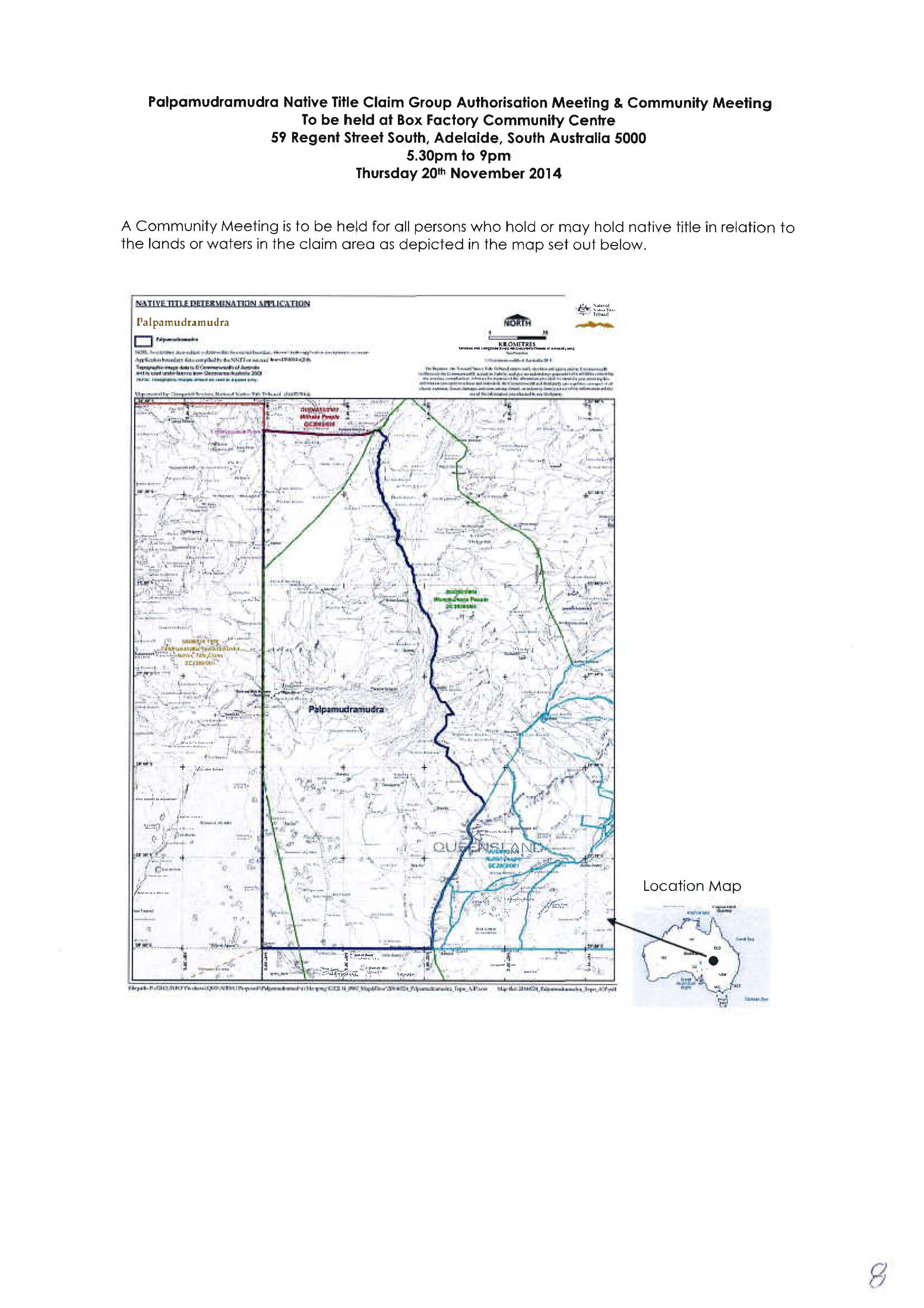
31 If it is necessary to say so, I consider this conclusion is supported by another difficulty with the PY claimant application. It arises from the way in which the meeting held on 20 November 2014 was notified. A copy of the notice, which was sent to as many people as one of the applicants could identify as relevant, is attached to these reasons for judgment as ‘Annexure A’. It will be apparent that the notice identifies one criterion of relevance, being:
persons who hold or may hold native title in relation to the lands or waters in the claim area as depicted in the map set out below.
32 The problem with this method of notification is that it does not identify a proposed native title claim group at all or any criterion for membership. It assumes that any recipient of the notice, without any information beyond the description of the area of land to be claimed, will know if they hold or may hold native title in relation to the area. This assumption is neither justified nor proven by any evidence. Moreover, the heading to the notice refers to the “Palpamudramudra Native Title Claim Group” which suggests that it is members of that group to whom the notice is directed, yet no information is provided about the criteria for membership of this group. No reader of the notice could know whether they were or might be a member of the “Palpamudramudra Native Title Claim Group”. While there is no process prescribed for authorisation, the process will miscarry if it is incapable of yielding an outcome which satisfies ss 61(1) and 251B of the Act.
33 In TJ (on behalf of the Yindjibarndi People) v State of Western Australia [2015] FCA 818 (TJ (on behalf of the Yindjibarndi People)) Rares J, in the context of an application under s 66B of the Act, observed that:
78 In Bolton [2004] FCA 760 at [45]-[46], French J considered whether a replacement applicant had been duly authorised. There, a number of native title claim groups had been defined by reference to apical ancestors, biological descendants of those persons and persons adopted by them. However, advertisements and notices of meetings had not referred to the relevant native title claim groups except by use of the generic titles of the applications in question. His Honour concluded that, unlike in this case, it was not possible to determine whether the persons who participated in the meetings were members of the relevant claim group. But, critically, French J also said that because of the process used, it was not possible to determine whether those participants “were in any sense representative of the various components of the claim group concerned”. French J held that, accordingly, the s 66B application had a fatal deficiency because:
The evidence is insufficient to demonstrate that there has been notification to members of the native title claim group as defined or that those who attended belonged to it. A fortiori, there is no evidence that the meetings were, in any sense, fairly representative of the native title claim groups concerned. (emphasis added)
79 I am of opinion that the notice and advertisements failed properly to identify the persons to whom they were addressed.
80 First, the description in the notice “Yindjibarndi#1 native title claim group members” did not convey any criterion by which a person could identify whether he or she was a member of that group and, in particular, whether he or she was a descendant of any of the 31 apical ancestors by which the claim group was identified. And, that description was indiscriminately jumbled together in the notice with another imprecise description, “Yindjibarndi determined native title holders”.
…
83 The expression “Yindjibarndi #1 native title claim group members” did not convey who were that group’s members. A reader of the notice, or an advertisement of it, would not be informed by it whether the description “Yindjibarndi #1 native title claim group members”, referred to him or her. There is no evidence that that description was universally understood, or understood at all, among the whole of the claim group as designating who its members might be. In fact, that description has the appearance of being very much like lawyers’, not indigenous persons’ language.
34 I am unable to accept Mr Carter’s submission that the reasoning in Bolton and TJ (on behalf of the Yindjibarndi People) must be confined to an application under s 66B. In terms, the reasoning concerns authorisation of an applicant as required by ss 61(1) and 251B. As in Bolton and TJ (on behalf of the Yindjibarndi People) I consider that the notice given of the meeting held on 20 November 2014 was incapable of informing any reader whether they might be a member of the proposed Palpamudramudra native title claim group. In common with TJ (on behalf of the Yindjibarndi People) there is no evidence of universal understanding of the phrase “Palpamudramudra Native Title Claim Group”. Indeed, the evidence is that there is considerable confusion in that regard having regard to the resolutions passed at the meeting and the proposed amendments to the claim group description as discussed above. Accordingly, the deficiencies in the notification were likely to yield (and in my view did yield) incurable deficiencies in the identification of the native title claim group at the only meeting which is said to have resulted in any authorisation of the PY claim.
35 It is unnecessary for me to deal with the allegations of abuse of process by reason of unreasonable delay and prejudice to the Wongkumara applicants. For the reasons given, I am satisfied that the PY native title determination application does not comply with s 61(1) and (4) of the Act, that the non-compliances are incapable of rectification, and that given the nature of the defect in authorisation it would be contrary to the interests of justice for the application to be permitted to proceed. Accordingly, the proceeding should be summarily dismissed under s 84C and also by reference to s 31A(2) of the Federal Court of Australia Act 1976 (Cth) and r 26.01(1)(a) of the Federal Court Rules 2011 (Cth) in that the PY applicants have no reasonable prospect of successfully prosecuting the proceeding given the incurable lack of authorisation of the native title determination application by a native title claim group.
36 I wish to record my appreciation to Mr Carter for his willingness to accept the pro bono referral from the Court to appear on behalf of the PY applicants in relation to the interlocutory application. The result in no way reflects the substantial assistance which he provided.
I certify that the preceding thirty-six (36) numbered paragraphs are a true copy of the Reasons for Judgment herein of the Honourable Justice Jagot. |
Associate:
Annexure A