FEDERAL COURT OF AUSTRALIA
Paperlinx Limited v McConnell [2016] FCA 450
ORDERS
PAPERLINX LIMITED (ACN 005 146 350) Prospective Applicant | ||
AND: | Prospective First Respondent ANDREW JOHN PRICE Prospective Second Respondent | |
DATE OF ORDER: | 29 APRIL 2016 |
THE COURT ORDERS THAT:
1. The parties confer, and provide joint proposed minutes of order, and if in disagreement, short written submissions with separate proposed orders by 4.00pm on 6 May 2016.
Note: Entry of orders is dealt with in Rule 39.32 of the Federal Court Rules 2011.
MIDDLETON J:
INTRODUCTION
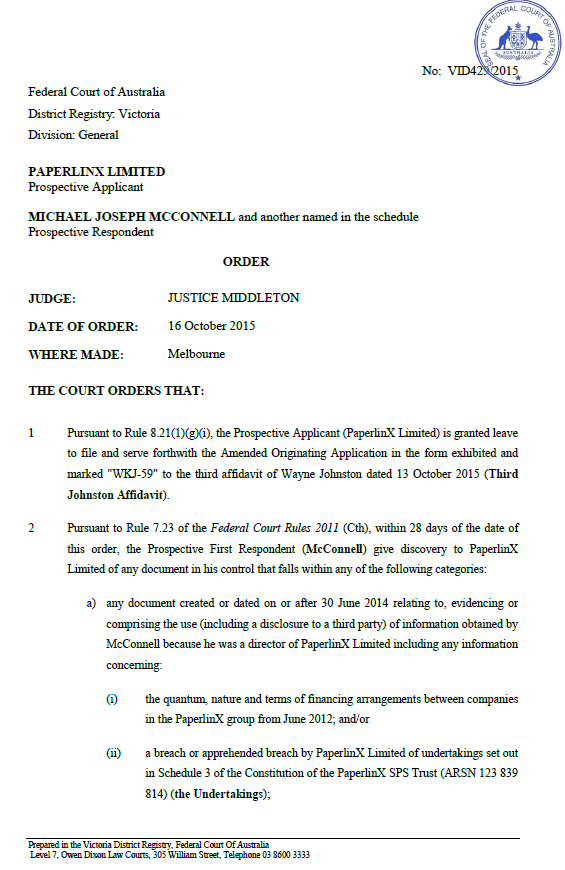
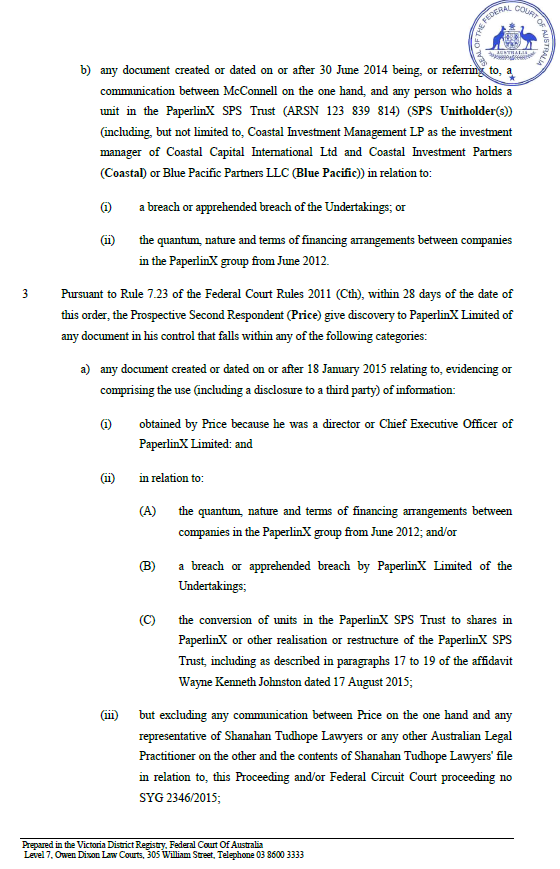
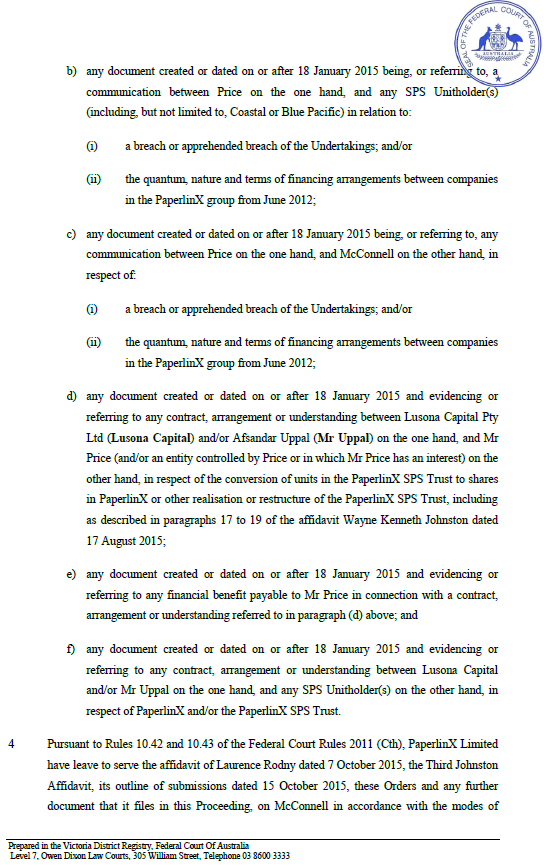
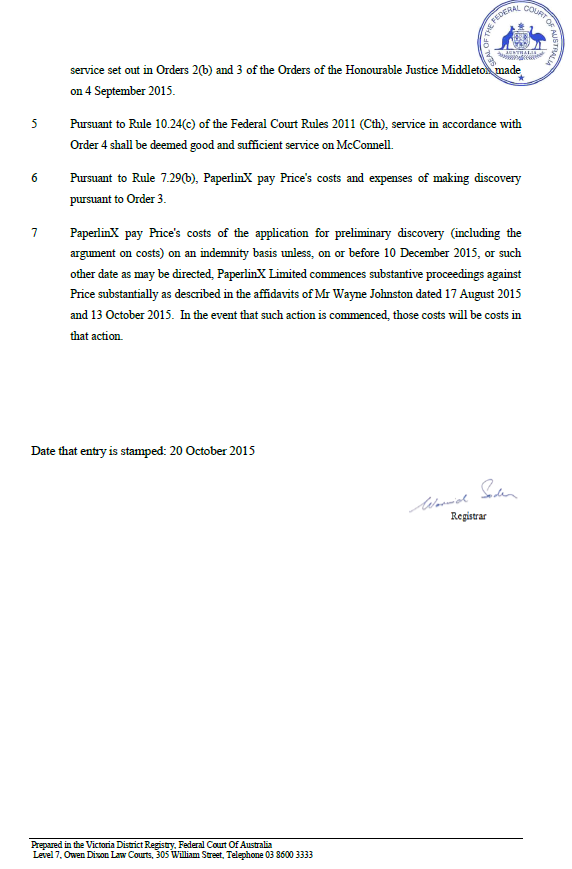
1 On 16 October 2015, I made orders relating to categories of preliminary discovery sought by PaperlinX Limited (‘PaperlinX’) against the Prospective First and Second Respondents (‘Mr McConnell’ and ‘Mr Price’, respectively) (the ‘October Orders’).
2 On 9 December 2015, PaperlinX filed an interlocutory application seeking leave to file and serve a Further Amended Originating Application (‘FAOA’) which amended the categories of preliminary discovery and, pursuant to r 7.23 of the Federal Court Rules 2011 (Cth) (the ‘Rules’), for Mr Price to give preliminary discovery to PaperlinX of any document falling in his control within the categories set out in the FAOA.
3 The new orders sought by PaperlinX, as amendments to the categories of preliminary discovery in the October Orders, are underlined below:
Orders sought
…
(3) Pursuant to Rule 7.23 of the Federal Court Rules 2011 (Cth), within 28 days of the date of this order, the Prospective Second Respondent (Price) give discovery to PaperlinX Limited of any document in his control that falls within any of the following categories:
(a) any document created or dated on or after 18 January 2015 relating to, evidencing or comprising the use (including a disclosure to a third party) of information:
(i) obtained by Price because he was a director of Chief Executive Officer of PaperlinX Limited; and
(ii) in relation to:
…
(D) the sale, divestment, restructure or disposal of any of PaperlinX’s business(es) or assets, including its Northern American business(es);
(b) any document created or dated on or after 18 January 2015 being, or referring to, a communication between Price on the one hand, and any SPS Unitholder(s) (including, but not limited to, Coastal or Blue Pacific) in relation to:
…
(iii) the Consultancy Services Agreement marked “Confidential Exhibit WKJ-65” and exhibited to the affidavit of Wayne Kenneth Johnston dated 8 December 2015 (Consultancy Services Agreement);
(iv) the “Incentive Agreement” referred to in the Consultancy Services Agreement (Incentive Agreement);
(v) the services provided under, and/or in performance of the Consultancy Services Agreement and/or the Incentive Agreement, including in relation to the proposed class action contemplated in the Consultancy Services Agreement; and/or
(vi) the sale, divestment, restructure or disposal of any of PaperlinX’s business(es) or assets, including its Northern American business(es);
…
(g) any document created or dated on or after 18 January 2015 and evidencing, referring to or relating to:
(i) the Incentive Agreement;
(ii) the provision of services and/or performance of the Consultancy Services Agreement and/or Incentive Agreement;
(iii) any payment (including, but not limited to, any fee, salary, wage, commission or other form of remuneration or benefit) payable by Lusona Capital and/or any SPS Unitholder to Price pursuant to the Consultancy Services Agreement and/or the Incentive Agreement;
(iv) any communications between Price and Lusona Capital and/or Uppal in relation to:
(A) the Consultancy Services Agreement (including, but not limited to, communications pursuant to clause 4.2 of the Consultancy Services Agreement);
(B) the Incentive Agreement; and/or
(C) the proposed class action contemplated in the Consultancy Services Agreement.
The October Orders are set out in the annexure to these reasons because reference is made to these orders later (as ‘original orders’).
4 PaperlinX made the Interlocutory Application on the basis that documents provided by Mr Price pursuant to the October Orders (as well as further documents obtained by PaperlinX) indicated to PaperlinX a strong likelihood that Mr Price had not discovered documents required to be produced under the October Orders. In addition, PaperlinX submitted that the documents discovered by Mr Price reveal the existence of other documents that could be the subject of additional orders for preliminary discovery under r 7.23 of the Rules.
CHRONOLOGY OF CORRESPONDENCE
5 Both parties rely upon the exchange of correspondence that occurred between Mr Price producing his initial tranche of discovery via an affidavit and list of documents filed and served on 13 November 2015 (‘Discovery Affidavit’), the second affidavit and an amended list of discovered documents filed and served by Mr Price on 15 December 2015 (‘Amended Discovery Affidavit’), and before the hearing of this Interlocutory Application on 5 February 2016. It is useful to set out the chronology of this correspondence:
(1) On 13 November 2015, Mr Price served on PaperlinX the Discovery Affidavit, and nine documents discovered pursuant to the October Orders. The documents were emails between Mr Price and Lusona Capital Pty Ltd (‘Lusona’) together with attachments, evidencing:
(a) the negotiation of a ‘Consultancy Services Agreement’ between Lusona and Mr Price from March 2015 to July 2015;
(b) the execution of the ‘Consultancy Services Agreement’ dated 14 July 2015 (‘CSA’); and
(c) the termination of the CSA by Lusona on 12 October 2015.
(2) On 3 December 2015, PaperlinX’s solicitors wrote to Mr Price’s solicitors complaining about the adequacy of Mr Price’s discovery, and requiring the provision of further documents by 7 December 2015 (‘3 December Letter’). The letter broadly addressed the failure of Mr Price to provide discovery in respect of:
(a) the Incentive Agreement, being an agreement between Lusona and the unitholders in PaperlinX SPS Trust (‘SPS Unitholders’) in relation to a class action process with PaperlinX;
(b) fees to be paid by Lusona to Mr Price under the CSA;
(c) the provision of services by Mr Price under the CSA and communications with Lusona in relation to those services; and
(d) the PaperlinX board paper dated 19 June 2012
(together, the ‘Discovery Issues’).
(3) Between 7 December 2015 and 8 December 2015, the parties exchanged further correspondence which does not bear on the issues in this Interlocutory Application, save for PaperlinX’s request for Mr Price’s consent to an extension of time to the deadline of 10 December 2015 for PaperlinX to commence substantive proceedings against Mr Price. Mr Price did not provide such consent, but offered to refrain from enforcing the costs orders against PaperlinX for a number of days.
(4) On 9 December 2015, PaperlinX filed the Interlocutory Application.
(5) On 11 December 2015, Mr Price’s solicitors provided a substantive response to the 3 December Letter, addressing each of the Discovery Issues (‘11 December Letter’).
(6) On 15 December 2015, Mr Price’s solicitors filed and served on PaperlinX the Amended Discovery Affidavit, providing discovery of an email from Mr Price to his wife attaching the PaperlinX board paper dated 19 June 2012 (‘June 2012 Board Paper’), which had been identified by PaperlinX in the 3 December Letter as missing from Mr Price’s discovered documents. The June 2012 Board Paper includes information relating to:
(a) confidential valuations of parts of PaperlinX’s business, and proposed options to sell parts of PaperlinX’s business or assets, including its North American business; and
(b) confidential intercompany financing arrangements between the PaperlinX group of companies.
(7) On 3 February 2016, PaperlinX’s solicitors responded to the 11 December Letter and Amended Discovery Affidavit, further addressing the Discovery Issues, and requesting the production of documents sought by the new categories of discovery set out in proposed FAOA.
(8) On 3 February 2016, Mr Price’s solicitors responded to PaperlinX’s solicitors letter of the same day, confirming Mr Price’s instructions that, among other things, he ‘does not have any documents falling within the [October Orders] other than those already discovered’ (‘Price’s 3 February Letter’).
RELEVANT LEGAL PRINCIPLES
6 As PaperlinX is yet to commence proceedings, any new orders must comply with r 7.23 of the Rules, which provides the following:
1) A prospective applicant may apply to the Court for an order under subrule (2) if the prospective applicant:
a) reasonably believes that the prospective applicant may have the right to obtain relief in the Court from a prospective respondent whose description has been ascertained; and
b) after making reasonable inquiries, does not have sufficient information to decide whether to start a proceeding in the Court to obtain that relief; and
c) reasonably believes that:
i) the prospective respondent has or is likely to have or has had or is likely to have had in the prospective respondent’s control documents directly relevant to the question whether the prospective applicant has a right to obtain the relief; and
ii) inspection of the documents by the prospective applicant would assist in making the decision.
7 The following issues are relevant to this Interlocutory Application:
(a) whether PaperlinX has sufficient information to decide whether to commence proceedings;
(b) whether PaperlinX has demonstrated that it holds a reasonable belief that Mr Price has control of the documents sought to be discovered under the new orders; and
(c) whether the documents sought under the new orders are directly relevant to the question of whether PaperlinX has the right to obtain the relief.
Sufficiency
8 Justice Hely in St George Bank Ltd v Rabo Australia Ltd (2004) 211 ALR 147 outlined in some detail the principles relevant to an application for preliminary discovery under the predecessor to r 7.23, order 15A r 6 of the Federal Court Rules 1979 (Cth). Relevantly, his Honour noted (at [26]) that, in relation to determining the scope of the discovery sought:
the question … is not whether the applicant has sufficient information to decide if a cause of action is available against the prospective respondent. The question is whether the applicant has sufficient information to make a decision whether to commence proceedings in the court... Accordingly, an applicant for preliminary discovery may be entitled to discovery in order to determine what defences are available to the respondent and the possible strength of those defences, or to determine the extent of the respondent’s breach and the likely quantum of any damages award…
(Emphasis in original; citations omitted.)
9 The question of sufficiency of information is central to determining whether preliminary discovery should be ordered. This question has been considered by various courts. For example, in Reeve v Aqualast Pty Ltd [2012] FCA 679, Yates J reviewed the authorities in relation to pre-trial discovery and relevantly held (at [65]) that:
[t]he measure of any preliminary discovery to be ordered is the extent of information that is necessary, but no more than that which is necessary, to overcome the insufficiency of information already possessed by the applicant after the making of all reasonable inquiries, to enable a decision to be made whether to commence a proceeding.
10 More specifically, Lindgren J in Alphapharm Pty Limited v Eli Lilly Australia Pty Limited [1996] FCA 1500 at [41] made the following observations in relation to ‘sufficiency’ (again in respect of the predecessor provision to r 7.23):
[T]he “insufficiency test” of [r 7.23(b)] has both subjective and objective aspects…
The fact that a particular applicant genuinely feels unable, because of a lack of information, to decide to commence a proceeding does not, without more, satisfy [r 7.23(b)]; the objective aspect of the paragraph requires it to be shown as an objective fact that the applicant lacks “sufficient information to enable a decision to be made whether to commence a proceeding”…
In my view, the objective aspect of [r 7.23 (b)] invokes a notion of “reasonable sufficiency”, the question raised being whether it is reasonable that the applicant for an order be required to take its decision without having the information to become available from inspection of the document or documents of which discovery is sought…
11 The Full Court of the Federal Court in Optiver Australia Pty Ltd v Tibra Trading Pty Ltd (2008) 169 FCR 435 also provided the following commentary (at [36]) on the scope of, and rationale behind the concept of ‘sufficiency’ in a preliminary discovery application:
The policy behind the rule is that even where there is a reasonable cause [as per the predecessor to r 7.23] to believe that a person may have a right to relief, nevertheless that person may need information to know whether the cost and risk of litigation is worthwhile. As Hely J pointed out in St George Bank Ltd v Rabo Australia Ltd (2004) 211 ALR 147 at [26], the question does not concern the right to relief but rather “whether to commence proceedings”. Inspection of documents in the possession of the proposed defendant may enable a properly informed decision to be made whether to commence a proceeding to obtain the relief.
Reasonable belief
12 In United Voice v Accolade Wines Australia Limited [2013] FCA 285 (‘United Voice’), Lander J said (at [29]):
if a prospective applicant has been told by a prospective respondent that documents of the kind sought in the application do not exist or are not in the prospective respondent’s possession, custody or power, it is hard to think that the prospective applicant could thereafter reasonably believe that the documents did exist, unless the prospective applicant could point to other evidence apart from the prospective respondent’s denial that would support that belief.
13 Mr Price submitted that PaperlinX cannot identify any other evidence that establishes a ‘reasonable belief’ that Mr Price has control of the documents sought in circumstances where Mr Price has already denied he has control of such documents. It is relevant, therefore, to note the comments of the Full Court of the Federal Court in relation to a ‘reasonable belief’ under r 7.23(1)(c) in Sandhurst Trustees Ltd v Clarke (2015) 321 ALR 1 at [20] (‘Sandhurst’), where it was held that:
the requirement is to show that the belief held by the applicant is one that is reasonably based. That requires an applicant to satisfy the court that there are reasonable grounds for the belief: that is, the existence of facts that are sufficient to induce that belief in a reasonable person…
(Emphasis added; citations omitted.)
Directly relevant
14 Rule 7.23 of the Rules requires the documents sought to be ‘directly relevant’ to the claim for relief. In ObjectiVision Pty Ltd v Visionsearch Pty Ltd (2014) 108 IPR 244 (‘ObjectiVision’), Perry J held (at [102]) that ‘the question of “direct relevance” is to be measured against the question of whether [the prospective applicant] has a right to obtain relief’ that the prospective applicant claims it may be entitled to. Her Honour also accepted the argument (at [102]) that ‘the concept of “direct relevance” does not necessarily exclude material from which inferences may be drawn and that, if the position were otherwise, the rule may fail to achieve its purpose in cases… where any evidence of [the claim] will almost inevitably be inferential.’
15 It has been accepted that a preliminary discovery application necessarily involves an element of ‘fishing’: see ObjectiVision at [104] per Perry J; Paxus Services Ltd v People Bank Pty Ltd (1990) 99 ALR 728 per Burchett J.
CONSIDERATION
16 As I have previously noted, with respect to the Interlocutory Application, the new orders must satisfy the three relevant criteria of r 7.23 of the Rules: ‘reasonable belief’, ‘sufficiency’ and ‘direct relevance’.
17 I note the following aspects of the parties’ arguments in relation to the following two criteria, as they inform my findings further below in relation to each of the new orders.
Sufficiency
18 In resisting PaperlinX’s application, Mr Price made broad submissions, outlining the information already in PaperlinX’s possession, to demonstrate that PaperlinX had sufficient material with which to decide whether to commence proceedings. Such information includes:
evidence that Mr Price has possession of PaperlinX’s confidential information;
information disclosing Mr Price’s confidentiality obligations;
market announcements and product disclosure statements from which publicly available information (viz a viz the intercompany loans) can be determined;
evidence that Mr Price had expressed a willingness to divulge confidential information if a recipient were to agree to make payments to him;
the CSA;
PaperlinX’s apprehension that Mr Price used the confidential information in providing services under the CSA; and
evidence of meetings between Mr Price and SPS Unitholders, and that such unitholders are now in possession of information confidential to PaperlinX.
19 While PaperlinX did not dispute that it possesses such information, it contended that such information only grounds the suspicions and does not show use of the information that would demonstrate it to be improper.
Directly relevant
20 As identified in ObjectiVision, the scope of the documents that can be ordered to be discovered in a preliminary discovery application is tied to the right to relief that may potentially be claimed. PaperlinX submitted that it believes it may have a right to obtain the following relief against Mr McConnell and Mr Price:
(a) injunctions to restrain breach of duties under s 183 of the Corporations Act 2001 (Cth) (the ‘Act’) and the analogous duty at general law;
(b) declaratory relief for breach of their contractual confidentiality obligations;
(c) injunctions to restrain further breaches of their contractual and statutory duties of confidentiality; and
(d) relief, both against Mr McConnell and Mr Price and possible third parties, under s 1043O of the Act for orders regulating future or past acquisitions or disposals of financial products (being PaperlinX Step Up Preferences Securities which are units in the PaperlinX SPS Trust (‘SPS Units’)) on the basis that Mr McConnell and Mr Price may have procured trading in SPS Units in contravention of s 1043A of the Act.
21 As noted above, one aspect of PaperlinX’s claim relates to possible relief available under s 183 of the Act which relevantly provides:
Section 183 Use of Information – civil obligations
(1) A person who obtains information because they are, or have been, a director or other officer or employee of a corporation must not improperly use the information to:
(a) gain an advantage for themselves or someone else; or
(b) cause detriment to the corporation.
22 Mr Price submitted that PaperlinX’s claims under s 183 of the Act centres on Mr Price’s disclosure of PaperlinX’s confidential information. Therefore, for the documents sought by PaperlinX to be considered directly relevant, Mr Price claimed that they must fall within one of the two types of confidential information that PaperlinX has identified in various affidavits, namely:
(a) ‘The terms on which and transactions by which the proceeds [raised by the issue of SPS Units in 2007] were originally invested and subsequently deployed in the PaperlinX group…’; and
(b) ‘Confidential valuation of parts of PaperlinX’s business, and proposed options to sell parts of Paperlinx’s businesses or assets including the North American business’.
23 In this regard, I accept PaperlinX’s submissions that relief potentially available to it is not limited to disclosure of PaperlinX’s confidential information. Rather, relief available under s 183 of the Act concerns improper use of any information obtained in a certain capacity; it is broader than ‘confidential information’. While improperly using information may occur from the disclosure of confidential information, that is not the limit of s 183 of the Act.
New orders sought
24 The new orders that are sought can be conveniently divided into the following categories:
(a) ‘Unitholder Communication Orders’: Orders related to communications between Mr Price and SPS Unitholders, contained in new orders 3(b)(iii) – (vi).
(b) ‘Northern American Business Orders’: Orders related to the sale of PaperlinX’s businesses, contained in new order 3(a)(ii)(D).
(c) ‘Incentive Agreement Orders’: Orders relating to the Incentive Agreement, contained in new order 3(g)(i).
(d) ‘CSA Fees Orders’: Orders relevant to the fees provided for in the CSA, contained in new order 3(g)(iii).
(e) ‘CSA Services Orders’: Orders concerning Mr Price’s provision of services under the CSA and communications with Lusona in respect of these services, contained in new orders 3(g)(ii) and (iv).
I will deal with each of these categories in turn.
Unitholder Communication Orders
25 PaperlinX has sought new orders in relation to the category of documents concerning communications between Mr Price and the SPS Unitholders in original order 3(b). At the heart of the claims that PaperlinX considers it may pursue is the improper use of information obtained by Mr Price from his position at PaperlinX. Improper use could result from disclosure of information to the SPS Unitholders which advantages Mr Price or the SPS Unitholders by either:
(a) providing an opportunity for Mr Price to gain financial benefits from the provision of such information; or
(b) assisting SPS Unitholders in a potential class action against PaperlinX, or in their campaign to trigger realisation of their SPS Units.
26 As such, I consider that the documents sought under these new orders are directly relevant to the relief PaperlinX may be entitled to claim.
27 Further, I accept PaperlinX’s characterisation of these documents as new categories of discovery not previously covered by the October Orders. These categories are distinct from the information contained in the documents already discovered by Mr Price in the Discovery Affidavit and Amended Discovery Affidavit (together, the ‘Price Affidavits’). As such, the evidence contained in the Price Affidavits does not cover these new categories of discovery. Therefore, as matters now stand, Mr Price, in his affidavits and correspondence, does not expressly state that he does not have control of documents now sought in this category. Having regard to the relationship between Mr Price and the SPS Unitholders, and the documents already known to be in existence, I consider that PaperlinX’s evidence establishes their reasonable belief that the documents that fall within these new orders may be in Mr Price’s control. It is more than likely that this is the case.
28 Further, I also consider that the centrality of such communications between Mr Price and the SPS Unitholders to the relief potentially sought, and the fact that no documents had been discovered under original order 3(b), render the new orders necessary to PaperlinX’s decision whether to commence a proceeding. The documents produced by such new orders may assist PaperlinX to make ‘an estimation of the strength of a prospective case including consideration of possible defences’: Optiver Australia Pty Ltd v Tibra Trading Pty Ltd [2007] FCA 1348 at [6].
29 In addition, PaperlinX has raised as a potential cause of action a breach of the insider trading provisions under s 1043A of the Act. In particular, PaperlinX has produced evidence regarding Mr Price’s meeting with key SPS Unitholders and such unitholders’ subsequent campaign to trigger a realisation of the SPS Units in PaperlinX.
30 In light of this, I also consider discovery of the documents covered by the Unitholder Communication Orders to be both directly relevant to this cause of action, and necessary to determining whether to commence proceedings in this regard.
31 Therefore, I will allow the Unitholder Communication Orders contained in new orders 3(b)(iii) – (vi).
32 If Mr Price does not have these documents within his control, he can file and serve an affidavit deposing to this.
Northern American Business Order
33 PaperlinX has also sought an order to require discovery of documents relating to the use of information with respect to the sale, divestment, restructure or disposal of any of PaperlinX’s business or assets, including its Northern American business. The order is in part sought following Mr Price’s initial failure to provide the June 2012 Board Paper. However, PaperlinX has also sought the order on the basis of the nexus between:
(a) Mr Price obtaining the June 2012 Board Paper when the termination of his employment was imminent;
(b) Mr Price being in contact with SPS Unitholder, Coastal, on the day his employment terminated; and
(c) Coastal pursuing a campaign to trigger realisation of its SPS Units by reference to the sale of the Canadian branch of PaperlinX’s business.
PaperlinX submitted that this nexus gives rise to a reasonable apprehension that the sale of the Canadian business was discussed by Mr Price and Coastal, if not other SPS Unitholders.
34 I do not consider that PaperlinX lacks sufficient information from which to determine whether to commence proceedings for the following reasons:
(a) Mr Price discovered (albeit not initially) key documents that would fall under this discovery category (namely, the June 2012 Board Paper and emails to which it was attached); and
(b) PaperlinX is already in possession of significant information (as outlined at paragraph 18 above) which may be relevant to this order.
35 As such, PaperlinX has sufficient information in this respect already, and I will not allow the orders sought in new order 3(a)(ii)(D).
Other Orders – Incentive Agreement, CSA Fees and CSA Services Orders
36 The remaining new orders are all categories of discovery covered by categories contained in the October Orders, as follows:
(a) Incentive Agreement Orders are covered by original order 3(f);
(b) CSA Fees Orders are covered by original order 3(e); and
(c) CSA Services Orders are variously covered by original orders 3(d), 3(e), and 3(f).
37 Therefore, the evidence contained in the Price Affidavits necessarily applies to the categories of discovery sought in these new orders. As such, the key issue to be determined in respect of each of the three new orders is whether PaperlinX has demonstrated a reasonable belief that the documents are in Mr Price’s control, despite Mr Price swearing to the contrary position in two previous affidavits. In light of the relevant authorities, I must be satisfied that PaperlinX has ‘point[ed] to other evidence apart from the prospective respondent’s denial that would support that belief’: United Voice at [29]. Such evidence must include ‘the existence of facts that are sufficient to induce that belief in a reasonable person’: Sandhurst at [20].
38 In relation to each of these new orders sought, PaperlinX claimed that Mr Price’s correspondence with PaperlinX, and the 11 December Letter in particular, revealed Mr Price’s restricted interpretation of the categories of discovery. Therefore, PaperlinX submitted that the Price Affidavits cannot be regarded as conclusive as to the fact that proper and complete discovery had been given in compliance with the categories contained in the October Orders. As such, these further categories of discovery are required. PaperlinX made such submissions on the following grounds:
(a) In the 11 December Letter, Mr Price’s solicitors stated that ‘our client does not have and has not previously had in his possession or control either the original or a copy of the Incentive Agreement.’ PaperlinX emphasised the fact that the 11 December Letter provided no confirmation in respect of other documents that might be discoverable under order 3(f). Therefore, to the extent his affidavits swear a position in respect of order 3(f), PaperlinX submitted that they must be considered to be limited to providing evidence in relation only to copies or the original of the Incentive Agreement.
(b) Given that the terms of the CSA, and particularly the fees Mr Price stood to receive under it, are closely tied to the Incentive Agreement, PaperlinX submitted that it ‘defies logic’ that Mr Price would not have any document related to the Incentive Agreement.
(c) In respect of the fees provided for in the CSA, Mr Price’s solicitors further stated in the 11 December Letter that ‘we are instructed that our client has never received any such payment or benefit [provided for in the CSA].’ PaperlinX submitted that such a response indicates that Mr Price’s interpretation of the original order 3(e) was restricted only to documents relating to benefits or payments actually received, and not those Mr Price stood to receive.
(d) Again in the 11 December Letter, Mr Price’s solicitors responded to PaperlinX’s assumption that Mr Price’s provision of the consultancy services under the CSA necessarily involved disclosing to Lusona, or otherwise using, information he obtained as a result of his position at PaperlinX. Mr Price’s solicitors stated:
Not only is no basis provided for this assumption, but it ignores the fact that clause 3.4 of the Consultancy Agreement expressly acknowledges our client’s ongoing obligations as a Director and Chief Executive Officer of [PaperlinX]. In any event, the documents of the kind your letter assumes to exist, would fall within the Court’s orders and in particular orders 3(a) and (b).
PaperlinX submitted that Mr Price’s response is limited to providing assurance only in respect of documents evidencing a breach by Mr Price of his ongoing obligations to PaperlinX, and not in relation to the provision of services under the CSA more generally, which was what was required by the relevant original orders.
39 In light of this, PaperlinX claimed that Mr Price’s deficiencies in this regard establish a basis for seeking categories of discovery specific to each deficiency, and requiring Mr Price to swear a further affidavit in relation to such categories.
40 I reject PaperlinX’s submissions on each of these grounds for the following reasons:
(a) First, in the 11 December Letter, Mr Price’s solicitors made the following general comments relating to the fees under the CSA and the provision of CSA services, which provided broad assurances affirming Mr Price’s position in respect of discovery under the October Orders:
(i) In relation to the fees under the CSA: ‘We are instructed that our client does not have and has not previously had in his possession or control documents evidencing, relating to or referring to the payment or other financial benefit contemplated in clause 5.1 of the Consultancy Services Agreement’; and
(ii) In relation to the provision of CSA services: ‘We confirm that our instructions are that our client has no further documents to discover under the Court’s order.’
PaperlinX’s position seemed to ignore such assurances, and was somewhat selective as to which of Mr Price’s statements it contended should be used to colour the evidence contained in his affidavits.
(b) Second, to suggest that Mr Price’s response in respect of the ‘originals or copies of the Incentive Agreement’ in the 11 December Letter revealed that Mr Price considered the relevant discovery categories to be limited in such a way takes the comment out of the context of the exchange of correspondence, as PaperlinX specifically requested the Incentive Agreement in the 3 December Letter.
(c) Finally, Mr Price’s solicitors make the following broad statements in Price’s 3 February Letter as to Mr Price’s compliance with the October Orders:
Through your letter dated 3 February 2016, your client seeks to suggest that our [11 December] letter has failed to confirm that our client has otherwise complied with the Court’s Orders made on 16 October 2015 (the Orders). We consider this suggestion to be misconceived. Our letter dated 11 December 2015 made clear that our client has provided discovery in terms of the Orders… Further in any event, our client subsequently filed a further List of Documents. In any event, we confirm that our instructions are that our client does not have any documents falling within the Orders other than those already discovered.
Contrary to PaperlinX’s submissions, Mr Price’s correspondence provided broad assurances as to compliance with the October Orders. I do not consider that it reveals Mr Price’s restrictive or misguided interpretation of the discovery categories in the October Orders, nor that it should colour Mr Price’s sworn position. Therefore, I do not consider that PaperlinX has identified the ‘existence of facts that are sufficient to induce’ a reasonable belief that the documents sought under these orders may be in Mr Price’s control, particularly in light of his sworn position. Therefore, I will not allow the orders contained in new order 3(g).
Discretion
41 The Court has an ultimate discretion to refuse an application for preliminary discovery, even if the other requirements of r 7.23 of the Rules are satisfied. In relation to the documents I propose to order be discovered, I consider that there is a utility in making the preliminary discovery orders. The documents are relatively confined in their nature, and go beyond the original orders sought. While this Interlocutory Application is the second seeking preliminary discovery, and while Mr Price has complied with the original orders, the further limited discovery I now order is not too burdensome on Mr Price and relates to possibly significant documents relevant to PaperlinX’s decision as to bringing a proceeding.
CONCLUSION
42 In view of the above, I tentatively consider that the following orders should be made:
(1) Pursuant to r 7.23 of the Rules, within 28 days of the date of this order, Mr Price give discovery to PaperlinX of any document in his control that falls within any of the following categories:
any document created or dated on or after 18 January 2015 being, or referring to, a communication between Mr Price on the one hand, and any SPS Unitholder(s) (including, but not limited to Coastal or Blue Pacific) in relation to:
(i) the Consultancy Services Agreement marked ‘Confidential Exhibit WKJ-65’ and exhibited to the affidavit of Wayne Kenneth Johnston dated 8 December 2015 (‘Consultancy Services Agreement’)
(ii) the ‘Incentive Agreement’ referred to in the Consultancy Services Agreement (‘Incentive Agreement’);
(iii) the services provided under, or in performance of, the Consultancy Services Agreement or the Incentive Agreement, including in relation to the proposed class action contemplated in the Consultancy Services Agreement; and
(iv) the sale, divestment, restructure or disposal of any of PaperlinX’s business(es) or assets, including its Northern American business(es);
(2) Pursuant to r 8.21(1)(g)(i) of the Rules, PaperlinX is granted leave to file and serve a Further Amended Originating Application in the form exhibited to the fourth affidavit of Wayne Kenneth Johnston dated 8 December 2015 and marked ‘WKJ-67’; and
(3) Pursuant to r 7.29(b) of the Rules, PaperlinX pay Mr Price’s costs and expenses of making discovery pursuant order 1.
43 In relation to the time for issuing any proceeding made in order 7 of the orders made on 16 October 2015, as I said during the hearing, it would be unfair not to allow PaperlinX further time to consider its position in light of these reasons. I consider it appropriate to vary the original order, and there is no real prejudice to Mr Price in so doing. Therefore, in addition to the above orders, it would be appropriate to make an order that the reference to ‘on or before 10 December 2015’ in paragraph 7 of the October Orders be amended to read ‘on or before 23 June 2016.’
44 I propose to give the parties time to consider these proposed orders. I will order that the parties confer, and provide minutes of joint proposed order, and if in disagreement, a short written submission with separate proposed orders by 4.00pm on 6 May 2016.
I certify that the preceding forty-four (44) numbered paragraphs are a true copy of the Reasons for Judgment herein of the Honourable Justice Middleton. |
Associate:
ANNEXURE