

FEDERAL COURT OF AUSTRALIA
Kim v SW Shipping Co Ltd [2016] FCA 428
ORDERS
GYEONG-DUEK KIM IN HIS CAPACITY AS FOREIGN REPRESENTATIVE OF SW SHIPPING CO LTD Plaintiff | ||
AND: | Defendant | |
DATE OF ORDER: |
THE COURT ORDERS THAT:
1. The order made on 4 February 2016 in paragraph 2 a. is amended nunc pro tunc pursuant to r 39.05 of the Federal Court Rules 2011 (Cth) so that the word “send” is substituted for the word “serve”.
2. Rehabilitation proceedings in the Seoul Central District Court (Case 2015 HeoHap 100273 Rehabilitation) by which the plaintiff was recognised as custodian of the defendant on 11 December 2015 (“the Korean proceeding”) be recognised as a foreign proceeding within the meaning of the Cross-Border Insolvency Act 2008 (Cth) Schedule 1 (“Model Law”) Article 2(a) and Article 17(1).
3. Mr Gyeong-Duek Kim be recognised as a foreign representative within the Article 2(d) of the Model Law.
4. The Korean proceeding be recognised as a foreign main proceeding pursuant to Article 17(2) of the Model Law.
5. Pursuant to r 15A.7(1)(b), (c) and (d) of the Federal Court (Corporations) Rules 2000 (Cth), the plaintiff be ordered:
(a) within 48 hours of the date of this order, to serve a copy of this order on the defendant by sending it by email to the following address hijoung.oh@barunlaw.com;
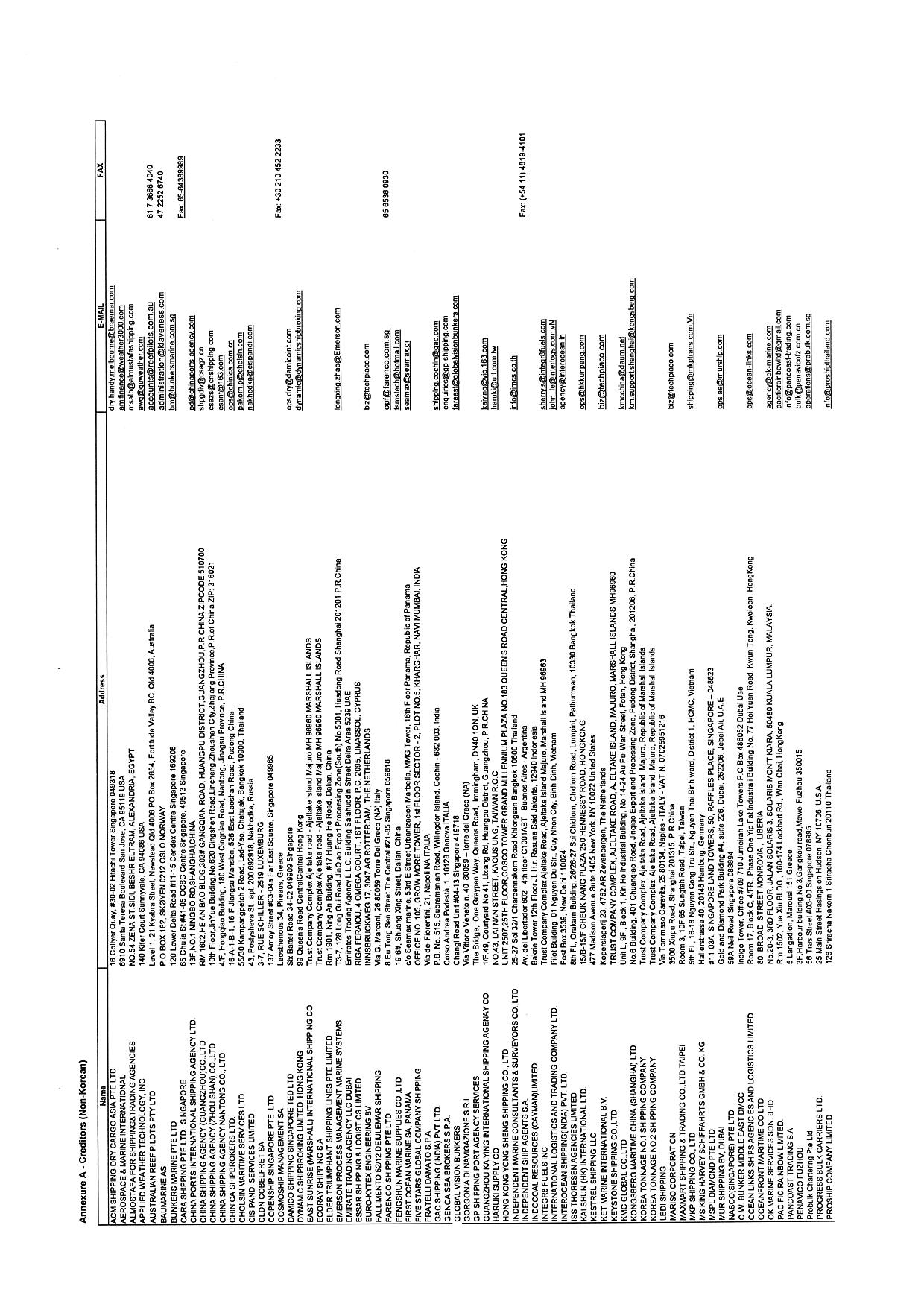
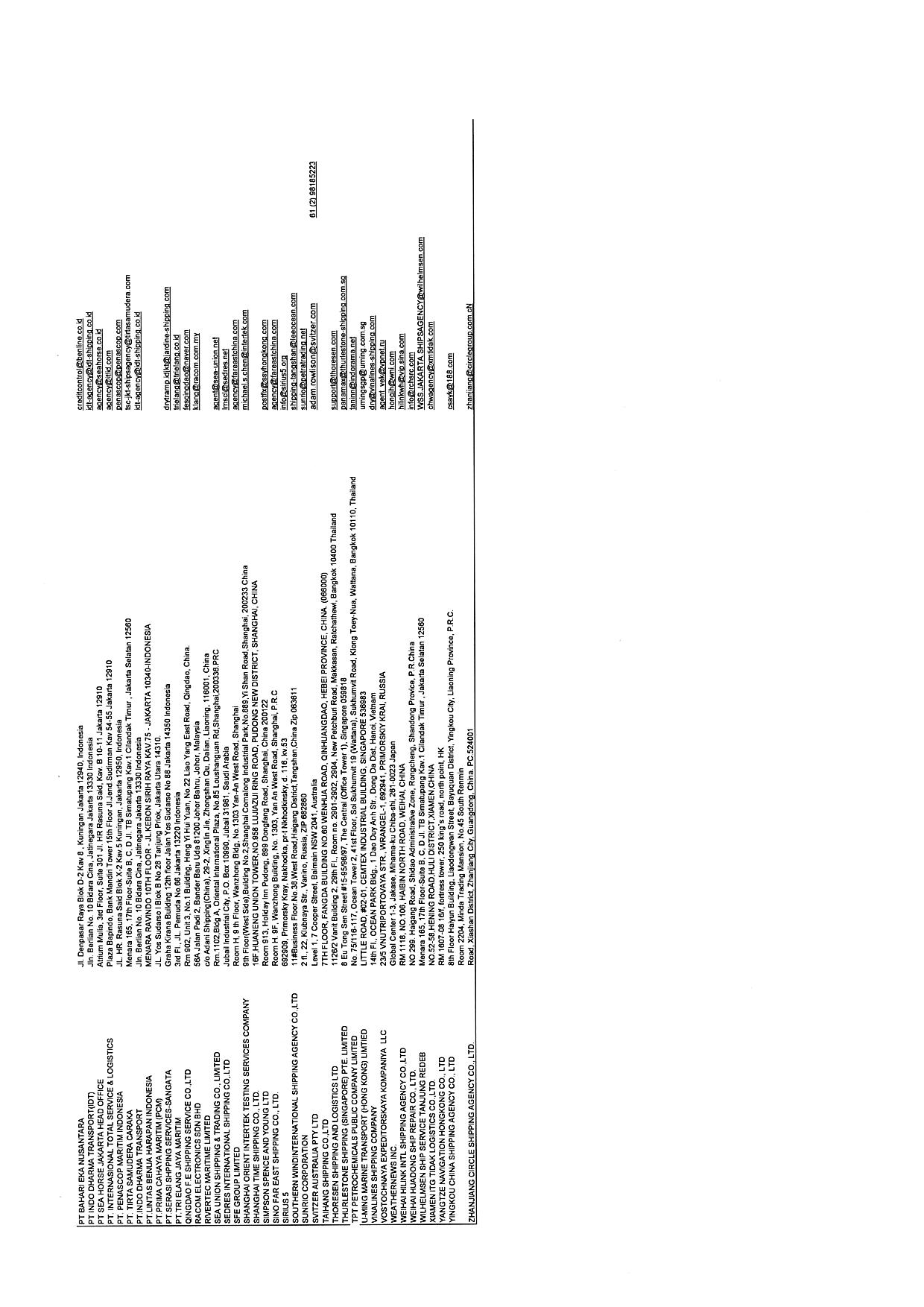
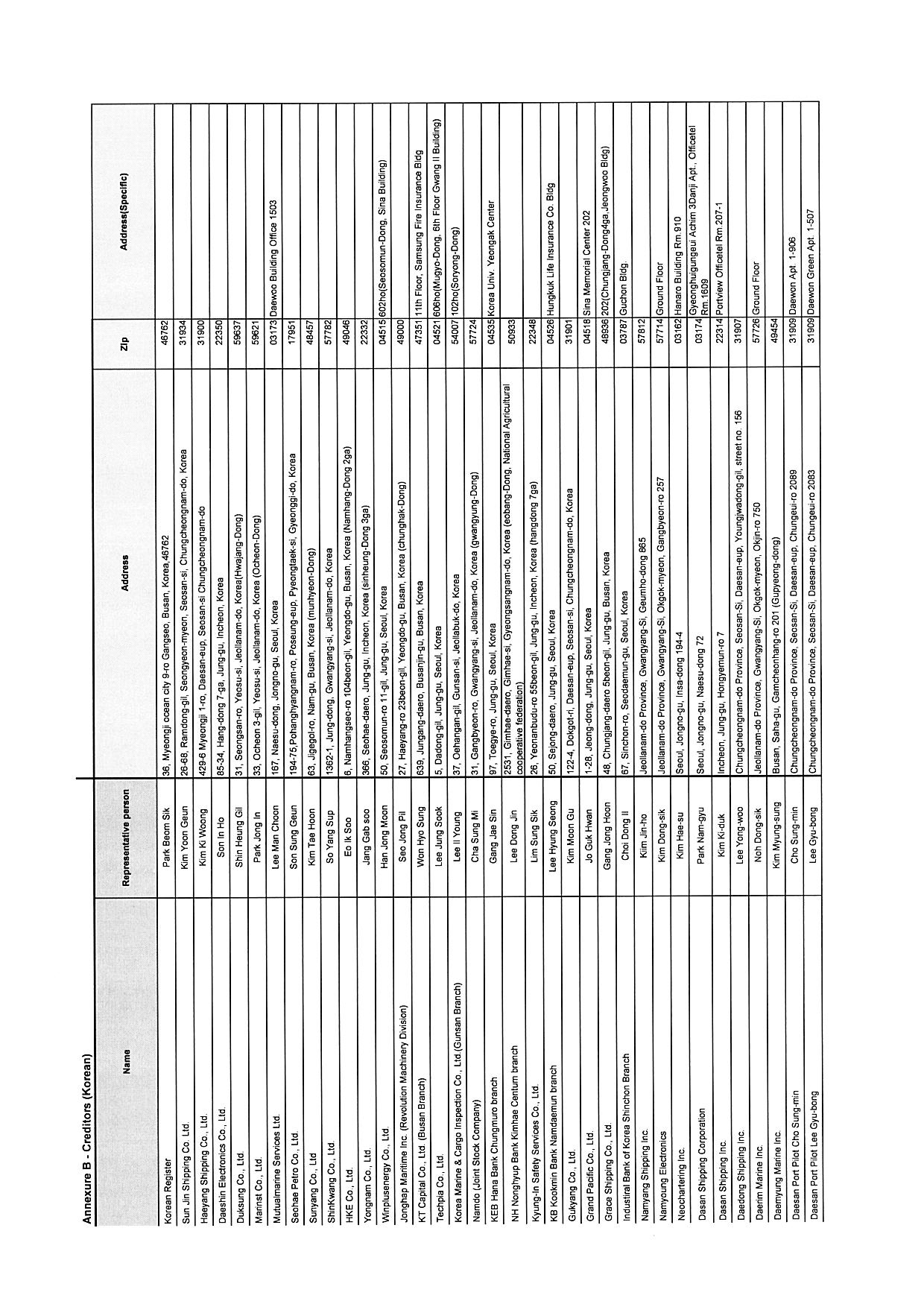
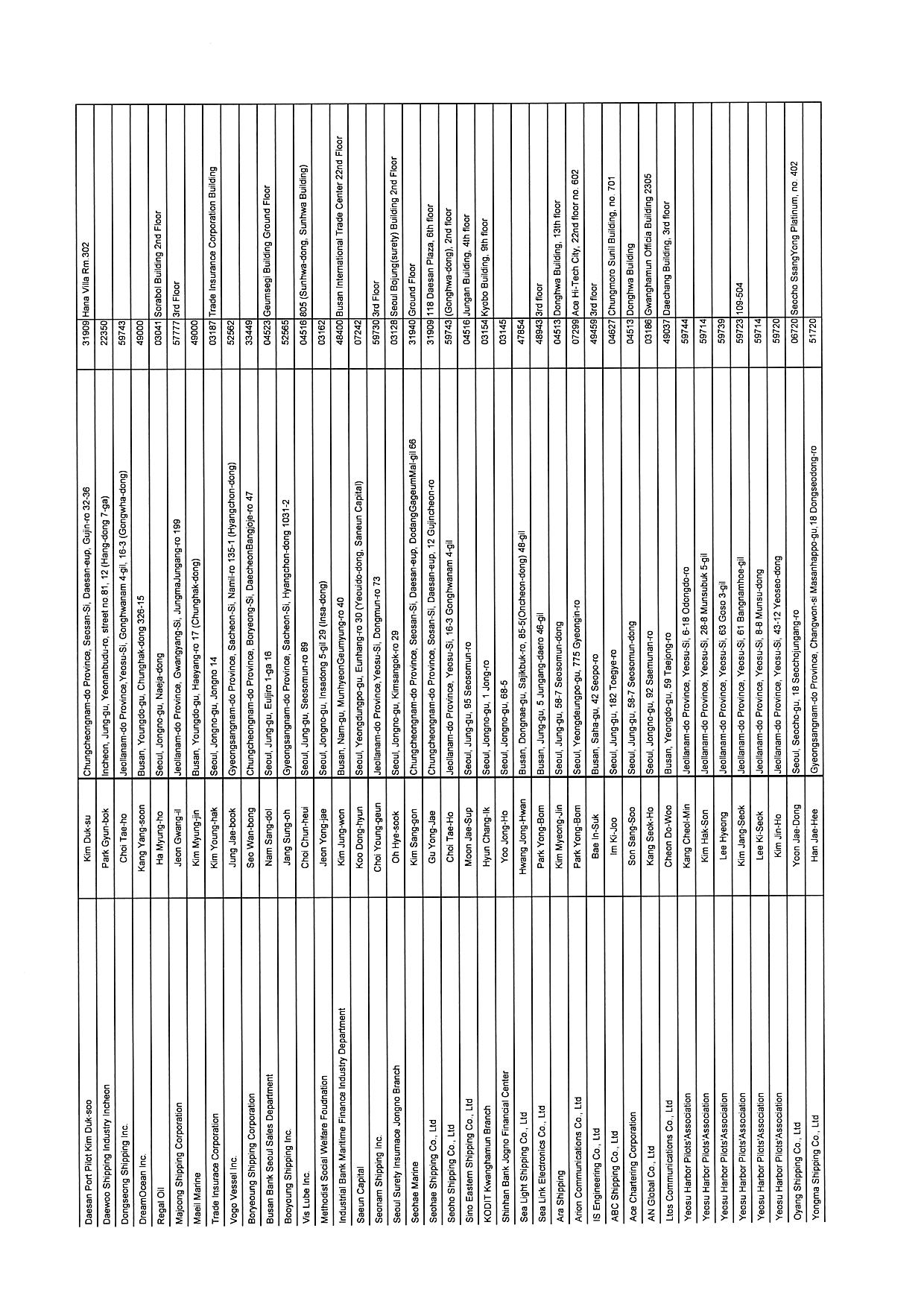
(b) within 7 days of the date of this order, to send a copy of these orders in accordance with Form 21 of the Federal Court (Corporations) Rules to the persons listed at Annexures A and B to these orders by either registered post, facsimile or email, save for the following:
(i) Pt Lintas Benua Harapan Indonesia;
(ii) ShinKwang Co Ltd;
(iii) Grace Shipping Co Ltd;
(iv) Grand Pacific Co Ltd;
(v) ABC Shipping Corporation;
(vi) Fallimento 52/12 Deiulemar Shipping;
(vii) Global Vision Bunkers;
(viii) Progress Bulk Carriers;
(ix) Proship Company Limited; and
(x) Pt Prima Cahaya Maritim (PCM)
on which notification by the method in paragraph (c) below is taken to be sufficient compliance with r 15A.7 of the Federal Court (Corporations) Rules;
(c) within 14 days of the making of this order, to cause to be published in:
(i) The Korea Economic Daily newspaper;
(ii) The Australian newspaper;
(iii) Lloyd’s list (international version);
a notice of the making of this order in accordance with Form 21, as annexed to these orders.
6. Any application for issue of a warrant for the arrest in Australia of any vessel owned or chartered by the defendant, brought by a person claiming to hold a security interest, be made:
(a) with a minimum of 4 hours’ notice to the Australian legal representatives for the plaintiff;
(b) to a judge of this Court with reasons for judgment in this case, Yu v STX Pan Ocean Co Ltd (South Korea) (2013) 223 FCR 189, and Yakushiji v Daiichi Chuo Kisen Kaisha [2015] FCA 1170 drawn to the attention of the court at the time any such application is made.
7. Any person who claims to hold a security interest in any property or vessel owned or chartered by the defendant, or who claims to be a creditor of the defendant, has liberty to apply to a Judge of the Federal Court of Australia, on the giving of three days’ written notice to the plaintiff, to vary or rescind any of these orders.
Annexure
Notice of making of order under Cross-Border Insolvency Act 2008
Form 21
(rule 15A.7)
IN THE FEDERAL COURT OF AUSTRALIA No. 443 of 2015
DISTRICT REGISTRY: SOUTH AUSTRALIA
DIVISION: CORPORATIONS
IN THE MATTER OF SW SHIPPING CO LTD
GYEONG-DUEK KIM IN HIS CAPACITY AS FOREIGN REPRESENTATIVE OF SW SHIPPING CO LTD
Plaintiff
SW SHIPPING CO LTD
Defendant
TO all the creditors of SW Shipping Co Ltd
TAKE NOTICE that:
On [ ] April 2016, the Federal Court of Australia in Proceeding No. 443 of 2015, commenced by the plaintiff Gyeong-Deuk Kim, made the following orders under the Cross-Border Insolvency Act 2008 in relation to SW Shipping Co. Ltd (the respondent):
1. Rehabilitation proceedings in the Seoul Central District Court (Case 2015 HeoHap 100273 Rehabilitation) by which the Plaintiff was recognised as custodian of the Defendant on 11 December 2015 (the Korean proceeding) be recognised as a foreign proceeding within the meaning of the Cross-Border Insolvency Act 2008 (Cth) Schedule 1 (Model Law) Article 2(a) and Article 17(1).
2. Mr Gyeong-Duek Kim be recognised as a foreign representative within the Article 2(d) of the Model Law.
3. The Korean proceeding be recognised as a foreign main proceeding pursuant to Article 17 (2) of the Model Law.
4. Pursuant to r 15A.7(1)(b), (c) and (d) of the Federal Court (Corporations) Rules 2000, the Plaintiff be ordered:
4.1 Within 48 hours of the date of this order, to serve a copy of this order on the defendant by sending it by email to the following address hijoung.oh@barunlaw.com.
4.2 Within 7 days of the date of this order, to send a copy of these orders in accordance with Form 21 of the Federal Court (Corporations) Rules 2000 to the persons listed at Annexures A and B to these orders by either registered post, facsimile or email, save for the following:
(a) Pt Lintas Benua Harapan Indonesia;
(b) ShinKwang Co Ltd;
(c) Grace Shipping Co Ltd;
(d) Grand Pacific Co Ltd;
(e) ABC Shipping Corporation;
(f) Fallimento 52/12 Deiulemar Shipping;
(g) Global Vision Bunkers;
(h) Progress Bulk Carriers;
(i) Proship Company Limited; and
(j) Pt Prima Cahaya Maritim (PCM)
on which notification by the method in paragraph 4.3 below is taken to be sufficient compliance with rule 15A.7 of the Federal Court (Corporations) Rules 2000.
4.3 Within 14 days of the making of this order, to cause to be published in:
(a) The Korea Economic Daily newspaper;
(b) The Australian newspaper;
(c) Lloyd’s list (international version);
a notice of the making of this order in accordance with Form 21, as annexed to these orders.
5. Any application for issue of a warrant for the arrest in Australia of any vessel owned or chartered by the defendant, brought by a person claiming to hold a security interest, be made:
5.1 with a minimum of 4 hours’ notice to the Australian legal representatives for the plaintiff;
5.2 to a judge of this Court with reasons for judgment in this case, Yu v STX Pan Ocean Co Ltd (South Korea) (2013) 223 FCR 189 and Yakushiji v Daiichi Chuo Kisen Kaisha [2015] FCA 1170 drawn to the attention of the court at the time any such application is made.
6. Any person who claims to hold a security interest in any property or vessel owned or chartered by the defendant, or who claims to be a creditor of the defendant, has liberty to apply to a Judge of the Federal Court of Australia, on the giving of three days’ written notice to the plaintiff, to vary or rescind any of these orders.
The plaintiff’s address for service is Symoane Mercurio, Cowell Clarke, Level 5, 63 Pirie Street, Adelaide SA 5000, Australia.
The name and address of the foreign representative is Gyeong-Deuk Kim, (Insa-dong) 29 Insadong5-gil, Jongro-gu, Seoul, Korea.
Date: April 2016
Name of plaintiff’s legal practitioner: Symoane Mercurio, Cowell Clarke, Level 5, 63 Pirie Street, Adelaide SA 5000, Australia.
Note: Entry of orders is dealt with in Rule 39.32 of the Federal Court Rules 2011.
BESANKO J:
Introduction
1 This is an application by the plaintiff for recognition of a proceeding as a foreign proceeding within Article 17 paragraph 1 of the Model Law on Cross-Border Insolvency of the United Nations Commission on International Trade Law (“Model Law”). The Model Law is Schedule 1 to the Cross-Border Insolvency Act 2008 (Cth). The plaintiff also seeks orders that he be recognised as a foreign representative within Article 2(d) of the Model Law and that the foreign proceeding be recognised as a foreign main proceeding within Article 2(b) and Article 17 paragraph 2 of the Model Law. In addition to these orders, the plaintiff seeks an order that any application for the issue of a warrant for the arrest in Australia of any vessel owned or chartered by the defendant, brought by a person claiming to hold a security interest, be made with a minimum of four hours’ notice to the Australian legal representatives for the plaintiff and to a judge of this Court with reasons for judgment in this case, Yu v STX Pan Ocean Co Ltd (South Korea) (2013) 223 FCR 189, and Yakushiji v Daiichi Chuo Kisen Kaisha [2015] FCA 1170 drawn to the attention of the Court at the time any such application is made.
The Evidence
2 The plaintiff’s application was supported by three affidavits affirmed by him and dated 16 December 2015, 2 March 2016 and 7 March 2016 respectively. The principal evidence in support of the application is contained in the plaintiff’s affidavit affirmed on 16 December 2015. The plaintiff is a representative director of SW Shipping Co Ltd (Corporate Registration No 1100111-0996392) (“SW Shipping”). SW Shipping was registered in South Korea on 23 December 1993 with the primary business objective of carrying on a shipping business. It has its head office in Seoul and that is the place where most of the company’s important business and decision-making functions are concentrated.
3 On 20 November 2015, SW Shipping filed a Petition to Commence a Rehabilitation Proceeding pursuant to s 34 of the Debtor Rehabilitation and Bankruptcy Act of Korea with the Seoul Central District Court (“the Korean proceeding”). On 24 November 2015, the Seoul Central District Court (“the Seoul Court”) granted an asset preservation order and an order for a comprehensive injunction for SW Shipping. The asset preservation order is an order prohibiting SW Shipping from disposing of assets, repaying debts, incurring further loans and employing new employees, and the comprehensive injunction is an order prohibiting creditors of SW Shipping from filing for any provisional or permanent attachments against the assets of SW Shipping or enforcing any judgments or rights against SW Shipping or both. SW Shipping has been conducting its ordinary business as the Seoul Court has made orders allowing it to do so including, but not limited to, orders for maintaining its P & L insurance; for paying for the purchase of fuel and services; and making payments for public charges and utilities.
4 On 1 December 2015, the plaintiff attended at the Seoul Court to be interviewed in connection with SW Shipping and its operations. On 11 December 2015, that court made orders that the rehabilitation proceeding be commenced. At that time, the court did not appoint a custodian of SW Shipping, but rather it ordered that the plaintiff as the representative director of SW Shipping be deemed as the custodian of SW Shipping pursuant to s 49 of the Debtor Rehabilitation and Bankruptcy Act of Korea for the purposes of supervising and assisting with the reorganisation of SW Shipping. Under the orders made by the court on 11 December 2015, the expected course of events is as follows:
(1) A list of rehabilitation (unsecured) creditors and rehabilitation secured creditors will be submitted from 11 December 2015 until 29 December 2015;
(2) The period of declaration of rehabilitation (unsecured) claims, rehabilitation secured claims and shares (equity interest) will be from 29 December 2015 until 15 January 2016;
(3) The period of investigation of rehabilitation (unsecured) claims and rehabilitation secured claims will be from 15 January 2016 until 5 February 2016; and
(4) A rehabilitation plan will be submitted by 30 March 2016.
5 The plaintiff states that the creditors of a debtor subject to a rehabilitation proceeding are dealt with as follows:
(1) Upon the commencement of the rehabilitation proceeding, the administrator is required to prepare a list of the creditors’ claims.
(2) If the claims are correctly specified in such a list, the filing of proofs of claim is not required. However, if the claims are not specified or are not specified correctly, the creditors are required to file their claims and proofs of claims within a period of time designated by the court, and failure to do so will either nullify their claims or fix their claims as specified in the list.
(3) If the administrator does not accept the filing of a claim, the creditor must file a confirmatory action within one month from the date the creditor receives the rejection notice from the administrator. Once a confirmatory action is filed, the court reviews the filing and gives its decision. Any party that objects to the court’s decision may file an objection within one month from receipt of the decision, following which the case is moved to the ordinary court and reviewed in accordance with ordinary civil procedure.
(4) The above rules also apply to foreign creditors.
(5) In a rehabilitation procedure, all creditors, including secured creditors, can obtain satisfaction of their claims only in accordance with the rehabilitation plan.
(6) In a rehabilitation procedure, claims rank in the order of:
(i) common interest claims;
(ii) rehabilitation secured claims;
(iii) rehabilitation (unsecured) claims; and
(iv) other claims arising after commencement.
Common interest claims are paid without any restriction under the rehabilitation procedure.
(7) Rehabilitation secured claims and rehabilitation claims are paid only through the rehabilitation plan. Under typical rehabilitation plans, rehabilitation secured claims are paid out of the proceeds of sale of the relevant assets first and any remaining proceeds after distribution go to creditors with rehabilitation (unsecured) claims.
(8) A relative priority rule applies in a rehabilitation plan as opposed to an absolute priority rule. Under a relative priority rule, creditors with rehabilitation secured claims, creditors with rehabilitation claims and shareholders or equity holders are accorded different treatment based on fair and reasonable principles. For example, creditors with rehabilitation claims may receive some distribution even if creditors with rehabilitation secured claims are not paid in full. In this sense, priorities are relatively recognised. Unsecured creditors are free to participate in a rehabilitation or bankruptcy procedure, although their rate of recovery is usually much lower than that of secured creditors.
6 At the date of the Petition to Commence a Rehabilitation Proceeding, the company had chartered two ships under bareboat charters, being the Sea Honesty and the Sea Future. The Sea Honesty is owned by Korea Tonnage No 1 Shipping Company and chartered by SW Shipping. The Sea Future is owned by Korea Tonnage No 2 Shipping Company and chartered by SW Shipping. As I have said, both are recorded as hired under bareboat charters. Under the charter agreements, SW Shipping is leasing the two ships while the legal ownership remains with the owners. However, upon payment of the leasing fees under the agreements, SW Shipping becomes the legal owner of the ships so that the ships will be booked as “assets” of SW Shipping. The leasing fee is therefore treated as installations of the purchase price. In those circumstances, the ships are treated as assets of SW Shipping in the Korean proceeding.
7 Article 15 paragraph 3 of the Model Law provides that an application for recognition shall be accompanied by a statement identifying all foreign proceedings in respect of the debtor that are known to the foreign representative. The plaintiff states in his affidavit affirmed on 16 December 2015 that there are currently no foreign recognition proceedings in respect of the Korean proceeding on foot and that he is not aware of any proceedings in Australia which involve SW Shipping in relation to proceedings under the Bankruptcy Act 1966 (Cth), the appointment of a receiver within the meaning of s 416 of the Corporations Act 2001 (Cth), or a controller or a managing controller (both within the meaning of s 9 of that Act) in relation to the property of SW Shipping, or proceedings under Chapter 5 or s 601CL of the Corporations Act in respect of SW Shipping. The plaintiff makes similar statements in his affidavit affirmed on 2 March 2016. In his affidavit affirmed on 7 March 2016, the plaintiff states that he is not aware of any foreign proceedings involving SW Shipping other than the Korean proceeding (which statement addresses the correct issue). He states that that was the position at the time he affirmed his first and second affidavits.
8 Although SW Shipping does not have any assets permanently situated in Australia, the plaintiff deposed to the fact that the Sea Honesty was expected to enter Australian territorial waters on 19 December 2015, 22 January 2016 and 25 February 2016, and the Sea Future was expected to enter Australian territorial waters on 4 January 2016 and 7 February 2016. That was the position when he affirmed his affidavit on 16 December 2015.
9 The plaintiff was concerned that Australian or international creditors of SW Shipping may seek to apply to arrest or otherwise encumber the Sea Honesty and the Sea Future whilst those vessels are in Australian territorial waters. He was concerned about the possible arrest of the vessels because of the impact that an arrest would have on the business of SW Shipping and its ability to successfully trade out of the rehabilitation. An arrest of the Sea Honesty or the Sea Future would mean that those vessels would be unable to meet the shipping schedule and that would result in a potential breach of the shipping agreements with the customers of SW Shipping. The two vessels were being operated to perform long term shipping agreements with Korea Southern Power Co Ltd and Korea Midland Power Co Ltd. The plaintiff expressed the view that the operative agreements were worth in the order of USD 220.5 million. He said that if the vessels are arrested, then SW Shipping would be required to pay security to release the vessels. To do that, it would need to obtain permission for such payment from the Seoul Court which he estimated would take two to three working days. The plaintiff said that without the two vessels, SW Shipping could not conduct its normal business activities. The plaintiff said that he understood that his legal representatives would seek an order from this Court that any application for the arrest of a vessel owned or chartered by SW Shipping be made on four hours’ notice to his legal representative. He said that in the event that such an order was made and his legal representative received such a notice, he undertook that he would not communicate the fact or content of that application, or any subsequent hearing, to SW Shipping.
Interim Orders
10 The Court has the power to grant interim relief or relief of a provisional nature under Article 19 of the Model Law. The Court may make an order for provisional relief where relief is urgently needed to protect the assets of the debtor or the interests of the creditors (Tucker v Aero Inventory (UK) Ltd [2009] FCA 1354; (2009) 76 ACSR 19 at 22 [10]-[13] per Lindgren J). Provisional relief was called for in this case, having regard to the shipping schedules referred to above. On 18 December 2015, I was satisfied that it was appropriate to make the following orders:
1. Pursuant to Rule 15A.6 of the Federal Court (Corporations) Rules 2000, the Plaintiff:
a. serve the Originating Process and Affidavit of Gyeong-Duek Kim sworn on 16 December on the Defendant by email within 24 hours of the making of this order and all further service requirements under r 2.7 of the Federal Court (Corporations) Rules 2000 be dispensed with.
b. within 5 working days of the date of this order, serve the persons listed at Annexure C and D below with a copy of a document in accordance with Form 20, at Annexure A to these orders by registered post to the registered office of each creditor, or by facsimile, or by email.
c. within 3 days of the making of this order or as soon as practicable after this order is made, to cause to be published a notice in accordance with Form 20, as at Annexure A to these orders, in:
i. The Korea Economic Daily newspaper;
ii. The Australian newspaper;
d. within 10 days of the making of this order cause to be published a notice in accordance with Form 20, as at Annexure A to these orders in Lloyd’s list (international version);
2. Unless a Judge of this Court otherwise orders for the purposes of Order 3 below, then until further order, pursuant to section 6 of the Cross Border Insolvency Act 2008 (Cth) and Articles 15 and 19(1) of the Model Law (and subject to Article 20(3) of the Model Law), the commencement or continuation of any individual action or legal proceeding (including, without limitation, any arbitration, mediation or any judicial, quasi judicial, administrative action, proceeding or process whatsoever) against the respondent or any of its assets, rights obligations or liabilities is not to be commenced and any such action be stayed respectively.
3. Any application for issue of a warrant for the arrest in Australia of any vessel owned or chartered by the defendant be made:
a. with a minimum of 4 hours’ notice to the Australian legal representatives for the plaintiff;
b. to a judge of this Court with reasons for judgment in this case, Yu v STX Pan Ocean Co Ltd (South Korea) (2013) FCR 189 and Yakushiji v Kaisha [2015] FCA 1170 drawn to the attention of the court at the time any such application is made.
4. Pursuant to Rule 15A.7 of the Federal Court (Corporations) Rules 2000, the Plaintiff shall, as soon as is practicable after this order is made:
a. serve the Defendant with a copy of this order in accordance with the method of service set out at paragraph 1(a) above.
b. send a copy of these orders in accordance with Form 21 of the Federal Court (Corporations) Rules 2000 (Annexure B) to each person listed at Annexure C and D below by registered post to the registered office of each creditor, or by facsimile, or by email.
c. cause to be published in:
iii. The Korea Economic Daily newspaper;
iv. The Australian newspaper;
v. Lloyd’s list (international version);
a notice of the making of this order in accordance with Form 21, as annexed to these orders.
5. The originating process be set down for hearing on 1 February 2016 at 9:45 am.
6. The Court notes the undertaking at paragraph [43] of the affidavit of Gyeong-Duek Kim affirmed on 18 December 2015. Mr Kim undertakes that in the event that his legal representatives receive notice of an application for arrest of a vessel owned or chartered by the defendant, he will not communicate the fact or content of that application to the defendant.
11 The order in paragraph 1 was made to reflect the requirement in Rule 15A.6 of the Federal Court (Corporations) Rules 2000 (Cth) (“Corporations Rules”) and Annexure C to the order was a list of SW Shipping’s non-Korean creditors, and Annexure D was a list of the company’s Korean creditors. The order in paragraph 2 was made pursuant to Article 19 of the Model Law.
12 The order in paragraph 3 reflected the approach taken in Yu v STX Pan Ocean Company Ltd [2013] FCA 680; (2013) 223 FCR 189 (“Yu”) and Yakushiji v Daiichi Chuo Kisen Kaisha [2015] FCA 1170 (“Yakushiji”) (see also Practice Note Corp 2 – Cross-Border Insolvency: Cooperation with Foreign Courts or Foreign Representatives at [6]).
13 The background to this type of order is as follows.
14 The effect of the recognition of a foreign main proceeding is set out in Article 20 of the Model Law which provides as follows:
Article 20
Effects of recognition of a foreign main proceeding
1. Upon recognition of a foreign proceeding that is a foreign main proceeding:
(a) Commencement or continuation of individual actions or individual proceedings concerning the debtor’s assets, rights, obligations or liabilities is stayed;
(b) Execution against the debtor’s assets is stayed;
(c) The right to transfer, encumber or otherwise dispose of any assets of the debtor is suspended.
2. The scope, and the modification or termination, of the stay and suspension referred to in paragraph 1 of the present article are subject to [refer to any provisions of law of the enacting State relating to insolvency that apply to exceptions, limitations, modifications or termination in respect of the stay and suspension referred to in paragraph 1 of the present article].
3. Paragraph 1 (a) of the present article does not affect the right to commence individual actions or proceedings to the extent necessary to preserve a claim against the debtor.
4. Paragraph 1 of the present article does not affect the right to request the commencement of a proceeding under [identify laws of the enacting State relating to insolvency] or the right to file claims in such a proceeding.
15 Section 16 of the Cross-Border Insolvency Act provides as follows:
Effects of recognition of a foreign main proceeding
For the purposes of paragraph 2 of Article 20 of the Model Law (as it has the force of law in Australia), the scope and the modification or termination of the stay or suspension referred to in paragraph 1 of that Article, are the same as would apply if the stay or suspension arose under:
(a) the Bankruptcy Act 1966 ; or
(b) Chapter 5 (other than Parts 5.2 and 5.4A) of the Corporations Act 2001;
as the case requires.
16 Section 471C in Chapter 5 of the Corporations Act excludes from the reach of the stay arising under Chapter 5 a secured creditor’s right to realise or otherwise deal with the security interest. Section 471B gives the Court the power to grant leave for a person to commence or proceed with a proceeding or an enforcement process in circumstances where a stay or suspension is otherwise in place.
17 In Yu, Buchanan J said (at 202-203 [41]-[42]):
I can see no reason at present why an action in rem to enforce a maritime lien would not fall within the operation of s 471C of the Corporations Act, as contemplated by Article 20(4) of the Model Law. I can see no basis, either, for extinguishing or modifying at the present time any recourse to s 471B of the Corporations Act. Those potential rights may require assessment according to the circumstances of particular cases but, to take a simple example, there may be a very good reason why a claim for seamen’s wages, normally enforceable as a maritime lien, should not be affected by recognition of the foreign main proceedings.
I see no reason at present either to curtail or foreclose the exercise of rights which are recognised by the Model Law itself. The terms of Article 20 of the Model Law will take effect automatically, but I see no reason why the arrest of a ship owned or operated by the defendant which is in Australian waters could not be sought in appropriate circumstances, without having to overcome an order such as proposed order 5. Whether an arrest warrant would issue would depend on the circumstances, the reason why the arrest was sought and the interest sought to be vindicated by the action in rem. Such an application should be made to a Judge of the Court rather than to a Registrar. Full disclosure should be made to the Court that the foreign proceedings have been recognised under the Cross-Border Insolvency Act 2008 (Cth) and the terms of this judgment should be drawn to the attention of the Judge at the time any such application is made.
18 The relationship between the recognition of foreign proceedings and rights of arrest under the Admiralty Act 1988 (Cth) was addressed by the Chief Justice in Yakushiji at [16]-[22]. In that case, Allsop CJ referred to the question of the nature of a maritime lien and its place as a security interest or privilege in the hull of the ship and the question under Australian law of the status (whether secured or not) of non-lien claims made pursuant to the Admiralty Act as an in rem action that have been filed. The Chief Justice then said (at [21]-[22]):
The point of the above discussion is that the protection given by the orders to a shipping company should not be seen as necessarily defeating proper maritime claims that are lien claims, and the question of the status of any claims that are lien claims (as well as the status of any claims that are “quasi lien claims”, to which I have referred), would need to be resolved in any litigation unless the matter were agreed. It would be wrong to make orders now that would forestall any vindication by such claimants against the interests of the rehabilitation. Likewise, it would be wrong to prevent the rehabilitation being supported by the Act on the mere possibility of the existence of these claims.
Therefore the orders contemplate that there be an ability for creditors to deal with and vary these orders should a particular proceeding, such as by way of enforcement of maritime lien claim, be appropriate.
19 Returning to the orders made on 18 December 2015, the order in paragraph 4 is self-explanatory as is the order in paragraph 5. The order in paragraph 6 was designed to prevent SW Shipping from taking any action to avoid the arrest of either the Sea Future or the Sea Honesty.
20 Unfortunately, the plaintiff experienced difficulty serving the creditors of SW Shipping and further orders were made on 4 February 2016 and the application for recognition was adjourned to 4 March 2016. The orders made on 4 February 2016 were as follows:
1. The originating process be set down for hearing on 4 March 2016 at 9.30 am.
2. The Defendant is to:
a. within 10 working days of the date of this order, serve the persons listed at Annexure C and D to the orders dated 18 December 2015 with a copy of a document in accordance with Form 20 at Annexure A to these orders by registered post to the registered office of each creditor, or by facsimile, or by email.
b. within 3 days of the making of this order or as soon as practicable after this order is made, to cause to be published a notice in accordance with Form 20, as at Annexure A to these orders, in:
i. The Korea Economic Daily newspaper;
ii. The Australian newspaper;
c. Within 10 days of the making of this order cause to be published a notice in accordance with Form 20, as at Annexure A to these orders in Lloyd’s list (international version);
3. Unless a Judge of this Court otherwise orders for the purposes of Order 4 below, then until further order, pursuant to section 6 of the Cross Border Insolvency Act 2008 (Cth) and Articles 15 and 19(1) of the Model Law (and subject to Article 20(3) of the Model Law), the commencement or continuation of any individual action or legal proceeding (including, without limitation, any arbitration, mediation or any judicial, quasi judicial, administrative action, proceeding or process whatsoever) against the respondent or any of its assets, rights obligations or liabilities is not to be commenced and any such action be stayed respectively.
4. Any application for issue of a warrant for the arrest in Australia of any vessel owned or chartered by the defendant be made:
a. with a minimum of 4 hours’ notice to the Australian legal representatives for the plaintiff;
b. to a judge of this Court with reasons for judgment in this case, Yu v STX Pan Ocean Co Ltd (South Korea) (2013) FCR 189 and Yakushiji v Kaisha [2015] FCA 1170 drawn to the attention of the court at the time any such application is made.
5. Pursuant to Rule 15A.7 of the Federal Court (Corporations) Rules 2000, the Plaintiff shall, as soon as is practicable after this order is made:
a. serve the Defendant with a copy of this order by email;
b. send a copy of these orders in accordance with Form 21 of the Federal Court (Corporations) Rules 2000 (Annexure B) to each person listed at Annexure C and D to the orders dated 18 December 2015 by registered post to the registered office of each creditor, or by facsimile, or by email.
c. cause to be published in:
iii. The Korea Economic Daily newspaper;
iv. The Australian newspaper;
v. Lloyd’s list (international version);
a notice of the making of this order in accordance with Form 21 (Annexure B to these orders).
The Application for Final Orders
21 The plaintiff seeks the following by way of final orders:
1. Rehabilitation proceedings in the Seoul Central District Court (Case 2015 HeoHap 100273 Rehabilitation) by which the Plaintiff was recognised as custodian of the Defendant on 11 December 2015 (the Korean proceeding) be recognised as a foreign proceeding within the meaning of the Cross-Border Insolvency Act 2008 (Cth) Schedule 1 (Model Law) Article 2(a) and Article 17(1).
2. Mr Gyeong-Duek Kim be recognised as a foreign representative within the Article 2(d) of the Model Law.
3. The Korean proceeding be recognised as a foreign main proceeding pursuant to Article 17 (2) of the Model Law.
4. Pursuant to Rule 15A.7(1)(b), (c) and (d) of the Federal Court (Corporations) Rules 2000, the Plaintiff be ordered:
a. Within 48 hours of the date of this order, to serve a copy of this order on the defendant by sending it by email to the following address hijoung.oh@barunlaw.com.
b. Within 7 days of the date of this order, to send a copy of these orders in accordance with Form 21 of the Federal Court (Corporations) Rules 2000 to the persons listed at A and B to these orders by either registered post, facsimile or email, save for the following:
i. Pt Lintas Benua Harapan Indonesia;
ii. ShinKwang Co Ltd;
iii. Grace Shipping Co Ltd;
iv. Grand Pacific Co Ltd;
v. ABC Shipping Cororpation [sic];
vi. Fallimento 52/12 Deiulemar Shipping;
vii. Global Vision Bunkers;
viii. Progress Bulk Carriers;
ix. Proship Company Limited; and
x. Pt Prima Cahaya Maritim (PCM)
on which notification by method in paragraph c below is taken to be sufficient compliance with rule 15A.7 of the Federal Court (Corporations) Rules 2000.
c. Within 14 days of the making of this order, to cause to be published in:
i. The Korea Economic Daily newspaper;
ii. The Australian newspaper;
iii. Lloyd’s list (international version);
a notice of the making of this order in accordance with Form 21, as annexed to these orders.
5. Any application for issue of a warrant for the arrest in Australia of any vessel owned or chartered by the defendant, brought by a person claiming to hold a security interest, be made:
a. with a minimum of 4 hours’ notice to the Australian legal representatives for the plaintiff;
b. to a judge of this Court with reasons for judgment in this case, Yu v STX Pan Ocean Co Ltd (South Korea) (2013) FCR 189 and Yakushiji v Kaisha [2015] FCA 1170 drawn to the attention of the court at the time any such application is made.
6. Any person who claims to hold a security interest in any property or vessel owned or chartered by the defendant, or who claims to be a creditor of the defendant, has liberty to apply to a Judge of the Federal Court of Australia, on the giving of three days’ written notice to the plaintiff, to vary or rescind any of these orders.
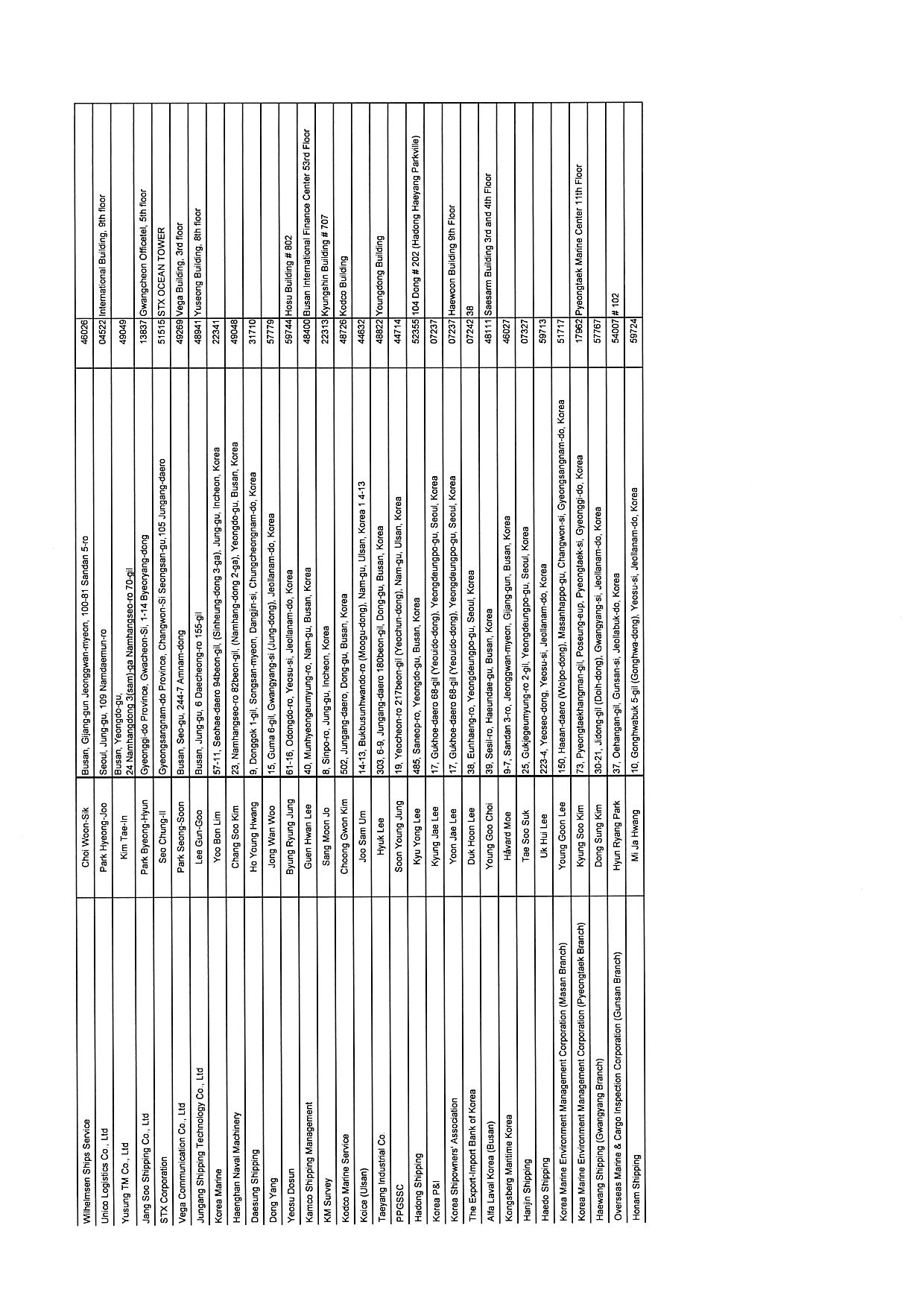
22 The persons listed in Annexure A to the proposed orders are the non-Korean creditors of SW Shipping, and the persons listed in Annexure B are the Korean creditors of the company.
23 Subject to a matter concerning the giving of notice to creditors, the plaintiff has established the matters that need to be established for the purposes of the orders set out in paragraphs 1, 2 and 3 of the proposed orders.
24 Article 17 of the Model Law relevantly provides:
Article 17
Decision to recognize a foreign proceeding
1. Subject to article 6, a foreign proceeding shall be recognized if:
(a) The foreign proceeding is a proceeding within the meaning of subparagraph (a) of article 2;
(b) The foreign representative applying for recognition is a person or body within the meaning of subparagraph (d) of article 2;
(c) The application meets the requirements of paragraph 2 of article 15;
(d) The application has been submitted to the court referred to in article 4.
2. The foreign proceeding shall be recognized:
(a) As a foreign main proceeding if it is taking place in the State where the debtor has the centre of its main interests; or
(b) As a foreign non-main proceeding if the debtor has an establishment within the meaning of subparagraph (f) of article 2 in the foreign State.
…
25 Article 6 is not relevant in the circumstances of this case. The evidence of the plaintiff summarised above (at [2]-[9]) establishes that the Korean proceeding is a foreign proceeding within the meaning of subparagraph (a) of Article 2, that the plaintiff is a person within the meaning of subparagraph (d) of Article 2, and that the Korean proceeding is a foreign main proceeding (see also Article 16 paragraph 3). The application meets the requirements of paragraph 2 of Article 15. This Court has jurisdiction to determine the application for recognition (Article 4; s 10 Cross-Border Insolvency Act). The order in paragraph 5 of the proposed orders is appropriate, having regard to the circumstances of this case and the decisions in Yu and Yakushiji respectively.
26 The issue concerning the giving of notice to creditors of SW Shipping is as follows. The orders made in paragraphs 2 and 5 of the orders made on 4 February 2016 required the giving of notice to the creditors of SW Shipping (at [20] above). The orders reflect the requirements of r 15A.6 and r 15A.7 of the Corporations Rules. Those rules are in Division 15A of the Rules which deals with proceedings under the Cross-Border Insolvency Act. The two rules provide, relevantly:
15A.6 Notice of filing of application for recognition
(1) Unless the Court otherwise orders, the plaintiff in a proceeding mentioned in rule 15A.3 must:
(a) send a notice of the filing of the application in accordance with Form 20 to each person whose claim to be a creditor of the defendant is known to the plaintiff; and
(b) publish a notice of the filing of the application for recognition of a foreign proceeding in accordance with Form 20, in a daily newspaper circulating generally in the State or Territory where the defendant has its principal, or last known, place of business.
(2) The Court may direct the plaintiff to publish a notice in accordance with Form 20 in a daily newspaper circulating generally in any State or Territory not described in paragraph (1) (b).
15A.7 Notice of order for recognition, withdrawal etc
(1) If the Court makes an order for recognition of a foreign proceeding under article 17 of the Model Law, or makes any order under article 19 or 21 of the Model Law, the plaintiff must, as soon as practicable after the order is made, do all of the following:
(a) have the order entered;
(b) serve a copy of the entered order on the defendant;
(c) send a notice of the making of the order in accordance with Form 21 to each person whose claim to be a creditor of the defendant is known to the plaintiff;
(d) publish a notice of the making of the order in accordance with Form 21, in a daily newspaper circulating generally in the State or Territory where the defendant has its principal, or last known, place of business.
(2) The Court may direct the plaintiff to publish the notice in accordance with Form 21 in a daily newspaper circulating generally in any State or Territory not described in paragraph (1) (d).
…
(4) The Court may direct the plaintiff to publish the notice in accordance with Form 22 in a daily newspaper circulating generally in any State or Territory not described in paragraph (3) (d).
27 Form 20 is the form of notice for the purposes of r 15A.6 and contains details of the matters which must be included in the notice, including the date and place of the hearing of the application. Form 21 sets out the matters which must be included in the notice of the making of an order, including the date upon which the order was made and the nature of the order.
28 Rule 15A.6 requires a plaintiff to “send” a notice of the filing of the application and r 15A.7 requires a plaintiff to “send” a notice of the making of the order to each person whose claim to be a creditor of the defendant is known to the plaintiff. Rule 15A.7 distinguishes between serving a copy of the entered order on the defendant and sending a notice to creditors.
29 I should mention at this point that the use of the word “serve” in paragraph 2 a. of the orders made on 4 February 2016 is a slip and that the intention was to reflect the requirements of Rule 15A.6 which uses the word “send”. I will make an order nunc pro tunc correcting the order.
30 Mr Je Hyeoung Park is a foreign attorney based in Seoul, Korea. He is employed by Barun Law who are solicitors acting for the plaintiff. He was instructed to notify the 220 creditors of SW Shipping pursuant to the orders made by this Court on 18 December 2015. The general manager of the Insurance and Legal Affairs Team at SW Shipping provided the last known addresses of the company’s creditors according to the company’s records to Barun Law on 30 November 2015. Mr Park directed that, in the first instance, service be effected by registered post because this is the ordinary method of service in Korea. On or about 25 January 2016, he became aware that of the 220 creditors served with the initial notices, 23 had been returned undelivered. In order to ensure that all necessary steps were taken to serve the creditors of SW Shipping, the plaintiff’s solicitors sought an adjournment of the substantive hearing to enable the orders made on 4 February 2016 to be carried out. It transpires that 10 creditors have not been served by email, post or facsimile despite exhaustive efforts in attempting service. Those efforts are outlined in Mr Park’s affidavit. The 10 creditors are Grand Pacific Co Ltd, ABC Shipping Corporation, Fallimento 52/12 Deiulemar Shipping, ShinKwang Co Ltd, Grace Shipping Co Ltd, Pt. Lintas Benua Harapan Indonesia, Global Vision Bunkers, Progress Bulk Carriers Ltd, Proship Company Limited, and Pt. Prima Cahaya, Maritim (PCM).
31 In the case of these 10 creditors, Barun Law discovered, either by returned mail or by independent research through the tracking service of the Korean Postal Service, that the notices had not been delivered to creditors. Subsequent attempts at service were unsuccessful. Mr Park ascertained that one of the creditor companies was suspended which means that the company is no longer conducting any business activity, and two creditor companies were closed which means that the company’s office are closed and that the company is no longer conducting any business activity. Another of the creditor businesses is bankrupt.
32 In the circumstances as I have outlined them, a question arises as to whether there has been compliance with the orders for notice to be given to creditors. As I have said, the orders reflect the requirements of the Corporations Rules.
33 The Corporations Rules do not define the word “send”. The plaintiff submits that it does not mean “serve”. He points out that if it means “serve”, then by reason of r 1.3 the Corporations Rules, the rules in the Federal Court Rules 2011 (Cth) are potentially engaged. Rule 1.3 of the Corporations Rules provides that the other Rules of Court apply to the extent that they are relevant and not inconsistent with the Corporations Rules. This potentially engages Division 10.4 of the Federal Court Rules which deals with service outside Australia. Service outside Australia requires leave to serve in accordance with a convention, the Hague Convention or the law of the foreign country.
34 The context in which the word “send” is to be construed is as follows. The purposes of the Model Law include the fair and efficient administration of cross-border insolvencies that protect the interests of all creditors and other interested persons, including the debtor and the facilitation of the rescue of financially troubled businesses, thereby protecting investment and preserving employment (see the Preamble to the Model Law). The Corporations Rules make provision for notice to be given by publication in a newspaper circulating in the State or Territory of the debtor’s place of business. A foreign debtor may have a large number of creditors operating in a number of different jurisdictions. This case is an example in that there are 220 creditors from at least 20 different jurisdictions (excluding Korea and Australia), including Libya, the Marshall Islands, India, Egypt and Russia. The plaintiff correctly submits that if it was necessary to obtain leave to serve out of the jurisdiction on each and every foreign creditor, then that would require, at the very least, evidence of whether the Hague Convention applied, and if not, the procedure for service according to the law of the foreign country. This could be a costly, cumbersome and time-consuming exercise, and it could potentially delay the making of orders by reason of difficulties encountered with possibly only a handful of creditors.
35 The word “send” has been used in the Corporations Rules in contradistinction to the word “service”. That is apparent from r 15A.7 and may also be seen in r 15A.9.
36 In addition to these matters, the plaintiff submitted that to “send” means to cause a notification to be conveyed or transmitted to a person at a destination and he referred to Re Minister for Immigration and Multicultural Affairs & Ors; Ex parte Radojicic (Unreported High Court of Australia, 21 January 2000). In that case, McHugh J said:
If the Minister takes steps that would ordinarily have the effect of getting the notification to the applicant if the applicant was at the address last given to the Minister, it seems to me that the Minister has sent the notification to the applicant at the address last given to him or her.
37 The plaintiff also pointed to Article 14 of the Model Law includes the following:
…
(2) Such notification shall be made to the foreign creditors individually, unless the court considers that, under the circumstances, some other form of notification would be more appropriate. No rogatory letters or other similar formality is required.
38 In the Explanatory Memorandum to the Cross-Border Insolvency Bill 2008, reference was made to this Article in the following terms:
… in principle requires individual notification for foreign creditors but leaves discretion to the court to decide otherwise in a particular case (for example if individual notice would entail excessive cost or would not seem feasible under the circumstances). It is advisable for notifications to be effected by such expeditious means that the court considers adequate. The need for notification to be performed in a timely manner is the reason for the provision in paragraph 2 that ‘no letters rogatory or other, similar formality is required’.
39 I do not think that “send” means “serve” and I think that the steps taken by Mr Park on behalf of the plaintiff were sufficient to satisfy the orders of the Court and the Corporations Rules which those orders reflect. In reaching that conclusion, I rely in particular on the use of the word “send” in contrast to the word “serve” in the Corporations Rules and the context in which the Cross-Border Insolvency Act and the Model Law operates.
40 The Court has a general dispensing power under the Federal Court Rules (r 1.8) which rule is, I think, relevant and not inconsistent with the Corporations Rules. Had it been necessary for me to do so, I would have exercised that power in relation to the 10 creditors, having regard to the circumstances identified in Mr Park’s affidavit, especially the significant efforts made to give those creditors notice where possible.
Conclusion
41 In the circumstances, I will make the orders set out in paragraph 21 above.
I certify that the preceding forty-one (41) numbered paragraphs are a true copy of the Reasons for Judgment herein of the Honourable Justice Besanko. |
Associate:


