FEDERAL COURT OF AUSTRALIA
Thardim v Northern Territory of Australia [2016] FCA 407
File number: | NTD 23 of 2005, NTD 22 of 2005 NTD 24 of 2005, NTD 25 of 2005 NTD 30 of 2005, NTD 31 of 2005 |
Judge: | MANSFIELD J |
Date of judgment: | |
Date of last submissions: | 13 March 2015 |
Registry: | Northern Territory |
Division: | General Division |
National Practice Area: | Native Title |
Category: | No catchwords |
Number of paragraphs: | |
Solicitor for the Applicants: | Arnell & Cooper Lawyers Pty Ltd |
Counsel for the Respondents: | S Brownhill QC |
Solicitor for the Respondents: | Solicitor for the Northern Territory |
ORDERS
JUDGE: | MANSFIELD J |
DATE OF ORDER: | 10 May 2016 |
THE COURT ORDERS THAT:
1. The interlocutory application to substitute persons to constitute the applicant and to amend the application is refused.
2. The application is dismissed.
Note: Entry of orders is dealt with in Rule 39.32 of the Federal Court Rules 2011.
ORDERS
NTD 22 of 2005 | |
BETWEEN: | REX MUNAR, JIMMY NUMBATU, MARLENE DARGIE, PHILLIP MULLUMBUK and PETER ARMATIL ON BEHALF OF THE WERAK GOANNA PULIMI (MAK MAK), WATER RAT, LONG NECK TURTLE, KANGAROO & CATFISH CLANS Applicants |
AND: | NORTHERN TERRITORY OF AUSTRALIA, COMMONWEALTH OF AUSTRALIA, BRANIR PTY LTD and TOVEHEAD PTY LTD Respondents |
JUDGE: | MANSFIELD J |
DATE OF ORDER: | 10 may 2016 |
THE COURT ORDERS THAT:
1. The interlocutory application to substitute persons to constitute the applicant and to amend the application is refused.
2. The application is dismissed.
Note: Entry of orders is dealt with in Rule 39.32 of the Federal Court Rules 2011.
ORDERS
NTD 24 of 2005 | |
BETWEEN: | REX MUNAR, MAY STEVENS, MICHAEL ANGLITCHI, RAPHAEL THARDIM, PETER ARMATIL, PHILLIP MULLUMBUK, MARLENE DARGIE and JIMMY NUMBATU ON BEHALF OF THE WERAK GOANNA/PULIMI (MAK MAK), KANGAROO, LONG NECK TURTLE, WATER RAT, CATFISH, KING BROWN SNAKE, EMU, BLUE TONGUE LIZARD AND MARRI (CYCAD/GLIDER POSSUM) CLANS Applicants |
AND: | NORTHERN TERRITORY OF AUSTRALIA, CONSERVATION LAND CORPORATION and SCIMITAR RESOURCES LTD Respondents |
JUDGE: | MANSFIELD J |
DATE OF ORDER: | 10 may 2016 |
THE COURT ORDERS THAT:
1. The interlocutory application to substitute persons to constitute the applicant and to amend the application is refused.
2. The application is dismissed.
Note: Entry of orders is dealt with in Rule 39.32 of the Federal Court Rules 2011.
ORDERS
NTD 25 of 2005 | |
BETWEEN: | REX MUNAR, MAY STEVENS, MICHAEL ANGLITCHI, MARLENE DARGIE, JIMMY NUMBATU, PETER ARMATIL and PHILLIP MULLUMBUK ON BEHALF OF THE WERAK GOANNA/PULIMI (MAK MAK), KANGAROO, LONG NECK TURTLE, WATER RAT, CATFISH, KING BROWN SNAKE, EMU AND BLUE TONGUE LIZARD CLANS Applicants |
AND: | NORTHERN TERRITORY OF AUSTRALIA, TOVEHEAD PTY LTD and BRANIR PTY LTD Respondents |
JUDGE: | MANSFIELD J |
DATE OF ORDER: | 10 may 2016 |
THE COURT ORDERS THAT:
1. The interlocutory application to substitute persons to constitute the applicant and to amend the application is refused.
2. The application is dismissed.
Note: Entry of orders is dealt with in Rule 39.32 of the Federal Court Rules 2011.
ORDERS
NTD 30 of 2005 | |
BETWEEN: | REX MUNAR, PHILLIP MULLUMBUK, MARLENE DARGIE and PETER ARMATIL ON BEHALF OF THE WERAK GOANNA/PULIMI (MAK MAK), KANGAROO, LONG NECK TURTLE & CATFISH CLANS Applicants |
AND: | NORTHERN TERRITORY OF AUSTRALIA Respondent |
JUDGE: | MANSFIELD J |
DATE OF ORDER: | 10 MAY 2016 |
THE COURT ORDERS THAT:
1. The interlocutory application to substitute persons to constitute the applicant and to amend the application is refused.
2. The application is dismissed.
Note: Entry of orders is dealt with in Rule 39.32 of the Federal Court Rules 2011.
ORDERS
NTD 31 of 2005 | |
BETWEEN: | RAPHAEL THARDIM ON BEHALF OF THE MARRI (CYCAD/GLIDER POSSUM) CLAN Applicants |
AND: | NORTHERN TERRITORY OF AUSTRALIA and AUSTRALIAN NEW ZEALAND RESOURCES CORPORATION PTY LTD Respondents |
DATE OF ORDER: |
THE COURT ORDERS THAT:
1. The interlocutory application to substitute persons to constitute the applicant and to amend the application is refused.
2. The application is dismissed.
Note: Entry of orders is dealt with in Rule 39.32 of the Federal Court Rules 2011.
MANSFIELD J:
INTRODUCTION
1 The issues relating to these six claims, and in particular concerning the application of the Northern Territory for these claims to be dismissed pursuant to s 84C(1) of the Native Title Act 1993 (Cth) (NT Act) or under r 26.01 of the Federal Court Rules 2011 (Cth), are related to claims concerning the recognition of native title rights and interests over the Town of Batchelor. It is therefore convenient in the first place to start by reference to those claims.
The Town of Batchelor Claims
2 On 21 September 2001, a native title determination was filed by Gabriel Hazelbane and others on behalf of the Warai and Kungarankany groups over the Town of Batchelor (NTD 6057 of 2001 – Batchelor No 1 claim).
3 In the Batchelor No 1 claim on 1 July 2002, Claude Narjic by notice under s 84 of the NT Act on behalf of eight clans (together identified as the Finniss River Brinkin Group) (FRBG) became respondents to that claim, asserting that the FRBG should be recognised as the group holding native title over the Town of Batchelor. Those eight clans were the Long Necked Turtle, Red Catfish, Kangaroo, Werak Goanna/Pulimi, Marri (Cycad/Glider Possum/Tree), Emu, King Brown Snake and Blue Tongue Lizard/Echidna clans. It was asserted at the time that those eight clans should have been included in the claim group, and comprised Brinkin speaking people associated with the Woolaning community with traditional interests in the Finniss River area, including the Town of Batchelor. It was said that the eight clans had inter-married and were patrilineal descendants of Larrakia, Kungarakan and Djerait language groups.
4 Some considerable time later, on 29 August 2005, Thomas Edward Petherick, May Stevens and Michael Anglitchi filed a native title determination application also over the Town of Batchelor on behalf of the Emu, Blue Tongue Lizard and King Brown Snake Clans (NTD 21 of 2005 – Batchelor No 2 claim). In circumstances set out below, on 8 August 2008, the applicant in the Batchelor No 2 claim applied by motion to amend the native title determination application to replace that claim group with a claim group representing or constituted of the eight FRBG clans.
5 Margaret Daiyi, Linda Ford and Kathleen Devereaux and others then on behalf of the Rak Mak Mak Marranunggu People also made an application for the determination of their native title rights and interests over the Town of Batchelor (NTD 18 of 2006 – the Batchelor No 3 claim). They also became respondents to the Batchelor No 1 claim.
(a) The Batchelor No 3 claim
6 To resolve disputes between the three competing claim groups in relation to the Town of Batchelor, a preliminary question was listed for hearing on 23-27 May 2011 as to whether the applicant in the Batchelor No 3 claim represented a native title claim group who have native title rights and interests (as specified in particulars dated 16 July 2010) in the Town of Batchelor, subject to any issues of extinguishment. Oral evidence was given at that time, including oral evidence from Mr Petherick. In addition, on 25 June 2013, the applicants in the Batchelor No 2 claim filed an affidavit of Mr Petherick in relation to that issue. Following the part hearing of that preliminary question on behalf of the Rak Mak Mak Marranunggu People, the Batchelor No 3 claim was discontinued by leave, including upon terms that the persons constituting the applicant ceased to be respondents to the Batchelor No 1 claim, and that neither the native title claim group described in the Batchelor No 3 claim, nor any member of it, should be permitted to issue a further application for the determination of native title under s 61 of the NT Act over the Town of Batchelor or to apply to be a party to either the Batchelor No 1 claim or the Batchelor No 2 claim inconsistent with those two claims: see Hazelbane on behalf of the Warai and Kungarankany Groups v Northern Territory of Australia [2011] FCA 1186.
(b) The Batchelor No 2 claim
7 That left unresolved the status of the competing claimants in the Batchelor No 1 claim and the Batchelor No 2 claim in relation to the Town of Batchelor.
8 On 14 November 2006, the applicants in the Batchelor No 1 claim had applied to strike out the Batchelor No 2 claim. Following a hearing, on 7 March 2008, the Batchelor No 2 claim was ordered to be struck out, subject to giving the applicant in the Batchelor No 2 claim a further limited time within which to endeavour to restore the claim: Hazelbane v Northern Territory [2008] FCA 291 (the Town of Batchelor 2008 judgment).
9 That order prompted an application by the applicant in the Batchelor No 2 claim to restore the claim, supported by affidavits of Mr Petherick of 25 March 2008 and 16 July 2008 re-asserting the native title rights and interests of the eight FRBG clans in the Town of Batchelor, and on 8 August 2008 applying to amend the native title determination application by substituting the eight FRBG clans as the claim group as noted at [4] above. The amendment application was opposed by the applicant in the Batchelor No 1 claim. If that opposition was successful, the order striking out the Batchelor No 2 claim made on 7 March 2008 and referred to below would stand. The application of 8 August 2008 was adjourned from time to time, as attention focused on the Batchelor No 3 claim.
10 In the Batchelor No 2 claim, in addition to the two affidavits of Mr Petherick of 25 March 2008 and 16 July 2008, on 16 June 2009 a further affidavit of Mr Petherick asserted that there were 11 Aboriginal clans with interests in the areas surrounding the Town of Batchelor including the areas of Reynolds River, swamp and coastal areas in Bynoe, Litchfield Station areas and in the Litchfield National Park. He also said there were 20 living clans including the Marri clan, the FRBG clans and several clans of the Kamu and Malak Malak who had been dispossessed from the area constituting the Town of Batchelor, Litchfield National Park and the stations in the Finniss River areas. Consequently, he said in that affidavit, there was a need to add another clan to the native title claim group in the Batchelor No 2 claim, namely the Fire clan.
11 On 25 June 2013, a further affidavit of Mr Petherick asserted that members of those 20 clans were connected to the claim area, that is to the Town of Batchelor and its environs, and entitled to be recognised as the holders of native title rights and interests in that area. He described that group as “the Daly Family” consisting of speakers from eight language groups and 20 dialects. An annexure to that affidavit asserted that Mr Petherick was a member of the Emu, Werak Goanna/Pulimi, White Brested Sea Eagle and Marri Cycad/Possum clans; and that May Stevens was a member of the Blue Tongue Lizard, Ghost/Echidna and Fig Tree clans.
12 Then on 28 June 2013, a further affidavit of Mr Petherick in the Batchelor No 2 claim asserted that the native title claim group constituted of three only of the FRBG clans, namely the Emu (with “Marri links”), Blue Tongue Lizard and King Brown Snake clans, although there were other inter-related neighbours.
13 On 12 July 2013, Mr Petherick by notice to the Court asserted that there were more members of the native title claim group in the Batchelor No 2 claim yet to be put forward.
14 The position further evolved when the applicants in the Batchelor No 2 claim on 22 August 2013 proposed a further application (amended from the application of 25 March 2008) to further amend the proposed amended native title determination application, and to replace the native title claim group with two only of the FRBG claims, namely the Emu and Blue Tongue Lizard clans. That was again supported by an affidavit of Mr Petherick of that date. In that affidavit, Mr Petherick said that he had been unable to find a member of the King Brown Snake clan to authorise the making of the claim.
15 It is in that context, and after the discontinuance of the Batchelor No 3 claim, that the proposals to amend the Batchelor No 2 claim came to be considered.
16 The strike out motion on the application of the Batchelor No 1 applicant in the Batchelor No 2 claim, and the amendment applications of the Batchelor No 2 applicant in relation to the Batchelor No 2 claim, were listed for hearing, and heard, on 4-6 September 2013. Oral evidence was given by Mr Petherick and Christian Adams, an anthropologist, on behalf of the Batchelor No 2 applicant.
17 Having considered all that evidence, on 21 August 2014, the Court ordered that the previous order to strike out the Batchelor No 2 claim made on 7 March 2008 should take effect forthwith and that the applications to amend that claim be refused: Hazelbane v Northern Territory [2014] FCA 886 (the Town of Batchelor 2014 judgment). That order brought an end, it might have been expected, to the Batchelor No 2 claim. It left the Batchelor No 1 claim as the only claim in relation to the Town of Batchelor.
18 However, Mr Petherick sought to revive a status as a respondent to the Batchelor No 1 claim by an affidavit of 11 March 2015 asserting on his behalf and on behalf of others that he was entitled to do so as “Elder Custodian to Sacred Sites and Rock Art Sites, Traditional Owner to Land”. That application has been struck out by orders made at the same time as this judgment: Hazelbane v Northern Territory of Australia [2016] FCA 408.
The Present Claims
19 The purpose of that lengthy history is not simply to record the course of the Town of Batchelor claims, but to indicate the commonality of the allegations made in relation to the Batchelor No 2 claim, and the current claims. As is already apparent from the brief references to Mr Petherick’s affidavits, the claimant group in the Batchelor No 2 claim sought to establish their connection with the Town of Batchelor as part of a much wider area extending over parts of, if not all of, the present areas of the present claims.
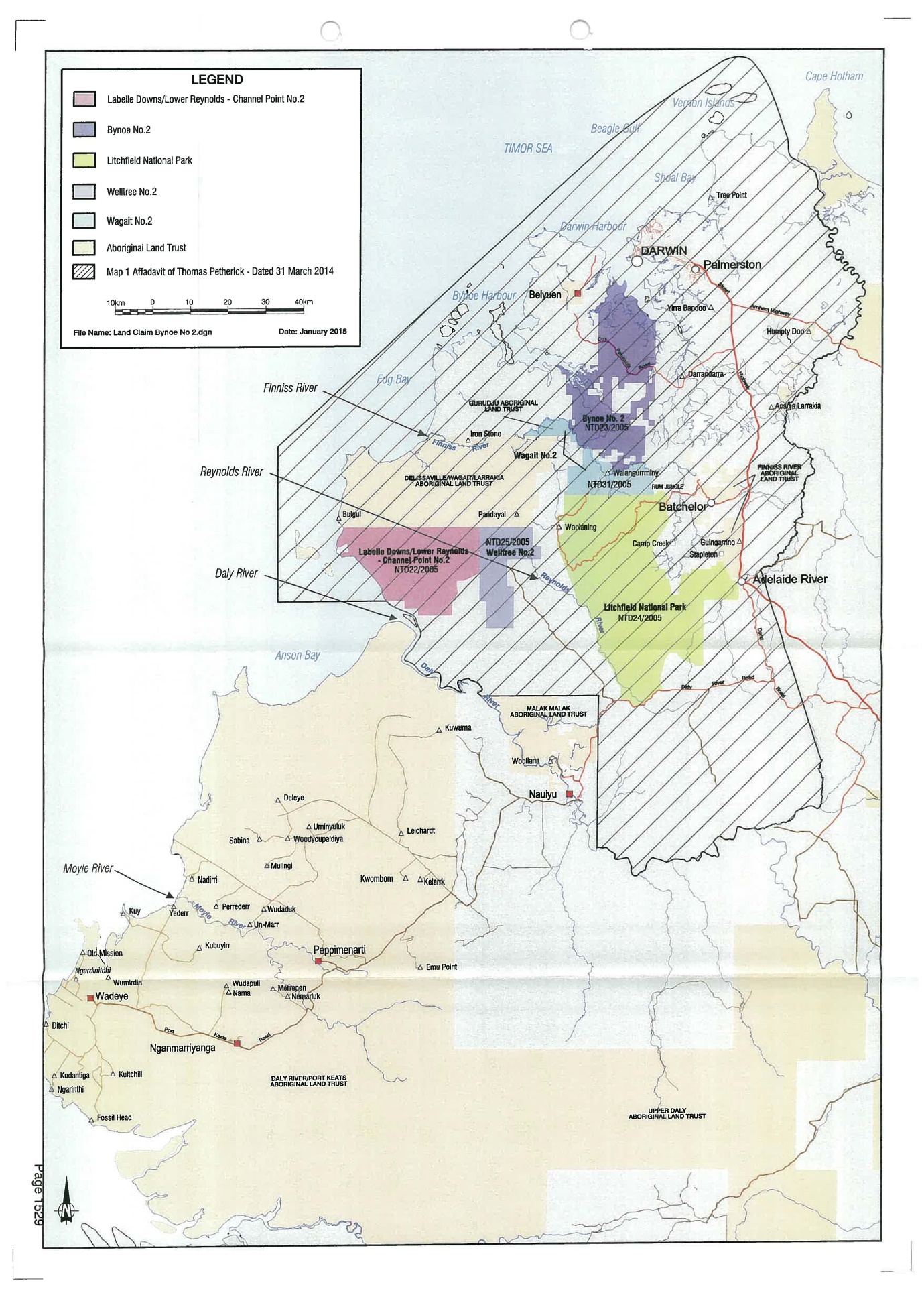
20 Each of the current claims relates to an area to the west and north and south of the Town of Batchelor. A map which is an exhibit to the affidavit of Jennifer Laurence sworn in support of the strike out applications is appended to these reasons. As can be seen, each of the claims (other than the Wagait No 1 claim) relates to land west of the Stuart Highway and running extensively across a substantial area in part to the coast. Each is north of the Daly River and apart from the Bynoe No 2 claim (which extends north to the Middle Arm of Darwin Harbour) south of the Finniss River. It is not necessary to describe the particular geography in especial detail. I note that that map does not indicate the area of the Wagait No 1 claim. It is made over most, but not all, of the area marked on that map as the Delissaville/Wagait/Larrakia Aboriginal Land Trust. There is an area which is cut out from that land trust area in its south-eastern section, roughly triangular in shape and on one side bounded by the McCallum Creek. It is also in the area to the west and north of the Town of Bachelor extending to the coast. The area of the Wagait No 1 claim is as depicted in the Map 1 (and more particularly described in the Map 2) in the Wagait No 1 claim application itself.
21 It is also said to be relevant that on 16 November 1983 the Lower Daly Land Claim was lodged by the Northern Land Council under the Aboriginal Land Rights (Northern Territory) Act 1976 (Cth) (ALRA) on behalf of the Wadjigiyn people. It related to the bed and banks of, and islands in, a portion of the Daly River extending to the coast. There was a hearing of that claim in 2001, during which Claude Narjic, Daisy Majar and Mr Petherick sought to be heard on the basis that Ms Majar and the Werat (Fresh Water Crocodile) group were said to be traditional Aboriginal owners of the claimed land. In 2002, Mr Petherick gave evidence in that claim. On 30 April 2003, the Aboriginal Land Commissioner (Olney J) determined the Land Claim, finding that the traditional Aboriginal owners were a group of Wadjigiyn people and that the Werat group were not traditional Aboriginal owners of the claim area.
22 It is also noted, as part of the evidence of the Northern Territory, that in September 2000, Mr ER Petherick, the father of Mr Petherick, produced a monologue entitled “Aboriginal Rock Art Motifs of Litchfield National Park”. It identified 20 clans having connections to land in the vicinity of the park. That document was considered as part of the evidence when determining the status of the Batchelor No 2 claim, in both the Town of Batchelor 2008 judgment and the Town of Batchelor 2014 judgment. It was referred to extensively in the evidence on the hearing of the interlocutory applications leading to those judgments, and in the Town of Batchelor 2014 judgment. It relates to an extensive area roughly encompassing most of the area of the current claims.
23 In the chronological sequence of events, the next steps are the institution of the present claims: Bynoe No 2 claim (NTD 23 of 2005) on 29 August 2005, the La Belle Downs/Lower Reynolds River claim (NTD 22 of 2005) also on 29 August 2005, the Litchfield National Park claim (NTD 24 of 2005) on 30 August 2005, the Welltree claim (NTD 25 of 2005) on 30 August 2005, and the Wagait Land Trust No 2 claim (also in some documents and submissions and in this judgment called the Wagait No 2 claim) (NTD 31 of 2005) on 27 October 2005. The Wagait Aboriginal Land Trust No 1 claim (also called the Delissaville/Wagait/Larrakia Aboriginal Land Trust claim) (in this judgment called the Wagait No 1 claim) (NTD 30 of 2005) was instituted on 17 October 2005.
24 The management of those claims was not progressed while the status of the Batchelor No 2 claim and the Batchelor No 3 claim were determined. Reference has been made to the course of events in those claims.
25 Brief details of the claims presently under consideration are now set out.
26 The Bynoe No 2 claim was made by Raphael Thardim on 29 August 2005 on behalf of one only of the FRBG clans, namely the Marri (Cycad/Glider Possum) clan.
27 Its procedural history is as follows:
(a) on 31 March 2014, following directions to progress the claim, the applicant in the Bynoe No 2 claim filed an affidavit of Mr Petherick of 31 March 2014 (and signed by others) asserting that the native title claim group could include, if they chose to join:
(i) members of, or descendants of speakers of, Werat/Djerait, Brinkin Wagaits, Larakia, Muluk Muluk, Kulumbirikin, and Woolwonga languages; and
(ii) members of the Freshwater Crocodile, Burramundi [sic], Kangaroo, Long Neck Turtle, Red Catfish, Cycade [sic]/Glider Possem [sic], Brushtail Possem [sic], Water Snake, Goose, Goanna, White Breasted Sea Eagle, Darter Bird, Water Rat, Fire, Emu, Iron Wood, Green Turtle, Stingray, Dugong, Snapping Turtle, King Brown Snake, Wet Stone, Tree/Saltwater Crocodile, Blue Tonged [sic] Lizard/Echidna and Crab clans;
(b) on 21 August 2014, the applicant in the Bynoe No 2 claim filed an interlocutory application seeking removal of Raphael Thardim, being deceased, as the named applicant and for his replacement with Richard Tcherna and Gabriel Thardim, and for leave to file and serve an amended native title determination application;
(c) on 15 September 2014, the Court provisionally ordered that Richard Tcherna and Gabriel Thardim be substituted as the applicant, and gave them leave to amend the application to the form proposed by the annexure to the affidavit of Mr Petherick of 21 August 2014 (that is, subject to formal objection by the Northern Territory);
(d) on 9 December 2014 (within the time allowed for it to do so), the Northern Territory objected in writing to those orders and specified its grounds for doing so (the Notice of Objection);
(e) on 20 January 2015, the Northern Territory then applied to have the claim itself dismissed under s 84C of the NT Act;
(f) on 1 April 2015, Richard Tcherna and Gabriel Thardim applied to further amend the proposed amended application in terms of the further proposed amendments appended to an affidavit of Mr Tcherna of 30 March 2015.
28 The applications to be addressed, therefore, are those to substitute Richard Tcherna and Gabriel Thardim as the applicant; to amend the application in accordance with the annexure to Mr Petherick’s affidavit of 21 August 2014 and as further amended as annexed to Mr Tcherna’s affidavit of 30 March 2015; and that of the Northern Territory to strike out the claim.
29 The La Belle Downs/Lower Reynolds River claim was made by Rex Munar, Jimmy Numbatu, Peter Armatil, Philip Mullumbuk and Marlene Dargie on behalf of five clans (identified as the Finniss River Brinkin Group) comprising four of the eight FRBG clans, namely the Werak Goanna / Pulimi (Mak Mak), Long Neck Turtle, Kangaroo and Catfish clans, and another clan, namely the Water Rat clan. That application covered the same, or part of the same area, as two earlier claims over the area of La Belle Downs station (NTD 6029 of 2002) and over the area of the Lower Reynolds River Station (NTD 6060 of 2001) made on behalf of different claim groups.
30 The procedural progress is much simpler.
(a) On 20 January 2015, the Northern Territory applied for an order that it be summarily dismissed under s 84C of the NT Act.
(b) On 24 February 2015, Gregory Munar, Peter Armital and Marlene Dargie applied to be substituted as the applicant, Rex Munar, Jimmy Numbatu and Phillip Mullumbuk having deceased, and they also applied for leave to amend the application in the form annexed to the affidavit of Gregory Munar of 23 February 2015. The proposed revised claim group comprised members of nine clans, namely the
Marri (Cycad/Glider Possum (Wawun)) clan;
Emu (Mutjirr) clan;
Blue Tongue Lizard (Awiyeri) clan;
Werak Goanna clan;
Long Neck Turtle (Ardram) clan;
Catfish (Giayi) clan;
Red Kangaroo (Kumbit) clan;
King Brown Snake (Wullunggar) clan; and the
Freshwater Crocodile (Jingurr) clan.
As can be seen, the Water Rat clan is no longer included, and the Marri (Cycad/Glider Possum (Wawun)) clan, the Emu (Mutjirr) clan, the Blue Tongue Lizard (Awiyeri) clan, the King Brown Snake (Wullunggar) clan and the Freshwater Crocodile (Jingurr) clan have been added. The Kangaroo clan has been changed to the Red Kangaroo (Kumbit) clan. Three of the initial clans included remain much as first described.
31 The Litchfield National Park claim was made by Rex Munar, Philip Mullumbuk, Peter Armatil, Jimmy Numbatu, Marlene Dargie, Michael Anglitchi, Thomas Petherick, May Stevens and Raphael Thardim on behalf of nine clans, comprising the FRBG clans and the Water Rat clan.
32 The procedural history relevantly is the same as that in the La Belle Downs/Lower Reynolds River clan. Gregory Munar, Peter Armital and Marlene Dargie applied to be substituted as applicants and retaining Mr Petherick and Ms Stevens, because Rex Munar, Raphael Thardim, Philip Mullumbak and Jimmy Numbatu had deceased. The supporting affidavit of Gregory Munar of 23 February 2015 is in the same terms as, and the proposed claim group is the same as, that proposed in the La Belle Downs / Lower Reynolds River claim proposed amendments. The only substantive changes are the omission of the Water Rat clan and the addition of the Freshwater Crocodile (Jingurr) clan, and the refined description of the Kangaroo clan.
33 The Welltree claim was made by Rex Munar, Philip Mullumbuk, Peter Armatil, Jimmy Numbatu, Marlene Dargie, Michael Anglitchi, Thomas Petherick and May Stevens over the area of Welltree Station on behalf of eight clans (identified as the Finniss River Brinkin Group) comprising seven of the eight FRBG clans, namely Werak Goanna / Pulimi (Mak Mak), Kangaroo, Long Neck Turtle, Catfish, King Brown Snake, Emu and Blue Tongue Lizard clans, and another clan, namely the Water Rat clan. The area of that claim is the same as, or part of the same as, the area of a separate and earlier native title determination application (NTD 6004 of 2002) made on behalf of another claim group.
34 Again the procedural history is straightforward: an application for summary dismissal by the Northern Territory was made on 20 January 2015, and an interlocutory application of Gregory Munar, Peter Armital and Marlene Dargie was made on 24 February 2015 for them to be substituted as the applicant, as the same four of the original persons are deceased. The application assumes that Mr Petherick and Ms Stevens will remain as part of the applicant. The proposed amended application is annexed to an affidavit of Gregory Munar of 24 February 2015. The same changes are made to the proposed claim group, that is by removing the Water Rat Clan and adding the Marri (Cycad/Glider Possum (Wawun) clan and the Freshwater Crocodile (Jingurr) clan.
35 The Wagait No 2 claim (originally called the “Wagait Land Trust #2” claim) was made by Raphael Thardim on behalf of one of the eight FRBG clans, namely the Marri (Cycad/Glider Possum) clan, said to be “also known as the Southern Larrakia”. The area of that claim is part of the Delissaville/Wagait/Larrakia Aboriginal Land Trust area, part of the Gurudju Aboriginal Land Trust area, and part of Land Claim 237 under the ALRA being the bed and banks of part of the Finniss River.
36 In that matter, the relevant procedural history initially is very brief. The only outstanding application at the hearing date was an application by the Northern Territory for an order to dismiss summarily the application under s 84C of the NT Act.
37 However, following the hearing of that application, on 1 April 2015, Richard Tcherna and Gabriel Thardim applied to be substituted as the named applicants, as Raphael Thardim had deceased. They also sought an order for leave to file an amended application, in the form annexed to the affidavit of Richard Tcherna of 30 March 2015. It sought to substitute the nine clans for the one clan previously named (still included in the nine clans). That is the same nine clans as referred to in the La Belle Downs/Lower Reynolds river claim, Litchfield National Park claim and Welltree claim. It was agreed that that interlocutory application would be addressed on the papers.
38 The final claimant application before the Court is the Wagait No 1 claim by Rex Munar, Philip Mullumbuk, Peter Armital and Marlene Dargie on behalf of four specified clans of the Finniss River Brinkin Group, namely the Werak Goanna/Pulimi (Mak Mak) Clan, the Kangaroo Clan, the Long Neck Turtle clan and the Catfish clan. The claim area is part of the Delissaville/Wagait Larrakia Aboriginal Land Trust area. The maps enclosed with that application indicate that part which is included, and that part which is excluded. It is said to exclude the Freshwater Crocodile clan area, and the Kiyuk Language Group area.
39 It, too, had an uneventful procedural history until the Northern Territory application of 19 February 2015 for an order to summarily dismiss the claim, and in turn an application by Gregory Munar, Peter Armital, Kenneth Mullumbuk and Marlene Dargie to be substituted as applicants, as Rex Munar and Philip Mullumbuk had deceased, and then for leave to amend the application. The affidavit of Gregory Munar of 23 February 2015 annexes the proposed amendment. The proposed amendment extends the claim group to the same nine clans as are referred to above. It therefore proposes to add the Marri (Cycad/Glider Possum (Wawun)) clan, the Emu (Mutjirr) clan, the Blue Tongue Lizard (Awiyeri) clan, the King Brown Snake (Wullunggar) clan and the Freshwater Crocodile (Jingurr) clan.
THE EVIDENCE AND THE HEARING
40 In each of the six matters, the Northern Territory has by interlocutory application of 20 January 2015 (and 19 February 2015 in respect of the Wagait No 1 claim) sought orders for the summary dismissal of the claims.
41 As noted, in addition to the strike out applications, in relation to each of the six claimant applications, the applicant (or the proposed applicant) applied to replace a deceased person or persons as part of the applicant, and to amend the native title determination application, including by changing the composition of the claim group (and in other respects). It was accepted that in each of the claims those issues were common.
42 Procedurally, it was requested that all the interlocutory applications be heard together, with evidence in each of them to be evidence in the others, that is the six applications by the Northern Territory to strike out each of the present claims and the six applications to amend the native title claimant applications including by amending the named applicants. There was no objection on behalf of any of the applicants to the receipt of material on that basis. Nor was there any objection to the application that those applications should be heard and determined together.
43 The Northern Territory submitted that in each of them the application to replace an applicant and to amend the application itself should be refused, because in each case there was no prospect of there having been a compliant process with the NT Act, so that the application should be summarily dismissed, and alternatively even if the proposed replacement/amendment were permitted, each application in any event should be summarily dismissed.
44 As a preliminary to the Court dealing with those applications and the summary dismissal application, the applicants in each matter sought an order that the Northern Territory provide answers to the request for particulars as requested in correspondence dated 23 February 2014. Whether or not that order was made, in any event each of the applicants contended that the summary dismissal applications should themselves be refused or dismissed. The applicants in each of the applications then sought a further order in the following terms:
That pursuant to 84 D(1) of the Native Title Act the Applicants produce further evidence to the court that they are properly authorised to make the Native Title Determination Applications NTD 22, 23, 24, 25, 30 and 31 of 2005 on behalf of the Claimant Group.
45 Ultimately, with one qualification, the respective evidence of the applicant in each application and of the Northern Territory was duly received, with some minor ongoing issues as to its significance. To the extent to which the applicants sought a variation of the directions earlier given to permit the filing and service, and tender, of material up until a short time prior to the hearing, the necessary order was varied. The affidavit of Joan Growden of 26 February 2016 (in the Bynoe No 2 application) supported that course. That permitted the applicants to seek to rely upon the further report of Christian Adams of 2 March 2005 as an expert report (filed in the Bynoe No 2 application). After submissions on the admissibility of that document however, the applicants withdrew its tender.
46 The Northern Territory sought orders that, on the hearing of the summary dismissal applications, the Court should receive into evidence pursuant to s 86(1)(a) of the NT Act:
(1) the transcript of evidence in the hearing of the Lower Daly Land Claim comprising the evidence given by Thomas Edward Petherick on 13 September 2002;
(2) the transcript of:
(a) evidence given by Mr Petherick on 26 May 2011 during the hearing of the preliminary question in relation to the Town of Batchelor claims as to whether the applicants in the Batchelor No 3 claim comprised a native title claim group holding native title rights and interests in the Town of Batchelor (see [6] above); and
(b) evidence given by Mr Petherick on 4 and 5 September 2013, and by the anthropologist Christian Adams (called by the applicant in the Batchelor No 2 claim) on 5 September 2013, during the hearing of the applications for leave to amend the Batchelor No 2 application, and to strike out the Batchelor No 2 claim (see [16] above).
47 It is further sought that pursuant to s 86(1)(c) of the NT Act, the Court adopt various findings of the Court (Mansfield J) made in the Town of Batchelor 2014 judgment on the hearing of those applications and which relate to the formulation and composition of the relevant putative native title holding group and the basis upon which that group asserts native title rights and interests in the Batchelor No 2 claim.
48 The Court also had regard to the Notice of Objection dated 9 December 2014 made by the Northern Territory to the applicants proposed amendment in the Bynoe No 2 application. It is further noted that the order made on 19 December 2014 provided an extension of time until 2 March 2015 for the proposed evidence of Christian Adams to be filed.
49 There was no objection to receipt of the letter of 26 March 2002 by Claude Narjic to the Northern Land Council on behalf of a group identified as FRBG complaining that eight local descent groups comprising Brinkin speaking people associated with the Woolaning Community with traditional interests in the Finniss River region had not been included in various native title claims (including the Batchelor No 1 claim). The letter stated that the eight clans were intermarried and patrilineal descendants of Larrakia, Kungarakan and Djerait language groups and comprised the following clans:
Long Necked Turtle Djerait
Red Catfish Djerait
Kangaroo Djerait
Werak Goanna/Pulimi Djerait
Marri (Cycad/Glider Possum/Tree) Larrakia
Emu Kungarakan
King Brown Snake Kungarakan
Blue Tongue Lizard/Echidna Kungarakan
50 There was also no objection to the document of 1 July 2002 by which Claude Narjic appeared in the Batchelor No 1 claim, and sought to have the eight clans referred to above, identified as the FRBG, joined as respondents to the Batchelor No 1 claim. The Form 5 identifies the same language groups for each of the eight clans save that the term “Wagaitj” is used rather than “Djerait”, and named ancestors of each of the eight clans.
51 There was also no objection to the receipt of Ms Laurence’s affidavits, in effect the same affidavit in each of the Northern Territory applications. It confirmed that the Report of Olney J, Aboriginal Land Commissioner, titled “Lower Daly Land Claim” and dated 30 April 2003 recorded that:
(a) on 16 November 1983, the Lower Daly Land Claim was lodged by the Northern Land Council under the ALRA on behalf of the Wadjigiyn people. The claim related to the bed and banks of, and islands in, a portion of the Daly River, extending to the coast;
(b) after an initial hearing of the claim in 2001, Claude Narjic, Daisy Majar and Mr Petherick sought to be heard in relation to the claim on the basis that Ms Majar and the Werat (Freshwater Crocodile) group were traditional Aboriginal owners of the claimed land. At that time, neither Mr Narjic nor Mr Petherick made a claim to be a traditional Aboriginal owner of any part of that claim area;
(c) on 13 September 2002, oral evidence was given by Mr Petherick at the hearing of the land claim; and
(d) on 30 April 2003, Olney J determined the land claim, finding that the traditional Aboriginal owners were a group of Wadjigiyn people, and that the Werat group were not traditional Aboriginal owners of the claimed area.
A copy of the Report of Olney J was also in evidence.
52 Mr ER Petherick’s monologue entitled “Aboriginal Rock Art Motifs of Litchfield National Park” (see [22] above) was also put into evidence.
53 Ms Laurence’s affidavit shows that on 3 January 2003, Mr ER Petherick wrote to the Office of the Aboriginal Land Commissioner regarding the Lower Daly Land Claim asserting that there were geological features and rock art motifs in the Litchfield National Park and surrounding areas which matched 20 known Aboriginal clans, that eight of those clans had agreed to claim land as the FRBG and that those clans had a history of intermarriage of 100 years. A copy of that letter is also in evidence.
54 The Northern Territory tendered without objection, and the Court received under s 86(1)(a) of the NT Act the evidence of Mr Petherick referred to at [46] above.
55 For the sake of completeness, I note that the Northern Territory also relied on the affidavits of Mr Petherick of 25 March 2008 and 16 July 2008, the further affidavit of 16 June 2009, and his further affidavits of 25 June 2013, 28 June 2013 and 22 August 2013 (all filed in the Batchelor No 2 claim).
56 Ms Laurence also referred to the affidavits of Mr Petherick of 31 March 2014 (in the Bynoe No 2 claim) and the 11 affidavits on the various applications to amend the claimant applications were said to be as follows:
(a) Richard Tcherna sworn 9 August 2014;
(b) Gabriel Thardim affirmed 16 August 2014;
(c) Mr Petherick affirmed 18 August 2014;
(d) Mr Petherick affirmed 21 August 2014;
(e) May Stevens affirmed 18 August 2014;
(f) Gregory Munar sworn 8 August 2014;
(g) Raymond Bangun affirmed 20 August 2014;
(h) Kenneth Mullumbuk affirmed 15 August 2014;
(i) Peter Armital sworn 8 August 2014;
(j) Virgil Wanirr sworn 9 August 2014; and
(k) Marie Frances Thardim made 23 April 2014.
57 The affidavit of Mr Petherick of 15 December 2014 in the Batchelor No 1 claim was also tendered.
58 All of that material was received without objection. The remaining evidentiary issue on the Northern Territory application was the use, if any, to which the findings of the Court in the Town of Batchelor 2014 judgment may be put under s 86(1)(c) of the NT Act.
59 As to that, the Northern Territory in their written submissions said that the Court should adopt the findings that:
(a) At [124]: The evidence of Mr Petherick points to the relevant native title holding group including:
(i) almost certainly the members of the eight FRBG clans (ie Long Neck Turtle, Red Catfish, Kangaroo, Werak Goanna/Pulimi, Marri (Cycad/Glider Possum/Tree), Emu, King Brown Snake and Blue Tongue Lizard/Echidna clans); and
(ii) probably a group of members of some 20 or so clans.
(b) At [136]: There are clear and demonstrable changes in the formulation of the landholding group of which Mr Petherick is a member over time.
(c) At [136]: There is no anthropological evidence to support the claims Mr Petherick has made at a theoretical level or in relation to the Batchelor area.
(d) At [136]: There is clear and consistent anthropological evidence that Mr Petherick, whether as a member of the Emu clan, or as a member of the FRBG, or as a member of the wider group of clans, does not hold native title rights and interests over Batchelor or the nearby vicinity.
(e) At [136]: Such claims are inconsistent with the findings made in the Finniss River Land Claim and in the Wagait Committee Inquiry.
(f) At [137]: Mr Petherick made no claim, at the time of the Finniss River Land Claim or the Wagait Committee Inquiry, to hold interests in the areas then under consideration, or the adjoining areas.
(g) At [140]; [146]: There is no anthropological evidence to support the thesis that native title rights are held by the group of which Mr Petherick is a member on the basis of totemic rock paintings (with or without local geographical features) as expressed in the monograph by ER Petherick entitled “Aboriginal Rock Art Motifs of Litchfield National Park”, and there is positive evidence that they are not consistent with any anthropological literature or analysis either in the Batchelor area, or the wider Darwin area.
(h) At [148]: The thesis is not consistent with well-established anthropological data about how country is acquired in the Batchelor and wider Darwin area.
That issue will be addressed later in these reasons.
60 The applicants through counsel accepted (subject to the ruling about any order under s 86(1)(c) of the NT Act) that that material was admissible in relation to each and all of the applications and was relevant to each of their respective positions. That was an appropriate position to take. It is clear that the FRBG and each of the clans variously said to be represented by their respective applicants had a common foundation for their claims, arising from or supported by the work of Mr ER Petherick, Mr Petherick’s father. It is also clear that Mr Petherick and others comprised a core of persons who sought to represent the indigenous interests of the various clans named, and what he and others did was done on behalf of all. The several applications and the several proposed amended applications have a clear commonality of data sources, structures and processes (including the authorisation process) for the proposed amended claims in relation to the geography addressed in Mr ER Petherick’s work; as noted, it encompasses in broad terms the areas of the claims presently under consideration. Counsel for the several applicants did not make any submissions that their respective positions were not complementary and cooperative. Indeed, there was no submission put that one or some only of the applicants might succeed on their respective applications, or that one or some only of the applicants might successfully resist the applications of the Northern Territory. It was a case of all or none, as the argument was presented.
61 The evidence of the applicants in support of the orders they sought, and in opposition to the summary dismissal orders sought by the Northern Territory, was relatively brief.
62 The affidavit of Joan Growden of 13 March 2005 (in the Bynoe No 2 claim) enclosing correspondence was relied on to support the application for an order for the provision of particulars before the applications more generally were dealt with.
63 There was some ambiguity in the submissions of the applicants about which affidavits were more generally relied upon. That was in part because of the logistical difficulties in securing duly sworn affidavits.
64 Based on the written submissions and written response of the applicants, the affidavits relied upon were those of Richard Tcherna of 14 May 2014 (La Belle Downs), 1 April 2015 (Wagait No 2) Marie Thardim of 23 March 2014 (Bynoe No 2); Thomas Petherick of 21 August 2014 (Bynoe No 2); Gabriel Thardim of 21 August 2014 (Bynoe No 2); Joan Growden of 10 October 2014 (Bynoe No 2) and 26 February 2015; Gregory Munar of 24 February 2014 (affidavits in each of La Belle Downs/Reynolds River; Litchfield National Park; Welltree; and Wagait No 2); Thaddeus Dartinga of 23 February 2015 (Bynoe No 2); Raymond Bangun of 10 March 2015 (La Belle Downs/Reynolds River); of 6 March 2015 (Litchfield National Park). His affidavits were relied upon generally.
65 The list of affidavits in the written submissions did not quite reconcile with what was said orally. I have endeavoured to be as comprehensive as possible, and have reverted to each of the six separate files to check against the recently filed affidavits as well as those filed in support of earlier proposed amended claims where there was a further and later proposed amendment.
66 The parties agreed that all that material should be capable of being used in relation to each of the applications of the respective applicants, and of course in opposition to the application of the Northern Territory.
67 To the extent to which it was sought to admit the various materials pursuant to s 86(1)(a) of the NT Act, and to base submissions upon them, the fact of them constituting what they were said to constitute was not an issue and it was accepted that it was appropriate for the Court to receive them and have regard to them.
68 To the extent to which it was sought to rely upon findings of the Aboriginal Land Commissioner and of the Court in the Town of Batchelor 2014 judgment, again counsel for the applicants did not oppose the reception of that material for its proposed use. Reference was also made to the various applications, the proposed amendments to those applications, and to the Notice of Objection filed by the Northern Territory on 9 December 2014 in relation to the applicants’ interlocutory application in the Bynoe No 2 claim made on 21 August 2014.
CONSIDERATION
(a) The request for particulars
69 The first issue concerns the applicants’ request for particulars.
70 Ms Growden in her affidavit of 13 March 2015 says that between 19 December 2014 and 13 March 2015 she acted as the “facilitating communicator” between the applicant (she must mean the proposed applicant) and the Northern Territory in relation to the Bynoe No 2 application. I have considered her correspondence, as if it related to each of the six applications (as the attached pieces of correspondence show).
71 By undated email apparently received by the Northern Territory on 19 February 2015 from Ms Growden, it was said that the applicants did not understand who (according to the Northern Territory) should be in the respective native title claim groups, and why the respective authorisations were not correct. By that date, the Northern Territory summary dismissal applications had been received, together with Ms Laurence’s affidavit of 20 January 2015 and the Notice of Objection of 9 December 2014.
72 The email sought particulars of the omissions or acts which demonstrated improper authorisation of the particular statutory requirements which had not been complied with (and how they had not been complied with), and of the persons or groups who had not been included in the proposed amended applications and why they should have been included.
73 The Northern Territory promptly replied by email letter of 20 February 2015. Relevantly, it shortly pointed out that the affidavit of Ms Laurence adequately provided the necessary particulars.
74 Ms Growden by email on 4 March 2015 referred again to the email of 19 February 2015 (erroneously saying it was dated 23 February 2015 – the date on which Mr Tcherna apparently signed an affidavit also containing that document). She did not refer to the Northern Territory response of 20 February 2015. In relation to the Bynoe No 2 claim (and in the context of eight elders who (she said) had authorised the proposed amended Bynoe No 2 claim), she asked for particulars of:
(1) the names and members of the 25 clans referred to in the Northern Territory written submissions of 3 March 2015, and who had authority to make decisions on their behalf; and
(2) the members of the 25 clans who have not been represented and/or included in the authorisation process.
75 The Northern Territory response of 5 March 2015 said that it had no obligation to provide those particulars, and in any event the balance of its written submissions provided appropriate and adequate detail of its position.
76 The response of Ms Growden of 9 March 2015, apart from requesting certain documents, requested that the Northern Territory, for each local descent group it recognised, provide the name of the traditional elder; of the “patriarch”; of the “Totemic Dreaming” from which those persons get their spiritual connection to the land; and genealogy for each of those persons for at least three generations.
77 On 10 March 2015, the Northern Territory responded, in particular by providing further information about the source of the documents requested.
78 I have considered the material in the affidavits of Ms Laurence of 20 January 2015 in each of these matters, the Notice of Objection, and the written submissions of the Northern Territory.
79 In my view, the Northern Territory clearly identified the basis of its summary dismissal application. As it was apparent (and was accepted in the course of submissions) the concern of the Northern Territory was in effect the same concern as that which had been extensively ventilated in the Batchelor No 2 claim, leading to the Town of Batchelor 2014 judgment. I did not discern in the course of submissions that counsel for the applicants in each of these six matters (and who was counsel in the hearing leading to the Town of Batchelor 2014 judgment) was at any disadvantage through a lack of understanding of the concerns of the Northern Territory.
80 As was accepted, it was appropriate to consider both the proposed several amendments to the identity and composition of the applicant and the proposed amended application in each matter in conjunction with the summary dismissal application in each matter. It would have been of little avail to address the summary dismissal applications without having regard to those proposed changes to the composition of the applicant and the proposed changes to the claim groups.
81 I note that it was not in issue that the proposed changes to the applicant in each matter, arising from some of the persons (or in one or two cases, the person) constituting the applicant having deceased, should be made provided that the changes had been properly authorised and provided there would be utility in doing so.
82 Consequently, the real focus should be, and was in submissions, upon whether the proposed changes to the particular applications would lead to a native title claim group capable of being recognised as the holders of native title rights and interests over the particular claim area, and if so whether the proposed amended claim (including the nominated persons to comprise the amended applicant) should be made.
83 I do not, therefore, accede to the request for an order that the Northern Territory provide the particulars as specified. Its contentions are clear. The requested particulars assume that the Northern Territory is putting forward a particular case as to who are the correct indigenous people for each of the claim areas. It is not doing so. Indeed, as noted briefly, there are other outstanding claims over much of the claim areas of these six claims, and the Northern Territory is not required at present to specify, and is not specifying, who are the proper people for these claim areas. Its point is simply that the claim groups as specified (or proposed to be specified) cannot be the appropriate claim group as they are specified (or proposed to be specified) because they are subsets of a potential claim group. The issues are clear, and the particulars requested are not necessary or appropriate to enable them to be resolved.
(b) The findings in the Town of Batchelor 2014 judgment
84 The second step is to consider the use to which firstly the findings in the Lower Daly Land Claim can be adopted, and to the extent relevant, used and secondly and more importantly whether the findings in the Town of Batchelor 2014 judgment can be adopted, and to the extent relevant used, in consideration of the issues.
85 Counsel for the applicants did not seek to dispute that the findings in each of those documents was capable of adoption under s 86(1)(c). Nor did he seek to argue (other than on the issue of relevance) that the Court should not have regard to the findings in the Town of Batchelor 2014 judgment.
86 In my view, it is appropriate to adopt the findings in that judgment as set out in [59] above. They are capable of informing the proper outcome of the competing applications in these matters.
87 In essence, it is the case of the Northern Territory in each instance that the putative native title holding group comprises the members of some 25 named clans, so that the six native title claims in their current form are each brought on behalf of a subset of those clans, contrary to s 61 of the NT Act, and so are not authorised by all members of the putative native title holding group, contrary to ss 61, 62 and 251B of the NT Act. It then says that there is no real prospect that the native title claim group could amend the claims to reconstitute the native title claim group as the putative native title holding group and have that group authorise the making of the claims.
88 Each of the six claims involve iterations of the FRBG, common identified clans, common named applicants, and are founded upon the same bases. In the Batchelor No 2 claim, the claim was brought on behalf of members of the Emu, Blue Tongue Lizard and King Brown Snake clans, as part of the FRBG. Mr Petherick was a member of the claim group. He held the role of named applicant for a period of time. He produced a large volume of affidavit and other material in support of the claim, and gave evidence in support of the claim during both the hearing in relation to the Batchelor No 3 claim in May 2011, and the hearing in relation to the Batchelor No 2 claim in September 2013. As noted, his role there obviously extended well beyond the geographical limits of the Town of Batchelor.
89 As noted, the current claims include or are proposed to include from one to nine named clans, most of which include the eight clans identified as the FRBG in the Town of Batchelor 2014 judgment at [3]; and Mr Petherick is one of the current named applicants and the proposed named applicants in the Litchfield National Park and Welltree claims.
90 Material produced and relied upon in the Batchelor No 2 claim in respect of their claim over the Town of Batchelor is also produced and relied upon in respect of the six native title claims the subject of the applications, including the monologue of Mr ER Petherick. That is evident from the initial application and the proposed amended application in each matter.
91 The evidence given by Mr Petherick in the Batchelor No 2 and Batchelor No 3 claims is both relevant and material to the issues raised by the interlocutory applications as it also informs the composition and formulation of the relevant putative native title holding groups and the bases upon which that group or groups assert native title rights and interests. The same comments apply to the oral evidence given by the expert anthropologist called on behalf of the Batchelor No 2 claim applicants in relation to these claims, it is relevant and material to the present issues. It is not necessary to refer to it in detail. All that evidence addresses the status of the FRBG or specified clans or a wider clan group in relation not merely to the Town of Batchelor but to a much wider geographical area, largely encompassing the present claim areas.
92 In addition, the evidence given by Mr Petherick in the Lower Daly Land Claim in 2002 is relevant and material to these issues because it discloses that Mr Petherick made no claim to hold traditional interests in the Lower Daly River (which is reasonably proximate to (at least) the claim area in La Belle Downs/Lower Reynolds River) at that time.
93 For similar reasons, in my view, following findings of the Court in the Town of Batchelor 2014 judgment set out in [59] above are also relevant and material to the present issues.
94 Those findings are largely based on material which is referred to variously in the six current and proposed amended applications for the determination of native title. There is no submission that there are material points of distinction. There is no submission of unfairness if they are received and adopted. There is no submission that they are wrong, having regard to other material before the Court on behalf of the applicants in relation to any, or all of, the current six applications for the determination of native title. There is no submission that the evidence on which they were based is not also evidence concerning the claimed entitlement of the present (or proposed) claim groups to the particular areas of their claims.
95 In those circumstances, it represents an efficiency in both time and resources to take that course. The Court proceeds accordingly.
(c) The composition of the claim groups
96 Section 84C(1) of the NT Act permits the Court to strike out an application if it does not comply with ss 61, 61A or 62.
97 Ordinary principles governing summary dismissal apply to the power to strike out under s 84C of the NT Act. Such an order should be approached with caution and should be allowed only where a clear case for summary dismissal has been made, and proceedings should be dismissed only in very clear cases where the claim as expressed is untenable upon the version of the evidence favourable to the applicant (and generally without any weighing of conflicting evidence or of the inferences which might be drawn therefrom). The mere complexity of an issue, or the fact that extensive argument may be necessary to demonstrate that the claim is untenable, is not a reason not to dispose of an application summarily. Those propositions are well known: see Dey v Victorian Railways Commissioner (1949) 78 CLR 62 at 91 per Dixon J; General Steel Industries Inc v Commissioner for Railways (1964) 112 CLR 125 at 129-130 per Barwick CJ; Williams v Grant [2004] FCAFC 178 at [48]-[49] per Lander J (North and Dowsett JJ agreeing); Bodney v Bropho (2004) 140 FCR 77 at [51] per Stone J. They were applied in the Town of Batchelor 2008 judgment at [11]-[15] and in the Town of Batchelor 2014 judgment at [120].
98 Having considered the applicable general principles, it is now necessary to identify the proposition for which the Northern Territory contends, and to assess its correctness.
99 The first step is now well-established. There is considerable authority that a claim for native title rights and interests by a subset of the putative native title holding group is contrary to s 61 of the NT Act and cannot succeed: see Ward v Western Australia (1998) 159 ALR 483 at 542; Risk v National Native Title Tribunal [2000] FCA 1589 at [60]; Tilmouth v Northern Territory (2001) 109 FCR 240 at 241-242; Dieri People v South Australia (2003) 127 FCR 364 at [55]; Landers v South Australia (2003) 128 FCR 495 at [504]; Harrington-Smith v Western Australia (No 9) (2007) ALR 1 at [1209]-[1217]. That was applied in the Town of Batchelor 2014 judgment at [123].
100 The second step is a factual one. It is that, on the material, the relevant native title holding group for the recognition of native title rights and interests over the six claim areas is a group constituted by 20 clans or thereabouts.
101 The Northern Territory has referred to extensive evidence to support that proposition.
102 Mr Petherick’s affidavit filed in Bynoe No 2 and Batchelor No 2 of 31 March 2014 describes the Aboriginal people on whose behalf native title claims were being brought. He described a group of people:
(a) who have lived, hunted, protected and have spiritual connection to the land (para 2);
(b) who are members of local descent groups, local family and community and related to apical ancestors who spoke multiple languages (para 3);
(c) who are totemic clan groups formed “to help, include aboriginal people of the lost generation, aboriginal people of lost language and those that do not know their apical ancestors” (para 3);
(d) who “have lived in our claim areas for years” (para 3);
(e) who “have been dispossessed by the authority and left lifeless but are connected to us” (para 3);
(f) who comprise Werat/Djerait, Brinkin, Wagait, Larakia, Muluk Muluk, Kulumbiringin and Woolwonga people (para 4);
(g) who comprise members of 25 identified Aboriginal clans, the “principle [sic] applicant” of whom is the FRBG, which has accepted these groups, clans and peoples (para 4);
(h) who can, but do not have to claim native title, but if they do, they are in the native title claim group (para 5); and
(i) who claim rights and interests extending in a broad area described as “the Darwin hinterland” extending from the Adelaide River in the east to the Daly River in the west and from the waters of Anson Bay, Fog Bay, Bynoe Harbour, Darwin Harbour and Shoal Bay (and seaward) in the north to the Daly River in the south (para 7 and Map 1).
103 That area is a very extensive one. It encompasses the whole of the six claim areas, including the Town of Batchelor. It extends as far north as the Vernon Islands, and is bounded on the south by the Daly River (save for the Malak Malak Aboriginal Land Trust area). It therefore includes the Darwin area, all the Cox Peninsula, and all areas between the coast and a line to the east of the Stuart Highway, and extends to significant sea areas off the coast.
104 Mr Petherick’s affidavit clearly identifies the foundations for such a putative native title claim group with the members having particular characteristics. They are that the members of such a group have:
(a) familial links between members, largely due to intermarriage between different clan members;
(b) historical connections of members to parts of the claim area;
(c) physical occupation and/or use of the claim area or its resources;
(d) totemic links between a clan’s totem/s and parts of the claim area, commonly appearing via rock art motifs and geographic features;
(e) in some cases, a failure to be “recognised” as having traditional rights and interests in the claim area; and
(f) a wish to be included in a claimant group.
105 Each of the proposed amended applications discloses the same bases for the claims to native title, namely:
(a) familial links between members (Schedules A and F);
(b) historical connections to the claim area (Schedule F);
(c) physical occupation and/or use of the claim area (Schedule F);
(d) totemic links (Schedule F and Attachments F2, F3, F5, F11, F12);
(e) failure to be recognised (Schedule F);
(f) a wish to be included – the claim group is defined as members of eight or nine named clans who according to traditional customs and knowledge identify themselves as members (Schedule A); and
(g) a “recognition” of additional specified clans as “belonging to” the claim group (Schedules A and F).
106 The evidence given by the anthropologist called on behalf of the Batchelor No 2 claim applicants during the hearing in relation to that claim is consistent with a putative native title holding group comprising members of the 25 identified clans asserting rights and interests held at a community level in respect of a broad area such as “the Darwin hinterland”. It is not necessary to quote particular paragraphs of that evidence.
107 The findings made by the Court in the Town of Batchelor 2014 judgment set out in [59] above are also consistent with that conclusion, given that the Court found:
(a) the relevant native title holding group probably includes members of some 20 or so clans;
(b) there have been ongoing changes to the formulation of the native title holding group which is not a minor or technical detail, but goes to the heart of a native title claim and is a vital matter to the success of a native title claim: see also Quall v Risk [2001] FCA 378 at [67] and [69] per O’Loughlin J.
108 The commonality of the material relating to the six claim groups is significant. All but Bynoe No 2 are proposed to have the same nine clans. Bynoe No 2 has eight of those clans.
109 In that circumstance, it is necessary to consider if there is any material to support the contention that the eight (or nine) clans may constitute the relevant native title claim group, rather than a subset of the much larger groups to which Mr Petherick in his affidavit refers, and which Mr Adams as an anthropologist supports.
110 The applicants’ contentions were focused on the propriety of the authorisation process for the proposed amended applications. No other anthropological evidence was relied upon. There was no specific evidence presented to controvert what Mr Petherick said in that affidavit.
111 In the absence of any such evidence, I am satisfied that the onus resting on the Northern Territory has been discharged. I have taken into account the findings at [124] in the Town of Batchelor 2014 judgment referred to above, having regard to the commonality of the six claims with the Batchelor No 2 claim as noted above.
112 That would be sufficient to dispose of the Northern Territory summary dismissal application, and to refuse the orders sought by the several putative applicants.
(d) The evidence of connection
113 There is, in my view, on the material available, another basis for summarily dismissing the six claims. That, too, is on the basis of the findings in the Town of Batchelor 2014 judgment, and the commonality of the claims now under consideration with that claim.
114 In that case, there was demonstrated to have been ongoing changes to the formulation of the claimant group. It was also found in that case that:
(a) there was no anthropological evidence to support Mr Petherick’s claims at a theoretical level or around Batchelor; and
(b) there is clear and consistent anthropological evidence that Mr Petherick, whether as a member of the Emu clan (which clan is included in each of the six proposed amended applications), the FRBG or the broader group of 20 or so clans, does not hold native title rights and interests in the vicinity of Batchelor. It was noted that Mr Petherick’s father, Mr ER Petherick, is not an Aboriginal man. His mother was a Maringar woman from the Moyle River area, and his step-father was also from the Moyle River area (a long way south of the claim areas): see Mr Petherick’s evidence of 4 September 2013 on the hearing of the Batchelor No 2 claim summary dismissal application, and his earlier evidenced on the hearing of the separate question in the Batchelor No 3 claim.
115 Furthermore, it was found in that case in the light of the anthropological evidence called and the other evidence that the claims by the FRBG or of a clan or clans of the FRBG or indeed of the wider 25 clan putative claim group there suggested by Mr Petherick that:
(a) those claims are inconsistent with the findings in the Finniss River Land Claim (that members of the Kungarakany and Warai groups, and the Maranunggu groups were “traditional Aboriginal owners” of parts of the land claimed (which were ultimately granted as Aboriginal land)) and the Wagait Committee Inquiry;
(b) no such claims were made in the Finniss River Land Claim or Wagait Committee Inquiry;
(c) there is no anthropological evidence to support the thesis that native title rights are held on the basis of totemic rock paintings as expressed in the monograph by ER Petherick, entitled “Aboriginal Rock Art Motifs of Litchfield National Park”, and there is positive evidence that they are not consistent with any anthropological literature or analysis either in the Batchelor area, or the wider Darwin area; and
(d) the thesis is not consistent with well-established anthropological data about how country is acquired in the Batchelor and wider Darwin area.
116 As noted, parts of Mr ER Petherick’s monologue are included in each of the applications and the proposed amended applications. Mr Petherick remains an applicant in two of them, and the claimed or putative native title claim groups have the same characteristics and foundations as that considered in the Batchelor No 2 claim. Moreover, as is clear from the changes in the proposed amended applications from the existing applications describing the native title claim group in each, there are proposed significant compositional changes from those originally asserted.
117 There is no new or more refined anthropological evidence presented. There is nothing to suggest that the Court was not provided with the available historical records and earlier determinations of those Aboriginals who held or exercised native title rights and interests in the Town of Batchelor and surrounding areas. There is nothing to suggest the present six claim areas are, in any significant way, different from the areas broadly addressed in the Town of Batchelor 2014 judgment. Indeed, as noted, the contrary is the case.
118 In short, the material now available points to the fact that the six applications (both as originally formulated and as formulated in the proposed amended applications) are within the area to which the evidence and the findings in the Town of Batchelor 2014 judgment were directed.
119 In the absence of any other material than the affidavits supporting authorisation, and because each application and proposed amended application is in fact based upon the ER Petherick thesis which was shown in the Town of Batchelor No 2 claims not to accord with available anthropology, available ethnography and available earlier findings by others, I am satisfied that the Northern Territory has shown that the six claims as expressed, or as proposed to be expressed, do not have any real prospect of succeeding.
(e) Authorisation
120 The issues raised by the Northern Territory concerning authorisation are more specific. It says that the proposal to amend the La Belle Downs/Reynolds River, Litchfield, Welltree, Wagait No 2 and Wagait No 1 claims to claim native title on behalf of nine clans is inconsistent with a putative native title holding group of eight clans comprising the FRBG. It is also inconsistent with a putative native title holding group of 20 or so identified clans from which people “opt in”. The proposed amended application in Bynoe No 2 does not include the Freshwater Crocodile clan (unlike the other proposed amended applications) but also says that members from clans other than those named as part of the claim group can, if they chose to do so, be included: Schedule A and Attachment A of the proposed amended application in Bynoe No 2.
121 If the claims are brought on behalf of a subset of the putative native title holding group, and authorised by that subset, then they are clearly not made by a person or persons authorised by all the persons who, according to their traditional laws and customs, hold the common or group rights and interests comprising the native title claimed as required by ss 61, 62(1)(a)(iv) and 251B of the NT Act.
122 However, the Northern Territory also says alternatively that, if the putative native title holding group comprises the nine clans proposed as the claim group in the La Belle Downs/Reynolds River, Litchfield, Welltree, Wagait No 2 and Wagait No 1 claims, then the proposed claim in Bynoe No 2 is not properly authorised because it is only authorised by members of eight of the nine clans; and also that the proposed claims in La Belle Downs/Reynolds River, Litchfield, Welltree, Wagait No 2 and Wagait No 1 claims are not properly authorised because there is no evidence that the “two step” authorisation process necessary for an amendment comprising a reconstitution of the claim group has been followed because:
(a) the existing claim group must meet and determine how the claim group is to be reconstituted; and
(b) the new or reconstituted group must then meet and decide to authorise a new applicant to make the claim on behalf of the new claim group.
123 The authorisation evidence is limited to an assertion by a single person for each of the eight or nine clan groups that that person is the Traditional elder for the clan; that that person is authorised by all the persons belonging to the clan to deal with matters arising in relation to the claim in accordance with the process of decision-making that, under the traditional laws and customs of that clan, must be complied with; and that because that person has the authority as the Elder for that clan as the traditional elder under their traditional laws and customs; that person may and does authorise named people to be the named applicants in the claim on behalf of the claimant group comprising the eight or nine clans.
124 The authorisation evidence does not demonstrate any process by which the current claim groups determined to reconstitute themselves, and then, as a reconstituted composite group, authorised the proposed applicants to bring the reconstituted claims: see Kudjala People v Queensland [2006] FCA 1564 at [13]-[15] per Dowsett J; Dodd obo v the Wulli Wulli People v Queensland (No 2) [2009] FCA 1180 at [14] per Dowsett J; Doctor obo the Bigambul People v Queensland (No 2) [2013] FCA 746 at [56]-[57] per Reeves J.
125 The applicants in the Bynoe No 2 claim really demonstrate the shortcoming in the authorisation process. It is accepted that the Freshwater Crocodile clan is not included, but (it is said) the affidavit of Thaddeus Dartunga of 23 February 2015 now addresses that issue. He says he is “the Traditional elder” for that clan and is authorised to make decisions on behalf of it for the purposes of the clan. He then authorises Richard Tcherna and Gabriel Thardim to make the claim as the applicant, and says that his claim is part of the claim group. In conjunction with that affidavit, an oral application was made to amend the proposed amended application to include the Freshwater Crocodile clan, and Mr Dartunga’s affidavit (presumably as part of Annexure R) to show the authorisation of that clan, by a decision-making process which Mr Dartunga says he discussed with “the other Elders of our Native Title Claimant Group”. It is not clear whether that refers to other elders of his clan, or of other clans.
126 The serial steps do not demonstrate that the composite claim groups (of eight or nine clans) each collectively met and authorised the making of the claim.
CONCLUSION
127 For those reasons, in my view, the application of each of the putative applicant in each of the six matters to be substituted as the applicant and to amend the application should be refused. In turn, and for the reasons given, each of the applications is dismissed.
I certify that the preceding one hundred and twenty-seven (127) numbered paragraphs are a true copy of the Reasons for Judgment herein of the Honourable Justice Mansfield. |
Associate:
Exhibit to Affidavit of Jennifer Laurence