FEDERAL COURT OF AUSTRALIA
Lifeplan Australia Friendly Society Ltd v Woff [2016] FCA 248
Table of Corrections | |
29 March 2016 | In paragraph 2, third sentence, the word “the” has been deleted before the words “duties of confidence”. |
29 March 2016 | In paragraph 33, the word “not” has been deleted between the words “was” and “something”. |
29 March 2016 | In paragraph 40, the word “the” has been deleted between the words “of” and “Lifeplan’s”. |
29 March 2016 | In paragraph 79, the words “on line” has been replaced with “on-line”. |
29 March 2016 | In paragraph 85, the word “licence” has been replaced with “Licence”. |
29 March 2016 | In paragraph 236, the words “Mr Hughes” between the words “to” and “of” has been replaced with “him”. |
29 March 2016 | In paragraph 283, the word “the” has been inserted between the words “in” and “sales”. |
29 March 2016 | In paragraph 318, the word “the” has been deleted between the words “in” and “FPA’s”. |
29 March 2016 | In paragraph 405, the word “of” has been deleted between the words “and” and “his”. |
29 March 2016 | In paragraph 472, the word “the” has been inserted between the words “was” and “cost”. |
29 March 2016 | In paragraph 484, the word “to” has been deleted after the word “Annexure B”. |
ORDERS
DATE OF ORDER: |
THE COURT ORDERS THAT:
1. The applicants file and serve within seven days draft minutes of order reflecting the conclusions expressed in these reasons and containing any other orders they seek.
2. The proceeding be adjourned to a date to be fixed for the making of final orders.
Note: Entry of orders is dealt with in Rule 39.32 of the Federal Court Rules 2011.
[1] | |
[21] | |
[27] | |
[63] | |
[68] | |
[69] | |
[84] | |
[93] | |
[112] | |
[144] | |
[194] | |
[214] | |
[227] | |
Failure to disclose a business opportunity to the applicants | [229] |
[230] | |
Taking other confidential and/or valuable business intelligence | [247] |
Steps towards establishing a new business whilst still employed by Lifeplan | [250] |
[261] | |
Melbourne Mailing and the applicants’ list of funeral directors | [267] |
[282] | |
[283] | |
Involvement of Foresters in the conduct of Mr Woff and Mr Corby | [293] |
[327] | |
[327] | |
[377] | |
[382] | |
[386] | |
[390] | |
Failure to disclose a business opportunity to the applicants | [393] |
[396] | |
Taking other confidential and/or valuable business intelligence | [398] |
Steps towards establishing a new business whilst still employed by Lifeplan | [400] |
[403] | |
Melbourne Mailing and the applicants’ list of funeral directors | [405] |
[407] | |
[414] | |
[414] | |
[422] | |
[442] | |
The applicants’ claim for an account of profits against Mr Woff and Mr Corby | [446] |
[448] | |
The value of the Foresters Funeral Fund and the expert evidence | [449] |
[482] | |
Appendix A | |
Appendix B |
BESANKO J:
1 This proceeding involves claims made by Lifeplan Australia Friendly Society Ltd (“Lifeplan”) and Funeral Plan Management Pty Ltd (“FPM”) for declarations, an injunction, an order for delivery up of documents and an account of profits against Noel Geoffrey Woff, Richard Corby, Funeral Planning Australia Pty Ltd (in liquidation) (“FPA”) and the Ancient Order of Foresters in Victoria Friendly Society Limited (“Foresters”). The events which are said to give rise to the applicants’ claims took place in 2010 and 2011. In 2010, Mr Woff and Mr Corby were employees of Lifeplan. In late 2010, they left the employ of Lifeplan and became employees of Foresters. Shortly prior to the cessation of their employment with Lifeplan, they established FPA. They were the two directors and two shareholders of the company. On 31 December 2010, FPA entered into an agreement with Foresters whereby it agreed to provide promotional and marketing services to Foresters in return for the payment of a commission. The promotional and marketing services related to an investment product issued by Foresters known as funeral bonds. Lifeplan also issued funeral bonds.
2 The applicants’ case is that Mr Woff and Mr Corby acted in breach of the duties they owed to them and they identify those duties as fiduciary duties, duties of confidence and contractual duties. The applicants also allege that, in the case of Mr Woff, he contravened sections of the Corporations Act 2001 (Cth) dealing with the duties of officers and employees of a corporation. Foresters is a third party to the breaches and is said by the applicants to be liable for knowingly assisting the breaches by Mr Woff and Mr Corby of their fiduciary duties and duties of confidence, and for inducing them to breach their contracts of employment. Foresters is also said to have been involved in Mr Woff’s contraventions of the Corporations Act. The applicants also make a claim for passing off against Mr Woff, Mr Corby and Foresters. Finally, the applicants claim that Foresters is vicariously liable with respect to some of the equitable “wrongdoing” of Mr Woff and Mr Corby.
3 FPA traded for approximately two and-a-half years, commencing in early 2011. On 12 June 2013, it was wound up in insolvency by order of the Supreme Court of Victoria. I have granted the applicants leave to proceed against it under s 471B of the Corporations Act up to the entry of judgment (Lifeplan Australia Friendly Society Ltd v Woff [2013] FCA 1092). FPA has taken no effective part in the proceeding since I granted leave and it did not appear at the trial. The limited relief the applicants seek against FPA is described below.
4 During closing submissions, the applicants identified the orders they seek against the respondents. They seek declarations dealing with the alleged breaches by Mr Woff and Mr Corby, and the involvement of Foresters. The declarations they seek are as follows:
1. Noel Jeffrey Woff and Richard John Corby between July 2010 and the present date breached duties and obligations owed by each of them to Lifeplan Australia Friendly Society Ltd and to Funeral Plan Management Pty Ltd:
a. as a fiduciary of each of those companies;
b. pursuant to duties and obligations of confidence which each of them owed to each of those companies;
c. pursuant to each of their contracts of employment (employment contract) with Lifeplan Australia Friendly Society Ltd;
d. pursuant to Confidentiality and Intellectual Property Declarations which each of them signed with those companies; and
e. pursuant to the Information Technology Declaration which each of them signed with those companies.
2. Ancient Order of Foresters Friendly Society in Victoria Ltd:
a. induced Noel Jeffrey Woff and Richard John Corby to breach their employment contracts;
b. knowingly assisted Noel Jeffrey Woff and Richard John Corby to breach their fiduciary duties and obligations of confidentiality.
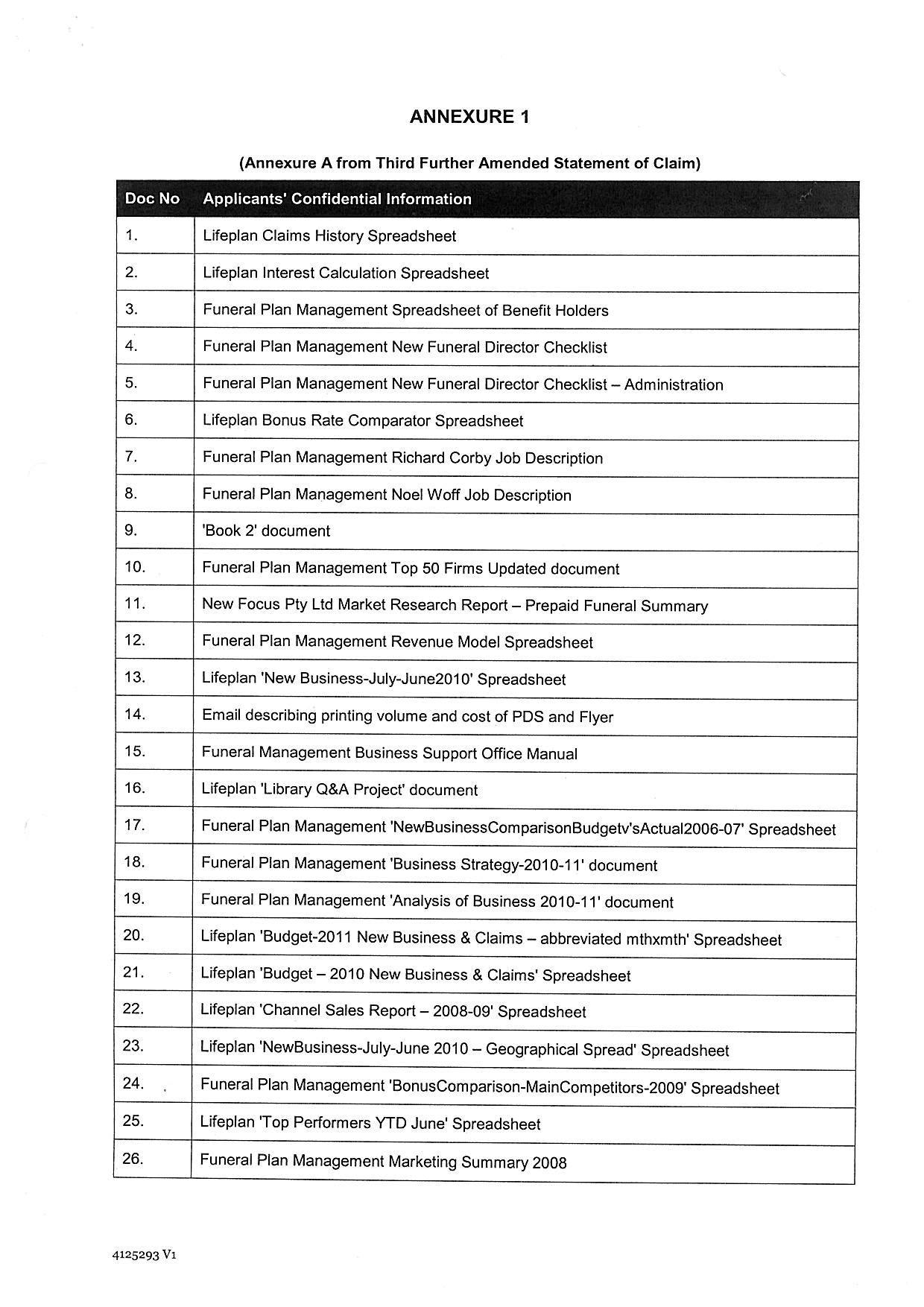
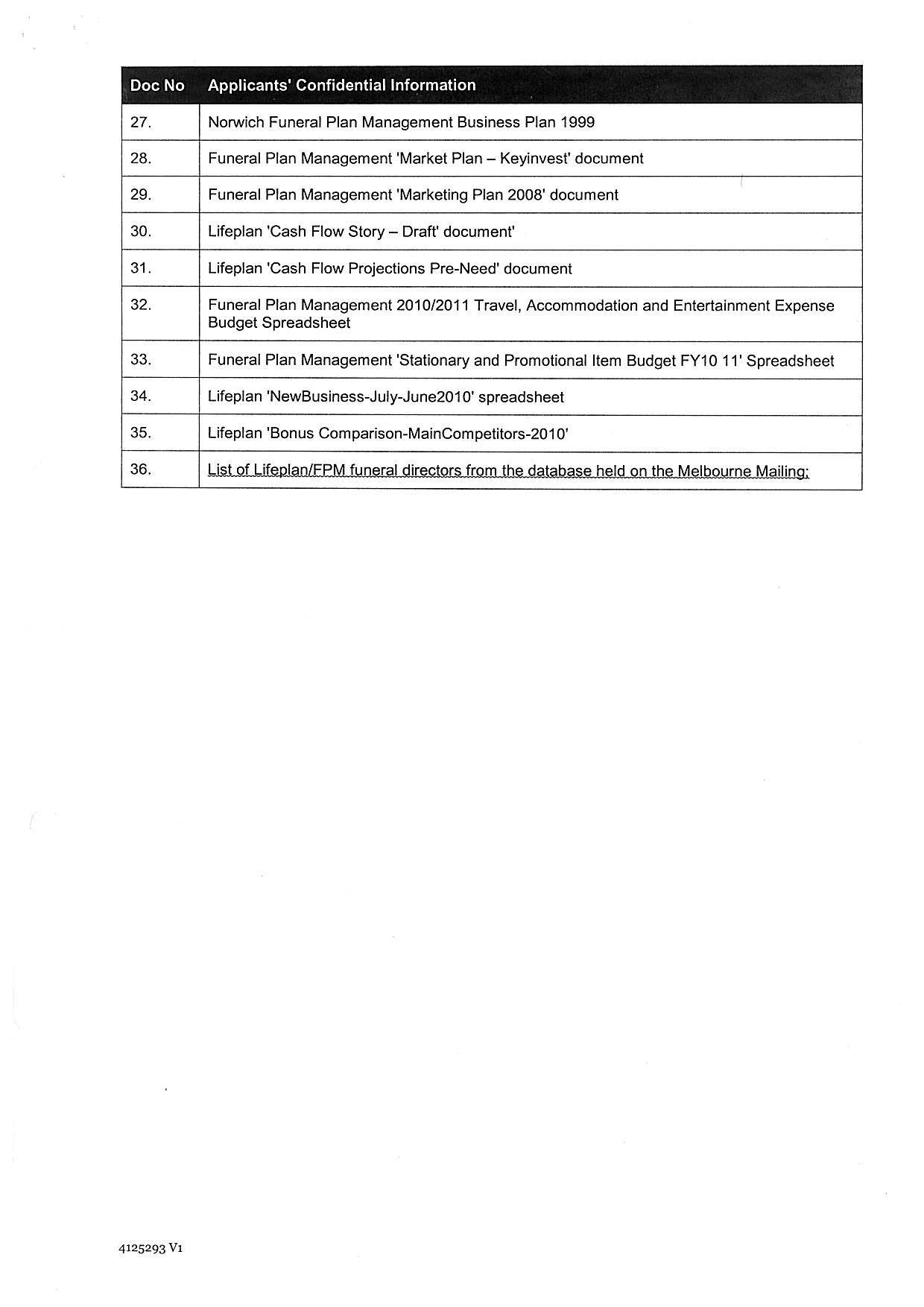
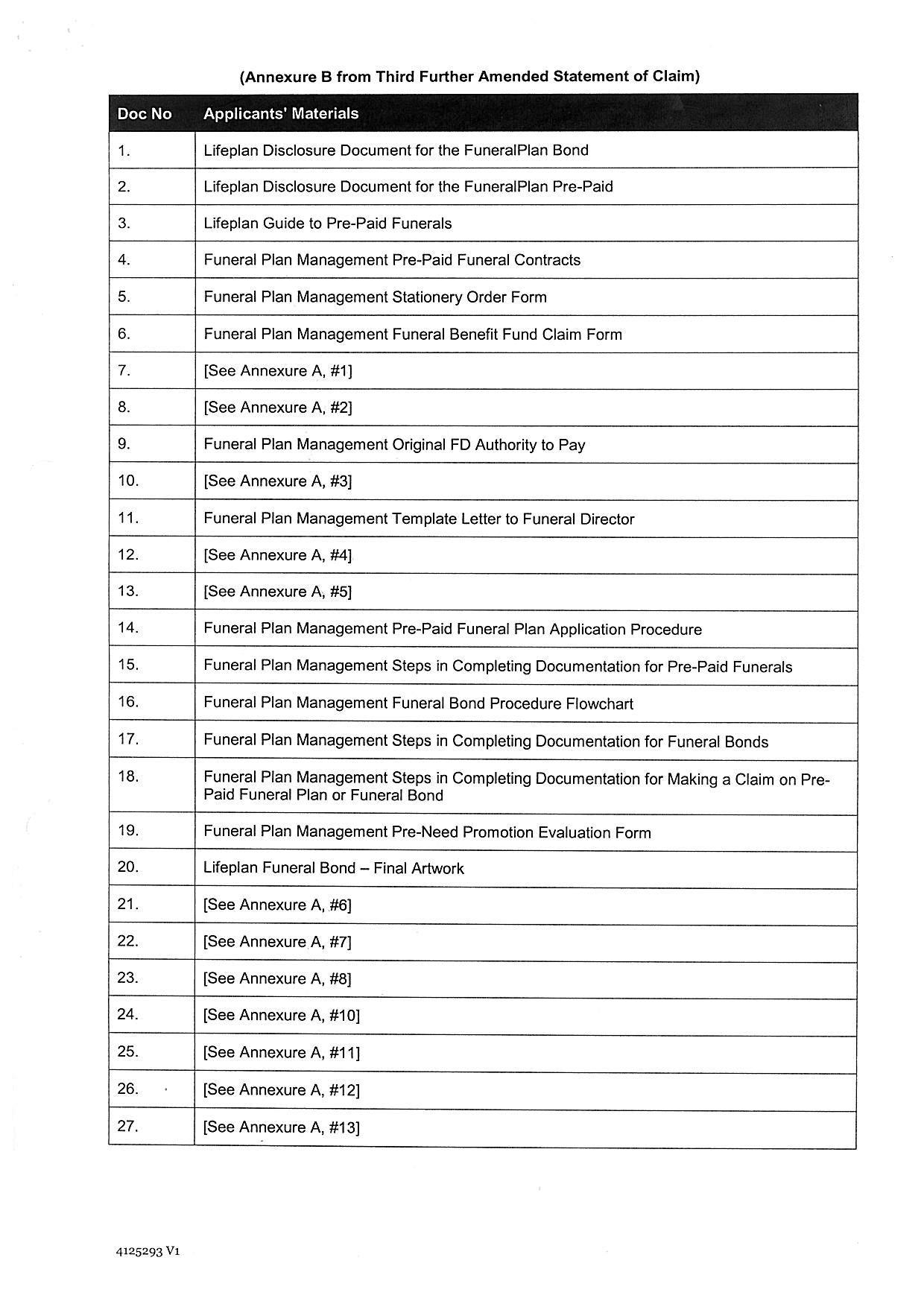
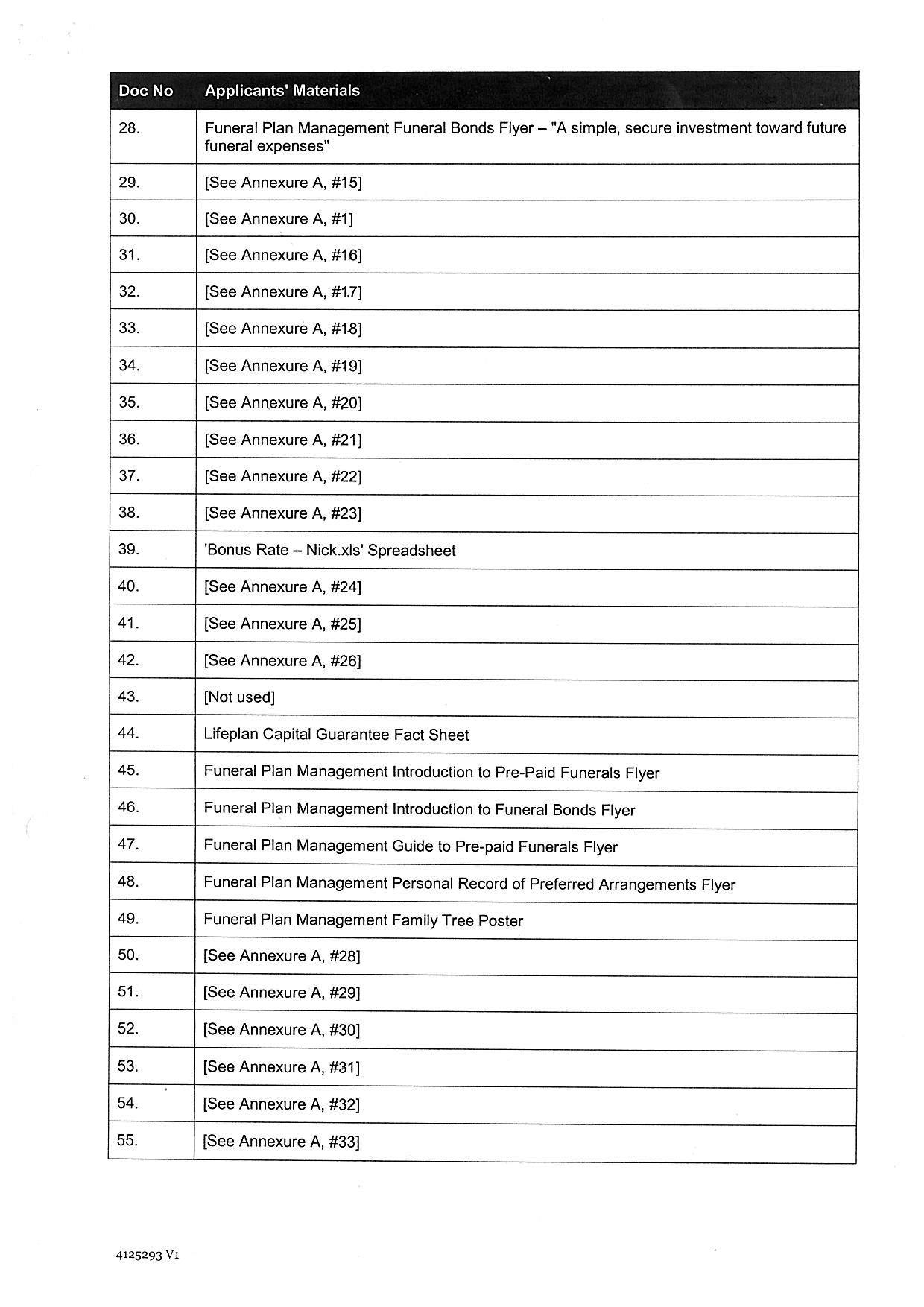
5 The applicants also seek an injunction and orders for delivery up against all four respondents in relation to 61 documents. There were two annexures to the Statement of Claim as it was until shortly prior to trial. In Annexure A, the applicants identified documents they contended contained confidential information taken and used by the respondents. In Annexure B, the applicants identified what they claimed were their copyright works and materials. Shortly prior to trial, the applicants abandoned their claim for infringement of copyright. They now contend that the documents identified in Annexures A and B contain their confidential or valuable information or both which has been taken and used by the respondents. I attach a modified version of Annexures A and B to these reasons. As will be seen, Annexure A identifies 36 documents and Annexure B 60 documents (number 43 not used). Thirty five of the documents identified in Annexure B are documents identified in Annexure A.
6 The orders sought by the applicants in relation to the documents in Annexures A and B are as follows:
3. Noel Jeffrey Woff, Richard John Corby, Funeral Planning Australia Pty Ltd (in liquidation) and the Ancient Order of Foresters Friendly Society in Victoria Ltd whether by themselves, their agents, employees or related entities (as defined by s 9 of the Corporations Act 2001 (Cth)) be permanently restrained from using or publishing the documents described in Annexure A and B of the Third Further Amended Statement of Claim and attached as Annexure 1 to this Order.
4. Noel Jeffrey Woff, Richard John Corby, Funeral Planning Australia Pty Ltd and the Ancient Order of Foresters Friendly Society in Victoria Ltd within 14 days:
a. deliver to the Applicants all hard copies of the documents described in Annexures A and B of the Third Further Amended Statement of Claim and attached as Annexure 1 to this Order in each of their possession, custody or control; and
b. permanently destroy all electronic copies of the documents described in Annexures A and B of the Third Further Amended Statement of Claim and attached as Annexure 1 to this Order in each of their possession, custody or control.
7 In terms of monetary relief, the applicants made an election well before trial for an account of profits rather than damages or equitable compensation. They did not seek to prove any specific loss or damage which they suffered as a result of the respondents’ conduct. As against Mr Woff and Mr Corby, the applicants seek the salaries they were paid by Foresters and some small amounts (relatively speaking) that Mr Woff and Mr Corby received through FPA. As against Foresters, the position is as follows. In 2010, Foresters had a relatively small funeral fund upon which it earnt a management fee. From the time Mr Woff and Mr Corby became employees of Foresters, the fund grew very substantially and Lifeplan’s funeral fund business has diminished. For bonds or plans written from 2011 onwards, Foresters earns a 2% management fee in relation to the fund. The 2% management fee is calculated by reference to the funds under management (“FUM”). This fund is predicted to grow as new bonds or plans are written. The applicants’ primary claim against Foresters is for an account of profits being the net present value of the profits earned and to be earned by Foresters with respect to the fund. The applicants’ case is that an account of profits against Foresters results in a figure in the order of $30 million.
8 In their pleadings and affidavits of evidence filed before trial, the applicants advanced a broad case concerning the scope of the respondents’ wrongdoing. They alleged that absent the wrongdoing, Foresters had neither the financial capacity nor the skills and systems to obtain and then operate the business it did from 2011 onwards. They alleged that FPM had a business system which they described as the “FPM Business System” and which comprised market facing documents, interfaces with funeral directors, support systems and business intelligence, and that the respondents took and used that system. I do not think that the applicants advanced a case in closing that Foresters did not have the financial capacity to establish and operate the business it did from 2011 onwards. In any event, I am satisfied on the evidence that Foresters did have that capacity. With respect to the allegation concerning the taking and use of a FPM Business System, whilst Mr Woff and Mr Corby took certain documents and reproduced them in documents used by Foresters, the evidence does not support a finding that the respondents took and used the applicants’ system of operating, or that all aspects of that system were unique.
9 As the applicants’ case was developed at trial, it concentrated on 11 acts or courses of conduct by Mr Woff and Mr Corby which were said to involve breaches of duty on their part. As my findings of fact are organised around these 11 matters, it is convenient that I identify them at the outset.
10 The business concept that Mr Woff and Mr Corby had in mind in the second half of 2010 involved them working together with Foresters to develop a successful funeral fund business. Mr Woff and Mr Corby were to leave their employment with Lifeplan and become employees of Foresters, and Foresters would engage their company FPA to promote and market the business in return for the payment of a commission. The proposal would involve substantial set-up costs to be borne by Foresters and there was a risk that the business would not succeed. The Board of Foresters had to approve the proposal and, it may be assumed, would only do so if satisfied the risks were worth taking. In order to persuade the Board of Foresters that the business concept was commercially viable, Mr Woff and Mr Corby, in the name of FPA, prepared a paper to present to the Board entitled “Funeral Fund Business Concept”. I will refer to this paper as the Business Concept Plan or BCP. The applicants’ case is that Mr Woff and Mr Corby used their confidential and valuable information in preparing the BCP and, indeed, included some of it in the BCP. The applicants’ case is that Foresters knew that the BCP contained the applicants’ confidential and valuable information.
11 Secondly, the applicants’ case is that between October and December 2010, Mr Woff, whilst still an employee of Lifeplan, and Mr Corby tried to solicit the business of one of the applicants’ major clients, Tobin Brothers Funerals (“Tobins”). In other words, they tried to persuade Tobins to transfer its business from the applicants to the proposed business with Foresters. Tobins was a major client which, unlike other funeral directors, entered into a contract (usually for three years) with the fund manager it selected.
12 Thirdly, the applicants’ case is that between October and December 2010, Mr Woff and Mr Corby, and in particular Mr Woff, whilst still employees of Lifeplan, approached other funeral directors with a view to soliciting the business of those funeral directors for the proposed business with Foresters.
13 Fourthly, the applicants’ case is that in July 2010, Mr Woff, whilst still an employee of Lifeplan, and with the knowledge and encouragement of Foresters, induced Mr Corby to leave his employment with Lifeplan.
14 Fifthly, the applicants’ case is that Mr Woff and Mr Corby, whilst still employees of Lifeplan, became aware of Foresters’ desire to increase its funeral products business and yet failed to disclose that “business opportunity” to the applicants.
15 Sixthly, the applicants’ case is that Mr Woff and Mr Corby took and used their FPM Business System. As developed, the primary documents which were the subject of this allegation were disclosure documents, stationery request forms, marketing flyers, claim forms and pre-paid contract forms.
16 Seventhly, the applicants’ case is that Mr Woff took other confidential and/or valuable business intelligence of the applicants. They point to the large number of their documents which Mr Woff sent to one or other of his private email addresses between July and December 2010.
17 Eighthly, the applicants’ case is that Mr Woff and Mr Corby took extensive steps whilst still employed by Lifeplan to establish FPA and to ensure that the proposed business with Foresters was in a position to commence immediately upon the cessation of their employment with Lifeplan. The applicants’ case is that the steps taken went well beyond what the law permits an existing employee to do.
18 Ninthly, the applicants’ case is that Mr Woff and Mr Corby prevailed upon a printing firm, Matgraphics and Marketing Pty Ltd (“Matgraphics”), which had been engaged by Lifeplan to print pre-paid funeral contract pads to provide to funeral directors, to use its electronic templates to print pre-paid funeral contract pads for Foresters to provide to its funeral directors. This was done without the applicants’ permission.
19 Tenthly, the applicants’ case is that Mr Woff and Mr Corby sent the applicants’ list of funeral directors to a mailing house, Melbourne Mailing, which then used it as Foresters’ mailing list of funeral directors.
20 Finally, the applicants’ case is that because of the similarity between the applicants’ key documents and those of Foresters, there was, at least for a time, confusion in the market between the applicants’ business and the business of FPA and Foresters. The applicants’ case is that FPA and Foresters were passing off their business as that of the applicants.
21 The applicants made an application to amend their Second Further Amended Statement of Claim shortly before the trial. The application was supported by an affidavit from their solicitor. Mr Woff swore an affidavit in opposition to the application. After hearing submissions, I granted leave to amend and a Third Further Amended Statement of Claim was filed. A brief description of the amendments and my reasons for allowing them is as follows.
22 The first class of amendments related to Annexure A to the Statement of Claim. Annexure A of the Second Further Amended Statement of Claim had identified 35 documents which were described as “confidential” or “commercially sensitive and/or proprietary”. Annexure A was amended to identify one additional document involving Melbourne Mailing and to refer to “confidential” or “commercially sensitive, confidential or valuable information”. There were corresponding minor changes in the body of the Statement of Claim. The addition of the reference to “valuable” information was designed, I think, to enable the applicants to argue that, in addition to misusing confidential and commercially sensitive information, Mr Woff and Mr Corby breached their duties to the applicants by copying documents containing valuable information during their employment with a view to using the documents after their employment had ended. “Valuable” was said by the applicants to mean no more than non-trivial (Spotless Group Ltd & Others v Blanco Catering Pty Ltd and Another [2011] FCA 979; (2011) 93 IPR 235 at 242-243 [27] per Mansfield J; Faccenda Chicken Ltd v Fowler and Others [1987] Ch 117 at 136; (1985) 6 IPR 155 at 164). It seemed to me that the amendment involved no more than a further characterisation of information already identified. I could not see any prejudice to the respondents in allowing this amendment.
23 The second class of amendments related to Annexure B. As I have already said, Annexure B of the Second Further Amended Statement of Claim had identified 60 documents which were said to be the subject of copyright in favour of the applicants and which the respondents were alleged to have infringed. There were also allegations of infringement of copyright in the body of the Statement of Claim. By this class of amendments, the applicants sought to add one additional document to Annexure B, add a reference alleging that the information in the documents was valuable (with corresponding minor changes in the body of the Statement of Claim), and delete all references to copyright in Annexure B and in the body of the Statement of Claim. In other words, the thrust of this amendment was the abandonment of the copyright claim and that was not seriously opposed by the respondents. The other amendments in this class were unlikely to cause any prejudice to the respondents. I granted leave to amend in relation to Annexure B and, insofar as it contained claims of copyright infringement (and inserted references to the information being valuable), the body of the Statement of Claim.
24 The third class of amendments involved the addition of a claim under s 1317H(2) of the Corporations Act for the profits made by Foresters as a result of Mr Woff’s contraventions of the Act. Section 1317H is in the following terms:
1317H Compensation orders—corporation/scheme civil penalty provisions
Compensation for damage suffered
(1) A Court may order a person to compensate a corporation or registered scheme for damage suffered by the corporation or scheme if:
(a) the person has contravened a corporation/scheme civil penalty provision in relation to the corporation or scheme; and
(b) the damage resulted from the contravention.
The order must specify the amount of the compensation.
Note: An order may be made under this subsection whether or not a declaration of contravention has been made under section 1317E.
Damage includes profits
(2) In determining the damage suffered by the corporation or scheme for the purposes of making a compensation order, include profits made by any person resulting from the contravention or the offence.
Damage includes diminution of value of scheme property
(3) In determining the damage suffered by the scheme for the purposes of making a compensation order, include any diminution in the value of the property of the scheme.
(4) If the responsible entity for a registered scheme is ordered to compensate the scheme, the responsible entity must transfer the amount of the compensation to scheme property. If anyone else is ordered to compensate the scheme, the responsible entity may recover the compensation on behalf of the scheme.
Recovery of damage
(5) A compensation order may be enforced as if it were a judgment of the Court.
25 The applicants alleged in their Second Further Amended Statement of Claim that Mr Woff had contravened ss 180, 181, 182 and 183 of the Corporations Act. Whilst it was never made clear why s 1317H(2) had not been pleaded earlier, I accepted the applicants’ submission that the “liability” plea (i.e., the plea of the contraventions of the Corporations Act) was already in the Second Further Amended Statement of Claim and that the parties had addressed the issue of the profits made in the evidence filed for use at trial in connection with the claim in equity for an account of profits. In those circumstances, I allowed the amendment.
26 Finally, the applicants sought to introduce a plea into their Statement of Claim that Foresters was vicariously liable for the conduct of Mr Woff and Mr Corby to the extent that such conduct occurred whilst each of them was employed by Foresters. This amendment was opposed by Foresters on the ground that it was not arguable that Foresters was liable for the equitable wrongdoing of Mr Woff and Mr Corby. I decided that the matter was arguable and that the amendment should be allowed. I have now had full argument on the issue and I have decided that Foresters is not vicariously liable for the equitable wrongdoing of Mr Woff and Mr Corby.
27 Mr Matthew Peter Walsh was the principal witness called by the applicants. He swore four affidavits which were read as his evidence-in-chief. The affidavits set out the applicants’ case, largely by reference to the documents which had been retrieved from Mr Woff’s computer, or discovered or produced on subpoena. At times, some of Mr Walsh’s statements were more in the nature of submissions rather than statements of fact.
28 Mr Walsh’s employment history and position at Lifeplan is as follows. He has been employed by Lifeplan since 1993 and he was the information services manager for Lifeplan from that date until 1998. In that position, he supervised the information technology functions of Lifeplan. In 1998, he became the general manager for strategic development and in that position, he was responsible for the business strategy functions, sales and marketing, product maintenance and development, customer services and information technology. His responsibilities also encompassed the business conducted by FPM and he had executive responsibility for that company and general oversight of its operations. After the merger of Lifeplan and Australian Unity Investments Ltd (“Australian Unity”) in August 2009, Mr Walsh held the position of Head of Lifeplan and General Manager of Specialised Products for Australian Unity and he also oversaw the management of FPM. Mr Walsh said that in his position as Head of Lifeplan and General Manager of Specialised Products for Australian Unity, he is responsible for the Lifeplan business as part of his role as head of the specialised products business of Australian Unity with a total of $2 billion funds under management, and over 100,000 clients in 2012.
29 Mr Walsh was cross-examined at length, principally by counsel for Foresters. An important aspect of the cross-examination was to suggest to Mr Walsh that the loss of business by Lifeplan and the securing of business by Foresters was not due to the alleged wrongdoing of Mr Woff and Mr Corby, but rather to other factors, including the poor performance in terms of investment returns of one of Lifeplan’s funeral benefit funds (i.e., Funeral Benefits Fund No. 2) and, to a lesser extent, cost cutting measures put in place after the merger of Australian Unity and Lifeplan. It seems that the performance of Funeral Benefits Fund No 2 was affected by the Global Financial Crisis and it may also have been affected by a depreciation in unlisted assets. There was a reference in the course of the evidence to collateralised debt obligations. There was a sale of equities before December 2008 and the fund was temporarily closed to new business. It has not to date been reopened to new business. It remains “open” for those making regular contributions into the fund (i.e., those paying by instalments). Lifeplan has established a new funeral benefit fund called the “Tax Minimiser Fund”. Those making regular contributions into the Funeral Benefits Fund No 2 number in the region of 100 to 150 of the 350 funeral directors who had an interest in the fund upon its closure. The fund paid returns of 0.25% in 2009, and 0.5% in 2010. During the same years, the Tax Minimiser Fund returned 4.30% in 2009, and 3.57% in 2010. Other funds returned in excess of 2.5% in these two years. The Consumer Price Index in 2009 was 1.46%, and in 2010 it was 3.05%.
30 Mr Walsh was quite defensive about the performance of the Funeral Benefits Fund No 2. At one point in his evidence, he described the return during the 2009 year as an excellent return in the circumstances. Although I accept the substance of Mr Walsh’s evidence, I think he took an unduly optimistic view of the performance of Funeral Benefits Fund No 2 in 2009 and 2010, and tended to downplay the likely reaction to the fund’s performance from the funeral directors who had invested in it. As I have said, another aspect of the cross-examination was to establish that cost cutting measures were put in place following the merger between Australian Unity and Lifeplan. I find that there were such measures and that they affected marketing (including sponsorships), travel and entertainment expenses. Mr Walsh was also cross-examined about the decline in staff numbers in the FPM sales team in the second half of 2010 and my findings in relation to that matter are set out below. Mr Walsh accepted in cross-examination that the financial documents suggested that Foresters had the capital to expand its business.
31 Counsel for Mr Woff and Mr Corby submitted that the applicants were not frank with their funeral director clients as to the reasons for the poor performance of Funeral Benefits Fund No 2. This was said to have two consequences. Mr Woff and Mr Corby were left to bear the brunt of the funeral directors’ annoyance as to the performance of the fund, and this is a reason they were prepared to leave Lifeplan. Furthermore, Lifeplan’s “misrepresentation” or “non-disclosure” as to reasons for the poor performance of the fund is a reason in equity why the applicants’ claim for an account of profits should be refused.
32 I think Funeral Benefits Fund No 2 performed poorly in terms of investment returns. I think funeral directors would have been angry or annoyed about that fact. I think that conclusion is supported by the evidence of the three funeral directors who gave evidence before me (see at [53] below). I will come back to the reasons for the poor performance of Funeral Benefits Fund No 2 and the alleged misrepresentations or non-disclosures to funeral directors when addressing Mr Woff’s evidence.
33 The other matter which Mr Walsh was cross-examined about at some length was the FPM Business System. There can be no doubt that FPM had a business system, but I am not persuaded that it was particularly unique or was something that was not, for the most part, the product of the nature of the business. In any event, as I will explain later in these reasons, I am not satisfied that other than in respects I identify, the respondents took and used the FPM Business System.
34 Subject to noting these matters, I consider that Mr Walsh was a satisfactory witness and that I can rely on his evidence.
35 The applicants tendered affidavits of the following persons as the evidence-in-chief of those persons:
(1) Ms Michelle Anne Rawe (employee of Lifeplan and executive assistant to Mr Walsh);
(2) Ms Sharon Patricia Ferguson (employee of Lifeplan and a service and support manager);
(3) Mr Christopher James Pullen (employee of Australian Unity and a senior infrastructure engineer);
(4) Mr Michael Francis Hutton-Squire (employee of Australian Unity and head of technical services/business technology); and
(5) Mr Jean-Pierre du Plessis (partner of Ferrier Hodgson specialising in computer forensics and data recovery, among other things).
36 Other than Ms Ferguson, these witnesses were involved in the investigation carried out by Lifeplan which I describe below. Ms Ferguson described events surrounding an information request made by Mr Woff in 2010. None of these witnesses were required for cross-examination and I accept their evidence.
37 The applicants called two experts, one an expert in accounting (Ms Dawna Wright), and the other an expert in actuarial calculations (Mr Michael Dermody). Both were credible and reliable. I discuss their evidence (and that of Foresters’ experts) below.
38 Mr Woff’s evidence-in-chief was contained in a number of affidavits which he had sworn and which were tendered. The affidavits were, in part, not in proper form because they were argumentative and expressed in terms of submissions rather than statements of fact. Some of the topics addressed were not relevant. For example, Mr Woff tried to explain his decision to leave Lifeplan by reference to a lack of opportunity for further career advancement and reference to his dissatisfaction with Lifeplan’s future intentions in respect of the expenses FPM might incur to increase its business, such as marketing rebates and discretionary spending. Mr Woff gave his opinion as to the reasons Lifeplan’s business declined and he suggested that it was, in part at least, the author of its own misfortune. He also gave his opinion as to the reasons Foresters was able to succeed in building up the Foresters Funeral Fund and in doing so he attributed a good deal of the success to the skills he and Mr Corby were able to bring to the Foresters’ business.
39 For reasons I will give, I do not accept Mr Woff’s evidence except where it is corroborated by evidence which I do accept. There were not many references to Mr Woff’s evidence-in-chief in his counsel’s closing submissions. Subject to one matter, I will refer to those aspects of Mr Woff’s evidence which were relied on by his counsel during his closing submissions in the context of particular topics.
40 The one matter which I deal with at this point is as follows. Mr Woff and Mr Corby submitted that the applicants were not entitled to the equitable remedy of an account of profits because they had not acted equitably. They submitted that the cause of the poor performance of Lifeplan’s Funeral Benefits Fund No 2 was poor investment decisions by Lifeplan and not, or not simply, the Global Financial Crisis. They submitted that the applicants misrepresented, or at least did not disclose, the true position to funeral directors. Mr Woff deposed to a conversation he had in June 2010 with a Mr Tony di Girolamo who was employed by one of the applicants as the Head of Specialised Products Lifeplan Funds Management. Mr di Girolamo allegedly told Mr Woff that in 2008, Lifeplan had made risky investment decisions resulting in a loss of $20 million which had been transferred to Funeral Benefits Fund No 2. In due course, an amount of $8 million was borrowed from the management fund to ensure the solvency of the fund. Mr di Girolamo allegedly said that Mr Walsh told him not to tell Mr Woff these things. I do not think this last matter, even if true, is sinister. Mr Walsh may have simply wished to keep control of the situation.
41 Counsel for Mr Woff pointed out that Mr Woff was not cross-examined about this conversation. Although that is correct, it does not mean that I have to accept the evidence in circumstances where there was a sustained attack on his credibility and reliability, and where I have found that I will not accept his evidence except where it is corroborated by evidence which I do accept. There are strands of evidence which bear on the poor performance of the Funeral Benefits Fund No 2, but I would hesitate to make a finding as to the cause or causes of that poor performance even if it was important that I do so because I think that the evidence was far from complete. However, I do not think that it is important that I do so because the evidence does not establish the alleged misrepresentations or non-disclosures to funeral directors. Furthermore, and in a sense this is the short answer to the submission, it was never explained and no authority was referred to which might assist in explaining how any conduct by Lifeplan in relation to Funeral Benefits Fund No 2 bars the applicants from making what is otherwise a proper claim against Mr Woff and Mr Corby.
42 A number of the matters which form the basis of my conclusion that I will not accept the evidence of Mr Woff except where it is corroborated by evidence which I do accept are set out in my discussion of particular facts. At a more general level, I base my conclusion on the following.
43 In the second half of 2010, Mr Woff sent a number of emails with the applicants’ documents attached from his Lifeplan email account to one or other of two private email addresses, ichbinnoddy@hotmail.com and noel.woff@hotmail.com. Except where it is necessary to refer to one of these private email addresses in particular, I will refer to them collectively as Mr Woff’s private email address. Mr Woff admitted in cross-examination that he “double-deleted” a number of emails from his Lifeplan account shortly before leaving the employment of Lifeplan and that, in hindsight, it was the wrong thing to do. He would not provide a direct answer to the question of whether he had doubled-deleted the emails in order to ensure that Lifeplan would not discover them. Mr Woff also admitted sending emails with attached information to his hotmail address and “that it was a mistake and in hindsight is something I shouldn’t have done”. He admitted referring to one or two of the emails for the purposes of preparing the BCP and that it was wrong.
44 In my opinion, Mr Woff’s explanation for not discovering emails and attachments sent to his ichbinnoddy@hotmail.com email address to the effect that a virus had attacked it and he shut the account, is completely implausible and a fabrication. The explanation is belated and I found his evidence on the topic entirely unconvincing.
45 In my opinion, Mr Woff’s evidence that he sent the emails through to his ichbinnoddy@hotmail.com email address for future reference and not to further the proposed business with Foresters was implausible and I reject it. The description of the subject of some of these emails, for example, “Recipe” and “New Food Conditions” was designed, I find, to avoid detection of what he was doing by the applicants.
46 I found Mr Woff’s evidence concerning the proposed role of FPA at the time of the BCP to be evasive, although he eventually acknowledged the position.
47 Mr Woff admitted that what he told Mr Walsh about where Mr Corby was going after he left Lifeplan was untrue and he said that he put his own personal interests above those of Lifeplan. A little later he said that he lied because he was negotiating his contracts with Foresters at the time. I think he also accepted that he was not entirely accurate in describing to Mr Walsh his proposed role at Foresters.
48 Mr Woff admitted on a number of occasions that the discovery given by Mr Corby and himself was inadequate. He was not able to provide an explanation for failure to give proper discovery. On a number of occasions during the course of his cross-examination when he was asked to explain the reason he had not discovered a document, he said that it was an oversight and he apologised to the Court.
49 There were occasions in cross-examination where Mr Woff’s logic was difficult to follow. For example, he asserted that it was irrelevant that he and Mr Corby had made statements in their proposal to Tobins in 2010 which reflected poorly on the applicants because Tobins was never going to award the new contract to the applicants. That is either a submission, or if intended to be evidence of a fact, it is illogical. It is illogical because if the statements were irrelevant, then they would not have been included. I reject his suggestion that they were included because Lifeplan is the benchmark.
50 Mr Corby did not give evidence. He is the second respondent to the proceeding and an employee of the fourth respondent, Foresters. As will become clear, there are events and circumstances in issue in this case about which Mr Corby could have given evidence. Mr Corby’s absence from the witness box in circumstances where there is nothing to suggest that he could not have given evidence means that I can infer that his evidence would not have assisted his case. Where there are competing inferences, Mr Corby’s absence from the witness box might enable me to be more confident in drawing one of the available inferences. These principles are well known (Jones v Dunkel and Another (1959) 101 CLR 298 at 308 per Kitto J; at 312 per Menzies J and 320-321 per Windeyer J; Australian Securities and Investments Commission v Hellicar [2012] HCA 17; (2012) 247 CLR 345 at 412-414 [164]-[170] per French CJ, Gummow, Hayne, Crennan, Kiefel and Bell JJ).
51 To the extent that Foresters disputes the applicants’ case relating to the events and circumstances about which Mr Corby could have given evidence, I think the same approach applies to it. Mr Corby was and remains an employee of Foresters and I think it was to be expected that Foresters would call him if it wished to challenge the applicants’ version of the relevant events and circumstances.
52 Foresters referred to the fact that Mr Corby was separately represented and that the whole of his affidavit evidence was subject to objection. Foresters submitted that it could not be expected to have arranged a new affidavit from Mr Corby. It submitted that no inference should be drawn against it. I reject that submission. If the submission is that in some way the pre-trial orders lead to the conclusion that the absence of Mr Corby from the witness box cannot give rise to the inferences I have identified, then I reject it. Foresters could have obtained affidavit evidence from Mr Corby or applied to lead oral evidence from him. If the submission is that nothing Mr Corby could have said was relevant to Foresters’ defence of the claim that it did not knowingly assist and was not involved within s 79 of the Corporations Act, then clearly if the premise is correct, the conclusion follows. The position with respect to Foresters and the absence of Mr Corby from the witness box might be different if there was clear evidence of a conflict between the two, but there is no such evidence. Mr Corby is still employed by Foresters.
53 Mr Woff and Mr Corby called three funeral directors to give evidence. They were Mr Craig Murphy of Murphy Family Funerals, Mr John Scott of TJ Scott and Son, and Mr Paul Graham of Graham Family Funerals. Each of these funeral directors was on friendly terms, to varying degrees, with either Mr Woff or Mr Corby or both. Nevertheless, there is no reason not to accept the substance of their evidence.
54 Mr Murphy owns Murphy Family Funerals and that business had investments with FPM. The returns on the investments were poor. Mr Murphy was contacted by Mr Corby in March 2011 and Mr Corby told him that he and Mr Woff had left FPM and commenced with Foresters. In November 2011, Mr Murphy started placing his investments with Foresters. He did not think that he had been told the truth about the reason for the poor performance of Lifeplan’s Funeral Benefits Fund No 2.
55 Mr Scott is the owner of TJ Scott and Son and that business had investments with FPM. He moved his investments from FPM to Foresters in March 2011 because he wanted to maintain a personal relationship with Mr Woff and Mr Corby. He said that neither Mr Woff nor Mr Corby solicited him for business for Foresters whilst they were employed by Lifeplan.
56 Mr Graham is the managing director of Graham Family Funerals and that business had investments with FPM. Mr Graham became dissatisfied with the low returns on the FPM pre-need funeral products and, in July 2011, he started placing his investments with Foresters. Mr Graham said that it was FPM’s poor rate of return that led him to move to Foresters.
57 The evidence of the funeral directors establishes, I think, that there was a perception amongst at least some funeral directors that Lifeplan’s Funeral Benefits Fund No 2 had performed poorly and that at least some funeral directors considered that they have suffered a loss where investment returns do not keep pace with the increase in funeral costs. It also establishes that the reasons a funeral director may transfer from one fund to another include the quality of the investment returns and the extent of the personal relationship with the salesmen representing the fund.
58 Foresters called four witnesses.
59 Mr Theodore Fleming is the non-executive Chairman of the Board of Foresters. He has held that position since 1995. Between December 1993 and 1995, he was a non-executive director of Foresters. Mr Fleming is a legal practitioner. He has practised law for nearly 40 years and he is the principal partner of the legal practice, Fleming & Rhoden Lawyers.
60 Mr Fleming swore an affidavit which was tendered as his evidence-in-chief. He was cross-examined at some length by counsel for the applicants. On occasions, Mr Fleming reformulated counsel’s question in a more extreme form and then denied it, or commented upon it. Nevertheless, I accept the substance of Mr Fleming’s evidence.
61 Mr Kerry Allan Hughes has been the chief executive officer of Foresters since October 2000. He swore seven affidavits which were tendered as his evidence-in-chief. He was cross-examined about a number of matters, including events in 2010, the adequacy of Foresters’ discovery and the decision to put FPA into liquidation in 2013. I accept much of what Mr Hughes said, although there are a couple of areas, which I will identify, where I do not accept his evidence.
62 Foresters also called two experts, one an expert in accounting (Mr Campbell Jackson), and the other an expert in actuarial calculations (Ms Caroline Bennet). Like the applicants’ experts, both were credible and reliable. Their evidence is discussed below.
63 The applicants allege that the respondents have not made proper discovery. They refer to orders for discovery made in the proceeding and, in particular, orders made on 22 October 2013 and 3 June 2014 respectively. They have put before the Court correspondence which has passed between the respective solicitors for the parties and affidavits about discovery filed by Mr Woff, Mr Corby and Mr Hughes respectively.
64 The applicants contend that the failure to make proper discovery means that I can and should infer that the applicants have been disadvantaged in their ability to prosecute the proceeding, and that the documents would have assisted the applicants in proving the breaches by Mr Woff and Mr Corby, and in proving the knowing assistance of Foresters.
65 It is trite that issues of discovery and, in particular, whether there has been adequate discovery are ordinarily dealt with before trial. Nevertheless, the failure to produce a document where there is an obligation to do so may lead to an adverse inference in certain circumstances (Microsoft Corporation and Another v Atifo Pty Ltd and Others (1997) 38 IPR 643). It would be necessary to show that the document exists, that there was an obligation to produce it, and that there has been an intentional withholding of the document. There would then need to be a precise identification of the inference to be drawn from the failure to produce the document. For example, the party seeking the inference would need to identify the precise process of reasoning from the absence of, say, document X, or a class of documents to the particular conclusion. The applicants have not done that. For example, in the case of Mr Woff and Mr Corby, it is said (among other allegations) that they have failed to discover documents concerning Foresters’ purported loans to FPA, Mr Woff and Mr Corby, and have failed to discover documents regarding the hybrid trust arrangement, but it is not made clear how it is said that these documents would have assisted the applicants to prove the breach of duties alleged. If it is said that these documents are relevant not to breach but to the account of profits, one may ask rhetorically, what are the competing inferences to which these documents relate. The applicants’ written submissions tended to focus almost entirely on the deficiencies in the discovery and not also on these issues.
66 Having said that, there is no doubt that the discovery of Mr Woff and Mr Corby has been deficient in a number of respects. Mr Woff admitted as much on a number of occasions in the course of his cross-examination. I do not think I need to pursue this any further because I think I can make clear findings about the conduct of Mr Woff and Mr Corby from the evidence which has been put before me.
67 The position with Foresters is somewhat different. Except for the fact that Mr Hughes has not searched for the FPA proposal to Tobins or caused any person at Foresters to carry out a search for this document, there appears to be a dispute about whether the orders for discovery have been complied with. In their closing written submissions, the applicants identified the deficiencies in Foresters’ discovery in similar terms to a letter from their solicitors dated 30 January 2014. I note that Foresters denied any deficiencies in the letter from their solicitors dated 12 February 2014. I am not prepared to find that Foresters deliberately failed to make proper discovery.
68 I now set out my findings of fact. Many of the background facts are not in dispute as they are clearly established by the evidence of Mr Walsh or the documents put in evidence. Where there is a dispute, I will identify the dispute and the way in which I resolve it.
69 Lifeplan described itself and FPM in its 2009 Disclosure Documents in the following terms. Lifeplan is a leading Australian specialist fund manager and provider of investment products. It is a provider of Funeral Bonds, tax effective investment products and Education Savings Plans. It holds an Australian Financial Services Licence. FPM is a wholly-owned subsidiary of Lifeplan and it is a specialist business dedicated to providing funeral benefits, investment management and customised administration services for funeral directors and their clients. Lifeplan and its funeral products are regulated by its constitution, the Corporations Act and the Life Insurance Act 1995 (Cth). Its funeral bond product is regulated by the Australian Prudential Regulation Authority (“APRA”) under the Life Insurance Act.
70 Mr Walsh expanded on this description with particular emphasis on Lifeplan’s funeral bond business as follows. Lifeplan is in the business of funds management and the provision of investment products. In conjunction with FPM, Lifeplan provides professional administration, investment products and information on aspects of planning for a funeral in advance of a customer’s death. Lifeplan has been involved in the funeral products business since 1984. FPM promotes, markets and distributes Lifeplan’s funeral products. As at 2012, these products were sold through 250 Australian funeral directors. FPM both recruits and maintains relationships with funeral directors for this purpose. FPM has the capacity and had prior to 2012, promoted the products of entities other than Lifeplan. It previously promoted and distributed funeral bond products of another friendly society, KeyInvest Limited. FPM no longer promotes and distributes KeyInvest funeral bond products but does administer them on behalf of KeyInvest Limited. FPM’s business planning includes a strategy of seeking out and securing other friendly society funeral product providers.
71 A funeral bond is a funeral investment product offered by a friendly society through a benefit fund. In the usual course, there is a requirement that the monies which have been invested be paid out only on the death of the client and used for the purpose of their funeral. The idea of a funeral bond is that it allows individuals to set aside funds to meet the costs of future funeral expenses.
72 Mr Walsh said, and I accept, that the ways in which funeral bonds can be used relate to the type of sale and the mechanism by which the benefit is paid to the funeral director. Funeral directors use funeral bonds in two principal ways. First, the most common way is to use the funeral bond in association with a pre-paid funeral contract that sets out the desired funeral arrangements and stipulates a fixed price for the funeral services. This type of funeral bond is called a Funeral Plan Pre-Paid Bond. The maximum amount of the bond is the cost of the funeral service under the pre-paid funeral contract. The pre-paid funeral plan can be paid out to the funeral director on the death of the client and following confirmation from the funeral director that the funeral has been conducted in accordance with the pre-paid funeral contract. The second way in which a funeral bond can be used is through a transaction referred to as a Funeral Plan Bond. The client executes a document containing specified funeral services, but without a contractual commitment as to the pricing of those services. In the case of this type of funeral bond, when the client dies the funeral director would requote the funeral based on the pre-arranged details and any further modifications based on the prices current as at the date of death. The funeral bond is used to contribute to the cost. There is a maximum amount allowed for the bond. In Lifeplan’s 2009 Disclosure Document, it is stated to be $10,750. Under both types of bond, payments may be made by instalments.
73 The largest sales channel for funeral bonds is through funeral directors. Funeral directors introduce funeral bonds to customers on behalf of friendly societies because it enables them to promote and sell their own services prior to the death of the individual in what is known as the “pre-need” market. In 2010, the applicants had a large share of the market in the order of 70%.
74 Funeral bonds can also be sold through financial planners and there is no contact with funeral directors at this time. Such funeral bonds can be converted at a later time to one of the bonds referred to above. Funeral bonds can also be bought directly from a friendly society.
75 Mr Walsh explained the relationship between the client and a particular funeral director in relation to the bonds. I accept his explanation. The first and most common mechanism is that the funeral bond is “assigned” by the client to the funeral director when it is taken out, making the funeral director the owner of the bond, with the client being the “life assured”. The effect of such an arrangement is that the client has assigned all the rights and benefits of the bond, and monies can only be paid to the funeral director upon the death of the life assured. The second mechanism is one whereby the funeral director is nominated as the beneficiary of the bond and on the death of the client, the bond is paid to the funeral director. The client remains the owner of the bond and is able, during their lifetime, to change the nominated beneficiary if they see fit. The third mechanism is for the client to hold the bond as the legal and beneficial owner thereof and, in that case, the funeral director relies on the executor acting for the deceased estate, to honour any pre-arrangement that may be in place.
76 Mr Walsh said, and I accept, that in the case of each method of sale and mechanism through which the benefit is paid to the funeral director, the essential element of a funeral bond is that it can only be claimed following the death of the client and for the purposes of contributing to their funeral expenses.
77 In 2010, Lifeplan and FPM had two main funeral investment products, being a funeral bond, known as the FuneralPlan Bond, and a pre-paid funeral plan known as the FuneralPlan Pre-Paid. Lifeplan manages investment funds for funeral bonds and pre-paid funeral plans and it receives a management fee for those services. FPM markets, distributes and administers the funeral bonds and pre-paid funeral plans through funeral directors. Mr Walsh said, and I accept, that FPM has a commercial relationship with those funeral directors who utilise Lifeplan funeral products in order to support their funeral planning business. FPM provides marketing materials, standard contractual documents and other stationery to those funeral directors and it may also provide specialist sales and marketing advice. FPM may also provide a marketing budget to certain funeral directors to use in promoting Lifeplan’s funeral products. FPM administers the payment of claims out of the Lifeplan Benefit Fund. Mr Walsh said, and I accept, that FPM’s commercial relationships and arrangements with funeral directors provide the key distribution channel for Lifeplan funeral products.
78 Lifeplan owns and has created and developed a suite of documents in relation to the promotion and administration of its funeral bonds and pre-paid funeral plans. Mr Walsh identified these documents as being marketing materials and administrative documentation. The marketing materials include a marketing brochure entitled “The Guide to Pre-Paid Funerals”, a disclosure document entitled “Funeral Plan Pre-Paid”, and a disclosure document entitled “Funeral Plan Bond”. The administrative documents include a pre-paid funeral plan contract, including terms of agreement, a funeral benefit fund claim form, and a stationery request form.
79 Lifeplan maintains template funeral contracts and terms of agreement. They are provided to funeral directors so that they can use them in entering into pre-paid funeral contracts with customers. The contracts comprise a coversheet to be filled in recording the client details, the services agreed upon, and details of the document’s execution and a page of standard terms of agreement. Lifeplan provides the funeral contracts to their funeral directors by way of a contract pad. Lifeplan arranges for funeral directors to include their name, trade mark and contact details on the upper left hand side of the contract. The contracts contain a branding of FPM and references to FPM on the front page and in the terms and conditions. Lifeplan also provides funeral directors with access to the contracts on-line, and if that facility is used, the contracts may be printed and executed in hard copy form.
80 FPM prepares a stationery order form for funeral directors to order supplies of the contracts and Lifeplan promotional materials. It also provides a funeral benefit fund claim form which is completed by the funeral director when the beneficiary of the funeral product dies, and there is either a pre-paid funeral contract in place or a funeral bond which has been assigned or where the funeral director has been nominated as the beneficiary of the funeral bond.
81 In 2001, Lifeplan merged with Norwich Union Friendly Society Ltd (“NUFS”) and as part of that merger, Lifeplan purchased the share capital in Norwich Union Funeral Plan Management Pty Ltd (“NUFPM”) from Norwich Union Holdings Australia Ltd. Before the acquisition, NUFPM promoted and distributed funeral products on behalf of NUFS, and after the acquisition, NUFPM promoted and distributed Lifeplan funeral products through the use of the Norwich Union Funeral Fund Customer Information Brochure. On 25 June 2001, NUFPM changed its name to Funeral Plan Management Pty Ltd (“FPM”). Mr Woff was part of the NUFPM business and after the acquisition, he reported to Mr Walsh in the latter’s executive capacity as general manager, strategic development.
82 Lifeplan merged with Australian Unity in August 2009. Lifeplan is a subsidiary of the Australian Unity Group, and its parent company is Australian Unity Limited.
83 Australian Unity is based in Melbourne. Lifeplan is based in Adelaide. Until shortly prior to May 2012, there was an FPM office in Melbourne which dealt with marketing and distribution.
84 Foresters described itself and FPA in its 2011 Disclosure Documents in the following terms. Foresters is a public company registered under the Corporations Act and a traditional friendly society. It manages the Foresters funeral bond Fund under rules of the Fund and is subject to the Corporations Act and the Life Insurance Act. It administers the Fund and it stated in its disclosure documents in 2011 that FPA promotes and markets the Fund. It describes FPA in those documents as a specialised funeral planning company providing customised administration and marketing services for funeral directors and their clients Australia wide.
85 Mr Hughes expanded on this description in his evidence as follows. Foresters is a public company limited by shares and guarantee. It is registered under s 21 of the Life Insurance Act and has been determined by the APRA to be a friendly society under s 16C of that Act. Its principal activities are the marketing and management of investment and insurance products, including friendly society bonds, funeral bonds, and death and distress benefit funds under an Australian Financial Services Licence. It is regulated by the Australian Securities and Investments Commission under the Corporations Act and prudentially regulated by the APRA under the Life Insurance Act. Foresters currently operates five funeral funds, the two largest being the STL Funeral Benefit Fund established in 1997 and with assets worth $33 million (as at March 2013), and the Funeral Benefit Fund established in 1990 with assets worth $40 million (as at March 2013).
86 There was very significant growth in the business of Foresters between 1997 and 2011. Benefit fund assets comprising funeral benefit fund increased from $19.1 million as at 30 June 1997 to $220.1 million as at 30 June 2011. Management fund assets increased from $3 million as at 30 June 1997 to $14.6 million as at 30 June 2011.
87 The increase in size of the business of Foresters between 2000 and 2010 resulted from the acquisition of various smaller friendly societies, or the transfer of funds operated by them. In October 2000, Foresters had two funeral bond products. In the years that followed, it acquired the businesses of a number of other friendly societies. Until 2008, the State Trustees which in the 2007/2008 financial year had an operating revenue of almost $60 million, invested in the Foresters funeral bond. Tobins invested in Foresters pre-need funeral bond product until 2008.
88 Mr Fleming said, and I accept, that by 2010, the Board of Foresters had concluded that there was limited scope for further growth through the acquisition of other friendly societies or the transfer of other friendly society funds and it directed the chief executive officer, “to identify opportunities for organic growth in our existing funds”.
89 The funeral funds which Foresters had under management increased significantly from 2011 when Mr Woff and Mr Corby were engaged as employees of Foresters. The funeral fund of Foresters which is the subject of the proceeding was established on 3 December 1990 and is known as the “Foresters Funeral Benefit Fund – Exempt and Taxable” (“Foresters Funeral Fund”). Foresters manages other funeral funds, including STL (or State Trustees), Funeral Benefit Fund and MUA Bluechip Funeral Fund. As at 30 June 2010, the balance of the Foresters Funeral Fund was $13,238,399, and as at 30 June 2013, the balance of the Foresters Funeral Fund was $62,940,608. The Foresters Funeral Fund is an “approval benefit fund” for the purposes of the Life Insurance Act.
90 Mr Hughes described the features of a funeral bond and his description does not differ in any material way from that given by Mr Walsh. In general terms, funeral bonds involve an investment by an individual so as to provide for the payment in due course of their funeral expenses, and the benefit of the investment may or may not be assigned to a funeral director. Pre-paid funeral plans involve an investment by an individual in conjunction with the execution of a fixed price funeral contract between the individual and a funeral director. Under the plan, the individual assigns the benefit of their investment, but not their membership of the fund, to the funeral director.
91 In the case of Foresters Funeral Fund, the individual and not the funeral director is always the member of the Fund and even if the individual assigns the benefit of the investment to a particular funeral director, the individual and not the funeral director remains the member of the Fund. The Foresters Funeral Fund is and always has been capital guaranteed and this means that the “guarantee” is supported by the solvency reserves maintained by Foresters in accordance with APRA regulatory requirements.
92 In 2010, Foresters had a disclosure document in relation to each of its funds.
Lifeplan and Mr Woff and Mr Corby
93 Mr Woff commenced employment with NUFPM as a funeral fund manager on 2 April 1990. His employment was transferred to Lifeplan following the acquisition of NUFPM and the terms of his employment are recorded in a letter dated 27 March 2001.
94 Mr Woff operated the FPM office in Melbourne where he supervised on average four to five staff members. He reported to Mr Walsh. The FPM office in Melbourne was engaged in the promotion and distribution activities of FPM and the administration of the funeral products was carried out in Lifeplan’s offices in Adelaide. Mr Woff’s position was described as “Manager, Funeral Plan Management”. Mr Walsh described that position as a senior management position and I accept that that was the case. Mr Woff was responsible for the oversight of the marketing and distribution arm of FPM and Lifeplan’s funeral director based funeral product business. Mr Woff’s remuneration in 2010, including salary and bonuses, was $333,000 per annum.
95 Mr Walsh said, and I accept, that Mr Woff had overall responsibility for maintaining and protecting Lifeplan’s distribution network of funeral directors. He, together with other staff, helped deliver Lifeplan’s package of products and services to funeral directors. He exercised a fair degree of autonomy in managing the day-to-day activities of the operation.
96 On 13 July 2006, Mr Woff executed a Confidentiality Declaration and an Intellectual Property Rights Declaration. In the Confidentiality Declaration he acknowledged that he would use all confidential information received in connection with his employment only for that employment and that, except in the proper performance of his duties, he would not copy or disclose to any person, any information with respect to the affairs of Lifeplan whilst an employee or after he had ceased to be an employee. In the Intellectual Property Rights Declaration he acknowledged that Lifeplan owned all intellectual property rights arising as a direct or indirect result of the performance of his employment. On 13 July 2006, Mr Woff executed an acknowledgement that he would abide by a Technology Usage Guide and Agreement which imposed restrictions on the usage of Lifeplan’s computer system, including in relation to confidential and sensitive information.
97 Mr Woff was an employee of Lifeplan and, therefore, subject to the duties in s 182 (not to use his position improperly), and s 183 (not to use information improperly) of the Corporations Act. The applicants also allege that he was an “officer” of both applicants and, therefore, subject to the duties in s 180 (to exercise reasonable care and diligence), and s 181 (to act in good faith in the best interests of the corporation and for a proper purpose) of the Corporations Act. The term “officer” is defined in s 9 of the Corporations Act to mean a person who makes, or participates in making, decisions that affect the whole, or a substantial part, of the business of the corporation; or who has the capacity to affect significantly the corporation’s financial standing; or in accordance with whose instructions or wishes the directors of the corporation are accustomed to act. In addition to the matters referred to in paragraphs 94 and 95, Mr Walsh said that Mr Woff made and participated in making decisions that affected the whole of the business of FPM and a substantial part of the business of Lifeplan. That evidence of Mr Walsh is a conclusion expressed in terms of paragraph (b)(i) of the definition of officer in s 9 of the Corporations Act. I do not think I should accept it without examining whether it is supported by specific evidence. Mr Walsh said, and I accept, that Mr Woff attended strategic business planning events for Lifeplan and, at least, one off-site strategic meeting of senior executives of Australian Unity Executives and presented on the strategic approach he would be implementing at FPM. Mr Woff’s job description included the following responsibilities:
… manage business unit with particular emphasis on relationship management to protect existing client bases, driving sales to increase market share and develop and implement specific business strategies to secure business units continued future success …
Maintain strong relationships with existing funeral firms and in particular the top ten accounts.
98 Mr Woff denied that he was an officer of either applicant. He gave evidence that in his 10 years at Lifeplan, he had attended only one, possibly two, meetings of the Board of Lifeplan. He gave evidence that the Australian Unity/Lifeplan group was a large organisation, that he reported to Mr Walsh, and that at the end of his employment he was the only person in the FPM office in Melbourne.
99 Notwithstanding those matters, Mr Woff was the senior manager of FPM charged with, among other responsibilities, the responsibility of creating and maintaining relationships with funeral directors. I think he made and participated in the making of decisions that affected the whole, or a substantial part, of the business of FPM and I hold that he was an officer of FPM within s 9 of the Corporations Act. Although I am prepared to accept that the funeral fund business was an important aspect of Lifeplan’s business and FPM was a wholly-owned subsidiary of Lifeplan, I do not think the conclusion that Mr Woff was an officer of FPM means that he was also an officer of Lifeplan. In order to address that issue, I would need evidence of Lifeplan’s overall business and the place of FPM’s business in that business. I do not have specific evidence on that matter and, in those circumstances, I am not prepared to hold that Mr Woff was an officer of Lifeplan.
100 Mr Woff resigned on 1 December 2010. His resignation was effective on 29 December 2010. At the time of his resignation, Mr Woff spoke to Mr Walsh on the telephone and told him that he was joining Foresters.
101 Mr Corby commenced employment as National Sales Manager for FPM on 16 December 2002. He signed a letter of employment dated 11 November 2002. Mr Corby was based in FPM’s office in Melbourne and he reported to Mr Woff. Mr Corby’s maximum annual remuneration in 2010, including salary and bonuses was $163,338. Mr Corby’s position required him to oversee the sales performance of the business unit and that required him to service existing clients and recruit new ones.
102 Mr Corby also signed a Confidentiality Declaration and an Intellectual Property Rights Declaration and a Technology Usage Guide and Agreement in July 2006. Mr Corby had, in fact, executed an earlier Confidentiality Declaration in November 2002.
103 On 28 October 2010, Mr Woff advised Mr Walsh that Mr Corby had handed in his resignation effective on 25 November 2010.
104 In June 2010, the FPM sales team consisted of Mr Woff, Mr Corby, Ms Alisha Nee and Ms Keira Anderson. Ms Anderson’s role was principally to provide administrative support for the FPM sales team of Mr Woff, Mr Corby and Ms Nee. For example, she prepared the paperwork for invoice payment, travel bookings, credit card statement reconciliations, and she organised the dispatch of documents to funeral directors.
105 Ms Nee’s role was principally to provide sales services to funeral directors and that included attending to the customisation of contract pads, stock control, organising the dispatch of documents to funeral directors, following up on inquiries, assisting with the training of funeral directors in the use of what was described as the FPM Business System, and general relationship management of Lifeplan and FPM’s funeral director client base. Ms Nee focussed on sales to smaller funeral directors.
106 On 23 July 2010, Ms Anderson handed in her notice of resignation. Mr Woff advised Mr Walsh that Ms Anderson’s role did not require a replacement, explaining that his remaining team members could absorb her workload. Ms Anderson’s last day at Lifeplan was 6 August 2010. On 7 October 2010, Ms Nee handed in her notice of resignation.
107 In October 2010, the work performed by Ms Anderson and Ms Nee was taken over by staff in the Adelaide office. In the same month, there was correspondence between Mr Woff and Mr Walsh concerning Ms Nee’s replacement. Mr Woff suggested that Lifeplan and FPM replace Ms Nee by employing another administrative person in Adelaide not Melbourne.
108 Ms Nee’s last day at Lifeplan was 28 October 2010. On the same day, Mr Corby handed in his notice of resignation. Mr Woff advised Mr Walsh that Mr Corby had indicated to him that he wanted to take a break and “then that he has a couple of business opportunities to pursue with friends in January”. Mr Woff later advised Mr Walsh:
From what I can gather he has an opportunity to either buy into or join a couple of mates in the recruitment field.
109 On 1 November 2010, Mr Woff wrote to Mr Walsh suggesting that there was no need to replace Mr Corby immediately, although he again suggested that there was a need for someone in Adelaide to perform administrative tasks. As previously noted, Mr Corby’s last day at Lifeplan was 25 November 2010.
110 On 1 December 2010, Mr Woff handed in his notice of resignation. Mr Woff spoke to Mr Walsh on the telephone and Mr Woff advised Mr Walsh that he had received an offer to move into a “general manager” role at Foresters with the potential to move into a CEO role when Mr Hughes retired. Mr Walsh contacted his superior and it was decided that Mr George Takianos would take over Mr Woff’s sales management role at FPM. On 3 December 2010, Mr Takianos recommended to Mr Walsh that Mr Trevor Holst replace Mr Corby. On 15 December 2010, Mr Takianos appointed Mr Holst as the business development manager for FPM. FPM advised funeral directors of the staff changes. On 15 January 2011, Ms Maria Messineo commenced as business development assistant/sales team coordinator for the sales team. She was based in Adelaide.
111 FPA was incorporated on 11 November 2010 and it signed a Marketing & Service Agreement with Foresters on 31 December 2010. Mr Corby commenced employment with Foresters on 6 December 2010, and Mr Woff commenced employment with Foresters on 4 January 2011.
112 Shortly after 21 February 2011, Mr Walsh’s executive assistant, Ms Michelle Rawe, noticed an email on Mr Woff’s Lifeplan email account which caused Mr Walsh to investigate further. He took steps to search Mr Woff’s Lifeplan email account, but not much was revealed by those searches. He did search FPA and discovered that Mr Woff and Mr Corby were directors of that company.
113 Mr Walsh was concerned about the activities of Mr Woff, Mr Corby, FPA and Foresters, and in May 2011, he became aware that a funeral director seeking to order FPA stationery forms had contacted Lifeplan to place an order. In early June 2011, the administration team at Lifeplan received a pre-paid contract that was meant for Foresters but was sent to Lifeplan. The pre-paid contract had an FPA logo on it. In late June 2011, Mr Walsh discovered from an article in the Journal of the Funeral Directors Association of New South Wales that FPA formed and operated by Mr Woff and Mr Corby had entered the pre-paid funeral plan market. On 10 August 2011, Lifeplan received a second “lot” of pre-paid contracts intended for Foresters and containing an FPA logo.
114 Mr Walsh obtained brochures and disclosure documents of FPA and arranged for them to be compared with those of FPM. He noted a number of similarities. He also obtained claim forms, stationery request forms and pre-paid contracts of FPA.
115 In August 2011, Mr Walsh commenced a process which led to the restoration of a number of emails in Mr Woff’s Lifeplan email account. These emails had been deleted from his inbox and sent items, and then deleted from his deleted items file. There were 10,000 emails restored, 5,000 of which needed to be reviewed one by one. A large number of emails had been sent to Mr Woff’s private email address.
116 It became apparent from Mr Walsh’s investigations that Mr Woff and Mr Corby whilst employed by Lifeplan were taking steps preparatory to the establishment of another business. For example, they were drafting flyers. Mr Woff emailed from his Lifeplan email address to ichbinnoddy@hotmail.com on 7 September 2010 a document entitled “Recipe”. This document is referred to in more detail below (at [171]). The steps Mr Woff and Mr Corby were taking included considering registration of a funeral contribution fund, and contact with MGR Accountants concerning a proposed venture.
117 Mr Woff sent a number of documents to his private email address principally between July and December 2010. In this section, I will concentrate largely on those documents which are identified in Annexure A and Annexure B.
118 On 6 October 2010, Mr Woff sent an email with an attachment from his Lifeplan email address to his private email address. The subject of the email was “Claims History” and the attachment was a Claims History Spreadsheet containing Lifeplan’s claims history since 1990 (A1, B7). This document contained information on the behaviour of Lifeplan’s funds and was plainly a confidential document.
119 On 18 October 2010, Mr Woff sent an email with attachments from his Lifeplan email address to his private email address. The subject of the email was “FW: Info. For future reference” and the attachments were as follows:
(1) Lifeplan Interest Calculation Spreadsheet being a spreadsheet of bonus rates paid in relation to investment products dating from 1988 to 2004 (A2, B8).
(2) Funeral Plan Management Spreadsheet of Benefit Holders being a document containing personal information of benefit holders with a range of funeral directors (A3, B10).
(3) Funeral Plan Management New Funeral Director Checklist being a document showing processes and tasks required to be completed for the establishment of a new commercial relationship with a new funeral director (A4, B12).
(4) Funeral Plan Management New Funeral Director Checklist – Administration being a document showing a list of questions to be posed to a new funeral director in order to establish a file for that funeral director (A5, B13).
(5) Funeral Plan Management Original FD Authority to Pay being a form used by FPM for the authorisation of payments of benefits to funeral directors (B9).
(6) Funeral Plan Management Template Letter to Funeral Director (B11).
(7) Funeral Plan Management Pre-Paid Funeral Plan Application Procedure being a flow chart showing the process whereby a funeral director completes an application for a new client’s funeral plan in conjunction with FPM (B14).
(8) Funeral Plan Management Steps in Completing Documentation for Pre-Paid Funerals being a step-by-step description of what is required in order for a funeral director to complete documentation for pre-paid funerals (B15).
(9) Funeral Plan Management Funeral Bond Procedure Flowchart being a flow chart showing the process for a funeral director to assist a client with an application for a new funeral bond in conjunction with FPM (B16).
(10) Funeral Plan Management Steps in Completing Documentation for Funeral Bonds being a document showing a step-by-step guide to completing documentation for funeral bonds (B17).
(11) Funeral Plan Management Steps in Completing Documentation for Making a Claim on Pre-Paid Funeral Plan or Funeral Bond being a step-by-step guide to the same (B18).
(12) Funeral Plan Management Pre-Need Promotion Evaluation Form being a form providing for funeral directors to give feedback to FPM on a promotion of pre-need funeral products (B19).
120 Mr Walsh said, and I accept, that the documents described in paragraphs (2), (3) and (4) contain confidential information of the applicants and that the document described in paragraph (11) is intellectual property of the applicants. These documents and the other documents are important administrative documents of FPM used in the administration of funeral products.
121 Later on the same day, Mr Woff sent an email with an attachment from his Lifeplan email address to his private email address. The subject of the email was “Cash Flow Story - Update” and the attachment was entitled “Cash Flow Story - Draft” which Mr Walsh described as marketing material connected to cash flow projections for pre-need funeral products (A30, B59). The document includes a table containing data which is almost identical to data in the Claims History Spreadsheet (A1, B7).
122 On 9 November 2010, Mr Woff sent an email with attachment from his Lifeplan email address to his private email address. The subject was “FuneralPlan Bond – Final Artwork” and the attachment was a draft or part of a draft of a disclosure document (B20).
123 On 24 November 2010, Mr Woff sent an email from his Lifeplan email address to his private email address with an attachment. The subject of the email was “Bonus Rate Comparator” and the attachment was described as “BonusComparison-Main Competitors- 2010.xls”. The attachment is a spreadsheet which consists of a historical register of “bonus” (or interest) rates paid since 1996 by the main players in the funeral product market (A35, B60). Mr Walsh said, and I accept, that the information in the document is valuable to the applicants.
124 On 26 November 2010, Mr Woff sent an email from his Lifeplan email address to his private email address attaching a job description for himself and a job description for Mr Corby (A7, A8, B22, B23). Mr Walsh said, and I accept, that these job descriptions are confidential to the applicants.
125 On 29 November 2010, Mr Woff sent an email from his Lifeplan email address to his private email address attaching a document entitled “Book 2” consisting of a spreadsheet showing business projections over a five year period (A9). This document contained confidential information of the applicants and the information was used in the preparation of the Business Concept Plan.
126 On 21 December 2010, Mr Woff sent an email from his Lifeplan email address to his private email address attaching a document entitled “Top 50 Firms Details Updated 21st Dec.xls” comprising a spreadsheet containing business intelligence in relation to the top 50 funeral directors with whom the applicants had a business arrangement (A10, B24). I accept Mr Walsh’s description of this document as containing valuable business intelligence.
127 I mention some other emails of Mr Woff which were discovered. On 26 October 2010, Mr Woff sent an email from his Lifeplan email address to Mr Corby at his Lifeplan email address discussing a meeting with Tobins. That email is discussed in more detail below. On 9 November 2010, Mr Woff sent an email from his Lifeplan email address to his private email address enclosing a Lifeplan Funeral Bond disclosure document. On 2 December 2010, Mr Woff sent an email from his Lifeplan email address to Ms Robyn Materazzo at Matgraphics, the design company which had been used by Lifeplan and FPM for some years for design and printing work.
128 The investigations to date had revealed emails from Mr Woff’s email account and Mr Corby’s email account for August, September, October, November and December 2010.
129 Lifeplan and FPM decided to conduct a further forensic investigation of the respective email accounts of Mr Woff and Mr Corby and they instructed Ferrier Hodgson to undertake that task.
130 The investigations by Ferrier Hodgson revealed that on 15 February 2010, Mr Woff sent an email from his Lifeplan email address to “victoria@ideastudios.com.au” attaching documents entitled “Market Research - Prepaid Funeral Survey_Final Report.pdf” and “Market Research Final Report - Oct 2008.pdf” (A11, B25). These documents were reports prepared by an external market research consultant engaged to undertake research exclusively for Lifeplan with the intention that Lifeplan and FPM would obtain the benefit of that research.
131 On 19 July 2010, Mr Woff sent an email from his Lifeplan email address to his private email address with an attachment. The subject of the email was said to be “Sales Figures” and the attachment was described as “NewBusiness-July-June 2010.xls” (A34, B58). Mr Walsh described the attachment as a spreadsheet containing an extract of information from Lifeplan’s main registry system which summarised sales contributions by funeral directors and the number of funeral bonds written by that funeral director for a specified period of time. I accept that description. Mr Walsh said, and I accept, that the document contains confidential information of the applicants.
132 On 6 August 2010, Mr Woff sent an email from his Lifeplan email address to his private email address with an attachment. The subject of the email was “FW: Bonds Flyer Update - Draft 02”. The attachment was described as “Funeral Bonds FF729.pdf”. The flyer was entitled “Funeral Bonds. A simple, secure investment toward future funeral expenses” (B28). A little later on the same day, Mr Woff sent an email from his Lifeplan email address to his private email address with an attachment. The subject of the email was “FW: Final Copy - for real” and the attachment was described as “BUSINESS SUPPORT OFFICER MANUAL.doc” (A15, B29). The document is a procedure manual which records FPM’s internal administrative processes and the required function of the “Business Support Officer”. Mr Walsh said, and I accept, that the document is a confidential document of the applicants.
133 On 11 August 2010, Mr Woff sent an email from his Lifeplan email address to his private email address with an attachment. The subject of the email was “FW: Claims Data” and the attachment was described as “Claim Stats from 1990 - Clean version.xls”. Mr Walsh said, and I accept, that the spreadsheets contain the claims history in relation to Lifeplan since 1990 and is confidential information (A1, B30). Later on the same day, Mr Woff sent an email from his Lifeplan email address to his private email address with an attachment. The subject of the email was described as “FW:” and the attachment was described as “Library Q & A Project - April 2005.doc” (A16, B31). Mr Walsh described this document as an internal staff training manual that recorded Lifeplan’s expertise and knowledge required to service and market funeral bonds, and that it pertains specifically to the applicants’ business and the applicants’ products. I accept that description. I also accept Mr Walsh’s evidence that the document is a confidential document of the applicants.
134 On 17 August 2010, Mr Woff sent an email from his Lifeplan email address to his private email address with attachments. The attachments are described as follows: “NewBusinessComparison Budgetv’s Actual2006-07.xls; FPM - Business Strategy-2010-11.doc; FPM - Analysis of Business 2010-11.doc; Budget - 2011 New Business & Claims - abbreviated mthxmth.xls; Budget - 2010 New Business & Claims.xls; Channel Sales Report - 2008-09.xls; NewBusiness-July-June 2010 -Geographical Spread.xls”.
135 The first attachment is described as “NewBusinessComparison Budgetv’s Actual2006-07.xls” and is a spreadsheet containing a summary of confidential sales figures of the applicants from 1989 to 2007, and confidential budgeting information (A17, B32). The second attachment is described as “FPM - Business Strategy-2010-11.doc” and is a business plan containing know-how, confidential financial information, secret business plans and strategies, trend information, market intelligence and confidential assessments of the applicants’ business, and the businesses of its competitors (A18, B33). The third attachment is described as “FPM - Analysis of Business 2010-11.doc” and is a business plan containing information to be characterised in the same way as the information in the second attachment is characterised (A19, B34). The fourth attachment is described as “Budget - 2011 New Business & Claims - abbreviated mthxmth.xls” and is a spreadsheet containing confidential financial information (A20, B35). The fifth attachment is described as “Budget - 2010 New Business & Claims.xls” and is a spreadsheet containing confidential financial information (A21, B36). The sixth attachment is described as “Channel Sales Report - 2008-09.xls” and is a spreadsheet containing confidential financial information (A22, B37). The final attachment is described as “NewBusiness-July-June 2010 -Geographical Spread.xls” and is a document containing confidential financial information (A23, B38).
136 On the same day, that is, 17 August 2010, Mr Woff sent an email from his Lifeplan email address to his private email address with an attachment. The subject of the email was “Bonus Rates” and the attachment was described as “bonus Rate - Nick.xls; BonusComparison-MainCompetitors- 2009.xls” (A24, B39, B40). Mr Walsh said, and I accept, that this document is a confidential document of the applicants.
137 On the same day, Mr Woff sent an email from his Lifeplan email address to his private email address with an attachment. The subject of the email is “Top Performers” and the attachment is described as “Top Performers YTD June.xls”. This document was described by Mr Walsh as a spreadsheet containing an extract of information from Lifeplan’s main registry system summarising sales, contributions and volumes by funeral directors. Mr Walsh said, and I accept, that the document contains confidential information of the applicants (A25, B41).
138 On the same day, Mr Woff sent an email from his Lifeplan email address to his private email address with an attachment. The attachment was described as “Marketing Summary 2008.doc; business plan 1999.doc”. Mr Walsh said, and I accept, that the document contains confidential information of the applicants (A26, B42). Mr Woff also seems to have sent to himself the business plan for 1999 of Norwich Funeral Plan Management (A27).
139 On the same day, that is, 17 August 2010, Mr Woff sent an email from his Lifeplan email address to his private email address with an attachment. The attachment was described as “Market Plan - KeyInvest.doc; Marketing Plan 2008.doc”. Mr Walsh said, and I accept, that the documents contained confidential information of Lifeplan (A28, A29, B50, B51).
140 On 25 August 2010, Mr Woff sent an email from his Lifeplan email address to his private email address with attachments. The subject was described as “Marketing Brochures” and the attachments were described as “Capital Guarantee – Whats in a Guarantee Oct09.pdf; FF449B Intro to Pre-paids flier DL.pdf; FF729_Funeral Bond Intro Flyer.pdf; The Guide to Funeral Bonds - updated 15-12-09.pdf; The Guide to Pre-Paid Funerals - updated 15-12-09.pdf”. The attachments are “Lifeplan Capital Guarantee Fact Sheet” (B44), “Funeral Plan Management Introduction to Pre-Paid Funerals Flyer” (B45), “Funeral Plan Management Introduction to Funeral Bonds Flyer” (B46), “Funeral Plan Management ‘A smart investment that shows you care – the Guide to Funeral Bonds’ flyer” (B56), and “Funeral Plan Management ‘A little forethought, a great deal of benefit – The Guide to Pre-paid Funerals’ flyer” (B57).
141 On 30 August 2010, Mr Woff sent an email from his Lifeplan email address to his private email address with attachments. The subject of the email was described as “Brochures” and the attachments were described as “FF442Y Personal Record of Preferred Arrangements.pdf; FF475U Family Tree Poster.pdf”. The documents were “Funeral Plan Management Personal Record of Preferred Arrangements Flyer” (B48), and “Funeral Plan Management Family Tree Poster” (B49).
142 On 6 October 2010, Mr Woff sent an email from his Lifeplan email address to his private email address with attachments. The attachments were described as “Cashflow Story - Draft.doc (69.12kB); Cash Flow Projections Pre-Need.xls (26.11kB)”. The attachments are described as “Lifeplan ‘Cash Flow Story - Draft’ document and “Lifeplan ‘Cash Flow Projections Pre-Need’” documents (A30, A31, B52, B53).
143 I now turn to the events which are the subject of the applicants’ claims. As I have already said, I will set out the facts by reference to each of the 11 breaches previously identified.
The BCP and the events leading up to it
144 Mr Hughes and Mr Woff have known each other for many years. Mr Hughes said, and I accept, that he has tried to persuade Mr Woff to work for Foresters on a number of occasions. Mr Woff was not interested in leaving Lifeplan. Mr Hughes and Mr Woff spoke in February 2010 and Mr Woff indicated that he was interested in leaving Lifeplan if the offer was right.
145 Mr Hughes and Mr Woff met on 14 July 2010 to discuss the possibility of Mr Woff joining Foresters. Mr Hughes asked Mr Woff to put together a proposed business model for Foresters to consider. He asked Mr Woff to include in the proposal, details of how much business was likely to be generated for Foresters and the likely profit figures. He did not specify in any detail what information should be included, and he did not ask Mr Woff to include in the proposal any confidential information belonging to Lifeplan. Mr Hughes said to Mr Woff that if the discussions progressed and he did join Foresters, then Foresters may consider employing additional staff. Mr Hughes asked Mr Woff if he knew of anyone else who would be suitable to be part of a new sales team and Mr Woff mentioned Mr Corby. Mr Hughes asked Mr Woff if he could make inquiries of Mr Corby as to his interest in joining Foresters.
146 It seems that in the same month, Mr Hughes spoke to Mr Fleming and he told him that he had spoken with Mr Woff on a number of occasions in 2010 and that Mr Woff had said that he was not happy at Lifeplan. Mr Hughes told Mr Fleming that Mr Woff’s unhappiness began with, or was exacerbated by, the acquisition of Lifeplan by Australian Unity in August 2009. Mr Hughes told Mr Fleming that Mr Woff was interested in moving to Foresters and that Mr Woff wished to put a proposal to Foresters. Mr Hughes said that Mr Woff had a colleague, Mr Corby, who was part of the proposal. Mr Fleming saw the employment of Mr Woff as a way in which Foresters could achieve its aim of “organic growth in its existing funds”. He encouraged Mr Hughes to continue his discussions with Mr Woff and to invite him to put a proposal in writing if he and Mr Corby wished to discuss the matter further.
147 Mr Woff and Mr Corby sent a letter to Mr Hughes dated 23 July 2010 wherein they presented their initial proposal outlining “a viable, sustainable and profitable product and distribution option for Foresters Friendly Society”. The letter was four pages long and there was an annexure to the letter entitled “2010/2011 Travel, Accom & Entertainment Expense Budget”. The annexure is very similar in layout and form to a Lifeplan and FPM document. Mr Woff and Mr Corby recommended to Foresters that it concentrate on the funeral fund market sold via funeral firms and in doing so, give consideration to the engagement of two experienced funeral fund development managers, “Messrs Richard Corby and Noel Woff”. Mr Woff and Mr Corby set out their opinion as to why Foresters should concentrate on the funeral fund market. They referred to FPM saying that it had the lion’s share of the market writing $55 million in gross inflows in 2009/2010 purely through its distribution network of funeral firms. They also said that FPM’s new owners, Australian Unity, had a track record of not supporting funeral funds. They expressed their belief that Australian Unity did not recognise the inherent profitability of the product and that it preferred to focus its energies on securing finely priced wholesale funds. Mr Woff and Mr Corby set out their credentials. They set out their opinion as to the business which could be secured over a five year period. Those opinions were summarised in the following table:
Year | Annual Inflows Year End | Nos of Funeral Firms |
1 | $10,000,000 | 40 |
2 | $25,000,000 | 125 |
3 | $35,000,000 | 170 |
4 | $40,000,000 | 220 |
5 | $45,000,000 | 300 |
148 Mr Woff and Mr Corby also set out their opinion as to the estimated first year set-up costs, that is to say, the costs in year one. That figure was $659,000 and some of the costs in the estimate were costs set out in the annexure to which I have already referred. The information presented by Mr Woff and Mr Corby suggested that they believed they should be employed by Foresters, but, in addition, receive a commission of .5% of funds under management paid monthly for a 20 year period.
149 On 5 August 2010, Mr Woff sent an email with attachments to Mr Hughes in which he said that he was sending the email from his private email address. He referred to a brief conversation with Mr Hughes that morning. He attached to his email a document entitled “Foresters Profit Revenue Model” that he and Mr Corby had put together as well as what seems to be another copy of the “2010/2011 Travel, Accom & Entertainment Expense Budget” document and a document entitled “Projected Stationary [sic] and Promotional Item Costs 2010/2011”. The “Foresters Profit Revenue Model” was very similar in layout and form to a “FPM Revenue Model” Mr Woff sent to Mr Walsh on 3 June 2010, and the “Projected Stationary [sic] and Promotional Item Costs 2010/2011” was very similar in layout and form to an FPM document bearing the same title. Mr Woff’s email ends with the expression of a hope that the attached information would be of some help to Foresters’ accountant. The Foresters Profit Revenue Model is based on the same annual inflows set out in the letter from Mr Woff and Mr Corby to Mr Hughes dated 23 July 2010 and the model contained an estimate of the funds under management throughout a 10 year period.
150 Mr Fleming and Mr Hughes met some time in August 2010 and discussed the letter from Mr Woff and Mr Corby dated 23 July 2010, and the Foresters Profit Revenue Model which Mr Woff had sent to Mr Hughes on 5 August 2010.
151 On 24 August 2010, Mr Fleming received an email from Mr Hughes. Copies of the email were sent to the other members of the Board of Foresters. Mr Hughes explained the events to that point in the following way:
After initially making contact with Noel Woff the GM of Funeralplan Management which is Lifeplan’s Funeral Bond business arm to ascertain where AU are going with the Funeral Bond business since the takeover of Lifeplan, we have in the past month had preliminary discussions as regards the possibility of Noel joining Foresters and setting up for us a similar arrangement to the original Lifeplan Funeral Bond business plan. Noel has indicated that since AU took control of Lifeplan they have not been putting the resources into the Funeral Bond he feels is required to maintain the business and that it is the opportune time for Foresters to make a concerted push to move into the business.
152 Mr Hughes goes on in the email to refer to Mr Woff’s preliminary submission which he states he had reviewed with Mr Fleming. He advises the Board that he and Mr Fleming believe that Mr Woff’s proposal offered “a tremendous opportunity to move seriously into the Funeral Bond business and fill the position previously occupied by Lifeplan”. Mr Hughes advises the Board that Mr Fleming had requested Mr Woff to put together a formal submission which would be presented to the Board of Foresters at the meeting planned for 30 August 2010.
153 Mr Woff and Mr Corby prepared the BCP for presentation to the Board of Foresters. They engaged a design firm, Floate Design Partners, to assist in the preparation of the BCP. The paper is dated 25 August 2010. Mr Corby met with Mr Hughes on 25 August 2010 and he signed a confidentiality deed on behalf of FPA, and Mr Hughes signed the deed on behalf of Foresters. The confidentiality agreement provided that all communications between the parties concerning ongoing discussions between FPA and Foresters, other than that which was on the public record already, would be treated as confidential. Mr Corby gave Mr Hughes the BCP. It was subsequently sent to the members of the Board of Foresters with other papers for the Board meeting to be held on 30 August 2010.
154 It is necessary to examine the contents of the BCP in some detail.
155 The BCP is a 36 page document and the “Introduction” (section 1) to the paper contains the following statements:
This paper has been prepared for the Board Members of the Foresters Friendly Society (“Foresters”) by Funeral Planning Australia (“FPA”) to discuss the concept of working together to develop a successful funeral fund operation.
The funeral industry provides two products:
1. At Need – where the deceased is either buried or cremated
2. Pre-need – when a person organizes his or her funeral in advance
Compared to overseas experience the Australian pre-need market is both under developed and under serviced. With the exception of the highly costly life products there are very limited suppliers of funeral fund products in an obviously aging demographic.
We believe that a window of opportunity exists to introduce a viable and credible alternative to distribute an accumulation product through funeral directors.
In the Australian funeral fund industry a company called Funeral Plan Management (‘FPM’) is recognised as the largest and most successful operator. FPM’s two key employees are Noel Woff and Richard Corby. Through FPM they have established a market lead position based on performance and innovation through product, marketing capability, technical advice and service standards.
Richard and Noel have now established their own niche marketing company, FPA, which they present to the Board of Foresters as an opportunity to, in a very short timeframe, replicate the success enjoyed by FPM.
156 The “Executive Summary” (section 2) is in the following terms:
Foresters have an internal objective to increase its current level of new business inflows.
In order to meet this objective it is recommend [sic] that Foresters give consideration to marketing a funeral fund product Australia wide through a sales channel of established funeral firms.
As an adjunct to this it is additionally recommended that consideration be given to engaging the services of FPA, a newly created specialist pre-need funeral marketing firm. FPA is the creation of two experienced funeral fund development managers Messrs Richard Corby and Noel Woff.
With this in mind, FPA have identified the following areas for further discussion:
• Five Years Sales Budget
• Strategies to achieve the sales projections
• Projected first year costs
• Projected profit
• Conclusion and Next Steps
157 The proposal in the BCP is that Foresters enter into a marketing agreement with FPA and that it employ Mr Woff and Mr Corby.
158 Section 4 of the BCP addresses the size of the market and section 4.2 addresses “Funeral Directors” and the funeral director sales channel. The section contains a table of 37 funeral firms which are said to be the largest funeral firms. They are set out in descending order of annual sales and the estimate of annual sales is rounded to the nearest ten thousand dollars. There is also a statement as to the location of the operations of the funeral firm. The table is introduced with the following statement:
The following table outlines the main participants in the Australian funeral industry together with their annual sales and current fund managers (non FPM firm’s sales figures are estimated).
I have emphasised the words in brackets because they formed a basis for the assertion by the applicants that the FPM figures (i.e., where Lifeplan was the fund manager) were actual figures.
159 Section 5 of the BCP contains a statement in tabular form of strengths, weaknesses, opportunities and threats of FPA and Foresters, and states as a strength “Will offer professional marketing collateral”, and as a weakness “Admin service levels may be tested due to lack of resources”, and as opportunities, “AUI will be slow to react and will be reticent to invest marketing dollars”, “AUI have a very poor track record in terms of support and service”, “AUI/Lifeplan merger created market uncertainty – FPA staff will capitalise on this”. AUI is a reference to Australian Unity.
160 Section 6 entitled “Foresters – Projected New Business” is important. It contains the opinion of Mr Woff and Mr Corby as to annual inflows for the first five years of the new business. It is as follows:
6.1 Five Year Sales Projections
The following table summarises the projected new business inflows we can expect to secure over the next 5 years.
These figures are supported in Attachment B to this report which itemises at funeral director level the new business planned to be secured over the next five years.
Year | Annual Inflows Year End | Nos of Funeral Firms |
1 | $10,000,000 | 40 |
2 | $25,000,000 | 125 |
3 | $35,000,000 | 170 |
4 | $40,000,000 | 220 |
5 | $45,000,000 | 300 |
161 The following points should be noted. The annual inflows outlined in the table are the same as the annual inflows predicted by Mr Woff and Mr Corby in their letter dated 23 July 2010 and in their Foresters Profit Revenue Model attached to the email of 5 August 2010. Appendix B (at p 20) which is said to support the figures is an important document. It is entitled “New Business Acquisition Timeframe” and it sets out an opinion or plan as to the funeral firms who might be persuaded to join the Foresters Funeral Fund and at what point in time over a five year period that might occur. It states to the dollar the value the particular funeral firm’s business and the number of contracts which forms the basis of that figure. As I read Appendix B, the estimated business in year 1 in terms of annual inflows is $14,911,776.
162 Section 6.2 of the BCP is in the following terms:
6.2 Historical Sales Performance
With any projections for a start up entity there are the obvious questions of accuracy. As a means to give validity to what has been presented we submit our historic sales figures which have been achieved in an environment of more players and intensive competition.
Year | Annual Sales |
2000/1 | $21.3M |
2001/2 | $22.5M |
2002/3 | $27.7M |
2003/4 | $28.5M |
2004/5 | $32.8M |
2005/6 | $39.3M |
2006/7 | $41.8M |
2007/8 | $51.0M |
2008/9 | $55.0M |
2009/10 | $55.8M |
(Emphasis added).
The reference to “our historic sales” is important because it is, I find, a reference to Lifeplan’s historic sales figures.
163 Section 6.3 is entitled “Geographical Spread” and it contains an estimate of the annual inflows to be attributed to each State.
164 Section 11 of the BCP is in the following terms:
11. Market Reaction of AUI
The reaction of Australian Unity to the loss of its entire funeral fund sales team (the other two members have indicated their intention to resign) is unpredictable. However, all indications suggest that they will do nothing as their eyes seem to be clearly fixed on developing other market segments and so they are more likely to simply sit back and take heart at the short term expense savings they will now enjoy.
165 Appendix C is entitled “Visitation Plan” and seems to be a reproduction of the “2010/2011 Travel, Accom & Entertainment Expense Budget” attached to Mr Woff and Mr Corby’s email to Mr Hughes dated 5 August 2010.
166 Appendix D of the BCP is a schedule of returns of various funeral benefit funds. It is entitled “Bonus Rate Comparison (‘Untaxed’) – Funeral Plan Management (‘FPM’)”. The heading is important because it contains a reference to FPM, not FPA. The schedule sets out for each year from 1996 to 2009 the bonus rate earned on 11 different funds involving, as far as I can see, seven different fund managers.
167 Finally, Appendix E is entitled “Foresters Profit Revenue Model” and is similar in layout and form to the document with the same description sent to Mr Hughes on 5 August 2010.
168 Mr Fleming said, and I accept, that Mr Hughes discussed the proposal from Mr Woff and Mr Corby at the Board meeting held on 30 August 2010. The Board had a number of concerns and questions about the proposal and it asked Mr Hughes to raise them with Mr Woff and Mr Corby. However, the Board considered the proposal attractive and decided to invite Mr Woff and Mr Corby to present their proposal to a subsequent meeting of the Board. Mr Hughes’ account was not materially different. He said that he reported to the Board that he had had discussions with Mr Woff concerning the proposal that Mr Woff and Mr Corby pursue a funeral bond initiative with Foresters. He was directed to make inquiries of Mr Woff and Mr Corby concerning a number of matters, including whether their contracts contained any covenant preventing or restricting either of them from accepting positions as employees with Foresters, given that Foresters would then continue, with them as employees, competing against Lifeplan, their former employer. The Board agreed that a meeting be convened with Mr Woff and Mr Corby.
169 As to this matter, the minutes of the meeting of the Board of Foresters on 30 August 2010 are as follows:
6.10 Funeral fund proposal:
The CEO confirmed he had been in discussions with Noel Woff the General Manager of Funeral Plan Management concerning the possibility of he and his Sales Manager pursuing a Funeral Bond initiative with Foresters. The CEO told the Board that he was suggesting they consider the proposal and if interested get Noel and his associate in to review and discuss matters of interest. After discussions it was agreed that a meeting be convened with Noel Woff and his associate Richard Corby but that the CEO should address the following matters with them:
(a) Are there any restrictions in them setting up the proposed structure in opposition to Funeral Plan Management in their current employment contracts;
(b) How long they anticipate Foresters continuing to remunerate them; and
(c) Is it necessary for the commission payment to be channelled through a separate company.
170 Mr Hughes made inquiries of Mr Woff and Mr Corby and he was advised that there was no contractual limitation which prevented them from accepting employment with Foresters. He invited Mr Woff and Mr Corby to make a formal presentation to the Board at a meeting which was planned for 13 September 2010.
171 As I have already said, on 7 September 2010, Mr Woff sent an email with an attachment from his Lifeplan email address to his private email address under the subject “Recipe” (at [116]). The notes in the recipe document appear to be speaking notes for the meeting with the Board of Foresters and notes of questions Mr Woff thought he might be asked by the Board and his responses to those questions. In the notes, Mr Woff suggests that competitors in the market will be very vulnerable between October 2010 and March 2011, and that there will be confusion in the market when the new business is established. The notes contain the following statements:
There will be firms that follow and fill in stationery order forms simply because they wont know any better.
But there will also be firms that will fill in our documentation and then mistakenly deposit the funds with the wrong entity. We can expect a lot of that to happen.
So we need to capitalise on the confusion.
Later in the notes, the following statement appears:
9. There will be confusion in the market after we leave and lines of demarcation between fund management firms will be blurred (and to be honest we may at times let this happen)
There is a statement in the notes to the effect that the biggest challenge for those pursuing the proposal will be in securing Tobins in year one.
172 On 9 September 2010, Mr Woff and Mr Corby wrote to their accountant, Mr Peter Mulqueen of MGR Accountants. Mr Mulqueen was dealing with the incorporation of FPA and the establishment of a trust. Mr Woff and Mr Corby sent Mr Mulqueen a copy of their proposal to Foresters and said:
This information is extremely confidential given it contains figures relating to funeral industry participants. For the sake of good order could you please read the attached confidentiality deed that we can sign at our initial meeting.
173 A special Board meeting of Foresters was due to take place on 13 September 2010 and the only item on the agenda for that meeting was the presentation of the proposal by Mr Woff and Mr Corby and a consideration of that proposal. At the meeting, the Board had a management report which addressed the funeral fund business concept and contained two questions to be asked. With the management report there was (among other documents) a document completed by Mr Hughes of what the management report referred to as the requested costings calculated on the basis of the proposal achieving 50% of its projected business.
174 The minutes of the meeting of the Board of Foresters held on 13 September 2010 show that there were five members of the Board present, including Mr Fleming. Mr Hughes and Foresters’ chief financial officer (Mr Bernardo Balmaceda) were also present. The minutes refer to the presentation from Mr Woff and Mr Corby. Mr Woff made the presentation and he was supported by Mr Corby. The minutes state:
Their proposal in essence will have Woff and Corby promoting a Foresters Funeral Bond through funeral directors in a joint venture arrangement similar in structure to the current operation they are involved in with their current employer Australian Unity under the Funeral Plan Management banner.
175 The minutes also record that the proposal involved Mr Woff and Mr Corby becoming employees of Foresters, but also establishing a marketing company and receiving a commission through that marketing company. The minutes record that the Board directed Mr Hughes to write to Mr Woff and Mr Corby advising them that Foresters was interested in “moving discussions forward”. The Board noted that there were a number of matters to be resolved, including the fact that there were no employment restrictions on either Mr Woff or Mr Corby under the employment arrangements with their current employer, and a number of stipulations Foresters would place on the structure of FPA and its ongoing operation, and the payment of commission.
176 Mr Hughes wrote to Mr Woff and Mr Corby on 20 September 2010. He said, among other things, the following:
Please accept this letter as Foresters Friendly Society’s expression of interest in moving forward with your proposed Funeral Fund venture. This expression of interest is absolutely conditional on there being no employment restrictions on either Noel Woff or Richard Corby under employment arrangements with their current employer.
You will appreciate that Foresters do not wish to engage in litigation with your current employer regarding employment issues or intellectual property matters.
…
In measuring the traction of the product the Board will rely heavily upon your predictions of sales/growth that you provided in your written proposal document.
…
We ask that you review this proposal and come back to us with your comments and recommendations. We trust the proposed arrangement is reasonably in line with your expectations and will be happy to discuss any problems you may have, we are confident that we can come to mutually suitable arrangement and can develop a satisfactory basis to move the joint venture forward.
177 The third paragraph in the passages set out above was inserted at the suggestion of Mr Fleming and the reference to “your written proposal document” is a reference to the BCP.
178 Mr Woff and Mr Corby responded to Mr Hughes’ letter by letter dated 27 September 2010 indicating that they were ready to proceed subject to the resolution of the matters they identified.
179 The following became clear as a result of Mr Woff’s cross-examination.
180 Mr Woff agreed that he used a Lifeplan document as a template for the travel, accommodation and entertainment document he prepared and sent to Mr Hughes with his email dated 23 July 2010. He also agreed that the basic profit model attached to his email to Foresters dated 5 August 2010 was derived from a spreadsheet he created for Lifeplan.
181 Mr Woff and Mr Corby went to considerable lengths to prepare the BCP. As I have said, they arranged for a graphic design company, Floate Design Partners, to prepare the document.
182 Mr Woff and Mr Corby knew that at least Appendix B of the BCP contained confidential information of Lifeplan. Mr Corby signed a confidentiality agreement with Foresters when Mr Corby presented the BCP to Mr Hughes on 25 August 2010 and they acknowledged the confidentiality of at least some of the information in the BCP in Mr Woff’s email to Mr Mulqueen dated 9 September 2010 wherein Mr Woff said “This information is extremely confidential given it contains figures in relation to funeral industry participants”.
183 On 19 July 2010, Mr Woff emailed to his private email address a document showing the sales figures for the financial year ended 30 June 2010. Relevantly, that document showed the inflows and policy numbers of funeral directors, and he used that document to prepare Appendix B. He manipulated it to show the funeral directors whose business he thought could be secured. All of them are funeral directors who at the time invested through Lifeplan, subject to a minor exception.
184 On 17 August 2010, Mr Woff emailed to his private email address a number of documents, including a document showing historical new business inflows. He used that document as the basis for the information set out in section 6.2 “Historical Sales Performance” of the BCP. Although he suggested that even though he used the Lifeplan document the information was publicly available, I do not think that it was ever established that the information was publicly available and I do not accept that it was publicly available.
185 On 17 August 2010, Mr Woff emailed to his private email address a document setting out top performing funeral directors in terms of sales for the financial year ended 30 June 2010. I think that he used that document to prepare the table in section 4.2 “Funeral Directors” of the BCP. I reject the suggestion by Mr Woff that he had all the information in his head and used his own recollection to prepare the table. I do not think that that is true, but, in any event, it is irrelevant. The information was plainly confidential and whether it was in Mr Woff’s head or in a document, he was not entitled to disclose the information to a third party without Lifeplan’s consent.
186 On 15 February 2010, Mr Woff emailed to his daughter a market research report prepared by New Focus and commissioned by FPM. Some of the information in that report appears in section 4.1 “Pre-Need Market” of the BCP. Mr Woff said that he could not remember whether he referred to the report, but he said he would have had a lot of the information in his head. He may well have remembered some of the information, but I think he used the document as a reference point, and I so find.
187 A document of Lifeplan was the source of the geographical spread information in section 6.3 “Geographical Spread” of the BCP.
188 On 17 August 2010, Mr Woff emailed to his private email address two documents entitled “Marketing Summary 2008” and “Business Plan 1999”. I think that Mr Woff adapted certain sentences in the former document for the purposes of section 3 “Proposition” of the BCP and he adapted the strengths, weaknesses, opportunities and threats analysis for the purpose of section 5 “SWOT Analysis – FPA & Foresters” of the BCP, and I so find.
189 Mr Woff used a FPM Revenue Model as a template in his preparation of Appendix E “Foresters Profit Revenue Model” of the BCP. Mr Woff adapted a Lifeplan expense budget as a basis for Appendix C “Visitation Plan” in the BCP.
190 On 17 August 2010, Mr Woff emailed to his private email address a document entitled “Bonus Rate Comparison (‘Untaxed’) – Funeral Plan Management (‘FPM’)” showing the bonus ratio earned by 11 funds from (in some cases) 1996 to 2009, and the average bonus rates for certain periods. He used that to create Appendix D in the BCP which bears the same heading.
191 At the risk of some repetition, it is convenient to draw the threads together in the following summary:
(1) Some of the phraseology in the document identified in paragraph 138 above (A26, B42), appears in section 3 of the BCP.
(2) Information in the document identified in paragraph 130 above (A11, B25) was used in the preparation of section 4.1 of the BCP.
(3) Information in the document identified in paragraph 137 above (A25, B41) was used in the preparation of the table in section 4.2 of the BCP.
(4) The SWOT analysis in the document identified in paragraph 138 above (A26, B42) and in the document referred to in paragraph 135 above (A18, B33) appear to have been used, in part at least, in the preparation of the SWOT analysis in section 5 of the BCP.
(5) The information in the document identified in paragraph 135 above (A17, B32) was used in the preparation of the historical sales figures in section 6.2 of the BCP, and the information in the document identified in paragraph 135 above (A18, B33), was used in the preparation of the geographical spread figures in section 6.3 of the BCP.
(6) The information in the documents identified in paragraph 131 above (A34, B58) and in paragraph 135 above (A23, B38) was used in the preparation of Appendix B to the BCP.
(7) The information, or at least part of it, in FPM’s “2010/2011 Travel, Accom & Entertainment Expense Budget” was used in the preparation of the Visitation Plan, Appendix C of the BCP.
(8) The information in the document identified in paragraph 136 above (B39) was used in the preparation of Appendix D to the BCP.
(9) The structure and form of the Foresters Profit Revenue Model, Appendix E to the BCP, follows the structure and form of the FPM Revenue Model that Mr Woff sent to Mr Walsh on 3 June 2010.
192 The only subsequent use of these documents (that is, after the Board meeting of 13 September 2010) involved the use of the annual sales figures of funeral directors in Appendix B to the BCP. They, or at least some of them, appeared in FPA Board Reports for January 2011 (“Sales Activity Matrix”) and March 2011 (“Sales Report”).
193 There was debate about whether Mr Woff and Mr Corby were going to target funeral directors who were clients of the applicants. I think they were initially because they were the funeral directors they knew and had done business with and, in one sense, it was inevitable that that would be the case because the applicants had approximately 70% of the market.
194 With one exception, the applicants did not have contracts with funeral directors who regularly invested in their funeral funds. Funeral directors were free to change funds and fund managers at any time. The one exception was Tobins which at about the relevant time would enter into three year contracts. Before entering into a contract, Tobins would look carefully at the advantages and disadvantages of various funds. Between 2008 and 2010, Tobins had a contract with Lifeplan, between 2011 and 2013, Tobins had a contract with the Australian Friendly Society, and from 2013 onwards, they had a contract with Foresters. They were a large and desirable client for any fund manager. Tobins was the top performing funeral director client for the applicants and its business was worth almost three times the next best performing funeral director client. Tobins was at the head of the list in Appendix B to the BCP, and it will be remembered that in the recipe document, Mr Woff said that securing Tobins would be the biggest challenge in the first year.
195 During the course of 2010, Mr Walsh was informed by Mr Woff that Lifeplan were likely to lose Tobins as a distributor of its funeral products. At a management meeting of Lifeplan held on 6 September 2010, Mr Woff said that “State Trustees” were approaching Tobins. At about the same time, Mr Walsh was told by Mr Woff that Tobins was not going to tender its funeral fund account and that it intended to take their funeral fund account to the Australian Friendly Society.
196 There was a meeting between Mr Woff and Mr Corby, and Mr Martin Tobin of Tobins on 25 August 2010. That was the day of Mr Corby’s meeting with Mr Hughes when he gave Mr Hughes the BCP. There was a meeting between the same persons on 26 October 2010. On 26 October 2010, Mr Woff wrote to Mr Corby in the following terms:
Rich as we briefly discussed yesterday I think it maybe a good idea to try and see if Marty is free this afternoon for a quick chat. I probably wont be able to call him until later this morning after the Aust Unity AGM and by then you will probably be at lunch. Was thinking to try and make it around 3pmish?
You are playing golf tomorrow and then we have Alisha’s lunch on Thursday so I cant see us getting anything concrete to them until maybe Friday? So maybe it will just have to be a verbal indication to Marty today.
I also think Tobins have their Board meeting this Friday so their Directors would be keen for an update and to be seen to have scored some minor victory.
As I mentioned to you yesterday as much as I hate rolling over we also need to balance this against the need to get moving asap while Tobins are still keen to work together.
Regs
Noel
197 There was a social function on 28 October 2010 (celebration drinks) at which it seems the same persons were present among others.
198 On 26 November 2010, Mr Woff and Mr Corby met with representatives of Tobins. There is an almost contemporaneous written record of this meeting and a subsequent meeting in the form of a memorandum to the directors of Tobins dated 30 December 2010, and written by Mr MacLeod and Mr Fogarty of Tobins, for presentation to an extraordinary Board meeting of Tobins to be held on 4 January 2011 and to deal with the funeral fund provider for 2011/13. The memorandum records the fact that on 26 November 2010, Mr Martin Tobin and one of Mr MacLeod or Mr Fogarty met Mr Woff and Mr Corby. At the time, Mr Woff was still employed by Lifeplan as general manager of AU Fund, and Mr Corby had ceased working for Lifeplan the day before. Mr MacLeod’s understanding was that Mr Woff and Mr Corby attended the meeting as FPA, “the new business venture which they were establishing under the umbrella of FFS”. Mr Woff stayed for the entirety of the meeting on 26 November 2010.
199 Mr Woff and Mr Corby prepared notes for their meeting with Tobins on 26 November 2010 containing potential items to discuss. Plainly, they were putting forward a proposal on behalf of FPA and Foresters for the Tobins’ contract and adopted as a theme, the advantages of FPA and Foresters over “FPM/Lifeplan/AUI”. They suggested that the latter would have no sales staff in Melbourne and would be looking to reduce expenses. In addition, they were prepared to disclose (it seems) Lifeplan’s rebate formula, actual rebate payments for 2009/2010 and the likely (and lower) rebate payments to be offered by Australian Unity in the future.
200 This was a blatant breach of duty by Mr Woff. He should not have been at the meeting. He should not have been involved in putting forward a proposal for the Tobins’ contract on behalf of FPA and Foresters. Even worse, he should not have been involved in the serious denigration of his employer’s business.
201 The memorandum dated 30 December 2010 records the fact that Mr Martin Tobin and Mr MacLeod or Mr Fogarty met Mr Corby on 8 December 2010. Mr Corby presented a written proposal to the representatives of Tobins. The document is in the name of Funeral Planning Australia and includes a logo for that business. The document is entitled “Pre-Need Supplier Proposal presented to Tobin Brothers”. I will refer to this document as FPA’s proposal to Tobins. Mr Woff had input into the FPA proposal to Tobins.
202 The memorandum prepared by Mr MacLeod and Mr Fogarty refers to meetings and correspondence with other funeral funds. It refers to the fact that Tobins had received submissions from FPA, State Trustees and the Australian Friendly Society. Mr MacLeod and Mr Fogarty state that Tobins was unable to approach Australian Unity for a submission given that Mr Woff was still the manager of Australian Unity’s Funeral Fund. Mr MacLeod and Mr Fogarty state that over the past week to 10 days, they had spent an extensive amount of time on formulating a recommendation as to the appropriate funeral fund provider. They provide a list of the advantages and disadvantages of each of the fund managers. They refer to the satisfactory performance of the Foresters funds. They express a concern that the 2% pre-tax taken as an annual management fee was the highest amount being charged of the three organisations bidding for the business. They refer to the advantages in terms of bonus payments. Ultimately, Mr MacLeod and Mr Fogarty recommend that Tobins give their work to the Australian Friendly Society. The decisive factors appear to be the low management fee and the networking possibilities with “Bendigo Banking”.
203 It seems that there was a version of the FPA proposal to Tobins presented to Mr Martin Tobin and Mr MacLeod or Mr Fogarty on 8 December 2010, and then an amended version presented to the Board of Tobins.
204 As to the amended version, it refers to Foresters as FPA’s business partner and it sets out details of FPA and Foresters and how the relationship between the two will work in practice. It sets out a comparison of bonus rates paid by Lifeplan and those funds administered by Foresters. In relation to Lifeplan, two funds are referred to, being the fund closed in January 2009 and the fund used since January 2009. In relation to Foresters, two funds are referred to and they are the Foresters Funeral Fund and the State Trustees Ltd Fund. FPA’s proposal to Tobins sets out details of the rebates offered by FPA and the amount of the rebates varied depending on the new business sales level. The proposal also refers to the “make-up” bonus, the details of which it is unnecessary for me to relate. The proposal refers to Melbourne Mailing being responsible for all stationery mail-outs and to FPA having engaged Matgraphics.
205 Tobins produced the earlier version of the FPA proposal to Tobins and notes for the meeting to be held on 8 December 2010 in answer to a subpoena directed to it. The earlier version contains the following features:
(1) There is a section entitled “Tobin Brothers Current Situation” which contains a number of criticisms of Lifeplan and its ability to service properly Tobins (section 6). There are tables setting out the current rebate formula and rebate payments made in 2009/2010. A person has written in hand “Ethical obligations” next to this information. There is also a section which is entitled “Future Rebates to be offered by Tobins’ current provider” and a person has written in hand “Unfair to use this material!” (section 7);
(2) There is a table which seeks to compare the rebate proposed by FPA and the estimated new rebate from the current manager. A person has placed three question marks next to this information and a line through the section showing the estimated new rebate from the current manager (section 8b).
206 On 8 December 2010, Mr MacLeod and Mr Martin Tobin met with Mr Corby. On the following day, Mr Corby wrote to Mr Martin Tobin enclosing a revised FPA proposal to Tobins dated 10 December 2010. Section 6 dealing with Tobins’ current situation, section 7 dealing with future rebates to be offered by Tobins’ current provider, and the section comparing FPA’s proposed rebate with the estimated new rebate from the current manager (section 8b) had been removed from the earlier version.
207 On 7 January 2011, Mr MacLeod of Tobins wrote to Mr Corby advising him that the Board of Tobins had decided that the Australian Friendly Society would be its fund provider for the next three years.
208 In FPA’s Board Report for January 2011, FPA states that it had been unsuccessful in obtaining the account of Tobins and that, as it understood it, Tobins’ decision had been made “purely on commercial grounds”.
209 On 1 November 2013, Mr MacLeod of Tobins wrote to Mr Corby of FPA advising him that Tobins was calling for submissions from certain entities to be its funeral fund provider from 1 February 2014 to 31 January 2017. On 27 November 2013, Mr Corby on behalf of Foresters, made a submission to Tobins to be the funeral fund provider for that period. He made an amended submission on 10 December 2013. On 23 December 2013, Mr MacLeod wrote to Mr Corby advising him that the Board of directors of Tobins had decided that Foresters would be Tobins’ funeral fund provider for the three year period commencing on 1 February 2014. A formal letter was signed by both parties on 17 January 2014.
210 Mr Woff gave evidence of his involvement with Tobins prior to his departure from Lifeplan. I do not accept his evidence that the meeting with Tobins on 25 August 2010 had nothing to do with the proposed new business venture. He then sought to construct an argument from the documents produced by Tobins as to why the meeting on 25 August 2010 had nothing to do with the proposed new business venture. I found his evidence unconvincing.
211 Mr Woff said that he regretted attending the meeting with Tobins on 26 November 2010 and informing them of his intention to resign. However, he said that he removed himself once the negotiations started, although it is clear that he remained at the meeting. I do not accept that Mr Woff removed himself from negotiations. I find that he was fully involved in them and in the preparation of the FPA proposal to Tobins. It is entirely consistent with his behavior throughout that period that he would be closely involved in the relevant events.
212 I found Mr Woff’s evidence about this topic overall to be quite unsatisfactory. I found it surprising that he could not remember whether the meeting of 26 November 2010 was arranged at Mr Corby’s initiative or his initiative, and that he could not be clearer as to his precise contribution to the written FPA proposal to Tobins. Mr Woff did not satisfactorily explain why there were a number of statements adverse to Lifeplan in the earlier version of the FPA proposal to Tobins. He kept saying in cross-examination that as Lifeplan was not going to secure the account, the statements were irrelevant. I do not accept his statement that AU was to be distinguished from Lifeplan and I do not accept his explanation to the effect that the Lifeplan rebates were put in the document because and only because Lifeplan was a benchmark.
213 It may well be that Tobins had indicated that it was unlikely to renew its contract with Lifeplan. However, I am not satisfied that it was in any way certain that it would do so. The memorandum from Mr MacLeod and Mr Fogarty does not suggest that Tobins considered the applicants an uneligible candidate and the comparisons with the applicants in the FPA proposal to Tobins suggest that Mr Woff and Mr Corby did not consider the applicants had no chance of securing the contract.
Approaches to other funeral directors
214 The applicants’ case is that Mr Woff and Mr Corby were soliciting the business of funeral directors for FPA and Foresters before they left the employ of Lifeplan.
215 There was a conference in the Hunter Valley, New South Wales, organised by the Funeral Directors Association of New South Wales on 16 and 17 October 2010. Mr Woff and Mr Corby of FPM attended the conference.
216 On 20 October 2010, Mr Woff sent an email to Mr Hughes in the following terms:
Hi Kerry!
How are things going your end?
Thought you may like to know that Richard and I spent a very encouraging few days in the Hunter Valley last weekend attending a NSW funeral industry conference. We did take the opportunity to subtly sound out a few potential clients and your Board may be interested to learn that we now have verbal comittment [sic] from 90% of those approached to swing over immediately to FPA. From this relatively small audience we already have in excess of $15M in annual funds ready to roll in.
Obviously the sooner we capitalise on this momentum and speak to others in other States the better for all parties concerned.
How’s the MU merger gone so far? FYI it was mentioned by a few of our clients over the weekend.
Look forward to catching up.
Kind regards
Noel
217 On 20 October 2010, the Australian Funeral Directors Association, Victorian Division held a meeting at Benalla and Mr Corby of FPM attended the meeting.
218 On 17 November 2010, there was a meeting of the Australian Funeral Directors Association, Victorian Division at Warragul and Mr Corby of FPM attended the meeting.
219 The Australian Funeral Directors Association, Victorian Division held a Christmas function on 26 November 2010. Mr Woff of FPM and Mr Corby attended the function. There were over 60 attendees.
220 In the FPA proposal to Tobins dated 8 December 2010, there is a statement that FPA had had a number of discussions with Australian funeral directors and had verbally secured strong support.
221 On 10 December 2010, Mr Corby sent an email to Mr Hughes in the following terms:
Hi Kerry
Good trip thus far 2 from 2. About $2.5 M worth which is handy. Could you please forward the below to Bernie as I don’t have his email handy.
Thanks and have a good weekend.
222 In cross-examination, Mr Woff admitted that before he left Lifeplan on 29 December 2010, he approached funeral directors and advised them that he was leaving Lifeplan. He approached funeral directors at the Hunter Valley conference of funeral directors in October 2010 and he admitted that that was probably “the wrong thing to do”.
223 Mr Woff was cross-examined at some length about his email to Mr Hughes dated 20 October 2010 wherein he referred to the Hunter Valley conference of funeral directors and said that he had spoken to a number of funeral directors who had given a commitment to change from Lifeplan and FPM to FPA. In the email, Mr Woff said that he had “in excess of $15 million in annual funds ready to roll in”. In cross-examination, he seemed to say that he had told some funeral directors that he was leaving Lifeplan and he had received expressions of best wishes from those funeral directors. He seemed to say that he made no mention of FPA and Foresters or at least he did not solicit business on behalf of FPA and Foresters. He said that he did not have a verbal commitment from any funeral directors. He could not answer or could not remember where the figure of $15 million had come from. He said that his statements to Mr Hughes were an embellishment. His counsel submitted that there was no evidence to contradict Mr Woff’s evidence that neither he nor Mr Corby sought business for Foresters and FPA before they left their employ at Lifeplan. I do not accept this submission or the evidence of Mr Woff, and I think that what he wrote in his email to Mr Hughes was accurate. It may be that some funeral directors indicated that they would consider changing, rather than actually committing to do so, but otherwise I think that what Mr Woff wrote was accurate. The statements in Mr Woff’s email of 20 October 2010 are consistent with his other conduct at about the same time whereby he was advancing his own interests in complete disregard of the interests of his employer. His oral evidence is unsatisfactory, and I think what he wrote at the time is to be preferred.
224 Mr Corby attended the meetings at Benalla on 20 October 2010 and at Warragul on 17 November 2010 as a representative of FPM. I think that it is consistent with what Mr Woff was doing and what he thought should be done (see the third paragraph of his email to Mr Hughes dated 20 October 2010) that Mr Corby approached funeral directors at these meetings and suggested to them that they change from the applicants to FPA and Foresters. I can draw that inference more confidently in light of Mr Corby’s absence from the witness box. I draw the same conclusion in relation to Mr Woff’s attendance at the Christmas function on 26 November 2010.
225 There is insufficient evidence for me to make a finding as to the number of funeral directors who were approached.
226 In December 2010, Mr Woff wrote to various funeral directors and advised them that he was leaving Lifeplan and that he would like to meet them. Examples are Peter Elberg Funerals and Alfred James Funerals. Mr Woff could not recall whether the meetings took place. I think that I can and should infer that they did and that at those meetings Mr Woff raised with them the possibility of changing from the applicants to FPA and Foresters.
Inducing Mr Corby to leave his employment with Lifeplan
227 The applicants rely on one piece of uncontradicted evidence of Mr Hughes in support of its case in relation to this alleged breach. I have already summarised the evidence above (at [145]). In precise terms, the evidence is as follows at [38] of Mr Hughes’ affidavit sworn on 15 March 2013:
I met with Mr Woff on 14 July 2010 and discussed the possibility of him joining Foresters and the terms on which he would do so. I asked Mr Woff to put together a proposed business model for Foresters to consider. I also said to Mr Woff that if the discussions progressed and he did join Foresters, Foresters may consider employing additional staff. I asked Mr Woff if he knew of anyone else who would be suitable to be part of a new sales team. Mr Woff mentioned Mr Corby. I asked Mr Woff if he could make enquiries of Mr Corby as to his interest in joining Foresters.
228 Mr Woff said that he spoke to Mr Corby on 14 July 2010 or the following day and asked him if he was interested. Mr Corby indicated that he wanted to move on and was interested.
Failure to disclose a business opportunity to the applicants
229 The applicants rely on the evidence previously summarised and, in particular, on Mr Walsh’s evidence that Lifeplan was open to entering into commercial arrangements with other fund providers (see paragraph 70 above).
Taking and using the FPM Business System
230 By 2010, the disclosure and other documents for the Foresters Funeral Fund had not been reviewed for a number of years. Mr Woff and Mr Corby undertook a review to ensure that Foresters’ documents were suited to the needs of funeral directors and their customers, and to recommend any necessary changes. They also developed additional documentation that they considered was required. They reviewed the rules for the Funeral Fund and the rules for the STL Funeral Fund. They reviewed the disclosure documents and created a disclosure document for a “straight funeral bond” and a disclosure document for a pre-paid plan. They did this in October and November 2010. They also prepared marketing flyers. Again, they had assistance from Floate Design Partners in preparing a number of documents.
231 Mr Woff had said to Mr Hughes that he considered that Foresters’ marketing or disclosure documents were out of date and he volunteered to update them. He updated the documents in November and December 2010 whilst he was still an employee of Lifeplan. Mr Hughes said that he did not consider that this was inappropriate because Mr Woff did this work on behalf of FPA and not on behalf of Foresters.
232 Mr Hughes reviewed various drafts of the disclosure documents which were sent to him by Mr Woff. Mr Woff wrote to Mr Hughes on 28 October 2010 saying that they would be creating two disclosure documents, “one for a straight funeral bond and one for a pre-paid”. On 8 November 2010, Mr Woff wrote to Mr Hughes referring not only to the disclosure documents, but also saying that he had completed “the initial draft of two marketing flyers”. On 10 November 2010, Mr Woff sent to Mr Hughes the initial draft of the two disclosure documents “that we are proposing”.
233 On 29 November 2010, Mr Woff sent an email to Mr Hughes in which he referred to “Disclosure Documents – Version 3”. The email was in the following terms:
The existence a pre-paid funeral contract dictate the legal position of both parties. And with the Pre-paid Disclosure Document it can only be used in conjunction with a contract.
The fact that a contract of service is in place makes the completion of assignment forms pretty much superfluous as the terms of the pre-paid funeral contract over-ride evrything [sic]. For example it willl [sic] be a condition of the contract that monies must be invested with Foresters and that Foresters will only pay out to the funeral director if they conduct the service.
Minter Ellisons have signed off on the T’s & C’s so they are pretty tight. Copy of a generic NSW contract wording which we will adopt with obvious changes is attached.
To be honest Assignment Forms are pretty useless even in funeral bonds as we cant pay out to a funeral director if he doesn’t conduct a service. In reality if the Estate claim we have to pay out to them regardless of the Assignment Forms. Again advicwe [sic] from Minters.
Regards
Noel.
234 Mr Hughes considered that it was likely there was a version 1 and a version 2, but he was unable to explain the absence of discovery of earlier emails from Mr Woff attaching versions 1 and 2.
235 Mr Hughes said that at the time of these emails from October to December 2010, and at least up until Lifeplan’s complaints in September 2011, he understood that all the documents prepared by Mr Woff and Mr Corby had either been adapted from Foresters existing documents, or developed independently by Mr Woff and Mr Corby. They were in a similar style and format to the standard disclosure documents used by almost every friendly society. He said that he had no reason to think that any of the documents had been copied from the applicants’ documents.
236 In November and December 2010 and whilst still employed by Lifeplan, Mr Woff was drafting the terms and conditions of the proposed FPA pre-paid contract and in doing so he made reference to the Lifeplan and FPM contract. He was able to assure Mr Hughes in his email to him of 29 November 2010 that the terms and conditions were “pretty tight” because they had been approved by Minter Ellison.
237 Mr Woff was also working on a disclosure document for pre-paid contracts. At that time, Foresters had a disclosure document for a funeral bond but not for a pre-paid product. Mr Woff agreed that he did refer to the FPM disclosure document and he acknowledged that there were some phrases in the FPA document which should not have been used. He also acknowledged that there were a few similarities between the FPM disclosure document for funeral bonds and FPA’s equivalent document. Mr Woff admitted that he did do some preliminary work in relation to “marketing collateral, contracts and administrative documents” and he said that he regretted doing that. Mr Woff admitted that he modelled the Foresters and FPA claim form on the Lifeplan and FPM claim form.
238 I have compared the key documents of the applicants on the one hand, and FPA and Foresters on the other, and my conclusions are as follows.
239 The disclosure documents are required by law and they are prepared by the fund manager and provider of the product sometimes in association with a subsidiary or other company which specialises in the funeral benefit product such as FPM or FPA. The disclosure documents are directed to members of the public. I accept that in the case of Funeral Bonds and Pre-Paid Plans, there will be information which is common to all funeral products. By that I mean that some of the information will appear in all disclosure documents irrespective of the identity of the particular fund manager.
240 I have compared the applicants’ disclosure document for its Funeral Plan Bond which document is dated 9 October 2009 with FPA and Foresters’ disclosure document for its Funeral Bond which document is dated 1 February 2011. I do not think that there are any substantial similarities so as to suggest that Mr Woff or Mr Corby or anyone at Foresters copied substantial parts of the applicants’ documents.
241 The applicants’ disclosure document for the Funeral Plan Pre-Paid dated 9 October 2009 and Foresters’ Pre-Paid Funeral Plan dated 1 February 2011 is a different matter. There are in excess of 25 sentences or paragraphs in the Foresters’ disclosure document which correspond with sentences or paragraphs in the applicants’ disclosure document. I find that Mr Woff prepared the FPA and Foresters’ documents and that he copied sentences and paragraphs from the applicants’ documents.
242 The stationery request form is a form prepared by the fund manager or its associated funeral company and is given to funeral directors. By using it, funeral directors can order from the fund manager or its associated funeral company free of charge, disclosure documents, market brochures and administration documentation. I have compared the FPM and FPA stationery request forms. They bear sufficient similarities to lead to the inference that Mr Woff and Mr Corby used and adapted the FPM form in preparing the FPA form.
243 The same may be said of Funeral Benefit Claim form. These are forms prepared by the fund manager or its associated funeral company and are completed by a funeral director after the funeral service or services have been provided. By the form, the funeral director makes a claim in relation to the bond or pre-paid plan.
244 The marketing flyer is prepared by the fund manager or its associated funeral company and provided to the channels through which the product is sold, such as funeral directors and, in the applicants’ case, financial planners or direct to members of the public. They are directed to members of the public. I accept that, to a point, there will be similarities between the marketing flyers of competing businesses. However, I have compared the applicants’ marketing flyer with that of FPA and Foresters and, although the documents are quite brief, there are sufficient similarities between the two for me to infer that Mr Woff and Mr Corby used and adapted the applicants’ marketing flyer in preparing the marketing flyer of FPA and Foresters.
245 The Pre-Paid Funeral Contracts are the contracts between the funeral director and the contract holder and the beneficiary (who may be the same person). The forms have the name and address of the funeral director (and sometimes the logo) at the top of the form and then provision for the identification of the parties and the details of the funeral service and of additional services and the costs and total costs of the services. The terms and conditions appear on the rear of the forms. These forms are customised to varying degrees. They are provided free of charge by the fund manager or its associated funeral company to funeral directors. The name and logo of the associated funeral company appears on the top of these forms. I was provided with the applicants’ pre-paid contracts for 12 funeral directors and FPA and Foresters pre-paid contracts for the same 12 funeral directors. Leaving aside the terms and conditions, there is substantial identity between the two documents in the case of each of the 12 funeral directors.
246 I will return to the pre-paid contracts when discussing the breaches which fall under the heading of Matgraphics and the pre-paid funeral contract pads. As to the other documents discussed above, FPA/Foresters’ documents were altered after the applicants’ solicitors complained of the similarities between the two sets of documents in September and October 2011.
Taking other confidential and/or valuable business intelligence
247 As set out earlier in these reasons, Mr Woff sent a number of documents of the applicants to his private email address. He was cross-examined about a selection of them.
248 Mr Woff admitted sending to his private email address documents containing useful business intelligence of Lifeplan. He used one of the documents to prepare an article which subsequently appeared on FPA’s Facebook page. Mr Woff admitted that he drew on some information he had access to while at Lifeplan, and he said that he regretted doing it. He knew the information was confidential or, at the very least, “pretty invaluable financial information”. Despite his denial, I find that on 21 September 2010, Mr Woff made an internal request for a document (that is, a request within Lifeplan) for the very purpose of advancing the business proposal which he and Mr Corby had in mind.
249 I have identified the documents of the applicants which Mr Woff took. I have identified those documents which he subsequently used for the purposes of preparing the BCP and FPA’s Facebook page. The applicants ask me to infer that Mr Woff and Mr Corby made use of the other documents Mr Woff took for the benefit of the business of FPA and Foresters. I do not think that there is sufficient evidence to that effect and I am not prepared to draw that inference.
Steps towards establishing a new business whilst still employed by Lifeplan
250 I have already identified a number of steps Mr Woff and Mr Corby took with a view to establishing the competing business of FPA and Foresters. The following matters are additional to those matters I have already identified.
251 On or about 12 August 2010, Mr Woff and Mr Corby registered the domain name for FPA’s website of “funeralplanningaustralia.org”. At about the same time, Mr Woff made inquiries with the Office of Fair Trading in New South Wales about whether Foresters needed to be registered in New South Wales.
252 Mr Hughes sent the existing rules of Foresters to FPA on 29 September 2010 for review and Mr Woff sent his comments in a five page document having undertaken “a fairly extensive review” on 12 October 2010. Mr Woff was keen to ensure that FPA was operational by 1 January 2011 and he wrote to Mr Hughes wanting to know “where things were at with the rule change to the fund fees” on 2 November 2010. His email to Mr Hughes was in the following terms:
Hi Kerry,
I thought it important to drop you a note to inquire where things were at with the rule change to the fund fees?
I think it is important that FPA is operational by 1st January and to thus have documentation ready to go to market by then. Like you, I have been through this kind of “stuff” many times and know how often delays can occur.
In view of the lag time can you please consider this aspect asap and advise the status within the next 3 weeks in order that, at the very worst, we can organise a reprint of the existing docs on the existing fee basis.
I cannot over emphasise the importance of the timing of this matter,
Many thanks
Noel
253 Mr Hughes responded on 8 November 2010.
254 Mr Hughes said that the reference to a change to the rules was a reference to the fact that the rules of the benefit fund would need to be changed to increase the management fee to 2% with respect to future business.
255 On or about 11 November 2010, Mr Woff and Mr Corby incorporated FPA. The proposal was that FPA would be the trustee of a trust called the Funeral Planning Australia Hybrid Trust. MGR Accountants prepared a Trust Deed and sent it to Mr Woff and Mr Corby on 29 November 2010. Mr Woff and Mr Corby were to be the subscribers to the Trust and were to hold 60 units each. The Trust prepared a financial report for the year ended on 30 June 2011.
256 In November 2010, Mr Woff and Mr Corby were negotiating the terms of the proposed Marketing & Service Agreement with Foresters.
257 On or about 12 November 2010, Mr Woff and Mr Corby started preparing advertisements for use by FPA. On that date, Mr Woff sent an email to Mr Corby with a copy to Mr Hughes in the following terms:
Hi Rich,
I think we need to start considering a few corporate adverts for FPA for the standard funeral industry trade mags.
As wasteful as they can prove to be, we still need to position ourselves in print.
A quick draft is attached.
Please give some thought as to how you think we should express ourselves.
I have copied Kerry in on this as I think we need to work on this approach in partnership with Foresters.
Regards
Noel
The draft advertisement attached to Mr Woff’s email referred to FPA being supported by Foresters.
258 Mr Hughes advised the Board of Foresters on 6 December 2010 that negotiations with Mr Woff and Mr Corby were progressing very well and that there was agreement in principle on all the terms and conditions and that the employment contracts for Mr Woff and Mr Corby had been agreed.
259 On 31 December 2010, Foresters and FPA executed an agreement entitled “Marketing & Service Agreement” under which Foresters granted FPA exclusive rights of promotion and marketing. The term of the agreement was 15 years and FPA was to receive a commission calculated monthly and payable monthly in arrears of 0.50% based on the mean average of funds under management. The agreement referred to a new product and a new fund. As it happened, that did not occur and the investments funds were paid into an existing fund, being the fund established in 1990 and known as the Foresters Funeral Benefit Fund – Exempt and Taxable (“Foresters Funeral Fund”). The balance of that fund as at 30 June 2010 was $13,238,399 and the balance as at 30 June 2013 was $62,940,608 with more than 12,000 policies in the fund. The Foresters Funeral Fund is capital guaranteed. Annexed to the Marketing & Service Agreement were employment letters between Foresters and each of Mr Woff and Mr Corby. Mr Woff was to be employed as general manager commencing on 4 January 2011. Mr Corby was to be employed as national sales and marketing manager commencing on 6 December 2010.
260 Before the employment of Mr Woff and Mr Corby, Foresters managed three funeral funds with assets worth in excess of $65 million and it had a disclosure document for each fund, including a Funeral Fund Disclosure document in relation to the Foresters Funeral Fund. Foresters had a claim form in relation to each fund and kept electronically the names of their members and their relevant details.
Matgraphics and the pre-paid funeral contract pads
261 The pre-paid funeral contract pads which the applicants provided to funeral directors were produced by an external supplier called Matgraphics. In late 2010, Matgraphics held the applicants’ designs of FPM’s pre-paid funeral contract templates and customised templates FPM organised for specific funeral directors. The terms and conditions set out in the contracts had been through Lifeplan’s legal compliance procedures. In his fourth affidavit, Mr Walsh set out a flowchart describing the process involving funeral directors, FPM and Matgraphics where a new funeral director was to be given a customised contract pad or an existing funeral director wanted changes made to that funeral director’s existing contract pad. It seems that the extent to which contracts were adapted to a particular funeral director varied. At one end of the spectrum was a generic pad for their State with no customisations, and at the other end of the spectrum was a bespoke contract pad printed by the applicants on the funeral director’s behalf. Mr Walsh said, and I accept, that the majority of the applicants’ larger funeral director clients used a generic contract for their State, with the funeral director’s logo, name and address included, and with changes to the services offered and to the general terms and conditions. Matgraphics held versions of the customised contracts from their involvement in the production process. They were not permitted to use these customised contracts for the benefit of other friendly societies. Mr Woff and Mr Corby provided a report to the Board of Foresters on 28 February 2011, and as part of that report, they advised the Board that they were in the process of having funeral director contract pads printed, and that documents for 55 funeral directors were available. Mr Walsh expresses the view that it is unlikely that 55 customised contract pads could be customised, designed, approved and printed in a period of three months even with extra staff support.
262 Mr Woff said that funeral directors who changed from the applicants to FPA and Foresters would give instructions to the latter as to the changes they wanted to their customised contracts and the printer, Matgraphics, would then make the changes. Mr Woff said that he considered the contracts were the property of the funeral directors and that that was the reason there had been no discovery of emails between funeral directors and FPA and Foresters.
263 I reject that evidence of Mr Woff. I find that FPA and Foresters arranged with Matgraphics to make the necessary changes to the pre-paid funeral contracts, (i.e., change of logo and the reference from FPM to FPA) without the intervention of funeral directors. The reasons I make that finding are as follows. First, there has been no discovery by the respondents of any documents relating to the form of the pre-paid contracts passing between FPA and Foresters, funeral directors and Matgraphics. Secondly, it is difficult to see how it could be otherwise in circumstances where (as I have said) by 28 February 2011 Mr Woff and Mr Corby were able to report to the Board of Foresters that they had reached the point of having contract pads printed for 55 funeral directors. Thirdly, there is evidence, which I accept, from Mr Graham of Graham Family Funerals that as part of what would seem to be a marketing exercise, he received material from Mr Corby in early February 2011, including a pre-paid contract form with FPA and its logo on the form. Mr Graham had not arranged for this to be done. Finally, Mr Woff’s email to Mr Jim Anderson of Allison Monkhouse dated 27 March 2012 suggests that this is what occurred. Mr Woff said that he wanted to explain to Mr Anderson the services FPA could offer and “the seamless transition should you decide to change fund providers”. Mr Woff described the documentation of FPA and Foresters as “very similar to what your staff currently use”. In an email dated 9 May 2012, Mr Woff said to Mr Anderson that a change would be seamless because FPA and Foresters had access to the same printers that Allison Monkhouse had with contract pads so that the format will be the same and “your staff will not be confused”. Mr Woff made similar comments to Mr Anderson in a letter dated 9 December 2013 and in other communications with Mr Anderson at about this time.
264 The other finding I make is that Mr Woff commenced making arrangements for Matgraphics to perform services for FPA and Foresters in early December 2010, if not before. Mr Woff spoke to the principal of Matgraphics, Ms Robin Materazzo, and told her he was resigning from Lifeplan. I reject Mr Woff’s evidence that he told Ms Materazzo that Mr Corby, who had by then had resigned, would contact her about FPA and Foresters engaging Matgraphics. It seems far more likely, and I find, that it was Mr Woff who conducted the negotiations with Ms Materazzo.
265 The funeral directors continue to use the same pre-paid contract forms (i.e., the contracts prepared by Matgraphics at the request of FPA and Foresters) to the present day. Foresters stopped using Matgraphics in early 2015 after Ms Materazzo passed away.
266 It was put on behalf of Mr Woff and Mr Corby that the contract forms were fairly standard because of legislative requirements and that, in any event, the forms were available online. That seems to me to miss the point. The breach is in prevailing on Matgraphics to use the electronic templates that belonged to the applicants.
Melbourne Mailing and the applicants’ list of funeral directors
267 A number of matters are quite clearly established by the documents.
268 On 24 January 2011, Mr Woff sent an email to Mr Steven Hadjigeorgiou of Melbourne Mailing from his email address, noel@fpaus.com.au describing himself as a director of FPA:
Hi Steven,
Thanks for that quote and we are happy to proceed as per your terms.
Now, I have attached a spreadsheet that you may care to keep on file “just in case” that sets out names of funeral firms we would like to be “considered” for our web site but would assume before you do any additional work you may care to consider previous files sent through last year, if that makes sense.
The funeral director codes in the system (eg QLO2) may have to be updated.
Also have attached copy of our logo for web site.
Can discuss when I am back in the office this Thursday just didn’t want to delay anything your end as we are hoping to go to print with our 4 brochures by end of this week so stock will be available for storage say in 14-20 days.
Regards
Noel
269 The funeral director code “QLO2” is a code that the applicants assigned to Burdekin Funerals at that time.
270 The spreadsheet attached to Mr Woff’s email was entitled “Funeral Director List.xls”. It contained a list of funeral directors, including the relevant contact at the funeral director firm to whom marketing materials should be sent. For the majority of the funeral director firms listed in the document, it included a contact name for the relevant person to whom material should be sent, a postal address and a telephone number. It also noted in some places that a funeral director’s business was in the process of being sold and that the contact person and details would need to be updated. Mr Walsh said, and I accept, that the spreadsheet was reproduced from or derived from a database maintained by the applicants in the context of its relationship with its printing and mailing house service provider, Melbourne Mailing, and from which information could be extracted in spreadsheet form. The applicants’ database which it resembles was updated regularly to maintain its accuracy so that it could fulfil its purpose of enabling the applicants to give instructions to Melbourne Mailing to quickly dispatch materials to individuals, multiple, or all of the applicants’ funeral director clients. This database contained sensitive and valuable information critical to Lifeplan and FPM. The metadata properties of the spreadsheet indicated that it had been created in December 2004, last printed in March 2009, and last modified on 24 January 2011.
271 On 10 December 2010, Mr Woff sent an email from his Lifeplan email address to Ms Elsebeth McCrimmon of Melbourne Mailing as follows:
Elsebeth,
What is the process in updating client information on your system?
Simple email from us with details?
Thanks
Noel
272 On 13 December 2010, Ms McCrimmon replied as follows:
Hi Noel,
You are able to update the details from your end. Click on inventory and then on clientdb, click ok and this will bring up your client base.
I hope this helps.
Thanks
Elsebeth McCrimmon
273 On 24 January 2011, Ms McCrimmon replied to Mr Woff’s email as follows:
Hi Noel,
Steve passed on this email from you which is great news. I just have a couple of questions before we commence the web set up.
Firstly in the data there are a number of records that don’t have an address. An example of this is below
QA02 | BLEDISLOE AUSTRALIA P/L – BRISBANE DISTRICT | 07 3013 0039 |
Could you confirm if these are to be included or left off?
Also when possible could you email through the code numbers of the 4 brochures you are having printed and the contact details of the people you wish to have access to the web system.
Thanks
Elsebeth
274 The code “QAO2” was a funeral director code the applicants assigned to the Brisbane district of Bledisloe Australia Pty Ltd at this time.
275 Melbourne Mailing produced a number of documents under subpoena. It produced a spreadsheet entitled “Funeral Planning Australia orders (20110225-20150224).xls”. This spreadsheet contains a list of orders dispatched by Melbourne Mailing on behalf of FPA for the period from 25 February 2011 to 24 February 2015. The spreadsheet specifies the order number, the code assigned to the funeral director firm, the person to whose attention the order is to be marked, the name of the funeral director firm and its address for postage, when the order was input into the system, the status (i.e., whether it has been sent), the consignment details, the date on which it was sent, the code assigned to the product being sent, the name assigned to the product being sent, and the quantity of that product being sent.
276 Melbourne Mailing produced a spreadsheet entitled “Funeral Service orders (20090512-20150211).xls”. This spreadsheet contains a list of orders dispatched by Melbourne Mailing on behalf of Lifeplan for the period from 12 May 2009 to 11 February 2015. The spreadsheet contains similar information to the first spreadsheet.
277 Mr Woff was cross-examined about his email to Mr Hadjigeorgiou of Melbourne Mailing dated 24 January 2011. He said that his failure to discover the email was an oversight. He admitted that he sent a list of funeral directors to Mr Hadjigeorgiou and that it was a Lifeplan list with Lifeplan code letters and numbers. He admitted that at some stage he transferred the information to his private email address. He seemed to try and justify his conduct (which he said he regretted doing) by arguing that the list was an old one produced in 2004 and that the information could be put together quite quickly from public information. He said that he sent the list because Mr Hadjigeorgiou asked him for a list. Later he admitted that, in hindsight, it was the wrong thing to do.
278 Mr Woff was cross-examined about the FPA document presented to Tobins in December 2010 suggesting that FPA had secured the services of Melbourne Mailing. Mr Woff denied that he had negotiated any agreement with Melbourne Mailing before January 2011. He said that he had proceeded on the basis that Melbourne Mailing would not refuse to accept a new client. I think it likely, and I find, that Mr Woff did speak to someone at Melbourne Mailing in November or December 2010 about FPA using Melbourne Mailing’s services. That would be consistent with the very extensive steps Mr Woff and Mr Corby (in particular, Mr Woff) took to establish the business of FPA before they left the employment of Lifeplan.
279 It is clear that Melbourne Mailing distributed material to funeral directors on behalf of FPA. Mr Woff was not able to say whether Melbourne Mailing used the list that he sent to it on 24 January 2011. I think the appropriate inference is that it did. Mr Hadjigeorgiou asked Mr Woff for the list and it is a fair inference (and I so find) that he did so for the purpose of using it and that he did so use it.
280 It is unclear whether (as the applicants suggested) Mr Woff sent a Lifeplan list of funeral directors to Melbourne Mailing in 2010 as part of preparing for FPA’s business. The reference in the email of 24 January 2011 to “previous files sent through last year” is obscure, although I accept that there is the correspondence between Mr Woff and Ms Elsebeth McCrimmon of Melbourne Mailing in the first half of December 2010. I do not think that the evidence is clear enough to make a firm finding either way.
281 I do not accept that the mailing list was out of date. As I have said, Mr Hadjigeorgiou asked for a list and this is what Mr Woff sent him. It does not make any sense that Mr Woff would send a document that could not be used or adapted for use. Although it may be accepted that the substance of the information in the list could be put together from other publicly available sources quite easily, that does not justify Mr Woff taking the applicants’ document, emailing it to his private email address, and then using it for his own purposes.
The cause of action for passing off
282 The evidence of confusion or mistake which the applicants rely on is of the nature described by Mr Walsh as summarised above (at [113]). The applicants also rely on the fact that in the recipe document Mr Woff and Mr Corby anticipated that, initially at least, there would be confusion in the market. For example, Mr Woff refers to a window of opportunity in the market over the following six to twelve months and initial confusion in the market. I do not accept that the confusion Mr Woff had in mind was restricted to confusion about Mr Woff and Mr Corby’s place of employment. Despite Mr Woff’s statement that the last thing he and Mr Corby had in mind was to be associated with the applicants, I think he had in mind, in part at least, confusion caused by the similarities in documentation to be used. Mr Woff agreed that it was an error to make the stationery forms so similar.
283 FPA provided monthly reports to the Board of Foresters. In the report for January 2011, the report stated that the annual year sales budget for 2011 was set at $10 million. Mr Hughes thought that that was based on the figure in the BCP. As I have said, FPA set out a sales activity matrix for January 2011 and that is based on the figures contained in Appendix B to the BCP. It is stated that the verbal sales commitment was running well above target, and in the sales activity matrix there are over 30 funeral firms with an anticipated start date of no later than 1 March 2011.
284 On 31 January 2011, the Board of Foresters met and the Board’s minutes contain the following:
6.13 Funeral Bond Initiative:
Noel Woff and Richard provided a review of their progress. They reported that they were currently running 4 weeks behind original expectations but still anticipated producing $10m in new business in the first year. They confirmed that they were unsuccessful in obtaining Tobin’s business which went to Australian Friendly Society, they also provided a summary of the clients they had seen and an agenda for February. The CEO confirmed the changes to the Funeral Fund Rules had been approved by APRA and the disclosure documents were in the process of final review. He also stated the lease on 436 William Street was in the process of execution.
285 On 5 September 2011, Australian Unity wrote to Mr Fleming of Foresters complaining of “several serious breaches of law and equity which appear to have been committed by officers of Funeral Planning Australia Pty Ltd (FPA)”. Australian Unity complained of the following:
(1) The establishment of FPA and the furtherance of its business interests occurring during Mr Woff and Mr Corby’s employment with Lifeplan and Funeral Plan Management Ltd (FPM);
(2) Mr Woff and Mr Corby making use of Lifeplan and FPM’s confidential information in the establishment and operation of FPA; and
(3) The utilisation of Lifeplan and FPM’s intellectual property, including marketing and administrative documentation which has been issued by FPA and Foresters in the course of FPA’s business.
286 The letter to Mr Fleming enclosed a longer letter from Lifeplan’s solicitors, Minter Ellison, to Mr Woff. Although Foresters did not think that there was anything in Lifeplan’s complaints, it took steps to remove the cause of the complaints, including notifying funeral directors on or about 19 September 2011 that existing documents should no longer be used and issuing replacement documents at the start of October 2011.
287 The Marketing & Service Agreement was terminated on 8 March 2013 and thereafter Foresters has promoted the Foresters Funeral Fund. As I have said, FPA was placed in liquidation on 12 June 2013.
288 The circumstances in which FPA was put into liquidation are set out in my reasons dealing with the applicants’ application for leave to proceed against it under s 471B of the Corporations Act. Foresters was the major creditor and it issued the petition to wind up the company. Its debt was for legal fees it had paid to the former solicitors for Mr Woff, Mr Corby and FPA in this proceeding. The debt was in the amount of $293,000 (Lifeplan Australia Friendly Society Ltd v Woff [2013] FCA 1092 at [5]-[6]).
289 In cross-examination, Mr Fleming said that there was no written loan agreement between Mr Woff, Mr Corby and FPA on the one hand, and Foresters on the other. He had no idea why there was no written loan agreement. In fact, it is not entirely clear from his evidence whether, at the outset, the arrangement was a loan. At all events, in 2012 Foresters’ auditor was raising questions about the liability and Foresters put FPA into liquidation because it decided that it did not want to contribute to FPA’s legal costs any further. Mr Hughes also suggested that the original arrangement was not a loan agreement, but then the legal fees kept on “going up and up and up”. He thought that advice from the auditor had brought matters to a head. The auditor had said that it was probably inappropriate for Foresters to be paying a commission to FPA and the legal fees.
290 In cross-examination, it was put to Mr Woff that FPA was put into liquidation “to draw a line between FPA’s activities that might be in breach and subsequent business activities of Foresters”. He denied that that was the case.
291 One might have expected that there would be a written loan agreement. However, the decision to petition for the winding up of FPA was made by Foresters and I think that the company’s auditor raised the propriety of the company having such a large “open-ended” liability. I am not satisfied on the evidence that Foresters made the decision to petition for the winding up of FPA with a view to insulating itself from the applicants’ claim.
292 Mr Woff and Mr Corby remain in the employ of Foresters and continue to assist in the marketing and promotion of the Foresters Funeral Fund. They report to Mr Hughes.
Involvement of Foresters in the conduct of Mr Woff and Mr Corby
293 As I have said, in 2010, Mr Fleming was the Chairman of the Board of Foresters and there were four other members of the Board.
294 Mr Fleming produced, shortly prior to the time at which he gave evidence, his own copy of four important documents, including the BCP. These documents contained highlighting and notes he had placed on the documents. He was asked for the reasons he did not produce the documents at an earlier stage. He provided an explanation which is set out in the transcript and which I accept.
295 Mr Fleming said that he was and is kept informed about the operation and performance of Foresters by the chief executive officer. He speaks to Mr Hughes on most working days.
296 Mr Fleming said that from at least 1998 or 1999 he was aware of Mr Woff’s strong reputation in the funeral fund business. Foresters approached Mr Woff with a view to making him an offer of employment, but Mr Woff declined the approach saying that he considered Foresters too small. Mr Fleming reviewed the annual reports of other friendly societies each year and he was aware of Lifeplan’s strong sales growth after 2001.
297 Mr Fleming said that overall at the meeting of the Board on 30 August 2010, the Board found the prospect of recruiting Mr Woff “attractive and agreed to invite Woff and Corby to present their proposal at a subsequent meeting of the board”.
298 Mr Fleming said that the Board (meaning himself and the other members) did not make use of the BCP or the information contained in it after the meeting on 13 September 2010. The Board was not involved in the development of the disclosure and marketing documents published in around 2011. It was usual practice to leave the development of such documents to management.
299 Mr Fleming referred to his contact with Australian Unity in September 2011 and Foresters’ efforts to resolve Lifeplan’s concerns as to the conduct of Mr Woff and Mr Corby and Foresters. It is not necessary for me to set out the details.
300 Mr Fleming said that he could not remember what if any notes Mr Woff and Mr Corby relied on at the Board meeting on 13 September 2010. Mr Fleming said that there may well have been reference at the Board meeting on 13 September 2010 to a window of opportunity, but that he could not recall any reference to confusion in the market.
301 Mr Fleming was the only member of the Board called to give evidence. At times, he purported to speak on behalf of the Board, but, of course, he can only say what motivated him and what was discussed at the meeting. He said that the key factors which ultimately persuaded the Board to progress the proposal put forward by Mr Woff and Mr Corby were as follows:
(a) As we already knew, Woff and Corby had been successful in running the funeral fund business at Lifeplan.
(b) They satisfied the Board that they had the capacity to bring substantial new business to Foresters through their connections and sales experience. We were particularly impressed with their demonstrated willingness to travel and meet with funeral directors face-to-face in order to develop and maintain a business relationship.
(c) Woff told us that Lifeplan was not interested in supporting its funeral fund business. It was not seen as a growth product and Lifeplan was putting no effort or energy into the business. Woff told us that Lifeplan’s strategic decision not to resource adequately the funeral fund business was undermining his good relationship with funeral directors and also caused him to be seriously concerned about his continued employment with Lifeplan. This helped the Board to understand why Woff wanted to leave Lifeplan and also gave us confidence that there were opportunities in the funeral fund market if Woff and Corby were given appropriate encouragement, support and incentives.
302 Mr Fleming said that there was no discussion at the Board meeting of the identity of individual funeral directors that Mr Woff and Mr Corby might be able to attract to Foresters, and there was no discussion at the meeting as to whether Foresters had adequate systems and processes in its funeral fund business to take advantage of the opportunity that the proposal presented. Mr Fleming said that Foresters was well aware of the identity of many funeral directors and that it had substantial funds under management, including funeral funds, and the necessary systems and processes to operate and administer those funds.
303 I think a fair summary of Mr Fleming’s evidence is that he, and I am prepared to infer other members of the Board, placed emphasis on Mr Woff and Mr Corby’s projected annual inflows rather than any confidential information in the BCP. Nevertheless, Mr Fleming accepted that he had a good look at Appendix B. I think he accepted in his evidence that the precise figures in Appendix B were such that it was likely that they had come from Lifeplan and that the information was confidential. He seemed to say that the Appendix B figures did not have a “massive impact”. He accepted that the proposal involved a major investment by Foresters and that there was a considerable risk involved in the undertaking of the proposal. Mr Fleming said that the Board did not make any decision based solely on the figures contained in Appendix B. He said that he assumed that most of the Board were, like himself, relying on the profit revenue model provided by Mr Woff on 5 August 2010, and Foresters own analysis of that.
304 Mr Fleming tended to emphasise his reliance (and by implication that of the Board) on the rather general financial figures, particularly the predicted annual inflows, set out in the email from Mr Woff and Mr Corby dated 5 August 2010, and Foresters’ analysis of that information. Somewhat surprisingly, he tended to downplay reliance on the more specific information in, for example, Appendix B of the BCP. Nevertheless, as I have said, he candidly admitted that he had a “good look” at Appendix B, and, although the information in Appendix B was not the “driver” of Foresters’ decision or “decisive” in the decision, he did not say that it did not play a part in the Board’s decision. Mr Fleming said it would have made no sense to ask Mr Woff and Mr Corby to remove the confidential information from the BCP.
305 Mr Fleming said that he did not notice the heading to Appendix D (i.e., “Bonus Rate Comparison (‘Untaxed’) – Funeral Plan Management (‘FPM’)”), although he acknowledged that looking at it in the witness box, one would assume that it was a Lifeplan document.
306 FPA reported to the Board every month. FPA’s reports were prepared in part by reference to the New Business Acquisition Timeframe to the BCP (i.e., Appendix B). In other words, it was used as a measurement of the progress of FPA.
307 Mr Hughes had known Mr Woff for a number of years prior to 2010. He referred to Mr Woff’s role in the development of the pre-need funeral products industry in Australia as very significant and he said that Mr Woff was well known as the “principal rain-maker in the industry”. Mr Hughes said that he had tried to persuade Mr Woff to take up employment with Foresters on a number of occasions. He had a telephone conversation with Mr Woff in February 2010 and a meeting with him shortly afterwards. Mr Woff told Mr Hughes that he would consider employment with Foresters if the offer was right. Mr Hughes later corrected that evidence to the extent that he said that the second discussion with Mr Woff in February 2010 had taken place over the telephone rather than in person.
308 Mr Hughes said that he prepared the management report for the Board meeting on 13 September 2010. He said that he did not know of the existence of the recipe document before the proceeding commenced. He said that he could not recall whether Mr Woff or Mr Corby used speaking notes or other aids at the meeting on 13 September 2010. Nor could he recall whether Mr Woff said anything about a window of opportunity or market confusion at the Board meeting on 13 September 2010.
309 Mr Hughes said that he looked at the BCP and that he formed the view that “very little of the information contained in that document was new or fresh”. He said that the crucial factor in terms of the Board’s decision made on 13 September 2010 was “that these two men who were making the proposal, were known to us as possessing the necessary personal relationships with funeral directors that our business needed in order to gain market share and which heretofore had been holding back our expansion”.
310 Mr Hughes used the projections of annual new business set out in the letter from Mr Woff and Mr Corby dated 23 July 2010, the 5 August 2010 profit revenue model, and section 6.1 of the BCP to set the initial sales targets and budgets for FPA. Mr Hughes said that other than this, Foresters made no use of the 23 July 2010 letter, the 5 August 2010 profit revenue model, or the BCP or the information contained in any of them after the Board meeting on 13 September 2010.
311 Mr Hughes denied that Foresters needed the FPM business system before it could launch the proposal involving FPA.
312 In December 2014, Annexure A to the Second Further Amended Statement of Claim identified what the applicants alleged was their confidential information and contained particulars of the respondents’ breaches of confidence and the involvement or implication of Foresters. Mr Hughes went through each of those documents providing his observations and comments in relation to each document. He said that he did not ask or encourage Mr Woff or Mr Corby to obtain confidential information from the applicants and he did not offer them any inducement to do so. Mr Hughes did a similar exercise in relation to the documents in Annexure B which contained details of what the applicants then alleged to be their copyright in works/materials and the respondents’ breach of copyright. He said that Foresters did not knowingly infringe the applicants’ copyright and that any infringement that did occur was inadvertent. Mr Hughes said that after Lifeplan complained to Foresters in September 2011, Foresters promptly replaced the documents that were the subject of Lifeplan’s complaints other than pre-paid funeral contracts which he considered were the funeral directors’ documents not the documents of Foresters or FPA. He said that Foresters has never asked, encouraged or authorised any of Mr Woff, Mr Corby or FPA to infringe Lifeplan’s copyright or offered them any inducement to do so.
313 As far as the email from Mr Woff dated 20 October 2010 was concerned, Mr Hughes agreed that he received this email. He said that at the time he received the email, there was no agreement between FPA and Foresters and when pressed as to this, he said that, at that stage, it was possible that there would be an agreement. He said that he was not disturbed by the email because at that time there was no agreement between FPA and Foresters, and he could not control what Mr Woff and Mr Corby did. They were not approaching funeral directors at the encouragement of Foresters. He said that if an agreement was not reached between FPA and Foresters, it was possible that FPA would have taken its proposal to another friendly society. Mr Hughes said that he could not recall responding to Mr Woff’s email. He agreed that he did not do anything to discourage Mr Woff or Mr Corby from approaching funeral directors in other States.
314 As far as the email from Mr Corby dated 10 December 2010 was concerned, Mr Hughes said that at the time this email was sent, Mr Corby was an employee of Foresters, although on that date FPA and Foresters had not yet entered into the Marketing & Service Agreement, nor had Mr Corby signed his employment agreement with Foresters.
315 Mr Corby attended conferences at Benalla and Warragul on behalf of Lifeplan. Mr Hughes could not recall receiving any oral reports from Mr Corby in November 2010 about how he was going gathering sales for FPA and Foresters.
316 It was put to Mr Hughes that he knew that the advice of Minter Ellison referred to in Mr Woff’s email of 29 November 2010 was advice that Minter Ellison had given to Lifeplan. Mr Hughes said that he did not take any notice of the party for whom Minter Ellison were acting or whether or not they were Lifeplan’s solicitors.
317 As to the documents Mr Woff and Mr Corby developed between October and December 2010, Mr Hughes’ understanding was that those documents had been adapted from Foresters’ existing documents or developed independently. In cross-examination, Mr Hughes agreed that he knew at the time that Mr Woff was probably using documents of Lifeplan to assist him in creating these documents, including the disclosure documents. Mr Hughes knew that the documents had to be created quickly because of the intended date for the launch of FPA being early January 2011. Mr Hughes later qualified this statement by saying that he was aware in relation to the disclosure documents that Mr Woff was using a lot of disclosure documents, and not just Lifeplan’s documents in particular.
318 Mr Hughes said that he never had any discussions with Mr Woff about an approach being made to Tobins. He did have discussions with Mr Corby after Mr Corby had joined Foresters. Mr Hughes agreed that he provided the figures with respect to the marketing rebates that Foresters would be willing to provide which were included in FPA’s proposal to Tobins, but he did not think that he saw the written proposal. Mr Hughes agreed that he had discussions with Mr Corby about that topic. He agreed that it is likely that he had a number of discussions with Mr Corby about the marketing rebates, but he could not recall whether there was an exchange of emails. He did not know whether there had been discovery of any such emails. Mr Hughes agreed that the applicants only introduced the allegations concerning Tobins into their case in February 2015 and he agreed that he had not searched for a copy of the FPA’s proposal to Tobins or asked anyone else to do so. Despite being pressed, Mr Hughes said that he could not recall seeing FPA’s proposal to Tobins.
319 Mr Hughes agreed in cross-examination that the reason he did not send the letter dated 23 July 2010 and the email dated 5 August 2010 to Board members was because he was expecting a more detailed proposal to be sent to Foresters.
320 Mr Hughes said that he does not know whether Mr Woff and Mr Corby have used the information in Annexure A and Annexure B of the of the Second Further Amended Statement of Claim during their employment by Foresters.
321 Mr Hughes agreed that the sales budget Foresters set for Mr Woff, Mr Corby and FPA was based on the figures in section 6.1. Mr Woff and Mr Corby gave their report as to how they and FPA were progressing by reference to Appendix B.
322 As I mentioned when I discussed the witnesses in this case, there were aspects of Mr Hughes’ evidence which were not satisfactory. Generally speaking, he was quite defensive at times and his recollection as to some matters seemed surprisingly poor. He was reluctant to admit matters that seemed fairly obvious. For example, he was reluctant to agree that the figures for those funeral directors in the table in section 4.2 of the BCP, who were clients of Lifeplan, were actual figures, although I think that he eventually did so. It seemed to me that that was the most obvious inference, having regard to the statement in section 4.2 that “(non FPM firm’s sales figures are estimated)”. Mr Hughes gave confusing evidence about his belief in the source of the sales figures and contract numbers in Appendix B to the BCP. In the end, I do not think he agreed that the only sensible inference was that the annual sales figures were historical data. His refusal to accept what I think was the obvious inference means that his evidence must be scrutinised with care. Mr Hughes was also not prepared to accept that, because of the contents of Appendix B, the initial targets, at least, were funeral directors who were clients of Lifeplan. I do not accept Mr Hughes’ description of the likelihood of the business proposal proceeding in October 2010 (see [326] below). I think that he was trying to distance himself from Mr Woff’s activities at, for example, the Hunter Valley conference.
323 I should add for completeness that I do not accept all of the applicants’ criticisms of Mr Hughes’ evidence. Although I do not find his evidence that pre-need funeral products comprise about 10% of each funeral director’s business particularly helpful having regard to the issues in this case, I do not accept that he is to be criticised for advancing it.
324 My findings to this point are as follows. The employment contracts between Foresters and Mr Woff and Mr Corby respectively, and the Marketing & Service Agreement between Foresters and FPA, would not have proceeded in the absence of the BCP. The BCP contained confidential information of the applicants. The confidential information in, for example, Appendix B had the potential to influence the reader of the BCP in at least two ways. First, it would give the reader confidence that the annual sales targets set out elsewhere in the BCP were achievable, or might be achieved. Secondly, and at a more general level, it had the potential to give the reader confidence that Mr Woff and Mr Corby, to put it colloquially, knew what they were talking about. I think that the confidential information played a part in Foresters’ decision to proceed. Even if I could make an assessment, I do not think it is necessary for me to reach a conclusion as to how significant it was in terms of Foresters’ decision. The fact is it was not irrelevant or completely peripheral and, in any event, I did not understand Mr Fleming to suggest that that was the case.
325 Mr Hughes of Foresters knew in late November or early December 2010 that Mr Corby and FPA were approaching Tobins with a view to securing its business for a fixed period. At some point prior to 8 December 2010, he conveyed to Mr Corby at least, the rebates Foresters would be prepared to pay to Tobins. Having said that, I am not satisfied that at that time Mr Hughes saw either the earlier version or the amended version of the FPA proposal to Tobins.
326 Mr Hughes of Foresters knew by 20 October 2010 that Mr Woff, whilst still employed by Lifeplan, was soliciting business from funeral directors for the proposed business and that Mr Woff was likely to continue to do so. Whilst there is no evidence that Mr Hughes encouraged Mr Woff to approach funeral directors at the Hunter Valley conference, there is no evidence that after 20 October 2010 he did anything to discourage Mr Woff from soliciting funeral directors, and I find that he did nothing along those lines. Mr Hughes said that the proposed business arrangement at that stage was only possible. I think that significantly understates the position and that, by late October 2010, it was at least fairly likely that the proposed business would proceed. It is true the employment contracts and the Marketing & Service Agreement were not executed until 31 December 2010, but one only has to look at what the parties were doing in November 2010 to conclude that for some time all parties thought it very likely the proposed business would proceed. The parties were considering changes to the rules of the Foresters Fund, the preparation of disclosure documents and Mr Woff and Mr Corby were looking at securing the business of Tobins. Furthermore, it should not be overlooked that Mr Corby in fact commenced employment with Foresters on 6 December 2010 having given notice of his resignation on 28 October 2010 and that Mr Woff gave notice of his resignation on 1 December 2010.
327 The relationship between an employee and an employer is an accepted fiduciary relationship: Hospital Products Limited v United States Surgical Corporation and Others (1984) 156 CLR 41 (“Hospital Products v United States Surgical Corporation”) at 96 per Mason J (as his Honour then was). No party attempted to argue to the contrary.
328 In Chan v Zacharia (1984) 154 CLR 178 Deane J described the obligations which a fiduciary owes to his or principal in the following terms (at 199):
… Stated comprehensively in terms of the liability to account, the principle of equity is that a person who is under a fiduciary obligation must account to the person to whom the obligation is owed for any benefit or gain (i) which has been obtained or received in circumstances where a conflict or significant possibility of conflict existed between his fiduciary duty and his personal interest in the pursuit or possible receipt of such a benefit or gain or (ii) which was obtained or received by use or by reason of his fiduciary position or of opportunity or knowledge resulting from it. …
329 Justice Deane considered whether there was one principle with two themes or two principles. His Honour said (at 199) that neither theme fully comprehended the other, and that a formulation of the principle by reference to only one of them will be incomplete (see also Mason J in Hospital Products v United Surgical Corporation at 102-104; Breen v Williams (1996) 186 CLR 71 at 113 per Gaudron and McHugh JJ).
330 In Pilmer and Others v Duke Group Ltd (In Liquidation) and Others (2001) 207 CLR 165 McHugh, Gummow, Hayne and Callinan JJ said (at 199 [78]):
In particular, the fiduciary is under an obligation, without informed consent, not to promote the personal interests of the fiduciary by making or pursuing a gain in circumstances in which there is “a conflict or a real or substantial possibility of a conflict” between personal interests of the fiduciary and those to whom the duty is owed. That is how the matter was put by Mason J in Hospital Products.
331 In Howard v Commissioner of Taxation [2014] HCA 21; (2014) 253 CLR 83 (“Howard”) at 156 [57] Hayne and Crennan JJ made the point that even if there are two distinct obligations, “both may, and often will be, engaged by the one set of facts”.
332 The circumstances in which the obligation of confidence arises in equity were identified by Gleeson CJ in Australian Broadcasting Corporation v Lenah Game Meats Pty Limited [2001] HCA 63; (2001) 208 CLR 199 at 222 [30] as follows:
(1) the information is confidential;
(2) the information was originally imparted in circumstances importing an obligation of confidence; and
(3) there has been, or is threatened, an unauthorised use of the information to the detriment of the party communicating it.
333 A fiduciary may breach both fiduciary obligations and obligations of confidence by the same conduct where, for example, an employee takes confidential information of his or her employer without consent and uses it to further a scheme which is contrary to the employer’s interests.
334 A third party may be liable in relation to a breach of fiduciary duty or of confidence if “they assist with knowledge in a dishonest and fraudulent design on the part of the trustees”: Barnes v Addy (1874) LR 9 Ch App 244 (“Barnes v Addy”) at 251-252 per Lord Selbourne LC. The requirements of the second limb in Barnes v Addy i.e., knowing assistance and indeed the first limb of knowing receipt have been the subject of a good deal of debate. The “knowledge” which will satisfy the knowing assistance limb of Barnes v Addy has now been authoritatively determined by the High Court in Farah Constructions Pty Limited v Say-Dee Pty Limited [2007] HCA 22; (2007) 230 CLR 89 (see also the decision of the Full Court of this Court in Grimaldi v Chameleon Mining NL and Another (No 2) [2012] FCAFC 6; (2010) 200 FCR 296 (“Grimaldi”) at 362 [262]). The High Court said that, having regard to the earlier decision of the Court in Consul Development Pty Limited v DPC Estates Pty Limited (1975) 132 CLR 373, the following states of knowledge would satisfy the test for liability (at 163 [174]-[177]):
(1) actual knowledge;
(2) wilfully shutting one’s eyes to the obvious;
(3) wilfully and recklessly failing to make such inquiries as an honest and reasonable man would make; and
(4) knowledge of circumstances which would indicate the facts to an honest and reasonable man.
(see Baden and Others v Sociéte Générale pour Favoriser le Dé veloppement du Commerce et de l’Industrie en France SA Note [1993] 1 WLR 509 at 575-576, 582; [1992] 4 All ER 161 at 235, 242-243).
335 In Grimaldi, the Full Court said (at 361-362) that the state of knowledge described in (4) above was an understandable, objective, default rule designed to prevent a third party setting up his or her own moral obtuseness as a reason for not recognising an impropriety that would have been apparent to an ordinary person, and the Court went on to say that it was a surrogate of actual knowledge.
336 The common law implies various terms into employment contracts. In 1895, Lord Esher MR in Robb v Green [1895] 2 QB 315 at 317 said that there will always be an implication in contracts that an employee will act with good faith towards their employer.
337 The employee’s duties to his or her employer under the contract of employment may be broadly expressed as duties of fidelity and good faith. Those duties include duties of confidence (Blyth Chemical Limited v Bushnell (1933) 49 CLR 66 at 81 per Dixon and McTiernan JJ). For reasons which will become clear, it is unnecessary for me to discuss the particular manifestations of those two broad duties as identified, for example, in paragraph 10 of the applicants’ Third Further Amended Statement of Claim.
338 An employee may take certain preparatory steps towards new employment or a new business without breaching his or her duties to his or her existing employer. What may be done without breaching the duties of fidelity and good faith will depend very much on the particular circumstances of the case: Robb v Green [1895] 2 QB 1 per Hawkins J; Ansell Rubber Co Pty Ltd v Allied Rubber Industries Pty Ltd [1967] VR 37; Futuretronics.com.au Pty Limited v Graphix Labels Pty Ltd [2007] FCA 1621; Futuretronics.com.au Pty Ltd v Graphix Labels Pty Ltd [2009] FCAFC 2.
339 In Concut Pty Ltd v Worrell [2000] HCA 64; (2000) 176 ALR 693 (“Concut”), Gleeson CJ, Gaudron and Gummow JJ considered the relationship between the implied contractual duties in a contract of employment and the fiduciary duties an employee owes his or her employer. Their Honours said (at 700-701 [26]):
Contractual obligations and fiduciary duties have different conceptual origins, "the former", in the words of McLelland J, “representing express or implied common intentions manifested by the mutual assents of contracting parties, and the latter being descriptive of circumstances in which equity will regard conduct of a particular kind as unconscionable and consequently attracting equitable remedies”. Formulations of the obligations of an employee in terms such as those in Pearce and Blyth Chemicals may be understood, Professor Finn has pointed out, as the re-expression of equitable obligations in terms of implied contracts. If so, the importation is well established and beneficial …
340 In University of Western Australia v Gray (2009) 179 FCR 346 at 382, the Full Court of this Court said the employee’s duty of confidence to his or her employer can arise by way of implied contract or as a matter of equitable obligation and that the scope of the duty will be the same despite their “different conceptual obligations” and the Court referred to the decision in Concut.
341 At the breach stage, as distinct from the remedy stage, it is not necessary, in the circumstances of this case, to pause on distinction between the implied contractual duties and the equitable fiduciary duty with respect to confidential information.
342 The common law tort of inducing a breach of contract involves a defendant inducing another person to break a contract with the plaintiff. The tort was described by Jenkins LJ in DC Thomson & Co Ltd v Deakin [1952] Ch 646 as follows (at 694):
Direct persuasion or procurement or inducement applied by the third party to the contract breaker, with knowledge of the contract and the intention of bringing about its breach, is clearly to be regarded as a wrongful act in itself, and where this is shown a case of actionable interference in its primary form is made out.
343 In Qantas Airways Ltd v Transport Workers’ Union of Australia & Ors (2011) 280 ALR 503 at [438] – [451], Moore J considered the act and the intention comprising the tort. First, as to the act, his Honour said at 559 [447] that “it is necessary to show the tortfeasor procured or induced the breach of contract”. His Honour referred to Communications, Electrical, Electronic, Energy, Information, Postal, Plumbing and Allied Services Union of Australia v Corke Instrument Engineering Australia Pty Ltd (2005) 223 ALR 480; [2005] FCA 799 where Finkelstein J said:
… It is, however, necessary to show that the breach of the contract has been “procured” or “induced”. Sometimes the cases have noticed a distinction between “procuring” or “inducing” which is said to be unlawful, and “advice” which is said not to be unlawful. The prevailing view is that to induce a breach of contract means to create a reason for breaking it; to advise a breach of contract is to point out the reasons that already exist. The former is actionable while the latter is not. See generally South Wales Miners’ Federation v Glamorgan Coal Co Ltd [1905] AC 239; D C Thomson & Co Ltd v Deakin [1952] Ch 646 at 686; [1952] 2 All ER 361 at 373.
Secondly, as to the intention, his Honour said at 597 [440] that “there is no doubt that intention is a necessary element”. His Honour referred to the Full Court of the Federal Court decision in Hospitality Group Pty Ltd v Australian Rugby Union Ltd (2001) 110 FCR 157; [2001] FCA 1040 at [127] where it was held:
The gravamen of the tort of inducing breach of contract is intention. Although the requirement of knowledge of the contract is sometimes discussed as if it were a separate ingredient of the tort, it is in fact no more than an aspect of intention. The requirement that the alleged tortfeasor have sufficient knowledge of the contract is a requirement that he have sufficient knowledge to ground an intention to interfere with contractual rights. Both the intention to interfere with contractual rights and the necessary supporting knowledge of the contract refer to the state of mind of the alleged tortfeasor: All State Life Insurance Co v ANZ Banking Group Ltd (1995) 58 FCR 26 at 43; 130 ALR 469 at 484.
344 Finally, in addition to the two elements of act and intention, proof of damage is required. In Zhu v Treasurer of New South Wales (2004) 218 CLR 530 at 586 [157], the High Court confirmed that “the tort is only actionable on proof of damage”.
345 The applicants do not have standing to apply for declarations of contraventions of the Corporations Act (ss 1317E, 1317J; Lifeplan Australia Friendly Society Ltd v Woff [2013] FCA 613). The applicants can seek compensation under s 1317H of the Corporations Act. As I have said, the applicants allege that Mr Woff contravened one or more of ss 180, 181, 182 and 183 of the Corporations Act. I have held that Mr Woff was an officer of FPM at the relevant times and, therefore, ss 180 and 181 were engaged as far as that company is concerned. I will deal with s 180 at this stage. To my mind, it would be unrealistic to characterise Mr Woff’s conduct as lacking the required degree of care and diligence because it was quite deliberate, and if it was wrongful, it should not have been carried out. It seems to me that it is unrealistic to suggest that he should have carried out the conduct with a higher degree of care and diligence.
346 The applicants do not allege that Mr Corby contravened one or more of those sections and they do not plead, in the Third Further Amended Statement of Claim, that Mr Corby was involved in Mr Woff’s contraventions within s 79 of the Corporations Act.
347 As far as Foresters is concerned, the applicants allege that it was involved in Mr Woff’s contraventions of ss 181, 182 and 183 within s 79 of the Corporations Act.
348 Sections 181 to 183 of the Corporations Act provide a statutory formulation of the existing common law and equitable duties. These provisions replaced the former s 232 of the Corporations Act. In Forkserve Pty Ltd v Pacchiarotta and Anor (2000) 50 IPR 74, Young J of the New South Wales Supreme Court said (at 79):
[28] As I said in Rosetex Company Pty Ltd v Licata (1994) 12 ACSR 779, the general coverage of the obligations under s 232 are not to any major extent wider than the duties under the general rules of equity…
[29] Thus it follows that as there is no breach under the general rules of equity, there is no breach under s 232.
349 Section 181(1) of the Corporations Act provides as follows:
A director or other officer of a corporation must exercise their powers and discharge their duties:
(a) in good faith in the best interests of the corporation; and
(b) for a proper purpose.
In Lipton P, Herzberg A and Welsh M, Understanding Company Law, (16th ed, Thomson Reuters/Lawbook, 2012) at [13.0.25], the authors point out that this section is also “essentially the same as the fiduciary duty”.
350 Section 182(1) of the Corporations Act provides as follows:
A director, secretary, other officer or employee of a corporation must not improperly use their position to:
(a) gain an advantage for themselves or someone else; or
(b) cause detriment to the corporation.
351 Section 183(1) of the Corporations Act provides as follows:
A person who obtains information because they are, or have been, a director or other officer or employee of a corporation must not improperly use the information to:
(a) gain an advantage for themselves or someone else; or
(b) cause detriment to the corporation.
352 In SBA Music Pty Ltd v Hall (No 3) [2015] FCA 1079 at [28], Wigney J said:
Each of ss 182 and 183 of the Corporations Act effectively reflects a fiduciary obligation under the general law: Manildra at [131]; Landmark Underwriting Agency Pty Ltd v Kilborn [2006] NSWSC 1108 at [71], referring to Rosetex Company Pty Ltd v Licata (1994) 12 ACSR 779 and Forkserve Pty Ltd v Pacchiarotta (2000) 50 IPR 74; [2000] NSWSC 979 at [28]. It follows that if a breach of a general law fiduciary duty is made out, it is likely that there will also be a contravention of ss 182 and/or 183 of the Corporations Act: Manildra at [133].
353 The standards imposed by these statutory provisions are therefore essentially the same as those imposed by the common law and equity.
354 Sections 181 to 183 of the Corporations Act extend the liability imposed by those sections to third parties who are “involved in a contravention” of the sections.
355 Section 79 of the Corporations Act explains the meaning of “involved in a contravention”. It states:
A person is involved in a contravention if, and only if, the person:
(a) has aided, abetted, counselled or procured the contravention; or
(b) has induced, whether by threats or promises or otherwise, the contravention; or
(c) has been in any way, by act or omission, directly or indirectly, knowingly concerned in, or party to, the contravention; or
(d) has conspired with others to effect the contravention.
356 The relevant legal principles concerning accessorial liability are set out in Yorke v Lucas (1985) 158 CLR 661 (see also Australian Securities and Investments Commission v ActiveSuper Pty Ltd (in liq) (2015) 105 ACSR 116 (“ASIC v ActiveSuper”) at [397]-[410] per White J). The principles are summarised in Austin RP and Ramsay IM, Ford, Austin & Ramsay’s Principles of Corporation Law (LexisNexis Butterworths) at [9.284] as follows:
• for a person to be knowingly concerned in a statutory contravention, that person must have been an intentional participant, with knowledge of the essential elements constituting the contravention;
• it is not, however, necessary that the person also know that those elements amount to a contravention;
• actual knowledge of the essential elements constituting the contravention is required — imputed or constructive knowledge is insufficient;
• proof that a person had actual knowledge of each of the essential elements making up the contravention may be derived from direct evidence but more commonly will be a matter of inference from all the circumstances found to be proved. In some cases, actual knowledge can be inferred from the combination of a defendant’s knowledge of suspicious circumstances and the decision by the defendant not to make inquiries to remove those suspicions; and
• the requisite actual knowledge must be present at the time of the contravention. A later acquisition of knowledge of the essential matters is not sufficient.
White J in ASIC v ActiveSuper also identified the following further principles at [406]-[410]:
A company may be knowingly concerned in a statutory contravention. The intention and knowledge of the directing or governing mind and will of a company may be imputed to the company for this purpose;
A person cannot become involved in an act made unlawful by mere knowledge or inaction on his part – some act or conduct on his part is necessary; and
There must be a practical connection between the alleged accessory and the offence.
357 The three elements of the tort of passing off, sometimes referred to as the “classical trinity”, were described by Lord Oliver in Reckitt & Colman Products Pty Ltd v Borden Inc and Others [1990] UKHL 12; (1990) 17 IPR 1 (“Reckitt”) (at [7]) in the following terms:
.... First, he must establish a goodwill or reputation attached to the goods or services which he supplies in the mind of the purchasing public by association with the identifying get-up (whether it consists simply of a brand name or a trade description, or the individual features of labelling or packaging) under which his particular goods or services are offered to the public, such that the get-up is recognised by the public as distinctive specifically of the plaintiff's goods or services. Secondly, he must demonstrate a misrepresentation by the defendant to the public (whether or not intentional) leading or likely to lead the public to believe that goods or services offered by him are the goods or services of the plaintiff. Whether the public is aware of the plaintiff's identity as the manufacturer or supplier of the goods or services is immaterial, as long as they are identified with a particular source which is in fact the plaintiff. For example, if the public is accustomed to rely upon a particular brand name in purchasing goods of a particular description, it matters not at all that there is little or no public awareness of the identity of the proprietor of the brand name. Thirdly, he must demonstrate that he suffers or, in a quia timet action, that he is likely to suffer damage by reason of the erroneous belief engendered by the defendant's misrepresentation that the source of the defendant's goods or services is the same as the source of those offered by the plaintiff.
(see also TGI Friday’s Australia Pty Ltd and Another v TGI Fridays Inc and Another (1999) 45 IPR 43; [1999] FCA 304 (“TGI Friday’s”)).
358 The applicants referred to Erven Warnink BV v J Townend & Sons (Hull) Ltd [1979] AC 731 (“Erven Warnink”) at 742, where Lord Diplock identified the following five characteristics which must be present in order to make out the tort:
(1) a misrepresentation (2) made by a trader in the course of trade, (3) to prospective customers of his or ultimate consumers of goods or services supplied by him, (4) which is calculated to injure the business or goodwill of another trader (in the sense that this is a reasonably foreseeable consequence) and (5) which causes actual damage to a business or goodwill of the trader by whom the action is brought or (in a quia timet action) will probably do so.
359 Foresters also appeared to accept in their written submissions that these five elements are required for the tort to be made out.
360 However, since Erven Warnink, the return to the “classical trinity” of reputation or goodwill, misrepresentation and damage has been confirmed by the Privy Council in Cadbury-Schweppes Pty Ltd v Pub Squash Co Pty Ltd (1980) 2 NSWLR 851; (1980) 32 ALR 387 and the House of Lords in Reckitt referred to above (cited by the Full Court of this Court in TGI Friday’s).
361 Gummow J sitting as a judge of this Court in Conagra Inc v McCain Foods (Aust) Pty Ltd (1992) 33 FCR 302 at 356 said that the “classical trinity” served to emphasis the three core concepts in this area of law and I followed this approach in Coca-Cola Company v PepsiCo Inc (No 2) [2014] FCA 1287.
362 The applicants allege that Foresters is vicariously liable for the wrongful conduct of Mr Woff on and after 4 January 2011, and the wrongful conduct of Mr Corby on and after 26 November 2010 (the day after his last day with Lifeplan) or 6 December 2010 (his first day with Foresters) according to his employment contract. The wrongful conduct is not conduct which is wrongful because it is in breach of the contractual duties Mr Woff and Mr Corby each owed to the applicants or Mr Woff’s alleged contraventions of the Corporations Act. In other words, the applicants do not assert that Foresters is vicariously liable for breaches of contract or contraventions of the Corporations Act. They assert that Foresters is vicariously liable for the equitable wrongdoing of Mr Woff and Mr Corby. In terms of timing, that relates to conduct on and after 26 November 2010 or 6 December 2010, and 4 January 2011.
363 As I understand it, in respect of at least two aspects of the applicants’ case – Matgraphics and the pre-paid funeral contract pads, and Melbourne Mailing and the applicants’ list of funeral directors – the applicants accept that they cannot succeed against Foresters unless they can establish that it is vicariously liable for the wrongful conduct of Mr Woff and Mr Corby. The applicants submitted that the wrongful conduct of Mr Woff and Mr Corby occurred in the course of their employment by Foresters in the sense that Foresters received and used the benefit of the contract pads and the funeral directors’ mailing list, and that it was part of the funeral fund business, and that Foresters should be held vicariously liable for the equitable wrongdoing in the same way as it would be held liable for torts committed by Mr Woff and Mr Corby in the course of their employment.
364 The applicants referred to the decision of the House of Lords in Dubai Aluminium Co Ltd v Salaam and Others [2003] 2 AC 366. In that case, a partner in a firm of solicitors, A, was held liable for knowing assistance in a fraudulent scheme. The innocent parties of the firm made a payment to the victims of the scheme and then sought contribution from the architects of the scheme. To recover contribution they needed to show that they were liable to the victims of the scheme and they could do that if they were responsible for partner A’s wrongful act. The innocent partners relied on s 10 of the Partnership Act 1890 (UK) which was in the following terms:
10 Liability of the firm for wrongs
Where, by any wrongful act or omission of any partner acting in the ordinary course of the business of the firm, or with the authority of his co-partners, loss or injury is caused to any person not being a partner in the firm, or any penalty is incurred, the firm is liable therefore to the same extent as the partner so acting or omitting to act.
365 The question before the House was whether “any wrongful act or omission” was limited to common law torts or extended to an equitable wrong, in that case, knowing assistance. The House of Lords held that the equitable wrong of knowing assistance was within the section. Lord Nicholls of Birkenhead held that an equitable wrong of knowing assistance was no different from, for example, fraudulent misrepresentation as in both cases the liability of the wrongdoing partner arose from dishonesty and there was no rational basis in terms of the description of a “wrongful act” for distinguishing one case from the other (at 375 [11]). Lord Millett took a similar approach saying that s 10 was concerned only with fault-based liability, but there was nothing to indicate that the liability must arise at common law (at 394 [103]). Lord Millett considered the rationale for vicarious liability (at 395 [107]):
Vicarious liability is a loss distribution device based on grounds of social and economic policy. Its rationale limits the employer’s liability to conduct occurring in the course of the employee’s employment. “The master ought to be liable for all those torts which can fairly be regarded as reasonably incidental risks to the type of business he carries on”: see Atiyah, Vicarious Liability (1967), p 171; Lister v Hesley Hall Ltd [2002] 1 AC 215. The American Law Institute, Restatement of the Law, Agency, 2d (1958), section 229 is to the same effect: “the ultimate question is whether or not it is just that the loss resulting from the servant's acts should be considered as one of the normal risks to be borne by the business in which the servant is employed.” Since this is the underlying rationale of the doctrine there is no rational ground for restricting the liability to torts, or for excluding liability in equity, particularly when equitable liability often has its counterpart at common law. Why should a firm be vicariously liable if a partner procures or induces a breach of contract but not if he procures or participates in a breach of trust or fiduciary duty? If the risk of wrongdoing is one which can fairly be said to be reasonably incidental to the employer's business, why should it matter that the liability arises in equity and not at common law or by statute?
366 The High Court referred to the rationale for vicarious liability in State of New South Wales v Lepore and Another (2003) 212 CLR 511, a case in which alleged victims of sexual abuse by teachers sued the State of New South Wales for negligence. Gleeson CJ referred to the well-known decision in Lloyd v Grace, Smith & Co [1912] AC 716 and then said (at 537 [45]):
The Earl of Halsbury explained the rationale of vicarious responsibility in such a case by quoting Holt CJ who had said: “for seeing somebody must be a loser by … deceit, it is more reason that he that employs and puts a trust and confidence in the deceiver should be a loser than a stranger”. Lord Macnaghten said that the employer, having put the employee in the place of the employer to do a certain class of acts, must be answerable for the manner in which that agent has conducted himself in doing the business of the employer.
(Citations omitted).
367 I also refer to the detailed discussion by Gummow and Hayne JJ at 580-582 [197]-[201] and by Kirby J at 612-614 [301]-[306].
368 One thing may be noticed immediately and that is that if the rationale for vicarious liability is loss distribution, that rationale would not support an extension of the doctrine to equitable wrongdoing where the particular relief claimed is an account of profits.
369 The applicants referred to two Canadian authorities where (on the applicants’ argument) the Court held that there was vicarious liability for equitable wrongdoing.
370 In 57134 Manitoba Ltd v Palmer [1989] BCJ No 810, the British Columbia Court of Appeal upheld an award of damages (the primary judge having held that it was impractical to make an award on the basis of an accounting) against the subsequent employer of a defaulting fiduciary. Esson JA (with whom Hinkson and Macdonald JJA agreed) said at [24]:
The employer’s lack of knowledge of the conduct of Palmer, and of its illegal nature, does not relieve it from liability. It is clear that Smith got the benefit of those activities. The obtaining of such a benefit has generally been considered as militating in favour of the imposition of vicarious liability. The absence of knowledge of the illegality of the acts does not militate against such liability.
371 This decision was followed by Burnyeat J in Clayburn Industries Ltd v Piper [1998] BCJ No 2831.
372 The only Australian authority to which I was referred where a court or a member of the court has held that an employer was vicariously liable for the equitable wrongdoing of its employee is Coulthard and Others v State of South Australia (1995) 63 SASR 531 (“Coulthard”). That case involved a claim for damages for, among other things, breach of confidence. The significance of the case for present purposes is that King CJ said that the State could be vicariously liable for breach of confidence, although his Honour ultimately found that vicarious liability was not established on the facts. The Chief Justice said (at 535):
No authority has come to my attention which establishes that vicarious liability of an employer can exist under the equitable doctrine of breach of confidence. Nevertheless a breach of the equitable obligation of confidence is analogous to a common law tort. It is to be expected that equity would follow the law in such circumstances and that the common law doctrine of the vicarious liability in tort of an employer for the acts of employees in the course of their employment would apply in equity to breaches of confidence. It is to be expected that equity would act upon the conscience of the employer by requiring the employer to accept responsibility for the employee’s breach of confidence.
373 Perry and Debelle JJ seemed to have assumed that the State could be vicariously liable for a breach of confidence by one of its employees, but decided on the facts that vicarious liability was not made out (at 538-540 per Perry J; at 552-554 per Debelle J). Their Honours did not discuss the issue suggesting that it was not raised or but faintly raised.
374 I am not prepared to hold that Foresters is vicariously liable for the equitable wrongdoing of Mr Woff and Mr Corby for the following reasons. First, at least in the general run of cases, vicarious liability is concerned with loss to a third party, rather than any gains made by the defaulting fiduciaries or their employer. Secondly, there is no authority in Australia, other than Coulthard, to the effect that vicarious liability applies in the case of equitable wrongs. The authority of Coulthard is limited because the point does not appear to have been raised, or at least it does not appear to have been raised, in a major way. Thirdly, vicarious liability would make significant inroads on the carefully constructed rules of third party liability (where the third party is a new employer) discussed in Barnes v Addy and the long line of cases which have followed Barnes v Addy.
375 I should add that, even if I am wrong and vicarious liability applies and can lead to an account of profits, there is a good deal of force, at least on the face of it, in Foresters’ submission that the account relates to the profits made by the defaulting fiduciary rather than profits made by the new employer. I do not need to decide this point.
376 I turn now to consider whether Mr Woff and Mr Corby acted in breach of duty and whether Foresters knowingly assisted such breaches or induced breaches of contract by Mr Woff and Mr Corby or were involved in contraventions of the Corporations Act by Mr Woff. I will do so by reference to the 11 aspects of breach identified at the beginning of these reasons.
377 I identified earlier in these reasons (at [191]) the documents of the applicants which were used by Mr Woff and Mr Corby in preparing the BCP and the information disclosed in the BCP. Most of the information was confidential information. The most obvious example is the annual inflows and contract numbers in Appendix B and the annual sales in the table in section 4.2. The use of confidential information involved a breach of the duty of confidence, and to use it for the purpose of advancing a business proposal in their own interests, and contrary to the interests of the applicants, was a breach of the fiduciary duties Mr Woff and Mr Corby owed to the applicants. Some of the information used by Mr Woff and Mr Corby such as the statements about FPA in section 3 and statements about the industry in section 4.1, might be no more than valuable information of the applicants. Nevertheless, the use of valuable information of the applicants for the same purpose was a breach of the fiduciary duties. The conduct of Mr Woff and Mr Corby was also a breach of the contractual duties they owed to the applicants, both at a general level in terms of the obligation of fidelity and good faith, but also of the declarations and agreements identified earlier in these reasons (at [96] and [102]). Mr Woff’s conduct was such that he also contravened ss 181, 182 and 183 of the Corporations Act.
378 In terms of whether Foresters had the requisite knowledge for the purposes of the second limb of Barnes v Addy, I do not think that there is any doubt that it did, having regard to the fact that it is sufficient that Foresters knew of circumstances which would indicate the facts to any honest and reasonable person. The annual inflows and contract numbers in Appendix B are sufficient for that conclusion, as are the words and table in section 4.2. One could add to these matters, the table in section 6.2 and the heading to Appendix D.
379 Foresters submitted that even if it had the requisite knowledge for the purpose of the knowing assistance limb, it did not assist Mr Woff and Mr Corby in the breach of their fiduciary duties and the duty of confidence. It submitted that it did nothing to procure, induce or encourage Mr Woff and Mr Corby to provide to it the applicants’ confidential information. It is true that Foresters, other than requiring more information than it had previously been given, did not specify the information to be provided by Mr Woff and Mr Corby in their business proposal. However, there are two answers to Foresters’ submission. Foresters assisted because it was open to it, through Mr Hughes and Mr Fleming, to require Mr Woff and Mr Corby to remove the applicants’ information from the BCP before it was presented to the Board of Foresters. I infer that this is what the management of Tobins did in relation to the first version of the FPA proposal to Tobins. The second answer to Foresters’ submission is that in the case of the equitable duties, a broad approach to assistance is appropriate, and considering events from July to September 2010, I think it can be said that Foresters provided assistance.
380 I do not think Foresters induced Mr Woff and Mr Corby to breach their contracts of employment because it did not create a reason for breaking the contracts or have the intention to interfere with contractual rights as required by the authorities.
381 As to whether Foresters is liable on the basis that it was involved in Mr Woff’s contraventions of the Corporations Act, I have, with considerable hesitation, reached the conclusion that I cannot be satisfied that it is so liable because I cannot be satisfied that it had the degree of knowledge required for the purposes of s 79 of the Corporations Act (see [356]).
Tobins
382 I find that at their meetings on 25 August 2010, 26 October 2010 and 28 October 2010 respectively, Mr Woff and Mr Corby raised with representatives of Tobins the prospect of Tobins engaging FPA and Foresters when Tobins’ current contract with the applicants came to an end. I say that for the following reasons. First, Tobins was the largest potential client in terms of annual inflows and contract numbers to be secured by the business as shown in Appendix B. Secondly, Mr Woff, in the speaking notes (or a draft of such notes) of 7 September 2010, said that “our biggest challenge will be securing Tobin Bros in year one”. Thirdly, as I will explain later in these reasons, Mr Woff was approaching other funeral directors on 16 and 17 October 2010, and if he was prepared to do that then I think he was prepared to approach the largest potential client.
383 I also find that Mr Woff fully participated in the meeting with Tobins on 26 November 2010. I reject the suggestion that he “held back” in some way. Not only was it never explained what was meant by that, in any event such reticence would be entirely inconsistent with his other conduct at the time. For the same reasons, I would reject the more general suggestion that, in relation to Tobins, Mr Woff played a minor or ancillary role to that of Mr Corby. Mr Woff was involved in the drafting of the earlier FPA proposal to Tobins in which he and Mr Corby:
(1) denigrated the applicants’ fund and the services provided by the applicants by suggesting that they would reduce their future marketing rebates to Tobins, continue to declare below average bonus rates, close their Melbourne Sales Department, and be subject to further cost restraints impacting on its client service levels; and
(2) set out the current rebate formula, the 2009/10 Rebate Payments and, without instructions from the applicants, the likely future rebates to be offered by the applicants and then purported to compare the latter with rebates to be offered by FPA.
384 Mr Woff and Mr Corby solicited the business of Tobins for the proposed business and, in the course of doing so, denigrated the applicants’ fund and the services provided by the applicants as much as they could. I think the course of conduct started on 25 August 2010 and continued until 8 December 2010. In doing so whilst an employee of Lifeplan, Mr Woff breached his fiduciary duties and his contractual duties to the applicants. He also contravened s 181 of the Corporations Act. In doing so whilst an employee of Lifeplan up until 25 November 2010, Mr Corby acted in breach of his fiduciary duties and contractual duties to the applicants.
385 I have already found that Mr Hughes of Foresters did not see either the first version or the amended version of the FPA proposal to Tobins, and that at some point he provided to Mr Corby details of the marketing rebates Foresters would be prepared to pay to Tobins. Mr Corby ceased his employment with Lifeplan on 25 November 2010 and he was free to approach Tobins at any time after that. It is possible Mr Hughes provided the marketing rebates to Mr Corby after 25 November 2010. Mr Woff did not attend the meeting with Tobins on 8 December 2010. On this view of the facts, Foresters did not render themselves liable on any of the grounds (i.e., knowing assistance, inducing a breach of contract or involved in within s 79 of the Corporations Act) relied on by the applicants. On the other hand, it might be said that it is difficult to think that any person could hold the view that Mr Woff was suddenly no longer part of what was going on. Foresters wanted to secure Mr Woff as an employee and he was as much a part of the proposal as FPA, Mr Corby and Foresters. Despite these considerations, I do not think Foresters had the requisite knowledge for the purpose of the knowing assistance limb. For the same reasons, it is not liable for inducing breaches of contract, or Mr Woff’s contraventions of the Corporations Act.
Approaches to funeral directors other than Tobins
386 I have already set out my findings concerning the approaches made by Mr Woff and Mr Corby whilst still employees of Lifeplan; in the case of Mr Woff, up to and including 29 December 2010, and in the case of Mr Corby, up to and including 25 November 2010 (at [222]-[223]). That conduct was carried out with a view to soliciting business for the proposed business involving FPA and Foresters. The conduct involved a breach of the fiduciary duties and the contractual duties Mr Woff and Mr Corby owed to the applicants and, in the case of Mr Woff, a contravention of s 181 of the Corporations Act.
387 As I have previously said (at [326]), Mr Hughes knew from 20 October 2010 that whilst employed by Lifeplan, Mr Woff was soliciting business from funeral directors for the purposes of the proposed business, and that he was likely to continue to do so. That is sufficient knowledge for the purposes of the knowing assistance limb of Barnes v Addy.
388 Foresters submitted that even if I reached this conclusion, nevertheless it did not provide any assistance for the purpose of the knowing assistance limb. I reject this submission because again, as with the BCP, I think it involves too narrow a view of assistance in the breach of fiduciary duties. The reality in this case is that both the defaulting fiduciaries (Mr Woff and Mr Corby) and the third party (Foresters) were working towards, not only the execution of agreements which would embody their arrangements, but, confident that the arrangements would be put in place, they were both taking steps to ensure that the business would be ready to start as soon as the employment of the defaulting fiduciaries ceased. Foresters was considering rule changes and the preparation of disclosure and other documents. Foresters’ involvement in that process is sufficient assistance for the purposes of the knowing assistance limb.
389 I take a different view in relation to other bases of third party liability identified in this case namely, inducing a breach of contract and involvement within s 79 of the Corporations Act. I think that, with respect to those grounds, more active involvement or conduct by Foresters is required than is shown in this case.
Inducing Mr Corby to leave his employment with Lifeplan
390 The evidence Mr Hughes gave of his conversation with Mr Woff on 14 July 2010 (which was not challenged) is set out above (at [227]). As far as Foresters was concerned, Mr Corby’s first direct involvement with it was as a signatory to the letter to Mr Hughes dated 23 July 2010.
391 Mr Corby did not give evidence and, as I have said, I am not prepared to accept Mr Woff’s evidence unless it is corroborated by evidence which I accept.
392 The difficulty for the applicants with respect to this aspect of their case is that, whilst one employee encouraging another employee to leave his employer’s employment and join him in a new venture may be a breach of the first employee’s contractual duties of fidelity and good faith and of his fiduciary duties, it is not known on the evidence what role Mr Woff played in Mr Corby’s decision to leave Lifeplan. He may have encouraged Mr Corby to decide to leave or the two of them may have reached their decision jointly. If the latter, then there would be no breach of contractual or fiduciary duties by Mr Woff. I do not think that there is sufficient evidence to choose between the two alternatives. In the circumstances, I am not satisfied that Mr Woff committed a breach of his duties to the applicants. Having regard to that conclusion, there is no need to consider the position of Foresters.
Failure to disclose a business opportunity to the applicants
393 I accept Mr Hughes’ evidence that, at the outset, he was interested in employing Mr Woff. He had tried to persuade Mr Woff to join Foresters as an employee on previous occasions, but Mr Woff had declined. Finally, in 2010 Mr Woff indicated that he was interested in joining Foresters if the offer made to him was the right one. On 14 July 2010 when Mr Corby’s name was mentioned, Foresters’ primary interest was in securing the services of Mr Woff and possibly such other persons as Mr Woff might consider appropriate. As I have said, I think Mr Woff was very well known in the industry and a good salesman. At that stage, I do not think Foresters was offering Mr Woff a business opportunity that might otherwise have been offered to the applicants. At that stage, it was offering Mr Woff a contract of employment.
394 It is true that as the negotiations developed, the arrangement between Foresters and FPA came to resemble in some respects the arrangement between Lifeplan and FPM, and it is also true that Mr Walsh said in his evidence that the applicants were amenable (as they had done in the past) to arrangements whereby FPM promoted the products of other funds (i.e., funds other than those managed by Lifeplan) (at [70]) above). However, I do not think either of those matters change the character of what Foresters was at all times trying to achieve, that is to say, to secure the services of Mr Woff (as an employee) and, on his recommendation, Mr Corby. In those circumstances, I do not think that there was a business opportunity for the applicants that Mr Woff was under a duty to pass on to them.
395 I do not think that there was a breach of duty by Mr Woff and, in those circumstances, there is no need to consider the position of Foresters.
Taking and using the FPM Business System
396 As the case developed and, having regard to the finding I have made in paragraph 249 above, the primary documents falling under this heading are the documents identified in paragraphs 239 to 245 above. Of those documents, I deal with the Pre-Paid Funeral Plan contracts under the heading of Matgraphics and the pre-paid funeral contract pads.
397 The applicants have abandoned their copyright claim in relation to the disclosure documents, stationery request forms, claim forms and marketing flyers. I think that leaves two possible complaints by the applicants in relation to the documents. First, the applicants complain that Mr Woff and Mr Corby breached their duties to the applicants in working on the documents to be used by FPA and Foresters whilst they were still employed by Lifeplan. In other words, that conduct, together with other conduct, went beyond the preparatory steps an employee may take with a view to establishing a competing business on the cessation of his employment with his current employer. Secondly, the applicants complain that the similarities between the documents of the applicants on the one hand, and the documents of FPA and Foresters on the other, led to the passing off of the business of FPA and Foresters as that of the applicants. I will deal with this aspect of the applicants’ case in those contexts.
Taking other confidential and/or valuable business intelligence
398 As set out above, Mr Woff sent a number of the applicants’ documents from his Lifeplan email address to his private email address. I find that he did that with a view to the possible use of the documents, or the information in the documents, in relation to the proposed business. Mr Corby must have known that Mr Woff was accessing and using the applicants’ documents and information. That was a breach by each of Mr Woff and Mr Corby of the fiduciary and contractual duties they owed to Lifeplan and, in the case of Mr Woff, a contravention of ss 181, 182 and 183 of the Corporations Act. There is no evidence that Foresters was aware that Mr Woff was sending a large number of the applicants’ documents to his private email address.
399 Mr Woff and Mr Corby subsequently used some of these documents, or the information in these documents, for the preparation of the BCP and that use constituted a further breach of the duties I have identified. It is apparent that Mr Woff and Mr Corby used other documents of the applicants in the preparation of the BCP, although they are not documents which he sent to his private email address. Nevertheless, Mr Woff and Mr Corby breached the duties I have identified by that use of the documents.
Steps towards establishing a new business whilst still employed by Lifeplan
400 The matters involving the approach to Tobins and to other funeral directors have already been dealt with and are not included under this heading.
401 I do not think that registering a domain name, incorporating FPA, establishing a trust, contacting the office of Fair Trading in New South Wales and negotiating the terms of the Marketing & Service Agreement go beyond what an employee might do during his current employment with a view to new employment or establishing a new business.
402 I take a different view of Mr Woff and Mr Corby’s involvement in the changes to be made to the rules governing the Foresters Funeral Fund and their involvement in the preparation of the disclosure documents. It seems to me that that conduct went well beyond the conduct a current employee may permissibly undertake and that it amounted to a breach by Mr Woff and Mr Corby of their fiduciary and contractual duties and, in the case of Mr Woff, a contravention of s 181 of the Corporations Act. Foresters, through Mr Hughes, played an active role in this conduct (see [230]-[237], [252]-[255]) which he would have known had nothing to do with Mr Woff’s employment by Lifeplan and I think knowing assistance, inducing a breach of contract and involvement in a contravention of the Corporations Act are all made out.
Matgraphics and the pre-paid funeral contract pads
403 I think that before Mr Woff left the employ of Lifeplan, he and Mr Corby made arrangements for FPA and Foresters to use Matgraphics. They prevailed on Matgraphics to use the templates or contracts used to print contracts for funeral directors who were clients of the applicants to print contracts for funeral directors who were to become clients of FPA and Foresters. That was a breach of their fiduciary and contractual duties.
404 The applicants accept that the only possible basis for holding Foresters liable in relation to the alleged breaches involving Matgraphics is if Foresters is vicariously liable for the conduct of Mr Woff and Mr Corby. I have held that Foresters is not vicariously liable for the conduct of Mr Woff and Mr Corby.
Melbourne Mailing and the applicants’ list of funeral directors
405 I find that Mr Woff took the applicants’ mailing list of funeral directors and provided it to Melbourne Mailing. That was a breach of Mr Woff’s fiduciary duties, the duty of confidence and his contractual duties.
406 As with the alleged breaches involving Matgraphics, the applicants accept that the only basis for holding Foresters liable in relation to the alleged breaches involving Melbourne Mailing is if Foresters is vicariously liable for the conduct of Mr Woff and Mr Corby. I have held that Foresters is not vicariously liable for the conduct of Mr Woff and Mr Corby.
The cause of action for passing off
407 This cause of action was not developed in any significant way during the course of the trial. Counsel for the applicants did not refer to it in the course of his opening.
408 The applicants’ claim for passing off is based on the following matters:
(1) Mr Woff’s knowledge as shown in the recipe document of 9 September 2010 that there was likely to be confusion in the market when the proposed business was established with, for example, firms filling out documentation and then depositing the funds with the wrong entity. Mr Woff said in the document that the lines of demarcation between fund management firms will be blurred “(and to be honest we may at times let this happen)”;
(2) The similarities between the following documents of Lifeplan and FPM on the one hand, and Foresters and FPA on the other: disclosure documents, marketing flyers, pre-paid contract forms, stationery requests and claim forms. I have already outlined the similarities between these documents (at [239]-[245] above);
(3) Mr Walsh’s evidence of a misdirected inquiry of the applicants in relation to a stationery request and two pre-paid contracts sent to the applicants, but intended for Foresters and FPA. This evidence is summarised above (at [113]).
(4) Further evidence of confusion amongst funeral directors consisting of the applicants’ claim form being used in relation to the Foresters’ bonds or plans, and Foresters’ claim forms being sent to the applicants. In addition, as I understand it, there is evidence of the applicants’ claim forms and pre-paid contracts relevant to the applicants’ bonds or plans being sent to FPA in 2011.
409 I think Mr Woff was quite prepared to exploit any advantage to him, Mr Corby and FPA arising from the similarities between Lifeplan’s bonds and pre-paid plans and those of Foresters. That conclusion is irresistible in light of Mr Woff’s statements in the recipe document, his desire to promote his business proposal to funeral directors as involving a “seamless” transition, and the similarities between the documents. Having said that, he was, as I have found, approaching funeral directors whilst employed by Lifeplan advising them that he was leaving Lifeplan and joining Foresters and soliciting their business.
410 There is no direct evidence from the relevant “consumers”, whether they be members of the public or funeral directors, that they were deceived into thinking that the Foresters’ bonds or pre-paid plans were those of Lifeplan or that there was an association between Lifeplan and Foresters. No “consumers” gave evidence to that effect and there was no evidence of a survey carried out which might establish that fact. Furthermore, there was no evidence, as there sometimes is, of complaints by the relevant consumers that they have been deceived. There is a further difficulty in that the disclosure documents are both detailed and, at one level, quite complex documents and it is difficult to see how a member of the public could believe the Foresters Pre-Paid Funeral Disclosure document was dealing with a Lifeplan bond or a pre-paid plan or that it was associated with Lifeplan unless he or she had a detailed prior knowledge of the Lifeplan equivalent, and I think that circumstance is unlikely.
411 The applicants face the difficulty that actual deception or the likelihood of actual deception is an element of the tort of passing off. A further essential element is actual damage or the likelihood of actual damage. It would seem, on the evidence, that the similarity in the pre-paid contracts, claim forms and stationery requests gave rise to actual deception, but the difficulty then is for the applicants to show actual damage because that confusion arises, for the most part, after the product has been purchased, and I think it is fair to assume, mainly in the minds of the administrative staff in the business of funeral directors. I am not satisfied that there is sufficient evidence of actual damage.
412 Even if I am wrong, any passing off was for a limited period ending in late September 2011 when all but the pre-paid contract forms were withdrawn by Foresters and FPA. Even with the pre-paid contracts, the significance of the similarity between the forms in terms of a passing off claim must have been greatly reduced when FPA and its logo no longer appeared on the forms. As I have said, the applicants have not formulated its account of profits claim by reference to profits for a limited period.
413 The applicants’ claim for passing off must be rejected.
414 It seems likely that had FPA succeeded, then the applicants would have made a major claim against it for the profits it made under the Marketing & Service Agreement it had with Foresters. FPA was the vehicle through which Mr Woff and Mr Corby intended to profit from the venture. Neither Mr Woff nor Mr Corby received an increase in salary as a result of moving from Lifeplan to Foresters; in fact, Mr Woff suffered a reduction in his salary, as did Mr Corby, although in Mr Corby’s case, the position in later years is not so clear. However, as events transpired, FPA was wound up in insolvency on 12 June 2013 and the applicants do not pursue an account of profits against it.
415 The applicants’ case against Mr Woff and Mr Corby is that the profit they received for the purpose of an account of profits against them is the remuneration earned by each of them during their employment with Foresters. The applicants claim that the Court may infer that the respective salaries of Mr Woff and Mr Corby were paid for their effort and they submitted that it is a matter for the Court to determine what in equity the account of profits should be in this regard. There is evidence before the Court of the respective salaries of Mr Woff and Mr Corby and, in addition, there is evidence of drawings from the trust of which FPA was the trustee and of trust distributions made to them or members of their respective families for the years ended 30 June 2011 and 30 June 2012.
416 In their pleadings, the applicants claim a constructive trust over the Foresters Funeral Fund. That claim was not pressed by the applicants in closing submissions, although at the same time it was not formally abandoned. As I understood the submissions of counsel for the applicants, the applicants accept that there may be regulatory obstacles to the imposition of a constructive trust. Those regulatory obstacles were not identified and were not the subject of submissions. I have decided that the applicants are not entitled to the value of the Foresters Funeral Fund by way of an account of profits for reasons I will give. For those same reasons, a claim for the imposition of a constructive trust would be refused. I would note that in addition to the reasons I will identify, there may be other reasons for refusing the claim for the imposition of a constructive trust (see, for example, in addition to regulatory obstacles, the matters discussed in Heydon JD, Leeming MJ and Turner PG, Meagher, Gummow & Lehane’s Equity Doctrines and Remedies (5th ed, LexisNexis Butterworths Australia, 2015)).
417 A number of matters established by the authorities in relation to the remedy of an account of profits are not in issue in this case. There is no dispute that it is irrelevant to the question of whether the remedy is granted that the applicants did or did not suffer a loss or could or could not have made the profits. There has been an issue debated in the authorities as to whether a knowing participant is only liable for the profits made by it or is also liable for the profits made by the defaulting fiduciary. That point has not been argued in this case because the major claim in this case is made against the knowing participant (i.e., Foresters).
418 The applicants claim against Foresters that they are entitled to the profits earned and to be earned by the Foresters Funeral Fund from 1 February 2011 to a notional date when the Fund comes to an end. They have called expert evidence which contains a forecast of the profits likely to be made by the Fund over the life of the Fund. Foresters’ revenue is a 2% management fee calculated by reference to funds under management. The applicants’ expert valued the business of the Foresters Funeral Fund and she did so by reference to a going concern model with significant growth in terms of new policies. This model was constructed by the applicants’ expert having regard to the history of Lifeplan’s Fund after she had been provided with Lifeplan’s new policies and claims history for the years from 1990 to 2010. The applicants’ expert adopted, as she described it, a discounted cash flow methodology using a net present value calculation.
419 The Fund made a loss for the financial years ended 30 June 2011, 30 June 2012 and 30 June 2013. The applicants did not put a case in the alternative to the effect that they are entitled to profits made on the Fund for a limited period from breach to a date before trial. In other words, they do not claim that the breaches of fiduciary duty or of confidence gave Foresters a headstart or that for other reasons, such as those which appealed to the High Court in Warman International Limited and Another v Dwyer and Others (1995) 182 CLR 544 (“Warman v Dwyer”), the period of the account of profits should be limited.
420 The parties did put forward an analysis which would enable the profits to be calculated by reference to the policies issued or to be issued (i.e., a forecast) up to a particular point in time. For example, there is a calculation of the net present value of the Fund calculated by reference to the number of policies at a particular point in time and the profits earned and to be earned on those policies. That approach is to be distinguished from an account of past profits up to the date of an injunction or trial or for a more limited period before trial. The analysis is set out in a document called “Amended Appendix A” which I discuss in more detail below.
421 Foresters advance a series of arguments as to why the applicants’ claim must fail. First, it submits that there is no causal link between any of its conduct and the establishment and operation of the Fund. In other words, the claim fails because the profits of the Fund are not attributable to its conduct. That issue is addressed below. Secondly, and in the alternative, Foresters submits that a claimant for an account of profits can only claim for profits earned. He or she cannot claim for profits to be earned, or as they were referred to in submissions, future profits. The applicants responded by pointing to cases where courts have held that capital profits may be recovered: Apand Pty Ltd and Another v Kettle Chip Co Pty Ltd (No 2) (1999) 88 FCR 568; V-Flow Pty Ltd and Others v Holyoake Industries (Vic) Pty Ltd [2013] FCAFC 16; (2013) 296 ALR 418. Thirdly, Foresters submits that future profits cannot be recovered in any event because they will not be earned. That is because Foresters, if told that the Fund was created as a result of wrongful conduct by it, will close the Fund. The applicants responded by pointing out that neither Mr Fleming nor Mr Hughes gave evidence to that effect.
422 The causes of action relied on by the applicants in their closing submissions are breach of fiduciary duty, breach of confidence, breach of contract, contraventions of the Corporations Act, and passing off.
423 In terms of an account of profits, I think I can put to one side the causes of action in contract because it was not argued that this case falls within one of the established categories of cases where an account of profits might be granted in aid of what are purely common law rights (Meagher, Gummow & Lehane’s Equity Doctrines and Remedies [26-025] et seq.). Furthermore, I can put to one side the cause of action of passing off. That cause of action fails for the reasons I have previously given. Even if the cause of action was made out, the applicants would not recover any profits with respect to it against Foresters. As I have previously said, if there was passing off it ceased in October 2011. Foresters did not make any profits between February 2011 and October 2011.
424 The power to award profits in relation to the contraventions of the Corporations Act is contained in s 1317H(2) of the Act. Section 1317 is curiously drafted in that it gives a person a right to recover compensation for damage suffered resulting from contraventions and then provides that in determining the damage suffered for the purposes of making a compensation order, the Court may include profits made by any person resulting from the contravention. In Grimaldi at 433-434 [628]-[631], the Full Court of this Court considered whether s 1317H(1) and (2) had altered the position as it had been under s 1317HD(1). The Court decided that it had not and, relevantly for present purposes, that s 1317H(2) empowered the Court to compensate for profits made from a contravention without proof of a corresponding loss. The profits which may be awarded under s 1317H(2) are those made by any person resulting from the contravention. I was not referred to any cases which have considered the calculation of profits under s 1317H(2) and it was not suggested by the applicants that there might be profits they could recover under s 1317H(2) which they could not recover under an account of profits in equity. In other words, it is not suggested by the applicants that s 1317H(2) has any wider operation than the equitable principles relating to any account of profits. The equitable principles are discussed below and, having regard to the use of the words “resulting from” in s 1317H and the submissions made in this case, I will approach the matter on the basis that the section, at least in terms of causation, does not have a wider operation than the equitable principles (see Grimaldi at 435 [641]).
425 The only authority the applicants referred to in support of their claim that the respective salaries of Mr Woff and Mr Corby could be recovered as profits was Polyaire Pty Ltd v K-Aire Pty Ltd & Ors [2012] SASC 75 at [54]-[56] per White J. It is true that in that case White J appears to have proceeded on the basis that salary or part of a salary could be recovered in an account of profits, although in the result his Honour held that the applicant had failed to establish the necessary causal link between the infringement and the salary or part of the salary. Ordinarily an account of profits will be sought in relation to a business, and the profits will be, broadly speaking, the revenue of the business minus its expenses. Difficult issues have arisen in relation to expenses as may be seen from cases such as Colbeam Palmer Limited v Stock Affiliates Pty Limited (1968) 122 CLR 25 (“Colbeam Palmer”) and Dart Industries Inc v Decor Corporation Pty Ltd and Another (1993) 179 CLR 101 (“Dart v Decor”). I discuss those cases in another context and in more detail below. Nevertheless, I see no reason why, as a matter of principle, salary could not be recovered in an account of profits providing the other matters, in particular causation, are established. It is difficult to see why, for example, if defaulting fiduciary’s salary varies according to the performance of the enterprise and the performance improves because of the misuse of confidential information, the variation could not be the subject of an account of profits. The difficulty for the applicants in this case will be in establishing a variation and causation.
426 The applicants put forward a broad proposition in their written submissions to the effect that causation is not the test for an account of profits. In other parts of their submissions, they seemed to acknowledge the need to prove a causal link when they submitted that it was necessary to identify the profit the fiduciary has made “which might be attributed to that breach”. At times the applicants’ argument seemed to come to this. There had been breaches of fiduciary duty and a fund had been established in circumstances where Foresters’ increase in business was approximately the same as Lifeplan’s decrease in business. In those circumstances, the respondents bore the onus of establishing that the fund resulted from factors other than the breaches of fiduciary duty. This led to a great deal of evidence about the relative significance in terms of the success of a funeral fund business of the following factors: the quality of the investment returns, the abilities of the salesmen and, in particular, whether they were well-known industry figures, the quality of the marketing support, including the marketing material and collateral, and the level of rebates.
427 At least at a general level, it seems to me that a reliable source for the purpose of examining the matters which are likely to influence funeral directors to invest in one fund rather than another is the report of Mr MacLeod and Mr Fogarty dated 30 December 2010 to the Tobins Board. The matters which Mr MacLeod and Mr Fogarty considered important in choosing a fund were as follows:
(1) Consistent performance in terms of returns on investments in the fund;
(2) The level of marketing rebates paid by the fund manager to the funeral director;
(3) The level of the management fee charged by the fund manager; and
(4) The extent to which the fund manager focuses on the funeral fund business and (by implication) the services it provides.
428 Another source of information in this case was research conducted by Adept Research of the national funeral director market for FPM in July 2002. Adept Research divided funeral directors into proactive and reactive funeral directors. For the former, the ideal fund manager was an entity with whom they had a strong business relationship, whose fund provided a good rate of return and who provided good service. For the reactive funeral directors, protection of the investment was critical followed by a strong business relationship and good service.
429 It is possible to make some general observations about the effect of factors other than the breaches, but it is very difficult to be precise. That is because the evidence is of a general nature and at times, points in different directions. I think that it can be said that Mr Woff and Mr Corby were well known in the industry, particularly Mr Woff. They had a personal relationship with a number of funeral directors and, by that, I mean a friendship. They were good salesmen and they attacked the market aggressively. I do not think I can make a finding as to how good they were as salesmen, but I do find that they knew the market very well. Many years of experience meant that they had a good understanding of how the market worked and how to generate new business. Mr Woff and Mr Corby had a great deal of general know-how about the funeral bond industry. At about the same time, Lifeplan had a fund which had performed poorly and it was considering various ways of reducing costs. It had lost most of FPM’s staff in Melbourne over a relatively short period. On the other hand, Lifeplan had closed the fund and its Tax Minimiser Fund was performing satisfactorily. Furthermore, as at 30 June 2010, FPM’s sales had not only met budget, but were a record achievement. Mr Woff put this down to the fact that he and Mr Corby were “holding up the dam walls”, but I think that is an exaggeration. In terms of funeral directors, I think that some funeral directors would have been concerned about the poor performance of the Lifeplan Funeral Benefits Fund No 2 and the poor performance would have been an easy theme for Mr Woff and Mr Corby to exploit after they had left Lifeplan. Foresters could and, in fact, did, devote considerable resources to the new venture.
430 I mention these matters lest it be thought that they have been overlooked. I think that the authorities establish that the proper approach is to consider the effect of each breach and then the cumulative effect of the breaches. I turn now to examine the authorities.
431 In Colbeam Palmer, Windeyer J considered the appropriate order for an account of profits in a case involving a trade mark infringement. His Honour considered whether an account of profits in such a case should relate to all the profits made on the goods to which the trade mark had been applied or only those profits attributable to the wrongful application of the trade mark. His Honour noted that the same issue arose where a patent was infringed by the incorporation or use of a patented invention or process as a part of a larger machine or process, or copyright infringed by the publication of copyright material as part only of a larger work. His Honour said that the distinction was between goods which could not be produced at all without the infringement of the relevant intellectual property right or the confidential information on the one hand, and goods which could be produced without infringement or breach on the other. In the former case, the account of profits was for all the profits made on the sale of the goods, whereas in the latter it was only for the profits attributable to the infringement or breach. His Honour recognised that there may be cases where a trade mark is so well known that it is proper to infer that the trade mark was the inducement for the purchase of the goods (it does not necessarily have to be the sole inducement) so that it is proper to attribute all of the profits to the infringement or breach. His Honour referred to four cases from the United States dealing with intellectual property rights where the Supreme Court held that the profits recoverable were the profits attributed to or resulting from the infringement or breach.
432 A similar issue as to the profits which should be attributed to the infringement of an intellectual property right was considered in Dart v Decor. This case concerned the infringement of a patent for press button seals or lids used to seal plastic kitchen canisters. The patentee elected for an account of profits. One issue in the case was the extent to which general overhead costs could be taken into account on the account of profits. That issue is not relevant to the issue I am presently addressing. The other issue concerned the primary judge’s direction that the profits for which the account must be made were those from the manufacture and sale of the complete canisters, including the press button seals. The plurality in the High Court approved of the approach taken by Windeyer J in Colbeam Palmer and said that the question was ultimately one of fact. The plurality said that overall the approach of the Full Court was correct. The Full Court had said (Decor Corporation Pty Ltd and Another v Dart Industries Inc (1991) 33 FCR 397) at 407:
The respondent cannot gainsay that it is only entitled to the profits obtained by the infringement. If, for example, a patented brake is wrongfully used in the construction of a motor car, the patentee is not entitled to the entire profits earned by sales of the motor car. He must accept an appropriate apportionment. But the question is how that principle shall be applied to a situation where the patent relates to the essential feature of a single item. Take, for instance, a patent for a soft drink. The drink cannot be sold without a container. Would it be right to attempt to apportion the profits from sales of bottles of infringing soft drink? The entire reason for the sale of the bottle was as a container for the drink. Similarly, it seems to us that it was open to the judge to find, and he correctly found, that what characterised the infringing product was the press-button lid, without which this particular container would never have been produced at all.
433 In Hospital Products v United States Surgical Corporation at 100, Mason J considered whether a constructive trust over a competing business established in breach of fiduciary duty should be imposed where the success of the competing business has been due, in part at least, to the defaulting fiduciary’s own efforts. His Honour referred to the two approaches which he identified in the following way. The first approach is that the defaulting fiduciary is liable to account as constructive trustee only for the particular benefits which flowed to him in breach of his fiduciary duty. The second approach is that the defaulting fiduciary is liable to account as a constructive trustee for the business with due allowance being made for the defaulting fiduciary’s efforts. Which approach is followed depends on the facts, with the guiding principle being that “the form of inquiry to be directed is that which will reflect as accurately as possible the true measure of the profit or benefit obtained by the fiduciary in breach of his duty” (emphasis added).
434 In Warman v Dwyer, Warman was an Australian distributor of gearboxes manufactured in Italy, and Mr Dwyer was the general manager of Warman’s main branch office. Warman rejected a proposal from the overseas manufacturer for a joint venture for the assembling of its gearboxes, and Mr Dwyer thereupon approached the overseas manufacturer and indicated that he may be interested in leaving the employ of Warman and entering into an arrangement with it. Warman made an offer to Mr Dwyer to purchase the agencies division which Mr Dwyer rejected. Mr Dwyer left the employ of Warman and entered into a joint venture arrangement with the overseas manufacturer which proved successful. Mr Dwyer took with him to the joint venture the existing staff of the branch office. The trial judge found that Mr Dwyer had breached his fiduciary duties to Warman and that the joint venture companies were knowing participants. He ordered an account of profits. The intermediate court of appeal held that Warman could only recover the losses it had suffered as a result of the breaches of fiduciary duty.
435 The High Court said that the remedy of account was ancient and notoriously difficult in practice. The Court said that, although the assessment of the profit may be difficult, it is necessary to determine as accurately as possible “the true measure of the profit or benefit obtained by the fiduciary in breach of his duty” (at 558). The Court drew a distinction between a defaulting fiduciary holding a specific asset and a defaulting fiduciary conducting a business and said (at 561-562):
In the case of a business it may well be inappropriate and inequitable to compel the errant fiduciary to account for the whole of the profit of his conduct of the business or his exploitation of the principal's goodwill over an indefinite period of time. In such a case, it may be appropriate to allow the fiduciary a proportion of the profits, depending upon the particular circumstances. That may well be the case when it appears that a significant proportion of an increase in profits has been generated by the skill, efforts, property and resources of the fiduciary, the capital which he has introduced and the risks he has taken, so long as they are not risks to which the principal's property has been exposed. Then it may be said that the relevant proportion of the increased profits is not the product or consequence of the plaintiff's property but the product of the fiduciary's skill, efforts, property and resources. This is not to say that the liability of a fiduciary to account should be governed by the doctrine of unjust enrichment, though that doctrine may well have a useful part to play; it is simply to say that the stringent rule requiring a fiduciary to account for profits can be carried to extremes and that in cases outside the realm of specific assets, the liability of the fiduciary should not be transformed into a vehicle for the unjust enrichment of the plaintiff.
…
Whether it is appropriate to allow an errant fiduciary a proportion of profits or to make an allowance in respect of skill, expertise and other expenses is a matter of judgment which will depend on the facts of the given case. However, as a general rule, in conformity with the principle that a fiduciary must not profit from a breach of fiduciary duty, a court will not apportion profits in the absence of an antecedent arrangement for profit-sharing but will make allowance for skill, expertise and other expenses.
(Citation omitted).
436 The Court then addressed two issues. The first issue was the period of time for which the account of profits should be ordered. The Court said that two years was the appropriate period because, although on the one hand Warman would probably have retained the agency for only another year, on the other hand the benefits from the experience, contacts and knowledge of the staff Mr Dwyer had taken with him would have endured beyond the initial one year period. Secondly, the Court decided that of the two approaches identified by Mason J in Hospital Products v United States Surgical Corporation it was appropriate to order that the defendants account for the entirety of the net profits of the business before tax less an appropriate allowance for expenses, skill, expertise, effort and resources contributed by them.
437 The applicants relied heavily on the decision of Kearney J in Timber Engineering Co Pty Ltd and Others v Anderson and Others [1980] 2 NSWLR 488 (“Timber Engineering”) in support of an account of profits in relation to the Foresters Funeral Fund. The judge in that case found that the new business conducted by the defaulting fiduciaries had been carved out of their employer’s business. I think that case was quite a different case.
438 Mason J in Hospital Products v United States Surgical Corporation made the following observations about Timber Engineering (at 115-116):
The decision in Timber Engineering rests on the proposition that the business of the company represented the measure of the profit or benefit which was obtained in breach of fiduciary duty, for relief by way of constructive trust is merely a means of giving effect to the fiduciary’s basic liability to account. This is how Kearney J. dealt with the matter. He was at pains to demonstrate that (a) every opportunity which the company received was directly attributable to resources and benefits provided by the employer, even to the extent of time and effort expended by the employees for which the employer paid, and (b) every advance made by the company was due to resources and facilities provided by the employer, leading to the conclusion that the business of the company was “carved out of the business” of the employer.
(Citation omitted).
439 The recent decision of the High Court in Howard is a very different case from the present. Nevertheless, in considering a claim for an account in relation to the receipt of an unauthorised benefit, Hayne and Crennan JJ (at 107 [62]), emphasised the need to establish that the profit was obtained by reason, or by use of, the fiduciary position.
440 Finally, I refer again to the decision of the Full Court in Grimaldi. The Court said the profit for which the fiduciary or third party participant may be liable to account is that made “in consequence” of the breach and that may not be all of the profit derived (at 447 [710]).
441 I turn now to consider whether the Fund or the policies in the Fund at a particular point in time were attributable to Foresters’ knowing participation in the breach of fiduciary duty and of confidence of Mr Woff and Mr Corby.
Are the applicants entitled as against Foresters to the profits earned and to be earned by Foresters in relation to the Foresters Funeral Fund?
442 This is a claim by the applicants against Foresters. I have found that Foresters participated in breaches of duty by Mr Woff and Mr Corby in relation to the BCP and its preparation, the approaches to funeral directors other than Tobins, and aspects of the preparations for the new business. The issue is whether the profits earned and to be earned by Foresters in relation to the Foresters Funeral Fund are attributable to one or more of these breaches. I should add in case it is not clear, that Foresters will only be liable for profits made by it in consequence of the breaches it participated in.
443 I do not think it can be said that Foresters’ participation in the breaches of duty in relation to the BCP and its preparation resulted in the profits earned and to be earned on the Foresters Funeral Fund. The confidential information was not used to generate any of these profits. There is nothing to suggest that the information in Appendix B, the table in section 4.2, the information as to geographical spread or Appendix D were used to generate profits. The use of some of the information in Appendix B by FPA in its Board Reports in early 2011 is not a use that generated profits. The fact that the proposed business would not have gone ahead without the BCP and that the confidential information with respect to which I have found Foresters had knowledge within the relevant legal test, played a part in Foresters’ decision to proceed, is not sufficient to conclude that the profits claimed were attributable to those matters.
444 I can deal with the approach to funeral directors other than Tobins and the preparations for the new business together. Neither Mr Woff nor Mr Corby were subject to restrictive covenants and, other than Tobins, funeral directors did not enter into contracts with fund managers to invest in a particular fund for an agreed period. It was open to Mr Woff and Mr Corby after they left the employ of Lifeplan to approach funeral directors and seek their business, to prepare disclosure documents and to advise Foresters as to the rules of the Foresters Funeral Fund. In those circumstances, the breaches in which Foresters participated might have led to FPA and Foresters being able to establish the proposed business earlier than might have been the case had there been no breaches, but they did not lead to the profits earned and to be earned in relation to the Foresters Funeral Fund. As I have said, the applicants have not advanced a case on a headstart basis. There is evidence before the Court of the profits earned and to be earned on policies issued up to a particular date, but that was not advanced as a basis for assessing profits. It is not the traditional way in which profits for a limited period would be assessed as I think counsel for the applicants acknowledged. I am not aware of any authority which would enable me to assess profits on this basis.
445 The applicants’ claim against Foresters for an account of profits must fail.
The applicants’ claim for an account of profits against Mr Woff and Mr Corby
446 I have found that Mr Woff and Mr Corby breached various duties to the applicants. I think the aggregate effect of the conduct of Mr Woff and of Mr Corby in relation to approaching funeral directors, other than Tobins, preparing for a new business, Matgraphics and the pre-paid funeral contract pads and Melbourne Mailing and the applicants’ list of funeral directors is that they were able to establish the FPA business and have it operating earlier than might otherwise be the case. It is difficult to be precise as to the period. I am not disposed to make any allowances or assumptions in favour of the defaulting fiduciaries, having regard to the blatant and deliberate nature of the breaches. I think one year is appropriate. I do not think that the applicants are entitled to the salaries of Mr Woff and Mr Corby because there is nothing to suggest a link between the breaches and the earning of the salaries. Mr Woff and Mr Corby were entitled to leave the employ of Lifeplan and join Foresters and be paid a salary. The drawings and distributions through the trust of which FPA was the trustee stand in a different position. I think that they can properly be regarded as profits in the hands of Mr Woff and Mr Corby. Doing the best I can with the figures set out in the Woff Class Beneficiaries Financial Report for year ended 30 June 2012 and the Corby Class Beneficiaries Financial Report for the year ended 30 June 2012, I find that the profits earned by Mr Woff for about a year from February 2011 total $24,238 and Mr Corby for the same period total $24,198.
447 As far as Tobins is concerned, FPA and Foresters did not secure the Tobins’ contract for 2011-2013. By the time Foresters secured the Tobins’ contract for 2014-2016, FPA had been wound up and Mr Woff and Mr Corby were no longer receiving any profits through that company.
Conclusions with respect to the account of profits
448 The applicants are not entitled to an award of an account of profits against Foresters. The applicants are entitled to an account of profits against Mr Woff in the sum of $24,238 and against Mr Corby in the sum of $24,198.
The value of the Foresters Funeral Fund and the expert evidence
449 Although it is not strictly necessary for me to do so, I propose to address the dispute between the experts as to the value of the Foresters Funeral Fund. I do that in case there is an appeal and I am found to be wrong.
450 The modelling by the applicants’ experts is complex and is based on a number of assumptions. Foresters makes a number of submissions in relation to this approach which I will deal with later in these reasons.
451 The applicants adduced evidence from Ms Dawna Wright who gave expert accounting evidence. Ms Wright is a senior managing director in the forensic accounting and advisory services practice of FTI Consulting. In that role, she provides forensic accounting, valuation and financial investigation services. Ms Wright has no actuarial qualifications. She was required to make assumptions in relation to the maturity rates which applied to pre-paid funeral products. For that purpose, she relied on the second expert witness called by the applicants, Mr Michael Dermody. Mr Dermody gave expert actuarial evidence. He is a Fellow of the Institute of Actuaries of Australia and a partner in the firm KMPG and a director of KMPG Actuarial Pty Ltd.
452 Foresters adduced evidence from Mr Campbell Jackson who gave expert accounting evidence. Mr Jackson is a chartered accountant and he is a partner in the forensic dispute practice of Deloitte Touche Tohmatsu. In that role, he provides expert assistance in relation to forensic accounting issues and disputes. Like Ms Wright, in preparing his report he relied on the expert opinion of an actuary. In his case, he relied on the opinion of Ms Caroline Bennet who is an actuary and a partner of Deloitte Touche Tohmatsu. Ms Bennet specialises in the provision of actuarial consulting services, with a particular focus on life insurance and banking.
453 Neither side challenged the expertise of the other side’s experts and I find that each expert had the necessary expertise to provide the opinions which they expressed.
454 Each expert provided one or more written reports containing their opinions and those reports were exchanged between the parties. The experts then met and discussed their opinions. They then prepared a joint expert report which set out the matters upon which they agreed and the matters upon which they disagreed. There was a table annexed to the report which set out joint calculations and which was described in the report as Appendix A.
455 Ms Wright was asked to value the business which is the Fund, including future business (i.e., policies to be written). Mr Jackson was not asked to do that, although he did value the business having regard to the policies in the Fund at particular points in time.
456 The applicants and Foresters agreed that it would be appropriate for the experts to give evidence together and that is what occurred. Before that took place, the parties tendered a document which set out 10 issues to be addressed by the experts (R 26). An Amended Appendix A was tendered (R 25). The Amended Appendix A was the result of a meeting between Ms Wright and Mr Dermody shortly before trial. I reproduce that table below.
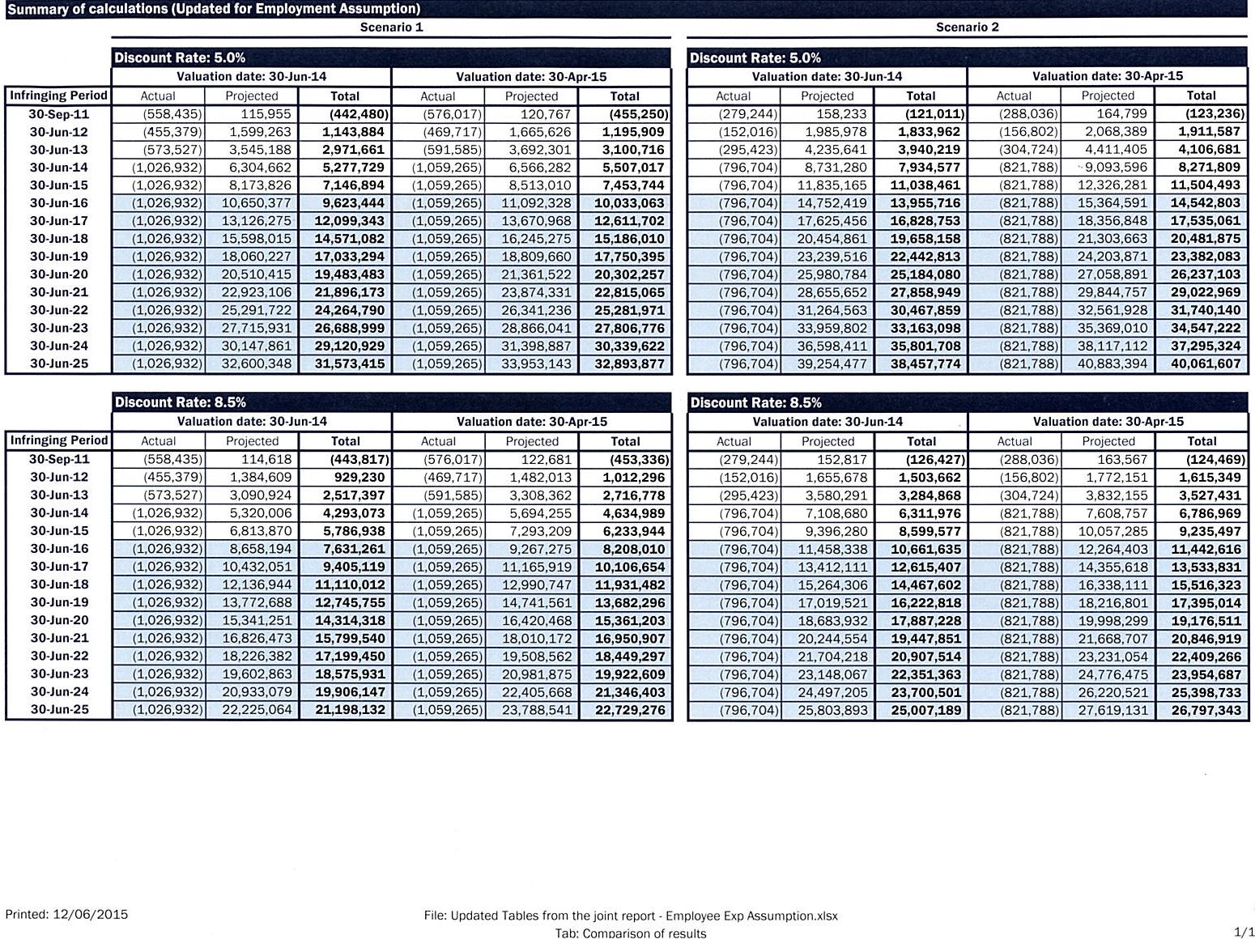
457 This table was explained by the accounting experts. The two discount rates are 5% and 8.5%. The discount rate relates to the “run-off” scenario which is the run-off for infringing policies assuming no new policies after a particular date. Ms Wright’s discount rate for the run-off period is 5%, and Mr Jackson’s discount rate is 8.5%. In order to make clear the information contained in the table, it is convenient to take an example. If a discount rate of 5% is taken in Scenario 1 (valuation date 30 June 2014) for the infringing period ending on 30 June 2014, the figures assume that new policies are written up until that date but not thereafter, and the existing policies run down to their maturity. The actual figure in the second column from the left ($1,026,932) is the actual financial result to 30 June 2014 which was the last date in respect of which the accountants had actual financial data. The projected figure of $6,304,662 represents the projected cash flows associated with those policies over a 10 year run-off period with what is called a terminal value to take into account those policies which mature after the 10 year period. Ms Wright said that it was common to take a discounted cash flow calculation over a fixed time period, and then use a “terminal value” calculation to estimate any profit expected to be generated beyond that date. Mr Jackson described the terminal value as a very sensitive number incorporating a run-down rate or a diminishing growth rate of minus 22% to reflect the fact that the policies are running off quicker the further out one goes beyond the 10 years. The total figure of $5,277,729 is the total of ($1,026,932) and $6,304,662. The total figure is the projected profit on policies written up to 30 June 2014 and assumes no new policies are written after that date.
458 It emerged from the evidence given by the experts that the valuation date of 30 April 2015 was the date which should be chosen because it reflects more up-to-date information.
459 The difference between Scenario 1 and Scenario 2 is to be explained by the fact that certain expenses are included in Scenario 1 which are not included in Scenario 2.
460 Mr Jackson explained in evidence that the forecast of future profits is based on Ms Wright’s projected growth of policies which in turn is based “on the history from Lifeplan falling into Foresters in terms of the amount of new policies that will be written over a period of time”. Ms Wright explained her revised calculation of net present value resulting in an increase in the order of $13 million which she made in her March 2015 report on the basis that she had additional information showing that the actual performance for the financial year ended 30 June 2014 was significantly better than the results included in her projection based on actual results to 30 June 2013. The contributions were higher than projected and the expenses lower than projected.
461 As far as expenses are concerned, the allocation of overheads, except for rental expenses which I will deal with separately, is not in dispute. The calculations have been performed based on the actual results and represent a percentage of the total expenses to the funds under management at a particular point in time.
462 The major difference between the accounting experts was as to the appropriate discount rate for the growth period and the run-off period. The experts agree that a discount rate is used to reflect the time value of money and the risk associated with the cash flows being projected. The experts agree that the Capital Asset Pricing Model (CAPM) can be used as a starting point, but that ultimately the selection of a discount rate is one of professional judgment. The accounting experts agree that the appropriate figures produced by CAPM are a rate of 10.15% at June 2014, and a rate of 8.86% at April 2015. The experts agree that the CAPM calculation needs to be adjusted for the risk profile of the business and cash flows in question. The elements of this model are a risk free rate, an equity premium and a beta factor. Ms Wright adjusted the figure of 8.86% down to 8%, and Mr Jackson adjusted the figure up to 13.15%.
463 Ms Wright’s discount rate for the growth period is 8.0% which she reduces to 5% for the run-off period. Mr Jackson’s discount rate for the growth period is 13.15% which he reduces to 8.5% for the run-off period. The experts agree that a lower discount rate is appropriate for the run-off period because there is less risk as far as the cash flow is concerned.
464 Ms Wright’s lower discount rate for the growth period reflects her view that the risk is significantly lower than comparable companies because the funds cannot be withdrawn and the risk is lower because of the rigour provided by an actual actuarial analysis of the cash flow and because the payment of bonuses is discretionary. Ms Wright also relied on the fact that it is the funeral directors not the fund manager who bears the risks of inflation and that overall she considered that the figures which had been used were conservative. The discount rate for the run-off period was influenced by the starting point which was the discount rate for the growth period. Ms Wright was criticised, I think with some force, that she had adjusted her figure down when earlier she had adjusted her CAPM figure of 6.9% up to 8%. She explained that difference in approach by saying that she considered her earlier CAPM figure of 6.9% “too low and too aggressive”.
465 Mr Jackson’s higher discount rate for the growth period reflected the fact that he believed there should be, what he called, a small company risk premium, because Foresters being a small company had less liquidity, capital and cash reserves to withstand market volatility than larger companies. In addition, Mr Jackson relied on the fact that the risks also include competition from larger asset management companies with attractive capital guaranteed investment products and the risk of low returns due to poor portfolio management. Mr Jackson also had regard to the fact that Foresters’ ability to diversify in terms of its investment portfolio is more limited than a larger company, comparisons with Lifeplan’s growth are of limited assistance because of the different nature of the two companies and the certainty of the future cash flow is to an extent affected by the retention by Foresters of Mr Woff and Mr Corby. Mr Jackson also had regard to the fact that there are a limited number of funeral directors in Australia, and any matter which adversely impacts on them will also affect the performance of the business. Mr Jackson also emphasised that the forecast is for a substantial period of 25-30 years. Mr Jackson said that he had taken into account the fact that, once invested, funds cannot be withdrawn in the calculation of his rate factor.
466 Mr Jackson acknowledged that he had made two mistakes in his written report. He had applied his discount rate for the growth phase to the run-off phase and he had included business expenses to the run-off phase.
467 Both accounting experts were clear, concise and objective in the opinions which they expressed concerning the discount rates for the growth period and the run-off period. Both were doing their best to assist the Court. Both experts identified relevant matters and, although each of them identified a particular matter which they considered important (Ms Wright identified the fact that once invested, the funds cannot be withdrawn, and Mr Jackson identified the risks associated with a relatively small company), neither suggested that it was not appropriate to consider a range of matters, placing such weight on each matter as they considered appropriate.
468 The matter is one of judgment and much will turn on the weight placed on the relevant factors.
469 I have reached the conclusion that I should accept the opinion of Mr Jackson as to the appropriate discount rate for the growth period. I think Mr Jackson’s more conservative approach is the appropriate one for the following reasons. First, whilst it is true that it is important that the funds cannot be withdrawn once they are invested, that is only one part of the equation. The other is the risks associated with obtaining the funds in the first place. Secondly, I think caution is called for with the figures, bearing in mind that the substantially better performance of the Fund in the year ended 30 June 2014, led to such a difference in Ms Wright’s final figure for the net present value of the Fund being a figure in the order of $13 million. Thirdly, the evidence in this case suggests to me that the personal relationship between the Fund’s salesman and funeral directors is important in terms of obtaining business, and that Mr Woff and Mr Corby, and Mr Woff in particular, were good at fostering and maintaining good relationships with funeral directors. Some weight needs to be put on the risk that Foresters might lose Mr Woff and Mr Corby, or either of them, and separately, the risk that they might join a competing business. Finally, I am troubled by the fact that when Ms Wright reached a lower CAPM she increased it, and then when she agreed a higher CAPM she reduced it, albeit slightly. That is not to question her professionalism or objectivity, but is more an indication of the impressionistic nature of the exercise. Having regard to these matters and the matters Mr Jackson identified in his evidence, I am satisfied that I should accept his discount rate for the growth period. I find that the appropriate discount rate for the growth period is 13.15%.
470 This conclusion does not mean that, as a matter of course, I must accept Mr Jackson’s discount rate for the run-off period. However, there is nothing to suggest that I should accept Mr Jackson’s discount rate for the growth period and Ms Wright’s figure for the run-off period. Nor is there anything to suggest that I should pick my own figure for the run-off period, assuming that was an approach otherwise open to me. I find that the appropriate discount rate for the run-off period is 8.5%.
471 I turn now to particular costs and expenses which are in dispute.
472 There is a dispute about an item called the cost of capital which Mr Jackson told me he had built in as a cost in his original calculations. Ms Bennet explained that this was the cost of holding capital pursuant to prudential requirements. It is the difference between capital earning an investment return within the company and a shareholder return when money can be released from the company. Mr Dermody was not asked to address this issue.
473 The cost of capital is the cost of having to set aside capital to satisfy prudential requirements. This money is invested, but (on Foresters’ case) it cannot be deployed in a way which would earn higher returns. Ms Bennet was the only expert who addressed this issue. Mr Dermody said that he had not been asked to address it. Ms Wright was asked about it in evidence and her point was that she had not seen any evidence that Foresters could have deployed the capital elsewhere and earned higher returns. Again, the state of the evidence is not entirely satisfactory in that there is no evidence from Foresters as to the use of monies. Nevertheless, I think it appropriate to accept the evidence of the only witness who addressed the issue in a detailed way, Ms Bennet, and that there should be an allowance for the cost of capital.
474 There is a dispute about staffing costs. In the original table attached to the joint report, Scenario 1 included the costs of two administrative staff and one management staff for the duration of the projection period whereas Scenario 2 included one administrative staff with a salary cost that decreases over time in proportion to the declining infringing policy funds under management as a percentage of total funds under management. In their joint report the experts said:
20. However, the experts have made different assumptions in relation to the staffing required:
i. Mr Jackson is instructed that an additional administrative person salary should be allocated to the Account of Profits in the Historical Period in addition to the expense already included in the historical profit & loss information.
ii. Mr Jackson is instructed that the additional administrative person is required for the Projection Period.
iii. Ms Wright has assumed that an additional administrative person is required in the Projection Period. Ms Wright does not have any instructions in relation to an additional administrative person in the Historical Period.
iv. Mr Jackson has also included an additional cost for a suitably qualified manager with appropriate skills to assist with oversight and management of the fund.
v. Ms Wright has not assumed that this would represent an incremental cost (i.e., a cost not already incurred by Foresters).
vi. Based upon the above, Scenario 1 includes two administrative and one management staff for the duration of the Projection Period. Scenario 2 includes one administrative staff with a salary cost that decreases over time in proportion to the declining infringing policy FUM as a percentage of total FUM.
21. The experts agree that if there is an incremental expense related to staffing that is required to support the infringing revenue, then it should be included in the financial model. The experts do not have sufficient information to determine the staffing required (both skills and numbers) to support the infringing revenue.
22. This will be impacted by Court’s determination of the length of the infringing period, if any. It would also be impacted by whether or not the run-off scenario would require a “stand-alone” fund (as assumed by Mr Jackson), or whether the calculation is in relation to the cash flows associated with the infringing policies whilst they are part of another fund (as assumed by Ms Wright).
23. The resolution of these differences is a matter for the Court to decide. Accordingly, the joint financial model includes scenarios that include and exclude the additional staff costs. (See Summary tables at Appendix A.) Additional scenarios could be modelled at the request of the Court.
…
a) Growth Model
46. The agreed calculations reflect Ms Wright’s instructions and calculations, with a Valuation Date of April 2015. Mr Jackson has not been instructed to prepare growth model calculations. Growth Scenario 1 and 2 reflect the different rent expense assumptions and the staffing assumptions described at paragraph 20 i) to v). The experts have modelled the discount rate of 8% and 13.15%, as per the Wright Report and the Jackson Report, respectively.
13.15% | 8% | |
Growth Scenario 1 | $15,239,976 | $30,181,353 |
Growth Scenario 2 | $16,539,015 | $32,255,501 |
b) Run-off Model
47. The experts do not have sufficient information to determine whether certain expenses relate to obtaining new policies, or to support the infringing revenue or whether additional expenses would be required to affect the run-off of the fund. Accordingly, the joint financial model includes scenarios that include and exclude certain operational costs. The resolution of these differences is a matter for the Court to decide. (See Summary tables at Appendix A.) Additional scenarios, to include a different combination of, or further costs could be modeled [sic] at the request of the Court.
48 Scenario 1 reflects the following assumptions:
i. One additional administrative person in the historical period.
ii. A further administrative person in the Projection Period.
iii. A management staff in the Projection Period (at approximately 75% of the salary cost of Woff or Corby).
iv. The following additional operational expenses are included: Travel, Meetings, Registrations, Accommodation & Food, Communication, Car Hire and Taxis.
v. Including rental expense.
vi. In order to assist the Court, for purposes of the joint expert report the experts have agreed to adopt comparable rates for illustrative purposes. Accordingly, discount rates of both 8.5% and 5.0% are adopted for each of the June 2014 and April 2015 Valuation Dates.
49. Scenario 2 reflects the following assumptions:
i. None of the additional salary or operational costs described above.
ii. In order to assist the Court, for purposes of the joint expert report the experts have agreed to adopt comparable rates for illustrative purposes. Accordingly, discount rates of both 8.5% and 5.0% are adopted for each of the June 2014 and April 2015 Valuation Dates.
iii. If it is assumed that the fund would be closed, the experts agree that additional costs (related to the closure) could be required, although they have insufficient information to determine the extent of those costs.
475 Mr Hughes gave evidence to the effect that, in his opinion, when the Fund exceeds $50 million there is a need for two administrative staff and one manager, when the Fund is between $50 million and about $20 million there is a need for one administrative staff and half the expense of a manager, and when the Fund is below $20 million there is a need for half the expense of one administrative staff and a quarter of the expense of a manager. Mr Hughes was not cross-examined on that evidence and, in the absence of any more compelling evidence, I accept it. That expense structure is reflected in Scenario 1 in Amended Appendix A. The staffing costs should be calculated on the basis identified by Mr Hughes in his evidence.
476 There is a dispute about additional operating expenses being the costs of travel, meetings, registration, accommodation and food, communication, car hire and taxis. A proportion of these costs based on the actual results for the financial year ended 30 June 2014 applied to the alleged infringing run-off funds under management, as management fees have been included in the calculations for Scenario 1. The dispute here is whether these expenses (or a portion of them) are only incurred in relation to new policies or whether they would also be incurred in relation to existing policies. Mr Hughes seemed to address the issue in one of his affidavits and Mr Jackson read Mr Hughes’ evidence as referring only to expenses associated with capturing new business or additional contributions.
477 The additional operating expenses are expenses in the run-off period. They are not business expansion expenses which have been excluded. Mr Hughes addressed expenses described as entertainment, travel and registration, and said that they would not be incurred in the run-off period. However, he did not make it clear whether he was only referring to business expansion expenses. I think Foresters should bear the consequences of that lack of clarity and these expenses should not be allowed.
478 There is a dispute about rental expenses and income in the run-off scenario. In the joint report, the experts said:
Rental
24. The second difference relates to rental expense. Ms Wright excluded the expense related to office rental because it appeared to be offset by rental income (as if the office space had been sublet).
25. Mr Jackson included rental expense in his financial model.
26. The experts agree that if there is an incremental expense related to office rent that is required to support the infringing revenue, then it should be included in the financial model.
27. The resolution of this difference is a matter for the Court to decide. Accordingly, the joint financial models include scenarios that include and exclude the office rental costs. (See Summary tables at Appendix A.)
479 Since the joint report, the issue between the parties has narrowed. Ms Wright’s approach is that the rental expense should not be allowed because the business of the Fund is located in the Foresters’ building as established by the evidence of Mr Hughes, and in the absence of a cash outflow related to the business no allowance should be made. That approach is reflected in Scenario 2. Mr Jackson’s approach is reflected in Scenario 1 and is that the business has to be “housed” somewhere and, in those circumstances, it is appropriate to allow a rental expense. He saw this issue as related to the issue of whether the run-off scenario should be treated as a stand-alone fund. Mr Hughes gave evidence that whilst Mr Woff and Mr Corby were initially located in separate premises, in November 2012 Foresters decided to locate all of its business premises to 51-57 Jeffcott Street, West Melbourne.
480 The rental expense has been allowed for the period during which Mr Woff and Mr Corby were in separate premises. Ms Wright would not allow it thereafter because there is no evidence that a separate cost has been incurred. Furthermore, there is no evidence of Foresters’ occupancy costs and the relationship between those total costs and the costs in relation to the operations of Mr Woff and Mr Corby. There is force in these points, but I think it would be unfair to Foresters to uphold them. To my mind, there is plainly an occupancy expense associated with the Foresters Funeral Fund operation and, as imperfect as the evidence may be as to actual cost, an allowance should be made.
481 Had it been necessary for me to do so, I would have given the parties the opportunity to rework the calculations in accordance with the findings in these reasons. However, for the reasons I have given, it is not necessary for me to take that course.
482 The applicants are entitled to a declaration against Mr Woff and Mr Corby to the effect of the declaration which they seek and which is set out above (at [4]).
483 I have found that Foresters knowingly assisted Mr Woff and Mr Corby in the breach of their fiduciary duties in the respects which I have identified, and induced a breach of their contracts in the manner set out above (at [402]), but that there are no profits which the applicants are entitled to recover from Foresters. In those circumstances, I wish to hear the relevant parties as to whether I should make the declaration sought in paragraph 2 of the proposed orders. I will hear the applicants and Foresters as to that matter.
484 The applicants are also entitled to the orders concerning the documents in Annexure A and Annexure B which they seek and which are set out above (at [6]). The orders should be made against FPA as well as Mr Woff and Mr Corby. FPA has not appeared to oppose the making of the orders and it is possible that it has some of the documents. I think the orders should also be made against Foresters. Relevantly, it is in the same business as the applicants and it has employed and continues to employ Mr Woff and Mr Corby.
485 Mr Woff must account to the applicants in the sum of $24,238 and Mr Corby in the sum of $24,198.
486 I will hear the parties as to the orders and costs. I will adjourn the proceeding to a date to be fixed for the making of final orders. To facilitate this process, I will order that the applicants file and serve within seven days draft minutes of order reflecting the conclusions expressed in these reasons and containing any other orders they seek.
I certify that the preceding four hundred and eighty-six (486) numbered paragraphs are a true copy of the Reasons for Judgment herein of the Honourable Justice Besanko. |
Associate:
SAD 99 of 2012 | |
ANCIENT ORDER OF FORESTERS IN VICTORIA FRIENDLY SOCIETY LIMITED |