

FEDERAL COURT OF AUSTRALIA
TJ (on behalf of the Yindjibarndi People) v State of Western Australia (No 4) [2016] FCA 231
ORDERS
TJ (ON BEHALF OF THE YINDJIBARNDI PEOPLE) AND OTHERS (AS PER SCHEDULE) Applicant | ||
AND: | STATE OF WESTERN AUSTRALIA AND OTHERS (AS PER SCHEDULE) Respondent | |
DATE OF ORDER: |
THE COURT ORDERS THAT:
1. Pursuant to rule 24.15 of the Federal Court Rules 2011 (Cth), the following subpoenas issued by the Applicant to WAD 6005 of 2003 be set aside:
(a) the subpoena addressed to Edward M McDonald on 12 February 2016; and
(b) the updated subpoena addressed to Edward M McDonald on 24 February 2016.
2. The applicant is to pay Dr McDonald’s costs of and incidental to the application to set aside.
3. All parties and Eastern Guruma be granted access to all documents produced by subpoenas issued by the Applicant to WAD 6005 of 2003 in connection with the interlocutory hearing before Rares J on 8 and 9 March 2016.
Note: Entry of orders is dealt with in Rule 39.32 of the Federal Court Rules 2011.
MCKERRACHER J:
1 On the afternoon before both a strike out application and a joinder application were due to commence before Justice Rares, albeit that there was a long weekend intervening, the parties required a number of urgent interlocutory matters to be addressed. I made rulings in relation to those matters. These are my reasons.
SUBPOENA
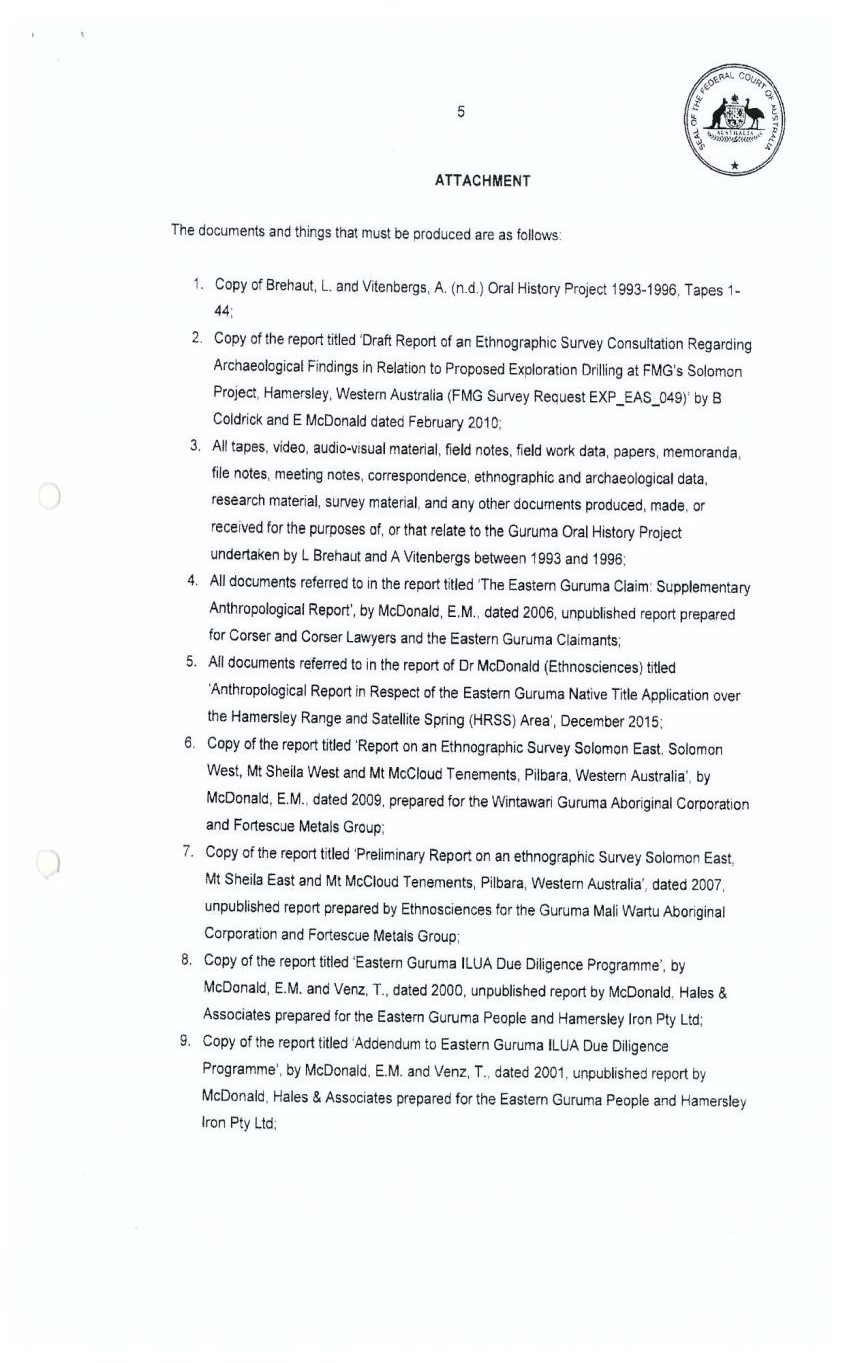
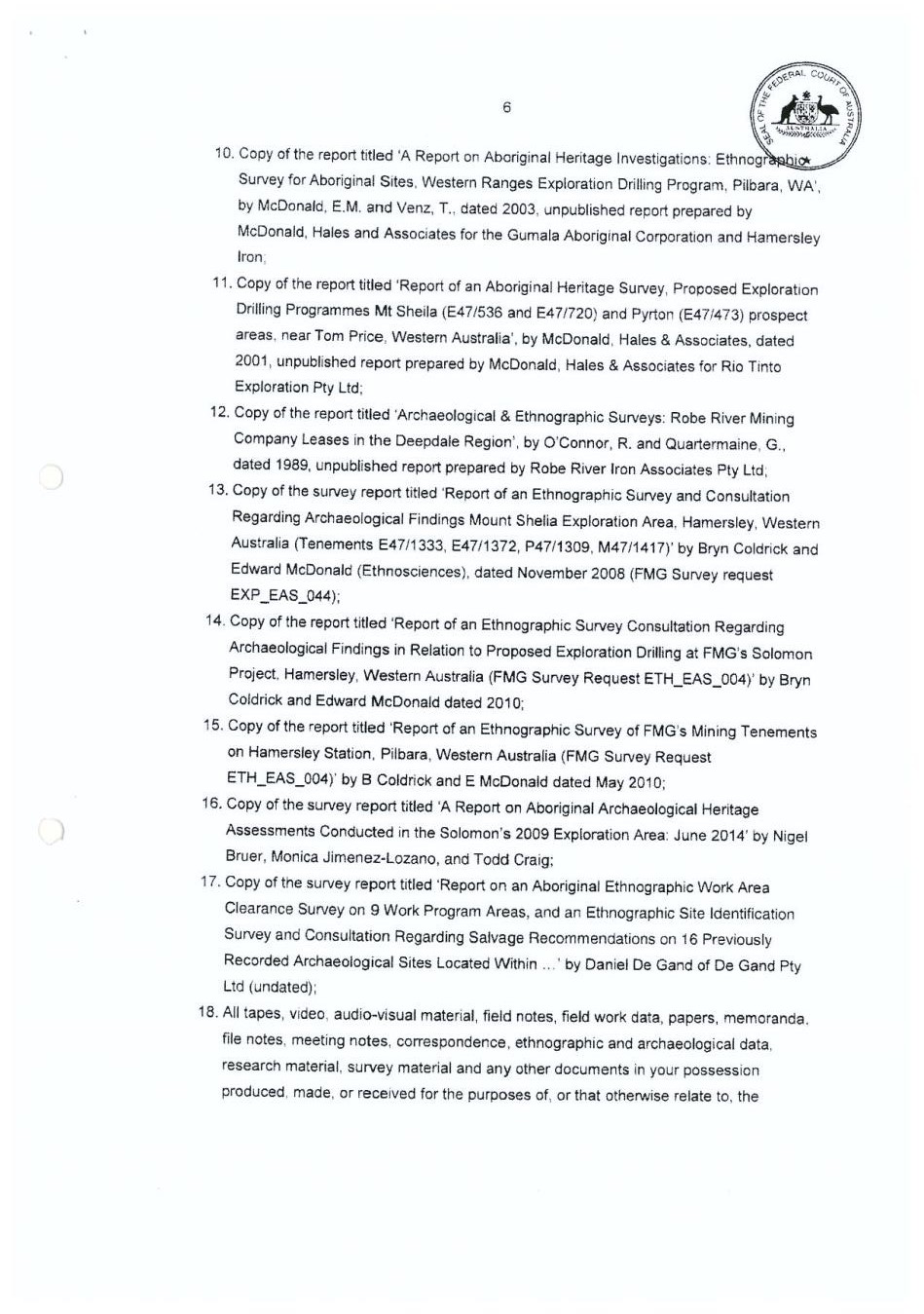
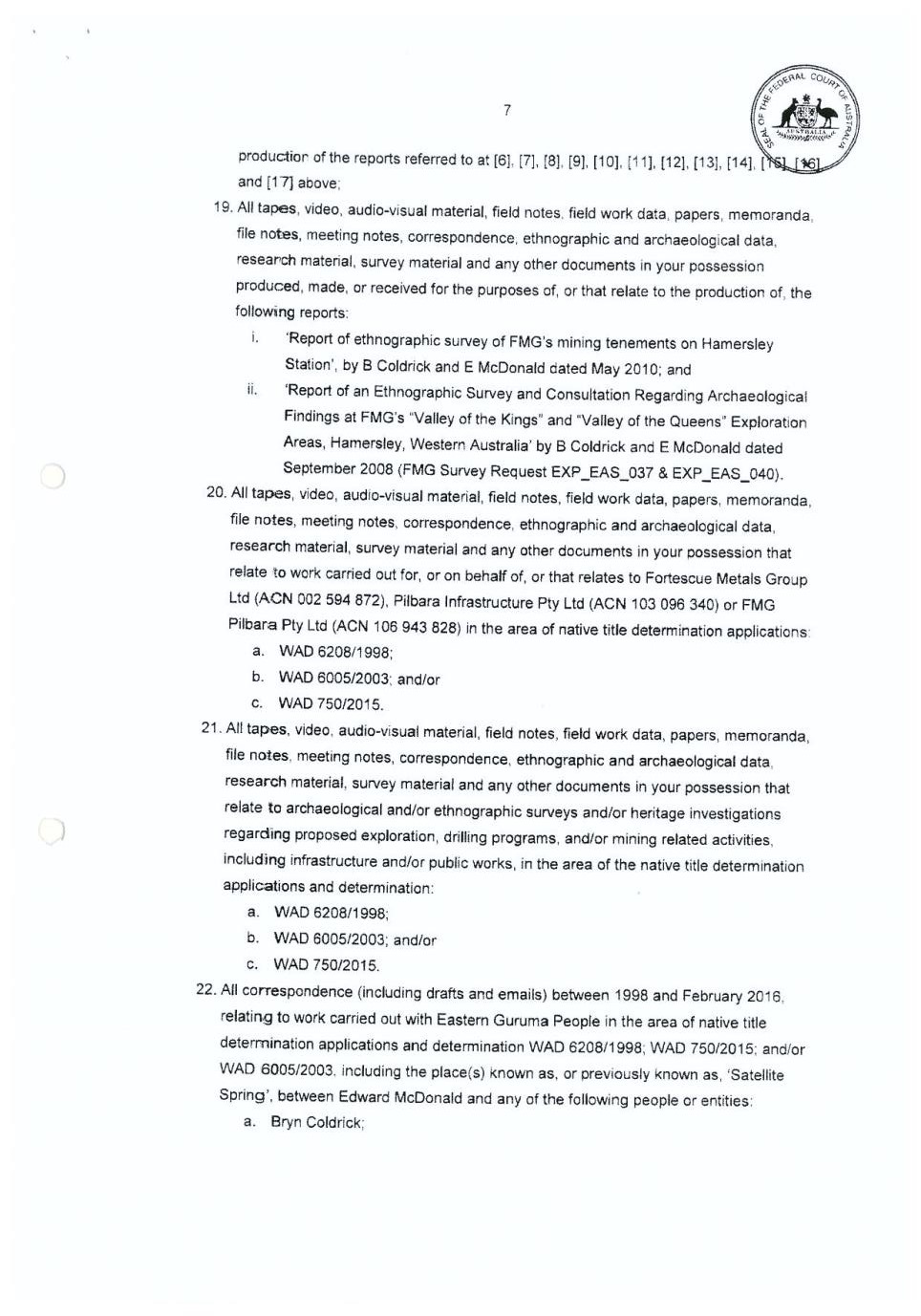
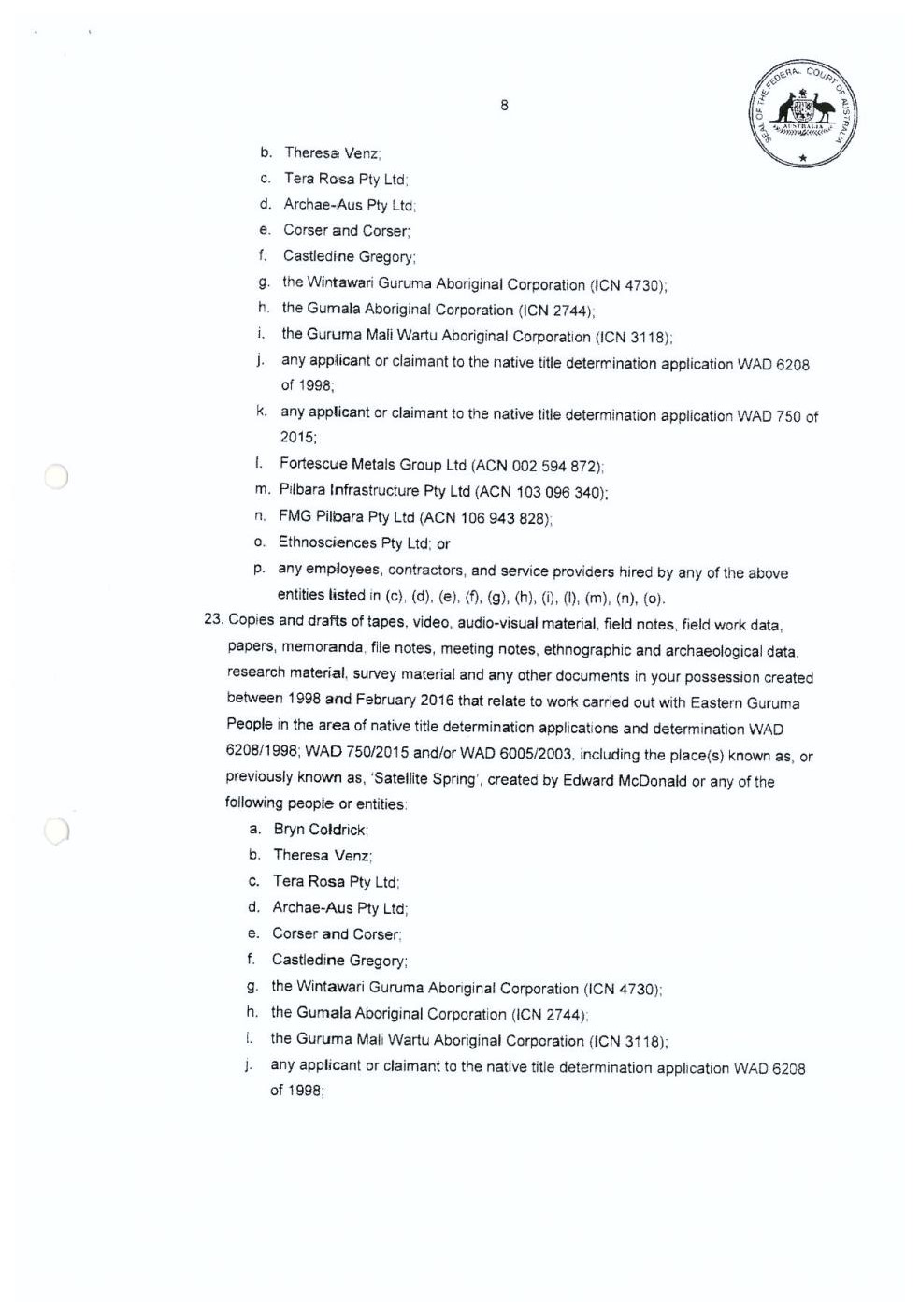
2 By interlocutory application, filed on 29 February 2016, Dr Edward McDonald sought orders that a subpoena addressed to him on 12 February 2016 and an updated subpoena addressed to him on 24 February 2016 be set aside on the ground of oppression. The subpoena initially required production of the documents in the list annexed to these reasons. But, as correctly pointed out by Mr Edwards, counsel for the applicant, through a process of conferral the number of documents requested was reduced. Putting aside for a moment the process by which amendment of the Court’s subpoena was sought to be achieved by a party, the more substantive issue was that it was contended by Dr McDonald that the subpoena was oppressive.
3 Dr McDonald, who is a consulting anthropologist, received the subpoena by email on 12 February 2016 at 11.29 pm, although he did not actually see the email until 13 February 2016. In either event, that is less than three weeks ago. In the meantime, he has been conducting field work in the Pilbara in accordance with contractual requirements from 22 to 25 February 2016 and had anticipated being overseas between 1 March and 5 April 2016, although that has been cancelled. He has commitments to another native title group required a report to be prepared by 29 February 2016, as well as commitments to various other clients. He has, nonetheless, endeavoured to cooperate to the extent he can and has already spent several hours to that end.
4 In the context of oppression, Dr McDonald makes the point that the materials required by the subpoena date back to 1998. In addition, he says that he had archived most hard copy files off-site. He would potentially be required to review several thousand hard copy and digital documents in order to comply with the subpoenas and ascertain which of the documents or things sought by subpoena have been destroyed, never existed or were never in his possession. He estimated that it would take approximately 150 hours, at his usual professional charge out rate, to locate and compile the documents. All of this would be required within a matter of days of the hearing.
5 On the other hand, the Yindjibarndi applicant also complains that the main issue in its strike out application before the Court and in its opposition to the joinder application at the interlocutory hearing before Rares J on 8 and 9 March 2016, is that the filing of the proceeding at the instance of Eastern Guruma (the joinder applicant in WAD 750 of 2015) is oppressive and an abuse of process by reason of the extreme delay in commencement of the proceeding. The delay is said to be accompanied by an absence of any adequate or credible explanation. Prejudice to the Yindjibarndi applicant, the claim group and respondent parties are raised.
6 Dr McDonald is the anthropologist for Eastern Guruma. His report was filed on 22 December 2015 in support of Eastern Guruma’s joinder application. The Yindjibarndi applicant points to the fact that Dr McDonald, in fact, first undertook field work for the Eastern Guruma in 1997 and was engaged by them to prepare the expert connection reports for two consent determinations made by Justice Bennett in 2007 and 2012. He undertook survey work over many years and was present on a Fortescue Metals Group Ltd (FMG) survey when Mr Nelson Hughes looked for a place called ‘Satellite Springs’ in 2007, but could not find it. The applicant says that subsequent attempts were made without Mr Hughes and it was ‘rediscovered’ in August 2009 on an FMG survey undertaken with Eastern Guruma people and a consultant that worked with Dr McDonald. The rediscovered Satellite Springs was not in the adjacent Eastern Guruma determination area, but was in the applicant’s claim area.
7 The concern I have is not so much with the relevance of the subpoena. I can imagine that, amongst the plethora of documents which would be produced if time permitted, there would be documents reasonably likely to add, in the end, in some way or another, to the relevant evidence in the case: Construction, Forestry, Mining and Energy Union v BHP Coal Pty Ltd (No 3) [2012] FCA 61 per Collier J (at [6]). The timing of the briefing to Dr McDonald about the places known as Satellite Springs and the northern boundaries could possibly be relevant to the question of delay in instituting the application. I express no firm view.
8 While a number of portions of the subpoena have been narrowed, there remains a substantial amount of material to produce in a very short period of time. As the Yindjibarndi applicant points out, short deadlines are not always determinative of subpoenas being set aside (Fair Work Ombudsman v Lifestyle SA Pty Ltd (No 2) [2014] FCA 1152 per Mansfield J (at [9]-[10]).
9 I reject the submission from the applicant that there is no evidence that the burden placed upon Dr McDonald is not oppressive, given that he is the anthropologist who drafted the report for the application. Dr McDonald’s own evidence as to the likely time involved is probably conservative in my assessment and is certainly persuasive. Further, the breadth of the material sought, taken together with the ten other subpoenas that the Yindjibarndi applicant issued for the proposed short interlocutory hearing does not assist it in dispelling the impression that it is conducting an improper ‘fishing’ exercise.
10 A subpoena will be oppressive if, amongst other things, it requires the addressee to make extensive searches of an excessively large amount of documents: Australian Competition & Consumer Commission v Shell Co of Australia Ltd (1999) 161 ALR 686 per Cooper J (at [53]). It is irreconcilable with the principles of this Court, in which discovery is strictly limited, for subpoenas to be drafted with extravagant demands. It has long been the case that subpoenas should be particularised with precision, restraint and economy.
11 This subpoena requires Dr McDonald to search for all documentation relating to a particular subject matter without attempts to identify some topics with reasonable particularity. It calls for the production of a significant volume of documentation spanning a period of 17 years and to produce documents that are not created with him and were never in his possession. Most importantly, it requires him to do so within a timeframe that is virtually impossible.
12 In the context of the amount of material sought and the time available to produce it, I consider that the subpoenas issued by the Yindjibarndi applicant were at all times oppressive.
13 For those reasons I set aside the subpoena pursuant to r 24.15 of the Federal Court Rules 2011 (Cth).
ACCESS TO SUBPOENAED DOCUMENTS
14 Eastern Guruma sought access to the documents produced pursuant to the subpoenas issued by the Yindjibarndi applicant. The Yindjibarndi applicant opposed this application on the basis that Eastern Guruma was not (yet) a party to the proceeding.
15 It is now customary, in the absence of good reason, for all parties to a proceeding to have access to documents subpoenaed by any of the parties. As I say, there are exceptions. It is not an exception, as advanced for the Yindjibarndi applicant, that the examination of subpoenaed documents may give persons who are to be cross-examined some benefit, particularly if it relates to the credibility of the witnesses. Having regard to the very limited time between now and when cross-examination (if any) will ensue, it is not apparent that such benefit is likely to be significant. But the primary objective is to ensure that this fiercely fought application for joinder can be resolved as efficiently as possible in the interests of the Court, the parties and the public.
16 Having regard to those factors and the fact that the applicant for joinder is hardly a stranger to the proceeding or to the applicant, I made orders for all parties to have access to all subpoenaed documents.
PRIVILEGE
17 Certain documents have been produced under subpoena by Eastern Guruma. Some of those documents, comprising three lever arch files and two envelopes, were the subject of claims for legal professional privilege as articulated in an affidavit. I was informed that the Yindjibarndi applicant nevertheless wished the Court (in particular, a judge other than the judge presiding over the application) to examine the documents in order to form a view as to the privilege claims.
18 The principles I applied for the purpose of forming a view as to the claim for privilege in respect of each of the documents were:
legal professional privilege is confined to those communications and documents brought into existence for the dominant purpose of the provision of legal advice or for use in anticipated legal proceedings: Esso Australia Resources Ltd v Federal Commissioner of Taxation (1999) 201 CLR 49 per Gleeson CJ, Gaudron and Gummow JJ (at [35]);
litigation privilege covers communications and documents passing between the party’s solicitor and a third party, if they are made or prepared when litigation is anticipated or commenced for the purpose of the litigation with a view to obtaining advice as to it, evidence to be used in it or information which may result in the obtaining of such evidence: Trade Practices Commission v Sterling (1979) 36 FLR 244 (at 246). See also Southern Equities Corporation Ltd v West Australian Government Holdings Ltd (1993) 10 WAR 1; and
as noted by Lindgren J in Australian Securities & Investments Commission v Southcorp Limited [2003] FCA 804 (at [21]):
1. Ordinarily the confidential briefing or instructing by a prospective litigant’s lawyers of an expert to provide a report of his or her opinion to be used in the anticipated litigation attracts client legal privilege: cf Wheeler v Le Marchant (1881) 17 ChD 675; Trade Practices Commission v Sterling (1979) 36 FLR 244 at 246; Interchase Corporation Ltd (in liq) v Grosvenor Hill (Queensland) Pty Ltd (No 1) [1999] 1 Qd R 141 (“Interchase”) at 151 per Pincus JA, at 160 per Thomas J.
2. Copies of documents, whether the originals are privileged or not, where the copies were made for the purpose of forming part of confidential communications between the client’s lawyers and the expert witness, ordinarily attract the privilege: Commissioner of Australian Federal Police v Propend Finance Pty Ltd (1997) 188 CLR 501 (“Propend”); Interchase, per Pincus JA; Spassked Pty Ltd v Commissioner of Taxation (No 4) (2002) 50 ATR 70 at [17].
3. Documents generated unilaterally by the expert witness, such as working notes, field notes, and the witness’s own drafts of his or her report, do not attract privilege because they are not in the nature of, and would not expose, communications: cf Interchase at 161—162 per Thomas J.
4. Ordinarily disclosure of the expert’s report for the purpose of reliance on it in the litigation will result in an implied waiver of the privilege in respect of the brief or instructions or documents referred to in (1) and (2) above, at least if the appropriate inference to be drawn is that they were used in a way that could be said to influence the content of the report, because, in these circumstances, it would be unfair for the client to rely on the report without disclosure of the brief, instructions or documents; cf Attorney-General (NT) v Maurice (1986) 161 CLR 475 at 481 per Gibbs CJ, 487—488 per Mason and Brennan JJ, 492-493 per Deane J, 497—498 per Dawson J; Goldberg v Ng (1995) 185 CLR 83 at 98 per Deane, Dawson and Gaudron JJ, 109 per Toohey J; Instant Colour Pty Ltd v Canon Australia Pty Ltd [1995] FCA 870; Australian Competition and Consumer Commission v Lux Pty Ltd [2003] FCA 89 (“ACCC v Lux”) at [46].
5. Similarly, privilege cannot be maintained in respect of documents used by an expert to form an opinion or write a report, regardless of how the expert came by the documents; Interchase at 148—150 per Pincus JA, at 161 per Thomas J.
6. It may be difficult to establish at an early stage whether documents which were before an expert witness influenced the content of his or her report, in the absence of any reference to them in the report; cf Dingwall v Commonwealth of Australia (1992) 39 FCR 521; Tirango Nominees Pty Ltd v Dairy Vale Foods Ltd (No 2) (1998) 83 FCR 397 at 400; ACCC v Lux at [46].
19 I examined all documents in respect of which privilege was claimed, both prior to the hearing last Friday afternoon, and during the course of the hearing once counsel for those parties not claiming privilege had been excused. With the benefit of examining the documents and identifying the personnel involved, and applying the principles set out above, I required that only a very small number of documents be produced as not falling within the conventional concepts of legal professional privilege.
20 The following orders were made:
1. Pursuant to rule 24.15 of the Federal Court Rules 2011 (Cth), the following subpoenas issued by the Applicant to WAD 6005 of 2003 be set aside:
(a) the subpoena addressed to Edward M McDonald on 12 February 2016; and
(b) the updated subpoena addressed to Edward M McDonald on 24 February 2016.
2. The applicant is to pay Dr McDonald’s costs of and incidental to the application to set aside.
3. All parties and Eastern Guruma be granted access to all documents produced by subpoenas issued by the Applicant to WAD 6005 of 2003 in connection with the interlocutory hearing before Rares J on 8 and 9 March 2016.
I certify that the preceding twenty (20) numbered paragraphs are a true copy of the Reasons for Judgment herein of the Honourable Justice McKerracher. |
Associate:
ANNEXURE 1
SCHEDULE
WAD 6005 of 2003
BETWEEN:
ALLUM CHEEDY, JUDITH COPPIN, KEVIN GUINNESS, JOYCE HUBERT, MAISIE INGIE, THOMAS JACOB, ANGUS MACK, JEAN NORMAN, ESTHER PAT, PANSY SAMBO, STANLEY WARRIE and MICHAEL WOODLEY
Applicant
AND:
STATE OF WESTERN AUSTRALIA
First Respondent
FMG PILBARA PTY LTD, FORTESCUE METALS GROUP PTY LTD, HAMMERSLEY EXPLORATION PTY LTD, ROBE RIVER MINING CO PTY LTD,
THE PILBARA INFRASTRUCTURE PTY LTD
Second Respondents
PETER GILBERT COOK, COOLAWANYA PASTORAL CO PTY LTD, GEORGINA HOPE RINEHART AND HANCOCK PROSPECTING PTY LTD, TONY RICHARD RICHARDSON
Third Respondents
PHYLLIS HARRIS (TODD), LINDSAY TODD, MARGARET TODD, YAMATJI MARLPA ABORIGINAL CORPORATION
Fourth Respondents


