

Qualify Me Pty Ltd v Get Qualified Australia Pty Ltd [2016] FCA 192
ORDERS
QUALIFY ME PTY LTD ACN 165 025 874 Applicant | ||
AND: | GET QUALIFIED AUSTRALIA PTY LTD ACN 144 813 543 First Respondent ADAM WADI Second Respondent | |
DATE OF ORDER: |
THE COURT ORDERS THAT:
1. Paragraphs 3A to 17 of the further amended statement of claim be struck out.
2. The applicant have leave to replead paragraphs 3A to 17 of the further amended statement of claim and to file a second further amended statement of claim by 25 March 2016.
3. The parties are to file and serve submissions, not exceeding 5 pages in length, in relation to the issue of costs of the interlocutory application by 18 March 2016. Unless notified to the contrary by 18 March 2016 the question of costs on the interlocutory application will be determined on the papers.
4. Otherwise dismiss the interlocutory application.
5. The matter be relisted for directions before Markovic J on 31 March 2016.
Note: Entry of orders is dealt with in Rule 39.32 of the Federal Court Rules 2011.
MARKOVIC J:
INTRODUCTION
1 Qualify Me Pty Ltd (Qualify Me) and Get Qualified Australia Pty Ltd (GQA) are in substantially the same business: they both provide skills recognition and accreditation services. As will become apparent, it is common ground that they are trade competitors.
2 On 30 June 2015 Qualify Me commenced proceedings against GQA as first respondent and Mr Adam Wadi, the sole director of GQA, as second respondent, by filing an originating application and a statement of claim. Following the commencement of proceedings there was exchange of correspondence between the parties relating to the provision of particulars of the claim and issues raised by the respondents of alleged deficiencies in the pleading. The procedural history is set out below. However, I note by way of background that Qualify Me subsequently filed an amended statement of claim and most recently a further amended statement of claim (the FASOC) which is the subject of the present application.
3 On 9 November 2015, GQA and Mr Wadi filed an interlocutory application (the Interlocutory Application) seeking orders that:
(1) the FASOC be struck out pursuant to r 16.21 of the Federal Court Rules 2011 (the Rules);
(2) in the alternative to order 1, the FASOC be summarily dismissed pursuant to r 26.01 of the Rules;
(3) the originating application filed on 21 July 2015 be struck out pursuant to r 16.21 of the Rules;
(4) in the alternative to order 3, the originating application be summarily dismissed pursuant to r 16.21 of the Rules (given that GQA and Mr Wadi's submissions rely on r 26.01 in the alternative, I have proceeded on the basis that the reference to r 16.21 in order 4 of the Interlocutory Application is an error);
(5) Qualify Me pay the respondents' costs of the Interlocutory Application and if the FASOC and originating application are struck out or dismissed an order that Qualify Me pay the respondents' costs of the proceedings.
4 In support of the Interlocutory Application, GQA and Mr Wadi rely on an affidavit sworn by Mr Wadi on 5 November 2015.
5 Qualify Me opposes the Interlocutory Application and relies on an affidavit sworn by Mr Wagdi Andrawis, a director and the CEO of Qualify Me, sworn 30 November 2015, an affidavit of Mr Sydney Birchall, the principal of Birchall Legal, solicitors for Qualify Me, affirmed 30 November 2015 and an affidavit of Ms Julia Robson, a licensed private investigator and the principal of Online Investigations Pty Ltd, sworn 1 December 2015.
THE FASOC
6 In its FASOC Qualify Me claims that it has suffered loss and damage. The alleged loss and damage is said to arise from the claims which I set out below. Before describing those claims I note that in addition to the applicant and respondents, the FASOC refers to a company called ProSEO Pty Ltd (ProSEO) which was registered in May 2014 and Mr Jan Bertrand, who, with Mr Wadi was a director of ProSEO.
Misleading or deceptive conduct claims
7 Paragraphs 3A to 25 set out claims pursuant to s 18 of the Australian Consumer Law (the ACL) (being Schedule 2 to the Competition and Consumer Act 2010 (Cth)) (the CC Act). The claims relate to two matters: firstly, conduct relating to certain websites and Facebook pages and secondly, conduct relating to Google AdWords.
8 Qualify Me alleges that ProSEO, or alternatively Mr Bertrand, engaged in misleading or deceptive conduct in contravention of s 18 of the ACL in relation to the publishing of statements on certain websites and Facebook pages, that Mr Wadi was knowingly concerned in the contravention of s 18 ACL by ProSEO, or alternatively Mr Bertrand, and that the conduct of ProSEO, or alternatively Mr Bertrand, in publishing the statements was engaged in on behalf of GQA.
9 Qualify Me also alleges that GQA contravened s 18 ACL by setting up a Google AdWords account and creating sponsored links with Google AdWords using or containing certain phrases and that Mr Wadi was knowingly concerned in that contravention.
10 More specifically, for the conduct relating to the websites and Facebook, Qualify Me alleges that:
(1) ProSEO or alternatively Mr Bertrand supplied online reputation management (ORM) strategies to clients;
(2) ProSEO, or alternatively Mr Bertrand personally, was engaged by GQA between May and October 2014 to implement ORM strategies and to provide search engine optimisation (SEO) services to GQA;
(3) when providing SEO services to GQA, ProSEO and Mr Bertrand used the phrase "Qualify Me" in website content as keywords for the purpose of optimising search engine results relating to GQA;
(4) between May and October 2014, ProSEO, or alternatively Mr Bertrand or another person at his direction, established:
(a) the following websites:
(i) http://www.qualifymescamasutralia.blogspot.com.au;
(ii) http://qualifymescamaustralia.weebly.com;
(iii) http://qualifymescamau.blogspot.com.au;
(iv) http://qualifyscamaustralia.wordpress.com; and
(v) http://qualifymescamasutralia.edublogs.org
(the Websites); and
(b) Facebook accounts in the names of "Robert Devera", “Juan Cross", "Jenny Mendoza" and “Vhem Zhao" (the Accounts);
(5) ProSEO, or alternatively Mr Bertrand or another person at his direction, published on the Websites and the Accounts statements to the effect that Qualify Me was:
(a) operating a scam;
(b) did not provide the services it promised;
(c) offered a small number of colleges through which to obtain certification rather than a large number, thereby curtailing clients' choices;
(d) acted unlawfully in relation to visa arrangements for its clients;
(e) charged clients arbitrarily; and
(f) did not provide accurate advice about obtaining qualifications;
(6) the conduct referred to in the preceding subparagraph would lead at least some ordinary, reasonable consumers to believe that Qualify Me:
(a) was operating a scam;
(b) did not provide the services it promised it would provide to clients;
(c) offered a small number of colleges through which to obtain certification rather than a large number of colleges, thereby curtailing clients' choices;
(d) was acting unlawfully as regards visa arrangements for its clients;
(e) charged its clients arbitrarily;
(f) did not provide accurate advice about obtaining qualifications;
(7) each of the representations made by ProSEO, or alternatively Mr Bertrand, about Qualify Me was misleading or false and the conduct of ProSEO and Mr Bertrand in publishing the statements was misleading or deceptive and contravened s 18 of the ACL; and
(8) Mr Wadi was knowingly concerned in the contravention of s 18 of the ACL by either ProSEO, or alternatively Mr Bertrand, and the conduct of ProSEO, or alternatively Mr Bertrand, was engaged in on behalf of GQA.
11 For the conduct relating to Google AdWords, Qualify Me alleges that:
(1) on or around May 2015, GQA opened an account with Google AdWords and created sponsored links with Google AdWords using or containing the phrases "Looking for Qualify Me?", "Qualify Me - Too Easy" and "Qualify Me Now" as keyword insertions (the Sponsored Link Conduct);
(2) Qualify Me had a sponsored link containing the words "Qualify Me";
(3) following a Google search, a GQA sponsored link with the words "Qualify Me Now" would appear below Qualify Me's sponsored link, while similar links with the words “Looking for Qualify Me” and “Qualify Me – Too Easy” would appear above the Qualify Me sponsored link;
(4) the Sponsored Link Conduct would lead at least some ordinary, reasonable consumers to believe that:
(a) the website URL displayed in the GQA sponsored link (the Website URL) was the URL of Qualify Me's website;
(b) if the consumer clicked on GQA's sponsored link or the Website URL they would be taken to a website associated with Qualify Me;
(c) if the consumer clicked on the GQA sponsored link or the Website URL, they would find information regarding Qualify Me or its business;
(d) the person who published the GQA sponsored link was Qualify Me; and
(e) there was an association between Qualify Me and GQA or the person who published the GQA sponsored link;
(5) each of the representations referred to in the preceding subparagraph was misleading or false and the Sponsored Link Conduct was misleading or deceptive and contravened s 18 of the ACL. Mr Wadi was knowingly concerned in the contravention of s 18 of the ACL by GQA.
Passing off claim
12 Paragraphs 26 to 36 set out a claim for passing off. Qualify Me alleges that:
(1) by reason of the following matters it has developed a reputation in relation to the services it offers:
(a) it has provided its services since around July 2013 and since that time over 1500 clients have undertaken courses offered by Qualify Me;
(b) it receives on average over 250 inquiries per week from prospective clients;
(c) it has partnership arrangements in place with at least 15 registered training organisations in relation to the provision of its services;
(d) it spends annually on average at least around $1.25 million on advertising and marketing its services via various methods;
(2) it was a reasonably foreseeable consequence of the Sponsored Link Conduct that it would cause at least some prospective clients of Qualify Me to believe that GQA operated the same business as it did and, as a result, Qualify Me has suffered and will continue to suffer injury to its business and loss and damage.
Trademark infringement claim
13 Paragraphs 37 to 44 set out a claim for trade mark infringement.
14 From August 2014 Qualify Me has been the registered owner of composite trademark QUALIFY ME number 1600446 (the Trade Mark) with a priority date of registration of 10 January 2014. Qualify Me alleges that:
(1) on or before 25 and 26 March 2014, respectively, GQA created and operated a Facebook page called "Get Qualified Australia" and a Twitter account with the account name "Get Qualified Au";
(2) from on or before 27 March 2014 GQA displayed the Trade Mark or a mark which is substantially identical to the Trade Mark on its Facebook page and Twitter account in respect of services relating to skills recognition;
(3) GQA has thus infringed the Trade Mark and, as a result, Qualify Me has suffered loss and damage.
THE ORIGINATING APPLICATION
15 In its originating application Qualify Me seeks injunctions pursuant to s 232 of the ACL, declarations pursuant to s 21 of the Federal Court of Australia Act 1976 (Cth) (the FCA Act) that GQA and/or Mr Wadi contravened s 18 of the ACL, damages from GQA and Mr Wadi in accordance with s 236 of the ACL, compensation from GQA and Mr Wadi in accordance with s 237 of the ACL, damages for passing off, damages and additional damages in accordance with s 126 of the Trade Marks Act 1995 (Cth) (the Trade Marks Act) and injunctions in accordance with s 126 of the Trade Marks Act.
THE DEFENCE AND CROSSCLAIM
16 On 14 August 2015, GQA and Mr Wadi filed a defence to the statement of claim first filed. Qualify Me relies on that defence insofar as it makes some admissions.
17 GQA and Mr Wadi have also filed a notice of cross claim and statement of cross claim. Qualify Me has filed a defence to the cross claim. It is not necessary that I consider the cross claim for the purposes of determination of the Interlocutory Application.
LEGAL FRAMEWORK
18 In oral submissions counsel for GQA and Mr Wadi clarified that in relation to orders 1 and 3 of the Interlocutory Application his clients rely on rr 16.21(1)(b), (c), (d) and (e) of the Rules which relevantly provide:
(1) A party may apply to the Court for an order that all or part of a pleading be struck out on the ground that the pleading:
…….
(b) contains frivolous or vexatious material; or
(c) is evasive or ambiguous; or
(d) is likely to cause prejudice, embarrassment or delay in the proceedings; or
(e) fails to disclose a reasonable cause of action or defence or other case appropriate to the nature of the pleading; or
……..
19 Rule 16.21(1) is concerned with the adequacy of the pleading, in the instant case the FASOC, and requires a consideration of the terms of that document: see Mulhern v Bank of Queensland [2015] FCA 44 (Mulhern) at [53].
20 The Court's power to strike out proceedings or portions of pleadings is discretionary, should be used sparingly and should only be exercised in a clear case. After observing that was the case, the Court in Australian Competition & Consumer Commission v Pauls Ltd (2000) ATPR 41-747 at [10] went on to say:
…. The modern system of pleading requires only that the material facts on which a party’s claim is based be stated; the claim is not expected to be formulated as an elegant model of legal purity: Carr v McDonald’s Australia Ltd (1994) 63 FCR 358 at 367 and there is now a tendency against taking a pedantic approach to a pleading: Coshott v Kam Tou Mak (Wilcox J, 3 March 1998, unreported).
21 The principles relating to the circumstances in which the power to strike out proceedings pursuant to rr 16.21 (1)(c), (d) and (e) may be exercised were relevantly summarised by me in Tameeka Group Pty Ltd v Landan Pty Ltd [2015] FCA 1218 at [33] to [35]. In particular:
(1) a pleading may be struck out as evasive or ambiguous pursuant to r 16.21(1)(c) if it is unintelligible, ambiguous or so vague that it fails to identify the material factual allegations so that the other party does not have notice of the substance of the claim: Elston v Commonwealth of Australia [2013] FCA 108 at [30];
(2) in relation to r 16.21(1)(d), a pleading may be embarrassing if it is susceptible to various meanings, contains inconsistent allegations, contains alternatives which are confusingly intermixed, contains irrelevant allegations which will tend to increase expense, is unintelligible or vague: Spiteri v Nine Network Australia Pty Ltd [2008] FCA 905 at [22];
(3) the power to strike out a pleading pursuant to r 16.21(1)(e), because it discloses no reasonable cause of action, is only to be exercised in a plain and obvious case, where it is clear no reasonable amendment can cure the alleged defect and there is no reasonable question to be tried: Polar Aviation Pty Ltd v Civil Aviation Authority (2012) 203 FCR 325 at 337. An application to strike out a pleading because it discloses no reasonable cause of action involves establishing that the applicant's case is so untenable that it cannot possibly succeed: General Steel Industries Inc v Commissioner for Railways (NSW) (1964) 112 CLR 125 at 130.
22 In the alternative, GQA and Mr Wadi seek orders pursuant to r 26.01(1) of the Rules which provides as follows:
(1) A party may apply to the Court for an order that judgment be given against another party because:
(a) the applicant has no reasonable prospect of successfully prosecuting the proceeding or part of the proceeding; or
(b) the proceeding is frivolous or vexatious; or
(c) no reasonable cause of action is disclosed; or
(d) the proceeding is an abuse of the process of the Court; or
…
23 Although not referred to in the Interlocutory Application, it is relevant to note s 31A of the FCA Act, which sets out the Court's power to strike out, and which relevantly provides:
….
(2) The Court may give judgment for one party against another in relation to the whole or any part of a proceeding if:
(a) the first party is defending the proceeding or that part of the proceeding; and
(b) the Court is satisfied that the other party has no reasonable prospect of successfully prosecuting the proceeding or that part of the proceeding.
(3) For the purposes of this section, a defence or a proceeding or part of a proceeding
need not be:
(a) hopeless; or
(b) bound to fail;
for it to have no reasonable prospect of success.
….
24 As with the power under r 16.21(1), the power to order summary judgment is to be exercised with caution: Mulhern at [57]. In contrast to a strike out application, an application for summary dismissal under s 31A, permits consideration of matters outside of the pleadings: see J & A Vaughan Super Pty Ltd (Trustee) v Becton Property Group Limited [2014] FCA 581 (J & A Vaughan) at [8].
25 In Kanakaridis v Westpac Banking Corporation [2015] FCA 1146, Beach J at [51] to [52] summarised the principles relating to the power to summarily dismiss a proceeding pursuant to s 31A of the FCA Act and r 26.01(1) of the Rules as follows:
….
51 In relation to s 31A(2), a number of propositions should be stated (Spencer v Commonwealth of Australia (2010) 241 CLR 118). First, a proceeding need not be “hopeless” or “bound to fail” for it to have no reasonable prospect of success (s 31A(3)). Second, s 31A(2) may justify summary dismissal (French CJ and Gummow J at [22]) where, inter alia:
(a) the pleadings disclose no reasonable cause of action, with the deficiency being incurable;
(b) there is unanswerable or unanswered evidence of a fact fatal to the pleaded case or any permissible modification;
(c) the case is frivolous or vexatious; or
(d) the case otherwise amounts to an abuse of process.
52 But s 31A(2) is not limited to such categories. The content and boundaries of “no reasonable prospect of success” are not to be confined to taxonomies, lexicons or intensifying epithets (Hayne, Crennan, Kiefel and Bell JJ at [58] to [60]). Third, the exercise of power under s 31A(2) should be used with caution, particularly where complex questions of fact are involved.
….
26 In J&A Vaughan Pagone J at [7] quoted from the judgment of Sundberg J in Adunat Pty Ltd v ITW Construction Systems Australia Pty Ltd [2009] FCA 499 at [37] where the principles relating to the exercise of the power under s 31A of the FCA Act were summarised including that:
….
• In applying s 31A, the court does not conduct fact finding but must assess the strength of the allegations made by reference to the pleadings, affidavits and any other evidence adduced, in order to determine whether the claim is sufficiently strong to warrant a trial: see Jefferson Ford 167 FCR at [23] (Finkelstein J), [74] (Rares J) and [130] (Gordon J); see also Bradken Resources Pty Ltd v Lynx Engineering Consultants Pty Ltd [2008] FCA 1257 at [28] (Emmett J); Imobilari Pty Ltd v Opes Prime Stockbroking Ltd [2008] FCA 1920 at [6] (Finkelstein J). Ultimately, the court must consider whether there are any real, as opposed to fanciful, issues of fact or law that require proper determination at a trial.
• In assessing whether there are reasonable prospects of success, the court should draw all reasonable inferences (but only reasonable inferences) in favour of the non-moving party: see Jefferson Ford 167 FCR at [132] (Gordon J). Moreover, where the evidence on a summary judgment application is of an ambivalent character, there will be a real issue of fact and therefore reasonable prospects of success for the purposes of s 31A: see Boston 236 ALR at [45]; Jefferson Ford 167 FCR at [73] (Rares J) and [130] (Gordon J).
• The moving party bears the onus of persuading the court that its opponent has no reasonable prospects of success: see Jefferson Ford 167 FCR at [127] (Gordon J); Boston 236 ALR at [45]. However, where the moving party establishes a prima facie case for summary judgment, the opposing party must be able to point to “specific factual or evidentiary disputes that make a trial necessary”: see Jefferson Ford 167 FCR at [127] (Gordon J).
• As s 31A requires in effect a prediction as to the outcome of a claim, the court should be more reluctant to summarily dismiss a claim where real questions of fact and credit arise. In those cases, the court will not have all material evidence before it until trial, the credit of important witnesses will not have been tested and it will as a consequence be very difficult if not impossible to fairly assess the prospects of the claim: see Jefferson Ford 167 FCR at [20] (Finkelstein J); Dandaven v Harbeth Holdings Pty Ltd [2008] FCA 955 at [6] (Gilmour J).
RELEVANT FACTS
27 There is a contest between the parties about many of the facts. I set out below the facts insofar as they are relevant to the Interlocutory Application.
The parties and relevant associates
28 GQA was registered on 24 June 2010. Mr Wadi is its sole director, secretary and shareholder.
29 Qualify Me operated its business from about January 2013 but was registered on 29 July 2013. Its directors, secretaries and shareholders in equal shares are Mr Andrawis and Mr Choucair. Its registered office and principal place of business is in Croydon.
30 GQA and Qualify Me are in the same business: providing skills accreditation and recognition services. Mr Andrawis regards GQA as Qualify Me's main competitor. Similarly, Mr Wadi views Qualify Me as a competitor.
31 On 28 May 2014, ProSEO was registered with Messrs Wadi and Bertrand as its directors and shareholders. Mr Wadi incorporated ProSEO at the request of Mr Bertrand, who worked for GQA from May to October 2014 as a marketing specialist, to allow Mr Bertrand to do SEO work outside of his employ with GQA. Mr Wadi says that ProSEO was never engaged by and did not do any work for or on behalf of GQA or him.
32 On 29 May 2014, the domain name proseo.com.au was registered by Mr Bertrand.
33 ProSEO ceased activity in August 2014 when Mr Bertrand left the employ of GQA and went overseas. An application for ProSEO's deregistration was received by the Australian Securities and Investments Commission (ASIC) on 8 December 2014. On 12 February 2015 ProSEO was deregistered.
YouTube
34 On or around 17 August 2014, Mr Andrawis, using his mobile phone, found a YouTube channel with the name "ProSEO.com.au SEO Company Sydney CALL 0405908118" on which a number of videos had been posted. He played at least two of them and saw that the "GQ" logo, which he associates with GQA, appeared at least twice and that the videos were promotional material for GQA. Mr Andrawis also saw that the term "Qualify Me" was used in the titles of seven of the videos as follows:
(a) "Qualify Me Trade recognition Australia rpl";
(b) "Qualify Me NOW";
(c) "Qualify Me Skills Recognition'';
(d) "Qualify Me education ...";
(e) "Qualify Me Trade recognition";
(f) "Qualify Me Recognition of prior learning RPL"; and
(g) "Qualify Me easy RPL Australia ".
Blogs and Facebook
35 On about 1 July 2014, Mr Andrawis became aware that a series of posts from a Facebook profile in the name of Juan Cross were appearing on Qualify Me's official Facebook page. The posts said: "you qualify me SUCKS, It's a SCAM!". On 2 July 2014 Mr Andrawis became aware that a reply post from a Facebook profile with the name Jenny Medoza had appeared on Qualify Me's official Facebook page which said: "Qualify Me are SCAMMERS, they only get your money and overcharge you. Be aware!!".
36 On 19 August 2014, Mr Andrawis conducted a Google search on his smart phone using the phrase: "qualify me review". Upon doing so the first ranked search result that appeared was headlined: "BE AWARE of Qualify Me Australia Review | Qualify Me". Mr Andrawis clicked on the link and was taken to a website under the domain name "australiaqualify mescam.wordpress.com". At that address, Mr Andrawis viewed a blog that he describes as disparaging of Qualify Me including by use of the headlines: "Beware of Qualify Me - SCAM" and "Qualify ME fraud - warning!". He saw the name Vhem Zhao underneath the blog and the names: Avvy Colastre, Jerry Third and Jhonny Jamelo underneath individual blog posts.
37 Mr Andrawis has never heard of any person going by the name of Vhem Zhao, Avvy Colastre, Jerry Third, Jhonny Jamelo, Juan Cross, Jenny Mendoza, Robert Devera, Ferreki or Abby Brise. Mr Andrawis undertook a search of the business records of Qualify Me, which contain the names of all present and former employees, suppliers and customers, and says that people going by those names have never had anything to do with Qualify Me or its business. Mr Wadi also says that he does not know any person by the name of Robert Devera, Juan Cross, Jenny Mendoza or Vhem Zhao.
Google AdWords
38 Qualify Me uses Google AdWords to publish advertisements at or above organic searches when people do Google searches using certain keywords. The advertisements contain the phrase "Qualify Me" and have the word "Ad" in an orange box next to them.
39 On or before 18 May 2015, GQA opened an account with Google AdWords and created sponsored links with Google AdWords using or containing the phrases "Looking for Qualify Me?", "Qualify Me - Too Easy" and "Qualify Me Now" as keyword insertions.
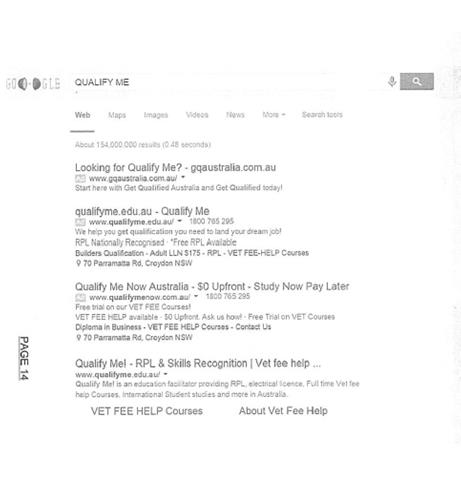
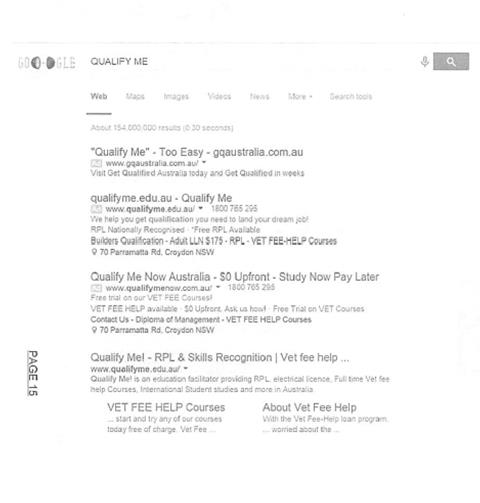
40 On about 13 May 2015, Mr Andrawis conducted a Google search on his computer using the words "qualify me". Upon doing so, Mr Andrawis saw that the first ranking advertisement said: "Looking for Qualify Me? - gqausttralia.com.au". Mr Andrawis took a screen shot of the search result. This was not an advertisement published by Qualify Me. The domain name "gqaustralia.com.au" does not belong to Qualify Me. At about the same time, Mr Andrawis conducted a further Google search using the words "qualify me". When he did so the first ranking advertisement said: "Qualify Me - Too Easy - gqaustralia.com.au". Once again this was not an advertisement published by Qualify Me. The website URL appearing in these advertisements was: www.gqaustralia.com.au which is not Qualify Me's website. Mr Andrawis also took screen shots of these search results which are reproduced below:
41 On or about 21 May 2015, Mr Andrawis received an email from Mr Choucair which contained an image file. When Mr Andrawis clicked on the image file he saw a screen shot of an advertisement displayed in response to the search term "qualify me". The advertisement, which appeared as the second ranking advertisement, carried the headline "Looking for Qualify Me? - gqaustralia.com.au". It had not been published by Qualify Me. Again, the website URL appearing in the advertisement was: www.gqaustralia.com.au.
42 According to Mr Wadi GQA, using software called Google Analytics, prepared a report as at end July 2015 which shows data for all of the Google AdWords paid for by GQA, namely "Looking for Qualify Me?", "Qualify Me -Too Easy" and "Qualify Me Now", as keyword search terms during the time from when GQA first started paying for these Google AdWords, being October 2014, to the end July 2015. The report provides the total number of clicks on the search terms that have resulted in a user being sent to GQA's landing page on its website, the total number of converted clicks, being the number of clicks that turn into a lead for GQA, and the conversion rate for GQA, the percentage that GQA converts of their total leads. Based on that report, Mr Wadi says that 82 people clicked on the search terms and were directed to GQA's landing page. Of those 82 people, 10 clicked on GQA's skills review and completed it thereby becoming a lead with their details being sent to GQA. Given that the report shows GQA's conversion rate is 5% this means that statistically GQA has only gained 0.5 of a customer from paying for the search terms as Google AdWords over this period.
Trade mark – Twitter and Facebook
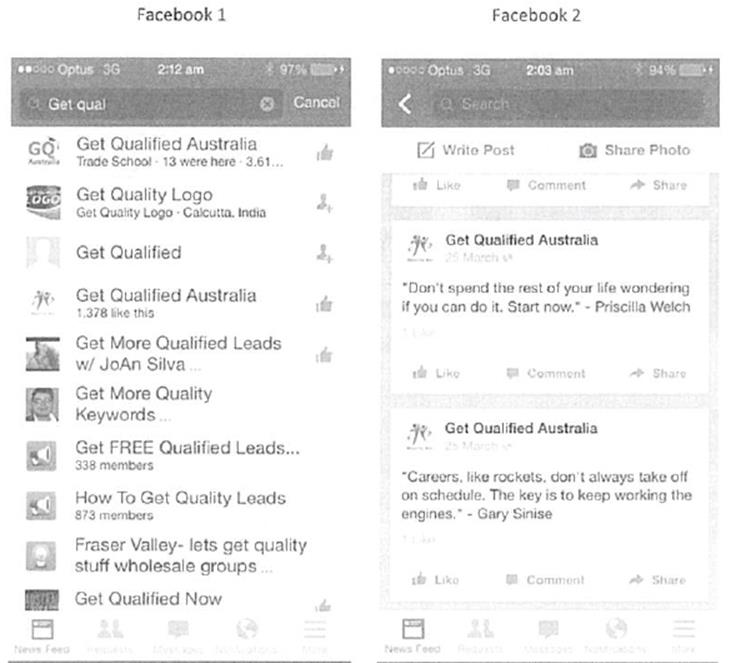
43 On or around 22 July 2014, Mr Andrawis first became aware of the existence of a Facebook page under the name "Get Qualified Australia". He viewed the Facebook page using his smartphone and took six screen shots of it. At about the same time he viewed the Facebook page on his computer and took two more screen shots. By way of example, the screenshots taken at this time and described by Qualify Me as Facebook 1 and Facebook 2 are reproduced below:
44 Mr Andrawis contacted Facebook to complain about the Facebook page. On 19 August 2014, Mr Andrawis received an email from Facebook which included the following:
…..
Thank you for bringing this matter to our attention. We have removed or disabled access to the third party or user-generated content you have reported to us for violating our Statement of Rights and Responsibilities. We understand this action to resolve your intellectual property issue.
…..
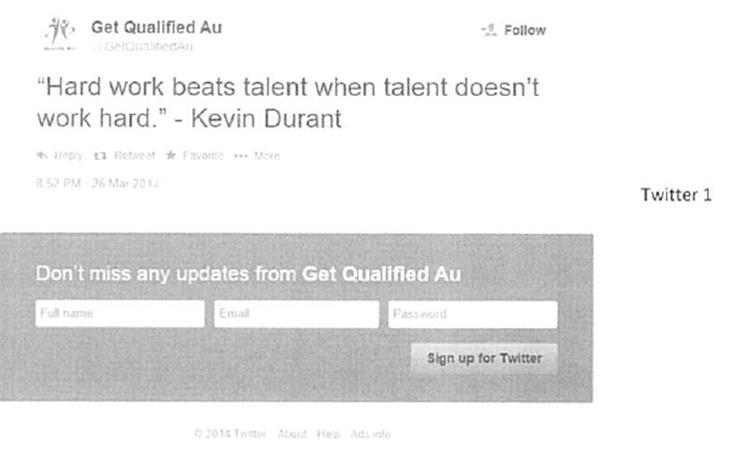
45 On or just prior to 31 July 2014, Mr Andrawis became aware of a Twitter account under the name "Get Qualified Au". He looked at the Twitter account and took screen shots. Between 4 to 10 August 2014, Mr Andrawis took a further screen shot of the Twitter account. By way of example, the screenshot taken by Mr Andrawis and described by Qualify Me as Twitter 1 is reproduced below:
46 On 31 July 2014, Mr Andrawis used Twitter's online contact feature to alert Twitter to the "Get Qualified Au" account under the brand impersonation category. Mr Andrawis received an automated response from "Twitter Support" which included, among other things, the following:
…….
We have received your report regarding an account impersonating your brand on the Twitter platform. In order for us to further review your report, we need to confirm that you are an authorized representative of the brand.
If this email address is associated with the brand’s email domain, please reply to this message to confirm that you have access to this email address.
………
Thank you,
Twitter Trust & Safety
47 On 12 August 2014, Mr Andrawis received another email from Twitter Support which included:
Thank you for providing the required information. We have removed the reported profile(s) from circulation due to violation of Twitter’s Impersonation Policy (https://support.twitter.com/articles/18366-impersonation-policy.)
Any documents you may have uploaded have been deleted.
48 Neither Mr Andrawis nor Mr Choucair created a Twitter account in the name of “Get Qualified Au” or a Facebook page in the name of "Get Qualified Australia". With the exception of one person who was overseas at the time, Mr Andrawis made inquiries of all of Qualify Me's staff and ascertained that none of them were responsible for establishing a Twitter account in the name of "Get Qualified Au" or a Facebook page in the name of "Get Qualified Australia".
49 Mr Wadi says the only Twitter username that GQA has ever used is "@GQAust" and that he is not aware of any person setting up a Twitter account on his behalf or on behalf of GQA with the username "@GetQualifiedAu". On or about 26 March 2015, Mr Wadi in fact became aware of a Twitter account using the name "Get Qualified Au" with Qualify Me's logo on it. Upon learning of this Mr Wadi said to his employee, Scott Roy:
Get Twitter to take it down at once. Qualify Me are our competitor and should not be allowed to impersonate us.
50 On 26 March 2015, there was an email exchange between Mr Roy and Twitter. In the second email in that exchange, Mr Roy provides further information as to why he says that the account he is reporting is impersonating GQA. Mr Wadi says that the Twitter account with the username "@GetQualifiedAu" was subsequently suspended.
51 Mr Wadi says that the only Facebook name that GQA has ever used is "Get Qualified Australia". As far as he is aware no person has ever set up a Facebook account on his behalf or on behalf of GQA using the name "Qualify Me" or the Qualify Me logo.
52 Mr Wadi has reviewed the screenshots taken by Mr Andrawis of the Twitter account and Facebook page which are said by Qualify Me to infringe its Trade Mark and makes observations about each one and sets out reasons why they would not have been set up or published by GQA.
53 Mr Wadi says that Qualify Me is a direct competitor of GQA and that neither he nor GQA have any commercial reason to encourage or direct potential customers to search for the Twitter user name "@QualifyM" or search the term "Qualify Me" or to visit Qualify Me's website or Twitter page. In his view it makes no sense for GQA to set up a Twitter account that would attract users searching for GQA and then, at the point where search results are displayed or the user is otherwise captured, to prominently display Qualify Me's logo. Mr Wadi makes similar observations in relation to setting up a Facebook page displaying Qualify Me's logo. Mr Wadi speculates that the only person who would benefit from displaying Qualify Me's logo is Qualify Me. He says that it is against GQA's commercial interest to drive customers to Qualify Me.
Investigations and inquiries made by Ms Robson
54 Ms Robson, a licensed private investigator, has undertaken a number of searches for Qualify Me. She has ascertained, based on domain name registration searches, the following information about the domain names listed below:
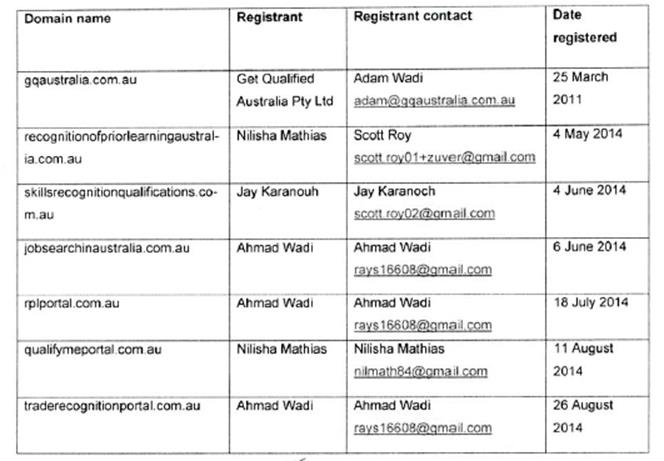
55 Between September and October 2014, Ms Robson undertook an investigation into the extent to which the words "qualify me" appeared on each of the sites listed in the table in the preceding paragraph. She found that it was used:
(1) 78 times on the website located at http://www.gqaustralia.com.au;
(2) 20 times on the website located at http://recognitionofpriorlearningaustralia.com.au;
(3) 273 times on the website located at http://skillsrecognitionqualifications.com.au;
(4) 297 times on the website located at http://www.jobsearchinaustralia.com.au;
(5) 75 times on the website located at http://www.rplportal.com.au;
(6) 240 times on the website located at http://www.qualifymeportl.com.au; and
(7) 64 times on the website located at http://www.traderecognitionportal.com.au.
56 Between about September 2014 and March 2015, Ms Robson investigated the extent of the use of the words "Qualify Me" on two other websites: http://recognition-of-prior-learning.blogspot.com.au and http://www.facebook.com which appeared to be operated by ProSEO or Mr Bertrand and found:
(1) at the first site, recognition of prior learning, a photo of Mr Bertrand was displayed, and there was a hypertext link to the gqaustralia website and a hypertext enabled phrase: VISIT GET QUALIFIED AUSTRALIA NOW. Ms Robson found 32 instances of the term "Qualify me" throughout the site, of which 3 instances were in the form: "Qualify Me!”. In addition underneath the words "About Me" there was a hypertext link to a Google Plus profile in the name of "John Bertrand";
(2) at the second site Ms Robson found at the address http://www.facebook.com/people/RplportalaustraliaAustralia/100004700508416 a profile under the name "Rplportalaustralia Australia". She saw a photo of Mr Bertrand as the profile photo, the GQ logo and observed that "Qualify me" was used 6 times throughout the profile.
57 Based on her searches Ms Robson also found that "qualify me" was used on two websites for which she could not identify the creator or owner. They were: http://www.traderecogntion.wordpress.com where "Qualify me" was used three times and on two occasions the term was hypertext linked to the website at http://www.gqaustralia.com.au, and http://www.easyrpl.wordpress.com, where "Qualify me" was used three times and in one case the term was hypertext linked to the website http://www.gqaustralia.com.au.
58 Ms Robson also located a number of websites that used language which she describes as disparaging of the operations of Qualify Me. By way of example, a post which she located at http://www.qualifymescamaustralia.blogspot.com.au was in the following terms:
Be AWARE of Qualify ME Australia Review
Hey guys, this is just to inform each and everyone BE AWARE of Qualify Me Australia.
I’ve been duped by this agency. I applied last year and based on their assessment I was qualified …. I gave all the requirements needed.
Then last year, they informed me regarding new policy … to make the story short … I’m no longer eligible for the federal skilled program. When I went to their office they asked me to sign the form “in holding the cheque”. I was so confident then that they will no longer take my money on that month.
But it was a big no! no! coz they still deposited my cheque. And not only that, the new policy has been effectively implemented last November last year, thus they SHOULD NOT encashed my cheque even for the month of December last year. BUT THEY DID, and they just informed me last January this year. I whined and they assured that they will return back everything. But I was wrong!
Is this part of their business? Or strategy? Of getting income, just to fool applicants to sign the application and after that ask to cancel the contract so they could TAKE MONEY From us?
- Abby Brise
59 Ms Robson investigated who published material of the nature referred to in the preceding paragraph on the following websites:
(1) http://www.qualifymescamaustralia.blogspot.com.au;
(2) http://qualifymescamaustralia.weebly.com;
(3) http://qualifymescamau.wordpress.com;
(4) http://qualifymescamau.blogspot.com.au;
(5) http://qualifymescamaustralia.wordpress.com;
(6) http://www.measuredup.com;
(7) http://www.yellowpages.com.au;
(8) http://www.zillow.com;
(9) http://plus.google.com;
(10) http://www.facebook.com; and
(11) http://www.truelocal.com.au.
60 At the first four of those websites, Ms Robson found that numerous blog posts had been published on each of the sites about Qualify Me on various dates. The identity of the person who published the posts on the websites was Vhem Zhao, in the case of http://www.qualifymescamaustralia.blogspot.com.au, and Fereki, in the case of http://qualifymescamau.blogspot.com.au. The names appearing under some of the posts were Avy Colastre, Jerry Third, Jhonny Jamelo, Abby Brise and Ivvee Lastimosa. Upon review, Ms Robson found that there was no content on the website http://qualifymescamaustralia.wordpress.com.
61 Ms Robson also found:
(1) one post about Qualify Me on the website http://www.measuredup.com which had been published by "Fake999" and had the name Abby Brise appearing under it;
(2) one post about Qualify Me at http://www.yellowpages.com.au/nsw/croydon/qualify-me-15150225-listing.html which had been published by "Juan C";
(3) one post about Qualify Me on the website at http://www.zillow.com which had been published by "juancross2014". Abby Brise's name appeared under the post;
(4) a Google Plus profile in the name of "Vhem Zhao" and found a post had been published about Qualify Me with the date 28 May 2014;
(5) a Facebook profile in the name of "Vhem Zhao" where a post had been published on the profile about Qualify Me with the date 28 May 2014;
(6) a Facebook profile in the name of "Juan Cross" where six posts had been published about Qualify Me with date range 17 to 19 June 2014. The profile displayed two Facebook friends: "Robert Devera" and "Jenny Mendoza";
(7) a Facebook profile in the name of "Robert Devera" where three posts had been published about Qualify Me with date range 18 to 19 June 2014. The profile displayed two Facebook friends: "Juan Cross" and "Jenny Mendoza";
(8) a Facebook profile in the name of "Jenny Mendoza" where six posts had been published about Qualify Me with date range 17 to 30 June 2014. The profile displayed two Facebook friends: "Juan Cross" and "Robert Devera";
(9) one post about Qualify Me at www.truelocal.com.au/member/rober-devera under the name "rober Devera" with the statement "joined 03 June 2014 appearing below"; and
(10) that there was nothing published under the headings "Reviews" and "Comments" at www.truelocal.com.au/member/johncross but found that the profile picture at that address was the same as the profile picture for the "Juan Cross" Facebook profile. However, the name of the profile was "John Cross" and under the name "joined 08 September 2014" appeared.
62 It seems that at least one of these websites which contains material which is disparaging of Qualify Me is still available online.
Procedural history
63 On 8 December 2014, Qualify Me's solicitors, Birchall Legal, wrote to Mr Wadi at GQA setting out Qualify Me's claims, its demands arising out of the alleged conduct and putting GQA on notice that if it did not meet Qualify Me's demands by 18 December 2014, Qualify Me would commence proceedings without further notice.
64 On 29 June 2015, &Legal, who had been retained to act for GQA and Mr Wadi, responded to Birchall Legal's letter dated 8 December 2014 and to the allegations contained in a draft statement of claim. The evidence before me does not disclose when a draft statement of claim was provided to GQA and Mr Wadi.
65 On 30 June 2015, Qualify Me commenced these proceedings and on 21 July 2015 the matter came before the Court for directions. Bennett J ordered GQA and Mr Wadi to file and serve a defence by 14 August 2015 and stood the matter over for further directions to 25 August 2015.
66 By letter dated 24 July 2015, GQA and Mr Wadi sought particulars of the statement of claim and on 31 July 2015 and 2 August 2015 respectively, Birchall Legal provided a response and an amended response.
67 On 14 August 2015, GQA and Mr Wadi filed their defence, notice of cross-claim and statement of cross-claim.
68 On 25 August 2015, the matter was next before the Court. No formal orders were made. The matter was listed for further directions on 15 September 2015.
69 On 28 August 2015, Birchall Legal provided a list of proposed categories of discovery to &Legal.
70 On 4 September 2015, Birchall Legal wrote to &Legal providing, among other things, information "supporting the view that [Qualify Me] had reasonable bases for the allegations made in the statement of claim". In a second letter of the same date addressed to &Legal, Birchall Legal provided a further amended response to GQA's and Mr Wadi's request for particulars dated 24 July 2015.
71 On 11 and 14 September 2015, &Legal and Birchall Legal exchanged correspondence in relation to Qualify Me's list of proposed categories of discovery.
72 On 15 September 2015 the matter was before the Court. Among other things, Bennett J ordered Qualify Me to file and serve any amended originating application and statement of claim and to provide further particulars of its claim for trade mark infringement by 18 September 2015. The matter was listed for further directions on 29 September 2015.
73 On 18 September 2015, Birchall Legal provided the further particulars the subject of the orders made by Bennett J on 15 September 2015.
74 On 21 September 2015, Qualify Me filed an amended statement of claim.
75 On 23 September 2015, &Legal wrote to Birchall Legal raising its clients' concerns with the amended statement of claim and on 25 September Birchall Legal provided a response.
76 On 28 September 2015, by consent, Bennett J made orders including that Qualify Me have leave to file a further amended statement of claim.
77 On 29 September 2015 Qualify Me filed the FASOC.
CONSIDERATION
78 Before dealing with each of the particular claims in the FASOC, counsel for GQA and Mr Wadi made two overarching submissions. The first was that by its response to the Interlocutory Application it appears that Qualify Me wishes to bring a case that is different from the one pleaded and that it now relies on a large amount of material that either departs from the pleadings or ought to have been properly particularised in the period that has elapsed since commencement of the proceedings. It is apparent that if Qualify Me wishes to press some of those claims it will need to seek leave to further amend its statement of claim and that it ought not be permitted to do so.
79 It is the case that Qualify Me relies on evidence that departs from its pleaded case and which it says would support additional causes of action. Should Qualify Me wish to amend its pleading to include further causes of action that is an application it will need to make at an appropriate time. It is not before me now and it is not appropriate that I make any further comment on such an application. In the meantime that evidence is relied on by Qualify Me as part of the factual matrix it relies on to answer the application made by GQA and Mr Wadi for summary dismissal.
80 GQA and Mr Wadi further submit that despite Qualify Me saying that it needs discovery to properly particularise its claim, it is apparent from the evidence it now relies on that it was in a position to provide particulars at all times and in fact Ms Robson undertook her investigations in September 2014, well before commencement of the proceedings. In those circumstances, there is no explanation as to why the material included in Ms Robson's affidavit could not properly have been included as particulars in the statement of claim first filed. In the absence of a reason being proffered, a further amendment ought not be allowed and the proceedings should be struck out on case management grounds.
81 While it may be the case that some of the evidence contained in Ms Robson's affidavit ought and could have properly been included as particulars in the FASOC or earlier iterations of it, the omission of that material to date is not of itself a proper basis to strike out the proceedings. The failure to include it, in the circumstances which Qualify Me has been aware of it for some time, is rather, in my view, an issue that might go to costs.
82 The second overarching submission is that the FASOC either has a tendency to cause prejudice and embarrassment and delay, because it does not disclose the case Qualify Me actually wishes to make or, because it does not have reasonable prospects of success. As to the former point, the Interlocutory Application is to be considered based on the FASOC. As already observed, if Qualify Me wishes to further amend its pleading it will need to make an application to do so which will be assessed on its merits. As to the latter point the question of whether the FASOC has reasonable prospects of success is a complex one which, given the way in which the parties approached the detailed argument on the Interlocutory Application, I will consider for each part of the FASOC.
Alleged misleading or deceptive conduct: Blogs and Facebook
83 This claim is set out at [3A] to [17] of the FASOC. It is alleged that ProSEO or its former director, Mr Bertrand, engaged in misleading or deceptive conduct by using the phrase "Qualify Me" in website content and keywords for the purpose of optimising search engine results and that one or other of them established certain websites and Facebook accounts which contained material for that purpose.
84 Firstly, GQA and Mr Wadi submit that the particulars provided of the alleged conduct by ProSEO and Mr Bertrand are wholly inadequate. To the extent that Qualify Me says that it will provide particulars after discovery, GQA and Mr Wadi submit that it is difficult to see how Qualify Me will ever be able to provide further particulars of these allegations after discovery because:
(1) Qualify Me must first obtain an order for discovery under r 20.12 of the Rules, having persuaded the Court that such an order will facilitate the just resolution of the proceedings as quickly, inexpensively and efficiently as possible pursuant to r 20.11;
(2) neither ProSEO or Mr Bertrand are parties to the proceedings - ProSEO has been deregistered and Mr Bertrand lives overseas; and
(3) GQA and Mr Wadi have given informal discovery and Mr Wadi has deposed that they have nothing to produce in relation to these allegations.
85 The pleading against Mr Wadi arising from this part of the FASOC is that he was knowingly concerned in the contravention of s 18 of the ACL by ProSEO or, in the alternative, by Mr Bertrand. GQA and Mr Wadi next submit that Qualify Me is unable to particularise or plead in any cogent way the necessary elements to establish that Mr Wadi was knowingly concerned in the alleged contravention of s 18 ACL by ProSEO or Mr Bertrand and rely on Fernandez v Glev Pty Ltd [2000] FCA 1859 at [18], where Hely J said that:
The facts necessary to sustain a conclusion that the individuals were involved in a contravention of s 52 should be pleaded. That includes whether involvement in, or knowledge of the making of the representations is relied upon and knowledge of the falsity of the representations in question.
86 It is submitted by GQA and Mr Wadi that the only material fact pleaded relevant to that claim is that Mr Wadi was a director of ProSEO. GQA and Mr Wadi submit that the evidence is that Mr Wadi denies that he had any knowledge of the matters alleged in this part of the claim and that, relying on Ridgway v Consolidated Energy Corporation Pty Ltd (1987) ATPR 40-754 (Ridgway) at 48,189, if Qualify Me bases its case against Mr Wadi only on "inferences, innuendo and suspicion", it has no reasonable prospects of success.
87 In J & A Vaughan Pagone J in considering a pleading that two individuals were involved in the contraventions pleaded against the corporate first respondent said the following at [9]:
…. That involvement, as previously mentioned, is said to take the form of aiding, abetting, counselling, procuring, being knowingly concerned and conspiring with others, but no facts of any of those are pleaded or found in the particulars. The majority in Yorke v Lucas (1985) 158 CLR 661 said at 667 (and see Brennan J at 673) that the term “involved in” as used in s 75B of the Trade Practices Act 1974 (Cth) was derived from analogous concepts in the criminal law and “should be given [no] new or special meaning”. In Imobilari Pty Ltd v Opes Prime Stockbroking Ltd (in liq) (2008) 252 ALR 41, Finklestein J said at [13]:
To establish secondary liability … it is settled that in order for a defendant to be “knowingly concerned” in another party’s wrongdoing, actual knowledge of the essential facts is required … With respect to conduct, the defendant must have done some positive act amounting to participation …
(Emphasis added, footnote omitted)
88 There is a paucity of material facts pleaded in relation this aspect of the claim against Mr Wadi. Particulars of the relevant paragraphs of the FASOC (and its predecessors which were in identical terms), being paragraphs 11(b) and 15(b), were sought by GQA and Mr Wadi. The particulars sought and the responses provided were as follows:
Paragraph 11(b)
Please specify:
(a) what matters concerning the contravention are alleged to have been known by Mr Wadi; and
(b) how is it alleged that he was ‘concerned’ in the contravention.
Answer
(a) This is a matter for discovery by the Respondents.
(b) By reason at least of Mr Wadi’s being a director of Proseo. Further particulars are a matter for discovery by the Respondents.
Paragraph 15(b)
Please specify:
(c) what matters concerning the contravention are alleged to have been known by Mr Wadi; and
(d) how is it alleged that he was ‘concerned’ in the contravention.
Answer
(c) This is a matter for discovery by the Respondents.
(d) By reason at least of Mr Wadi’s being a director of Proseo, of which Bertrand was a director and manager. Further particulars are a matter for discovery by the Respondents.
89 In my view, the pleaded case against Mr Wadi as set out in paragraphs 3A to 17 of the FASOC does not identify the factual elements which constitute Mr Wadi's knowing involvement in ProSEO's, or alternatively Mr Bertrand's, conduct. Nor is Mr Wadi assisted in this regard by the response provided to the relevant particulars.
90 However, it does not follow that Qualify Me's claim against Mr Wadi has no reasonable prospects of success because it is founded on inferences as to misconduct. In that regard GQA's and Mr Wadi's reliance on Ridgway is misplaced. As submitted by Qualify Me, in Ridgway Fox J held that no evidence of being knowingly concerned in the contravention could be inferred based on the facts of that case. It is not the case that Fox J found that the requisite degree of knowledge could only ever be established by direct evidence. In Compaq Computer Australia Pty Ltd v Howard Merry & Ors (1998) 157 ALR 1, Finklestein J said the following at 4 to 5:
… But where it is sought to make a person liable as an accessory to a contravention of s 52(1) based in s 75B it is necessary to establish that the person has intentionally participated in the contravention. To establish intentional participation it must be proved that the person has knowledge of the essential matters that make up a contravention of s 52(1) … In this regard “knowledge” means actual and not constructive knowledge. For example, it would not be sufficient to merely show that the person charged with accessorial liability had shut his eyes to the obvious if that is intended to be a substitute for actual knowledge … Of course, where there is a combination of suspicious circumstances and a failure to make an inquiry it may be possible to infer knowledge of the relevant essential matters. (Citations omitted)
91 In J & A Vaughan Pagone J also considered whether the applicant in that case ought to be given leave to file a further amended statement of claim. The problem identified with the amended pleading was that the applicant's case was essentially based on inferences but that the draft pleading did not clearly enough identify the inferences it would, in the future, seek to have drawn and the facts which it would contend permitted the inferences to be drawn. Pagone J observed at [18] that the applicant should not be shut out of its cause of action "merely because its case depends upon inferences" but that it was incumbent on the applicant to "file a statement of claim which discloses a cause of action on the facts as they are known to" it. His Honour continued at [19]:
Inferences require facts from which an inference is capable of being drawn. That requires that the facts relied upon bear probatively upon those inferences which are sought to be drawn. In Holloway v McFeeters (1956) 94 CLR 470 Dixon CJ said at 477 (albeit on dissent on the outcome of the case) in the context of a motor vehicle negligence case:
What is required is a basis for some positive inference involving negligence on the part of the driver as a cause of the deceased’s death. The inference may be made only as the most probable deduction from the established facts, but it must at least be a deduction which may reasonably be drawn from them. It need not be an inference as to how precisely the accident occurred, but it must be a reasonable conclusion that the accident in one or another occurred through the lack of due care onto the part of the driver and not otherwise.
Williams, Webb and Taylor JJ in a joint judgment in that case referred at 480–1 to the earlier decision of the High Court in Bradshaw v McEwans Pty Ltd (1951) 217 ALR 1 where it had been said:
[Y]ou need only circumstances raising a more probable inference in favour of what is alleged … where direct proof is not available it is enough if the circumstances appearing in evidence give rise to a reasonable and definite inference; they must do more than give rise to conflicting inferences of equal degree of probability so that the choice between them is mere matter of conjecture … All that is necessary is that according to the course of common experience the more probable inference from the circumstances that sufficiently appear by evidence or admission, left unexplained, should be that the injury arose from the defendant’s negligence. By more probable is meant no more than that upon a balance of probabilities such an inference might reasonably be considered to have some greater degree of likelihood. (Citation omitted)
92 Qualify Me submits that even on the basis of the factual material currently available there is substance to the allegations that Mr Wadi was knowingly concerned in the breach of s 18 of the ACL as set out in paragraphs 11(b) and 15(b) of the FASOC. Qualify Me sets out in its written submissions a list of the matters from which it says the necessary inferences leading to such a conclusion may reasonably be drawn. However, those matters and/or inferences to be relied upon as material facts have not been pleaded and ought to be to the extent that they are essential elements in the cause of action against Mr Wadi: see J & A Vaughan at [14].
93 Turning now to the claim that ProSEO and Mr Bertrand were agents of GQA (see [12] and [16] of the FASOC), Qualify Me submits that paragraphs 11, 12, 15 and 16 of the FASOC allege that GQA by itself or by its agents, ProSEO or Mr Bertrand, is responsible for the misleading or deceptive conduct represented by the derogatory materials identified in its submissions, that while Mr Wadi denies that conduct that is not determinative of the matter and that at trial Qualify Me will rely on inferences arising from objective matters to support its case.
94 Qualify Me submits that applying the general law of agency and s 84(2) of the CC Act, GQA as principal is liable for the conduct of its agent and that, contrary to the submissions made by GQA and Mr Wadi, it is not necessary for Mr Wadi's state of mind to be established for these paragraphs to be established at law. GQA and Mr Wadi submit that this allegation should be struck out as it does not disclose any cause of action under the ACL or otherwise.
95 In the pleading it is alleged that ProSEO or, alternatively Mr Bertrand personally, was engaged by GQA ([4] and [6] of the FASOC) and that pursuant to that engagement, ProSEO, or alternatively Mr Bertrand, implemented ORM strategies or provided SEO services to GQA ([5] and [6A] of the FASOC). It is then alleged that the ProSEO conduct, or alternatively the Bertrand conduct, was engaged in on behalf of GQA ([12] and [16] of the FASOC). I note that in its defence to the statement of claim first filed GQA and Mr Wadi, while denying paragraph 4 also admit in answer to it that, between May and October 2014, GQA engaged ProSEO to provide SEO services. In evidence Mr Wadi denies any such engagement by GQA of ProSEO.
96 Particulars were sought by GQA and Mr Wadi of this aspect of the pleading and answers provided as follows:
Paragraph 4
3 Was the ‘engagement’ express or implied?
4 If express or partly express, was the ‘engagement’ made orally or in writing?
5 If the ‘engagement’ was oral or partly oral, please state by whom and to whom the words were said, the date of the conversation and the substance of the words used.
6 If the ‘engagement’ was in writing or partly in writing, please provide a copy of the writing.
7 If the ‘engagement’ was implied or partly implied, please particularise all of the facts and circumstances said to give rise to the engagement.
Answer: Items 3-7 are matters for discovery by the Respondents.
Paragraph 6
9 Was the ‘engagement’ express or implied?
10 If express or partly express, was the ‘engagement’ made orally or in writing?
11 If the ‘engagement’ was oral or partly oral, please state by whom and to whom the words were said, the date of the conversation and the substance of the words used.
12 If the ‘engagement’ was in writing or partly in writing, please provide a copy of the writing.
13 If the ‘engagement’ was implied or partly implied, please particularise all of the facts and circumstances said to give rise to the engagement.
Answer: Items 9-13 are matters for discovery by the Respondents.
Paragraph 12
19. Is the conduct alleged to have been engaged in by ProSEO on behalf of GQA pursuant to the engagement pleaded in paragraph 4? If not, please provide the same particulars of the engagement as are sought in relation to paragraph 4.
Answer: Yes.
Paragraph 16
23. Is the conduct alleged to have been engaged in by ProSEO (sic) on behalf of GQA pursuant to the engagement pleaded in paragraph 6? If not, please provide the same particulars of the engagement as are sought in relation to paragraph 6.
Answer: Yes.
97 In my view the pleading as to the alleged agency is deficient. It does not plead the material facts out of which the agency is said to arise. If it arises as a result of inferences that are to be drawn, as set out in Qualify Me's written submissions, then, in my view, GQA and Mr Wadi are entitled to know, and Qualify Me ought to plead, the material facts from which it will contend those inferences are to be drawn. While there is no reference to s 84(2) of the CC Act in the pleading, Qualify Me submits that the pleading sufficiently engages the language of the section and that there is no requirement that the section be specifically pleaded. However, in my view, at the very least, a party would expect, if there is reliance on s 84(2) of the CC Act, reference to it in the particulars to the relevant pleading. GQA and Mr Wadi should not be taken by surprise in that respect.
Summary dismissal or strike out?
98 In order for GQA and Mr Wadi to succeed to have this part of the FASOC summarily dismissed, they must establish, having regard to the available evidence, that Qualify Me has no reasonable prospect of succeeding on its claim, or that no reasonable cause of action is disclosed, or that the proceedings are frivolous or vexatious. In my view and having regard to the material before me, summary judgement under s 31A of the FCA Act and r 26.01 of the Rules is not warranted in relation to these paragraphs of the FASOC. As is evident from the facts, as set out above, there is sufficient material to demonstrate that there are real and complex issues of fact to be tried and determined. Mr Wadi's bare denial of the claims made in these paragraphs is not sufficient to dispose of them. There is a real contest between the parties on a number of issues. As the authorities establish the exercise of the power to order summary dismissal should be used with caution. This is not a cause of action which falls within the limited category of those which might be said to be amenable to the exercise of the power.
99 I turn then to the question of strike out. As I have identified, there is a deficiency in the pleading in relation to the allegation of Mr Wadi's knowing involvement in the breach of s 18 of the ACL and in the allegations that ProSEO or alternatively Mr Bertrand were agents of GQA. The paragraphs which plead these claims fail to identify the material factual allegations so that GQA and Mr Wadi do not have sufficient notice of the substance of the claims. While the claims are made in paragraphs 11, 12, 15 and 16 of the FASOC, those claims as currently framed rely on matters that are pleaded in other paragraphs. I propose to strike out paragraphs 3A to 17 of the FASOC.
100 Should leave to replead be granted to Qualify Me? GQA and Mr Wadi submit that it should not on the basis that, if granted, it will be Qualify Me's fourth attempt to put its claim, after three attempts to provide particulars and a period of five months and that there are now a series of new factual allegations which, prior to the Interlocutory Application, were not articulated. Put simply GQA and Mr Wadi say that Qualify Me has had “three strikes" and should now "be out". While I have some sympathy for the position that GQA and Mr Wadi find themselves in vis-a-vis these proceedings, I do not propose to adopt that course. Unless futile to do so, a court will ordinarily grant leave to replead those parts of a pleading that have been struck out. In Coshott v Kam Tou Mak [1998] FCA 147, Wilcox J granted leave to amend the pleadings despite the need for "heroic surgery" and in J & A Vaughan Pagone J granted the applicant a "final attempt to replead its case of accessorial liability": at [24]. I propose to do the same and to grant Qualify Me a final attempt to replead its case against GQA and Mr Wadi.
Alleged misleading or deceptive conduct: Google AdWords
101 This claim is set out at [18] to [25] of the FASOC and alleges a breach of s 18 ACL arising out of GQA's opening of an account with Google AdWords and its creation of certain sponsored links using or containing phrases that include the words "Qualify Me". In their defence to the statement of claim filed 30 June 2015, GQA and Mr Wadi admit opening the Google AdWords account and creating the sponsored links pleaded, namely those using the phrases "Looking for Qualify Me?", "Qualify Me - Too Easy" and "Qualify Me Now".
102 In oral submissions, counsel for GQA and Mr Wadi put as their primary submission that, while there may be an arguable case, given the way that it is pleaded, parts of that case are liable to be struck out and that what then survives ought not be entitled to proceed. The parties would be fighting an expensive and lengthy trial for a minimal amount of potential damages in circumstances where the conduct is not continuing and no application for injunctive relief has yet been agitated.
103 By way of amplification of that submission, counsel for GQA and Mr Wadi referred to page 15 of exhibit WA1 to the affidavit of Mr Andrawis which contains one of the Google entries of which Qualify Me complains and which is reproduced at [40] above. GQA and Mr Wadi submit that internet users would not be confused or misled as to whose website was being advertised, given:
(1) there is a factual distinction between what appears here and what appeared and was considered by the Court in Australian Competition and Consumer Commission v Trading Post Australia Pty Ltd (2011) 197 FCR 498 (Trading Post). That factual difference is that in Trading Post the name of one trader appeared and underneath it the URL for the Trading Post. Here, the first line of the Google search result includes "Qualify Me" which, given the use of inverted commas, suggests that it is part of a quote and is not part of a name and GQA's name appears prominently in the first line of the entry;
(2) the orange box to the left of the text saying "Ad" most internet users would be sophisticated enough to realise that this was an advertisement or paid link; and
(3) the entry includes GQA's website address and says underneath that address "Visit Get Qualified Australia Today and get qualified in weeks".
104 In any event, GQA and Mr Wadi submit that any confusion caused would soon be dispelled when a user clicks on the link included in the entry: www.gqaustralia.com.au, the web address for GQA, as the websites of GQA and Qualify Me are very different. GQA and Mr Wadi rely on SAP Australia Pty Ltd v Sapient Australia Pty Ltd (1999) 48 IPR 593 and TJM Products Pty Ltd v A&P Tyres & Ors (1987) 14 FCR 33.
105 If I am not persuaded by GQA's and Mr Wadi's overarching submissions, GQA and Mr Wadi rely on the judgment in Trading Post commencing at [118] and following in support of a submission that, if the claim for misleading or deceptive conduct is entitled to proceed, then at the very least paragraphs 23(a), (b) and (d) are liable to be struck out on the basis that they could not be made out. In that part of the judgment in Trading Post, Nicholas J considered a Google search result that featured the words Kloster Ford and underneath those words a URL to the Trading Post website and eight different representations that were said to arise from the juxtaposition of the Kloster Ford name with the Trading Post URL.
106 The first representation considered by Nicholas J was that by clicking on the headline of the Kloster Ford advertisement a person would be taken to a website associated with Kloster Ford. Nicholas J at [129] found that was not the case and was not satisfied that such a representation was conveyed and found that "[o]rdinary and reasonable members of the relevant class would understand that by clicking on the headline to the Kloster Ford advertisement they would be taken to the webpage at www.tradingpost.com.au. They would also understand that to be the website of Trading Post". GQA and Mr Wadi submit that in light of this finding in Trading Post it is even more unlikely that the "stronger, more difficult to assert" representation alleged in paragraph 23(a) of the FASOC, that the website URL displayed in the Sponsored Link was the URL of Qualify Me's website, would be made out.
107 The representation alleged in paragraph 23(b) of the FASOC is that if the consumer clicked on the Sponsored Link or the website displayed therein, the consumer would be taken to a website either or both operated by or associated with Qualify Me. Relying on the judgment in Trading Post, GQA and Mr Wadi submit that the alleged representation in paragraph 23(b) of the FASOC is unsupportable. At [123] to [126] of his judgment, Nicholas J considered the nature of the members of the relevant class of people and a submission by the ACCC that there would be ordinary and reasonable members of the class who would not appreciate that if they clicked on the headline of a sponsored link they would be taken to a webpage at the URL specified immediately below and that there would be some users of the Google search engine who would not appreciate that by clicking on the headline of the Kloster Ford advertisement they would be taken to the Trading Post webpage. Nicholas J found at [126] that:
… ordinary and reasonable members of the class would read the Kloster Ford advertisement as a whole. They would see the address appearing immediately below the headline and understand it to indicate the webpage to which they would be taken if they were to click on the relevant link. I am therefore satisfied that ordinary and reasonable members of the class who clicked on the Kloster Ford advertisement … would expect to be taken to www.tradingpost.com.au.
108 Nicholas J considered whether the relevant advertisement conveyed any one or more of the eight representations to the ordinary and reasonable class members on that basis i.e. that they would not only see the URL appearing below the headline but that they would appreciate that it was the address to which they would be taken if they clicked on the headline.
109 The representation at paragraph 23(d) of the FASOC is that the person who published or caused to be published the Sponsored Link was Qualify Me. A representation to the same effect was not considered by Nicholas J in Trading Post in relation to the Kloster Ford advertisement. GQA and Mr Wadi submit that the closest analogy is representation F considered by Nicholas J at [134] to the effect that Kloster Ford was a sponsor of the Trading Post site. Nicholas J found that no such representation was conveyed by the advertisement. GQA and Mr Wadi submit that if Nicholas J was not prepared to find that representation was conveyed then a court would be less likely to find the more aggressive representation, that the sponsored link in this matter was in fact published by Qualify Me, given the presence of GQA's URL which is quite different to Qualify Me's URL.
110 The final submission made by GQA and Mr Wadi in relation to Trading Post is that it is a decision of a single judge of this Court and, while it is desirable that there be comity between decisions of judges of this Court, I am not bound by it. Further, this is an area of the law that deals with evolving technology and with members of the public who are becoming increasingly more familiar with the technology and more sophisticated in their use of it.
111 GQA and Mr Wadi submit that, in any event, the claim should not proceed because, based on the evidence of Mr Wadi about the number of "converted" clicks and the information contained in confidential exhibits A and B tendered by GQA and Mr Wadi, which show respectively GQA's enrolments per month and its net profit, it is a claim for an amount of damages that is so low as to be vexatious. Counsel for GQA and Mr Wadi was unable to point to any authority in support of that submission.
112 That GQA and Mr Wadi admit to setting up an account with Google AdWords and creating the sponsored links complained of and thereby properly submit that there may be an arguable case arising out of the claim relating to the Google AdWords is sufficient, in my view, to dispose of any argument that this claim should be summarily dismissed. I cannot in those circumstances be persuaded that Qualify Me has no reasonable prospects of success. However, for completeness I also note that there are real issues of fact to be determined in relation to this claim including the extent to which any of the representations in paragraph 23 of the FASOC are established, if so, whether the representations are misleading or deceptive and, if so, the measure of any damages.
113 Nor do I think that this claim or any part of it ought be struck out. Firstly, as to GQA and Mr Wadi's overarching submission that the facts in this case could be distinguished from those considered by Nicholas J in Trading Post, I note that in Trading Post, the claim by the ACCC against Google arose in two ways: first, out of the way in which the results of a search page were displayed, which it said failed to distinguish sufficiently between organic search results and advertisements, and secondly, upon 11 distinct claims involving various advertisers and sponsored links which Google was alleged to have published on its results page. The ACCC alleged that these results as published were misleading or deceptive or likely to mislead or deceive because they contained a headline consisting of a trading name, a product name or a website address of the advertiser's competitor which also served as a clickable link to the advertiser's website.
114 Contrary to GQA and Mr Wadi's submission, Qualify me, relying on a different part of the judgment in Trading Post relating to Harvey World Travel advertisements, submit that the position here is materially indistinguishable from the facts there considered by Nicholas J. Relevantly, at that part of the judgment Nicholas J was considering the interaction between a Google search in the name of Harvey World Travel and STA Travel. Such a search generated a results page which comprised a single top left sponsored link and three right side sponsored links one of which was in the following terms:
Harvey Travel
Unbeatable deals on flights, Hotels & Pkg’s Search, Book & Pack Now!
www.statravel.com.au
115 At [237] Nicholas J was "satisfied that by the publication of the Harvey World Travel advertisements STA represented that it had a commercial association with Harvey World Travel and that information relating to Harvey World Travel could be found at the STA Travel website".
116 Whether there is a factual distinction as submitted by GQA and Mr Wadi between the Google search result the subject of these proceedings and that (or those) before Nicholas J in Trading Post is not a matter which ought be determined on this application. Suffice to say that is one of the issues that will need to be determined at a hearing. In other words, whether users would be confused or misled as to whose website was being advertised is a factual matter to be determined at trial and not one to be determined on this application. Similarly, the issue of whether, if any confusion was caused it would be transient and quickly dispelled and the impact of any such finding is not one to be determined on this application.
117 I am not persuaded by GQA and Mr Wadi's submissions based on Nicholas J's findings in Trading Post at [118] and following that parts of paragraph 23 of the FASOC ought be struck out because they fail to disclose a reasonable cause of action. The findings in Trading Post were made with the benefit of hearing all of the evidence and submissions and were made in light of the facts relevant to that case. The same has not yet occurred here. It cannot be said, based solely on the judgment in Trading Post, that the representations pleaded in paragraphs 23(a), (b) and (d) are so untenable that a claim based on those alleged representations could not be made out.
118 Nor can the claim be struck out as vexatious because, as GQA and Mr Wadi allege, if proved, the damage suffered is of a negligible amount. That is for several reasons. First Mr Wadi's evidence in that regard has not been tested and the basis of calculation of damages that he puts may not be the only basis upon which damages may be assessed. Second, this Court has no jurisdictional minimum and thus, while a low recovery may result in an adverse costs order in some circumstances, it is not a bar to bringing proceedings. Further as submitted by Qualify Me its claim for relief is not limited to a claim for damages but extends to a claim for injunctive relief. Lastly, I do not accept that a claim can be categorised as vexatious simply because, if made out, it sounds in low or minimal damages. That matter of itself, if it be the case, does not infect the pleading itself nor the assessment of whether there is a reasonable cause of action.
119 The claim in [18] to [25] of the FASOC ought stand as pleaded.
CLAIM FOR ALLEGED PASSING OFF
120 This claim is set out at [26] to [36] of the FASOC. In short, Qualify Me alleges that the Sponsored Link Conduct also amounts to passing off.
121 GQA and Mr Wadi submit that for the same reasons as those put in relation the claims for misleading or deceptive conduct this claim has no reasonable prospect of success or is otherwise vexatious.
122 For the reasons set out above in relation to the misleading or deceptive claim based on the Google AdWords, this claim is neither liable to be summarily dismissed or struck out in whole or part.
123 My view is not changed by the additional submission made by GQA and Mr Wadi that, even if there is a risk of members of the public becoming confused as to the identity or the origin of the service providers, it appears that Qualify Me, rather than GQA and Mr Wadi, has engaged in passing off. This is said to be because GQA began building its business reputation about three years before Qualify Me commenced trading and Qualify Me then adopted a similar name, logo and colour scheme to that used by GQA. If that is alleged then it is a matter for GQA and Mr Wadi to lead appropriate evidence at trial or, if appropriate and they wish to do so, to pursue such a claim by way of cross claim. However, such an assertion of itself does not cause me to alter the conclusion I have reached in relation to this claim.
ALLEGED INFRINGEMENT OF TRADEMARK
124 This claim is set out in [37] to [44] of the FASOC. Qualify Me alleges that GQA displayed the Trade Mark on its Facebook page and its Twitter account thereby infringing the Trade Mark pursuant to s 120 of the Trade Mark Act.
125 GQA and Mr Wadi submit that the Facebook and Twitter account pages direct those viewing to Qualify Me's website and office. As a result, the allegations are inherently implausible because it would be contrary to GQA's commercial interests for it to display the Trade Mark and Qualify Me's URL and contact details on its Facebook and Twitter pages thereby directing people to its "arch rival". Further they submit that, given that the entries complained of on the Facebook pages direct a reader to Qualify Me's website, one would infer that they are posts created by Qualify Me. On this basis the allegations are said not to have any reasonable prospect of success.
126 GQA and Mr Wadi also submit that the only trade mark infringement case available to Qualify Me is one where there has been misuse of the composite mark which has been registered and not one relying on any use of the words "qualify me" on any website by GQA and Mr Wadi.
127 The claim that is made by Qualify Me for trade mark infringement relates to two accounts: one with Facebook and one with Twitter. GQA and Mr Wadi admit in their defence that the pleaded accounts were created and operated by GQA. In his affidavit filed for the purposes of the Interlocutory Application, Mr Wadi denies any knowledge of the Tweets or the Facebook pages that are the subject of this claim and seems to now deny setting up the Twitter account or the Facebook page on which the allegedly infringing material is located.
128 There are clearly factual issues that arise out of the evidence relied upon by GQA and Mr Wadi, on the one hand, and Qualify Me on the other. Qualify Me points to inconsistencies between the defence filed by GQA and Mr Wadi and Mr Wadi's evidence as well as inconsistencies or issues that arise on Mr Wadi's evidence. In my view there are a number of factual and legal issues to be resolved including who set up or created the accounts, who posted the material, if the accounts were created by GQA, were the posts made with its authority, was the use of the allegedly infringing material laudatory and, if so, does that mean there is then no infringement of the Trade Mark. Given these issues and, in particular, the factual issues that arise, I do not think it can be said that Qualify Me has no reasonable prospects of successfully prosecuting this part of the proceeding in the sense that it is hopeless or bound to fail. This part of the claim is not one which is liable to be summarily dismissed.
129 Similarly, in my view this claim ought not be struck out. The material facts have been pleaded. GQA and Mr Wadi are aware of the claim against them and have been provided with copies of the allegedly infringing Facebook pages and Twitter entries. A reasonable cause of action is disclosed. It cannot be said that the claim is vexatious, frivolous, ambiguous or likely to cause prejudice, embarrassment or delay in the proceedings.
COSTS
130 At the conclusion of the interlocutory hearing, the parties agreed that the question of costs on this application should be deferred to allow the parties to consider the outcome and to make any submissions on costs they consider appropriate. I will order that any submissions on this issue of costs of this application are to be filed and served within two weeks of the date of this judgment. Unless the parties notify me to the contrary I propose to determine the issue of costs on this application on the papers once submissions have been filed and served.
CONCLUSION
131 In light of the matters set out above, I will make orders striking out paragraphs 3A to 17 of the FASOC and I will grant leave to Qualify Me to file a second further amended statement of claim repleading the causes of action contained in those paragraphs which are struck out. The second further amended statement of claim is to be filed and served within three weeks of the date of this judgment. The proceedings will be listed before me for directions on 31 March 2016.
I certify that the preceding one hundred and thirty-one (131) numbered paragraphs are a true copy of the Reasons for Judgment herein of the Honourable Justice Markovic j. |
Associate:


