

Gilead Sciences Pty Ltd v Idenix Pharmaceuticals LLC [2016] FCA 169
DATE OF ORDER: | 2 march 2016 |
THE COURT ORDERS THAT:
1. The parties confer and file agreed or competing orders reflecting these reasons for judgment within 14 days.
Note: Entry of orders is dealt with in Rule 39.32 of the Federal Court Rules 2011.
[1] | |
[1] | |
[10] | |
[10] | |
[11] | |
[12] | |
[14] | |
[15] | |
[16] | |
[18] | |
[18] | |
[21] | |
[21] | |
[25] | |
[41] | |
[50] | |
[53] | |
[56] | |
[59] | |
[68] | |
[84] | |
[92] | |
[92] | |
[95] | |
[103] | |
[104] | |
[113] | |
[114] | |
[117] | |
[118] | |
[133] | |
[138] | |
[146] | |
[146] | |
[149] | |
[153] | |
[157] | |
[160] | |
[163] | |
[166] | |
[172] | |
[177] | |
[186] | |
[192] | |
[196] | |
[196] | |
[198] | |
4.3 What common general knowledge should be attributed to the skilled addressee? | [210] |
[252] | |
[252] | |
[253] | |
[256] | |
[280] | |
[301] | |
[301] | |
[308] | |
[309] | |
[316] | |
[324] | |
[330] | |
[346] | |
[386] | |
[392] | |
[400] | |
[415] | |
[418] | |
[418] | |
[421] | |
[422] | |
[432] | |
[433] | |
[433] | |
[434] | |
[435] | |
[442] | |
[447] | |
[447] | |
[459] | |
[504] | |
[527] | |
[527] | |
[537] | |
[545] | |
[552] | |
[562] | |
[583] | |
[592] | |
[597] | |
[600] | |
[604] | |
[616] | |
[626] | |
[626] | |
[628] | |
[633] | |
[655] | |
[655] | |
[657] | |
[658] | |
[661] | |
[661] | |
[668] | |
[687] | |
[688] |
REASONS FOR JUDGMENT
JAGOT J:
1 Sofosbuvir is a new treatment for the Hepatitis C virus (HCV). The applicant (referred to below as Gilead) wishes to sell sofosbuvir in Australia.
2 Sofosbuvir is a compound having the following chemical structure:
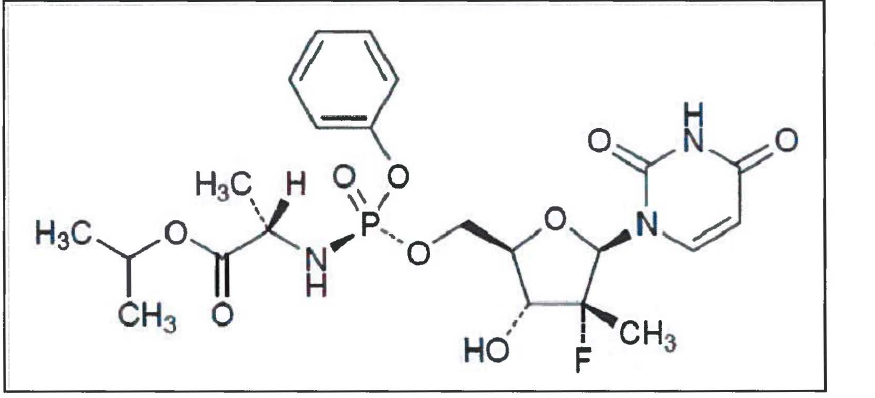
3 This structure was disclosed in Gilead’s Australian patent no. 2004253860 filed on 21 April 2004 and published on 13 January 2005, but which claims a priority date of 30 May 2003 based on International Patent Application WO 2005/003147. Gilead’s patent is referred to as the Clark patent, being a reference to Jeremy Clark, one of the inventors.
4 The respondents (referred to collectively below as Idenix) contend that sofosbuvir infringes Idenix’s Australian patent no. 2003247084 (the Idenix patent). The Idenix patent was filed on 27 June 2003 and published on 19 January 2004, but claims earlier priority dates of 28 June 2002 based on US Patent Application 60/392,350 (referred to as the 350 application) or 14 May 2003 based on US Patent Application 60/470,949 (referred to as the 949 application).
5 Gilead concedes that sofosbuvir infringes claims 7 and 8 (as well as dependent claims 10 and 13) of the Idenix patent but contends that the Idenix patent is invalid on the grounds of lack of novelty, lack of internal fair basis, insufficiency, lack of utility, lack of manner of manufacture and false suggestion.
6 Claim 7 of the Idenix patent is as follows:
A compound of Formula (IX):
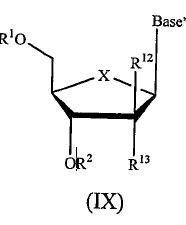
or a pharmaceutically acceptable salt thereof, wherein:
R1 and R2 are independently H; phosphate; straight chained, branched or cyclic alkyl; acyl; CO-alkyl; CO-aryl; CO-alkoxyalkyl; CO-aryloxyalkyl; CO-substituted aryl; sulfonate ester; benzyl, wherein the phenyl group is optionally substituted with one or more substituents; alkylsulfonyl; arylsulfonyl; aralkylsulfonyl; a lipid; an amino acid; a carbohydrate; a peptide; cholesterol; or a pharmaceutically acceptable leaving group which when administered in vivo is capable of providing a compound wherein R1 and/or R2 is independently H or phosphate;
X is O, S, SO2, or CH2;
Base* is a purine or pyrimidine base;
R12 is C(Y3)3;
Y3 is independently H, F, Cl, Br or I; and
R13 is fluoro.
7 Claim 8 also claims a compound of Formula (IX) but where X is O and Y3 is H.
8 Claim 10 claims a pharmaceutical composition comprising an effective amount to treat a Flaviviridae infection of a compound, or a pharmaceutically acceptable salt thereof, of any of claims 1 to 9 in a pharmaceutically acceptable carrier.
9 Claim 13 claims the composition of claim 10 wherein the Flaviviridae virus is HCV.
1.2 The allegations of invalidity – a brief overview
10 Gilead contends that the relevant claims of the Idenix patent are not fairly based on the priority documents on which Idenix relies, the 350 and 949 applications. As such, the Idenix patent is not entitled to the priority dates of 28 June 2002 or 14 May 2003, but is only entitled to the date on which the specification for the Idenix patent was filed, being 27 June 2003. If this is so, then assuming that the Clark patent is entitled to the priority date of 30 May 2003, the relevant claims of the Idenix patent would not be novel because the same invention is anticipated by the Clark patent.
11 Gilead contends that the relevant claims of the Idenix patent (claim 7 and all dependent claims) are not fairly based on the specification. In particular, Gilead contends that there is no real and reasonably clear disclosure in the specification of a compound which has an F (fluorine or fluoro) at the 2' down position together with methyl at the 2' up position, a nucleobase that includes natural bases, and a prodrug element only at the 5' position but such compounds are within claim 7 and dependent claims.
12 Gilead contends that the Idenix patent does not sufficiently describe how to synthesise compounds falling within claim 7, in particular because it does not describe how to produce a compound that contains F at the 2' down position of the sugar ring of the compound and installing F at that position and a carbon containing group such as methyl (Me or CH3) at the 2' up position was not routine chemistry as at the claimed priority dates of the Idenix patent.
13 Gilead also contends that the Idenix patent does not identify which of the compounds within claim 7 are effective for the treatment of Flaviviridae infections or HCV and does not describe how to identify such compounds.
14 Gilead contends that the Idenix patent claims that the compounds described are useful in the prevention and treatment of Flaviviridae infections including HCV but the relevant claims encompass compounds (or compositions or uses) that either cannot be made (those where Y3 is bromine (Br) or iodine (I)) or are inactive against Flaviviridae infections including HCV or are toxic or both.
15 Gilead contends that the Idenix patent claims trillions of compounds which the patent asserts but does not demonstrate are useful in the prevention and treatment of Flaviviridae infections including HCV. As such, the Idenix patent contains an abstract idea but not a manner of manufacture.
16 Gilead contends that the Idenix patent makes representations about the making of compounds and their efficacy in the treatment of Flaviviridae infections including HCV which were false and material to the grant of the patent.
17 If any one or more of Gilead’s contentions is correct, the Idenix patent is (or relevant claims are) invalid.
18 There were a number of disputes between the parties about the knowledge that would be attributed to the skilled addressee of the Idenix patent. Despite this, the parties agreed that certain concepts would have been known to, accepted and assimilated by the bulk of persons skilled in the art with which the Idenix patent is concerned irrespective of the priority date of the patent. Accordingly, these may be accepted to form part of the common general knowledge (sometimes abbreviated to CGK in the submissions of the parties) by reference to which the Idenix patent is to be construed.
19 This common general knowledge concerns matters of organic, specifically nucleoside, chemistry and virology.
20 Apart from some basic information about nucleotides which I also consider to have been part of the common general knowledge of the skilled addressee of the Idenix patent, the following summary is based on the documents (a chemistry primer and virology primer) which were the subject of agreement between the parties. It should be noted that certain statements are not included in this summary, being matters I consider potentially inconsistent with specific submissions the parties made about the common general knowledge. If any inconsistency remains, this section is to be read subject to my specific findings about the common general knowledge, which appear below.
2.2 Organic and nucleoside chemistry
21 The sharing of electrons between two atoms can result in the creation of chemical bonds. Each single chemical bond contains two electrons.
22 Each C (carbon) atom has 4 electrons available to share with other atoms for bonding so that it can make four bonds with other atoms. Each H (hydrogen) atom has one electron available to share, meaning that hydrogen can form only one bond with another atom.
23 The bond created by the sharing of the electrons between C – H is covalent which means the bond is created by the sharing of electrons. The sharing of one pair of electrons is commonly referred to as a single bond. When two pairs of electrons are shared between the same two atoms, this is called a double bond. When three pairs of electrons are shared between the same two atoms, this is called a triple bond.
24 Covalent bonds are different to ionic bonds. Ionic bonds form due to an electrostatic attraction between two charged atoms or molecules. Charged atoms or molecules are known as ions. In an ionic bond, two or more ions of opposite charge are attracted to each other in an interaction that does not involve sharing electrons. Rather, an ionic interaction involves the pairing of opposite charges which are respectively positive and negative.
25 In the context of organic chemistry, an analogue is a molecule or compound to which at least a single chemical change has been made relative to a natural compound.
26 Conjugate is the name often given to a molecule where two or more classes of molecules are linked together. For example, a peptide that is attached to a nucleic acid is a conjugate.
27 An enzyme is a biological molecule that catalyses (or accelerates) a chemical reaction.
28 A functional group is the term organic chemists use to describe structural elements that exhibit particular chemical behaviours or properties. For example, one common functional group in organic chemistry is a hydroxyl.
29 A hydroxyl (also referred to as a hydroxy group) is commonly represented by the shorthand letters OH. A hydroxyl attached to a carbon atom is referred to as an alcohol. Hydroxyls (OH) are commonly referred to as primary, secondary or tertiary hydroxyls based on the classification of the carbon atom to which the OH substituent is bonded. A carbon is classified as a primary, secondary or tertiary carbon if it is bonded to one, two or three carbons, respectively. For example:
(1) a primary hydroxyl (1° hydroxyl) is bonded to a carbon atom that has one further carbon atom attached;
(2) a secondary hydroxyl (2° hydroxyl) is bonded to a carbon atom that has two further carbon atoms attached; and
(3) a tertiary hydroxyl (3° hydroxyl) is bonded to a carbon atom that has three further carbon atoms attached.
30 The term heteroatom is the term commonly used to describe any atom other than a carbon or hydrogen in an organic molecule.
31 Ligand is the name given to a molecule that binds specifically to a receptor site of another molecule.
32 Polymorph is a different crystalline form of the same compound. Polymorphs are not different compounds, just different solid states of a compound.
33 Pharmacokinetics is the study of what happens to a drug once it is introduced into the body and in general terms involves the study of the absorption, distribution, metabolism and excretion of a drug.
34 Reagents are compounds usually used to help bring about chemical change in other compounds.
35 A molecule is considered a tautomer (or tautomeric) if it can exist in another form of itself, simply by an internal rearrangement of electrons and bonds. A tautomer can freely interconvert between its tautomeric forms. In general, one tautomeric form of a molecule will predominate over the others. For example, the nucleobases adenine, cytosine, guanine, thymine and uracil exist as tautomers.
36 Organic molecules can have the same molecular formula (i.e. have the same number of each type of atom) but may be different chemical substances. These molecules are called isomers. When two molecules have the same molecular formula but the atoms are connected differently, the molecules are known as structural isomers. Where two molecules have the same molecular formula and atoms are connected in the same way, but differ in their structural arrangement in space, the molecules are known as stereoisomers.
37 Stereochemistry is concerned with the two-dimensional (2D) and three-dimensional (3D) shape of molecules. Stereoisomers, as noted, are compounds which have the same chemical formula and the atoms bonded in the same order but the atoms are arranged differently in space. Enantiomers and diastereoisomers are two types of stereoisomers.
38 An aspect of organic chemistry and stereochemistry is the concept of chirality. The word chiral is a Greek term meaning “handed”. A chiral molecule is a type of molecule that has a non-superimposable mirror image, analogous to the left and right hands and these forms are typically referred to as enantiomers. The figure below illustrates the enantiomers of the amino acid alanine which has one chiral carbon. One structure is the enantiomer of the other. In nature, one enantiomeric form may be more prevalent than the other.
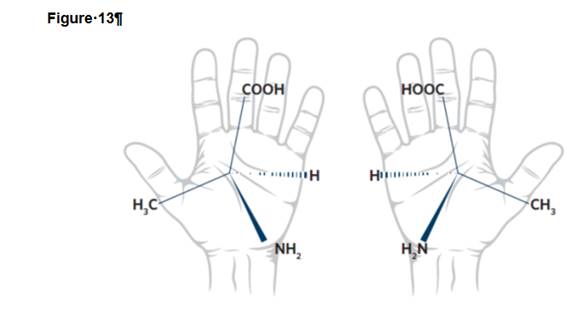
39 Carbon is a good example of an atom that can be chiral. A carbon atom can form four bonds. When a carbon atom has four groups attached to it through four single bonds, it is referred to as being in a tetrahedral arrangement. If each of the four groups attached to the carbon atom through four single bonds are different, then the carbon is a chiral carbon (also known as a stereocentre). Amino acids, sugars and nucleosides are usually chiral molecules.
40 Enantiomers have the same physical properties when analysed using non-chiral methods and can only be distinguished from each other in a chiral environment. The human body is an example of a chiral environment. Enantiomers rotate plane polarised light (which refers to light which has been filtered to select only light in a single plane) to the same degree but in opposite directions. This ability to rotate plane polarised light is referred to as optical activity. If a solution of a molecule fails to rotate plane polarised light, this could be due to a number of reasons including that the solution contains non-chiral molecules or it contains a racemate and is a racemic mixture, which is a mixture that contains two enantiomers in equal proportions.
2.2.3 Conventions for drawing and naming organic molecules
41 The simplest method for drawing an organic molecule uses a structural formula or skeletal formula. A structural formula shows how the atoms are bonded and each bond is represented by a single line. In a skeletal formula:
(1) the hydrogen and carbon atoms are not illustrated, but the carbon atoms are represented by the intersection (or vertices and termini) of carbon chains;
(2) the lines themselves represent the bond connecting the carbon atoms; and
(3) any other non-hydrogen groups attached to the carbon atoms are illustrated.
42 Because stereochemistry is such an important concept in organic chemistry, a number of conventions have been devised in order to allow representation of 3D concepts on paper. The 3D stereochemistry of molecules can be illustrated on paper in 2D form by, for example, using the following generally accepted drawing conventions:
(1) a solid wedge indicates that the bond or group is projecting out of the plane of the page towards the observer;
(2) a broken hashed wedge indicates that the bond or group is pointing into the plane of the page away from the observer;
(3) a straight line indicates that the bond or group is in the plane of the page; and
(4) a wavy (or wiggly) line indicates either (1) unknown or undefined stereochemistry or (2) a mixture of two stereoisomers, but not necessarily a 50:50 mixture.
43 Haworth projections are used to depict rings of atoms and provide an illustration of the stereochemistry of the groups attached to the ring. By convention, the thickened line at the bottom of the sugar ring indicates atoms which are coming out of the page towards the observer. In a Haworth projection the substituents are drawn in the “up” and “down” orientation, which illustrates that these substituents are either above or below the plane of the sugar ring, respectively. An example of a Haworth projection for glucose is illustrated below:
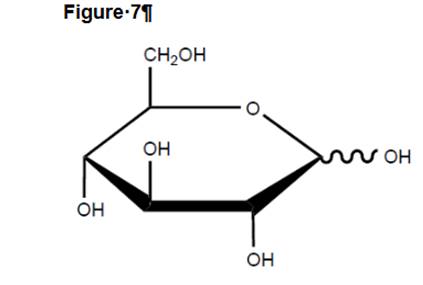
44 It is common convention to show organic molecules without illustrating all of the C and H atoms, as illustrated above. However, an organic chemist understands that both the C and H atoms are present even though they are not explicitly labelled as “C” and “H”.
45 A Haworth projection for glucose and an example nucleoside showing the C and H atoms and their numbering conventions is illustrated below:
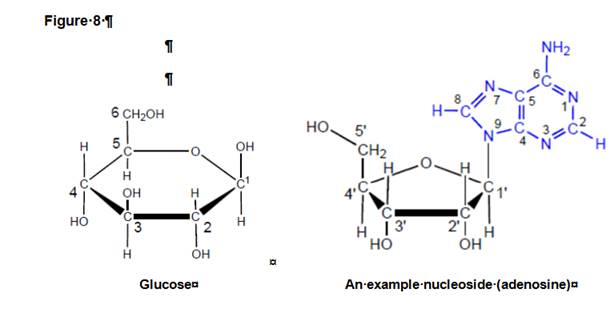
46 A Markush structure illustrates a group of compounds with common features, together with each of the variable groups which are typically labelled as R or other letters of the alphabet that do not depict chemical elements such as X, Y and Z. A Markush structure can also be expressed in a Haworth projection to illustrate the stereochemistry features of the compounds of the Markush structure. An example Markush structure in a Haworth projection for a nucleoside is illustrated below:
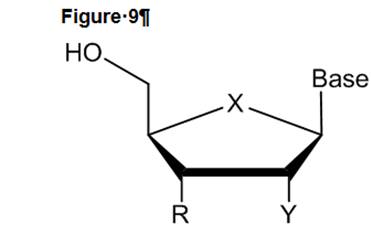
47 Carbon atoms on a sugar are numbered consecutively starting with number 1 which is assigned to the most highly oxidised carbon. In nucleoside chemistry the numbers of the carbons of the sugar are designated using the symbol (') termed “prime”, and the positions on the nucleobase are numbered using non-prime numbering. Prime numbering can be written in a number of accepted ways including 1', C1', 1'C and 1'-C. Figure 8 above illustrates the different numbering systems used for carbohydrates (using glucose as an example) and nucleosides (using adenosine as an example).
48 The stereochemical configuration of a chiral atom can be conveyed from the way the compound is named. A commonly used convention for defining the stereochemical configuration of a chiral atom is by using the letters R and S. An organic chemist can determine whether a chiral atom is of an R or S configuration by ranking the four different groups attached to the chiral atom. Each group is ranked by the atomic number of the atom closest to the chiral carbon atom. The group with the highest atomic number is ranked first, the group with the second highest atomic number is ranked second, the group with the third highest atomic number is ranked third, and the group with the smallest atomic number is ranked fourth.
49 The D and L terminology is another descriptor of stereochemistry as it relates to a sugar or an amino acid. Designation of a sugar as D or L is based on the orientation of a particular substituent. In the context of a nucleoside, it is the 4'-position which determines whether a nucleoside will be designated as D or L. If drawn as a Haworth projection and in the conventional orientation, when the substituent at the 4'-position is orientated above the plane of the ring it is a D nucleoside, and when below the plane of the ring, it is an L nucleoside.
2.2.4 Organic chemical reactions
50 In a typical substitution reaction (more correctly referred to as nucleophilic substitution and sometimes referred to as a displacement reaction) an atom or group of a molecule is replaced (substituted) with another atom or group. Nucleophilic substitution is generally taught in undergraduate organic chemistry and is one type of reaction between an electron donator (nucleophile, Nu-) and an electron acceptor (electrophile). Nucleophiles are electron-rich molecules and because of their excess of electrons, they tend to react with electron-poor molecules and are therefore classed “nucleus loving”. Electrophiles are electron-poor molecules and because of their lack of electrons, they tend to react with electron-rich molecules and are therefore classed “electron loving”.
51 In a typical elimination reaction, a hydrogen atom attached to one carbon atom is removed by a base and a group on an adjacent atom is removed (or eliminated). In elimination reactions, a new double bond is formed between the two participating carbon atoms.
52 A typical addition reaction is the opposite of an elimination reaction. A carbon to carbon double bond is converted to a carbon to carbon single bond and an additional atom or group is added to each of the participating carbon atoms.
53 Synthesis is the process of using a series of chemical reactions to break down, build up or reconstruct molecules. Often starting with simple, commercially available starting materials, a series of controlled organic reactions (or chemical transformations) is used to turn those materials into a compound of interest.
54 A reaction scheme is a standard tool used by organic chemists and represents a pictorial road map of the series of chemical reactions (i.e. a reaction sequence) which are performed in a particular order to form a compound of interest. Reaction schemes are also sometimes referred to as synthetic pathways or schemes.
55 Reagents used in reaction schemes can selectively react with a particular group out of a number of chemically similar groups (called a chemoselective reagent) or particular molecules having a particular stereochemistry or react to give a particular stereochemistry (called stereoselective reagents).
2.2.6 Amino acids, peptides and proteins
56 Amino acids are compounds that have a carboxyl group (-COOH, where C is carbon, O is oxygen and H is hydrogen) bound indirectly to an amino group (-NH2 where N is nitrogen and H is hydrogen) and a side chain (commonly referred to as R).
57 Peptides, polypeptides and proteins are chains of amino acids joined together by peptide bonds.
58 The terms protein and polypeptide are frequently used interchangeably, with the term protein being more commonly used for a naturally occurring polypeptide. Proteins can be broken down or cleaved into fragments which may be termed peptides or polypeptides. Each of these fragments can be further broken down into their individual amino acids. Peptides, proteins and polypeptides can also be made by chemical synthesis or by recombinant methods.
2.2.7 Nucleosides and nucleotides
59 Nucleoside chemistry refers to the study, manipulation and use of a class of molecules known as nucleosides. The term nucleoside chemistry is also colloquially used to describe the study, manipulation and use of either nucleosides or nucleotides.
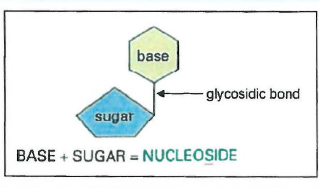
60 A nucleoside is a chemical compound which is made up of two parts:
(1) a heterocyclic base (which is typically called a base or more precisely, a nucleobase however both terms can be used interchangeably); and
(2) a sugar (for example, ribose in ribonucleic acid or RNA or a 2'-deoxyribose in deoxyribonucleic acid or DNA),
and the sugar and nucleobase are linked by a glycosidic bond.
61 The general structure of a nucleoside can be schematically represented as follows:
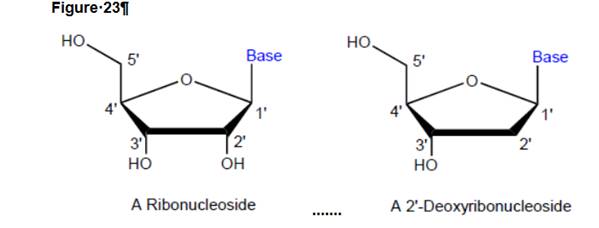
62 The structures of a naturally occurring ribonucleoside and deoxyribonucleoside (specifically a 2'-deoxyribonucleoside) are illustrated below:
63 A nucleotide comprises a nucleoside to which one or more phosphate groups has been covalently bonded. The process by which phosphate groups are added to the sugar group of a nucleoside is known as “phosphorylation”.
64 A nucleobase is a core component of a nucleoside and a nucleotide. Nucleobases naturally occurring in 2'-deoxyribonucleosides and 2'-deoxyribonucleotides are adenine (A), guanine (G), thymine (T) and cytosine (C). Nucleobases naturally occurring in ribonucleosides and ribonucleotides are adenine (A), guanine (G), cytosine (C) and uracil (U) (instead of thymine which is present in 2'-deoxyribonucleosides and 2'-deoxyribonucleotides only).
65 These nucleobases fall within two groups – purine and pyrimidine. A purine is a 5-membered ring fused to a 6-membered ring (each ring containing two nitrogen atoms). Guanine (G) and adenine (A) are members of a class collectively called purines. A pyrimidine is a single 6-membered ring (containing two nitrogen atoms). Thymine (T), cytosine (C) and uracil (U) are members of a class collectively called pyrimidines.
66 Positions on the nucleobase are distinguished from those on the sugar in a nucleoside by adopting non-prime numbering for the nucleobase.
67 Modifications can be made to the naturally occurring nucleobases to produce a nucleoside analogue or nucleotide analogue when the modified nucleobase is linked to the sugar (which may itself also be modified). Naturally occurring nucleosides and nucleotides can be altered at almost every position of the sugar ring or the nucleobase.
68 The sugar component of a nucleoside or a nucleotide is a cyclic sugar. The sugar component of a natural ribonucleoside or ribonucleotide is ribose which is a five carbon sugar. The sugar component of a natural deoxyribonucleoside or deoxyribonucleotide is deoxyribose, specifically a 2'-deoxyribose which indicates that no hydroxyl (OH) is present at the 2'-position.
69 The ring of a ribose contains four carbon atoms and one oxygen atom. As noted earlier, the carbon atoms of the sugar in a nucleoside are identified using prime numbering and the 1'-carbon is known as the anomeric carbon. The remaining carbons on the sugar are then numbered consecutively in a clockwise manner.
70 The oxygen atom naturally present in a sugar ring and commonly drawn at the top of chemical structures for the sugar ring is referred to as the ring oxygen.
71 The sugar and nucleobase of a nucleoside are connected by a chemical linkage referred to as a glycosidic bond. In the laboratory, the process used to create a glycosidic bond and thereby attach the sugar to the nucleobase is known as glycosylation (glycosylation is a general term used to describe the attachment of a sugar to another molecule). Nucleosides and nucleotides (and analogues thereof) in which the nucleobase is attached by a nitrogen (N) atom to the anomeric carbon (1'-carbon position) of the sugar ring (a N - C linkage) are referred to as N-nucleosides.
72 When the nucleobase is a naturally occurring pyrimidine (cytosine, thymine or uracil) the 1'-carbon of the sugar attaches to the nitrogen at the 1-position on the nucleobase which is referred to as N1.
73 When the nucleobase is a naturally occurring purine (guanine or adenine) the 1'-carbon of the sugar attaches to the nitrogen at the 9-position on the nucleobase which is referred to as N9.
74 The nucleobase and sugar can also be connected via a carbon-carbon linkage. That is, the 1'-carbon of the sugar and a carbon in the nucleobase. These nucleosides are referred to as C-nucleosides.
75 While adenine, guanine, thymine, cytosine and uracil are naturally occurring nucleobases, the corresponding nucleosides containing adenine, guanine, thymine, cytosine and uracil nucleobases are referred to as adenosine, guanosine, thymidine, cytidine and uridine, respectively.
76 In general, the stereochemical configuration of nucleosides is described using D and L terminology (as described above) and alpha (α) and beta (β) terminology.
77 The α and β terminology refers to the orientation of the nucleobase at the 1'-position relative to the orientation of the substituent (or group) at the 4'-position. Where the nucleobase and substituent at the 4'-position are on the same side of the ring, a nucleoside is classified as a β-nucleoside and where the nucleobase and substituent at the 4'-position are on opposite sides of the ring, a nucleoside is classified as an α -nucleoside. The difference is shown below:
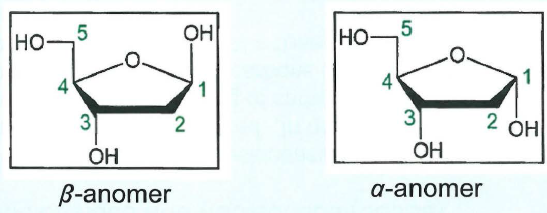
78 Although the α and β terminology is based on the orientation of the nucleobase relative to the substituent (group) on the 4'-position, the alpha and beta terminology is sometimes loosely used to describe whether substituents at any position on the sugar are on the α -face or β -face of the sugar ring.
79 The α and β terminology and the D and L terminology can be used together to describe the orientation and stereochemistry of nucleosides. For example, a nucleoside chemist understands that the name 2'-D or L-valine ester of β-D-2',6-dimethyl-cytidine indicates that:
(1) the compound is derived from the nucleoside cytidine. The β -D indicates that the stereochemistry of the nucleoside is of a particular configuration: in this case it is in the configuration of the natural nucleoside;
(2) there are two methyl groups in the nucleoside: one at the 2'-position on the sugar and one at the 6-position of the cytosine nucleobase; and
(3) the OH group normally present at the 2'-position has been converted to a valine ester. The reference to 2'-D or L valine indicates that the stereochemistry of the valine ester is unspecified. That is, the valine may be in the D or L configuration.
80 One of the modifications that may be made to a natural nucleoside is the substitution of a carbon atom for the oxygen atom in the five-membered ring of the sugar of the nucleoside.
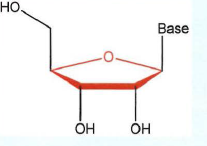
81 Carbohydrates that have a chemical structure that includes a five membered ring consisting of four carbon atoms and one oxygen atom are collectively identified by the term “furanose”. The ring structure of such carbohydrates is referred to as the “furanose ring”. The furanose ring in a nucleoside is shown in red below:
82 Nucleoside analogues in which a carbon atom has been substituted for the oxygen atom of the five-membered sugar are referred to as “carbocyclic nucleosides”. The ring structure of such compounds is referred to as a “carbocyclic ring”.
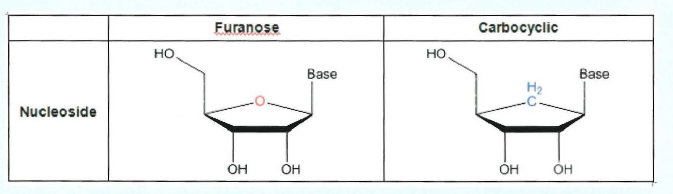
83 Prior to 2002, carbocyclic nucleosides had been reported as being more metabolically stable than natural nucleosides. This was reported as being due to the fact that they were not subject to the action of nucleoside phosphorylase and hydrolase enzymes that cleave the glycosidic linkage of natural nucleosides.
2.3 Nucleosides and nucleotides as antiviral drugs
84 HCV is a single-stranded RNA virus that infects liver cells in humans. HCV replicates using the intracellular machinery of its host cell. One of the key processes in the replication of HCV is the making of multiple copies of the HCV RNA. The enzyme responsible for this process is a viral RNA dependant- RNA-polymerase called NS5B.
85 One mechanism by which nucleoside analogues can act as antiviral drugs is by the inhibition of the viral polymerase. In order to do so, the nucleoside analogue must be recognised by the relevant enzymes involved in the processes of phosphorylation (to be converted into the active triphosphate form) and RNA synthesis (to be incorporated into the growing RNA chain) described above (i.e. be a suitable substrate for those enzymes). Once incorporated into the RNA chain, the nucleoside analogue disrupts growth of the chain, resulting in chain termination. In the case of HCV, the nucleoside analogue (in the triphosphate form) must be recognised by NS5B as a substrate to be incorporated into the growing RNA chain.
86 Where the nucleoside analogue does not possess a 3'-hydroxyl group, chain termination results because an incoming nucleotide cannot be attached to the RNA chain. Where the nucleoside analogue does possess a 3'-hydroxyl group, chain termination can still result where the modification(s) to the nucleoside analogue prevent the formation of a 3', 5'-phosphodiester bond with an incoming nucleoside. For example, the modification(s) may alter the conformation (shape) of the sugar ring so that the 3' -hydroxyl group is not correctly positioned for the formation of a 3', 5'-phosphodiester bond. Alternatively, the modification(s) may sterically hinder the formation of a 3',5'-phosphodiester bond.
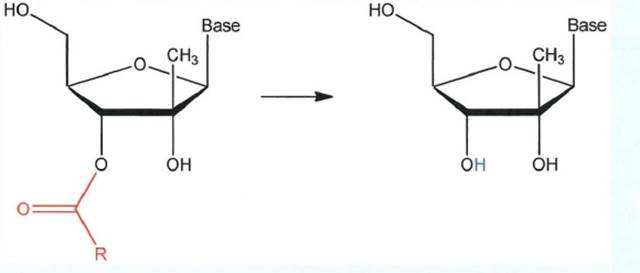
87 An example of a prodrug modification at the 3'-position of a nucleoside is the addition of an acyl group. An acyl group is comprised of a carbonyl (C=O) attached to a carbon-containing group (R). When an acyl group is bonded to the oxygen atom of an hydroxyl group, the new group formed is called an ester.
88 The structure of a 2'-methyl-“up” nucleoside analogue with a 3'-acyl (or 3'-ester) prodrug modification is shown below. This is an example of a nucleoside prodrug. After metabolism in the body, the 2'-methyl-“up” nucleoside analogue is formed.
89 A specific example of an ester prodrug modification is the addition of valine. Valine is a naturally-occurring amino acid. Amino acids contain both an amino group (NH2) and a carbocyclic acid group (COOH). The structures of valine and a nucleoside analogue with a 3'-valine prodrug modification are shown below.
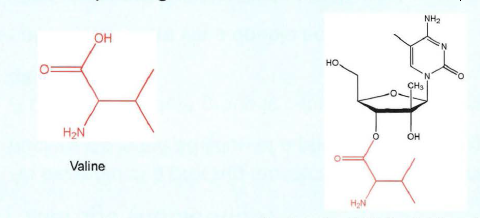
90 An example of a prodrug modification at the 5'-position of a nucleoside is the addition of a phosphoramidate group. A phosphoramidate group is comprised of a phosphorus atom attached to:
(1) an oxygen atom via a double bond;
(2) two oxygen atoms via single bonds; and
(3) a nitrogen atom via a single bond.
91 The structure of a 2'-methyl-“up” nucleoside with a 5'-phosphoramidate prodrug modification is shown below. This is an example of a nucleotide prodrug. After metabolism in the body, the 2'-methyl-“up” nucleoside monophosphate analogue is formed.
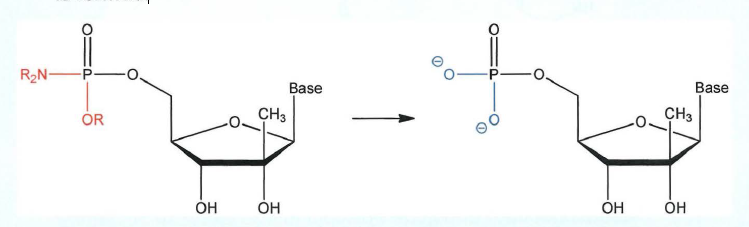
92 Virology is the study of viruses.
93 A virus is an infectious microorganism that replicates inside the cells of other organisms. A virus is composed of nucleic acid (either ribonucleic acid (RNA) or deoxyribonucleic acid (DNA)) in a protein coat, which is able to deliver the nucleic acid to target (host) cells. This viral nucleic acid contains sufficient coding capacity to permit its replication to produce new virus. Viruses enter host cells via processes known as “adsorption” and “penetration”, and, once inside the host cell, the virus is uncoated, leaving the viral nucleic acid within the cytoplasm of the cell, from where it may or may not migrate to the nucleus. This means that it can be “translated” into proteins and “transcribed” into nucleic acid copies, enabling replication of the virus.
94 Pathogenesis is a general term meaning the study of the process of disease. In the context of viral infections, it refers to the study of the outcomes of viral infection, and the mechanisms of disease. Pathogenesis also involves investigation of the timing of the expression of certain host cellular proteins in response to viral infection, and the impact of viral proteins on cellular proteins, cell division or cell death.
95 The Flaviviridae are positive-sense, single-stranded RNA enveloped viruses. That is, the Flaviviridae genome:
(a) consists of RNA (whereas some virus genomes consist of DNA);
(b) consists of a single strand of RNA (whereas some RNA virus genomes are double-stranded); and
(c) consists of “positive-sense” RNA (whereas some single-stranded RNA virus genomes consist of “negative-sense” RNA). The key difference between positive-sense and negative-sense RNA is that positive-sense RNA is similar to messenger RNA (mRNA) in that it can be used directly by host-cell machinery to produce new proteins, while negative-sense RNA must first be “transcribed” (see below) to produce positive-sense RNA before new proteins can be synthesised.
96 The Flaviviridae are “enveloped” viruses. This means the genome is encapsulated in a core (capsid) protein which is in turn enveloped by a lipid (i.e. fat or oil) envelope into which the envelope proteins are inserted. This is shown in the figure below, which is a diagram of HCV.
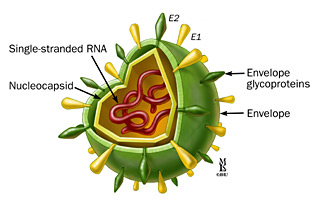
Figure 1 – ‘enveloped’ structure of HCV, a member of the Flaviviridae.
97 Within the Flaviviridae there are currently four genera, as shown in the table below. The fourth genus, pegivirus, was proposed in 2011 but the other three were recognised by 2002.
Family | Genus | Example strains (viruses) |
Flaviviridae | flavivirus | yellow fever virus (YFV), dengue virus (DENV), West Nile virus (WNV) |
pestivirus | bovine viral diarrhoea virus (BVDV) | |
hepacivirus | HCV, GB virus B (GBV-B) | |
pegivirus | GB virus A (GBV-A) (or simian pegivirus, SPgV), GB virus C (GBV-C) (or human pegivirus, HPgV), GB virus D (GBV-D) (or bat pegivirus, BPgV) |
Table 1 Flaviviridae genera and example strains
98 Flaviviridae viruses were grouped together because they exhibited a certain sequence conservation as well as similarity in their genomic organisation and the general features of the lifecycle of the viruses, and they all replicate their genome via an RNA-dependent RNA polymerase. In addition, each virus shares similarities in virion morphology including the size and shape of the viral particle. However, each virus in the family was recognised as having a unique set of biological properties, such as, for example, host and cell type tropism and pathogenic properties, as well as different proteins and antigens.
99 Of the Flaviviridae, only HCV generally causes persistent (or chronic) infection in humans:
(a) pestiviruses, GBV-A, GBV-B and GBV-D do not infect humans (GBV-A and GBV-B are monkey viruses, and GBV-D is a bat virus);
(b) flaviviruses generally cause acute (i.e. self-limiting) infection in humans; and
(c) GBV-C causes acute asymptomatic infection in humans.
100 “Viral replication” may refer to the entire process of producing new virus to be released from the host cell or the term “replication” may be used to describe the narrower step of copying the viral nucleic acid, or “viral genome” itself (which is one step in the broader replication of the virus, described below).
101 The diagram below sets out the general steps involved in replication of positive-sense RNA viruses (such as the Flaviviridae) from viral entry into the host cell through to the exit of new virus ready to infect new cells.
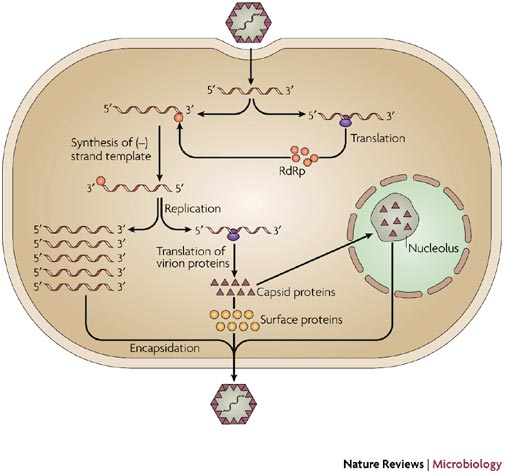
Figure 2 – General strategy for positive-sense virus replication.
102 Generally speaking, the process of viral replication for Flaviviridae is as follows:
(a) The virus enters the cell and “uncoats” to release the viral RNA into the cytoplasm of the host cell.
(b) The genetic information encoded in the viral RNA (i.e. genes) is utilised, in a process known as “translation”, to produce a “polyprotein” constituted by all the viral proteins in an immature state. Both during and after translation, the polyprotein is progressively cleaved (i.e. cut) by a combination of host-cell enzymes and enzymes within the polyprotein itself into the individual viral proteins. These viral proteins are necessary to produce new virus.
(c) One of the proteins produced from the polyprotein, the RNA-dependent RNA polymerase (RdRP), then makes new copies of the viral RNA, in a process known as “transcription”. Transcription of positive-sense viral RNA produces a complementary, negative-sense strand. This results in the production of a double-stranded RNA molecule (i.e. incorporating both the original positive-sense RNA and the negative-sense RNA) that is then used as a template for the production of nascent (i.e. growing) positive-sense RNA. This positive-sense RNA is a copy of the original viral RNA. Although the above diagram shows only RdRP being involved in transcription, this is a simplified illustration. In fact, transcription uses a “replication complex” that contains a number of proteins necessary for the replication of the viral RNA. In most RNA viruses (including Flaviviridae), a number of host cell proteins contribute to viral RNA replication in the replication complex.
(d) The positive-sense viral RNA that has been produced can then:
(i) produce more viral proteins;
(ii) produce more negative-sense RNA templates for synthesis of new positive-sense viral RNA; or
(iii) be “encapsidated” by the capsid protein, which is then enveloped by the envelope proteins by budding into the lumen of the endoplasmic reticulum (a network of intracellular membranes) to produce new virus that is then secreted from the host cell (and can then infect new cells).
103 As noted above, HCV is a member of the Flaviviridae family, genus hepacivirus. HCV itself has recently (in 2014) been recognised as having seven genotypes (and 67 sub-types). Classification of viruses into genotypes and sub-types is based upon the similarity in their genome. HCV genotypes can vary by as much as 30% in gene sequence. Viruses within an HCV genotype typically contain more closely related sequences, and vary by approximately 20% in gene sequence, or 10% within sub-types.
104 HCV has a genome of approximately 9.6kb (i.e. the RNA strand consists of approximately 9,600 nucleotide bases).
105 Below is a diagram setting out the organisation of the HCV genome including, in particular, the genes coding for the viral proteins. The figure starts on the left-hand side with the 5' NTR, or 5' UTR, or 5' NCR (shorthand for “5 prime non-translated region”, “5 prime untranslated region” and “5' non coding region”, respectively), which is 341 nucleotides long and acts as an internal ribosome entry site (IRES). An IRES is a structure that allows the viral RNA to directly interact with a host cell’s protein-making machinery, called ribosomes, in order to translate new viral proteins. HCV is one of the few Flaviviridae with an IRES (GBV-B is another).
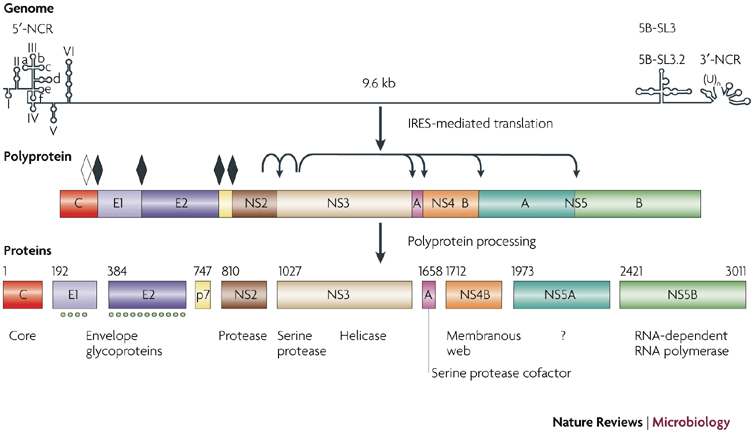
Figure 3 – Organisation of the HCV genome
106 The organisation of the HCV genome is also depicted below.
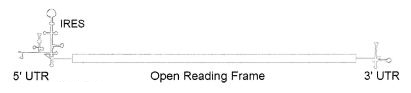
Figure 1: HCV genome (adapted from Dubuisson et al, "Interaction of hepatitis C virus proteins with host cell membranes and lipids" (2002) 12 Trends in Cell Biology 517 at 518).
107 As discussed above, during viral replication, the viral proteins are produced by translating the HCV genome to produce a polyprotein, which is co- and post-translationally (i.e. at the same time as, and after, translation) cleaved into the smaller mature proteins. The “structural” proteins (i.e. C, E1 and E2) are cleaved by host cell protease (an enzyme which breaks down the peptide bonds between amino acids), and the “non-structural” proteins are cleaved by viral enzymes. The “structural” proteins are so-called because they physically make up each virus particle (i.e. the capsid and protein coat described above). The “non-structural” proteins do not form part of the virus particle, but are produced as part of (and play a role in) the replication cycle inside a host cell.
108 The structural (C, E1 and E2) proteins are encoded by the core (C) and envelope (E1 and E2) genes respectively:
(a) C protein: the main role of the HCV core protein is to form the capsid, which carries and protects the HCV genome. Once the capsid contains the HCV genome, the capsid and genome together are referred to as a nucleocapsid.
(b) E1 and E2 proteins: the nucleocapsid is then enveloped in a lipid-based envelope in which the HCV envelope proteins are embedded.
109 The organisation of the HCV polyprotein is depicted below.
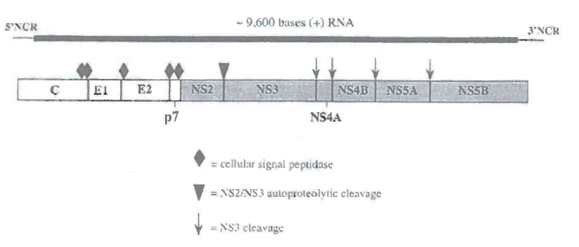
Figure 2: Structure of the HCV polyprotein (adapted from Knipe et al (eds.), Fields Virology (Lippincott Williams & Wilkins, 4th ed, 2001) 1129).
Note that one of the diamonds between the C and E1 proteins is not a cellular signal peptidase (as indicated in Figure 2) but a cellular signal peptide peptidase.
110 The remainder of the HCV genome encodes the non-structural, or NS, proteins:
(a) p7 is thought to be an ion channel protein that is essential for efficient assembly and release of infectious virus particles. Although it is probably a non-structural protein it has sometimes been classified as a structural protein.
(b) NS2 is thought to be required for viral morphogenesis (i.e. the process of assembling the structural proteins and viral genome into a complete virus particle). It self-cleaves from the polyprotein between NS2 and NS3.
(c) NS3 is a multifunctional protein, with protease, helicase and ATPase activity. When acting as a protease, NS3 recognises and cleaves the HCV polyprotein into the individual, smaller, viral proteins. This protease activity is dependent on an interaction with NS2 and NS4A. Specifically, NS3 interacts with NS2 to cleave itself from NS2 and, thereafter, it requires NS4A as a cofactor to cleave the remaining non-structural proteins. When acting as a helicase, NS3 unwinds the viral RNA so that the RNA can be more efficiently copied by the viral replication complex. As an ATPase, it helps release the energy required to unwind the viral RNA, by releasing phosphate groups from ATP (adenosine triphosphate).
(d) NS4B anchors the virus replication complex to a structure within the host cell called the endoplasmic reticulum. For positive-sense RNA viruses like HCV, viral replication is more efficient when it is anchored to a cellular structure.
(e) The function of NS5A is not known but it is thought to play a role in morphogenesis and the maturation of the virus particle. Despite the fact that its role is not well understood, compounds that inhibit NS5A have been developed as anti-viral therapies.
(f) NS5B is the HCV RNA-dependent RNA polymerase. This polymerase is responsible for making new copies of viral RNA.
111 The NS5B RNA-dependent RNA polymerase is responsible for generating a negative or antisense copy of the viral genome and subsequently using the negative copy as a template for generating positive-strand RNA that could be translated, further transcribed, or packaged into new viruses. The building blocks of RNA are nucleotides. The nucleotide species utilised by the polymerase as the RNA building block is the nucleoside 5' triphosphate. Modified versions of nucleotides or their precursor nucleosides (nucleotide or nucleoside analogues) can be used to prevent replication of HCV RNA.
112 There are a number of steps in the HCV life cycle. Briefly, those steps are as follows:
(a) The first step is attachment of the virus to the hepatocyte. This occurs via binding of the virus to receptors found on the cell surface.
(b) Following binding to the receptor, the virus is internalised in the cell via a process called endocytosis.
(c) Once inside the cell, the viral particle disassembles and releases the viral RNA genome in the cytoplasm.
(d) In the next step, the RNA genome is recognised by the cellular protein synthesis machinery (ribosome) and it is translated into a polyprotein.
(e) Then the polyprotein is subsequently cleaved by the concerted action of cellular and viral proteases into at least 10 individual proteins, including structural and non-structural proteins.
(f) The non-structural proteins NS3 to NS5B form a so-called RNA replication complex, the function of which is to make new copies of the viral RNA.
(g) Newly-synthesised viral RNA genomes can be translated as in step (d) above, further transcribed or interact with the structural proteins to produce new viral particles.
(h) The newly-formed viral particles will exit from the cell and infect surrounding hepatocytes. The HCV life cycle is depicted below.
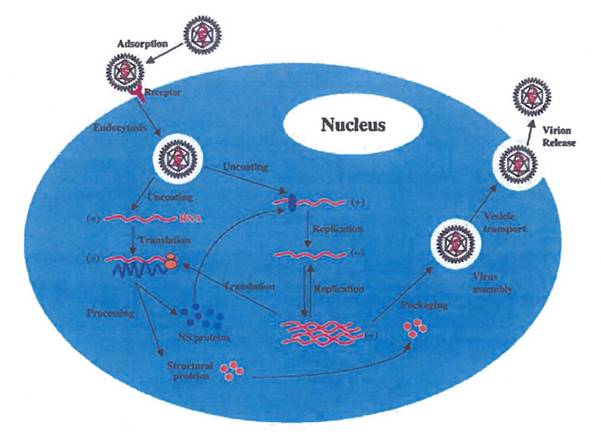
Figure 3: The HCV life cycle (extracted from Shi and Lai, "Hepatitis C viral RNA: challenges and promises" (2001) 58 Cellular and Molecular Life Sciences 1276 at 1285).
2.4.5 Development of HCV anti-virals
113 Although HCV was identified in 1989, by June 2002 HCV researchers still could not grow HCV in cell culture. It was not until 2005 that a strain of HCV was reported that could be grown in the lab (this strain is known as JFH-1).
114 Due to the limitations associated with in vivo animal models and the inability to culture HCV in vitro prior to 2005, early studies of HCV often relied on “surrogate” models. HCV surrogate models sought to mimic the human and HCV biological and viral systems and usually comprised a non-HCV virus (such as BVDV) together with a non-human biological system.
115 Surrogates were ways to study general replication strategies of these viruses, on the assumption that they would be similar between all Flaviviridae family members (including HCV).
116 From around 1994-1995, BVDV was used as a surrogate model for HCV. BVDV is a pestivirus in the Flaviviridae family and, unlike HCV, is able to replicate in cell culture.
2.4.7 HCV protease and polymerase assays
117 The direct screening of potential HCV inhibitors may be done with in vitro polymerase and protease/helicase enzyme assays.
118 A replicon is a nucleic acid molecule that contains all the sequences necessary for its own replication. In the case of the HCV Replicon, the nucleic acid molecule contains all of the RNA sequence required for replication of the HCV RNA genome.
119 Replicons are self-replicating RNA molecules that are generated by genetic engineering and allow researchers to study aspects of viral replication. Replicons can also be used as a screening assay for anti-viral compounds. The first replicon was developed in the mid-1990s using Kunjin, an Australian isolate of WNV (which is a flavivirus). HCV replicons were developed in 1999. As discussed below, reports of the first HCV replicons in 1999 revolutionised HCV research and drug development.
120 The diagram below compares the organisation of the HCV genome (a) with a typical HCV replicon genome (b).
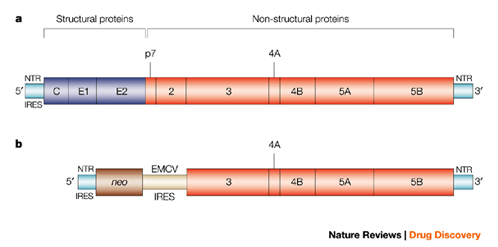
Figure 4 – Organisation of the HCV genome (a) and a typical HCV replicon genome (b).
121 Structurally, classical HCV replicons encode the non-structural proteins of a virus together with a “Neo-selection” system in place of the structural protein genes, and with viral 5' and 3' UTRs. The Neo-selection system consists of:
(a) a neomycin resistance gene, or Neo. Neo expression in a cell confers resistance on that cell to being killed by the addition of neomycin (an antibiotic). If a cell contains a replicon, then replication of that replicon results in the Neo gene also being expressed. Accordingly, only cells successfully transfected with replicons and expressing proteins will be able to grow in cell culture containing neomycin; and
(b) an IRES from encephalomyocarditis virus, or EMCV. As discussed above, an IRES is used to initiate the translation of viral proteins. Because the Neo gene is inserted into the replicon genome, a second IRES is also introduced (one to drive the translation of Neo and one to drive the translation of the HCV non-structural proteins). The EMCV IRES is commonly used to drive translation of proteins in engineered RNA sequences.
122 As the Neo-selection system replaces the HCV structural genes, these replicons cannot produce new virus particles which can be secreted from the cell.
123 As discussed above, the first replicon was developed in the mid-1990s using Kunjin. However, although Kunjin is a flavivirus, the differences between the proteins of Kunjin and HCV meant that the Kunjin replicon could be used to study WNV but could not be used to study HCV or screen for anti-virals with anti-HCV activity. It was not until 1999 that HCV replicons were first developed, independently, in two laboratories: Lohmann and Bartenschlager in Heidelberg, Germany, and Professor Rice’s laboratory in the United States.
124 The development of the first HCV replicons in 1999 provided a much more authentic assay in terms of screening compounds for anti-HCV activity. The replication complex is similar to that in a genuinely HCV infected cell, so the complex interactions between virus-virus proteins and virus-host cell proteins will take place in replicon-transfected cells that will not take place in isolated polymerase or protease assays. Testing is relatively straightforward: compounds of interest are added to a cell culture system in which replicons are successfully replicating, and one observes whether the replication is subsequently inhibited. Originally, this could be done either by leaving the neomycin selection on (such that cells in which replicons ceased replicating would die), or by quantifying the level of replication using a technique such as quantitative RT-PCR. HCV replicons have since been specifically adapted to drug screening with the inclusion of a reporter gene, such as luciferase (which confers bioluminescence), enabling a visual output of the level of replicon activity within cells: if the candidate compound inhibited the virus, the expression of the reporter gene would also be inhibited which results in a measurable decrease in bioluminescence.
125 The design of the HCV Replicon was inspired by the notion that structural proteins are not required for genome replication of several positive-strand RNA viruses, including flaviviruses and pestiviruses, and by the successful design of self-replicating replicons for other Flaviviridae, such as the Kunjin virus and BVDV reported in 1997 and 1998, respectively.
126 The HCV Replicon was derived from the genome of the viral strain Con-1, which was isolated and cloned from the liver of an HCV-infected patient. The Con-1 genome used by Professor Bartenschlager and his team contained the sequences encoding for both the structural and non-structural HCV proteins referred to, respectively, above.
127 Professor Bartenschlager’s group modified the Con-1 genome by deleting the region encoding for the HCV structural proteins and replacing it with the neomycin phosphotransferase (neo) gene. The neo gene codes for the expression of neomycin phosphotransferase, which confers resistance to the antibiotic action of neomycin or its analogue G418. Thus, in a heterogeneous cell population, only those cells that express the neo gene survive treatment with neomycin or G418, while other cells will die. The inclusion of the neo gene therefore permitted the selection of cells supporting efficient replication of the HCV Replicon.
128 The HCV Replicon contained the following elements:
(a) the HCV 5'-UTR and the first portion of the capsid protein fused to the neo selectable marker;
(b) an IRES from the encephalomyocarditis virus (EMCV), which is important to direct the translation of the downstream HCV proteins;
(c) the HCV non-structural proteins NS3 to NS5B; and
(d) the HCV 3'-UTR.
The elements of the HCV Replicon are depicted below.

Figure 4: Structure of the HCV Replicon (adapted from Lohmann et al, "Replication of subgenomic hepatitis C virus RNAs in a hepatoma cell line" (1999) 285 Science 110 at 111).
129 Professor Bartenschlager’s group also reported that HCV Replicons could be maintained in a human hepatoma (liver cancer) cell line (Huh-7) (HCV Replicon system). That is, the HCV Replicon could be taken up by Huh-7 cells and undergo replicon replication.
130 Briefly, the work of Professor Bartenschlager’s group involved the following: a DNA plasmid containing the HCV Replicon sequence was transcribed in vitro to generate HCV Replicon RNA. Transfection of Huh-7 cells with HCV Replicon RNA followed by selection with G418 resulted in a low number of surviving cell colonies. These cells replicated HCV Replicon RNA to high levels (1000 to 5000 copies of positive-strand RNA per cell). The cell colonies were then isolated from the plate and expanded to establish a cell line that carried stably-replicating HCV Replicons. These steps are depicted below.
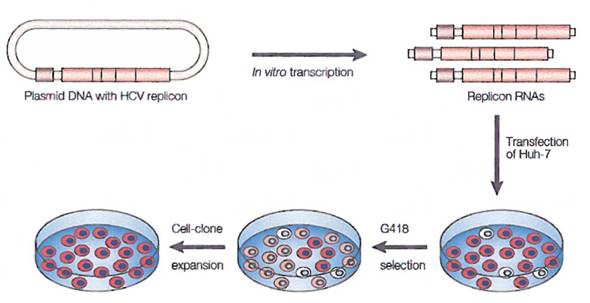
Figure 5: Establishment of cell clones that carry self-replicating HCV replicons (extracted from Bartenschlager et al, "Hepatitis C Virus Replicons: Potential Role for Drug Development" (2002) 1 Nature Reviews Drug Discovery 911 at 913).
131 The HCV Replicon system was the first cell-based system which made it possible to measure HCV RNA replication. This permitted the evaluation of candidate compounds for their ability to inhibit HCV replication in Huh-7 cells. The HCV Replicon system thus provided a way to measure anti-HCV activity of a candidate compound in a cell-based system.
132 In order to screen candidate compounds for anti-HCV activity, using the HCV Replicon system, the following steps are involved:
(a) expose the HCV Replicon cell line to the candidate compound at a particular (fixed) concentration for a period of time that typically ranges from between two to four days; and
(b) measure the extent of inhibition by the candidate compound by measuring viral RNA or viral protein levels. To do this, the cells are lysed and viral RNA levels are measured using quantitative PCR methodology and/or viral protein levels are measured using ELISA methodology, both of which were, well prior to June 2002, standard laboratory techniques.
The HCV Replicon assay thus enables the calculation of the percentage reduction in viral RNA or viral protein with respect to a control (that is, without the candidate compound). This is taken as a measure of the extent of inhibition of viral replication.
2.4.9 Modifications to the HCV Replicon system
133 The HCV Replicon could be established only in a very small fraction of cells (in the order of a few cells out of hundreds of thousands of transfected cells).
134 On 8 December 2000, a paper by Blight et al, “Efficient initiation of HCV RNA replication in cell culture” (2000) 290 Science 1972, reported versions of the HCV Replicon that carried adaptive mutations which favoured replication in cultured cells, yielding systems of increased replication efficiency (the Blight-modified HCV Replicon).
135 These adaptive mutations were identified following sequence analyses of HCV Replicon RNAs replicating in cell colonies after G418 selection. Most highly adaptive mutations lie within the NS48, NS5A and NSSB coding regions, although adaptive mutations can be found in NS3 or NS4A as well.
136 The impact of these mutations on the efficiency of HCV replication and G418-resistant cell colony formation was tested by generating HCV replicons containing one or more of these mutations and determining the number of cell colonies after transfection of these replicons and G418 selection. Depending on the particular mutation, an increase in the efficiency of colony formation could be as high as 10,000-fold compared to the wild type HCV Replicon. It was also found that the combination of more than one mutation, for example, one in NS5A with one in NS3, could confer superior efficiency compared to single adaptive mutations.
137 Prior to June 2002, it would have been possible to test NS5B polymerase inhibition of a candidate compound against any HCV genotype using a polymerase assay with the purified NS5B polymerase from each genotype.
2.4.10 The drug discovery process
138 Given the nature of the screening process, it is expected that the assay will result in both false positives and false negatives. In light of this, the next step in this phase is to “cherry-pick” individual compounds that scored as actives in the initial assay and undertake a “Confirmatory Assay”. This involves repeating the inhibition assay as replicates, that is, running multiple parallel assays on the compound. This is expected to eliminate any false positives.
139 Having eliminated false positives in the Confirmatory Assay, the next step in this phase is to evaluate the inhibitory “potency” of individual compounds over a range of concentrations. The potency is measured as IC50 or EC50 in biochemical assays or cell-based assays, respectively.
140 In order to obtain an IC50 value, serial dilutions of the test compound are evaluated in a biochemical assay, and the percentage inhibition corresponding to each concentration is measured. These results are usually displayed graphically by plotting percentage inhibition as a function of the compound concentration. Typically, this data is fitted to a theoretical IC50 curve by a computer program which generates a value representing the concentration of the test compound (inhibitor) at which 50% inhibition of the target biological activity is observed or predicted from the plot. This value is referred to as the IC50 (inhibitory concentration) value.
141 In a cell-based antiviral assay, EC50 (effective concentration) is the concentration of the test compound (inhibitor) at which 50% inhibition of viral replication in the cell is observed. The EC50 value is calculated using the methodology discussed above, on data obtained from a cell-based assay. However, cell-based assays may have a degree of non-specificity. Cell-based assays are not measuring the direct effect of the antiviral on the virus. Rather, they are measuring the effect of the antiviral on the virus-infected cell.
142 When a cell-based assay is used, it is important to determine whether the observed inhibitory activity is due to the test compound inhibiting the target biological activity or interfering with cell functions not related to the target biological activity leading to cell death. This is done by way of a cytotoxicity assay run in the same cell line used for the primary biological assay typically in the absence of the virus.
143 Prior to June 2002, there were a number of cytotoxicity assays available. The MTT assay is a calorimetric assay in which MTT is converted to a blue-violet colour by activity of mitochondrial enzymes. As mitochondria function only in live cells, the assay gives a measure of cell viability. Analysis of the data obtained from this assay is carried out in the same manner as discussed above to yield a CC50 (cytotoxicity concentration) value, that is, the concentration of the test compound at which a reduction of cell viability of 50% is observed.
144 The CC50 value is then compared to the EC50 value. When the CC50 value is significantly higher than the EC50 value, this is an indication that the biological target of interest is inhibited without significantly affecting cell viability.
145 When there is little or no difference between the EC50 and CC50 values, it is not possible to assess the extent to which the test compound has inhibited the biological target. This is because such a result can be interpreted in a number of ways: the test compound is inhibiting the biological target but is also inhibiting a function that is important for viability of the cells used in the assay. For example, an inhibitor of a viral polymerase could be cytotoxic because it is also an inhibitor of a cellular polymerase or because it inhibits a totally unrelated but important cell function. Alternatively, the compound may not be inhibiting the target biological activity but it nevertheless inhibits an important cell function leading to lack of cell viability.
3. THE EXPERTS – A BRIEF OVERVIEW
146 Many of the experts gave extensive evidence in affidavits about their interpretation of the Idenix patent and the 350 application. While parts of that evidence involved opinions not necessarily based on the specialised knowledge and experience of the expert it was not possible to exclude that material as inadmissible lay opinion for three reasons. First, given the complexity of the subject being considered, it was not always possible to identify when expert opinion stopped and lay opinion started. Second, the strands of evidence were intertwined so that excision of inadmissible lay opinion may have undermined the meaning of the remaining evidence. Third, some of the affidavits were very long documents, making it undesirable to use the hearing time available for the purpose of a detailed examination of admissibility of evidence for possibly little meaningful outcome.
147 That said, it would have been more helpful if the affidavits had consistently set out the background material which the expert considered to be the basic knowledge in their field of expertise in a section separate from the application of the expert’s own particular knowledge to the terms of the patent. It also would have been more helpful if the experts had been instructed to give their opinions assuming that certain terms in patent specifications may take alternative meanings where those terms did not involve the application of any expertise. In the present case, the two examples that spring to mind are the meaning of the words “and/or” and “Base is as defined herein” which, as will become apparent, appear in the 350 application and the Idenix patent, and which the experts purported to construe. I can see no risk to the integrity of expert evidence from an expert being instructed to assume that certain ordinary English words may take more than one meaning and for the expert to be asked to give an opinion about matters within their expertise on each assumed alternative basis. If this is seen to be inappropriate in any case then, at the least, the expert should be saved the potential embarrassment of cross-examination on the expert’s reading of ordinary English words (particularly where they are known or likely to be the subject of dispute as in the present case) by being instructed to assume that those words have a particular meaning.
148 In the brief overview of the evidence below I have focused on the expert’s principal opinions, leaving aside much of their evidence consisting of interpretation of documents which is better dealt with in the context of resolving the issues in dispute. In particular, I do not consider in this brief overview the experts’ conclusions (where given) about whether the 350 application and Idenix patent disclose a prodrug at the 5' position alone when an “and/or” formula is used to describe prodrugs at the 2', 3' and/or 5' positions because these conclusions (in contrast to some of the material informing these conclusions with which the conclusions were intertwined) are not a matter for expert opinion at all.
149 Richard Furneaux is a chemist with over 40 years’ experience in organic and carbohydrate chemistry. He is the Director (with the title Professor) of the Ferrier Research Institute at the Victoria University of Wellington, New Zealand. The Ferrier Research Institute is a group of 27 scientists specialising in strategic carbohydrate chemistry research for application in the pharmaceutical, industrial chemical and functional food sectors.
150 Professor Furneaux’s principal opinions in respect of the Idenix patent as set out in his affidavits were that:
(1) Fluorination reactions at primary and secondary hydroxy groups can be unpredictable and no reaction or a number of competing reactions can occur (displacement without inversion, displacement with inversion, elimination, or rearrangement).
(2) As he put it:
I was not aware of chemistry as at June 2002 that would enable me to introduce a fluorine into a tertiary carbon on a sugar or nucleoside. Given my experience with fluorination, and my understanding of the nature of fluorine, together with the reported unpredictability of the reaction pathways and stereochemical outcomes of fluorination reactions, I would not have considered fluorination of a tertiary hydroxy group to be routine chemistry. To the contrary, it would have required significant research and experimentation.
151 Professor Furneaux also observed that the Idenix patent contains 23 different formulas which encompass an extraordinarily large number of compounds, estimated to be in the many trillions. Claim 7 of the Idenix patent, he said, covers between 129,000 and in excess of 25 trillion compounds.
152 Professor Furneaux also gave extensive oral evidence which will be considered below in the context of the issues to be resolved.
153 John Lambert is an organic chemist of over 26 years’ experience in the application of organic chemistry to drug discovery and development. He was the Vice President, Drug Development at Biota Pharmaceuticals Inc, which is a biopharmaceutical company that focuses on the discovery and development of new anti-infective medicines, particularly antiviral compounds.
154 Dr Lambert explained that:
at June 2002 and June 2003 my knowledge and expertise primarily related to organic chemistry generally and more specifically nucleoside chemistry and antivirals. In January 2004, when I commenced work at Biota Inc, I undertook a review of the commercial status of drug development in relation to hepatitis C virus (HCV). I refer to this review … as my HCV Review and it was through my HCV Review that I acquired an up to date understanding of HCV research and HCV drug development.
…
My understanding and knowledge of viruses, including HCV, is as a result of my 14
years’ work with organic compounds intended for use as antivirals, 3 years of which (from approximately 2004 to 2007) specifically related to HCV antivirals…
155 Dr Lambert’s principal opinions in respect of the Idenix patent as set out in his affidavits were that:
(1) There is an indefinite number of permutations and combinations that are possible for each of the formulas in the patent. As he put it:
While I am unable to calculate the precise number of compounds covered by the Patent Specification, I estimate that it encompasses millions, if not billions, of compounds… I am confident that the Patent Specification encompasses more nucleoside analogues than have ever been synthesised or reported in the literature…
The breadth of compounds covered by the Patent Specification is primarily a result of the high degree of structural variation within each Formula described in the Patent Specification.
(2) In order to synthesise a compound within claim 7 of the patent he would need to undertake further research, including review of primary literature, perform retrosynthetic analysis to design the synthesis and conduct experimentation, processes which would not be straightforward or predictable.
(3) To determine the biological activity of any compound of claim 7, he would need to design an appropriate reaction scheme using retrosynthetic analysis and synthesise the compound and, if the synthesis was successful, test the compound in an appropriate biological assay to determine if it was effective against Flaviviridae, including HCV.
156 Dr Lambert also gave oral evidence which will be considered below in the context of the issues to be resolved.
157 Eric Gowans is a virologist of over 30 years’ experience, with specialist expertise in HCV and other viruses within the Flaviviridae family. He is an Honorary Professor in Molecular Biosciences, University of Adelaide and was the Executive Director and Head of the Virus Research Laboratory at the Women’s and Children’s Health Research Institute. He has also done some work in anti-viral drug discovery and development and is reasonably familiar with the process of drug discovery and development.
158 Professor Gowans’ principal opinions in respect of the Idenix patent as set out in his affidavits were that:
(1) The patent provides no evidence that the compounds are in fact effective treatments for Flaviviridae infections.
(2) It is very unlikely that the large number of compounds encompassed by the patent would have anti-Flaviviridae or anti-HCV activity and it is unlikely that such a large number of compounds could be tested to determine whether they had such activity using the methods described in the patent.
159 Professor Gowans also gave oral evidence which will be considered below in the context of the issues to be resolved.
160 Simon Tucker is a virologist with experience in the development of nucleoside analogues for treating, amongst other diseases, HCV. He was the Vice President of Research at Biota Scientific Management Pty Ltd and was responsible for the management of Biota’s entire research portfolio (other than clinical research), including virologists and chemists. He was involved in Biota’s HCV project in which Biota synthesised and screened novel nucleoside analogues to determine whether they were active against HCV.
161 Dr Tucker’s principal evidence as set out in his affidavit was that:
(1) Due to the difficulties in culturing HCV, another option that has been used to screen potential anti-HCV compounds is surrogate assays. These assays were primarily used before replicon systems became available (in the late 1990s for HCV), but were also used after that time as well.
(2) By June 2002 the primary screening systems that were generally used to test for anti-HCV activity were assays using a replicon system or biochemical assays, such as RNA polymerase assays or protease assays. Biota’s HCV project utilised both replicon assays and polymerase assays.
(3) The purpose of biochemical assays, as with replicon assays, is to determine whether a compound inhibits some part of the replication process of the virus. However, a polymerase assay specifically determines whether a compound inhibits one particular viral enzyme (i.e. the polymerase), whereas a compound can be effective in a replicon assay if it inhibits any of a number of steps in the viral replication cycle.
(4) Before a nucleoside analogue can be tested in a polymerase assay, it must first be converted to its triphosphate form, as polymerase will only recognise and act on nucleoside triphosphates.
(5) It is necessary to determine the EC50 (or Effective Concentration 50%) for any compound being tested, which is the concentration of the compound that inhibits replicon replication by 50%. It is also necessary to determine the compound’s CC50 (or Cytotoxic Concentration 50%), being the concentration of the compound that kills half of the cells. Once the EC50 and CC50 are determined, compounds are ranked by comparing their ratio of CC50 to EC50 (which is referred to as the cytotherapeutic index) and their relative EC50. Ideally, the cytotherapeutic index should be as large as possible.
(6) When screening a number of compounds for anti-viral activity, it is possible to automate at least some steps of both polymerase assays and replicon assays in order to increase the number of compounds that can be screened in a given period of time. There is a variety of levels of high-throughput screening, from millions of compounds down to thousands of compounds. Polymerase assays, in particular, are amenable to high throughput screening if a large number of compounds are being screened.
(7) In the case of nucleoside analogues, large scale screens (e.g. including hundreds of thousands of compounds) are not common. This is because nucleoside analogue libraries tend to be much smaller than libraries of other types of small molecule organic compounds. As at June 2002, he was not aware of any companies or groups that had libraries containing more than 10,000 nucleoside analogues (even those companies with historical experience in the field).
(8) In Biota’s HCV project the project teams screened in the order of hundreds, and possibly single-digit thousands (i.e. less than 10,000), of nucleoside analogues, many of which were evaluated in several different assays.
(9) It would not be possible to screen 20 billion, or 25 trillion, nucleoside analogue compounds for anti-HCV (or anti Flaviviridae) activity as at June 2002, June 2003 or May 2010 because he has not heard of a compound library containing that number of nucleoside analogues (or indeed a compound library containing that many organic compounds of any description) and screening this number of compounds would not be feasible. He has been involved in screens ranging from tens of thousands of compounds to between 500,000 and 1,000,000 compounds. Screens of 500,000 to 1,000,000 compounds generally took between approximately 6 months and one year to complete and analyse the results of, depending on the complexity of the assay and the resources available. To increase the number of compounds into the billions or trillions – i.e. a thousand to million-fold increase – is not feasible. For example, assuming that a million compounds could be screened within 6 months, it would take 10,000 years to screen 20 billion compounds. The number of hits generated from a screen of that size would also be too large to be practically analysed.
162 Dr Tucker also gave oral evidence which will be considered below in the context of the issues to be resolved.
163 Susan Cox is a virologist. At both June 2002 and June 2003 she was Director of Virology Research at Australian Medical Research and Development (Amrad), from which Avexa Limited (Avexa) was later founded. As Director of Virology Research at Amrad, she had, and continues to have, oversight of all virology work being conducted at Amrad. Between 2002 and 2010, Amrad had a number of anti-viral screening projects, which focused mainly on HIV, HBV and HCV. Amrad’s HCV project continued for approximately 8 years from around 2002 to around 2009, and involved screening libraries of compounds, including some nucleoside analogues, for anti-HCV activity.
164 Dr Cox’s principal evidence as set out in her affidavit was that:
(1) At June 2002 Amrad had a compound library containing approximately 15,000 compounds, which grew to around 100,000 compounds by 2010. Of these there were included a small number of nucleoside analogues (i.e. in the 100s).
(2) In 2002 and 2003, Amrad’s HCV project involved using a BVDV assay to screen compounds and HCV polymerase assay which was used to screen particular compounds that had been selected based on their structure or on their activity in the BVDV assay. This process was used because Amrad, which had limited resources and other projects with higher priority, did not have available to it a replicon system in 2002 and 2003, although such systems were available at that time. Amrad gained access to a replicon system in 2006.
(3) For the same reasons, Amrad also did not have access to robotic screening techniques as at June 2002 and 2003. Such systems, however, were available at that time.
(4) Over the eight year period of its HCV project Amrad screened an estimated 50,000 compounds.
165 Dr Cox also gave oral evidence which will be considered below in the context of the issues to be resolved.
166 Alexander Clemens is a chemist specialising in synthetic organic chemistry. He is employed by Albany Molecular Research, Inc. (AMRI), which provides contract research and manufacturing services to the pharmaceutical and biotechnology industries.
167 During the period 25 to 30 August 2014, he conducted a synthesis that is depicted in the following scheme (the Deoxo-Fluor Scheme):
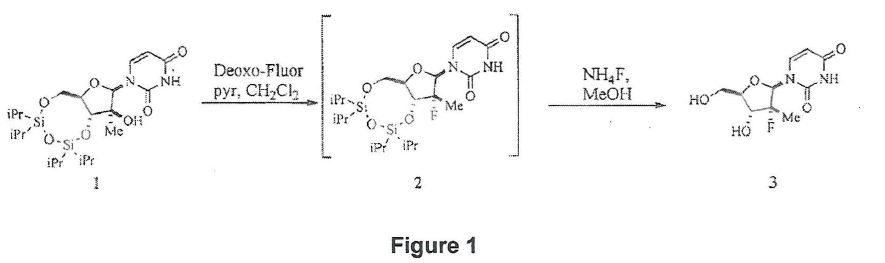
168 In the same period he also carried out analytical work to characterise the products of that synthesis.
169 Dr Clemens explained that:
The Deoxo-Fluor Scheme comprises two reactions. The first, indicated on the left-hand side of Figure 1, involves the reaction of a protected 2' -methyl nucleoside (the compound labelled as compound 1 in Figure 1) with Deoxo-Fluor and anhydrous pyridine in anhydrous dichloromethane (the Fluorination Reaction). The desired product of the Fluorination Reaction is the protected 2'-fluoro nucleoside (the compound labelled as compound 2 in Figure 1). The second reaction in the Deoxo-Fluor Scheme, indicated on the right-hand side of Figure 1 involves the reaction of the protected 2'-fluoro nucleoside with ammonium fluoride in methanol to produce the 2'-fluoro nucleoside, labelled in Figure 1 as compound 3 (the Deprotection Reaction).
170 Based on his analysis Dr Clemens was satisfied that the product he isolated from the sequence of Fluorination and Deprotection Reactions was compound 3.
171 Dr Clemens also gave oral evidence which will be considered below in the context of the issues to be resolved.
172 Chris Meier is an organic chemist with specialist expertise in the synthesis of nucleosides and nucleotides for medicinal purposes. He is a Professor of Organic Chemistry at the University of Hamburg.
173 Professor Meier’s evidence as set out in his affidavits included the following (the opinions he expressed relating to the position as at 2002 and 2003):
(1) Nucleoside and nucleotide analogues have been studied (and used) in the treatment of viral infection in humans, including HCV infection, for many years.
(2) HCV viral RNA replication involves a viral RNA-dependent-RNA polymerase called NS5B, an enzyme which synthesises new RNA strands using 5'-ribonucleoside triphosphates from the host liver cell as its substrate. Thus, the NS5B-catalysed synthesis is an ideal target for intervention. However, because of dephosphorylation in the bloodstream by enzymes called phosphatases and inability to penetrate the liver cell membrane scientists have developed and were continuing to develop nucleotide prodrugs (pro-nucleotides), which are compounds in which the 5'-monophosphate, 5'-diphosphate or 5'-triphosphate group of a nucleotide or a nucleotide analogue is masked (or “protected”) through chemical modification. By 2002, there were a number of approaches adopted in designing pro-nucleotides, the aim being to mask (or protect) the 5'-phosphate group(s) of the nucleotide analogue to prevent dephosphorylation (loss of phosphate groups) in the bloodstream and to neutralise the negative charges of the 5'-phosphate group(s) resulting in the formation of a neutral (uncharged) compound which is capable of crossing the cellular membrane. Accordingly, the ideal nucleotide analogue for intracellular delivery was the 5'-triphosphate form. The 5'-diphosphate form may also be a suitable candidate for intracellular delivery since this would require only one further phosphorylation for conversion into the 5'-triphosphate form. In summary:
Although the detailed mechanism of the inhibition of HCV polymerase was not understood at that time [2002 and 2003], scientists had established that conversion of the nucleoside analogue into the 5'-triphosphorylated form is a prerequisite for the nucleoside analogue to bind to the RNA-dependent RNA polymerase in order to inhibit its function.
174 Professor Meier said that if he had been provided with the 350 application and was seeking to identify the most promising candidate compounds to evaluate in the context of an anti-HCV drug discovery project he would approach the task taking into account the intended biological target of the compounds (as an anti-HCV drug) as well as their proposed mechanism of action (inhibition of polymerase). For numerous reasons set out in his affidavits, Professor Meier concluded that, if given this task, he would have undertaken a synthesis resulting in a nucleoside analogue with modifications at the 2' position of methyl-“up” and fluoro-“down” and a lipophilic phosphate pro-drug moiety at the 5' position attached to a natural base (uracil) (which, it should be noted, is the structure of sofosbuvir). A summary of this proposed synthesis, prepared by Gilead, is as set out below:
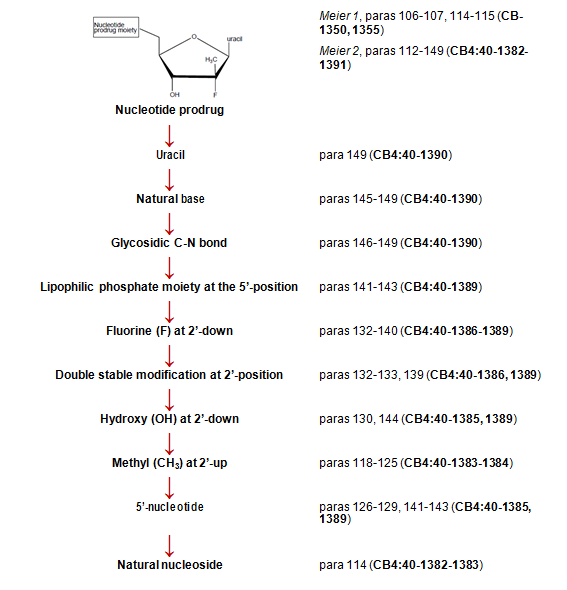
175 In respect of the Idenix patent, key modifications that Professor Meier would have identified in June 2002 if he had sought to identify candidate compounds from the patent to evaluate in the context of an anti-HCV drug discovery project were the branch modification of the methyl group in the 2'-“up” position together with the fluoro in the 2'-“down” position and the use of a 5'-nucleotide analogue pro-drug by the addition of a stabilized phosphate to the 5' position. For the purpose of the required synthesis, he was aware in 2002 of the organometallic reagents such as the Grignard reagents (for example, methylmagnesium bromide), methyllithium, and trimethylaluminium that could be used to introduce a methyl group in the 2' position. He was also aware and had used the reagent diethylaminosulfur trifluoride (DAST) to introduce fluoro in the 2'-“up” position of a nucleoside analogue. In his words:
Prior to June 2002 I had used DAST to introduce a fluoro atom at the 2' position of a nucleoside analogue and was aware that a DAST fluorination reaction typically proceeded with inversion of stereochemistry.
I was aware that to introduce a fluoro atom at the 2' position of a nucleoside I would require a hydroxy group as the functional group at the 2' position. Therefore I was aware that it was necessary to introduce the methyl modification to the 5-membered ring of the nucleoside first, leaving the functional OH group to enable the fluoro substitution. I was also aware, that DAST fluorination reaction typically proceeds with inversion of stereochemistry. Therefore I was aware that the required starting material for a DAST reaction would have had a methyl group in the “down” position and a hydroxy group in the “up” position.
176 Professor Meier also gave extensive oral evidence which will be considered below in the context of the issues to be resolved.
177 Alan Borthwick is a drug design and medicinal chemistry consultant employed since 2006 at DrugMoIDesign, London, an independent consultancy which provides support and expertise in drug design to academia and the pharmaceutical industry. He was awarded a PhD in organic chemistry in 1972. He was employed by the Glaxo group between 1971 and 2006.
178 While employed by Glaxo Dr Borthwick was involved in numerous drug design projects including, in the period between 1985 and 1994, a project involving the design and synthesis of carbocyclic nucleosides known as the Herpes and Retrovirus Project (or HSV project). As he described it:
This project involved the development of a number of compounds that progressed to exploratory development candidates. These included the chiral nucleosides carbocyclic (+)-(E)-5-(2-bromovinyl)-2'-deoxyuridine (against varicella zoster virus), carbocyclic 2'-ara-fluoroguanosine (against herpes simplex virus 1 and herpes simplex virus 2), carbocyclic 2'-deoxy-4'-hydroxyguanosine and carbocyclic 8-aza-2'-ara-fluoroguanosine.
179 As part of the HSV project Dr Borthwick led a team of four to five organic chemists who worked under his supervision. Two of these scientists had PhD qualifications and the others had graduate degrees in organic chemistry. The HSV project proceeded over a number of years and involved numerous steps which Dr Borthwick described. As Dr Borthwick put it, having regard to his knowledge and experience:
…the first step in the project was to conduct a literature search to seek to identify any nucleoside derivatives that were known to have activity against human herpes viruses. I recall that the search involved a review of papers of which I was aware at the time and the references cited therein. I recall that the search revealed a number of nucleoside analogues, namely IDU, FMAU and FIAU, that had been reported in the literature as having activity against HSV-1 and HSV-2.
…
The next search involved interrogating the literature for reports of the synthesis of carbocyclic nucleosides with a purine or pyrimidine nucleobase coupled to a carbocyclic ring with hydroxyl groups at the 2-, 3- and 5-positions of the carbocyclic ring.
180 Another step involved a literature search of the use of DAST in the conversion of alcohols to alkyl fluorides (the DAST Search). As a result of this search Dr Borthwick became aware of a number of papers dealing with fluorination by DAST. He considered that these literature reports demonstrated that DAST reacts with secondary and tertiary hydroxyl groups to deliver fluorine in a single step with inversion of configuration. As such, for the HSV project, and as one of many steps, he decided to use DAST to introduce a fluorine at the 2-“up” position of the carbocyclic aminotriol ring system by replacement with inversion of the 2-“down” hydroxyl group. The first attempt did not result in fluorination. Analysis of the results disclosed that participation of a neighbouring group amino trityl group had occurred which prevented the nucleophilic substitution of the fluorine at the 2-position. Dr Borthwick thus decided to protect the amino group with a dinitrophenyl (DNP) protecting group so it was less likely to participate in the DAST reaction. The second attempt at fluorination, where the 3- and 5-hydroxyl groups were also protected with TIPS (tetraisopropyldisiloxanyl protecting group, also referred to as TIPDS), resulted in the replacement of the hydroxyl group by fluorine with inversion of configuration (the desired product). The reaction also gave the protected fluorohydrin as a by-product. The mixture was separated and purified into the individual compounds by chromatography on silica. As the HSV project proceeded, Dr Borthwick carried out fluorination steps involving DAST and other fluorinating reagents with various results being obtained as he described.
181 Dr Borthwick was provided with a chemical structure (referred to in his evidence as figure 69) as follows and was told the base was a natural nucleobase, namely uracil, cytosine, thymine, adenine or guanine:
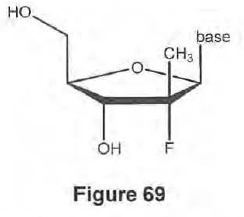
182 Dr Borthwick said figure 69 represents a number of compounds, each of which is a nucleoside analogue having 3'- and 5'-hydroxyl (OH) groups, a natural nucleobase (“base”) at the 1'-“up” position and a 2'-methyl (CH3)-“up” and 2'-fluoro-“down” configuration. He was instructed to treat figure 69 as his Target Compounds. Dr Borthwick was asked to review section VII of the Idenix patent and provide his opinion whether that section discloses information regarding the synthesis of a Target Compound.
183 According to Dr Borthwick:
(1) The Idenix patent describes the synthesis of a compound which has the configuration of the Target Compounds at the 2'-position, specifically a methyl group in the 2'-“up” position and a functional group in the 2'-“down” position (in this case a tertiary hydroxyl group). The illustration of this configuration is of particular significance for the synthesis of a 2'-methyl-“up”-2'-fluoro-“down” modified nucleoside because Scheme 9 in the patent shows that such a compound has been synthesised. Also, a fluoro group was known to be a bioisostere of a hydroxyl group; that is, the fluoro group (F) and hydroxyl group (OH) share physical and chemical characteristics, including that they are both small electron withdrawing groups and are able to form hydrogen bonds with other functionalities, meaning that they would be expected to behave similarly in a biological environment.
(2) He therefore would have expected that the Target Compounds, which have a 2'-methyl-“up”-2'-fluoro-“down” configuration, could be synthesised.
(3) In devising a synthesis for the Target Compounds, he identified, as the immediate precursor (to react with DAST), a compound which, at the 2'-position, had the inverse stereochemistry to the compounds of interest, that is, a 2'-methyl-“down”-2'-hydroxyl-“up” nucleoside analogue. Thereafter, based on a detailed process of reasoning set out in his affidavit, Dr Borthwick said that he would have:
…devised a synthesis in which Matsuda compound 12a (the Matsuda Precursor) was made, according to the instructions provided in the Matsuda Paper, and then treated the compound with DAST, expecting the reaction to give the 2'-methyl-“up”-2'-fluoro-“down” nucleoside analogue which is TIPDS-protected at the 3'- and 5'-hydroxyl groups, and protected at the 4-position of the nucleobase with an ethoxy group; that is, a protected Target Compound…
[and then:]
…would have reacted the compound in Figure 87 with TBAF to remove the TIPDS group followed by either sodium hydroxide to give the Target Compound with a uracil nucleobase or ammonia in methanol to give the Target Compound with cytosine nucleobase.
(4) Dr Borthwick described this as Target Synthesis 1. The Matsuda Precursor is identified in a paper by Akira Matsuda et al, “Alkyl Addition Reaction of Pyrimidine 2'-Ketonucleosides: Synthesis of 2'-Branched-Chain Sugar Pyrimidine Nucleosides” (1988) 36(3) Chemical and Pharmaceutical Bulletin 945 (the Matsuda Paper).
(5) Another approach that Dr Borthwick would have considered in synthesising the Target Compounds is to take the Matsuda Precursor and replace the TIPDS protecting group at the 3'- and 5'-positions with benzoate protecting groups before undertaking the DAST reaction, which he described as Target Synthesis 2.
(6) Dr Borthwick also would choose a uracil nucleobase in the first instance as it is structurally simpler than the purine nucleobases (adenine and guanine) and is versatile in that it can be converted into the cytosine nucleobase, meaning that two nucleosides with different nucleobases can be prepared using the one reaction scheme.
184 In summary Dr Borthwick considered that:
…[t]he Matsuda Paper gives a complete synthesis for the Matsuda Precursor [and] the DAST reaction with this precursor was well precedented in the literature prior to June 2002 and therefore its use to treat the Matsuda Precursor would not involve “trial and error experimentation”.
185 Dr Borthwick also gave extensive oral evidence which will be considered below in the context of the issues to be resolved.
186 Anthony Barrett is the Glaxo Professor of Organic Chemistry and the Director of the Wolfson Centre for Organic Chemistry in Medical Science in the Department of Chemistry at Imperial College of Science, Technology and Medicine in London and the Sir Derek Barton Professor of Synthetic Chemistry and Head of the Synthesis Section in the Department of Chemistry at Imperial College.
187 Professor Barrett explained the analytical techniques that in his experience were used routinely in the field of organic chemistry prior to June 2002 to separate and characterise the products of a synthetic reaction. He said in his affidavit that:
(1) Separation of the products of a chemical reaction is frequently required because, typically, syntheses will result in the formation of a mixture of products.
(2) Separation of the products of a reaction can be performed in many ways including by distillation, liquid extractions and recrystallisations but, most commonly, scientists use chromatography to separate and purify reaction products, particularly when the reactions are first carried out on a small scale.
(3) There are many different types of chromatography but each is based on similar principles, namely that two or more compounds partition differently between a mobile phase, usually a solvent or mixture of solvents, and a stationary phase, usually an inorganic solid such as silica or alumina. Chromatography is usually carried out by allowing a solution containing the mixture of products to flow through the stationary phase. Due to the differences in partition, the products of the mixture progress (elute) at different rates through the stationary phase and are collected separately and evaporated. Components that interact more strongly with the stationary phase will be eluted more slowly and thereby collected later.
(4) The three most commonly used types of chromatography are TLC (thin layer chromatography), column chromatography, and HPLC (high-performance liquid chromatography). HPLC is a more sophisticated chromatographic technique in which the solution mobile phase is pumped under significant pressure through a very finely divided stationary phase and the eluted solution monitored for composition change by a detector, often an ultraviolet spectrometer detector. HPLC has the advantage that it can be carried out in tandem with mass spectrometry in an LC-MS (Liquid Chromatography - Mass Spectrometry) instrument. LC-MS refers to the separation and identification technique of liquid chromatography (HPLC) coupled directly with mass spectrometry so as to measure the molecular weights of the compound or compounds present in each eluted fraction.
(5) NMR (nuclear magnetic resonance) spectroscopy is the most important spectroscopic technique that is used for the structural characterisation of compounds. It allows a chemist to determine either completely or partially, depending on molecular complexity, the structure of a compound by giving information on the types of groups of atoms present and their relative connectivities.
(6) When a synthetic chemist is seeking to synthesise an unknown compound for the first time, he or she will typically monitor the course of the reaction using TLC and/or with another technique such as analytical HPLC or LC-MS.
188 Professor Barrett was provided with extracts from the laboratory notebook of Dr Griffon (referred to as the Griffon Notebook) and a document titled “Jean-François GRIFFON - Audrey CHAPPE, PROGRESS REPORT No 26*: February 1st - February 28, 2003 period” (referred to as the Griffon Progress Report). Professor Barrett explained the synthesis described in these documents. He also said:
I have…been asked to express an opinion as to whether the Deoxo-Fluor® reactions and deprotections recorded in the Griffon Notebook resulted in the formation of the “desired product” namely, the uridine derivative with the 2'-CH3 (methyl) “up” and the 2'-F (fluoro) substituent “down” (compound 6a). As I have discussed above, the Griffon Notebook includes information of only one of the reaction products from each of the syntheses being isolated, purified and characterised, and does not include a record of further examination of any the other products that were clearly formed. On this basis, it is not possible for me to provide my view, based on the Griffon Notebook and Griffon Progress Report, as to whether such a compound was indeed formed from the Griffon syntheses.
However, I do note that the reaction described gave rise to a number of products about which there is no information to indicate that they were isolated, purified and characterised.
189 Professor Barrett was also provided with extracts relating to the experiments carried out by Dr Clemens (referred to as the AMRI experiments). He concluded that the product isolated in the AMRI Experiments contained a compound having the same structure as Clark compound 9, although the AMRI product was not completely pure. Clark compound 9 is 2'-deoxy-2'-fluoro-2'-C-methyluridine as reported in the Clark 2005 paper (Jeremy Clark et al, “Design, Synthesis, and Antiviral Activity of 2'-Deoxy-2'-fluoro-2'-C-methylcytidine, a Potent Inhibitor of Heptatis C Virus Replication” (2005) 48 Journal of Medicinal Chemistry 5504).
190 Professor Barrett was asked to compare the experiments carried out by Dr Griffon with those carried out by Dr Clemens. He concluded that the experiments “used the same quantities of reactant, reagents and solvents and reaction conditions for both the fluorination and deprotection steps”. Professor Barrett said:
Given the close similarities between the experimental procedure recorded in the Griffon Notebook in respect of the Griffon Fluorination and deprotection and that recorded in the AMRI Notebook, it is my opinion that the Griffon Fluorination would most likely also have resulted in the formation of the nucleoside, compound 6a.
191 Professor Barrett was not required to give oral evidence.
192 Steven Patterson is an organic chemist and is a Professor in the Center for Drug Design at the University of Minnesota. He was employed as a discovery chemist by Pharmasset between 2000 and 2004.
193 Professor Patterson was asked to recall the synthesis by Pharmasset of the compound which came to be designated as PSI-6130. PSI-6130 has the structure set out below:
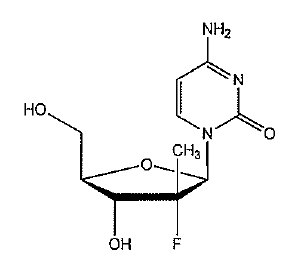
194 The synthesis of this compound was carried out by Jeremy Clark, one of the Pharmasset chemists who reported to Dr Pankiewicz. Amongst other things Professor Patterson records that:
…I recall that Dr Pankiewicz said to Mr Clark that he should prepare the compound from the nucleoside cytidine. Dr Pankiewicz told Mr Clark that by protecting the 3' and 5' positions, oxidising the 2'-OH to the ketone and treating the ketone with methyl lithium or methyl magnesium bromide, he could obtain the tertiary alcohol at the 2' position of the nucleoside. Dr Pankiewicz further suggested to Mr Clark during this discussion that the tertiary alcohol could be treated with DAST as the fluorinating reagent.
…
During the conversation in which Dr Pankiewicz suggested to Mr Clark that he use DAST as a fluorinating reagent, Dr Pankiewicz said that he thought the application of DAST to a tertiary alcohol would be novel chemistry. I understood Dr Pankiewicz to be referring to the fact that the conversion of the 2'-OH “up”, 2'-Me “down” nucleoside to make a 2'-Me “up”, 2'-F “down” nucleoside analogue involved a tertiary alcohol at the 2' position, that is, an OH attached to three carbon atoms. I told Dr Pankiewicz my view that there was a host of literature support for a successful DAST fluorination of a tertiary alcohol as would be required for Mr Clark to fluorinate the nucleoside.
195 Professor Patterson was not required to give oral evidence.
196 It is common ground between the parties that the Idenix patent and the priority documents (the 350 and 949 applications) are to be read through the eyes of the skilled addressee and in light of the common general knowledge.
197 There was disagreement between the parties about the identity of the skilled addressee and the common general knowledge that would be attributed to that person.
4.2 Who is the skilled addressee?
198 In Kimberly-Clark Australia Pty Ltd v Arico Trading International Pty Ltd [2001] HCA 8; (2001) 207 CLR 1 (Kimberly-Clark ) the High Court said at [24]:
It is well settled that the complete specification is not to be read in the abstract; here it is to be construed in the light of the common general knowledge and the art before 2 July 1984, the priority date; the court is to place itself “in the position of some person acquainted with the surrounding circumstances as to the state of [the] art and manufacture at the time”.
199 That person is the skilled addressee of the patent (or priority document).
200 Idenix contended that:
The skilled addressee of the ‘350 Application is a medicinal chemist with expertise in the use and synthesis of nucleoside and nucleotide analogues and prodrugs of such compounds as anti-Flaviviridae (including anti-HCV) agents. Only Professor Meier has such experience.
201 According to Idenix Professor Furneaux is not representative of the skilled addressee because:
Professor Furneaux is not a medicinal chemist. He is not a nucleoside chemist. He is a carbohydrate chemist whose only experience in the synthesis and use of nucleoside analogues at the priority date was the Schramm Collaboration, which involved the construction of a sugar analogue (with a nitrogen atom in place of the ring oxygen atom) followed by construction of a particular nucleobase “from scratch”.
202 Idenix also contended that Dr Lambert was not the skilled addressee because “he had no experience in introducing fluorine into a nucleoside as at June 2002/June 2003 or even today” and said that he would have handed the task of preparing any nucleoside to his “nucleoside synthetic team”.
203 In support of its case that Professor Meier represents the skilled addressee Idenix submitted that:
…although the relevant skilled addressee is a team comprising a nucleoside chemist and a medicinal chemist (as well as a virologist), this does not mean that all such chemists are relevantly the skilled addressee. The particular discipline under consideration here is the development of nucleoside analogues for use as antiviral drugs in the field of Flaviviridae, including HCV. The relevant skill is that of a nucleoside chemist working in conjunction with a medicinal chemist (i.e. with a particular focus of creating nucleoside analogues for use as anti-Flaviviridae drugs).
204 Idenix also said:
…the question of whether particular knowledge has formed part of the common general knowledge is not determined, as Gilead would suggest, by identifying whether particular articles or literature references were known by the majority of the four experts (Dr Borthwick, Professor Meier, Professor Furneaux and Dr Lambert) as at June 2002/June 2003. Evidence of at least one expert plus supporting publication material can suffice, all the more so where it is accepted that the skilled addressee is a team.
205 Gilead responded as follows:
To characterise Professor Meier as a “medicinal chemist” rather than a “nucleoside chemist” (or more generally, an “organic chemist”) is to draw an irrelevant distinction in this case. There is no dispute that Dr Borthwick and Professor Furneaux meet the latter description. So does Professor Meier, plainly. In addition, both Dr Borthwick and Professor Furneaux fairly meet the former description, as their work has been on the development and chemical synthesis of compounds that are intended for evaluation for therapeutic use. There is no relevant distinction between the three of them for this purpose. Indeed, Dr Borthwick described himself in his affidavit as a “drug design and medicinal chemistry consultant” and he confirmed this view in his oral evidence.
Accordingly, information that was known to Professor Meier but not to Dr Borthwick and Professor Furneaux is not common general knowledge in this case.
206 I consider that the approach for which Idenix advocates is liable to result in error. If the skilled addressee “is not an avatar for expert witnesses whose testimony is accepted by the court” but a tool for analysis (AstraZeneca AB v Apotex Pty Ltd; AstraZeneca AB v Watson Pharma Pty Ltd; AstraZeneca AB v Ascent Pharma Pty Ltd [2015] HCA 30 at [23]) then it cannot be correct to focus on whether one or other expert witness can be taken to represent the skilled addressee. The relevant issue is the common general knowledge that should be attributed to the skilled addressee given the area of discourse to which the relevant documents relate.
207 Idenix contended that the relevant area of discourse may be characterised as the development of nucleoside analogues for use as antiviral drugs for Flaviviridae infections, including HCV. Gilead said this characterisation is so specific that it “is almost to require a person to have worked on the development of the invention in suit”. Given the terms of the Idenix patent I do not consider Idenix’s characterisation unreasonable. This does not mean, however, that every expert must have expertise across the entire spectrum of the area of discourse in order to give evidence relevant to the common general knowledge. Nor does it mean that, insofar as the chemistry is concerned, the skilled addressee is a person with specialist, even unique (as in the case of Dr Borthwick), experience in the fluorination of a tertiary hydroxyl. As Idenix no doubt intended, to adopt this approach would pitch the debate at a level of specificity ensuring Professor Meier and Dr Borthwick alone could be representative of the skilled addressee. I do not accept this and I also do not accept that the evidence given by Professor Furneaux and Dr Lambert is immaterial to the common general knowledge of the skilled addressee.
208 Professor Furneaux is an organic chemist of over 40 years’ experience including, as it happens, in fluorination. His work in respect of nucleoside analogues is not mere “dabbling” as Idenix would have it. Dr Lambert’s experience in synthesising nucleoside analogues started in the early 1990s and continued thereafter. He described himself as an organic chemist with over 26 years’ experience in organic chemistry and the application of organic chemistry to drug discovery and drug development. His knowledge includes matters relating to virology and HCV, as well as nucleoside chemistry. The fact that he had not attempted to introduce fluorine into a nucleoside and would hand over the actual synthesis tasks to another expert does not mean that his expertise is unrepresentative of the skilled addressee. The skilled addressee is not a nucleoside or medicinal chemist with specialist expertise in introducing fluorine into nucleosides. Professor Furneaux is representative of the kind of chemist who would be part of the team comprising the notional skilled addressee of the Idenix patent. Dr Lambert is also the kind of expert to whom the relevant documents were addressed. The fact that he was towards the beginning of his career in 2002 does not undermine this conclusion. Professor Furneaux’s and Dr Lambert’s evidence about what each treated as background knowledge for those involved in the field, accordingly, is relevant to the drawing of inferences about the common general knowledge.
209 As will be apparent, there was no debate that the common general knowledge that ought to be attributed to the skilled addressee involved more than one field of expertise – in particular nucleoside chemistry and virology. Whether the label “medicinal chemist” or “nucleoside chemist” should be placed on the notional skilled addressee is immaterial. The issue is the knowledge which the skilled addressee is taken to have, which is the common general knowledge of the skilled addressee of documents dealing with the development of nucleoside analogues for use as antiviral drugs for Flaviviridae infections, including HCV. As Gilead submitted, the need for inferences about the common general knowledge to be based on the evidence:
… cannot be avoided by artificially constructing a skilled team to include a person … with highly specific and unusual knowledge gained through literature searches or idiosyncratic experience not shared by others in the field. Nor can it be avoided by artificially excluding others who happen not to possess that knowledge. The common general knowledge is a general body of knowledge known and used by all those in the field.
4.3 What common general knowledge should be attributed to the skilled addressee?
210 To resolve the disagreement between the parties it is necessary to have regard to the applicable principles.
211 In Minnesota Mining and Manufacturing Co v Beiersdorf (Aust) Ltd (1980) 144 CLR 253 (Minnesota Mining), Aickin J (with whom the other members of the Court agreed) said at 292:
The notion of common general knowledge itself involves the use of that which is known or used by those in the relevant trade. It forms the background knowledge and experience which is available to all in the trade in considering the making of new products, or the making of improvements in old, and it must be treated as being used by an individual as a general body of knowledge.
212 In Aktiebolaget Hässle v Alphapharm Pty Ltd [2002] HCA 59; (2002) 212 CLR 411, Gleeson CJ, Gaudron, Gummow and Hayne JJ said:
[31] The primary judge rejected Alphapharm’s submission that the common general knowledge of the skilled formulator in Australia included material which the formulator might find by conducting computer searches and the like, being means available to and used by formulators. His Honour correctly did so because the corollary of the submission was that information should be treated as part of the common general knowledge in Australia, even in the absence of evidence of its general acceptance and assimilation by what he called “the formulating community”. This was a proposition which Lehane J recognised was foreclosed by the authority of this Court, in particular by Minnesota Mining and Manufacturing Co v Beiersdorf (Australia) Ltd.
…
[57]…There was no finding that what was disclosed by those documents had entered the common general knowledge of those in Australia experienced in the practical work of formulating drugs for therapeutic use. Rather, reliance was placed upon the notion, illegitimate after Minnesota Mining, of a “routine literature search”.
213 Justice Middleton summarised the law as follows in Ranbaxy Laboratories Ltd v AstraZeneca AB [2013] FCA 368; (2013) 101 IPR 11:
[215] Common general knowledge is knowledge actually known or used by skilled addressees generally, or accepted by “the bulk of those who are engaged in the particular art”: see British Acoustic Films Ltd v Nettlefold Productions (1936) 53 RPC 221 at 250 (British Acoustic Films). As the High Court emphasised in Aktiebolaget Hässle [v Alphapharm Pty Ltd (2002) 212 CLR 411; 194 ALR 485; 56 IPR 129; [2002] HCA 59] at [31], information cannot be treated as part of the common general knowledge unless there is “evidence of its general acceptance and assimilation” by persons skilled in the art.
…
[217] As I noted in Eli Lilly [and Company Ltd v Apotex Pty Ltd (2013) 100 IPR 451; [2013] FCA 214], information does not constitute common general knowledge merely because it might be found, for example, in a journal, even if widely read by persons in the art: see Wake Forest University Health Sciences v Smith & Nephew Pty Ltd (No 2) (2011) 92 IPR 496; [2011] FCA 1002 at [96], citing British Acoustic Films at 250 (which was also affirmed in General Tire at IPR 135; RPC 480–1). Reference in this regard is made to the words of Luxmoore J in British Acoustic Films (1936) 53 RPC 221 at 250, cited by Lehane J in Aktiebolaget Hässle v Alphapharm Pty Ltd (1999) 44 IPR 593; [1999] FCA 628 at [39]:
In my judgment it is not sufficient to prove common general knowledge that a particular disclosure is made in an article, or series of articles, in a scientific journal, no matter how wide the circulation of that journal may be, in the absence of any evidence that the disclosure is accepted generally by those who are engaged in the art to which the disclosure relates. A piece of particular knowledge as disclosed in a scientific paper does not become common general knowledge merely because it is widely read, and still less because it is widely circulated. Such a piece of knowledge only becomes general knowledge when it is generally known and accepted without question by the bulk of those who are engaged in the particular art; in other words, when it becomes part of their common stock of knowledge relating to the art.
[218] In Alphapharm [Pty Ltd v H Lundbeck A/S (2008) 76 IPR 618; [2008] FCA 559], Lindgren J observed that (at [221]):
[221] … [I]t was held in Astra [Aktiebolaget Hassle v Alphapharm Pty Ltd (2002) 212 CLR 411] that information recorded in a document, even a document widely circulated within the art, is not part of general common knowledge merely because the skilled addressee could be expected to locate it. The question is whether it is “generally accepted without question” or “generally regarded as a good basis for further action” by the bulk of those in the art.
214 In ICI Chemicals & Polymers Ltd v Lubrizol Corporation Inc [1999] FCA 345; (1999) 45 IPR 577 (ICI Chemicals) at [112] Emmett J said:
The common general knowledge is the technical background to the hypothetical skilled worker in the relevant art. It is not limited to material which might be memorised and retained at the front of the skilled workers mind but also includes material in the field in which he is working which he knows exists and to which he would refer as a matter of course. It might, for example, include:
• standard texts and handbooks;
• standard English dictionaries;
• technical dictionaries relevant to the field;
• magazines and other publications specific to the field.
215 The competing submissions of the parties are to be assessed consistently with these principles. It follows that I do not necessarily accept Idenix’s submissions as follows:
Thirdly, even though a particular journal article may not be able to be instantly recalled by an expert, this does not mean that the article and its teaching have not been assimilated into the common general knowledge. This is particularly the case in the field under consideration where the evidence establishes that those working in the field follow the literature as and when it is published even though they may later have to conduct literature searches to remind themselves of the specific details of its contents.
Fourthly, the evidence establishes that, in this field, one of the primary methods by which knowledge is disseminated is by publications. While a particular researcher’s work may not of itself indicate whether the methodology employed by the researcher is common general knowledge, the fact is that by publication and re-publication of that researcher’s work, the information becomes part of the common general knowledge of researchers in that field. That conclusion can be reached where there is evidence from a relevant expert with that knowledge supported by publication evidence.
216 I do not necessarily accept these submissions because they are expressed at a level of principle rather than proof in the particular case. Justice Emmett’s observations in ICI Chemicals are consistent with the authorities. Justice Emmett is not suggesting anything more than that the common general knowledge might include information in articles (etc) if the skilled addressee knows the article (etc) exists and would refer to it as a matter of course. In other words, what his Honour is allowing for is that the skilled addressee does not have to have instant recall of every matter for it to be common general knowledge. If the skilled addressee knows that certain information exists in an article (etc) and would refer to that document as a matter of course to refresh his or her memory about the details of that which the skilled addressee already knows in broad outline then those details might themselves form part of the common general knowledge. Justice Emmett is not suggesting that merely because the skilled addressee could locate a document and, having located it, could read and assimilate its contents, the document and its contents would form part of the common general knowledge. This would be inconsistent with Minnesota Mining, in particular, that the common general knowledge is the background knowledge and experience which is available to all in the trade. For the possibility which Emmett J recognised in ICI Chemicals to arise there would have to be evidence that the particular document was known and would be referred to as a matter of course by those in the field.
217 Idenix’s submissions, accordingly, go too far. It may be accepted that instant recall of an article is not required. This does not mean, however, that documents found by searching for a subject-matter, rather than by some form of recall or reminder of what is already known to exist, are common general knowledge. This is so irrespective of the fact that experts in the field read widely. Further, it is not the case that mere publication and republication proves that a document and its contents have entered the common general knowledge. Nor is it the fact that a document and its contents necessarily form part of the common general knowledge merely because one expert knows or has managed to locate it and assimilate its contents. Such a document may or may not form part of the common general knowledge. The relevant inferences are to be drawn on the basis of the whole of the evidence.
218 In particular, much of Idenix’s case about the common general knowledge appeared to be premised on the assumption that everything Professor Meier knew was necessarily part of the common general knowledge because Professor Meier is a medicinal chemist and the team representing the skilled addressee would include a medicinal chemist. I do not find that chain of reasoning persuasive. While I accept that the relevant area involves a high level of skill, Professor Meier struck me as a leader in his field with knowledge extending far beyond that which might properly be attributed to the skilled addressee having only the common general knowledge known to, assimilated by and generally accepted by all or the bulk of those working in the field. Before 2002 he had read and knew of papers of which none of the other experts were aware. In his second affidavit at para 138 he said that he had “read and was familiar with the following publications and review articles describing different methods and reagents for introducing fluorine atoms at different positions of a nucleoside with appropriate stereochemistry” after which he listed a series of articles in sub paras (a) to (o) including his own article Chris Meier et al, “CycloSal Pronucleotides of 2'-Fluoro-ara-and 2'-Fluoro-ribo- 2',3'-dideoxyadenosine as a Strategy to Bypass a Metabolic Blockade” (1999) 42 J Med Chem 1615-1624. These articles which Professor Meier had assimilated and absorbed by 2002 were not demonstrated to be part of the common general knowledge of nucleoside or medicinal chemists apart from Professor Meier. Further, the fact that Professor Meier approached the 350 application and the Idenix patent with more than the common general knowledge is confirmed by his evidence that:
For example, when we worked on this fluorinated nucleoside analogues in ’99 and before, of course we run literature surveys on – on fluorinated nucleosides. And, of course, we found papers – a lot of papers describing fluorination reactions.
219 In other words it is apparent from his evidence that Professor Meier had a particular expertise in the fluorination of nucleoside analogues by reason of work he had done in 1999 as part of which he had read and assimilated lots of papers about fluorination reactions. While some familiarity with fluorination reactions might be imputed to the skilled addressee of the 350 application and the Idenix patent it would be wrong to conceive of the skilled addressee as having specialist experience and expertise in that regard by reason of personal involvement in the fluorination of nucleosides (or, in the case of Dr Borthwick, carbocyclic nucleosides). Neither the 350 application nor the Idenix patent is directed towards such a narrow topic as the fluorination of nucleosides. I do not accept that the skilled addressee can be treated as having available as part of the common general knowledge all of the expertise and experience in the fluorination of nucleosides that Professor Meier and Dr Borthwick had by reason only of their involvement in particular projects for that purpose.
220 Given the specificity of some of the issues which Idenix said – and which Gilead denied – formed part of the common general knowledge of the skilled addressee, it is necessary to deal with the disputes on an issue-by-issue basis. In the following paragraphs I identify the fact or matter said to form part of the common general knowledge of the skilled addressee in italics before setting out my conclusions about whether or not that fact or matter forms part of the common general knowledge.
221 Dr Borthwick’s work in relation to the fluorination of a tertiary hydroxyl group at the 4'-position of a carbocyclic nucleoside using DAST with inversion published in the Journal of the Chemical Society, Chemical Communications in 1990 and a second synthesis by Dr Borthwick published in Bioorganic & Medicinal Chemistry Letters in 1993 (Annexures AB-42 and AB-44): Idenix contended that this formed part of the common general knowledge noting that Professor Furneaux and Dr Lambert both said that they routinely read this journal prior to June 2002.
222 I do not accept that this work or the articles recording this work formed part of the common general knowledge in 2002 or 2003 (or subsequently). The mere fact that the work was published in a respected journal that was routinely read by organic chemists does not mean that the work entered the common general knowledge. If that were so, every article in that journal would be taken to form part of the common general knowledge of an organic chemist. There is a difference between experts routinely reading certain journals and the existence of those articles, let alone the information within those articles, being part of the common stock of knowledge relating to the art, known to and generally accepted by the bulk of those who work in the relevant field. Further, the fact that Dr Borthwick’s articles were cited in footnotes to another paper (referred to as the Wachtmeister Paper) does not transform the articles or the Wachtmeister Paper (which neither Dr Borthwick nor Professor Furneaux knew about) into common general knowledge.
223 As Gilead put it:
(a) The only witness who gave any evidence of having been aware of that [Dr Borthwick’s] work was Dr Borthwick. This is hardly surprising, since he conducted it.
(b) Given his position, Dr Borthwick’s evidence as to his awareness of the work cannot inform the question whether the work was generally known to skilled persons in the field at the relevant date.
(c) Dr Borthwick did not purport to give any evidence that the work was generally known to skilled persons in the field at the relevant date.
(d) It is clear from Professor Furneaux’s evidence that he was not aware of Dr Borthwick’s work at the relevant date.
(e) Dr Meier did not suggest he was aware of Dr Borthwick’s work at the relevant date, amongst the many publications he did list in his affidavit.
(f) There is no evidence that Dr Lambert was aware of Dr Borthwick’s work at the relevant date. This was not put to him in cross-examination.
(g) Idenix’s own documents show that Dr Borthwick’s work was not referred to by Idenix’s team of scientists and external consultants – an actual team of skilled persons in the field who were working on the task at hand.
(h) Dr Borthwick himself conducted literature searches by reference to keywords including “tertiary fluoride and nucleoside”, “tertiary fluoronucleoside” and “tertiary fluoro nucleoside”, being searches he said he would have conducted in addressing the task at hand – and these did not turn up Annexures AB-42 or AB-44 [Dr Borthwick’s publications] or indeed any of his other publications.
224 I am persuaded that Gilead is also right when it says:
This last point is significant, because it suggests that, far from having been part of the common general knowledge, Dr Borthwick’s work in Annexures AB-42 and AB-44 was not even ascertainable by a “routine literature search” of the kind the High Court held in Aktiebolaget Hässle was not sufficient to meet the relevant standard for information to be part of the common general knowledge.
225 I also agree with Gilead that:
… the fact that Professor Furneaux routinely read the journal in question but was not aware of Dr Borthwick’s publications provides a good illustration of the distinction between published information and common general knowledge that was emphasised in Aktiebolaget Hässle.
226 The Middleton Paper: Gilead agreed that the Middleton Paper, and its contents, had entered the common general knowledge before 2002. This is consistent with the evidence including that of Professor Furneaux that the Middleton Paper is a seminal publication concerning the fluorination of hydroxyl groups. As Gilead submitted, however, the Middleton Paper is not an example that assists Idenix to bring other, more obscure, less well known publications within the common general knowledge.
227 The McAtee Paper: Idenix contended that this formed part of the common general knowledge at 2002 but there was no evidence of the requisite kind supporting this inference. As Gilead said:
No witness gave evidence that he or she was aware of it at the relevant date. Dr Lambert gave evidence that he was not.
228 I do not accept that the McAtee Paper or its contents had entered the common general knowledge by 2002 or subsequently.
229 The use of DAST to fluorinate a tertiary hydroxyl group with inversion: Idenix did not identify any basis for this use forming part of the common general knowledge other than the work of Dr Borthwick. Given that Dr Borthwick’s work was not part of the common general knowledge I do not accept that the use of DAST to fluorinate a tertiary hydroxyl group with inversion was part of the common general knowledge by 2002 or subsequently. As discussed below, I am satisfied that this use was far indeed from common general knowledge at the relevant times.
230 The use of DAST to fluorinate a secondary hydroxyl group on a nucleoside with inversion: Gilead accepted that by 2002 the use of DAST to fluorinate a secondary hydroxyl group on a nucleoside had been conducted and reported but said some care was required in identifying the knowledge that was common general knowledge. I agree. The evidence disclosed that it was common general knowledge that DAST could be used to fluorinate a secondary hydroxyl group on a nucleoside but, as explained in more detail in the context of the sufficiency issue, it was also common general knowledge that these reactions could be unpredictable and could result in a number of competing reactions, including fluorination with inversion, fluorination without inversion, or result in an elimination or rearrangement product with no fluorination at all. The skilled addressee also knew as part of the common general knowledge that there are differences between a secondary hydroxyl group and a tertiary hydroxyl group including for the purpose of any fluorination reaction.
231 The first, and only, common general knowledge method that would come to mind for the introduction of a tertiary fluoro group at the 2'-“down” position of a nucleoside analogue would be fluorination of a tertiary 2'-hydroxyl “up” nucleoside with DAST (or DAST equivalents) with inversion: As explained in the context of sufficiency below I do not accept that the evidence supports this proposition.
232 A proposed mechanism of action of the compounds as anti-Flaviviridae drugs was the inhibition of Flaviviridae polymerase activity: Gilead accepted that this was part of the common general knowledge of the skilled addressee as at 2002. I agree.
233 Conversion to the 5'-triphosphorylated form of a nucleoside analogue in an HCV infected liver cell was a prerequisite for inhibiting the HCV polymerase (i.e. the 5'- triphosphorylated form was the “active species”): Gilead accepted that it was common general knowledge that the 5'-triphosphorylated form of a nucleoside analogue was the “active species” but not that conversion to the 5'-triphosphorylated form of a nucleoside analogue in an HCV infected liver cell was a prerequisite for inhibiting the HCV polymerase. I agree with Gilead that the evidence does not support the inference that the common general knowledge extends as far as Idenix would have it merely by reason of Professor Meier’s evidence.
234 The 5'-nucleoside analogue triphosphate will only be recognised by the polymerase (and hence result in inhibition) if it is able to mimic the natural nucleoside: I do not accept that this formed part of the common general knowledge. Dr Lambert, who is representative of the skilled addressee insofar as nucleoside chemistry is concerned, said:
I agree that a nucleoside analogue or nucleotide analogue must be recognised and phosphorylated by cellular enzymes in order to be incorporated into a growing RNA chain and thereby act as an antiviral. However, in my opinion this does not mean that nucleoside analogues and nucleotide analogues must always closely resemble the structure of natural nucleosides. For example, I set out at paragraph 81 of my First Affidavit the chemical structures of nucleoside and nucleotide analogues that I was aware were in use globally as antivirals for a number of different viruses in around the time I performed my HCV Review. Of these chemical structures I note that acyclovir (for the treatment of HSV), adefovir dipivoxil (for the treatment of HBV) and tenofovir disoproxil (for the treatment of HIV) all significantly depart from the structure of the natural nucleoside.
235 Given this evidence I do not see how it can be said that it was widely known and accepted in the art that the 5'-nucleoside analogue triphosphate will only be recognised by the polymerase (and hence result in inhibition) if it is able to mimic the natural nucleoside.
236 Two different prodrug strategies could be used – a nucleoside prodrug strategy and nucleotide prodrug strategy: Gilead accepted that this was part of the common general knowledge by 2002. I agree.
237 The nucleoside prodrug strategy focuses on prodrug moieties at the 2'- and 3'- positions to improve the uptake of the nucleoside analogue into the cell, and after entry to the cell the prodrug moiety is cleaved, leaving the nucleoside analogue to be phosphorylated to the 5'-mono-, 5'-di-, and 5'-triphosphate forms by the metabolism in the cell: As Gilead said, while it was common general knowledge that it was desirable for a nucleoside analogue to be phosphorylated by metabolism in cells, and that prodrug strategies were, in general, utilised to overcome limitations of a parent compound including cellular uptake, the evidence does not support an inference that it was common general knowledge that prodrug moieties are at the 2' and 3' positions or that the only reason for them is improved uptake. In common with Gilead’s other qualifications below it is apparent that Idenix’s characterisation of the common general knowledge is founded on Professor Meier’s evidence. As discussed, however, I am not satisfied that the skilled addressee armed with the common general knowledge in 2002 or 2003 knew everything that Professor Meier knew (even on the basis that the skilled addressee is a team including a nucleoside chemist, or medicinal chemist as Idenix would have it, and a virologist). Dr Lambert and Professor Furneaux did not share this knowledge and their state of knowledge is not able to be dismissed as immaterial to this issue as Idenix would have it.
238 The nucleotide prodrug strategy focuses on delivering a nucleotide analogue into the cell by using a prodrug moiety at the 5' position, which is cleaved after entry to the cell. The aim of nucleotide prodrug strategy is to mask or protect the 5'-phosphate group(s) of the nucleotide analogue to prevent dephosphorylation in the bloodstream and to reduce the negative charges of the 5' phosphate group(s) so as to make it able to cross the cell membrane more easily. The delivery of a 5'-nucleoside analogue mono-, di- or triphosphate to the cell avoids any limitation in the conversion of a nucleoside analogue to the 5'-mono-, 5'- di- or 5'-triphosphate form: Gilead made this submission:
Gilead accepts that it was CGK that, to the extent that it was practicable to deliver a 5'-nucleoside analogue mono-, di- or triphosphate to the cell, this could avoid any limitation in the conversion of a nucleoside analogue to the 5'-mono-, 5'-di- or 5'-triphosphate form.
However, Gilead does not accept that this item was otherwise CGK. In particular, it was not CGK that the prodrug moiety at the 5' position is “cleaved after entry to the cell”; to the contrary, at least a phosphorous containing group was intended to remain in place as a substrate for subsequent phosphorylation.
239 I agree with Gilead that Idenix’s identification of the common general knowledge goes too far for the same reasons as set out above.
240 Stable modifications at the 2'- and/or 3'-positions were known and AZT in HIV treatment was such an example: Gilead made this submission, which I accept:
Gilead accepts that, at a general level, it was CGK that nucleoside analogues could be modified at the 2'- and/or 3'-positions, amongst other positions, and that such modifications at those or other positions could potentially be stable. Gilead also accepts that the existence of the compound AZT and its use in HIV treatment were CGK.
However, Gilead does not accept that this item was otherwise CGK. In particular, Gilead does not accept that it was CGK that modifications at the 2'- and/or 3'-positions of nucleoside analogues would be stable such that modifications at those positions would be preferred or tried first.
Nor does Gilead accept that the detail beyond the general structure of AZT was CGK. In addition, it should also be noted that AZT was for use in HIV treatment, not HCV treatment as asserted for the invention.
241 The majority of antiviral compounds available in June 2002 had stable modifications at either the 2'- or 3'-positions: Dr Lambert’s evidence is inconsistent with this forming part of the common general knowledge. Dr Lambert identified a number of antivirals known as at 2002 which did not involve modifications at these positions. I thus do not accept that this proposition is necessarily accurate, and still less that it formed part of the common general knowledge at the relevant times.
242 Stable modifications at the 2'- and/or 3'-down positions would mimic the natural nucleosides: Given the discussion above about the lack of a need to mimic the natural nucleosides this could not have been part of the common general knowledge at 2002.
243 Compounds which had one or more stable modifications at the 2'-position were known: Gilead accepted that this fact was part of the common general knowledge.
244 A stable double modification at the 2'-position was known for Gemcitabine: Again, based on Dr Lambert’s evidence, I consider Idenix’s proposition goes too far. I accept that the existence of the compound Gemcitabine was part of the common general knowledge at 2002. I do not accept that it was common general knowledge of the skilled addressee that Gemcitabine had a stable double modification at the 2'-position. Nor do I accept that it was part of the common general knowledge at 2002 or subsequently that the skilled person working on an anti-HCV or anti-Flaviviridae treatment would necessarily look to the anti-tumour field for guidance.
245 Certain nucleoside analogues that had a methyl modification of the sugar ring had been shown to have antiviral or anti-tumour activity: While this is knowledge Dr Lambert had, this alone does not prove that this was part of common general knowledge at 2002 or subsequently. I am not satisfied on the evidence that it should be inferred that this was part of the common general knowledge of the skilled addressee at the relevant times.
246 Fluorine was known to medicinal chemists as the “magic atom” because introducing it into a compound often causes interesting changes in bioactivity: This was evidence of Professor Meier. The difficulty is that while the other relevant experts knew that fluorine was a potential candidate substituent, they did not treat fluorine as a “magic atom” in the sense Professor Meier did. They considered that fluorine was one of a number of known potential substituents the biological effect of which was not predicable. Unlike Professor Meier, Dr Lambert did not know in 2002 that fluorine’s ability to mimic a hydroxyl group made it uniquely suited to nucleoside analogues as a replacement of OH in the sugar portion of a nucleoside. The reason for this, I infer, is that as Professor Furneaux acknowledged this was something he would expect “somebody who was interested in having a fluorine in a carbohydrate” of his skill to know but he could not say more than that many chemists would have considered the value of introducing fluorine into an organic molecule.
247 Accordingly, I consider that it was part of the common general knowledge that fluorine was a known potential candidate substituent with the potential for biological activity which could not necessarily be predicted and no more.
248 The introduction of a fluoro atom in the 2'-down position of a nucleoside was shown to provide higher chemical stability, and some fluorinated nucleosides were shown to provide high inhibitory activity against viral replication, for example HIV: This was Professor Meier’s evidence but, beyond this, there is no basis for inferring that this was part of the common general knowledge at the relevant times.
249 Natural bases were readily obtainable and they most closely resembled (or mimicked) the natural nucleoside: Gilead accepted this was part of the common general knowledge at the relevant times. I agree.
250 It is also appropriate here to note that to the extent Idenix might have submitted that everything in the Red Books (the Journal of Carbohydrate Chemistry) about the fluorination of secondary and tertiary hydroxyls were part of the common general knowledge, I disagree. None of the experts suggested that they had absorbed and assimilated all of that information as part of the generally accepted knowledge in their field of endeavour.
251 Insofar as other matters were asserted by one or the other parties to constitute part of the common general knowledge at the relevant dates, I deal with the assertions in the context of the issue of sufficiency below.
252 The principal issue is whether claim 7 of the Idenix patent is fairly based on matter disclosed in either the 350 application or the 949 application. Idenix concedes that if claim 7 is not fairly based on matter disclosed in either the 350 application or the 949 application then claim 7, and all claims dependent on claim 7 (claims 8 to 41), are invalid for lack of novelty by reason of the Clark patent.
253 The relevant legislation is the Patents Act 1990 (Cth) (the Act) and Patents Regulations 1991 (Cth) (the regulations) as in force at the competing priority dates.
254 Each claim of a patent has a priority date (s 43(1)). The priority date of a claim is the date of filing of the specification or, where the regulations provide for the determination of a different date as the priority date, the date determined under the regulations (s 43(2)). Regulation 3.12(1)(b) provides that if a claim is fairly based on matter disclosed in one or more priority documents, the priority date of the claim is the date of filing of the priority document.
255 The 350 and 949 applications are priority documents. Accordingly, if claim 7 of the Idenix patent is fairly based on matter disclosed in either the 350 or 949 applications, the priority date will be the date of the filing of the 350 or 949 applications (as applicable) and not the date of the filing of the Idenix patent specification. In either event the priority date of claim 7 will be before the priority date of the Clark patent and, as a result, the Clark patent will not destroy the novelty of claim 7 (and dependent claims). If claim 7 is not fairly based then Idenix concedes that the invention claimed in claim 7 (and dependent claims) was not novel as required by s 18(1)(b)(i) of the Act and, accordingly, was not patentable.
256 The content of the relevant principles was agreed but their application to the present case was not.
257 In Lockwood Security Products Pty Ltd v Doric Products Pty Ltd [2004] HCA 58; (2004) 217 CLR 274 (Lockwood) the High Court said:
[46] … a lack of fair basing is a distinct ground for revocation. Hence the “inventiveness” or “meritoriousness” of, or the technical contribution made by, the specification are issues to be examined if there is an objection under s 18(1)(b) of the Act for want of novelty or absence of an inventive step (ie obviousness). There is no reason to introduce them into the fair basing question.
…
[68] Erroneous principles. The comparison which s 40(3) calls for is not analogous to that between a claim and an alleged anticipation or infringement. It is wrong to employ “an over meticulous verbal analysis”. It is wrong to seek to isolate in the body of the specification “essential integers” or “essential features” of an alleged invention and to ask whether they correspond with the essential integers of the claim in question.
[69] “Real and reasonably clear disclosure”. Section 40(3) requires, in Fullagar J’s words, “a real and reasonably clear disclosure.” But those words, when used in connection with s 40(3), do not limit disclosures to preferred embodiments.
The circumstance that something is a requirement for the best method of performing an invention does not make it necessarily a requirement for all claims; likewise, the circumstance that material is part of the description of the invention does not mean that it must be included as an integer of each claim. Rather, the question is whether there is a real and reasonably clear disclosure in the body of the specification of what is then claimed, so that the alleged invention as claimed is broadly, that is to say in a general sense, described in the body of the specification.
Fullagar J’s phrase serves the function of compelling attention to the construction of the specification as a whole, putting aside particular parts which, although in isolation they might appear to point against the “real” disclosure, are in truth only loose or stray remarks.
…
[71] … The correct way of answering the question is to examine the body of the specification in order to see what it describes as the invention.
…
[87] Finally, it is necessary to consider the trial judge’s citation of Atlantis Corporation Pty Ltd v Schindler [(1997) 39 IPR 29] for the proposition that to couch a claim “in the same terms as the description of the invention in the specification” did not of itself, by that mere “coincidence of language”, establish fair basing. That proposition is correct, but it is not fatal to the Patentee’s position in this case. A “coincidence of language” between a claim and part of the body of a specification does not establish fair basing if that part of the language of the specification does not reflect the description of the invention in the light of the specification as a whole… In short, the case is distinguishable. Here, the Patentee does not rely on mere “coincidence of language”: it contends that the language used, unlike that employed in the Atlantis Case, does describe the invention.
258 In Inverness Medical Switzerland GmbH v MDS Diagnostics Pty Ltd [2010] FCA 108; (2010) 85 IPR 525, Bennett J noted at [142] that the principles from Lockwood relevant to internal fair basis also applied in an external fair basis context:
In Lockwood Security Products v Doric Products Pty Ltd (2004) 217 CLR 274; 212 ALR 1; 62 IPR 461; [2004] HCA 58 (Lockwood), the High Court stated at [69] that the fair basing requirement in s 40(3) of the 1990 Act requires a “real and reasonably clear disclosure” of what is then claimed. The High Court said that it is wrong to apply an “over meticulous verbal analysis” and the comparison is not analogous to that between a claim and an alleged anticipation or infringement: at [68]. The correct analysis is whether “the invention is broadly, that is to say in a general sense, described in the body of the specification” or whether it “travel[s] beyond the matter disclosed”: Rehm Pty Ltd v Websters Security Systems (International) Pty Ltd (1988) 81 ALR 79 at 95; 11 IPR 289 at 301 per Gummow J, quoted with approval in Lockwood at [69]; Synthetic Turf Development Pty Ltd v Sports Technology International Pty Ltd (2005) 67 IPR 475; (2006) AIPC 92-166; [2005] FCAFC 270 at [26] (Synthetic Turf); Lockwood at [57]. Disclosure is not limited to preferred embodiments set out in the specifications: Lockwood at [69]. These principles are equally applicable to determining whether the claims in a divisional patent are fairly based on matter disclosed in a parent patent or a priority document.
259 In CCOM Pty Ltd v Jiejing Pty Ltd (1994) 51 FCR 260 at 280 the Full Court said:
…it is well established that a claim may be fairly based on matter in the specification which is not verbal description but accompanying drawings; these of course, are to be read by the skilled addressee: Societe des Usines Chimiques Rhone-Poulenc v Commissioner of Patents (1958) 100 CLR 5 at 11, per Fullagar J; Halsbury's Laws of England, (4th ed, 1981), Vol 35, pp 301, 303.
260 Other cases dealing with internal fair basis are also relevant. Given that internal fair basis is also in issue in this case, it is convenient to deal with those cases immediately.
261 In Seafood Innovations Pty Ltd v Richard Bass Pty Ltd [2011] FCAFC 83; (2011) 92 IPR 1 Bennett J said:
[35] Claim 1 is, of course, no broader than the broadest consistory clause but that is not in itself sufficient for fair basis. The first question is whether the claim is fairly based on the description of the invention or, as put by Bass, whether claim 1 “travels beyond” the invention as described. The parties accept that the principles to be applied are found in Lockwood Security Products Pty Ltd v Doric Products Pty Ltd (No 1) (2004) 217 CLR 274; 212 ALR 1; 62 IPR 461; [2004] HCA 58 (Lockwood (No 1)), in which the High Court set out the approach to be taken in assessing compliance with the fair basis requirement in s 40(3) of the Act. Their Honours made it clear that s 40(3) does not raise questions that properly arise under s 18 of the Act. That is, a consideration of s 40(3) does not import a consideration of novelty or innovative step. The key to an understanding of the application of s 40(3) is an understanding of the invention described in the specification. It is necessary to examine the body of the specification in order to see what it describes as the invention. In doing so, it is wrong to employ an “over meticulous verbal analysis” or to seek to isolate in the body of the specification “essential integers” or “essential features” of an alleged invention and to ask whether they correspond with the essential integers of the claim in question. The requirement for a real and reasonable clear disclosure does not limit those disclosures to a preferred embodiment.
[36] It is therefore necessary to ascertain how the invention is described in the common specification of the innovation patents…
…
[39] …Bass’ analysis seeks to isolate essential integers from the body of the specification in understanding the described invention. This is contrary to the approach identified by the High Court in Lockwood (No 1). As is apparent from Lockwood (No 1), a narrow embodiment of a broad claim does not render the claim invalid for lack of fair basis. A claimed invention within the scope of the broadest description of the invention in the specification is fairly based.
262 In Photocure ASA v Queen's University At Kingston [2005] FCA 344; (2005) 216 ALR 41 Merkel J at [134] said:
…When s 40(3) requires that a patent’s claims must be fairly based on “the matter described in the specification”, it refers back to the description of the invention required by s 40(2): see Lockwood at [53]. That is not limited to the examples. Rather, the specification must be read as a whole in order to ascertain what it discloses as the invention.
263 In Pfizer Inc v Commissioner of Patents [2005] FCA 137; (2005) 141 FCR 413 (Pfizer v Commissioner of Patents) Bennett J said:
[69] In Imperial Chemical Industries Pty Ltd v Commissioner of Patents (2004) 213 ALR 399 [[2004] FCA 1658], Crennan J considered at [64]-[68] whether an alleged anticipatory document containing a broad chemical claim encompassing many, even thousands of compounds discloses, sub silentio, a particular compound from the broad class referred to. Her Honour referred to University of Georgia at 233 and 237 and the distinction there made between “paper disclosure” and “enabling disclosure” as “sound”. Her Honour was also of the view that it was in the context of novelty that the latter had relevance.
[70] Implicit in the reasoning of Crennan J in Imperial Chemical Industries, is that disclosure of the broad class does disclose the members of that class. It may not be an enabling disclosure but still be a “real and reasonably clear disclosure”.
…
[72] In TA Blanco White, Patents for Inventions (4th ed, Stevens & Sons, London, 1974) the author states at 4–109, footnote 62:
Prima facie, a general disclosure of a class is a disclosure of all members of the class, however obscure and whatever the consequences.
[73] Roche [F Hoffman-La Roche & Co AG v Commissioner of Patents (1971) 123 CLR 529] is authority for the proposition that where a large class of compounds is disclosed, claims to individual compounds forming part of that class are fairly based on the disclosure. Gibbs J held that the fact that the first basic application disclosed a class of chemical compounds, including those in the proposed claims was sufficient to provide fair basis (at 541). He rejected the submission that the compound per se should have been disclosed.
[74] Further, absence of exemplification does not mean absence of fair basis (Roche at 541–542; Doric at 60). There is no requirement that each single compound be specifically claimed (Roche at 539, applying Societe Des Usines Chimiques Rhone-Poulenc v Commissioner of Patents (1958) 100 CLR 5). That is, there is a “real and reasonably clear disclosure” of that single compound by reason of its inclusion in the class.
264 It should also be noted that in F Hoffman-La Roche & Co AG v Commissioner of Patents (1971) 123 CLR 529 (Roche) at 542-543 Gibbs J observed as follows:
If a basic application disclosed a large class of compounds, all of which were claimed to be of pharmaceutical utility, and it were found that the claim was false, in that only some of the compounds were useful, or it appeared that some of the compounds had a particular and peculiar value, there would be much to be said for the view that a claim limited to those compounds selected for their utility or special value would not be fairly based on matter disclosed in the basic application, at least if the basic application did not itself provide a guide to that selection…
265 In Decor Corporation Pty Ltd v Dart Industries Inc (1988) 13 IPR 385 Sheppard J stated as follows at 412 to 413:
A reading of the specification as a whole leaves one with the impression that very great advantage was seen by the draftsman, and thus the inventor, in using a surface which was corrugated or fluted. Indeed, as one reads the specification, one is so impressed with this feature of the description, repeated as it is on numerous occasions, sometimes with the addition of the word “plaited”, that it comes as quite a surprise to find the words missing from the claims. It is then that one must remember the rules of construction which are to be applied and take care to give effect to them. One must also give weight to the paragraph (relied upon by the learned primary judge), which leads from the description of the preferred embodiment to the claims, in which it is said that the invention may be embodied in other specific forms without departing from the spirit of the essential characteristics thereof and that the present embodiments are to be considered in all respects as illustrative and not restrictive.
Having given the matter the anxious consideration which I have indicated, I have reached the conclusion that the word “biased” in the claims is not to be restricted in its meaning so as to apply only to corrugated, fluted or similar surfaces which are biased in the sense that they have a predisposition to move in a particular way.
266 In Coopers Animal Health Australia Ltd v Western Stock Distributors Pty Ltd (1987) 15 FCR 382 at 389 Fox J said:
The fact that there may be a further working out of details before the complete specification is lodged does not mean that the provisional specification can always be used as giving a priority date to something which is worked out and contained in the specification. In particular, the selection of one compound with special qualities from a class of compounds disclosed in the provisional is not permissible for that purpose: Hoffman-La Roche (supra) at 542 [F Hoffman-La Roche & Co AG v Commissioner of Patents (1970) 123 CLR 529]; Re British Drug Houses Ltd's Application [1964] RPC 237 at 244.
267 Justice Fox concluded that the claim was not fairly based on the provisional specification in that case because (at 390-391):
The patent claim concerning DGBE is not simply a more specific application of what is claimed in the provisional specification. It is the result of further experimentation and can properly be regarded as involving an inventive step. Indeed, the whole product is different from any which could be regarded as part of an invention disclosed in the provisional specification. It is true that the same chemical names are to be found at one point or another in the provisional specification, but what has since been arrived at, although in a sense derived from various ingredients mentioned in the provisional specification, is itself a special product. A reading, or a study, of the provisional specification would not lead readily, or by a process of selection, to what is set forth in the patent claim.
268 Justice Beaumont at 399 noted that while DGBE was mentioned in the provisional specification this was insufficient:
It is true that DGBE is mentioned in the provisional on a number of occasions and is specifically picked up in two of the examples. But its mention is not, of course, enough. It must form a basis for the later claim.
269 In Justice Beaumont’s view there was “an attempt to place a very different complexion upon the character of the invention” which resulted in lack of fair basis (at 400).
270 In AstraZeneca AB v Apotex Pty Ltd [2014] FCAFC 99; (2014) 226 FCR 324 at [244], albeit in a different context but nevertheless concerning the concept of disclosure, Besanko, Foster, Nicholas and Yates JJ said:
A very general description of an invention in a specification before amendment might not contain a real and reasonably clear disclosure of more specific embodiments of the invention subsequently disclosed and claimed after amendment. Similarly, in the case of a claim to a pharmaceutical formulation, the description of the invention in the specification before amendment might allow for the use of particular classes of chemicals with which to make the formulation, while the amended claim might positively exclude their use for that purpose.
271 Later, Besanko, Foster, Nicholas and Yates JJ said this:
[285] It may be accepted that the present case is not one where the prior disclosure is simply in relation to a large class of compounds of which the subject matter of the invention in suit is but one of such compounds. Dealing with disclosures of that nature, Jacob LJ in Dr Reddy’s Laboratories (UK) Ltd v Eli Lilly and Co Ltd [2010] RPC 9 at [26] said:
... An old question and answer runs as a follows: “Where does a wise man hide a leaf? In a forest.” It is, at least faintly, ridiculous to say that a particular leaf has been made available to you by telling you that it is in Sherwood Forest. Once identified, you can of course see it. But if not identified you know only the generality: that Sherwood Forest has millions of leaves.
[286] Later at [28], his Lordship said:
I would add that I would regard the listing out of a great number of compounds as opposed to the use of a Markush formula in the same way. To say a particular book is identified by saying “the books in the Bodleian” is no different from saying it is identified by providing access to the catalogue of the Bodleian.
272 Sigma Pharmaceuticals (Australia) Pty Ltd v Wyeth [2011] FCAFC 132 (Sigma v Wyeth) also contains relevant statements, specifically in respect of external fair basis. Justice Bennett said:
[78] There is no dispute that regard must be had to the whole of the Priority Document, including the claims. This involves an assessment of statements in the Priority Document in context. There is no dispute that the comparison must be conducted as a matter of substance. However, Wyeth submits that, by analogy with the fair basing of a complete patent specification on a provisional specification, ‘a development along the same line of thought which constitutes or underlies the invention described in the earlier document’ may be regarded as fairly based on matter disclosed in the earlier document (Delnorth Pty Ltd v Dura-Post (Aust) Pty Ltd (2008) 78 IPR 463 at [20] per Gyles J, citing Stauffer Chemical Co’s Application [1977] RPC 33 at 54). Those observations cannot, however, derogate from the requirement that the earlier document must in substance disclose the claimed invention. Even if that invention were further developed in the later document, it must be the same invention. Additionally, a disclaimer of the scope of the invention described in the earlier document cannot be disregarded in assessing the external fair basis of the subsequent claim on that earlier document.
[79] The necessity of putting stray phrases, parts of sentences or parts of paragraphs into the context of the whole of the Priority Document answers many of Wyeth’s submissions on external fair basis. It is correct that, as Wyeth submits, there is a reference in the specification of the Priority Document to the provision of an ER encapsulated formulation containing venlafaxine hydrochloride, unlimited by reference in that sentence to the particular spheroid formulation the subject of the later examples. However, the beginning of that sentence is ‘in accordance with this invention’ an ER formulation is provided. The next sentence commences with ‘through administration of the venlafaxine formulation of this invention, there is provided a method’. The Priority Document does not assert that it provides a method unrestricted to the formulation described. To the contrary, it asserts that some formulations, such as a hydrogel formulation, have not worked.
273 Justice Bennett continued as follows in Sigma v Wyeth:
[90] That is, it is not simply a matter of matching a consistory clause or other stray phrases with a claim. It is a question of comparing the invention claimed with the invention disclosed. Frequently, indeed most often, there is no real difference; sometimes there is.
[91] Fair basis requires a “real and reasonably clear disclosure” in the body of the specification of what is claimed (Lockwood (No 1) at [69]). If the consistory clause is not consistent with the description of the invention in the body of the specification considered as a whole, or is wider than that invention, the mere insertion of a statement mirroring the claim does not, of itself, provide fair basis for the claim. If the consistory clause must be understood in a particular way to be consistent with the rest of the specification, and if so understood it does not describe the invention claimed, there is no fair basis (Lockwood (No 1) at [99]).
274 Similarly, in Sigma v Wyeth Yates J at [243] concluded that “the consistory clauses do not reflect the description of the invention in the light of the specification as a whole: Lockwood at [87]; Atlantis Corporation Pty Ltd v Schindler (1997) 39 IPR 29 at 50”. Justice Nicholas at [170] also considered that “the consistory clauses do not do so [provide a fair basis] because they do not reflect the description of the invention contained in the specification when read as a whole”.
275 As explained in the cases below, these statements must be understood against the fact that a priority document may disclose more than one invention, the consequence being that part or parts of a priority document might be relied upon to satisfy the requirement of fair basis under reg 3.12.
276 In Leonardis v Sartas No 1 Pty Ltd (1996) 67 FCR 126 (Leonardis v Sartas) at 139, Burchett, Hill and Tamberlin JJ contrasted the language used in s 40(3) (internal fair basis) with that in regs 3.12(1)(b) and (c), pointing out that s 40(3) refers to the “the matter described”, while reg 3.12 refers to the claim being fairly based “on matter disclosed”:
… Whatever the precise effect of the definite article in s 40(3), in the regulation, its absence plainly suggests that the fair basis in question need not relate to all the matters disclosed in the respective documents referred to in pars (b) and (c). Paragraph (b), as is made clear by subreg (2)(a), relates to s 38 of the Act, subs (1) of which provides:
“If an applicant makes a provisional application, the applicant may make one or more complete applications associated with the provisional application at any time within the prescribed period.”
This indicates that the provisional application may provide fair basis for several complete applications, and the absence of a definite article which might require one claim to be fairly based on all the matter disclosed in a provisional application seems deliberate and appropriate. That the draftsman’s choice of words was deliberate is also suggested by the final words of reg 3.12(1)(b), in which the expression “the matter” is used to refer to the particular matter that provides the fair basis. Just as the nature of a provisional application, having regard to s 38, may explain the reference to “matter” in par (b), so the nature of a divisional application may explain the use of the same word, again without any article, in par (c).
277 At 143-144 in Leonardis v Sartas their Honours said:
In Societe des Usines Chimiques Rhone-Poulenc v Commissioner of Patents [(1958)
100 CLR 5] at 28-29, Fullagar J said that “a particular specification may quite reasonably be regarded either as disclosing one invention only or as disclosing two or more inventions”. It is plain that Fullagar J thought a claim might be “fairly based on matter disclosed” in a provisional specification within the meaning of s 45(5) of the Patents Act 1952 (Cth), although other inventions were also disclosed in the same provisional specification. Beaumont J, in Coopers Animal Health Australia Ltd v Western Stock Distributors Pty Ltd [(1987) 15 FCR 382] at 400, made the same point when he said:
“[I]t is open to a party to describe more than one invention in a provisional. Further, the respective functions of the provisional and the complete must be kept steadily in mind: for the purposes of the provisional, it is sufficient to ‘describe’ the invention; by contrast, the complete shall ‘fully describe’ the invention, including its best method of performance and shall end with a single claim ‘defining’ the invention.”
He rejected the fair basing of the ingredient DGBE involved in that case, not on the ground that it could not be separately claimed in the complete specification, but on the ground that in the provisional specification its role was “so subsidiary and so incidental to the main thrust and orientation of that specification that one would hesitate to describe it as forming a basis for the later claim”, and, at any rate, one could not regard that claim as “fairly” so based.
278 In Vehicle Monitoring Systems Pty Ltd v Sarb Management Group Pty Ltd (trading as Database Consultants Australia) (No 2) [2013] FCA 395; (2013) 101 IPR 496 Yates J said:
[120] Regulations 3.12(1)(b) and (c) each require, relevantly, that the claim be “fairly based on matter disclosed” in the specification from which priority is claimed.
[121] The parties accepted that the expression “fairly based” has the same meaning in this context as it has in s 40(3) of the Act dealing with internal fair basing, namely that there be “a real and reasonably clear disclosure” in the compared specification of that which is claimed: Lockwood Security Products Pty Ltd v Doric Products Pty Ltd (2004) 217 CLR 274; 212 ALR 1; 62 IPR 461; [2004] HCA 58 at [69] (Lockwood). However, the test of fair basis for determining the priority date of a claim is not the same as the test under s 40(3). Under s 40(3), the invention as claimed must be “fairly based on the matter described in the specification”. This comparison alludes to the coordinate requirement of s 40(2)(a) that the complete specification – of which the claims form part – must describe the invention fully. There is no corresponding requirement in relation to a priority document.
…
[126] …some part or parts of the overall disclosure made in the prior specification can provide “matter” on which a claim can be fairly based for the purpose of assigning a priority date to that claim….
…
[143] …The specification makes plain that the invention it describes is not one limited to embodiments involving a portable or mobile data collection apparatus. It also makes plain that the invention it describes includes embodiments that employ a persistent wide area network. The recognition in the specification that some embodiments of the invention have advantages that others do not – because, advantageously a portable or mobile data collection device can be used – does not mean that the other described embodiments cannot be claimed validly.
279 To the same effect in Nichia Corporation v Arrow Electronics Australia Pty Ltd [2015] FCA 699 Yates J said:
[56] In Vehicle Monitoring Systems Pty Ltd v Sarb Management Group Pty Ltd (t/as Database Consultants Australia) (No 2) (2013) 101 IPR 496 at [122], I pointed out that the test of fair basis for determining the priority date of a claim is not the same as the test for fair basis under s 40(3) of the Act, which concerns claim width and is directed, in a general sense, to ensuring internal consistency between that which is described as the invention, and that which is claimed as the invention. This difference is reflected in the language of s 40(3), which requires that a claim be fairly based on “the matter described in the specification”. In reg 3.12(1)(b), the inquiry is whether the claim is fairly based on “matter disclosed”. The significance of the omission of the definite article “the” in relation to “matter” in the test applied under reg 3.12(1)(b) was specifically referred to and discussed in Leonardis v Sartas No 1 Pty Ltd (1996) 67 FCR 126 at 139, where the Full Court made clear that some part or parts of the overall disclosure made in the relevant priority document can provide “matter” on which a claim can be fairly based for the purpose of assigning a priority date to the claim.
[57] Regard should also be had to the use of the word “disclosed” in reg 3.12(1)(b), contrasted with the word “described” in s 40(3). The word “described” as used in s 40(3) focuses attention on the invention that is required to be fully described in the specification: see s 40(2). However, in its particular context, the word “disclosed” in reg 3.12(1)(b) is a more general expression which, in conjunction with the word “matter”, reinforces that priority can be claimed by reference to some part or parts of the priority document.
5.4 The 350 application - overview
280 The 350 application consists of 5301 pages about 5000 of which comprise tables identifying different substituents for certain chemical formulas. It is a complex document. It cannot be said that clarity is its hallmark. It is difficult to understand (even for the experts) and rife with ambiguity. Given this, the fact that it was the focus of so much attention during the hearing in respect of the claimed lack of external fair basis when the 949 application is also available for this purpose is difficult to understand. Ultimately, I have resolved the ambiguities in the 350 application against Idenix in respect of external fair basis, but I accept that the issue is by no means free from doubt (rather like the 350 application itself). Given the extensive submissions put, this part of the reasons is itself more detailed than might be thought necessary given I have reached the view that the 949 application does provide a fair basis for the Idenix patent.
281 The title of the application is modified 2' and 3'-nucleoside prodrugs for treating Flaviviridae.
282 The Field of the Invention section states:
This invention is in the area of pharmaceutical chemistry, and is in particular, a 2' and/or 3' prodrug of 6-modified, 1', 2', 3' or 4' -branched pyrimidine nucleoside or 8-modified, 1', 2', 3' or 4'-branched purine nucleoside for the treatment of a Flaviviridae, and in particular, hepatitis C virus.
283 The Background includes the following:
The hepatitis C virus (HCV) is the leading cause of chronic liver disease worldwide…HCV causes a slow growing viral infection and is the major cause of cirrhosis and hepatocellular carcinoma…
…
HCV is an enveloped virus containing a positive-sense single-stranded RNA genome of approximately 9.4kb. The viral genome consists of a 5' untranslated region (UTR), a long open reading frame encoding a polyprotein precursor of approximately 3011 amino acids, and a short 3' UTR. The 5' UTR is the most highly conserved part of the HCV genome and is important for the initiation and control of polyprotein translation. Translation of the HCV genome is initiated by a cap-independent mechanism known as internal ribosome entry. This mechanism involves the binding of ribosomes to an RNA sequence known as the internal ribosome entry site (IRES).
284 This section also describes the need for new treatments for HCV given the limitations of the existing treatments which include Ribavirin and Interferon and a combination of the two.
285 In a sub-section of the Background a heading “Additional Reference Disclosing Methods to Treat HCV Infections” appears. That sub-section states that Idenix was the first to disclose branched nucleosides, and their use in the treatment of HCV and flaviviruses and pestiviruses in International Publication Nos. WO 01/90121 (referred to as the 121 patent) and WO 01/92282.
286 The Background concludes that:
In light of the fact that the hepatitis C virus, and flaviviruses and pestiviruses has reached epidemic levels worldwide, and has tragic effects on the infected patient, there remains a strong need to provide new effective pharmaceutical agents to treat hepatitis C that has low toxicity to the host.
Therefore, it is an object of the present invention to provide a compound, method and composition for the treatment of a host infected with hepatitis C virus.
It is another object of the invention to provide a compound, method and composition for the treatment of a Flaviviridae infection, preferably an HCV infection, with increased half-life.
It is yet another object of the invention to provide a compound for the treatment of a Flaviviridae infection, preferably an HCV infection, with improved pharmacokinetics.
It is yet another object of the invention to provide a compound for the treatment of a Flaviviridae infection, preferably an HCV infection, to modulate the biological properties of the parent compound.
287 A lengthy section follows headed “Summary of the Invention”. It states:
2' and 3' -Prodrugs of 1', 2', 3' or 4' -branched β-D or β-L nucleosides, or their pharmaceutically acceptable salts or pharmaceutically acceptable formulations containing these compounds are useful in the prevention and treatment of Flaviviridae infections and other related conditions such as anti-Flaviviridae antibody positive and Flaviviridae-positive conditions, chronic liver inflammation caused by HCV, cirrhosis, acute hepatitis, fulminant hepatitis, chronic persistent hepatitis, and fatigue. These compounds or formulations can also be used prophylactically to prevent or retard the progression of clinical illness in individuals who are anti-Flaviviridae antibody or Flaviviridae-antigen positive or who have been exposed to a Flaviviridae.
A method for the treatment of a Flaviviridae viral infection in a host, including a human, is also disclosed that includes administering an effective amount of a 2' or 3'- prodrug of a biologically active 1', 2', 3' or 4' -branched β -D or β -L nucleosides or a pharmaceutically acceptable salt thereof, administered either alone or in combination or alternation with another anti-Flaviviridae agent, optionally in a pharmaceutically acceptable carrier. The term 1', 2', 3' or 4' -branched, as used in this specification, refers to a nucleoside that has an additional non-natural substituent in the 1', 2', 3' or 4'-position as well as an additional non-natural substituent in the 8-position in the purine base or 6-position in the pyrimidine base. The term 2' -prodrug, as used herein, refers to a 1', 2', 3' or 4'-branched β -D or β -L nucleoside that has a biologically cleavable moiety at the 2' position, including, but not limited to acyl, and in one embodiment, a natural or synthetic D or L amino acid, preferably an L-amino acid. The term 3' -prodrug, as used herein, refers to a 1', 2', 3' or 4'-branched β -D or β -L nucleoside that has a biologically cleavable moiety at the 3'-position, including, but not limited to acyl, and in one embodiment, a natural or synthetic D or L amino acid, preferably an L-amino acid.
288 Numerous embodiments, examples of embodiments and sub-embodiments then appear. The text which describes these embodiments (etc) uses the words:
2' and/or 5'
3' and/or 5'
2', 3' and/or 5'
2',3'
2',5'
3',5'
2', 3', 5'.
289 Twenty three principal embodiments follow each of which involves a chemical structure. Formulas I to XII involve methods of treatment comprising administering an effective treatment amount of a compound of each formula or a pharmaceutically acceptable salt or prodrug thereof. Formulas XIII to XXIII involve a compound of the formula or a pharmaceutically acceptable salt or prodrug thereof.
290 Formula IX appears as follows:
In a fifth principal embodiment, a method for the treatment of a host infected with a Flaviviridae is provided, comprising administering an effective treatment amount of a compound of Formula (VIII), (IX) or (X):
or a pharmaceutically acceptable salt or prodrug thereof, wherein:
R1, R2, R3 and X are as defined above;
Base* is a purine or pyrimidine base as defined herein
each R12 is independently a substituted alkyl…[9 lines of text follow]…
each R13 is independently substituted alkyl…[17 lines of text follow]…
…or fluoro…
291 This summary section concludes in these terms:
In particular, the present invention provides the following:
(a) a compound of Formula (XIII) -(XXIII), or its pharmaceutically acceptable salt or prodrug thereof;
(b) pharmaceutical compositions comprising a compound of Formula (XIII) -(XXIII), or its pharmaceutically acceptable salt or prodrug thereof, together with a pharmaceutically acceptable carrier or dileuent;
(c) pharmaceutical compositions comprising a compound of Formula (XIII) -(XXIII), or its pharmaceutically acceptable salt or prodrug thereof, with one or more other effective antiviral agent, optionally with a pharmaceutically acceptable carrier or dileuent;
(d) pharmaceutical compositions for the treatment of a Flaviviridae infection in a host comprising a compound of Formula (I) -(XXIII), or its pharmaceutically acceptable salt or prodrug thereof, together with a pharmaceutically acceptable carrier or dileuent;
(e) pharmaceutical compositions for the treatment of a Flaviviridae infection in a host comprising a compound of Formula (I) -(XXIII), or its pharmaceutically acceptable salt or prodrug thereof, with one or more other effective antiviral agent, optionally with a pharmaceutically acceptable carrier or dileuent;
(f) methods for the treatment of a Flaviviridae infection in a host comprising a compound of Formula (I) -(XXIII), or its pharmaceutically acceptable salt or prodrug thereof, optionally with a pharmaceutically acceptable carrier or dileuent;
(g) methods for the treatment of a Flaviviridae infection in a host comprising a compound of Formula (I) -(XXIII), or its pharmaceutically acceptable salt or prodrug thereof, with one or more other effective antiviral agent, optionally with a pharmaceutically acceptable carrier or dileuent;
(h) uses for a compound of Formula (I) -(XXIII), or its pharmaceutically acceptable salt or prodrug thereof, optionally with a pharmaceutically acceptable carrier or dileuent, for the treatment of a Flaviviridae infection in a host;
(i) uses for a compound of Formula (I) -(XXIII), or its pharmaceutically acceptable salt or prodrug thereof, with one or more other effective antiviral agent, optionally with a pharmaceutically acceptable carrier or dileuent, for the treatment of a Flaviviridae infection in a host;
(j) uses for a compound of Formula (I) -(XXIII), or its pharmaceutically acceptable salt or prodrug thereof, optionally with a pharmaceutically acceptable carrier or dileuent, in the manufacture of a medicament for the treatment of a Flaviviridae infection in a host; and
(k) uses for a compound of Formula (I) -(XXIII), or its pharmaceutically acceptable salt or prodrug thereof, with one or more other effective antiviral agent, optionally with a pharmaceutically acceptable carrier or dileuent, in the manufacture of a medicament for the treatment of a Flaviviridae infection in a host.
292 There follows in the 350 application a brief description of certain figures and then a section headed “Detailed Description of the Invention”, the opening paragraph of which states:
The invention as disclosed herein is a compound, a method and composition for the treatment of a Flaviviridae infection in humans and other host animals. The method includes the administration of an effective anti-Flaviviridae treatment amount of a 2' and/or 3'-prodrug of a 1', 2', 3' or 4'-branched β -D or β -L nucleoside as described herein or a pharmaceutically acceptable salt thereof, optionally in a pharmaceutically acceptable carrier. The compound of this invention either possesses antiviral (i.e., anti-HCV) activity, or is metabolized to a compound that exhibits such activity.
The 2' and/or 3' -prodrugs of a 1', 2', 3' or 4' -branched β-D or β -L nucleoside are acyl derivates of a secondary or tertiary alcohol alpha to a secondary or tertiary carbon. Due to the steric hindrance of these prodrugs over the 5' -prodrugs, an acyl derivative of a primary alcohol, these prodrugs differentially modulate the biological properties of the molecule in vivo. It has been discovered that the 2' and/or 3'-prodrugs of a 1', 2', 3' or 4' branched β-D or β-L nucleoside can provide a drug with increased half-life and improved pharmacokinetic profile.
293 Further information of the benefits offered by 2' and/or 3' -prodrugs of a 1', 2', 3' or 4' -branched β-D or β -L nucleoside are then described with a summary thereafter setting out in sub-paras (a) to (v) descriptions of 2' and/or 3' -prodrugs of a 1', 2', 3' or 4' -branched β-D or β -L nucleoside.
294 The section “Detailed Description of the Invention” is thereafter divided into sub-sections as follows:
I Active Compounds
II Definitions
III Nucleotide Salt Formulations
IV Combination and Alternation Therapy
V Pharmaceutical Compositions
VI Processes for the Preparation of Active Compounds
295 In sub-section I, Active Compounds, the 23 formulas previously described appear including formula IX (see above).
296 In addition there is an “even more preferred subembodiment” of a third principal embodiment of formula IV described as follows:
In even more preferred subembodiment, the method for the treatment of a host infected with a Flaviviridae comprising administering an effective treatment amount of a compound of Formula (IV), or its pharmaceutically acceptable salt or prodrug, is provided:
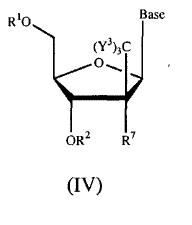
wherein:
Base is as defined herein; optionally substituted with an amine or cyclopropyl (e.g., 2-amino, 2,6-diamino or cyclopropyl guanosine);
R7 is halo (F, CI, Br or I), though preferably F;
R1 is· H;… [8 lines of text follow]…; and
R2 is phosphate … [8 lines of text follow]…
297 After formula XXIII is discussed, commencing at p 99, the 350 application continues in these terms:
The nucleosides described herein are prodrugs that can increase the activity, bioavailability, stability or otherwise alter the properties of the nucleoside. A number of nucleoside prodrug ligands are known. In general, alkylation, acylation or other lipophilic modification of the mono, di or triphosphate of the nucleoside will increase the stability of the nucleoside. Examples of substituent groups that can replace one or more hydrogens on the phosphate moiety are alkyl, aryl, steroids, carbohydrates, including sugars, 1,2- diacylglycerol and alcohols. Many are described in R. Jones and N. Bischofberger, Antiviral Research, 27 (1995) 1-17. Any of these can be used in combination with the disclosed nucleosides to achieve a desired effect.
The active nucleoside can also be provided as a 2', 3' and/or 5' -phosphoether lipid or a 2', 3' and/or 5' -ether lipid, as disclosed in the following references, which are incorporated by reference herein: Kucera, L.S., N. Iyer, E. Leake, A. Raben, Modest E.K., D.L.W., and C. Piantadosi. 1990. “Novel membrane-interactive ether lipid analogs that inhibit infectious HIV-l production and induce defective virus formation.” AIDS Res. Hum. Retro Viruses. 6:491-501…
…
The β -D- and β -L-nucleosides of this invention may inhibit Flaviviridae polymerase activity. Nucleosides can be screened for their ability to inhibit Flaviviridae polymerase activity in vitro according to screening methods set forth more particularly herein. One can readily determine the spectrum of activity by evaluating the compound in the assays described herein or with another confirmatory assay.
…
The active compound can be administered as any salt or prodrug that upon administration to the recipient is capable of providing directly or indirectly the parent compound, or that exhibits activity itself. Nonlimiting examples are the pharmaceutically acceptable salts (alternatively referred to as “physiologically acceptable salts”), and a compound, which has been alkylated or acylated at the 5' -position, or on the purine or pyrimidine base (a type of “pharmaceutically acceptable prodrug”). Further, the modifications can affect the biological activity of the compound, in some cases increasing the activity over the parent compound. This can easily be assessed by preparing the salt or prodrug and testing its antiviral activity according to the methods described herein, or other methods known to those skilled in the art.
298 In sub-section II, Definitions, the 350 application states that:
The term purine or pyrimidine base includes, but is not limited to, adenine…
The term “pharmaceutically acceptable salt or prodrug” is used throughout the
specification to describe any pharmaceutically acceptable form (such as an ester, phosphate ester, salt of an ester or a related group) of a nucleoside compound which, upon administration to a patient, provides the nucleoside compound…
The compounds of this invention possess antiviral activity against a Flaviviridae, or are metabolized to a compound that exhibits such activity.
299 In sub-section VI, Processes for the Preparation of Active Compounds, the 350 application states that:
The nucleosides of the present invention can be synthesized by any means known in the art. In particular, the synthesis of the present nucleosides can be achieved by either alkylating the appropriately modified sugar, followed by glycosylation or glycosylation followed by alkylation of the nucleoside. The following non-limiting embodiments illustrate some general methodology to obtain the nucleosides of the present invention.
300 The embodiments then listed are set out under the headings General Synthesis of l'-C-Branched Nucleosides, General Synthesis of 2'-C-Branched Nucleosides, General Synthesis of 3'-C-Branched Nucleosides, General Synthesis of 4'-C-Branched Nucleosides, and General Synthesis of 2' and/or 3'-Prodrugs. The next section contains non-limiting Examples of the invention. Each example includes a chemical structure followed by numerous (some 5000) pages of potential substituents. Also included in these sections are various reaction schemes including schemes which are discussed further below in the section relating to the sufficiency of the Idenix patent (schemes 4 and 9 in the Idenix patent, being schemes 4 and 8 in the 350 application).
5.5 The 350 application - consideration
301 Idenix put its case on the 350 application in these terms:
The simple answer to the priority date point is that the invention claimed in claim 7 and dependent claims is disclosed in Formula (IX) of the ‘350 Application which appears twice in the document. Claim 7 is a subset of Formula (IX).
302 It follows, Idenix said, that claim 7 does not travel beyond the disclosure in the 350 application.
303 Insofar as much expert evidence dealt with the issue of what was disclosed in the 350 application, Idenix submitted the evidence was irrelevant.
304 Gilead accepted that claim 7 is within the structural formula of formula IX in the 350 application but contended that, having regard to the 350 application as a whole, there is no real and reasonably clear disclosure in the 350 application of a compound where:
(1) R13 (the substituent at the 2' down position) is fluorine (F);
(2) Base* may be a natural base; and
(3) the compound may be a 5' prodrug that is not also a 2' or 3' or 2' and 3' prodrug – that is, a compound of formula IX that is a 5' only prodrug.
305 Such a compound is within claim 7 (noting that claim 7 encompasses 5' only prodrugs) but this, according to Gilead, travels beyond the disclosure in the 350 application.
306 Further, in Gilead’s words:
because the disclosure of the 350 application is so wide and generic that it is not possible to identify what the purported invention actually is, claim 7 and dependent claims are not entitled to a priority date earlier than the date of filing of the complete specification.
307 Gilead accepted that the issue is one for the Court, not the experts, but said the expert evidence can assist given the highly technical nature of the disclosure and the length (5301 pages) of the 350 application.
308 I have concluded that Gilead’s contention that claim 7 is not fairly based on matter disclosed in the 350 application (because there is no real and reasonably clear disclosure in the 350 application of a compound where the substituent at the 2' down position is fluorine, the base is a natural base, and there is a prodrug only at the 5' position) should be accepted at least in part.
5.5.3 Response to competing cases
309 Consistent with the decisions discussed above, to the extent that Idenix submitted that the only question was whether claim 7 is “within” formula IX and, if it was (which is not disputed), it necessarily followed that the claim did not travel beyond the disclosure, I disagree.
310 The question whether claim 7 is fairly based on matter disclosed in the priority documents does not begin and end with the question whether claim 7 is “within” formula IX. The fact that a claim may be fairly based on a drawing, rather than text, does not mean that the text and the nature of the drawing is to be disregarded. Nor does the fact that a claim may be fairly based on part or parts of a priority document (including a drawing) mean that the whole of the document, which will provide context to the part or parts in question, is to be disregarded. Similarly, while an “over meticulous verbal analysis” is to be avoided (Lockwood at [68]), Idenix’s description of the task as a “relatively mechanical process”, if intended to mean anything more than that notions of undue reward are immaterial (Lockwood at [57]) and quality of disclosure unhelpful (Lockwood at [89]-[90]), might involve an invitation into error. This is because the statutory requirement is to consider “matter disclosed” in the priority document. These observations carry particular weight given the nature of the 350 application which is described below.
311 For these reasons I do not accept a submission which Idenix put as follows:
Let it be assumed that claim 7 was on all fours with Formula (IX). It could hardly be said that claim 7 travels beyond or is not disclosed by Formula (IX). The “vice” of claim 7 according to Gilead is that it is narrower than Formula (IX). It would represent a remarkable turn of events in the patent law of this country if a claim that was narrower than the prior disclosure was more exposed to loss of its claimed priority date.
312 The concerns which arise from this submission are that it assumes that: - (i) formula IX may be considered in isolation, (ii) the issue of disclosure is necessarily answered by finding something (indeed, anything) in a priority document which can be matched to the claim, (iii) every word or drawing in a priority document, taken in isolation, is necessarily a part of the matter disclosed, (iv) there is no need, in determining fair basis, to consider the invention or inventions, and (v) there is no scope to find a lack of fair basis if the subsequent embodiment is more specific than that in the priority document. I am not persuaded that any of those assumptions are valid. In any event, as Gilead put it, the asserted “narrowing” relates only to F at 2' down. But three combined attributes are in issue:
F at the 2' down position (in combination with Methyl at the 2' up position),
No prodrug moiety at either or both of the 2' and 3' positions, and
A natural nucleobase.
313 I also do not agree with Idenix’s submission that Gilead’s case depended on the 350 application disclosing only one invention. While there were threads of this concept running through the experts’ evidence, it is not the case which Gilead put. Gilead’s case was that the 350 application, properly construed, did not disclose any invention(s) such as that encompassed by claim 7 (that is, natural base, F at 2' down, and prodrug at the 5' position only). This submission also does not depend on any illegitimate notions of undue reward or quality of disclosure. It depends only on construction of the 350 application to ascertain what matter it discloses.
314 One tension between the submissions remained largely unexplored. Gilead’s case emphasised that the concept of disclosure for both internal and external fair basis necessarily involves consideration of the invention or inventions (in the priority document for external fair basis and the specification for internal fair basis). This is consistent with the approach in Lockwood. Idenix’s case appeared to focus on the words or drawings which appeared in the priority document, whether or not they were described as part of the invention or inventions being disclosed. To the extent this tension existed, I prefer Gilead’s approach which I consider to be consistent with the authorities.
315 I do accept, however, that the expert evidence is largely immaterial to the issues at hand. In particular, I accept Idenix’s submission that “Professor Meier’s evidence as to how he would have discerned a particular embodiment from the disclosure is not material to disclosure”. For this reason I make little reference to the expert evidence in reaching my conclusions about this issue.
316 Some facts about the 350 application are beyond argument (apart from its extraordinary length).
317 Gilead provided a table, which I accept, analysing the 23 formulas in the 350 application as follows:
Text Formula | Nucleobase | Fluorine at 2' down? | Page |
I method | Base (modified base) | No F | 13, 45 |
II method | Base (modified base) | No F | 15, 47 |
III method | Base (modified base) | No F | 15, 48 |
IV method | Base (modified base) | F among about 70 options; some of which themselves encompass numerous options | 15, 48 |
IV (even more preferred) method | Base (modified base) (this is disputed) | F among 4 (“preferably”) | 57 |
V method | Base (modified base) | F among about 70 options; some of which themselves encompass numerous options (irrelevant carbocycle) | 15, 48 |
VI method | Base (modified base) | F among about 70 options; some of which themselves encompass numerous options | 24, 58 |
VII method | Base (modified base) | F among about 70 options; some of which themselves encompass numerous options (irrelevant carbocycle) | 24, 58 |
VIII method | Base* (modified or natural base) | No F | 26, 91 |
IX method | Base* (modified or natural base) | F among about 70 options; some of which themselves encompass numerous options | 26, 91 |
X method | Base* (modified or natural base) | F among about 70 options; some of which themselves encompass numerous options (irrelevant carbocycle) | 26, 91 |
XI method | Base* (modified or natural base) | F among about 70 options; some of which themselves encompass numerous options | 27, 92 |
XII method | Base* (modified or natural base) | F among about 70 options; some of which themselves encompass numerous options (irrelevant carbocycle) | 27, 92 |
XIII-XIV | missing illustration of structure | 29, 64 | |
XV compound | Base (modified or natural base) | No F | 31, 91 |
XVI compound | Base (modified or natural base) | No F | 31, 96 |
XVII compound | Base (modified or natural base) | No F | 31, 96 |
XVIII compound | Base (modified or natural base) | No F (irrelevant S ring atom) | 31, 96 |
XIX compound | Base expressly non-natural | F among almost 70 options; some of which themselves encompass numerous options | 32, 97 |
XX compound | Base expressly non-natural | No F | 32, 97 |
XXI compound | Base expressly non-natural | No F | 32, 97 |
XXII compound | Base expressly non-natural | No F | 32, 97 |
XXIII compound | Base expressly non-natural | No F | 32, 97 |
318 The following propositions, to my mind, are also uncontroversial (or should be at least).
319 Generally:
(1) It was common ground between the experts that the 350 application does not provide an example of any compound which is effective against HCV.
(2) It was also common ground that, despite the repeated assertions that compounds (etc) are useful in the 350 application, it is not possible from the 350 application, read in light of the common general knowledge, for the skilled addressee to know whether any one or other of the potentially trillions of compounds within the scope of the 350 application might be efficacious for the treatment of HCV. As the 350 application otherwise states at p103:
The β-D- and β-L-nucleosides of this invention may inhibit Flaviviridae polymerase activity. Nucleosides can be screened for their ability to inhibit Flaviviridae polymerase activity in vitro according to screening methods set forth more particularly herein (emphasis added).
(3) It follows from p103 that the skilled addressee would read the 350 application as saying nothing more than that the compounds (etc) disclosed may or may not inhibit Flaviviridae polymerase activity and, in order to determine whether any particular compound does have this inhibitory effect, screening of selected compounds would be required.
(4) The 350 application does not provide any rationale for compounds (etc), as a class, having or not having an inhibitory effect on Flaviviridae polymerase activity.
320 In respect of F at the 2' down position (R13 in claim 7):
(1) The 350 application does not describe a compound of claim 7 with F at the 2' down position.
(2) The approximately 5000 pages of tables of possible substituents and various combinations thereof in respect of each example (which, it is accepted, do not include an example based on formula IX) do not identify F at the 2' down position.
(3) Only formulas IV, V, VI, VII, IX, X, XI, XII and XIX permit F at 2' down (and, except for IV, this is among many other potential substituents).
(4) In formula IX, F at 2' down is allowed for among many (approximately 70) primary options at that position (and many more sub-options within the named possible substituents).
(5) The 350 application does not explain why, from the numerous potential substituents at the 2' down position, F would be preferred. No rationale for F being present at that position, other than its appearance amongst a multitude of other possible substituents, is provided.
321 In respect of the base being a natural or non-modified base:
(1) The 350 application, at p1 lines 4-7 and p8 line 28 - p9 line 1, describes the invention as relating to a 2' and/or 3' prodrug of 6-modified, 1', 2', 3' or 4'-branched pyrimidine nucleoside or 8-modified, 1', 2', 3' or 4'-branched purine nucleoside for the treatment of a Flaviviridae, and in particular, hepatitis C virus. The references to “6-modified” and “8-modified” are to modifications on the nucleobase of the nucleoside analogue (that is, modified bases).
(2) References to modified bases recur throughout the 350 application, for example, p9 line 26 - p13 line 8, p35 lines 22 - 24, p89 line 30 - p90 line 24, every one of the hundreds of thousands of Examples in the Tables provided at pp129 - 5293 and Figure 1 at p5298.
(3) The totality of the disclosure of the natural bases is their inclusion among the very long list of “purine and pyrimidine bases” at p105 lines 14-29. It is invoked by Base*. Accordingly, Base* includes natural nucleobases but in doing so the definition at p105 of the 350 application also invokes a very much broader list of modified nucleobases.
(4) A discrete nucleoside with F at 2' down and a natural base is never shown in the 5301 pages of the 350 application.
(5) Leaving aside the appearance of natural bases in the formulas where “Base” is used and one sub-embodiment of formula IV (about which the parties are at issue in terms of construction of the 350 application), of the formulas that permit F at the 2' down position:
IV has modified nucleobases only;
V has modified nucleobases only;
VI has modified nucleobases only;
VII has modified nucleobases only;
IX has Base*; it is the formula principally relied on by Idenix;
X has Base* but is a carbocycle;
XI has Base*; it is similar to IX with additional branching possibilities;
XII has Base* but is a carbocycle; and
XIX has modified nucleobases only.
322 In respect of prodrugs at the 5' position only and not also at the 2' or 3' position:
(1) The title of the 350 application is “modified 2' and 3'-nucleoside prodrugs for treating Flaviviridae”.
(2) There are many statements in the 350 application which identify the “invention” as “modified 2' and 3'-nucleoside prodrugs for treating Flaviviridae”.
(3) The 5000 or so pages of tables invariably have the prodrug moiety present at the 2' or 3' position or both, whereas the substituent at the 5' position is not described in the tables.
(4) The list in the summary section of the 350 application at (a) to (v) involves 2'-prodrugs and/or 3'-prodrugs, not 5' prodrugs.
323 Apart from these basic facts, my further observations are set out below.
5.5.5 F at the 2' down position
324 As Gilead noted, given the sub-classes within a number of the potential substituents identified in the 2' down position, formula IX permits F at 2' down amongst thousands of possibilities. Nothing in the 350 application explains why F at 2' down might be preferred to any one or other of those thousands of possibilities. In contrast, the “even more preferred subembodiment” of formula IV, discussed above (that is, the “even more preferred subembodiment” of a third principal embodiment of formula IV), does identify (albeit with no explanation) that F at the 2' down position is preferable. Professor Meier placed weight on Formula IV, particularly in his affidavits.
325 Formula IV, it should be noted, does not involve a natural base and nor does this even more preferred subembodiment (see the discussion below). Unlike claim 7, the compound in this embodiment of formula IV is one which necessarily has a modified base. There is no relationship in the 350 application between formulas IV (modified base) and IX (modified and natural bases). I accept Gilead’s submission that the skilled addressee would not read formulas IV and IX as related in any way. The skilled addressee would recognise that they are unrelated and the compounds are different. The skilled addressee, accordingly, would not transpose the “preferably fluoro” reference on p57 of the 350 application in this particular embodiment of formula IV into formula IX where no such preference is expressed. One reason for this is that the skilled addressee would do no more than recognise fluorine in formula IX as one of a number of known substituents which might have unpredictable biological activity but no more.
326 Formula IX permits F at 2' down amongst many possibilities. Is claim 7, with F at 2' down, thereby fairly based? Is there a real and reasonably clear disclosure of a compound with F at 2' down in circumstances where there are thousands of potential substituents at that position, nothing in the 350 application discloses any reason for preferring F at 2' down over and above any of the other many potential substituents at this position in formula IX, and nothing in the common general knowledge would direct the skilled addressee to consider F over and above any of the other potential substituents?
327 Uninstructed by authority the caveat expressed by Gibbs J in Roche at 242 set out above seems to have much to commend it. However, as has been noted in subsequent decisions, the caveat is not readily reconcilable with the reasoning in Lockwood. In Novartis AG v Hospira Pty Ltd [2012] FCA 1055; (2012) 98 IPR 185 Yates J at [64] said this:
These observations [ie of Gibbs J in Roche] – which raise the prospect of inventive selection being priority-defeating – appear to sit somewhat discordantly with what has been said in later cases, particularly in Lockwood at [50] and [68]–[69]. Whilst a decision of a single justice of the High Court is deserving of close and respectful consideration, I am not bound by the observations quoted above.
328 In Pfizer v Commissioner of Patents at [43] Bennett J said:
On 18 November 2004, the High Court delivered its judgment in Lockwood Security Products Pty Ltd v Doric Products Pty Ltd (2004) 217 CLR 274 (‘Doric’), after the hearing of this matter had concluded. The High Court made it clear that, in considering fair basis, an examination of the specification goes to the form that the specification takes (at [44]). There is no reason to introduce “inventiveness” or “meritoriousness” or inventive step (Doric at [46], [48] and [53]-[54]). It is a question only of what is said in the specification (Doric at [72]). To the extent that there is any conflict between Doric and the observations of Gibbs J in Roche which were not part of the ratio of that case, clearly Doric is authoritative.
329 Consistently with the ratio in Roche and the reasoning in Lockwood I consider that this issue must be answered in Idenix’s favour. By this I mean that by reason of F being one of the multitude of potential substituents at the 2' down position in formula IX it must be concluded that there is a real and reasonably clear disclosure of a compound with F at the 2' down position in the 350 application. However, as explained below, I have also concluded that there is no real and reasonably clear disclosure of such a compound which also has a natural base and a prodrug only at the 5' position.
5.5.6 Modified or natural bases?
330 It will be apparent from the above table that the various formulas use either “Base” or “Base*”. Where “Base*” is used, as in formula IX, the expression is “Base* is a purine or pyrimidine base as defined herein”. This is because neither Base nor Base* is itself a defined term in the 350 application. Rather, at p105, the definition appears as follows:
The term purine or pyrimidine base includes, but is not limited to, adenine… [15 lines of text follow which include natural and modified bases]…
331 Where “Base” and not “Base*” is used, the expression is “Base is selected from the group consisting of…”, followed by numerous structural formulas of bases. Leaving aside the disputed embodiment of formula IV for the moment, as the above table shows, Formulas I to VII show formulas of modified bases only. Formulas XV to XVIII, however, show formulas of both modified and natural bases. As I understand it, Idenix contends that these formulas therefore expressly contemplate natural bases, as does any formula involving Base*.
332 The difficulty arises because the 350 application is by no means free from ambiguity. On the one hand, some examples of Base involve natural bases in the accompanying structural formula and some examples of Base* are natural bases. On the other hand, if Base and Base* are construed to include natural bases then it is difficult to understand the way in which the 350 application refers to the invention as involving 1', 2', 3' or 4'-branched nucleosides a concept which, at line 28 - p8, is defined as follows (with my emphasis):
The term 1', 2', 3' or 4' -branched, as used in this specification, refers to a nucleoside that has an additional non-natural substituent in the 1', 2', 3' or 4'-position as well as an additional non-natural substituent in the 8-position in the purine base or 6- position in the pyrimidine base.
333 As noted, this concept of the invention appears repeatedly (p9 line 26 - p13 line 8, p35 lines 22 - 24, p89 line 30 - p90 line 24, every one of the hundreds of thousands of Examples in the Tables provided at pp129 - 5293 and Figure 1 at p5298).
334 Idenix relied on the fact that the 350 application may disclose multiple inventions. This does not seem to me to answer the fact that the 350 application, expressly and repeatedly, describes itself as involving an invention (or inventions) in which the base is modified at the 6 and 8 positions. Nor does it explain why the tables consistently exemplify the description of the invention or inventions as modified nucleobases. The fact that a priority document might disclose multiple inventions does not assist where, as in the present case, first, whenever the priority document attempts to identify the inventions it does so by reference to involving 1', 2', 3' or 4'-branched nucleosides which are defined to mean modified nucleobases and, second, whenever a natural base appears it is merely one of a much larger number of modified bases from which the skilled addressee is instructed by the application to select the nucleobase.
335 Insofar as it is necessary to deal with one of the sub-embodiments to formula IV (relied on by Professor Meier), Gilead’s construction is to be preferred. At p57 line 15 there begins a description of an “even more preferred subembodiment”. This refers to:
Base is as defined herein.
336 Professor Meier read this as referring to the definition on p105 that “[t]he term purine or pyrimidine base includes, but is not limited to, adenine…[etc]”.
337 I am unable to agree.
338 First, the so-called “subembodiment” is an even more preferred subembodiment of formula IV. Formula IV begins on p48. It defines “Base” as being selected from a group, all of which are modified bases. As a subset of formula IV it is preferable to read “[b]ase is as defined herein” as a cross-reference back to p48 and not to p105.
339 Second, and confirmatory of this preference, the subembodiment refers to Base not Base*. When the description at p105 is to be invoked the 350 application uses Base*.
340 Third, and as discussed, the definition on p105 is not of Base or Base*. Whenever Base* is used the 350 application says “Base* is a purine or pyrimidine base as defined herein” and p105 defines the “the term purine or pyrimidine base”.
341 Fourth, the purpose of this even more preferred subembodiment is to narrow the scope of the modified bases already described at p48 by identifying that:
Base is as defined herein; optionally substituted with an amine or cyclopropyl (e.g., 2-amino, 2,6-diamino or cyclopropyl guanosine).
342 The fact that the 350 application otherwise uses the expression “as defined above” to cross-refer to earlier definitions is insufficient to persuade me to the contrary. Nor does the fact that the general schemes in the 350 application at pp114 to 126 use the expression “base … as defined herein” in describing bases which are not limited to non-natural bases. Neither matter carries the same weight in determining the preferred construction as the four considerations to which I have referred as supporting the construction I prefer.
343 To the extent that Professor Meier relied on this subembodiment as involving a natural base (with F preferred at the 2' down position) I consider he was in error. This is one reason why it would have been preferable for Professor Meier not to have been left to construe ordinary English words on his own but to have been instructed as to competing possible constructions. The relevance of the different construction to his ultimate conclusions would then have been clear. As it is, I consider that he has misconstrued this subembodiment, on which he has placed considerable weight, because it gives a preference for F in the 2' down position, and the impact of this on the reliability of his conclusions is unclear but worrying. While his view expressed in oral evidence that F was the “magic atom” may have led him to reach the same conclusions in any event, this is not apparent from his affidavits which place material weight on his construction of this embodiment of formula IV. All in all, this indicates that Professor Meier’s conclusions may be adversely affected by an incorrect interpretation of the 350 application.
344 As noted, unlike the case of F at 2' down, where F is inescapably one of the potential substituents disclosed in formula IX at this position, there is ambiguity in the way in which the 350 application deals with bases. The ambiguity must be resolved in the context of the application as a whole. Ultimately, in reconciling the descriptions in the 350 application I consider that the key is that whenever “Base” is used it expressly involves the making of a selection by the skilled addressee from formulas which include modified bases in the context of an invention which describes itself as involving modified bases. The same applies to Base* because the definition includes both modified and natural bases. While the 350 application includes natural bases in its descriptions of Base (by the structural formulas) and Base* (by the words of the definition) it is nevertheless doing so in the context of the disclosure of an invention or inventions in which the base is modified. The skilled addressee of the 350 application would know which of the bases shown involve the 1', 2', 3' or 4'-branched nucleosides of the invention or inventions disclosed by the 350 application (that is, those involving a modified base). This knowledge, as set out above, was common general knowledge of the skilled addressee at the relevant times.
345 As a result, I consider that claim 7, insofar as it claims a natural base, is not fairly based on the 350 application. There is no real and reasonably clear disclosure of any such compound.
5.5.7 Prodrugs at the 5' position only
346 Similar reasoning informs my conclusions about this issue. My conclusion is that, whatever matter the 350 application might be disclosing, that matter does not involve a compound with a prodrug at the 5' only position.
347 As noted above, the 350 application repeatedly refers to the invention (or inventions) as consisting of modified 2' and 3'-nucleoside prodrugs for treating Flaviviridae. Yet I accept that there are other parts of and ambiguities in the 350 application, in particular, by reason of:
(1) the use of “and/or” relied on by Professor Meier and Idenix as including 5' only prodrugs;
(2) the description of “2', 3' and/or 5'” prodrug moieties at pp99-100;
(3) the formulas, which are each introduced by the expression “a compound of Formula … or a pharmaceutically acceptable salt or prodrug thereof, wherein”; and
(4) the formulas which by selection of substituents allow 5' only prodrugs or no prodrugs at all.
348 It is necessary to consider all of these issues together as each part of the 350 application informs an understanding of the other parts and of the whole.
349 In respect of the use of “and/or”, I have no doubt that this form of conjunction ordinarily means either both or the one or the other so that, where the phrase used is “the 2' and/or 5' positions”, “the 3' and/or 5' positions” or “the 2', 3' and/or 5' positions” there needs to be some sound reason for construing the phrase as not contemplating a prodrug at the 5' only position. I am persuaded that, in the case of the 350 application, sound reason exists. I have already identified that the title, numerous instances in the body of the specification, and the 5000 pages of examples indicate that the invention (or inventions) being described is a 2' and 3' or 2' or 3' prodrug, optionally also including a 5' prodrug moiety, but not an invention involving a 5' prodrug alone. In addition to these general propositions, the following matters support this conclusion.
350 The summary section of the 350 application expressly defines 2'-prodrug and 3'-prodrug at p 9. Hence (with my emphasis):
The term 2' -prodrug, as used herein, refers to a 1', 2' ,3' or 4'-branched β -D or β -L nucleoside that has a biologically cleavable moiety at the 2'-position, including, but not limited to acyl, and in one embodiment, a natural or synthetic D or L amino acid, preferably an L-amino acid. The term 3' -prodrug, as used herein, refers to a 1', 2', 3' or 4'-branched β -D or β -L nucleoside that has a biologically cleavable moiety at the 3'-position, including, but not limited to acyl, and in one embodiment, a natural or synthetic D or L amino acid, preferably an L-amino acid.
351 The summary section then describes embodiments as 2'-prodrugs and 3'-prodrugs. In so doing it refers to “and/or 5'” but, in context, all of these are examples of a 2'-prodrug or a 3'-prodrug which, by definition, must have a prodrug at the 2' or 3' position respectively. This is the only way in which pp9 to 13 of the 350 application can be read. Professor Meier, in my view, agreed with this proposition.
352 Consistently with this, the 350 application explains why prodrugs at the 2' and 3' position are being disclosed rather than prodrugs at the 5' position only. At p39 this is said:
The 2' and/or 3' -prodrugs of a 1', 2', 3' or 4' -branched β-D or β -L nucleoside are acyl derivates of a secondary or tertiary alcohol alpha to a secondary or tertiary carbon. Due to the steric hindrance of these prodrugs over the 5' -prodrugs, an acyl derivative of a primary alcohol, these prodrugs differentially modulate the biological properties of the molecule in vivo. It has been discovered that the 2' and/or 3'-prodrugs of a 1', 2', 3' or 4'-branched β-D or β-L nucleoside can provide a drug with increased half-life and improved pharmacokinetic profile.
353 As Professor Meier explained this is a description of a nucleoside analogue prodrug strategy which recognises that:
… you need a certain stability to get the compounds into the cell. If the temporary moiety is cleaved too fast you do not get an advantage for that to use it, so you need a certain stability and the stability in the context of these amino acid esters is that the 5' are less stable than the 2' or 3' so it’s more beneficial to put the moieties at the 2' or 3' position, which does not say that the 5' position alone might have an advantage over the parent nucleoside, but to use it as a drug in the nucleoside analogue prodrug strategy, it is more reasonable to use it in the 3', 2' position.
…
The 5' is a primary alcohol, the 5' end of a nucleoside analogue and the 2' and 3' are secondary alcohols. So the enzymes that are involved in the cleavage of these temporary groups work less efficient on the secondary alcohol to cleave the ester than on the primary alcohol and therefore the stability due to steric hindrance is higher for the 2' and 3'.
354 The 350 application returns to this issue at pp99-100 where it states:
The nucleosides described herein are prodrugs that can increase the activity, bioavailability, stability or otherwise alter the properties of the nucleoside. A number of nucleoside prodrug ligands are known. In general, alkylation, acylation or other lipophilic modification of the mono, di or triphosphate of the nucleoside will increase the stability of the nucleoside. Examples of substituent groups that can replace one or more hydrogens on the phosphate moiety are alkyl, aryl, steroids, carbohydrates, including sugars, 1,2- diacylglycerol and alcohols. Many are described in R. Jones and N. Bischofberger, Antiviral Research, 27 (1995) 1-17. Any of these can be used in combination with the disclosed nucleosides to achieve a desired effect.
The active nucleoside can also be provided as a 2', 3' and/or 5' -phosphoether lipid or a 2', 3' and/or 5' -ether lipid, as disclosed in the following references, which are incorporated by reference herein: Kucera, L.S., N. Iyer, E. Leake, A. Raben, Modest E.K., D.L.W., and C. Piantadosi. 1990. “Novel membrane-interactive ether lipid analogs that inhibit infectious HIV-l production and induce defective virus formation.” AIDS Res. Hum. Retro Viruses. 6:491-501…
…
355 Idenix and Professor Meier placed weight on this part of the 350 application, not the least because the articles referred to involve 5' only prodrugs. However, I do not consider that this involves, as Idenix would have it, the disclosure of another invention with a prodrug at the 5' position only. The context of this part of the 350 application indicates to the contrary.
356 First, it is apparent to the skilled addressee that this part of the 350 application concerns nucleotides (that is, a nucleoside to which one or more phosphate groups has been covalently bonded). The section, however (and importantly), begins with the words “[t]he nucleosides described herein…”. Leaving aside the formulas (discussed below), the nucleosides described herein are nucleosides with a prodrug at the 2' and/or 3' position, a prodrug at the 5' position being an optional addition to such nucleosides.
357 What is being described at pp99-100 is a nucleotide drug strategy with a prodrug at the 5' position (as discussed in the articles to which reference is made in this part) that can be “used in combination with the disclosed nucleosides to achieve a desired effect”. The sentence beginning with the words “[t]he active nucleosides can also be provided as a 2', 3' and/or 5'-phosphoether lipid or a 2', 3' and/or 5'-ether lipid” is to be understood in this context. The description continues to relate to the nucleosides described herein which are nucleosides with a prodrug at the 2' and/or 3' position.
358 Accordingly, in my view, at least insofar as the text is concerned, the disclosed nucleosides remain the nucleosides with a prodrug at the 2' and/or 3' position, a prodrug at the 5' position being an optional addition to such nucleosides. In other words, the 350 application also describes a nucleotide prodrug strategy involving prodrugs at the 2' and/or 3' position, a prodrug at the 5' position being an optional addition to such nucleotides.
359 Second, this construction is consistent with the fact that the various articles to which reference is made disclose 5' nucleotide prodrugs. Such nucleotides are treated as known in the art already by the 350 application. Professor Meier and Dr Lambert also said that a 5' phosphate (i.e., 5' nucleotide prodrug) was known to those skilled in the art at all relevant dates. This lends weight to Gilead’s submission that this part of the 350 application, properly construed, is describing types of lipophilic substituents that can be placed at the 5' position of a nucleoside monophosphate (as Professor Meier insisted) but of a nucleoside that also already has a prodrug moiety at either or both of the 2' and 3' positions.
360 Idenix placed weight on the statement that “[t]he active nucleoside can also be provided as a 2', 3' and/or 5'-phosphoether lipid or a 2', 3' and/or 5'-ether lipid as disclosed in the following references, which are incorporated by reference herein:…”. Idenix relied on these articles (as they refer to 5' only prodrugs) because it assumed that, as they were incorporated by reference, their content was necessarily part of the matter disclosed in the 350 application so that a subsequent claim could be fairly based on any part of the content of those articles. I have difficulty with this submission. As I have said, the articles are incorporated by reference for the purpose only of drawing the skilled addressee’s attention to the fact that the 5' nucleotides already known to the art (as referred to in the articles) could be used in conjunction with the nucleosides of the invention (that is, with a 2' and/or 3' prodrug). The the 5' nucleotides already known to the art, of themselves, are not the invention or inventions with which the 350 application is concerned.
361 This is consistent with the principles relevant to construction of patents, in particular, incorporation by reference of other documents, which focus on the purpose of the incorporation (Apotex Pty Ltd v Sanofi-Aventis [2008] FCA 1194; (2008) 78 IPR 485 at [121]; ICI Chemicals at [88]-[90], and Nicaro Holdings Pty Ltd v Martin Engineering Co (1990) 91 ALR 513 (Nicaro Holdings) at 517 and 532-539). In Nicaro Holdings this was said at 517:
It is, however, permissible to refer not only to the patent relied on as the source of disclosure but to another patent or other patents incorporated by reference provided that it is plain that the incorporation by reference unequivocally and plainly demonstrates that the draftsman has adopted the cross-referencing system solely as a shorthand means of incorporating a writing disclosing the invention: George C Warner Laboratories Pty Ltd v Chemspray Pty Ltd (1967) 37 AOJP 2513 at 2516; Blanco White, 5th ed, at para 4.107 and Gratwick, “Having Regard to What was Known and Used” (1972) 88 LQR 341 at 343.
362 And at 538-539 in Nicaro Holdings these observations were made:
Again, even where there is a further description of the prior publication, it may nevertheless be that the purpose of the reference is to direct the reader away from it, as disclosing something outmoded or defective.
363 These principles are of particular importance once it is recognised that there are more than 200 documents referred to throughout the 350 application (and the Idenix patent, as to which see below) amounting to many thousands of pages. Given this, the purpose of the cross-reference and incorporation would be critical to the way in which the skilled addressee would read the 350 application (and the Idenix patent).
364 In my view, what is disclosed in this part of the 350 application is thus not simply 5' nucleotide prodrugs. It is the use of these nucleotides with the nucleosides of the invention (that is, with a 2' and/or 3' prodrug). Given this, I struggle with the notion that the 350 application discloses 5' only prodrugs. To my mind the skilled addressee would understand that it identifies the existence in the art of 5' only prodrugs for the purpose of disclosing something different – how they can be used with the nucleosides of the invention.
365 The fact that Professor Meier read the 350 application to say otherwise in this part may be accepted but does not lead me to a different conclusion. Much of his opinion appeared to arise from Professor Meier’s interpretation of ordinary English words (such as “and/or”) as much as his scientific expertise. As Idenix said, on a strict view, Professor Meier’s conclusion in this regard is simply irrelevant. Otherwise Professor Meier’s conclusions appeared to involve an application of scientific knowledge outside the scope of the common general knowledge of the skilled addressee. Professor Meier said this:
…in this application, you have to distinguish between two different approaches for prodrugs. Both are mentioned in the 350 application. It is the nucleoside analogue prodrug strategy, and this is related to the 3'-amino acids, for example, 2' or 3' or only 3' and 2', 3' favoured over 5'…
… when you go now to the nucleotide analogue prodrug strategy, the aim is different. You modify the nucleotide – the nucleoside monophosphate. You get it into the cell. You deliver the monophosphate in the cell, and then this compound is phosphorylated to the tri. The difference is that you start your metabolism on the nucleoside monophosphate level in one case, and in the former case you start your metabolism on the nucleoside level. So that’s the big difference, and very often these nucleoside analogues have a big problem being monophosphorylated. So a nucleotide analogue monophosphate prodrug improves the metabolism, and the mixture or mixing these two strategies – nucleoside analogue prodrug or nucleotide analogue prodrug – in my view, is – first of all, I think it is not necessary, but the more important thing is that you risk that you have higher complexity in your molecule and in the degradation on the delivery of the target compound by putting too many different groups on this molecule…
So this is also my experience: that your – if you have a nucleotide prodrug, and this nucleotide prodrug is cleaved first, and you deliver a nucleoside monophosphate which still has an acyl, if it is cleavable, or an aminoacyl group at the 3'-position, you risk that this acyl group or aminoacyl group is not cleaved any more. So this means that the compound you deliver will not be bioactive, because you have a blocked 3' hydroxy group. So in my view, the risk of – that you have to take into account if you mix both prodrug strategies is too high. So you can make 5' monophosphate prodrugs, or you can make nucleoside prodrugs.
366 The problem with this, as Gilead identified, is that the 350 application is saying otherwise. Professor Meier’s experience leads him to the view that the risks of mixing of the prodrug strategies is too high but that experience (as discussed) is by no means part of the common general knowledge. As far as the 350 application is concerned the nucleotides with a 5' prodrug are able to be used “in combination with the disclosed nucleosides”, being the nucleosides with a 2' and/or 3' prodrug. The following reference to the active nucleosides also being provided as a 2', 3' and/or 5'-phosphoether lipid or a 2', 3' and/or 5'-ether lipid as disclosed in the articles is also to be understood in this context.
367 A similar conclusion applies to Idenix’s reliance on the statement at p103 line 26 of the 350 application that:
The active compound can be administered as any salt or prodrug that upon administration to the recipient is capable of providing directly or indirectly the parent compound, or that exhibits activity itself. Nonlimiting examples are the pharmaceutically acceptable salts … and a compound, which has been alkylated or acylated at the 5'-position, or on the purine or pyrimidine base (a type of “pharmaceutically acceptable prodrug”).
368 As Gilead said, read in context, the issue being discussed is of modifications to the phosphate at the 5' position for the same reasons as discussed previously at pp39-41 (improved bioavailability). It is in this context that the additional possibility of a 5' prodrug moiety is re-introduced. Read in context, it does not indicate that it is part of the invention or inventions for there to be a prodrug element only at the 5' position.
369 Third, the 350 application refers to Idenix’s prior application, WO 01/90121. It does so at p7 lines 19-21 where the 350 application states that Idenix was first to disclose branched nucleosides and their use in the treatment in HCV. As Gilead put it:
At page 55 of Idenix’s prior application, WO 01/90121 (Ex 35), a passage appears that corresponds to that at p99 of the 350 application. It refers only to 5' lipid prodrugs (rather than 2', 3' and/or 5' prodrugs) and it refers expressly to nucleotide prodrugs. This is under a heading, present in the Patent p108 line 15 (CB1:1-0110) but not in the 350 application, “Nucleotide Prodrug Formulations”. Gilead submits that if the invention truly were 5' only prodrugs, it had undoubtedly already been disclosed.
370 Idenix’s prior application WO 01/90121 is incorporated by reference into the 350 application for the express purpose of identifying the branched nucleosides which have already been disclosed. As Gilead submitted, when the known branched nucleosides of WO 01/90121 are compared to the 350 application, the skilled addressee would understand that the asserted advance over this prior art is the modified bases and, in particular, the 2', 3' prodrugs which are disclosed in the 350 application.
371 What then about the formulas which are just as much a part of the 350 application as the text?
372 As Gilead put it, the formulas appear twice in the 350 application:
(1) firstly, commencing at p13 line 19, as part of the summary of the invention, following the passages at p8 line 14 – p13 line 18, that unequivocally describe 2', 3' prodrugs, optionally including 5' prodrugs. This is preceded by the title and field of the invention on p1, which also identify 2', 3' prodrugs as the invention, and
(2) secondly, commencing at p45 line 1, as part of the detailed description of the invention which again refers to 2', 3' prodrugs (as the figures also show), the consistory clause at p39 lines 15-21, the description of the inventors’ rationale at p39 line 22 – 41 line 13 and the summary of the “features of the invention” at p41 line 14 – p43 line 31. These include particular compounds and each of (a)-(v) is a 2' or 3' prodrug, or both.
373 As Gilead acknowledged, the formulas refer to or at least include the parent compounds and the various possible substituents on the sugar ring include both branching substituents (Professor Meier’s “stable” modifications, e.g. alkyl) and prodrug substituents (Professor Meier’s “temporary” modifications, e.g. amino acid). This is necessarily so given that each formula commences with the expression “compound or a pharmaceutically acceptable salt or prodrug thereof” and each formula, by reason of the potential substituents identified, permits a compound which has no prodrug at all or a prodrug at the 5' only position. Idenix submitted that it followed from this that:
…the disclosure is of each of the compounds within the formula without a prodrug element, compounds within the formula with a prodrug element and compounds within the formula without a prodrug element but to which a prodrug is added …[a conclusion]… reinforced by the definition of the term “pharmaceutically acceptable … prodrug” starting at p107 line 26.
374 If the only question is whether the formulas allow for a compound which has no prodrug element, by reason of the potential substituents at each position in the structure, then the answer is yes. Similarly, if the question is whether the formulas allow for a compound with a prodrug at only the 5' position, the answer is also yes. As discussed, however, if the question is whether the 350 application discloses a compound with a prodrug at the 5' only position I do not consider these facts to be the beginning or the end of the issue.
375 I am not persuaded that the relevant question is necessarily answered by Idenix’s submission that the disclosure in the 350 application is of each of the compounds within the formula without a prodrug element, compounds within the formula with a prodrug element and compounds within the formula without a prodrug element but to which a prodrug is added. For present purposes, assume Idenix’s submission is correct. The issue remains whether the matter disclosed includes a compound with a prodrug only at the 5' position, which is encompassed by claim 7.
376 It is true, as Idenix said, that the substituents of formulas XV, XVI, XVII, XVIII, XXI and XXIII of the 350 application only permit a prodrug element at the 5' position, not at the 2' or 3' positions. Read in context and through the eyes of the skilled addressee this does not seem to me to advance Idenix’s case. As Gilead said, formulas XV- XVIII and XX-XXIII:
have extra branching substituents E and G;
have M or CH2 in the ring (instead of O);
do not allow F at 2' down; and
require modified nucleobases at p30, although a natural nucleobase could be engineered with the appropriate substituents.
377 Moreover, formula XIX permits F at 2' down but expressly forbids natural nucleobases at p33 line 10.
378 The best that Idenix’s case gets is formula IX. But read in the context of the 350 application as a whole nothing indicates that a compound within this formula should have a prodrug only at the 5' position. I do not find the balance of the submissions of Idenix to the contrary persuasive.
379 It is convenient first to identify some points about the formulas by reference to parts of Dr Lambert’s evidence (albeit that I accept this is an issue for the Court and not experts). Dr Lambert made the following points:
“…the body of the text had seemed to me to deliberately exclude 5' only prodrugs”;
while the formulas allow for prodrugs at the 5' position only “…every single other permutation that could be imagined had been described in detail with specific examples, except for those where 5' only prodrugs existed”;
the 350 application seems to be saying that “although you can allow for a nucleoside to be used as a drug, you know, our invention is that, or the advantage to be gleaned out of our discovery is if you use a 2' and 3' prodrug of those nucleosides.”
380 I agree.
381 The formulas encompass many thousands of potential compounds. Left with the formulas alone, the skilled addressee would not have much, if any, clue about what the 350 application was disclosing. The formulas have to be understood in the light of the text. Read as a whole, there are undoubtedly complexities, even ambiguities, in the 350 application. But the question of what the 350 application discloses cannot, in my view, be answered by reference to the formulas without regard to the text. The text directs the skilled addressee about the relevance and use to be made of the formulas. I do not see this as inconsistent with the reasoning in CCOM Pty Ltd v Jiejing Pty Ltd (1994) 51 FCR 260. Nor do I see it as inconsistent with the fact that a claim may be fairly based on part only of a priority document. This is because the issue remains one of identifying the disclosure. In the case of the 350 application, the formulas cannot be understood as disclosing anything meaningful in isolation from the text.
382 The question of the invention or inventions disclosed in the 350 application remains relevant. As discussed, I have concluded that the 350 application is not disclosing as an invention or inventions the branched nucleosides or nucleotides with a prodrug only at the 5' position (which have already been disclosed elsewhere). The fact that Professor Meier considered some of the strategies to be disadvantageous is not to the point. As Gilead said Professor Meier “accepted that the description of the 350 application at least includes a 3' and a 5' phosphate prodrug, whether or not he thought it was a good idea”.
383 Idenix noted that the “Detailed Description of the Invention” commences with a statement that the invention is a “compound, a method and composition for the treatment of a Flaviviridae infection” and “the method includes the administration of an effective anti-Flaviviridae treatment amount of a 2' and/or 3'-prodrug of a 1', 2', 3' or 4'-branched β-D or β-L nucleoside as described herein …” (emphasis added). This may be accepted. The difficulty is that apart from the formulas allowing for a prodrug at the 5' position only, amongst many thousands of compounds, the text of the 350 application concerns itself with an invention or inventions which, at least insofar as prodrugs are concerned, involves their placement at the 2' and 3' positions, with an option of also having a prodrug at the 5' position.
384 It is also convenient to note here that I accept Idenix’s submission that the so-called R3 proviso does not apply to formula IX. The 350 application at page 14 line 11 and at page 45 line 20 states “wherein at least one of R2 and R3 is not hydrogen”. This is the R3 proviso. Formula IX, however, has no R3. This issue, however, is immaterial to the question which must be answered.
385 When read as a whole the invention or inventions being disclosed in the 350 application necessarily involve nucleosides or nucleotides which have a prodrug at the 2' and/or 3' positions, optionally with a prodrug at the 5' position. Claim 7 and dependent claims, which encompasses a prodrug at the 5' position only, is not fairly based on the 350 application.
386 I accept that the expert evidence is largely immaterial to this issue. To the extent more needs to be said I make the following observations.
387 Consistent with the views expressed above I do not accept Idenix’s submission that Professor Meier alone possessed the knowledge of the skilled addressee or that all of Professor Meier’s knowledge was also common general knowledge of the skilled addressee in 2002 or 2003.
388 I also do not accept Idenix’s submission that Professor Meier’s reading of the 350 application was based solely on “the disclosure of the specification in light of the CGK [common general knowledge] as at June 2002”. His reading of the 350 application was based on the whole of his knowledge which, as explained, did not all form part of the common general knowledge in 2002 or 2003. It was also based on Professor Meier’s views about ordinary English words (such as “and/or”). Accordingly, it is not possible to identify what conclusions Professor Meier would have reached had he possessed only the common general knowledge of the skilled addressee or had he been instructed about different interpretations of ordinary English words.
389 As already discussed, the fact that Professor Meier said he had read a lot of the papers on which he relied at the time those papers were published before 2002 does not mean that the content of those papers all formed part of the common general knowledge as at 2002 or 2003. Idenix’s submission as follows should not be accepted:
It was not put to Professor Meier that any one (or more) of those documents were documents that he was not aware of prior to June 2002. On this basis, Idenix submits that each of those documents constituted CGK for a medical chemist in the field of the ‘350 Application as at June 2002. Hence, it was proper for Professor Meier to have regard to those materials in reading the ‘350 Application.
390 Mere awareness of a paper by Professor Meier before 2002 does not prove that anything in any of the papers to which he referred formed part of the common general knowledge at that time or later. It cannot be inferred that the content of these papers was known to, let alone assimilated and generally accepted by, those skilled in the art in 2002 and 2003. As noted, in many respects, the evidence is to the contrary.
391 Otherwise the question whether claim 7 is fairly based on matter disclosed in the 350 application is not answered by Professor Meier’s evidence of how he would have gone about selecting target compounds by reference to that application. Professor Meier’s mind is not determinative of any issue about the matter disclosed in the 350 application other than to the extent that he could explain terms of art and cast light on what would have been the common general knowledge of the skilled addressee at the relevant time. The same can be said about each of the other experts.
5.6 The 949 application – overview
392 The 949 application is entitled “Nucleosides for the treatment of infection by coronaviruses, togaviruses and picornaviruses”.
393 Formula (AA) first appears starting at p11 under the heading “Summary of the Invention” and is repeated starting at p16 in the “Detailed Description of the Invention” section under the subheading “Active Compounds, Physiologically Acceptable Salts and Prodrugs Thereof”. At p11 formula (AA) is introduced by the words “In a first principal embodiment, a compound of formula (AA), or a pharmaceutically acceptable salt or prodrug thereof, is provided: …”. The structure of formula (AA) is as follows (p12):
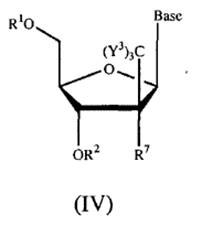
394 R1 is H, phosphate or phosphonate (including mono-, di-, or triphosphate or a stabilized phosphate prodrug); acyl (including lower acyl); alkyl (including lower alkyl); sulfonate ester including alkyl or arylalkyl sulfonyl including methanesulfonyl and benzyl, wherein the phenyl group is optionally substituted with one or more substituents as described in the definition of an aryl given herein; optionally substituted arylsulfonyl; a lipid, including a phospholipid; an amino acid derivative; a carbohydrate; a peptide; cholesterol; or other pharmaceutically acceptable leaving group which, when administered in vivo, is capable of providing a compound wherein R1 is independently H or phosphate.
395 Each R2 and R4 independently is H, OH, optionally substituted alkyl, optionally substituted alkenyl, optionally substituted alkynyl, halo, NO2, NH2, N3, CH2N3, CH2NH2, CN, CH2CN, CH2N3, CH2NHCH3, CH2N(CH3)2, CH2OH, halogenated alkyl, alkoxy, CF3, C(A)3, 2-Br-ethyl, CH2F, CH2Cl, CH2CF3, CF2CF3, CH2(A), C(A)2(A)3, SCN, OCN, NCO, haloalkenyl, Br-vinyl, haloalkynyl; -(CH2)mC(O)OR13, -(CH2)mC(O)SR13; -O(alkenyl), CF3, halogen, (CH2)mNHR13, -(CH2)mN(R13)2, -(CH2)mC(O)NHR13, -(CH2)mC(O)N(R13)2, -C(O)OR13, -O(R13), an optionally substituted carbocycle, an optionally substituted heterocycle, an optionally substituted heteroaryl (preferably a heteroaromatic ring having one or more O, S and/or N atoms), or C3-7 cycloalkylamino.
396 A is H, OH, C1-4 alkyl, halo, azido, cyano, C2-6 alkenyl, C2-6 alkynyl, Br-vinyl, 2-Br-ethyl, -C(O)O(alkyl), -C(O)O(lower alkyl), -O(acyl), -O(lower acyl), -O(alkyl), -O(lower alkyl), -O(alkenyl), CF3, NO2, NH2, -NH(lower alkyl), -NH(acyl), -N(lower alkyl)2, or -N(acyl)2.
397 Each R3, R5 and R6 independently is H, OH, an optionally substituted alkyl, an optionally substituted alkenyl, an optionally substituted alkynyl, halo, NO2, NH2, N3, CH2N3, CH2NH2, CN, CH2CN, CH2N3, CH2NHCH3, CH2N(CH3)2, CH2OH, halogenated alkyl, alkoxy, CF3, C(A)3, 2-Br-ethyl, CH2F, CH2Cl, CH2CF3, CF2CF3, CH2(A), C(A)2(A)3, SCN, OCN, NCO, haloalkenyl, Br-vinyl, haloalkynyl; -(CH2)mC(O)OR13, -(CH2)mC(O)SR13; -O(alkenyl), CF3, halogen, -(CH2)mNHR13, -(CH2)mN(R13)2, -(CH2)mC(O)NHR13, -(CH2)mC(O)N(R13)2, C(O)OR13, -O(R13), an optionally substituted carbocycle (preferably a 3-7 membered carbocyclic ring such as, for example, a C3-7 cycloalkylamino), an optionally substituted heterocycle (preferably a 3-7 membered heterocyclic ring having one or more O, S and/or N), an optionally substituted heteroaryl (preferably a heteroaromatic ring having one or more O, S and/or N atoms), a C3-7 cycloalkylamino, CF3, mercapto, optionally substituted C1-4 alkyl, C1-12 alkoxy, C2-4 alkenyl, C2-4 alkynyl, C2-6 alkenyloxy, C1-4 alkylthio, C1-8 alkylcarbonyloxy, aryloxycarbonyl, C1-4 alkylamino, di(C1-4 alkyl)amino, Br vinyl, -C(O)O(alkyl), O-phosphate or O-phosphonate (including mono-, di-, or triphosphate or a stabilized phosphate prodrug); O-acyl (including lower acyl); O-alkyl (including lower alkyl); O-sulfonate ester including O-alkyl or O arylalkyl sulfonyl including O-methanesulfonyl and O-benzyl, wherein the phenyl group is optionally substituted with one or more substituents as described in the definition of an aryl given herein; -OC(O)O-aryl; -OC(O)O-aralkyl; -S(acyl); -S(alkyl); S(alkenyl); optionally substituted O-arylsulfonyl; an O-linked lipid, including an O-phospholipid; an O-linked amino acid; an O-linked carbohydrate; an O-linked peptide; O-linked cholesterol; or other O-linked pharmaceutically acceptable leaving group which, when administered in vivo, is capable of providing a compound wherein R1 is independently H or phosphate.
398 X is O, S, SO2, CH2 or CHOH.
399 The 949 application defines the term “base” at pp 33 to 37 so as to include natural and non-natural bases.
5.7 The 949 application – consideration
400 Consistently with its position in respect of the 350 application, Gilead accepted that claim 7 of the Idenix patent is within formula (AA) of the 949 application but contended that it was not disclosed by that formula.
401 Gilead’s case involves the following contentions.
(1) The invention described relates to other viruses which are unrelated to the Flaviviridae family of viruses.
(2) HCV is mentioned at p19 in the context of formula I at p20. This formula does not have double branching at 2'; it allows halo at 2' down (among a familiar long list – that is, familiar from the 350 application) but has no 2' up substituents. It has nothing to do with formula AA.
(3) To the extent that Idenix attempted to match claim 7 with formula II of the 949 application a “familiar but even more vast multiplication of substituents is listed”.
(4) Idenix did not plead reliance on the 949 application in answer to Gilead’s Particulars on priority date, nor did it answer Professor Furneaux’s evidence and Professor Gowans’ evidence on this issue. The cross examination established only that the compounds of formula IX in claim 7 are a subset of at least one of the formulas in the 949 application. This does not amount to a real and reasonably clear disclosure.
402 It should be noted that despite reference to Idenix not pleading the 949 application Gilead did not suggest that Idenix should not be permitted to rely on the 949 application.
403 Idenix’s case involved the following contentions:
(1) Professor Furneaux’s evidence in response to a question asked by the solicitors for Gilead regarding “whether the 949 Provisional Application describes 2’-fluoro-2’-C(H/halogen)3 nucleosides of Formula (IX) as provided in Claim 7 of the Patent” is that of the 29 formulas in the 949 application, formulas (AA), (II), (XI) to (XV), (XVII), (XXI) and (XXV) provide options that could be selected to give such a compound.
(2) Professor Furneaux’s evidence is also that formula (AA) encompasses nucleosides with natural bases.
(3) Professor Furneaux’s evidence is that the compounds of the 949 application, including formula (AA), “may or may not be prodrugs” and that if they contain a prodrug element, it is preferable for the prodrug element, to be present on the 3' position or the 5' position.
(4) The 949 application at p40 refers to papers describing 5' only prodrugs. These references identify phosphate prodrug moieties and 5' only nucleotide prodrugs as discussed in relation to the 350 application. Each of these papers is expressly incorporated by reference into the 949 application at p40.
(5) Although Professor Furneaux gives evidence that the 949 application is “aimed” at compounds for use in the prevention and treatment of patients infected with picornavirus, coronavirus and togavirus, his evidence is also that the 949 application refers to the fact that “compounds are said to be effective for the treatment of pestivirus, flavivirus and HCV”.
(6) Professor Gowans similarly recognised that despite the fact that the 949 application appears to be “primarily focussed on SARS” (that is, severe acute respiratory syndrome), there are a number of places in the 949 application that appear to refer to RNA viruses more generally, including HCV.
(7) This is consistent with the fact that the 949 application provides data in the Examples section which shows the activity of “exemplified compounds of the invention” (as illustrated in Figure 1) against members of the Flaviviridae family of viruses.
(8) Therefore claim 7 of the Idenix patent and dependent claims are separately fairly based on the 949 application and as such are entitled to a priority date being the filing date of the 949 application, that is, 14 May 2003.
404 Not only is the 949 application entitled “Nucleosides for the treatment of infection by coronaviruses, togaviruses and picornaviruses”, it describes the invention (or inventions) as involving treatments for those viruses. Accordingly, immediately before the first principal embodiment (formula (AA)), in the “Summary of the Invention” section, these words appear at p11:
Methods and compositions for the treatment of infections caused by a coronavirus, togavirus or picornavirus are described that include administering an effective amount of a β-D or β-L-nucleoside of the formula below or a pharmaceutically acceptable salt or prodrug thereof.
405 In the section headed ‘Detailed description of the invention” the 949 application at p15 states:
The present invention provides a compound, method and composition for the
treatment of a host, and in particular a human or an animal, infected with a (+)-stranded RNA virus that is a coronavirus, a togavirus, or a picornavirus.
406 Formula (AA) then appears again in this section under the heading “I. Active Compounds, Physiologically Acceptable Salts and Prodrugs Thereof” at p16 and immediately following the words:
Methods and compositions for the treatment of coronavirus, togavirus and picornavirus infections are described that include administering an effective amount of a β -D or β-L-nucleoside of the general formula below, or a pharmaceutically acceptable salt or prodrug thereof.
407 There is no mention of flaviviruses until p 19, after formula (AA) has appeared (twice). At p19 what is said is this:
In another embodiment, methods and compositions for the treatment of pestivirus,
flavivirus and hepatitis C virus infection are described that include administering an effective amount of a β-D or β-L-nucleoside of the Formulae (I) - (XXVIII), or a pharmaceutically acceptable salt or prodrug thereof.
408 There is no other mention of flaviviruses elsewhere in the 949 application. The examples, however, contain references to other viruses within the Flaviviridae family of viruses (pp64-66).
409 Further, the only reference to HCV before p19 appears on p8 in the context of Interferons.
410 Given the above, I do not accept the 949 application discloses formula (AA) as having anything to do with flaviviruses or HCV. It follows that claim 10 (and all dependent claims) of the Idenix patent, each of which involves the treatment of a Flaviviridae infection, is not fairly based on matter disclosed in the 949 application.
411 Otherwise, the words on p 19 which refer to flaviviruses or HCV follow the words “In another embodiment”. I infer that this is to be read as meaning “in another embodiment of the invention”. Yet the invention as consistently described to that point has nothing to do with flaviviruses or HCV. If this ambiguity is assumed to be resolved in Idenix’s favour on the basis that the 949 application is disclosing at least two inventions, then it is formulas I to XXVIII only which are said to relate to that second invention, not formula (AA).
412 To the extent that Idenix relied on formula I (which is unclear), I find Gilead’s submissions about that formula persuasive. Gilead said “[t]his formula does not have double branching at 2'; it allows halo at 2' down (among a familiar long list) but has no 2' up substituents”. Formula I does not provide a fair basis for the compounds of claim 7 which involve double branching at 2' in which 2' up is R12 defined as C(Y3)3; where Y3 is independently H, F, Cl, Br or I.
413 In respect of formula II (on which Idenix did rely, albeit belatedly), R3 is the 2' down position. It is said on p22 to be “defined as above”. This is a cross-reference to p20 in which, as Gilead said, amongst an even more expansive list of potential substituents than formula (AA) for this position, halo is mentioned, which is defined to include fluoro. However, consistent with my reasoning above about the 350 application and given that “halo” is defined to include fluorine I consider that the 949 application provides a real and reasonably clear disclosure of F at the 2' down position. Moreover, unlike the 350 application, nothing in the 949 application indicates that the invention disclosed is one that involves a prodrug at the 5' position only in combination with a prodrug at the 2' and/or 3' positions or that the base must be a modified base. On this basis, given that claim 7 is a claim to a compound only, I consider that claim to be fairly based on the 949 application.
414 Insofar as claim 10 (and dependent claims) of the Idenix patent are concerned, which involve the treatment of a Flaviviridae infection, the only difficulty for the Idenix patent being fairly based on the disclosure of formula II in the 949 application is that it purports to disclose a single invention being one that “provides a compound, method and composition for the treatment of a host, and in particular a human or an animal, infected with a (+)-stranded RNA virus that is a coronavirus, a togavirus, or a picornavirus”. Is the statement on p19, which refers to another embodiment of this invention being “methods and compositions for the treatment of pestivirus, flavivirus and hepatitis C virus infection” a real and reasonably clear disclosure for the purpose of these claims? In my view, the statement on p19 cannot be dismissed as a mere stray phrase. It is not ambiguous. It is a clear disclosure of a formula within which claim 7 compounds are encompassed.
415 For the reasons given above I consider that while Gilead has established that claim 7 and dependent claims of the Idenix patent are not entitled to the priority date of the 350 application, Gilead’s case that these claims are not entitled to the priority date of the 949 application should not be accepted.
416 I also do not accept that Gilead’s alternative way of putting the same point – that the claims at best represent an arbitrary selection of different components from the broad ranges of possibilities comprehended by the formulas in the applications – is a legitimate way to answer a question of external fair basis. The claims either are or are not fairly based on the 350 application or the 949 application. I have explained above why I consider Gilead succeeds in respect of the 350 application but fails in respect of the 949 application.
417 Accordingly, the priority date of claim 7 and dependent claims is the date of filing of the 949 application which is 14 May 2003 (that is, before the Clark patent). It follows that the Clark patent does not deprive the Idenix patent of novelty.
418 Section 40(3) of the Act provides that:
The claim or claims must be clear and succinct and fairly based on the matter described in the specification.
419 By s 138(3)(f) of the Act non-compliance with s 40(3) is a ground for revocation of a patent.
420 Gilead contends that claim 7 of the Idenix patent and dependent claims are not fairly based on the matter described in the specification because there is no real and reasonably clear disclosure in the specification of compounds within claim 7 which have F at the 2' down position, a natural nucleobase and a prodrug at the 5' only position (and not at the 2' and/or 3' positions).
6.2 The specification of the Idenix patent – an overview
421 The primary differences between the 350 application and the Idenix patent are:
(1) The Idenix patent does not include the approximately 5000 pages of tables of the 350 application, but it expressly incorporates by reference the 350 and 949 applications, p1 lines 5-8.
(2) The Idenix patent includes as a preferred embodiment a compound which corresponds to claim 7 at p100 lines 6-27. It also includes as subembodiments matter corresponding to claims 8 and 9 (p100 lines 28-29).
(3) The equivalent parts to the 350 application at pp99-100 (dealing with nucleotides) have been amended (see p108 of the Idenix patent), in particular, to provide a heading “B. Nucleotide Prodrug Formulations” and the paragraph thereunder beginning with the words “[t]he active nucleoside can also be provided…” read (my emphasis):
The active nucleoside can also be provided as a 2', 3' and/or 5'-phosphoether lipid
or a 2', 3' and/or 5'-ether lipid. Non-limiting examples are described include the following references, which are incorporated by reference herein: [the referenced articles then follow].
(4) Example 26, lifted from the 949 application, has been included. It is common ground that this example has nothing to do with formula IX or HCV.
422 Idenix submitted that as the 350 and 949 applications are incorporated by reference into the Idenix patent it follows that, consistent with Idenix’s submissions about those applications, there can be no question that claim 7 (and relevant dependent claims) are fairly based on the disclosure of the Idenix patent.
423 Given my conclusions about the 350 application I do not accept this submission insofar as it relates to the 350 application. The 949 application, however, requires further consideration. That application, as noted, discloses the claim 7 compound.
424 The relevant statement on p 1 of the Idenix patent is that:
This application claims the benefit of priority to U.S. Provisional application No. 60/392,350, filed June 28, 2002; U.S. Provisional Application No. 60/466,194, filed April 28, 2003; and U.S. Provisional Application No. 60/470,949, filed May 14, 2003, the disclosures of each of which are incorporated herein by reference.
425 Idenix referred to the expert evidence as supporting its case that claim 7 and relevant dependent claims are fairly based on the disclosure of the Idenix patent. As discussed above, I do not consider the expert evidence particularly material to this issue. As noted, in the context of external fair basis, Idenix submitted that the expert evidence was irrelevant. Given also that the Idenix patent includes as a preferred embodiment a compound which corresponds to claim 7 the issue is not one amenable to expert evidence.
426 Consistently with my reasons above, I also do not give weight to the expert evidence insofar as it related to the Idenix patent disclosing the parent compounds and all of the compounds with or without a prodrug moiety. As discussed in relation to the 350 application, I do not see this proposition as answering the question whether claim 7, with the F at 2' down, a natural base and a prodrug only at the 5' position, is fairly based on the specification. Nor do I consider, as Idenix submitted, that this “puts paid to any allegation that the Patent is limited to 2'- and/or 3'-prodrugs (optionally with a 5'-prodrug moiety)”. The problem I have with this submission is that, as far as I can understand it, it assumes that because there are disclosed compounds with and without prodrugs it cannot be the case that the invention (or inventions if this submission also relates to the 350 application, as it logically would) is limited to compounds with a prodrug at the 2' and/or 3' positions. In my view, this does not follow.
427 Apart from the incorporation by reference of the 350 and 949 applications, the other significant difference between the Idenix patent and the 350 application which I consider calls for separate consideration is the insertion on p100 of the preferred embodiments which match claims 7, 8 and 9.
428 Gilead made this submission:
15. The passage at p100 of the Patent (CB1:1-0102) is thus by no means a consistory clause. It describes one “preferred embodiment” among numerous “embodiments”, “principal embodiments”, “subembodiments”, “preferred subembodiments” and “even more preferred subembodiments”. The consistory clauses beginning at p12 lines 12-32 (CB1:1-0014) and p41 lines 21-30 (CB1:1-0043) provide the only possible “unity of invention” required by s40(4). In that context, so far as formula IX on p100 (CB1:1-0102) allows a natural nucleobase or a 5' only prodrug element, it is the type of insufficient disclosure referred to in Lockwood v Doric at [69], in relation to the phrase “real and reasonably clear disclosure”:
Fullagar J’s phrase serves the function of compelling attention to the construction of the specification as a whole, putting aside particular parts which, although in isolation they might appear to point against the “real” disclosure, are in truth only loose or stray remarks.
16. Among the effectively innumerable compounds disclosed in the body of the specification of the Patent, there is no real and reasonably clear disclosure, as the invention, of compounds that possess the above attributes.
429 It will be recalled that the passages which Gilead describes as consistory clauses appear in the Idenix patent as follows:
p12 lines 12-32
2' and 3'-prodrugs of 1', 2', 3' or 4'-branched β-D or β-L nucleosides, or their pharmaceutically acceptable salts or pharmaceutically acceptable formulations containing these compounds are useful in the prevention and treatment of Flaviviridae infections and other related conditions such as anti- Flaviviridae antibody positive and Flaviviridae positive conditions, chronic liver inflammation caused by HCV, cirrhosis, acute hepatitis, fulminant hepatitis, chronic persistent hepatitis, and fatigue. These compounds or formulations can also be used prophylactically to prevent or retard the progression of clinical illness in individuals who are anti-Flaviviridae antibody or Flaviviridae-antigen positive or who have been exposed to a Flaviviridae.
A method for the treatment of a Flaviviridae viral infection in a host, including a human, is also disclosed that includes administering an effective amount of a 2' or 3' prodrug of a biologically active 1', 2', 3' or 4'-branched β-D or β-L nucleoside or a pharmaceutically acceptable salt thereof, administered either alone or in combination or alternation with another anti-Flaviviridae agent, optionally in a pharmaceutically acceptable carrier. The term 2'-prodrug, as used herein, refers to a 1', 2', 3' or 4'-branched β-D or β-L nucleoside that has a biologically cleavable moiety at the 2'-position, including, but not limited to acyl, and in one embodiment, a natural or synthetic D or L amino acid, preferably an L-amino acid. The term 3'-prodrug, as used herein, refers to a 1', 2', 3' or 4'-branched β-D or β-L nucleoside that has a biologically cleavable moiety at the 3'-position, including, but not limited to acyl, and in one embodiment, a natural or synthetic D or L amino acid, preferably an L-amino acid.
p41 lines 21-30
The invention as disclosed herein is a compound, a method and composition for the treatment of a Flaviviridae infection in humans and other host animals. The method includes the administration of an effective anti-Flaviviridae treatment amount of a 2' and/or 3'-prodrug of a 1', 2', 3' or 4'-branched β-D or β-L nucleoside as described herein or a pharmaceutically acceptable salt, derivative or prodrug thereof, optionally in a pharmaceutically acceptable carrier. The compounds of this invention either possesses antiviral (i.e., anti-HCV) activity, or are metabolized to a compound that exhibits such activity. HCV is a member of the Flaviviridae family. HCV has been placed in a new monotypic genus, hepacivirus. Therefore, in one embodiment, the Flaviviridae is HCV. In an alternate embodiment, the Flaviviridae is a flavivirus or pestivirus.
430 I accept that the specification of the Idenix patent must be read as a whole to ascertain what it discloses as the invention. I accept the applicability of the observations of Bennett J in Sigma v Wyeth (set out above) which bear repetition in the present context. Her Honour said:
[90] That is, it is not simply a matter of matching a consistory clause or other stray phrases with a claim. It is a question of comparing the invention claimed with the invention disclosed. Frequently, indeed most often, there is no real difference; sometimes there is.
[91] Fair basis requires a “real and reasonably clear disclosure” in the body of the specification of what is claimed (Lockwood (No 1) at [69]). If the consistory clause is not consistent with the description of the invention in the body of the specification considered as a whole, or is wider than that invention, the mere insertion of a statement mirroring the claim does not, of itself, provide fair basis for the claim. If the consistory clause must be understood in a particular way to be consistent with the rest of the specification, and if so understood it does not describe the invention claimed, there is no fair basis (Lockwood (No 1) at [99]).
431 There is no doubt that the embodiments on p100 of the Idenix patent match or mirror claims 7, 8 and 9. Given that the terms of the Idenix patent also reflect the 350 application, which contains a number of ambiguities as discussed above, it might be concluded that whatever the Idenix patent discloses as the invention is not “reasonably clear”. However, it is the claims that must relate to a single invention only (s 40(4)). In circumstances where the Idenix patent expressly incorporates by reference the 949 application (which I have found provides external fair basis for the Idenix patent, given formula II) and the Idenix patent also contains an express disclosure consistent with the disclosure in the 949 application (at p100), I am unable to accept Gilead’s argument that the Idenix patent does not contain a real and reasonably clear disclosure of the compounds of claim 7.
432 For these reasons I do not accept Gilead’s case that claim 7 and dependent claims of the Idenix patent do not comply with s 40(3) of the Act in that they are not fairly based on the matter described in the specification.
433 The issue is whether the Idenix patent describes the invention fully, in particular whether it enables the skilled person, first, to make, or synthesise, any compound falling within claim 7 and dependent claims (the synthesis issue) and, second, to identify a compound within claim 7 and dependent claims that has anti-viral activity such as to be effective for the treatment of Flaviviridae infections including HCV (the treatment issue).
434 Section 40(2)(a) of the Act, as it applies to the Idenix patent, requires the complete specification to “describe the invention fully, including the best method known to the applicant of performing the invention”. By s 138(3)(f) failure to comply with this requirement is a ground on which the Idenix patent may be revoked.
435 The High Court identified the applicable principle in Kimberly-Clark as follows:
[24] It is well settled that the complete specification is not to be read in the abstract; here it is to be construed in the light of the common general knowledge and the art before … the priority date; the court is to place itself “in the position of some person acquainted with the surrounding circumstances as to the state of [the] art and manufacture at the time”.
[25] …Speaking of the 1907 Act in No-Fume Ltd v Frank Pitchford & Co Ltd [(1935) 52 RPC 231 at 243], Romer LJ repeated par (h) of s 25(2) and continued:
“[I]n other words, [it is essential] that the patentee should disclose his invention sufficiently to enable those who are skilled in the relevant art to utilise the invention after the patentee’s monopoly has come to an end. Such disclosure is, indeed, the consideration that the patentee gives for the grant to him of a monopoly during the period that the patent would run. ...
It is not necessary that he should describe in his specification the manner in which the invention is to be performed, with that wealth of detail with which the specification of the manufacturer of something is usually put before the workman who is engaged to manufacture it.”
The question is, will the disclosure enable the addressee of the specification to produce something within each claim without new inventions or additions or prolonged study of matters presenting initial difficulty?
436 While the parties agreed that this was the principle to be applied, Idenix’s submissions repeatedly reformulated the question as whether the skilled addressee “could make any compound within claim 7”. The difficulty with this formulation is that it is an inaccurate summary of the test. It omits the question of the patent enabling the skilled addressee to produce something within each claim. It also omits the qualification that this enablement must be “without new inventions or additions or prolonged study of matters presenting initial difficulty”.
437 I did not understand it to be in dispute that the requirement was only that something within each claim be able to be made without new inventions or additions or prolonged study of matters presenting initial difficulty. As Idenix said:
A unanimous Full Federal Court, in Abbott Laboratories v Corbridge Group Pty Ltd (2002) 57 IPR 432 at [67], citing Kimberly-Clark, held that “[s]o long as there is a description of an example of a device within the claims, that is sufficient”. Similarly, in Wake Forest University Health Sciences v Smith & Nephew Pty Ltd (No 2) (2011) 92 IPR 496 at [801], Dodds-Streeton J found:
A description will suffice if it contains enough information to enable the addressee to produce one embodiment that falls within each claim, even if there are other embodiments that are claimed but for which “new inventions or additions or prolonged study of matters presenting initial difficulty” are required.
438 Otherwise, in respect of additional points made by Idenix, my conclusions follow:
(1) I accept that the skilled addressee is a person with reasonable skill and knowledge in the art, possessed of common sense and the common general knowledge pertaining to the art, who reads the specification to understand how to carry the invention into effect (Yamazaki Mazak Corporation v Interact Machine Tools (NSW) Pty Ltd (1991) 22 IPR 79 at 90).
(2) I accept that the skilled addressee is not constrained by funding or the time they can address to a problem (Genentech Inc v The Wellcome Foundation Ltd (1988) 15 IPR 423 (Genentech) at 515; Fallshaw Holdings Pty Ltd v Flexello Castors & Wheels Plc (1993) 26 IPR 565 (Fallshaw) at 571) provided that, in the present context (sufficiency not obviousness which is the issue to which Genentech and Fallshaw relate), the time and funding is not a result of the need for “new inventions or additions or prolonged study of matters presenting initial difficulty”.
(3) I accept that the skilled addressee may have a capacity for original research (Kinabalu Investments Pty Ltd v Barron & Rawson Pty Ltd [2008] FCA 314; (2008) 75 IPR 370 at [44]) but add the proviso, in the present context, that if original research is required to be able to produce something within a claim then it would raise a real question whether the qualification that there be no need for “new inventions or additions or prolonged study of matters presenting initial difficulty” is satisfied. This is particularly so given that the skilled addressee is assumed to bring to bear on the specification the common general knowledge only and not the fruits of original research when determining if something within each claim can be made without the need for “new inventions or additions or prolonged study of matters presenting initial difficulty”.
(4) I accept that the skilled addressee may be well-versed in the literature and be able to carry out searches and read specifications as they become available (Aktiebolaget Hässle v Alphapharm Pty Ltd [2002] HCA 59; (2002) 212 CLR 411 at [154]; Minnesota Mining at 294) subject to the proviso that, in the present context of sufficiency, the literature, specifications and the searches must form part of the common general knowledge in the sense discussed above in order to be available to the skilled addressee.
(5) I accept that the skilled addressee for sufficiency has the advantage over the addressee for obviousness of having the invention in view in that they are trying to carry out the invention and achieve success, “not searching for a solution in ignorance of it” (Zipher Ltd v Markem Systems Ltd [2009] FSR 1 at [366]).
(6) I accept that where the art involves ingenuity, it may be wrong to assume the skilled addressee is devoid of it (Genentech) but, again, say that in the context of sufficiency if ingenuity is required to be brought to bear to make something within a claim it would raise the question whether a new invention has been involved which would be a disqualifying factor.
(7) I do not doubt that courts have accepted evidence on sufficiency from highly-qualified witnesses who were also somewhat inventive. This is because it is not impossible for such a person to give evidence relevant to the common general knowledge, skill and experience the skilled addressee would bring to bear on the task. If, however, such a person could make something within a claim only by the exercise of knowledge over and above the common general knowledge and with the exercise of ingenuity then, again, a real question as to satisfaction of the applicable principles would arise. In particular, if knowledge over and above the common general knowledge in the art is required to fulfil the task then that would support a conclusion of insufficiency.
(8) I accept that it is not necessary that the skilled addressee “should be able to do the work without any trial or experiment, which, when it is new or especially delicate, may frequently be necessary, however clear the description may be” (Edison and Swan Electric Light Co v Holland (1889) 6 RPC 243 at 278).
(9) I accept that a general instruction to use “other suitable materials” (as long as there is not only one material fit for the purpose) (Bickford v Skewes (1835) 1 QB 938; see also Henriksen v Tallon Ltd (No 2) [1965] RPC 434 at 441) or “known methods” (In the matter of an application for a patent by I.G. Farbenindustrie Aktiengesellschaft (1939) 56 RPC 249) or to use chemical reagents of a general class and leaving it to the addressee to determine which members of the class will operate satisfactorily (Leonhardt v Kalle (1895) 12 RPC 103 at 116) may be sufficient, the question being whether the skilled addressee, relying on the common general knowledge, nevertheless would be able to make something within the claim.
(10) I accept that there is no requirement to include “details of well-known analytical agents, commonly used methods, well-known terms of art, or a description of machinery in standard use” (Expo-Net Danmark A/S v Buono-Net Australia Pty Ltd (No 2) [2011] FCA 710 at [14]). The specification can call on the addressee to exercise “all the actual existing knowledge common to the trade” (Morgan v Seaward (1836) 1 Webs R 170).
(11) I accept that steps may be difficult yet routine and the aptness to the present case of observations of Heerey J in Eli Lilly and Co v Pfizer Overseas Pharmaceuticals [2005] FCA 67; (2005) 218 ALR 408 as follows:
It would be necessary to test for oral bioavailabilty, toxicity and effectiveness, but the evidence shows that while these steps call for skill, they are essentially routine for those skilled in this area. The term routine here (and in other contexts in this case) is not used as a synonym for simple and easy. In the present case the hypothetical skilled workers at the hypothetical workbench are persons holding academic qualifications at the PhD level together with practical experience. It would not be necessary to employ such persons unless the task they had to perform was a difficult one. Yet this does not of itself mean that the Patent could not be worked without further invention.
(12) I accept that the addressee is taken to be honestly and intelligently trying to make the invention work (British Thomson-Houston Co Ltd v Corona Lamp Works Ltd (1922) 39 RPC 49 at 89, 92).
(13) I accept that trial and error might be required without sufficiency being undermined (No-Fume Ltd v Frank Pitchford & Co Ltd (1935) 52 RPC 231).
(14) I accept that obvious mistakes in a specification which a skilled addressee would recognise and rectify do not deprive the patent of sufficiency (AMP Inc v Utilux Pty Ltd (1971) 45 ALJR 123 at 128-130). The relevant requirement is that the skilled addressee, bringing to bear the common general knowledge, would recognise and rectify the error. If “new inventions or additions or prolonged study of matters presenting initial difficulty” is required in order to recognise and rectify the error, however, the specification would be insufficient.
439 Insofar as Gilead made any different points I accept that objective evidence may be relevant to the issue of sufficiency.
440 In the context of obviousness the High Court in Lockwood Security Products Pty Ltd v Doric Products Pty Ltd (No 2) [2007] HCA 21; (2007) 235 CLR 173 (Lockwood No 2) at [119] said:
When skilled, non-inventive persons, and in this case also a skilled inventive person (Mr Garland), looking for improvements, fail to arrive at the invention, it is impossible to suggest that it would have been obvious to the skilled and not necessarily inventive person.
441 I agree with Gilead that the same approach is available in the context of sufficiency. If a relevantly skilled non-inventive (and even more so, a relevantly skilled inventive) person or team, looking to make a compound within a claim, found that they could not do so despite having available the patent making the claim then it is difficult to accept that the patent is sufficient.
7.4 The competing cases – the synthesis issue
442 It was common ground that a compound within claim 7, referred to as the target compound, is as follows:
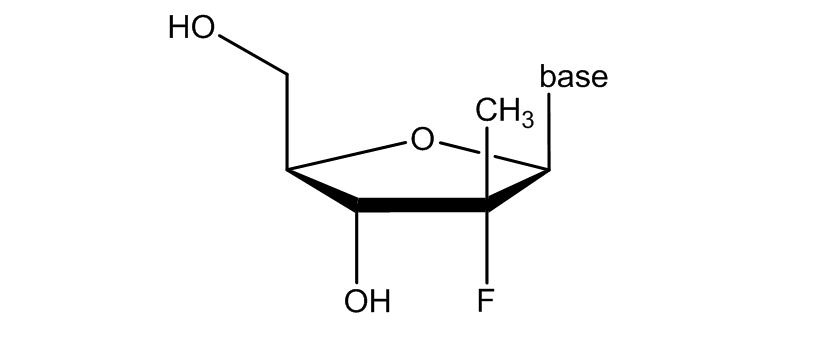
443 It was also common ground that the immediate precursor for a fluorinating reaction to produce the target compound is a nucleoside with a natural base in the 1' “up” position, a methyl group in the 2' “down” position, an hydroxyl group in the 2' “up” position and hydroxyl groups at each of the 3' “down” and 5' positions as shown below (Pg designating protecting groups), referred to as compound 6 in Exhibit 8:
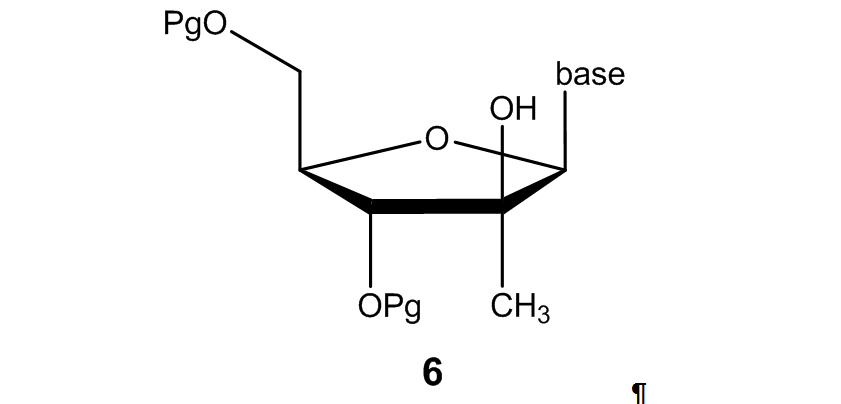
444 Idenix contended that Gilead had not proved that the skilled addressee was not enabled by the Idenix patent to make the target compound in 2002 (or subsequently in 2003) without new inventions or additions or prolonged study of matters presenting initial difficulty. According to Idenix, “[t]he only commonly known methods in 2002 of introducing fluorine into a nucleoside at the 2'-position involved the use of DAST or Deoxo-Fluor or a two-step agent”. Gilead referred to this as Idenix’s “just DAST it” approach and contended to the contrary. In particular, amongst other things, the parties disagreed about the use that could be made of certain documents, referred to as the Idenix documents.
445 I will deal with the issue about the Idenix documents before considering the other evidence relevant to sufficiency of the Idenix patent. The Idenix documents are relevant only to the synthesis issue.
446 The only other observation which should be made now is that it was not suggested that the evidence would be different depending on the relevant date (2002 or 2003).
7.5 The Idenix documents – the synthesis issue
447 The Idenix documents are documents recording Idenix’s own attempts to make a compound within claim 7 of the Idenix patent.
448 Idenix contended that, other than in one respect, the documents are irrelevant because the evidence does not establish that the routes Idenix actually tried or contemplated were routes which would be taken by the skilled addressee armed only with the common general knowledge and the Idenix patent. In support of this submission Idenix said that Professor Furneaux was asked to characterise the work Idenix did and said only that it appeared to be a typical research project but did not say that it reflected the work of scientists of ordinary skill in attempting to make a compound within claim 7. According to Idenix, the failure to call evidence from Professor Furneaux about this issue permits an inference that any evidence from Professor Furneaux would not have assisted the Gilead case. This, said Idenix, is supported by Professor Furneaux’s evidence in cross examination that the only synthetic route employed by Idenix that Professor Furneaux identified as one he would have expected a skilled addressee to pursue was the fluorination of a compound 6 precursor. The other routes employed by Idenix were not ones that he could say would have occurred to him.
449 I do not accept these propositions.
450 First, as will become apparent, there is ample evidence from which it must be inferred that the scientists involved in the work recorded in the Idenix documents were skilled in the art. Indeed, it is apparent that a number of them were highly skilled and inventive, possessing not only the common general knowledge but also ingenuity and inventiveness. The fact that the Idenix team included scientists who possessed very high skill levels directly relevant to the task of making a compound within claim 7 does not mean the evidence of their attempts to do so is irrelevant. To the contrary, a prerequisite to the holding of very high skill in the field is acquisition of the common general knowledge. If a team involving such scientists cannot make a compound within claim 7 with the benefit of the Idenix patent then, as Gilead said, that is powerful evidence of the insufficiency of the Idenix patent. Using Gilead’s words:
…s 40(2)(a) does not authorise resort to other information, being information outside the Patent and not part of common general knowledge, in order to supplement the description of the invention. It does not mean that evidence of a skilled person’s resort to such material is irrelevant: to the contrary…such evidence tends to show that the description in the Patent is insufficient.
451 Idenix’s argument to the contrary is either that its own team fell below the standard of a person skilled in the art possessing the common general knowledge or that the Idenix team was, as it were, “too clever” and, possessed so much knowledge that the team did not do what a person skilled in the art possessing only the common general knowledge would do. The former proposition is untenable as a matter of fact given the members of the Idenix team (discussed below). The latter proposition is contrary to the fact that a person with more than the common general knowledge necessarily possesses the common general knowledge and involves the improbable inference that such a person, having the common general knowledge and more, would be incapable of perceiving the simplest and most efficient way of achieving the target compound. It is also contrary to the mode of reasoning which appears in Lockwood No 2 at [119].
452 Second, the fact that Professor Furneaux had not conceived of the methods the Idenix team used to try to synthesise a compound within claim 7 other than one does not prove that all of the other methods were not ones the skilled addressee armed only with the Idenix patent and the common general knowledge would take. If anything, this supports the inference that the Idenix team, taken together, was capable of exercising a greater level of skill and ingenuity than Professor Furneaux would have been able to bring to bear on the task. Again, if a team possessing not only the common general knowledge but also more highly specialized knowledge and skills directly relevant to the very task at hand could not complete the task with the benefit of the Idenix patent, that is powerful evidence of the insufficiency of the Idenix patent. Professor Furneaux’s evidence does not prove that the steps taken by Idenix prior to February 2003 were not steps which would have been taken by the skilled addressee.
453 Third, it is not necessary for an expert to use the label “common general knowledge” to describe a matter in order to support an inference from the expert’s evidence that the matter involved an exercise, at the least, of the common general knowledge. Accordingly, when Professor Furneaux described Idenix’s work as appearing to be a typical research project, this was a way of saying that he saw nothing out of the ordinary in what Idenix did. While he would not have thought of everything Idenix did his evidence that what Idenix did appeared to be a typical research project supports the inference that Idenix was proceeding consistently with how a person skilled in the art with the common general knowledge (and probably more) would proceed.
454 Fourth, given the inferences available from the face of the Idenix documents, if any inference is to be drawn from a party not calling evidence, it is an inference against Idenix. It called none of the scientists involved in the Idenix work with no suggestion that they were unavailable. As such, where an inference is plainly available on the evidence and the face of the Idenix documents, I should not hesitate to draw it merely because the authors of the documents have not given evidence. To use Gilead’s words if “there were any explanation to be given to support a finding that their approach was idiosyncratic or unusual, or motivated by special considerations not apparent from the documents, they [the Idenix team members] were the persons to give it”. Yet they have not done so.
455 Fifth, Gilead’s submission that it is a matter for the Court, not any expert, to opine on whether the Idenix team were skilled persons in the field, or acting in accordance with what such persons would do is correct. I find persuasive Gilead’s submission that:
The objective evidence of what the Idenix team of scientists and consultants did is the best guide to what a person of ordinary skill would do – better than opinions given by experts years after the fact who did not undertake the task at the time or even when giving their evidence.
456 Sixth, Idenix’s case seems to depend on an assumption that Professor Furneaux’s evidence was determinative of this issue (the steps Idenix took which should be characterised as reflecting the common general knowledge) when Idenix otherwise rejected Professor Furneaux as not being the skilled addressee of the Idenix patent. The two propositions do not rest easily together.
457 When the content of the Idenix documents is disclosed it ought to be readily apparent why Gilead, rightly, placed great weight upon them as supporting its case that the Idenix patent is insufficient on the basis of the synthesis issue. The problem for Idenix’s case in this regard is best summed up by Gilead’s observation that:
…Idenix’s case is that a method of synthesis of a compound within claim 7 was out there in the common general knowledge, just waiting for the skilled person – and that means any person of ordinary skill – to take it and apply it as the first and only obvious method. Idenix did not do so.
458 Further, Gilead rightly observed the inconsistency and unreality within Idenix’s case as follows:
…Idenix’s position requires it to accept that its scientists were persons skilled in the art. It positively relies on the proposition that Strategy 5 [see below, this is the Deoxo-Fluor route] was what the skilled person would do. By doing so it accepts that they were skilled persons. And it follows from this that the other steps they took were also steps a skilled person would take – because they are steps these particular skilled persons did in fact take.
…
…in relation to its own work, it [Idenix] effectively asks the Court to pretend that Strategy 5 was the first and only synthetic route attempted by the Idenix team of scientists, contrary to the objective evidence of what happened in the real world.
7.5.2 The content of the Idenix documents
459 The following description is based on the Idenix documents, as well as Gilead’s submissions about them.
460 In December 2001, before the Idenix patent was filed (on 27 June 2003), Idenix appears to have considered a 2' methyl (up), 2' fluoro (down) nucleoside as one of a number of potential targets for synthesis in its “HCV Programme”. Various possible targets were proposed including the following:
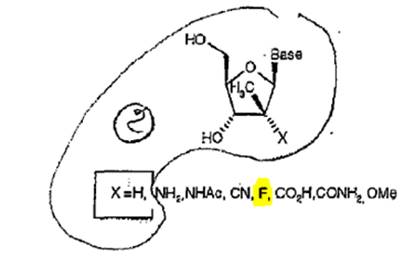
461 The minutes of the meeting record that as to the 2' position a “wide range of groups could be of interest including NH2, NHAc, CN, F (although often toxic)”.
462 The 350 application was filed on 28 June 2002.
463 A meeting was held in July 2002 attended by a number of chemists including two of the named inventors of the Idenix patent, Drs Storer and Gosselin. At this meeting Dr Griffon was given the following task as a “new synthetic priority”:
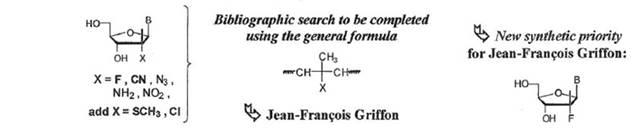
464 Dr Storer is Vice-President Chemistry at Idenix. He was described by Dr Borthwick as a “highly qualified synthetic chemist” and had been published in peer-reviewed journals in relation to carbocyclic nucleosides including the fluorination of carbocyclic compounds. Dr Storer, it may be inferred, was in at least as good a position, and probably a better position, as the skilled addressee of the Idenix patent would have enjoyed insofar as nucleoside or medicinal chemistry is concerned, including fluorination reactions. Dr Griffon worked at the Idenix – Centre National de la Recherche Scientifique – L’Universite Montpellier II Cooperative Laboratory in France. He was a nucleoside chemist with PhD level qualifications.
465 The first attempts by Idenix to synthesise a 2' methyl (up), 2' fluoro (down) nucleoside involved two different strategies, which were developed in parallel – 2'-methylenyl derivative chemistry (called Strategy 1 by Gilead) and 2,2'-anhydro nucleoside chemistry (called Strategy 2 by Gilead). By October 2002 it was reported that so-called Strategy 2 had failed. An alternative was devised involving protecting the 3' and 5' hydroxyl groups on the 2'- iodomethyl-anhydro compound with benzoyl (Bz) protecting groups to obtain the precursor compound (compound 14) and the proposed use of the fluorinating reagent HF/pyridine to obtain the desired 2' methyl (up), 2' fluoro (down) nucleoside (called Strategy 2A by Gilead). By November 2002 it was reported that Strategy 1 had failed and there were difficulties being encountered with Strategy 2.
466 By December 2002 Idenix had got Professor Fleet involved. Professor Fleet of Oxford University was a highly regarded expert in organic and synthetic carbohydrate chemistry. Dr Griffon, Dr Storer, Dr Gosselin (all from Idenix) and Professor Fleet met. The minutes record that different experimental conditions for Strategy 2 were to be checked in the literature and tried (Zn/HCl or Zn/AcOH, and Mg/MeOH). A synthetic strategy proposed by Professor Fleet was discussed – the reaction of a 2'-C-methyl-glycan with a positive source of fluorine (F+) – that is, the introduction of fluorine to a six- membered sugar ring without a nucleobase attached.
467 By this time also, that is December 2002, a second attempt to synthesise the 2' methyl (up), 2' fluoro (down) nucleoside using so-called Strategy 1 failed. The second attempt involved reacting the 2'-methylenyl derivative with HF/pyridine at 80oC. However, Idenix had made a 2,2'-anhydro precursor compound (being the first step in so-called Strategy 2) using an unprotected nucleoside by this time. As the next step, in January 2003, it was proposed to attempt fluorination. The report records that:
Several experimental conditions are going to be attempted in order to introduce the fluorine atom at the 2'- down position: HF-pyridine, AIF3, 120oC or KHF2, ethylene glycol, reflux.
468 In January 2003 an attempt to produce an unprotected precursor in so-called Strategy 2 using one of the conditions proposed in the December 2002 meeting with Professor Fleet (Zn/AcOH) failed.
469 It is also clear that although work on so-called Strategy 1 was continuing “all the attempted experimental conditions failed”.
470 On 8 February 2003 Dr Storer wrote to Dr Coe, a specialist organic chemist who was an expert in the fluorination of organic compounds. The letter states in part:
We are OK with the nucleoside chemistry, it’s the fluorine chemistry we are struggling with and where your help will be valuable.
471 The attachment to the letter, “Fluorinated Targets for Review by Dr Paul Coe”, states:
We have a number of nucleoside targets which contain fluorine most of which we are struggling with. The targets are all ribonucleosides of one sort or another and have an additional substituent, usually a methyl group, up at the 2'- position.
…
Target 9 is an attempt to replace the tertiary OH of the ribo analogue with fluorine. We’ve tried a variety of procedures from the exocyclic methylene analogue in attempt to effectively add HF across the double bond. We had no success with that. We’re now looking at attempting to take the 2'-α methyl anhydro compound and open that with fluoride. I’m not too hopeful for success with that. Appendix 3 shows a summary of this. Your thoughts on how to introduce the tertiary fluoro substituent in compound 9 would be appreciated.
472 In February 2003 the fluorination reagents and conditions proposed in January 2003 for so-called Strategy 2 were attempted but they failed to fluorinate the 2,2'-anhydro-nucleoside precursor, the following being recorded:
473 A new approach to the fluorination of the 2' methyl (up), 2' fluoro (down) nucleoside was then devised and attempted. This new approach involved the fluorination of a 2'-tertiary hydroxyl nucleoside with the fluorinating reagent Deoxo-Fluor (referred to in some of the evidence as the Deoxo-Fluor route and by Gilead as Strategy 5). Dr Griffon attempted this reaction twice and reported that it failed on both occasions. The report recorded as follows:
474 In an email to Dr Storer and others including Dr Gosselin of 4 March (or 3 April) 2003 Dr Griffon reported that:
You will find enclosed as an attached document my Progress Report of February 2003.
As I told you last week at the end of the Summary Meeting, the compound I obtained after treatment with DeoxoFluor and deprotection was not the (very!) expected Fluoro derivative but the 2'-methylene derivative.
475 There is no indication that Dr Griffon was instructed to try the Deoxo-Fluor route again nor that Idenix determined that another chemist ought to be instructed to try the Deoxo-Fluor route to check Dr Griffon’s reported results. I say this because Idenix contends that it should be inferred that, contrary to Dr Griffon’s report, the Deoxo-Fluor route produced the desired compound (that is, methyl up and fluorine down at the 2' position by way of fluorination with inversion). This issue is dealt with below.
476 In the first week of April 2003 Dr Griffon and another Idenix chemist, Dr Pierra, attended a Scientific Update Course on Fluorination in Stratford-upon-Avon. The course was titled “Making and Using Fluoroorganic Molecules” and was given by Professor Jonathan Percy and Dr Alison Stuart from the University of Leicester in the United Kingdom. After attending the course, Dr Griffon and Dr Pierra prepared a 10 page summary document based on the course, which Dr Pierra sent to Drs Storer and Gosselin under cover of an email saying:
You will find as an attached file a summary of the presentation that we made yesterday regarding the Scientific Update Course on Fluorination (Stratford- upon-avon on April 1-4, 2003) We gave a talk for all Idenix scientists (ingeniors and techniciens). As you can notice, we focused our talk on the electrophilic and nucleophilic fluorine sources because we thought it was the most interesting part for our current chemistry.
477 The attached report records that a number of different fluorinating reagents were the subject of the Stratford-upon-Avon Scientific Update Course including the properties of known electrophilic (F+) fluorinating reagents and literature examples employing those reagents and the properties of known nucleophilic (F-) fluorinating reagents and literature examples employing those reagents.
478 Dr Griffon, in a separate email to Drs Storer and Gosselin about the course said:
The course was very interesting and allowed us to learn a lot about the last [sic – latest?] progress in the fields of nucleophile and electrophile fluorinating agents.
479 Gilead made this point about the fluorination course which chemists from Idenix attended which should be noted:
…they didn’t come back from this course…saying, “My goodness, now we know how to fluorinate. We need to DAST it. We’ve been trying the wrong thing, or our Deoxo-Fluor route should have worked. We had better look at it again”.
480 Idenix did not return to the Deoxo-Fluor route after its scientists attended this course which enabled them to learn “a lot” about progress in the fields of nucleophile and electrophile fluorinating agents.
481 Dr Coe responded to Idenix’s request in an undated letter noting that “some of the route [sic] you have tried are OK except that I think you are using the wrong reagents, leaving groups and reaction conditions”. Dr Coe suggested a number of methods for the synthesis of the 2' methyl (up), 2' fluoro (down) nucleoside including (a) synthesis of the 2' methyl (up), 2' hydroxy (down) sugar, involving activation of the 2' hydroxy sugar using SO2Cl2 and imidazole to form a leaving group and then fluorination with Et3N.3HF, followed by glycosylation to introduce the nucleobase; (b) reaction of tertiary alcohols with HF/pyrimidine; (c) reaction involving 2,2'-anhydro nucleoside chemistry; and (d) reaction of a 2' methyl (up), 2' hydroxy (down) nucleoside analogue with HF pyrimidine.
482 Dr Griffon then reported on further “attempts for introducing the fluorine atom at the 2'-down position”. These attempts involved a TIPS protected 2'-tertiary hydroxy nucleoside and the fluorinating reagent Et3N.3HF and another attempt at fluorination of the 2,2'-anhydro-nucleoside precursor (Strategy 2) was proposed, but using Bu4NHF2 as the fluorinating reagent. Both attempts failed. In a subsequent report also in May 2003 it is recorded that the the synthesis of a 2' methyl (up), 2' fluoro (down) nucleoside was “still a high priority”, the work being “in progress” by Dr Griffon.
483 It will be recalled that the Clark patent claims priority from 30 May 2003, being the date of filing of US Patent Application No 60/474,368. The Clark patent and the priority document for it are also known as the Pharmasset patents.
484 By June 2003 two further strategies involving the displacement of a tertiary hydroxyl group at the 2' position of a nucleoside had been attempted. The first attempt reported involved the reaction of a 2'-tertiary hydroxy nucleoside, specifically a 2' methyl (up), 2' hydroxy (down) uridine nucleoside, with HF/pyridine which failed. The second attempt involved a reaction of a 2'-tertiary hydroxy nucleoside with the fluorinating reagent DAST which also failed.
485 It will be recalled that the Idenix patent was filed on 27 June 2003.
486 In July/August 2003, an alternative 2,2'-anhydro-nucleoside precursor strategy that was proposed in May 2003 was conducted but “no reaction occurred”.
487 Idenix chemists (A Moussa, B Mayes and A Stewart) met with Professor Fleet of Oxford University on 10 May 2004 to discuss, amongst other things, the work on the synthesis of the 2' methyl (up), 2' fluoro (down) nucleoside.
488 In June and July 2004, two new strategies were attempted – both of which failed, being (first) total synthesis of the sugar synthon involving D,L-alanine ethyl ester hydrochloride, NaNO2, 35% HF-pyridine, ethyl-L-lactate, DAST, CH2Cl2, then diisopropylamine, n-Buli, THF -78oC and (second) addition of an electrophilic fluorinating agent Selectfluor on a 1,2'-double bond of a sugar. Another synthesis strategy that was being considered in June and July 2004 was the opening of a spiro α-chloroepoxide, which was reported as being on “stand by”.
489 In a report for the period September 2003-2004, it was reported that different strategies were attempted in order to synthesise the 2' methyl (up), 2' fluoro (down) nucleosides and that each of the nucleoside strategies (including those starting from uridine) and the sugar strategies had so far failed. The report poses the questions: “Due to the synthetic difficulties encountered, is it worthwhile to continue to consider this series of future targets?”.
490 On 11 November 2004 Dr Storer emailed Adel Moussa and Dr Stewart in relation to “Literature for fluoro target compound”. In his email, Dr Storer said:
A lot of things which look simple on paper in related systems have been tried and don’t work in this series. Having to make the tertiary fluoride is very different to having to make a secondary.
491 Gilead made this point about Dr Storer’s observation:
…[it] resonates very strongly with the evidence that was given by Professor Furneaux based on his own experience in the sense that, on his evidence, fluorination at a tertiary position where there’s a tertiary alcohol or hydroxyl group is a very different consideration to fluorination of a secondary alcohol group and more difficult, complicated or unpredictable and his evidence ultimately was that he didn’t know whether it would even be possible.
492 On the same day, Dr Stewart responded to Dr Storer including the following:
I was surprised that any formation of a tertiary fluoride from a tertiary alcohol had been reported until we found it yesterday, but I haven’t look through the literature that was ordered yet (in case, no relevant reaction on sugar or nucleoside was reported).
493 Also on 11 November 2004, Dr Stewart emailed Professor Fleet seeking his assistance in relation to the synthesis of a tertiary fluorine. In his email to Professor Fleet, Dr Stewart said:
As you probably already know, we’d like to find a way to get a tertiary fluoride at the C-2 position (with stereochemistry as in compound 15 (Scheme G1) to eventually form a nucleoside.
494 On 7 December 2004, in an email from Dr Stewart to Dr Barker at Oxford, Dr Stewart noted some of the fluorination reactions he was proposing to try, saying:
Look forward to getting the experimental in due course and seeing how you did the triflation, about to try that and DAST on the five-ring so wish me luck…
495 In January and February 2005, Idenix tried a new strategy and variants on a number of previous strategies in an attempt to synthesise a 2' methyl (up), 2' fluoro (down) nucleoside. These included (a) further attempts at the 2'-tertiary hydroxy nucleoside chemistry; (b) the attempted displacement of a tertiary hydroxyl group at the 2' position of a lactone; and (c) further attempts at the 2,2' anhydro nucleoside chemistry.
496 As to (a), in January 2005 Dr Stewart attempted a fluorination using DAST on a 2' hydroxy (up), 2' methyl (down) uridine nucleoside but the reaction failed and instead produced an elimination product. Dr Stewart noted that the “…result ties in with that observed by J-F Griffon who got the same result with DeoxoFluor, DCM, pyr, -78oC to r.t...”. A 31 January 2005 report by Dr Stewart records his failure with DAST on a 2'-tertiary hydroxy nucleoside; his summary indicates that he had made more than one attempt at the reaction without success. The report then states that:
the use of DAST at a lower temperature to increase the formation of the minor products was carried out by J. Wang. By comparison with subsequent discovery of the Pharmasset conditions, it seems that the theory being followed was correct and that the fluorinated nucleoside is present albeit in small yield.
497 The report also indicates that Idenix were investigating the “Pharmasset Patent”.
498 A report attached to an email from Dr Stewart to Adel Moussa of 7 January 2005 annexes various reactions schemes which include the following:
499 This is the first mention of the successful introduction of a fluorine into a tertiary carbon on a sugar or nucleoside. The same attachment also reports difficulties with synthesising the high priority 2' methyl (up), 2' fluoro (down) nucleoside – the reaction (as illustrated below) was unsuccessful and it is noted that “significant problems” were encountered:
500 In an email dated 11 January 2005 Dr Stewart commented on this work to Dr Sarah Barker at Oxford University as follows:
Still haven’t got round to asking Dick [Dr Storer] whether I can tell you, so keep it quiet just in case, but I managed to make a tertiary fluoride (3) from the C-2 OH epimer (2) of your compound. This is a huge step, even on the wrong stereoisomer as there’s nothing in the literature
501 On 12 January 2005, Dr Storer emailed Dr Stewart, copying in Adel Moussa, saying that he had been told that a person interviewed “just after Christmas who worked at Pharmasset told him they made the compound from a Nucleoside which may be good news for the other approach Alistair discussed. Maybe you can let Alex know that we will consider this but we need to wait for results from a couple of other in house results first”. Dr Stewart replied “[t]hanks for that information…could be very handy and might narrow things down a bit. I’m going to switch our focus straightaway onto the nucleoside that Jean-Francois [Griffon] provided and see whether we can avoid elimination in a few 50mg reactions by varying the fluorinating agent (changing from DAST to PBSF, Et3N.HF and HF.pyr) or temperature that I used the DAST (r.t. to -30 and -78oC)”.
502 A report by Jingyang Wang of 31 January 2005 also reports an attempted reaction using DAST on a 2'-tertiary hydroxy nucleoside. The report states that is it inconclusive whether the desired 2' methyl (up), 2' fluoro (down) nucleoside had been made and notes that a number of other compounds, that is compounds other than the desired compound (being compounds 9, 10 and 11), were isolated and identified.
503 On 2 February 2005, Dr Stewart emailed Dr Sarah Barker at Oxford reporting some of the results of their 2'-tertiary hydroxy nucleoside strategy using DAST. Two attempted reactions are reported – a 2' hydroxyl (up), 2' methyl (down) nucleoside and the attempted fluorination of a 2' methyl (up), 2' hydroxyl (down) nucleoside with DAST. The chemistry reported indicates that both failed. These failures were also reported by Dr Stewart in an internal report.
504 Gilead provided a summary of the types of precursors and chemistry involved in Idenix’s attempts to synthesise the desired 2' methyl (up), 2' fluoro (down) nucleoside as follows, the highlighted reactions representing actual attempts (and noting that the strategy numbers are Gilead’s, not those of Idenix when it carried out the work):
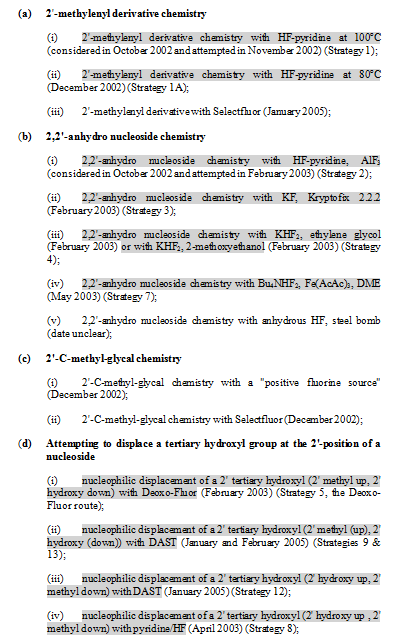
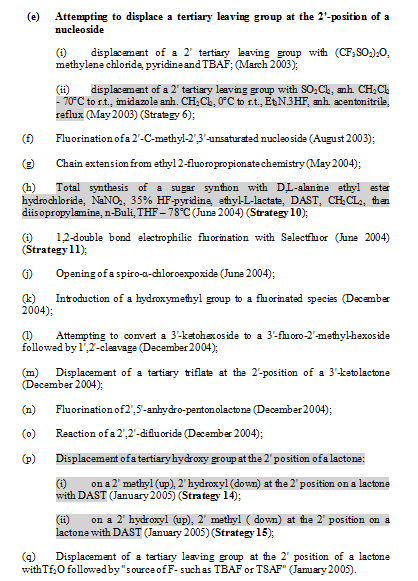
505 As Gilead submitted:
These attempted and proposed syntheses involved numerous different fluorination reagents, including the following: HF; AHF, anhydrous HF; HF-pyridine; HF-pyridine/ AlF3; H+/KF; AcF; KHF2; KF; KF/crown ether; CsF; H+/CsF; DeoxoFluor; KF, Kryptofix, pTsOH; TASF; TBAF; DAST; Et3N.3HF; Et3N.HF; Bu4NH2F3; Bu4NH2F/Fe(AcAc)3; Bu4NHF2/ Fe(AcAc)3; PBSF; Selectfluor; and acetyl hypofluorite (CH3CO3F).
506 I consider that it is apparent that Idenix attempted to synthesise a compound within claim 7 as a priority from July 2002. According to Idenix’s own documents it failed to do so between that time and 2005. As discussed, I do not accept the notion that the Idenix team, assisted by persons such as Dr Coe, Professor Fleet and Dr Barker, did not possess all of the common general knowledge relevant to the synthesis. From (and no doubt before) 27 June 2003 they possessed all the information in the Idenix patent. With the benefit of the Idenix patent and the common general knowledge (and, in my view, knowledge that exceeded the common general knowledge given the involvement of Dr Storer, Dr Coe and Professor Fleet, as well as the attendance by Idenix chemists at a specialist fluorination conference), Idenix’s documents record consistent failures in all attempts to make such a compound.
507 As noted, Idenix’s case was that it had not been proved that anything bar one reaction scheme (the February 2003 Deoxo-Fluor route) involved an exercise of the common general knowledge. I do not accept this submission. It overlooks the specific evidence about Dr Storer’s expertise and the inferences which can be drawn about the expertise of Dr Coe and Professor Fleet. It depends also on drawing an inference that Idenix would have assigned a priority synthesis task to a nucleoside chemist, Dr Griffon, who did not possess even the common general knowledge of a nucleoside chemist. It depends on drawing these inferences when Idenix has not called any of its chemists (including Drs Storer and Griffon) in circumstances where there is no suggestion they are unavailable. In the circumstances I can see no rational reason to draw either inference.
508 This is consistent with, and I accept, Gilead’s submission that:
The evidence simply does not support any finding that the approach taken by Dr Griffon and his colleagues in February 2003 was idiosyncratic or not reflective of a person with adequate skill to conduct synthetic procedures of this kind. The Idenix team plainly included persons skilled in the art of nucleoside synthesis. As submitted above, Dr Storer in particular met that description, and had published articles dealing with fluorination of carbocyclic nucleoside compounds including with the use of DAST.
509 Also as noted, if it is suggested that the work is irrelevant because the Idenix team probably possessed greater expertise than the notional skilled addressee (that is, the common general knowledge and additional knowledge), I consider that suggestion would be inconsistent with the approach in Lockwood No 2 at [119]. That is to say, if a skilled team which possesses all of the common general knowledge and additional knowledge (even inventiveness) cannot synthesise a compound within claim 7 then the notional skilled addressee possessing only the common general knowledge may be inferred even more readily not to have been able to do so.
510 It is necessary now to say something about Idenix’s case on the February 2003 Deoxo-Fluor route. As noted, Dr Griffon reported that this synthetic route failed to produce the desired compound. Idenix now contends that it is more likely than not the Deoxo-Fluor route did produce the desired compound (albeit in a small amount) but Dr Griffon failed to do what would ordinarily be done by the person skilled in the art (that is, characterise all products of the reaction, not only some products) with the consequence that he and Idenix simply failed to appreciate that the reaction had succeeded. The evidence of Professor Barrett, in particular, concerned this issue (as summarised above).
511 For the purpose of this part of the discussion, it may be assumed that Idenix is correct when it contends that the Deoxo-Fluor route produced the desired compound (albeit in a small amount) which Dr Griffon did not recognise as having been produced. What should be kept in mind when assessing the potential significance of this, however, is the following:
(1) There is no suggestion that the first thing the Idenix team thought of to synthesise the desired compound was the Deoxo-Fluor route.
(2) From the documents it would be inferred that the Deoxo-Fluor route was not the first thing the Idenix team thought of. Rather, they first thought of and attempted a number of other strategies, all of which failed, before they attempted the Deoxo-Fluor route.
(3) Dr Griffon reported (and must be taken to have believed) that the Deoxo-Fluor route had failed to produce the desired compound.
(4) Dr Griffon reported his failure to others within Idenix including Dr Storer.
(5) No-one in Idenix queried the reported failure of the Deoxo-Fluor route. It was not suggested by anyone that Dr Griffon should continue to try the Deoxo-Fluor route. No one queried whether he had characterised all reaction products on the basis of any expectation that the reaction should have worked with the consequence that Dr Griffon’s reported failure was inexplicable.
(6) Dr Griffon did not return from the fluorination seminar with the view that the Deoxo-Fluor route should have worked and ought to be repeated. If, as Idenix maintains, he did not characterise all reaction products of the Deoxo-Fluor route then Dr Griffon knew that to be the case. Yet it must be inferred that he did not at any time consider it worthwhile to repeat the Deoxo-Fluor experiments (which he had twice attempted) again even with the benefit of the fluorination seminar. Nor did anyone, following that seminar, make the same suggestion.
(7) Instead, for the best part of two years, Idenix continued to develop other strategies to develop the desired compound.
512 Given these matters, Idenix’s case that the Deoxo-Fluor route actually worked is of little significance. Idenix certainly did not perceive that it had worked. As far as it was concerned the Deoxo-Fluor route had failed because it had not produced the desired compound. The question is – does the disclosure enable the addressee of the specification to produce something within each claim without new inventions or additions or prolonged study of matters presenting initial difficulty? The Idenix documents provide a very strong basis for concluding that the answer to that question is “no”. It can hardly be said that the answer changes to “yes” on the basis that, unbeknownst to Idenix, something was produced within claim 7. In the context of synthesising a chemical compound, a necessary part of the synthesis is recognition of what has been produced. If what has been produced cannot be recognised then there is no enablement.
513 Idenix’s answer to this was that the notional addressee would have characterised every reaction product of the Deoxo-Fluor route and, having done so, would have recognised that the desired compound had been produced. I do not accept this submission. If Dr Griffon did not characterise every reaction product (as Idenix contends) then that is evidence of a person skilled in the art not having done so. As noted, Dr Griffon alone knows exactly what he did and did not do, yet has not been called to give evidence. If he did not characterise every reaction product his reasons for not doing so remain a mystery, as does the question whether those reasons might have been well-founded. Having attended a seminar specifically about fluorination Dr Griffon did not return suggesting that he ought to repeat the Deoxo-Fluor experiments and ensure every reaction product was characterised. No-one in Idenix, perplexed by the reported failure of the reaction (which as Idenix would have it any person skilled in the art would first try as the obvious thing to do based on the common general knowledge) thought to ask him if he characterised every reaction product. No-one involved in the work suggested that if they had only known Dr Griffon had not characterised all reaction products they would have insisted the experiments be repeated. Nor can it be inferred from the evidence that Dr Griffon, or any person skilled in the art, would have recognised that the target compound had been produced if all reaction products had been characterised. There are a number of indications in the Idenix documents that this proved a difficult exercise with the particular reactions carried out.
514 For these reasons I accept and adopt Gilead’s submission that:
On the view of the chemistry Idenix now propounds, one would have expected the members of the Idenix team and their consultants to have assumed that Dr Griffon’s failure reflected a mistake in the conduct of the experiment or in his characterisation of the reaction products and that the experiment should have been repeated. There is no evidence of any such reaction by any member of the Idenix team. This demonstrates that Idenix’s contemporaneous view of the chemistry was that there was no particular expectation that Dr Griffon’s experiment should have worked.
515 As Gilead also submitted, and I accept:
The most telling evidence of the fact that the synthesis of a compound of claims 7 and 8 of the Patent would have required “prolonged study of matters presenting at least initial difficulty”…on the part of the person skilled in the art is Idenix’s own experience in attempting such a synthesis.
This is contemporaneous, unguarded, evidence from the named inventors and those assisting them of the variety of routes available to attempt to form such a compound and of the complexity of the science involved. Idenix’s unexplained failure to bring forward any of these scientists to give evidence about this work means the Court should infer that no evidence any of them could have given could have assisted Idenix. Further, to the extent Idenix submits that inferences may be drawn from its documents, including Dr Griffon’s laboratory notebooks, being inferences that would assist Idenix, that submission should be rejected. The Jones v Dunkel inference arising from the absence of any member of the Idenix team, including their external consultants, extends to evidence that might have been given including explaining the documents in so far as they are not self-explanatory.
Importantly, the Idenix documents are wholly inconsistent with any submission that the person skilled in the art would have proceeded directly to use protecting group chemistry at 5' and 3' positions on a commercially available preformed nucleoside, performed an oxidation reaction at the 2' position to form a ketone, methylated the ketone at the 2' position with control of stereochemistry so as to obtain methyl in the 2' (down) position and then fluorinated using DAST, relying on inversion to obtain a 2' methyl (up), 2' fluoro (down) nucleoside. It is simply not what Idenix did.
516 In particular, it must be recalled that:
(1) Professor Fleet provided advice to Idenix in December 2002 where he proposed a synthetic strategy involving a “positive fluorine source” (electrophilic fluorination). Professor Fleet then provided advice to Idenix in May 2004 where Idenix met with Professor Fleet and a strategy was proposed involving the displacement of tertiary leaving groups at the 2' position of lactones. Professor Fleet did not suggest the use of DAST to fluorinate a tertiary hydroxyl.
(2) The chemistry proposed by Dr Coe for making a 2' methyl (up), 2' fluoro (down) nucleoside did not involve the use of DAST as a fluorinating reagent. Dr Coe also expressed concern regarding the use of DAST as leaving groups generated in situ from using DAST may result in undesired elimination, participation of blocking groups and migration chemistry.
(3) Dr Storer, who was kept apprised of Dr Griffon’s work and was a named inventor on the Idenix patent, never suggested to Dr Griffon that he was wasting time by not simply using DAST as a fluorinating reagent.
517 It is not entirely clear, and I do not need to decide, whether Idenix was stumbling towards a way of creating a compound within claim 7 by early 2005 and either got there or would have got there in any event or whether Idenix was assisted by hearing about what Pharmasset had done just before Christmas 2004. The reason I do not need to decide this is that, leaving aside the other evidence for the moment, the Idenix documents show that Idenix itself was unable to make anything within claim 7 without prolonged study of matters presenting initial difficulty. It seems likely that hearing about the Pharmasset work did assist Idenix in focusing its efforts. This is not the least because the Pharmasset (or Clark) patent may be inferred to have shown Idenix where to look. So much appears from the comment by Dr Stewart about the January 2005 work that a fluorinated product has been obtained “[b]y comparison with the subsequent discovery of the Pharmasset conditions” and that “[f]ollowing the publication of the Pharmasset patent it was decided that their route from cytidine should be followed to make required fluorinated nucleoside”, which is what Idenix in fact did. Otherwise Idenix attempted to rely on ambiguous statements to suggest that it succeeded in obtaining the target compound independently from the Pharmasset work. The problem with this is, as Gilead said, if Idenix wanted to clarify the references to the Pharmasset work in its documents then it could have done so by calling Dr Stewart or Dr Wang who were available but were not called to give evidence. Given the ambiguity of the documents, and the suggestions in it of relevance of the Pharmasset work to Idenix’s ultimate success, I do not consider any ambiguity should be resolved in Idenix’s favour.
518 Apart from this certain other propositions of Idenix need to be identified and considered.
519 The fact that hydrogen fluoride (HF) is a dangerous corrosive gas which, for that reason, Dr Borthwick had never used does not mean that when Idenix used it in its efforts to create a compound within claim 7 it was acting contrary to the common general knowledge. HF was a fluorinating reagent known to the experts and used in the literature, including literature relied on by Professor Meier.
520 The proposition that there is “no evidence that the making of that precursor involved anything other than routine chemistry” is difficult to accept given that all such evidence, if it existed, would be in the control of Idenix. Dr Griffon was not called by Idenix. No inference should be drawn in Idenix’s favour that the making of the precursor compound was routine chemistry and did not involve prolonged study based on a lack of evidence in this regard.
521 The 4 March 2003 email saying that “the compound I obtained after treatment with DeoxoFluor and deprotection was not the (very !) expected Fluoro derivative …” may or may not be contemporaneous evidence that the use of a fluorinating agent such as Deoxo Fluor on the relevant precursor was expected to produce the relevant reaction product. It was not so expected that it was the first thing attempted. It was not so expected that Dr Griffon considered he had to characterise every reaction product. It was not so expected that anyone else in Idenix was so surprised it did not work that they suggested the experiment be repeated.
522 Contrary to Idenix’s submissions Professor Furneaux in fact said that a chemist would not necessarily test all reaction products. Moreover, Professor Barrett did not say that every reaction product should always be tested. If Dr Griffon did not test every reaction product the evidence does not enable an inference to be drawn that Dr Griffon was thereby acting contrary to how a skilled addressee would act. This is particularly so given that Professor Furneaux explained that there was a sound scientific basis for considering that the other products were not the target compound. Further given that Dr Griffon has not given evidence it is not enough to support the inferences for which Idenix contends that there is no evidence of him testing every reaction product. Gilead is right when it states:
The only person who can give evidence as to whether other reaction products were characterised and the data recorded elsewhere or not recorded because they indicated useless or irrelevant by-products is Dr Griffon. Similarly, if Dr Griffon tested more than one but fewer than all reaction products, it is likely some logic informed his selection but the Court is not in a position to make findings one way or the other because of his unexplained absence. These are not matters on which the opinions of Dr Furneaux can replace direct evidence from the man with actual knowledge of what he did.
…
There is no doubt from the Idenix fluorination documents that Dr Griffon was looking for the Target Compound as a high priority. The Idenix fluorination documents do not indicate that this priority is focussed on yield. Dr Griffon reported without qualification to other team members that he had not obtained the Target Compound. In the absence of direct evidence establishing a contrary proposition, the Court would infer that Dr Griffon had a scientific basis for his conclusion.
523 I am not satisfied, in any event, that I can infer that if he had tested every reaction product Dr Griffon would have realised he had obtained the target compound. As Gilead noted Dr Stewart reports the use of DAST on a 2' hydroxy up 2' methyl down nucleoside that resulted in a major product corresponding to the elimination product obtained by Dr Griffon in his Deoxo-Fluor experiment. Importantly minor products were created “which could not be separated by chromatography”. This was the same technique Dr Griffon was using for characterisation.
524 I am not satisfied that Dr Stewart’s use of DAST at room temperature was outside the bounds of what a skilled person would do. The fact that DAST is often used at lower temperatures does not place Dr Stewart’s work in a category outside that which the skilled addressee based on common general knowledge would do. As Gilead pointed out there is ample evidence of the use of DAST at a range of temperatures including above room temperature depending on the requirements of the particular experiment and its purpose.
525 I do not accept that Idenix was in possession of a route that worked as at February 2003 (the Deoxo-Fluor route) or that this means that the details of the separation and analysis undertaken by Dr Griffon are largely irrelevant. As far as everyone in Idenix was concerned the February 2003 Deoxo-Fluor experiments did not work. Dr Griffon used standard methods to analyse reaction products (TLC and column chromatography, and NMR and MS for characterisation) and reported that the experiments had failed. No-one suggested he repeat the experiments using different techniques to characterise all reaction products (such as those used by AMRI in the AMRI experiments, discussed below). As noted, it is also not apparent that if he had tested all reaction products (assuming he did not) that, using those techniques, he could have identified the target compound. This is hardly being in possession of a route that worked. Yet again Gilead’s submission that the suggestion that “Dr Griffon might have lacked care or diligence reveals the vice in a party attempting to recreate history on the basis of its own documents without calling its own readily available witnesses and authors of the documents” is persuasive.
526 The Idenix documents, of course, need to be weighed up with the other available evidence. I turn to that evidence now.
7.6 Other evidence – the synthesis issue
527 Despite the affidavits of the experts trawling through the Idenix patent to see what, if anything, it said about the synthesis of a compound within claim 7 it is now common ground that the Idenix patent does not describe any such synthesis but says that “[t]he nucleosides of the present invention can be synthesized by any means known in the art” (p119 lines 31-32). Idenix maintained that schemes 3, 4 and 9 of the Idenix patent are nevertheless relevant.
528 Those schemes appear at pp123-125 and 135.
529 Scheme 3 is described in these terms and appears as set out below:
In a particular embodiment, the 2'-C-branched ribonucleoside is desired. The synthesis of a ribonucleoside is shown in Scheme 3. Alternatively, deoxyribo-nucleoside is desired. To obtain these nucleosides, the formed ribonucleoside can optionally be protected by methods well known to those skilled in the art, as taught by Greene et al. Protective Groups in Organic Synthesis, John Wiley and Sons, Second Edition, 1991, and then the 2'-OH can be reduced with a suitable reducing agent. Optionally, the 2'-hydroxyl can be activated to facilitate reduction; i.e. via the Barton reduction.
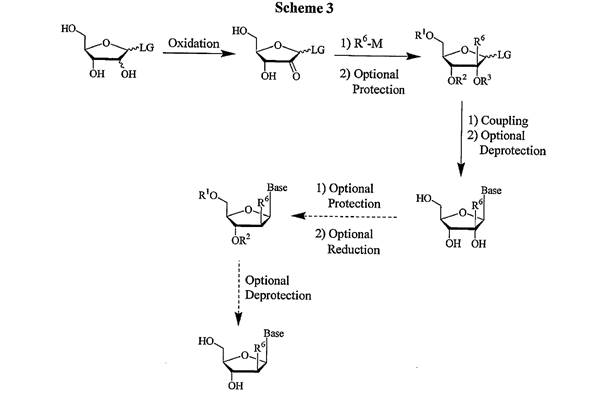
530 Scheme 4 is described in these terms and appears as set out below:
In a particular embodiment, the 2'-C-branched ribonucleoside is desired. The synthesis of a ribonucleoside is shown in Scheme 4. Alternatively, deoxyribo- nucleoside is desired. To obtain these nucleosides, the formed ribonucleoside can optionally be protected by methods well known to those skilled in the art, a taught by Greene et al. Protective Groups in Organic Synthesis, John Wiley and Sons, Second Edition, 1991, and then the 2'-OH can be reduced with a suitable reducing agent. Optionally, the 2'-hydroxy can be activated to facilitate reduction; i.e. via the Barton reduction.
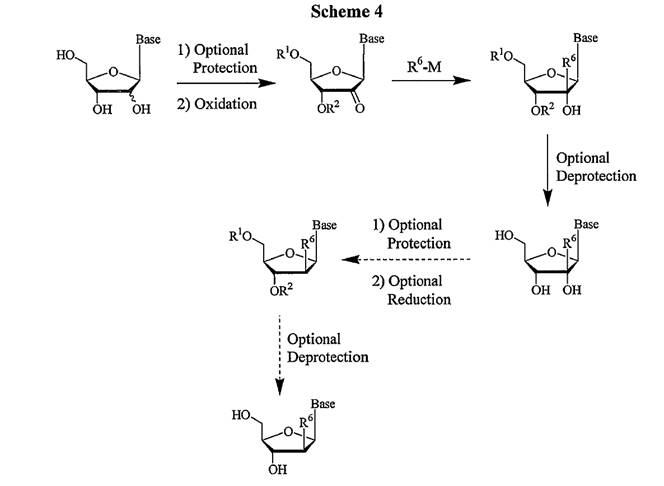
531 Scheme 9 is described in these terms and appears as set out below:
EXAMPLE 2: PREPARATION OF 2'-C-METHYLRIBO-8-METHYLADENINE
The title compound was prepared according to a published procedure (R.E. Harry O'kuru, J.M. Smith, and M.S. Wolfe, “A short, flexible route toward 2'-C-branched ribonucleosides”, J.Org. Chem. 1997, 62, 1754-1759) (Scheme 9).
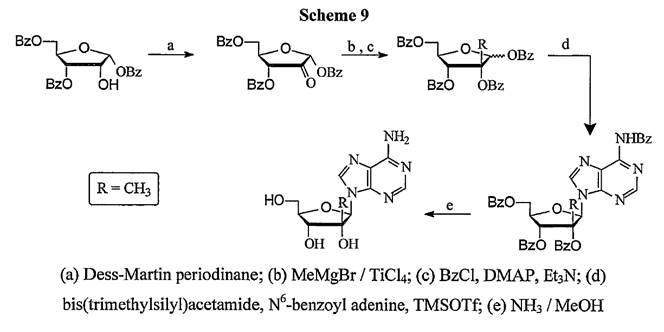
532 It is not clear how Idenix maintains both that the skilled addressee could make a compound within claim 7 relying solely on the common general knowledge (having been directed to do so by the statement in the Idenix patent at p119) and that the skilled addressee would nevertheless find assistance in schemes 3, 4 and 9. Neither Professor Meier nor Dr Borthwick purported to give evidence that, on the basis that the Idenix patent said only that “[t]he nucleosides of the present invention can be synthesized by any means known in the art”, the skilled addressee possessing only the common general knowledge would have been able to make a compound within claim 7 without new invention or prolonged study of matters presenting initial difficulty. While Idenix rejected any suggestion that its case had changed through the course of the hearing (or, indeed, after the evidence of Professor Meier and Dr Borthwick had been filed) it is difficult to reconcile their evidence with the case as ultimately put by Idenix – that any person skilled in the art could make a compound within claim 7 without new invention or prolonged study of matters presenting initial difficulty on the basis of the instruction in the Idenix patent at p119 and using only the common general knowledge.
533 First, if this had been the opinion of Professor Meier and Dr Borthwick then it would be expected they would have expressed this opinion, without delving into the complexities of what they thought schemes 3, 4 and 9 were attempting to convey. Yet they did not express any opinion to this effect. Instead, they gave extensive evidence about what they would have taken from schemes 4 and 9 (and to a lesser extent scheme 3) of the Idenix patent. This indicates that it was not their view that a person skilled in the art needed nothing more than the common general knowledge to make a compound within claim 7.
534 Second, what schemes 4 and 9 are conveying is not readily reconcilable with what Professor Meier and Dr Borthwick said they took from them. I return to this issue below.
535 Third, the evidence of what Professor Meier and Dr Borthwick say they would have done based on schemes 4 and 9 is inconsistent with what Idenix in fact did. In particular, their evidence does not disclose any cogent reason why the skilled addressee, possessing only the Idenix patent and the common general knowledge, would hone in on the strategy that the Clark patent proved to have worked. The explanations given of how each worked his way towards this result are peppered with information that I do not consider constitutes common general knowledge. I return to this issue below also, but for present purposes it is sufficient to say that when the evidence discloses so many potential paths to a result (assuming, for this purpose, that the result being the target compound is a given), only one of which seems to have worked (the Clark patent route), evidence of the kind given by Professor Meier and Dr Borthwick, after the event and in wholly hypothetical circumstances, is inherently unpersuasive when compared to the evidence of what Idenix actually did.
536 Fourth, and also as explained below, I do not accept Idenix’s approach to the evidence of Professor Furneaux. Contrary to Idenix’s submissions I consider that Professor Furneaux’s evidence was that he would not have thought that the fluorination of a tertiary hydroxyl group was practicable.
537 I accept Gilead’s submission that if the Idenix patent teaches anything about the making of a compound within claim 7 (and, in my view, it does not), then what it teaches is contrary to the evidence given by Professor Meier and Dr Borthwick. I do not accept that the skilled addressee, armed with the common general knowledge, would have done what Professor Meier and Dr Borthwick appear to have done – namely, to apply their own particular knowledge, outside the common general knowledge, to read the Idenix patent as somehow assisting them to make decisions which on their face seem to be the opposite of what the patent is actually saying. To the contrary I consider that the skilled addressee would recognise that the Idenix patent actually says nothing about making a compound within claim 7 (Idenix’s primary case) other than that such compounds can be made by means known in the art.
538 First, and again adopting Gilead’s submissions, schemes 3, 4 and 9 in the Idenix patent are expressly concerned with and directed to methods of synthesis of 2' carbon branched ribonucleosides, being nucleosides with a carbon branch up and a hydroxyl down at the 2' position, and their deoxyribo analogues. These compounds have the opposite stereochemistry to the precursor compounds that were relied on by Dr Borthwick and Professor Meier as the subject of their proposed fluorination steps, which had the carbon branch down and hydroxyl up at the 2' position: i.e. arabinonucleosides. While the skilled addressee would know, for example, that scheme 4 produces a mix of reaction products including nucleosides with a carbon branch up and a hydroxyl down at the 2' position there is no indication in scheme 4 that any procedure for the production of the arabino isomer is being disclosed or is of any interest. Further, scheme 9 provides a stereoselective method of synthesis by reference to the published procedure in the Harry-O’kuru Paper. This method produces only the isomer shown at the end of the scheme, being 2' carbon branched ribonucleosides with a carbon branch up and a hydroxyl down at the 2' position. Dr Borthwick, for example, expressly accepted that scheme 9 was not a precedent for making the precursor of his target compounds, prior to his suggested fluorination step, because it provided a stereoselective synthesis of a compound having the wrong stereochemistry at the 2' position (i.e. with a methyl up and hydroxy down at that position).
539 Second, as Gilead said, only scheme 9 provides the reagents and conditions necessary to conduct the actual transformation proposed, by way of the published procedure in the Harry-O’kuru Paper. Scheme 4 (and, to the extent relevant, scheme 3) provide only a general synthetic approach. Scheme 9, moreover, leads the skilled addressee away from the routes which Professor Meier and Dr Borthwick adopted.
540 In particular, it is clear that the cross-reference in the Idenix patent to the Harry-O’kuru Paper is for the specific purpose of providing the stereoselective published procedure that is reflected in scheme 9, that is a method for producing only the ribonucleoside (methyl up and hydroxy down at 2' position). To infer that the skilled addressee, using only the common general knowledge and the Idenix patent as a whole, would take this reference as the starting point for doing the exact opposite (that is, the making of an arabinonucleoside with the carbon branch down and hydroxyl up at the 2' position) is inherently implausible. It raises the questions of the application of knowledge outside the common general knowledge by Professor Meier and Dr Borthwick and of affectation by hindsight.
541 I thus agree with Gilead’s submission that:
Thus the question is not whether the skilled person could obtain such a result [a compound within claim 7] based on common general knowledge alone. It is whether the description in the Patent enables the skilled person to do so, taking into account common general knowledge, without new inventions or additions or prolonged study of matters presenting initial difficulty. By directing the reader to make precisely the wrong compound required as a precursor for a “just DAST it” approach (ie, a ribonucleoside having the opposite stereochemistry at the 2’ position, obtained exclusively in the stereoselective method of synthesis in Scheme 9), and by not providing instruction for the use of DAST or any other fluorinating reagent at all, the Patent provides no assistance to the skilled person and indeed points in the opposite direction.
542 The same reasoning applies to the Emory Patent which is referred to at p10 of the Idenix patent. Page 10 appears in the “Background of the Invention” section under the heading “Additional Methods to Treat Flaviviridae Infections”. None of the experts mentioned the reference to the Emory patent as relevant to their construction of the Idenix patent. The reference is simply that the Emory Patent “discloses the use of certain 2'-fluoronucleosides to treat HCV”. There is no hint to the reader that the Emory Patent might have anything relevant to say about a method of synthesis for the nucleosides of the invention of the Idenix patent. Given that, as noted, there are more than 200 documents said to be incorporated by reference into the Idenix patent, the purpose of the reference is critical. The purpose is not to disclose methods of synthesis. In any event, as Gilead noted, the Emory Patent deals with secondary substituents only and includes methods other than DAST including the opening of an anhydro ring (which Idenix tried and was found to be unsuccessful) and a new methodology that does not use a precursor with a hydroxyl group, which it recommends over the use of DAST.
543 Third, to the extent that Idenix’s case is that the skilled addressee could have relied on scheme 4 to undertake a Grignard reaction to produce a mixture of isomers, and separate them, in order to obtain a precursor compound to be fluorinated, the evidence is to the contrary. This is not what Professor Meier or Dr Borthwick said they would do. They both relied on the Matsuda Paper which they found in the footnotes to the Harry O’Kuru Paper. Nor is it what Idenix itself did.
544 The concerns which I have about the way in which Professor Meier and Dr Borthwick approached the Idenix patent are confirmed by their evidence.
545 Although much of Professor Meier’s evidence related to the 350 application, it applies equally to the Idenix patent given that the two documents are the same in many respects.
546 Idenix relied heavily on some evidence Professor Meier gave in re-examination to support its case that Professor Meier had formulated his proposed synthesis relying only on his memory and before doing any literature searches. That evidence was in these terms:
MR BANNON: Professor, you were asked this morning a question in which you gave an answer:
First of all, you do the retrosynthetic approach –
this is about achieving the target compound –
and you confirm by database searches the retrosynthesis.
And you were asked this question:
Do you rely entirely on memory in undertaking the retrosynthetic analysis?
And you said yes. Do you remember giving that evidence this morning? Yes.
In that retrosynthetic analysis, by – in memory did you identify a reagent – a fluorinating reagent? Yes, I did.
What was it? DAST.
Did you identify a precursor compound? It should be then the methyl-(down)-hydroxy-(up).
And was it a nucleoside or a sugar? A nucleoside, yes.
And when did you first conceive of that retrosynthetic analysis? It’s about three, three and a half years ago in the context of the Norwegian proceedings.
And at that stage, had you – were you aware of the Clark method of synthesis? No.
547 This evidence does not say that Professor Meier devised the whole of his proposed synthesis by an exercise of memory. Professor Meier made clear that his approach to synthesis involved numerous steps being:
(1) selecting a target compound;
(2) analysing the structural features of the target;
(3) undertaking a retrosynthetic analysis;
(4) undertaking a literature review and data bank searches;
(5) developing a synthesis plan for the target;
(6) conducting experiments; and
(7) modifying the plan if necessary.
548 Professor Meier carried out step (3) from memory. He then undertook the other steps, including the literature search, for the purpose of proceedings in Norway. He did this before he gave any evidence in the present matter. It follows that his synthesis plan in step (5) was influenced by his literature searches (amongst other things). While Professor Meier knew about some of the articles disclosed by his literature searches before the searches were conducted he did not know about all of them. In any event, the fact that he knew about articles does not establish that their existence or contents had entered the common general knowledge of the skilled addressee of the Idenix patent. Like Dr Borthwick (discussed below) Professor Meier had specialist knowledge based on his experience of fluorination which I am unable to infer had entered the common general knowledge of the skilled addressee of the Idenix patent. He had published in the specific area of fluorination in 1999. For that purpose he read widely in that specific area. Consistent with this, as with Dr Borthwick, he knew a lot more about the specific topic of fluorination than Professor Furneaux or Dr Lambert. Even more obviously, he knew a lot more about fluorination than Idenix itself when it was trying to create its priority target (a compound within claim 7 of the Idenix patent) both before and after publication of the Idenix patent. All of this indicates that Professor Meier’s knowledge cannot be inferred to be that of the skilled addressee with the benefit of the Idenix patent and the common general knowledge and nothing more.
549 It is also relevant that a number of the articles about which Professor Meier was asked questions (the Ikeda article, Ikehara article, Herrmann article, Olsen article and his own publication) do not tend to support Idenix’s case that the skilled addressee would have conceived of the synthesis Professor Meier proposed. As Gilead said:
(a) the articles either reported fluorination at a secondary or primary hydroxyl groups – they do not relate to tertiary hydroxyl groups;
(b) DAST was by no means the only fluorinating reagent reported, and others such as TBAF and HF were used (in one case with more success than DAST);
(c) the authors of the Ikeda article, which included the fluorination chemist Dr Victor Marquez, reported that fluorination in the 2’ (up) position was “more straightforward” than fluorination at the 2’ (down) position; and
(d) the choice of protecting group used in the fluorination reaction can have an influence on the structure of the five-membered ring.
550 Even Professor Meier, with his specialist knowledge of fluorination, had not been involved in an attempt to fluorinate a tertiary hydroxy group, with or without inversion. He had said in his affidavit that before “June 2002, [he] had used DAST to introduce a fluoro atom at the 2' position of a nucleoside analogue and was aware that a DAST fluorination reaction typically proceeded with inversion of stereochemistry” but confirmed in oral evidence that this work related to a secondary alcohol.
551 It also emerged that Professor Meier had located the Harry-O’kuru Paper as a result of the literature searches he did for the Norwegian proceedings. He read this article not because it is mentioned in the 350 application (p1948, being an equivalent to the reference in the Idenix patent at p135) but because it was disclosed by his literature searches. As Gilead submitted it follows from this also that Professor Meier’s synthetic route does not result from any disclosure in the 350 application.
552 Dr Borthwick’s approach was influenced by his extensive work on his “carbocyclic nucleosides project” and publications resulting therefrom which, as discussed above, I consider did not form part of the common general knowledge. The significance of Dr Borthwick’s own work to his knowledge should not be underestimated. His work extended, albeit on and off, over 9 years. The work specifically concerned the synthesis of carbocyclic nucleoside compounds with fluorine as a substituent. The work resulted in a number of peer-reviewed publications dealing with the fluorination of such compounds. The idea that all of this knowledge acquired by Dr Borthwick had entered the common general knowledge of the skilled addressee of the Idenix patent, in my view, is untenable. Dr Borthwick’s publications followed about five years of work which included a number of very specific literature searches and the assimilation by Dr Borthwick of the results of those searches relevant to the synthesis of carbocyclic nucleoside compounds with fluorine as a substituent.
553 Indeed, so far as Dr Borthwick knew (and I infer he alone would have known this) there were no other chemists publishing as at June 2002 about treating a tertiary hydroxyl group in a nucleoside system with DAST resulting in the displacement of the hydroxyl group with fluoro with inversion.
554 It was apparent that this knowledge formed a critical part of Dr Borthwick’s entire approach. Without his very particular knowledge based on his own extensive work I do not know what Dr Borthwick would have made of the Idenix patent.
555 In addition, and as noted, Dr Borthwick used the Harry-O’kuru Paper to point him in a direction against the teachings of both the Idenix patent and the Harry-O’kuru Paper. I infer that he did so because of his own work which would not have been available to the skilled addressee. As part of this he went to a footnote in the Harry-O’kuru Paper referring to the Matsuda Paper (in fact, papers). The Matsuda Paper(s) are neither part of the common general knowledge nor incorporated by reference into the Idenix patent. As to the common general knowledge, there is no proper foundation to infer that those papers were generally known or used in the field or of their general acceptance and assimilation by persons skilled in the art. As to incorporation by reference, reference in a footnote to a paper incorporated by reference for a different purpose (to teach away from the Matsuda Paper(s)) is not incorporation of the disclosure of the Matsuda Paper(s) into the Idenix patent. For these reasons, Dr Borthwick’s evidence, which disclosed reliance on the Matsuda Paper(s), also involved a form of reasoning which cannot be accepted.
556 The Middleton Paper states that:
The reaction of DAST and the other dialkylaminosulfur trifluorides with alcohols to replace the hydroxyl group with fluorine appears to be a broadly general with distinct advantages over other reagents used for this purpose, including SF4, SeF4-pyridine, α-fluorinated amines and HF and HF-amine reagents. Primary, secondary, and tertiary alcohols all react, with high yields of the unrearranged fluoride usually resulting.
These reactions can be conducted under very mild conditions so that other groups, including ester groups and other halogens, can also be present. Typically, the alcohol can be added slowly to a solution of DAST in an inert solvent cooled to -50 to -78 [degrees]. For many alcohols, the reaction occurs rapidly even at this low temperature.
557 Idenix, understandably, placed great weight on these statements. However, the common general knowledge of the skilled addressee would not be confined to this one quote from the Middleton Paper. The common general knowledge would include that the Middleton Paper is not dealing with inversion and that there are only two tertiary alcohols exemplified in the Middleton Paper, which are small, symmetrical molecules unlike the more complex substrates with which the Idenix patent deals. The skilled addressee, I consider, would know that this seminal paper, insofar as it exemplifies tertiary alcohols, is (as Dr Borthwick put it) “talking about simple tertiary alcohols: not in a ring, not fixed or anything, but just simple where everything can flap about”, where steric hindrance would not be a concern. In other words, the skilled addressee, confronted by the Idenix patent, would know that they were dealing with an entirely different compound from that which the Middleton Paper considered. They would know that the teachings of the Middleton Paper could not be applied to the compounds of the Idenix patent. This is consistent with the fact that Idenix itself may be inferred not to have considered the Middleton Paper as disclosing anything that could be directly applied to their attempts at creating a compound within claim 7.
558 The same reasoning must be applied to the textbook March’s Advanced Organic Chemistry, which cited the Middleton Paper in support of the statement that:
Hydrogen fluoride does not generally convert alcohols to alkyl fluorides. The most important reagent for this purpose is the commercially available diethylaminosulfur trifluoride (Et2NSF3) (DAST), which converts primary, secondary, tertiary, allylic and benzylic alcohols to fluorides in high yields under mild conditions.
559 Idenix’s submissions to the effect that the skilled addressee would simply rely on the Middleton Paper and the March textbook (and that Professor Furneaux was unrepresentative of the skilled addressee by contemplating anything else) fail to confront the problem that this is not what Dr Borthwick (or anyone else – Professor Meier, Professor Furneaux, Dr Lambert or any of the many chemists on the Idenix team) did. As Gilead submitted:
To the contrary, his [Dr Borthwick’s] affidavit and oral evidence made it clear that his reliance on the instructions given in the Matsuda Paper was critical to the development of his Target Syntheses:
(a) In devising his Target Syntheses, Dr Borthwick stated in terms that “I would have devised a synthesis in which Matsuda compound 12a (the Matsuda Precursor) was made, according to the instructions provided in the Matsuda Paper”, and his reliance on those instructions was confirmed in numerous subsequent paragraphs of his affidavit.
(b) In his oral evidence, Dr Borthwick tellingly characterised Scheme 9 in the Patent as being as scheme for the synthesis of a particular nucleoside analogue in which “they’ve done all the hard work”, save that the compound produced had the opposite stereochemistry to his desired precursor. This reflects the fact that Scheme 9 provides an actual method of synthesis that can be followed, as opposed to a “general methodology” from which a method of synthesis might be able to be devised.
(c) Although Dr Borthwick referred to Scheme 4 in the Patent as providing a “general methodology” from which he would expect to obtain a mixture of isomers, including his desired precursor, he did not devise any synthesis based on Scheme 4. Again, this is because that scheme did not provide the reagents and conditions necessary to conduct any synthesis.
(d) Instead, as he made clear in this evidence referred to above, Dr Borthwick sought out guidance in the literature and relied on the instructions in the Matsuda Paper. This involved the application of a different approach to Scheme 9 and the Harry-O’kuru Paper, both in terms of stereochemistry and the adoption of a linear or preformed nucleoside approach.
(e) Further, as reference to both the Harry-O’kuru Paper and the Matsuda Paper shows, a particular method of synthesis may well not result in a mixture of isomers: the methods in those two papers are stereoselective, resulting in the production of one but not the other isomer.
560 I also accept Gilead’s overall characterisation of Dr Borthwick’s evidence as follows:
Ultimately, Dr Borthwick’s route to the Target Syntheses was explicitly and exclusively founded on his “precedent based” approach. Yet he conceded that Scheme 9, on which he relied, does not provide any precedent for such a synthesis:
Now, you agree with me, don’t you, that scheme 9 is not any kind of precedent, using your language from your affidavit, for the synthesis of a target compound. That’s right, isn’t it?---It’s not for making the fluoro compound, correct.
It’s not a precedent for doing that, is it?---Not a precedent for making the fluoro compound.
561 Given these conclusions I do not see that Dr Borthwick’s expectations that his proposed synthesis would work are material. For the same reason it follows that the limitations to those expectations are immaterial. I do not need to resolve the extent to which Dr Borthwick’s expectation that his proposed synthesis would work was undermined by the carbocyclic nucleoside compounds which were the subject of his work not having an oxygen heteroatom in the ring (a matter Dr Borthwick described in one of his papers as involving a “drastic” difference) and the differences between the 4' position on the five-membered ring (the subject of his work) and the 2' position (the subject of his proposed synthesis in the present case). This is because Dr Borthwick’s proposed synthesis and expectations were the result of something other than the common general knowledge and the Idenix patent.
562 A significant plank in Idenix’s approach to Professor Furneaux’s evidence about the fluorination of a tertiary hydroxyl (involved in the synthesis proposed by Professor Meier and Dr Borthwick) depended on para 23(d) of his second affidavit where Professor Furneaux said this:
Mechanism of action of DAST: Dr Borthwick’s Target Syntheses are also premised on his view that DAST invariably fluorinated with inversion, irrespective of whether the fluorination was performed at a primary, secondary or tertiary hydroxy group. However, Annexure AB-48 to the Borthwick Affidavit (which is co-authored by Dr Borthwick) identifies at page 549 the likelihood of neighbouring group participation reactions occurring when the substrate is more complex than a primary or secondary alcohol. It states ‘For simple secondary alcohols the reaction proceeds with inversion of configuration, but in more complex substrates neighbouring-group participation can lead to partial or complete retention of configuration at the reacting carbon centre’. This accords with my understanding as at June 2002 and June 2003 that inversion was not the only likely outcome of an attempted fluorination reaction of a tertiary hydroxy group in a sugar or nucleoside.
563 Professor Furneaux was cross-examined about this statement, particularly the last sentence as follows:
Would you read to yourself the paragraph (d)? Yes, sir.
You made the statement in the last sentence of (d) after carefully considering what you understood was a reasonable approach to the science, didn’t you? Yes, sir.
That reflects your view, that sentence, namely:
This accords with my understanding as at June 2002 and June 2003 that inversion was not the only likely outcome of an attempted fluorination reaction of a tertiary hydroxy group in a sugar or nucleoside.
Do you agree? Yes, sir.
What you are saying there is it’s a likely outcome, but not the only likely outcome. Do you agree? Yes, sir.
564 When this topic was raised later in the cross-examination this evidence was given by Professor Furneaux:
May we take it you still stand by paragraph 23(d) of your affidavit, which is your second affidavit, page 1134? Yes, sir. Just let me reread that again. I see no reason to disagree with you, I’m just making sure.
The last sentence? Yes, sir, I understand the subtlety of the language.
You agreed, when I asked you, that you accepted that inversion was a likely outcome but not the only likely outcome? So I understand the language and I did not mean to imply that it was a likely outcome and I understand that that language could be interpreted as saying that. Clearly, my evidence to date has suggested that my view was that it was an unlikely outcome.
And, Professor, I asked you, the first question this morning, whether you agreed that what you were intending to convey there was that inversion was a likely outcome but not the only likely outcome and you said yes, didn’t you? Sir, I will correct that, sir, because that’s not
But that’s what you said, wasn’t it, Professor? It may be, sir. I
No, there is no maybes here, Professor. You know perfectly well that that’s what you said.
…
MR BANNON: Do you agree I asked you, almost the first question this morning, that what you were intending to convey in paragraph 20(d) was that inversion in the last three lines was a likely outcome, but not the only likely outcome. I asked you that question and you said, “Yes.” Do you agree that that’s what you said? I thank you for providing me with an opportunity to correct myself. I obviously did not think carefully enough about the English language in that sentence and in line with
my other evidence, which has suggested that I thought that the fluorination of a tertiary hydroxy group in a nucleoside or sugar by attempting to undertake a displacement reaction was unlikely to give a fluorinated product. I need to make that correction.
…
I’ll start at line 19 of 197 of the live transcript:
That reflects your view, that sentence, namely: “This accords with my understanding as at June 2002 and June 2003 that inversion was not the only likely outcome of an attempted fluorination reaction of a tertiary hydroxy group in a sugar or nucleoside.” Do you agree? Yes, sir.
What you are saying there is it’s a likely outcome, but not the only likely outcome. Do you agree?
You said, “Yes.” Do you accept that that is an accurate transcription of questions I asked and answers you gave? Yes, sir.
Do you accept that I asked you those questions after I asked this question at line 15:
You made that statement in the last sentence of (d) after carefully considering what you understood was a reasonable approach to the science, didn’t you? Yes, sir.
Do you accept that that is an accurate transcription of that question I asked and that answer that you gave? Yes, sir.
Those answers you gave to those questions I asked were honest answers, weren’t they? They were what I thought were honest answers, yes, sir.
You don’t seek to retract them as an honest, independent witness of this court, do you? I do seek to clarify that I had made a mistake in giving those answers because I had misunderstood the English language in that sentence.
Did you make a mistake when you swore to the last sentence of 23(d)? I think that in rereading it now, sir, I had not considered the contrary – the flip side of not the only likely outcome.
Drafts of this affidavit were provided to Australian lawyers. Correct? You provided drafts – the preparation of this affidavit was in consultation with Australian lawyers? I didn’t provide drafts, sir, no. My evidence was taken orally and the drafts were provided for me to correct.
Yes? And so that they are my words, they are definitely my words.
Yes? But I have expressed it poorly.
I wasn’t seeking to ask the physical process, perhaps it came out that way, but they were prepared in consultation with lawyers? They are my words, sir.
Yes, I wasn’t suggesting otherwise. American lawyers were involved as well, as far as you know? Sir, I have no knowledge of that.
You have an understanding that the American client was receiving considerations of drafts which you’d corrected? No, sir, I was unaware of that.
See, you wrote that sentence or provided that sentence after you had considered not only what you had written in your first affidavit, but after you had considered what matters had been pointed out to you by Doctor Borthwick? Yes, sir.
That sentence was written, trying to assist the court, taking into account not only what you had said, but taking heed of what had been pointed out to you or said by one of your peers, namely, Doctor Borthwick. Do you agree? Yes, sir.
You were under no misapprehension as to what that sentence meant in 23(d) when you swore the affidavit, were you? So, sir, I must have been because it doesn’t correlate with the other evidence I have provided and my understanding of the situation as what my view at 2002-2003 is.
565 Idenix said this in submissions:
Critically, in paragraph 23(d) of his reply affidavit, Professor Furneaux indicated that his understanding as at 2003 was that inversion was not the only likely outcome of an attempted fluorination reaction of a tertiary hydroxyl group in a sugar or nucleoside. As a matter of ordinary English that is an acceptance that inversion was a likely outcome. It is consistent with his other affidavit evidence. He initially accepted in cross-examination that by [23(d)] he intended to convey that inversion was one of the likely outcomes, but not the only likely outcome. Then, he attempted to retreat from it and from his affidavit [23(d)], in an effort to defend the more extreme position he adopted at times in cross-examination to the effect that fluorination may not occur at all (as opposed to not being favoured (i.e. not being the major product) which was his affidavit evidence).
566 I do not accept this submission. Contrary to what Idenix proposes, the effect of Professor Furneaux’s evidence on a fair view is not that inversion was a likely outcome of an attempted fluorination reaction of a tertiary hydroxyl group in a sugar or nucleoside. Professor Furneaux’s position at all times was that he considered that to introduce a fluoro substituent at the 2' position in the down orientation with a methyl substituent up in such a compound would be complicated chemistry. He said in his first affidavit (and thereafter) that the chemistry would be unpredictable. He said it was “unlikely that a displacement reaction at a tertiary carbon would be favoured”. Again, contrary to Idenix’s submissions, it is apparent on a fair review of all of Professor Furneaux’s evidence that he used the concept of a reaction being “favoured” inconsistently. From the context of each use it is apparent that he sometimes meant that he expected or thought it likely a reaction would occur but not be the predominant reaction and other times meant that he expected or thought it likely that a reaction would not occur at all. It is not possible to understand Professor Furneaux’s evidence to be that he expected or thought that inversion was a likely outcome of an attempted fluorination reaction of a tertiary hydroxy group in a sugar or nucleoside. If that were so, the balance of his evidence, right from his first affidavit, would make no sense. When he uses “favoured” the context of each reference must be considered. When dealing with the fluorination of a tertiary hydroxyl, by “favoured” Professor Furneaux means that in his view as at 2002/2003 he believed it unlikely that fluorination would occur at all; instead there would be an elimination reaction.
567 It is convenient (again) to adopt Gilead’s submissions which I consider disclose why Professor Furneaux used a formula of words in para 23(d) of his second affidavit which, read literally, conflict with the balance of his evidence. Gilead said, and I accept, the following:
In para 23(d), Professor Furneaux was responding specifically to Dr Borthwick’s view that “DAST invariably fluorinated with inversion” – a fair characterisation of the impression given in the statements in Dr Borthwick’s affidavit. In saying that inversion was not “the only likely outcome of an attempted fluorination reaction of a tertiary hydroxy group”, it is apparent that Professor Furneaux was merely intending to disagree with Dr Borthwick’s view that this was the only likely outcome. Having regard to the evidence he had previously given as outlined above, Gilead respectfully submits that the Court would not take Professor Furneaux to be expressing a different view, and now accepting that fluorination with inversion was a likely outcome, albeit one of several likely outcomes.
568 In other words, it is readily understandable that when a person (not being a lawyer) is presented with a proposition to the effect “fluorination with inversion is the only likely outcome of this reaction” and is asked whether or not they agree the person might respond with a statement that “fluorination with inversion is not the only likely outcome of this reaction” without meaning to convey that fluorination is a (in distinction from the only) likely outcome. Nor is it surprising that Professor Furneaux, knowing that he had expressed his views clearly and consistently otherwise, might read his statement in the witness box and yet not appreciate that, divorced from the overall context of his evidence, his statement, read literally, conveyed that fluorination with inversion is a (in distinction from the only) likely outcome. The notion that para 23(d) in fact captured Professor Furneaux’s true opinion, the rest of his evidence being obfuscation or worse, is untenable. Professor Furneaux was a frank, open and highly engaging expert (as, indeed, were all of the experts who gave oral evidence in this case) who had a clear opinion which, but for one paragraph, he consistently expressed.
569 As a result, I do not accept any of Idenix’s criticisms of Professor Furneaux based on para 23(d) of his second affidavit.
570 Another significant plank in Idenix’s case is that Professor Furneaux never disclosed until cross-examination that he had in mind at all times the same precursor compound as Professor Meier and Dr Borthwick, and that this compound would be subjected to DAST. Again, a fair view of Professor Furneaux’s evidence indicates that the criticism is not warranted. The content of his affidavits (specifically the first affidavit) was a result of the questions he had been asked. He was asked about the Idenix patent providing information about synthesising a compound within claim 7 and concluded it gave him no real assistance (a conclusion I consider reflects the position the skilled addressee would have reached). As noted, he considered that complicated and unpredictable chemistry would be involved in such a synthesis and mentioned the possibilities of adding the methyl group with the fluorine already present and fluorinating a tertiary hydroxyl group. Because he did not think either route would necessarily work, he believed that he would have had to undertake further research in order to investigate the route which should be adopted. He was then asked how he would fluorinate a tertiary hydroxyl group (that is, how he would go about one of the possible routes he had thought of). His initial reaction to this, he said in oral evidence, was to think about the possibility of using DAST (a so-called “one pot” or “one step” reaction) or TBAF (tetrabutylammonium fluoride) (a so-called “two pot” or “two step” reaction) but, at the same time, to characterise this possible route as having a “high chance” of not working; his state of mind when he thought of fluorinating a tertiary hydroxyl with inversion by the one or two step processes was immediately “[w]hoa, that’s going to be difficult” or “[w]ow, that’s going to be tough”. Because of this it was not his first thought in fact to use DAST on a precursor compound. As such, it cannot be said that he thought DAST was the first thing he should try. In fact he thought DAST was highly unlikely to work which is what led him to express the opinions he did in both his affidavits and oral evidence – that several retrosynthetic steps would be required, including a literature search and experimentation, and that the chemistry would be complicated and unpredictable.
571 Idenix’s submissions about Professor Furneaux do not take into account these important matters. They undermine Idenix’s submission that:
Professor Furneaux’s alleged doubts in relation to tertiary hydroxyl groups, crucially, did not prevent him from arriving at the obvious synthesis route of obtaining the Precursor Compound and reacting it with DAST – i.e. assuming that a tertiary hydroxyl group may well react with DAST to give replacement with inversion, even if he had some doubts about whether that reaction be “favoured”. This was implicit in all of Dr Furneaux’s affidavit evidence where he sought to explain why he had some doubts as to whether reaction of a tertiary hydroxyl group on a nucleoside would proceed with replacement with inversion, or whether elimination would be “favoured”, i.e. be the major product. In his first affidavit, he did so with reference to a synthesis route which he did not articulate, but referred to as “the chemistry”. That was before Dr Borthwick or anyone else had suggested the Exhibit 8 synthesis route. That unarticulated route was plainly applying DAST to the Precursor Compound.
572 Certain parts of Professor Furneaux’s cross-examination may appear to support Idenix’s characterisation of his evidence but only when taken out of context. Professor Furneaux was asked and answered numerous questions based on an assumption that he was “going to go down the fluorination route” (that is, fluorinating a tertiary hydroxyl group). Much of the evidence on which Idenix relies is evidence qualified by this assumption – an assumption which is contrary to the overall effect of Professor Furneaux’s evidence. For example, I note the following:
(1) His evidence that “DAST is an obvious reagent to be considered” was in response to questions which assumed that he was going to “go down the fluorination route”.
(2) His evidence about “Plan A” was in the same context – it was premised on the assumption of “if you’d done the fluorination reaction in 2002”. On that premise, Professor Furneaux said:
I suppose what I was thinking, that you would certainly want a plan B because I didn’t think that plan A would be guaranteed to be successful.
…
What I am saying is that no fluorination could be a result, you might not get the product you desire, and my corollary to that is that you may have to have a plan B, another alternative method of approaching it.
…
So I expected that, in my words, that you may well expect not to get it as one of the products.
…
So I suggest what you are taking out of me, that plan A would have been favoured over plan B, and that’s just – I have chosen those letters. They are not intended to indicate that I would have chosen plan A first rather than plan B.
…
But let’s leave aside whether plan A was plan A or plan B, at least one of the plans – and we’ll come back to whether it was plan A or plan B – was to fluorinate. Correct? That was certainly a consideration as to whether that would be an approach.
…
I think what I may have said straight off the bat was, “Whoa, that’s going to be difficult.”
In any event, I thought you said, and you will correct me and we can check the transcript, I thought you said that if you’d been asked to look at the matter in 2002, you would have suggested fluorinating in the expectation you’d likely get a range of reactions, one of which would include, but not necessarily include, the successful displaced fluorination reaction. Isn’t that the effect of what you said before? It is not how I’ve said it.
But you agree that would have been your approach, wouldn’t it? I agree that it would have been one consideration as an approach to making a compound with a methyl up and a fluorine down.
The submission that this evidence supports the proposition that “[d]espite later qualifications, it is clear “plan A” was being referred to as a first course of action” by Professor Furneaux is difficult to accept. His evidence as follows, on which Idenix relies, also has to be understood in this context – the initial premise on which he was answering questions – and that at most he considered the fluorination of a precursor compound with DAST or TBAF but, at the same time as that consideration, thought “[w]hoa, that’s going to be difficult” or “[w]ow, that’s going to be tough”. The exchange in cross-examination was this:
Let us assume someone comes to you and says, “I want you to make this target compound,” in 2002, okay? Secondly, they also say, “I’m not concerned about the yield, I’m not concerned about it being the most favoured reaction, I just want you to make it.” All right?---Yes, sir.
So they are your instructions. Do you agree that plan A, as you mentioned this morning, trying to assist this court, the most likely thing you would say is you would proceed as plan A with fluorinating a precursor compound of one of the types which we’ve looked at, do you agree, with DAST?---So yes to the bit before you got to DAST and I would say I would have equally considered the two-step process in which I activated the tertiary hydroxyl with a sulfonate leaving group and used a source of fluorine in a secondary reaction in an attempt to achieve a fluorination reaction, so those would have both been in my mind.
For the reasons given I do not accept Idenix’s submission that this evidence “is clearly an answer that he would “proceed as plan A with fluorinating a precursor compound with DAST” or, he added, a two-step agent. It was not simply a “consideration” but it was an action”.
573 Nor do I consider that Idenix’s criticisms of Professor Furneaux which led to the submission that “Professor Furneaux was eventually forced to concede that the reference to “the chemistry” in the first affidavit was the transformation of a tertiary hydroxyl group to a tertiary fluoride using DAST” should be accepted. In a lengthy cross-examination about three affidavits and more besides Professor Furneaux at one point wrongly thought he was addressing Dr Borthwick’s proposed synthesis in his first affidavit when in fact he was addressing the question he had been asked about how he would fluorinate a tertiary hydroxyl. This exchange occurred:
The statement, “The chemistry may look simple on paper,” was a reference to what you envisaged would be the likely route that you would have taken in 2002. Do you agree? So it refers to that transformation of a tertiary hydroxyl group to a tertiary fluoride using DAST, yes, that would be the chemistry I’m referring to as looking simple on paper.
…
The reference there to, “The chemistry may look simple on paper,” do you agree that what you are referring to there was the use of DAST on a precursor to produce an inversion reaction? I don’t think I was specifically referring to DAST, but to the replacing a hydroxyl group using a displacement reaction to get to a tertiary fluoride and as I commented on before, I did think there were two ways that you could do it and one was using DAST and another was using a sulfonation activation step followed by a fluoride displacing reaction in a separate vessel.
…
So that you hadn’t seen the Clark patent when you suggested as one approach to getting the compound was to use DAST on a precursor compound. That’s correct? So when you say I suggested that approach, I considered that approach and considered that it was going to be difficult, so I don’t wish to convey, by agreeing with your statement, that I settled on this as an approach to take.
You described it earlier as plan A, didn’t you? So this is at the start of the paper chemistry and clearly I would have considered that as a piece of paper chemistry and also would have needed to consider other approaches because my perspective was that it was not simple chemistry, it was complicated chemistry and could take some experimentation before I could figure out whether it would work or not because of the need to, in protecting group chemistry, find the right protecting groups make the starting materials and with not a high expectation that it would work.
Whether you described it as paper chemistry, I think you’ve told the court that you were likely to perform to make the product in 2002 using a DAST reaction on a precursor I think and now you’ve added or a two-step sulfonate process. Is that right? That I would have considered those.
Considered and would have done one of them? I haven’t agreed to your second point, that I would have done, would carry out that.
574 The mistake Professor Furneaux made does not suggest that he was trying to conceal that he had considered the fluorination of a precursor compound in response to the question he had been required to answer by his instructions. Beyond that, his evidence was consistently that while he considered fluorination by DAST or TBAF he thought at the same time how difficult those reactions were going to be because “it was complicated chemistry and could take some experimentation before I could figure out whether it would work or not because of the need to, in protecting group chemistry, find the right protecting groups make the starting materials and with not a high expectation that it would work”. This cannot be reduced to Idenix’s proposition that “Professor Furneaux’s first reaction as to how to best achieve the synthesis of a compound of claims 7 and 8 was to obtain the Precursor Compound and apply DAST to it, or perhaps do a similar thing in two-stage reaction using TBAF”.
575 Accordingly, on the basis of the whole of Professor Furneaux’s evidence, I do not accept Idenix’s propositions that:
(1) “Professor Furneaux’s doubts expressed in his affidavit about whether the tertiary hydroxyl group, when reacted with DAST, would proceed with replacement and inversion, were not doubts as to whether that reaction would proceed at all, but were doubts as to whether that reaction would be “favoured”, i.e. would be the reaction yielding the largest amount of reaction product”. In fact, Professor Furneaux did not expect the desired reaction to occur at all.
(2) “Professor Furneaux does not say that very specific reactions would be required to produce a product with fluorine introduced in the 2'-position – but only that very specific reaction conditions would be required to favour it – i.e. for it to be the major reaction product”. In context, it is apparent that Professor Furneaux did think very specific reaction conditions would be required for there to be a fluorination reaction at all.
(3) “…his understanding as at 2003 was that inversion was not the only likely outcome of an attempted fluorination reaction of a tertiary hydroxyl group in a sugar or nucleoside. As a matter of ordinary English that is an acceptance that inversion was a likely outcome”. This is not so – see above.
(4) “Professor Furneaux’s reticence to accept in cross examination that at least one of the expected reactions would have been successful fluorination coincided with him having to concede that the route he first thought of and regarded as obvious was the DAST fluorination reaction with inversion”. I am unable to see anything in Professor Furneaux’s evidence to support the view that he was being anything less than frank at all times.
(5) “…even in cross examination, his position was inconsistent” as to whether fluorination with inversion was likely to occur. I disagree. His answers must be read in context and as a whole. When this is done any perceived inconsistency disappears.
(6) “Professor Furneaux’s alleged doubts as to whether applying DAST or a similar reagent to the precursor would result in a fluorination reaction being “favoured” were formed after he specifically searched the Red Books, and did searches on both Google and Google Scholar, for matters disclosing complications with fluorination reactions on secondary hydroxyl groups”. In fact, his expectation that the reaction would not work existed from the outset and he then did searches to confirm his views.
(7) “…he accepted that the reaction normally proceeded with replacement with inversion”. Professor Furneaux accepted that fluorination with inversion of a secondary hydroxyl could be expected, albeit along with other reactions. He never accepted that fluorination with inversion of a tertiary hydroxyl could be expected – a point contrary to the whole thrust of his evidence. Hence, care is required in identifying “the reaction” to which reference is being made by Professor Furneaux.
(8) Professor Furneaux searched for problems to support his “mantra of “complicated chemistry””. In fact, Professor Furneaux knew that the fluorination with inversion of a secondary hydroxyl often involved competing reactions so when confronted with the question of fluorination of a tertiary hydroxyl, which he considered would be complicated chemistry, he reminded himself of literature which disclosed competing reactions in respect of secondary hydroxyls. I do not see this as some form of illegitimate search for problems to support a “mantra”. Professor Furneaux already knew about complications associated with fluorination of secondary hydroxyls. He already thought that fluorination of a tertiary hydroxyl was unlikely to succeed.
(9) “Professor Furneaux did not have any clear or consistent scientific rationale as to why he considered an elimination reaction would be “favoured””. To the contrary Professor Furneaux explained that his views took into account steric hindrance, crowding by other groups and neighbouring group participation.
(10) “…when considering the Patent, Professor Furneaux requires detailed exemplification of all reaction conditions to fluorinate a tertiary hydroxyl group on the sugar ring of a nucleoside, but when making representations to the US Patent and Trade Mark Office he is content to say that fluorinating a tertiary hydroxyl group at the 2 position on a sugar ring is within the ordinary skill of the addressee”. This is a reference to a patent naming Professor Furneaux as an inventor in which some of the formulas show methyl-“up” and fluoro-“down” groups at the 2'-position which are said to be able to be made by methods analogous to those known in the art. As Professor Furneaux said, these compounds were never specifically exemplified in the patent naming him as an inventor. Moreover, he did not “require” anything from the Idenix patent. He was giving his opinion on specific issues as requested and no more.
(11) “A fair characterisation of the approach taken by Professor Furneaux was that he was not looking to succeed, as the sufficiency addressee ought to be. Rather, he was operating outside his comfort zone of expertise, and accordingly became unduly anxious about theoretical reasons which he considered might result in failure. He then deliberately sought out complications in the literature to justify his doubts”. As discussed, I do not accept any of the contentions which underlie this characterisation.
(12) Professor Furneaux’s evidence “is contradicted in terms by the common general knowledge in the Middleton Paper and March. His later attempts to distinguish the Middleton Paper in his affidavit in reply need to be viewed in that light – i.e. as a rearguard defence of an uninformed original opinion”. As noted, irrespective of whether he specifically had in mind the Middleton Paper or March textbook when he prepared his first affidavit, Professor Furneaux’s view that those papers dealt with only a couple of very simple tertiary hydroxyls and were of little relevance to the task of fluorinating the tertiary hydroxyl of a compound such as that involved in claim 7, in my view, would have reflected the approach of the skilled addressee armed with the Idenix patent and the common general knowledge in 2002 and 2003.
576 I accept Gilead’s submissions that:
(1) “The import of Professor Furneaux’s evidence is that he would have investigated other possible approaches and would have had to engage in a retrosynthetic analysis and research project in order to attempt to make a compound within claim 7. That is entirely consistent with the objective evidence” (that is, the Idenix documents).
(2) “…the effect of Professor Furneaux’s evidence was that he immediately considered fluorination with DAST only to be an approach that was problematic, and which he did not expect to produce a successful result. He did not give evidence that he would have adopted that approach. The answers on which Idenix relies were given in response to questions that required him to make multiple assumptions which in effect determined the result”.
(3) “…there can be no doubt that Professor Furneaux’s opinion is that the fluorination of a tertiary alcohol with DAST appeared to him to involve complex chemistry and he was not satisfied that that was a synthetic route he would pursue. That is the relevant level of the debate, not whether using DAST had occurred to him”.
(4) “Professor Furneaux was very clear to distinguish between what one may conceive of as opposed to what one may actually try because upon conceiving of the possibility of using the DAST approach, he thought it unlikely to work… There was no reason for him, in light of the questions he was answering in his affidavit and his opinion about the likely utility of the DAST approach, to identify in his affidavit only to dismiss it immediately”.
(5) “…the sincerity of Professor Furneaux’s views in this respect was readily apparent in his cross-examination and that the Court would accept that he was giving his evidence honestly, including that this was his view before undertaking the Red Book review and reading Pankiewicz 2000”.
577 Insofar as capacity to make the required precursor compound is concerned, Professor Furneaux expected he would be able to make the precursor but not, as Idenix would have it, by resorting only to the common general knowledge. Professor Furneaux said that this would be “a multistep process with selections for protection and possibly deciding the reaction conditions to get the compound with the right stereochemistry from something like a Grignard reagent. So it’s easy to write it on paper, but the chemistry still requires a number of steps” for which he would “have planned out alternative routes and then considered which to undertake” recognising that he “would have to go to the literature, look up the methods, but with the expectation that that information would be present”. An expectation that he would find the information he needed is not the same as knowing specific information exists and merely looking it up to confirm the details (which I accept may fall within the rubric of the common general knowledge).
578 I also do not accept Idenix’s submissions that because the issue is whether the skilled addressee could make something within claim 7 and not whether the addressee would do so, Professor Furneaux’s evidence about what he expected is irrelevant. This identification of the issue is an over-simplification of the test which is concerned with whether the disclosure in the specification (construed in the light of common general knowledge) provides the relevant enablement.
579 Further, as Gilead said:
…where reliance is placed on the common general knowledge as the source of the information required to enable the skilled person to produce something within the claim, as opposed to any instruction or direction in the Patent, the question whether a skilled person would or would not adopt a particular course of action is highly relevant. If the skilled person would not in fact take a step that is available in common general knowledge, for example because it would not occur to them to do so, or because it appears to them to be too complicated or unlikely to succeed, it is a fiction to say that “the disclosure” in the specification has enabled that person to take that step without new inventions or additions or prolonged study of matters presenting initial difficulty.
580 If Idenix’s submission were correct then it also would follow that the expectations of every other expert, including Professor Meier and Dr Borthwick, were irrelevant. Yet it is those expectations which, in each case, led them to express opinions about what they would have done in 2002 and 2003. Without their expectations it is unclear what, if anything, they say they would have done. Gilead said this:
A person’s expectation as to whether or not a particular course of action would or would not lead to the invention will plainly be relevant to whether or not he or she would undertake it, and thus whether he or she would be put in possession of the invention.
This is particularly so where, as in this case, the specification admittedly provides no instruction on how to produce the invention, so that the skilled person has to resort to common general knowledge in order to attempt to produce it. If there were directions given in the specification for how to make a compound within claim 7, then the question of the skilled person’s expectation would not arise in practical terms, as the instructions could simply be followed in order to make it. But where it is the common general knowledge is relied on as the source of the method of synthesis, the question of that person’s expectation is highly relevant.
The common general knowledge is a general body of knowledge used by persons in the field; it is not a set of instructions to be followed for doing any particular thing. In order to extract from it a pathway to making the invention, if one indeed exists, and without any direction in the Patent, the skilled person relies on his or her expectation that adopting that particular course will in fact lead to the invention. That expectation necessarily informs such a person’s decision as to whether, in the absence of any instruction to do so, he or she would use the common general knowledge to take the relevant steps. If he or she would not, then there has been no enablement to produce something by that route.
Similarly, in the absence of any direction in the Patent, if a skilled person’s expectation is that he or she would need to research non-common general knowledge methods in order to attempt to devise a way to produce something within the claim, that evidence cannot simply be ignored. That is what Idenix would have the Court do in relation to Professor Furneaux’s evidence. By inviting the Court to take that course, Idenix in effect treats the Patent as though it contains instructions to the skilled person to adopt a different approach – a method of synthesis involving fluorination with DAST – being something Idenix admits the Patent simply does not provide.
581 I agree. Professor Furneaux’s expectations were no different from those of Professor Meier and Dr Borthwick. Idenix would have it that the expectations of Professor Meier and Dr Borthwick are legitimate but those of Professor Furneaux irrelevant. In fact, the expectations of Professor Meier and Dr Borthwick were based on highly specific knowledge which, as discussed, did not form part of the common general knowledge. Professor Furneaux’s expectations were based on common general knowledge. He went to literature only to confirm what he already knew. Further, Professor Furneaux’s view that to ascertain if he could make a compound within claim 7 he would need to formulate a retro-synthesis, undertake research and experimentation (that is, go beyond the common general knowledge) was itself based on the common general knowledge.
582 Gilead’s characterisation of Idenix’s submissions about the irrelevance of expectation and of what a skilled addressee would do is persuasive. Gilead said these submissions involved an approach in which “the skilled person is forced into adopting a course of action he or she would not have adopted, disregarding his or her expectation as to whether or not it would work and whether or not he or she would in reality have taken it, and being precluded from conducting research and inquiry into other matters that he or she would in fact have sought to conduct”, which is an artificial and inappropriate way to try to determine sufficiency.
583 Idenix relied also on the evidence of Professor Patterson who was not cross-examined. According to Idenix his evidence supported a number of propositions:
(1) “In 2003, shortly after the priority date, Professor Patterson (at that time Dr Patterson) was a Senior Scientist at Pharmasset, and head of its analytical chemistry group. The analytical chemistry group included Mr Jeremy Clark (the alleged inventor of the Clark Patent) and Dr Pankiewicz (the author of the Pankiewicz Review). That group contains skilled addressees, or taken collectively represents the skilled addressee”.
(2) “…there was no difficulty getting to the precursor (compound 6 of Exhibit 8), by oxidising the 2'-OH of a nucleoside to a ketone and methylating the ketone using a reagent such as methylmagnesium bromide or methyllithium”.
(3) “…fluorinating a precursor of the type of compound 6 of Exhibit 8 with DAST was the initial response both of Dr Pankiewicz and of Professor Patterson (both of whom were skilled addressees) in relation to how to obtain a compound within claim 7”.
(4) “Whilst Dr Pankiewicz initially considered that this was novel chemistry, Professor Patterson pointed out to Dr Pankiewicz that there was a host of literature support for a successful DAST fluorination of a tertiary alcohol. As a result of these expressions of views by Professor Patterson and Dr Pankiewicz, Mr Clark successfully proceeded to fluorinate a Precursor Compound with DAST, as reported in the Clark Patent”.
(5) “Professor Patterson was not dissuaded from attempting the reaction by the possibility that there may be a mixture of products including the desired fluorination product, as well as the elimination product, and perhaps the stereoisomer with the fluorine in the “up” position. Professor Patterson considered that although the yield may not be high, the desired product could be isolated from the reaction mixture”.
(6) “Professor Patterson’s evidence of his approach and that of Dr Pankiewicz entirely corroborates the evidence of Dr Borthwick and Professor Meier, and Professor Furneaux’s evidence that DAST with inversion would have been his first thought”.
584 In fact, Professor Patterson’s evidence discloses that he was the head of the analytical chemistry group at Pharmasset which consisted of three people including Professor Patterson. Mr Clark and Dr Pankiewicz were not members of the analytical chemistry group headed by Professor Patterson. Mr Clark and Dr Pankiewicz were members of the broader chemistry group headed by Dr Watanabe which comprised some 15 chemists.
585 In common with the Idenix team the Pharmasset team headed by Dr Watanabe, I infer, had available to them far more than the common general knowledge. Like Dr Borthwick and Professor Meier but also like Idenix’s Dr Storer, Dr Pankiewicz was the author of several papers on fluorination published in leading journals. The assumption Idenix makes, that the Pharmasset team headed by Dr Watanabe represent the common general knowledge and no more, is not well founded. As Gilead said, the work of that team led to the grant of a patent fulfilling a long-felt want for an effective treatment of HCV. The Clark patent which resulted from the work of the team is taken to be novel and involve an inventive step unless and until a revoker proves otherwise.
586 The Pharmasset team considered two methods which Professor Patterson described:
The first of those methods was to synthesise the 2-Me, 2-F modified ribose component and then couple it with the base. The alternative method was to commence with the nucleoside cytidine, which has the ribose attached to the base, and modify the ribose moiety.
587 Professor Patterson was not involved in any of the experimental work that Mr Clark carried out. His affidavit indicates that all he knew was that Mr Clark told him he had started experimental work with a view to synthesising the 2'-Me “up”, 2'-F “down” nucleoside analogue using the first method. Other than that it appears Professor Patterson was involved in a discussion in which Dr Pankiewicz said to Mr Clark that he should prepare the compound from the nucleoside cytidine and that by protecting the 3' and 5' positions, oxidising the 2'-OH to the ketone and treating the ketone with methyl lithium or methyl magnesium bromide, he could obtain the tertiary alcohol at the 2' position of the nucleoside. He could then treat the tertiary alcohol with DAST as the fluorinating reagent. Importantly, Dr Pankiewicz, the author of several articles about fluorination, said that “he thought the application of DAST to a tertiary alcohol would be novel chemistry”. Professor Patterson, who thought Dr Pankiewicz’s idea a good one, said “there was a host of literature support for a successful DAST fluorination of a tertiary alcohol”.
588 Nothing in this evidence indicates that there was no problem making the precursor compound. Professor Patterson, who was not directly involved, cannot shed any light on the difficulty or ease which Mr Clark experienced in obtaining the precursor compound which derived from the nucleoside cytidine.
589 Nor does the evidence support the proposition that fluorinating a precursor such as compound 6 in Exhibit 8 with DAST was the initial response of Dr Pankiewicz and of Professor Patterson. Dr Pankiewicz, who I am satisfied was more than merely the skilled addressee with common general knowledge, thought of this approach, not Professor Patterson. Moreover, it is not possible to infer that this was Dr Pankiewicz’s initial response. The evidence indicates a number of discussions occurred and Mr Clark was experimenting before the relevant discussion took place. It can be said only that Dr Pankiewicz proposed this route at some stage after the work had already commenced. Moreover, I cannot infer that Professor Patterson was a part of all discussions.
590 Further, it was not as a result of the expression of any views by Professor Patterson that the work proceeded. Professor Patterson’s reference to a host of literature was not only contrary to Dr Pankiewicz’s view that he was suggesting novel chemistry, it seems to have been simply incorrect. No such host has emerged in this proceeding. Dr Pankiewicz did not retract his view that the chemistry was novel (if he had, I infer Professor Patterson would have recalled it). Dr Pankiewicz, who had published in the area, appears to have had more expertise than Professor Patterson in fluorination at this time (Dr Pankiewicz had published in the area and Professor Patterson had not).
591 Professor Patterson, moreover, had nothing to do with the actual work proceeding so whether he was dissuaded from trying anything or not is immaterial. The work proceeded irrespective of Professor Patterson. He had no involvement in what Mr Clark actually did, his role being limited to some discussions between members of both teams, where he expressed some views. It is clear that Professor Patterson had no real knowledge of any of the details of the work Mr Clark did. He did not say what that work involved because, I infer, he did not know. As such, his evidence does not establish or reveal anything about the level of skill, difficulty or inventiveness involved at any step in the process.
592 According to Idenix, the Clark patent:
(1) admits that fluorinating a nucleoside with methyl-“down” and OH-“up” groups at the 2'-position so as to obtain a nucleoside with methyl-“up” and fluoro-“down” groups was routine chemistry;
(2) does not suggest that there is anything novel or inventive about obtaining the precursor compound;
(3) does not suggest that there is anything novel or inventive about applying DAST to the appropriate 2'-methyl-“down”-2'-hydroxyl-“up” precursor;
(4) shows only two additional steps when compared to scheme 4 in the Idenix patent – being express identification of the 2'-methyl-“down”-2'-hydroxyl-“up” precursor and of the fluorination step;
(5) treats all steps of scheme 2, including the fluorination step, step 5, as reactions within the common general knowledge;
(6) discloses only a reaction scheme which is within the common general knowledge (fluorination using DAST gives inversion), together with completely unremarkable reaction conditions for that reagent; and
(7) does not not claim the method of synthesis of the 2'-methyl-“up”-2'-fluoro-“down” compound (a submission relating to claims 13, 14 and 20 of the Clark patent).
593 Dealing with point (7) first (from which many of the other points follow), I do not accept that the Clark patent does not claim the method of synthesis of the 2'-methyl-“up”-2'-fluoro-“down” compound. As Gilead submitted claim 20 claims “a method of synthesis of a nucleoside according to claims 13 or 14 as described by reference to the Examples. Claims 13 and 14 define glycosylation and deprotection steps but merely “comprise” (i.e. include) those steps as part of the overall method of synthesis. A single glycosylation or deprotection step is not a method of synthesis. The Examples set out all of the steps in the method of synthesis and these are expressly incorporated in claim 20. That is the purpose of claim 20: to more specifically and thus more narrowly define the invention, by including additional integers. In particular, the reference to the Examples plainly picks up the fluorination step on the sugar as a necessary anterior step to the coupling of the sugar to the Base. It is part of the synthesis”.
594 Given that the synthesis is claimed as an invention in claim 20 it is not the case that the Clark patent admits that the synthesis of the compound claimed is routine.
595 The comparison with scheme 4 of the Idenix patent is difficult to understand given that, as Gilead noted, it is Idenix’s case that scheme 4 is not directed to the making of a compound within claim 7. It concerns a nucleoside with the 2' methyl up. In addition, the “only” steps said to be missing from scheme 4 of the Idenix patent are significant. They are the steps which instruct the skilled addressee how to make a compound which happens to be a compound within claim 7 of the Idenix patent. Hence, scheme 2 of the Clark patent provides the skilled addressee with an explicit direction that the 2'-methyl “down”, 2'-OH “up” is preferred. Scheme 4 of the Idenix patent also lacks a fluorination step whereas scheme 2 of Clark patent provides details of fluorinating reagents (DAST or Deoxo-Fluor), solvent choices, and numerous specific examples of reaction conditions. In the context of sufficiency these differences are fundamental. As Gilead put it, in contrast to the Idenix patent:
The skilled person can readily follow the instructions in the Clark Patent to make a relevant compound, given the identification of all of the reagents, steps and conditions required – it having been made clear that, if those reagents, steps and conditions are followed, a product will result. This includes the information about the yield of the product, which would signify to the skilled person that a product of low yield should be looked for.
596 Nor are Idenix’s other propositions supported by the Clark patent or the evidence. The Clark patent in fact shows that reaction conditions vary for different examples. It does not admit that the making of the precursor compound was a matter of the common general knowledge. The method of synthesis described was considered worthy of publication in a prestigious peer-reviewed journal (the Clark Paper that was published in 2005 in the Journal of Medicinal Chemistry). Dr Borthwick, who had a robust view of the scope of routine chemistry even when describing his own very significant work, accepted that the fluorination step was a novel piece of chemistry that was worthy of publication in that journal.
597 Idenix submitted that other literature confirms the reaction mechanism of DAST or Deoxo-Fluor on a 2'-methyl-“down”-2'-hydroxyl-“up” nucleoside proceeds with displacement and inversion under “standard conditions”. In respect of the Almond Patent, the Liu Article and the Phravc Article (where Idenix objected to the parts on which Gilead wished to rely as hearsay then itself sought to rely on other parts of the same articles for this purpose), it is not apparent that they formed part of the common general knowledge. It is also not clear what Idenix means by “standard conditions”. Nor is it apparent why part of an article should be excluded as hearsay yet another part admitted. The answer that Gilead wanted to tender the whole article is unsatisfactory. If the part on which Gilead wished to rely is rejected as hearsay then another part on which Idenix wished to rely should not be admitted, it being obvious that Gilead had no intention of tendering only those parts which Idenix wished to use to its advantage. The articles are either in for all purposes or they are out (as discussed below, I have concluded they should not be admitted). If they are in, they do not assist Idenix because they were not part of the common general knowledge and, as the evidence of the numerous reaction conditions available to the skilled addressee and which Idenix tried demonstrates, much potential complexity is masked by the reference to “standard conditions”.
598 There is not a sound evidentiary foundation to infer that the Wachtmeister Paper, the Barros Paper, the Pankiewicz (1992) Paper, the Yang Paper and the Singh and Shreeve Paper were part of the common general knowledge. Dr Borthwick did not seem to know about these papers at 2002 or 2003. Nor did Professor Furneaux.
599 Otherwise as Gilead said:
(1) The numerous papers identified by Dr Borthwick from his review of the Red Books that relate to the fluorination of secondary alcohols are similarly irrelevant, to the extent that no witness gave evidence of being aware of them at the relevant date.
(2) As to the Pankiewicz Review article, Professor Furneaux’s evidence in his first affidavit concerning that article was given on the basis of him having ascertained it through a literature search. He did not recall reading it before the relevant date, although it was published in the journal Carbohydrate Research of which he was a recipient.
(3) The Hudlicky Paper of which Dr Borthwick became aware through specifically monitoring the literature for reports of syntheses involving fluorination reactions has not been shown to have been part of the common general knowledge.
600 The AMRI experiments do not assist Idenix as it proposed. There can be no doubt that the AMRI experiments used more sophisticated techniques than those used by Dr Griffon. As such, it cannot be inferred that Dr Griffon would have found the target compound if he had tested all reaction products (assuming he did not), as to which see above. Moreover, given the circumstances already described (Dr Griffon considered the experiment failed, there is a sound scientific basis for inferring he might well have been right, no-one in Idenix required the experiment to be repeated, no-one from Idenix, including Dr Griffon, has been called to explain exactly what he did and why etc) no such inference would be drawn in Idenix’s favour merely because the AMRI experiments certainly did produce the target compound.
601 I accept Gilead’s submissions as follows:
(1) Dr Clemens used LC-MS to monitor the reaction; this was not done by Dr Griffon and it should not be inferred from the evidence that this was routinely done by those of ordinary skill in 2003. Dr Clemens only did this because he had been instructed to do so, just as he was required to quench the reaction after 22 hours regardless of what the TLC or LC-MS told him.
(2) It was the molecular weight data generated through the use of that technique that allowed Dr Clemens to know that the reaction had succeeded in part without having to rely on TLC.
(3) Idenix did not require AMRI to use the same TLC stain as used in the 2003 experiment, notwithstanding that AMRI could have used sulphuric acid if required. It directed the use of an iodine stain for the TLC.
(4) Idenix directed purification by HPLC as opposed to routine column chromatography.
(5) The evidence confirmed that even minor differences in experimental procedures can affect the result. Dr Clemens was required to adhere to a set of instructions the origin of which, other than that they came from a Dr Weingarten, is a mystery. Given the lack of explanation of the protocol to which Dr Clemens was required to adhere, it is to be inferred that the reason for the changes was to maximise the likelihood of the experiment succeeding and of the target compound being purified and characterised.
(6) Idenix has not established that the person skilled in the art would have used the monitoring, purification and analytical techniques employed in the AMRI experiments (which, it should be noted, were conducted more than 10 years after the February 2003 experiments of Dr Griffon).
(7) Dr Clemens did not put himself in Dr Griffon’s position of having to interpret TLC data in order inform his next steps in the experiment. His monitoring of the reaction by LC-MS data meant that, unlike Dr Griffon or the skilled addressee in 2003, he could be confident that the reaction had been successful.
602 I accept also Gilead’s submission that the two sets of experiments were carried out in different contexts. In February 2003 Dr Griffon was trying a synthetic route that had not been attempted before. The August 2014 AMRI Experiment involved the synthesis of what is today a known compound.
603 While Professor Furneaux was prepared to resolve doubt in Idenix’s favour so that he accepted that it was more probable than not that Dr Griffon had created the target compound in February 2003 (the conclusion Professor Barrett reached), in all of the circumstances set out above I am unable to reach the same conclusion. The fact that Professor Barrett was not cross-examined does not mean that I am bound to accept his opinion. In this regard it must be recognised that Professors Furneaux and Barrett were drawing inferences. They were not expressing conclusions or opinions about facts they knew. Ultimately the drawing of any inference about whether Dr Griffon in fact obtained the target compound is a matter for the Court on the whole of the evidence and taking into account all circumstances including that Idenix chose not to call Dr Griffon to explain anything about what he did or did not do and why. There are so many imponderables in this regard and in the unexplained differences between the AMRI experiments and what Dr Griffon did, that I am not prepared to infer that Dr Griffon in fact obtained the target compound but just did not realise it. Even if this is incorrect, I am not prepared to infer that Dr Griffon would have been able to isolate and identify the target compound using the techniques that a person skilled in the art would have used in 2003 in the circumstances in which Dr Griffon was in at that time.
604 Given the above discussion a number of other points Idenix made may be dealt with in a summary form.
605 The evidence does not support the proposition that in “2002, the most commonly known method to those skilled in the art of introducing fluorine into a nucleoside at the 2'-position was to use the fluorinating agent DAST on a precursor nucleoside with a hydroxyl group at the 2'-position in the configuration opposite to the desired fluorine configuration, that is to say, by a process of nucleophilic substitution with inversion”. The evidence, to the contrary, indicates that in 2002 there was no commonly known method of introducing fluorine into a nucleoside at the 2'-position at all. It follows that I also do not accept Idenix’s submission that “[t]he only commonly known methods in 2002 of introducing fluorine into a nucleoside at the 2'-position involved the use of DAST or Deoxo-Fluor or a two-step agent”. To the contrary the evidence discloses, in Gilead’s words that “there were many possible approaches used in the field that could have been employed by a skilled person attempting to make a compound within claim 7. These included wholly different synthetic approaches, different approaches to making any precursors, different fluorinating reagents, different protecting groups, and variables such as reagents and reaction conditions that can affect the outcome”.
606 It is not the case that “each of the relevant experts who gave evidence said that that synthetic route [the precursor compound and “just DAST it” approach] is the first thing that would have occurred to them if asked to make the Target Compound in 2002”.
As discussed, Professor Furneaux’s evidence cannot be simplified in this way given the critical differences between secondary and tertiary hydroxyls.
It was not the first thought of Professor Patterson – he does not say this and it cannot be inferred he did other than agree with Dr Pankiewicz when Dr Pankiewicz suggested it.
Moreover, the evidence does not support the inference that it was Dr Pankiewicz’s first thought. The evidence indicates it occurred to Dr Pankiewicz after Mr Clark’s work had begun and Dr Pankiewicz (rightly) thought his suggestion involved novel chemistry.
It was not the first thought of Mr Clark for the same reasons.
It was not the first thought of any member of the Idenix team who, at the time, in fact had to grapple with the critical differences between tertiary and secondary hydroxyls and whose work demonstrates that difference (consistently with Professor Furneaux’s evidence).
607 It was the first thought only of Professor Meier and Dr Borthwick each of whom had experience in fluorination which was well outside the common general knowledge of the skilled addressee of the Idenix patent. Gilead is right not only when it submitted that “key parts of the affidavit and oral evidence of Professor Meier and Dr Borthwick are explicitly based on information that was plainly not common general knowledge at the relevant date”, but also in saying that “it is not possible to recast the evidence of Dr Borthwick and Professor Meier to suggest that they could have devised a method of synthesis based on the common general knowledge alone, when their affidavits make it clear that they explicitly relied on the instructions in the Matsuda Paper and the other matters … to devise such a method”. Consistent with this, the evidence of Professor Meier and Dr Borthwick supports the insufficiency of the description in the Idenix patent. To make something within claim 7 both relied on matters outside the common general knowledge.
608 Idenix’s submission about the Matsuda Paper is not consistent with authority. Idenix said:
The reference to the Matsuda articles in the Harry-O’kuru Paper should be treated no differently to a reference to those articles in the Patent itself, given that the Harry-O’kuru Paper is incorporated by reference into the Patent.
609 However, as discussed, the reference in the Idenix patent to the Harry-O’kuru Paper is for a purpose which teaches against the Matsuda Paper. The Matsuda Paper is merely referred to in footnotes to the Harry-O’kuru Paper. The evidence indicates that the Matsuda Paper was not part of the common general knowledge. The Matsuda Paper is not a “standard reference work” or published paper setting out reactions and reaction conditions with which the “the skilled addressee by reason of common general knowledge is perfectly familiar”.
610 Idenix’s characterisation of Gilead’s case as “fatuous” insofar as it relates to the precursor compound is also unfounded. Professor Meier and Dr Borthwick did not devise their synthesis by relying on scheme 4 and the common general knowledge alone. They both relied on the Matsuda Paper to make the precursor compound. This meant that neither had to devise their own method to make the precursor compound, including appropriate reagents, protecting groups, reaction conditions, separation techniques or the like.
611 Idenix’s submissions about synthesis, including of the precursor compound, were pitched at too high a level of generality to assist in resolving the relevant issues. For example, at one level if may be accepted that “[t]he evidence disclosed that the use of protecting groups was well known in the art” but, as Gilead said, “the fact that protecting group strategies were well known does not mean that the choice of a particular group would have been obvious or straightforward in a particular case, or that a person of ordinary skill would be able to get a synthesis to work in this respect without prolonged inquiry, research or experiment”. I consider that Dr Borthwick’s work bears this out and in fact favours Gilead’s case rather than that of Idenix. As noted, Dr Borthwick appeared to have viewed his work as predictable and routine. To my mind, properly characterised, Dr Borthwick’s work involved (at the least) prolonged study of a number of matters presenting initial difficulty including as to the choice of protecting groups. Whether Dr Borthwick’s characterisation of his work was the result of an inherently robust view of what is routine and what is not, modesty about his own achievements, or hindsight (things tend to look less complex after they have been successfully completed) is immaterial. The actual steps he had to take and what he experienced in so doing, in my view, involved prolonged study of a number of matters presenting initial difficulty. Again, Gilead’s approach to Dr Borthwick’s evidence is persuasive. It said:
Further, it is no answer to this evidence for Idenix to submit (as Gilead apprehends it will do) that the examples of such failed approaches in Dr Borthwick’s work can be explained away or rationalised after the fact – for example by attributing them to the influence of neighbouring group participation from the base or 1' substituent in transformations undertaken on a 2' hydroxyl group in the down orientation. The important point from this evidence is that such results were unexpected and unpredictable to Dr Borthwick at the time. The explanation that Idenix now seeks to provide is only one that became available after Dr Borthwick had actually conducted the chemistry and reasoned out the possible explanation.
612 The evidence also does not establish that the skilled addressee could make the precursor compound relying only on the common general knowledge. It supports the inference that the skilled addressee could make the precursor compound by a retrosynthetic analysis which would involve literature searches and experiments that were outside the common general knowledge. Contrary to Idenix’s case the issue in this regard (and in all respects as to sufficiency) cannot properly be reduced to the question whether the skilled addressee could make something. This formulation leaves open the issue of the conditions under which a skilled addressee could make something. If free to go outside the common general knowledge the skilled addressee could make the precursor compound and, if inventive, could make a compound within claim 7 (as the Clark patent shows). But that is not the test. Idenix’s submissions often omitted the requirement that the description in the Idenix patent enable the skilled person to make a compound within claim 7, taking into account common general knowledge, without new inventions or additions or prolonged study of matters presenting initial difficulty.
613 I also accept Gilead’s submission that:
Finally, one asks, why would the skilled person even be attempting to do this, that is, to obtain a nucleoside compound that has hydroxyl (up) at 2' in circumstances where the Patent does not provide any direction or suggestion that that should be done. The only reason that Dr Borthwick and Professor Meier said they would do so is because of their view, based on their own experience and material that was not part of common general knowledge, that they would make the precursor and apply DAST to attempt to fluorinate it. That is not based on anything described in the Patent and so the whole exercise is one that the person of ordinary skill would not even commence.
614 I do not consider it necessary to consider the competing submissions of the parties about the UK proceedings (Idenix Pharmaceuticals Inc v Gilead Sciences Inc [2014] EWHC 3916) where the evidence was different.
615 For the reasons given I am satisfied that, insofar as it bore the onus of proof (another contested issue which it is unnecessary to decide), Gilead has established that armed with common general knowledge, the skilled addressee could not make something within claim 7 without new inventions or additions or prolonged study of matters presenting initial difficulty.
616 Gilead also contended that the Idenix patent is invalid in that it does not enable the skilled person to identify a compound within claim 7 and dependent claims that has anti-viral activity such as to be effective for the treatment of Flaviviridae infections or HCV infection.
617 This contention involves the following steps:
(1) The invention in claim 7 and dependent claims of the Idenix patent is directed at compounds that are said to be effective for the treatment of Flaviviridae infections or HCV infection.
(2) Claim 7 and dependent claims of the Idenix patent claim an enormous number of compounds.
(3) Not all compounds within claim 7 and dependent claims would be expected to show activity, and thus be useful for the treatment of Flaviviridae infections or HCV infection. Indeed, it would “beggar belief if suddenly trillions of effective compounds had been discovered”.
(4) The Idenix patent does not describe or disclose any biological activity data for any single compound within any of the claims, including claim 7 and its dependent claims. Further, there is no guidance in the Idenix patent as to what chemical features of the compounds described confer the alleged anti-viral activity.
(5) It would have been impossible for the skilled person to make and screen large numbers of the claimed compounds in order to assess their activity, and the Idenix patent does not describe or disclose any method for doing so.
(6) Even with automation, the evidence establishes that it is not possible to screen the number of compounds claimed, or anything like it, for anti-HCV or anti-Flaviviridae activity. For example, the largest screens conducted by Dr Tucker, of between half a million to a million (non-nucleoside) compounds, took 6-12 months to complete.
(7) “Screening is only the first step toward identifying a compound that is useful for the treatment of HCV or other viral infection. Once a compound has been identified from screens, it is then necessary to conduct a series of in vitro tests, for example as to toxicity and pharmacokinetics, before progressing to a number of in vivo trials in animals and, ultimately, humans”.
(8) The Idenix patent does not enable the skilled person to identify any compound within those claims that would be effective for the treatment of Flaviviridae infections or HCV infection.
618 Idenix’s response may be summarised as follows:
(1) Claims 7 and 8 are claims to compounds and there is no requirement that they be effective for treatment.
(2) The dependent claims have requirements that there be an effective amount of the compound for treatment of Flaviviridae infections (claim 10 and dependent claims), West Nile Virus, Yellow fever, Dengue Virus or BVDV (claim 12 and dependent claims), and HCV infections (claim 13 and dependent claims).
(3) “…once one compound within claim 7 can be obtained, there is no additional argument on sufficiency, because all compounds within claim 7 must also then meet the requirements of the dependent claims”.
(4) To succeed Gilead must prove that a skilled addressee could not make a single compound which was useful for treatment without undue difficulty. Accordingly, the total number of compounds encompassed by claim 7 is irrelevant for the purposes of testing sufficiency.
(5) It is not the case that the skilled addressee would regard all compounds encompassed by the claims as being equally likely candidates to be equally useful for treatment across the claims dependent on claim 7. Hence, it is not the case that all compounds claimed need to be tested.
(6) Professor Meier, the skilled addressee, selected a target compound within claim 7 with a methyl group at the 2'-“up” position and a fluorine atom at the 2'-“down” position. If pursuing a nucleoside prodrug strategy he would use on the 3'-position an acyl or amino acid and on the 5'-position an OH group. If pursuing a nucleotide prodrug strategy he would use an OH-“down” at the 3'-position and a lipophilic phosphate prodrug moiety, or “stabilised phosphate” at the 5' position.
(7) Leaving aside Professor Meier, there is sufficient disclosure such that the skilled addressee is put in possession of a suitable number of alternatives to test, depending on their particular requirements, and the strategy they wish to follow. Professor Furneaux and Dr Lambert were not the skilled addressee in this regard. In particular, Dr Lambert did not know about the concept of 5' prodrug moieties in 2002 – he did not learn about it until doing his HCV review in 2004.
(8) A large number of compounds were able to be screened in 2002 – taken with the selective approach that the skilled addressee would use the Idenix patent is not insufficient on this ground.
619 I accept Idenix’s submissions about claims 7 and 8 because they are merely claims for compounds. However, given my conclusions about lack of sufficiency on the synthesis issue, this does not assist Idenix.
620 Otherwise, as to claims 10, 12 and 13 and dependent claims, the Idenix patent does not disclose any biological data. Nor does it provide any guidance by which a skilled addressee would select one compound over another in order to make a compound with the relevant anti-viral activity. Consistent with my views about synthesis above, I do not accept that Professor Meier is representative of the approach the skilled addressee armed only with the common general knowledge would take to the selection of a compound which should have relevant anti-viral activity. Nor do I accept Idenix’s dismissal of Professor Furneaux and Dr Lambert as lacking the common general knowledge of the skilled addressee. I accept Gilead’s submissions that:
Professor Meier described himself in his affidavit as a “Professor of organic chemistry”. Dr Lambert is an “Organic chemist with over 26 years’ experience in organic chemistry and the in application of organic chemistry to drug discovery”. Dr Lambert read into the field of HCV drug discovery in 2004, just after the relevant dates, and so his evidence is of considerable assistance to the Court in terms of identifying the perspective of the person of ordinary skill. Professor Furneaux is a “chemist with over 40 years’ experience in the application of organic and carbohydrate chemistry to research and commercial projects”. From the early 1990s, he was heavily involved in the chemistry of molecules thought to be useful biological agents.
621 Neither Dr Lambert nor Professor Furneaux thought the Idenix patent gave any guidance as to the selection of compounds with potential anti-viral activity. The reason for this is simple – it does not. Professor Meier did not rely on anything in the Idenix patent to guide him to his target compound. He relied on his own particular skill and experience which I do not accept reflects the common general knowledge of the skilled addressee of the Idenix patent in 2002 or 2003. Moreover, as Gilead said:
…there is no evidence that a compound within claim 7, other than sofosbuvir, is effective and as the evidence illustrates Professor Meier’s selection of compounds just happens to possess the elements of a nucleoside analogue that is effective in the treatment of HCV in humans (i.e. sofosbuvir).
622 Putting Professor Meier’s evidence to one side in this regard (as I consider must be done), the skilled addressee would have no basis from the Idenix patent read in light of the common general knowledge to exercise any rational judgment capable of yielding a group of compounds appropriate for screening to determine anti-viral activity. All that the Idenix patent says (a matter relevant to utility and false suggestion, discussed below) is to the effect of – here are numerous compounds which may or may not be effective as an anti-viral for Flaviviridae infections and HCV infection which the skilled addressee can make according to methods known in the art and then screen to determine efficacy also according to methods known in the art. I have already rejected the contention that compounds within claim 7 could be made by methods known in the art relying on the Idenix patent and the common general knowledge at the relevant dates. I reject also the contention that the skilled addressee, relying on the Idenix patent and the common general knowledge, could make any rational selection of classes of compounds from the trillions available to screen for anti-viral activity.
623 The skilled addressee would have to go beyond the Idenix patent and the common general knowledge to be able to select from the patent rational classes of compounds which could then be synthesised and tested for anti-viral activity. Relying on the Idenix patent and the common general knowledge alone, the skilled addressee would be left with no foundation to undertake the kind of exercise Professor Meier undertook by way of the selection of a class of compounds appropriate for screening.
624 As Gilead also put it, a screening process of any significant number of nucleosides – which of course require synthesising before screening – is a research project akin to those in which Biota and Avexa were engaged and exceeds the level of work permitted for a patent to comply with s 40(2)(a).
625 Accordingly, claims 10, 12 and 13 and dependent claims are also invalid on this ground.
626 By ss 138(3)(b) and 18(1)(c) of the Act a patent may be revoked on the ground that the invention so far as claimed in any claim is not useful.
627 Gilead contends that the invention claimed in claim 7 of the Idenix patent and dependent claims is not useful because, first, it includes compounds which cannot be made (specifically where Y3 in the formula in claim 7 is bromine (Br) or iodine (I)) and, second, it includes compounds which are ineffective against HCV or toxic and thus which are contrary to the “promise” of the Idenix patent (p12 lines 12-20) that the compounds of the invention are useful in the prevention and treatment of Flaviviridae infections.
628 It was common ground that everything that is within the scope of a claim must be useful (H Lundbeck A/S v Alphapharm Pty Ltd [2009] FCAFC 70; (2009) 177 FCR 151 at [81] and [217]) so that “if on their correct construction [the claims] assert a monopoly, not only in respect of something useful, but also in respect of something not useful, the patent is bad” (Martin Engineering Co v Trison Holdings Pty Ltd (1989) 14 IPR 330 at 337, citing Blanco White on Patents for Inventions, 5th edn, 1983, ss 4-408 to 4-412).
629 As explained in Ranbaxy Australia Pty Ltd v Warner-Lambert Co LLC [2008] FCAFC 82; (2008) 77 IPR 449 (Ranbaxy) at [141]:
Under ss 138 and 18(1)(c) of the 1990 Act, it is a ground of invalidity if the claimed invention is not useful “so far as claimed in any claim”. If the claimed invention does what it is intended by the patentee to do and the end obtained is itself useful, the invention is useful within the meaning of s 18(1)(c) (see Rehm Pty Ltd v Webster’s Security Systems (International) Pty Ltd (1981) 81 ALR 79 at 96; 11 IPR 289 at 305-6; Welcome Real-Time SA v Catuity Inc (2001) 113 FCR 110; 51 IPR 327; [2001] FCA 445 at [157] – [161]; and Fawcett v Homan (1896) 13 RPC 398 at 405). As to the first aspect, the invention as claimed must attain the result promised by the patentee (Advanced Building Systems Pty Ltd v Ramset Fasteners (Aust) Pty Ltd (1998) 194 CLR 171; 152 ALR 604; 40 IPR 243; [1998] HCA 19 at [21] – [26]).
630 In Alphapharm Pty Ltd v H Lundbeck A/S [2008] FCA 559; (2008) 76 IPR 618 (Alphapharm v Lundbeck) at [468] Lindgren J said:
There is a principle that all that is within the scope of a claim must be useful if the claim is not to fail for inutility, or, to express the matter differently, a claim
is bad if it covers means that will not produce the desired result even if a skilful person would know which means to avoid: WM Wrigley Jr Co v
Cadbury Schweppes Pty Ltd (2006) 66 IPR 298; [2007] FCA 1035 at [138] and authorities there cited.
631 On the other hand, when it comes to construction of a claim (which must occur before utility is examined), as Bennett J said in Austal Ships Pty Ltd v Stena Rederi Aktiebolag [2005] FCA 805; (2005) 66 IPR 420 at [240]:
I do not consider that lack of utility is established by a consideration of the characteristics of hull shapes that are totally impractical and contrived and would not be considered by any experienced or competent naval architect. The claims are not directed to readers in a vacuum, they are directed to and are to be understood by the skilled workers in the field. That is the person who construes them, in a commonsense way: Populin at 476–7 [Populin v HB Nominees Pty Ltd (1982) 41 ALR 471]). It would be artificial to assess utility in a way that ignores the fact that a design that is theoretically or mathematically within the parameters of the claims would never be contemplated for use by the skilled naval architect wishing to design a hull for a multi hulled vessel capable of speeds greater than 30 knots. A design that no naval architect would adopt would not be the appropriate test on the question of utility.
632 Further, in Rescare Ltd v Anaesthetic Supplies Pty Ltd (1992) 111 ALR 205 at 232 Gummow J said:
One looks at the claim to see whether there is a failure to fulfil that promise. It is not necessary to show utility that the promise be fulfilled in every case. On the evidence, the claimed invention plainly is of considerable practical utility in the treatment of substantial numbers of persons who are “patients” within the meaning of claim 1.
633 As to the compounds which cannot be made, there is no issue of construction involved – claim 7 includes compounds in which Y3 is bromine or iodine. The “promise” of claim 7, in my view, is that such compounds can be made. If Gilead has proved that such compounds cannot be made then I consider the invention claimed is not useful in accordance with the relevant authorities.
634 Dr Lambert explained that:
F, Cl, Br and I are elements that belong to a group in the periodic table known as halogens.... Halogens are electronegative elements each having different chemical activities. Of these halogens, fluorine forms the strongest bond with carbon whereas iodine forms the weakest bond with carbon. Each of the halogens increases with size as their atomic number increases…That is, fluorine is the smallest halogen and iodine is the largest halogen.
635 Dr Lambert also said:
I do not have experience in introducing all of these 45 R12 options into a sugar or nucleoside. However, based on my understanding of the relative size of each of the halogens, I would expect that not all combinations defined by C(Y3)3 could be successfully introduced at the 2'-position in the up orientation. For instance, groups containing the larger halogens bromine and iodine…would likely be sterically hindered.
636 Professor Furneaux dealt with this issue as follows:
I do not have experience in attempting to introduce 3 chlorine atoms, 3 bromine atoms or 3 iodine atoms, or combinations of chlorine, bromine and iodine, to the same position on a complex molecule such as a sugar or nucleoside. I would expect an R12 substituent having one or more bromine and iodine atoms, due to their relative size, would be sterically hindered (or blocked) from approaching the 2'-position. Because of their size, I expect it would be particularly difficult to insert 3 iodine atoms or 3 bromine atoms at the R12 position. The Patent provides me with no guidance as to how to do so. I would not expect the reaction conditions to introduce 3 iodine atoms or 3 bromine atoms into the R12 position, if chemically possible, would be straightforward or predictable and I would need to undertake a substantial amount of experimentation to work out if this was in fact chemically possible.
637 It will be recalled that in claim 7 R12 is C(Y3)3.
638 Professor Meier gave this evidence in cross-examination:
And we can – I think we can see that – we see at various places that Y3 could be hydrogen or the halogens fluorine, chlorine, bromine, iodine. Is that right? Correct, yes.
Just as a matter of practicalities, would you agree that there would be an increasing degree of difficulty in synthesising a nucleoside of Formula I with chlorine, bromine or iodine in the position of being Y3? Yes.
And could you explain why, please? So the – the options that are given for Y3 can be subdivided into groups, if you want. So there is the hydrogen, as you mentioned, and the halogens. The separation or this differentiation can be made by the electronegativity of the halogens in contrast to hydrogen, and the halogens are – and the series of the halogens as they are given here, they are increasing in size from the fluorine, which is the smallest, going to iodine, which is the biggest, and then you – in order to synthesise compounds bearing these substituents, then you need to make compounds or make reagents that have this fragment already in.
That’s the fragment? And this is getting – getting more and more difficult to – to make them.
As a practical matter, would it be impossible by the time one gets to the size of bromine or iodine? I think so, yes.
639 In re-examination he was asked what he meant by “I think so, yes”. He gave this evidence:
Why did you say “I think so”? The same meaning. So I have no experience in that, so I just can assume.
640 By the “same meaning” it may be inferred that Professor Meier was referring back to evidence given immediately before about why he used the word “maybe” in some other evidence he gave as follows:
Now, you were asked some questions yesterday about – at transcript 528 as to whether you put aside iodine, I think it was – and perhaps bromine, but – because you of what knew as matter of practicality, and you said:
Yes, because as an organic chemist or a medicinal chemist, I have – I always should take into account the way how to make these compounds, and due to practicality reasons I would leave them beside, because it’s extremely difficult to make them, and even – and maybe they are not feasible to make, and I would not touch them at the beginning.
When you said “maybe”, why did you add maybe to your answer? I simply have no experience in making these compounds, so I am just unsure of this working.
641 Idenix submitted that:
Professor Meier’s assumption was not based on any work he had conducted to seek to synthesise these compounds. Neither has Gilead sought to test the correctness of the assumption through the conduct of experiments. Thus what is left rises no higher than precisely the type of speculation that this Court has rejected as a foundation for a lack of utility allegation (Apotex Pty Ltd v AstraZeneca AB (No 4) [2013] FCA 162; (2013) 100 IPR 285 at [469]).
642 In Apotex Pty Ltd v AstraZeneca AB (No 4) the evidence was left at a level described as follows:
…without testing what might or might not be happening in terms of the stability of particular compositions, the evidence left the various possibilities equally likely.
643 The present case is different. The evidence is all one way. While none of the experts had tried to make such a compound (with bromine or iodine at the Y3 position), Dr Lambert expected that not all combinations defined by C(Y3)3 could be successfully introduced at the 2'-position in the up orientation in that the groups containing the larger halogens bromine and iodine would likely be sterically hindered. Properly understood, this is evidence that Dr Lambert considered it most likely that those compounds could not be made. Professor Furneaux expected it would be particularly difficult to make such a compound and concluded that he “would need to undertake a substantial amount of experimentation to work out if this was in fact chemically possible”. Properly understood, this is evidence that he did not know if such compounds could be made but expected it to be a very difficult exercise. Professor Meier’s evidence should be understood as conveying his expectation, like that of Dr Lambert, that he considered it more likely than not that it would be impossible to make such compounds. His reference to “I just can assume” is not a mere assumption. It is an expectation based on expertise, and for sound scientific reasons, that he thought that such compounds could not be made with bromine or iodine at the Y3 position.
644 This is not a case where the evidence amounts to no more than mere untested hypothesis and speculation that at its highest suggests that the compounds may not be able to be made. It is a case where claim 7 and dependent claims encompasses compounds which, on the evidence, at least two of the experts expect cannot be made. As Gilead noted, the Court finds facts, including facts going to inutility, on the balance of probabilities, not absolute scientific proof (Evidence Act 1995 (Cth) s 140). Gilead has made good its case of lack of utility in this respect.
645 As to the compounds which are not useful in treating Flaviviridae infections, first, it is apparent that the Idenix patent does not provide any experimental data or evidence showing that any compound within claim 7 (and dependent claims) is active against Flaviviridae infections. Second, it is equally apparent that despite numerous unqualified statements about the compounds being useful for the treatment of such infections in the Idenix patent which a layperson might take at face value, no skilled addressee expected every compound claimed to be useful in treating Flaviviridae infections (see also the discussion on false suggestion below). They all expected that in order to identify such a compound testing would be required. The difficulty for Gilead is that, leaving aside the articles on which it relied, the evidence remained at this high level of generality. The expectations of the experts informed the proper construction of the Idenix patent. Unlike the circumstance relating to the making of a compound with bromine or iodine at the Y3 position where Professor Meier and Dr Lambert had a positive view that they expected these specific compounds could not be made, in respect of this aspect of alleged lack of utility the experts simply did not accept that it was possible that all compounds identified in the Idenix patent could be useful in treating Flaviviridae infections. They did not construe the Idenix patent as making this “promise” because, to their minds, such a “promise” would have been outlandish. This indicates that irrespective of the numerous statements in the Idenix patent to the contrary, there is no “promise” that all compounds will be useful in the treatment of Flaviviridae infections and HCV infection.
646 Further, and leaving aside the articles on which Dr Lambert relied, there was not evidence to the effect that any specific compound within claim 7 was not useful in the treatment of Flaviviridae infections and HCV infection. This was the expectation of all of the experts but, it must be said, it was an expectation left at a level of generality which did not take into account the exact nature of any “promise” made by the Idenix patent.
647 Idenix rightly identified the following which I am unable to be satisfied the experts took into account when expressing their views that it could not be the case that all compounds within claim 7 would be “useful” in the treatment of Flaviviridae infections and HCV infection:
(1) The “promise” of the Idenix patent extends to the treatment of viral infections where the Flaviviridae infection is a flavivirus or pestivirus. It is not limited to usefulness in the treatment of HCV.
(2) The “promise” of the Idenix patent is not limited to humans (given the broad definition of “host” at p106 animals are included).
(3) The “promise” of the Idenix patent is not confined to usefulness of the compounds in isolation but extends to usefulness in combination with other therapies (see, for example, p112).
(4) The Idenix patent does not promise that the compounds of the invention will not exhibit any toxicity when administered to a host. It contemplates that there may be some level of toxicity (see p12).
(5) The fact that a compound does not itself have efficacy in the treatment of Flaviviridae infections, does not mean that it may not demonstrate efficacy when administered in combination with another agent.
648 On this basis Idenix submitted that the “promise” of the invention “can rise no higher than that the compounds of the invention are useful in the treatment of at least one of the Flaviviridae infections in at least one of a human or an animal”. Further, such usefulness may take a number of forms which Idenix described as follows:
(a) the compound alone has some level of antiviral activity against at least one of the Flaviviridae virus in either a human or an animal; or
(b) the compound used in combination with another compound (which may or may not be a compound of the invention) has some level of activity against one of the Flaviviridae viruses in either a human or an animal.
649 Given the matters referred to above, including the way in which the skilled addressee would construe the Idenix patent, I accept this submission. Assessed in this way none of the evidence proves lack of utility in this regard.
650 Insofar as the articles are concerned, because I prefer Idenix’s approach to the “promise” of the invention (which undermines the usefulness of the articles because their content is not capable of negativing that “promise”), it is not necessary to say much about their admissibility.
651 In the present case the problem for Gilead is that Dr Lambert’s evidence added nothing to the articles. For the articles to be admissible, they would have to be admissible on their own terms and not because they provided the foundation for any evidence from Dr Lambert. This is because Dr Lambert did not use his expertise to locate the articles and in his evidence did no more than construe the articles in circumstances where there is no suggestion that in so doing Dr Lambert brought to bear his own expertise. The circumstances are thus different from those considered by Lindgren J in Alphapharm v Lundbeck at [711]-[783] in which his Honour rejected a hearsay objection. In the particular circumstances in which Gilead seeks to make use of the articles the subject of Dr Lambert’s evidence, I consider the hearsay objection should be upheld. I do not agree with Idenix, however, that the articles are an experimental proof within the meaning of r 34.50 of the Federal Court Rules 2011 (Cth).
652 Dealing with the substance of the articles, Gilead did not answer Idenix’s submission that, as a compound within claim 7 is not a 2' prodrug, Gilead had to prove that a 3' prodrug of the invention within claim 7 was not useful in treating Flaviviridae infections but the articles on which it relied do not involve 3' prodrugs at all. In common with the nature of the “promise” of the invention, this point also appears to put paid to Gilead’s case of lack of utility based on compounds within claim 7 being ineffective to treat HCV and/or toxic.
653 For these reasons I consider it unnecessary to consider Idenix’s submissions about each article other than to say that they exposed many limitations on the use that could be made of this part of Dr Lambert’s evidence of the kind that discloses why evidence of a hearsay character intended to be used for hearsay purposes, if admitted, tends to lack reliability and cogency when tested.
654 For these reasons Gilead’s case of lack of utility based on the claims of the invention in claim 7 being ineffective against HCV or toxic should not be accepted.
655 By s 18(1)(a) of the Act “an invention is a patentable invention for the purposes of a standard patent if the invention, so far as claimed in any claim is a manner of manufacture within the meaning of section 6 of the Statute of Monopolies”. Failure to fulfil this requirement is a ground on which a patent may be revoked under s 138(3)(b) of the Act.
656 Gilead contends that claim 7 and dependent claims represent either an arbitrary selection of different components from the broad range of possibilities comprehended by the formulas of the claims or an attempt to define a multitude of theoretical compounds, or compositions or uses of such compounds, irrespective of whether or not those compounds could have been made by the person skilled in the art as at the priority date of the claims or would have been understood by the person skilled in the relevant art to be useful as at the priority date of the claims, and thus are not a manner of manufacture as required.
657 Gilead’s case on this issue traversed many of the other grounds. Insofar as its submissions can be confined to the present ground it appears that Gilead’s contentions involve the following propositions:
(1) The Idenix patent “covers a large number of compounds that are said to be useful in treating Flaviviridae and in particular HCV, but it presents no evidence that any of the compounds in fact have that activity (or, for that matter, have even been made), nor which, if any, of the compounds described have activity against particular Flaviviridae”. This, I note, is factually correct.
(2) It “is not a manner of manufacture merely to postulate a range of compounds and a possible utility that can only be ascertained by making and testing each compound” (citing, in support, May & Baker Ltd v Boots Pure Drug Co Ltd (1950) 67 RPC 23 (May & Baker) and National Research Development Corporation v Commissioner of Patents (1959) 102 CLR 252 (NRDC)) which is what the Idenix patent involves. Putting it another way, “a claim to a vast genus of compounds cannot be a manner of manufacture … unless a sufficient number have been made and tested to support a generalising rationale” (citing, in support, Biogen Inc v Medeva PLC [1997] RPC 1 at 23 and 49 and American Home Products Corp v Novartis Pharmaceuticals UK Limited [2000] RPC 547 at [53]).
(3) “Merely to list trillions of possible compounds does not satisfy the NRDC “test” of an “artificial effect of economic utility”; and merely to draw a Markush structure encompassing such possible compounds is not an invention” (Chiron Corporation v Murex Diagnostics Ltd [1996] RPC 535).
(4) “…the specification merely claims an abstract idea or a “principle”” (NV Philips Gloeilampenfabrieken v Mirabella International Pty Ltd (1993) 44 FCR 239) and amounts to no more than a “mere idea or mere desideratum” (Burroughs Corp (Perkins’) Application [1974] RPC 147 at 160, cited in Grant v Commissioner of Patents [2006] FCAFC 120; (2006) 69 IPR 221 at [18]).
(5) The Idenix patent provides no consideration for the statutory monopoly as there is nothing of economic utility provided on the face of the specification (D’Arcy v Myriad Genetics Inc [2015] HCA 35; (2015) 325 ALR 100 (D’Arcy) at [28]).
(6) The test is not answered by the mere fact that a compound is claimed. In D’Arcy, submissions that the claim in suit was to a compound and therefore a manner of manufacture were rejected at [6], [85], [88], [94].
658 It may be accepted that the categories of case in which a claimed invention does not represent a manner of manufacture are not closed and that the issue is to be determined on a case-by-case basis (D’Arcy at [4]-[5], [18], [23]). Other than this I do not see the circumstances in D’Arcy are analogous to the present case. D’Arcy involved “a new class of claim [that] involves a significant new application or extension of the concept of “manner of manufacture”” (at [28]) and, as such, called for consideration of a wide range of factors which would not unfairly be described as extending to questions of policy. I do not see the present case as enlivening the same considerations. Claims 7 to 9 are to chemical compounds, and the principal dependent claims (claims 10 to 26) are to pharmaceutical compositions. The circumstances which led the High Court in D’Arcy not to accept the characterisation of the isolated nucleic acid coding for the mutations or polymorphisms on the BRCA1 gene as a claim to a chemical compound are not involved in the present case.
659 Apart from this I accept Idenix’s submission that Gilead’s case on this issue is difficult, if not impossible, to separate from its contentions of lack of sufficiency and utility. I accept also the relevance of Idenix’s submission that “sofosbuvir, which Gilead admits infringes claim 7, is said by Gilead to be a highly efficacious compound i.e. a compound within claim 7 which has been made and which is efficacious”. The relevance of this is that it indicates that Gilead’s case, however it is put, is founded on the insufficiency and inutility of the Idenix patent rather than the claimed compounds not being a manner of manufacture. It does not matter that Gilead made sofosbuvir after the date of the Idenix patent. What matters is that this compound, if the Idenix patent is valid, infringes claim 7.
660 Further, the various cases on which Gilead relied each depended on the particular specification and claims involved and, in the UK cases, were subject to a different statutory regime. It is not possible to discern from them any unifying principle that suggests a lack of a manner of manufacture merely by reason of the large number of compounds claimed or the fact that the inventor has not in fact made any of the compounds. Given that, as Idenix said, “a valid patent may be obtained for something stumbled upon by accident, remembered from a dream … if it otherwise satisfies the requirements of the legislation” (The Wellcome Foundation Ltd v VR Laboratories (Aust) Pty Ltd (1981) 148 CLR 262 at 286), the case which Gilead makes, in my view, does not involve any matter which goes to the lack of a manner of manufacture as opposed to insufficiency and inutility.
661 By s 138(3)(d) of the Act a patent may be revoked on the ground “that the patent was obtained by fraud, false suggestion or misrepresentation”.
662 Gilead contends that the Idenix patent was obtained by false suggestion or misrepresentation insofar as the patent made the so-called “Compound Representations” and “Treatment Representations”.
663 As Gilead put it in written submissions (albeit in a summary format) the Compound Representations are to the effect that the applicants for the Idenix patent had made the compounds (the First Compound Representation) in formula IX or had made and tested a sufficient range of those compounds to enable a sound prediction to be made (the Second Compound Representation) or that there are otherwise “reasonable grounds…to believe” that the compounds could be made (the Third Compound Representation).
664 The Fourth Compound Representation relied upon by Gilead is that:
…one or more of the processes for the preparation of compounds described at p119 line 30 – p152 line 17 (CB1:1-0121-0154) can be used to synthesise every compound within the class of compounds of Formula (IX) without new inventions or additions or prolonged study of matters presenting initial difficulty.
665 Gilead also contends that the Idenix patent represents that the applicants for the patent had in fact demonstrated (the First Treatment Representation) or had tested a sufficient range of compounds to enable a sound prediction to be made (the Second Treatment Representation) or had reasonable grounds to believe (the Third Treatment Representation) that the compounds were effective against HCV.
666 Gilead’s case is that all of these representations are false because:
Not only had the compounds not been made but even if they had, it is simply not feasible to test the inordinate number of compounds covered by claim 7, and it was common ground that, in the context of nucleoside analogues, even small changes in the structure can have a dramatic impact on function and activity.
667 In respect of Example 26 (referred to above in the context of internal fair basis), Gilead contends that the Idenix patent represents that the data presented in Example 26 demonstrates that the compounds of the invention, including those claimed in claim 7 are, or are likely to be, effective for the treatment of Flaviviridae infections, including HCV (the Example 26 Representation). This representation, it is said, is false because the activity of compounds falling within the claims, including claim 7, cannot be determined or inferred from the data presented in Example 26.
668 It is clear from the evidence that, if the Idenix patent made any of the representations (except, perhaps, the Third and Fourth Compound Representations and the Third Treatment Representation), those representations would be false. This is because the evidence of all experts who dealt with these issues was to the effect that:
(1) The applicants for the Idenix patent had not made all of the compounds in formula IX of the Idenix patent and, indeed, may be inferred not to have made any such compounds.
(2) As such, the applicants could not have tested a sufficient range of those compounds to enable a sound prediction to be made that these compounds could be made or had anti-viral activity in respect of Flaviviridae infections, including HCV.
669 Whether the Third Compound Representation was false depends on the scope of the representation (which was somewhat unclear). If the representation is said to be that the applicants for the patent had reasonable grounds to believe that all of the compounds in the Idenix patent could be made then, on the evidence, the representation would be false. This is because the evidence leads to the inference that it is not possible to make a compound with Br or I at the 2' up position (R12) in the formula in claim 7 (an issue discussed above in the context of utility). The applicants for the Idenix patent, I infer from this evidence, could not have had reasonable grounds to believe that a compound within claim 7 could be made with Br or I at the 2' up position (R12). If, however, the representation is said to be that the applicants for the patent had reasonable grounds to believe that some or even one of the compounds could be made then, on the evidence, the position may well be different. As explained below, it is unnecessary to resolve this issue.
670 Whether the Fourth Compound Representation is false depends on the outcome of the sufficiency argument. As discussed above, I have resolved the issue of sufficiency in Gilead’s favour. It follows that, if made, the Fourth Compound Representation is false. Again, however, I consider it unnecessary to resolve this issue.
671 Whether the Third Treatment Representation is false depends on the scope of the representation (which was also somewhat unclear). If the representation is said to be that the applicants for the patent had reasonable grounds to believe that all of the compounds in the Idenix patent were effective against HCV, on the evidence, the representation would be false. This is because all of the experts agreed that it was impossible to know or predict this, as biological assays would be required. If the representation is said to be that the applicants for the patent had reasonable grounds to believe that some or even one of the compounds in the Idenix patent were effective against HCV then, on the evidence, the position may well be different. It is also unnecessary to resolve this issue.
672 If the representation in respect of Example 26 was made then, on the evidence, it was false. This is because all of the experts agreed that the activity of compounds falling within the claims, including claim 7, cannot be determined or inferred from the data presented in Example 26.
673 The difficulty for Gilead relates to the question whether any of the representations were made. Gilead’s case depended solely on the face of the Idenix patent. It did not suggest that there were any collateral dealings between the Commissioner and the applicants for the Idenix patent which were relevant. Insofar as the face of the Idenix patent is concerned none of the experts considered that any of the representations were made. Each of the experts who read the Idenix patent knew that it could not be the case that all of the compounds had been made or that all would be effective against Flaviviridae infections, including HCV. They knew that it was impossible to predict whether any compound would be effective against Flaviviridae infections, including HCV without undertaking biological assays. They inferred that the applicants for the Idenix patent had not made any compounds of the invention or tested any such compounds for effectiveness against Flaviviridae infections, including HCV because they expected that, if any such work had been done, it would have been presented in the Idenix patent and it was not. They also knew that Example 26 had nothing to do with the compounds of the invention.
674 The parties accepted that this evidence of the experts reflected how the skilled addressee, on the basis of the common general knowledge in the field, would construe the Idenix patent. In other words, while some of the experts, from their evidence as a whole, may be inferred to have found the Idenix patent a perplexing and somewhat confusing document, none of them read it as making any of the representations on which Gilead relies.
675 This, no doubt, is the reason for Gilead’s concession that the only way in which it could succeed in respect of its false suggestion case is if, for this purpose, the Idenix patent is not to be construed as the skilled addressee would construe it but, rather, as the Commissioner should be inferred to have construed it. As the argument was put for Gilead in oral submissions:
We all accept that the commissioner is an expert person. The court gives deference to her delegate’s decision in appeals from their decisions…and she is also presumed to have, and in fact does have, she and her examiners and other delegates, scientific background, but that’s not the same as the level of team that our friends are going to be asserting is capable, like Professor Borthwick, of fluorinating a compound, etcetera, or of the level of Professor Gowans. So…we submit that, just stepping back as a matter of reality, the commissioner is going to give these statements full faith and credit.
…
The examiner who is sitting there has got a scientific background, but not the expertise of the skilled addressee of a team in a case such as this.
676 Gilead relied on Ranbaxy at [134] to support its proposition that the Commissioner ought not to be taken to read the Idenix patent as the skilled addressee would have read it. Rather, the Commissioner would have read the Idenix patent “with the will to believe what [s]he finds set down in it” (May & Baker at 36). In Ranbaxy at [134] it was said:
[134] It may also be that his Honour was of the view that the statements, objectively considered, were such as were intended to induce a favourable decision concerning the grant of the Enantiomer Patent. However, such a proposition may not be self-evident. Having regard to the evidence as to how CSI measurements would be understood by the relevant expert addressee of the Enantiomer Specification, namely, as indicating a ranking and not an absolute score, it is possible that that is how the CSI Table was understood by the Commissioner or the Commissioner’s delegate. Accordingly, it does not necessarily follow that the contents of the CSI Table materially contributed to the Commissioner’s decision.
677 In Ranbaxy the statements in issue were made in a specification of a patent and in a letter from a patent attorney to the Commissioner. In respect of the patent specification the Full Court said this:
[96] It is for the Court to construe a specification, although the Court will do so in the light of evidence as to usage of language by the relevant skilled addressee of the specification, to the extent that language is used in a manner that is different from ordinary English usage. In order to do so, the Court must place itself in the position of a person skilled in the art as at the priority date. Thus, the Court would have regard to evidence of what a person skilled in the art would understand from the language, information or data in a specification or what such language, information or data would disclose to the relevant skilled addressee. Ultimately, of course, the question of what representations are made in a specification is a matter for the Court to determine.
…
[98] However, there is no express statement in the Enantiomer Specification that the measure of the increase in activity is ten-fold. There is no representation that the CSI Table reflects all of the CSI data available to Warner-Lambert. In addition, there was evidence that the relevantly skilled addressee would understand the table as giving no more than a ranking of the respective activity found in relation to each of the compounds listed. And, the skilled addressee would understand that there may be results that, for various reasons, would be rejected.
678 When dealing with the question whether the specification was misleading the Full Court at [140] said:
It was common general knowledge that, on resolution or synthesis to obtain the enantiomers, one of them would most likely have an activity of twice that of the racemate. In the ordinary course, that would make a patent claiming the enantiomer not novel or obvious. The Enantiomer Specification asserts a surprising result. It asserts, by statement and by supporting data, that the enantiomer has an unexpected and surprising level of activity of more than twice that of the racemate. That was a false representation. When the examiner questioned the patentability of a claim to an enantiomer where the racemate had been prior published, the representation was repeated and affirmed. The statements in the patent attorneys’ letter were made in response to the examiner’s objection, which if not overcome, would have led to rejection of the patent application. The statements sought to overcome the objection. Warner-Lambert succeeded in overcoming the objection based on want of novelty and the Enantiomer Patent was granted. The inference is clearly open, and should be drawn, that the grant of the Enantiomer Patent was made because the examiner accepted the truth of the representation.
679 Given these statements I do not consider that [134] of the Full Court’s reasons can be understood as suggesting that the issue of false suggestion arising from the face of a patent is to be determined on the basis of some construction of the patent different from that which would be reached by the skilled addressee. To the contrary the Full Court resolved the issue on the basis of the understanding the skilled addressee (with the benefit of the common general knowledge) would have of the specification.
680 The fact that the Commissioner is taken to be willing to believe the statements in a specification does not advance Gilead’s case. The concept of the skilled addressee does not involve the reading of a patent with a view to disbelieving it.
681 Gilead did not identify any authority to support its submission that, for the purposes of false suggestion, a patent may be construed other than as the skilled addressee would construe it. Nor did it identify a principled basis for such an approach. The argument appears to be that the field of discourse of the Idenix patent is so specialised that it would be unrealistic to attribute to the Commissioner the common general knowledge of the skilled addressee. Without that knowledge, it is said, the Commissioner would read the Idenix patent as making the representations.
682 I consider the submission confronts a number of difficulties. Without evidence, it is not possible to know if the Commissioner subjectively understood the Idenix patent as making the representations. Nor is it possible to identify any particular standard by reference to which that question can be answered. If the patent is not to be construed as the skilled addressee would construe it for this purpose, then the approach to construction might change on a patent-by-patent basis depending upon the skills of the Commissioner and delegates and the field of discourse of the patent. It is one thing for the Commissioner to assert that she was in fact misled (which is not the present case). It is another to infer, without any evidence of the skills available to the Commissioner, that because a patent involves a highly specialised art she understood it to make representations that the skilled addressee would not have understood to be made.
683 Gilead’s submissions would also create difficulty in respect of the issue of the materiality of the representations. As Idenix submitted, it is clear that the question is whether it can be inferred that the Commissioner was actually misled by the representations and not whether the representations were merely likely to mislead or deceive the Commissioner. Further, the fact that the Commissioner has not chosen to give evidence is relevant to whether the inference should be drawn or not. Without evidence from the Commissioner the materiality issue is to be resolved by asking whether the representations (if made) were objectively likely to contribute to the grant of the Idenix patent (Ranbaxy at [83] citing Synthetic Turf Development Pty Ltd v Sports Technology International Pty Ltd [2004] FCA 1179 at [2], and WM Wrigley Jr Co v Cadbury Schweppes Pty Ltd [2005] FCA 1035; (2005) 66 IPR 298 at [123] – [130]). The test of objective likelihood makes sense if the patent is to be construed as the skilled addressee would construe it. It makes less sense if, without any evidence from the Commissioner, the patent is to be construed on some other basis. Indeed, it is impossible to formulate what that other basis might be. The Commissioner is accepted not to be a layperson so a test based on that standard would be inappropriate. In some fields of discourse the Commissioner might possess all of the common general knowledge of the person skilled in the art. In others, the Commissioner might possess some but not all of that knowledge.
684 For these reasons, I do not consider the approach which Gilead advocates in the present case is tenable. Absent evidence from the Commissioner that she was in fact misled, I cannot see any basis upon which it should be inferred that the Commissioner construed the Idenix patent other than as the skilled addressee would construe it. If construed as the skilled addressee would construe it, Gilead concedes that none of the alleged misrepresentations are made by the Idenix patent.
685 There are other reasons for rejecting Gilead’s false suggestion case. Leaving aside the content of the common general knowledge which led all of the experts not to read the Idenix patent as Gilead contends, there is no statement in the Idenix patent that the applicants themselves synthesised any compound. On that basis, it is unclear how the First and Second Compound Representations and First and Second Treatment Representations could have been made. There is no statement of belief about the capacity to make any compound “without new inventions or additions or prolonged study of matters presenting initial difficulty”. This is a legal construct relating to the law of sufficiency. Indeed, there is no statement in the Idenix patent about any beliefs or states of mind. As such, it is unclear how the Third and Fourth Compound Representations or Third Treatment Representation could have been made.
686 Example 26 is different. There is some evidence that a person without the common general knowledge of chemistry that the skilled addressee is taken to have might wrongly believe that Example 26 is a compound encompassed by the Idenix patent. Professor Gowans, a virologist, assumed this to be the case, acknowledging that he is not a chemist and thus did not understand the structure of the compound the subject of Example 26 (Compound F). I am not prepared to infer that the Commissioner wrongly made the same assumption. There is no evidence she did. It would be no more than speculation to infer that the Commissioner understood Example 26 to be a compound encompassed by the Idenix patent given that the skilled addressee would immediately recognise that to be impossible. Nor is there evidence from which it would be inferred that the Example 26 Representation was material to the Commissioner’s decision to grant the Idenix patent.
687 I do not accept Gilead’s case that the Idenix patent was obtained by false suggestion or misrepresentation.
688 For the reasons set out above I am satisfied that Gilead’s challenges to the validity of the Idenix patent should be accepted in respect of the grounds of insufficiency and inutility to the extent that claim 7 includes compounds which cannot be made. I do not accept the balance of Gilead’s contentions.
689 The parties should confer and submit agreed or competing orders reflecting these reasons for judgment within 14 days.
I certify that the preceding six hundred and eighty-nine (689) numbered paragraph is a true copy of the Reasons for Judgment herein of the Honourable Justice Jagot. |
Associate:
NSD 48 of 2013 | |
UNIVERSITA DEGLI STUDI DI CAGLIARI | |
Third Cross-Claimant | CENTRE NATIONAL DE LA RECHERCHE SCIENTIFIQUE |
Fourth Cross-Claimant | UNIVERSITE DE MONTPELLIER |
Fifth Cross-Claimant | Idenix Pharmaceuticals LLC |
GILEAD SCIENCES INC |


