Diab Pty Ltd v YUM! Restaurants Australia Pty Ltd [2016] FCA 43
ORDERS
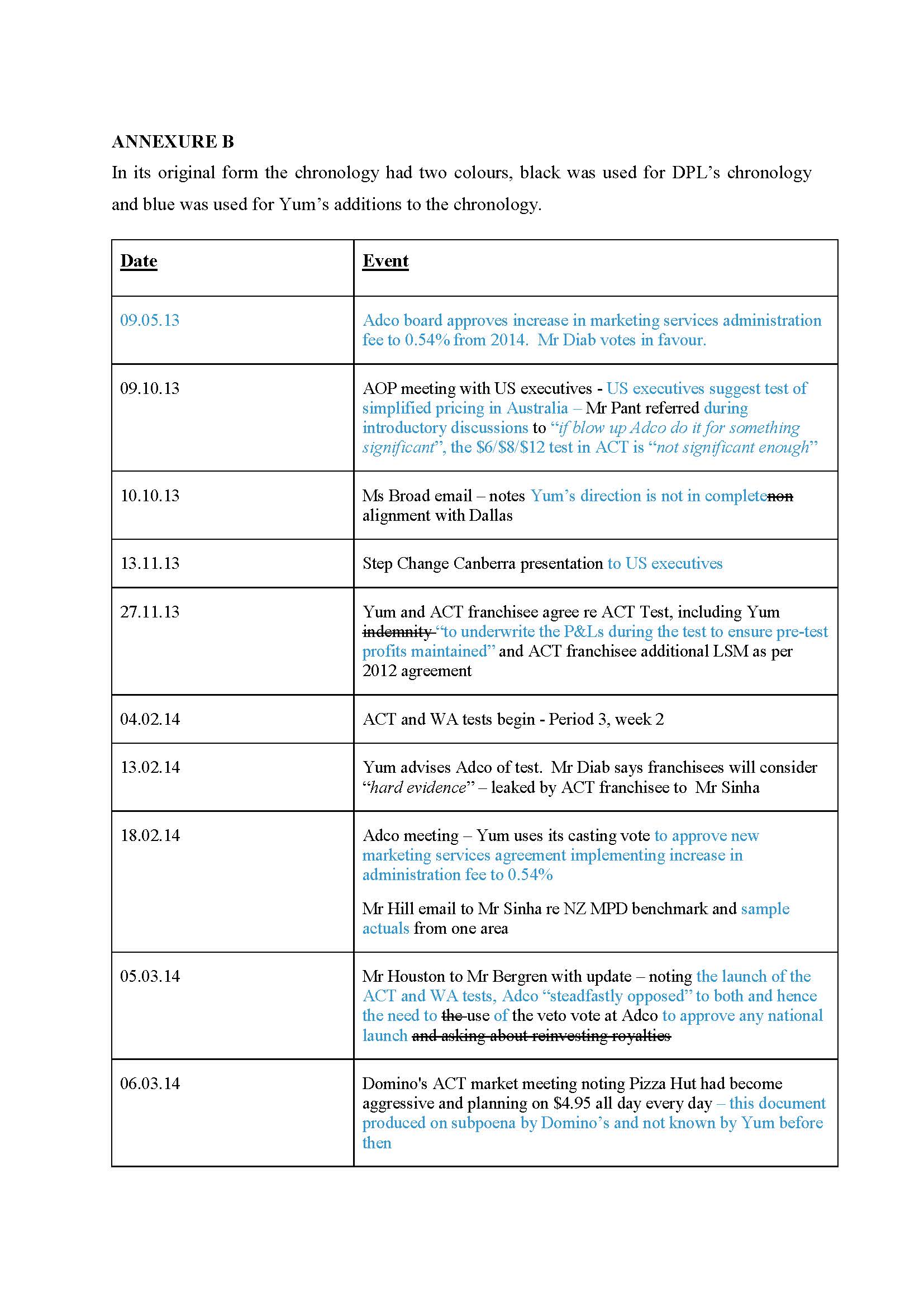
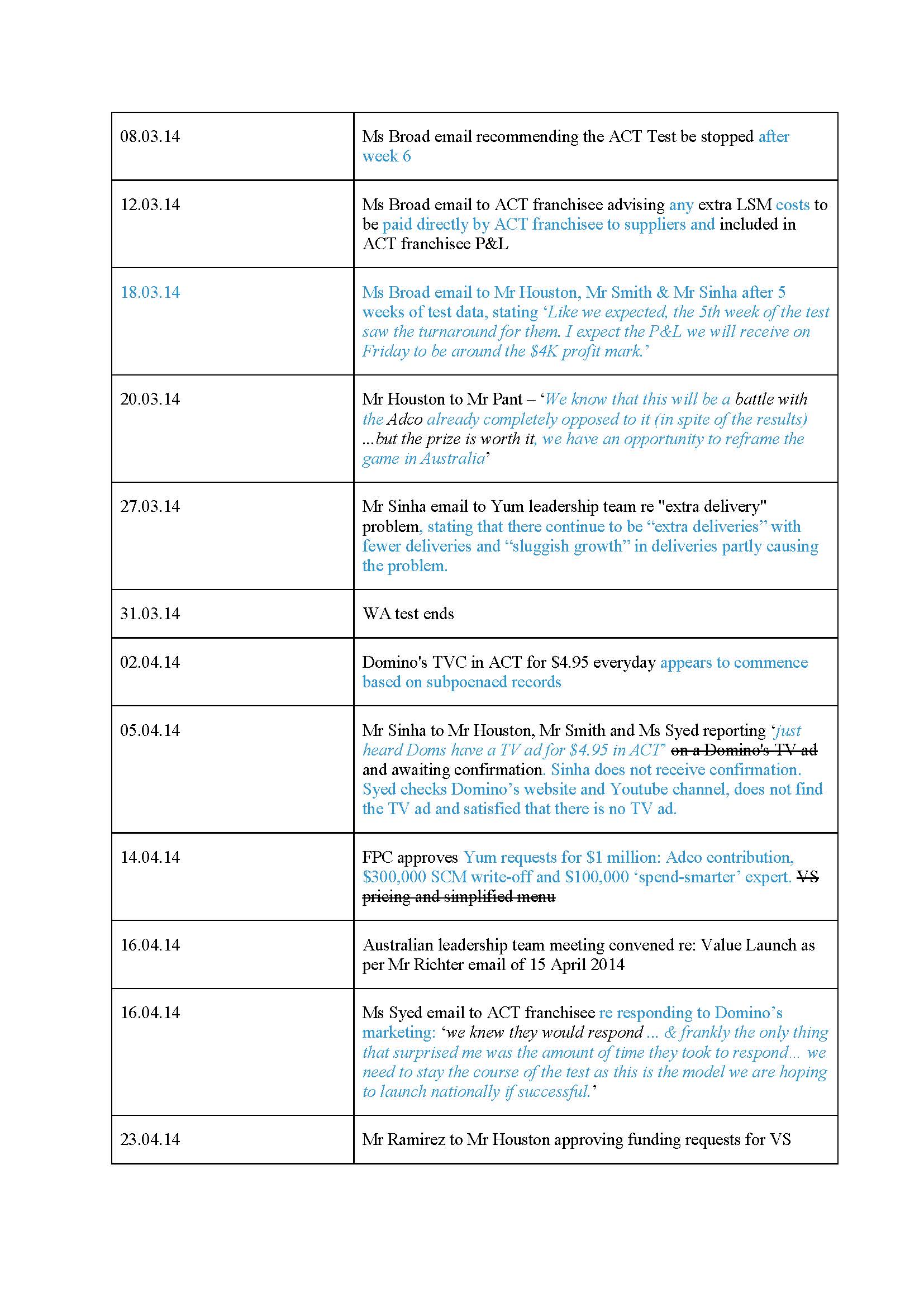
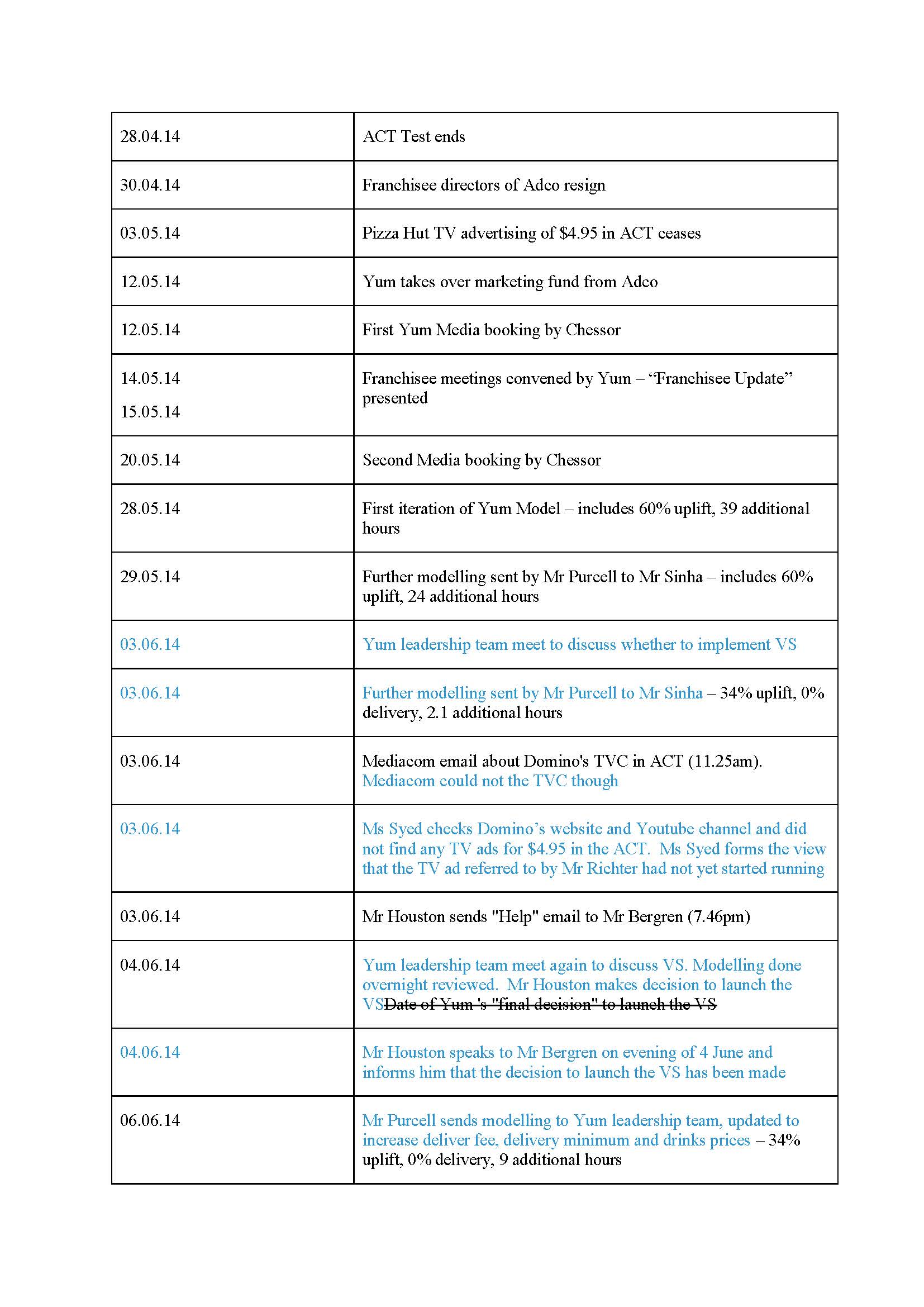
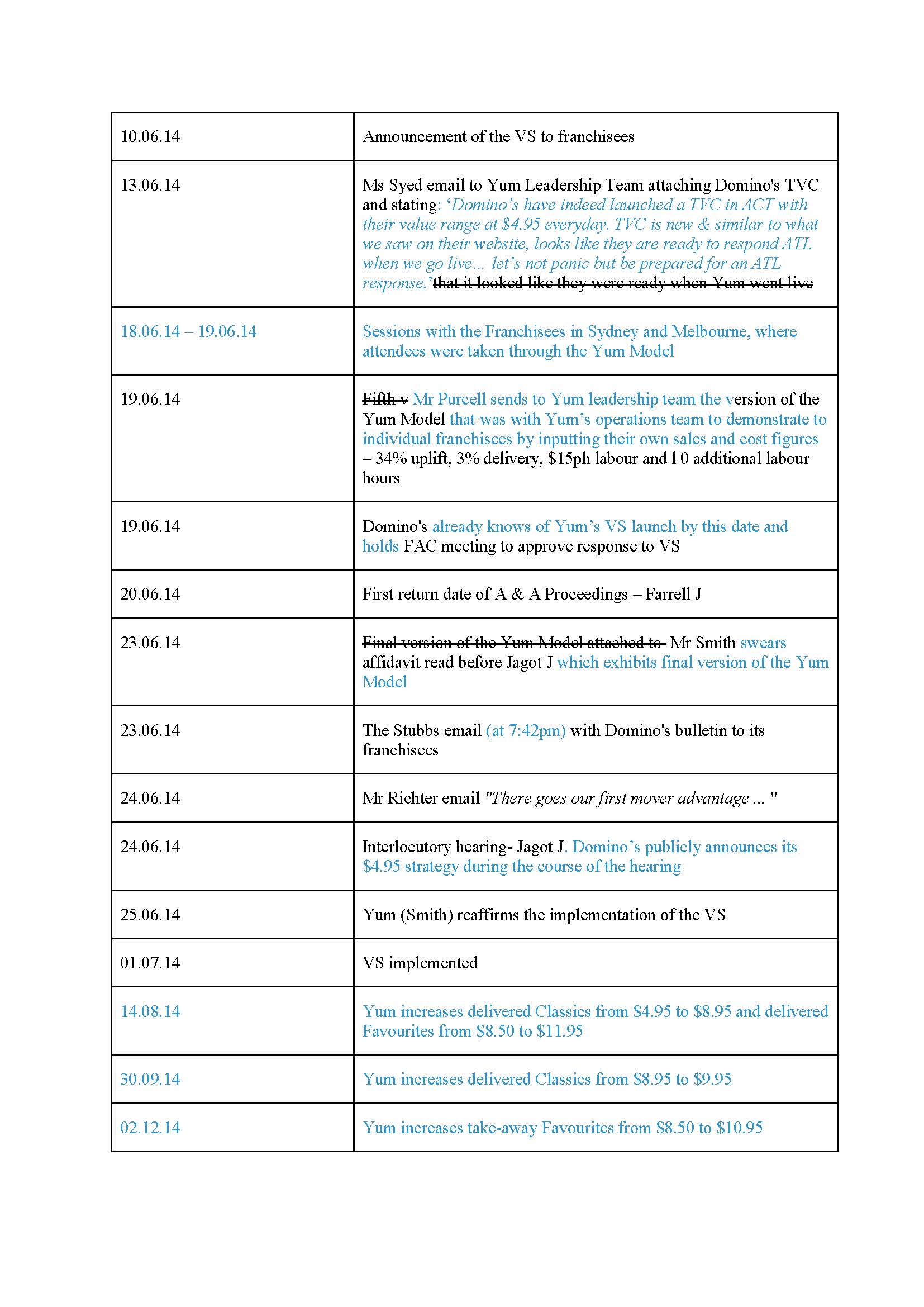
DIAB PTY LTD (ACN 003 168 812) Applicant | ||
AND: | YUM! RESTAURANTS AUSTRALIA PTY LTD (ACN 000 674 993) Respondent | |
DATE OF ORDER: |
THE COURT ORDERS THAT:
1. Proposed orders, by consent or as proposed by each party, be sent to chambers by 19 February 2016.
2. Any proposed redactions to the reasons, said to be confidential, be sent to chambers by 19 February 2016.
3. The matter be stood over to 23 February 2016 at 9.30am.
Note: Entry of orders is dealt with in Rule 39.32 of the Federal Court Rules 2011.
TABLE OF CONTENTS
[3] | |
[3] | |
[6] | |
[11] | |
[15] | |
[20] | |
[23] | |
[23] | |
[25] | |
[28] | |
[29] | |
[31] | |
[35] | |
[39] | |
[39] | |
[40] | |
[42] | |
[43] | |
[46] | |
[49] | |
[50] | |
[51] | |
[52] | |
[55] | |
[59] | |
5.3.3.3 DPL’s conclusion on the presentation of the ACT Test during the Franchisee Update presentation | [60] |
[61] | |
[64] | |
[67] | |
[71] | |
[72] | |
[75] | |
[78] | |
[81] | |
[84] | |
[94] | |
[97] | |
[100] | |
5.4.6 Was $4.95 was an unprofitable price for the Classics range? | [103] |
[109] | |
[110] | |
[113] | |
[119] | |
[122] | |
[125] | |
[125] | |
[136] | |
[139] | |
5.8 The reasons of Jagot J in the interlocutory application for injunctive relief | [140] |
[149] | |
[149] | |
[153] | |
[159] | |
[160] | |
[162] | |
[165] | |
[168] | |
[171] | |
[173] | |
[177] | |
[178] | |
[185] | |
[190] | |
[196] | |
[203] | |
[203] | |
[206] | |
[210] | |
[217] | |
[220] | |
[220] | |
[232] | |
[250] | |
[266] | |
[279] | |
[283] | |
[284] | |
[286] | |
[306] | |
[318] | |
[334] | |
[347] | |
[353] | |
[353] | |
[362] | |
9.3 The ACT Test, the Yum Model and the first mover advantage | [371] |
[402] | |
9.5 The intervention of the interlocutory proceedings and Domino’s pre-emptive launch of a $4.95 every day pizza | [403] |
[427] | |
[436] | |
[439] | |
[440] | |
[440] | |
[440] | |
[441] | |
[443] | |
[448] | |
[448] | |
[451] | |
[453] | |
[458] | |
[461] | |
[462] | |
[465] | |
[465] | |
[468] | |
[470] | |
[470] | |
[474] | |
[478] | |
[481] | |
[482] |
BENNETT J:
1 These proceedings, brought by Diab Pty Limited (DPL), a franchisee of Pizza Hut outlets, concern a decision made by Yum! Restaurants Australia Pty Limited (Yum), the franchisor. That decision, which was announced to Pizza Hut franchisees on 10 June 2014 and implemented on 1 July 2014, was to reduce the ranges of Pizza Hut pizzas from four to two and reduce the prices in the available ranges to two price points: $4.95 for “Classics” pizzas (from $9.95) and $8.50 for “Favourites” pizzas, formerly called “Legends” pizzas (from $11.95). Yum’s strategy was known as the Value Strategy (VS) and the reduced price points were predicated on various iterations of a model prepared by Yum personnel (the Yum Model). DPL brings its claim against Yum as the representative applicant of all persons who were franchisees under an International Franchise Agreement (IFA) with Yum to operate Pizza Hut outlets as at 1 July 2014 (Franchisees; singular: Franchisee).
2 A range of terminology and definitions are used in these reasons. Accordingly, a glossary of terms is attached in Annexure A. Further, the parties provided a series of chronologies, following the hearing, and a summary chronology of the events relevant to this matter is attached in Annexure B. That chronology, submitted by the parties, is not agreed as to all of the facts as provided but serves only to provide a convenient reference of the relevant date. DPL provided the original chronology, which is represented in black in Annexure B, and Yum made changes to DPL’s chronology and those changes are represented in blue in Annexure B.
3 DPL is a Pizza Hut franchisee which owns and operates six Pizza Hut outlets in the Greater Macarthur region of south-western Sydney, pursuant to a separate IFA for each outlet.
4 DPL was formed in 1986. Mr Danny Diab is the majority shareholder and managing director of DPL. Since 1995, Mr Diab has had an extensive involvement in all aspects of the Pizza Hut business in Australia, including as a franchisee director of Pizza Hut Adco Limited (Adco), a body that, in conjunction with Yum, is responsible for marketing and promotional activities and promoting the Pizza Hut business, brands and products in Australia. Mr Diab was a director of Adco until April 2014 and was a representative on many of Yum’s joint councils with Franchisees. Mr Diab is also a director of Restaurant Brands New Zealand Limited (RBNZ), the New Zealand Pizza Hut master franchisee.
5 When compared to the national average, all of the current DPL outlets are high volume stores. Mr Diab gave evidence that DPL outlets have a 2-to-1 advantage over the Domino’s stores in the Greater Macarthur region. This is not the case with other Pizza Hut outlets. The importance of this numerical advantage and scale was recognised within Yum as seen in an email of 11 August 2013 from the senior planner of Yum in the USA. In the period February to June 2014 DPL outlets were experiencing increasing sales with a “run rate” of approximately 3.55% increase in sales growth. Mr Diab gave evidence that he advised Yum of the positive progress that DPL was making. DPL states that since the implementation of the VS, it has experienced a significant decline in its sales and profitability.
6 Yum is an Australian subsidiary of Yum! Brands, Inc. (Yum US), which is a publicly listed company on the New York Stock Exchange and is among the world’s top 250 companies on the Fortune 500 list. Yum operates the Pizza Hut business in Australia. Yum called key personnel involved in the launch of the VS to give evidence. The personnel included:
Mr Graeme Houston, the General Manager of Pizza Hut South Pacific (SOPAC);
Ms Lynne Broad, employed by Yum as the Head of Finance and Supply Chain, Pizza Hut;
Mr Kurtis Smith, employed by Yum in July 2013 as the Head of Operations of Pizza Hut SOPAC and in January 2014, he became the Market Director for Pizza Hut in Australia until January 2015;
Ms Fatima Kamali-Syed, employed by Yum as the Head of Marketing; and
Mr Devesh Sinha, employed by Yum as the National Operations Manager from January 2014 until 15 July 2015.
7 Mr Houston has been a director of Yum since 21 December 2011. Ms Broad became a director in December 2014. Mr Smith and Mr Sinha no longer work for Yum; however, both have roles in Yum US’ Dallas headquarters. Mr Smith is the Senior Director of Development of the USA Pizza Hut business and Mr Sinha is now the Senior Manager of Operations for what has been described as Pizza Hut Global.
8 Mr Houston gave evidence that, as at 27 November 2014, there were approximately 210 Pizza Hut franchisees in Australia, of which approximately 45 were franchisees which operated more than two outlets and approximately 4 were franchises which operated more than 5 outlets.
9 In terms of its own financial reporting cycle, Yum provides quarterly reports to the Chief Financial Officer (CFO) of Pizza Hut Global, Mr Enrique Ramirez, commencing each year with a forecast known as Q0F, which is then updated in subsequent periods by forecasts known as Q1F, Q2F and Q3F. According to Ms Broad, these forecasts are then built into a consolidated forecast for the Pizza Hut business as a whole.
10 In terms of business and financial planning, Yum commences this process in about July of each year when Yum, with every other business unit which is a subsidiary or related entity around the world, submits a market growth plan which outlines store build and profit targets, which are agreed with the Pizza Hut Global CFO. In about October of each year, there is a conference between Yum’s leadership team and the Yum US senior leadership team. During this conference, Yum presents its business strategy known as the Annual Operating Plan (AOP) to the Yum US senior leadership team. The AOP meeting for the 2014 Yum year took place on 9 October 2013.
1.3 Representative proceedings and group members
11 These representative proceedings were commenced by DPL under Part IVA of the Federal Court of Australia Act 1976 (Cth) (the FCA Act). The group members are defined as the Franchisees who suffered loss as a result of the introduction of the VS. Opt-out notices were sent to all potential group members on 10 October 2014, as a result of which only 11 of the Franchisees opted out. It follows that approximately 190 of 200 of the Franchisees are group members for the purposes of the proceedings.
12 In accordance with s 33H(1)(c) of the FCA Act, DPL has specified the questions of law and fact common to the claims of all group members in the Amended Originating Application dated 2 April 2015 (the application): (Merck Sharp & Dohme (Australia) Pty Ltd v Peterson [2009] FCAFC 26 at [6]).
13 DPL submits that, other than questions relating to the quantification of damages, there is a very high level of commonality between the claims of DPL and each of the group members – essentially because Yum’s conduct involved the introduction of a single, national strategy and Yum’s legal relationship with the Franchisees was and is conducted pursuant to a standard form IFA. However, other group members may have separate claims that they may wish to advance against Yum pursuant to s 33R of the FCA Act. These separate claims would be in addition to the claims made in the Amended Statement of Claim dated 2 April 2015 (ASC). Also, it is probable that each group member would have to establish his, her or its damages if liability is established.
14 It should be noted that, in [26] of the ASC, DPL has clearly specified that it claims damages on its own behalf as an individual claim, which includes the quantification of its loss as to which it has led evidence from both Mr Diab and Mr Potter. DPL particularised, in [27] of the ASC, that ‘[p]articulars of the loss and damage suffered by the [Franchisees] will be provided after the determination of the common issues relating to liability and the determination of the individual damages claim of [DPL]’. That is, if the Court finds in favour of DPL and awards damages to DPL, the judgment will enure for the benefit of all group members as findings on the common questions, other than in respect of the quantification of damages. The Court’s power to award damages to DPL only at this time is established by s 33Z(1)(e) of the FCA Act. The Court may then take submissions as to the appropriate orders or directions to be made in respect of the damages claims or assessments to be made in respect of all other group members under s 33Z(1)(g) or s 33ZF of the FCA Act.
15 Mr Diab, and each Franchisee, executed the IFA for a term of 10 years with a right of renewal for a further 10 years, subject to certain conditions of compliance (clause 18). The IFA provides in clause 14 that the Franchisee cannot sell or transfer any interest in the IFA without Yum’s prior written approval of the proposed transferee.
16 Clause 1.1 provides that Yum grants to the Franchisee the right to use a comprehensive restaurant system (the System). The Franchisee agrees to use its best endeavours to develop the Business (defined as the business of preparing, marketing and selling the products) and to increase the Revenues (defined as gross receipts received by the franchisee as payment for the products and for other goods and services) (clause 1.2). By clause 2.3, the initial and annual payments made by the Franchisees are in consideration of the rights granted in clause 1.1 and not for Yum’s performance of any specific obligations or services.
17 Also relevant are clauses:
5.2 Franchisor may, by notice to Franchisee, at any time change or withdraw any Approved Product or add new Approved Products. Franchisee will implement such changes, withdrawals and additions within the period specified in the notice.
…
6.1 Franchisee will not execute or conduct any advertising or promotional activity in relation to the Business or the System without Franchisor’s prior written approval.
6.2 Franchisee will participate in such national and regional advertising, promotions, research and tests as Franchisor from time to time requires and Franchisee will not have any claim or action against Franchisor in connection with the level of success of any such advertising, promotion, research or test.
…
23.1 This Agreement constitutes the entire agreement between the parties with respect to its subject matter and supersedes all prior negotiations, agreements or understandings.
18 “Approved Products” are defined, in schedule A of the IFA, as ‘the products from time to time approved by Franchisor for sale in the Business.’ Yum also points to the “franchisee’s representation” which forms part of the IFA:
(a) Franchisee has reviewed this Agreement with the assistance and advice of independent legal counsel and understands and accepts the terms and conditions of this Agreement;
(b) Franchisee has relied upon its own investigations and judgment in entering this Agreement, after receiving legal and financial advice, and no inducements, representations or warranties other than those expressly set forth in this Agreement, have been given in respect of the System, the Business or this Agreement; and
(c) Franchisee acknowledges that establishment and operation of the Business will involve significant financial risks and that the success of the Business will depend upon the skills and financial capacity of Franchisee and also upon changing economic and market conditions and that such risks, skills and conditions are not in any way guaranteed or underwritten by Franchisor.
19 The key clause with respect to the exercise by Yum of its power to fix the prices pursuant to the VS is clause C1 the IFA. This clause provides:
MAXIMUM RETAIL PRICE
Franchisee will not permit any Approved Product to be sold at the Outlet at any price exceeding the maximum retail prices advised by Franchisor to Franchisee from time to time.
3. THE STATEMENT OF CLAIM/THE ASC
20 There are certain matters as to the IFA that are not in dispute on the pleadings:
The IFA provided the structure for the System.
The Franchisees agreed to comply with specifications concerning the operation of the System, which provided for uniform operation of all restaurants within it.
The matters set out in clause 1.1 of the IFA.
The Franchisee is an independent contractor and no fiduciary relationship exists between the franchisor and the Franchisee.
The Franchisees will not permit any Approved Products to be sold at any price exceeding the maximum retail prices advised by the franchisor to the Franchisees from time to time.
The franchisor may, by notice to the Franchisees, change, withdraw or add new Approved Products.
The Franchisees will participate in advertising and promotions as the franchisor requests, with no claim in connection with the level of success.
The Franchisees will spend an amount on advertising as directed by the franchisor, being 6% of revenues, as defined, payable to the Adco or as directed by Yum and 0.5% of revenues on local advertising and promotions approved by the franchisor.
21 DPL’s pleaded case in contract has two related components:
(1) DPL pleads that on the proper construction of clause C1, Yum was obliged to set profitable prices – being prices that would enable a Franchisee to make, maintain or increase its profits;
(2) DPL pleads that Yum was subject, in any event, to the following implied duties owed by Yum under the IFA to DPL and to each Franchisee:
(a) A duty to cooperate with the Franchisees to achieve the objects of the IFA; and
(b) A duty to comply with standards of conduct that are reasonable having regard to the interests of the parties to the IFA.
22 Diab also pleads that ‘for the purpose of the Implied Duties and/or for the purpose of construing Yum’s powers under the IFA’ the following, in summary, applies:
The object of the IFA is to generate profits for DPL and for each Franchisee performing in accordance with the IFA.
The benefit of the IFA for DPL and each Franchisee, and their interest under the IFA includes:
the ability to make and increase profits after covering operating costs, overheads and cost of capital, from developing the business and by investment of capital, time, skill and labour using a proven business system and brand developed by Yum, without having to share those profits with Yum except by way of fixed royalty percentage;
the ability to market, sell and transfer the business and reap a capital gain; and
the collective marketing of the Pizza Hut brand to consumers in Australia, in relation to which all Franchisees contribute.
23 Mr Diab is the managing director and the majority shareholder of DPL. Mr Diab has been involved in the pizza business since 1987 and has been involved with Pizza Hut since 1989. His involvement with Pizza Hut includes:
Over the last 25 years, he has overseen the development and operation of DPL’s Pizza Hut outlets.
From 1998 to 2011 and from 2012 to May 2014, Mr Diab was a franchisee director of Adco.
He was a franchisee representative of a number of other Yum bodies including the Pizza Hut Purchasing Council, the Pizza Hut Operations Council, the Pizza Hut Development Council and the Customer Service Centres Council.
Between 2009 and 2012, Mr Diab was President of the Australasian Pizza Association Inc, which is a representative body for approximately 150 of the Pizza Hut franchisees. Further, between 2000 and 2008, Mr Diab was the President of the National Pizza Association, which was the predecessor of the Australasian Pizza Association Inc.
Since 2013, Mr Diab has been a director of RBNZ. Prior to 2013, he worked as a consultant to RBNZ and advised it in relation to its acquisition of the Eagle Boys chain in New Zealand during 1999-2000 and in relation to its acquisition of 51 Pizza Hut Outlets in Victoria in 2002, which it subsequently sold in the 2007/2008 financial year.
24 Mr Diab also holds a Diploma in Company Directorship from the University of New England and the Australian Institute of Company Directors (AICD), and a Graduate Diploma in Corporate Management from the Institute of Corporate Managers, Secretaries and Administrators (ICMSA). Further, Mr Diab is a Foundation Fellow of the AICD, since 1991, and a Fellow of ICMSA, since 1995.
25 Mr Houston is employed by Yum as the General Manager Pizza Hut South Pacific (SOPAC) and has held this position since 2011.
26 Mr Houston was awarded a Bachelor of Commerce from Canterbury University in New Zealand in 1986. He has been employed by Yum, or its related entities, since 1990. His various roles have included:
From 1990 to 1994, he held various Area Manager Positions in Auckland and Dunedin in New Zealand and Wollongong, New South Wales in KFC Operations (which is a division of Yum). At that time KFC was part of Pepsi Co International.
In 1994, he was promoted to the position of Operations Manager New South Wales KFC.
In 1995, he was promoted to market manager for Pizza Hut New Zealand and this was the most senior position in Yum that was based in New Zealand.
In 1997, Mr Houston was promoted to Market Manager KFC Victoria, Tasmania and South Australia where he was responsible for 90 company owned restaurants and 48 franchised outlets.
In 2002, he was promoted to Chief Supply Chain Officer for both KFC and Pizza Hut, based in Sydney. In that role he reported to the Managing Director Yum SOPAC.
In 2003, Mr Houston became the General Manager Pizza Hut Operations SOPAC, in which he led the Operations team for Pizza Hut in Australia and New Zealand.
In 2006, Mr Houston became the Vice President of Pizza Hut Delivery Operations of Yum! Restaurants International (which is a division of Yum US). Mr Houston was responsible for developing the Pizza Hut delivery business for all countries in which Pizza Hut did business except the USA and China. He held this job until 2011. During this period, Mr Houston also participated in the Global Pizza Hut Brand Council, which is an annual meeting of “key thought leaders” from the global Pizza Hut brand to help develop and refine the Pizza Hut brand strategy.
27 From 2013, Mr Houston has also assumed responsibility for establishing and developing the Pizza Hut brand in Russia. This role was expanded from 2014 as Pizza Hut Africa was added to his portfolio.
28 Mr Broad is employed by Yum as the Head of Finance & Supply Chain, Pizza Hut and has held this position since the middle of 2013 and reports to Mr Houston. Ms Broad has held the position of Head of Finance since January 2011. Ms Broad commenced employment with Yum in April 2007 and has held the following roles: Group Taxation & Treasury Manager, Finance Manager and Commercial Planning Manager. Ms Broad was awarded a Bachelor of Commerce from the University of Sydney and Graduate Diploma from the Institute of Chartered Accountants in Australia. Ms Broad is currently a director of Yum and was appointed in December 2014.
29 Ms Syed is the Head of Marketing of Yum and a member of the Leadership Team. Ms Syed has held these positions since January 2013. She has seven employees in her team, five in the Marketing Team and two in the Research and Development Team. Mr Richter is the Marketing Manager and the most senior person reporting to Ms Syed. Ms Syed began working for Yum in November 2010 as the Group Marketing Manager.
30 Ms Syed was awarded a Bachelor of Business Degree by the University of Technology, Sydney, in 2000 and was awarded a Masters of International Business Degree from the University of Sydney in 2001. She has worked as a marketing professional in Australia for 12 years, in the following roles:
Assistant Brand Manager at Nestlé Australia Ltd from 2002 to 2004.
Brand Manager at Reckitt Benckiser Healthcare Australia Pty Limited from 2004 to 2006.
Brand Manager at PepsiCo Australia and New Zealand from 2006 to 2008 and Senior Brand Manager from 2008 to 2010.
Group Marketing Manager at Yum from 2010 to 2012.
31 Mr Sinha was the National Operations Manager of Yum from January 2014 until 15 July 2015.
32 Mr Sinha had extensive work experience before joining the Yum system, including:
From 1994 to 1995, he was a Hotel Operations Management Trainee at the Taj Mahal Hotel in Mumbai, India.
From 1995 to 1996, he was the Managing Partner of Zodiac – Multicuisine Restaurant in India.
From 1996 to 1998, he was the Executive of Hotel Services at Eurest Radhakrishna Hospitality Services Pvt. Ltd in India.
From 1998 to 2000, Mr Sinha was a District Manager of Domino’s Pizza India.
33 Mr Sinha first worked in the Pizza Hut system in India in 2000 as the Restaurant General Manager for Favorite Food India (which was a subsidiary of Wybridge, the Master Franchisor for Pizza Hut in Indonesia), where he opened and managed Pizza Hut stores in Mumbai. In that capacity, Mr Sinha had personal experience in making, and supervising the making, of pizzas in a Pizza Hut store. Since 2000, Mr Sinha has had many roles associated with the Pizza Hut business. These include:
In 2002, Mr Sinha was the Area Coach in Wellington for RBNZ, in which he managed the operation of the Pizza Hut Stores. He stayed at RBNZ until 2006.
From 2006 to 2009, he had the position of Franchise Business Coach and EDI Operations Leader for Yum Restaurants International in India.
From 2009-2011, Mr Sinha was the Area Manager of Southern Restaurants Pty Ltd in Melbourne, Victoria.
In 2011, Mr Sinha became the Pizza Hut State Operations manager for New South Wales with Yum.
34 In January 2014, Mr Sinha was promoted to National Operations Manager. Each State Operations Managers reported directly to Mr Sinha and the operations team was responsible for maintaining operational standards across all Pizza Hut stores in Australia. Mr Sinha reported directly to Mr Smith. Mr Sinha had the overall responsibility for all operational matters that impacted customers, including such matters as food preparation, food and operational safety and customer service.
35 Mr Smith is the Senior Director of Development in the Pizza Hut USA business and has held that position since January 2015. At the time of the hearing before Jagot J, Mr Smith was employed as a Market Director by Yum and held this position since January 2014. The role required him to oversee day-to-day operations at Pizza Hut Australia and he reported to Mr Houston.
36 Mr Smith was awarded a Bachelor of Science in Business Administration, majoring in Accounting, from the University of Richmond, in Virginia in the USA, in 2002. Further, in 2007, he was awarded a Masters of Business Administration from the University of Chicago – Booth School of Business.
37 Mr Smith’s professional background is, as follows:
From 2002 until 2005, Mr Smith worked as an Associate at Deloitte.
From 2006 to 2009, he was a consultant at Bain & Company.
From December 2009 until October 2010, he was the Senior Manager, Strategy, at Hewlett Packard.
Between October 2010 and July 2013, Mr Smith was employed by Yum! Restaurants International in which he held a range of positions including Manager, Strategic Planning (from October 2010 to June 2011), Senior Manager, Strategic Planning (from June 2011 to December 2011) and Director Financial and Capital Planning (from January 2012 to July 2013).
38 Mr Smith joined Yum in July 2013 as the Head of Operations, Pizza Hut SOPAC.
39 Mr Potter qualified as a Chartered Accountant in 1990. He is now the principal of Axiom Forensics Pty Limited. Mr Potter’s relevant experience to this matter is, as follows:
He was a trainee accountant in Perth for two years, before obtaining a Bachelor of Commerce at the University of Western Australia.
He was a graduate accountant in Perth for three years and worked as a Chartered Accountant in Perth and Sydney for 24 years. Mr Potter’s experience in that time included 13 years in insolvency and reconstruction accountancy specialisation and 16 years in forensic accounting, which has included investigations for regulators on issues including valuation, valuation disputes and competition related disputes, pricing decisions and/or valuation matters, damages assessments and consulting assignments.
40 Mr Gower is a Chartered Accountant and has been a director of GoweJones & Co Pty Limited since 2009. Mr Gower’s professional background is, as follows:
Between 1977 and 1982, Mr Gower was employed by Arthur Young in South Africa and Australia.
In 1982, Mr Gower joined Duesbury’s (a predecessor firm of Deloitte Touche Tohmatsu).
From 1987 to 1993, Mr Gower was a Partner off Duesbury’s and from 1993 to 1998 he was a Partner of Deloitte Touche Tohmatsu.
Between 1998 and 2003, Mr Gower was a sole practitioner at GCA Gower & Co and he became a director of GCA Gower & Co from 2003 until 2009.
41 Mr Gower has provided accounting support across a range of areas, including:
Analysis of the fairness of the acquisition considerations to be paid.
Valuation of businesses.
Due diligence investigations.
General financial analysis and advice in respect of the preparation of forecasts, feasibility studies and evaluation of the benefits of transactions.
Litigation engagements, involving providing evidence in respect of accounting matters generally and quantification of economic loss.
5. FACTUAL BACKGROUND AND SUBMISSIONS ON THE FACTS
42 DPL has analysed Yum’s closing submissions by subsequently providing a comprehensive table of responses to various of those submissions, and Yum has responded to these comments. Nonetheless, this section will summarise facts asserted and, where appropriate, the parties’ submissions as to the facts as presented prior to the table being provided by DPL. I will then turn to my consideration of the facts asserted and submissions advanced by the parties, taking the table, with Yum’s responses, into account as relevant.
43 DPL provided a useful table that compared headline prices for Pizza Hut and Domino’s before the VS and at 1 July 2014 when the VS was implemented. Relevantly to the calculation of loss and damage, the analysis is of the prices of Pizza Hut pizzas before the VS, the prices due to the implementation of the VS and the prices of pizzas during the period of loss. Accordingly, the prices of the ranges of Pizza Hut pizzas, with a delivery fee of $8.00, before the VS were:
DELIVERY | PICK UP | ||
Range of pizza | Price | Range of pizza | Price |
Mia (6 pizzas in range) | $5.00 | Mia (6 pizzas in range) | $5.00 |
Classics (6 pizzas in range) | $9.95 | Classics (6 pizzas in range) | $9.95 |
Legends (8 pizzas in range) | $11.95 | Legends (8 pizzas in range) | $11.95 |
Signature (7 pizzas in range) | $14.95 | Signature (7 pizzas in range) | $14.95 |
44 As at 1 July 2014, the date of the implementation of the VS, the delivery price was increased to $8.95, the Legends range was changed to Favourites (with the number of pizzas increasing from 8 to 11 in the range) and the Mia and Signature ranges were removed. The prices of the ranges of Pizza Hut pizzas as at 1 July 2014 were:
DELIVERY | PICK UP | ||
Range of pizza | Price | Range of pizza | Price |
Mia (6 pizzas in range) | Deleted | Mia (6 pizzas in range) | Deleted |
Classics (6 pizzas in range) | $4.95 | Classics (6 pizzas in range) | $4.95 |
Favourites (11 pizzas in range) | $8.50 | Favourites (11 pizzas in range) | $8.50 |
Signature (7 pizzas in range) | Deleted | Signature (7 pizzas in range) | Deleted |
45 Yum says that major price adjustments were made to the ranges of pizzas following the implementation of the VS. Yum relies on Ms Syed’s affidavit dated 13 July 2015, which is relevantly summarised as follows:
On 14 August 2014, Yum increased the delivered price for the Classics range from $4.95 to $8.95, increased the delivered price for the Favourites range from $8.50 to $11.95 and the delivery fee was decreased from $8.95 to $4.95.
On 30 September 2014, Yum increased the delivered price for the Classics range from $8.95 to $9.95.
On 2 December 2014, Yum increased the pick up price for the Favourites range from $8.50 to $10.95. A new tier of pizza range was also introduced, which was called the Loaded Classics range. The price for this range was $7.95 and the delivered price was $10.95.
On 22 December 2014, Yum increased the fixed delivery fee from $4.95 to $7.95.
On 5 May 2015, Yum increased the pick up price for the Classics range from $4.95 to $6.95 (except on its website), increased the pick up price for the Loaded Classics range from $7.95 to $9.95 and increased the pick up price the Favourites range from $10.95 to $11.95.
5.2 Characterisation of the VS
46 DPL describes its characterisation of the VS in [13] of the ASC, which is as follows:
On 10 June 2014, Yum advised the Applicant and the other Franchisees (Advice), that:
(a) On an from 1 July 2014, it was reducing the maximum prices that could be charged for pizzas sold at Pizza Hut Outlets for takeaway and delivery to two price points (Reduced Prices):
(i) “Classics” pizzas at $4.95 (including GST) – being a reduction of approximately 50% from the preceding price of $9.95; and
(ii) “Legends” pizzas at $8.50 (including GST) – being a reduction of approximately 29% from the preceding price of $11.95.
(b) On and from 1 July 2014, Yum was reducing the range of Approved Products to be sold at Pizza Huts to the “Classics” and “Legends” ranges of pizzas (removing the “Signature” and “Pizza MIA” ranges of pizzas);
(c) Yum had made its decision to implement the Reduced Prices in (a), the change in the range of Approved Products in (b) and certain other changes, including changes to delivery prices (Reduced Price Strategy) on the basis of trials of a reduced price strategy at Pizza Hut Outlets in the ACT and experience in New Zealand, which it asserted had provided evidence of a significant increase in sales revenue in those markets in response to those trials;
(d) On an from 1 July 2014, Yum would initiate a public marketing campaign of the new Pizza Hut prices as being for a limited time only, for the purpose of achieving a spike in sales, when it was not Yum’s intention that the prices be for a limited time only;
(e) The introduction of the Reduced Price Strategy would be accompanied by an advertising program lasting 1 month only with financial support from Yum’s US parent company;
(f) Yum would provide $1,000 per Outlet to each Pizza Hut franchisee in Australia by way of assistance to cover stock write offs arising from the deletion of the “Signature” pizza range;
(g) Yum would not otherwise provide any compensation to franchisees for any loss of profits they may incur in implementing the Reduced Price Strategy.
47 Paragraph 13 of the ASC refers to ‘Reduced Prices’ as providing the foundation of the VS. As described by DPL, the VS comprised four main elements:
the “Reduced Prices” – being the new price points for pizzas, which in fact became $4.95 for “Classics” and $8.50 for “Favourites” (previously called “Legends”);
a menu reduction to two ranges of pizzas, by eliminating the “Signature” range and the “Mia” range;
an advertising campaign to support the launch of the VS. A media booking authorisation form from Mediacom dated 20 May 2014 indicated approval for media spending of XXXX XXXXXXX; and
a provision of assistance to the Franchisees of $1,000 including GST per outlet in relation to the launch.
48 Yum criticises DPL’s characterisation of the VS as it contends that DPL seeks to confine the VS to only the elements enumerated in the ASC. Yum submits that it has always said that the VS was an integrated market strategy that contained many elements, ranging from menu design, to an aggressive and attention catching marketing campaign, to reducing and simplifying the price points at which products could be purchased. In particular, it was always intended by Yum, as part of the VS, that Yum would be first into the market with an everyday value proposition of full sized pizzas at $4.95 all day every day. Yum says that these elements are not acknowledged by DPL, as DPL has isolated one aspect of the strategy by naming it the ‘Reduced Price Strategy’ in [13] of the ASC. Accordingly, Yum submits that this terminology diminishes the significance of the remaining elements of the VS, in particular, being first to market with an all-day every day value proposition.
49 Yum used a test in the ACT to trial the VS before its implementation (the ACT Test). It was commenced on 4 February 2014 and concluded on 28 April 2014. The ACT franchisee, who owned all 8 outlets in the ACT market, implemented the VS during this period with the assistance of Yum. Yum agreed to underwrite any losses suffered by the ACT franchisee during the test period. As a result of the ACT Test, Yum paid the ACT franchisee the sum of $143,000 to make good his losses. The ACT franchisee continued to implement the VS after 28 April 2014 and Yum also paid him $51,000 to make good the losses in this period after the completion of the test.
50 The parties are not in dispute that Yum’s decision to test the VS in the ACT was appropriate. The test was appropriate for the following reasons:
Yum believed that there was a “value” problem in Australia and it wished to see whether adopting the New Zealand $4.90 strategy would increase sales, transactions and Franchisee profitability.
Conducting a trial of a strategy, such as the VS, was an appropriate action by a franchisor acting responsibly towards its franchisees, particularly where it had the cooperation and support of the participating franchisee and had agreed to indemnify him.
The ACT was an appropriate place to conduct such a test because it was a distinct media market with its own signal, there was a single franchisee who owned all 8 outlets in the market, the franchisee was one of the better performing franchisees and the low average current level of per store average (PSA) sales meant that there was significant room for improvement.
5.3.2 Mr Diab’s response to being informed of the ACT Test
51 DPL submits that Mr Diab’s response on being informed of the Act Test at the Adco meeting on 12 February 2014 was measured and appropriate, as he advised his franchisee colleagues in an email on 13 February 2014:
These tests are quite radical and have strong long term implications on our business, however we will assess the results carefully and decide whether this is the right thing for our businesses – if these tests are unsuccessful then we would have put the discount strategy fight to bed once and for all. I reiterate the Adco directors are currently opposed to these strategies, however have agreed to examine and scrutinise any results, at the end of the day it will require significant hard evidence to determine the viability or failure of either of these tests.
5.3.3 Profitability of the ACT franchisee
52 DPL contends that Yum asserted that profitability of the ACT franchisee improved during the ACT Test and that this was presented to the Franchisees on 14 and 15 May 2014 and repeated without qualification in the evidence presented before Jagot J during the Franchisees’ interlocutory application to prevent Yum from implementing the VS. Yum represented to the Franchisees, in a presentation on 14 May 2014 entitled “Franchisee Update May 2014” (the Franchisee Update), that there had been a $425 per week per store improvement ($425 improvement) in comparable profit in weeks 5 – 10 of the ACT Test. Yum submits that weeks 1 – 4 were not included in the presentation to the Franchisees on 14 May 2014 because the results in that period were not in a “steady state” and this issue was not challenged by DPL. Yum also submits that weeks 11 and 12 were not included because of the impact of the Easter and ANZAC Day holidays. At the time of the presentation, Ms Broad did not have profit and loss statements from the ACT franchisee; however, Ms Broad agreed that she did have sales information for that period but could not recall why same store sales growth (SSSG) was not presented. DPL contended that this calculation of the $425 improvement was ‘simply a product of financial engineering by Ms Broad that does not withstand reasonable scrutiny’. However, DPL did not establish that Ms Broad engaged in deliberate “engineering” of the results but did establish that the presentation to the Franchisees did not include relevant data, which may have affected the conclusions that could be drawn.
53 DPL submits that the true position, which was neither revealed to the Franchisees nor to Jagot J, was that the ACT franchisee incurred a loss during the test of approximately $140,000, for which it was compensated by Yum pursuant to the indemnity or “backstop” arrangement. Furthermore Yum had also agreed to pay the additional $51,000 to the ACT franchisee for its post-test losses on the basis that it maintained the VS prices following the conclusion of the test.
54 DPL submits, relying on the Franchisee Update, that there were two elements that comprised the calculation of the alleged $425 improvement:
(1) An alleged post-launch profit for weeks 5 – 10 of $155 per week per store; and
(2) A prior year loss of $270 per week per store.
5.3.3.1 Alleged post-launch profit
55 Ms Broad concedes that the $155 per week per store figure was taken from the adjusted profit and loss figures for weeks 5 – 9 (in Exhibit AO) not weeks 5 – 10 as stated in the above presentation document. In cross-examination, Ms Broad, stated that the calculation of $155 was only until week 9 and then Yum ‘double-checked to see if week 10 made a difference to that number’. DPL contends that Ms Broad invented this answer in the witness box to ‘attempt to cover up this relatively trivial slip’.
56 Nonetheless, the figure of $155 per week per store was calculated using 1.5% of sales for local store marketing (LSM) costs. DPL argues that Ms Broad arrived at this figure by “stripping out” LSM costs in excess of 1.5% and that this approach was not according to normal accounting practices of “matching” expenses and revenues. DPL analysed the full 12 week profit and loss for the ACT franchisee who incurred a 1.8% charge for ‘Local Store Marketing – Leaflet’ costs and a 4% charge for ‘Additional LSM’. On this basis, the ACT franchisee incurred costs equating to 5.8% of sales during the ACT test which were as a result of LSM.
57 Ms Broad explained that the 4% additional LSM was not actually spent by the ACT franchisee on LSM but was paid by it to Yum as a contribution to the overall marketing budget for the ACT Test. Nonetheless, DPL contends that Yum failed to account for all marketing expenses when determining net profit and arbitrarily cut off the expenses at 1.5% of sales rather than accounting for the 5.8% in total marketing expenses. It follows, DPL says, that if Yum had taken the full cost into account, the amount of extra cost would have been at least three times the amount calculated for LSM expenses in the Franchise Update, and an overall loss would have been calculated. Ms Broad did not object to this proposition if DPL’s calculation was correct and if it was appropriate to take the additional LSM into account.
58 Yum acknowledges that the ACT franchisee did provide 4% additional LSM. However, it contests the argument that the 4% should have been taken into account when analysing whether the ACT Test was profitable. Ms Broad said that she was ‘trying to get an understanding of what would happen to the [profit and loss] of a store if we launched the pricing strategy nationally’ and that the 4% additional LSM was required to replicate the marketing budget that would be used nationally. Yum submits that the “matching principle” was not appropriate in the circumstances because Ms Broad was analysing the impact on profitability that the VS would have upon a national rollout and the 4% Additional LSM would not be replicated on a national level. That is, the expense would not be incurred by the Franchisees on a national level, as the Franchisees’ contribution to the overall marketing budget would be what they currently paid.
59 Ms Broad acknowledged that the prior year loss of $270 per week per store presented to the Franchisees in the Franchisee Update did not reflect her own estimate for period 3 of 2013 which she calculated as a loss of $257 per week per store. DPL suggests that the most likely explanation for the $270 per week per store figure is that it was based upon an average of the ACT franchisee data from period 5 to period 11 in 2013, which showed an average weekly loss per store of $273. DPL contends that this figure included a deduction for head office costs which, if removed, would have resulted in a profit of $239 per week per store for the ACT franchisee in 2013. That is, if this profit figure were used, there would have been a loss of approximately $980 per week per store, comparing 2013 and weeks 5 – 9 of the ACT Test.
5.3.3.3 DPL’s conclusion on the presentation of the ACT Test during the Franchisee Update presentation
60 DPL concludes that Yum actively engaged in a “public relations exercise” by presenting manipulated data to the Franchisees, which presented a false picture of the profitability of the ACT Test. Further, DPL contends that even if Yum did not have the full 12 weeks of data at the date of the presentations to the Franchisees on 14 and 15 May 2014, it certainly did have data at the time of the interlocutory hearing before Jagot J and it failed to make any qualification or explanation to the Franchisees or to the Court. It follows, DPL says, that Yum was in breach of its implied obligations to act reasonably and cooperatively in relation to the exercise of its power to set maximum prices under clause C1 of the IFA, because the true result of the ACT Test was that the VS prices caused the ACT franchisee to make a loss and thus Yum had no justification for reducing the price points for the Franchisees by application of the VS.
61 DPL contends that Yum presented misleading sales results in the Franchisee Update, as it compared an SSSG of -5%, from the 12 weeks before the ACT Test to a range of increases in sales during the ACT Test, ranging from 14% to 48%. DPL argues that the presentation of SSSG in the Franchisee Update was misleading for the following reasons, as put to Ms Broad:
The prior 12 week period was never a valid comparison, as it included Christmas and the January holidays, which as times when Canberra sales are traditionally low due to Parliament not sitting, school holidays and the public service shuts down. The trend is clear when one assesses the decline in PSA sales in the past two years over this period.
The 48% increase in Week 6 reflected an abnormal dip in the prior year, which was associated with the transition period prior to the ACT franchisee taking over control of all the ACT outlets.
Weeks 7 and 8 in 2014 were inflated due to the misalignment of Easter dates between the two years. That is, in 2014 Parliament was sitting in both of those weeks, whereas in the prior year Parliament sat for only one of those weeks as the other was during Easter.
62 Yum challenges DPL’s criticism that the prior 12 week period was never a valid comparator. Yum relies on Ms Broad’s explanation that the 12 week period before the ACT Test was used because:
Ms Broad had the profit and loss statements for that period and the data were better, relying on assumed data.
Ms Broad did not regard a failure to adjust for Christmas as a serious failure.
Mr Houston believed that it was the only rational period to use and did not see anything that was not representative of the business, even though Christmas fell in the period.
63 Following the ACT Test, the ACT franchisee continued to implement the VS with Yum’s consent. The ACT franchisee experienced poor sales results after week 12 of the ACT Test. Yum attributed this to Yum ceasing advertising and the fact that Domino’s was not advertising on television. DPL contends that this assertion cannot be sustained in light of the Nielsen reports, which show that there was continued advertising by Yum and Domino’s following week 12 of the ACT Test.
5.3.5 Replication of the ACT Test
64 DPL contends that to the extent that there were any positive results generated by the ACT Test, they were not replicable because of the amount of money that was spent by Yum on advertising to generate those profits. DPL argues that, as Yum knew as at 14 May 2014 when the Franchisees briefings commenced, the only conclusion to be drawn from the sales results in the ACT was that extensive advertising could increase sales significantly in the absence of any response by Domino’s. Pizza Hut outspent Domino’s by 2:1 on media spending during the ACT Test, which contrasted the usual spending ratio, where Domino’s outspent Pizza Hut by 2:1. DPL says that there was simply no basis for Yum to have formed the conclusion as at that date, with all of the data which were then available, that the ACT test had been a success in terms of sales. By 10 June 2014, when the VS was announced to the Franchisees, the situation in the ACT was worse, and the negative trend was continuing as at 24 June 2014 when an interlocutory hearing took place before Jagot J.
65 Yum strongly denies DPL’s assertion that Yum’s large advertising budget during the ACT Test meant that the results were not replicable. Yum relies on Ms Syed’s evidence. Ms Syed stated that she believed that ‘[t]he plan could be replicated nationally’ even though additional funds may be required ‘to support the launch’.
66 DPL’s theory was that the expenditure on marketing for the ACT stores must be calculated and then that figure multiplied by stores nationally. Ms Syed rejected this theory as she said that media is replicated based on ‘reach and frequency as opposed to looking at a dollar amount and working from there’ and Yum contends that there is no evidence to support the theory that Yum did not believe that the strategy could be replicable nationally. Further, Yum submits, Mr Houston stated that “replicate” meant achieve the media outcome achieved in the ACT, not the dollars actually spent. That is, focusing on the actual dollars spent was not the correct approach in assessing whether the ACT Test could be replicated. The VS as formulated included provision for an increased national marketing budget. This was not available upon implementation as planned, as it required not only Adco approval but also extra contribution from the Franchisees, which were not forthcoming.
67 On 8 March 2014, during week 5 of the ACT Test, Ms Broad sent an email to Mr Smith, Mr Houston and Mr Sinha providing her opinion as to the success of the ACT Test. Ms Broad stated the following opinion, based on three weeks profit and loss data:
My opinion at this stage is that the test was well worth doing and the marketing team should be congratulated – the sales growth and transaction growth we have achieved in this test have proven beyond doubt that velocity pricing is the path we need to head down. … Having said that, from a profitability stand point, I believe it’s marginal – this is one of our best Franchisee groups and I don’t believe they are making the same amount of money they were previously – it’s borderline at best at this stage.
…
From my perspective, looking at these numbers, our underlying business model doesn’t support velocity pricing… and I believe we should stop the test at the end of week 6…
68 DPL concludes that Ms Broad’s statement was vindicated by the national rollout of the VS, as the sales data after its inception show a negative downward trend, which is very similar to the negative downward trend in PSA sales for the ACT from the time of Domino’s intervention in the ACT. It follows, DPL says, that Ms Broad’s conclusion ‘was and ought to have been obvious to any reasonable and fair minded observer conscious of Yum’s duties to act reasonably and cooperatively under the [IFAs]’.
69 Yum argues that DPL’s reliance on Ms Broad’s email is misplaced for the following reasons:
Ms Broad’s view was based only on three weeks’ profit and loss. Profitability did not improve until the fifth week of the ACT Test.
Data for the first four weeks of the ACT Test were not representative, as a steady state had not been reached. Yum argues that a steady state was reached in weeks 5 – 10 of the ACT Test.
Ms Broad made it clear in her affidavit evidence that subsequent results of the ACT Test allayed her concerns about the VS.
Ms Broad acknowledged that after 3 weeks it was only a profitability point that prevented her from supporting the implementation of the VS.
70 DPL submits that Yum cannot escape a finding of breach of the implied duties of reasonableness and cooperation, on the basis of selective information and manipulated data, by turning a clear and catastrophic loss result produced under otherwise ideal conditions in the ACT into evidence which was sufficient to justify the imposition of the VS upon DPL and all other Franchisees.
71 Prior to 10 June 2014 and after the ACT Test, Yum prepared a model for deciding whether to implement the VS (Yum Model). Mr Houston stated that Ms Broad was responsible for the Yum Model and that Mr Smith’s role was to ‘validate and refine it’.
5.4.1 Operation of the Yum Model
72 In its written submissions, Yum describes the Yum Model’s operation, as to which Yum’s witnesses gave evidence:
242. Firstly, the Yum Model is an Excel model. The model itself is an electronic Excel document, not a paper document. It is comprised of various pieces of data and assumptions contained in different cells on different worksheets. Various cells are linked to other cells (often on different worksheets) by means of formulas which also form part of the model. It is the data, assumptions and formulas, as embodied in the electronic document, which constitute the Yum Model.
243. The Yum model contains numerous input cells, into which different inputs could be placed. In some cases, if an input is changed in one input cell it automatically changes the inputs in certain other cells. For example, upon selecting a particular store in the store selector drop-down box, the “Store Profile” inputs (such as the average value of sales, number of transactions, and so on) automatically update. In other cases, each input cell needs to be altered manually. The input cells which require manual alteration are shaded yellow in the Yum Model.
244. The Yum model operates by applying the chosen inputs to the existing data, assumptions and formulas to produce certain outputs. Every time that an input or multiple inputs are changed, the outputs are recalculated by the model.
245. Once the Yum Model was created, it was used in an iterative process. That is, over the period in late May and early June 2014, on numerous occasions Mr Sinha and Mr Purcell altered various inputs in order to see what outputs would result. Their ultimate goal was to determine what level of transaction uplift or increase would be required, following the introduction of the Value Strategy, in order for the National Average store to maintain the same EBITDA level as it had before the introduction of the Value Strategy.
246. Every time a “version” of the Yum Model was saved, emailed or printed out, what was saved, emailed or printed included the particular set of inputs and the resultant outputs in the model at that particular time. The model itself, however, continued to exist in electronic form.
73 Yum also commented in its submissions on different versions of the Yum Model in evidence:
247. [DPL] has put into evidence 5 emails from Mr Purcell, at different points in time, which attach a particular “version” of the model – i.e. containing particular inputs and outputs. This is only evidence that Mr Purcell had placed particular inputs into the model, resulting in particular outputs, at a particular point in time and had reason to email the results, either to Mr Sinha (Ex[hibits] V, W and X) or to Yum’s LT (Ex[hibits] G and H).
74 DPL contends that it put into evidence every version of the model that was discovered by Yum, so that Yum’s statement that there were “only” 5 emails is an unfair characterisation.
5.4.2 Purpose of the Yum Model
75 DPL describes the purpose of the Yum Model and its contents in [13C] – [13F] of the ASC, as follows:
13C. The Yum Model:
(a) Was constructed by Yum as a model of the profitability at a store EBITDA level for each Pizza Hut Outlet in Australia;
(b) Included 52 weeks of data available to Yum from its Micros system in relation to sale and transactions at each Pizza Hut Outlet in Australia;
(c) Calculated sales and transactions for a “National Average” Outlet in relation to sales and transactions at all Pizza Hut Outlets in Australia from its Micros system;
(d) Included a calculation of the weekly “National Average” store level EBITDA for the 52 week period covered by the data referred to in (b) above;
(e) Included a model for calculating the cost of labour by reference to the different types of labour used in an Outlet, including the number of hours and pay rates for management and crew members (Labour Model);
(f) Included a provision for comparing current levels of Outlet performance with future levels of Outlet performance and for the “National Average”, based on different assumptions, designated as “Now” and “Future”, including in relation:
(i) The elements used to determine the sales revenue, and in particular sale price, transaction composition in terms of pizzas per order and sides per order, transaction mix and delivery mix;
(ii) The elements comprising the Labour Model, and in particular the number of hours and pay rates for management and crew members, and a rate for driver costs per day of the week.
13D. On the basis of the Yum Model, and prior to providing the Advice to the Applicant and the other Franchisees on 10 June 2014, Yum determined that the “break even” increase in transactions for the “National Average” Outlet upon the assumptions made in the Yum Model was 34.5% (Break Even Transaction Level).
…
13F. The Break Even Transaction Level for the “National Average” in the Yum Model was based on the following assumptions in relation to the effect of the Reduced Prices and/or Reduced Price Strategy:
(a) There would be an increase of 218 transactions per week;
(b) Thirteen (13) additional labour hours for crew members would be required to produce the additional 218 transactions per week;
76 Yum characterises the Yum Model somewhat differently. Yum’s characterisation of the purpose of the Yum Model is that ‘it was in essence a “break even” model’. That is, Yum used the Yum Model to ascertain the level of increase in transactions required for the national average store to retain the same EBITDA level of profitability after the introduction of the VS as it had before the VS. Yum says that the Yum Model relied on data derived from Yum’s records about the operation of the notional national average store for the 12 months from May 2013 to May 2014 and assumptions about the likely impact of the VS derived largely from the experience during the ACT Test.
77 Through an iterative process of entering various inputs, Yum relied on the conclusion based on the Yum Model that transactions would need to increase by approximately 34.5% for the national average store to “break even”. This was an increase of 218 transactions per week (from 635 transactions to 853 transactions per week). Yum submits that this result was one of the factors which it considered in deciding whether to proceed with the VS. Yum points out what the Yum Model was not used for, including:
Yum did not attempt to predict what would happen if the VS was implemented. For example, the Yum Model did not predict what increase in transactions or profits would result from implementing the VS. Its purpose was to predict what increase in transactions would be required for profit levels to remain the same and to assist in evaluating the likelihood of whether there would be an increase in transactions sufficient to maintain or increase profits by reference to other matters.
The Yum Model was not a pricing model. Yum contends that the Yum Model did not attempt to calculate what prices should be charged for pizzas (or any other products) under the VS and that the decision concerning prices was determined independently of the Yum Model. That is, the Yum Model simply applied the prices which were provided as input into the model in order to do the “break even” calculations.
5.4.3 Usefulness of the Yum Model
78 DPL does not criticise all aspects of the Yum Model, as DPL states that it was ‘a very useful EBITDA model for Australian Pizza Hut outlets, and was capable of being [sic] to evaluate the impact of the VS upon those outlets through the consideration of the “national average” outlet’. To this extent, DPL says, it accepts Ms Broad’s evidence that ‘[m]odelling a store on a national average basis is a standard financial average technique used in the business’.
79 DPL accepts all of Yum’s inputs into the 34.5% Yum Model other than the input for “variable labour”. Yum made an assumption in the Yum Model that an additional 13 hours of variable labour would be required to process the additional 218 transactions that would occur if there was a 34.5% increase in transactions. That is, the 34.5% was the “output” of the Yum Model designed to identify the break-even point of the Franchisees’ profitability.
80 DPL and Yum have used different rates to determine variable labour: DPL relies on “dockets per hour”, whereas Yum relies on “minutes per docket” (MPD). Mr Sinha’s described MPD as follows:
The MPD value is derived by dividing the total amount of variable labour employed (expressed in minutes) by the number of transactions. The higher the MPD figure, the less efficient the labour is.
(emphasis added)
5.4.4 Assumption of 13 additional labour hours
81 Mr Sinha placed the additional 13 hours of variable labour assumption into the Yum Model. Yum summarised how Mr Sinha derived his assumption as follows:
Mr Sinha first calculated the minimum number of weekly labour hours which would be required to staff a Pizza Hut outlet, given Yum’s rules about minimum staffing levels. This was 97 hours of management, 70 hours of team member time and 40 hours of delivery drivers who also assist in the store. That is, the total was 207 hours. Mr Sinha formed the view that these hours were more than sufficient to service the pre-VS transaction level of 635 transactions per week. Mr Sinha gave evidence that 70 team member hours when divided by 635 transactions, gives an MPD of 6.6 and his reasoning was that it was less efficient than the New Zealand benchmark of 5.6 and the results achieved during the ACT Test. That is, Mr Sinha concluded that an MPD of 6.6 was reasonable and, therefore, that his estimates of 70 team member hours was also reasonable.
Mr Sinha then allocated the 218 additional transactions on a day-by-day basis during the week, maintaining the same relativities on a day-by-day basis as before the VS. This resulted in a different number of additional transactions for each day, ranging from 20 additional transactions on a Monday to 41 additional transactions on a Friday.
On the basis of Mr Sinha’s own experience of utilising labour in Pizza Hut outlets, he formed the view that the existing minimum labour hours would not be fully utilised before the VS. In other words, in Mr Sinha’s opinion the minimum 207 labour hours used before the VS was capable of producing more than 635 transactions per week.
Mr Sinha then assessed the quantity of additional transactions on each day. He formed the view that the existing level of labour was sufficient to cover the additional number of transactions on Mondays, Wednesdays, Thursdays and Sundays (which ranged from 20 to 28 additional transactions per day). He also formed the view that the additional number of transactions on Tuesdays, Fridays and Saturdays (which ranged from 37 to 41 additional transactions per day) would require additional labour and allocated additional hours on those days, totalling 13 additional hours for the week.
82 Mr Sinha calculated that an additional 13 team member hours resulted in an overall MPD of 5.84. Mr Sinha noted that MPD rates for the ACT stores during the ACT Test from week 4 of the ACT Test onwards were below 5.6. As the MPD of 5.84 was higher (and therefore less efficient) than both the New Zealand benchmark and the results in the ACT Test (from week 4 onwards), Mr Sinha was satisfied that his calculations of 13 additional labour hours was a reasonable one.
83 Mr Sinha was the internal Yum expert responsible for modelling labour hours and allocating the correct labour hours and Mr Houston and Ms Broad relied on his expertise in this area. Mr Sinha’s evidence is that Mr Travis Purcell had primary responsibility for the structure of the Yum Model and for entering data into the model and that Mr Sinha assisted in preparing some parts of the Yum Model, including preparing the labour cost figures.
5.4.5 Variable labour as a balancing item
84 DPL argues that Yum’s “break-even” position is that if ‘more than 13 hours of labour were required, [the F]ranchisees would lose money if there was a transaction uplift of 34.5%’. That is, if more than 13 hours of additional labour were required, the break-even transaction uplift would be greater than 34.5%.
85 DPL contends that Mr Sinha’s evidence in support of the 13 additional labour hours ought to be rejected for the following reasons:
Mr Sinha regarded an MPD of 5.6 as an appropriate “benchmark” for measuring labour efficiency during the ACT Test. This decision was based on an email that Mr Sinha received from Mr David Hill, the sole New Zealand franchisee, (dated 16 February 2014) about the New Zealand experience. DPL submits that the benchmark figure of 5.6 MPD was an ‘aspirational target’ and was a forecast rather than an actual result achieved by the various New Zealand outlets in question.
The actual MPD rate for those outlets, contained in the material sent to Mr Sinha, was 6.69. When Mr Sinha was asked why he relied on the benchmark rather than the underlying data, his response was: ‘[w]hen I got 5.6, I had an opportunity of testing it in ACT and that’s how I got confirmed that yes, that’s a reasonable benchmark… And when we started achieving [the benchmark], I didn’t really have any reason to go back to the New Zealand data because we were achieving better results in ACT’. DPL contends that ignoring the actual data was ‘an inexcusable misuse of the data’ and that Mr Sinha’s attempts to explain why the data were not used were unacceptable and should be rejected.
Even though the New Zealand data represented a limited sample of high volume stores in 2 weeks in Christchurch, Yum has not explained why it did not seek full data directly from RBNZ so that it had a comparable data set for the NZ outlets for the purpose of analysing the ACT Test or for use in the Yum Model. Yum argues that Mr Sinha did not assess whether particular stores in New Zealand met the benchmark as this was irrelevant to him; rather, he concentrated on the benchmark figure.
Extra deliveries were being made by drivers but were not being converted into labour hours and were ignored in determining the MPD rate from the ACT Test, which included only the actual team member hours. DPL contends that this produced MPD rates for all ACT outlets other than Erindale of less than 5.6, which resulted in Mr Sinha concluding that the ACT outlets had been more efficient in their labour usage than New Zealand.
The Court is entitled to find that the true position is that the ACT franchisee was using delivery drivers as proxy crew members, and paying them on the basis of $14 per hour, being the rate of 2 deliveries at a contract rate of $7 per delivery. If the extra deliveries in the ACT Test were accounted for on the basis of 2 extra deliveries being equivalent to 1 hour of team member labour, and additional team member labour were added to existing team member labour, the average MPD of the ACT Test was 8.70.
Mr Sinha said that the ACT franchisee was guaranteeing two deliveries to a driver per hour as a bare minimum and if the driver did not get the two deliveries, then the ACT franchisee would guarantee the money. DPL submits that the effect of this explanation is that the ACT franchisee was prepared to pay drivers to do nothing in its stores and, to the extent that they substituted for team members, Mr Sinha was not prepared to account for it in his calculations.
86 Yum argues that DPL’s proposition advanced in submissions that the labour records produced to the Court did not accurately reflect these extra hours, is false. (In the table of asserted inaccuracies served after the conclusion of the hearing, DPL says that it did not mean to state that the labour sheets were inaccurate but rather that there was an inconsistency in the hours recorded for the ACT franchisee stores in the labour sheets, in terms of how total labour was comprised or allocated. Yum says that this is irrelevant and (see [94]) that Mr Potter selected Erindale to the exclusion of other ACT stores for a specific reason and that this was not due to the extra delivery issue). DPL did not call any evidence to prove that the records were inaccurate; rather, it relied on Mr Potter’s assumption of inaccuracy based on an exhibit, Exhibit Y, where Mr Sinha said: ‘Most stores have drivers who can help out so it makes sense to put extra of those when either the Kitchenhand is new or is not available’. Mr Potter’s criticism relies on the view that the ACT labour records understate labour hours and Yum argues that Mr Potter has no expertise which would enable him to form any judgment on the appropriateness of the labour rate. Yum argues that the statement at its most ‘suggests that on limited occasions drivers were asked to help out. It says nothing about the accuracy of the labour records. It does not say that any entry in the records for the extra deliveries was a payment for work done as a kitchen hand’. Further, Mr Sinha gave evidence that Mr Singh (who worked for the ACT franchisee) confirmed that it was an exceptional occasion where ACT outlets were using additional driver hours as crew hours and if these drivers were working in stores, then they should have been converted to drivers who work in the store and are paid an hourly rate.
87 Yum rejects DPL’s criticism of Mr Sinha and DPL’s submission that Mr Sinha’s evidence was in effect developed only in cross-examination.
88 Yum criticises Mr Potter’s reliance on Exhibit Y as the foundation for his criticisms of the Yum Model. Exhibit Y is an email exchange between Mr Sinha and the ACT franchisee about the use of delivery drivers in the kitchen. As a result, Yum provided a lengthy explanation in its submissions of the email correspondence. The explanation is as follows:
(i) The cause of the email correspondence is Mr Sinha’s concern about the high number of extra deliveries (i.e. deliveries being paid for but not done) in the ACT stores – see email of 27.3.14, 8.04 pm.
(ii) Mr Sinha was concerned to know whether new leaflets would help increase delivery sales and thus reduce the extra delivery numbers – email of 28.3.14, 12.06 am. This directly corroborates Mr Sinha’s evidence of his understanding of extra deliveries as a minimum payment guarantee for delivery drivers. If it was a minimum payment guarantee, then increasing the number of delivery transactions would reduce the number of extra deliveries paid. If, however, extra deliveries constituted payment for drivers working as kitchen hands, then increasing the number of delivery transactions would not decrease the number of extra deliveries (and could well increase them if those extra delivery transactions had to be processed by drivers working as kitchen hands).
(iii) Mr Singh told Mr Sinha that the number of actual deliveries during the ACT Test was decreasing during non-peak times, which partly explains the increase in extra deliveries compared to before the ACT Test.
(iv) Mr Singh explained that, with respect to the Kingston store, he needed to have two delivery drivers engaged even though there were only three deliveries to be done, as one driver could not do those deliveries in the required time, but that also meant he ended up paying for extra deliveries – email of 28.3.14, 11:52 am. This is again consistent with extra deliveries being a minimum payment guarantee to drivers.
(v) Mr Singh stated to Mr Sinha that, when stores had drivers available to help out (i.e. when they were not doing deliveries) it made sense to utilise them as kitchen hands if a kitchen hand was new or not available – email of 28.3.14, 9:19am. Mr Sinha responded by asking Mr Singh to identify where the under-utilised drivers were working so that Mr Sinha could see if there was an opportunity to utilise them more effectively – email of 28.3.14, 11:29am. This was a request by Mr Singh to be allowed to use delivery drivers as a form of kitchen hand labour in certain limited circumstances, given the pressures he was under. It is not evidence that this was in fact a common practice.
(vi) Under cross-examination, Mr Sinha accepted that the use of drivers as kitchen hand labour may have been occurring occasionally in the ACT, but he was not aware of it being a regular practice, he instructed Mr Singh to make sure it was not happening and he was told by Mr Singh “That’s taken care of”.
89 DPL criticises Yum’s submission in (iii) above. It submits that Mr Sinha’s evidence that he was told delivery transactions were decreasing in the ACT as part of his “guaranteed delivery” explanation, is false. DPL contends that there is no evidence to corroborate Mr Sinha’s attempt to corroborate this hearsay evidence from Mr Singh. Yum disagrees with DPL’s analysis. It argues that Mr Singh’s response in various emails makes it clear that the reason for the increase in “extra deliveries” was the requirement to have sufficient drivers on hand always and to pay them, even when there were no deliveries. Further, Yum submits that it is incorrect that there is no other evidence to corroborate Mr Sinha’s evidence to the effect that decreasing deliveries were a reason for the increase in extra deliveries, as Yum says that Mr Sinha sent an email to the Yum leadership team stating that Mr Sinha would work with Mr Singh to minimise extra deliveries but that delivery sales had been sluggish in comparison to takeaway sales.
90 DPL contends that the “true position” is that variable labour was used as a balancing item in the Yum Model. DPL states that this is an explanation for variable labour being allocated across a range of values between 2.1 hours to 39 hours in the six versions of the Yum Model and why all other models, other than the final Yum Model, made no allocation of the variable labour across the different days of the week.
91 On 5 May 2014, Mr Russell Creedy of RBNZ sent Mr Houston an email that stated that the “secret” to the strategy is to maintain the labour hours despite the higher volumes and that in New Zealand they were able to prevent an increase in labour costs to meet the additional transactions. DPL noted that Mr Smith acknowledged the need to control labour costs and it argued that this reflected Mr Smith’s mindset about additional labour. DPL argues that this mindset would explain why variable labour was treated as a balancing item, as it would make the Yum Model look “reasonably credible”, rather than providing a genuine and reasonable estimate of the additional labour costs required to implement the VS.
92 On 28 May 2014, Mr Purcell sent an email to Mr Sinha stating that the ‘model is completed just to finish entering some semis and fixed costs but overall it is working’. Attached to this email was an Excel document containing the model and at that point the transaction growth percentage was at 60%. DPL submits that the Court is entitled to infer from this email that Yum knew that the true breakeven point for the VS was 60%, as Mr Purcell modelled, and that Yum’s own model showed that the failure of the VS was inevitable, irrespective of a reaction by Domino’s.
93 Yum relies on Mr Sinha’s labour calculations and his fundamental assumption that the minimum weekly labour hours to operate a Pizza Hut were capable of processing more than the 635 transactions of the national average store before the VS. That is, the existing labour hours had significant capacity to process some (but not all) of the additional transactions which would result from a 34.5% transaction increase, which means that as transactions increased, the labour efficiency (measured as the number of transactions processed for every hour of labour) would also increase. Yum contends that Mr Potter has effectively assumed that there is no spare capacity, meaning that labour efficiency rates would essentially stay the same, regardless of the level of transactions. Yum says that this is contrary to the ACT data that clearly show that as the overall number of transactions increased during the ACT Test, labour efficiency also increased.
5.4.5.1 Mr Potter’s calculation of variable labour
94 Mr Potter concluded, in his calculations, that the additional labour required by the Yum Model ought to be 52 hours rather than the 13 hours stipulated by Yum. DPL contends that Mr Potter’s calculation should be accepted over that of Yum’s because of the following evidence:
Labour data from the ACT Test from the store at Erindale in the ACT, which was the outlet least affected by the “extra delivery” issue. Mr Sinha conceded that the labour hour statistics for Erindale were more reflective of what should actually happen in a well-run store.
An analysis done by Mr Potter in relation to the actual New Zealand labour data, which showed that the actual New Zealand rate of MPD was substantially higher than the benchmark rate assumed by Mr Sinha (see [85] above).
A sensitivity and regression analysis done by Mr Potter in relation to ACT data, including the “extra deliveries”, that indicated that the labour costs experienced in the ACT test were substantially higher than those used in Mr Sinha’s assessment of an appropriate cost.
95 Mr Gower disagrees with Mr Potter’s calculations of the additional labour hours. DPL comments on Mr Gower’s basis of disagreement as follows, in summary:
Mr Gower argues that “extra deliveries” should be counted for the purpose of determining actual team member hours in the ACT Test. DPL contends that this is a false premise, as Mr Gower converted “extra deliveries” into team member hours when he should not have done so.
Mr Gower treats Erindale as an “outlier” because it has a different labour cost profile to the other ACT stores in terms of team member hours. DPL agrees that Erindale is different from other ACT outlets; however, DPL argues that it is only different because it has a more conventional approach to labour than the other ACT outlets in the ACT Test, and includes the least amount of “extra deliveries”. DPL concludes that Erindale is a good proxy for the national average outlet used in the Yum Model because the PSA sales for Erindale during the ACT Test fell within the “Now” and “Future” sales range of the national average outlet, and the average ticket price also fell within the ranges in the Yum Model.
96 Yum submits that the other stores’ labour efficiency hours need to be taken into account and that if they are taken into account, it is difficult for DPL to contend that Mr Sinha’s labour calculation was not reasonable. Further, Yum argues that the Court should disregard DPL’s decision to rely on the Erindale store (which had fewer extra deliveries), for the purpose of its analysis, as Erindale had fewer extra deliveries than the store at Dickson in the ACT because Erindale had delivery drivers who were allowed to work in stores, whereas other stores had drivers that were not allowed to work in the store. It follows, Yum says, that having drivers that can work in the store does not make Erindale any more representative of the national average store with respect to labour usage and efficiency.
5.4.5.2 Yum’s criticisms of Mr Potter’s analysis
97 Yum argues that, in preparing his report, Mr Potter had available to him the actual dockets per hour rates for 13 Pizza Hut outlets in Australia: DPL’s five delivery outlets (after introduction of the VS) and the eight ACT outlets during the ACT Test. DPL’s stores had an average dockets per hour rate of 4.5. The eight ACT outlets had an average dockets per hour rate of 4.85. Mr Potter was also aware that the average dockets per hour rate for the New Zealand stores was 4.71. Yum criticises Mr Potter for using the dockets per hour rate of 3.89, which was the rate of one ACT store, the Erindale store, as the more appropriate rate for the national average store. Mr Potter dismissed the other rates as unreliable on the bases that he had limited knowledge of the New Zealand stores, that they may not be comparable, and that the DPL stores were too small a sample size to form the basis for any conclusions.
98 DPL submits that on the assumption that Erindale was a good proxy for the national average store, the pre-VS rate was 3.8 (which is taken from the Yum Model in the “now” column) and post-VS (under the ACT Test) was 3.89. That is, the impact of the VS was to produce some change in the dockets per hour rate, but that it was only relatively small. DPL criticises Mr Sinha’s approach, as the Yum Model predicted a change from 3.8 to 4.74 dockets per hour.
99 Yum criticises DPL’s argument that labour efficiency improved from 3.8 to 3.89 dockets per hour, as the 3.8 figure was taken from Mr Sinha’s calculation and the 3.89 figure was achieved by the Erindale store. That is, Yum says, the figures measure different things and are not directly comparable. Accordingly, Yum says that reliance on Erindale as being representative of the national average store is incorrect and that Mr Potter merely asserted that the other stores in the ACT Test could not be analysed. Yum argues that Mr Sinha’s docket per hour rate of 4.74 in the Yum Model was more likely to be accurate than the rate relied upon by Mr Potter.
5.4.5.3 Non-inclusion of depreciation and return on capital
100 Yum highlights evidence that Mr Potter initially expressed the view that depreciation and a return on capital element should have been included in the Yum Model because he had formed the view that it was a cost plus based pricing model, which is a model used to determine prices by asking what all the relevant costs are and what target return on investment is required. Mr Potter now accepts that the Yum Model was not a cost plus based pricing model; however, he maintains the view that depreciation and return on capital should have been included.
101 Yum claims to have adopted a different approach in determining its pricing, as it adopted the market based pricing approach. The market based pricing approach determines what price should be charged by reference to the state of the market (with the behaviour of consumers and competitors both being relevant factors). It follows, Yum submits, that it was unnecessary to create a model which included matters such as depreciation and a return on investment.
102 Yum notes that DPL does not contend that a market based pricing approach was inappropriate. Accordingly, Mr. Potter’s view on this aspect is not relevant to the preparation of the Yum Model or its implementation. DPL contends that the suggestion that Mr Potter’s views on this topic are not relevant is misleading, as it is a question of fact for the Court as to how Yum determined its prices and it is a question of expert opinion whether those prices were profitable or not.
5.4.6 Was $4.95 was an unprofitable price for the Classics range?
103 DPL submits that Mr Potter has demonstrated that $4.95 was an unprofitable price for selling “Classics” pizzas when using the Yum Model and its original assumptions, including 13 additional labour hours. Further, Mr Potter concluded that if the number of additional hours increased to 52, the Classics range would remain unprofitable and the national average EBITDA for Classics would also be negative.
104 The Yum Model draws a distinction between two sales channels, take-away and delivery, as it recognises that customers have different behavioural patterns in these two channels. The parties agree that delivery customers are less price-sensitive than take-away customers. For example, delivery customers were considered more likely to pay the higher drinks’ price than were take-away customers. Mr Potter’s analysis and reworking of the Yum Model resulted in a calculation of the EBITDA of the two core product lines: Classics and Favourites. Mr Gower criticises this approach, as he argues that the Yum Model was not designed to be a product/cost model but rather a sales/EBITDA model. DPL submits that Mr Gower’s argument is ‘simplistic’, as a business can be modelled in different ways, either on a product basis or on a sales channel basis.
105 Mr Potter created the product/cost model by:
allocating revenue and cost items on an initial basis of 51% to Classics and 49% to Favourites, as he relied on Mr Houston and Ms Broad’s evidence that the 51:49 split was a constant allocation factor used in the Yum Model.
calculating a price for sides as between takeaway and delivery, using the existing Yum data. Although this produced a higher price for sides on delivery than takeaway, this observation is consistent with Yum’s own recognition that its delivery customers were less price sensitive than its take-away customers. Given that sides account for only a small proportion of the ticket prices, and there are a range of different items that are grouped together under the heading “sides”, Yum’s approach is a practical approach to the modelling exercise and Mr Potter ought not be criticised for applying that approach.
allocating labour costs on the basis of transaction numbers. Mr Potter gave evidence that he believed that volume is the relevant driver of the costs incurred by the business – DPL contends that the difference, from a labour perspective, in terms of the time taken to top a Favourites pizza and a Classics pizza, is negligible. Further, DPL submits that there is no evidence to suggest that more labour is involved in producing sides for different types of pizzas and the fact that the sides are sold at different prices does not imply that labour costs are any different.
allocating other costs to product lines. The experts did not agree on how to allocate all labour. Mr Gower acknowledged in his 7 September 2015 report: ‘it is incorrect to assume (as Mr Potter has done) that all labour is employed in the manufacture of pizzas’. Mr Potter argued that the Yum Model should recognise the full costs of the product, as it is necessary in setting long term prices and if this is not done ‘the company is in danger of not seeing the right price… and it may fail’. Mr Potter, also, justified his decision to allocate costs fully because the national average store only existed to produce and sell pizzas (and other approved products).
106 Yum argues that Mr Potter has not shown that a retail price of $4.95 would be unprofitable. Yum contends that what Mr Potter has shown is that:
(a) if one assumes a transaction increase of 34.5%;
(b) if one then allocates every single pizza sold into one of just four types of transactions, made up as follows:
(i) a take-away transaction containing 2.17 Classic pizzas and 0.56 sides;
(ii) a take-away transaction containing 2.17 Favourites pizzas and 0.56 sides;
(iii) a delivery transaction containing 2.54 Classic pizzas and 1.79 sides; and
(iv) a delivery transaction containing 2.54 Favourites pizzas and 1.79 sides;
(c) if one then assumes that the average price per side in a take-away transaction is $1.86 but the average price per side in a delivery transaction is $4.25; and
(d) if one then allocates all costs of the store (including not just the food costs and costs of labour involved in making up the transaction, but also all overhead costs and labour costs not directly referable to processing the transaction) in the manner in which Mr Potter has done so,
then the take-away transaction comprising 2.17 Classic pizzas and 0.56 sides is unprofitable.
107 That is, Yum argues, Mr Potter has shown that a particular transaction, constructed in the way he has constructed it and allocating costs in the way he has, will be unprofitable. Yum says that he has not shown that a Classics pizza sold at $4.95, as such, will be unprofitable. Yum argues that for Mr Potter’s conclusions to have any weight, there are many unproved assumptions that need to be accepted as correct, including:
It is not possible to conclude from Mr Potter’s calculations that a $4.95 Classics pizza is necessarily or inherently unprofitable. Mr Potter accepted that the Yum Model did not predict the number of transactions that might occur if the VS was implemented, but for the purpose of his modelling he assumed there would be 853 transactions. Mr Potter accepted that he needed a reliable assumption as to the volume of pizzas sold in order to determine profitability. There was no basis on which he could conclude that the 853 transactions was the correct number to use to determine product line profitability.
The transactions constructed by Mr Potter assumed that any transaction, regardless of whether it was take-away or delivery, would contain only Classics pizzas or only Favourites pizzas, not a mixture of the two. Yum submits, there is nothing in the Yum Model to suggest this is the case and it is an assumption Mr Potter has made without any evidential basis.
The Yum Model indicates that the average number of pizzas in a take-away transaction is 2.17 and in a delivery transaction is 2.54 and the number of sides in a takeaway transaction is 0.56 and in a delivery transaction is 1.79. Yum submits that the Yum Model does not say whether or not this remains the case even if a transaction contains only Classics or only Favourites pizzas. Mr Potter has assumed that it does, but without any basis in the Yum Model.
Mr Potter assumes that the average price per side in a take-away transaction is $1.86 but the average price per side in a delivery transaction is $4.25. These values were created by Mr Potter; they do not come from the Yum Model. As Mr Gower demonstrates, Mr Potter derived these values as a balancing item for his other calculations. Yum argues that what the Yum Model does show is that the average cost per side is $1.14, regardless of whether it is sold in a take-away or delivery transaction.
108 Yum states that even if Mr Potter’s cost allocations are accepted, his ultimate conclusions cannot be accepted because they are based on a series of assumptions which are not in the Yum Model. That is, it cannot be said that the calculations that Mr Potter has done were able to be derived in their entirety from the Yum Model or that the Yum Model as it existed projected or predicted the calculations which he has undertaken. Accordingly, Yum says, the Yum Model was not designed to undertake this task and it did not do so. Even if all of Mr Potter’s assumptions are taken at face value, Yum argues that Mr Potter has only demonstrated that a take-away transaction of 2.17 Classics pizzas and 0.56 sides would be unprofitable and has not shown that $4.95 Classics pizzas are in themselves inherently unprofitable.
5.5 4 June 2014 meeting and implementation decision
109 Mr Houston gave evidence that he made the decision ‘on 4 June 2014 to launch the strategy’. DPL argues that there is simply no basis for the Court to make a finding based on the objective evidence that any decision was made about the VS on 4 June 2014, beyond some minor implementation issues in relation to drinks prices and delivery fees.
5.5.1 Versions of the Yum Model
110 There are six iterations of the Yum Model in evidence and DPL tendered a summary comparison of those models. The Yum Model was brought into existence in late May 2014 and refined in early June 2014. Yum submits that the Yum Model first emerged on 28 May 2014 and was worked on from that date to 3 June 2014. DPL contends that even though Mr Houston said that the decision to launch the VS was made on 4 June 2014, the inputs for the Yum Model were not finally settled until 19-23 June 2014, when the 34.5% Yum Model was produced for the purpose of exhibiting to Mr Smith’s affidavit for the hearing before Jagot J, where her Honour heard and determined an interlocutory application by A & A (Sydney) Pty Ltd and 80 applicant Franchisees, including DPL, seeking to restrain Yum from implementing the VS (the A & A proceedings). DPL argues that this result is clear from the change in the labour rate from the $15 per hour rate that applied up to 19 June 2014, to the $14 rate appearing in the 34.5% Yum Model.
111 DPL notes that Mr Houston conceded in cross-examination that the Yum Model in the form presented to Jagot J was changed after 4 June 2014 and did not have 13 labour hours; rather it had 9 labour hours, as recorded on 6 June 2014. Further, DPL referred to an email from Mr Purcell to Mr Smith on 19 June 2014, that contained a figure of 10 hours as input into the Yum Model. DPL put to Mr Sinha that that was the latest version of the Yum Model and that the assumptions in it were being made at that time. Mr Sinha disagreed with this contention, as he said that the assumptions were made on 4 June 2014.
112 Yum argues that the difference between 9 and 13 hours, in terms of cost, is $60; that is, 4 hours at $15 per hour, which is immaterial to the costs assumptions made in the Yum Model and to the calculation of the transaction uplift of 34.5% and that the real dispute between the parties is whether the Yum Model should have included 13 hours or 52 hours, according to Mr Potter’s analysis. Further, Yum submits that the Yum Model was discussed on 3 and 4 June 2014 and displayed on a screen and points out that Mr Sinha gave evidence that 13 additional hours were included in the Yum Model during the course of the meeting on 3 and 4 June 2014 and that he had no further consultation with any person after that concerning labour hours. Yum argues that there is no reason not to accept this evidence, as the discussion about labour hours at the 4 June 2014 meeting occurred when the Yum Model was on a screen and the document was not saved at that date. Even though the 6 June 2014 version contains 9 hours and the 19 June 2014 version contains 10 hours, Yum argues that this does not contradict Mr Sinha’s evidence, because his evidence is that 13 hours was not saved as an input at the time of the 4 June 2014 meeting.
113 DPL accepts that a meeting of some description took place on 3 and 4 June 2014 and that the then current state of the Yum Model was discussed at that time. This finding is supported by the following evidence:
A model produced on 3 June 2014. The main difference between it and the prior model of 29 May 2015 was the reduction in assumed transaction uplift from 60% to 34%, with a corresponding reduction of variable labour from 24 hours to 2.1 hours.
A drop-down input box to substitute a $5.95 price for a $4.95 price for Classics pizzas. On 3 June 2014, Mr Houston sent an email to Mr Bergren, in which Mr Houston referred to the possibility of a $5.95 price.
On 6 June 2014, Mr Purcell sent Mr Houston and others a copy of the updated model.
114 DPL says that it is probable that meetings on 3 and 4 June 2014 did include a discussion about the $4.95 versus $5.95 price, the delivery minimum and delivery fee, and the drinks price. Further, DPL argues that it is possible that the discussion also considered the 60% versus 34% expected transaction uplift shown in the model. However, DPL concludes, having analysed Mr Smith’s email to Mr Purcell of 8 June 2014 about the revised model circulated by Mr Purcell on 6 June 2014, that the modelling was incomplete and had not been completed by 10 June 2014, when the announcement of the VS was made to the Franchisees, and even then the model did not contain the assumptions that Mr Sinha and Mr Smith say that it contained at that time.
115 DPL argues that the most likely date for any internal decision within Yum in Australia to launch the VS was Wednesday, 16 April 2014, with the implementation locked in by 12 May 2014. DPL submits this, based on the following evidence:
On 14 April 2014, Ms Eliane Setton, Counsel for Yum Restaurants International, advised Mr Houston that the Franchisee Policy Committee (FPC) was ‘directionally aligned’ with Yum with respect to the VS.
On 15 April 2014, Mr Richter of the Marketing Department sent out the “Value Launch Plan” to the Yum Australia leadership team. The covering email referred to the ‘key decisions that need to be made tomorrow in our meeting regarding the value launch’.
On 16 April 2014, Yum’s leadership team met.
On 23 April 2014, Mr Ramirez confirmed that he and Mr Houston were ‘fully aligned’ on the VS proposal and funding requests and that ‘Scott has signed off as well’. This approval prompted Mr Houston to respond:
Thanks Enrique, appreciate the support. We are very excited about the ability to change the game once and for all in Australia and this goes a long way to ensuring success. Given the test result of 30% growth and the probability that we can replicate this nationally we are confident that it will not impact plan for balance of yr.
Game on!!
By 9 May 2014, it had become clear that Adco would not be reconstituted following the resignation of the Franchisee directors.
On 12 May 2014, Yum signed its first media booking in support of the launch of the VS (called “Project Seek”) for the week commencing 24 June 2014. On 20 May 2014, Yum signed a revised media booking, which extended the media from 27 July to 2 November 2014.
116 Yum contends that Mr Richter’s email sent on 15 April 2014 was the evidentiary high point of DPL’s theory that the implementation decision was made on 16 April 2014. Yum argues that DPL’s theory is untenable because:
the extent to which Mr Richter could unilaterally impose a timetable on the whole of the Yum leadership team is not explained.
the meeting approved the presentation to Adco, which was sent out on 17 April 2014.
DPL provides no explanation, if the decision was in fact made on 16 April 2014, for the absence of any steps being taken to implement it until well after the proposed date for the Adco meeting.
117 Yum argues that acceptance of DPL’s theory requires the Court to reject the evidence of Mr Houston, Mr Smith, Mr Sinha and Ms Syed, as each of whom deposes to the events of 3 and 4 June 2014, Mr Houston in particular, in detail. Yum notes that Mr Houston gave evidence that:
his purpose in attending the meeting was specifically to decide whether to launch the VS.
he was particularly concerned as to whether the proposed price points of $4.95 and $8.50 would achieve the intended results of increasing transaction volumes enough to increase franchisee profitability.
the possibility of setting a price point of $5.95 instead of $4.95 was raised, he believes, by Mr Smith.
at the end of the meeting on 3 June 2014, he was unsure as to whether $4.95 or $5.95 would be the most appropriate price point, so he requested further modelling to be done, as well as modelling on different drinks and delivery pricing to show the impact of such variations on margins.
the next day, the further modelling was considered at the meeting and towards the end of the meeting Mr Houston asked each participant whether he or she agreed with the VS and no-one disagreed with it.
he took those views into account to make his decision to launch the VS on 4 June 2014.
118 Further, Yum notes that:
Mr Smith refers to specific matters addressed at the meeting, including that he raised the possibility of a $5.95 price point being preferable to $4.95 and the impact of a $4.95 price point on outlets with a high ratio of deliveries to takeaway.
Mr Sinha refers to the way in which the model was used during the course of the meetings.
5.6 Showing the Franchisees the Yum Model
119 DPL argues that there was never any genuine consultation with the Franchisees about the introduction of the VS and DPL proposes that on no occasion was the Yum Model shown to the Franchisees.
120 Mr Sinha gave evidence that he participated in meetings with the Franchisees in New South Wales and Victoria, at which the Yum Model was demonstrated to them by inputting data from their stores and then analysing the results. Mr Sinha gave the following details about these meetings:
On or about 10 June 2014, Yum issued an invitation to the Franchisees, under which a Yum representative would take them through the Yum Model and show them the expected impact of the VS on their net profit.
On 18 June 2014, Mr Sinha attended the two morning sessions of the meeting at Bonnyrigg Training Centre in New South Wales. The Franchisees in attendance included the Seven Hills franchisee, the Merrylands and Canley Vale franchisee, the Ashfield franchisee. The first session included introducing the Franchisees to the VS and sharing the modelling tools kit that Yum had created for the Franchisees to run their store better when the VS would be launched. The second session involved was a “one-on-one” session, where the Franchisees worked with individual Franchise Office Consultants, who were responsible for a cluster of Pizza Hut stores and worked with the Franchisees on a day-to-day-basis.
Mr Sinha attended another meeting in Melbourne at the Restaurant Support Centre, which was similar to the Bonnyrigg meeting but was organised by the Victorian team. The Victorian team and Mr Sinha met with Franchisees and spoke to them about the changes in value and menu of the VS and spoke about the modelling tools kit. The Franchisees were also taken through the Yum Model.
121 DPL put to Mr Sinha, in cross-examination, that on no occasion on 18 June 2014 was the Yum Model shown to the Franchisees and that his evidence was invented so as to cause the Court to believe that the Yum Model was available as at 18 June 2014. Mr Sinha disagreed with these propositions. Further, Mr Sinha gave evidence that it was his understanding that Mr Simon Cook of Yum took Mr Edwin Lopez through the Yum Model on 16 June 2014. Yum points out that DPL has not called Mr Lopez, or any other Franchisee who was at the meetings, to deny that there was a discussion about the Yum Model or to contradict Mr Sinha’s evidence.
5.6.1 Showing Mr Diab the Yum Model
122 Mr Sinha gave evidence that Mr Diab did not respond to Yum’s invitation on 10 June 2014 to have the Yum Model shown to him. Mr Sinha agreed with Mr Diab that he met with Mr Diab on 13 June 2014 and that he brought with him a laptop computer as he ‘believed Mr Diab may have been interested in seeing the results from the Model’. Mr Sinha gave evidence that he did not show Mr Diab the Yum Model on his computer, as Mr Diab ‘was irrational’ and Mr Sinha did not believe that they would have a productive and reasonable discussion on that day. DPL put to Mr Sinha that Mr Sinha lied about his meeting with Mr Diab to discredit him and it relies on a follow up email that Mr Diab sent to Mr Sinha, stating that he would like to put his data into the Yum Model demonstrating Mr Diab was not irrational.
123 DPL’s argument, conveyed in its cross-examination of Mr Sinha, was that the Yum Model was not settled on the day of the meeting with Mr Diab on 13 June 2014 and that is why it was not shown to Mr Diab. Mr Sinha provided the same response each time this proposition was put to him, which was that the Yum Model was settled and he did not show it to Mr Diab because Mr Diab ‘was irrational’.
124 Additionally, it is worth noting that no evidence was adduced to show that any of the Franchisees raised a complaint about the Yum Model when it was shown to them.
5.7 Consultation with the Franchisees
125 Adco had existed since 1998. Yum described it as ‘a forum that allowed franchisees to have input into how Advertising Contribution was spent and provided a mechanism for Yum to consult with franchisees on marketing, through their elected representatives, on marketing’. On 9 May 2013, at an Adco meeting, Adco directors resolved to increase the marketing services administration fee, to have effect on 1 December 2013. Minutes of the meeting show that Mr Diab voted in favour of the resolution and that two of the Franchisees’ Adco directors voted against it. Mr Houston gave evidence that he knew of no challenge to the accuracy of those minutes.
126 At the Adco meeting on 18 February 2014, Yum presented the extent of decline in transaction growth for 2013 and 2014 and the directors discussed the ‘current value perception’ of Pizza Hut. A resolution was sought to approve an increase in Adco’s administrative contribution to Yum as a result of an updated marketing agreement between the parties. The votes on the resolution were equally in favour and against the resolution. As a result, Yum exercised its casting vote, pursuant to clause 44 of Adco’s Constitution, and the updated marketing agreement was approved. On 30 April 2014, the Franchisees’ representatives on Adco resigned.
127 There is a dispute between the parties as to why the Franchisees’ representatives resigned from Adco. Mr Diab said that it was because they did not want Yum to convey to the Franchisees that Adco approved the change in price. Yum suggests that Mr Diab refused to attend the next meeting scheduled on 1 May 2014 so that he could obtain control over pricing, which was not a power conferred on him under the IFA. On 29 April 2014, Ms Syed confirmed that pricing would not be raised at the Adco 1 May 2014 meeting. Yum contends that Mr Diab was not content with this assurance and it argues that that is the reason for his resignation and why Adco “blew up”.
128 There is no need to determine the reason for Mr Diab’s resignation. The fact is that he resigned.
129 Adco ceased to function or to approve marketing contributions and expenditure. Yum proceeded with the VS, without Adco’s agreement. Yum contends that it intended to share the results of the ACT Test at the Adco meeting scheduled for 1 May 2014, which did not then take place.
130 DPL contends that there was never any genuine consultation with the Franchisees about the introduction of the VS; rather, it says, Yum’s strategy was to “blow up” Adco. DPL argues that this tactic was approved by Yum US and it relies on Mr Micky Pant’s statement (as noted by Ms Anna Honey in the minutes of the AOP meeting in October 2013):
Why not go for a single price point like NZ rather than 6,8,12? If blow up adco do it for something significant. [The] Canberra test is not significant enough.
131 Prior to the 18 February 2014 meeting, DPL had sought some alterations to the terms proposed by Yum in an updated marketing agreement. These alterations included:
On 30 October 2013, DPL sought clarification of whether the fee Adco would pay to Yum was on the basis of net contributions (which allowed for bad debts) or gross contributions. DPL preferred net contributions.
On 16 December 2013, DPL sought the inclusion of a term that ‘any recommendation of regular and promotional pricing for PIZZA HUT products must have the unanimous support of all Adco board of directors’.
132 Neither of these proposed concessions were incorporated by Yum into the marketing agreement. Yum says that it did not agree to the changes for the following reasons:
Administratively it would not be able to execute the change to the clause regarding net contributions and Yum disagreed with the suggestion in principle.
On 19 December 2013, Ms Broad stated that Yum refused to incorporate the term requiring unanimous support of all Adco directors, as it would waive Yum’s right to use its casting vote and the power to set a maximum price, which resided with Yum under the IFA. Yum submits that what Mr Diab sought was something to which he was not entitled and which, if agreed, would fundamentally change the parties’ relationship.
133 DPL contends that Yum never intended to engage in any genuine consultation with Adco about the implementation of the VS. DPL relies on an email sent from Mr Houston to Mr Bergren on 5 March 2014, which stated the following:
We have adco in 2 weeks time and will push for a decision at this meeting. I suspect it will come to a vote and we will need to use our veto vote, something that had never been used in 19 years, until 2 weeks ago where we played it to vote in the new adco agreement… we are waiting to see what the ramifications of this will be… all sorts of threats of legal action but I doubt that it will come to anything (at this stage anyway)...
134 As a result of this email, DPL argues that Yum intended to use its veto power to force through Adco approvals for expenditure of money in respect of the VS. DPL contends that Yum knew that the Franchisees would be hostile to the VS following the AOP meeting in October 2013. However, Yum expected Adco to “rubber stamp” the VS and, if it did not, Yum would use its casting vote to achieve the desired outcome, irrespective of the views of the Franchisees.
135 In any event, any consultation process was derailed by the resignation of the Franchisee directors from Adco on 30 April 2014, immediately prior to the 1 May 2014 meeting.
136 Meetings on 14 and 15 May 2014 were used to update the Franchisees on the proposed VS. Yum presented the Franchisee Update and Yum says that the key information that was presented included the following:
that the business trajectory that Pizza Hut was on was unsustainable, with PSA sales having declined by XXXX X XXXXX XX real terms since 2004;
historical trends, market data, consumer research and customer surveys all demonstrated that Pizza Hut had a value problem with consumers; and
the results of the ACT and WA Tests.
137 As has been explained earlier at [61], DPL argues that these meetings provided misleading information.
138 Yum submits that at these meetings it made a commitment to continued liaison with the Franchisees following the resignation of the Adco board. Yum submits that it did liaise with the Franchisees in two ways:
On 22 May 2014, Yum convened a meeting with a group of the Franchisees in order to “brainstorm” other marketing ideas to achieve the same objectives as those sought to be achieved by the VS. However, the meeting did not yield any ideas sufficient to achieve the breakthrough in sales and transaction growth that Yum was hoping to achieve.
Yum presented the Yum Model to various of the Franchisees so that they could input their own data into the cells of the Yum Model to see how the VS would affect them.
5.7.3 Availability of Franchisee information
139 Mr Houston gave evidence that the Yum Model was necessarily incomplete because Yum did not have access to the profit and loss information of the Franchisees. DPL asserts that this evidence is not credible, as Yum had extensive powers under the IFA to inspect and audit business records of the Franchisees at any time and the Franchisees must fully cooperate with Yum during such inspections or audits (clause 10.2 of IFA). DPL states that Yum also received the Franchisees’ information. However, from the evidence, Yum only received full year profit and loss statements when a transfer request was submitted to it to sell an outlet.
5.8 The reasons of Jagot J in the interlocutory application for injunctive relief
140 On 24 June 2014, after Yum announced to the Franchisees, in confidence, its intention to implement the VS on 1 July 2014, Jagot J heard and determined an interlocutory application by A & A (Sydney) Pty Ltd and 80 applicant Franchisees, including DPL, seeking to restrain Yum from implementing the VS (A & A (Sydney) Pty Ltd v YUM! Restaurants Australia Pty Ltd [2014] FCA 678). The interlocutory application was made on an urgent basis because Yum intended to implement the VS imminently and had made at least partly irreversible arrangements on that basis. The grounds for interlocutory relief were, in essence, that under the IFA Yum owed each of the applicants implied duties, being:
a duty to cooperate in achieving the objects of the IFA;
a duty to act reasonably and/or honestly in the performance of duties and exercise of rights, powers or discretions under the IFA;
a duty to act in good faith under and in relation to the IFA, including a duty to have regard to the legitimate interests of the applicants and not to render the applicants’ interests nugatory or worthless; and
that implementation of the VS would involve unconscionable conduct in contravention of s 21 of Sch 2 of the Competition and Consumer Act 2010 (Cth) (the Australian Consumer Law) (ACL).
141 Justice Jagot noted that, according to the Franchisees, the VS if introduced would have a detrimental or even catastrophic impact upon the profitability of their individual businesses. The evidence included the assertion that the implementation of the VS would substantially reduce the profits of the Franchisees and cause serious loss and damage extending to loss of the entire business. The applicants relied upon an expert report from Mr Potter, although it is not suggested that that report was as extensive as the report presently before the Court. However, her Honour noted that Mr Potter’s analysis did not take into account the impact on sales which might be occasioned by any competitive response by Pizza Hut’s competitors. Her Honour noted that Mr Potter considered that a competitive response was likely. Indeed, during the course of the hearing, her Honour was provided with evidence that Domino’s proposed imminently to extend their existing $4.95 offer of two days per week to every day of the week.
142 Mr Smith’s evidence before Jagot J was to the effect that the VS was developed in response to the downward trend in financial performance of the Franchisees and increased indebtedness of Franchisees to Adco. He said that by December 2013, senior executives of Yum had decided that something needed to be done urgently to turn the business around, arrest the decline in value of the Pizza Hut brand in Australia and help the Franchisees achieve higher sales and profitability.
143 The evidence before Jagot J was that Yum considered the ACT Test to be a success and that Mr Smith and other senior executives had formed the view that the results observed in the ACT would be stronger were the VS to be applied nationally with marketing support. Her Honour noted that on 3 June 2014 a meeting of Yum senior managers took place where various issues, including concerns as to the viability of the pricing in the VS, were discussed but that a decision was taken at the conclusion of the meeting, in principle, to proceed with the VS. This was affirmed as a final decision the following day.
144 Justice Jagot referred to the various briefings offered and given to the Franchisees in April and May 2014. She noted, at [18], Mr Smith’s evidence that the briefing provided was ‘necessarily at a high level because [Mr Smith] was concerned that there was a risk that the information would enter the public domain at an early stage, providing Pizza Hut’s competitors with an opportunity to respond to the strategy more quickly that otherwise been the case’ and that this had been a legitimate concern.
145 Her Honour concluded (at [26]):
There is no evidence whatsoever to suggest that Yum believed it was acting solely in its own financial interest at the expense of and without any proper or reasonable regard for the interests of the franchisees in maintaining the profitability and asset values of their franchise businesses. To the contrary, the evidence adduced by the respondent consistently discloses that Yum believed, and continues to believe, that it is acting in the financial interest of all parties to the franchise agreement and with a proper view to maintaining the profitability of the franchisees’ businesses as a whole.
146 Justice Jagot formed the view that the Franchisees’ complaint was that Yum had not cooperated in good faith because it did not consult with them about the modelling, and that the modelling undertaken by Yum was not objectively reasonable because, inter alia, Yum did not factor in a rate of return to Franchisees on their capital investment. Justice Jagot concluded that if there was a serious question to be tried on either of these bases, it was an extremely weak one. Her Honour noted that the dispute was not as to the existence of implied duties on the part of Yum but whether Yum had breached any of those duties or provisions.
147 Yum had conceded that the duty of cooperation was a duty concerned with the advancement of the interests of the business but noted that this did not grant to the Franchisees a right of veto over pricing strategy in the face of the IFA and its express provision as to the setting of a maximum price. Her Honour accepted that the process that Yum had adopted showed great care in developing the VS; and her Honour stated (at [29]) that it was not a strategy that was invented capriciously or arbitrarily. Further, the process did involve giving the Franchisees notice from as early as February 2014 in the giving of notice of the perceived need for change. Tests had been conducted overseas, in Western Australia and the ACT and her Honour said (at [30]):
With respect to whether Yum’s modelling was objectively reasonable, as I have said above, I accept Yum’s submission that, even if the modelling is wrong, it does not necessarily mean that Yum breached of any of the implied terms or engaged in unconscionable conduct. The question is whether Yum failed to act reasonably and honestly in the performance of duties and exercise of any rights, powers or discretions under the franchise agreement, or failed to act in good faith towards the franchisees under and in relation to the franchise agreement, not whether it adopted modelling with which the franchisees agreed.
148 Her Honour concluded that there were serious questions to be tried but they seemed to be extremely weak. Taking into account the balance of convenience, her Honour was not satisfied that the interlocutory injunction should be granted and did not grant it.
149 On 19 June 2014, Domino’s notified its franchisees of its decision to pre-empt Yum and to launch an all day every day $4.95 price point. As a result, Yum became the second participant in the market to launch this strategy and Domino’s gained the “first mover advantage” by implementing the strategy first into the market. Yum acknowledges that it was aware of the risk that Domino’s might have responded to the VS and that it had factored a form of response into its analysis. However, Yum did not anticipate that Domino’s would learn of its proposal before the launch of the VS, or that Domino’s would launch its own $4.95 all day every day strategy. Yum submits that the difference between being first and second mover is “critical” in this market. Nonetheless, it should be noted that Yum cannot make a claim that it was the “first mover” in relation to any $4.95 price point, as Domino’s had an existing offer in the market for $4.95 on Mondays and Tuesdays and had in the past offered its “value” pizza range at $4.95 on other days as well.
150 Yum contends that its executives had the first mover advantage in mind in June 2014 and it relies on Mr Brad Richter’s (of Yum) email that post-dated Domino’s entry which stated:
There goes our first mover advantage… Gulp…
151 Yum says that Ms Syed referred to the critical importance of the first mover advantage in the discussions with the Franchisees on 10 June 2014, which Mr Diab attended, and that Mr Diab never denied that Ms Syed spoke of this importance. Mr Houston and Mr Smith agreed with Ms Syed that there was a benefit in being the first mover, even if Domino’s moved immediately after Yum. Yum argues that the Court is not in a position to discount or dismiss the views of Yum’s executives as to the significance and benefits of being first to market, as DPL did not call any expert marketing evidence as to whether or not the advantage exists; rather, DPL merely suggests that the first mover advantage was an “excuse” and put to Ms Syed that it was something that she had been told to say.
152 Yum argues that Domino’s also believed that there was a first mover advantage, which was clear in the email sent by Mr William Stubbs, a Yum employee in Western Australia, who had obtained and forwarded an email on 23 June 2014 to the Yum leadership team about the intervention by Domino’s (the Stubbs email) that stated that Domino’s ‘is going to be first to market’. Domino’s predicted that it would receive a lift in sales of 15-20% within the first two months; the media reporting focused almost entirely on Domino’s introduction of $4.95, with only minor reference to Pizza Hut doing the same.
153 Yum did not expect Domino’s to react to the launch of the VS by marketing on television, as it thought that Domino’s would react through less effective forms of marketing, such as online and through leaflets.
154 However, Mr Creedy of RBNZ did not believe at the time that Domino’s would be as slow to react in Australia as they were in New Zealand. He sent an email to Mr Houston on 20 May 2014, in which he stated:
Domino’s were caught with their pants down and did not respond for several periods as they assumed RBL could not maintain the strategy… I suspect that Dominos will not sit back in Australia but will activate an aggressive counter strategy and with almost double the number of stores Dominos should have the advantage.
155 DPL submits that the situation in the ACT was completely different to that in New Zealand. DPL contends that in the ACT Domino’s did respond on television and it provided evidence that demonstrates this reaction:
In Exhibit AAJ (a record of when Domino’s’ advertisement was played in the ACT), Domino’s responded on television from 2 April 2014 with advertisement DPA041404.
A visual comparison of Exhibits AAJ and AAH (a record of when Yum’s advertisement was played in the ACT) shows that the advertisements were effectively running in parallel.
On 5 April 2014, Mr Sinha advised Mr Smith, Mr Houston and Ms Syed:
Just heard Doms have a TV ad for $4.95in ACT… waiting on confirmation… will let you know… Thanks
On 16 April 2014, although no reference was made to any TV advertisement as opposed to other forms of marketing, Mr Singh sought an update on Yum’s plan of action to counter Domino’s response to the ACT prices. Ms Syed responded:
I completely understand your concerns with Domino’s starting to react to our offer (they have clearly figured out it is not a short LTO,) but we need to remember that we knew they would respond & frankly the only thing that surprised me was the amount of time they took to respond but it is becoming apparent the delay was due to the fact that they probably thought we were running this offer for a short period of time & chose to ignore it initially…
On 3 June 2014, Mediacom, a media monitoring agency, provided advice to Yum that they had heard that Domino’s were running a $4.95 advertisement on television, and also made reference to a $4.95 coupon that was available in the ACT on the internet. However, Mediacom did not confirm in that email whether Domino’s were offering $4.95 every day.
On 13 June 2014, Mediacom forwarded to Ms Syed a copy of the Domino’s advertisement, DPA041404, which by then had been showing in the ACT for approximately 5 weeks. That advertisement was for $4.95 every day. Ms Syed advised the leadership team. Mr Richter, who reported to Ms Syed, wrote:
Hi All,
We have just managed to get our hands on this which is a Domino’s ad that is currently playing in the ACT talking to $4.95. We are pretty safe to say that if they respond to our rollout, this is what they would respond with.
156 DPL argues that, based on this evidence, it is “inherently improbable” that Yum did not know about Domino’s advertising on television from 5 April 2014, even if it did not get the actual advertisement until 13 June 2014. Ms Syed gave evidence that in April 2014 she only looked on YouTube and the Domino’s website for the television advertisement and could not identify any advertisement. DPL contends that this evidence is implausible, as Ms Syed accepted that Yum had not put its own ACT advertisement on its website and, therefore, it was unlikely to appear on YouTube. Ms Syed said in re-examination that had she known of an advertisement running from April 2014, she would have informed the leadership team of the fact.
157 Ms Syed also gave evidence that she could not find out, or request Mediacom to find out, if the advertisement had been broadcast unless she was ‘certain it ha[d] gone to air’ as it was ‘confidential information’. That is, Ms Syed said that she could not request competitor information from a media agency and from networks without knowing that the commercial was actually live and had gone to air, because it was confidential. DPL submits that this evidence is unbelievable, as no one of Ms Syed’s experience could possibly have believed that an advertisement that has been broadcast to the public on free-to-air television remained confidential information and, even if she were not certain whether it had gone to air, the networks must have been in a position to provide this information.
158 Ms Syed also gave evidence that as soon as a pizza competitor runs an advertisement, she is automatically told about it. Following 13 June 2014, when Ms Syed saw the advertisement, Ms Syed immediately spoke to Mediacom, which told her that the advertisement had been running for two weeks. It follows, DPL argues, that as the objective evidence obtained from Nielsen establishes that Dominos did broadcast the advertisement from 2 April 2014 many times during the ACT Test, Ms Syed must have known of this from when it occurred or shortly thereafter, and certainly by 16 April 2014.
159 DPL submits that even if Yum did not know the precise details about Domino’s TV advertising when it first occurred, the senior executives knew by early May 2014, or at least by 3 June 2014, that Domino’s response had a significant impact on sales growth in the ACT because:
in the SSSG chart presented in the Franchisee Update on 14 and 15 May 2014, Yum made reference to the Domino’s response from Week 9 onwards (being the week commencing 7 April 2014). This acknowledgment of Domino’s response is reflective of Yum’s awareness of the impact of that response.
in an email Mr Houston sent to Mr Bergren of Yum US on 3 June 2014 (the Help! email), Mr Houston expressly acknowledged his concerns about Domino’s and its effect on the launch of the VS.
160 On 3 June 2014, Mr Houston sent the Help! email. This email highlights some of the factors that, Mr Houston’s view, were for and against the launch of the VS:
Scott, I wanted to give you a quick update and see if I can grab a quick call tomorrow. I know we have a call scheduled for next week but would like to talk thru some issues prior to locking away decisions.
I am up and about from 6am which is 1pm your time. I am sure your calendar is packed but I am hoping to catch a few minutes for a sanity check.
Background
We are at the decision point for the launch of value and need to make the call tomorrow.
We have been working towards a date of July 1 and are at the point of no return tomorrow.
Why the concern ??
1. We have spent the last couple of weeks communicating with franchisees and trying to get alignment and generally the result is poor. Majority of franchisees are very nervous and reluctant to support it. Opting to maintain the status quo (despite knowing that we have no media budget and without YUM support even less). They are collecting signatures for a petition and I understand that they have approx. 120 of the 200 franchisees at this point. It is not a rational decision but that is the reality of a small owner operator model. We are pretty confident that if we launch and fail in any store we will get a law suit. We feel very confident about the due diligence that we have gone thru but the reality is big corp vs small businessman will be tough to win.
2. We have tested the NZ model and got strong results in the ACT, 28% sales growth and 48% transaction growth. The P&L that we have relied on is from a franchisee and whilst we have sliced and diced it as much as we can none of us feel 100% confident about the data. There is nothing more we could do but the reality is we are relying on a franchisee P&L for this launch.
3. The results in the ACT mirrored the NZ result when it came to P&L esp the COS… that gave us confidence that it was robust. What we have been working over the last 2 weeks is how replicable is that data for national launch. It is apparent that we have a number of outliers in the system that will likely need to hurdle a much higher transaction lift to break even. Nationally we need to achieve around 40% transaction lift which given the ACT result is possible… the problem is there is no tolerance for error for the outliers… some of these stores will need 70% plus trans growth... that is a serious stretch. We are working on tweaking some of the less sensitive prices to ensure that we can still deliver to the tested proposition (sides pricing, delivery min, delivery fee) to improve the margins whilst maintain the headline $4.95 price point.
I guess it is this that I want to bounce off you
We are committed to launch value on July 1. I am nervous about the ability to hit 40% transaction growth and ensure that all (or at least 90%+) of stores make more money given our current economics. I don’t think I can build enough margin protection around the outside to bring this number down to a more manageable level (will find this out tomorrow morning).
We are considering launching with $5.95 instead… I know that this sounds crazy and it may be pre launch nerves but I actually think it is the safer play from a YUM perspective.
Why $5.95
We know Doms will react to a national launch of value and we will not have the ability to sustain a $4.95 price point for more than a few weeks esp if they take our trans growth back to 20% instead of 40%... franchisees don’t have the ability to weather the storm. Whilst $5.95 leaves that price open for them to take and own we also think it is tough for them to own it everyday for exactly the same reasons it is for us… perhaps even more so because they are higher vol. At $5.95 we think our ability to sustain a value proposition for the long term is more likely. The hurdle rate is around 13% vs 40% at $4.95.
The million dollar question is what sort of sales spike can we expect at $5.95… we didn’t test this although the ACT run a test of $6, $8 and $12 for signature pizzas last year and got an 11% sales growth and a 25% transaction growth when we had media… this indicates that it would hurdle esp given the fact that it would have more media support than the test.
It is important to note that even at $5.95 and $8.50 we would be discounting our current pricing by 40% on classics and 40% on favorites… all day everyday.
I am torn between the two options and just want to bounce it off you to get your thoughts. I will check email in the morning if you can make time for a quick call.
161 DPL submits that the Court should not accept the evidence of the Yum witnesses who assert that the Domino’s reaction came as a surprise to them. DPL contends that if the Yum witnesses conceded that they knew prior to announcing the launch of the VS that Domino’s would react by matching the $4.95 price reduction and support that reaction with television advertising, Yum would have been unable to blame Domino’s for loss of the first mover advantage and the failure of the VS. It follows that Yum would have been forced to accept that the failure of the VS was its own fault.
5.9.5 Email from Mr Smith of 25 June 2014
162 On 24 June 2014, Pizza Hut’s major competitor, Domino’s, pre-empted the VS by implementing its own price changes, which were essentially limited to its $4.95 range on takeaway only and also included two new pizzas in a range called “Value Plus” at $7.95. DPL notes that Domino’s did not match the price reduction on delivered Classics pizzas by Pizza Hut. Domino’s did not reduce its $11.95 pizzas to match the price change to the Legends/Favourites price changes by Pizza Hut and did not delete any of its premium range pizzas.
163 On 25 June 2015, Mr Smith wrote to the Franchisees to ‘reaffirm that our value initiative will take effect on 1 July 2014’. DPL submits that the significance of this announcement by Mr Smith is that it was made after Yum was fully aware of the Domino’s price changes and that Yum ought not have met the $4.95 all day every day price point, as Domino’s did not match the price reduction on delivered Classics pizzas or the price reduction on Legends/Favourites.
164 Yum contends that the Court should reject this submission as it says that the pre-emption by Domino’s of the VS defeats almost all of DPL’s contentions with respect to Yum’s liability for any loss on the part of the Franchisees. Yum submits this for the following reasons:
Whether or not Yum had earlier planned to launch the VS was immaterial after 24 June 2014, when Domino’s launched its own strategy. This is because the market leader, which was already rated more highly by consumers than Pizza Hut in respect of the key criterion of value, had improved its value profile. For Yum not to match Domino’s would have been potentially catastrophic. That is, Yum submits, Yum had no choice but to proceed with the VS. DPL argues that Yum has not established that the losses would have been worse if it did not match Domino’s pricing than the ‘catastrophic effect’ of introducing the VS on the Franchisees, which has in fact occurred. DPL criticises Yum’s suggestion that the Franchisees were better off by introducing the VS once Domino’s response was known, rather than maintain the status quo. Yum disagrees with DPL’s claim, as it states that ‘[t]he counterfactual, like all counterfactuals, necessarily involves an element of speculation’ and that in the circumstances, the people best placed to ascertain the response were of the view that matching Domino’s was necessary for a commercial purpose.
The VS was now defensive. Domino’s internal prediction of a substantial transaction uplift corroborates Yum’s view as predicated in the Yum Model.
The suggestion that Domino’s would not have implemented its own strategy if Yum did not implement the VS is not correct. Domino’s announced its strategy before Yum had done so and at the exact time when an application for an injunction brought by the Franchisees to stop the implementation of the VS was being heard. Yum contends that it is extremely unlikely that, had that application succeeded, Domino’s would have unilaterally abandoned the obvious advantage that it had predicted it would obtain in its email announcement to its franchisees. DPL disagrees with this inference and it argues that Domino’s did not expect to continue the strategy for more than 2 months. Yum argues in response that it “beggars belief” that a competitor such as Domino’s would abandon an advantage that it had obtained at a time when Yum had not launched and might not launch depending on the interlocutory application. Accordingly, the 2 month inference alleged is both unavailable and irrelevant.
165 DPL argues that Yum in its opening sought to suggest that Domino’s became aware of the VS as a result of the action of the Franchisees, and in particular the commencement of the A & A proceedings on 19 June 2014. DPL says that this speculation on Yum’s part is not correct. It submits that although the A & A proceedings were commenced on 19 June 2014, the first public hearing took place before Farrell J on 20 June 2014. The material produced on subpoena by Domino’s reveals that Domino’s planned its response at a meeting of its Franchise Advisory Council on 19 June 2014. This was before any public hearing in the A & A proceedings and Domino’s response involved a proposal to take effect on 27 June 2014.
166 By the evening of 23 June 2014, Yum knew the full details of Domino’s proposed response having received the Stubbs email. This included:
Good afternoon all,
We’ve had word that the start of the new financial year will see a major competitor adopt an extremely aggressive $4.95 pricing strategy on its value range.
Having faced similar experience with our New Zealand family, we’re not about to sit back and watch it affect our sales and customer count again. We have a plan and we are not afraid to use it!
Domino’s is going to be first to market with an aggressive pricing position of its own.
167 DPL contends that that response was clearly the consequence of the Domino’s Franchise Advisory Council meeting on 19 June 2014 not the A & A proceedings. In written submissions, Yum does not press the argument that the parties’ attendance in Court informed Domino’s of the impending launch of the VS. However, Yum argues that the Franchisees were obviously aware that the proceedings were to be launched well before 19 June 2014 and that provided the Franchisees with the opportunity to leak the information. Yum points out that on 19 June 2014 up to 80 Franchisees were applicants in the proceedings and that it was extremely unlikely that these applicants first learnt of the proceedings on that day and agreed to join as applicants on the same day. Accordingly, as the Franchisees were told that the VS would be implemented on 10 June 2014, Yum contends that there can be no doubt that there was ample opportunity, in the hope of frustrating the VS, to communicate the confidential content of the VS and even the injunction application to Domino’s prior to 19 June 2014. Yum states that it neither intended nor facilitated the communication of the VS to Domino’s and even though it anticipated a Domino’s response, pre-emption by Domino’s was not anticipated.
5.9.7 Other evidence of Domino’s reduced prices
168 DPL states that there is no evidence to suggest that Domino’s were otherwise planning to lower their prices, or to extend their $4.95 offer from Mondays and Tuesdays to an every day offer. In 2013, Mr Houston was aware that Domino’s were considering extending their existing two day $4.95 offer to a four day offer for a limited period, but this proposal had made Domino’s franchisees ‘very upset’, according to Mr Houston. DPL says that this would explain why part of Domino’s response to the VS involved a fee reduction for franchisees and an advertising investment by Domino’s of $500,000 ‘to ensure media weights don’t drop’. Further, DPL contends that it can hardly be supposed that Domino’s would need to put its own hand in its pocket if this was a pre-planned pricing movement by Domino’s, rather than a response to the VS.
169 DPL argues that Yum is speculating as to whether, and if so how, Domino’s learnt of the prospective implementation of the VS. The evidence surrounding Domino’s decision is inadequate to draw definite conclusions as to Domino’s knowledge and reasons. The evidence is also inadequate to draw comparisons sufficient to evaluate the VS by reference to Domino’s strategy. As Yum points out:
There is no evidence as to Domino’s food costs, other than Yum’s belief that they were higher than Pizza Hut’s.
There is no evidence about the extent and duration of any fee relief which Domino’s might have afforded its franchisees.
There is nothing in the material subpoenaed from Domino’s that suggests that any modelling was undertaken before Domino’s made its decision.
170 Yum contends that the evidence only supports one inference, being that Domino’s made an executive decision at short notice to pre-empt Pizza Hut’s strategy and to accrue to itself the first mover advantage. However, this does not need to be determined. The fact is that Domino’s did pre-empt Pizza Hut’s VS by making a $4.95 every day offer. Yum then had to decide whether to go ahead with implementation of the VS.
5.9.8 Whether Yum had to follow Domino’s new market prices
171 Yum asserts, in its evidence in this proceeding and asserted before Jagot J during the A & A proceedings, that once Domino’s made its announcement on 24 June 2014, Yum had no choice but to follow the new market prices set by Domino’s. DPL contends that this argument is illogical and unsupported by evidence, as follows:
It is clear that Domino’s reacted to Yum’s decision to implement the VS, including by subsidising its own franchisees. If Yum had not proceeded with the VS, there is no evidence to suggest that Domino’s would have followed through with its response or with its own launch.
Yum’s VS went well beyond Domino’s response which, as previously noted, was essentially limited to $4.95 pricing every day on takeaway “value” pizzas. By contrast, the VS saw substantial reductions in delivery prices and the prices of Legends/Favourites and the removal of the profitable “Signature” range. As Mr Houston acknowledged, the VS was a significant change to the Pizza Hut business model.
Notwithstanding the above, Yum made a separate announcement in the email of 25 June 2014 to the Franchisees. To the extent that the reaffirmation involved a fresh decision by Yum in relation to the VS, it was clearly taken with full knowledge of the precise nature and timing of the Domino’s response.
172 Yum submits that it should not be criticised for meeting the price point once Domino’s decided to implement its own strategy. That is, for Pizza Hut not to respond at all and at least match Domino’s price point would have left Pizza Hut severely compromised in the market and Domino’s, XXXXX XXXXXXX XXXXXX XXXXXX XXXXX XXXXXXXXX XXX XXXXX, would be the only operator at the new, lower price point.
5.10 Post implementation of VS
173 DPL submits that it is clear from the sales data that the introduction of the VS has not had a positive impact on delivery transactions, and delivery transactions have declined gradually from 1 July 2014. DPL acknowledges that there was an initial spike in takeaway transactions after 1 July 2014; however, the trend has been downward since the implementation of the VS with the exception of a spike in overall sales around Christmas 2014.
174 Yum adjusted its prices at various times after the implementation of the VS, as set out in [45] above.
175 DPL notes that Yum has maintained the $4.95 price for Classics on-line and, therefore, that Yum continues to implement the VS. Further, DPL contends that the restoration of delivery prices and price changes on pizza ranges ‘has not reversed the negative impact of the VS’ and that Ms Syed acknowledged in cross examination that ‘you can’t go straight back to where you were’ on price and that ‘you had to do gradual moves’. That is, merely altering the original price points of the VS did not prevent DPL from suffering loss, as the changes were gradual over time.
176 Yum contests DPL’s allegation that loss was suffered from the original alleged breach, notwithstanding Yum’s adjustment of the original price points. Yum submits that this allegation is untenable for the following reasons:
Yum operates in a competitive market and its ability to set prices unilaterally is constrained by the conduct of other market participants. Domino’s, the market leader, was the first mover to the $4.95 all day every day price point. Yum in the exercise of its business judgment, must compete in the market as it finds it.
DPL’s apparent case is that irrespective of whether there is any continuing breach, there is ongoing loss caused by the alleged breaches on 10 and 25 June 2014. This contention does not account for the effect of subsequent increased prices on the calculation of such loss. The logical conclusion of this contention would be that Yum would be held liable for losses suffered as a result of Domino’s taking market share from the Franchisees from 27 June 2014, even if Yum did not implement any aspect of the VS. Yum submits that such a conclusion would be irrational.
DPL pleaded that the contractual obligation in the IFA is to allow the Franchisees to make “profits” over a 12 month period, with there being a reasonable period of measurement of Profits and Outlet Costs of 12 weeks. It follows that if Yum were to adjust any price within the reasonable period of measurement, then setting a price that would otherwise be in breach could not contravene the alleged term. Yum submits that it did adjust the pricing of delivered Classics and delivered Favourites within about 6 weeks of implementation and of delivered Classics again within about 12 weeks of implementation. That is, even if there were a term construed or implied as alleged in [9] – [9D] of the ASC, there has been no breach according to its terms in respect of delivered Classics or delivered Favourites.
177 DPL contends that the decision to implement the VS was imposed on Yum by Yum US, following the approval of the US FPC. DPL’s pleading on this issue is as follows:
24H. On 14 April 2014, Yum was advised by an officer of Yum! Brands Inc in the United Stated that:
(a) The PFC [sic] approved in principle:
(i) the establishment of a two-tiered pricing for pizzas in Australia, being $5 for “Classic” pizzas and $8 for “Legend” pizzas;
(ii) a simplified menu from 37 to 16 items;
(b) Mr Ramirez would be in contact directly with Mr Houston to finalise the mechanics/amounts of the 3 funding requests made by Yum and referred to in paragraph 24G(c) above.
…
24I. The advice provided to Yum from its US parent referred to in paragraph 24H (US Approval) represented:
(a) approval for the national implementation of Reduced Prices;
(b) recognition that Yum could now proceed to implement the balance of the plan, or alternatively the back up plan, devised by the US Leadership Team at the AOP Presentation as set out in paragraphs 24C to 24CB above, having initiated the ACT Test as outlined at the AOP Presentation; and
(c) a commitment on the part of Yum’s US parent company to fund the national implementation of the Reduced Prices, subject to mechanics and amounts being determined between Mr Ramirez and Yum.
…
24P. By making the “final decision” referred to in paragraph 24O, Yum gave effect to the US Approval referred to in paragraph 24I and the request made by the US Leadership Team at the AOP Presentation as set out in paragraphs 24C to 24CB above.
5.11.1 AOP meeting on 9 October 2013
178 Yum presented its 2014 business strategy to Yum US’ senior leadership team at the AOP meeting on 9 October 2013. DPL relies on the notes of Ms Anna Honey (in-house lawyer at Yum), who was in attendance at the AOP meeting. The notes were sent to the Yum leadership team but did not record Yum’s presentation or any responses made by Yum’s leadership team. DPL argues that the VS was not presented by the Yum leadership team to the Yum US senior leadership team; rather, the VS arose out of directions given by the Yum US senior leadership team during the teleconference on 9 October 2013. That is, DPL says that the idea that the VS would be implemented in Australia during the 2014 Yum year was conceived by the Yum US senior leadership team. Ms Honey noted the following:
Mr Pant (Yum US senior leadership team) said: ‘Why not go for a single price pt like NZ rather than 6,8,12? If blow up adco do it for something significant’.
Three of the Yum US senior leadership team discussed the need for a ‘painful price point’ not just ‘simple pain but complex pain’ and that ‘$5 is not persuasive enough’.
Mr Pant said: ‘At end of 2014, if still missing plan, need to do something radical. Business is getting worse. Tried lots of ideas, except for NZ idea. Only reason we aren’t doing is franchisees. Not prepared to give a royalty holiday but would cover losses’.
In the wrap up of the AOP meeting, Mr Pant said that the stakes are high and that people look to Australia. Further, Australia could be used to learn for other markets. Mr Pant concluded that Yum should go ahead with the “Canberra Test” (the ACT Test) and that Yum US would help with funding, provided that the New Zealand model or a simpler model was tested. As a result, the contribution from Yum US would be $3 million.
179 DPL contends that Yum US overruled the Yum leadership team at the AOP and relies on Ms Broad’s email to a colleague on 10 October 2013, in which she said:
It was a tough AOP for us. We’re certainly heading in a direction in the back end of 2013 that isn’t completed [sic] aligned with Dallas, so it made for some good robust discussion!!!
180 Yum states that if it had been overruled by Yum US, Ms Broad’s communication with a Yum US leadership team member immediately after the AOP meeting would not highlight the misalignment between the two management groups but would acknowledge Yum’s “error” and the correction.
181 DPL notes that Mr Smith, who previously worked in Dallas, came to Australia in August 2013 at the commencement of the AOP period and it argues that he seems to have had a major part in the planning of the VS.
182 Yum denies DPL’s theory that the VS was imposed on Yum by Yum US and that it was conceived to expose the Franchisees to harm in order to achieve an increase in royalty revenue for Yum. Yum submits that, as Mr Houston stated, the 2013 AOP meeting was not a decision making forum and that the Yum US leadership team did not impose any particular strategy on any business unit. Further, Yum states that DPL’s characterisation must fail for the following reasons:
It wrongly characterises the purpose and effect of the AOP meeting.
The direction theory does not accord with the plain words of Ms Honey’s notes.
It is contradicted by the evidence of Mr Houston, Ms Broad, Ms Syed and Mr Smith, each of whom was actually there. When it was put to Ms Syed that the idea for a $4.95 pizza was first raised at the October 2013 AOP, Ms Syed responded ‘not exactly’ and she denied that Yum US directed Yum to do anything. This evidence was corroborated by Ms Broad and Mr Smith.
It is inconsistent with the subsequent course of events, including the implementation of the existing planned pods, the conduct of the ACT Test and the WA Test, the attempt to obtain alignment with the Franchisees, Yum’s decision to contribute $1,000,000 to the eventual launch, and the creation of a model that could be used by the Franchisees to assess the impact of the VS on them and which would assist in Yum’s eventual decision to launch the VS.
183 Yum contends that DPL mischaracterises Ms Honey’s notes by treating them as the recording of a direction to implement a strategy nationally. Yum says that it is plain from Ms Honey’s notes that the suggestion made by Mr Pant was to “conduct a test” in the ACT that would be funded by Yum US in the event that existing strategies, including the free delivery strategy, did not succeed. Yum also notes that Mr Roger Eaton on two separate occasions referred to the proposal of a test, in the ACT, and that it would follow free delivery. Accordingly, Yum argues that Ms Honey’s note makes clear that the AOP meeting was not the genesis of a decision to launch the VS, but a suggestion to test the successful New Zealand strategy in Australia.
184 Further, Yum submits that DPL’s theory that the AOP meeting constituted a direction by the Yum US leadership team is also contradicted by the subsequent conduct of Yum, which includes:
Yum did not take steps in relation to testing the VS but proceeding with the planned free delivery pod.
There is nothing in contemporaneous documents to suggest that the Yum US leadership team wanted to impose the VS on Yum, or that Yum was acting in accordance with any such perceived wishes. Yum notes that DPL advances no basis to demonstrate that Yum was compelled to do so and no reason for Yum to choose to do so.
Yum’s planned free delivery promotion proceeded and Yum argues that it devised a carefully thought out strategy which it would not jettison on the basis of a few comments in the course of a 2 hour presentation of the AOP, in circumstances where the Yum US leadership team clearly deferred to Yum’s local expertise at various points.
5.11.2 Initiation of the ACT Test
185 In November 2013, Yum sought funding from Yum US to conduct what was to become the ACT Test. Yum submits that it did not move to implement the VS following the October 2013 AOP meeting, which would have been expected if it had been directed by the Yum US leadership team. Yum points out that the decision to implement the ACT Test directly contradicts DPL’s argument. Yum presented the ACT Test to various members of the Yum US leadership team, as seen by the powerpoint presentation attached to an email sent by Mr Houston on 7 November 2013. In preparing the slides for this presentation, Yum relies on the fact that Mr Houston gave consideration to and analysed the New Zealand experience, where a similar strategy had been adopted. Mr Houston’s analysis explained why the New Zealand model would not work in Australia and gave consideration to a likely Domino’s response and the importance of leveraging cost of labour in order to ensure that the Franchisees could ultimately afford to implement the VS, if the strategy was implemented.
186 Yum argues that it required the involvement of the Yum US leadership team to conduct the ACT Test only because it sought relief from its AOP commitments, as Mr Pant said during the AOP meeting that Yum US would help fund such a test.
187 On 13 November 2013, Yum presented to the Yum US leadership team the “Step Change Canberra” presentation. DPL relies on the following observation in the “Summary” that says:
If we can demonstrate that this will influence broader community and mitigate need for more costly support in the future when we do roll nationally.
188 DPL argues that this summary point implies that it was always a question of “when” the VS would be implemented not “if”, depending on the results of the ACT Test. Yum criticises DPL’s characterisation of this presentation. Yum submits that this is not a fair reading of the “Summary” as it argues that “rolling nationally’ is conditional on demonstrating success in accordance with the criteria set out in the balance of the presentation. Yum submits that reading the presentation as whole contradicts DPL’s interpretation as the presentation demonstrates that:
no more than a test in the ACT had been raised by the Yum US leadership team during the AOP meeting;
the communication related to funding, not to approval for the conduct of the test itself;
Yum was alive to the competitive challenge from Domino’s; and
Yum was keenly conscious of, and concerned for, the financial position of Franchisees. It was the concern for the financial position of the Franchisees that underlay the whole testing regime.
189 Further, Yum points out that in December 2013 it initiated the WA Test in which a different value strategy was trialled. Yum relies on this test as it argues that its very existence is significant for the following reasons:
it contradicts DPL’s theory that the VS had been established early as a result of the comments of the Yum US leadership team in the AOP meeting in October 2013, because if the course had already been set, there would have been no WA Test.
the WA Test was initiated and conducted without any approval from the Yum US leadership team or the FPC. This was because no funding was sought in order to conduct the test. In the absence of a request for funding or a deviation from a standard policy, neither the Yum US leadership team nor the FPC had even a limited role in approving operational decisions of Yum.
190 Mr Houston gave evidence describing the FPC:
The [FPC] is a committee of senior Pizza Hut Global executives in Dallas who consider special requests from Yum business units around the world for the provision of incentives to franchisees outside the parameters of the IFA. The FPC’s role includes the review and approve any proposed incentives or deviation from the IFA.
(errors in the original)
191 On 13 April 2014, Yum approached the FPC in order to obtain plan relief in conjunction with what Yum was now beginning to consider would be the launch of the VS nationally. However, Yum states that no decision to launch had yet been made, as the ACT Test was not complete and alignment with the Franchisees was being sought. Yum argues that it knew that the Franchisees’ representatives on Adco were implacably opposed to any such strategy.
192 Yum submits that it has always had the power to change elements of the AOP without obtaining Yum US approval, as was demonstrated when it implemented the WA Test in December 2013. Yum contends that only when overall financial parameters of the AOP are changed or there is a deviation from a standard policy does Yum need approval from the FPC. Yum argues that the FPC’s role in April 2014 in relation to the then contemplated launch of the VS was to consider the request from Yum for the provision of incentives to the Franchisees. These incentives included $1,000,000 in benefits or incentives to the Franchisees over and above Yum’s obligations under the IFA. That is, Yum says, the FPC did not approve or disapprove the VS.
193 DPL relies on an email that Ms Setton, writing on behalf of the FPC, sent to Mr Houston on 14 April 2014 as the ‘most concise description of the VS’. The email is as follows:
The [FPC] is directionally aligned with setting up a two-tiered value pricing ($5 for “classic” pizzas and $8 for “legend” pizzas) and simplified menu (from 37 to 16 items) for the Pizza Hut system in Australia. Enrique [Ramirez] will contact you directly to finalise the mechanics/amounts for the 3 requests you sent through (AdCo contributions ($1MM), SCM write-off ($300K) and G&A for “spend smarter” expert ($100K)).
194 Yum argues that this characterisation of Ms Setton’s email is incorrect, because Ms Setton was not concerned to record the parameters of the VS; she was communicating the parameters of the plan relief sought by Yum, which had been approved by the FPC. It follows that, as the FPC was not concerned with approving the VS as a whole, the communication of its approval of Yum’s provision of an additional $300,000 in direct payments or credits to franchises and $700,000 in additional advertising was confined to those financial aspects.
195 Further, Yum argues that the FPC’s position is put beyond doubt by Mr Houston’s email to Mr Mahboobani, Pizza Hut Global’s General Counsel, on 1 April 2014, which attached a short deck of slides entitled “Pizza SOPAC FPC Request – Velocity Pricing Launch”. Yum argues that the slide deck identifies the support requested and its estimated cost. That is, it establishes that the FPC’s role was extremely limited and did not extend to conferring head office approval of the VS.
196 Mr Diab agreed in cross-examination that during 2013 sales and transactions of the Franchisees had been declining as compared to prior years. He agreed that Mr Smith had told him, in December 2013, that the system was in ‘a bad place’ and that Yum needed to do something about it. Ms Syed gave evidence that sales had declined year on year since 2012. Yum says that the value problem was a matter of concern to Yum’s management from at least the middle of 2013. Mr Houston gave the following evidence summarising the situation:
In the early 2000’s, Pizza Hut was still the largest pizza brand in Australia based on outlet numbers.
From 2004 to 2011, Pizza Hut had closed about 40 outlets.
Between 2011 and 2014, Pizza Hut added 40 new outlets. However, average weekly sales declined XX and transactions declined XX in 2012 and a further decline in sales of XX and XX in transactions was suffered in 2013.
In the first half of 2014, the downward trend worsened with a XX decline in sales and a XX decline in transactions.
197 DPL accepts that over the course of the preceding 10 years, Pizza Hut had generally lost market share to Domino’s. However, DPL argues that it has not lost market share in the Greater Macarthur region. DPL acknowledges that the significance of Domino’s achieving a 2:1 dominance nationally was that Yum US’s internal assessment was that Domino’s revenues would be enhanced by this dominant position and that Pizza Hut’s would decline. However, even though the loss of market share was a long-term problem, DPL says that it was not a crisis requiring a short term pricing fix of the nature embodied in the VS.
198 DPL contends that the objective evidence does not support the assertion that the Pizza Hut system in Australia was experiencing a sales decline in, and preceding, the first half of 2014. This evidence includes:
The data for the first two quarters of 2014 show a relatively stable business for Pizza Hut in Australia. SSSG for quarter 2 was XXXXX, which was an improvement on quarter 1’s SSSG of XXXXX. Net sales were trading within XX from quarter 1 to quarter 2 XXXXXXX in quarter 1 compared to XXXXXX in quarter 2. DPL argues that this evidence is consistent with Mr Houston’s acknowledgement that Mr Diab’s favourable results in 2014 ‘would be pretty consistent with the whole system… last pod has been positive and sales have grown, with no discounting’.
Ms Syed acknowledged that there had been two good years of sales growth in 2011 and 2012 and that the 2013 year had been disrupted by one off events that were unlikely to be repeated, as Domino’s was able to obtain Yum’s marketing calendar which set back Yum’s marketing efforts for the year.
199 Accordingly, DPL submits that the Franchisee Update was highly misleading, as it portrayed a system in crisis. The graph was adjusted so that PSA sales were stated in 2013 dollars and DPL suggests that it was meaningless unless comparative cost and price information were also included to show a change in business performance. Further, DPL argues that the 5 year average SSSG was only XXX, which is more reflective of Ms Syed’s evidence, and that the business was in a steady-state but experiencing a decline in market share.
200 Yum submits that value is a matter of consumer perceptions and if consumers do not believe that a quick service restaurant provides products at a good value, that operator will be at a comparative disadvantage to any operator in the same segment who is perceived as offering better value. Mr Diab agreed that Pizza Hut suffered from a “perception issue”. This concern was corroborated by Yum’s guest experience surveys at the time. These surveys are not evidence of the facts they purport to interrogate but they were part of the material available to Yum as part of its decision making process. The guest experience surveys showed:
XXXXX XXXXX XXXXX XXX XXXXX XXXXX XXX XXXXX XXXX XXXXXXXX, XXXXX XXXX XXX XXX XXXXX XXXXX;
XXXXX XXX XXX XXXXXXX XXXXXXXXXX XXXXXX XXX XXXXXXXX XXXXXXXX XXXXXXXX XXX XXXXXX;
XXXXX XXXXX XXXXX XXX XXXXX XXXXX XXX XXXXXXXXX XXXX XXXX;
XXXXXX XXXXX XXXXX XXXXXXXXXXXX XXXX XXXXXXXXXXX XXXXXXX; XXX
XXXX X XXXXXX XXXXX XXXXXX XX XXXX X XXXX, XXX XX XXXXXX XXXXXXXX X XXXXX XXXXXXXXXX XXXXXX XXXXXXX XXXX XXXXX XXX XXX XXX XXXXXXXXX.
201 Yum argues that the need to address Pizza Hut’s value problem was a matter of concern for Yum’s leadership team, particularly Mr Houston. Yum states that a number of strategies had been tried but none could prevent the decline in value perception. Mr Diab proposed a solution that the perception issue could be resolved by using marketing and DPL argues that the business required further investment by Yum to compete with Domino’s. DPL argues that further investment was appropriate, as there remained plenty of scope within the existing business model for the Franchisees that were efficient to run good businesses and make a substantial profit. Further, DPL submits that Pizza Hut pizzas were not overpriced when one compares the headline price prior to the implementation of the VS as Pizza Hut’s pizzas were comparable, if not cheaper, than the majority of Domino’s pizza ranges. Accordingly, DPL argues that reducing the price of pizzas was not the correct approach to improving value; rather, investing in the businesses would have resulted in more success.
202 Yum disagrees with Mr Diab’s and DPL’s propositions as it relied on its surveys that indicated to it that Pizza Hut was viewed as expensive and offered poor value. Yum contends that Mr Diab’s and DPL’s proposed solution was always going to be inadequate.
203 DPL submits that Mr Diab ought to be accepted as a witness of truth and that he was extremely knowledgeable about the operation of the Pizza Hut system in Australia and New Zealand. DPL suggests that this knowledge arose not only from his personal involvement in running his own outlets through DPL since 1987, but also from his detailed involvement with Yum as a franchisee representative on Adco and a range of other Yum operational councils.
204 Mr Diab gave evidence of a number of conversations with Yum officers including Mr Houston, Mr Smith and Ms Syed, in which he stated his concerns about introducing a VS or velocity pricing (otherwise known as reduced pricing). The parties do not dispute the majority of the content of those conversations. However, Mr Sinha gave evidence that Mr Diab had threatened him at a meeting that they had on 13 June 2014. DPL submits that the evidence was an invention by Mr Sinha to deflect attention from his own failings in relation to the modelling and constituted a transparent attempt to discredit Mr Diab. DPL contends that Mr Sinha made this accusation without a single document to corroborate the threat and DPL argues that it was contrary to Mr Diab’s email, sent in the evening of the same day, which sought further information on the VS. Mr Diab opened the email by saying ‘I wanted to thank you for your time and patients [sic] today and wanted to summarise our discussions and list the information you agreed you would provide’. Accordingly, DPL argues that this evidence not only discredits Mr Sinha but also Yum for the way in which it has personalised its attacks on Mr Diab.
205 DPL notes that Yum’s Senior Counsel made no attack on Mr Diab’s credit, beyond suggesting at one point that Mr Diab had lost objectivity, in particular with respect to an email received by him on 19 June 2014. DPL argues that there is no basis for this suggestion and that Mr Diab’s conduct was not on trial in these proceedings.
6.1.1 Email received by Mr Diab on 19 June 2014
206 Yum argues that Mr Diab had several days’ notice of Domino’s strategy as he received an email on 19 June 2014 which made clear that Domino’s was aware that Pizza Hut was going to launch a $4.95 Classics strategy. The email from Mr Scott Altmann, Director of Pizza Hut Sovereign Hill, said the following:
Thought I would share some information that I have recently received.
I was chatting to the franchisees of the Pizza Hut Restaurant who are good friends with the local Domino’s franchisee. This Domino’s franchisee recently returned yesterday from a state meeting in Melbourne.
1. Domino’s is aware that Pizza Hut is Doing $4.95 classics and are prepared to match our price
2. Domino’s believe that Pizza hut is struggling in Australia and this is Pizza Hut’s last chance to turn their business around, if this value promotion doesn’t work there is a good chance that YUM will sell their investment in Pizza Hut Australia.
Take the above for what it is worth and the information is second hand, however I thought I would circulate this in case any of you have hear something similar or not.
207 Yum submits that the effect of the email was that the interlocutory application in the A & A proceedings was doomed to fail: the fact that Domino’s were about to launch a pre-emptive strike meant that Yum would have no choice but to respond and the Court would be extremely unlikely to intervene to tie its hands.
208 Yum criticises Mr Diab, who admitted in cross-examination that he was aware of the email, as it argues that Mr Diab sought to downplay his knowledge, dismissing the email as “chatter”. Further, Yum argues that Mr Diab did not disclose this knowledge to Yum and he did not disclose it to the Court. That is, Yum submits, Mr Diab’s explanation for his reticence was entirely unsatisfactory, as the email was far from industry “chatter”, as it referred to a specific meeting of Franchisees. Further, Yum characterises Mr Diab’s demeanour in the witness box, when challenged about this, as one of “obvious discomfort”, as he knew it was significant but had consciously chosen not to disclose it.
209 DPL re-iterates that this email was chatter amongst the Franchisees and it submits that the email says nothing about pre-emptive action by Domino’s. DPL argues that the email was received by Mr Diab after the A & A proceedings were commenced and that it is clear from the email that Mr Altmann was wary of the veracity of the information as he said ‘[t]ake the above for what it is worth’. That is, DPL says, Mr Diab was entirely justified in characterising this as “chatter”.
210 DPL submits that the evidence of the Yum witnesses was largely an exercise in advocacy for Yum’s case theory on all key issues. Accordingly, DPL says, the reliability of the evidence should be treated with caution, except where the Yum witnesses made admissions against their interest or the evidence can be corroborated by objective documentation, or the external context within which the relevant event took place.
211 DPL, in its written submissions, highlights various times when Yum’s witnesses should be treated with caution. These include contentions that:
Yum’s external communications with the Franchisees, and in particular the Franchisee Update, was misleading and deceptive in every key respect concerning the ACT Test and the rationale for a VS.
The affidavit evidence of the Yum witnesses was largely a process of reconstruction by them to justify the VS and their conduct towards the Franchisees. This evidence ranged from the outright falsehoods of Mr Sinha in relation to his supposed labour calculations, to the lack of frankness by Mr Houston, Ms Broad and Mr Smith in relation to the existence or significance of the AOP meeting in October 2013 as the genesis of the VS.
Yum’s evidence appears to provide just enough of the truth to tell a “story”, which was “reasonably credible”. DPL argues that the affidavits were essentially tailored to the documents discovered by Yum at the time when the affidavits were prepared, even though the subsequent production of documents by Yum, or by third parties on subpoena, exposed the lack of candour or frankness. DPL provides an example of the asserted lack of truthfulness, which was the Yum witnesses’ explanation of advertising in the ACT: they said that Yum had stopped promoting the $4.95 at the end of week 12 of the ACT Test and that Domino’s had not advertised on TV in the ACT. DPL says that the Nielsen documents produced on subpoena disproved and discredited this part of the Yum narrative as told by the Yum witnesses.
The oral evidence of the Yum witnesses under cross-examination followed a similar pattern. DPL says that witness after witness refused to address key questions that were asked of them directly, instead using the questions to provide lengthy non-responsive answers. DPL states that this approach was clear from the frequent and repeated interjection into answers by the witnesses of assertions about a “value problem” and “first mover advantage” wherever possible, whether responsive or not to the question asked.
Wherever possible, the Yum witnesses took advantage of comments made in the frequent objections made by Yum’s Senior Counsel to questions asked in cross-examination to tailor their responses to the questions asked, and to this extent such answers ought be disregarded as evasive and not as a genuine attempt by them to assist the Court. DPL notes that no criticism is made of Yum’s Senior Counsel in relation to the objections; rather, the criticism is limited to the way in which Yum’s witnesses responded to those objections and the lengthy debate that many of these objections entailed.
212 DPL submits the following about the credit of each of the Yum witnesses:
Mr Houston sought to portray himself as the sole decision-maker responsible for the introduction of the VS. To this extent, DPL argues, Yum put his state of mind forward as the basis for Yum’s decision to implement the VS and this presentation was neither true nor was it frank with the Court about the role and influence of Yum US. As a consequence, DPL says, Mr Houston’s evidence lacked credibility, and it is somewhat difficult to tell what, if any real decision-making role he played, beyond that indicated in the documents – which was essentially that of overseeing the implementation of policies determined by Yum US.
Ms Broad’s evidence was, on the whole, unreliable and gave the appearance of being contrived to suit the Yum case theory. DPL contends that the only reliable statement of her views were those written in her internal communications to her colleagues, which were at odds with her affidavit and oral evidence about the ACT Test, the Yum Model and the VS. DPL argues that Ms Broad was overruled by Mr Houston and Mr Smith in relation to her views in opposition to velocity pricing and the ACT Test, and, as a result of this, she applied her financial engineering skills to produce data and analyses which were misleading and inaccurate in relation to the success of the ACT Test. Accordingly, DPL argues that her evidence ought not be accepted on any topic, except to the extent that it can be corroborated by contemporaneous documents or is supportable as appropriate accounting practice.
Although Mr Houston, Ms Broad and Mr Smith all claim to have relied upon Mr Sinha in relation to the labour modelling, it is not clear what if any role he played in relation to the modelling of the additional labour hours. DPL says that this item of the Yum Model was a balancing item, and the labour costs were not finally decided upon and entered into the Yum Model until after 19 June 2014. Either his evidence is correct that he had no involvement in the modelling after 4 June 2014, in which case there is no explanation provided by Yum to support the 13 additional labour hours, or else he was involved in the period 19 – 23 June 2014 to produce the 34.5% labour model but he has given no evidence about what role he played in that period. It follows, DPL says, that the Court can have no confidence in accepting any of Mr Sinha’s evidence, even more so in light of his unwarranted attempt to discredit Mr Diab at their meeting on 13 June 2014.
Ms Syed’s oral evidence largely retracted her affidavit evidence and involved the acknowledgment, when confronted with the Nielsen documents obtained on subpoena, that Yum’s “first mover advantage” would likely have been limited to a matter of days and not weeks. That is, DPL says, to the extent that Yum seeks to put any weight on Ms Syed’s affidavit evidence, that evidence ought be put aside as unreliable for the same reasons as those given in relation to her colleagues, particularly in relation to her knowledge of the Domino’s television advertisements during the ACT Test.
Mr Smith’s affidavit evidence, particularly his first affidavit prepared for the A & A proceedings, was an incomplete and misleading statement on every key aspect of the case. DPL says that given that Mr Smith played a key role in the development of the VS and in preparing the presentation to the Franchisees in May 2014, it is inconceivable that he did not know that the evidence which he presented to Jagot J was false or at the very least highly misleading without extensive and detailed qualifications and explanations. Accordingly, DPL submits that in these circumstances the Court ought not accept his denial of responsibility for the untruthfulness of his affidavit, nor should it accept his attempt to blame others for any errors that occurred in that affidavit.
213 Yum notes that Mr Castle put many suggestions to Ms Broad that she dishonestly presented profit figures to the Franchisees. Yum argues that the fact that the profit figures involved an analysis of part of the 12 weeks results or did not apply matching of expenditure does not mean that Ms Broad believed that the figures were inaccurate. Yum submits that the critical issue when a charge of dishonesty is made is Ms Broad’s belief in the accuracy and honesty of what she did (John McGrath Motors (Canberra) Pty Ltd v Applebee (1964) 110 CLR 656 at 659-660). Accordingly, Yum says, whenever an allegation of a dishonest representation is made, the following limbs, from Applebee, must be proven:
A representation conveyed a particular meaning;
The party charged with fraud, understood the representation to have this meaning; and
The representor knew the meaning was false.
214 Yum argues that DPL could never make this charge of dishonesty, as Mr Castle never secured Ms Broad’s agreement about particular representations. Further, Yum states that it should be noted that the fraud alleged against Ms Broad was never pleaded and, while it is open to DPL to rely on this allegation, it would require amending the pleading which was not sought (Banque Commerciale SA (In Liq) v Akhil Holdings Ltd (1990) 169 CLR 279, 286-287). An example of a charge of dishonesty that Yum says was not made out related to Ms Broad’s inability to recall why some store sales growth for Weeks 11 and 12 were not contained in Exhibit AR. Yum states that DPL’s counsel, while cross-examining Ms Broad, stated that Yum was ‘not prepared to be frank’ and that this charge falls far short of what was necessary to put to Ms Broad. Yum submits that what DPL needed to put, before a charge of dishonesty could be accepted, was that:
Ms Broad appreciated that the weeks 11 and 12 results should be presented;
she chose not to present them; and
her conduct in not presenting them with the knowledge was for the purpose of dishonestly misleading the Franchisees.
215 Another example, Yum submits, relates to Mr Smith’s interpretation of page 213 of Exhibit A, which is slide from the Franchisee Update that compares the prior year profit and loss of the ACT franchisee and the profit of loss of the ACT franchisee following the implementation of the VS. DPL put to Mr Smith that the figures on this page were not a fair representation of profitability. Even though Mr Smith denied this allegation, Yum argues that DPL continued to make various charges that he knew the profit figures were false. Yum notes that DPL was never able to satisfy the first limb of Applebee and for that reason the charge cannot stand.
216 Nonetheless, DPL submits that its case does not depend upon the credit of Yum witnesses, with the exception of Mr Sinha’s evidence of the 13 additional labour hours calculation. However, DPL states that, for the reasons set out above, an inference of conscious wrong-doing by the Yum witnesses in respect of its conduct is in issue in these proceedings and that any explanations given by these witnesses in support of Yum’s case which are not consistent with the objective evidence, ought be rejected.
217 DPL submits that the evidence given by the experts concerned three broad topics, including:
The assessment of DPL’s damages – in which Mr Potter advanced a damages calculation and nothing was advanced by Mr Gower.
The determination of the correct input for variable labour in the Yum Model – which was essentially a dispute about the analysis of the ACT Test labour data and the use of the Erindale data to derive an alternative labour number of 52 hours by Mr Potter, instead of Mr Sinha’s 13 hours.
Whether the Yum Model could be reworked, as Mr Potter had done, to demonstrate that the sale of Classics at $4.95 was unprofitable – which essentially involved a dispute about the ability to rework the model beyond its original purpose, the pricing of sides, and how various costs should be allocated.
218 DPL argues that Yum’s suggestion that Mr Potter was not qualified to express the opinions which he gave, because he had no experience in operating Pizza Hut outlets, ought to be rejected. DPL argues that Mr Potter was simply undertaking a data analysis exercise with the evidence that was available to Yum at the relevant time, which included Mr Singh’s email of 28 March 2014.
219 DPL submits that Mr Potter’s approach, both in his written reports and in his oral evidence, demonstrated a high level of care and testing of his opinions through reference to multiple data sources and the use of sensitivity analyses. DPL notes that Mr Potter properly took account of various criticisms made by Mr Gower and adjusted his reports accordingly and that Mr Gower did not advance any positive case in relation to any of the topics on which expert evidence was required. Further, DPL argues that to the extent that Mr Gower’s evidence travels outside areas of his expertise, such as his interpretation that 4 minutes of labour seemed very high for the purpose of making a pizza, that evidence can be treated as being of no relevance or weight. Yum criticised Mr Potter’s analysis as explained above in [97] and [99].
7. SUBMISSIONS AS TO THE APPLICATION OF LEGAL PRINCIPLES
7.1 Principles of contractual interpretation
220 There is no real dispute that the IFA imposed an implied obligation on Yum and on each Franchisee to do all that was reasonably necessary to secure performance of the contract and to do all that was necessary to enable the other party to have the benefit of the contract, such that other parties’ interests should not be rendered nugatory, worthless or perhaps seriously undermined (Burger King Corp v Hungry Jack’s Pty Ltd (2001) 69 NSWLR 558). Thus, a discretion granted under the IFA is not unfettered (Secured Income Real Estate (Australia) Ltd v St Martins Investments Pty Ltd (1979) 144 CLR 596 per Mason J) and may not be exercised capriciously or arbitrarily. When Mason J discussed the meaning of “arbitrarily”, his Honour drew on synonyms including “without reasonable cause”. Such an implication, involving good faith and reasonableness, will ordinarily be implied, particularly in a standard form contract (Burger King).
221 The duty generally has been described in terms of good faith and fair dealing and extends to performance of a contractual obligation and in the exercise of a power conferred by the contract (Burger King at [160]). The duty has been described in GEC Marconi Systems Pty Ltd v BHP Information Technology Pty Ltd (2003) 128 FCR 1 where Finn J (at 208) referred to the duty as one of good faith and fair dealing ‘implied by both law and ad hoc’. His Honour there discussed the fact that such a duty was not precluded by a provision of the contract or an entire agreement clause. As Allsop CJ (with whom Besanko and Middleton JJ agreed) said in Paciocco v ANZ Banking Group (2015) 321 ALR 584 at [282]: ‘Unconscionable conduct, as a coherent basis for relief, had, at its root, the protection of the vulnerable from exploitation by the strong’. To the extent that this is viewed as an implied term, it is implied by law unless inconsistent with an express term of the contract and does not depend on the intention of the parties (Australis Media Holdings Pty Ltd v Telstra Corporation Ltd (1998) 43 NSWLR 104 at 123; Vodafone Pacific Ltd v Mobile Innovations Ltd [2004] NSWCA 15 at [191]). The duty of good faith extends to (Paciocco at [288]):
an obligation to act honestly and with a fidelity to the bargain; an obligation not to act dishonestly and not to act to undermine the bargain entered or the substance of the contractual benefit bargained for; and an obligation to act reasonably and with fair dealing having regard to the interests of the parties (which will, inevitably, at times conflict) and to the provisions, aims and purposes of the contract, objectively ascertained.
222 This does not require a party to subordinate its own interests to those of the counterparty (Paciocco at [290]).
223 As stated by Edelman J in Mineralogy Pty Ltd v Sino Iron Pty Ltd (No 6) [2015] FCA 825 at [1004]:
When contracts incorporate an express obligation of good faith then the meaning and content of that obligation must be determined in that particular contract. Where, as in this case, a contract does not expressly incorporate an obligation of good faith then the question becomes one of what is required to be implied, in line with the test for the implication of terms.
224 His Honour observed at [1006] that obligations of good faith are not necessarily implied indiscriminately into all commercial contracts and that the potential for the content of “good faith” will differ from one contractual context to another. Rather, as explained by Allsop CJ in Paciocco, the notion is better understood as a norm underlying and shaping a particular duty or duties (Mineralogy at [1009]). Justice Edelman also drew attention to Lady Hale’s reasons in Braganza v BP Shipping Ltd [2015] 1 WLR 1661 at 1669, where her Ladyship considered the exercise of a contractual power of discretion and commented that it is not for the courts to re-write the parties’ bargain for them, but the courts will ensure that such powers are not abused where there is an imbalance of power and conflicts of interest by an implication of reasonableness.
225 In construing a commercial contract, the circumstances addressed by the contract and the objects which it is intended to secure are relevant (International Air Transport Association v Ansett Australia Holdings Ltd (2008) 234 CLR 151 at [8]) and are considered objectively and not by the subjective beliefs or understandings of the parties about their rights and liabilities that govern their contractual obligations (Toll (FGCT) Pty Limited v Alphapharm Pty Limited (2004) 219 CLR 165 at [40] and cited in International Air Transport).
226 Yum draws attention to Australis Media at 124, where it was pointed out that a duty to cooperate does not extend to bringing about something that the contract does not require to happen and that an implication must be limited by the extent of the necessity from which it is derived. It is clear that the imposition of terms as a matter of law involves the imposition of legal duties in cases where the law thinks that the policy requires it (Australis Media at 123). It is implied as a legal incident of a commercial contract unless excluded by express provision or because it is inconsistent with terms of the contract. Senior Counsel for DPL notes that there are some differing views on this point in the authorities, by referring to Vodafone Pacific at [125], citing Alcatel Australia Ltd v Scarcella (1998) 44 NSWLR 349 at 369, where by Giles J, acknowledge such a difference in Vodafone Pacific at [192], noting that the cases were not uniform. The Court of Appeal in Australis Media (at 125) observed that each party to a contract can only call on the other to provide, or cooperate in the providing of, benefits promised by that party. Further, in construing the contract, the commercial purpose or objects to be secured by the contract must be taken into account and the contract given a businesslike interpretation (Electricity Generation Corporation v Woodside Energy Ltd (2014) 251 CLR 640 at 657). Thus it is necessary to examine the terms of the contract itself (Mineralogy at [1006]). DPL submits that none of the factors that precluded the different position in Vodafone Pacific is present in this case.
227 The High Court recently affirmed the applicable principles in Mount Bruce Mining Pty Limited v Wright Prospecting Pty Limited (2015) 325 ALR 188. The majority (French CJ and Nettle and Gordon JJ) relevantly explained that:
the rights and liabilities of parties under a provision of a contract are determined objectively, by reference to the text, context (the entire text of the contract) and purpose.
in determining the meaning of terms of a commercial contract, it is necessary to ask what a reasonable businessperson would have understood those terms to mean. This requires consideration of the circumstances addressed by the contract and the commercial purpose or objects to be secured by the contract.
if an expression in a contract is unambiguous or susceptible of only one meaning, evidence of surrounding circumstances cannot be adduced to contradict its plain meaning.
referring to events, circumstances and things external to the contract may be necessary to identify the commercial purpose or objects of the contract but each of these is objective.
evidence of the parties’ statements and actions reflecting their actual intentions and expectations is inadmissible.
unless a contrary intention is indicated in the contract, a court is entitled to approach the task of giving a commercial contract an interpretation on the assumption that the parties intended to produce a commercial result.
228 Justices Kiefel and Keane added that:
regard may be had to the mutual knowledge of the parties to an agreement in the process of construing it (it is evident from Codelfa Construction Pty Ltd v State Rail Authority of New South Wales (1982) 149 CLR 337).
a commercial contract should be construed by reference to the surrounding circumstances known to the parties and the commercial purpose or objects to be secured by the contract in order to avoid a result that could not have been intended.
229 There are certain principles applicable to the construction of clause C1 in the IFA as to which the parties do not seem to be in dispute, relevantly and in summary:
Where language is ambiguous or susceptible of more than one meaning (DPL says that “prices” is in this category), regard is had to the objective framework of facts within which the contract came into existence and the parties’ presumed intention in this setting (Codelfa; Mount Bruce Mining).
The construction should be so as to give a businesslike interpretation to the contract, having regard to the language used, the commercial circumstances or purpose and the objects (McCann v Switzerland Insurance Australia Limited (2000) 203 CLR 579 at [22] per Gleeson CJ), by reference to what a reasonable businessperson would have understood and to avoid making it commercial nonsense or commercial inconvenience (Electricity Generation at [35]).
Yum had a duty to cooperate (Mackay v Dick (1881) 6 App Cas 251 at 263; Secured Income at 606-611) in this case to allow the Franchisees to achieve the benefit of the IFA.
Yum had a duty to comply with standards of conduct that are reasonable having regard to the interests of the parties to the IFA (not by reason of the amendment to the Competition and Consumer (Industry Codes – Franchising) Regulation 2014 (Cth) (the Franchising Code), in respect of conduct occurring after 1 January 2015 which is not applicable, but under an obligation under the common law to act in good faith). DPL also points to the Franchising Code as in effect prior to 1 January 2015 (when it was amended) (Trade Practices (Industry Codes – Franchising) Regulations 1998 (Cth)) and, in particular to reg 23A to the following effect:
Nothing in this code limits any obligation imposed by the common law applicable in the state or territory on the parties to a franchise agreement to act in good faith.
The meaning of terms of a commercial contract is to be determined by what a reasonable businessperson would have understood those words to mean, to produce a commercial result (Electricity Generation at [35]).
230 As pointed out by Bell and Gageler JJ, in Mount Bruce Mining, the question whether ambiguity must be shown before a court interpreting a written contract may have regard to background circumstances did not arise but it was agreed that the proper interpretation of the terms was to be by reference to what reasonable businesspersons would have understood.
231 In determining the actions of Yum and the knowledge of Yum, the fact that some or other of the officers of the company responsible for different aspects of the preparation of the Yum Model and its implementation had certain and individual knowledge does not relieve Yum or Mr Houston of the consequences of that cumulative knowledge (Krakowski v Eurolynx Properties Limited (1995) 183 CLR 563 at 583).
232 DPL submits that in implementing the VS, Yum breached the IFA. DPL alleges that the breach occurred on 10 June 2014 but that it also could be said to have occurred on subsequent dates. Yum submits that simply alleging that the breach occurred on 10 June 2014 with the announcement of the VS to the Franchisees on a confidential basis, is insufficient.
233 DPL also alleges that the fixed price was not a maximum price but, in effect, a minimum price. Yum does not accept the premise that the fixed price was a minimum price. It says that the food cost of a Classics pizza is XXXXX and that DPL has not proved that the costs were such that none of the Franchisees could charge less than $4.95 for this pizza. In any event, says Yum, once Domino’s announced its own $4.95 pricing strategy, the decision to implement what remained of the VS cannot amount to a breach of clause C1 and DPL is not alleging breach in such terms. Participants in a competitive market must be free to respond to price competition, as acknowledged by Jagot J in A & A (Sydney) Pty Ltd at [31(5)].
234 As to implied duties arising under the IFA, Yum accepts that each party to the IFA is under an implied obligation to do all things as are necessary to enable the other party to have the benefit of the contract but rejects that this extends to requiring Yum to do all things necessary to enable the Franchisees actually to make a profit in the conduct of their businesses. Yum maintains that the Franchisees’ profit is not a contractual object or benefit of the IFA. Yum notes that there is no contractual promise with respect to the Franchisees’ profitability and that the “Franchisees’s Representation” and clause 6.2 of the IFA are inconsistent with such a promise. Yum submits that requiring Yum to do all things necessary to enable such profit would in essence rewrite the contractual bargain and require Yum to exercise its contractual powers and discretions as a fiduciary, preferring the Franchisees’ interest in making a profit over its own interests.
235 Yum also submits that the implied contractual duty to act reasonably is not a separate or freestanding contractual obligation. While a duty of good faith may be implied into a contract, it is not implied indiscriminately to all commercial contracts as a necessary legal incident of those contracts (Mineralogy at [1006]). Rather, it is necessary to comply with BP Refinery (Westernport) Pty Ltd v Shire of Hastings (1977) 180 CLR 266.
236 In considering this part of DPL’s case, Yum poses the questions regarding the alleged good faith obligations, that it says must be asked:
what are the particular contractual rights or powers which are said to be subject to the implied duty of good faith?
should a duty of good faith be implied with respect to these contractual rights or powers?
if so, what is the content of that implied duty?
237 Yum points out that DPL does not identify the particular contractual powers under the IFA which are said to be the subject of a duty of good faith. It points to the powers under the IFA used by it to implement the VS, which include:
Yum’s power under clause 5.2 to reduce the range of pizzas to be offered for sale;
Yum’s power under clause C1 to set new maximum prices for pizzas, sides and drinks; and
Yum’s powers under clause 6.4 to require the Franchisees to pay their advertising contributions into Yum’s marketing fund and then for Yum to use those funds to advertise the VS.
238 Yum’s submissions on the alleged implied duty of good faith can be summarised as follows:
DPL focuses only on clause C1.
Yum accepts that it is generally subject to implied obligations to cooperate to achieve the contractual objectives of the IFA and to act honestly in doing so.
The matters embraced by the obligation to cooperate to achieve the contractual objective are compliance with honest standards of conduct and compliance with standards of conduct that are reasonable having regard to the interests of the parties (Cordon Investments Pty Ltd v Lesdor Properties Pty Ltd [2012] NSWCA 184 at [145]). DPL relies on the latter, in particular.
Yum accepts that it is under an obligation based on the commercial bargain itself, which requires fidelity to the bargain (Paciocco at [289]) but the nature of the obligation must recognise the nature and terms of the contract, the different interests of the parties and the lack of necessity for parties to subordinate their own interests to those of the counterparty (Paciocco at [290] per Allsop CJ; Braganza at [18] and [31] per Lady Hale). The obligation is to be objectively ascertained (Paciacco at [288]).
Yum accepts that in exercising its powers under the IFA, it is subject to an obligation to exercise those powers only for the purpose for which they were granted.
The implied obligation cannot be different from, or additional to, the obligation that the clause, here clause C1, only be exercised for the purpose for which it was granted.
A term that requires Yum to produce a profit for each Franchisee is contrary to the presumed intention of the parties arising from the express terms of the IFA.
239 Yum relies upon its rights, as set out in the IFA, to own and operate the System in which the Franchisees are allowed to participate, in a uniform way and to Yum’s own advantage, such as by increase in goodwill to Yum’s benefit. Yum says that the maximum price is a matter of Yum’s business judgment and that there is no contractual obligation to consult with the Franchisees before exercising its powers. Yum points out that it is highly likely that a pricing decision made to operate uniformly may not benefit, or may be detrimental to, a particular franchisee and that the interests of Yum and the Franchisees may diverge. In such circumstances, Yum says that it is entitled to exercise the pricing power under clause C1 in its own interests and that there is ‘no scope’ for an implied obligation on Yum to exercise its powers only in a manner that can be considered reasonable generally.
240 Yum points out to the contractual context and says that:
The IFA is a franchise agreement.
The Franchisees are granted a licence to participate in the System.
The System remains the property of and under the control of Yum.
Yum has power to operate and control the system in a uniform way, based on Yum’s business judgment, and without consultation with the Franchisees.
The powers to set a maximum price and to reduce the range of pizzas as specifically provided for were exercised.
It is not for the Court to reconstitute the commercial bargain between the parties.
An implied obligation cannot extend beyond the obligation to exercise the contractual powers honestly and for the purpose for which they were granted.
241 Yum says that it has fully complied with its good faith obligations in exercising its contractual powers to implement the VS, because:
Yum exercised its contractual powers for the purposes for which they were granted, namely to change the products, pricing and marketing of the Pizza Hut System in a uniform manner;
one of Yum’s primary concerns in developing and, ultimately, deciding to implement the VS was to increase the profitability of the Franchisees;
Yum genuinely believed that the results of the ACT Test, the experience in New Zealand and the results of the modelling suggested that an increase in profitability was likely to occur for most the Franchisees upon implementation of the VS;
Yum consulted with the Fanchisees about the proposed VS, even though it was under no contractual obligation to do so; and
Yum did not exercise its contractual powers capriciously or dishonestly.
242 Yum submits that none of the factual assertions made by DPL as to the deficiencies in the VS establish a breach of the implied obligation on the part of Yum to act reasonably.
243 As to the alleged defects in the VS, such as the outcome of the ACT Test, the lack of provision of ACT sales data to the Franchisees, the relevance of the New Zealand experience, whether Pizza Hut had a value problem, the modelling process and the “blowing up” of Adco, Yum says:
It was under no obligation to share the results of the ACT Test with the Franchisees, so any failure to disclose information, which is denied, cannot constitute lack of fidelity to the bargain embodied in the IFA.
Any asserted failure on its part to appreciate that it should not proceed with the VS after the ACT Test has nothing to do with lack of good faith or fidelity to the bargain but, if anything, to asserted negligence.
The assertions about Ms Broad are irrelevant to this aspect of DPL’s claim. Either they go to a negligence claim or they are not relevant. The contention that her analysis was false or that she gave misleading information to the Franchisees has not been made out but even if established, it is not relevant to the exercise of Yum’s contractual powers by Mr Houston. It was not suggested to him that he was party to any alleged misleading of the Franchisees about the relevant data.
Any failure to consult with the Franchisees or to accept their stated position at Adco does not constitute lack of good faith in exercising Yum’s contractual powers.
244 In reply, DPL explains that it is simply relying on normal principles of contract and tort and s 21 of the ACL. DPL challenges the nature and circumstances of the IFA as presented by Yum. DPL submits that an appreciation of the commercial purpose of the contract involves an understanding of the franchise system, in summary:
The IFA controls how the business established under the IFA is to be conducted.
The Franchisees undertake to use their best endeavours to grow the business and increase the revenues over the 20 year term of the contract, which necessitates a sufficient return to cover costs, including operating costs, depreciation and cost of capital over the term of the IFA.
This must involve the contract having as an object the opportunity for the Franchisees to earn a sustainable profit.
The exercise by Yum had to be at least cooperative and reasonable with a view to achieving that end. Yum accepts the former and only possibly the latter but only to the extent of permitting the Franchisees to be part of the System.
While uniformity of the System is accepted as important, uniformity of price is not and is not a characteristic of the franchise, nor at law could it be so. This is recognised in the IFA by providing for Yum to determine a maximum, but not a minimum, retail price.
Yum has accepted that the reciprocal rights and obligations of the parties to the IFA are not related solely to participation in the System but extend to the object of the contract (cf Baltic Shipping Co v Dillon (1993) 176 CLR 344 at 371)
DPL accepts that the IFA did not promise that Franchisees would make a profit but says that, on an objective view, ‘the opportunity to profit was the sole or primary object of the IFA’ from the perspective of the Franchisees. Accordingly, the purpose of clause C1 ‘is not to set the minimum price that franchisees can charge. Rather, its purpose is to ensure that franchisees do not set their prices above a particular level, and thereby bring the brand into disrepute’.
The power conferred to set maximum prices was discretionary, and such right cannot be used arbitrarily, capriciously or unreasonably (Abu Dhabi National Tanker Co v Product Star Shipping Ltd (No 2) [1933] 1 Lloyd’s Rep 397 at 404).
There was no provision in the IFA that permitted Yum to set maximum prices at such a level that, notwithstanding the skills and financial capacity of the Franchisees, it will not be able to make a profit, or to generate sufficient revenue so as to fulfil its contractual duties to Yum.
In conceding that it could not set the maximum price at 10c per pizza, which would necessarily involve a sale at a significant loss, Yum has conceded that the power to set a maximum price is not unqualified.
Having granted a right to operate a franchise for a 20 year term and accepted a fee and royalties, Yum could not set a maximum price that prevents the Franchisees from making sufficient money to stay in business over the term and to recoup the capital outlay. This is the case, whether the route is via a limitation on the power granted in clause C1, as a matter of construction or implication in relation to the clause itself, or by implication as a matter of law.
An implied duty of cooperation also implies a negative covenant not to hinder or prevent the fulfilment of the purpose of the express promises made. While Yum relies on the absence of an express term with respect to the Franchisees’ profitability, there remains a duty to cooperate, separately from any questions of construction of the provisions of the contract or from an implication of terms ad hoc. This is an implication imposed by law, having regard to the contract as a whole and its objects. DPLs position is that the contract as a whole has the object of reciprocal obligations in relation to the use of the parties’ best endeavours to develop the Business and increase the Revenues (as those terms are used in the IFA).
An absence of the duty to cooperate in respect of the setting of a maximum price, even if the price meant that the Franchisees cannot viably comply with its obligations under the IFA, means that Yum could set too low a price, having taken initial fees from the Franchisees, allowed the Franchisees to establish a new outlet at significant expense, collected royalties based on turnover while the Franchisees are in business, and then churn the outlet at a profit by way of additional initial fees and sale price of the outlet.
There is a separate duty as a matter of law, to act reasonably and in good faith, which is not coterminous with an obligation to exercise any contractual power for a proper purpose. The dispute between the parties is whether, as Yum asserts, the Franchisees merely have a right to participate in the System, or whether Yum must exercise the power in clause C1 cooperatively and reasonably so as to achieve the purpose and objects of the contract. DPL acknowledges that it is in Yum’s interest for the Franchisees to develop their Businesses and increase their Revenues, which the Franchisees do by having the opportunity to sell their products at a profit.
While there were some Franchisees who had not survived prior to the implementation of the VS, by July 2015 XXX of the Franchisees owed bad debts to Yum.
DPL accepts that the question whether a good faith obligation exists is to be determined as at the time the parties contracted but says that the question whether there has been a breach is determined at the date of the breach.
The evidence establishes a lack of any reasoned or considered case for implementation of the VS, in breach of Yum’s contractual obligations.
245 DPL makes the following additional submissions:
Yum needed Adco to approve the marketing expenditure for the VS from funds collected from the Franchisees. Upon using its casting vote and the following resignation of the Franchisees’ directors, Yum took over that fund.
Properly analysed, the ACT Test and the Yum Model demonstrated that velocity pricing was not the answer to the alleged “value problem”.
Mr Diab had given Mr Houston a paper setting out alternative strategies in November 2013.
A proper exercise of the contractual power required Yum to make a decision reasonably and rationally because the cost of the decision was to be borne by the Franchisees.
There is evidence (the Stubbs email) that Domino’s would not have launched its own $4.95 every day strategy had Yum not launched the VS – and this evidence was not presented to Jagot J during the course of the interlocutory application.
Dealing with this last point, Yum provided an explanation of the decision by Senior Counsel not to provide the Stubb’s email for the interlocutory application. I accept that explanation. In any event, Domino’s implemented its strategy on the morning of 24 June 2014 during the course of the interlocutory application, so the point is moot.
246 As to the use that could be made of clause C1 and the implied obligation to act reasonably, as propounded by DPL, Yum submits that:
… clause C1 is not subject to an implied obligation to act reasonably in its exercise, if that imposes an obligation different from, or additional to, the obligation that the clause only be exercised for the purpose for which it was granted. The Applicant’s case seeks to build from an implied obligation to act reasonably to a conclusion that acting reasonably in exercising the clause C1 power requires Yum to produce a profit for each franchisee. Such a term cannot be implied as it is contrary to the presumed intention of the parties arising from the express terms of the IFA. The existence and content of any such obligation is shaped by the circumstances in which the parties contracted (Vodafone Pacific Ltd v Mobile Innovations Ltd at [196]). In particular:
(a) The object of the IFA is to allow the franchisees to participate in the System, while reserving to Yum the right and power to operate the System (including changing the operation of the System) in a uniform way and to its own advantage.
(b) The System as a whole is owned by Yum and is operated by Yum for its own benefit. Although franchisees have been granted a licence to participate in the System pursuant to the IFA, any increase in goodwill associated with the System as a result of the franchisees’ participation is for the benefit of Yum alone.
(c) The purpose of clause C1 is to allow Yum to set a uniform maximum price for each product across the entire System, and to change that uniform maximum price as and when Yum sees fit. What the maximum prices should be at any point in time is a matter of business judgment, and that business judgment is reserved by the IFA exclusively to Yum.
(d) Yum’s powers under clause C1 are expressly unconfined and may be exercised solely by Yum and in its interests. There is no contractual obligation to consult with franchisees before exercising the powers. They are not powers granted for the benefit of the franchisees. Nor is Yum constrained to exercise them only in the interests of the franchisees.
(e) Clause C1 exists for the benefit of Yum. There is a fundamental tension between, on the one hand, operating a uniform system and, on the other hand, making pricing decisions that will benefit any particular franchisee. It is highly likely that any particular pricing decision by Yum is likely to be more beneficial (or alternatively, more detrimental) for some franchisees than for others. This is a point which the Applicant’s solicitor made in his 29 April 2014 email. It is likely that the interests of Yum and the franchisees will diverge. This case illustrates the point. In such circumstances, the exercise of the pricing power under clause C1 can only work if Yum is entitled to exercise it in its own interests, not the interests of the franchisees.
247 As to the exercise of the contractual power, Yum says:
It exercised the powers for the purpose for which they were granted: changing the products, pricing and marketing in a uniform manner.
After the New Zealand experience and the ACT Test, the powers were exercised in the likelihood of increasing profitability of the Franchisees.
Yum consulted with the Franchisees.
248 In effect, Yum denies an obligation to exercise the powers of clause C1 reasonably to the extent that such obligation required it to subordinate its own interests.
249 Additionally, Yum says:
The relevant date for the determination of breach, whether of contract, tort or s 21 of the ACL, is 10 June 2014 or, in the alternative, 25 June 2014, when the VS was announced to the Franchisees.
This is also the relevant date for the assessment of any liability for loss. As at this date, Yum had not engaged in any unconscionable conduct which had caused DPL actual loss.
Domino’s launched on 27 June 2014. This represents an extraordinary or unusual event that negatives Yum’s causal conduct. Foreseeability of this event is not relevant, as it was due to a leak of Yum’s decision. The fact that Domino’s launched its own strategy prior to the launch of the VS most likely involved a breach of Yum’s confidential information by a Franchisee. Otherwise, Yum would have been first to market.
Its conduct involved implementing certain maximum prices in the reasonable expectation that Domino’s would not find out until the public launch and would not be able to respond for at least another four weeks.
Any consequential loss is as a result of competition.
Any loss or damage must be shown to be because of the alleged breach of contract, breach of duty, or by reason of the asserted unconscionable conduct (s 21 of the ACL). If Yum had been first to market, as planned, any loss or damage would have been different.
DPL has failed to account for subsequent price changes from 14 August 2014.
250 DPL also asserts that Yum owed a duty of care to each Franchisee in relation to any conduct or decision by Yum in providing services as franchisor of the System and in the exercise of its powers under the IFA. DPL asserts that the exercise of power must be so that:
the Franchisees can operate their outlets so as to make, maintain and/or increase profits from operating the outlets.
the Franchisees do not experience a lower level of profits or a loss as a result of the decision.
the maximum price exceeds the reasonable cost incurred in selling the respective pizza range, such costs to include operating costs, overheads, depreciation and cost of capital.
the Yum services provided as part of its duty of care, and for which the Franchisees paid a royalty, included preparation of plans and policies for the successful operation, marketing and development of the System in Australia.
251 DPL asserts that it has suffered loss from the implementation of the VS, not only directly as a Franchisee but also because the financial distress of XXX of the franchise community in Australia has reduced the media budget, which has affected DPL’s sales. That is, DPL says, there was a duty of care owed by Yum to DPL in relation to the Yum Services provided to the Franchisees, to avoid causing economic loss in relation to the Yum Services. Those Services include the preparation of plans, policies, models and forecasts.
252 The asserted duty of care takes into account DPL’s vulnerability to risk of harm and its reliance on Yum to deliver its services with all due skill and care. The duty of care in negligence is said by DPL to be a general duty of common application to the Franchisees arising out of Yum’s role as franchisor of the System.
253 DPL alleges negligence in relation to modelling, the likely Domino’s response and the design and implementation of the VS. DPL’s assertions include:
Yum’s ability to be able to model properly the proposed VS by reason of internal capability and data.
The fact that Yum provided marketing support for the ACT Test which would not be replicated nationally.
The methodology and end result of providing insufficient additional labour in the Yum Model.
The fact that modelling should have revealed that $4.95 was an unprofitable price for Classics pizzas, even using the Yum Model assumptions.
Yum’s knowledge that Domino’s would respond, resulting in reduced transaction growth and that the Franchisees did not have the ability to “weather the storm”.
The design of the VS was flawed and negligent and the price point determined without any modelling and without regard for the Franchisees’ profitability was merely a marketing exercise, being below $5. The modelling itself was an exercise in trying to validate a $4.95 price which had been set.
254 Yum denies a duty of care as alleged and submits that DPL’s case in negligence ‘rises or falls’ with the contract case. Yum submits that if the terms relied upon cannot be implied into the contract, there cannot be a duty of care owed to the same effect, as such a duty would operate inconsistently with the contract. Yum submits that a duty of care in tort will not be imposed between contracting parties where the contract is intended to be a complete statement of the parties’ obligations (Bank of Nova Scotia v Hellenic Mutual War Risks Association (Bermuda) Ltd (The Good Luck) [1992] 1 AC 233), nor will it readily expand a contracting party’s legal obligations through the imposition of tortious duties that extend beyond the obligations imposed by the contract (Tai Hing Cotton Mill Ltd v Liu Chong Hing Bank Ltd [1986] AC 80). Further, Yum submits that, as pleaded, the duties would have obliged Yum to exercise its contractual powers to achieve particular outcomes, where the law of negligence imposes duties to take reasonable care, not positive duties to achieve particular outcomes.
255 Yum says that a hope or expectation of success and profit on the part of the Franchisees does not transform the making of profits by the Franchisees into a contractual right (Australis Media at 125); neither is it a common joint purpose as provided for in the IFA. Yum maintains that the essential promise which the Franchisees secured under the IFA was the right to participate in the System which Yum operates.
256 Yum says that the Franchisees did not engage Yum to develop and implement the VS and that any analogy with an engagement of professional services must be rejected. These services were not, Yum says, provided under the IFA, nor were they services which the Franchisees requested Yum to provide outside the scope of the IFA. Yum says that there was no consideration provided, but this is rejected by DPL, which points to the marketing contributions.
257 Basically, Yum says that it did not assume any responsibility for developing the VS or the Yum Model on behalf of the Franchisees or for the purpose of advising them. It was Yum’s idea, irrespective of the Franchisees’ support or consent, and implementation was within Yum’s contractual rights, based on Yum’s assessment that it was an appropriate commercial course. The Yum Model was created for Yum’s own purposes, although it was used to help the Franchisees to understand the impact of the VS. Decision making in any uniform system may advantage some and disadvantage others and this was part of the context of the contract. This in turn negates the alleged duty of care to protect the vulnerability of the Franchisees individually.
258 As to the design and implementation of the VS and an asserted “necessary” obligation on Yum to exercise due care and skill in exercising contractual powers, Yum relies on the separation of the law of negligence and contractual relationships (Astley v Austrust Ltd (1999) 197 CLR 1 at 22) and the implication of a term into the contract that obliges a services provider to exercise reasonable care in the provision of services. That is, Yum says, the duty imposed by the law of negligence in effect arises from the contractual duty and is concurrent with it.
259 In Tomlin v Ford Credit Australia Ltd [2005] NSWSC 540, McDougall J observed at [124] that where a contract provided that one party may do something in its uncontrolled discretion, the law should be slow to remake the bargain by imposing a duty of care, the effect of which would be to fetter that discretion. This approach has been adopted, save in the relationship of the provision of professional services. While DPL characterises the relationship as a provision of services, including the design and implementation of the VS, Yum rejects that characterisation. Yum stresses that the Pizza Hut System was developed by Yum and operated by Yum for Yum’s benefit. It also points out that uniformity is the essence of the System and that it is Yum that operates and modifies it, determines the products that are sold, the maximum price for the products and the marketing and advertising campaigns to be run in support of the products. This, Yum says, forms the basis on which Yum and each Franchisee entered into the commercial bargain.
260 Yum rejects any suggestion that the decision to implement the VS was taken without regard to the Yum Model. Its position is that the Yum Model ‘was utilised during the meetings held by Yum’s senior executives on 3 and 4 June 2014. The outcome of the modelling was one of the matters which Yum took into account in deciding to implement the Value Strategy’.
261 Yum rejects each of the major bases of the alleged breach of the duty of care, namely the asserted incorrect labour assumption of 13 additional team hours to achieve a 34.5% uplift, the failure to undertake a Potter-style analysis and failing to model the cost of capital of a Franchisee’s business. It rejects the allegation of negligence by reason of a failure to approach the matter as suggested by DPL and by Mr Potter.
262 Yum characterises the decision and the design of the Yum Model on a different basis, where the consideration was of the profitability of the whole store, so that while the particular price for a product covered the direct cost of sales of that product and a margin, the revenues and costs for the entire store would yield a profit. This did not require profitability of the single product, standing alone. The theory was that the Classics pizza and Favourites pizza would each have a sale price that would cover the cost of that pizza, with a margin to contribute to the store’s other costs and profit and that the 34.5% increase in transactions would yield a profit for the national average store.
263 Yum’s analysis does not seem to allow for the extra cost of labour as a direct cost of making the pizza but puts that factor into the “other costs” for which the 34.5% increase would provide.
264 This was not the way in which Mr Potter conducted modelling, although his analysis does, Yum says, support this conclusion. Further, while Yum did not factor in cost of capital, it says that there was no indication that the VS would require increased capital, so that its introduction would not effect a change in profitability for that reason alone.
265 Additionally, Yum rejects the allegation of negligence for entering into a “price war” with Domino’s where Domino’s had superior advertising capability. In any event, it is clear that Mr Houston’s view was that being first mover would give Pizza Hut an advantage.
266 DPL relies on statutory unconscionability under s 21 of the ACL, which relevantly provides:
(1) A person must not, in trade or commerce, in connection with:
(a) the supply or possible supply of goods or service to a person…
engage in conduct that is, in all the circumstances, unconscionable.
267 DPL’s case can be summarised from it submissions:
An important function of the analysis in this section of the submissions is to address the implicit question “why” Yum would sacrifice the financial interests of its franchisees by adopting and implementing a flawed strategy, which was doomed to fail, and failed exactly as any rational and reasonable analysis would have predicted on or before 10 June 2014 when the VS was announced.
268 DPL’s answer to this question is that ‘Yum was pursuing a strategy that had as one of its key objectives the test of simplified pricing as a learning for other markets including Australia so as to enable Yum to enhance its own profits, not the Franchisees’.
269 DPL says that:
The present case is a paradigm example of a party exercising a contractual power solely and disproportionately in favour of its own interests and in complete disregard of the legitimate interests of the other party to the contact. This does not require that the Court accept all aspects of the submissions made above. It will be sufficient that Yum exercised its powers to set maximum prices unreasonably, unfairly or otherwise than in good faith in all the circumstances of the case.
270 DPL recognises that it promised to take part in a uniform pizza restaurant system and that it had acknowledged that the success of its business will depend on its own skills and financial capacity. It points out that the bargain rewarded Yum through a guaranteed royalty stream and the increased capital value of the goodwill in its brand; the bargain rewarded the Franchisees through profits made from operating the business and the capital gain to be made on selling the outlet at a profit if successful. It says that velocity pricing changed the nature of the bargain. Accepting that there was no change to the terms of the IFA, DPL says that it ‘involved a transfer of wealth from the [F]ranchisees to Yum’, assuming it worked. It says that the Franchisees would have to have worked harder and incurred greater cost with no greater reward. That is, it represented ‘a fundamental change in the bargain’. The decision was made, according to DPL, by Yum US, implemented by the Australian management without consideration of the interests of the Franchisees and ‘ruthlessly and for the purposes of their US superiors’.
271 Yum notes that DPL entered the IFA freely, with the benefit of legal advice to secure a commercial opportunity, in the knowledge that there was no promise by Yum of profitability. Yum says that it did not supply, as part of the IFA, the services alleged to form the basis for DPL’s claim and that the introduction of the VS was not a service which Yum provided to the Franchisees. Accordingly, Yum submits that DPL’s claim must fail. There were, Yum says, a series of business decisions made by Yum with respect to its own business which, pursuant to the IFA, became binding on the Franchisees. Yum submits that the essence of DPL’s case is that Mr Diab did not agree with Yum’s commercial decisions, despite the IFA providing for that ability.
272 Both parties rely on Paciocco at [296] where Allsop CJ referred to ‘modern Australian commercial, business or trade conscience’ as providing the correct approach to s 21 of the ACL, which is used to determine whether any particular conduct, in light of all of the relevant circumstances, offends against such conscience.
273 As indicia of unconscionability, DPL relies on a number of matters, including:
The Franchisees were vulnerable to the exercise by Yum of its powers and discretions under the IFA with no alternative but to comply with a maximum price set by Yum.
Yum had the power not to renew a Franchisee who, for example, commences legal proceedings against it.
If the IFA were terminated, it may benefit Yum, which has the right to refranchise and receive the proceeds and still sue for the balance of the business debt.
Yum controlled the release of information to the Franchisees.
Yum stood to gain from the VS and in greater proportion than the Franchisees by reason of the royalties from the proposed 34.5% uplift.
Yum’s conduct was fundamentally unfair in that the Franchisees bore all of the risks associated with the VS.
274 Yum submits that it is not for the Court to rewrite or reshape that contractual, commercial bargain and that the fact that a commercial bargain is disadvantageous to a party does not make it unconscionable. Yum also submits that if it is in breach of the IFA, then consideration of s 21 of the ACL becomes moot; if not in breach, then s 21 has no further work to do.
275 Yum rejects DPL’s assertion of the indicia of unconscionability as follows:
The assertion of vulnerability and that DPL had no choice but to comply with the maximum price set is answered by the free entry into contractual arrangements that granted those powers.
The assertion of vulnerability in that, at the end of the term of the IFA, Yum has power over the business assets and may not offer a new IFA is answered by the IFA, being for a stated term in which a Franchisee has the right to participate in the System.
The assertion of Yum’s ability to “ruin a franchisee” financially if it terminates the IFA is answered by the fact that Yum may terminate the IFA for breach, that is, for failure to comply with the terms of the IFA and that is the cause of any “financial ruin”. There can be no unconscionability in the valid exercise of termination rights.
As Yum had no obligation to consult with the Franchisees at all, it did not need to consult with them or obtain their consent to implement the VS.
There is no basis for the assertion that a purpose of the VS was to increase the royalty payments to Yum. Indeed, if the Franchisees’ businesses suffer, Yum’s royalties decrease.
The VS did not change the bargain between Yum and the Franchisees. The bargain derived from, and consisted of, the terms of the IFA.
276 DPL in effect submits that Mr Houston’s decision was so unreasonable that no reasonable person would have made it. Yum’s response is, in summary:
Domino’s had introduced $4.95 pizzas for two days a week and it was reasonable for Yum to formulate a response.
The VS assumed first mover advantage.
A similar strategy to the VS proved successful in New Zealand.
The VS was tested in the ACT and an alternative value strategy was tested in Western Australia. The latter proved unsuccessful and was not adopted. Before implementing the VS, it was modelled based on the national average store.
The evidence of Yum’s witnesses was that they believed that the VS could be successfully implemented nationally and that it could improve the Franchisees’ profitability and reverse Pizza Hut’s slow decline.
When Domino’s launched its strategy, with the first mover advantage, it proved successful.
277 DPL challenges the basis of Yum’s assertion that unconscionable conduct is to be assessed on the basis of the IFA. It says that if that were the case, there would be no rationale for applying s 21 of the ACL to contractual conduct, as the law of contract would provide any necessary remedy. It submits that it is more than a question of analysing the contractual rights and responsibilities. As the normative standard of behaviour required by s 21 of the ACL cannot be excluded from the relationship between the parties, DPL submits that the Court must look at the power to set a maximum price, why it was exercised and the results of the exercise. DPL submits that Yum did not have an unqualified power to set the maximum price and that the manner of it exercise is also relevant. It is not the existence of the power that DPL says is unconscionable but the way in which Yum exercised that power. Yum had a discretion in the exercise of the power and that does not, DPL submits, ‘render the one party subject to the other’s uninhibited whim’.
278 DPL summarises its position by saying that the underlying difference between the parties is the proper characterisation of the object and purpose of the IFA.
279 It does not seem to be in dispute that the VS caused the Franchisees to suffer loss and damage after the implementation of the VS.
280 However, DPL must prove breach of a legal obligation which caused loss and that the losses claimed flow from or were caused by the breach which, DPL asserts, occurred on 10 June 2014, the date of Yum’s announcement to the Franchisees of its proposed implementation of the VS.
281 In essence, Yum says that the VS was never implemented as planned or as announced on 10 June 2014, because of the intervention by Domino’s, which then forced Yum to respond but without the planned first mover advantage. Further, it has not been shown that Domino’s reacted to Yum’s confidential announcement of the launch of the VS to the Franchisees on 10 June 2014 rather than to a breach of that confidential information by one of the Franchisees. Yum says that the losses suffered after the Pizza Hut launch of 1 July 2014 were caused by the Domino’s announced launch on 24 June 2014. Yum says that there was no breach by the announcement of 10 June 2014 and that DPL has not established a breach of an obligation as at that date.
282 Further, Yum says, DPL has not shown that Domino’s intervention was caused by, or connected with, a Yum breach. Yum’s submission is that, assuming that the announcement of the VS on 10 June 2014 was a breach, Domino’s intervention was the result of two conditions – the announcement and the leaking of that announcement, probably by a person who owed a duty of confidence to Yum, or, alternatively, by the commencement of the A & A proceedings, in which introduction of the VS was revealed in open court by interests associated with the DPL. Yum says that the second condition, breach of confidence, was in terms of common law causation, the common sense test (March v E & MH Stramare Pty Ltd (1991) 171 CLR 506), and it was that breach of confidence which caused the conduct of Domino’s. That is, Yum says, the existence of the VS was a necessary condition to Domino’s intervention, but it was the leaking of the VS in breach of confidence which caused Domino’s to act. But for that breach, the announcement made on 10 June 2014 would have been kept confidential and Yum would have launched on 1 July 2014 as it intended to and secured the first mover advantage. Any damages enquiry would then have been entirely different.
283 I have taken account of the extensive submissions advanced by the parties, which have been initially summarised above. It is helpful to summarise further some of these arguments, for the purpose of consideration, although it necessitates some repetition.
8.1 Yum’s powers and obligations under the IFA
284 DPL’s case is that it is simply relying on normal principles of contract and tort and s 21 of the ACL.
285 Some of DPL’s arguments said to establish that Yum was in breach of its obligations under the IFA are, as follows:
The IFA controls how the business, established under the IFA, is to be conducted.
The Franchisee undertakes to use its best endeavours to grow the Business and increase the Revenues over the 20 year term of the contract, which necessitates a sufficient return to cover costs, including operating costs, depreciation and cost of capital over the term of the IFA.
This must involve the contract having as an object the opportunity for the Franchisees to earn a sustainable profit. DPL’s position is that the contract as a whole has the object of reciprocal obligations in relation to the use of the parties’ best endeavours to develop the Business and increase the Revenues.
DPL accepts that the IFA did not promise that the Franchisees would make a profit but says that, on an objective view, ‘the opportunity to profit was the sole or primary object of the IFA’ from the perspective of the Franchisees. Accordingly, the purpose of clause C1 ‘is not to set the minimum price that [the F]ranchisees can charge. Rather, its purpose is to ensure that [the F]ranchisees do not set their prices above a particular level, and thereby bring the brand into disrepute’.
The exercise by Yum had to be at least cooperative and reasonable with a view to achieving that end. Yum accepts the former and possibly the latter, but only to the extent of permitting the Franchisees to be part of the System. However, Yum has accepted that the reciprocal rights and obligations of the parties to the IFA are not related solely to participation in the System but extend to the object of the contract (cf Baltic Shipping at 371).
While uniformity of the System is accepted as important, uniformity of price is not and is not a characteristic of the franchise, nor at law could it be so. This is recognised in the IFA by providing for Yum to determine a maximum, but not a minimum, retail price.
There was no provision in the IFA that permitted Yum to set maximum prices at such a level that, notwithstanding the skills and financial capacity of the Franchisee, it will not be able to make a profit or generate sufficient revenue so as to fulfil its contractual duties to Yum.
The power conferred to set maximum prices was discretionary, and such right cannot be used arbitrarily, capriciously or unreasonably (Abu Dhabi at 404).
Having granted a right to operate a franchise for a 20 year term and accepted a fee and royalties, Yum could not set a maximum price that prevents the Franchisees from making sufficient money to stay in business over the term and to recoup the capital.
This is the case, whether the route is via a limitation on the power granted in clause C1 as a matter of construction or implication in relation to the clause itself, or by implication as a matter of law.
In conceding that it could not set the maximum price at 10c per pizza, which would necessarily involve a sale at a significant loss, Yum has conceded that the power is not unqualified.
An implied duty of cooperation also implies a negative covenant not to hinder or prevent the fulfilment of the purpose of the express promises made. While Yum relies on the absence of an express term with respect to Franchisees’ profitability, there remains a duty to cooperate, separately from any questions of construction of the provisions of the contract or from an implication of terms ad hoc. This is an implication imposed by law, having regard to the contract as a whole and its objects.
An absence of the duty to cooperate in respect of the setting of a maximum price, even if the price meant that the Franchisees cannot viably comply with its obligations under the IFA, means that Yum can set too low a price, having taken initial fees from the Franchisees, allow the Franchisees to establish a new outlet at significant expense, collect royalties based on turnover while the Franchisees are in business and then churn the outlet at a profit by way of additional initial fees and sale price of the outlet.
There is a separate duty as a matter of law, to act reasonably and in good faith, which is not coterminous with an obligation to exercise any contractual power for a proper purpose. The dispute between the parties is whether, as Yum asserts, the Franchisees merely have a right to participate in the System, or whether Yum must exercise the power in clause C1 cooperatively and reasonably so as to achieve the purpose and objects of the contract. DPL acknowledges that it is in Yum’s interest for the Franchisees to develop their businesses and increase their revenues, which the Franchisees do by having the opportunity to sell their products at a profit.
While there were some Franchisees who did not survive prior to the implementation of the VS, by July 2015, after implementation, XXX of the Franchisees owed bad debts to Yum.
DPL accepts that the question whether a good faith obligation exists is to be determined as at the time the parties contracted but says that the question whether there has been a breach is determined at the date of the breach.
The evidence establishes a lack of any reasoned or considered case for implementation of the VS, in breach of Yum’s contractual obligations.
Mr Diab had given Mr Houston a paper setting out alternative strategies in November 2013, which Mr Houston apparently did not implement.
Yum needed Adco to approve the marketing expenditure for the VS from funds collected from the Franchisees. Upon using its casting vote and the resignation of the Franchisees’ directors, Yum took over that fund.
Properly analysed, the ACT Test and the Yum Model demonstrated that velocity pricing was not the answer to the alleged “value problem”.
A proper exercise of the contractual power required Yum to make a decision reasonably and rationally because the cost of the decision was to be borne by the Franchisees.
The duty to act honestly involves conduct which may be equated, objectively, with the duty not to act with conscious impropriety or with reckless disregard of the rights of others, based on the person’s actual knowledge at the time; the duty does not extend to inadvertent or negligent conduct or carelessness (Royal Brunei Airlines Sdn. Bhd v Philip Tan Kok Ming [1995] 3 All ER 97).
8.2 Application of the principles to the IFA
286 Yum states, unapologetically, that the relevant objects and purposes to be secured by the IFA are to allow the Franchisees to participate in the System, and hence earn revenues, while Yum operates the System, and that Franchisee profit is not an object of the IFA. Indeed, Yum submits that ensuring that each of the Franchisees achieves a profit is entirely inconsistent with the objects and purposes of the IFA.
287 Yum points to clause 6.2 of the IFA. Clause 6.2 obliges the Franchisees to participate in national and regional advertising promotions determined by Yum but excludes liability on the part of Yum for “the success” of such promotions. Yum submits that an obligation under clause C1 to ensure that the Franchisees were able to make a profit in setting the maximum price is an obligation inconsistent with a provision of the IFA. Additionally, each Franchisee’s position is different such that not only would different maximum prices be required to ensure a profit but also such a result would be unworkable, if not inconsistent, with a uniform system envisaged by the IFA and nationwide advertising. Setting a maximum price that is so high that it would cover the price chosen by all of the Franchisees, as suggested by DPL, is commercially unworkable in the context of national advertising against active competitors.
288 Yum submits that such a term cannot be implied by law or ‘ad hoc’. Further, Yum submits, it fails the BP Refinery test, as stated in Codelfa per Mason J (at 346 - 347), as follows:
…the courts have been at pains to emphasize that it is not enough that it is reasonable to imply a term; it must be necessary to do so to give business efficacy to the contract.
…
The conditions necessary to ground the implication of a term were summarized by the majority in B.P. Refinery (Westernport) Pty. Ltd v. Hastings Shire Council (56): "(I) it must be reasonable and equitable; (2) it must be necessary to give business efficacy to the contract, so that no term will be implied if the contract is effective without it; (3) it must be so obvious that 'it goes without saying'; (4) it must be capable of clear expression; (5) it must not contradict any express term of the contract".
289 In particular, Yum contends that the proposed implied terms set out in the ASC lack clarity, are not obvious and Yum could not have agreed to them where individual Franchisee profit was unknown to Yum and outside Yum’s control; it could not be promised and such promise was not necessary to give business efficacy to the IFA. Yum submits that such implied terms are neither reasonable nor equitable.
290 In the ASC, DPL identified what it alleges was a reasonable basis for the determination of an ordinary transaction for an individual outlet. It accepted in the pleading, and in submissions, that the relevant factors may be determined on a national or regional basis. One way of determining an ordinary course transaction was, as stated in the ASC, by use of the data collected by Yum through its Micros Point of Sale System (Micros). Mr Diab gave evidence that Micros data ‘is the data that lives inside the operating system inside all Pizza Hut outlets.’ Mr Diab gave examples of items recorded in Micros data, including:
All transactions;
The time it took for the transactions to be undertaken;
The type of pizzas and the average ticket prices; and
The theoretical cost of the ingredients.
291 Importantly, DPL says that on the proper construction of clause C1 of the IFA, or as an implied term of the IFA, the maximum retail price set and advised by Yum must be sufficient to allow, or alternatively be reasonably capable of allowing, DPL and each Franchisee to charge prices:
to make profits from operating the outlet; and
if a change to the maximum retail prices, to make profits at the same level, that is, to maintain the same level of profit, and/or to increase profits after the change.
292 Profits were defined in the ASC as the excess of sales revenue, net of GST, of the outlet. The costs are said to include reasonable operating costs, overheads, depreciation and cost of capital applicable to that outlet. DPL also alleges that a reasonable period to assess compliance with this obligation in the event of a change in the maximum retail price is a 12 week period.
293 As clarified in DPL’s submissions:
As noted above, DPL has pleaded three alternative constructions of clause C1, each of which gives effect to DPL’s overall submission that the “maximum prices” to be set under clause C1 must be profitable prices, ie. capable of being profitable. The first of these tests “make profits” is an objective measure, the other two are relative measures, which assume an existing level of profits, namely “maintain profits” or “increase profits”.
The differences between the formulations of the terms pleaded in [the] ASC paras 9, 9B and 9C are as follows:
(a) Para 9 is concerned with the profit of an outlet generally, taking into account all costs (see para 9A(a) and (b));
(b) Para 9B is concerned with the profit of an Approved Product or a Core Product, either on an EBITDA basis or on the basis of all Outlet costs;
(c) Para 9C is similar to para 9B, but profitability is measured on a transaction rather than a product basis.
294 Further, DPL says, the maximum price must be a price which exceeds the reasonable cost to be incurred by the Franchisees in selling the product, being the reasonable operating costs, reasonably apportioned to the manufacture and supply of that product, taking account of a reasonable allowance for overheads, deprecation and cost of capital.
295 There is a further or alternative pleaded construction or implied term, setting out the requirement for a price which exceeds the reasonable cost taking into account, inter alia, other products.
296 Yum has acknowledged that, in determining pricing strategies, it must act in good faith to assist the Franchisees in developing their businesses and increasing their revenues, consistently with clause 1.2 of the IFA. Yum has relied on the care taken by it in developing the VS based on overseas experience, market testing and two days of consideration by senior management, to demonstrate that it was acting in good faith.
297 DPL points out that the difference between the parties is not so much in the nature of Yum’s obligation to set profitable prices, but rather the reasonableness of Yum’s position and actions.
298 DPL submits that the duty to act honestly involves conduct which may be equated, objectively, with conscious impropriety or with reckless disregard of the rights of others, based on the person’s actual knowledge at the time, and does not extend to inadvertent or negligent conduct or carelessness (Royal Brunei).
299 DPL submits that Yum owed contractual duties to it, separately from any duties owed by Yum to any other Franchisee. The maximum price should, it says, be set to accommodate the separate interests of all Franchisees in the System who are acting efficiently. That is, the maximum price should be set so as to ensure profit and to allow such Franchisees, if they choose and are able, to lower the price. At the same time, DPL eschews the submission that, in relation to pricing, Yum must guarantee that each Franchisee will make a profit, but does submit that Yum cannot set a “maximum” price which is so low that a Franchisee cannot make a profit from charging that price, let alone consider any further discounting from that price. That is, DPL says, whatever the construction of clause C1, the maximum price must be a price capable of being profitable for all Franchisees but, relevantly, for DPL.
300 Accordingly, DPL submits that:
There can be little doubt that the aim of the IFA is to enable:
(4) Yum to earn a royalty and other benefits (such as increased goodwill in the Marks and System Property – see clause 8.1) from franchising its brand name and system to franchisees;
(5) Franchisees to earn a sufficient level of profit over the Term of the franchise agreement to enable them to develop the Business and increase the Revenues, as per clause 2.1.
301 DPL emphasises the objectives of the IFA, including that the Franchisees own their own business, that the success of the business is said to depend on the skills and financial capacity of the Franchisees and that the Franchisees will be supported to achieve profitability goals. It submits that ‘[t]he implicit bargain is that Yum will not impose an unprofitable price that makes any of these goals or objectives unattainable’. It follows, DPL says, that Yum must use its powers to set maximum prices which are capable of being profitable for a Franchisee who is otherwise operating within the terms of the IFA. However, it accepts that such a price can be set having regard to a national average model of profitability.
302 If such a term is not express then, in the alternative, DPL submits that it is implied on Codelfa principles.
303 Yum submits that the permission granted to Yum by clause C1 is in unqualified terms, without restriction. Accepting that regard may be had to surrounding circumstances without the need to find ambiguity (Stratton Finance Pty Ltd v Webb (2014) 314 ALR 166 at [41]), Yum points to five such circumstances:
(1) The IFA is a standard form contract, governing the terms on which some 200 franchisees operate approximately 300 Pizza Hut outlets across Australia. Pizza Hut outlets were operated in a uniform manner, all selling the same products at the same maximum prices, supported by the same national marketing and advertising campaigns and using the same trademarks. This uniformity was achieved through operating manuals and policies devised by Yum which record the Franchisees’ obligations in great detail.
(2) Pizza Hut outlets operate in a highly competitive market, which includes other national pizza chains (such as Domino’s, Eagle Boys and Crust) and local pizza outlets. The profit enjoyed by a franchisee will in part be dependent on the nature and extent of competition within the market, which is beyond the control of Yum.
(3) National marketing and advertising campaigns are regularly undertaken for Pizza Hut products. These national promotions generally advertise products for sale at a uniform price.
(4) Yum expressly did not promise that the Franchisees would make a profit and the IFA contains no terms to this effect. The Franchisees contracted on the express basis that their success would depend on factors outside Yum’s control, such as the Franchisees’ skills and financial capacity and the activities of competitors and market conditions.
(5) Many of the costs which affect profit, such as labour costs, depreciation costs and costs of capital, are under the control of the Franchisees, not Yum. Such costs are not regularly or routinely disclosed to Yum by the Franchisees.
304 Specifically, Yum repeats that Franchisee profit is not a relevant purpose or object to be secured by the IFA. Rather, says Yum, the purpose and objects are to allow the Franchisees to participate in the System which Yum operates. Yum points to clause 6.2 of the IFA and submits that clause C1 cannot be construed to operate a competing obligation.
305 Yum also identifies some matters which it says would arise if, as submitted by DPL, there was an obligation to provide a profit to each Franchisee:
The factors affecting profitability for each Franchisee are different.
Fixing a maximum price so high that it would ensure profitability for each Franchisee, enabling each Franchisee to fix an individual price below that, is commercially unworkable. Specifically, advertising, for example, say a $15 maximum price when Domino’s advertises a $4.95 price for an equivalent pizza is effectively impossible. It is also contrary to a uniform system.
Yum does not know the full costs of each Franchisee.
If clause C1 cannot be construed in the way DPL submits, as stated above, which includes inconsistency with other provisions of the IFA, then such provisions as advanced by DPL cannot form implied terms, as they fail each of the necessary conditions of BP Refinery.
306 DPL accepts that individual contracts cannot be viewed in isolation and that each contract is part of the System. DPL accepts that there are parts of the relationship between franchisor and franchisee which are clearly uniform and which must be adhered to, and that Mr Diab would have known that. DPL submits that because the power was to set a maximum price, it should reasonably be set at one in which ‘a good, efficient and viable franchisee was capable of selling pizzas’. DPL submits that the price has to be ‘sufficiently maximised’ to deal with all efficient producers. DPL submits that bearing in mind the abilities and opportunities of different individual Franchisees, this is not a system which can require uniformity of pricing. It submits that there is no reason why a maximum price needs to be set at a level below a price at which an efficient producer of pizzas is able to sell them. This leaves it open to a Franchisee to reduce its prices if matters such as competition require that to occur.
307 DPL identifies the common or joint purpose of the IFA as that of building up the business for the parties’ mutual benefit, subject to the terms and conditions of the IFA. DPL notes that part of the common or joint purpose would be the derivation of revenues and profits for both parties, with Yum deriving its profits from the share of revenues and the Franchisees deriving its profits from the actual operation of the store.
308 DPL accepts, as set out in Generation, that the purpose or objects of a commercial contract arise from promises made in the contract itself and not from the subjective expectations of the contracting party that exist outside the bounds of the contractual terms. While DPL accepts that proposition with respect to uncommunicated subjective expectations of a contracting party, it draws a distinction with the common or joint purpose of the IFA, in the nature of the background of the contract and the commercial purpose. Thus, DPL draws a distinction between an analysis in the present case and one where the purpose or object is only determined from the actual terms of the contract.
309 For example, DPL points to clause 1.2 of the IFA, which provides that the Franchisees have to endeavour to develop the Business and increase the Revenues. DPL contends that it is therefore difficult for Yum to submit that profit, or the ability to make a profit, is not part of the common bargain and that, if an unreasonably low price is set the Franchisees can’t complain. Yum says that the disclaimer in the IFA acknowledging that ‘[n]ational marketing and advertising campaigns are regularly undertaken for Pizza Hut products. These national promotions generally advertise products for sale at a uniform price’ include a risk setting of a maximum price at a level which is less than that at which the Franchisees can make profits and therefore not be able to fulfil obligations under the contract otherwise than by investing further capital into the company. DPL accepts that the contract does not deal with that specific risk but submits that it is obvious that the contract is one which involves both parties participating, and cooperating reasonably to try, to bring about a situation in which both derive profit from the contract in their different ways.
310 DPL relies upon the concept that the exercise of a discretionary contractual power may be fettered by a general duty of good faith and contract performance, arising as a matter of law. There is also a duty to act in good faith in the exercise of the power to set a maximum price; the power has to be exercised in good faith and reasonably and the parties have to cooperate. Further, DPL submits that later authorities such as Cordon Investments do not dispute the appropriateness of implying into the agreement an obligation that the parties would act in good faith towards each other.
311 DPL’s submissions are based, in part, upon the assertion that a price of $4.95 for a Classics pizza is below the cost of production. That submission must take into account DPL’s case as to the cost of additional labour. It does not seem to be in dispute that the cost of the ingredients of the Classics pizza is of the order of XXXXX. However, DPL says that its case does not depend upon establishing $4.95 is below the cost of making a pizza, or the precise figure of $4.95. Rather, it is based on what it asserts is an uneconomic price. However, it also says that whether or not it is accepted to be an uneconomic price, it is sufficient for DPL’s case if it establishes that the process of decision making was flawed and that Yum did not act reasonably in relation to the decision such that the decision was not justified. DPL says that its position is unaffected if some of the Franchisees could make pizzas at that price and still make a profit.
312 Yum says that it implemented the VS pursuant to its powers under the IFA, including:
Yum’s power under clause 5.2 to reduce the range of pizzas to be offered for sale;
Yum’s power under clause C1 to set new maximum prices for pizzas, sides and drinks; and
Yum’s powers under clause 6.4 to require the Franchisees to pay their advertising contributions into Yum’s marketing fund and then for Yum to use those funds to advertise the VS.
313 As to the use that can be made of clause C1 and an implied obligation to act reasonably, as propounded by DPL, Yum submits:
The object of the IFA is to allow the Franchisees to participate in the System, while reserving to Yum the right and power to operate the System (including changing the operation of the System) in a uniform way and to its own advantage.
The System as a whole is owned by Yum and is operated by Yum for its own benefit. Although the Franchisees have been granted a licence to participate in the System pursuant to the IFA, any increase in goodwill associated with the System as a result of the Franchisees’ participation is for the benefit of Yum alone.
The purpose of clause C1 is to allow Yum to set a uniform maximum price for each product across the entire System, and to change that uniform maximum price as and when Yum sees fit. What the maximum prices should be at any point in time is a matter of business judgment, and that business judgment is reserved by the IFA exclusively to Yum.
Yum’s powers under clause C1 are expressly unconfined and may be exercised solely by Yum and in its interests. There is no contractual obligation to consult with the Franchisees before exercising the powers. They are not powers granted for the benefit of the Franchisees, nor is Yum constrained to exercise them only in the interests of the Franchisees.
Clause C1 exists for the benefit of Yum. There is a fundamental tension between, on the one hand, operating a uniform system and, on the other hand, making pricing decisions that will benefit any particular Franchisee. It is highly likely that any particular pricing decision by Yum is likely to be more beneficial (or alternatively, more detrimental) for some of the Franchisees than for others. It is likely that the interests of Yum and the Franchisees will diverge. This case illustrates the point. In such circumstances, the exercise of the pricing power under clause C1 can only work if Yum is entitled to exercise it in its own interests, not the interests of the Franchisees.
314 In effect, Yum denies an obligation to exercise the powers of clause C1 reasonably to the extent that such obligation requires it to subordinate its own interests. Further, Yum points to the provisions of the IFA, in particular:
The IFA is a franchise agreement.
The Franchisees are granted a licence to participate in the System.
The System remains the property of and under the control of Yum.
Yum has power to operate and control the system in a uniform way, based on Yum’s business judgment, and without consultation with the Franchisees.
315 As to the exercise of the contractual power, Yum says:
The power to set a maximum price was exercised.
It is not for the Court to reconstitute the commercial bargain between the parties.
An implied obligation cannot extend beyond the obligation to exercise the contractual powers honestly and for the purpose for which they were granted.
It exercised the powers for the purpose for which they were granted: changing the products, pricing and marketing in a uniform manner.
After the New Zealand experience and the ACT Test, the powers were exercised in the likelihood of increasing profitability of Franchisees.
Yum consulted with the Franchisees.
316 As to the alleged defects in the VS such as the outcome of the ACT Test, the lack of provision of ACT sales data to the Franchisees, the relevance of the New Zealand experience, whether Pizza Hut had a value problem, the modelling process and the “blowing up” of Adco, Yum says:
It was under no obligation to share the results of the ACT Test with Franchisees, so that any failure to disclose information, which is denied, cannot constitute lack of fidelity to the bargain embodied in the IFA.
Any asserted failure on its part to appreciate that it should not proceed with the VS after the ACT Test has nothing to do with lack of good faith or fidelity to the bargain but, if anything, to asserted negligence.
The assertions about Ms Broad are irrelevant to this aspect of DPL’s claim. Either they go to a negligence claim or they are not relevant. The contention that her analysis was false or that she gave misleading information to the Franchisees has not been made out but, even if established, it is not relevant to the exercise of Yum’s contractual powers by Mr Houston. It was not suggested to him that he was party to any alleged misleading of the Franchisees about the relevant data.
Any failure to consult with the Franchisees or to accept their stated position at Adco does not constitute lack of good faith in exercising Yum’s contractual powers.
317 Additionally, Yum says:
The relevant date for the determination of breach, whether in contract, tort or s 21 of the ACL, is 10 June 2014 or, in the alternative, 25 June 2014, when the VS was announced to the Franchisees.
This is also the relevant date for the assessment of any liability for loss. As at these dates, Yum had not engaged in any unconscionable conduct which had caused DPL actual loss.
Domino’s launched on 27 June 2014. This represents an extraordinary or unusual event that negatives Yum’s causal conduct. Foreseeability of this event is not relevant and, in any event, was not relevant as it was due to a leak of Yum’s decision. Otherwise, Yum would have been first to market.
The fact that Domino’s launched its own strategy prior to the launch of the VS most likely involved a breach of Yum’s confidential information by a Yum Franchisee.
Yum’s conduct involved implementing certain maximum prices in the reasonable expectation that Domino’s would not find out until the public launch and would not be able to respond for at least another four weeks.
Any consequential loss is as a result of competition.
Any loss or damage must be shown to be because of the alleged breach of contract, duty or of s 21 of the ACL, to compensate for damage caused by the unconscionable conduct.
If Yum had been first to market, as planned, any loss or damage would have been different.
318 DPL asserts that Yum owes a duty of care to each Franchisee in relation to any conduct or decision by Yum in providing services as franchisor of the Pizza Hut System as defined in the IFA and in the exercise of its powers under the IFA. DPL asserts that the exercise of power must be so that:
the Franchisees can operate their outlets so as to make, maintain and/or increase profits from operating the outlets;
the Franchisees do not experience a lower level of profits or a loss as a result of Yum’s decision to set a maximum price; and
the maximum price exceeds the reasonable cost incurred in selling the respective pizza range, such costs to include operating costs, overheads, depreciation and cost of capital.
319 DPL asserts that it has suffered loss from the implementation of the VS, not only directly as a Franchisee but also because the financial distress of XXX of the franchise community in Australia has reduced the media budget which has, in turn, affected DPL’s sales. That is, DPL says, Yum also owed a duty of care to it in relation to the Services provided to all of the Franchisees, to avoid causing economic loss in relation to the Services. The Services included the preparation of plans, policies, models and forecasts. The duty of care takes into account DPL’s vulnerability to risk of harm and reliance on Yum to deliver its services with all due skill and care. The duty of care in negligence is said by DPL to be a general duty of common application to the Franchisees arising out of Yum’s role as franchisor of the Yum System.
320 Yum says that a hope or expectation of success and profit on the part of the Franchisees does not transform the making of profits by the Franchisees into a contractual right (Australis Media at 125). It is not a common joint purpose as provided for in the IFA. Yum maintains that the essential promise which the Franchisees secured under the IFA was the right to participate in the System which Yum operates.
321 DPL alleges negligence in relation to modelling, the likely Domino’s response and the design and implementation of the VS. In summary, DPL relies on:
Yum’s ability to be able to model properly the proposed VS by reason of internal capability and data.
The principle that a Court will not presume that parties have consented to a discretionary contractual power being exercised for reasons contrary to the purposes for which the power was granted, or exercised in an unreasonable and arbitrary manner (Paterson JM, “Implied Fetters on the Exercise of Discretionary Contractual Powers” (2009) 35(1) Monash University Law Review 45, 52).
Yum’s knowledge that Domino’s would respond, resulting in reduced transaction growth and that the Franchisees did not have the ability to ‘weather the storm’.
The fact that Yum provided marketing support for the ACT Test which would not be replicated nationally.
The methodology and end result of providing insufficient additional labour in the Yum Model.
The fact that modelling should have revealed that $4.95 was an unprofitable price for Classics pizzas, even using the Yum Model assumptions.
The design of the VS was flawed and negligent and the price point determined without any modelling and without regard for the Franchisees’ profitability but set as a marketing exercise, being below $5. The modelling itself was an exercise in trying to validate a $4.95 price which had been set.
322 Yum denies a duty of care as alleged and submits that DPL’s case in negligence ‘rises or falls’ with the contract case. Yum submits that if the terms relied upon cannot be implied into the contract, there cannot be a duty of care owed to the same effect, as such a duty would operate inconsistently with the contract. Yum submits that a duty of care in tort will not be imposed between contracting parties where the contract is intended to be a complete statement of the parties’ obligations (Bank of Nova Scotia) nor will it readily expand a contracting party’s legal obligations through the imposition of tortious duties that extend beyond the obligations imposed by the contract (Tai Hing). Further, Yum submits that, as pleaded, the duties would oblige Yum to exercise its contractual powers to achieve particular outcomes whereas the law of negligence imposes duties to take reasonable care and does not impose positive duties to achieve particular outcomes.
323 Basically, Yum says that it did not assume any responsibility for developing the VS or the Yum Model on behalf of the Franchisees or for the purpose of advising them. It was Yum’s idea, irrespective of the Franchisees’ support or consent, and implementation was within Yum’s contractual rights, based on Yum’s assessment that it was an appropriate commercial course. The Yum Model was created for Yum’s own purposes, although it was used to help the Franchisees understand the impact of the VS. Decision making in any uniform system may advantage some and disadvantage others and this was part of the context of the contract. This in turn negates the alleged duty of care to protect the vulnerability of the Franchisees individually.
324 As to the design and implementation of the VS and an asserted “necessary” obligation on Yum to exercise due care and skill in exercising contractual powers, Yum relies on the separation of the law of negligence and contractual relationships (Astley at 22) and the implication of a term into the contract that obliges a services provider to exercise reasonable care in the provision of services. That is, Yum says, the duty imposed by the law of negligence in effect arises from the contractual duty and is concurrent with it.
325 In Tomlin, McDougall J observed at [124] that where a contract provided that one party may do something in its uncontrolled discretion, the law should be slow to remake their bargain by imposing a duty of care, the effect of which would be to fetter that discretion. This approach has been adopted, save in the relationship of the provision of professional services. While DPL characterises the relationship as a provision of services, including the design and implementation of the VS, Yum rejects that characterisation.
326 Yum says that the Franchisees did not engage Yum to develop and implement the VS and that any analogy with an engagement of professional services must be rejected. These services were not, Yum says, provided under the IFA, nor were they services which the Franchisees requested Yum to provide outside the scope of the IFA. Yum says that there was no consideration provided but this is rejected by DPL, which points to the marketing contributions.
327 Yum stresses that the System was developed by Yum and is operated by Yum for Yum’s benefit. It also points out that uniformity is the essence of the System and that it is Yum that operates and modifies it, to determine the products that are sold, the maximum price for the products and the marketing and advertising campaigns to be run in support of the products. This, Yum says, forms the basis on which Yum and each Franchisee entered into the commercial bargain.
328 Yum rejects any suggestion that the decision to implement the VS was taken without regard to the Yum Model. Its position is that the Yum Model ‘was utilised during the meetings held by Yum’s senior executives on 3 and 4 June 2014. The outcome of the modelling was one of the matters which Yum took into account in deciding to implement the Value Strategy’.
329 Yum rejects each of the major bases of the alleged breach of duty of care, namely the asserted incorrect labour assumption of 13 additional team hours to achieve a 34.5% uplift, the failure to undertake a Potter-style analysis and failing to model the cost of capital of a Franchisee’s business. It rejects the allegation of negligence by reason of a failure to approach the matter as suggested by DPL and by Mr Potter.
330 Yum characterises the decision and the design of the Yum Model on a different basis, where the consideration was of the profitability of the whole store, so that while the particular price for a product covered the direct cost of sales of that product and a margin, the revenues and costs for the entire store would yield a profit. This did not require profitability of the single product, standing alone. The theory was that the Classics Pizza and Favourites pizza would each have a sale price that would cover the cost of that pizza, with a margin to contribute to the store’s other costs and profit and that the 34.5% increase in transactions would yield a profit for the national average store.
331 Yum’s analysis does not seem to allow for the extra cost of labour as a direct cost of making the pizza but puts that factor in to the “other costs” for which the 34.5% increase would provide.
332 This was not the way in which Mr Potter conducted modelling although his analysis does, Yum says, support this conclusion. Further, while Yum did not factor in cost of capital, it says that there is no indication that the VS would require increased capital, so that its introduction would not effect a change in profitability for that reason.
333 Additionally, Yum rejects the allegation of negligence for entering into a “price war” with Domino’s where Domino’s had superior advertising capability. In any event, it is clear that Mr Houston’s view was that being first mover would give Pizza Hut that advantage.
334 DPL relies on statutory unconscionability under s 21 of the ACL, which relevantly provides:
(1) A person must not, in trade or commerce, in connection with:
(a) the supply or possible supply of goods or service to a person…
engage in conduct that is, in all the circumstances, unconscionable.
335 DPL’s case can be summarised from it submissions:
An important function of the analysis in this section of the submissions is to address the implicit question “why” Yum would sacrifice the financial interests of its franchisees by adopting and implementing a flawed strategy, which was doomed to fail, and failed exactly as any rational and reasonable analysis would have predicted on or before 10 June 2014 when the VS was announced.
336 DPL’s answer to this question is that ‘Yum was pursuing a strategy that had as one of its key objectives the test of simplified pricing as a learning for other markets including Australia so as to enable Yum to enhance its own profits, not the Franchisees’.
337 DPL says that:
The present case is a paradigm example of a party exercising a contractual power solely and disproportionately in favour of its own interests and in complete disregard of the legitimate interests of the other party to the contact. This does not require that the Court accept all aspects of the submissions made above. It will be sufficient that Yum exercised its powers to set maximum prices unreasonably, unfairly or otherwise than in good faith in all the circumstances of the case.
338 DPL recognises that it promised to take part in a uniform pizza restaurant system and that it had acknowledged that the success of its business will depend on its own skills and financial capacity. It points out that the bargain rewarded Yum through a guaranteed royalty stream and the increased capital value of the goodwill in its brand; the bargain rewarded the Franchisees through profits made from operating the business and the capital gain to be made on selling the outlet of a profit if successful. DPL says that velocity pricing changed the nature of the bargain. Accepting that there was no change to the terms of the IFA, DPL says that velocity pricing ‘involved a transfer of wealth from the [F]ranchisees to Yum’ assuming it worked. It says that the Franchisees would have to have worked harder and incurred greater cost with no greater reward. This, says DPL, represented ‘a fundamental change in the bargain’. The decision was made, according to DPL, by Yum US, implemented by the Australian management without consideration of the interests of the Franchisees and ‘ruthlessly and for the purposes of their US superiors’.
339 Again, Yum says that, as it does not supply, as part of the IFA, the services alleged to form the basis for DPL’s claim and that the introduction of the VS was not a service which Yum provided to the Franchisees, DPL’s claim must fail. There were, Yum says, a series of business decisions made by Yum with respect to its own business and which, pursuant to the IFA, became binding on the Franchisees.
340 Both parties rely on Paciocco at [296] where Allsop CJ referred to ‘modern Australian commercial, business or trade conscience’ as providing the correct approach to s 21 of the ACL, being to determine whether any particular conduct, in light of all of the relevant circumstances, offends against such conscience. Yum notes that DPL entered the IFA freely, with the benefit of legal advice, to secure a commercial opportunity in the knowledge that there was no promise by Yum of profitability. Yum submits that the essence of DPL’s case is that Mr Diab did not agree with Yum’s commercial decisions, despite the IFA providing for that ability.
341 As indicia of unconscionability, DPL relies on a number of matters, including:
The Franchisees were vulnerable to the exercise by Yum of its powers and discretions under the IFA with no alternative but to comply with a maximum price set by Yum.
Yum had the power not to renew a Franchisee who, for example, commenced legal proceedings against it.
If the IFA were terminated, it may benefit Yum, which has the right to refranchise and receive the proceeds and still sue for the balance of the business debt.
Yum controlled the release of information to the Franchisees.
Yum stood to gain from the VS and in greater proportion than the Franchisees, by reason of the royalties from the proposed 34.5% uplift.
Yum’s conduct was fundamentally unfair in that the Franchisees bore all of the risks associated with the VS.
342 Yum again submits that it is not for the Court to rewrite or reshape the contractual, commercial bargain and that the fact that a commercial bargain is disadvantageous to a party does not make it unconscionable. Yum also submits that if Yum is in breach of the IFA, then consideration of s 21 of the ACL becomes moot; if not in breach, then s 21 has no further work to do.
343 Yum rejects DPL’s assertion of the indicia of unconscionability as follows:
The assertion of vulnerability and that DPL had no choice but to comply with the maximum price set is answered by the free entry into contractual arrangements that granted those powers.
The assertion of vulnerability in that, at the end of the term of the IFA, Yum has power over the business assets and may not offer a new IFA is answered by the IFA being for a stated term, in which a franchisee has the right to participate in the System.
The assertion of Yum’s ability to “ruin a franchisee” financially if it terminates the IFA is answered by the fact that Yum may terminate the IFA for breach, that is, for failure to comply with the terms of the IFA and that is the cause of any “financial ruin”. There can be no unconscionability in the valid exercise of termination rights.
As Yum had no obligation to consult with the Franchisees at all, it did not need to consult with them or obtain their consent to implement the VS.
There is no basis for the assertion that a purpose of the VS was to increase the royalty payments to Yum. Indeed, if the Franchisees’ businesses suffer, Yum’s royalties decrease.
The VS did not change the bargain between Yum and the Franchisees. The bargain derived from and consisted of the terms of the IFA.
344 DPL in effect submits that Mr Houston’s decision was so unreasonable that no reasonable person would have made it. Yum’s response is, in summary:
Domino’s had introduced $4.95 pizzas for two days a week and it was reasonable for Yum to formulate a response.
The VS assumed first mover advantage.
A similar strategy to the VS proved successful in New Zealand.
The VS was tested in the ACT and an alternative value strategy was tested in Western Australia. The latter proved unsuccessful and was not adopted. Before implementing the VS, it was modelled based on the national average store.
The evidence of Yum’s witnesses was that they believed that the VS could be successfully implemented nationally and that it could improve the Franchisees’ profitability and reverse Pizza Hut’s slow decline.
When Domino’s launched its strategy, with the first mover advantage, it proved successful.
345 DPL challenges the basis of Yum’s assertion that unconscionable conduct is to be assessed on the basis of the IFA. It says that if that were the case, there would be no rationale for applying s 21 of the ACL to contractual conduct, as the law of contract would provide any necessary remedy. It submits that it is more than a question of analysing the contractual rights and responsibilities. Because the normative standard of behaviour required by s 21 of the ACL cannot be excluded from the relationship between the parties, DPL submits that the Court must look at the power to set a maximum price, why it was exercised and the results of the exercise. It is not possible, DPL submits, that a party simply say ‘well, we simply did what the contract allowed us to do and so therefore there’s no room for unconscionable conduct to intervene’. It is not the existence of the power that DPL says is unconscionable but the way in which Yum exercised that power. Yum had a discretion in the exercise of the power and that does not, DPL submits, ‘render the one party subject to the other’s uninhibited whim’.
346 DPL summarises its positon by saying that the underlying difference between the parties is the proper characterisation of the object and purpose of the IFA.
347 It does not seem to be in dispute that the VS caused the Franchisees loss and damage.
348 However, DPL must prove breach of a legal obligation which caused loss and that the losses claimed flow from or were caused by the breach.
349 DPL asserts that the relevant date of breach and for determination of damages was 10 June 2014, the date of Yum’s announcement to the Franchisees of its proposed implementation of the VS.
350 In essence, Yum says that the VS was never implemented as planned, because of the intervention by Domino’s, which then forced Yum to respond but without the planned first mover advantage. Further, it has not been shown that Domino’s reacted to Yum’s confidential announcement of the launch of the VS to the Franchisees on 10 June 2014 rather than to a breach of that confidential information by a Franchisee. Yum says that the losses suffered after the Pizza Hut launch of 1 July 2014 were caused by the Domino’s announced launch on 24 June 2014. Yum says that there was no breach by the announcement of 10 June 2014 and that DPL has not established a breach of an obligation as at that date. Accordingly, DPL has not shown that Domino’s intervention was caused by, or connected with, a Yum breach.
351 Yum then says that even if these submissions are not accepted and there was a breach of duty on 10 June 2014 caused by the announcement, that breach did not cause Domino’s conduct and DPL has not established the contrary.
352 Yum’s submission is that, assuming that the announcement of the VS on 10 June 2014 was a breach, Domino’s intervention was the result of two conditions – the announcement and the leaking of that announcement, probably by a person who owed a duty of confidence to Yum, or alternatively, by the commencement of the A&A proceedings with the interlocutory application, in which introduction of the VS was revealed in open court by interests associated with the DPL. Yum submits that the breach of confidence, was the cause, as a matter of common sense, and that it was only that breach of confidence which caused the conduct of Domino’s. The existence of the VS was a necessary condition to Domino’s intervention, but it was the leaking of the strategy in breach of confidence which caused Domino’s to act. Had Yum, as it intended, secured the first mover advantage, any damages enquiry would have been entirely different. Yum submits that it is not appropriate for Yum to be held liable for the consequence of a breach of confidence by a person who owed a duty to Yum not to leak the VS.
353 There are a number of aspects of the IFA that are particularly relevant to an understanding of the object of the contract and the obligations of the parties:
It was a standard form contract.
It was to apply to different Franchisees in different parts of Australia.
Those Franchisees would have different capabilities and experience and different access to and provision of capital to be put into the operation of the franchise.
The nature of the franchise was the making and supply of pizzas. Accordingly, there had to be a uniform standard to be applied to the products and product range had to be uniform.
Yum, as franchisor, was responsible for the design of the uniform system and its maintenance as well as the choice of the products, which could be changed or withdrawn at any time.
Yum was also responsible for the advertising of the Pizza Hut products and promotions, although the Franchisees were free to engage in their own advertising as well, with Yum’s written approval.
Yum had the right to fix a maximum price for the products.
The Franchisees could not claim against Yum if advertising or a promotion was unsuccessful.
After the exercise of a single option to renew for a second 10 year term, any transfer or sale of the franchise had to be approved by Yum.
The Franchisees were obliged to use best endeavours to develop the business the subject of the IFA and to increase the revenues to Yum.
The Franchisees acknowledged that establishment and operation of the business will involve financial risk, which is not guaranteed or underwritten by Yum.
354 It can be accepted that the object of the IFA was to enable the Franchisees reasonably to have the opportunity to run a profitable operation. That was in the interests of the Franchisees and of Yum, not least because Yum received 6% of the gross receipts received by the Franchisees. However, that does not mean that it was an object of the IFA that the maximum price fixed for each pizza in the product line had to be profitable to each Franchisee, especially if the overall sales mix was profitable. There is no such obligation express or implied in the contract, which has as its object the totality of the business of the franchise. As DPL itself states, the object of the IFA is to generate profits for DPL and each Franchisee, that is for the overall business, not for each pizza. Further, it is not necessary and is by no means necessary commercially. It can well be the case that a particular pizza is priced at a low dollar value to entice customers to buy from Pizza Hut, where the Franchisees can make a profit from the other items, such as other pizzas and sides, that are purchased. Further, a good offer may encourage customers to return to Pizza Hut as it is seen to be good value for money compared to competitors. In any event, under the IFA the Franchisees expressly do not have a claim against Yum if a promotion is not successful.
355 There is no dispute that the obligations of cooperation, good faith and fidelity to the bargain must be taken into account in construing the rights under the IFA. The exercise of discretions granted under the IFA must take the obligations into account. However, the express provisions of the IFA are also relevant, as is the nature of that agreement. It is a standard form contract applicable to each Franchisee operating a Pizza Hut franchise in different geographical locations in Australia in a uniform manner. That uniformity extends to products and maximum prices and to the applicability of national marketing and promotion campaigns. The IFA expressly provides, realistically, that Yum is not liable if such marketing campaigns do not result in increased profits. An obligation to ensure profits for each Franchisee with respect to a given promotion, including the setting of a maximum price which is particularly low, is not only inconsistent with clause 6.2, it is also commercially unrealistic in the context of different Franchisees with different factors ensuring profit.
356 Such an implied obligation or term should not be imported by law, it is inconsistent with express conditions of the IFA and it does not comply with the tests in Codelfa. The implied term advanced by DPL would also involve rewriting the bargain between the franchisor and Franchisees. It could not be implied into DPL’s contract alone, as that would negate the nature of the bargain, being a uniform system. It fails the Codelfa test for the above reasons, not least its commercial unreality.
357 There is an express provision in the IFA to the effect that Yum does not guarantee a profit to the Franchisees. The profit would depend not only on the operation of the System but also on the ability of the individual Franchisees and, if the cost of capital were to be included as DPL submits, the cost of capital that each Franchisee had invested in the franchise. The implication of such a guarantee is inconsistent with this provision and with the IFA as a whole.
358 Further, with respect to DPL’s claim to a right to profits on sale or transfer, the IFA makes such an event, after the exercise of the 10 year option, subject to Yum’s approval.
359 It can be accepted that in setting a maximum price, that price should be sufficient to be one that is reasonably capable of allowing DPL and the other Franchisees to make profits. However, first, profit is not limited to one particular pizza but relates to the operation of a franchise as a whole. Secondly, DPL asserts that the resulting profit must be at the same level and take account of all overheads and costs to the individual Franchisee. Such detail was not known to Yum. In any event, the Yum Model was implemented on Yum’s belief that it would help to reverse declining profits and result in increased profits for the Franchisees.
360 That is not to say that Yum’s discretion under the IFA was unfettered. It had to be exercised in good faith and reasonably and with reasonable cause. Yum had an obligation to act honestly and with fidelity to the bargain but that does not mean that Yum was under a strict liability to make decisions that only resulted in success and more profits for the Franchisees. That does not mean that a decision made in good faith and on reasonable grounds that proved to be unsuccessful in realising profits, and in fact realised losses, renders Yum liable for any Franchisee losses. It also does not mean that hindsight is applied to a decision, importing facts known subsequently but not at the time that the decision is made.
361 Further, the IFA granted certain powers to Yum expressly. It is not for the Court to rewrite those contractual powers, although care should be taken to ensure that the powers are not abused by being exercised unreasonably, particularly where the power was conferred only on one party without a balancing power conferred on the other. However, it is also important to recall that the essence of the IFA is the Pizza Hut franchise, which operates under the System developed and maintained by Yum. It is this franchise and Yum’s oversight that is the foundation of the IFA and the right to participate in the System is the bargain purchased by the Franchisees, albeit in the expectation objectively ascertained that Yum would act reasonably in the parties’ joint interests with a view to achieving commercial success.
9.2 The setting of a maximum price
362 Clauses 6.2 and C1 of the IFA make it clear that Yum has control of promotions and the setting of a maximum price and that liability for unsuccessful promotions is excluded. In this case, the setting of the price of $4.95 was part of a strategy or promotion. Not only is the obligation advanced by DPL, that Yum must set a price that ensures the Franchisees profit, inconsistent with these provisions and the IFA generally, it is also practically unworkable in circumstances where there are many franchisees with different abilities and liabilities, as to which Yum has no detailed knowledge, and where Pizza Hut was suffering a decline in market share against a larger competitor where Yum’s view was that the latter was perceived as offering better value for money and had a $4.95 pizza on offer, albeit not every day.
363 As to the way in which the dollar price was derived, it is clear that Yum and, in particular Mr Houston, carefully considered the appropriate maximum price taking into account that it was part of an overall strategy. Mr Houston weighed an alternative price that was slightly higher and made a choice. DPL has not established that Mr Houston acted dishonestly or in bad faith or with reckless disregard for the Franchisees. He clearly agonised over the decision and based it, ultimately, on his views of the ACT Test and the workings of the Yum Model which had, in his belief, been demonstrated to a number of Franchisees. DPL submits in a variety of ways that the implementation of the VS was at the direction of, or for the purposes of, Yum US and not for the purposes of or the benefit of the Pizza Hut business in Australia. That case has not been made out. Mr Houston made the decision for implementation in Australia based on the Yum Model and taking into account the ACT Test and, to some extent, the results in New Zealand.
364 Yum issued invitations to the Franchisees, including Mr Diab, on or about 10 June 2014, inviting them to attend a session at which a Yum representative would take them through the Yum Model and show them the expected impact of the VS on their net profit. Various Franchisees (but not Mr Diab) attended the sessions at Bonnyrigg Training Centre in New South Wales and in Melbourne at the Restaurant Support Centre. I accept Mr Sinha’s evidence that he intended to show Mr Diab the Yum Model on 13 June 2014 but did not do so during that encounter.
365 There is no suggestion or any evidence that any of the Franchisees, who saw the Yum Model prior to Mr Houston’s decision and were able to provide input into its parameters to project their own position, made any complaint about the choice of parameters, including the provision for labour hours. Mr Houston was of the view that the VS, which included the maximum prices determined by Yum, was capable of delivering the same profits to the Franchisees, as the Yum Model showed that with the predicted 34.5% uplift, the profits would be the same. He was also of the view that the VS would also serve to reverse the downward trend in market share that he believed existed. The VS was not limited to the costs of the Classics pizza alone. The Classics range remained in the mix of pizzas before and after the introduction of the VS. However, the mix of pizzas was reduced after its implementation. The VS was also directed to other aspects, such as the number of products available and reduced and simplified price points (as to which Yum had control under the IFA) and delivery fees; it also took into account the likely orders of sides.
366 So far as Yum was concerned, the VS represented a strategy that combined the new price structure and national marketing with an increased budget, where the Pizza Hut franchises would have the advantage of being first to market with the new price structure. While the $4.95 for full size pizzas was the drawcard, the VS included the other aspects of the strategy.
367 The price that was fixed for the Classics pizza was more than the cost of production of such a pizza. The assumption used by the experts was a cost of XXXXX. While it may be accepted that other costs must be taken into account in allowing for store profitability such as overheads, DPL has not established that it was reasonable for Yum also to take account of depreciation and cost of capital. There is no evidence that Yum was aware, or that the Franchisees took steps to make Yum aware, of the varying cost of capital that each of some 200 Franchisees may have had.
368 It may be that Mr Houston was naïve, or that he did not himself delve into the Yum Model or the ACT Test results to conduct or consider an appropriate analysis. He may have demonstrated poor business judgment, particularly with the benefit of hindsight. However, that does not equate to a lack of fidelity to the bargain or to unconscionable behaviour. Mr Houston, as the decision maker, took advice from his executives and from Yum US who had experience with a similar strategy; he balanced the factors, including the knowledge that the Franchisees were against the VS. He made what he considered to be the best decision from the point of view of Yum and the future profitability of the Franchisees. He and the Yum executives, rightly or wrongly but reasonably, believed in a first mover advantage. He also clearly believed, again rightly or wrongly but reasonably, that once Domino’s offered an everyday $4.95 pizza, Pizza Hut had no choice but to implement the VS that was ready to go.
369 Yum did take steps to inform the Franchisees of the proposed VS. It arranged meetings for the purpose of presentation of the strategy and offered Franchisees the opportunity of seeing the Yum Model and providing their own data for input into the model prepared for the national average store. Yum had the power under the IFA to implement the various aspects of the VS, such as the fixing of a maximum price, the commitment to advertising and the reduction of the Approved Product line. In Yum’s view, the VS represented an opportunity for the Franchisees to achieve a short term or longer term benefit without a short term reduction in profitability, as it was based in part on a first mover advantage which would enable the predicted uplift in transactions. If it had worked as predicted by Yum, the Franchisees would have achieved a benefit as a result of Yum exercising its powers granted under the IFA.
370 As events occurred, the outcome of the VS as planned is not known. Domino’s intervention took away the first mover advantage that was an assumed factor in the Yum Model and in the deliberations of Yum executives that resulted in the decision to implement the VS. As a result, was also a reduction in the planned-for amount for advertising that would have come from the Franchisees.
9.3 The ACT Test, the Yum Model and the first mover advantage
371 Various criticisms can be made of the Yum Model. Matters such as reliance on the New Zealand data, the adoption of the New Zealand benchmark and the labour hours imported into the Yum Model to achieve the 34.5% price lift have been shown by DPL to be validly subject to comment and some criticism. However, these are not the only questions to be asked and it is clear that Mr Sinha and Mr Houston believed that the Yum Model was valid and reliable, as a model.
372 The ACT Test was just that: a test. There is no doubt that the ACT Test can be evaluated in different ways. It had the advantage of involving a number of stores which should have assisted extrapolation to a national average store but those stores were also in a limited and somewhat special geographical area. The use of the ACT as the test location and the use of the ACT stores is not in dispute. However, the parties disagree as to the proper analysis of the results. Yum drew conclusions from the results of all of the stores; DPL concluded that only the Erindale store should have been used to calculate the input of labour hours into the Yum Model.
373 DPL criticises reliance on the ACT Test as it says that the results did not indicate improved profitability but rather a loss and it concludes that Yum actively engaged in a “public relations exercise” by presenting manipulated successful data to the Franchisees, which presented a false picture of profitability. Further, by the time of the decision to implement the VS, Yum knew that the marketing budgeted for the VS would not be forthcoming. Not only did this affect the VS itself which depended on, and included, provision for increased marketing but marketing was also crucial, to the knowledge of Yum, which had contributed a relatively large advertising budget to the ACT Test. However, Yum rejects DPL’s theory that expenditure on marketing for the ACT stores must be calculated and then that figure multiplied by the number of stores nationally. Mr Houston gave evidence that his concern was to ensure that Yum could replicate the ACT advertising expenditure actually implemented on a national rollout and explained that “replicate” meant achieve the media outcome achieved in the ACT, not the dollars actually spent. As a result of the circumstances following the implementation of the VS, including the absence of expected extra contributions from Franchisees, the evidence was insufficient to establish whether the marketing spend in the ACT Test and the VS were comparable.
374 It would seem that choices were made by Yum to include and reject data obtained during the ACT Test for the purposes of drawing conclusions as to profitability. DPL has not established that Ms Broad deliberately engineered the results to obtain a false picture of profitability. Ms Broad provided an explanation of decisions that she made and accepted that some data had not been included. While there may be criticisms of her reasons for including some data and not including other data, her decisions, such as which weekly periods to include, have not been shown to be unreasonable or to invalidate her conclusions.
375 Yum also defended its position that the advertising budget provided for the ACT franchisee did not render those results inappropriate to be replicated nationally. While there may be differences of opinion as to the making of predictions, Yum provided an explanation for its view at the time and DPL did not provide evidence to support its theory. DPL has not established that the correct method would have been to take the marketing budget for the ACT Test and just apply it nationally. A key issue was whether the 4% additional LSM should have been included. I am not satisfied that it was inappropriate to exclude it at the time that the calculations were made. Ms Broad did not include the complete 1.8% of LSM and only used 1.5% as a cut-off mark. Ms Broad stated that the reason that she provided for extra marketing was because it was part of overall marketing activity being produced by Ms Syed’s team and her understanding was that Yum would not need to replicate all such cost when the marketing strategy was extended to a national level. Had she done so, it could have altered the profit and loss of the ACT franchisee. However, I am not satisfied that this decision was made with some ulterior motive or without reason. There are clearly other factors that would need to be taken into account when assessing this issue, such as those raised by Yum, for example the difference in “reach” of different Franchisees. In the formulation of the VS, there was provision for extra marketing, although the relativities with Domino’s were not established. Intervening events, such as Domino’s prior market entry and the failure to get Adco approval and Franchisee marketing contributions make it impossible to conclude that the failure was due to the VS itself.
376 There is no dispute that it was appropriate for Yum to conduct a test of the VS. There is no good reason to conclude that testing in the ACT Test was inappropriate, or that the test was poorly conducted. There will always be issues with such a test and it will not always accurately predict whether it will be successful on a national basis or for other franchises.
377 DPL relies on Mr Potter’s analysis. Mr Potter’s analysis was based on different parameters and, in particular, on the results of the Erindale store. Mr Gower challenged Mr Potter’s analysis but did not proffer an alternative or provide a rigorous analysis. Mr Potter’s conclusion was that the additional labour required to obtain the necessary 34.5% uplift was four times that stipulated by Yum; even if this figure, of 52 hours, is too high, alternative calculations based on Mr Potter’s assumptions still result in significantly higher additional labour hours than the provision in the Yum Model. DPL maintains that the Erindale store should have been used as the basis for the Yum Model and for the labour hours required to provide the uplift. Yum disagrees and says that the Erindale store is no more representative of the national average store than are the other stores in the ACT with respect to labour usage and efficiency. DPL says that this statement is a non-sequitur. DPL says that what made Erindale representative was its sales turnover and it had a relatively close approximation to the key labour statistics of the national average, certainly closer than the other ACT stores. Yum says that the fact that it was close to the national average says nothing about whether it was representative of the national average store with respect to labour usage or efficiency.
378 I am not satisfied that DPL has established that only the Erindale store should have formed the basis of a model of the national average store or that Yum was in error in using all of the stores the subject of the ACT Test for the purposes of the Yum Model. It did not lack reason to utilise the ACT Test to examine the strategy over a range of stores in a geographical area, so as better to have an average of stores for the characterisation of a national average store for a model of the effect of a strategy.
379 DPL does not agree that the 13 hours provided for in the Yum Model was a reasonable estimation of variable labour hours which would be required to provide for a 34.5% uplift in transactions. That estimate was made by Mr Sinha. He gave a detailed explanation of his reasoning. That explanation was not shown to be unreasonable, nor did DPL show that the decision was made in bad faith or recklessly. DPL’s case rests upon an allocation for labour hours greatly in excess of Mr Sinha’s estimate, which was based on his reasoning in section 5.4.4 above. DPL has not demonstrated an error of the order of magnitude it advances. Mr Sinha’s estimate was based on Mr Sinha’s own experience, including as to the time taken to make a pizza, the use of labour, labour availability in a store across the week and information available to him from New Zealand and the ACT Test. It may have been lacking in detailed analytics, including interrogating the data to separate driver hours, as carried out by Mr Potter, but Mr Sinha is not a qualified accountant; he worked his way up in the Pizza Hut business. He explained his own experience as to the time taken to make a pizza and as to the information that he received from the ACT franchisee as to the use of delivery drivers.
380 Mr Sinha was adamant that the provision in the Yum Model of 13 additional hours was reasonable. Mr Sinha gave evidence as to his reliance on the New Zealand data and what he drew from the ACT Test but he also drew on his own experience, including as a pizza maker in a Pizza Hut franchise. Mr Sinha explained that he did not in fact rely on the New Zealand data alone for determining the labour hours for the Yum Model. Even accepting that he used the incorrect data point from New Zealand by way of reference, he did not simply insert that into the model but also relied on the ACT Test results to establish the correct data point. Whether or not 5.6 was the appropriate New Zealand benchmark for measuring labour efficiency during the ACT Test, New Zealand merely represented an imperfect comparator. For example, RBNZ was the master franchisee in New Zealand and Pizza Hut has a greater market share in New Zealand than does Domino’s. The fact is that Mr Sinha says that he used it merely as a comparator and relied on the ACT Test results and his own experience and that evidence was not shaken.
381 DPL asserts, in effect, that the figure for labour hours was a number randomly allocated to be used as a balancing item in Yum’s calculations. The differences between Yum’s labour hours calculations, relied upon by DPL, are those that appeared in iterations of the Yum Model, including 9 and 13 hours. Yum points out that this represents a difference of $60 in labour costs. Mr Sinha gave an explanation for his choice of allocation of labour hours, although, there was no real explanation as to the variation in the final presentation of the Yum Model. However, Yum’s submission is that DPL did not establish that 9 hours was the more appropriate figure. In the light of Mr Sinha’s evidence, DPL has not established that proposition.
382 DPL points to different versions of the Yum Model that preceded the model presented to Mr Houston and on which he based his decision. Some of the versions in evidence were the work of Mr Purcell, who was not called to give evidence. Those versions contained different figures for labour hours and the required or estimated transaction growth percentage. DPL relies on these versions to submit that the Yum Model was not created rigorously or bona fides to represent what was achievable. Yum maintains that these earlier versions represented the structure of the Yum Model at an early stage, rather than a real version of the Yum Model to be presented to Mr Houston and the Franchisees.
383 Minds may differ as to whether Mr Sinha with practical experience or an accountant with theoretical qualifications would be better placed to determine such parameters for the Yum Model based on the information available. That may, in turn, also be affected by the use of the Yum Model. Mr Sinha and Mr Potter came to different conclusions, in part based on different use of the ACT Test data and on the breadth of those data compared to the data for one store. It is not uncommon for different people with different perspectives to have different opinions as to the parameters, efficacy and applicability of a model. Even accepting that Erindale represented what should happen with a well-run store, that does not mean that only Erindale data should apply to a model of the national average store and other data rejected. It was not shown to be unreasonable or negligent to use Mr Sinha rather than an accountant. DPL has not shown that Mr Sinha’s reasoning was not open or that his determination was unreasonable or made in bad faith or recklessly. Rather, Mr Sinha was satisfied that his calculation of 13 additional labour hours was reasonable and provided an appropriate input into the Yum Model.
384 The fact that criticisms can be made, for example that Mr Sinha used the New Zealand benchmark rather than the underlying New Zealand data, may mean that he should have analysed those data more carefully but it does not mean that the benchmark represented an unreasonable figure. Ultimately, Mr Sinha formed the view that it was consistent with his experience and with the ACT data.
385 Similarly, DPL recognises that a business can be modelled in different ways. It prefers Mr Potter’s analysis and use of a product/cost model. Yum does not accept the validity of Mr Potter’s analysis nor of the assumptions that he has made. Yum prefers Mr Sinha’s and Mr Gower’s and a break even model. Each party challenges the assumptions made in the opposing model. However, DPL has not shown that the Yum Model was developed unreasonably or in bad faith or negligently.
386 Mr Potter has shown that additional labour hours can reasonably be calculated from the data to be significantly higher than 13 hours, especially if it can be accepted that, as demonstrated in the ACT Test and as explained by Mr Sinha, different stores adopt different usage and record of payment of drivers, some of whom also work in the store and are then paid on an hourly basis, whereas other stores use drivers that only do a guaranteed number of deliveries. However, this demonstrates that different models could reasonably have been created, especially where decisions are made by former pizza store managers and compared to those of analytical accountants. It does not necessarily follow that Mr Sinha’s Yum Model was flawed or, if so, he should have appreciated that fact.
387 Mr Potter calculated that a $4.95 Classics pizza price point was unprofitable but failed to take into account other aspects of the VS, including other pizza range price points and subsequent changes to the prices following the implementation of the VS. His calculations are challenged by Yum and Yum submits, in effect, that in any event Mr Potter’s conclusions are not connected to the Yum Model, the design of which does not correlate with Mr Potter’s methodology. In any event, Yum’s evidence is to the effect that Mr Houston and ultimately Ms Broad, as well as Mr Smith, were of the view that the VS as a whole, including the $4.95 Classics pizza and the uplift in sales, would increase Franchisee profits.
388 DPL contends that the Yum executives knew or ought to have appreciated that the VS as a whole would be unprofitable or loss-making for the Franchisees. Nevertheless, DPL’s submission that the implicit bargain is that Yum will not impose ‘an unprofitable price’ that will negatively impact on the Franchisees’ profitability is somewhat simplistic. DPL emphasises the price of a Classics pizza, being the pizza for which the $4.95 maximum price was imposed. However, the point of the VS was to bring about a 34.5% sales uplift, not just by the sale of more Classics pizzas but also by the increased sale of other pizzas in the range and side orders, together with increased deliveries for which there was a delivery charge. DPL’s focus on the $4.95 price point of the Classics range has not taken into account the variation in the mix of pizzas before and after the implementation of the VS. Before the implementation of the VS, the Classics range was one of four ranges of pizza in the mix; following the implementation, the mix was reduced to two ranges. There were also sides and delivery fees to be considered as part of the total sales. The $4.95 Classics pizza could be viewed as a “loss leader” to bring about a substantial increase in overall sales and hence increased profitability for both Yum and the Franchisees.
389 DPL’s submissions that the ACT data were manipulated by Yum in order to present a false picture of profitability of the ACT Test to Franchisees, while concealing the data from Jagot J seem to be linked with its contention that Yum wanted to implement the VS for some purpose other than assisting the Australian Pizza Hut businesses. DPL offers a reason for this: that Yum was acting under direction from Yum US, who wanted the VS implemented in Australia for its own reasons, not concerned with Australian profitability.
390 DPL has not established such a conspiracy. The evidence, including that of Mr Houston and Ms Broad and the documentary evidence as a whole, demonstrates that the decision was that of Mr Houston. Certainly he had discussions with executives of Yum US and took account of their views and sought alignment with the FPC to ensure that Yum received the extra $1 million it sought in funding but he did not act under their direction. He acted in what he believed was the best interests of the Australian enterprise – rightly or wrongly. It does not make sense, as DPL’s theory would encompass, that Mr Houston would make a decision deliberately to diminish the profitability of the Franchises on which the Yum business depends. It is true that in the short term, payments by Franchisees to Yum would increase with the predicted uplift in transactions but it still does not make commercial sense to make a decision for that purpose where it would be only short term and would result in increased bad debts from Franchisees and franchises failing. That would not assist Yum commercially, as the value of a franchise would decrease.
391 I reject DPL’s contention that the decision to devise and implement the VS was made by Yum US and not by Yum in Australia. The evidence, both written and oral, is consistent with, and supports the conclusion that, the decision being made here. I accept Yum’s detailed submissions as to the characterisation of the relevant events, discussions and emails. Certainly, there were discussions with Yum US executives and the idea of a VS including velocity pricing may well have come from there but the decision, ultimately, was clearly made by Mr Houston with his executives in Australia and not by a decision, direction or approval from Yum US.
392 It was clear from the Help! email that the decision was Mr Houston’s. He used Mr Bergren in the US as a sounding board but the decision was his. The idea to consider the VS in Australia may have come from Yum US and its executives participated in discussions about it and Yum US may have provided funding for it but the decision to implement was made by Yum. DPL has not established the contrary.
393 DPL says that a failed franchise is in Yum’s interests because it is able to recover debts from the existing Franchisee and then sell the franchise at a profit to Yum and recoup more by way of initial fees payable under the IFA. That speculation is not borne out by such evidence as is available. By the time that Yum writes off the bad debt and refurbishes or otherwise prepares a store for resale, the evidence is that Yum does not make a profit and may, indeed, make a loss.
394 As to the Yum Model, the first matter to note is that it was a model, necessarily containing assumptions and including parameters that were chosen but could be varied to arrive at different outcomes. It was a tool. If one input is changed, it necessarily changes the inputs in other cells of the model. It is not uncommon, and was a feature here, that in arriving at the final version of the model, inputs are changed in an iterative process to see what effect they have and to determine the appropriate parameters. In the end, however, it remains a model, a theory to assist in determining an outcome based on certain parameters. Inherently, it contains a measure of hypothesis and speculation. It will not necessarily be universally applicable. In this case, the Yum Model was for a “National Average” outlet and clearly this means that the parameters will not be applicable to all outlets.
395 Whether or not there could be other models that could have been prepared, the Yum Model was not a pricing model. Nor was it a model to predict the outcome of the implementation of the VS. It was a “break even” model, to ascertain the level of increase in transactions required for the national average store to retain the same EBITDA level of profitability after the introduction of the VS. This being the case, Yum was considering the profitability of the Franchisees and the bargain embodied in the IFA.
396 I reject the submission that Mr Houston’s decision to implement the VS was made in bad faith, or on the orders of Yum US, or without consideration of the Franchisees, or simply to increase Yum’s share of increased turnover irrespective of whether it was accompanied by increased profit or loss by the Franchisees. As viewed today, Mr Houston may not have been totally adequate for his role in steering Yum through the task of deciding on the best and most accurate Yum Model and whether or not to implement the VS. However, he was the CEO of the company, entrusted with oversight of those matters and he sought to fulfil his tasks to the best of his ability. In making the decisions, he was entitled to delegate appropriate matters, such as the creation of the Yum Model to other Yum employees. For example, Mr Sinha was, to Mr Houston’s knowledge, sufficiently experienced to help to create the model. The fact that Mr Sinha had no accounting qualifications did not seem to affect Mr Houston’s faith that, as an experienced Pizza Hut employee who had risen to National Operations Manager of Yum, he could rely on Mr Sinha to provide appropriate input into the Yum Model.
397 It would only be speculation to consider what would have happened had the Franchisees not applied for an injunction, or to consider what would have happened had Domino’s not entered the market. Each event occurred and had consequences. I accept Yum’s evidence that it also perceived that the first mover advantage was a relevant and important factor in the launch of the VS.
398 Decisions made subsequent to the launch of the VS were clearly attempts to recover from the losses being experienced by the Franchisees, while at the same time offering comparable prices and ranges to those offered by Domino’s.
399 The evidence is that Domino’s did respond to the new pizza prices in the ACT by advertising in the ACT, including on television. Mr Creedy warned Mr Houston not to rely on the lack of response in New Zealand and that Domino’s would respond in Australia. I do not accept Yum’s evidence that it was unaware of Domino’s response in the ACT, although that matter may not have been reported to the Yum leadership team or Mr Houston. It is not credible that a responsible marketing manager who was aware of the importance of the major competitor’s response would fail to monitor the media broadly upon the implementation of the ACT Test. In any event, when Mediacom advised Ms Syed of the Domino’s advertisement on 13 June 2014, she did advise the Yum leadership team. This was in advance of the launch of the VS and by then Yum knew that Domino’s was likely to respond immediately to the VS and that it did respond in the ACT. However, this does not mean that Yum failed to believe in the first mover advantage, although Yum appreciated, or should have appreciated, that the first mover advantage would be short-lived or diminished.
400 Hindsight grants the viewer 20/20 vision of the success or failure of a proposed strategy. Further, it enables analysis of the information fed into the Yum Model, of the success or failure of the ACT Test and how it was evaluated, and of the fact that the results were not as predicted. It also takes account of the fact, which was not part of the Yum Model, that Domino’s would be first to market with an all day, every day $4.95 pizza. That is, the VS that was in fact implemented as part of a marketing strategy was not the same as the VS that was devised.
401 Once Domino’s launched, Mr Houston had to decide whether Pizza Hut could afford not to implement the available strategy which was ready for implementation and for which media had been arranged, or whether the best business decision was to implement it and to try to avoid Domino’s being the only one with this offer on the market.
9.4 Date of the implementation decision
402 DPL argues that the most likely date for any internal decision within Yum in Australia to launch the VS was 16 April 2014. DPL relies on a variety of evidence that points to the meeting of Yum’s leadership team as the date for the internal decision. Yum contends that an email sent by Mr Richeter on 15 April 2014 was the evidentiary high point of DPL’s theory and argues that 16 April 2014 is an untenable date. Yum argues that the acceptance of DPL’s theory requires the Court to reject the evidence of all of Yum’s witnesses who deposed that the decision was made on 3 and 4 June 2014. I am of the opinion that the evidence tends to support Yum’s contention that the implementation decision was made in June 2014. There is no clear explanation by DPL as to why Yum would create a model if the decision had already been made.
9.5 The intervention of the interlocutory proceedings and Domino’s pre-emptive launch of a $4.95 every day pizza
403 Justice Jagot recognised the applicable principles and applied them to the evidence before her. Her Honour accepted the potential financial impact on the Franchisees and, as set out above, concluded that DPL’s case, that Yum had not cooperated with the Franchisees in the advancement of the interests of the business in good faith about the modelling and that the modelling was not objectively reasonable by not providing, inter alia, for a return on capital, was a weak one. Her Honour concluded that Yum had shown great care in developing the VS and that it was not a strategy that was developed capriciously or arbitrarily. Her Honour also observed that even if the modelling was wrong, it did not necessarily mean that Yum had breached any implied term or engaged in unconscionable conduct. Further, her Honour said, adopting modelling with which the Franchisees did not agree did not constitute unreasonable behaviour on the part of Yum or a failure to act in good faith towards the Franchisees in relation to the IFA.
404 With respect, I adopt Jagot J’s comments and findings. Despite the much greater amount of evidence than was available to her Honour, those comments and findings remain apposite.
405 The interlocutory proceedings also made public the fact that the Franchisees were taking action against Yum. Whether that became known to Domino’s, or the subject matter of the proceeding became known, or whether Domino’s otherwise became aware the confidential information that Yum was about to implement the VS and a $4.95 every day pizza offer, Domino’s announced their offer and thereby was the first to market with such an offer.
406 While Yum accepted the likelihood that Domino’s would respond to the launch of the VS, it did expect to be the first to market with a $4.95 pizza every day and to have that market to itself for at least a short time. The VS was to be implemented on that assumption.
407 DPL criticises Yum’s response to Domino’s pre-emptive launch of a $4.95 takeaway range and Value Plus range. It says that Yum should not have proceeded with the VS and the changes not only to a $4.95 pizza but also to the other pizzas in the Pizza Hut range. Yum’s response is, in effect, to rely on Mr Houston’s business judgment decision and to submit that Domino’s action left Yum with no choice but to implement an available response, the VS.
408 DPL has not established that Mr Houston made his decision in bad faith or negligently. The evidence shows that Mr Houston agonised over the decision whether to implement, knowing full well that the Franchisees opposed this course but knowing also that Domino’s, the market leader, had launched a similar initiative. Mr Houston, rightly or wrongly, believed in the Yum Model and that the results of the ACT Test were sufficiently positive to support a national implementation. He was also acutely conscious of the fact that Yum’s data demonstrated that Pizza Hut had lost, and was losing, market share.
409 There is disagreement between Mr Diab and Mr Houston as to the state of the Pizza Hut franchises in the Australian market and whether there was a perceived “value problem” and a decline in market share. It is not necessary for, nor does the evidence enable, a conclusion to be drawn on each of these matters, nor to determine whether Mr Diab’s agreement that there was a “perception issue” equates to Mr Houston’s view that there was a “value problem”. It is the case, however, that Mr Diab was one of the most, if not the most, successful of the Franchisees. It is also clear from Mr Houston’s evidence that he was of the view that something needed to be done to rectify or reverse what he perceived, based on information provided to him, to be a continuing decline in Pizza Hut’s position in the Australian market, in particular with regard to value for money.
410 Subsequent analysis shows that Mr Houston’s faith in the Yum Model may have been misplaced. It was apparent during his evidence that he did believe that it was valid and that it could be used as a model for the national stores. A business judgment that, with hindsight, can be criticised when it was a judgment made in accordance with the powers and discretions in the IFA, in good faith and pursuant to a genuine attempt to benefit both Yum and the Franchisees by boosting sales and profits, is not a breach of the IFA.
411 Another difficulty with the implementation of the VS as planned was the fact that the Franchisees would not attend the Adco meeting at which it was to be discussed and that Adco “blew up”. This affected the joint decision making on advertising for the VS. However, it is apparent that there were some difficulties in Adco, and as between Mr Diab and Yum, prior to the implementation of the VS, in particular concerning Yum’s powers under the IFA regarding the setting of maximum prices and promotional pricing. The involvement of Adco was ended by Yum’s use of its casting vote and the resignation of the Franchisee directors. DPL has not established that Yum formed the intention of, or had a commercial interest in, “blowing up” Adco.
412 I reject DPL’s suggestion that Yum deliberately “blew up” Adco. Yum was dependent on Adco to provide funding for and approval of increased marketing that formed part of the VS. It makes sense that Yum would have preferred to have the Franchisees’ support for decisions that it made including, and in particular, to launch the VS. A deal of care went into explaining the Yum Model to the Franchisees to that end. Adco provided a means by which Yum and the Franchisees’ representatives could discuss matters generally and marketing in particular.
413 The concessions sought by the Franchisees during March 2014 and prior to the resignation of the Franchisee directors would have removed from Yum certain of its rights under the IFAs, in particular the right to set the maximum price for pizzas. It was not unreasonable of Yum to refuse that concession. The question of gross contributions versus net contributions to Adco would affect the quantum of marketing contributions from the Franchisees. The consequences of such a change were not the subject of evidence so as to enable definitive conclusions but DPL has not demonstrated that Yum’s refusal to make that concession was unreasonable. When Adco was called upon to make a decision and was deadlocked, Yum was entitled to use its casting vote; this was the circumstance for which provision for a casting vote was made and it was not unconscionable or unreasonable of Yum to wish to preserve the power of a casting vote. Exercising the casting vote was a legitimate, and not unconscionable use, of the power. The formation of Adco was to enable the Franchisees to be involved with the making of relevant decisions by Yum. For some time it apparently worked extremely well in that regard. Yum clearly appreciated the utility of Adco. However, the setting up of Adco did not alter the entitlement of Yum to make decisions as provided for in the IFA.
414 In any event, after Adco ceased to function, Yum proceeded to meet with the Franchisees to inform them of the reasons for and basis of the Yum Model.
415 DPL argues that Yum should have appreciated that Domino’s would respond immediately and with television advertising, although this did not happen in New Zealand. Mr Creedy advised Mr Houston that he did not believe that Domino’s would take the same approach as in New Zealand and the evidence is that Domino’s did commence advertising in the ACT. It is not clear that Mr Houston appreciated the fact of Domino’s early response, including on television, in the ACT. I accept that Ms Syed did not inform the Yum leadership team of that fact until 13 June 2014, some 5 weeks after the advertisement commenced. Ms Syed’s evidence as to why she did not know of that response was unconvincing. On the other hand, there is no reason why she would have delayed in informing the Yum leadership team of such information. It was her job to know such things and to monitor them. However, she failed in doing so.
416 In any event, Mr Houston did not rely on any delay by Domino’s in responding. He appreciated that it would react to Yum’s national launch. He also appreciated that the timing of such a response was important because he was acutely aware of the Franchisees’ ability to maintain the price point without the increased market share that the first mover advantage and better perceived value was assumed to bring. In that regard, it cannot be said that Mr Houston disregarded the views and position of the Franchisees. He acknowledged those views in the Help! email of 3 June 2014. It was a factor that he took into account in coming to a business decision that he hoped would bring increased profitability to all or at least 90% of Franchisees. He did not blindly accept the ACT Test data but those data and the New Zealand results represented the available data. He appreciated that Domino’s would react and quickly, although at that time he did not know of the television advertising by Domino’s in the ACT or, of course, that Domino’s would launch first.
417 It is not suggested that Yum leaked the proposed VS to Domino’s. It is not suggested that Mr Diab or DPL leaked information to Domino’s. Nevertheless, the evidence does not establish that Domino’s would have launched a $4.95 every day strategy were it not for the imminent implementation of the VS. It is likely that Domino’s was aware of the proposed implementation prior to the hearing of the interlocutory application but it is not necessary to determine, or to speculate upon, the cause of any such leak.
418 As it turned out, it was Domino’s that had the first mover advantage, with Yum following close behind with the VS. The evidence does not establish that Yum should have appreciated this likely circumstance prior to the interlocutory proceedings, but it was aware of it before it implemented the VS.
419 I accept that once Domino’s announced its own launch of a strategy based on a $4.95 pizza every day, Yum really had no choice but to follow with the already planned VS. DPL says that this may constitute a fresh decision. If it does, that only assists Yum in my view. Even if there was some hesitation prior to this point, I accept that it was reasonable for Yum to decide, for the reasons that Yum advances, that if it did not match the Domino’s lower price point, it would lose even more market share to Domino’s.
420 Further, Domino’s intervention meant that the Yum Model was no longer applicable and that the 34.5% uplift would not be realised. This also means that DPL’s reliance on the decision to launch the VS on 3 June 2014 or some other date prior to the interlocutory proceeding and prior to the Domino’s launch is not the same as the exercise of the power to implement the VS after those events and that the earlier decision is not the one on which to base a claim for loss and damage. Further, Yum adjusted its prices after the launch of the VS, increasing the delivered price of Classics pizzas as early as 14 August 2014, followed by other increases. This does not of itself mean that DPL has not continued to suffer loss but it changes the subsequent basis for any loss claimed and whether it is as a result of a breach by Yum or of Domino’s actions and the effect of those actions on Pizza Hut’s market share.
421 Mr Houston’s evidence was clear and logical: once Domino’s implemented its own price changes, he felt that Yum had no alternative but to implement the VS, without the first mover advantage. Again, this was a business decision that had to be made immediately. Even though the price points were not identical to those of Domino’s, the VS was ready to be implemented and Mr Houston was of the view that Pizza Hut had to respond to its competitor.
422 This was particularly the case as Mr Houston was firmly of the opinion that Pizza Hut was experiencing a general decline in sales and transactions and in market share to Domino’s. This national market share situation is not disputed by DPL but DPL says that it did not require a short term price fix such as in the VS. DPL asserts that the evidence does not support a decline in sales in the first half of 2014. Mr Diab says that he has not lost market share himself in the Greater Macarthur region. However, Mr Houston was looking at the Pizza Hut position nationally in regard to a uniform system and in that regard, while there may be a difference of opinion as to the appropriate business decision to be made, Mr Houston had no less, and most likely considerably more, experience than Mr Diab in considering such matters at a national level, with all relevant considerations for the need for action and subsequent decision making. Mr Houston clearly formed the view that some action was required to maintain Pizza Hut’s competitive position. The fact that Mr Diab had a different view of whether and what actions should be taken does not mean that Mr Houston’s decision was wrong or unreasonable or lacking good faith or capricious or arbitrary – or indeed otherwise a breach of the objects of the IFA or of fidelity to the bargain contained therein.
423 It follows that Mr Houston’s decision for Yum was not unconscionable, nor unreasonable, nor irrational as DPL alleges. Nor has DPL established that Yum breached the duty of care that it owed the Franchisees as alleged. Yum was not under a duty to ensure profitability of each franchise, nor under a duty to ensure that profits were maintained or increased, as alleged by DPL. In any event, Yum believed that the VS would result in increased profitability for the Franchisees and that it would arrest the decline in market share. The suggestion by DPL that Yum was obliged only to engage in promotions that were successful is inconsistent with the IFA.
424 As to DPL’s assertion that the modelling was conducted negligently and that properly conducted testing and modelling would have indicated a loss of profits, this is answered above with respect to the different approaches to modelling and consideration of the alleged breach of contract. Further, the VS was Yum’s idea and an example of one of the responsibilities of Yum as encompassed in the IFA and as to which the Franchisees agreed. It also makes commercial sense for the franchisor of a uniform national system to be responsible for national strategies such as the VS. Yum developed the Yum Model, tested it in the ACT and discussed it with the Franchisees. This then provided information to Yum in order to make a decision as to whether to implement the VS.
425 Yum relies on the contractual, commercial bargain embodied in the IFA which recognises the different position of franchisor and Franchisee and to which the Franchisees agreed. Yum’s submissions as to its obligations under the IFA and the exercise of the powers there granted in accordance with its obligations in contract and in law should be accepted.
426 As DPL was unable to make out breach of a legal obligation, there is no need delve deeper into the issue of causation and the circumstances and consequences of Domino’s decision to implement its own strategy.
427 I accept that, in giving his evidence, Mr Diab gave truthful evidence. He gave his evidence clearly and of the matters of which he had knowledge and an opinion. Mr Diab is a very experienced and successful Pizza Hut Franchisee. Mr Diab had strong views on certain matters and was entitled to express those views, in particular as to the VS from his perspective. There was no reason to doubt Mr Diab’s integrity.
428 DPL severely criticised the Yum witnesses.
429 The Yum witnesses are not entrepreneurs. They work for a large organisation in a highly competitive area. Some, like Mr Sinha, have worked in Pizza Hut for a long time and have worked their way up through more senior levels in the organisation. DPL attacked the Yum witnesses’ character and their evidence.
430 I do not propose to canvass each and every question and answer. I have dealt with Mr Sinha’s evidence. While he may not have had the skills to develop something called a “model”, as an accounting tool, he worked on it to the best of his ability and gave reasons for his final inclusion of the 13 additional labour hours.
431 It was put to Ms Broad that she reconstructed her evidence, in particular as to matters that occurred after she expressed disagreement with the proposed strategy and the ACT Test results. I accept that Ms Broad believed in the accuracy and honesty of her calculations as to the ACT Test at the time and that she had a basis for the inclusion and exclusion of data even though she accepted in cross-examination that some of those bases could be considered to be flawed. That acceptance does not really affect the outcome because the ACT Test results were only one factor in the preparation of the Yum Model and the decision to implement the VS.
432 The least satisfactory witness was Ms Syed who, it seemed, had not monitored Domino’s response in the ACT and then, in evidence, gave unconvincing explanations of how it was that she did not know of Domino’s television advertising for 5 weeks. However, she notified the Yum leadership team of those advertisements on 13 June 2014. When Mr Houston made his decision to implement the VS, he was fully conscious of Domino’s likely immediate response. It is not apparent that after Domino’s launched, whether or not they advertised made any difference to the decision to implement the VS, or would have made a difference to the earlier decision to implement that was interrupted by the interlocutory proceeding.
433 I accept Mr Houston’s evidence. He also gave truthful evidence to the best of his ability. The most that can be said against Mr Houston is that others may not have agreed with his business judgment, but that does not mean that the decisions that he made lacked a reasonable foundation or were wrong.
434 DPL strongly attacked the credit of Mr Smith and it submits that Yum seeks to avoid a finding that Mr Smith gave inaccurate and untruthful evidence to Jagot J that the form of the Yum Model attached to his affidavit of 23 June 2014 was the model on which Yum had relied to formulate the VS. I do not need to make a determination about the credit of Mr Smith and have not placed reliance on Mr Smith’s evidence unless it was a matter to which other witnesses referred.
435 I received a great deal of assistance from the experts who gave their evidence clearly and objectively. In particular, the detailed analysis and explanation by Mr Potter was clear and helpful, although I did not ultimately accept the assumptions upon which much of his analysis was made.
436 It follows that I have accepted Yum’s submissions generally. DPL has not established that Yum was in breach of its obligations in relation to the implementation of the VS. Accordingly, DPL’s application should be dismissed with costs. However, the application sets out a series of specific questions for the purpose of s 33H(1)(c) of the FCA Act as being common to the claims of the group members represented by DPL. These reasons have dealt with the submissions made by the parties and those submissions did not specifically address the questions set out in the application. Indeed, some of the questions in the application are simply not capable of a straightforward answer as seen in these reasons, or were not addressed in submissions. That is, to the extent that the submissions addressed the questions, the questions have been answered in the reasons.
437 It may be necessary for consideration to be given with respect to the orders in the application. I will give the parties an opportunity to consider whether any orders with respect to the questions in the application need to be addressed further in light of the reasons. The parties should confer and discuss proposed orders and proposed orders should be sent, by consent or by each party, to chambers within 14 days.
438 Further, these reasons may contain matters confidential to the parties. I will provide an opportunity for the parties to propose any redactions within 14 days.
439 While I have concluded that DPL has not established liability on the part of Yum, I will set out the submissions on loss and damage that were provided by the parties.
11.1.1.1 Instructions provided
440 DPL provided Mr Potter with the following instructions:
The commencement of the loss period is 10 June 2014 when the VS was announced and implemented shortly thereafter.
The relevant principle for the assessment of loss is that DPL, and other of the Franchisees, are entitled to recover an amount in compensation which would put DPL (and other of the Franchisees) in the position they would have been in had the VS not been announced and implemented.
Financial accounts for the DPL stores are only available for the 9 month period ended 31 March 2015.
DPL anticipates the sale of its stores to be completed within 3 months (from 18 June 2015) and an EBITDA multiple of 4.5 times reported EBITDA for the year ended 30 June 2015 is expected to be achieved.
The decline in reported sales for the 9 months ended 31 March 2015 on an annualised basis as compared to the year ended 30 June 2014 is entirely attributable to the implementation of the VS.
11.1.1.2 Principles of loss assessment
441 Mr Potter relied on the following principles of loss assessment:
In his experience, the commonly applied approach to assessing a loss and, in this case, is to ‘compare the expected future net cash flows following the loss commencement date assuming the [VS] had not been implemented (hypothetical cash flows) to the future net cash flows following the loss commencement date that have been actually earned by the store, the difference being a loss of net cash flows’.
The loss of cash flows is ordinarily valued at the date of the commencement of the loss (10 June 2014) using the discounted cash flow methodology. The commonly used discount rate is the required rate-of-return, which makes an allowance for market type events or risks that had contributed to the decline in net cash flows that would have occurred in any event. This is defined as the trading loss (or income loss).
The value of a business is equal to the present value of the future net cash flows that can reasonably be expected from that asset. The present value of the asset is calculated by discounting future net cash flows to the date of the commencement of the loss. Then, the valuation can be undertaken by implementing the multiple of EBITDA method. This is defined as the capital loss.
If the effect of the implementation of the VS on cash flows is expected to continue past the date of the assessment of the loss, it is necessary to make an assumption as regards the expected future actual net cash flows and the extent of the difference in the future.
The projection of both the hypothetical expected future net cash flows and the future actual cash flows requires judgment. Mr Potter stated that ‘it is usual practice for valuers to have regard to historical trends in the business for 2 to 5 years prior to the loss commencement date’.
It was not possible at the time of writing the report, Mr Potter said, to determine whether the effect of the VS was permanent or temporary. That is, the effect on the Franchisees who have continued to operate their stores and anticipate continuing to operate them in the future is unknown.
Some Franchisees have decided to sell their stores subsequent to the implementation of the VS, which would crystallise the loss of expected future net cash flows. In these cases, Mr Potter noted, the loss will be calculated by reference to the comparison of hypothetical and actual net cash flows up to the date of sale and the extent to which the sale price has been diminished.
442 Mr Potter noted that he used the crystallisation method in his calculation of loss for DPL’s stores, as he was instructed that DPL would realise the stores in the near future.
443 Mr Potter attached the following table in his report:
Item number | Item description | $ |
1. | Expected future annual EBITDA | 1,231,223 |
2. | Less: Actual EBITDA for year ended 30 June 2015 | (763,012) |
3. | Equals: Loss of net cash flow for year ended 30 June 2015 | 468,211 |
4. | Present value of trading loss at 10 June 2014 | 438,164 |
5. | Capital value loss | 2,106,949 |
6. | Present value of capital value loss at 10 June 2014 | 1,971,737 |
7. | Total present value of trading and capital loss at 10 June 2014 | 2,409,901 |
8. | Pre judgment court interest (if awarded) | 165,543 |
9. | Total value of loss including court interest to 30 June 2015 | 2,575,444 |
444 Mr Potter calculated item 1, which is the expected EBITDA for the year ended 30 June 2015, by taking the average of the EBITDA for the years ended 30 June 2013 and 30 June 2014 (this data was taken from Yum records). In item 2, Mr Potter took the actual EBITDA at 31 March 2015 (9 months) and annualised that figure. Accordingly, item 3 is the difference between items 1 and 2. Item 4 is the present value of the trading loss at 10 June 2014. The present value was calculated using the following sum formula:
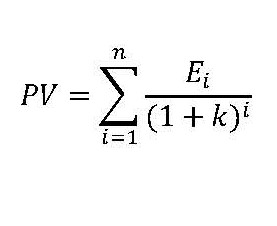
Where:
PV = present value
n = 12 periods. Accordingly, i ranges from 1 to 12 from 30 June 2014 to 30 June 2015. Mr Potter assumed there was no difference between the value at 10 June 2014 and 30 June 2014 as the period was not affected by the announcement of the VS.
Ei = expected income in the ith period. In this case, Mr Potter took item 3 and divided by 12 as he assumed the cash flows arose evenly over the year for the trading business.
k = discount rate. Mr Potter used his weighted average cost of capital calculation on a post tax basis. Accordingly, the discount rate used was 12.6%.
445 As a result, the value of item 3 is reduced by $30,057 due to the present value calculation.
446 Mr Potter calculated item 5 by multiplying item 3 by the EBITDA multiple of 4.5. Mr Potter acknowledged, in his report dated 18 June 2015 (Mr Potter’s second report), that he was instructed by DPL to assume the EBITDA multiple of 4.5 times. Mr Potter, in his report dated 19 June 2014 (Mr Potter’s first report), stated that the expected range for the EBITDA multiple of a Pizza Hut Franchise would be between 4 and 4.5. That is, a small business would typically have a value of between 1 to 5 times EBITDA and ‘a franchise business generally [has a] value at the higher end of the range because of the value of the brand and the relationship with the franchisor’. Following Mr Potter’s second report and receiving Mr Gower’s reports, Mr Potter undertook a further analysis of higher volume New South Wales outlet sales. In this analysis, Mr Potter calculated a weighted average EBITDA multiple of 3.93 and a standard deviation of 1.19. He concluded that DPL’s instructions that the EBITDA multiple be 4.5 was appropriate in the circumstances as it was well within the standard deviation range. Nonetheless, he acknowledged an EBITDA multiple is not usually a precise figure and noted that using a range is usually more appropriate, which he did.
447 Item 6 can be calculated either by multiplying item 4 by the EBITDA multiple of 4.5 or by using the formula in [444] and calculating the present value of item 5 at 10 June 2014. Item 7 is calculated by adding items 4 and 6 together. Mr Potter has made an allowance for interest in item 8. Item 9 is the addition of items 7 and 8.
448 Mr Gower contended that Mr Potter relied on his own model to demonstrate the unfavourable impact the VS was expected to have on store profitability. However, Mr Gower says, inconsistently, Mr Potter disregarded his model to quantify DPL’s loss and relies on DPL’s historical financial performance to determine hypothetical cash flows. Mr Potter’s model calculated the total EBITDA generated by DPL (excluding Minto) after the implementation of VS as $19,583 per week. Mr Gower argued that this figure is approximately the same as DPL’s (excluding Minto) 2014 EBITDA of $19,644 per week. Accordingly, Mr Gower concluded that no trading loss has been suffered by DPL and Mr Potter is unable to explain his departure from his own model in his assessment of DPL’s loss.
449 Mr Gower also criticised Mr Potter for relying on actual EBITDA for the period ended 30 June 2015. Mr Gower stated that the ‘adoption of actual EBITDA assumes that not only is the decline in sales directly attributable to the VS but all changes in expenses are also directly attributable to the VS’. That is, Mr Gower said, Mr Potter undertook no analysis or enquiry on the financial statements to establish that the changes in expenses are entirely attributable to the implementation of the VS. Mr Gower reviewed DPL’s financial statements and observed the following between the period ended 30 June 2014 and the 9 month period to 31 March 2015:
DPL’s sales during the 6 month period to 31 December 2014 remained consistent with 2014 and declined during the quarter ended 31 March 2015.
Cost of sales increased, primarily as a consequence of an increase in the price of pizza toppings (4% of sales) and a minor decrease in pizza cheese costs (1% of sales).
Employment costs increased.
Expenses declined, as Pizza Hut implemented the call-to-store system (requiring staff at each store to answer customer calls directly), no local store marketing costs were incurred, advertising costs declined, no training and development costs were incurred and an increase in costs such as repairs and maintenance, rent and outgoings, land rates and taxes, store petty cash, electricity and gas.
450 Mr Gower concluded that during the period 1 July 2014 to 30 June 2015, costs had both increased and decreased compared to the period ended 30 June 2014. With respect to the costs that have increased, Mr Gower stated that it is necessary to understand the basis for the increase before assuming that it is all attributable to the VS. Further, the reduction in advertising costs and no local store marketing costs are factors that could also affect sales that were not addressed by Mr Potter.
451 Mr Gower considered Mr Potter’s quantification of capital loss for DPL to be flawed for the following reasons:
Mr Potter assumed the VS caused the increase in costs for DPL and assumed a decline in EBITDA is entirely attributable to the VS (as stated above in [440]).
Mr Potter undertook his analysis on a group basis, implicitly assuming that the value of each store, prior to the VS, is the same. It follows that Mr Potter had no regard to the remaining terms of the IFAs of each stores and the remaining terms of the leases and Mr Gower contended that the stores with a longer IFA and lease are likely to have a different value to those with shorter terms remaining. Further, Mr Gower argued that Mr Potter had no regard to the various upgrade requirements of each store that may affect value and that Mr Potter did not assess widely different historical EBITDA figures for different stores, that could significantly alter their value.
452 Mr Gower concluded that ‘Mr Potter’s adoption of an EBITDA multiple of 4.5 times the assumed reduction in EBITDA without regard to the specific circumstances of each store is likely to misstate the capital loss which he asserts has been lost by DPL as a consequence of the VS’. That is, there are circumstances which are not directly related to the VS that affected DPL’s EBITDA and those circumstances were not taken into account by Mr Potter. In the hot tub, Mr Potter stated that he was instructed to use an EBITDA multiple of 4.5, that he was comparing the position to June 2014 and that the period of leases and franchise agreements had been reducing over that period. Accordingly, Mr Potter could not see a more appropriate approach that could effectively take in all of those factors over the loss period and concluded that with the complexity of factors, the approach that he took was most appropriate.
453 DPL claims loss in its individual claim arising from the introduction of the VS. DPL’s claim for loss is stated in [26] of the ASC, as follows:
By reason of the matters pleaded in any or all of paragraphs 1 to 25 above the Applicant has suffered loss and damage by reason of the breaches of duty and contravening conduct of the respondent.
Particulars
(i) The Applicant proposed, prior to 1 July 2014, to sell its Outlets at the then prevailing level of EBITDA of each of those Outlets and using a multiple of 4-4.5 times;
(ii) Loss of profit since 1 July 2014 from not being able to sell the Approved Products at the prices prevailing as at 30 June 2014, or such other prices in excess of the Reduced Prices as would have prevailed if Yum had not implemented the Reduced Prices and/or the Reduced Price Strategy;
(iii) Loss of profit since 1 July 2014 on sales foregone as a consequence of the Other Prices Stipulated by Yum, in particular in relation to delivery sales;
(iv) Loss of value of each of the Outlets as at the date of judgment represented by the difference in the actual realisable value of each of the Outlets at the date of judgment and the sale value that would have been achieved at or prior to that date on the basis of that Outlet’s likely EBITDA multiplied by 4-4.5 times, such EBITDA calculations having regard to the prices prevailing prior to 1 July 2014, or such other prices in excess of the Reduced Prices as would have prevailed if Yum had not implemented the Reduced Prices and/or the Reduced Price Strategy.
454 DPL submits that the loss may be correctly characterised as the ‘loss of the ability to continue to earn profits from its outlets after 1 July 2014 that [DPL] had been earning prior to 1 July 2014’. Those profits, DPL says, give rise to two heads of damages:
Income loss: Difference between DPL’s actual profitability (measured on an EBITDA basis) under the VS and what it would have earned if the VS had not been introduced.
Capital loss: Loss of capital value of the outlet as a consequence of the VS, which can be determined by hypothesising a sale of the outlet and comparing the differences in values.
455 DPL submits that the following principles apply for the assessment of damages:
The guiding principle in relation to the assessment of damages for a lost opportunity is that the Court will do the best it can with the evidence available to it (Malec v JC Hutton Pty Ltd (1990) 169 CLR 638).
Any difficulties in proof in relation to the damages assessment are generally resolved in favour of the applicant (McCartney v Orica Investments Pty Ltd [2011] NSWCA 337).
There is no relevant difference, in this case, between the calculations of damages under any of the three causes of action.
The date for assessment of damages will be the date of the breach, the date on which Yum announced the VS to the Franchises, which was on 10 June 2014. It follows that interest would be added from 10 June 2014 to the date of judgment.
The damages calculations by Mr Potter are provisional, in the sense that he used DPL’s actual accounts up to 31 March 2015. Accordingly, DPL submits that if the Court accepts DPL’s submissions that it is entitled to be awarded damages, the Court can determine a provisional damages amount as at 31 March 2015 and make an order pursuant to r 30.41 of the Federal Court Rules 2011 (Cth) that the final damages award be determined by a Registrar, or otherwise give directions in accordance with s 33Z of the FCA Act to take account of then updated financial information from DPL’s outlets and actual sales data.
456 The Court’s powers in a representative proceeding are found in s 33Z of the FCA Act, as follows:
(1) The Court may, in determining a matter in a representative proceeding, do any one or more of the following:
(a) determine an issue of law;
(b) determine an issue of fact;
(c) make a declaration of liability;
(d) grant any equitable relief;
(e) make an award of damages for group members, sub-group members or individual group members, being damages consisting of specified amounts or amounts worked out in such manner as the Court specifies;
(f) award damages in an aggregate amount without specifying amounts awarded in respect of individual group members;
(g) make such other order as the Court thinks just.
457 DPL submits that, pursuant to s 33Z(e) of the FCA Act, the Court can have regard to the approach taken to assess DPL’s damages and give directions in relation to the manner in which the amounts other group members can be calculated. DPL concedes that a complication may arise for some group members in relation to the calculation of capital loss where an outlet has closed. That is, if the closure of the outlet was caused by the VS, then the capital loss will represent the entirety of the capital value of the outlet as at 10 June 2014.
458 Mr Potter provided a damages calculation of DPL’s loss and Mr Gower has offered no alternative calculation. DPL submits that Yum cannot resist an award of damages based on Mr Potter’s evidence by asserting, for example, that this evidence is insufficient in some respect.
459 DPL contends that Mr Potter’s determination of DPL’s hypothetical EBITDA by taking an average of the two prior years EBITDA and assuming 0% growth is conservative. The factors contributing to this determination are:
DPL’s sales were growing in the first half of 2014;
DPL maintained its 2-to-1 advantage over Domino’s in the Greater Macarthur Region;
DPL’s sales growth, as at 10 June 2014, showed a positive “run rate” of 3.5%;
DPL’s stores had been recently upgraded; and
There was no reason to expect that, absent the VS, DPL would have experience reduced earnings after 1 July 2014.
460 DPL notes Mr Gower’s criticism that there were changes in a number of cost items in DPL’s accounts for the period after 1 July 2014. DPL submits that Mr Diab was not cross-examined on any of these items and these criticisms should be disregarded. In any event, DPL contends that the changes were all brought about by the VS and that Mr Potter discounted the profitability back to 10 June 2014 using DPL’s after-tax discount rate of 12.6%, which has the consequence of making allowances for normal business risks that DPL would have faced post 1 July 2014. Mr Gower said that he did not accept that all of the risks to which he had pointed were taken into account in the discounting process. DPL contends that Mr Gower did not seek to identify which, if any risks were not taken into account beyond this generalised statement. Accordingly, DPL submits, the Court is entitled to accept Mr Potter’s evidence that the risks and contingencies have been fully taken into account in the discounting process.
461 The explanation of Mr Potter’s calculation for income loss is in section 9 of Mr Potter’s second report. Mr Potter concluded that DPL’s income loss as at 10 June 2014 is $438,164.
462 Mr Diab gave evidence that the usual way in which outlet sales prices are determined is by using the outlet’s EBITDA and applying an EBITDA multiple. DPL says that Yum contests this evidence as their approach is that the EBITDA multiple method is one factor that is taken into account in determining a selling price and other qualitative factors are also relevant, including outlet location, competitor activity, age and condition of the outlet and the remaining length of the IFA. DPL contends that that the EBITDA multiple can be adjusted to take into account these factors.
463 DPL submits that, as Mr Potter’s analysis of higher volume NSW outlet sales (in [446] above) established a weighted average EBITDA multiple of 3.93 and a standard deviation of 1.19, it was reasonable for Mr Diab to conclude that the appropriate multiple was 4.5 for DPL outlets (which is within 1 standard deviation of the mean). DPL concedes that a reason for not applying a 4.5 multiple arises in the event that one of the outlets would not be sold on a going concern basis, which could be an issue for DPL’s stores at Minto and Narellan.
464 Accordingly, DPL submits that on the basis of the 4.5 multiple being applied to all DPL outlets, DPL’s capital loss, as calculated by Mr Potter, is $2,106,949.
465 Yum notes that DPL’s claim for losses necessarily assumes that the entire difference between actual trading results and the results that DPL claims would have resulted had the VS not been introduced was caused by the VS. This was evident as Mr Potter was expressly instructed to make that assumption in preparing the loss calculation.
466 Yum submits that DPL’s loss calculation fails to take into account the following:
The possibility that Domino’s would have introduced a $4.95 every day strategy. Domino’s had already been selling $4.95 pizzas two days a week for a year, and had trialled a four day-per-week $4.95 offer in August 2013. Domino’s has continued to offer $4.95 every day even after Pizza Hut increased its prices.
The fact that Yum increased its prices again at various times after 1 July 2014, see [45] above.
467 It follows, Yum submits, that any damages should be limited to the loss incurred in the period when the VS was operative. Yum contends that DPL’s claim makes no allowance for this and Mr Potter’s calculations do not take this into account.
468 Yum submits that there can be no capital loss for the DPL’s Minto restaurant, as the IFA expires on 30 October 2015 (which has been extended pursuant to an order made on 21 October 2015 to 29 February 2016) and that an outlet has no capital once the IFA expires, unless there is an agreement to renew it. Yum states that the position is similar for DPL’s Narellan store which expires in April 2016. Yum contends that as the other stores have not been sold, no capital loss has crystallised and the capital value of the stores may increase in the future. That is, a future loss is not recoverable as it is hypothetical and not proven.
469 Yum disagrees with DPL’s reliance on 4.5 as the EBITDA multiple. Yum submits that there is no proper basis for this assessment and that the evidence clearly shows there are widely differing EBITDA multiples for the sale of Pizza Hut stores. Yum submits that the actual EBITDA multiple depends on numerous variables, including the remaining term of the IFA has rental costs. That is, a 4.5 EBITDA multiple or even a range of 4 to 4.5 does not provide an acceptable basis to calculate any capital loss.
470 Mr Gower criticised Mr Potter for not relying on his own model to quantify DPL’s loss and relying on DPL’s historical financial performance to determine hypothetical cash flows. Mr Potter’s analysis was not an attempt to create his own model. Rather, he was assessing the Yum Model for its flaws to calculate whether the labour hours allowance by Yum was a realistic figure that could be relied upon in achieving a 34.5% transaction uplift for the national average store. The aim of Mr Potter’s analysis was not to model projected EBITDA but rather to assess the extra labour hours and break even point. It follows that Mr Gower’s criticism of Mr Potter’s analysis is unfounded, as Mr Potter should not be required to rely on his model in this way. Nonetheless, it is unclear why Mr Potter used the average EBITDA method of DPL’s historical financial performance. This was not clear on the evidence and there is no basis for assuming that this is the best approach in assessing the future hypothetical EBITDA of DPL’s outlets.
471 Mr Gower opposed Mr Potter’s reliance on actual EBITDA for the period ended 30 June 2015 as Mr Potter undertook no analysis or enquiry on the financial statements to establish that the changes in expenses were entirely attributable to the implementation of the VS. DPL submits that Mr Diab was not cross-examined on any of these items and, as a result, these criticisms should be disregarded.
472 It is difficult to assess whether the expenses incurred for the period were all attributable to the VS. This is an assumption that was made by Mr Potter and no alternative calculation was posited to take into account the expenses. As Yum did not provide an alternative calculation, it is difficult to assess how Mr Potter should have taken into account the changes in expenses. If a different analysis were provided, it is likely that the Mr Potter’s calculation of income loss would have been altered.
473 Nonetheless, I accept that there is clear evidence that the $4.95 price was increased at various times after 1 July 2014. The delivered price for Classics only remained at $4.95 until 14 August 2015 and since that time the price has been above $8.95. The pick up price remained at $4.95 until 5 May 2015, which is after the 9 month period assessed by Mr Potter. Accordingly, further assessment would be required to analyse the effects of these changes. The assumption that the VS was operative throughout the entire period until 31 March 2015 is not completely accurate and DPL’s claims make no allowance for these changes in price. It follows that the damages calculation would need to be altered and to take into account the period when the VS was operative and not operative.
474 I accept Mr Gower’s criticism of Mr Potter’s calculation as Mr Potter had no regard to the remaining terms of the IFAs and leases. The value of an IFA varies depending on the remaining term. If the IFA has concluded there is no capital value unless there is an agreement to renew it. Further, the capital loss determined by DPL is hypothetical, as the stores have not been sold. It is not until the store is sold that the value crystallises and the capital loss or gain can be realised. It is even more difficult to assess a capital loss or capital gain where a store requires Yum’s consent to be sold or a lease renewal transferred. As the stores have not been sold, the quantum of damages necessary to put DPL into the position before the breach had occurred, cannot be quantified.
475 However, some Franchisees may have lost their stores as they have been foreclosed, which reduces the capital value to zero. In those circumstances, the capital value loss is clearly the entire value of the franchise prior to a breach. This calculation is easier than for DPL, as the DPL stores have not been sold and the loss has not crystallised, so capital value may remain.
476 Further, Yum submits that the EBITDA multiple method is one factor that is taken into account in determining a selling price but that other factors must also be taken into account. While DPL contends that the EBITDA multiple can be adjusted to take into account these other factors, no sufficient explanation was provided as to how these factors can be taken into account. If they were to be included, the EBITDA multiple of 4.5 may not be appropriate. Mr Potter suggested that a range for the EBITDA multiple is most appropriate as it takes into account the different circumstances of each DPL outlet. Accordingly, an appropriate method may be to consider the range of EBITDA multiples suggested (which is 4 to 4.5) to find a suitable figure for each store.
477 Nonetheless, on the evidence before the Court, it is difficult to find that Mr Potter’s analysis provides a conclusive result for capital loss. Many factors have not been fully assessed and the value of any capital loss would need to be reviewed if a breach of Yum’s obligations were established.
11.5 Conclusion on loss and damage
478 The evidence is insufficient to determine the appropriate quantum of damages if DPL had been successful. As Yum points out, the claimed loss as set out in Mr Potter’s evidence is incomplete, based on assumptions that have been challenged, including the assumption that all losses were caused by implementation of the VS without accounting for Domino’s response and Yum’s subsequent price increases. Claims for capital losses are based on a multiple of EBITDA that has not been properly validated for the sale of all of DPL’s Pizza Hut stores. In particular, there has been no allowance for different lengths of contract and whether Yum would agree to a transfer.
479 Consideration might be given, if DPL were successful, to allowing DPL to apply to reopen but that does not need presently to be considered.
480 There remains the question of loss and damage quantification for other Franchisees. DPL submits that all have lost income and capital. DPL accepts that there would be variation between the Franchisees. If such matters were to require resolution further evidence and submissions would be necessary and/or directions for alternative methods of determination.
481 This issue does not directly relate to loss and damage but to the EBITDA multiple and thereby is relevant to Mr. Potter’s model.
11.6.1 Required return on capital
482 Mr Potter extended the results of the Yum Model to incorporate capital expenditure and return on capital to demonstrate how Franchisees would be impacted should the VS not achieve at least a break-even level of EBITDA. In Mr Potter’s first report, the EBITDA multiple range was not dependent on a capital expenditure assumption and he assessed a rate of return of 22.40% and EBITDA multiple in the range of 4.0 to 4.25. In Mr Potter’s second report, Mr Potter was instructed to use an instructed EBITDA multiple of 4.5 and an instructed level of capital expenditure (which was based on the instructed cost of franchise upgrades based on a Yum disclosure document). Accordingly, Mr Potter’s rate of return specific to DPL stores was different from that in his first report.
483 Following Mr Potter’s second report, Yum provided Mr Potter with Mr Houston’s affidavit of 17 July 2015. This affidavit included information to the effect that:
A more current version of the disclosure document was available which set out a different range of franchise upgrade costs to those which Mr Potter was instructed to assume;
A “Full Upgrade” would only be required in extremely rare circumstances;
The Franchisees were required to perform a minor front of house upgrade five years after entering a franchise agreement and every ten years after that, if applicable, for a cost in the range of $9,000 to $35,000; and
The Franchisees were required to perform a major front of house upgrade every ten years after entering a franchise agreement, for a cost in the range of $25,000 to $100,000.
484 After receiving Mr Houston’s affidavit, Mr Potter calculated an updated capital expenditure based on this information over a ten year period and calculated an average capital expenditure on a per year basis for minor and major front of house upgrades. As a result, Mr Potter calculated a different range of required rates of return (ranging from 22.4% to 19.4%) implied by the same EBITDA multiple of 4.5 and for a range from 4.0 to 4.5. Mr Potter concluded, having assumed that the national average store was generating the required return prior to the implementation of the VS, that an EBITDA multiple closer to 4.0 or high threes (as compared to 4.25 or 4.5) for the national average store may be more appropriate. He conceded that it was more appropriate as it was consistent with his weighted average EBITDA multiple of 3.94 based on historical Pizza Hut data and the weighted average EBITDA multiple of 4.13 from Mr Gower’s report dated 20 July 2015.
485 While the analyses seem to be valid, there is insufficient material before me to establish that the return on capital is a valid cost within the framework of the IFA. In view of my decision on liability, it does not need to be determined.
I certify that the preceding four hundred and eighty-five (485) numbered paragraphs are a true copy of the Reasons for Judgment herein of the Honourable Justice Bennett. |
Associate:
ANNEXURE A
Definition | Description of definition |
$425 improvement | $425 per store per week improvement by ACT franchisee presented to the Franchisees by Yum |
A & A proceedings | Interlocutory application by A & A (Sydney) Pty Ltd and 80 applicant Franchisees, including DPL, seeking to restrain Yum from implementing the VS |
Adco | Pizza Hut Adco Limited. A body responsible for marketing and promotional activities in conjunction with Yum promoting the Pizza Hut business, brands and products in Australia. |
AICD | Australian Institute of Company Directors |
AOP | Annual Operating Plan. A meeting in October of each year |
application | Amended Originating Application dated 2 April 2015 |
ASC | Amended Statement of Claim dated 2 April 2015 |
DPL | Diab Pty Limited |
FAC | Franchisee Advisory Council |
FCA Act | Federal Court of Australia Act 1976 (Cth) |
FPC | Franchisee Policy Committee |
Franchisees | All persons who were franchisees under an IFA with Yum to operate Pizza Hut outlets as at 1 July 2014 |
Franchisee Update | Franchisee Update May 2014 |
CFO | Chief Financial Officer |
Help! email | Email from Mr Houston to Mr Bergren of Yum US on 3 June 2014 |
ICMSA | Institute of Corporate Managers, Secretaries and Administrators |
IFA | Standard form International Franchise Agreement |
LSM | Local store marketing |
Micros | Micros Point of Sale System. Provides data that lives inside the operating system inside all Pizza Hut outlets |
Mr Potter’s first report | Mr Potter’s report dated 19 June 2014 |
Mr Potter’s second report | Mr Potter’s report dated 18 June 2015 |
MPD | Minutes per docket |
PSA | Per store average |
Q0F, Q1F, Q2F, Q3F | Quarterly Forecasts and summary memorandum of the Australian management to the USA. The Q0F was the outcome of the AOP process and set the annual plan for the year. Q2F was an update in June. |
RBNZ | Restaurant Brands New Zealand Limited. The New Zealand Pizza Hut master franchisee. |
SOPAC | South Pacific |
SSSG | Same store sales growth |
Stubbs email | Email sent by Mr William Stubbs on 23 June 2014 to Yum’s leadership team regarding the intervention by Domino’s. |
System | Comprehensive restaurant system as defined in the IFA |
Velocity pricing | VS’s two price points: $4.95 for “Classics” pizzas (from $9.95) and $8.50 for “Favourites” pizzas (from $11.95) |
VS | Value Strategy |
WA Test | Western Australia Test |
Yum | Yum! Restaurants Australia Pty Limited |
Yum Model | The model used to analyse the viability of the VS and to assess the number of extra labour hours required to ensure a 34.5% uplift in transactions for the National Average Store. |
Yum US | Yum! Brands Inc. The US parent company of Yum |