

FEDERAL COURT OF AUSTRALIA
CKI Utilities Development Pty Ltd v Australian Energy Regulator
[2016] FCA 17
ORDERS
First Applicant PAI UTILITIES DEVELOPMENT LTD (and others named in the Schedule) Second Applicant | |
AND: | Respondent |
DATE OF ORDER: | |
WHERE MADE: |
THE COURT ORDERS THAT:
1. The application is dismissed.
2. Applicants pay to the respondent costs of the application.
3. The time within which any appeal from these orders may be brought is extended to run from the date upon which the written reasons for judgment are published.
Note: Entry of orders is dealt with in Rule 39.32 of the Federal Court Rules 2011.
INTRODUCTION
1 This application principally challenged the validity of a decision of the Australian Energy Regulator (AER) on 19 June 2015 that it was not satisfied that the Pricing Proposal of the applicants – collectively SA Power Networks (SAPN) should be approved.
2 The AER did not grant its approval to the Pricing Proposal, in particular, in relation to two newly introduced sub-categories which the Pricing Proposal included within the tariff class (as presented by SAPN) Low Voltage Residential, namely the “solar tariff” and the “social tariff” (the Primary Decision).
3 The AER’s consequent decision of 19 June 2015, confirmed on 24 June 2015, to require SAPN to resubmit its Pricing Proposal without the solar tariff and the social tariff led to SAPN submitting a Revised Pricing Proposal (under protest). On 29 June 2015, the AER approved the Revised Pricing Proposal, and it was published on 30 June 2015. Those additional decisions of the AER were also challenged.
4 It is accepted that the decisions of the AER are reviewable and that if the Primary Decision is set aside, the subsequent decisions should also be set aside.
5 It is appropriate to note that SAPN, by the introduction of the solar tariff and the social tariff in the Pricing Proposal, was not seeking to increase its revenue flow from residential customers during the regulatory period. It says it was securing the appropriate revenue flow through its breakup of those customers into the tariff groups (a generic word) referred to in its proposal. In the case of the solar tariff group, it presented its economic justification for doing so. In the case of the social tariff group, it accepted that the justification was based more on “affordability”, although there was an economic justification for it.
6 Finally, it may be noted that the structure of the National Electricity Law (the Law) and the National Electricity Rules (the Rules) is that, subject to the regulatory role of the AER, the pricing for the supply of electricity to customers is very largely the role of the relevant Distribution Network Service Provider (DNSP). As the present application shows, the retailer to domestic consumers has little price discretion (as compared to discretion in service terms) in dealing with consumers. That is obviously the legislative policy. Moreover, on the basis of SAPN’s submissions, apart from applying economic efficiency measures and economic incentives to consumer groupings, it appears to be the case that to a significant degree the relevant DNSP has the capacity to decide on the implementation, and the means of implementation, of social policy in respect of disadvantaged consumers in the geographical area it serves, perhaps in terms quite different from that in which disadvantaged consumers in areas served by other providers have structured their tariffs.
7 The solar tariff related to low voltage residential customers with micro-generation facilities (PV customers), that is with domestic solar panels. The AER required that, when assigning or re-assigning customers to tariff classes, it should ensure that PV customers are not treated less favourably than customers without micro-generation facilities (non-PV customers) with similar load profiles. It considered the Pricing Proposal with the solar tariff would have resulted in PV customers paying a higher price per kWh for electricity than non-PV customers. The AER was not satisfied that the load profiles of PV customers and non-PV customers are dissimilar. Consequently, it refused to approve the Pricing Proposal in respect of the solar tariff, as its introduction would treat PV customers less favourably than non-PV customers.
8 The social tariff was proposed for some “hardship customers”. It excluded certain charges included in other tariffs payable by other household customers. The regulatory regime requires SAPN to assign customers to tariff classes on the basis of connection type and usage, and to ensure that retail customers with similar connection and usage profiles are treated equally. The AER was not satisfied that the allocation of customers to the social tariff group was based on differences in connection type or usage, so it also did not consider that the Pricing Proposal in respect of the social tariff should be approved.
9 The Court did not consider that the Primary Decision nor the additional decisions of the AER should be set aside. It announced that conclusion on 23 December 2015, and made orders dismissing the application with costs at that time. These are the reasons for that decision. At that time, the Court also extended the time from which any appeal period should run to commence on the date of publication of these reasons.
BACKGROUND
10 By the further amended application dated 15 November 2015, SAPN sought orders under the Administrative Decisions (Judicial Review) Act 1977 (Cth) (the ADJR Act) setting aside the two decisions of the AER made on 19 June 2015 under cl 6.18.8(a) and (b)(1) of the Rules firstly rejecting the solar tariff and social tariff included in the Pricing Proposal in relation to the Low Voltage Residential Class, and secondly requiring amendments to its proposal to remove the solar tariff and social tariff. Secondly, it sought to set aside the decision of the AER of 29 June 2015, which was supplementary to the Primary Decision and which approved the Revised Pricing Proposal submitted to the AER by SAPN, without prejudice and under protest, pursuant to the AER’s decisions on 19 June 2015.
11 As it is accepted that each of the decisions of the AER is reviewable under the ADJR Act, it is not necessary to trace the legislative structure under which that comes to be the case. It is also common ground that Version 65 of the Rules is the applicable version.
12 The AER’s decisions in respect of both the solar tariff and the social tariff were made by reference to cl 6.18.4 of the Rules. It was SAPN’s contention that the decisions are affected by a misconception about the role of cl 6.18.4 (ground 1). SAPN said that cl 16.18.4 creates constraints on the movement of customers between tariff classes, but not to the application of tariffs to different customers within a tariff class. It also said that its proposal on tariffs to the AER did not involve the transfer of customers between tariff classes, so cl 6.18.4 was not engaged at all. The applicable clause, it said, was cl 16.8.5.
13 The second broad attack by SAPN asserted that the AER’s decisions in respect of the solar tariff were affected by the impermissible imposition of an onus to disprove the applicability of an aspect of cl 6.18.4 (ground 2), and were unreasonable, because the AER relied upon a purported statistical analysis that was not performed in accordance with proper statistical methods and principles. SAPN said that this was an approach that no reasonable decision-maker would have adopted (ground 3).
14 The third line of attack by SAPN asserted that the AER’s decisions in respect of the social tariff were affected by an erroneous interpretation and/or application of cl 6.18.4 that ignored an important element of cl 16.18.5 (ground 4).
15 The primary relief sought by SAPN was to have the AER’s decisions set aside on some convenient date in the future, following the publication of reasons. Following the publication of the Court’s reasons, SAPN was to seek an opportunity to be heard on when that date should be. The adoption of that suggested course was to allow the parties to have a substituted set of tariffs in place at the time the current tariffs cease to apply, and so would minimise disruption to SAPN, retailers, customers and the wider South Australian community. In the further alternative, SAPN sought a declaratory order under s 16(1)(c) of the ADJR Act as to the proper construction of cl 6.18.4 and cl 6.18.5 (for the purposes of future annual pricing proposals) and/or directions under s 16(1)(d) of the ADJR Act that the AER consider and determine SAPN’s future pricing proposals by reference to cl 6.18.5 rather than cl 6.18.4.
16 In view of the decision of the Court, those practical and sensible concerns do not arise.
SUBSTANTIVE ISSUES
17 SAPN identified the substantive issues for determination, ultimately, as being:
(1) on the proper construction of Chapter 6 Part I of the Rules, whether cl 6.18.4(a) was engaged by the inclusion in the Pricing Proposal of the solar tariff and the social tariff, or was the inclusion of those tariffs to be assessed by reference to cl 6.18.5 rather than cl 6.18.4(a). That was said to involve two sub-issues:
(i) whether cl 6.18.4(a) imposed implied limitations of a manner in which different tariffs can be applied for the same or similar electricity network services to different customer groups; and
(ii) the interpretation of “tariff” and “tariff class”, and whether a tariff class can include different tariffs for use of the network for different groups of customers within the same tariff class;
(2) if cl 6.18.4(a) was engaged, what is the proper construction of cl 6.18.4(a)(3), and in particular whether SAPN’s contention that it required an empirical comparison of the load volumes of the respective customer groups who were to be the subject of the relevant different tariffs as proposed by SAPN was correct;
(3) if cl 6.18.4(a) was engaged, then on the proper construction of cl 6.18.4(a)(3), did the AER err:
(i) in rejecting the solar tariff by imposing impermissibly an onus on SAPN to prove dissimilarity of the respective customer groups’ load profiles;
(ii) in rejecting the solar tariff by deciding that the load profiles of PV customers and non-PV customers are not sufficiently dissimilar, or could be considered similar, when it was unreasonable to so conclude;
(iii) in rejecting the social tariff, in not complying with cl 6.18.4(a)(1)(i) and (ii) because it erroneously did not adopt an harmonious construction of those provisions on the one hand and cl 6.18.5(b)(1) and (2)(ii) on the other.
LEGISLATIVE FRAMEWORK
18 On 30 April 2015, pursuant to cl 6.11.1 of the Rules, the AER issued a Preliminary Distribution Determination (the AER Distribution Determination), which addressed the prices which could be charged by SAPN to retailers for use of SAPN’s distribution network from 1 July 2015 to 30 June 2020. The AER Distribution Determination relevantly included, among other things, Attachment 14 Control Mechanisms, which imposed limits on the price which could be charged for certain electricity distribution services provided through the distribution network.
19 Attachment 14 contains Appendix D, which addresses the assignment of retail customers to tariff classes. That Appendix, part D.3, provided that existing retail customers of SAPN, who continue to be customers of SAPN from 1 July 2015, will be taken to be assigned to the tariff class they held prior to 1 July 2015.
20 On 21 May 2015, SAPN submitted its Pricing Proposal for the 2015-2016 regulatory year to the AER pursuant to cl 6.18.2 of the Rules.
21 The provisions under which SAPN submitted its Pricing Proposal for the regulatory year 2015-2016, and under which the AER addressed that proposal, are in Part I of Chapter 6 of the Rules entitled “Distribution Pricing Rules”. That part applies to “tariffs and tariff classes related to direct control services”.
22 “Direct control services” are distribution services that are direct control network services within s 2B of the Law. Direct control network services are, relevantly, “electricity network services” that are specified by the AER in a distribution determination as services the prices for which, or the revenue to be earned from which, are regulated under the distribution determination. Under s 2(1), electricity network service means a service provided by means of, or in connection with, a transmission system or distribution system.
23 “Tariff” is not defined, but “tariff class” is defined (in Chapter 10 of the Rules), as:
A class of retail customers for one or more direct control services who are subject to a particular tariff or particular tariffs.
24 SAPN’s Pricing Proposal proposed four new tariffs in the pre-existing tariff class “Low Voltage Residential”. It will be necessary to refer to the proposal in more detail later in these reasons.
25 The Low Voltage Residential tariff class has at all material times comprised residential customers taking supply at less than 1 kV. The services provided by SAPN to those customers are “standard control services” (within the meaning of the Rules). That is, they are “electricity network services” (within the meaning of the Law) and are “distribution services” (within the meaning of the Rules) that are subject to a control mechanism based on the AER’s determination as to SAPN’s allowed revenue for the regulatory year.
26 Clause 6.18.2(a) relevantly required SAPN to submit a pricing proposal, having the attributes specified in cl 6.18.2(b), which relevantly provided:
(b) A pricing proposal must:
(1) set out the tariff classes that are to apply for the relevant regulatory year; and
(2) set out the proposed tariffs for each tariff class; and
(3) set out, for each proposed tariff, the charging parameters and the elements of service to which each charging parameter relates; and
(4) set out, for each tariff class related to standard controls services, the expected weighted average revenue for the relevant regulatory year and also for the current regulatory year; and
…
(6A) set out how jurisdictional scheme amounts for each approved jurisdictional scheme are to be passed on to customers and any adjustments to tariffs resulting from over to under recovery of those amounts; and
…
(1) demonstrate compliance with the Rules and any applicable distribution determination; and
(5) describe the nature and extent of change from the previous regulatory year and demonstrate that the changes comply with the Rules and any applicable distribution determination.
…
27 “Charging parameters” are defined (in Chapter 10 of the Rules) as the “constituent elements of a tariff”.
28 Clause 6.18.3 is entitled “Tariff classes”. Clause 6.18.3(a) and (b) provide that:
(a) A pricing proposal must define the tariff classes into which retail customers for direct control services are divided.
(b) Each customer for direct control services must be a member of 1 or more tariff classes.
29 SAPN said it is accorded significant discretion in defining tariff classes. The only express limitations appear in cl 6.18.3(c) and (d), which provide:
(c) Separate tariff classes must be constituted for retail customers to whom standard control services are supplied and retail customers to whom alternative control services are supplied (but a customer for both standard control services and alternative control services may be a member of 2 or more tariff classes).
(d) A tariff class must be constituted with regard to:
(1) the need to group retail customers together on an economically efficient basis; and
(2) the need to avoid unnecessary transaction costs.
30 As noted, cl 6.18.4 is central to the controversy in the proceeding. It is entitled “Principles governing assignment or re-assignment of retail customers to tariff classes and assessment and review of basis of charging”. Clause 6.18.4 provides:
(a) In formulating provisions of a distribution determination governing the assignment of retail customers to tariff classes or the re-assignment of retail customers from one tariff class to another, the AER must have regard to the following principles.
(1) retail customers should be assigned to tariff classes on the basis of one or more of the following factors:
(i) the nature and extent of their usage;
(ii) the nature of their connection to the network;
(iii) whether remotely-read interval metering or other similar metering technology has been installed at the retail customers’ premises as a result of a regulatory obligation or requirement;
(2) retail customers with a similar connection and usage profile should be treated on an equal basis;
(3) however, retail customers with micro-generation facilities should be treated no less favourably than retail customers without such facilities but with a similar load profile;
(4) a Distribution Network Service Providers’ decision to assign a customer to a particular tariff class, or to re-assign a customer from one tariff class to another should be subject to an effective system of assessment and review.
(b) if the charging parameters for a particular tariff result in a basis of charge that varies according to the usage or load profile of the customer, a distribution determination must contain provisions for an effective system of assessment and review of the basis on which a customer is charged.
31 The thorough and helpful submissions of SAPN pointed out two matters which may be relevant to the construction of cl 6.18.4. Section 3 of the Law relevantly provides that Sch 2 applies to the interpretation of the Rules. Clause 4(3) of Sch 2 indicates that a heading to a “section or subsection of this Law” does not form part of the Law. By parity of reasoning, that may mean that the headings to clauses of the Rules do not form part of the Rules. Secondly, there is a note to cl 6.18.4(a), which by reference to cl 4(4) of Sch 2 to the Law probably does not form part of the Rules, but which reads:
If (for example) a customer is assigned (or reassigned) to a tariff class on the basis of the customer’s actual or assumed maximum demand, the system of assessment and review should allow for the reassignment of a customer who demonstrates a reduction or increase in maximum demand to a tariff class that is more appropriate to the customer’s load profile.
32 Clause 6.18.5 is also central to the controversy in the proceeding. SAPN contended that it was cl 6.18.5, to the exclusion of cl 6.18.4, that governed the issues for determination concerning the inclusion of the solar tariff and the social tariff in SAPN’s proposal. Clause 6.18.5 is entitled “Pricing principles”. It provides:
(a) For each tariff class, the revenue expected to be recovered should lie on or between:
(1) an upper bound representing the stand alone cost of serving the retail customers who belong to that class; and
(2) a lower bound representing the avoidable cost of not serving those retail customers.
(b) A tariff, and if it consists of 2 or more charging parameters, each charging parameter for a tariff class:
(1) must take into account the long run marginal cost for the service or, in the case of a charging parameter, for the element of the service to which the charging parameter relates; and
(2) must be determined having regard to:
(i) transaction costs associated with the tariff or each charging parameter; and
(ii) whether retail customers or the relevant tariff class are able or likely to respond to price signals.
(c) If, however, as a result of the operation of paragraph (b), the Distribution Network Service Provider may not recover the expected revenue, the provider must adjust its tariffs so as to ensure recovery of expected revenue with minimum distortion to efficient patterns of consumption.
33 Clause 6.18.6 does not have particular significance for the resolution of the present issues. It applies only to tariff classes related to the provision of standard control services. The clause establishes side constraints, that is, a ceiling on the growth of average revenue to be raised from any given tariff class in any one regulatory year, referable to a “permissible percentage” defined in cl 6.18.6(c). The side constraint control mechanism involves the calculation of a weighted average revenue effect for the tariff class by reason of the expected application of the tariffs within the tariff class. This indicates that there may be multiple tariffs within a tariff class, and that they can apply in differential proportions. In this regard, cl 6.18.6 relevantly provides:
(b) The expected weighted average revenue to be raised from a tariff class for a particular regulatory year of a regulatory control period must not exceed the corresponding expected weighted average revenue for the preceding regulatory year in that regulatory control period by more than the permissible percentage.
34 Clause 6.18.7A requires a pricing proposal to provide for tariffs designed to pass on to retail customers the “jurisdictional scheme amounts for approved jurisdictional schemes” to be incurred by the DNSP. These relevantly include the amounts that must be paid by the DNSP to customers who have micro-generation facilities supplying electricity to the distribution network, pursuant to Div 3AB of the Electricity Act 1996 (SA) (see cl 6.18.7A(e)(1)(ii)). Again, it is not of particular significance to the resolution of the present issues.
35 Clause 6.18.8, entitled “Approval of pricing proposal”, is the clause under which the relevant decisions of the AER were made. It provides:
(a) The AER must approve a pricing proposal if the AER is satisfied that:
(1) the proposal complies with this Part, any relevant clauses in Chapter 11 and any applicable distribution determination; and
(2) all forecasts associated with the proposal are reasonable.
(b) If the AER determines that a pricing proposal is deficient:
(1) the AER may require the Distribution Network Service Provider, within 10 business days after receiving notice of the determination, to re-submit the proposal with the amendments necessary to correct the deficiencies identified in the determination and (unless the AER permits further amendment) no further amendment; or
(2) the AER may itself make the amendments necessary to correct the deficiencies.
(c) If the service provider fails to comply with a requirement under paragraph (b), or the resubmitted proposal fails to correct the deficiencies in the former proposal, the AER may itself amend the proposal to bring it into conformity with the requirements of this Part and any applicable distribution determination.
(d) an approved pricing proposal takes effect:
(1) in the case of an initial pricing proposal – at the commencement of the first regulatory year of the regulatory control period for which the distribution determination is made; and
(2) in the case of an annual pricing proposal – at the commencement of the regulatory year to which the proposal relates.
36 Clause 6.18.9 requires a Distribution Network Service Provider to publish information on its website including:
(a) A Distribution Network Service Provider must maintain on its website:
(1) a statement of the provider’s tariff classes and the tariffs applicable to each class; and
(2) for each tariff – the charging parameters and the elements of the service to which each charging parameter relates.
THE HEARING
37 Total Environment Centre Inc. (TEC) applied for, and was granted without opposition, leave to appear in the proceedings as amicus curiae for the purposes of making a written submission.
38 Its confined submission was that the Pricing Proposal was not valid to the extent that it included the solar tariff by the introduction of the “Residential with solar PV connected” as a new subset or subgroup of the existing Residential customer tariff class.
39 It pointed out (as is clearly the case) that a PV customer would be required to pay higher rates than the rates which a non-PV customer, that is a residential customer with a similar or the same load profile but without solar PV connected, would pay.
40 Hence, TEC said, the Pricing Proposal was inconsistent with the requirement identified in the AER Distribution Determination based upon cl 6.18.4(a)(3) of the Rules. TEC says the AER was entitled to impose that requirement, so it follows that the AER properly was not satisfied in terms of cl 6.18.8(a). As its submissions broadly mirror those of the AER, it is not necessary to address its submissions separately.
41 Unlike many applications under the ADJR Act, the material before the Court was not confined to the material before the primary decision-maker, the AER in this case.
42 SAPN tendered two reports of Jeremy Tustin of ACIL Allen Consulting of 13 August 2015 and 7 October 2015. In addition to the affidavit of James Bennett, the Manager Regulation of SAPN of 17 July 2015 (to which was exhibited certain of the primary documents which were before the AER), a further affidavit of Mr Bennett of 29 September 2015 was also received, relating to the communications between the AER and SAPN in June 2015. That material was received, subject to debate about its relevance and to certain specific objections which were the subject of rulings. Both Mr Tustin and Mr Bennett also gave some oral evidence and were cross-examined.
43 The AER tendered the affidavits of John Thompson of 11 September 2015, 23 October 2015 and 10 November 2015. Mr Thompson is a Senior Technical Adviser of the AER. He addressed the assertions of unreasonableness in the AER’s decisions and commented in response to Mr Tustin’s reports. Parts of his first affidavit were objected to, and were not relied on. The AER also tendered parts of a report of William Heaps, an electrical engineer, of 25 September 2015. Mr Thompson also gave brief oral evidence and was cross-examined.
44 Certain other documentary material was tendered by both SAPN and the AER, including by the AER a report of NERA Economic Consulting of December 2006, entitled “Distribution Pricing Rule Framework”, Network Policy Working Group.
45 I did not find either Mr Heaps’ report or that of NERA Economic Consulting of particular significance in resolving the present issues, although in one respect Mr Heaps with his particular experience and expertise confirms part of the evidence of Mr Thompson which I have accepted in any event. In many respects, he provided a background to the industry which confirmed that described by counsel. In those general respects, his descriptions were also consistent with those of Mr Tustin.
46 It is also not necessary to say much about the evidence of Mr Bennett. I accept that he was qualified to give the evidence he gave and to express the views he expressed.
47 Mr Bennett’s evidence was to explain in more detail how and why SAPN decided to introduce the solar tariff and the social tariff, including the data available to SAPN and its analysis of that date, and to expand upon the communications between SAPN and the AER in June 2015. He said that the Pricing Proposal was intended, by the social tariff, to ensure that allocative efficiency was achieved by charging users for access to the network by reference to the cost of providing the network to meet the demand for its usage. At times of peak demand, outside of daylight hours when the PV customers’ demands were being met by the network, it was necessary for the network capacity to be at its current level to meet their demands.
The Evidence of Mr Tustin and Mr Thompson
48 Mr Tustin’s evidence and reports were directed to showing that the creation of the solar tariff and its structure was a sensible one on the part of SAPN. He was critical of the decisions of the AER which did not accept that. It was given in a direct and impressive way. To the extent that particular consideration of his views is necessary, however, the position is that I do not consider, having regard to his evidence, that the attacks on the decision of the AER (putting aside the issues of construction and proper application of the Rules) are made out, notwithstanding his evidence.
49 That is because, in my view, Mr Thompson’s evidence was both impressive and sensible. He explained why he, on behalf of the AER, reached the conclusion that the load profile of the PV customers was not the same as, or similar to, that of the non-PV customers. In particular, I considered his explanation that load factor is but one of the characteristics of load profile, and why the key question is how the peak load drives the cost of the network.
50 I accept that the AER’s published reasons for rejecting the solar tariff do not really represent the reasons, as explained by Mr Thompson, for doing so. It was therefore necessary to consider whether it was in fact the reasoning of Mr Thompson which led the AER to its conclusion to reject the solar tariff, or alternatively to consider whether, in the light of Mr Thompson’s evidence, the Court in any event was satisfied that SAPN’s attack on the decision to attack the solar tariff on the ground of unreasonableness was made out.
51 That conclusion is not to overlook Mr Tustin’s evidence. It was given in a confident and persuasive manner. But, in my view, given the assessment of Mr Thompson’s evidence which I made, I considered that to conclude that Mr Tustin is correct and that Mr Thompson is wrong, that is that I should prefer Mr Tustin’s evidence over that of Mr Thompson (as SAPN urged in its final submission), would in the particular circumstances amount to a “merits review” of the AER’s Primary Decision.
52 The SAPN contention is that I should have taken that step, because s 5(1)(e) of the ADJR Act has been made out: “an improper exercise of power”, even though it may not be shown that the decision was unreasonable, as expressed in s 5(2)(g) of the ADJR Act. That is because, it is said, the ADJR Act is intended to provide “redress against unlawful or unfair or erroneous decision-making” with the overarching objective of improving and maintaining “standards of official fairness, rationality and compliance with the law”: Minister for Immigration and Ethnic Affairs v Taveli (1990) 23 FCR 162 at 178 per French J.
53 The step which is then to be taken, on SAPN’s submission, is to conclude that the AER exercised the discretion conferred upon it unreasonably, “that is, [not] in a rational and comprehensive way, alternatively, that it failed to properly interpret the data/statistics that were provided”.
54 The final quoted expression (taken from SAPN’s Supplementary Submissions of the Applicant on the Amended Ground 3 (Unreasonableness)) is laden with qualitative expressions. It is not necessary to explore their content. Nor is it necessary to explore whether there was a failure “properly” to interpret the “data/statistics” provided by SAPN (which, at least on the hearing of this application, required the introduction of expert evidence to attempt to demonstrate that). There is obviously a line to be drawn between the type of error in the process of decision making which is subject to correction under ss 5 and 13 of the ADJR Act and the type of (asserted) error which is based on a form of factual merits review. Nor is it necessary to explore the extent to which the decision of the High Court in Minister for Immigration and Citizenship v Li (2013) 249 CLR 332 may have broadened the test of unreasonableness, giving rise to error under s 5(2)(g) of the ADJR Act. I do not consider that, on any conventional or contemporary reasons of unreasonableness, the ground is made out.
55 As I have explained below, based upon my acceptance of Mr Thompson’s evidence (with the reservation expressed), whatever the particular angle of the attack by SAPN, I am not persuaded that the AER Primary Decision (and it follows its consequent decisions) are shown to have been in error in the way the ground 3 of the application asserts.
RELEVANT FACTS / MATERIAL QUESTIONS OF FACT TO BE DETERMINED
56 As one would expect in an application under the ADJR Act, most of the relevant facts are not contentious. SAPN’s pricing proposal dated 21 May 2015 proposed four new tariffs in the pre-existing tariff class “Low Voltage Residential”, making six single rate tariffs in this tariff class:
(a) Low Voltage Residential – Single Rate
(b) Low Voltage Residential – Single Rate with Controlled Load
(c) Low Voltage Residential Solar – Single Rate
(d) Low Voltage Residential Solar – Single Rate with Controlled Load
(e) Low Voltage Residential Social Tariff – Single Rate
(f) Low Voltage Residential Social Tariff – Single Rate with Controlled Load.
57 It is helpful at this point to refer in some detail to SAPN’s Pricing Proposal, including in particular the data explaining SAPN’s reasons for the proposed introduction of the solar tariff and the social tariff.
58 In the executive summary, SAPN began by setting out the components of an electricity customer’s retail bill, noting that the first four are the subject of the Pricing Proposal:
(a) distribution network charges (also called DUOS charges);
(b) transmission network charges (also called TUOS charges);
(c) jurisdictional scheme amount charges required to fund the South Australian Government’s Feed-in-Tariff credit to the owners of qualifying solar photo-voltaic electricity generators (also called PV FiT tariffs); and
(d) metering charges.
59 The executive summary went on to refer to the proposed introduction of the solar tariff and the social tariff in the following terms:
New residential tariffs are proposed to apply to those customers with solar PV (residential Solar tariff), and for customers on hardship programs with retailers (residential Social tariff).
Analysis of residential customer load profiles has shown that customers with solar have a different load profile to other residential customers, with an average load factor over 20% less favourable than customers without solar. This is primarily caused by lower usage during the day when the sun is shining. The new residential Solar tariff ensures that these customers pay a fair price for the capacity they require whilst recognising the benefit to the network of less energy throughout on extreme summer days when the sun is shining. The new tariff gives residential Solar customers a saving of $88 in their annual retail bill. This is in addition to any other savings they have made through the use of solar PV to date.
Over the last year of the 2015-20 Price Reset consultation, the concept of a Social tariff has been discussed with some key stakeholders and was included in our Regulatory Proposal. Following feedback from stakeholders (positive and negative) we have revised the concept. This resulted in identifying residential hardship programs as a possible beneficiary of a residential Social tariff, to be financed from other residential tariff reform (eg the residential Solar tariff). There are 10,000 customers currently on such programs with retailers. The Social tariff excludes any charge for PV FiT recovery and the distribution supply charge. It was considered inequitable that hardship customers should be required to contribute to PV FiT cost-recoveries. It was also felt that requiring such customers to contribute at average levels to costs in excess of long run marginal cost may have economic repercussions for such vulnerable customers, resulting in the deletion of the supply charge for these customers. For a typical 5 MWh residential customer, the residential Social tariff will provide a further -$198 saving.
A comparison of the three residential tariffs for 2015/16 is set out below.
…
Note that where a typical residential customer previously using 5 MWh pa has installed solar PV, their annual usage will have dropped by about 20% to 4 MWh although they will still require the same network capacity for their peak summer evening demand. A 4 MWh solar PV customer’s annual network bill is $729, which is 10% lower than the typical 5 MWh residential customer’s bill that uses the same capacity.
60 Hence, it is said by SAPN the key drivers of the decision to introduce the solar tariff were threefold. First, analysis of available data demonstrated that PV customers exert a similar peak demand on the distribution network, and so their capacity requirements are equivalent to those of non-PV customers. Second, about 50% of network costs are attributable to the level of capacity that the network is required to bear at times of peak demand (on hot summer afternoons and evenings), even though such times are rare. Third, the capacity needs of the network to address times of peak demand drives up prices per unit of energy. This is exacerbated by the circumstance that retail customers’ metering is not yet sufficient to be able to charge the majority of customers’ differential rates depending on whether and to what extent they draw electricity from the network at peak times. The vast majority of customers’ meters are type 6 meters, which merely show electricity consumed from the network between manual meter reads.
61 It is not the role of the Court on an application under the ADJR Act to decide the correctness or otherwise of those key drivers. Nor is it the role of the Court critically to assess their significance or whether there are then other significant matters which should have informed the SAPN proposal. The Court has noted above the broad structure under which such decisions are made (subject to their approval by the AER).
62 The peak demand/capacity considerations outlined above, and their pricing implications, were introduced in the Pricing Proposal as follows:
3.4 Climatic conditions
Adelaide and much of South Australia has a dry climate featuring greater extremes of summer temperature than most other Australian capitals. Extended periods of heatwave conditions can occur in summer (March 2008, January-February 2009, November 2009 and January 2014 are recent examples of extended heatwaves).
During these heatwave periods, summer daytime temperatures can exceed 40oC for several days in a row and overnight minimums can remain above 30oC for some of those days.
3.5 SA Power Networks’ customer and demand profile
The South Australian climate has led to an extraordinary demand for air conditioning. Over 90% of homes are air conditioned with the airconditioned floor space of these homes increasing each year. The consequent high peak network demand occurs for only a small part of the year. At other times in summer, milder weather often occurs which requires no air conditioning in most homes.
Extremely “peaky” conditions such as these heatwaves require network assets and capacity that is under-utilised during much of the year, driving distribution costs higher on a per unit of energy served basis than comparable interstate networks. These conditions also provide the impetus for SA Power Networks’ network tariff strategies and innovative tariff developments described in Sections 5.4 to 5.8.
A more recent development has been the customer uptake of PV systems by small customers. Over 23% of residential customers now have PV systems operating, reducing their use of energy when the sun is shining. The incentives of the solar PV feed-in tariff schemes have been popular, and customers have responded to the incentives provided. We are seeing quite different load profiles from such customers today which warrant some consideration. This is discussed later in the proposal.
63 Chapter 4 of the Pricing Proposal sets out the tariff classes and tariff structure adopted by SAPN, and the cost components to be recovered under that structure. As explained by SAPN in section 4.2:
The grouping of customers into standard control service tariffs has historically distinguished between customers on the basis of the following factors:
• The nature and extent of usage of different types of customer;
• For business customers, nature of connection to the network, including the capacity and location or voltage of connection;
• Whether the customer also receives a controlled load service; and
• The type of meter installed at the premises, with a distinction between Types 1-4 metering and Types 5-6 metering.
Two new factors have been created for this pricing proposal:
• Whether a residential customer has a solar PV system installed, as this results in a different load profile being assumed; and
• Whether the retailer has advised that the customer is participating in a hardship program, as this may result in the assignment of the residential Social tariff.
It should be noted that SA Power Networks uses net metering for all customer billing. We distinguish in the network tariff between residential customers with PV micro-generation and those without only to the extent that they reflect demonstrably different load profiles in the customer usage, not in respect of any energy exported.
Clearly, in establishing tariff classes that are to be used for the purpose of monitoring pricing compliance, it is desirable and appropriate that similar individual tariffs should be grouped together.
…
SA Power Networks’ network tariffs and tariff classes for 2015-16 are shown in Figure 3 below. The tariff classes have been constituted with regard to the provisions of clause 6.18.3(d) of the Rules concerning economic efficiency and transaction costs. As is apparent from the diagram, the suite of tariffs provides:
• A range of tariffs which are dependent upon a customer’s size, consumption characteristics and voltage of connection (these factors are generally related); and
• A level of sophistication in the pricing and billing. In some cases facilitated by the metering arrangements.
[Figure 3 omitted]
64 Section 4.3 addressed the Low Voltage Residential tariff class. It explained that the tariff class included single rate and controlled load tariffs, controlled load tariffs being available for certain permanently installed storage water heaters, storage space heaters, and the like, accompanied by separate metering.
65 As to the single rate tariff, it was explained that there are three variations of the single rate tariff for low voltage customers in the pricing proposal:
residential;
residential with solar PV connected; and
residential social tariff (following nomination by a retailer offering hardship programs).
66 Chapter 5 of the proposal sets out SAPN’s network tariff strategy, including its tariff reform objectives. It relevantly explained the nexus between the proposed new solar tariff and the advancement of economic efficiency in the provision of services via the distribution network, by the closer alignment of tariffs for services to customer segments with the long run marginal costs of supply of those services, avoiding cross-subsidisation by others. The alignment of costs with prices in that way is said to be a fundamental tenet of economic efficiency, because of the accurate price-signalling effect of doing so. That is, consumers will tend to make decisions as to whether and to what extent to consume a good or service that is more efficient in terms of costs to the economy as a whole if they are incentivised by a price that more accurately reflects the long run marginal cost of supply of the good or service: see Re Telstra Corporation Ltd [2006] ACompT 4 at [94] and [142]. The Pricing Proposal sought to establish the foundational facts for the introduction of the solar tariff. That economic justification for the proposal was not directly relevant to the present application. Whether it is correct in the present circumstances is therefore not a matter which the Court has to decide.
67 The tariff objectives are sensible: revenue sufficiency; minimising revenue volatility; pricing efficiency (as noted above); customer equity – tempering prices to some customers to a “reasonable allocated share of costs … to limit their impact on some customers; pricing stability; and pricing simplicity and transparency.”
68 The need for tariff reform is said to flow from high summer peak demands during heat wave conditions, “when elements of the system have least capacity and the power factor of loads is poor”. That was further explained in s 5.3 of the Pricing Proposal as follows:
Over the last five years, the new development has been solar PV systems, especially within the residential networks. We now have over 23% penetration of these systems and there can be in excess of 500 MW of generation occurring near midday for over half of the year when the sun is shining. The network challenges are different today, with problems of low load during days with mild but sunny weather. In summer, the peaks that used to occur between 2pm and 5pm have moved to become slightly lower peaks between 5pm and 8pm. There are still business network peaks during the day but residential systems and co-incident systems are now peaking later.
The next development coming is battery storage, and perhaps electric vehicles. The battery storage has the potential to soak up a lot of the excess energy being generated during sunshine and shift that to later in the day when the network peaks. How this will develop in summer is unclear, but network tariffs that give good signals for economic peak-lopping will assist in the development of a more efficient and economic network. If electric vehicles do take off, we will again need clear signals to customers that enable them to recharge their car with convenience but without creating new peaks on the network. Technologies over the next five years will create quite strong pathways and opportunities for the future development of the network.
As a consequence, the management of summer demand has a high priority in SA Power Networks’ tariff reform strategies. This leads to an emphasis on providing network price signals that will encourage both residential and business customers to manage their demand by the following means:
• The price levels of existing tariff structures;
• The development of more cost reflective tariff structures; and
• The development of innovative new tariff structures.
69 Apart from securing “revenue sufficiency”, the intent of SAPN by its Pricing Proposal included signalling the long run marginal cost of supply through the network tariffs.
70 Section 5.7 of the pricing proposal also explained the rationale for SAPN’s proposed introduction of the social tariff.
71 It is for vulnerable customers involved in a retailer hardship program. This tariff specifically excludes the PV FiT recovery charges (as such cost-recoveries can impact severely on customers spending a more significant proportion of their disposable income on energy). It also excludes the supply charge. The tariff was to be limited to 12,000 applicants, or to 1.4% of any retailer’s residential customers, based on retailer allocation. SAPN said the cost of the discounts is about $2M, and is to be financed within the Residential tariff class by the “Residential Solar Initiative”. Business customers were not being asked to contribute to this initiative.
72 SAPN also discussed new meter-based tariffs for PV customers. It said:
After allowing for the diversity between these customers, we found that the average load factor (ie the average level of demand to peak demand) was 20% lower for the customers with PV than it was for those without. We are not permitted to charge differently for customers with micro-generation compared to those without except for the difference in usage patterns and load profile. As we allocate our network costs equally across customers on the basis of 50% for peak demand and 50% for energy, then the residential PV customers should be paying a higher price – the same 50% for the same capacity and 40% for the use of energy (PV customers typically use 80% of the energy from the network relative to that of non-PV customers). This implies that PV customers should pay 90% of the annual network bill paid by typical residential customers, whereas they have been paying 80% to date. PV customers should continue to pay less than other residential customers for the same capacity, just not as much less as they have been paying.
73 Consequently, it was noted, if a PV customer considered that their load profile was such that the imposition of the solar tariff was disadvantageous to them, an option available to the customer would be to transfer to an interval meter and actual demand tariff.
74 The conclusion as to improvement of alignment of costs and prices reached on this data in the pricing proposal was as follows:
Notwithstanding what the profiles reveal, the after-diversity profile of residential customers with PV is 80% of that for residential customers, and so with a 50% capacity allocation and a 50% energy allocation, the PV customer should be paying 90% of what a similar residential customer uses for the same peak capacity, not the 80% currently being paid. A slightly higher price for block 1 and block 2 has been proposed in the pricing.
75 In short, it was said that the load profile of PV customers was significantly different, with a load factor (average load divided by peak load) that is 20% “poorer” (lower) than typical residential customers, so a different tariff is used to “correctly price their usage.”
76 On 3 June 2015, two weeks after the submission of the Pricing Proposal, officers of SAPN had a discussion with an officer of the AER about SAPN’s proposed social tariff and solar tariff. Following that discussion, SAPN sent an email further explaining these aspects of the proposal, and attaching correspondence supporting the introduction of the social tariff from Uniting Communities (formerly UnitingCare, Wesley Adelaide, and the Adelaide Central Mission) and from the Energy Project.
77 On 4 June 2015, an officer of the AER sent an email to SAPN outlining concerns about the inclusion in the Pricing Proposal of the solar tariff and the social tariff. In relation to the solar tariff, the email attached a staff paper that foreshadowed a rejection of the solar tariff on the basis of a purported application of cl 6.18.4(a)(3).
78 The paper went on to contend that the load profile of PV customers and non-PV customers should be considered to be similar but only on the basis that “load profile” should be construed as meaning “native” load profile. “Native” load profile, the paper explained, involved a customer’s total electricity usage, irrespective of whether the source of the electricity was a micro-generation facility or the distribution network. The paper acknowledged that the network-observed load profiles of customers with and without micro-generation “will” and “must” be different, but contended that load profile should be considered to be “native” load profile:
While residential customers will have the similar underlying (native) load profiles, the network observed (net) load profile will be different due to the presence of the micro-generation. That is, if it was not for the micro-generation the load profiles of a residence with micro-generation would have a similar load profile to a residence without.
We consider that clause 6.18.5(a)(1)(3) [sic] should be read on the basis of: 1. The native or underlying load profile
The clause operates to avoid discrimination of customers with micro-generation facilities as the native load profile will be similar …
Practically this means a household with micro-generation and a household without micro-generation could not receive different price signals as they will have similar native (or underlying) load profiles even though their net (or observed) load profiles must be different due to the presence (or absence) of micro-generation.
79 On 5 June 2015, in a telephone conference with SAPN, the AER raised concerns about aspects of the pricing proposal and requested additional data in relation to the load profile (including maximum power demand and energy usage data) of customers who have photovoltaic micro-generation facilities (PV customers) and those who do not.
80 On 9 June 2015, SAPN forwarded additional data to the AER regarding the load profile of PV customers and non-PV customers.
81 On 19 June 2015, the AER made the Primary Decision to reject SAPN’s Pricing Proposal on three grounds, only two of which are relevant for present purposes, and to require amendments pursuant to cl 6.18.8(b)(1) of the Rules.
82 Relevantly, in its decision on 19 June 2015, the AER rejected the solar tariff and the social tariff in SAPN’s Pricing Proposal, and gave a statement of reasons that relied upon cl 6.18.4 of the Rules in these respects.
83 The AER’s statement of reasons said:
Determination on Solar Tariff
We find that the proposed Solar Tariff filed by SA Power Networks does not comply with the National Electricity Rules clause 6.18.4(a)(3). This clause requires that customers with micro-generation facilities – such as solar Photovoltaic – should not be treated any less favourably than customers without such facilities, but with similar load profiles.
SA Power Networks provided data and analysis to support its submission that customers with solar PV systems have a different load profile to other residential customers. They submitted that customers with solar PV systems have a 20 per cent less favourable load factor than customers without solar, primarily because of lower usage during the day.
We are not satisfied that SA Power Networks has demonstrated that PV and non-PV retail customers have sufficiently dissimilar load profiles. A PV specific tariff of the type proposed by SA Power Networks would therefore constitute less favourable treatment of retail customers with micro-generation facilities in contravention of clause 6.18.4(a)(3).
The data and analysis provided by SA Power Networks is not sufficient to conclude that customers with PV (micro-generation as per clause 6.18.4(a)(3)) have a dissimilar load profile to non-PV customers. The data provided did not show load profile variation over the day but rather consisted of averages and is selective. [Footnote: Half hourly data over a period from 1 July 2013 to 14 May 2015 over a population of customers comprising about 900 non-PV customers and circa 450 for PV customers).] For example, SA Power Networks focuses on the peak of the load profile only and use of a limited number of values extracted from extreme weather days. There was no consideration of the load profile over a reasonable time period (e.g. summer, winter, various times of the day and night) to show that the load profiles are dissimilar.
Furthermore, SA Power Networks has not given any consideration to the reasonable variation across the residential population’s load profile.
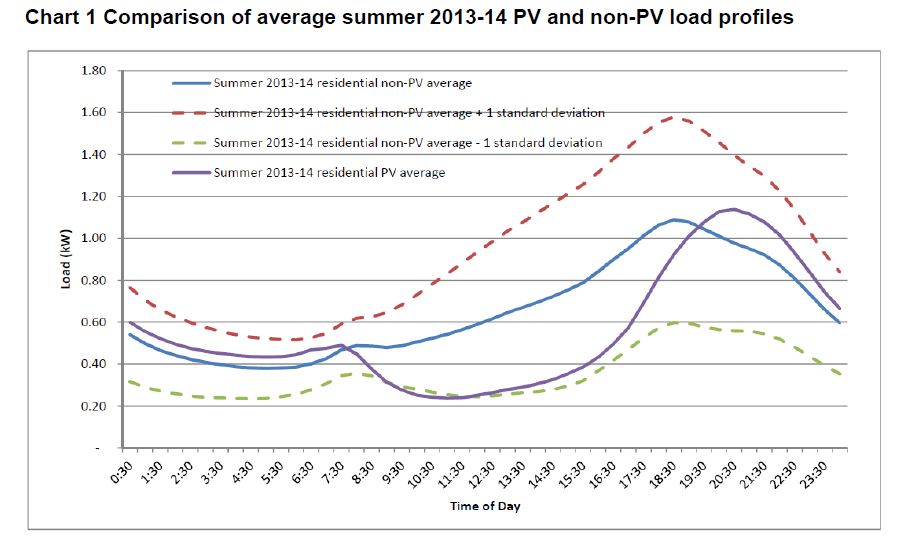
We undertook analysis using SA Power Network’s data that showed that the load profile of PV customers and non-PV customers could be considered similar. This is shown in chart 1. The red and green dashed lines represent one standard deviation of the non-PV customers load profile. The blue and purple lines, representing non-PV customers and PV customers’ respectively; both sit within that single standard deviation across a very large portion of the profile.
We are therefore not satisfied that the proposed Solar Tariff complies with clause 6.18.4(a)(3) and hence this tariff should be removed from the tariff application.
84 In relation to the Social Tariffs, the AER’s statement of reasons said:
Determination on Social Tariff
SA Power Networks filed a proposed residential Social tariff. The business submits that the concept of a Social tariff had been discussed with some key stakeholders and was included in its regulatory proposal. The proposed Social tariff would exclude any charge for PV FiT recovery and the distribution supply charge. SAPN submits that it is inequitable for hardship customers to contribute to the PV FiT cost-recoveries. In deleting the supply charge from hardship customers, SA Power Networks further argue that requiring customers on hardship programs to contribute at average levels to costs in excess of long run marginal cost may have economic repercussions.
We find that SA Power Networks’ proposed Social Tariff does not comply with the National Electricity Rules clause 6.18.4(a)(1)(i) and (ii). This clause requires that customers should be grouped together on the basis of the nature and extent of their usage and the nature of their connection to the network.
There is no evidence to suggest that customers on hardship programs have different demand, usage or connection characteristics to other residential customers.
SA Power Networks should therefore remove the Social Tariff from its pricing proposal.
Overall, the AER considers the inclusion of a Solar Tariff and the Social Tariff to be deficiencies under clause 6.18.8(b) and, to correct those deficiencies, the AER requires the pricing proposal to be submitted without those tariffs.
85 The statement of reasons relevantly concluded with a decision by the AER (cl 6.18.8(b)(1) refers) requiring SAPN:
Actions for SA Power Networks to undertake
SA Power Networks is required to resubmit its 2015-16 pricing proposal within 10 working days of this letter by:
□ removing the Solar Tariff
□ removing the Social Tariff
□ inserting a reference to the ability of customers to choose their meter service provider, and meter type when installing a PV system.
The AER will then assess the resubmitted pricing proposal for compliance with the pricing principles and the 2015-20 preliminary distribution determination.
86 SAPN then on 25 June 2015 under protest, but to avoid the AER using its powers under cl 6.18.8(c) to itself amend the proposal, provided amended appendices to the pricing proposal, and on 26 June 2015 the Revised Pricing Proposal on a “without prejudice” basis, by which SAPN sought to preserve its ability to contend that the AER’s rejection of the solar and social tariffs was invalid. As noted, there is no dispute on the part of the AER about its entitlement to do so.
87 Clause 6.18.8(d) provides that an approved pricing proposal takes effect at the commencement of the regulatory year, that is, 1 July 2015.
88 The Revised Pricing Proposal, as approved and published, is now in effect.
CONSIDERATION: GROUND 1
89 As is apparent, there is a clear difference in the Rules between the creation of new “tariff classes” (as defined in Chapter 10 of the Rules):
A class of retail customers for one or more direct control services who are subject to a particular tariff or particular tariffs.
and the concept of “tariffs” as exist or as purported in the pre-existing “Low Voltage Residential Tariff class”. The term “tariff” is not itself defined.
90 The contention of SAPN is that its creation of the solar tariff is a subclass of the previous Low Voltage Residential tariff class and is not the creation of a new tariff class. In my view, that is not correct. As a matter of construction, the creation of the PV customers or a “grouping of customers” (the description of SAPN) meant that it was creating (in terms of the Rules) a new tariff class. Its proposed tariff or price (or formula for the price) to be charged to each customer for the service to be provided to the PV customers was not compliant with the Rules.
91 The legislative structure giving rise to the Rules, and in particular Chapter 6 of the Rules, was not said to be of any particular significance to the construction of the relevant Rules, save for a passing reference to cl 4 of Sch 2 to the Law. It provides, possibly relevantly, that headings to chapters and parts of the Law are part of the Law, but not headings to sections or subsections of the Law or notes to provisions.
92 The real focus was on Chapter 6 of the Rules, entitled Economic Regulation of Distribution Services. It provides for the AER to make a distribution determination for each DNSP: cl 6.2.4, including to impose controls over the prices for direct control services by a control mechanism which may have a number of elements: cl 6.2.5.
93 Part I of Chapter 6 was the part of the Rules most directly relevant to the present issues. It applies to tariffs and to tariff classes related to direct control services. As noted, it requires the submission of a pricing proposal which sets out the proposed tariff classes, and the proposed tariff for each tariff class: cl 6.18.2(b)(1) and (2) of the Rules. Clause 6.18.3 requires the pricing proposal to define the tariff classes into which retail customers are divided. Clause 6.18.3(d) provides that a tariff class must be constituted with regard to:
(1) the need to group retail customers together on an economically efficient basis; and
(2) the need to avoid unnecessary transaction costs.
94 Clauses 6.18.4 and 6.18.5 are set out above.
95 Clause 6.18.4 directs the AER, in formulating the provisions of a distribution decision governing the assignment of retail customers to tariff classes or the re-assignment of retail customers from one tariff class to another to have regard to specified principles. By reference to those principles, focus is given to the nature and extent of usage, the nature of the connection to the network, the nature of the metering (if required by a regulatory obligation or requirement) and the similarity or otherwise of a retail customer’s connection and usage profile: cl 6.18.4(a)(1) and (2) of the Rules.
96 Clause 6.18.4(a)(3) makes it clear that, in the process of tariff assignment or re-assignment of retail customers, PV customers are to be considered so that they are treated no less favourably than retail customers without micro-generation facilities but with a similar load profile. The terms “load profile” or “similar load profile” are not defined.
97 Clause 6.18.5 deals with the pricing principles for each tariff class. It directs that the revenue to be recovered from each tariff class should be within two bounds: the upper bound representing the stand alone cost of serving the retail customers in that class, and the lower bound representing the avoidable cost of not serving those retail customers.
98 The pricing proposal must provide for tariffs designed to pass on to retail customers the “designated pricing proposal charges”: cl 6.18.7 of the Rules.
99 As noted, the AER was not satisfied that SAPN’s pricing proposal complied with Part I of Chapter 6. It therefore required the re-submission of a proposal which (under protest) was duly done, and is reflected in the decision of 29 June 2015.
100 In my view, the introduction of the solar tariff and the social tariff in the manner proposed by SAPN in the Pricing Proposal was not in accordance with the Rules. That is simply because I do not consider that that could be done by creating new subgroups within the existing tariff class “Low Voltage Residential”.
101 The starting point for that conclusion is the text of cl 6.18 itself. Clause 6.18.9(a)(i) requires a record be maintained, relevantly of the retail customers who comprise a tariff class (as defined) as the class of customers “who are subject to” a particular tariff or tariffs, and that one or more tariffs may be “applicable to” each tariff class. It is contemplated that, at the level of a tariff class, a DNSP will assign retail customers to a tariff class (see cl 6.18.4(a)), so that the retail customer becomes subject to the tariff or tariffs that apply to that class. In short, a tariff or tariffs apply to a tariff class, and a customer is assigned to a tariff class.
102 That does not sit readily with the Pricing Proposal which proposes that, below the “tariff class” level, SAPN can assign retail customers to a subclass within the tariff class, so that it, in effect, assigns the retail customer to a “tariff” that is a price or price formula.
103 At the very least, that is a substantial reworking of the conceptual arrangements that the Rules clearly provide for at the “tariff class” level. SAPN acknowledged, if it is correct and it is not creating a new tariff class that, as a consequence, the protective principles of cl 6.18.4(a) are not attracted.
104 It is clearly intended by cl 6.18.4(a)(3) that PV customers should be treated no less favourably than non-PV customers with a similar load profile in the assignment of retail customers to tariff classes. I do not consider it was intended that the comparison required of the AER by cl 6.18.4(a)(3) should be able to be avoided by the DNSP electing to categorise the new tariff (pricing) to be imposed on PV customers by merely subgrouping within an existing tariff class. Yet, that is what SAPN says it is entitled to do. The allocation of retail customers to a tariff class, with that principle for PV customers should not be so readily achieved, excluding the AER from applying that principle by what is an artifice of nomenclature. Indeed, there does not appear to be any recognition in the Rules for the creation of tariff subclasses, or customer segments of that character.
105 At a contextual level, there does not appear to be any policy or logical justification for such a construction as SAPN urged. It has the consequence of enabling a DNSP compulsorily to reassign customers to different tariffs without having to satisfy the general equal treatment principle in cl 6.18.4(a)(2) and the solar no-less favourable treatment principle in cl 6.18.4(a)(3). But SAPN advances no cogent explanation of how the Rules can or should be construed as impliedly authorising that approach.
106 At most, SAPN asserts (without elaboration) that cl 6.18.5, combined with cl 6.18.4(b), “adequately constrains” the formulation and assignment of tariffs within a tariff class. But that suggestion is unfounded; it is not directed to tariff class reassignment, but it sets out the “pricing principles” that constrain the price levels at which individual tariffs may be set.
107 At a more general level construction of tariff class and tariff as a group of customers subject to a tariff (or multiple tariffs for multiple direct control services) best promotes the purpose of cl 6.18.4, which is to ensure that like customers are treated alike. Adopting that construction means that PV customers are not treated less favourably than non-PV customers if they have similar load profiles, and more generally, that customers with a similar connection and usage profile are treated equally. The efficacy of those principles would not be best served if a DNSP could avoid them by “defining away” their applicability by the device of subgroups within a tariff class. That construction will prevent discriminatory tariffs on different customers within a tariff class who receive the same direct control service. It will prevent the general equal treatment principle and the solar no-less-favourable treatment principle being easily and simply avoided.
108 It is worth noting, as SAPN acknowledged, that its Pricing Proposal would have compulsorily reassigned 3,000 retail customers a day (175,000 customers in total) to the solar tariff, without any need to consider whether those customers’ load profiles are similar or dissimilar to those of non-PV household customers.
109 SAPN then said that if a PV customer considered that its usage profile was significantly different to that used for pricing the type 6 meter outcome, that customer could elect to adopt the residential actual demand tariff and receive an actual cost-reflective tariff. The cost implications of doing so were not fully explained. In any event, that would not give effect to the customer objection mechanism for which Attachment 14.D specifically provides. It also does not sit comfortably with that mechanism as the residential actual demand tariff under the Pricing Proposal was to be available to a maximum of 1,000 customers only in 2015-2016.
110 I have considered the extrinsic material said to touch on this issue and referred to in the course of submissions. I do not think that it throws particular light upon the resolution of the question of construction, in support of either the position contended for by SAPN or that adopted by the AER.
111 Accordingly, I do not consider that the first ground of review is made out. Attachment 14.D was appropriate to be applied by the AER. It reflected the principles for assignment or re-assignment of retail customers to tariff classes in cl 6.18.4 of the Rules.
112 Attachment 14.D.1 proceeded on the basis that all customers were taken to be assigned to the tariff class they were in prior to 1 July 2015, namely the Low Voltage Residential class. The Pricing Proposal would have created a new tariff or tariff classes by its creation of the “subgroups” described, in particular those to whom the solar tariff applied and those to whom the social tariff applied.
113 In those circumstances, it was appropriate for the AER to apply the principles in cl 6.18.4 to the Pricing Proposal, as it indicated it would do so in Attachment 14.D. The AER was therefore entitled to consider whether the load profiles of PV customers, who were by the Pricing Proposal to be re-assigned compulsorily to the new solar tariff class (or “sub-group”) were in their load profiles dissimilar from or similar to those of non-PV customers. Subject to the third ground of review, it was proper therefore for the AER to come to the view that SAPN’s Pricing Proposal did not “ensure” that PV customers would not be treated less favourably as required by Attachment 14.D.4 and to refuse to approve the Pricing Proposal for non-compliance with Attachment 14.D.
114 In relation to the hardship customers, as the Pricing Proposal reassigned them to the new social tariff class, in circumstances where the AER was not satisfied that this would occur as a consequence of those customers having different connection and usage profiles, its conclusion was also available to it. The AER concluded that there was no evidence to suggest that customers on retailer hardship programs have different demand, usage or connection characteristics from other residential customers. The AER’s conclusion is not said to be unreasonable. Consequently, it was open to the AER to conclude that SAPN’s Pricing Proposal did not “ensure” that customers would be assigned to a tariff class based on their connection and usage profiles as required by Attachment 14.D.3.
115 In my view, in those circumstances, it was not incumbent on the AER to set out reasoning regarding satisfaction of the cl 6.18.5 requirements. Clause 6.18.8 requires that the AER give reasons that address aspects of a pricing proposal about which it is not satisfied comply with either cl 6.18.4 or an applicable distribution determination.
116 If I am not correct in concluding that the solar tariff and the social tariff are new tariff classes, I consider that their inclusion in the Low Voltage Residential tariff class resulted in the creation of a new broad tariff class, in effect with the same name as the existing Low Voltage Residential tariff class.
117 On that basis, the first ground of review would fail for the same reasons as those given above.
118 In any event, I do not consider that the AER erred in applying Attachment D in the Primary Decision to its consideration of the Pricing Proposal, even if the new tariffs were created within an existing tariff class for PV customers by the solar tariff and for hardship customers by the social tariff. Attachment 14.D.3.1 determined that existing customers were taken to be assigned to their existing tariff class. Where, as a matter of substance, there was a compulsory re-assignment of PV customers to a new tariff structure, applying the principles set out in cl 6.18.4(a), which includes the solar no-less-favourable treatment principle and the general equal treatment principle was within the proper discretion of the AER. It was open to the AER to conclude that SAPN’s Pricing Proposal would have enabled SAPN to avoid the solar no-less-favourable treatment principle and the general equal treatment principle at the outset by inserting into the existing class new tariffs that were contrary to the solar no-less-favourable treatment principle and the general equal treatment principle.
CONSIDERATION: GROUND 2
119 The second ground of SAPN’s application complains that the AER “implied” that SAPN had an onus to demonstrate dissimilarity of load profiles, or as developed in submissions that the AER imposed an onus on SAPN where none should have been imposed.
120 In my view, this ground of review was also not made out.
121 Under cl 6.18.8 the AER is obliged to approve a pricing proposal if it is satisfied that the proposal complies with Part I and any applicable distribution determination. The relevant decision is to be made by the AER as an administrative decision-maker. It is clear that the notion of onus of proof related to judicial fact finding in resolving controversies does not apply in administrative proceedings: see eg Minister for Immigration and Citizenship v Li (2014) 249 CLR 332 at [10] per French CJ.
122 If a decision-maker is required to make a particular decision only when satisfied of a particular matter then the decision-maker can only make the decision if the evidence allows the decision-maker to be reasonably satisfied of that matter. If the decision-maker is not so satisfied it must refuse to make the decision.
123 As is apparent from the Pricing Proposal itself and the material subsequently provided by SAPN following 5 June 2015, in circumstances such as the present, it was appropriate for SAPN to provide the information which it considers would satisfy the AER under cl 6.18.8. It is not correct to refer to this as imposing an “onus” of proof.
124 In the context of the satisfaction requirement in s 65 of the Migration Act 1958 (Cth), it has been said that it is for the applicant to advance whatever evidence or argument she wishes to advance in support of her contention that she has a well-founded fear of persecution. The decision-maker must then decide whether that claim is made out: see eg Abebe v The Commonwealth (1999) 197 CLR 510 at [187] per Gummow and Hayne JJ.
125 In my view, that reflects what occurred in this matter. The AER’s decision says, by reference to cl 6.18.8, that it was not satisfied that the Pricing Proposal complied with the Rules and the Distribution Determination. It said that it was “not satisfied” that SAPN had demonstrated that PV and non-PV retail customers have “sufficiently dissimilar” load profiles. It was appropriate to expect SAPN to put forward whatever evidence or argument it wished in support of its case that its Pricing Proposal complied with the Rules and the AER Distribution Determination. In reaching its view the AER engaged in discussions with SAPN, raised concerns with SAPN, referred to data and analysis provided by SAPN, and referred to the AER’s own analysis. In short, the AER was not subjectively satisfied that the Pricing Proposal complied with the Distribution Determination. In reaching that view, the AER simply applied the appropriate test. The fact that the AER concluded, after analysing the data available, that the load profiles of PV and non-PV customers “could be considered similar” does not demonstrate the imposition of an onus of proof. It demonstrates that the AER undertook its own evaluation of similarity/dissimilarity. The AER then explained to SAPN the AER’s reasoning process and why it was not in fact satisfied of dissimilarity.
CONSIDERATION: GROUND 3
126 It is desirable to address in further detail the contentions on the part of SAPN that, in any event, the AER’s decision was unreasonable.
127 First, in my view and as discussed above, I do not consider that any nuanced understanding of the test of unreasonableness would make any difference to the view I have reached. That is simply because, adopting the test of unreasonableness most favourable to SAPN as developed in its submissions, I am not persuaded that the AER’s decision is unreasonable.
128 It is common ground that, on this application, the assessment of the contentions required an understanding of the expression “load profile”, as used in cl 6.18.4(a)(3) and by the AER in its Attachment 14.D.3.4.6. It is also accepted that, as a technical expression, the expert evidence of Mr Thompson and Mr Tustin was admissible to inform its trade usage: see eg Australian Retailers Association v Reserve Bank of Australia (2005) 148 FCR 446 at [471].
129 The term “load profile” is not defined in the Rules, although the words “load” and “profile” are separately defined as follows:
load
A connection point or defined set of connection points at which electrical power is delivered to a person or to another network or the amount of electrical power delivered at a defined instant at a connection point, or aggregated over a defined set of connection points.
profile
Metering data or costs for a period longer than a trading interval allocated into trading intervals.
Those definitions have relevance to the task of understanding the expression “load profile”. A trading interval is the 30 minute period for which settlements of the wholesale market price are carried out.
130 The AER says that a “load profile” is the amount or amounts of electrical power transferred across one or more connection points with respect to time, typically represented by a curve, or a set of curves, plotted with respect to time. Mr Thompson’s affidavit of 11 September 2015 explained that it is concerned with the consumer’s consumption of electrical power over time. It accords with the description by Mr Heaps of how, in the electricity supply industry, load profiles are most commonly created, and then used for the purposes of customer category load profiles.
131 That appeared to me to be a sensible and pithy description of what the Rules seek to express by the use of the expression. There are indications in the Rules consistent with that view: see cll 3.7.2(c)(1)(iii), 4.9.1(c)(1), 7.16(c)(2)(ii) and Sch 5.7 requiring the provision of “Load Profiles”.
132 For the purposes then of the comparison to which cl 6.18.4(a)(3) directs attention, as adopted in Attachment 14.D.3, it is therefore necessary to have regard to the “load profile” as measured at the (collective) customers’ connection points to the network.
133 The AER took the view that its analysis of the comparative load profiles of the PV customers and the non-PV customers (the comparative graphs of their loads with respect to time) required a careful consideration of the similarities of the two sets of curves over time. It is clear enough that there are a range of mathematical, statistical and algorithmic methods, either alone or in combination, which may be used to assist in assessing the similarity of such curves. I accept the evidence of Mr Thompson that those methods are of limited use, partly because there is necessarily a judgment to be made about the concept of dissimilarity or similarity, and partly because the “families” of shapes vary over time. Consequently, there is a subjective judgment to be made in the light of the indicative metrics outcomes of those methods.
134 It is convenient to indicate at this point why I consider that Mr Thompson’s analysis informed the AER’s Primary Decision. It is because it was his role within the AER to carry out that analysis. That is confirmed by his role in the communications between the AER and SAPN officers on and from 5 June 2015 concerning the character of the data SAPN had provided with its Pricing Proposal. His analysis was prepared in graphical form to be presented to those in the AER who were to make the Primary Decision.
135 I do not regard the precise detail of those communications as necessary to be explored. The AER made certain requests which SAPN sought to address. There may have been an assumption on the part of SAPN that, upon the provision of further information, the AER was satisfied with that information. The AER, in my view, is not shown to have concluded those communications in a way which misled SAPN into that assumption. The AER was obliged to make a decision in a timely manner with respect to the Pricing Proposal, as its pricing decision was to be operative from 1 July 2015. It sought further information and received it. It considered it. It did not then act improperly in proceeding to make the Primary Decision. The process of those communications on and after 5 June 2015 does not itself give rise to any established ground of review under s 5 of the ADJR Act.
136 To revert to the internal AER processes, I also accept – as is indeed obvious – that Mr Thompson did not consider the Pricing Proposal, together with the additional information provided by SAPN, as sufficient to analyse the load profiles of the surveyed customers to determine the range of variation in their load profiles. He then chose to use variation in the half hourly average demand date (as provided) as a proxy for the variation in individual half hourly demand that would exist in the raw customer survey data. He regarded that as a reasonable proxy for the half hourly variation measured in the customer survey data. He points out that this might underestimate the likely variation in the customer survey data, as half hourly averages may give a smaller variation estimate than actual half hourly customer survey data.
137 Mr Tustin’s report and his evidence was critical of that calculation of the standard deviations, as the proper statistical hypothesis test must account for any error in the estimated average value given a sample of particular size. Mr Thompson did not say that, as a matter of proper statistical theory, Mr Tustin was incorrect. He simply said that he was not engaged precisely in that exercise, so the asserted error in the estimate of average value was not relevant to his analysis. Rather, he said, he was looking at the variation that would exist in each half hour of the customer survey data as an indicator of the range of variation that could be observed within the customer load profiles of the customer data set. Hence, he was trying better to understand the load profiles of PV customers and non-PV customers to assist in the visual analysis of the comparative curves. His approach is demonstrated by the graph he prepared, plotting at half hourly intervals the PV customers’ average against the non-PV customers’ average plus or minus one standard deviation (calculated by proxy in the manner described). He pointed out that, because the average load and the variation are measured at the particular half hourly interval, they do not represent measures over time or with respect to time, and so do not contain information regarding the shape of the load profile.
138 Mr Thompson’s further affidavit of 10 November 2015 addresses Mr Tustin’s second report (ACIL Allen Consulting Report, 7 October 2015). The parties were of course aware of the nature of this application, that is to review the AER’s Primary Decision on grounds available under the ADJR Act. Consequently, some evidence was adduced which may have informed the orders which the Court might have made in the event that it was satisfied of reviewable error on the part of the AER. In my view, the second affidavit of Mr Bennett of 29 September 2015 (showing in part further data which had been procured by SAPN by that time, and which might have been provided to the AER by SAPN with the Pricing Proposal or in the course of discussions after 5 June 2015 and before the AER’s Primary Decision if SAPN had realised that it was necessary or desirable to provide it), the second report of Mr Tustin (also in part addressing that material) and the affidavit of Mr Thompson of 10 November 2015 largely fall into that category. As I have not found reviewable error on the part of the AER in making its Primary Decision or its consequential decisions, it is not necessary to refer to that material in any detail.
139 As I have indicated, I have proceeded on the basis that I found Mr Thompson’s evidence to be impressive. That is not to say that Mr Tustin is wrong in his evidence that on a strict statistical analysis, there is a need to allow for the standard error of mean (as depicted in his sketch of two overlapping bell curves). But he was not asked to analyse the data SAPN made available to him, and in particular he did not seek to form a judgment about the robust way in which Mr Thompson said he approached the use of the data with which he was provided or the judgment he made on that material. Indeed, he accepted that to perform a reliable statistical analysis of the relativity of the PV customers and non-PV customers, further data would have been desirable and it would have been necessary to assume the “normality” of the data available.
140 There was one area of specific dispute about Mr Thompson’s use of the proxy to provide an estimate of the relativity of the two load profiles.
141 However, accepting it is appropriate on an application such as the present to allow competing expert evidence to demonstrate unreasonableness on the decision-making of the AER (as the parties did), I have not taken the step urged by SAPN of being satisfied that I should regard Mr Thompson’s approach as erroneous or incorrect, so that the AER’s Primary Decision as based on his approach would be unreasonable. He clearly has considerable relevant expertise and experience. He addressed matters raised in cross-examination with confidence and gave direct and cogent answers. He demonstrated a careful and open-minded approach. He referred to the range of relevant factors with facility, including recognising the role of the “load factor” as a characteristic of the load profile, and was persuasive in saying that the comparative “load factor” of the PV customers and non-PV customers is not determinative of their comparative load profile.
142 I note that SAPN, relying on Mr Tustin’s evidence, says that the comparison chart prepared by Mr Thompson (referred to above) focused on the day-to-day variation in the load profile of non-PV customers, and that such a variation did not relate to the customer-to-customer variation. Mr Tustin then said that there is no logical relationship between such day-to-day variation and the question of the similarity in the load profile of PV customers and non-PV customers. I am not persuaded that Mr Thompson’s approach, as he described it, is flawed illogically so as to lead to a conclusion of unreasonableness.
143 I have not taken the step that the AER urged of treating the similarity or dissimilarity of the load profiles as a finding of fact of an intermediate (and therefore non-reviewable) finding of fact, preliminary to its conclusion that it did not have the satisfaction prescribed by cl 6.18.4(a)(3) and adopted in Attachment 14.D. That submission was based on cases such as Minister for Immigration and Multicultural Affairs v Eshetu (1999) 197 CLR 611 at [124]-[127] per Gummow J, and said to have been recognised and preserved in Minister for Immigration and Citizenship v Li (2013) 249 CLR 332 by each of the judgments of French CJ at [22], of the plurality (Hayne, Kiefel and Bell JJ) at [63]-[66] and of Gageler J at [106]. As I have said, I did not consider it necessary to accept or reject that contention.
144 In my view, it is simply that the conclusion of the AER in terms of cl 6.18.4(a)(3) and under Attachment 14.D, based upon the material available to the AER at the time of the Primary Decision, is not shown to have been unreasonable. Its qualitative assessment was made in the light of Mr Thompson’s analysis, and (as its reasons show) where the individual customer load profile data that SAPN provided was confined to six irregularly spaced data points on a single day (16 January 2014), which was one of the extreme heatwave days depicted in SAPN’s Pricing Proposal, and to the load profile data that SAPN provided to the AER across the full survey period 1 July 2013 – 31 May 2015 which reflected only the aggregate and mean load of household customers in the PV and non-PV categories and did not disclose the extent of customer-to-customer variability within each category over the full survey period. It is not apparent that taking account of the extent of customer-to-customer variability within each group of customers was irrelevant to its statutory task of assessing whether the two load profiles were “similar”. Mr Tustin accepted that such customer-to-customer variability will exist within each group of customers.
145 Even if there is, as Mr Tustin says, a statistical flow in the part of the curves shown in Mr Thompson’s chart, I do not regard such a flaw in this matter as leading to the conclusion of unreasonableness. Minister for Primary Industries and Energy v Austral Fisheries Pty Ltd (1993) 40 FCR 381 is a decision on its particular facts and legislative structure. There was a broad decision to be made on this matter by the AER, necessarily evaluative, and made on the data provided by SAPN and without the full data which the AER had requested from SAPN. In my view, the use of the factual proxy on the available material, addressing a proper issue of standard deviation, was not unreasonable in the circumstances. More importantly, it is not shown that the evaluative judgment made by the AER was itself unreasonable.
CONSIDERATION: GROUND 4
146 There is an additional ground of review raised in relation to the social tariff. Strictly speaking, in view of my conclusions already reached, it is not necessary to address it.
147 However, it is appropriate briefly to do so. I apprehend that the prospect of a solar tariff and the social tariff will not be ended by this judgment or the reasons for it. Each is a decision concerning the particular Pricing Proposal. It is open to SAPN to pursue the establishment of a solar tariff and/or a social tariff in a future pricing proposal.
148 SAPN argued that the AER erred in law in that, insofar as it applied cl 6.18.4(a)(1)(i) and (ii) (or, relevantly, the corresponding provisions of Attachment 14.D.3.3), it failed to interpret those provisions in light of cl 6.18.5(b)(1) and (2)(ii) of the Rules, and to reflect the harmony or consistency of approach which they require.
149 There was no evidence that household customers on retail hardship programs have different demand, usage or connection characteristics.
150 In my view, the AER was entitled to apply cumulatively the requirements of Attachment 14.D and cl 6.18.5. It did not refuse to approve the Pricing Proposal on the basis that the social tariff did not comply with cl 6.18.5. I do not consider that it was obliged to qualify its finding by notions of harmonious construction so as to depart from the plain meaning of cl 6.18.4(a)(1) or Attachment 14.D.3.3.
151 Indeed, SAPN’s proposal was that the social tariff would be ascribed to customers participating in retailers’ hardship programs, presumably because they are experiencing payment difficulties due to hardship. That is not a criterion that is based on the nature or extent of those customers’ usage, or the nature of their connection to the network. It is difficult to see how the application of hardship policies by retailers would ensure that customers in like circumstances would be treated equally in eligibility for the social tariff in any event. The numerical cap on the number of household customers who could be assigned to the social tariff – 12,000 customers in total, or no more than 1.4% of any retailer’s residential customer base – once that quantitative cap is reached – is also not based on any measure of the connection between the social tariff and the equal treatment of household customers by reference to their usage or connection characteristics.
152 In my view, cl 6.18.5(b)(1) does not impose any requirement for the formulation of a pricing proposal in cl 6.18.4(a) and cl 6.18.5(b)(2)(ii) similarly does not qualify the requirement in cl 6.18.4(a) for retail customers’ tariff classes, but identifies charging parameters for those within a tariff class, or for retail customers. It does not mandate the creation of a separate tariff class, in the face of cl 6.18.4(a). Those views flow into the application of Attachment 14.D.3.3.
153 I have already concluded that the Pricing Proposal for a subgroup of social tariff customers was not available in the way the Pricing Proposal presented it. Whether the creation of a separate new tariff class of such a group could be established is a matter which I do not finally decide.
CONCLUSION
154 For those reasons, orders were made on 23 December 2015 in the terms referred to above.
155 There are two additional observations to be made.
156 First, obviously, these reasons for judgment relate to the particular Primary Decision of the AER under review, and its consequential decisions. They do not decide either as a matter of fact or as a matter of law that there is no scope for there to be a solar tariff or a social tariff put forward in some later pricing proposal by SAPN and for that to be considered by, and if appropriate accepted by, the AER.
157 Secondly, it is clear, as Mr Bennett readily acknowledged, the primary cost elements for the provision of electricity to consumers (both commercial and consumer users) is ultimately determined by the AER under the process prescribed by the Rules, relevantly by reference to the pricing proposal of a DNSP. Retailers of electricity have limited capacity to adjust prices for the supply of electricity to consumers, although clearly the terms and conditions of supply are more flexible. The metering and reading of the meters is also a task performed by SAPN. In that context, particularly in relation to the prospect of a social tariff, but also more generally in relation to a solar tariff, the Rules broadly speaking impose a regulatory structure to give effect to economic efficiency in the provision of network services. There is no clear reason why SAPN, or any network service provider, should have the role or responsibility for the determination of policy which is intended to protect those in need within the wider community, or (as here) to identify and define the extent of that need.
158 To a degree, but for different reasons, there are clearly policy considerations which have influenced pricing for PV customers in the past. The incentives provided for the installation of domestic solar power are an example. That is, for example, recognised by cl 6.18.2(6A). As I noted, without determining its correctness in this matter, SAPN identified a clear economically efficient rationale for its proposal to introduce the solar tariff. Assuming that it is valid (as it appears at a theoretical level to be), any broader policy considerations encouraging the installation of domestic solar power or how they could intersect with the need to maintain an efficient and effective electricity network for the provision of services to consumers would not be within the aegis of the AER in its regulatory role.
159 The comments in this concluding section of the reasons are not, and could not be, to express any view about proper public policy. That is a matter for government. They are simply to point out that the criteria by which SAPN, and other DNSPs, and the AER, are required respectively to present and consider pricing proposals are essentially based on economic efficiency considerations, with the possible exception of cl 6.18.5(b)(ii). It is not clear whether it is intended that broader matters of public policy are in fact intended to be delegated to the DNSPs, and to the AER (to the extent that it may do so, if at all, where a pricing proposal otherwise satisfies the Rules).
I certify that the preceding one hundred and fifty-nine (159) numbered paragraphs are a true copy of the Reasons for Judgment herein of the Honourable Justice Mansfield. |
Associate:
SCHEDULE OF PARTIES
SAD 231 of 2015
Third Applicant: SPARK INFRASTRUCTURE SA (NO 1) PTY LTD
Fourth Applicant: SPARK INFRASTRUCTURE SA (NO 2) PTY LTD
Fifth Applicant: SPARK INFRASTRUCTURE SA (NO 3) PTY LTD


