

FEDERAL COURT OF AUSTRALIA
Doyle on behalf of the Iman People #2 v State of Queensland [2016] FCA 13
QUD 6162 of 1998 | ||
RICHARD DOYLE & ORS ON BEHALF OF THE IMAN PEOPLE #2 Applicant | ||
AND: | STATE OF QUEENSLAND (and others named in the Schedule) First Respondent | |
DATE OF ORDER: | ||
THE COURT ORDERS THAT:
1. Each of the following comprises a previous exclusive possession act within s 23B of the Native Title Act 1993 (Cth):
(a) The grant of:
(i) Grazing Homestead Perpetual Lease 36/7570 on 2 March 1978 pursuant to s 169B of the Land Act 1962-1975 (Qld) over Lot 1 on Plan AB94 which ceased to have effect prior to 28 November 1994;
(ii) Grazing Homestead Perpetual Lease 36/7569 on 4 May 1978 pursuant to s 169B of the Land Act 1962-1975 (Qld) over Lot 1 on Plan AB74 which ceased to have effect prior to 28 November 1994; and
(iii) Grazing Homestead Perpetual Lease 36/7571 on 18 May 1978 pursuant to s 169B of the Land Act 1962-1975 (Qld) over Lot 2 on Plan AB148 which ceased to have effect prior to 28 November 1994,
which comprise area 226, being Lot 62 on FTY1809.
(b) The conversion, pursuant to s 61 of the Land Act Amendment Act 1984 (Qld), of the following to Grazing Homestead Perpetual Leases under s 131 of the Land Act 1962-1984 (Qld) on 15 May 1984:
(i) Grazing Homestead Lease 40/1789 granted on 19 September 1968 over Lot 2 on Plan LE297 (comprising part of area 224, being Lot 52 on FTY1364); and
(ii) Grazing Farm Lease 40/1824 granted on 15 April 1982 over Lot 1 on LE271 (comprising area 73, being Lot 3 on LE289).
(c) The depiction on Plan LE9 of an area running north south on the western boundary of Portion 26 identified as road (comprising area 33, including Lot 1 on AP3608).
Note: Entry of orders is dealt with in Rule 39.32 of the Federal Court Rules 2011.
REEVES J:
Introduction
1 With the exception of certain questions relating to the extinguishment of native title, the parties to this native title determination application have agreed, in principle, upon the terms of a consent determination of native title pursuant to s 87 of the Native Title Act 1993 (Cth) (the NTA). This judgment concerns the outstanding extinguishment questions. They relate to four areas of land described as areas 33, 73, 224 and 226, all of which are located in the general vicinity of the town of Taroom in Western Queensland.
The separate extinguishment questions
2 In mid-June 2015, with the consent of the relevant parties (the applicant and those respondent parties who had indicated an interest in these extinguishment questions), I ordered that the following questions be determined as separate questions under r 30.01 of the Federal Court Rules 2011 (Cth):
Which of the following comprise a previous exclusive possession act within s 23B of the Native Title Act 1993 (Cth):
(a) The grant of:
(i) Grazing Homestead Perpetual Lease 36/7570 on 2 March 1978 pursuant to s 169B of the Land Act 1962-1975 (Qld) over Lot 1 on plan AB94 which ceased to have effect prior to 28 November 1994;
(ii) Grazing Homestead Perpetual Lease 36/7569 on 4 May 1978 pursuant to s 169B of the Land Act 1962-1975 (Qld) over Lot 1 on plan AB74 which ceased to have effect prior to 28 November 1994; and
(iii) Grazing Homestead Perpetual Lease 36/7571 on 18 May 1978 pursuant to s 169B of the Land Act 1962-1975 (Qld) over Lot 2 on plan AB148 which ceased to have effect prior to 28 November 1994,
which comprise area 226, being Lot 62 on FTY1809.
(b) The conversion, pursuant to s 61 of the Land Act Amendment Act 1984 (Qld), of the following to Grazing Homestead Perpetual Leases under s 131 of the Land Act 1962-1984 (Qld) on 15 May 1984:
(i) Grazing Homestead Lease 40/1789 granted on 19 September 1968 over Lot 2 on plan LE297 (comprising part of area 224, being Lot 52 on FTY1364); and
(ii) Grazing Farm Lease 40/1824 granted on 15 April 1982 over Lot 1 on LE271 (comprising area 73, being Lot 3 on LE289).
(c) The depiction on Plan LE9 of an area running north south on the western boundary of Portion 26 identified as road (comprising area 33, including Lot 1 on AP3608).
The issues that arise
3 These questions essentially involve two sets of issues as follows:
(a) whether the land within area 33 was duly dedicated and established as a public road under the relevant legislation in force in the late 19th and early 20th centuries (question [2(c)] above) (“the road dedication issue”); and
(b) whether the various past acts undertaken in respect of area 73 (question [2(b)(ii)] above), area 224 (question [2(b)(i)] above) and area 226 (question [2(a)] above) between 1978 and 1988 are valid within the terms of s 23B of the NTA (“the Metwally issue”).
4 With respect to the road dedication issue, it emerged from the applicant’s submissions that, should that issue be determined against it, it wished to raise, in the alternative, an issue about the proper location of the western boundary of the road in question. I will refer to this additional issue as “the road boundary issue”.
5 As its epithet suggests, the second set of issues above partly involves the High Court decision in University of Wollongong v Metwally (1984) 158 CLR 447 (Metwally) and the operation of s 109 of the Constitution. Because of this latter factor, prior to the trial of these separate questions, notices were served under s 78B of the Judiciary Act 1903 (Cth). No Attorney-General subsequently sought to intervene in the proceeding.
6 For the purposes of the trial of these separate questions, the parties put forward an agreed bundle of documents which recorded the history of each of the four areas of land in issue. In addition, with particular relevance to the two road issues, the State of Queensland tendered an affidavit by Mr McClelland, a principal surveyor for the State, and made him available for cross-examination. Mr McClelland holds a Degree in Surveying from the University of Queensland and has approximately 40 years’ experience as a surveyor, including 33 years employed as an officer of the Department of Natural Resources and Mines or its predecessors. In his written and oral evidence, Mr McClelland described, among other things, the surveying and mapping practices followed in Queensland dating back to the late 19th and early 20th centuries.
7 Since these two sets of issues are quite discrete in their timing and legislative settings, I will deal with them separately below.
The road issues – Area 33
Introduction
8 The determination of the road issues requires a consideration of s 23B of the NTA and the Land Act 1897 (Qld), which was in force in the late 19th and early 20th centuries, together with certain Executive acts that were performed in accordance with that legislation affecting Portion 11v on Plan LAB4012 and Portion 26 on Plan LE9, both of which encompass area 33. It also includes a consideration of the surveying and mapping work that was undertaken at that time with respect to Portion 11v, to Portion 26, and to the lands surrounding those portions.
Previous exclusive possession acts
9 For the purposes of the road dedication issue, a “previous exclusive possession act” is defined in s 23B(7) of the NTA as an act (an expression which is defined broadly in s 226 of the NTA) that is valid and “consists of the … establishment of any public work that commenced to be … established on or before 23 December 1996”. The expression “public work” is relevantly defined in s 253 of the NTA to mean a road that is “established by or on behalf of the Crown”. The only aspect of this definition in dispute in this issue is the latter: whether the road in question was established (or dedicated) by the Crown.
The Land Act 1897
10 The Land Act 1897 was in force throughout the period relevant to the determination of these road issues. Five provisions of that Act are of particular importance. They were as follows:
75. The Governor in Council may, by Proclamation, declare any Country Lands to be open for selection either as unsurveyed lands or as surveyed lands under the provisions of this Part of this Act, and may, by Proclamation, withdraw any lands from being so open:
Provided that the Minister may, if he deems it necessary so to do, withdraw any lands from being open for selection by notification in the Gazette; and upon ratification by the Governor in Council by Proclamation within one month after such notification has been published, the withdrawal shall have the same force and effect as if the lands had been withdrawn from selection by the Governor in Council at the time at which they were withdrawn by the Minister.
76. When any land is proclaimed open for selection as unsurveyed lands, the following provisions shall have effect by way of modification of the provisions hereinafter contained in respect of land which is proclaimed open for selection as surveyed lands:–
(1) The application to select any such land shall give a clear description of the locality and boundaries of the land applied for, and shall state that it is unsurveyed.
(2) Every selection applied for shall, before the application is lodged, be marked on the ground in the manner prescribed by the Regulations.
A statement that the marking has been duly effected shall accompany the application.
(3) If any selection is not surveyed by order of the Minister within three months from the date of the acceptance of the application by the Commissioner, the applicant may request the Minister to refund the part of the survey fee lodged with his application as hereinafter provided, and, if the survey is not made within two months from the date of such request, may, at his own cost, employ a licensed surveyor to effect the survey, and on such survey being made and approved by the Minister the part of the survey fee so lodged shall be refunded to the applicant.
(4) If upon the survey it appears that, by reason of a prior application or for any other reason, the applicant cannot obtain the whole of the land applied for, he may, by writing under his hand, withdraw the application and demand back the amount deposited by him in respect of rent as hereinafter provided and the part of the survey fee lodged by him.
(5) The application shall not be approved by the Court until the land has been surveyed.
(6) The land which the applicant shall be entitled to occupy on receiving from the Commissioner the license hereinafter mentioned shall be the land comprised in the application according to the boundaries as defined by the survey.
In other respects the provisions of this Act with respect to land which is proclaimed open for selection as surveyed lands shall be applicable.
77. Before any land is proclaimed open for selection as surveyed lands it shall be surveyed under the direction of the Minister, and divided into portions of convenient area for selection, with proper roads and reserves for public purposes wherever necessary. The portions shall be marked on the ground in the manner prescribed by the Regulations.
78. With respect to land which it is practicable to divide into portions without actual survey, and to indicate the position of such portions by means of maps or plans and by reference to known or marked boundaries or starting points, the following provisions shall have effect:–
(1) The Governor in Council may suspend the operation of so much of the last preceding section as requires the land to be actually surveyed and marked on the ground before it is proclaimed open for selection, and may require the Surveyor-General to divide the land into portions and to indicate the position of such portions on proper maps or plans;
(2) The land may thereupon be proclaimed open for selection in the same manner as if it had been surveyed, and the delineation of the portions on the maps or plans shall be deemed to be a survey thereof, and the portions shall be deemed to be surveyed portions for the purposes of this Part of this Act;
(3) The application shall not be approved by the Court until the land has been actually surveyed;
(4) The land which the applicant shall be entitled to occupy on receiving from the Commissioner the license hereinafter mentioned shall be the land comprised in the application according to the boundaries as defined by the actual survey.
…
84. When any land is proclaimed open for selection, maps shall be prepared and exhibited to the public at the office of the Land Agent and at the Department of Public Lands in Brisbane showing the land so open, its distance from railway or water carriage, the rent and purchasing price, if any, per acre, the maximum area that may be selected in each mode of selection by any one person in the whole area to which the Proclamation has reference, and such other information as may be prescribed.
The surveying and other Executive acts between 1900 and 1908
11 Most of the surveying and other Executive acts, for which records still exist, are recorded on the two plans mentioned above: Plan LAB4012 and Plan LE9. Some are recorded in other records held by the State of Queensland relating to the land in area 33. The particular part of area 33 that is at the heart of these road issues is a swamp area which is located in about the middle of the western boundary of Portion 11v on Plan LAB4012 and Portion 26 on Plan LE9. The southern part of Portion 11v was subdivided to become Portion 26. The following is an enlarged view of Plan LE9 showing the particular part of Portion 26 that is in contention in these road issues.
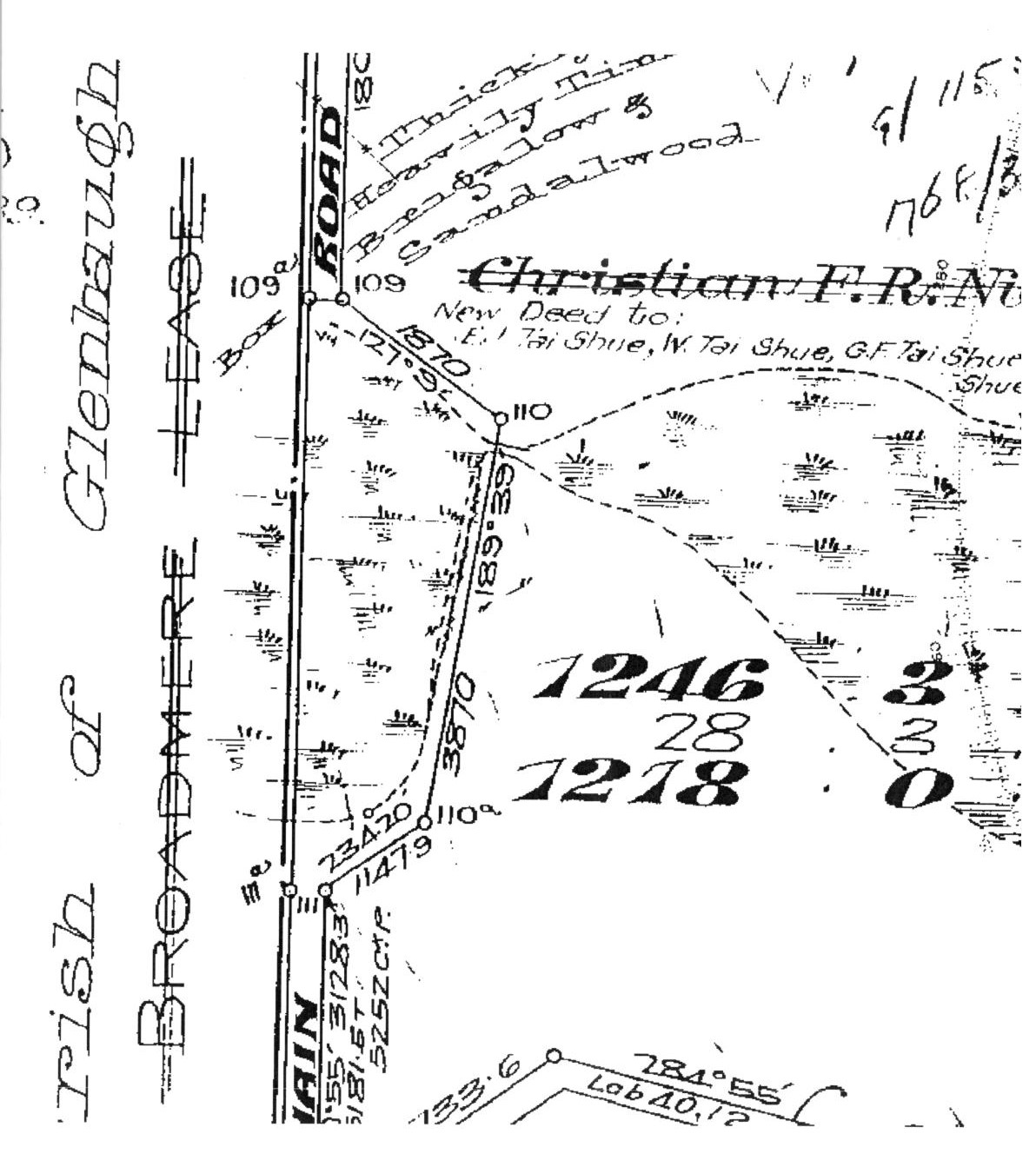
12 In his affidavit, Mr McClelland detailed the pertinent information that is recorded on the two plans mentioned above. In relation to Plan LAB4012, he stated:
The following information is recorded on Plan LAB4012:
(a) Instructions were received to create the plan on 2 November 1899;
(b) The surveyor provided the draft plans for examination on 6 July 1900;
(c) It was examined and charted on 28 August 1900 [for a description of what these terms mean, see Mr McClelland’s evidence at [18] below];
(d) Portions 8v, 9v, 10v and 11v were open for selection on 21 November 1900;
(e) The plan shows a note that “Portions 10 & 11 altered from 10v and 11v to avoid duplication”;
(f) By Government Gazette of 1909.1.1170, Portions 9v-11v were withdrawn from selection; and
(g) The plan depicts an area running north-south on the south part of the western boundary of Portion 11 (plotted in brown ink). This has been added at a later date to reflect part of the surveyed road shown on plan LE9.
13 In addition to the above, Plan LAB4012 evidences the following matters which are of some relevance to these road issues:
(a) On 24 February 1900, a surveyor employed by the Queensland Surveyor-General’s Department issued the following certificate:
I hereby certify that I, in person, made, and on the 24th Feb. 1900, completed the survey represented by this plan, on which are written the bearings and lengths of the lines surveyed by me, and that the survey has been executed in accordance with the existing regulations of the Surveyor-General’s Department.
(Emphasis in original)
(b) Consistent with paragraphs [12(e)] and [12(f)] above, the words “cancelled by Le 9” are written across the southern parts of Portions 10v and 11v on Plan LAB4012. As is already mentioned above, the southern parts of Portions 10v and 11v were subdivided to become Portions 26, 27 and 28 as shown on Plan LE9.
14 Further, consistent with [12(d)] above, the agreed bundle of documents includes a copy of the Queensland Government Gazette published on 6 October 1900, which included a notice made pursuant to the Land Act 1897 that the lands in Portions 8v, 9v, 10v and 11v (shown on Plan LAB4012) were declared:
… open for Selection as GRAZING SELECTIONS, under the provisions of the [Land Act 1897], on and after WEDNESDAY, the TWENTY-FIRST day of NOVEMBER, 1900, at ELEVEN O’CLOCK A.M., at the TAROOM LAND OFFICE ...
15 With respect to Plan LE9, Mr McClelland stated:
9. The following information is recorded on Plan LE9:
(a) Instructions were received to create the plan on 21 January 1908;
(b) The plan was examined on 8 May 1908;
(c) The plan was charted on 12 May 1908;
(d) The plan subdivides part of Portions 10 and 11 on plan LAB4012 in accordance with design plan LE7:
(e) Portions 26, 27 and 28 were selected and taken up by the persons identified in the “Particulars” table located in the top centre of the plan.
(f) The plan depicts an area running north south on the western boundary of Portion 26 as “THREE CHAIN ROAD [partly shown at [11] above].”
(g) The plan depicts an area of swamp within the area marked “THREE CHAIN ROAD.” The road boundary deviates around the swamp area which forms part of the road [shown at [11] above];
(h) The plan depicts a reference tree located near a corner marking at station “110” within Portion 26. The reference marking is shown as “↑ R 26” in the “Reference to Corner” table on the top right corner of the plan [see at [19(c)] below];
(i) The plan depicts the metes and bounds of the “THREE CHAIN ROAD” between reference points 109 and 110 as “127 degrees 09’, 1870 links”, between 110 and 110a as “189 degrees 39’, 3870 links” and between 110a and 111 as “234 degrees 20’, 1147.9 links” [shown at [11] above].
10. A reference to “↑ R 26” indicates that to the west of the corner marking station 110 was Crown road and to the east was Portion 26.
16 In addition, Plan LE9 evidences the following matters relevant to these road issues:
(a) On 5 March 1908, a surveyor employed by the Queensland Surveyor-General’s Department issued a certificate in the following terms:
I hereby certify that I, in person, made, and on the 5.3.1908 completed the survey represented by the plan, on which are written the bearings and lengths of the lines surveyed by me, and that the survey has been executed in accordance with the existing regulations of the Surveyor-General’s Department.
(b) With respect to Portion 26, the information recorded in the “Particulars” table at the top of Plan LE9 (see at [15(e)] above) was as follows (so far as can be deciphered): “AF [which, it is accepted, refers to “agricultural farm”], Farm No 199, Selector L.A. Peeck, ..., Remarks L13.20500 p.l.”. It should also be noted that these particulars were recorded in black ink and they appear to have been crossed through and replaced by other particulars in red ink. However, these later particulars in red ink are not relevant for present purposes.
17 There are two Executive acts in relation to which the State of Queensland was unable to produce any records. They are as follows:
(a) any Government Gazette (including a notice similar to [14] above) declaring that the lands in Portions 26, 27 and 28 (shown on Plan LE9) were open for selection in accordance with the provisions of s 75 of the Land Act 1897; and
(b) that the maps relating to Portions 26, 27 and 28 were exhibited to the public in accordance with s 84 of the Land Act 1897.
Mr McClelland’s written and oral evidence about surveying practice
18 The practice of the Queensland Government agencies responsible for the performance of land surveys, the preparation of survey plans and the charting and recording of those plans is described in Mr McClelland’s affidavit in the following terms:
[The purpose and context of survey plans]
Survey plans are records depicting cadastral and other lines such as lot or portion boundaries drawn in relation to natural features of the land. The cadastral and other lines are marked by reference to pegs or other marks placed upon the land (such as on the ground or on trees) and the bearings and distances from each of the pegs or marks to the next.
[The performance of a land survey]
In the performance of a survey and preparation of a survey plan, it has been a requirement, and part of the survey process, that:
(a) surveyors consider and take account of natural features of the land such as swamps and other topographical features when determining the location of pegs or markers to identify land boundaries;
(b) survey markers such as corner pegs or tree branding had to be made on the land; and
(c) such survey markers had to be drawn and identified on the survey plans.
[The preparation of a survey plan]
The process for the preparation of a survey plan involved the following, with the steps usually recorded on the survey plan when they were taken:
(a) Instructions were provided by the relevant Survey Office staff for an external surveyor to survey the area;
(b) A surveyor was engaged to survey the area;
(c) The surveyor went into the field, undertook the survey, and prepared field notes as a record of his survey;
(d) The surveyor used those field notes to prepare a draft survey plan;
(e) The surveyor provided the draft plan to the relevant Survey Office staff for checking or examination, which involved consideration of the survey plan to ensure it complied with the applicable Survey Office requirements, rules and regulations in effect at the time;
(f) Once the survey plan was examined it was then charted [see “The charting of survey plans” below];
(g) On some occasions, survey plans were stamped by the Survey Office Queensland (or its equivalent at the respective time), identifying the applicable Office file number and recording the receipt and processing by the Office of the survey plan;
(h) The survey plan was then made available to the public as the official record of the matters recorded on the survey plan.
[The charting of survey plans]
A survey plan was “charted” when the plan had been registered as the formal land administration record, land transactions (such as the selection of land for the grant of tenure) had proceeded, details of the plan and tenure had been recorded on an administrative map and actions such as the issue of deeds or leases were proceeding.
If a plan is recorded as “charted”, it is recognition that all actions have been carried out with respect to that plan which give it operational force and effect.
[The recording of survey plans]
As part of its land administration function, Queensland government agencies have long been responsible for the preparation, maintenance, publication and retention of survey plans. Survey plans were held in hard copy and used as administrative tools to record dealings in relation to the land depicted and changes made over time in respect of boundaries, portion numbers, etc were marked on the survey plans.
19 Some of the salient aspects of Mr McClelland’s oral evidence may be summarised as follows:
(a) In the early 20th century, three chains, or approximately 60 metres, was the normal width of a road in a rural area of Queensland;
(b) In undertaking a survey and preparing a plan, a surveyor would compile a set of field notes in which he would record the peg or natural feature on the ground that corresponded to a particular “station”. These “stations” are shown on Plans LAB4012 and LE9 by number, for example stations 22, 48 etc on the former, and stations 109, 110, 110a etc on the latter (see at [11] above);
(c) Each of the plans in question contains a table which records the pertinent details of the “Reference to Traverse and Road Secants” and “Reference to Corners” by station number, bearing and distance. The “Reference to Corners” table also includes the reference mark on the ground that the surveyor used, eg “Coolib.”, indicating a coolibah tree. Mr McClelland said those marks on the ground take precedence in interpreting where a boundary mark on a plan is located. In relation to the former, the following details are recorded for stations 109, 109a, 111 and 111a on Plan LE9:
Line | Bearing | Dist |
109-109a | 270o55' | 300 |
111-111a | 270o55' | 300 |
The details recorded on Plan LE9 in relation to the latter for stations 109–111 are as follows:
Cnr. | Bearing | From | Links | Marks. |
109 | 35o50' | Box | 543 | ↑ R26 |
110 | 280o10' | Coolib. | 457 | ↑ R26 |
111 | 335o15' | Box | 642 | ↑ R26 |
110a | 354o30' | Box | 48 | ↑ 26R |
(d) The details above would have been recorded by the surveyor in accordance with the rules and directions to surveyors issued initially under the Land Act 1897 and then under the Land Surveyors Act 1908 (Qld). Mr McClelland described those instructions in these terms:
They were instructions in terms of various tenures. How to mark passes, how to survey passes, and there - there were tables, diagrams about the types of marks to be placed, the types of brands to be placed on trees in urban areas, how they mark-up section corners and allotment corners, and how they brand those, so it was all there published for surveyors.
20 Further, Mr McClelland was examined at length about the stations marked on Plans LAB4012 and LE9 in the vicinity of the swamp area shown on both plans (see Plan LE9 at [11] above). Beginning with the stations marked on Plan LAB4012, he said that station 22 shown on the western boundary of Portion 11v on Plan LAB4012 would correspond with a point “that would be somewhere near [station] 109a” on the western side of the road on Plan LE9. He added that station 22 would be represented by a mark on the ground. He also said that he assumed that the surveyor “has come three chains from that corner to position the eastern side of the road, at that point”, namely between stations 109a and 109. He went on to say that:
… if [station] 109a coincides with [station] 22, then there should be a mark on both sides. One would be an original one from LAB4012, and then [the surveyor] would have placed a new one at 109 on the eastern side of the road from that mark.
21 Earlier in his evidence, he agreed that there is no bearing or distance measurement shown on Plan LE9 for the line bisecting the swamp area on the western boundary of Portion 26 between stations 109a and 111a. He also agreed that there are no references recorded in the “Reference to Corners” table with respect to stations 109a and 111a, and that, in all likelihood, those stations were therefore not marked on the ground. However, he qualified that by saying station 109a “could have been [the] original corner from [Plan] LAB4012”. He also said that the surveyor would not have been required to mark the corners for those stations on the ground “because he is not surveying the western side of the road. He is only surveying the eastern side of the road.” He said that the “western boundary was previously surveyed on [Plan] LAB4012”. When asked how he had come to that conclusion, he said:
[F]rom experience, and - and the fact that on [Plan] LAB4012 it didn’t surveyed (sic) the road, it only surveyed the boundary - the western boundary of Portion 11, which coincided with the parish boundary for Glenhaughton, on [Plan] LAB4012.
22 Finally, in relation to the broken line shown inside the eastern boundary deviation around the swamp (see the plan at [11] above), Mr McClelland said that he thought the surveyor had allowed 10 or 15 metres between the eastern boundary and the edge of the swamp to allow for the passing of traffic.
The contentions on the road issues
23 With respect to the road dedication issue, the applicant accepted that the Full Court decision in Fourmile v Selpam Pty Ltd (1998) 80 FCR 151 (Fourmile) is binding authority to the effect that, where land is surveyed and declared open for selection in accordance with the statutory process prescribed under a relevant piece of legislation in force at a particular time (in this case the Land Act 1897) and the official survey plans prepared in following that process showed an area of land marked as a road, that combination of factors was sufficient to constitute the dedication of that area of land as a public road. Applied to this case, the applicant therefore accepted that, if there is evidence that a survey was performed and a plan was prepared and charted in accordance with s 77 of the Land Act 1897, and if that plan showed an area of land set aside as a road, and if there is evidence that a proclamation was subsequently made under s 75 of that Act that the land so surveyed was declared open for selection, that series of steps had the effect of dedicating that area of land as a public road. Finally, with respect to the native title implications flowing from such a road dedication, the applicant accepted that the valid dedication of an area of land as a public road made prior to the commencement of the Racial Discrimination Act 1975 (Cth) (the RDA) constituted a valid act for the purpose of s 23B of the NTA to extinguish all native title rights and interests that existed in that area of land.
24 However, the applicant claimed that none of these concessions availed the State in relation to the road dedication issue. That was so, because it contended, firstly, that, since the proclamation made on 3 October 1900 under s 75 of the Land Act 1897 relating to the land shown on Plan LAB4012 (which included area 33) did not show a north-south road on the western boundary of Portion 11v, no road dedication was effected by that proclamation. Secondly, the State had not produced any evidence that such a proclamation had been made after Plan LE9 was charted on 12 May 1908. In this respect, it is to be recalled that Plan LE9 effected the subdivision of Portions 26, 27 and 28 from the southern area of Portion 11v as shown on Plan LAB4012. In the absence of such a proclamation, the applicant contended that there was no evidence that the north-south road shown on the western boundary of Portion 26 on Plan LE9 was duly dedicated as a public road in accordance with the process prescribed under the Land Act 1897. Finally, relying on Minister for Natural Resources v New South Wales Aboriginal Land Council (1987) 9 NSWLR 154 (Aboriginal Land Council) at 164 per McHugh JA, the applicant contended that the State could not rely upon the presumption of regularity to ask the Court to infer that such a proclamation had been made prior to the grants of Portions 26–28 as shown on Plan LE9, because that presumption only applied to the prerequisites that are anterior to the exercise of the statutory power to make such grants and each of the grants in question was made after, and not before, the supposed proclamation. In any event, the applicant contended that the grants of Portions 26–28 could have been made under the unsurveyed lands process prescribed in s 76 of the Land Act 1897 and, that being so, s 77 of that Act would not have applied to them.
25 In the alternative, assuming that the road dedication issue were to be determined against it, the applicant contended that, based on the available evidence, it should be inferred that the western boundary of the north-south road shown on Plan LE9 is located three chains (approximately 60 metres) to the west of the eastern boundary line marked around the swamp shown on that Plan (see the plan at [11] above). To make good this contention, the applicant relied, first, on the words “Three Chain Road” appearing on the road shown on Plan LE9, to the south and north of the swamp area; secondly, on the evidence of Mr McClelland that the stations numbered (from south to north) 111, 110a, 110 and 109 shown on Plan LE9 referred to markings made by the surveyor on the ground (that is, to trees or similar natural items) and that such survey markings take precedence in determining the location of the boundary; and finally, on the evidence of Mr McClelland that the stations numbered 111a and 109a, shown on Plan LE9 on the western boundary of Portion 26, do not refer to survey markings made on the ground and that no such survey markings are shown on Plan LE9, which indicate the location of the western boundary of the road in question.
26 For its part, the State acknowledged that it was unable to produce evidence that Plan LE9 was publicly exhibited in accordance with s 84 of the Land Act 1897, or that a proclamation had been made that Portions 26–28 had been declared open for selection in accordance with s 75 of that Act. However, noting that no issue had been raised by the applicant in relation to the former, the State relied upon the presumption of regularity to fill the evidentiary lacuna in relation to the latter. In this regard, it urged the adoption of the same approach as was taken by Drummond J in Fourmile. It pointed out that, in Fourmile, the Full Court dealt with the provisions of ss 41 to 46 of the Crown Lands Act 1884 (Qld) which were effectively replaced by ss 75 to 78 of the Land Act 1897. Based upon the various steps recorded on Plan LE9, the State therefore contended that it could be inferred that the land constituting Portions 26–28 had been declared open for selection in accordance with s 75. In this respect, the State particularly relied upon the “Particulars” table at the top of Plan LE9, which recorded the details of the original grants of agricultural farm leases in respect of those portions. As to the judgment of McHugh JA in Aboriginal Land Council, the State submitted that his Honour did not conclude that the legislative steps in question had to be prerequisites for, or anterior to, the performance of the public duty in question, only that they had to be performed as part of the legislative process concerned. It submitted that the same approach was apparent from the judgment in Fourmile.
27 On the road boundary issue, the State submitted the explanation given by Mr McClelland in his evidence established that stations 111, 110a, 110 and 109 on Plan LE9 were all marked on the ground by the surveyor and provided clear evidence of the location of the eastern boundary of the road. I note, in passing, that, ultimately, the applicant did not dispute this contention. As for the western boundary of the road, the State submitted that, while Mr McClelland’s evidence was to the effect that stations 109a and 111a were not marked on the ground, the contents of Plans LAB4012 and LE9, when considered together, showed that that boundary had been surveyed in accordance with s 77 and was located as shown on both of those plans. I take this to mean along the western boundary of Portion 11v on the former, and of Portion 26 on the latter.
The declaration in relation to Portions 26–28 can be inferred
28 The road dedication issue essentially reduces to the question whether the presumption of regularity can be relied upon by the State to overcome the absence of any evidence to show that Portions 26–28 on Plan LE9 had been declared open for selection in accordance with s 75 of the Land Act 1897. The applicant claims that the State cannot rely upon the presumption of regularity because it only applies to the prerequisites that are anterior to the exercise of a statutory power. To advance this contention, it relied on the judgment of McHugh JA in Aboriginal Land Council. In that case, a question arose as to whether the Secretary of the Western Lands Commission, who had purported to grant permissive occupancy of certain land, was acting pursuant to a delegation made by the Minister for Natural Resources. McHugh JA (with whom Kirby P agreed at 157) concluded (at 164) that the presumption (or legal maxim) of regularity could be used to infer that the Secretary had the requisite authority to make the grants. In reaching that conclusion, his Honour made the following observations (at 164):
The natural home of the maxim is public law. Where a public official or authority purports to exercise a power or to do an act in the course of his or its duties, a presumption arises that all conditions necessary to the exercise of that power or the doing of that act have been fulfilled. Thus a person who acts in a public office is presumed to have been validly appointed to that office: M'Gahey v Alston (1836) 2 M & W 206 at 211150 ER 731 at 733; R v Brewer (1942) 66 CLR 535 at 548; ; Hardess v Beaumont [1953] VLR 315 at 318-319.
…
A particular application of the maxim which is relevant to this case is stated in Broom’s Legal Maxims, 10th ed (1939) at 642 as follows:
“… where acts are of an official nature, or require the concurrence of official persons, a presumption arises in favour of their due execution. In these cases the ordinary rule is omnia praesumuntur rite et solenniter esse acta donec probetur in contrarium — everything is presumed to be rightly and duly performed until the contrary is shown.”
29 Clarke A-JA reached the same conclusion (at 169), observing that:
In my opinion in this case it is appropriate to presume, in default of any reason to conclude to the contrary, that the Minister had duly delegated the relevant power under s 17A to the signatory of the document: Western Stores Ltd v Orange City Council [1971] 2 NSWLR 36 at 47; McLean Bros & Rigg Ltd v Grice (1906) 4 CLR 835 at 849-850.
30 I do not consider McHugh JA intended to limit the application of the presumption of regularity in the way contended for by the applicant. While the first example given by his Honour that the “presumption arises that all conditions necessary to the exercise of that power or the doing of that act have been fulfilled” does support this confined operation of the presumption, the other examples his Honour gave focus on the official duty involved and presume that it was “rightly and duly performed until the contrary is shown”. The statement of the presumption by Clarke A-JA is in similar terms. Furthermore, this conclusion is, in my view, supported by the approach taken in Fourmile. In that case, Drummond J (with whom Burchett J agreed at 153) inferred (at 168) that a map prepared by the Surveyor-General showing the location of a road had been publicly exhibited as required by s 46 of the Crown Lands Act 1884 (the equivalent of s 84 of the Land Act 1897). His Honour held (at 168) that such could be inferred:
… by reason of that aspect of the presumption of regularity, which Wigmore on Evidence (1981 Rev ed), at 2534 calls the presumption of due performance of official duty, that, following the proclamation of 31 October 1890, the map showing the location of Lot 25 and the road in question, which the proclamation recorded had been prepared by the Surveyor-General, was publicly exhibited, as required by s 46.
31 It will be noted that Drummond J referred to the official duty concerned and did not express the presumption in the confined manner advanced by the applicant.
32 Taking into account these observations, in the circumstances of this case, I consider that an inference can be drawn that, in the absence of anything pointing to the contrary (and there is nothing), before Portions 26–28 were granted as agricultural farms, they had been officially and duly declared open for selection in accordance with s 75 of the Land Act 1897. To explain why I have reached this conclusion, it is appropriate to begin with an observation made by Drummond J in Fourmile. It was that, since the establishment of the State of Queensland, the valid alienation by grant of an interest in Crown land in the State required legislative authority. His Honour said (at 164):
Legislative authority has been essential to the validity of any dealing with Crown wastelands in Queensland at least since the enactment of s 40(1) of the Constitution Act 1867 (Qld), which vested in the Queensland legislature “the entire management and control of” those lands. This is an embodiment of the principle first applied to Australia by s 2 of the Land Sales Act 1842 (Imp) (5 & 6 Vict, Ch 36) that the wastelands of the Crown were to be thereafter dealt with only by legislative authority; previously, it was the prerogative power that had provided the authority for disposing of interests in the Crown’s lands in Australia: see Wik Peoples at 461-462 and 477-478 (FCR) and Wik Peoples at 91, 139-140, 173-174 and 227 (CLR).
33 In this case, the general legislative authority concerned was contained in s 12 of the Land Act 1897. It provided that:
The Governor in Council may, in the name of Her Majesty, subject to the provisions of this Act, grant in fee-simple, or demise for a term of years, any Crown Lands within the Colony of Queensland.
34 Then, the specific legislative authority relating to the grant of Country Lands was contained in Part IV of the Land Act 1897, headed “Selections” (ss 75 to 162), and particularly s 75 thereof, appearing under the heading “General provisions relating to all Selections”. The expression “Country Lands” was defined in s 4 as: “all Crown lands which are not town lands or suburban lands”. In essence, these provisions required that, before a person could apply to the Crown for the grant of an area of Country Lands, the land in question had to be declared open for selection. As can be seen above (see at [10]), s 75 provided for two kinds of declaration that Country Lands were open for selection: as unsurveyed lands, or as surveyed lands. In this matter, the applicant accepted that it can be inferred from the information recorded on Plan LAB4012 that the lands, including Portion 11v (the portion from which Portions 26–28 were subsequently subdivided) were declared open for selection as surveyed lands. The information from which this could be inferred included the fact that Plan LAB4012 reveals that a survey of those lands had been undertaken pursuant to s 77 of the Land Act 1897; that a certificate had been issued by the surveyor on 24 February 1900 (see at [13(a)] above); that following that survey, Plan LAB4012 was duly examined and charted on 28 August 1900 (see at [12(c)] above); and, most importantly, that all of these acts occurred before the publication of the proclamation of the declaration pursuant to s 75 of the Land Act 1897 on 6 October 1900 (see at [14] above). It is worth adding at this point that this inference disposes of the applicant’s contention at the end of [24] above. Once the lands comprising Portion 11v were declared open for selection as surveyed lands, this necessarily meant that those lands were from that time onwards surveyed lands. Even if, as s 75 of the Land Act 1897 provided, they were subsequently withdrawn from selection at some point prior to the grant of Portion 26 in 1908, that did not, in my view, alter their character as surveyed lands.
35 However, as the applicant correctly observed, the October 1900 proclamation and declaration did not bring about the dedication of the road in question because it was not recorded on Plan LAB4012. Instead, as Mr McClelland said in his affidavit, the existence of the road was inserted on Plan LAB4012 at some later date (see Mr McClelland’s evidence at [12(g)] above). Nonetheless, both the subdivision of Portions 26–28 from Lot 11v and the three chain road along the western boundary of Portion 26 are shown on Plan LE9. Furthermore, that plan does contain a certificate in almost identical terms to the one issued in relation to Plan LAB4012, suggesting that both were surveyed under the same statutory provision, namely s 77 of the Land Act 1897 (compare [13(a)] with [16(a)] above). Further still, the “Particulars” table at the top of Plan LE9 shows the grant of Portion 26 as an agricultural farm to L.A. Peeck (see at [16(b)] above). To have achieved that grant, it can be inferred that the grantee, L.A. Peeck, complied with the requirements of Part IV of the Land Act 1897 providing for the grant of Country Lands that had been declared open for selection (see at [34] above). Finally, and significantly for present purposes, s 91 of the Land Act 1897 prescribed how one may apply for a selection of Country Lands. It stated, among other things, that:
The application shall be for a portion, as specified in the Proclamation, and when the land is open for selection in alternative modes shall state precisely which mode of selection is desired.
(Emphasis added)
36 It can therefore be inferred that Portion 26 would not have been granted to the grantee, L.A. Peeck, unless he or she specified the Proclamation relating to that portion being declared open for selection in his or her application. That being so, it can also be inferred that the officials concerned had performed their duty to publish the Proclamation of a declaration under s 75 of the Land Act 1897 to the effect that the lands, including Portion 26, were open for selection. Finally, and perhaps most importantly, the applicant has produced no evidence to suggest that any of the official duties mentioned above was not performed.
37 For these reasons, I infer that, subsequent to the charting of Plan LE9 and before Portion 26 was granted to L.A. Peeck, a Proclamation of a declaration pursuant to s 75 of the Land Act 1897 was duly made to the effect that Portions 26–28 were open for selection. It follows, based on the ruling in Fourmile, that the land marked as a road on Plan LE9 constituted the dedication of that area of land as a public road and that road is therefore a “public work” as defined in s 253 of the NTA. It follows further that this dedication, made as it was prior to the commencement of the RDA, was valid and therefore operated as a previous exclusive possession act under s 23B(7) of the NTA to extinguish all native title rights and interests that existed in the area of land comprising that road.
The western boundary of the road is the western boundary of Portions 11v and 26 as shown on Plans LAB4012 and LE9
38 I will now turn to consider the alternative issue raised by the applicant, namely the road boundary issue. First, I note that, at the conclusion of oral submissions, there was no dispute between the parties that the eastern boundary of the road on the western side of Portion 26 is located along the line marked on Plan LE9 which joins (moving from south to north) stations 111, 110a, 110 and 109 (see at [11] above). The question therefore raised by this road boundary issue is confined to the location of the western boundary of the road in question. On that question, I do not accept any of the contentions relied upon by the applicant (see at [25] above) to claim that that boundary is located three chains, or 60 metres approximately, to the west of the undisputed eastern boundary described above. Instead, I consider the evidence establishes that the western boundary of the road is the same as the western boundary of Portion 26 and, before that Portion came into existence, Portion 11v. The following are my reasons for reaching this conclusion.
39 First, the words “Three Chain Road” do not, in my view, support the applicant’s claim about the location of the boundary. While those words variously appear above (“Road”) and below (“Three Chain”) the area where the road traverses the swamp area shown on Plan LE9 between stations 111 and 111a in the south and 109 and 109a in the north (partly shown in the plan at [11] above), they do not appear within that swamp area and they do not, therefore, in my view, say anything about the width of the road in that area. Furthermore, in that swamp area, no three chain wide corridor is marked on Plan LE9, whether to the east of the western boundary of Portion 26, or to the west of the agreed eastern boundary of the road.
40 Secondly, while it is true that, based upon the evidence of Mr McClelland, there is no evidence on Plan LE9 to indicate that the points numbered 109a and 111a represent stations marked on the ground by the surveyor during the survey, I do not accept that the line joining those two points as shown on Plan LE9 can be ignored. In the first place, while Mr McClelland said that the station markings on the ground take precedence in determining the location of a boundary, I did not understand him to be saying that one should ignore all other markings when construing an official survey plan. Obviously, a person wishing to establish where a boundary is physically located on an area of land would use the markings made by the surveyor on the ground to do that. However, when one is interpreting an official survey plan, it is equally obvious, in my view, that regard must be had to all of the information that is duly recorded on that plan, not just the information relating to the location of any stations marked on the ground. In this case, the swamp area shown on Plan LE9 provides an example. It is depicted with the markings as shown at [11] above, not by reference to any station numbers.
41 It follows that, even though points 109a and 111a may not represent stations that are marked on the ground, they do show points on Plan LE9 which are of importance in construing the location of the western boundary of the road as represented by that Plan. Mr McClelland said in his evidence that point 109a appeared on Plan LE9 three chains to the western side of station 109 and probably coincided with station 22 as marked on Plan LAB4012. Station 22, among others on Plan LAB4012, shows the position of the western boundary for Portion 11v on Plan LAB4012. While Mr McClelland was not asked the same questions about point 111a, I infer from his evidence about point 109a that it served the same purpose of marking the western boundary of Portion 26 at that point.
42 It is also significant, in my view, that the line joining points 109a and 111a is located in approximately the same position on Plan LE9 as the western boundary of Portion 11v on Plan LAB4012. Furthermore, there is no other line showing the western boundary of Portion 26 on Plan LE9. All of this is consistent with Mr McClelland’s evidence that the surveyor preparing Plan LE9 was not surveying the western boundary of Portion 26, but was instead surveying the eastern boundary of the road, and had therefore used the western boundary of Portion 11v, as already surveyed and shown on Plan LAB4012, as the western boundary of Portion 26. I infer from this evidence that, if the surveyor had intended that the western boundary of the road was located somewhere other than the western boundary of Portion 26, he would have included some expression of that important distinction somewhere on Plan LE9. There is nothing on Plan LE9 to that effect.
43 Based on these observations, I consider that the proper interpretation of Plan LE9 is that the line joining points 109a and 111a, which coincides with the western boundary of Portion 11v as shown on Plan LAB4012, was intended to show both the western boundary of Portion 26 and also the western boundary of the road in the vicinity of the swamp area shown on that Plan.
Conclusion – affirmative answer to the question at [2(c)] above
44 For these reasons, the question at [2(c)] above must be answered in the affirmative.
The Metwally issue – Areas 73, 224 and 226
Introduction
45 The historical context to the Metwally issue (see at [3(b)] above] is of much more recent origins. It dates from the late 1960s, when a number of leasehold interests were granted, or granted and converted, under the Land Act (Qld), which affected the land in areas 73, 224 and 226. Importantly, it is common ground that: those leasehold interests all arose after the passage of the RDA on 31 October 1975; they were all inconsistent with the provisions of that Act; and they were therefore rendered invalid by the operation of s 109 of the Constitution. In submissions, this invalidity was agreed to be of the second kind identified in Western Australia v Ward (2002) 213 CLR 1; [2002] HCA 28 at [108]: “[A] State law [that] … extinguishes only native title and leaves other titles intact … and the discriminatory burden of extinguishment is removed because the operation of the State law is rendered invalid by s 109 of the Constitution.” Finally, it is common ground that all of the interests in question were surrendered prior to 1 January 1994, when the NTA came into effect.
The grant, and grants and conversions, concerned
46 The relevant history of the grant (area 226) and the grants and conversions (areas 73 and 224) concerned in this Metwally issue are as follows:
Area 73
(a) On 15 April 1982, Grazing Farm Lease 40/1824 was granted under the Land Acts 1962-1981 (Qld); and
(b) On 15 May 1984, s 61 of the Land Act Amendment Act 1984 (Qld) came into effect. Under s 61(1)(a) of that Act, this Grazing Farm Lease was converted into a Grazing Homestead Lease Perpetual.
Area 224
(a) On 19 September 1968, Grazing Homestead Lease 40/1789 was granted under the Land Acts 1962-1968 (Qld) and the Brigalow and Other Lands Development Acts 1962-1965 (Qld); and
(b) As noted above, on 15 May 1984, s 61 of the Land Act Amendment Act 1984 (Qld) came into effect. Under s 61(1)(a) of that Act, this Grazing Homestead Lease was also converted into a Grazing Homestead Lease Perpetual.
Area 226
(a) During 1978, the following leases were granted under Div IV of the Land Act 1962-1975 (Qld), which together covered the whole of area 226:
(i) Grazing Homestead Lease Perpetual 36/7570 on 2 March 1978;
(ii) Grazing Homestead Perpetual Lease 36/7569 on 4 May 1978; and
(iii) Grazing Homestead Perpetual Lease 36/7571 on 18 May 1978.
47 Affecting all of the three areas in question, between 1986 and 1990 all of the above leasehold interests were progressively surrendered and the land to which they related was incorporated into Queensland State Forests Nos 52 and 62.
48 To complete this history, as is already mentioned above, the NTA came into effect on 1 January 1994 and the Native Title (Queensland) Act 1993 (Qld) (the QNTA) came into effect on 28 November 1994.
The issues that arise
49 A different aspect of the previous exclusive possession acts provisions of s 23B of the NTA arises for consideration in this Metwally issue. Within the terms of s 23B, there is no dispute that the grant, or grants and conversions, of each of the leasehold interests above:
(a) is an “act” within the meaning of s 226 of the NTA;
(b) is a “past act” within the meaning of s 228(2) of the NTA. Specifically, the leases concerning areas 73 and 224 involved “an act consisting of the … amendment … of legislation” (sees 228(2)(a)(i)) and the leases concerning area 226 were “any other act” (see s 228(2)(a)(ii));
(c) is a Scheduled interest within the meaning of s 249C and clause 23(8), Part III of Schedule 1 of the NTA (see s 23B(2)(c)(i)); and
(d) took place on or before 23 December 1996 (see s 23B(2)(b)).
50 What is in dispute is whether, under s 23B(2)(a), the leases in question are “valid” because of Div 2 or 2A of Part 2 of the NTA. Division 2 of Part 2 is directed to the validation of past acts and Div 2A of Part 2 is directed to the validation of immediate period acts. It is not in dispute that this issue only involves the former Division. That Division contains provisions which validate certain past acts attributable to the Commonwealth and to the States and Territories. Section 14 of the NTA achieves the former and s 19 allows the State and Territory governments to achieve the latter. The central question, therefore, in this Metwally issue, is whether the acts connected with the grants of the leasehold interests above, all of which came into existence and were surrendered before the past act validation provisions of the NTA came into effect, were duly validated by the provisions of Div 2 of Part 2 of the NTA.
The contentions
51 Relying upon Metwally, the applicant contended that the Commonwealth cannot retrospectively legislate to overcome the invalidity of a piece of State legislation which was brought about by an inconsistency with Commonwealth legislation and the operation of s 109 of the Constitution. It contended that the Commonwealth could only legislate to validate such an invalidity prospectively. As a consequence, the applicant contended that the apposite provisions of the NTA and the QNTA could only validate an invalidity to which they related from the date they each came into effect. It followed, so the applicant claimed, that, since the Executive acts (the grant of the leases over area 226) and the Legislative acts (the conversions of the leases effected by s 61 of the Land Act Amendment Act 1984 (Qld) in relation to areas 73 and 224) were not extant at the time the NTA and the QNTA came into effect, none of those acts could be retrospectively validated by the “past acts” provisions of those Acts. The applicant submitted that nothing said in Western Australia v Commonwealth (1995) 183 CLR 373 (the Native Title Act case) affected this particular aspect of the ruling in Metwally because s 19 of the NTA was not challenged in that case on Metwally grounds, and all the references to Metwally in that case were directed to other issues. Alternatively, the applicant submitted that the observations in the Native Title Act case relied upon by the State were obiter dicta, which were not “seriously considered” dicta of the kind described in Farah Constructions Pty Ltd v Say-Dee Pty Ltd (2007) 230 CLR 89; [2007] HCA 22 (Farah Constructions), and were therefore not binding on this Court.
52 For its part, the State submitted that the Metwally principle, in the form advanced by the applicant, did not exist. Instead, the principle for which Metwally stood was that the Commonwealth could not itself legislate to attempt to retrospectively remove an invalidity arising from the operation of s 109 of the Constitution. Nonetheless, the State contended that some of the majority judgments in Metwally made it plain, as did the plurality judgment in the Native Title Act case, that the Commonwealth and State governments could act together to overcome the effects of past invalidity arising from the operation of s 109 of the Constitution if the Commonwealth first acted to remove the source of the inconsistency and then allowed the State to pass legislation to validate the past invalid acts in question. The State therefore submitted that ss 7, 19 and 228 of the NTA and s 8 of the QNTA together achieved an effective validation of the past invalid acts associated with the leases that were granted, or came into existence, with respect to areas 73, 224 and 226.
The Metwally principle
53 Given that I have described this issue as the Metwally issue, it is appropriate for me to begin by considering the High Court’s judgment in that case. First, it is necessary to briefly describe the factual and historical context in which that judgment was delivered. Mr Metwally was an Egyptian person. He was enrolled for the degree of Doctor of Philosophy in the Department of Metallurgy at the University of Wollongong. In 1981 and 1982, he made two complaints against the University alleging it had discriminated against him in contravention of the provisions of the Anti-Discrimination Act 1977 (NSW) (the ADA(NSW)). Those complaints were eventually heard by the Tribunal established under the ADA(NSW) and it delivered a decision in which it found both complaints had been established and it ordered the University to pay Mr Metwally damages totalling $46,500. It also made a direction with respect to the research work undertaken by Mr Metwally during his degree studies at the University. The University appealed the Tribunal’s decision to the New South Wales Court of Appeal. In its notice of appeal, it attacked the validity of s 3 of the Racial Discrimination Amendment Act 1983 (Cth) (the RDA Amendment Act), which had inserted a new s 6A in the RDA. That section provided, among other things, that:
This Act is not intended, and shall be deemed never to have been intended, to exclude or limit the operation of a law of a State or Territory that furthers the objects of the Convention and is capable of operating concurrently with this Act.
54 It was inserted in the RDA in an attempt to overcome the effect of the earlier High Court judgment in Viskauskas v Niland (1983) 153 CLR 280. In that judgment, the Court held that various provisions of the ADA(NSW) – those that had been relied upon by Mr Metwally to make his complaint about the University – were inconsistent with the RDA and were, to that extent, invalid by the operation of s 109 of the Constitution. On the application of the Attorney-General for New South Wales, the University’s appeal was removed into the High Court to determine two questions related to the validity of s 3 of the RDA Amendment Act. By a majority of four (Gibbs CJ, Murphy, Brennan and Deane JJ) to three (Mason, Wilson and Dawson JJ), the Court held that s 3 of the RDA Amendment Act was invalid. While they are lengthy, it is appropriate to set out in full the main parts of the majority judgments that were cited by the parties in submissions on this issue. First, Gibbs CJ (at 457–458):
Before the Amendment Act came into effect, the Commonwealth Act, on its proper construction, was intended to be a complete and exclusive statement of the law of Australia with regard to racial discrimination, and Pt II of the Anti-Discrimination Act was inconsistent with that law and therefore invalid by force of s. 109. What the Amendment Act in effect provides is that the Commonwealth Act should now be understood as though it did not have that intention and that Pt II of the Anti-Discrimination Act was therefore not inconsistent with it. In other words, the Parliament has attempted to exclude the operation of s. 109 by means of a fiction. The short answer to the submissions of the respondents is that the Parliament cannot exclude the operation of s. 109 by providing that the intention of the Parliament shall be deemed to have been different from what it actually was and that what was in truth an inconsistency shall be deemed to have not existed. Section 109 deals with “a matter of prime importance” in the constitutional framework (see Butler v. Attorney-General (Vict.)), namely the effect of an inconsistency between the enactments of two legislatures both of which operate in the same territory. Its provisions are not only critical in adjusting the relations between the legislatures of the Commonwealth and the States, but of great importance for the ordinary citizen, who is entitled to know which of two inconsistent laws he is required to observe. With all respect, I do not agree with the remark of Evatt J. in Victoria v. The Commonwealth, that the section does “no more than declare a rule of last resort”. If there is an inconsistency between a law of a State and a law of the Commonwealth there is no other rule than that laid down by s. 109 by which the inconsistency may be resolved. In the present case, since an inconsistency in fact existed, the provisions of s. 109 were called into play and their effect cannot later be excluded by retrospectively declaring that the truth was other than it was.
(Footnotes omitted)
55 Secondly, Murphy J (at 468–469):
Can s. 109 invalidation be overcome by legislation? At the time of the commission of the acts of racial discrimination, the State Act was invalid by reason of s. 109 of the Constitution (the Viskauskas Case). It was invalid from its inception and continues to be invalid at least until the operation of the Amendment Act. Can the invalidating effect of s. 109 during that period be removed by an Act?
… The answer is that s. 109 would already have operated throughout that time to invalidate the State Act. Parliament cannot alter the incidence of s. 109 so as to render the State Act valid during that time. An Act cannot undo the invalidating effect which s. 109 has had on a State Act.
As from the commencement of operation of the Amendment Act, the basis on which s. 109 could operate in respect of any State Act that “furthers the objects of the Convention and is capable of operating concurrently with” the Racial Discrimination Act, as amended, was removed. But that did not affect the previous operation of s. 109. If an inconsistency occurs because of prospective or retrospective operation of federal or State law, s. 109 operates to render the State law invalid to the extent of the inconsistency. But retrospective operation of federal law cannot render valid what s. 109 made invalid. This would elevate legislation above the Constitution.
Equally, State legislation cannot overcome the invalidating effect of s. 109. Suppose an inconsistency arose only because of a particular feature of a State Act but the result was the invalidity not merely of that feature but of the whole State Act. Suppose the State retrospectively amended the State Act to delete that feature. Nevertheless the State Act would remain invalid until the amendment.
(Footnotes omitted)
56 Thirdly, Brennan J (at 474–475):
When inconsistency between a Commonwealth law and a State law is removed by an amendment of the Commonwealth law, the condition which governs the operation of s. 109 is no longer satisfied. As the temporal operation of s. 109 depends on the satisfaction of the condition from time to time, the State law takes or regains its full force and effect with the amendment of the Commonwealth law but, in my opinion, a retrospective amendment of the Commonwealth law does affect the past operation of s. 109 upon the State law. The period during which the State law was inconsistent with the Commonwealth law is a matter of history, not of legislative intention. If the retrospective amendment of the Commonwealth law were effective to satisfy retrospectively the condition governing the operation of s. 109, the operation of s. 109 would be contradictory; prior to the retrospective amendment, s. 109 would have deprived the State law of legal force and effect, yet after the amendment it would be necessary to deny that s. 109 had any operation on the State law during the same period. It is impossible to suppose that s. 109 could so operate as to attribute to a State law no legal force and effect in its application to acts, matters and things that occurred or existed prior to the amendment of the Commonwealth law and, after the amendment, to acknowledge that the State law had full force and effect in its application to the same acts, matters and things.
Where the condition governing s. 109 is in truth satisfied, it is not within the power of the Parliament to deem it not to be satisfied. The Parliament can remove an inconsistency, but it cannot deem an inconsistency to be removed. …
If the Parliament is unable legislatively to deny the existence of direct inconsistency, it is equally unable legislatively to deny that the inconsistent laws existed contemporaneously. Satisfaction of the condition governing s. 109 can be ascertained only from time to time by reference to the laws that are standing on the statute books of the Commonwealth and the States, and the operation of s. 109 depends upon the fact that inconsistent laws are on the statute books at the same time. Though a law of the Commonwealth can be given a retrospective operation, it cannot retrospectively endow a State law with the force and effect of which s. 109 deprived it before the retrospective Commonwealth law was enacted. It follows that the events upon which the first respondent's claims for relief were founded were, at the time when they occurred, devoid of legal effect under Pt II of the State Act.
(Emphasis added)
57 Finally, Deane J (at 478–479):
Section 109 of the Constitution is not concerned with legal fictions. It is concerned with the reality of contemporaneous inconsistency between a valid law of the Commonwealth and an otherwise valid law of a State. According to its terms, its operation is immediate. Its terms are unqualified and self-executing. If there is inconsistency between an otherwise valid law of a State and a valid law of the Commonwealth the State law shall be, to the extent of the inconsistency, invalid. It is not the Commonwealth law which operates to make the State law invalid, it is the Constitution itself: see Federated Saw Mill &c. Employès of Australasia v. James Moore & Son Pty. Ltd.; Wenn v. Attorney-General (Vict.). It is the Constitution and not the Commonwealth Parliament which tells the citizen faced with the dilemma of inconsistent Commonwealth and State laws which both, according to their terms, apply to him or her that the State law is invalid and can be disregarded. If, at some subsequent time, the Commonwealth repeals or amends its law to remove the inconsistency, the State law will then become again valid or operative not from some prior date but from the time when there was, in fact, no longer inconsistency. The fact that the Commonwealth Parliament legislates retrospectively to introduce the fiction that, for the purposes of its law, its inconsistent law never existed or had a different operation to that which it in fact had cannot alter the objective fact that at the previous time when s. 109 operated that inconsistency did exist. Nor can it alter the fact that the immediate and self-executing provisions of s. 109 have already operated upon that inconsistency to invalidate the State law not for the period in which the Commonwealth Parliament, by the introduction of a fiction for its purposes, has subsequently said that its law had a different operation to that which it in fact had but for the period in which the fact of that inconsistency existed. So to say is not to construe s. 109 of the Constitution as imposing a restriction on Commonwealth legislative power. It is simply to recognize that while the Commonwealth can retrospectively legislate for itself it cannot retrospectively impose as State law the provisions of a law which the Constitution has said was invalid because of contemporaneous inconsistency which has subsequently been removed. That is something which, if it is to be done, must be done retrospectively by the relevant State.
(Footnotes omitted and emphasis added)
58 With the addition of the word “retrospectively” after the words “Commonwealth Parliament cannot”, in my view, the principle that emerges from these majority judgments in Metwally was accurately summarised in the CLR headnote (at 447) as follows:
When a State law is held to be inconsistent with a Commonwealth law, the invalidity of the State law is brought about by s 109 of the Constitution and the Commonwealth Parliament cannot enact a law to override the operation of the Constitution.
59 This was confirmed in the plurality judgment in the Native Title Act case, where Metwally was cited (at 454–455) as authority for “the principle that a law of the Commonwealth cannot retrospectively avoid the operation of s 109 of the Constitution on a State law that was inconsistent with a law of the Commonwealth”. So, together, those two statements express the Metwally principle to be that the Commonwealth Parliament cannot pass legislation which purports to retrospectively remove an inconsistency between Commonwealth and State legislation where the inconsistent State legislation has been rendered wholly or partly invalid by the operation of s 109 of the Constitution.
60 This description of the Metwally principle is, in my view, more consistent with that advanced by the State in its contentions (see at [52] above). However, that does not dispose of the central tenet of the applicant’s contentions on this issue. The question that the applicant has raised is whether this principle operated to make the validation of past acts provisions in Div 2 of Part 2 of the NTA ineffective to validate that category of past acts where the interests concerned had come into existence and been surrendered some years before the NTA came into effect on 1 January 1994. As I have endeavoured to explain below, in part, the answer to that question lies elsewhere in the judgments in Metwally and, in part, it lies in the judgment of the plurality in the Native Title Act case.
The observations in Metwally on overcoming s 109 invalidity
61 In Metwally, three of the majority judgments, and at least one minority judgment, to varying extents, indicated that there was a course open to the Commonwealth and State governments which would allow them to jointly overcome the effect of a past invalidity brought about by the existence of an inconsistency with Commonwealth legislation and the operation of s 109 of the Constitution. Of the three majority judgments in Metwally, that of Murphy J was the most explicit. Immediately after the quotation set out above (see at [55]), his Honour went on to observe (at 469) that:
Neither federal nor State Parliament can render valid what s. 109 has made invalid. But of course, either can legislate to remove an inconsistency so that s. 109 will not continue to apply. Also, although the federal Parliament itself cannot undo the previous invalidating effect of s. 109, it can clear the way for the State Parliament to make a fresh State Act to apply retrospectively in the same terms. Thus both Parliaments can legislate retrospectively so that a fresh State law would come into existence giving present legal force to the procedures which have been followed and the remedies which have been obtained by Mr. Metwally.
62 The brief observation of Brennan J on this point is highlighted in about the middle of the quotation set out above (see at [56]). The pertinent observations of Deane J are also highlighted in the quotation set out above (see at [57]). Finally on this aspect, at least one of the minority judgments in Metwally made some observations to similar effect, as follows (see Mason J at 460–461):
But there is no objection to the enactment of Commonwealth legislation whose effect is not to contradict s. 109 of the Constitution but to remove the inconsistency which attracts the operation of that section. So, where inconsistency between Commonwealth and State laws arises, as it did in Viskauskas, because the Commonwealth law, according to its true construction, is intended to regulate the subject-matter exhaustively or exclusively, the Commonwealth Parliament may legislate to remove that inconsistency by providing that the Commonwealth law is not intended to regulate the subject matter exhaustively or exclusively, thereby opening the way to the concurrent operation of a State law on the subject-matter. It is, of course, well settled that: “a Commonwealth statute may provide that it is not intended to make exhaustive or exclusive provision with respect to the subject with which it deals thereby enabling State laws, not in direct conflict with a Commonwealth law, to have an operation”: Palmdale-A.G.C.I. Ltd. v. Workers’ Compensation Commission (N.S.W.).
(Footnotes omitted and emphasis added)
The explanation in the Native Title Act case as to how the validation of past acts provisions in the NTA operate
63 More than a decade after Metwally, the plurality judgment in the Native Title Act case described in some detail how the NTA and the QNTA had achieved a scheme of the kind outlined in the quotations set out above. Since it is one of the most critical provisions of the NTA, it is appropriate to begin a consideration of that judgment with the observations made in it about s 11 of the NTA. That section is brief. It provides that native title “is not able to be extinguished contrary to this Act”. As the plurality judgment observed, this provision has the effect of establishing “an exclusive code” which, among other things, outlines those exceptional circumstances in which native title may be extinguished contrary to that code. Their Honours said (at 453):
The protection given to native title by this provision removes its vulnerability to defeasance at common law by providing a prima facie sterilisation of all acts which would otherwise defeat native title. By that prima facie sterilisation, s 11(1) ensures that the exceptions prescribed by other provisions of the Act which permit the extinguishment or impairment of native title constitute an exclusive code. Conformity with the code is essential to the effective extinguishment or impairment of native title. The Native Title Act thus governs the recognition, protection, extinguishment and impairment of native title.
64 The interaction between the RDA and the NTA is crucial to the operation of this code and, in this respect, s 7 of the NTA is particularly significant, as their Honours then proceeded to observe as follows (at 453):
Of course, as this Court held in Mabo [No 1], native title was substantially protected against extinguishment by the Racial Discrimination Act on and after 31 October 1975. But the Native Title Act expressly makes “valid” – a term which is defined to include “having full force and effect” (s 253) – certain “past acts” that affect native title to the exclusion of the protection extended by the Racial Discrimination Act. Although s 7(1) of the Native Title Act provides that nothing in that Act “affects the operation of the Racial Discrimination Act 1975”, s 7(2) declares that s 7(1) “does not affect the validation of past acts by or in accordance with this Act.”
(Footnote excluded)
Footnote 301 to these observations is also worth quoting. It was as follows:
Although nothing in the Native Title Act affects the operation of the Racial Discrimination Act, nothing in the Racial Discrimination Act is capable of affecting the operation of the Native Title Act truly construed. However, to construe the Native Title Act and thereby to determine its operation, ambiguous terms should be construed consistently with the Racial Discrimination Act if that construction would remove the ambiguity.
It should be noted that s 7 of the NTA was amended subsequent to the Native Title Act case, but that amendment did not affect the import of the above observations.
65 Consistently with these observations, the plurality judgment then proceeded to outline how the validation of past acts was achieved by the provisions of the NTA. At the outset of this outline, the importance of the qualifying factors contained in the definitions of the expressions “past acts” and “future acts” was highlighted. It was said (at 453) that those definitions were “carefully drafted to comprehend a large number of qualifying factors”. First, the peculiar nature of the “acts” concerned was identified in the following terms (at 453–454):
An “act”, whether past or future, includes the making, amendment or repeal of any legislation, the exercise of any executive power of the Crown in any of its capacities (whether or not under legislation) and the grant, creation, variation or extinguishment of interests in land or other rights by the Crown in any of its capacities or by any other person (s 226).
66 Secondly, the importance of the timing of a “past act” was identified in the following terms (at 454):
The definition of “past act” (s 228) distinguishes in point of terminal date (302) between the enactment of a law (1 July 1993) and other “acts” (1 January 1994). To be a “past act”, the act done before the terminal date must have been “invalid” to some extent on account of the existence of native title.
67 Thirdly, the essential character of the invalidity arising from the overriding operation of the RDA was described as follows (at 454):
As the chief, and perhaps the only, way in which the existence of native title might have produced invalidity in a past act attributable to a State or Territory is by attracting the overriding operation of the Racial Discrimination Act, the definition of past acts gathers in those legislative and other acts which discriminated, albeit unintentionally, against the Aboriginal and Torres Strait Islander holders of native title. The overriding operation of the Racial Discrimination Act would have made inconsistent State and Territory laws inoperative or would have required the reading down of State and Territory laws so as to be consistent with the Racial Discrimination Act. The legislative authority which State and Territory laws were capable of giving to executive acts affecting native title was restricted accordingly.
68 Fourthly, the central significance of the definition of the expression “past act” was highlighted as follows (at 454):
The definition of “past act” is the lynchpin for the provisions of the Native Title Act which permit State laws enacted in the future to give full force and effect to earlier acts which purported to extinguish or impair native title but which were ineffective at the time when the acts were done.
… as acts purporting to extinguish or impair native title might be impugned as inconsistent with the Racial Discrimination Act if they were done after that Act came into operation, the Parliament has chosen to include certain legislative and executive acts of the Crown within the definition of “past acts”.
(Footnote omitted)
69 Fifthly, the manner of operation of the validating scheme effected in ss 14 and 19 of the NTA was summarised in the following terms (at 454):
Section 14 then confers (or confirms, if only to remove doubt) validity on the past acts of the Commonwealth. Section 19(1) permits State and Territory laws enacted in the future to confer (or confirm, if only to remove doubt) validity on the past acts of the State or Territory. The Queensland Coast Islands Declaratory Act 1985 (Q) is excluded from the definition of “past acts” (s 228(2)(a)).
70 Finally, after stating that s 19 did not offend the Metwally principle (see at [59] above), their Honours proceeded to explain why that was so. In this respect, it is worth interpolating that two members of the majority in Metwally were members of the plurality in the Native Title Act case (Brennan and Deane JJ). That explanation was as follows (at 455):
Section 19 of the Native Title Act does not purport to deny the overriding effect of the Racial Discrimination Act upon any inconsistent law of a State in the past. Section 19 removes any invalidating inconsistency between, on the one hand, a State law enacted in the future that purports to validate past acts attributable to a State and, on the other, the Racial Discrimination Act or any other law of the Commonwealth (including the Native Title Act itself). The validation of past acts attributable to a State is effected by a State law which, at the time of its enactment, is not subject to an overriding law of the Commonwealth. The force and effect of a past act consisting of a State law which was “invalid” by force of s 109 of the Constitution because of inconsistency with the Racial Discrimination Act is recognised only from and by reason of the enactment of the future State law but, from that time onwards, the force and effect of the past act is determined by the terms of the State law enacted in conformity with s 19.
(Footnote omitted and emphasis in original)
71 Before explaining how these observations provide an answer to the question posed by the applicant in this Metwally issue, it is convenient to sum up. First, the scheme contained in the NTA for the validation of past acts does not involve the Commonwealth retrospectively attempting to avoid the operation of s 109 of the Constitution on a State law that was inconsistent with a Commonwealth law, as occurred in Metwally. Secondly, by s 7 of the NTA, the Commonwealth has removed any future inconsistency with the RDA that may be involved in a State Legislature passing legislation to validate past acts that were rendered invalid by the combined operation of the RDA and s 109 of the Constitution. Thirdly, by s 19 of the NTA, the Commonwealth has confirmed that a State Legislature may pass legislation with the same effect as ss 15 and 16 of the NTA (relating to certain past acts attributable to the Commonwealth) to validate similar past acts attributable to the State. Fourthly, under s 19, a State Legislature may pass legislation which provides for the validation of past acts attributable to the State, however, to be effective, that State legislation has to comply with the apposite provisions of the “exclusive code” in the NTA: see the Native Title Act case at 453, 456 and 468–469. Fifthly and finally, if the State legislation does comply with that code, once it comes into effect, from that time onwards, it operates as an exception to the general protection offered to native title by s 11 of the NTA and effects an extinguishment of the native title concerned. This is what the expressions “giving present legal force” (see Metwally at 469 per Murphy J), “only for the future” (see the Native Title Act case at 451) and “from that time onwards” (see the Native Title Act case at 455) were intended to convey. Similarly, the words in s 19 of the NTA and s 8 of the QNTA that they “are taken always to have been valid”.
The prospective validation of past acts existing as historical facts
72 Finally, I turn to explain how these observations provide an answer to the question posed by the applicant in this Metwally issue. To begin with, there is no suggestion in this case that the Queensland legislation, the QNTA, particularly s 8 thereof, did not comply with the “exclusive code” in the NTA and did not, once it came into effect, have the validating effect and the extinguishing consequences mentioned above from that time onwards. However, in this issue, the applicant has concentrated on what happened in the intervening period between the inception of the invalid acts – the grant or conversion of the leases affecting areas 73, 224 and 226 – and 1 January 1994 and 28 November 1994, when the NTA and the QNTA, respectively, came into effect. In essence, it claims that the validating effect, and extinguishing consequences, described above, could not, and did not, apply to past invalid acts attributable to the State where those acts no longer existed as at 1994.
73 It cannot be doubted that, during this intervening period, those invalid past acts attributable to the State remained invalid and ineffective: see Metwally at 456 per Gibbs CJ and 473 per Brennan J; and the Native Title Act case at 464–465. Nor can it be doubted that the inconsistency that attracted the operation of s 109 of the Constitution and coincidentally rendered them invalid became established as a matter of historical fact: see Metwally at 472 per Wilson J, 474 per Brennan J and 478 per Deane J. From that point, therefore, their status as past invalid and ineffective acts became established as a matter of historical fact. That being so, as at 1 January 1994, those past acts continued to hold that status. At that point, it was the historical fact of this past invalidity that became a critical qualifying factor in the operation of the past act provisions of the NTA and the QNTA mentioned above. In this respect, it is important to note that s 228(2) of the NTA defines the expression “past act” as an act that “took place” and “was” invalid. For these reasons, the NTA and the QNTA did not, as the Commonwealth legislation purported to do in Metwally, seek to remove the historical existence of those acts, nor did they seek to alter the character of them. Viewed in this way, whatever happened in the interim period to the interests granted under those invalid acts did not remove the historical fact of their existence and invalidity.
74 It is therefore erroneous, in my view, to claim, as the applicant does in this Metwally issue, that the historical facts of the invalid past acts relating to areas 73, 224 and 226 had somehow disappeared as a result of the subsequent dealings with the land in question by the time the NTA and QNTA came into effect. Instead, those past invalid acts continued to exist as historical facts until the advent of the NTA and QNTA in 1994. At that time, their continuing existence as past invalid acts was a central qualifying criteria for the operation of the validating provisions of the NTA and QNTA. If, at that time, they fell within the carefully drafted terms of the definitions in the NTA (see at [65] above), by virtue of the provisions of the NTA and the QNTA, from that time onwards they were validated as acts of the State and, as such, they became effective as exceptions to the exclusive code in the NTA to extinguish any native title rights and interests that existed over the land to which they related. Importantly, those native title rights and interests were not extinguished in the interim, or retrospectively, and nor was the historical and legal ineffectiveness of those acts to achieve that end.
75 Whether or not this aspect of Metwally was specifically raised by one of the parties in the Native Title Act case, I consider that the plurality judgment in that case clearly disposed of it. And even if it was not raised by one of the parties and could not therefore be said to be part of the ratio decidendi of the Native Title Act case, I consider the observations in that judgment (see at [63]–[70] above) and, for that matter, the observations in Metwally about overcoming s 109 invalidity (see at [61]–[62] above) all constituted seriously considered dicta of the kind described in Farah Constructions that is binding on this Court.
Conclusion – affirmative answers to the questions at [2(b)] and [2(c)]
76 For these reasons, I consider the validation of past acts provisions of Div 2 of Part 2 of the NTA and the provisions of the QNTA, particularly s 8, operated to make valid the past acts affecting areas 73, 224 and 226, notwithstanding the fact that the leasehold interests concerned had been surrendered some years before the NTA and the QNTA came into effect. It follows that the questions at [2(a)] and [2(b)] above must be answered in the affirmative. Put differently, and within the terms of s 23B, the grant of the leases described in [2(a)], and the conversion of the leases described in [2(b)], both comprised previous exclusive possession acts as defined in s 23B of the NTA because they are all past acts within the terms of the definition of that expression in s 23B(2). In particular, they are “valid” because of the provisions of Div 2 of Part 2 of the NTA: see s 23B(2)(a).
Overall conclusion
77 For the reasons set out above, the answers to the separate questions at [2] above are:
1. Each of the following comprises a previous exclusive possession act within s 23B of the Native Title Act 1993 (Cth):
(a) The grant of:
(i) Grazing Homestead Perpetual Lease 36/7570 on 2 March 1978 pursuant to s 169B of the Land Act 1962-1975 (Qld) over Lot 1 on Plan AB94 which ceased to have effect prior to 28 November 1994;
(ii) Grazing Homestead Perpetual Lease 36/7569 on 4 May 1978 pursuant to s 169B of the Land Act 1962-1975 (Qld) over Lot 1 on Plan AB74 which ceased to have effect prior to 28 November 1994; and
(iii) Grazing Homestead Perpetual Lease 36/7571 on 18 May 1978 pursuant to s 169B of the Land Act 1962-1975 (Qld) over Lot 2 on Plan AB148 which ceased to have effect prior to 28 November 1994,
which comprise area 226, being Lot 62 on FTY1809.
(b) The conversion, pursuant to s 61 of the Land Act Amendment Act 1984 (Qld), of the following to Grazing Homestead Perpetual Leases under s 131 of the Land Act 1962-1984 (Qld) on 15 May 1984:
(i) Grazing Homestead Lease 40/1789 granted on 19 September 1968 over Lot 2 on plan LE297 (comprising part of area 224, being Lot 52 on FTY1364); and
(ii) Grazing Farm Lease 40/1824 granted on 15 April 1982 over Lot 1 on LE271 (comprising area 73, being Lot 3 on LE289).
(c) The depiction on Plan LE9 of an area running north south on the western boundary of Portion 26 identified as road (comprising area 33, including Lot 1 on AP3608).
I certify that the preceding seventy-seven (77) numbered paragraphs are a true copy of the Reasons for Judgment herein of the Honourable Justice Reeves. |
Associate:
QUD 6162 of 1998 | ||
BANANA SHIRE COUNCIL | ||
Third Respondent: | CENTRAL HIGHLANDS REGIONAL COUNCIL | |
Fourth Respondent: | MARANOA REGIONAL COUNCIL | |
Fifth Respondent: | WESTERN DOWNS REGIONAL COUNCIL | |
Sixth Respondent: | ERGON ENERGY CORPORATION LIMITED | |
Seventh Respondent: | TELSTRA CORPORATION LIMITED (ACN 33 051 775 556) | |
Eighth Respondent: | AUSTRALIA PACIFIC LNG PTY LIMITED ABN 68 001 646 331 | |
Ninth Respondent: | GLENCORE COAL QUEENSLAND PTY LIMITED (FORMERLY XSTRATA COAL QUEENSLAND PTY LTD) | |
Tenth Respondent: | JEMENA QUEENSLAND GAS PIPELINE (1) PTY LTD (FORMERLY ALINTA DQP PTY LTD) | |
Eleventh Respondent: | JEMENA QUEENSLAND GAS PIPELINE (2) PTY LTD (FORMERLY ALINTA DEQP PTY LTD) | |
Twelfth Respondent: | MOONIE OIL PTY LTD | |
Thirteenth Respondent: | SANTOS QNT PTY LTD ABN 33 083 077 196 | |
Fourteenth Respondent: | VAMGAS PTY LTD | |
Fifteenth Respondent: | EION EVAN ATKINS AND BRIAN JOHN ATKINS | |
Sixteenth Respondent: | AVON ROSS HAMILTON, CAROL HAMILTON AND NATHAN JAY HAMILTON | |
Seventeenth Respondent: | DOUGLAS R BAKER, TANIA M BAKER AND TONY P BAKER | |
Eighteenth Respondent: | RONALD ROBERT BAXTER | |
Nineteenth Respondent: | HAZEL THELMA BRUGGEMANN AND ROBIN ALLAN BRUGGEMANN | |
Twentieth Respondent: | JUDITH JAYNE COPELAND AND ROBERT JOHN COPELAND | |
Twenty-First Respondent: | JOHN RICHARD FERLING AND KEVIN FERLING | |
Twenty-Second Respondent: | MARGARET GEARY | |
Twenty-Third Respondent: | STUART FRANK GOLDEN | |
Twenty-Fourth Respondent: | WILLIAM FRANCIS HAY | |
Twenty-Fifth Respondent: | MARJORIE JOYCE JOHNSTON | |
Twenty-Sixth Respondent: | KALBELA PTY LTD | |
Twenty-Seventh Respondent: | LEANN BEVERLEY KALLQUIST AND WAYNE JAMES KALLQUIST | |
Twenty-Eighth Respondent: | MALCOLM MCINTYRE | |
Twenty-Ninth Respondent: | DAVID THOMAS POOLE AND DOUGLAS WILLIAM POOLE | |


