FEDERAL COURT OF AUSTRALIA
Selth v Australasian Barrister Chambers Pty Limited [2015] FCA 1494
IN THE FEDERAL COURT OF AUSTRALIA | |
DATE OF ORDER: | |
WHERE MADE: | BRISBANE |
THE COURT ORDERS THAT:
1. Pursuant to s 23 of the Federal Court of Australia Act 1976 (Cth) and rr 1.32 and 1.36 of the Federal Court Rules 2011, these orders and this direction and the reasons for judgment in support of the orders and direction are made and published from Chambers.
2. The interlocutory application of the respondents filed on 8 December 2015 seeking orders for discovery is dismissed.
3. The costs of and incidental to the application are reserved for later determination.
4. By way of direction, in the event that the applicants have not at the date of this direction provided to the respondents copies of the further documents the applicants contend they provided to the respondents on or about 6 December 2015 in relation to the category described at para (e) of the interlocutory application, the applicants are to provide copies of those further documents to the respondents by 4.00pm (Australian Eastern Daylight time), 24 December 2015.
Note: Entry of orders is dealt with in Rule 39.32 of the Federal Court Rules 2011.
NEW SOUTH WALES DISTRICT REGISTRY | |
GENERAL DIVISION | NSD 975 of 2014 |
BETWEEN: | PHILIP SELTH IN A REPRESENTATIVE CAPACITY FOR THE MEMBERS OF THE AUSTRALIAN BAR ASSOCIATION First Applicant ABA AUSTRALIAN BAR ASSOCIATION LIMITED (ACN 605 949 148) Second Applicant |
AND: | AUSTRALASIAN BARRISTER CHAMBERS PTY LIMITED (ABN 80133736848) First Respondent DEREK MICHAEL MINUS Second Respondent DISPUTE RESOLUTION ASSOCIATES PTY LTD (ABN 50090594451) Third Respondent AUSTBAR PTY LTD (ACN 608 133 768) Fourth Respondent |
JUDGE: | GREENWOOD J |
DATE: | 22 DECEMBER 2015 |
PLACE: | BRISBANE |
REASONS FOR JUDGMENT
1 These proceedings are concerned with an application by the respondents filed on 8 December 2015 by which the respondents seek an order under r 20.13(1) and (2) of the Federal Court Rules 2011 (the “Rules”) that the applicants give standard discovery as that term is understood for the purposes of r 20.14 of the Rules.
2 However, by para 3 of the interlocutory application, the respondents say that the “scope of the discovery sought” is for six categories of documents described in this way:
a. The ABA (Unincorporated) Association
b. Members of the ABA (Unincorporated)
c. Members of The ABA Ltd
d. Collection Of Member Subscriptions
e. Use Of The Domain Name <austbar.asn.au>
f. Relationship Between ABA Unincorporated and ABA Ltd
3 Since the respondents are seeking categories of documents in this way, the application is more in the nature of an application for non-standard discovery as contemplated by r 20.15 of the Rules. In any event, the respondents must show that the documents within the categories are “directly relevant” to the issues raised by the pleadings and they are documents, of which, after a reasonable search, the applicants are aware and also that the documents are or have been in the party’s control: r 20.14(1) and r 20.15(1).
4 Having regard to the written and oral submissions made by Mr Minus on behalf of the respondents, it is necessary to say something about the parties to the proceeding before explaining the issues in controversy. The question of whether discovery is to be ordered turns, essentially, upon whether the documents sought are directly relevant to the issues raised by the pleadings.
5 The applicants in the principal proceeding are Mr Philip Selth in a representative capacity for the members of an unincorporated association described as “The Australian Bar Association” (“ABA Unincorporated” or “ABAU”) and ABA Australian Bar Association Ltd (“ABA Ltd”), a company limited by guarantee and incorporated on 20 May 2015. I will say a little more about the applicants later in these reasons.
6 The first respondent is Australasian Barrister Chambers Pty Limited (“Chambers”). On 8 December 2015, the Supreme Court of New South Wales made orders that Chambers be wound up under the provisions of the Corporations Act 2001 (Cth). Mr David Sampson was appointed liquidator. Mr Derek Minus, the second respondent, formerly represented the interests of Chambers in the principal proceeding. He filed on 11 December 2015 a notice of ceasing to act as the lawyer for Chambers. On 16 December 2015, the solicitors for the liquidator filed a notice by which the liquidator submits to any order the Court might make in the principal proceeding although the liquidator wants to be heard on the question of costs.
7 On 18 December 2015, the Court granted leave under s 471B of the Corporations Act to the applicants to proceed against Chambers in the principal proceeding.
8 The second respondent is Mr Derek Minus.
9 In his affidavit sworn and filed on 16 October 2015 in related proceedings concerning the New South Wales Bar Association, he explains that he was admitted as a barrister of the New South Wales Supreme Court on 2 August 1991 and has practised at the Bar since that time. He was a member of the New South Wales Bar Association (“NSWBA”) from 9 April 1992 until he voluntarily ceased to be a member on 19 September 2013. Thus, he was a member of the NSWBA for 21 years (and seven months). He sought to re-join the NSWBA in 2014. Consideration of his application was deferred until the conclusion of proceedings between the NSWBA and Mr Minus (and others). That proceeding is to be heard together with the principal proceeding.
10 Both proceedings are set down for trial for five days commencing on Monday, 1 February 2016.
11 In his affidavit of 16 October 2015 in the related proceedings, Mr Minus sets out the steps he has taken since 1992 to become qualified and accredited as a mediator and arbitrator. He also sets out a summary of his ADR experience.
12 The pleaded relevance of Mr Minus to Chambers is that: until October 2014, Mr Minus was the sole director and sole shareholder in Chambers; since October 2014, all of the shares in Chambers have been held by ABCD Corporation Pty Ltd (“ABCD”); Mr Minus is a director of ABCD and holds 50% of the issued shares in ABCD; and (until the appointment of the liquidator), Mr Minus exercised control over the business and management of the affairs of Chambers: para 15, further amended statement of claim (“FASC”).
13 The third respondent, Dispute Resolution Associates Pty Ltd (“Dispute Resolution”), is the registrant of the domain name <austbar.com.au>: para 16, FASC.
14 The fourth respondent, AUSTBAR Pty Ltd (“ABPL”), was registered with the Australian Securities and Investment Commission (“ASIC”) on 9 September 2015. Mr Minus is the sole director of ABPL. The sole shareholder is Aplus Pty Ltd (“Aplus”). The directors of Aplus are Mr Minus and Armine Minasian. Mr Minus is the beneficial owner of nine of the 10 issued shares in Aplus and Armine Minasian is the beneficial owner of one share. In a letter dated 12 October 2015 which Mr Minus sent to Mr Christopher, the solicitor for the applicants (in the context of a proposed application to join ABPL as a fourth respondent), Mr Minus observed that on 7 July 2011, Chambers registered the domain name <austbar.com.au> and has promoted itself as “AUSTBAR” since then; on 3 January 2014, it registered the business name “AUSTBAR Chambers” and has operated under that name since then; and, on 29 May 2014, it registered the business name “AUSTBAR” and has operated under that name since then.
15 Mr Minus also observes in that letter that Aplus in a trust capacity caused ABPL to be incorporated; ABPL is in the course of acquiring the “AUSTBAR website” and the domain name <austbar.com.au> (presumably from Dispute Resolution); ABPL has filed a trademark application for “AUSTBAR ADR”; and, ABPL has taken over the opposition of Chambers to two trademark applications for the marks “AUSTBAR (Application No. 1560119) and “AUST BAR” (Application No. 1650033) filed by Mr Selth on behalf of members of ABAU.
16 In an affidavit affirmed on 22 April 2015 (and filed on 23 April 2015), Mr Selth says that he is the Executive Director of NSWBA (a position he has held since 10 November 1997) and, since 2 February 2015, Chief Executive Officer (“CEO”) of the Australian Bar Association (“ABA”) which presumably means that he was CEO of ABAU from 2 February 2015 to 20 May 2015 and CEO of ABA Ltd from 20 May 2015. However, it may mean that Mr Selth is CEO of both bodies until the transitional provisions of cl 67 of ABA Ltd’s constitution are exhausted.
17 Both ABAU and ABA Ltd assert in the principal proceeding that ABA Ltd was established to assume the role, function and activities of ABAU. As I discuss later in these reasons in the context of the amended defence filed by the respondents and the written and oral submissions of Mr Minus, the respondents contest the capacity, standing and legality of the applicants’ contentions in that regard.
18 In any event, Mr Selth also says in his affidavit that since 24 July 2001, the ABA (which is a reference to ABAU) has been the registrant and operator of a website <austbar.asn.au> which went “live” in or about 2001 and which, since then, has contained a variety of information about the activities of ABAU as set out in paras 39 to 44 of his affidavit. In Mr Selth’s affidavit affirmed and filed on 9 November 2015, he says that on 15 October 2015, the registration of the website <austbar.asn.au> was transferred from ABAU to ABA Ltd.
19 Mr Selth also explains in his affidavit of 22 April 2015, the history of his engagement with the affairs of ABAU; meetings of the Council of that Association (every meeting of which he says he has attended since 1997); his understanding of the formation and history of ABAU from 24 January 1963; its objects; its activities in pursuit of its objects; the use of the name or mark “Australian Bar Association” and the logo device (“logo”) used by ABAU; the trademark applications ultimately filed on 25 October 2013 for Australian Bar Association and 21 May 2013 for the logo both of which proceeded to registration.
20 Obviously enough, I mention all of these factual matters not for the purpose of accepting or rejecting any of them but simply as contended matters of context. I assume for present purposes that all such contended matters are in contest although at the trial some of these matters may ultimately not be contested questions of fact.
Other aspects of the further amended statement of claim (“FASC”) and the Constitutions of each applicant
21 By paras 1 to 3 of the FASC, the applicants say things about ABAU.
22 It was established in 1962. It has a Constitution. Under the Constitution, the name of the Association is “The Australian Bar Association”. It has 14 recited objects which include: to encourage the continued existence and growth of an independent Bar in Australia and its Territories; to promote, maintain and improve the interests and standards of members; to promote and maintain the rule of law and the effective administration of justice; to form a bond and union among members of the Bar in the Commonwealth and its Territories: cl 3.
23 Subject to cl 4(b), the “members” of the Association “shall consist of the practising barristers who are members from time to time” of the identified six State Bar Associations and the identified Bar Associations of the Northern Territory and the Australian Capital Territory all called the “Constituent Bodies”: cl 4(a).
24 No solicitor can be a member of the Association: cl 4(b).
25 A member or former member may be appointed by the Council as a Life Member. A person may be appointed as an Honorary Member.
26 There shall be an Australian Bar Council which shall control and manage the business and affairs of the Association: cl 5. The Council consists of five officers who must be members of the Association (President, Vice President, Honorary Secretary, Honorary Treasurer and Chair of Advocacy Training Council (“ATC”)) and one representative appointed by each of the Constituent Bodies.
27 The applicants plead that ABA Ltd was incorporated on 20 May 2015 and from incorporation it “assumed the role and function of [ABAU]” and references to “the ABA” in the pleading to events or circumstances after that date are a reference to ABA Ltd. In a document called “President’s Report to Members” under the ABA logo device under the name of Ms Fiona McLeod SC dated June 2015, Ms McLeod SC described incorporation of ABA Ltd in this way:
Incorporation
The Australian Bar Association has recently incorporated a new entity, ABA Australian Bar Association Limited (ABA Limited). ABA Limited is an Australian public company limited by guarantee and will assume the role and function of the ABA going forward. The ABA Council also proposes to assign all rights and interests of the ABA to ABA Limited. It has been a long-held plan of the ABA to incorporate and this is a positive development for the future activities and governance of the ABA.
I am very grateful for the extraordinary assistance of Tony Lang of the Victorian Bar and the work undertaken by Chris D’Aeth to bring this about. The new constitution is available on the website.
Fiona McLeod SC
28 ABA Ltd also has a Constitution.
29 Although Object 3(i) is new and Objects 3(j), (l), (m) and (n) of the ABAU Constitution have not been adopted, Objects 3(a) to (h) and (j) to (l) from the ABAU Constitution have been adopted in the ABA Ltd Constitution. Thus, its objects are substantially the same as ABAU.
30 It has, as members, “constituent bodies” which are the same bodies described as “Constituent Bodies” in the ABAU Constitution: cls 6 and 7. It has, as members, “individual members” who may be practising barristers, life members or honorary members: cls 6 and 8. A practising barrister is a person who practises in Australia only as a barrister and not as a solicitor: cl 9.1. All practising barristers “who are members of a constituent body are individual members of [ABA Ltd], subject to the constitution”: cl 9.2.
31 Clause 9.3 recites that in order to give effect to cl 9.2, the Constitution of each constituent body must include a provision to the following effect:
By becoming and remaining a member of the [insert name of constituent body], the member agrees to become and remain a member of ABA Australian Bar Association Limited (“the ABA”), subject to the constitution of the ABA. A member who ceases to be a member of the [insert name of constituent body] ceases to be a member of the ABA, unless otherwise provided by the constitution of the ABA.
32 The Constitution is an enforceable contract between ABA Ltd and each member: cl 13.3.
33 For an individual member who is a practising barrister, he or she ceases to be a member of ABA Ltd if he or she ceases to be member of a constituent body (and is not a life or honorary member): cl 16. Annual General Meetings are addressed at cl 18. Individual members must be provided with the cl 18.4 documents if they request them. ABA Ltd has 11 directors: eight appointed by the constituent bodies (one appointee each) and three directors who are office bearers (President, Vice President and Treasurer): cls 28, 29 and 34. Only individual members who are practising barristers and who are nominated by a constituent body are eligible to be elected as office bearers: cl 35.
34 There is also a Council: cl 37.
35 The directors of ABA Ltd are the voting members of the Council. There are two non-voting members. The Council, like the Council established under the ABAU Constitution, is responsible for the governance and management of ABA Ltd. The Council may exercise all of the powers of ABA Ltd, subject to the general meeting. Council may delegate day-to-day management to an executive (the voting members of which are the President, Vice President and Treasurer).
36 Clause 67 addresses transitional matters.
37 It provides that until a constituent body has amended its Constitution in accordance with cl 9.3, cl 9.2 (which renders all practising barristers who are members of a constituent body individual members of ABA Ltd, subject to the Constitution), “may be satisfied by the constituent body obtaining an individual member’s consent to membership of [ABA Ltd]”.
Other elements of the FASC
38 It is now necessary to return to the pleading of the claims.
39 Until 27 July 2015, Mr Selth held two trademark registrations on trust for the members of ABAU: No. 1587902 for “Australian Bar Association” (the “name mark”) and No. 1558252 for the logo as depicted at para 8 (the “logo mark”): paras 4 and 8. They were assigned by Mr Selth to ABA Ltd by a deed dated 27 July 2015: para 8. Recital D to the deed recites that the assignee was incorporated to assume the role and function of ABAU.
40 ABA Ltd did so assume the role of ABAU from 20 May 2015: para 5B.
41 Mr Selth also assigned, by that deed, the benefit of two trademark applications made by him for and on behalf of the members of ABAU: No. 1560119 for “AUSTBAR” and No. 1650033 for “AUST BAR”: para 5C.
42 Since 1962, ABAU has provided a range of pleaded services (the “services”) deriving from activities consistent with the list of ABAU Constitutional objects, using the “Australian Bar Association” name and since at least 1996 using the logo depicted at para 8: paras 6 and 7.
43 Since 27 July 2015, ABA Ltd has been the legal owner and registered proprietor of the name mark and the logo mark: para 8A.
44 Since 1963, ABAU has promoted itself and the services using the names AUSTBAR and AUST BAR: para 10.
45 Since 2001, ABAU has used AUSTBAR as part of its domain name <austbar.asn.au> and in its email address: (prefix) <austbar.asn.au>: para 10.
46 What follows, as a matter of pleading, is that since 1962, the name mark and the logo mark when used by an organisation concerned with the services of representing and promoting the interests of barristers (called the “relevant services”) has been exclusively associated in Australia by the legal profession, judges, State and Federal governments and the public (all called the “relevant consumers”) with “the ABA” which until 20 May 2015 was ABAU and thereafter, in terms of the pleading, “the ABA” is understood as ABA Ltd: para 11(a).
47 Also, the names AUSTBAR and AUST BAR since 1963 when used in connection with the relevant services has been exclusively associated in Australia by the relevant consumers with “the ABA” as understood in the chronological sense as described at [46] of these reasons: para 11(b).
48 Further, the name AUSTBAR when used as part of a URL and as part of an email address has, since 2001, similarly been so exclusively associated: para 11(c).
49 It also follows, as a matter of pleading, that by early 2013 the name mark, the logo mark, AUSTBAR, AUST BAR, the “austbar” domain name and the “austbar” email address had become distinctive of the ABA as understood in the chronological sense as described at [46] of these reasons and so too had the services and the website <austbar.asn.au>. Any use of them in respect of the services would have, put simply, a signification for the relevant consumers of a connection with the ABA (as understood and described at [46] of these reasons): paras 12 and 13.
50 The applicants plead that Chambers has been the owner of registered business names for: “AUSTBAR” since 29 May 2014; “Australian Barristers Association” since 9 May 2014; “AUSTBAR Chambers” since 3 January 2014; and, Australian Bar Association since 14 June 2013: para 14.
51 On the hearing of the discovery application on 18 December 2015, Mr Minus observed that Chambers had registered the business name “Australian Bar Association” as a “protective step” to protect the interests of barristers in that name as ABAU had, in his view, no legal capacity to hold that name mark in the way ABAU contends it did. The basis for that incapacity or lack of legality is discussed later in these reasons. Mr Minus says that the respondents have not used the name mark and also says that the business registration by Chambers for “Australian Bar Association” was allowed to lapse.
52 Further, Mr Minus does not seek to cross-claim for rectification of the Trade Mark Register. He does (as do the third and fourth respondents) rely upon the contended deficiencies (both factual and legal) going to the title and capacity of ABAU and ABA Ltd to assert proprietorship of “AUSTBAR” or “AUST BAR” or the domain name “austbar” or the email address incorporating “austbar” (which the respondents say also goes to incapacity of title in respect of the registered trade marks notwithstanding that no challenge is made to registration by way of cross-claim).
53 The applicants also plead that Chambers since 2013 has operated a website under the names “AustBar Chambers” and “Australasian Barrister Chambers” for practising barristers; is operating a self-styled companion website for barristers using the name “AustBar” and “AustBar ADR”; has promoted itself on Twitter by “AustBar”; and, has used, put simply, a colourably similar logo in conjunction with pleaded identified names: para 14.
54 At para 15, Mr Minus is said to be, put simply, the guiding mind of Chambers, ABPL and Aplus and is the designated contact for the domain name <austbar.com.au> for which dispute resolution is the registrant. The applicants plead first that Chambers has used or was intending to use (until the appointment of a liquidator) the name mark and “Australian Barristers Association” and, second, use those names and “AustBar Chambers” in conjunction with the image of the scales of justice used by ABAU as part of its logo device.
55 This use is said to constitute infringement of the name mark and logo mark by Chambers: paras 21 and 22.
56 Mr Minus is said to be personally involved in the infringing conduct of Chambers: para 23.
57 The use by Chambers of the names and marks is also said to contravene s 18(1) and s 29(g) and (h) of the Australian Consumer Law (“ACL”).
58 As to AUSTBAR, apart from the matters at [50] of these reasons, the applicants say that Chambers has used, since early 2013, the URL <austbar.com.au>, the names “AustBar” and “AustBar Chambers” and “AustBar” website. They say that since 2014 it has used “AustBar ADR”. It has also used the URLs, names and marks in conjunction with the scales of justice device: para 31. The para 31 use is said to be use in the promotion of the relevant services in the way pleaded at para 32. That use, without the consent of either applicant, is said to give rise to misleading and deceptive representations signifying to the relevant consumers (as defined) that the relevant services of Chambers have, put simply, a connection with ABAU and then ABA Ltd (after May 2015) in contravention of s 18(1), 29(g) and 29(h) of the ACL: paras 34 to 36.
59 A similar proposition is advanced concerning the combination of the relevant names, URLs and website with the scales of justice device: paras 37 to 39.
60 As to Mr Minus, each applicant says, put simply, that Mr Minus counselled and procured the conduct of Chambers about which complaint is pleaded.
61 As to the third respondent, Dispute Resolution, has been the registrant of the URL <austbar.com.au> since 7 July 2011 and since May 2013 it has authorised the use by Chambers of the URL and thus, put simply, was engaged in the contravention by Chambers concerning that use: paras 45 to 50.
62 As to the fourth respondent, ABPL, the applicants say that since September 2015 it has used the company name AUSTBAR; held itself out as the owner of the business name “AUSTBAR Chambers”; and promoted itself to barristers on the Australasian Barrister Chambers website using those names. The applicants plead that the incorporation and use of “AUSTBAR” without the consent of either applicant, gives rise to misleading or deceptive representations to the relevant consumers (as defined) that the relevant services of ABPL have, put simply, a connection with ABA Ltd in contravention of ss 18(1), 29(g) and 29(h) of the ACL: paras 50A to 50H.
63 Mr Minus is said to have counselled and procured that conduct: paras 50I to 50L.
The amended defence
64 Subject to particular admissions, the respondents, in essence, put all of the claims of the applicants in issue.
65 More fundamentally (and relevantly for the discovery application), the respondents deny that ABAU is an association of “practising barristers” at all. They say that since barristers are not able to individually join, resign from, nor participate “as members” of ABAU pursuant to the Constitution, there simply is “no association” amongst practising barristers in Australia governed by the Constitution of ABAU: paras 1 and 15.
66 The respondents say that ABAU as an unincorporated entity is unable to own any Australian trade mark. They deny that Mr Selth held the trade mark registrations on trust for “practising barristers” as a “class of members” of ABAU. They say that the trade mark applications (the name mark and the logo mark) were made by the Australian Bar Council (the “Council”) members “on behalf of” the members of ABAU. They say that Council members cannot own the property of ABAU (or of its members) and the ownership of the two trade marks is held by Council members on trust for the members of ABAU as indivisible joint trustees. The 12 applicant Council members are identified: para 4.
67 They also say that those Council members (Mr Michael Colbran QC, Mr Mark Livesey QC, Mr Philip Walker, Mr Philip Boulten SC, Mr Roger Traves SC, Mr Greg Stretton SC, Mr Peter Quinlan SC, Mr Bruce Taggart, Ms Fiona McLeod SC, Mr Patrick O’Sullivan QC, Mr John Lawrence SC and Mr Philip Greenwood SC [no relation to myself]) invalidly assigned the applications to the 11 members of the new Council on 17 April 2014 (Mr Mark Livesey QC, Mr Philip Boulten SC, Mr Greg Stretton SC, Mr Peter Quinlan SC, Mr Bruce Taggart, Ms Fiona McLeod SC, Mr Patrick O’Sullivan QC, Mr John Lawrence SC, Mr Philip Greenwood SC, Mr William Alstergren SC and Mr Peter Davis QC) who, in turn, invalidly purported to assign the applications to Mr Selth and thus at 27 July 2015, Mr Selth did not hold (own) and could not pass valid title to the name mark and logo mark to ABA Ltd: paras 4 and 8.
68 These matters represent the challenge earlier described in these reasons to the legality of ABA Ltd’s title to the registered trade marks. However, there is no cross-claim for revocation and the respondents emphatically disavow any challenge to the registrations notwithstanding the pleaded and asserted denial of validity of title. At para 13(c), the respondents deny that the registered trade marks were validly registered and at para 13(d) they say that the trade marks should be revoked.
69 The respondents contest the claims of infringing conduct.
70 As to the trade mark applications for “AUSTBAR” and AUST BAR” assigned by Mr Selth under the deed of 27 July 2015 to ABA Ltd, the respondents assert the same grounds of invalidity in title to those applications as they assert concerning the registered trade marks. That is, there are no practising barrister members of ABAU; the chain of title to Mr Selth is not valid; and Mr Selth could not pass title to apply for those trade marks to ABA Ltd: para 8.
71 The respondents deny use of the names by either applicant to promote itself or its services and they say that use is confined to use as a domain name and email address: paras 14 and 16. By para 14, the respondents deny use of those names by either applicant in connection with relevant services (as defined) and deny exclusive association in the minds of relevant consumers (as defined) with ABAU or ABA Ltd.
72 For the purposes of the present application, it is not necessary to identify the contentions of the respondents concerning infringing and contravening conduct allegations made by the applicants. It is sufficient to note that those matters are contested and the legal consequences asserted by the applicants are also contested and denied.
The discovery application
73 In the context of these issues between the parties, it is now necessary to turn to the application for discovery by the respondents. As already mentioned, the respondents say that the “scope of the discovery sought” is for six categories of documents described in this way:
a. The ABA (Unincorporated) Association
b. Members of the ABA (Unincorporated)
c. Members of The ABA Ltd
d. Collection Of Member Subscriptions
e. Use Of The Domain Name <austbar.asn.au>
f. Relationship Between ABA Unincorporated and ABA Ltd
The ABA (Unincorporated) Association
74 The respondents say that they seek discovery of any and all documents relating to the functioning of ABAU as an association of barristers in which barristers can participate as members. The class of documents they seek within this category are: notices of annual general meetings, agenda, financial reports and minutes of meetings sent to the barrister members of the Association since the inaugural meeting at which the members were able to attend and vote.
75 Mr Minus says that the respondents seek to demonstrate that ABAU “is not a functioning association and, in fact, has no members” consistent with the amended defence as put on.
76 The respondents say that it is not in doubt that as at 1963, a group of barristers met and agreed to adopt and be bound by a constitution as members of the Australian Bar Association. However, the respondents say that apart from the initial meeting establishing ABAU, there is no evidence that it is (or has been) functioning as an association with properly convened meetings and other features emblematic of an unincorporated association.
77 The respondents say that one cannot become a member of an association by “reference” but only by “application” and because members must subscribe to an association’s constitution and agree to maintain and conform to obligations in the constitution, as between themselves, there must be an actual assent by each individual to become a member. That has not occurred in the case of ABAU, it is said. The respondents say that if ABAU has no members then ABAU, by its committee, cannot apply for a trade mark on behalf of its members. The respondents say that ABAU appears to operate as an “incorporated association” when it is “nothing of the sort”.
78 In my view, these documents do not have direct relevance to the issues raised on the pleadings.
79 The respondents raise contentions about whether practising barristers can properly become members of ABAU in the way contemplated by the Constitution. They raise the question of the capacity and standing of Council members to deal with particular property and apply for trade marks. They raise issues about whether practising barristers can properly regarded as members of ABA Ltd in the way contemplated by the Constitution. The pleadings do not raise questions going to the general functioning and administration of ABAU over the period from its commencement in 1963 to the present day or up to and including 20 May 2015.
80 Moreover, seeking out and providing discovery of the classes of documents identified over such a long period would be unnecessarily burdensome and onerous. The documents do not represent material the applicants rely upon in making good their pleaded case and they are not documents which would be directly relevant in the sense of adversely affecting their case.
81 Accordingly, these documents ought not to be the subject of an order for discovery.
Members of the ABA (Unincorporated)
82 As to this category, the respondents again observe that ABAU is said to be an association of practising barristers who hold a current practising certificate and who are members of one of the Australian State and Territory Bar Associations. The respondents say that they seek to establish whether any of the claimed “members” of ABAU have ever applied to join ABAU or authorised their State or Territory Bar Associations to do so on their behalf.
83 To this end, the respondents seek: copies of any and all membership application forms identifying the barristers who have applied to be members of ABAU; ABA Minutes noting the admission of members by name; notices to members of a State or Territory Bar Association that they are a member of ABAU consequent upon their application to join ABAU; copies of procedures to join or resign from ABAU distributed to prospective members since the inaugural meeting in 1963.
84 The question of whether practising barristers are, or are not, members of ABAU, as a matter of law, is a question of construction of the Constitution of ABAU and whether, as a matter of law, practising barristers can become members of an unincorporated association in the way contemplated by the Constitution of ABAU. Plainly enough, the applicants contend that all practising barristers who have a practising certificate and who are members of the State and Territory Bar Associations are members of ABAU.
85 Putting aside the particular position relating to life members and honorary members of ABAU, practising barristers, according to the Constitution, do not become members by making application to become members of ABAU. They are either members of ABAU, according to law, by operation of the Constitution or not. Documents within the classes identified by the respondents are not directly relevant to the issues raised by the pleadings as extensively discussed in these reasons. The applicants correctly observe that the precise mechanism by which practising barristers become members of ABAU does not bear on the applicants’ claim for infringement of the trade marks or for contraventions of the Australian Consumer Law.
86 Accordingly, discovery ought not to be ordered in respect of the classes of documents within this category of documents.
Members of The ABA Ltd
87 As to this category, the respondents seek to establish whether any of the asserted “members” of ABA Ltd have ever elected or applied to join ABA Ltd or authorise their State or Territory Bar Associations to do so on their behalf. The respondents seek the following classes of documents within this category: copies of any and all membership application forms identifying the barristers who have applied to be members of ABA Ltd; copies of any and all application forms identifying the barristers who have authorised their State and Territory Bar Associations to apply for membership of ABA Ltd on their behalf; and notices to members of a State or Territory Bar Association that they are a member of ABA Ltd consequent upon their application to join and nominate as members.
88 The same position prevails in relation to these documents within this category as it does for the previous category of documents. The question of membership of ABA Ltd, as a matter of law, is a function of the proper construction to be attributed to the ABA Ltd Constitution and whether that instrument is capable of achieving membership in the way described. The documents sought within this category are not directly relevant to the issues raised on the pleadings and do not go to support the respondents’ case or adversely affect the applicants’ case.
Collection of Member Subscriptions
89 The respondents say that according to Mr Selth’s affidavit of 22 April 2015, the ABA is funded through the application of an annual fee deducted from the membership fees paid by practising barristers to the relevant Australian State or Territory Bar Association of which that practising barrister is a member. The respondents seek to establish whether and to what extent the barrister members are “aware of, agreed to pay, and have authorized the deduction or payment of fees to the association or played any role in determining the amount of such fees”.
90 To this end, the respondents seek discovery of these classes of documents within this category: any copies of financial records of the ABA disclosing the amount of the contribution collected from each State and Territory Bar Association in respect of each practising barrister; any documents which show the approval or agreement by barrister members for the payment of a membership or “capitation” fees, for each barrister; any documents evidencing the authorisation by barristers who have made an application to join or who are members of ABAU and identifying the barristers who have agreed to pay a membership fee and the amount of any such fee; any Minutes of Meeting open to all members of the Association at which the barrister members of the Association have by agreement amongst themselves set the amount of any capitation or membership fee since the inaugural meeting.
91 These classes of documents within this category represent a wide range of material. It includes documents relating to contributions made by the State and Territory Bar Associations to ABAU and the payment of fees to ABAU by practising barrister members. The documents reach back to the inaugural meeting of ABAU in 1963. There are two features of the request which are important. First, the request goes to all of the financial contribution documents over the entire life of ABAU which in itself is an oppressive exercise. Second, the documents relating to financial contributions to ABAU by practising barristers are not directly relevant to the issues raised by the pleadings. By the pleadings, the applicants seek to impugn the legal capacity of ABAU to hold property by its Council members or otherwise on trust for members and they seek to impugn the legality of the applications by ABAU and ultimately the assignment and transfer of rights to ABA Ltd. These are questions of law and involve questions of construction of the Constitution of ABAU and ABA Ltd.
92 There is no issue raised on the pleadings of which particular individual barrister members might or might not be members of either ABAU or ABA Ltd and nor is there any issue raised on the pleadings of the amount paid by way of contributions by State and Territory Bar Associations to ABAU or ABA Ltd. The documents sought by the respondents neither support nor adversely affect any party’s case.
93 It is not appropriate to order discovery of these documents.
Use of the Domain Name <austbar.asn.au>
94 The respondents say that according to Mr Selth’s affidavit of 22 April 2015, ABAU has been the registrant and operator of the Austbar website at <austbar.asn.au> since 24 July 2001. The respondents seek discovery of documents relevant to the question of whether ABAU has ever asserted any proprietary claim in respect of its use of the domain name <austbar.asn.au>. To that end, the respondents seek discovery of these documents: any correspondence between the ABA or their representatives and the relevant Registrar in respect of the application to register the <austbar.asn.au> domain name; any correspondence or application in relation to the subsequent renewals of the registration of the <austbar.asn.au> domain name; copies of payments or receipts for payment of the licence fee for use of the <austbar.asn.au> domain name made by the ABA in its own name.
95 The applicants say that documents answering this category have been exhibited to the affidavit evidence filed in the principal proceeding.
96 However, further searches were carried out and further documents within this category were produced to the respondents on 6 December 2015 although the respondents say that as at midday, 17 December 2015, the applicants had not supplied that material. The applicants say that subject to one further possible line of enquiry, there are no further documents to produce which are responsive to this category of documents. The applicants, in that regard, make reference to the affidavit of Mr Christopher sworn 17 December 2015 at paras 3 to 6. The applicants say that an order for discovery of documents in this category would have no utility.
97 It is not appropriate to order discovery of documents in this category. That follows on the footing that the applicants have provided the respondents with the further documents within this category as they assert. In a letter from Webb Henderson (for the applicants) to Mr Minus (for the respondents) dated 1 December 2015, Mr Christopher said that enquiries were being made of the applicants and of third parties regarding any documents that would be responsive to this category and that any further such documents would be made available to the respondents. The applicants in their submissions say that those documents were made available on 6 December 2015 although Mr Minus contests that matter.
98 In the event that the further documents have not been provided to the respondents, I propose to make a direction for the provision of the documents. However, I do not propose to make any order for discovery.
Relationship between ABA Unincorporated and ABA Ltd
99 The respondents refer to the affidavit of Mr Christopher sworn 27 July 2015 which makes reference to the statement contained in the President’s Report to Members dated 15 June 2015 quoted at [27] of these reasons. The respondents say that they seek to establish whether the barrister members “who collectively own the rights and interests of the ABA have approved the assignment of such rights and interests to the ABA Ltd”.
100 To that end, the respondents seek discovery of: any documents listing or identifying the rights and interests of the members of ABAU; any documents listing or identifying the rights and interests of the members of ABAU that had been assigned or transferred to ABA Ltd; any documents or financial records listing or identifying the monies on deposit that belong to the members of ABAU that have been assigned or transferred to ABA Ltd or which ABAU intends to assign or transfer to ABA Ltd; any correspondence between ABAU and its barrister members seeking their approval or agreement to the assignment or transfer of the rights which they collectively hold as members of ABAU to ABA Ltd.
101 The applicants say that the rights of the members of ABAU are those rights set out in the Constitution. They say that certain assignments have been made by ABAU on behalf of its members (as earlier described in these reasons). More particularly, they say that the only assignment of any asset of ABAU to ABA Ltd referred to in the pleadings is the assignment of the trade marks (in the way earlier described). The applicants allege that those trade marks have been infringed. Two trade mark applications have also been assigned. The documents (and, in particular, the deed of 27 July 2015) relating to those assignments are exhibited to the affidavits filed by the applicants in the proceedings. The present state of the proceedings is that directions orders were made some time ago requiring the parties to put on their evidence. Those affidavits have been exchanged and thus the parties have the evidence upon which each side is relying in seeking to make good either the claims or the defences to the claims.
102 The questions in issue in the proceeding concerning infringements of the trade marks and contraventions of the ACL, and the defences raised to those claims including the defences going to legality and incapacity, do not render directly relevant, documents relating to the assignment or transfer of any other asset such as monies on deposit, the transfers of such money or documents concerning the approval to the transfer or assignment of rights by practising barrister members.
103 Accordingly, it is not appropriate to order discovery of these documents.
The recusal application
104 I now propose to say something about the recusal application made by Mr Minus on his own behalf and on behalf of the third and fourth respondents.
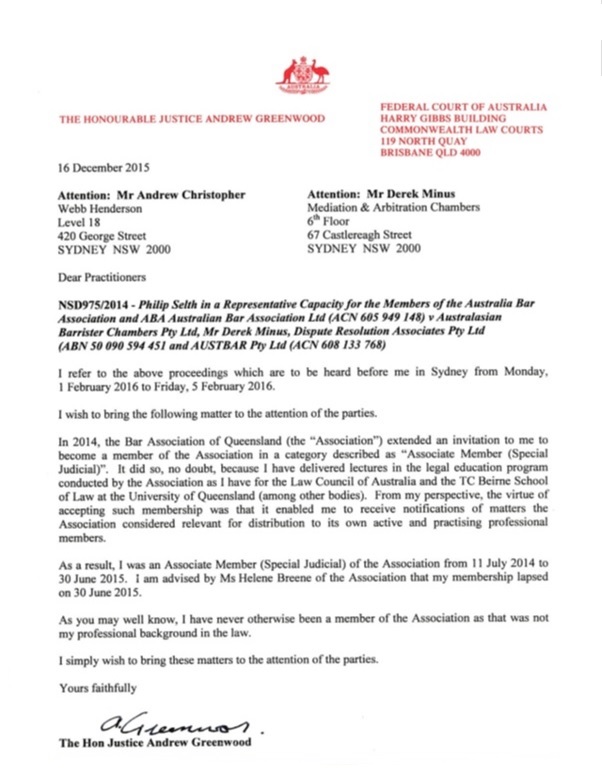
105 On 16 December 2015, I sent a letter to the legal representatives a copy of which is Attachment A to these reasons. In that letter I said that in 2014 the Bar Association of Queensland extended an invitation to me to become a member of that Association in a category described as “Associate Member (Special Judicial)”. I observed that the Association did so, no doubt, because I had delivered lectures in the legal education program conducted by that Association as I have for the Law Council of Australia and the TC Beirne School of Law at the University of Queensland (among other bodies). I said that from my perspective, the virtue of accepting such membership was that it enabled me to receive notifications of matters the Association regarded as relevant for distribution to its own active and practising professional members. I observed that as a result, I was an Associate Member (Special Judicial) of that Association from 11 July 2014 to 30 June 2015 although the membership lapsed at 30 June 2015. I also observed that as the parties may well know, I have never been an active member or a member at all, of that Association as that was not my professional background in the law.
106 On 17 December 2015 at 11.23am AEST, my Associate received an email from Mr Minus in which he said:
I am instructed to make an application that His Honour recuse himself, to be heard at the next available hearing.
107 The matter was listed for the hearing of the discovery application on 18 December 2015 and I directed that I would address the recusal application on that day. The recusal application was heard before the discovery application was heard.
108 Mr Minus made oral and written submissions on the recusal application both on his own behalf and on behalf of the third and fourth respondents. By this time, the Supreme Court of New South Wales had appointed a liquidator to Chambers (8 December 2015) and Mr Minus had filed a notice of ceasing to act for Chambers on 10 December 2015.
109 In the course of his written and oral submissions, Mr Minus set out the relevant legal principles deriving principally from Ebner v Official Trustee in Bankruptcy (2000) 205 CLR 337. Other important authorities on this topic are Isbester v Knox City Council (2015) 320 ALR 432 and Livesey v New South Wales Bar Association (1983) 151 CLR 288. In Ebner, Gleeson CJ, McHugh, Gummow and Hayne JJ said this at [8]:
The apprehension of bias principle admits of the possibility of human frailty. Its application is as diverse as human frailty. Its application requires two steps. First, it requires the identification of what it is said might lead a judge (or juror) to decide a case other than on its legal and factual merits. The second step is no less important. There must be an articulation of the logical connection between the matter and the feared deviation from the course of deciding the case on its merits. The bare assertion that a judge (or juror) has an “interest” in litigation, or an interest in a party to it, will be of no assistance until the nature of the interest, and the asserted connection with the possibility of departure from impartial decision making, is articulated. Only then can the reasonableness of the asserted apprehension of bias be assessed.
[emphasis added]
110 Mr Minus and the third and fourth respondents do not assert that I have an interest in the proceeding. They do assert that there is an association in the sense that I have a contended direct or indirect relationship with a person or persons interested in or otherwise involved in the proceedings.
111 They also assert that I have engaged in conduct in the course of the proceedings at two directions hearings which give rise to an apprehension of bias on the footing that I have differentially treated the parties at those two directions hearings.
112 As to the association question, Mr Minus and the third and fourth respondents say at para 10 of the written submissions that although I did not practice as a barrister, I have now formed “an association” with the Bar Association of Queensland and that it is:
… entirely reasonable to consider that His Honour, upon reaching the age of retirement from the Federal Court, or at some earlier time, may seek to form a further association from which he could expect to receive a benefit.
113 They say that the Bar Association of Queensland prominently displays on every page of its website that it is a constituent body of the Australian Bar Association with links to the Australian Bar Association website at <austbar.asn.au>. They observe that the Bar Association of Queensland is also one of the members of ABA Ltd. It follows for Mr Minus and the third and fourth respondents that this association with the Bar Association of Queensland is one which is incompatible with the appearance of impartiality in the sense that a fair-minded reasonable observer not unduly sensitive or suspicious, with knowledge of the circumstances of the case, might entertain a reasonable apprehension that the Judge might not bring an impartial and unprejudiced mind to the resolution of the questions involved in the proceedings.
114 The articulation of the logical connection between the contended association and the feared deviation from deciding the proceeding on the merits is said to be that I have an “interest” in the sense that, upon retirement, I might seek to form a further association with the Bar Association of Queensland in the expectation of receiving a benefit. The second feature of the logical connection is that in the letter I identify that the virtue of accepting membership was that it enabled me to receive notifications of matters the Association considered relevant for distribution to its own active participating professional members.
115 Mr Minus observed that he was not aware of whether I had been paid for giving lectures in the Bar Association’s continuing legal education program. I observed in the course of oral argument that I had not been paid for those lectures and, as a matter of principle, they were given as part of the education processes for the profession in the same vein as the lectures I had given to the Law Council of Australia, the University of Queensland, Griffith University and other institutional bodies who have an interest in ensuring that members of the profession reach informed views about things because they continue to be educated in an informed way.
116 I do not accept that there is any proper articulation of a logical connection between my membership of the Bar Association of Queensland in the period 11 July 2014 to 30 June 2015 and feared deviation from the course of deciding the case on the merits in the sense contemplated by their Honours in Ebner.
117 The second basis is said to be that I treated the parties differentially at two directions hearings. I do not accept that that is so in the per se way in which it is put.
118 There was debate at the first review of the matter (after I became the Docket Judge) on 11 November 2015 about whether the matter could sensibly be set down for a hearing in the second week of December. A question arose about the filing by the respondents of an amended defence. Another question arose about categories of documents about which the respondents would seek discovery. General questions of readiness arose. All of the evidence had been put on and the question of discovery was arising late in the day. Moreover, the respondents had not put contentions as to discoverable documents to the other side.
119 At the directions hearing on 20 November 2015 which was listed in order to deal with the state of the issues between the parties on discovery in light of a letter Mr Minus was to send and in respect of which there was to be a reply, it emerged that Mr Minus had not sent a letter to the applicants setting out the position of the respondents as to the documents sought, until 7.00am on the morning of the directions hearing.
120 That seemed to me to be unreasonable.
121 Nevertheless, I do not accept that there is any differential conduct which would give rise to a conclusion of apprehended bias in the sense contended for by Mr Minus and the third and fourth respondents deriving from the principles in Ebner.
122 Thus, I have refused to recuse myself from the hearing of the matter.
Conclusion
123 The application for discovery of documents will be dismissed. The costs of the application will be reserved for later determination.
I certify that the preceding one hundred and twenty three (123) numbered paragraphs are a true copy of the Reasons for Judgment herein of the Honourable Justice Greenwood. |
Associate:
ATTACHMENT A