

FEDERAL COURT OF AUSTRALIA
Voxson Pty Limited v Telstra Corporation Limited [2015] FCA 1490
IN THE FEDERAL COURT OF AUSTRALIA | |
DATE OF ORDER: | |
WHERE MADE: |
THE COURT ORDERS THAT:
1. Leave be granted to the applicant to file an amended Vox 1 Statement of Claim in the form provided to the Court and the respondents on 3 September 2015, together with the Vox 1 Amended Originating Application, by 18 January 2015.
2. The parties confer to discuss the further conduct of the proceeding and notify my associate of the proposed orders by 27 January 2015.
Note: Entry of orders is dealt with in Rule 39.32 of the Federal Court Rules 2011.
NEW SOUTH WALES DISTRICT REGISTRY | |
GENERAL DIVISION | NSD 2436 of 2013 |
BETWEEN: | VOXSON PTY LIMITED (ACN 005 291 458) Applicant |
AND: | TELSTRA CORPORATION LIMITED (ACN 051 775 556) First Respondent SINGTEL OPTUS PTY LIMITED (ACN 052 833 208) Second Respondent OPTUS MOBILE PTY LIMITED (ACN 054 365 696) Third Respondent SINGAPORE TELECOMMUNICATIONS LIMITED (ARBN 096 701 567) Fourth Respondent VODAFONE HUTCHINSON AUSTRALIA PTY LIMITED (ACN 096 304 620) Fifth Respondent |
JUDGE: | BENNETT J |
DATE: | 23 december 2015 |
PLACE: | SYDNEY |
REASONS FOR JUDGMENT
1 The applicant/patentee, Voxson Pty Limited, (Voxson) alleges infringement by each respondent (the first respondent, Telstra Corporation Limited (Telstra), the second to fourth respondents, together Optus and the fifth respondent, Vodafone Hutchinson Australia Pty Limited (Vodafone)) of Patent No 676242 (the Vox 1 Patent). Interlocutory applications were filed by each respondent (Optus’ strike out application filed on 24 October 2014, Telstra’s strike out application filed on 17 October 2014 and Vodafone’s strike out application filed on 20 October 2014) (the strike out applications) seeking to strike out Voxson’s further amended statement of claim filed on 29 August 2014 (the pleading). Voxson alleges infringement by reason of exploitation of “a system” that involves the presence of each of the integers of the claims alleged to have been infringed. The second and fourth respondents seek to be removed from the proceeding. That is the subject of separate reasons (Voxson Pty Limited v Telstra Corporation Limited (No 3) [2015] FCA 1492) (the costs decision).
2 The strike out applications and various requests for particulars, followed by hearings over a number of days over the course of some seven months, led to a series of proposed amendments to the pleading, one of which is now pressed by Voxson. That course of conduct is the subject of applications as to costs that will be dealt with separately in the costs decision. The seventh proposed amended statement of claim (the proposed amended pleading) served on 3 September 2015 forms the present and final subject matter of the strike out applications. Consideration of some of the earlier proposed versions will be relevant to understanding the course of proposed amendments and in determining the appropriate order as to costs.
3 The Vox 1 Patent is entitled ‘Positioning Systems Utilizing Mobile Telephone System for Correction Signals’. As characterised by Telstra, the Vox 1 Patent broadly relates to satellite based vehicle positioning systems. As characterised by Optus:
The body of the specification describes the tracking of vehicles by a fleet manager using an interface on a control computer. The control computer lodges requests for the location of mobile stations, and following specific interactions with mobile devices interoperating with the mobile telecommunication network and GPS satellites, receives and displays information as to the location of those mobile stations (p 14, lines 14-27). The interactions include the receipt by a mobile station of a correction signal (which provides differential GPS error correction data: p15, lines 7-8), the use of that correction signal to calculate the position of the mobile station and the transmission of that information to the fleet manager.
4 Submissions centred on claim 1 of the Vox 1 Patent which is to:
A system for tracking the location of vehicles and the like, said system comprising local positioning information supply means which corrects positioning information received from satellites so as to produce a local positioning information signal; and wherein said local positioning information signal is transmitted to said vehicles and the like on a special signalling layer of a communications path provided by a mobile telephone system.
5 The allegations in the pleading and the proposed amended pleading relate to three different generations of radio access networks: 2G, 3G and 4G networks.
6 In the pleading, Voxson alleged infringement against all parties (in [425] – [436]), as follows:
(1) By offering to sell, selling, offering to supply and/or supplying to consumers in Australia, and keeping for the purposes of doing any of those things, one or more systems as claimed in each of the asserted claims.
(2) By using one or more systems as claimed in each of the asserted claims.
(3) By authorising consumers in Australia to use one or more systems as claimed in each of the asserted claims.
(4) By supply of a product pursuant to s 117(1) of the Patents Act 1990 (Cth) (the Act), by reference to s 117(2)(b) and (c).
(5) By acting as a joint tortfeasor in respect of consumers’ infringement of each of the asserted claims.
7 Amendments were made to the pleading and Voxson’s infringement case now differs between the respondents. For example:
Voxson no longer alleges points (1) and (2) in [6] above against Optus and Vodafone.
Voxson no longer alleges point 2 in [6] above against Telstra.
8 While many of the technological terms will be defined, a glossary of relevant terms is also found at Annexure 1 of these reasons.
THE OPTUS STRIKE OUT APPLICATION
9 In its application filed on 24 October 2014, Optus applied to have the pleading struck out pursuant to r 16.21 of the Federal Court Rules 2011 (Cth). Further or in the alternative, it sought orders in the application, pursuant to r 16.45, that Voxson provide a statement of the nature of its case, to include specific information detailed in the application.
10 Voxson filed a first statement of the nature of the case on 5 December 2014 and an amended statement of the nature of the case on 19 January 2015 (the nature of the case).
11 The Optus application and submissions formed the basis for the hearings and the major arguments advanced concerning the strike out applications. Telstra and Vodafone adopted Optus’ submissions and made additional submissions.
12 Various of the bases of attack on the pleading have been resolved by serial proposed amendments. However, Optus maintains that certain deficiencies have not been cured. Optus’ present position is that the pleading be struck out with no leave given to re-plead. Voxson submits that leave should be granted to amend the pleading as set out in the proposed amended pleading.
13 Optus, Telstra and Vodafone have reserved their rights in respect of any applicable limitation matters arising from a repleading of the pleading and any permitted amendment. Voxson has acknowledged that reservation of any rights.
14 I shall only now deal with as much of the pleaded case as relevant to the remaining issues between the parties. With respect to some of the issues raised, I indicated my decision and reasons during the course of the hearing of the strike out applications. At that stage, the parties were content with that course. Subsequently, the parties sought written reasons with respect to certain matters raised. I have taken the view that, bearing in mind the complexity and number of issues raised during the days of hearing, I will only provide these reasons in respect of the matters outstanding at the conclusion of the hearing.
15 The key remaining attacks on the proposed amended pleading, said to justify the strike out without leave to amend, centre around:
The claim to a “system” and whether that can be pleaded in the alternative as a product or a process.
The integer of claim 1 being the ‘special signalling layer of a communications path provided by a mobile telephone system’ and how the pleading asserts that the messages constituting the local positioning information signal, or any part of them, are transmitted on a control channel.
The Pleading
16 Voxson alleged infringement with respect to each of Optus’ 2G, 3G and 4G networks. Voxson alleged that hardware and/or software external to the Optus 2G GERAN (the GSM/EDGE Radio Access Network) was used for transmitting and/or receiving Satellite Data (being information received from one or more global navigation satellites, directly or indirectly). Further or in the alternative, the allegation was that the 2G external location servers were used by or on behalf of Optus for transmitting and/or receiving Satellite Data. It was pleaded that, for the claimed infringement period, the Optus 2G GERAN and/or the 2G external location servers were operated by Optus, or further or in the alternative, operated on behalf of Optus.
17 Voxson’s pleading also concerned the Secure User Plane Location (SUPL) architecture. As explained later by Optus, SUPL is one form of technology implementing assisted GPS (A-GPS) and is governed by certain standards (the SUPL Standards), which are not mandatory; an A-GPS service can be implemented without using them. SUPL architecture consists of location servers (SUPL Location Platforms or SLPs) which communicate with SUPL enabled mobile devices, or terminals (SETs). A SUPL Location Platform transmits communications to SETs using the ordinary data channel of a mobile network.
18 Voxson alleged that Optus operated, or had operated on its behalf, the Optus 2G GERAN that complied with the whole or part of a version of the SUPL Standards. It alleged that, for the infringement period, Satellite Data were transmitted and/or received using the Optus 2G GERAN and/or the external location server that was an SLP.
19 The pleading concerning the 3G and 4G networks was in similar terms.
20 Optus says that, relevantly, its mobile network acts as a mere conduit.
21 Voxson also alleged that Optus authorised consumers in Australia to use one or more of the systems as claimed in the claims of the Vox 1 Patent, the system being as described in the pleading.
Optus’ original submissions on the pleading
22 In its written submissions on the pleading, Optus characterised the allegations as being infringement by direct exploitation and infringement by authorisation, with further amendments foreshadowed of infringement by reason of s 117 of the Act and joint tortfeasorship.
23 Optus’ main complaints about the pleading, as set out in its written submissions and as still relevant, can be said to be centred around the allegedly infringing “system” and Optus’ involvement in the sale, supply or use of it, as well as Optus’ claimed liability for use of the system by consumers. Generally, Optus said that there was insufficient information about its infrastructure and how it operated to effect the claimed infringement.
24 Optus also complained about the form of the pleading, the degree of particularisation and the use of internal cross-referencing. I do not propose to discuss these aspects further. I made it clear during the course of the hearing that, because of the nature and length of the pleading and the course of conduct whereby Optus requested further particularisation which Voxson included, I did not consider those matters to be sufficient to support a strike out. I remain of that view.
25 Optus also raised the question of pleaded compliance with the 3GPP Standards (the Standards), the extent of such compliance and whether conformity with the Standards is said by Voxson to be optional or mandatory. Voxson has provided more information on the Standards and I consider that sufficient for the purposes of the proposed amended pleading. Voxson has pointed out that, by reference to particularised advertisements, Optus has implemented certain optional features of the Standards and contends that if a feature is implemented, it must so comply. Questions of compliance with specific aspects of the Standards can be dealt with by way of evidence.
26 Optus also complained that it had insufficient information as to the products and services that it offers that are said to be infringing. Voxson responded that it had given an instance of infringement, which was sufficient. I accepted that, with the instances provided, together with the information in the pleading and in the nature of the case provided, Voxson has given Optus fair notice of what is being alleged against it in this regard. The limited instances may, however, restrict the width of discovery, including for damages.
27 As to the alleged failure to define the “system” of the claims, Optus said that the pleading and the nature of the case provided by Voxson are untenable because, on the facts pleaded, Optus does not sell or supply the system; it sells or supplies mobile devices but does not sell or supply its mobile network infrastructure or any relevant servers. Nor, said Optus, does it “use” the system; the devices are operated by a user, not by Optus. Generally, Optus asserted that provision of access cannot constitute the supply of a product or of a process.
28 Another attack on the pleading concerns the use of a “Location Based Services” application which interoperates with the Optus infrastructure whereby a request is transmitted for the location of an Optus 2G mobile station (MS) which is received by Optus 2G-GERAN and/or external servers operated by or on behalf of Optus] in such a way as to use the patented technology, resulting in the claimed system and of the claimed direct and indirect infringement. Optus’ contention was that while a Location Based Services application is alleged to be an application supported by a MS, or by the Optus infrastructure, or sold by Optus, there is no other characterisation to distinguish it, or of any practical application. Optus asserted that there is no explanation in the pleading that the Optus services, as particularised, infringe the claims. Indeed, Optus said that there is no identified basis for asserting that the Optus infrastructure has implemented the necessary functionality.
29 Optus also identified asserted deficiencies in the pleading of the case for secondary infringement, again largely concerning the workings of the Optus infrastructure, the Location Based Services and the MS, and questioned whether there was a relevant supply, for example for the purposes of s 117 of the Act, and whether it could be said that Optus had the requisite reason to believe as provided for in s 117(2)(6).
30 Some of these matters were the subject of subsequent amendment or determination during the course of the hearing.
Voxson’s submissions on the pleading
31 Voxson emphasised:
the nature of the case;
the adequacy of the pleading;
the fact that detailed and extensive particulars had been provided in response to numerous requests;
that Optus clearly understood the scope of the case pleaded;
the overarching purpose of ss 37M and 37N of the Federal Court of Australia Act 1976 (Cth); and
various authorities as to the care to be taken in the exercise of the power to strike out pleadings, as well as the factors to be taken into account.
32 Voxson’s position on the pleading was relatively straightforward. It said that the pleading:
identified the claims of the Vox 1 Patent said to have been infringed;
described the features of the system said to infringe the Vox 1 Patent;
mapped the features of the infringing system to the features of the asserted claims;
set out the acts of exploitation in relation to the system that amount to infringement of the Vox 1 Patent.
33 In the nature of the case, Voxson divided claim 1 of the Vox 1 Patent into the following integers:
a system for tracking the location of vehicles and the like, said system comprising:
(i) local positioning information supply means:
• which corrects positioning information received from satellites;
(ii) local positioning information signal;
(iii) transmitted to said vehicles and the like:
• on a special signalling layer of a communications path provided by a mobile telephone system.
34 It asserted in the nature of the case that the three features are present, as follows:
(i) The Optus 3G UTRAN and/or the 3G external location servers use ‘local positioning information supply means’.
• The Optus 3G UTRAN and/or the 3G external location servers receive positioning information from GPS satellites, either directly or indirectly, and provide this information to an Optus 3G UE (‘which corrects positioning information received from satellites’).
(ii) ‘Local positioning information signals’ are transmitted from the Optus 3G UTRAN to the Optus 3G UE as radio frequency messages.
(iii) The Optus 3G UE (for example, a Nokia N95) is a ‘vehicle and the like’.
• The ‘special signalling layer of a communications path provided by a mobile telephone system’ comprises the control channels provided by the Optus 3G Network.
35 Voxson also explained the alleged acts of exploitation in the nature of the case, relevantly as follows:
Optus infringed claim 1 by:
a) Offering to sell, offering to supply, selling and or supplying to consumers in Australia, the systems as claimed. That is:
(i) Optus offered to sell/supply and sold/supplied the Optus 3G UE (which, amongst other things, had Location Services (LCS) capability including the capability to utilise the Go Places Everyone Location Based Service);
(ii) Optus offered to sell/supply and sold/supplied Optus 3G SIM cards subscriptions to the Optus 3G Network and offered to supply/supplied the Optus 3G Network which included the use of the Optus 3G UTRAN and/or the 3G external location servers with the capability of providing information from GPS satellites to the Telstra 3G UE based on the approximate geographic location of the Optus 3G UE, and
(iii) Optus offered to sell/supply and sold/supplied Location Based Services (such as Go Places).
b) using in Australia the systems as claimed. That is: Optus used the claimed system in the transmission of local position information from the Optus 3G UTRAN and/or the 3G external location servers to the Optus 3G UE.
Optus and Optus Networks infringed claim 1 by:
a) authorising consumers in Australia to use the systems as claimed. That is:
(i) each of Optus and Optus Networks offered to sell/supply and sold/supplied Optus 3G UE and authorised consumers to use the Optus 3G UE (which, amongst other things, had LCS capability including the capability to utilise the Go Places Location Based Service) to receive information from GPS satellites; and
(ii) each of Optus and Optus Networks offered to sell/supply and sold/supplied Optus 3G SIM cards and subscriptions to the Optus 3G Network and offered to supply/supplied access to the Optus 3G Network and Optus operated the Optus 3G Network which included the use of the Optus 3G UTRAN and/or the 3G external location servers in the transmission of local positioning information to the Optus 3G UE; and
b) offering to supply to consumers in Australia the Optus 3G UE; Optus 3G SIM cards and other access to the Optus 3G UTRAN and/or the 3G external location servers; and Location Based Services and/or access thereto, and by each of Optus and Optus Networks having:
(i) had reason to believe that consumers such as the user of the Optus 3G UE would use each of those products (not being staple commercial products) in the systems as claimed, pursuant to s 117(1) and 2(b) of the Patents Act 1990 (Cth) (see paragraphs 431, 433 and 435 and 439, 442 and 443 of the Vox 1 SFASOC).
(ii) given by way of advertisement or otherwise, instructions to use the product and/or an inducement(s) to use the product such that the product would be used in the systems as claimed, pursuant to s 117(1) and 2(c) of the Patents Act 1990 (Cth) (see paragraphs 431, 433 and 435 and 439, 442 and 443 of the Vox 1 SFASOC).
c) directing or procuring consumers such as the user of the Optus 3G UE to infringe each of the systems claimed, or otherwise participating in, being a party to or joining in a common design with respect to those infringements, and in so doing, being liable as a joint tortfeasor in respect of those infringements (see paragraphs 436 and 444 of the Vox 1 SFASOC).
36 Voxson asserted in the nature of the case that the acts of exploitation also occurred in respect of the SUPL infrastructure which utilises the 2G, 3G and 4G network infrastructure to provide data, as being SUPL infrastructure operated by or on behalf of Optus.
37 Thus, Voxson submitted, if the matters as alleged in the pleading can be made out at trial, it will have established that Optus will have infringed the asserted claims and this is sufficient to defeat the strike out.
38 In its written submissions, Voxson stated that the pleading alleged that Optus provided corrected local positioning information via a mobile telephone network on a special signalling layer and that Optus offered Location Based Services which provided corrected positioning information to a MS/user equipment (UE)/SET using its networks. It also stated that the identity of the Location Based Services for the carrier does not matter, as no particular Location Based Service is described and that it is not part of the claims but ‘merely provides a window into the claimed system’.
39 As to the “system” product/method divide, Voxson said that ‘the claims are to “systems” that operate through the interaction of various features and may be characterised as method claims’, while maintaining that the construction is for the Court. Voxson also said that whether the claims are to a product or method, the “system” or access to the system was supplied by Optus.
40 As to the authorisation of consumers, Voxson pointed not only to the provision of the network but also to the provision of materials, including standard forms of agreement and various instructions to consumers that, it said, constituted authorisation of infringement by consumers of the Vox 1 Patent.
41 It is worth noting that in its written submissions on the pleading and relevant to the identification of the special signalling layer, Voxson responded to Telstra’s request to provide particulars as to the Special Signalling Layer. It stated that that integer in the claim comprised the “control channels” provided by the relevant respondent’s network.
Subsequent changes to the pleading
42 The pleading underwent a number of iterations before the proposed amended pleading. A comparison is not straightforward. However, one relevant amendment was to change the assertion that the external location servers were operated by Optus or on its behalf to an assertion that the servers were operated by Optus or entities other than Optus. A key amendment was that Voxson no longer claimed that Optus implemented A-GPS, rather it claimed that Optus is liable for an A-GPS service implemented by third parties on third party servers.
43 It is fair to say that there were wholesale amendments made, which in part reflected a different case being made as to the nature of the system alleged to have been implemented and the involvement of the Optus network.
44 In a position paper served with the statement of claim relied upon as at 23 March 2015 (the proposed March pleading), Voxson stated that it no longer alleged direct or secondary infringement in respect of the Optus 2G Network, 3G Network or 4G Network. Voxson no longer alleged direct infringement in respect of Optus SUPL but continued to allege secondary infringement in respect of Optus SUPL.
45 By proposed amendment, the previous definitions of Optus 2G/3G/4G SLP were no longer used. SLP was now defined to denote one or more SUPL Location Platforms that transmit Satellite Data while working with the Optus 2G GERAN, 3G UTRAN and 4G E-UTRAN. It was no longer alleged that Optus operated, or had operated on its behalf, the SLP. Voxson’s position was that, in the context of secondary infringement, it was the consumer who uses the claimed system, which includes the SLPs. Voxson maintained the allegation that Optus operated its 2G/3G/4G Networks and the respective 2G GERAN/3G UTRAN/4G UTRAN during the infringement period, but no changes limited that to a claim of direct infringement.
46 The pleading was further amended in the proposed March pleading so that the particulars did not differentiate between whether the system is a product, method or process, but related to Optus’ acts of exploitation. The allegation was that Optus authorised the use by the consumer of the claimed system. The provision of Location Based Services as alleged in the pleading was amended to refer to the provision of Location Based Services applications in the proposed March pleading.
47 Voxson explained this as amendments being made to remove any paragraphs of the pleading that were ‘no longer necessary’ with paragraphs being retained that related to allegations of infringement concerning Optus SUPL.
48 Optus submitted that the change in the case, from actual implementation of A-GPS in the pleading to liability for an A-GPS service implemented by third parties on third party servers in the proposed March pleading was ‘fundamentally different in character from the case previously pleaded’. I accept Optus’ characterisation. Although authorisation was originally pleaded and had been maintained, and SUPL was referred to, taking the pleadings as a whole, Optus’ submission should be accepted.
49 Optus then raised concerns as to the proposed March pleading, including:
As to asserted compliance with the SUPL Standards, it is not mandatory for either a network operator or a third party location service provider to implement the SUPL Standards. The proposed March pleading did not assert that it is.
The Optus mobile network has not implemented the SUPL Standard.
The proposed March pleading did not identify any basis for asserting that Optus or a relevant third party service provider or server has implemented the SUPL Standards.
The proposed March pleading conceded that any third party service provided utilised the data channel (or “traffic” channel) of the Optus network. The consequence is that the requirement of all pleaded claims for the relevant signal to be transmitted on a “special signalling layer” was, on the face of the pleading, unfulfilled.
The conduct pleaded cannot amount to authorisation.
50 Optus adduced evidence, that was unchallenged, that it has not provided or implemented an A-GPS service on its mobile telecommunications network, and neither has a third party on its behalf. This includes a SUPL service. The Optus mobile telecommunications network does not incorporate a SLP and Optus does not operate any such platform. The Optus network functions only as a conduit of the relevant data between the handset and the third party infrastructure. The network does not distinguish such data from other data such as email data. Optus has no knowledge of, or control over, communications of such data. Optus has not implemented in its network any of the SUPL Standards.
51 Voxson raised certain matters as to that evidence, such as a distinction between assertions couched in the present tense and those in the past tense and as to the asserted incapability to manage data sent on the network – an asserted distinction for example between “cannot” distinguish data and “do not” distinguish data. This does not detract from the general assertions by Optus. Voxson did not suggest that it has any evidence to contradict Optus’ evidence.
52 In written submissions elaborating this position, Optus drew attention to the fact that, in the pleading, Voxson did not plead any case involving a SUPL service implemented by a third party but pleaded a requirement for the Optus mobile network to have implemented an A-GPS service. Optus’ secondary liability was pleaded as derived from consumers’ alleged use of the system that was said to have been implemented by Optus. Accordingly, while it is correct that, as Voxson asserts, Voxson continued to allege secondary infringement in respect of Optus SUPL, it was a different case being alleged.
53 Optus again raised issues about the identity of the location server, the third party service provider, and whether the SLP is situated in Australia. If the SLP is not operated in Australia then, Optus said, the “local positioning supply means” is not operated in Australia, so that it could not give rise to infringement in Australia. These issues were raised as part of a submission that the proposed March pleading was deficient in providing sufficient facts to enable a determination of the case being advanced. Optus said that the proposed March pleading was ‘evasive and ambiguous, and likely to cause prejudice, embarrassment and delay in the proceeding’ and failed to disclose a reasonable cause of action.
54 It also complained about the uncertainty of the part of the proposed March pleading which asserted that Optus operated the Optus 2G GERAN that complied with the whole or part of a version of the SUPL Standard. Apart from a failure to identify the part of the SUPL Standard, which could be later particularised or provided in evidence, Optus said that, to Optus’ knowledge, it does not operate an SLP and that its network merely serves as a conduit for transmission of data. Accordingly, Optus says, the failure to identify what functionality the Optus network is said to have, was embarrassing. There were other complaints about the lack of detail of the asserted functionality of the Optus network.
55 Additionally, Optus pointed to the integer of the claim, the “special signalling layer”. The case made out in the proposed March pleading was that the transmissions on which Voxson relied are sent on a traffic channel of the network. Optus said, simply, that the traffic channel is not a special signalling layer as pleaded. At [408], the proposed March pleading stated, under the heading “Special Signalling Layer”, that the messages were transmitted and/or received by the SET on one or more traffic channels. In [408], the proposed March pleading stated that prior to conveying the information to the SLP, the Optus 2G SET received at least a portion of the information contained in the information from the Optus 2G GERAN in messages transmitted on one or more control channels. In [409], it was stated that one or more traffic channels and one or more control channels corresponded to the “special signalling layer” of the claims. There were similar pleadings for 3G and 4G.
56 Optus seized on the definition of ‘special signalling layer” as the combination of one or more traffic channels and one or more control channels. However, as pleaded, the control channels were not used for transmitting the necessary messages but were rather used in a prior step, which was not pleaded to constitute the transmission of a local positioning information signal, and it could not be so, because it is not a message. That is, Optus’ contention was that the proposed March pleading, on its face, asserted that the third party SLP transmits communications over the traffic channel of the network and not over a control channel, whereas the special signalling layer of the claims was defined as consisting of both traffic and control channels which each carry information which is part of the local positioning information signal as pleaded.
57 Further, Optus submitted that ‘a new paradigm’ was introduced by the proposed March pleading. This was that a third party supplied a limited form of A-GPS, ie SUPL, and that no primary infringement was alleged against Optus. Alleged secondary liability was based on the assertion that Optus authorised consumers to infringe, because consumers use handsets or SETs that interact with third party SLPs. While secondary liability was pleaded prior to the proposed March pleading, it was in respect of a system implemented by Optus to use the Optus network as the means of infringement.
58 In addition, Optus addressed the case of secondary liability. It characterised the proposed March pleading as asserting acts that are, in substance, the sale of mobile devices (manufactured by third parties) having A-GPS capability, and the provision of access to its mobile network by way of a SIM card for those devices. It said that mere sale of a device which is capable of infringing and non-infringing uses is insufficient to found secondary liability as asserted, and that, as pleaded, the particularised manuals provided by Optus did not assist Voxson’s case. Further, it pointed out that any A-GPS communications utilising a third party server are indistinguishable from any other data traffic and that Optus has no knowledge of them, nor does it have power to control such use of its network.
59 Optus provided schematics that set out some of its contentions, as follows:
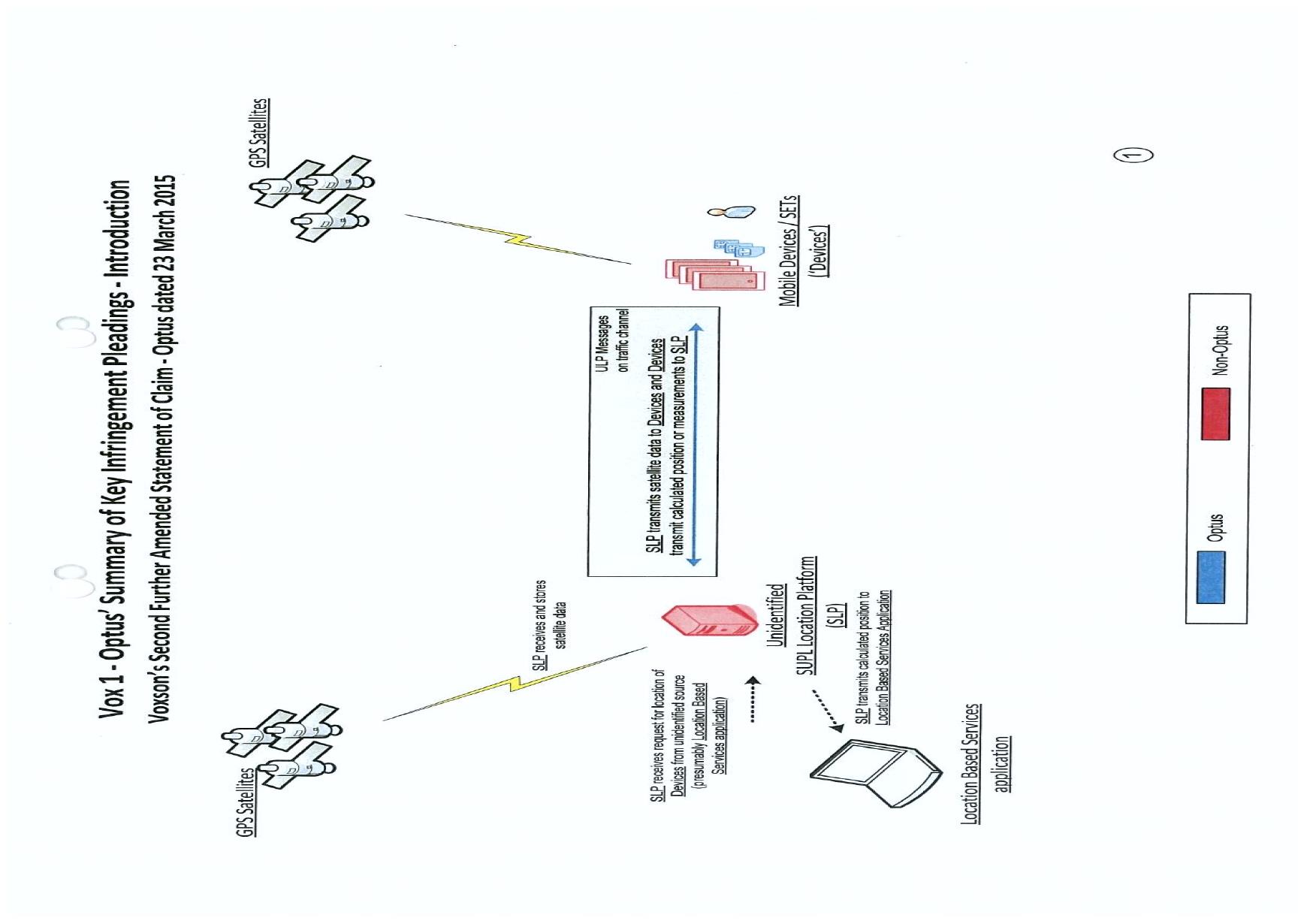
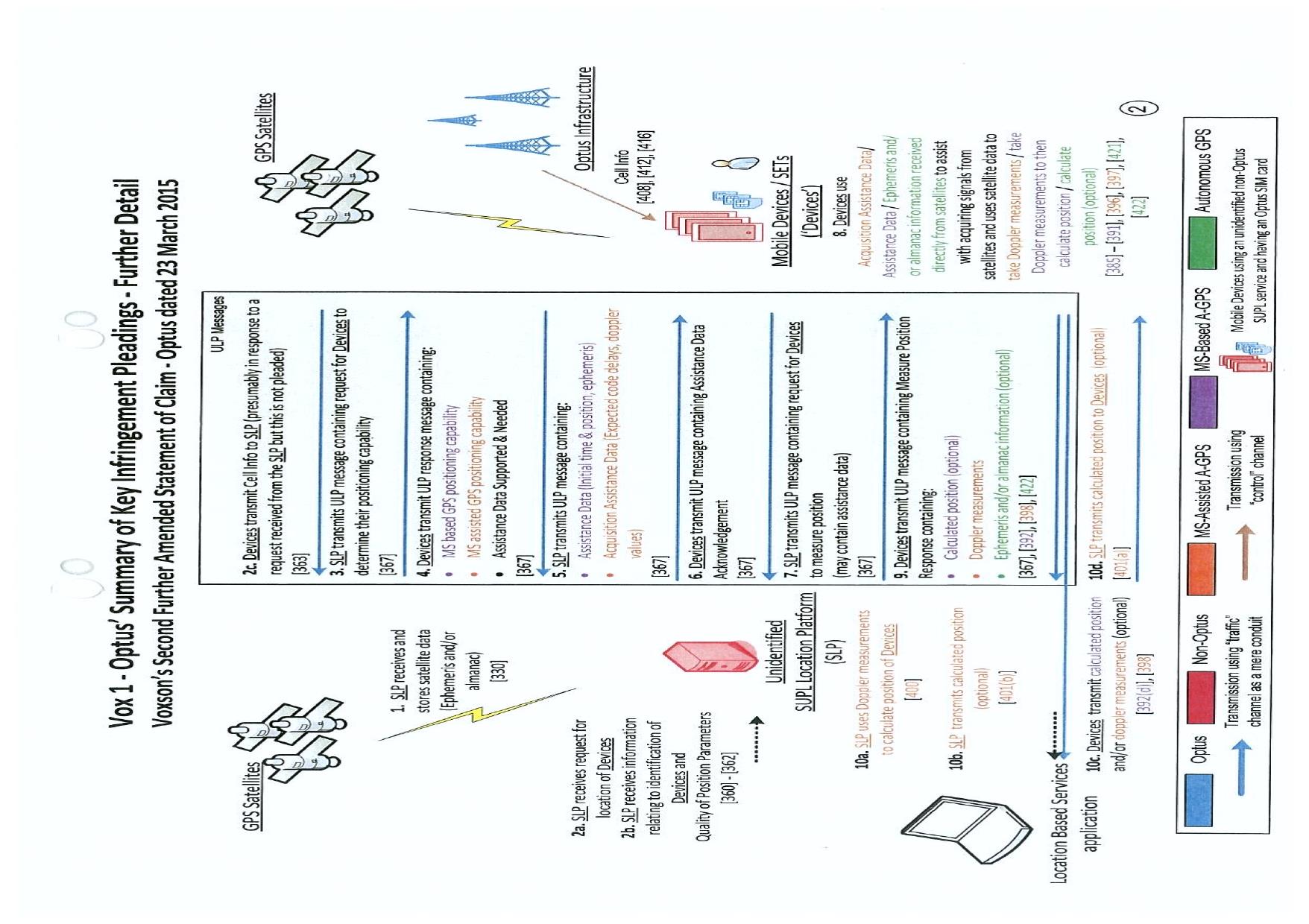
60 Voxson’s response to Optus’ position as to the special signalling layer was to say that it would amend that section of the proposed March pleading ‘to clarify that one or more traffic and control channels correspond to the “special signalling layer”’. Voxson said that Optus accepted that it provides both traffic and control channels and that SUPL data are transmitted over the Optus network. It submitted that the construction of this integer of the claims is a matter for evidence of the skilled addressee.
61 Voxson provided its own schematic:
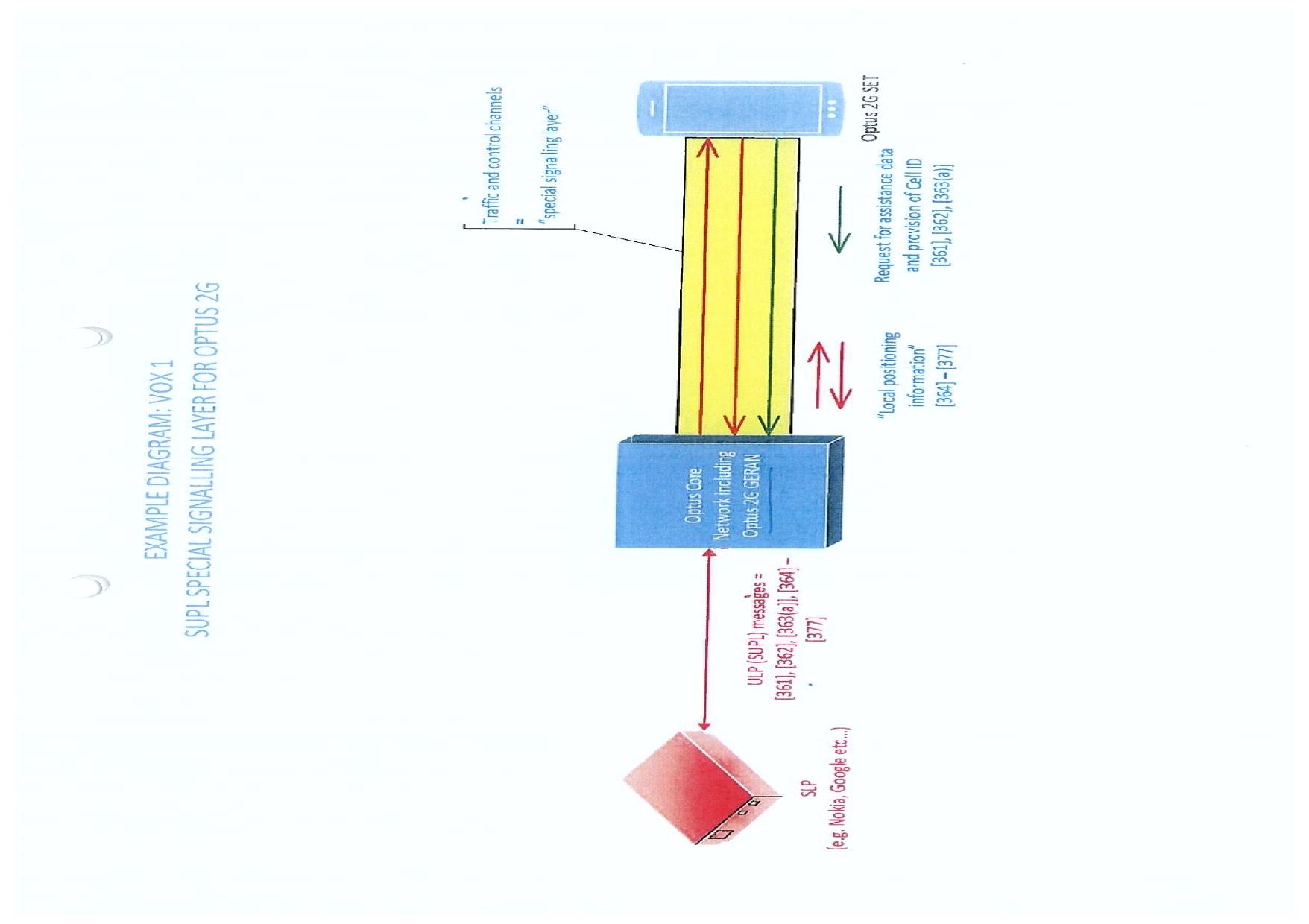
62 Voxson made it clear that a combination of one or more traffic channels and one or more control channels provided by the mobile telephone system constitute the special signalling layer. It said that these channels allow for the transfer of messages between the SLP and SET within the mobile telephone system. It said that it does not assert that any communication path outside that system forms part of the integer. It accepted that its amendments ‘clarify certain issues raised by Optus’.
63 At the same time, Voxson offered other amendments in relation to certain more minor complaints and responded to others. I am satisfied as to these more minor amendments.
The proposed amended pleading
64 The proposed amended pleading is the one on which Voxson now relies.
Special signalling layer
65 Voxson proposed an amendment to [407] of the proposed March pleading, to plead that the messages previously identified in that pleading were transmitted and/or received by the Optus 2G SET on one or more traffic channels and one or more control channels of the Optus 2G GERAN. The channels were identified by reference to the Standards. [408] was deleted and [409] amended to plead that the traffic and control channels corresponded to the “special signalling layer”. Other amendments were directed to including the control channels as well as the traffic channels as constituting the special signalling layer.
66 In support of its submission that the pleading as to the special signalling layer is untenable, Optus relies on the previous versions of the proposed amended pleading. It points to the fact that the proposed March pleading “conceded” that the UserPlane Location Protocol (ULP) messages, or more particularly SUPL POS messages, which are transmitted by the SLP to the Optus MS/UE/SETs, were transmitted on a traffic channel, not a control channel as, Optus says, would be expected of a third party SUPL service transmitting that data over the Optus mobile network. Optus notes that, when this amendment was raised during a previous hearing, the Court said that Voxson should provide the factual basis for the changed assertion which, Optus says, Voxson has not done. Optus contends that Voxson has not identified which of the SUPL POS messages constituted the pleaded local positioning information signal of the claims, or which part of the messages were transmitted on a control channel rather than on a traffic channel.
67 Optus submits that it is insufficient for an infringement allegation for Voxson to maintain that the information is transmitted on the special signalling layer, or that it is common ground that traffic channels require associated control channels in order to transmit data.
68 Optus points out that while the proposed amended pleading now asserts that the signals are transmitted over both the traffic channel and the control channel, it does not identify how those signals are, or what information is, transmitted over the control channel, when Optus says that they are not so transmitted. Optus says that that pleaded case is that the person skilled in the art would understand that accompanying the transmission of the ULP or the SUPL POS messages, referred to in the proposed amended pleading, is some sort of signalling control information which is on the control channel, which forms part of the special signalling layer – and that that is not what is pleaded.
69 Voxson denies any “concession” made in previous versions of the pleading which, it contends, are irrelevant in any event as it is pressing for the proposed amended pleading, not the proposed March pleading. Voxson states that it has expressly abandoned its previous proposed pleadings. That formed part of its answer to Optus’ attack on the way in which the previous versions of the statement of claim defined the special signalling layer and the use of traffic and control channels on which Optus relied as a concession by Voxson. Voxson denies that it had conceded that ULP messages were transmitted on a traffic channel but not a control channel. Rather, it says that it had repeatedly stated that a data channel always has a corresponding control channel. It also relies on the power to grant leave to amend, as having an objective of curing defects or errors in pleadings (Caason Investments Pty Ltd v Cao [2015] FCAFC 94 at [20]).
70 Voxson says that this issue was first raised by Optus in its 10 July 2015 position paper and in oral submissions on 19 August 2015. When it was raised, Voxson amended its pleading to “clarify” it.
71 After the repleading to include the control channel as part of the means of transmission of messages and as part of the special signalling layer, Voxson was directed to identify the control channel, to identify the information transmitted on it and the basis on which the information was said to constitute a local positioning information signal. The proposed amended pleading does not describe those matters but that is not decisive of a strike out. While the information will ultimately be relevant, the pleading is of infringement of the claims, which does not require the identification in the proposed amended pleading of the information said to be transmitted on the control channel. Optus points out that the proposed amended pleading already purports to address this matter by stating that each of the ULP messages referred to in the pleading is a local positioning information signal, but that does not require the proposed amended pleading to identify what part of the information is transmitted on the control channel.
72 The allegation is that the information is transmitted on the special signalling layer and that is the integer of the claim. The claims refer to the “special signalling layer”, not to specific channels, and the construction of the “special signalling layer” in the claims is a matter for the Court to determine, informed by the person skilled in the art. Many of the matters which Optus complains are missing will necessarily be adduced in the evidence. That is, properly a matter for trial.
Other alleged deficiencies in the proposed amended pleading
73 Optus maintains that certain of the particulars are insufficient and/or embarrassing. Otherwise, it relies on its earlier submissions as to the “flaws” in the allegations concerning implementation of the SUPL Standards by Optus and in the allegations of secondary liability. Optus also points out that there is no mandatory standard for the provision of the third-party A-GPS services and that the mandatory standard does not apply to SUPL, such that it is not essential for a server which supplies A-GPS to comply with the SUPL Standard.
74 Voxson’s case is that it has provided sufficient particularisation. With respect to the instances of infringement, Voxson submits that it has particularised at least one instance and that it is entitled to discovery to ascertain further instances (Nokia Corporation v Liu (2009) 179 FCR 422; SNF (Australia) Pty Ltd v Ciba Speciality Chemicals Water Treatments Ltd (No 4) [2013] FCA 845 at [6]), after which it can provide further particulars of the SETs and SLPs on which it relies. I have not been asked to consider the extent of available discovery. I am satisfied that Voxson has sufficiently identified the SLPs/SETs said to infringe for the purposes of the pleading at this stage.
75 Optus still says that Voxson needs to establish that the third party location server is situated in Australia and submits that it would be necessary to enjoin any third party A-GPS service provider whose location server was said to give rise to infringement. That can also be dealt with by evidence, if available and by subsequent application if necessary.
76 Optus also states that it will rely on what it describes as a case fundamentally different in character in the proposed amended pleading as a limitation point. It submits that to characterise the previously pleaded case and the presently pleaded case as the same because they can both be said to be cases in respect of secondary infringement allegations in relation to SUPL is just wrong. That submission, insofar as it raises questions of limitation, does not need to be addressed at this stage as the parties have reserved their positions.
The Telstra strike out application
77 Telstra takes the same position as does Optus with respect to the pleading regarding its 4G network, but not as to the 2G or 3G networks. Generally, Telstra submitted that Voxson’s proposed March pleading continued to constitute speculative pleading with allegations that lacked a proper factual and legal foundation, such that it could not properly plead to it.
78 Telstra states that it has never implemented a SUPL architecture as part of its 4G Network and, to the best of its knowledge, no ULP messages travel over its 4G Network. In the proposed March pleading, Voxson withdrew its allegations of direct and indirect infringement by means of Telstra’s 4G Network, except insofar as such allegations related to SUPL architecture.
79 Telstra submits that the pleading should be struck out but does not oppose leave to replead with respect to its 2G and 3G Networks only, on stated conditions as to costs: that Voxson pay its costs thrown away and the costs of the application, payable forthwith. That is dealt with separately in the costs decision.
80 Telstra more forcefully maintains a further submission with respect to the proposed March pleading concerning the Standards and SUPL Standards. Telstra submits that, where the various standards provide for optional features, Voxson should identify the particular features of the relevant standards that are said to be present in the various Telstra systems and that are said to correspond with the features of its claims. Telstra submits that Voxson must provide the factual bases of the pleading that a technical feature is a mandatory part of a telecommunications standard. It submits that, if Voxson claims infringement by reason of compliance with the standards, it must identify the features that are said to correspond to the features of the asserted claims, where those features can be found in the standards and include an allegation that implementation of those specific features is mandatory.
81 Expanding on those submissions, Telstra points out that the allegations made against it have changed during the course of the hearing of the application to strike out the pleading. As did Optus, Telstra informed Voxson that:
At no time during the relevant period did it operate, or have operated on its behalf, any component or system that assisted the determination of the position of a mobile device by using data received from satellites and which sent resulting data across Telstra’s 4G Network.
It has not at any time, and did not at any time, implement or have implemented on its behalf, an A-GPS system that used its 4G Network. Telstra also emphasised the importance of Voxson’s assumption that its networks utilised the LTE Positioning Protocol (LPP) during the claimed infringement period, where there was, Telstra says, no factual foundation for that assumption.
82 Generally, with respect to the proposed March pleading, Telstra provided detailed submissions about the lack of factual bases for allegations that its networks received satellite data as described, including local positioning information supply means and included global position calculating means, or other integers of the claims.
83 Telstra makes broadly the same submissions as does Optus as to the special signalling layer and the traffic channel/control channel identification in the proposed March pleading and the proposed amended pleading.
The Vodafone strike out application
84 Vodafone stated, on the second day of the hearing in February 2015 to strike out the pleading, that it did not itself implement A-GPS. Vodafone relies on its clear statement made on 5 February 2015, supported the next day by a letter. This was later supported by affidavit evidence of Mr Walls provided to Voxson on 19 August 2015 and sworn on 1 September 2015. Prior to that time, Vodafone informed Voxson that it had not implemented the system of claim 1 of the Vox 1 Patent.
85 Vodafone also asserted that the proposed March pleading represented a “radical departure” in Voxson’s case. The proposed March pleading abandoned, as against Vodafone, the allegations of direct infringement and limited Voxson’s case to secondary infringement by way of authorisation, contravention of s 117 of the Act and joint tortfeasorship, only in respect of the Vodafone SUPL architecture. Vodafone characterised this as an effective abandonment of three quarters of the case. This left, as stated by Vodafone, allegations that Vodafone’s networks included the SLP functionality which complied with the SUPL Standard. As the case was that Vodafone allowed consumers to access third party services which provided A-GPS functionality and complied with the SUPL Standard, Vodafone said that the case was speculative, as the relevant third parties were not identified and there was no factual basis for the allegation that Vodafone or third parties complied with the SUPL Standard.
86 In addition, Vodafone said that there should be further definition of the “system” in circumstances where the proposed March pleading identified three types of infringement in respect of three systems without distinguishing between them. This, in turn, Vodafone said, made the pleading of authorisation ‘unacceptably obscure’. Generally, Vodafone raised concerns about the difficulties with the allegedly infringing “system” of the claims and how that affected pleadings of direct and indirect infringement in the proposed March pleading. It also complained about the complexity in the way in which particulars have been given and the absence of particulars of damage.
87 Vodafone also drew attention to the earlier versions of the proposed amended pleading and its lack of understanding of the case made against it in circumstances where it denied implementing the system. That also formed a basis for Vodafone’s submissions on the importance of specifying the SUPL Standards said to have been complied with, in circumstances where the SUPL Standards were not alleged to require implementation of a mandatory feature. While many of Vodafone’s criticisms were directed to an earlier form of the statement of claim, some of the criticisms remain relevant to the proposed amended pleading.
Voxson’s Submissions on the strike out applications
88 Voxson maintains that the proposed amended pleading does not represent a new case. It says that the case that was pleaded as at 29 August 2014 and in the proposed amended pleading is, for Telstra, direct and secondary infringement in relation to 2G, 3G and SUPL and, for Optus and Vodafone, secondary infringement allegations in relation to SUPL. Otherwise, says Voxson, there have simply been deletions from the pleading, which it characterises as:
for Telstra, infringement allegations for the 4G network other than secondary infringement relating to SUPL on the 4G network.
for Optus and Vodafone, infringement allegations for the 2G, 3G and 4G networks and direct infringement allegations for SUPL.
89 Voxson characterises other amendments as “minor”, which seem to include allegations under s 117 of the Act which, it says, are based on facts already pleaded, and a claim for additional damages.
90 Voxson characterises the history of the proceedings differently. It submits, in summary, that:
It has abandoned aspects of its pleading, in accordance with ss 37M and 37N of the Federal Court of Australia Act 1976 (Cth) to identify the real issues in dispute.
It agrees to pay the costs thrown away by reason of abandonment.
The pleading included allegations of direct and indirect infringement since 29 August 2014 including ‘in relation to SUPL’ and this allegation, which is maintained, was encompassed in the pleading.
There was a sufficient basis for the allegation of infringement from the beginning by reason of the sale by the respondents of A-GPS handsets.
In addition, ‘there were services provided by Optus. The services related to GPS’.
The original pleading referred to a Nokia manual, which specifies that Nokia provides an A-GPS service.
When, in February 2015, Optus “confessed” that other entities use its networks to provide the A-GPS service, Voxson abandoned the allegations of direct infringement and maintained the pleading of indirect infringement by authorisation.
Optus denied that it implemented A-GPS and denied that a third party implemented it on its behalf. Voxson asked Optus to explain what it meant by “implement” and Optus should have explained that it allowed other services to use its network, as “dumb pipes”. Optus was ‘hiding behind’ the word “implement”. Optus only “confessed” to the dumb pipes on the second day of the February 2015 hearing.
Costs were incurred because Optus was not “transparent” about the fact that it did not implement the system but allowed third parties to use the network, which is conduct that ss 37M and 37N of the Federal Court of Australia Act 1976 (Cth) were designed to avoid. Optus should have ensured that Voxson was not proceeding on a misconception and not kept the issues hidden (White v Overland [2001] FCA 1835).
91 Voxson says, repeatedly, that it did not understand what Optus meant by the word “implement”, a word not used in the pleading, or the denial that Optus, or someone on its behalf, implemented the claimed system. Voxson says that the onus was on Optus fully to explain its denial. Voxson says that it did not understand the denial, as it took it to mean that Optus asserted that there was no transmission over its network.
92 In essence, Voxson says:
Optus only raised the “dumb pipes” issue on the second day of the hearing, on 5 February 2015. Any reference in earlier documentation was no more than a “footprint” that did not reveal the true issue.
Vodafone indicated on 4 February 2015 that it was in the same position as Telstra before adopting the dumb pipes position on 5 February 2015 and providing a letter identifying a third party provider on 23 February 2015 and an unsigned affidavit in August 2015, with the signed affidavit on 16 September 2015.
Telstra did not raise the dumb pipes position on its 4G network until 5 February 2015. Although it did not provide an affidavit from an appropriately qualified person, Voxson accepted the position and served the proposed March pleading.
The respondents’ conduct was unreasonable in light of material forwarded by Voxson, including standards and claim charts well prior to the commencement of proceedings.
CONCLUSION
93 If the pleading can be cured by amendment, amendment ought to be permitted. Voxson has at all times attempted to respond to points raised by the respondents in the answering of questions and the provision of particulars. In this case there has been an “iterative process” of serial amendments to rectify specific matters raised by the respondents. This has resulted in the proposed amended pleading which has, as already observed, changed significantly the case being made. It cannot be said that the amendments to the pleading are minor.
94 Parts of the pleading have now been abandoned, further information included and amendments proposed. The respondents may complain of certain parts of the proposed amended pleading, or the absence or inadequacy of particulars but they do not say that they cannot plead to them, with the possible exception of the alleged exploitation of the claimed system characterised in the alternative as a product or a process. Voxson argues that the only reason that the respondents want to succeed in the strike out applications is to get costs, and that this should not justify the making of such orders. Appropriate costs orders can be made without a successful strike out application.
95 Voxson points out that, as it is an early stage of the proceedings and no respondent has filed a defence or, it says, prepared evidence, there can be no prejudice if Voxson is granted leave to amend the pleading.
96 Voxson maintains that the case made out in the proposed amended pleading was encompassed in the pleading. The pleading originally provided for three alternatives, including an external location server, which was not linked to the assertion that that server was operated by or on behalf of Optus. Voxson says that that was a “dumb pipes” pleading, even if not appreciated or known by Voxson. Voxson says that the concept of “dumb pipes” was encompassed by the pleading and points to a number of paragraphs which, when read together can, Voxson submits, be said to plead the use of the Optus network and a third party operated external location server. Voxson does not suggest that this was intentional, as it did not know the factual situation at the time but says that it was present in the pleading, although the SUPL location platform server was ‘confusingly defined as an Optus SLP’. However, Voxson says that it was clear that it was the Optus 2G GERAN and/or external location services. Voxson does not suggest that Optus appreciated that the pleading raised the “dumb pipes” scenario.
97 Voxson relies on [8] of the pleading which, when read with [330], can be said to cover a situation of a third party location server using the Optus network which does not require that the system be implemented by Optus or on its behalf, as do [7] and [9].
98 However, as Optus points out, [12] and [13] make it clear that the allegation was that the Optus 2G GERAN and the Optus 2G external location services referred to in [7], [8] and [9] were operated on behalf of Optus. It was not an allegation, as now foreshadowed and relied upon, of an external service provider outside of Optus. Such an allegation was not present in the pleading. As pointed out by Telstra on 5 February 2015, counsel for Voxson, in dealing with [8], stated that it provided for the existence of something external to the 2G GERAN that was used for transmitting and/or receiving satellite data, and that Optus was liable because it was operated on its behalf and was not independent.
99 Despite the fact that Optus asserted in correspondence that it understood the pleading to be that Optus itself implemented the system or someone on its behalf, Voxson maintains that it was Optus’ obligation to realise that the pleading encompassed the use of the Optus network together with a third party external server and to explain the use of its network in response to the pleaded allegations that were directed to implementation by Optus or by someone on its behalf.
100 From the correspondence, which is elaborated in [21] – [32] of the costs decision, it is clear that Optus understood the pleading on its face. That did not include the “dumb pipes” scenario. The pleading asserted that Optus itself implemented the claimed system. Voxson did not disabuse Optus of that understanding. Indeed, Optus asked Voxson to confirm whether the 2G external location servers involved in the allegations of infringement were only those operated by Optus and asked, if that was not the case, for particulars of each third party that operated the servers. No relevant reply or contradiction was forthcoming in the response. The letters from Optus are replete with statements and questions making it clear that, so far as it was concerned, the pleading was limited to implementation by or on behalf of Optus, where Optus’ understanding of what it meant by implementation was made abundantly clear, especially bearing in mind Voxson’s own expertise.
101 Voxson submits that [12] and [13] of the pleading should be disregarded and [330] read together with [8], but this narrow analysis disregards the pleading as a whole, which reflects what Voxson intended to plead at the time, based on its understanding of the implementation of the system.
102 Voxson persisted in its position despite the correspondence and even some time after the matter was explained by Optus’ counsel at the hearing on 5 February 2015. However, there was no relevant further delay, taking account of correspondence and further evidence in the interim, between the disclosure by the respondents’ counsel on 5 February 2015 of the use of the different networks as “dumb pipes” and the serving of the proposed March pleading.
103 Voxson seeks leave to amend the pleading in the form of the proposed amended pleading. That is, the form of the pleading on which Voxson seeks to rely is before the Court and has been the subject of consideration and submissions by the respondents. Voxson also wishes, to the extent possible, to obviate the consequences to its case of the applicable limitation period that a strike out of the pleading might, of itself, bring. Voxson maintains that the final proposed amended pleading of the case remains the same as it was in the pleading ‘albeit narrowed’. As to part of the consideration of Voxson’s application for leave to amend, the respondents reserve their right, which reservation Voxson accepts without admission as to its success, to argue that the final proposed amended pleading provides for a new cause of action which is pleaded outside the relevant limitation period. In these circumstances, the power to grant leave to amend should be considered beneficially to the applicant for that leave, without prejudice to the respondents to advance a case that the limitation period is applicable to the proposed amended pleading.
104 It follows that Voxson should be given leave to amend the pleading of infringement of the Vox 1 Patent in accordance with the proposed amended pleading. The construction of the “system” of the claims is a matter for the Court at the hearing, assisted to the extent necessary by the evidence of the skilled addressee. It will be for Voxson to establish by evidence which of the standards have been implemented and the SETs or devices said to be relevant to the pleaded authorisation of infringement. These are matters of evidence, as are other matters to which the respondents made reference. This should not be taken as approval for wide ranging discovery to seek to establish or expand Voxson’s case.
105 The fact that Voxson has been granted leave to amend rather than the Court acceding to the applications to strike out the pleading and then granting leave to re-plead does not mean that it follows that costs should be awarded as if Voxson had been successful in defeating the strike out applications. The course of those applications has been unusual. The question of costs of the applications to strike out the pleading is dealt with in the costs decision.
ORDERS
106 Accordingly, the Court will grant leave to Voxson to file the proposed amended pleading together with the Vox 1 Amended Originating Application.
107 Voxson seeks an order that the respondents file and serve any defence in the Vox 1 proceedings, including full particulars of the basis for any denial and reasons for any non-admission within one month of the proposed amended pleading being filed. Such an order, if made, would need to be on the basis that the respondents may not be able to plead to some parts of the proposed amended pleading when filed until Voxson files and serves evidence or an explanation going to its construction of the claimed system and the way in which the respondents are said to exploit it, within the meaning of the Act. In particular, the respondents may not be able to plead responsively to the alleged exploitation or infringement without particulars or evidence about the components of the product constituting the system and/or the use of the system as claimed.
108 I will give the parties time to consider proposed orders as to further conduct of the proceedings and to notify my associate of agreement or lack thereof.
I certify that the preceding one hundred and eight (108) numbered paragraphs are a true copy of the Reasons for Judgment herein of the Honourable Justice Bennett. |
Associate:
Dated: 23 December 2015
Annexure 1: Definitions
TERM | DEFINITION |
Act | Patents Act 1990 (Cth) |
A-GPS | Assisted GPS |
costs decision | Voxson Pty Limited v Telstra Corporation Limited (No 3) [2015] FCA 1492 |
GERAN | GSM/EDGE Radio Access Network |
LPP | LTE Positioning Protocol |
MS | Mobile station |
nature of the case | Statement of the nature of the case filed on 5 December 2014 |
Optus | Second to fourth respondents. This includes: Singtel Optus Pty Limited Optus Mobile Pty Limited Singapore Telecommunications Limited |
pleading | Amended Statement of Claim filed on 29 August 2014 |
proposed amended pleading | Seventh proposed Amended Statement of Claim served on 3 September 2015 |
proposed March pleading | Proposed Amended Statement of Claim as at 23 March 2015 |
SETs | SUPL enabled mobile devices, or terminals |
SLP | SUPL Location Platforms |
Standards | 3GPP Standards |
strike out applications | Interlocutory applications filed by each respondent seeking to strike out the pleading: Optus’ strike out application was filed on 24 October 2014 Telstra’s strike out application was filed on 17 October 2014 Vodafone’s strike out application was file on 20 October 2014 |
SUPL | Secure User Plane Location |
SUPL POS messages | ULP messages transmitted by the SLP to the Optus MS/UE/SETs |
SUPL Standards | OMA-AD-SUPL Standards |
Telstra | First respondent – Telstra Corporation Limited |
UE | User equipment |
ULP | UserPlane Location Protocol |
Vodafone | Fifth respondent – Vodafone Hutchison Australia Pty Limited |
Vox 1 Patent | Patent No 676242 |
Voxson | Applicant/patentee |
2G, 3G and 4G networks | Radio access networks |


