FEDERAL COURT OF AUSTRALIA
McMaster v Qube Ports Pty Ltd [2015] FCA 1385
Citation: | McMaster v Qube Ports Pty Ltd [2015] FCA 1385 |
Parties: | |
File number: | VID 1162 of 2013 |
Judge: | NORTH ACJ |
Date of judgment: | |
Catchwords: | INDUSTRIAL LAW – Adverse Action – Dismissal – Exercise of workplace right under s 340(1)(a)(ii) and s 341(1)(c) of the Fair Work Act 2009 (Cth) – Exercise of workplace right under s 25 of the Occupational Health and Safety Act 2004 (Vic) – Exercise of workplace right to complain about safety – Exercise of workplace right to take reasonable care for own health and safety – Stevedore refusal to upgrade duties from Grade 3 to Grade 5 – Recognised and required competency – Work for which the employee is appropriately skilled – Right to refuse to upgrade under Qube Ports Pty Ltd (TT Line VIC & TAS) & Maritime Union of Australia Enterprise Agreement 2012 and Stevedoring Industry Award 2010 – Discrimination between employee and other employees of the employer – Adverse action contrary to s 342(d) of the Fair Work Act 2009 (Cth) – Reason for dismissal – Mistake of law – Mistake of law distinguished from mistake of fact – Employer acts for proscribed reason where employer has mistaken view about the law – Employer dismissed employee because employer made a mistake of law in concluding the employee did not have a workplace right – Ignorance of law no defence to action contrary to law – Knowledge of essential elements of factual basis of contravention |
Legislation: | Fair Work Act 2009 (Cth), ss 12, 340(1), 341(1), 342, 360, 361(1) Occupational Health and Safety Act 2004 (Vic), s 25 |
Cases cited: | Barclay v The Board of Bendigo Regional Institute of Technical and Further Education (2011) 191 FCR 212; [2011] FCAFC 14 Board of Bendigo Regional Institute of Technical and Further Education v Barclay (2012) 248 CLR 500; [2012] HCA 32 Construction, Forestry, Mining and Energy Union v Anglo Coal (Dawson Services) Pty Ltd [2015] FCAFC 157 Construction, Forestry, Mining and Energy Union v BHP Coal Pty Ltd (2014) 253 CLR 243; [2014] HCA 41 Construction, Forestry, Mining and Energy Union v Endeavour Coal Pty Ltd (2015) 231 FCR 150; [2015] FCAFC 76 Giorgianni v R (1985) 156 CLR 473; [1985] HCA 29 Johnson v Youden (1950) 1 KB 544; [1950] 1 All ER 301 Musgrove v Murrayland Fruit Juices Pty Ltd [1980] FCA 64; (1980) 47 FLR 156 |
Date of last submissions: | 11 August 2015 |
Place: | Melbourne |
Division: | FAIR WORK DIVISION |
Category: | Catchwords |
Number of paragraphs: | 242 |
Solicitor for the Applicant: | Aitken Partners |
Counsel for the Respondent: | Mr M Follett |
Solicitor for the Respondent: | Herbert Smith Freehills |
IN THE FEDERAL COURT OF AUSTRALIA | |
Applicant | |
AND: | Respondent |
DATE OF ORDER: | |
WHERE MADE: |
THE COURT ORDERS THAT:
1. The hearing is adjourned to a directions hearing fixed for Wednesday 3 February 2016, at 10.15am.
Note: Entry of orders is dealt with in Rule 39.32 of the Federal Court Rules 2011.
VICTORIA DISTRICT REGISTRY | |
FAIR WORK DIVISION | VID 1162 of 2013 |
BETWEEN: | TORREN MCMASTER Applicant |
AND: | QUBE PORTS PTY LTD Respondent |
JUDGE: | NORTH ACJ |
DATE: | 4 DECEMBER 2015 |
PLACE: | MELBOURNE |
REASONS FOR JUDGMENT
INTRODUCTION
1 The applicant, Torren McMaster, was dismissed by his employer, the respondent, Qube Ports Pty Ltd, Qube, on 23 July 2013. Mr McMaster claims that he was dismissed because he had voiced concerns about safety matters at his workplace. Mr McMaster argues that in voicing those concerns over safety he was exercising a workplace right. For Qube to dismiss him because he exercised a workplace right is prohibited by s 340(1)(a) of the Fair Work Act 2009 (Cth) (the Act).
2 Qube argues that the reason for Mr McMaster's dismissal was that on 7 June 2013 he refused to upgrade from the position of Stevedore Grade 3, G3, to Stevedore Grade 5, G5, as he was directed to do. He was not dismissed because he raised concerns with management over safety. Qube formed the view that Mr McMaster refused to upgrade in order to place industrial pressure on Qube to reinstate his colleague and friend Mr Richard Lunt who had been dismissed on 27 May 2013.
3 Mr McMaster argues in the alternative, accepting for the purpose Qube's case that it dismissed him for refusing to upgrade, then he had a workplace right to refuse to upgrade and, as a result, the dismissal was prohibited by s 340(1)(a) of the Act.
4 On 5 August 2014 the Court ordered by consent of the parties that the question whether Qube contravened s 340(1)(a) of the Act be heard and determined separately from and before the question of what, if any, relief Mr McMaster should obtain. Consequently, these reasons for judgment deal only with the issue of liability.
RELEVANT STATUTORY PROVISIONS
5 The prohibition on taking adverse action for specified reasons is found in s 340(1)(a) of the Act which relevantly provides:
(1) A person must not take adverse action against another person:
(a) because the other person:
(i) has a workplace right; or
(ii) has, or has not, exercised a workplace right; or
6 What constitutes adverse action is defined relevantly in s 342 of the Act which provides that adverse action is taken by an employer against an employee if the employer:
(a) dismisses the employee; or
…
(d) discriminates between the employee and other employees of the employer.
7 A workplace right is defined in s 341(1)(a) and (c)(ii) of the Act which relevantly provides:
(1) A person has a workplace right if the person:
(a) is entitled to the benefit of, or has a role or responsibility under, a workplace law, workplace instrument or order made by an industrial body; or
…
(c) is able to make a complaint or inquiry:
…
(ii) if the person is an employee—in relation to his or her employment.
8 The references to a workplace law and to a workplace instrument in s 341(1) are explained in s 12 of the Act which relevantly defines a workplace law as:
(a) this Act; or
…
(d) any other law of the Commonwealth, a State or a Territory that regulates the relationships between employers and employees (including by dealing with occupational health and safety matters).
And a workplace instrument as an instrument that:
(a) is made under, or recognised by, a workplace law; and
(b) concerns the relationships between employers and employees.
9 Mr McMaster also relies on a workplace right derived from s 25 of the Occupational Health and Safety Act 2004 (Vic) (OHS Act) being a workplace law within the meaning of s 12(d) of the Act. Section 25 of the OHS Act relevantly provides:
25 Duties of employees
(1) While at work, an employee must—
(a) take reasonable care for his or her own health and safety; and
(b) take reasonable care for the health and safety of persons who may be affected by the employee's acts or omissions at a workplace; and
(c) co-operate with his or her employer with respect to any action taken by the employer to comply with a requirement imposed by or under this Act or the regulations.
Penalty: 1800 penalty units.
……
(3) In determining for the purposes of subsection (1)(a) or (b) whether an employee failed to take reasonable care, regard must be had to what the employee knew about the relevant circumstances.
(4) An offence against subsection (1) or (2) is an indictable offence.
10 The prohibition in s 340(1)(a) applies even if the prohibited reason is not the sole reason for the action. That follows from s 360 of the Act which provides:
For the purposes of this Part, a person takes action for a particular reason if the reasons for the action include that reason.
11 Section 361(1) of the Act provides for a reverse onus of proof in a proceeding alleging a contravention of s 340(1)(a) as follows:
1) If:
(a) in an application in relation to a contravention of this Part, it is alleged that a person took, or is taking, action for a particular reason or with a particular intent; and
(b) taking that action for that reason or with that intent would constitute a contravention of this Part;
it is presumed that the action was, or is being, taken for that reason or with that intent, unless the person proves otherwise.
THE CENTRAL ISSUES
12 The issues of central relevance in this proceeding and the way in which they are resolved may be summarised as follows.
13 The first issue is whether, when Mr McMaster refused to upgrade on 7 June 2013, he was, as he contends, exercising a right to complain about the safety of his workplace, that is to say, a workplace right under s 341(1)(c) of the Act, or whether he was, as Qube contends, refusing a reasonable and lawful direction in order to place pressure on Qube to reinstate Mr Lunt. This issue is resolved in Mr McMaster's favour.
14 The next issue is whether, when Mr McMaster refused to upgrade on 7 June 2013, he was acting to take reasonable care for his own health and safety and thereby discharging his duty under s 25 of the OHS Act. By so doing, Mr McMaster claims that he was exercising a workplace right under s 341(1)(a) and s 12(d) of the Act. This issue is also resolved in Mr McMaster's favour.
15 As a consequence of these initial conclusions the onus falls upon Qube to demonstrate that it was not an operative and immediate reason for dismissing Mr McMaster that he exercised the right to complain about safety or that he acted pursuant to his duty under s 25 of the OHS Act. The oral testimony of Mr Sousa, who was the decision maker, is the primary source of evidence on this question. That evidence, together with the documentary evidence, established, on the balance of probabilities, that the reason Mr Sousa dismissed Mr McMaster was that Mr McMaster refused a direction to upgrade. It was no part of Mr Sousa's reasoning that Mr McMaster had raised safety issues. This finding means that Mr McMaster's case that Qube contravened s 340(1)(a) of the Act by dismissing him because he complained about issues of safety is not made out.
16 However, the reason for the dismissal established by Qube as part of its case, namely, that Mr McMaster refused the direction to upgrade, gives rise to the question whether that reason was a prohibited reason for the purpose of s 340(1)(a) of the Act. The resolution of that question in turn depends on whether Mr McMaster had a right to refuse to upgrade under the Enterprise Agreement by which he was employed. I have concluded that Mr McMaster had the right to refuse to upgrade. For Mr Sousa to dismiss him for exercising that right contravened s 340(1)(a) of the Act.
The STRUCTURE OF THESE REASONS FOR JUDGMENT
17 These reasons for judgment are arranged in sections which deal with the witnesses who gave evidence at the hearing, the findings of fact made by the Court, the oral evidence of Mr McMaster, and the oral evidence of Mr Sousa.
18 Then, the reasons for judgment consider the following four questions:
(1) Did Mr McMaster exercise a workplace right to complain about safety under s 341(1)(c)?
(2) Did Mr McMaster exercise a workplace right under s 25 of the OHS Act?
(3) Did Mr Sousa dismiss Mr McMaster because Mr McMaster exercised the workplace right to complain about safety or the workplace right to take reasonable care for his own health and safety?
(4) By dismissing Mr McMaster because he refused to upgrade did Qube take adverse action against Mr McMaster because he exercised a workplace right?
THE WITNESSES
19 Mr McMaster and three of his workmates, Mr Samuel Burke, Mr Robert Vranesic and Mr Richard Lunt, gave evidence for the applicant.
20 Mr Burke was employed as a G3 on the same gang as Mr McMaster. Like Mr McMaster he refused to upgrade to G5 on 7 June 2013. But he was not dismissed. Instead he was given a final warning.
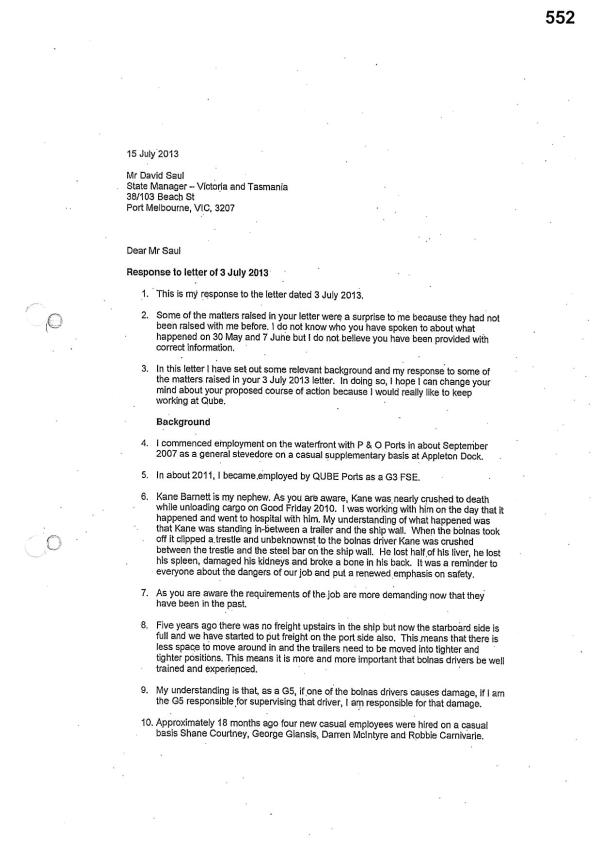
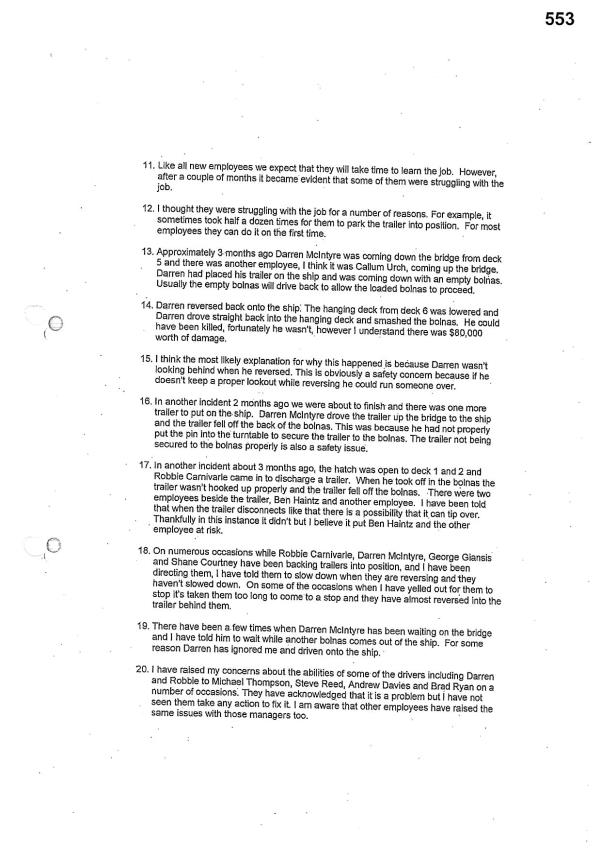
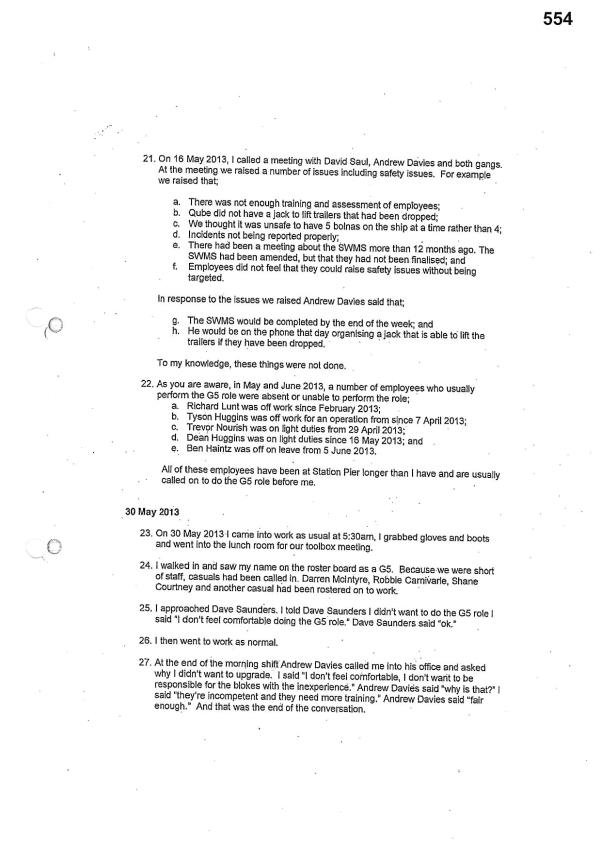
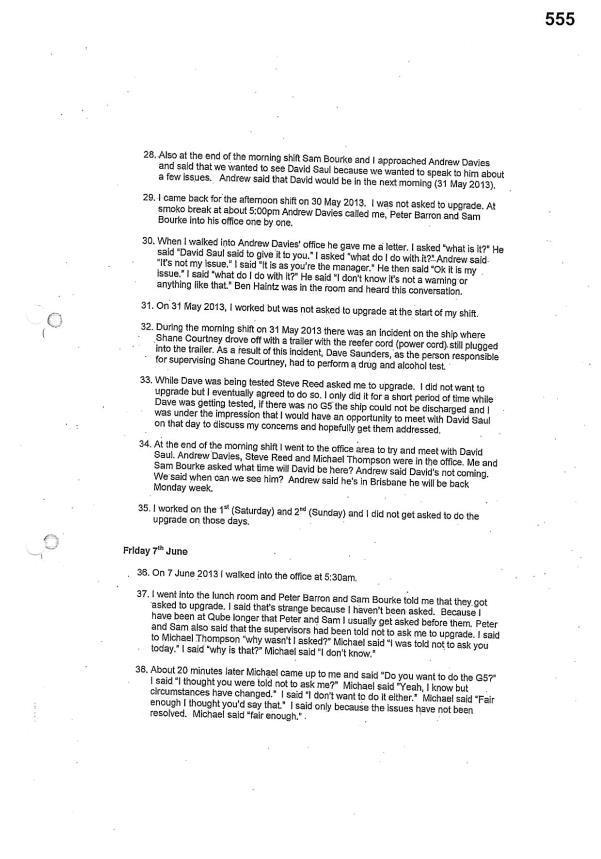
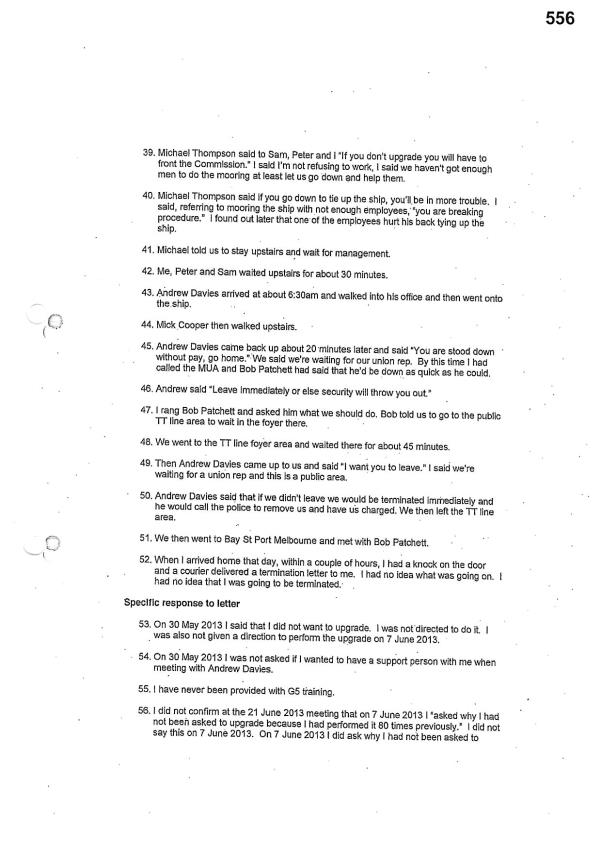
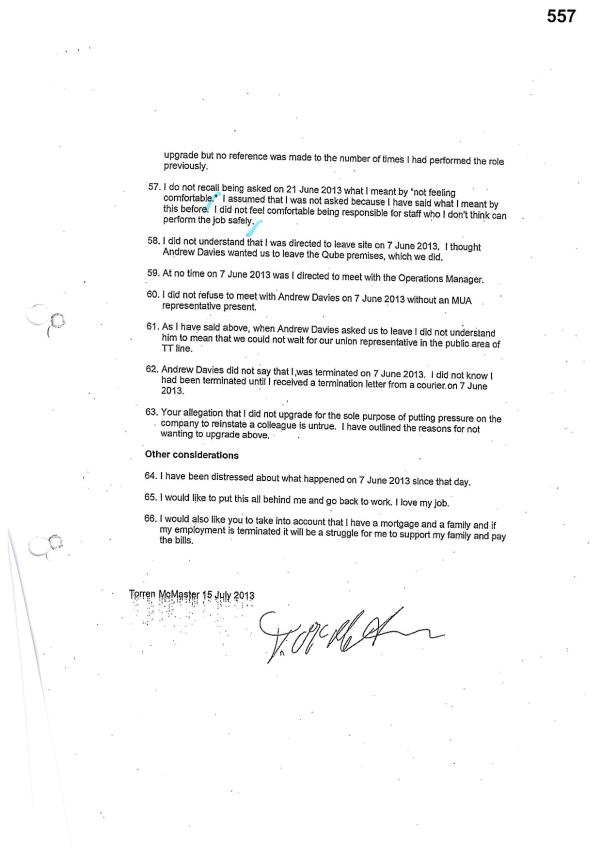
21 Mr Vranesic worked for Qube or its predecessors since 1997. He was a G6 from about 2004/5 and worked on the same gang as Mr McMaster at various times.
22 Mr Lunt worked for Qube or its predecessors since about 1998. He was dismissed on 27 May 2013. For around two years before his dismissal he had worked as a G5. Mr McMaster worked on the same gang in those years and they were friends.
23 Three officials of the Maritime Union of Australia (MUA) also gave evidence for the applicant. Mr Warren Smith is and was in 2013 the National Secretary of the MUA. Mr Kevin Bracken was the Branch Secretary of the Victorian Branch of the MUA in 2013. Mr Robert Patchett is and has been for the past 13 years an Assistant Branch Secretary of the Victorian Branch of the MUA.
24 Three officers of Qube gave evidence for the respondent. Mr Michael Sousa is one of the two directors of Qube. He has held that position for eight years and has been with Qube for 19 years. Mr David Saul was at all relevant times in 2013 the State Manager for Victoria and Tasmania for Qube. He commenced in that role in March 2013. Mr Andrew Davies was in 2013 the Operations Manager for Qube for Station Pier and Devonport. He commenced in that role in March 2012.
THE FACTS
Mr McMaster's Terms of Employment
25 Mr McMaster started work with Qube in September 2007. From December 2007 he worked at Station Pier as part of a team which moored, loaded and unloaded the Spirit of Tasmania vessels.
26 In the course of his employment Mr McMaster entered into a written employment agreement dated 12 January 2011. Under that agreement he was promoted to the G3 position from 17 January 2011.
27 It was common ground that the terms of Mr McMaster’s employment were also governed by the Qube Ports Pty Ltd (TT Line VIC & TAS) & Maritime Union of Australia Enterprise Agreement 2012 (the Enterprise Agreement).
28 The Enterprise Agreement also provided that the terms of the Stevedoring Industry Award 2010 (the Award) were incorporated into the Enterprise Agreement. It also specified at cl 5.2 that in the case of inconsistency the terms of the Enterprise Agreement prevailed.
29 The work of stevedores employed by Qube at Station Pier involved the loading onto and the unloading from the Spirit of Tasmania of freight, semi-trailers, excavators, other heavy machinery, and passenger cars. The stevedores usually worked in a gang of 10 made up of one G6, two G5s, five G3s, and two preparation workers. The G5 fulfilled a foreman role and directed the G3s in their work. The G3s drove the tow vehicles called bolnas which link to trailers for the purpose of towing them on and off the ship. The G3s also directed traffic and helped out the G5s. The eight stevedore gang members apart from the preparation members worked split shifts from 5.30 am to 8.30 am and from 3.30 pm until 7.30 pm. There were two gangs. Each gang worked a four day shift and then had four days off.
Mr McMaster's safety concerns
30 Mr McMaster gave evidence about his concerns for safety and about the occasions when he reported those concerns to Qube. His concern for safety issues was heightened by an accident which occurred at work on Good Friday 2010 which resulted in serious injury to his nephew, Kane Barnett, who worked for Qube at Station Pier. After a bolnas was unhitched from a trailer, a trestle struck Mr Barnett and pinned him against a wall.
31 In 2012 there was a meeting of both gangs with management at which there were complaints about the level of fumes on the deck of the ship from the vehicles being moved around. A full load of vehicles is around 300 passenger cars, 60 containers, and 40 semi-trailers. Qube had the fume levels measured but did not provide the results to the employees. Mr McMaster then acquired a device for measuring carbon monoxide and placed it on the ship. He told Mr Harwood, the Health and Safety Manager at the time, that the reading was pretty dangerous. He asked Qube to provide breathing apparatus. Mr Harwood arranged for paper masks to be supplied. Following a Worksafe investigation, on 20 December 2012, Qube, under the name of Mr Davies, published a safety alert containing standards for the management of intermittent exposure to vehicle emissions. The standard provided that where employees found they were being, or likely to be, impacted by emissions, they should report this concern to the shift manager and remove themselves from the work area. Mr McMaster said that his gang stopped work about three times in response to these conditions. These incidents were reported to Mr Brad Ryan, the Assistant Shift Manager.
32 Mr McMaster told of his concerns that there were new members in his gang who were involved in serious safety incidents. On one occasion, in the April/May 2013 period, Mr Darren McIntyre was driving a bolnas on board when a 40 tonne container dropped off the vehicle. It had not been properly fastened and fell to the ground. The Assistant Shift Manager, Mr Steven Reid, told Mr McIntyre to lift the container up with a 3.5 tonne forklift. Mr McMaster refused because it was dangerous to do so. In the end, Mr Davies was called to intervene and he ordered a crane to lift the container.
33 On another occasion, in the same April/May 2013 period, there was an incident involving another member of the gang, Mr Carnovale. Mr McMaster described the incident as follows:
Mr Carnovale was on deck 3 of the Spirit of Tasmania. He had actually went to reverse his container and he hadn’t hooked up properly either, and what had happened was the container fell off. Now, there was a G5 on that side and a G3 with him. What happened was the container slipped off right next to the hatch to deck 2 where all – actual passenger cars go down into deck 2. And what had happened was the container nearly, like, landed in deck 2. I heard the bang. I was on the other side, I was on the starboard side of the ship, and I come around and the G5 was a bit – you know, he was white.
34 As a result of these safety breaches, Mr McMaster told a number of managers, including Brad Ryan, Michael Thompson, Steve Reid, Brett Hamell and Ted Williamson, that the new gang members needed more training.
35 Mr McMaster was concerned about these incidents and contacted Mr Patchett to see if a meeting could be arranged with management to address the issues. Mr Saul had been appointed State Manager in March 2013 and Mr McMaster wanted to introduce the matters to the new manager.
36 Mr Patchett approached Mr Saul to arrange the meeting. Mr Saul gave evidence that Mr Patchett told him that there was a concern in the workplace about communication and engagement with management.
37 Mr McMaster and Mr Patchett prepared an agenda for the meeting listing the matters of concern to both gangs. The list of items on the agenda, entitled ‘Employee Issues,’ was as follows:
• Safety Meetings /Minutes/Chairperson/Correct Wording, Selective Controlled Structure etc<Brett Harwood>
• Members have continually raised OH&S issues only to be told just get the job done
• OH&S Rep no longer Reps company target anyone who speaks out or about Safety or anything for that nature
• Management direct employees to work unsafe
• Reported Safety Issues disregarded by Management
• Incident reports tabled nothing done <as usual >
• Procedures Amended where are they?
• No Proper training Matrix Modules some employees need to be assessed /Incidents have occurred frequently
• Certifications ?
• Manager unapproachable /writes letters doesn't talk to us hands letters to Supervisors after he walks past us
• Manager performs unsafe acts Forklift/Tyre Pressure/lifting capacity etc
• Return to Work Issues
• Brett Harwood directs assistant shift managers to perform our work
• Brett Harwood has commonly made it known that he needs to break us up
• Brett Harwood continues to follow John Roberts Instructions to write up anyone who speaks up on anything that we disagree with then create a file to get rid of them
• OH&S Rep Dick Lunt who speaks on our behalf has been targeted because of John Roberts Instructions/Culture /Brett Harwood is on a Mission to get rid of Dick Lunt
• We are taking our issues home to our families and leaving them upset we have had enough about how we are treated as employees
• We want assurances from the company that when Dick is able to come back to work he will be able to do that without Intimidation/Harassment etc
• We are all entitled to raise issues and not be treated with the John Roberts Culture
38 The meeting was held on 16 May 2013. Members of both gangs as well as Mr Saul and Mr Davies attended. Mr Davies prepared minutes of the meeting in the afternoon following the meeting. Those minutes read as follows:
Meeting | Qube Employees - TT Line | ||
Date | 16 May 13 | ||
Location | Station Pier | ||
Time | 0830 | ||
Participants | Andrew Davies (Qube), David Saul (Qube), Qube employees | ||
Meeting purpose | Employee Issues & Management Expectations | ||
Issue Area | Employee Concern/Issue | Rectification Process | Expected Completion |
Safety-Near Miss reports | • Thrown away and not entered into the system • Never Documented • Never Followed through | • Place incidents on notice boards from previous month | • Immediately |
Safety-PPE | • I. Hollywood, TT Line employee, not wearing high vis vest on vessel | • Issue already rectified some 6-8 months ago | • CLOSED |
Safety-SWMS Rollout | • SWMS needed changes as were not sufficient | • SWMS to be reworded where required and consultation with HSR’s to take place. • Once HSR is satisfied, SWMS to be rolled out again | • Changes to be made by 24/05/13 • Consultation by Mid June • Rollout by End of June |
Training | • Trainers believe they have not been sufficiently coached into Qube’s training procedures | • Meet with trainers, Alice and SM’s to go through processes, documentation control and overall picture | • Monday 20th May 1pm-3pm |
Safety- Dropped Trailers | • Employees asked to lift trailers with 3t fork | • Do not use forklift • Use Western Towing • Procure Lifting Device | • Immediately • When required • August 2013 |
Safety-Emissions | • Managers direct employees to use Bol 6 & 7 terminal tractors that have high emissions | • Have terminal tractor fleet emissions tested | • July 2013 |
Performance Mgt | • DS was surprised how performance management system working | • Restructure counselling letter | • Immediately |
Safety | • Safety issues forced upon managers and nothing done | • Give employees near miss books | • ASAP |
Shift managers | • Shift managers are winding legs, driving freight cars, pushing trestles | • N/A | • N/A |
Labour | • Shortage of labour time and time again | • Training | • ASAP |
Training | • No foreman training | • Rollout Qube national foreman training | • August 2013 |
Radios | • Radios don’t work, No solution looked at | • Better radio communication processes & hearing aids | • July 2013 |
Other Comments/ Issues
• Kane Barnett incident - Safety has gone downhill since then
• Lights went out in yard and we still had to work
• No consistency in applying discipline process - person written up for smoking 5m outside of smoking area
• Procedures not followed by managers
• Since JR/BH/AD arrived they said heads will roll and the culture has to change
• Used to enjoy coming to work, but there is no morale now
• We work three points of work
• Management have a list of employee targets
39 Mr McMaster gave evidence that he spoke to the meeting on a number of the issues. He spoke about the dropping of containers which he said had become a common occurrence. He asked Qube to provide a bottle-jack to lift dropped containers to avoid being asked to use the 3.5 tonne forklift to do the job. He said that the Safe Work Method Statements (SWMS) applicable at Station Pier needed to be finalised. The SWMS are the written descriptions of how particular functions, such as loading freight or discharging freight should be performed to ensure that they are undertaken safely. Mr McMaster also said that he spoke on the issue of the emissions from bolnas 6 and 7. He said that Qube attended to this issue. And he spoke about foreman training. Because there was a shortage of G5s in his gang members were being constantly asked to upgrade to G5 on particular shifts.
40 Mr McMaster said that Mr Saul told the meeting that all the issues would be fixed within two weeks and the bottle-jack would be available the next day.
41 Mr Saul said that Mr McMaster had an active role at the meeting, but not more active than some of the other senior employees. Mr Davies expressed the same view. And Mr Vranesic and Mr Burke gave similar evidence.
42 The evidence establishes that Mr McMaster expressed his views about safety to management both at the meeting and generally, but not that he was outspoken in a way that particularly set him apart from other senior employees.
43 On 29 April 2013, Mr Lunt was stood down on pay until 27 May 2013, when he was dismissed by Qube. He had applied for leave whilst overseas and when part of that leave was not granted he failed to return from overseas to resume work. At the time he was dismissed Mr Lunt was a G5 working on the same gang as Mr McMaster.
The Events of 30 May 2013
44 30 May 2013 was the first working day for Mr McMaster’s gang after the dismissal of Mr Lunt.
45 Between the meeting on 16 May 2013 and 30 May 2013, Mr McMaster agreed that he had upgraded probably half a dozen times.
46 But on the morning of 30 May 2013 Mr McMaster declined to upgrade from G3 to G5 when asked by the G6, Mr David Saunders. On the same morning Mr Peter Barron declined to upgrade. Qube says that Mr Burke also declined to upgrade on that morning, but he denies that he was asked.
47 Mr McMaster explained in examination in chief what happened when Mr Saunders asked him to upgrade:
So what was different that day?---Well, nothing was really different because, as I said before, you actually got the chance to decline if you wanted to because the G6 allocated the job. Now, the G6 allocated the job that day and I said, “Dave, I –” To Mr Saunders I said, “Dave, I didn’t want to do it that day.” Dave said, “Okay. That’s fine.” Anyway, I – I didn’t really think nothing – I didn’t think it was an issue, to be honest…
48 There was evidence of an email from Mr Reid, the Shift Manager, to Mr Davies outlining the reasons for not upgrading given by the employees to Mr Saunders. That email stated:
Dave informed me that no one would be willing to upgrade to G5 because they didn’t want the responsibility. They didn’t want to take someone else’s job.
Also that if anything went wrong they didn’t want to get a warning or sacked.
49 Mr McMaster denied in cross-examination that he said to Mr Saunders that he did not want to take someone else’s job. I accept that denial because the report of the conversation was second-hand and did not differentiate between the three employees involved.
50 Later in the morning Mr Davies met separately with each of the three employees. Mr McMaster said in examination in chief:
He actually spoke to me and said, “You’ve refused to upgrade.” I said, “Yes. I didn’t think it was an issue.” He said, “Well, why – why did you refuse to upgrade?” I said, “Well, I didn’t feel comfortable with the employers. I’ve spoken to Dave Saul about the issues. Nothing has been attended to and I didn’t want to be held responsible for the current employees.”
51 Mr Davies made file notes of the conversations. In respect of Mr McMaster the file note read:
Reason for not upgrading
- Everything done no reward
- incompetent blokes, don’t want to be responsible for them.
52 In cross examination Mr McMaster denied that he told Mr Davies that everything was done for no reward. The probabilities favour the contemporaneous file note.
53 At the meeting Mr Davies gave Mr McMaster a letter which read as follows:
30 May 2013
Torren McMaster
40 Seventh Avenue
Altona North VIC 3025
Dear Torren,
Refusal to Work in Upgraded Positions
I refer to your advice earlier today that you were refusing to up-grade into the Grade 5 position at Station Pier.
You have been trained in the TT Line Operations and have worked 81 shifts in this position for over the last 12 months. Our training records confirm that you were trained on 28 April 2010 and have been able to follow these procedures.
Whilst we have refreshed the Safe Working Procedures for our TT Line Operations, these are consistent with previous procedures as rolled out. Our procedures have also been supplemented with Safety Alerts which you have been and are expected to follow.
If you are unclear on aspects of the procedures you should advise the Manager and will be immediately refreshed. As you are aware, the procedures apply to all aspects of the tasks, and we can provide support on this.
I remind you of your obligations under clause 8.4 of the Qube Ports Pty Limited (TT Line Vic and Tas) and the Maritime Union of Australia Enterprise Agreement 2012 which requires you to work as reasonably directed. If you are not able to work as directed, you should advise me on your next shift and a formal review will be undertaken.
If you have specific safety concerns relating to the daily operation, you are reminded to communicate these to your Manager. This is a requirement of all employees.
Finally, we are all responsible for safety in all positions worked at Station Pier, including me. It is not acceptable to refuse activities on the basis that you do not want this responsibility.
Yours sincerely,
Andrew Davies
Operations Manager TT Line
54 Mr Davies also handed Mr McMaster a formal warning letter concerning attendance management. The letter stated that Mr McMaster had failed to provide medical certificates for absences on 11 and 30 March 2013, and had failed to attend two meetings which were arranged to discuss the matter. The letter also said that the formal warning was issued because Mr McMaster had previously been issued with formal counselling on 24 December 2012 in relation to non-compliance with attendance requirements.
55 Mr McMaster was not happy receiving the letters. He asked to meet with Mr Saul and Mr Davies agreed that Mr McMaster would meet with Mr Saul on the following day. On the following day Mr McMaster attended to meet Mr Saul but was told that Mr Saul was interstate and unavailable. Mr Davies said that when he made the arrangement he did not know Mr Saul would not be available.
56 On 31 May 2013, Mr McMaster upgraded to G5 for a short time because Mr Saunders, as the G6, had to undergo a drug and alcohol test following an incident when a G3, Mr Shane Courtney, to tow a container when its power cord had not been disconnected so the power cord was ripped from the socket.
57 On 1 June 2013, the shift manager, Mr Reid, asked the gang to meet to discuss their concerns about the SWMS. The employees insisted that representatives from management and the health and safety officer attend. As those people were not available the gang did not meet to address the concerns about SWMS.
The Events of and related to 7 June 2013
58 At the start of the morning shift on 7 June 2013, the assistant shift manager, Mr Michael Thompson, asked Mr Burke and Mr Barron to upgrade to G5. They refused. Shortly afterwards, Mr Thompson asked Mr McMaster to upgrade to G5. He also refused.
59 Mr McMaster gave evidence that he said to Mr Thompson that he did not feel comfortable to do the upgrade and that there were issues still not resolved.
60 Shortly after, Mr Thompson asked Mr Michael Cooper, another G3 stevedore, to go to deck 5 to discharge cars. Mr Cooper refused, saying that he would not do it unless a G6 or G5 was present.
61 Mr Thompson reported the position to Mr Davies. Mr Davies would normally have then raised the issue with Mr Saul, but he was en route to Brisbane by air. So Mr Davies spoke to Mr Sousa. Mr Sousa said that the employees should be directed to work and if they refused they should be stood down.
62 Mr Davies advised Mr Cooper that as no G5 or G6 was available, there would be a manager present to supervise the shift, and asked him whether he would undertake his duties under supervision of a manager. Mr Cooper refused, and walked off. Mr Davies then asked to meet with the four employees. They said that they did not want to speak with him until their union representative arrived. Mr Davies then stood them down and asked them to leave the premises.
63 The employees rang Mr Patchett who told them to wait for him in the public area of the TT Line passenger terminal.
64 Mr Davies again spoke to Mr Sousa and said that the four employees had been stood down and they had been asked to leave, but were still on the premises in the TT Line departure lounge. Mr Sousa said that if they refused to leave their employment should be terminated.
65 Mr Davies went with a security guard to the public area where the men were waiting for Mr Patchett. Mr Davies told them to leave or he would call the police. They replied that they were in a public area. Mr Davies gave evidence that they refused to leave and he terminated their employment as advised by Mr Sousa.
66 Shortly afterwards Mr Davies sent Mr Sousa an email with the names of the employees whose employment had been terminated. Mr Sousa said that this was the first time he knew the identity of the employees.
67 In the evening, Mr McMaster received a letter of termination delivered by courier to his home. Mr Barron and Mr Burke received letters in the same terms. The letter directed to Mr McMaster read as follows:
7 June 2013
Torren McMaster
40 Seventh Avenue
Altona North, VIC, 3025
Dear Torren
NOTICE OF TERMINATION OF EMPLOYMENT
On behalf of Qube Ports Pty Limited, (the Company), I confirm that we wrote to you on 30 May 2013 in relation to your refusal to work in upgraded positions. That letter set out the expectations and requirements that the Company has of you in that regard. The letter made clear that your conduct in refusing to work in upgraded positions was treated very seriously by the Company and was unacceptable. In the circumstances, the Company raised its legitimate concerns with you about failing to comply with the requirements relating to your role, specifically, refusing to work in upgraded positions.
Notwithstanding that letter, you again today refused to comply with a lawful and reasonable direction to work in an upgraded position. The Company has on many occasions required you to work in such positions, and doing so is a fundamental requirement of your role. It is not acceptable to refuse to perform that work on the basis that you do not wish to do so. Such conduct is clearly not in accordance with the requirements in your contract of employment, or under the Enterprise Agreement, to work as reasonably directed. The Company considers your failure to comply with this requirement as a serious breach of your employment obligations.
Accordingly, this letter is to notify you of the decision to terminate your employment effective immediately. You will be paid in lieu of any accrued but unused annual leave and long service leave, if applicable, entitlements in accordance with the relevant legislation.
As you are aware, you have an obligation to return company property on termination of your employment. Please return to me as soon as possible the company property currently in your possession.
Yours sincerely,
Andrew Davies
Operations Manager TT Line
68 Mr Saul returned to Melbourne from Brisbane to attend to the dispute which had arisen. In an email to Mr Sousa sent at 7.20 pm he related a discussion at Station Pier between Mr Bracken, and another union official, Mr David Cushion, an Assistant Branch Secretary, Mr Davies and himself. The email included the following reference:
The MUA asked whether the initial difference commenced with a safety concern about the training level of junior employees – this was refuted on the basis of training and testing processes conducted by Qube.
69 The officials asked that the company engage a formal grievance process. The email from Mr Saul stated:
I noted that I would convey that request, but that discussion has taken place over the last 2-3 weeks.
70 In his evidence Mr Saul thought that the reference to weeks in the email should perhaps have been to hours because there had been no discussions over weeks relating to the events of 7 June 2013 which were unexpected. Mr Sousa said that he had not had discussions on these issues over that period. For him the events of 7 June 2013 came out of the blue.
71 This email was also copied to Mr Brendan Milne, an employee of Qube’s external solicitors, Herbert Smith Freehills.
72 Mr Saul also referred to a conversation he had with Mr McMaster and Mr Burke in the car park as he was leaving Station Pier. The email described the conversation thus:
They approached me in a cordial manner and expressed their surprise at how the day had unfolded, commenced to outline why they were in a difficult position doing the 5 job and that they had not been trained in the role – I noted that the situation was serious, in actual fact they were more than experienced enough to do the 5 task (which both then agreed was correct) and I noted I would pass on the MUA’s request for discussion and reinstatement.
73 Mr Smith and Mr Sousa spoke on 7 June 2013 probably more than once and for some time. Mr Smith urged Mr Sousa to reinstate the four employees. He was concerned about failures in the process of dismissal. He said there were quite severe safety issues at Station Pier and that he was open to attempting to resolve some problematic relationships across the Station Pier workforce. He said that Mr Sousa said that the men at Station Pier needed to be taught a lesson.
74 Mr Sousa explained his recollection of the conversation in examination in chief thus:
Mr Smith obviously rang me ..... discussion progressed through the day. “What are you doing? Why did you terminate him?” And I said, “Look, Warren, these guys are refusing to upgrade.” This is obviously as a response to Lunt. Mr Smith then rang me again in the evening and said, “Look, what are you doing? You need to put him back. At least put him back and let’s go through a process of interviews, etcetera.” I said, “Look, Warren, they’re terminated.” He went on to say that I was mistaken; this was actually about – there were some safety issues and I said to him, “Look, Warren, no. This was purely a refusal to upgrade.” I said I’ve got an issue now where I’ve got a customer that’s really upset and I said that – I went through what had occurred throughout the morning to bring him up to date. I said to him something along the lines of the customer – you know, they were getting pretty annoyed that these employees had taken matters into their own hands and I said to Warren that I felt that my fear was that my customer would take, sort of, matters into their own hand and they teach us a lesson and probably terminate the contract and the issue I would be facing then and he would be facing is we would be dealing with 60 employees without a job rather than where we are now. He went on to continue about safety and I said to him, “Look,” – I asked him specifically, “Tell me what the safety issue is. What is it that I don’t know?” And he said he wasn’t aware, “I will get back to you”, and I said – I did – I made the comment to him that if he wasn’t aware at this point, then clearly there wasn’t a safety issue or else he would have been able to sit here and tell me and I said, “Look, Warren, you and I know this is basically the guys taking matters into their own hands and it’s really about, you know, giving us a touch-up for Richard Lunt.”
75 Mr Sousa denied saying that the men at Station Pier needed to be taught a lesson. In evidence he said that he was concerned that the client, TT Line, which operated the Spirit of Tasmania, could teach Qube a lesson and terminate the contract, “That was my fear at the time”. Mr Sousa had spoken to Mr Pat Guarino, the Chief Operating Officer of TT Line, during the morning of 7 June 2013 and Mr Guarino had expressed frustration at the events.
76 The conversations of 7 June 2013 between Mr Smith and Mr Sousa were confirmed and advanced in a series of emails on the following day. Mr Smith continued to press for reinstatement of the four employees and wrote:
The MUA says that the four members had not received refresher training in the G5 position when they has [sic] asked for it. The members had genuine safety concerns about the role they were requested to perform. This concern is recognised and addressed in the company letter of May 30.
We note that in your Qube letter 30 May undesigned [sic] by Andrew Davies, Operations Manager at TT Line, workers are instructed that ‘if you are unclear on aspects of the procedures you should advise the Manager and you will be immediately refreshed’ and ‘if you have specific safety concerns relating to the daily operation, you are reminded to communicate these to your manager’. Yet when workers followed these instructions, the response from the company was instant dismissal. At no time prior to the sackings did management offer refresher training to these four members despite commitments given.
77 And he further stated:
I note in our telephone conversation that your response to my identification of these issues was that ‘those guys at Station Pier need to be taught a lesson’.
78 Mr Sousa responded by refusing to reinstate the employees and wrote:
As discussed last night the employees in question where [sic] in breach of their employment contracts with Qube.
They were issued with an instruction to work and refused to adhere without any reason to that refusal.
They were offered numerous opportunity throughout the morning yesterdat [sic] to return to work and refused.
This refusal was a repeat of the same instructions a week ago where they were issued with letters.
79 In relation to the alleged threat to teach the men a lesson, Mr Sousa replied:
Finally your interpretation of our discussion is somewhat intriguing. Our discussion was is [sic] relation to on-going poor performance which our Client had put us on notice for and our obligations as an organisation to manage performance issues.
80 Then, early on Sunday morning, 9 June 2013, at Station Pier Mr Bracken had a conversation with Mr Saul about an unrelated safety incident. The dismissal of the four employees was also raised. Mr Bracken gave evidence that he said to Mr Saul that Mr Saul had not followed the proper procedures in relation to the incident. Mr Bracken gave evidence that Mr Saul replied:
“I don’t give a fuck about the policies. I don’t give a fuck about the Award. I don’t give a fuck about the agreement. We’re teaching these blokes a lesson.”
81 Mr Saul denied saying that. Having observed Mr Bracken and Mr Saul in the witness box and by reference to the evidence as a whole I accept Mr Saul’s denial that he replied as Mr Bracken alleged.
82 At 7.37 am on that morning Mr Saul sent Mr Sousa an email referring to the conversation with Mr Bracken and explained:
I just had an hour with Kevin Bracken in the cold – going around the buoy on the dismissals.
He is trying to link safety, training and the dismissal. While he is keen to brandish the “upgrade letter” of the 30 May 13 as evidence of a process not being followed, he is uncomfortable when it is explained to him that employees were brought in on the 1 Jun [sic] to do a SWMS refresher / review which was the opportunity to detail position responsibilities and they refused to participate in the process.
83 On 11 June 2013 Mr Sousa wrote to Mr Bracken objecting to a leaflet which he said Mr Bracken and others were observed handing to passengers of the Spirit of Tasmania. The leaflet stated in part:
The Stevedoring Company loading this ship is QUBE Ports. We would like to make you aware this company has an atrocious safety record and on Saturday 7th June illegally sacked four workers for raising a legitimate safety issue.
The four workers requested to be trained for a position they would sometimes be employed in. The training was denied and all four workers were sent home and received a termination letter that afternoon.
…
If you believe workers have the right to a safe workplace, proper training, and to come home alive, we ask you to raise your concerns about QUBE’s practices to the Spirit of Tasmania crew.
84 The leaflet stated that it was authorised by Mr Bracken. Mr Bracken responded to Mr Sousa’s letter indicating that the MUA would cease distributing the leaflet whilst it considered Mr Sousa’s letter and asking in what respect the leaflet was factually incorrect.
85 Mr Sousa then wrote to Mr Bracken contesting each of the allegations in the leaflet and, in particular, the suggestions that the workers were sacked for raising safety issues.
86 At the same time, Mr Smith requested branches of the MUA to distribute to members an email which made similar allegations against Qube as in the leaflet, and included the following:
I write to inform members that Qube have instantly dismissed four MUA members from their TT Line operation at Station Pier Melbourne over safety related matters. This occurred on Friday 7th June 2013. The MUA continues to fight to get the four comrades reinstated from this unlawful dismissal.
The four workers requested to be retrained prior to upgrading to a G5 position, as they were uncomfortable with the safe working processes in place on the job.
On the 7th June three workers were told by the Supervisor “we know you have not been retrained but we want you to perform the senior role”. The workers replied “we don’t feel comfortable in that role”. Another employee was asked to do work outside of safe operating procedures. When he stated that fact he was told: “get off the ship you are off pay”. All four were sent home and received a termination letter that afternoon.
…
Sacking workers that raise safety issues is disgraceful at any time let alone with QUBE’s safety record
The Victorian Branch and National Office are using all available resources to deal with this issue and working to get the all the comrades back on the job.
87 The email then asked members to pass resolutions supporting the reinstatement of the four employees.
88 By a letter dated 12 June 2013, Mr Sousa threatened proceedings against the MUA and Mr Smith if they continued to publish the material which Mr Sousa said contained false, misleading and damaging information.
Reconsideration of the Terminations
89 Mr Sousa left for a short trip to Canada. Whilst he was away an agreement was reached on 14 June 2013 between Mr Smith, and Mr Don Smithwick, the Managing Director of Qube, that the four employees would not be terminated but suspended on pay and they would attend meetings in the following week where the circumstances of their terminations would be considered in full. Mr Smithwick advised Mr Smith that Mr David Reid, the Workplace Relations Manager for Qube, would run the process. Mr Sousa gave evidence in cross examination that Mr Noel Pearse, General Manager HR/IR, ran the process. However, the weight of the evidence, including Mr Smithwick’s email of 14 June 2013 to Mr Smith, establishes that Mr Reid was actively coordinating the process, in consultation with Mr Pearse and others.
90 On 18 June 2013, Mr Reid sent an email to Mr Saul, Mr Davies, and Mr Harwood concerning arrangements for the meetings including that Mr Saul would conduct the meetings, that each employee would be interviewed individually, and that Mr Davies should prepare a list of relevant questions and provide a chronology of events. It is noteworthy that Mr Harwood was included in this process. He was the Health and Safety Manager. His inclusion suggests attention to the safety issues raised by Mr McMaster.
91 The email was copied to Mr Sousa. It contained the following:
It is very important that this meeting be strictly confined to one issue ie failure to comply with a lawful instruction. If safety matters are raised, as they undoubtedly will be, they should be played with a “dead bat”. We will have plenty of time to discuss systemic issues at TT Line in coming days and weeks.
92 On 20 June 2013, Mr Davies sent to Mr Reid, Mr Saul, and Mr Harwood, copied to Mr Sousa and Mr Noel Pearse, a chronology of events and an overview of each of the four employees. He also wrote:
It should be made clear that prior to the 07/06/13, there was a G6 & G5 available (D. Saunders & B Haintz), and the job could keep operating sufficiently. On the 07/06/13, B. Haintz was on annual leave and without the G5, the operation could be severely impacted and the employees understood this.
93 The overview relating to Mr McMaster read as follows:
Torren McMaster
• Initial Meeting on 30/05/13
• AD asked the reason for not upgrading, TM said that everything is done for no reward. TM said that the other employees are incompetent and he doesn’t want to take responsibility for them.
• Trained on SWMS on 29 April 2010 and refreshed on 19 September 2012
• On 24/05/13, Steve Reid tool boxed all employees that there was an opportunity to review and to through the SWMS after discharge. No employees attended
• Refused to be refreshed /go through SWMS on 01/06/13 & 02/06/13
• Performed position on 81 occasions in last 12 months
• Asked to perform G5 role on 31/05/13 and did.
• Confirmed with David Saul on 07/06/13 PM, more than experienced to do the job
94 At the meeting held on 21 June 2013, Mr McMaster related the events of 7 June 2013. Mr Harwood took notes and produced a summary which included a reference that Mr McMaster said Mr Burke and Mr Barron were “not comfortable with inexperience” and “I’m not comfortable either”. Mr Saul confirmed in cross examination that Mr McMaster had said that he was uncomfortable with the inexperience of the workers he was being asked to supervise on 7 June 2013.
95 On 3 July 2013, Mr Saul sent Mr McMaster a show cause letter. The letter is included as Annexure A to these reasons for judgment.
96 On 15 July 2013, Mr McMaster replied to the show cause letter. The reply is lengthy and set out much of the history and concerns already detailed. However, as this letter was produced to Mr Sousa and he was not aware of some of the matters referred to prior to receiving this letter, it is included as Annexure B in full.
97 On 16 July 2013, Mr Reid sought clarification in respect of some of the matters raised in a significant number of the paragraphs of Mr McMaster’s letter dated 15 July 2013. For instance, as to paragraph 20, Mr Reid asked:
Have these issues been raised with the managers named? If so, there a defensible responses?
98 And as to paragraph 21, Mr Reid enquired:
16 May meeting. Were these issues raised and addressed?
99 On the same day Mr Davies provided responses to Mr Reid’s request for clarification. The response in respect of paragraph 20 was:
• Steve Reid – passing comments. Not in a pure safety issue context. No examples provided. General wording ‘dudds’
• Michael Thompson – General conversation. Not in a pure safety issue context. No examples provided. General wording ‘dudds’
• Andrew Davies – No direct conversation / issues in regard to employees abilities.
• Brad Ryan –
• Notes – The other gang has not raised any safety concerns about the employees stated. McMaster is unhappy as they are not his mates.
100 As to paragraph 21 Mr Davies response was:
a. Raised – No
b. Raised – Yes, Addressed – Yes
c. Raised – No
d. Raised – Yes, Addressed -Yes
e. Raised – Yes, Addressed –Yes
f. Raised – Yes, Addressed – Yes
g. Raised – Yes, Addressed – Yes
h. Raised – Yes, Addressed – Yes
101 On 17 July 2013, Mr Sousa responded to the answer provided by Mr Davies to Mr Reid and sought more detail about the clarification of paragraph 21. He wrote:
Generally I am ok with everything in their statements as being noise.
My only issue in their statements is point 21 where they raised safety issues and we are compelled to action and communicate.
Your answers attached on point 21 are just yes / no.
I would like to see some details please on what was done on (a) to (h) and how it was communicated.
102 On 17 July 2013, Mr Davies responded to Mr Sousa first by sending him the agenda for the meeting held on 16 May 2013, and the minutes of that meeting. Then, shortly afterwards, he sent further details in response to paragraph 21 of Mr McMaster’s letter of 15 July 2013 as requested by Mr Sousa. The further details read thus:
a) Not raised in meeting
b) AD advised that we were in the procurement stage of acquiring a lifting device. AD advised that it is not just as easy as buying a jack, it will take time. In the meantime we will use Western Towing to lift dropped trailers.
c) Not raised in meeting
d) DS advised that there is an incident reporting system and incidents are entered into that system. AD advised that TT Line reports the most near miss incidents per employee than other site. DS advised that AD would put incidents that were in the system on the noticeboards immediately and DS wanted assurance that the notice would not be ripped down. AD posted incidents on noticeboards within 2hrs of the meeting finishing.
e) SWMS were finalised and reviewed by HSR's & managers in Devonport and Station Pier in August 2012. Rollout took place in September and employees were not happy with some wording. Employees refused to sign and complete questionnaires as MUA advised them us not to sign anything. Attendance forms were used as documentation of going through SWMS. AD advised that the correct consultation process had been followed.
f) AD recalls being raised and no substance to comments due to no examples given
g) Changes were completed by AD that week. Then need to follow document review process, consultation etc
h) As per part b)
• Notes-
• AD went through all the meeting agenda items with all the shift managers at Station pier after the meeting
• 2/5/2013- Worksafe visited Station Pier to address issues which MUA indicated to Worksafe were an imminent risk to Health and Safety. Worksafe indicated no issues This meeting above occurred two weeks after and employees were not happy with worksafe's outcome
The Termination of Mr McMaster's Employment on 23 July 2013
103 On 23 July 2013, Mr Saul sent Mr McMaster a letter of termination in the following terms:
23 July 2015
Mr. T. McMaster
40 Seventh Avenue
Altona North VIC 3025
Dear Mr. McMaster,
RE TERMINATION OF YOUR EMPLOYMENT
On behalf of Qube Ports Pty Limited (the Company), we refer to our letter dated 3 July 2013 to provide you with a final opportunity to respond to the Company's proposed decision to terminate your employment for the reasons stated in that letter. We refer also to your letter in response dated 15 July 2013.
The Company has given careful consideration to the matters set out in your letter as well as the explanations provided by you verbally during our meeting with you on 21 June 2013.
The explanations you offered, have not altered the Company's view that your conduct on 7 June 2013 amounted to a refusal to follow the lawful directions of management, without reasonable excuse. In the Company's view, that conduct amounted to serious and wilful misconduct. Accordingly, the Company upholds its decision made on 7 June 2013 to terminate your employment, effective immediately.
You will be paid in lieu of any accrued but unused annual leave and long service leave, if applicable, and any other entitlements in accordance with relevant legislation.
As you are aware, you have an obligation to return company property on termination of your employment. Please return to me as soon as possible the company property currently in your possession.
Yours sincerely
David Saul
Qube Ports Manager – Victoria & Tasmania
104 Mr Barron’s employment was not terminated, but he was provided with a final written warning dated 25 July 2013. Mr Burke’s employment was not terminated, but he was provided with a final written warning dated 9 August 2013. Mr Cooper’s employment was not terminated, but he was provided with a final written warning on 27 August 2013, and later ceased employment on terms agreed between him and Qube.
THE ORAL EVIDENCE OF MR MCMASTER
105 The course of events in issue was extensively documented. The documents recorded the reasons that Mr McMaster gave for refusing to upgrade on 7 June 2013. Mr McMaster’s oral evidence elaborated on these issues and explained his reasons in his own words.
106 Mr McMaster described the effect on workers having to work among the exhaust fumes of motor vehicles whilst loading and unloading the ship. He agreed that Qube had commissioned carbon monoxide testing which occurred in November 2012 but said that the employees were not given the results.
107 Mr McMaster said that he was concerned about the dangers of working with others who lacked experience. In particular he referred to Mr Shane Courtney, Mr Robbie Carnovale, Mr Darren McIntyre, Mr Brad Davis and Mr George Giantsis. In May 2013, Mr Carnovale had been employed for around 20 months, Mr McIntyre and Mr Courtney for around 14 months and Mr Giantsis for around seven months. The incidents involving Mr Carnovale and Mr McIntyre, outlined at [32] and [33] above, occurred within six weeks of the meeting held on 16 May 2013.
108 Mr McMaster believed that as a G5 he was responsible for any accidents or incidents which occurred under his supervision. He gave evidence in cross examination as follows:
Well, can you explain to me why it’s any less safe to perform the G5 directing role than the G3 directing role? ......as I understand it, you expressed a concern about working with a number of employees with poor levels of skills and experience?
……Well, basically, the G6 foreman and the G5 foreman were held responsible in regards to any incidents on that ship.
All right. Now, when you say “held responsible”, what do you mean by that? Well, I mean if – if anything occurred, the G6 and G5 foreman actually had signed off on a document stating that they are held responsible for anything happening on the ship. So…
What document is that? I’m not sure, sir, but I remember speaking to one of the G6s and they had a meeting – the G6s and the G5s had had a meeting and they would now – now be held responsible for anything that happened. One of the – one of the circumstances was when Dave Saunders was actually directing as a G6 and Shane Courtney pulled out the reefer cord. Now, they also – instead of just taking Shane Courtney who had the incident up to the office to be drug and alcohol tested, they also took Dave Saunders with them. That proved that a G6 is now held responsible as well.
Right. Now, do I take it you mean that if they made a mistake and damaged something, that because you were responsible for supervising them, it would be partially regarded as your fault for a lack of supervision, so to speak? No. Mr Follett, it’s not just a – on those ships, it’s not a minor mistake. As I said, I’ve
Well, I didn’t ? I’ve witnessed it before.
I didn’t ask you anything about a minor mistake. I asked you ? But there’s not any minor mistakes. These are major mistakes. I’m not going to be responsible for someone getting crushed by a container because the – the employees weren’t competent or weren’t trained up enough to perform their duties.
And so perhaps if you can – I will go back to my question, which was did you think that Qube would make you responsible if there was a mistake from one of these employees and it caused any damage? Yes, I did.
109 From the meeting held on 16 May 2013, he understood from Mr Saul that the SWMS would finalised by the end of the week and the bottle-jack would be procured within 24 hours. He further believed that the other items discussed would be attended to within two weeks.
110 Mr McMaster explained his reason for not upgrading on 30 May 2013 and the response to it as follows:
[T]he incidents on the lead-up to that were enough to say I didn’t want to upgrade that day – that particular day. That’s why I declined it and I didn’t think it would be an issue.
111 Mr McMaster said that he told Mr Saunders that he did not want to upgrade because he did not want the responsibility, that he did not feel comfortable and that if anything went wrong he did not want to get a warning or be sacked. He denied saying that he did not want to take someone else’s job.
112 Later when speaking to Mr Davies he said that he did not want to be responsible for incompetent blokes. He denied saying to Mr Davies that “everything was done for no reward.”
113 Mr McMaster said that he thought it was poor form that Mr Saul was not available on the morning of 31 May 2013 to discuss the letters given to Mr McMaster the day before because Mr Davies had indicated that Mr Saul would be available at that time.
114 In cross examination Mr McMaster was asked his reason for not upgrading on 7 June 2013 and he replied:
[I]t was in regards to the issues that I had raised and the fact that I hadn’t even seen David Saul to attend to any of the issues that I had raised, that was the reason for me not upgrading. It had nothing to do with Burke or Barron.
115 He was then asked about the allegedly different reasons he had given for not upgrading and he explained as follows:
Well, can I suggest to you, Mr McMaster, that you’ve given about six or so accounts of your reasons for not upgrading on 30 May and none of them have ever suggested that there were unresolved issues about 16 May? Well, that’s what they are. If I don’t feel comfortable or don’t want to be held responsible – it was in regards to these inexperienced employees not being able to perform their role. Basically, that, for me, says exactly what I’ve raised at the 16 May meeting.
116 And later in cross examination the following exchanges occurred:
[T]he true reason why you refused to upgrade on that day was the same reason as 30 May, which was in protest of the dismissal of Mr Lunt? No. That’s not true.
You, along with others on your gang, wanted him reinstated and you thought that refusing an upgrade collectively would put pressure on Qube to reinstate him, correct? Not true. No.
…
[T]he structure of what had been put in place was that there would be a collective refusal of the G5 upgrade and there would be a refusal to work with shift managers in the G5 position, the effect of which was that Qube couldn’t load the vessels or unload the vessels and that’s what would put pressure on Qube to reinstate Mr Lunt? That’s not correct because all the other guys were – were at work. We’re the only three stood down, the three that declined the – the actual G5 position.
117 In examination in chief Mr McMaster had explained:
And if it was put to you that really what you were doing on 30 May and 7 June was an industrial response to Mr Lunt's dismissal, what do you say about that? Well, I refute that because, if anything, I've always had the union officials deal with any issues that I've had. As I've said, with the Davies incident and the attendance management plan, I've always called the officials. With the agenda that I raised on 16 May, I called the officials. There's no way I'm going to act alone in regards to someone else if I don't see - see it in my best interests.
THE ORAL EVIDENCE OF MR SOUSA
118 The decision to dismiss Mr McMaster was made by Mr Sousa. He took account of and agreed with the recommendation made by Mr Saul.
119 The reason Mr Sousa decided to dismiss Mr McMaster is one of the central matters relevant to the determination of this proceeding. The events in issue and the process which led to the decision to dismiss Mr McMaster are extensively documented. That documentary evidence is described elsewhere in these reasons for judgement. However, the oral evidence given by Mr Sousa explains the context more fully, and articulates in his own words the factors which influenced his decision. For this reason Mr Sousa’s evidence is separately outlined in this section of these reasons for judgment.
120 Mr Sousa explained that he is responsible for the Qube business which operates in 24 ports in Australia and ten ports in New Zealand. The business employees around 2500 people in Australia and around 800 people in New Zealand.
121 Mr Sousa trained as an accountant. He has worked for Qube for 19 years. He started as an accountant for the international business and then moved out of finance. He became the Operations Manager for White Bay in Sydney. Then he was State Manager for New South Wales, followed by a time as Commercial Manager before his appointment as a Director eight years ago.
122 Mr Sousa explained that Qube has a human resources department which handles disciplinary and termination issues. He said that the department runs those processes. He explained:
And I do that specifically to remove myself from the decision. So by the time I get it, what I’m getting is fact.
123 Thus, for example, in the present case Mr Sousa was not involved in the interviewing process or in gathering the relevant material.
124 Mr Sousa played no part in the decision to reinstate the four employees pending reconsideration because he was overseas in Canada at the time.
125 In relation to the events of 30 May 2013, Mr Sousa said that he was generally aware that some employees refused to upgrade. At the time he thought that the action related to the dismissal of Mr Lunt.
126 Mr Sousa said that he had past experience of men refusing to upgrade as an industrial tactic used to put pressure on Qube. In order to load or unload the ship it was necessary for Qube to supply a gang with a specified number of stevedores in designated classifications. By the employees collectively refusing to upgrade to G5 they potentially prevented a workable gang being assembled.
127 In relation to the events of 7 June 2013, Mr Sousa said that when Mr Davies told him of the refusal to upgrade he did not know of Mr McMaster, and did not know of the meeting held on 16 May 2013. He was aware that there had been an issue over fumes but knew that Qube had supplied paper masks. He believed that the issue had been resolved and that there were no ongoing complaints. He was not aware of any complaints about the lack of training of employees.
128 When Mr Davies told Mr Sousa of the refusals to upgrade Mr Davies said that the men had given no reason for their action. No safety issues were raised with Mr Sousa before Mr Davies was instructed to dismiss the men. He saw the issue at that time as a refusal by the men to upgrade in order to place pressure on Qube to reinstate Mr Lunt. He acted swiftly because the ship had just arrived with passengers wishing to disembark and no work was being done to allow that to happen.
129 After the employees were reinstated and Mr Sousa had received the material referred to in [90] to [102] above for his consideration, including Mr McMaster’s 15 July 2013 response to the show cause letter, Mr Sousa remained of the view that Mr McMaster should be dismissed. He explained:
Why did you make that decision? I – after I had read his responses and looked at his file, what I felt was that this employee had a history of refusing management direction. And this was culminated on the day by Mr McMaster initially requesting to upgrade on the day and then, when later requested to upgrade, refused, then refused to leave the site as well. So what I saw was an employee that had a – a history of refusing management direction.
What was your considered view as to why Mr McMaster refused to upgrade on 7 June? I felt that it was – predominantly it was in relation to the termination of Mr Lunt.
What was your view as to his denials as to that motivation? I felt they were untrue.
…….
MR FOLLETT: What was your view as to his assertions that he was inadequately trained for the G5 role?
……
THE WITNESS: I felt that was inaccurate. Mr McMaster had done the job 81 times, I think, previously, so he certainly had the experience. He had been trained in the SWMS like every employee and I felt that he was certainly – he was certainly competent at performing the job.
MR FOLLETT: What were you – what was your view as to his assertions as to the safety of working around employees who he regarded as less experienced and less trained? That’s the role of a G5. Their job is to be a mentor to those less-experienced employees.
What was your view as to the assertion that to do so was unsafe? I felt that was not correct. I mean, there was certainly nothing raised on the day as to any safety issues.
130 Mr Sousa was asked in cross examination whether he thought that Mr McMaster might have had mixed motives for refusing to upgrade:
Did you consider, sir, that in terms of what happened on 7 June, Mr McMaster may have been concerned both about Mr Lunt and about safety issues? No. I wasn’t. My view is that Mr McMaster was completely – that it was industrial action in relation to Mr Lunt’s termination.
131 And later Mr Sousa said:
My understanding of why he didn’t upgrade on that day was purely that he – he – he refused to upgrade because of an industrial issue. That was my view.
132 Mr Sousa denied that the outcome of the reconsideration was predetermined. He denied that he decided to treat safety with a dead bat. Rather, on examination of the material provided, he formed the view that there was no justification in the suggested safety issues and that Mr McMaster’s explanation that he refused to upgrade for safety reasons was untrue. There were explanations by Mr Davies in relation to each safety allegation. In respect of the allegations in paragraph 21 of Mr McMaster’s response to the show cause letter, Mr Sousa sought further detail. In the end Mr Sousa accepted the view of Mr Davies that all the safety issues raised had been appropriately dealt with and there was no basis for them.
133 As to the allegation that he decided to dismiss Mr McMaster because he raised issues of safety, Mr Sousa responded in examination in chief as follows:
To what extent, if any, did the fact that Mr McMaster had made complaints about any matter – safety, employment or otherwise – form part of your decision? None whatsoever.
CONSIDERATION
Did Mr McMaster exercise a workplace right to complain about safety under s 341(1)(c)?
134 Section 341(1)(c) of the Act provides that an employee has a workplace right if the person is able to make a complaint or enquiry in relation to his employment. Qube does not deny that Mr McMaster exercised a workplace right within the meaning of s 341(1)(c) of the Act when he raised safety concerns shortly before the 16 May 2013 meeting over the incidents involving Mr McIntyre and Mr Carnovale. Qube also accepts that Mr McMaster exercised a workplace right when he raised matters at the 16 May 2013 meeting. Qube did not suggest that these concerns of Mr McMaster were misplaced. Indeed, Mr Saul gave evidence that when he took up the position of State Manager for Victoria and Tasmania for Qube in 2013, the lost time injury frequency rate for Station Pier was unacceptably high. The lost time injury frequency rate reflects the time that employees have taken off due to workplace injuries. In 2013, the rate across the Qube Ports business was below 14, however the rate at Station Pier was in the high 20's. By 2015 the rate at Station Pier had reduced to around 11 which was just below the industry average.
135 Qube, however, contests that Mr McMaster exercised a workplace right on either 30 May 2013 or 7 June 2013, or further, on 15 July 2013 by writing his response to the show cause letter. Counsel for Qube argued that Mr McMaster refused to upgrade on 7 June 2013 in order to apply pressure on Qube to reinstate Mr Lunt. He did not act out of concern for safety at all. Counsel for Qube contended that when Mr McMaster said that he acted for reasons of safety, he was not being truthful, or at least, his evidence on that question is not reliable.
136 Counsel for Qube contended that Mr McMaster proffered four or five different reasons for refusing to upgrade, most of which had nothing to do with safety. Thus, on 30 May 2013, Mr Davies’ file note recorded that Mr McMaster had said “everything done no reward” as a reason for not upgrading. I accept the accuracy of the file note. But it also records “incompetent blokes, don’t want to be responsible for them.”
137 In his 30 May 2013 email Mr Reid, Shift Manager, stated that Mr Saunders told him that the reasons for not upgrading included “they didn’t want to take someone else’s job”. I have explained why I accept Mr McMaster’s denial that he said that. The email gave two other reasons, namely, that the men did not want the responsibility, and if anything went wrong they didn’t want to get a warning or be sacked. These reasons, particularly the former, reflect what is recorded in Mr Davies’ file note.
138 Then, on 7 June 2013, when Mr Thompson asked Mr McMaster to upgrade, Mr McMaster said that he refused and told Mr Thompson that this was because “the issues have not been resolved”. At the meeting on 21 June 2013, Mr McMaster explained that he was not comfortable with the inexperience of some of the members of the gang. In [57] of his response to the show cause letter Mr McMaster explained that his reference to “not feeling comfortable” meant:
I did not feel comfortable being responsible for staff who I don’t think can perform the job safely.
139 Counsel for Qube relied on several further instances of alternative reasons given by Mr McMaster. However, those examples were based on instances which Mr McMaster denied and were not otherwise proved, or were the result of questions in cross-examination which were insufficiently clear to allow the responses to be regarded as material. In the end, this criticism of Mr McMaster’s evidence should not be accepted. There was a consistent theme from the 16 May 2013 meeting to the reasons expressed on 30 May 2013 and on 7 June 2013, and then confirmed in the response to the show cause letter. That theme was that some of the newer gang members were not sufficiently experienced to work safely and Mr McMaster was concerned that there may be injury or accidents while he was supervising them as a G5. Mr McMaster’s concern was expressed differently at different times. Thus, the safe working of gang members was an issue discussed at the 16 May 2013 meeting. On 30 May 2013 Mr McMaster expressly referred to incompetent blokes. On 7 June 2013 he said that issues had not been resolved. There was no elaboration of this reason because matters escalated so quickly on that day. Then, at the 21 June 2013 meeting Mr McMaster spoke about not being comfortable upgrading, which he explained in his response to the show cause letter as a reference to not wanting to be responsible for staff who could not work safely.
140 A factor which could be taken to support Qube’s position that Mr McMaster refused to upgrade on 30 May 2013 in support of the reinstatement of Mr Lunt was that 30 May 2013 was the first day of work for Mr McMaster’s gang after Mr Lunt was dismissed on 27 May 2013. However, Mr McMaster explained that 30 May 2013 was also the time when Mr Saul had indicated at the 16 May 2013 meeting that all the outstanding issues would be resolved. Mr McMaster said that the issues had not been resolved by the promised time. Thus, the temporal proximity supports the conclusion that Mr McMaster refused to upgrade on 30 May 2013 for either or both of the reasons. It does not necessarily support the conclusion that his actions were in aid of the reinstatement of Mr Lunt alone.
141 Counsel for Qube then argued that Mr McMaster had upgraded 81 times in the previous 12 months and on some of those occasions the same inexperienced employees had been working on the gang. The presence of the inexperienced employees could not therefore explain Mr McMaster’s failure to upgrade on 30 May 2013 and 7 June 2013.
142 However, this argument does not take into account two changes in circumstances which occurred just prior to 30 May 2013. Mr McMaster explained these circumstances. One was that the issues arising from the 16 May 2013 meeting had not been resolved. Although the minutes of the meeting do not suggest that all of the issues would be resolved in two weeks, Mr McMaster gave evidence that he believed that the issues would be resolved in that time. I accept that Mr McMaster believed that Qube had not honoured all the promises made at the meeting. The other circumstance was that the dismissal of Mr Lunt on 27 May 2013 exacerbated the problem of inexperience on the gang. Mr Lunt had been a G5 in Mr McMaster’s gang. Mr McMaster explained the position:
So basically, what I was getting at was, there was already four G5s off. Lunt was sacked. That made five G5s off. The issues that we raised were in regards to G5 training, and we needed some qualified G5s, yet now we now have eight G3s attending to a shift without any qualified G5s.
143 Following these events Mr McMaster did not upgrade save for a period of 20 – 30 minutes on 31 May 2013 when Mr Saunders became unexpectedly absent. 30 May 2013 was the first working day for his shift following the two week period after 16 May 2013 and the dismissal of Mr Lunt. 7 June 2013 was the next occasion on which Mr McMaster was asked to upgrade.
144 The objective facts are therefore consistent with Mr McMaster’s claim that he refused to upgrade on 7 June 2013 due to his concerns about safety. Mr McMaster gave his evidence in a straightforward way. His version of events was coherent. I am satisfied that Mr McMaster held genuine concerns about the safety of his working environment at the time when he refused to upgrade on 7 June 2013. I find on the balance of probabilities that Mr McMaster refused to upgrade on 7 June 2013 at least in part in the exercise of a right to complain about safety at his workplace. That is to say, his refusal to upgrade was a way to registering his objection to the safety concerns he held.
145 Some of the arguments relied on by counsel for Qube were based on an approach that if it was safe for Mr McMaster to upgrade on 7 June 2013 then he could not have been exercising a workplace right to complain about safety. Thus, for instance, it was contended that the failure of Qube to have finalised the revision of the SWMS did not mean that it was unsafe for Mr McMaster to upgrade. However, that approach does not focus on the proper question, namely, whether the right to complain was being exercised by Mr McMaster taking the action.
146 It follows from this reasoning that Mr McMaster did exercise a workplace right to complain about safety under s 341(1)(c) of the Act.
Did Mr McMaster exercise a workplace right under s 25 of the OHS Act?
147 A person has a workplace right for the purposes of s 341(1)(a) of the Act if that person has a role or responsibility under a workplace law. Section 12 of the Act provides that the OHS Act is a workplace law. Section 25 of the OHS Act requires a person to take reasonable care for their own health and safety.
148 The question now raised is whether, by refusing to upgrade on 7 June 2013, Mr McMaster exercised a right to take reasonable care for his own health and safety, and hence exercised a workplace right under s 340(1)(a) of the Act. Counsel for Mr McMaster argued that whether Mr McMaster took reasonable care for his own health and safety is to be determined subjectively. As he believed his actions were necessary to protect his safety, his action constituted compliance with s 25 of the OHS Act.
149 Counsel for Qube contended that the test is objective. As it was not objectively necessary for Mr McMaster to refuse to upgrade in order to protect his own safety, his action did not fall within s 25 of the OHS Act.
150 To seek to characterise the approach required by the section as subjective or objective as apt to distract from the terms of the section. The terms of the section include both elements. For instance, subsection 3 expressly postulates a subjective enquiry. It provides that, in determining whether an employee failed to take reasonable care, “regard must be had to what the employee knew about the relevant circumstances”. On the other hand, the reference to reasonable in the concept of reasonable care involves a consideration of the objective circumstances.
151 The question raised in this case by s 25 of the OHS Act is whether Mr McMaster took reasonable care for his own safety on 7 June 2013 by refusing to upgrade.
152 The arguments of the parties concentrated on the act of refusing to upgrade as conduct taken to avoid Mr McMaster being exposed to an immediate danger. The arguments assumed that in order for a person to take reasonable care for their own safety there had to be an act which directly avoided an immediate danger.
153 That is too narrow a reading of the section. Reasonable care may require a person to register a complaint with an employer over a matter of safety, raise a warning or take a stand in protest over safety matters. In such circumstances there may be no immediate danger to the employee, but only a potential danger.
154 When Mr McMaster refused to upgrade on 7 June 2013 he was at least in part registering a protest that the issues arising from the 16 May 2013 meeting had not been resolved in the promised time. He was registering a protest over the pace of the response. That conduct involved taking reasonable care for his own safety even if the dangers were not imminent on 7 June 2013, and therefore constituted the exercise of a right under a workplace law.
155 It follows from this reasoning that Mr McMaster exercised a workplace right under s 341(1)(a) of the Act.
Did Mr Sousa dismiss Mr McMaster because Mr McMaster exercised the workplace right to complain about safety or the workplace right to take reasonable care for his own health and safety?
156 Mr Sousa said that he dismissed Mr McMaster on 23 July 2013 because Mr McMaster refused to obey a direction to upgrade on 7 June 2013. Mr Sousa thought that Mr McMaster took this action in order to pressure Qube to reinstate Mr Lunt. He did not believe that Mr McMaster had genuine concerns for safety.
157 In the witness box Mr Sousa was emphatic that any safety issues which may have concerned Mr McMaster played no part in his reason for dismissing Mr McMaster. His view about Mr McMaster’s motivation was strongly held and expressed with certainty and commitment.
158 Counsel for Mr McMaster contended that the reason Mr Sousa dismissed Mr McMaster was that Mr McMaster was the ringleader of a group of employees who had agitated about issues of safety. Counsel contended that Mr Sousa’s denial should not be accepted. The documentary trail was constructed to make it appear that the reason for the dismissal was Mr McMaster’s refusal to upgrade when the real reason was that he had raised safety issues.
159 Counsel for Mr McMaster relied on a number of circumstances which he argued revealed that Mr McMaster’s agitation about safety was the reason for the dismissal. In Mr McMaster’s response to the show cause letter, which was received by Mr Sousa before making his decision, Mr McMaster set out at length his concerns about safety. Indeed, most of the letter was a catalogue of the safety failings alleged by Mr McMaster. Mr Sousa was also provided with the agenda and minutes of the 16 May 2013 meeting. Furthermore, these safety concerns were raised at a time proximate to the refusal to upgrade. That suggested a genuineness which would not have existed if the safety incidents had occurred further in the past. In essence, the argument was that the safety issues were so current and extensive that it was improbable that Mr Sousa would not have sought to act against Mr McMaster for raising them.
160 This contention, however, leaves out of account a number of important factors. After Mr Sousa received Mr McMaster’s response to the show cause letter, Mr Davies provided a response from his point of view to most of the paragraphs of Mr McMaster’s letter. Mr Sousa did not simply accept this response but asked for further details of the response to paragraph 21 of Mr McMaster’s letter which concerned the issues raised at the 16 May 2013 meeting. The request made by Mr Sousa demonstrates that he directed genuine attention to the safety issues raised by Mr McMaster and did not just implement a predetermined outcome. If Mr Sousa had determined to dismiss Mr McMaster for raising safety issues he would not have sought further information which might have disclosed safety issues and thereby thwarted the process. But, in any event, the further details provided by Mr Davies to Mr Sousa were details which Mr Sousa regarded as showing that Mr McMaster did not have genuine safety concerns. Minds may differ about that assessment, however the information provided to Mr Sousa gave him a basis for the view that there were no genuine safety issues involved.
161 Counsel for Mr McMaster submitted that Mr Sousa was not a reliable witness, and hence the Court should not accept his denial that he acted in response to Mr McMaster’s concerns about safety. In particular, counsel contended that Mr Sousa had denied telling Mr Smith that the guys at Station Pier need to be taught a lesson when Mr Smith had given evidence to that effect. However, as explained in [81] I prefer the evidence of Mr Sousa on that issue.
162 The centrepiece of the arguments that Mr Sousa’s evidence disguised the true reason for the decision to dismiss Mr McMaster was the reference in the 18 June 2013 email from Mr Reid to Mr Saul, Mr Harwood and Mr Davies, copying Mr Sousa, that said:
It is very important that this meeting be strictly confined to one issue ie failure to comply with a lawful instruction. If safety matters are raised, as they undoubtedly will be, they should be played with a “dead bat”.
163 It was submitted that this email disclosed that Qube fixed upon a strategy to present the dismissal as nothing to do with a safety complaint. The strategy was a contrivance.
164 It is not clear what action or inaction Mr Reid was advocating in this email. It was directed to the procedure to apply at the 21 June 2013 meeting. That is to say, it was not in terms a strategy directed to the outcome of the decision making process. But, more importantly, it was not a view expressed by Mr Sousa and it did not stop him from investigating for himself the details of the safety concerns expressed in Mr McMaster’s response to the show cause letter. Mr Sousa’s approach made it possible that on further consideration he may have come to the view that the safety issues were justified.
165 Next, counsel for Mr McMaster submitted that the differential treatment of Mr McMaster and Mr Burke demonstrated that Mr Sousa dismissed Mr McMaster because he raised safety issues. Mr Burke was not dismissed but given a final warning. Yet both were G3 and both refused to upgrade to G5 on 30 May 2013 and 7 June 2013. The real difference was that Mr McMaster was active in complaining about safety issues.
166 Mr Sousa said that the reason for the differential outcomes was that Mr McMaster had upgraded 81 times in the previous 12 months and Mr Burke had upgraded only ten times in that period. Further, they had different disciplinary records. In particular, Mr Sousa said that Mr McMaster had a history of refusing management directions.
167 The critical difference on which counsel for Mr McMaster seemed to rely was the fact that Mr Burke had received a final written warning for unacceptable work conduct whereas Mr McMaster had not received any final written warning. He had received a number of written warnings but not a final written warning. Mr Sousa explained the position and his approach as follows:
And, sir, is it not the case that Mr McMaster was never the subject of a final written warning, was he? No. He had multiple warnings.
But is it not – there’s an escalating system whereby if you have a final written warning you’re really on notice that further infractions and you will be sacked? No, not necessarily. There’s no – you could be sacked on the first warning.
A final written warning is not more severe than a – just a warning? No, because you can be terminated on – without a – without having a warning on the file.
So…? If we feel that it’s serious enough.
My proposition for you, sir, is that there was no material difference. Mr Burke – withdraw that. Mr Burke had a substantial disciplinary history? He certainly had some issues on his file.
And Mr McMaster had a substantial disciplinary history? Yes.
And there was no material difference between the two of them? I felt there was a difference.
And could you articulate what the difference was for his Honour? There were – from memory there were about seven items on Mr McMaster’s file that I looked at.
Yes. And what – do you say that you went through a process – seven on McMaster’s file; only four on Burke’s; is that how it – is that how you differentiated between the two? No. And I looked at severity of each of those.
168 In view of this evidence I accept that Mr Sousa regarded the disciplinary records of Mr McMaster and Mr Burke as different and that that was a view which was reasonably open to him on the materials which he had.
169 Counsel for Mr McMaster contended that there was no logical reason to distinguish between Mr McMaster and Mr Burke on the basis of the number of times they had upgraded in the past. Mr Sousa explained that the frequency of upgrades told him something about the level of experience of the employees. Presumably this was taken by Mr Sousa to show that Mr McMaster had less reason to refuse the upgrade than Mr Burke. There was a point of distinction between the men but it did not seem to figure in a significant way in Mr Sousa’s reasoning. Such reliance as he placed on that factor does not suggest an illegitimate discrimination between them.
170 Mr Sousa demonstrated a good recall of the events in question. He answered questions directly and responsively. He had a very definite view that Mr McMaster acted in support of Mr Lunt and he presented that view in a forthright manner in the witness box. His evidence demonstrated that he dismissed Mr McMaster because Mr McMaster refused to upgrade on 7 June 2013, and that any concern Mr McMaster had about safety did not motivate Mr Sousa in making his decision.
171 The events which occurred on 7 June 2013 itself confirm the view just expressed. Mr Sousa acted immediately on 7 June 2013 as the events unfolded. He required Mr Davies to dismiss Mr McMaster and the three other employees on the spot. At that time Mr Sousa responded to the employees’ failure to obey the direction to upgrade and to leave the premises. He could not have acted personally against the men because he did not know them. He could not have acted in response to their safety concerns because he was only told afterwards that they had those concerns. The identity of the men and their safety concerns were revealed to Mr Sousa because the dismissals were reconsidered. The fact that he dismissed Mr McMaster on 7 June 2013 for reasons which could not have included any concern about safety supports his case that those concerns played no part in the final decision to dismiss Mr McMaster.
172 It follows from this reasoning that the operative and immediate reason for dismissing Mr McMaster was that he refused to upgrade, not because he raised concerns about safety. As a result, the application, insofar as it is based on the alleged reason for the dismissal being that Mr McMaster voiced safety concerns, must fail.
By dismissing Mr McMaster because he refused to upgrade did Qube take adverse action against Mr McMaster because he exercised a workplace right?
173 Mr Sousa's evidence established that the reason he dismissed Mr McMaster was that Mr McMaster refused the direction to upgrade.
174 The question now considered is whether Mr McMaster had a right to refuse to upgrade under the Award or Enterprise Agreement and hence a workplace right within the meaning of s 341(1)(a) of the Act.
175 It was common ground that the contract of employment between Mr McMaster and Qube appointed him to the position of a G3.
176 The Enterprise Agreement provided:
8.4 Subject to the provisions of this Agreement, all employees are employed on the basis that each employee will carry out all work within their recognised and required competency as reasonably directed by the Company. Nothing in this Agreement shall prevent the Company from directing an employee to perform any work for which they are appropriately skilled.
8.5 Each employee will be advised and updated on the skills/competencies that are to be maintained by the employee.
8.6 Generic Company position descriptions will be provided or made available upon request for each skill and/or competency. The Company at all times will provide appropriate opportunity to maintain skills through application of skills on the job or periodic refresher training, as necessary.
177 The Award contained a classification structure which included descriptions of the work of a G3 and a G5 stevedore as follows:
B.3 Grade 3
A Grade 3 employee is an employee who has attained the level of stevedoring employee Grade 2 and who has:
(a) completed additional training and has demonstrated competence in clerical and/or operational skills at this grade, and performs such functions as required by the employer from time to time in relation to:
(i) operation of heavy mechanical equipment such as heavy fork-lifts, straddle carriers, transtainers, front-end loaders, excavators or fuel trucks;
(ii) the operation of ships gear;
(iii) basic servicing of equipment incidental to the performance of functions at this grade;
(iv) clerical tasks incidental to the performance of functions at this grade;
(v) semi-skilled maintenance such as equipment and vehicle servicing and the use of hand tools in relation thereto, and incidental tasks;
(vi) general and routine clerical duties requiring the exercise of limited initiative, performed under supervision involving functions such as the processing of information or documents associated with the receival and delivery of cargo/containers; the loading and discharge of ships, the location of cargo in sheds or the wharf; the sorting and stacking of cargo/containers; time keeping;
(vii) security/watching duties where this is required to be carried out as a primary function of an employee;
(viii) first aid duties where this is required to be carried out as a primary function of an employee;
(ix) where appropriate in respect to paragraphs (ii), (iii), (iv), (v) or (vi), functions associated with a higher grade as part of a training program;
(b) been trained and selected for appointment to the classification of stevedoring employee Grade 3 in accordance with the operational requirements of the employer's enterprise.
B.5 Grade 5
A Grade 5 employee is an employee who has attained the level of stevedoring employee Grade 3 or 4 and who has:
(a) completed additional training and has demonstrated competence in the skills required at this grade and performs such functions as are required by the employer from time to time; and
(i) is the, or one of the key operational employees engaged on a shift and is experienced in the operation of equipment, assists and co-ordinates the work of others; works from a work plan or sequence, liaises with supervisory employees, and performs operational and incidental clerical tasks as required; or
(ii) in the case of an employee who works primarily in clerical functions, assists, co-ordinates or directs the work of other clerical employees, monitors the work flow in the area of responsibility, liaises with supervisory employees; performs clerical functions as required;
(iii) in relation to paragraphs (i) or (ii) where appropriate, performs functions associated with a higher grade as part of a training program;
(b) having been trained and selected for appointment to the classification of stevedoring employee Grade 5 in accordance with the operational requirements of the employer's enterprise.
178 Clause 5.2 of the Enterprise Agreement incorporated the terms of the Award unless the latter were inconsistent.
179 Under cls 13.1 and 13.3 of the Award, wage rates were fixed by reference to the grade classifications under which the employee was employed. The classification structure contained seven grades. In respect of grades two to seven the classification structure followed a pattern. Each grade depended on the employee attaining the level of the prior grade or grades. Then, the award specified several elements necessary for classification to a particular grade, namely, additional training, demonstrated competence, and the performance of specified functions as well as appointment by the employer to the specified grade. The functions to be performed at each grade were particularised in some detail, as can be seen in respect of Grade 3 and 5 as set out in [177] of these reasons for judgment. Clause B.3 (a)(ix) is the only reference to functions beyond the list of functions to be performed by a G3. It provided:
where appropriate in respect to paragraphs (ii), (iii), (iv), (v) or (vi), functions associated with a higher grade as part of a training program.
180 Thus, under the Award, a G3 could be required to perform functions associated with a higher grade in circumstances limited by two conditions, namely, that the functions fell within the specified clauses, and where they are performed as part of a training program.
181 Clause 2.5.1 of Part B of the Enterprise Agreement provided that where an employee is upgraded the employee shall receive an allowance. The amount of the allowance was fixed by cl 2.5.3. Clause 2.5.4 provides:
Suitably trained employees will be required to relieve the Assistant Shift Manager as per TT Line requirements.
[Emphasis added.]
182 Clause 8.4 of the Enterprise Agreement is set out again here for ease of reference and reads:
Subject to the provisions of this Agreement, all employees are employed on the basis that each employee will carry out all work within their recognised and required competency as reasonably directed by the Company. Nothing in this Agreement shall prevent the Company from directing an employee to perform any work for which they are appropriately skilled.
183 Counsel for Qube contended that cl 8.4 uses the word competency in the first sentence in its ordinary sense and entitles the employer to require an employee to do work which the employee is competent to do. Thus, if a G3 is competent to work as a G5, on this construction, the employee can be required to work as a G5. Even if that construction is not correct, counsel for Qube contended that the second sentence of cl 8.4 allows the employer to direct an employee to perform work for which the employee is appropriately skilled. A G3 who has the skills necessary to work as a G5 may therefore be required to upgrade to a G5. And then, as a further alternative, counsel for Qube argued that even if an employer cannot direct an employee to upgrade, neither the Award nor the Enterprise Agreement gave the right to the employee to refuse to upgrade. Counsel argued that that right is to be found in the contract of employment which is not a workplace law or workplace instrument within the meaning of s 341(1)(a) of the Act, and hence cannot give rise to a workplace right within that section. In my view, the preferable construction is that the Award and the Enterprise Agreement do not allow the employer to require an employee to upgrade, but do allow the employee to refuse to upgrade.
184 Mr McMaster was appointed to a G3 position by his contract of employment. The classification structure defined the functions to be performed by a G3. The structure also provided for a G3 to perform at a higher grade, but in limited circumstances.
185 The Enterprise Agreement, by cl 8.4, in effect, adopted the classification structure as the definition of the boundaries of the duties applicable to the employment of an employee appointed to a particular grade. The reference in cl 8.4 to competency is a direct reference to the classification structure which uses the same terminology. The first sentence obliges the employee of a particular grade to perform all the functions of that grade stipulated in the classification structure. The second sentence in some degree is repetitive. The words “appropriately skilled” are another way of saying that the employee has the competencies required by the grade as specified in the classification structure. It is not an unusual drafting technique to repeat the same or similar concepts for the purpose of emphasis. To construe cl 8.4 as counsel for Qube suggests would render almost superfluous the classification structure despite the obvious reference to that structure particularly in the phrase “required competency”.
186 Thus, Qube had no legal right under the Award or the Enterprise Agreement to require Mr McMaster to upgrade. It flows as an inevitable consequence that Mr McMaster was entitled to refuse to upgrade. In order for him to have that right it was not necessary that the Award or the Enterprise Agreement expressly state that an employee is not bound and may refuse to upgrade.
187 The construction of the Award and the Enterprise Agreement is resolved by reference to the text and to the context in which the relevant provisions appear. That was the approach the parties adopted. There was no attempt to refer to the history of the provisions or to a common intention of the parties. Nonetheless, it emerged from the evidence that the practice of upgrading is common across waterfront employment in Australia. That, of course, may be accepted without concluding that employees are required to upgrade. So long as there is cooperation in the workplace employees may be quite willing to upgrade. For one thing an additional allowance is payable for doing so. But, a practice of voluntary upgrading does not establish a legal right of employers to require employees to do so.
188 Then, counsel for Qube argued that even if Mr McMaster had a right to refuse to upgrade he did not exercise the right because he did not intend to do so. Section 341 is an anti-victimisation provision. It was argued that in order to suffer victimisation, the victim must know of the right and seek to rely on it. Otherwise the curtailment of the right does not victimise the person.
189 This approach reads into the section a requirement which is not there, and fails to achieve the beneficial purpose which Qube itself asserts. The section requires the exercise of the right. That act may be achieved without knowledge of the right. The section could have stated that the right had to be exercised knowing of the right. The protective purpose of the section acknowledged by Qube is better served by a construction which does not add a requirement of the knowledge of the legal characterisation of the act as the exercise of the right.
190 Even if the construction advocated by counsel for Qube were accepted, I would infer from evidence such as the following that Mr McMaster believed he had a right to refuse to upgrade:
Were there occasions where you did not step up? Yes, there would have been probably 50 to 60 odd occasions where I declined the offer, and what they actually did – the G6 actually allocated the role to the G5. So what – sometimes you get in of a morning. You might be tired, you might be – you know, had a big night or whatever. You – the G6 would allocate the G5 role. He would say, “Okay, you want to do the G5 role today?” Or he would have you on the board and sometimes you wouldn’t even question it. But then there were certain times when you did decline it because, you know, you wanted to drive, you didn’t want to be stuck in the ship with the fumes, or just certain things. So I declined that position, that role, at least 50 times, your Honour.
191 After 30 May 2013, when Mr McMaster received the warning letter from Qube, he would have known that Qube believed that he had no right to refuse to upgrade. But there is no evidence that he shared that view.
192 Then, counsel for Qube argued that if even Mr McMaster had a right to refuse to upgrade, he was not dismissed by Mr Sousa for the reasons that he exercised that right because Mr Sousa believed that Mr McMaster was obliged to upgrade and had no right to refuse. Even if Mr Sousa was mistaken about the law, his belief was critical to the reason for the dismissal for the purposes of s 340(1)(a)(ii) of the Act. Unless Mr Sousa appreciated that Mr McMaster was exercising a workplace right he could not be found to have acted for a prescribed reason.
193 There is an initial factual issue involved in this argument. Mr Sousa gave evidence that he believed that Qube had a right to direct Mr McMaster to upgrade. This evidence was as to his general understanding of the legal position concerning the power of an employer to direct an employee to upgrade. It was not evidence that he considered the question of the legality of his action on 23 July 2013. The evidence is silent on that issue. If an inference is to be drawn at all, then the inference would be that Mr Sousa did not consider or take into account the legality of Mr McMaster's action. On either of these views of the evidence, the factual basis for the submission is not made out.
194 If it is assumed that Mr Sousa acted on a belief that Mr McMaster had no right to refuse to upgrade, but that his belief was founded on a mistaken view of the law, did Qube contravene s 340(1)(a)(ii)?
195 Counsel for Qube contended that s 340(1)(a)(ii) is concerned with the actual reason which motivated the person taking adverse action. If Mr Sousa had a wrong view of the law, and acted on it, that meant that he did not act because Mr McMaster had exercised a workplace right. Mr Sousa did not think that Mr McMaster had such a right so he could not have acted because Mr McMaster had exercised such a right. That approach was said to follow from Board of Bendigo Regional Institute of Technical and Further Education v Barclay (2012) 248 CLR 500; [2012] HCA 32 (Barclay), Construction, Forestry, Mining and Energy Union v BHP Coal Pty Ltd (2014) 253 CLR 243; [2014] HCA 41 (BHP Coal), and Construction, Forestry, Mining and Energy Union v Endeavour Coal Pty Ltd (2015) 231 FCR 150; [2015] FCAFC 76 (Endeavour Coal).
196 In Barclay it was alleged that the Bendigo TAFE had, contrary to s 346 of the Fair Work Act 2009 (Cth), taken disciplinary action against Mr Barclay because he was an officer of the Australian Education Union and because he had engaged in industrial activity. Mr Barclay was an employee of the Bendigo TAFE and President of the Sub-Branch of the Union comprised of union members employed by the Bendigo TAFE. He sent an email to members stating that some members had been asked to participate in producing false and fraudulent documentation in connection with the process of reaccreditation of the Bendigo TAFE and urging the members not to participate in the production of false or fraudulent documentation relating to the reaccreditation process. The CEO of the Bendigo TAFE gave evidence that she took action because the allegations made by Mr Barclay were not raised with management, the language used in the email was bound to cause distress to staff, and his actions could bring the reputation of Bendigo TAFE into question in the important process of reaccreditation, and that Mr Barclay was employed in the unit responsible for overseeing preparation of the audit process. The trial judge accepted this evidence and found that Mr Barclay had not been disciplined for proscribed reasons. A majority of the Full Court (Gray and Bromberg JJ) allowed the appeal in Barclay v The Board of Bendigo Regional Institute of Technical and Further Education [2011] FCAFC 14 on the ground that all of the conduct alleged against Mr Barclay involved him in his capacity as a union official and not as an employee. The majority said at [28]:
The real reason for a person's conduct is not necessarily the reason that the person asserts, even where the person genuinely believes he or she was motivated by that reason. The search is for what actuated the conduct of the person, not for what the person thinks he or she was actuated by. In that regard, the real reason may be conscious or unconscious, and where unconscious or not appreciated or understood, adverse action will not be excused simply because its perpetrator held a benevolent intent. It is not open to the decision-maker to choose to ignore the objective connection between the decision he or she is making and the attribute or activity in question.
197 This approach was rejected by the High Court which allowed an appeal. French CJ and Crennan J said at [44] that the question was “why was the adverse action taken?” and there is no warrant in the text of s 346 for treating the expression “because” as requiring only an objective enquiry into the employer's reason, including an unconscious reason, for taking adverse action.
198 Gummow and Hayne JJ said at [121]:
[T]o engage upon an inquiry contrasting "objective" and "subjective" reasons is to adopt an illusory frame of reference. Such an inquiry into the "objective" reasons risks the substitution by the court of its view of the matter for the finding it must make upon an issue of fact.
199 And at [126]:
The relevant frame of reference in this case is a statutory provision in which neither the words "objective" nor "subjective" appear. There is an inherent risk of misguidance when seeking to imply tests or requirements in the application of a statutory provision absent some persuasive basis to do so.
200 And at [127]:
In determining an application under s 346 the Federal Court was to assess whether the engagement of an employee in an industrial activity was a "substantial and operative factor" as to constitute a "reason", potentially amongst many reasons, for adverse action to be taken against that employee. In assessing the evidence led to discharge the onus upon the employer under s 361(1), the reliability and weight of such evidence was to be balanced against evidence adduced by the employee and the overall facts and circumstances of each case; but it was the reasons of the decision-maker at the time the adverse action was taken which was the focus of the inquiry.
[Emphasis added.]
201 Heydon J said at [146]:
To search for the "reason" for a voluntary action is to search for the reasoning actually employed by the person who acted. Nothing in the Act expressly suggests that the courts are to search for "unconscious" elements in the impugned reasoning of persons in Dr Harvey's position. No requirement for such search can be implied.
202 In BHP Coal it was alleged that the employer dismissed the employee because the employee participated in a lawful activity engaged by the union, the CFMEU, and / or because he represented or advanced the views, claims or interests of the CFMEU contrary to s 347(a) and (b) of the Act. The employee was employed at the Saraji Mine. He participated in a protest in the course of a seven day work stoppage. During the protest he held up a sign which included the word "SCABS". The general manager of the mine gave evidence which was accepted that he dismissed the employee because the employee repeatedly and deliberately held up the sign including the word "SCABS" and waved it at those driving into the mine knowing that the use of the word was inappropriate in the workplace. The trial judge held that the employer dismissed the employee contrary to s 346(b). Holding and waving the sign was participation in lawful activity organised by the CFMEU within the meaning of s 347(b)(iii), and also represented or advanced the views and interests of the CFMEU within the meaning of s 347(b)(iv). In the Full Federal Court, a majority, Dowsett and Flick JJ, held that the prescribed reasons played no part in the reasons of the general manager. Kenny J agreed in respect of the allegation under s 347(b)(iii), but differed in the respect of the allegation under s 347(b)(iv). In the High Court, French CJ and Kiefel J in one judgment, and Gageler J in a separate judgment dismissed the appeal. Hayne and Crennan JJ in separate judgments would have allowed the appeal. French CJ and Kiefel J said at [21] and [22]:
21. In the present case, the reasons found by the primary judge to actuate Mr Brick's decision did not include Mr Doevendans' participation in industrial activity, or his representing the views of the CFMEU. To the contrary, his Honour found that Mr Brick had not been motivated by such considerations. This was consistent with the reasons given by Mr Brick in evidence accepted by his Honour, which related to the nature of Mr Doevendans' conduct and what it represented to Mr Brick about Mr Doevendans as an employee.
22. The primary judge then went on to consider whether Mr Doevendans' conduct constituted an industrial activity in the relevant respects. The only inference which can be drawn from this additional reasoning is that, because the adverse action was based upon the sign which Mr Doevendans held and waved, this activity must be taken as one of the reasons for the action. That is to say no more than that the adverse action had a connection, in fact, to the industrial activity. That connection may necessitate some consideration as to the true motivations of Mr Brick, but it cannot itself provide the reason why Mr Brick took the action he did. That enquiry was concluded by his Honour's earlier findings. His Honour, in effect, wrongly added a further requirement to s 361, namely that the employer dissociate its adverse action completely from any industrial activity.
203 Gageler J said [85], [88] and [90]:
85. Analysis in the appeal to this Court must begin, as analysis began at each stage of the proceedings in the Federal Court, with consideration of this Court's decision in Board of Bendigo Regional Institute of Technical and Further Education v Barclay [No 1]. The unanimous holding in that case was that, read in the context of ss 360 and 361 of the Act and of its legislative history, the word "because" in s 346 of the Act connotes the existence of a particular reason as an operative and immediate reason for taking adverse action. Where the adverse action taken is in consequence of a decision made by a responsible individual within a corporation, the existence or non- existence of a particular reason as an operative and immediate reason for taking that adverse action turns on an inquiry into the mental processes of that individual.
...
88. The majority in the Full Court of the Federal Court in the present case was correct to treat Barclay as foreclosing the mode of analysis adopted by the primary judge in the present case to conclude that BHP Coal's dismissal of Mr Doevendans was because he had engaged in industrial activity within the meaning of s 347(b)(iii) and (v).
...
90. In the present case, the totality of the operative and immediate reasons for BHP Coal having taken adverse action against Mr Doevendans were proved by the evidence of Mr Brick about his own process of reasoning. The fact that Mr Doevendans held and waved the signs while participating in the protest organised by the CFMEU was not an operative part of Mr Brick's reasoning. Nor was the fact that the signs represented or advanced the views or interests of the CFMEU. The correct answer to the question presented by s 346(b) in those circumstances was that given by the majority in the Full Court: BHP Coal's dismissal of Mr Doevendans was not because he had engaged in industrial activity within the meaning of s 347(b)(iii) and (v) and therefore did not contravene s 346(b).
[Footnotes omitted.]
204 Hayne J on the other hand, in dissent, said:
42. But Mr Doevendans' [the employee] use of the word (by his displaying the sign) cannot be divorced from the circumstances in which it was used. He used it in the course of participating in a union-organised protest. The protest was directed at BHP Coal as employer. But it was also directed at those employees who had not joined the work stoppage.
43. As has been noted earlier, Mr Brick's reasons for dismissing Mr Doevendans hinged around the language in which Mr Doevendans chose to express that latter form of protest. The central point was that he had chosen to express his protest using a word which he knew was offensive. That is, Mr Doevendans had participated in a lawful activity organised by the CFMEU (a protest against his employer and his fellow employees who were not participating in the work stoppage) in a way which he knew would give offence to others.
...
45. The conclusion that Mr Brick did not act for a prohibited reason can be reached only by distinguishing between Mr Doevendans' participation in the protest near the entrance to the mine property and the manner in which he expressed his protest. No relevant distinction of that kind can be drawn.
...
50. There could be no doubt that Mr Brick understood that the word "scab" was used in the manner and circumstances that have already been described. That is, Mr Brick knew not only that the word was used to demean those who had not joined in the work stoppage, but also that the CFMEU had organised the protest at which the sign was repeatedly displayed. And Mr Brick knew that the protest was directed at both BHP Coal and those of its employees who had not joined in the work stoppage.
51. Again, unless some distinction can be drawn between the act of representing or advancing the views or interests of the CFMEU and the manner in which that was done, Mr Doevendans was dismissed for reasons that included his representing or advancing those views. For the reasons given in connection with the application of s 347(b)(iii), no distinction of that kind can be made.
205 Crennan J, who agreed with the reasons expressed by Hayne J also said in dissent:
67. The factors which Mr Brick listed as justifying his dismissal of Mr Doevendans were accepted by the primary judge as honest explanations of why Mr Brick dismissed Mr Doevendans. However, the circumstances and conduct for which Mr Doevendans was dismissed were inconsistent with, and rendered unreliable, Mr Brick's assertion that Mr Doevendans' engagement with industrial action or activity had nothing to do with his decision. On all of the material before him the primary judge rejected the respondent's contention that holding and waving the scabs sign as part of lawful industrial activities protected under s 347(b)(iii) and (v) could be abstracted from the Act's protection because the sign was offensive, albeit lawful.
68. ...Barclay does not hinder the drawing of available inferences which may controvert an honest decision-maker's assertion that he or she did not take adverse action for any prohibited reason.
206 In Endeavour Coal a maintenance fitter in a colliery was moved from a weekend day shift roster to an ordinary Monday to Friday roster. It was accepted that the move was adverse action. In the previous two and a half years the employee had taken personal leave on 15 occasions amounting to 29½ days. He was entitled to take this leave, save for one day, under the agreement governing his employment. The Federal Circuit Court concluded at [177]:
[I]t was the lack of predictability in Mr McDermott’s attendance which was the reason for the decision to move him from the weekend day shift, not the fact that he had previously exercised his rights to personal/carer’s leave.
207 The appeal was dismissed by a majority (Jessup and Perram JJ).
208 Jessup J recorded the argument for the appellant which is relevant to the present case at [31] thus:
Counsel for the appellant in the present case based her argument seeking to distinguish Barclay and BHP Coal upon the holding of French CJ and Kiefel J in the latter that it was not sufficient for there to be a connection between the adverse action taken by the employer and the industrial activity in which the employee had engaged; and that, under s 361, it was not incumbent on the employer completely to dissociate the adverse action from any industrial activity. By contrast in the present case, counsel submitted, the absences from work by reason of which adverse action was taken against Mr McDermott were in fact the personal leave to which he was entitled under the agreement. Her client was not relying merely on some degree of association or connection between the two: Mr McDermott was subjected to adverse action for the very absences to which he was entitled.
209 Jessup J said at [32]:
The “connection” which was held not to be sufficient in BHP Coal was between the adverse action taken by the employer and the industrial activity in which the employee had engaged. It was not between two different characterisations of the conduct of the employee, in that case, as a contravention of the employer’s conduct policy and as participation in industrial activity. As French CJ and Kiefel J made clear, if adverse action was taken because the conduct involved such a contravention, it did not become a breach of s 346 merely because the conduct was, at the same time, participation in industrial activity. The existence of such a “connection” was insufficient. What was necessary was that the actual reason of the decision-maker, in his or her own mind, be the employee’s participation in industrial activity. To see their Honours’ reasons in this way is, in my view, to recognise the consistency of those reasons with the statements of principle contained in the reasons of Gageler J in the same case. Those statements represent the law after Barclay and BHP Coal.
210 And he concluded at [34]:
On the findings of the primary Judge, it was not the circumstance that Mr McDermott exercised his right to take personal leave which acted upon the mind of Mr Young when he took adverse action against Mr McDermott on 10 September 2010. Rather, it was that the respondent “did not want to have workers on [the weekend] shift whose attendance was not predictable and reliable ....” It was “the lack of predictability in Mr McDermott’s attendance which was the reason ... [for the adverse action], not the fact that he had previously exercised his rights to [personal] leave.” Anticipating the analytical framework later formulated by Gageler J in BHP Coal, the respondent satisfied the primary Judge that the character of Mr McDermott’s absences as personal leave played no operative part in Mr Young’s decision to take adverse action against him.
211 Perram J described the argument of the appellants relevant to this case at [73] thus:
[I]t is submitted that the trial judge’s conclusion that Mr McDermott had been moved to the weekday shift by Mr Young because he did not always attend, rather than because he took leave to which he was entitled, was a conclusion involving error. The error was said to arise because the fact that he did not always attend was a consequence of his exercising the right to take leave. It was said that his unreliable attendance was an unavoidable incident of taking the leave to which he was entitled.
212 His Honour said at [75] that the argument:
is precluded by the High Court’s decision in CFMEU v BHP (2014) 314 ALR 1. The logic of that decision establishes that the question posed by s 340(1) concerns only the state of mind of the decision-maker: 3-4 [6], [7] and 18 [85]. The trial judge accepted the evidence of Mr Young that his reason for moving Mr McDermott to the weekday shift was because he did not always attend when rostered. There was material before the trial judge which would have justified a different conclusion about Mr Young’s motives but that was not the finding the trial judge made.
213 His Honour continued at [76] and [77]:
76. To outflank the application of CFMEU v BHP, the CFMEU submitted that it was distinguishable because it did not involve a situation where the permissible reason was constituted by the same facts as the forbidden reason.
77. For myself, I would be disposed to see the force of that argument but it is precluded by CFMEU v BHP and Board of Bendigo Regional Institute of Technical and Further Education v Barclay (No 1) (2012) 248 CLR 500 at 11 [45] and 540-541 [121] respectively. In the former case the employee was sacked for offensive behaviour and in the latter the employee was suspended for it. In both cases the same behaviour also constituted protected industrial action. That the conduct might be susceptible to multiple characterisations was irrelevant at the legal level. The only issue was a factual one, viz. what were the actual motives of the decision-maker. I cannot distinguish that analysis from the present situation. Mr McDermott’s absences can bear two characterisations. They can be seen as the exercise of lawful rights under the Workplace Agreement. They can also be seen as an unreliable attendance record. Which of these characterisations Mr Young put upon Mr McDermott’s actions is a purely factual inquiry which the trial judge resolved. No error is shown in that conclusion.
214 Bromberg J in dissent distinguished the case from Barclay and BHP Coal. Those cases require that there be a connection between the reason of the decision maker and the protected activity. A temporal connection is not sufficient although it may throw light on the reason. Bromberg J said that the Federal Circuit Court judge accepted that the employer was motivated by the absences of the employee but not by the character of the absences as carers leave. Barclay and BHP Coal did not hold that an employer could discharge the onus by establishing that the character of the protected activity was not motivational even when the activity was known to be protected and its content, substance, and effect were motivational.
215 The present case does not raise the issue considered in the three authorities just discussed. In each of those cases there was a debate about the reasons which motivated the adverse action. The Court had to make a choice between a number of possible reasons. In Barclay, the reason may have been that Mr Barclay was a union delegate and an alternative reason, which was accepted, was that he had sent the email of a particular character in particular circumstances. In BHP Coal the employee may have been dismissed because he was engaged in the protest activity or, alternatively, he may have been dismissed because of the nature of the reference to the word "SCABS" on the sign which he held. In Endeavour Coal the roster change may have been motivated because the employee had taken personal carers leave or, alternatively, because the employer was concerned with the predictability of attendance of employees on a particular shift.
216 In the present case, for the purposes of this argument, it is accepted that the reason Mr Sousa dismissed Mr McMaster was that Mr McMaster refused the upgrade. There is no choice of competing reasons for the dismissal. The mental process by which Mr Sousa arrived at this decision is not in contention the factual level.
217 The issue which this case raises is a different one. That issue is whether the employer acts for a proscribed reason where the employer has a mistaken view about the legality of the employee's action.
218 There has been some consideration given to arguably analogous questions since judgment in this case was reserved. In Construction, Forestry, Mining and Energy Union v Anglo Coal (Dawson Services) Pty Ltd [2015] FCAFC 157 (Anglo) the applicants claimed that Mr Byrne, a mine worker employed by the respondent at the Moura mine in central Queensland, was dismissed because he exercised a right to take sick leave.
219 Mr Byrne applied to the mine superintendent, Mr Lawn, for two days annual leave. When Mr Lawn rejected the request Mr Byrne said that he would get a medical certificate and not attend for work. He did obtain the medical certificate and was absent for those two days. Mr Lawn then instituted a disciplinary process against him. In the course of the process Mr Power took over as mine manager. Mr Lawn told Mr Power that Mr Byrne had applied to him for two days annual leave, that the request was refused, and that Mr Byrne had then said that he would get a medical certificate and not come to work. Mr Power then dismissed Mr Byrne.
220 The primary judge found that Mr Byrne was in fact sick and consequently had a right under the applicable Enterprise Agreement and s 352 of the Act to take the leave.
221 The evidence of Mr Power's reasons for dismissing Mr Byrne was described in the judgment on appeal by Jessup J thus, at [15]:
In evidence which the primary Judge accepted, Mr Power stated his reasons for terminating Mr Byrne’s employment. Factually, he accepted what Mr Lawn had told him about his conversation with Mr Byrne on 22 April 2014. He formed the view that Mr Byrne had, in effect, threatened Mr Lawn with a medical certificate, and had indicated to Mr Lawn that he would use the certificate to get what he wanted, thereby putting himself above reproach by Mr Lawn or his employer. He thought that Mr Byrne had expected that his request for annual leave would be approved and, when it was not, decided to take the leave in any event, without regard for the impact of his conduct on his colleagues or his employer. As it appeared to Mr Power, Mr Byrne had no regard for the need for annual leave to be managed carefully because of its impact on productivity and operations and the pressure it placed on other employees when too many people were away at any given time. He considered that Mr Byrne had conducted himself in a manner which showed that he intended to be dishonest with his actions and to take sick leave when he was not in fact sick. Mr Power believed that Mr Byrne had not been unfit to work on 24 and 25 April 2014, and that he had obtained a medical certificate because it was an easy way to circumvent the refusal of his annual leave request. He said that, in his experience, it was easy for an employee to get a medical certificate, even if he or she were not unwell, because of the reliance which doctors placed on their patients self-reporting their symptoms. He did not attach any significance to the fact that Mr Byrne had obtained a medical certificate.
222 Jessup J and Rangiah J in separate judgments dismissed the appeal, in essence, because Mr Power dismissed Mr Byrne not because he had a right to take sick leave, but because he acted dishonestly in absenting himself for illness when he was not, as Mr Power believed, ill. In the course of his reasons for judgment Jessup J said at [37]:
Although not the subject of a ground of appeal as such, there was some debate at the hearing of the appeal on the question whether it ought to have been found that Mr Byrne was dismissed because of his absence from work on account of illness because, objectively, he was absent for that reason and that absence was a factor in Mr Power’s reasons for his decision to dismiss. Counsel for the appellant, correctly in my view, considered that it was not open to him to argue along these lines in the light of Construction, Forestry, Mining and Energy Union v BHP Coal Pty Ltd [2014] HCA 41; (2014) 253 CLR 243. For my own part, I consider that the present case was more straightforward than those, such as BHP Coal and Construction, Forestry, Mining and Energy Union v Endeavour Coal Pty Ltd (2015) 231 FCR 150, which involve questions of characterisation, and was, rather, analogous to cases in which the result depended on the employer’s knowledge of the entitlement arising under the industrial instrument, such as Musgrove v Murrayland Fruit Juices Pty Ltd [1980] FCA 64; (1980) 47 FLR 156 [Musgrove]. It is true that the present case turned on the decision-maker’s belief in the existence of facts which would have given rise to the entitlement, rather than on his knowledge of the existence of the entitlement as such, but, in my view, the principle – that the case must be decided by reference to the actual reason or reasons of the decision-maker – is essentially the same in each situation.
223 Rangiah J discussed the adverse action claim and rejected it on the basis of the authority of Barclay and BHP Coal because the reason for the dismissal depends on the mental processes adopted by Mr Power. His reasoning was that Mr Byrne had acted dishonestly and that was not a prescribed reason. Following the discussion concerning the adverse action claim Rangiah J concluded his reasons for judgment as follows, at [137]:
I respectfully agree with the other aspects of Jessup J’s reasons. I agree that the appeal should be dismissed.
224 Buchanan J would have allowed the appeal. He explained at [72]:
In my view, it is not incorrect to say that Mr Byrne was dismissed because he exercised a workplace right (i.e. took sick leave to which he was entitled) and because he was temporarily absent from work on account of illness. It may also be true to say that Mr Power’s immediate, or conscious, motivation did not extend so far – i.e. his subjective reasons did not. However, in an appropriate context, objective circumstances may also provide reasons (I do not, in the present case, suggest subconscious ones) which give context and meaning to what is done and which cannot realistically be separated, divorced or disconnected from the action under examination.
225 And he further explained at [74]:
[I]t is clear from Mr Power’s evidence ... that there were two fundamental and equally important reasons for his decision: Mr Byrne’s conduct on 24 and 25 April 2014 in absenting himself from work; and Mr Power’s attribution of dishonesty to that conduct. Absent either feature there would have been no dismissal. In particular, Mr Byrne was not dismissed because he said he would be absent; he was dismissed because he was, in fact, absent. He was dismissed because he exercised a workplace right which he did, in fact, have.
226 Buchanan J referred to Musgrove and regarded it as distinguishable from the circumstances raised in the appeal. I will return to his approach to that case shortly.
227 In Musgrove one issue was whether the applicant was dismissed contrary to s 5 of the Conciliation and Arbitration Act 1904 (Cth) because he was entitled to a benefit under the award. Mr Musgrove had arranged to go to lunch at 12 o'clock. When his replacement was not immediately available, contrary to instructions, Mr Musgrove shut down the extractor at which he worked and left for lunch. He was dismissed in these circumstances. As it happened Mr Musgrove had an award entitlement to take a lunch break at the time. Smithers J discussed the situation thus:
16. ... So the critical question is whether the circumstance that the prosecutor was entitled to some particular benefit of the award and, of course, cl. 19 (a) is relied upon, was an operable and substantial reason in the mind of the factory, in the mind of the defendant, which influenced the defendant to dismiss the prosecutor when it did. The defendant by its managers knew that the award was operative and that the prosecutor was entitled to certain benefits thereunder. The defendant did not know what some of those benefits were but the defendant had no objection to the prosecutor having those benefits whatever they were.
17. As to these benefits that they did not know of, and did not know the nature and extent of, they were not influenced by those factors to take action against the prosecutor. The situation was that having become unfavourably inclined to the informant on various indefinite grounds, almost all of a personality incompatibility, the smouldering hostility flared into flame when the prosecutor took his meal break and for that purpose switched off the extractors. It so happened that the prosecutor was entitled to his meal break at the time at which he took it. There is no evidence he knew that, but that is, I think, irrelevant. Certainly the defendant did not know it. I may be said that the prosecutor ought to have known and that ignorance of the law is no excuse, but the question is as to the reason which actuated the defendant in taking the action that it did and that involved not what the defendant ought to have known or what ought to have been in its manager's mind but what actually was in their minds. What circumstances were in their minds when they dismissed him? They could not act by circumstances of which they had no knowledge.
228 Then, his Honour said:
19. When one looks at what the circumstances were in the mind of Mr. Carazza which influenced him to take action against Mr. Musgrove, we find they can be easily summarized by saying that he had an established hostility and that there had been what appeared to him a high-handed act in the turning off of the extractors for the purpose of taking lunch and the defiance to Mr. Goonan when Mr. Goonan said he was not to go to lunch. (at p160)
20. The existence of the award and the prosecutor's entitlements thereunder were just not in the mind of the defendant. To my mind it cannot be said that a man has acted by reference to a particular circumstance when he knew nothing about it. (at p160)
229 In Anglo, at [81], Buchanan J distinguished the circumstances from those in Musgrove because in Musgrove Smithers J found that the decision to dismiss was unrelated to the award entitlement. It was the result of "smouldering hostility". In Anglo the two day absence of Mr Byrne was not a mere incident which was not central to the decision to dismiss. The absences themselves were the subject of Mr Power's consideration.
230 In Anglo, the respondent was, as a matter of fact, mistaken that Mr Byrne was not ill and was absent for that reason. On the reasoning adopted by Jessup J by reference to Musgrove, the reasons for the dismissal depended on the state of mind of the respondent, albeit that it was, objectively, mistaken.
231 Applied to the present case, that reasoning would mean that Mr Sousa did not dismiss Mr McMaster because Mr McMaster exercised a workplace right. Mr Sousa believed that Mr McMaster did not have that right even though, in law, Mr McMaster did have the right to refuse to upgrade.
232 It is not clear that Rangiah J joined in that part of the reasoning of Jessup J. Rangiah J wrote his separate reasons on the adverse action claim. What he adopted at [137] was Jessup J's reasoning in respect of the remaining contractual claim. It is doubtful that Rangiah J adopted the reasoning of Jessup J in respect of the application of Musgrove. There is not therefore a majority for the adoption of the Musgrove analogy.
233 In any event, the issue addressed in Anglo was different from the present issue. In Anglo the mistake made by the respondent concerned the fact that Mr Byrne was absent because he was sick. The application of the award entitlement did not arise in the mind of the employer because he believed the facts did not give rise to any award right.
234 In the present case Mr Sousa made no mistake of fact. He made a mistake concerning the existence of the legal right of Mr McMaster to upgrade. Thus, even if there were a majority in Anglo in favour of the reasoning adopted by Jessup J, that reasoning is not necessarily applicable in the different circumstances of the present case.
235 Some of the reasoning in Musgrove comes a little closer to the present case because it made reference to the ignorance of the employer of the existence of the legal right to Mr Byrne's lunch break. However, the approach adopted in Musgrove is an insecure foundation for the resolution of the present case. The references to the employer's ignorance of the legal right were not necessary for the decision in that case. His Honour found that the dismissal was because of a personality clash and not for any other reason. The judgment was given ex tempore and did not provide a principled analysis of the issue. And, finally, his Honour thought that it was influential that s 5 of the Conciliation and Arbitration Act was a criminal section (see [23]). The present provision gives rise to a civil penalty but not to any criminal sanctions.
236 Whilst the authority of Barclay, BHP Coal and Endeavour Coal must govern the circumstances to which they were addressed, they were not concerned with the present situation in which an employer dismissed an employee because the employer made a mistake of law in concluding that the employee did not have a workplace right.
237 In relation to matters of fact, the authorities have established that the mental process of the decision maker determines whether the action taken was “because” the employee exercised a workplace right. The consequence of that reasoning has the possibly unintended result in cases such as Anglo where the decision maker misunderstands the facts. The decision maker avoids liability even though on the facts as they were the victim was subjected to adverse action by the decision maker. The result is to restrict the area of protection of the victim provided by the section and to expand the area of non-culpability of the decision maker. The purpose of the section is to provide protection to the victims of adverse action. In order to do so it is necessary to limit the scope of the doctrine so far developed to mistakes of fact made by decision makers. The beneficial purpose of the section would be impeded if decision makers who mistake the law avoid liability.
238 Further, there is a distinction in principle between a mistake of fact in such situations and a mistake of law. People are presumed to know the law. That is a requirement for an ordered society. Members of society are not able to claim ignorance of the law as an excuse for action which is contrary to law. To allow people to do so would undermine the foundation on which an ordered society rests. It is unlikely that ignorance of the legal right was intended by the section to render the perpetrator immune from liability for the adverse action.
239 The distinction between knowledge of fact and knowledge of law, and the principle that a mistake or ignorance of the law is not a defence finds expression in the approach taken by Lord Goddard in Johnson v Youden (1950) 1 KB 544; [1950] 1 All ER 301 concerning secondary liability in criminal cases. He said:
Before a person can be convicted of aiding and abetting the commission of an offence he must at least know the essential matters which constitute that offence. He need not actually know that an offence has been committed, because he may not know that the facts constitute an offence and ignorance of the law is not a defence. If a person knows all the facts and is assisting another person to do certain things, and it turns out that the doing of those things constitutes an offence, the person who is assisting is guilty of aiding and abetting that offence, because to allow him to say, 'I knew of all those facts but I did not know that an offence was committed,' would be allowing him to set up ignorance of the law as a defence.
[Emphasis added.]
See also Giorgianni v R (1985) 156 CLR 473; [1985] HCA 29 per Mason J at 494, Gibbs CJ at 481, and Wilson, Deane and Dawson JJ at 500.
240 Although the context is different in the present statutory regime, the approach provides a useful commencement for principled analysis.
241 Mr Sousa dismissed Mr McMaster because Mr McMaster refused to upgrade. Mr McMaster had a legal right to refuse to upgrade. It was immaterial to Qube’s liability under s 340(1)(a)(ii) of the Act that Mr Sousa believed that Mr McMaster had no right to refuse to upgrade. In the result, Qube contravened s 340(1)(a)(ii) of the Act by dismissing Mr McMaster because he exercised a workplace.
CONCLUSION
242 As the parties agreed that the question whether there has been a contravention should be dealt with before the question of relief, directions will now be made to deal with the balance of the proceeding.
I certify that the preceding two hundred and forty two (242) numbered paragraphs are a true copy of the Reasons for Judgment herein of the Honourable Acting Chief Justice North. |
Associate:
Annexure A
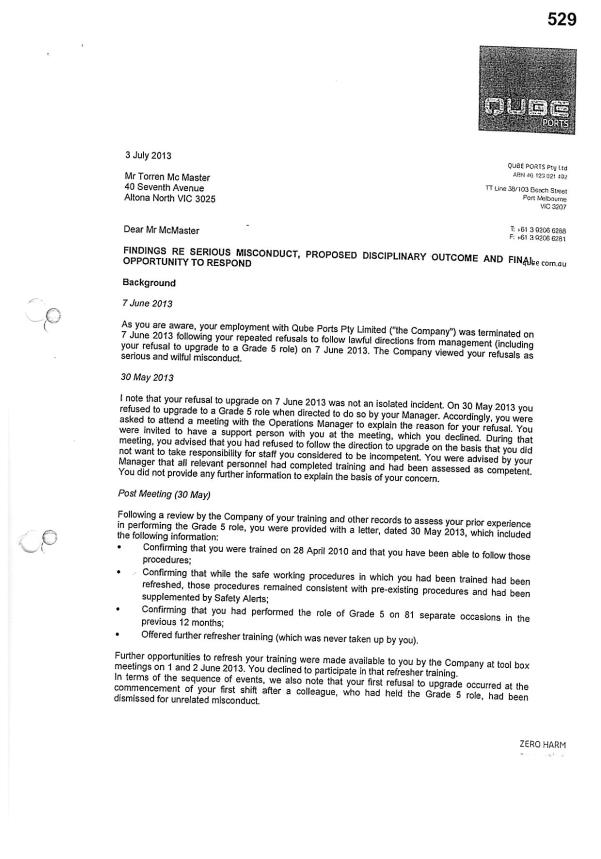
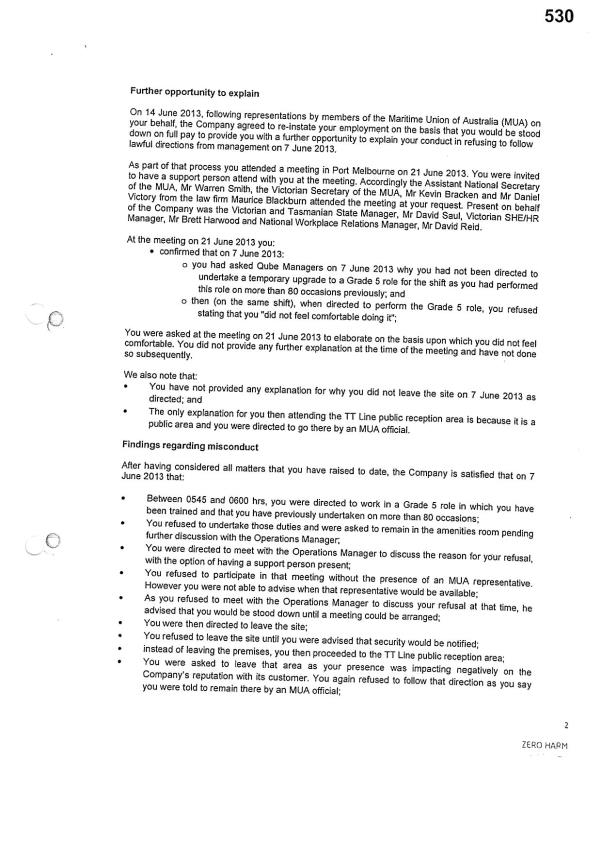
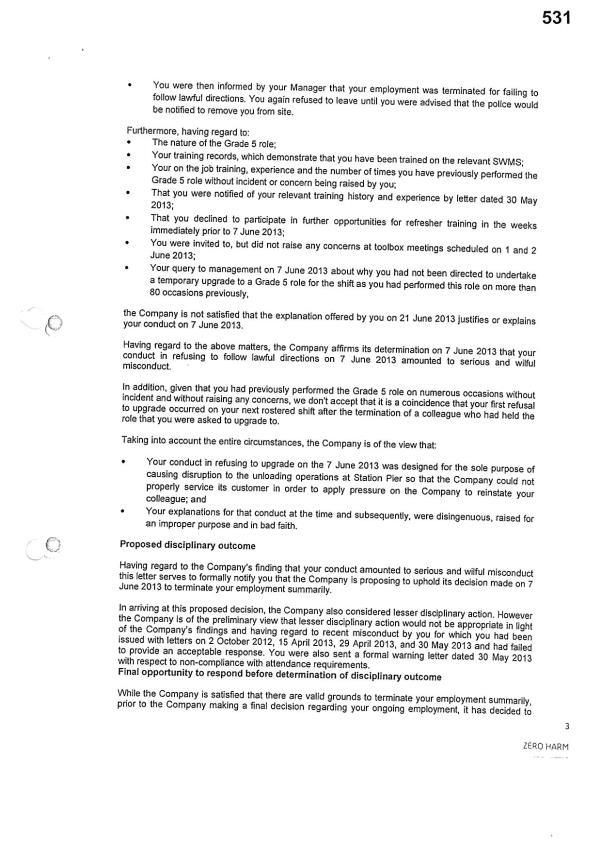
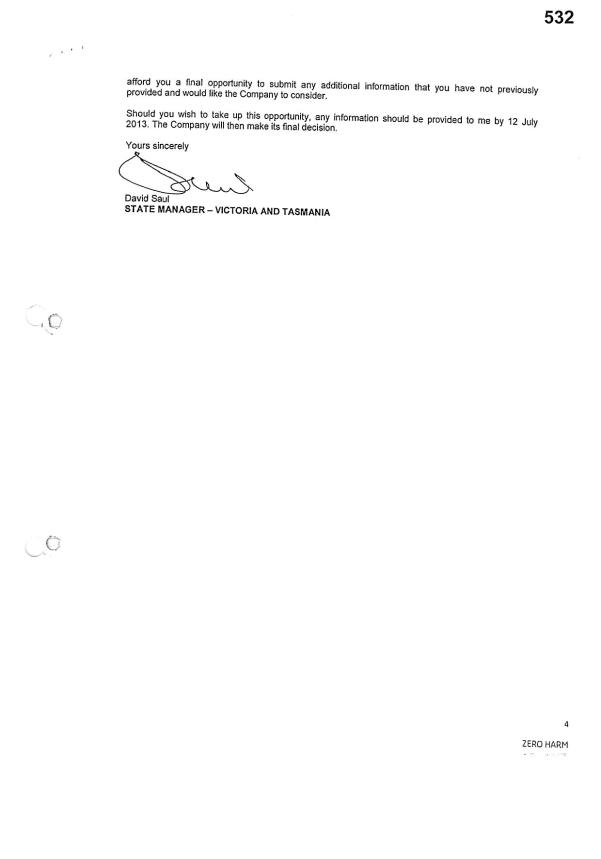
Annexure B